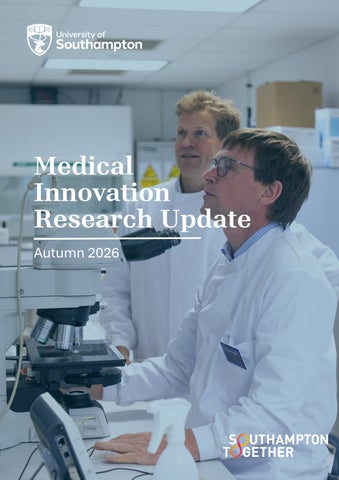
Medical Innovation Research Update Autumn 2026
GIFT ANNOUNCEMENTS The data below shows where we are currently sitting in relation to the IMI and the MIF since the start of August (year to date) and overall campaign totals. These figures were taken from the dashboards.
Institute for Medical Innovation NEW FUNDS COMMITTED CUMULATIVE CAMPAIGN TOTAL
YEAR TO DATE
£11.92m
£228,878
We have 43 active members of the IMI giving groups Members of the IMI Giving Levels receive the following benefits (more details can be found in the naming opportunities brochure): Annual report showcasing progression of the building. Termly updates highlighting discoveries across all five disease areas. Events hosted by senior members of the IMI team, with opportunities to meet some of the team and researchers. Name permanently displayed in the building via donor wall.
Medical Innovation Fund NEW FUNDS COMMITTED CUMULATIVE CAMPAIGN TOTAL
YEAR TO DATE
£1.79m
£11,243
1
Donor Highlights: Mr Paul and Mrs Susan Boissier PRM: Mercedes Carballo Paul is a former Chief Executive of the Royal National Lifeboat Institution (RNLI). A former Royal Navy Officer, Vice Admiral Bossier held titles such as Chief of Fleet Support, Deputy Commander-in-Chief Fleet and Chief Naval Warfare Officer before retiring in 2009. He is a member of the RYS in Cowes. Susan is a sponsor of HMS Dragon which joined the Royal Navy Surface Fleet in April 2012. They both attended the IMI launch event in Hampshire where they had a number of meaningful interactions with members of the team, noting they were humbled and grateful to be invited to our events. During conversations they both mentioned how fascinating they found their CCI tour in 2025 and also mentioned that they wanted make a gift to the IMI and asked if this can be in the format of a regular gift. They have since donated a bronze level gift. They are managed as a couple with equal decision making power and moved from being influencers to donors to the IMI. They are strong advocates, introducing fundraisers to a number of potential donors and requested IMI brochures to distribute amongst their network.
Mr Cheng-Huat Tan PRM: Tom Prentki Alumnus, based in Singapore, he has held senior technical and leadership roles with Broadcom since 2005, focusing on research and development, integrated circuit design and intellectual property development. Prior to joining Broadcom, he served as an IC Design Project Manager at Agilent Technologies and as a Senior Analog IC Designer at Sony Electronics (S) Pte Ltd. Mr Tan is also a named inventor on multiple patents relating to semiconductor technologies. He plays an active part of the international alumni community, having attended many receptions and events over the years. He also attended the VC dinner is Singapore in January this year. He has had many meaningful interactions with the university, noting how supported he felt when he was a student and feels grateful that he can return his goodwill back to the University so that other can benefit and keep the gifting tradition ongoing. Has given £500k to the IMI and also donated to the Malaysia campus. Mr Tan will have part of the buliding named in his honour.
2
Visualising the future: the latest architectural concept designs for the IMI revealed Our pioneering Institute for Medical Innovation (IMI) will unite the greatest minds in medicine, science, mathematics and engineering. Our goal remains clear: to make faster breakthroughs to help prevent, diagnose, treat and cure the world’s most devastating diseases. We recently held our second public consultation event regarding the latest updates for the building. Below is the architect’s most recent visualisation illustrating the proposed design which we are delighted to share with you.
3
Wildflower’s potential to help tackle antibiotic resistance Researchers at the University of Southampton, Trinity College Dublin and Brunel University London have discovered that Tormentil, a yellow wildflower (pictured below) found in boglands and heathlands across the UK, Ireland and Europe, may help fight antibioticresistant infections. Ronan McCarthy (pictured below), Professor in Microbial Biofilms at the National Biofilms Innovation Centre, University of Southampton, led the study. The team examined 70 bogland plants and found that Tormentil could stop the growth of Acinetobacter baumannii, a dangerous bacterium responsible for around 50,000 deaths worldwide each year. The bacterium is commonly found in hospitals and can cause wound, respiratory and urinary tract infections. It is difficult to treat because it is resistant to many antibiotics. The study found that Tormentil may increase the effectiveness of colistin, a powerful antibiotic often used as a last-resort treatment. Scientists also investigated how the plant works. They identified two compounds, agrimoniin and ellagic acid, which kill bacteria by preventing them from accessing iron, a nutrient they need to survive. When iron was added, the antibacterial effect disappeared, confirming the findings. Tormentil has been used in traditional medicine for centuries to treat conditions such as toothache, wounds, stomach problems and gum disease. Researchers say the study highlights the value of revisiting traditional remedies and could lead to the development of new treatments to tackle the growing challenge of antibiotic resistance. This research shows the importance of collaboration. With the development of the Institute for Medical Innovation (IMI), we are bringing together exceptional researchers, clinicians and innovators to drive breakthroughs that will transform healthcare and save lives.
6
In conversation with the experts: Dr Victoria Goss In an exclusive interview, we are pleased to introduce Dr Victoria Goss, Associate Professor of Early Diagnosis and Translational Research. Dr Goss leads and supports translational research and clinical trials, focusing on developing and testing new diagnostic methods and treatments, particularly for early cancer detection and respiratory diseases, to improve patient outcomes.
How important is collaboration to your work? How will the IMI enhance your research?
In this interview, Victoria shares an insight into her work and how philanthropy plays such an important role to her incredibly vital area of work.
You spoke at the launch event for the IMI in Hampshire, how would you sum up your experience of the evening? And what are you most excited about regarding the IMI?
Collaboration is key to clinical research as we work with a wide range of groups with diverse expertise. The IMI will allow many of those groups to work together in one space to drive cross-disciplinary working and allow successes in one disease area to be rapidly translated to others.
It was an incredible privilege to speak at the IMI launch event - a real pinch me moment to be beside colleagues whose work I have looked up to for a long time! It's always a pleasure for me to have the opportunity to showcase the work of my team who are incredibly dedicated to delivering the studies we work on. It was also wonderful to meet the guests and be asked some very interesting and pertinent questions. I'm really excited to see the building work get underway and to know that we will soon have a building housing cutting edge research equipment and infrastructure. How important is the relationship between the clinical trials unit and the university? How long have you been at the University of Southampton and what drew you to working here? I first started working in Southampton in 2007 when I moved here for my first postdoctoral position. In 2015 I moved to Yorkshire for a few years and then I returned to the university to work at the Southampton Clinical Trials Unit in 2020. Coming back to Southampton was a very easy decision there is incredible and ambitious research happening here and I'm inspired every day by my colleagues.
We work very closely with colleagues from across many specialties at the university which is incredibly valuable - I love going to meetings and seeing the breadth of research that happens and talking to people about trials that we might be able to run one day.
4
Is there anything you are particularly proud of? This question may prove to be harder to answer because I'm incredibly proud of all the studies I have worked on and that my team are developing. Some highlights have included iDxlung which successfully recruited 7,000 participants to find new biomarkers for the early detection of lung cancer and the NHS Cancer Vaccine Launch Pad study which gives more patients the opportunity to take part in trials of novel immunotherapies. What role does philanthropy play in developing your important area of research I have already been lucky enough to receive philanthropic funding to support one of my studies which allowed us to investigate how patients felt about the possibility of home urine collection being used one day to test for signals of cancer. This work gave us some great insights that wouldn't have been possible otherwise and I'm very grateful, so the power of philanthropic research is very real to me!
We are grateful to have Dr Goss as part of the team here at Southampton. Her work informs such a huge part of the research and trials that are happening at the university. The IMI will bring together leading experts from across the university, creating a collaborative environment that accelerates medical breakthroughs.
5
Scientists are using tree bark to assess air pollution
Research led by Dr Natasha Easton (pictured above) is investigating whether tree bark can be used to track harmful air pollution in local communities. The study focuses on particulate matter, tiny dust particles that are too small to see but can be breathed deep into the lungs. The smallest particles can even enter the bloodstream and have been linked to a range of health conditions, including asthma, heart disease, stroke and dementia. The project is testing whether tree bark can capture and store evidence of pollution over time. This could help researchers understand where pollution comes from and which communities are most affected. The study is being carried out in partnership with Southampton and Winchester City Councils, with bark samples collected from trees across both cities. Pollution comes from a range of sources, including vehicle exhausts, industrial emissions, and particles released by tyres and brakes. These sources leave distinctive chemical traces that can help researchers identify their origins. Dr Easton said: “Air pollution doesn’t affect every area in the same way, so it’s really important that we build a clearer picture of what’s happening in our local environments.” She added: “By looking at what’s captured in tree bark, we hope to uncover these hidden fingerprints to pinpoint sources of pollution and guide strategies to ultimately support healthier communities.” The findings could help improve air quality and support healthier communities in the future.
7
Severe asthma patients are often battling multiple health conditions A major new study has found that most people living with severe asthma also have other health conditions, and these conditions often occur together in predictable patterns. The study was led by scientists from the University of Southampton, University Hospital Southampton, the National Institute for Health and Care Research (NIHR), and the Southampton Biomedical Research Centre. It analysed information from 2,700 patients with severe asthma across 11 European countries. Researchers found that almost all patients had at least one other health condition, while most had three or more. These additional conditions can affect how well a person's asthma is controlled, how often they have asthma attacks and the type of treatment they need. The study identified three common groups of patients: High steroid use: Patients who used large amounts of steroid medicine were more likely to have weakened bones (osteoporosis) and weight gain. Severe allergies: Patients commonly experienced conditions such as eczema, hay fever and rhinitis. Sinus problems: Patients often had long-term sinus inflammation (sinusitis) and nasal polyps. Professor Ramesh Kurukulaaratchy, Professor, Clinical and Experimental Sciences, who led the study, said: "Better understanding of these patterns will help us look beyond asthma alone and improve the care for people living with severe asthma." Dr Anna Freeman, Associate Professor, Clinical and Experimental Sciences added: "People with severe asthma often live with a heavy burden of other conditions but, until now, we didn't fully understand how they were linked." Researchers hope the findings will help doctors provide more personalised care and improve quality of life for people with severe asthma.
8
From fear to hope: One family’s journey with childhood albinism When Carly Thorpe first looked into the eyes of her newborn daughter, Nevaeh, she knew something was wrong. Nevaeh’s eyes moved rapidly from side to side, and although doctors initially reassured her that this was normal development, Carly feared her daughter might be blind. Eventually, Nevaeh was diagnosed with albinism, a genetic condition that affects the production of melanin and can cause significant vision problems, including nystagmus, which leads to involuntary eye movements. After moving back to Jersey in 2023 from Dubai, Carly and her partner James received support from local clinicians and learned more about the condition. When Carly became pregnant again, she was told there was a one-in-four chance her second child would also have albinism. In 2024, Novah was born and was quickly identified as having the condition. Her eyesight is even more severely affected than her sister’s, creating further challenges for the family. Seeking specialist support, Carly contacted Professor Jay Self, a leading paediatric ophthalmologist at University Hospital Southampton. He invited both girls for further testing, which confirmed that Nevaeh has oculocutaneous albinism type 2, and Carly is expecting Novah’s results in the autumn, but she thinks it will be the same diagnosis. Both girls have nystagmus (involuntary eye movements that can affect vision and balance) and astigmatism (blurry vision) and have been prescribed glasses to improve their eyesight. Novah cannot see more than one metre away and has an astigmatism score of -4.75. Nevaeh’s astigmatism score is -2. Professor Self is leading innovative research into childhood sight disorders. He and colleagues have developed computer games, including NystagME and Amblios, to measure vision more realistically and assess whether treatments are working. Nevaeh is already using the games as part of the research. This work forms part of Southampton’s wider programme of sight-loss research and will be supported by the Institute for Medical Innovation (IMI). Carly hopes this research will lead to better treatments and brighter futures for children like Nevaeh and Novah.
James, Nevaeh, Carly and Novah 9
Listening differently: connecting hearing loss and dementia Professor Tracey Newman, Professor of Neuroimmunology at Southampton, is leading work that brings together hearing research and dementia science, with a focus on helping people recognise hearing problems earlier and access support sooner. Hearing loss affects around 18 million people in the UK and can occur at any stage of life. However, many people delay seeking help. Professor Newman explains that people often wait around ten years before getting their hearing tested and may wait another ten years before using hearing aids. This is concerning because untreated hearing loss is increasingly associated with a higher risk of dementia, while using hearing aids and other interventions may help protect cognitive health. Hearing loss can also have a major impact on social life. Following conversations, especially in noisy environments, can become tiring and frustrating. Over time, some people begin to withdraw from social situations. This matters because social isolation is itself linked to poorer cognitive health, creating a cycle in which hearing loss, isolation, and dementia risk become connected. This research has also highlighted barriers within healthcare. Hearing difficulties can make dementia assessments less reliable if patients struggle to hear questions. To address these challenges, Professor Newman works closely with people who have lived experience of hearing loss through ALLEARS@UoS, a patient and public involvement group. Their insights help shape research and improve healthcare practices. Alongside this work, Tracey is developing new ways to assess cochlear implants, particularly for people who cannot easily explain what they are experiencing, such as young children or those with cognitive impairment. Her team is creating a quick, objective test that could help clinicians identify problems earlier. At the heart of this research is a simple message: people should recognise hearing loss early, seek support sooner, and stay connected to their communities. Increased awareness and timely action could improve quality of life and help reduce dementia risk.
10
Fridge-free vaccine shows promise of reaching millions worldwide A world-first trial of a fridge-free tetanus and diphtheria vaccine has produced promising results, offering hope for improved access to vaccines around the world while reducing carbon emissions. According to the World Health Organization (WHO), around half of all vaccines are wasted each year, often because they are exposed to unsafe temperatures during storage or transport. Vaccines that do not require refrigeration could help solve this problem, making it easier to deliver life-saving medicines to remote communities and areas affected by conflict. Professor Saul Faust (pictured below), who led the research, said the technology could transform the way vaccines are stored and delivered worldwide if larger studies confirm the results. The Phase 1 trial, led by the University of Southampton and University Hospital Southampton NHS Foundation Trust, found that the vaccine, known as SPVX02, was safe and well tolerated, with no serious side effects linked to the vaccine. Researchers found that it can be stored at temperatures of up to 30°C for at least two years without losing its effectiveness. It also remained effective after repeated exposure to temperatures ranging from -20°C to +40°C. The study involved 60 healthy adults. Within 28 days of vaccination, all participants developed protective antibody levels against both tetanus and diphtheria, producing immune responses similar to those of existing approved vaccines. A larger trial is now underway. Stablepharma, a UK biotechnology company, expects to complete the vaccine's clinical development programme by 2027, bringing fridge-free vaccines a step closer to widespread use.
11
The University of Southampton helps develop next-gen protection against respiratory viruses The university is helping to lead a major international research programme that aims to improve protection against respiratory viruses, including those that could cause future pandemics. Funded by the Advanced Research and Invention Agency (ARIA), the Sustained Viral Resilience programme brings together 11 research teams from the UK and USA to develop a new type of medicine that could provide broad, long-lasting protection against a range of respiratory infections. One of the selected projects is TRIUMPH-NK, a study led by Professor Salim Khakoo from Southampton’s Faculty of Medicine. The project will explore how natural killer (NK) cells, a type of immune cell that helps the body fight infections, can be trained and strengthened to provide longer-lasting protection against respiratory viruses. Unlike traditional vaccines, which target specific viruses, the programme is developing new medicines called Sustained Innate Immunoprophylactics (SIIPs). These treatments aim to boost the body’s natural immune defences, creating ready-to-use protection that could be rapidly deployed during future outbreaks before vaccines become available. The project builds on Southampton’s internationally recognised expertise in NK cell research. Using advanced mRNA technology, the team hopes to increase the activity of these cells in the respiratory tract, helping the body respond more effectively when it encounters a virus. The Southampton team includes researchers from across the University and works closely with University Hospital Southampton NHS Foundation Trust. Together, they are combining expertise in immunology, clinical research, data science and emerging technologies to develop new ways to prevent viral disease, further growing the universities reputation for world-leading immunology research and its important role in strengthening global preparedness for future pandemics.
12
Could a simple urine test help detect lung cancer earlier?
Researchers at the University of Southampton are investigating whether simple urine tests could help detect lung cancer earlier and improve survival rates. As part of the UH-CAN Lung study, 1,000 people across Southampton have received home urine collection kits to see if this could become an easier way to screen people at high risk of the disease. Lung cancer is the third most common cancer in the UK and the leading cause of cancer deaths. Nearly 70% of cases are diagnosed at a late stage, when treatment is less effective. Researchers hope that finding cancer earlier could improve outcomes for patients. The study, funded by the Jon Moulton Charitable Trust, focuses on people who did not respond to invitations for the NHS Lung Cancer Screening programme, which offers CT scans to people aged 55 to 74 with a history of smoking. Although the programme has helped detect more than 10,000 lung cancer cases since its launch, around half of those invited do not attend. Reasons include difficulty accessing screening units, concerns about scans, or lack of time. The Southampton Clinical Trials Unit (SCTU) is working with Swedish company Elypta AB to test whether people are willing to collect and return urine samples from home. Participants are also asked to complete a questionnaire about their experience and why they did not attend previous screening appointments. Researchers believe home-based testing could remove barriers to screening and encourage more people to take part. If successful, larger studies will follow to evaluate whether urine tests can reliably detect lung cancer early. The team hopes this approach could eventually help identify lung cancer, and potentially other cancers, at a stage when treatment is most effective. Dr Victoria Goss (see page 3 for her full interview), Associate Professor of Early Diagnosis and Translational Research at the SCTU, said: "Finding lung cancer earlier can improve outcomes for patients by identifying the disease when treatment is more likely to work. "Lung cancer can be hard to spot in its early stages because symptoms are often unclear. We need simpler and more accessible ways to detect the disease in people who are at high risk."
13
Find out more https://fund.southampton.ac.uk/innovation/
Contact us about the IMI or with your feedback on this report donorrelations@soton.ac.uk
Office of Development and Alumni Relations University of Southampton University Road, Southampton, SO17 1BJ United Kingdom
The University of Southampton is an exempt charity. Our HMRC reference number for Gift Aid claim eligibility is X19140.