MAGAZINE | ISSUE 15 | SUMMER 2026
Reframing the value proposition for the future of academia
Beginning on page 16
MAGAZINE | ISSUE 15 | SUMMER 2026
Reframing the value proposition for the future of academia
Beginning on page 16
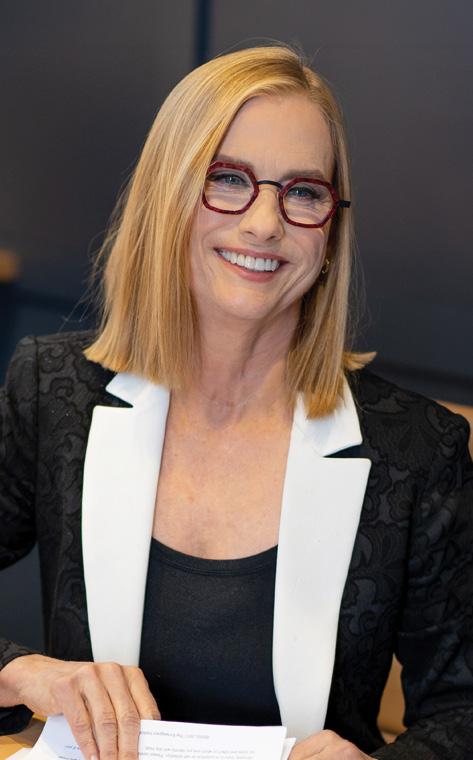
DR. VIRGINIA MAXWELL, forensic science professor and director of the Animal Cruelty Investigation graduate certificate at the University of New Haven, is conducting pioneering research to revolutionize how animal cruelty cases are handled in the courtroom. By tracking biomarkers of pain and stress in dairy heifers at a Connecticut farm, she seeks to establish objective scientific evidence to aid investigations. Leveraging her extensive background in forensic science and animal welfare, Dr. Maxwell aims to replace subjective assessments with data that can hold up in court and improve legal responses to animal neglect. A valued member of the University community since 2007, Dr. Maxwell was recently appointed interim dean of the Henry C. Lee College of Criminal Justice and Forensic Sciences, assuming this post on July 1.




Editor In Chief
Elizabeth Rodgers
Senior Executive Director of Marketing and Communications
Sue Pranulis
Marketing & Communications
Roger Castonguay, Dave Cranshaw, Tyler Hanson, Matthew McCullough, Carolyn Meyer, John Mordecai, Laura Norris, Kaitlyn Pinheiro, Carol Regan, Chris Teodosio, Caitlin Truesdale
Design
Bria Mangione, Bria Loves Design LLC
Contributors
Michael Blanding, Steve Neumann, Courtney Westlake, Doug Whiting
Photography
Defining Studios & Defining Properties, Don Hamerman, Hand Robot / Adobe Stock, Len Rubenstein, University of New Haven Athletics
The University of New Haven Magazine is published twice a year by the Office of Marketing & Communications. Its mission is to connect alumni and other members of the University community to the University and to one another.
Reach us at:
The University of New Haven, 300 Boston Post Road, West Haven, CT 06516 or at magazine@newhaven.edu.
The University of New Haven is committed to equal access to educational and employment opportunities for all applicants, regardless of gender, sexual orientation, race, color, personal appearance, marital status, civil union status, national origin, ancestry, religion, age, or physical or intellectual disability.
©2026 University of New Haven. All Rights Reserved.
For permissions, please contact erodgers@newhaven.edu
In the words of acclaimed trumpeter, composer, and Pulitzer Prize winner Wynton Marsalis: “If you want to be different, do something different.”
Marsalis often uses this philosophy to highlight that standing out requires tangible action rather than a mere desire for attention. He embraces a healthy sense of competition, viewing a crowded field rife with talent as an opportunity to elevate the art form and challenge musicians to find their unique voice. As Marsalis puts it, “Don’t compete with people, compete with yourself. Music is an idea, not a race.”
When it comes to ideation and this pursuit of originality, many theories posit that true creativity is combinatory.
We see arguments across history — from Ecclesiastes to Mark Twain, Albert Einstein, and Steve Jobs — that all human thought is built upon existing cultural knowledge and experiences. Newness comes from remixing old concepts into original combinations rather than creating something from nothing. The more diverse the inputs, the more unique the resulting combinations will be.
In this way, we see it is innately human to consume, digest, connect, and ultimately shape. In fact, it is impossible to remove this human element from the creative process. But holding onto our humanity has become a pretty big ask in a world that feels increasingly more bot than flesh and blood.
My stance? Challenge accepted.
In a recent interview with Oprah Winfrey, Anthropic co-founder and president Daniela Amodei argued that today’s AI revolution might actually offer us an opportunity to deepen, rather than discard, our humanity.
Amodei encouraged people to hold two possibilities simultaneously: “I think there’s a world where AI could damage so many of the things that I think are the hallmarks of a well-lived life. And I think there’s a world where it could enable those. It could allow a lot more people to be able to have meaning and value, to self-introspect, to be the best versions of ourselves, to show up for each other well. I hope that’s the world we’re going to build towards.”
Perhaps the biggest roadblock to building something new is the uncertainty of our current time and what feels like an unprecedented unknown future.
CFP and financial psychology expert Hanna Horvath addresses this ambient anxiety through the lens of financial nihilism and adaptive presentbias, writing, “When the future is uncertain and the present is painful, weighting the now is the rational move.” Yet this propensity to live only in the moment has undeniable repercussions, often preventing us from stepping, both individually and as a society, into the exact meaningful moment we so crave. As Horvath notes, “When the future doesn’t ostensibly exist to people, the present is now where all the meaning has to live.”
The antidote? Horvath recommends a prescription just as unexpected and audacious as Amodei’s: “Financial nihilism is the mainstream position in today’s economy. So the most contrarian financial position you can take in 2026 is hope.”
And this is exactly where we begin this issue of the University of New Haven Magazine — at the intersection of audacity and hope.
In this liminal space, we release the idea of a known destination or endpoint and cultivate faith in a future storyline before it is validated. We create for the sake of creating anyway. We defy the death of trust and altruism and plant seeds to bear fruit we may not personally witness in our lifetime.
In higher education — a landscape historically defined by imposing ivory and snaring foliage — this acts as a unique call and response. What does it mean to do something truly different? What are the significant reasons to stand out, and where do we set our bar? How do we maintain our integrity, values, and humanity in the face of automation? Most importantly, how do we choose hope each day as an institutional community, and how does that choice shape everything we do from here?

Elizabeth J. Rodgers Editor In Chief
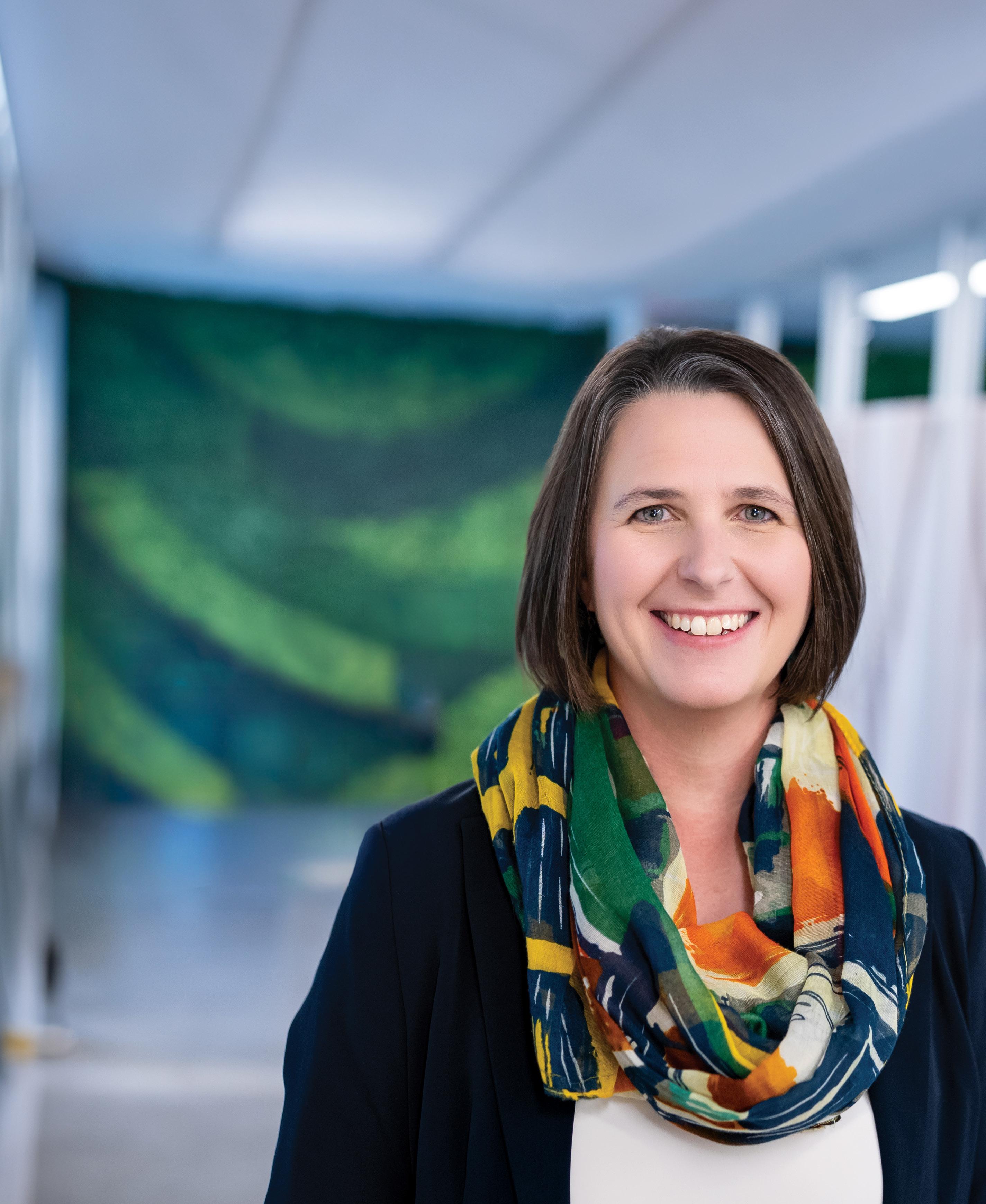
The University of New Haven has appointed Sarah P. Shultz, Ph.D., as the next dean of its School of Health Sciences, effective March 1, 2026.
Dr. Shultz joins the University following a comprehensive national search. She brings extensive experience in strategic planning, program accreditation, faculty development, institutional fundraising, community engagement, and student recruitment. Her leadership background focuses heavily on interdisciplinary collaboration, institutional equity, educational access, and innovation within patient-centered healthcare education.
Dr. Shultz’s career spans multiple administrative and faculty roles globally. She previously served as dean of the School of Arts and Sciences and special assistant to the provost at Fort Lewis College in Colorado, where she also taught in the Health and Human Performance Department. Her prior administrative leadership includes roles as interim dean of the Marjorie K. Unterberg School of Nursing and Health Studies at Monmouth University in New Jersey, and associate dean of international relations for the College of Health at Massey University in New Zealand. Additionally, she served as a tenured professor and department chair at Seattle University in Washington, directing university-level initiatives to improve student retention and engagement.
Her academic credentials include a Ph.D. and a Master of Education in kinesiology, with an emphasis in athletic training, from Temple University, and a bachelor’s degree in exercise and sport science from the University of North Carolina, Chapel Hill. She also holds a graduate certificate in executive leadership from Seattle University. Dr. Shultz completed a postdoctoral research fellowship at the Institute of Health and Biomedical Innovation at Queensland University of Technology in Australia. As a researcher, she has secured significant external funding and has been published in peer-reviewed journals, including the Journal of Biomechanics, the International Journal of Environmental Research and Public Health, and Nutrients.

RECOGNITION
The Hartford Business Journal named University of New Haven President Jens Frederiksen, Ph.D., to its annual "5 to Watch" list for 2026. This publication identifies five influential leadership figures in Connecticut who are expected to significantly impact their sectors in the upcoming year. This marks the first time since 2024 that the list has included a higher education leader. President Frederiksen was recognized alongside executives from Sikorsky, Connecticut Children’s, the Capital Region Development Authority, and the state’s top utility regulator.
The recognition centers on an ambitious operational agenda at the University of New Haven. Key initiatives include the launch of The Elevation Center, a 130,000-square-foot facility situated on 12 acres near the main West Haven campus. Designed inside a former commercial retail building, the center serves as a collaborative hub for student and corporate partnerships focused on automation, production, and applied research projects.
Additional major institutional projects include the strategic relocation of the University's business school back to the main West Haven campus and planned upgrades to the athletics center. The expansion also features an international branch campus in Riyadh, Saudi Arabia, following formal approval from the Saudi government in October 2025. This international campus builds upon two decades of existing educational programs and degree offerings for Saudi students. Furthermore, the University is managing a major athletic transition as its sports programs elevate to the NCAA Division I level.

President Frederiksen is the first higher education leader named to the list since 2024.
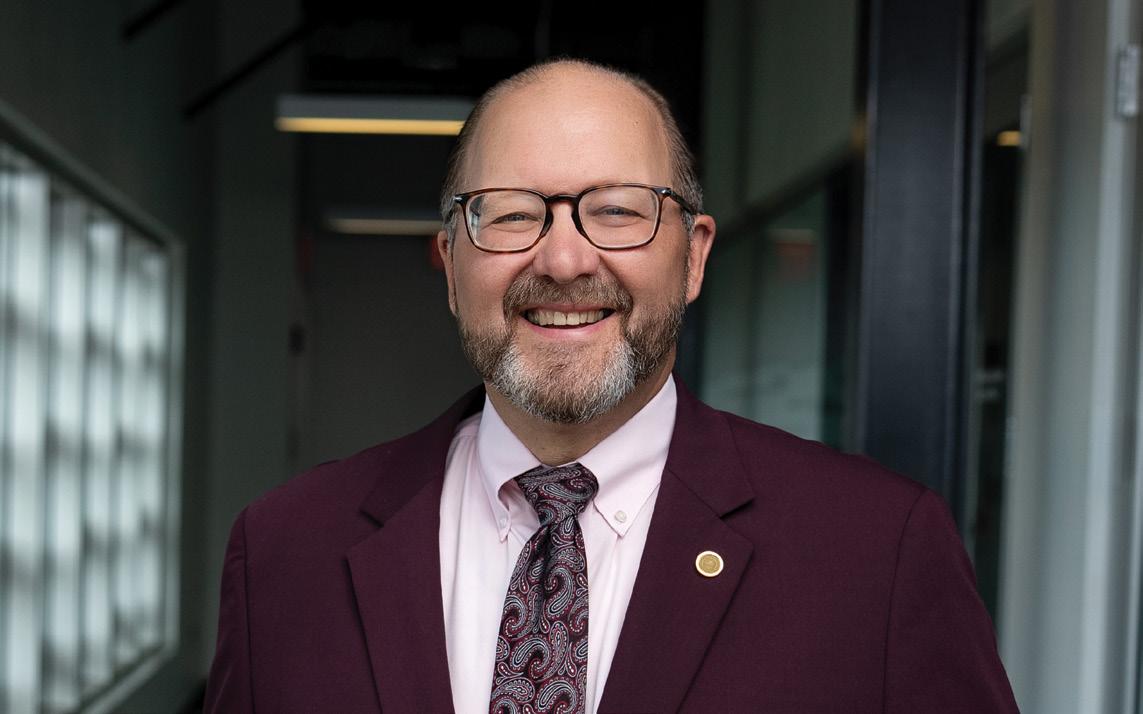
Paul Lavoie, vice president for innovation and applied technology at the University of New Haven, has been appointed to the Board of Directors of the newly launched American Manufacturing Futures Institute (AMFI). In tandem with this board seat, Lavoie will serve in a national leadership role as America’s chief manufacturing officer. AMFI is a national nonprofit organization focused on advancing United States manufacturing by aligning workforce development, industrial strategy, civic responsibility, and public–private ecosystem collaborations to support long-term national competitiveness.
At the University of New Haven, Lavoie directs the development of The Elevation Center. This facility serves as an institutional hub designed to connect students, faculty, policymakers, and corporate partners to address applied research, regional economic growth, and talent development. The University has recently expanded its focus on high-growth sectors, introducing new academic programming and industry partnerships in advanced manufacturing, robotics, cybersecurity, and data-driven innovation.
Lavoie joined the University administration in July 2025. Prior to this appointment, he spent more than three years serving as the chief manufacturing officer for the State of Connecticut. In 2024, Manufacturing Digital Magazine named him one of the top five chief manufacturing officers globally, alongside executives from corporations including Michelin, General Motors, Ferrari, and Johnson Controls. In his new national capacity with AMFI, Lavoie will advise the institute on nationwide industry strategies, public–private initiatives, and ecosystem developments to bridge education, industry, and public service.
Named one of the top five chief manufacturing officers globally — alongside executives from General Motors, Ferrari, and Michelin.

The University of New Haven received a $4 million philanthropic gift from Janet J. Jensen ’17 Hon. to establish the Jensen Community Center for Applied Justice. Jensen is a former member of the University’s Board of Governors and the founder of The Jensen Project, a nonprofit organization that has directed more than $11 million toward anti-trafficking efforts and the fight against sexual violence.
The contribution will fund the renovation of a 10,000-square-foot commercial building, a former CVS Pharmacy, located at the intersection of Route 1 and Campbell Avenue in West Haven. Renovation of the space is scheduled to begin in late summer or early fall. Once operational, the center will serve as an integrated, trauma-informed hub dedicated to developing survivor-centered initiatives. These programs will span prevention, intervention, law enforcement coordination, cyber
The University of New Haven received a seven-figure financial commitment from local entrepreneur David Sussman to establish the Sussman Family Sales Institute. Sussman is the chief visionary officer of The Family Security Plan®, a Connecticut-based insurance firm, and a member of the Pompea College of Business’ Advisory Board.
The new institute will be located within the planned 50,000-square-foot facility for the Pompea College of Business on the main West Haven campus. Groundbreaking for this donor-funded academic building is scheduled for later this year, following the business college's relocation back to West Haven from its former campus in Orange, Connecticut. The Sussman Family Sales Institute is designed as an experiential learning hub where students will study modern sales strategies, train
forensics, advanced investigative techniques, and long-term survivor support. The ultimate objective is to establish best practices that can be scaled and shared nationwide.
The Jensen Community Center for Applied Justice will house several of the University’s existing academic and professional programs. These include the Center for Forensic Investigations of Trafficking in Persons, the Center for Advanced Policing, the Tow Youth Justice Institute, the Center for Analytics, and the Prison Education Program. The facility will combine research, training, policy innovation, and public education to prevent exploitation, support survivors, and address systemic challenges in youth justice, public health, violence prevention, and community-based policing.
Programs housed at the center:
· Center for Forensic Investigations of Trafficking in Persons
· Center for Advanced Policing
· Tow Youth Justice Institute Center for Analytics
· Prison Education Program
for local and national sales events, and engage with corporate leaders. The University's sales students have previously achieved top placements at the National Collegiate Sports Sales Championship and the Northeast Sales Competition.
Beyond the Sales Institute, the upcoming business facility will feature advanced learning environments, including an artificial intelligence and business analytics lab, an entrepreneurial pitch room, a simulated financial trading room, and a student-run cafe. The building plans also incorporate dedicated suites for career development, executive mentorship, student internships, and academic advising, alongside state-of-the-art classrooms, a lecture theater, a corporate boardroom, and collaborative breakout spaces.
handshakeSussman Family Sales Institute
Study modern sales strategies through hands-on, real-world application
Train and compete in local and national sales competitions
Engage directly with corporate leaders and industry professionals

Internationally acclaimed forensic scientist
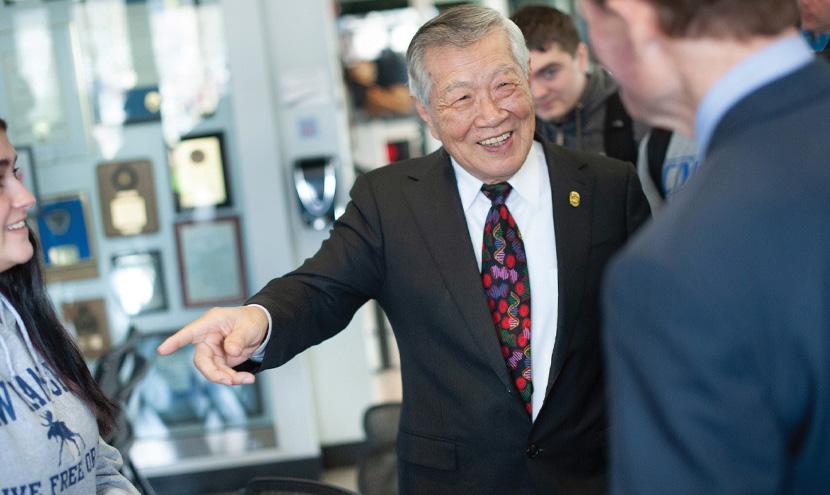
Dr. Henry C. Lee passed away on March 27, 2026, at his home in Henderson, Nevada, at the age of 87. Dr. Lee was a distinguished professor at the University of New Haven for more than 50 years and an emeritus member of the University’s Board of Governors for nearly three decades. Up until his passing, he was finalizing his latest book on missingpersons investigations, adding to a career portfolio of more than 40 authored or co-authored books.
Dr. Lee joined the University of New Haven faculty in 1975 and founded the institution’s forensic science program, growing it from a single classroom into a globally recognized multidisciplined academic department. In 1998, he established the Henry C. Lee Institute of Forensic Science. The University opened an ultramodern, three-story, 15,000-square-foot facility for the Institute in 2010, which houses a crime scene center, a high-tech forensics room, a crisis
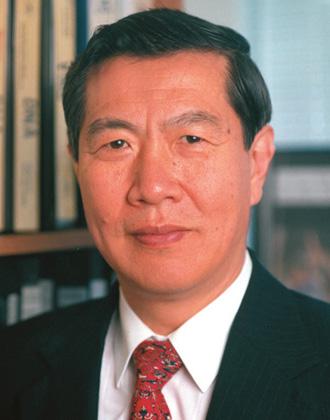
management center, and an advanced learning facility equipped with cutting-edge investigative technology.
Alongside his academic tenure, Dr. Lee served the State of Connecticut in multiple high-level public safety roles. He was the chief criminalist for the state and director of the Connecticut State Police Forensic Science Laboratory from 1978 to 2000. He also served as commissioner of the Connecticut Department of Public Safety and the Connecticut State Police from 1998 to 2000, followed by a tenure as chief emeritus for the state’s Division of Scientific Services from 2000 to 2010.
Throughout his career, Dr. Lee acted as a forensic expert in all 50 U.S. states and more than 46 countries, lecturing in over 70 countries and consulting for 600 law enforcement agencies. He provided expert testimony more than 1,000 times in criminal and civil courts globally. His investigative assistance was utilized in numerous high-profile cases, including the
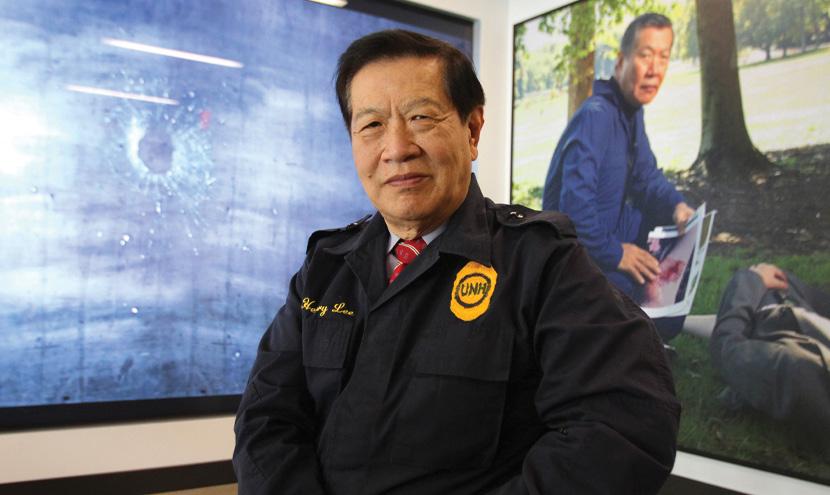
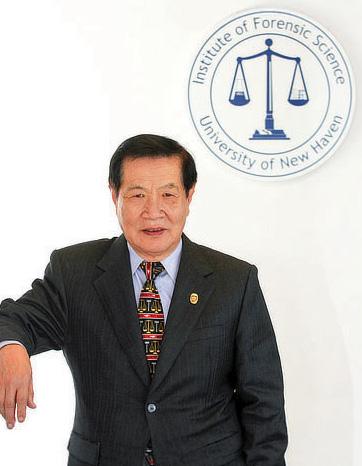
O.J. Simpson trial, the murder of JonBenét Ramsey, the Helle Crafts case, the Laci Peterson case, the death of Chandra Levy, the kidnapping of Elizabeth Smart, the 9/11 forensic investigations, and the reinvestigation of the John F. Kennedy assassination. Born on November 22, 1938, in Rugao, Jiangsu, China, Dr. Lee emigrated to Taiwan, earning a Bachelor of Arts in police administration from the Central Police College in 1960. He rose to the rank of captain in the Taipei Police Department at age 22 before moving to the United States in 1964. He earned a bachelor’s degree in forensic science from John Jay College in 1972, a master’s degree in biochemistry from New York University in 1974, and a Ph.D. in biochemistry from NYU in 1975. Dr. Lee was awarded 30 honorary degrees, including two from the University of New Haven. He is survived by his wife, Angel Xiaping Jiang, two children, two stepchildren, and four grandchildren.

The University of New Haven secured formal approval from the New England Commission of Higher Education (NECHE) to establish its international branch campus in Riyadh, Saudi Arabia. As one of the oldest and most respected regional accrediting bodies in the United States, NECHE’s approval ensures that the new Middle Eastern site operates under the exact same rigorous academic and institutional quality

standards that govern the University’s domestic programs in Connecticut.
Earning this regional accreditation is a critical regulatory milestone required for the campus’s scheduled opening in the fall of 2026. The NECHEapproved framework will initially debut degree programs through a College of Business and Digital Innovation. Future accredited expansions will introduce degree paths through a College of Engineering and Advanced Manufacturing, alongside a College of Arts and Applied Sciences. The
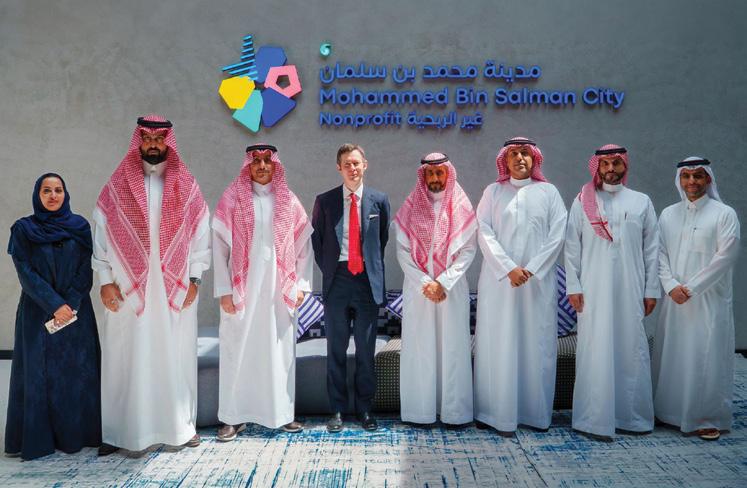
The University of New Haven announced that the first phase of its new international branch campus, the College of Business and Digital Innovation, will be located inside Mohammed Bin Salman Nonprofit City, known as “Misk City,” in Riyadh, Saudi Arabia. Set to open in the fall of 2026, the campus is projected to welcome an inaugural incoming class of up to 500 undergraduate and graduate students specializing in business, entrepreneurship, and digital innovation.
Misk City is a master-planned, dedicated district explicitly established to foster innovation, education, the arts, culture, sports, and the development of
future leaders. Designed as an integrated hub that blends learning, work, and community life, the location provides students with direct access to a broader entrepreneurship ecosystem, commercial cafes, social spaces, and sports facilities. Structurally, Misk City is built to be one of the greenest and most connected districts in Saudi Arabia, utilizing smart transit links and prioritizing urban sustainability and personal well-being.
The choice of this specialized nonprofit city serves an academic purpose by embedding the University directly into the economic sectors driving Saudi Arabia’s Vision 2030 goals. The
location will offer NECHE-accredited undergraduate and graduate degrees, executive education, and specialized micro-credentials to a projected student body of over 10,000 learners.
By maintaining NECHE oversight, students enrolled at the Riyadh campus gain seamless access to the University’s main campus in West Haven, Connecticut, and its satellite campus in Tuscany, Italy, with full portability of credit and resources. This landmark decision marks the first time a U.S. international branch campus has been approved by a major American accreditor to operate inside Saudi Arabia, aligning the institution’s global expansion with the economic and educational diversification goals of Saudi Arabia’s Vision 2030 initiative.
location connects students to high-growth industries in business, technology, tourism, and creative fields. This establishment follows the University securing a foreign branch campus license from the Ministry of Education of the Kingdom of Saudi Arabia, making it the first American institution to achieve this status.
FACULTY EXCELLENCE
Mirlinda Ndrecka, Ph.D., an associate professor of criminal justice at the Henry C. Lee College of Criminal Justice and Forensic Sciences, received a Fulbright U.S. Scholar Program award for the Spring 2026 Semester. Granted by the U.S. Department of State and the Fulbright Foreign Scholarship Board, the award funds her teaching appointment at the University of Tirana School of Law in Albania.
An expert in institutional corrections and reentry programs, Dr. Ndrecka is teaching within the university’s executive master’s in criminology program. Her responsibilities include co-teaching courses, leading comparative seminars on American and Albanian justice systems, and collaborating on research. The initiative serves justice sector professionals from the Albanian Ministry of Justice, the Ministry of Interior, the courts, and the prosecutor’s office.

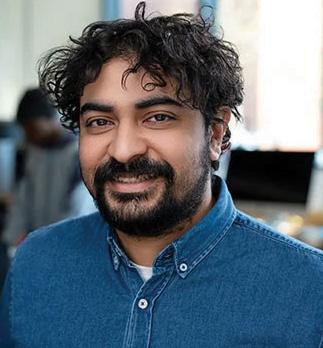
Following National College Decision Day on May 1, the University of New Haven announced the arrival of a record-breaking undergraduate first-year class. The incoming Class of 2030 accounts for more than 1,400 student enrollment deposits. This record domestic undergraduate enrollment was drawn from a highly competitive application pool of more than 22,000 total applicants, building directly upon the admissions momentum of the preceding year’s highly selective class.
The arrival of the Class of 2030 counters broader regional enrollment contractions often attributed to the higher education “demographic cliff” in New England. This growth coincides with several major, forward-looking University infrastructure and athletic initiatives that will shape the academic experience for these incoming first-year students during their time on campus.
Members of the Class of 2030 will witness the University’s full transition to NCAA Division I athletic membership, which is scheduled to conclude in advance of the 2028–29 academic year. Additionally, their undergraduate tenures will align with major physical campus expansions, including groundbreaking later this year on a new 50,000-square-foot facility for the Pompea College of Business and the ongoing development of The Elevation Center. This latter project is a 133,000-square-foot adjacent commercial space designed to function as an industry–academia bridge, preparing the Class of 2030 to eventually transition directly into the global workforce.
Ganesh Balasubramanian, Ph.D., chair of the Mechanical and Industrial Engineering Department at the Tagliatela College of Engineering, has been elected to the Connecticut Academy of Science and Engineering (CASE). Established in 1976 by the Connecticut General Assembly, CASE provides technical and scientific guidance to the state’s government, industries, and residents.
Dr. Balasubramanian was selected for his contributions to materials science, specifically his use of data-enabled simulations, advanced computational methods, and artificial intelligence tools to accelerate the predictive design, discovery, and synthesis of highentropy materials. His research focuses on optimizing the additive manufacturing and high-temperature performance of these ultradurable compounds for aerospace, healthcare, and clean-energy technologies. He joins three other University faculty members who have received this state distinction.

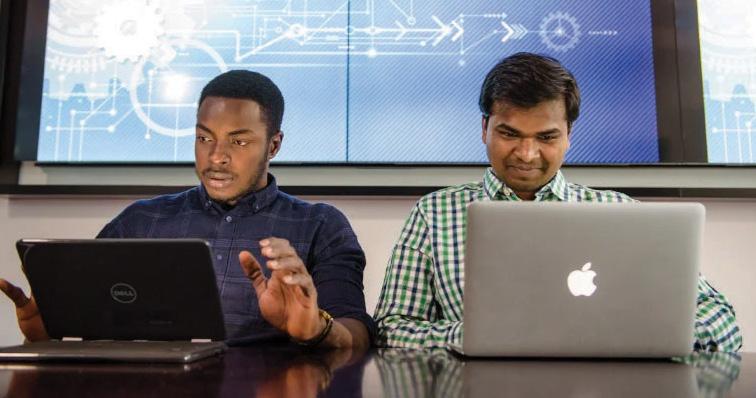
The University of New Haven launched a new AI for Cybersecurity concentration within its designated Center for Academic Excellence in Cyber Operations (CAE-CO) Bachelor of Science in Cybersecurity program. Led by Mehdi Mekni, Ph.D., the initiative is funded by a grant from the State of Connecticut’s Tech Talent Accelerator 3.0 program through the Board of Higher Education Forum (BHEF) and New England Board of Higher Education (NEBHE). It aims to address the state’s workforce demand for AI-enabled cyber professionals, particularly in the insurance and financial services sectors.
Developed in direct collaboration with lead industry partner Travelers, the curriculum integrates applied AI tools into core coursework rather than treating them as standalone electives. Students will earn stackable, industry-recognised credentials from AWS, Google, and CompTIA.
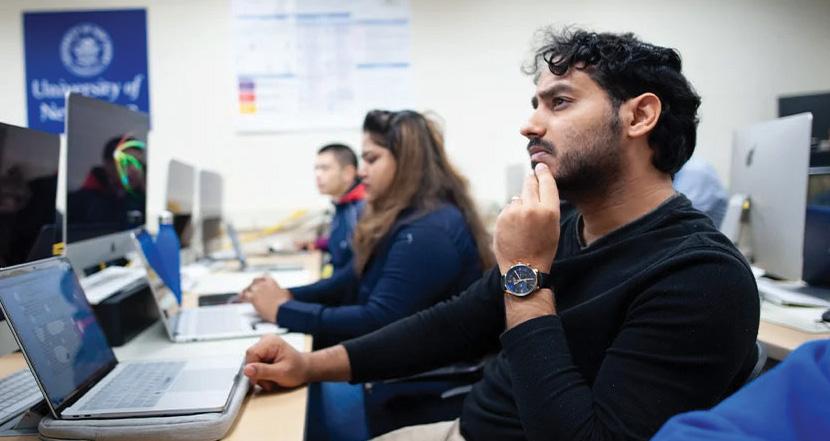
The University of New Haven is launching a new Bachelor of Science in Artificial Intelligence to meet the growing global demand for specialized technology professionals. Coordinated by Assistant Professor of Practice Div Pithadia, the multidisciplinary undergraduate program integrates foundational mathematics, statistics, computing, data engineering, machine learning, and deep learning. Beyond core technical training, the curriculum emphasizes engineering processes for scalable systems using large-language models, natural-language processing, computer vision, and agentic computing. Built in collaboration with industry partners to provide hands-on, project-based learning, the degree also mandates coursework in ethical, legal, regulatory, and privacy frameworks. Graduates will be prepared for technical career paths including AI engineering, machine learning, data science, and AI product management.
The University of New Haven celebrated the 10th anniversary of its pioneering Nashville Study Away program with a special commemorative event on Wednesday, April 29, at the Nashville Entrepreneur Center. The evening featured a presentation titled “How Nashville Became Music City” by author and music historian Robert K. Oermann, followed by an interview with Mark Montgomery, a music-tech pioneer and faculty member within the program. The event was co-produced alongside the Nashville Entrepreneur Center and the Community Foundation of Middle Tennessee.
This milestone concluded a semester-long recognition of the immersive, semester-length academic experience, which is operated in direct collaboration with Blackbird Studio. Over the past decade, the program has connected students with faculty and entertainment professionals to prepare them for careers in the commercial music sector.
Throughout the 10-year history of the program, participating students have secured professional internships at major entertainment and media organizations in Nashville. These partner sites have included Sony Music Publishing, Universal Music Group, Red Light Management, Station West Recording Studio, Big Machine Label Group, and the Country Music Hall of Fame. The curriculum includes specialized coursework such as “Entrepreneurship and Careers in the Music Industry,” bridging the gap between classroom instruction and the legal, technological, and creative components of the modern music business.


NEW SETON GALLERY EXHIBIT CELEBRATES LIFE AND LEGACY OF ACCLAIMED
The University of New Haven’s Seton Gallery hosted Embrace: Elizabeth Gourlay, an exhibition celebrating the life and abstract artwork of the late Connecticut artist.
Running through March 10, the exhibition was organized with critical support from the artist’s husband, Dr. Matthew Griffiths, who serves as a professor of physics at the University.
Curated by Daphne Anderson Deeds, the display highlighted Gourlay’s intuitive, richly layered geometric abstractions, emphasizing her sensitivity to color, architectural forms, and musical rhythms. Gourlay, a Yale School of Art MFA graduate who passed away in April 2024, utilized color as structure and form.
The University’s gallery showcased her paintings to offer the campus community moments of quiet contemplation through her distinct modernist-influenced style.
The Elevation Center is where ideas move beyond the classroom and into real-world impact. Designed as a hub for innovation, applied learning, and industry collaboration, the Center reflects the University’s hands-on, career-focused approach — preparing students to adapt and flourish in a rapidly evolving global workforce.
The University of New Haven launched a University-wide Corporate Partnership Council to coordinate and deepen its external industry engagement. Reporting directly to the president and the cabinet, the council aligns with the institution’s Strategic Plan and the development of its upcoming Elevation Center.
Led by Paul Lavoie, vice president of innovation and applied technology, the council utilizes a “One University, One Voice” approach to create a centralized entry point for external organizations. The initiative focuses on four key strategic areas: strategic industry engagement, sustainable revenue growth, brand visibility, and talent development. By managing corporate relationships, the council aims to expand student internships, capstone projects, industry-sponsored research, and job placements to enhance long-term career readiness.
The University of New Haven signed a master research agreement with Burlington-based C3 Medical Device Consulting to support medical product development and technological innovation. Coordinated through the University’s Elevation Center, the collaboration provides a framework for faculty and students to tackle real-world engineering, hardware design, embedded software, and cloud-integration challenges.
The partnership enables C3 to access university research insight and talent for variable project support. Simultaneously, it gives students hands-on exposure to the technical, design, and regulatory complexities of the fast-paced medical technology sector. Managed under the growing portfolio of The Elevation Center, this initiative aims to strengthen Connecticut's tech ecosystem while expanding career-connected student workforce opportunities
The University of New Haven entered into a master research agreement with Milford-based manufacturer Eastern Metal Works, marking the fourth corporate collaboration brokered by The Elevation Center. The partnership integrates University faculty expertise and student talent directly with Eastern Metal Works’ precision metal fabrication operations.
The active research initiatives focus heavily on deploying emerging technologies to streamline industrial processes. Key current projects include developing AI-assisted ranking and scoring modules for corporate bid opportunities, alongside building real-time operational reporting and system integration software. The program bridges academic theory with practical application, providing regional manufacturing with data-driven process optimization tools while equipping engineering students with career-connected, hands-on experience solving modern workforce challenges.

The University of New Haven signed a master research agreement with Capewell Aerial Systems, a South Windsor-based aerospace manufacturer with over a century of defense and aviation experience. Managed by The Elevation Center, the collaboration establishes structured semester projects and summer internships for engineering students.
Students will work on real-world manufacturing and design challenges focused on advanced aerial delivery, cargo handling, and emergency descent systems. The partnership exposes participants to rigorous aviation testing, certification standards, and safety compliance. This initiative aligns academic programming with Connecticut’s high-demand aerospace sector, providing Capewell with a pipeline of technical talent while giving students career-connected experience in a mission-critical field.
The University of New Haven launched a partnership with the Association of School Business Officials (ASBO) International to become a preferred provider of school finance and operations courses. The collaboration introduces completely online, sevenweek micro-credential modules designed for individuals seeking roles as certified administrators of school finance and operations or school business officials.
The specialized curriculum covers crucial components of public-school administration, including human resources, educational budgeting, facilities management, student transportation, and comprehensive municipal financial management. Led by Master of Public Administration (MPA) Director Christy Smith, Ph.D., these academic courses satisfy the continuing education eligibility criteria for the national SFO certification exam and recertification. Eligible earned credits can also be applied directly toward the University’s fully online graduate MPA program.
The University of New Haven’s Elevation Center signed a three-year Memorandum of Understanding with i5 Services to establish a national Supply Chain Resiliency Hub. Operating out of the West Haven campus, the hub combines the company’s CONNEX Marketplace digital platform and supplier databases with University faculty expertise and student talent to help U.S. manufacturers mitigate risks, optimize sourcing, and reshore production.
The center will provide companies with supply-chain assessments, resiliency analyses, and professional workforce training, while offering students experiential learning through internships and applied research.
Fully operational within four months, the self-sustaining hub will generate revenue for the University via project consultations and referral commissions while advancing collaborative research grants in manufacturing logistics.
The University of New Haven signed a master research agreement with West Haven-based advanced lighting manufacturer The Lighting Quotient. Managed through The Elevation Center, the collaboration connects University faculty research and engineering talent directly with the company’s product development pipeline.
Students will engage in hands-on projects exploring advanced materials, optical engineering, and manufacturing process technologies for high-performance luminaires under commercial brands like elliptipar®, tambient®, and MEYER. The partnership builds on a decadeslong relationship of the company hiring University engineering and business graduates. By bridging academic inquiry and proprietary reflector technologies, the initiative strengthens Connecticut’s advanced manufacturing ecosystem while preparing students for technical careers in lighting design.

Congratulations to the unforgettable Class of 2026!
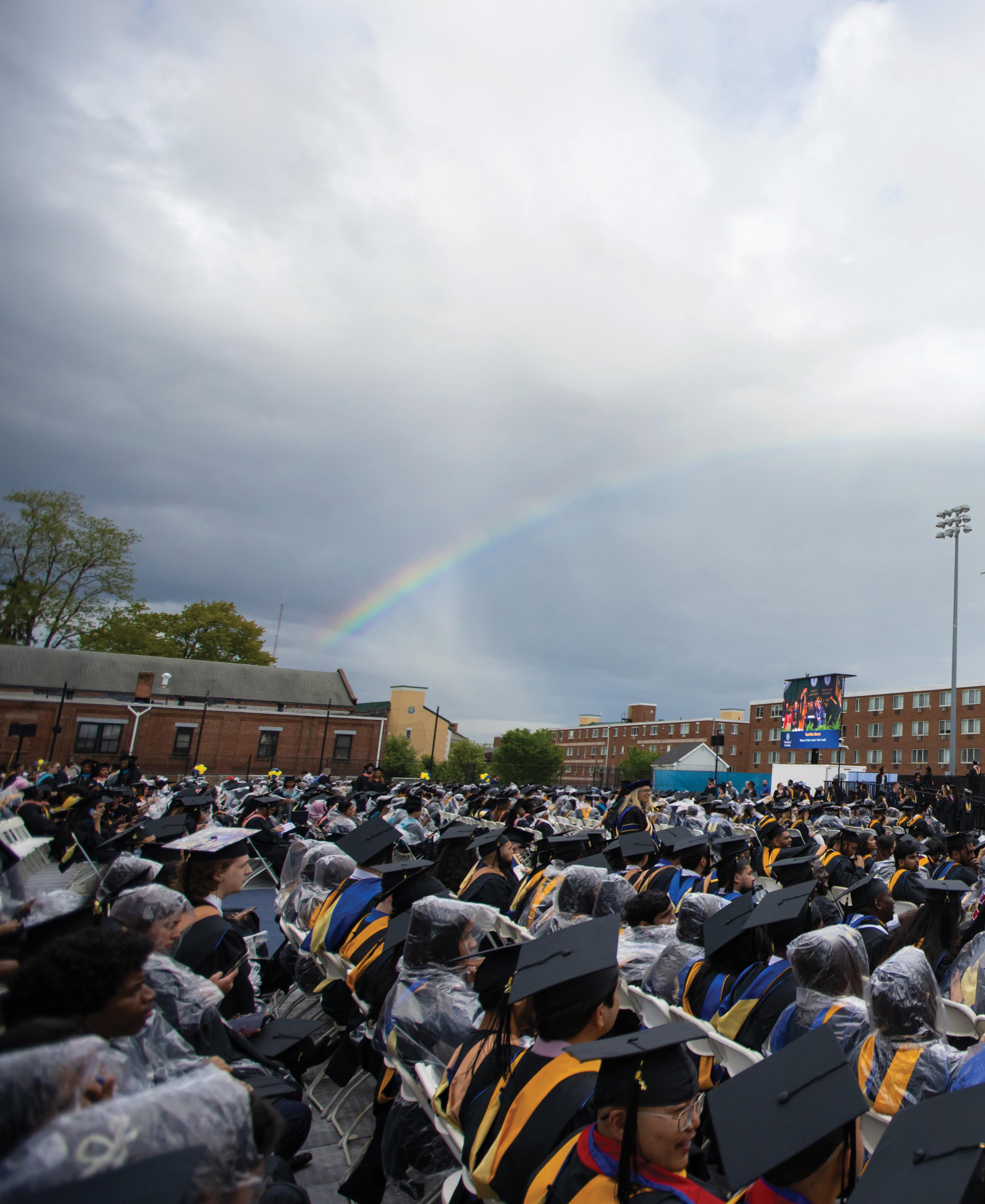
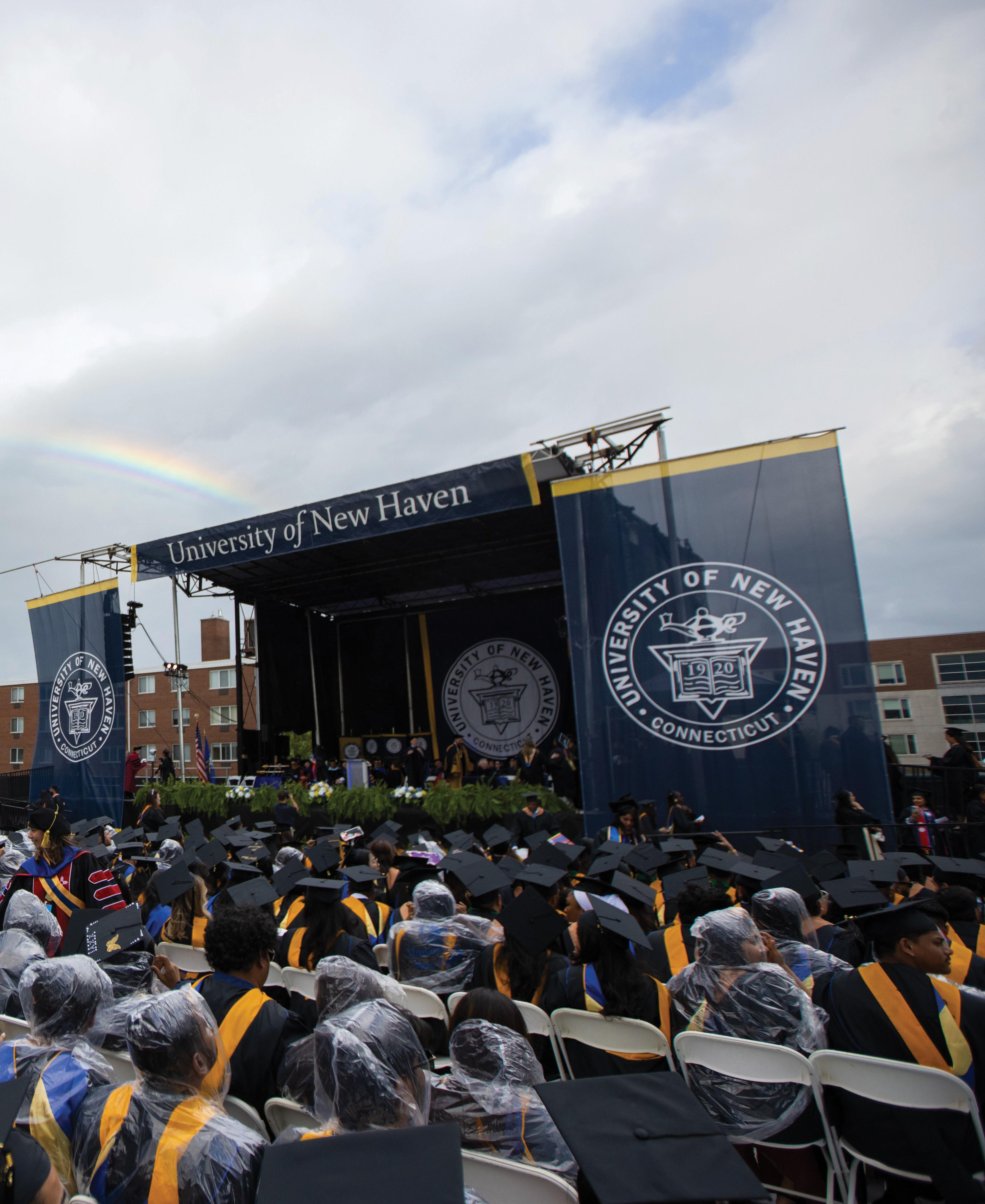
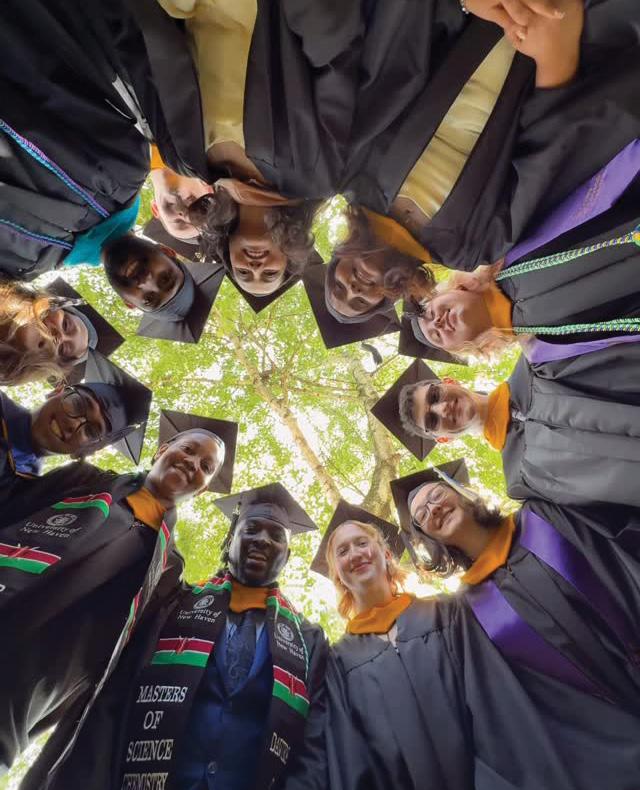
The University of New Haven officially welcomed its newest alumni as more than 3,100 graduates crossed the stage during two spectacular Commencement ceremonies on May 15 and 16 at Kathy Zolad Stadium. The historic Class of 2026 includes more than 1,100 undergraduates and nearly 2,000 graduate and doctoral students, representing 46 states, 31 countries, and 152 cities and towns across Connecticut. Over 4,800 proud guests packed the stadium for each ceremony to celebrate this momentous milestone.
A major highlight of the weekend was the undergraduate Commencement address delivered by beloved professor and campus chaplain Martin J.
O’Connor. A pillar of the University faculty for over three decades, Professor O’Connor has taught fire protection law, criminal law, and public service ethics while coordinating internships for thousands of students. Before his academic career, he spent 30 years with the New Haven Fire Department, serving as the first commanding officer of its nationally recognized Fire Investigation Unit before retiring as chief in 1998.
An ordained deacon who has preached in New Haven parishes for 36 years, Professor O’Connor has also served as the University’s campus chaplain since 1999. In recognition of his extraordinary lifetime of service, leadership, and dedication to Charger Nation, the
University presented him with an honorary Doctor of Humane Letters degree during Saturday’s ceremony. The ceremonies also spotlighted incredible student achievements, including inspiring addresses from student speakers chosen through a competitive audition process. Among the undergraduates receiving degrees was Jacob Urban ’26, a training captain and EMT with the West Haven Fire Department. Urban made history as the very first West Haven first responder to earn a tuition-free bachelor’s degree through an innovative, ongoing collaboration between the University and the City.
Congratulations to the unforgettable Class of 2026!
BY DOUG WHITING
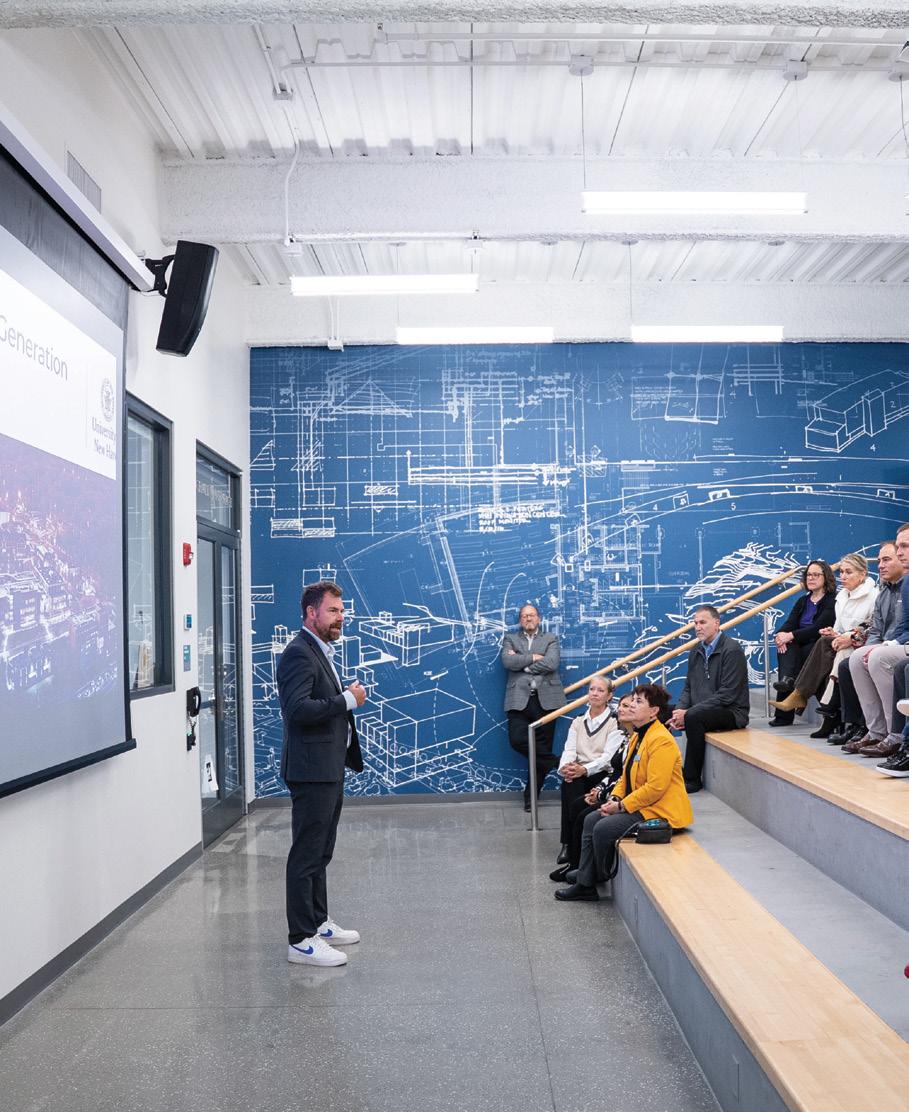
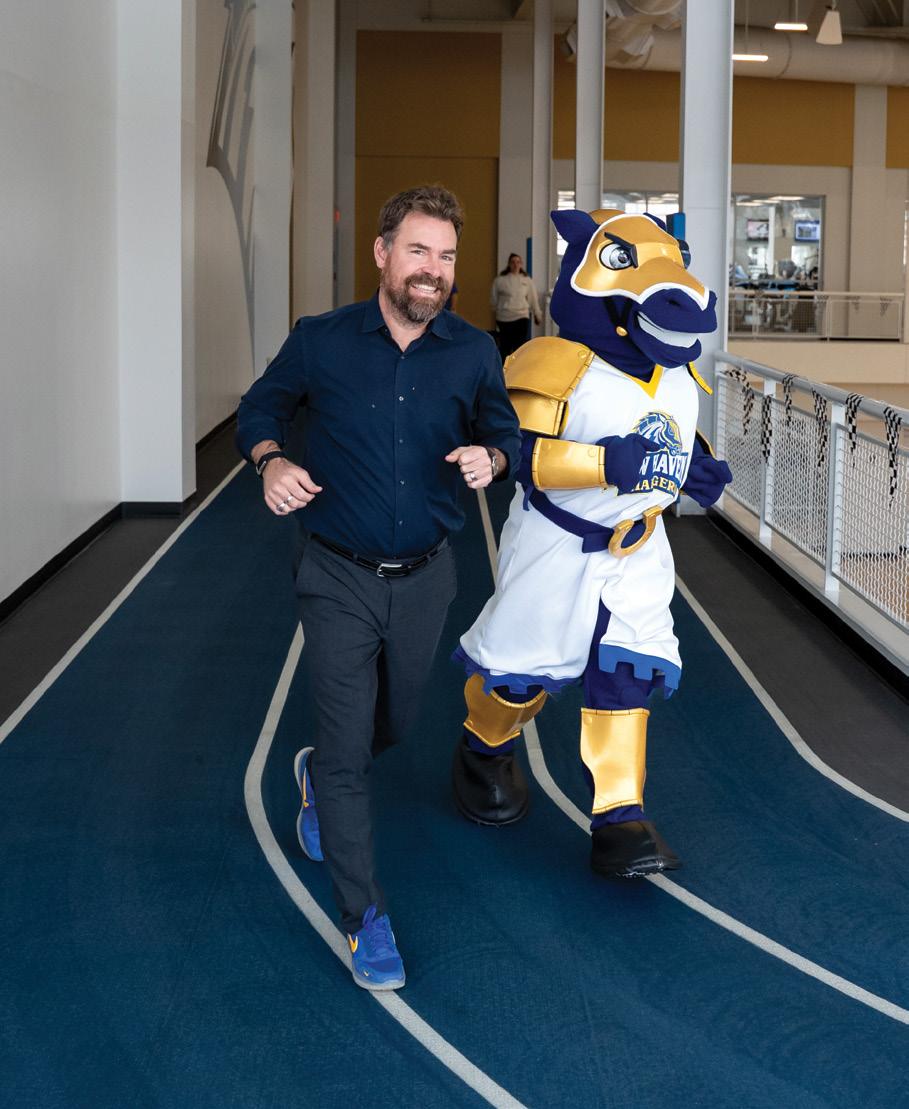
The tell was always there, right before our eyes. It was the sneakers that hinted at the idea that Jens Frederiksen might just be a different kind of president.
Of course, there were other signs — his relative youth, an unquenchable thirst for doing right by students, comfort with the social media of a new generation, a proclivity for bold and innovative initiatives, the nontraditional career trajectory. This looked like University leadership as more human, visible, and digitally fluent than is often the norm.
The sneakers, though, were the cue that work and life around the West Haven campus were changing.
They suggest flexibility and agility in the wearer, conjuring thoughts of someone in perpetual motion desiring to get someplace just a little faster than others. They announce a quirky self-confidence, especially when worn, as Frederiksen often does, with casual and business attire alike.
Since his arrival in early 2024, Frederiksen has moved steadily toward his vision for students of a unique return on investment (ROI), a global and transformative education, and preparation for the elite jobs of the future. His has become a leading voice on these topics, defying the more tentative responses of many of his counterparts to an industry in crisis.
He is forever asking — and endeavoring to answer — “As an institution that has long operated, in many ways, outside the deeply entrenched
traditions of higher education, how can the University of New Haven continue to push boundaries and strategically position itself for the future?”
...how can the University of New Haven continue to push boundaries and strategically position itself for the future?
The answer might mean purchasing nearby property and reenvisioning it as The Elevation Center; gaining accreditation for a new Physician Associates program; embarking on a $200-million campus infrastructure plan, including returning the University’s business school to the main West Haven campus and establishing a freshly conceived center for applied justice; rapidly transitioning to a Division 1 athletic program; or doggedly pursuing a campus in Saudi Arabia.
Or it might reflect the frequent Instagram posts of a savvier-than-most-presidents social media
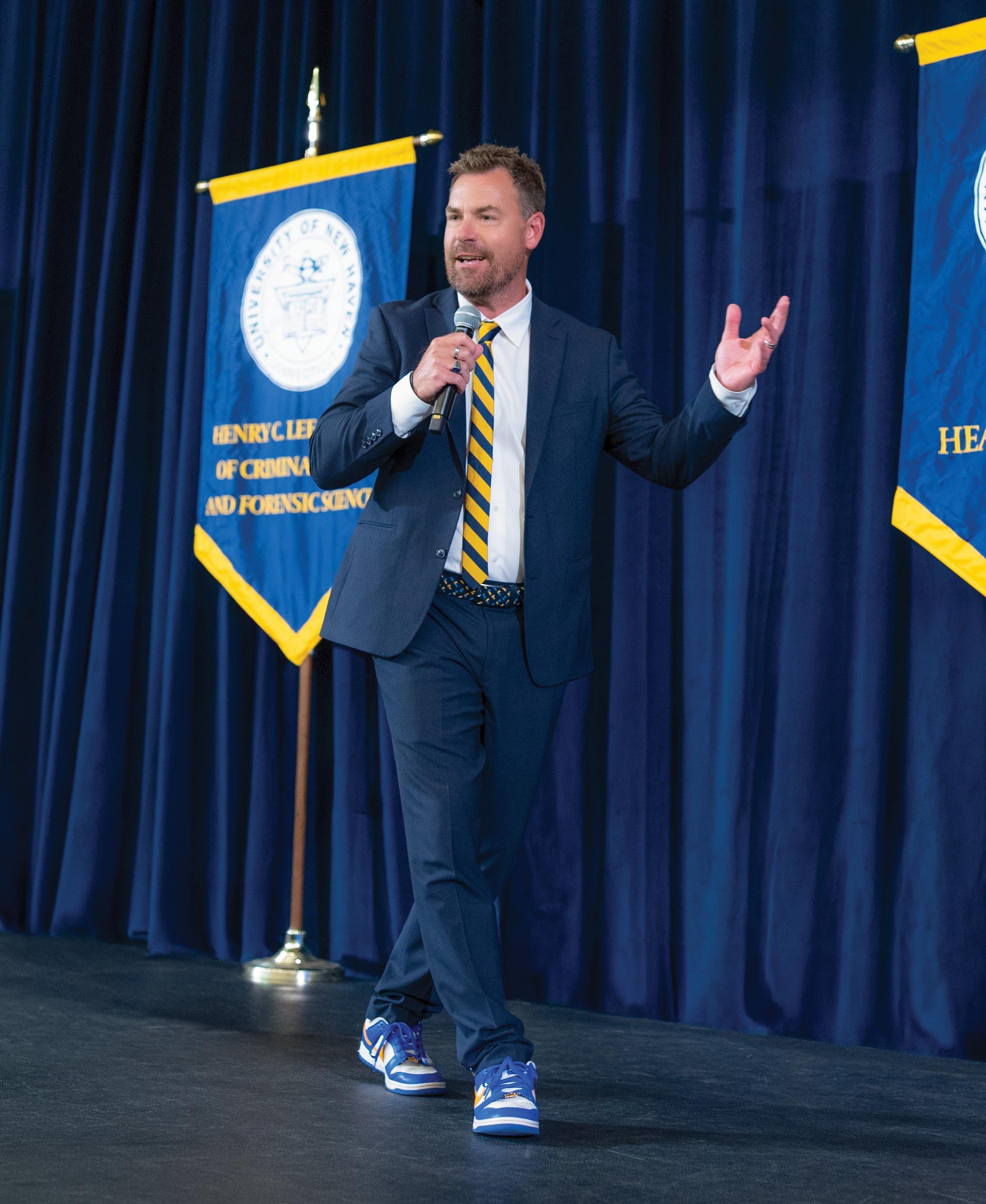

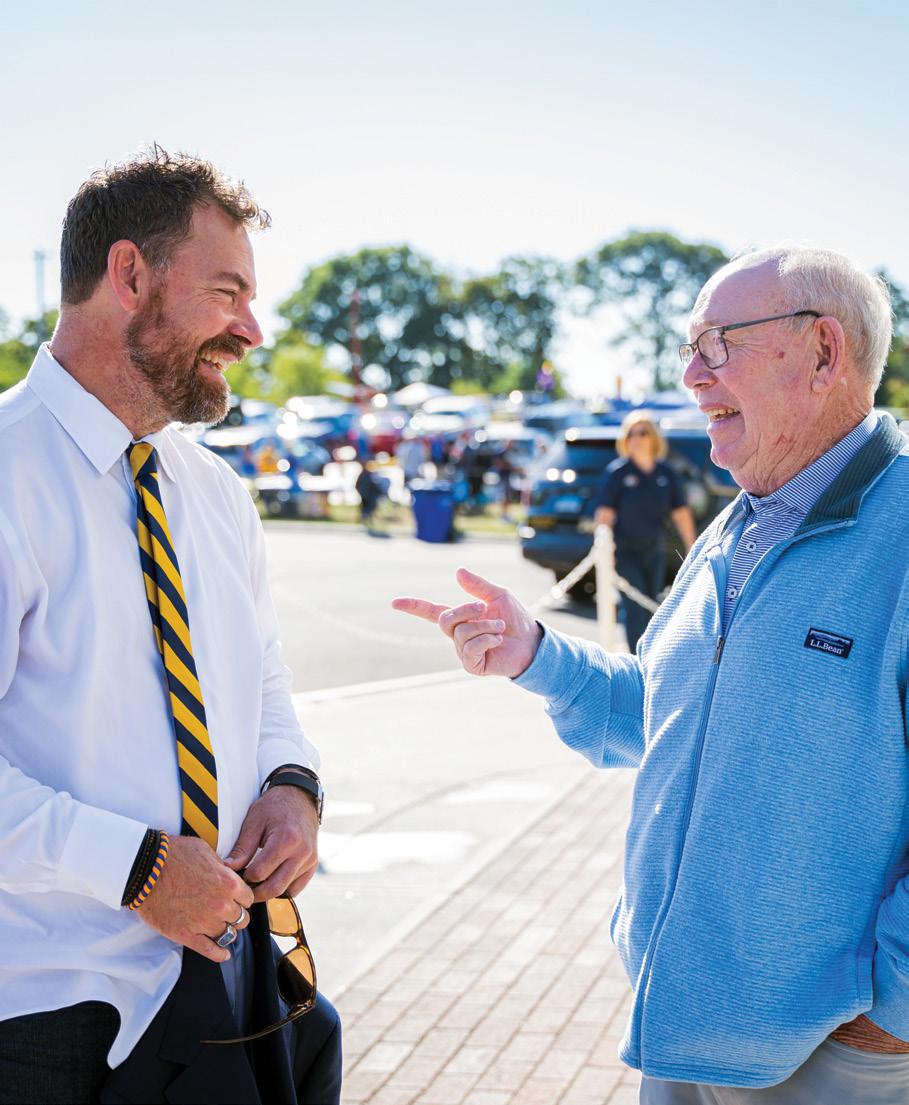


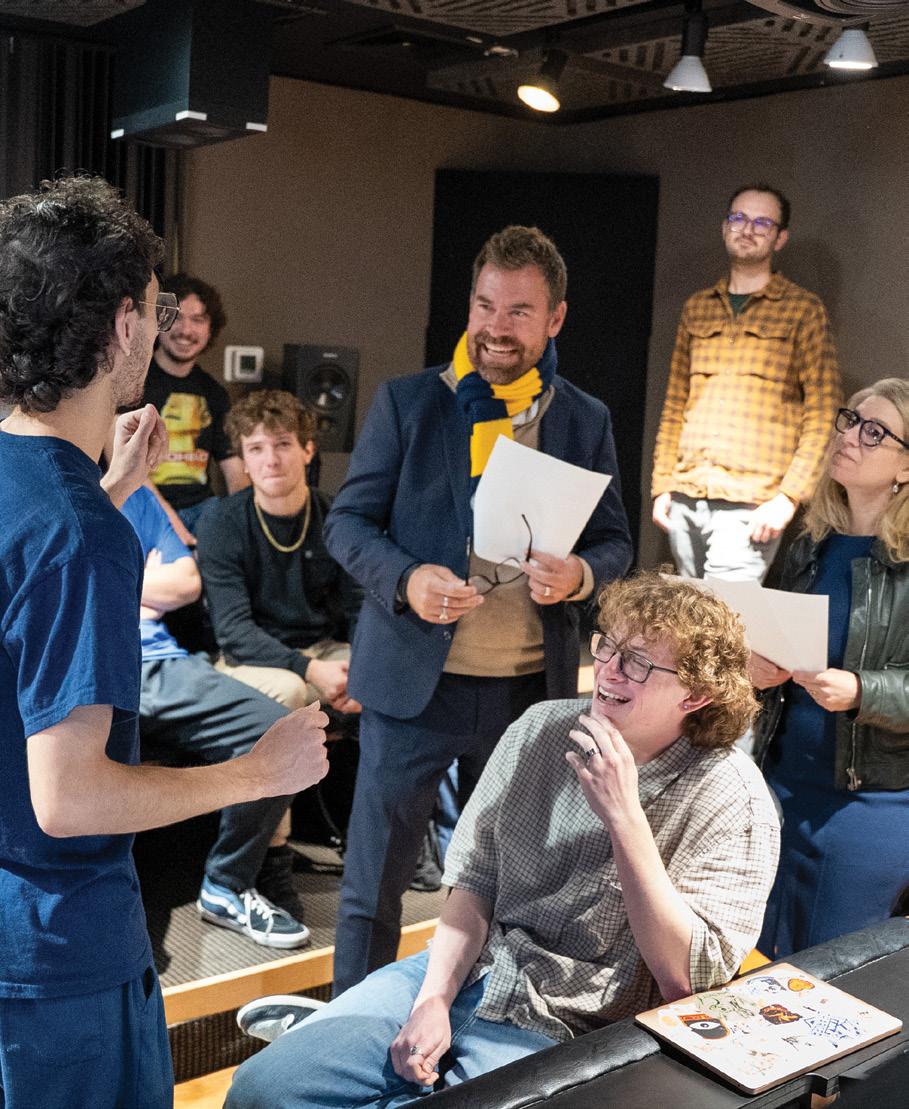
user, humanizing Frederiksen and gaining him and the University unprecedented visibility in the digital world where today’s students and parents live.
The ambitious agenda comes at a time when many universities are hunkering down in the face of mounting challenges. Tremendous uncertainty hovers over higher education. Frederiksen believes a university is standing still if it is not embracing and confronting head on the tumult of the demographic cliff, political pressures, the cost–value proposition, the sudden disappearance of the international student market, and the weight of enhancing and finding new revenue streams.
He never said it would be easy. Early in his presidency, Frederiksen told a national television audience that the job is a “pressure cooker.” That view hasn’t changed.
“When public confidence wanes, domestic demographics decline, and international student visas are drastically cut, it inevitably becomes a pressure cooker,” he says. “There’s been this criticism of higher education that it’s ‘out of touch and out of time.’
Adjustments and realignments are needed, and even those institutions with seemingly unlimited resources are challenged. Academia has been impacted by the notion of the ‘ivory tower’ for generations, but reverence for this has lost its shine.”
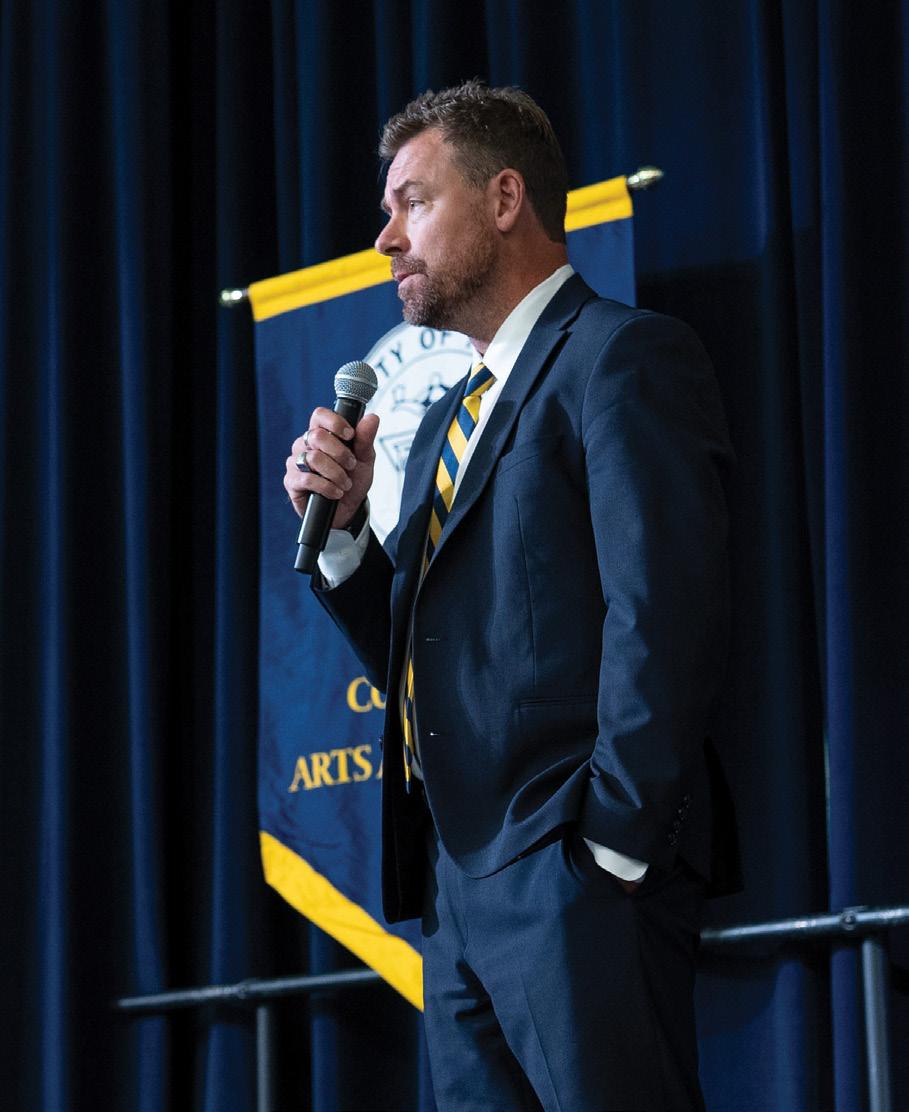
This reality, he believes, demands action that not enough leaders have acknowledged. “This challenging climate offers tremendous opportunity and quite possibly even a mandate for higher education innovation and transformation,” he says. “It is time to step up and answer the call. There is a need to be agile and to have an entrepreneurial level of economic, social, and technological responsiveness to confront the challenges. We have to change. We’re shaping the next generation in profound ways that make the work more important. Universities have been and continue to be uniquely positioned as platforms for a brighter, more productive, and just future.” Frederiksen emphatically pushes back against critics of higher education: “Many argue that rapid global change renders academia less relevant, but I flip that critique on its head. In a complex world where legacy institutions are often caught off-balance, the right kind of academia is more vital than ever. Our challenge is to determine how we can best prepare students within a four-year window to engage with the real world and make a real impact.”
Frederiksen’s choice has been to make strategic decisions and investments that some have called risky but that he believes are “the best way to position the University for an upside.”
Consider his pursuit of a campus in Riyadh at a time when the University is right-sizing to address the decline in international graduate students.
“I understand I will never appease everyone,” he says. “Our ambition in Saudi Arabia is not an either/or proposition against needs here in West Haven.” In a
Boston Globe interview he said that Saudi Arabia is an “extraordinary frontier. They want American degrees the same way they are delivered in West Haven. We are at the forefront of the line to answer the call.”
Broadening this perspective, Frederiksen notes that the urgent need for human capital transformation is both transcendent and global, spanning from the United States and Saudi Arabia to India and Ukraine and beyond. “This is the defining challenge of our time, and it is exactly what the University of New Haven delivers to the world,” he says. “The demands we address in West Haven are identical to those felt globally. While nations with younger demographics hold a distinct advantage, we all share the same sleepless nights over education, workforce readiness, and shifting market trends.”
Practically, he says, Saudi Arabia gives UNewHaven students another opportunity for an international experience, and the business model is tuition-driven. “We’re doing something unprecedented, and we need to focus simultaneously on the present and the future. It’s what corporate enterprises do constantly, and we are ultimately in the business of transforming lives. But while traditional businesses often operate on shorter time horizons — consumed by immediate demand and forcing long-term strategy to the backburner — we don’t have that luxury. As a tuition-dependent, enrollment-driven, high-stakes institution, we navigate the razor’s edge of demand, supply, and market logic at all times.”
Frederiksen says his approach “isn’t emblematic of a singular way to do this, but it’s the New Haven way to do this. There is an entrepreneurial nature to this inflection point in higher education. Who’s rising to the challenge?”
His answer, implicitly, is the University of New Haven.
As he steers the University through these unprecedented times, he considers what he brings to the table.
About his presidency, he says that although he respects traditional notions of the college presidency, “the paths to the job are changing. Education, in its capacity to reshape human potential, is a different kind of big business. The enrollment or advancement paths can be very valuable. I think the firsthand experience of recruiting students and raising money is valuable. There is an urgency to the financial aspects of the enterprise.” His years at Fisk University afforded him immersion in virtually every aspect of its operations, and time as a faculty member gave him an “acute awareness of the academic experience.” Though his path was nontraditional, he believes it prepared him well for the needs of today’s university.
About his forays into social media he says, “It’s a powerful mode of communication, allowing me to meet students and families through their medium. Some of it is pure fun, but much of what I do on
social showcases everything this University has to offer. I’m proud of the inventory we’ve created, and students have responded well to it.”
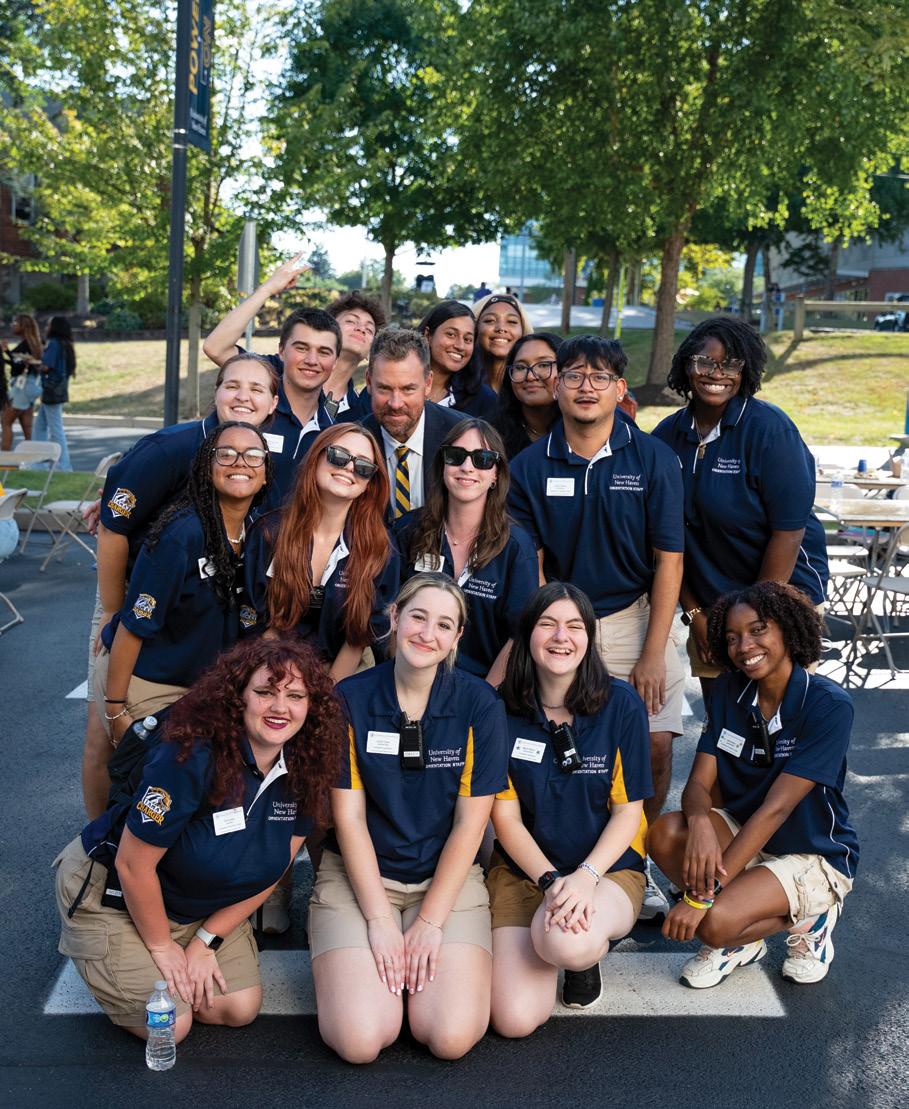
Frederiksen has been able to build a remarkable rapport with students. “I am younger than the norm,” he says, and “while I am out of touch with the language of today’s generation I am very familiar with their experiences.” He continues, “I cherish my relationships with our students; they are not only the direct fulfillment of our mission, but also vital stakeholders in our community. I see myself deeply invested in their trajectory — both during their time at UNewHaven and in what comes next. Ultimately, my role is to help them realize their potential, providing a formative experience that prepares them for a lifetime of success.”
As he surveys the higher education environment, Frederiksen believes “the backbone to the future of American higher education is the midsize, private colleges and universities. They are existentially bound to the product they deliver. This is an incredible moment to answer the kernels of truth in the criticisms of the industry. We must elevate the four-year experience. The new stable is instability. It is up to us to deliver an experience in four years that readies our students for life.”
The new stable is instability. It is up to us to deliver an experience in four years that readies our students for life.
With sneakers at the ready and eyes fixed on today and tomorrow, he charges ahead and offers guiding fundamentals for his presidency.
First, never lose touch with students. Spend qualitative and quantitative time with them, all with an eye to a transformative outcome.
Second, pay attention to the critical, revenue-generating side of the enterprise — the fundraising that provides the resources to improve the experience, and student recruitment.
Finally, create an ethos among staff and faculty “to empower every division to function at its highest level. Create a level of cohesion and excitement among leadership and throughout the organization. Remain operationally focused.”
Doubling down on deeply held convictions, he says, “We are all committed to recognizing the moment and its challenges, while never losing sight of the University’s core purpose and mission. There can be no doubt about the authenticity of our dedication to student success.”
BY DOUG WHITING
A disturbing number of small, liberal arts colleges and midsize private universities are closing their doors. Bigger name schools are eliminating significant numbers of academic programs and slashing payrolls.
Though not immune to the external pressures on the higher education industry and their consequences, the University of New Haven is aligning its operational and academic road maps to buck national trends and position itself for long-term success.
With students’ academic experience the most critical factor in their eventual success, Provost Nancy Ortins Savage says the building blocks of an academic division critical to achieving President Jens Frederiksen’s vision for the University were in place when he arrived on campus a little over two years ago.
Now, she says, she and other academic leaders are fully engaged in a process to ensure that the student experience is responsive to Frederiksen’s call for a university marked by a global sensibility, entrepreneurial initiatives, market-responsive academic programs, and innovation. With those inputs, he has said, UNewHaven will be known for its unique ROI for students, transformative education, and preparation for the elite jobs of the future.
Early returns are trending positive. The University just announced that it will welcome a record-breaking undergraduate first-year class, having received more than 1,400 deposits for the incoming Class of 2030, from a pool of more than 22,000 applicants. The news comes on the heels of last year’s entering undergraduate class, the most selective in the University’s history.
In addition, the University’s ability to retain enrolled students has changed dramatically in recent years, with a retention rate approaching 80 percent that is a barometer of an institution’s health nationally.
“While many institutions — particularly in New England — are facing the impact of the ‘demographic cliff,’ the University of New Haven has continued to defy this trend with record domestic undergraduate enrollment levels,” Fredericksen said. “We are pleased to see our commitment to delivering an unparalleled ROI, and preparing better-than-ready graduates is resonating strongly with students and families.”
Added Greg Eichhorn, vice president for enrollment, “The size and quality of this incoming class
demonstrate the momentum of the University and the value students and families see in the educational experience we provide. This growth reflects the University’s continued investment in the success and excellence of our students and our Charger community.”
Frederiksen has set the bar high. In a 2024 memo to faculty and staff he wrote:
“Our vision is to become a global powerhouse for preparing the next generation of elite talent to excel in the workforce of the future. This lofty endeavor is propelled by the rich history of our graduates who are leaders in nearly every industry imaginable, working in all corners of the globe.
“Thanks to the collaborations and pathways we are actively building, we are positioning ourselves at the intersection of academia and industry to prepare our students for what is a rapidly transforming economic landscape and an entirely different workforce. Our focus is on investing in human capital, building partnerships, and preparing our graduates for success.
“Ultimately, the stakes could not be higher. But the ability we have to impact future generations far outweighs the pressures. It is the promise of a brighter tomorrow that makes this work so worthwhile.”
Pompea College of Business Dean Brian Kench echoes Savage and Frederiksen: “The University is successfully executing President Frederiksen’s vision to be global, market-responsive, and innovative.”
That success, he says, “is rooted in providing transformative, hands-on experiences; preparing students for an evolving job market; and maximizing ROI for students.” He points to that record-breaking incoming class and a concurrent increase in net revenue as proof that the direction is the correct one. “In an era where universities are closing at a rate of one per month, it is clear that the future of higher education looks like us. Universities that fail to adopt an educational model similar to ours will simply not survive.”
Savage points to work last summer on revising the strategic plan — the University’s blueprint for sustained success — to better mirror the new focus articulated by Frederiksen, particularly putting more emphasis on retention, student outcomes, and global vision. There continues to be a spotlight on transforming how students are educated, “focusing on building skills and competencies, gaining real-world experiences, and preparing our students to excel for the careers of the future,” according to the introduction to the plan.
Kench says the colleges are responding in kind. The Pompea College, he says, aligns with the institutional vision “through bold infrastructure and STEM integration,” adding that a new, privately funded, 50,000-square-foot facility “will serve as a hub for innovation, featuring dedicated
“Our success is rooted in providing transformative, hands-on experiences; preparing students for an evolving job market; and maximizing ROI for students.”
BRIAN KENCH, DEAN, POMPEA COLLEGE OF BUSINESS
spaces for Launchpad for Future Business Leaders where students develop career readiness skills, the Introduction to Business and Entrepreneurship program where students learn to write and pitch business plans, and the Gaia initiative where students manage a near-$1 million portfolio. By offering 12 unique STEM-designated programs and maintaining elite AACSB accreditation, the Pompea College ensures a market-responsive curriculum that ranks in the top 6 percent globally.”
Kench emphasizes that career preparation and ROI are central to the Pompea student experience. “The impact of our Shared Live Client Experience (SLiCE) program — where students work on realworld consulting projects — and required internships shows up in our 97 percent postgraduation success rate. The Sussman Family Sales Institute and the top-10 globally ranked Sport Management program further drive professional outcomes through national competitions and elite networking. Perhaps
the most impactful ROI initiative is our four-year BS+MBA Fast Track Program, saving students $45,000 in tuition. These efforts have culminated in a Pompea College Net Promoter Score of 75, which is 134 percent higher than the industry average, signaling exceptional alumni satisfaction.”
Illustrating the importance of program review to the University’s well-being, in September Savage wrote to the community about last summer’s tweaks to the strategic plan. She said a cross-campus group is working to “implement a robust program assessment plan. This involves using metrics and program assessment outcomes to identify academic programs for reimagining, additional investment, or decommissioning.” In addition, she said, the group is looking at ways to integrate AI literacy into the curriculum and to the creation of new micro-credentials and collaborative and interdisciplinary programs.
Savage acknowledges that part of the process of implementing the shared vision for the University’s future is the difficult work of making structural changes in program offerings to reflect a post-COVID right-sizing that is taking place due both to the ongoing, annual review of programs for efficacy and a revenue loss from a significant reduction of nearly 30 percent of overall enrollment brought on by the inability of international students to obtain visas for study in the United States.
“Of course there are morale issues when budget and personnel cuts occur,” she says. “That’s why I’m a strong advocate for making change quickly and for approaching program review strategically and analytically. We shouldn’t be closing programs only when there is a crisis, but rather when it makes sense for us to do so.”
Even so, program eliminations and personnel reductions at the University promise to be far less draconian than at other universities across the country. According to Inside Higher Ed, in addition to closures recently announced by Hampshire College and Anna Maria College, both in Massachusetts, deep program and personnel cuts are planned at institutions including Syracuse University (84 programs),
University of Wisconsin at Madison (160 employees), University of Maryland (150 employees), East Carolina University (44 programs), and North Texas University (70 programs), among others.
A second strategic planning group, Savage writes, is “working to implement a team-based advising model that provides both early intervention for at-risk students and timely assistance for students encountering emerging issues” with an eye on increasing student retention and graduation rates.
Emphasizing the University’s priorities on innovation and global impact, a fundraising goal of $25 million has been set to support The Elevation Center, a newly established focal point on campus for innovation, technology, and partnerships with external entities. The plan calls for the creation of “up to 15 new master research agreements with corporate partners” and the implementation of new agreements with international institutions in Europe and Asia. Support for faculty scholarly activity would be the goal of developing a “framework for a Center of Research Excellence.”
To underscore the intentionality and import of developing new industry and academic partnerships, the University a year ago hired Paul Lavoie as its first vice president for innovation and applied technology, overseeing the work of The Elevation Center. He had been the state of Connecticut’s chief manufacturing officer prior to his appointment and was named one of the Top 5 Chief Manufacturing Officers in the world by Manufacturing Digital Magazine in 2024, joining leaders from Michelin, General Motors, Ferrari, and Johnson Controls.
Since joining UNewHaven, he has also taken on the role of chair of the Corporate Partnership Council.
“All partnerships are designed to bring experiential learning experiences to our students,” Lavoie says. “The seven master research agreements that we have currently signed are designed to bring real projects from industry for our students to deliver real results.”
The master research agreements are a win for both the companies involved and for students, he says. “Forty-six percent of companies say the problem with entry-level hiring is the lack of relevant experience. We are engaging with industry to bring relevant work experience to our students. Companies get projects completed while students get real work experiences. Companies get to develop their next generation of leaders, and they get to ‘try before they buy’ as they work closely with our students on projects.”
The strategic partnerships with industry, Lavoie says, include the National Supply Chain Resiliency Hub, a partnership with i5 Services “where we will bring real supply chain risk analysis, supply chain development, and other projects to our supply chain students” in the Pompea College of Business. Another partnership, soon to be announced, will
bring student inventions to commercialization and will be supported by students across several of the University’s colleges.
Lavoie emphasizes that The Elevation Center is working with each college and school and collaborating with faculty members. He cites as examples discussions with College of Engineering faculty to talk about supporting robotics, precision manufacturing, and automation. Meetings with Lee College professors have centered on providing support for forensic science initiatives, financial crimes, and new product development in the area of crime scene investigations. Biology and interior design and architecture are among the Arts and Sciences disciplines that can find support at The Elevation Center. And, he says, explorations are underway for a health clinic in The Elevation Center facility that would be run by health sciences students.
“And we have just begun,” he enthuses. “There are, of course, many applications for the engineering and business colleges, including an entrepreneurship and incubator for new products and companies. It is a University-wide initiative that will be driven by industry needs — industry led and student centered.”
Savage is confident that the University’s academic initiatives are in line with the vision of both the strategic plan and Frederiksen. In terms of global education, she says the faculty are already primed to work with international organizations, and when doors are opened internationally, “there is a familiarity and willingness of faculty to walk through that door and make things happen.”
There is a shared belief in an aggressive approach to retention, with members proactively pursuing students to provide assistance where needed. Measuring ROI, in part by internships, employment, and graduate school attendance, she says, will be critical to determining student success. In all of the University’s colleges, Savage says the fact that many programs are professional tracks like biology, fire science, engineering, communications, medical lab science, accounting, and music-related programs allows for more definable outcomes. “With an historic focus on experiential learning, the renewed emphasis on retention and ROI is being well received across campus.”
Savage tries to cut through the complexity of the many initiatives currently underway by citing one simple Frederiksen innovation that is emblematic of new thinking and is having an impact on students. Early in his tenure, the president launched a program whereby all new students are required to upload their résumés to the Handshake career network and job platform. Savage says that when students periodically update those résumés they can immediately see their progress. “It’s really wonderful to see them understand that they are not the same person they were when they arrived as first-year students. That’s tangible proof that we’re moving in the right direction.”
22K+

Higher education has long been built on tradition, from academic rankings to long-standing reputation and prestige. However, that foundation is slowly being replaced. Schools simply can’t rely solely on reputation anymore; they need to continuously demonstrate who they are in a public, digital space.
As social media presence is essentially reshaping how the audience sees a higher ed institution, success is increasingly defined by how a school positions itself to potential students online. Colleges are now asking new questions: what does success look like today? How do we tell that story to prospective students? And how do we build meaningful community in a world where human connection is largely happening from behind a screen?

handle @unewhavenpresident, describing himself as “not your average university president.”
“Under Jens’ leadership, he acknowledged that social media is a very powerful tool. We were already doing a great job, but he really identified it as a focus area for the University to improve visibility,” Sue says. “There’s been a shift in the energy on campus; he’s elevated the morale, the perception.”
With those questions in mind, University of New Haven has made an intentional marketing strategy shift in recent years, embracing creative risks on social media to engage the upcoming generation.
Building visibility and audience connection through innovative storytelling has led to notable differentiation — not only sparking viral sharing online but also unifying the community and driving up enrollment numbers at a time when many schools are experiencing the opposite.
This all started by rethinking how to digitally bring the University’s core message to life. Several years ago, New Haven’s marketing department launched the “Power On” campaign, a brand refresh for better visibility, increased enrollment, and a stronger campus community. The school then extended this messaging into its new social media strategy, with an approach different from many traditional universities.
With a focus on the tagline “Use your power to change the world,” New Haven set out to highlight the change-makers and innovators, encouraging the campus community to “power your purpose” and “make your mark” — and has tied those messages into new videos and captions across channels like Instagram, Facebook, and TikTok.
“At its core, our brand is empowering students to find their voice and make the world a better place,” says Sue Pranulis, senior executive director of marketing and communications at New Haven.
“When we’re authentically telling the story of our students, it’s feeding into that brand. There’s so much of the brand that I think our current students connect with.”
And as the digital landscape continues to rapidly evolve, New Haven leadership has recognized the importance of following the tide. Dr. Jens Frederiksen took the helm as president in March 2024 and quickly started posting under his own Instagram
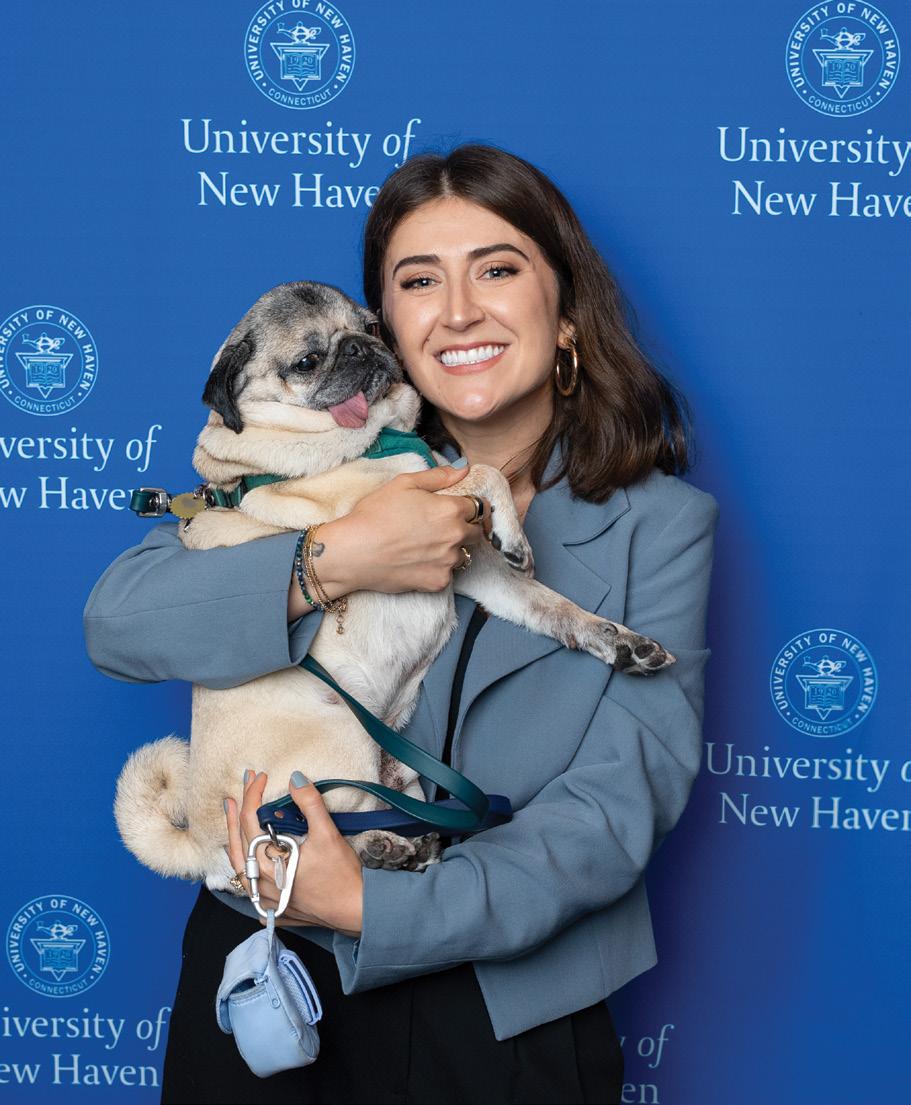
That momentum led to bringing on Leslie Mosier, whose brand featuring her lolly-tongued pet Doug the Pug has catapulted to influence online. In fall 2024, Leslie was six months into a new venture of brand consulting when Jens reached out and asked her to come speak to New Haven’s marketing department. She conducted a presentation for the group and immediately felt a connection with the team and campus.
“I saw opportunities for the University to do more native-to-platform content. Up until recently, it was hard for businesses or corporations to lean into that less polished feel. But in reality, that’s what students are connecting with and what the platform algorithms are rewarding,” Leslie says. “And I believe it’s made a big impact with the connection of the school, the president, and overall student unity.”
To differentiate itself in a crowded high ed market, New Haven is leaning into student voices to connect with Gen Z. From silly dorm moments to spontaneous games on the quad, prospective students look to social media for assurance that they’ll make friends at college and that they’ll like living on campus.
“We’re focusing on belonging,” says Laura Norris, New Haven’s assistant director of creative visual content and strategy. “Sure, academic programs do draw students, but what we really see is that authentic feeling of being on campus, what types of people will be around you, and how people interact. We try to show in our posts that what you see is what you get; we are the people we’re portraying.”
At the core of a student-led, story-driven focus, Laura developed a student social media ambassador program in 2024 alongside colleague Kristen Ortega, giving the marketing team an “insider scoop” to what students want to see online.
“We’ll ask our student ambassadors questions like ‘we have these ideas: what’s the coolest part about it and how can we spin it so it is authentic and relatable? What’s something that you want to share with your friends?’ That helps increase our engagement,” Laura says.
A recent video took students behind the scenes at the police station. Though perhaps a mundane topic on the surface, the response was surprisingly
WE’RE FOCUSING ON BELONGING. SURE, ACADEMIC PROGRAMS DO DRAW STUDENTS, BUT WHAT WE REALLY SEE IS THAT AUTHENTIC FEELING OF BEING ON CAMPUS, WHAT TYPES OF PEOPLE WILL BE AROUND YOU, AND HOW PEOPLE INTERACT. WE TRY TO SHOW IN OUR POSTS THAT WHAT YOU SEE IS WHAT YOU GET; WE ARE THE PEOPLE WE’RE PORTRAYING.”
— LAURA NORRIS
strong from parents, who want to feel comfortable about the safety and security of campus.
This kind of behind-the-scenes, personal content cultivates emotional connection for social media followers that translates into UNewHaven not only being noticed online but also, more importantly, being remembered.
“We can come at the account with all of our marketing minds, but at end of the day, when we’re trying to attract new students who see themselves at New Haven and trying to attract the current students, that authenticity will come through the most from someone living, eating on campus, having inside jokes with areas around campus,” Leslie says.
It may be difficult for an audience to remember numbers like what an institution is ranked or how many academic papers its professors published last year. But when it comes to prospective students and their families, school stories are what actually stick.
“With anything social media, I try to put myself in the shoes of who is following the account,” Leslie says. “With a university, we don’t only want to attract followers in the area but also everywhere else in the country, to help put the school on the map.”
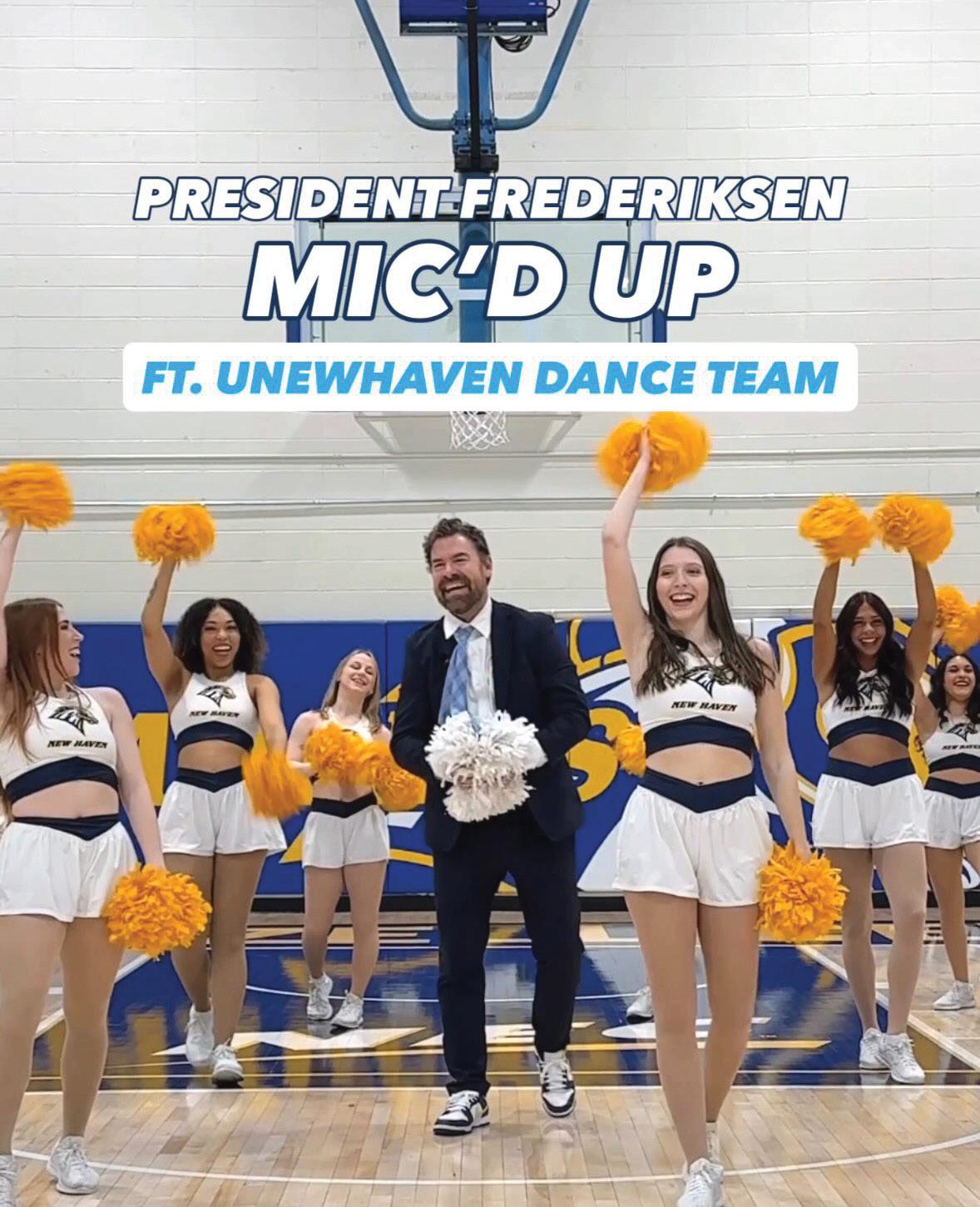
From student life and alumni updates to major announcements like establishing an international branch campus in Saudi Arabia, there’s no shortage of exciting, engaging content to share. And President Frederiksen has become a web celeb in his own right, posing with the dance team’s trophy and dropping into civil engineering meetings to see exciting projects being built.
“Jens is incredibly approachable and beloved by students. So we’ve been able to play into that and help him speak their language. When he’s out on campus, students come up and want to take selfies with him,” Leslie says. “As a social media marketer, you can have numbers and engagement, but having that real world recognition, you can’t pay for that.”
That engagement has even led to corporate partnerships with local businesses. When Raising Cane’s opened near campus, the corporation reached out to partner with Jens. “And that video had incredible engagement,” Leslie notes.
*From March 2025 to March 2026
The marketing team also jumped into action when Doechii, a Grammy-winning rapper, was spotted wearing a University of New Haven sweatshirt in one of her videos. The entire campus clamored to wear the same sweatshirt, and the content captured from that event went viral.
Another breakthrough came when New Haven officially collaborated with Leslie’s dog Doug the Pug. Doug visited campus, committed to studying “furensic science,” and posed for pictures with mascot Charlie the Charger, President Frederiksen, and students across campus. In May 2025, Doug surprised students by attending commencement and walking across the stage to receive his honorary degree — all to wildly popular response online and widespread coverage beyond campus.
“They took a big chance on having a famous dog help represent the school, and it truly worked,” Leslie says.
Taking chances in marketing is earning national recognition for New Haven. The school has won multiple Collegiate Advertising Awards, including a 2024 Gold award in the social media marketing category for launching the president’s Instagram account, as well as bronze and silver awards in 2025 for a Halloween-themed video and commencement coverage.
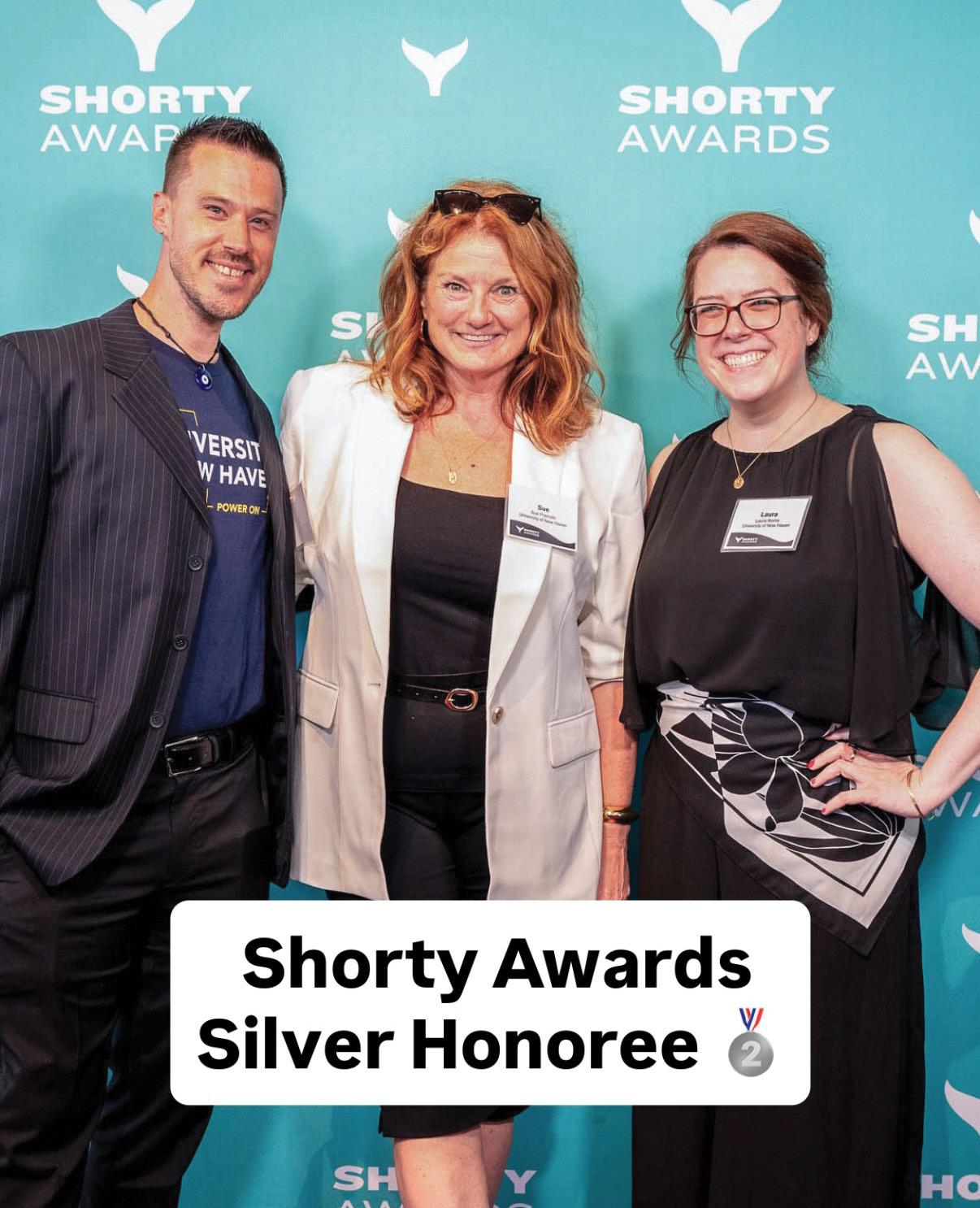
And this year, New Haven was in the finalist rounds for the Shorty Awards — a prestigious international awards program for outstanding work across digital platforms — for its “pawtnership” with Doug the Pug. For historically “traditional” industries struggling with how to balance professionalism and playfulness in digital marketing, organizations like New Haven that are willing to take creative risks will stand out to a generation that values authenticity, Leslie says.
“The days of social media where we all expected perfection are no longer. When you visit a highly curated feed, it no longer feels approachable and relatable,” Leslie says. “When you start leaning into what people want to share and feel represented in, the numbers and shares speak for themselves.”
In New Haven’s case, those numbers tell a clear story.
From March 2025 to March 2026, U New Haven saw a 180 percent increase in TikTok impressions and a 31 percent increase in Instagram impressions. Video views exceeded 17.6 million, and content
posted on those channels had 53 million impressions and 598K engagements — reaching a 57.6 percent increase in overall engagement.
“Every time I’m with the president on campus, someone is coming up and commenting on our social media,” Sue says. “The student population has noticed what we’re doing.”
At a time when the value proposition of universities is being questioned and the future of higher education is more uncertain than ever, it’s crucial to take control of the narrative.
“As someone who works in social media, of course I’m looking at analytics and impressions and shares and followers. But it’s those moments where I’m hearing from the president and from students on campus, where I’m seeing real, engaged comments from alumni saying ‘I wish the school was like this when I went decades ago!’, that is the real proof of concept that we’re on the right path,” Leslie says. “You would think that as things become more digital that I would be looking more digitally, but the things that make me happiest are hearing from real people.”
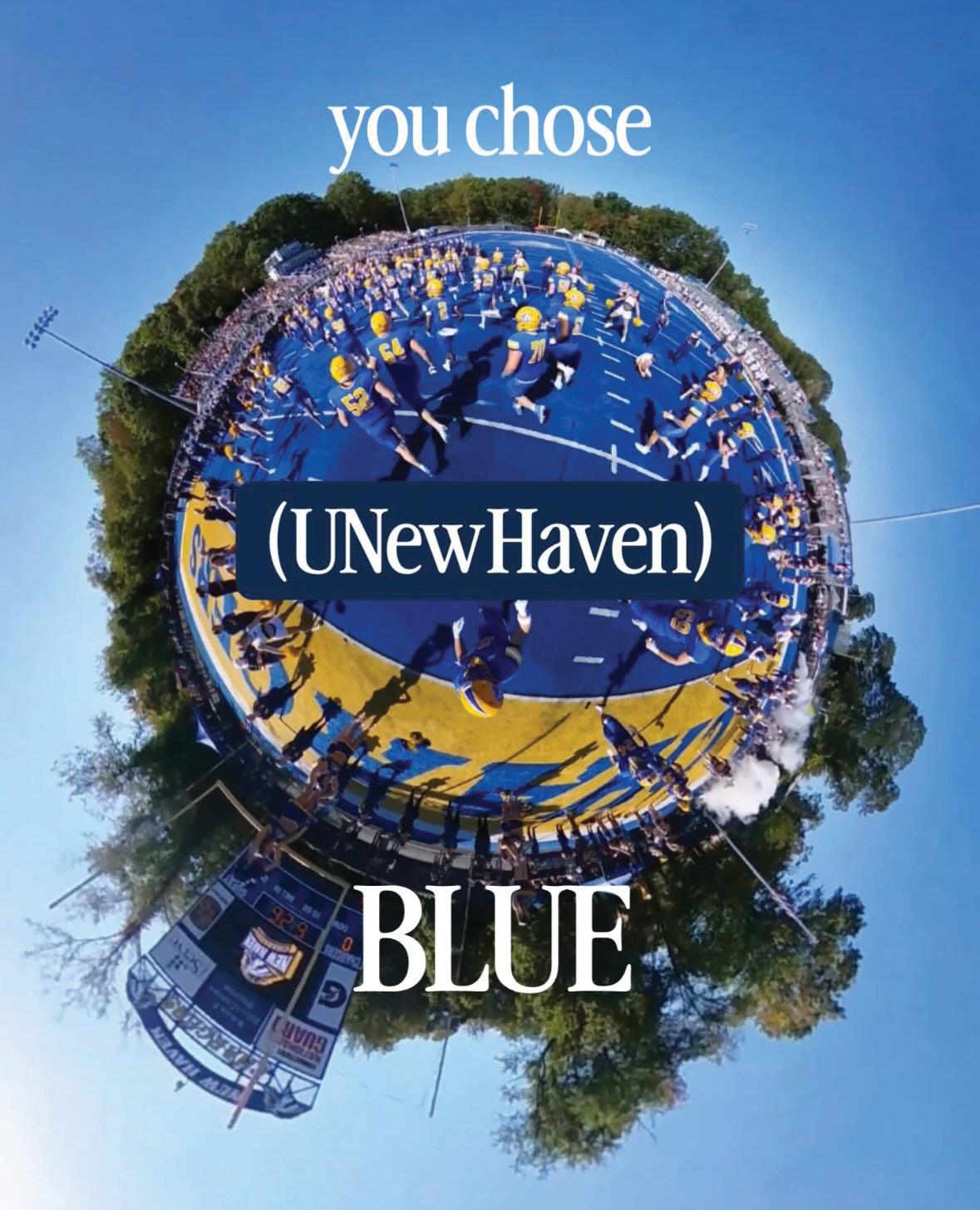
In an industry rooted in tradition, New Haven is redefining success through digital storytelling infused with student voices, building relevance, connection, and credibility in ways that rankings or renown aren’t able to. A significant part of success in higher education today is being seen and shared and, ultimately, chosen.
And although platforms and technology are ever-changing, the true emphasis will always be on community. Helping people discover that rare kind of community found at New Haven is the ultimate goal, from prospective students and their families to faculty and staff.
“You’re all in it together. Community amongst peers, colleagues, students — that’s the central part,” Laura shares. “In the digital world where we’re all so individualized looking down at our phones, we want to focus on what will bring them all together. We try to lean into that community feel and highlight it, because it’s here on campus and we want to bring it to the screens for everyone.”
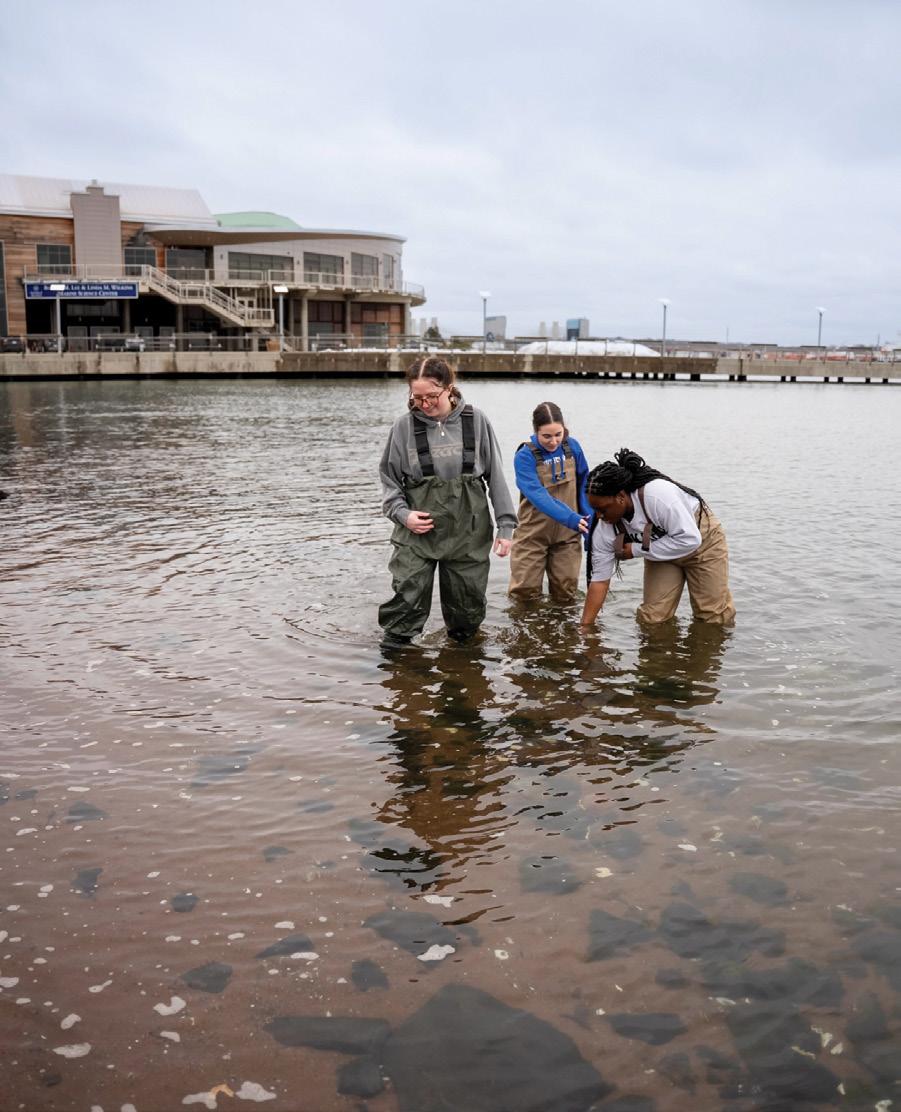



Artificial intelligence is not a distant trend. It is already transforming how students learn, how faculty teach and conduct research, how we advise and support one another, and how universities operate. We have a choice: we can wait for this wave to reach us, or we can meet it on our terms.
At the University of New Haven, we choose to lead.
In the following pages, you will read about world-class professors across all five University schools and colleges who are working to expand AI literacy for faculty, embed AI across our curriculum and research, and equip our classrooms with tools that elevate teaching and learning in a responsible manner.
The institutions that will thrive in the years ahead are the ones bold enough to act now.
This next chapter is one we write together.
BY CAITLIN TRUESDALE
The questions surrounding artificial intelligence are, for April Yoder, Ph.D., associate professor of history in the College of Arts and Sciences, many of the same questions that have long shaped her work as a historian: Who has power? And who gets to decide the future of democratic life?
Who gets to decide how AI is used? What happens to labor when technology changes the nature of work? How do societies balance innovation with freedom, equality, and accountability?
“All my research touches on the question of how governments and citizens understand the proper alignment between individual freedom (often tied to economics or capitalism) and equality or opportunity,” Yoder said.
She approaches artificial intelligence not as a computer scientist or engineer, but as a historian. It is a perspective that shapes the way she teaches, researches, and challenges students to think critically about a technology rapidly transforming society.
“When I started to get into AI research, I was interested in what AI would mean for labor and how we organize human societies,” she said. “But it was still pretty abstract until ChatGPT hit the scene in late 2022. I was mostly concerned about how to handle teaching with AI. Then I realized the problem comes down to choice. We decide how we integrate AI tools into society — or if we do.”
That realization became central to her work. “That choice is getting harder and harder to make,” she continued, “but I think it’s still there. And we have to demand that the choice of if, how, and why we use AI — and even which types of AI — is something that’s not concentrated in the hands of tech billionaires. In a democratic society, it shouldn’t be.”
Her focus on governance and public accountability led Yoder to the Center for AI and Digital Policy, where she first became involved through its AI Policy Clinics. She volunteered with the organization’s Policy
Group, which provides commentary and feedback to countries and international organizations on AI policy. She eventually became the editor-in-chief for the organization’s AI and Democratic Values Index.
The Index, available online for free, tracks and evaluates AI policies and practices around the world, ranking countries according to democratic values reflected in their approaches to AI. This year, 10 new countries were added to the report, and AI literacy was introduced as a new evaluated category. The Index serves as a practical tool for understanding how nations are navigating AI technology.
“The Index offers a snapshot of AI policy and some of the key debates and struggles at the moment,” she said. “It shows incredible progress on AI policy. Countries all over the world are moving quickly to implement policies related to AI directly and indirectly, and international organizations such as the UN are increasing their involvement in discussions among various countries.”
The findings also reveal growing divides in how countries approach regulation. “Here in the U.S., we hear a lot from leaders that regulation hurts innovation,” Yoder said. “The Index shows that there are more options.”
She points to countries across the European Union that are trying to develop frameworks that protect citizens while still encouraging innovation. “Other countries are working to figure out how to regulate how AI is used or developed to protect people without going too far to curtail individual freedom,” she said. “There are more countries and people represented in these ‘middle powers’ (not the U.S. or China) that are trying to figure out how to ensure we develop AI to benefit humans rather than for the sake of developing AI.”
That sense of tension between innovation and responsibility, efficiency and understanding, is also discussed in the classroom. Yoder recently taught an
honors course titled “Thinking Historically About AI & Society,” wherein she experimented with integrating the Index into the curriculum as a reference tool for students exploring AI policy and governance. “I used the Index in the class,” she said. “I didn’t do as good a job integrating the Index itself explicitly, but I have some ideas for how to do that next time.”
Beyond the classroom and the Index, Yoder is preparing to spend her upcoming sabbatical exploring many of these questions more deeply through a new book project examining myths and anxieties surrounding AI through historical examples.
“When I was preparing the ‘AI & Society’ class, I struggled to find a good historical text on AI,” she said. “I wanted a historical perspective because history pays attention to how the context of time and place shapes our understandings and interactions with one another and with technology.”
For Yoder, the questions raised by artificial intelligence connect directly to the themes that have long defined her research. Much of her scholarship concerns how democratic societies navigate tensions between individual freedom and equality, and she sees AI as the latest arena where those debates are unfolding.
Right now, “the book is a bunch of notecards with phrases, questions, or ideas written on them shoved into a manila envelope.”
The proposed book will feature a series of short chapters tackling contemporary AI questions through historical context. “One chapter asks, ‘Will AI take my job?’” she said. “I’ll show how new technologies have impacted the labor market in the past and think through some of the potential similarities and differences with AI.”
The project reflects the same approach as the rest of Yoder’s work at the University of New Haven, grounding rapidly changing technologies in historical perspective, civic responsibility, and human choice.
And we have to demand that the choice of if, how, and why we use AI — and even which types of AI — is something that’s not concentrated in the hands of tech billionaires. In a democratic society, it shouldn’t be.”
APRIL YODER, PH.D.

BY STEVE NEUMANN
Associate Professor of Finance Frank Chen teaches his applied AI course around a simple idea: AI is a blind elephant — it’s a powerful beast, but it needs human expertise to be truly useful. That’s why Chen doesn’t treat AI like the elephant in the room. It is the room.
“AI is everywhere in the business world, from finance to marketing to management and consulting,” Chen said, “and students who don’t learn AI will fall behind quickly.”
In Chen’s course, students explore machine learning, natural language processing, and generative AI while gaining hands-on experience with all the modern AI tools. Chen also has them complete practical projects in corporate finance throughout the semester where they learn how to design and implement AI solutions while understanding its impact across various industries. Some of these projects include aspects of stock valuation, financial modeling, and market analysis.
“I teach students to ask the right questions, challenge AI outputs with domain knowledge, and think about the business problem first,” Chen said.
Chen is already seeing the learning return on his pedagogical investment.
“The students have had a real mindset shift,” Chen said. “I’ve seen them go from taking an answer from ChatGPT or Gemini at face value, to really starting to think: Is this answer correct? Is it useful?”
Chen also said his approach to teaching AI is producing real-world results for his students.
Prashna Limbu ’26, a graduate student in finance and financial analytics, uses AI every day in her role as a financial analyst intern at Westbury Group LLC, an investment banking firm that provides M&A and capital raising services to middle market companies.
“Prashna is stress-testing models in Excel with Claude, editing CIM layouts in PowerPoint, and analyzing Dropbox data rooms to draft investor
responses,” Chen said. “She always cross-checks AI outputs against PitchBook [a data platform that provides information about businesses in capital markets], and that is exactly the judgment-first mindset I try to build.”
Stress-testing a financial model is basically checking to see how sensitive a model is to changes in important assumptions. In Excel, that works by adjusting the model’s input cells and observing how the outputs change — for example, how a business would perform if conditions turn out worse than expected.
“I use AI as a starting point rather than letting it do all the work itself,” Limbu said. “Financial models normally take a long time to build — up to three or four hours — but when I use AI, that time is significantly reduced.”
The specific model Limbu works on for Westbury Group is the free cash flow valuation model, which measures a company’s financial health by showing how much cash is available after expenses and capital expenditures. It’s an important metric investors use to evaluate a company’s ability to generate cash, reinvest in the business, or return value to shareholders.
“There are lots of assumptions that go into the free cash flow model, and if we assume a wrong number, we could get a completely different value for our calculation,” Limbu said. “So I will develop a prompt for Claude that says something like, ‘if this assumption is unreasonable with respect to a certain percent of profit the company is generating, then flag that number in the cell.’
“Doing it the traditional way,” Limbu added, “you would have to go to each and every cell, recalculate your values, and check whether all the numbers you got are correct or not.”
Although this kind of application of AI sounds like an incredibly convenient shortcut, Chen notes that
two old adages still apply to AI: “garbage in, garbage out,” and “show your work.”
“There is no shortcut,” Chen said. “AI will present a result, but students need to also ask AI to present the whole explanation, so then they can see whether the explanation is validated. Essentially, they’re auditing AI’s work.”
Chen said that AI doesn’t think in the way humans think, so it doesn’t approach a problem with the same nuance that a human, with years of relevant experience, would approach it.
“For example, different businesses have different risks, so a certain cash flow level may be an indicator of risk for one company that has lots of debt,” Chen said. “But it may not be a problem for another company that has had low cash flow for years. So it definitely needs human expertise to sift through it.”
As AI tools continue to rapidly improve and be increasingly incorporated in more and more areas of human life, courses like Chen’s are as essential to student career success as learning the basics of the fields they are studying.
“It’s easy for students to access and use AI,” Chen said, “but my goal is to teach them how to think in an AI-driven world, and how to combine human judgment with machine intelligence.”
In a world where the AI elephant looms large in every business sector, Chen ensures his students cultivate far more than technical proficiency by learning exactly when to trust automation and when to challenge it with rigorous human expertise. Ultimately, Chen’s mission is to cultivate future leaders who refuse to rely blindly on digital systems. By prioritizing critical judgment and strategic insight, he guarantees that Charger alumni always remain the single most important intelligence in the room, commanding authority in any professional environment.
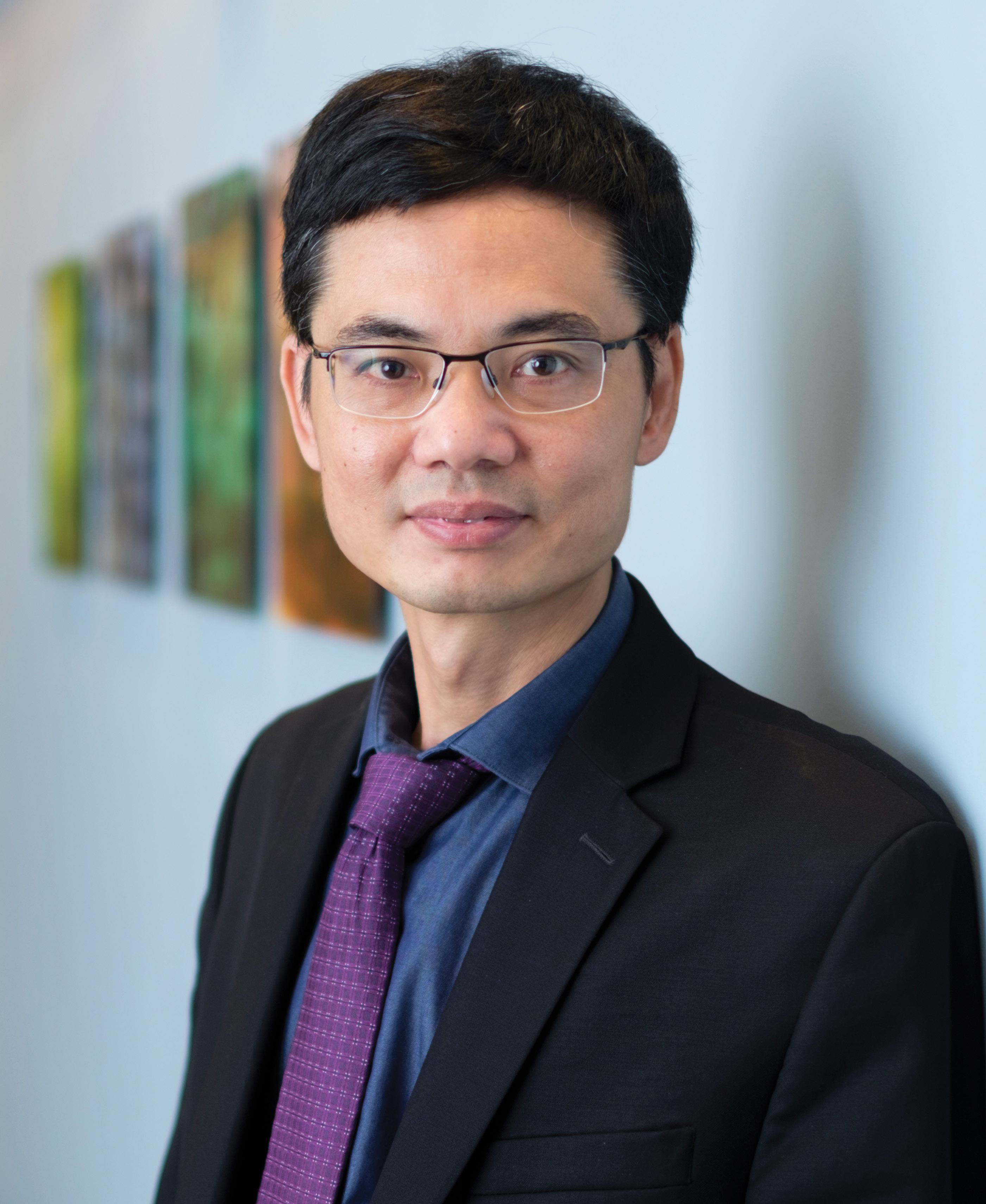
It’s
easy for students to access and use AI, but my goal is to teach them how to think in an AIdriven world, and how to combine human judgment with machine intelligence.”
FRANK CHEN, PH.D.
BY MICHAEL BLANDING
To the untrained eye, satellite images of the fertile Nile river delta look like the speckled patterns of mold in a petri dish. But to criminologist Michelle Fabiani, they hold the key to protecting the world’s precious cultural artifacts. “People who are invested in cultural heritage have known for a long time that looting happens at archaeological sites, and there’s a lot of satellite imagery where you could look for it.” At the same time, examining those images can be time-consuming. “It can be difficult on the eyes to look at images for hours and ask, is it a bush or a hole?” Fabiani says.
To solve those logistical issues, Fabiani has turned to artificial intelligence, training machine-learning algorithms to identify signs of looting at a scale impractical for humans. She then combines that evidence with other data to develop better strategies for protecting sites and tracking thefts when they occur. “As with many criminal justice issues, a small number of people are likely responsible for the majority of thefts,” Fabiani says. “So how can we use limited resources to effect the change we want to see? We need a baseline to know which archaeological sites have been looted and when, and in response to what kind of factors.”
An associate professor at the Henry C. Lee College of Criminal Justice and Forensic Sciences at the University of New Haven, Fabiani works at the intersection of disciplines, blending criminal, cultural, economic, and physical information to identify patterns. In Egypt, she’s already catalogued looting attempts at 140 sites, sometimes nearly every month. Her team is now using algorithms to expand detection across eight years and 632 sites in the Nile Delta, serving as a model Fabiani hopes to apply to other locations. She leads this work as co-director of the CURIA Lab, a collaboration with sociologist Fiona Greenland of the University of Virginia.
Fabiani sees the project as just as much a humanitarian endeavor as a law-enforcement tool. “We have
never lived in as technologically advanced an era as now, and yet there is so much disconnection — we are all incredibly online and floating in the ether of the internet,” she says. “We’re missing the things that can ground us, and cultural heritage is a way to do that. Everybody deserves the right to know who they are and where they come from, and to see the connections between cultures.”
Growing up near Boulder, Fabiani was interested in archaeology from a young age, “dragging” her parents to a lecture on the 2003 looting of the Baghdad Museum when she was still in middle school. She followed that interest to the University of Maryland, where she studied cultural anthropology and art history, working in collections departments and museums. As she learned about the instances of artifact theft, she was surprised by the lack of information on what had been taken and how objects were trafficked. “The answer I got was, ‘We don’t have any data on that.’”
As she dug into the issue, she quickly understood why — to get a full picture, it was necessary to cross multiple disciplines, combining econometrics, geospatial analysis, political science, archaeology, and environmental science. Fabiani realized statistics could provide a common language to connect disciplines. “I try and be at least 40 percent literate in whatever field I’m intersecting with,” she says. Starting a decade ago, she turned to the explosion of satellite imagery as a way to track thefts, cross-referencing instances of looting with data on poverty and inflation, political violence, precipitation, soil moisture, and vegetation.
Applying multilevel statistical models to the data, she found that looting was influenced by multiple factors, with elements such as inflation or environmental stress often growing over time to create a tipping point. Political unrest almost
always guaranteed looting, though only in a small geographical area associated with violence. By far, the most important factor was whether a site had been looted in the past, which could increase likelihood of future looting by as much as 60 percent. Identifying those patterns faster with AI, she says, could help governments determine where to spend their scarce resources, through increased security and faster responses at sites with a high likelihood of theft. “You might not stop an event, but if you at least document it, then on the back end when objects start to appear you have a stronger legal claim to stop the sale or seek repatriation.” Along with looting, Fabiani and Greenland have pursued another project looking at the effectiveness of no-strike designations in Syria, under an aspect of international law in which countries designate sites to be avoided in military strikes.
She has involved students from the beginning of the algorithm development — from criminal justice to political science, data science, cybersecurity, and mathematics. They use artificial intelligence to guide the complex work from troubleshooting algorithm development to translating across disciplines. “It becomes an iterative process where all of us are learning, including the AI, how to explain complex, interdisciplinary concepts in a way that is intuitive and transparent and actionable.”
Her goal is to provide concrete information to stakeholders around the world that will help them better safeguard their unique artifacts. She also hopes to offer a new model for how the most advanced technology of the information age can help preserve ancient cultures. “If we can push a paradigm shift toward more proactive approaches of data collection leveraging machine learning,” she says, “I think we will see a ripple effect in terms of advocacy, legislative changes, and repatriation.”
We have never lived in as technologically advanced an era as now, and yet there is so much disconnection ... We’re missing the things that can ground us, and cultural heritage is a way to do that. Everybody deserves the right to know who they are and where they come from, and to see the connections between cultures.”
MICHELLE FABIANI, PH.D.
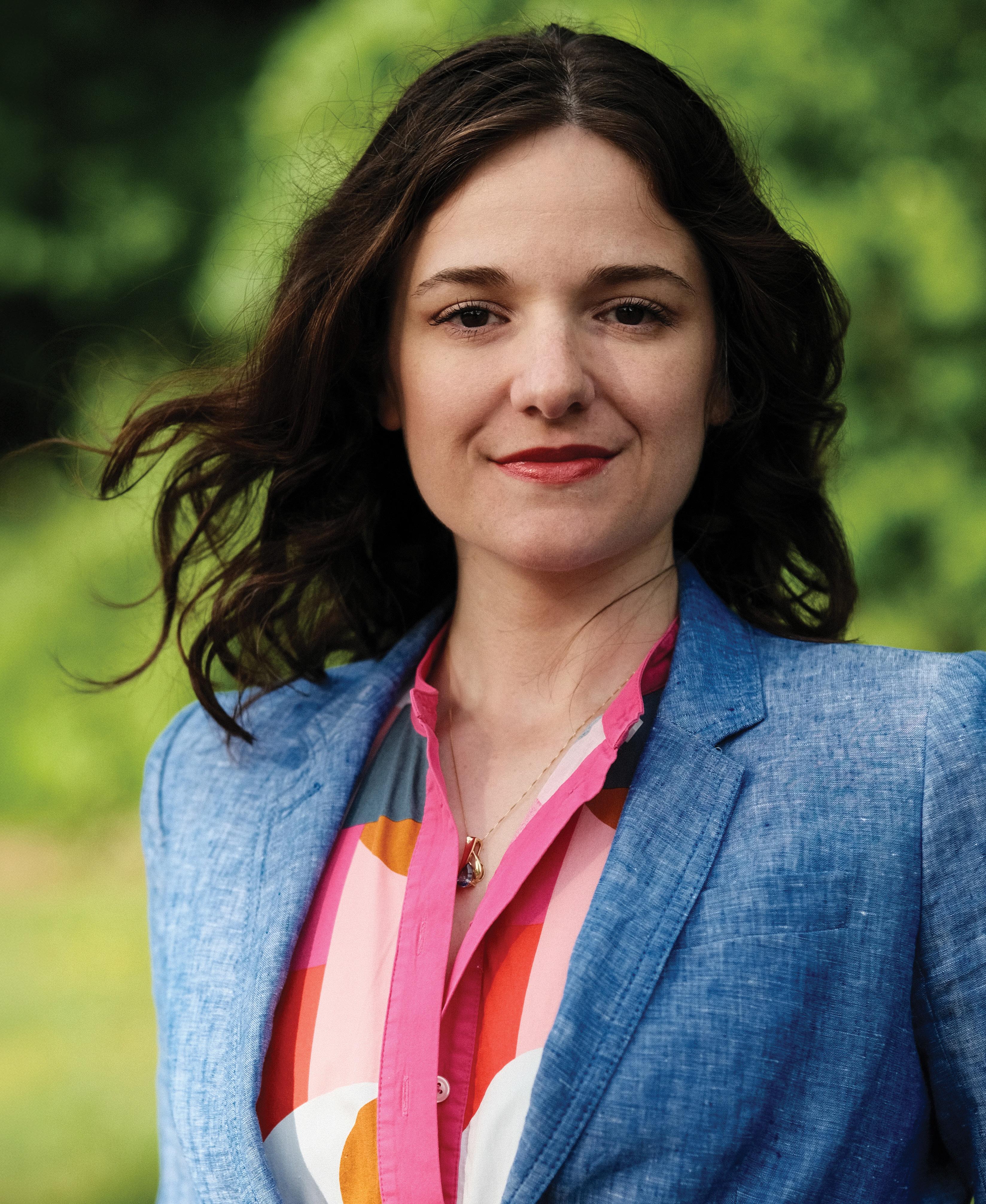
Mehdi Mekni, Ph.D.
BY CAITLIN TRUESDALE
Students walking into the University of New Haven are entering a learning environment already shaped by artificial intelligence.
Not someday. Not hypothetically. Right now.
“We are not talking about the future,” Mehdi Mekni, Ph.D., said. “We are doing it already.”
As professor of computer science and cybersecurity and undergraduate coordinator for cybersecurity in the Tagliatela College of Engineering, Mekni has helped guide the College’s rapid expansion into AI-focused education and workforce preparation.
In his work he focuses on making sure students can take what they learn in the classroom and apply it to real-world problems before they graduate.
The clearest example may be found in the University’s yearlong computer science capstone projects, where students are challenged to turn ideas into fully realized solutions. This year, four of the five computer science capstone projects incorporated AI.
“That demonstrates two things,” Mekni explained. “Students not only master the artificial intelligence techniques that we teach them in the second and third year, but they are at the level of applying those techniques.”
Mekni speaks about student projects with visible pride, not as distant faculty oversight, but as collaborative work. “I’m part of the team,” he said. “We meet on a weekly basis, providing feedback.”
One project that stood out to him was READY2WORK, a virtual reality interview training platform that combines AI-generated interview questions and feedback with immersive technology. Designed to help students prepare for job interviews, the platform places users inside a simulated interview environment where they interact with an AI-powered avatar representing a hiring manager.
At the end of the session, students receive detailed feedback identifying where they succeeded, where answers lacked focus, and how they could strengthen their résumés and cover letters for specific roles.
“The goal was to help students lower their level of stress when they are in an interview,” Mekni said, “and position University of New Haven students as competitive professionals in the market.”
Another student project, Elevate, addressed a growing concern among aspiring software developers: how to stand out in a world increasingly shaped by generative AI coding tools.
The software functions as an add-on to an integrated development environment, analyzing student coding progress and offering targeted feedback to strengthen programming competency beyond simple syntax memorization.
“The goal was to elevate their skills,” Mekni explained, “so they are industry-ready for hiring as soon as they graduate and hit the ground running.”
For Mekni, the projects are proof that the University’s approach to AI is already producing results.
That strategy accelerated dramatically following the COVID-19 pandemic, when the University saw a surge in demand for its data science graduate program. What had once been a relatively small program expanded rapidly, creating an urgent need for faculty expertise and curriculum growth.
“It was a big challenge for the College and the departments to quickly position themselves,” Mekni said.
The University invested in hiring AI-focused faculty experts while simultaneously building new academic pathways for students. Those efforts led to the creation of both bachelor’s and master’s degree programs in artificial intelligence, an approach Mekni says remains relatively uncommon at the undergraduate level.
“Not many universities are investing in undergraduate artificial intelligence,” he said. “But we are trying to align with what the market is expecting.” The result is what Mekni describes as both “depth and breadth” in AI education.
Students can pursue a fully AI-focused degree pathway, or they can integrate AI concentrations into fields such as cybersecurity, software development, or electrical engineering.
“We did it vertical and horizontal,” Mekni explained. “The vertical aspect is the bachelor’s and master’s degrees in artificial intelligence. The horizontal aspect was revisiting every other program
to add pathways that leverage AI technologies. This way, students can major directly in AI or add AI pathways to any degree.”
That philosophy extends beyond engineering and computer science students. Beginning this fall, the University is also introducing AI literacy courses as part of the core curriculum, giving students across all majors an opportunity to better understand artificial intelligence, its capabilities, and its limitations.
“We want every student on campus, regardless of their major, to learn about what AI means,” Mekni said. The goal, he added, is not to turn every student into an AI engineer. Instead, the courses are designed to demystify artificial intelligence and help students think critically about the technology shaping modern workplaces and industries. “AI’s not magic,” Mekni continued. “It’s not something we need to follow blindly. It’s a helper.”
Outside the classroom, Mekni has played a key role in workforce development initiatives across Connecticut, including the University’s involvement in the Tech Talent Accelerator grant program and working with organizations such as the Business-Higher Education Forum and regional economic development partners. “My role is to make sure the programs are revised in a way that aligns with market needs,” Mekni said.
As AI reshapes industries, Mekni says programs have to evolve just as quickly. Connecticut’s growing technology ecosystem, including health tech, fintech, and aerospace innovation corridors, has only increased the urgency of preparing students for emerging careers.
At the center of it all is the question of whether students are ready. Mekni believes readiness is more than technical competency. It means graduates who can adapt, innovate, and contribute immediately in fast-changing industries.
“My role is to make sure my students demonstrate capabilities not only in applying technology in projects,” he said, “but creating projects that add value and projects that show creativity and innovation.”
The University of New Haven isn’t waiting for AI — Mekni’s classroom is already producing results.
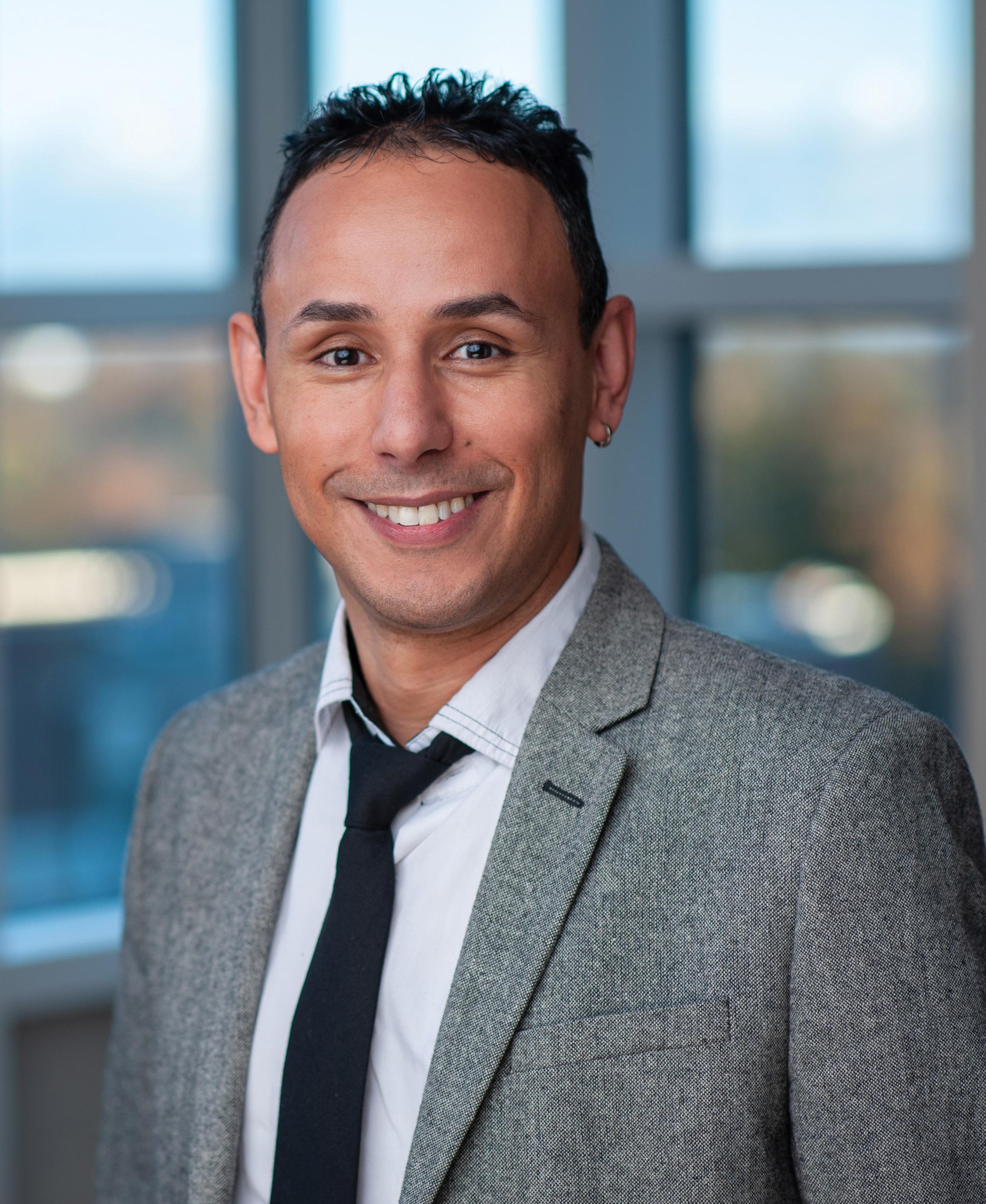
Not many universities are investing in undergraduate artificial intelligence, but we are trying to align with what the market is expecting.”
MEHDI MEKNI, PH.D.
BY STEVE NEUMANN
Since ChatGPT was introduced in 2022, generative AI has become practically ubiquitous in human life. In the home, in the classroom, in the workplace, more and more people are utilizing it to make their lives and jobs easier, more productive, or more efficient.
That’s why Assistant Professor Jacqui Brown Ed.D., the director of UNewHaven’s SpeechLanguage Pathology Program, thinks it’s important to help students, faculty, and her fellow professionals in the field improve their AI literacy.
Prior to entering academia, Brown had worked in K-12 schools, outpatient and inpatient adult rehabilitation, and acute care before starting the Speech-Language Pathology Program at UNewHaven. Since then, her research has centered on the ways in which speech-language pathologists (SLPs) could be supported in their roles.
That’s where artificial intelligence comes in.
“In the last few years there’s been some research on whether AI can be used for things like language sampling, which is analyzing someone’s language content and structure,” Brown said. “And that helps us to understand how we might intervene in those areas.”
Brown notes that language sampling is a time-consuming aspect of an SLP’s job, because it involves recording what each patient says, then transcribing it, and then analyzing it for potential opportunities for therapeutic intervention.
“AI isn’t accurate the way a clinician would be,” Brown added. “So ultimately, the clinician still has to check for accuracy. But the large language model can collect data and help organize information.”
It was this fact-checking aspect that inspired Brown to start introducing her students to the possibilities and pitfalls of AI use as they enter the profession after graduation.
“Students used either ChatGPT or Microsoft Copilot in the classroom this last semester,” Brown said. “I had students feed recorded samples into a large language model, and then had it break out which parts of speech, like verbs or articles, were missed in the sample.
“It wasn’t 100 percent accurate,” Brown added, “but it at least provided an initial breakdown that students could revise, as opposed to having to do the analysis from scratch. It’s a great way for students to learn to organize their thinking by working with a pretend patient.”
Brown feels this exercise is important because the temptation is there to let the AI do the thinking for you, and just accept its answers at face value.
“That’s one thing to caution students about,” Brown said. “You still have to use your cognitive resources, you still have to think critically, because oftentimes there’s one statement that has nothing to do with the transcript you fed it.”
That’s one of the reasons Brown thinks AI won’t ultimately replace professionals in the SLP field. Another reason is because she feels it lacks a certain quality that no AI can ever possess — the human connection.
“There was an NPR story when ChatGPT was first released that said the jobs that will prevail in the age of AI are the jobs that require human connection,” Brown said. “One of the pieces that is so crucial in SLP therapy is that your patient is not going to make progress because you gave them the right task to do, but because you built a connection with them.
“There was something about that connection that motivated them to work to make progress, and that’s something a large language model can’t do with a patient.”
As part of her current research, Brown has been working on a project that involves surveying and interviewing SLPs about their experience with AI in the field. Though her study is in its early stages, Brown’s preliminary findings reveal significant hesitancy among professionals.
“My interviewees have mentioned that, if you’re going to use ChatGPT or any other large language model ethically and well, building the prompt that is going to give you good information takes a lot of time and cognitive work,” Brown said. “And organizations are not really providing training unless there’s someone who’s in an academic setting and has sought training on their own.”
Though training in AI in the field may be limited, Brown said some SLPs are finding creative ways to use AI effectively in their work.
“Some of them are saying that AI is really good for a conversation,” Brown said. “For example, I can ask the large language model to pretend it’s a 54-yearold patient who just had a stroke, and I am going to try to treat them as their SLP. That allows SLPs to practice a little more without the fear of making a mistake with an actual patient.”
Brown’s research plays a vital role in shaping industry standards, ensuring that SLPs ethically and effectively navigate the evolving landscape of generative AI — which will ultimately elevate the standard of care for their future clients.
In addition to her role as professor and researcher, Brown is also on UNewHaven’s AI Literacy Group, which includes faculty from all colleges and staff from various offices, and aims to equip students with the knowledge and skills to effectively and ethically use AI in their future careers.
“My role is really to advocate for my colleagues to introduce their students to at least using large language models,” Brown said, “because we do more of a disservice to students by eliminating it from coursework.
“Students will inevitably need to use it, they’ll see their colleagues use it, and they’ll be more likely to make mistakes or get left behind if we aren’t intentionally exposing them to it and having them learn how to use it meaningfully and responsibly.”
Ultimately, Brown hopes students, faculty, and her fellow professionals in the SLP field can come to accept the new reality imposed upon the world by the advent of generative AI, suggesting everyone needs to become responsible consumers, just like with any other type of technology.
“AI is moving very fast, and perhaps by the time our students graduate, there will be so much more that AI could do,” Brown said, “but at least they will know its limitations, how it impacts efficiency and efficacy, and understand that professional knowledge and experience are still important.”
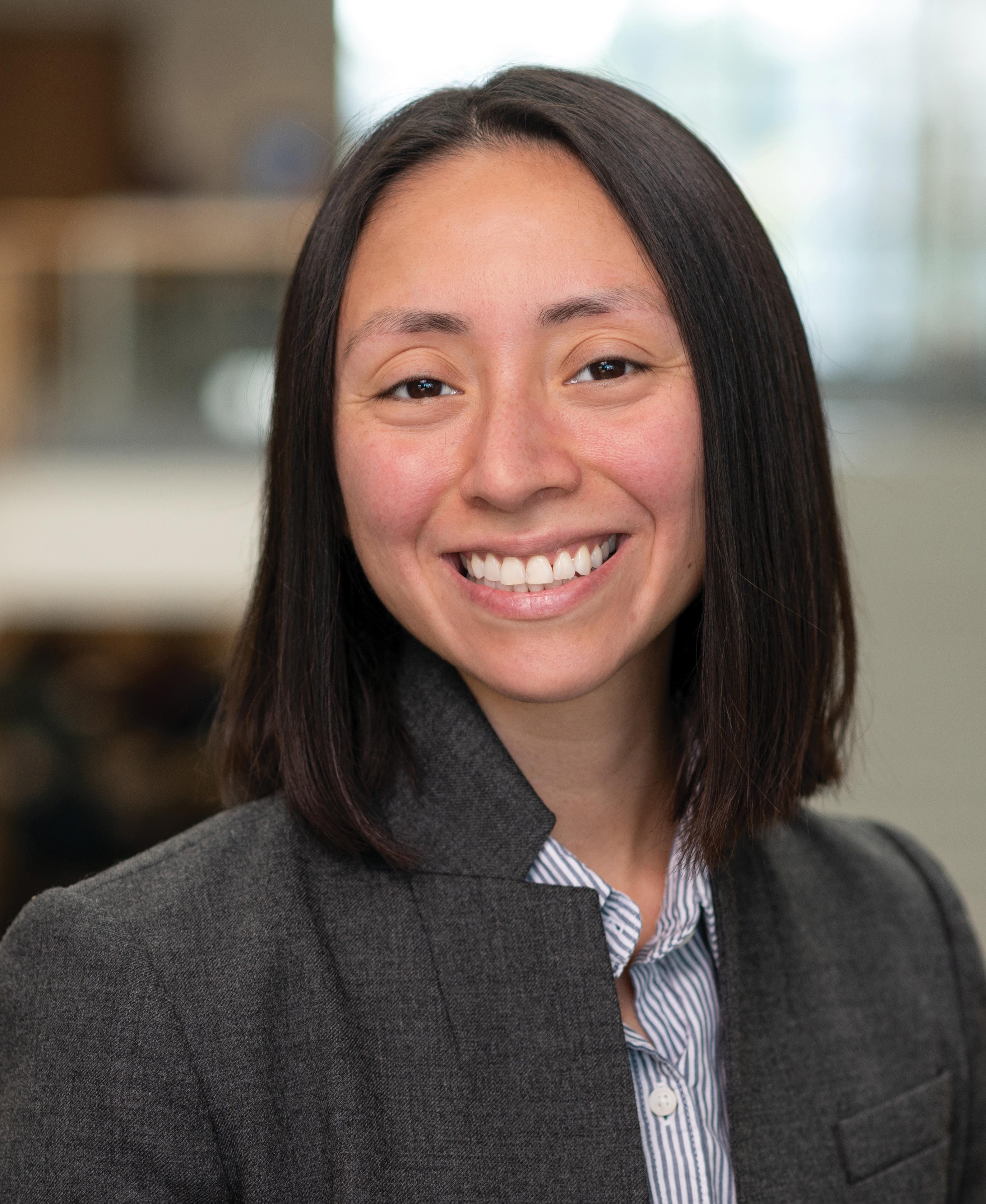
You still have to use your cognitive resources, you still have to think critically, because oftentimes there’s one statement that has nothing to do with the transcript you fed it.”
JACQUI BROWN, ED.D., CCC-SLP
We’ve made it through the first half of the year, and the end of another successful academic year. UNewHaven saw tremendous results from Giving Day, raising over $400K from over 900 donors. Admissions also had record domestic applications. These achievements came despite some of the road bumps the University, like many other institutions, encountered in the past year, mostly from a changing landscape in higher education and external factors beyond the University’s control.
While some higher institutions around the country are shutting their doors, UNewHaven is persevering, with numerous projects in progress to expand the West Haven campus, our global presence, and our social media visibility.
While some higher institutions around the country are shutting their doors, UNewHaven is persevering.”
I’m also seeing drastic changes happening within my career in the TV broadcast industry. In the Vlock Center at Maxcy Hall a decade ago, my peers and I had foreseen some of these changes, such as the shift from cable to online streaming, which can lead to content modifications and consolidation to create conglomerates. We also observed the newspaper and radio industry slowly shrink due to conglomeration and automation, and that’s what’s happening now with TV. As for me, there are times I feel like I am in survival mode, but I try not to dwell on what-ifs and focus on being the best I can be at my job. If I keep being me, I know that things will work out, even when uncertain changes are on the horizon.
I am excited to hear that the College of Arts and Sciences is adding a Sports Media & Production concentration to the Communication major, especially as sporting events dominate social media and streaming platforms. This addition to the Communication major and the continuation of prioritizing experiential learning will help our students be prepared for the ever-evolving world of broadcasting. Our board is also “doing things differently”: we’re continuing to see success in shifting to a pillar format, instead of committees, to keep the foundation of the Alumni Board strong and to stay on track for our initiatives. Our e-board’s specified roles in communication, partnership, and membership serve our Board better than traditional VP, secretary, and treasury roles. This year, we have established connections with some of the college deans to collaborate on ways the Alumni Board can better serve the University’s academic colleges, professors, and students. The Board is also extending our appeal past Giving Day in seeking contributions to the Power Forward Scholarship, which focuses on our goal of retaining rising sophomores hoping to return in the fall.
Enjoy the summer, and I hope you can join me and the Alumni Association at Homecoming this September.

Leah Myers ’18
President, University of New Haven Alumni Association

The University has never lost sight of what’s most important — the students. Everything is focused on their experience, their education, and their success. That’s why I continue to support it.”
BY CAITLIN TRUESDALE
Long before she became the president and CEO of Ledyard Financial Group, Josephine Moran, ’01 M.S., ’19 EMBA, was a student navigating a relentless balancing act. After spending a decade in the fashion industry, doing everything from wholesale sales to retail management at Macy’s, a book on personal finance sparked an entirely new passion. Moran decided to pivot her life toward investing and financial planning, enrolling at the University of New Haven to pursue a master’s degree in finance and financial services.
At the time, Moran was raising two young sons and working full time during the day, taking just one night class at a time. By 1999, she had secured a role as a financial specialist at a bank branch in West Haven. Suddenly, her evening classes and her daytime reality connected in the best possible way.
“Once I started working in banking, what I was learning in class, I was able to apply to work and vice versa,” Moran recalls. “We had to write case studies, and I was actually experiencing them in
real time with clients. That experiential learning made a massive difference.”
She still vividly remembers an estate-planning adjunct professor — a practicing attorney — whose elective course directly helped her solve real client problems at the branch and inspired her to pursue her Series 7 and 63 licenses. “I truly believe that I would not be where I am today if I didn’t go to the University of New Haven,” she says.
As Moran’s career took her to senior leadership roles, wherein she managed regions of up to 1,200 people for major financial institutions, the University reached back out to her in 2012. What began as an invitation to help form the College of Business Advisory Council quickly turned into a deep, long-term commitment to service and leadership.
Today, Moran is a member of the University’s Board of Governors and continues to chair the Pompea College of Business (PCOB) Advisory Board. Driven by her passion for supporting fellow female professionals, she has also founded the University’s Women’s Leadership Council to provide mentorship, networking, and professional

development for female students while actively securing corporate sponsorships and speakers for the annual Women’s Leadership Conference. Her commitment to her own growth brought her back to campus as well, earning an Executive MBA in 2019 alongside a tight-knit cohort she still stays in touch with today.
For Moran, giving back is a profound responsibility. “I feel strongly that people who have experience should take those who are starting out under their wing,” she says. “They’re the future.”
That belief is why she has been a consistent financial supporter of the University for over 10 years, contributing regularly to the Dean’s Fund out of a deep belief in the forward-thinking leadership of PCOB Dean Brian Kench. Her philanthropic commitment has taken an exciting step forward with her major support of the PCOB capital project, an initiative aimed at
ensuring that future generations of business students have access to the cutting-edge spaces and resources they need to thrive.
Her connection to the Charger community is deeply personal, too.
Beyond her own two degrees, Moran’s son, Zachary Moran, is a 2020 business alumnus, and her partner’s son is currently enrolled as an engineering major who works in the admissions office.
Seeing the university’s impact through the eyes of a student, an alumna, and a parent reinforces her optimism for its future.
“I always thought the University of New Haven was the best-kept secret,” Moran says. “But the buzz is out there. The University has never lost sight of what’s most important — the students. Everything is focused on their experience, their education, and their success. That’s why I continue to support it.”
On Wednesday, April 22, the University of New Haven community united for its annual 24-hour Giving Day campaign, delivering a historic triumph that shattered our initial goals. Charger Nation rallied together to raise more than $450,000 from over 900 incredible donors, directly funding the vital programs, scholarships, and campus experiences that fuel bright futures for our students.
The extraordinary results of Giving Day 2026 underscore a powerful truth: each year, our University community grows stronger, propelled by the unwavering passion and resilience of our alumni, families, and friends. This widespread participation showcases our collective strength and unity, proving that every single gift makes a profound impact.
In a standout moment of celebration, the University proudly presented the Giving Day Appreciation Award to Paul Falcone, director of studio operations and media production, honoring his remarkable milestone of 25 consecutive years of giving. Devoted leaders like Paul embody the heart of our mission, helping to transform student lives and elevate our entire campus. Thank you, Charger Nation, for your inspiring generosity!
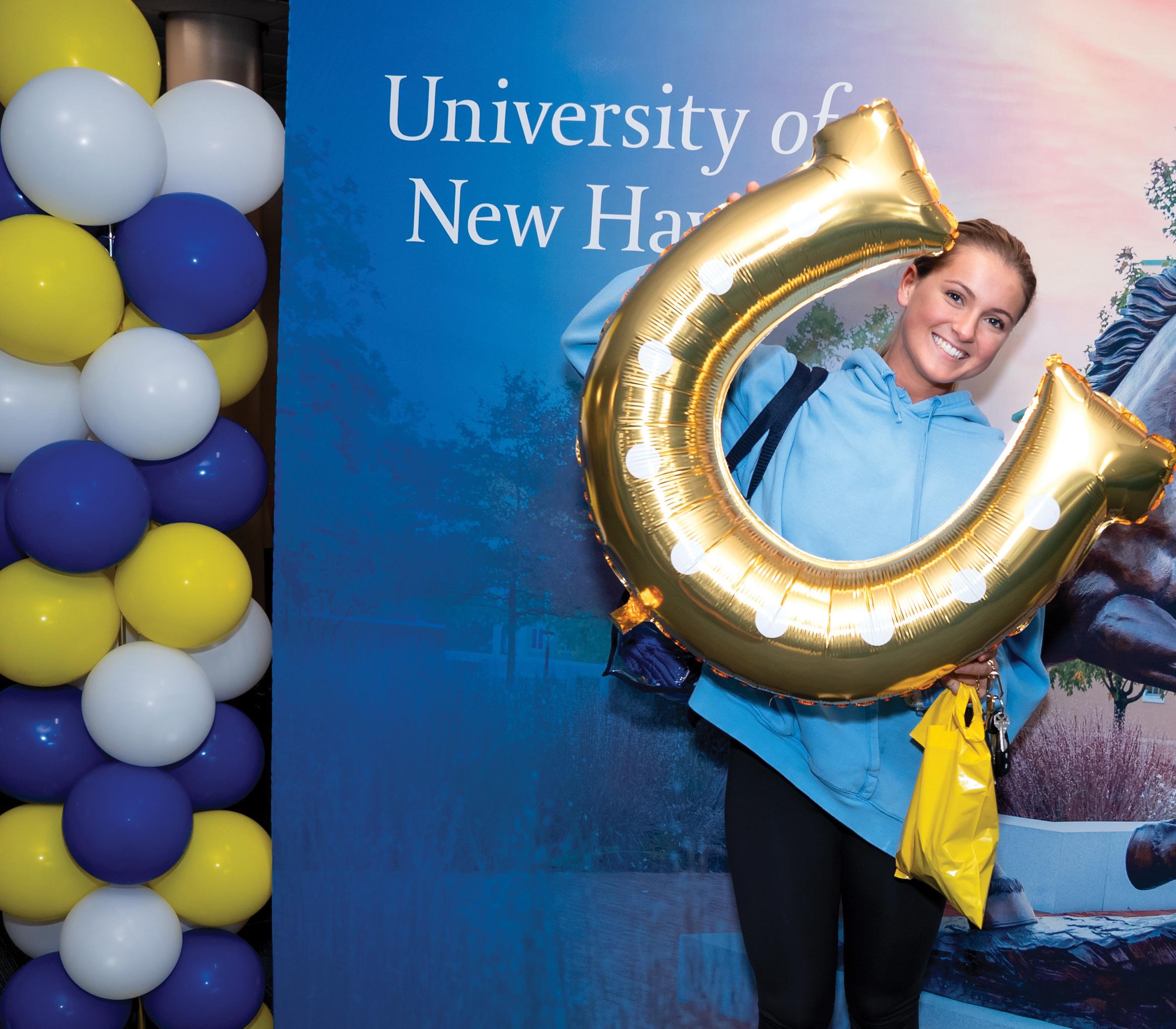
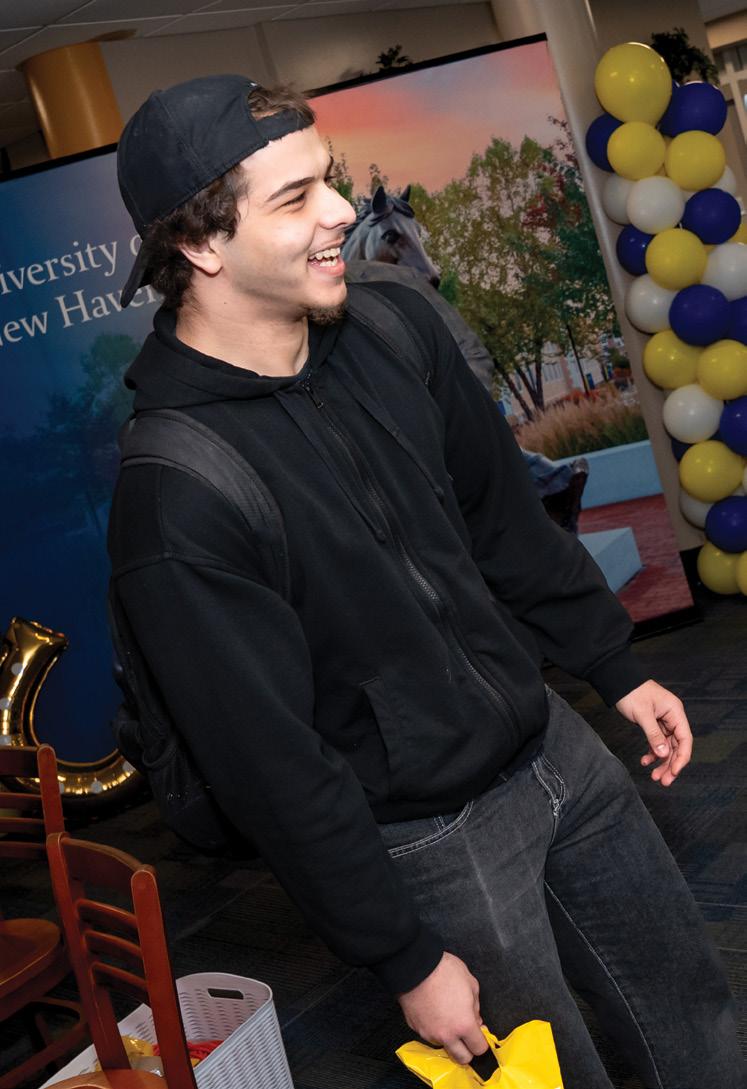
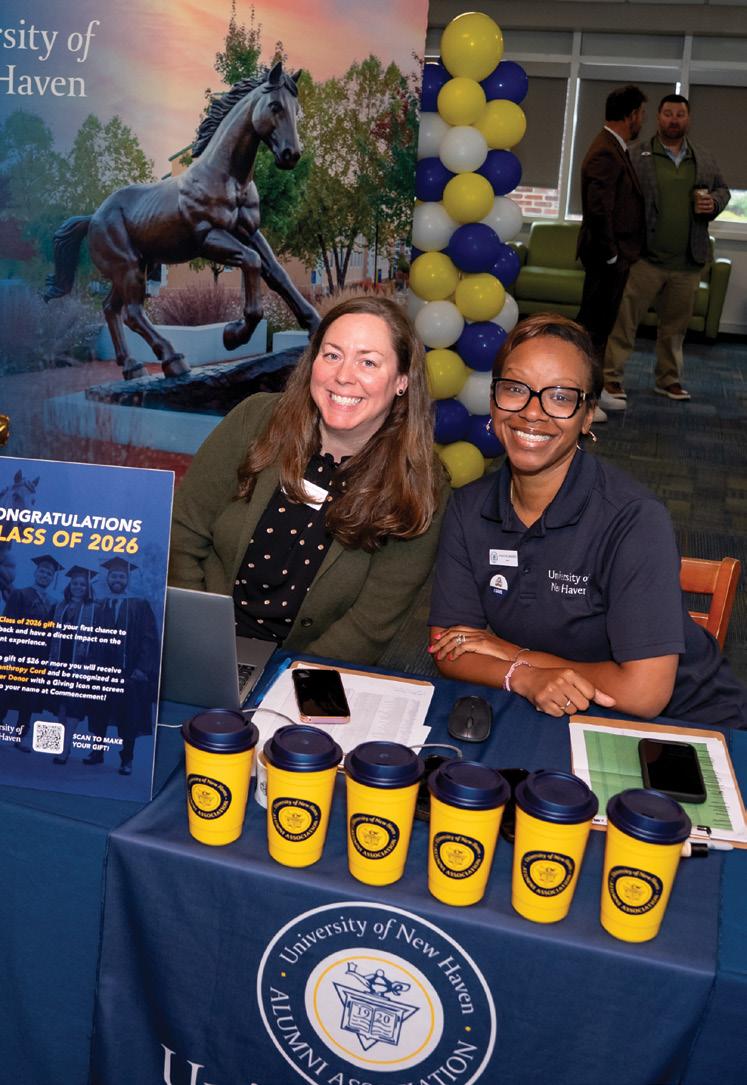



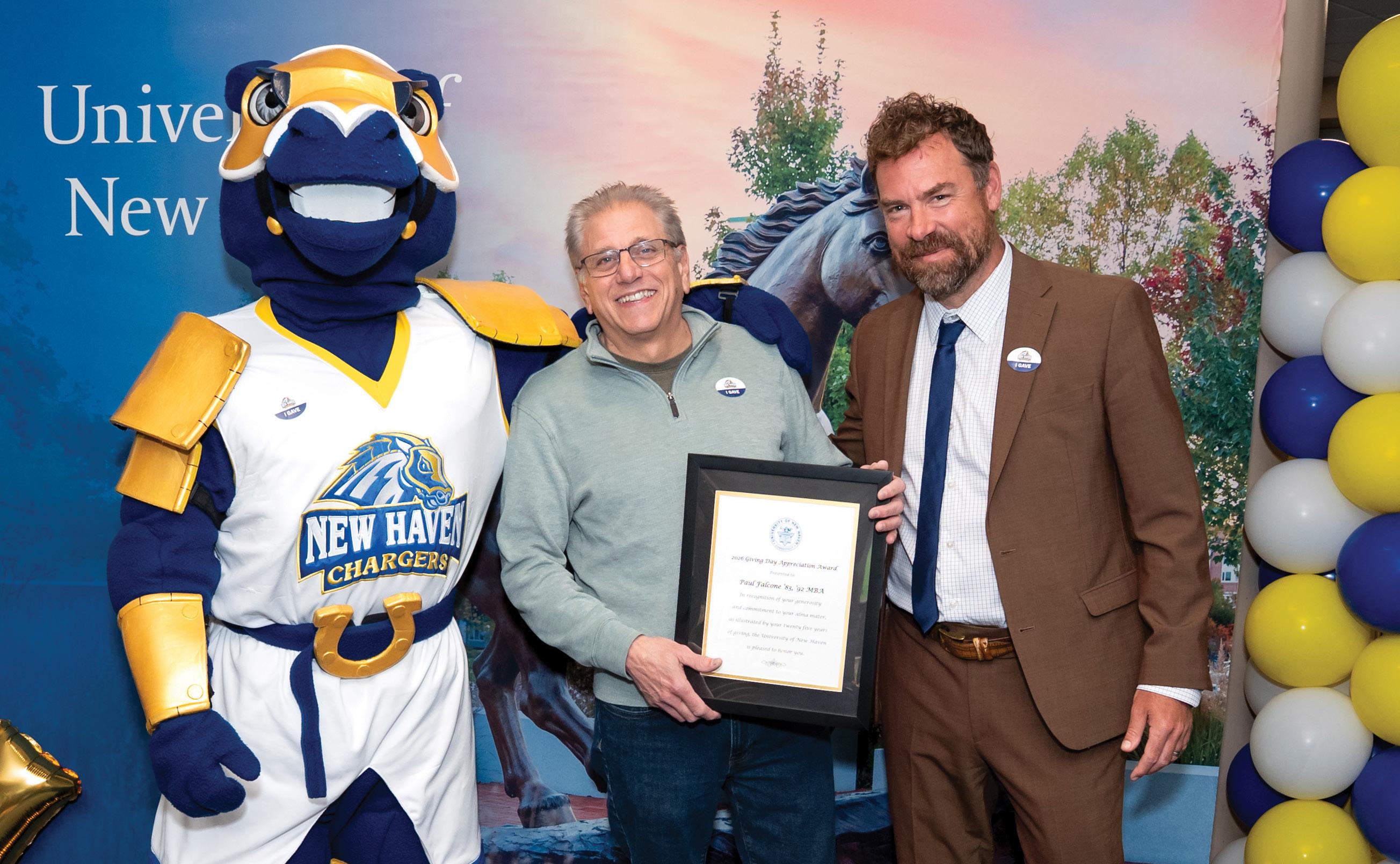
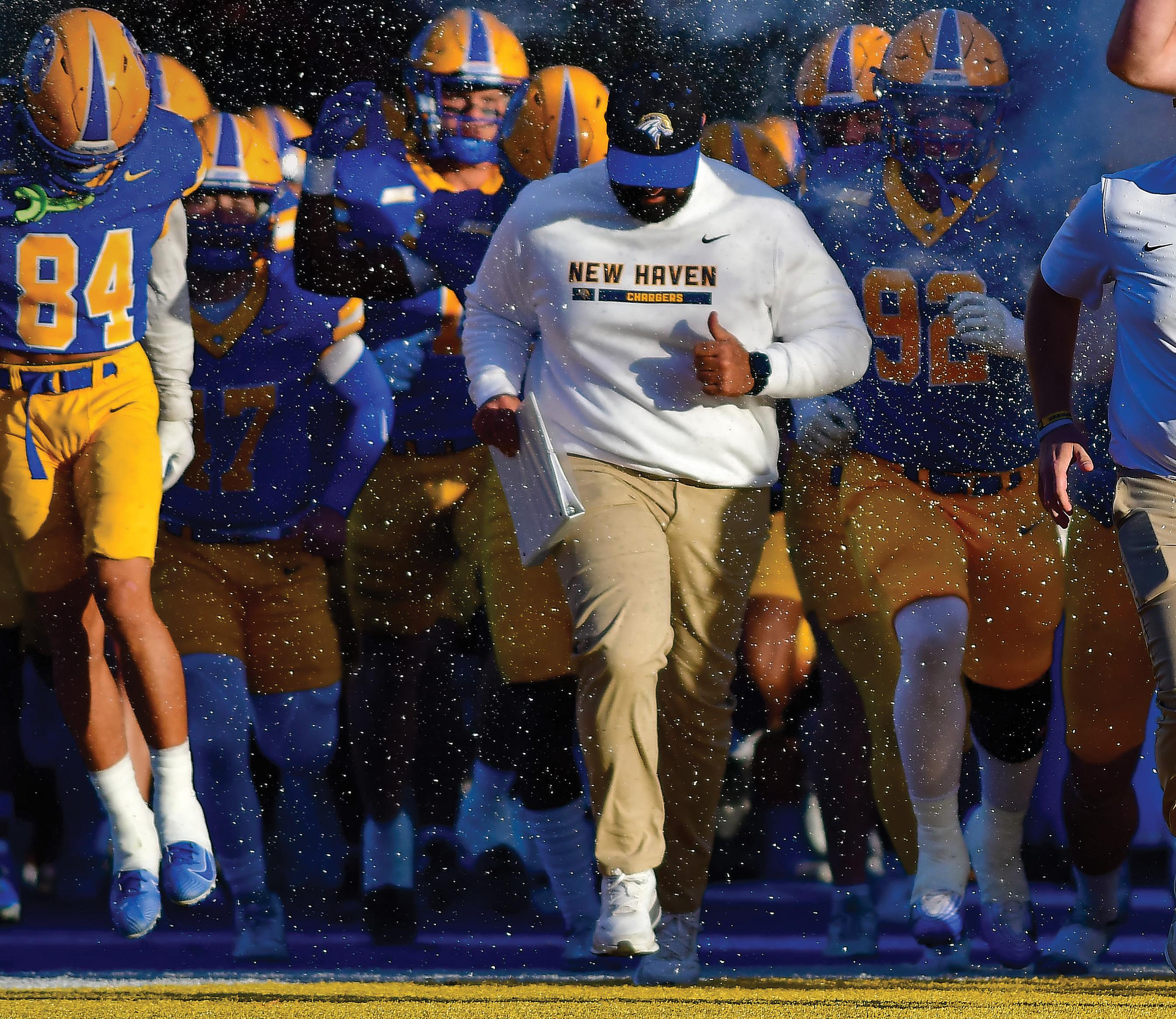
The University of New Haven has unveiled its 2026 football schedule, marking a monumental milestone as the program enters its inaugural season as a full football member of the Northeast Conference (NEC). Competing for a conference championship, the Chargers face an expanded 12-game slate featuring three first-time opponents: South Dakota State, Brown, and Austin Peay.
New Haven kicks off the season at home under the Friday night lights on Aug. 28 against Marist University, seeking to avenge last year’s opener
where quarterback AJ Duffy passed for 377 yards. The home crowd at Ralph F. DellaCamera Stadium will also welcome Ivy League foe Brown on Sept. 19, alongside critical NEC matchups against Stonehill on Sept. 5, Duquesne on Oct. 31, and Long Island University on Nov. 7.
A rigorous road campaign will test the Chargers’ championship resolve. Non-conference road trips include South Dakota State on Sept. 12, Merrimack on Sept. 26, and Austin Peay on Oct. 3. Following an Oct. 10 bye week, New Haven enters a crucial
stretch of NEC road games at Robert Morris, Central Connecticut State, Wagner, and the regular-season finale at Mercyhurst on Nov. 21.
SCHEDULE KEY ARROW-RIGHT
Home Away
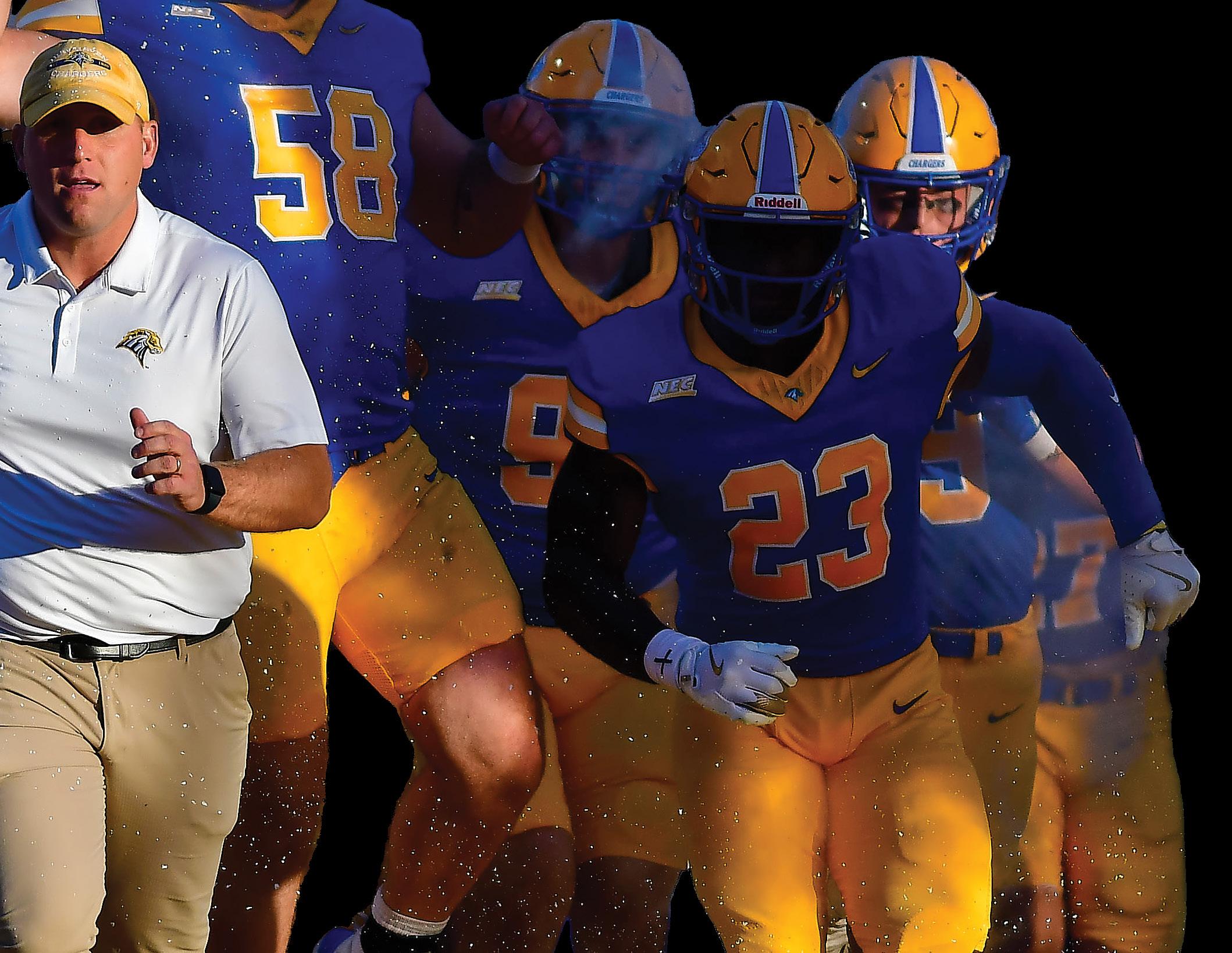
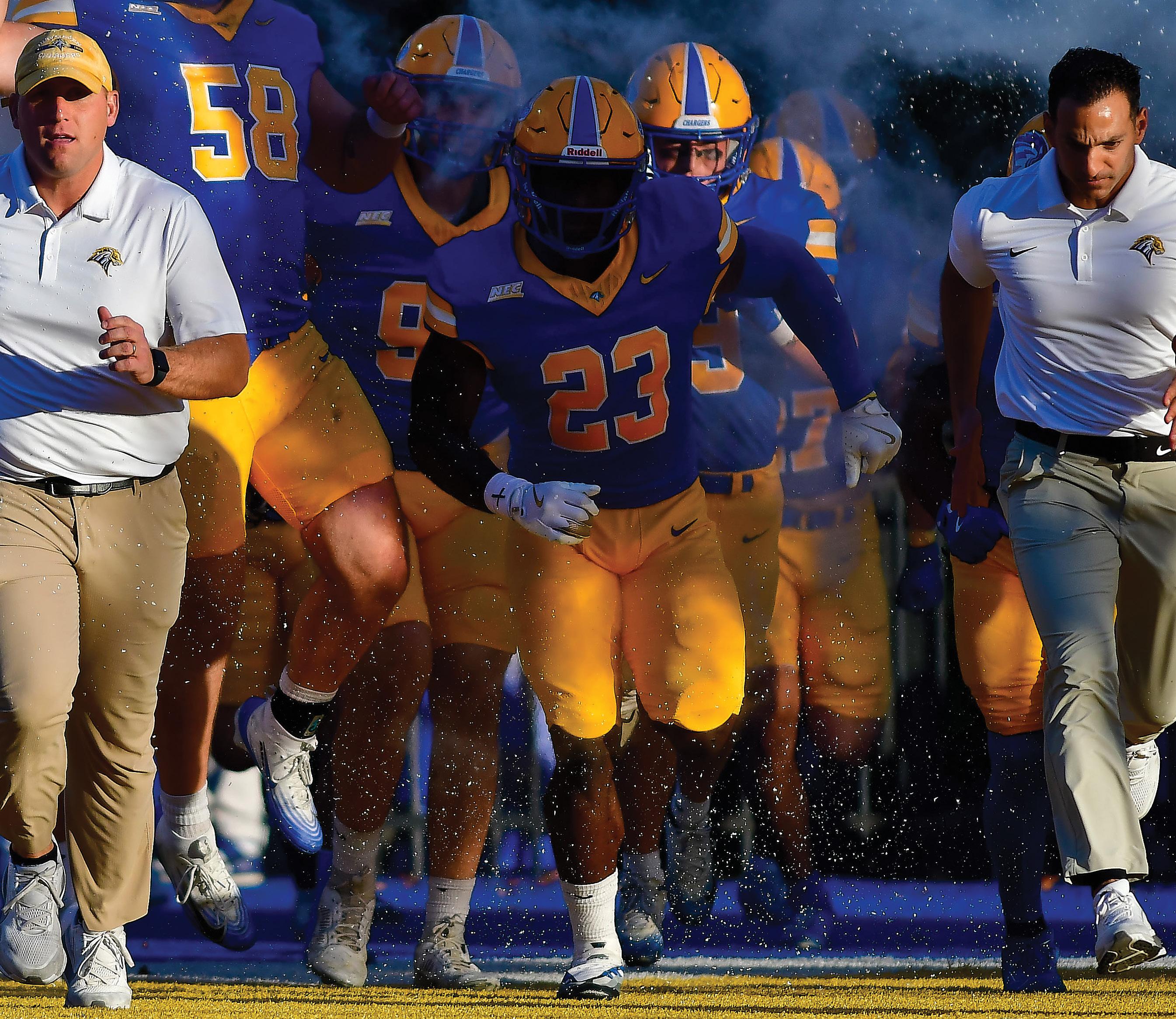








University of New Haven men’s basketball standouts Jabri Fitzpatrick and Teshaun Steele earned postseason recognition from the Northeast Conference following the team’s historic first year in Division I. Fitzpatrick, a standout transfer guard, captured Second Team All-NEC honors after leading the Chargers in scoring (15.0 points per game), assists (2.6), and steals (1.7). Meanwhile, Steele earned a spot on the NEC All-Rookie Team. The resilient freshman was the only first-year player to appear in all 31 contests, leading his class in both scoring and rebounding to anchor the future of the program.
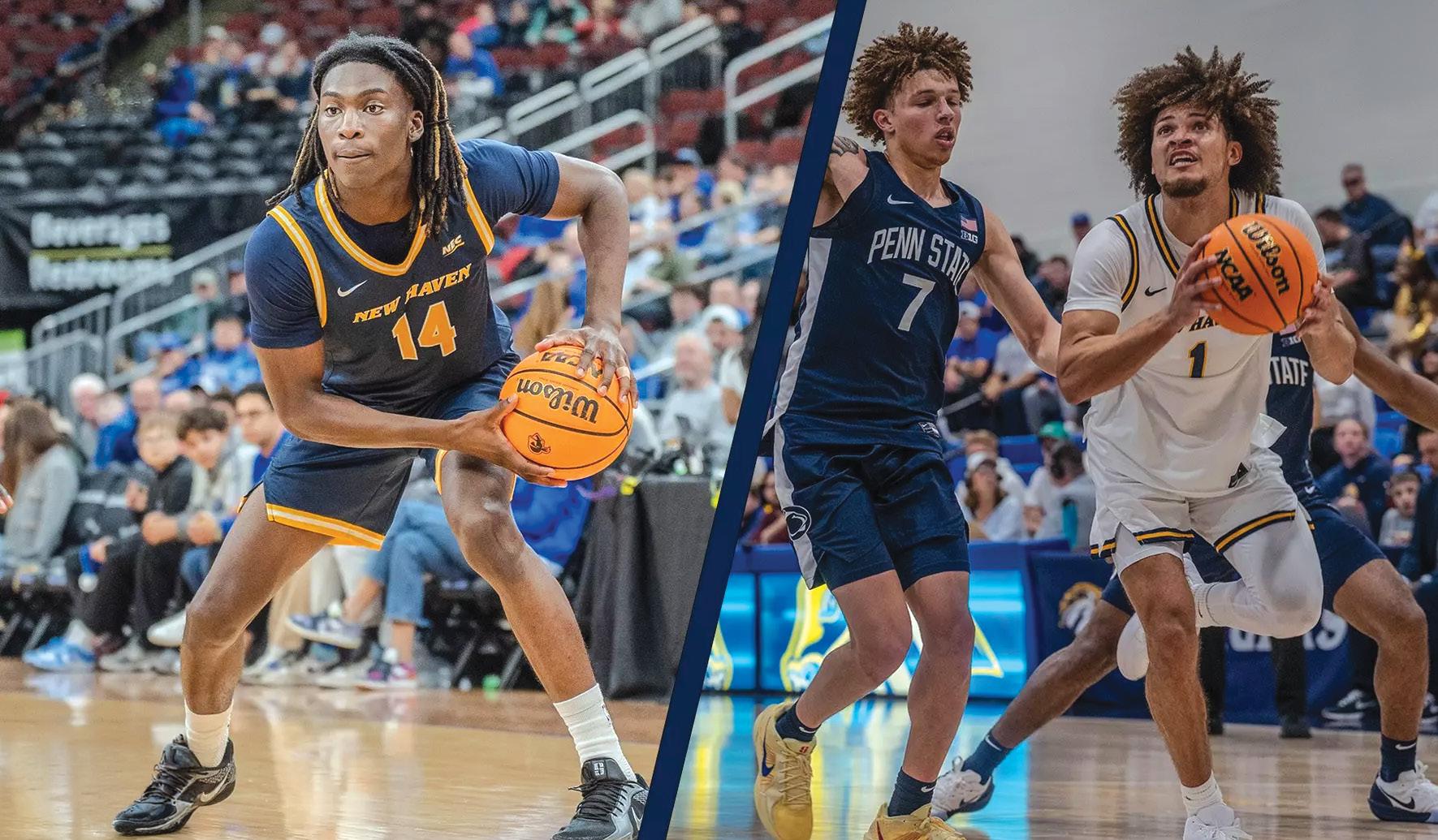
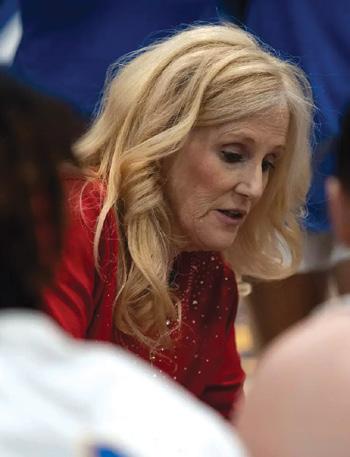
The University of New Haven has signed Head Women’s Basketball Coach Debbie Buff to a three-year contract extension through the 2028–29 season. Entering her eighth year with the Chargers, Buff has amassed 95 program wins, placing her just one victory away from breaking the school record. She recently guided the team through a historic transition into NCAA Division I, establishing the top scoring defense in the conference. Buff also celebrated her 300th career victory this past season while developing All-NEC forward Aniya McDonald-Perry, reinforcing the University’s commitment to athletic excellence and student-athlete success.

The University of New Haven track and field program showcased its elite talent with nine athletes securing Northeast Conference postseason honors following their exceptional indoor season. Leading the Chargers were First Team selections Jimmy Oreste (weight throw), Jada Kamtha (60m hurdles), and Gabrielle Teel (triple jump). Second Team honors went to jumpers Cole Parker and Matthew Steele. Highlighting a bright future for the program, four standouts — Jhelani Anderson, Noah Cooper, Aiden Watson, and multi-event sprinter Madeline Klecha — landed on the All-Rookie Team. The team transitioned this momentum into their outdoor campaign, which kicked off at the Rage in the Cage Invitational.

University of New Haven student-athletes paired athletic drive with academic distinction as 86 Chargers were named to the NEC Winter Academic Honor Roll, achieving GPAs higher than 3.2. Further highlighting this success, 29 student-athletes secured a spot on the prestigious Commissioner’s Honor Roll with a GPA above 3.75, continuing a strong academic year following a successful fall semester.
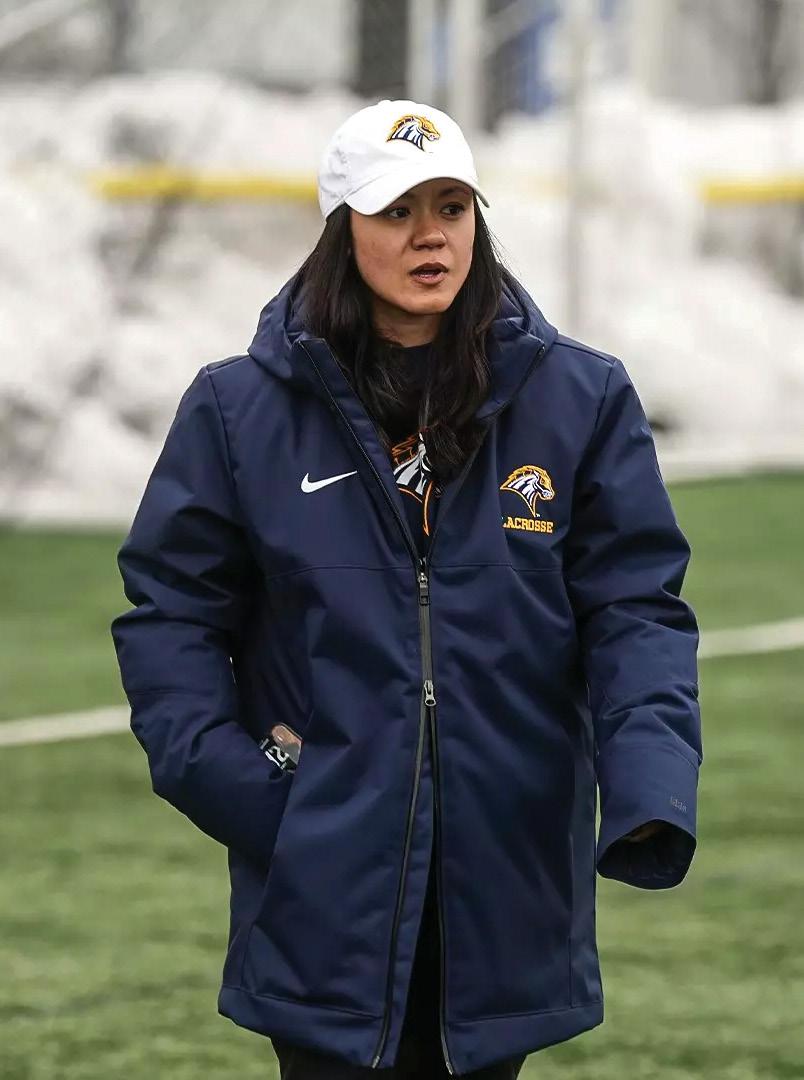
The University of New Haven lacrosse team opened their 2026 campaign in spectacular fashion, securing a 10-7 home victory over Sacred Heart University to grant head coach Kit a winning debut. The Chargers’ elite defensive unit anchored the victory, forcing 16 turnovers and limiting the Pioneers to just three goals across the final three quarters. Offensively, Summer Castiglione fueled the Chargers with three goals and two assists — including the game-winner — while Sophia Minnion registered a hat trick. The historic season-opening triumph provided a powerful springboard for the program before they traveled south to face Wofford College.
University of New Haven student-athletes secured six All-NEC honors at the 2026 Outdoor Track & Field Championships, highlighted by first-team selections for Amir Phelemetto (110m hurdles) and Gabrielle Teel (triple jump). Freshman
Jhelani Anderson earned second-team honors, while Noah Cooper, Riley Davis, and Danielle Lynch were named to the All-Rookie teams. The performances led the men’s team to a fifth-place finish and the women’s team to an eighth-place finish.
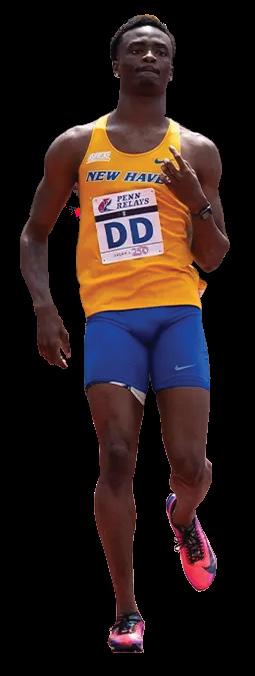

ANIYA MCDONALD-PERRY BECOMES FIRST DIVISION I ALL-CONFERENCE HONOREE
University of New Haven forward
Aniya McDonald-Perry made program history as the first Charger to earn All-Conference honors at the NCAA Division I level, named to both the Second Team All-NEC and the NEC All-Defensive Team. The standout sophomore led the conference in steals (2.7 per game) and offensive rebounds (4.5 per game). She anchored the Chargers in minutes, rebounds, assists, and blocks, finishing second on the team in scoring with 11.4 points per game.
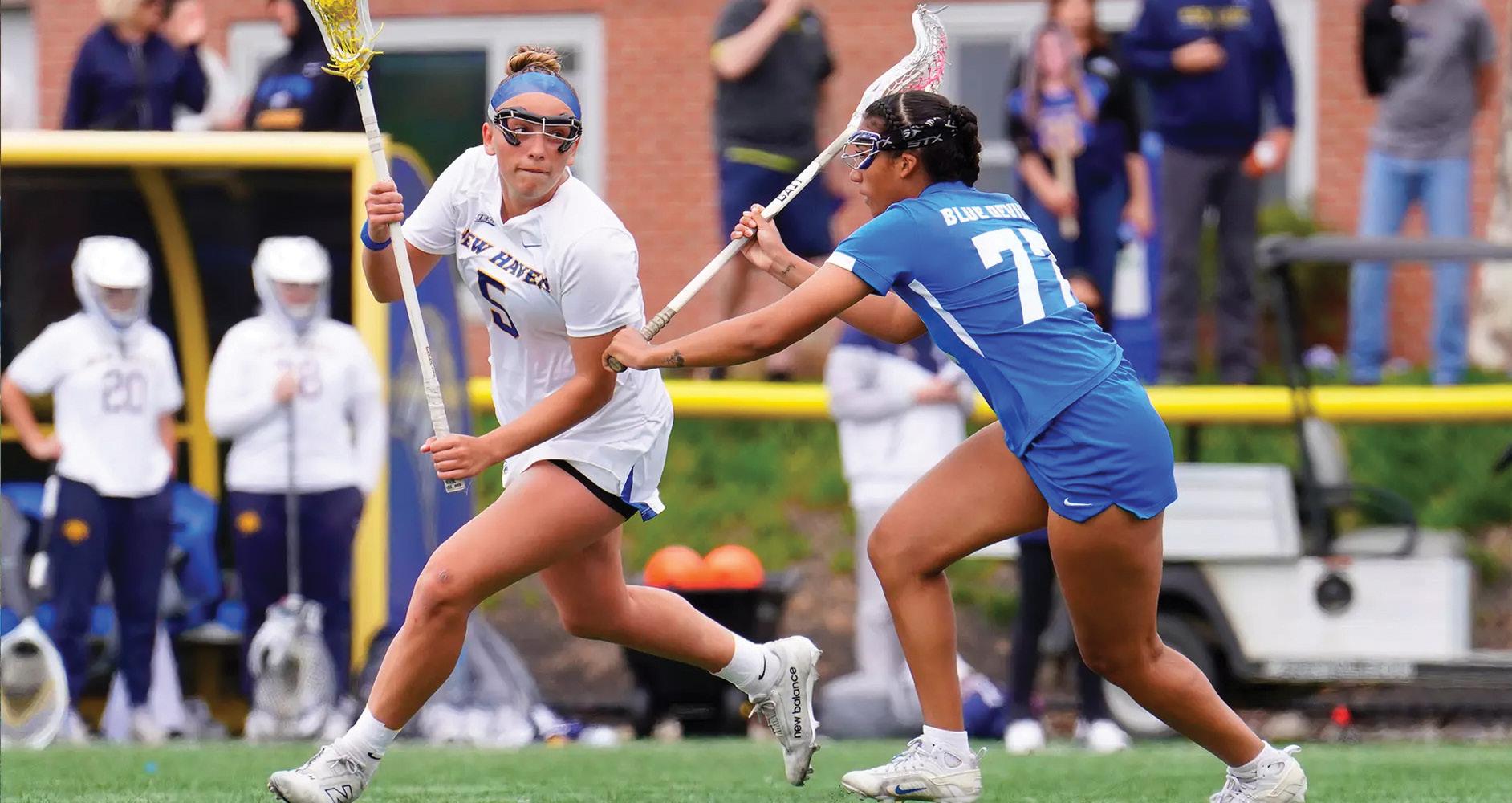
The University of New Haven Department of Athletics concluded its historic first NCAA Division I season by naming Jayden Shwed and Caitlin Daley the first-ever recipients of the Blue & Gold Excellence Award. The new honor recognizes student-athletes who embody athletic prowess, academic distinction, and university core values. Shwed, a decorated business student, completed a rare gridiron trifecta during his career by passing, rushing, and receiving for touchdowns. Daley, a seven-time Dean’s List soccer goalkeeper, finished second nationally in saves per game and anchored the campus community as a dedicated student leader.
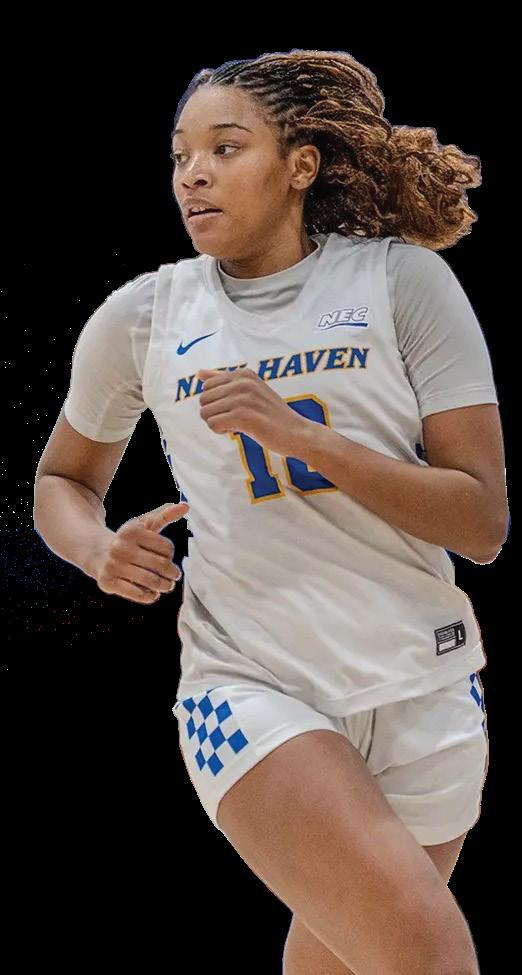
MELANIE GREENE NAMED HEAD VOLLEYBALL COACH

The University of New Haven has appointed Melanie Greene as the sixth head coach in the history of the Chargers volleyball program. Greene arrived in West Haven following a successful two-year tenure at the University of California San Diego, where she guided the Tritons to a 17-13 record and a historic Big West conference tournament appearance. Boasting extensive NCAA Division I experience, she previously spent over a decade building a powerhouse program at San Diego State University. Her proven track record in recruitment and player development positions the Chargers for immediate competitive and academic excellence.

The University of New Haven women’s lacrosse program capped off its 2026 season with four Chargers earning prestigious Northeast Conference postseason honors. Seniors Caitlin Seleny and Summer Castiglione, alongside sophomore defender Karlie Maye, secured All-NEC Second Team distinctions. Seleny anchored the offense with a record-setting 53 assists, while Castiglione dominated the midfield. Defensively, Maye led the squad with 17 caused turnovers. Highlighting the bright future of the program, standout freshman goalkeeper Ainsley Bourbeau was named to the NEC All-Rookie Team after logging 107 saves, signaling a strong upward trajectory for the Chargers at the Division I level.
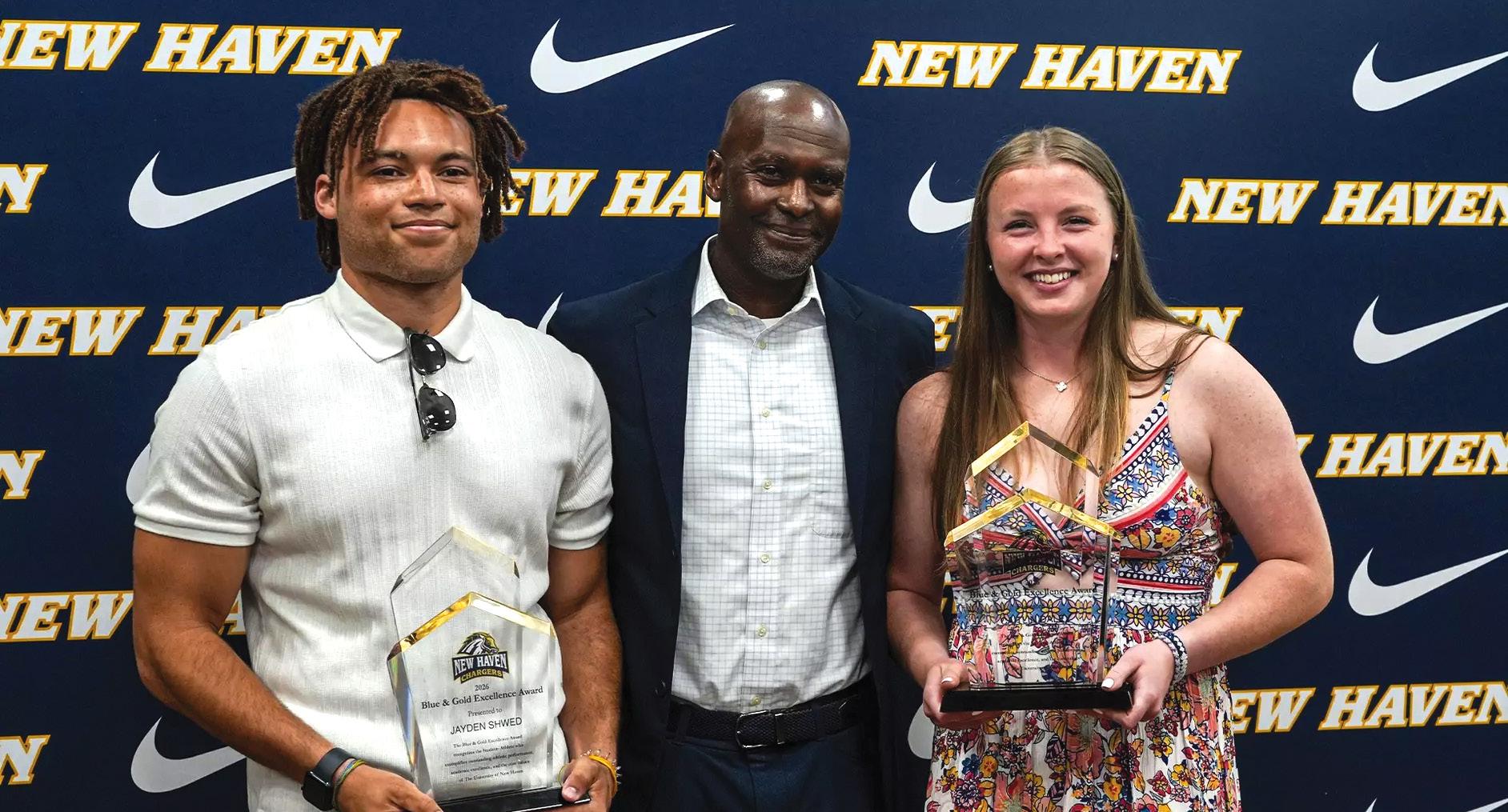
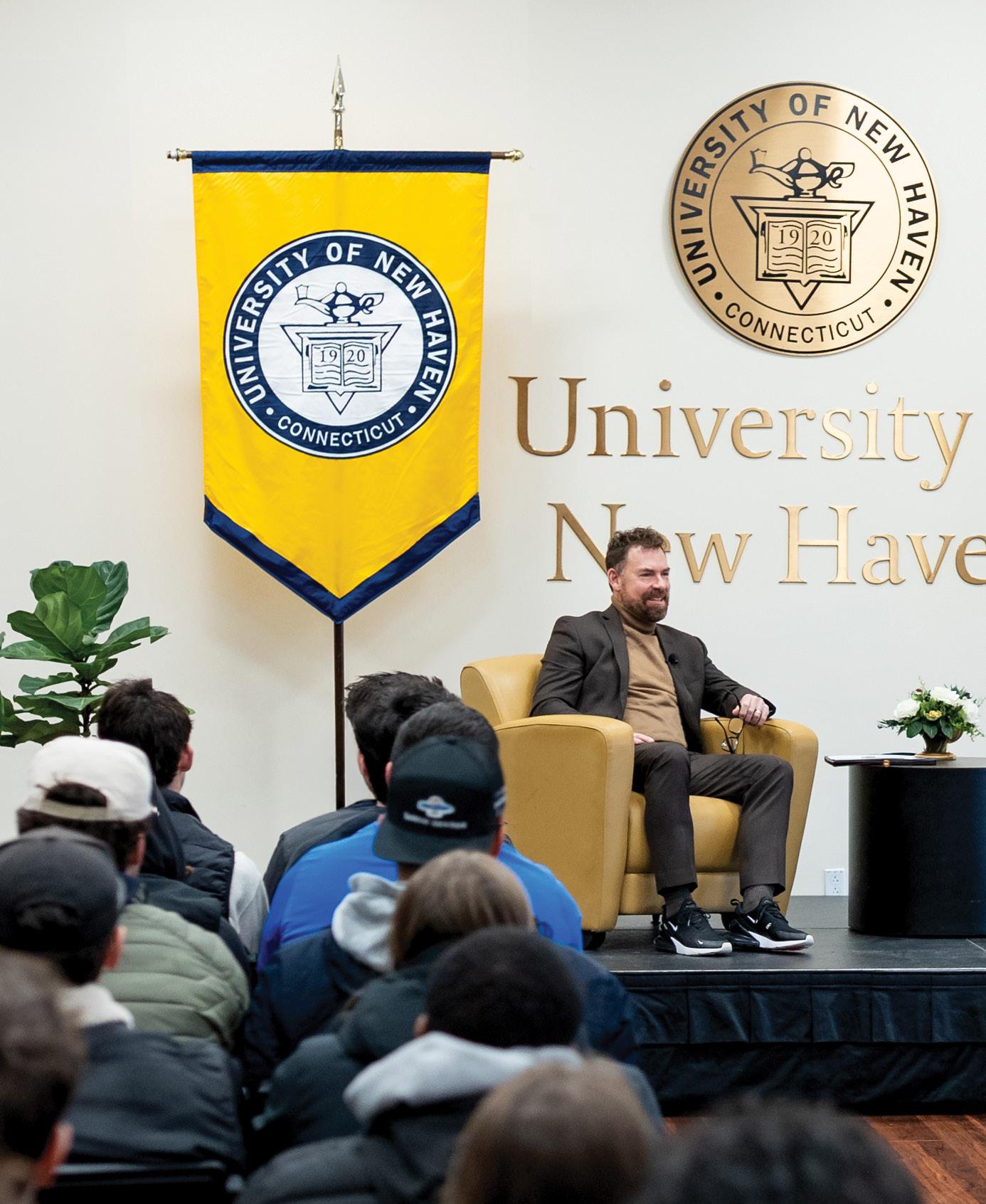

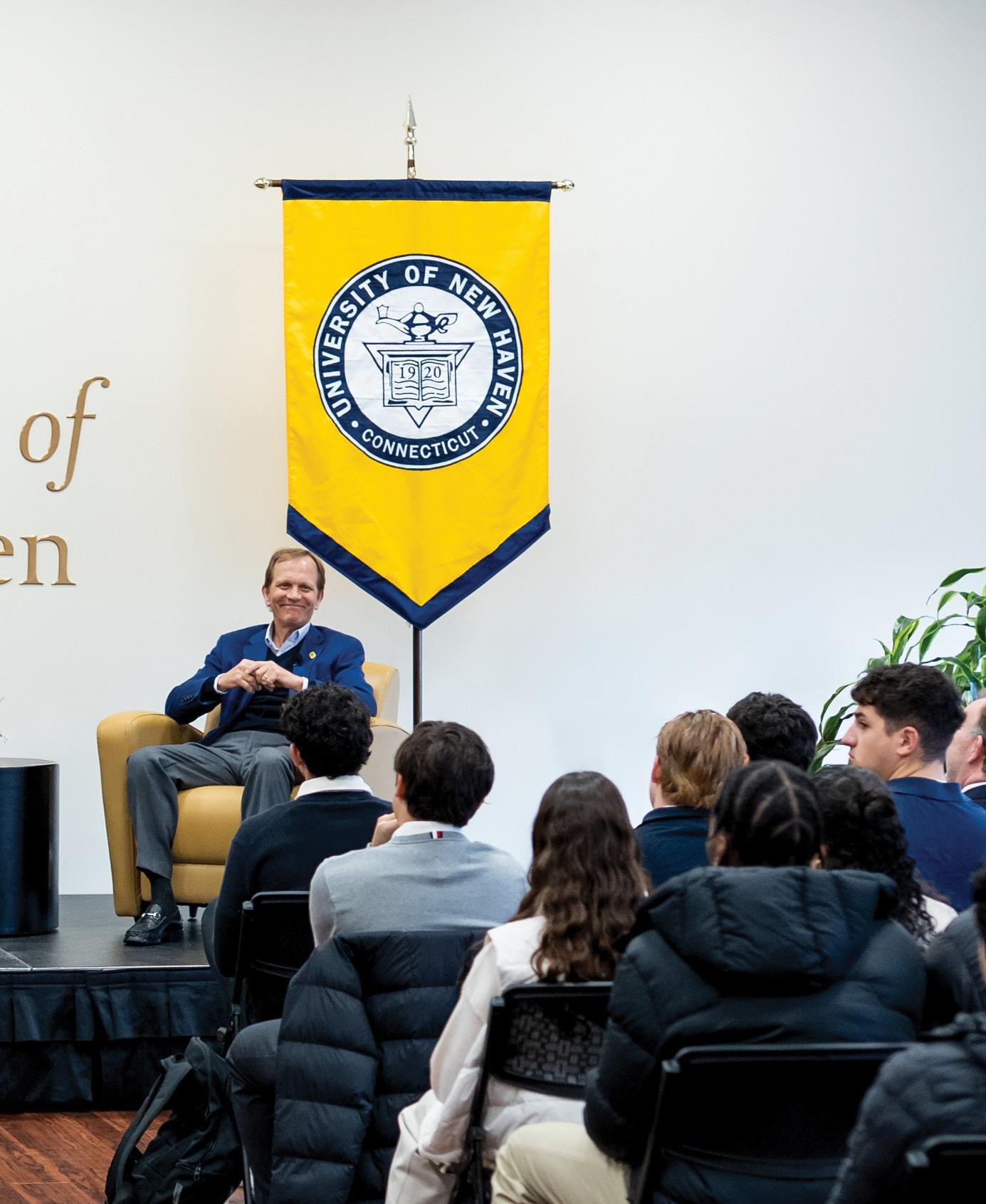
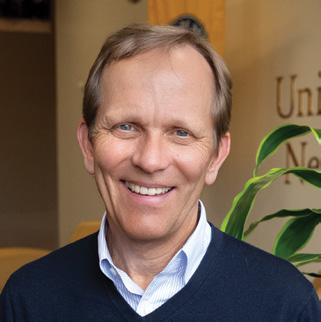
The University of New Haven launched its new Sports Leadership Exchange Speaker Series with an inaugural event featuring prominent business executive and Major League Soccer (MLS) team owner John R. Ingram. Serving as the featured guest, the Nashville SC owner sat down with President Jens Frederiksen, Ph.D., to share personal insights on sports entrepreneurship, strategic executive recruitment, and organizational vision. This event served as the official kickoff for the university’s newly established speaker series. The Sports Leadership Exchange is designed to bring high-profile sports executives, franchise owners, and athletic innovators to campus, providing students with direct access to contemporary industry leadership paradigms. The series focuses on exploring the intersections of sports management, cross-industry commercial enterprise, and public–private sector collaborations.
During this premiere session, Ingram detailed the process of transforming Nashville into an MLS expansion city after initially ranking at the bottom of the candidate pool in 2017. He highlighted critical operational milestones, including his pivotal decision to hire former Liverpool CEO Ian Ayre to execute the franchise’s launch. Addressing students directly, Ingram emphasized the importance of workforce initiative, stating that career advancement relies heavily on execution, trustworthiness, and surrounding oneself with a values-aligned leadership team.