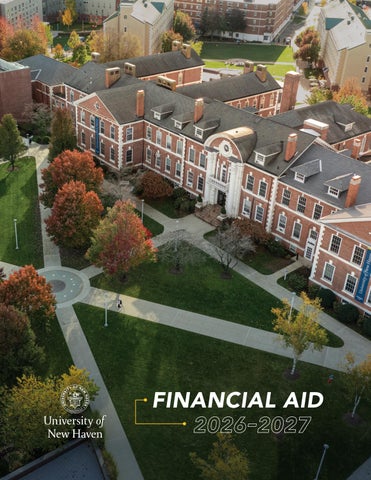
FINANCIAL AID 2026-2027
WELCOME TO THE UNIVERSITY OF NEW HAVEN The cost of a college education can seem overwhelming, but that’s where financial aid comes to the rescue. Financial aid can come from the U.S. federal government, the state you reside in, your college or university, and a non-profit or private organization. The forms they take? Everything from loans to scholarships to grants. Work-study, too. You can use them to cover tuition, fees, housing and meals, books and supplies, and transportation: everything you need to make your college education a reality. Let’s look at your options and see how we can help you become our next great Charger!
MAXIMIZE YOUR TIME & INVESTMENT Great Career Placement At the University of New Haven students power their purpose. The companies where our graduates are employed tell us our graduates are work-ready and able to make a contribution from day one on the job.
Successful Alumni The Charger family extends across industries and around the globe. Our graduates can be found in the board room, the operating room, and even the locker room. You’ll find Chargers as CEOs, doctors, engineers, artists, and even chocolatiers.
High-Impact Experiences We’ve established a reputation far and wide for the practical learning experiences that support and put into action the theories and lessons learned in the classroom. From faculty-mentored research and highly relevant internships, to service learning in the community and senior-year projects, our students acquire a professional’s ability to do something, not just to know something.
95%
of 2024 graduates were employed or in graduate school within six months of graduating
100+
majors and academic programs, in addition to over 50 dual degree programs intended to get you ahead in your chosen field and with a higher starting salary
UNDERSTANDING AND APPLYING FOR FINANCIAL AID
WHAT IS FINANCIAL AID? Financial aid is awarded to students to assist them with paying college expenses. Approximately 97% of the University of New Haven’s full-time undergraduate students receive some type of financial assistance in the form of academic and merit scholarships, grants, and student loans. In addition, there are numerous campus employment opportunities for students. The University does its best to work with families to make the cost of higher education an affordable investment in your future. Do not hesitate to contact the Financial Aid Office with any questions you may have about financing your education.
Financial aid comes in the form of: • Scholarships: Free money that you don’t have to repay • Grants: Free money that you don’t have to repay • Loans: Money you borrow that you must repay • Student Employment: Money you earn by working in a
part-time job on campus or through service in our community
You can receive financial aid from these sources: • Federal: Money from the federal government • State: Money from the state in which you reside • Institutional: Money from the University; for example, merit-based (based on academic performance) or need-based (based on the results of the Free Application for Federal Student Aid [FAFSA])
• Private: Money from private agencies, organizations, civic groups, high schools, etc.
IMPORTANT DATES October 2025: The 2026-2027 FAFSA (Free Application for Federal Student Aid) anticipated to be available February 1, 2026: Enrollment deadline for Early Decision students March 1, 2026: Priority deadline to submit FAFSA April 1, 2026: Submit any additional paperwork requested by the Financial Aid Office May 1, 2026: Enrollment deadline for Early Action I, Early Action II, and Regular Decision students 4
HOW TO APPLY FOR FINANCIAL AID Most financial aid awards are based on an individual’s demonstration of need after careful consideration of the application for assistance. In calculating need, the Financial Aid Office considers all aspects of a student’s financial circumstances. Need-based awards are available only to U.S. citizens or eligible noncitizens. Some funds are available on a merit basis for students who have exceptional academic records or athletic ability.
Applying for Financial Aid To apply for financial aid, families MUST complete the FAFSA (Free Application for Federal Student Aid). The FAFSA is a federal application that is FREE and should be completed at the federal government’s website, https://studentaid.gov. This form MUST BE COMPLETED EACH YEAR for which the student is seeking financial assistance.
Meet the Deadlines The University’s new student priority date for submitting the 2026–2027 FAFSA is March 1. Any additional paperwork that we request is required by May 1. Applications may be completed after those dates*; however, the applications will be considered on a rolling basis, depending on the availability of funds. Applications must be received, not postmarked, by the dates mentioned above. The Financial Aid Office will communicate with students via email to request any required additional paperwork.
Enter the FAFSA Code: 001397 The University of New Haven’s Financial Aid Office will receive the results of your FAFSA, provided you have entered our school code (001397) in the school code section of the FAFSA.
March 1 The University’s new student priority FAFSA submission due date.
The University of New Haven uses the FAFSA to determine a student’s eligibility for federal financial aid. We also use the FAFSA to determine the amount of institutional “need-based” financial aid to offer students. In addition, many states use the FAFSA to determine a student’s eligibility for state financial aid.
* Financial aid applications must be completed and loans must be certified prior to the last day of the term for which the student is seeking aid.
5
UNDERSTANDING AND APPLYING FOR FINANCIAL AID
CALCULATING FINANCIAL NEED Estimated Cost of Attendance To determine the amount of financial aid a student can receive, the school must first determine the Estimated Cost of Attendance. It is important to remember that costs will vary from one college to another. For 2026–2027, the Estimated Cost of Attendance for a full-time undergraduate student at the University of New Haven is as follows:
RESIDENT (On Campus)
COMMUTER (Off Campus)
DIRECT EXPENSES Billed by the University of New Haven Tuition & Fees
$51,270
$51,270
Room & Meals (standard room and Pride meal plan)
$20,586
$0
Total Direct Costs**
$71,856
$51,270
ESTIMATED INDIRECT EXPENSES NOT Billed by the University of New Haven Estimate for Books
$1,300
$1,300
Personal/Misc. Expenses
$1,968
$5,480
Transportation Costs
$566
$2,416
Federal Student Loan Fees
$66
$66
Total Estimated Indirect Costs
$3,900
$9,262
ESTIMATED TOTAL COST OF ATTENDANCE
$75,756
$60,532
** The costs provided here do not include course fees, overload charges for course loads over 17 credit hours, or tuition differentials. The roomand-meals cost noted is based on the amount normally assessed to most of our residential students. Amounts listed for books, personal expenses, and transportation are estimated indirect costs that may be incurred during the academic year and will not be directly reflected on your student account.
6
Estimated costs for a student living on campus (resident) are different from a student who is living off campus (commuter) because a commuter student has different direct educational costs. For example, a commuter student is not charged for on-campus housing. The Cost of Attendance for part-time students is prorated and calculated based on part-time costs. The Bursar’s Office provides a full listing of the undergraduate costs on its website at newhaven.edu/bursar. Lab fees and tuition differentials are additional costs that may be reflected on a student’s bill. Tuition differentials are additional fees associated with particular courses. These courses (usually engineering and computer courses) require additional resources to operate. It is similar in concept to a lab fee, although the course in question does not necessarily have a laboratory component. Differential fees are noted on the course listing. Students will see the additional charge for the lab fee or tuition differential on their bill once they register for the class.
Your FAFSA Results and Student Aid Index Calculation The Federal Processing Center processes the FAFSA with a federally mandated calculation called “Need Analysis.” The result of the processed FAFSA is the Student Aid Index (SAI). The University then uses the SAI to determine the types of financial aid and amounts we can offer to a student. The University of New Haven has a limited amount of resources and is not able to meet the full financial need of students. We distribute aid as equitably as possible to all our financial aid applicants. Most families will need to supplement their unmet need through a variety of resources, such as the tuition installment plan, the Federal Direct Parent PLUS Loan program, or a private student loan. The Financial Aid Office acts as the “liaison” between the federal government and the family. Under federal guidelines, the University determines the student’s eligibility for the federal financial aid programs and, at the same time, determines the student’s eligibility for institutional financial aid. We will use a Financial Aid Award Notification to communicate with you, directing you to view your award online. The award indicates the amount of financial assistance that can be offered to help pay your expenses at the University.
Determining Financial Aid If your SAI is less than the Cost of Attendance, you may be eligible for some subsidized financial aid such as grants, scholarships, the Federal Direct subsidized loan. If your SAI is greater than the Cost of Attendance, you may be eligible for unsubsidized financial aid such as the unsubsidized student loan. NOTE: Merit scholarships are based on a student’s academic or athletic performance and can be awarded regardless of the SAI. However, the Financial Aid Office must take into consideration the amount of your merit scholarships when determining the amount of need-based financial aid for which you are eligible.
Cost of Attendance — Student Aid Index (SAI) Financial Need The University’s Financial Aid Office subtracts your SAI (the results of your FAFSA) from the Cost of Attendance to determine your “financial need.”
ESTIMATE YOUR POTENTIAL FINANCIAL AID ELIGIBILITY Use the Net Price Calculator: Students considering attending the University of New Haven can use our Net Price Calculator to get an estimate of their potential financial aid eligibility. Families will need to provide information regarding income, number of family members, GPA, SAT/ACT test scores (if applicable), etc., to obtain the estimate. The Net Price Calculator is only an ESTIMATE of the potential financial aid for which you could be eligible. Some funding is limited and may not be offered in your actual Financial Aid Award. Also, students must complete the full financial aid application process to be considered for any of the financial aid programs. To try the Net Price Calculator, visit: newhaven.edu/npc
7
FORMS OF FINANCIAL AID
SCHOLARSHIPS $15K – $33K Merit scholarships range from $15,000 to $33,000* annually. Students are automatically considered for merit awards when they apply for full-time undergraduate admission.
Merit Scholarships Students who apply under Early Decision or Early Action and are accepted are given priority consideration for all merit-based scholarships. Merit scholarships are awarded to full-time undergraduate students at the discretion of the University of New Haven and, unless otherwise noted, require no special application. Award decisions will be based on the student’s academic credentials at the time of the student’s admission decision. Students who qualify for these scholarships will be notified by the Office of Undergraduate Admissions at the time of their acceptance to the University. These awards are renewable for a maximum of ten undergraduate semesters and are applied only to tuition. Each admitted student is eligible for a maximum of one merit scholarship.
8
Additional Scholarships These scholarships can be awarded in addition to our merit-based scholarships. Specific deadlines are in place for each of these additional scholarships. Honors Scholarship: $1,000 (annual) Awarded to all students who are selected for and enroll in our Honors Program. Scholarship deadline is February 1. Marching Band Scholarship: $1,000 to $3,000 (annual) Awarded to eligible students in our Chargers Marching Band at the direction of the marching band director. This scholarship is renewable each year and up to four years as long as the student remains a member of the Marching Band. Scholarship deadline is February 1. Phi Theta Kappa Scholarship: $2,000 (annual) A student who has been inducted into the Phi Theta Kappa Honor Society may be considered for this $2,000 scholarship. Portfolio Awards: $1,000 to $4,000 (annual) Awarded to outstanding students in art, design, or music programs based on submitted portfolios. A committee of faculty members from our nationally accredited programs reviews each portfolio and makes recommendations for these prestigious awards. This scholarship is renewable annually if the student continues to study in our art, design, or music programs. Scholarship deadline is February 1. *The amounts indicated for the merit awards are based on awards offered for the 2025–2026 academic year.
FINANCIAL AID PROGRAMS Eligibility for the following financial aid programs will automatically be determined for all admitted full-time undergraduate students who submit a completed FAFSA to the University.
Need-Based Financial Aid Programs Federal Pell Grants: The Pell Grant program is a need-based federal program providing grant assistance to low-income students. The maximum Pell grant for the 2025-2026 academic year is $7,395, with the U.S. Department of Education determining the student’s eligibility based on the results of the FAFSA. Federal Supplemental Educational Opportunity Grant (SEOG): SEOG is a need-based federal program to provide additional assistance to students eligible for the federal Pell Grant. Students are selected by the University to receive this grant. These funds are limited, so not all students who are eligible for this grant will receive it.
Other Financial Aid Programs Athletic Grant-in-Aid: Athletic grants are non-need-based grants provided to students for participation in select University varsity sports, with the Athletic Department selecting recipients based on students’ athletic ability. Yellow Ribbon Program for Veterans: The University of New Haven participates in the Yellow Ribbon Program for military veterans and/or their eligible dependents. Veterans should first complete all necessary applications and paperwork with the U.S. Department of Veterans Affairs. Once approved for educational benefits by Veterans Affairs, students should contact the University Registrar’s Office to indicate they are expecting to receive benefits from Veterans Affairs.
Roberta B. Willis Scholarship Grant Program: Funds provided by the Connecticut General Assembly are awarded to Connecticut residents attending the University of New Haven. Eligibility is based on the student’s SAI as determined by the FAFSA. The annual grant amount is set each year by the Connecticut Department of Higher Education. Roberta B. Willis Scholarship Program: In the 2025-2026 award year, it was for a CT resident who was a high school senior or graduate with a high school junior year class rank of 20% or better and/or SAT scores of at least 1200 or ACT score of at least 25. Recipient must attend a CT public or non-profit private college. For more information, please visit https://www.ohe.ct.gov/SFA/sfa.shtml#Governor University Grant-in-Aid: The University Grant-in-Aid is institutional money from the University of New Haven that is awarded based on the results of the FAFSA. Federal Work-Study: Federal Work-Study is awarded to students who demonstrate financial need as determined by the FAFSA. Eligible students are able to select from a wide range of positions, including the option to work off campus in a community service capacity. Generally, students work between eight and 10 hours per week and earn an hourly wage. Students are paid weekly for the hours they work. These funds are limited, so not all students eligible for Federal Work-Study will receive it. Many students who do not qualify for Federal Work-Study obtain positions on campus through the Non Federal Work Study Employment program. These positions are posted on ChargerLink, the University’s on-line career management system.
9
FORMS OF FINANCIAL AID
FEDERAL DIRECT STUDENT LOANS Federal Direct Student Loans Federal Direct Student Loans are low-interest-rate federal loans offered to undergraduate students attending accredited colleges and universities. There are two types of Federal Direct Student Loans: Subsidized and Unsubsidized. Federal Direct Student Loans are loans the student borrows, and these must be repaid. For both loans, repayment is not required until six months after the last day of attendance. Prior to receiving their first disbursement, new loan borrowers are required to: 1. Complete Entrance Counseling 2. Sign a Master Promissory Note
The federal government requires students to complete Entrance Counseling so they will know and understand their rights and responsibilities. A Master Promissory Note must be signed by students as their promise to repay the loan. Students must go to https://studentaid.gov to complete Entrance Counseling and sign a Master Promissory Note once they decide to attend the University of New Haven.
The Subsidized Student Loan is a federally subsidized loan program available on the basis of financial need to students enrolled at least half-time and maintaining satisfactory academic progress. For students who are eligible, the U.S. Department of Education pays the interest while the student is enrolled at least half-time and during other specified periods. The interest rate is fixed and is reset each year around June 1 by the federal government. For 2025-2026, the interest rate is 6.39%. The FAFSA must be completed to determine a student’s eligibility for the loan. The Unsubsidized Student Loan does not require a student to have financial need. The U.S. Department of Education does NOT pay interest on this type of loan. The interest rate is fixed and is reset each year around June 1 by the federal government. For 2025-2026, the interest rate is 6.39%. The interest will start accruing on the date of the first disbursement. The student has the option to pay the interest while in school. The FAFSA must be completed to determine a student’s eligibility for the Unsubsidized Federal Student Loan. A student must maintain satisfactory academic progress and must be enrolled at least half-time to be considered for this loan. NOTE: Students who have both the Direct Subsidized and Direct Unsubsidized loans on their award need only complete one Entrance Counseling session and sign only one Master Promissory Note.
10
SUPPLEMENTING YOUR STUDENT AID INDEX Most families will need to supplement their Student Aid Index (SAI) and unmet need through a variety of resources, such as the tuition payment plan, the Federal Direct Parent PLUS Loan program, or a private student loan.
Federal Direct Parent Loan (PLUS) The PLUS Loan is a financing option available to parents of a dependent undergraduate student who is enrolled in school at least half-time and is making satisfactory academic progress. For 2025-2026, the interest rate on the Plus loan is fixed at 8.94% and is reset each year around June 1 by the federal government. Payments may be deferred until 6 months after graduation. For more details on the Plus loan, please visit our website at: https://www.newhaven.edu/admissions/financial-aid/undergraduate/loans/plus.php.
Private Student Loans Private Student Loans are private credit-based loans where the student is the borrower. These loans will likely require a creditworthy cosigner for the student to be approved. These loans must be repaid, and normally the student must be at least 18 years old to apply. Private loans offer varying terms and conditions set by the individual lender of the loan program. Private loans typically cost more than the educational loans offered by the federal government. The interest rates are pegged to either the Prime Lending Rate or the LIBOR index and may be fixed or variable.
PAYMENT OPTIONS Pay With Credit Card, Debit Card, or Check The University Bursar’s Office uses ePay, a quick, easy, and secure way to pay your bills online using Visa, MasterCard, Discover, American Express, a debit card, or a U.S. checking account. Please note that credit/debit card payment are subject to a service fee.
Tuition Payment Plan (Monthly Installment) As a convenience to our students, we are pleased to offer the option of making tuition payments on a monthly basis. Our installment plan option is an interest-free alternative to lump sum payments that are due at billing time. This option consists of five (5) payments each semester and can limit the amount of loan money you may need to borrow to meet the cost. The installment plan starts on July 1. Further information regarding the plan can be found in the “Payment Options” section on the Bursar’s Office website, newhaven.edu/bursar.
11
FORMS OF FINANCIAL AID
PRIVATE SCHOLARSHIPS Students should also consider searching independently for private scholarships for additional financial assistance. A private scholarship is an award a student receives from a source outside the University. Private scholarships are also called “Outside Scholarships” and are awarded by businesses, organizations, civic groups, high schools, and many other agencies. Students apply for these scholarships on their own by communicating directly with the agency offering the award.
How Do You Search for Private Scholarships?
Let Us Know if You Receive a Private Scholarship.
1. Students should contact their high school counseling office during their senior year of high school to determine if there are any scholarship opportunities available for which they can apply.
Once you have received a letter from the agency indicating the amount of the scholarship you have been awarded, you should forward a copy of that letter to the Financial Aid Office. Private scholarships may affect your eligibility for the other financial aid programs you have already been awarded. The sooner you provide a copy of the letter from the agency regarding your private scholarship award, the quicker the Financial Aid Office can determine if adjustments to your Financial Aid Award are necessary. If an adjustment to a student’s current Financial Aid Award is necessary, the Financial Aid Office will communicate the changes to the student via a revised Financial Aid Award Notification.
2. Students may want to check with community service organizations or civic groups in which they are involved to ask if they offer scholarships. 3. Students can log into iGrad, a FREE financial literacy platform. Select “Tools” once logged in. 4. Students may search for scholarships on their own on the internet. There are several sites available on which to search for scholarships. Some of the popular sites are:
newhaven.igrad.com/scholarships • fastweb.com finaid.org • chegg.com
Outside scholarships do NOT include tuition exchange scholarships, tuition benefits from an employer, any or all tuition remission benefits, ROTC, or Vocational Rehabilitation benefits. These types of awards will be substituted dollar for dollar from institutional grant eligibility, including merit awards.
BEWARE OF SCHOLARSHIP SCAMS Some of the scholarship opportunities that are offered through online scholarship searches may be scams. Keep the following tips in mind before applying for a scholarship. If you receive information stating any of the following, chances are it is a SCAM! 1. A service needs your credit card or checking account information: Applying for scholarships should be FREE! You should NOT pay money to apply for scholarships! 2. A scholarship is guaranteed: No service can guarantee it will get you money. 3. The service will do all the work: No service can provide all of the personal information needed, write essays, or supply the references a scholarship may require. 4. “You can only find this information here”: Scholarships, grants, and awards for school are available in directories and all over the internet. No single organization has a monopoly on this information. 5. Being a finalist in a contest you never entered or randomly being selected by a national foundation to receive an award: Most organizations only contact you AFTER you have made an inquiry.
12
How It Works Once students are accepted for admission, the Office of Financial Aid will review the results of their FAFSA, and the University will communicate with students via a Financial Aid Award Notification. The University determines the amount of federal and institutional financial aid that can be awarded to students. The awards offered make up a “Financial Aid Award.” Families should review the Financial Aid Award and all literature provided to be sure they understand each award listed. NOTE: Federal Work-Study awards are funds a student must earn by working. This money is earned slowly throughout the academic year as the student works hours and submits time sheets for payment. This money is paid directly to the student for the hours worked; it is not posted as a credit to the Bursar’s bill the way other types of financial aid are. Therefore, if Federal Work-Study is listed in your Financial Aid Award, do NOT deduct this award from the student’s charges.
YOUR FINANCIAL AID AWARD
THE FINANCIAL AID AWARD
There is limited funding for University grants and for some of the federal programs, such as Federal Work-Study and the Supplemental Educational Opportunity Grant. If your award does NOT include these programs, you were either determined to be ineligible for these programs, or the University did not have enough funds to offer these programs to you.
What to Do Next Once you have your Financial Aid Award, the next step is to determine how much it will cost for you to attend the University of New Haven. The financial aid offered is not likely to cover the entire cost of the University, so families should begin with determining the direct costs in order to know how much they will be expected to pay: 1. Review your estimated remaining balance listed at the bottom of your award letter. 2. Review your options in order to pay the balance (see page 11). 3. Don’t forget to factor in an amount for books to be sure you are considering all mandatory costs that the student will incur when attending the University. An average amount for books for a student enrolled full-time for one semester is $650; however, the books for the sciences, engineering, and some other classes may be more expensive. Books may be purchased from the University Bookstore. The University Bookstore also offers a textbook rental program. For more information, you may contact the Bookstore at 203.931.2954, or visit their website at newhaven.edu/bookstore.
1313
YOUR FINANCIAL AID AWARD
COMPLETING YOUR FINANCIAL AID FILE The initial Financial Aid Award a student receives from the University should not change unless the student is selected for a process called Verification (by the FAFSA processing center or by the Financial Aid Office) and your FAFSA data is incorrect OR if the University receives information that causes a change to a student’s eligibility. Information that may cause an adjustment to a student’s eligibility can include, but is not limited to: a change in the results of the FAFSA, a change from living on campus to living off campus (or vice versa), notification of an outside scholarship, receipt of benefits from an employer, etc.
Those students selected for Verification must submit the following additional documents to the Financial Aid Office: 1. An Acceptance or Decline of the awards offered* 2. Student’s 2024 Signed Federal Tax Return (if tax return was filed) 3. Parent’s 2024 Signed Federal Tax Return (if parent information was required on FAFSA, and if a tax return was filed) 4. Completed and Signed Verification Worksheet 5. 2024 W-2 Form(s) for student and parents who did not file a tax return 6. Other documents noted with the award, except for Entrance Counseling or Master Promissory Note. Please check your email frequently because this is where the Financial Aid Office will notify you of any required documentation.
Students NOT selected for Verification must only accept/ decline the awards offered for the aid to be processed. However, other steps are necessary before loans can be processed by the Financial Aid Office. * Accepted awards do NOT commit students to attending the University of New Haven. If students decide not to accept an offer of admission, they should inform the Office of Undergraduate Admissions that they are not planning to attend. The Financial Aid Office will update its records once the information has been received from the Office of Undergraduate Admissions.
SPECIAL CIRCUMSTANCES Let Us Know if You Have Special Circumstances The FAFSA requires families to provide prior-prior year income information on the application; however, the University of New Haven recognizes that families may experience extenuating or unusual circumstances that are not reflected in the information on the FAFSA or that happen after the FAFSA has been filed. Families who encounter a significant change in income, a change in marital status, the loss of a job, or other extenuating circumstances that are affecting their current financial situation should notify the Financial Aid Office. Once all required documentation is received by the Financial Aid Office, it will be reviewed to determine if additional financial assistance can be offered to the student. Items that families will need to provide will vary, but in general, for a student’s file to be reevaluated for special circumstances, the following MUST be provided to the Financial Aid Office: • Special Circumstances Form • A Letter Explaining the Extenuating Circumstances • Supporting Documentation (examples are listed on the Special Circumstances Appeal Form) Please contact the Financial Aid Office for the proper forms and for more details regarding the Special Circumstances process.
14
RENEWING YOUR FINANCIAL AID Be Sure to File Your FAFSA Each Year Renewing your financial aid from year to year is NOT automatic. You must complete the FAFSA each year by January 1, and you must provide all required documentation to the Financial Aid Office by March 1 each year for priority consideration of financial aid. If your family’s financial circumstances remain approximately the same from year to year and you submit all application materials on time, your Financial Aid Award should also remain approximately the same from year to year. Students can renew their FAFSA online at https://studentaid.gov each year after October 1. In addition, students must meet certain academic standards each year to be eligible for financial aid for the following academic year. Academic progress is checked each year at the end of the spring term.
Students must make satisfactory academic progress (SAP)
IMPORTANT DEADLINES FOR RENEWING FINANCIAL AID January 1: You must complete and submit the FAFSA (Free Application for Federal Student Aid) each year by January 1. March 1: Provide all required documentation to the Financial Aid Office by March 1 for priority consideration of financial aid.
toward their degree and be in good academic standing in order to remain eligible to receive financial aid.
What Are Satisfactory Academic Progress Requirements? The Financial Aid Office will review your academic transcript in May to make sure you:
• have successfully earned a specific percentage of the credit hours you attempted (“pace”),
• have a certain cumulative grade point average (CGPA), and • are not on academic probation. All federal and state financial aid (including, but not limited to, federal student loans, federal parent loans, grants, scholarships, and work-study) is subject to meeting the minimum SAP standards set by the University. To renew financial aid, full-time undergraduate students must:
• maintain a specific cumulative GPA as determined by the number of their attempted credit hours and
• successfully complete at least 67% of the credits they attempt.
Helpful Websites • newhaven.edu/financialaid — The University’s Financial Aid Office
• newhaven.edu/financialliteracy — Allows you to link
to iGrad, a FREE financial literacy platform that offers an outside scholarship search, job searching, loan repayment calculators, banking, credit and savings information, etc.
• studentaid.gov — To complete your FAFSA online and
create your FSAID, which is used as your electronic signature on the FAFSA.
• finaid.org — A comprehensive collection of information about financial aid
• gibill.va.gov/benefits — The U.S. Department of Veterans Affairs education benefit programs
• sss.gov — Visit to register or check your registration with Selective Service
• irs.gov — Visit to get information about education tax credits or to obtain a copy of your federal Tax Return Transcript
More information about the SAP requirements can be found in the Financial Aid Policies section of the Financial Aid website at: newhaven.edu/financialaid. Select “Financial Aid Info for Undergraduate Students,” then under “Policies,” select “Satisfactory Academic Progress.”
15
16
SUMMARY AND CHECKLIST Use the Net Price Calculator to ESTIMATE the potential financial aid for which you could be eligible: newhaven.edu/netprice Complete and submit the 2026-2027 FAFSA at studentaid.gov
• Anticipated to be available by October 2025 • Enter the University of New Haven School Code 001397 on the FAFSA
Once accepted for admission, watch for your Financial Aid Award Notification.
• The Financial Aid Office will begin to send this information by early January or February 2026
Review the Estimated Cost of Attendance in this booklet and subtract your financial aid from the costs to determine the estimated amount you will owe to attend the University. Submit any requested documents as noted when reviewing your Financial Aid Award Information. Consider Payment Options to cover the balance after you subtract your Financial Aid Award from the Estimated Cost of Attendance — monthly installment plan, Federal Direct Parent Loan (PLUS), and private alternative loans.
Search for scholarships:
• In your local community • In your high school counseling office • Online Notify the Financial Aid Office if any of the following apply:
• You have an extenuating circumstance you would like to make the Financial Aid Office aware of
• You are selected as a recipient for an outside scholarship • You are receiving tuition benefits, employer tuition remission, ROTC, Vocational Rehabilitation benefits, etc.
• Your housing status changes, for example, on-campus to off-campus or vice versa
• You change your enrollment status, for example, from full-time to part-time
• You determine you made an error on the FAFSA Complete and submit your FAFSA each year! Meet the Satisfactory Academic Progress (SAP) requirements of the University to continue to receive financial aid each year. 1. Maintain a specific cumulative GPA as determined by the number of your attempted credit hours 2. Successfully complete at least 67% of the credits you attempt
• Go to newhaven.edu/financialaid and select “Undergraduate,” then “Satisfactory Academic Progress” under “Policies”
NOTES
If you have any questions, please contact us at 203.932.7315 or financialaid@newhaven.edu.
17
IMPORTANT CONTACTS One Stop Student Financial and Registrar Services Office The One Stop is an integrated customer service office representing the Offices of the Bursar, Financial Aid, and Registrar. This office is here to assist students and families with their student billing, financial aid, and registration questions.
Financial Aid Office Financial aid offers a comprehensive financial aid program, with students receiving assistance in the form of grants, scholarships, student loans, and work-study employment. One Stop Office, Bergami Hall · 203.932.7315 · FinancialAid@newhaven.edu
Bursar’s Office The Bursar’s Office is responsible for all aspects of tuition billing, payment processing, and refunds.
203.932.7014
Campus Store newhavenshop.com 203.931.2954
Health Services Student Health Center, Immunization Records 203.932.7079
Student Employment Office SEO@newhaven.edu
Office of Undergraduate Admissions admissions@newhaven.edu 203.932.7319
One Stop Office, Bergami Hall · 203.932.7217 · Bursar@newhaven.edu
Residential Life
Registrar’s Office
On-Campus Housing reslife@newhaven.edu 203.932.7076
The Office of the University Registrar is responsible for implementing policies, procedures, and systems in support of class scheduling, registration, transfer course approval, final grading, degree auditing, maintenance of academic records, and graduation. One Stop Office, Bergami Hall · 203.932.7309 · Registrar@newhaven.edu
18
University Police
Sodexo Dining Services diningservices@newhaven.edu
19
FINANCIAL AID OFFICE 203.932.7315 | Fax: 203.931.6050 financialaid@newhaven.edu | newhaven.edu University of New Haven | Bergami Hall 300 Boston Post Road | West Haven, CT 06516