2027–2028
Degree Studies
SCHOOL OF EDUCATION AND PSYCHOLOGY
Early Childhood Education Primary Education Pedagogy Psychology
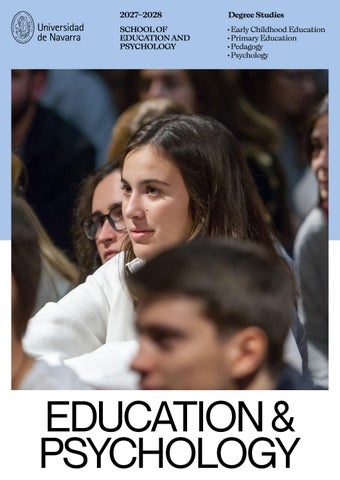
EDUCATION & PSYCHOLOGY
The University of Navarra is a research university with Christian inspiration, founded in 1952 by Saint Josemaría Escrivá. As a non-profit institution, it works to generate knowledge, educate individuals, and contribute to society through teaching, research, and healthcare. Its project includes internationally renowned institutions such as the Clínica Universidad de Navarra and IESE Business School, strengthening its connection with healthcare, business, research, and clinical care.
Learn to give. Give to transform
2
UNIVERSITY OF NAVARRA School of Education and Psychology
Degree Studies
01. ACADEMIC EXCELLENCE
Academic excellence is reflected in how you learn, who you learn from, and how closely your education is connected to the real world. You will learn from professors who conduct pioneering research, drive innovation, and work at the forefront of today's scientific, technological, and societal challenges.
02. NAVIGATE A CHANGING WORLD
Every student receives a holistic education that brings together science, technology, and the humanities to develop judgment, critical thinking, and the ability to listen, reflect, and engage in dialogue. Through the Core Curriculum (one of the University's defining strengths) you will learn to ask better questions, gain a deeper understanding of today's world, and address the challenges of artificial intelligence, innovation, and social change responsibly.
Need more reasons? The University in numbers
03.
14K
4,300
GROW TOGETHER. A COMMUNITY THAT INSPIRES YOU
More than 14,000 students in the 20252026 academic year, forming a diverse, dynamic, and close-knit university community.
A global community of 4,374 international students from 133 countries.
University life is a transformative experience when you are challenged, encouraged, and part of a close-knit community. Meaningful relationships with professors and mentors, together with a vibrant campus life that includes sports, culture, volunteering, museums, exhibitions, and student activities, help you discover your strengths, broaden your horizons, and shape your own personal and professional journey.
STUDENTS
262 #35 TOP WORLDWIDE
EMPLOYABILITY
01
92.5
Ranked #1 in Spain and 29th in Europe for employer reputation in the QS Europe Rankings 2026.
92.5% of our graduates are employed, according to the University's Graduate Employment Survey 2026.
Ranked among the top 262 universities in the world in the QS World University Rankings 2026, which evaluated more than 5,660 universities across 106 countries.
st
↗ Campus life is where learning, connection, and personal growth take shape.
Introduction
INTERNATIONAL STUDENTS
EMPLOYER REPUTATION
University of Navarra
Ranked #35 worldwide for employability in the Global Employability University Ranking and Survey 2026 by Times Higher Education.
%
EMPLOYMENT RATE
3
GP
GLOBAL PATHWAY
ALUMNI
Since it was created 10 years ago, more than 3,000 graduates of the School of Education and Psychology have made a lasting impact on the world by becoming part of a community committed to excellence and social impact.
350 AGREEMENTS
We have more than 350 placement agreements with educational institutions in Spain and other countries.
SIMULATION CENTER
Created in 2017, the Simulation Center is an innovative teaching space where students can enhance their academic education through extensive practical experience in a controlled and safe environment.
EMPLOYABILITY
97% of the School's graduates find employment within the first year after completing their studies.
PLACEMENTS
Students complete more than 400 hours of curricular placements and may choose from more than 350 national and international educational institutions. Nearly 40% of our students begin their first job at the institution where they completed their placement.
The Global Pathway Certificate enables students to develop a broad, interdisciplinary skill set through learning experiences that foster a global outlook, social responsibility, and a commitment to sustainability, inclusion, and equality. The program encompasses a wide range of areas, including global citizenship, service-learning, community engagement, social and educational inclusion, environmental sustainability, international perspectives, leadership, and research. Designed to complement students’ academic studies, the certificate allows graduates to demonstrate a well-rounded profile that is increasingly valued in the fields of Education and Psychology, preparing them to make a meaningful impact in diverse professional and social contexts.
WOULD YOU LIKE TO LEARN MORE?
1/2
Would you like to learn more about the certificate? Scan the QR code and discover all its benefits.
FACULTY-STUDENT RATIO
Students are the protagonists of their own journey. They can choose and take advantage of the School's activities, sessions, programs, mentoring, research and more… to develop both their professional and personal potential.
↖ Students taking a break on the steps of the Main Library.
+ THAN 10 YEARS DEVELOPING TALENT 4
School of Education and Psychology
Degree Studies
OUR DAY-TO-DAY LIFE ON INSTAGRAM
Follow us on social media and discover our students' day-today life at the School.
instagram.com/ edupsicounav/
Our Alumni Xabi Rodriguez
Ángela Chaverri
Pedro Amoretti
Paulina Ayon
PSYCHOLOGY '20
DOUBLE DEGREE IN PEDAGOGY AND PRIMARY EDUCATION ’19 Special Education Classroom Teacher, Colegio Cambrils, Fundación Arenales
PRIMARY EDUCATION / MENTION IN ATTENTION TO DIVERSITY AND DECA DIPLOMA ’23 Class Teacher, Colegio Alderiz
EARLY CHILDHOOD EDUCATION ’19 Early Childhood Teacher, Colegio Fuenllana
Clinical Psychologist at Centro Terapéutico Lagasca and Dr. Carlos Chiclana's Practice
“The University has been fundamental to my personal development, providing me with an enriching environment in which to study, learn, and work in an enjoyable way. It has offered me an academic depth that goes beyond psychology, allowing me to explore other areas of interest. The campus has become my home, a place I can always return to. In addition, the bonds created during this time endure, providing the constant support of people whom, although I do not work with them directly, I can always rely on”.
Testimonials
“I began working in Human Resources at a recruitment consultancy, but I had always dreamed of working in special education classrooms, as I did during my university placements. At the University, the human education and contact with professors and classmates always made me feel at home and, to this day, they continue to support me as I focus on my development and professional future”.
“At the University, I learned the importance of focusing not only on academics but also on personal growth by taking part in extracurricular activities that enriched my educational experience. Thanks to this, I dared to move to different places to learn and practise my profession, and I am glad I took those steps that have brought me to where I am today”.
University of Navarra
“At the University, I received both professional and personal education, with the support I needed at all times. Thanks to the professors' preparation and the relationship we developed, I feel that I acquired many of the skills I now use in my daily work at the school”.
5
01.
DEGREES
Pedagogy
Are you passionate about transforming society through education? Do you have a strong social commitment and a genuine interest in helping people reach their full potential? The Degree in Pedagogy prepares you to become an expert in addressing educational challenges across a wide range of settings, including schools, families, communities, and organisations. Guided by a commitment to the pursuit of truth and a vocation for service, you will develop the knowledge, skills, and professional judgement needed to make a lasting impact on individuals and society.
4 Years 240 Credits Pamplona Campus Spanish
FIRST YEAR
Anthropology 6 General Psychology 6 Family, Society and 6 Education Psychology of Development 6 History of Education 6
SECOND YEAR
Ethics Organisation and Management of Educational Centres Research Fundamentals II Techniques of Data Collection and Measurement in Education Special Education Comparative Education
THIRD YEAR
Keys to Today’s Culture Sociology of Education I Educational Technology Social Pedagogy Educational Diagnosis Design, Development and Innovation of the Curriculum
6 6
6 3
6 3
6 3 3 6 6 6
FOURTH YEAR
Practicum II 12 Educational Policy and 3 Legislation I Philosophy of Education 3 Organisation and 3 Management of Pedagogical-Social Centres Language Disorders 3 Psychopedagogical 6 Guidance
60 ECTS
General Didactics Theory of Education Educational Guidance Research Fundamentals I Contemporary Educational Currents and Systems
6 6 6 6 6
60 ECTS
Electives Learning Difficulties and Psycho-Pedagogical Intervention Neuropsychology of Development Training and Updating in the Pedagogical Function Educational Psychology Family Counselling Psychology of Language
6 6
3 6 3 3 3
60 ECTS
Practicum I Socio-Professional Orientation Psycho-Pedagogical Intervention in Developmental Disorders Professional Competences Design of Online Training Sociology of Education II
12 3 6
3 3 3
60 ECTS
Final Degree Project Electives Programme Evaluation Educational Policy and Legislation II Fundamentals and Strategies of SocioEducational Action I Fundamentals and Strategies of SocioEducational Action II
6 12 3 3 3
3
→
You can learn more about the degree by scanning the QR code or at en.unav.edu/web/degree-in-pedagogy
6
Activity with children in which Pedagogy students use play and observation as tools to support learning.
School of Education and Psychology
Degree Studies
Degrees
University of Navarra
7
02. Early Childhood Education Are you passionate about education and helping children grow during their earliest years? Do you enjoy working with children from birth to age six and supporting their families? Are you empathetic, service-minded, and committed to helping others grow? The Degree in Early Childhood Education prepares you to become a reflective, innovative, and compassionate teacher, committed to nurturing each child’s potential and positively influencing their educational, family, and social environment.
4 Years 240 Credits Pamplona Campus Spanish
FIRST YEAR
Anthropology General Psychology Family, Society and Education Psychology of Development Oral and Written Expression Techniques
SECOND YEAR
Ethics Education for Health in Childhood Organisation and Management of Educational Centres Foreign Language Proficiency Music Education I Plastic and Audiovisual Education I Special Education
THIRD YEAR
Keys to Today’s Culture Sociology of Education I Corporal Expression and Its Didactics Language Learning and Attention to Linguistic Diversity Educational Technology Learning Mathematics and Its Didactics
FOURTH YEAR
Practicum II Acquisition and Development of Literacy and Its Didactics Acquisition and Development of Language and Its Didactics II Educational Policy and Legislation
6 6 6 6
60 ECTS
General Didactics Theory of Education Educational Guidance Research Fundamentals I Contemporary Educational Currents and Systems
6 6 6 6 6
6
6 3 6
6 3 3
60 ECTS
Electives Learning Difficulties and Psycho-Pedagogical Intervention Neuropsychology of Development Faculty Development and Innovation in Education Music Education II Plastic and Audiovisual Education II
6 6
3 6 3 3
6
6 3 6 3
3 6
21 6
3
60 ECTS
Acquisition and Development of Language and Its Didactics I Foreign Language and Its Didactics Practicum I Children’s Literature: Tradition and Folklore
3
3 24 3
60 ECTS
Final Degree Project Electives Learning of Natural Sciences, Social Sciences and Their Didactics Early Education Programmes
6 12 6
3
3
You can learn more about the degree by scanning the QR code or at en.unav.edu/web/degree-in-early-childhood-education
8
School of Education and Psychology
Degree Studies
03.
Primary Education
Are you someone who wants to help others and believes that education is a key element in transforming society? Do you consider yourself empathetic, committed to serving people, and dedicated to their personal and professional development? In Primary Education, you can make an impact on the lives of students aged 6 to 12 who are beginning to take the first steps in their development. FIRST YEAR
Anthropology General Psychology Family, Society and Ed. Psychology of Development Oral and Written Expression Techniques
SECOND YEAR
Ethics Education for Health in Childhood Foreign Language Proficiency Spanish Language Plastic and Audiovisual Ed. I Didactics of the Spanish Language
THIRD YEAR
Keys to Today’s Culture Corporal Expression and Its Didactics Language Learning and Attention to Linguistic Diversity Foreign Language Didactics I
FOURTH YEAR
Practicum II Learning Mathematics and Its Didactics I Final Degree Project Electives
Degrees
6 6 6 6
60 ECTS
General Didactics Theory of Education Educational Guidance Research Fundamentals I Contemporary Educational Currents and Systems
6 6 6 6 6
↑ Students in the Early Childhood and Primary Education degrees have the opportunity to obtain the DECA (Ecclesiastical Declaration of Academic Competence), awarded by the Spanish Episcopal Conference. This qualification provides the academic certification required to teach Catholic Religious Education in Spanish schools.
6
6 3 6 6 3 3
6 3 3
3
21 6 6 12
60 ECTS
6 Social Sciences and Their Didactics I 6 Spanish Language 6 Electives 6 Learning Difficulties and Psycho-Pedagogical Intervention 6 Didactics of the Spanish Language Plastic and Audiovisual Ed. II 3
4 Years 240 Credits Pamplona Campus Spanish
60 ECTS
Physical Education and Its Didactics Mathematics Experimental Sciences and Their Didactics I Practicum I Literature and Its Didactics
6 6 6
24 3
60 ECTS
Learning Mathematics and Its Didactics II Foreign Language Didactics II Experimental Sciences and Their Didactics II
6 3 6
You can learn more about the degree by scanning the QR code or at en.unav.edu/web/degree-in-primary-teaching
University of Navarra
9
Programs and Diplomas DECA Diploma
Mention in Attention to Diversity
Mention in Physical Education
EARLY CHILDHOOD EDUCATION OR PRIMARY EDUCATION
EARLY CHILDHOOD EDUCATION OR PRIMARY EDUCATION
PRIMARY EDUCATION
The DECA (Ecclesiastical Declaration of Academic Competence) is awarded by the Spanish Episcopal Conference and provides the academic qualification required to teach Catholic Religious Education in Spanish schools. To obtain the DECA Diploma, students must complete 24 ECTS, distributed as follows: Second Year: 6 ECTS of elective courses Third Year: 6 ECTS of elective courses Fourth Year: 12 ECTS of elective courses.
The Mention in Attention to Diversity prepares future teachers to meet the needs of increasingly diverse classrooms, recognising that every learner is unique. Students develop the knowledge and practical skills to identify educational needs, design inclusive learning strategies, and adapt teaching to different learning profiles in line with the principles of Universal Design for Learning (UDL). To obtain the Mention, students must complete 48 ECTS, consisting of: 24 ECTS of Practicum in specialised educational settings during the third year 6 ECTS for a Final Degree Project related to the Mention 18 ECTS of elective courses associated with the Mention
The Mention in Physical Education is designed for students who are passionate about physical activity and promoting healthy lifestyles in schools. This specialisation provides future teachers with expertise in motor development, physical education pedagogy, health education, and the adaptation of physical activity to different ages, abilities, and educational needs. To obtain the Mention, students must complete 48 ECTS, consisting of: 24 ECTS of Practicum in specialised educational settings during the third year 6 ECTS for a Final Degree Project related to the Mention 18 ECTS of elective courses associated with the Mention
en.unav.edu/web/ degree-in-primary-teaching/much-more-than-a-degree/ mencion-en-atencion-a-la-diversidad
en.unav.edu/web/ degree-in-primary-teaching/much-more-than-a-degree/ mencion-en-educacion-fisica
en.unav.edu/web/ school-of-education-and-psychology/ students/deca
↑ Education students taking part in a practical learning experience with children, fostering learning through play, observation, and active participation.
10
School of Education and Psychology
Degree Studies
35 2
329 376
7
633
709
132
122
271
19
14
114
180
77 211
239 142
20 30
88
11
24
103
4
6
133
3 134
15
18
2
IB International Education Certificate EARLY CHILDHOOD EDUCATION, PRIMARY EDUCATION, OR PEDAGOGY
01. EXPAND YOUR EDUCATION, MULTIPLY YOUR IMPACT
The IB International Education Certificate is an international qualification worth an additional 21 ECTS that complements the degree with education focused on global educational contexts.
02. EDUCATION WITH A GLOBAL OUTLOOK
The International Baccalaureate (IB) is an educational model present in more than 150 countries and 5,000 schools. This education enables graduates to work in diverse educational settings and become part of an international learning community.
→ One of the School's priorities is to promote its students' professional development, ensuring that they have a wide range of career opportunities upon completing their studies.
Programs and Diplomas
03. MORE THAN TEACHING: DESIGNING LEARNING EXPERIENCES
Through inquiry-based methodologies, students research, question, and construct knowledge with the support of the teacher in a participatory, dynamic, and meaningful process.
↓ The IB certificate will enable you to work in international education. More than 6,500 schools are part of the International Baccalaureate Organization (IB). You will be able to work at institutions at the forefront of global education and benefit from innovative, internationally recognized programs.
04. PROFESSIONAL DEVELOPMENT AND AN INTERNATIONAL NETWORK
The IB provides teachers with an environment of continuous learning, access to resources, and international collaboration.
05. PREPARING EDUCATORS FOR THE FUTURE
The program contributes to the development of key skills in a teacher's education: Effective communication Self-management Research skills Social skills Critical thinking
06. ADDING VALUE TO YOUR CAREER The IB International Education Certificate provides a global and practical perspective, broadens professional opportunities, and connects students with international teachers.
University of Navarra
en.unav.edu/web/ degree-in-early-childhood-education/muchmore-than-a-degree/ grado-en-educacion-infantil-y-diploma-de-educacion-internacional-ib
11
01.
DOUBLE DEGREES
Pedagogy + Early Childhood Education
Do you have a clear vocation to transform society through education? Do you have social awareness and enjoy working with people? Are you passionate about education and teaching, working with children from birth to age six and their families? The Double Degree in Pedagogy and Early Childhood Education prepares you for a career in formal education while providing an in-depth understanding of how people learn and develop throughout every stage of life.
5 Years 342 Credits Pamplona Campus Spanish
↘ A comprehensive education to understand how people learn and support them through the most important stages of their development.
12
You can learn more about the degree by scanning the QR code or at en.unav.edu/web/degree-in-early-childhood-education/much-more-than-adegree/doble-grado-de-pedagogia-y-magisterio-de-educacion-infantil
School of Education and Psychology
Degree Studies
FIRST YEAR
Anthropology General Psychology Family, Society and Education Psychology of Development History of Education Oral and Written Expression Techniques
6 6 6 6 6 6
SECOND YEAR
Ethics 6 Education for Health in 3 Childhood Organisation and 6 Management of Educational Centres Research Fundamentals II 6 Techniques of Data 3 Collection and Measurement in Education Foreign Language 6 Proficiency Music Education I 3
THIRD YEAR
Keys to Today’s Culture Sociology of Education I Language Learning and Attention to Linguistic Diversity Educational Technology Acquisition and Development of Language and Its Didactics I Foreign Language and Its Didactics
6 3 3
3 3
3
FOURTH YEAR
21 Practicum II – Early Childhood Education Acquisition and Development 6 of Literacy and Its Didactics 3 Acquisition and Development of Language and Its Didactics II 3 Ed. Policy and Legislation I 3 Organisation and Management of PedagogicalSocial Centres 3 Language Disorders Learning of Natural Sciences, 6 Social Sciences and Their Didactics
FIFTH YEAR
Comparative Education Corporal Expression and Its Didactics Learning Mathematics and Its Didactics Design, Development and Innovation of the Curriculum Philosophy of Education
Double Degrees
3 6 6 6
66 ECTS
General Didactics Theory of Education Educational Guidance Research Fundamentals I Contemporary Educational Currents and Systems
6 6 6 6 6
↑ Combine a pedagogical perspective with classroom experience to help every child develop their full potential.
69 ECTS
Plastic and Audiovisual Ed. I Special Education Learning Difficulties and Psycho-Pedagogical Intervention Neuropsychology of Development Faculty Development and Innovation in Education Educational Psychology Music Education II Plastic and Audiovisual Ed. II Psychology of Language
3 6 6
3 6 3 3 3 3
69 ECTS
Social Pedagogy Educational Diagnosis Practicum I – Early Childhood Education Children’s Literature: Tradition and Folklore Psycho-Pedagogical Intervention in Developmental Disorders Sociology of Education II
6 6 24 3 6
3
72 ECTS
Programme Evaluation Ed. Policy and Legislation II Fundamentals and Strategies of SocioEducational Action I Fundamentals and Strategies of SocioEducational Action II Professional Competences Design of Online Training Family Counselling Socio-Professional Orientation Early Ed. Programmes
3 3 3
3
3 3 3 3 3
66 ECTS
Psychopedagogical Guidance Final Degree Project – Pedagogy Final Degree Project – Early Childhood Education Practicum I – Pedagogy Practicum II – Pedagogy
6 6 6
12 12
3
University of Navarra
13
02.
Pedagogy + Primary Education
Do you consider yourself empathetic and strongly committed to serving people in their personal and professional development? Do you want to make an impact on society through education, recognizing its great transformative power? The Double Degree in Pedagogy and Primary Education will enable you to work in education with students aged 6 to 12 and gain an in-depth understanding of how people learn at any age.
5 Years 372 Credits Pamplona Campus Spanish
FIRST YEAR
Anthropology General Psychology Family, Society and Ed. Psychology of Development History of Education Oral and Written Expression Techniques
SECOND YEAR
Ethics Education for Health in Childhood Research Fundamentals II Techniques of Data Collection and Measurement in Education Foreign Language Proficiency Music Education I Plastic and Audiovisual Education I Special Education Social Sciences and Their Didactics I
THIRD YEAR
Keys to Today’s Culture Sociology of Education I Language Learning and Attention to Linguistic Diversity Educational Technology Foreign Language Didactics Social Pedagogy Educational Diagnosis
You can learn more about the degree by scanning the QR code or at https://en.unav.edu/web/degree-in-primary-teaching/much-more-than-adegree/doble-grado-de-pedagogia-y-magisterio-de-educacion-primaria
14
66 ECTS
6 6 6 6 6 6 6
General Didactics Theory of Education Educational Guidance Research Fundamentals I Contemporary Educational Currents and Systems
6 3
Learning Difficulties and Psycho-Pedagogical Intervention Neuropsychology of Development Training and Updating in the Pedagogical Function Educational Psychology Music Education II Plastic and Audiovisual Education II Psychology of Language Social Sciences and Their Didactics II
6 3
6 3 3 6 6
6 3 3
3 3 6 6
6 6 6 6 6
75 ECTS 6
3 6 3 3 3 3 6
78 ECTS
Mathematics Experimental Sciences and Their Didactics I Practicum I – Primary Education Literature and Its Didactics Psycho-Pedagogical Intervention in Developmental Disorders Sociology of Education II
6 6
24 3 6
3
↘
→
Understand how people learn, how educational environments evolve, and how to drive meaningful improvements that benefit the entire educational community.
Combine hands-on teaching experience with a deep understanding of learning, education, and human development across every stage of life.
School of Education and Psychology
Degree Studies
FOURTH YEAR
Practicum II – Primary Education Educational Policy and Legislation I Philosophy of Education Organisation and Management of Pedagogical-Social Centres Language Disorders Learning Mathematics and Its Didactics I Programme Evaluation Learning Mathematics and Its Didactics II Educational Policy and Legislation II
FIFTH YEAR
Comparative Education Corporal Expression and Its Didactics Design, Development and Innovation of the Curriculum Psychopedagogical Guidance Physical Education and Its Didactics
Double Degrees
21 3 3 3
3 6 3 6 3
3 3 6
6 6
78 ECTS
Fundamentals and Strategies of SocioEducational Action I Fundamentals and Strategies of SocioEducational Action II Professional Competences Design of Online Training Family Counselling Socio-Professional Orientation Experimental Sciences and Their Didactics II Foreign Language Didactics II
3
3
3 3 3 3 6 3
75 ECTS
Organisation and Management of Ed. Centres Didactics of the Spanish Language Spanish Language Final Degree Project – Pedagogy Final Degree Project – Primary Education Practicum I – Pedagogy Practicum II – Pedagogy
6 3 6 6 6
12 12
University of Navarra
15
03. Spanish Language and Literature + Primary Education Are you passionate about the power of language and literature? Do you dream of inspiring future generations through teaching? This degree transforms your love of reading, history, and critical thinking into a meaningful and rewarding career. You will not have to choose between your passion for the humanities and your professional aspirations. Our programme prepares you to become an outstanding teacher, equipped to foster a love
of language, literature, and learning while nurturing curiosity, creativity, and independent thinking in children and young people. If you have strong communication skills, a passion for education, and a desire to make a difference, this degree offers a comprehensive education where your ability to inspire, communicate, and engage with others becomes one of the most powerful tools for transforming lives through education.
6 Years 378 Credits Pamplona Campus Spanish
You can learn more about the degree by scanning the QR code or at en.unav.edu/web/degree-in-language-and-literature/doble-grado-con-magisterio-de-educacion-primaria
16
School of Education and Psychology
Degree Studies
↖
↑
Discover how language helps us understand the world and learn how to pass that knowledge on to new generations in the classroom.
Become part of a new generation of teachers capable of awakening critical thinking, creativity, and a love of reading.
FIRST YEAR
FOURTH YEAR
Anthropology World Literature I General Psychology Family, Society and Ed. Psychology of Development Oral and Written Expression Techniques
SECOND YEAR
Ethics Music Education Latin Language Introduction to Literary Criticism Spanish Grammar I Social Sciences and Their Didactics I Plastic and Audiovisual Education I Didactics of the Spanish Language
THIRD YEAR
Classical Tradition Cultural Keys I Language and Society Language Learning and Attention to Linguistic Diversity
Double Degrees
6 6 6 6 6 6
6 3 6 6 6 6 3 3
6 3 6 3
72 ECTS
Introduction to Linguistics General Didactics Theory of Education Research Fundamentals I Contemporary Educational Currents and Systems Educational Guidance
6 6 6 6 6 6
75 ECTS
3 Education for Health in Childhood 6 Modern Language and Its Literature I 6 Spanish as a Romance Language 6 Medieval Literature Social Sciences and Their 6 Didactics II 6 Learning Difficulties and Psycho-Pedagogical Intervention Plastic and Audiovisual Ed. II 3
63 ECTS
Experimental Sciences and Their Didactics I Mathematics Cultural Keys II Literature and Its Didactics Foreign Language Didactics I Practicum I
6 6 3 3 3
World Literature II Renaissance Literature Learning Mathematics and Its Didactics I Spanish Grammar II Baroque Literature Modern Language and Its Literature II
FIFTH YEAR
Linguistic and Literary Analysis of Texts Latin American Literature I Spanish Literature of the 18th and 19th Centuries History of Spanish Pronunciation and Writing
SIXTH YEAR
Final Degree Project History of the Spanish Language Discourse Analysis Introduction to Comparative Literature 20th-Century Spanish Literature I
6 6 6 6 6 6
6 6 6 3
6 6 6 3 6
54 ECTS
Voice and Sounds of Spanish Learning Mathematics and Its Didactics II Experimental Sciences and Their Didactics II Foreign Language Didactics II
3
6 6 3
57 ECTS
Corporal Expression and Its Didactics Physical Education and Its Didactics Final Degree Project Practicum II
3
6 6 21
57 ECTS
Latin American Literature II 20th-Century Spanish Literature II Literary Theory Spanish in the World Semantics and Lexicon
6 6 6 6 6
24
University of Navarra
17
01.
DEGREES
Psichology
Are you fascinated by human behaviour and the workings of the mind? Do you have a vocation for helping others and a desire to promote the psychological well-being and personal development of individuals and communities? The Degree in Psychology provides a comprehensive education in the scientific study of human behaviour and mental processes. You will gain a deep understanding of the biological, psychological, and social foundations of behaviour, preparing you to work with individuals, families, organisations, and communities in a wide range of professional settings.
FIRST YEAR
Anthropology 6 Psychology: History, 6 Theory, and Method Biological Foundations 6 of Behavior Family, Society and Ed. 6 Oral and Written 6 Communication Techniques
SECOND YEAR
Ethics Personality Psychology Human Sexuality General Psychopathology Psychology of Motivation and Emotion Research Fundamentals II Developmental Psychology II
THIRD YEAR
4 Years 240 Credits Pamplona Campus Spanish
Child and Adolescent Psychopathology Scientific English Assessment and Diagnosis in Psychology Social Psychology Data Collection and Measurement Techniques Professional Ethics
FOURTH YEAR
Organizational Psychology I Interview and Observation Interpersonal Communication Electives
6 6 3 6 6 6 3
6 6 6 3 3
60 ECTS
Psychology of Attention and Perception Developmental Psychology I Psychology of Memory and Thought Sociology Research Fundamentals I
6 6 6 6 6
60 ECTS
Professional Meetings Psychology of Language Philosophical Psychology Psychology of Learning Psychology of Individual Differences Introduction to Neuroscience Keys to Today’s Culture
3 3 6 6 3 3 3
60 ECTS
Electives Practicum I Psychopathology in Adults and the Elderly Psychotherapy Psychometrics Educational Psychology Group Psychology
3 6 6 6 3 6 3
3
3 3 3
60 ECTS
Keys to Today’s Culture II Practicum II Final Degree Project Electives
3 9 6 15
15
You can learn more about the degree by scanning the QR code or at en.unav.edu/web/degree-in-psychology
18
School of Education and Psychology
Degree Studies
Pathways and specializations ↖ Psychology students can tailor their education to their professional interests by choosing from a range of pathways and specialisations. Each option combines specialised coursework with practical learning experiences designed to prepare students for specific areas of professional practice.
Work and Organisational Psychology Pathway Develop an in-depth understanding of individual, group, and organisational behaviour to address the challenges faced by today's workplaces. This pathway prepares students for careers in occupational health and well-being, workplace risk prevention, talent management, recruitment and selection, human resources, consumer psychology, marketing, and behavioural economics. Graduates acquire the skills needed to support the development of individuals, teams, and organisations.
Educational Psychology Pathway This pathway focuses on the psychological processes involved in learning, development, and education across both formal and non-formal educational settings. It provides an excellent foundation for careers in educational psychology and can be complemented by the University's Master's Degree in Educational and Psychological Intervention or the Master's Degree in Teacher Training, specialising in Educational Guidance.
Clinical Psychology Pathway This pathway offers advanced training in clinical psychology through specialised coursework in psychological assessment and evidence-based intervention. Students deepen their knowledge of the prevention, assessment, and treatment of psychological disorders across the lifespan, with a particular focus on children, adolescents, and adults.
Mention in Health Psychology All students enrolled in the Degree in Psychology complete at least 90 ECTS of health-related coursework and therefore graduate with the Mention in Health Psychology. This qualification fulfils the academic requirements for applying to the Master's Degree in General Health Psychology, although admission to the programme is subject to the University's selection process.
WHICH PATHWAY INTERESTS YOU?
Scan the QR code to find out which pathway best suits you.
← Students develop professional skills through simulations, case analysis, role-playing and other practical activities.
Degrees
University of Navarra
en.unav.edu/web/degree-in-psychology/menciones-e-itinerarios#trabajo
19
Spaces where students can apply theory, develop professional competencies, and learn in contexts that closely reflect real life.
20
HOLISTIC EDUCATION School of Education and Psychology
Degree Studies
↖
01.
02.
Psychology Laboratory
Simulation Centre
The Psychology Laboratory is a specialised learning environment where students complement their academic studies through hands-on training in psychological assessment, observation, and intervention. Using simulations, case-based learning, group activities, and advanced technological resources, students develop the practical skills and professional competencies required for contemporary psychological practice. Designed to promote experiential learning, the laboratory enables students to strengthen their observation, active listening, critical thinking, and analytical skills in a setting that closely reflects real professional practice.
The Simulation Centre is an innovative learning environment where students apply their knowledge in realistic, professionally supervised scenarios. Through simulations, role-playing, and case-based learning, they develop essential competencies such as clinical decision-making, communication, teamwork, and the management of complex situations. By integrating theory with practice, this experiential learning approach builds students' confidence and prepares them for the challenges of professional practice in psychology and related fields.
Holistic Education
University of Navarra
The Psychology Laboratory enables students to develop their observation, active listening and analytical skills in spaces designed for practical learning.
↑ A space where students can put their knowledge into practice and develop professional competencies in situations that closely reflect real life.
21
WE CAN HELP YOU 01. Admission deadlines A. Regular application deadlines
Two regular applications for all undergraduate degree programs, except Medicine, which has one DEADLINE
AVERAGE GRADE
ADMISSION TEST
09 Dec.
=
12 Dec. 21 Jan.
All degree programs + International Foundation Program available. Medicine: International applicants only.
National: Min. average grade: 7. International: Medicine Min. average grade: 7. Other programs: No min. grade required.
09 Mar.
=
All degree programs.
>
>
07
Medicine: Minimum average grade of 7. Other programs: No min. grade required.
ENROLLMENT
23 Feb. First tuition payment must be completed by this date.
13 Mar.
07
RESULTS
15 Apr.
31 May. Full tuition payment must be completed by this date (immediate payment or financing options available).
The Medicine admission test will take place in the afternoon.
B. Other admission deadlines
Available for degree programs with remaining places
15 Apr.
No
Thursday
Tuesday
31 May.
Not required.
Every Thursday.
The following Tuesday.
Until May 31. Full tuition payment required (one-time payment or financing options available).
Thursday
Tuesday
01 Week
Every Thursday.
The following Tuesday.
Within 1 week after admission decision.
31 May./Aug. No Not required.
22
School of Education and Psychology
Degree Studies
02.
+ Information
What do you want to study? Request more information https://en.unav.edu/ solicita-informacion
Deadlines + Information
Academic services and procedures: Apply for admission through miUNAV portal https://miportal. unav.edu
University of Navarra
General information: All you need to know about the University https://en.unav.edu/ admission-andfinancial-aid/degree/ deadlines
23
COME VISIT US
Open Days and other activities held across our campus offer the perfect opportunity to explore the University, meet our schools, students and faculty members, ask questions, and experience university life firsthand. Pamplona Campus Oct. 17, 2026 For Navarra Families Nov. 09, 2026 For Madrid Families Nov. 21, 2026 Open Day Feb. 20, 2027 Open Day San Sebastián-Donostia Campus Nov. 21, 2026 Open Day Feb. 20, 2027 Open Day
CONTACT Request information
FOLLOW US TikTok @universidaddenavarra Instagram @edupsicounav @universidaddenavarra Youtube @edupsicoUnav Facebook facebook.com/edupsicounav Linkedin linkedin.com/company/ educacion-y-psicologia-unav
Madrid Campus Feb. 6, 2027 Open Day UNIVERSITY INTRODUCTION DAYS
June 2027 For Spanish students in 4th year and 1st year of Bachillerato www.unav.edu/JIU
SUMMER PROGRAM
DL NA 1515-2026
June 2027 For High School Students: sophomores and juniors www.unav.edu/summer