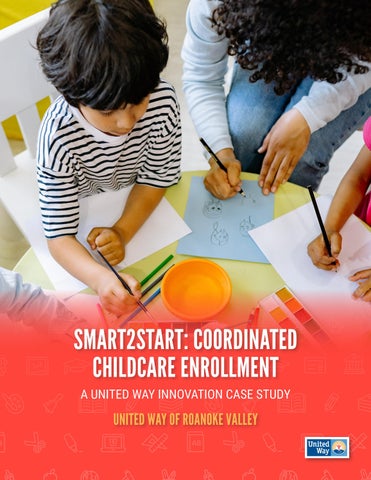
SMART2START: COORDINATED CHILDCARE ENROLLMENT A UNITED WAY INNOVATION CASE STUDY
UNITED WAY OF ROANOKE VALLEY
R
ecognizing that 85% of brain development happens
for coordinated enrollment and began convening partners to
before a child reaches age five, United Way of
develop this system in October 2019. In February 2020, they
Roanoke Valley created the Smart2Start program.
launched the Smart2Start coordinated enrollment system
Smart2Start helps families find affordable childcare
for the upcoming school year for publicly and privately
and preschools that are just the right fit.
funded sites.
By
coordinating with public schools, nonprofits, and
faith-based organizations, United Way ensures that every child enters kindergarten with the skills needed to succeed in school and in life. Coordinated childcare enrollment means that parents can complete just a single application to find affordable childcare and discover if their family is eligible for publicly funded programs that may provide free or reduced cost options. Growing out of the state of Virginia’s commitment to develop the state’s early childhood system, the Virginia Early Childhood Foundation created the Smart Beginnings initiative, which works to improve early childhood and development systems. As part of the Smart Beginnings network, United Way of Roanoke Valley already served as their local conveners of both publicly and privately funded early childhood care providers within the footprint that they cover. This convening role set United Way of Roanoke Valley up as the appropriate organization to pilot and launch a coordinated childcare enrollment system.
INITIATIVE COMPONENTS Partnerships ”We partner with public schools, nonprofits, and faith-based organizations to ensure every child enters kindergarten with the skills needed to succeed in school and life.” – Vivien McMahan, Vice President, Community Impact, United Way of Roanoke Valley For many years, United Way had been the convener of their community’s early childhood network and would bring partners together through meetings and the work of improving the early childhood system, whether it related to parent engagement, professional development, or access for early childhood systems change in general. United Way was able to pull Smart2Start partners together quickly, partially because they had already established those partnerships and relationships. Those trusted relationships had existed for many years and were a key component that was already in place before the pilot coordination effort was activated. The criteria by which childcare providers could be involved was that they had to be connected with the Department of Social Services (DSS).
BACKGROUND
they were center-based programs, family day homes,
In 2018, Virginia received a preschool development grant; part of that grant was devoted to improving the state’s early childhood system overall. That work transitioned all early childhood work, including the state office of Head Start, to the Virginia Department of Education. One of the state’s priority goals in 2018 was to develop a more efficient, coordinated childcare enrollment system.
This connection guaranteed that
the health and safety component was in place. Whether
The goal was to support
partners across the state in doing a better job of enrolling children in available public and private slots, serving more children along the way, and making sure that no children were left out when they could have been placed in the childcare system. United Way was tasked with facilitating the pilot
voluntarily registered, religiously exempt, etc., all those types of programs were, and are, connected with Virginia’s social
services
offices
and
Smart2Start’s
coordinated
enrollment system. Staying aligned and connected with the state’s priorities and investment into early childhood also contributes to Smart2Start’s success.
This includes making sure that
parents are involved, addressing the social determinants of health, and creating an equitable system and addressing vulnerable populations so that everyone has access to childcare. Smart2Start’s commitment to efficiency is also 2
critical since there are insufficient childcare slots available. They are looking at how to use a mixed delivery system to “blend and braid” resources to shift and lend slots on an annual basis to areas in need of childcare slots. Part of the mindset shift that the partners worked through successfully was recognizing as a community what the data was showing in terms of need – the number of children, the net eligibility requirements, and siloed recruitment efforts for each individual program – and realizing what they could do better to serve all the community’s children and families collectively. The partners also explored where all the applications should land and who could be trusted with those applications. The unanimous decision was that United Way was the appropriate and trusted entity to do the communicating and pass out the applications to the programs that best met the needs of families.
convener to providers, they were trusted to look at all the eligibility requirements that needed to be met - based on Head Start, Virginia Preschool Initiative state funded (VPI), and DSS childcare subsidy1, and even those private providers that may not accept any publicly funded dollars. such
established
– Vivien McMahan, Vice President, Community Impact, United Way of Roanoke Valley
Because United Way
doesn’t provide direct services to children, and serves as a
Having
“United Way serves as the conveners and the facilitators. We don’t have to be the decision makers and we don’t have to have all of the answers. But we can be that convener and facilitator to bring our partners together so they can really design the program and so they have a strong voice and feel they are well represented. This includes the publicly and privately funded providers, our Department of Social Services, early intervention, and parent voice.”
trusted
relationships
Community Engagement To make sure that parents’ voices are heard, and their views included in Smart2Start, United Way has parent representation from Head Start publicly funded schools, as well as private paying childcare. United Way compiled parents’ perspectives on what was important to them about
and
partnerships positioned the Roanoke community to pilot coordinated childcare enrollment. It’s grant funded at this writing, but the state of Virginia is committed to this effort as part of the preschool development grants that they have received, and is something that the state has prioritized and wants to continue funding and invest in.
how to design the system. One key result was the single point of entry application which helps determine eligibility and placement for children, and includes an educational piece so that parents could make well informed decisions about what types of childcare providers are available for them. Parents are also part of Smart2Start’s steering committee, an existing governance body supporting the work of United Way’s early learning team. Engaging parents aligns with the state’s strategic plan and the preschool development grant in general. The state’s priorities call for building relationships, increased family access to quality childcare, improved quality of childcare and preschool settings, and stronger parent engagement, all through the lens of inclusiveness and equity.
Applying through Smart2Start To ensure inclusivity and equity, Smart2Start applications are available online as well as a paper hardcopy in English and Spanish. All the local school systems sent the paper applications home with every child in their schools, and not just with young children. Even seniors in high schools received the paper applications for early care and education 1
The Child Care Subsidy Program assists families in paying childcare costs
for children under age 13 who are not eligible to attend public school during the part of the day when public education is available, or children with special
because they may have a younger sibling or a cousin or somebody that they could share that with. People can return
needs under age 18 who reside with the applicant.
3
applications to the school; the school gets the applications
to make referrals for families and connect them to additional
back to Smart2Start.
resources that will help improve their lives.
Smart2Start also has a helpline to
connect families to partners, including the Department of Social Services offices, to make sure that multilingual
Smart2Start has two navigators, and because of expansion,
families have help interpreting the applications.
another one doing part time contractual work. Smart2Start started out with six cities and counties in February of 2020, and as of this writing, they are in 16 cities and counties. Because enrollment times can fall on specific dates in the year, there are ebbs and flows to the volume of applications coming in.
But children are born, and families’ needs
happen, throughout the year, so there are families looking for childcare throughout the year. During the slower times, navigators work on recruitment and support of the partners to ensure a steady flow of applications through the system.
Costs and Sustainability The Smart2Start program costs about $250,000 a year. That includes three staff and the cost of the ChildPlus data system. In thinking about the initiative’s sustainability and the work they are doing in cooperation with the state, United Way is exploring what a Virginia-built data system would look like, and how it can support Head Start programs and Once the application comes in to Smart2Start, a navigator reviews it to see if the child is eligible for childcare, and which type. The navigators follow up with the family to make sure they have all the information they need to make an informed decision about where to place their child. Parent choice does factor into the decision; Smart2Start ensures that parents’ voices are heard and that they do have a say on where their child goes. If it’s privately funded childcare that parents must pay for themselves, Smart2Start informs parents about program options that they might be eligible for that they don’t have to pay for, or only pay for partially.
work in a whole new system. Avoiding duplicate work was part of the feedback United Way received from partners, and it was one of the reasons they chose the ChildPlus system for Smart2Start; it was a system that’s already being used for federal reporting requirements. The goal is to create something comparable and more affordable in the long run that can communicate with other systems, support partners like Head Start, and avoid duplicative effort for people who are already working as hard as they can. The state of Virginia has made the Unite Us software free to all nonprofits for the next several years. United Way is fundraising for Smart2Start
Since Head Start has the strictest eligibility requirements, Smart2Start uses those as the basis for determining eligibility across the program and to create alignment, instead of trying to modify different systems into one.
school systems so that they’re not having to duplicate their
Smart2Start
currently uses ChildPlus, Head Start’s data management system, because Smart2Start had multiple Head Start partners, as well as school systems, involved that also use that system. In addition to matching families to appropriate childcare options, navigators use motivational interviewing techniques, a family needs assessment, and information from the application in a formulated way to assess the families’ needs and strengths. This process helps navigators connect families to other wraparound resources that might be helpful for them. Smart2Start and 211 are using the Unite Us system
as part of its Early Learners’ initiative, and hosts sponsored events to support the project. There is already action taking place to develop a statewide, but regionally led coordinated enrollment system, based on the efforts of the United Way of Roanoke Valley Smart2Start pilot. United Way staff, the Virginia Department of Education, the Virginia Early Childhood Foundation (VECF), as well as other key stakeholders that are part of VECF’s Ready Regions Network from across the Commonwealth are currently working with a vendor to develop the system. As this work progresses, families continue to be involved. There is a more intentional focus to engage Hispanic families to ensure the system is also culturally competent. Ultimately, 4
this will benefit families to have accurate information, clarity
They matched up to 3000 children to solutions that worked
in program requirements and eligibility, less duplication of
for their families. Secondly, Smart2Start is examining how
applications, planned and purposeful inclusion of children
many slots they need. To avoid duplication, they are aiming
with delays and disabilities, and more stability for programs
towards building a centralized system with one waitlist
and childcare providers. This effort will continue over the next
versus all the programs and providers having their own
year to ensure a quality system is produced that will support
waitlist. This will help them better determine the actual
the various and diverse needs of each of the Ready Region
need in their communities and figure out how to build out
hubs that will be implementing the coordinated enrollment
childcare and resources to better meet those needs. Finally,
system across the state. The launch of this iteration will
the success of the collaboration is proving the partners
happen in the Greater Roanoke area with expansion to take
work better when they act together and connect families to
place in the additional 8 Ready Region hubs shortly thereafter.
the additional resources that they might need. Ultimately, the partnership wants families to achieve that goal of selfsufficiency and recognizes that that can’t happen if they
COVID-19 Pandemic
continue to work in silos. Collaboration has resulted in the
United Way’s history of funding collaborations was an advantage when the COVID-19 pandemic hit in 2020.
ability for Smart2Start to provide wraparound services to families more holistically.
Because the local early childhood community had already been working together, they were better prepared to address the changing needs resulting from COVID-19. This history of partnering helped break down silos, “blend and braid” resources, and better serve the community. During the pandemic, Smart2Start partners were unable to get out into communities to talk to families and get them engaged in the work. There were no community events or going out and knocking on doors. But through the strength of the partnerships, after families would come into the Department to Social Services to apply for childcare subsidy, the follow up second step would be to ask them to fill out the Smart2Start application. Schools, Head Start programs, and private childcare providers also continued to refer families to the Smart2Start application to access services. As partners got rid of their own applications and directed people to the Smart2Start system, it created a bridge to a new way of doing things; Smart2Start was able to respond to new needs in a time of limited resources.
ADVICE FOR OTHER UNITED WAYS
During the
pandemic, as schools were going virtual, childcare needs for families expanded from kindergarten up through high school ages. Smart2Start also worked with virtual pop-up providers to support working families and their children who needed a physical place to go to attend virtual school.
Invest in Relationships Investing in relationships that are formed during the work, or before the work has started, builds a strong foundation of trust. That trust speeds up the work, creates supporters, advocates, and pioneers willing to take the leap into this new effort; removes silos between organizations; and creates
Results
efficiencies that ultimately benefit the community.
Smart2Start is looking at three markers of success in the long term. In its first year, in the middle of a pandemic, and through the strength of the partnership, they were able to share that programs were filled, even when they went virtual.
Involve Parents You’ve got to have that parent voice involved because this is 5
specifically affecting them. We can’t just think that we know what’s best for our families. We must have them tell us.
Stay Aligned with State Priorities and Goals Having and maintaining champions at the state level facilitates long term alignment with their goals and investments. This alignment is critical for the sustainability of the coordination effort “because we don’t want something that’s just going to work here for a little while” or potentially be affected by changes in state leadership, systems, or programs.
Be Inclusive Smart2Start is set up to work for all families and be inclusive of any parent who needs childcare resources. They reach out to vulnerable, marginalized families who don’t have access to TV commercials or the internet.
But the information
coming out of the system also shows that financially better off families need childcare, too. It’s not a program just for poor or rich people, it’s a program for all parents who at some point or another are going to need resources.
Communicate, Communicate, Communicate When undertaking a coordination effort with multiple partners who may initially seem hesitant about giving up some level of control, continuous communication is critical to helping everyone understand how the initiative is playing out. Partners need to know on a constant basis what is going on, what applications are with Smart2Start, and who’s getting the applications.
Smart2Start sits down with partners to
discuss specific families to make sure they are going where they need to go to get their needs best met.
To learn more, visit the Smart2Start website or watch our quick, 30-second commercial. 6
United Way Worldwide 701 North Fairfax Street Alexandria, Virginia 22314 USA +1 (703) 836-7112 Innovation@UnitedWay.org
© 2022 United Way of Roanoke Valley