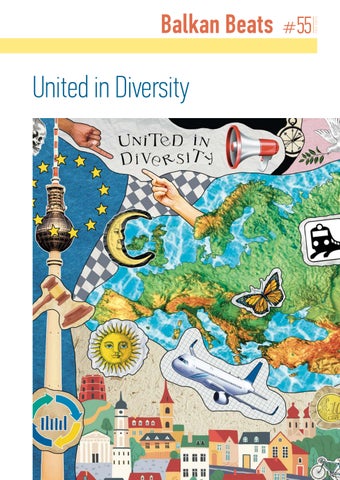
United in Diversity
FREE PRESS
Balkan Beats #55
United in Diversity Dear reader, Europe is a mirror. Sometimes it reflects our ideals: freedom, creativity, and solidarity. Sometimes it reflects our failures: inequality, extremism, and misunderstanding. In its reflections, we see both what we hope for and what we must confront. In this issue, we follow these reflections. We see Europe in laws and protests, in elections and debates, in professions that struggle and hobbies that flourish. We see it in personal stories of home and belonging, in the courage to live authentically. Europe is neither perfect nor static. It is a conversation, a tension, a space where contradictions coexist. And in that space, every question, every critique, and every story matters. The Editorial Team Tania Tarasova and Joanne Santier
Joanne Santier
Tania Tarasova
E D I T O R I A L
issue 55
Credits for cover: Lev Narozhny
02
PERSONAL NARRATIVE
Path forward to Europe
Everyday journeys in Europe
04
26
07
28
When Values Fade Legal Myths About EU Rights
09
Is the rise of the far right a threat to the European Union’s values?
13
Water Resources of Europe
What does it mean to call Europe home? Living together can’t be learned in conferences
30
Home Help
MIX FIX
15
Impact in the mix
21
32
The next member of the EU is…. Can the EU Overcome Its Economic Divide?
LOCAL LIFE
Snapshots from our local activities
44
Biokofinaki
Express yourself boldly
24
Cosplay
Funded by the European Union. Views and opinions expressed are however those of the author(s) only and do not necessarily reflect those of the European Union or the European Education and Culture Executive Agency (EACEA). Neither the European Union nor EACEA can be held responsible for them.
03
C O N T E N T S
OPENING ACT
Opening Act Path forward to Europe
WHEN VALUES FADE The EU’s Struggle with Democratic Backsliding by Ioannis Gianniotis
The European Union has managed to reform and change a lot throughout the years.Starting in 1951 with the European Coal and Steel Community (ECSC), an international organization that created a common market for coal and steel, and continuing through to the Maastricht Treaty in 1992, the EU has evolved in many aspects of its structure and function. One of the key areas of this evolution is the development of EU values , meaning the sum of all the rules and ethics that constitute the European’s Union identity and guiding vision. These values, even though their implementation is mandatory for all the country-members, are not always followed by and many of them don’t even comply with them. There are a variety of values that the EU is aligned with in order to maintain its European identity and shared political culture. This identity is most clearly showcased through Article 2 of the Treaty on European Union, which states that “the Union is founded on the values of respect for human dignity, freedom, democracy, equality, the rule of law and respect for human rights including the rights of persons belonging to minorities” (European
04
Union, 2012). These values are not merely abstract ideas, but serve as key criteria both for the membership and the internal legitimacy within the EU countries. They were further enriched by the Charter of Fundamental Rights of the European Union, which gained binding legal force after the Lisbon Treaty in 2009. The Charter recognises a range of social and political rights, freedoms, and principles that are related to dignity, equality, solidarity, citizen’s rights, justice, such as the right to life (Article 2), the right to liberty and security (Article 6), and freedom of thought, conscience, and religion (Article 10). This highlights the transformation of the EU, from a simple trade-oriented organization to a well-rounded international organization with an ethical profile and legal commitment. While these values, in theory, are shaping the EU’s moral profile, in practice, they do not always align with the personal stances of member states and this creates a huge gap between theory and reality. Despite the EU’s stated commitment, as previously mentioned, many countries fail to align with democratic values, human rights and rule of law and reject or neglect the Euro-
Path forward to Europe Opening Act
pean value model. Two countries that don’t always keep up with EU values are Poland and Hungary. In the case of Poland, there have been multiple times that tensions have arisen between the EU’s values and Poland’s actions. More specifically, policies that have been represented through the PiS (Law and Justice) party were seen as contradictory with EU values. Judicial reforms, anti-LGBTQ+ policies, and pushbacks of migrants have led to accusations that Poland is drifting away from other member states and does not follow the common policies that EU is setting. On a similar note, the Hungary of Viktor Orblan is backsliding within the EU by undermining democratic institutions like media control, misusing EU funds to build loyal voting networks and limiting judicial independence. Hungary has been characterized as an “illiberal democracy”, meaning that fundamental principles of liberalism, like individual rights and freedoms, are being neglected. This rejection of liberal EU values targets citizens and is against the values that the EU has promised to preserve. While there have been multiple tries from the European Commission against Hungary’s violations of values, real consequences have been limited due to the unanimity among member states, with Poland often supporting it. Besides Poland and Hungary, other countries have also shown a distance from the normative standards of the EU. Countries like Italy or Greece have been accused through
numerous reports of journalists and NGOs for violent push backs of immigrants and refusing protection of asylum seekers. Even the European Agency of Frontex has sometimes overlooked or allowed this kind of behavior. A 2022 research showed that during March 2020 and September 2021 more than 957 pushbacks happened at the Greek waters with the involvement of Frontex. The widening gap between the EU’s values and its internal reality has important consequences for the legitimacy of the Union as a whole. When countries don’t comply with the EU and there are noticeable breaches in democracy, the rule of law and human rights, citizens can very easily turn against their European identity and distance themselves from it. The creation of a eurosceptic mindset is getting set and accuses the EU of being unable to be controlled and efficient. To counter this, the EU needs to establish a common and more credible enforcement mechanism to ensure its values are respected and upheld by all member states. In a time when authoritarianism is rising alarmingly, the EU must decide whether it will represent and showcase its written values and lead by example or allow internal violations to undermine its legitimacy. Translating values into reality is important not only for internal coherence, but also important to maintain the role of the EU as a global and influential power.
05
Opening Act Path forward to Europe
References • European Council on Refugees and Exiles. (2024, July 10). ACCESS TO THE TERRITORY AND PUSH BACKS Greece. Asylum Information Database. Retrieved May, 2025, from https://asylumineurope. org/reports/country/greece/asylum-procedure/access-procedure-and-registration/access-territory-and-push-backs/ • European Parliament. (2022, April 28). Rule of law in Hungary and Poland: plenary debate and resolution | 0205-2022 | News. European Parliament. Retrieved May 21, 2025, from https://www.europarl.europa.eu/news/ en/agenda/briefing/2022-05-02/6/rule-of-law-in-hungary-and-poland-plenary-debate-and-resolution • European Parliament. (2024, March 31). The First Treaties | Fact Sheets on the European Union | European Parliament. European Parliament. Retrieved May,
06
2025, from https://www.europarl.europa.eu/factsheets/en/sheet/1/the-first-treaties • European Union. (2000, December 18). CHARTER OF FUNDAMENTAL RIGHTS OF THE EUROPEAN UNION. European Parliament. Retrieved May, 2025, from https:// www.europarl.europa.eu/charter/pdf/text_en.pdf • European Union. (2012, October 26). Consolidated version of the Treaty on European Union. EUR-Lex. Retrieved May 21, 2025, from https:// eur-lex.europa.eu/resource.html?uri=cellar:2bf140bf-a3f8-4ab2-b506-fd71826e6da6.0023.02/ DOC_1&format=PDF • Fella, S. (2024, February 13). Poland: The Law and Justice Government and relations with the EU, 20152023. The House of Commons Library. Retrieved May, 2025, from https://commonslibrary.parliament.uk/ research-briefings/cbp-9868/
Path forward to Europe Opening Act
LEGAL MYTHS ABOUT EU RIGHTS Debunking Common Misunderstandings by Polyzou Iliana Maria
Don’t Believe Everything You Hear About This means that EU law takes precedence the EU over the corresponding national law only in areas where the EU has exclusive or shared Nowadays, more or less everyone knows what competence. In all other fields, such as healththe European Union is and how it works. In real- care, member states retain control over their ity, however, many still fall prey to misinforma- own legal systems tion about events that gradually evolved into legal myths. Let’s take a closer look at some of Myth 2: The EU forces member states to the most widespread legal myths about the EU accept a fixed number of refugees and uncover the truth behind them. In political debates about migration, many polMyth 1: EU law always overrides iticians often claim that the EU forces member national law states to accept refugees and immigrants. In political discussions, it is often stated that EU law is superior, diminishing the importance of national law. As a result, many assume that EU rules automatically replace local ones, as they are “supreme”. The reality: EU law in reality has primacy but only in specific areas where the EU has legal competence. These can be divided in three categories: • Exclusive competence ( customs union), only the EU can legislate and take action., Member states can’t act independently
The reality: This statement is misleading and oversimplifies how EU migration policy actually works. Μigration and asylum fall under shared competence, meaning both the EU and the member states play a role, meaning that the EU sets certain common rules to ensure fair treatment, but national law retains the authority to decide how many refugees a country will accept. In short, the EU doesn’t “force” countries to accept refugees, but rather provides a structure for fairness and responsibility-sharing. Member states maintain significant control over how many people they admit and how their asylum systems operate.
• Shared competence (environment, consumer protection), both the EU and member Myth 3: You can live anywhere in the EU states can legislate, but EU law has priority without any restrictions when it exists Slogans like “ work anywhere in Europe” • Supporting competence (education, tourhave created the impression that EU citizens ism), the EU can assist and coordinate, but not can live and work freely in any member state enforce, member states remain fully in control without restrictions.
07
Opening Act Path forward to Europe
The reality: While free movement is a fundamental right, there are rules in place to balance individual freedom with the needs of the host country. For example, staying longer than three months usually requires proof of employment, sufficient financial resources, or enrollment in education.These conditions are meant to ensure fairness and protect host countries’ social systems while enabling mobility. They’re often misunderstood or exaggerated in public debate. Myth 4: You need a special permit to drive your car in other EU countries There is a common perception that crossing borders by car between member states involves complicated paperwork and permits. The reality: A valid driving license issued by any EU country is recognized across the EU. This means that you can legally drive in any member state without needing any additional permits or licenses. Regarding vehicle registration and insurance: Your car must be properly registered and insured according to your home country’s laws, but your insurance should generally cover you in other EU states under the “green card” system. Myth 5: You can’t use your mobile phone abroad without paying huge roaming fees Before 2017 using your phone abroad within the EU often came with expensive roaming charges. People were billed extra for calls, texts, and data – resulting in long-lasting fears about mobile use while traveling.
08
The reality: Since June 2017, the EU introduced the “Roam Like at Home” regulation, ensuring: • No extra charges when using your phone in any other EU country • You pay the same rates as you would in your home country for calls, texts and data Keep in mind that it doesn’t apply to non-EU countries, even if they’re geographically close. EU Law: Closer to Your Life Than You Think EU law often feels distant or complicated, but as these myths show, it actually affects our daily lives in very practical ways. From using your phone abroad to driving across borders or understanding your right to live and work in another country, the EU sets rules that aim to make life easier and fairer for its citizens. By separating fact from fiction, we can better understand how the EU works and how to make the most of the rights it gives us.
Path forward to Europe Opening Act
IS THE RISE OF THE FAR RIGHT A THREAT TO THE EUROPEAN UNION’S VALUES? When democracy cracks by Joanne Santier
“We still say f*ck to the National Front” European elections and the dissolution of the 15/06/24. Paris. Demonstration against the National Assembly. extreme right, in reaction to the score in the Spoiler alert: Yes. Human dignity, freedom, democracy, equality, and the rule of law — these are the values enshrined in Article 2 of the Treaty of Lisbon and the Charter of Fundamental Rights of the European Union. But today, more than ever in the history of the European Union, these values are under threat from a growing shadow: the far right. So how does the far right manage to convince people? In what ways does it endanger the EU’s values — and more importantly, how can we still fight back against this resurgence? The far right thrives on democracy’s cracks. The far right, always and everywhere, uses the same playbook to win over voters. It exploits fears, frustrations, and resentment. Basically, when everything’s a mess, the far right rubs its hands with glee. Economic
09
Opening Act Path forward to Europe
crises, climate chaos, migration fears, distrust freedom, judicial independence, and minority of elites, disinformation — people lose faith rights. What does that actually look like? and start looking for radical solutions. Undermining fundamental rights and passThe 2008 financial crash, COVID-19, the war ing repressive laws in Ukraine (and the energy crisis) all contributed to an atmosphere of uncertainty. Un- The first rights to be targeted are, unsurprisemployment rises, the wealth gap widens, ingly, those of minorities, and in recent years, and discontent with elites grows. Add global- democratic countries have seen a surge of reization and increased migration flows to the pressive laws. mix, and you get an identity crisis. People fear • In January 2024, the French Parliament for their national identity — and the far right passed the “Asylum and Immigration Law”, takes full advantage. They stigmatize immiwhich removed State Medical Aid for certain grants, fantasize about a “great replacement”, categories of foreigners. and convince people that newcomers are the cause of all problems. Immigrants, they claim, • In March 2025, the Hungarian Parliament are stealing your jobs, erasing your identity, passed a constitutional law banning legal recand creating urban insecurity. Their solution? ognition of gender, recognizing only biologiClosed borders, deportation, and an exclusive cal sex. This law violates Article 2 of the Treanationalism. They revive a nationalist popu- ty on European Union and the EU Charter of lism by posing as the voice of the “real peo- Fundamental Rights. ple,” even though they themselves often come from privileged backgrounds and are far re- • The Vlaams Belang (Belgian far-right pomoved from real-life concerns. litical party) frequently votes against social rights, despite its populist image: raising reTheir strategy is to hijack your fears, claim tirement age, blocking wage increases... they have the answers, and hand you a scapegoat — blame the elites, migrants, feminists, Attacking checks and balances leftists, LGBTQIA+ people. The far right sells a “back in the good old days” narrative to bring To suppress fundamental freedoms without back anti-progressive discourse. They sell a resistance, the far right moves to eliminate nostalgic vision of a stable, “pure” past that checks and balances that might push back. never existed. They idolize “strong” leaders, as the only way to fix society. And the worse Undermining judicial independence: things get, the more persuasive they become. • In 2017, the Polish government passed laws allowing the Minister of Justice to appoint How the far right dismantles our court presidents and vice-presidents, increasdemocracies ing political control over the judiciary. Beyond their hateful rhetoric, the real danger with far-right parties is their illiberal vision of • In 2025, Orbán’s government (Orbán is power. That is, they preserve the appearance Hungary’s far-right prime minister) and the of democracy (elections, institutions) but grad- head of the judicial council signed an agreeually undermine individual freedoms, press ment (without consulting other judges), weakening judicial independence in exchange for salary increases.
10
Path forward to Europe Opening Act
Controlling education:
This is the EU’s strongest legal mechanism to respond to serious violations of its fundaChanging laws is one thing — changing pub- mental values. lic opinion is even better. Education is the perfect institution to indoctrinate and control fu- • Step 1: The EU Council may determine a ture generations. The far right knows this. In clear risk of a breach (qualified majority). Hungary, since 2021, it has been illegal to discuss homosexuality or gender identity in • Step 2: If there is a serious and persistent schools. In the end, erasing minorities is more breach, the European Council can suspend certain rights of the Member State, including efficient than debating them. voting rights. Controlling the media These proceedings are currently underway “If you’re not careful, the media will have against Poland (since 2017) and Hungary you hating the oppressed and loving the (since 2018) over threats to judicial indepenoppressors.” — Malcolm X dence and the rule of law. Unfortunately, moving to step 2 requires unanimous agreement The far right monopolizes media outlets to among the other states — almost impossible spread hate speech. They use media to nor- since Hungary and Poland protect each other malize their ideas, gradually shifting the (voting in each other’s favor). boundaries of acceptable public discourse (the Overton window). With media allies, dis- Conditioning EU funds senting journalists are fired, forcing others to self-censor. This results in less democrat- Since 2021, the EU can withhold funds from ic debate and more polarization, eventually countries that breach the rule of law (via the Rule of Law Conditionality Regulation). For inleaving only one dominant narrative. stance, in 2022, the Commission suspended • In Hungary, the creation of a media council €6.3 billion in funds to Hungary due to corrupcontrolled by the government turned nearly all tion and judicial independence concerns. Howmedia into pro-government outlets or forced ever, for political reasons, the EU sometimes them into self-censorship. Finding anything lifts sanctions quickly after vague promises of other than propaganda is a miracle. reform (as with Hungary in early 2024). • In France, Article 24 of the 2021 “Global Security Law” banned sharing images of police officers under certain conditions. This severely limits press freedom and makes documenting police violence — an essential topic — much harder.
Infringement procedures (via the European Court of Justice)
What can the European Union do?
Annual rule of law report
The Commission can sue a member state before the EU Court of Justice if it violates EU law (including Article 2 values).
When countries threaten the EU’s core values, Each year, the Commission publishes a detailed report on the rule of law in each member state. It the Union has several tools it can use. identifies threats and makes recommendations. Article 7 TEU: the “nuclear option”
11
Opening Act Path forward to Europe
This is useful as a political and media pressure al.com/), whistleblowers, lawyers, and journaltool, but legally, it has no teeth. ists — even when it’s uncomfortable. We must also push back against authoritarian laws disIn short, the EU has some tools, but they’re of- guised as “security” measures. Just because ten misused, too slow, and too weak. a law targets “terrorism” or “immigration” doesn’t mean it’s neutral. What can we do individually? Develop critical (and collective) thinking In uncertain times, people are scared and willing to trade rights for security — and you can’t The internet has wrecked public discourse. But blame them. It’s easier to look away than to that doesn’t mean we should swallow everyfight. But the far right plays by the rules un- thing. Fighting disinformation means building til the rules no longer serve them. Democ- critical thinking, cross-checking sources, not racy dies slowly, quietly, without us even no- sharing before reading. Learn to spot populist ticing. Today, we still have time to fight back. rhetoric, analyze strategies, and verify data — the far right loves to manipulate statistics. Don’t normalize authoritarian discourse And most importantly, talk to others. DemocWe must refuse to normalize far-right talking racy is collective. It’s about debate. points. When extremist ideas enter public debate under the guise of free speech, we must Vote, get involved, take action (even a little) call them what they are: messages of hate, exclusion, and division. People often say it’s pointless, that all politicians are corrupt. Understandable — the sysIn Belgium, a political “cordon sanitaire” has tem is exhausted. But not voting means letting kept parties like Vlaams Belang out of power others choose for you. And those who show up for years, despite growing support. In France, in force? The extremists. Vote — even blank. by contrast, Marine Le Pen is now invited on Get involved locally — even small actions matall platforms, as if her program were just an- ter. Join protests — against racist laws, for other political option. the climate, women’s rights, trans rights, immigrants’ rights. All these fights are connected. We must not tolerate intolerance. So no, it’s not over. But given the EU’s ineffecDefend checks and balances tive response, nothing will change if we stay Every time the press, the judiciary, NGOs, or spectators: it’s a collective and ongoing fight. universities are attacked, democracy falters. It’s urgent to support independent media (Blast: https://www.blast-info.fr/, courrier international: https://www.courrierinternation-
12
Path forward to Europe Opening Act
WATER RESOURCES OF EUROPE A call for an urgent action by Maria Beauvais
Surface water in Europe — lakes, rivers, Water Quality in Europe streams, and springs — is currently in a critical state, as highlighted in a recent report by Freshwater is becoming an increasingly scarce resource in certain regions of Europe due to the European Commission. an uneven distribution between countries.
13
Opening Act Path forward to Europe
According to a report published on January 17, 2025, by the European Environment Agency (EEA), up to 34% of the European Union’s population and 40% of its territory experienced seasonal water shortages as recently as 2022. This issue is particularly severe in southern Europe, where up to 70% of the population faces summer water stress, mainly due to high water demand from agriculture, tourism, and domestic supply.
ents and pesticides. Agriculture is by far the largest net consumer of water in Europe, and without changes in farming practices, the demand for irrigated agriculture is expected to rise as drought episodes intensify.
In Europe, the availability and quality of freshwater are increasingly compromised by a combination of environmental and human pressures. According to the EEA’s report “Europe’s State of Water 2024: The Need for Improved Water Resilience”, agriculture exerts the greatest pressure, affecting both surface and groundwater. According to monitoring by member states, this is due to water use and pollution caused by the intensive use of nutri-
These reports underscore the urgent need for increased action to protect freshwater resources, prevent flooding, and adapt to the impacts of climate change. Cooperation among member states, along with more effective water management, will be crucial to ensuring a sustainable future in the face of growing pressure on these vital resources.
Industry also has a significant impact on water quality, particularly through point-source pollution: direct discharges into rivers or lakes from factories or wastewater treatment plants. Although these plants treat wastewaSome countries are especially affected — Cy- ter, they cannot fully eliminate harmful subprus and Malta record the highest levels of sea- stances, such as PFAS, microplastics, or pharsonal water shortages. Greece, Portugal, Spain, maceutical residues. and Romania also face critical episodes, espeThe effects of climate change, combined cially in the spring and summer months. with population growth, rapid urbanization, Moreover, water quality is another major con- and poor management of water infrastruccern. The chemical status of surface water is ture, are expected to intensify seasonal flucconsidered good in only 29% of cases, com- tuations in water availability in the coming pared to 77% for groundwater, which never- years. Droughts are projected to become theless provides the majority of drinking wa- more frequent, longer-lasting, and more seter consumed by Europeans. vere. According to forecasts, a significant improvement by 2030 seems unlikely, given the Freshwater Pollution ongoing negative trends observed since 2010.
14
Path forward to Europe Opening Act
THE NEXT MEMBER OF THE EU IS…. From candidates to members. by Lev Narozhny
Let’s think together: which country could • Freedom of speech and the press be the next to join the European Union (EU), and what will the process look like? • Independence of the judiciary Which countries have the highest chances of • Respect for the rule of law and the Constitution joining today? How does EU accession work? To become a member of the European Union, a country recognized by the United Nations and located fully or partially in the European part of Eurasia must submit a formal application for membership. Once the application is submitted, the review process begins.
• Combating corruption • Implementing privatization policies and supporting free competition • Ensuring financial stability
If a country fulfills these requirements, it may be granted candidate status. After the application is submitted, a lengthy negotiTo successfully join, the country must meet ation process begins with current EU memstrict political, economic, and legal conditions ber states. If the outcome is positive, an — known as the Copenhagen Criteria, adopt- accession treaty is signed. ed in 1993. The main requirements include: Which countries are located in Europe? • Conducting free and fair elections Currently, there are about 45 fully recognized • Separation of powers countries located wholly or partially in the European part of Eurasia (not including the 27 • Protection of human rights and the rights EU member states). of national minorities
15
Opening Act Path forward to Europe
Fully located in Europe (15 countries): • Albania AL • Andorra AD • Bosnia and Herzegovina BA • Iceland IS • Liechtenstein LI • Moldova MD • Monaco MC • Montenegro ME • North Macedonia MK • Norway NO • Serbia RS • San Marino SM • Switzerland CH • United Kingdom GB • Vatican City VA Partially located in Europe (5 countries):
• Georgia (northern regions lie north of the Caucasus) GE • Armenia (partially considered European, especially northern areas) AM Countries with the highest chances of joining the EU As of today, several European countries have already fulfilled many of the core requirements for European Union membership. However, they are in no rush to join the bloc. Let’s take a closer look at some of them: Norway, Iceland, Switzerland, Liechtenstein, Monaco, and Andorra are known for their strong economies, fair judicial systems, and active protection of human rights. Despite meeting most EU accession criteria, they have not pursued membership. The main reasons are financial disagreements with the EU and a desire to maintain traditional neutrality. Still, these countries maintain close cooperation with the EU, participating in various financial and trade agreements, which allow them to work effectively with the Union without full membership.
The United Kingdom is a former EU member, having left the Union in 2020 (Brexit). • Russia (European part lies west of the Ural While the UK continues to uphold economic Mountains) RU ties and shares many EU values, major points of contention included migration policy, sov• Turkiye (European territory: Eastern ereignty concerns, and the desire to fully conThrace) TR trol domestic legislation — all of which drove • Kazakhstan (European part lies west its decision to exit. of the Ural River) KZ EU Accession Candidates
16
Path forward to Europe Opening Act
Currently, several countries have applied for These countries face territorial conflicts EU membership and are negotiating with the .These issues remain major obstacles to EU European Union: accession. Additionally, improvements are still needed in human rights, economic re• Ukraine forms, judicial independence, and reducing the influence of political forces. • Moldova Montenegro, Bosnia and Herzegovina, • Georgia Albania, North Macedonia • Albania
• Bosnia and Herzegovina
Countries are actively working toward meeting the criteria for EU membership. While each of these countries faces its own set of challenges — such as territorial disputes, persistent corruption, weak economic development, or institutional instability — efforts are being made to implement necessary reforms and improve internal conditions.
• Turkiye
Republic of Türkiye
• Serbia • Montenegro • North Macedonia
These countries have already made significant progress in aligning with the EU, but they still need to continue reforms to fully meet the Union’s criteria and standards. Let’s take a closer look at their current challenges.
Republic of Türkiye has been an EU candidate since 1999, but since 2024 accession talks have been “frozen.” The main problems are tense relations with Greece, issues with democratic institutions and human rights, and concerns over the concentration of powUkraine er. The EU demands significant legal and poFor a long time, Ukraine has been considering litical reforms, which are being implemented EU membership prospects and implementing slowly and inconsistently. reforms in its economy, judiciary, and goverWho will be the next EU member? nance, aligning with Western standards. However, because of the start of war in 2022, the This question is difficult to answer. Countries country was forced to suspend most reforms with a high standard of living are not rushing and focus on defense and territorial protec- to join the EU, and there are no signs that this tion. Now, Ukraine faces the task of resuming will change soon. its reform process after the war ends. At the same time, countries with candidate staMoldova, Georgia, Serbia tus face the need for large-scale reforms — in politics, anti-corruption efforts, resolving territorial disputes, and protecting human rights.
17
Opening Act Path forward to Europe Nevertheless, let’s analyze which candidate become the next EU member. Here are my ascountry currently has the highest chances to sessments of their prospects:
Country
Reforms & Readiness
Politics & Stability
Ex
Montenegro
Most advanced in reforms, praised by the EU
Relatively stable, but corruption remains an issue
No ma
Moldova
Strong reform efforts post2022, close cooperation with EU
Fairly stable pro-European government
Security c T
Serbia
Progressing slowly
Politically stable, but Russian influence & Kosovo are issues
North Macedonia
Making reforms, but blocked by Bulgaria
Politically unstable at times, reforms ongoing
Albania
Some progress, but corruption remains a challenge
Occasional political crises
Ukraine
Judiciary reform and full implementation of anti-corruption measures need significant work
Democracy remains resilient, but strained by the conflict with Russia
Occupied te ternal ob
Republic of Türkiye
Reforms largely stalled, authoritarian turn
Major democratic and rights concerns
Disputes
Georgia
Mixed reform record, recent political backsliding
Increasing authoritarian tendencies, protests
Ten Abkha
Bosnia & Herzegovina
Very complex internal structure, weak progress
Deep ethnic divisions and political fragmentation
Internal
18
Dis
Path forward to Europe Opening Act
xternal Issues
Negotiation Blocks
Prospects for Joining Soon
ajor external conflicts
No
Highest chance — in 6-9 years
concerns du e to Russia, Transnistria issue
No formal blocks, but vulnerable to outside threats
Medium chance — in 9-10 years
Kosovo matter
Blocked due to non-recwwognition of Kosovo
Medium chance — in 9-10 years
spute with Bulgaria
Blocked by Bulgaria
Medium chance — in 9-10 years
No
No
Medium chance — in 9-10 years
erritories presents major exbstacles to EU accession
Political support within the EU for Ukraine’s accession, and no member states are actively blocking negotiations
Medium chance — in 9-10 years if the war ends soon
with Cyprus and Greece
Accession talks frozen
Very low — unlikely in 10+ years
nsions with Russia, azia & South Ossetia
Concerns over democratic backsliding
Very low — unlikely in 10+ years
l instability and Kosovo recognition
Not fully ready for negotiations
Low — long-term timeline
19
Opening Act Path forward to Europe
Conclusion:
Georgia has advanced in European integration but has experienced setbacks in demMontenegro is the most realistic and fast- ocratic reforms and the rule of law in recent est candidate for accession. It is closest to years, slowing its rapprochement with the EU. completing negotiations and has made the greatest progress in reforms, although chal- Bosnia and Herzegovina remains very unlenges remain. stable, with uncertain prospects. Moldova shows political will and reforms but faces a serious problem with the Transnistria conflict and overall vulnerability due to regional instability. Serbia is one of the countries most advanced in negotiations with the EU, but its membership is hindered by significant political obstacles. The main issues are its relations with Kosovo and close ties to Russia. Although reforms are underway, they are often seen as superficial or insufficient. North Macedonia prospects depend on the lifting of the blockade by Bulgaria. Albania has made significant progress in reforms, especially in justice and anti-corruption efforts. However, problems with the rule of law, media freedom, and political stability continue to slow down the process. Ukraine demonstrates a strong pro-European direction, actively pursuing internal reforms and strengthening cooperation with EU countries. However, the ongoing war and unresolved territorial conflicts with Russia significantly complicate the integration process. Republic of Türkiye negotiations are frozen, and accession in the near future is highly unlikely.
20
The countries with the highest chances of joining the EU are primarily those that do not actually seek full membership in the union but actively cooperate with the EU and share pro-European values: protection of human rights, independence and fairness of the judicial system, combating corruption, and developing their domestic economies. For example, countries like Norway and Switzerland, which have developed and stable economies, do not see clear benefits in full EU membership. Therefore, they prefer to sign bilateral agreements that are beneficial to both parties while maintaining close partnership relations with the union. On the other hand, there are countries that show active interest in joining the EU but are not yet fully meet the key criteria and conditions for membership. However, this does not prevent the start of negotiations — the fact that their candidacies have not been rejected means that with further progress in human rights, reforms of political and judicial institutions, and resolution of territorial disputes, they have a real chance to become full members of the European Union.
Path forward to Europe Opening Act
CAN THE EU OVERCOME ITS ECONOMIC DIVIDE? Europe in the Shadow of Inequality by Lucas Leroy
The European Union is widely regarded as a symbol of solidarity, peace, and shared prosperity. But behind this optimistic discourse lies a more troubling reality: economic inequalities between its member states remain massive. And these disparities persist at a time when Europe aspires to speak with a stronger voice on the global stage.Between Western and Eastern Europe, the gap remains wide. In 2024, the average income in Luxembourg is eight times higher than in Bulgaria. The minimum wage exceeds €2,000 in some northern countries, while it struggles to reach €500 in parts of the East.These figures are not trivial: they reflect a structural inequality that persists despite years of integration. The same goes for unemployment: in Germany or the Netherlands, the rates are close to full employment. In Spain or Greece, youth unemployment sometimes exceeds 20%. Added to this are disparities in access to health-
care, education, public transport, and digital infrastructure. In conclusion, Europe can be far from united economically. These inequalities are not just unfortunate. They directly threaten the cohesion of the Union. Because when inequalities persist, they breed frustration. In some Eastern or Southern countries, many feel left behind by a system that mainly benefits the richest. The result: a rise in Euroscepticism, growing distrust toward Brussels, and a turn toward nationalism. Brexit was a brutal expression of this, but it is not an isolated case. On the other hand, in northern countries, some voters reject the idea of paying for others. This became evident during debates on post-Covid aid. The paradox is that the EU has equipped itself with tools to reduce these gaps: cohesion funds, structural aid, and more recently, the
21
Opening Act Path forward to Europe
Next Generation EU plan. But despite these efforts, economic convergence remains slow. Some member states continue to rely on tax or labor-cost advantages to attract investment, undermining collective progress and fueling internal tension.
a mere technical alliance between unequal and increasingly divided countries.
And then there’s the eurozone: a single currency without a strong common economic policy is a bit like a car with four differently sized wheels. It moves forward, but it’s a bumpy ride. The Greek debt crisis or the current struggles of heavily indebted states show that without stronger solidarity, the monetary union risks breaking apart with every shock. The idea of a united Europe remains attractive. But it will only hold if it rests on a more equitable foundation. That means massive investment in the most lagging regions, a genuine common industrial policy, coordinated action against tax evasion, and a rebalancing of budgetary rules that take social realities into account.
With the 2024 European elections still fresh in people’s minds and the rise of nationalist parties, the pressure is stronger than ever. If the EU wants to regain citizens’ trust, it will have to prove that it is more than technocratic regulations or markets. The future of Europe is not being played out solely in Brussels or Frankfurt, but also in the rural towns of Romania, neighborhoods with limited access to resources and opportunities in Portugal and the forgotten industrial cities of France.
Europe stands at a crossroads. Either it chooses to confront its internal imbalances and act to correct them, or it risks becoming
22
In the latter case,, the project of a united, strong, and solidaristic Europe will remain a beautiful idea on paper.
Unity cannot be decreed: it must be built slowly on social justice and equal opportunity. Without this, even the very idea of “Union” risks sounding increasingly hollow.
Path forward to Europe Opening Act
23
Local Life Express yourself boldly
COSPLAY Be yourself in any costume by Lev Narozhny
Recently, a major geek event took place in Thessaloniki — Comic Con, held from May 9th to 11th. It’s a space where fans of anime, cartoons, manga, games, and pop culture can connect, share experiences, and feel “in their element.” Among them, cosplayers tend to attract the most attention. Have you ever loved something passionately, only to be misunderstood or mocked? If so, you’re not alone. Today we’re talking about cosplay — a hobby that may seem strange to some but brings joy, creativity, and self-expression to others. The word cosplay, from “costume” and “play,” became widespread through Japanese pop culture. It’s the art of transforming into favorite characters from anime, games, films, comics, and more.
yourself? It’s a skill valued not only at conventions but in theater and film too. How Cosplay Reflects European Values It’s the freedom of self-expression, respect for diversity, human dignity, and the right to be yourself, regardless of other people’s opinions. Cosplay is not just about costumes. It’s an act of courage and inner freedom. People who take part in this hobby challenge prejudice, stereotypes, and social pressure. They create, express themselves, and inspire others — whether they are children, teenagers, or adults. That’s why cosplay isn’t only about the external — it’s about the inner right to be who you are. And as long as there are still those who judge others for being different, events like Comic Con will remain vital islands of freedom, where everyone can be heard and accepted.
But cosplay is more than dressing up. It’s about love for detail, patience, and the cour- Next time you see a cosplayer on the metro, age to be yourself. Many cosplayers hand- smile because it’s brave. craft their costumes, which can cost thousands of euros due to complex designs, Character names (picture): tailoring, and accessories. 1) Evelynn | League of Legends Wigs also vary: simple ones cost 20–30 euros, but custom styling can drive the price much higher. Still, high prices aren’t essential — many create amazing looks with budget-friendly materials. Skill and creativity matter more than money. Knowing how much professional costumes cost — and how affordable materials can be — have you ever thought of becoming a costume maker
2) Akali | League of Legends 3) Dio Brando | JoJo’s Bizarre Adventure 4) Akihiko | Persona 3 5) Astarion | Dungeons & Dragons 6) Xayah | League of Legends 7) Aang | Avatar: The Last Airbender 8) SpiderMan | Marvel 9) Dynasty Ahri | League of Legends 10) Abraham Sapien | Hellboy 11) 2B and 9S | NieR: Automata 12) Tartaglia | Genshin Impact
24
Express yourself boldly Local Life
© Lev Narozhny
25
Personal Narrative Everyday journeys in Europe
WHAT DOES IT MEAN TO CALL EUROPE HOME? Living between places, languages, identities by Tania Tarasova
In today’s Europe, the idea of “home” is more than just the place where you were born or the language you speak. It is not a fixed point on the map; instead, it is something shaped by constant movement, interaction, and change. As philosopher Étienne Balibar explains, European identity grows out of a mix of cultural traditions, languages, and histories. This identity is built through conversation, and sometimes through conflict. Because of this, “home” in Europe is rarely a simple idea. Instead of representing clear-cut belonging, it often reflects complex and shifting realities. Even though the European Union promotes free movement and shared values, the experience of home is not the same for everyone. Deep-rooted inequalities, historical wounds, and nationalist attitudes continue to shape who gets to feel fully “at home,” and who does not. Belonging becomes something we must work at, something we build over time. It is a process: learning the language, picking up social cues, figuring out where you fit in. It is something you actively do.
mines whose voices are heard and whose remain marginalized. In multilingual Europe, language often acts as a marker of power and belonging: speaking the “right” language can mean being recognized and granted the right to participate in public life. Ulrich Beck called this phenomenon a kind of “internal globalization” (Beck, 2006), where people are both part of their local culture and somewhat disconnected from it at the same time. You might feel close to where you’re from, but also like you don’t fully belong there anymore. This tension challenges the traditional idea of home, making it feel too simple. For example, imagine a university student from Spain moving to Finland for studies. If they speak Finnish fluently, they may find it easier to connect with classmates and feel accepted. But if their accent is strong or their vocabulary limited, they might notice subtle exclusion – classmates switching to English, or peers making jokes the person couldnt understand. These everyday linguistic barriers can shape whether someone feels truly at home.
This complex process is especially visible when A person may be physically rooted in a city, we look at language, a key medium through yet if their speech is mocked or their native which people express identity and belonging. tongue deemed “provincial” or “inappropriate,” a sense of foreignness prevails. Thus, The languages we inhabit home becomes a contingent and unstable notion, dependent not only on emotional but Language is not merely a tool for communialso linguistic recognition. cation; it is one of the primary mechanisms of inclusion and exclusion. Language deter-
26
Everyday journeys in Europe Personal Narrative
The philosopher Martin Heidegger famously said, “Language is the house of being.” If that is true, then many people in Europe live in more than one “house” at the same time. They move between languages depending on where they are, who they’re with, or what they’re doing. So home becomes less about a single location and more about feeling at ease in a mix of languages. It becomes a kind of “linguistic geography” that helps people make sense of their identity. A practice, not a place
becomes fluid, mobile, and temporary. We live in an era of constant reinvention, where adaptability is a necessity, and mobility is a virtue but this freedom comes at a cost. In return, we face uncertainty, a fear of being left behind, and a persistent sense of incompleteness. The culture we inhabit promises endless choice, yet offers little real control. More often, we find ourselves as consumers (of culture, of relationships, of identity) rather than active participants. Depth gives way to the surface, and speed replaces stability.
While Europe aims to be a shared home and moving across borders may be legally straightforward, the cultural and emotional experience of belonging can be very different.
Many Europeans carry home with them, reshaping it depending on context and community. A family might live between two countries, keeping ties to both places and cultures. Their sense of home shifts as they speak difConsider a young professional from Italy re- ferent languages, celebrate different tradilocating to Germany for work. On paper, they tions, and build connections in multiple places. have all the rights of an EU citizen: residency, healthcare, employment. Yet in daily life, they In the end, Europe can be understood as a might face stereotypes or subtle distrust. place where “home” is not a fixed location, but a continuous process. It involves moving, beBelonging is not a right automatically ing recognized by others, and expressing who conferred by a passport, but a continu- you are. Living consciously in this flow is how ous practice enacted through language, many find a genuine sense of belonging. labor, civic participation, and navigating social differences. This ongoing effort can be tiring, but it also shows how belonging is something lived and not always just given. Europe today is a place of constant movement and change. Sociologist Zygmunt Bauman called this “liquid modernity” (Bauman, 2000), a condition where identity is never fixed but always evolving. In the conditions of liquid modernity, as described by Bauman, stable forms of life like long-term partnerships, steady careers, a sense of rootedness are dissolving. Everything
27
Personal Narrative Everyday journeys in Europe
LIVING TOGETHER CAN’T BE LEARNED IN CONFERENCES Messy, imperfect, human. by Joanne Santier
We hear about “living together” as if it were an ideal. In conferences, debates, LinkedIn posts. It’s sold to us with polite words: inclusion, respect, diversity, kindness — the recipe for being a good citizen. But what no one tells you is that real “living together,” the one you experience every day, doesn’t happen in lecture halls or codes of conduct. It happens in a slightly messy kitchen, way too early in the morning, when you realize someone ate your bougatsa.
ropean volunteers, five fridges, three showers, and a whole lot of compromise. After living there for several months, I learned that living together isn’t an idea. It’s someone blasting music while you’re trying to nap. It’s waiting in line for the shower, sharing hallways, and enduring awkward silences.
It’s anything but a theoretical concept. It’s messy, sometimes annoying, often funny, but always beautiful. Not because everyone loves A13 is an experimental lab for living together each other, but because we learn — to tolerate — a house in Thessaloniki, about twenty Eu-
28
Everyday journeys in Europe Personal Narrative each other, to face a bit of friction, and above ple you don’t always understand. People you all, to understand. may never have chosen. And it’s not the absence of conflict that creates bonds, but the Living together isn’t a hashtag. It’s an expe- way we move through it. You have to comprorience. A real-life cohabitation, made up of mise. Adapt. Sometimes give in. Sometimes small victories: like managing to clean the toi- hold your ground. let together without fighting. It’s political. And emotional. It’s learning how The myth of “kind” coexistence to make space for others without disappearing yourself. It’s learning to speak without hurting. At conferences, they talk about consensus. To listen without trying to convince. It’s learnIn real life, there are people who slam doors, ing to negotiate space, time, words, and silence. leave hair in the shower, hoard every mug in their room, talk loudly all the time — or don’t It’s not easy, but that’s what makes it real. talk at all. People who avoid you when they’re upset. Or, on the contrary, want to solve every- When it works, despite everything thing right away, even when all you want is to lock yourself in your room and ignore the world. And then, sometimes, out of nowhere, it works. A spontaneous dinner where everyone No one prepares you for that. No one teach- stays at the table a bit longer. A deep 3 a.m. es you how to deal with the passive irritation of chat in the kitchen. A movie night in the living dirty dishes left in the sink. Or how to live with room on a hungover Sunday. Someone doing people who don’t tidy like you, don’t eat like you, your chore without saying anything. Someone don’t sleep like you. And yet, we live together. really listening to you — not interrupting, not Every single day. Whether we want to or not. judging — when you weren’t doing great. The little things that reveal us
Those moments aren’t scheduled. They don’t happen because of a flatmate meeting. It’s a The truth is, living together often starts with quiet solidarity that builds through everything the tiniest details. Minuscule. Insignificant. But you’ve already overcome together. when repeated daily, they become huge. Living together can’t be learned in conferSnoring at night. A used pan left unwashed. A ences. There’s no recipe. No perfect method. bathroom monopolized for an hour. An ignored Just attempts, failures, and small wins. “hello.” A chore left undone. These things don’t make it into speeches. But they’re what test Living together means accepting that it’s our patience, our tolerance, our nerves, and our sometimes uncomfortable, often tiring, but alability not to explode over nothing. ways human. Because it’s not a fixed ideal. It’s a constant construction. A simple, daily effort And that’s exactly where living together begins: made of compromises, tensions, laughter, and in that microscopic moment when you choose small gestures that matter more than we think. not to chuck the dirty pan out the window. And sometimes, when everyone gathers on Conflict as a bond-builder the rooftop, someone puts on a playlist we can all more or less tolerate, and we all team up to The problem is, we often confuse “living tobarely manage to light a barbecue — then livgether” with “getting along perfectly.” But ing together looks a bit like the idea we had of no. Living together means being around peoit. Not perfect. Not spectacular. But truly nice.
29
Personal Narrative Everyday journeys in Europe
HOME HELP A Profession in Trouble by Maria Beauvais
A European study commissioned by UNI Europa, EFFAT, EFFE, and EFSI reveals that working conditions in the home care and housekeeping sectors are unsustainable. Although these jobs are essential, they remain undervalued, poorly paid, and marked by difficult conditions, pushing many workers to leave the sector. To understand this better, here is a look at a typical day in the life of a home care worker:
an hour. So I juggle care, conversation, cooking, and dusting.
9:30 a.m. I get back in the car. The next visit is a 25-minute drive away. I pass through isolated villages. In rural areas, I sometimes spend more time driving than actually working in the homes. My back is starting to hurt, and I think of my colleagues who are on sick leave — those 7:30 a.m. I start my day at Mr. R.’s house. who, after ten years of repetitive tasks, He needs help with his hygiene routine, then have ruined their backs and shoulders. I make him a quick breakfast. I have 30 minutes — no more. We exchange a few words, 10:00 a.m. A new visit, to a man I’ve never sometimes he smiles at me, sometimes he met before. He doesn’t want help — his son stays silent. I’ll probably be the only person he arranged this. I’m nervous. I don’t know what talks to today, but my half-hour is already up. condition he’ll be in, and I just hope he opens the door. Sometimes, it’s aggression. SomeI get in my car. I have ten minutes to get to my times, it’s fear. But one thing is certain: I’ll next visit. I use my own vehicle and receive a have to face it alone, once again. small reimbursement: 0.37 euros per kilometer. That’s very little, especially with today’s 12:00 p.m. In theory, this is my lunch break. fuel prices, and this amount doesn’t cover In practice, I eat a sandwich in my car, parked wear and tear on my car or additional expens- in a lot or on a quiet street. I don’t have time to go home; I’m back on duty at 2:30 p.m. es — those are all on me. This two-hour gap, of course, is unpaid. Moreover, this reimbursement only applies to There’s not much I can do, and nowhere to travel between clients’ homes. If I leave from go during that time. my own home or have a break during the day, 2:30 p.m. I head out for three more visits. those kilometers don’t count at all. Mrs. L., who’s very lonely — she waits for me 8:15 a.m. I’m at Simone’s. She needs help eagerly with very specific instructions. At Mr. getting up, getting ready, and taking her med- B.’s, the house is filthy and he drinks, which ication. We chat a little — she’s anxious and makes him aggressive. I’ve reported the sitoften worries about her children. I have to uation to my supervisors several times, but clean , and everything must be done within
30
Everyday journeys in Europe Personal Narrative
nothing concrete has been done. Still, I keep I barely earn more than minimum wage. And yet, I’m supposed to uphold an essential pubgoing, with a knot in my stomach. lic service that’s crucial to human dignity. 6:30 p.m. Final visit, to Marie-Thérèse. She has Alzheimer’s. Each time, she tells me the I’ve never received any training — I learned same stories, and I listen as if it’s the first everything on the job. Every year, I ask to be time. That role, being a listener, is neither rec- trained, and every year I’m told it’s not posognized nor valued. For many families, home sible, that there’s no space. In reality, what care is just cleaning. They don’t always real- bothers them is that if they train me, they’ll ize that their parents or grandparents mostly have to pay me more. And that, for them, is need someone to talk to. Some even clean be- out of the question. forehand, just so they can fully enjoy that hour But I keep going, because despite everything, and have a proper chat. we tell ourselves that we’re useful, that we 8:30 p.m. I get home. Exhausted. Tomorrow, serve a purpose. Even if we’re invisible, unit all starts again. I’m not full-time, like most heard, and never truly acknowledged. I often of my colleagues. I work 24 hours a week, wonder how much longer I can keep this up. spread over six days, with gaps in between.
31
Mix Fix Impact in the mix
SNAPSHOTS FROM OUR LOCAL ACTIVITIES by Balkan Hotspot Team
Celebrating Europe Day
32
Impact in the mix Mix Fix
Celebrating Europe Day
33
Mix Fix Impact in the mix At Eurogames
At Eurogames
34
Impact in the mix Mix Fix
Crochet Workshop
35
Mix Fix Impact in the mix Crochet Workshop
36
Impact in the mix Mix Fix Beach Cleaning at Peraia
37
Mix Fix Impact in the mix
Beach Cleaning at Peraia
38
Impact in the mix Mix Fix
Human Library
39
Mix Fix Impact in the mix Human Library
40
Impact in the mix Mix Fix
41
Mix Fix Impact in the mix
Art Therapy
42
Impact in the mix Mix Fix
Art Therapy
43
Mix Fix Impact in the mix
BIOKOFINAKI Harvest in Focus: A Photo Mix by Joanne Santier
Biokofinaki is one of the therapeutic activities offered within the framework of ARGO – Alternative Therapeutic Program for Addicted Individuals. ARGO is a non-residential, drugfree program that is part of the Greek National Health System, specifically under the General Hospital of Thessaloniki “G. PAPANIKOLAOU” – Organic Unit Psychiatric Hospital. It provides free support to individuals over 18 dealing with substance use (heroin, cocaine, cannabis, stimulants, etc.) as well as other addictive behaviors (such as gambling, internet addiction, or prescription medication misuse).
44
Guided by the principles of personal freedom, collectivity, and creativity, Biokofinaki offers participants a hands-on, communal activity centered around cultivating vegetables. Working the land together helps restore structure, purpose, and connection. The harvested produce is either sold in biological seasonal produce baskets or used in shared cooking activities. Through this meaningful work, participants reconnect with nature, rediscover their abilities, and experience healing within a supportive community.
Photo Gallery Mix Fix
45
Mix Fix Impact in the mix
46
Photo Gallery Mix Fix
47
Mix Fix Impact in the mix
48
Photo Gallery Mix Fix
49
Mix Fix Impact in the mix
50
Photo Gallery Mix Fix
51
Mix Fix Impact in the mix
52
Photo Gallery Mix Fix
53
Mix Fix Impact in the mix
54
Photo Gallery Mix Fix
55
Mix Fix Impact in the mix
56
Photo Gallery Mix Fix
BALKAN HOTSPOT TEAM Iliana Maria Polyzou
Ioannis Gianniotis
Greece
Greece
Lucas Leroy
Joanne Santier
France
France
Lev Narozhny
Tania Tarasova
Estonia
Estonia
Maria Beauvais France
57
Mix Fix Impact in the mix
United Societies of Balkans is a Non Governmental Organization, founded in Thessaloniki in 2008, by a team of active young people. The organization was created as a response to the pressure of constant changes in the Balkan and Eastern European region and under the need for the creation of a better social environment. Key areas of the organization’s activities concern the defense of human rights, the organization of youth exchanges and training courses, which will bring young people from Balkans and Europe together, the organization of local educational seminars and multimedia production (webradio, videos, documentaries). Main goals of the organization To promote the values of non formal le- aring,volunteering, active citizenship and democracy for the creation of a better future for European youth. To promote human rights, solidarity and respect for diversity. To build healthy cooperation bridges between countries of the Balkan area and that of Eastern Europe with the rest of Europe. To locate and multiply the special cultural attributes of our societies. The break down of prejudices and stereo- types between Balkan countries. Property of Balkan Beats The United Societies of Balkans, NGO, does not necessarily share the opinions expressed in Balkan Beats. It is illegal to reproduce any part of this publication without referring to the source.
UNITED SOCIETIES OF BALKANS, NGO | 8, Delmouzou str., Thessaloniki | Tel./Fax: +30 2310 215 629 | www.usbngo.gr
Find us: www.balkanhotspot.org | Usb_ngo.gr
58
Balkan Beats, a part of Balkan Hotspot Balkan Hotspot is the ESC (European Solidarity Corps) project of “United Societies of Balkans”, a NGO founded in Thessaloniki in 2008 by a team of active young people. The Balkans and Eastern Europe are geographical regions with many cultural features which offer a broad spectrum of actions and youth involvement initiatives. The organiza-
tion was created as a response to the pressure of constant changes in the Balkan and Eastern European region and under the need for the creation of a better social environment. Key areas of the organization’s activities concern the defense of human rights, the organization of youth exchanges and training courses, which will bring young people from Balkans and Europe together, the organization of local educational seminars and multimedia production.
The volunteers responsible for this publication are hosted in Greece in the framework of the European Solidarity Corps. This project has been funded with support from the European Commission. This publication [communication] reflects the views only of the authors, and the Commission can not be held responsible for any use which may be made of the information contained therein.
This magazine is distributed free of charge.
General Directors: Aristodimos Paraschou | Christian Cibba Editors: Tania Tarasova | Joanne Santier Graphic Designer: Anna-Maria Diamantidou
59