“Risk more than others think is safe. Dream more than others think is practical.” — Howard Schultz
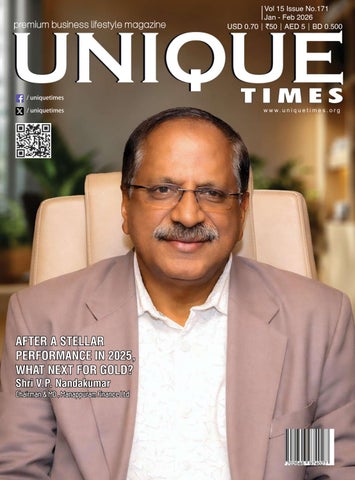
Gold delivered a stunning performance in 2025, soaring far beyond forecasts to cross $4,000/oz globally and nearly `1.4 lakh per 10 grams in India, generating 70–75% returns for Indian investors. The rally was powered by record central-bank buying (including RBI reserves nearing 880 tonnes by Q3 2025), heightened geopolitical uncertainty, and loose US fiscal-monetary conditions that kept real yields low and strengthened safe-haven demand. While 2026 is expected to be more measured, the outlook remains supportive, with forecasts pointing to $4,500–$4,900/oz amid reserve diversification and possible rate cuts. This month’s cover story presents the viewpoint of V.P. Nandakumar, Chairman & MD of Manappuram Finance Limited, on what gold’s historic surge signals for long-term wealth strategy and investor resilience.
This issue also brings you all your favourite segments—from travel features and beauty tips to an engaging book review and a thoughtfully curated collection of inspiring business stories.
“Just the knowledge that a good book is awaiting one at the end of a long day makes that day happier.”
— Kathleen Norris
Happy Reading!
Cover Photograph
Shri V.P. Nandakumar
Chairman & MD, Manappuram Finance Ltd
JioHotstar to Invest $444 Million in Expanding South
Indian Content Portfolio
JioHotstar, owned by Reliance Industries and Walt Disney, will invest $444 million (`40 billion) over five years to expand South Indian content, a senior executive announced. The move targets growing demand for regional cinema, even as Bollywood faces challenges. With over 200 million subscribers, JioHotstar aims to more than double its user base by focusing on regional and influencer-driven content. South India, home to Tamil, Telugu, Kannada, and Malayalam film industries, accounts for audiences spending 70% more time on the platform than other regions. The investment will fund acquiring post-theatrical movie rights, producing original series, and expanding non-scripted entertainment. Chief Marketing Officer Sushant Sreeram confirmed the partnership with Warner Bros Discovery will continue as planned, despite Netflix acquiring Warner Bros’ entertainment assets and Paramount Skydance launching a hostile bid, highlighting ongoing shifts in the media landscape.
India’s IPO Boom Marks Structural Shift as 2025 Sees `1.95 Trillion Mobilised
“In business, the only thing that’s constant is change.” –
Marc Andreessen
India’s primary markets had a record year in 2025, with 373 IPOs — including 103 mainboard and 270 SME listings — raising `1.95 trillion, according to Pantomath. The data highlights a broadening of capital formation beyond large corporates to mid-sized and emerging companies. India’s primary market fund-raising now represents nearly 49% of private capital raised, far exceeding the US (9%) and Europe (13%), reflecting strong domestic investor participation and confidence in IPOs as growth capital rather than exit events. Average mainboard IPO sizes increased to `1,570 crore, while SME IPOs more than doubled to `24 crore. Notable listings, such as HDB Financial Services (`12,500 crore) and Tata Capital (`15,510 crore), strengthened market credibility. Fresh issues consistently make up 35–40% of proceeds, indicating a focus on expansion.
Apple’s iPhone 16 became India’s highest-selling smartphone in 2025, signalling a shift toward premium devices in the price-sensitive market. Counterpoint Research reported over 6.5 million iPhone 16 units sold in the first 11 months, surpassing mid-range models like Vivo’s Y29 5G, which sold 4.7 million units. Analysts attribute the trend to a growing “premiumisation” of the market, aided by easy EMI options, exchange offers, card discounts, and cashbacks that make high-end devices more accessible. The iPhone 15 also ranked among the top five best-sellers, highlighting Apple’s increasing appeal. India’s smartphone shipments are expected to reach 158 million units in 2025, up from 151–153 million last year. Apple’s expanded local manufacturing and new retail stores in Bengaluru, Pune, and Noida have strengthened its presence, reducing reliance on China and supporting the company’s continued growth in the Indian market.
Renault India to Increase Car Prices by Up to 2% from January 2026
“Business
opportunities are like buses; there’s always another one coming.” –
Richard Branson
Renault India has announced a marginal price increase of up to 2% on its vehicles, effective January 2026, citing rising input costs and macroeconomic conditions. The hike will vary across models and variants and follows a similar move by JSW MG Motor, which also plans up to a 2% increase. Both companies currently hold a 1% share of India’s passenger vehicle market, which sells around 4 million units annually. While smaller players adjust prices, major carmakers like Maruti Suzuki, Hyundai, and Mahindra & Mahindra have not yet indicated hikes, though Tata Motors has suggested a likely increase due to rising commodity costs. Despite these adjustments, India’s passenger vehicle market is expected to record double-digit growth in the second half of FY26.
Oyo Parent Prism Wins Shareholder Nod to Raise
`66.5 Billion via IPO
Oyo’s parent company, Prism, has received shareholder approval to raise up to `66.50 billion ($742 million) through a fresh equity issue as part of its planned IPO, allowing the company to pursue a public listing without a fixed timeline and tap capital markets when conditions are favourable. Formerly known as Oravel Stays, Prism has made multiple IPO attempts, including a 2021 filing targeting a $12 billion valuation and a confidential March 2023 filing, with earlier plans postponed partly due to resistance from major shareholder SoftBank; the latest target is reportedly March 2026 at a $7 billion valuation. Prism reported FY25 revenue of `62.53 billion, up 16%, and net profit of `2.45 billion, up 6.6%, marking its twelfth consecutive EBITDA-positive quarter, driven by premium segment growth, acquisitions, and technology-led operational efficiencies.
Fortis Healthcare Acquires Bengaluru’s People Tree Hospital for `4.3 Billion
“Risk
more than others think is safe. Dream more than others think is practical.” –
Howard Schultz
FortisHealthcare Ltd announced it will acquire People Tree Hospital in Yeshwantpur, Bengaluru, for `4.3 billion through its wholly owned subsidiary, International Hospital, by purchasing a 100% stake in TMI Healthcare, which operates the facility. The acquisition aims to strengthen Fortis’ presence in South India and is complemented by a planned investment of around `4.1 billion over the next three years to further develop the Bengaluru hospital. The company expects the transaction to enhance operational capabilities, boost revenues and profitability, and support longterm growth in the region. Partly owned by Malaysia-based IHH Healthcare Bhd, Fortis currently operates 33 healthcare facilities with over 5,700 beds across 11 states. CEO Ashutosh Raghuvanshi has also outlined plans to invest `7 billion over four years to expand hospital capacity in key markets including Bengaluru, Mumbai, the National Capital Region, and Punjab.
Tesla Expands Battery Cell Production at German Gigafactory
Tesla has announced significant new investments to expand battery cell production at its Gigafactory in Grünheide, near Berlin, targeting up to 8 gigawatt hours of annual output by 2027. The US electric vehicle maker plans to invest an additional three-digit million euro sum, bringing total investment in the local battery cell factory close to €1 billion. This expansion is part of Tesla’s strategy to deepen vertical integration at the site, enabling production of everything from battery cells to complete vehicles in a single location—a setup the company says is unique in Europe. The move aims to strengthen supply chain resilience and reduce reliance on external suppliers. Tesla also acknowledged that economically producing battery cells in Europe remains challenging due to competition from China and the U.S. Currently, the Grünheide facility employs around 11,500 people and is critical to stabilising Tesla’s position in the European electric vehicle market.
Pournami Murali crowned Miss India Glam World 2026
Pournami
Murali from Kerala was crowned Alcazar Watches Miss India Glam World 2026 at the grand finale held on January 6 in Kerala, India, hosted by Pegasus Global Pvt Ltd. Celebrating talent, culture, and purpose, the national pageant brought together outstanding women from across the country, with Pournami now set to represent India at the upcoming Miss Glam World, carrying forward a legacy of grace, confidence, and excellence. Soumya S Thomas (Kerala) secured the first runner-up title, while Sanjana Akasam (Telangana) became second runner-up. The winner was crowned by former titleholder Shwetha Jayaram, with Deepthi Vijayakumar (MD, Aiswaria Advertising) crowning the first runner-up and Preethi Parakkat (MD, Parakkat Jewels) crowning the second runner-up, in the presence of Dr. Ajit Ravi, Founder & Chairman of Pegasus Global Pvt. Ltd. The judging panel featured Archana Ravi, Harmeet Singh Gupta, Ankita Kharat, and Nikita Thomas, and regional and subtitle titles were also awarded.
Dr. Varna Sampath
Triumphed Mrs India Global 2026
Dr. Varna Sampath from Karnataka captured the coveted title of Alcazar Watches Mrs India Global 2026 at the spectacular grand finale held on January 6 in Kerala, India, hosted by Pegasus Global Pvt. Ltd. Showcasing poise, purpose, and personality, the contest brought together outstanding married women from across the country, celebrating individuality and cultural pride on a national platform. Milenta Mariam Chacko (Karnataka) was named first runner-up, while Dr. Deepikha Krishnaraj (Tamil Nadu) secured the second runner-up position. The crowning honours were led by Jebitha Ajit, Managing Director of Pegasus Global Pvt. Ltd., who placed the crown on the winner, while Preethi Parakkat (MD, Parakkat Jewels) and Deepthi Vijayakumar (MD, Aiswaria Advertising) crowned the runners-up, in the presence of Dr. Ajit Ravi, Founder & Chairman of Pegasus Global Pvt. Ltd. The event was evaluated by judges Archana Ravi, Harmeet Singh Gupta, Ankita Kharat, and Nikita Thomas, with regional and subtitle titles also awarded.
Finland PM Apologises to Asian Nations Over Racism Controversy
Finland’s Prime Minister Petteri Orpo has apologised to Asian nations following a racism controversy involving members of the far-right Finns Party, part of his coalition government. The “slanted eyes” scandal arose after derogatory images were shared online by several lawmakers, sparking diplomatic concern and international backlash. Orpo emphasized that such actions contradict Finland’s values of equality and inclusion, stating through Finnish embassies in China, Japan, and South Korea that the government is committed to combating racism. The controversy began when the Miss Finland titleholder posted a photo making an offensive gesture, leading to her losing her crown despite an apology. The situation worsened as multiple Finns Party politicians circulated similar images, drawing criticism both domestically and abroad. Finland’s national airline, Finnair, noted negative reactions in Asian markets, important for its long-haul operations.
AFTER A STELLAR PERFORMANCE IN 2025, WHAT NEXT FOR GOLD?
Gold had a blockbuster year in 2025, delivering returns in the range of 70–75% in rupee terms and setting multiple all-time highs in both international and domestic markets. The rise in price far outpaced what most analysts had pencilled in a year earlier. As investors look ahead to 2026, the balance of strong safe-haven demand, central-bank buying and a broadly bullish commodities backdrop suggests further gains are likely, albeit at a more moderate pace than in 2025.
2025:
A Year That Surprised Everyone
Most analysts entered 2025 expecting a good year for gold, but few anticipated the scale of the rally that eventually unfolded. Forecasts published in late 2024 typically clustered between 2,300 and 2,700 dollars an ounce for 2025, with even bullish scenarios stopping short of the levels ultimately reached.
After all, gold went on to surge past 4,000 dollars an ounce at its October peak, with domestic prices in India approaching `1.4 lakh per 10 grams as the year drew to a close.
For Indian investors, this translated into calendar - year returns of roughly 70–75%, making gold one of the best-performing mainstream asset classes of 2025. The magnitude of the move was such that even long-time gold bulls were forced to revise up their targets as the year progressed.
Why the Meteoric Rise
Two structural forces were central to gold’s stellar performance: sustained central-bank accumulation and easy global liquidity conditions, particularly in the United States. A recent analysis of official-sector activity shows that annual central-bank net purchases averaged about 473 tonnes between 2010 and 2021, then jumped to 1,136 tonnes in 2022, 1,051 tonnes in
2023 and 1,045 tonnes in 2024, with 2025 recording 950 tonnes of purchases. This extraordinary appetite reflects a desire among many reserve managers to diversify away from the US dollar at a time of heightened geopolitical risk and concerns about the long-term sustainability of developed - market fiscal positions.
India’s own central bank has been an active participant in this trend. The Reserve Bank of India’s gold reserves rose to about 880 tonnes by the third quarter of 2025, up significantly from earlier years, and a larger proportion of these holdings is now kept domestically rather than overseas. These additions underscore gold’s growing role in India’s external balance-sheet resilience and send a powerful signal to domestic investors about the metal’s strategic importance.
On the macro side, persistently loose fiscal and monetary
For Indian investors, this translated into calendar‑year returns of roughly 70–75%, making gold one of the best‑performing mainstream asset classes of 2025. The magnitude of the move was such that even long‑time gold bulls were forced to revise up their targets as the year progressed.
policy in the United States has been a powerful tailwind. Large fiscal deficits, rising public debt and a stop-start approach to tightening have kept real interest rates contained and revived fears of long-term dollar debasement. With markets increasingly pricing in further rate cuts into 2026, non-yielding assets such as gold have benefited from a lower opportunity cost of carry.
The Broader Commodities Boom Gold’s outperformance in 2025 did not occur in isolation; it was part of a broader upswing across the commodities complex. Silver, the
traditional high - beta counterpart to gold, almost tripled in domestic terms, with some estimates placing its annual gain at around 150–170%, supported by both safe-haven flows and surging industrial demand from sectors such as electronics, solar and electric vehicles.
Base metals also joined the party. Copper prices on Indian exchanges delivered returns of more than 60% in 2025, while aluminium and other industrial metals posted strong double-digit gains on the back of tightening supply, energy-transition investment and restocking in key manufacturing hubs. This synchronous rally across precious and base metals suggests that investors were not only seeking safety, but also positioning for a new capex cycle and a world increasingly constrained by resource bottlenecks.
2026 Outlook: Tailwinds, Headwinds, and Forecasts
Looking ahead, consensus pro-
jections still point to upside for gold, but from a much higher base and with greater dispersion in views. Major investment banks now see gold averaging somewhere in the mid-4,000s per ounce in 2026, with some calling for targets as high as 4,900–5,000 dollars under benign conditions that do not assume a full-blown crisis.
On the tailwind side, three factors stand out:
• Ongoing central-bank demand, particularly from emerging markets seeking to diversify reserves.
• Expectations of further monetary easing in advanced economies, which would keep real yields low and support non-yielding assets.
• Elevated geopolitical tensions and “fragmentation risk”, which sustain safe-haven flows into gold and other real assets.
• Set against these are some potential headwinds. A sharper-than-expected slowdown in global
growth could dampen jewellery and industrial demand, especially in Asia. A strong rebound in the US dollar, perhaps triggered by a more hawkish Federal Reserve path, could also cap dollar-denominated gold prices even if local-currency prices remain firm in emerging markets. Finally, after the extraordinary gains of 2025, there is always the risk of intermittent profit-taking as leveraged players rebalance portfolios.
Taken together, these forces argue for a more measured performance in 2026: gold is unlikely to repeat the fireworks of the previous year, but the fundamental backdrop still appears supportive of an upward drift rather than a reversal. The fact that silver, copper and aluminium have all outpaced gold in percentage-return terms reinforces the view that a broader commodities cycle is under way, with gold acting as both anchor and barometer of investor sentiment.
Where Might Gold Be by End‑2026?
Forecasting precise price levels is always hazardous, more so after a year as exceptional as 2025. Nonetheless, looking at the prevailing central-bank buying patterns, projected interest-rate cuts and the continued churn in global geopolitics, it is reasonable to expect gold to finish 2026 modestly higher than current levels rather than meaningfully lower. Many institutional forecasts cluster around a further 10–15% upside over a two-year horizon, implying that by December 2026, international prices could be broadly in line with the 4,500–4,900-dollar-per-ounce range, with domestic
prices in India adjusting accordingly based on currency movements and local demand.
A December 2025 commodities outlook note from Goldman Sachs forecasts gold at 4,900 dollars per ounce by the end of 2026, supported by strong central-bank demand and expected US Federal Reserve rate cuts. JP Morgan’s late - 2025 outlook calls for gold to average about 5,055 dollars per ounce in the fourth quarter of 2026, one of the more optimistic projections among major banks. The bank cites persistent central-bank purchases (around 566 tonnes per quarter) and a Fed easing cycle, alongside worries about stagflation and currency debasement, as
key supports for this higher path.
For investors and policy-makers alike, the key message is that gold’s role as a strategic hedge has been reaffirmed, not diminished, by its recent outperformance. Central-bank purchases, including those of the Reserve Bank of India, underline the metal’s importance as a reserve asset, while households have been reminded once again of its ability to protect real wealth in an era of loose monetary and fiscal policies aggravated by geopolitical flux. The most prudent base case, therefore, is for a continued, moderate appreciation in gold over 2026, with volatility along the way but with its safe-haven status firmly intact
A December 2025 commodities outlook note from Goldman Sachs forecasts gold at 4,900 dollars per ounce by the end of 2026, supported by strong central‑bank demand and expected US Federal Reserve rate cuts.
A Glimpse into the World of Miss Glam Universe 2025: Neha Balqiz
Some crowns sparkle. Others speak.
When Neha Balqiz stepped onto the international stage representing the UAE, she carried more than elegance—she carried intention. Her victory as Miss Glam Universe 2025 wasn’t simply a personal milestone; it became a symbol of modern womanhood—where glamour is defined not by perfection, but by purpose, empathy, and inner strength.
In this exclusive interview, Neha opens up about her journey, the powerful sisterhood behind the scenes, and the vision she now holds as a global titleholder.
1. How does it feel to hear the words “Miss Glam Uni verse 2025” attached to your name after such an incred‑ ible journey?
Hearing “Miss Glam Universe 2025” next to my name still feels surreal. This title isn’t just a crown—it’s a symbol of growth, perseverance, and self-belief. I walked into this journey as a dreamer and walked out as a woman who truly believes that kindness and hard work can take you anywhere.
2. You represented the UAE with pride and grace. What does this international win mean to you personally and to your country?
Representing the UAE was an honour beyond words. The UAE taught me that strength and grace can coexist—and this crown represents that harmony. Personally, it reminds me that no dream is too big when your heart is grounded in purpose. For my country, it’s a celebration of diversity, empowerment, and unity on a global stage.
3. Pegasus Global Pvt Ltd is
known for bringing a touch of international class to every event. How did it feel to be part of that experi‑ ence?
The Pegasus Global experience was nothing short of exceptional. Every detail reflected professionalism, inclusivity, and genuine care for every delegate. What made it truly special was the atmosphere they created—where every contestant felt valued, not just as competitors, but as women with stories worth celebrating.
4. Pageants often transform lives beyond the crown. How has this experience shaped your confidence, mindset, or outlook on life?
This experience taught me that confidence isn’t about being flawless—it’s about embracing your authenticity. I learned to view challenges as opportunities for growth, and to believe that vulnerability is not weakness, but strength in its truest form. I now see life as a journey of purpose, not perfection.
5. Can you share a memora‑ ble moment from the pag eant—backstage or during the finale—that you’ll never forget?
One of my most unforgettable moments happened backstage before the finale. I was panicking— overwhelmed with nerves. But a few of my fellow contestants surrounded me, held my hands, and helped me calm down. It was such a pure moment of sisterhood. It reminded me that even in competition, kindness and support always shine the brightest.
6. The theme this year focused on global elegance and empowerment. In your view, what truly defines “glamour” in today’s world?
True glamour today isn’t about what you wear—it’s about what you radiate. It’s confidence, empathy, and authenticity wrapped in grace. A glamorous woman is one who uplifts others while staying grounded in her values. Because true elegance comes from the heart—not the mirror.
“True glamour isn’t what you wear—it’s what you radiate.”
7. Many young women look up to you now. What advice would you give aspiring contestants who dream of walking the same stage one day?
Believe that you are enough— exactly as you are. Preparation matters, but what will truly set you apart is your authenticity and your heart. Don’t chase the crown—chase purpose, and the crown will find its way to you.
8. You competed alongside incredible women from across continents. What did you learn from interact‑ ing with contestants from diverse cultures?
Being surrounded by women from so many cultures reminded me how beautiful diversity is. Despite our differences, our dreams and emotions were the same—we all wanted to inspire, to make an impact, and to be heard. It showed me that womanhood is a universal language of strength and compassion.
9. Winning a global title opens new doors. What are your immediate plans and long‑term goals as Miss Glam Universe 2025?
In the short term, I want to use this platform to advocate for empathy-driven awareness—especially around women’s safety and mental health. Long-term, I hope to build a foundation focused on emotional education and empowerment for young women. I want this crown to be more than an ornament. I want it to be a tool for change.
10. Finally, if you could describe your Miss Glam Universe journey in just three words, what would they be? Transformative. Empowering. Unforgettable
Rajesh Nair Partner, Ernst & Young LLP
Rory, an ex–Ogilvy Mather top executive in the UK, has an endearing and hilarious contrarian view of everything we consider rational. He avers that economics and logic are ‘broken binoculars’ because they see only what is measurable and miss the emotional and behavioural ambit of ideas.
Interesting Books I Read In 2025
Another year with the books — the early mornings, some from insomnia, some for early flights, and some born from the sheer curiosity of a reader who lives in the land of words as much as the real one. This is the 30th year of clocking a hundred books, trying to time box it as a habit every day. I reckon a few rituals stay with such stubborn loyalty.
Like every year, I do suffer from recency bias, though the good ones always float right up there. As a caveat, I mention — as always — this was the year I read the book, and it has nothing to do with its original printing year. Here is a peek into some interesting ones, each stimulating a different cognitive corner of the mind.
Shattered Lands: Five Parti tions and the Making of Modern Asia – Sam Dalrym‑ ple
It is a masterly attempt at deciphering the fractured division of the old Indian empire into a patchwork of nation states across five partitions. Burma’s separation (1937), Aden and the Gulf’s detachment, the
1947 partition, integration of 550 princely states, and the secession of East Pakistan into Bangladesh. We enjoy history because it combines the incredulity of fiction with the authenticity of real events. But the narrator still wields the urge to steer interpretation — and this is where Sam’s debut work scores very high. Someone once described it as revisionist history — not really, I reckon. Stronger Ground – Brené Brown
When I posted the review of her Atlas of the Heart, many friends felt it was too mushy, predictable. But I thought she makes her prose and podcasts very palatable by doing exactly that. Her ability to talk about leadership concepts like stability and vulnerability from a different, often clever, angle is thought provoking. I may complain she uses a surfeit of Western examples and not enough Eastern, but certain ideas — Stronger Ground, Pocket Presence, Athlete Stance — will stay in your mind. Multipliers – Liz Wiseman
I read this book while delivering a programme for inducting our new senior managers earlier this
year. Absolutely well researched and discussed threadbare with mental frameworks. The premise is that some leaders amplify the intelligence and capacity of people around them — Multipliers — while others unintentionally drain it. They can overcome this by inculcating certain disciplines and becoming talent magnets, liberators, challengers, debate makers, and investors. A must read for anyone in management looking to sharpen their cognitive leadership toolkit.
Alchemy – Rory Sutherland Rory, an ex–Ogilvy Mather top executive in the UK, has an endearing and hilarious contrarian view of everything we consider rational. He avers that economics and logic are ‘broken binoculars’ because they see only what is measurable and miss the emotional and behavioural ambit of ideas. In a seminal consulting insight, he says a rational logical plan is merely bronze standard (every consulting company will do it), innovation/ingenuity is silver, and MAGIC is gold. Gear yourselves to becoming magicians — I agree. I read this book three times this year
and gifted seven copies. This is a clever masterclass on thinking. 1929 – Inside the Greatest Crash in Wall Street His tory and How it Shattered a Nation – Andrew Ross Sorkin
Andrew, a popular finance columnist with the NYT and CNBC’s Squawk Box, wrote the phenomenal Too Big to Fail. The topic is not new, but the treatment is. He details the exuberance leading to 1929 — the discourse, the chatter, the research from diaries and private papers — making it vivid and real. The greed, the belief that “this time is different,” and the repeating cognitive patterns of human psychology send chills because this could happen — no, WILL happen again.
Breakneck: China’s Quest to Engineer the Future –Dan Wang
This is the China 101 manual you were looking for. Dan calls China an “engineering state,” where
leaders prioritise rapid building, infrastructure, and industrial capacity over legalities and individual rights. With on ground reporting from Shenzhen, Shanghai, Chongqing and beyond, he shows how this mindset brewed spectacular growth, world class manufacturing, and economic success. But there is commentary on deep social costs — surveillance, traumatic policies like Zero Covid and One Child — and the fear of individual liberty being sacrificed at the altar of outcomes. A cognitively stimulating, unsettling read.
The Activator Advantage –Matt Dixon
I had read and reviewed his earlier work The JOLT Effect. This one is again a must for the consulting fraternity on cultivating the right habits for the disruptive client psyche era. The book identifies five partner profiles — Experts, Confidants, Debaters, Realists, Activators — and builds the case for the Activator profile. It
is a handbook on relationship building, urging you to constantly commit, connect, and create — and not wait for the next RFP!
Unreasonable Hospitality –Will Guidara
Splendid! This is part memoir, part philosophy on how Will transformed Eleven Madison Park from a solid brasserie into the world’s top restaurant — by obsessively delighting customers beyond their wildest expectations. It is not a restaurant manual or Michelin guide but a sermon relevant to every industry. It pushes us toward deep observation, thinking for our customers, empowering teams, and embracing an ‘unreasonable’ mindset. Make it a strategy, not a soft skill — UNREASONABLE FIRST. I reckon this mindset separates the ordinary from the exceptional.
Valli – Sheela Tomy (Trans‑ lated by Sujata Kalathil)
Translations often lose some essence, but this was an exceptional
experience. I have not read a better book on sustainability, the future, man’s greed to conquer nature, and how lush Adivasi inhabited Wayanad has been plundered by landlords, politicians, traders, and tourism alike. Chronicled across generations through letters and journals, land, forest, and climate become the protagonists. A deeply cognitive and emotional read.
Men Without Women –
Haruki Murakami
No year list is complete without a
Murakami! Another brilliant collection of stories of men who, in different ways, have lost their women and are left wrestling with loneliness, memory, and desire. Trust him to weave surreal magic, emotional disorientation, lack of companionship, and the haunting presence of past relationships. The characters stay with you for many nights — some so worrying you ask, how do I unread this book? For Murakami addicts — you need this dose.
Fortune Seekers – Business
History of Nattukottai Chet‑ tiars – Raman Mahadevan
An engrossing account of how a Tamil mercantile community built a far flung banking and trading empire across South and Southeast Asia. It outlines their story, lessons on enterprise, diversification, and the limits of caste based networks. A phenomenal read on business models, macro trends, and institutionalising governance. A clever reminder for today’s business student to diversify beyond legacy strengths
No year list is complete without a Murakami! Another brilliant collection of stories of men who, in different ways, have lost their women and are left wrestling with loneliness, memory, and desire.
Dr Arun Oommen
MBBS, MS (General surgery), Mch (Neurosurgery, MRCS Ed (UK), MBA (Hospital administration). D Litt(h), DSc(h), PhD(h), ENLS. DMS
Senior
VPS
Consultant Neurosurgeon
Lakeshore Hospital. Kochi
State Secretary. Neurological society of IndiaKerala Chapter www.arunoommen.com
Acknowledge the change and help them accept it as a normal phenomenon. Enable them to stay healthy and fit through a nutritious diet and exercise.
KNOWING ADOLESCENT DILEMMAS AND WAYS TO HANDLE THEM
Adolescence is not an easy time for the kids or parents. Due to the hormonal changes the kids face a lot of physical and emotional changes. They become very vulnerable, impulsive and face difficulty is coping with the changes around the world. The only way to deal with needs and problems at this age is to know about them and learn to face them.
Let’s discuss few issues and understand ways to handle it:
1. Physical Changes
Physical changes happen due to change in the teenager’s hormone levels.
•Development of full breasts in girls can be awkward in the beginning. Girls may start to feel conscious about their figure. Girls start their menstrual periods.
•Change of voice and appearance of facial hair in boys is perhaps
the most prominent change that takes place during adolescence.
•Acne is a major concern.
•The growth of pubic hair in girls and boys.
•Body odour becomes evident. Solution:
Make them aware of these normal changes and help them adapt to it. Acknowledge the change and help them accept it as a normal phenomenon. Enable them to stay healthy and fit through a nutritious diet and exercise.
2. Emotional Changes and Problems
Hormones affect your teenager not only physically but also emotionally.
•Adolescence is the age between adulthood and childhood. Teenagers are often confused about their role and are torn between their responsibilities as growing adults and their desires as children.
•Significant developmental change in the brain makes teens moody, tired and difficult to deal with. Anything and everything can make them happy, excited, mad or angry.
•Bodily changes result in selfconsciousness. Feelings of inferiority or superiority may arise at this time. May try all silly gimmicks to impress the opposite sex.
•Adolescence is the age when sexual feelings arise in youngsters. Feelings and thoughts about sex can trigger a sense of guilt.
Solution:
Puberty is an emotional rollercoaster ride. And it is normal.
•Let them talk. Listen to them without judging and avoid giving them advice when they are not ready for it.
•Encourage them to exercise as physical activity helps keep the serotonin (creates good feelings and
happiness) levels up.
•Indulging in a creative activity can help in channelising their talents and emotions. It helps release the happiness hormones (Endorphin).
•Parents should share experiences of puberty or let them talk to an older sibling who has gone through the same.
3. Behavioural Changes
They become vulnerable to overwhelming emotions which can lead to impulsive behaviour and can be harmful to themselves as well as others.
•Adolescence is the time when kids develop and exercise their independence. This can give rise to questioning the parents’ rules (seen as argumentative) and standing up for what they believe is right (seen as stubbornness).
•The raging hormones in teenage boys can even push them to get
into physical confrontations. As a part of their new-found independence, adolescents may also want to try new things and take risks, resulting in careless behaviour. The most troubling behaviour is perhaps your teen hanging out with problem kids and adapting to a dangerous lifestyle.
•They would also want to listen to loud music.
•Sometimes, peer pressure and the need to ‘fit in’ can make them behave in a certain way or develop certain habits that are hard to break.
•Dressing, hairstyle, and sense of fashion also change which may not be approved by parents.
•Lying is one of the common teen behavioural issues. Teens may lie to avoid confrontation with parents or out of fear.
Solution:
•Behavioural problems in adolescence can make life difficult for parents. But remember that it is a
passing phase, and is entirely normal.
•Gaining your child’s trust is important. Talk to them and listen to what they have to say. Do not judge or criticise them, as it could worsen their behaviour. Adolescents are very sensitive and may not take criticism well.
•You will have to intervene if you see them falling into bad company.
4. Educational Challenges
Adolescents also have a lot of educational activities to do.
•Pressure to perform academically and obtain college admission can be stressful and make your teenager moody.
•Juggling school work, extra-curricular activities and chores at home can be tiring.
•Distractions at school can result in poor academic performance, which will add to the pressure.
Solution:
•Support your kid’s aspirations for college education as what they need is the encouragement to do well.
•Teaching effective learning techniques are very important.
•Household chores may be cut down to enable them to focus on their school projects. Nutrition and exercise can help them get the strength and endurance they need to get through the hectic high school period.
5. Psychological Problems
Research has revealed that around 50% of mental health disorders that adults have, begin at the age of 14. In fact, one-third of adolescent deaths are suicides triggered by depression.
•Teenagers may have selfesteem or confidence issues. The feelings of inferiority or superiority often arise from their appearance, and acceptance of their body – skin color, beauty, and figure.
•Poor performance in academics and low IQ can also demotivate them and develop the ‘I’m not good enough’ attitude towards life.
•Depression is one of the common psychological problems associated with adolescence.
•The stress and pressure of adolescence can create anxiety related issues, while mood swings can lead to conduct disorder or oppositional defiant disorder.
Solution:
Identifying symptoms of psychological problems in adolescence is not easy and needs the eye of an expert.
•Most of the time, talking about the problems and maintaining a healthy lifestyle can prevent the onset of depression. Allow them to talk and listen to them.
•Talk to the child’s teachers and friends to know if they are moody and disoriented at school as well. Never brush away their feelings, as that can make things worse.
•If your child is overly moody
and cynical, it is time to intervene and seek professional help if necessary.
6. Social and Sexual Prob‑ lems – Dating and Relation ships
Attraction to the opposite sex begins during puberty. Adolescence is the time when their sexual or reproductive organs start developing. At such a vulnerable time, it is natural for kids to feel awkward in social situations.
•Teenagers want to have an identity of their own. They tend to look up to role models at home or outside.
•They need time to understand and get comfortable with their sexuality. Girls and boys start experiencing ‘weird’ feelings towards the other sex and may not know what to do about it. This is the time they start dating. Your adolescent may not be comfortable talking to you about it and may go with little information or misinformation they have about it. Sexual feelings and thoughts of sex may seem wrong to an adolescent, because of which they may feel guilty.
•Without proper guidance, teenagers may become sexually active before they are ready. This could result in unwanted pregnancies. Unwanted pregnancy is the biggest risk that adolescent girls face.
•Unprotected sex can also lead to sexually transmitted diseases like HIV.
•Adolescents may compete with her peers in about anything and everything. Their spirit of competition speaks a lot about their perception of self – whether they have a positive self-esteem or a negative one.
•Their social circle expands during this time as they seem occupied interacting with friends on social media sites, through their phone and outside.
Solution:
•Dating, romance, and sex are delicate issues that your teenager
may not be comfortable talking about. Don’t make it more awkward for your child. Be confident and rational when discussing the subject. Sharing your dating and social life experiences in school can put them at ease sometimes.
•Your child may seem to spend more time outside than with you. Accept that your adolescents are discovering a whole new world. Just let them know you are there when they need you.
•The hormonal changes in teenagers may make them act impulsively. It is important that you talk to them about the consequences of unprotected sex and how it can change their life.
•Awareness is the only way to prevent early pregnancies and sexually transmitted infections (STIs) in adolescents.
7. Health Problems
Without proper nutrition and healthcare, they are susceptible to illnesses as they are vulnerable emotionally and physically.
•Teenagers have a hectic schedule as they hop from one activity to another with little time to eat or rest properly. Unhealthy eating habits prevent them from getting the nutrition they need.
•Consciousness about their body can lead to eating disorders, especially in girls. Adolescent girls who worry about their weight and appearance can develop disorders like anorexia or bulimia. Stress can also lead to loss of appetite and sleeplessness in young children.
•Unhealthy eating habits and a less active lifestyle could also lead to obesity.
Solution:
Parental guidance can help abate health problems in adolescence to maintain a healthy lifestyle. Lead by example and encourage your children to eat healthy balanced food, exercise right and sleep on time.
8. Addiction to Cyberspace
The advent of social media has
changed the way we interact with each other. It has affected teenage lifestyles the most.
•They may seem to spend hours on phone, texting, talking or simply playing.
•Adolescents addicted to the internet tend to have fewer friends and a less active social life. They lead solitary lives and are happy browsing the internet for hours.
•Addiction to cyberspace also cuts short their physical activities, resulting in an unhealthy and sedentary lifestyle.
•Do not say ‘no’ to the Internet. That will only make them adamant. Instead, talk about your concerns and help them work on other things that do not require a computer.
•Have some cyber rules and boundaries for everybody at home. Limit the use of the mobile phone to a few hours in a day, and avoid bringing the phone to the bedroom as it is likely to affect a person’s sleep.
•Enroll them in activities that encourage them to interact with others. Have family activities that will make them want to spend less time at the computer.
9. Aggression and Violence
Aggression is especially a concern with adolescent boys (Raging bull phenomenon). Young boys start to develop muscles, grow tall and have a coarser, manly voice. And they are moody and vulnerable and can let others get under their skin.
•Adolescent boys could start bullying others, which is a major problem that adolescent boys and girls have to deal with.
•Boys may fall into bad company and be drawn to acts of violence, vandalism, and aggression. Impulse acts of violence can lead to serious consequences, including death.
•Teenage girls are likely to suffer violence or aggression by a partner.
Solution:
Children tend to imitate what they see at home.
•Teach your children to be kind and considerate and the importance of compassion. Nurturing relationships at home can help them become less aggressive.
•Prevent access to firearms and alcohol early to prevent violence.
•Avoid exposing them to violent stories, games or movies at an age when they cannot differentiate between what is right and wrong.
•Make them try alternative ways, such as going for a run, do-
ing yoga or music for venting out their anger.
10. Substance Use and Abuse
Teenagers are vulnerable and Substance abuse is one of the biggest problems that parents of adolescents have to deal with.
•Peer pressure and tendency to take risk is one of the significant factors that drive adolescents to take up smoking and drinking or to do drugs.
•If there is somebody who smokes or drinks at home, they can become your teen’s role models.
•Poor self-esteem and the need to be ‘cool’ can push adolescents to smoke or drink.
Solution:
•Keep an eye on your child’s behaviour. Look for erratic behaviour and change in his or her appetite, sleep patterns, and moods. Do not spy on them or accuse them of any wrongdoing. Encourage them to talk and be honest.
•If your child is not willing to talk to you, the doctors can ask confidential questions to know if they are abusing any substances.
•Avoid going as far as a drug test, as that may come across as confrontational and threaten the kid. If necessary, get your adolescent the appropriate treatment
Ravi Saini Associate Editor, Unique Times & CEO, RSW (Resetting Sustainable Wealth) Group
In a healthy democracy, power is a means to serve public purpose. In India today, power, too, often be comes the purpose itself.
India’s Obsession with Power and Elites
Today, India occupies an important place on the world stage. Global leaders speak of the country as a growth engine, a demographic dividend, and a geopolitical balancer. Indian delegations are increasingly visible at platforms such as the World Economic Forum (WEF), G20, and other global policy forums. From technology to climate discussions, India is now part of every serious global conversation.
Growing Uneasiness
Yet, beneath this global confidence lies a growing domestic discomfort. For millions of Indians, everyday life remains a struggle—finding stable jobs, accessing quality education and healthcare, breathing clean air, navigating broken urban infrastructure, or waiting endlessly for justice. This contrast between global ambition and local reality exposes a deeper structural
issue: India’s increasing obsession with power, elites, and access, often at the cost of addressing common, everyday problems.
This obsession is not just political—it is cultural, institutional, and systemic. And unless corrected, it risks weakening both India’s democracy at home and its negotiating strength abroad.
When Power Becomes the Goal, Not the Tool
In a healthy democracy, power is a means to serve public purpose. In India today, power, too, often becomes the purpose itself.
Political success is often measured by proximity to the centre, optics, and narrative control rather than by outcomes. Administrative success is measured by postings and influence rather than problemsolving. Corporate success increasingly depends on access and alignment rather than innovation and
productivity. This has created a culture where:
• Loyalty is rewarded more than competence
• Visibility matters more than delivery
• Centralisation replaces decentralisation
Over time, this weakens institutions and sidelines citizens.
The Rise of an Elite‑ Centric Ecosystem
India’s policymaking ecosystem is now heavily shaped by a small circle of political leaders, senior bureaucrats, large corporate groups, consultants, and opinion influencers. This elite group often speaks a global language—of indices, rankings, sustainability frameworks, and international benchmarks.
There is nothing inherently wrong with global thinking. The problem arises when local realities
are filtered out.
A young graduate in a tier-2 city, a small entrepreneur navigating compliance, a farmer facing climate stress, or an urban family dealing with poor public services rarely influence national policy debates in a meaningful way.
Problems
Migration pressures
Urban unemployment
Environmental degradation
Public health emergencies
Social unrest
A strong nation is built not in conference halls, but in neighbourhoods, towns, and villages.
Summary of Strategies:
•Migration pressures: Addressing the root causes by improving living standards in rural areas and creating legal pathways to manage population flow.
•Urban unemployment: Bridging the skills gap through spe-
As a result, many policies appear impressive on paper but struggle on the ground.
Why Local Issues Are National Issues
In India, local problems are often treated as minor administrative matters. Poor drainage,
Solutions
water shortages, overcrowded hospitals, traffic chaos, unreliable public transport—these are dismissed as municipal or statelevel failures. This thinking is dangerous.
Unresolved local issues eventually turn into national crises:
Regional economic development, rural investment, and legal migration frameworks.
Vocational training, SME support, infrastructure job creation, and labour reforms.
Renewable energy transition, circular economy, and strict conservation policies.
Strengthening healthcare infrastructure, early warning systems, and global cooperation.
Inclusive governance, reducing wealth inequality, and robust social safety nets.
cialised training and boosting the private sector to create sustainable jobs.
•Environmental degrada tion: Moving toward a "green economy" that prioritises sustainability and reduces the carbon footprint of urban expansion.
•Public health emergen cies: Investing in preventative care and rapid-response infrastructure to
mitigate the impact of future crises.
•Social unrest: Ensuring political and economic inclusivity to build trust between the state and its citizens.
Democracy Has Become Pe‑ riodic, Not Continuous
India’s electoral democracy is robust, but participation between elections is weak.
Citizens vote enthusiastically, but
thereafter:
Indian businesses must look beyond short term gains and policy favours. Long‑term competitiveness comes from innovation, skills, and productivity—not access.
•Policy discussions remain opaque
•Feedback mechanisms are limited
•Accountability is diluted Democracy becomes an event rather than a pro‑ cess.
This gap allows power to concentrate among elites, while ordinary citizens become passive recipients rather than active participants.
Global Negotiations Require Domestic Clarity
India’s global engagements— especially at forums like the World Economic Forum—cover critical areas:
•Climate commitments
•Trade and investment rules
•Technology and data governance
•Employment and labour standards
Negotiations are strongest when backed by clear domestic priorities and broad public consensus.
If policies are shaped primarily by elite interests or global narratives, India’s negotiators lack firm footing. A country that has not resolved its internal priorities cannot defend them convincingly on the global stage.
Global Platforms Are Not the Problem
It is important to be clear: global platforms are not the enemy. India must engage with the world. Investment, technology, and global cooperation are essential. However, engagement must be on India’s terms, guided by domestic needs—not elite preferences.
India should never negotiate from a position of approval-seeking. Its strength lies in its market size, talent pool, democratic legitimacy, and civilisational confidence.
Reclaiming Power Through
Citizen Alignment
True negotiating strength comes when policymakers can say: “This reflects the will and needs of our people.”
Such alignment forces respect.
To achieve this, India needs:
•Strong local governments with real authority
•Transparent data on public services
•Issue-based citizen engagement
•Structured public consultations
Citizen pressure must be organised, informed, and consistent—not emotional or sporadic.
Transparency Is Not a Weakness
Contrary to popular belief, secrecy does not strengthen governance—transparency does.
Open policy debates:
•Improve decision quality
•Reduce public resistance
•Build trust
Global commitments should be explained to citizens clearly. Parliament, civil society, and media must play a role in reviewing and understanding international engagements.
From Elite Summits to Pub‑ lic Accountability
Every major global engagement should be followed by:
•Public briefings in simple language
•Parliamentary discussion
•Independent expert review
Foreign policy and economic negotiations cannot remain the domain of a few. They must become part of the national discourse.
Redefining Power in Indian
Democracy
India must redefine power. Power is not:
•Access to decision-makers
•Control over narratives
•Social media dominance
Real power is:
•Solving everyday problems
•Strengthening institutions
•Protecting public interest
Leaders who align with citizens wield far greater legitimacy than those surrounded only by elites.
The Role of Business and Youth
Indian businesses must look beyond short-term gains and policy favours. Long-term competitiveness comes from innovation, skills, and productivity—not access.
India’s youth, meanwhile, must demand institutions, not icons. Sustainable progress depends on fair rules, transparent systems, and accountability.
An Indian Model for the World
India does not need to copy the West, nor oppose it blindly. It must offer its own model—development rooted in democracy, inclusion, and ethics.
Such a model can only emerge when domestic governance is strong and citizen-centric.
Conclusion: Power Must Serve Purpose
India’s obsession with power and elites is a habit, not a destiny, and the habits can change.
If local issues are taken seriously, if citizens organise around outcomes, if transparency replaces symbolism, and if policymakers negotiate globally with domestic clarity, India’s rise will be both credible and sustainable.
The real question is not whether India will be powerful, but who that power will serve. True national strength lies in aligning power with the people
Manappuram Unique Times Women Excellence Award: Setting Benchmarks in Contemporary Leadership
The Unique Times Women Excellence Award, presented by Manappuram Finance Ltd., unfolded as an inspiring celebration of women who are shaping industries, influencing society, and redefining leadership with purpose and vision. Held on January 6, the ceremony brought together distinguished achievers from diverse professional spheres, spotlighting their contributions to business growth, innovation, social progress, and community development.
The awards were conferred by an eminent gathering of business leaders, including Gokulam Gopalan, Chairman of the Sree Gokulam Group of Companies and FICF; Dr. A. V. Anoop, Managing Director of AVA Group of Companies; Dr. Siddeek Ahmed, Chairman and Managing Director of ERAM Holdings; and Dr. Suresh Kumar Madhusudhanan, Secretary General of INMECC. The ceremony was held in the presence of Dr. Ajit Ravi, Founder
and Chairman of Pegasus Global Pvt Ltd.
Among the award recipients, Sheela Kochouseph, Founder and CMD of V-Star Creations Pvt. Ltd., received the Excellence in Business Expansion & Brand Building Award for her strategic leadership in building a strong and trusted brand legacy; Sherly Regimon, Founder and Creative Lead of Milan Design, was honoured with the Excellence in Boutique Innovation Award for redefining creative entrepreneurship through refined craftsmanship and distinctive design; and popular television personality Lakshmi Nakshathra received the Excellence in Television & Digital Innovation Award, recognising her influential presence across television and digital media platforms.
The second segment of honours recognised impactful leadership across advocacy, enterprise, and healthcare. Adv. Maneesha Radhakrishnan was conferred the Excellence in Social Impact Media
& Legal Awareness Award for her commitment to legal advocacy and socially responsible communication; Aishwarya Nandilath, Director of Nandilath G-Mart, received the Excellence in Next-Gen Business Innovation Award for driving modernisation and forwardlooking business strategies; and Dr. Gigi Samsheer, Founder of Dr. Gigi’s Clinic for Women, was honoured with the Excellence in Women’s Healthcare Award for advancing specialised, compassionate, and accessible healthcare for women.
Addressing the gathering, Unique Times Editor Dr. Ajit Ravi emphasised that the Women Excellence Awards serve as a catalyst for inspiring women to pursue leadership, innovation, and social responsibility. More than a recognition platform, the event reflects the growing influence of womenled progress—celebrating achievement while encouraging future generations to lead with confidence, integrity, and purpose
Beyond Balance Sheets: Dr Siddeek Ahmed Receives 20th Manappuram MBA Award
The 20th edition of the Manappuram Unique Times Multibillionaire Business Achiever (MBA) Award marked a defining moment in contemporary Indian business leadership as it was conferred upon Dr Siddeek Ahmed, Chairman and Managing Director of ERAM Holdings, on January 6. The prestigious honour celebrated not just financial success, but a philosophy of leadership rooted in innovation, inclusivity, and social responsibility.
The award was formally presented by Gokulam Gopalan, Chairman of Sree Gokulam Group of Companies and the Federal International Chamber Forum (FICF), along with Dr A. V. Anoop, Managing Director of AVA Group of Companies. The ceremony was held in the distinguished presence of Dr Ajit Ravi, Founder of Pegasus Global Pvt Ltd, the MBA Award, and the Federal International Chamber Forum.
Dr Siddeek embodies the core values of the MBA Award through his strategic leadership in expanding ERAM Holdings into a global con-
glomerate operating across 16 countries. Under his stewardship, the group has diversified into technology, sustainability, skill development, healthcare, and education—driven by a mission to empower communities. He firmly believes business growth must advance alongside social progress, measuring success not just in profits, but in lives transformed through responsible entrepreneurship.
With this honour, Dr Siddeek also joins the elite Federal International Chamber Forum (FICF), one of the world’s most exclusive business clubs. Membership is not application-based or fee-driven, but awarded only to leaders who meet the forum’s highest standards of success, credibility, and ethical integrity. Reserved for visionaries with assets exceeding `1,000 crore and a strong commitment to social responsibility, FICF unites entrepreneurial excellence with meaningful societal impact.
The Manappuram MBA Award itself has, over the years, evolved into a benchmark of excellence in
Indian and global business leadership. Instituted to recognise exceptional entrepreneurs with strong social involvement, the award has previously been bestowed upon some of the most iconic names in the business world. Past recipients include V.P. Nandakumar, Joy Alukkas, M.A. Yusuff Ali, T.S. Kalyanaraman, P.N.C. Menon, Gokulam Gopalan, Dr Ravi Pillai, M.P. Ramachandran, Kochouseph Chittilappilly, Sabu M. Jacob, Dr Viju Jacob, Dr Varghese Kurian, Adv. P. Krishnadas, Dr Hafeez Rahman, Shri Soundararajan Bangarusamy, V.R. Muthu, V.C. Praveen, Dr Arun N. Palaniswami, C.K. Kumaravel, T.K. Chandiran, Sir Sohan Roy SK, and Dr Vijay Sankeshwar—each a trailblazer in their respective domains.
As the 20th Manappuram MBA Award is conferred upon Dr Siddeek Ahmed, it highlights a modern leadership defined by vision, innovation, and empathy. His journey proves that purpose-driven enterprises do more than create wealth—they inspire change, strengthen communities, and build a lasting legacy
Adv Sherry Samuel Oommen: This article is authored by Adv Sherry Samuel Oommen. He specialises in the Constitution, tax and corporate laws and has also cleared the final exams of the Institute of Chartered Accountants of India, the Institute of Cost Accountants of India and the Institute of Company Secretaries of India. He has also completed his Masters's Degree in Commerce, apart from obtaining a Post Graduate Diploma in Business and Corporate Laws from Symbiosis, Pune. The views expressly are personal and should not be construed as a legal opinion. sherryoommen@nashcp.com.
DEFINING THE ARAVALLIS: ECOLOGY, EXPERTISE, AND ENVIRONMENTAL CONSTITUTIONALISM AT A CROSSROADS
I. Introduction
The Aravalli mountain range, spanning Gujarat, Rajasthan, Haryana, and the National Capital Territory of Delhi, is among the world’s oldest geological formations. Ecologically, it functions as a natural barrier against desertification, a major groundwater recharge system, and a biodiversity corridor supporting forests, wildlife, and human settlements. Despite this significance, decades of unregulated mining, rapid urbanisation, and deforestation have caused severe and often irreversible environmental degradation across the region.
In T.N. Godavarman Thirumulpad v. Union of India (2025) , the Supreme Court undertook a comprehensive examination of this
crisis. The Court addressed persistent illegal mining, inconsistent State-level definitions of the Aravalli Hills and Ranges, and regulatory fragmentation that unfortunately enabled ecological harm under a legal umbrage formal legal compliance. While reaffirming the ecological importance of the Aravallis and India’s international obligations under the United Nations Convention to Combat Desertification, the Court permitted regulated mining under a newly articulated framework. The judgment thus represents a critical moment in Indian environmental constitutionalism, raising fundamental questions about judicial restraint, ecological protection, and the limits of governance-oriented adjudication.
II. Background and Context
The litigation concerning the Aravalli Hills forms part of the continuing environmental proceedings initiated in T.N. Godavarman Thirumulpad v. Union of India , originally centred on forest conservation. Over time, the scope of the litigation expanded to include mining activities in ecologically sensitive regions, reflecting the Court’s sustained supervisory role over environmental governance.
A central issue before the Court was the absence of a uniform definition of the Aravalli Hills and Ranges. Divergent State-level classifications enabled mining to continue in areas excluded from protection through narrow or technical criteria. This regulatory fragmentation facilitated
The Aravalli mountain range, spanning Gujarat, Rajasthan, Haryana, and the National Capital Territory of Delhi, is among the world’s oldest geological formations.
environmental degradation while preserving the appearance of legal compliance.
To address this, the Supreme Court relied on reports submitted by the Central Empowered Committee (“CEC”), the Forest Survey of India (“FSI”), and an expert committee constituted under the Ministry of Environment, Forest and Climate Change (“MoEF&CC”). Accepting their recommendations, the Court adopted a definition based on elevation thresholds and proximity criteria and directed the preparation of a Management Plan for Sustainable Mining (“MPSM”) for the entire Aravalli range. While these measures sought to introduce regulatory coherence and scientific planning, they simultaneously raised questions about whether definitional clarity necessarily translates into substantive ecological protection.
III. Court’s Reasoning: Institutional Restraint and Regulatory Pragmatism
The Supreme Court’s reasoning in the Aravalli judgment is grounded in a deliberate exercise of institutional restraint. Departing from the interventionist posture that has historically characterised Indian environmental jurisprudence, the Court positions itself as a facilitator of regulatory coherence rather than a direct enforcer of ecological prohibitions. Central to this approach is the Court’s concern that blanket judicial bans on mining may generate unintended consequences, including illegal extraction, regulatory evasion, and criminalisation, thereby weakening environmental governance, which was previously discussed in the case of Goa Foundation v. Union of India.
A key pillar of the Court’s reason-
ing is its reliance on expert-driven decision-making. Recognising the technical complexity of geological classification and ecological assessment, the Court defers to bodies such as the CEC, FSI, and MoEF&CC appointed expert committees. The adoption of a uniform, elevation-based definition reflects the Court’s preference for administratively workable and scientifically standardised regulation, even at the cost of ecological nuance. Regulatory certainty is implicitly prioritised over ecological maximalism as a means of curbing State-level arbitrariness.
The Court further situates environmental protection within a broader socio-economic framework, acknowledging mining’s role in sustaining livelihoods and resisting abrupt judicial intervention that could disrupt employment. Finally, by directing the preparation of a
The Aravallis are not just any hills. They are one of the world’s oldest geological formations, a vital green barrier against the eastward march of the Thar Desert, and a repository of biodiversity hosting tiger reserves, wildlife sanctuaries, and critical aquifers.
Management Plan for Sustainable Mining, the Court signals a shift from reactive judicial orders to future-oriented, landscape-level planning. Yet, by allowing existing mining to continue pending the MPSM, the judgment exposes a tension between precaution and pragmatism that lies at the heart of its reasoning.
IV. Judicial Caution or Constitutional Compro mise? A Critical Analysis
At the heart of the controversy is the Court’s acceptance of a new, operationally convenient definition of the “Aravali Hills and Ranges” proposed by a committee of bureaucrats. This definition, which categorises a hill based on a 100-meter elevation threshold from local relief, stands in stark contrast to the scientifically robust, slope-based definition (slope >3°) recommended by the Forest Survey of India (FSI). The Court itself notes the Amicus Curiae’s warning: adopting the committee’s definition would “open up all hills below 100 metres for mining,” destroying the ecological continuity and integrity of the Aravallis, yet such a definition was accepted by the court.
The Aravallis are not just any hills. They are one of the world’s oldest geological formations, a vital green barrier against the eastward march of the Thar Desert, and a repository of biodiversity hosting tiger reserves, wildlife sanctuaries, and critical aquifers. The Court
acknowledges this, citing the “escalating degradation pressures” from deforestation and illegal mining that have already depleted forest cover and damaged water systems. Given this acknowledged fragility, the decision to adopt a broader, more malleable definition for regulatory purposes seems counter-intuitive to the precautionary principle, a cornerstone of environmental law.
The judgment’s central conceit is its faith in a future Management Plan for Sustainable Mining (MPSM), to be prepared by the Indian Council of Forestry Research and Education (ICFRE). The Court directs that until this plan is ready, no new mining leases will be granted. This appears to be a protective measure. However, it explicitly allows all existing “legal” mining to continue unabated. In a landscape riddled with illegal mining and weak enforcement—as detailed in the Central Empowered Committee’s (CEC) report—this distinction between “legal” and “illegal” is often academic on the ground. In my view, the moratorium on new leases is a half-measure that fails to halt the ongoing attrition.
Furthermore, while the Court prohibits mining in designated “core/inviolate areas,” it carves out a significant exception for “critical, strategic and atomic minerals.” This loophole, strategically advocated by the executive, renders the protection conditional and vulner-
able to expansive interpretations of what constitutes a “strategic” need. In a nation prioritizing rapid industrialization and resource extraction, this exception could very well become the norm.
The Court defends its stance against a complete mining ban by citing the risk of creating “land/ mining mafias” and livelihood losses, a new principle clearly opposed to the precautionary principle. While these are valid socioeconomic concerns, they should not eclipse the non-negotiable imperative of preventing irreversible ecological collapse. The judgment places the burden of proof of ecological harm on the future MPSM study, rather than requiring mining interests to conclusively prove their operations will cause no damage—a reversal of the precautionary principle.
In essence, the judgment swaps immediate, robust protection for a promise of future scientific management. It prioritises bureaucratic definitions over ecological reality, and process over precaution, which has held fort since ages. By accepting a diluted geographical scope for the Aravallis and permitting existing mining to continue, the Court has potentially ignited further fragmentation of this vital ecosystem.
The Aravalli range is a natural heritage and a fundamental ecological shield for millions. Its protection requires unambiguous, stringent, and immediate safe -
guards, not conditional approvals and delayed studies. This judgment, despite its nods to sustainability, may be remembered not as a shield for the mountains, but as a chisel that legitimised their piecemeal erosion. The hope now rests on the ICFRE’s MPSM being driven by uncompromising ecological science, and on future judicial vigilance to ensure that “sustainable mining” does not become a euphemism for sanctioned degradation.
Although the Court acknowledges livelihood concerns, this recognition remains largely rhetorical. The judgment offers no concrete framework for mitigating the distributive burdens imposed on mining-dependent communities, particularly informal and migrant
workers. By framing the conflict primarily as one between environmental protection and illegality, the Court overlooks the structural reality that environmental regulation often redistributes costs downward. Environmental constitutionalism must integrate social justice into its remedial architecture to retain legitimacy.
Taken together, the judgment reflects a broader trend in Indian environmental jurisprudence toward managerial and technocratic solutions that promise clarity and control but insufficiently engage with the ecological, procedural, and distributive complexities of environmental harm.
V. Conclusion
The Aravalli judgment marks a
pivotal shift in Indian environmental constitutionalism from assertive judicial intervention toward governance-oriented facilitation. While the Court’s emphasis on administrative feasibility, expert input, and socioeconomic considerations reflects judicial prudence, it also exposes significant ecological limitations. By deferring substantive protection to future administrative action, the judgment risks undermining the precautionary principle and exposing fragile ecosystems to irreversible harm. The ecological stakes of the Aravallis demand a recalibrated judicial approach—one that balances restraint with constitutional responsibility and safeguards ecological integrity not merely in principle, but in practice
CA Sreejith Kuniyil Founder, PravasiTax & True Legacy
When
For many families in India, making a Will is seen as the final step in succession planning. There is a common belief that once a Will is registered, the beneficiary can easily get the property transferred in their name.
a Will Is Not Enough: What the Kerala High Court’s Mutation Guidelines Mean for Succession Planning
Babu R v. State of Kerala (2024)
For many families in India, making a Will is seen as the final step in succession planning. There is a common belief that once a Will is registered, the beneficiary can easily get the property transferred in their name. The Kerala High Court’s decision in Babu R v. State of Kerala shows why this belief is often misplaced and why disputes around Wills frequently surface at the mutation stage.
This judgment does not change how Wills are made or proved. What it does is explain, in clear terms, how government offices must deal with property records when a Will is involved, and what families should realistically expect.
What Is the Mutation of Property?
Mutation is the process by which government land records are updated to reflect the name of the person who succeeds to a property after sale, gift, or death. While mutation does not decide legal ownership, it is essential for paying land tax, obtaining building permits, selling property, and dealing with public authorities.
The Issue in Simple Terms
After a person’s death, property records need to be mutated. In Kera-
la, many people who inherited property through a Will applied for mutation, however, their applications were delayed or rejected because:
• Other family members objected,
• A court case was filed (or threatened),
• Officials said they could not decide whether the Will was genuine.
There were no clear rules on how such situations should be handled. Different offices followed different practices, which is why the High Court stepped in to bring clarity and consistency.
What the Court Said
The Court made three important points:
1. Revenue officials cannot decide whether a Will is valid.
Only civil courts can examine whether a Will is genuine or legally valid.
2. Mutation can be done based on a Will, but only if there is no dispute.
If someone objects to the Will, mutation cannot go ahead until a court decides the matter.
3. Legal heirs must be in‑ formed.
Since a Will changes the normal line of inheritance, family members
who would otherwise inherit must be given a chance to object.
Practical Guidelines
The most useful part of the judgment is the step-by-step guidelines issued for mutation based on a Will. These apply in Kerala, but they also reflect a broader trend in how authorities treat Wills across India.
1. What the applicant must submit
The person asking for mutation must give:
• A copy of the Will, and
• Details of all legal heirs (through a certificate or a sworn statement).
2. Notice to family members
The authorities must then inform the legal heirs about the mutation request. In addition, a public notice must be displayed in local government offices, giving 30 days to raise objections.
3. If no one objects
If no objections are received within the notice period, or if all heirs give written consent, mutation can be completed.
4. If someone objects
If even one legal heir disputes the Will:
• The revenue office must stop the mutation process.
• The parties must approach a civil court to settle the dispute.
5. Time limit for objectors
If someone objects, they must file a civil case within three months.
• If no case is filed, mutation can proceed.
• If a case is filed, mutation must wait until the court gives a final decision.
6. If a case is already pend‑ ing
If a court case about the Will or inheritance is already ongoing, mutation cannot be done until the case is decided.
What This Means in Real Life
A registered Will is not enough on its own.
Many people assume that registration guarantees smooth transfer. This judgment makes it clear that registration does not prevent disputes or objections.
Mutation is no longer a shortcut.
Earlier, some beneficiaries used mutation entries to gain control over property even when disputes existed. The Court has closed this door.
Disputes will move to courts sooner.
If family members do not agree, court involvement becomes unavoidable. Mutation offices will not act as decision-makers.
Delays are likely in contest
ed families.
Even genuine beneficiaries may face long delays if objections are raised and litigation follows. What It Means for Wills and
Estate Planning
The key lesson is simple: a Will alone does not guarantee a smooth transition.
If a Will is likely to be challenged, families should be prepared for delays and legal proceedings. This is especially relevant in joint families, second marriages, or situations involving unequal distribution. Good estate planning now means:
• Clear and well-drafted Wills,
• Open communication with family where possible,
• Considering alternatives like family trusts in sensitive situations.
As an alternative wherever probate is available or advisable, beneficiaries may consider completing the probate process before seeking mutation. Probate is the court’s confirmation of Will’s validity, and once granted, it removes scope for objections at the revenue level, allowing mutation to proceed smoothly. In many cases, obtaining probate early can save significant time, cost, and uncertainty compared to prolonged civil suits arising at the mutation stage.
Conclusion
The Kerala High Court’s deci-
sion brings fairness and clarity to mutation procedures. It protects family members from being sidelined and prevents misuse of property records. For individuals, the judgment underscores an important truth: a Will, even if registered, is not a guarantee of smooth succession. Where disagreements exist, court intervention is inevitable, and property records will reflect the court’s decision, not private arrangements. This reminds property owners of an uncomfortable truth: succession planning does not end with signing a Will.
For families where future disputes are likely, relying solely on a Will may not be the most effective solution. In such cases, creating a private family trust can offer a far more stable alternative. A trust allows property to be transferred during the lifetime of the owner, with clear rules on management and distribution. Since the trust holds the property, the scope for objections, mutation disputes, and civil litigation is significantly reduced.
This ruling pushes families to move beyond minimal planning and towards thoughtful, disputeresistant succession planning that works not only on paper, but in practice. The goal of the judgment is to ensure that succession happens smoothly, privately, and with minimal conflict
Rajiv Ambat is a well-known speaker and the author of the best-selling book ‘The Midriff Crisis’. As a lifestyle expert, Rajiv leads the team at SOLVEMyHealth, which includes experienced dieticians, exercise specialists, and medical doctors. Together, they help clients manage a wide range of health concerns through structured, scientific, and personalised lifestyle interventions. The team specialises in treating and managing lifestyle-related conditions such as obesity, diabetes, high cholesterol, fatty liver, and PCOS through customised diet and exercise plans tailored to each individual’s needs.
Why Diet Plans Fail, and What Works Instead?
When people think of weight loss or better health, especially around the New Year, the first solution that comes to mind is a diet plan. Every January, gyms fill up, diet apps see a spike in downloads, and restrictive eating plans trend once again. However, data consistently shows that nearly 80% of New Year resolutions fail by February, and weight-loss goals are among the most commonly abandoned. This is not because people lack discipline, but because dieting itself is a flawed approach! A longterm follow-up published in the New England Journal of Medicine reported that most people regain a significant portion, or all of the weight they lose, within two years of dieting. So common is this cycle of loss and regain that weight regain is now considered the rule rather than the exception.
So Why Do Diet Plans Fail?
The word ‘diet’ itself is part of the problem. It implies restriction, punishment, and deprivation - no favourite foods, no social eating, no flexibility. This is why at SOLVEMyHealth, we prefer the word ‘nutrition’ over diet. The word ‘nutrition’ has a positive connotation, as compared to ‘diet’ - it is about nourishing the body; it focuses on health, energy, function, and well-being. Also, diet plans rely heavily on willpower and self-control. Will power, however, is a limited resource. Stress, poor sleep, work pressure,
family responsibilities, and illness can all drain it quickly. When willpower runs out, rigid diet rules collapse.
Most diet plans focus only on calories counting and food charts. They fail to address the psychological and emotional reasons behind eating - stress, boredom, social habits, emotional comfort, and routine. For most of us, food is often used as a coping mechanism. Ignoring this reality makes long-term success unlikely.
This approach aligns with what I describe as ‘The 3S Framework of Lifestyle Change’ - a model we consistently apply at SOLVEMyHealth The 3S of Lifestyle Change
Any lifestyle plan that does not fit into these three principles is unlikely to work in the long run.
S1 – Scientific
Simplistic advice like “reduce carbs, increase protein, and exercise for an hour” may work temporarily, especially in younger individuals. But it need not be a scientific approach - especially for adults above 30 years.
A scientific lifestyle plan considers individual health status. For example, before increasing protein intake in someone with diabetes, kidney markers such as serum creatinine, uric acid, and urine albumin should be assessed. People with gallstones cannot do a keto diet, and may need fat restriction. Certain autoimmune conditions may require dietary modifications, so on
and so forth.
The same logic applies to exercise. High-impact workouts may worsen joint conditions like rheumatoid arthritis. Lifting heavy weights in the gym may be unsafe for individuals with hernia or piles. A person with back pain or knee pain may need to exclude certain types of exercises.
Exercise and nutrition are not generic templates, they are applied sciences. Ignoring this scientific temper increases the risk of longterm harm, even when intentions are good.
S2
– Sensible
About 95% of foods cannot be strictly labelled as “good” or “bad.” Context matters - quantity, frequency, combinations, medical conditions, and lifestyle.
Brown bread is often labelled healthier than white bread. But white bread with paneer and fibre rich vegetables is nutritionally superior to brown bread with jam or syrup. Similarly, white rice eaten with vegetables and adequate protein is far better than brown rice eaten with only pickles.
For most people, the 80–20 principle applies well. Roughly 20% of sensible changes can deliver nearly 80% of health benefits. Food does not need to be demonised. What matters is overall calorie balance, nutrient density, and consistency.
Also, remember that even the healthiest foods, when consumed in excess of energy expenditure,
can lead to weight gain, high cholesterol, fatty liver, and poor metabolic health. Quantity of calories are equally important; not just the quality of calorie (food). That said, certain foods clearly do more harm than good ultra-processed junk foods, trans fats, repeatedly reheated oils, and frequent high-sugar drinks. S3 – Sustainable
What is the point of a healthy eating plan if you cannot eat a piece of cake on your loved one’s birthday? A healthy lifestyle should not come at the cost of living a life. Occasional indulgences are not failures, they are part of sustainability. A plan that allows flexibility has a far higher chance of long-term success. The key is in learning how to include such occasional indulgences and yet continue to progress towards your health goal.
Sustainability is also about variety. Consider this example: if someone is asked to eat four slices of bread with a whole egg as a sandwich every morning, boredom will set in within days. But if they are allowed to swap the egg for paneer or cheese, or replace bread with phulkas, the options expand significantly - egg sandwiches, panner sandwiches, veg-cheese sandwiches, chapati with egg curry, chapati with panner curry, wraps, so on and so forth!
That said, are the protein or carbohydrate sources identical in the above examples? Absolutely Not! But obsessing over such micro-differences often leads to analysis paralysis - the idea is to go balanced
and have a variety of food items by learning how one can be replaced with another so that you do not feel you are on a restrictive diet. In the larger picture, adequate protein, sufficient vegetables, and variety matter far more. This is how nutrition becomes sustainable and practical. Health Is a
Long Game, Not a Quick Fix
Adopting a healthy lifestyle is similar to learning to drive a car. In the beginning, it feels overwhelming. You consciously think about every action. Over time, it becomes automatic. You do not need to understand engine mechanics to drive confidently, you only need to understand how the car responds.
Health works the same way. You do not need a degree in nutrition or exercise science to live well. What you need is a simple framework that is sustainable, sensible, and scientific - one that fits into real life rather than disrupting it. How many calories do you need and what kind of protein, fat and carbs can be included in your daily nutrition that also augurs well with your liking, preference, cultural habits and medical conditions. Once you learn this, more than half the battle is won!
Also, your strategy for a lifestyle change should be like running a marathon. No one starts a marathon aiming to be first in the opening kilometre. The initial goal is to find a pace that can be sustained. As the race progresses, confidence builds, efficiency improves, and performance naturally gets better. Only
then does the focus shift to finishing strong.
Health follows the same principle. Do not aim for 100% perfection at the start. Avoid the “all-ornothing” mindset. Focus on what you can sustain. Small, consistent actions taken over time deliver far better results than extreme efforts that last only for a month or two.
At SOLVEMyHealth, we tell our clients to not aim for weight loss. Weight loss is not the cause of good health - it is often the result of it. You do not lose weight to become healthy; rather, you become healthy to lose weight. When metabolic health improves, when sleep, movement, nutrition, and stress are addressed together, weight tends to correct itself over time.
This way of thinking shapes how lifestyle disorders and health improvements are approached at SOLVEMyHealth, where the emphasis remains on building systems that people can sustain in the real world. “The focus is not on rapid results, but on steady improvements in metabolic health, physical function, and overall quality of life, changes that last beyond a few weeks or months” - says Rajiv Ambat, the founder of SOLVEMyHealth.
You do not need to be perfect to be healthy. You only need to be consistent. Remember - all good things in life take time. Health is not any different; you only need a bit of patience and the ‘3S Framework’ to achieve it. And yes, you can improve your health and still enjoy your cake!
Anup V Menon Sports Analyst and Knowledge Partner
The retirement of a few T20 stalwarts finally opened a window. The new think tank backed him, offering the confidence and clarity he so desperately needed.
SANJU SAMSON'S REDEMPTION ARC
Life has taken yet another U-turn for Sanju Samson. Once again, he finds himself at the centre of Indian cricket’s T20 narrative, this time as a member of India’s squad for the upcoming T20 World Cup.
Not too long ago, when Sanju was finally given a free run as an opener in T20 Internationals, he grabbed the opportunity with both hands. The numbers were staggering. Three centuries in just five matches, one against Bangladesh at home and two against South Africa in a four-match series on their turf, where visiting batters often struggle to leave a mark. Yes, you read that right. Three hundreds in five outings for India.
For many, this felt long overdue. Given the sheer weight of his talent, it was only a matter of time before Sanju delivered something special. Yet, it would be unfair to suggest that the talent or intent
was ever missing. What stood in his way was competition of the highest order. With the likes of MS Dhoni and Rishabh Pant occupying similar spaces, Sanju had to make every fleeting opportunity count. That pressure, perhaps, created a mental block. The feeling that he had to do something extraordinary every single time he walked out in Indian colours often pushed him into ill-advised slogging. The result was a series of low scores, punctuated by the odd cameo that promised much but delivered little. The expectations, both internal and external took their toll, and the noise outside the field only made matters worse.
The IPL, however, told a different story. Year after year, Sanju Samson looked a far more relaxed and assured cricketer. There was a method to his madness. When he took over the captaincy of Rajasthan Royals, his game scaled new heights. Not only did his bat-
ting mature, but his cricketing intelligence as a leader came to the fore, earning admiration across the cricketing world. With each strong IPL season, expectations soared and so did the pressure to replicate the same for India.
Unfortunately, international opportunities remained sporadic and often ill timed. Sanju found himself drafted into the T20 side when India was preparing for a 50-over World Cup, and vice versa. More than anyone else, Sanju would have felt he was at the wrong place at the wrong time. Fans and pundits alike feared that Indian cricket was squandering one of the most naturally gifted white-ball batters of this generation.
The retirement of a few T20 stalwarts finally opened a window. The new think tank backed him, offering the confidence and clarity he so desperately needed. Sanju responded like a man reborn, calm, assured, and decisive. He
wasn’t chasing his spot anymore. He was owning it.
Yet, the turbulence wasn’t over.
Team management’s decision to bring Shubman Gill into the opening slot pushed Sanju down the order. Ever the team man, he adapted without complaint. Despite doing little wrong, he was benched again. For many, that might have felt like the end of the road.
Then came another twist. Injuries opened the door once more, and Sanju returned to his preferred role as opener in the final T20I. A fluent, assured knock of 37, flawless in execution was all it took to remind the selectors of his value. Soon after, he was deservedly named in India’s T20 World Cup squad.
Now back at the top of the order, where he belongs, the hope is simple that Sanju Samson con-
tinues to play with freedom, trust his immense ability, and contribute to India’s quest to defend the coveted World Cup crown.
Because if there’s one thing his journey has shown us, it’s this. Sanju Samson’s story was never about lack of talent. It was always about timing, patience, and belief.
Until next time Adios Amigos!!!
M R Rajeshkumar
Lead - Partner, GatewaysGlobal Family Business Advisory. www.gatewaysglobal.com
In any family business journey, professionalisation usually unfolds in stages. Earlier phases focus on professionalising the Self, the Family, and the Business.
STAGES PROFESSIONALISING
FAMILY BUSINESS: Professionalising Legacy
When we observe Indian family enterprises that have endured across generations, continuity is rarely accidental. Groups such as the Murugappa Group show that legacy survives not merely through ownership continuity, but through deliberate and sustained professionalisation. What began as a closely held family venture gradually evolved into an institution guided by shared values, strengthened by systems, and anchored in long-term responsibility to family, business, and society.
In any family business journey, professionalisation usually unfolds in stages. Earlier phases focus on professionalising the Self, the Family, and the Business. These stages build individual capability, family alignment, and organisational discipline. However, as businesses mature and generations expand, a fourth and equally critical stage emerges
professionalising legacy. Without consciously addressing legacy, even well-governed family businesses risk fragmentation, loss of identity, or generational disconnect.
From Self, Family, and Business to Legacy
Professionalisation often begins with the Self. Individual family members develop leadership readiness, emotional maturity, and clarity about their relationship with the enterprise. This stage ensures that involvement in the business is intentional rather than inherited by default.
The journey then moves to the Family. As families grow in size and generational spread, informal understanding is no longer enough. Professionalising the family means openly discussing values, expectations, and roles. This is where early conversations around a family constitution begin - helping families articulate what they stand for, how decisions
are made, and how differences are handled.
This is followed by professionalising the Business, where systems, processes, merit-based roles, and governance structures ensure accountability, performance, and sustainability. Clear separation between family, ownership, and management becomes essential.
Once these three stages are established over time, the focus shifts from how the business is run to what the family is committed to carrying forward. This is where legacy takes centre stage.
Understanding Legacy in Family Businesses: Values, Purpose, and Continuity
In family businesses, legacy is not just about the past - it is about purpose. It reflects what the family believes in, what it values, and why it continues to stay together in business. Legacy shapes identity. It influences behaviour, decision-making,
leadership style, and the sense of responsibility each generation feels toward the family enterprise.
At its core, legacy is deeply connected to family values and purpose. Over generations, families develop shared beliefs about integrity, work, responsibility, relationships, and contribution to society. These values become the invisible thread linking one generation to the next. When purpose remains aligned with these values, legacy remains meaningful. When purpose drifts, legacy begins to feel heavy or unclear.
Legacy shows itself in visible ways through businesses built, institutions created, and initiatives sustained. It also lives quietly in everyday actions: how elders mentor the next generation, how conflicts are resolved, how decisions balance profit with principle, and how the family treats its people and its community.
This is why documenting legacy becomes important. A family con-
stitution plays a crucial role here. It captures the family’s values, shared purpose, guiding principles, and long-term intent. It transforms legacy from something assumed into something consciously agreed upon. Through this, legacy moves from emotion to clarity.
Legacy also carries multiple dimensions: continuity of the family, identity rooted in culture and values, responsibility toward society, and an entrepreneurial mindset that allows renewal. These dimensions evolve with time and must be actively stewarded rather than taken for granted.
Professionalising
Legacy: Three Critical Areas
Professionalising legacy means moving it from emotion to institution—from something carried by individuals to something sustained by systems. In mature family enterprises, this becomes visible through three interconnected areas.
1. Succession
Succession is not merely operational; it is symbolic. Passing leadership means passing identity. When succession is informal or personality-driven, legacy becomes fragile and conflict-prone.
Professionalising succession involves defining clear processes, leadership criteria, preparation pathways, and timelines. Family constitutions are especially powerful here, as they document succession principles, role clarity, and expectations - reducing ambiguity and emotional strain. Structured succession allows each generation to reinterpret legacy while remaining aligned with the family’s core values and purpose.
2. The Bigger Family Sys‑ tem
As families grow across generations, branches, and geographies, legacy cannot depend on personal relationships alone. Professionalising legacy therefore, requires professionalising the larger family system,
including members who may not be active in the business.
Family governance mechanisms - such as family councils, education forums, and regular communication platforms - help maintain alignment. The family constitution becomes a shared reference point, guiding behaviour, resolving disagreements, and reinforcing unity. When the family functions as a system, legacy becomes collective and resilient rather than individual-dependent.
3. CSR and Giving Back to Society
As family businesses mature, legacy naturally extends beyond the family and enterprise into society. Giving back becomes a reflection of accumulated values and long-term purpose.
Professionalising CSR means moving from informal or individualdriven philanthropy to structured, value-aligned social initiatives. Foundations, trusts, and long-term programs ensure continuity and impact across generations. When CSR
is anchored in family values - and articulated within the family constitution - it becomes an integral part of legacy, not an afterthought.
This also creates meaningful engagement opportunities for younger generations, helping them connect with the family’s purpose beyond business roles.
The Challenges of Profes‑ sionalising Legacy
Professionalising legacy is not easy. Emotional attachment often resists structure. Legacy is deeply personal and frequently unspoken. Differences in generational outlook, identity, and expectations can intensify conflict, especially during succession.
Families often struggle to balance continuity with freedom - roots with wings. When legacy is imposed rather than discussed, it feels like a burden. When values are preserved without allowing renewal, legacy risks stagnation. These challenges highlight the importance of dialogue, patience, and documented agree-
ments such as family constitutions. Legacy as the Outcome of Professionalisation
Legacy does not endure simply because it existed in the past. It endures because families consciously align values, purpose, systems, and people over time. When professionalisation extends from the self to the family, the business, and finally to legacy, emotional attachment is transformed into institutional strength.
Professionalising legacy ensures continuity without rigidity, identity without constraint, and growth without losing purpose. It marks the transition from a successful family business to an enduring family institution.
At Gateways Global, we support family enterprises in professionalising this journey, helping families articulate values, draft family constitutions, strengthen governance, professionalise succession, and consciously shape legacies that remain relevant across generations
Dolly Nina
Dolly Nina is the founder of THE IGNIST, a training company born out of a noble cause and spirit. She has a decade-long experience being a passionate mentor and entrepreneur.
Resilience is not a trait you develop once and use forever. It is a pattern that invites you to understand the deeper ecology of your own psyche.
THE RESILIENCE CYCLES
Entrepreneurship is often described as a journey, but in truth, it behaves more like a living organism — breathing, expanding, contracting, shedding, regenerating. Every founder eventually discovers that success is not a straight line; it moves in cycles, like seasons, like tides, like the quiet mathematics of the inner world. Resilience is not a trait you develop once and use forever. It is a pattern that invites you to understand the deeper ecology of your own psyche. And unless an entrepreneur recognises these cycles as part of the architecture of creation itself, she often mistakes them as personal failure.
The cycle usually begins with expansion. A spark, an idea, a realisation, a moment where inner clarity meets outer opportunity. This phase feels exhilarating — energy flows
freely, the body feels charged, and intuition is sharp. In this stage, entrepreneurs believe they are unstoppable, divinely guided, and aligned with their highest potential. This is not an illusion; it is the truth of alignment. But every expansion demands an equal invitation to stabilise and deepen. And this is where the cycle begins to turn.
Inevitably, there comes a contraction. A pause, a delay, an unexpected setback, a sudden halt in momentum. For many entrepreneurs, this phase feels like betrayal — the universe withdrawing support just when everything seemed to be working. Yet, energetically and psychologically, contraction is not punishment. It is the composting phase, where the roots must grow stronger, where weaknesses reveal themselves not to shame us but to prepare us. No business expands endlessly. No
soul grows without friction. No vision manifests without shedding what cannot sustain it. The contraction forces an entrepreneur to look inward — not for blame but for recalibration.
This is where the deeper work begins. Resilience is not about “pushing through.” It is the ability to sit with the discomfort of not knowing. It is the willingness to let parts of an old identity die so a truer one can rise. It is the inner discipline of holding yourself gently while everything external feels unstable. Entrepreneurs who misinterpret this phase often spiral into self-doubt. They question their worth, their vision, their competency. The shame that emerges here is one of the most painful emotional states — not because something failed, but because the entrepreneur feels they failed. But this is where the universal cy-
cle mirrors itself: seeds break before they sprout, seasons turn dark before they bloom, even galaxies collapse before they create new stars. A contraction is always preparation.
Then comes the stillness. The in-between. Nothing moves, nothing breaks open, nothing seems to respond. This phase is perhaps the most misunderstood. In entrepreneurship, inertia feels like death. But from a consciousness perspective, stillness is incubation. It is the moment where your nervous system catches up with your dreams. It is where intuition reorganises itself. It is where emotional clarity forms. This space is not empty; it is full of unseen reconfiguration. Many of the greatest breakthroughs in his-
tory were born after long periods where nothing seemed to work. The stillness tests an entrepreneur’s relationship with surrender. Can you let go of force? Can you listen instead of react? Can you hold your vision without draining your spirit? This is where resilience becomes spiritual. Eventually, something shifts. A quiet insight. A new idea. A fresh connection. A subtle opening of energy you can’t quite explain. The momentum begins to return, but differently this time — grounded, informed, wiser. This phase marks the regeneration. The resilience cycle comes full circle. You rise again, but not as the previous version of yourself. You rise as someone who has met his own edges. Someone who
understands the rhythm of life rather than fights it. Someone who no longer confuses slowing down with losing. Someone who recognises that resilience is not the ability to bounce back, but the ability to expand the capacity of your inner container. This is where entrepreneurs evolve. They see that setbacks weren’t obstacles but initiations. They recognise that delay was protection. They understand that the pause was a refinement. They realise their emotional landscape is not separate from their business outcomes — it is the blueprint shaping them. The more conscious an entrepreneur becomes of these cycles, the more power she holds. Because she stops reacting to every external shift,
and instead becomes an observer of the larger patterns moving beneath her life.
In truth, every entrepreneur is constantly cycling through microresilience phases. A difficult conversation. A failed launch. A betrayal. A sudden opportunity. A moment of clarity. A moment of confusion. These smaller cycles mirror the larger ones. And by paying attention to them, a founder learns to manage her energy with far more mastery. She stops leaking power in the form of overthinking, panic, or urgency. She starts directing her power into alignment, focus, and intuitive strategy.
At a psychological level, resilience cycles also help an entrepreneur regulate his nervous system. Modern entrepreneurship often glorifies hustle — the sharp, linear, masculine pursuit of achievement. But cycles give permission to soften. They allow the parasympathetic system to restore balance. They remind the entrepreneur that she is not meant to operate at full force all the time. In the cycle of resilience, re-
covery is not weakness; it is strategy. Reflection is not a delay; it is intelligence. Rest is not a lack of ambition; it is honouring nature.
At a spiritual level, resilience cycles reconnect an entrepreneur with universal timing. Not everything is meant to happen when you want it to. Some doors must remain closed until you are ready to walk through them without collapsing. Some successes cannot arrive until your emotional maturity matches the weight of your desire. Some visions need time to stretch themselves across your consciousness. The universe does not deny; it synchronises. And resilience is what allows you to stay open long enough to receive what is already on its way.
Every founder who understands the resilience cycle becomes harder to break. Not because she becomes emotionless, but because she becomes attuned. She expects periods of contraction and does not interpret them as doom. He understands the stillness and does not mistake it for stagnation. He recognises the regeneration phase and rides it with grati-
tude. She becomes an entrepreneur guided by the rhythm of life, not the fear of failure. She begins to build not only a business, but a soul-led empire.
The more deeply you understand this cycle, the more compassion you cultivate for yourself. You stop rushing your healing. You stop forcing outcomes. You stop holding yourself to impossible timelines. And instead, you start listening to your inner ecosystem. You treat your energy as a sacred resource. You allow yourself to move with divine timing. And through that alignment, resilience becomes your greatest asset.
Entrepreneurship is not a straight road. It is a spiral. You revisit the same lessons, but each time from a higher consciousness. And resilience is the staircase that lifts you, cycle after cycle. When you learn to trust these cycles, you stop surviving entrepreneurship and start evolving through it. This is how entrepreneurs rise — not despite the cycle, but because of it. Let this New Year bring you a fresh new successful run to conquer and rise!
RAINBOW DIET FOR EVERYDAY LIVING: WHAT EACH COLOUR GROUP OF FRUITS AND VEGETABLES DOES FOR THE BODY
Ahealthy diet is often described in terms of calories, proteins, or vitamins — but one of the simplest and most powerful nutrition principles is colour. The “rainbow diet” encourages people to eat a variety of naturally coloured fruits and vegetables every day. Each colour represents a unique combination of antioxidants, phytonutrients, vitamins, and minerals that support different functions of the body. Rather than focusing on single superfoods, the rainbow approach highlights diversity, balance, and long-term wellness. Red Foods — Heart Health and Cellular Protection
Tomatoes, watermelon, red grapes, strawberries, cherries, and pomegranates are rich in lycopene and anthocyanins. These compounds help protect cells from
oxidative stress, support heart health, and may reduce the risk of certain lifestyle diseases. Red fruits also contain vitamin C, which improves immunity, skin elasticity, and wound healing. Regularly including red foods in meals supports circulation and overall vitality.
Orange and Yellow Foods — Immunity, Skin, and Eye Health
Carrots, mangoes, oranges, papayas, pumpkins, and sweet corn contain carotenoids such as beta-carotene, which the body converts into vitamin A. This nutrient plays a vital role in vision, skin repair, and immune defense. These foods are also rich in vitamin C and flavonoids that support collagen formation and protect the body against infections. Orange and yellow foods are especially beneficial
for children, active adults, and those recovering from fatigue or stress.
Green Foods — Detoxifica‑ tion, Bones, and Metabo‑ lism
Leafy greens, cucumbers, broccoli, okra, avocados, kiwi, and green peas are nutritional all-rounders. They provide chlorophyll, iron, folate, calcium, magnesium, and fibre — nutrients that assist in detoxification, blood formation, bone strength, and digestive health. Green vegetables also support hormone balance and help maintain healthy cholesterol levels. Eating a variety of greens across the week helps nourish the gut microbiome, which plays a key role in immunity and mood regulation.
Blue and Purple Foods — Brain Health and Anti
The “rainbow diet” encourages people to eat a variety of naturally coloured fruits and vegetables every day. Each colour represents a unique combination of antioxidants, phytonutrients, vitamins, and miner als that support different functions of the body.
Aging Support
Blueberries, black grapes, plums, purple cabbage, and eggplant derive their deep colour from anthocyanins, powerful antioxidants linked to improved brain function, memory, and cognitive ageing. These foods help combat free-radical damage, support healthy arteries, and may contribute to better metabolic health. Including blue-purple foods is particularly valuable for adults seeking long-term neurological and cardiovascular well-being.
White and Brown Foods — Immunity and Digestive
Protection
Bananas, mushrooms, garlic, onions, cauliflower, and pears may appear plain, but they contain allicin, potassium, and prebiotic fibres that support immunity, gut function, and heart health. Mushrooms also provide vitamin D precursors, while garlic and onions have natural antimicrobial and anti-inflammatory properties. These foods play a silent yet essential role in everyday nutrition.
How to Put the Rainbow Diet Into Practice
A rainbow plate does not mean eating every colour in one meal — it means achieving variety across the day or week. Simple strategies include mixing different fruits in a bowl, adding colourful vegetables to curries or salads, choosing diverse pulses and grains, and rotating produce instead of repeating the same items daily. Fresh, seasonal, and minimally processed options offer the greatest nutritional value. Ultimately, the rainbow diet is not a trend — it is a mindful way of eating that encourages diversity, balance, and nourishment from nature’s palette. By consciously including multiple colours on the plate, individuals support their immunity, energy, and long-term health in a simple, natural, and sustainable way
Vijay Sampathkumar Vice President (India & South East Asia) ZutaCore
Traditional IT workloads were predictable and fairly uniform. Cooling systems, power distribution, and rack designs were optimized for moderate heat generation and steady demand.
AI IS REDEFINING DATA CENTRESWHY SUSTAINABILITY MUST LEAD THE WAY
Artificial intelligence is reshaping nearly every sector of the economy, from healthcare and finance to retail, manufacturing, and public services. Yet, one of the biggest transformations is happening behind the scenes, inside the data centres that power this growing digital ecosystem. As AI adoption accelerates, these facilities are facing pressures far greater than anything the industry has experienced before.
Higher power consumption, rising heat levels, and the growing need for responsible energy use are forcing a complete rethink of how modern digital infrastructure should be designed and operated. The future of AI will depend not just on smarter algorithms, but on smarter, more sustainable data centres.
AI Workloads Are Changing the Rules
Traditional IT workloads were predictable and fairly uniform. Cooling systems, power distribution, and rack designs were optimized for moderate heat generation and steady demand. AI, however, is a different story.
Training and running advanced AI models require extremely powerful processors packed tightly together. These systems draw significantly more electricity than standard servers, and in turn release heat at levels that conventional cooling methods struggle to manage. In many facilities, AI racks can exceed the limits for which the building was originally designed. This shift brings three major challenges:
• Rising energy consumption
• Limitations of legacy cooling systems
• Growing operational and environmental pressures
These realities are pushing data center operators to explore new approaches that balance performance with long-term sustainability. Why Cooling Has Become a Strategic Priority
For years, most data centers relied on air cooling as their primary method of heat removal. It was efficient enough for traditional workloads, but AI-driven environments have stretched its capabilities to the edge.
Simply increasing airflow or adding more fans is no longer an effective solution. High-density computing demands more precise and efficient cooling strategies, or opera-
tors risk performance degradation, unplanned downtime, or prohibitive energy costs.
This is why the industry is shifting toward liquid-based cooling, which removes heat far more efficiently than air. With this approach, facilities can support higher rack densities, maintain stable operating temperatures, and significantly reduce power usage.
The benefits extend beyond performance:
• Lower energy bills
• Improved utilisation of space
• Predictable thermal management
• Reduced carbon footprint As AI workloads continue to grow, efficient cooling is becoming essential—not optional.
Energy Efficiency: A New Competitive Edge
For modern businesses, energy efficiency has evolved from a cost-
saving measure to a strategic differentiator. Companies that adopt efficient cooling and power practices can expand computing capacity without expanding their physical footprint. They can maintain stable operating costs and meet sustainability expectations from regulators, investors, and customers.
This shift is especially relevant in rapidly growing markets such as India and Southeast Asia, where digital adoption is accelerating. High ambient temperatures, increasing energy prices, and climate commitments make efficient data center design a critical component of long-term infrastructure planning.
A Future Built on Responsi‑ ble Infrastructure
The next generation of digital infrastructure will be defined by three principles:
1. Smarter design, built for highdensity computing from day one
2. Efficient cooling technologies, especially liquid-enabled systems
3. Sustainability at the core, embedded across planning and operations
AI promises extraordinary possibilities, but turning those possibilities into reality requires infrastructure that is efficient, resilient, and environmentally conscious. The decisions we make today about cooling, energy use, and facility design will shape the digital landscape for decades to come.
By modernizing how data centres operate, we can support the rapid growth of AI while keeping sustainability firmly at the forefront—a balance that is essential for responsible innovation
HOW TO OVERCOME HURDLES AND HONE YOUR PUBLIC SPEAKING SKILLS
Turn the pages of history, and you can find some really great speeches that caused major epoch-making upheavals. The classic example is Sir Winston Churchill’s “We will fight them on the beaches” speech that emboldened British citizens to face the Nazi onslaught during World War II. Cutting across sectors, professionals need to hone their oratorial skills as it is a critical element of their work life and essential to their growth within the organisation.
A professional having good public speaking skills becomes a valued member of the team and an asset to the workforce. However, mention public speaking, and some are sure to get nervous. There are many people out there who feel insecure or intimidated when it comes to communicating with others, let alone at a gathering. However, it is imperative to tide over such invisible barriers and become confident speakers. Here are some tips to help you overcome inhibitions and boldly say a few words before an audience.
Let the Speech Resonate With The Crowd: Before you plan to address the gathering, some preparations need to be done. First of all, you should be aware of the audience you are going to talk to and prepare the speech/script in such a way that it gels with them. You can pepper your speech with words they are familiar with and even certain usages. Make sure to avoid pedantic stuff and words that simply fail to sink in. Use jargon judiciously depending on the crowd in front of you.
No Substitute for Practice: For novices, there is no shortcut to a good speech other than rigorous practice. Remember the story of Demosthenes, the master of rhetoric in ancient Greece, who placed pebbles in his mouth and practiced public speaking to overcome his stuttering. Rigorous practice made him one of the most eloquent public speakers in history. Once you prepare your script, memorise the points in the correct sequence and speak before the mirror with a voice recorder that is switched on. Looking at the mir-
ror, you can evaluate your body language, and the recorded speech will point out areas where you need to improve diction, pause and provide more clarity.
Use Anecdotes or Stories: Everyone loves a good story. No matter what topic you are going to speak about, there is always enough room for personal anecdotes and small stories. Glean them diligently and present them succinctly without running the risk of digressing from the topic. You can pick and choose tales from the classics or folklore. Ideally, try to give them a local flavour. Try them and be sure to be lauded by the audience.
Use Humour for Flavour: Like a good story or anecdote, gentle humour also has the uncanny ability to lift the mood of the audience. A good laugh will cut the monotony and make the whole talk flavourful and appealing. However, one should desist from racist or sexist jokes so as not to offend people in the audience.
Eye Contact is Essential: Even though you carry a sheet of
A professional having good public speaking skills becomes a valued member of the team and an asset to the workforce.
paper to the lectern, never read out your speech. Try to be as natural as you can and only occasionally glance at the sheet in front of you to keep track of the sequence and the points. Look at the people seated before you and speak freely. If you are finding that difficult, then
fix your gaze at the rear wall or some object there. Each member of the audience will get the impression that you are looking at him or her.
Be Open to Feedback: If you have someone you trust, such as a close friend, spouse or well-wisher, ask them to give
an honest appraisal after you make a mock presentation. Such a person can easily point out the chinks in the armour and give corrections as and when required. Assimilating their feedback and then having a few more rounds of practice will work wonders
WINTER SKIN
ESSENTIALS: EVERYDAY TIPS TO BEAT DRYNESS AND DULLNESS
Winter may be a cozy and romantic season, but it can be surprisingly harsh on the skin. Cold air outside and dry indoor heat leave the skin craving moisture, often resulting in dullness, flakiness, and tightness. The good news is that a few gentle adjustments to your daily routine can help your skin stay soft, radiant, and comfortable all season long. Winter skincare isn’t about complicated routines — it’s about small, thoughtful habits that nourish your skin when it needs extra care.
Swap Harsh Cleansers for Gentle Hydration
What works for your skin in summer may not suit it in winter. Foaming or strong cleansers can strip away natural oils, leaving your skin feeling stretched and dehydrated. Switching to a creamy or hydrating cleanser
helps maintain the skin’s protective barrier. The goal is to cleanse without leaving the face squeaky dry. A mild, nourishing formula keeps the skin comfortable while still removing dirt and impurities, setting the right base for the rest of your routine.
Moisturise with Layers, Not Just One Product Winter skin thrives on moisture that lasts through the day. Instead of relying on one heavy cream, layering lightweight hydrating products can make a big difference. A hydrating serum followed by a cream-based moisturizer helps the skin retain its softness for longer. Ingredients like hyaluronic acid, glycerin, and ceramides work together to replenish lost moisture and strengthen the skin barrier. Applying moisturiser on slightly damp skin helps lock in hydration more effectively.
Don’t Skip Sunscreen
Just Because It’s Cold
Cloudy skies and cool winds can be deceiving. UV rays continue to affect the skin even in winter, contributing to pigmentation and aging. Sunscreen remains as important in December as it is in May. A lightweight SPF during the day protects the skin while you commute, travel, or simply sit near sunny windows. Think of sunscreen as your daily shield — no matter the season. Add a Touch of Gentle Exfoliation
Dryness often builds up on the skin’s surface, causing rough texture and dullness. Gentle exfoliation a few times a week helps reveal fresh, healthy-looking skin beneath. The key is to avoid harsh scrubs or aggressive routines. A mild exfoliant keeps the skin smooth without causing redness or irritation. When done carefully, exfoliation also helps moisturisers work better, allow-
Dr. Elizabath Chacko, MD-Kalpana International
ing them to absorb more deeply.
Care for Lips and Hands
— The Most Neglected Areas
Winter dryness doesn’t stop at the face. Lips often become chapped, and hands may feel rough due to frequent washing and exposure to cold air. A nourishing lip balm and a simple hand cream can prevent cracks and discomfort. Keeping these small essentials in your bag makes touch-ups easy throughout the
day. Soft lips and hands instantly add to your overall sense of comfort and confidence.
Stay Hydrated and Rest‑ ed for Natural Radiance
Skincare isn’t only about what you apply externally. Adequate sleep, warm fluids, and a balanced diet help maintain a natural glow from within. Winter often slows our routine, making it the perfect season to practice gentle self-care. When the body feels nourished, the skin reflects
that calm, rested energy.
Embracing Winter with Healthy, Happy Skin
Winter doesn’t have to mean dull, tired-looking skin. With simple adjustments, a little consistency, and a kinder approach to your routine, your skin can remain radiant and resilient throughout the colder months. Treat winter skincare as a comforting ritual, and your skin will thank you with a healthy, luminous glow
Aruna Rathod
Feature Writer | Travel, Food & Lifestyle
Tignes is very, very popular with skiers across Europe. Tignes opens for skiing as early as end of November and the ski slopes are just five minutes away from the hotels.
SNOW HAVEN AT TIGNES
Tignes in the French Alps Is a Great Place for Skiing – For Both Learners and Experts
It was a very cold morning when we landed in Geneva, Switzerland. From here, I headed to Tignes, the French Alps, located three hours from Geneva Airport. Why Tignes? Tignes is famous for its slopes – right from the beginner to advanced levels for skiing. Indian Youth Olympian Aanchal Thakur was practising in Tignes, preparing for the Winter Olympics to be held in Cortina. Our shuttle was a MercedesBenz van that took us through the Swiss border into France, traversing through beautiful countryside and a few lakes. Within two hours, we began our ascent of the snow-covered mountains. The alpine scenery was very picturesque with snow all around, a bit of dark green leaves peeping through the snow, making the landscape a white Christmassy
one. With the heater on inside the van, we weren’t able to fathom the minus temperature outside. It was winter wonderland with snow on the hills and tress and miles and miles of coniferous forests.
Up Into the Glacier
Once we reached the ClubMed resort, we checked in. What I found most convenient was the key - it is a simple bracelet – that has a sensor and it can be used to open your room and gives you entry to all the facilities in the resort, except skiing where one has to rent the equipment among other stuff. The bracelet can be worn, while swimming or even bathing. It was a true blessing as there was no fear of losing the key. After a hot chocolate and cheese sandwich, it was time to explore the hills and catch up with our very own
Youth Olympian Aanchal Thakur from Himachal Pradesh.
To access the peaks, there is ski-pass that must be scanned to allow entry into the funicular and the ski lifts. Aanchal and her father – also an expert skier and paraglider from Manali in Himachal Pradesh, were all set with their ski jackets, boots, helmet and googles. We took the funicular which was a large tube-like structure that operates every 20 minutes taking skiers to the first level of the mountain. The funicular was filled within seconds with enthusiastic skiers, right from young children, families to adults all set to glide down the slopes.
Tignes is very, very popular with skiers across Europe. Tignes opens for skiing as early as end of November and the ski slopes are just five minutes away from the
hotels. A popular route is the mythical Double M piste, linking the Grande Motte glacier and Tignes Val Clare, where it’s a 1,400 metres of vertical drop. Glacier skiing on Grande Motte at an elevation of 3,459 metres is open throughout the year.
Aanchal was all set to ski from the Grand Motte glacier which stands at a height of 11,338 ft. After the funicular stopped, we all got off and acclimatized to the height. Then we proceeded to the cable car that took us to the next level which
was the glacier. Aanchal stepped out and was all set to ski down. It was cold, windy and minus 4 degrees on top. As she proceeded to ski down the slopes, we got ready to take the cable car down to ClubMed for lunch.
Alpine Meals
It took us about 30- minutes to reach the resort and as we entered the ski preparation area, she was already there, bright and cheerful. It was time for an alpine lunch at the Solstice restaurant.
Going up the snowy moun-
tains had whetted our appetites and it was time to indulge in some cheese fondue. Served with cold cuts, some vegetables, potatoes and bread, it was exciting to roll the food into the soft molten cheese and enjoy.
Training trails
For more than a month, Aanchal is training on the slopes of France, Italy and Austria, preparing for the 2026 Olympic Winter Games in Cortina, Italy also called the Milano Cortina 2026.
The 29-year-old skier, who
What makes Tignes unique is the smoothness of skiing. You can ski‑in and ski‑out with ease and the huge ski area with over 300 km of pistes (ski trails) allows a lot of choice for beginners and experts to ski.
is just about five feet tall, divides her time between slopes in winter, glaciers in summer when in Europe and dry training in India before hitting the Alpine slopes again. The young Olympian began skiing on skis made from walnut wood from the age of five in her village Solang in Manali. “My father gifted me a pair of ‘real’ skis when I was seven and my passion for skiing has grown ever since,” says Aanchal. Her routine involves four hours of skiing in the morn-
ing, lunch and sleep, then weights, running, and endurance training. Skier’s Delight
What makes Tignes unique is the smoothness of skiing. You can ski-in and ski-out with ease and the huge ski area with over 300 km of pistes (ski trails) allows a lot of choice for beginners and experts to ski. Tignes also spans the Italian border, making it a great place to ski from France to Italy. ValClaret is the highest village, at a height of 2,300 metres flanked by villages
Le Lac, La Lavache that offer boutique stores, cafes and French dining. Tignes enjoys the longest ski season in France (from December to May).
During off time, visitors can go to the villages located about 10 minutes away from each other and easily accessible by a shuttle bus service for free. You can visit the local cafés, check out the other skiing areas or just browse in the small stores with French delicacies
TSHIRT
Author : Tory Henwood Hoen
Price : `2,244 (Hardcover)
ToryHenwood Hoen’s Before I Forget is a warm, emotionally uplifting novel that beautifully explores family, healing, and the quiet magic found in second chances. Through Cricket Campbell’s return to her childhood lake house to care for her father, Hoen paints a touching portrait of love tested by early-onset Alzheimer’s, yet brightened by unexpected moments of clarity and wonder. The father’s mysterious, future-seeing insights feel symbolic and heartfelt, guiding Cricket toward courage, forgiveness, and self-rediscovery. The story balances nostalgia and hope with grace, reminding readers that even as memories fade, connection and compassion endure. Written with sensitivity and gentle humour, this novel celebrates resilience, vulnerability, and the strength it takes to move forward while honouring the past. A deeply positive and inspiring read.
Author : Kristi DeMeester
Before I Forget Dark Sisters
Price : `2,256 (Hardcover)
Ahauntingly beautiful and empowering novel, Kristi DeMeester’s Dark Sisters blends horror and historical fiction with remarkable emotional depth, celebrating the resilience and inner fire of three generations of women bound by fate and forbidden power. Anne Bolton’s desperate pact for protection, Mary Shephard’s brave pursuit of love despite suffocating expectations, and Camilla Burson’s awakening to ancient strength each feel vivid and compelling, their stories echoing across time with tenderness and intensity. DeMeester’s lyrical writing transforms darkness into something strangely hopeful, showing how courage, desire, and self-discovery can survive fear and superstition. Rather than simply frightening, the novel illuminates the quiet strength of women who refuse to be silenced, making Dark Sisters a powerful, atmospheric, and ultimately uplifting exploration of legacy, love, and transformation.
We Who Will Die
Author : Stacia Stark
Price : `2,888 (Hardcover)
This gripping and exhilarating romantasy by Stacia Stark combines Roman-inspired intrigue, immortal politics, and fierce emotion into a story that feels both epic and deeply personal. Aravelle is a bold, compelling heroine whose vow to challenge an ancient vampire empire sets the stage for breathtaking stakes and heartfelt character growth. The brutal trials of the Sundering, the uneasy alliances, and the slow rekindling of fractured trust create constant tension while highlighting loyalty, sacrifice, and courage. Stark’s worldbuilding feels vivid and immersive, and the relationships—especially the complicated pull between Aravelle and the man who once hurt her—add warmth and vulnerability to the darkness. With its propulsive pacing and uplifting sense of resilience, the novel delivers a thrilling, hopeful journey of power, destiny, and love for readers.
Best Offer Wins
Author : Marisa Kashino
Price : ` 1,800 (Hardcover)
Marisa
Kashino’s Best Offer Wins is a sharp, engaging, and surprisingly heartfelt story that captures the emotional rollercoaster of modern home buying while exploring ambition, longing, and the fragile line between hope and obsession. Margo Miyake is a relatable and sympathetic heroine, driven by love for her family and the dream of stability, and Kashino portrays her desperation with warmth, nuance, and gentle humour. The suburban setting feels vivid and real, and the escalating tension as Margo pushes boundaries keeps the story gripping while still grounded in genuine emotion. Rather than judging her, the novel invites readers to understand her fears and desires, ultimately delivering a thoughtful, uplifting look at identity, belonging, and what it truly means to build a home. A compelling, compassionate, and thoroughly enjoyable read.