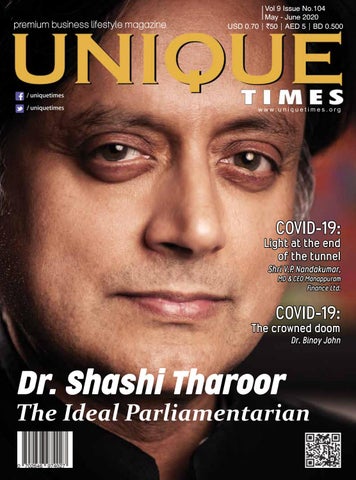
Vol 9 Issue No.104 May - June 2020 USD 0.70`50AED 5BD 0.500
COVID-19:
Light at the end of the tunnel Shri V.P. Nandakumar, MD & CEO Manappuram Finance Ltd.
COVID-19:
The crowned doom
Dr. Binoy John
Dr. Shashi Tharoor
The Ideal Parliamentarian
Editorial
Jebitha Ajit Director & CEO Editor Dr. Ajit Ravi Editor in charge Jebitha Ajit Legal Advisor Latha Anand orld renowned French emperor, Napoleon B.S.Krishnan Associates Bonaparte said: “The battlefield is a scene of bskrishnanassociates@gmail.com constant chaos. The winner will be the one who Sub-Editor Vignesh S.G controls that chaos, both his own and the enemies. “ Associate Editor Ravi Saini The story of Indian politician and renowned Rajeev Kumar writer Shashi Tharoor is not different. Navigating Director and special editor kollur many volleys and potholes in his political journey, Correspondents Dr. Thomas Nechupadam Tharoor managed to secure a hat-trick in Thiru Vivek Venugopal- Quarter Mile vananthapuram constituency in Kerala as an MP. Amrutha V Kumar While the Modi wave virtually drowned Congress in Creative Design PEGASUS 2014 and 2019, Tharoor survived to make a photoCover Photographer Ashique Hassan finish victory. His diplomatic skills inherited from Marketing UAE his UN Days, helped him to make an unorthodox Phygicart.com entry into politics and launched many initiatives to P.O. Box: 92546, Al Karama Dubai develop his constituency. These initiatives are now Mr. Anish K Joy being called as ‘Tharoor model’. Unbelievably, while Mob: +971528946999 making all these restless political moves, he suc info@phygicart.com ceeded in keeping the writer inside as active as ever. Plot No 19A, 9th Floor, Our cover story unravels more unknown facts about Green Building, Film City, one and only Shashi Tharoor. Sector - 16A, Noida - 201301 In his column, Nandakumar, CEO and ManagMaharashtra ing Director, Manappuram, writes about the global Jayasankar M, a/101, crisis of Covid 19, but the optimistic writer says New Prathamesh Niwas, there is ‘Light at the end of the tunnel’. We have all OPP. Laxmi Park, Thakurli East, regular staples of travel, cinema, technology, health, Dombivli post, Thane District, 421201 beauty, book review, business diary, and expert col Mob: 9820708662 umns etc. which take you to new experiences. Hariharan chennai, Mob: 9840018929 Enjoy reading Unique Times, No.6/31, Arunachalam main road, Thank You Saligramam, Sd/ Chennai – 600093 Dr. Ajit Ravi Karnataka Paperback Publishing 3218/A, 6th C Main, 13th Cross, HAL 2nd stage, Indiranagar Bengaluru 560038 Andhrapradesh PEGASUS Ph: 09288800999 Sunilkumar NN Your wing Vineeth Nair Director Ambalika Saikia, Ambalika_saikia@yahoo.com
W
Printed at St. Reddiar & Sons, P.B. No: 3627, Veekshanam Road, Cochin Published at Pegasus Global Pvt. Ltd. L5-106, Changampuzha Nagar Kalamassery, Ernakulam-682 033 e-mail: editor@uniquetimes.org uniquetimesindia@gmail.com Ph:0484 2532040, 2532080 Mob:+91 98460 50283, 94470 50283
Cover Photograph Dr. Shashi Tharoor
Printer & publisher Pegasus Global Pvt. Ltd. Cochin (682033) on behalf of Ajit Ravi. Printed at S.T.Reddiar & Sons, Cochin-18.
18
CONTENTS
12
22
Shashi Tharoor: The Ideal Parliamentarian
12
COVID-19: Light at the end of the tunnel
18
The new Connotation of LiteracyDigital Awareness
22
COVID 19: Is it an opportunity?
26
COVID-19: The crowned doom
30
26
48
54
50
30
56
40
Being emotionally intelligent in business
48
Gadgets
50
Recipe
54
Natural ways to remove dark circles under eyes
56
Namibia: The Driest Country in Africa
UNIQUE DIARY
Sharp dip in the net profit of Reliance Industries
A
sharp dip in the net profit of fourth quarter has been reported by Reliance Industries Limited. The profit has come down to Rs. 6,546 crore. The deep fall in crude oil prices is the prime reason for the dip in the fourth quarter net profit. Refining, petrochemical and oil and gas are the main businesses of the conglomerate based in India. The retail and telecommunication sectors of the conglomerate have made an unsuccessful attempt to offset the dip caused due to the decline of its core sectors like refining and oil and gas. The company has expressed confidence in its ability to overcome the crisis.
RIL to bring in pay cuts
“If you just work on stuff that you like and you’re passionate about, you don’t have to have a master plan with how things will play out.” Mark Zuckerberg
I
n a bid to overcome the unpleasant state to which the Covid-19 outbreak has brought, the Reliance Industries Limited has decided to introduce pay cuts. Only those employees who are working in the hydrocarbon division of the company – which is badly hit due to the outbreak - may face the heat of the present decision. In a letter prepared for those working in the aforesaid division, the company has explained why they have taken up this decision. The company based in India has required the support of its employees to overcome the present crisis – created by the outbreak of Covid-19.
8
May - June 2020
UNIQUE DIARY
Heavy Industries Minister meets heads of automobile industry
U
nion Heavy Industries Minister Prakesh Javadekar has convened a virtual meeting with leaders of the automobile sector of the country. Several top figures, including Maruti Suzuki’s Kenichi Ayukawa, Ashok Leyland’s Vipin Sondhi, SIAM’s Rajan Wadhera and ACMA’s Deepak Jain, have participated. The minister has conveyed the leaders of the automobile sector the importance of bringing the sector back to its wheels. The big issue the sector is facing at this moment is the sharp fall in the demand for its finished products. The sales has come down sharply in the recent past due to the Covid-19 outbreak. The sector wants the intervention of the government to improve the demand for its products.
Glenmark prepares to test its anti-viral tablet on Covid-19 patients
“When you find an idea that you just can’t stop thinking about, that’s probably a good one to pursue.” Josh James
10
May - June 2020
T
he Drug Controller General of India has approved the plan of Glenmark Pharmaceuticals to conduct clinical trials of its anti-viral tablet, Favipiravir, on Covid-19 patients. Favipiravir, which is the generic version of Avigan from Japan-based company Toyama Chemical Co, has found to be effective to treat influenza viruses. Similar tests have been initiated in China, Japan and the United States of America lately. In this stage, the company can only test the medicine on those with mild to moderate symptoms. If the trials meet success, it will be a great relief to countries like India – which has been suffering from this outbreak for last few months.
ATMA demands immediate intervention of centre
T
he Automotive Tyre Manufacturers Association has demanded the immediate intervention of the central government to improve the strength of the sector. It has pointed out about the possibility emerged due to the new geopolitical situation. It has shared how the country can gain from the changed attitude of Japan and the west including the United States of America towards the Asian country of China. The organisation wants the government to impose curbs on indiscriminate import of tyres into the country, and to make available natural rubber at competitive prices through reduced duties. The organisation has appealed for the generation of Make in India spirit.
Amazon introduces Amazon Pay Later
“Every day that we spent not improving our products was a wasted day.� Joel Spolsky
E
-Commerce giant Amazon has announced a new service, named Amazon Pay Later. This platform offers an extra ordinary credit service facility. This facility can be used to make purchases through the platform of Amazon. The E-Commerce platform is expected to benefit hugely through the new service. For the last few years, the E-Commerce giant has been consistently growing not only in India but also across the world. It is one of the few sectors which have not been disrupted by the outbreak of Covid-19. The service has a specific target group. In the coming days, the company is likely to expand.
May - June 2020
11
COVERSTORY
12
May - June 2020
Shashi Tharoor: The Ideal Parliamentarian As a Member of Parliament, Tharoor has converted his unorthodox entry into politics and diplomatic skills inherited from his UN days, into a potent asset. In a country notorious for long-winded bureaucratic bottlenecks and red tape-ism that often reduces development projects to crawl, Tharoor has displayed an irreverential approach to the system and the rules of conformity it demands.
D
r. Shashi Tharoor’s bio on his ever-buzzing Twitter page reads ‘MP for Thiruvananthapuram, Author of 20 books, Former Minister of State, Goverment of India, Former UnderSecretary General, United Nations’. The order is questionable. While his credentials as a bestselling author or a prolific career in the international body are well established, his modern-day political hat offers an interesting quandary worth unpacking. Even to seasoned pundits, Tha-
roor’s journey since the commencement of his political career in 2007, could not be more different from the diary of a textbook politician. And often (or perhaps consequently) there has been a rush to categorise Tharoor as a fish out of water in Indian politics. Not just because of certain personality traits of the three-term Member of Parliament, universally regarded as a suave, articulate and astute leader, are perhaps qualities less than commonly associated with
our perception of the political class. Or because despite his verified credentials and potential he frequently appears to be underutilised by his own party, even as it faces an existential crisis. Or because unlike many he bumps into at Parliament’s Central Hall, Tharoor’s ascension to the very top is neither the product of a helpful lineage in this line of work nor by cutting his teeth in the swirl of party-affiliated student politics. Indeed the question of what an individual like Tharoor is doing investing
May - June 2020
13
COVERSTORY his time, energy and legacy in Indian politics is one that has puzzled many. His upbringing and career offer little clues. Born in London, Tharoor’s early years were spent between the teeming metropolises of Kolkata, Mumbai and then New Delhi where he read History at the premier Anglican establishment of St. Stephens College. Though he made a name for himself as a champion debator, a talented thespian and perhaps even displayed inklings of a future diplomat thanks to the various favourable exemptions he secured from the administration during his tenure as President of the college union, the ingredients of a conventional politician in the making were conspicuously absent during his formative years. Following his years in Delhi University, despite securing admissions to two premier IIMs and the option of vaulting into the bureaucracy through the prestigious civil services examinations, Tharoor, then 19, chose to travel overseas to Tufts University's Fletcher School of Diplomacy where the anxiety of burning through his scholarship (and an academic record that would be every Indian parent’s dream) saw him secure an MA, MALD and a PhD (courtesy a 650-page tome on Indian foreign policy that would be subsequently converted into his first book ‘Reasons of State) by the age of 22, a tearing pace that since has not been emulated. The subsequent chapter of nearly three decades at the UN has already been well chronicled, including his first diplomatic coming of age when tasked with overseeing the body’s response in the port city of Singapore to the Vietnamese boat peoples crisis (1981-84), at the frontline of the Yugoslav civilian war and on various assignments he subsequently performed in the UN Secretary-General’s Office, culminating with his promotion to Under Secretary-General for Communications and Public Information. Seen by many as a right-hand man to the then Secretary-General Kofi Annan, Tharoor’s career and formidable experience he had garnered at the UN seemed primed for him to take
14
May - June 2020
over from his mentor and guru in 2006 and the then UPA government under Manmohan Singh decided to back this by officially nominating him in the race to elect the new SG. Sadly, despite a spirited campaign, Tharoor had to settle for second place after the US, eager to find a "yes, minister" to compensate for their experiences with an outspoken Annan, decided to scuttle his candidacy by exercising their veto. That Tharoor decided to jump into the maelstrom of Indian politics soon after, when any number of lucrative options in the private sector
For one, there is a level of accessibility with Tharoor that people can rarely seek out in his contemporaries. This is not just based on his active presence on social media but extends to the way he conducts himself professionally, often responding to representations and emails from constituents well past midnight or willing to collaborate with small NGO’s whose work resonates with him. would have made themselves available, adds to the puzzlement of most observers. Sure, perhaps his highprofile return to India would have made him a popular personality and perhaps even an entry through the safer route of the Rajya Sabha could have been considered. If the destination of Parliament was his eventual desire, could not then the decision to physically contest an election, in a seat that had historically been hotly contested, in a language that he was still reacquainting himself with, pose a risk that could have been easily
avoidable? But that would not have been his style. The journey hasn’t always been kind to him and Tharoor himself has described his experience in navigating the volleys and potholes that he has encountered as an agni pariksha. True, he has managed to secure a hattrick in a constituency that opted for a different representative in the five elections preceding his arrival, but these have been hard-fought and gritty victories. His inaugural campaign in 2009 saw his own party members threatening to rebel on account of the ticket being given to an ‘outsider’. A second in 2014, saw Tharoor not just going up against a Modi wave that effectively drowned out the Congress but also faced a vicious whisper campaign following the untimely demise of his wife Sunanda Pushkar Tharoor just three months before the elections. Still, against overwhelming odds, Tharoor would go on to cobble together a photo-finish victory. Much of the script remained the same during the 2019 elections, where Tharoor faced a second Modi wave that had made Kerala, still reeling from the Supreme Court verdict on Sabarimala, the centre of its polarising agenda. On the other side, the Left sought to undercut Tharoor’s minority vote banks by portraying him as a high-nosed snob with an intentional misrepresentation of a tweet with Tharoor holding a fish and describing himself as a ‘squeamish vegetarian’. But this is Indian politics, where all is foul in love and war and Tharoor, nonplussed dealt with the PR fallout and soldiered on. Even when it looked like a more mysterious force was conspiring against him, by crashing an heavy iron hook on his head, during a routine campaign event, forcing the leader to get nine stitches at the 11th hour, it was impossible to keep him down. Eight days later, the people of the constituency came together to vote for him and when the ballots were opened on counting day, Tharoor once again came out on top with a margin of nearly 1 lakh votes over his nearest rival. As a Member of Parliament, Tharoor has converted his unorthodox
entry into politics and diplomatic skills inherited from his UN days, into a potent asset. In a country notorious for long-winded bureaucratic bottlenecks and red tape-ism that often reduces development projects to a crawl, Tharoor has displayed an irreverential approach to the system and the rules of conformity it demands. Whether it is by pushing bureaucrats or through multiple meetings with Ministers or even leveraging his own contacts and networks, Tharoor has managed to engineer vital approvals for his constituency such as the 4-lane NH Kazhakootam- Karode Bypass that had been lying dormant for 40 years before he took over. Today the project offers vital connectivity in his constituency, linking 5 out 7 Assembly segments and has boosted economic growth and investment in the region. But it's not just headline-making infrastructure projects like the bypass and the upcoming Vizhinjam International Transhipment Port that has earned him his stripes. In the 11 years he has spent as the city’s MP, Tharoor has been a relentless advocate for its causes and interests, whether it is by pushing for the upgradation of local institutions such as the Regional Cancer Centre, Sree Chitra Thirunal Institute of Medical Sciences and Technology (SCTIMST), or the National Institute of Speech and Hearing; or by lobbying the Central government for increasing the number of trains connecting his constituency, the air traffic at the airport and facilities within these hubs; or convincing cultural groups to bring in literary festivals and shows. His successfully using his global networks to attract foreign countries to establish local consulates in Thiruvananthapuram is a feat few other MPs could have pulled off. Plus it always helps that as a cricketing aficionado Tharoor can break into an impromptu game of cricket with his constituents even despite the logistical challenges of playing in a mundu. The Tharoor model, however, is not just about feel-good measures or a simple commitment to the people he represents. As even his most
virulent critics will begrudgingly admit, there is a tactical and strategic side that he brings to the table that keeps his brand rolling. During the ongoing pandemic, when other MPs chose to invest in heavy purchases such as ventilators, Tharoor decided to use the same amount to invest in an assortment of smaller but critical equipment such as testing devices, PPE kits, non-contact thermometers and scanners. But procurement was only half of the story. With an effective team and a wide range of contacts Tharoor then cleared multiple logistical barriers to ensure that not only was his constituency well equipped to tackle the transmission of the contagion but even earned the unique distinction of being the force behind the first delivery of testing kits in the whole state. Even the Left had to sit back and congratulate Tharoor for his leadership during
the crisis. There is a lot more that can be said about his retail politics including his impressive work ethics and performance in Parliament, his industrious output during Question Hour, the important policy contributions made through Private Members Bills, accolades that he has received such as a Sahitya Akademi award this year -- but all of that would take an entire book. But there are elements of the brand Tharoor has built in the last decade that offer some clarity on why despite not being a career politician, he remains one of the most popular politicians in the country. For one, there is a level of accessibility with Tharoor that people can rarely seek out in his contemporaries. This is not just based on his active presence on social media but extends to the way he conducts him-
May - June 2020
15
COVERSTORY
In a system that is unwelcoming of outsiders, largely self-serving and self-perpetuating, and stacked up against efficiency and meritocracy, Tharoor’s own rise naturally sticks out.
self professionally, often responding to representations and emails from constituents well past midnight or willing to collaborate with small NGO’s whose work resonates with him. Equally, it also helps that Tharoor has consciously cultivated an image beyond his regular politicking whether it is by doing a standup set in front of a live audience or spending time during the lockdown teaching young students virtually through Unacademy. These two traits, along with his well-established disregard for partisanship and the ills that afflict modern-day politics in India make him instantly likeable and admired across the aisle.
16
May - June 2020
So why then is he seen as an outsider in Indian politics? Perhaps the answer to that question has less to do with the man himself and more to do with the field he represents. In a system that is unwelcoming of outsiders, largely self-serving and self-perpetuating, and stacked up against efficiency and meritocracy, Tharoor’s own rise naturally sticks out. But that may yet be his greatest asset and the source behind his widespread popularity. When people look at him, they can actually see a bit of their own lives at play-the Indian middle-class struggle and constant endeavour to advance in their personal and professional lives, the
competition and barriers they have to circumvent to rise, the potential of making your way to the top on the strength of your own discipline and belief systems and the recognition of capability and merit. Tharoor’s stock continues to grow because he represents a brand of aspirational politicsa fleeting glimpse into what our current political systems could one day be and what that could achieve for our country. On July 7, Tharoor will eclipse his distinguished predecessor A Charles to become the longestserving Member of Parliament for Thiruvananthapuram. It is a milestone richly deserved
BUSINESS
There’s no doubt that the economic fallout of the Corona pandemic represents a major challenge to NBFCs, who were already facing liquidity issues following the IL&FS default in late 2018. The imposition of the lockdown and the subsequent recommendation by RBI about extending a three-month moratorium to borrowers heightened concerns about prospects for the NBFC sector. Shri V.P.Nandakumar MD & CEO Manappuram Finance Ltd.
COVID-19: Light at the end of the tunnel
A
couple of months ago, in the March issue, I had written about COVID-19, even as it was in the early stages, highlighting the need for a coordinated global response. That was when total worldwide cases stood below 100,000 whereas it stands at over 3.8 million now, after having caused over 265,000 deaths. The disease has moved from China to Iran, Italy, South Korea, Spain, France, US and so on, to almost every inhabited part of the world. The worldwide lockdowns necessitated by the need to contain its spread have brought trade and travel to a grinding halt. The economic costs have been enormous and may well
18
May - June 2020
exceed the havoc wrought by the global financial crisis of 2008-09. One of the benchmarks for crude oil prices, West Texas Intermediate or WTI, slipped briefly into negative territory (implying that sellers would pay buyers!) something unimaginable in normal times. Gold prices are rising almost every day and look set to surpass the previous peak set in 2011. Unemployment and Job losses have spared no sector and geography and things have never looked gloomier than this. But then, it is said that the night is darkest before the dawn and there is reason for hope as well. Hospitals in Wuhan are not reporting new cases anymore and the city
reopened on 8 April after a 76-day lockdown. Children in Spain were recently allowed outside for the first time in six weeks. In India, which went into a nationwide lockdown on March 24, most parts are limping back to normal, even as the red zones stay largely closed. At the time of announcing the lockdown, the Prime Minister had said, “jaan hai to jahan hai” (there is a world because there is life). By realising the gravity of the problem and taking harsh measures early on to contain the spread of the disease, India has successfully achieved its target of flattening the curve. Of course, it is too early to celebrate, but there is no denying
that we are beginning to see the light at the end of the tunnel.
The next battle The time has come for us to gird ourselves for the next battle which will be bigger and longer lasting than the disease itself. This has to do with combating the economic fallout of the lockdown which has seen millions of Indian families lose their livelihood and pushed to the edge.
For them, it is not so much about “revival of the economy� as a question of survival. Most Indian households earn their livelihood in the informal or unorganised segment. About 68 percent of the workers in non-agriculture and agriculture (except in growing crops) are engaged in the informal sector. Among regular wage/salaried employees in the nonagriculture sector, 71 per cent had
no written job contract, 54 per cent were not eligible for paid leave, and 50 per cent were not eligible for any social security benefit. Majority of these workers do not have access to social security like provident fund, pension etc. More than 70 per cent of the Indian population lives in rural areas, and 52 percent of rural households are self-employed, while 25 percent depend on casual labour and 12 per-
May - June 2020
19
BUSINESS
20
May - June 2020
There’s no doubt that the economic fallout of the Corona pandemic represents a major challenge to NBFCs, who were already facing liquidity issues following the IL&FS default in late 2018. The imposition of the lockdown and the subsequent recommendation by RBI about extending a three-month moratorium to borrowers heightened concerns about prospects for the NBFC sector. cent get regular wages and salaries. Only 9 percent of rural households are engaged in occupations such as officers and managers, professionals and technicians.
Tough times for NBFCs There’s no doubt that the economic fallout of the Corona pandemic represents a major challenge to NBFCs, who were already facing liquidity issues following the IL&FS default in late 2018. The imposition of the lockdown and the subsequent recommendation by RBI about extending a three-month moratorium to borrowers heightened concerns about prospects for the NBFC sector. However, by now, it is becoming clear that many borrowers have preferred to stick with their existing repayment schedule because they realise that the moratorium does not offer a waiver of interest or principal and would add to their interest outflow. Meanwhile, the operational disruption from the lockdown will be temporary but there can be serious long-term implications for asset quality as clients face job losses and declining incomes, impacting their capacity to service loans. A shakeout in the industry followed by consolidation looks imminent, and NBFCs who enjoy a strong capital buffer will
be the survivors and beneficiaries. In the long run, a process of consolidation where weaker players are weeded out is beneficial for the industry. Gold loans will perhaps be the only lending business to come out of all this unscathed. It will also be the first to rebound when the lockdown eases. During periods of economic stress, banks are generally known to become risk averse and cut down on lending. Further, in today’s scenario, many NBFCs are faced with severe liquidity constraints and therefore in no position to pick up the slack. That would leave gold loans as the fall-back option for borrowers denied access to their regular channels. Indeed, the World Gold Council expects gold to become a tool for the revival of many small and medium enterprise businesses and household fortunes. In the microfinance segment, analysts expect much pain ahead for lenders as defaults are expected to surge. However, based on our past experience of dealing with episodes of stress in the segment, we are much more positive. Most microfinance borrowers are keen to maintain their account in good standing to avoid negative reporting to the credit bureaus and thus continue to be eligible for future loans. We
saw this behaviour after the floods in Kerala and Chennai and the cyclone in Odisha. Recall also that the microfinance sector was laid low by Demonetisation but rebounded strongly thereafter. Further, within microfinance, companies with lower borrowing cost (who therefore charge lower rates of interest to their borrowers) are better placed as they would have attracted more credit-worthy customers by a process of natural selection. Critical to the health of the larger NBFC sector is the question, how quickly will the economy rebound after the lockdown is over? The incentive for borrowers to adhere to credit discipline and maintain repayments on schedule is much stronger when there is an end in sight to their pain. From this perspective, it will be worthwhile for the government to pump prime the economy with a large stimulus which can be unwound as and when growth picks up. Otherwise, a mood of pessimism and despondency may take over which can become self-reinforcing, in other words, something of a vicious cycle (VP Nandakumar is MD & CEO of Manappuram Finance Ltd. Views are personal)
May - June 2020
21
BUSINESS
Rajesh Nair Associate Partner, Ernst & Young LLP
Digital avatar is the digital depiction of you, in graphics, internet, and electronic media et.al. For the purpose of this short article – I classify it as the digital persona you have projected of yourself, which is deciphered by all your digital presence including your social media presence and you digital footprint, in terms of websites you have visited, purchases you have made online, searches you have done.
The new Connotation of LiteracyDigital Awareness
T
he past two months have been that of severe disruption and change. The COVID 19 spurt and the subsequent lockdowns of various degrees across the world have forced us to explore new working models and also sweat every idea we had of remote working. Plugging into office networks on remote lines, home networks, multiple devices has thrown up opportunities and challenges of its own. Our old definition of literacy was the ability to read and write in a language – the presumption being that this would give us access to education, communication, reading, general information and build our thinking capabilities. But, today, some of it have no meaning unless we are able to access an electronic equipment like a phone or a laptop or desktop and a handheld mobile phone! The spotlight is clearly on the gargantuan topic of ‘Digital’. We often limit our thoughts on digital with something related to ‘technology’. But, technology has always been around. Artificial Intelligence
22
May - June 2020
has been the moot topic for several decades now and robots caught our fancy half a decade ago. But, what is different today is the surfeit of various areas of technology which has come together. The key elements of robotic process automation have efficiently attached the ‘routine tasks’ at the workplace and made them far more effective and time consuming that ever before. The focus is also on the various tasks and businesses which have in the past been constrained by capacity and speed of decision making and human coordination. The entire automation theme is likely bring quantum changes in the ability to consume data and implement various complex iterations with a scale and speed that was hard to imagine even as recent as couple of years ago. We also managed to coast through technical institutions, without knowing, how the word ‘digital’ would transform our lives! And definitely, we never knew that we would have digital personas or ‘digital avatar’! Digital avatar is the digital depiction of you, in graphics, internet,
and electronic media et.al. For the purpose of this short article – I classify it as the digital persona you have projected of yourself, which is deciphered by all your digital presence including your social media presence and you digital footprint, in terms of websites you have visited, purchases you have made online, searches you have done. I also refrain from using names of companies which work on this space, a normal ‘Google’ search will get you that information. If someone is able to trace your entire internet journey, there is more information available on you than you would probably want to believe. Your searches, your postings, you ‘Likes’, your frequent visits to particular sites, your digital purchases is all available to a digital tracker. The button ‘Delete’ or ‘Delete History’ does not really hide the tracks. The multifarious passwords are constantly looked at and there is a recent algorithm which will predict not only the passwords but also the characters or numbers you are likely to use on the passwords. This will also lead to intelligent sending
your pop ups and ‘advertisements’ on products that may interest you and links, you have high propensity to use. What this has created is also the need to be responsible in your digital sojourns. There are placement agencies who will scour this history to figure your personality. The recent political campaigns have extensively tried to dig deep into candidates and retrieve information on your liaisons, pet peeves and the ‘hidden’ you. To also reiterate, these are not skills which require a hacker or a vile cyber-mind. The logs through IP addresses, URLs etc. are easy to access and any amount of data is not ‘BIG’ anymore. There are gazillion tools to help you decode and this is
not hieroglyphics anymore. This is also not all bad news. You can leverage this information too. The social presence and advocacy you do on the internet can also help you market yourself, your company and your services. People will find it easier to locate you and get more information on you. Any professional these dates will search for you on social media on LinkedIn, Facebook etc before coming to meet you. This can also be to your advantage. You can take a few tips from Lee Strasberg – ‘Method acting’ to create the persona you want to build. What intelligence will we need to create a smart future? Nearly every menial and repetitive tasks have been automated and there will be an
increasing trend in that space. Internet of Things will bring in machine to machine connectivity enabling more collaboration, use of data etc. Smart is also empowering customers with more information and greater insight than ever before — but insight is not enough. Customers are expected to use those insights to take action, to adapt their energy usage, change their travel habits or manage their health proactively. When machines become workers, what is the human role? The displacement of labour by technology and globalization is hardly a new phenomenon. In the future of work, the ultimate resource that companies will use more efficiently is still the human resource. Digital changes
May - June 2020
23
BUSINESS
24
May - June 2020
are large, transformative trends that define the present and shape the future by their impact on businesses, economies, industries, societies and individual lives. When responding to disruption and these trends, organizations cannot afford to fall back on old solutions. Embracing creativity, entrepreneurial spirit, diversity and inclusivity will enable businesses to challenge the prevailing paradigm and create new business models. By building robust and responsive ecosystems and driving collaboration in previously unexpected places, they can meet the evolving demands of customers. Innovative practices such as these will be key to revealing the upside of disruption. The march of disruption is unrelenting
and this can leave today’s decision makers and leaders grappling with tremendous uncertainty and a broad array of challenges. Responding to disruption has become a central issue for incumbent organizations everywhere. I don’t hint perjury or apocryphal information. I mean aspects of you. You want to project and create a recall in minds. You have to be responsible and overly cautious in your digital presence. Like in real life, it helps to remember that you are not an anonymous scribe on the internet – you have connections, friends and colleagues. In any case, the next time you click on a button, remember, that click is another page in your digital biography. A conscious click and a thought-
ful prompt can always get you what you want and burst the bubble around you! In every person around us like much of us, we see the urge to casually glance at the cell phones, peruse the laptop screens endlessly and at times, even meaninglessly dancing our fingertips on the keyboard. It has been, but a decade, since we have been toasting and celebrating these prodigious time saving devices. We need to mull over the fact that, these are perhaps ‘weapons of mass distraction’, which have to be handled with care and responsibility. A little stillness can also help, time to think to ourselves, long walks in wilderness, hearing the harmonious chimes of nature and celebrating a ‘internet and network’ Sabbath ! Cheers to that!
May - June 2020
25
FINANCE
Adv Sherry Samuel Oommen is a practising lawyer at High Court of Kerala who specialises in tax and Corporate Laws. Presently he heads the tax and corporate law practice of Nash Capital Partners. Apart from being a qualified lawyer, he is also a chartered accountant, cost accountant and a company secretary. He is currently pursuing his Doctorate Degree and is reachable at sherryoommen@nashcp.com.
In a move to avoid large scale insolvencies, the Government vide Notification No 1205(E) has increased the threshold of the minimum amount of default for maintainability of an application under the Insolvency and Bankruptcy Code, 2016 from INR 100,000 (One Lakh) to INR 1,00,00,000 (One crore). Interestingly, the notification does not indicate any specific date from when the revised threshold would be effective.
COVID 19: Is it an opportunity? T
he tellers of doom would argue that India Inc is staring at the end of a barrel owing to the contagion. In my view, we are at a cusp, where all the fittest would survive. To me, in every adversity, there is an opportunity and likewise in every challenge, there is a winner. If one is indeed patient, and able to think with a cool and calm mind, defenestrating notions to the contrary, tiding over the difficult times, and making the best of every opportunity that presents itself along with the way would become a way of life. In this article, I intend to delve into some of the key relaxations granted which could be considered.
Relaxations by the Ministry
26
May - June 2020
of Corporate Affairs
In view of the recent pandemic and with a view to ensure compliance, the Ministry of Corporate Affairs (“MCA”) has introduced a slew of measures. Some of the key relaxations granted by the MCA are as follows 1. The Ministry of Corporate Affairs vide Circular 12/2020 has introduced the Companies Fresh Start Scheme,2020. The said scheme offers a one-time opportunity for defaulting companies to enable them to complete their pending compliances from its incorporation. Importantly, the Scheme offers a waiver of additional fees, apart from immunity from prosecution/penal proceedings.
The Government has also offered similar benefits to Limited Liability Partnerships vide Circular No 13/2020 dated 24.03.2020, which is indeed appreciated. 2. The MCA vide notice dated 18 March 2020, providing relaxation in holding meetings with physical presence of directors for approval inter-alia of the annual financial statements, board’s report, etc. Consequently, such meetings may be held through video conferencing or other audio visual means from 19 March 2020 until 30 June 2020. 3. The MCA vide General Circular No 11/2020 dated 24.03.2020, has offered various relaxations, which include:
a. No additional fees shall be payable for late filing of any document during the moratorium period commencing from 01 April 2020 to 30 September 2020; b. The interval period prescribed for holding of a board meeting has been extended from 120 days to 180 days until the next two quarters, ie, till 30 September 2020. c. Additional time period of 6 months has been granted to newly incorporated companies to file a declaration for commencement of business, in addition to the existing period of 6 months. d. For the financial year ended 31 March 2020, the noncompliance of the minimum residency in India for a period of 182 days by at least one of the Directors shall not be treated as a violation. e. A key relaxation has been the extension of the Companies (Auditors Report) Order 2020 from Financial Year 2019-20 to Financial Year 2020-21. The said order has provided for enhanced disclosure requirements and further qualitative judgments on the part of the Auditor. For instance, an Auditor under the new order
is required to specifically report whether the Company has been regular in depositing undisputed statutory dues of Goods & Services Tax, whether there has been an occurrence of a “fraud�, or whether transactions that are not recorded in the accounts have been surrendered or disclosed as income during the year in the tax assessments under the Incometax Act, 1961.
Insolvency and Bankruptcy Code
In a move to avoid large scale insolvencies, the Government vide Notification No 1205(E) has increased the threshold of the minimum amount of default for maintainability of an application under the Insolvency and Bankruptcy Code, 2016 from INR 100,000 (One Lakh) to INR 1,00,00,000 (One crore). Interestingly, the notification does not indicate any specific date from when the revised threshold would be effective. Hence, there is a ground to contend that the revised limit would also apply to proceedings pending before the NCLT/ NCLAT and not merely to cases that would now be initiated. Furthermore, one could ar-
gue on its retrospectivity to also state that the Court was bound to apply the law as on the date of the judgment (ie, the revised limit of INR 1 crore). This view is supported by the judgment of the Supreme Court in the case of Dahiben Vs VasanjiKevalbhai 1995 Suppl (2) SCC 295.
Goods & Services Tax
Amidst the pandemic, the Government has granted relaxations to tax payers by way of waiver of late fees for delay in furnishing of returns in Form GSTR 3B for the period February 2020 to April 2020 and Form GSTR1 for the tax periods Mar'20 to May'20 and for quarter ending 31st March 2020 vide Notification No.32/2020 - Central Tax and 33/2020 - Central Tax both dated 3-4-2020. In another key development, the government has also permitted cumulative matching of input tax credit for the period February 2020 to August 2020, as against a matching to be undertaken on a month-wise basis. The said benefit has been provided through an amendment effected in Rule 36(4) where a proviso has been inserted vide Notification No
May - June 2020
27
30/2020.
Direct taxes
The Government has promulgated an ordinance styled Taxation and other Laws (Relaxation of Certain Provisions) Ordinance, 2020. In my view, the Government has not only moved swiftly in announcing the lockdown but has also taken necessary steps to ease the tax and regulatory compliances in order to give the businesses a breather amidst such difficult times. The route of introducing an ordinance was adopted under Article 123 of the Constitution of India as the Parliament was not in session coupled with the emergency situation that the country is currently facing.
Some of the key benefits under the said ordinance are as follows:
1. The last date for filing the of original as well as revised incometax returns for the FY 2018-19 (AY 2019-20) has been extended from 31 March 2020 to 30 June 2020. 2. The due date for linking of Aadhar with the PAN has been extended to 30 June 2020. 3. The Ordinance provides that a reduced rate of interest of 9% shall be charged for non-payment of Income-tax (e.g. advance tax, TDS, TCS) Equalization Levy, Securities Transaction Tax (STT), Commodities Transaction Tax (CTT) which are due for payment from 20 March 2020 to 29 June 2020, if they are paid by 30 June 2020. Further, no penalty/prosecution shall be initiated for these non-payments, if the pay-
28
May - June 2020
ments are effected by 30 June 2020 along with interest. 4. Under the Vivad se Vishwas Scheme, the due date under the said scheme has also been extended up to 30.06.2020. Hence, declaration and payment under the Scheme can be made up to 30.06.2020 without additional payment. 5. The date for making various investment/payment for claiming deduction under the Act, for instance, towards LIC/ PPF, NSC (ie, Section 80C) or towards Mediclaim (ie, under section 80D) or donations (ie, section 80G) has been extended to 30 June 2020. Hence the investment/payment can be made up to 30.06.2020 for claiming the deduction under these sections for FY 2019-20. This extension would indeed benefit the salaried class.
Provident Fund
In order to prevent disruption in employment of low wage earning employees and to support establishments employing up to 100 employees, the entire employees EPF contribution comprising of both the employee and employers contribution (aggregating to 24 percent of the total wages) shall be paid directly by the Central Government in the EPF account of the concerned employees for the period March 2020 to May 2020. The Scheme would apply to those covered establishments having up to 100 employees with 90 percent or more of such employees earning wages less than INR 15,000 per month.
Financing related
The Reserve Bank of India in a notification dated 27 March 2020 has offered a slew of reliefs. For instance, the RBI has notified that in respect of all term loans (including agricultural term loans, retail and crop loans), all commercial banks (including regional rural banks, small finance banks and local area banks), co-operative banks, allIndia Financial Institutions, and NBFCs (including housing finance companies) are permitted to grant a moratorium of three months on payment of all instalments falling due between 01 March 2020 and 31 May 2020. The notification states that the repayment schedule for such loans as also the residual tenor, will be shifted across the board by three months after the moratorium period. However, interest shall continue to accrue on the outstanding portion of the term loans during the moratorium period. Further, even in respect of working capital facilities, lending institutions are permitted to defer the recovery of interest applied in respect of such facilities during the period 01 March 2020 to 31 May 2020.
Conclusion
In summary, while the days ahead are indeed challenging, the one who thinks innovatively would emerge as the winner without being driven by hubris. This decision on the way we think and act is a decision that each individual would need to make. Our individual action would define the path that India would takeď Ź
HEALTH
Dr. Binoy John MD DM (CARDIOLOGY) FCSI FACC FESC FSCAI FAPSIC Senior consultant interventional cardiologist & specialist in heart failure & advanced cardiac diseases, Chennai Visiting Consultant: Dr Rela Institute & Medical Centre, Chennai Credence Hospital, Trivandrum
It is to be remembered that the virus is highly infective and all are equally susceptible to the infection. It is the severity of the disease and the complications that vary amongst subsets. The ones who are at risk for more severe disease, complications and a poorer outcome are people with poor immunity, the malnourished, elderly and frail, patients on long-term steroids and other immuno-suppressive drugs as liver, kidney and heart transplant patients.
Email: drbinoyjohndmcard@gmail.com
BBinoy John Dr FDr Binoy John AAngioblaster
COVID-19: THE CROWNED DOOM
A
virus is not even a living thing, but yet has managed to get a technologically and militarily advanced humanworld in its entirety into a stupefying and unimagined lock-down, while every other animal moves gracefully free! It is enigmatic to realize that this virus which is just 0.06 -0.14 Microns in size and a mere structure of a single strand of nucleic acid, some lipids, proteins and carbohydrates and that which actually needs a host to propagate has humbled the scepter wielding powers of the world.
About the virus:
The Corona virus has
30
May - June 2020
spikes on it which gives it the appearance of a crown or corona, from which it derives its name. It is with these spikes that the virus gains entry into the host cells and multiplies and then causes all the ensuing destruction. It was initially named the novel corona virus and subsequently as the Severe Acute Respiratory Syndrome Corona Virus-2 (SARSCoV-2). The virus is presumed to have originated in bats and then moved to probably the pangolin before it infected the humans for the first time in Wuhan, Hubei province in China. The Corona Virus disease 2019 or the COVID-19, is now a global pandemic affect-
ing over 3.7 million people and counting, in 210 countries and territories of the world.
How does the virus spread?
The virus is spread mainly via droplets but can be aerosolized when someone coughs or sneezes and can remain stable in the atmosphere for up to 3 hours in the aerosol, depending on factors such as atmospheric temperature, humidity and ventilation. It can remain on hard surfaces from 24 hours on cardboards and to as many as 3 days on steel and plastics. There are reports that the virus is excreted via the stools also. The virus has a high reproduction number
and therefore spreads easily. So the common mode of infection is when a person with the virus contaminated hand touches the nose, mouth or eye or inhales the virus containing aerosol, with the virus thus gaining entry into the lungs. The incubation time or the time between the entry of the virus into the body and appearance of symptoms is an average of 4 to 5 days, but can range from 1 to 14 days. An infected person can spread the virus even when he has no symptoms and thus be an asymptomatic carrier of the virus. It is the combination of the high infectivity along with the ability of a person to infect even when he is asymptomatic, that has been responsible for the rapid spread and the pandemic proportions of the disease.
How does it damage the lungs and other organs?
The primary target of the virus is the respiratory system and the virus uses its spike proteins to enter the lung cells by binding to a receptor called angiotensin converting enzyme 2 (ACE-2). This enzyme is expressed in the heart also, in addition
to the lungs and also plays a key role in the functioning of the heart and development of high blood pressure in humans. Once the virus enters the lungs it begins to multiply and the symptoms during these early stages are mostly mild or can be none at all. The protective mechanisms in the body tries to fight and suppress the virus by producing immune cells and also chemicals called cytokines. In some patients however, the release of these chemicals can be sudden and severely out of proportion, a phenomenon called, the ‘cytokine storm’ which ultimately turns out to be damaging to the patient himself. The chemical release damages the lungs causing breathing difficulty and the failure of lungs to oxygenate the blood results in decreased oxygen supply to all organs affecting their normal functioning too. When the kidneys start failing, the waste products start accumulating in the body, further depressing the function of the organs and also causes additional bacterial infection in the blood and organs causing septic organ failure.
What are the symptoms and signs of COVID-19?
The usual symptoms are fever and dry cough but conspicuously a runny nose and gastrointestinal symptoms like diarrhea and vomiting are uncommon, though they can occur. Around 80% of the infected patients have no pneumonia (lunginfection) or may have only a mild pneumonia and only 15% develop more serious respiratory symptoms needing hospitalization and assisted breathing support and only 5% become critical with respiratory failure, shock and or multi organ failure.
Who are the people at high risk?
It is to be remembered that the virus is highly infective and all are equally susceptible to the infection. It is the severity of the disease and the complications that vary amongst subsets. The ones who are at risk for more severe disease, complications and a poorer outcome are people with poor immunity, the malnourished, elderly and frail, patients on long-term steroids and other immuno-suppressive drugs as liver, kidney
May - June 2020
31
HEALTH and heart transplant patients.
COVID-19 and the heart:
The primary damage to the heart results from the lack of oxygen supply to the heart which causes a progressive failure in the pumping function of the heart. Added to this insult, the sudden chemical storm can cause a fall in the blood pressure which further reduces the blood and oxygen supply to the heart, thus creating a vicious cycle of increasing damage. The brain when it senses this poor pumping efficiency of the heart, in order to maintain adequate oxygen supply to the organs causes an increase in the heart-rate. This helps initially, but then the heart starts failing like a repeatedly flogged horse does, to a point when it cannot cope up further and a cardiac arrest ensues. People with heart ailments are not especially prone for COVID-19 and their risk to get the infection is the same as any healthy person. However, patients with heart diseases can have more severe complications when they get COVID, especially those with previous heartattacks, heart failure, children with certain cardiac birth defects (bluebaby defects) to mention a few. Pregnant women who have heart ailments may be at a higher risk too. However, there is no evidence that the virus can infect implanted heartdevices like pacemakers or defibrillators or that it can directly infect the valves, muscle or the covering of the heart. However, it is important to note that the stress on the heart produced by the chemical storm may cause rupture of fatty plaques or blocks inside the arteries of the heart and can cause a heart-attack. Another point of controversy and debate is regarding two medications used commonly to treat high bloodpressure (Angiotensin converting enzyme inhibitors and Angiotensin II receptor blockers) which block ACE-2 and its system through which the virus enters the body. It was of concern that people taking these medications could develop more lung complications with COVID-19. However, these observations have no confirmatory scientific evidence and major guideline forming cardi-
32
May - June 2020
ology societies and associations like the American Heart Association, European Society of Cardiology, and British Cardiac Society have recommended that these drugs should not be stopped, because these are drugs with proven benefits. Stopping cardiac medications without advice from the cardiologist can only lead to complications.
How deadly is COVID-19?
Thankfully, majority of the patients recover. The death rate from COVID 19 is estimated to be 1.4% (which for flu is only 0.1%). The fatality increases with increasing age being less than 1% for people less than 50 years 1.3% for 50 to 60
Testing for COVID-19 specifically relies mainly on three tests, the real time reverse transcription-polymerase chain reaction (RT-PCR) which is the gold-standard for SARS-CoV -2 viral genetic material, the antigen test which detects viral surface proteins (eg: spike protein) and the third being antibody (immunoglobulin) testing. years, 3.6% for 60 – 70 years, 8% for 70 – 80 years and 15% for those above 80 years of age. Also death occurred only in 0.9% of the patients when there was no associated illnesses but it was 6 – 10% when the patients had associated high blood pressure, diabetes and other cardiac conditions. The reason or mechanism as to why patients with high blood pressure have higher death rates is unclear but could mostly be only an apparent association because of the higher prevalence of high blood pressure in elderly age group (> 70 years of age) which had maximum deaths.
Diagnosis of COVID-19:
Testing for COVID-19 specifically relies mainly on three tests, the real time reverse transcriptionpolymerase chain reaction (RTPCR) which is the gold-standard for SARS-CoV -2 viral genetic material, the antigen test which detects viral surface proteins (eg: spike protein) and the third being antibody (immunoglobulin) testing. RT-PCR and antigen tests use specimens collected from the respiratory tract secretions of the patient. All the tests are useful in different stages of the infection as their titres are variable with the duration of infection, viral load and severity of symptoms. False positive results can occur with antigen testing and false negative tests can occur if the specimen collection is improper. Therefore, a negative test warrants the test to be repeated in a patient in whom the clinical index of suspicion for COVID-19 is high. Antibodies are produced by blood cells called lymphocytes, specifically against the virus and the antibodies bind tightly to the virus to inactivate it. Antibody levels start rising with time as the body tries to fight the infection and blood samples are used for detection of these. The immunoglobulin (Ig) M antibodies are the first to be produced in response to the infection and Ig G starts rising a week to 10 days after onset of infection and remains in the blood even after the patient has recovered and is the one that indicates possible immunity from subsequent infections. But, it is too early to say how much immunity would be conferred by Ig G antibodies against COVID-19.
Treatment of COVID-19:
Currently, the treatment is mainly supportive like ensuring control of fever, maintaining good hydration and nutrition and it is only when the oxygen content of the blood drops, the blood-pressure drops or the patient gets worse that hospitalization is advocated. Several drugs currently used against the virus are those targeted against the different mechanisms of virus multiplication and the chemical storm. An effective treatment or cure in the form of medications can only be obtained by a detailed understanding of the pa-
thology of the disease obtained from post-mortem studies and a deep understanding of the microbiology of this novel virus, the pathogenesis and immunology of the disease and use of medications directed at every possible step. Until the recent evidence with the drug Remdesivir, there was no definitive success with the use of any specific drugs against the virus. All medications being used were merely on an experimental basis. However, Remdesivir an anti-viral drug which prevents multiplication of the virus in the body has been shown in a multi-centre randomized controlled trial to have clear-cut evidence in hastening the recovery of patients being treated with it. The use of Remdesivir has now been made ‘standard of care’ in the treatment of patients hospitalized with COVID-19. Some of the other drugs being used in COVID-19 patients with variable results are those which would prevent virus entry into the cell (chloroquine) or to treat cytokine storm (Tocilizumab). Drugs like chloroquine and hydroxychloro-
quine have only been tested outside the human body to show some efficacy and there are no randomized controlled trials to prove its efficacy in humans with certainty. It is important however to remember that some of the drugs have cardiac side effects and can cause electrical abnormalities called ‘torsades de pointes’ which can cause sudden cardiac death and therefore needs electrocardiogram (ECG) monitoring and should not be taken without consulting a specialist. Treatment with convalescent plasma is another option being investigated and attempted. It involves the transfusion of plasma obtained from recovered patients, containing high titres of antibodies against SARS Co V- 2, into other patients who have less severe infection or patients who are in early stages of the infection or people who are at high risk of getting COVID, as healthcare professionals. The antibodies present will prevent multiplication of the virus in the body and thus prevent lung and other organ damage. However, this procedure is not
totally risk free to the person receiving the treatment and have a risk of transmitting other infections and causing other immune reactions.
Prevention is better than cure:
As of now with no cure in hand, prevention is the key and the steps to prevention are simple and involves avoiding touching the mouth, nose and eyes with unclean hands, washing hands thoroughly with soap and water for at least twenty seconds or the use of hand-sanitizers containing at least 60% alcohol. It is also important to keep frequently touched objects clean with disinfectants. Practicing social distancing or maintaining a safe distance of at least two metres from other people whenever possible and keeping away from sick people even if their symptoms are mild and also staying away from crowded areas is vital. Also covering one’s nose and mouth with a cloth or with the inside of the elbow when one sneezes or coughs and using the non-dominant hand to touch objects so that you would not unknowingly use it to touch your mouth nose
May - June 2020
33
HEALTH
or eyes are good practices. Wearing the right protective masks in public places is crucial and only masks which are recommended for COVID-19 protection will be protective and have to be used in the right manner and will be useful in public places where the chances of getting infected are high. If one experiences fever, cough or chest infection it is important to consult a doctor on the phone and follow his instructions and get tested only after taking professional advice as testing centres can be potential areas of high infectivity.
Vaccines and immunity:
Vaccines are being researched on fervently but would take a while to be available for human use, after they are tested in animals and proven to be effective and safe. After the first infection, it is speculated that COVID - 19 would confer immunity but if mutations and fresh strains occur, they could re-infect, and would need fresh vaccines, information about which is currently unavailable. Herd immunity is a concept
34
May - June 2020
where, when a large percentage of the population are infected and recover and get immunity, thereby providing protection in a community, where the chances of non-immune people getting infected are less because the percentage of infected carriers in that community steadily becomes fewer. Thus, the COVID-19 has taken an erstwhile head-strong and free world unawares, with a chilling shock, sending them into hiding, when an invisible nothing has humbled seemingly invincible powers and the powerful of the world, putting medical researchers and organizations on their toes desperately trying to find a quick resolve, while the front-liners strive tirelessly risking their own lives to save humanity from a rapidly decimating disease. Adding to the cost of life, the economic repercussions would be severe too. This infliction of unimaginable proportions has also given humanity an opportunity to introspect on the wrongs we have committed,
when we abused nature with all our power and glory; has given us a time to introspect on what we did wrong as a world and as individuals when we divided ourselves with borders, languages, colour, religions, caste and what not; when now, standing together singularly as humanity with humaneness seems to be the only way to tide over this catastrophe of unfathomable proportions. Let us change for the better, but then will we be given that chance? Hope and faith is what has always kept the world going and so may God bless us all! Dr Binoy John was awarded the Best Interventional Cardiologist – Tamil Nadu @ Vigyan Bhawan, New Delhi, 2020 and was Director and Head: Dept of Cardiology, Interventional Cardiology Heart Failure and Cardiac Transplant Medicine. Miot International, Chennai & Chief Consultant Interventional Cardiologist: Dr Rela Institute and Medical Centre, Chennaiď Ź
BUSINESS
By Jiz P Kottukappally Chief Executive Officer Yescalator Management and Financial Consultants
Your customers are the reason why you exist in business. The business prospects of your customers will in turn affect your business prospects and so it is essential that you talk to your customers and understand how their business has been affected in the short term and the long term also. It would be relevant to understand how their business development plans have changed.
Mob No 75588 91177 Email Jizpk@yescalator.com
Combating Challenging Times and Moving Forward “Tough times are inevitable in life and in business. But, how you compose yourself during those times defines your spirit and will define your future.” Richard Branson
C
OVID-19 has no doubt brought the world to a standstill. The financial impact of Covid-19 could be much more painful and prolonged than the health impact it creates. The International Monetary Fund (IMF) has recently released its global growth projections, revealing that in the year 2020, the global economy is expected to plunge into the worst recession since the Great Depression. In fact, IMF estimates the impact to be far worse than
36
May - June 2020
the Global Financial Crisis and thus many of living now would not have seen adverse economic impacts of such magnitude. Just to give a sense the cumulative loss to the global GDP in the year 2020 and 2021 would be greater than the economy of Japan and Germany put together. By when the issues will be resolved and things will be back to normalcy for business enterprises cannot be predicted under the current circumstances. Time frames and opinions differ depending upon sectors in which the unit is operating. But, one thing that is agreed by all is that back to normalcy doesn’t mean things will be as it was before the outbreak of COVID. There will be a new normal which gets evolved
based on the situations and the learning’s from the pandemic. As has been mentioned by Charles Darwin in Theory of Evolution in the current scenario also it would not be the strongest or toughest of enterprises that will survive, it will be those which are more adaptable to change that will survive. So, it is essential that enterprises take stock of the critical elements of their business and initiate corrective steps wherever required. The following aspects should definitely be looked into by entrepreneurs to minimise their losses and disruption in business, identify opportunities and remodel their business if required.
Your Employees
For any organisation, the
employees are one of the most critical resources. Dedicated and motivated employees will definitely be very critical for any organisation for tiding over the current situation. So, during this challenging time organisations should take care of the health safety and welfare of their employees. During this lockdown period, work from home has become a new world order. Even after the lockdown is over this could continue as this results in a lot of savings to companies by way of lesser rent, utility charges etc. But, for achieving the desired results organisations has to ensure that proper work protocols, data security measures, reporting structures and performance measurement tools are put in place so that efficiency level of employees are monitored. If such systems and procedures are not put in place there could be an application of Parkinsons law which states that “work expands so as to fill the time available for its completion�. Skill sets required for employees who work from home might be slightly different from those who work in
an office atmosphere. The amount of self motivation and self discipline for work from home employees would definitely be higher than employees working from offices. Organisations that want to move to a work from home culture should therefore assess the skill sets of the employees especially on communication, organising, planning, and decision making. The ability and willingness of employees for continuous learning and up skilling are also very critical. As every employee is driven by different forces, identifying an employee’s strength and weaknesses would play an important role in enhancing productivity. For example, some employees will be challenge driven and such employees should be given challenging task. Some employees will be instruction driven and such employees should be given clear instructions. The work from home can result in reshaping the current remuneration structures. Under the new order the salary packages might have less of a fixed component so as to satisfy the labour laws and more
of performance/productivity based components. The work from home concept could attract new talent pool to your companies, especially people who had taken short employment breaks to take care of their kids or aged parents. In the context of current business slowdown enterprises should revisit their manpower requirement including redeployment of existing manpower and also their hiring plans. Employees on their part should be willing to unlearn, relearn and take up new roles and responsibilities so that they remain relevant for their organisations in the new world order.
Your Customers
Your customers are the reason why you exist in business. The business prospects of your customers will in turn affect your business prospects and so it is essential that you talk to your customers and understand how their business has been affected in the short term and the long term also. It would be relevant to understand how their business development plans have changed. This
May - June 2020
37
would be more relevant for businesses operating in the B2B segment. For businesses operating in the B2C segment broad industry impact studies prepared by various agencies can be looked into for understanding how their businesses will shape up. Customer expectations preferences and priorities could change. There could be customers who would now defer their purchases or even drop the plan. Enterprises would be looking at reducing the fixed cost by opting for operating expenses model than for capital expenditure model. There could be renegotiations on margins, terms of trade, credit limits etc. Enterprises should maintain flexibility in their business model to cater to such changing requirements from customers. Always remember it is not the strongest of species but those species that are more adaptable to change that have survived.
Your Suppliers
If you have to cater to the needs of your customers you should have
38
May - June 2020
your suppliers to support you. Just like talking to your customers and understanding the impact on their business, talk to your suppliers and understand how the situation has affected them. Find out if there could be time delay in executing the orders and take realistic timelines so that you can talk to your customers accordingly. Analyse the situation and find out whether there is a need for you to look out for alternate suppliers or even alternate material, technology etc. Remember, necessity is the mother of all creation. COVID 19 might be providing you an opportunity to revisit your established line of supplies, established terms of trade, established technology etc. and work out something new and better.
Your operations
The new business models you are developing or rather evolving might require you to relook at how you manage the operations. It could be good to have a look at whether
there is scope for digitization and simplification of process. Can paper files of the British Raaj be changed to digital documents and physical signature be replaced with digital signature? Can physical meetings changed to online meetings? On premise storage be replaced with cloud storage? Licensed software replaced with SAAS model software? Can onsite monitoring and data capturing changed to off site monitoring and online/digital data capturing? Can physical display at retail outlets be changed to digital display and physical delivery at shops replaced with home delivery? Can we use “just in time technology� to reduce inventory levels? From centralised supplies can we move to decentralised supplies to take care of business disruptions? Clearly, the operations teams will have to look at such things to ensure business continuity in case of such events occurring in future. Some of these changes could also result in reducing cost and im-
proving operational efficiency and faster decision making.
Your finances and cashflows
Having talked to your customers and suppliers you will now be in a better position to assess the financial impact of COVID 19 on business. For the short term your focus should be on how COVID-19 will be impacting your cash flows and for the long term your focus should be on how it will be affecting your business profitability and viability. For managing the cash flows it would be good for you to prepare a daily cash budget capturing all your expected cash inflows and outflows. As short term cash management is very critical now prepare this on a daily basis for the next 30 days and then a weekly/fortnightly basis for the next 6 months. While preparing the cash budget segregate all your payments into two mandatory payments and optional payments. See how much of avoid or defer optional payments so that cash is preserved. In case there is a negative cash position see how you can balance it either by deferring some of your payments, intensifying collection efforts or by resorting to external borrowings. The cost of each of the options will have to be ascertained and the informed decisions will have to be taken considering the criticality of the situation and also profitability in mind. Your long term business plan
will also have to be revisited in the wake of the current circumstances. All parameters including revenue and costs should be reworked with focus on optimisation of resources and cost. Cost benefit analysis of all resources utilised shall be undertaken so as to ensure resources are put to optimum use. Nobody can predict the future with certainty and more so in situations like this. So when you prepare the medium to long term business plan it would be good to prepare multiple scenarios ranging from optimistic to pessimistic. Actions to be taken in each of these scenarios shall also be planned. Identify the key variables of your business and do a stress testing/sensitivity analysis of these key variables so as to understand the impact. This will help you to identify the areas you should focus on for taking corrective actions for ensuing business viability and growth. In case you find the business prospects are severely affected and a significant restructuring of your business is required, it might be good for companies to look at the options available under the Insolvency and Bankruptcy Code.
Your risk management practices
The floods in Kerala during 2018 and 2019 have improved the business continuity planning and preparedness of enterprises to a great extend. The learnings brought by these incidents including the COV-
ID 19 should be documented and a formal business continuity plan should be prepared. For preparing the business continuity plan all the critical activities of the organisation should be captured, the multiple contingencies that can come up has to be listed and how the organisation will respond to each of these contingency should be mentioned. The trigger points for reporting contingency, who will report to whom, who will take decision etc has to be documented so as to avoid any confusion. This will help people deal with critical activities to handle various contingencies without panic in a better organised manner. While it is good to have BCP for all the activities, to begin with you should have it at least for the critical activities. For identifying the critical activities in an organisation the combined effect of probability of disruption and the impact given a disruption of that activity will have to be considered. You should also be looking at the business continuity plans of your suppliers and service providers as well so that you get these uninterruptedly. Laying down standard operating procedures, developing proper succession planning, developing incident trackers for keeping track on incidents, forming emergency response teams etc would be some of the basic risk management practices that all enterprises will have to focus on for sustainability and growth in the futureď Ź
May - June 2020
39
MOTIVATION
Dolly Neena Dolly Neena is founder of Your Wing, a training company born out of a noble cause and spirit. She holds a decade long experience being a passionate mentor and entrepreneur.
Emotional intelligence is a lot more about being aware of what you are actually feeling in a particular situation. Understanding and accepting what you are feeling is first step. It becomes more mandatory for an entrepreneur to gauge himself accurately thus, to succeed in life. Self-awareness enhances the quality of self-management, which leads to self-containment. It helps reflect and produce quality in different arenas of life.
Being emotionally intelligent in business
E
motional Intelligence is extremely important and inevitable for an entrepreneur’s long term success. According to Daniel Goleman, who coined the phrase “emotional intelligence”, motivation is one of its five main pillars. He defines it as “a passion for work that goes beyond money and status”. So, EI can be defined as a set of individual social abilities or skills, which is used to regulate/control one’s thinking and action. It is the critical factor that differentiates star performers from the rest of the pack. There are some core competencies for driving the change, doing people management and accelerating transformation at workplace. Interpersonal skills are so entangled with the employee management. In the current decade there was a real pursuit for people with emotional intelligence to be hired on top rank-
40
May - June 2020
ings and senior positions. This is because an emotionally intelligent culture leads to a multiplier effect and will induce better productivity, personal/professional excellence and better communication at workplace. Every entrepreneur is trying to cope with and survive the situation during lockdown. But sometimes we get stuck as if suspended in a kind of emotional waterwheel. It is very important to hold a hang of your emotions and others as well.
Self- Awareness
“Leaders who are self-aware can recognize when their emotions have a negative impact on their work, or on the people around them,” says Goleman. A lot of people have emotional responses to events that they have no idea about. When asked about how they feel, they will give you one of the basic answers such as happy, angry, sad, and the like.
Many feels vulnerable in a contingency. Emotional intelligence is a lot more about being aware of what you are actually feeling in a particular situation. Understanding and accepting what you are feeling is first step. It becomes more mandatory for an entrepreneur to gauge himself accurately thus, to succeed in life. Self-awareness enhances the quality of self-management, which leads to self-containment. It helps reflect and produce quality in different arenas of life. There are lot of instances at work life which triggers stress points for us and make us react negatively. Emotionally intelligent people practice how to tackle these. They respond, not react. They understand how to handle self and others logically. Most importantly, it helps you to maintain a positive attitude in life, which helps you to remain calm and
May - June 2020
41
42
May - June 2020
Good leadership is all about understanding the people you are leading and this leading them in the right way, rather than being an iron-fist.
take imperative decisions across career. Having a cando attitude itself is a trait for a go-getter.
Having a better control over emotions
Entrepreneurs’ ability to be successful is dependent on their resilience and ability to be innovative. Emotionally intelligent entrepreneurs, rather than sulking and dwelling on the past or being depressed on a failure, they channel their energy to make a better outcome on their next try. No one becomes emotionally intelligent and successful overnight, working on it is a never ending practice. As temperament keeps on changing across life, and dealing with situations, environments and people changes constantly, you need to keep yourself on the selfchecking mode always. Your personal growth is continuous and constantly evolving. You need to keep learning from the mistakes. Bouncing back onto the work mode, no matter what hurdles you have to cross, should be a smooth habit for you.
Being empathetic and Being Leaders
Good leadership is all about understanding the people you are leading and this leading them in the right way, rather than being an iron-fist. Learning usually transpires from a synergy be-
tween an individual and his environment. Learning is mostly experiential and it requires four factors: feeling, thinking, behaving and perceiving. Emotional intelligence is a combination of competencies. These skills contribute to a person’s ability to manage and monitor his or her own emotions, and to correctly gauge the emotional state of others and to influence opinions. Invest time to build relationships, have genuine conversations, try focusing on emotion and needs of people around you. Make a conscious effort to focus on how you feel. Being empathetic is assertive here, understanding and sharing the feeling of others. Solidifying a stellar first impression takes a lot of rehearsals, practice and sustaining habits. Being pro-active and going the extramile are all habit that can be instilled overtime. An emotionally intelligent person exhibits a confident body language as well. This helps the other person trust him or her, without much of effort. Taking up a mentor or external support to help you in this regards would extremely advisable. Because practicing and improving on your own Emotional Intelligence can be a bit difficult when you got to analyse it accurately on your ownď Ź
SPIRITUAL ODYSSEY
A Bright Light in the Darkness
C
hildren, the state of the world today is very sad. On one side, terrorism and terrorist attacks are continuing without any end. On the other side, because of man’s selfishness and greed, natural disasters have become a regular occurrence. Still, even in these circumstances, we can see rays of hope here and there. There are people who try very hard to help those who are hungry and suffering. These people are our role models because their compassion-filled hearts awaken hope for a bright future. Amma is reminded of an incident that happened years ago during a foreign tour. During darshan, a 13-year-old boy came to Amma and gave me a small envelope. Hugging him, Amma asked “What is it?” The boy said, “300 euros.” “Where did you get this from, son?” “I took part in a flute competition. I got first prize, and this is the prize money. Amma takes care of many orphans, and this will help them in some way.” Listening to his words and seeing his innocent heart, Amma had tears in her eyes. Amma said, “Son, your goodness has filled Amma’s heart today. People like you are Amma’s real wealth.” But the story doesn’t end there. The boy’s younger sister became very sad. She also wanted to do something for the poor people, just like her brother. Two weeks later, those children came to see Amma again. When they came for darshan, the little sister gave Amma an envelope. Amma asked, “Daughter, what’s in this envelope?” Her mother answered. “It was her birthday a week ago. When her grandfather gave her 10 euros, she had one strong desire: She wanted to give the money to Amma to buy chocolates for the orphans.” Listening to this, Amma hugged this beautiful child, kissing her incessantly.
44
May - June 2020
Amma asked her, “Doesn’t my daughter want to eat ice cream and chocolate?” The girl shook her head, “No.” “Why not?” Amma asked. The girl said, “I get to eat that all the time. But aren’t there a lot of children who don’t have money to buy these things? Amma must take this money and buy them chocolates.” Her brother, in his compassion-filled action, had become a role model for this young girl. May these compassion-filled little hearts become role models for all of us. Change has to start from within individuals. As change happens in individuals, there will be changes in families too. Society will then progress. So, first, we must try to change ourselves. We must make certain that through all of our actions, we become role models for others. Amma, Sri Mata Amritanandamayi Devi
Vizag Leak: That Avoidable
Tragedy Vignesh S.G
W
hat have we learned from the infamous Bhopal Gas Tragedy – the gas leak which claimed the lives of as many as 3,787 innocent people in a city situated in the Indian state of Madhya Pradesh? The repetition of similar incidents proves that the country has not learned anything from that tragedy. On May 8, 2020, the country has woken up to a depressing news report – the story which describes the latest gas tragedy. Over eleven people have been killed in the gas leak happened in a South Korean company owned chemical plant situated in Visakhapatnam – the city located in Andhra Pradesh. Unfortunately, there is a six-year-old among those who have lost their lives. At the time the story is being written, at least 350 people, who have been affected by the leak, are in various hospitals waiting for their destiny. If methyl isocyanate was the villain in the Bhopal episode, here the villain is none other than styrene gas – the gas which is yet to be proved as fatal. A big question that remains unattended is: who is the actual villain in this case. Actually, the real culprit in this matter is the system – which administers the country on behalf of each of its citizens, including those who have been affected due to the
46
May - June 2020
disastrous leak. That culprit can no longer remain silent. The authority needs to answer several important questions. One of those questions has already been asked by the Andhra Pradesh High Court. The court has enquired how such a chemical factory was erected in a densely populated area. Had the factory owned by one of the largest chemical companies of South Korea LG Polymers been erected not near the densely populated area, the death rate and injured rate would not have grown this high. The actual problem is that only when an incident like this spits its flame on our face, we wake up to the reality that a large number of our population lives under the risk of chemical exposure. Like always, this time also, almost all major political leaders have expressed their deep condolence to the families of the victims. Some have demanded an investigation, others have assured the investigation. Anyway, the government has initiated an investigation into the matter – in line with the precedent followed by the system for years. The majority of those who have been affected are poor. So, of course, they cannot afford a lengthy legal battle. From the Bhopal experience itself, it can be understood that it may take years for the victims to win the justice they deserve. People are more important than economy. It is the most valued slogan at this juncture. The strict measures imposed to curb the spread of the Covid-19 outbreak have been repeatedly justified with the help of the aforesaid slogan. Why a system which values the lives of its people than its economy has not seen the reality that the plant which has leaked is situated in a densely populated region? Over 1,200 families have been evacuated from the region to reduce the risk of chemical exposure. The
action itself proves that these many families have been living under the risk of gas leak all these years. Whenever such an incident happens what the system normally does is it announces a hefty compensation for the families of victims. Such an action can be expected this time also. The less discussed fact is that such an action is not enough to stop the repetition of such an incident. What the government needs to do if it genuinely wants to find a permanent solution to this issue is that it should address the issue with right policies – those capable to prevent the repetition of such an unfortunate event in future. It is essential to perform a detailed internal analysis on what has gone wrong. If needed, the government should bring in a new law to make sure the country does not loss any life in future because of the lack of a law which stipulates no hazardous industry – how much profitable it may be - shall function near an area where people live in large numbers. The latest incident cannot be dismissed as an accident. The investigation team may come up with a credible scientific explanation on what has led to the incident. In the preliminary investigation, some problems have been detected in the temperature controls of the plant. But, how the negligence that permitted the existence of a hazardous industry near a densely populated area can be justified? The system may not find the task of finding an acceptable explanation to that callousness easy. The National Green Tribunal has constituted a five member committee to look into the matter. The committee has been directed to report on the cause of the incident and many other things including the steps to be taken for the compensation of the victims of the incident. Meanwhile, what is indigestible about the verdict made by the NGT is that the tribunal has used the
term ‘strict liability’ over the term ‘absolute liability’, though it has directed LG Polymers India to deposit a sum of Rs. 50 crore. The usage of strict liability, which is less powerful than absolute liability, means the company will not be liable to pay any compensation if the leak is found to have been caused not by the negligence of the part of the company. Many have come forward requesting the NGT to consider the replacement of strict liability with absolute liability, which means the company will not be eligible for any exception from the payment of compensation even if the leak is found to have been occurred not by the negligence of the company. Anyway, the timely interference of the National Disaster Response Force is worth appreciable. Their prompt intervention has saved many lives. It is also notable that the central government and the state government were swift to respond to the incident. Anyway, it is depressing to see the faces of those innocent people, who have been badly affected by the avoidable leak - happened in one of the most industrially advanced states of the country, and the family members of those who have either been killed or been injured in the incident. It is hoped that the government will take all necessary steps to makes sure such an incident does not repeat in future. “The air I breathe Carries the stench of death Innocent lives wiped out Because of negligence Darkness is what is left For the future generations Hopes and aspirations ebbed Lay buried with the dead The living forever mimed A stink that will immutably Bring black memories – The Bhopal Gas Tragedy” - Yogi-writes.
May - June 2020
47
GADGETS
Honor X10
` 15,999 (approximately) Android 10 OS 6.63 inches Display 48 MP + 8 MP + 2 MP + 2 MP Primary Cameras 16 MP Secondary Camera 4 GB RAM 64 GB Internal Memory 4200 mAh Battery Capacity
Huawei Y5p
` 10,290 (approximately) Android v10 (Q) OS 5.45 inches Display 8 MP Primary Camera 5 MP Secondary Camera 2 GB RAM 32 GB Internal Memory 256 GB Expandable Memory 3020 mAh Battery Capacity
48
May - June 2020
Huawei Y8s
` 11,990 (approximately) Android v9.0 (Pie) OS 6.5 inches Display 48 MP + 2 MP Dual Primary Cameras 8 MP + 2 MP Dual Secondary Cameras 4 GB RAM 64 GB Internal Memory 512 GB Expandable Memory 4100 mAh Battery Capacity
Realme Narzo 10
` 14,990 (approximately) Android v10 (Q) OS 6.5 inches Display 48 MP + 8 MP + 2 MP + 2 MP Quad Primary Cameras 16 MP Secondary Camera 3 GB RAM 64 GB Internal Memory 256 GB Expandable Memory 5000 mAh Battery Capacity
May - June 2020
49
COOKERY
Chicken Biriyani Ingredients
• • • • • • • • • • • • • • • • •
50
Rice - 3 cups Chicken - 1/2 Kg Onion - 4 nos Tomato - 4 nos Curd - 1/2 cup Mint leaves - 1/2 bunch Coriander leaves - A bunch Turmeric powder - 1/2 teaspoon Clove - 4 nos Cardamom - 4 nos Cinnamon - 1stick Ginger paste - 1 teaspoon Garlic paste - 1 teaspoon Cashew nuts - 15 nos Ghee - 1/4 cup Green chilli - 6 nos Salt - As required
May - June 2020
Preparation
Soak rice in water and then drain. Fry the rice and keep it aside. In a pressure cooker add some ghee and fry the onions, spices, tomato, ginger paste, garlic paste, green chillies, coriander leaves, mint leaves and turmeric powder, until red. Grind cashews. Mix the cashew paste with the curd. Add the chicken and curd mixture into the masala and mix well. Add salt to it. On top of this, spread the rice and add about 5 cups of water. Cover and cook with the weight on, until you hear the first whistle.
Vegetable Fried rice Ingredients
• • • • • • • • • • • •
Basmati Rice – 1 cup Water – 2 cups Salt – to taste Oil – 2 tablespoon Garlic – 1 Tbsp, finely chopped Egg – 1, well beaten Carrot – 1/2, cut thin Pepper – 1/2 teaspoon Cabbage – 1 cup, cut thin White Vinegar – 1 teaspoon or to taste Chili Sauce – to taste Spring Onions – 1 stalk
Preparation
Wash and rinse the rice. Add water and a little bit of salt and add to pressure cooker. Give it one whistle and turn off the stove. Allow the pressure to release by itself. In a pan, heat oil. Once warm, add in garlic, cook for about 1-2 mins. Add in the carrots and cook. Add pepper and cabbage and cook for a minute. Pull the vegetable to one side of the wok and break the egg on the other. Stir the egg and scramble it till cooked. Mix in with the vegetables. Cook the vegetables till they are soft. Add in the cooked rice and mix well. Add white vinegar and the chilli sauce. Mix well. Heat till the rice is heated all the way through. Garnish with Spring Onions.
Paneer fried rice Ingredients
• • • • • • • • • • • •
Basmati rice: 1 cup Sliced paneer: 100 gram Sliced green chilli: 3 Ginger garlic paste: 1 tea spoon Sliced onion: 1 Garlic cloves: 2 Green peas: 1/4 cup Cashew nuts: 5 Finely chopped coriander leaves Cardamom: 2 Oil: 2 tablespoon Salt: to taste
Preparation
Heat oil. Paneer, onion and green chillies are deep fried until it is golden brown in colour. Add basmati rice in pan containing hot water for a few minutes. Heat 2 spoons of oil in a pan. Cardamom, cashew nuts and Coriander leaves are added. Then sauté onion pieces and green chilli for 2 minutes. Now add ginger garlic paste. Mixing well, now add 2 cups of water and let it boil. When it boils, add soaked rice, green peas and salt. Mix it well. Closing the lid, cook it in a low flame for 5 to 10 minutes. When the rice is cooked, the paneer pieces are added, and kept in a low flame for more 2 minutes.
May - June 2020
51
Apple pudding Ingredients
• • • • • • • •
52
Apples, (peeled, cored, sliced) - 4 large Caster sugar- 1/2 cup Eggs- 2 Self-raising flour- 2 tablespoons Plain flour- 2 tablespoons Custard powder- 2 tablespoons Pure icing sugar, (to serve) Custard or ice-cream, (to serve)
May - June 2020
Preparation
Preheat oven to 180°C. Lightly grease a 6-cup capacity ovenproof dish. Place apples, 1/4 cup sugar and 2 tablespoons cold water in a saucepan. Stir over low heat until sugar dissolves. Increase heat to medium. Cook, while stirring occasionally, for 10 to 12 minutes or until apples are tender but still holding their shape. Pour into prepared dish .Using an electric mixer, beat eggs until pale. Gradually add remaining 1/4 cup sugar, beating until mixture is thick. Sift flours and custard powder together over egg mixture. Fold in until just combined. .Spoon the mixture over the apples. Bake for 20 minutes or until light golden. Dust with icing sugar. Serve with custard or icecream.
Paneer Cutlet Ingredients
• • • • • • • • •
Scrambled paneer-1 cup Boiled potato - 1 Bread crumbs- 1 cup Red chilli powder- 2 teaspoons Cumin powder - 1 teaspoon Garam masala - 1/2 teaspoon Maida - 3 tablespoon Oil - for frying Salt - to taste
Preparation
Mixing potato and bread crumbs, add chilli powder, cumin powder and salt to make dough. Divide it into equal portions. Taking one portion, make small balls and shape it flat. Now take maida in a small bowl and add little water to make a paste. Take a shaped cutlet and coat it with maida paste (which must be little diluted) and then with bread crumbs. Keep this for 5 minutes to set the crumbs well. Meanwhile heat oil in kadai, lower the flame once it get hot. Now gently add the prepared cutlets and deep fry it.
May - June 2020
53
BEAUTY
Natural ways to remove dark circles under eyes
D
ark circles under eyes are not uncommon. Both men and women are equally vulnerable to this condition. Most hate this condition, as it can make them look older. It is not easy to get rid of this condition. Sometimes, it takes years to find a permanent solution to this problem. Though no age group is resistant to this condition, those aged above 60 are more vulnerable than the rest. From fatigue to sun exposure, there are several reasons that can contribute to the formation of dark circles under eyes. Fatigue is actually the main cause of this condition. Genetic and allergy also pave way for this condition. But, there is no need to go panic. This is completely curable. In this edition, we are going to discuss some interesting natural methods which can be used to eliminate the
threat of dark circles under eyes.
Tea bags
Tea is a rich source of few rare antioxidants. It is also the store house of a miraculous element called caffeine. It can help shrink blood vessels and stimulate blood circulation. Take two tea bags. Sock the bags in hot water for at least five minutes. Put the bags inside a refrigerator. Once the bags are perfectly cooled, take them outside and place it over your closed eyes for at least twenty minutes. Wash them off with lukewarm water. Repeat the procedure at least twice a week for better result.
Cold Compressor
This is the most effective, as well as most easiest, method that can be used to get rid of dark circles under eyes. Take a clean cloth. Place few ice cubes inside this cloth. Place the cubes wrapped with the cloth over your eyes. Let it rest there
for few minutes. Or, simply wipe your eyes with the cold cloth. Repeat the procedure at least few times a day for good result.
Cucumber
This vegetable is easily available. And, it is known for its medical properties. It is the rich source of several vitamins and minerals. Take a fresh cucumber. Cut two round slices out of that. Place those over your eyes. Let those rest there for at least few minutes. Repeat the procedure at least twice or thrice a week for better result. This method not only offers a solution to the unpleasant condition of dark circles under eyes, but also gifts a relaxing feeling. Some studies say that a person’s skin health has an inseparable relation with his lifestyle and his food habits. There are many reasons to believe that the condition of dark
Dr. Elizabath Chacko, MD-Kalpana International
Mob: 9388618112
54
May - June 2020
circle under eyes has a relation with lifestyle and food habits. That implies if you bring in some slight changes in your lifestyle and food habits you can make a huge difference in the way you skin look. Anyway, it is important to understand one thing that this condition is not a disease. It sometimes is just a reflection of the face that the process of aging makes its impact on skin.
Stay Healthy! Stay Beautiful! Be Happy!
May - June 2020
55
TRAVELOGUE
Namibia, which is also called the Republic of Namibia, is the driest country in the Sub-Saharan African region. The country shares borders with Zambia, Angola, Botswana, South Africa and Zimbabwe. It is the member of the United Nations, the Southern African Development Community, the African Union and the Common Wealth of Nations.
56
May - June 2020
Namibia: The Driest Country in Africa A
frica is a magic. It is an interesting land to explore. The world knows this continent as a dark continent. But, there is more this can offer. Its beauty is unexplainable. It possesses everything – from beautiful mountains and amazing forests to mindblowing deserts. It is important that all misconceptions about this continent should be erased. Actually, Africa is not a dry land. It owns many other continents lack. It is our lack of understanding that prompts us to dismiss this land as an irrelevant territory. Yes, this continent has many shortcomings. It does not have advanced infrastructure, proper health system, political stability and many more. At the same time, when it is viewed through a different lens, we may find that other continents lacks many Africa possesses. Most other continents are not culturally superior as that of Africa. The art, culture, cuisine, architecture and
May - June 2020
57
TRAVELOGUE
Beautiful rivers, spectacular forests, extra-ordinary mountains and amazing deserts are those which define the beauty of Namibia.
58
May - June 2020
many more are fabulous and unmatchable. One need not visit Africa for those luxuries other continents offer. This continent is only suitable to those who approach anything without any anticipation. In this latest edition, a beautiful country situated in the southern region of the continent of Africa is thoroughly explored. Namibia, which is also called the Republic of Namibia, is the driest country in the Sub-Saharan African region. The country shares borders with Zambia, Angola, Botswana, South Africa and Zimbabwe. It is the member of the United Nations, the Southern African Development Community, the African Union and the Common Wealth of Nations. The country was formally a German colony. After the First World War, it fell under the clutches of South Africa. It was in the year 1990 that the country secured independence. The economy of the country is not too perfect. Agriculture, mining and tourism are the three main areas of the Namibian economy. The mining industry of the coun-
try is very powerful. The country is blessed with several valuable resources such as diamonds, gems, uranium, gold, silver and several other metals. The country is not too populated. Its population is just around 2.6 million people. It is one of the least densely populated countries in the world. The tourism sector of the country is at present in a primitive stage. But, it has potential to emerge as a valuable tourism destination. Beautiful rivers, spectacular forests, extra-ordinary mountains and amazing deserts are those which define the beauty of Namibia. Sossusvlei, Etosha National Park, Skeleton Coast, Damaraland and Victoria Falls are the five main tourist attractions in this part of the world. Sossusvlei is the sea of sand dunes. The region offers a different trekking opportunity. It is the best way to touch the soul of this region. It is one of the most exciting locations in the country. This desert has many secrets to share. There is no good thing in this world other than getting an opportunity
TRAVELOGUE
to explore this region. Etosha National Park is one of the most amazing reserves in this part of the world. Around 114 varieties of animals, including lion, elephant, black rhino, white rhino, leopard, brown hyena, giraffe, spotted hyena, cheetah and caracal, are there in this park. It is the best place to enjoy the genuine African Safari experience. Skeleton Coast is a magnificent coast. Situated between Sossusvlei and Etosha, it is as popular as the other two. Its scenic beauty is un-
60
May - June 2020
explainable. It is exciting to watch ‘dunes meet sea’. The region offers several adventure opportunities. It is the best place to enjoy quad biking, paragliding, sandboarding and skydiving. The region also offers desert tour opportunity. Damaraland is different from other similar regions situated in this part of the world. Several varieties of animals, including desert-adapted elephant, lion and rhino are there in this region. This is also a perfect destination for bird watching. Victoria Falls, which is situated
close to this country, is a must watch region. Its beauty is indefinable. The scene of that white water falls from that cliff is simply mesmerising. That scene is simply unmatchable. Technically, the fall is not situated in this country. But, it is close to this country and can be experienced from this country. The region offers several adventurous activities. White water rafting is the most interesting one among them. Do visit this exceptional country at least once
MOVIE REVIEW
Extraction
I
t is an action film directed by young filmmaker Sam Hargrave, who is known in the industry as a stuntman. The film tells the story of a black-market mercenary who is hired to rescue the kidnapped son of an imprisoned International crime lord. There are several stunning action sequences in the film. Chris Hemsworth, Golshifteh Farahani, Randeep Hooda, Sam Hargrave, David Harbour, Manoj Bajpai, Derek Luke, Nico Pimpare, Pankaj Tripathi, Fay Masterson, Marc Donato, Neha Mahajan, Shataf Figar, Geetanjali Thapa, Mir Sarwar, Priyanshu Painyuli and Rayna Campbell appear in the lead roles. The film has received mixed reviews. It can excite all kinds of audiences.
Trolls World Tour
I
t is an animation film directed by renowned filmmaker Walt Dohrn, who is known for his writing skills. The film depicts how Poppy and Branch protects the six troll tribes from the attempt of Queen Barb and King Thrash to destroy these tribes. The film is actually a musical film. There are several interesting musical works in this film. Dwayne Johnson, Rachel Bloom, Kelly Clarkson, Jamie Dornan, Anna Kendrick, Ozzy Osbourne, Justin Timberlake and Sam Rockwell appear in the lead roles. The screenplay is done by Jonathan Aibel, Glenn Berger, Wallace Wolodarsky, Maya Forbes and Elizabeth Tippet. The film has attracted mixed reviews.
62
May - June 2020
Jhund
I
t is a biographical sports-drama directed by senior filmmaker Nagraj Popatrao Manjule, who is also an actor, producer, scriptwriter, poet and screenwriter. The film is based on the life of Vijay Barse, who is the founder of NGO Slum Soccer. In the film, Amitabh Bachchan plays the role of the central character. Apart from Mr. Bachchan, Rinku Rajguru, Akash Thosar, Vicky Kadian and Ganesh Deshmukh appear in the lead roles. The film can excite all kinds of audiences. It is an extremely inspirational film. It is one of the best sports films developed by the industry in the recent history.
Gunjan Saxena: The Kargil Girl
I
t is a biopic directed by talented filmmaker Sharan Sharma. It is produced by Karan Johar, Hiroo Johar, Apoorva Mehta, and Zee Studios. Janhvi Kapoor appears as the central character in the film. She plays the role of renowned Indian Air Force pilot Gunjan Saxena. Apart from Ms. Janhvi, Angad Bedi, Vineet Kumar Singh, Manav Vij and Pankaj Tripathi act in the lead roles. The film have received mixed responses. It is an extremely inspirational film. Though the film can excite all kind of audiences, women may find this film more interesting than men. There are some beautiful songs in this film.
May - June 2020
63
BOOK REVIEW
An Extraordinary Life: A Biography of Manohar Parrikar Author Price
: Sadguru Patil, Mayabhushan Nagvenkar : Rs. 449 (Hardcover)
T
he book traces the life and times of former Union Defence Minister and former Goa Chief Minister Manohar Parrikar, who left us several months ago. Mr. Parrikar was an extra-ordinary politician. His story is a real inspiration. The effort the writers have taken to develop this biography is worth appreciable. The writers have interviewed several persons, who were close to Mr. Parrikar, to get the actual picture of the legendary politician - who transformed the face of the tiny state of Goa. The book explores both his personal life as well as his life as a political leader. The book is suitable to all who is interesting to know more about this legend.
Publish and Be Damned – Censorship and Intolerance in India
Author Price
T
: Rajeev Dhavan : Rs. 484 (Hardcover)
he Right to Freedom of Speech and Expression is an important right. If any compromise is made on this right, democracy may collapse. Do you think in this present times this right is practiced in its actual form? It is an undeniable fact that knowingly or unknowingly some slight compromises are tolerated. In this book, this legendary writer explains where have we gone wrong in the matter of the Right to Freedom of Speech and Expression. The writer is a human rights activist, advocate, social scientist and many more. The book is highly informative, as well as insightful. It can excite all kinds of readers.
64
May - June 2020
www.mrsglamworld.com
BOOK REVIEW
Bad Money: Inside the NPA Mess and How It Threatens the Indian Banking System Author Price
: Vivek Kaul : Rs. 598 (Hardcover)
W
hat is Non Performing Asset? How this issue affects the health of Indian Banking System? These are two basic questions in connection with the topic of NPA. We all know NPA is the biggest problem the country’s banking sector is facing at this juncture. Several times, the government with the public money has saved the banks in the public sector from the injuries – caused by this issue. The book explains everything one needs to know about the sensitive topic of NPA. What the book exposes is a big secret – which can leave you stunned. The book is a must read. It is suitable to all kinds of readers.
Traffic Secrets: The Underground Playbook for Filling Your Website and Funnels with Your Dream Customers Author Price
A
: Russell Brunson, Dean Graziosi : Rs. 1,043 (Kindle Edition)
re you a business enthusiast? Then, you cannot miss this book. What this exposes is a trick you must learn to take your business away from the list of failed businesses. The book discusses about the art of getting traffic. You may have an extra-ordinary product. But, if you do not know how to reach to the right customer platform – the platform where those who may need your product present, your product may simply end up in the list of failed products. The book explains everything that can be done to improve your presence in the right platform. It is a must read for entrepreneurs.
66
May - June 2020
Printed On 09/ 05/ 2020
RNI Reg No. KERENG/2011/42633