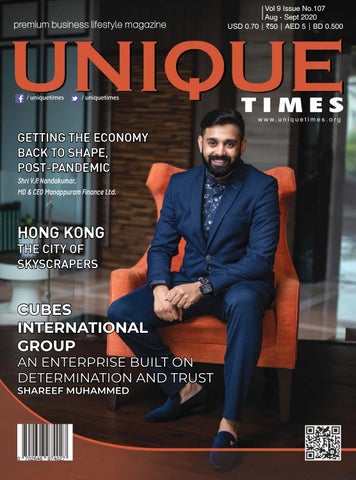
Vol 9 Issue No.107 Aug - Sept 2020 USD 0.70`50AED 5BD 0.500
GETTING THE ECONOMY BACK TO SHAPE, POST-PANDEMIC Shri V.P. Nandakumar, MD & CEO Manappuram Finance Ltd.
HONG KONG THE CITY OF SKYSCRAPERS
CUBES INTERNATIONAL GROUP
AN ENTERPRISE BUILT ON DETERMINATION AND TRUST SHAREEF MUHAMMED
M
O
T
O
R
S
KERALA: COCHIN : Nettoor, Edappally, Anagamaly, Perumbavoor, Thodupuzha :SALES INFO : 77360 65 115 M
O
T
O
R
S
TAMILNADU : CHENNAI: Chrompet, Chegelpet, Kattupakkam, Porur
: SALES INFO : 96772155 55
Jebitha Ajit Director & CEO Editor Jebitha Ajit Legal Advisor Latha Anand B.S.Krishnan Associates bskrishnanassociates@gmail.com As we look ahead into the next century, leaders Sub-Editor Vignesh S.G will be those who empower others.” – Bill Gates Associate Editor Ravi Saini Kerala, a small state in the southern part of In Rajeev Kumar dia, has contributed several business leaders to the Director and special editor kollur country. Shareef Muhammed, the Chairman and Correspondents D r. Thomas Nechupadam Managing Director of Cubes International Group, Vivek Venugopal- Quarter Mile is a highly successful businessman based in the Amrutha V Kumar southern state. The young business legend has esCreative Design PEGASUS tablished a huge business empire. In this edition’s Cover Photographer Saran P S cover story, his inspiring journey is depicted. Marketing UAE In the space awarded to V P Nandakumar, this Phygicart.com time he comes with an informative article, which P.O. Box: 92546, Al Karama Dubai explains how the economy of the country can be Mr. Anish K Joy brought back to the track of progress. Mob: +971528946999 This month’s travel article covers Hong Kong. info@phygicart.com It portrays the beauty of the city of skyscrapers, Plot No 19A, 9th Floor, covering even the minute details regarding the Green Building, Film City, tourism sector of the Asian version of Europe. Sector - 16A, Noida - 201301 Maharashtra This time, Volkswagen T-Roc is what is dis Jayasankar M, a/101, cussed by our auto expert. He explains why the New Prathamesh Niwas, car is one of the best cars launched by Volkswagen. OPP. Laxmi Park, Thakurli East, Apart from these articles, this edition also has Dombivli post, Thane District, 421201 all our usual ingredients from motivation and spir Mob: 9820708662 itual odyssey to book review and movie review. Hariharan Enjoy reading! chennai, Mob: 9840018929 Unique Times, No.6/31, Arunachalam main road, Thank You Saligramam, Sd/ Chennai – 600093 Jebitha Ajit Karnataka Paperback Publishing 3218/A, 6th C Main, 13th Cross, HAL 2nd stage, Indiranagar Bengaluru 560038 Andhrapradesh PEGASUS Ph: 09288800999 Sunilkumar NN Your wing Vineeth Nair Director Ambalika Saikia, Ambalika_saikia@yahoo.com
Editorial “
Printed at St. Reddiar & Sons, P.B. No: 3627, Veekshanam Road, Cochin Published at Pegasus Global Pvt. Ltd. L5-106, Changampuzha Nagar Kalamassery, Ernakulam-682 033 e-mail: editor@uniquetimes.org uniquetimesindia@gmail.com Ph:0484 2532040, 2532080 Mob:9288800999
Cover Photograph Shareef Muhammed, Chairman and Managing Director of Cubes International Group
Printer & publisher Pegasus Global Pvt. Ltd. Cochin (682033) on behalf of Ajit Ravi. Printed at S.T.Reddiar & Sons, Cochin-18.
20
CONTENTS
12
24
Cubes international group: An enterprise built on determination and trust
12
Getting the economy back to shape, post-pandemic
20
On the brave new world of the management graduates of 2020
24
Inverted duty under gst-a rubric embroiled in unnecessary litigation
28
BPR-A business tool for survival and growth in challenging times
36
28
52
50
48
58
44
Are brain tumours related to excess cell phone use?
48
Gadgets
50
Skin care tips to be followed in rainy season
52 58
Hong Kong: The City of Skyscrapers VW T-Roc
UNIQUE DIARY
Covaxin: Human trial begins
T
he human trial of Covaxine, the Covid-19 vaccine developed by Bharat Biotech, has begun in the Indian state of Odisha. With that, the country has entered the third, as well as crucial, stage of the processes of developing the vaccine. The vaccine has been administered to several people. The process has been conducted under the guidance of Dr. E Venkat Rao, who is the principal investigator of the process. As per a latest report, almost all who have participated in the process have responded positively to the vaccine. It seems that the country is inching close to a great achievement.
India, UK agree to develop FTA
“If you do build a great experience, customers tell each other about that. Word of mouth is powerful” Jeff Bezos
8
T
he Asian superpower of India and the European hegemon of the United Kingdom has reassured their commitment to develop a Free Trade Agreement. If the agreement is developed, it will boost the trade between these two nations – which are closely connected to each other because of many reasons. Recently, a Joint Economic and Trade Committee meeting was conducted between these two countries. In the meeting, Piyush Goyal, the Indian Commerce and Industry Minister, represented the Indian side and UK Secretary of State for International Trade Elizabeth Truss the UK side. Several matters related to trade were discussed during the meeting.
August - September 2020
UNIQUE DIARY
Indian Bank reduces interest rate on gold loans to farmers
I
n a bid to help farmers to recover from the pit of miseries into which the present Covid-19 virus crisis has pushed them mercilessly, Indian Bank had reduced its interest rate on gold loans offered to farmers as agricultural jewel loans. The interest rate has been reduced to not more than seven per cent. The new policy has come to force on 22nd July. The policy is not only aimed at helping farmers to recover from the economic injury inflected by the virus crisis, but also intended to save them from falling under the clutches of local money lenders. As per the new policy, the bank only charges Rs. 583 per lakh per month as interest.
RBI board member appeals loudly against privatisation of PSBs
“If you buy things you do not need, soon you will have to sell things you need� Warren Buffett
A
board member of Reserve Bank of India, Satish Marathe, while speaking to an acclaimed national media, has strongly appealed against the possible privatisation of Public Sector Banks. Meanwhile, he has suggested that the concerned authority could reduce their shareholding to around twenty-six per cent. He has also observed that the Public Sector Banks should undergo an urgent revamp. As per his opinion, the transformation should happen in many areas, such as the area of staff attitude. The statement of the RBI board member has opened up a debate on the matter of the possible privatisation of Public Sector Banks.
10
August - September 2020
Russia looks for Indian partners to supply Covid-19 drugs
T
he Eurasian superpower of Russia is looking for suitable partners in the Asian country of India to supply Covid-19 drugs indigenously developed by the Eurasian giant. Favipiravir, Olokizumab and Levilimab are the three drugs which the Eurasian country has offered to supply. These drugs have been proved effective by Russia. To get a safe entry to India – which is a very huge market compared to the rest of the world, these drugs need the clearance of the Indian authority, which is responsible to check whether these drugs comply with the Drugs and Cosmetics Act 1940 and several other acts in connection with the matter.
India pharma sector to reduce its reliance on China
“You have to be just as mistrustful of straight forward rationality in business as you do of a uniquely gut approach� Bernard Arnault
I
n the wake of the latest development, the Indian government has decided to detach its pharmaceutical sector from China. At present, the Indian pharma sector is heavily depended on China. The government plans to strengthen its drug manufacturing and medical device manufacturing. It seems that more funds will be channelized to this sector to improve its efficacy. The statement regarding the ambitious plan has been officially released by Minister for Chemicals and Fertilisers Sadananda Gowda. Since the Covid-19 outbreak, India is not in a good relation with its aggressive neighbour, China. The new development may worsen the relation between these two superpowers.
August - September 2020
11
COVER STORY
CUBES
INTERNATIONAL GROUP: AN ENTERPRISE BUILT ON DETERMINATION AND TRUST Where there's a will, there's a way. Only a determined entity can persist in the face of perils.
Shareef Muhammed,
Chairman and Managing Director of Cubes International Group, is the living example of this proverb.
12
August - September 2020
August - September 2020
13
COVER STORY
14
August - September 2020
H A down to earth and resilient personality, Shareef is admired and is considered as an honest leader by his team and dear ones. In just a year, he expanded his vertices under the parent company, Cubes International Group
ailing from a small town in Thrissur, Kerala, Shareef ’s entrepreneurial journey commenced with an initial capital of dreams. He invested substantial hard work to build his empire and the result is the successful, strong illustrious Cubes International Group. Born to a simple middle-class family, Shareef started to work as an employee in 2008. During his initial days of work, he saved his earnings intending to invest in his own business... It was in 2011 he kick started his business with his savings as capital investment. “Starting a business is not an easy task, it's not for anyone. But the desire to achieve
success in what I do has always driven me,” says Shareef with a smile of confidence. He invested his two years worth savings in the business. He received much disdain in his earlier days when conversing about his dream business. But that didn’t get the better of him. He had his eyes set on the result and stood focused until he achieved it. Faith in oneself and one’s enterprise is the foundation stone to business success. Nine years from then, building the eight verticals of Cubes International Group has helped Shareef prove his naysayers wrong, proving his worth as a business leader.
Inception
In the early days of business, Shareef was still
Cubes International Logistics - Kalamassery, Cochin Office Inaugurated by Dr. Padma Shri Bharath Mammootty
August - September 2020
15
COVER STORY
an employee in a Qatar based construction firm. At a time when his company required manpower for completion of a particular project, Shareef took the initiative and provided 10 labourers for the job. “This was my first business. I struggled to manage things in the beginning but gradually I figured out,” he says. He invested his earnings as a capital investment for his dream business. Balancing work and business was quite difficult for Shareef, but never once did he give up on his dreams. His struggle went on till 2013. In the same year, he began working for a vehicle leasing firm. It was then that he realised where his true business strengths lie. Stating a quote he read somewhere, Shareef describes, if a window of opportunity appears, don’t pull down the shade, grab it. So did he. The vehicle leasing company he joined was providing commercial vehicles for construction purposes. Shareef saw an opportunity there as the firm needed drivers. He could successfully manage to provide three hundred drivers for the project. “Finally all my efforts and struggle were meaningful to me,” he says. The Turkeybased company invited Shareef to be a subcontractor with them and at that moment, his story shifted tracks from struggles to success. The jump from 300 to 1,300 employees was in no time. His determination and dedication towards his work eventually led him to set up his own business in Kerala. The groundwork for Cubes International Logistics started in 2017 and the firm started functioning in full-fledged in 2018. An ardent person, Shareef says that his mother is his biggest inspiration. He lost his father at a very young age and the strength his mother dis-
16
August - September 2020
played in raising him gave the grit in life. “My mother always wanted me to do my business in Kerala. She had a strong belief that our motherland will never betray us,” he says with a smile. Taking his mother’s advice and his love for Kerala to heart, he opened more firms here. The years that followed made Shareef realise the business potential in Kerala. Shareef credits his success to his team members. “ I am blessed to find such a spectacular team in each firm who are more than a family to me and with each other,” says Shareef. The team’s determination and sincerity keeps the business strong and successful, he added.
Business Verticals
A down to earth and resilient personality, Shareef is admired and is considered as an honest leader by his team and dear ones. In just a year, he expanded his vertices under the parent company, Cubes International Group. He oversees and manages the operations of Cubes International Developers, Cubes International Logistics, Cubes International Facility Management, Cubes International Management Services, Cubes Trading and Contracting, Cubevo International Trading, Psycho Designs and Cascade Foodstuff Trading. Exploring the business sectors from construction facility to consulting and management to FMCG, which is the latest add on to the cubes family, Shareef operates his business in UAE, Qatar, India and the USA. Managing a business in various verticals has helped Shareef to understand business in-depth and gave him the freedom to experiment with new ideas. During the tough times of Covid-19, one business that was not much affected was the Logistics. “My
business grew two times more at this time as we were shipping cargo through ocean ways which was much cheaper when compared to the airways,” says Shareef. As the export via airways came to a standstill due to the spread of Covid-19, Shareef and his team members recommended their clients to export perishable goods via ship. “However, it was worth a try and most of our clients agreed to export via ship and it became successful since many products beat damage,” he says. Although when one business was in the dynamic phase, on the other hand, the construction business faced a downfall. Cubes International Group’s construction wing focuses on building premium resorts, hotels and apartments. It is based on a concept-design-build format that integrates architecture design as well as construction. “The construction work was put on hold by the government due to the pandemic. And when the relaxations were imposed on construction works, the price of the materials was at the peak which led to the decrease in our profit margin,” he says. However, there was only one mission for Shareef and his team members, which was to finish the work and hand it over to the clients before the deadline. “The scenario for the architectural and designing firm was similar. But during this time we received genuine enquiries for construction, which was a ray of hope, he says with a smile. Based on the enquiries Shareef received, he sees potential in residential apartments in the coming years. Therefore, he along with his team members are planning to expand and explore more into the construction sector to deliver fine outcomes to their customers.
August - September 2020
17
COVER STORY Cubes International Group is also into trading coconut, coir and allied coconut products under the brand Cubevo International Trading. Due to the shortage of staff during the lockdown, Shareef ’s Cubevo took a bad hit. “The trading of coconut was not possible as most of the raw materials were bought from Pollachi and there were no staff to take the consignment, says Shareef. South India being the top spot for coconut cultivation, Shareef believes “It is just a matter of time and once things are fine, my business will reap in more profit.
The Success Mantra
As Steve Jobs once quoted, Great things in business are never done by one person. They’re done by a team of people. Shareef credits all his success to his team. “Without the support of my team members nothing was possible for me, he says. The strength, trust and honesty his team members possess gave Shareef the courage to ideate into new business. “I tend to create a team in all the companies I venture into. I let them do all the work and lend them my support and advice in times of requirement” he says. Shareef knows how to not let stress related to finance or business affect him. Being raised by a single mother, he has seen the struggle his mother faced and how she dealt with it. “ At a very young age, I lost my father. It was my mother who took care of me without letting me know of any difficulties. She was a strong woman indeed,” he says smiling. From childhood, I have seen her overcoming hard times with a smile on her face. I inherit those qualities from her, shares Shareef. His team members are no less than a family for him. Whenever a problem arises, they will all sit together and discuss, as it happens in the home. “I have been practising this with all my team members and it has helped me in improving in every stage,” says Shareef. This has also helped him to gain his team members' trust which in turn gives him the strength to take risks. He believes taking a risk is an es-
18
August - September 2020
sential part of any business. Without taking risks there is hardly any scope for progress. “Despite all the risk the one which I can never take or I am unwilling to take is to have a debt for any of my organisations,” he says.
the business potential in the respective cities. As of now, the Cubes family has operations in UAE, Qatar, India and the U.S. Taking challenges with a smile and keeping patience has always paid off Shareef in his entrepreneurial journey.
What's Next!
A piece of advice to the aspiring entrepreneurs
Speaking about the future endeavours of Cubes International Group, Shareef says that the next focus is U.S expansion. Along with that, he also looks forward to exploring more possibilities in the construction and logistics sector as he feels that it has a wide scope in the coming years. After setting up the base in the Fast-Moving Consumers Goods (FMCG), Cascade Foodstuff Trading in UAE and registered Cubes International in the USA, Shareef hopes to explore
A self-proclaimed and honest entrepreneur, Shareef admits that he is still a learner. Every day is a new chapter to him. He advises aspiring entrepreneurs to listen to their heart and be determined to put in their best efforts. “Hard Work always pays off...we just need the patience and strength to wait,” he says with a smile. And also choosing a good team and building trust is equally important, adds Shareef
August - September 2020
19
BUSINESS
When Unlock 1.0 began in May, we were hopeful of returning to normalcy within a couple of months. However, three months down the line, the situation continues to be dire as we head back to more of localised lockdowns and curfews. Most of our states are reporting an increasingly higher number of positive cases than before.
Shri V.P.Nandakumar MD & CEO Manappuram Finance Ltd.
Getting the economy back to shape, post-pandemic
E
conomists often use the term “ceteris paribus”, Latin for "all other things held constant" when positing their theories or making predictions based on their models. I am not an economist but as the CEO of a large NBFC, I take a keen interest in India’s economic performance, mainly to get a sense of where things are headed. After all, the wider performance of the economy has a crucial bearing on business performance. But these days, we are in the midst of an unprecedented situation where even near-term predictions are difficult to make because we have no clue about how the COVID-19 pandemic will play out. When Unlock 1.0 began in May, we were hopeful of returning to normalcy within a couple of months. However, three months down the line, the situation continues to be dire as we head back
20
August - September 2020
to more of localised lockdowns and curfews. Most of our states are reporting an increasingly higher number of positive cases than before. As we come to grips with the ground realities, the one good news is that India has ramped up its testing capacity and that nearly two crore people have been tested so far. In the meantime, work on developing a vaccine is going on at a frenetic pace. India is also in the race to develop a vaccine with trials of our Covid-19 vaccine, Covaxin, having started at 8 sites. Meanwhile, the medical profession is working tirelessly to develop a treatment protocol that would cure the disease and cut down on the fatality rates. While we are grateful to our medical professionals, and even as we hope for the best, we must simultaneously work to get the economy back on track. Otherwise, we may fail ourselves by saving the lives
of our citizens but destroying their livelihoods. It is increasingly clear that a lockdown is not a real solution as it only buys time at best. In that sense, it’s no better than kicking the can down the road. What’s more, it comes at a steep cost to the livelihoods of some of our poorest and most vulnerable sections. Therefore, what we need is to balance the precautionary measures with measures to support economic activity that would preserve livelihoods. Governments have a responsibility to protect both lives and livelihood. In this context, lockdowns serve one purpose very well but at the cost of the other. We have now seen for ourselves how lockdowns destroy the livelihoods of the poor and marginalised people, be it labourers, shopkeepers, traders or MSMEs. There is also a widely shared view among economists that the Indian government’s fiscal response to the economic crisis has been inadequate. According to this view, the government should ramp up spending without heed to the deficit financing it would entail so that the most vulnerable sections get direct monetary support from the state to preserve their (already precarious) standards of living. Now is not the time to bother about deficits or be afraid of rating downgrades. What India needs is a much larger economic stimulus that would put more money in the hands of the people. They argue that this would lead to economic recovery by stimulating demand. Considering that the collapse of income for large sections directly affects business and industry, there is considerable merit to the idea of a stimulus on the demand side. However, the Indian government has been relatively cautious so far, perhaps conscious of its stretched fiscal position, and the fear that a ratings downgrade that will likely follow from elevated fiscal deficits would have long term negative consequences for the Indian economy, such as the flight of capital, not to mention the high inflation stoked by a high fiscal deficit. Moreover, the experience of how India dealt with the global financial crisis of 2008-09 is still fresh in our
August - September 2020
21
BUSINESS
Policymakers should encourage asset-backed lending and appreciate that there is little point in tying up lenders in cumbersome regulations and then expect credit growth to pick up.
minds. On that occasion, the fiscal tap was turned on and the government largely succeeded in cushioning the economy from the impact of global meltdown. However, the failure to unwind, to get out of the stimulus mode in time, also set the economy up for high inflation and the currency crisis of 2013 when the rupee depreciated by close to 50 per cent in a matter of months. At the same time, there are a few measures specific to the financial services sector which the policymakers can consider and which won’t cost even a rupee. There’s no doubt that India’s banks and NBFCs will see their asset quality deteriorate, especially after August (when
22
the extended moratorium ends) and this will be true for corporates, SMEs and even the retail segments. It is worth noting that over the last few years, at least among retail borrowers, there has been a marked improvement in credit culture. People are much more conscious of the need to maintain their credit scores and instances of wilful default are fewer in the retail segment. A moratorium, in this context, is not an advisable solution as it is costly and destroys the hard-earned credit culture. A better way would be to permit a one-time restructuring of loans that would conserve capital and allow borrowers to rebuild their income generation capability.
August - September 2020
Policymakers should encourage asset-backed lending and appreciate that there is little point in tying up lenders in cumbersome regulations and then expect credit growth to pick up. For example, an NBFC can give out unsecured loans without restrictions but a loan against gold jewellery is legally capped at 75% of the value of the gold (an asset liquid as cash and which does not depreciate). These rules were last revised by RBI in 2014 and it is time for a fresh look. Similarly, restoration of priority sector lending (PSL) status to eligible gold loans disbursed by NBFCs making them on par with the banks would be another welcome step. Nearly 30% of the Banking
Sector’s Agriculture Loan book is in the form of gold loans. There is a need to remove this regulatory arbitrage between banks and non-banks for gold loan. After all, banks already enjoy get the benefit of lower capital charge on their gold loan book, and they face no restrictions in opening branches. Further, they enjoy the PSL benefit on a large part of their gold loan book classified under agricultural lending. In times of economic uncertainty and stress in the financial sector, there is an understandable hesitation to lend on the part of banks and NBFCs alike. Even borrowers tend to hold back as they are not sure if their venture would succeed given
the prevailing economic uncertainty. In such times, lending against gold jewellery is a very good business to be in. The two major tailwinds for gold loans are the lifetime high gold prices and the heightened risk aversion of banks and NBFCs. That is why a lot of banks and NBFCs are planning to get into the gold loan business. After every crisis, there is shakeout and consolidation. Over the next few quarters and the next few years, I expect to see a lot more of mergers and acquisitions (M&As) happening in the financial space, and I won’t be surprised if the weaker players get weeded out. Now that the RBI has been made the sole regulator of the
financial sector including Co-Operative Banks, all three major lending institutions (Banks, NBFCs/HFCs, and Co-Operative Banks) have come under the supervision of a single regulator. I expect harmonisation of many regulations thereby wiping out the regulatory arbitrage enjoyed by a few. With the blurring of boundaries, weaker players would have to go out of business or be taken over by larger entities. It will cause some pain in the short term but, over the longer term, it will be better for everyoneď Ź (V.P. Nandakumar is MD & CEO of Manappuram Finance Ltd. Views are personal.)
August - September 2020
23
BUSINESS
Rajesh Nair Associate Partner, Ernst & Young LLP
Education has reached a sort of pinnacle in quantity, in India. The growth of the number of business schools and engineering colleges has been disproportionately high in the last two decades. With a huge build-up of supply of seats, the ease to get into these institutions has become an open road. The new reality is that the institutions are now making it easy for students to seek admission – that is to euphemistically say that they are falling over each other to get students.
On the brave new world of the management graduates of 2020
I
t is the strangest of times! Uncertainty is not just a prism through which we had to look at the future. It is now, more of a windowpane to the present day. Every day is another cloud of questions. Our intuitive decisions from the collective experience of the past does not equip us to make daily and otherwise quotidian choices. The pressures are also a clarion call for immediate tactical actions. There is
24
August - September 2020
no time to mull over choices nor is there a body of ‘do it yourself ’ texts we can refer to. For the young management graduate, who is entering the portals of a career, it is a challenging time! For them, it is a key moment in life where exciting possibility and optimism meet uncertainty and change. It is at one level filled with hope, exhilarating and yet a testing time. This generation will be the ones who end up navigat-
ing a fascinating yet scary scenario. How much change can one tolerate? How much change orientation will be needed? What are the professions that will find its way to the roster of exciting opportunities? Perhaps amidst all these questions, it is also best to lie low, think more, keep faith in moments of great change. We all have the instinct to buckle down and cling to the familiar, what we know, what seems pragmatic, the things we’re comfortable with – there is nothing wrong with that! But it is also an opportunity to keep looking beyond the horizon. The reactive nature of the times will confuse the responses. A good framework to think forward is NOW, NEXT and BEYOND. What can we do now, how should we plan the next phase and what lies in the future beyond. At the end of it, we should always focus on moving forward one step at a time! As the saying goes, “Never let a good crisis go to waste.” Large organisations, high income levels and great consumption are always part of the picture, but it is also incomplete. The key is also financial inclusion. High Median income is never the answer, neither is it more exciting than a decent average income. Income parity is not a socialist phenomenon, but as much a capitalist agenda as
any another monetary concept. Regular income brings in not just economic freedom but also independence in thought, ability to focus on needs and wants, planning for the future breeding self-sufficiency. But employment also needs a supporting ecosystem which needs to prepare and wet the soil. This is often where skill development comes in. Education has reached a sort of pinnacle in quantity, in India. The growth of the number of business schools and engineering colleges has been disproportionately high in the last two decades. With a huge build-up of supply of seats, the ease to get into these institutions has become an open road. The new reality is that the institutions are now making it easy for students to seek admission – that is to euphemistically say that they are falling over each other to get students. A recent report by a reputed consulting company averred that more than 50% of the jobs we have today, will either not exist or be in a changed format, making it unrecognisable in the context of the past. The skilling effort for the future has to be a concerted effort involving an integrated determination of various stakeholders – the government, industry, the educational institutions and the individuals.
The most challenging task of all lies with the individual. There is a lot happening. Gone are the days of one job throughout your career. An average employee of the previously generation, who recently retired at sixty (especially in the Indian context), has on an average changed less than two jobs or simply put, most have never changed a job in their career. Their careers took the twists and turns as dictated by that respective organisation. This is changing. A recent research says that youngsters who started their careers post 2006, are likely to change eleven jobs by the time they retire at sixty! That is a whopping number, you may think. But the numbers for the western world are more bizarre – with countries having average job changes at 24! Which mean on an average many employees work in one organisation for less than eighteen months? So, while technology is more like a life skill now and not a functional skill, you also need to build the right attitude. An attitude about yourself, the watch on the horizon, a lot more mulling on your individual career is the need of the hour. There is a host of things you need to focus on: • Ability to think, • Ability to learn, • Ability to unlearn,
August - September 2020
25
BUSINESS
• Ability to be open to discuss change, • And the agility to do thing super quickly. The professional of tomorrow cannot navigate with just the front mirror and the rear mirror, but needs to have the instinct to look at every road sign, changing weather patterns, fading landscape and imbibe every tessellation of what is around them. For the future is just around the blind corner! Together some of these completes the jigsaw but the puzzle is far from over! The role of the government is also to keep the avenues of new employment ushering in and looking to create the best of infrastructure which can facilitate this. This also calls for taking caution to preserve some of the big employment areas of yesterday and look out to start
26
academies for restoration of the labour with reskilling, handholding and helping them transition into modern industry. Beyond a point, subsidies are crutches which will create resistances in embracing the changed scenario. The future is still full of hope for the optimist. With the advent of new fields like robotics and automation, the completely mechanical jobs will phase out through technology. But it will also bring in more efficient and productive man-machine combinations. Though the displacement of labour by technology and globalization is hardly a new phenomenon. In the future of work, the ultimate resource that companies will use more efficiently is the human resource. Labour-intensive firms everywhere will need to reinvent their business models, deploying smart technologies and using la-
August - September 2020
bour more productively. But flexible working hours, virtual offices will bring in the right impetus to diversity and inclusion to add women to the workforce like never before. The move from the safety of the institution to the boundaryless chasm of the real world is a moment of great transition and uncertainty. You're giving up your familiar identity as a student. You're on the verge of assuming some new garb – the working professional. You're about to embark on a journey through unknown territory. You're going to have to say goodbye to old friends, peers and a familiar way of life and hello to new jobs, new routines, and probably new environs. Perhaps it also means you focus on your heart, your inner voice, the unique glory and celebrate the inner journey to find the new you
FINANCE
Adv Sherry Samuel Oommen is a practising lawyer at High Court of Kerala who specialises in tax and Corporate Laws. Presently he heads the tax and corporate law practice of Nash Capital Partners. Apart from being a qualified lawyer, he is also a chartered accountant, cost accountant and a company secretary. He is currently pursuing his Doctorate Degree and is reachable at sherryoommen@nashcp.com.
As evident, GST works on a premise that being in the nature of consumption tax, the tax burden is ultimately borne by the final consumer and businesses do not bear the burden of the tax since they are allowed to take credit of the tax paid on anterior supplies received by them. The said principle has also been endorsed by Organization for Economic Cooperation and Development in the context of international VAT/ GST Guidelines.
INVERTED DUTY UNDER GSTA RUBRIC EMBROILED IN UNNECESSARY LITIGATION
S
ince the advent of the Goods & Services Tax (GST) in July 2017, the topic of GST has been a subject matter of varied litigation. The intent of GST is indeed perspicuous apart from being laudable, as well articulated in the first discussion paper published by the Empowered Committee of State Finance Ministers in 2009, which states as follows: “In the GST, both the cascading effects of CENVAT and service tax are removed with set-off, and a continuous chain of set-off from the original producer's point and service provider's point up to the retailer's level is established which reduces the burden of all cascading effects. This is the essence of GST, and this is why GST is not simply VAT plus
28
service tax but an improvement over the previous system of VAT and disjointed service tax. The GST at the Central and at the State level will thus give more relief to industry, trade, agriculture and consumers through a more comprehensive and wider coverage of input tax set-off and service tax setoff, subsuming of several taxes in the GST and phasing out of CST.” [Emphasis supplied] As a proprio vigore, the Statement of Objects and Reasons appended to the Bill introducing the Central Goods & Services Tax Act, 2017 (“CGST Act”) also stated that GST will be levied at each stage of supply chain and the taxes paid at earlier stage will be available as input tax credit. The relevant extract of the same is as under:
August - September 2020
"3. In view of the aforesaid difficulties, all the above-mentioned taxes are proposed to be subsumed in a single tax called the goods and services tax which will be levied on sac o! of goods or services or both at each stage of supply chain starting from manufacture or import till the last retail level. 4. The proposed legislation will simplify and harmonize the indirect tax regime in the country. It is expected to reduce cost of production and inflation in the economy, thereby making the Indian trade and industry more competitive, domestically as well as internationally. Due to seamless transfer of input tax credit from one stage to another in the chain of value addition there is an in-built mechanism in the de-
sign of goods and services tax that would incentivize tax compliance by taxpayers.” In a flyer dated 01.01.2018, the Central Board of Indirect Tax and Customs explained the input tax mechanism in GST, which stated as follows: "Uninterrupted and seamless chain of input tax credit hereinafter referred to as “ITC” is one of the key features of Goods and Services Tax. ITC is a mechanism to avoid cascading of taxes. Cascading of taxes, in simple language, is 'tax on tax'. Under the present system of taxation, credit of taxes being levied by Central Government is not available as set-off for payment of taxes levied by State Governments, and vice versa. One of the most important features of the GST system is that the entire supply chain would be subject to GST to be levied by Central and State Government concurrently. As the tax charged by the Central or the State Governments would be part of the same tax regime, credit of tax paid at every stage would be available as set-off for payment of tax at every subsequent stage.” As evident, GST works on a premise that being in the nature of consumption tax, the tax burden is ultimately borne by the final consumer and businesses do not bear the burden of the tax since they are allowed to take credit of the tax paid on anterior supplies received by them. The said principle has also been endorsed by Organization for Economic Cooperation and Development in the context of international VAT/ GST Guidelines. An excerpt of the related guidelines is as follows: “In addition, it should be
borne in mind that value added tax systems are designed to tax final consumption and as such, in most cases it is only consumers who should actually bear the tax burden. Indeed, the tax is levied, ultimately, on consumption and not on intermediate transactions between firms as tax charged on these purchases is, in principle, fully deductible. This feature gives the tax its main characteristic of neutrality in the value chain and towards international trade.” With the above-backdrop, the Hon’ble Gujarat High Court in the case of VKC Footsteps India Private Limited reported in 2020-VIL-340GUJ faced a rather peculiar issue on the interpretation of Rule 89(5) of the CGST Rules which essentially denies refund of unutilized input tax paid on input services as part of input tax credit accumulated on account of an inverted duty structure. However, section 54(3) of the CGST Act grants a registered person the right to claim a refund in respect of “any unutilized input tax credit”, which apparently conflicts with Rule 89(5) of the CGST Rules. Apparently, there appears to be no rationale for allowing refund of unutilised input tax credit in respect of tax paid on inputs but not unutilised input tax credit in respect of tax paid on input services.
Rules of interpretation
In interpretation of statutes, the Hon’ble Supreme Court in the case of Printers (Mysore) Limited and Another [1994] 2 SCC 434 held that it is well settled that where the context does not permit or where it would lead to absurd or unintended result, the definition of an expression need not be mechanically applied.
Further, it has also been judicially held that if a rule goes beyond what the Section contemplates, the rule must yield to the statute. The said priori was upheld by the Hon’ble Supreme Court in the case of Babaji Kondaji Garad (1984) 2 SCC 50, which has been extracted below: “Now, if there is any conflict between a statute and the subordinate legislation, it does not require elaborate reasoning to firmly state that the statute prevails over subordinate legislation and the bye- law, if not in conformity with the statute in order to give effect to the statutory provision the Rule or byelaw has to be ignored. The statutory provision has precedence and must be complied with.” The Hon’ble Supreme Court in the case of Lohara Steel Industries (1997) 2 SCC 37 has held that if a particular provision, being severable is discriminatory, the same could be struck down. Applying the above principles, the Hon’ble Gujarat High Court held that the Petitioner would also be eligible to claim a refund of both “input tax credit” availed on “goods” and “services”.
CONCLUSION
It is quite likely that this issue would travel to the Hon’ble Supreme Court, which unfortunately has turned out to be the desideratum in the attitude of the Government. It would also not be element of guess, or clairvoyance, if the Government adopts the procedure of effecting a retrospective change in law, which is reprehensible. It would indeed augur well for the industry, if the said decision is accepted by the Government, as it is in line with the true meaning of GST
August - September 2020
29
Wake Up with Make Up Rooma Sarika runs the ‘Rooma Permanent Cosmetics’ at Kochi. She talks about some beneficial treatments her offers. By Shevlin Sebastian
T
he doorbell rang at the flat in Mumbai. Priya Sharma opened the door. It was her former boyfriend Deepak. He had a small plastic bottle with him. It was uncapped. He threw the liquid at her face. She moved sideways, but drops of liquid still fell on her face. She screamed. Deepak fled. Priya realised he had come to take revenge. A week ago, she had ended their two-year relationship. The 30-year-old went to the hospital. The treatment did not cure her. Her lips fell to one side. One eyebrow had gone. She had to keep using the eyeliner to make an eyebrow but it gave off an artificial look. One day, her Delhi-based aunt Mona, who runs a chain of nail studios, called her. Priya told her about the problems with her face. “I have a solution,” Mona said. About a month earlier, Mona did a Google search to look for beauty therapists who did permanent makeup. And she came across the name of Rooma VS who runs a clinic, ‘Rooma Permanent Cosmetics’ in Kathrikadavu, Kochi. She called Rooma, fixed an appointment, flew down and got her eyebrows fixed and lip contouring. So Priya called Rooma, and came to Kochi. When Rooma had a look, she
30
August - September 2020
saw that the acid had damaged the eyebrows and an area near the eyes. Her lips did not have a proper shape. “This affected her self-confidence,” she says. “But the other side of her face looked beautiful.” Rooma propagates a technique called microblading. It is a method by which, with the help of microblades, a pigment is placed in the upper layers of the skin. This results in eyebrows becoming full and it can be shaped in a way the client wants. This lasts for two years. Rooma imports healthy pigments from the PhiAcademy, USA. Rooma’s first celebrity client was a noted singer and popular Malayalam TV anchor. Rooma worked on the eyebrows and made it permanent. “I also made the eyeliner permanent,” she says. “So, before a shoot, she does not have to bother about her eyebrows and eyes at all.” Another Mollywood star is also a client. She wanted her eyebrows to be done. So Rooma used the microblading technique. So happy was the actress with the treatment, she appeared in an online advertisement for the beauty clinic. For celebrities, this treatment is a God-send. Because of the mobile phone, people are always taking photos. “So even if a guest comes to the house, they have to rush and put on
Today, she is the only one to offer permanent make-up in Kerala. And the clients are coming from all over India. The reviews have been good.
August - September 2020
31
PhiContour - A skill of semi-permanent colouring of lips or eyelids
make-up, because there is a high possibility of a selfie being taken with them,” says Rooma. “It will be uploaded on social media, and so they must look good all the time. That is why permanent eyebrows are an enormous help.” On being asked whether women come to beautify themselves, so that they can look good for their spouses, Rooma laughs and says, “No, it has got nothing to do with husbands. Women want to increase their confidence levels by looking good. Plus, it will help them in their careers like acting and in jobs where they have to interact with the public.” Rooma has a wide range of customers: from 25 to 72. But most of the clients are
32
August - September 2020
in the 30 to 40-year age group. Women with distinctive problems come to see Rooma. One woman told her that because of an illness she lost her eyebrows. So, she could never step out of her bedroom without using a pencil and making lines. Unfortunately, the eyebrows looked fake. “She had become self-conscious,” said Rooma. “So, she felt relieved when she could get permanent eyebrows.” Some suffer from alopecia (spot baldness) and have lost their eyebrows. This also happens to women who have undergone chemotherapy. Apart from microblading, other services include
permanent eyeliner and lip contouring. Sometimes, when women smoke too much, their lips can grow dark. Or it could be because of the daily use of lipstick, which has lead and mercury in it. To hide the dark patches, they increase the use of lipstick. “But this is like a slow poison,” says Rooma. In lip contouring, Roopa replaces the underlying melanin, a natural skin pigment with mineral pigments. “These are safe,” says Rooma. “It is only metallic pigments that have a side-effect because it gets oxidised. After the procedure, you need not use lipstick at all.” Another procedure is the lifting of the eyelids
“The advantage of these types of extensions is that you can wash and comb your hair and nobody will notice the difference. These are also lightweight so that the wearer will not even feel there is extra hair.”
Micro Ring Hair Extention - No wig, No wax or heat, 100% real human hair
through plasma treatment. After the age of 30, the collagen content in the skin goes down. When this happens, the skin tends to collapse. “By using a small needle, I try to create some breaks. This will allow the body to make collagen naturally, and the drooping will go away,” she says. Earlier, people used Botox, but it resulted in deposits under the skin. Rooma is also adept at hair extensions. The earlier way was to put clip-on extensions, but that damaged the roots of the hair. “You have to remove it often,” she says. “We use micro ring hair extensions. You don’t need glue, heat or braids.” The strands, matching the original hair colour, are placed seamlessly into the hairline. “You cannot spot the difference,” says Rooma. “The advantage of these types of extensions is that you can wash and comb your hair and nobody will notice the difference. These are also lightweight so that the wearer will not even feel there is extra hair.” It is clear while talking to Rooma that she has a passion for her job. And this love began very early.
Early influences
One of Rooma’s aunts ran a beauty boutique in Mumbai. During summer vacations, she would come to the ancestral house at Ambalapuzha, in Kochi, where Rooma lived with her maternal grandmother. (Rooma’s father, who worked in the Central Reserve Police Force, had a transferable job). As a child, Rooma idolized her aunt. “She was very beautiful and wore impeccable make-up, with lipstick and mascara,” says Rooma. “I got interested in cosmetics from that age.” After her schooling at the St Mary’s School in Kayamkulam, she did her pre-degree at the Fatima
August - September 2020
33
Phibrows - A manual, semi-permanent
technique of hyper-realistic eyebrow drawing.
Mata National College in Kollam. At that time, she came across a course for beauty therapists in the newspaper. They would conduct the theory classes through the post. And then she had to do some practical classes. She did not tell her family as nearly all of them are doctors and engineers. “They would not be interested in me doing this course,” says Rooma. “So, I did the course without telling my father. But I confided in my mother, and she gave me the money to do it.” After her BA from the same college, Rooma moved to Kochi where she got a job in Naturals Cosmetics at their Kadavanthra branch. She gained plenty of experience by working there. Later, she became a trainer for other beauty therapists. In 2013, she got an opportunity to do a three-year degree in cosmetology at the Houston Community College in the USA. When she finished that, she took a 1000 sq. ft area, and opened a beauty centre at Houston. This location turned out to be lucky. Because right next to her centre, former Mollywood star Divya Unni was running the Sreepadam School of Arts. Rooma befriended Divya, and the latter sent many clients to her.
“Divya gave a lot of support to me,” says Rooma. At that time, she got a chance to do a sixmonth course at the PhiAcademy on permanent cosmetics. Soon, Rooma got the idea to start a clinic in Kochi. This came to fruition on September 10, 2018. “Ordinarily, I would have been just a cosmetologist and a beauty therapist,” says Rooma. “But the course at the PhiAcademy was a game-changer.” Today, she is the only one to offer permanent make-up in Kerala. And the clients are coming from all over India. The reviews have been good. S. Krishna Som, who did microblading and hair extensions, says, “I am very happy with the quality and efficiency of their services. Also, the products are of superior quality. Rooma and her team are dextrous and qualified.” Priya Anoopkumar says, “Rooma has added a new light in the life of people suffering from alopecia. This is the best service available in Kochi.” Annu Philip, who works in the airline industry, had suffered from thinning hair for many years. It affected her poise and self-confidence. “When I did my hair extensions, I felt so good,” she says. “A big thanks to Rooma.”
Philings - Combination of Phi-Ion and PhiNeedling, which is new, unique, different techniques intended for both skin rejuvenation and skin irregularities.
34
August - September 2020
BUSINESS
By Jiz P Kottukappally Chief Executive Officer Yescalator Management and Financial Consultants
Business process reengineering (BPR) is the practice of rethinking and redesigning the way work is done in an organisation. The focus of BPR is to better support an organization's mission and reduce costs.
Mob No 75588 91177 Email Jizpk@yescalator.com
BPR-A business tool for survival and growth in challenging times
T
ime and again Charles Darwin’s theory of evolution that it is not the strongest of the species but those species that are more adaptable to change only will survive is proving itself as not only a theory on the evolution of species but even as a vital management principle on the survival of organisations. The inventions in the field of mechanical engineering have proved it long back. The use of computer applications and information technology in business has reiterated it in the early 1990s. Specifically, in the Indian context, the liberalisation, privatisation and globalisation measures initiated in 1990s have proved the need for companies to adopt to change if they have to survive. Though Darwin’s theory of evolution has been proved correct in the business environment also still Newton’s first law of motion that there is an inertia to change and an object in a state of motion or rest will continue in the same state until an external force is applied is also equally applicable for many of the organisations. Undoubtedly, there
36
is a resistance to change in most of the organisations and unless there is an external pressure revisiting the existing and rebuilding the needed does not normally take place. Though Covid-19 has its negative impacts on the health, wealth and well-being of individuals and organisations it has created an external pressure on many organisations to relook at how they have been operating and bring in operational efficiency and cost reduction. Here there could be two response approaches that an organisation can undertake iterative response approach and radical response approach. The iterative response approach is mostly responsive to the changes in the environment. It focuses mostly on those opportunities that improve processes, but will not fundamentally change them. Here the focus would mostly be on reducing waste, errors, cycle time, etc. Radical response approach will look at enabling the organization to do existing things in a new way or even look at doing new things. As many experts are taking of a new normal
August - September 2020
post Covid-19 it would be better for organisations depending on the segment they are operating to look at radical response approach rather than iterative response approach. For eg many of the big IT and ITES companies have declared work from home as a policy for quite long period of time. If that is the case would it not make sense for even smaller companies in the IT sector to look at radical response approach rather than an iterative response approach and lay down completely new process for assigning, reporting, reviewing approving and submitting the various projects undertaken by them? Similarly, with more and more people getting used to hassle free online purchase would it not make sense for small and medium retailers to take a radical response approach and revisit their brick and mortar outlet strategies? With classes being online with work from home being the new rule and online shopping replacing the shopping experience of people will the relevance of urban and metro cities come down? If that is the case should not the
real estate builders and developers look at a radical response approach in their areas. If lot of educational activities can happen online should not educational institutions have a radical responses to the current Covid-19 situation? For businesses looking at radical response approach to the current covid situation it would be good to look at conducting a Business Process Reengineering (BPR) exercise for the organisation. BPR started getting attention in big way since early 1990s with technology being used as a key enabler for supporting business. While many firms looked at automating all the works that were done the firms which focused on reengineering paid more attention for eliminating forms/works that do not add value, rather than using technology for automating it. Great management thinkers like Peter Drucker and Tom Peters were accepting and advocating BPR as a new tool for growing successfully in
a dynamic world. Business process reengineering (BPR) is the practice of rethinking and redesigning the way work is done in an organisation. The focus of BPR is to better support an organization's mission and reduce costs. The first focus of any reengineering activity that is taken up by a firm should be to be more customer centric and ask the following important questions. 1. Who are our customers? 2. What do they want? 3. What has changed for them? 4. How do we serve them better? Answers to these questions will help the organisation to find out what is to be done and then go ahead and decide how best to do it. If this fundamental question is not asked more focus will be on modifying the existing processes, many of which would not be relevant at all from a customer point of view in the post Covid-19 new normal post. Business
process re-engineering identifies, analyzes, and re-designs an organization's core business processes with the aim of achieving improvements in critical performance measures, such as cost, quality, customer service, and speed. A well done BPR will bring about changes in strategy, people, organisation and technology. In short, BPR aims at bringing in fundamental changes required for organisational growth. Once the customer centric aspect has been taken care and what are the requirements of the customer has been understood then the focus should be on analysing the design of workflows and business processes within an organization. The analysis should help in identifying irrelevant process in the new normal, improving operational efficiency, reduce time of operations, reduce cost of operations and most importantly improve customer service. Only if customer centric focus is laid full scale revisiting of entire process and
August - September 2020
37
recreation will happen. Otherwise only iterative optimization of subprocesses will happen. Once the broad framework has been set the next step would be to see how the resources are used to create products and services that meet the needs of particular customers or markets. Any business process can be broken down into specific activities, measured and improved. It can also be completely redesigned or eliminated altogether. Business processes can be broken down into sub-processes and tasks that are carried out by several specialized functional areas within the organization. If the process itself is irrelevant there is no point in optimising the performance of the sub process. BPR thus looks at the relevance of the process first and if this process is relevant then looks at optimising the sub process.
38
August - September 2020
The most important step required for successful implementation of BPR is the top management sponsorship and buying from all the employees involved. The need for change should be clearly felt by the top management as well as all the employees. The pain points should be identified and processes needs to be investigated in detail. During the detailed investigation there would be process which add value from a customer point of view, process which add value from an organisation point of view. There could even be non-value add process say for eg maintaining inventory. Inventory is considered as non-value add as it is not being transformed while sitting idle. In addition to this, it consumes space and capital. No doubt some amount of inventory is required for smooth functioning of the organisation and meeting the
timelines. But excess inventory build-up is will result in additional storage and capital. This could be due to lack of standardized procedures or inconsistent application of procedures, unbalanced workflows, large batch sizes etc. Detailed investigations and root cause analysis done as part of the BPR exercise will reveal the reasons. After detailed investigations unwanted process should be eliminated and other process should be redesigned to suit the new requirements. Once the new process has been discussed, designed, tested and finalised it can be implemented. There should be strong management will for getting the new process implemented. If the strong will is lacking by the management then sooner or later implementation will fail and all efforts will be wasted. Proper
monitoring and evaluation at periodic intervals should be there for ensuring successful implementation. Ongoing continuous improvements will also be required till things reach a steady state and top management must maintain this flexibility. Apart from the customer satisfaction and cost reduction the various other changes that a BPR exercise could bring in an organisation would be a shift, from functional departments to process teams, from fixed compensation for skill and time spend to compensation for performance and results, from division of labour to multitasking, from hierarchical organisational structure to flat organisational structures, from separation of duties to cross functional teams, from single line of control to parallel report-
ing, from linear and sequential process to parallel process, from sequential reviews to real time parallel reviews and even from mass production to mass customisation. Convincing every affected group within the organization of the need for BPR is a key step in successfully implementing a process. That is why it is all the more relevant and sensible to start from a customer point of view and look at what the customer wants. The customer is the reason for a commercial organisation to exist. In some bigger organisations even customers are included as a part of the BPR team to give real time feedbacks on the process. Naturally there would be resistance to change. By informing all affected groups at every stage, and emphasizing the positive end results of
the re engineering process, it is possible to minimize resistance to change. While managing the change, organisations should understand and appreciate that employees are human beings and thus the rational of change and the need for the change should be frequently communicated and they should be taken to confidence. Unless employees realise the need for change, organisations won’t change. The ultimate success of BPR depends on the strong, consistent, and continuous involvement of all employees within the organization. The Covid-19 situation - the lockdown and the developments thereafter - has hopefully created an awareness about the need for change which the organisations can now capitalise and initiate their reengineering processď Ź
August - September 2020
39
The Privatization of Indian Railways: The Idea that Needs a Rational Introspection
•Vignesh SG
T
he Indian railways is one of the largest public sector companies in the country. As per a data developed by the World Bank, the country has at least 68,443 route kilometres of railways – one among the four largest networks in the world. Cheap transport, employment and connectivity are what this sector
40
August - September 2020
contributes mainly. In other words, its prime objective is to serve the people of the country. Undoubtedly, the Indian railways is a social welfare organisation. There is no dispute in one thing that railway is one of the unavoidable services the country offers. Like other public sector enterprises, this enterprise also has many
shortcomings. Needless to say, it is impossible to run an organisation in a one hundred percent fool-proof manner. Sadly, nothing much has been done so far to maintain the quality of the railway service at par with the same provided elsewhere. Undisputedly, the possibilities of modern technology have not
been tested fully in the sector. Notably, nothing much has changed in terms of its quality and technology since the service was introduced in the country by the colonial Briton. It is in this juncture that the concept of privatisation emerges as a saviour. Many believe that privatisation is the necessary evil which the sector needs to embrace if it wants to attain salvation. There are many reasons to assume that the argument cannot be easily dismissed. With privatisation, what comes
naturally is upgradation. Privatisation is linked to quality and employment. It is a general perception that privatisation increases employment opportunity, and improves quality. The United Kingdom and Japan have explored the possibility to its fullest. Each has developed a world class railway network with the support of this revolutionary concept. They have shown to the world how much difference this possibility can gift. It is natural to feel that India
also deserves such an upgradation. The Indian railways is the backbone of the country. If an upgradation is brought into this sector, it will transform the face of the country forever. Definitely, if this transformation is not achieved, India will remain as a developing country forever. Several studies and researches have been conducted so far on whether privatisation can be used to achieve the desired upgradation of the railway service of the world’s largest democratic country. The
August - September 2020
41
most prominent among them is the one conducted under the direct guidance of Bibek Debroy. That report emphasises that the future of the sector is not in privatisation, but in liberalisation. In this moment, it is pertinent to state a fact that there is a clear difference between privatisation and liberalisation. Liberalisation in a sense is less harmful than privatisation, as the former has adequate space for the installation of checks and balances. It is unfair to criticise the gov-
42
ernment’s decision to explore the possibility of liberalisation blindly. The path the country has chosen is not suspicious. Still, it is utter foolishness not to caution why the government should stay vigilant while moving through this path. Like what has been discussed earlier in this article, the Indian railways is not an ordinary public sector enterprise, but is an extra-ordinary social welfare institution. Though at the time of its installation, its objective was limited to
August - September 2020
transporting raw materials from rural regions to ports, at present it has a wide range of objectives from connectivity to low cost transportation. It is the obligation of the government to ensure that every region in the country remains well connected. Likewise, the government has the obligation to offer cheap transport to its citizens. Recently, the Indian railways has launched the program of opening up train operations to private entities on 109 origin destination pairs of routes
using 151 modern trains. Despite the ongoing Covid-19 virus crisis, the deadline for the completion of the program has been set to mid-2023, clearly indicating that the government is in hurry to complete the process. Firstly, this is not a program that is to be done in a hurry burry manner. A serious study should be conducted before the introduction of the policy. Though many studies have been conducted so far in this matter, still many areas in this topic are still unexplored. There has to be clarity on several matters, such as fair fixing, maintenance and safety. If the new policy takes away the right of the government to fix the tariff of railway service, it may turn up useless for the poor of the country; it is important not to forget the reality that the railways is a social institution work for the benefit of the poor. There has to be clarity on how much money the non-government player needs to invest on the maintenance of tracks. It is learned that the average maximum running speed will be raised to 160 kilometre per hour for the convenience of the private player. At present, the aver-
age speed is around 120 kilometre per hour. The proposed increase in the average speed means that a good amount of money needs to be earmarked for maintenance – especially for the upgradation of infrastructure. Who will bear that cost? If that is on the head of the government, how can the deal be termed profitable? Safety is another big concern. Will the private player, driven by the principle of profit, maintain the high safety standard the sector, at present completely controlled by the government, follows? Most experts see the solution of these problems in regulatory mechanism. The proposed establishment of the Railway Development Authority may answer some of the aforesaid questions – but, sadly, not all. Secondly, the private player is not obliged to go by the employment reservation policy followed by the government. It may not be easy to defend the argument that the privatisation of railways has been introduced to deprive a section of society the opportunity to recover from the pit of miseries created by the social inequality. Thirdly, the IRCTC, in which
the government is the major stakeholder, and which is the only organisation at present in the country to have proved its capability in operating luxury trains, has not been encouraged much to take part in the bidding process. The company, which runs luxury train services between Mumbai and Ahmedabad and New Delhi and Lucknow, actually meets all requirements prescribed to become eligible to take part in the bidding. Nonetheless, the expected investment of 30,000 crore may enhance the quality of service provided by the sector, and may assure the sector the right booster. It is said that the sector in the recent past has lost many loyal customers owing to its lack of interest in improving the quality of service. The trains operated by the IRCTC have expanded the imagination of people over how better the sector can become. Anyway, it is true that the Indian railways needs an urgent upgradation but it does not need to sacrifice its social obligation for that. If there is a policy which can address both rightly, then it will be the right policy for the sectorď Ź
August - September 2020
43
HEALTH
Dr Arun Oommen MBBS, MS (Gen Surg), Mch( Neurosurgery), MRCSEd, MBA Consultant Neurosurgeon, VPS Lakeshore Hospital Kochi, India
In 2011, International Agency for Research on Cancer (IARC) classified mobile phone radiation as Group 2B - possibly carcinogenic. That means that there "could be some risk" of carcinogenicity, so additional research into the longterm, heavy use of mobile phones needs to be conducted.
Are brain tumours related to excess cell phone use?
T
his has been the subject of a great deal of debate in recent years. Cell phones give off radiofrequency (RF) rays, a form of energy on the electromagnetic spectrum between FM radio waves and those used in microwave ovens, radar, and satellite stations. Till now it has not been proved that RF waves can cause brain tumours and at the same time it remains to be proved that RF waves are absolutely safe. It is ionizing radiations that has been proved to cause cancer by damaging the DNA inside cells. Cell phones do not give off ionizing radiation. In 2011, International Agency for Research on Cancer (IARC)
44
classified mobile phone radiation as Group 2B - possibly carcinogenic. That means that there "could be some risk" of carcinogenicity, so additional research into the long-term, heavy use of mobile phones needs to be conducted. Some studies pertaining to mobile phone RF rays have made few observations • Studies to date provide no indication that environmental exposure to RF fields, such as from base stations, increases the risk of cancer or any other disease. • Researchers have made some inconclusive studies that exposure to very high signal cell phone radiation led to a slightly increased risk of
August - September 2020
malignant gliomas in the brain and schwannomas of the heart in male rats. • Tumors are more likely to occur on the side of the head that the cell handset is used. • One hour of cell phone use per day may increases tumor risk after ten years or more. Also its possible that children who are increasingly using cell phones are at higher risk (4-5x) as the skull thickness is less thus allowing more radiation penetration. • Cell phone technology also continues to change, and it’s not clear how this might affect any risk. • Sperm die three times faster and experience triple the damage to
mitochondrial DNA compared to sperm from men who are not exposed to cell phone radiation. However, all these needs to be proved with further research and studies.
So as of now recommendations to reduce such risks can be by
A. Using an earpiece such that the hand set is away from the head. Never keep cell phone under your pillows. Also as far as possible keep cell phones in hand bags rather than in pants or shirt pockets. B. Keep the mobile phone away from you when dialing to connect. Phones use more radiation during connection time. C. Avoid continuous talking for more than 1520 minutes. D. Use more use of texting. Keep cell phone away from body while pressing ‘send’. E. Do not use cellphones in a car without an external antenna. F. When moving at high speeds cell phones try to connect with different network antennas thus increasing the radiation exposure. So avoid using
in moving vehicles, lifts, during jogging etc. G. People who use phones continuously like receptionists, call centre workers etc are advised to use more of land phones. H. Make sure that the Specific absorption rate (SAR) of our mobiles are less than 1.6 units. Specific absorption rate (SAR) is a measure of the rate at which energy is absorbed by the human body when exposed to a radio frequency (RF) electromagnetic field. It is measured as watts per kilogram (W/ kg). I. Bluetooth devices give off much lesser RF radiation than cell phones but since they are in close contact with the body the area of radiation dissipated is much less thus increasing radiation absorption per kg body weight. Thus, its safety is questionable and hence should be used with caution. Radiofrequency rays emitted from mobile phones has not been proved to cause brain tumours nor have they been proved to be absolutely safe. IARC hence recommends mobile phones to be used judiciously
August - September 2020
45
SPIRITUAL ODYSSEY
C
hildren, the foundation of family relationships is love and mutual faith. Family life will be joy filled only when these two remain together. But today very often, there is not enough steadfastness for mutual faith in family relations. Hence, family life that begins with love gradually turns into fear and exercise of control of one over another. “I cannot stay away from you even for a second. I am in heaven every second I am with you.” We can hear the same individual who said this later saying that he so much hates and despises even seeing his wife. When hearts distance, mutual shortcomings and faults are found and couples fight. We will not find shortcomings in an individual who we openly love from within the heart. Even if we find some fault, we have no difficulty to forgive and tolerate. Once a man visited a marriage counselor. After listening to his problems, the counselor said, “Today, you are seeing only the shortcomings and faults in your wife. There has to be some good quality in any individual. So do one thing. Write down in a piece of paper all the good qualities you used to see and still see in your wife.” Once he reached home, he took a pen and paper and started
46
writing. He was watching his wife frequently. She asked, “What are you writing?” He responded, “I am making a list of your good qualities. He continued writing. When the page was full, he read it. He himself was surprised. He never realized that his wife had so many good qualities. All this time, the wife could not contain her longing to see the list. She requested her husband to show her the list he had prepared. Even though he hesitated in the beginning, he finally gave her the list. She read that. She was surprised and happy that her husband was able to find so many good qualities in her. Right below his list, she added a few things. They were the good qualities she saw in her husband. Reading that, the husband was also happy. When there is mutual fight and mental separation, the faults of shortcomings of the life partner alone are visible and noticeable. In such instances, if we are ready and willing to recognize the good in the life partner instead of seeing them through eyes of hatred and malice, mutual love and faith will strengthen. That will spread beauty and fragrance in family life. Amma, Sri Mata Amritanandamayi Devi
August - September 2020
GADGETS
Xiaomi Redmi 9
Rs. 11,790 (Approximately) Android v10 (Q) OS 6.53 inches Display 13 MP + 8 MP + 5 MP + 2 MP Quad Primary Cameras 8 MP Secondary Camera 3 GB RAM 32 GB Internal Memory 512 GB Expandable Memory 5020 mAh Battery Capacity
Samsung Galaxy Note 20
Rs. 99,999 (Approximately) Android v10 (Q) OS 6.7 inches Display 12 MP + 64 MP + 12 MP Triple Primary Cameras 10 MP Secondary Camera 8 GB RAM 256 GB Internal Memory 1 TB Expandable Memory 4300 mAh Battery Capacity
48
August - September 2020
Vivo S7
Rs. 32,190 (Approximately) Android v10 (Q) OS 6.4 inches Display 64 MP + 8 MP + 13 MP Triple Primary Cameras 44 MP + 8 MP Dual Secondary Cameras 8 GB RAM 128 GB Internal Memory 4500 mAh Battery Capacity
OnePlus Nord
Rs. 24,999 (Approximately) Android v10 (Q) OS 6.44 inches Display 48 MP + 8 MP + 5 MP + 2 MP Quad Primary Cameras 32 MP + 8 MP Dual Secondary Cameras 6 GB RAM 64 GB Internal Memory 4115 mAh Battery Capacity
August - September 2020
49
BEAUTY
Skin care tips to be followed in rainy season M ost of us has a wrong belief that rainy season is good for skin as it is the exact opposite of summer. But that belief is absolutely baseless. Rainy season can be as dangerous as summer. Though rainy season gives respite from heat, it increases humidity in atmosphere. Excess humidity in atmosphere is not good for skin. It may limit the ability of skin to retain its moisture. As we all known, there are numerous pollutant particles in atmosphere. Naturally, as rain falls, like many other particles, pollutants also join the fall. These pollutants can create several serious skin issues. To save skin from the harmful effect of rainy season, one needs to aware about several important truths in connection with the relation of this season with skin. Now, we are in the middle of a bitter rainy season. We
have already experienced some slight changes in our skin. In this edition, some sensible points to protect skin from the adverse impact of rainy season are described in detail. Do you know it is necessary to follow a season-specific skin care routine? Professionals say each season has its own skin care routine. They add there is no point in following a summer routine in winter and likewise a winter routine in summer. The logic behind this point is that the nature and character of skin change according to season. The nature and character of skin in summer is not similar to the nature and character of skin in winter. Simply speaking, like how environment changes according to season, skin also changes.
Wash skin
Usually, people forget to wash their face in rainy sea-
son. It is important to wash your skin at least two or thrice a day in this season. The practice may reduce the chance of catching some serious skin problems like pimples.
Moisturizer
Humid atmosphere is the basic character of rainy season. Excess humidity in atmosphere leaves skin drained. It implies that moisturizer is an essential tool to combat rainy season. If you are someone with dry skin, the frequency of the usage of moisturizer needs to be as short as possible.
Sunscreen
There is a wrong notion that skin is less vulnerable to UV rays in rainy season. The reality is that skin is always vulnerable to UV rays. Whether it is a sunny day or not, no compromise should be made over the usage of sunscreen. Regular use of sunscreen brings several benefits.
Dr. Elizabath Chacko, MD-Kalpana International
Mob: 9388618112
50
August - September 2020
Drinking water
Unlike summer, in rainy season, one may not feel thirsty. It does not mean that you do not need to drink water in rainy season. One must drink at least eight to twelve glasses of water a day. That routine must be strictly followed in
rainy season also.
Diet
For rainy season, a diet with the right amount of fat is recommended, as this type of diet is essential for the repair of damaged skin. The inclusion of the right amount of fat does not mean that these is
no space for vegetables and fruits in this diet. No diet is complete if it is not balanced. This balancing act is often done with the help of vegetables and fruits. This diet also is not different.
Stay Healthy!
August - September 2020
51
TRAVELOGUE
Hong Kong is the best place in Asia to experience the vibe of vibrant city. It is not different from any rapidly growing economic hub in the world. People visit this city normally to experience how is it like to live in a fast-growing economic hub.
52
August - September 2020
Hong Kong: The City of Skyscrapers D
emocracy is an important value. India is a democratic country. The freedom each Indian enjoys now is the gift of this great value the visionary leaders who once scarified their lives for the country gifted. To understand the true value of this invaluable gift the country possesses, it is important to look through the windows of another country which lacks this gift. Let’s look through the windows of Hong Kong. Definitely, Hong Kong is much more developed and financially secured than India. It has an enviable infrastructure; it is known as the city of skyscrapers. Each Hongkonger now understands that if one does not have democracy the luxuries around him is of no use. For the last few months, a large section of people of Hong Kong has been aggressively fight-
ing against the attempt to stifle the value of democracy the city has inherited from the United Kingdom. Hong Kong was once a part of the Colonial Briton. Though post the World War Two the UK awarded freedom to many of its colonies, including India, this territory remained in the hand of the European master. The city was thus special for many reasons. It was a business hub. It offered a shelter to many western companies. Under the tutelage of the west, the city emerged as an Asian version of Europe. It was a testing ground of liberalism in the continent. Things were going smoothly until the UK finally decided to hand the region over to an Asian hegemon, China. The region was handed over to China based on the agreement that it would respect the
democratic values it inherited from the western liberalism and would be ruled as per the agreed concept of ‘one country two system’. Not only has China flouted the agreement, but also it has introduced some anti-democratic policies which has limited the breathing space of democracy which was assured by both the Asian and European powers. For the last few months, Hong Kong has been witnessing pro-democratic protests. Many have been arrested and several others have been injured, as the Hong Kong administration under the command of a pro-China leadership has decided to go stiffer against the way a section of people has taken to express their disagreement against the systematic intrusion of China. China is a openly Communist country, while Hong Kong is a region moulded by liberalism.
August - September 2020
53
TRAVELOGUE
Hong Kong is not too big. Victoria Peak is the best way to catch the entire view of this beautiful city-which is known for its skyscrapers.
54
August - September 2020
Primarily, it is what which stays as a hindrance to the attempted merger. The huge participation of youngsters in the pro-democratic movement in Hong Kong indicates how much worried the present generation of Hong Kong is about the attitude of China towards the region. It is hoped that peace will return to this region soon. Hong Kong is the best place in Asia to experience the vibe of vibrant city. It is not different from any rapidly growing economic hub in the world. People visit this city normally to experience how is it like to live in a fast-growing economic hub. Light shows, river cruises, ancient monasteries, fishing villages and markets are some of those attractions which bring people to this part of the world. Stary Ferry, Temple Street Night Market, A Symphony of Lights, Man Mo Temple, Victoria Peak and Tian Tan Buddha are the prime tourist destinations in the city – which is known for its affection towards luxuries. Stary ferry was established in the year 1880. Since then, it has been using to cross Victoria Harbour. Though several other less time-consuming methods have been developed over the years for this purpose, the method still remains one of the most preferred by travellers for the scenic beauty the journey promises. Market is a best place to understand the true vibe of a city. Hong Kong has several extra-ordinary markets. Temple street night market is an exception. When most markets shut their doors at dawn, this market does the opposite. Like what the name of the market indicates, it is a night market. From vegetables to craftworks, all kinds of products are available. This market is the best place to experience authentic Hong Kong cuisine. Do you know how a light sing? It may sound crazy. But, if you have ever gone to the light and sound show organised every day at 8 PM in the Kowloon side of Victoria Harbour, you may not rise your eyebrows. A symphony of lights is a Guinness World Record winning light and sound show organised
near the harbour every day. It is the largest permanent light and sound show in the world. One of the reasons which differentiates Chinese from Hongkongers is their affection towards region. There are several monasteries and temples in the city. People in the city has huge respect for these religious institutions. Man Mo Temple is one of them. This temple is dedicated to Man Cheong, who is the god of literature, and Mo Tai, who is the god of war. As this is a temple dedicated for the god of litera-
56
ture, this is a favourite place of the youngsters – especially students – of this city. The architecture of the temple is mind-blowing. Hong Kong is not too big. Victoria Peak is the best way to catch the entire view of this beautiful city – which is known for its skyscrapers. No skyscraper in this city is as high as this peak. When one looks down from this peak, he gets the view of this stunning city in a single frame. There are many ways to reach this peak. But, the best way to gain the actual feel of this trip is when the
August - September 2020
option of tram is selected. Tian Tan Buddha is a good example how much respect Hongkongers have towards their religious institutions. It is a 112 feet high statue situated above the Po Lin Monastery. The cable car facility offered here is one of the elements which makes this destination popular. The view from the cable car, which offers a 360-degree view, is appealing. Can you exclude this amazing city from your bucket list? Do visit this country at least once!
AUTO REVIEW
Vivek Venugopal is one of India’s top automotive writers with over a decade’s experience in road-testing and reviewing cars. He is currently the Editor of Quarter Mile magazine and a columnist in several leading magazines and newspapers. He is also a highly sought after consulting engineer and market analyst for many automobile manufacturers.
58
August - September 2020
The T-Roc is in fact quite small and to many, therein lies its appeal. It is compact enough to be handy in the city while remaining classy and stylish enough to be hanging out with other upmarket cars in the office parking lot. It looks more like a lifestyle product along with the Beetle and Arteon in the VW range where form is more important than function.
I
t’s small, not very spacious or that good value, but you still want one. That’s the appeal of the recently launched Volkswagen T-Roc. It is easily the most exciting product in the VW line up right now. Only a handful are coming to India this year under the homologation exempt scheme and they are all getting picked
up quite quickly too. The T-Roc is a desirable compact crossover that VW thinks has a better market case here, than their globally successful Golf hatchback on which it is based. In terms of size or pricing, it doesn’t fall into any particular class. Even its Czech cousin the Skoda Karoq, sits in a different market place in India, owing to
VW T-Roc its bigger size and pricing. The T-Roc is in fact quite small and to many, therein lies its appeal. It is compact enough to be handy in the city while remaining classy and stylish enough to be hanging out with other upmarket cars in the office parking lot. It looks more like a lifestyle product along with the Beetle and Arteon in the VW range where form is more important than
function. While it is shorter than a Creta and not as tall, it is quite wide at 1819mm. That along with the stretched 2590mm wheelbase, gives it a wide stance. The styling is typical VW at the front with elongated fascia holding the grille and the headlamps. The DRLs are set prominently on the bumper and they double up as indicators too. The overall shape is very sporty with a sharper rake to
August - September 2020
59
AUTO REVIEW
the rear windscreen. The contrasting roof and silver accent running along the sides merge into a minimalist looking boot. The fake exhaust tips on the bumper are part of the styling and VW isn’t the only one who does this. The 17 inch wheels are reasonably sized, but this car could surely benefit from an upgrade. The interiors are much more staid in comparison to the exteriors. It has the typical sensible design and solid build of a VW, but since this is a CBU, quality levels are a notch above. Sure, there are some hard plastics around and it looks a bit dull being black, but live with it for a while and you will surely be able to tell. The driver gets a 10 inch digital cluster while
60
August - September 2020
there is an 8 inch touch screen for the infotainment system. The front seats are comfy, and hugely supportive. The rear is a little short on space, but two average sized adults or three kids will still be comfortable. The panoramic glass roof adds to the airiness of the cabin. You don’t get cruise control, electrically adjustable seats, wireless charging which seem like glaring omissions. However the T Roc comes loaded with dual zone climate control, six airbags, heated seats, panoramic sunroof, Apple Car Play, Android Auto, tyre pressure monitoring, front and rear parking sensors etc. It also gets a collision warning system and a lane keep assist which steers you back to your correct lane if
you wander away. Powering the T-Roc is a 1.5 litre direct injection petrol four cylinder engine mated to a 7 speed dual clutch automatic gearbox. The new EA211 TSI Evo engine is the replacement for the older 1.4 TSI engine that was sold in the A3, A4, Beetle, Jetta and Octavia. The new engine benefits from a longer stroke and a more efficient combustion cycle to give it more torque and better drivability. It produces 150bhp and 250Nm. The engine feels particularly strong in the midrange and you can do 0-100kmph in 9.9 sec. Though there is adequate performance on offer, you can tell this one is not as eager as other performance oriented TSI motors from VW. That’s
because the engine and gearbox are both tuned towards efficiency. There is also a cylinder deactivation mode which shuts off two cylinders while cruising and apart from a small pop-up in the gauge cluster, there is nothing else to tell when it’s doing that. There is no change in sound or any vibration which is odd because it is only a four cylinder motor to begin with. It’s brilliant. I tested this feature in a similar engined Skoda Karoq and that one was returning over 18 kmpl city and highway driving, combined. Where the T-Roc impresses even more is the way in which it gets on the road. We know German cars have good ride and handling by
default, but more often than once, the cars we get here have their suspensions raised and softened up a bit, to suit Indian conditions. Not in the T-Roc, which comes as such from the factory in Portugal. As a result, you feel it is more European than most German cars. Everything feels very tight and built to last. There is a hint of firmness to the suspension over sharp bumps, but it improves with speed. It can tackle bad roads with so much ease. This is a well-honed VW Golf chassis underneath and it is evident in the dynamics. There is enough grip and it feels very balanced too. The T-Roc is a car you enjoy driving fast no matter what road you are
on. Even the brakes are superb and offer plenty of confidence. What makes the T-Roc even more appealing is the pricing. It is around Rs. 7 lakhs cheaper on road than the slightly bigger Skoda Karoq built on the same platform. It costs Rs.19.99 lakhs ex.showroom, but because we have to pay the flood cess in Kerala on top of that which pushes it to the next tax bracket, it costs about Rs. 24 lakhs on road. And while that looks expensive next to something like a Creta or Seltos, it is quite reasonable for an import. And for an urban SUV that looks this good, drives this well and is so desirable, Volkswagen has got it right this time
August - September 2020
61
MOVIE REVIEW
Khuda Haafiz
I
t is an action thriller movie directed by talented filmmaker Faruk Kabir, who is known for his writing skills. The story of the film, which is based on true events, is written by the director himself. The film depicts a common man, who races against time to rescue his wife who has fallen under the clutches of a huge trouble. Vidyut Jammwal and Shivaleeka Oberoi appear in the lead roles. Apart from them, Aahana Kumra, Shiv Panditt and Arradhya Maan act in the lead roles. The film is produced by Abhishek Pathak and Kumar Mangat. Those behind the film deserves special appreciation for the way they have handled the sensitive subject the film addresses.
Yaara
I
t is a crime thriller directed by renowned filmmaker Tigmanshu Dhulia, who is a popular actor, writer and producer. The film tells the story of the rise and fall of a criminal gang. Vidyut Jammwal appears in the lead role in the film. Apart from Mr. Jammwal, Mohommed Ali Shah, Amit Sadh, Shruti Haasan, Vijay Varma, Kenny Basumatary and Sanjay Mishra act in the lead roles. All the actors have done their part extremely well. There are several stunning action sequences in the film. The film is produced by the director himself. The film can excite all kinds of people.
62
August - September 2020
Lovecraft Country
I
t is an adventure drama produced by Jordan Peele, Misha Green, Ben Stephenson, J J Abrams, Yann Demange, David Knoller and Bill Carraro. The drama is based on Lovecraft Country, which is a popular novel written by Matt Ruff. The drama will be telecasted through HBO from 16th August onwards. The drama depicts an adventurous road trip embarked by Atticus Black along with his friend, Letitia and his uncle, George, in search of his missing father. In the drama, Jurnee Smollett-Bell, Jonathan Majors and Courtney B Vance appear as the central characters. Apart from them, Michael K Williams, Abbey Lee Kershaw, Wunmi Mosaku, Aunjanue Ellis and Jamie Chung act in the drama.
The One and Only Ivan
I
t is an adventure film directed by United Kingdom-based filmmaker Thea Sharrock, who is known for her incredible contributions to the field of theatre. The film depicts the interesting story of a gorilla, named Ivan, and his friend, Stella, who is an elephant. The screen play of the film is written by Mike White, and the story by Katherine Applegate. Angelina Jolie, Bryan Cranston, Sam Rockwell, Brooklynn Prince and Ariana Greenblatt are a part of the film. The film stands out from the rest for the way it presents its characters. The director deserves special appreciation. The film can only excite children but also appeal adults.
August - September 2020
63
BOOK REVIEW
Your Next Five Moves: Master The Art of Business Strategy Author Price
: Patrick Bet-David : Rs. 488 (Paperback)
A
businessman is like a chess player. If he wants to win his game, he has to anticipate at least five future moves. It is not easy. Only he who understands his platform well can excel in the art of prediction. This book describes how one can master this art. What this book offers is a great strategy – the strategy which can guarantee success. The author is the same person who owns one of the first YouTube channels for entrepreneurs, Valuetainment. The book is suitable to all those who are interested to read about business. It may also appeal students – especially those having business background.
How Innovation Works Author Price
W
: Matt Ridley : Rs. 399 (Paperback)
hat is innovation? It is an important question. It can answer the question how innovation works. To gain clarity, it is important to understand what is the difference between innovation and invention. Innovation is the turning of inventions into things of practical and affordable use to people. It has a role in the day to day life of every individual. It is the reason why the present-day life is much more comfortable compared to the past. It has contributed several positive shades to the present century. This book simply allows readers to go deep into the topic. It may appeal businessmen the most.
64
August - September 2020
BOOK REVIEW
The India Way: Strategies For An Uncertain World Author Price
: S Jaishankar : Rs. 599 (Hardcover)
T
he world is at present in a crucial juncture. The world politics is currently in a turbulent state. What it implies is that the stay relevant in the world politics each country has to put more interest in its external affairs. This book written by the Indian External Affairs Minister, S Jaishankar, explains the way Indian has adopted to handle the continuously evolving world politics. The book is highly informative in nature. It covers all sensitive topics concerning the relation between Indian and the rest of the world. It may appeal anyone who wishes to know about the country’s foreign policy.
You Just Got Cheated: Understanding White-Collar Crime Author Price
W
: Sibichen K Mathew : Rs. 536 (Paperback)
hat is white-collar crime? How much vulnerable our society is? How can the society overcome the threat posed by this type of crime? All these are very sensitive questions. Sadly, not many studies have been conducted so far on this topic. Thus, this book is very special in nature. The book explores this topic deeply. This is the first attempt to clear the dark clouds around this topic. The book takes readers to the mysterious world of white-collar crimes – the area which is largely unfamiliar to most of us. The book may appeal all kinds of readers. The writer deserves special appreciation for the effort he has put to develop this exceptional analytical work.
66
August - September 2020
Printed On 09/ 08/ 2020
RNI Reg No. KERENG/2011/42633