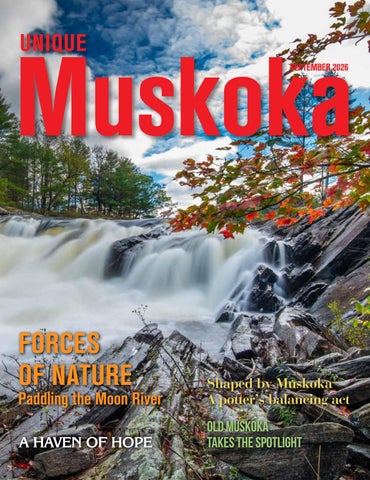
SEPTEMBER 2026
FORCES OF NATURE
Paddling the Moon River
Shaped by Muskoka A potter’s balancing act
A HAVEN OF HOPE
Old muskoka takes the spotlight
brownsappliances.com (705) 765-5700 108 Maple Street, Port Carling, ON
AND YOU THOUGHT THE MARKET WAS SOFT SOLD
SOLD
SOLD
SOLD
SOLD
SOLD
SOLD
SOLD
SOLD
SOLD
SOLD
SOLD
With 20 years of Muskoka Real Estate experience and a lifetime on the water, I leverage a global network and standout marketing. Your best interest is my bottom line.
CHELSEY@CAYMANMARSHALL.COM
705.205.2726
WWW.CHELSEYPENRICE.CA
...telling the Muskoka story
Features
22
12
Article by J. Patrick Boyer
Rooted in Faith — St. John’s, Beaumaris
Take a Hike — Hunters Bay Trail Article and Photography by John Challis For the last 26 years, Huntsville has nurtured a gem of public waterfront. The Hunters Bay Trail is a pleasant, accessible path from downtown commotion into peace.
[22]
In 1892, at Lake Muskoka’s prospering Beaumaris, the doors of the new Anglican church opened for its inaugural service. In the small yet famed community where Americans vacationed through July and August, affluent cottagers gathered at their place of worship named for St. John.
[28] [12]
18
Muskoka’s On-Screen Moment Article by Meghan Taylor While not a new relationship with cameras, Muskoka’s most recent forays into film with Sterling Point, Heated Rivalry and My Old Ass highlight for the world what those familiar with the region already know – Muskoka gives main character energy.
28
Harnessing the Falls – Gary Long Article by Meghan Taylor Growing up in Bracebridge, where rushing water and a hydroelectric station were part of the town’s everyday geography, Gary Long began to see Muskoka’s rivers not only as landmarks, but as working forces. Over 50 years of research have led to his recent book: Water Power: Relying on Muskoka’s Rivers to Generate Electricity, 1886-1956.
[32]
32
Earth, Wind, Water and Heart Article by Bronwyn Boyer Photography by Josianne Masseau A potter by trade and an artist at heart, Jessica Brabant’s journey to becoming a full-time artisan exemplifies dedication, resilience, and a deep connection to nature.
2 UNIQUE MUSKOKA September 2026
September 2026 UNIQUE MUSKOKA 3
LOWER OVERHEAD FOR US MEANS
LOWER PRICES FOR YOU
WE HAVE MOVED! VISIT OUR NEW WAREHOUSE SHOWROOM AT:
61 Keith Road, Bracebridge
Come check out our new Warehouse Showroom Pricing! Store hours 9-5, Wednesday through to Saturday Browse our extensive website at muskokafurniture.net • Call anytime 705-645-8183
4 UNIQUE MUSKOKA September 2026
38
Where Wild Lives Get a Second Chance
SEPTEMBER 2026
Article and Photography by Andy Zeltkalns From humble beginnings in the 1970s, Aspen Valley Wildlife Sanctuary, located near Rosseau, has earned global recognition for rehabilitating injured and orphaned native wildlife.
44
FORCES OF NATURE
[38]
With a Paddle — Moon River Article and Photography by Andy Zeltkalns
The Moon River, which begins its journey in Bala at the west end of Lake Muskoka, is an important connection to Georgian Bay. Eventually, 90 per cent of the Muskoka watershed passes through Lake Muskoka, where it is collectively funnelled into Georgian Bay by way of the Moon and Musquash Rivers.
Paddling the Moon River
Shaped by Muskoka A potter’s balancing act
A HAVEN OF HOPE
Old muskoka takes the spotlight
Our Cover
48
Photograph by Andy Zeltkalns
Indentured British Children Emerge as Unique Muskokans
The Moon River gives paddlers a fulfilling experience with its varied and dramatic scenery culminating with the Moon Falls, a spectacle to behold when water levels are high.
Article by J. Patrick Boyer Hundreds of Muskoka families and thousands more across Canada solemnly mark British Home Child Day on September 28. Muskoka received one of the country’s highest concentrations of impoverished youngsters from Britain during the region’s settlement era.
Departments 58
54 What’s Happening
Cottage Country Cuisine
Article by Matt Driscoll
Article by K.M. Wehrstein Photography by Brittany Clark
The Lake of Bays Heritage Foundation has permanently protected a 107-acre property and South Muskoka Hospital Foundation has received the largest donation in its history. R.M.S Segwun receives international recognition, ‘Outside Looking In’ brings Mendelson Joe’s art to the Eclipse Gallery and Prime Video’s Sterling Point brings mystery and drama to Muskoka. Fall fairs and the Muskoka Marathon return to the region, Huntsville Festival of the Arts fall and winter lineup brings variety and Witches and Warlocks Paddle event raises funds for cancer care. Muskoka Algonquin Healthcare is partnering with York University’s new School of Medicine, Theatre Muskoka to host their inaugural fundraising gala and Holocaust survivor and educator Eva Olsson dies at age 101.
Opinion
[58]
9
64
By Meghan Taylor
By Margie Woodgate
Muskoka Insights
Italian cooking is about simplicity, family and exceptional flavours. Chefs from across Muskoka share their savoury, sweet and simply delicious favourites for you to enjoy. Buon appetito!
Muskoka Moments
11
From an Artist’s Perspective By Lori Knowles
September 2026 UNIQUE MUSKOKA 5
• Specializing in Sourdough • Fine Artisan Breads Daily • Assorted Baked Goods • Made in House Desserts
…telling the Muskoka story Unique Muskoka is published six times per year by Unique Publishing Inc. Meghan Taylor Publisher/Editor Donna Ansley Sales Lisa Brazier Marianne Dawson Design
BIG RIVER BAKING COMPANY
705-394-4499 info@bigriverbakingco.com
FOLLOW US ON INSTAGRAM @bigriverbakingco for updates, daily bread lists and our weekly cheesecake special!
OPEN YEAR ROUND — TUESDAY TO SATURDAY 11A TAYLOR ROAD, BRACEBRIDGE
The Kia EV4
Susan Smith Administration Bronwyn Boyer J. Patrick Boyer John Challis Brittany Clark Matt Driscoll Lori Knowles Josianne Masseau K.M. Wehrstein Margie Woodgate Andy Zeltkalns Contributors Annual Subscription Rates: (including HST where applicable) In Ontario $30.00 All Other Provinces $36.00 HST: 773172721 Canada Post Publications Mail Agreement Number: 43268016 Copyright © 2026 Unique Publishing Inc. No content published in Unique Muskoka can be reproduced without the written permission of the publisher.
MUSKOKA KIA
21 Robert Dollar Dr, Bracebridge, ON P1L 1P9
705-645-6575 muskokakia.ca
6 UNIQUE MUSKOKA September 2026
Mailing Address Box 616, Bracebridge ON P1L 1T9 www.uniquemuskoka.com info@uniquemuskoka.com 705-637-0204
WHERE THE PROS SHOP AND YOU CAN TOO!
COVERING MUSKOKA years! For 49Years! over 50 For Over
Contemplating re-roofing, renovating or building new?
Trust the experienced professionals at Norstar who will recommend the right roof to help protect your investment. Choose from a variety of materials to suit all tastes and budgets, call today and deal with Muskoka’s Roofing Experts. Proudly sheltering Muskoka from the elements for more than 49 years!
IT’S ROOFING MONTH AT NORSTAR - VISIT OUR NEWLY RENOVATED SHOWROOM TODAY!
SHINGLE
RECYCLED RUBBER
POLYMER SHAKE
STANDING SEAM
STEEL
TRUE NATURE
Siding • Roofing • Soffit • Fascia • Decking • Eavestrough • Gutter Protection SERVING MUSKOKA, PARRY SOUND & HALIBURTON REGIONS SINCE 1976 Embrace Your Exterior! Supply • Install • Cash & Carry 800.732.0158 • 705.645.8404 • www.norstarexteriors.com September 2026 UNIQUE MUSKOKA 7
FURNISHINGS AND DESIGN SERVICES
Muskoka’s Most Beautiful Store Step into our breathtaking 35,000 sq ft showroom, featuring curated bedroom, living, dining, office, and outdoor furniture, plus an expanded rug area. Work with our designer Laura to create your perfect home, explore fine Canadian furnishings, and shop our in-store Veranda Outlet. With ample parking, and easy access, we can’t wait to welcome you!
OW N E R & O P E R AT O R
FURNISHINGS • DESIGN SERVICES RUGS • ART • LIGHTING OUTDOOR LIVING
505 HWY 118 WEST, BRACEBRIDGE • 705 645 6451 • VERANDACOLLECTION.CA
8 UNIQUE MUSKOKA September 2026
Muskoka Insights of 1892. More than a century later, families with cottages in the area continue to return to the quaint summer church, generation after generation. Regular contributor Bronwyn Boyer introduces us to artisan Jessica Brabant, whose work is inspired by the intersection of creativity and place. In her serene studio sanctuary, Brabant creates functional pieces with intention, drawing on nature’s palette to evoke calm, beauty, and connection. Aspen Valley Wildlife Sanctuary has long been held in high esteem for its work rehabilitating injured and orphaned native wildlife. As contributor Andy Zeltkalns shows, hope, gratitude, and perseverance are embedded in the organization’s values. From its humble beginnings as a backyard rescue to its current status as one of only three Global Federation of Animal Sanctuaries (GFAS)-accredited facilities in Canada, Aspen Valley continues to dream boldly about the future. There is, admittedly, something wonderfully chic about gratitude – not because it is trendy, but because it is timeless. In a culture that so often pushes us toward the next thing, gratitude asks us to pause with what is already here. It reminds us that life does not become meaningful only when it is new, curated, or widely admired. Sometimes, its richness is found in what is familiar. As September begins, perhaps the invitation is simple: carry a little of summer’s spaciousness into the structure ahead. Notice what endured after the fleeting parts faded. Let the season remind us that the things worth keeping are rarely the loudest. They are the ones that stay with us. Happy reading! Photograph: MacKenzie Taylor
Trends come and go. The words we repeat, the clothes we reach for, the places everyone suddenly wants to be – all can feel essential in the moment, then dated almost as quickly. But every so often, something rises above the noise. It becomes enduring, classic, even timeless. So, what makes that happen? Perhaps timelessness has less to do with popularity than with meaning. A trend asks us to notice it. A classic invites us to return to it. The distinction is subtle but familiar: one chases attention, while the other earns affection over time. September is a fitting month to consider that distinction. In Muskoka, the pace shifts almost overnight. Cottage days give way to workdays. School buses return to the roads. Calendars begin to fill. The long, loose rhythm of summer narrows into structure and routine, yet there is something comforting about that return. After a season spent near the water, on trails, in town, and among the small rituals that make Muskoka feel unmistakably itself, September offers a chance to look back with gratitude. Not the performative kind, but the quieter kind: gratitude for the places that ground us, the people who gather there, and the memories that linger long after the season changes. Maybe that is what makes something timeless. It is not simply that it lasts, but that it continues to matter. It becomes part of how we measure our days, mark our seasons, and understand what we value. A beloved view, a family tradition, a community gathering, a familiar road home – these do not need to announce themselves as fashionable. Their worth is proven by how naturally we keep coming back. Muskoka itself is one such beloved, timeless classic. In this issue, we explore the region’s range and richness – from nature and conservation to the origins of local buildings and organizations, from challenging historical scenarios to peaceful hiking expeditions. As Patrick Boyer shares, the Beaumaris community opened the doors to its new church, St. John’s, during the prosperous summer season
Inspired byNature w w w. b r a c k e n r i g . c o m 705-765-5565 info@brackenrig.com
September 2026 UNIQUE MUSKOKA 9
©Bredin Brothers Inc.
Taking the complexity out of hiring the right company. MUSKOKA BUILDERS’ ASSOCIATION IS THE PLACE TO START.
Enjoy Peace of Mind in Muskoka Our mission is to continuously support our members by providing timely education, training, and information tailored to their needs. We promote a collaborative culture rooted in strong business ethics, enhancing the effectiveness and success of the building industry in Muskoka. By fostering teamwork and shared values, we ensure our members are part of a community dedicated to excellence and ethical practices. Our members bring knowledge, experience, and peace of mind to your project, with deep familiarity of the local area and its unique
10 UNIQUE MUSKOKA September 2026
building challenges. All our members, from suppliers through to trades, have a strong working relationship. They are wellequipped to handle lake and island projects, and offer ongoing support and warranty services. We simplify the process of choosing a contractor with an easy-to-use directory on our website.
(705) 645 3008 • MUSKOKABUILDERS.COM
From an Artist’s Perspective
Autumn’s Artful Bounty
Patrick McQuillen behind the counter at The Farm Store Muskoka.
Zeltkalns
in Muskoka. It’s part of what brought Patrick McQuillen and Tim Taylor back to Bracebridge. The owners of The Farm Store Muskoka landed here after foodie stints in B.C. and New Brunswick. First came scenes from an Italian restaurant – not Billy Joel’s but Vancouver’s – where the pair first met and were schooled in fine food and wine.
Photograph: Andy
I make the same commitment at the start of every summer. Like a New Year’s resolution, I resolve to slow down, shop local, eat better. Fresh strawberries from Taylor Farms. Homemade pies from a farmers market. Rhubarb, leeks, beets and blueberries plucked from a local’s garden. Honey from Muskoka bees. Corn picked that morning, bought from a rickety stand next to Highway 11. Sounds scrumptious, doesn’t it? And yet, much like my failed New Year’s resolutions to put away my phone or trim down 10 pounds, I struggle to follow through. By August I’m steering back into drive-thrus, waving my credit card at the window like a hungry lunatic, busting to pry open my clam-shelled fast food so I can consume it, damn it, and get on with my workday – all while wondering where summer has sped off to. And yet. And yet. This summer has been a little different. At the recommendation of a friend, I popped into The Farm Store Muskoka on Manitoba St. in Bracebridge, a little shop tucked between a jewelry boutique and an alleyway. The atmosphere was calming. A duo of old friends sat sipping tea at a tiny table by the window. A counter laden with scones and cupcakes caught my eye. And a wall of sundries captured my hungry interest: sauces, pasta, rice, mini jars of mustard, big boxes of cheese sticks. “Where am I?” went the thought in my head. “Knightsbridge? Covent Garden? Rue Cler in Paris?” No, silly. This is Muskoka. Artful food isn’t a new thing – not in Paris, London, or even Muskoka. But it feels like our little corner of cottage country is getting better at making an effort. In the past few years, we’ve seen butcher shops, artisanal bread bakeries, tea mongers, even chocolatiers swing open their doors and invite us to try something tasty and new. The word is out: There’s loads of good stuff to eat
Photograph: Lori Knowles
Article by Lori Knowles Next came a café at Broadway and Cambie called Taste of Thyme where they promoted healthy eating. Then, while on vacation by the beach in New Brunswick, they spotted an inn for sale in Shediac and within a day were hoteliers/restaurant owners – sounds like Lorelai and Sookie in Gilmore Girls, doesn’t it? Family commitments brought them back to Bracebridge and to The Farm Store, purchased a few years ago. Taylor looks after the front end, ordering supplies and greeting customers. His WSET Level 3 Award in Wines gives him gravitas when recommending Ontario vintages on his shelves, and McQuillen’s Red Seal certificate in cooking keeps him backstage in the kitchen, whipping up those yummies behind the display window that look so inviting and delicious. “Bracebridge has evolved big time,” say the partners, explaining why they chose to put up their shingle on Manitoba St. “The food scene is picking up, there’s a nice farmers market, and different festivals are wonderful at bringing people. Once the bridge reopens and the Northlander starts back up (take note, local politicians) the energy in the town will be amazing.” What’s also amazing? The effect artful food has on my dicey summer resolutions. I haven’t kicked the drive-thru habit… yet, but the orzo and olive oils and crusty baguettes in stores on Muskoka streets make me hopeful. “Food is about feasting with your eyes,” say Taylor and McQuillen. “Every plate is like a canvas.” Lori Knowles is a journalist and author of Summers with Miss Elizabeth, a Muskoka novel. The second book in the series, Summers with Gin, is coming soon. In this column, Lori explores what it’s like to live and work as an artist in Muskoka. www.loriknowles.com @loriknowles_author
September 2026 UNIQUE MUSKOKA 11
Completed in 2017, an 840-metre trail extension at Hunters Bay includes a floating boardwalk and passage beneath Highway 11.
Article and Photography by John Challis
M
uskoka’s urban cores are blessed with ample waterfront, but most of it is in private hands. When towns create publicly accessible parkland, the result can invigorate the downtown, creating a recreational draw for visitors and residents alike. For the last 26 years, Huntsville has nurtured a gem of public waterfront. The Hunters Bay Trail, 4.6 km in length, starts in downtown commotion. The trailhead is directly beside the hum and throb of Infra Pipe, a polyethylene pipe manufacturer. Emergency vehicles scream on the busy Centre Street bridge above, just up the road from business and retail on Main Street. Freight trains rumble next door. But walk 50 metres, and the town’s urban hubris fades under an arch of Manitoba maple and alders. The trail continues around a brief stretch of the Muskoka
12 UNIQUE MUSKOKA September 2026
Hunters Bay Trail Length: 4.6 km Difficulty: Easy Suitable for: Walking, Running, Cycling, Swimming Operation: Year-round To get there: There are several parking areas to access this trail. The trailhead parking lot is off Centre Street about 450 metres north of Main Street. Avery Beach Park has a boat launch and ample parking at the end of Yonge Street. There is a small parking lot at Orchard Park, off Kitchen Road by Highway 11. The new extension has limited vehicle access on the west side of Highway 11 at the end of Lakeshore Road. It’s worth noting that the Town of Huntsville is in the final stages of creating a new Parks and Trails Master Plan. Visit myhuntsville.ca, the Town’s community engagement site, if you want to see the town’s trails initiatives preserved and expanded.
Paved for most of its length, Hunters Bay Trail offers an easy route with only a few minor elevation changes.
September 2026 UNIQUE MUSKOKA 13
Hunters Bay Trail’s iconic boardwalk winds hundreds of metres across the bay, offering a unique waterside experience. River until Hunters Bay unfolds into summer cottage idyl. Motorboats toss up wakes; young teens bask on docks; fishing rods are cast out from shore towards imagined lunkers. The trail is paved along most of its length. It’s level, with a few minor climbs at a railway trestle and access points. Where topography allows, grass has been trimmed and park benches are placed. A picnic pavilion at Avery Beach marks the halfway point, including a new pollinator garden and exercise station. Along the way, old pier posts jut in rows out of the water, recalling the waterfront’s industrial past. The trail’s signature feature is the boardwalk. Not just something that crosses a stream, it runs hundreds of metres over the water, heading along the western end of the bay toward Highway 11. This is an immensely popular trail. On a Monday morning, joggers, seniors, people
14 UNIQUE MUSKOKA September 2026
walking their dogs, people on mobility devices, and bicycles were regularly encountered along the trail. Many shared comments about how thankful they are that the town keeps the trail in good condition. Town hall couldn’t accomplish this trail on its own. But in 2000, Canada’s most ambitious Millennium project was the Trans Canada Trail, and like many municipalities, Huntsville was eager to see a leg of the trail in town. Multiple partnerships made it a reality. The town’s Rotary Club had already built the pavilion at Avery Beach. The late Don McCormick and former councillor Steve Alcock, both avid trail advocates, took on the effort to make the trail a reality, and by July 1, 2000, it was complete. Signage at the pavilion reveals the many corporate
contributors, some of which donated the raw materials for the trail. Hundreds of other private donors are also listed. One remarkable addition to the trail was completed in 2017: an 840-metre extension, much of it on floating boardwalk, crossing under Highway 11. It links Hunters Bay to the Trans Canada Trail through central and south Muskoka. From the outset, the proposal to cross a provincial highway right-of-way met with a bureaucratic brick wall. In a news article in 2017, Steve Alcock described “butting heads with MTO.” Don McCormick called it a 17-year process of changing the culture within the Ministry of Transportation. The town’s commitment to the trail hasn’t
705 765 7474 redcanoegallery.com 33 years in Muskoka
100% Canadian Artists / Bala, Muskoka
red canoe gallery
A new pollinator garden at Avery Beach adds colour and habitat for bees and butterflies along the trail, while the pavilion provides space for a picnic.
Embers On TheFall, Shield, MarkGarbett Janeck Muskoka Water 48”48”x48” x 48” Paul
September 2026 UNIQUE MUSKOKA 15
With gentle terrain and numerous rest stops, Hunters Bay Trail invites visitors to slow down and spend the day exploring. Dogs are welcome on leash.
cutline
Ongoing upgrades, from planned repaving to new benches and a pollinator garden, continue to enhance the Hunters Bay Trail experience. 16 UNIQUE MUSKOKA September 2026
When waterfront is opened to the public, it becomes a valuable community asset that enhances both recreation and downtown vitality. waned. Some spots along the trail are marked for repaving. The Rotary Club is behind recent upgrades, with a series of memorial benches and the pollinator garden last year. Dr. Adrian Musters was the lead on
those projects. What to bring: This is a casual, easy walk with plenty of places to stop. Pack a picnic basket, binoculars, and swimsuits and make a day of it. Pets must be kept on leash.
EXPERIENCE YOU CAN TRUST Experienced drilling & blasting for roads, ditches, foundations and septic systems. Exceptional service and top-quality results.
FREE ESTIMATES
People of all ages and abilities make regular use of Hunters Bay Trail, reflecting its value as an accessible and well-maintained recreational space. September 2026 UNIQUE MUSKOKA 17
Article by Meghan Taylor
Muskoka’s appeal is not only visual, but emotional. It is a place viewers can recognize as both escape and belonging.
Murphy, chief executive officer of Explorer’s Edge (RTO 12). “It’s not the first time and it won’t be the last.’’ Productions come for the obvious assets – clear water, granite shoreline, lake life, island cottages, roads that disappear into forest – but what survives the edit is something harder to manufacture: a regional confidence, a manner of living that is aspirational without feeling anonymous. This summer’s hit, Sterling Point, a Prime Video teen drama by Megan Park, draws on the waterfronts, islands, camps and cottage roads of the Muskoka Lakes region to create a fictional town that still feels recognizably
local. In a recent issue of Toronto Life, one of the stars of Sterling Point, Jacob WhiteduckLavoie, says, “I feel like Muskoka is actually the main character of the show.” Hayu’s Summer House Canada, a reality TV show, leans into the same social geography, placing weekend rituals against docks, decks and big-sky sunsets. The season is currently filming in Muskoka and is due for release in 2027. Runaway hit Heated Rivalry brings its cottage storyline to a real Muskoka property, while Megan Park’s My Old Ass tapped into the area’s particular summer texture: warm, fleeting, and always edged by the knowledge
Photograph: Muskoka Tourism
M
uskoka has always understood the power of a good entrance. Morning arrives in silver bands across the lakes; by midday, old boats throw flashes of varnished light; by evening, the pines hold the last rays of the sunset. On screen, that landscape does not simply behave as scenery. It announces a world – rooted, a little rugged, privately glamorous, and unmistakably Canadian. That may explain why Muskoka’s recent run of film and television attention feels less like a discovery than a correction. “It’s an ebb and flow, something that pops it’s head up every so often,” says James
Photograph: Muskoka Tourism
that the season will not last. Muskoka’s relationship with the camera is not new. The Long Kiss Goodnight filmed at Windermere House in late February 1996, shortly before the historic resort burned down on February 26, 1996. The property was rebuilt, but the association remains part of the region’s film folklore. “There’s been the Martin Short, Goldie Hawn, Kurt Russell-era,” says Murphy. “That essence of what’s being portrayed changes a bit with the generation but there’s this nostalgia. It’s great for Muskoka to have our moment.” Murdoch Mysteries has also drawn on the region’s period-ready heritage, using the historic Wenonah II steamship at the Gravenhurst wharf to lend a turn-of-thecentury authenticity that Muskoka can still provide without a studio backlot. It is a useful reminder that locations here are rarely neutral. They arrive with memory, reputation and weather built in. Long before this latest rush of cottagecountry prestige, Paradise Falls understood Muskoka’s dramatic potential in a different register. The early-2000s Canadian series set scandal, mystery and small-town intrigue against local cottage landscapes, using the region’s idyllic surface as a counterpoint to everything unsettled beneath it. That tension remains one of Muskoka’s most useful qualities on screen: beauty here can soothe, seduce or conceal. Muskoka resists being reduced to one postcard view. Its glamour is practical and timeless. It lives in the thump of a boat against a dock, the slap of water under a boathouse, coffee overlooking the water, the hush of pine needles underfoot, and the choreography of people arriving by boat as naturally as others arrive by car. It is the culture of the boat slip, the cottage porch, the farmers market, the lake association notice board, the water-access errand, the longrunning regatta, and the unspoken etiquette of slowing down near shore. Even lifestyle television has recognized the point: Restaurants on the Edge brought its makeover lens to the area, using local flavour, winter realities and waterfront hospitality to show that the view alone is never the whole story. For filmmakers, those details create instant atmosphere. For viewers, they make
Muskoka’s waterways offer more than scenic beauty, reflecting a way of life that feels both aspirational and deeply rooted in place. the fantasy legible. “Muskoka is that tonic for slowing down, for seeing the stars, for becoming grounded,” Murphy explains. “It’s great to have new generations experience Muskoka.” At a quick glance, many places in Muskoka can look the same – Canadian Shield rock, pine trees mixed with maples, oaks and other softer woods, lakes and rivers. To the unfamiliar eye, the landscape looks similar. But for those familiar with the place, seeing specific locations on screen is a thrill. “As a Muskokan you couldn’t be more proud to see your hometown on a TV show,” says Murphy. In Sterling Point, the title island is set at Mortimer’s Marina. However, the marina is not simply a pretty piece of waterfront; it is infrastructure, culture and character in one frame. Docks, fuel pumps, boats and floatplanes ground the drama in the working reality of lake life, where convenience stores, launch ramps, dockhands and boat mechanics are as essential to the season as sunsets. The series also reaches just beyond Muskoka to Sparrow Lake Camp near Severn Bridge, an overnight camp dating back to 1912, which provides the setting for the show’s summer camp scenes. That choice adds another familiar note to the show’s Ontario summer vocabulary: the cabins, campfire songs, canoe paddles, dining hall noise and camp traditions that many local viewers recognize from childhoods spent across northern Ontario, including Muskoka. In Heated Rivalry, the cottage can stand in
for somewhere else while remaining recognizably itself. The location is the real-world, privately owned Barlochan Cottage on Walkers Point along the west shore of Lake Muskoka. While in the show the cottage is not based in Muskoka, the series’ cottage scenes give the texture and experience of an actual shoreline rather than a constructed idea of one. Muskoka’s screen appeal depends on that double vision: it can serve the fiction without surrendering its own identity. Its specialty, ultimately, is contrast. Muskoka is polished and untamed, social and solitary, luxurious and elemental. A cottage may be grand, but the lake still sets the terms. A marina may be busy, but a quiet channel is never far away. The same community can hold century cottages and new builds, antique boats and wake
September 2026 UNIQUE MUSKOKA 19
Photograph: Muskoka Tourism
Muskoka’s character is found in moments experienced, where life on the water remains as timeless as the landscape itself. Captured by photograph and film, Muskoka’s distinct spirit captivates the viewer.
20 UNIQUE MUSKOKA September 2026
shots of Muskoka. Thank you for showing so much love for ‘old Muskoka’.” There is pleasure, certainly, in hearing Muskoka mentioned on a larger stage. Locals and summer regulars know the small current of recognition that comes when a familiar shoreline, resort name, marina, wharf, general store or bend in the road appears in a production or press tour. They also know the deeper references that rarely make the
Photograph: Muskoka Tourism
boats, golf shirts and work boots, dock dinners and hardware store errands, summer crowds and winter silence. That tension gives the region emotional range. It can carry a sunlit coming-of-age scene, a tense family secret, a glamorous weekend arrival or a solitary figure on a dock at dusk, because all of those moods already exist here. On a recent episode of The Tonight Show with Jimmy Fallon, Sterling Point star Ella Rubin said, “Right now I’m team Muskoka and team Annie. I’m team what’s best for Annie and I think Muskoka is best for Annie.” Host Jimmy Fallon added that Muskoka “is the most beautiful place on earth.” The exchange was playful, but it captures something real: Muskoka’s appeal is not only visual, but emotional. It is a place viewers can recognize as both escape and belonging. “Megan Park, thank you, thank you, thank you,” shares Val Hamilton, executive director of Muskoka Tourism, whose affection for the attention is personal as well as professional. “Thank you for reminding everyone that Toronto is only a 45-minute flight from New York City. Thank you for the endless aerial
Muskoka’s enduring appeal predates the camera, with film and television simply bringing a wider audience to a place long valued by those who know it.
headline: the first jump from the dock, the smell of cedar and sunscreen, the seasonal return of familiar boats, the ice-out conversations, the July traffic, the cottage country handshake between privacy and neighbourliness. But the more interesting point is that Muskoka’s cultural value has never depended on being discovered. The screen merely amplifies what the place has been saying for generations. “It’s been incredible to see Muskoka having such a moment on screen,” shares Hamilton. “We’re seeing an increase in international visitation to the Discover Muskoka website and social media channels, with our social media reaching 1.4 million people in the past 14 days alone. We’re incredibly grateful to Sterling Point for making Muskoka feel like a main character in the show and introducing the region to new audiences around the world.” Visibility, however, brings responsibility. Film and television can introduce new visitors to local businesses, lodges, marinas, restaurants and rental properties, but they can also add pressure to landscapes and communities already shaped by the
Photograph: Muskoka Tourism
SERVING MUSKOKA & PARRY SOUND FOR OVER 70 YEARS
The Gravenhurst wharf has lent its turn-of-the-century authenticity and charm to several projects, including Murdoch Mysteries, which also shot footage on Wenonah II. farmers markets, art studios, libraries, churches, service clubs, Indigenous histories, conservation groups, summer theatres and the small businesses that make cottage life possible. Film crews may arrive with cameras, but the atmosphere they capture is sustained by the people who have built lives around the lakes. That is what makes Muskoka more than photogenic. Its beauty is functional, cultural and deeply personal. It belongs to boat routes, family cottages, local trades, old resorts, new productions and the people who know that rugged beauty is not the same as infinite supply. If Muskoka is having an on-screen moment, the best thing the camera can do is not reinvent it but pay attention.
Photograph: Muskoka Tourism
contradictions of seasonal demand. The challenge is to welcome the spotlight without letting it flatten Muskoka into a generic idea of escape. “We’ve been through this before as a destination, we want to create sustainability and balance for continued economic development,” says Murphy. Muskoka’s screen presence is not merely a map of filming locations; it is a way of looking more closely at the handmade quality of a dock, the heritage of a resort, the role of a marina, and the seasonal rhythm of swimming, boating, hosting, working and waiting for weather to pass. It is also a reminder of the cultural ecosystem behind the postcard: outfitters, builders, marina crews,
Muskoka’s relationship with the camera is not new. The Long Kiss Goodnight filmed at Windermere House in late February 1996.
Sales & Service of Major Propane Appliances (refrigerators, ranges, fireplaces, furnaces & more) Safe & reliable No electricity required Bulk propane delivery to your home or cottage
705.645.4294 TF: 866.645.4294 STORE: 228 TAYLOR RD., BRACEBRIDGE OFFICE: 1646 WINHARA RD., GRAVENHURST
September 2026 UNIQUE MUSKOKA 21
Photograph: John Willmott Anderson / Patricia Ahlbrandt / Boston Mills Photograph: Patrick Boyer
Seen above after its 1892 original board-and-batten siding was replaced, St. John’s Anglican Church in Beaumaris crowns bedrock in the centre of the community. The passing roadway gets this main view of St. John’s.
Article by J. Patrick Boyer
T
he year 1892 surprised everybody connected with Muskoka – the railway company, steamboat operators, hotel owners, businesses, people in the trades, services, and residents. It was the district’s most prosperous tourist season yet. The lakes were more popular, the steamship
22 UNIQUE MUSKOKA September 2026
service greatly admired. At the epicentre was Lake Muskoka’s prospering Beaumaris, a small yet famed community where Americans vacationed July and August in splendid waterside estates. And that summer, the doors of their new Anglican church opened for its inaugural service, a place of worship named
for St. John – patron saint of writers, editors, publishers, and booksellers – the apostle himself the author of the New Testament’s fourth Gospel. By this date Muskoka property owners were mostly seasonal residents from cities escaping summer’s oppressive heat, ragweed,
Photograph: Elizabeth George Baker / Patricia Ahlbrandt / Boston Mills
and soot from coal-burning factories, and permanent residents living and working in the district year-round. Despite their differences and social incompatibility, the two communities resembled a married couple unable to live together but floundering if apart. Because their mutual dependence was foundational to most everything Muskokan, separate quarters became a prudent solution, which Beaumaris’ new Anglican Church intended to create. Just a decade earlier an Anglican church in Milford Bay – named for St. Mark, author of the second Gospel – began serving the neighbourhood. It was only two miles away, but socially as distant as the North Pole. St. Mark’s was what the vast Anglican Diocese of Algoma (running from Sault Ste. Marie to Muskoka’s Severn River boundary) termed a “missionary” church serving loggers, boatbuilders, farmers, and similar hinterlander stalwarts. Wealthy Americans seldom attended St. Mark’s. Creating this second church as a summer chapel was intrinsic to the vision of Beaumaris founders Edward Prowse and John Willmott – a haven for the rich to co-mingle while
Photograph: John Willmott Anderson / Patricia Ahlbrandt / Boston Mills
Weddings took place in St. John’s Anglican Church but photos posing the wedding party were easier to arrange on a cottage veranda’s steps, as for Eleanore Willard and William Dickson George’s 1903 marriage.
Edward Prowse grasped Tondern Island’s potential upon arrival in 1873 with his family and brother-in-law John Willmott. He built a wharf, named the place Beaumaris Landing, registered a subdivision plan with 18 cottage lots, and built the large and prestigious Beaumaris Hotel.
enjoying extended summer vacations, the way the brothers-in-law themselves had at Beaumaris in Anglesey, Wales. Their Tondern Island settlement began in 1873 when Prowse’s fleet of wooden sailing ships were being supplanted by iron-hulled steamships and Willmott was working for a British bank in Argentina, also wanting to do something new, when he read about Muskoka’s free land. In 1872, guided by A.P. Cockburn aboard his steamship, the bachelor assessed the territory, returning in 1873 with Prowse and his family, jointly buying Tondern from Maurice McCarthy for $1,560. The Willmotts took the island’s north half, built a log residence, laid out lots to sell others, cleared pastures, opened a general store, and had a bridge built to the mainland. Prowse, seeing Muskoka’s potential on arrival, built a large deep-water commercial pier and called the place Beaumaris Landing. When obtaining an all-important post office, Ottawa made him drop “Landing.” However named, Beaumaris was now a convenient safe stop for Muskoka steamships providing mail service, passenger transport, and freight. Without the wharf, Beaumaris was isolated; with it, the place thrived in Muskoka’s water-based
September 2026 UNIQUE MUSKOKA 23
Photograph: General Howe Venture / Patricia Ahlbrandt / Boston Mills
This 1944 aerial photograph captured the mature stage of Beaumaris. Looking south across Tondern Island, taking in wharf and marina, St. John’s rooftop is scarcely noticeable above trees in centre of the village. summer economy. Beaumaris’ development in the 1800s predated land travel by motor vehicle. Steam trains from the U.S. and southern Ontario to Muskoka’s waterside settlements, initially Gravenhurst, then also Bracebridge and Bala, with steamboats for the final leg of the journey. In the Steam Era, Edward Prowse’s wharf – Beaumaris Landing – led to Tondern Island’s development more than John Willmott’s bridge to the mainland. Summer vacationers owned boats, or hired
boat liveries, and built stately residences on numerous islands. “Millionaires Row” was intact prior to the motor vehicle age. By the Roaring Twenties, the problem of parking and the closeness of buildings – including St. John’s – only arose as people in number began getting around in motor vehicles. In addition to weekday busyness from the island’s service for boats, new settlers, and general store, Beaumaris with its Anglican church now also became hub of “the Sunday Fleet.” Whether public transport steamers
or luxurious private vessels, all docked at the spacious wharf, disembarking passengers who strolled pleasantly up to St. John’s. In 1883, Edward Prowse opened the Beaumaris Hotel, a posh three-storey resort catering to wealthy families, notably from major cities in northern American states. Guests arrived with servants, heavily laden steamer trunks, even livestock – as did many Muskoka cottagers in this era, coming for the entire summer, wanting fresh milk and eggs daily – settling in to benefit from Muskoka’s
Muskoka's Largest Home Service Company!
No job is too big or too small! www.GBScontracting.com 705.687.9143 1082 Beaumont Farm Rd., Bracebridge
24 UNIQUE MUSKOKA September 2026
Photograph: Jack Buwalda / Patricia Ahlbrandt / Boston Mills
restorative qualities, water sports, and fresh clean air. Repeaters among the hotel’s summer clientele, increasingly sold on Muskoka and urged by friends and family, began buying islands or mainland lots to build palatial summer homes for greater security and more privacy. In the bargain, their extensive offshore estates with large boathouses, magnificent gardens, and winding stone pathways added classy elegance to Muskoka’s scenic ruggedness. In this way, Edward’s luxurious woodframe hotel not only laid solid foundations for Millionaires Row but made Beaumaris and its environs an upscale go-to summer spa. St. John’s Church, as the seasonal sanctuary initiated when Prowse and Willmott donating the land, paid for fully by the millionaires, and granted special status by the Anglican bishopric, was intrinsic to this scene of privilege. The 1892 church was no more typical of Muskoka’s other summer churches organized by cottagers than plutocratic Beaumaris resembled the district’s other small villages.
The public wharf that Edward Prowse built in the mid-1870s is seen being replaced in 1912 by a government dock, cost to the Government of Canada with responsibility for navigable waters. The steamship behind the crane is the Islander. With wealthy seasonal vacationers guarding their privacy, St. John’s enabled American industrialists, business tycoons, and bankers, with their families and guests, to share religious rituals with social peers, segregated from local farmers, loggers, tradesmen, and other working-class Muskokans over at St. Mark’s. Same denomination, different places on the social hierarchy. With its pitched roof, lancet windows, and board-and-batten siding, St. John’s mirrored Beaumaris’ lakeside woodland
aesthetic while incorporating some traditional Anglican motifs. The interior’s exposed wood posts and beams with unpainted timber created a calming space, evoking a “pious wilderness” effect – high church tradition embracing frontier rusticity. Nestling like the millionaires’ estates themselves among mature pines and exposed rock, St. John’s stood secure upon its ancient bedrock, too. St. John’s was built on land donated by Prowse and Willmott, with Beaumaris’s wealthy summer residents entirely funding
HARDWOOD | LAMINATE | VINYL PLANK & TILE | CARPET CERAMIC | NATURAL STONE …AND MORE!
MODERN HOME CARPET ONE
350 Ecclestone Drive • Bracebridge
705.645.2443 carpetonebracebridge.ca
TAYLOR CARPET ONE
30 Cairns Crescent • Huntsville
705.789.9259
taylorcarpetonehuntsville.com
September 2026 UNIQUE MUSKOKA 25
Photograph: John Willmott Anderson / Patricia Ahlbrandt / Boston Mills
The general store opened by the Willmotts, seen here in 1904, drew people like a magnet for its offerings and served as a rendezvous for people arriving in Beaumaris by boat or automobile. immense seasonal wealth by designating St. John’s a specialized seasonal summer church, rather than a standard year-round parish. Such ecclesiastical compliance in granting special status to the high-and-mighty was what Prowse, Willmott, and American tycoons expected. But in return, structures were put in place concerning large donations and movement of funds. To prevent St. John’s from functioning as an isolated financial island, subsequent bishops, most notably the administrative reformer Bishop George Thorneloe, integrated the church into a broader regional framework that combined St. John’s, Beaumaris with neighbouring, less wealthy year-round congregations, including St. Mark’s, Milford Bay so that administrative overhead, banking, and governance costs were shared. As a
result, the substantial collections generated each Sunday by the millionaires during the short summer thus indirectly stabilized and subsidized the wider, poorer rural missions through the winter months. By binding the summer wealth of Beaumaris into centralized diocesan trusts and regional parish structures, the Anglican Bishops successfully converted a temporary summer windfall into long-term financial stability for the broader, working-class communities of Muskoka. The Willmott and Prowse families who brought Beaumaris into existence enjoyed high standards of life and prosperous endeavours before settling in Muskoka in 1873 and developed the summer community for wealthy Americans. Being cut from similar cloth is what produced their vision of what their Beaumaris could be, from their prior enjoyment of the upscale resort community Beaumaris in Wales. Developing understanding of each other’s interests and needs and working together fostered mutual respect and friendships through generations, typified expressly in St. John’s congregation. The services in July and August are peopled by generations matured into a common body of Christian worshippers who thrive on the Muskoka life offered in their distinctive Muskoka principality. With music central to worship, those providing it are pivotal to a church. A memorial plaque to St. John’s organist for 60 years, Myra Eleanor Freemantle, of Pittsburgh, Pennsylvania, is mounted on the wall immediately behind St. John’s organ. It
Photograph: Eliza & Hugh W. Niven, Jr. / Patricia Ahlbrandt / Boston Mills
its construction. St. John’s congregation of summer worshippers wielded massive financial resources, giving it uncommon advantage over all other churches in the diocese. In concert with Willmott, Prowse and the diocese hierarchy, wealthy families heavily supporting their church financially also funded church expansions, expensive memorial windows, and flow of money to poorer year-round missionary parishes. Whenever a bishop for Algoma was named, his instructions were to tend to the flock and raise money. Between 1882 and 1896 Bishop Edward Sullivan, then his successor Bishop George Thorneloe from 1896 to 1926, astutely addressed the money matter with Prowse, Willmott, and summer parishioners. Every summer the bishop of Algoma arrived to deliver a sermon to St. John’s upscale parishioners on how to burnish their hallows by giving money. Bishops Sullivan and Thorneloe in the church’s formative decades masterfully framed Beaumaris sermons which transformed giving into a spiritual privilege for the wealthy, and characterizing wealth as a sacred stewardship rather than merely personal fortune. By contrasting the comfortable life of the elite with the needs of missionaries, and framing donations as a heavenly investment, they turned charitable giving into a moral imperative. More was needed because the flow of funds, allocation of liabilities, and balance sheet business had to be structured for all the money and accountability. Bishop Edward Sullivan handled the potential influx of
“Parking has always been a problem at Beaumaris,” observed Patricia Walbridge Ahlbrandt in her deeply researched book about the community, when seeing this photograph taken near St. John’s when the age of the automobile arrived. 26 UNIQUE MUSKOKA September 2026
was donated by descendants of her family still active in the congregation today. Two years ago, St. John’s leapt into the forefront of church music with a new customdesigned organ with digital and pipe interface. The new organ was designed, built, and installed by Gary Schmidt of Kitchener, an organ specialist and church organist himself. His company creates unique church organs, each custom-designed for the church in which it will be housed taking into account space, acoustics, and musical qualities needed of the congregation. For St. John’s one-off advanced organ, the sets of pipes mounted on the church’s rear wall are incorporated with speakers that deliver fully balanced sound at the same volume throughout the church. Church organist John Dunbar, whose great-grandfather from southern Ontario camped on Gibralter Island near Beaumaris in the 1870s and became a property owner and member of the Sharon Fishing Club, still returns in summertime from his home in California, because of his deep connections with Muskoka and the Beaumaris community’s many generations. Summering at his long-held Lake Muskoka property, Dunbar’s mastery is displayed at the advanced Schmidt organ’s triple keyboards, foot pedals, stops and advanced instrumentation – as well as at many other churches throughout the parish where he is in high demand during the summer. A number of longstanding couples in St. John’s congregation now occupy their family’s wonderful summer residences on a timeshare, reflecting both the attachment families have to their Muskoka homes which passes down generations, and the need for the multiplying branches of family descendants to enjoy these prized properties on their own terms for a several splendid weeks each summer. Estate planning has led to a number of St. John’s families dividing annual July and August visits with as many as five timeshare arrangements. Neighbouring St. Mark’s in Milford Bay became the administrative anchor for all Anglican churches in Algoma Diocese’s Muskoka Lakes Parish, including St. John’s. The incumbent deacon for both churches, as well as others in the parish, is Rev. Cory Brunatti. Sunday morning worship at St. John’s during July and August begins at 9 a.m.
Don’t Miss
SPOOKTACULAR and Muskoka Christmas at Santa’s Village!
Check santasvillage.ca for details
Luxur M Luxury Motor otor Coaches Coac es C arter Bus Bus Services Services Charter Executive Vans Executive ans
Airport Transfers Transfers Airport
D D r ii v en en B B y Famil F a m i l y and and C C o mm m m u ni n i ty t y Since Since 1 1944 944
...telling the Muskoka story
www.uniquemuskoka.com
DAY TRIPS MULTI DAY TOURS INTERNATIONAL TOURS
TRAVEL More
WWW HAMMONDTOURS CA WWW.HAMMONDTOURS.CA . .
September 2026 UNIQUE MUSKOKA 27
Photograph: Town of Bracebridge
The first hydroelectric station at Bracebridge Falls was constructed in 1892 and purchased by the Town of Bracebridge in 1894. Later used as a water pumping station, it still stands today.
B
y the time most of us notice a waterfall, we have already turned it into scenery: a place to pause, a sound to remember, a photograph to take. Gary Long noticed something more. Growing up in Bracebridge, where rushing water and a hydroelectric station were part of the town’s everyday geography, he began to see Muskoka’s rivers not only as landmarks, but as working forces – shaping industry, settlement, technology and community life. “When I was old enough to be let loose on my bicycle to explore at will, I was soon visiting all the local waterfalls and peeking in the windows of the hydroelectric stations,” Long says. Born in Parry Sound, Long moved to Bracebridge in 1959, when he was three years old. His parents were outdoor enthusiasts – his father was a forest ranger – and they
28 UNIQUE MUSKOKA September 2026
began sharing their love of nature with him early. “At an early age I was introduced to hiking and canoeing and began learning from them a lot about the natural environment,” he says. “My dad took me on a walk down to Bracebridge Falls when I was about four or five, where the powerhouse operator gave us a tour of the hydro station. I was fascinated and still remember that vividly.” That childhood captivation gives the new book its emotional centre. Long is not writing about hydroelectricity as an abstract technology, but as a local story rooted in places he first encountered on foot, by bicycle, and from the banks of the Muskoka River. His lifelong passion has now become Water Power: Relying on Muskoka’s Rivers to Generate Electricity, 1886-1956, Long’s newest book and an ambitious act of regional research.
Photograph: Lorrie Szekat
Article by Meghan Taylor
Gary Long, here at High Falls, Oxtongue River, has spent much of his life chasing waterfalls. His passion has culminated in his new book Water Power: Relying on Muskoka’s Rivers to Generate Electricity, 1886-1956.
Water Power Relying on Muskoka’s Rivers to Generate Electricity 1886–1956
Viewed from the Muskoka Road bridge in 1872, the newly built Bird Woollen Mill stood above Bracebridge Falls, powered by the river and safeguarded with rooftop fire barrels. – Water Power gathers the pieces into a broad visual narrative. Long has made it available as a free PDF, formatted in two-page spreads best viewed on a desktop monitor. Writing about Muskok’s rivers began at school. Long recalls high school research essays he wrote on the Muskoka River and hydroelectric development in Bracebridge. He later graduated from the University of Waterloo and developed a specialty in rivers and their historical roles in the lumber industry and power development. “I majored in geography and earned a Bachelor of Environmental Studies,” Long
Gary Long’s newest book is an ambitious act of research – over 50 years’ worth, to be precise. says. “During summers and for a while after graduation I worked for the Ministry of Natural Resources. In my spare time I began accumulating material about the natural and cultural history of the Muskoka River, hiking, bicycling and canoeing the watershed and haunting libraries and archives. I was especially interested in the role the waterways played in the development of Muskoka.” His first step into writing more broadly on the subject came through local publisher Robert J. Boyer. In 1986, Boyer encouraged Long to write feature articles about the Muskoka River for the Muskoka Sun newspaper. “A version of these articles became the basis of my first book, This River the Muskoka,”
Wilson’s Falls around 1900, where tourists admired a dramatic river landscape shaped by twin cascades and an island between them, despite signs of the logging era.
Photograph: George Long
Photograph: Author’s collection
Nearly 50 years in the making, the 392-page illustrated eBook traces the early history of hydroelectric development in Muskoka, following the period when local rivers were transformed from natural corridors and working waterways into sources of electric power. The book is substantial in every sense: more than 400 photographs, along with over 80 maps, diagrams, and other illustrations, accompany Long’s detailed research. For readers accustomed to encountering Muskoka history in fragments – a plaque, a postcard, a family story, a surviving stone powerhouse
Photograph: Gary Long
Photograph: Archives of Ontario
G A RY LO NG
Wilson’s Falls in the 1950s, with second-growth white pine steadily reshaping the river landscape.
September 2026 UNIQUE MUSKOKA 29
Photograph: Gravenhurst Archives
The hydroelectric station at South Falls, constructed in 1907 by the town of Gravenhurst, was later purchased by Ontario Hydro and enlarged. “Since largely retiring from book production in the early 2020s, my full-time hobby has been researching the history of hydroelectric development in Canada,” Long says. His newest book extends that interest into the electrical age, when Muskoka’s waterways became part of a larger story about modernization, municipal service, and the promise of dependable power. The Muskoka River watershed covers roughly 5,100 square kilometres, rising near Algonquin Provincial Park and flowing southwest toward Georgian Bay. Hydroelectric generation has been part of the watershed since the late 1800s, and Bracebridge’s Bird’s Mill is remembered as the
Photograph: Author’s collection
explains Long. “By this point I’d gone full time into research and writing. Another parallel but related career path opened in 1997 when my wife and I established a small book design and publishing business, Fox Meadow Creations.” In addition to This River the Muskoka, Long’s books include Gilmour Tramway: A Lumber Baron’s Desperate Scheme and, with Randy Whiteman, When Giants Fall: The Gilmour Quest for Algonquin Pine. Across that work, a pattern emerges: Long is drawn to the relationship between landscape and labour, to rivers used to move timber, falls adapted to machinery and remote schemes built from ambition and necessity.
Port Sydney Falls, where water power supported Albert Sydney Smith’s mill complex and sparked early hydroelectric ambitions for Huntsville. 30 UNIQUE MUSKOKA September 2026
site of an early generating station built in 1892. Later facilities at High Falls, Wilson’s Falls, and Bracebridge Falls continued to link the river’s force with the region’s daily needs. That history is also national in its implications. In 1894, Bracebridge purchased a waterpower generating plant to supply electricity to the community, a milestone often cited as making the village a pioneer in municipal hydroelectric generation in Canada. Long’s book situates such moments within the texture of local experience: the people who planned, built, financed, maintained, and lived with the systems that turned falling water into light. “What I hope people gain from reading the book is that something we take for granted today – electricity – was once a commodity that communities needed to provide for themselves, and that harnessing local waterfalls was often the most practical and economical way to get it,” says Long. “The struggles to achieve this in the early days of electricity, before we had a provincial power grid, are something largely forgotten now, along with the fact that the small hydroelectric stations on Muskoka’s rivers were once the only source of power for the communities they served.” Water Power is designed for readers who
Photograph: Ontario Hydro
Muskoka Barging
South Falls in Bracebridge in spring 1985, showing the hydroelectric development and Highway 11 bridges that underscore the location’s historic importance as both a power-generating site and strategic crossing. want to look as well as read. Its hundreds of photographs and dozens of maps and diagrams make the book part narrative history, part visual archive. “One of the purposes of Water Power was simply to put together in one place everything I’d learned about the history of hydroelectricity in Muskoka for the benefit of researchers,” comments Long. For Muskoka readers, the appeal is immediate. The book promises to make familiar places newly legible: falls that were engineered, rivers that were regulated, mills and powerhouses that stood at the intersection of natural force and civic ambition. For visitors and seasonal residents, it offers a deeper way to understand the region beyond the language of lakeside leisure. Muskoka’s beauty, Long reminds us, has also been practical, productive, and intensely studied. Water Power: Relying on Muskoka’s Rivers to Generate Electricity, 1886-1956 is available free as a PDF, a fittingly generous ending to a book built from decades of patient research. To request a copy, email foxmeadowbooks@gmail.com; the file is sent by transfer service.
Family run construction company with over 35 years experience operating in the Muskoka Lakes area. No job is too small or too big.
705-764-0765 | muskokabarging.com | 1163 Milford Bay Rd, Milford Bay ON
BARGING ● STEEL & CRIB DOCKS ● SEPTIC SYSTEMS ● LANDSCAPING
...telling the Muskoka story
Missed an issue? Read our archives online
www.uniquemuskoka.com
September 2026 UNIQUE MUSKOKA 31
Article Bronwyn Boyer / Photography by Josianne Masseau
I
t takes all of Mother Nature’s elements to make pottery. The earth provides the clay, water makes it malleable for shaping and joining the pieces together, fire hardens them into finished products, and air dries the glazes. And craftspeople like Jessica Brabant bring other important elements to the process: heart and soul. Brabant has carved out a niche that marries her artistic spirit with the beauty that surrounds her. A potter by trade and an artist by heart, Brabant’s journey to becoming a full-time artisan exemplifies dedication, resilience, and a deep connection to nature.
32 UNIQUE MUSKOKA September 2026
Her story begins in the Renfrew County town of Deep River, Ontario. Growing up, her world was filled with creative influences. Her grandfather was a draftsman for Atomic Energy of Canada and a watercolour hobbyist who nurtured her early talents. “I always knew I wanted to be an artist,” Brabant recalls. Like many young dreamers, she explored various mediums until her curiosity led her to the welcoming embrace of the Deep River Potters Guild. “I’d walk past it every day, but I didn't know much about it,” she says. “My mom and I signed up together, and that’s where I got hooked.” That initial spark ignited a
lifelong passion that would eventually guide Brabant’s professional path. After high school, Brabant attended the Haliburton School of Art and Design. Her focus was on ceramics, but the program required her to diversify her skills. This led to the study of fibre art, which was an adventure given her initial unfamiliarity. “It was a bit out my comfort zone,” she admits. “I’d never even used a sewing machine before.” Yet, each new skill added another layer to her artistic identity. Brabant’s education laid a foundation, but her journey was far from linear. “I was studying ceramics, gardening, and exploring
Between growing her own food, keeping chickens, and her pottery enterprise, Jessica Brabant’s plate is full. She considers each aspect of her life a labour of love and balancing act.
September 2026 UNIQUE MUSKOKA 33
Jessica Brabant’s path to becoming a full-time artisan reflects dedication, resilience, and a deep connection to the natural world. different creative outlets,” she recalls. This period of experimentation was essential in shaping her current minimalist aesthetic. Her creative exploration eventually evolved into designing simple, functional pieces inspired by nature and the everyday moments of connection in her life. Brabant’s move to Muskoka in 2016 marked a new chapter. Recently married, she and her husband decided to start their new life in a new place. Their decision was bold, but they took a leap of faith and moved into a small apartment in Huntsville. Despite the challenges of a new environment, Brabant maintained her connection to pottery. “I set up a mini studio in the hall closet of our apartment,”
she remembers. “I’d make things there, and fire them in Deep River when I visited my family. It was a lot of driving.” But her dedication paid off, and when the young couple found their current home in Dwight, she set up her own studio, and the dream was realized. Brabant has officially been a full-time potter for three years, driven by a desire for more meaningful work. “I was working for a gardening company and as a florist before this,” she shares, “but it became too demanding, and I lost myself in it.” Working up to 80 hours a week, she found little time for her passions. The turning point came when she decided to prioritize her art in an act of courage and self-belief. Now Brabant embraces her craft with renewed purpose. Her studio is a sanctuary where she creates with intention, focusing on
Firing and glazing are the most unpredictable stages of the craft. Jessica Brabant fondly recalls her early struggles with brush-on glazes that required multiple coats and drying times. 34 UNIQUE MUSKOKA September 2026
Glaze mishaps, kiln malfunctions, and weatherrelated issues require adaptability and resilience. “You learn to be patient and go with the flow,” Jessica Brabant explains. functional pieces that evoke tranquility with the colours of nature’s palette. Brabant’s pieces are characterized by their neutral tones, minimalist designs, and a focus on everyday utility. “I want my pieces to bring people together,” she explains. “I think about gatherings at my family’s table, sharing meals and stories; all those moments are precious, and I want my work to reflect that.” Her work also reflects moments spent immersed in the wilderness. She gives her glazes names like ‘mist,’ because it resembles morning fog over water at dawn. Brabant’s creativity is fueled by her surroundings. “It was really important for me to reconnect with nature,” she says. “It’s been helping me rediscover who I am.” This is palpable from her designs, with
Each mug, Jessica Brabant’s current specialty, begins as a piece of clay cut to size, with the edges scored before being rolled around a pin to create its shape. Carefully sculpted handles are then attached, and the mugs are left to dry slowly to help prevent cracking. RIOBEL MOMENTI™ COLLECTION their earthy browns, soft greens, and mutedTHEtouch. Her typical day begins with Brabant has expanded her collection to AVAILABL E AT KNOWLES PLUMBING! blue, all mimicking the natural elements preparing clay slabs with a roller, then dinner sets and will continue to add more and feelings that resonate with her. cutting and shaping each piece meticulously. designs to her repertoire. Currently, mugs Brabant’s work is predominantly hand“I prefer hand building over wheel are her specialty. After cutting the clay to built from slabs, a deliberate choice that throwing,” she explains. “It’s slower, but it size, scoring the edges, and rolling them allows for more control and a personal gives me the accuracy I want.” around a pin to form the mugs, the handles
BAT H & KI TC H E N SH OW R O O M DESIGN. INSTALLATION. REPAIR S E RVING ALL OF MU SKOKA 279 MA N ITOBA ST, B R AC EBR ID G E
70 5 . 6 45.2 67 1
K NOWLESP LUMBI N G .COM @MUSKOKA BATH
Muskoka’s Bath & Plumbing Centre
BATH & KITCHEN SHOWROOM SALES • INSTALLATION • REPAIR SERVING ALL OF MUSKOKA
279 Manitoba Street, Bracebridge
705.645.2671 @knowlesplumbing knowlesplumbing.com September 2026 UNIQUE MUSKOKA 35
At her home studio, Jessica Brabant has expanded her collection to dinner sets and will continue to add more designs to her repertoire. Her use of dip glazes creates unique and spontaneous effects that add character to each piece.
Putting in full days of hard work in Jessica Brabant’s studio yields finished products in about two weeks. are sculpted and added with care. Then the pieces are left to dry slowly, which is a crucial step to prevent cracking. “You learn to be patient and go with the flow,” she explains, “and that’s part of the beauty of it.” She’s especially mindful of ergonomics, ensuring her mugs are not only beautiful but comfortable to hold. Her intention is to create mugs for the important ritual of relaxing with a favourite beverage, like getting a warm hug from an old friend. “If a mug is beautiful to look at but hurts your hand, what’s the point?” she laughs. “That’s when it becomes a pencil holder.” Firing and glazing are the most unpredictable stages of the craft. It’s quite literally a trial by fire. A batch can be ruined by both internal and external environmental conditions. And Brabant fondly recalls her early struggles with brush-on glazes that required multiple coats and drying times. Transitioning to dip glazes streamlined her process, creating unique and spontaneous effects with drips and runs that add character to each piece. Glaze mishaps, kiln malfunctions, and weather-related issues require adaptability
36 UNIQUE MUSKOKA September 2026
and resilience. The costs of equipment and raw materials are significant, which is why Brabant suggests joining a guild and sharing studio spaces for those starting out, as it’s a much more economical way to learn. Despite these challenges, Brabant finds gratification in her work. “Sharing my pottery with others and knowing it’s used every day is what makes my job special,” she reflects. She hopes her pieces will hold sentimental value as they become part of daily routines, offering comfort and a sense of connection. Putting in full days of hard work in the studio yields finished products in about two weeks. And as if all the challenges that go into making the pieces weren’t enough, there is also the marketing, pricing, and showcasing aspects as well, each with its own multitude of details to consider. Like most artists and craftspeople, self-promotion feels uncomfortable for Brabant. But as she participates in shows like the Muskoka North Studio Tour and the Muskoka Arts and Crafts summer show, she finds the enjoyment of connecting with her customers makes it easier. “It’s always nerve-wracking in a way, but in the end, it’s rewarding,” she shares. “Talking to people about my work is a way of sharing my story.” It also provides a good balance to the time spent creating in solitude. “Even though I’m an introvert, it’s nice to have the chance to talk to people after spending so much time feeling like a
‘studio goblin,’” she laughs. Her brand, Brabant Design Studio, emphasizes simplicity, nature, and functionality, and these values also resonate with her community and clientele. She’s also exploring filling custom orders such as logos on mugs and vase and garden sculpture designs. Brabant’s life is a balancing act. Between growing her own food, keeping chickens, and her pottery enterprise, her plate is full (pun intended). She considers these various demands to be labours of love, integrating her passions seamlessly. “Gardening and art are a big part of who I am,” she shares. “They both keep me grounded.” Brabant credits her grandfather and supportive teachers she’s had over the years for nurturing her artistic spirit and encouraging experimentation and growth. Her own passion for nature and sustainable living further influence her work and personal life. Future aspirations include applying for larger art shows and participating in the prestigious “One of a Kind” show in Toronto. As Brabant continues to shape her pottery and her life in Muskoka, each piece she completes is another step on a meaningful path. Her dedication to the creation of her designs shows how rewarding it can be to follow one’s passions. “It’s about finding joy in the process,” she concludes. “My pottery is a reflection of my life; organic, imperfect, and full of love.”
September 2026 UNIQUE MUSKOKA 37
Article and Photography by Andy Zeltkalns
L
ocated near the town of Rosseau on 460 acres of natural habitat, Aspen Valley Wildlife Sanctuary has earned global recognition for rehabilitating injured and orphaned native wildlife. In 2025, Aspen Valley Wildlife Sanctuary became the first Canadian rehabilitation facility to receive accreditation from the Global Federation of Animal Sanctuaries (GFAS). According to GFAS, a “true sanctuary” provides temporary or permanent safe haven to animals in need, delivers excellent and humane care in a nonexploitative environment, and follows
38 UNIQUE MUSKOKA September 2026
ethical policies. Granted only after rigorous standards have been met, the accreditation makes Aspen Valley one of only three GFASaccredited facilities in Canada. Aspen Valley’s humble beginnings date back to the early 1970s, when high school teacher Audrey Tournay began rescuing and caring for injured and orphaned wildlife from her own home. As word spread, more animals arrived at her doorstep, and over the years she nursed many of them back to health so they could be released back into the wild. After retiring from teaching high school in Parry Sound in 1982, Tournay was
able to dedicate herself full time to rehabilitating wild animals, using her homestead property as a base of operations. By 1989, the homegrown endeavour had become a registered not-for-profit charity and has continued to grow and improve to this day. Linda Glimps, executive director at the sanctuary, has seen significant growth and many changes at the rehabilitation facility since joining the team of dedicated staff and volunteers in 2016. According to Glimps, there were about 10 permanent animals around the time she joined and
Aspen Valley Wildlife Sanctuary staff and volunteers assess each wildlife patient upon arrival, tailoring rehabilitation and medical care to its needs, with specialized veterinary support available when required. now there are 40. “There are hundreds of animals at the facility at any given time now, and in an average year, around 1,000 animals are rehabilitated, with May to July being the busiest months,” shares Janalene Kingshott, director of animal welfare. There is always an unpredictability as to when a larger influx of animals might arrive. Although Aspen Valley’s focus is on native wildlife species, sometimes anomalies occur and the facility has needed to take on a transitory role to help some exotic species. In 2025 Aspen Valley temporarily housed seven African lions rescued from a neglected roadside zoo in Quebec. Thanks to funding from Humane World for Animals, they were able to build safe and specialized enclosures to provide emergency care for the lions over
The roots of Aspen Valley Wildlife Sanctuary trace back to the early 1970s, when Audrey Tournay cared for injured and orphaned wild animals in her own home.
a period of six months until a permanent home for the animals could be found. A combination of success and a lack of similar rehabilitation centres has increased demand on Aspen Valley, bringing the challenge of managing accelerated growth. The organization wanted to continue its mission while finding a sustainable way to build on it. “We wanted to continue doing what we had always been doing, but we wanted to be better at it,” says Glimps. Applying for GFAS accreditation helped Aspen Valley focus its priorities, explains Glimps. She says the rigorous four-year application process encouraged the organization to evaluate its entire structure as a rehabilitation centre. Every aspect of Aspen Valley’s operation – from animal care
September 2026 UNIQUE MUSKOKA 39
Spring brings Aspen Valley’s busiest months, as the wildlife rehabilitation centre cares for hundreds of animals and treats about 1,000 each year. and financial sustainability to education and emergency response protocols – had to meet a high standard. When the accreditation, which is reviewed every three years, was finally granted, it brought added credibility to the organization and helped strengthen trust in Aspen Valley’s work. In addition to
the three-year review by GFAS, Aspen Valley needs to annually renew its licenses with the Ministry of Natural Resources and Muskoka Lakes Township. Accountability is always there for the organization. Aside from a small number of paid staff, Aspen Valley relies heavily on about 100
A new six-kilometre self-guided trail system winds through forests and wetlands, offering visitors opportunities to learn about local wildlife and their habitats. 40 UNIQUE MUSKOKA September 2026
volunteers from the local community, as well as 16 live-in international students who volunteer from April to September in exchange for valuable work experience. Even the seven members of the board of directors are volunteers and help with many hands-on tasks. Not everyone gets to work directly with the wildlife, Glimps clarifies, but every completed job contributes to the ultimate goal of helping animals. Animal care, fundraising, animal-transfer drivers, tour guides, and many other roles are essential to keeping the facility running. When wildlife arrives at Aspen Valley, workers triage each animal to assess what treatment or rehabilitation is needed. Depending on the situation, Aspen Valley also has a licensed veterinarian on call who can prescribe medication and perform surgery, if required. Although Aspen Valley strives to release as many animals as possible back into the wild after rehabilitation, some wildlife is unable to return to their natural habitat and must be housed at the centre. Kingshott adds that success at the facility is not always measured by the number of animals rehabilitated. Some of the wildlife that arrives at Aspen Valley are “very broken and in a bad way,”
she says, and humane euthanasia can reduce suffering, which is also a form of success. Aspen Valley receives hundreds of calls each year, and the advice staff provide is considered another success because it can help mitigate harm to wildlife in certain situations. Beyond its work in wildlife rehabilitation, Aspen Valley plays an important role in public education. Kingshott reiterates that an ongoing challenge for the organization is “to let people know who we are and what we do.” Its education programs give the public several ways to learn more about wildlife and the vital role the sanctuary plays in the community. Guided tours, available by appointment, are offered in the mornings and allow visitors to meet some of the local wildlife residents while becoming better acquainted with what happens at the facility. These tours, done in moderation, also provide important stimulation for the captive wildlife. Staff at Aspen Valley also deliver engaging wildlife presentations for schools, community organizations, and special interest groups, and they are invited to share information at events such as markets. A new six-kilometre self-guided recreational trail through forests and wetlands, complete with interpretive signs, provides another opportunity for the public to learn more about local wildlife and their habitats. Photography courses and tours are also sometimes offered to help raise funds and provide people with a different kind of learning opportunity. One common theme throughout this education is the importance of learning how to coexist with wildlife. As Kingshott emphasizes, 90 per cent of the wildlife arrives at the facility due to human interference. Vehicle collisions, injuries from pets, accidental displacement of animals, use of rodenticides, and trapping are just some of the activities that account for wildlife needing rehabilitation. Teaching people how to modify certain behaviours can go a long way toward reducing wildlife injuries. For instance, feeding wildlife might be done with good intentions, but it can cause animals to lose their natural fear of humans and eventually put them in real danger. Likewise, people
sometimes try to displace or rescue young wildlife that appears abandoned, only to cause more harm by removing the animal from its mother. Trapping to remove animals from your home or property should only be done as a last resort as this activity can lead to orphaned young, injury, or even death. Wildlife sometimes like to take shelter in human made structures for activities like nesting and given some patience and time these animals will eventually move on. Sealing off entrance points and using other
natural deterrents can help prevent wildlife from returning in the future. If unsure about how to handle any wildlife situation or encounter you can contact the Aspen Valley animal care line at 705-644-4122 for valuable advice on how to proceed. Looking to the future, Aspen Valley wants to build on what it already has before considering further expansion, Glimps shares. She explains that the organization now needs to decide how best to repair or replace existing structures, including rehabilitation shelters and volunteer
Rising demand has challenged Aspen Valley to balance growth with its commitment to wildlife care and rehabilitation. September 2026 UNIQUE MUSKOKA 41
The many residents of Aspen Valley Wildlife Sanctuary, including bears, beavers, wolves, turtles, racoons and moose, help convey the core message of the organization’s education program: when people and wildlife coexist responsibly, fewer animals require rehabilitation. As director of animal welfare Janalene Kingshott notes, 90 per cent of the wildlife admitted to the facility arrives because of human interference. housing. Funding remains an ongoing challenge, and expanding the donor base is a key priority alongside the continued goal of raising public awareness. From its humble beginnings to its role today as a trusted centre for wildlife care and education, Aspen Valley Wildlife Sanctuary stands as a testament to what can be achieved through passion and perseverance. Getting involved as a volunteer or donor is an important way to help the sanctuary continue its forward momentum. If you haven’t yet experienced Aspen Valley for yourself, take the opportunity to visit and help amplify the vital work taking place there every day.
42 UNIQUE MUSKOKA September 2026
Your stuff can build homes.
You donate it. We sell it. Together, we help build affordable communities. Bracebridge Huntsville Midland Orillia Sudbury September 2026 UNIQUE MUSKOKA 43
Article and Photography by Andy Zeltkalns
O
n the western slopes of Algonquin Park, a journey of epic proportions begins as water from the Muskoka watershed descends 300 metres westward over a distance of 210 kilometres. Roughly the size of Prince Edward Island, this watershed forms an intricate network of rivers and lakes covering approximately 5,100 square kilometres, offering paddlers an extraordinary range of routes to explore. In our recent paddling series, we have explored the upper part of this watershed through the Oxtongue River and Big East River, which together account for about 25 per cent of all the water draining through this vast system. Eventually, 90 per cent of the watershed’s water passes through Lake Muskoka, where it is collectively funnelled into Georgian Bay by way of the Moon and Musquash Rivers. The Moon River, which begins its journey
44 UNIQUE MUSKOKA September 2026
in the town of Bala at the west end of Lake Muskoka, has been a traditional travel route since the first paddle ever touched its waters. Acting as an important connection to Georgian Bay, the Moon River was an ancient corridor for the First Peoples of this area and later was valued by fur traders, settlers, and the early logging industry. According to the Muskoka Waterweb, only five per cent of the Moon River and Musquash River sub-watershed has been developed, making it a popular choice for paddlers wanting to venture into the back country. Of these two rivers, the Moon River gives paddlers a more fulfilling experience with its varied and dramatic scenery culminating with the Moon Falls, a spectacle to behold when water levels are high. Add to that the challenge of navigating rapids and swift currents, together with portages around rugged granite outcroppings where water
tumbles its way forward, and the Moon River becomes a bucket list worthy river for any paddler seeking a memorable adventure. Originally believed to be called moonzziibi, an Ojibwa term meaning “moose river” the name eventually morphed into its current designation, despite having nothing to do with the moon. From Bala, the Moon River covers a distance of approximately 35 km before finishing at Arnold’s Bay on Georgian Bay. If you’re seeking the full river experience a car shuttle will be required, but there are also options for a loop trip on the lower Moon River through a series of inland lakes, or for an out-and-back adventure from Georgian Bay. To cover the entire river length, you can start in Bala, or if you want to skip the first five km of the trip which is akin to lake travel, you can gain access off of Ragged Rapids Road at a public launch spot.
The Moon River combines rugged beauty, challenging rapids, and the spectacle of Moon Falls to create an unforgettable paddling experience.
Whichever starting point you choose, your first portage will be a 400m jaunt around the Moon River control dam. At this point the waterway narrows and takes on the true personality of a river. This dam stores and directs water away from the Moon River and into the Musquash to provide flow for Big Eddy and Ragged Rapids Generating Stations. As a consequence, the water on the Moon River tends to be lower and more sedate during the summer months resulting in a much calmer paddling experience. Following heavy rainfall or spring runoff, however, the river can transform into a powerful force that demands respect and should only be attempted by paddlers with considerable skill and expertise. From the Moon River control dam the waterway will continue for about 10 km before passing beneath Highway 400. During this stretch you will journey through
Water levels dictate how paddlers navigate the rapids encountered along the Moon River, whether by running, lining, wading, or portaging around them. Scouting conditions ahead is always recommended. September 2026 UNIQUE MUSKOKA 45
Stretching 35 kilometres from Bala to Georgian Bay, the Moon River offers paddlers a variety of route options, from full river journeys to scenic loops and out-and-back excursions. The full force of the Moon Falls is a spectacular visual to behold. part of the Wahta Mohawk Territory and encounter numerous small rapids, short portages, and a picturesque section where rushing water slides past narrow bands of jagged bedrock at the Jack Knife Rapids. Just below these rapids lies a sandy beach ideal for camping or a wilderness lunch stop.
During the summer months the amount of paddling compared to portaging or river walking required will depend entirely on water levels which fluctuate based mostly on recent rainfall. Even when water levels are lower you can still experience the thrill of running some of the rapids but be prepared
Spring runoff and high-water conditions can transform this otherwise manageable river into a challenging route that requires advanced paddling skills. 46 UNIQUE MUSKOKA September 2026
for your watercraft getting a few bumps or scrapes along the way. A couple of kilometres past Jack Knife Rapids you will pass underneath Highway 400 and enter into an extended stretch of the river which flows through the Moon River and Lower Moon River Conservation Reserves. Together these two reserves safeguard approximately 15 km of unique and diverse natural habitats along the Moon River and partially encompass a section designated as a Muskoka Heritage area. This site protects numerous nationally and provincially rare species of wildlife and plants including threatened species like the Eastern massasauga rattlesnake and Eastern hognosed snake. Just west of Highway 400 you will be greeted by a 1.5 km succession of rapids known as the Seven Sisters. Water levels will determine whether the rapids can be lined, waded, or paddled in places. Alternatively, you can follow the 1.5 km arduous land
Canadian Fine Craft & Artwork
Whether explored for hours or days, the Moon River unfolds like a northern tapestry of rushing water, rugged shores, and unforgettable moments. of the river can be found part way along this path. Another 1.3 km further, a short hop over some rocky terrain will bring you to a wider section of the river which, bearing left, will take you to your final 450m portage around the Moon Falls and to where the river enters Georgian Bay. Before leaving the second last portage, paddle to the right a short distance to behold the western end of The Chimney. This gorge, along with the Moon Falls, becomes even more spectacular when water levels are higher and the full force of nature can be witnessed. The most convenient end points for your paddle are either Moon River Cottages (also known as Bill’s Cottages), about 2.5 km from the falls, or 4.5 km further, Moon River Marine on Woods Bay. These two locations can also be used for an out-andback day trip to the Moon River if an extended river trip isn’t feasible. Starting at these locations or the marina on Healey Lake or Kapikog Lake, a beautiful 34 km loop through a series of inland lakes to the lower Moon River is another way to experience part of this unique waterway. This scenic loop, which can be completed over two days, requires about 12 portages but is certainly worth the effort. Whether exploring this waterway on a day trip or on a multi-day wilderness excursion, the Moon River promises to deliver an exciting and memorable adventure. As always, the practice of no trace camping and a respect for the environment will ensure these backwoods treasures remain wild and unspoiled for generations to come.
Susanne Massie Make a Wish, 40" x 30" Joy Annett Designs Jewellery
1073 Fox Point Road, Dwight, 705.635.1602
oxtonguecraftcabin.com
*New* northern site:
New Liskard
Rely on us ~ we're just a nd the corner! rou
route to bypass the rapids all together. Even if you are familiar with the route, wisdom dictates that whenever possible you should scout a river for potential hazards before attempting any set of rapids or fast water. Several kilometres further on the gentle downstream flow of the river gets channelled and descends through a rugged section of Canadian Shield known as Curtain Chute. Approach this section with caution to avoid being overpowered by the current when water levels are high. Here a 200m long portage is necessary to continue on with your journey. Over the next three km there are another couple of areas where the river drops suddenly which will require short portages before the waterway splits around a narrow island. If you’re following a through course, it is best to pursue the left side of the river for the remaining way. This option avoids you being diverted to the right and eventually being faced with a very steep, gruelling, and unmarked portage around a 50m long gorge known as “The Chimney.” If time is on your side, a detour to this scenic spot where the timeless force of water has carved out a narrow corridor of ancient rock is worth the trip. As you get closer to The Chimney there are several good places to camp and the potential for investigating a few small interconnecting lakes. Following river left the next portage will be a 180m stretch around the picturesque Twin Falls where the river drops dramatically over the Precambrian granite shield. A camping spot with a beautiful vantage point
Tolearn learn more more scan QRQR code To scanthe the code visitlakelandEVcharging.ca lakelandEVcharging.ca ororvisit
September 2026 UNIQUE MUSKOKA 47
Photograph: Peterborough Centennial Museum & Archives
Hazelbrae, the building in Peterborough seen here with Barnardo staff, was the name of a Barnardo receiving home for Barnardo children arriving from Britain, to be assigned a “situation,” as placements where they would work were called.
Article by J. Patrick Boyer
O
n Monday, Sept. 28, two days before Canada’s National Day for Truth and Reconciliation, hundreds of Muskoka families and thousands more across Canada will solemnly mark British Home Child Day. Many are not descendants of those being remembered, but they are
48 UNIQUE MUSKOKA September 2026
mindful of a shadowy saga that shaped Canada and, unmistakably, Muskoka. British Home Child Day recalls not today’s children across the Atlantic, but 100,000 impoverished youngsters from Britain’s slums, back alleys and orphanages who were sent to Canada as child workers a century and
more ago. Muskoka, especially its northern sections, received one of the country’s highest concentrations because the district’s settlement era, when every available hand was needed, coincided with Britain’s decision to “emigrate” destitute boys and girls rather than confront the conditions producing them.
r photograph
about the family’s pioneer days at Fairy Lake. As an adult digging into accounts not told, Yearley’s investigation disclosed at least nine British youngsters working at this one Muskoka farm – itself a clue that north Muskoka had Canada’s highest per capita number of home children. The first five were girls: Mary Elizabeth
McCormack, nine; Martha Harwood, eight; Maria Elizabeth Abram, 10; Lizzy Southworth, eight; and Franny Harper, six. In 1899, nine-year-old Mary Southworth arrived to join Lizzy, whom she joyously greeted as “Izzy.” Boys followed: Albert Hugh Cullen and Eduard Baker, both seven, who crossed on the Tunisian in 1900, and eightyear-old George Cullen, unrelated to Albert, who began at the Brunel Township farm six years later. The nine did not all overlap at Springfield Farm. Census records, along with copies of upbeat Barnardo newsletters mailed from Britain’s largest exporter of children to places where its children had been indentured, including the Yearley farm, disclosed that most worked for several years, with Mary Southworth remaining but a year and the two Cullen youths more than a decade. As a Huntsville teacher, Yearley “found the age of the working children to be unimaginable.” They endured primitive Atlantic crossings, illness and fear, then trains to unknown Canadian destinations. Carrying a small box of possessions, each received a one-way ticket and the name of a farmer who would meet them at the station. Often arriving late at night, a child would be met by a waiting farmer, driven by wagon over primitive roads, and shown to a shed or outbuilding as the promised land of “Canada” became real. Letters ostensibly written by placed children and excerpted in those Barnardo
Photograph: Shelley Yearley / Plaskett Family Collection
Homesteading boomed after 1868, when free land was offered to those clearing farms from forest. Britain’s shipment of child labourers to Canada began the next year. In May 2019, Brenda Stanbury of Windermere Women’s Institute introduced Orillia’s Lori Oschefskie, head of the British Home Children Advocacy and Research Association, at a public meeting about home
Photograph: Autho
Photograph: Barnardo Homes
Entering a Barnardo Home for Boys in London neither excited nor pleased, bleakly despondent orphan John Albert Moon now had serial 19539 for identity. His diary notes the deaths of both of his parents, unlike many displaced British children.
children. Oschefskie was struck by the crowd filling the village hall, with people standing along the walls, eager to learn more and share family stories. There are many to tell because Muskoka directly experienced how the British Child Emigration Program affected communities and lives on this side of the Atlantic. “The presence of home children on the farm is a part of our family’s history not often discussed during my childhood,” writes Shelley Yearley in her deeply researched 2019 book Springfield Farm,
Seen here, the Hollingshead family’s pioneering farm on Peninsula Lake in north Muskoka gave Huntsville teacher Shelley Yearley – a family descendant – the case study for her richly researched 2019 book Springfield Farm, which traces the land’s changing roles from Indigenous occupation to a farm worked by a half-dozen British children and, later, to a summer resort. September 2026 UNIQUE MUSKOKA 49
Photograph: Janet Fisher Collection / Muskoka Heritage Place, Huntsville, Ontario
Taken in by a Huntsville newsletters Yearley studied family, Pleace met and had identical phrases and married farmer John pleasing details. “The lake Cookson, whose acreage will soon be frozen, and along the north shore then we can slide, and the of Fairy Lake boasted a trees look very pretty. I panoramic view. The place am writing this at school,” became Joe’s home, with allegedly wrote Martha Minnie and John as his foster Harwood in January 1899. parents and their Cookson “There are eight girls and name eventually his own. 11 boys here today. I am in Pleace opened Grandview the second class.” Farm resort, and Joe came In reality, few of Britain’s of age performing its endless worker children on farms chores alongside the farm ever made it to school, or work. even into town, despite “So much of what went schooling being part of a on in those early days was child’s indenture contract. taken for granted that little “We have a very big has been written about it,” farm and we picked a lot Cookson, as an adult, began of berries this summer,” his first book, “and today someone named Maria what was once common Abram was quoted as knowledge has been writing in another Barnardo forgotten.” His experiences newsletter. “I enjoy and clear-eyed observations Christmas in Canada.” As By 1914 and the Great War, include detailed accounts Yearley notes about this hundreds of destitute children of displaced children in hint of, perhaps, a family from Britain sent to work in Muskoka. Christmas dinner, “the child Muskoka came of age and When speaking at workers on farms never ate volunteered to fight for King, Windermere, Lori Oschefskie with the family.” Country, and the British Empire. reported that of the 129,000 From farm to farm, Private A.H. Roberts, enlisting children delivered to Canada each child was another in Huntsville, had been one of disoriented immigrant toiling Muskoka’s many from Barnardo by Britain’s deportations of child workers, only two per among equally stubborn Homes. cent were orphans, despite homesteaders on rocky bush Canadians believing all were because that lot terrain. Lonely, separated from family is how the British running the relocation and friends, often isolated in a small room or program portrayed them to gain sympathy shed, poorly fed and worked from dawn to and support. dusk, many wondered where their brothers The places these self-relying outcast and sisters were and why their promised new youngsters of the streets were being amassed life had become servitude. in Britain were not internment camps but Huntsville’s Joe Cookson would not refer to Britain’s uprooted youngsters as objectified privately operated institutions called homes for orphans – “homes” to convey in the “home children” but, more sympathetically, as “displaced children,” a sensitivity reflecting public mind a safe refuge, “orphans” to suggest their parents had died – not that his own experience. parents had abandoned them, or they’d run As a two-year-old, Joe was boarded in away from their family for safety, or been Huntsville by his mother, who promised deliberately given up to the deportation to return but never did. Fate brought him scheme’s way-station homes, most often the to Minnie Pleace, one of north Muskoka’s case, since only a small fraction could be displaced girls from Britain. Abused, documented as orphaned. overworked and humiliated, Pleace had run The homes were owned and operated away from her placement.
50 UNIQUE MUSKOKA September 2026
by organizations acclaimed in British newspapers for Christian service and human kindness, attracting public and private donations. Dr. Thomas Barnardo’s Home for Boys was the largest, relocating more than 100,000 home children to Canada between 1869 and the program’s end, but more than 50 philanthropic and religious groups participated. Annie Macpherson’s Emigration Homes sent thousands from London to her Marchmont Home receiving centre in Belleville, from which children were distributed to rural communities, Muskoka high among them. The Salvation Army and the Church of England’s Waifs and Strays Society also operated major Canadian dispersal systems. In a grim historic parallel, Canadian churches were then operating residential schools for Indigenous children taken from their families. Four dozen more British emigration associations drew together street children for Canada with promises of fresh air, work and schooling. From the start, organized labour opposed the program, arguing that child workers took jobs from Canadian men and that child labour, though not yet outlawed, was harmful. Upon arrival in Canada, Britain’s indigent children went to the various reception centres, intrinsic to the Child Emigration network, to be assessed and placed – girls to private residences in cities where domestic help was wanted, boys to farms. In Britain, hard-pressed families were increasingly giving up their girls, and the ships to Canada often carried more girls than boys. Before long, more girls were being assigned to farms, where they were less likely to face molestation than in urban areas, just as they had in Britain, where high numbers of “street urchin” girls had begun by running away from home to escape abuse. In Britain’s industrial cities, children laboured making matches, labelling bottles, sweeping chimneys and sleeping in slums. Rather than radically address poverty, pollution and inequality, Britain’s rulers and reformers off-loaded impoverished boys and girls onto colonies. Some found good homes, but not many; some very young children were adopted. On farms, chores displaced schooling, and any modest, promised payment was often withheld until adulthood,
Photograph: Gertrude Frost Collection / Peterborough Centennial Museum & Archives
then offset by charges chalked up by the farmer. In Muskoka, fear of home children reached such intensity that people sought to prevent them from attending schools so their own children would not be exposed to paupers from the gutters who, everyone knew, were murderous, ailing thieves. Such a restriction violated public policy in Ontario because the Education Act required children to attend school and also contract law because a child’s terms of placement required farmers to send child workers to school when unneeded for farm work. However, they were always needed for unfinished jobs and, even if children managed to get to a schoolhouse, it was possible they would not be allowed inside. In the late 1890s, a central Muskoka township school board implemented the demands of fearful parents by prohibiting home children from attending its school. The trustees justified their ban on the grounds that, because the orphans had no parents paying taxes, they had no right to education. Frederick Hill was defiant about being denied access to school in Muskoka, now his
Dr. John Barnardo at his desk had a lot of work organizing and co-ordinating the Barnardo Homes for Children, dealing with public officials and newspaper staff, handling both administration and public relations. home. When he challenged the board, his sympathetic employer, George Shiers, took the case to court, maintaining that Hill had been guaranteed schooling and that he was not just his employer but legal guardian with
status to defend the lad’s rights. That did not cut it with the judge who, feeling community pressure, upheld the school board’s policy. This news from Muskoka spread rapidly, with city dailies keenly reporting on home children LEAD SPONSOR
HIKE FOR HOSPICE MUSKOKA:
Every Donation Will Be Doubled, Up to $50,000
TRAIL SPONSORS
SUPPORTING SPONSOR
SUNDAY SEPTEMBER 13 12-3PM MUSKOKA LAKES FARM & WINERY Thank you to the Harry Debes Family Foundation for their generous offer in support of local palliative care. Images: New Leaf Media
Scan to register or double your impact
TINYURL.COM/H4HM2026 September 2026 UNIQUE MUSKOKA 51
Photograph: Boyer Family Archives
Johnny Moon had many jobs and numerous acquaintances through life, most not too long lasting, and was a presence without always being seen. This rare photograph captures his somewhat mysterious character. for readers with strong if mixed feelings about sinister young Britons in their midst. Yet even critics of child immigration found the court-backed school ban brutish. The Toronto News, while opposing importation of “this class,” argued that once admitted to Canada, the children “must be given an elementary education,” if only as protection for Canadians, because “ignorance and crime are twins.” Just getting into town intermittently to see the sights seemed impossible. Elevenyear-old Robert Webster, as Kenneth Bagnell recounts in The Little Immigrants, was charged with attempted murder of Henry Lewis over this issue. Lewis enjoyed relaxing at his farm with a cup of tea, but one summer day swallowed a cupful that did not taste right. He checked inside the teapot to discover the bottom full of poisonous Paris green and was smart enough to induce vomiting and live. Huntsville police chief McFadden testified at Webster’s trial for attempted murder that young Webster had it in for Lewis, an angry child wanting to “fix” him for never taking him along into Huntsville. From around Ontario came other news – a despairing British child ending his life, runaways escaping their taunting and traumatizing servitude. By this time more than 10,000 British children were scattered across Ontario’s farms. “In this hard land,”
52 UNIQUE MUSKOKA September 2026
Kenneth Bagnell noted, “they were expected to earn their keep, tending barns, milking cows, making hay. Often, they would rise before anyone in the house, before the first light of day, and would work until nightfall.” Barnardo Homes and similar organizations claimed to inspect each placed child’s home. Canada’s distances made that promise hollow, and visits that occurred were usually brief and superficial, focused more on asking adults about problems than privately interviewing the children whose welfare inspectors were supposed to protect. British children working on farms did not eat meals or live with the owner’s family but had separate quarters, perhaps a barn loft, more often a pigsty or henhouse lightly converted for human habitation – hot and smelly in summer, unheated and frigid in winter. Reports from Ontario farms shocked people with just how base Britain’s child labourer program was becoming. Doctors conducted autopsies for children who died in misery through starvation and beatings on isolated farms. By 1914, when Britain declared war on Germany, many British children arriving in Muskoka since the 1870s had reached fighting age. For a marginalized British outcast, enlisting was a form of personal validation, a chance to prove a thing or two. Never thinking themselves anything but
British – the legal status of Canadian-born British subjects, too – going to war for the Empire seemed almost instinctive. Gravenhurst’s Joe Stratford sees profound irony in Muskoka’s grown Home Children “signing up in droves for the Great War, going back to fight for the homeland that discarded them, and to which they literally owed nothing.” But he also recognized that enlisting “was likely the only good-paying job they could find, and the first opportunity to grasp something they’d been searching for their entire lives: respect.” Stratford’s comprehension is informed by the experience of his grandfather, Great War soldier Fred Stratford, himself a Barnardo Boy. Two years later, when Muskokans formed the district’s 122nd Overseas Battalion, more young British men joined. Some had just turned 18; others had hesitated in 1914, imagining a quick war over by Christmas, a boast heard from London to Muskoka and rooted in faith of British superiority. But learning that Canada’s soldiers overseas had time in Britain and periods of leave, displaced British boys still in Muskoka saw enlistment as a ticket home for sleuthing out their real story because, in most cases, they were not orphaned but had been abandoned or given up. With the pressure to enlist in 1916, they happily did so. Private A.H. Roberts, for one, in the Barnardo Home organization and destitute working on a north Muskoka farm, walked off, got into Huntsville, and signed up for war. Despite their presence and impact in Muskoka, Britain’s displaced children remained in the shadows of district society. The same way books about Muskoka for years were written as if Indigenous people never dwelt on the land, the presence in the district’s midst of displaced British children was likewise glossed over or omitted, too. Many, upon gaining their freedom, married, settled into farms of their own or took up trades, began raising families, finally reaching the promised land of Canada years after their arrival. Albert Dance, signed away by his mother when six, became a telegraph operator working at Gravenhurst. Leslie Hart, moving from the farm he worked into Bracebridge, applied his gardening skills to start a greenhouse on River Road and began
Missed an issue? Photograph: Muskoka Heritage Place, Huntsville, Ontario
selling flowers in a town that would have several floral shops through the mid-20th century, at least one more also started by a British boy labourer who’d learned gardening on a Muskoka farm. Across the river from Hart, a little further upstream, lived another Barnardo boy, a more mysterious man who had already become a legend in his lifetime, Johnny Moon. When Bloc Québécois leader Gilles Duceppe, a descendant of British Home Child John James Rowley, won election to Parliament in 1991, he quipped about his Anglo roots, “I’m a bloke who turned Bloc.” He was serious, however, about championing the children’s memory and urging Canada to make amends. After no government response, Bloc MP Luc Thériault introduced a private member’s motion unanimously passed on Feb. 16, 2017, recognizing “the injustice, abuse and suffering endured by the British Home Children” and offering Parliament’s apology to them and their descendants. No official government apology has yet been delivered in Parliament by the prime minister. Ontario’s government did not issue a formal apology either, but did respond, preferring the honourable and honest path of seeking truth and reconciliation. On June 1, 2011, the British Home Child Day Act became provincial law to officially acknowledge the hardships faced and, importantly, recognize the resilience and contributions of these individuals, by establishing Sept. 28 every year as British Home Child Day – leading Parliament to adopt the same day of commemoration for all Canada in 2018. In the interim, Britain’s House of Commons passed a resolution of formal apology to the British Home Children – as at Ottawa, a statement by the legislature, not the country’s government. Reformer philanthropists sending displaced British children away may initially have been motivated by high ideals, at least within the imperial mindset of settler dominions such as Canada and Australia. Those who applied for children to work primitive farms were less altruistic. Many understood the bargain as free labour: another working animal on the farm – a mule, an ox, a Home Boy – reflecting a convenient public attitude on both sides of the Atlantic that home children were less than fully human.
...telling the Muskoka story
www.uniquemuskoka.com
Home Boy William Lilley, known to his fellow Barnardo Boys as “Willie Lilley” is seen here gardening near Windermere. For their part, most youngsters coped with terror, confusion, meanness, and exclusion with varying degrees of child courage and hope. Most boys on farms and in forestry operations, and girls in domestic servitude, survived and contributed “bone and sinew” to Muskoka. After completing their term of service, they generally married, raised families, began their own farms, worked as skilled printers, telegraphers, tanners, and boatsmen, or started small businesses as florists in Muskoka’s towns, building greenhouses and applying lessons from the local farm they’d worked for years. Some, such as Johnny Moon in Bracebridge, remained self-directed loners all their lives. They lived a grinding pioneer life we can now barely comprehend. As adults, these world-wise and stoic individuals contributed a lively democratic character to Muskoka and Canada generally, a robust quality that invariably grows from the bottom up, not the top down.
Read our archives online September 2026 UNIQUE MUSKOKA 53
Photograph: The Lake of Bays Heritage Foundation
Whats’ Happening
A 107-acre ecologically significant property near the historic Bona Vista cottage community has been permanently protected, thanks to a bequest from the estate of Marianne Girling.
The Lake of Bays Heritage Foundation has permanently protected a 107-acre ecologically significant property near the historic Bona Vista cottage community, thanks to a bequest from the estate of Marianne Girling. Girling’s 2019 bequest funded both the property’s purchase and a Stewardship Endowment Fund to support its long-term care. The reserve has been named the Marianne Girling Nature Reserve in recognition of her lifelong love of nature and conservation. The property features mature forests, wetlands, a cold-water stream and Dreamhaven Lake, an open-water marsh that provides important habitat for nesting waterfowl and endangered turtles. A recent biological inventory identified 249 species, including nine species at risk and five endangered bat species. The reserve also connects with the adjoining Westermain Woods Nature Reserve, creating a larger protected landscape that supports
54 UNIQUE MUSKOKA September 2026
biodiversity, carbon storage, flood reduction and climate resilience. The Foundation now protects 759 acres across the Lake of Bays region.
Hospital Foundation receives record-breaking gift
South Muskoka Hospital Foundation has received the largest donation in its history, thanks to an $8 million legacy gift from longtime Muskoka summer resident
International honour recognizes Muskoka icon R.M.S. Segwun
Muskoka’s iconic R.M.S. Segwun is receiving international recognition as the Steamship Historical Society of America (SSHSA) names the historic vessel its 2026 Ship of the Year. Built in Glasgow, Scotland, in 1887 and assembled in Gravenhurst, Segwun originally
Photograph: South Muskoka Hospital Foundation
Lake of Bays Heritage Foundation permanently protects 107-acre nature reserve
and entrepreneur Robert George “Bob” West. West, who founded Medical Mart, one of Canada’s leading medical supply companies, spent his career working alongside hospitals and health-care professionals. That experience gave him a deep appreciation for the facilities, equipment and technology needed to deliver exceptional care. West first discovered Muskoka during family vacations at Bangor Lodge before eventually purchasing a cottage on Lake Rosseau and making the region his summer home. His son, Rob West, said Muskoka became a community his father deeply cared about and wanted to make better. The historic donation will support the Foundation’s mission of strengthening local health care and will help advance the vision behind Raise Muskoka, including plans for an integrated health-care system and two new hospitals, one in Bracebridge. The Foundation hopes West’s generosity will inspire others to consider legacy giving.
Longtime Muskoka summer resident and entrepreneur Robert George “Bob” West has made an $8 million legacy gift to the South Muskoka Hospital Foundation.
Photograph: Muskoka Steamships and Historical Society
The Steamship Historical Society of America (SSHSA) has awarded Muskoka’s R.M.S. Segwun the 2026 Ship of the Year award. operated as the side-paddlewheel steamer Nipissing II, carrying passengers, mail and freight throughout the Muskoka lakes. After being retired from service, the vessel was rebuilt and renamed Segwun in 1925, an Ojibwa word meaning “springtime.” The ship was nearly lost to deconstruction before being converted into a floating maritime museum in 1962. Restoration efforts led to its relaunch in 1974, with Pierre Elliott Trudeau officiating, and Segwun returned to the water as a cruise vessel in 1981. Today, R.M.S. Segwun remains North America’s oldest operating hand-fired steamship and an enduring symbol of Muskoka. She also retains her designation as an official Royal Mail Ship with Canada Post.
locations, featuring waterfront scenes, boat launches and lake travel. Production also took place at Sparrow Lake Camp near Severn, adding forested waterfront landscapes and a nostalgic summer camp feel. Created by filmmaker Megan Park, known for My Old Ass, the series follows 17-year-old Annie Jacobson and her twin brother Connor after they inherit a remote Canadian island from their estranged grandfather. Their discovery soon leads Annie into a mystery involving family secrets, her late mother and her grandfather’s past.
Outside Looking In brings Mendelson Joe’s art to Eclipse Gallery
The vibrant and thought-provoking work of late Canadian musician, writer and visual artist Mendelson Joe will be featured at Eclipse Art Gallery in Huntsville this fall with the return of Outside Looking In. The exhibition runs September 23 to October 3, with an opening reception scheduled for September 25 from 5 to 7 p.m. Known to many for his music, Mendelson Joe also developed a prolific painting career beginning in 1975. His artwork explored a wide range of subjects, including landscapes, portraits, social commentary and political themes, reflecting his distinctive outsider-art perspective. The exhibition will showcase selected
series of Joe’s visual work alongside his music, offering visitors an opportunity to experience another side of the celebrated Canadian artist. Karen Robinson, Joe’s longtime art representative and spouse, will also be on hand during the reception to share stories about his colourful life and career. The exhibition will be held at Eclipse Art Gallery at 3 Brunel Road in Huntsville.
2026 Muskoka Marathon returns to Bracebridge
The Muskoka Marathon is set to return to Bracebridge this fall, bringing runners from across the region and beyond to Muskoka for a weekend of racing, community spirit and scenic views. The 2026 event takes place October 3 and 4 at Santa’s Village. The weekend begins Saturday with 5 km and 10 km races, followed Sunday by the half marathon and full marathon. The certified marathon course follows the Muskoka River and features paved roads with relatively little elevation change, making it an attractive option for runners looking to set a personal best or qualify for the Boston Marathon. Full marathon runners will complete the course twice. The event also supports Campfire Circle, helping children with cancer or serious illness experience medically supported camp programs. The Muskoka Marathon was born in 2020, when Bracebridge race directors Jed
Muskoka takes a starring role in a new Amazon Prime Video series. Sterling Point, an American coming-of-age mystery drama, premiered August 5, with all eight episodes of its first season released at once. While the series is fictional, much of the production was filmed in Ontario, with Muskoka providing the backdrop for its remote island setting and cottage country atmosphere. Mortimer’s Point Marina on Lake Muskoka was among the key filming
Photograph: Wikipedia Commons
Prime Video’s Sterling Point brings mystery and drama to Muskoka
Artwork by the late Canadian musician, writer, and visual artist Mendelson Joe will be featured this fall at Eclipse Art Gallery in Huntsville. September 2026 UNIQUE MUSKOKA 55
Corbeil and Curt Dunlop saw an opportunity to bring a running event to the community during a year when races across Ontario were being cancelled because of COVID-19. Despite the challenges of organizing a sporting event during the pandemic, the inaugural Muskoka Marathon went ahead on October 3 and 4, 2020, featuring four races: the 5 km, 10 km, half marathon and full marathon. The event proved to be a success, and organizers quickly began planning for its return the following year. Since then, the Muskoka Marathon has continued to grow, attracting runners and visitors to Bracebridge while establishing itself as a Boston Marathon qualifying event. By 2026, organizers say participation has grown exponentially, prompting the return to a two-day format to provide runners with a more comfortable experience.
Photograph: Enliven Cancer Care Muskoka
open in late summer. The paddle combines an opportunity to enjoy Oxtongue Lake during the fall season with a chance to support local cancer care. Participants are encouraged to watch for registration details as they become available.
Huntsville Festival’s new season features Canadian acts
The Huntsville Festival of the Arts is bringing a packed lineup of music, comedy, theatre and family entertainment to the region this fall and winter, with a mix of acclaimed Canadian artists and popular returning favourites. The 2026–27 season gets underway with Hawksley Workman performing September 18 and 19 at Sandhill Nursery. The venue will also host A Garden Variety Improv Show on September 25, followed by blues and roots
favourite Harry Manx on September 26. October continues with Terra Lightfoot taking the stage at Sandhill Nursery on October 16, while comedy fans can enjoy Yuk Yuk’s On Tour on October 17. The season also features an impressive roster of Canadian talent, including Good Lovelies, Matt Andersen, Tim Hicks and Gowan, with performances taking place at venues including Sandhill Nursery and the Algonquin Theatre. With music spanning multiple genres, along with comedy, theatre and family programming, the festival’s latest season offers plenty of opportunities to experience live entertainment in Huntsville. Tickets and complete performance details are available through the Huntsville Festival of the Arts website, where audiences can browse the full 2026–27 fall and winter calendar.
Photograph: Huntsville Festival of the Arts / The Good Lovelies
Photograph: Muskoka Marathon
The Muskoka Marathon is set to return this fall, taking place October 3 and 4 at Santa’s Village.
The Witches and Warlocks Paddle returns to Oxtongue Lake on Saturday, October 3 and serves as a fundraiser for Enliven Cancer Care.
Witches and Warlocks Paddle supports cancer care
Get ready for a fun fall outing on the water as the Witches and Warlocks Paddle returns to Oxtongue Lake on Saturday, October 3. The event begins at 11 a.m. at Algonquin Outfitters Oxtongue Lake and serves as a fundraiser in support of Enliven Cancer Care Muskoka. Participants can bring their own kayak, canoe or stand-up paddleboard, or rent a boat at the location. Those looking for another way to take part can also book a seat in the Voyageur canoe. Registration is $45 per participant, with registration expected to
56 UNIQUE MUSKOKA September 2026
The Good Lovelies are among the performers featured in the Huntsville Festival of the Arts’ fall and winter lineup of music, comedy, theatre, and family entertainment.
Photograph: The Family of Eva Olsson
Holocaust survivor, author and educator Eva Olsson has died at the age of 101. Olsson passed away peacefully on August 4, surrounded by family at Andy’s House hospice in Port Carling. Born in Satu Mare, Northern Transylvania, in 1924, Olsson and her family were deported to Auschwitz-Birkenau in 1944. She survived Auschwitz, forced labour camps and BergenBelsen, where she was liberated by British soldiers. She and her younger sister were the only members of their family to survive the Holocaust. After immigrating to Canada, Olsson eventually settled in Bracebridge, where she raised her son and later became a tireless advocate for tolerance and acceptance.
Eva Olsson, Holocaust survivor, author and educator, passed away peacefully at the age of 101 on August 4, surrounded by family. Beginning at age 71, she spent 26 years sharing her story with students and community groups. She delivered more than 4,600 presentations across Canada and the northern United States, reaching more than 1.5 million people. Olsson was also a bestselling author and recipient of the Order of Ontario, Order of Canada and three honorary doctorates.
Muskoka fall fairs bring September to life
Muskoka’s fall fair season returns in September with community celebrations showcasing agriculture, entertainment, local talent and family fun. The season begins with the Severn Bridge Fall Fair on September
Photograph: Theatre Muskoka
Local and national treasure Eva Olsson dies at 101
Theatre Muskoka’s inaugural fundraising gala, Opening Night: Raising the Curtain, will bring supporters together on Oct. 17 for an evening of entertainment and celebration. 12, marking its 151st anniversary with the theme “Tractors, Denim & Sunflowers.” Visitors can enjoy exhibit halls, horse shows, a corn roast, games and live entertainment. The Bracebridge Fall Fair and Horse Show follows from September 18 to 20 at JD Lang Activity Park. Highlights include the traditional parade, livestock shows, Farm Olympics, midway rides, live music, a pancake breakfast and Western Performance Horse Show. The season wraps up with the Huntsville Fall Fair, running September 25 to 27. The weekend features agricultural competitions, vendors, family activities, live entertainment and the popular Demolition Derby on Sunday.
Muskoka to partner with York University School of Medicine
Muskoka Algonquin Healthcare is partnering with York University’s new School of Medicine as Ontario works to train more family doctors and improve access to primary care across Muskoka and surrounding communities. The province is investing $55.8 million to support the planning and operations of the new medical school, which is expected to welcome its first students in 2028. It will be Ontario’s first medical school focused specifically on training family physicians. The school will initially offer 80 undergraduate seats and 102 postgraduate positions, eventually growing to 240
undergraduate and 293 postgraduate positions at full capacity. Muskoka Algonquin Healthcare president and CEO Cheryl Harrison said the partnership will help strengthen the future of family medicine locally and improve access to care closer to home. The provincial investment will support curriculum development, accreditation, faculty recruitment, medical resources and training and operating costs for undergraduate and postgraduate programs.
Theatre Muskoka to host inaugural fundraising gala
Theatre Muskoka will host its inaugural fundraising gala, Opening Night: Raising the Curtain, on Saturday, October 17 at the Canadian Raceboat Hall of Fame on Highway 118 W, Muskoka Lakes. The red-carpet evening will celebrate live theatre, local talent and the community with an elegant three-course dinner, live performances and exclusive entertainment. The gala is designed to help support the future of Theatre Muskoka while bringing supporters together for a memorable night on and off the stage. Guests will enjoy an evening filled with entertainment and celebration as Theatre Muskoka raises the curtain on a new chapter. The event promises to be a special night for theatre lovers and community supporters alike.
Feature by Matt Driscoll September 2026 UNIQUE MUSKOKA 57
Italian cooking is about simplicity and love Article by K.M. Wehrstein / Photography by Brittany Clark There is no question that one of the world’s greatest cuisines in the world comes from Italy. The world the Romans failed to conquer entirely has surrendered happily to dishes originated by their descendants and adapted in innumerable ways. For example, macaroni and cheese, spaghetti and meatballs and – standing supreme globally with its multi-billion-dollar market and hundreds of thousands of specialist eateries – pizza. What’s the Italian secret? “Especially in the south, it’s part of our culture,” says Luca Mazzaferro, co-owner with his cousin Anthony Mazzaferro, of Rosseau Pizzeria, and originally from a small town in Calabria. “You come in my house, my nonna (grandma) would ask, first question, ‘Want to eat something?’ I’d come with my friends and say ‘Nonna, there are 10 of us,’ she’d say ‘Good,’ I’d say ‘There are 20,’ she’d say ‘Even better.’ You are here, you came to be with us, you’re part of the family. If you don’t put love in it, you’re just making food. So, we’re
putting lots of love in it.” More deliciousness from him later! “It’s ingredients first, technique second,” says John Cooper, executive chef of Basilico in Bracebridge. “French cuisine is about techniques. With Italian, techniques tend to be simple, but there’s a heavy emphasis on good ingredients.” A chef ’s tip from all three of this issue’s pros: get high quality ingredients, local fresh produce consumed in its season, and flavourings imported from Italy, of course! Also: eat by the lake. All three featured restaurants have patios near water. Cooper is native to Bracebridge and intended to become a philosopher until he found, while putting himself through philosophy school by cooking, that the relative amounts that chefs and philosophers make were… well, food for thought. Italian epicure, he says, has always been part of his life. “I’ve cooked with Italians over the years, certainly picked it up,” Cooper shares. “Every niche little village in Italy has its
own way of doing things, so it’s infinite complexity with simple dishes.” Simplicity of technique but excellence in ingredients makes for “a different set of problems” for the restauranteur. “It’s easier on training staff,” Cooper says. “But harder on logistics, especially produce.” For us he’s serving up a classic: Chicken Cacciatore (“Hunter’s Chicken”). It’s hard to imagine without tomato, but the original dish from the early 16th century, using small, hunted game such as quail and rabbits, predated the introduction of the tomato, a north American fruit, to Europe later in the 16th century. “We do things a little differently here, we sous-vide ours, and do half a chicken: two legs, two thighs,” says Cooper. He adds about customer feedback, “It’s a good seller for us. They often complain that it’s too much. But that’s what we have takeaway containers for.” Cacciatore is served at Basilico with mashed potatoes and additional vegetables by season. The plentiful portion adds
Linguini alle vongole – linguini pasta with clams – is another traditional simple Italian recipe, combining pasta with clams, onions, garlic, chili peppers, parsley and wine.
58 UNIQUE MUSKOKA September 2026
Chicken Cacciatore B
UT
Ingredients 5 chicken leg quarters ½ large white onion, cut into wedges 1 large carrot, cut into coins 5 to 6 garlic cloves, smashed 1 stalk celery, sliced ½ cup roasted peppers, diced 1 tsp kosher salt 1 tsp cracked pepper 1 tsp dried thyme 2 bay leaves House seasoning to taste Braising liquid 1½ cups marinara sauce ½ cup dry white wine
Method 1. Preheat oven to 325°F (160°C). 2. In a large Dutch oven or a deep 9 x 13-inch baking dish, toss the onion, carrot, garlic, celery and peppers. 3. Season the chicken quarters with house seasoning and nestle them on top of the vegetables. 4. Roast uncovered for 25 minutes. This starts the browning process and renders
Basilico’s version of Chicken Cacciatore from executive chef John Cooper is incredibly tender and features tomatoes, cremini mushrooms and more.
P
- John Cooper
CHER SH O
“A Muskoka Family Tradition since 1927”
Specializing in the Finest Quality Custom Cut Meats
some of the fat. 5. Remove the pot or dish from the oven, pour the white wine and marinara over and around the chicken. Use a spoon to ensure some liquid gets underneath the vegetables, so they do not stick. 6. Cover the pot tightly with a lid or a double layer of foil. 7. Return to the oven for 45-60 minutes. The chicken should be incredibly tender, and the leg bone should start to pull away easily from the meat when done cooking. Yield: five portions.
Wine Pairing Chianti. What, a red with chicken!? But wine pairing is about flavour parity and this is a strong-flavoured dish. “I like it with anything tomato,” Cooper says.
• Certified Angus Beef, Steaks & Roasts • Canadian Lamb & Game Meat • Pork, Veal, Wagyu Beef & Poultry • Store-made Gluten Free Burgers & Sausage • Fresh Fish & Specialty Seafood • Seasonal Local Baking & Produce • Fine Cheeses & Condiments
8 Harris Street, Port Carling Or by boat on the Indian River
705-765-3936
www.stephensbutchershop.ca Summer Hours: Monday to Saturday 9 am - 5 pm, Fridays until 6
®
DIP. DRIP. DRENCH.
Taste & Shop
1 Crescent Rd., Huntsville muskokagourmet.com September 2026 UNIQUE MUSKOKA 59
Linguini alle vongole - Nicholas Rahnama
Ingredients
Olive oil for cooking and seasoning 1 whole shallot, diced 3-4 garlic cloves, minced 1 fresh red chili pepper, diced finely 14 clams 14 ounces linguini 1.5 ounces of dry white wine 1 Tbsp butter unsalted 0.5 ounces lemon juice 20 capers 1 pinch chopped fresh parsley 3-4 cherry tomatoes, halved
Method
1. Cook down the shallots in olive oil, then add the garlic and chili peppers. Pour in the white wine to prevent the shallots and garlic from burning, then add in about an ounce of pasta water, butter and capers to create the base of the sauce. 2. Mix everything together. Add clams. Ensure there is enough liquid in the pan to properly cook the clams. Cover with a lid for 3-4 minutes. 3. Cook linguini in enough water (with salt) to submerge the pasta for roughly 4 minutes until al dente.
Nicolas Rahnama, owner and executive chef at Beveragino in Port Carling, puts his own spin on the traditional Linguini alle vongole.
4. Once the clams open, put the heat on low, remove the lid and add more splashes white wine and lemon juice, plus butter to the sauce, depending on how much has evaporated. Adjust to preferred consistency and taste. 5. Dump in your cooked linguini, season the pasta with salt, pepper and olive oil. 6. Mix everything thoroughly and top with cherry tomatoes and parsley. Use rainbow cherry tomatoes for presentation, if desired. Yield: two seven-clam portions.
Wine Pairing “The recommendation we give here is our Tara Feleiro Pecorino white wine from Italy,” says Rahmana. “It is a medium-bodied white that balances the dish’s flavours without overwhelming your palate.”
Chef's Tips • Great source for seafood in Muskoka: Field of Greens Gourmet Market, right in Port Carling. “If it’s in the sea, he can get it,” says Rahnama. • When adding the linguini to the pan, shove the clams to one side and tilt the pan so that the sauce puddles on the opposite side, then drop the linguini into it and mix well so every strand ends up fully coated. • If a clam doesn’t open – don’t use it, it’s no good. • Use Italian parsley. “It has more flavour and fragrance,” says Rahnama.
60 UNIQUE MUSKOKA September 2026
cremini mushrooms and asparagus on a bed of subtly garlic-heavy mash. The whole thing is delectably tender, from chicken to carrots to mash, with a harmonious and warming blend of flavours. Tomato unites everything. Nicolas Rahnama, owner and executive chef at Beveragino in Port Carling, grew up in Spain, has been cooking since he was a little boy and has a background in music, playing cello and double bass. Since his first trip at age 14 to Austria to study music, he has travelled all through Europe and opened a restaurant in Japan which is still running. After finishing his musical education in
Toronto, he worked as a chef de partie at the Air Canada Centre and Skydome. When COVID-19 hit, Rahmana had been working as a private chef for a large corporation for four years. Asked to help open a restaurant in Port Carling by a friend who had worked at another Port Carling eatery you might recall from these pages, Portside Fusion, Rahmana came to Muskoka. When he found another opportunity, Beveragino was born. Not in the best year – 2020 – but, as he says, “In 2026 we’re still standing.” Not just standing but winning honours; Beveragino took
the Open Table Diners’ Choice award in 2024 and 2025 and is rated 4.8 of 5 on the platform. “There’s no magic recipe,” says Rahmana. “You can’t do shortcuts, you have to put your heart and soul into it, love what you do. Put good food in front of people, and they’ll appreciate and they’ll come.” Another factor in this eatery’s success, Rahmana explains, is his luck in finding Matthew Fallavollita, who works as both sous-chef and general manager. The two share the cooking. “People from Portugal and Spain like his octopus better than what
Tiramisu - Mazzaferro Family
Ingredients 1 kg mascarpone cheese 8 medium eggs, beaten 200 g white sugar 200 g ground Italian coffee, espresso-brewed 380 g ladyfingers (enough for a double layer covering the cream) Cocoa powder for sprinkling
Method 1. Combine mascarpone, eggs and white sugar, create bottom layer in a large flat dish. 2. Place coffee in a small bowl. Dip each ladyfinger into it quickly – too long and it will fall apart. Create a double layer of ladyfingers on top of the cream, then top them with a generous amount of cream to cover everything. 3. This can be repeated for as many layers as you like – keep the amounts of cream and coffee-dipped ladyfingers roughly equal. 4. Rest 4-5 hours in the fridge before serving. 5. Sprinkle generously with cocoa powder just before serving (or the cream will absorb it). Yield: 6-8 portions.
Chef's Tips
Luca Mazzaferro, co-owner of Rosseau Pizzeria, reminisces of his nonna sharing her Tiramisu recipe with him. “I have nonna’s little voice in my ear when I make it,” he says.
• Brew your espresso to your preferred strength diluting with water or milk (make it weaker for kids). • There are two different theories on how to place the two layers of ladyfingers, parallel or crosswise. It depends on how thick the cream is and therefore how solid the structure. • If you have a smoker, you can smoke your tiramisu for an even smokier coffee flavour.
September 2026 UNIQUE MUSKOKA 61
they get at home,” Rahmana attests. Linguini alle vongole – linguini pasta with clams – is another traditional, simple Italian recipe, combining pasta with clams, onions, garlic, chili peppers, parsley and wine. But the Beveragino version, new for this year and currently one of its three most popular entrees, has Rahmana’s particular spin. “This recipe comes from being in the food industry for 20 years,” Rahmana says. “You can write a recipe from the palate. I don’t write them, my experience does.” The first striking thing about the dish: it’s red, green and white(ish) colour scheme are reminiscent of the Italian flag. The second is that it does multiple checking of flavour boxes. Double alliums – garlic and onions – are already there, as is a double spiciness, black pepper and chili peppers, which leave a pleasant afterburn on tongue, palate and lips. To the one acidity of the traditional dish, the wine, Rahmana adds two more, lemon juice and cherry tomatoes – and the tomatoes are sweet. With olive oil there is a second fat – butter – for extra richness and warmth. All together it becomes an overall harmony of multiple new variations on traditional themes, with well-placed grace notes over an essentially simple melody – well, it comes from a musician, doesn’t it! – that is utter joy to take in. Finally, our dessert, an Italian classic that is absurdly simple, with only six ingredients: tiramisu. Its name is a combination of three words in Italian, tira, “pull”, mi, “me”, and su “up”, meaning “pick/cheer me up.” With its succulent creamy mouth feel and double energy shot of sugar and coffee, if it doesn’t pick you up, see your doctor. If you order tiramisu at Rosseau Pizzeria… actually, it’s a surprise, how exactly it’s served. “At first they’re confused a little bit, and after we serve it, they say ‘Wow, that’s insane!’” says Luca Mazzaferro. “But you make it starting with coffee, so…” Enough said. “I grew up with my nonna,” Mazzaferro says of his childhood in Calabria. “I was the pickiest eater, so I was the baby to nonna. She would make tiramisu on Sunday, because on Saturday my cousin from out in the country brought the fresh eggs.” Mazzaferro started cooking professionally as a teen. “I always worked in restaurants
62 UNIQUE MUSKOKA September 2026
DIRECTORY YOUR GUIDE TO SERVICES AND RESOURCES
JOHNSON LOG HOME RESTORATIONS Staining Chinking Log Repairs Sandblasting Timber Frames Renovation Log Wash Custom Builds LogHomeRestore.ca
705-738-7831 jcd.johnson@hotmail.com
YOUR FURNITURE, CUSTOM UPHOLSTERY & DRAPERY SPECIALISTS
Call Curt and Paula Today! 705.784.0906
muskokauph@gmail.com • MuskokaUpholstery.com
...telling the Muskoka story Specializing in WATER ACCESS PROPERTIES
SEPTIC PUMPING muskokaseptic@gmail.com mu s ko ka s ep ti c s er vi ces . net
705-375-2797
www.uniquemuskoka.com
We’ll take care of your propane needs for your home, cottage, or business.
• Barrie • Simcoe County Serving: Muskoka Serving: Muskoka• •Gravenhurst Haliburton• •Haliburton Simcoe County • Kawartha Lakes
www.budgetpropaneontario.com
Budget Propane Sales & Service
705.687.5608 Toll Free 1.888.405.7777
...telling the Muskoka story www.uniquemuskoka.com
because it was my passion.” At age 24, he moved to Milan and opened the restaurant Mare Mosso (“Sea Waves”) with another cousin. It’s still operating. “We are a huge family, and we’re in the restaurant business. We own four or five more restaurants.” After eight years in Milan, Mazzaferro was looking for new ideas and opportunities elsewhere. Considering Miami, he called his cousin Anthony Mazzaferro in Toronto, then came to visit and learn English. Anthony also owns a staffing agency in Toronto which helps staff Muskoka resorts. “We came to a business meeting at the JW Marriott about staffing in March 2024,” Mazzaferro explains. “I would drive by here, saw a nice building with a patio. I was looking for a new opportunity, and he said ‘I think we can do an Italian restaurant. If you are running it, people will trust you more, because you know how to run a restaurant’.” By summer 2024, the Pizzeria was open, and business is very good. “We are very thankful to the community here because they gave us a huge welcome in the area. They love that they’re having an authentic Italian food experience, and we love that we have them here.” The family-run angle is crucial, Luca says. “We’re family, so let our family take care of your family. We are in your house” – yes, Rosseau Pizzeria caters – “but let us take care of your guests like our nonnas and zias (aunts) were doing when we were young.” Bob Findlay, a local cottage owner since 1982, offered a customer testimonial which actually turned out to be 10 customer testimonials. “Luca has changed the face of Rosseau,” he enthuses. “All we had was one five-star restaurant that was always full. Luca has introduced fabulous service, fair prices, friendly staff and most of all, excellent Italian food, specializing in pizza. Which my nine grandchildren say is the best pizza anywhere.” Mazzaferro learned how to create tiramisu at home, of course. “I have nonna’s little voice in my ear when I make it,” he says. Sweet, creamy with ladyfinger chunks giving just a tad of texture and the smokiness of coffee and powdered chocolate… perfetto. Maybe if you listen carefully as you make it, you’ll hear Nonna’s voice in your ear, too, saying… “Buon appetito!”
September 2026 UNIQUE MUSKOKA 63
Muskoka Moments To Tuffy and Ethan, With Love
64 UNIQUE MUSKOKA September 2026
Photograph: Margie Woodgate
John Barker – a friend living in Cambridge, England but born and summering in Canada – showed my husband, Rick, and me the most adorable little tugboat in 2009. Her name was Tuffy. John and his wife, Saskia, had teenage children far too old and big for Tuffy; Rick and I had a two-year-old grandson who would surely love the dear little boat. So, we offered John the waterslide that had come with our newly purchased cottage, hoping to exchange it for that tiny boat. John kindly said we could bring our grandson over anytime to use it. There were only a few issues: the Barkers had to be in Canada, and our grandson had to be up north with us. We waited… And we waited... Finally, after a few years, John was leaving Muskoka and was ready to part with Tuffy. Ethan was our first grandchild, and everyone knows how special that is. We thought Tuffy would be perfect for this curious young boy. By the time we finally got custody of Tuffy the tugboat, Ethan – almost 11 by then – was too old to be interested in sweet little Tuffy. Basketball and tennis had captured his heart. But by then we had more grandchildren, so Rick and I were still delighted to take Tuffy. We looked forward to restoring her, and Rick especially enjoyed the challenge. Tuffy had been built in 1954 by John Barker’s father in Port Credit, Ontario. Tuffy travelled up north on the roof of a car. The OPP stopped John’s father on Highway 400 and asked: “Are you expecting a flood?” Although the restoration was a labour of love, it took Rick more than two years to complete. Since Rick was still working at his real job, I was happy to help with surface preparation: scraping, sanding and painting. Problem solving was an integral part of the restoration. Rick learned how to work with
Photograph: Margie Woodgate
Article by Margie Woodgate
fibreglass, marine plywood, epoxy glue, and marine paint. He even redesigned the cabin to have larger windows. Rick spent a king’s ransom on marine plywood and paint, a new charger, a new marine battery and – of course – red and white buoys to match the exterior. A special stencil was commissioned for Tuffy’s name on the back, so all would know her as she cruised along the shore, chug-chugging and humming. Rumour has it there are or were other Tuffys in existence. Sadly, one even found its way to the garbage pile. However, because our Tuffy was resurrected and lovingly refurbished, she continues to bring smiles to the young ones and to the adults who remember and may have ridden in her. We celebrated her initial launch with neighbours and family. Rick and I wore her colours – red and white. Music was playing, or was it just our singing that comes to mind? Although Ethan was too tall by then to be a passenger, he and his siblings enjoyed racing beside Tuffy. Even at top speed, our grandchildren could swim faster than her steady putt-putt. The lesson learned: tugboats are not racing boats. She’s a slow but tough little boat, with a name that is perfect for her. Our neighbour, Mike Debes, was her captain while she rescued a boat that wasn’t tied properly. If not
for Tuffy, that other boat would have ended up on the rocks! From that first launch to today, Tuffy has presented one challenge: she’s solid, wide, and (like a canoe) a bit tippy. She also needs to be inside during winter. Carrying her down to the water and back up for storage requires strong volunteers. But she is worth it whenever little ones are nearby. Friends ask to bring their children and grandchildren for rides. Some even suggest that Tuffy should show her colours in the Antique Boat Show. Maybe… some day when we have the time, patience, and a big enough battery for the long, slow trip across Lake Muskoka. Invariably rekindling the wonder we experienced as children, Tuffy fills the hearts of those who see her. Now in her 72nd year, she is not just surviving. She is thriving!
Margie Woodgate, originally from Sudbury, studied languages at university and represented McMaster University at Expo 67 when Canada was host to the world. She left teaching to help her eldest son with his company for seven years before working in her family business. Woodgate has a cottage on Lake Muskoka with her husband, Rick. They love being outside in all seasons, enjoying paddling, hiking, skiing and skating.
FULL SERVICE INTERIOR DESIGN
Innovative. Inspired by nature. Infused with tradition.
RETAIL STORE
705.732.4040
HILLTOPINTERIORS.COM
1150 HIGHWAY 141, ROSSEAU, ON P0C 1J0