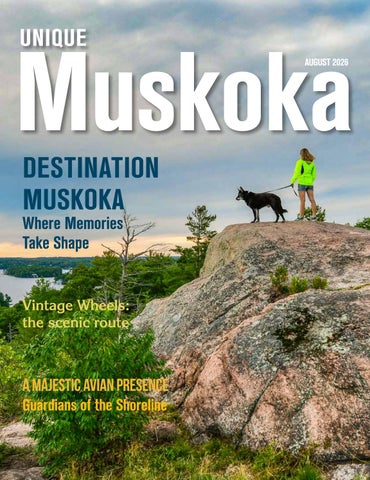
AUGUST 2026
DESTINATION MUSKOKA
Where Memories Take Shape
Vintage Wheels: the scenic route
A MAJESTIC AVIAN PRESENCE Guardians of the Shoreline
brownsappliances.com (705) 765-5700 108 Maple Street, Port Carling, ON
CHELSEY PENRICE YOUR MUSKOKA STORY STARTS HERE. Yo
705.205.2726
WWW.CHELSEYPENRICE.CA CONNECT WITH ME
...telling the Muskoka story
Features
22
12
Article and Photography by Andy Zeltkans
Take a Hike — Limberlost Forest and Wildlife Reserve Article by John Challis Photography by Andy Zeltkalns
Inspired by the Landscape — The Art of Sherry Beiers Growing up in Muskoka’s special environment laid down the foundation for Sherry Beiers’ future success as a painter and continues to fuel her artistic passion to this day.
Nestled into the forested hills north of Highway 60 and with more than a century of history, Limberlost Forest and Wildlife Reserve is an enigmatic wilderness retreat with astounding trails to explore.
26
Rolling Through History – Antique Automobiles Article and Photography by Tim Du Vernet
16
Owners and enthusiasts of antique and vintage automobiles have a passion for automotive heritage and craftsmanship, and a keen sense of adventure to take their wheels on the Muskoka roads.
Rooted in Faith — Bannockburn Community Church Article by Patrick J. Boyer Though off the beaten path, nestling inconspicuously on heavily wooded rocky shoreline with a southeast view across to Acton, Bannockburn Community Church is accessible by road or boat – just as its original congregants arrived.
[22]
[26]
[32]
32
Experience Unforgettable Iconic Muskoka Article by Lori Knowles Photography by Andy Zeltkalns Explore a highlight reel of experiences, capturing the essence of Muskoka and celebrating the people, places and traditions that have made this region iconic.
2 UNIQUE MUSKOKA August 2026
August 2026 UNIQUE MUSKOKA 3
LOWER OVERHEAD FOR US MEANS
LOWER PRICES FOR YOU
WE HAVE MOVED! VISIT OUR NEW WAREHOUSE SHOWROOM AT:
61 Keith Road, Bracebridge
Come check out our new Warehouse Showroom Pricing! Store hours 9-5, Wednesday through to Saturday Browse our extensive website at muskokafurniture.net • Call anytime 705-645-8183
4 UNIQUE MUSKOKA August 2026
38
Herons of Muskoka Article and Photography by Lauren Todd
AUGUST 2026
Graceful, wading herons are among cottage country’s most fascinating wild residents and are symbols of healthy wetlands and abundant aquatic life.
[38]
DESTINATION MUSKOKA
Where Memories Take Shape
44
The Rise and Fall of Muskoka’s Leather Empire
Vintage Wheels: the scenic route
Article by Patrick Boyer Muskoka owed its rise as a leather-making juggernaut to a rare combination of elements in one place – from the abundance of tanning bark from hemlock trees to the soft water of the Muskoka River, reliable transportation to municipal inducements, leather production thrived in the region, for a time.
A MAJESTIC AVIAN PRESENCE Guardians of the Shoreline
Our Cover
50
Photograph by Andy Zeltkalns
With a Paddle – Big East River Article and Photography by Andy Zeltkalns From its origin at East End Lake in Algonquin Park, the Big East River meanders through a scenic landscape shaped by ancient glacial meltwater. It is one of the largest undammed rivers in the watershed and has long stretches of undeveloped shoreline.
The view across Lake Muskoka from the pinnacle of Huckleberry Rock in Muskoka Lakes is an unforgettable experience, at any time of year.
Departments 58
54 What’s Happening
Cottage Country Cuisine
Article by Matt Driscoll
Article by K.M. Wehrstein / Photography by Brittany Clark
Plans for a new medical training centre in Bracebridge are moving ahead, the Lake of Bays Foundation awarded bursaries to two local students and Safe Quiet Lakes launches a new education initiative. Muskoka Chautauqua returns to Windermere, District of Muskoka approves additional funding and long-term care beds for Fairvern, and the Town of Bracebridge reviews spring flooding reaction. Applications for a new District Chair are now open to the public, Antique Show and Sale returns to Bracebridge, and the Canadian Outdoor Archery Championships will take place in Muskoka.
The art of pairing an exceptional dish with a delightful beverage can make or break a meal. Talented bartenders and chefs from across the region share their sweet and savoury pairings with unique cocktails for your enjoyment.
[58]
Opinion 9
Muskoka Insights By Meghan Taylor
11
From an Artist's Perspective
64
Muskoka Moments By Dr. Norman Yan
By Lori Knowles
August 2026 UNIQUE MUSKOKA 5
The 2026 Carnival HEV
…telling the Muskoka story Unique Muskoka is published six times per year by Unique Publishing Inc. Meghan Taylor Publisher/Editor Donna Ansley Sales Lisa Brazier Marianne Dawson Design Susan Smith Administration
MUSKOKA KIA
21 Robert Dollar Dr, Bracebridge, ON P1L 1P9
705-645-6575 muskokakia.ca
• Specializing in Sourdough • Fine Artisan Breads Daily • Assorted Baked Goods • Made in House Desserts
J. Patrick Boyer John Challis Brittany Clark Matt Driscoll Tim Du Vernet Lori Knowles Lauren Todd K.M. Wehrstein Dr. Norman Yan Andy Zeltkalns Contributors Annual Subscription Rates: (including HST where applicable) In Ontario $30.00 All Other Provinces $36.00 HST: 773172721 Canada Post Publications Mail Agreement Number: 43268016 Copyright © 2026 Unique Publishing Inc. No content published in Unique Muskoka can be reproduced without the written permission of the publisher.
BIG RIVER BAKING COMPANY
705-394-4499 info@bigriverbakingco.com
FOLLOW US ON INSTAGRAM @bigriverbakingco for updates, daily bread lists and our weekly cheesecake special!
OPEN TUESDAY TO SATURDAY — 11A TAYLOR ROAD, BRACEBRIDGE
6 UNIQUE MUSKOKA August 2026
Mailing Address Box 616, Bracebridge ON P1L 1T9 www.uniquemuskoka.com info@uniquemuskoka.com 705-637-0204
Eavestrough and Gutter Protection
Lose the leaves... get Clearwater
Make your eavestroughs maintenance free. Repel leaves, sticks and branches, no rusting, chipping or peeling.
Alu-rex
Protects your eavestroughs from damage caused by snow and ice.
Our Selection of Rainware Products will Help your Home or Cottage Weather the Storm
Embrace Your Exterior! Siding • Roofing • Soffit • Fascia • Decking • Eavestrough • Gutter Protection
www.norstarexteriors.com SERVING THE MUSKOKA, PARRY SOUND & HALIBURTON REGIONS
Spring Booking Specials on Now! T: 705-645-8404
T/F: 800-732-0158
F: 705.645.7263
August 2026 UNIQUE MUSKOKA 7
FURNISHINGS AND DESIGN SERVICES
Muskoka’s Most Beautiful Store Step into our breathtaking 35,000 sq ft showroom, featuring curated bedroom, living, dining, office, and outdoor furniture, plus an expanded rug area. Work with our designer Laura to create your perfect home, explore fine Canadian furnishings, and shop our in-store Veranda Outlet. With ample parking, and easy access, we can’t wait to welcome you!
OW N E R & O P E R AT O R
FURNISHINGS • DESIGN SERVICES RUGS • ART • LIGHTING OUTDOOR LIVING
505 HWY 118 WEST, BRACEBRIDGE • 705 645 6451 • VERANDACOLLECTION.CA
8 UNIQUE MUSKOKA August 2026
Muskoka Insights storytelling still matters. Looking ahead, that work may matter even more. Muskoka faces questions about growth, affordability, access, environmental protection and the responsibilities that come with loving a place deeply. The stories we tell can connect newcomers with longtime residents, seasonal visitors with year-round realities, and cherished memories with the choices needed to protect what makes them possible. Unique Muskoka’s anniversary is therefore more than a milestone for a magazine. It is a reminder that local stories are not decorative extras. They are part of how a community understands itself. That spirit continues in this issue. Contributor and local author Lori Knowles shares a highlight of top experiences across the region, reminding us how a first visit, or a familiar return, can leave a lasting impression and stir memories of visits past. Photographer and biologist Lauren Todd brings that same attentiveness to the natural world, spotlighting the six types of heron present in Muskoka. These wetland waders may be elusive, but their presence offers a quiet reminder of the health and fragility of the environment that helps define this region. Regular contributor Patrick Boyer looks back to another chapter, identifying the conditions that made Muskoka a key player in the leather trade starting in the late 1800s. The rise and fall of that industry may seem distant, yet its lessons about trade, resources and technology remain relevant today. Once discovered, never forgotten. After 10 years, Unique Muskoka has helped ensure that what is discovered here is not only the view, but the people, places and histories behind it. May the next decade continue to honour that discovery, one story at a time. Happy reading! Photograph: MacKenzie Taylor
Once discovered, never forgotten – those four words capture the feeling people carry away from Muskoka. This place is not simply a point on a map or a summer destination. It is a collection of memories: the flash of a whitetailed deer at the edge of the forest, the rhythm of a paddle on a quiet lake, the glow of a sunset caught between pine branches, the conversation that lingers long after the dock chairs are folded away. As Unique Muskoka marks its 10th anniversary, that motto feels especially fitting. A decade ago, this magazine set out to do something both simple and ambitious: tell the Muskoka story. Not one story, of course, because Muskoka has never belonged to a single voice. Its character is shaped by year-round residents, returning families, artists, builders, historians, naturalists, entrepreneurs, volunteers and quiet observers who notice what others might pass by. Over these 10 years, the magazine has become a place where those stories can gather. Its pages have celebrated wooden boats and wild spaces, community builders and creative makers, familiar landmarks and lesser-known histories. They have reminded readers that Muskoka’s beauty is not only scenic. It is cultural, environmental, historical and deeply personal. Variety matters because communities are strengthened by the stories they preserve. In a region known around the world for its lakes and cottages, it can be tempting to let the postcard image stand in for the whole truth. But Muskoka has always been more complex: a place of Indigenous history, settlement, industry, tourism, conservation, craftsmanship and constant reinvention, where memory and change meet at the shoreline. An editorial column is a moment to look back and ahead. Ten years of publishing reflects countless choices: which stories to pursue, which photographs best capture a place, whose voices need to be heard and how to balance nostalgia with curiosity. It also reflects the work of writers, photographers, editors, advertisers, distributors and readers who believe local
Inspired byNature w w w. b r a c k e n r i g . c o m 705-765-5565 info@brackenrig.com
August 2026 UNIQUE MUSKOKA 9
©Randy Blain Construction
Taking the complexity out of hiring the right company. MUSKOKA BUILDERS’ ASSOCIATION IS THE PLACE TO START.
Enjoy Peace of Mind in Muskoka Our mission is to continuously support our members by providing timely education, training, and information tailored to their needs. We promote a collaborative culture rooted in strong business ethics, enhancing the effectiveness and success of the building industry in Muskoka. By fostering teamwork and shared values, we ensure our members are part of a community dedicated to excellence and ethical practices. Our members bring knowledge, experience, and peace of mind to your project, with deep familiarity of the local area and its unique
10 UNIQUE MUSKOKA August 2026
building challenges. All our members, from suppliers through to trades, have a strong working relationship. They are wellequipped to handle lake and island projects, and offer ongoing support and warranty services. We simplify the process of choosing a contractor with an easy-to-use directory on our website.
(705) 645 3008 • MUSKOKABUILDERS.COM
From an Artist’s Perspective
The Origin of a Good Story Article by Lori Knowles
Photograph: Andy
Zeltkalns
Photograph: Paul Feist
says both his antics and his The number one question I get “wonderfully engaging personality” asked as a novelist: How did you come helped him cross the customer/server up with the story? divide. With clients like Wayne I’d like to say it’s a plot that Gretzky, Paul Godfrey (Toronto Sun, intrigues me – a mysterious death, a Blue Jays), and the Labatts, there summer love gone sour, a crafty, nasty were many famous faces buying Kraft grifter who steals from her friends – Dinner, T-bone steaks and bags of but that would be misleading. Because milk. it’s always a character who snatches my “The best clientele in Canada,” attention and spins a fresh new story Feist says, “would walk through that for me. Not plot, character. And we all door.” know Muskoka has plenty of those. Judges, lawyers, politicians, big Among the most animated of our business owners, Hollywood actors Muskoka characters is actor and fellow and CEOs. Feist remembers CTV’s author Paul Feist. You may know him Doug Bassett as the “whirlwind man” from his latest books (Broken Anchor who shopped at 40 mph. Once, Feist and Warts And All), or his stage work mistook Paul Coffey as a local (Misery and Love Letters, both with contractor and asked him if he had Robin Clipsham), or his 1970s TV enough work “to see him safely variety show (We’re Only Joking). Or through the winter” – the hockey perhaps you know him for his dorky player assured him he did. Another alter ego (Dorkin Barnes), whom Feist time, late at night, Feist was asked to slips into just when your guard is open, it was urgent: a wealthy client down. That charming farmer from needed cream for her morning coffee. Utterson can make you spit out your The following day as she returned for gin and tonic. more shopping, he asked her politely I’ve come to know Feist via the not to disturb him after closing time Muskoka Authors’ Association. Actor and author Paul Feist as his alter ego, Dorkin Barnes. again. She replied by reaching into the Currently he’s crafting a collection of cooler, pulling out a carton of cream short stories (Groceries Are My Life!) would bust a move or break into song. and saying: “Well, if I do disturb you, this is about his days as a local grocer. Before it “Running that store was like being on gained fame as “the general store with the stage,” Feist says now, “a thing I’d been doing the brand I want.” See what I mean? Muskoka has loads of blueberry doughnuts” (see page 33 in this since I was 10 years old.” Cracking a joke or characters to inspire a good story. Who needs issue), the Port Sandfield Marketeria was bursting forth with a Broadway tune, Feist plot? Paul Feist is writing about those Paul Feist’s domain. characters in Groceries Are My Life! Maybe Do you remember him there? From 1988 one day, I’ll write about him. to 1998, Paul and his wife (artist Janice Feist) ran the little shop near the bridge connecting Lake Rosseau to Lake Joe – the Lori Knowles is a journalist and author of one where, a’hem… all the rich people go. Summers with Miss Elizabeth, a Muskoka Now known as Silver Stream Farms Market, novel. The second book in the series, Summers its current owner, Bruce Watford, admitted with Gin, is coming soon. In this column, Lori to me recently Feist was “a tough act to explores what it’s like to live and work as an follow” literally. As Port Sandfield’s most artist in Muskoka. www.loriknowles.com infamous proprietor, on any given day while @loriknowles_author scooping ice cream or sweeping floors, Feist
August 2026 UNIQUE MUSKOKA 11
Article by John Challis / Photography by Andy Zeltkalns
N
estled into the forested hills north of Highway 60, you’ll find Limberlost Forest and Wildlife Reserve, an enigmatic wilderness retreat with more than a century of history. Limberlost Lodge opened in 1921 after the grandson of an original settler conceded that farming the granite and sand was fruitless. The original lodge was promoted to city-dwelling adventurers as a romantic wilderness getaway – much as it is again today. Jack Cockwell, the former CEO of Brookfield Asset Management, acquired Limberlost about 40 years ago. In retirement, he turned his energy to enlarging the property to its current 4,050-odd hectares and creating a destination wilderness experience. In a Globe and Mail profile, he said cutting trails on the site became a vacation pastime for the family. That pastime fostered
12 UNIQUE MUSKOKA August 2026
Limberlost Forest and Wildlife Reserve Length: Variable, depending on the trail Difficulty: Easy to Difficult, depending on the trail Suitable for: Hiking, Mountain Biking, Paddling, Swimming, Camping, Skiing, Snowshoeing Operation: Year-round To get there: From Highway 11, travel 23 km on Highway 60 to Limberlost Road. About 8.9 km north, turn onto South Limberlost Road for 3 km.
the creation of 75 km of trails on the reserve. Most of Muskoka’s recreational trails are on municipal or provincial land, often suffering under fluctuating budgetary and political priorities. The private ownership model at Limberlost Forest and Wildlife Reserve offers an intriguing alternative. The cost of managing Limberlost’s trails is offset by fees for cabins and campgrounds throughout the property. The trails themselves are free to the
While there are cabins and a few private cottages along some of the lakes, on the trails there are often limited signs of civilization. Bird song, the lapping of water, and the breeze through massive trees are the most common companions. general public. It’s a model that seems to be working well. Private ownership also means lawyers. At each trailhead, a cautionary note asks if the hiker has notified family of their whereabouts, if they’re fit enough for a vigorous walk, and if they’re equipped with appropriate gear. When you invite visitors to your property, their safety is a must. A crew of nine conducts regular maintenance on the trails. Footpaths are generally easy to navigate and well mapped. Simple erosion controls protect trail edges along steep hillsides and guide drainage away from downhill
segments. Flat stepping stones or boardwalks dodge the wettest areas. There are a dozen main trails of varying difficulty, ranging from 1.5 km to 8 km in length, skirting the larger of the reserve’s 16 lakes. They’re crisscrossed by half a dozen side trails that can convert an afternoon’s jaunt into a full day’s hiking. Ski and snowshoe trails are available in winter. The most popular trek is Solitaire Lake Trail, a stunning route through mature maple, birch and hemlock around that lake’s shoreline. Sandy beaches at the north end are part of a glacial delta deposit. The 50-metre cliff on the west side, known as Echo Rock, was once a nesting site for peregrine falcons. Just beyond that cliff you’ll find a cabin-sized outcrop of quartz. Farther along at the south end of the
The most popular route is Solitaire Lake Trail, a stunning hike through mature maple, birch and hemlock around that lake’s shoreline.
lake there are two boardwalks over the water, tucked under more rock faces, where cool water trickles from the rock and drips
There are a dozen main trails of varying difficulty at Limberlost, ranging from 1.5 km to 8 km in length, skirting the larger of the reserve’s 16 lakes. The main trails are crisscrossed by half a dozen side trails that can convert an afternoon’s jaunt into a full day’s hiking. August 2026 UNIQUE MUSKOKA 13
Exploring at Limberlost Forest and Wildlife Reserve rewards with exceptional views and over 70 km of trails to discover.
EXPERIENCE YOU CAN TRUST
musically into the lake. If the weather turns foul, the Langmead Cabin, about halfway around the trail on the lake’s south end, is offered as a place for hikers, campers, or canoe trekkers to shelter. Side trails around Solitaire Lake can turn
this 7 km trail into a more substantial hike. A winter ski trail continues for a kilometre along the top of the Echo Rock. The Kalonga Wetland Trail on the east side is a 2 km trail through wetlands linking with Helve Lake and another 2 km lakeside loop trail.
Experienced drilling & blasting for roads, ditches, foundations and septic systems. Exceptional service and top-quality results.
FREE ESTIMATES
The trails at Limberlost Forest and Wildlife Reserve place priority on safety. At each trailhead signage reminds hikers to consider their physical fitness, ensure they’re appropriately equipped and notify family of their whereabouts. 14 UNIQUE MUSKOKA August 2026
705 765 7474 redcanoegallery.com 33 years in Muskoka
100% Canadian Artists / Bala, Muskoka
red canoe gallery
There are a few private cottages along some of the lakes in Limberlost – trails may skirt them or pass directly in front. Hikers are encouraged to respect the privacy of these residents. As with any private business, Limberlost is always revising and rebuilding. There were signs on some roads warning of heavy equipment and construction earlier this summer. On the trails, though, there was no indication of construction noise: bird song, waterfalls, and the breeze through massive birch trees was all that could be heard. The standard hiking apparel guidelines apply for these trails: good hiking boots, loose fitting clothing, bug repellent, snacks, and more water than you think you’ll need. Bring a bathing suit to take advantage of swimming areas. Walking poles are advisable, especially for older hikers, for tackling steep hills. A tuck shop near the entrance has snacks and a potable water supply. A downloadable map of all the trails is available. Hikers are required to sign a safety Spanning more than 10,000 acres of unspoiled mixed forest, the Limberlost Forest and Wildlife waiver before beginning. Both are available Reserve is a year-round wilderness destination that offers public access to its privately managed landscape of 20 secluded lakes. online on the Limberlost website.
Muskoka Water Fall, 48” x 48” Paul Garbett
August 2026 UNIQUE MUSKOKA 15
Photograph: Bannockburn Community Church
“T
his church’s heritage involves the dreams, visions, faith, and work of pioneer and subsequent members – officers, musicians, givers of hospitality to hungry preachers, arrangers of flowers, ushers, the list is long – who served faithfully,” said Rev. Ivan C. Morgan, 36 years ago when celebrating Bannockburn Community Church’s 100 years of worship on Lake Muskoka’s shoreline across from Acton Island. Principal of McMaster University’s Baptist divinity college, he knew the cottager congregation well as one of its summer ministers.
16 UNIQUE MUSKOKA August 2026
Article by J. Patrick Boyer Those pioneers, most notably, were members of the White family. Reaching Muskoka from Northern Ireland in the 1860s and ‘70s, brothers Isaac, William, Samuel, and sister Kate settled at different dates with their wives and husband around Lake Muskoka’s western side. William and wife Elizabeth White chose land abutting the homesteads of Isaac and Jane White and Samuel and Janet White where three roads serving the neighbourhood’s settlers intersected. William opened a general store and soon became first postmaster of a new Muskoka locale named, not surprisingly, Whiteside. Beyond clustered
homesteads, the settlement boasted a wharf, freight sheds, and sawmill on the point. The White children walked as a group to school in Glen Orchard, picnicked as one in summer, skated the lake together in winter, and every Sunday morning accompanied their parents to worship in a local hall, returning on their own for afternoon Sunday School. Built on William’s land by brother Isaac around 1890, the hall served for Church of Scotland (Presbyterian) worship. For the next two decades it was also a regular pastoral call for itinerant Presbyterian theology students, whether circuit-riding on horseback
Photograph: Bannockburn Community Church
When Samuel and Janet White and their children relocated from Whiteside to the north end of Acton Island, and the Whiteside Church was closed, their private home became the gathering place for Sunday worship for a homeless congregation. nationalistic pride a small price for finally having land and a church they could call their own. Their worshipful progression, begun in 1890 on William White’s land at Whiteside Bay, advancing in 1912 to Samuel White’s property on Acton, now settled in Sutherland Bay, the smaller inlet of Lake Muskoka’s larger Dudley Bay. Lumber from Whiteside’s abandoned hall was salvaged in 1921 for re-use building Bannockburn. Keen work bees clad the exterior in pine siding, finished the interior with tongue-and-groove cedar paneling, and ecstatically opened the church doors for July 1922 services. Though off the beaten path, nestling
Photograph: Bannockburn Community Church
or paddling a canoe from Bala to conduct services and offer the sacraments. As the students changed the congregation became accustomed to the preaching of different ministers. In 1892 Isaac, who seven years earlier founded Port Carling’s Loyal Orange Lodge 685 when living there, now started Whiteside Lodge 1361 and the church became an Orange Hall, too. Whiteside’s lone community centre, the Presbyterians’ place of worship also housed festivities, concerts, and suppers. In 1899, the militantly anti-Catholic Orangemen grew somber as Whiteside became home of St. Anne’s Catholic Church. By now, Whiteside’s community was dispersing. In 1900, with the community in freefall, the Orange Lodge folded, setting the record for the briefest existence of any lodge in Muskoka. With the area heavily logged, the sawmill no longer operated. Other wharves at better locations now drew the freight and passengers. By 1894, Samuel couldn’t wait to leave the deflated village, bought Acton’s north end from a Methodist minister and relocated to Muskoka’s largest island with Janet and their five children. By 1912, with Whiteside’s multi-purpose Presbyterian Church shuttered, new settlers, increasing cottagers, vacationers in Bala, and White family members found themselves a homeless flock. Their faith held, but they quested for a place to anchor and began drifting to Samuel and Janet’s home on Sundays, worshipping and hymn-singing on the White’s veranda, crowding their rough front lawn, with divinity students or vacationing clergymen intermittently materializing and taking a service. After almost a decade of improv, Albert E. Gordon, a man of means, solved everyone’s dilemmas in 1921 by donating land to the free-floating congregation – his only stipulation being to name the church “Bannockburn.” Of the clan Gordon, he was as proud of his heritage as other Scottish Canadians who, in Ontario between 1870 and 1930, dubbed farms, estates, railroad stops, and homes Bannockburn for where, 600 years earlier, Scots defeated English soldiers, a turning point for Scottish independence. It struck many as odd for a church name to lack religious connotation, but the migratory congregation decided helping Scots uphold
United Church minister Rev. Dr. Frank Fidler, who arrived from Toronto with his wife Marguerite in July 1935 to take services at Bannockburn, cooked outside when they lived in Samuel White’s boathouse.
inconspicuously on heavily wooded rocky shoreline with a southeast view across to Acton, Bannockburn Church was accessible for knowledgeable cottagers arriving by road or boat; one Acton cottager drove to church in Bala for several years until discovering she only needed paddle across the bay. Offshore from Bannockburn, cottagers gathered summer evenings in their boats, enjoying popular singsongs. During the Roaring Twenties, their motor cars grew so numerous that in 1930 the congregation bought an adjacent lot and, with more work bees and extra donations, created additional parking for cars and expanded docking space. By 1938, the church’s rather secular name seemed more apt for a congregation no longer anchored to a single denomination. Members voted to become non-denominational, their place of worship to henceforth be known as Bannockburn Community Church. As a Muskoka summer church, Bannockburn attracted a battalion of religious leaders and devoted clerics to take Sunday services. Over its first century, upwards of a hundred different ministers conducted worship. Since then, more than three decades have brought dozens more guest preachers, a constantly revolving ministry of various denominations, principally Methodist, Anglican, Presbyterian, Baptist, and Congregationalist. Such steady procession of church notables to Bannockburn’s pulpit
August 2026 UNIQUE MUSKOKA 17
Photograph: Bannockburn Community Church
Bannockburn’s Sunday School offers youngsters and teachers a Sunday morning sense of camping in the Muskoka woods, with crafts, games, and lessons. “We call it the JAM tent,” smiles church leader Ian Davies, “an acronym for ‘Jesus And Me’.” Nathanial Parker at intervals between 1939 and 1981. Heads of other churches were just as numerous, from David Hay, moderator of the Presbyterian Church of Canada to George Pigeon, moderator of the United Church of Canada. Others stood out for breaking barriers, like Rev. Bob Rumball, famous far beyond the United Church for his crusade on behalf of deaf people, whose inspirational preaching led to stints at Bannockburn throughout the 1960s, 1970s, and 1980s. The spirit infusing Muskoka’s lakeside
Photograph: Bannockburn Community Church
evinces the magnetic pull of Muskoka summers. In 1923, Hugh Thompson Kerr, boating over from Bala, was a Presbyterian student minister at Knox College in Toronto; seven years later, ordained and back in the USA, he’d become moderator of the American Presbyterian Church. Ivan Morgan, as noted, was principal of McMaster’s Baptist Divinity College when manning the Muskoka pulpit. Also holding that office when at Bannockburn were H.S. Stewart in 1954 and
Guest ministers arriving from far and wide to take Sunday services at Bannockburn and needing accommodation cherished the upstairs quarters of Samuel White’s Acton Island boathouse. 18 UNIQUE MUSKOKA August 2026
summer churches blends the casual ease of a cottagers’ association with the uplifting experience of people worshipping together. That essence is compressed by the intensity of enjoying two prime months at the lakeside cottage longingly envisaged all winter and now unfolding daily, fused by easy intermingling of notables meeting as regular folks. The sense of community is palpable. Families volunteer to maintain the church grounds. Upgrades, often with work bees, saw dock repairs in 1949, reroofing in 1952, repairing the church with new supports, additional joists, and replaced veranda flooring in 1953. By 1954, 24 stacking chairs, and later, another 30, were bought to accommodate more people. In 1959, flagstones were laid and the porch enclosed with windows. 1968 saw dock repairs and church repainting, again repainted in 1982 when crowding bushes were trimmed back and hornets’ nests removed. Although used but a sixth of the year, Bannockburn remains the focus of its dedicated congregation. On the social front, summer picnics were popular for their games, making new acquaintances, catching up with friends, and extensive choice as each family brought
Photograph: Bannockburn Community Church
potluck edibles and drinkables. By mid-20th century, Bannockburn’s mailing list ran to 68 families, including church leaders who had taken summer services and joyfully continued as the congregation’s alma mater. A potluck lunch is held after each summer’s final service in August. In 1990, to celebrate a century of worship, Bannockburn published Reflections, an engaging 60-page booklet with dozens of congregants sharing memories and thoughts about their church, preserving a Muskoka church community’s heritage. Sometimes a member of the church’s pulpit committee would fetch and return Sunday’s guest minister by boat. Some years Samuel White’s Acton Island boathouse, with upstairs living quarters extending over the water, provided heavenly accommodation for a minister and his wife to spend the summer. With a roster of diverse ministers each summer, worshippers heard different approaches to sermonizing and more variety in scriptural interpretations than in their year-round southern city churches. Music remains vital to worship, whether for a congregation that once sang from their flotilla In summer 2025, Bannockburn officials welcomed the Neema Children’s Choir from Uganda, with of boats or today enjoy fulsome hymn-singing their pastor Daniel Mutibwa preaching the sermon. The musicians and their pastor travelled to before Sunday service commences. In 1938, the Canada to raise money for their school and orphanage in Africa.
Muskoka's Largest Home Service Company!
No job is too big or too small! www.GBScontracting.com 705.687.9143 1082 Beaumont Farm Rd., Bracebridge
August 2026 UNIQUE MUSKOKA 19
small pump organ was replaced by an oak cased piano, the tuning of which after 10 idle months in sub-zero temperatures and spring heat was something long-serving Genevieve White arranged ahead of July services. For half a century, artist and musician Mary Chenhall was Bannockburn’s church pianist. Today, pianist Paul Leyman plays for the preservice hymn sing and what church cochair John Franklin calls “special music each week as part of the service.” In recent years, again out of the ordinary, Bannockburn has hosted the Neema Children’s Choir from Uganda, with their pastor Daniel Mutibwa preaching the sermon. Ian Davies, one of Bannockburn’s leaders, witnessed them performing at Gravenhurst farmers’ market and, understanding their mission, invited them to perform Sunday
to the congregation. The youthful choristers are rescued orphans given a new life by the Kingdom Child Project in Kajjansi, a rapidly growing urban centre south of Kampala, with donors sponsoring the choir’s annual fundraising visits to Canada to support the Kingdom Child’s orphanage and school. They have performed at Bannockburn a number of times. July and August Sunday services, preceded by a popular warmup 15-minute hymn sing, begin at 10:30 a.m. “The priority has been and still is the high standard of ministers with different denominations and backgrounds,” emphasize Bannockburn’s current leaders, “who understand the needs of an interdenominational seasonal church here in Muskoka.” The church offers an open invitation to participate in worship, and after service refreshments on the lawn enable meeting and greeting, with casual dress acceptable and dockage available for those arriving by water. Sunday school for children five to 12 years is held in a separate tent as JAM (Jesus and Me) sessions, although in recent years fewer children attend. Rev. George James, who also “conducted services in warm Muskoka sunshine and persistent rain,” relished interacting with Bannockburn’s regular community “drawn from a great variety of places and from enjoyment of lazy cottage Sunday mornings into the discipline and celebration of worship.”
Bala cottager Nancy Cairns, who’s been attending summer services since childhood, observes, “Some Muskoka experiences entertain us, while others restore us. For over a century, people have gathered here to find peace, community, and spiritual renewal in one of Muskoka’s most beautiful natural settings. Every visit feels like a chance to step away from the noise of daily life, breathe Photograph: Bannockburn Community Church
Photograph: Bannockburn Community Church
Avery Harrison and Reid Marshall, with longtime connections to Muskoka and family history with the church, romantically chose Bannockburn for their August wedding last summer.
Mary Chenhall’s watercolour painting of Bannockburn in the fall used reproductions to raise money for the church. Her canvases of Muskoka scenes still enhance many summer homes.
20 UNIQUE MUSKOKA August 2026
Photograph: The Marshall Family
Photograph: Bannockburn Community Church
Mary Chenhall, who built her own cottage at Henshaw Lake, was an accomplished musician and artist. She served Bannockburn as church pianist for half a century. Mary was 101 when she died in 2011.
Rev. George James relished his ongoing involvement with the summer church congregants. deeply, and reconnect with what matters most. After all these years of welcome, reflection, and simple beauty, it’s still the best place I know to experience a feeling of peace – a unique ‘only in Muskoka’ experience I highly recommend!” Getting there, current road signage on Highway 169 (six kilometres north from Bala, or two south of Glen Orchard) indicates the turn to Acton Island Road. On it, turn right at the Bannockburn sign onto Bannockburn Road for a half kilometre to the church.
JULY
28/29 The Jim Cuddy Band - 2 Shows!
OCT.
27
The Psychology of Cults
30
JULY
Lowest of the Low - Indie Rock
OCT.
Heroes on the Air
AUG.
01
Delhi 2 Dublin - FREE!
NOV.
Roch Voisine - Sings Gordon Lightfoot
AUG.
Story Time and Song - Bring The Kids!
NOV.
The Nutcracker: A Canadian Tradition
AUG.
06
The Good Brothers - Country & Bluegrass
DEC.
10
Good Lovelies
07
AUG.
Classic Albums Live: Hotel California
DEC.
Come Frome Away
AUG.
Kyung-A Lee - Classical By Candlelight
09
AUG.
CHOIR! CHOIR! CHOIR! - 2 Shows!
AUG.
12
Daniel Lanois - Canadian Music Legend
AUG.
An Evening with Alan Cross
AUG.
Ashley MacIsaac - Celtic Fiddle
SEPT.
06
08
29 12
21
17-22
2027 spring shows JANUARY
27
FEB.
Brent Butt
03
The Taiko Project
19
FEB.
Matt Andersen
FEB.
20
Lennie Gallant
Hawksley Workman
MARCH
Emerald Isle
SEPT.
A Garden Variety Improv Show
APRIL
24
Tim Hicks
SEPT.
Harry Manx
MAY
Gowan
OCT.
Lloyd Spiegel
13
15
18/19 25
26
04 OCT.
In Spite of Ourselves:
08
An Evening of John Prine
OCT.
Terra Lightfoot
16
OCT.
17
Yuk Yuk’s On Tour
09
08
SCAN TO
CHECK OUT THE LINEUP DID YOU KNOW... YOU CAN SAVE 15% WHEN YOU BECOME A MEMBER!
August 2026 UNIQUE MUSKOKA 21
Article and Photography by Andy Zeltkalns
A
tapestry of scenic waterways where forests mingle with rugged outcroppings of Canadian Shield has always been an inspiration for Muskoka artists. For local artist Sherry Beiers growing up in this special environment laid down the foundation for her future success as a painter and continues to ignite her passion to this day. Beiers, whose family name can be found on Beiers Road in Kilworthy, grew up near Gravenhurst where her great grandfather, Oscar Beiers, settled after coming to Canada. As a child she loved spending time in nature roaming and playing amongst the rocks and trees. From the very beginning she was drawn to these untamed landscapes and was both calmed and intrigued by the shimmering blue and green of the water bodies in the area. “We had an area behind my house that I called Up on the Rock,” explains Beiers. “This was my happy place.” Time spent at a family cottage on Longpoint Lake in Northern Ontario also made an impression on her and helped form a base for her creativity. Growing up in an environment where she was surrounded by white birch trees had a lasting impact on Beiers and she often includes them in her paintings. Tom Thomson and the Group of Seven artists with their unique perspectives of the Canadian landscape were also an important influence on her. It was in high school that Beiers was first introduced to painting. She continued to paint into her early 20s but drifted away from it for a few years as life got busy. When she was in her early 30s, an employment opportunity initiated a move to Toronto. Missing her life in Muskoka, and to help her cope with the city, Beiers started to paint again and began decorating her apartment with scenes reminiscent of the natural landscapes she had left behind. Eventually she was able to make the move back to Muskoka and about 20 years ago found the perfect property in Bracebridge. “It felt like home as soon as I saw it,” she shares. Back in Muskoka, she has established herself as a dedicated artist and often uses the nature in her own backyard to create ideas for her paintings. Walking on a trail that loops through her property is a regular
22 UNIQUE MUSKOKA August 2026
Aside from the satisfying feeling of pride and accomplishment from finishing a creative project, Sherry Beiers abides by the belief that the process is just as important as the completed product.
knife to create thick bold strokes, and a brush, she transforms her acrylic paint into layers of textured and vibrant colours to bring her scenes to life. Her preferred medium is stretched canvas and wooden panels in varying sizes. “I have painted a lot of little four by six-inch panels making these original paintings affordable and collectable,” explains Beiers. She has been told that because of their convenient size, some of the small paintings get to travel all over the world. She also creates larger paintings, up to 36 by 48 inches, which have a dramatic impact on the viewer due to their size. As she works on a painting, Beiers often experiences the spark of a new idea that she can apply to future projects. She is always From the very beginning Sherry Beiers has been drawn to the untamed landscapes of Muskoka. She open to learning something new and is not was both calmed and intrigued by the shimmering blue and green of the water bodies in the area. THE RIOBEL MOMENTI™ COLLECTION afraid to experiment in case it leads to a better Those inspirations spark creativity in her art. AVAILABL E AT KNOWLES PLUMBING! or more interesting result. For Beiers, painting is an evolving journey and each year she sets routine where ideas spring forth as she makes photos or ideas and develop them into a out to work on a new area of her art. her way through the forest. scene.” “I am always taking photos of inspirational Beiers, who has been self-taught other than Currently her focus is on planning the composition of her paintings involving some scenes, and my phone is full of little glimpses high school art classes, has formed her own BAT H & KI TC H E N SH OW ROOM additional research and experimentation of an idea,” says Beiers. “I often take several distinctive style of painting. Using a palette DESIGN. INSTALLATION. REPAIR S E RVING ALL OF MU SKOKA 279 MA N ITOBA ST, B R AC EBR ID G E
70 5 . 6 45.2 67 1
K NOWLESP LUMBI N G .COM @MUSKOKA BATH
Muskoka’s Bath & Plumbing Centre
BATH & KITCHEN SHOWROOM SALES • INSTALLATION • REPAIR SERVING ALL OF MUSKOKA
279 Manitoba Street, Bracebridge
705.645.2671 @knowlesplumbing knowlesplumbing.com 24 UNIQUE MUSKOKA August 2026
SERVING MUSKOKA & PARRY SOUND FOR OVER 70 YEARS
Self-taught, other than high school art classes, Sherry Beiers has formed her own distinctive style of painting. Using a palette knife to create thick bold strokes, and a brush, she transforms her acrylic paint into layers of textured and vibrant colours to bring her scenes to life. before the brush hits the canvas. “The good thing about acrylic painting of landscapes is you can either leave out or add in,” Beiers explains. Her approach gives her flexibility in the design of her final product. Aside from the satisfying feeling of pride and accomplishment one gets from finishing a creative project, Beiers believes the process is just as important as the completed product. “Art is good for you, and has so many benefits,” states Beiers. For her, art is a form of therapy that focuses the mind and takes you away from the day-to-day issues. Painting with others is also an important social activity with its own healing benefits that can be done at any level, skill, or age. The Annex Arts Collective in Bracebridge, which showcases Beiers’ work along with that of 20 other local artists, is a place she enjoys spending time. “It’s a great space with a group of wonderful artists that has something for everyone,” exclaims Beiers. “When I’m working there, I love it when people come in and like to talk about art.” Aside from creating her own work, she enjoys sharing her knowledge with others and teaches acrylic painting at Let The Cat Go Fine Art and Craft studio located inside the Annex. Her first experience as an art instructor
was teaching at her mother’s retirement home. Having to teach people with varying levels of art skill was a learning process for Beiers but helped her towards becoming a better teacher. She has taught art classes for the Town of Bracebridge and Town of Gravenhurst as well. “I love seeing people grow and get hooked on art,” she says. “After only one class, people often become more observant about their surroundings and look at things differently.” Beiers is a member of both Muskoka Arts and Crafts and Huntsville Art Society, which are great sources to discover artists. As an additional challenge, Beiers has twice entered an “Art Battle” which is a live painting tournament where the task involves painting a 16 by 20-inch canvas in 20 minutes while the audience walks around and watches. For Beiers the experience was fun, but mingled with stress as well, leaving her hands shaking at times. Being naturally a fast painter helped her with the process, and she feels the tournament added to her skills as an artist. Through an artistic eye inspired by years of exploration and observation of the natural beauty around us, Beiers has brought to life the many iconic scenes this area has to offer. Drop by the Annex Arts Collective to explore her work, or better yet, enroll in one of her painting courses to spark creativity.
Sales & Service of Major Propane Appliances (refrigerators, ranges, fireplaces, furnaces & more) Safe & reliable No electricity required Bulk propane delivery to your home or cottage
705.645.4294 TF: 866.645.4294 STORE: 228 TAYLOR RD., BRACEBRIDGE OFFICE: 1646 WINHARA RD., GRAVENHURST
August 2026 UNIQUE MUSKOKA 25
The E-M-F Company’s Brass Era vehicles were among some of the most successful from that era. This one, built prior to 1916, explored to Muskoka's back roads as part of the Horseless Carriage Club tour.
26 UNIQUE MUSKOKA August 2026
Article and Photography by Tim Du Vernet
M
uskoka is home to several antique automobile enthusiasts and recently played host to the annual tour of the Horseless Carriage Club of Canada. Owning, collecting and preserving historic technology is one thing. Actively using it is another level of commitment altogether, especially when the vehicle is well over 100 years old. Hurtling along a back road in Muskoka in a 1911 Ford Model T is not for the faint of heart. With wheels, steering and brakes that are slightly
more effective than those of a bicycle, speeds of 50 km per hour become not only an achievement, but also a test of courage and faith. More than 20 vehicles took part in the tour of Muskoka’s back roads, organized by Port Sandfield resident Paul Gockel. Some were very rare, and possibly the only operating examples of their kind. The commitment to owning, preserving and actively driving such historic vehicles brings both rewards and challenges. The vintage car
Owning a piece of automotive history, such as Paul Gockel with his white 1913 Stevens Duryea, Cliff Dawson with his blue 1928 Overland Whippet, or a black Ford Model T with original-coloured white tires, is a commitment with rewards and challenges. August 2026 UNIQUE MUSKOKA 27
Brass Era Ford Model T’s, built before 1916, are lined up together during the Horseless Carriage Club’s tour of the Etwell Road area. community is a rich source of knowledge, and some members are exceptionally skilled with antique autos. It’s a kind of living archaeological experiment: every outing is both a test of faith and an experiment in design. It’s rare for an automobile to pass through three generations. The 1928 Overland Whippet owned by the Dawson family was first purchased 73 years ago by Cliff Dawson, and it has been in the family ever since. Dawson admits the car has had some work done over the years, including being repainted a few times. One of the most rewarding experiences for the proud grandfather was taking his granddaughters out for ice cream at a nearby store. Not everyone who owns and regularly uses a vintage automobile needs to be a mechanic, but being handy with tools does help. Some
of the oldest cars have no electric start, so knowing how to use the hand crank, set the timing and fuel settings, and possibly prime the carburetor are all part of the process. A manual transmission is generally expected. Double-clutching up and down to help the driveshaft and transmission speeds match is also normal practice. For owners who have had their vehicles for many years, the nuances of operation become second nature. Dawson’s clever problem solving was put to good use when he created a rumble seat out of the rear trunk by fitting a seat borrowed from a Beetle. The older the vehicle, the more character it generally accumulates. The year 1928 was a high point for the Overland, and this particular model was likely assembled in Toronto, as indicated by the special plate above the radiator.
Vintage models are often heavily modified, such as this 1960s C10 pickup truck. The custom modifications include air suspension that lifts when underway. 28 UNIQUE MUSKOKA August 2026
There are those who need the latest and greatest technology, and there are those who savour moments with its historic counterparts. Some of the oldest vehicles are primitive and travel not much faster than a bicycle. Of course, that’s their charm. Looking for back roads where you can travel safely at half the speed limit and explore the deeper reaches of a region is all part of the experience. During their recent sojourn, while returning to Huntsville along Aspdin Road, the Horseless Carriage group was welcomed back by a passing thunderstorm, complete with hail. Encountering inclement weather in an antique car is not a roll-up-the-windowsand-turn-on-the-wipers scenario. If you are lucky, or if they have been added later, these pre-1916 vehicles may have snap-on side curtains, but likely no motorized wipers. The brakes are primitive systems that barely work
Joan Rennie and her husband John bring their 1954 Meteor Special Niagara to vintage automobile events in Muskoka.
in rain, and the narrow tires offer only a suggestion of traction on slick pavement. You wear a raincoat and hold tight in crosswinds. All of this requires concentration and careful planning with every move. As many cyclists know, Muskoka has its share of hills. For the vintage horseless carriage, a long, steep uphill climb represents a challenge that requires careful, experienced assessment: how much speed can you build up to avoid shifting into a lower gear? These primitive manual transmissions require intimate knowledge of their unique personalities. Coming into town offers another set of challenges, including stops for lights, starting up again, signalling and navigating traffic. For basic safety reasons, most vehicles have adapted LED tail, signal and brake lights, since they hail from an era when hand signals were sufficient. At the heart of owning and driving a pre-1916 vehicle is a sense of adventure and preparedness for the unexpected. Some owners, like Paul Gockel, have known their treasures since childhood. The Horseless Carriage group focuses on pre-1916
vehicles. In 1956, Gockel’s parents bought a 1913 REO, and it has been his favourite vehicle ever since. “It is rugged, reliable, colourful and dainty on the road,” claims Gockel. Next up, purchased more recently, is his 1913 Stevens Duryea touring. Bought in 2025, “it is an absolute monster, but it carries luxury unbounded and runs superbly well,” he shares. “The model I bought turned out to have been the same auto my father turned down when a friend offered it to him for sale more than 50 years ago.” At one time, Orillia was home to an aspiring automotive company, the Tudhope Motor Company. In an effort to be completely in-house, Tudhope cast engine blocks, cut gears, stamped frame components, built bodies and assembled everything into high-quality machines. The new models, which began to come off the line for the 1911 model year, were known as Everitt 30s, but sales materials pointed out the many special Tudhope features that added to their value. With four-cylinder, waterRosseau General Store was one stop along the cooled engines, magneto ignition and Horseless Carriage Tour. While the Model T was three-speed transmissions, they included some usually black, these two are bright red.
HARDWOOD | LAMINATE | VINYL PLANK & TILE | CARPET CERAMIC | NATURAL STONE …AND MORE!
MODERN HOME CARPET ONE
350 Ecclestone Drive • Bracebridge
705.645.2443 carpetonebracebridge.ca
TAYLOR CARPET ONE
30 Cairns Crescent • Huntsville
705.789.9259
taylorcarpetonehuntsville.com
August 2026 UNIQUE MUSKOKA 29
George Mournahan enjoys attending car shows near and far. His 1928 Ford Model A Tudor truck has been trailered across Ontario to partake in these events.
While not exactly the same vehicle, George Eldridge’s 1973 Volvo P1800 ES Sport Wagon evokes memories of the TV series The Saint and the Volvo P1800 that became such a hit.
This 1938 Plymouth, owned by Jim Darrach, is a classic car known for its styling. Not everyone who owns and regularly uses a vintage automobile needs to be a mechanic, but being handy with tools does help to maintain and operate these vehicles.
of the best ideas in automotive engineering in an era when the automobile was in a constant state of evolution. By early 1912, a sleek and powerful six-cylinder 6-48 was added to the line, and in all models, body and fender design showed the beginnings of streamlining. A ride in the all-original, only operating example makes clear why the Tudhope still inspires admiration. The smooth-running engine appeals to the musical senses of its owner, Peter Voisey, a professional musician living in Orillia. The Tudhope was even featured in the 300th episode of Murdoch Mysteries. Father’s Day weekend in Muskoka offers an annual opportunity to see collectible cars displayed by their passionate owners in Gravenhurst and Bracebridge. With everything from Model A roadsters to heavily modified hot rods, there is something to appeal to every taste. The 1920s vehicles are always eye-catching with their big wheels and brass accents. These are favourites of Greg Mournahan of Bracebridge. One of his favourites is a 1931 Model A roadster truck. Relatively few of this model were built.
Mournahan explained that his version came with an overdrive transmission, which makes it possible to reach rural highway speeds. This truck has been around. The Model A roadster truck was purchased in 1931 at a Ford dealership in Caledonia. It sold several times and moved to Mount Durham, Buffalo, N.Y., and Port Dover, where it was restored in the early 1990s. Then it moved to Sault Ste. Marie. Mournahan enjoys attending car shows near and far, and this Model A truck has been trailered across Ontario. “I enjoy seeing other vehicles and meeting new people through the cars,” he says. “It amazes me how much interest there is from younger people, even teenagers, asking technical questions, how to get parts. It’s a culture.” Mournahan believes the cars can be a big attraction for a town. The Model A is a fun car to drive, with a strong following. The vehicles are considered very reliable and simple to operate. Keith Dawson’s 1928 Roadster Pickup was joined by Ken Dawson’s 1931 Model A six-wheel coupe at one of the recent shows. Moving into the heavy chrome era of the
30 UNIQUE MUSKOKA August 2026
1950s, John and Joan Rennie had their 1954 Meteor Special Niagara on display. They explained that the car was produced at the Oakville, Ontario, plant between May and September 1954. There were 1,427 two-door sedans produced, and this car was built at the end of May. The new 1955 Ford and Meteor models were coming out in September 1954, so this car had all the leftovers put into it. It has the Ford dash, not the Mercury dash. Only in Canada did they keep the flathead motor. Some fans of vintage autos will remember the TV series The Saint and the Volvo P1800 that became such a hit. While not exactly the same car, George Eldridge’s 1973 Volvo P1800 ES Sport Wagon was close enough to spark that connection at the show. The car set the standard for Volvo’s sporty durability. Summer is vintage car time, and many towns in Muskoka host weekly gatherings. When you come across a vintage auto on the road, remember that many can’t go very fast or stop quickly, so be sure to give them space, especially in rainy conditions. Give them a thumbs-up as they rattle by.
u o Y k n a Th TO OUR CANADA DAY CELEBRATION SPONSORS
PREMIER
PLATINUM
GOLD
Thank you as well to all of the generous members of our community, whose kind donations have allowed us to keep this tradition going for so many years.
August 2026 UNIQUE MUSKOKA 31
Article by Lori Knowles / Photography by Andy Zeltkalns
S
ome would say that any experience in Muskoka is an iconic one. The region is chock-full of incredible places to explore, businesses to visit, food to try and people to meet. Discovering the charm and wildness of Muskoka isn’t possible with only one visit – but you can create a highlight reel. Choosing just 10 proves to be no small task. Muskoka’s appeal lies in its remarkable diversity, from tranquil mornings on mist-covered lakes to lively afternoons spent strolling vibrant downtowns, sampling local flavours or uncovering hidden gems along winding back roads. Every corner of the region offers something memorable, and every visitor comes away with a different list of personal favourites. For every experience that made our list, there were countless
32 UNIQUE MUSKOKA August 2026
others that could have earned a spot just as easily. That challenge is really a testament to what makes Muskoka so special. It’s a place where natural beauty, rich history, entrepreneurial spirit and authentic community connections come together to create unforgettable moments. Whether you’re a first-time visitor or a lifelong cottager, there is always something new to discover and appreciate. Was it difficult to choose? Absolutely. But after much debate, reminiscing and a fair bit of friendly disagreement, its been narrowed down to 10 experiences that capture the essence of Muskoka and celebrate the people, places and traditions that have made this region iconic. In the spirit of Unique Muskoka’s 10th anniversary, here are the top 10 picks for classic Muskoka experiences.
Rosseau General Store is a must-stop addition to your Friday adventure to the village’s farmer’s market. The trek up the hill is worth it!
A Friday in Rosseau
The Blueberry Doughnut
Move aside Timmies, Dunkin’, Tiny Tom and Krispy Kreme. There’s a better blueberry doughnut on the market and it’s in an unlikely place called Port Sandfield. Perched on a precarious spit connecting Lake Rosseau to Lake Joseph, Silver Stream Farms Market delivers the tastiest morsels of goodness cottage country has ever
The wall mural of the Sagamo passing through the locks in Port Carling is made up of over 9,000 photos from the community from 1860 to 1960. experienced. Thank the Watford family for a secret recipe that mixes hard red winter wheat with blueberries and sugar to produce a homemade doughnut that owner Bruce Watford labels “difficult to be around.” As the store’s proprietor for more than 30 years, Watford points to the flour. “It’s responsible for the dough’s springiness,” he says. Store staff start mixing batter daily around 5 a.m. Boats and cars stream in all day long for a blueberry doughnut fix. Watford adds: “We can’t turn them around fast enough.”
The Port Carling Scene
Hello home of Snapdragon Designs. One of our favourite stops on the Port Carling “scene” is this little shop on the corner selling cashmere, cabin socks and oversize tees that spell “cottage life” better than your Scrabble board. You’ll find it along a strip of other iconic shops, foodie-friendly cafes and fab furniture stores – all worthy of a post on Instagram, naturally. The Muskoka Lakes Museum and locks are just across the road. Ground yourself with a little history on who made Muskoka and why. Or forget all that and flop on a chair on the deck of Turtle Jack’s – if you can find one. On the menu: people watching at its finest – oh, and an incredible variety of provisions anywhere on Brown’s Landing.
By The Light of the Moon
Ron James. Steven Page. Jim Cuddy. Yuk Yuk’s. A starry galaxy of iconic Canadian acts have made their way to Huntsville Festival of the Arts at one point or another. The festival began as an ambitious showcase for classical music and symphony in the early 1990s but expanded to include indie performances by Hawksley Workman and Serena Ryder. Now housed in Huntsville’s Algonquin Theatre, it’s a year-round venture featuring music, dance, theatre and art. It’s also the cornerstone of the town’s annual Nuit Blanche North that bills itself as a “bold and interactive multi-arts street festival.” The interactive art event is held in mid-July by the light of the moon. Say no more.
Photograph: Huntsville Festival of the Arts
Once a week on the lips of countless Muskoka cottagers: “It’s Friday, let’s go to Rosseau.” The Rosseau Farmer’s Market has been a lakeside Friday fixture since 1999 when a pair of intrepid local artisans created an outdoor space for local growers and artists to peddle their produce and showcase their creations. It’s impossible to know if Lynnis Royea and Ernie Sainsbury knew then the market would attract thousands over the next two decades. Cars and boats now seek precious parking spots between 9 a.m. and 2 p.m. to roam Rosseau Waterfront Park, pick up a kielbasa from Cosmos Smoked Meats, a beer from Trestle Brewery, or a pretty trinket from Jibe Jewellery. Don’t miss: The trek up the hill to Rosseau General Store for an ice cream and a healthy dose of nostalgia – the store has been in business since its delivery boat, The Gasping Annie, delivered ice blocks and provisions to cottagers before roads, or even vehicles.
Silver Stream Farms Market in Port Sandfield delivers the tastiest morsels cottage country has ever experienced with their blueberry doughnuts. August 2026 UNIQUE MUSKOKA 33
A Steamship Cruise Quick quiz: name one of the world’s last remaining Royal Mail Ships. Answer: the RMS Segwun. It’s one of only three in the world today – bet you can’t name the other two – and the only one powered by steam. Gravenhurst Wharf welcomes throngs of steamship aficionados to its shores ever summer. RMS Segwun and Wenonah II float side-by-side in quintessential grandeur, joined this year by Wanda III, commissioned by Lady Eaton in 1915. While Segwun is in for service throughout summer 2026 – the old girl’s getting a makeover – the remaining two ships continue to sail. Stop by the nearby Discovery Centre to marvel at some of the most beautiful wooden boats ever made anywhere, including Muskoka.
Bala is the cranberry capital of Ontario and there’s nowhere better to experience the cranberry plunge during harvest season.
Bala and The Kee
Another iconic Muskoka scene: Bala and The Kee. Boasting a lower-key vibe, this little town on Lake Muskoka is a blink-oryou’ll-miss-it kinda place with some really big credibility. It’s home to the annual Bala
The Kee, a lakeside bar with history dating back to the Big Band Era, continues to host memorable concerts today. 34 UNIQUE MUSKOKA August 2026
Cranberry Festival every fall, the one with a fall fair mise-en-scène and some terrific handmade crafts and artists. But Bala also lays claim to The Kee, a lakeside bar with history dating back to the Big Band Era and beyond. This summer see Our Lady Peace, Trooper, The Glorious Sons and more. Oh, and don’t forget David Wilcox – a Kee fixture. Who could forget a David Wilcox experience?
Santa’s Village and Bracebridge Falls
Tell a stranger you’re heading for Bracebridge and you’re bound to be asked: “Home of Santa’s Village?” The town happens to be situated on the 45th parallel, halfway between the equator and the North Pole. It’s a happy fact leveraged by locals in 1955 while searching for a reason to draw tourists to the town. Now Santa’s Village is a 60-acre attraction hugging the Muskoka River, with plenty of deer, a ferris wheel,
Soaking in the sights and sounds of Muskoka from the deck of a historic steamship, passengers enjoy one of Gravenhurst’s most iconic attractions.
and an amphitheatre featuring daily live shows. Yes, it’s like Christmas coming early every year. And yes, you’ll see Santa and Mrs. Claus. Afterwards, take a hike on a local trail to see one of Bracebridge’s three notable waterfalls – Wilson’s Falls, High Falls, and Bracebridge Falls. It’ll work off the sugar high you triggered by all of those candy canes.
Situated on the 45th parallel, Bracebridge has long been known as Santa’s summer home thanks to Santa’s Village. Bracebridge Falls, one of three notable waterfalls in the town, is another place worthy of exploration.
OPEN STUDIO WEEKEND August 14, 15 and 16, 2026 10 am to 5 pm Welcome to an exciting studio tour for Huntsville and the Muskoka region. Visit unique artists working in a variety of media inspired by this rugged, northern landscape.
15 STUDIOS. 26 ARTISTS. Painting • Pottery • Jewellery • Metalwork • Woodwork • Sculpture
muskokanorthstudiotour.ca
August 2026 UNIQUE MUSKOKA 35
The Lady of the Lake
Huckleberry Rock, near Milford Bay, is an incredible specimen of Canadian Shield that has drawn sunset-seekers and hikers to its trails for over 100 years. It’s worth the climb.
They call it the Lady of the Lake for good reason. Windermere House was built, originally, in the 1860s as a fishing outpost. In the 1880s its white siding and iconic flag-tower peak became the hotel’s emblems, welcoming dandy gentlemen and ladies who lunch to enjoy the view on the veranda. Steamships paid daily visits, as did glossy wooden boats carrying millionaire golfers. Hollywood burned Windermere House to the ground in 1996 during filming of The Long Kiss Goodnight, but it didn’t take long for the red-roofed hotel to be resurrected. Today, its best asset may just be a coconut gin mojito on the stone patio.
A Big Rock That’s a Billion Years Old
How often can you say you’re on a rock that’s a billion years old? Often, in fact – but still, that little trivia tidbit is a special claim to fame for Huckleberry Rock near Milford Bay. This gigantic and impressive specimen of Canadian Shield has been drawing hikers and sunset-seekers to its trails for more than 100 years. A quick and easy jaunt along a 2.5 km loop marked by white ribbons takes you to the top of the rock. Your reward? A westward view of Lake Muskoka that glows and sparkles during sunset.
Windermere House sits in splendour atop a hill, overlooking the shores of Lake Rosseau as it has since the 1860s.
Lookout Lake of Bays!
Who knew in 1922 a tower used as a forest fire lookout would attract so many thrill seekers 10 decades later? The Dorset Scenic Lookout Tower was built high on a hill to overlook Lake of Bays and its hilly surroundings. It’s one job: fire detection. The original tower (25 metres) was decommissioned in 1961 and replaced in 1967 as a 30-metre-high tourist attraction. These days more than 60,000 visitors climb its stairs to an observation deck that’s 142 metres above lake level. Beware: you’ll need a reservation to do the climb during Muskoka’s peak autumn colours. You can drive a car to the tower’s base, but a hike up from the nearby village of Dorset is more rewarding. Bring water, binoculars, a good mood, and comfortable shoes.
36 UNIQUE MUSKOKA August 2026
Perched high above Lake of Bays, the Dorset Scenic Lookout Tower rewards visitors with sweeping views of the vast Muskoka landscape. Once used for fire detection, the tower now serves as one of the area’s most iconic attractions.
a z
at ReStore, find everything from
except retail prices
Bracebridge - Huntsville - Midland - Orillia - Sudbury August 2026 UNIQUE MUSKOKA 37
Article and Photography by Lauren Todd
M
uskoka is renowned for its crystal-clear lakes and rivers, extensive wetlands, and thriving wildlife, which make it one of Ontario’s most important freshwater habitats. While many visitors come to the region hoping to hear the loon’s haunting call or catch a glimpse of a majestic moose, a group of secretive, wading birds quietly inhabits Muskoka’s wetlands: the herons. These graceful birds are among cottage country’s most fascinating wild residents and are symbols of healthy wetlands and abundant aquatic life. The region’s wetlands
38 UNIQUE MUSKOKA August 2026
provide ideal feeding grounds for herons, as they are rich in fish, frogs, insects, crayfish, salamanders, and other aquatic prey. Early mornings and evenings between May and September typically provide the best opportunities to observe herons feeding along shorelines, marshes, and wetlands. A few of the best places to look for herons across Muskoka’s six municipalities include Fairy Vista Trail in Huntsville, Six-Mile Lake Provinicial Park in Georgian Bay, Henry Marsh and the Bracebridge Sewage Treatment Ponds in Bracebridge, the marsh at North Muldrew Lake Road and Peninsula
Road in Gravenhurst, Marsh’s Falls Nature Reserve in Lake of Bays and Torrance Barrens Dark-Sky Preserve in Muskoka Lakes. Although the great blue heron is undoubtedly the best-known species, Muskoka is home to five other members of the heron family: the green heron, the blackcrowned night heron, the great egret, the American bittern, and the least bittern. The great blue heron (ardea herodias) is one of the largest birds found in Ontario. Standing over one metre tall with a wingspan reaching nearly two metres, it is
The great blue heron is one of the largest birds found in Ontario but weighs in at just five or six pounds due to its hollow bones.
August 2026 UNIQUE MUSKOKA 39
Muskoka Barging
Family run construction company with over 35 years experience operating in the Muskoka Lakes area. No job is too small or too big.
705-764-0765 | muskokabarging.com | 1163 Milford Bay Rd, Milford Bay ON
BARGING ● STEEL & CRIB DOCKS ● SEPTIC SYSTEMS ● LANDSCAPING
BUILDING CUSTOM HOMES & COTTAGES FOR 50 YEARS
A master of camouflage, the American bittern often goes unnoticed among the cattails and reeds of quiet marshes. Its streaked brown plumage helps the bittern blend into the surrounding marsh vegetation, despite being quite large. an unmistakable sight along lakeshores, marshes, and quiet bays. Its impressive stature, blue-grey feathers, long yellow bill, and graceful flight make it easy to identify. Unlike most birds, the great blue heron flies with its neck folded into an s-shape while its long legs trail behind. The great blue heron is commonly seen standing motionless in shallow water looking
SERVING MUSKOKA/GEORGIAN BAY/HALIBURTON
Visit our Toronto Design Centre, & we’ll bring your dream to life
1-888-417-8761 www.techhomeltd.com
GREATER TORONTO AREA DESIGN CENTRE 130 Konrad Cres, Unit #18 Markham, ON L3R 0G5 905.479/9013 • 1.888.417.8761
40 UNIQUE MUSKOKA August 2026
for prey to catch or spear with its long bill. Great blue herons nest in large communal treetop colonies called heronries (or less specifically, rookeries), often returning to the same nesting sites year after year. Much smaller and far more secretive, the green heron (butorides virescens) often goes
Standing over one metre tall with a wingspan The green heron is a much smaller bird, around reaching nearly two metres, the great blue heron 45 centimetres tall, with a dark greenish-black is an unmistakable sight along lakeshores, cap and bright yellow legs. marshes, and quiet bays.
The black-crowned night heron is a stocky species, approximately 60 centimetres tall, with a black crown, red eyes and short legs.
unnoticed despite being one of Muskoka’s regular summer residents. Standing only about 45 centimetres tall, this stout heron has a dark greenish-black cap, chestnut neck, grey wings, and bright yellow legs. It prefers quiet marshes, beaver ponds, slow-moving streams, and heavily vegetated shorelines. The green heron is particularly famous for its intelligence. It is one of the few bird species known to use tools, sometimes dropping insects, feathers, or small twigs onto the water’s surface to lure prey within striking distance. Because of its shy
crown and back, pale grey wings, and red eyes. Adults develop elegant white head plumes during the breeding season, which they raise during courtship displays. These herons inhabit marshes, rivers, ponds, and sheltered shorelines throughout southern Ontario, occasionally breeding in suitable Muskoka wetlands. The great egret (ardea alba) is one of the most striking wading birds found in Muskoka, but it is not frequently encountered in the region. Most are thought to be migrants or post-breeding wanderers
nature, birdwatchers often hear a green heron making its distinctive sharp “skeow” call before seeing it fly away. Unlike most herons that hunt during daylight, the black-crowned night heron (nycticorax nycticorax) becomes active around dusk and throughout the night into early morning. During daylight hours, they often remain hidden among dense vegetation or perched quietly in trees. This stocky species is roughly 60 centimetres tall and relatively short legged compared to other herons, with a black
Unlike most birds, the great blue heron flies with its neck folded into an s-shape while its long legs trail behind.
The great egret, while not seen frequently in the region, is a striking bird when encountered. At just under a metre tall, its brilliant white plumage and yellow bill make it easy to identify when in Muskoka’s wetlands rather than local nesters. Standing just under a metre tall, its brilliant white plumage, long black legs, and yellow bill make it unmistakable. During the breeding season, great egrets grow long, delicate back plumes called “aigrettes” that extend past their tail. Their facial skin turns a vivid lime-green, and their bill becomes an orange-yellow colour. Once rare in Ontario due to plume hunting, great egret populations have recovered through legal protection and wetland conservation, making sightings increasingly common. In Muskoka, great egrets can be found around marshes, shallow bays, river mouths, and rich wetlands.
The American bittern (botaurus lentiginosus) is a master of camouflage. Rather than standing openly along shorelines, this secretive bird spends much of its life concealed in marshes among cattails and reeds. Despite being quite large at 70 centimetres tall, its streaked brown plumage helps it blend almost perfectly into the surrounding marsh vegetation. When threatened, the American bittern often freezes with its bill pointed straight upward, swaying gently with the surrounding reeds to become nearly invisible. Although rarely seen, the American bittern is frequently heard during spring and early summer. Males produce a distinctive
The great blue heron is commonly seen standing motionless in shallow water looking for prey to catch or spear with its long bill. 42 UNIQUE MUSKOKA August 2026
deep gulping call that carries surprisingly long distances across wetlands and has earned it the nickname “thunder pumper.” The least bittern (botaurus exilis) is Canada’s smallest heron, measuring only about 30 centimetres tall. Despite its tiny size, it shares many characteristics with its larger relatives. This elusive species inhabits dense cattail marshes where it skillfully climbs reeds rather than simply wading through water. It can even grasp multiple cattail stems with its feet, allowing it to distribute its weight while searching for prey. Although uncommon in Muskoka, least bitterns are occasionally found in suitable marsh habitats during the spring-summer breeding season. Their secretive behaviour makes sightings relatively rare even where they are present. Despite their adaptability, herons face challenges that remind us of the importance of protecting healthy ecosystems. Wetland loss, shoreline development, pollution, and human disturbance near nesting colonies can all affect local populations. Herons depend on clean water and healthy fish populations to flourish, which makes them indicators of environmental health. A thriving heron population often reflects a robust wetland ecosystem. Fortunately, Muskoka still contains many protected natural areas where herons can flourish. Simple actions by waterfront property owners, such as leaving native vegetation along the water’s edge, reducing the use of pesticides and fertilizers, and avoiding disturbance near active nests, can make a meaningful difference. Observing herons can be one of the highlights of exploring Muskoka’s natural areas, but these birds are sensitive to disturbance, particularly during nesting season. Birdwatchers should remain on established trails whenever possible, observe birds from a respectful distance using binoculars or telephoto lenses, avoid approaching nesting colonies, keep pets under control, and limit noise around wetlands. Whether you’re actively searching for a heron sighting or stumble upon one while out in Muskoka’s wilderness, enjoy the majestic presence of these stealthy aquatic hunters.
PROTECTED. FOREVER.
Land in its natural state is more resilient to the effects of flooding and wildfires EXOTICOF NATURE JOIN US. BECOME A MEMBER MUSKOKA CONSERVANCY NATURAL BEAUTY
VISIT REALLYGREATSITE.COM
EXCITING TRIP
PHOTOGRAPHY TIPS
www.muskokaconservancy.org AND TRICKS
August 2026 UNIQUE MUSKOKA 43
Article by J. Patrick Boyer
B
y the late 1800s, leather was everywhere: in clothing, footwear, personal goods, transportation, furniture, military equipment and machinery. Its versatility and adaptability kept inviting new uses, while rising global demand and mass production made leathermaking one of the age’s most consequential industries. A successful tannery needed a rare convergence: steady hides, abundant soft water, ready tannic acid, reliable transportation, cheap labour, municipal inducements and tolerance for heavy pollution. The Muskoka River gave Huntsville and Bracebridge many of these advantages, supplying water for processing, power for machinery, and transport for hides and tanbark. Its soft water was crucial, preventing reactions that damaged hides, wasted tannins and produced inferior leather. That chemistry strengthened Muskoka’s potential as a tanning powerhouse. Resting
44 UNIQUE MUSKOKA August 2026
on Canadian Shield granite rather than limestone, the district’s watershed offered exceptionally soft, mineral-poor water – precisely what was needed to produce premium heavy sole leather for shoes and boots being made by the millions. In the 1850s, when the province opened Muskoka for settlement, nobody envisaged it becoming a leather-making economy, any more than officialdom foresaw its future vacationing economy. In the mid-1870s, Toronto capitalist George Beardmore, already operating a tannery at Acton and eager to expand, heard of Muskoka’s hemlock forests and soft waters and travelled north to scout Gravenhurst and Bracebridge. Gravenhurst, busy with sawmills and lumbering, seemed possible. Bracebridge, eager and incorporated, proved better. Its councillors offered Beardmore Bros. $2,000 and a 10-year tax holiday to build downstream from the village beside the Muskoka River, trusting jobs and prosperity
would follow. With that prospect, locals reassessed the district’s ubiquitous hemlock. To tanners, the tree so troublesome to settlers and loggers had hidden value: bark that could be brewed for tannic acid, leather’s great preserver. Combined with raw hides in vats, it helped remove hair, gristle and fat, then fortified hides against decay. Muskoka’s hemlock stands became a forestry gold mine awaiting tanneries willing to pay for bark delivered to their doors. Before building Beardmore Bros.’ Bracebridge tannery in 1877, George Beardmore visited Pennsylvania’s renowned Jewett & Keating works, among America’s most advanced leather-making facilities. Using its plans and lessons from its operation, he built an improved version in Bracebridge. The industrial-scale tannery looked so promising that Bracebridge and Monck councils each granted 10 years of tax exemptions.
Photograph: Ontario Archives
Two years after the tannery began accomplishment of many other supply some hides, but Beardmore aimed at operation, W.E. Hamilton, writing his improvements.” large-scale production for world markets. Guidebook and Atlas of Muskoka and Parry And so, from 1877, Muskoka’s ambitious Muskoka could not produce enough raw Sound Districts, recounted being present in leather future began. Beardmore had pledged material. Reliable transportation would be Bracebridge for the arrival of George to hire 10 local workers, but the number essential. Beardmore, “when a meeting of the leading soon passed 30, then 50, and ultimately 100. Transportation was a decisive reason merchants and village Beardmore chose Bracebridge. councillors was called to Gravenhurst had become the meet him, and in an hour or northland’s railhead in 1875, so after the idea was with a Grand Trunk spur to broached, the municipal Muskoka Bay wharf. Steamships clerk sketched a rough draft could carry imported skins north of the agreement and the to Bracebridge and return cured enterprise was captured for leather for rail shipment to North Bracebridge.” American and world markets. In 1905, writing about Beardmore expected rails would this himself in the Muskoka push farther into Muskoka; for Herald, municipal clerk now, he had what he needed. Two scow loads of Lake of Bays tanbark at South Portage wharf, bound for James Boyer said, “This was By 1885, Beardmore’s Huntsville’s Anglo-Canadian Tannery on the Muskoka River, await transshipment probably the best investment over land and water. expectations proved correct. The Bracebridge ever made, as it Grand Trunk reached brought a large amount of ready money into The 35-acre riverfront works housed rows of Bracebridge; the next year, Huntsville. Direct the district and not only started the village, vats, tanbark, hides and finished leather, its rail links meant low-cost raw hides could be but helped settlers in the townships, and activity helping define Muskoka as a imported and high-quality Muskoka leather began an era of prosperity that has rendered manufacturing centre. exported efficiently, setting the stage for a possible the aiding of other industries and Local hunters, farmers and butchers could second major tannery at Huntsville.
August 2026 UNIQUE MUSKOKA 45
Photograph: Boyer Family Archives
The convergence of resources for a successful tannery were in abundance at the Muskoka River. This image of the Ango-Canadian Tannery from across Bracebridge Bay shows great detail and the expanse of the operation.
Photograph: Frank Micklethwaite / Bill Micklethwaite Archives
Frank Mickelthwaite’s 1890s panoramic photograph of Bracebridge wharf and bay, below the town falls, shows four Muskoka Steamship Company steamers moored by the bay’s outlet to the Muskoka River. Warehouses and boathouses crowd below the curving Wharf Road. Beyond on flat land is recently built Anglo-Canadian’s leather tannery, fronted by long rows of tanbark protected by roofing. That next stage began with the Shaw family. In 1859, Brackley Shaw II came north to assess prospects for expanding his family’s tanning business. The Shaws bought John Pratt’s Quebec tannery at Roxton Falls, east of Montreal, then expanded across Quebec and Ontario. Brackley became a major Canadian industrialist, with 16 tanneries producing half the country’s sole leather and offices in Montreal, Quebec City and Toronto. By the 1880s, with Beardmore proving Muskoka’s promise, the family sent Brackley’s son William to Huntsville. In 1890, council granted him a 10-year tax exemption to establish a tannery. Within a year, William and partner David Alexander built the Shaw, Cassils & Company tannery between Centre and Susan streets beside the Muskoka River. When it began production, Huntsville’s growing population helped lift the village to town status. William then built an even larger second Muskoka tannery downstream in Bracebridge, on the southeast bank of the Muskoka River, directly across from Beardmore’s works. Charles Shaw, William’s cousin, was a Maine-born civil engineer and tannery specialist seasoned at the Pfister & Vogel works in Cheboygan, Michigan. That operation, capable of tanning 1,000 hides daily, was tied to rail transport and a company town employing more than 250 workers. Summoned to Huntsville in 1898, Charles brought disciplined, production-first methods to Muskoka, imposing standards
46 UNIQUE MUSKOKA August 2026
and quotas that quickly sparked resistance among workers used to an easier rhythm. The Huntsville Forester reported workers complaining they were so worn out by day’s end they were “almost unable to walk home.” Reeve Tom Goldie and local clergymen tried to mediate Muskoka’s first industrial stoppage. Charles faced them squarely. “No time can be wasted waiting for divine intervention,” he said, adding he would hire “an entire new workforce” if the men did not return. After a week-long strike, they resumed work at the same pay. While Charles battled unrest in Huntsville, Bracebridge tannery workers also walked out over longer hours and unchanged wages. Seeing opportunity, he hired Italian railway workers seeking new employment, valuing the skill and work ethic he had seen elsewhere. Many settled in Bracebridge, enriching the town as productivity rose. Charles settled in quickly. Muskoka’s scenery, Huntsville’s sawmill-and-tannery economy, and its enthusiasm for hunting and fishing suited him. He became vice-president of Shaw, Cassils & Company, and used the authority. By 1905, he had consolidated ownership, become president and general manager, reorganized the operation and renamed it Anglo-Canadian. By then, with three industrial-scale tanneries operating at capacity and producing high-quality leather, Muskoka had earned national and global standing as a prime leather-making centre. One of Muskoka’s great contradictions was that tourism flourished even as logging
and tanning scarred the environment. Downstream from Bracebridge, tannery waste fouled the Muskoka River, killed fish and degraded wildlife habitat, yet resorts and cottages multiplied. For many visitors, Muskoka’s industrial scars were still preferable to the pollution left behind in the cities. Fed by hides shipped by steamship and rail from South America, the Caribbean, Central America and the United States into hundreds of Bracebridge and Huntsville vats, Muskoka became a world centre for boot leather. Its three tanneries supplied more of it than any other place in the British Empire, though their chief customers remained conveniently close in U.S. footwear factories. Smaller pioneer-era tanneries also served local needs. In 1904, E. Garrett moved his custom operation from rural Macaulay into Bracebridge, supplying harness makers, saddlers, bootmakers, butchers and cattle dealers. Located at Monck Road and Wellington Street, away from the river, Garrett’s motto was direct: “Prepared to tan any kind of skins!” A fire later destroyed the business. Other regional tanneries dotted the map. Dee Bank had one in the late 1860s beside the Dee River, near a grist mill and sawmill. Parry Sound’s William Taylor & Sons had four tanners and an on-site shoemaking shop where Irish cobblers made waterproof work boots. Burk’s Falls also had a tannery serving the region. Beside such neighbourhood operations, Muskoka’s three monumental tanneries
displayed Victorian heavy industry in full force. Workdays ran 10 to 12 hours, the labour gruelling, toxic and physically punishing, but steady cash pay mattered in a money-poor district. Beam hands and general labourers earned $1 to $1.50 a day; specialists, such as saddle cutters and master tanners, earned more. Tanning was demanding but profitable. In
Photograph: Muskoka Heritage Place, Huntsville, Ontario
Photograph: Muskoka Heritage Place, Huntsville, Ontario
Updated facilities of Huntsville’s tannery, under Charles Shaw’s leadership, included fire-proof concrete structures, seen here in 1918 with worker residences, a company store, and in the foreground an octagonal bandshell where his celebrated Anglo-Canadian Concert Band rehearsed and gave local concerts.
While exterior photos of Muskoka’s tannery buildings are readily available, pictures of their interior workings are rare. This valuable shot of AngloCanadian tanning vats in Huntsville underscores the impressive scale and engineering of Muskoka’s leather-making empire.
1882, only five years after opening in Bracebridge, the Beardmores sold their immense tannery to businessman Charles W. Tillson. He renamed it Muskoka Leather Tannery and expanded rapidly before dying suddenly in May 1890. When the property came up for sale, the Beardmores moved quickly. Their offer was accepted, George Beardmore’s son Alfred
took charge, the original name was restored, and the Bracebridge works rejoined the family’s Acton-based leather empire. By January 1904, Shaw’s Huntsville and Bracebridge tanneries were running at full production. In 1906, the Huntsville Forester reported they employed 200 tannery hands, supported tanbark collectors, handled 1,000 hides a day, operated 313 days a year and
Join us for Hospice Muskoka’s Largest Annual Fundraiser It takes $3 million each year to provide compassionate palliative care and grief support at no cost to the community. With only 45% of our operating costs funded, your participation helps ensure families receive the care they need.
Together, We Hike in Love and Remembrace Register as an individual or gather a team of friends, family, or coworkers. Honour loved ones, celebrate community, and join the Team Challenge for a little friendly competition that creates a big impact.
SUNDAY SEPTEMBER 13 12-3PM
Scan to learn more, register and sponsor a hiker or team
MUSKOKA LAKES FARM & WINERY Stay tuned for matching campaign details: Images by New Leaf Media
TINYURL.COM/H4HM2026
August 2026 UNIQUE MUSKOKA 47
Photograph: Boyer Family Archives
When world war erupted, many Muskokans swiftly enlisted, thinning the ranks of those working. By summer 1916, few remained to recruit, but an enlistment drive for Muskoka’s 122nd Overseas Battalion raised more than 800 more able-bodied soldiers, seen here marching through Bracebridge. Muskoka, in concert with most of Canada, faced a manpower crisis. paid $65,000 annually in wages. Bracebridge’s first large tannery, again carrying the Beardmore name and backed by the family’s Acton operations, modernized to meet global demand. In 1913 it expanded into a 130-by-300-foot riverside cinderblock structure. With Bird’s Woollen Mill also upgrading before the unanticipated world war, Muskoka seemed poised for wartime production: boot leather for Britain, wool for soldiers’ uniforms, and lumber for the broader war effort. It was not. As Britain’s war of attrition consumed soldiers, Ottawa sent ever more Canadian men overseas. Factories, forests and farms lost workers, and the Home Front stumbled into a manpower crisis. Leather orders from Britain were redirected to the United States. Muskoka could find replacements or limp on. Although women were moving into war work, Beardmore did not consider leathermaking’s gritty toil suitable for them. It turned instead to another labour pool: able-bodied Canadian men Ottawa had imprisoned as “enemy aliens” because they or their ancestors had come from countries now on the opposing side. Held in isolated internment camps, some men were paroled so Ottawa could hire them out for roadwork, wood cutting, carpentry and masonry. As replacement workers for the slowed Beardmore Tannery, 10 men interned at Kapuskasing were to travel under guard by train to Bracebridge. When workers learned replacement
48 UNIQUE MUSKOKA August 2026
labourers from enemy nations were coming, employees at both Bracebridge tanneries walked out and public outrage erupted. A mass “indignation meeting” at town hall denounced the plan, and that night a barracks prepared for the incoming workers was burned. The tanneries were left to struggle on with their remaining, already strained workforce. Ottawa’s focus on sending soldiers overseas left too few workers for essential war industries, damaging Muskoka’s leather sector. Anglo-Canadian struggled to fill military orders for boot leather and other army needs while also supplying belting for war factories. After the war, demand for military leather collapsed, boot-sole leather demand fell 25 per cent, and the industry faced a serious downturn. That was bad enough, but the gravest blow came from the United States. Through the 1920s and early 1930s, successive Republican administrations raised tariff walls that sharply restricted trade, disrupting Canada’s close economic relationship with its largest market. Woodrow Wilson’s Democrats had favoured lower duties to encourage commerce; Republicans championed self-sufficiency. Exportdependent industries such as Muskoka’s leather trade suddenly lost access to American customers. From Muskoka’s biggest employers – tanneries and sawmills – wages, services and purchases rippled across the district. Leather and lumber exports to the U.S. met
American needs while generating local prosperity. Then the Republican tariff wall of the 1920s and 1930s delivered a sledgehammer blow. Before the world war, Muskoka had become a heavy-industry powerhouse through logging, lumbering and industrialscale tanning. When the U.S. closed itself to foreign goods, Muskoka’s integrated regional economy suffered immediate, severe consequences. Again, there were two ways to respond. For the Beardmores, whose Bracebridge mill depended on U.S. customers, the 1921 Emergency Tariff and higher 1922 tariff eliminated profit margins. Stripped of its main market, they closed this citadel of the local economy that same year and drained their tanning vats one last time into the Muskoka River. The 100 laid-off tanners joined returning soldiers still seeking work. Rising U.S. lumber tariffs also hushed winter logging camps and silenced sawmills across Muskoka, leaving thousands tied to the wood economy looking for jobs. Beardmore consolidated in Acton, using synthetic chemicals to tan specialty leathers in rising Roaring Twenties demand. Charles Shaw chose differently. Determined to keep his Muskoka tanneries running, he kept selling to American customers willing to absorb tariff costs while turning aggressively toward Canadian and British Empire markets benefiting from Imperial trade preferences. Unlike Beardmore, Anglo-Canadian survived the first 1920s shocks. Shaw’s balancing act bought time, he expected, until the leather-importing United States came to its senses. A former American with enduring contacts, he kept selling to long-standing U.S. importers and even picked up former Beardmore customers. But the Depression and another steep U.S. tariff increase in 1930 ended what remained of Anglo-Canadian’s American trade. Reduced in scale, the company declined gradually before closing in 1952, 75 years after Muskoka’s leather empire began its ascent. The collapse laid bare the irony of 1920s American protectionism. By trying to
insulate U.S. businesses and reserve domestic markets, Washington broke regional supply chains with its closest neighbour. Muskoka’s empty tanneries, logging camps and sawmills became local casualties of a broader trade war that deepened stagnation on both sides of the border. By 1922, the year Beardmore last operated, forestry assessments also pointed to hemlock depletion across heavily harvested Muskoka. Tannery pollution was facing growing protest from vacationers and resort operators in a district increasingly associated with fishing, swimming and clean water. Muskoka owed its rise as a leathermaking juggernaut to a rare combination of elements in one place at one moment in a modernizing industry. Although chromium tanning was known by the 1870s, the era still largely belonged to bark tanning, which drew natural tannins from trees such as hemlock. Muskoka had hemlock in abundance. Its three vast tanneries created a tanbark economy just as land-grant homesteaders, struggling on “free” land, were legally obliged to clear forests for fields. Felling hemlocks, peeling bark and selling it to a tannery became a lifeline for many farmers, while giving tanners exactly what they needed – a pattern, like an image in a kaleidoscope, not to be repeated. Half a century after Muskoka’s leather dominance began, conditions shifted dramatically. Resource depletion, hostile American tariffs, geopolitical change, new technology and environmental protest combined into a perfect storm. Yet the industry was so entrenched it did not die quickly. Muskoka’s leather empire took three decades to fall. In retrospect, Muskoka’s leather boom and bust is one locality’s part in a global phenomenon – a microcosm of how natural resources, trade patterns, technology and market demand can swiftly create an industrial powerhouse in an unexpected place. It is also the tale of how technological change, tariff warfare, environmental protest and the industry’s own damaging side effects can just as readily dissolve it.
Luxur M Luxury Motor otor Coaches Coac es C arter Bus Bus Services Services Charter Executive Vans Executive ans
Airport Transfers Transfers Airport
D D r ii v en en B B y Famil F a m i l y and and C C o mm m m u ni n i ty t y Since Since 1 1944 944
...telling the Muskoka story www.uniquemuskoka.com
DAY TRIPS MULTI DAY TOURS INTERNATIONAL TOURS
TRAVEL More
WWW HAMMONDTOURS CA WWW.HAMMONDTOURS.CA . .
August 2026 UNIQUE MUSKOKA 49
Foaming rapids and fast-moving water put skill and determination to the test on the Big East River. This wild section between Billie Bear Road and Williamsport Road offers an exhilarating journey through one of the area’s scenic landscapes.
Article and Photography by Andy Zeltkalns
M
uskoka has approximately 680 lakes and 17 major river systems, making it a mecca for paddlers. Muskoka beckons to be explored. One waterway that stands out as a unique gem is the Big East. This 50 km long iconic waterway with its distinctive natural features forms part of the Muskoka River’s watershed that drains from the western slopes of Algonquin Park. From its origin at East End Lake in the park, the Big East meanders through a scenic landscape shaped by ancient glacial meltwater and enters Lake Vernon near the town of Huntsville. It is one of the largest undammed rivers in the watershed and has long stretches of undeveloped shoreline
50 UNIQUE MUSKOKA August 2026
offering paddlers a true wilderness experience. As with many of Muskoka’s rivers, the Big East has a rich history of Indigenous culture, exploration, and lumbering. In the late 1800’s the Big East River Improvement Company was formed to manage water levels and the seasonal spring log drives. Over time, six dams were established on the river to help achieve this purpose and were used for logging until the last log drive in 1934. From 1949 until the early 1970s the dams were used mainly for flood control but were later decommissioned or replaced with passive weirs since they were no longer needed. The process made this one of the first major dam removal and river
restoration projects of its kind in Canada. With its diverse character, the Big East River caters to paddlers of all experience levels. For a straightforward easier option, one can start at Hutcheson Beach on Lake Vernon. From here a short 0.5 km paddle across the bay will give you access to the Big East and set you on a serpentine upstream journey. On this section of the river, you can choose from a number of out and back alternatives varying in length from an hour to all day. Paddling from Hutcheson Beach to where the river enters Arrowhead Provincial Park is about 16 km in one direction, but you can turn around anywhere you prefer. The river along here is interspersed with
A paddler’s view reveals the magnificent sand bluff at Big Bend, one of Arrowhead Provincial Park’s most striking natural features. Rising dramatically above the river, the towering bluff creates a stunning backdrop for those exploring the Big East River. some development but still retains enough wild spaces to make it an interesting choice. Since you are paddling upstream on the first half of the trip, your overall effort and progress will depend on seasonal water flow. Fortunately, this section of the river typically maintains a good volume of water and remains navigable even later in the summer when water levels elsewhere may be low. If arranging a car shuttle is possible, you
can start just inside the gates of Arrowhead Provincial Park off Arrowhead Road, requiring a day pass, or at the Old North Road bridge just west of the park, and paddle downstream to Hutcheson Beach letting the current guide you along. For a more immersive wilderness experience and a bit of adventure, you can follow the popular and traditional downstream route from Williamsport Road to either the Arrowhead Park Road, or two
kilometres further downstream, the Old North Road bridge. With the arrangement of a car shuttle, this 11 km to 13 km stretch of picturesque river can easily be done in a few hours with lots of time to explore. The first kilometre of this trip can be rocky and shallow, but when water levels are high, the rapids become navigable, providing a thrilling and exciting start to your trip. As you leave Williamsport Road
August 2026 UNIQUE MUSKOKA 51
After passing beneath Williamsport Road, the Big East River winds through nearly six kilometres where steep sandy banks rise above the water and broad beaches line the shore. As the gentle current carries paddlers downstream, striking bluffs, golden sand, and lush forests combine to create one of the river’s many captivating landscapes. you will be paddling through the Big East River Provincial Park. It covers the area from the western boundary of Algonquin Provincial Park to Arrowhead Park and encompasses a 200-metre-wide protected boundary along both sides of the river. Established in August 2000, and acting as a non-operating wilderness space, it was designed to protect the river’s ecological features, including some ancient sand bluffs and numerous oxbows. A short distance from where you depart, the river will begin hugging the southern boundary of Arrowhead Provincial Park and then continue its sinuous course before leaving the park near Highway 11. As the river gently pulls you forward, you will be drawn in by the beautifully forested landscape that is intermingled with eye catching sandy beaches, riverbanks, and bluffs. Eventually you will arrive at a magnificent part of the river known as Big Bend where stunning views of a towering sand bluff overlooking the water will make a memorable impression. A further five kilometres downstream you’ll have the opportunity to make a 0.5 km upstream side trip on the Little East River to admire the scenic Stubbs Falls or continue on to one of the usual take out
52 UNIQUE MUSKOKA August 2026
points. For a longer alternative you can add another 15 km to your journey by finishing at Hutcheson Beach. If you have initiated your paddle from outside Arrowhead Park and remain on the water, an Arrowhead Provincial Park Day Use Pass is not necessary. However, if you anticipate getting on shore to do some exploring on foot you are required to have a day-use
pass, so be sure to plan ahead. Well-seasoned paddlers, and those who wish to challenge themselves, might consider a journey starting further northeast from an access point where the Billie Bear Road crosses the Big East. A paddle from here to Williamsport Road has the means to deliver a most satisfying adventure. From Williamsport Road, where
An exhilarating sweeping turn at the end of a fast-moving stretch showcases the dynamic character of the upper Big East River. With everything from gentle currents to exciting rapids, the river offers a variety of out-and-back paddling adventures, ranging from a leisurely hour on the water to a full day of exploration.
Canadian Fine Craft & Artwork
Nancy L. Moore
Crisscross Birch
A portage at McArthur Chute offers a chance to pause and appreciate the raw energy of the Big East River before launching back into a scenic wilderness corridor, framed by forests, sandy banks, and meandering stretches of river.
acrylic on canvas 36" x 48"
Hello Lovely Cork Co. Lorna Moffat Design pillow covers
1073 Fox Point Road, Dwight, 705.635.1602
oxtonguecraftcabin.com
*New* northern site:
you will need to leave a vehicle for a return car shuttle, is about a 30-minute drive to your starting point. This 17 km stretch of off-grid wilderness will provide a stimulating blend of flat-water paddling, portaging, scrambling through water along shallow rocky sections of the river, and a good measure of whitewater to keep your adrenaline flowing. The upper third of this paddle is interspersed with several areas where the fast-moving water creates dramatic scenes as it accelerates over the ledges and rocks of the Canadian Shield. One location worth noting is McArthur Chute where the water
funneling through a narrow opening creates a striking view. This stretch of the Big East is best tackled when water levels are high, minimizing the number of portages or time spent in the water dragging your paddle craft. A paddle craft resilient to bumps and scrapes against rocks is also recommended. If paddleboarding, consider using a river fin to reduce the risk of snagging on the river bottom. The Big East River is a perfect balance of adventure and tranquility. No matter which route you choose, you will leave with a sense of fulfillment and appreciation of the natural beauty this area can offer.
Rely on us ~ we're just a nd the corner! rou
Compressed into a confined channel, the rushing water at McArthur Chute creates a dramatic display of force and motion, making this one of the river’s most impressive natural features and a memorable highlight of any paddling trip.
New Liskard
Tolearn learn more more scan QRQR code To scanthe the code visitlakelandEVcharging.ca lakelandEVcharging.ca ororvisit
August 2026 UNIQUE MUSKOKA 53
The Ontario government has officially launched the application process to appoint the next Chair of the District Municipality of Muskoka, marking a significant shift in how the region’s top municipal leader will be selected. For the first time, the District Chair will be appointed by the provincial government rather than chosen by elected members of District Council following the municipal election. The full-time position, advertised through Ontario’s Public Appointments Secretariat, carries a four-year term from November 15, 2026 to November 14, 2030. According to the province, the District Chair will serve as Muskoka’s chief executive officer, providing leadership to council, chairing meetings, representing the municipality at official functions and promoting public engagement in local government. The successful candidate will also be expected to work with all levels of government, collaborate with Muskoka’s lower-tier municipalities and help advance provincial priorities, including housing and economic development. The appointment follows the passage of the Better Regional Governance Act, 2026, which transferred the authority to appoint the heads of council for several upper-tier municipalities, including Muskoka, from local governments to the province. The move has drawn criticism from many District councillors, who argue it reduces local democratic oversight. Council has previously asked the province to consider candidates with municipal experience, strong ties to Muskoka and a proven ability to build consensus, while also requesting greater transparency throughout the appointment process.
Following recent approval of a zoning amendment, the former Georgian College Muskoka Campus is one step closer to a new chapter as a regional health and wellness centre. of a zoning amendment by the Town of Bracebridge. The proposal, submitted by the Muskoka Health and Wellness Centre, would transform the existing Wellington Street campus into a centralized health care facility serving Bracebridge and the wider Muskoka region. The redevelopment plan focuses on renovating the current building rather than constructing a new facility. The proposed centre would include approximately 18,000 square feet of health-related services, including clinical and primary care offices, medical offices for physicians and specialists, physiotherapy and rehabilitation services, and other wellness programs. A key feature of the proposal is the potential creation of a Family Medicine
Teaching Unit, which would provide patient care while supporting the education and training of future health care professionals. The zoning amendment allows for medical offices, a drug store and a small restaurant as permitted uses on the property. No building additions are planned, with renovations focused on adapting the existing space and improving accessibility. The project will maintain the site’s 110 parking spaces while increasing accessible parking from two spaces to six.
Muskoka Chautauqua returns to Windermere
The Muskoka Chautauqua Festival returns to Windermere village from August 7 to 16, 2026, bringing 10 days of arts, music, wellness and family programming to the community. Hosted at 1039 Golf Avenue Road, the annual festival will feature a wide range of daytime activities, performances and special events designed to celebrate creativity, history and local talent. Most daytime programming will run daily from 10 a.m. to 4 p.m. Festival highlights from August 7 to 16 include the Gallery in the Woods, showcasing works from local artists, a pop-up bookshop at the historic Village Hall, the Windermere History Walking Tour at noon, and Creative Kids Nature Workshops.
Photograph: Muskoka Chautauqua
Ontario launches Muskoka District Chair selection process
Photograph: Town of Bracebridge
Whats’ Happening
Former Georgian Campus to become Muskoka Health Hub
The former Georgian College Muskoka Campus in Bracebridge is moving closer to a new chapter as a regional health and wellness centre following approval
54 UNIQUE MUSKOKA August 2026
Celebrating community, creativity, and culture, the annual Muskoka Chautauqua festival brings history, music, theatre, art, and inspiring conversations together in the heart of Muskoka.
Bracebridge reviews 2026 flood response
Photograph: Matt Driscoll
The Town of Bracebridge is reviewing its response to the 2026 spring flood after a major flooding event affected approximately 1,300 properties, damaged municipal infrastructure and resulted in more than $111,000 in emergency response costs. A staff report presented to General Committee outlined lessons learned from the flood, which was caused by rapid snowmelt, significant rainfall and abovefreezing overnight temperatures in early April. The report noted precipitation levels were significantly higher than normal, with rainfall and snowfall totals reaching 150 per cent above average in March and 200 per cent above average in April. While the Ministry of Natural Resources completed a winter drawdown of Lake Muskoka in
A recent staff report presented to Bracebridge Town Council outlined lessons learned from the 2026 flood event.
Photograph: Last Wilderness Alliance
The festival’s evening lineup includes the August 7 opening celebration and “Rising Stars” concert featuring five emerging local singer-songwriters. Other performances include Juno-winning folk-pop artist Caroline Marie Brooks on August 9, the Toronto All-Star Big Band on August 10, Celtic and folk roots group Maggie’s Wake on August 11, and Folk Night with Beverlie & Friends on August 14. Additional author talks, family activities and special programming will take place throughout the festival. Visitors are encouraged to check the Muskoka Chautauqua event calendar for complete schedules and event times.
Safe Quiet Lakes and the Safe Wakes Coalition are launching a new education campaign that includes lake-specific maps to help boaters identify areas where wake-enhanced activities can be conducted responsibly and safely. March, staff said the measure was not expected to prevent or substantially reduce the effects of a major flood event. Floodwaters impacted about 716 residential structures, including approximately 334 permanent homes. A review completed with support from the District of Muskoka’s GIS team identified about 1,300 affected properties throughout Bracebridge. The flooding also caused widespread road closures, affecting four District roads, 13 Town roads and approximately 18 seasonal and private roads. Bracebridge firefighters conducted wellness checks over eight days for residents isolated by flooded roadways. Unlike the 2019 flood, Bracebridge did not declare a municipal emergency or require military assistance. However, staff noted some areas experienced water levels that exceeded previous records. The Town estimates flood response costs at approximately $111,400, with additional repairs expected for damaged docks and the Bracebridge Bay Trail. Staff will seek provincial and federal funding support while using the experience to improve future emergency planning.
New campaign promotes safer wake boating
Safe Quiet Lakes and the Safe Wakes Coalition are launching a new education campaign aimed at promoting responsible wake-enhanced boating practices across
Ontario’s lakes and waterways. With activities such as wake surfing becoming increasingly popular, the initiative encourages boaters to follow three scienceinformed guidelines: stay at least 250 metres from shore, docks and boathouses; operate in water at least nine metres deep; and ensure there is enough space for a safe, uninterrupted run. The recommendations are designed to reduce shoreline impacts, protect the environment and improve safety for all lake users, including swimmers, paddlers and smaller watercraft. “This is about helping people enjoy wake-enhanced activities in a way that works for everyone on the lake,” said Colleen Kennedy, chair of the Safe Wakes Coalition. “Distance, depth, and space all matter, and when they’re respected, everyone benefits.” Research from Canada and the United States has shown that large wakes created too close to shore or in shallow water can contribute to erosion, sediment disruption and increased safety concerns. As part of the campaign, Safe Quiet Lakes has developed lake-specific maps to help boaters identify areas where wakeenhanced activities can be conducted responsibly. The maps are available through safequiet.ca, with additional lakes expected to be added. The initiative will include education materials, marina partnerships, digital outreach and community engagement throughout the boating season. The Safe
August 2026 UNIQUE MUSKOKA 55
Photograph: Lake of Bays Heritage Association
Wakes Coalition includes organizations such as the Georgian Bay Association, Muskoka Lakes Association and Haliburton Cottage Association, working together to promote safer and more sustainable boating practices.
Lake of Bays Heritage Foundation awards bursaries to two Muskoka graduates
Speed limit increases incoming to Highway 400
Muskoka drivers heading south on Highway 400 will soon be able to legally travel at speeds of up to 110 km/h on the route to the GTA. The Ontario government has announced it will permanently raise the
56 UNIQUE MUSKOKA August 2026
Local students Jonah Gonthier and RJ Maksymchuk were recently awarded financial support to pursue careers in environmental and biological sciences through the Lake of Bays Heritage Foundation’s 2026 Harriet T. Weaver Bursaries. posted speed limit from 100 km/h to 110 km/h on additional sections of provincial highways across the province. For Muskoka residents, the most significant change takes effect August 21, when the speed limit on Highway 400 from Highway 401 to Lake Joseph Road will increase to 110 km/h, covering the main corridor connecting Muskoka with southern Ontario. The province says the change follows successful pilot projects and is intended to improve traffic flow while maintaining road safety. Drivers are reminded that the higher limit only applies to the specifically designated highway sections and that road, weather and traffic conditions should always determine safe driving speeds. Additional highway sections across Ontario will see permanent 110 km/h limits introduced between June 26 and September 30.
at life-sized animal targets. The Field Championships follow on August 11 and 12 in Huntsville, challenging archers with varied terrain and distances. The Target Championships will run August 13 to 15 at Muskoka Airport in Gravenhurst, featuring traditional distance shooting. The event will also include the new Distance Challenge, testing extremerange accuracy, and the historic Fred Usher Cup team competition.
Proposed Cliff Bay development drawing concern in Gravenhurst
Residents packed the Gravenhurst Centennial Centre recently to discuss the proposed Cliff Bay resort development and the Ontario government’s possible use of a Minister’s Zoning Order (MZO), with nearly 200 people attending the community meeting. The town hall, hosted by the Green Party
Muskoka to host 2026 Outdoor Archery Championships
Muskoka will welcome Canada’s top archers this summer as the 2026 Canadian Outdoor Archery Championships take place from August 7 to 15, 2026. Organized by Archery Canada, the national event will feature athletes competing in three outdoor disciplines across the region’s unique landscapes. The championships begin with the 3D Outdoor Championships, hosted by the Archers in Muskoka club in Huntsville from August 7 to 10, where competitors will navigate wooded trails and shoot
Photograph: Cliff Bay Muskoka Corp
Two Muskoka students are receiving financial support to pursue careers in environmental and biological sciences through the Lake of Bays Heritage Foundation’s 2026 Harriet T. Weaver Bursaries. Jonah Gonthier of Huntsville High School and RJ Maksymchuk of Bracebridge and Muskoka Lakes Secondary School have each been awarded a $1,500 bursary. Gonthier will study biology at Nipissing University, while Maksymchuk is heading to the University of Guelph to study animal biology. “The Harriet T. Weaver Bursaries reflect our commitment to supporting local students as they pursue post-secondary education,” said foundation president Margaret Casey. The bursaries are awarded annually to graduating students entering college or university programs aligned with the foundation’s conservation and environmental mission. Established in memory of longtime Lake of Bays cottager Harriet T. Weaver, the program has supported 23 local students since its launch in 2014. Gonthier said the award will help him continue learning about biology and the environment before giving back to Muskoka, while Maksymchuk said the bursary will help him pursue his dream of becoming a veterinarian.
In July, nearly 200 residents attended a community meeting at the Gravenhurst Centennial Centre to discuss the proposed Cliff Bay resort development and the potential use of a Minister’s Zoning Order (MZO).
of Ontario, focused on concerns surrounding the proposed waterfront development, including its potential environmental impacts, flood risk and the prospect of the province using an MZO to accelerate approvals by overriding parts of the municipal planning process. The proposed Cliff Bay resort would be built on 33 hectares at the former Muskoka Centre property on the south end of Lake Muskoka. Plans call for more than 1,200 residential units, hotel accommodations, two restaurants, a spa, event centre, marina with space for 80 boats, additional docks, a 260foot pier and over-water villas. The project is being proposed by Cliff Bay Muskoka Corp., part of the KS Group of Companies. One of the most contentious aspects of the proposal is the construction of over-water villas on Crown-owned lakebed, with opponents expressing concerns about impacts on aquatic habitat and the long-term health of Lake Muskoka. Speakers at the meeting emphasized the importance of local decision-making and environmental protection, while attendees voiced concerns about the scale of the project and the potential use of an MZO. The Cliff Bay proposal has generated significant public interest since it was unveiled in 2025, with ‘‘Protect Muskoka Bay’’ signs appearing throughout the community and previous public information sessions drawing strong interest. The proposed Minister’s Zoning Order remains under provincial consideration.
2026 Windermere Concert Series
Bracebridge Antique Show returns in August
Antique enthusiasts from across Muskoka and beyond will gather at the Bracebridge Antique Show and Sale from August 21 to 23, 2026, at the Agricultural Building at JD Lang Activity Park. The annual event features quality dealers showcasing vintage furniture, cottage décor, advertising signs, collectibles, toys, jewelry, vinyl records, Persian rugs, china, and more. Admission is $5 for the entire weekend, with food available through the Huntsville Lions Club food court. The show runs Friday from 4 p.m. to 10 p.m., Saturday from 10 a.m. to 5 p.m., and Sunday from 10 a.m. to 3 p.m. at 331 Fraserburg Road, Bracebridge.
Feature by Matt Driscoll
Concerts & Musical Performances
Plus:
Sponsored by:
Lectures & Panel Discussions Kids Workshops Pop-up Bookshop Musical Performances Book Talks & Signings Historic Walking Tours Windermere Family Fun Day Visual Art Workshops
For full event listings visit: www.muskokachautauqua.com August 2026 UNIQUE MUSKOKA 57
The culinary pas de deux: beverage pairings Article by K.M. Wehrstein / Photography by Brittany Clark There’s no such thing as a meal without a drink, and we all know the basic rules: red meat, red wine; white meat, white wine; savoury main, dry wine; don’t let one overpower the other, and so forth. However, the art of pairing an exceptional dish with a complementary beverage can be taken to much greater heights. Bartender Holly Wade, owner of Cottage Country Cocktails, has been mixing drinks for nine years. She started in high school as a hostess and server, then took her first bartending job in Guelph while attending university to become a veterinary technician. “That’s when I got thrown to the wolves and found my passion,” she says. “The creativity – that’s an endless thing for me; there are so many flavours. But I just love everything: being on the go, meeting the people.” Moving to Oro-Medonte, Wade launched Cottage Country Cocktails in 2023. She started by delivering cocktail baskets: ingredients, equipment, glassware and instructions for do-it-yourself bartending. Then, having delivered two baskets to a 2024 Superbowl party, she was asked if she’d stick around to make more cocktails. From there, she never looked back, expanding into event bartending as word spread. She also offers mixology classes. Before we get to Wade’s offering, some
notes for those who avoid alcohol, as she’s a mocktail expert too. “Do everything like a cocktail,” Wade says. “You need a citrus, a sweet, a bubbly and fruit; muddle your fruit.” She suggests using soda water first and ginger ale second as liquor substitutes. Aside from that: “The world’s your oyster; use your imagination about flavours.” The cocktail Wade is sharing is one of the most popular on her “First-Class Flavours” menu, “a collection,” she explains, “built on the idea that flavour has the power to transport us, turning a simple cocktail into a journey of its own.” For this one, she says, “I just pictured myself sitting in Monaco. What does Monaco taste like?” If she’s right, Monaco tastes fruity, floral, fresh, light, very summery and very thirstquenching with lemon tanginess nicely foiling raspberry sweetness. This cocktail can go with a sweet or savoury pairing, so long as it’s Frenchinfluenced. For this feature, the pairing is savoury – crostini covered with lemon crème and a soupçon of honey, topped with slivers of smoked salmon and cucumber. Pair these liquid and solid flavour adventures together and a simple conversation on a Muskoka shoreline can turn into a vacation on the French Riviera.
Don’t be fooled by the humble exterior of Crossroads in Rosseau; it is one of the finest restaurants in Muskoka. Perhaps that’s due to the harmony between husband Richard Lalonde, the chef, and wife Julie Lalonde, who works baking and front of the house. The Lalondes – Julie and their two daughters Emma and Gabby – are also creative with cocktails. Because the family takes the typical Muskoka-restaurant weekend of Monday and Tuesday off, “we do a family dinner every Tuesday and make cocktails for it together,” Julie says. “We’ve been trying to use a lot of Ontario or Canada products,” she enthuses. “Empress 1908 gin from B.C. has become one of my favourites. I love the Empress colour; it’s nice for summer. There are some great distilleries in Ontario now.” Two nearby ones she names are Legend Spirits in Parry Sound and Georgian Bay Spirits in Collingwood. The Empress colour, in case you don’t
The cocktail and sweet pairing courtesy of the Windermere House team, led by chef Aaron Clyne, features complex and multi-leveled flavour profiles.
58 UNIQUE MUSKOKA August 2026
Pairing: Bathe Me in Monaco with Smoked Salmon Canape Bathe Me in Monaco - Holly Wade
Ingredients 9 raspberries 1 oz. lemon juice 1 oz. simple syrup 1 oz. vodka 1 oz. St-Germain elderflower liqueur 1 splash prosecco Method 1. In a shaker, add 8 raspberries, lemon juice, simple syrup and muddle until raspberries are mushed. 2. Add vodka and St-Germain, fill shaker with ice and shake generously until the shaker is frosted. 3. Strain with a bar-grade strainer into a coupe glass with fresh ice and top with prosecco. 4. Garnish with a dehydrated lemon wheel or twist of lemon, and one fresh raspberry.
Bartender’s Tips • Muddle thoroughly. “You don’t want to see a whole raspberry. That’s what gives it the colour.” • Why use a coupe glass? “To allow the aromas and flavours to fully open and develop, while the stem keeps the cocktail perfectly chilled from first sip to last.”
DIP DRIP
DRENCH
Smoked Salmon Canapé with Fresh Herbs - Holly Wade
Ingredients 1 baguette, thinly sliced on a bias 2 Tbsp olive oil 200 g smoked salmon, sliced into small pieces 1 cup whipped cream cheese 2 Tbsp crème fraîche (or Greek yogurt) 1 Tbsp fresh lemon juice 1 tsp lemon zest 1 tsp honey 1 Tbsp fresh dill, finely chopped 1 Tbsp chives, finely chopped Fresh cracked pepper, to taste Thin slices of cucumber or pickled cucumber (optional) Fresh herbs or microgreens, for garnish Tiny raspberry pieces, for garnish (optional, but beautiful)
Method
Holly Wade’s Bathe Me in Monaco cocktail and Smoked Salmon Canapé create an incredible flavour adventure.
1. Brush baguette slices with olive oil and toast at 375°F for 8-10 minutes, until crisp. 2. Whip cream cheese, crème fraîche, lemon juice, lemon zest, honey, dill, chives, and pepper until smooth. 3. Spread the cream mixture onto each crostini. Add smoked salmon and finish with a small cucumber slice, a few fresh herbs or raspberry.
Taste & Shop
1 Crescent Rd., Huntsville muskokagourmet.com August 2026 UNIQUE MUSKOKA 59
Pairing: Banana Bread At Work Bro! with Brown Butter Whiskey Banana Bread
Banana Bread at Work Bro! - Aaron Clyne and Daniel Sidon
Ingredients 1 oz. vanilla vodka 1 oz. brown butter-infused whiskey (recipe provided) 1.5 oz. banana water (substitute banana juice or banana simple syrup) 0.5 oz. French vanilla simple syrup 1 egg white
Method Mix all ingredients together and dry shake followed by wet shake. Serve in a rocks glass garnished with a dehydrated banana slice coated in French vanilla sugar.
Pastry chef Emily Doris credits her banana bread recipe to her studies at an advanced patisserie in France, though her final version is enhanced with a Dominican banana extract and spiced rum. 60 UNIQUE MUSKOKA August 2026
Brown Butter Whiskey Banana Bread with Buttercream Frosting - Emily Doris
Ingredients Banana Bread 500 g all-purpose flour 10 g baking soda 6 g baking powder 8 g kosher salt 5 g ground cinnamon 450 g very ripe bananas, mashed (about 4–5 large) 250 g whiskey brown butter, softened (recipe provided) 250 g brown sugar 100 g granulated sugar 3 large eggs 10 g vanilla extract 60 g sour cream 60 g whole milk Buttercream 225 g unsalted butter, softened 75 g whiskey brown butter, softened (recipe provided) 450 g icing sugar, sifted 30–45 mL brown butter-infused whiskey (recipe provided) 10 mL vanilla extract 1–2 Tbsp heavy cream Pinch of kosher salt
Method 1. Preheat oven to 175°C (350°F). 2. Grease and line two loaf pans with parchment.
3. Whisk together dry ingredients. 4. In the bowl of a mixer, cream the brown whiskey butter with both sugars until light and fluffy. 5. Add eggs one at a time, mixing well after each addition. 6. Mix in the mashed bananas, vanilla, sour cream, and milk. 7. Fold the dry ingredients into the wet mixture just until combined. Do not overmix. 8. Divide evenly between the prepared pans. 9. Bake for 50–60 minutes, or until a skewer inserted into the centre comes out clean. Cool completely before frosting. 10. While cooling, make the buttercream. Start by beating both butters together until very light and fluffy (4–5 minutes). 11. Gradually add the icing sugar, mixing well after each addition. 12. Add the vanilla, salt, and brown butter-infused whiskey. 13. Beat for another 3–5 minutes until smooth and airy. 14. Add cream as needed to achieve a spreadable consistency. 15. Frost the bread with a generous amount of buttercream and garnish artistically with edible flowers, syrup, or desired topping. Yield: 2 standard loaves (9 × 5 in) or 24 slices
– Richard and Julie Lalonde
Ingredients
Blush and Bloom - Julie, Emma and Gabby Lalonde
Ingredients 1 oz. lavender simple syrup 2 oz. Empress gin ¼ oz. fresh lime juice 2 lengthwise slices of cucumber (use carrot peeler) 1 ice ball 1 good splash sparkling rosé of your choice
Method Combine all ingredients and garnish with a fresh sprig of lavender (and tiny daisies, if desired).
6-8 oz. centre-cut fresh yellowfin tuna (available at butcher shops), sliced ½ shallot, diced 6 good quality green olives, chopped 2 Tbsp mixture of lemon/lime/orange zest ½ cup mixture of lemon/lime/orange juice ¼ cup olive oil Herbs: mint, basil, to taste (at least a good handful) Local greens or arugula leaves ½ cup chopped pistachios 1 orange, sectioned 1 radish, thinly sliced
UT
B
Tuna Crudo
P
Pairing: Blush and Bloom with Tuna Crudo CHER SH O
“A Muskoka Family Tradition since 1927”
Specializing in the Finest Quality Custom Cut Meats • Certified Angus Beef, Steaks & Roasts • Canadian Lamb & Game Meat • Pork, Veal, Wagyu Beef & Poultry • Store-made Gluten Free Burgers & Sausage • Fresh Fish & Specialty Seafood • Seasonal Local Baking & Produce • Fine Cheeses & Condiments
8 Harris Street, Port Carling Or by boat on the Indian River
705-765-3936
www.stephensbutchershop.ca
Method 1. Combine shallot, olives, zest, juice, herbs and oil into a vinaigrette. Marinate tuna in vinaigrette for 30 minutes, refrigerated, turning halfway through. 2. Place tuna crudo on leaves, artistically arrange radish slices and orange sections around. Top with pistachios and olives
Summer Hours: Monday to Saturday 9 am - 5 pm, Fridays until 6
Missed an issue?
Chef ’s Tips “You can have some fun with plating,” says Julie.
...telling the Muskoka story
www.uniquemuskoka.com
According to Julie Lalonde, nutty flavours, like the pistachios in this Tuna Crudo, bring out the quality of liqueurs in a cocktail.
Read our archives online August 2026 UNIQUE MUSKOKA 61
Brown Butter-Infused Whiskey and Brown Butter – Aaron Clyne Ingredients 1 750 mL bottle whiskey (bourbon or rye work particularly well; recommended rye brands: Barnburner, Forty Creek) 1 lb (454 g) unsalted butter 1 vanilla bean, split lengthwise 3 whole cloves 1 cinnamon stick Freshly shaved nutmeg from whole nutmeg (approximately ½ tsp) Method 1. Place the butter in a heavy-bottomed saucepan over medium heat. 2. Melt completely, then continue cooking until the milk solids turn deep golden brown and develop a rich, nutty aroma. 3. Remove from the heat immediately to prevent burning. Allow the butter to cool for 5–10 minutes, until hot but no longer scorching, and strain through a fine mesh strainer. 4. Pour the whiskey into a large non-reactive container with a tightfitting lid. 5. Add the browned butter. 6. Add the split vanilla bean, cloves, cinnamon stick, and freshly shaved nutmeg. 7. Seal the container. 8. Over the next hour: shake the container vigorously for about 10 seconds; let it rest for 10 minutes; repeat this process 5–6 times. 9. Freeze overnight (or until the butter has completely solidified in a firm layer on top). 10. Remove the solidified butter cap in one piece and reserve. 11. Strain the whiskey through a fine chinois, then through a coffee filter or cheesecloth if necessary to remove any remaining butter solids or spices. Yield: Approximately 650-700 ml whiskey and approximately 1 lb brown butter.
DIRECTORY YOUR GUIDE TO SERVICES AND RESOURCES
JOHNSON LOG HOME RESTORATIONS Staining Chinking Log Repairs Sandblasting Timber Frames Renovation Log Wash Custom Builds LogHomeRestore.ca
705-738-7831 jcd.johnson@hotmail.com
YOUR FURNITURE, CUSTOM UPHOLSTERY & DRAPERY SPECIALISTS
Call Curt and Paula Today! 705.784.0906
muskokauph@gmail.com • MuskokaUpholstery.com
...telling the Muskoka story Specializing in WATER ACCESS PROPERTIES
SEPTIC PUMPING muskokaseptic@gmail.com mu s ko ka s ep ti c s er vi ces .co m
705-375-2797 62 UNIQUE MUSKOKA August 2026
Missed an issue? Read our archives online
www.uniquemuskoka.com
We’ll take care of your propane needs for your home, cottage, or business.
• Barrie • Simcoe County Serving: Muskoka Serving: Muskoka• •Gravenhurst Haliburton• •Haliburton Simcoe County • Kawartha Lakes
www.budgetpropaneontario.com
Budget Propane Sales & Service
705.687.5608 Toll Free 1.888.405.7777
HUNTERS | JUMPERS LESSONS | SALES
4171 Line 11 N Coldwater, ON
(705) 641-0754 muskokahorseco.com
know, refers to the distillery’s Indigo Gin, but most would call it purple. It lends that delightful colour to the Crossroads cocktail “Blush and Bloom.” This has the typical depth of a well-designed cocktail, combining lavender, lime and cucumber contrasted with sweetness, over the coniferous tang of gin. “I thought Blush and Bloom would go well with tuna crudo,” Julie says. Crudo is Italian for ceviche in Spanish meaning the technique of marinating fish or other seafood in citrus juices as a substitute for cooking. Tuna served in this manner is so utterly tender it caresses the tongue. The soprano note of mint and the bass note of basil combine incredibly – though what jumps out on the first bite of the dish is a zap of pistachio. “Nuts and cocktails go well together really well,” Julie explains. “Nutty flavours bring out the quality of liqueurs.” The sweet cocktail in combination with the savoury pairing collide then mix into flavours of the best kind: previously unimagined. Aaron Clyne, whose creations have graced these pages before, is now executive chef at Windermere House. He teamed up with executive pastry chef Emily Doris and lead bartender Daniel Sidon to present a cocktail pairing that will knock your socks off, particularly if you enjoy bananas. To help organize a quite complex set of procedures, we’re going to start with a two-inone recipe which is key in both cocktail and pairing: Brown Butter-Infused Whiskey and Brown Butter. Just trust the process. The meme-themed cocktail “Banana Bread at Work Bro!”, like every culinary concept in which Aaron Clyne is involved, is complex and multi-leveled; rich and smoky and with the flavours of all its spices coming through but also tasting more of banana than you’d think possible without an actual solid banana in it. Pastry chef Emily Doris, who hails from Peterborough, got her banana bread recipe during three months study at an advanced patisserie in France. She enhanced it with a Dominican banana extract and spiced rum and kept tweaking from there. The full banana-inspired cocktail and pairing set with its interlocking ingredients is a three-person collaboration, really. “We always try to work as a team here as much as we can,” Doris says. “It makes the job easier and the day a lot more fun.”
August 2026 UNIQUE MUSKOKA 63
Muskoka Moments Peering Under the Surface in Muskoka Article by Dr. Norman Yan
64 UNIQUE MUSKOKA August 2026
knowledge and public and political will, ecological restoration was possible, even in devastated landscapes. And with that attitude, my wife Sandy and I moved to Muskoka in 1983. I was immediately at home here. The rocks,
me to leave a job I loved to become a professor at York University. But I struck a formal partnership with my former MOE colleagues, and for the next 14 years, I split my time between York University and Muskoka. This worked well. My York students and I sampled over 300 Muskoka lakes, gathering the data needed to understand the effects of invading species and calcium decline on our lakes. When I retired in 2014, friends asked Sandy and me if we might return to Toronto. We looked at each other. Why would we leave the lives we built in Muskoka to return to the “big smoke?” Life has been marvellous here. Perhaps you’ll join me next summer on the Peer Under the Surface cruise. We can look at Muskoka plankton together, marvel at the life under our boat hulls, and the pleasure of living in a lake-strewn landscape. Photograph: Jan Simmons
Last week found me doing what most fills my work life with meaning – introducing others to the microscopic life in our lakes and helping them understand how to protect it. I was on the Peerless II on Lake Muskoka on Friends of the Muskoka Watershed’s Peer Under the Surface cruise. We netted 1000s of animal plankton. I helped people identify the animals we collected, and I’m confident that everyone was delighted to see what lives beneath their boat keels, life previously unconsidered – trillions of water fleas that filter algae from the entire lake every few weeks. That I’m still able to do this as I approach 80 is wonderful, and Muskoka made that possible. My life is a tale of two Maxes – Max Yan, my father, the industrial chemist, who borrowed the microscope that gave me my first glimpse of life in a water drop, and Max Iland the lumberjack who took me on my first canoe trip on the Root River east of Sault Ste. Marie. I was 12 and hooked on microscopes and canoes – two devices that were critical to my later life. In my early 20s, I spent two summers paddling around Killarney Provincial Park, pursuing a master’s degree on effects of acid rain on phytoplankton – character and muscle-building summers they were, but also ones that proved how much damage humans had done to the natural world. So, it was a pleasure, after completing my MSc, to take a job with the Ministry of the Environment (MOE) testing how to restore Sudbury’s acidified lakes with powdered limestone. I learned that with appropriate
water and trees echoed my northern roots. I moved here with other young lake scientists to work out how cottage developments should be managed to protect water quality. That work on shoreline development evolved into an understanding first of the threat of acid rain, and then a growing awareness of other threats to our lakes including mercury pollution, climate change, invading species, calcium decline, road salt, and their interactions. The work was satisfying, and so was just being here. On my daily drive on 117 to Dorset, I listened to Toronto traffic reports on the radio, while counting if I saw more wild turkeys and deer than cars on the drive. In 1985, with my wife Sandy’s blessing, I went back to school part time to pursue a PhD. Thank heavens I did, because a few years later when Mike Harris became premier times got tough in our lab at Dorset, forcing
For more than 50 years, Dr. Norman Yan has been a leader in lake science. His research on acid rain, pollution, climate change, invasive species, and other environmental stressors has produced more than 200 scientific publications. In recognition of his contributions, he was inducted into the Royal Society of Canada in 2012. Yan retired in 2014 and promptly founded Friends of the Muskoka Watershed to help protect the Muskoka environment he’s grown to love. That was more than ten years and 100 presentations ago. Visit fotmw.org to learn more.
YOUR STYLE YOUR HOME
Innovative. Inspired by nature. Infused with tradition.
YOUR LIFE
BEDDING & DECOR 705.732.4040
LIGHTING HILLTOPINTERIORS.COM
FURNITURE
KITCHEN & BATH
1150 HIGHWAY 141, ROSSEAU, ON P0C 1J0