JUNE 2026
INDISPENSABLE
INSECTS Woollen Wonders: Imaginative art from natural fibres
Newspaper Wars Early Publishing in Muskoka
brownsappliances.com (705) 765-5700 108 Maple Street, Port Carling, ON
LAKE MUSKOKA LAKE OF BAYS $4,995,000 $5,490,000
LAKE ROSSEAU LAKE VERNON $14,000,000 $5,995,000
IMAGE RENDERINGS FOR REFERENCE ONLY
705.205.2726 WWW.CHELSEYPENRICE.COM CONNECT WITH ME
[32]
...telling the Muskoka story [12]
22
Natural Rhythms, Wild Inspiration — Sandra Morris
Features
Article by Meghan Taylor
12
Rooted in Faith — Norway Point Community Church Article by J. Patrick Boyer When the area around Norway Point on Lake of Bays was settled in the late 1800s, the area became a vacationland for Presbyterian clerics, as they could not own homes but could own cottages. Today, Norway Point Community Church continues its multi-denominational services.
Take a Hike — McCrae Lake Conservation Reserve Trail
Covering 2,039 hectares of Crown land, McCrae Lake Conservation Reserve is one of 378 conservation reserves created 25 years ago. The entire park is breathtaking with the main trail wandering alongside smaller lakes, beaver ponds and wetlands that give way to oak and pine forest and rock barrens.
2 UNIQUE MUSKOKA June 2026
26
Insects — Essential to the Ecosystem Article and Photography by Tim Du Vernet
18
Article by John Challis Photography by Tim Du Vernet
Muskoka resident and poet Sandra Morris is deeply in love with her now home region and that love translates from her experiences to the pages of her first book The Wilding. Morris offers a gentle but steady suggestion throughout her work – start with wonder and stay long enough to be changed.
[26]
The world of insects is vast and complex. With countless species, diverse habitats, and remarkable abilities to survive extreme conditions, insects represent an extraordinary range of life. The presence – or absence – of certain insect species can also serve as a clear indicator of ecosystem health.
32
A World of Wonders — Painted with Wool Article by Bronwyn Boyer / Photography by Josianne Masseau To everything, there is a season, and Pam Carnochan is the embodiment of that truth like no other. She’s an artist, an event host, a passionate teacher, and a storyteller who speaks through the fibres of her sheep, her environment, and her imagination – a process she calls “watercolour with wool.”
June 2026 UNIQUE MUSKOKA 3
BUILDING BEAUTIFUL
CUSTOM HOMES IN MUSKOKA
www.mcewanhomes.ca 4 UNIQUEus MUSKOKA June 2026 Contact for a no-obligation quote on your Custom Home Renovation, Dock, Boathouse, or Bunkie Build.
[40] JUNE 2026
INDISPENSABLE
INSECTS
Newspaper Wars Early Publishing in Muskoka
Woollen Wonders: Imaginative art from natural fibres
40
48
Article by J. Patrick Boyer
Article by Meghan Taylor Photography by Andy Zeltkalns
The Rise of Muskoka’s Early Newspapers A community without a newspaper cannot know what is going on or understand what’s ahead, yet 150 years ago, who would dare launch a vitally needed newspaper in Ontario’s daunting northland?
With a Paddle — Muskoka River, North Branch
Our Cover
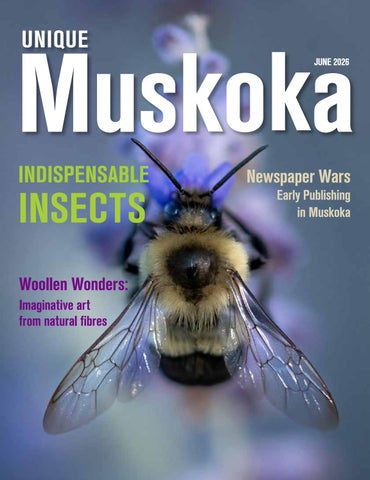
Photograph by Lauren Todd Bees play a particularly important role in pollination, enabling fruit production for a variety of crops and plants. Without insects, pollination and crops are at risk.
The north branch of the Muskoka River offers a paddling experience that is defined less by urgency and more by possibility. It invites paddlers to slow down, pay attention and choose their own version of the journey.
Departments 52 What’s Happening Article by Matt Driscoll Muskoka experienced widespread spring flooding, South Muskoka Hospital Foundation receives a second $1 million gift and Huntsville Festival of the Arts launches its summer concert series. Northlander moves closer to revival, Ontario invests in primary care and fire threatened the historic Kee to Bala. District of Muskoka council opposes
proposed provincial appointment powers and Huntsville resident receives Queen Elizabeth II Ontario Medal for Good Citizenship. Policing boundaries are realigned in Algonquin Park and a new mammography unit opens at Huntsville Hospital.
56 Cottage Country Cuisine Article by K.M. Wehrstein Photography by Tim Du Vernet Tarts are delectable bites of mouth-watering sweetness, cupped in crispy pastry, in a wide array of flavours and styles. Bakers from across Muskoka share their range of specialty tart recipes, from fruit tarts to custard-like tarts to the classic butter tart.
Opinion 9
Muskoka Insights By Meghan Taylor
11
From an Ecologist’s Perspective [56]
By Kate Dickson
64
Muskoka Moments By Peter Sale
June 2026 UNIQUE MUSKOKA 5
The Kia EV4 …telling the Muskoka story Unique Muskoka is published six times per year by Unique Publishing Inc. Meghan Taylor Publisher/Editor Donna Ansley Sales Lisa Brazier Marianne Dawson Design
MUSKOKA KIA
21 Robert Dollar Dr, Bracebridge, ON P1L 1P9
705-645-6575 muskokakia.ca
• Specializing in Sourdough • Fine Artisan Breads Daily • Assorted Baked Goods • Made in House Desserts
Susan Smith Administration Bronwyn Boyer J. Patrick Boyer John Challis Brittany Clark Kate Dickson Matt Driscoll Tim Du Vernet Josianne Masseau Peter Sale K.M. Wehrstein Andy Zeltkalns Contributors Annual Subscription Rates: (including HST where applicable) In Ontario $30.00 All Other Provinces $36.00 HST: 773172721 Canada Post Publications Mail Agreement Number: 43268016 Copyright © 2026 Unique Publishing Inc.
BIG RIVER BAKING COMPANY
705-394-4499 info@bigriverbakingco.com
FOLLOW US ON INSTAGRAM @bigriverbakingco for updates, daily bread lists and our weekly cheesecake special!
OPEN TUESDAY TO SATURDAY — 11A TAYLOR ROAD, BRACEBRIDGE
6 UNIQUE MUSKOKA June 2026
No content published in Unique Muskoka can be reproduced without the written permission of the publisher. Mailing Address Box 616, Bracebridge ON P1L 1T9 www.uniquemuskoka.com info@uniquemuskoka.com 705-637-0204
Trust the experienced professionals at Norstar who will recommend the right roof to help protect your investment. Choose from a variety of materials to suit all tastes and budgets, ng Experts. Proudly sheltering Muskoka from the call today and deal with Muskoka’s R elements for more than 50 years!
June 2026 UNIQUE MUSKOKA 7
OW N E R & O P E R AT O R
8 UNIQUE MUSKOKA June 2026
Muskoka Insights paying attention, it leaves us changed as well. In this issue, change and evolution are consistent themes in our features. Contributor Bronwyn Boyer shares the magic of Pam Carnochan’s art – watercolour with wool. Carnochan is thoroughly engaged in every aspect of her craft, from shearing her own sheep to dyeing the wool, often with natural dyes from plants and organics from her farm. Her artistic process is freeflowing and transforms simple substances into incredibly detailed, refined works of art. Also in these pages, regular contributor Patrick Boyer delves into the history of Muskoka’s early newspapers. From the beginnings of the Northern Advocate in 1869 through its many owners and publishers, to the Huntsville Liberal, Gravenhurst Banner and Free Grant Gazette, local news has had an impact on the region as much as it has shared the stories of those living here. This feature barely steps into the 1900s, yet the information is vast. The expansion and contraction of local publishing is astounding. Insects, more often than not, are classified as a nuisance to those attempting to enjoy the outdoors in spring and summer. However, as contributor Tim Du Vernet explains, insects are of critical importance when verifying the general health of an ecosystem. The bugs we deem as an annoyance are what support the blooming of flowers and trees, the growth of fruit and vegetables and the decomposition and return of nutrients to soil. Insects are essential to our environment. And so, we stand in the hush between what has been and what is about to arrive. Spring does not rush us toward summer; it simply opens the door and lets the light spill in. In Muskoka, this moment reminds us that becoming is as beautiful as arrival – if we slow down long enough to notice. Happy reading! Photograph: MacKenzie Taylor
In Muskoka, change doesn’t announce itself with a date on the calendar. It drifts in, quietly, like mist lifting off the lake. As the saying goes, the only constant is change, and nowhere does that truth feel more gently persuasive than in the weeks when spring loosens its grip and summer begins to lean in. The transition arrives in small, unmistakable moments. Birds begin their morning chorus before the sky has barely started to lighten. Green pushes up through soil that was recently resigned to barren grey. The light lingers a little longer each evening, as if reluctant to leave. These are not grand gestures, but they are enough. They tell you everything is underway. Spring here is cautious, almost polite. It tests the temperature, retreats, then returns with more confidence. A lake can still feel sharp with memory, carrying the cold of winter deep below its surface, even as the afternoon sun warms your shoulders. And yet, things are growing again – returning, perhaps – and the land seems to remember exactly what to do. There is something especially honest about this in‑between season. It lacks the bravado of high summer, when Muskoka hums at full volume, but it carries a quieter beauty. Towns begin to shift their rhythm. Windows open. Conversations stretch. There is collective sense that new stories are ready to unfold. As spring surrenders, the signs of summer gather. Gardens thicken. Storefronts brighten. Trees gently unfurl their leaves. Cottages stir awake. What makes this season so compelling is its brevity. Summer will arrive with certainty and confidence, but this moment is fleeting. It asks us to notice. To pause for the first bloom, the unexpected warmth, the feeling that something is coming, whether or not we are ready. In Muskoka, change isn’t disruption; it’s the narrative thread. Spring turning toward summer reminds us that renewal doesn’t have to be loud to be profound. Sometimes it arrives on birdsong, on softened earth, on the quiet assurance of things growing again. And if we’re
Inspired byNature w w w. b r a c k e n r i g . c o m 705-765-5565 info@brackenrig.com
June 2026 UNIQUE MUSKOKA 9
www.OntarioCottageRentals.com info@OntarioCottageRentals.com
With over 20 Years of Experience We’re There for You! ✓ Helping prepare your cottage ✓ Reservations ✓ Reducing risk by applying advanced screening methods ✓ Marketing ✓ Payments ✓ Housekeeping services ✓ Assisting with local municipalities ✓ STR guidance ✓ Airbnb and VRBO
OntarioCottageRentals.com Cottage Rental Experts
705-788-1809
6 Main St W, Huntsville, Ontario
Muskoka Parry Sound Georgian Bay 10 UNIQUE MUSKOKA June 2026 Kawarthas Haliburton Near North
From an Ecologist’s Perspective
Rising waters across a changing landscape Late April and May are usually a time of renewal in Muskoka, as both year-round and seasonal residents turn their attention to preparing for months spent on the water, docks and trails. This year, however, feels markedly different. Following a winter with significant snowpack and several days of heavy rain, water moved rapidly across the landscape, leading to record flooding in several communities throughout April and into May. For many, the usual seasonal preparations were replaced by urgent efforts to protect properties and infrastructure. The causes of this flooding are cumulative. In a balanced year, snowmelt follows several pathways: some is absorbed into the soil to recharge groundwater, some moves across the land as runoff, and some evaporates later in the season. Increasingly, however, these systems are out of sync. Rapid swings between freezing and warm temperatures, consistent with a changing climate, mean the ground often remains frozen during sudden thaws, limiting its ability to absorb water. When heavy rainfall is layered on top of this, a greater proportion of water is forced to move quickly across the landscape, increasing flood risk. Human-driven changes are also contributing. Across much of the region, the balance between built surfaces, or things like patios, driveways and walkways, and natural features like soil and vegetation has shifted. Natural ground cover plays a critical role in slowing and absorbing water, particularly during high-volume events. Native plants, which have evolved in the region over thousands of years, are especially effective at this. While ornamental plants and turf grass offer some benefits, their ability to meaningfully reduce runoff is limited by comparison. This imbalance is most evident
Photograph: Kate Dickson
Article by Kate Dickson
along shorelines. As native vegetation is replaced with lawns, ornamental plantings, or hardened structures like retaining walls, water can move more quickly into lake systems. Where and how we build also matters. Over the past few decades, approximately 75 sq. km of wetlands have been lost across The Land Between bioregion, which Muskoka is a part of, due to development. Wetlands function as natural sponges, absorbing excess water and releasing it slowly over time. Because they occur as interconnected patches, their loss has a disproportionate impact on the region’s ability to manage water. Filling or draining wetlands for development reduces this natural buffering capacity, increasing flood vulnerability both locally and downstream. Wildlife also plays an often-overlooked role in water management. Beavers, in particular, are known as “ecosystem engineers” for their ability to slow and store water through dam building. These natural systems help regulate flow and reduce the severity of flooding events. When beavers are removed or relocated, these
benefits are lost, and water can move more rapidly and unpredictably across the landscape. The implications of flooding extend beyond immediate property damage. Fast-moving water contributes to erosion, infrastructure strain and declining water quality. At the same time, when water is unable to infiltrate the ground, groundwater recharge is reduced, which is an important concern in a region where many residents rely on wells for drinking water. Healthy, functioning landscapes also support broader ecological benefits, like sustaining biodiversity and naturally regulating nuisance species like mosquitoes and Canada geese. The recovery from this year’s flooding will take time and resources. But as rebuilding progresses, there is an opportunity to strengthen resilience to future events. Many of the most effective solutions – restoring native vegetation, protecting wetlands, building with the landscape rather than against it and coexisting with natural systems – are rooted in the very qualities that have long defined the rugged beauty of the Muskoka region and have drawn people here for generations.
Kate Dickson is a project ecologist at The Land Between. The Land Between is an expansive bioregion spanning the Muskoka and Kawartha regions in the west to the Ottawa Valley in the east. Nominated in 2018 as a federal Community-Nominated Priority Place, The Land Between represents a final opportunity to recover and offer refuge to over 60 species at risk along with other disappearing species like the loon, black bear, and moose in Southern Ontario. It is also the name of the charity that is working to conserve and protect this vital and iconic landscape.
June 2026 UNIQUE MUSKOKA 11
Photograph: Norway Point Community Church
Article by J. Patrick Boyer
F
Baysville and Dorset, projecting out with sandy beaches, was Norway Point, so named for its thick cover of a red pine species. The entire stand was clearcut, although loggers symbolically left a lone Norway Pine near the water’s edge. The whole region itself was long familiar
to First Nations as Ojibwe territory and for generations Indigenous peoples bartered there for goods and supplies. In time, they also bartered with White fur traders, bequeathing the name Trading Lake to waters whose high vistas and irregular bays thrilled those seeing them.
Photograph: Bruce MacLellan Collection
ollowing the arrival of White settlers in the province, Lake of Bay’s south shore first saw loggers, then homesteaders, followed by cottaging vacationers, and next holidaymakers at popular resorts like the WaWa Hotel. Midway along this shoreline between
Norway Point with its lone Norway Pine, as seen in the 1920s from the road along Lake of Bays shoreline between Baysville and Dorset, with infilling of tree cover a half-century after clearcutting and before a highway was built further inland. 12 UNIQUE MUSKOKA June 2026
By 1877, the area around Norway Point was settled, the intersection of Brown’s Brae Road and Paint Lake Road, known as Gordon’s Corners, with a church, a school and a post office. However, many early homesteaders, finding the land rocky and its soil unproductive, moved on, a departure creating a scenic vacuum drawing in high calibre cottagers. In 1899, visiting the increasingly renowned lake to see for themselves, Rev. J.L. Brown and his wife Lizzie felt overwhelmed by the natural spectacle. That J.L. as an ordained Presbyterian minister could not engage in money-making ventures was helpful because, of the pair, Lizzie was more adept at business. She bought land from Elizabeth Robertson, whose pioneering family owned plenty of Free Grant acreage, then subdivided her holdings around Norway Point, retaining one lot for the Brown’s own cottage, and began selling the rest to Presbyterian ministers. She knew, as the spouse of one, they could not own houses. The Presbyterian Church provided a manse for them to live in while serving a community,
ensuring easier relocation to a different community’s church without real estate complications. However, no rule forbade a minister to own a cottage. Lizzie and J.L. zealously began creating a summer colony of Presbyterian clerics who, when not on vacation themselves at their Norway Point cottages, profitably rented out the vacant summer residences, closely co-ordinated by Lizzie. Several ministers owned more than one and, with a bit of local help, built cottages themselves. In this era of Muskoka’s emerging vacation economy, clergyowned cottages became endemic across the district. In 1901, Dr.
Photograph: Doug Fatum, past chair, Norway Point Community Church
Photograph: Anne & Don Henry
Reaching a summer church by boat became a pattern in many parts of Muskoka and those crossing Lake of Bays to Norway Point Community Church found waiting docks to welcome them.
MacTavish of Toronto bought land from Lizzie and built his vacation home. The Browns and Dr. MacTavish, also envisaging a colony of the like-minded, actively enjoined ministerial colleagues to buy, build and benefit. Rev. Dr. R.M. Hamilton, then others, began building cottages on their lots. One was rented to James W. Tyrell who so liked the setup that he bought the place in 1905. Dr. Fraser Smith, a missionary from China, built along the Norway Point shore, then did two other missionaries, Dr. Murdoch MacKenzie, and Rev. Dr. McKay. In 1908, the Buckingham family rented from the Blacks, and several years on, bought the property. In 1910 and 1911, the Sprott family did likewise, renting, then buying. At the suggestion of J.L., the Muirhead family joined their ranks. In the bargain, digging for foundation work, arrowheads came to hand, tangible reminders of the land’s prior occupants. Norway Point’s seasonal population of the ordained and highly devout continued growing and as additional buyers built more cottages, a significant community emerged. By 1915, the nagging problem of errant property lines was addressed with a new survey by a non-Muskokan who prepared a plan based on his measurements that was accepted and signed by all the cottage owners – a legally binding title document for a settlement many now called “Muskoka’s Clergy Reserve.” While this was transpiring, a church emerged. For individuals sharing religious beliefs, a special place to worship together is a bonding ritual of transcending importance and, in a district like Muskoka, assembling at water’s edge for this purpose becomes all the more a summit experience. In that pivotal year 1899 when Lizzie bought land, J.L. convened the first of his Sunday morning services on their lot in a grove beneath a towering tree. With the enthusiastic
June 2026 UNIQUE MUSKOKA 13
Photograph: Norway Point Community Church
14 UNIQUE MUSKOKA June 2026
Browns their vanguard, Norway Point’s community of different Protestant denominations felt a self-reinforcing bond. Despite being distant from one another for 10 of the year’s dozen months, these cottage-owning Christian neighbours emerged a closely-knit congregation. Sunday worship beneath the Brown’s leafy canopy, with soothing onshore breezes, was sheer summertime pleasure – though not an allweather arrangement. A church building was needful. By 1908, they’d pooled enough money. On August 8, a Saturday workday, the cornerstone was laid. In the ensuing weeks of open weather and long daylight, construction sped forward with local carpenters assisted by adept cottagers. Dr. Neil and Dr. MacTavish themselves completing the roofing. In just two weeks, on Sunday, August 23, the church doors opened for a dedication service. The collection plate was passed around, returning with $217 on board – roughly $8,600 in 2026 dollars. Truly a community church rooted in faith, others beyond Norway Point keenly made it their place of worship, too. Daphne Curtis, writing about life at Norway Point, calls it “a rallying point of the community that remains so a century later.” An ecumenical spirit lifted lines of distinction from the Protestants who from inception, designated their Norway Point Community Church multi-denominational. In 1925, when the United Church of Canada merged Presbyterians, Methodists, and Congregationalists, that was national church leadership catching up with Norway Point. An elected board of trustees confirmed the pulpit and services open “to ministers and members of any evangelical denomination.” At first, the congregation consisted largely of summertime resident ministers and their families, but the invitation to others was being taken up, with WaWa Hotel and Bigwin Inn guests attending and participating in services. The Norway Point Community Church had become a magnet
The interior of Norway Point Community Church achieves an airy and comforting atmosphere with natural light from windows, overhead lights in wood shades and an abundance of natural wood surfaces.
Photograph: Muskoka Heritage Place, Huntsville, Ontario
Photograph: Bruce MacLellan Collection
Glenmount Hotel along Lake of Bays shoreline from Norway Point opened around 1912. “This photo shows how barren the land was from logging and farming efforts,” notes Lake of Bays historian Bruce MacLellan.
100% Canadian Artists / Bala, Muskoka
for the ministry. Rev. S. Edward Young, whose cottage was across the lake behind Bigwin Island, boated with sons Bradford and Edward to every summer service; both boys would become ordained ministers. The church that went up quickly came down even faster. On March 24, 1943, the weight of snow on its roof collapsed the
building. Unlike a fire, a salvage operation from snow produced all the worthy items that had been in or part of the structure little scathed. When the replacement church was erected on the same footings in 1944, its interior pine rafters and timbers were left in their mellow natural state, the salvaged oak pulpit reinstated to its place, along
By 1930 the days of clearcutting Lake of Bays’ south shore were history when this photograph was taken of Norway Point Community Church surrounded by woodland forest. with the matching chancel chairs. But since the congregation now included more than stoic Presbyterians, the hard-backed chairs, despite their recovery from the wreckage, gave way to more comfortable oak pews. The order of service is contemporary, blending vernacular usage and traditional
Lorem ipsum
‘NANUK’ 54” X 70” P. GARBETT
705 765 7474 redcanoegallery.com 33 years in Muskoka
June 2026 UNIQUE MUSKOKA 15
passages of scripture. Solemnizing a wedding in Norway Point Community Church is memorable. Procedures and guidelines outline all steps required, including contacting Mary-Lynne Dunn, a Norway Point co-chair. Scott Fraser, co-chair, includes among his many duties taking photographs that preserve a record of church events. All the while, the church’s growth led to expansion and upgrades. On Sunday, August 2, 1969, a memorial cairn by the front entrance was dedicated to the memory of professor J. Watson Bain, a longtime member and official of the congregation. The original church’s bell, recovered in 1943, was mounted atop the cairn to continue ringing out its summons to worship. Bain is an example of the devotion of those connected with Norway Point and its community church. His family’s Muskoka summer connections began at Lake Joseph in 1860. He became founding member and chair of the University of Toronto’s faculty of chemistry, and founder of the Canadian
Chemical Society. With a double lot at Norway Point, he tackled building the Bain cottage on still treeless terrain by planting red and white pines that flourished, giving privacy from the passing highway. To recruit ministers for Sunday services, Bain boated around Lake of Bays canvassing for clerics. Since 1974, a dock built at the shoreline directly in front of the church enables cottagers around the vast lake to attend worship more readily by boat. Reached on land along Muskoka District Road 117, a turn midway between Baysville and Dorset toward the lake onto Glenmount Road leads to Norway Point Road and, at its end, the church. In 1981, the church building was extended to provide a narthex and additional seating. More recently, electric heating provides comfort on cool days and coats no longer need to be worn for Christmas Eve service. Wheelchair access was made possible. In 2008, Lake of Bays Heritage Foundation presented the Norway Point Community Church congregation its esteemed Community Heritage Award.
EXPERIENCE YOU CAN TRUST Photograph: Norway Point Community Church
Experienced drilling & blasting for roads, ditches, foundations and septic systems. Exceptional service and top-quality results.
FREE ESTIMATES
On Sunday, August 2, 1969, this memorial cairn at the Norway Point Church’s front entrance was dedicated to the memory of Professor J. Watson Bain, a longtime member and official of the congregation. The original church bell, recovered in 1943, was mounted atop it and continues ringing out its summons to worship. 16 UNIQUE MUSKOKA June 2026
LOWER OVERHEAD FOR US MEANS
LOWER PRICES FOR YOU
WE HAVE MOVED! VISIT OUR NEW WAREHOUSE SHOWROOM AT:
61 Keith Road, Bracebridge
Come check out our new Warehouse Showroom Pricing! Store hours 9-5, Wednesday through to Saturday Browse our extensive website at muskokafurniture.net • Call anytime 705-645-8183
June 2026 UNIQUE MUSKOKA 17
Article by John Challis / Photography by Tim Du Vernet
I
n the worst of the COVID-19 pandemic, urban Ontarians flooded into the hinterland seeking a safe retreat from the numbing stress of the lockdowns. The exodus filled trails, parks and beaches everywhere. McCrae Lake Conservation Reserve, at the lip of Georgian Bay and two hours from the GTA, suffered from the mobs of visitors. Loud music,
scattered garbage, and even illegal use of motorboats, were common remarks posted to social media sites. One blogger, arriving there in the summer of 2020, found “dozens of parked cars on the shoulder of Georgian Bay Road. The parking lot was totally full, so people had taken to parking on the side of the road.” Today, any vehicle parked on
McCrae Lake Conservation Reserve Trail Length: 8 km one-way Difficulty: Moderate Suitable for: Walking, Hiking, Paddling, Climbing, Snowshoeing Operation: Year-round To get there: Coming from Bala, take Muskoka Road 38 to Highway 400 south; about 8 km later, take Exit 169 onto Georgian Bay Road/ Crooked Bay Road. The parking lot is on the west side of Highway 400.
The hiking at McCrae Lake Conservation Reserve can be described as moderate difficulty, but this is not a beginner’s outing. Wear good quality hiking boots – wetland sections can be muddy and bug repellent is a must for the wetland areas. 18 UNIQUE MUSKOKA June 2026
the road shoulder will be towed. Ontario Parks staff patrol the reserve, removing garbage, checking on overall use and the conditions of trails and signs. But the park remains busy, a well-known destination for wilderness hikers, campers and paddlers. Covering 2,039 hectares of Crown land, McCrae Lake Conservation Reserve is one of 378 conservation reserves created 25 years ago under Ontario’s Living Legacy Land Use Strategy. That strategy aimed to ensure a percentage of all the province’s ecosystems would be protected. The whole park is
breathtaking. The main trail leading in from the parking lot wanders alongside smaller lakes, beaver ponds and wetlands that give way to oak and pine forest and rock barrens. Eventually the spectacle of McCrae Lake itself unfolds. Pine-lined shores fill the view, interspersed by pink and grey fingers of granite knuckling into the water. A number of cliff lookouts provide memorable vistas. Walking the length of the trail reaches a steep climb to a narrows that spills from McCrae Lake directly into Georgian Bay. There’s plenty of wildlife sharing the park as well, including moose, beaver, turtles and Ontario’s only lizard, the five-lined skink. Red-shouldered hawks inhabit the deeper forest and the songs of many warblers will ring through the woods in the morning hours. The full trail, marked by yellow flashes, is just under 8-km long – about 15.6-km out and back
– with a total elevation gain of more than 300 metres. It’s a full day’s hiking. If you plan on a lunch break and a dip in the lake’s inviting water, the trip might finish at dusk as the mosquitoes begin to thicken. About 2 km in, a short side trail will lead to what’s called the Crow’s Nest lookout, the first of those cliff lookouts over the lake. It’s a popular stop for picnickers and offers a good enough walk to fill an afternoon. Another short trail starts on the main trail, but veers north to a creek leading from McDonald Lake. A snowmobile bridge spans a small cascade that spills from McDonald Lake to a boggy eastern bay of McCrae Lake. This trail is 4.8-km out and back. Make sure to be following the right trail as it connects to a difficult 18-km trail that heads north and out of the reserve property. It can also be described as muddy in parts, and not well-marked. McCrae Lake is a multiuse property. The lake makes for fine canoeing. In winter, the park is criss-crossed with snowshoe and snowmobile trails. As a conservation reserve, there is no charge for camping. As a result there are, by some estimates, as many as 50 campsites scattered around the lake. The hiking is described as moderate difficulty, but this is by no means a beginner’s outing. McCrae Lake is true wilderness and brings with it the hazards of that description. Cell
Throughout McCrae Lake Conservation Reserve, pine-lined shores are interspersed with pink and grey fingers of granite punctuating the water.
June 2026 UNIQUE MUSKOKA 19
There’s plenty of wildlife sharing McCrae Lake Conservation Reserve, including moose, beaver, turtles, insects and Ontario’s only lizard, the five-lined skink. Red-shouldered hawks and a wide range of birds can also be seen, and heard, on the trail. phone signals may be weak. The trails can be tricky to follow – markers may not be easy to find, may have been lost or faded – and people do get lost. Unofficial trails can distract from the proper route. Just last January, two snowshoers had to be rescued by helicopter when they went through the ice on the lake. A downloaded trail map from one of the popular trails apps available is advisable. If you’re worried about getting lost, download the “What 3 Words” app, which will locate you and provide universally recognized details of your whereabouts with a three word code. Wear good quality hiking boots – wetland sections can be muddy – and bring food and more drinking water than you think you’ll need. Bug dope is a must for the wetland areas.
20 UNIQUE MUSKOKA June 2026
Several cliff lookouts provide memorable vistas throughout McCrae Lake Conservation Reserve.
Taking the complexity out of hiring the right company.
©Legacy North
MUSKOKA BUILDERS’ ASSOCIATION IS THE PLACE TO START.
Enjoy Peace of Mind in Muskoka Our mission is to continuously support our members by providing timely education, training, and information tailored to their needs. We promote a collaborative culture rooted in strong business ethics, enhancing the effectiveness and success of the building industry in Muskoka. By fostering teamwork and shared values, we ensure our members are part of a community dedicated to excellence and ethical practices. Our members bring knowledge, experience, and peace of mind to your project, with deep familiarity of the local area and its unique building challenges.
(705) 645 3008
All our members, from suppliers through to trades, have a strong working relationship. They are well-equipped to handle lake and island projects, and offer ongoing support and warranty services. We simplify the process of choosing a contractor with an easy-to-use directory on our website.
MUSKOKABUILDERS.COM
June 2026 UNIQUE MUSKOKA 21
Photograph: Sandra Morris
Sandra Morris’ first book, The Wilding, and her forthcoming second work, The Land Between, are odes to the natural world and human connection.
22 UNIQUE MUSKOKA June 2026
Article by Meghan Taylor to Muskoka. But it is also a reminder that love brings responsibility. “As I say in one of the poems in my new collection, Muskoka spoke to us in a way that felt as though we knew it, and it knew us,” says Morris. “We have been hopelessly in love with it ever since.” Like many who fall for Muskoka, first as a visitor, Morris spent time returning to familiar shorelines, granite outcrops, and the particular hush that settles after a boat passes. Over time, those visits accumulated into something like a compass. The region stopped feeling like a backdrop and started to feel like a conversation partner. “We bought our little off-water cottage in Port Carling in 2018 and moved here permanently that year,”
explains Morris. “My husband and I felt that we wanted to spend more time in Muskoka than just a couple of weeks in the summer. I, in particular, felt it calling me. I felt utterly compelled to be up here, for reasons I didn’t even fully understand.” Living here full time Photograph: Sandra Morris
O
n a calm Muskoka morning, the lake does its quiet work. Water smooths itself into glass. Pines draw a clean, deliberate line against the sky. A loon calls – one long note that seems to fold time in half. For poet Sandra Morris, these moments are not interruptions to daily life. They are daily life, and they are the source from which her debut poetry collection, The Wilding, has grown. Now based year round in Port Carling with her husband, Morris writes from inside the landscapes that once drew her north as a visitor. Morris and her husband first started travelling to Muskoka almost two decades ago. They were in awe of the beauty they encountered. “In the midst of busy careers, we felt the need to get out into nature and were drawn north, without at first knowing where we were going, or what we might find there,” she shares. What began as seasonal escape has become something steadier and deeper: a lived relationship with place. The Wilding is the result of attentiveness – a book shaped by lakes and weather, rocks and birches, winter silence and late summer light. It is, first and foremost, a love letter
Sandra Morris, while notoriously camera-shy, has hundreds of photos of her adventures throughout Muskoka, drawing inspiration from the beauty of the land and waterways.
June 2026 UNIQUE MUSKOKA 23
Photograph: Muskoka Chautauqua
In August 2024, Sandra Morris launched her first book, The Wilding, at Muskoka Chautauqua in Windermere. The venue, amongst nature, was an apt backdrop for the poetry.
changed how Morris paid attention to the world around her. It became more intimate. Mornings looked different from afternoons. Seasons rewrote the same views. Winter, especially, demanded a slower gaze. That patience, earned through repetition and quiet, is central to Morris’ poetic voice. The poems in The Wilding don’t rush. They linger. They return. Morris approaches a shoreline, a tree or a stretch of water the way a painter might – revisiting the same subject under changing conditions, learning its subtleties, letting it speak. In her hands, Muskoka’s familiar icons – water, rock, forest, snow – are never just decorative. They are collaborators. Poem titles such as “The Rhythm of Water,” “At Huckleberry Rock,” “White Birch in the Backyard,” and “Winter White” reveal the collection’s method. Each begins with a tangible encounter, then opens outward. Water becomes measure and memory. A birch tree offers a meditation on fragility and resilience. Winter’s stark palette is treated not as deprivation, but as another form of abundance – an invitation to see what quiet can hold.
“I hope to use the power of words, and of poetry in particular, to inspire wonder about the world,” Morris says, “and both individual and collective action to save it.” That aspiration runs like an undercurrent through the book. The Wilding acknowledges beauty while refusing to ignore vulnerability. It celebrates the natural world while mourning the crises it faces. Yet the poems never lecture. Instead, they persuade through attention – through love that is earned rather than assumed. At its heart, The Wilding is about relationship: between human life and the more than human world, between belonging and stewardship, between the comfort of home and the grief that arrives when home is threatened. Morris asks a deceptively simple question repeatedly: What does it mean to love a place without consuming it? In her next endeavour, Morris explores the concept of “the land between” – the natural world and the ideas of home, family and human relationships. “I was inspired to discover on visiting the Muskoka Lakes Museum in Port Carling that Muskoka is part of a unique ecological
Muskoka Barging
Family run construction company with over 35 years experience operating in the Muskoka Lakes area. No job is too small or too big. 705-764-0765 | muskokabarging.com | 1163 Milford Bay Rd, Milford Bay ON
BARGING ● STEEL & CRIB DOCKS ● SEPTIC SYSTEMS ● LANDSCAPING 24 UNIQUE MUSKOKA June 2026
Photograph: Sandra Morris
SERVING MUSKOKA & PARRY SOUND FOR OVER 70 YEARS
Sandra Morris and her husband have spent hours paddling their kayaks on Lake Rosseau. One of her poems, titled “The Rhythm of Water,” speaks to her experiences and observations on the water. transition zone or ecotone, with rich biodiversity and other characteristics, known as the land between,” she shares. “I found myself drawn to the idea of exploring what that means, what further stories it might tell about Muskoka and the broader natural world.” Her second project, tentatively titled The Land Between, continues to explore the world around us and Morris’ own sense of learningin-progress. “The title of my 2024 book, The Wilding, is about what drew us here and caused us to fall in love with this extraordinary region, The Land Between,” says Morris. Morris’ poems don’t present tidy conclusions. Instead, they model a practice: slow down, pay attention, stay present long enough to be changed. Morris believes that how we observe shapes how we live and how
we protect what matters. This philosophy extends beyond the page. Morris is eager to connect with readers, artists and community partners who share an interest in the intersections of art, place and environmental responsibility. For her, poetry is not an isolated act. It is a conversation that begins with wonder and continues outward. The Wilding, now available in paperback, hardcover, and e book formats, is an ode to Morris’ love of the close wildness that is Muskoka. Even the cover signals this ethos: a red fox, photographed in Muskoka, meets the reader’s gaze. Wildness here is not distant or abstract. It lives next door. In Muskoka – a region defined by water, forest, and rock – Morris offers a gentle but steady suggestion. Start with wonder. Stay long enough to be changed. Let that change guide what you do next.
Sales & Service of Major Propane Appliances (refrigerators, ranges, fireplaces, furnaces & more) Safe & reliable No electricity required Bulk propane delivery to your home or cottage
705.645.4294 TF: 866.645.4294 STORE: 228 TAYLOR RD., BRACEBRIDGE OFFICE: 1646 WINHARA RD., GRAVENHURST
June 2026 UNIQUE MUSKOKA 25
Article and Photography by Tim Du Vernet
W
ho would have thought that the smallest creatures of the forest could be the most critical? According to Amanda Porter, conservation manager with Muskoka Conservancy, insects form the foundation of life in forest ecosystems. They are a primary food source for many species, particularly birds, which are often insectivorous. The world of insects is vast and complex. With countless species, diverse habitats, and remarkable abilities to survive extreme conditions, insects represent an extraordinary range of life. The presence – or absence – of certain insect species can also serve as a clear indicator of ecosystem health. Porter points to the “benthic zone,” the area just a few centimetres beneath the bottom of a pond, which supports many invertebrates. These organisms, including caddisflies, damselflies and mayflies, often emerge in spring and provide important clues about water quality. Although some insects are invasive and harmful, conservationists agree that indiscriminate use of insecticides – often applied for comfort or convenience – is one of the worst actions humans can take. Instead, they recommend alternative approaches during short periods of intense insect activity. These include spraying water on wood piles or encouraging natural predators by installing swallow nesting boxes or bat houses. At no time is the “cycle of life” more dramatic than in spring. Woodpeckers hammer into trees to reach insects hidden beneath the bark, creating cavities that later become homes for other species. Dragonflies dart through the air, consuming mosquitoes until they themselves may be caught by a swooping swallow. Each interaction highlights how interconnected these creatures are. Insects also play a crucial role in breaking down organic matter and recycling nutrients back into the soil. Lifting a layer of leaves from the forest floor reveals a thriving community of decomposers. Some, like millipedes and worms, are not insects, but they work alongside beetles and other species to keep ecosystems functioning – they recycle decaying material. Many familiar insects – June beetles, ladybird beetles, fireflies, and flies – also contribute as pollinators and decomposers.
26 UNIQUE MUSKOKA June 2026
From the blue bottle fly to the bumblebee, ladybug to woodlouse to butterfly, insects are a complex group of creatures, vital to any ecosystem. June 2026 UNIQUE MUSKOKA 27
protected by hard shells that prevent moisture loss. Some species even produce antifreeze-like compounds that stop ice crystals from forming inside their cells. Stronks explains how insects lay eggs in a variety of locations – on vegetation, beneath leaves, within plant stalks, in soil, or in water. Many species are highly host-specific, laying eggs only on plants their larvae can eat. This dependence underscores the importance of using native plants in gardens. Some insects, such as parasitic wasps, lay eggs inside other insects, where the larvae feed on the host. More than 80 per cent of all living creatures belong to the phylum Arthropoda, which includes insects, spiders, crustaceans, and millipedes. Insects specifically are defined by three main body sections: a head with eyes, antennae, and mouthparts; a thorax Dragonflies are agile hunters with remarkable adaptations. Their hard exoskeleton provides support that bears legs and wings; and an abdomen for powerful muscles, while intricate wings allow exceptional flight control. THE RIOBEL MOMENTI™ COLLECTION that contains internal organs. Anyone who AVAILABLE AT KNOWLES PLUMBING! remembers grade six biology may find this Despite their importance, most insects go identify only about 100. familiar. unnoticed. Rick Stronks, manager of Marsh’s Spring also brings renewed insect activity Looking closely at an insect like a Falls Nature Reserve, estimates that Muskoka following winter dormancy. Some insects, dragonfly reveals remarkable adaptations. Its alone may host as many as 10,000 insect including ladybugs and certain flies, species, person likelySH OW overwinter as adults. BATyet Hthe&average KI TC Hcan EN ROO M Others survive as eggs, hard exoskeleton provides support for DESIGN. INSTALLATION. REPAIR S E RVING ALL OF MU SKOKA 279 MA N ITOBA ST, B R AC EBR ID G E
70 5 . 6 45.2 67 1
K NOWLESP LUMBI N G .COM @MUSKOKABATH
Muskoka’s Bath & Plumbing Centre
BATH & KITCHEN SHOWROOM SALES • INSTALLATION • REPAIR SERVING ALL OF MUSKOKA
279 Manitoba Street, Bracebridge
705.645.2671 @knowlesplumbing knowlesplumbing.com 28 UNIQUE MUSKOKA June 2026
powerful muscles, while its intricate wings – unique structures rather than modified limbs – allow exceptional flight control. Insects have a heart and a circulating fluid called hemolymph, which transports nutrients and hormones but does not carry oxygen. Instead, oxygen enters through spiracles connected to an internal network of air tubes. These physical features are closely tied to how insects feed and interact with their environment. Bees, for example, have a specialized proboscis – a straw-like, retractable structure used to collect nectar, water and honey, as well as for grooming and transferring food. Dragonflies, meanwhile, are agile hunters. Sitting on a sun-warmed rock, they can be observed using their feet to manipulate prey. Their speed and manoeuvrability make them effective predators and reliable indicators of clean, healthy water. Butterflies and moths, though often confused with dragonflies, are not predators. Stronks believes they are underappreciated as pollinators. In the case of Monarch
Insects play a crucial role in breaking down organic matter and recycling nutrients back into the soil. Below the layer of leaves, whether in your yard or on the forest floor, a community of decomposers are working to recycle decaying materials. butterflies, the relationship with milkweed is essential because the caterpillars rely exclusively on the plant for food. Without milkweed, Monarch populations could
disappear. Moths also serve as an important food source for bats. Ants, wasps, and bees are closely related, and bees in particular play a vital role in
COTTAGE STYLE FURNISHINGS & DECOR Featuring Ontario Made Furniture
info@simplycottage.ca 705-646-2828 Visit us at our new home at 339 Ecclestone Drive Bracebridge, Ontario Delivery throughout Ontario www.simplycottage.com @simplycottageltd
June 2026 UNIQUE MUSKOKA 29
The four-spotted sap beetle is often known as the picnic beetle, as it is highly attracted to damaged, decaying or fermented organic materials, particularly overripe fruits and vegetables. The small black beetle, less than a quarter inch in length, is easily identified by four distinct orange-yellow spots on its wings.
Flowering plants, fruit trees and vegetable crops all depend on insects to transfer pollen enabling seed and fruit production. Bees play a vital role in pollination, although they’re not the only insects required for a thriving crop.
30 UNIQUE MUSKOKA June 2026
pollination. Flowering plants, fruit trees and vegetable crops all depend on insects to transfer pollen from the anther to the stigma, enabling seed and fruit production. Local hobby beekeeper Elizabeth Prosser recalls a neighbouring farmer who reported increased crop yields after bees were introduced nearby. She emphasizes that pollination is not guaranteed and depends on healthy insect populations. Habitat loss, pesticide use, and climate change all threaten these essential species. Spring also brings humans into direct contact with insects – sometimes unwillingly. Blackflies, made famous by song, quickly give way to mosquitoes, reminding us of the less glamorous side of insect life. Fortunately, technology allows individuals to contribute meaningfully to insect research. Stronks strongly supports community science initiatives using smartphone apps such as iNaturalist. These tools enable people to record sightings of insects and plants, providing valuable data that scientists could never collect alone across regions as large as
Ontario. Leaf litter and emerging plants are especially rich habitats in early spring, hosting aphids, leafhoppers, beetle larvae, and many others – even when traces of winter remain. While insects may sometimes frustrate us, their importance to Muskoka’s ecosystems cannot be overstated. Understanding which species are invasive – and how to manage them responsibly – is equally crucial. Insects such as the emerald ash borer, spotted lanternfly, hemlock woolly adelgid, spongy moth, Asian longhorn beetle and brown marmorated stink bug have caused significant damage to forests and fields. Prevention includes brushing seeds and insects off clothing and pets after hiking to avoid spreading them further. Pay close attention after adventures to be sure invasive species aren’t travelling with you. In the end, insects may not seem like our closest allies as they swarm around us in the bush, but they are truly essential. Their role in the natural world is often overlooked, yet nearly every interaction we have with nature in Muskoka is made possible, in some way, by insects.
10
...telling the Muskoka story
g n i t a r Celeb
Years
www.uniquemuskoka.com June 2026 UNIQUE MUSKOKA 31
Pam Carnochan proves with her art that wool can look like refined paintings.
Article by Bronwyn Boyer / Photography by Josianne Masseau
T
o everything, there is a season, and Pam Carnochan embodies that truth like no other. She ebbs and flows like waves on the shore through multiple roles. She’s an artist, an event host, a passionate
teacher, and a storyteller who speaks through the fibres of her sheep, her environment, and her imagination. She calls her process “watercolour with wool,” combining her love of fibre and watercolour painting.
Carnochan is a member of the Huntsville Art Society, an instructor for the Haliburton School of Art and Design, and has been featured in shows and on studio tours throughout Muskoka as well as the
A marriage of practicality and soulful channelling, Pam Carnochan’s connection to her raw materials and her approach to art champions patience, experimentation, and the beauty of imperfection. 32 UNIQUE MUSKOKA June 2026
Pam Carnochan is committed to nurturing the artistic community in Muskoka, which symbiotically nurtures her in return. She aims to continue inspiring others, whether through her art, workshops, exhibitions, charity contributions or other collaborations.
June 2026 UNIQUE MUSKOKA 33
McMichael Art Gallery in Kleinburg. She grew up in Huron County, on a farm in Seaforth Ontario. Carnochan always loved sheep and she was always an artist, though art school wasn’t in the cards for her. Later, her love of sheep made sense. She also didn’t miss out on arts academia, as she gained all the inspiration and insight she needed from watercolour painter Terry Gill. Before long, she was pulled like a magnet into the prolific arts community in Muskoka, and she never looked back. Carnochan and her husband operated Morgan House B & B at her farm with its pastoral stone house on the outskirts of Huntsville. She also offers wedding, yoga and music venue spaces, which are as thoughtfully curated as her art, geared towards fostering connection and creativity. “We want to make it just intimate,” she says. “I don’t want big weddings or overwhelming crowds.” This intimacy extends beyond the physical to her artistic process, where she emphasizes the importance of spontaneity. Carnochan’s workroom is a sanctuary of colour and texture. It’s filled with bags of wool, foam pieces and tools,
each a step in her teaching and creating process. “It’s about the journey through the seasons,” she shares. “The sheep grow the wool. Then there’s a time for shearing, then washing, dyeing, before the artistic process can even begin. There’s no rush.” Her approach champions patience, experimentation, and the beauty of imperfection. Carnochan’s connection to her raw materials makes her work a marriage of practicality and soulful channelling. Her wool comes from her own sheep, Lindsay, Helen and Gloria. “My girls give me everything I need to paint with,” she says. “It’s crimped, curled, full of swirls and alive with character.” Carnochan uses spiked tools to pick the wool apart, then it’s carded into felt pieces. “Wool is the oldest fabric known to man,” she says. “Felt was probably discovered by accident, because it’s created through friction, agitation and moisture.” The felting process involves brushing sections of wool, then layering them on top of each other, alternating the
The wool Pam Carnochan uses for her art comes from her own sheep – Lindsay, Helen and Gloria.
HARDWOOD | LAMINATE | VINYL PLANK & TILE | CARPET CERAMIC | NATURAL STONE …AND MORE!
MODERN HOME CARPET ONE
350 Ecclestone Drive • Bracebridge
705.645.2443 carpetonebracebridge.ca
34 UNIQUE MUSKOKA June 2026
TAYLOR CARPET ONE
30 Cairns Crescent • Huntsville
705.789.9259
taylorcarpetonehuntsville.com
Wool is washed and treated with water, vinegar and dye on a hot plate. The chemical reaction of the heat, pigment and vinegar creates a colourful medium. The acid of the vinegar acts as a “mordant” or fixing agent that bonds the dye to the protein fibres in the wool.
June 2026 UNIQUE MUSKOKA 35
After the washing and dyeing process, the colourful stew is dumped on to framed screens to drain and dry in the sun. Pam Carnochan is strategic about turning the wool during the drying process, as the sun bleaching the colour can be a desirable effect. 36 UNIQUE MUSKOKA June 2026
directions. Carnochan’s skill comes as second nature, rather than strict procedure. “I don’t make perfect squares,” she laughs. “I want my work to reflect the natural, fluid lines of life.” Before that, it’s washed and treated with water, vinegar and dye on a hot plate. The chemical reaction of the heat, pigment and vinegar creates the colourful medium. The acid of the vinegar acts as a “mordant” or fixing agent that bonds the dye to the protein fibres. This is how Carnochan achieves her vibrant, colourful landscapes, alive with colours and shadows that evoke wilderness scenes. Although the texture of the felt gives them an impressionist feel, they’re surprisingly realistic. Nature is Carnochan’s muse and medium. When possible, she dyes her wool with marigolds, goldenrod and poppies from her own garden. She describes her process as “farm to frame,” emphasizing her commitment to authenticity and sustainability. After the washing and dyeing process, the colourful stew is dumped on to framed screens to drain and dry in the sun. Carnochan is strategic about turning the wool as the sun bleaches the colour somewhat. This effect can be desirable as it adds even more gradation and variety to work with. Like a sculptor bringing the statue out from underneath rough clay, Carnochan coaxes and teases spring blooms, summer waters, fall’s rich hues and winter’s stark beauty from the fibres. The browns of tree trunks, the grays of rocks and white crests on deep blue waves are woven into life. A meaningful raven, a red canoe and elusive figures of people and animals hold mysteries waiting to be uncovered. “I love the idea that you see what you want to see,” she says. “It’s subjective, like dreams or memories.” Carnochan’s creations are layered with symbolism and emotion. She shares how her art has evolved from a perfectionist’s pursuit to a liberated exploration. “I used to throw out my work in high school because it wasn’t perfect,” she recalls. “Now I see beauty in the imperfect and spontaneous. It’s about trusting the process and letting go of the need to achieve specific outcomes.”
Teaching is one of Carnochan’s greatest joys. A firm believer in raw inspiration unsullied by formal training, she loves demystifying art for beginners, especially those who are intimidated it. Her workshops encourage participants to embrace “mistakes” as part of the creative dance. This teaches people that there’s no room for ego, only the unbridled spirit. “I want people to feel free,” Carnochan explains. “I want them to understand that art isn’t about perfection, but connection.” Her workshops often involve collaborative exercises, passing projects around so each participant can add to it. “It’s about the process, not the product,” she maintains. “It’s about nurturing a supportive community where artists of all ages and backgrounds thrive.” Flowing with the seasons, there is a time
Like a sculptor bringing the statue out from underneath rough clay, Pam Carnochan coaxes and teases spring blooms, summer waters, and the elusive figures of animals and people from the fibres.
125,000…
…that’s a big number but that’s the number of individual readers we reach We’re passionate about our towns, the people who live here, and the stories that shape our communities. By providing well-read news content and connecting with our readers in Muskoka and East Parry Sound, we work hard to deliver meaningful results for our advertisers.
For more information on advertsing and connecting with your community Email: hugh.mackenzie@doppleronline.ca June 2026 UNIQUE MUSKOKA 37
Canadian Fine Craft & Artwork
Margaret Grottenthaler Tessa Ounapuu Palette Potter Pursuits Jewellery
1073 Fox Point Road, Dwight Lake of Bays, 705.635.1602
oxtonguecraftcabin.com
Nature is Pam Carnochan’s muse and medium. When possible, she dyes her wool with marigolds, goldenrod and poppies, or other natural dyes, from her own garden.
...telling the Muskoka story
Missed an issue? Read our archives online
www.uniquemuskoka.com
38 UNIQUE MUSKOKA June 2026
to create, a time to teach, do shows, and host events. As an artist, Carnochan is refreshingly unpressured. She describes her creative rhythm as dictated by the moon phases rather than business imperatives and governed most of all by the desire to express her authentic self. “I think it’s a blessing that I didn’t go to art school,” she says. “I don’t measure my success with production or sales. I just follow my intuition and enjoy the magic of discovery. Creativity flows with the rhythm of life, not a ticking clock.’’ Looking ahead, Carnochan hopes to continue inspiring others, whether through her art, workshops, exhibitions, charity contributions and other collaborations. She is committed to nurturing the artistic community in Muskoka, which symbiotically nurtures her in return. Though Carnochan’s creations reveal her to be a deep thinker, her philosophy is simple. “Give yourself permission to play like a child,” she says. “Art is a feeling, not a thought.
Instead of getting lost in rules and expectations, just do what makes your heart sing.” Despite Carnochan’s easy-going approach, her art cannot be described as craft pieces or the results of a rainy-day hobby. She manages to prove that wool can look like refined paintings, especially from a distance and in prints. Not only is her medium unique, but the professional results she achieves comes from a completely self-taught and ephemeral technique. “I don’t know how to explain what I do,” she laughs. “I just do it. It’s something that happens when I get in the flow.” Carnochan reminds us that creativity is a mysterious dance with Mother Nature and her many moods and seasons. Each piece harbours hidden faces, figures and symbols to discover. And knowing the seasonal process, the viewer is reminded of a time when humanity did the work, not technology. Contemplating this, the fibres of the soul intertwine with the world’s endless tapestry.
June 2026 UNIQUE MUSKOKA 39
Muskoka Archives
skoka Archives
Photograph: e Place, Muskoka Heritag io Huntsville, Ontar
Photograph: Boyer
Photograph: Boyer Mu
Muskoka’s early newspapers and headlines represented the settlement and draw to the rugged landscape.
Article by J. Patrick Boyer
A
community without a newspaper cannot see itself, know what is going on, or understand what’s ahead. Without a newsprint mirror to reflect local doings, folks cannot be sure they even are a community. Yet 150 years ago, who would dare launch a vitally needed newspaper in Ontario’s daunting northland? Born in Scotland in 1831, Thomas McMurray sailed to America and elsewhere as a young man, then settled in Ireland, married, and began a family. A resolute 30-year-old,
40 UNIQUE MUSKOKA June 2026
McMurray departed Ireland with his wife and children in May 1861, sailing from Londonderry straight into the promise of the New World. On the Muskoka River’s south branch in newly surveyed Draper Township, several miles upstream by a waterfall called Draper Falls, McMurray selected 400 acres along the riverbank on which he and his family prospered for eight years. In 1868 the legislature voted for the controversial plan to open Ontario’s northern
districts Muskoka, Parry Sound and Nipissing for “free grant” settlement. To McMurray, the plan lacked effective communications. True, some newspaper ads, posters, and pamphlets were circulating in New York and London, and government immigration agents were seeking to recruit homesteaders in these and other cities. But success in drawing settlers to the northland, McMurray believed, required authoritative publications informing them, from practical experience of homesteaders on the ground, of the rare chance for a new life
Archives Gravenhurst
To establish the first newspaper in Ontario’s rugged and far-flung northland districts in the 1860s required a resolute visionary. Thomas McMurray blazed the trail with his Northern Advocate, first operating in Parry Sound before later relocating to Bracebridge. McMurray realized the inland lakes and rivers differed from the Georgian Bay shoreline. Moreover, with Orillia an all-purpose staging-area for Muskoka, it was developing faster by land along north-south routes than Parry Sound via the Great Lakes and east-west transit. Ever acting on his ideas, McMurray again moved his family. “Bracebridge is more central,” he explained, “to the three districts.” That is why in summer 1871, the Northern Advocate’s printing press and cases of type, delivered so easily by ship to Parry Sound,
were hauled to Bracebridge by straining horses over the rugged Parry Sound colonization road. Now Muskoka’s recently designated capital would become the home of Ontario’s only newspaper north of the Severn River. In addition to switching districts, McMurray changed publication day from Tuesday to Friday, shortened the Northern Advocate’s masthead and gave it a more authoritative typeface. He also announced that James Boyer, homesteader, conveyancer, and Macaulay Township clerk would have
June 2026 UNIQUE MUSKOKA 41
Photograph: Boyer Muskoka Archives
Photograph:
ge Place, Huntsv ille, Ontario uskoka Herita Photograph: M Photograph: Boyer Muskoka Archives
on land of their own. The very next year, thinking Parry Sound village the centre of all three districts, McMurray auctioned everything at his farm and used the proceeds to relocate to the village and take possession of printing equipment he’d ordered for a newspaper. Its masthead showed the publication’s intended reach and ambitious purpose: The Northern Advocate and General Advertiser for the Free Grant Districts of Parry Sound, Muskoka, & Nipissing. With a Tuesday publication day, it first appeared on September 14, 1869. The Northern Advocate carried advertisements from all three districts as well as businesses in Orillia, Collingwood and Toronto. A four-page broadsheet, it generally had a ratio of about 35 per cent ads to 65 per cent text. The news stories and ads were type set by hand for each edition. Within months, publisher McMurray proclaimed his prosettlement newspaper successful. “A great many copies go to England, Ireland and Scotland for the information of intending immigrants,” he noted, “and through its advocacy many have been induced to settle in our midst.” However, by living in Parry Sound,
The editor sought out and published reminiscences and tips from existing settlers and accounts of prior history. Coverage of British and Canadian political news and constitutional events found welcome space in the Advocate’s columns, while the back of their editorial hand was given to pro-U.S. tendencies. Not surprisingly, the paper proved stellar in defending Muskoka against its detractors. In addition to editorials and features on farming, Boyer edited for publication letters from prominent citizens opining on the success new settlers might enjoy in the district, others answering critics from beyond Muskoka, including agriculturalists from southern Ontario pronouncing Muskoka’s unsuitability
Photograph: Boyer Muskoka Archives
“editorial supervision of the paper,” and hired printer David Courtney to produce a new issue every week. From inception, McMurray envisaged three missions for the Advocate. First, circulating news, commercial information and entertainment that reflected the readership to itself and drew people into a more cohesive society. Second, true to its name, the newspaper would promote populating the districts with immigrants from Britain and the United States by selling them on its free land. Third, to espouse good living through moral uplift which included temperate use of alcohol and celebrating education and books. Public meetings were news. Reports on councils and agricultural societies, loyalist organizations and musical concerts also filled the paper’s columns. Cumulatively, they imparted to distant readers an impression the
Two blocks west of the Advocate office and printshop stood ‘‘The Grove’’, McMurray’s stately home. With stone fireplace and two-storey wraparound veranda, it served as spacious headquarters for his many business and public operations. 42 UNIQUE MUSKOKA June 2026
Photograph: Boyer Muskoka Archives
Photograph: Boyer Muskoka Archives
Photograph: Boyer Muskoka Archives
Duncan Marshall, in Muskoka organizing for the Liberals, bought the Liberal-centric Gazette from free grant districts were E.F. Field, changing its identifying lively, cultured, organized, name from “Free Grant” to and engaging places to live. “Bracebridge.”
Muskoka’s early newspapers moved production from place to place. For some years the Gazette occupied a portion of the Bird Woollen Mill premises.
Alfred McIsaac had been printer of the Gazette, then ran the paper when Marshall and next Williams successively owned it.
for farming. The partial truth of their claims obscured the fact these farmers’ own land values were not appreciating as they hoped, so long as the government kept giving free land. Behind the scenes, McMurray and Boyer worked tirelessly on a related project. In 1871 a book appeared in print entitled The Free Grant Lands of Canada – from Practical Experience of Bush Farming in the Free Grant Districts of Muskoka & Parry Sound. McMurray, acclaimed for the first newspaper in Ontario’s northern districts, now held a second record for first book printed and published in the northland. The Free Grant Lands of Canada was jam-packed with valuable, if selective, information about the districts and the situation of settlers, promoting further immigration into Muskoka and Parry Sound. Widely distributed by entrepreneurial McMurray, and by Crown land offices and railway companies, the Free Grant Lands did much to promote Muskoka and Parry Sound and encouraged many settlers. His advocacy and promotion of settlement and railroads to the north, were intrinsic elements of McMurray’s larger plan. A visionary with a practical program to build a new social order in Muskoka, he constructed the McMurray Block of stores and offices on Bracebridge’s central street (site of today’s Anglican church) in anticipation of an even greater land boom with thousands more settlers imminently arriving. McMurray
Photograph: Muskoka Heritage Place, Huntsville, Ontario
Photograph: Muskoka Heritage Place, Huntsville, Ontario
A self-assured 20-year-old, George Henry Oakwood Thomas, who in 1905 bought the Gazette, had come to Bracebridge to teach school children, but after success in that field turned to his new passion, publishing a Liberal newspaper.
Photograph: Henry Fry Photo/Myrtle Cator Collection/Gravenhurst Archives
orchestrated his operations from ‘‘The Grove’’, an expansive three-storey residence with stone fireplace and a two-tier wraparound veranda on the central Bracebridge street still bearing his name today. The 1872 U.S. financial crash and ensuing recession sent Muskoka’s economy, so dependent on large lumber exports to the States, into a tailspin, taking down McMurray’s sunny vision of Muskoka. Overextended with debt, unable to sustain his newspaper’s operation, incurring very high costs constructing the McMurray Block, plus the expenses of launching other ventures to further his dreams, meant financial collapse. Within two years, the dire slump in newspaper advertisements and subscription sales, zero income from his new facilities and little
From 1920 until his death 40 years later, Alf Dass owned the Gravenhurst Banner and was the paper’s hands-on publisher and editor, seen here in profile with linotype operator Reg Cator in 1946.
The desire for a local newspaper in Huntsville’s early days (seen here in the 1880s) spiked when a new medical doctor to town enlisted support of local Liberals to launch a weekly they named The Liberal. revenue from his agencies, McMurray’s businesses failed completely. Contributing to the blow had been the sprouting of a second Bracebridge newspaper. The Free Grant Gazette and Muskoka, Parry Sound and Nipissing Advertiser began publication in 1872 after E.F. Stephenson, who had a paper in Aurora, became enchanted with Muskoka’s beauty. Coming upriver to Bracebridge and captivated by the “hive of industry” still evident in the village early that summer, Stephenson decided, in his words, to “throw in his lot with those building the burgeoning town.” Stephenson’s printing equipment suffered damage over Muskoka’s atrocious roads on a sleigh from Orillia, but by May 14, 1872, the Gazette’s first issue was on the streets of Bracebridge and in the hands of northland readers. Neither Gravenhurst nor Huntsville, nor any other Muskoka community, had a newspaper. But now Bracebridge, a settlement without enough people to even qualify as a village, had two. Their desperate rivalry erupted into Muskoka’s first newspaper war – just when McMurray was least able to fight it. Drained financially, he sold the Northern Advocate to his foreman David Courtney in 1873, hoping the paper could continue its mission with Boyer upholding the homesteading mission and Courtney getting it into print. This plan held for several months. Then, part way through 1873, Boyer, no longer being paid and seeing the Advocate’s future fading under the Free Grant Gazette’s spreading shadow, yielded to Macaulay council’s
desperate appeal to return as township clerk. In spring 1874, another blow befell McMurray. David Courtney, who bought the newspaper determined to keep it going, drowned in the rampaging Muskoka River. His death, as last man standing, forced suspension of Northern Advocate publication. Bracebridge was again a one-paper town – a status other Muskoka communities craved. McMurray’s visionary beliefs had not collapsed with his business operations. Failing to win a municipal election in 1874, he returned to Parry Sound to launch his second newspaper, The North Star, to “promote the public good.” Its first edition in print launched on October 1, 1874. By 1875, desire for a local weekly at Huntsville blossomed when Dr. F.L. Howland, an enterprising young physician looking for ways to express his progressive views, proposed to a meeting of local Liberals they establish a newspaper. Interest was strong. Subscriptions were pledged. Howland made arrangements with fellow Liberal E.F. Stephenson to print the paper on his Bracebridge press. The Free Grant Gazette publisher keenly welcomed income by printing a paper explicitly named The Liberal. The Huntsville paper’s inaugural edition appeared early that April, with Howland as editor. Being in touch with the community through his medical practice, the Liberal’s appeal was plenty of personal news that interested everyone and hard-hitting editorials that pleased Liberals but limited subscriptions and advertisements from Conservatives. Two years later, Floyd Clearwater, a Whitby
June 2026 UNIQUE MUSKOKA 43
Photograph: Boyer Muskoka Archives
newspaper publisher smitten by Muskoka who saw Huntsville’s potential, approached Howland with a welcome proposition. Rather than getting the paper printed down in Bracebridge, with all the transportation challenges, they’d form a partnership with Clearwater bringing his printing press and various fonts of letter-type to Huntsville. With difficulty, Floyd got the heavy equipment over the woodland trail, and the duo established a printing plant to readily produce the weekly locally, changing the paper’s name from The Liberal to The Huntsville Forester. Howland continued as editor until 1881, when the partnership ended and Clearwater carried on publishing the paper, in all, for 22 years. On April 18, 1894, the newspaper operation and all its records went up in flames as a hellish inferno, starting with a grass fire, wiped out central Huntsville. Other Huntsvillites, opportunists with the town’s Forester in ashes, immediately launched a new paper, The Huntsville Enterprise, which published successfully for a year until it was acquired to become part of The Arrow in Burks Falls.
In 1871, working with his editor James Boyer, McMurray issued a hardcover book, printed at the Advocate shop – now claiming first book as well as first newspaper to be published north of the Severn River. In 2002, this paperback edition was locally produced by Brad Hammond. However, like a phoenix rising to new life from its own ashes, the Forester rebuilt its operation and, with new equipment, resumed
publishing. Until sale of the Enterprise, Huntsville was a two-paper town. When the Forester declared that it was no longer an advocate for Liberal politics and henceforth would be politically independent, prominent Huntsville Liberals, accustomed to framing the community their way, were so provoked they created a new party organ, The Huntsville Standard. For a few years, an impression existed that Huntsville had three newspapers until, in the case of the Standard, and in Harmon Rice’s words, “it was finally sold and removed from town.” With both the Enterprise and Standard gone, the town’s lone weekly mirror was the revamped Forester with its new name and all new equipment. In 1899, the transformation was completed with new ownership. Huntsville’s prominent businessman George Hutcheson Sr. took over the paper, inviting his son-in-law Harmon Rice, who’d become Huntsville correspondent for the Burks Falls Arrow in 1895, to take over as the Forester’s associate editor, in partnership with him. When Hutcheson retired in 1912, Harmon at his typewriter in the editor’s office had become a permanent fixture.
Sometimes the most meaningful support is simply being present. Hospice home visiting volunteers provide companionship, conversation, and comfort to people facing serious illness—helping ensure no one feels alone. No experience required, just compassion and a listening ear. Visits are typically 1–2 hours and flexible around your schedule.
Join our team of compassionate volunteers: VolunteerCoordinator@hospicemuskoka.com 705-646-1697 | hospicemuskoka.com
44 UNIQUE MUSKOKA June 2026
Photograph: Muskoka Archives& Discovery Centre Photograph:Boyer Muskoka Steamships
Photograph: Boyer Muskoka Archives
The very public newspaper battles to Gravenhurst’s north in Bracebridge and Huntsville made initial efforts of Muskoka’s senior community to land a weekly more closely resemble guerilla warfare. The first sortie was an April 1875 attempt to capture another village’s publication. However, E.F. Stephenson rebuffed the invitation to relocate his Free Grant Gazette. The next manoeuvre was to get Orillia publishers to start up a Gravenhurst paper, a proxy warrior for local interests. In 1876, Gravenhurst’s first weekly made its debut as The Canadian Lumberman, not exactly sounding like the paper of a tiny Ontario community known as the steamship era’s “Gateway to Muskoka.” Orillia’s Peter Murray, who had launched the Orillia Expositor the year of Confederation, was the Canadian Lumberman’s owner. He dispatched his brother George to Gravenhurst to control things, enlisted Muskoka’s member of parliament and Muskoka Steamships owner as editor, chose “Hew to the line, let the chips fall where they may” as the paper’s editorial slogan, and printed the weekly in Orillia, with
Drawing on initial publishing experiences, at Bracebridge James Boyer was hired to edit the Northern Advocate. Boyer came to Muskoka with his family in 1869 a free grant homesteaders and was Macaulay Township clerk when McMurray hired him away.
Another of the permanent newspaper buildings was The Herald Hall on Dominion Street in Bracebridge. Hidden by the leafy maple on the boulevard is the newspaper’s name.
its first number appearing Friday, May 19, 1876. Doug Fullerton, who in the 1970s researched and wrote about Gravenhurst’s hand-off efforts to establish a community
publication, noted, “Although it seemed to have a great deal of local and district news and the support of A.P. Cockburn, its final edition appeared just six months later, on November 24.” Fullerton found no explanation for the Lumberman’s sudden demise, nor could he find even one copy.
Muskoka's Largest Home Service Company!
No job is too big or too small! www.GBScontracting.com 705.687.9143 1082 Beaumont Farm Rd., Bracebridge
June 2026 UNIQUE MUSKOKA 45
Photograph: Muskoka Heritage Place, Huntsville, Ontario Photograph: Muskoka Heritage Place, Huntsville, Ontario
Dr. F.L. Howland, founder of Huntsville’s first newspaper, The Liberal, changed it when joined by a partner with a printing press, so the weekly sheet could be printed locally. In the bargain, the name was changed to the Huntsville Forester, for wider appeal.
Photograph: Boyer Muskoka Archives
Harmon Rice began his newspaper work in Huntsville as a correspondent reporting for the Burks Falls Arrow in Parry Sound District. His father-in-law, George Hutcheson Sr., brought him into the Forester office as associate editor. He’d continued as publisher and editor for decades.
Gravenhurst’s early efforts to get a weekly community newspaper entailed close connections with newspapers in Orillia. In this fashion, a newspaper named The Canadian Lumberman appeared, with A.P. Cockburn its editor, despite his other roles as MP for Muskoka and President of Muskoka Navigation Company. 46 UNIQUE MUSKOKA June 2026
Four years later, another Orillian came to the ramparts with a more focused plan and better name – the Muskoka Banner. William Rutherford Tudhope, a member of the prominent Orillia family, owned the paper himself, edited it himself, and limited it to four pages weekly. The first issue was published as a Christmas present to the community on December 10, 1880. Tudhope had also moved to Gravenhurst, relocating his drugstore and stationery business, to live in and get to know the community he was reporting on and whose self-identity he strengthened. An essential step in that direction, he modified the weekly’s name to Gravenhurst Banner. Two years later, the September blaze that demolished the heart of the community – news so sensational it was reported on the New York Times front page – destroyed the Banner office along with most every other business along and around the town’s core. The Tudhope family, leathered tough by overcoming major setbacks, meant William did not miss a beat in restoring the Banner operations to continue its increasingly successful operation, until 1900 when he unexpectedly died at 68 years of age. Meanwhile, in Bracebridge by 1878 another weekly, the Muskoka Herald, had arisen to take the place of Muskoka’s gold-standard lead-off newspaper, the ill-fated Northern Advocate, whose printing equipment had been waiting four years in tempting silence. Two Tories, F.T. Graffe and Harry Oaten, bought the essential assets from David Courtney’s estate, moving them from Dominion Street into part of the Orange Hall on Manitoba Street. Graffe and Oaten named it the Muskoka Herald to emphasize the weekly’s district-wide focus. First copies came off the press on the evening of April 11, 1878, with a large number of local Conservatives on hand to witness inauguration of a newspaper they could believe in. Sam Armstrong, businessman and later mayor, auctioned off two or three dozen of the first Muskoka Heralds as they came off the press, the very first going to Alfred Hunt, the banker who launched Muskoka’s first bank and later became Bracebridge mayor, for 25 dollars. The night’s haul, for a paper with a cover price of two cents per copy, provided a handsome sum to help Graffe and Oaten keep the Muskoka Herald afloat in its start-up year. The paper war was back on in Bracebridge
between two ardent rivals of different partisan allegiances, focused on newer issues than land settlement. Back in Gravenhurst, after the Tudhope years, a series of non-local owners bought and sold the Banner. Thomas Fawcett, a surveyor at Uffington, operated it for three years. Next came Harry Oaten who’d sold his interest in the Muskoka Herald at Bracebridge in 1866, then became associated with newspapers in Stratford, Georgetown, Farmersville, and Bowmanville. Now back in Muskoka, Oaten added Gravenhurst’s weekly to his portfolio, buying it from Fawcett in 1893. As Fullerton’s research reveals, Oaten not only returned to Muskoka but edited the Banner himself until early 1899, in addition to becoming the town’s clerk-treasurer in 1897. “However,” notes Fullerton, all his activities in Gravenhurst came to an end “when Harry Oaten was convicted of embezzling $3,500 from the town treasury and on June 21, 1899, was sentenced to three years in Kingston Penitentiary.” The next owner, taking over from Oaten, was William S.C. Curran. The Banner’s new editor, promptly proclaimed it to be, on the masthead, “The Best Paper in the District.” It was, in fact, just an extension of one of the best papers in Simcoe County. William’s brother Robert Curran, owner and publisher of the Orillia Newsletter, supplied the money to buy the Banner, then typeset, laid out, and printed the Gravenhurst weekly on his press in Orillia. Onto this open battlefield now came Dr. Beatty Nesbitt of Toronto, MPP for North Toronto in the provincial legislature, with a fresh local paper, The Gravenhurst Herald. A man of diverse business interests and significant social connections in Gravenhurst, Dr. Nesbitt had been a strong advocate for creating the Muskoka Cottage Sanatorium in 1897 and the Muskoka Free Hospital for Consumptives in 1902. By 1906, the Herald had achieved circulation of 800 when Nesbitt sold it to A.E. Mark, its printer, who now became its publisher. Meanwhile, the Banner continued to be passed around. Dr. John Grant, practicing medicine in Gravenhurst, bought the weekly from the Currans and, in 1907, also picked up the Herald from A.E. Mark, merging it into the Banner, so that the town again focused itself through a single newspaper. Grant and
Rely on us ~ we're just aro
und the corner!
his family ran the paper until the doctor’s death in 1911, when George Thomas of Bracebridge purchased it. By this date, in Bracebridge, Thomas had already bought the Gazette, which had been victorious in its war against the Northern Advocate. George Henry Oakwood Thomas first came to Bracebridge in 1884, a selfconfident 20-year-old, to teach school for a year. He never left. In addition to being able to teach all subjects of all grades, in the pattern of that era’s teachers, he was also an adept administrator. After just one year, he was named public school principal and head of the Model School for teacher training. By 1900, having shepherded education’s evolution into the Continuation School for grades 1 to 12, he resigned to devote himself full time to business, first retail stores in Bracebridge and Huntsville, then the Gazette newspaper which he bought in 1905 from Duncan Marshall. Thomas was passionate about his weekly publication. He happily tailored his week to its seven-day cycle. He divested himself of other businesses to make the Gazette and Liberal causes his singular devotion – in counterpoint to the rival Muskoka Herald and its Conservative worldview. Having a close opponent on the other side of the line improved performance. A highly innovative publisher, Thomas ran his editorials down the centre of the front page like a featured column, entitled “Comment” and signed with the initials G.H.O.T. The paper gained wide readership, and the personal admiration of former prime minister and Liberal leader Sir Wilfrid Laurier. Thomas McMurray had himself been “free and unshackled,” the motto of the Muskoka Herald whose lineage to the Northern Advocate in both printing equipment and James Boyer’s succeeding descendants ensured that Muskoka’s paper wars would not abate. But at this period to the early 20th Century, it struck many as doubly ironic that the large number of immigrants arriving to establish their farms learned of their opportunity through McMurray’s book Free Grant Lands of Muskoka and Parry Sound. McMurray’s legacy includes a northland where hundreds followed the publishing path he blazed with Muskoka’s first newspaper, its name reflecting the man, a true Northern advocate.
THE COTTAGE MERCANTILE A thoughtful marriage of general goods & vintage finds. 153 Manitoba Street, Bracebridge
To learn more scan the QR code or visit lakelandEVcharging.ca
705-640-0186 info@thecottagemercantile.com thecottagemercantile.com
Luxur M Luxury Motor otor Coaches Coac es C arter Bus Bus Services Services Charter Executive Vans Executive ans
Airport Transfers Transfers Airport
D D r ii v en en B B y Famil F a m i l y and and C C o mm m m u ni n i ty t y Since Since 1 1944 944
DAY TRIPS MULTI DAY TOURS INTERNATIONAL TOURS
TRAVEL More
WWW HAMMONDTOURS CA WWW.HAMMONDTOURS.CA . .
June 2026 UNIQUE MUSKOKA 47
An aerial north view of Duck Chutes shows the rapids narrowing to a gradually winding river, revealing the waterway’s varied character bend by bend.
Article by Meghan Taylor / Photography by Andy Zeltkalns
T
here are rivers you paddle to get somewhere, and rivers you paddle simply to be there. The north branch of the Muskoka River belongs firmly in the latter category. It is a river defined less by urgency and more by possibility – by the way it invites paddlers to slow down, pay attention and choose their own version of the journey. Flowing through a tapestry of forest, wetlands and established cottages, Muskoka River’s north branch offers something that feels increasingly rare: a seamless blend of wild space and lived in landscape. Over the course of a few kilometres, it’s possible to move from quiet, reed lined channels where birdsong
48 UNIQUE MUSKOKA June 2026
is the loudest sound, to casual glimpses of docks and backyards where everyday life hums along the shoreline. The result is a paddling destination that feels both remote and comfortably familiar. For experienced paddlers looking for a full day adventure, the route from Port Sydney to High Falls remains a standout. At approximately 20 kilometres, this trip offers a genuine sense of passage – a downstream journey that unfolds gradually, revealing the river’s varied character bend by bend. Two key portages, at Balsam Chutes and Duck Chutes, punctuate the route. Both offer more than just a break from the boat. Stepping out onto the riverbank, you’re
met with the sound of cascading water and the chance to linger for a moment, watching the river gather itself before continuing onward. Water levels play a defining role here. In higher conditions, some stretches of rapids may be runnable for confident paddlers; in lower water, those same sections demand patience and adaptability, often requiring a careful drag through shallow channels. It’s a reminder that this river resists rigid planning – it responds instead to recent rain, spring melt, and the rhythms of the watershed. Because the trip begins and ends in different locations, a car shuttle is essential. Yet the logistical investment is repaid
handsomely, with the satisfaction of covering real ground and experiencing the river as a continuous, evolving corridor rather than a loop. For those with energy – and curiosity – left at High Falls, the paddle can be extended to Bracebridge Bay. This additional eight kilometres brings with it three more portages and a noticeable shift in atmosphere. The landscape becomes increasingly settled, with homes and seasonal cottages appearing more frequently along the banks. Rather than detracting from the experience, this transition highlights one of the north branch’s most compelling qualities: its ability to hold wilderness and community side by side. One moment you’re drifting past quiet forest edges. The next, you’re gliding by gardens, docks and signs of daily life unfolding just beyond the water’s edge. It’s Muskoka in microcosm, where nature and settlement share the same shoreline. Not every memorable paddle on the north branch requires a full day or complex logistics. The out and back route from High Falls to Duck Chutes, roughly 10 kilometres in total, offers a gentler alternative with more subtle rewards that are no less compelling. With no portages along this stretch, paddlers can settle into a calm, steady rhythm, focusing on the water’s movement and the details along the shore. Part of the route flows beside the Bracebridge Resource Management Centre, introducing an unexpected juxtaposition of managed land and natural river corridor. About four kilometres from High Falls, Sage Creek enters the Muskoka River, opening into a wetland that feels like a world apart. Narrow channels invite exploration, threading through aquatic plants and offering close up encounters with birds and wetland ecosystems.
Not every memorable paddle on the north branch requires a full day or complex logistics. The out and back route from High Falls to Duck Chutes, roughly 10 kilometres in total, offers a gentler alternative than the full 20 kilometre route. June 2026 UNIQUE MUSKOKA 49
Help us raise walls and build futures in
Parry Sound
rendering of proposed Habitat build at 19 Hillcrest Avenue
donate donate.habitatgatewaynorth.com
50 UNIQUE MUSKOKA June 2026
DIP
DRIP DRENCH
Portages at Balsam Chutes and Duck Chutes punctuate the paddling route along the north branch of the Muskoka River. For experienced paddlers looking for a full day adventure, the route from Port Sydney to High Falls remains a standout. Notably, a section of Sage Creek lies within a newly acquired Muskoka Conservancy property, encompassing 166 acres. Paddling here provides a quiet, firsthand view of conservation in action – land protected not just as a concept, but as a place you can move through, slowly and attentively, by watercraft. For paddlers short on time, the north branch still delivers. The route from Wilson’s Falls to High Falls and back covers approximately eight kilometres and requires no portaging, making it an ideal half day outing that captures the river’s essential feel without the commitment of a full expedition. Even shorter is the stretch between Stephenson Road 1 and Balsam Chutes. At about three kilometres round trip, it’s well
suited to families, casual paddlers, or anyone seeking a brief but restorative escape on the water. This route is a reminder that meaningful time on a river doesn’t have to be long to be memorable. Across all of these routes, the north branch of the Muskoka River reveals a consistent personality. Straightforward sections give way to gentle bends; narrow passages open unexpectedly into wider channels and small bays. Progress is never guaranteed and speed always depends on current and water levels. That unpredictability is part of the river’s charm. The Muskoka River doesn’t reward rushing. Instead, it encourages paddlers to match its pace and to notice transitions – between wild and settled, fast and slow, effort and ease.
muskokagourmet.com
June 2026 UNIQUE MUSKOKA 51
Whats Happening
At the height of the flooding this April, water levels in some areas approached those seen during the significant 2019 floods, raising concerns about damage to homes, businesses and infrastructure.
Second $1million gift from local donor sets record for hospital foundation
Photograph: South Muskoka Hospital Foundation
A major milestone has been reached for the South Muskoka Hospital Foundation (SMHF) after local donor Bob Jacob made a second $1 million contribution, just six months after his first. The latest gift brings his total lifetime donations to more than $2.2 million, making him the largest living donor in the foundation’s history. Jacob said supporting the hospital is one of the most meaningful investments he can make and encouraged others to consider similar giving. SMHF executive director Leah Walker said the donation strengthens the hospital’s ability
Local donor Bob Jacob made a second $1 million contribution to the South Muskoka Hospital Foundation, with recognition for he and his late wife at the hospital’s main entrance. 52 UNIQUE MUSKOKA June 2026
to provide high-quality care close to home. Board chair Dan Brooks added that the level of generosity sets an example for others in the community. Both donations were made through publicly traded securities, a method that maximizes the value of the contribution while offering tax advantages, according to SMHF representatives. Jacob and his late wife Lynn have been recognized at the hospital’s main entrance.
Muskoka hit by widespread flooding Flooding across Muskoka in April caused widespread disruption as rising water levels impacted communities throughout the region. The spring freshet, driven by heavy rainfall and melting snow, led to rapidly increasing river flows and lake levels across the Muskoka watershed. A flood warning was issued for the Bracebridge, Minden and Parry Sound District in mid-April. At the height of the event, water levels in some areas approached those seen during the significant 2019 floods, raising concerns about damage to homes, businesses and infrastructure. Several roads in Bracebridge and nearby communities were closed due to high water, while public spaces, including parks and docks in Gravenhurst, were shut down as a precaution. Conditions varied across the region, with northern areas beginning to stabilize as water moved south through the system, prolonging
Northlander rail revival moves closer to reality in Muskoka Momentum is building toward the return of passenger rail service to Muskoka, though some uncertainty remains around timing and local details. The province’s plan centres on restoring the Northlander train, which will reconnect Toronto with northeastern Ontario, including Muskoka stops in Gravenhurst, Bracebridge and Huntsville. Testing of new trainsets is now underway along rail corridors that run through Muskoka, marking a significant step toward reintroducing service later in 2026. Expected one-way fares for the returning Northlander train from Muskoka to Toronto are roughly $60 to $70 for adults, with lower discounted rates for seniors, students and children. Prices vary slightly by booking time, with the cheapest fares available when purchased in advance. Questions remain at the municipal level. In Gravenhurst, local officials have raised concerns about station readiness and whether the community will be included in early phases of the service rollout. The Northlander, cancelled in 2012, is expected to operate up to seven days a week once fully launched.
Photograph: Government of Ontario
Photograph: Matt Driscoll
elevated levels downstream. Officials continued to monitor the situation closely as the flood warning remained in effect into early May. By the end of the month, water levels began to gradually recede in some areas, though cleanup efforts and damage assessments were expected to continue in the weeks ahead.
Testing of new trainsets is now underway, marking a significant step toward reintroducing Northlander passenger service later in 2026.
Ontario invests $4.5 millon to connect area residents to primary care The Government of Ontario is investing $4.5 million to expand access to family doctors and primary care across Parry Sound-Muskoka, aiming to connect more than 10,400 residents to care this year. The funding is part of the province’s Primary Care Action Plan. “This funding will help our local health teams create more spaces for patients and recruit more doctors and nurse practitioners,” said Graydon Smith, MPP for Parry Sound-Muskoka. “While there is still more work to do, this is another important step forward.” The largest portion, $2.13 million, will go to the Cottage Country Family Health Team, expected to connect over 6,000 patients. Additional funding will support clinics in west Parry Sound, north Muskoka, and Wasauksing First Nation Health Department. Each provider will manage its own intake, prioritizing residents without a family doctor.
OPP realigns Algonquin Park policing boundaries The Ontario Provincial Police (OPP) have realigned detachment boundaries in and around Algonquin Provincial Park effective April 8, 2026, following an operational review aimed
at improving efficiency and public safety. Under the changes, the Huntsville detachment continues to provide policing services in the western portion of the park and surrounding municipalities, while a restructured Bancroft detachment assumes responsibility for eastern areas after the Bancroft and Whitney detachments are amalgamated. Additional support comes from neighbouring detachments and regional units. The OPP says the adjustments are intended to improve coverage along Highway 60 and enhance access to specialized policing resources, while maintaining existing member reporting locations with only internal boundary adjustments.
Huntsville Festival of the Arts unveils packed 2026 summer season The Huntsville Festival of the Arts (HfA) has announced its 2026 summer season, marking its 34th year with an extensive lineup of music, theatre, comedy, and community events across Muskoka. Running under the theme “The Arts Are In Our Nature,” the festival aims to highlight creativity through performances and shared cultural experiences across Huntsville. The season features a wide range of returning favourites and Canadian talent, including Jim Cuddy, Holly Cole, Steven Page, Ron James, The Good Brothers, William Prince and Lowest
Fire threatens historic Kee to Bala An early morning fire on April 5 prompted a large emergency response at the historic Kee to Bala, after flames were reported near the venue shortly before 6 a.m. Fire crews from Bala, Torrance, Foot’s Bay, Walkers Point, Glen Orchard and Port Carling were dispatched to the scene following reports of a structure fire. Upon arrival, officials determined the fire was located on the exterior area behind the adjacent Bala Falls Pub, rather than inside the main building. Firefighters initiated a rapid suppression effort, described as a “fast attack,” and were able to bring the blaze under control before it extended to any structures. Crews successfully prevented the fire from spreading to the Kee to Bala building itself. No injuries were reported. Estimates place property damage at approximately $20,000. Investigators are continuing to determine the cause of the fire. The Kee to Bala is one of Muskoka’s most Photograph: Muskoka Lakes Fire Department
Photograph: Courtesy of MPP Graydon Smith
As part of the province’s Primary Care Action Plan, the Government of Ontario recently announced investments of $4.5 million to expand access to family doctors and primary care across Parry Sound-Muskoka
of the Low. Tribute and specialty performances include Classic Albums Live’s Hotel California, CHOIR! CHOIR! CHOIR! sing-alongs, and themed shows celebrating Gordon Lightfoot, The Band, and Stompin’ Tom Connors. Community programming is also central, with events such as Nuit Blanche North, Movie on the Docks, Dancing on the Docks, and National Indigenous Peoples Day celebrations at River Mill Park. Unique venues like Hillside Farm and downtown spaces, including the Algonquin Theatre, will host concerts, comedy, and theatrical productions. Tickets are now on sale.
An early morning fire on April 5 prompted a large emergency response at the historic Kee to Bala, after flames were reported near the venue. Crews successfully prevented the fire from spreading to the Kee to Bala building itself. June 2026 UNIQUE MUSKOKA 53
Photograph: District of Muskoka
Councillors from the District of Muskoka have unanimously passed a resolution urging the Ontario government not to include Muskoka among regions where the district chair could be provincially appointed under the proposed Better Regional Governance Act, 2026. iconic live music venues, originally built in the 1930s as a dance hall. It has hosted generations of performers and audiences, evolving into a major summer concert destination known across Ontario for its intimate setting and lakeside atmosphere.
District of Muskoka council opposes proposed provincial appointment powers for regional chair
Photograph: Muskoka Doppler
District of Muskoka council has unanimously passed a resolution urging the Ontario government not to include Muskoka among regions where the district chair could be provincially appointed under the proposed
Huntsville resident Debbie Kirwin has been recognized with the Queen Elizabeth II Ontario Medal for Good Citizenship for her long-standing advocacy work in accessibility and community engagement. 54 UNIQUE MUSKOKA June 2026
Better Regional Governance Act, 2026. The motion, introduced by district councillor Tatiana Sutherland and seconded by district councillor Nancy Alcock, responds to legislation that would allow the province to appoint chairs in several regions including Durham, Halton, Niagara, Peel, Waterloo and York, as well as the warden of Simcoe County. The proposed changes would also grant “strong chair” powers similar to strong mayor systems. Sutherland said Muskoka’s rural geography, environmental priorities and service delivery challenges make it fundamentally different from larger urban regions, arguing that local governance is better suited to respond to issues such as flooding and infrastructure pressures. Alcock added that the current system, where the chair is selected by elected councillors, preserves local accountability and reflects Muskoka’s environmental and economic priorities. Some councillors described the proposal as a potential reduction in local democratic control. District Chair Jeff Lehman did not take part in debate but said he was “a little emotional” about the discussion. The resolution will now be forwarded to the provincial government for consideration.
Huntsville woman awarded Queen Elizabeth II Ontario Medal for Good Citizenship Debbie Kirwin, a Huntsville resident, has been recognized with the Queen Elizabeth II Ontario Medal for Good Citizenship for her long-standing advocacy work in accessibility
and community engagement. She was among 20 Ontarians honoured on April 14, 2026, in a ceremony at Queen’s Park in Toronto led by Lieutenant Governor Edith Dumont. The province presented the award during the annual Queen Elizabeth II Ontario Medal for Good Citizenship ceremony, which recognizes individuals whose volunteer service and leadership strengthen communities across Ontario. Kirwin has been a strong advocate for improving accessibility, particularly for people with mobility challenges, helping raise awareness of barriers in local infrastructure and encouraging more inclusive community planning. Her work has been credited with influencing local leaders to prioritize accessibility improvements and support more inclusive public spaces throughout the Huntsville area for residents and visitors alike going forward in the region.
New mammography unit opens at Huntsville Hospital Muskoka Algonquin Healthcare (MAHC) is reporting the completion and activation of a new donor-funded mammography system at Huntsville District Memorial Hospital, restoring breast imaging services for residents across Muskoka and surrounding areas. The upgrade follows a temporary pause in mammography appointments earlier this year to accommodate installation of the advanced equipment. Services have now resumed in a renovated clinic space designed to support improved imaging and patient experience. The new system, a GE Senographe Pristina mammography unit, introduces 3D tomosynthesis technology that produces higherresolution images, particularly improving detection in dense breast tissue. The system also shortens scan times and reduces compression duration for patients. Comfort-focused design features include supportive armrests and a sensory suite with calming visuals and sounds. Staff ergonomics have also been improved to reduce physical strain during procedures. MAHC extended thanks to patients for their patience during the service interruption. Routine appointments at Huntsville District Memorial Hospital have now resumed, with patients being contacted directly if rescheduling is required.
Feature by Matt Driscoll
JUNE 01 AUG. 30
-
Huntsville Art Crawl - Local Art!
JUNE
National Indigenous Peoples Day
21
JUNE 2 7
&
JULY 31
JUNE 2 8
&
AUG. 0 2
JULY
01
-02 AUG. 13
JULY
JULY
02
Yuk Yuk's On Tour - Stand-Up Comedy Movie On The Docks - FREE! 2026 Canoe Mural Project:
Street Art Edition
Dancing On The Docks - FREE! Adam Baldwin - Maritime Troubadour
23
JULY
Ron James - Hilarious Stand-Up
JULY
Cottage Country Drag Festival
25
JULY
Steven Page - Beloved Canadian Artist
JULY
Whiskey Jack & Seán Cullen:
24/25
26 JULY
28/29 JULY
30 AUG.
The Songs of Stompin' Tom
The Jim Cuddy Band - 2 Shows! Lowest of the Low - Indie Rock
03
Rheostatics - Eclectic Rockers
01
Delhi 2 Dublin - FREE!
JULY
04
Dogs Do Magic - Bring The Kids!
06
AUG.
Story Time and Song - Bring The Kids!
JULY
Elmer Iseler Singers
AUG.
& The Bergmann Piano Duo - Classical
06
The Good Brothers - Country & Bluegrass
JULY
10
Holly Cole - Jazz & Pop
07
AUG.
Classic Albums Live: Hotel California
JULY
Tom Thomson's Wake - Musical
08
AUG.
Kyung-A Lee - Classical By Candlelight
JULY
09
11
JULY
Oh So Sweet:
12
The Songs of Gordon Lightfoot
09
AUG.
CHOIR! CHOIR! CHOIR! - 2 Shows!
JULY
Music at Noon - FREE!
AUG.
13
An Evening with Alan Cross
AUG.
Ashley MacIsaac - Celtic Fiddle
13-17 JULY
16
The Last Waltz:
Celebrating the Music of The Band
JULY
17
William Prince - Award Winning Artist
JULY
18
Nuit Blanche North - FREE!
JULY
MORE BARN!: The Music of Neil Young
JULY
Kaia Kater - Appalachian Banjo
20/21
22
15
SCAN TO
CHECK OUT THE LINEUP DID YOU KNOW... YOU CAN SAVE 15% WHEN YOU BECOME A MEMBER!
June 2026 UNIQUE MUSKOKA 55
The world’s best tarts are in Muskoka Article by K.M. Wehrstein / Photography by Brittany Clark Tarts – we love them. Delectable bites of mouth-watering sweetness, cupped in crispy pastry. Eating them with two hands so as not to let any pieces drop, licking the last blobs of sweetness off your fingers afterwards, and not feeling guilty because they’re small, so long as you only eat one. Or two. Or three… In Muskoka, as in the rest of Canada, the butter tart reigns supreme in popularity (though other tarts reign in other places). This is due, no doubt, to its main filling ingredient, after which it really should be named the sugar tart, or,
Tarts are the perfect dessert – a sweet finish of just a few bites – as long as you made enough for everyone! 56 UNIQUE MUSKOKA June 2026
even better, the totally decadent brownsugar-crammed million-calorie tart. How can we not love them? There are many other kinds of tarts as well, often featuring the sweetness and moisture of various fruits, to tempt and then tickle the tastebuds. For instance, Windmill Bakery and Bistro in Huntsville makes some lovely fruit tarts. This year is quite the year at Windmill as current co-owners Dan and Grace Willows will celebrate their 30th anniversary on June 1, Dan will hit the big 60 on July 13, and the bakery will
celebrate its 50th anniversary. Watch their Facebook page for announcements about upcoming events to celebrate the anniversary. Merchandise is already on sale to commemorate the milestone. If you have been following the saga of Windmill’s renovations but haven’t been there since Easter 2025, the planned year-round patio is now complete with a banquet table, rotating art by local artists, massive picture windows and an upsidedown vintage cedar-shake canoe decked with fairy lights on the ceiling (Dan’s idea).
P
B
UT
CHER SH O
“A Muskoka Family Tradition since 1927”
Specializing in the Finest Quality Custom Cut Meats • Certified Angus Beef, Steaks & Roasts • Canadian Lamb & Game Meat
• Pork, Veal, Wagyu Beef & Poultry • Store-made Gluten Free Burgers & Sausage • Fresh Fish & Specialty Seafood • Seasonal Local Baking & Produce • Fine Cheeses & Condiments
8 Harris Street, Port Carling Or by boat on the Indian River
Windmill Bakery and Bistro’s founder and former owner, Tjeerd Wouda, created these peachraspberry tarts, with the two fruits side by side rather than mixed. Each bite gives a slightly different flavour profile. “It’s been less congested for people ordering or waiting to pick up their orders,” says Grace. “They can sit down and not be crowded.” Or, of course, you can sit down for a bistro lunch.
Windmill is sharing with us their Key Lime and Peach Raspberry tarts, the latter a creation of Windmill founder and former owner Tjeerd Wouda. The Key Lime tart recipe has two options, depending on
705-765-3936
www.stephensbutchershop.ca Summer Hours: Monday to Saturday 9 am - 5 pm, Fridays until 6
WENDY WALLACE
Explore Original Artworks
Melktert, a dessert from South Africa, is genius in simplicity. It’s much like a custard tart but lighter and fluffier – a bit like air with a milk and egg taste that caresses your palate. June 2026 UNIQUE MUSKOKA 57
In Muskoka, as in the rest of Canada, the butter tart reigns supreme in popularity. This vegan version from Buddha’s Bakery gives a different spin on a classic.
preference. “The filling with Greek yogurt gives it a sense of cheesecake,” says Grace, “while the other is more creamy.” With either option, the Key Lime tart is not too sweet, and the tanginess bites your tongue in a delicious way, harmonized by the lemon-zested crust. Because the Peach Raspberry tart places the two fruits side by side instead of mixed, they speak for themselves separately in a soft and delicate way, and you have three options per bite: peach, raspberry or a bit of both? Whatever the combination, they do mix beautifully. Henrietta’s Pine Bakery, located near Dwight, was founded in about 1958 on Bloor St. in Toronto by Henrietta Neilson and her husband. “They would come up here every summer weekend with mixes on the trailer and bake for cottagers,” says current and fourth co-owner Geoffrey Harriss. “They moved up in the ‘60s.” Harriss has been in the baking business all his life, drawing mostly from European traditions; he was trained in part in
Key Lime Tart - Dan and Grace Willows
Ingredients Sweet Dough 200 g (¾ cup + 2 Tbsp) butter 100 g (½ cup) sugar ⅛ tsp salt 1 egg 300 g (2½ cups) white flour ⅛ tsp baking powder zest of 1 lemon Filling options: 1 can sweetened condensed milk 1 cup lime juice 4 egg yolks 1 tsp lime zest or 1 can sweetened condensed milk ½ cup Greek yogurt 1 tsp lime zest
¾ cup lime juice Dusting: about 2 tsp icing sugar
Method 1. Cream together butter, sugar, salt, egg and lemon zest. 2. In a separate bowl, combine flour and baking powder. Stir into the wet mixture. 3. Let dough rest, refrigerated, 30 minutes to 1 hour. 4. Roll out dough and cut out 18 circles, about 5 inches in diameter each, using a cookie cutter or cup. Press each circle into a 3- or 4-inch tart shell. 5. Mix together your choice of filling. 6. Pour about 35 g (2 Tbsp) of filling into each tart. Bake at 350° F for 15 to 20 minutes.
7. Cool, take out of foil shells and place in paper cups. Dust lightly with icing sugar. Yield: approx. 18 tarts
Baker’s Tips Grace: Dust icing sugar sparingly on the lime tart to show its greenness. “Presentation is everything.”
These key lime tarts, recipe courtesy of Windmill Bakery and Bistro co-owner Dan Willows, are not too sweet, with just the right amount of citrus tang. 58 UNIQUE MUSKOKA June 2026
Belgium, where he met his Belgian yet Toronto-born wife Carine. They moved to the Belleville-Trenton area in the ‘80s, then to Toronto where he worked for Mövenpick, and met the then-owner of Henrietta’s. The Harriss’s bought the bakery and moved into the living space upstairs in 2004. Ten years ago, they opened their Huntsville location.
They now employ a staff ranging from six to 25 in total depending on season, including Geoffrey’s mother Kirsten, age 95, who folds all the boxes. “What’s nice about this is that it’s endless,” he says. “The staff get upset with me, saying we have no more space for more product, because I’m forever trying to create
new items. Even now I learn stuff all the time.” But what hasn’t been mentioned, relevant to the recipe he’s sharing, is that Geoffrey Harriss was born in South Africa – a country whose cuisine we have never before visited in these pages. “The way you find butter tarts in every
Peach Raspberry Tart - Tjeerd Wouda
Ingredients Pie dough 215 g (1 cup) lard or veg. shortening 270 g (2¼ cups) pastry flour pinch salt 1 egg 60 ml (¼ cup) buttermilk 60 ml (¼ cup) cold water Filling about 1 Tbsp peach pie filling with slices about 1 Tbsp raspberry pie filling Butter streusel 85 g (6 Tbsp) butter, cut into chunks, cold 85 g (⅓ cup + 1 Tbsp) white sugar 125 g (1 cup) wheat flour
pinch salt ⅛ tsp vanilla extract
Method 1. Mix pie dough on low speed for 1 to 2 minutes, scraping the bowl as you go. 2. Let dough rest, refrigerated, 30 minutes to 1 hour. 3. Make butter streusel: mix flour, sugar and salt. Sprinkle vanilla extract and mix in. Cut in cold butter chunks until mixture forms pea-size pieces. 4. Roll out dough and cut out 18 circles, about 5 inches in diameter each, using a cookie cutter or cup. Press each circle into a 3- or 4-inch tart shell. 5. Scoop each filling side by side into the tart shell. 6. Sprinkle about 1 Tbsp of butter
streusel on top of each tart. 7. Bake at 350° F for 20 to 25 minutes. 8. Cool, take out of foil shells and place in paper cups. Yield: approx. 18 tarts
Baker’s Tips Dan: Don’t use jam for tarts; it boils over. You can add other sugars, or maple syrup, to taste. “Add just a bit at a time to make sure you’re not over sweetening.” Dan on the importance of resting: “Everything gets to rest except the baker.” Like wine aged, everything comes into its own. “Gluten is kind of a lattice, and rest lets the glutens come together and become elastic,” resulting in better rolling.
Windmill Bakery and Bistro in Huntsville makes some lovely fruit tarts, like these peach raspberry tarts, originally created by Windmill’s founder and former owner, Tjeerd Wouda.
June 2026 UNIQUE MUSKOKA 59
bakery here, you find milk tarts everywhere in South Africa,” he says, giving the Afrikaans word for the dish, melktert, and placing its roots with Dutch immigrants in South Africa. He also explains that down there, a tart is what we would call a pie, and what we would call a tart is a tartlet, and you can’t get milk tartlets, only wedges of tart. Appropriate for a light, cool dessert, as Henrietta’s serves it only in the summer. Melktert is genius in simplicity, like a custard tart but lighter and fluffier, a bit like
air with a milk and egg taste that caresses your palate. Harriss says “It’s not a milk tart without the cinnamon.” The spice’s sharpness perfectly complements the filling’s delicacy. He shares that South African customers say his melktert is better than what can be found in South Africa. Even if you have never been there, Harriss’ melktert is exquisite. And last but not least: the almighty butter tart! “We’re all Canadian, who doesn’t love a
good butter tart?” says Chelsea Treahy, baker at Buddha’s Bakery and manager of the Deli Lama at the Muskoka Natural Food Market in Bracebridge. “Everyone takes a recipe and tweaks it, everyone says their grandma’s butter tarts are the best butter tarts in the world.” She adds, “One of my favourite butter tart recipes has a shot of espresso.” (Only one way to find out, fellow foodies: try it!) But what if grandma is dairy-intolerant or can’t have gluten?
South African Melktert (Milk Tart) - Geoffrey Harris
Ingredients 2 baked 9-inch tart (pie) shells 1 litre milk 160 g sugar 60 g cornstarch 20 g all-purpose flour 4 eggs, separated 70 g butter Cinnamon for dusting
Method 1. Mix sugar, cornstarch, flour, egg yolks and 1 cup of the milk to make a slurry. 2. Boil the remaining milk and the butter on medium heat. 3. Pour the slurry into the boiling milk and thicken, making sure to boil the mixture. 4. Whip egg whites until stiff and fold into the mixture immediately after taking it off the heat. 5. Pour the hot mixture into two shells and immediately dust with cinnamon (the heat allows it to be absorbed).
big one; it’s not precise enough.” • Also try this with a graham-cracker pie shell, as that’s a tradition in South Africa. • Don’t add vanilla, that’ll kill the subtle egg/milk flavour. • Timing is crucial in adding the egg whites, so whisk them quickly while waiting for the mix to boil, or even prepare beforehand to be sure. • Serve at room temperature. “You don’t want to eat a cold milk tart, it’s just not right.”
Yield: two 9-inch tarts or 1½ dozen tartlets (made with pre-bought tart shells)
Baker’s Tips • Baking has to be precise, hence the use of weights. “Precision determines the outcome of your product. I use my small scale for flour amounts, not the
60 UNIQUE MUSKOKA June 2026
South African customers who visit Henrietta’s Pine Bakery say current and fourth co-owner Geoffrey Harriss’ melktert is better than what you get in South Africa.
‘‘If Grandma Was Vegan’’ Butter Tarts - Chelsea Treahy
Ingredients Pastry ¾ cup corn starch ¾ cup tapioca starch ½ cup chick pea flour ¼ cup brown rice flour 1 Tbsp organic cane sugar 1 tsp xanthan gum ½ tsp salt 1 tsp vinegar in 2 Tbsp water Filling 2 Tbsp melted vegan butter (Recommend Earth Balance) 1 cup brown sugar ½ cup cane sugar 2 Tbsp egg replacer (Recommend Bob’s Red Mill) in ⅓ cup oat milk 2 tsp vanilla 1 tsp vinegar Pinch of salt Raisins, pecans, or walnuts (optional)
Method Pastry 1. Place a rack in the middle of your oven with another below it holding a baking sheet (to catch spills). Preheat oven to 350° F. 2. Mix all ingredients except vinegar and water, until the mix reaches the consistency of moist crumbs. 3. Add vinegar and water, mix until dough forms a cohesive ball, adding more water a tablespoon at a time if
necessary. 4. Shape into a disc, wrap in plastic and chill for at least 2 hours or overnight. 5. Roll out to approximately 3mm thick. White rice flour is the best for dusting to keep the dough from sticking to your work surface. 6. Grease a muffin tin and cut pastry circles, about 3.5-inch diameter. 7. Drape circles over muffin tin and press into cups, making sure to close any tears in the pastry. Filling 1. Mix the egg replacer with the oat milk. 2. Add remaining ingredients and whisk until uniform. 4. Fill the tart shells to ¼ inch from the top and place on the middle rack of your oven. 5. Bake 18 to 20 minutes until filling is bubbly and thick and pastry has browned. 6. Cool the tarts 3 to 5 minutes before removing from the pan. To remove, gently twist each tart to loosen it, then slide a flat object (like a butter knife or popsicle stick) into the pan to help lift it out. If a tart doesn’t come immediately loose, slide a thin blade down the side of the tart and run it around the inside of the pan. 7. Place tarts on a wire rack to cool, transferring to an airtight container to store.
8. Extra pastry can be refrigerated for 4 days or frozen for up to a month. The tarts will keep fresh in the fridge for 5 days, if they last that long. Yield: 12 tarts
Baker’s Tips • Don’t cheat on the second oven rack by placing the muffin tin right on top of the baking sheet; “The bottoms of the tarts won’t crisp up.” • If adding raisins, chocolate chips or nuts, put them in the shells first or you’ll overfill. Nuts will float to the top; raisins will stay on the bottom. • Don’t wait longer than five minutes to remove tarts from the pan, or else any leaks will make them stick, hard. • You don’t get a really nice flake with gluten-free dough; it depends on gluten to make those connections that create the pockets of air. “You have to be okay with that crispy cookie texture rather than flaky.”
The Deli Lama and Buddha’s Bakery at Muskoka Natural Food Market specializes in necessary alternative diets – vegan, dairy free, and gluten free.
June 2026 UNIQUE MUSKOKA 61
DIRECTORY YOUR GUIDE TO SERVICES AND RESOURCES
JOHNSON LOG HOME RESTORATIONS Staining Chinking Log Repairs Sandblasting Timber Frames Renovation Log Wash Custom Builds LogHomeRestore.ca
705-738-7831 jcd.johnson@hotmail.com
Chelsea Treahy’s vegan butter tarts, available at Buddha’s Bakery at the Muskoka Natural Food Market, are made from her grandmother’s recipe but adapted for veganism. Born and raised in Guelph, Treahy tried teaching, found she wasn’t a good fit, then tried retail, and found it unfulfilling. When a job came open at a Guelph bakery where “they didn’t want experience, just attitude,” she says, she took it and has never looked back. She first worked at the Muskoka Natural Food Market for about 10 years, then moved with her husband to Toronto due to a job opportunity, returning to Muskoka and the Food Market again in 2010, to stay permanently except for a return to Guelph during the pandemic years. “Wood-fired ovens, sourdough bread, fancy cakes, in-your-own-kitchen kind of baking in large scale – I’ve done it,” Treahy says. “Everywhere I go, I have to do
62 UNIQUE MUSKOKA June 2026
YOUR FURNITURE, CUSTOM UPHOLSTERY & DRAPERY SPECIALISTS
Call Curt and Paula Today! 705.784.0906
muskokauph@gmail.com • MuskokaUpholstery.com
...telling the Muskoka story www.uniquemuskoka.com
We’ll take care of your propane needs for your home, cottage, or business.
• Barrie • Simcoe County Serving: Muskoka Serving: Muskoka• •Gravenhurst Haliburton• •Haliburton Simcoe County • Kawartha Lakes
www.budgetpropaneontario.com
Budget Propane Sales & Service
705.687.5608 Toll Free 1.888.405.7777
HUNTERS | JUMPERS LESSONS | SALES
4171 Line 11 N Coldwater, ON
(705) 641-0754 muskokahorseco.com
Tarts can have a variety of bases – sweet dough, shortcrust pastry, puff pastry, phyllo, press-in crumbs. Whichever option your recipe calls for, it’s bound to be delicious. something new, so I’m always learning.” The Muskoka Natural Food Market specializes in necessary alternative diets. “A lot of things we do here are vegan or dairy free, and pretty much everything is glutenfree, and the technology has advanced so much it becomes indistinguishable,” Treahy explains. “I don’t have to eat vegan, so I want to make them as good as possible for those who do. I love to share food, and I can’t share it if I’m the only one who can eat it.” Her butter tart is simply her own grandmother’s recipe, adapted to veganism. “It’s an oldie but goodie,” she says. There’s that typical decadent gooey brown-sugardominated filling in a shell that is indeed indistinguishable from a gluten-filled crust. If you are not told it wasn’t wheat based, you would never have guessed. Making them with attitude like Chelsea Treahy’s helps the flavour. Teasing a sticky tart gently out of her muffin tin, she suddenly exclaims, “God, I love my job!”
June 2026 UNIQUE MUSKOKA 63
Muskoka Moments Muskoka – a special place and my home
64 UNIQUE MUSKOKA June 2026
Shortly after arriving, Muskoka Watershed Council found me; I’ve been a member of that volunteer-driven organization ever since. Because that lets me use my science expertise to contribute to nurturing this incredible place, helping it remain incredible into the future. You see, what people in the Muskoka region are attempting to do is becoming ever more difficult. That is to retain a vibrant natural environment while growing a modern, sophisticated society economically dependent on that environment. People have lived in Muskoka for at least 10,000 years. They walked gently upon the land and acted with respect for the rest of creation. Things changed for the worse with the arrival of European traders, exploiters and
settlers, and we made some bad mistakes. Photos of Muskoka from the mid 1800s show a denuded landscape and despoiled waters resulting from our tendency to treat environment as just so much stuff to use. Fortunately, we woke up decades ago, stringent environmental rules were put in place and much of the early damage has been repaired. All would have been well except for the Great Acceleration. Beginning around 1945, the human enterprise globally has been on a burn. Many more of us, higher living standards and a booming economy stress the planet’s capacity to support us – think climate change, biodiversity loss, pollution and radical alterations to landscape. The consequences are apparent locally, and retaining the natural environment of Muskoka becomes more challenging every year. Our environment’s health degrades slowly, year by year, despite the stringent environmental policies in place. Road salt pollution, growing flood risk, and more frequent algal blooms are symptoms. Working with Muskoka Watershed Council and others to bring more advanced environmental management to this region, I help give Muskoka a fighting chance to remain wonderful into the future. It all begins with a culture shift – we are part of this place, and we only win if we and other species all win. Peter Sale is an environmental scientist. His 50+ year academic career in Australia, the USA and Canada took him to tropical coasts around the world with research on coral reefs in Hawaii, Australia, the Persian Gulf and the Caribbean. Living in Muskoka since 2006, he is a former chair of Muskoka Watershed Council. Photograph: Bruce Miller
I’ve been fortunate to have lived in some amazing places around the world. A Canadian, yet in my eighth decade I am still a few years shy of living half my life in Canada. How did I end up in Muskoka? I’ve always felt more comfortable, more complete, in a natural environment than in a city, but my early introduction to Muskoka was distinctly second-hand. At age 10, living in Toronto, I began my campaign to get a cottage. My friend’s parents had one on Georgian Bay; our family definitely needed one. My parents, having about two cents to rub together, smiled. Over the next few years, my campaign led to my parents vacationing as guests at a cottage in Muskoka, then renting a cottage, then buying a piece of land and building a cottage of their own. But I watched from afar, first as a student holding down summer jobs, then a budding scientist researching remote Temagami lakes. Just before my studies took me away from Canada, dad showed me the lot. My siblings enjoyed cottaging for many years, and my parents retired there, but for me, Muskoka was infrequent visits – from thousands of kilometres away. Serendipitously, my career brought me home. Twelve years after that we looked around for a place to retire. My suggested cabana on a distant tropical shore was wisely vetoed; we looked at each other, and together said, “Muskoka.” In 2006 we moved here, first to a lakefront house we built and then into Bracebridge, where I and my two cats still reside. I love Muskoka’s rocks, trees and water, and while I have not seen all of Canada, I firmly believe that, apart from the British Columbia coast, Muskoka is the best part of Canada in which to live.
Photograph: Peter Sale
Article by Peter Sale
FULL SERVICE INTERIOR DESIGN
Innovative. Inspired by nature. Infused with tradition.
RETAIL STORE
705.732.4040
HILLTOPINTERIORS.COM
1150 HIGHWAY 141, ROSSEAU, ON P0C 1J0