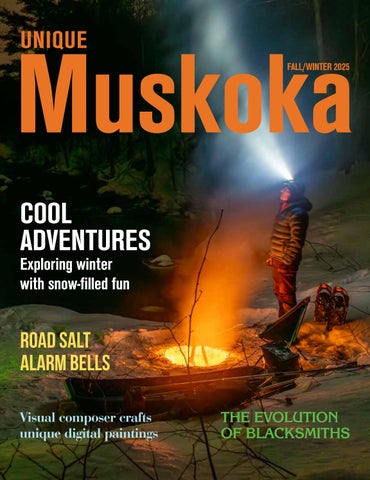
FALL/WINTER 2025
COOL ADVENTURES Exploring winter with snow-filled fun
ROAD SALT ALARM BELLS Visual composer crafts unique digital paintings
THE EVOLUTION OF BLACKSMITHS
brownsappliances.com (705) 765-5700 108 Maple Street, Port Carling, ON
[25]
...telling the Muskoka story
Features
[13]
13
Person of Note — Joe Cookson Article by J. Patrick Boyer
The way Joe Cookson recounted daily occurrences from north Muskoka enables readers to feel present in the moment as he experienced it, creating his unique niche in district historiography. While many books are written about Muskoka, few are better grounded in gritty reality than Cookson’s Roots in Muskoka and Tattle Tales of Muskoka.
19
Taking Risks, Staying Sexy — Sue Kelly Article by Meghan Taylor Photography by Josianne Masseau
Former nurse Sue Kelly enjoyed stepping into retirement but didn’t enjoy being undervalued as someone “over a certain age.” Her career in wellness and lifelong love of writing has blossomed into a post-retirement career of authoring a broad array of fiction and non-fiction, among other adventures.
[19]
25
Embracing an Active Winter
Article and Photography by Andy Zeltkalns Winter brings its own special qualities – peaceful landscapes softened and transformed by an endless blanket of snow and a refreshing crispness that lingers in the air. The season lets us experience nature in new ways – from cross-country skiing to skating to camping, snowshoeing and fat biking. Winter’s magic awaits!
32
Through the Lens to the Canvas — Greg Hammond Article by Bronwyn Boyer Photography by Josianne Masseau
As a professional businessman and self-described “bus man,” art was not something Greg Hammond initially set out to pursue. However, thanks to his own experimentation and curiosity, his visual artistry has become a way to capture moments and invite others to see the world through different eyes.
[32]
Fall/Winter 2025 UNIQUE MUSKOKA 3
45 Cairns Cres. #5 Huntsville, ON P1H 1Y3
4 UNIQUE MUSKOKA Fall/Winter 2025
705.789.6161 705.646.0347
allaboutkitchens.ca info@allaboutkitchens.ca
38
A Vibrant Community — Arrowhead Nordic Ski Club Article and Photography by Andy Zeltkalns What began as the Muskoka Nordic Ski Club in the 90s has developed into a robust, engaged community of members and volunteers who ski and socialize together. From early skills development through to competitive training and everything in between, Arrowhead Nordic Ski Club is a dynamic, active association filled with winter fun. [38]
44
The SALTYMuskoka Project
[44)
Article by Matt Driscoll The excessive use of road salt on residential properties, sidewalks and parking lots during the winter months is contaminating Muskoka’s lakes, causing significant negative impacts to aquatic life. Friends of the Muskoka Watershed are working to raise awareness and de-salinate our lakes.
Departments FALL/WINTER 2025
52
What’s Happened Article by Matt Driscoll Fall events, including Oktoberfest, the annual cranberry harvest, Santa’s Village Spooktacular and the Thanksgiving Train at Muskoka Heritage Place, are underway.
COOL ADVENTURES Exploring winter with snow-filled fun
ROAD SALT ALARM BELLS Visual composer crafts unique digital paintings
48
Muskoka’s Ever-evolving Blacksmiths Article by J. Patrick Boyer The evolution of the blacksmith is not specific to Muskoka, but it has played a continuous role in Muskoka’s history. Over centuries the craft of a blacksmith has both generalized and, in some cases, been honed for specific needs, such as the farrier.
Opinion 9
Muskoka Insights By Meghan Taylor
11
From an Artist’s Perspective By Lori Knowles
64
Muskoka Moments By Neil Hutchinson
Huntsville hosts its first art relay, and the Town of Bracebridge unveils a new walking labyrinth in Annie Williams Park. The District of Muskoka continues to develop the solid waste master plan, Muskoka Lakes Township considers closing firehalls and a pickleball tournament raises funds for the South Muskoka Hospital Foundation.
56 THE EVOLUTION OF BLACKSMITHS
Our Cover
Photograph by Andy Zeltkalns Winter camping is one way to embrace the magic of winter and give yourself the opportunity to experience the season in an entirely different way.
Cottage Country Cuisine Article by K.M. Wehrstein Photography by Brittany Clark
[56]
Invented in the 7th century, cookies continue to provide a delightful array of flavours, textures and colours – a sweet treat on their own or to finish a meal. From simple to intricate, the recipes shared in this issue don’t disappoint!
Fall/Winter 2025 UNIQUE MUSKOKA 5
FOUR UNIQUE BUSINESSES UNDER ONE ROOF BUY CANADIAN, SUPPORT LOCAL • • •
Fine Artisan Breads Daily Assorted Baked Goods Made in House Desserts
…telling the Muskoka story Unique Muskoka is published six times per year by Unique Publishing Inc.
HOUSEMADE PUMPKIN ROLLS
Meghan Taylor Publisher/Editor Donna Ansley Sales
FOLLOW US ON INSTAGRAM @bigriverbakingco
for updates, daily bread lists and our weekly cheesecake special!
• • •
•
Black Angus AAA beef, Ontario lamb, pork, chicken and sustainable fish Assorted selection of housemade sausages Variety of cheeses, dips, sauces and exclusive pantry items
Chef-inspired ready-to-eat meals and salads
OPEN TUESDAY TO SATURDAY 11A TAYLOR ROAD HIRAM ST MARKET
BIG RIVER BAKING COMPANY
705-204-0857
705-394-4499
@hiramstmarket
bigriverbakingco.com
Serving Fresh Goods Daily Special Orders Available on Request
OPEN TUESDAY TO SATURDAY 8 a.m. to 4 p.m.
6 UNIQUE MUSKOKA Fall/Winter 2025
Lisa Brazier Marianne Dawson Design Susan Smith Administration Bronwyn Boyer J. Patrick Boyer Brittany Clark Matt Driscoll Lori Knowles Josianne Masseau Dr. Neil Hutchinson K.M. Wehrstein Andy Zeltkalns Contributors
Annual Subscription Rates: (including HST where applicable) In Ontario $30.00 All Other Provinces $36.00 HST: 773172721 Canada Post Publications Mail Agreement Number: 43268016 Copyright © 2025 Unique Publishing Inc. No content published in Unique Muskoka can be reproduced without the written permission of the publisher. Mailing Address Box 616, Bracebridge ON P1L 1T9 www.uniquemuskoka.com info@uniquemuskoka.com 705-637-0204
WE HAVE MOVED!
Visit our new Warehouse Showroom at
61 Keith Road, Bracebridge LOWER OVERHEAD FOR US MEANS LOWER PRICES FOR YOU. Come check out our new Warehouse Showroom Pricing! Store hours 9-5, Wednesday through to Saturday Browse our extensive website at muskokafurniture.net • Call anytime 705-645-8183
Fall/Winter 2025 UNIQUE MUSKOKA 7
~ Muskoka ~ Serving Muskoka and area for 38 years
DIVERSE SELECTION OF PRODUCTS TRADITIONAL AND CONTEMPORARY DESIGNS KNOWLEDGEABLE STAFF TO ASSIST YOU WITH BEST SELECTIONS, WORKING ALONGSIDE YOUR ARCHITECTS, DESIGNERS AND BUILDERS ON YOUR NEW OR RENOVATION PROJECTS
sales@windowworksmuskoka.net 2358 HWY #11, RR#1 GRAVENHURST, ONTARIO
705-687-7617 1-800-668-9858 www.windowworksmuskoka.net Authorized Dealer
8 UNIQUE MUSKOKA Fall/Winter 2025
Muskoka Insights yourself in experience and adventure. In this issue, contributor Andy Zeltkalns shares in two features ways to make the most of winter through different activities and clubs. Embracing an active winter means there are many ways to enjoy the outdoors – adrenalinefilled sports like downhill skiing, classics such as skating or cross-country skiing, slower options like snowshoeing or modifications to favourites, like fat biking. Cool, crisp air and landscapes changed by snow make every outdoor adventure a new one. Winter conditions can be a challenge of their own but our adaptations to those conditions also create impact. Contributor Matt Driscoll shares with us the issue of road salt pollution to Muskoka’s watershed and how the SALTYMuskoka project is working to create change. Without change, our lakes may diminish significantly in the coming years. Also in this issue, regular contributor Patrick Boyer shares with us the history of local Joe Cookson. Orphaned at a young age and taken in by the Cookson family in Huntsville, Joe spent his life engaging with locals and welcoming guests to Grand View Lodge. Through his curiosity and diligence, Cookson recorded what he saw, knew and learned from the first settlers about their times in north Muskoka. Overcome with the need to record what might otherwise be lost in time, his observations create an enduring picture of early life in Muskoka. Whether you’re a lover of winter or not, find ways to enjoy the season. Get outside or find a cozy spot inside looking out at a favourite spot. Oh, and silence those notifications. Happy reading!
Your Home and Cottage Mattress Centre
Photograph: MacKenzie Taylor
Too often in the last number of years, we have heard that we’re living in challenging or unprecedented times. Like it or not, there are a great deal of difficult situations in our present world. I do believe that in any era, the challenges of those times felt daunting and maybe even insurmountable. And still, we persisted. In the midst of difficulties, we search for ways to cope. Humans find ways to feel better – to rest, reset and find a way through the issue. When times are hard, we find ways to band together and we search for joy and goodness. We look for ways to connect and build bridges. To feel a part of something bigger. In the digital age, that often means relying on social media or other technology to connect with others. Technology can be a wonderful thing. Video calls made a world of difference when we were separated during the COVID-19 pandemic. Text messages give a quick check-in with loved ones. Social media allows us to find friends or even distant family members with who we might otherwise lose touch. However, there is no substitute for grounding yourself in the natural world. We think of grounding as setting our toes in the sand of a beach or in the grass, but anyone can find their own method of grounding in nature – connecting with the world around you, in real time. Muskoka is a place to step away from the constant barrage of notifications, doomscrolling and screen time. As Sue Kelly, this issue’s author profile, said in her interview “Muskoka is a verb.” Muskoka is a place to do and to be in the moment. To exist in the quiet space of the morning, as the world is waking up. To be present in the hush of the woods as skis swish through fresh snow. To look for the bright sparks of stars coming alive on a deeply cold winter’s night. Muskoka is a place to stop and to appreciate what is right in front of us. In any season, Muskoka is a place to immerse
MUSKOKA CURATED COLLECTION by Marshall Mattress
THE LARGEST SELECTION OF IN-STOCK MATTRESSES IN MUSKOKA
195 Wellington St, BRACEBRIDGE
mattressesofmuskoka.com 705.646.2557 Fall/Winter 2025 UNIQUE MUSKOKA 9
Inspired byNature w w w. b r a c k e n r i g . c o m | 7 0 5 - 7 6 5 - 5 5 6 5 |
10 UNIQUE MUSKOKA Fall/Winter 2025
info@brackenrig.com
From an Artist’s Perspective
That’s a Wrap!
Photograph: Jan Jacklin
Jan Jacklin and Robin Clipsham are local theatre legends in Muskoka and avid advocates for returning professional summer theatre to the glory days of the past.
Zeltkalns
Jacklin is continually impressed by the calibre of local talent, but when asked to riff on the state of Muskoka’s theatre scene, the producer is honest: “The three full-size theatres in Muskoka are rental facilities, and the fees are high. Whilst their stages remain empty many days outside of the busy summer months, there is no encouragement for theatre companies to use their space for rehearsal or performance for nominal fees – they run for profit. So, it becomes less available, and people forget the magic of theatre, the shared experience, the art, the energy!” “What would be amazing,” she adds
Photograph: Andy
My earliest memory of theatre in Muskoka is riding in the bed of my father’s little red truck, thumping over bumpy cottage roads, on our way to a 1970s summer stock production of the Broadway musical, The Boy Friend. Gravel kicked off the tires as he wheeled the pickup into the drive of Britannia Resort on Lake of Bays. Fresh from afternoon swims, our bellies full of my mum’s homemade ice cream, me and my cottage cousins tumbled out of the truck and into our theatre seats, keen to be swept into the hijinks of that 1920s Broadway musical. It was the first time I’d seen anyone sport a feather boa, sing on stage, or dance The Charleston – and it was mesmerizing. Oh, how glorious was the heyday of Muskoka summer theatre. Vaudeville acts entertained at the Gravenhurst Opera House in the early 1900s, and the Straw Hat Players were onstage from 1948 to 1955 with performers such as Kate Reid, Ted Follows, Araby Lockheart and Donald Sutherland. By the time I was bumping toward Britannia to see The Boy Friend in the ‘70s, Muskoka Festival singers and actors were in full swing, performing not just at the Opera House but in Port Carling and on little stages at resorts across cottage country. The spotlight on summer stock dimmed in the 1990s when the Gravenhurst Opera House closed for renovations, resorts like Britannia went belly-up, and cottagers put TVs in their Muskoka rooms. Can we ever get back to those glory days? I know two women who continue trying. First, Jan Jacklin. As a writer and producer, she’s recognized and respected in Muskoka for keeping the theatre world spinning. Her own company, Dot The T Productions, contracts local theatre professionals – keyword local – to bring theatre to Lake of Bays. She Visits, starring the great Maja Ardal, ran in September, and Jacklin’s Tea, Tarts and Tenners will be staged March 27 to 29, 2026 at Pioneer Memorial Hall.
Photograph: Robin Clipsham
Article by Lori Knowles hopefully, “is a one-stop Muskoka arts public website where all creative art and performances in Muskoka were accessible.” Take note, councillors. Second, Robin Clipsham. (Full disclosure, Robin is my sister, and the more talented artist to be sure.) You may recognize Clipsham from Tim Horton’s TV commercials, but she’s also director and actor in dozens of Muskoka productions, including Shirley in Shirley Valentine, Ouiser in Steel Magnolias, and Peaches, that outrageous octogenarian, in Peaches On Ice and Peaches Undercover. Clipsham co-founded Prism, Theatre in the Park, a midsummer night’s dream if there ever was one. And she’s directing Grinched! A Holiday Panto for the Huntsville Festival of the Arts, December 20 to 21. “It’s going to be a blast,” she says. Clipsham is tirelessly supportive of local theatre, but she echoes Jacklin’s view that it’s challenging. “There is lots of room for everyone here and for all types and genres of theatre,” she says, but as a professional actor and director, finding roles is difficult. “I work outside of Muskoka much of the time – whenever there is work here, I welcome it!” How can things improve? “It takes collaboration and co-operation,” she says. “And we need to share – spaces, ideas, expertise. That’s tough because there is no large Arts Council for the region, or financial support.” Councillors, take more notes, will you? Perhaps re-lighting a spotlight on professional summer theatre in Muskoka is a pipe dream. Still, I hold out hope. That’s a wrap on this summer season. Hope to see all you art lovers again next year. Lori Knowles is a journalist and author of Summers with Miss Elizabeth, a Muskoka novel. In this column Lori explores what it’s like to live and work as an artist in Muskoka. www.loriknowles.com @loriknowles_author
Fall/Winter 2025 UNIQUE MUSKOKA 11
© Randy Blain Construction
Taking the complexity out of hiring the right company. M US KOK A B U I L DE R S’ ASSO CI AT I O N IS THE PL ACE TO STA R T.
Enjoy Peace of Mind in Muskoka Our mission is to continuously support our members by providing timely education, training, and information tailored to their needs. We promote a collaborative culture rooted in strong business ethics, enhancing the effectiveness and success of the building industry in Muskoka. By fostering teamwork and shared values, we ensure our members are part of a community dedicated to excellence and ethical practices. Our members bring knowledge, experience, and peace of mind to
your project, with deep familiarity of the local area and its unique building challenges. All our members, from suppliers through to trades, have a strong working relationship. They are well-equipped to handle lake and island projects, and offer ongoing support and warranty services. We simplify the process of choosing a contractor with an easy-to-use directory on our website.
CALL OR VISIT US ONLINE TODAY: (705) 645 3008 • MUSKOKABUILDERS.COM 12 UNIQUE MUSKOKA Fall/Winter 2025
PERSON OF NOTE
Article by J. Patrick Boyer
M
outpouring, few are better grounded in gritty reality than Joe Cookson’s Roots in Muskoka and Tattle Tales of Muskoka.
Photograph: Muskoka Heritage Place Collection, Huntsville, Ontario
uskoka has more books written about it than any comparable part of Canada. Within this vast
In 1978, Joe Cookson was proud to show off his book Roots in Muskoka about events, people and conditions from the district’s earliest settlement through the 20th century’s relentless changes. In 1984, Olympic Printing at Sprucedale put out a knocked down version of Roots in Muskoka, entitled Early Footsteps in Muskoka.
His own story as an all-seeing boy-abouttown began when a group of Vaudeville performers landed in Huntsville on the first week of November, 1904, checking into the Pym House hotel on main street. The troupe included a young American couple with a four-year old girl and 17-month-old Joe, with the wife on the brink of bringing her third child into the theatrical menage. Their two-night stand completed, the performers moved on. The expectant woman remained, delivering a girl on November 9. A week later, she left to join the other actors in Quebec, taking her nursing infant and little girl. She left her small son to board with a local family until she and her husband returned on their circuit six months later to fetch him and settle the account. Joe would not see her again for 35 years. Once it became clear he’d been abandoned, fate brought the orphaned two-year-old to the attention of Minnie Pleace, another orphan in Canada as one of the many Home Girls from England’s orphanage homes. Abused, over-worked and humiliated, Minnie ran away from her vile servitude and was taken in by a Huntsville family. She met and married farmer John Cookson, whose acreage along the north shore of Fairy Lake boasted a panoramic view. The place became Joe’s home, Minnie and John his foster parents whose name he took. The lad came of age and grew to manhood fascinated by north Muskokans and the local scene. He heard about the daily lives of early pioneers from the older people he associated with and listened to endlessly, spending one winter with an old-timer in his remote cabin. “So much of what went on in those early days was taken for granted that little has been written about it,” he observed when starting his first book, “and today what was once common knowledge has been forgotten.” He also knew from personal experience details of rural schooling, bush camps, log
Fall/Winter 2025 UNIQUE MUSKOKA 13
14 UNIQUE MUSKOKA Fall/Winter 2025
As a respected middle-aged man about Huntsville, Joe Cookson (at far right, now wearing glasses) enjoyed everything about hunt camp in the fall – hunting, cooking, fires in the evening, relaxing with others exchanging tales and smoking, living face-to-face with nature as Muskoka pioneers had.
Photograph: Autho
r’s Collection
everything happening in Huntsville. During the wartime winter of 1915-16 when Muskokan raised even more soldiers for its 122nd Overseas Battalion, he studied the icy surface of Hunter’s Bay, a mock battleground where officers of Huntsville’s “A” Company orchestrated training displays to excite patriotism and stimulate recruitment among townsfolk. Staged battles raged back and forth across the snow-covered bay. To thrill spectators and make things more realistic for the trainees, blank cartridges were fired and men flopped “dead” into the snow. Soldiers not yet issued the new Ross rifle used broom handles and shouted, reprising boyhood games. “I don’t know how much it impressed men of recruitable age,” said the sharp-eyed orphan, “but I do know that as I stood there half-frozen, the sight of those men crawling around in the snow didn’t do much to impress me.” Later, however, when Joe saw Muskoka’s soldiers in uniform beginning their Hundred Mile March around the district led by their own marching band, the detached lad was deeply moved – clearly, an observer with feelings. By the time Prohibition rolled around in the Roaring Twenties, stills producing illegal liquor sprang up like mushrooms and 17-year-old Cookson followed Muskoka’s dramas of farm and forest, noting how “there was plenty of woodland to hide the illegal equipment away. Some men dropped their regular occupation to devote their entire time to the illicit trade.” Stills were
Photograph: Muskoka Heritage Place Collection, Huntsville, Ontario
A young Joe Cookson (left) in winter 1913 enjoyed time with friends, sitting atop a fence at his Grand View Farm home.
Photograph: Muskoka Heritage Place Collection, Huntsville, Ontario
wheelbarrow down to the wharf and bring drives, Prohibition in the Roaring Twenties, their heavy trunks up to their assigned rooms. the Steam Era, and surviving the Dirty When water was needed, he fetched the team Thirties. and pulled two barrels full from the lake up Having won a writing prize in his school the hill on a stoneboat, then carried heavy days, Joe Cookson began writing about all he pails upstairs to knew “as a tribute to the sheer each guest’s courage and grit of our chamber. pioneers who He helped with conquered the Muskoka farm work, walked wilderness.” He two and a half interviewed and miles to the re-interviewed countless one-room people to ensure his stories were accurate. However, in the telling it was Joe Cookson’s voice and values that reigned. His personal experiences and clear-eyed observations became detailed accounts of most everything in the two books’ 50 fascinating chapters. As Muskoka farmers began taking in tourists, Minnie envisaged opening the doors at Grand View Farm to paying summer Joe Cookson’s 1978 publication holidaymakers. In 1911 she of Roots in Muskoka was a advertised the converted sequel to his first work from farmhouse’s “million-dollar 1976, Tattle Tales of Muskoka, view” and her own fine both published by the Herald-Gazette Press in cooking, launching a success Bracebridge, where Joe’s encouraging friend story to which Joe Bob Boyer helped organize and edit his notes. Both men shared a contributed while stoic commitment to preserving district heritage in printed form. husband John kept on farming. All the vegetables, cream, milk, berries, lamb and chicken guests schoolhouse and back through snow-filled ate came from their farm, with Joe preparing fields, attended the Canal Methodist Church the vegetables for the noon and evening meals. and entertained himself sitting in magistrate’s court to witness the fates of those arraigned. When holidayers arrived by steamer from Cookson got around and witnessed most Huntsville’s train station, he’d take a
Photograph: Muskoka Heritage Place Collection, Huntsville, Ontario
elaborate operations run by a farm family adhering to the bootlegger edict “stay sober and keep your trap shut.” A Huntsville tinsmith confided to Joe that the stills he made were for customers who came into his shop, usually strangers, specified precisely how they should be made, paid cash for the equipment, and disappeared. “He made what they wanted and asked no questions,” Cookson relayed in his extensive account of Prohibition practices. Operators keen to make fast money and indifferent to the health of strangers desperate for liquor tossed anything that would ferment and make alcohol into their mash. Distillers made quality “drinking whisky” for themselves and relatives, taking care to filter the liquid through charcoal or a reflux still to remove fusel oil. Two bachelor brothers in Huntsville used a barrel of sprouted corn in a kitchen corner for their mash, turning out crystal clear and highly palatable corn whisky only drunk by themselves and their friends. “But selling whisky was not subject to stringent methods of purification,” Cookson clarified, “just making it and getting rid of it as quickly as possible, no matter how bad it tasted or dangerous it was.”
In 1913 at his foster home beside Fairy Lake east of Huntsville, happy nine-year old Joe is with his “dad” John Cookson (on right) and Archie Cookson (driving) taking off hay while two “tourist girl” guests at Grand View pose on the team’s backs. Muskoka’s small operators made and bottled their liquor during the week then on Saturday drove a load into town by buggy or wagon when things were busiest on the main shopping day for farmers and townsfolk alike. Not only would he or she find more likely
buyers, but the bustle and confusion made transactions less obvious to tipsters. “Within half a mile of town,” Joe recalled about Huntsville’s experience, “they would stop in a secluded spot, maybe hand the reins to the wife, and jump off with a sack of bottled
100% Canadian Artists • Large LoremOriginal ipsum Paintings • Wood Bowls • Sculpture 3181 Hwy. 169, BALA 705-765-7474 www.redcanoegallery.com
Lorem ipsum
(open year round)
32 YEARS IN MUSKOKA ‘HORIZONS’ 60” X 60” ENCAUSTIC - P.GARBETT
Fall/Winter 2025 UNIQUE MUSKOKA 15
Sales & Service of Major Propane Appliances (refrigerators, ranges, fireplaces, furnaces & more) Safe & reliable No electricity required Bulk propane delivery to your home or cottage
705.645.4294 TF: 866.645.4294 STORE: 228 TAYLOR RD., BRACEBRIDGE OFFICE: 1646 WINHARA RD., GRAVENHURST
16 UNIQUE MUSKOKA Fall/Winter 2025
the brazen theft, intervened. “Either go back and pay for them, or return them, or I call the police. He tried to bluff his way out, but the older man was firm. He meekly paid, and it sure took some of the cockiness out of him.” Cookson’s character and circumstances combined to create a participant-observer of first rank. His curiosity and companionable nature made him game for most anything while his detachment and vulnerability as an orphan gave him alert attention to changes, the smallest details, and nuanced feelings. He wrote with sensitivity and compassion about the many orphan Home Children from England populating north Muskoka, giving their names and citing successes later in life of the dozens he knew as friends. North Muskoka had the highest concentration of Britain’s castoff children in Canada because their arrival between 1870 and 1930 coincided exactly with the area’s pioneering development and coveted free labour. Once he began to write about what he saw, knew and learned from first settlers about their times, Cookson was overcome by the urgency of recording for posterity what was slipping away funeral by funeral and the continuous loss of Muskoka heritage by abandonment and fires, most dramatically the 1894 fire that destroyed the town’s Main Street from the bridge to West Street, levelling 30 buildings and incinerating their contents. He strove for accuracy, often re-interviewing people to double-check details. He persuaded families to “tear apart their family albums for photographs and newspaper clippings.” Apart from
By 1928, Joe Cookson (second from left) was a member of S.S. Ramona’s crew working north Muskoka’s lakes, still folding his arms in a slightly defiant gesture but averting his eyes from the camera. Cookson’s instinctive humility with adults gained him entry to situations rarely open to others, furnishing information and insights few others received.
Photograph: Muskoka Heritage Place Collection, Huntsville, Ontario
SERVING MUSKOKA & PARRY SOUND FOR OVER 70 YEARS
hooch while she drove on. With a quick look around, he’d sneak into the dense bush and, finding a good spot, hide it. Later, after getting a sale for it, they’d come back after dark, retrieve their booze, and meet their customers at a prearranged spot in town.” Recruiting soldiers in wartime or producing alcohol during Prohibition are just two of hundreds of examples of Cookson being present most everywhere, in all seasons, attentive to district doings. He tells stories on himself – from a disastrous first effort to smoke using chewing tobacco to botching the recitation of a poem before a large audience and fleeing the stage – with self-disparaging humour. He describes his first winter in a logging camp so vividly it’s like watching a feature film. Growing up as a member of the family, Joe helped the farm evolve into Grand View Lodge, taking on any task required, always vigilant. One day he noticed two canoes pull up loaded with blanket-wrapped bundles. Three Ojibwe paddlers from Rama came ashore, climbed the hill to the hotel with their bundles and spread out “a beautiful assortment of baskets, birchbark canoes, jewelry cases, work with sweetgrass and porcupine quills. All the tourists crowded around examining, handling, asking prices.” One Grand View guest, “a stockbroker’s clerk, a real Smart Alec type always trying to attain the spotlight, went into his act, first trying to cut down the price then, while his friends attracted their attention, concealing several smaller cases under his clothing.” An older guest, watching
Photograph: Muskoka Heritage Place Collection, Huntsville, Ontario
As an older man, Joe Cookson began reconstructing the past by drawing on his retentive memory, interviewing “old timers” who’d lived north Muskoka’s raw frontier bush life and digging out artifacts to trigger recollections, such as winning the 1917 Boys’ Writing Prize at his one-room school – $1.00, paid by cheque. capturing the spirit and passing along the telling details of pioneer settlement, Cookson lived through and recorded the 20th century’s impacts on Muskoka. His lively descriptions of activities and instructive details about processes – from woods operations in winter and log drives in spring to the specifics of equipment and steps for distilling illegal alcohol during Prohibition – not only served as operators’ manuals but entered territory few others writing about Muskoka dared set down in writing. Cookson provided true accounts of what changing times meant to Muskokans in a bygone era, his vivid portraits of Huntsville characters and street
scenes preserving the character of a Muskoka town a century ago. The way Joe Cookson recounted daily occurrences enables readers to feel present in the moment as he experienced it from a street-level, back-alley, logging camp, tourist resort lawn or Prohibition Era hideaway perspective, creating his unique niche in district historiography. In 1986, he was among invited speakers at the Ontario Historical Society’s annual meeting in Huntsville, for the session “Presenting Everyday History.” His sense of self was entirely a sense of place – his own trusted place among the people of north Muskoka.
EXPERIENCE YOU CAN TRUST Experienced drilling & blasting for roads, ditches, foundations and septic systems. Exceptional service and top-quality results.
FREE ESTIMATES
Fall/Winter 2025 UNIQUE MUSKOKA 17
Fall Into Savings with NorStar’s Fall Siding Sale! Take advantage of some of the best pricing of the year from the manufacturers seen below
Don’t let winter take a toll on your eavestrough system Call us today for a free inspection, along with expert recommendations for repairs and upgrades to keep your home protected.
Protects your eavestrough from damage caused by snow and ice
Make your eavestroughs maintenance free. Repel leaves, sticks and branches, no rusting, chipping or peeling.
Embrace Your Exterior! Siding • Roofing • Soffit • Fascia • Decking • Eavestrough • Gutter Protection SERVING MUSKOKA, PARRY SOUND & HALIBURTON REGIONS SINCE 1976
Embrace Your Exterior! Supply • Install • Cash & Carry 800.732.0158 • 705.645.8404 • www.norstarexteriors.com 18 UNIQUE MUSKOKA Fall/Winter 2025
Article by Meghan Taylor / Photography by Josianne Masseau
“A
s a young girl I loved the promise of the blank page,” shares Sue Kelly, author and former nurse. That love of writing has stayed with her throughout her life – whether writing for business or for enjoyment. She recalls corresponding with pen pals on four continents, keeping a diary and working on school writing projects. Kelly spent much of her earlier life as a
registered nurse and public health nurse. Her specialty in wellness was developed through community experiences as a homecare nurse in the greater Toronto area, as an outpost nurse in northern Manitoba and as the director of health and wellness for We Care Health Services. Later in her nursing career, she took on writing manuals for nursing processes as well as educational brochures. “When I retired, my love of writing
Sue Kelly recalls falling in love with Muskoka and its stunning lakes at the same time she fell in love with her high school sweetheart and now husband, Paul.
took me down a different road,” she says. “I’ve dabbled in a wide array of literary genres – some more successful than others.” During the COVID-19 pandemic, Kelly signed up for online writing courses to broaden her skills. Five years later, she continues to take the courses led by Brian Henry. “The first course was called Writing Personal Stories,” she explains. “His gentle
Fall/Winter 2025 UNIQUE MUSKOKA 19
20 UNIQUE MUSKOKA Fall/Winter 2025
Photograph: Sophie E.
Sue Kelly’s winning entry of the Woodchester Storybook Trail writing contest, Lucky the Maple Key, is now an interactive outdoor reading experience, accompanied by illustrations from emerging artist Ronnie Szostak.
and helpful approach encouraged me to try other genres. It seems that my heart rests most easily in non-fiction.” The transition to retirement after her career in nursing felt relatively easy for Kelly. What she struggled with was “society’s undervaluing of people over a certain age.” “I felt irrelevant,” she shares, “as though I was past my best-before-date. And I know I wasn’t alone.” Not one to sit back, Kelly leaned on her career background in wellness to develop the first Women’s Wellness Conference (WWC) of Muskoka. The two-day event about healthy aging was held at the Gravenhurst Opera House and received rave reviews from those who attended. “I’d been doing research on writing a healthy aging book and started to put pen to paper on Still Sexy After Sixty,” explains Kelly. The second WWC came around and Kelly THE RIOBEL MOMENTI™ COLLECTION continued to work on her book. By the time AVAILABL E AT KNOWLES PLUMBING! the third WWC was happening, she had completed Still Sexy After Sixty and was ready to publish. The Woodchester Storybook Trail, featuring Sue Kelly’s story Lucky the Maple Key, was installed on “The book is full of stories about how the grounds of Woodchester Villa this July as part of the Town of Bracebridge’s 150th anniversary BATsuccessfully H & KI TC Hretirement,” E N SHsheOW ROOM celebrations. people navigated DESIGN. INSTALLATION. REPAIR S ERVING ALL OF MU SKOKA 279 MA N ITOBA ST, B R AC EBR ID G E
705 . 6 4 5.2 67 1
KNOWLESP LUMBI N G .COM @MUSKOKABATH
Muskoka’s Bath & Plumbing Centre
BATH & KITCHEN SHOWROOM SALES • INSTALLATION • REPAIR SERVING ALL OF MUSKOKA
279 Manitoba Street, Bracebridge
705.645.2671 @knowlesplumbing knowlesplumbing.com Fall/Winter 2025 UNIQUE MUSKOKA 21
shares. “‘Sexy’ refers to not being afraid to take risks and engaging fully with life.” Open to experiences and adventures, Kelly’s written works are a result of her perspective and her ability to go with the flow. Her curiosity and willingness to try something new, has led to accepting challenges and opportunities as they come her way. At the end of the pandemic, she and her husband purchased a new RV and planned a trip to Smith Falls, accompanied by their granddaughter Avery. That trip resulted in a joint book, Holly & Ivy, currently being considered by a publisher in New Brunswick. “Avery said, ‘Gran can we write a book this summer?’,” explains Kelly. “Inside, I was laughing but I jumped on this spark of imagination and later Holly & Ivy was born.” Holly & Ivy is a contemporary middle grade novel that blends mystery and fantasy geared to kids from ages eight to 12. With memorable characters, the joint effort of Kelly and her granddaughter reflects on the themes of diversity, inclusivity and equity.
Kelly has participated in the Canadian Legion Literary Contest for a number of years, submitting short stories to the competition, and has placed well in four of the last five years. In 2021, Show Me the Way to Go Home about her mother living in long-term care placed second. In 2022, Windows on the World placed first – a story inspired by her friend Maureen Basnicki, whose husband died in the 9/11 attacks in the United States. In 2024, What If, about the plight of Canada’s Indigenous Peoples placed first. And, in 2025, Kelly’s story about Canada’s first Medical Officer of Health for Indian Affairs, Doctor Peter Henderson Bryce, placed second. As part of the celebration of its 150-year anniversary in 2025, the Town of Bracebridge announced a writing contest for the Woodchester Storybook Trail – an interactive outdoor reading experience in the unique setting of Woodchester Villa’s grounds. “I thought I’d give it a try,” says Kelly. “To my absolute delight my story, Lucky the Maple Key, placed first and was unveiled this past July.” Lucky the Maple Key follows Lucky through the Woodchester grounds and shares what it’s like to live and grow in the forest. Kelly’s story is illustrated by emerging artist Ronnie Szostak, who has ties to Muskoka. The thrill of being selected as the winner of the Storybook Trail contest prompted Kelly to further her skills again, enrolling in an intensive picture book writing course, again with Brian Henry. “During the course I wrote a picture book which I entered into a children’s writing contest (CANSCAIP
For Sue Kelly, ‘‘sexy’’ is about engaging fully with life and being unafraid to take risks and try new things. 22 UNIQUE MUSKOKA Fall/Winter 2025
– Canadian Society of Children’s Authors, Illustrators and Performers) and last month I was notified that it made the long-list,” shares Kelly proudly. She has also collaborated on an Indigenous alphabet book about the Anishinaabe culture, A is for Ancestor, with Gregory Murdock, a residential school survivor from Regina, Saskatchewan. In between projects and competitions, Kelly has also completed some travel writing. Her work truly spans all genres and geography. Currently, Kelly is working on something that walks the line of historic and personal – her own personal path to reconciliation. “After I graduated from St Michael’s School of Nursing, I did outpost nursing at Norway House First Nation in northern Manitoba,” explains Kelly. “At the time, I had no idea about the devastating effects of colonization and residential schools to Indigenous Peoples. I returned to Norway House on the 50th anniversary of my time there which has inspired me to walk a new path. My simple goal is to learn, to reflect, to share and to act.” When she’s not writing, another love of Kelly’s is kayaking on Muskoka’s waterways in three of the four seasons. Time outdoors helps to inspire and clarify her thoughts as she works on her writing. “Nothing too strenuous but simply the pure enjoyment of sliding along the water and gliding to my heart’s content, allowing my body, mind and spirit to take me to where I needed to go in my writing: inspiring characters, settings and renewed perspectives,” she shares. “Walking the winter trails and frozen lakes does that, too.” Kelly recalls falling in love with Muskoka at the same time she was falling in love with her high school sweetheart, now husband, Paul. “Paul would bring me up to his parents’ cottage on Morrison Lake where again I fell in love with the rocky crags and luscious lakes,” she explains. “Muskoka brings out all the feels – like my senses are on steroids. Needless to say, Muskoka is a verb.” In her retirement life, Kelly has found ways to spark her own creativity, engage in the local community and build her network – all to keep living life to the fullest. She
EV9
I N T R O D U C I N G THE K I A
Still Sexy After Sixty is a collection of stories about how people successfully navigated retirement, which Sue Kelly spent several years researching and compiling as she navigated her own retirement. previously hosted a show for Hunter’s Bay Radio, interviewing “people who had found their sweet spot in life.” She recently joined the board of directors for Hospice Muskoka, a cause she holds dear, and she has spent many hours with the Catholic Women’s League at St Paul’s Church in Gravenhurst. She is also an active member of Muskoka Authors Association. “We meet once a month in Bracebridge and we love to welcome new members to our growing organization,” Kelly shares. “Muskoka Authors Association is a vibrant organization supporting writers at every level of their writing. Although writing is mostly a solo endeavour, you can’t do it alone.” Kelly is an advocate for pursuing new experiences and enjoying life, at any age. Taking risks may mean stepping out of your comfort zone to try a new skill or visit a new place. Her advice for anyone trying to start writing? “You’ll be surprised what you can accomplish by starting with just one word,” she says. “I promise you that that one word will boldly go where you never thought possible. Take a risk and do it… just do it, now.”
MUSKOKA KIA
21 Robert Dollar Dr, Bracebridge, ON P1L 1P9
705-645-6575 muskokakia.ca
RESIDENTIAL / COMMERCIAL / INDUSTRIAL
GENERATORS
ECRA/ESA #7010474
519.805.3200 info@arkltd.ca ARKLTD.CA
SMART HOME SYSTEMS NEW CONSTRUCTION LIGHTING Fall/Winter 2025 UNIQUE MUSKOKA 23
Stay up to date on Muskoka’s multi-site regional hospital www.madeinmuskokahealthcare.ca
24 UNIQUE MUSKOKA Fall/Winter 2025
The swishing of cross-country skis, the brightness of the sparkling snow as the sun reflects off it and the lack of extraneous noise are all part of the enjoyment of winter, on or off the beaten track. New perspectives and new adventures await!
W
hen the hues of autumn fade, the days draw shorter and snowflakes gently arrive, Muskoka gets poised for another long winter. While some welcome this as a metamorphosis into a cold weather playground, others are left wondering how they will endure another season of frozen landscapes and endless snow. Although winter in Muskoka can definitely be challenging, there are many ways to embrace this prolonged time period by staying active and transforming the season into one of
Article and Photography by Andy Zeltkalns anticipation, adventure and enjoyment. Winter brings its own special qualities – peaceful landscapes softened and transformed by an endless blanket of snow and a refreshing crispness that lingers in the air. The season lets us experience nature in new ways: animal tracks become easier to spot and, as wetlands and waterways freeze, opportunities to explore places rarely visited in summer become possible. Winter’s magic awaits us if we only know where to look. Nate Smith of Huntsville is one individual who really knows how to make
the best of winter. Most weekends he is found exploring the back country using either his wider skin skis or his snowshoes. His choice of equipment is dependent on weather and snow conditions and the type of activity he will be doing. In deep snow his backcountry skin skis allow him to travel through the forest at a higher speed and with less effort than snowshoes as they provide better flotation and glide. If Smith is winter camping and he needs to haul a heavy sled under certain conditions, snowshoes are sometimes a better choice. When winter
Fall/Winter 2025 UNIQUE MUSKOKA 25
camping, Smith prefers to use a “hot tent” – a special tent designed to be used with a small wood stove. Hot tents can make the winter camping experience more comfortable as they provide warmth as well as the ability to dry wet gear. “I enjoy the solitude and quiet that comes with winter,” explains Smith. “The extended scenery with no foliage, and there’s something to be said about the lack of bugs!” Bracebridge resident Shaun Francis has an equal passion for winter and gets excited when the Muskoka landscape is blanketed in snow and temperatures dip below freezing. “I love the cold crisp air, the beauty of the snow, and the peacefulness of the forest,” states Francis. While Francis’s favourite winter activity is downhill skiing due to the speed and adrenaline rush, when in Muskoka he prefers to do a mix of activities which include cross-country skiing, skin skiing and snowshoeing. Often his choice of activity is dictated by what adventure his friends might want to do but weather and snow conditions also play a part. If there are track set trails available, Francis enjoys the flowing motion
and speed that cross-country skiing has to offer. Sometimes it is nice to follow the road less travelled and head off on an unmarked trail exploring new places with his skin skis or snowshoes. Francis emphasized that he never gets tired of the winter scenery and being outside is “pure enjoyment.” “I only wish it would last longer,” exclaims Francis. Bruce Reville, a longtime resident of Muskoka, also loves the peacefulness of an outdoor winter adventure. The swishing of his cross-country skis, the brightness of the sparkling snow as the sun reflects off it, and the lack of extraneous noise, are all part of the enjoyment of winter for Reville. One of his favourite activities is to spend an evening snowshoeing or cross-country skiing with friends. The shortened days of winter with darkness descending early can make winter harder to bear – but exploring the quiet mystery of a winter’s night can be an exhilarating experience. With headlamps on, Reville and his friends venture into a forest hushed by a blanket of snow, its silence broken only by the crunching or shushing of
the snow underfoot. For Reville, a brilliant starry sky sharpened by the chilly night air, the occasional sound of a hooting owl or coyotes howling in the distance or switching the head lamps off to bathe in the light of a full moon reflecting off the snow, are all special memories. “An evening outdoor activity leaves me refreshed and ready for a good night’s sleep,” shares Reville. Jane Briggs of Muskoka, who in the non-winter months is a dedicated cyclist, has quite recently found an ideal way to maintain her cycling fitness throughout the cold snowy months. “Some friends introduced me to fat biking a couple of years ago,” explains Briggs. “Although I enjoy cross-country skiing and snowshoeing, fat biking has become my activity of choice.” Fat biking, for those unfamiliar, is an off-road bicycle built to accommodate larger tires. The over-sized tires make it possible to continue cycling all year round, particularly in the snowy months. “The forest looks completely different in winter, and I enjoy both the scenery and the
Muskoka's Largest Home Service Company!
No job is too big or too small! www.GBScontracting.com 705.687.9143 1082 Beaumont Farm Rd., Bracebridge
26 UNIQUE MUSKOKA Fall/Winter 2025
Fat bikes – off-road bicycles built to accommodate larger tires – make it possible to cycle year-round, enjoying in-town routes or trails through the woods.
slower pace of fat biking,” says Briggs. “It’s of trails in the South Monck area,” also a social activity for me since I often ride explains Wilson. with others on the trails or back roads. I As an exciting winter usually cycle for about two hours and dress substitute for mountain in layers similar to cross-country skiing, but biking, Wilson states that with regular winter boots.” the fat biking facility Scott Wilson, president of the Muskoka gets a good mix of Off Road Cycling Association (MORCA) age groups using helps co-ordinate an intricate network of the trails and had a large winter fat biking trails at the Bracebridge number of people out on Resource Management Centre (BRMC). family day enjoying the MORCA is a non-profit organization which, sport. The work accomplished by in partnership with the Town of Bracebridge MORCA would not be and the help of dedicated volunteers, builds possible without the help of and maintains trails and organizes weekly membership fees, so people rides at the BRMC both in summer and benefiting from the trails are winter. encouraged to purchase a membership to “Currently there are about 10 help support the efforts of this organization. km of fat biking trails at the Other fat biking opportunities can be found BRMC and there are plans Skating on a homemade backyard rink or on one of to develop several outdoor skating rinks throughout Muskoka is another often when new skills can be practiced or tried for the first network
time.
Fall/Winter 2025 UNIQUE MUSKOKA 27
Although winter in Muskoka can be challenging, activities like winter camping and snowshoeing can provide adventure and enjoyment, especially with planning, equipment and friends. 28 UNIQUE MUSKOKA Fall/Winter 2025
throughout Muskoka at places like Deerhurst Resort, Limberlost Forest and Wildlife Reserve, and Lance’s Loops near Huntsville, to name a few. For those seeking a different kind of thrill, Hidden Valley Highlands Ski Area east of Huntsville offers the excitement of downhill skiing and snowboarding. With 15 different trails/ runs, four lifts, 100m vertical, and a terrain park featuring a variety of jumps and rails for skiers and snowboarders to perform tricks, this facility provides plenty of options for a full day of winter fun outdoors. Retired schoolteacher Ellen Yeo, who has found satisfaction applying her teaching skills as an instructor, loves the friendly, family-oriented atmosphere of Hidden Valley.
“The resort gets a good mix of locals and visitors to Muskoka, and offers plenty of instruction from beginner to advanced,” states Yeo. She also notes that Hidden Valley has been a springboard for high-level athletes including freestyle skier Dara Howell, who won a gold medal in ski slopestyle at the Sochi Olympics. “We cater to many school groups and youth,” further elaborates Yeo, “and the night skiing offered is a big draw for teens.” Jody Hamilton and her son Nash started skiing at Hidden Valley last year and really enjoy the experience. “We went at least once a week for eight weeks during the winter and liked the friendly atmosphere,” says Hamilton.
For Nash, downhill skiing became a focus in the winter. As a child with special needs, Hamilton’s son was able to participate in the Ontario Track 3 Adaptive Sports Association program offered at Hidden Valley. The adaptive ski and snowboard program, designed for kids with special needs, was perfect for her son and gave him the personalized instruction he needed. For those seeking another kind of downhill exhilaration, tobogganing and tubing are also available in certain Muskoka locations such as Kerr Park in Bracebridge and Arrowhead Provincial Park in Huntsville. If temperatures allow, outdoor skating is another activity that can help make the shorter days of winter more bearable. Arrowhead Provincial Park
Fall/Winter 2025 UNIQUE MUSKOKA 29
The exhilaration of downhill skiing or snowboarding provides thrilling excitement in the cold weather months. Local facilities, like Hidden Valley Highlands Ski Area, provide plenty of options for a full day of winter fun outdoors and Muskoka Lakes Farm and Winery both offer a unique skating adventure that has become very popular. With each location having a skating trail just over one kilometre long, skaters can either follow a loop that winds through the forest at Arrowhead or circumnavigate 12 acres of cranberries with
the forest on one side and cranberry beds on the other at Muskoka Lakes Farm and Winery. For a truly magical experience, each facility also hosts a weekly chance to skate in the light of hundreds of torches that line the trail at night. Aside from families creating their own backyard rinks, there are many
Arrowhead Provincial Park and Muskoka Lakes Farm and Winery both offer unique skating adventures. For a truly magical experience, each facility also hosts a weekly chance to skate in the light of hundreds of torches that line the trail at night. 30 UNIQUE MUSKOKA Fall/Winter 2025
places throughout Muskoka that offer outdoor skating rinks. Places like Memorial Park in Bracebridge, Lions Lookout in Huntsville and Wharf Sports Field in Gravenhurst are just a few of the many rinks available. Whether you like the speed and thrill of downhill skiing or the relaxed pace of an evening snowshoe, Muskoka with its colder temperatures and abundant snow base has a lot to offer for winter activities. Aside from the venues already mentioned, publicly accessible places such as the Torrance Barrens Dark-Sky Preserve, Hardy Lake Provincial Park, Fish Hatchery Trail or Huckleberry Rock Lookout are just a few of the many locations at one’s disposal for different activities. Many privately run locations, along with outfitters in Muskoka, also provide opportunities for outdoor winter adventure along with equipment rental and sales, maps and instruction. It’s always a good idea to check snow and trail conditions, as well as what activities are available before heading to your destination. With a bit of planning, the right gear and clothing, and a spirit for adventure, winter in Muskoka is an incredible experience.
Fall/Winter 2025 UNIQUE MUSKOKA 31
Greg Hammond first began his journey as an artist following inspiration from his daughter. Her way of capturing photographs of items in her own unique style, based on curiosity, resonated with Hammond.
32 UNIQUE MUSKOKA Fall/Winter 2025
Article by Bronwyn Boyer / Photography by Josianne Masseau
G
reg Hammond can attest to the transformative power of art. A photographic digital artist whose work is gaining recognition, Hammond’s foray into creative expression is as natural as the landscapes he captures and transforms. Each piece, sometimes dissected, is a note or a chord in the symphony that is played out on the canvas. Hammond’s roots run deep in Muskoka, where his family’s history stretches back to 1881. Those roots are intertwined with hard work, dedication and community service through Hammond Transportation Ltd., where he has worked in various roles for 41 years. As a professional businessman and self-described “bus man,” art was not something that Hammond initially set out to pursue. “The art thing is fairly new and not something I’m known for,” he says. “And it’s not something I ever set out to become – it just happened.”
The family’s creative streak is evident, however. Hammond’s aunt, Pennie, is a remarkably gifted musician and painter and her paintings adorned the walls of the family home. His mother, a woman of many talents, was a passionate decorator, frequently reimagining their home environment. These influences laid the groundwork for Hammond’s evolving creative sensibility.
Hints that Hammond inherited those genes can be found in his work. “I suppose there was creativity involved in curating bus tours,” he admits. “Showing Muskoka to visitors in a way that they can best experience it visually has similarities with sharing what I see, or think I see, with art patrons.” But it was Hammond’s daughter who sprouted the seeds of his own artistic process
The inspiration for Greg Hammond’s art is rooted in genuine observation. He often utilizes multiple images from a location or images from different locations to create vibrant, expressive scenes.
Fall/Winter 2025 UNIQUE MUSKOKA 33
into action. “When she was younger, she used to pick up the camera and wander around taking pictures of things that interested her,” he shares. “And she took the coolest candid pictures of people. But they could be anything that she appreciated, like the bottle of ketchup sitting in the fridge, because she really liked ketchup. That curiosity and desire to capture the unique way she sees things always stuck with me.” Hammond carried this inspiration with him during a particularly memorable walk in the woods, contemplating life as the sun cast golden light through snow-laden trees. He snapped a photograph of the winding trail illuminated by the setting sun, a picture that resonated deeply with him. When he printed it on canvas and displayed it proudly, a friend remarked, “Now you’re an artist.” He resisted the label at first, but that simple affirmation struck a chord. He realized that creating something and sharing it was a legitimate expression of his soul.
And when he started making greeting cards from his photographs, he was pleasantly surprised by the reception they garnered. Everyone on his Christmas card list saw a new side of him, and they were impressed. Hammond’s works are a seamless blend of digital techniques to combine elements of his photographs, the way a chef combines ingredients to create a gourmet dish. He is meticulous in capturing scenes that speak to him. But it’s what he does afterward that elevates his work: digitally manipulating photographs to evoke the qualities of paintings, drawings or abstract compositions. Using a variety of software programs, Hammond experiments with brush strokes, colour palettes and compositional elements, often multiple times, to achieve a look that resonates with his vision. Hammond’s inspiration is rooted in genuine observation. He sees his surroundings through an artist’s lens, always thinking of how he can translate a scene into something
Greg Hammond’s non-traditional mediums and techniques make his artwork difficult to categorize. He uses photographs and technology to craft digital paintings but often relies on experimentation to get to his final iteration. 34 UNIQUE MUSKOKA Fall/Winter 2025
more vibrant and expressive. His digital paintings often stem from photographs taken in different locations, then re-combined to evoke a different aesthetic. One of Hammond’s recent works is a new rendition of the Bracebridge falls revisited multiple times, each iteration more dynamic than the last. “We were on a tour in France last year, and they showed us this mountain that Paul Cézanne painted 200 times,” he recalls. “I get it – it’s because that mountain looks different every day. The falls in Bracebridge look different depending on the time of year, time of day, or a sunny day versus storm clouds coming in. And now there are lights on the falls - adding the illumination to the water changes it even more.” Although Hammond’s medium involves photography, it’s not how he thinks of himself. “I don’t call myself a photographer because it’s not about showing people one image, but using it create something new,” he explains. “What ends up on the canvas might be pieces of multiple photographs. Sometimes it’s one photograph, other times it’s a collage. Sometimes I combine the foreground of one photo and the sky from another, and it just works.” Hammonds non-traditional mediums and techniques make his artwork difficult to categorize. “Like everything, art has evolved from paintings on rocks and walls, and it's going to continue to evolve,” he says. “The possibilities are endless.” The software Hammond uses is also always evolving. “Oftentimes I’ll think a particular image will work better in one particular program but then doesn’t come out quite the way I thought it would,” he shares. “So, I move it into different program and manipulate it further. Maybe the brush strokes are too fine or too heavy. It’s like hiring the carpenter to fix a squeaky floor –
In 2022, Greg Hammond hosted his first art show at The Annex in Bracebridge. While it was nerve-wracking to share this new part of himself, Hammond says the support from collectives like Muskoka Arts and Crafts, The Annex, and the local artist community in general has been instrumental in encouraging him to continue. you're not paying him to hammer one nail; you’re paying for his expertise in knowing exactly where to put that one nail.” Hammond’s process is rooted in experimentation and often contains happy accidents. A damaged print from years ago found new life when Hammond decided to frame it differently than another print of the same piece, revealing unexpected colour shifts that gave the piece a fresh personality. “There are so many things that can change with each print,” he explains. “It’s like how you can’t step in the same river twice.”
Even before the printing stage, Hammond’s perspective can affect the predictability of his muse. “Sometimes I see things in a more childlike way,” he says. “Each day can bring a different mood to the same scene. We take so much for granted, but when I look at it through my art, I see new textures, colours and stories.” Hammond’s artwork has gained further significance by his dedication to community service. He has donated many of his pieces to charities like the Miles Hammond Foundation and Hospice Muskoka. More than the
fulfillment he gets when people display his images in their homes and love them, Hammond also hopes his art can be a catalyst for community healing and remembrance. A notable example of this was in 2024 when he donated one of his pieces to the Wahta community. Hammond had developed a deep connection to Herman Stock, a soldier who gave his life on D-Day and was compelled to tell his story with a very special piece entitled Honouring Herman Stock. “A few years ago, I came across Herman’s name in one of Bob Boyer’s books,”
Floors for Home & Cottage HARDWOOD • LAMINATE • VINYL PLANK & TILE • VINYL ROLLS CARPET • CERAMIC • NATURAL STONE & MORE MODERN HOME CARPET ONE
TAYLOR CARPET ONE
350 Ecclestone Drive • Bracebridge
30 Cairns Crescent • Huntsville
705.645.2443
705.789.9259
modernhomecarpetonebracebridge.com
taylorcarpetonehuntsville.com Fall/Winter 2025 UNIQUE MUSKOKA 35
Before getting to the final stage of printing, Greg Hammond’s perspective and his art can be impacted by his mood. His digital process, rooted in curiosity, allows him to reimagine familiar scenes with fresh eyes. remembers Hammond. “And I was struck by how ordinary he was; just a young man who volunteered to serve and paid the ultimate price.” Hammond visited the Beny-sur-Mer Canadian War Cemetery in Reviers, France and photographed Stock’s headstone. This image, along with a black and white photo of Stock, were used to create a meaningful piece of artwork to commemorate the young man. “There was a ceremony arranged by Chief Phillip Franks of Wahta First Nation commemorating D-Day, and I was asked to speak about Herman,” Hammond shares. “It was very powerful. So many relatives and community members gathered, and I realized how important it was to remember and honour those stories. He gave his life for freedom, and that story is a part of all of us, and I feel privileged to tell it through my art.” The piece is a composition of thoughtfully crafted elements, each imbued with deep symbolism and meaning. At its heart stands Herman Stock, a vibrant young man full of life, dreams and hopes. His carefree expression contrasts his military uniform, capturing both the vitality of his youth and the seriousness of his service. This juxtaposition highlights the loss of innocence and the weight of duty. Stock’s gravestone stands beside him, a sobering reminder of a young life cut short. A maple leaf is carved into it to signal his
36 UNIQUE MUSKOKA Fall/Winter 2025
Canadian identity as well as the date – June 6, 1944 – D-day, a pivotal moment in the liberation of Europe during the Second World War. The Beny-sur-Mer Canadian War Cemetery is far from Wahta First Nation’s land. By placing Herman back in the forest setting of his roots, Hammond emphasizes the spiritual bond with the land and the sacrifice he made. The National Aboriginal Veterans Monument is outlined in the background, reflecting honour, duty and harmony with nature. The Thunderbird crowns the monument, an emblem embodying the Creator and the spirit of Canada’s First Nations people. This powerful symbol recognizes the contributions of all Indigenous veterans across generations. Lastly, the inclusion of the telegram addressed to Mary Stock underscores both the personal and collective grief of the Wahta First Nation, and beyond. Another milestone was Hammond’s first show at The Annex in Bracebridge in 2022. “The first time that I shared my art in public was after my wife and I were looking at the work of a guest artist, and she said, ‘you could do that,’” Hammond recalls. “I didn’t think of myself as an artist, but I thought I’d give it a shot. So, that October I had my first public showing. And it was frightening, to be
honest. Not only because it’s so different than my day job, but also because it was scary to bear my soul for public scrutiny. That’s when I realized how much bravery it takes to be an artist.” Hammond says the support from collectives like Muskoka Arts and Crafts, The Annex, and the local artist community in general has been instrumental in encouraging him to continue sharing that sensitive side of himself. “They call me ‘Mr. October’ at The Annex,” he laughs. “Because this will be my fourth year as guest artist for the month of October.” Looking ahead, Hammond plans to continue experimenting, expanding and exploring new themes. His recent work, inspired by travels to France and ongoing reflections on nature, hints at an artist unafraid to evolve. His digital process, rooted in curiosity, allows him to reimagine familiar scenes with fresh eyes. Hammond’s work transforms a simple walk in the woods into compelling canvases that feed the imagination. In his words, art is about expressing the soul, capturing fleeting moments and inviting others to see the world through different eyes. “Each piece teaches me something new,” he reflects. “I’m inspired by the idea that art isn’t a destination, but a continuous exploration.”
Fall/Winter 2025 UNIQUE MUSKOKA 37
Article and Photography by Andy Zeltkalns
A
n integral part of every community are the clubs and organizations that draw people together based on shared interests. These clubs allow individuals to connect, develop friendships and build a sense of belonging while participating in something they enjoy. Additionally, participants can have opportunities for leadership development, skill enhancement and community engagement. These organizations add to the vibrance of a community and offer many benefits that contribute to the overall health and social dynamic of an area. Arrowhead Nordic Ski Club, based out of Arrowhead Provincial Park, is one of those establishments that has been serving the Muskoka area since the year 2000. The club originated as the Muskoka Nordic Ski Club in the mid-90s with a small Jack Rabbit program but mostly as support for high school ski racers. Although Arrowhead Provincial Park has had cross-country ski trails since 1971, it wasn’t until the late 1990s that the building blocks for the current ski club began taking shape. In 1998, local cross-country skiers Paul and Lea Jorgenson, together with Mike Derbyshire, rejuvenated the existing Jack Rabbit program by locating it to Arrowhead and recruiting a team of
38 UNIQUE MUSKOKA Fall/Winter 2025
instructors. Designed to help children develop their skills and confidence on skis, the program was well received. As participation steadily grew, Paul Jorgenson and a group of volunteers decided it was time to establish Arrowhead Park as the permanent home of the Nordic Ski Club. This led to the birth of the Arrowhead Nordic Ski Club as we know it today. In its early days, the club focused primarily on youth, but over the years it has blossomed into a multi-faceted organization offering a wide range of programs and events, not only for its members, but to the community of Muskoka and beyond. With about a 50/50 male/female split, current membership stands at around 181 adults and 236 youth. Club president, Ken Parsons, calculated that 1532 individuals were involved in a club event or program last season. If non-club members participating in club sponsored events are included, there are over 1000 people outside the club that benefit each year. One of the key events hosted by the club is the Muskoka
The Muskoka Loppet, one of the key events held annually by Arrowhead Nordic Ski Club, attracts cross-country ski enthusiasts from Muskoka and throughout Ontario to participate.
Fall/Winter 2025 UNIQUE MUSKOKA 39
In its early days, Arrowhead Nordic Ski Club focused primarily on youth with its Jack Rabbit program. Over the years the club has developed into a multi-faceted organization offering a wide range of programs and events, not only for its members, but to the community of Muskoka and beyond. Loppet which happens every year at the end of January. The Muskoka Loppet, featuring the classic ski technique, has a long-standing history in Muskoka dating back to the 1970s when its route stretched from Hidden Valley Highlands Beach, across Penn Lake, along trails towards Mary Lake, and ending at Port Sydney Beach. Drawing over 1,000 competitors, the event thrived into the late 1980s before ultimately being discontinued due to a range of factors. In 2002, Tracy Marshall, the club president at the time, initiated the revival of the Loppet and the modern version of this event was born. With categories for youth, adults, special Olympics, and para Nordic, the event is very inclusive, and has route options that cover four, 17 and 30 kilometres, depending on the category. Weather permitting, the Muskoka Loppet now sees 300 to 400 participants each winter drawing many local skiers as well as people from throughout Ontario. Local cross-country skiing enthusiast Sally Onley and her husband Richard took part in the Loppet for
40 UNIQUE MUSKOKA Fall/Winter 2025
the first time in 2025. “Cross-country skiing with our family has always been a tradition and part of a healthy lifestyle,” explains Onley, “and it was great to ski with our grandson in this fun event.” The Onleys enjoyed seeing people of all ages participating in the Loppet and loved feeling the energy and excitement from the skiers, spectators and volunteers. For those with a competitive spirit, the Muskoka Loppet has a lot to offer as well. Fifteenyear-old Lucas Faulkner, from Waterloo, who was competing in his second Muskoka Loppet, enjoys the race since it combines a high level of competition with a route that is challenging and scenic. “I also like
that the event is well organized, inclusive, and has a mass start,” elaborates Lucas Faulkner. Lucas’s dad, Justin Faulkner, who grew up in Muskoka, has completed the Muskoka Loppet several times since its rebirth, and also loves the event. “There aren’t many skiing events like this one with a mass start that allows people of different levels to start together,” states Justin. “Once you’re on your way, you can ski with people at your own fitness level and there’s always someone nearby to keep you motivated.” Orchestrating a ski event of this magnitude requires plenty of time and energy so Arrowhead Ski Club relies on about 60 volunteers to help make this occasion possible. In addition to the Loppet, Arrowhead Ski Club hosts two elementary school races each winter which attract upwards of 400 children. In 2025 they also hosted the Ontario Youth Cross-Country Skiing Championships. Another program hosted by the Arrowhead Ski Club at the end of January is the “Women of Winter.” Denise Jordan, a club board member and regular skier, is one of the organizers of the now annual event. With the help of other club members, Jordan is able to offer a fun day for women that is filled with various activities and an inspiring guest speaker. “We have about 15 volunteers including instructors that help make this day happen,” explains Jordan. According to Jordan, the event has been hosted for four winters and now attracts 50 to 60 women. Women get the opportunity to participate in activities such as cross-country skiing, biathlon, skating,
Arrowhead Nordic Ski Club was the first to offer youth programs for para athletes. The club concluded its second season of the Eagle Para Nordic program in 2025.
The Jack Rabbit and Bunny Rabbit programs at Arrowhead Nordic Ski Club cover youth between the ages of four to nine and are a great starting point for children wanting to learn how to cross-country ski. For children ages 10 to 12 and who are beginners, there is the Lynx program with progressive skill development available. yoga and off-trail skiing using “skin skis” in a supportive and inclusive environment. Instructors are also available for those who want to work on improving their skiing skills. Cynthia Maclean from Dorset, who participated in her third “Women of Winter” really enjoys what the event has to offer. “This year I was really inspired by the guest speaker describing her trip to the Antarctic,” says Maclean. “I also enjoy the sense of empowerment I get from this experience and come away with new skills each year.” Kathy Alberts from Bracebridge, also a returning participant, states “It’s nice to spend the day with like-minded women that enjoy embracing winter. It’s also a good refresher for my ski technique.” All the profit from the “Women in Winter” event goes towards supporting the Jack Rabbit Bursary Program and the club’s rental programs, both of which help more people gain access to Nordic sport. Within the club there is a generous selection of programs available for members. Focusing on youth has always been
important to the organization and based on Cross Country Canada’s skill development program, there are various opportunities for children to get involved. The Jack Rabbit and Bunny Rabbit programs cover youth between the ages of four to nine and are a great starting point for children wanting to learn how to cross-country ski. For children ages 10 to 12 and who are beginners, there is the Lynx program with progressive skill development available. For 10- to 12-yearolds who have completed the Jack Rabbit program and want more in-depth skill development and training, there is Track Attack. For youth with a more competitive nature, the club offers a racing program through ARC (Arrowhead Race Crew). According to Arrowhead Nordic Ski Club, ARC is, “an athlete-centred, coach-directed, and parent-supported Nordic team enabling youth to develop their cross-country skiing race skills in a positive team environment.” Anne Lindsay, who has been involved with the club since 2008 and whose children have developed their skills there, began by taking
one of the adult learn-to-ski programs and eventually earned her coaching certificate in 2019. She is now co-ordinator of the Track Attack program and has instructed learn to ski programs for youth aged four and up. “It is a financially accessible sport for youth,” explains Lindsay. “Kids in the Jack Rabbit program can rent a pair of skis for an entire season at a reasonable cost.” There is also a Jack Rabbit Bursary Fund available through the club to assist families in need to lessen the financial burden. John Cowan, who in the earlier days of the club has been president, coach and technical director, and has both national and provincial certification in the sport, has watched the club evolve into a well-rounded organization. With its wide range of programs and events, Cowan referred to the organization as a “full-service club” that offers something for both members and the community. Fostering a strong social component, the club also helps members develop a sense of belonging. Drew Hutcheson, also a former club president who still helps with coaching
Fall/Winter 2025 UNIQUE MUSKOKA 41
Arrowhead Nordic Ski Club also hosts a “Women of Winter” event in January, thanks to the help of over 15 volunteers, that provides the opportunity to participate in activities such as biathlon, cross-country skiing, skating, yoga, and off-trail skiing. adults, has seen the club go from “not very structured, running on enthusiasm,” to an organization with “good planning and procedures in place.” The club can draw on its many members to help with events, and instructors are now paid, explains Hutcheson. “We also have teens or young adults who have graduated from the club’s cross-country skiing development programs and are now helping coach or instruct new youth joining the club,” Hutcheson elaborates further. The L.I.T. (Leaders in Training Program) gives
interested youth skiers the preparation needed to acquire their coaching certification and become paid instructors. John Cowan, who is now chair of the Ontario Para Nordic Committee, explains that Arrowhead Nordic Ski Club was the first to offer youth programs for para athletes. In 2025, the club concluded its second season of the Eagle Para Nordic program which was “launched to provide individuals with acquired or congenital disabilities an opportunity to enjoy the winter outdoors” and follows a similar path to the club’s regular youth skills
development program. The program also welcomes adults with acquired disabilities who are interested in learning how to ski. In addition to many opportunities for youth, the club offers a variety of programs for adults such as Nordic Newbies, Ski for Fitness, Masters skiing and a weekly afternoon social ski. Private lessons are available as well. Whether you’re a newcomer to the sport, or a well-seasoned pro, Arrowhead Nordic Ski Club has a lot to offer – so why not embrace winter and give the sport a try.
From competitive race skills development to fun, engaging activities for all ages, Arrowhead Nordic Ski Club has built an inclusive community of skiers for members and non-members. 42 UNIQUE MUSKOKA Fall/Winter 2025
Let Your Love for Muskoka's Nature Live On! A gift in your will to Muskoka Conservancy helps protect the forests, lakes, and wildlife you love—ensuring future generations can experience the same natural beauty that inspires you today.
Muskoka is more than a place—it’s a feeling. It’s shaped by the people who love, cherish, and protect this land. Your legacy can help keep that feeling alive. Photo by Brenda Binnington
Make nature part of your story. Learn more at muskokaconservancy.org/plannedgiving Fall/Winter 2025 UNIQUE MUSKOKA 43
The
SALTYMuskoka
PROJECT Photograph: Friends of the Muskoka Watershed
Fighting Road Salt Pollution to Protect Muskoka’s Lakes
Through the help of citizen scientists over the last few years, samples from over 80 lakes in Muskoka informed the Muskoka Watershed Council’s Watershed Report Card. Dr. Neil Hutchinson is seen here gathering a water sample for testing.
E
very winter, as snow blankets Muskoka in a postcard-perfect scene, tens of thousands of tons of road salt are applied to roads, sidewalks, driveways and parking lots. While it’s often a safety measure for icy conditions, there’s a growing problem beneath the surface – literally. That salt doesn’t just disappear in the spring; it ends up in lakes, creeks, wetlands and stormwater systems, changing the chemistry of Muskoka’s delicate freshwater ecosystems. Many individuals and companies overuse road salt during winter. Contrary to popular belief, more salt doesn’t always mean safer roads – but it does mean more harm to the environment. Research and early monitoring of the impact of road salt on the Muskoka watershed began in the early 2000s. In 2018 the Muskoka Watershed Conservation and Management Initiative was announced by the Ontario Ministry of the Environment,
44 UNIQUE MUSKOKA Fall/Winter 2025
Conservation and Parks (MECP). Testing of 80 lakes in 2022 showed salt concentrations have increased dramatically since the 1970s. In 2023, Muskoka Watershed Council released their Watershed Report Card, which further provided evidence of the rising level of chloride in Muskoka’s lakes. Enter SALTYMuskoka, a grassroots project powered by Friends of the Muskoka Watershed (FOTMW). This community-led initiative is working hard to raise awareness, reduce unnecessary road salt use, and protect the health of Muskoka’s watershed – one scoop at a time. Over the summer, the SALTYMuskoka team was out in full force, connecting with locals and cottagers at farmers’ markets and lake association events.
“We are so grateful to meet so many concerned and hopeful people,” says Alesha Breckenridge, SALTYMuskoka Project Lead. “Most people we interacted with were shocked that road salt had such huge environmental effects in Muskoka’s soft waters.” Through engaging displays, educational materials
Friends of the Muskoka Watershed’s outreach extended to four-legged friends. Their “Paws the Salt” dog bandana initiative raises awareness that road salt doesn’t just harm aquatic life. It can also irritate and even burn pet paws.
Photograph: Friends of the Muskoka Watershed
Article by Matt Driscoll
just our watershed,” says Breckenridge. “It also hurts our pets, corrodes infrastructure, and damages vehicles.” This fall, SALTYMuskoka is teaming up with local teachers and schools to bring road salt education into the classroom. Students are learning how chloride – a key component of road salt – impacts the Muskoka environment and how even small changes in salt use can protect freshwater
resources. Even more exciting? These students will soon become Community Volunteer Scientists, testing for chloride in their schoolyard environments and communities. Using conductivity metres, they’ll track salt concentrations and contribute real-world data to the project’s growing body of research. “We’re making the curriculum come alive,” says Breckenridge. “Students aren’t just learning;
Friends of the Muskoka Watershed treasurer Doug Clark holds the cheque while fellow board members Dr. Norman Yan and Andrew Wagner-Chazalon show off the salt cups, reminding people to use less road salt.
Give back to the community you love with a legacy gift to Hospice Muskoka. Whether through a bequest in your will, a donation of securities, or naming Hospice Muskoka as a life insurance beneficiary, your gift ensures compassionate care will be here for your loved ones when it’s needed most. You’ll also receive a charitable receipt to help offset capital gains and reduce income tax.
For details, connect with your financial advisor or visit: hospicemuskoka.com/ planned-giving
Fall/Winter 2025 UNIQUE MUSKOKA 45
Photograph: Friends of the Muskoka Watershed
and helpful strategies, the team equipped people with simple ways to reduce their personal salt use. Strategies such as using alternatives like sand to on-site ice prevention, like moving downspouts away from walkways and shoveling snow away to areas where the melt water won’t affect sidewalks, walkways, parking lots and driveways, to only salting when temperatures and conditions warrant intervention. The group’s outreach even extended to four-legged friends. The campaign’s “Paws the Salt” dog bandana initiative drew smiles while raising awareness that road salt doesn’t just harm fish and aquatic life. Road salt can also irritate or burn pet paws. “We know road salt affects more than
Photograph: Friends of the Muskoka Watershed
In August, Friends of the Muskoka Watershed hosted an Art and Experience Muskoka Raffle to raise additional funds for the SALTYMuskoka Project. Alesha Breckenridge and Dr. Norman Yan raised community awareness and sold raffle tickets at local events through the summer. they’re becoming stewards of their own ecosystems.” As the snow starts to fall, so does the next phase of the project: Road Salt Awareness Month, launching in November. The initiative includes a slate of educational activities, a public webinar (details to be announced) and partnerships with local businesses and retailers to reduce salt at the source. Retailers will display SALTYMuskoka’s road salt reduction tips and provide alternative products, while businesses are invited to sign a pledge to reduce their road salt use. “We want to show that safety and sustainability can go hand in hand,” says Breckenridge. “This is about being smarter with how and when we use salt, not giving it up entirely.” Also launching this fall is the Green Cup Movement. Community members will be able to “register” their 12-ounce (350 ml) cup as a symbolic representation of the road salt they are choosing not to use each winter.
46 UNIQUE MUSKOKA Fall/Winter 2025
“One Green Cup is all you need for one average driveway or 10 sidewalk squares,” says Breckenridge. ‘‘By helping people regulate their own personal use of road salt, we are empowering them to use less road salt. This helps protect the health of our Muskoka Watershed.” The idea is simple: over time, as individuals adopt better practices, those cups add up and so does the data. The SALTYMuskoka team will track the collective reduction in salt use across the region, offering an inspiring look at how small changes lead to big results. Behind the public outreach lies a robust foundation of citizen science. Eight volunteer scientists have been sampling 27 locations around Muskoka for the past two years, measuring water conductivity (a proxy for salt levels). The findings are sobering. “In some places in Gravenhurst and Bracebridge, the road salt coming off a parking lot has about half the seawater concentration of chloride,” explains Dr. Neil
Hutchinson, science director and FOTMW board member. “Water that salty is harmful to Muskoka’s aquatic life.” Hutchinson authored a report titled Citizen Science Observations on Road Salt in Muskoka, confirming that chloride levels in some developed lake catchments are rising to dangerous levels. Some areas, like Gravenhurst Bay, are showing steady declines in water quality, with chloride concentrations threatening lake oxygen levels, aquatic insects and fish populations. But the report also shows that citizen science works. “Our big finding, which wasn’t really a surprise, was that it’s possible to pinpoint areas of high salt loading with citizencollected data,” says Hutchinson. “We have an army of people who can monitor their own communities and that’s powerful.” Earlier this year, FOTMW received a $74,000 EcoAction grant from the Canadian Water Agency to support SALTYMuskoka’s
education and reduction efforts. The grant is a vital step forward but it’s only part of the solution. “We need to match that funding,” says FOTMW chair Lenore Inniss. “We’re calling on our community to help us take this project to the next level.” That’s because the threat is real and growing. Road salt levels have increased 20-fold in many developed lakes in Muskoka. It’s estimated that 30,000 tons of salt enter Lake Muskoka annually. And about 20 per cent of that comes from residential sidewalks, driveways, and parking lots – the very places SALTYMuskoka is targeting with its public outreach. “Twenty per cent of our road salt is used by individuals in their driveways and small businesses and local organizations on their driveways and sidewalks,” says Dr. Norman Yan, FOTMW director. “We can make a big difference by reducing this road salt usage at the source. Road salt pollution is a preventable problem. If each of us does a little less, it adds up to a lot more.”
Muskoka Barging
Family run construction company with over 35 years experience operating in the Muskoka Lakes area. No job is too small or too big.
705-764-0765 | muskokabarging.com | 1163 Milford Bay Rd, Milford Bay ON
BARGING ● STEEL & CRIB DOCKS ● SEPTIC SYSTEMS ● LANDSCAPING
Missed an issue?
...telling the Muskoka story Photograph: Friends of the Muskoka Watershed
www.uniquemuskoka.com
Over the summer, the SALTYMuskoka team, including Alesha Breckenridge, was out in full force, connecting with locals and cottagers at farmers’ markets and lake association events.
Lakeland Electric Vehicle Charging Network across Muskoka/Parry Sound
Fast 180kW
Reliable
Zero Downtime
Local
Read our archives online
Bracebridge
Download the App or to learn more visit lakelandEVcharging.ca Fall/Winter 2025 UNIQUE MUSKOKA 47
Article by J. Patrick Boyer
48 UNIQUE MUSKOKA Fall/Winter 2025
Photograph: Boyer Muskoka Archives
S
ay “blacksmith” and the image appearing in peoples’ minds is likely that of a muscular man in a dingy, grimy place wearing a protective leather apron and perspiring in the glow of his forge while wielding a heavy hammer to shape a red-hot horseshoe on an anvil. A century ago, that image was real to most every Muskokan. Horses were on the fields, in lumber yards, and at construction sites. They hauled heavily loaded wagons and pulled machinery, logs, carriages, buggies and sleighs. In the 1920s, as the battle for roadway supremacy began tilting from horses to motor vehicles, district smithies were still as commonplace for shoeing horses as service stations were starting to become for supporting automobiles. More recent generations have continued to see that colourful blacksmith prototype in many movies, especially westerns. Today at Huntsville’s Muskoka Heritage Place, blacksmith DJ Brown works iron on the anvil of his Pioneer Village smithy, fascinating onlookers as they witness the living past. In 1925, Canada’s horse population numbered 3.5 million, with Muskoka having its fair share. Those countless hooves (multiply every horse by 4) needing to be shod had already made blacksmiths a local fixture during Muskoka’s settler era. They continued nailing down their place as essential workers in the district economy and enjoyed social prominence in their communities. Because Bracebridge was a trans-shipment centre at the head of navigable water on the Muskoka River
Whether a horse had thrown a shoe or needed a full set of new ones, blacksmiths were essential to Muskoka horses. Fred Morris’ busy blacksmith shop, seen here in 1910 at the south end of downtown Bracebridge, operated beside his residence so he could respond to a horse’s need any time of night or day, all days of the week. to and from the interior and also a junction of three principle colonization roads, the community sprouted hotels, taverns, warehouses, livery stables and a great many blacksmiths: Fred Bartley, Thomas Collinson, James Copeland, Thomas Fennell, Lorenzo Johnson, Thomas Magee, James McKay, Fred Morris, R.N. Stewart, Richard Swain, William Tait, Robert Whaley and William Wright – and that was just up to the First World War in 1914. That year in Gravenhurst, popular blacksmith Albert Hill was the town’s elected mayor. But why are we talking about the past? Horses are still around, although retained differently than in the past. Are blacksmiths the ones shoeing all the horses jumping at
today’s farms and training centres in Muskoka? To say a “blacksmith” could be correct, but to answer a “farrier” would be more likely. This somewhat unfamiliar medieval word for a specialist in shoeing horses has resulted, in daily speech, for many folks saying blacksmith and farrier interchangeably. However, there are important differences. During the Bronze Age, our ancestors made widespread use of that metal to make tools, weapons and other objects, until human evolution and discovery of new minerals saw iron emerge as the dominant metal. Folks learned to efficiently extract and smelt its more commonly present ore and make iron implements that were better than those of brittle bronze. Around the world, this transition was gradual, varying geographically as use of iron spread and replaced bronze at different rates. But collectively, some three to five thousand years ago, “iron mongers” with new approaches were extending iron to wideranging uses. The Iron Age’s economic and cultural shifts produced its own vocabulary, too. A “smith,” already the word for a worker skilled in metal use, was fused with the “black” metal, as iron was called because of its black fire-scale that formed when heated. Iron came into increasing use as blacksmiths forged tools for tradesmen, implements for farmers, weapons for soldiers, decorative items such as streetlamp standards and benches for public parks, intricate curtains
In the countryside it was often handier for farmers to address their horses’ hoof-wear themselves. Homesteader Jack Oleson, whose farm was by Skeleton Lake, reshoes a workhorse still in harness in the field using his portable anvil.
Photograph: Edna Smith’s Collection, Windermere Archives
for castle halls, hardware for builders and structural elements for architects. Barely able to keep up with workorders, their numbers grew. Blacksmiths prospered, had job security and rose in social importance. But again, what about the horses? In harness, these animals made the Iron Age possible by hauling iron ore from mines to smelters, pulling equipment, turning wheels, powering construction sites, and delivering heavy loads to customers. Millions of horses, because of the surfaces on which they were now working, required iron shoes. Initially, ironworkers crafted horseshoes and fitted them to horses, meaning blacksmiths and farriers were often one and the same. But the need for specialized skills in horse care became increasingly necessary due to all the tasks these versatile animals were performing. The twined roles of ironworkers began to diverge, and by the 19th century, farriery had become a distinct trade whose practitioners focused exclusively on hoof care and shoeing horses, creating a service beyond the interest or ability of most blacksmiths and veterinarians. This distinction became more pronounced with establishment of trade guilds and professional organizations. Formal separation allowed blacksmiths to take on a much broader range of metalwork while farriers could concentrate on equine hoof care. With blacksmiths remaining free agent generalists, working with iron and other metals as they choose, many could, if required, make and even fit a horseshoe. However, farriers are specialists in the blacksmithing field, focused on properly shoeing horses by preparing each hoof, fitting a horseshoe and adjusting the shoe to ensure proper balance and comfort. This transition was reflected in numerous ways over many Muskoka decades. Because shoeing horses was a necessary pioneer skill, many Muskoka homesteaders fashioned horseshoes themselves at a small smithy of their own, where some also worked metal into farm implements such as plows and sheers, and many adeptly forged nails, latches and a dozen other simple but handy iron items. Jack Oleson from Iceland was a typical, versatile homesteader who shod horses at his Skeleton Lake farm and developed a portable anvil to conveniently work and re-nail a thrown shoe while his workhorse remained in the field harnessed to a plow. Oleson also fashioned nails, link chains, hinges and coat hooks. When embarking for winter-long logging deep in the bush, most farmers prudently took their team to a full-time blacksmith first, unless heading to one of the larger camps which had a blacksmith, almost as important as the cook, on staff. Being properly shod was part of horse well-being that enabled their owners to successfully farm and log. With all the horseshoes required, local blacksmiths could never make enough. The solution was mass production. Dr. Marty Wood, who with husband Jim
Fall/Winter 2025 UNIQUE MUSKOKA 49
Photograph: Gravenhurst Town Archives
In the 1870s, blacksmith James Clipsham opened a conveniently situated shop in the heart of Gravenhurst. It was among the town centre structures incinerated in the disastrous fire of 1887. Undaunted, Clipsham’s Carriage Works re-opened in this new building still advertising horseshoeing above the open door at left, but now with an expanded carriage works also building wagons and buggies – the first manufactured in Muskoka. owned and operated Woodmere Logging Museum near Baysville through the 1980s and 1990s, cites the example of the McRae Lumber Company in Whitney getting its supply of ready-made horseshoes in kegs, eight nail holes in each. “The blacksmith had to fit them properly, adjusting each shoe to the hoof ’s size and shape,” she notes. “The hoof was trimmed to fit the shoe by rasping it off around the edges or, if too narrow for the shoe, the shoe itself was adjusted to fit by firing it red-hot in the forge and hammering it to the needed shape on the anvil.” “If the shoe didn’t fit properly, the horse was bothered and there could be accidents,” adds Dr. Wood. “The blacksmith welded on the calks, which were blunt for skidding logs in the bush in autumn, or sharp for ice roads in winter.” These short spikes in the horse’s shoes helped it maintain a good grip on the often slippery and uneven terrain, especially when hauling logs. “If the shoes were not fitted properly, the horse might catch the front hoof with the hind hoof and tear the shoe off.” She also points out that farriers tending horses protected the animals’ legs with wool or leather warmers as high up as the snow line. The scale of horse-centred operations was vast. In 1870, the district’s first fully-fledged ground transportation system got underway when 400 horses of the Harvie Royal Mail Coachline emerged from their stables, were harnessed to coaches and wagons, and began
50 UNIQUE MUSKOKA Fall/Winter 2025
meeting their posted schedules north from Orillia through Washago, Severn Bridge, on to McCabe’s Landing (Gravenhurst) and further out to settlements along Muskoka’s emerging web of colonization routes. J.T. Harvie and his brothers ran the coachline with dozens of livery stables, blacksmiths, teamsters, wagons, coaches, drays and sleighs to move mail, parcels, passengers, freight, foodstuffs and barrels of whisky. Teams pulled loads in all seasons through every kind of weather at different hours of the day and often into nighttime darkness over roads that in places were dangerously impassable. Like a mechanical clock’s many moving parts, each coachline component operated in conjunction with the others, with pivotal blacksmiths doubling at times as veterinarian or farrier. Today, Muskoka horses needing shoeing and hoof care have the farrier travel to them. The boarding, training and riding facilities throughout Muskoka no longer retain a farrier onsite, as farms and companies of the past. Now, farriers travel far and wide, their trucks kitted with the tools of their trade, from within and outside of Muskoka to ensure horses are well-shod for their roles. With the 20th century’s motor vehicle revolution, horseshoeing work fell off due to fewer horses in work and more farriers being available. Small foundries had been operating in Muskoka for some time, including the Bracebridge Bay Foundry. In 1917 its owner,
Mungo Park McKay, greatly advanced the industrialization of district metalworking when he bought the abandoned redbrick factory of Dominion Linen Mills with direct railway access, converting the building, moving in his foundry from the riverside and renaming it Muskoka Foundry. The plant’s engineers, machinists, iron and brass founders worked under McKay’s leadership for decades turning out large castings, rotary saws and sawblades, machined parts and custom-designed ironwork for district logging operations, lumber yards, woodworking and boatbuilding facilities. Muskoka Foundry also manufactured metal goods such as manhole covers, signs, and snow-plowing equipment. In the late 1950s, Mungo’s son Ron McKay took the helm until, in 1964, the operation was acquired by Bracebridge Manufacturing which, under Phil Keppler, produced custom steel equipment and large components. With several further ownership changes, it continued as a metal fabrication plant for several decades more. Meanwhile, a small blacksmith’s shop established west of Port Carling after the Second World War had introduced new methods and fresh energy to Muskoka metalworking when Ted Church opened a small but state-of-the-art smithy. During the war he’d worked in Hamilton’s steel mills which were manufacturing artillery shells and steel plate for ship and tank construction. To apply his metalworking knowledge in a different setting, Church relocated his family to Muskoka and became village blacksmith of Glen Orchard. The Churches had three sons who took up the hammers and, today, two generations down, grandson Ryan Church follows in the family tradition working with Chris Hodgkinson at Muskoka Metal and Welding in Bala. Like all prospering Muskoka metalworking businesses, The Smithy had advanced with new technologies (converting its coal-burning forge to gas) and providing what local customers wanted, such as offering custom blacksmithing and architectural ironwork. Muskoka’s integrated metalworking industry evolved into a major employer and impressive driver of the district economy. A number of today’s many plants provide custom fabrication, welding, and blacksmithing. Numerous others have entered the field of
Photograph: Boyer Muskoka Archives
Heavy industry in Muskoka got a major boost when Mungo Park McKay relocated his foundry operation from Bracebridge Bay to become this much larger metal working plant. Previously a textile mill, the building boasted important rail access and operated for much of the 20th century as Muskoka Foundry. Whatever the nature of their workplace or smithy, few of Muskoka’s thriving metalworkers today would refer to themselves as blacksmiths because that time-trapped image of working with horseshoes is not who they are or what they’d want to convey. Yet that iron-mongering tradition shaped their present-day roles. Skills acquired by blacksmiths over time through trial and error have been translated into those computer programs directing precision cutting, drilling, and milling operations. From large-scale steel fabrication to handcrafted ironwork, these contemporary businesses constitute Muskoka’s dynamic blend of industrial capability and artisanal tradition.
Photograph: Sanford Institute and Richard Tatley
commercial and residential fabrication and metalwork repair. Still more provide custom metal services ranging from structural projects to HVAC. In tandem, Muskoka facilities for artistic metalwork continued to spring up, with local artisans creating custom art and products using traditional and modern metalworking techniques. The number of welding and manufacturing companies and artisans reveals the scope of Muskoka metalworking and demonstrates the health and evolution of district blacksmithing from iron to include steel, stainless steel and aluminum – for projects running beyond horseshoes to contemporary art, machinery, and structural jobs.
Village blacksmith of Port Carling in 1900, William John Batten, seen here at his workbench with hammer, is surrounded by tools of his trade, from anvil, forge, grinder, and spanner to calipers and a sturdy trolley. Fall/Winter 2025 UNIQUE MUSKOKA 51
Whats Happened
Photograph: Oktoberfest Muskoka
Oktoberfest Muskoka returns October 23 to 26 with beer, specialty food offerings, karaoke, trivia and more. 52 UNIQUE MUSKOKA Fall/Winter 2025
Downtown Huntsville BIA and Eclipse Art Gallery hosted the town’s first-ever Art Relay during the annual Harvest feast celebration, with 10 local artists participating.
Oktoberfest returns to Muskoka with beer, brats and Bavarian fun
Muskoka is raising a stein once again as Oktoberfest Muskoka returns October 23 to 26. This region-wide celebration of craft beer, German food and live music spans Bracebridge, Gravenhurst, Huntsville, Lake of Bays, Muskoka Lakes and southeast Georgian Bay. The festival kicks off with the Tapping of the Keg Ceremony at Quality Inn Bracebridge, featuring live accordion music and free admission. Throughout the weekend, local breweries like Muskoka Brewery, Clear Lake Brewing Co., Lake of Bays Bre w i n g , a n d Sawdust City Brewing Co. offer exclusive brews, Oktoberfest platters and entertainment. Signature events include Dragtoberfest at Sawdust City, Weiss Blau at Santa’s Village, trivia nights, karaoke, farmers’ markets, and the high-energy Golden Keys Party Band at Bala Bay Inn. Food lovers can feast on schnitzel, sausages, pretzels and German desserts at various venues, including Muskoka Bay Resort and Santa’s Village Fest Haus. New this year is the OktoberBaus tour offering brewery stops, trivia, and complimentary beer mugs. With events for all ages, Oktoberfest Muskoka promises four days of festive fun, food, and fall flavour. Learn more at oktoberfestmuskoka.ca
Photograph: Muskoka Lakes Farm and Winery
Downtown Huntsville was buzzing with creativity recently as the Downtown BIA and Eclipse Art Gallery hosted the town’s first-ever Art Relay during the annual Harvest Feast celebration. Ten local artists, including Helena Renwick, Roxanne Driedger, Serena West, Liz Derksen and others, participated in a unique live painting event where each artist worked on a canvas before passing it along in a relay-style rotation. The result? Ten collaborative masterpieces that captured the energy and spirit of Huntsville’s vibrant arts community. The event, emceed by Gerry Lantaigne, ended with a public auction on the steps of Town Hall, raising over $1,500 for Bear With Us, a local black bear rescue centre. Three of the original 16-inch x 20-inch paintings are available at Eclipse Gallery with a minimum bid of $200. With overwhelming community support, organizers hope to make the Art Relay an annual tradition. Visit Eclipse Gallery to view or bid on the remaining pieces and support local art and wildlife conservation.
Photograph: Karin Kriekaard
Art Relay brings community and creativity to life in downtown Huntsville
The Cranberry Plunge is a thrilling way to experience the cranberry harvest season at Muskoka Lakes Farm and Winery.
Experience the cranberry harvest season in Muskoka
Muskoka’s cranberry harvest season is underway at Muskoka Lakes Farm and Winery, running until October 22. This annual event offers visitors a rare glimpse into a crop unlike any other. Spread over 27 acres, the farm produces an impressive 300,000 to 400,000 pounds of cranberries each year. Native only to North America, cranberries are harvested using three distinctive methods: dry raking, wet raking with shallow boats, and the famous “beating” method, where berries float on water.
On October 12, the Town of Huntsville invites families to celebrate Thanksgiving at Muskoka Heritage Place with the popular Thanksgiving Train. The Portage Flyer Train departs every 45 minutes from 11:30 a.m. to 3:15 p.m., offering scenic rides through 90 acres of natural Muskoka landscape bursting with fall colours. Located just one kilometre from downtown Huntsville, Muskoka Heritage Place features a recreated pioneer village from the late 1800s, complete with costumed narrators and handson activities like candle-dipping, pioneer baking and school lessons. Visitors can also explore a First Nations’ encampment, blacksmith shop, general store, and more. Regular admission to the Muskoka Museum and Pioneer Village applies. The train departs from Rotary Village Station, 100 Forbes Hill Drive.
Santa’s Village hosts family-friendly Halloween Spooktacular in Bracebridge
Santa’s Village is trading in snowflakes for spiderwebs this fall as it launches its annual Halloween Spooktacular, running weekends from September 28 to October 27. The beloved Muskoka theme park will transform into a spooky (but not scary) destination filled with family-friendly Halloween fun. Visitors can enjoy trick-or-treating, meet costumed characters, ride the haunted train through eerie woods, and explore festive pumpkin trails, all within the park’s safe and magical setting. Costumes are highly encouraged for guests of all ages. Regular rides and attractions will remain open throughout the event. Park hours are Saturdays from 11 a.m. to 8
Team Canada, comprised of Jaimee Bull, Paige Pigozzi (Rini), Neilly Ross, Charlie Ross, Dorien Llewellyn, Ryan Dodd, captured the silver medal in the Team Overall competition at the 2025 IWWF World Waterski Championships. p.m. and Sundays from 11 a.m. to 5 p.m. Online tickets must be purchased by 10 p.m. the day before and are non-refundable. For more details or to book tickets, visit santasvillage.ca.
Muskokans help propel Team Canada to Silver at World Waterski Championships
Team Canada captured the silver medal in the Team Overall competition at the 2025 IWWF World Waterski Championships, held August 26 to 31 in Recetto, Italy. The sixmember team delivered outstanding performances across all events, earning a podium finish against the world’s top nations. Among the team athletes were Charlie and Neilly Ross, who split their time between Winter Garden, Florida and Muskoka, Ontario, and played key roles in Canada’s success. Canadian skiers brought home multiple individual medals. Neilly Ross earned gold in Women’s Tricks, her second world title. Charlie Ross won silver in Men’s Slalom. With over 180 athletes from more than 30 countries competing, Canada’s strong showing reinforced its status as a global leader in waterskiing.
Muskoka Padel community raises nearly $39,000 for Bracebridge hospital
A growing community of padel tennis players in Muskoka has turned their passion for sport into meaningful support for local health care. In August, the Muskoka padel community
hosted a multi-court tournament across seven locations, raising $38,841 for the South Muskoka Memorial Hospital Foundation. The event brought together nearly 200 players from around the region’s three major lakes. “The Muskoka padel tennis community appreciates how hard-working and dedicated the team is at our local Bracebridge Hospital,” said Andrew Sheiner, a local cottage owner who organized the fundraiser. Padel – a fast-paced racquet sport popular in southern Europe – was introduced to Muskoka by seasonal residents. Among them are Rob and Kate Wharton, founders of Bounce Padel, an Ontario-based company building high-end courts. Today, there are nine courts in Muskoka, with more under development. “Their generosity not only strengthens local health care but also reflects the incredible spirit of what our community can achieve,” said Kathryn Devlin, director of philanthropy at the hospital foundation.
Photograph: South Muskoka Hospital Foundation
Celebrate Thanksgiving at Muskoka Heritage Place
Photograph: Johnny Hayward Photography
Guests can enjoy a variety of activities including wagon tours, wine tastings, hiking trails, and the thrilling Cranberry Plunge. While visiting the store and café is free, access to the farm and most activities require a farm pass, with additional fees for tours and tastings. To ensure a smooth experience, all activities must be pre-booked as parking is limited. Drop-ins are accepted only if space permits. For more details, visit cranberry.ca.
The Muskoka Padel community hosted a multi-court tournament in August that raised nearly $39,000 for the South Muskoka Hospital Foundation. Fall/Winter 2025 UNIQUE MUSKOKA 53
Photograph: Aspen Valley Wildlife Sanctuary
Aspen Valley Wildlife Sanctuary recently welcomed new permanent resident SqueeGee – a 20-year-old snapping turtle.
Snapping turtle finds forever home at Aspen Valley Wildlife Sanctuary
Aspen Valley Wildlife Sanctuary has welcomed a new permanent resident: SqueeGee, a snapping turtle estimated to be over 20 years old. Known for his lively personality, SqueeGee was transferred from the Royal Botanical Gardens after it was determined he could not be returned to the wild. The move was co-ordinated by Zoocheck and Niagara Action for Animals, who also helped design a custom enclosure tailored to SqueeGee’s unique needs. His new home provides space to roam, soak and bask, ensuring all of his biological and behavioural needs are met. Visitors on summer tours may catch a glimpse of SqueeGee outdoors, while in colder months, he’ll stay in a specially designed indoor habitat. SqueeGee joins over 100 permanent residents at Aspen Valley, where animals unable to return to the wild are given compassionate, lifelong care in natural surroundings.
recommends reducing the current 10 station network to seven. The plan would close three aging stations – Torrance (2030), Glen Orchard (2032), and Raymond (2034) – while modernizing Walker’s Point and Windermere and rebuilding four others over the next 15 years. Fire Chief Ryan Murrell says the plan ensures safety, modernizes infrastructure and addresses overlapping service areas. “We can maintain service levels while investing in better facilities for our firefighters and community,” he said. Two alternative models were also studied: maintaining all 10 stations or consolidating further into five. However, the seven station model was recommended as the most costeffective and sustainable. Public input will help inform the council’s final decision, which is expected in October 2025.
District postpones decision on waste service inequities
The District of Muskoka has delayed making a decision on how to address long-standing concerns over waste disposal service inequities, particularly for seasonal residents without curbside pickup. At its August meeting, district staff presented two options. The first, and staff-recommended, would maintain the current two-bag weekly drop-off limit at waste facilities, postponing a planned reduction to one bag per week set for January 2026. This would allow time to explore a potential “pay-as-you-throw” model under the district’s ongoing Solid Waste Master Plan. The second option proposed a pilot project
54 UNIQUE MUSKOKA Fall/Winter 2025
Bracebridge opens new walking labyrinth at Annie Williams Memorial Park
The Town of Bracebridge has opened a walking labyrinth at Annie Williams Memorial Park, created to support mindfulness, reflection and recreation. The project was marked at an event attended by Mayor Rick Maloney, community members and donors. It was made possible by Pam and Jeff Rimer, Robert Jacob, the Rotary Club of Bracebridge and the Bracebridge Muskoka Lakes Rotary Club. “The labyrinth is an addition that supports community wellness,” said Mayor Maloney. The labyrinth features a single path that can be used by people with mobility or visual impairments. The project aligns with the Town’s focus on wellness, accessibility, and outdoor activity. Located in Annie Williams Memorial Park, the labyrinth is open to the public as a space for walking, meditation and reflection.
Charity Paddle Art Auction update
Photograph: Muskoka Doppler
Muskoka Lakes seeks feedback on proposed seven station fire model
The Township of Muskoka Lakes is inviting final community feedback on a proposed shift to a seven station fire service model, as outlined in the Fire Station Location Study presented to the General/Finance Committee on August 13, 2025. Developed in partnership with Emergency Management Group Inc. (EMG), the study
offering a set number of free garbage bag tags for drop-off-only properties in the Townships of Muskoka Lakes and Georgian Bay. Councillors expressed mixed reactions. Brenda Rhodes and Heidi Lorenz opposed both options, urging a more comprehensive approach within the Master Plan. Councillor Peter Kelley argued neither option addressed the core issue: seasonal residents paying for services they can't access. Peter Koetsier called the second option overly complicated. Ultimately, council voted to postpone any decision until a joint committee meeting in October. The issue was originally raised by a March resolution from the Township of Muskoka Lakes seeking improved fairness for part-time residents.
The District of Muskoka’s Solid Waste Master Plan continues to develop as concerns from seasonal residents relating to waste disposal service inequities are reviewed.
A quote in the September 2025 issue of Unique Muskoka mistakenly identified that local craftsman Don MacKenzie had passed away. While currently in his 90s, MacKenzie is alive and continues to carve exceptional wooden sculptures from his home in Huntsville. His previous submissions to the Charity Paddle Art Auction include a carved goldfinch paddle and “A Touch of Fall” with carved maple leaves. The organizers are grateful for MacKenzie’s generous contributions over the years.
Feature by Matt Driscoll
With your help, we’re building in Gravenhurst.
Generation Homes affordable rentals | six small-space units donate
donate.habitatgatewaynorth.com Fall/Winter 2025 UNIQUE MUSKOKA 55
The way the cookie crumbles Article by K.M. Wehrstein / Photography by Brittany Clark
T
hose lovely little discs of crunchy-yet-soft sweetness that you can never eat just one of – cookies. Invented in Persia in the 7th century CE, popular with all ages and relatively easy to make, cookies are everywhere, in innumerable flavours, textures, colours and themes. The first oatmeal cookie recipe was published in 1896. Oatmeal chocolate cookies are a newer innovation and even more delicious, which is why Erika Grainger of Erika’s (Bakery and Catering) in Dwight makes and sells them. Grainger first learned about baking from her mother, Simone, who homeschooled her daughter and taught her baking measures when she was in grade four. After taking chef training at Georgian College, Grainger worked at 3 Guys and a Stove, Hidden Valley and the like, but always found herself baking. When a business on Highway 35 went up for sale in 2010, she recalls, “I hummed and hawed, but then bought.” In two years, the bakery outgrew that space and moved to its current location in central Dwight. The operation has expanded to add coffee, breakfast, sandwiches, pizza and more to its offerings. Its 15 summer and four off-season staff, including Simone and her other daughter, Tanya, enable it to sell 40,000 butter tarts per year. “We had a lot of people asking for chocolate chip oatmeal cookies, so we started making them in the last two
years,” Erika recalls. The recipe came from her grandmother, though like every creative foodie, Erika tweaked it. So, here we are with a dependable classic, both crunchy on the edges and soft in the middle, as Erika bakes it, with those irresistible brown morsels. When a humble writer-photographer team met Brianna Provan, owner of Muskoka Cookies, a box of sugar cookies emblazoned with cover images from Unique Muskoka’s recent issues was the first impression. An “edible printer” that works something like an inkjet with food dye for ink, as Provan explained, brought the magic to life. One look at her website makes it clear that Provan is a true cookie artist, not just a painter but something of a sculptor, creating edible low reliefs on all manner of themes. “After a hard day at work,” shares Provan, whose day job is with the Ontario government, “this is a creative outlet that completely changes my outlook. I sometimes will decorate until 12:30 a.m. I love it. I love coming up with the ideas for the cookies, I love the process, I love learning new techniques.” Her business started with family and friends, but then around 2022 began to take off, expanding to special occasion orders and more. She began taking corporate orders this year and plans to teach the
A traditional shortbread tree like this one made by Michelle MacIsaac of the Humble Pie, or one made with chocolate shortbread or gingerbread, can serve as a delightful, delicious centrepiece during the holiday season.
Traditional Shortbread Christmas Tree - Michelle MacIsaac
Ingredients Cookies 4 cups softened butter (unsalted) 3 cups icing (powdered) sugar 8 large egg yolks 4 tsp vanilla extract 7½ cups all-purpose flour 1 cup cornstarch Royal Icing 1 large egg yolk 1½ cups icing (powdered) sugar ½ tsp lemon juice
Method Cookies 1. Mix butter and icing sugar. Slowly blend in egg yolks two at a time until incorporated. Combine flour and cornstarch and add to mix in batches, blending well until all flour is absorbed.
Split dough in half, wrap in plastic wrap, and refrigerate for at least 4 hours. Remove from fridge and let sit until cookie dough begins to soften. 2. Preheat oven to 350° F. Prepare baking sheets with parchment paper. Roll out cookie dough to ¼ inch thick. Starting with the largest cookies first, cut desired number of cookies to make the tree, and place on baking sheet at least 1” apart. Bake for 5 minutes, or until cookies are slightly golden – check frequently. Let cool.
of the smallest stars for your tree topper. Let the tree set for at least 5-6 hours or until secure. 3. Select your favourite sprinkles, candies, etc. To make small sprinkles adhere to the tree, thoroughly mix 1 tsp corn syrup with 2 tsp warm water. Brush the tree lightly with this mixture using a pastry brush, and place smaller sprinkles. 4. Now decorate with larger items using royal icing: Using a piping bag, place a very small amount at the tip of each star, and carefully place each decoration.
Royal Icing 1. Mix well with electric mixer. Icing is ready when it holds a peak. 2. Place a small amount of royal icing on your base to secure your largest star-shaped cookie. Then add cookies largest to smallest by offsetting each cookie from the one below as you build your tree. Use a small amount of royal icing between each cookie. Reserve one
Yield: three large trees (about 1 foot tall)
Once finished, let the decorated tree set for another few hours, even overnight. Dust with powdered sugar to simulate a light coating of snow.
Baker's Tip For a chocolate shortbread tree, substitute 1½ cups of cocoa for 1½ cups flour. So, it’s 6 cups flour and 1½ cups cocoa. For a gingerbread tree, use a mediumhard gingerbread recipe. A tree need not be made of just one flavour of cookie.
Decorating cookies during the holidays requires many options from sprinkles to coloured sugar. Fall/Winter 2025 UNIQUE MUSKOKA 57
art of the cookie starting this October. “My dream,” she says, “is to do this full-time.” The cookie Provan created for Cottage Country Cuisine was inspired by the season. “I love fall. I like the cooler temperatures, and it feels like more of a reset even than January 1. Thanksgiving is kind of like the Thursday of holidays, the lead-up… I like the anticipation. Fall smells, flavours, a preview of the pie you might be having,” she entices. Here the artist’s key media are flavour and texture. The soft crust with gentle tones of cinnamon and vanilla leads the way to the sweet and spicy taste of the filling, which by some magic tastes both of citrus and ginger. Lots to be thankful for! For many years, fourth-generation Huntsville resident Kelly Holinshead was best known in Muskoka as a photographer, even running her own gallery for a while. She hasn’t stopped shooting, but in 2021 when business was slow, something changed her life. “I always really loved baking, and in the pandemic, I did lots of baking,” Holinshead recounts. “For Father’s Day 2021, I wanted to take my dad date squares, but thought they’d be boring. I was out walking the dog and thought, ‘Why don’t I put bacon in cookie dough and wrap it around a date square?’” The results were so tasty that her husband Kyle Peacock requested a strawberry cheesecake cookie. “That tasted even better,” Holinshead says. “Then it occurred to us: we could put anything inside a cookie.” Even though internet research revealed that she was not the first to have the idea – “it’s a full-on culture in the US” – no one else in Muskoka was doing it. Thus, Muskoka Stuffed Cookies was born. It opened to a smashing success in Christmas 2021, she rented a kitchen until demand outgrew it, and in spring 2024 she moved to the current Main St. location, next to Westside Fish and Chips. “I wanted you to open one of my cookies and find a whole other dessert inside it,” Holinshead enthuses. “It’s important to me to get those layers.” Did it say earlier that cookies are easy to make? Follow the instructions in this recipe very exactly and carefully. “I don’t do anything one-
58 UNIQUE MUSKOKA Fall/Winter 2025
Every Day Should Be Your Birthday Cookie - Kelly Holinshead
Step 2 – Make funfetti cake pops:
Ingredients
280 g all-purpose flour ½ tsp salt 2½ tsp baking powder ¾ cup of vegetable oil 3 large eggs at room temperature 15 ml vanilla extract 250 ml buttermilk 125 g rainbow sprinkles
Method
Step 1 – Make brown butter
Method
1. Cut 1 lb. salted butter into 1-inch cubes, place in a light-coloured saucepan on medium heat. 2. When the melted butter begins to turn brown, stir constantly until it’s a rich, dark brown. Remove from heat and pour immediately into heat-proof container. Let it set at room temp.
1. In a bowl, combine flour, salt and baking powder. 2. Cream sugar and oil together with mixer. Beat for 3-4 minutes, scraping sides. Add vanilla then eggs, one at a time, whipping and scraping down sides after each addition. 3. Add a third of the dry mix, stir a little, then the second third and stir a little, then the final third. Stir until almost combined, then fold in sprinkles. Divide between two 8-inch diameter pans, sprayed. 4. Bake at 325°F for 25 minutes or until a toothpick inserted comes out clean. Let cool.
Kelly Holinshead’s stuffed cookies are incredible mixes of multiple flavours and a meal all on their own. This one includes buttercream, golden Oreos, chocolate chips and two different kinds of sprinkles.
Step 3 – Make butter cream
Ingredients
2 lbs. salted butter 4 bricks cream cheese 900 g icing sugar 6 Tbsp vanilla extract
Method 1. Whip butter with mixer, scraping down sides. Fully whip in vanilla, then icing sugar, and finally cream cheese, whipping and scraping sides after adding each ingredient. 2. Crumble cake into large crumbs in large mixing bowl. Gradually add 4-6 Tbsp butter cream, mixing with a fork, stopping once the mixture will hold shape. Using a #24 cookie scoop, form a puck 2½-inch in diameter, ½-inch thick. Place on parchmentlined cookie sheet, then place roughly the same amount of butter cream on top. Repeat for 27 butter cream-topped pops, then freeze until firm, about 1 hour.
Step 4 – Make cookie dough
Ingredients
1200 g all-purpose flour 85 g cornstarch 40 g baking soda 1 tsp salt 4 large eggs 4 egg yolks 90 g Greek yogurt 1 lb. butter (salted) 1 lb. brown butter 900 g brown sugar 200 g white sugar 20 ml vanilla extract 800 g Golden Oreos 1000 g white chocolate chips
Method 1. Combine flour, cornstarch, baking soda and salt, set aside. Combine eggs, egg yolks, yogurt and vanilla, set aside. 2. Cream together butter, brown butter and both sugars with mixer until mostly combined. (Don’t forget to scrape down the sides.) Add dry ingredients, mix for 30
seconds on low speed. Add egg mixture, mix for 30 seconds on low speed. Add Golden Oreos (breaking them smaller while mixing) and white chocolate chips, mix until mostly combined. Turn into large bowl and mix by hand, making sure all ingredients are incorporated. Step 5 – Finish cookies
Ingredients
800 g rainbow sprinkles
Method 1. Weigh dough into 27 loosely formed balls. Bring butter cream cake pops out of freezer. For each cookie, divide a dough ball into two ⅓ and ⅔ portions. Flatten the smaller piece, place cake pop on top. Slightly flatten the larger piece and wrap it over the butter cream and cake pop, forming a ball. Make sure the dough seam is fully sealed. Important: remember which is top and which is bottom, because otherwise the butter cream will get lost in the baking. 2. Roll each ball into rainbow sprinkles, covering thoroughly (always remembering where the bottom is). Place on parchmentlined tray(s). Freeze for 3 hours minimum, preferably overnight. 2. Preheat oven to 365° F. Place cookie balls straight out of the freezer onto parchmentlined baking sheet(s), leaving 3 inches between balls. Bake for 6 minutes then rotate the trays, bake for 5 more minutes. 4. Let cool to room temperature (2-3 hours) before serving. Yield 27 cookies
Baker's Tip Why is scraping so important? “To make sure all the ingredients are incorporated into the mix.” Why freeze everything beforehand? So that the outside cooks without the inside melting. Don’t over-handle the dough; “it’s like a hot potato; you want to work with it as quickly as possible.” Use a convection oven if you have one.
Fall/Winter 2025 UNIQUE MUSKOKA 59
Oatmeal Chocolate Chip Cookies - Erika Grainger
Ingredients 3 cups soft butter (salted) 6 cups brown sugar (packed) 1 cup milk 5 large eggs 2 tsp. vanilla flavouring
4 cups all-purpose flour 12 cups oats (usually Quaker Rolled Oats) 2 heaping tsp. baking soda 1 tsp. salt 4 cups chocolate chips
Method 1. In your largest mixing bowl, mix butter, sugar, milk, egg and vanilla together until smooth. 2. Mix dry ingredients with wet ingredients by hand until all are mixed together. Determine by consistency whether you need to add a bit of milk or flour.
3. Drop cookies onto a lined cookie sheet and bake at 350°F in oven for 10 to 15 minutes Yield: 4-5 dozen 4” diameter cookies
Baker's Tip Always make a couple of test cookies in the oven first to see if they set up nicely (don’t spread too much) and adjust dough accordingly, if needed. Grainger does all her mixing by hand. “With machines it’s not as airy, not as fluffy.” Bake what you need now and freeze the rest of the dough for later.
Erika Grainger, owner of Erika’s in Dwight, shares a family recipe for classic oatmeal chocolate chip cookies, with her own creative tweaks of course.
60 UNIQUE MUSKOKA Fall/Winter 2025
Graham Cracker Pumpkin Pie Cookies - Brianna Provan
Ingredients For the cookie 3-4 cups salted butter, softened ½ cups white sugar ½ cups packed brown sugar 1 egg 1 tsp vanilla (or vanilla extract) 1½ cups all-purpose flour 1 cup graham cracker crumbs (this is about 2 crackers shy of a whole pack), chopped in a food processor ½ tsp baking powder ½ tsp ground cinnamon For the pumpkin pie filling ⅓ cup canned pumpkin (NOT pumpkin pie filling) 3 Tbsp packed brown sugar 1 large egg 1 Tbsp cream (milk also works!) 1 Tbsp all-purpose flour 1 tsp pumpkin pie spice (store bought or made at home) For the icing drizzle 1 cup powdered/icing sugar
1-3 Tbsp water, milk or heavy cream (depending on consistency desired)
Method 1. Beat together butter and sugars until light and fluffy. Add in egg and vanilla. Make sure to scrape down sides of bowl with a spatula. 2. In a separate bowl, combine flour, graham cracker crumbs, baking powder and cinnamon. Mix well with a fork. Slowly add dry ingredients into butter/ sugar mixture. 3. Preheat the oven to 350°F (176°C). Line baking sheet(s) with parchment paper. 4. Using a cookie (or ice cream) scoop, portion out equal amounts of dough (about 1 large tablespoon), rolling them into balls between your hands. 5. Place on the parchment-lined baking sheets, spacing the dough 2 inches apart. 6. Place the cookies in the preheated oven and set timer for 5 minutes. 7. While the cookies bake, make the
pumpkin filling: In a small bowl combine the pumpkin, brown sugar, egg, cream (or milk), flour, and pumpkin pie spice. Whisk with a fork to combine. 8. Remove the cookies from the oven after 5 minutes (they’re only partially baked!) and use the back of a spoon to make a dimple in the middle of the cookie. (You want to have a wide hole in the center and an approximately half-inch border of cookie around it.) 9. Spoon about 1-2 teaspoons of the pumpkin pie filling into the centre of each cookie (careful not to overfill!) and bake for 9 to 11 more minutes or until the cookies are turning a light golden brown and the filling is no longer soupy looking. 10. Let cookies rest for 5 minutes on baking sheet before moving to a cooling rack. 11. Make icing drizzle: In a small bowl, use a fork to stir in milk (or water or cream) into icing sugar. Once fully combined, use a teaspoon to drizzle icing over cooled cookies in whichever pattern your pumpkin spice-loving heart desires. Cookies will remain fresh for one week at room temperature. Store in an airtight container. Dough can be made ahead and frozen for up to three months. Yield: 24 cookies
Baker's Tip
Muskoka Cookies owner Brianna Provan was inspired by the fall season’s flavours and smells when she crafted these graham cracker pumpkin pie cookies.
“White sugar makes cookies crunchy, brown sugar makes them chewy. I personally like a bit of both.” Prep time: 15 minutes, bake time: 14 minutes, total time: 30 minutes (plus cooling time) For this recipe you can use a stand mixer (with paddle attachment), a hand mixer or a wooden spoon.
Fall/Winter 2025 UNIQUE MUSKOKA 61
DIRECTORY YOUR GUIDE TO SERVICES AND RESOURCES
Brianna Provan uses an “edible printer” that works something like an inkjet, with food dye for ink, to make printing images onto cookies possible. dimensional,” says this woman who also coaches Crossfit, “and I don’t do anything easy.” The results are spectacular, decadent and delicious. A Muskoka Stuffed cookie really is arguably a whole meal in itself: massive, tall and loaded with a plethora of flavours and mouthfeels. Where else do you get melt-in-your-mouth butter cream combined with crumbled Golden Oreos, chocolate chips and two different uses of rainbow sprinkles? Eat just one and you’ll feel why the brand name includes “stuffed.” Our next offering is more, shall we say, structural, and comes from The Humble Pie in Baysville, which as you might recall from previous issues is owned by Michelle MacIsaac. “I started making chocolate shortbread trees at home years before as Christmas gifts, by cutting out star-shaped templates,” MacIsaac reminisces. In 2014, after seeing a gingerbread version in Food & Drink, she purchased a set of ten star-shaped cookie cutters and introduced the concept to the bakery. The Humble Pie now produces 25 to 30 trees annually in three sizes, three flavours and a variety of themes, and sells a total of 1,000 to 1,200 cookies every holiday season as well as other holiday
62 UNIQUE MUSKOKA Fall/Winter 2025
YOUR FURNITURE, CUSTOM UPHOLSTERY & DRAPERY SPECIALISTS
Call Curt and Paula Today! 705.784.0906
muskokauph@gmail.com • MuskokaUpholstery.com
...telling the Muskoka story www.uniquemuskoka.com
JOHNSON LOG HOME RESTORATIONS Staining Chinking Log Repairs Sandblasting Timber Frames Renovation Log Wash Custom Builds LogHomeRestore.ca
705-738-7831 jcd.johnson@hotmail.com
We’ll take care of your propane needs for your home, cottage, or business.
Serving Muskoka • Haliburton • Simcoe County • Kawartha • York Region www.budgetpropaneontario.com
Budget Propane Sales & Service
Toll Free 1.888.405.7777
Kelly Holinshead has always loved baking and came into her stuffed cookie idea when deciding what to make her dad for his birthday: bacon in cookie dough, inside a date square.
HUNTERS | JUMPERS LESSONS | SALES
4171 Line 11 N Coldwater, ON
(705) 641-0754 muskokahorseco.com
favourites such as squares, rum balls, macaroons, Linzer cookies and more. “A lot of people buy the trees as hostess gifts,” MacIsaac says. “For some people it’s become a tradition for Christmas.” Because these cookies must be structurally sound, you may not expect them to melt in your mouth as shortbread generally does – but they do. Your tree’s foliage won’t last long. And that does it, my friends, for Cottage Country Cuisine’s 2025 offerings. Happy holidays, stay warm and safe this winter, and see you in spring. As ever, we send you the wish we live by here: bon appetit!
Fall/Winter 2025 UNIQUE MUSKOKA 63
Muskoka Moments Science, Music and Memories Article by Dr. Neil Hutchinson
64 UNIQUE MUSKOKA Fall/Winter 2025
Some people may say that science and art come from two different parts of the brain and are unrelated. I disagree. Science and art both require strong foundations of knowledge and the application of this to pose and investigate interesting questions or to create interesting music or art. My science career was also inspired by books about Canadian geography and history. The music of Gordon Lightfoot and Ian and Sylvia echoed the Canada that I see in the Muskoka environment – the ancient rocks, trees and waters that now inspire me to write songs about lakes, about the Group of Seven, about explorers like David Thompson and about our environmental challenges. Science and art are both creative, draw from and enrich the fabric of Muskoka. That view of the Muskoka River valley that I saw out the car window on Cedar Lane years ago has been my preferred route into town for the past 36 years. Muskoka became more than a place to pass through. It became my home, with all the connotations of work, play, family and creativity that entails. I am grateful. Photograph: Crystal Bergstrome
Muskoka was always a place that I passed through. I grew up just outside of Toronto and my family had a cottage north of Temagami. Muskoka was a picnic at High Falls or the Big East River en route to Temagami and, on long weekends, a traffic jam that stretched north from Gravenhurst. One day Dad decided to duck out of traffic and, even if it was no faster, we would enjoy the scenery more than the stop and go. He turned off at Cedar Lane. I still remember sitting in the back of the station wagon, looking out at the sun setting over the Muskoka River Valley and thinking that there was something that drew me to this place. I liked what I saw. I can’t say that my planning was that focused but, somehow, I ended up back here. If you had told my teenaged self that I would live in a forest on a beautiful lake, applying my graduate training to useful and interesting environmental science, I would have said “As if…” How did this all happen? I was always drawn to water and, growing up at the dawn of the environmental movement in the ‘60s and ‘70s, I became interested in water pollution. I went to university and then to grad school and worked on acid rain as the focus of my Ph.D. research. At the time, the Dorset Research Centre was one of the two best institutions in the world for acid rain research, and I was fortunate enough to be offered work there. Our Muskoka research, along with the efforts of Stan Darling as our MP, led to sweeping North American legislation which addressed the acid rain problem. Muskoka made a difference.
My post-doctoral contract eventually became a full-time job in lake management. Dorset also had a major focus on what was called “lakeshore capacity” – how to balance the desire for lake recreation and cottages with protecting the quality of our Muskoka waters. Muskoka’s official plan policies now benefit from our science and Muskoka is fortunate that retired scientists live here and lead groups like the Friends of the Muskoka Watershed and the Muskoka Watershed Council in protecting our waters. I eventually left the government to work as an environmental consultant and ended up running my own company out of Bracebridge, working all across this great country on jobs that engaged my passion for the aquatic world. Muskoka now enjoys a dynamic and creative community of scientists, but also artists, musicians, and performance venues.
Dr. Neil Hutchinson, “singer/songwriter/ scientist”, enjoyed a 50-year career working on aquatic science across Canada, mostly from his home in the North Muskoka River watershed in Bracebridge. He currently applies his expertise with the Friends of the Muskoka Watershed, the Muskoka Watershed Council and Georgian Bay Forever. His artistic outlets include flutist in the Muskoka Concert and Gravenhurst BiFocals Bands, performing his “acoustic Canadiana” music throughout Muskoka and recording his third album of original acoustic music.
YOUR STYLE YOUR HOME
Innovative. Inspired by nature. Infused with tradition.
YOUR LIFE
BEDDING & DECOR 705.732.4040
LIGHTING HILLTOPINTERIORS.COM
FURNITURE
KITCHEN & BATH
1150 HIGHWAY 141, ROSSEAU, ON P0C 1J0