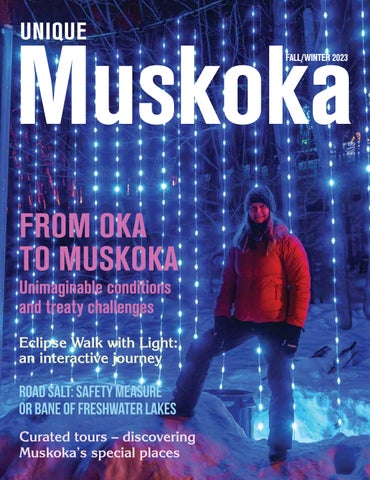
FALL/WINTER 2023
FROM OKA TO MUSKOKA
Unimaginable conditions and treaty challenges
Eclipse Walk with Light: an interactive journey
ROAD SALT: SAFETY MEASURE OR BANE OF FRESHWATER LAKES Curated tours – discovering Muskoka’s special places
(Port Carling) Limited (705) 765-5700 brownsappliances.com
Lake Muskoka $2,995,000
Lake of Bays $2,749,000
Mary Lake $1,395,000
CHELSEY PENRICE Broker
705.205.2726 MuskokaLuxuryProperties.ca
Fall / Winter 2023 UNIQUE MUSKOKA 1
...telling the Muskoka story [11]
24
[32]
Heritage Curators – Lake of Bays Museums
Features 11
Author Christina Kilbourne
Article by Kelly Goslin Photography by Josianne Masseau Award-winning author Christina Kilbourne expertly and genuinely tackles social issues and difficult topics in her novels, although activism is not the source of her inspiration. Truly, Kilbourne’s upbringing in the small community of Barkway instilled a love for nature and the community where she resides.
17
Community Science – Road Salt Monitoring
Article by John Challis Road salt plays an important role in maintaining highways, streets and walkways throughout winter in Muskoka. However, it creates more problems than it solves. A devoted group of citizen scientists are monitoring the impacts of salt as part of a pilot program from the Friends of the Muskoka Watershed.
Article by J. Patrick Boyer Photography by Andy Zeltkalns Both the Dorset Heritage Museum and the Lake of Bays Marine Museum are vital heritage centres in Dorset, representing the vast history of Lake of Bays. The museums are emblematic of the creative possibilities when citizens care about their community’s past, present and future.
32
Home is Where the Light is – Artist Meghan Irvine
Article by Bronwyn Boyer Photography by Kelly Holinshead The play of light along water as the sun sets in its “golden hour” is just one of the fleeting moments found in Meghan Irvine’s paintings. Painting from photographs she takes while out exploring in Muskoka, a prevailing theme of comfort, home and safety flows through Irvine’s canvases
38
Eclipse Walk With Light
[24]
2 UNIQUE MUSKOKA Fall / Winter 2023
Article and Photography by Andy Zeltkalns Huntsville’s Eclipse Walk With Light takes one through a memorable interactive journey of artistic lights and sounds. Journeying through what feels like an enchanted forest, illuminated soundscapes that connect to the seasons of the year and cycles of the day and moon are an adventure for all ages.
Celebrating 25 Years!
[43]
43
Tours with a Twist
Article by Bronwyn Boyer Photography by Tomasz Szumski Jacki MacPherson’s search for outdoor experiences and teachable subject matter for her kids during the COVID-19 pandemic led to the creation of Away We Go Trips. Curated day trips, for locals or visitors, guide people to local independent businesses, historical monuments and hidden gems that are often overlooked.
48
From Oka to Muskoka – Mohawks Under Duress
Article by J. Patrick Boyer Even before migrating to Muskoka, Mohawks faced unimaginable conditions and challenges throughout the European settlement of North
Opinion
FALL/WINTER 2023
FROM OKA TO MUSKOKA
Unimaginable conditions and treaty challenges
Eclipse Walk with Light: an interactive journey
ROAD SALT: SAFETY MEASURE OR BANE OF FRESHWATER LAKES Curated tours – discovering Muskoka’s special places
America. The promise of land as a future home for their entire community, and generations to come, drew a small group to Gibson Township in the late 1870s. However, the promise of land and the truth of their experience were far different.
9
64
By Meghan Taylor
By Cathy Kuntz
Muskoka Insights
Departments
Muskoka Moments
Our Cover
Photograph by Andy Zeltkalns Eclipse Walk With Light in Huntsville is a magical journey through time. With over 20,000 lights across multiple installations, buildings and soundscapes, the experience is memorable for all ages and abilities.
55
What’s Happened
Article by Matt Driscoll Huntsville Festival of the Arts has announced a new fall concert series, Cranberry Festival is back and Oktoberfest is celebrated across Muskoka. Local municipalities pledge millions towards the new hospital while the condo development proposed at Muskoka Wharf in Gravenhurst is at a standstill. Coyotes and wolves have been seen in Lake of Bays, Muskoka Watershed Council moves ahead with the Muskoka Integrated Watershed Management Plan and a pair of skiers in Huntsville are raising funds to make the national team.
58
Cottage Country Cuisine
[58]
Article by K.M. Wehrstein Photography by Tomasz Szumski Pulling out all the stops to create a four-star holiday meal may mean different things. Whether you want something you can prepare easily with less fuss or distinct and elevated flavour profiles for every dish on the table, several of Muskoka’s chefs have shared their recipes, tips and tricks for an unforgettable turkey dinner. Fall / Winter 2023 UNIQUE MUSKOKA 5
DISCOVER THE LOCAL MARKET WITH BIG CITY SELECTIONS IN HISTORIC DOWNTOWN BRACEBRIDGE • • •
Fine Artisan Breads Daily Assorted Baked Goods Made in House Desserts
…telling the Muskoka story Unique Muskoka is published six times per year by Unique Publishing Inc. Meghan Taylor Publisher/Editor Donna Ansley Sales Lisa Brazier Design Susan Smith Administration
• • •
Black Angus AAA beef, Ontario lamb, pork, chicken and sustainable fish Assorted selection of housemade sausages Variety of cheeses, dips, sauces and exclusive pantry items
Bronwyn Boyer J. Patrick Boyer John Challis Matt Driscoll Kelly Goslin Kelly Holinshead Cathy Kuntz Josianne Masseau Tomasz Szumski K.M. Wehrstein Andy Zeltkalns Contributors Annual Subscription Rates: (including HST where applicable) In Ontario $30.00 All Other Provinces $36.00 U.S. $60.00 All Other Countries $72.00 HST: 773172721 Canada Post Publications Mail Agreement Number: 43268016
• • •
Copyright © 2023 Unique Publishing Inc.
Chef-inspired ready-to-eat meals and salads Catering for staff luncheons, private parties and everyday needs Check the QR code online for menu ideas
No content published in Unique Muskoka can be reproduced without the written permission of the publisher. Mailing Address Box 616, Bracebridge ON P1L 1T9 Street Address 28 Manitoba St., Bracebridge ON P1L 1S1
OPEN TUESDAY TO SATURDAY 11A TAYLOR ROAD
HIRAM ST MARKET 705-204-0857
BIG RIVER BAKING COMPANY 705-394-4499 bigriverbakingco.com
6 UNIQUE MUSKOKA Fall / Winter 2023
SULLYS MUSKOKA 705-394-4594
www.uniquemuskoka.com info@uniquemuskoka.com 705-637-0204
FAMILY OWNED BUSINESS SINCE 1987
www.FIREPLACESTOP.com Fall / Winter 2023 UNIQUE MUSKOKA 7
CUSTOM FURNITURE, MADE TO YOUR SPECIFICATIONS! Choose from 100's of frames, fabrics, configurations, and power options Enjoy shortened delivery times and lower pricing • Made in Canada or U.S.A. We offer the best selection of quality furniture backed by the largest furniture retailer in Canada. Available only at Leon's in Bracebridge & Huntsville. Isn't it time you let us surprise you?
Muskoka Insights individual and collective, is at the forefront of regular contributor J. Patrick Boyer’s feature on the history of Wahta Mohawks. Their migration from Oka and subsequent years battling for the rights to live on their land, according to their way of life, were tumultuous. This history cannot be overlooked and I’m grateful for better understanding the challenges Indigenous People faced throughout Muskoka’s history. For artist Meghan Irvine, home is where the light is. As contributor Bronwyn Boyer shares, no matter the season, Irvine’s artistic expressions of her connection to nature shine through in her canvases. Drawing the viewer into a specific moment by revealing the relationship between every aspect of life brings hope, peace and comfort. Irvine’s art gives new perspective and appreciation for those quiet moments. In our community science feature, contributor John Challis shares the unsettling effects the overuse of road salt is creating in lakes and ecosystems throughout Muskoka. Winter driving and road safety are important in the region but the increased salination of our lakes and waterways pose questions that are yet to be answered. Friends of the Muskoka Watershed have activated their network of citizen scientists to collect data and monitor the impacts for our waterways. In every season, Muskoka is filled with adventures, such as those provided by Away We Go Trips and the Eclipse Walk With Light. Whether your interest is history, art, nature or just finding an activity to pique your interest, there’s always more to discover. As winter sets in, give yourself the opening to try something new and shake up your routine. Even if the pace is slower, enjoy the ride. Happy reading! Photograph: MacKenzie Taylor
Between work, play and gatherings with friends and family, summer always feels full. The days and nights overflow with activities and visitors, and bring joy along with the chaos. However, I also very much look forward to the space fall and winter give to reset, recuperate and revisit things outside of the hectic schedule of the summer. This year has been busy for me. Busy in a way I anticipated – work, magazine, horses, family, friends. I filled my plate full and I’ve enjoyed all of it. As this is the last issue of Unique Muskoka for 2023, I’m given the opportunity to reflect on the year so far, even if it’s not quite over yet. I’d like to extend a thank you to everyone who has taken part in this first year of the magazine with me at the helm. I am grateful for the support, the kind words of encouragement, the critiques and everything in between. My adventures in publishing have only just begun and I look forward to next year, and beyond. Once this issue is out in the world, and after a moment to breathe, I’m eager to source new ideas and make plans for 2024. Fall and winter for some may seem like a time of stalling out; a holding pattern of waiting for spring, waiting for warmer temperatures, and waiting for the next adventure. A time to do less and wait until the seasons shift again. On days when the skies are grey and the temperature dips into the negative double digits, I may even be one of them. While the landscape may seem frozen in time, winter is an opportunity to consider your daily life from a different perspective. In the busyness of summer, it’s easy to put aside life changes or wait for a better time to make that tough decision. In winter, development and growth can be come the focus. Making time to plot your way forward in life is time well-spent. In this issue, the power of decisions,
Your Home and Cottage Mattress Centre
SAVOY by DreamStar Bedding
MUSKOKA CURATED COLLECTION by Marshall Mattress
THE LARGEST SELECTION OF IN-STOCK MATTRESSES IN MUSKOKA
6 Monica Lane, Bracebridge 705.646.2557 www.mattressesofmuskoka.com
Fall / Winter 2023 UNIQUE MUSKOKA 9
Embrace Your Exterior
Hardie® fiber cement products combine beautiful design with high performance. Time and time again, we beat our competitors on both curb appeal and durability.
800.732.0158 • 705.645.8404
www.norstarexteriors.com SERVING MUSKOKA, PARRY SOUND & HALIBURTON
Supply & Install • Cash & Carry
Inspired by Community CHRISTINA KILBOURNE
The quaint communities encircled by lakes, the wide expansive forests and the connectedness of small-town Muskoka have provided a wellspring of inspirational settings for Christina Kilbourne’s writing.
Article by Kelly Goslin Photography by Josianne Masseau
A
uthor Christina Kilbourne is known for her thoughtprovoking young adult n o v e l s that address important, often uncomfortable, complex social, political, and environmental issues. With a writing style that carefully combines empathy and realism, Kilbourne skillfully weaves stories that resonate with her young readers and quietly, sensitively instil activism and awareness. Born in the small town of Forest, Ontario, Kilbourne and her family moved to Muskoka when she was about six years old. Living on a heritage farm property in the small community of Barkway, she grew up surrounded by natural beauty, while her father relied on the land to sustain them for heat, food and income. Her mother, a teacher, fostered an enthusiasm for learning from an early age. And Barkway, with its 60-student schoolhouse, introduced Kilbourne to community.
Fall / Winter 2023 UNIQUE MUSKOKA 11
Christina Kilbourne was introduced to the world of literature by the travelling librarian that would visit her small schoolhouse in Barkway. The prospect of reading, including published poems and stories written by other children, enthused her and the possibility of writing professionally was exhilarating.
“I would never want to trade the sense of belonging I experienced growing up in Barkway for any other childhood,” Kilbourne shares. The travelling librarian that would visit Kilbourne’s small schoolhouse when she was young introduced her to the world of literature, including published poems and stories written by other children. The prospect of reading enthused to her and the possibility of writing professionally was exhilarating. Muskoka has continuously afforded Kilbourne a space of inspiration, topographically and socially, and it remains an influence on her work today. The quaint communities encircled by lakes, the wide expansive forests, the connectedness of smalltown Muskoka, these have provided a wellspring of settings for Kilbourne’s writing. She describes the “residential streets of older homes and the two lakes flanking town” of her fictional Port Hope in her book Dear Jo and Gravenhurst is the clear inspiration. Living now in Bracebridge, she remains deeply connected to her childhood experience, bonded to the land and its various
Powering your cottage and home – even during a power outage.
ELECTRICAL • HVAC • HOME AUTOMATION • SOLAR ECRA / ESA 7002295 • TSSA 000365522
12 UNIQUE MUSKOKA Fall / Winter 2023
beauties, and integrates those memories and sentiments in her writing. “I feel closely tied to the land, flora and fauna,” she explains. “In fact, although I have lived in other parts of Ontario, and in New Zealand, and travelled extensively through Africa and Latin America, nowhere feels like home the way Muskoka does to me. When I lived in New Zealand, I missed the granite so badly my then boyfriend, now husband, took me on a trip where I could see granite outcrops. It wasn’t the same as the Canadian Shield emerging across the landscape and peeking up from underfoot when you walk through fields and forest, but it did bring me some comfort.” Muskoka has furthermore been a constant source of community support and enthusiasm for Kilbourne’s work. In the face of adversity or criticism, at home Muskoka has continued to celebrate her literary achievements, a source of great pride for her community. “Years ago, the owner of the bookstore in Gravenhurst told me one of my books was their top seller,” exclaims Kilbourne. “It was even outselling Alistair MacLeod’s novel No
Through her thought-provoking novels, encouraging critical thinking and empathy, Christina Kilbourne provides a compelling and inspiring forum for young adults to situate themselves in the world’s complex array of issues and wonders.
Floors for Home & Cottage HARDWOOD • LAMINATE • VINYL PLANK & TILE • VINYL ROLLS CARPET • CERAMIC • NATURAL STONE & MORE
MODERN HOME CARPET ONE 350 Ecclestone Drive • Bracebridge
705.645.2443 carpetonebracebridge.ca
TAYLOR CARPET ONE 30 Cairns Crescent • Huntsville
705.789.9259 taylorcarpetonehuntsville.com Fall / Winter 2023 UNIQUE MUSKOKA 13
I N T R O D U C I N G THE K I A
The 2023 Seltos. MUSKOKA KIA
21 Robert Dollar Dr, Bracebridge, ON P1L 1P9
705-645-6575 muskokakia.ca
14 UNIQUE MUSKOKA Fall / Winter 2023
Great Mischief, which went on to win the International IMPAC Dublin Literary Award.” Throughout her career, Kilbourne has demonstrated a keen interest in exploring issues such as mental health, addiction, trafficking, abuse, homelessness and other significant challenges faced by teenagers and adults alike in today’s society. One of Kilbourne’s most celebrated novels is Detached, which delves into the sensitive topics of self-harm, mental health, loss, and addiction. Kilbourne handles this difficult subject matter with grace and sensitivity, crafting a narrative that sheds light on the internal struggles of individuals battling their own depression or that of a loved one. The stories Kilbourne crafts are visceral but are woven with an unparalleled craftsmanship that manages to create relatable and authentic teenage characters. Kilbourne captures the voices, emotions, and experiences of young people, which allows her readers to connect with her stories on a personal level and creates a platform for youthful discussion. Her most recent and highly celebrated book, The Limitless Sky, is situated in a dystopian, post-climatic disaster landscape, where two young protagonists desperately seek truths from the past to save their families and communities. This setting is not only deeply symbolic and sensory, but it is disconcertingly realistic in light of our current global climate crisis. “Some days when I scan the news, this past summer especially, my heart lurches because
SERVING MUSKOKA & PARRY SOUND FOR OVER 70 YEARS
Christina Kilbourne’s upcoming young adult novel, 40 Days in Hicksville, is coming out October 14. With a writing style that carefully combines empathy and realism, Kilbourne skillfully weaves stories that tackle important topics and resonate with her young readers. of the similarities to the ‘time of the floods, fires and winds’ that I reference in my most recently published novel, The Limitless Sky,” shares Kilbourne. “In this dystopian world, society is fractured and struggling because humans did not heed the scientists’ warnings of the pending impacts of climate change.” Kilbourne makes it clear that the book does not explicitly aim to incite activism amongst its readers. However, it carefully draws attention to the environmental realities of our ever-fragile world, providing a space for young readers to consider their own
relationship with nature and their agency as environmental stewards and seekers of truth. “I don’t purposely set out to write books on social issues or social justice – or to promote awareness,” says Kilbourne. “It just seems that is where my interests lie.” Through her thought-provoking novels, encouraging critical thinking and empathy, she provides a compelling and inspiring forum for young adults to situate themselves in the world’s complex array of issues and wonders. In the tenacity of youth, Kilbourne feels inspired. “In my experience, young people are activists at heart,” she shares. “They carry with them so much passion and energy, knowledge and know-how, that I should probably be looking to today’s youth to inform my own awareness and inspire my passion”. Kilbourne was recently informed her book The Limitless Sky is a finalist for the Canadian Children’s Book Centre Arlene Barlin Award for Science Fiction and Fantasy, as well as for the 2023 Snow Willow Awards.
Throughout her career, Christina Kilbourne has demonstrated a keen interest in exploring issues such as mental health, addiction, trafficking, abuse, homelessness and other significant challenges faced by teenagers and adults alike in today's society.
Sales & Service of Major Propane Appliances (refrigerators, ranges, fireplaces, furnaces & more) Safe & reliable No electricity required Bulk propane delivery to your home or cottage
705.645.4294 TF: 866.645.4294 STORE: 228 TAYLOR RD., BRACEBRIDGE OFFICE: 1646 WINHARA RD., GRAVENHURST
Fall / Winter 2023 UNIQUE MUSKOKA 15
Come Visit Our Booth at
IT'S YOUR DREAM. WE BRING IT TO LIFE.
50
years of
custom homes & cottages.
Proudly serving Muskoka/Georgian Bay/ Haliburton.
GRAVENHURST MODEL HOME 2 2 7 8 H w y 11 N o r t h Graven h u rs t, O N | P 1P 1R 1 1 - 8 8 8 - 417- 8761 GTA DESIGN CENTRE 1 3 0 K on rad Cre s cent, Un i t #18 M ar k h a m, O N | L 3R 0G5 9 0 5 - 4 7 9 - 9013
www.techhomeltd.com
1-888-417-8761
Tech Home has helped clients realize their vision of a beautiful & uniquely personal custom home with the highest quality and affordable pricing.
Photograph: Friends of the Muskoka Watershed
The Friends of the Muskoka Watershed recruited their first 10 community scientists to run a pilot program in the winter of 2022-2023. Local residents, testing for evidence of road salt in urban runoff, added significantly to our understanding of where and when road salt is problematic.
I
Article by John Challis
n July 2023, Gravenhurst Town Council passed a bold resolution recognizing road salt as a toxic substance, echoing a 2004 addition to the Canadian Environmental Protection Act. Council vowed to reduce its use “as much as possible while maintaining safety on roads and sidewalks.” Road salt, of course, is seen as an absolute winter necessity. Since the 1950s, it has been used to make icy roads safe, at the speeds we all expect we should be travelling. But it creates more problems than it solves. It’s costing billions to fix
Fall / Winter 2023 UNIQUE MUSKOKA 17
Photograph: Friends of the Muskoka Watershed
Dr. Neil Hutchinson inspects the auger he uses to break into the ice on Jevins Lake at Gravenhurst. Dr. Hutchinson has been monitoring the watershed for increased salination during winter months. salt damage to bridges and roads. Our cars corrode, forcing major expenses. Salt has even been found in private drinking water wells. The environmental harms are every bit as problematic; dying pines facing Highway 11 are evidence of that. It’s been on the radar of the Friends of the Muskoka Watershed (FOTMW) for better than a decade. FOTMW calculates there are roughly 30,000 tonnes of road salt in Lake Muskoka. Dr. Norman Yan, founding director of FOTMW, worries about salt’s impact on aquatic life. He affectionately refers to the 80 known species of zooplankton in the lakes as “nature’s lawnmowers.” They chow through algae in astounding volumes. But some are vulnerable to elevated chloride, the dissolved element from road salt. Too much reliance, Dr. Yan says, is put on
18 UNIQUE MUSKOKA Fall / Winter 2023
the Canadian Water Quality Guideline, which sets a chloride limit of 120 mg/L in water bodies. FOTMW, working with Queen’s University researchers, conclude that concentrations of 10 mg/L are likely toxic to some key lake biota – the level present in 20 per cent of our lakes. It’s a warning that Muskoka’s legendary water
Friends of the Muskoka Watershed, as part of their road salt monitoring program, have cups available to limit the use of salt causing environmental hazards.
ple Orchard a M Farms We’re Celebrating our
35 YEARS
THANK YOU
with some Sweet Deals
- FACTORY OUTLET SPECIALS -
$17 99
PURE MAPLE SYRUP
1 Litre
Photograph: Friends of the Muskoka Watershed
ASSORTED CHOCOLATES
MAPLE COOKIES 350 g.
$3 99
Spencer MacPherson, citizen science coordinator with Friends of the Muskoka Watershed, is looking forward to gaining more volunteers, to collect more data and to provide ideas to improve the program. quality is vulnerable. Municipalities haven’t been ignoring the issue. Gravenhurst has switched exclusively to sand on sidewalks and municipal parking lots and is working on reducing quantities on roads. The
District of Muskoka has been monitoring chloride in our lakes since around 2004. But there’s more work needed. This is where citizen science comes in. The FOTMW feels recruiting local residents to test for evidence of road salt in urban runoff can add
1.800.461.5445
info@mapleorchardfarms.com 14 Gray Road, Bracebridge, ON P1L 1P8
Fall / Winter 2023 UNIQUE MUSKOKA 19
Photograph: Friends of the Muskoka Watershed
Road salt is seen as an absolute winter necessity to maintain safety. However, often areas are over-salted, creating numerous problems for the environment. While the issue has been on the radar of the Friends of the Muskoka Watershed for more than a decade, data to support changing the existing regulations is limited.
significantly to our understanding of where and when road salt is problematic. FOTMW recruited their first 10 citizen scientists to run a pilot program in the winter of 2022-2023. Among the recruits were members of the Gull and Silver Lake Residents’ Association. Already concerned about road salt, the association was eager to take on the role of pilot monitoring. Joanne and Clarke Smith jointly chair the environmental committee with the Gull Lake group. They’re a good fit for the portfolio: she a high school science teacher with training in zoology, he a retired lawyer. They received test kits to use at three sites in Gravenhurst. “The main concern of the association has always been the quality of the water,” Joanne says. Chloride has become a growing part of that focus. They discovered snow cleared from plaza parking lots on Bethune Drive was piled beside a storm drain that fed salt-laden meltwater into the lake. Highway 11’s bridge over the lake allows meltwater to drain salt into the water as well. And various municipal roads contribute more salt.
www.mikeslandscaping.ca info@mikeslandscaping.ca 20 UNIQUE MUSKOKA Fall / Winter 2023
Photograph: Friends of the Muskoka Watershed
Among the first citizen scientist recruits were members of the Gull and Silver Lake Residents’ Association. Already concerned about road salt, the association was eager to take on the role of pilot monitoring. They discovered snow cleared from plaza parking lots on Bethune Drive was piled beside a storm drain that fed salt-laden meltwater into the lake and Highway 11’s bridge over the lake allows meltwater to drain salt into the water as well. Thanks to newer technology, the citizen scientists’ task of measuring salt is not that complicated: Find some open water and pull out a cupful. An electronic probe does the analysis. The probe is a fascinating tool that provides accurate assessments of the chloride in the water. The salt in lake water is not something you can taste: the levels are in parts per million. Instead, Dr. Neil Hutchinson of FOTMW explains, the pen-sized electronic probe “uses conductivity, an accepted means
to estimate chloride.” The chloride measurements the Smiths and others have compiled have them worried. “We knew the lake had soft water,” Joanne says. “But we never thought of the effects chloride would have on soft water.” The science has revealed a “multitude” of impacts in the lake. It’s exactly the kind of synergy the FOTMW was hoping for when this program was designed. “Citizen scientists are our eyes on the watershed,” says Dr. Hutchinson “They
live close to runoff areas and can mobilize quickly and take measurements in response to rain, snow or thaw events when they occur. They are also proactive – making sure that staff and politicians hear the concerns from citizens as well as scientists.” Dr. Hutchinson has been monitoring a feeder stream leading to Jevins Lake, just downstream from Highway 11’s bend around the lake at Gravenhurst. He’s been using a slightly more sophisticated conductivity monitor, called a Hobo Logger, which
Fall / Winter 2023 UNIQUE MUSKOKA 21
Photograph: Friends of the Muskoka Watershed
Dr. Hutchinson is working with the Friends of the Muskoka Watershed to develop a recommendation for a more sensitive, Muskoka-specific water quality guideline for chloride, incorporating the enhanced toxicity of road salt in Muskoka’s soft water. remotely records measurements every five minutes. It’s been keeping a record for the better part of a year. Road salt runoff has easy access from the highway to the lake here, as well as from the town’s large south commercial area, with its major retail outlets. Dr. Hutchinson’s results show that during thaw periods from February to May meltwater created sharp spikes in chloride levels, approaching the Canadian Water Quality
22 UNIQUE MUSKOKA Fall / Winter 2023
Guideline. Jevins Lake, Joanne Smith says, “is a red flag.” She and Clarke have measured runoff in a ditch leading from the commercial area, and last year recorded the highest readings of all sites. The ditch feeds water into a wetland complex that leads to Dr. Hutchinson’s “Hobo site,” which in turn leads to Jevins Lake. Clarke Smith says it’s understandable that salt gets a lot of use in commercial retail
parking areas. It’s a liability issue. But Joanne points out the amount being used far outstrips what is needed. “It only takes a tablespoon of salt to melt a square metre of ice,” she says. And putting salt down in the coldest weeks is pointless: below –12°C, salt loses its ability to melt ice. Even in its infancy, the road salt pilot has had unexpected benefits. “In addition to more data being collected,” Spencer MacPherson, citizen science coordinator with FOTMW, says, “we have already seen benefits of creating a small community of motivated individuals with a common goal. Some of our volunteers have really stepped up and helped us make some positive changes to the program for this upcoming season.” The chance to play an important part in the project is what drew Joanne and Clarke Smith to get involved. It’s a commitment to community, Clarke says, a belief he holds that “by having people involved, change happens.” And, Joanne enthuses, “it’s practical research. I mean, how wonderful is that?” Other initiatives are also underway. Dr. Hutchinson, working with the Muskoka Watershed Council, has used the District of Muskoka’s data on chloride levels in more than 200 lakes to document the status of road salt for the Muskoka Watershed Report Card, released on September 18. He is working with the FOTMW to develop a recommendation for a more sensitive, Muskoka-specific water quality guideline for chloride, incorporating the enhanced toxicity of road salt in Muskoka’s soft water. If that comes about, it could dramatically affect the way road salt is used in the District of Muskoka. The program will continue to expand to new sites, with the help of new recruits. If you’d like to become one of the citizen scientists working on this project, contact Spencer MacPherson at Spencer@FOTMW.org, or by phoning the Friends of the Muskoka Watershed office at 705-640-0948.
~ Muskoka ~ Serving Muskoka and area for 36 years
DIVERSE SELECTION OF PRODUCTS TRADITIONAL AND CONTEMPORARY DESIGNS KNOWLEDGEABLE STAFF TO ASSIST YOU WITH BEST SELECTIONS, WORKING ALONGSIDE YOUR ARCHITECTS, DESIGNERS AND BUILDERS ON YOUR NEW OR RENOVATION PROJECTS
sales@windowworksmuskoka.net 2358 HWY #11, RR#1 GRAVENHURST, ONTARIO
705-687-7617 1-800-668-9858 www.windowworksmuskoka.net Authorized Dealer
In the Dorset Heritage Museum, visitors enjoy diverse artifacts, photographs and storyboards artfully presenting Dorset’s colourful saga from settlement to modern times. The museum occupies a re-purposed 1928 Forest Ranger building, still anchoring spacious grounds adjacent to the Dorset Lookout Tower.
Article by J. Patrick Boyer / Photography by Andy Zeltkalns
D
orset’s two museums bring their Lake of Bays community to life in ways that engage and reward the public. Both are easily accessible on the main street in buildings showcasing how heritage structures play roles intrinsic to their contemporary purpose. Dorset Heritage Museum, operating
24 UNIQUE MUSKOKA Fall / Winter 2023
since 2001, occupies a re-purposed 1928 Forest Ranger building. Still anchoring spacious grounds adjacent to the touristattracting lookout tower, the place maintains the community’s link to forestry and Dorset’s historic role as the location of Ontario’s Fire Ranger School. Lake of Bays Marine Museum, opened
in 2013 with legendary cruise ship Bigwin as its pivotal attraction, occupies the 1885 building and wharf where Huntsville & Lake of Bays Navigation Company and Bigwin Livery Company sold tickets. At that location, the company stored freight, distributed mail, operated the telegraph office and provided upstairs sleeping quarters for captains of steamships Mohawk Belle and Iroquois. These separate and distinctive entities curating Muskoka heritage are complementary. In the Heritage Museum, visitors enjoy a modern, clean, welcoming space. Diverse artifacts, photographs and storyboards artfully present Dorset’s colourful saga from settlement to modern times. Specific areas feature Indigenous presence, wildlife, summer camps, schooling, logging, farming, trapping, firefighting, service in wartime, commerce and time’s parade of innovations, from cash registers and cheese slicers to motor vehicles and radios. Lighting throughout is soft, which adds a cozy atmosphere while effectively illuminating each exhibit. Glass panes encasing displays, for instance owls of North America, are immaculate. Most displays have no glass, allowing curious visitors to touch a turtle’s shell or a child’s schoolroom slate, a beartrap or snowshoe, achieving exceptional intimacy for a museum. The Marine Museum’s inauguration a decade ago brought to life the impossible dream of heritage-minded individuals. The elegant S.S. Bigwin had been, in the words of authors Marijane Terry and Jeff Gabura, “the hardest worker at Bigwin Inn,” ferrying passengers and luggage to and from the island resort for decades. Her pathetic demise, then
Dorset Heritage Museum and Lake of Bays Marine Museum are separate and distinctive entities curating Muskoka heritage. However, their operations are complementary, showcasing all aspects of Lake of Bays history. Most displays at Dorset Heritage Museum have no glass, allowing curious visitors to interact more fully with displays, achieving exceptional intimacy for a museum. The Marine Museum’s artifacts and photographs recall the height of S.S. Bigwin’s popularity when she first set sail and makes the most of Bigwin’s new era on Lake of Bays. miraculous resurrection to a second life as today’s popular Lake of Bays cruiser, is superbly documented in their book A Muskoka Century / The Story of the S.S. Bigwin. Built in 1910, the Bigwin’s engine was converted in 1956 from steam to diesel, while her recent restoration entailed
conversion to electric power, in all, a stellar example of sustainable heritage. Because Bigwin’s role is best understood in her setting, the authors render a fulsome account of Lake of Bays history, just as the museum serves visitors with enriching artifacts and stories, selling pertinent books and providing helpful information with gift
Fall / Winter 2023 UNIQUE MUSKOKA 25
The elegant S.S. Bigwin ferried passengers and luggage to and from the island resort for decades. Built in 1910, the Bigwin’s engine was converted in 1956 from steam to diesel, while her recent restoration entailed conversion to electric power. Her miraculous restoration is the work of dedicated, heritage-minded individuals.
shop wall panels describing currently operating resorts. Passengers aboard Bigwin also relish commentaries by Captain Chuck McClelland, who draws from his seven decades of experience on the lake, and Captain Jim Spier, also the museum’s hands-on general manager, who explains how the vessel was updated for safe operation while maintaining her classic authenticity. The Marine Museum’s artifacts, photographs, and even the 1930s movie “Pleasure Island” shown in American theatres to attract guests north to Bigwin Inn, make the most of Bigwin’s new era on Lake of Bays. Gaining considerable media interest, its popular routes include Thursday evening dinner cruises to Port Cunnington Lodge. “We are having an excellent year,” smiled Captain Speirs early in August. Dorset Heritage Museum came into being when permanent and seasonal residents realized that Lake of Bays’ rich history would be lost if
Muskoka Barging
Family run construction company with over 35 years experience operating in the Muskoka Lakes area. No job is too small or too big. 705-764-0765 | muskokabarging.com | 1163 Milford Bay Rd, Milford Bay ON
BARGING ● STEEL & CRIB DOCKS ● SEPTIC SYSTEMS ● LANDSCAPING 26 UNIQUE MUSKOKA Fall / Winter 2023
Dorset Heritage Museum came into being when permanent and seasonal residents realized that Lake of Bays’ rich history would be lost if nobody acted. A combination of donated artifacts and items claimed from the closure of the Leslie M. Frost Natural Resources Centre, such as a birchbark canoe, art and educational exhibits of birds, turtles, fish and animal skulls, now make up the displays at the museum.
Muskoka's Largest Home Service Company!
No job is too big or too small! www.GBScontracting.com 705.687.9143 315 Industrial Drive, Gravenhurst
Fall / Winter 2023 UNIQUE MUSKOKA 27
Exhibits within the Dorset Heritage Museum feature Indigenous presence, wildlife, summer camps, schooling, logging, farming, trapping, firefighting, service in wartime, commerce and time’s parade of innovations, from cash registers and cheese slicers to motor vehicles and radios. nobody acted. “We were fortunate to get the Lands and Forests Fire Ranger Station,” explains Norm MacKay, a past chair of the museum committee. “We converted it with free labour. Stu Barnes, employed at Beaver
Creek correctional facility, brought minimum-security prisoners to work under direction of a carpenter, a drywaller, an electrician and a roofer to fashion a contemporary museum.”
Numerous artifacts were donated by Muskoka and Haliburton individuals and families. On July 6, 2004, when the province closed the Leslie M. Frost Natural Resources Centre (operating in the former Forest
Specializing in Private Events, Wheelie Good Coffee brings a delightful selection of espresso coffees and refreshments to Weddings, Film shoots and Corporate promotions. Exclusively serving Muskoka since 2016. To book or check availability, text/talk with Matthew directly 416 795 3195 matthew@wheeliegoodcoffee.ca
28 UNIQUE MUSKOKA Fall / Winter 2023
Considering renting your cottage? LET’S CONNECT.
• • • • • • •
Inquiries & Reservations Marketing 24/7 Guest Support Checking and Assessing Detailed Cottage Listing Professional Photography Cleaning & Check-Ups
The former Forest Ranger School is well represented at Dorset Heritage Museum, with exhibits showcasing the incredible history of the location and school as well as operating from a renovated building formerly part of the Forest Ranger School. The place maintains the community’s link to forestry and Dorset’s historic role as the location of Ontario’s Fire Ranger School. Ranger School), MacKay and John Clayton, another pillar of the museum’s development, went to the Centre and staked claim to a birchbark canoe, art and educational exhibits of birds, turtles, fish, and animal skulls – now exhibited in the museum. Thematically displayed, “Each item and picture tell a story,” notes MacKay. His
father’s book Early Days in Dorset, among titles on sale, records many such stories. So too do knowledgeable volunteers available as docents who answer visitors’ questions. Both these new and vital heritage centres in Dorset are emblematic of the creative possibilities when citizens care about their community’s past, present, and future.
Full Service 4-Season waterfront cottage rental management agency
Find Us
1-877-788-1809
newowners@OntarioCottageRentals.com
Fall / Winter 2023 UNIQUE MUSKOKA 29
30 UNIQUE MUSKOKA Fall / Winter 2023
OUR MOST COMFORTABLE MATTRESS
EVER
All Mattresses
25%
OFF Regular Prices
705.645.8183
www.muskokafurniture.net
CARBONCOR 13
195 WELLINGTON STREET, BRACEBRIDGE ON
Fall / Winter 2023 UNIQUE MUSKOKA 31
Painting is something Meghan Irvine does for herself because it’s what makes her creative spark shine the brightest. Irvine manages to walk the line between realism and abstraction, particularly in her ability to capture the energy of water in her paintings.
Article by Bronwyn Boyer / Photography by Kelly Holinshead
T
o look at Meghan Irvine’s paintings is to get lost in the experience they capture, the characters portrayed and the stories they tell. Irvine’s work delves much deeper than the aesthetic beauty of the natural world around her; ultimately, it’s about the relationships she forms with each tree, rock, animal, leaf, stream she shares with her viewers. The way the light accentuates features of nature only experienced in fleeting moments, if at all, can
32 UNIQUE MUSKOKA Fall / Winter 2023
be found in Irvine’s brush strokes and conscientious use of colour. Irvine grew up in Waterloo but spent her summers in Muskoka at her family’s cottage. Home is a prevailing theme in her paintings and her connection to the area is what gives them so much meaning. “Muskoka always felt like home to me,” Irvine explains. “It’s where all my best childhood memories happened.” Irvine studied fine art at the University of
Waterloo and Western University, where she also completed Teacher’s College. Her first area of study was kinesiology, as a career as an artist was not her original plan. “I’ve always done art,” she shares. “I always had a sketchbook and pencil with me. I was always drawing. When I was a kid, I’d go to my mom and say, ‘I need to make a craft, right now!’ There was an urgency about it that never went away. But I just thought it was something all kids do, so it took a long
time to realize it was my passion. I went into kinesiology because I didn’t want to try to be an artist. But I realized during the program that I was the only one there who didn’t really love kinesiology. I knew I wanted to teach, so I decided I wanted to teach art and math.” After teacher’s college, Irvine and her partner moved to Muskoka and she taught at Tawingo College in Huntsville. But Irvine’s destiny as a painter found a way to shine through her other plans, like the rays of the sun through a forest canopy. “When I had my first child, I decided to stay home with her and pursue art as a fulltime career,” she recalls. “I could only balance so many things and art was really important to me, I didn’t want to lose it. It’s funny how I accidentally spent my whole life trying to be an artist while I was trying to do other
This past spring, Meghan Irvine held her first solo show at Coles Art Market in Huntsville called Light Shines Through. The experience was a landmark moment for her, being able to return to the moments depicted in her 27 original paintings.
things.” Although Irvine displayed her paintings in Waterloo in her early days, it wasn’t until they were hung at the Silver Bridge Gallery in Bracebridge that she considered herself an artist. “Labelling myself that way has always been a challenge,” she says. “I always considered myself a painter but there was a sense of legitimacy
when my work started appearing in galleries. And taking the leap to prioritize my art as a source of income definitely changed my focus.” Irvine paints from photographs that she takes on forays into the natural world, sometimes at a specific time of day with the intent to capture the light she wants to paint. A prevailing theme of comfort, home and safety flows through Irvine’s canvases like a gently winding river. Showing the connection between every aspect of life in a way that brings hope, peace and comfort is her artistic modus operandi. She gives her paintings titles that emphasize nature being a safe haven.
Rather than looking out over a lake, Meghan Irvine’s paintings makes the viewer feel like they’re in the water. She credits having spent much time in the water as a child and with her own children for providing her the connection to the element and the perspective of being immersed in water.
Fall / Winter 2023 UNIQUE MUSKOKA 33
Evoking the feeling of comfort found in the “golden hour,” when the setting sun transforms the colours just right, is present in much of Meghan Irvine’s art. Irvine clearly feels at home among nature. The warmth and relaxation she experiences in Muskoka shine through in her paintings. 34 UNIQUE MUSKOKA Fall / Winter 2023
Her wildlife portraits personify the creatures being show-cased as relatable characters. A fox stretching its front legs is called This Moment, while the one stretching its back legs is called, Another Day. A painting of an empty nest called Everything We Need, is juxtaposed with a nest containing eggs called, The Simplicity of Importance. A study of four dying leaves on a twig called Somewhere Between shines light on the smallest, seemingly insignificant moments in the cycle between life and death. What most people miss, Irvine sees. Titles like Safe Harbor, Lullabies, and Home for The Night, evoke the feeling of comfort found in the golden hour, when the setting sun transforms the colors just right. “There’s something beautifully symbolic to me about the setting sun,” Irvine explains. “It’s when everything gets touched by a beautiful golden light for a while. I find a lot of solace in the dependability of that repeating cycle. It’s not only beautiful but it feels like everything is going to be okay.” Irvine’s work is a celebration of the dichotomy of the vastness of the world and humanity’s place in it. “The way birch trees shed their skin in layers… I know that feeling,” Irvine says with a laugh. “It’s a metaphor for how we transform and evolve. It’s not so much about painting the tree so much as seeing ourselves reflected in it, in ways we can resonate.” Irvine’s portraits of water are perhaps her strongest body of work. Rather than looking out over a lake, she makes the viewer feel like they’re in it. “I spent so much time in the shallow water, as a kid or with my kids,” she says. “We can only take in so much with our vision, so I loved trying to capture one closeup view of the water. I try to paint how water feels, the experience of being immersed in it. I’ve always been interested in our relationship with it. The more I paint it, the more I realize our physiological connection to it. It’s comforting to me to think that the lake is the same water I swam in as a kid. It feels like home.” Irvine captures the energy of water in a way that is equally realistic and inventive. She manages to walk the line between realism and abstraction thanks to her fascination with the element.
“I also love finding water in the forest,” she says. “I love to watch the strength and movement of a waterfall or a stream, the way it fluctuates and adapts. How it finds its path and the connection between the water and the rocks. There are lessons in it, I think.” Through her paintings, Irvine pays homage to the emotional experiences of the places she’s been, and wherever she lives. “There’s something interesting about the familiarity of visiting the trees I’ve painted,” she explains. “A horizon line becomes familiar too, like a friend. It’s an unexpected relationship to the space I’m immersed in that I just can’t get enough of.” This past spring, Irvine did her first solo show at Coles Art Market in Huntsville called Light Shines Through and it was a landmark moment for her. “I hadn’t had the experience before of standing in a room surrounded by my own art,” she recalls. “It was a
really incredible experience to spend eight months creating a body of work around a theme and then seeing it all together in one place. It was like re-experiencing a part of my life that I’d documented, culminated in twenty-seven original paintings and it felt like I was experiencing those moments all over again. I don’t always get to meet the people who buy my paintings, so it was amazing to see people interacting with it. I rode that high for a long time.” Though Irvine’s lifepath as an artist has eclipsed her teaching career, she will always love teaching, regardless of the subject matter. “I love observing how brains work – how we learn,” she states. “Being able to expose people to something that I had gotten so much joy out of was a wonderful experience. The most I enjoyed teaching art was at the Grade 7 and 8 level, helping students create a painting and THE RIOBEL MOMENTI™ COLLECTION discover their own inspiration and voice, to AVAILABLE AT KNOWLES PLUMBING! start them on their own artistic journeys. I also enjoy teaching math, helping people discover that they can do something they Meghan Irvine paints from photographs she takes on forays into nature, sometimes at a specific time always struggled with or understand of day with the intent of capturing the light she wants to paint. A prevailing theme of comfort, home something think BATHthey & didn’t KI TC Hthey E Ncould. SHIOW R Oflows OM and safety through Irvine’s canvases like a gently winding river. DESIGN. INSTALLATION. REPAIR S ERVI N G ALL OF MU SKOKA 279 MANI TOBA ST, BR AC EBR ID G E
705 .6 4 5.2 67 1
KNOWLESP LUMBING.COM @MUSKOKABATH
Muskoka’s Bath & Plumbing Centre
BATH & KITCHEN SHOWROOM SALES • INSTALLATION • REPAIR SERVING ALL OF MUSKOKA
279 Manitoba Street, Bracebridge
705.645.2671 @knowlesplumbing knowlesplumbing.com Fall / Winter 2023 UNIQUE MUSKOKA 35
Delving much deeper than the aesthetic beauty of the natural world around her, Meghan Irvine’s work is ultimately about the relationships she forms with each tree, rock, animal, leaf, stream she shares with her viewers. The way the light accentuates features of nature only experienced in fleeting moments, if at all, can be found in Irvine’s brush strokes and conscientious use of color. especially enjoy teaching art and math. Art is subjective, but math isn’t. I like striking that balance between the creative and logical sides of my brain.” Painting is something Irvine does for herself because it’s what makes her creative spark shine the brightest. The tension between art and business is a common struggle for artists that feels like walking a tightrope. “I try to keep them separate from each other,” Irvine explains. “I don’t think sales are what makes an artist successful. I think if you’re making something you love, that’s success. If no one ever bought a painting, I would still paint. There’s a tremendous amount of external validation when someone buys a painting that feels amazing but ultimately, I paint because I need the creative outlet to feel healthy.” Irvine’s paintings can be found at
While studying fine art at the University of Waterloo and Western University, where she also completed Teacher’s College, becoming an artist was not part of Meghan Irvine’s original plans. It wasn’t until she had her first child and chose to remain at home that she truly began to lean into art as her career. 36 UNIQUE MUSKOKA Fall / Winter 2023
Coles Art Market in Huntsville, Britton Gallery in Bracebridge, The Algonquin Art Centre in Algonquin Park, The Ethel Curry Gallery in Halliburton, Paula White Diamond Gallery in Waterloo and Crown and Press Gallery in Hamilton.
Irvine is doing two group shows in October at Crown and Press Gallery and Paula White Diamond Gallery. On November 4th, she’ll be in the “6x6” group show at the Huntsville Festival of Arts studio with Helena Renwick, Stephanie Aykroyd, Roxanne Driedger, Sylvia Kerschl and one more artist, to be determined.
The Eclipse Walk With Light in Huntsville provides an experience unlike any other in Muskoka. Participants walk through installations with over 20,000 lights and are greeted by illuminated soundscapes linked to the seasons of the year and cycles of the day and moon.
Article and Photography by Andy Zeltkalns
T
here are many places to go for a hike or walk in Muskoka, each with its own distinctive signature. One such walk however stands apart from the rest and offers visitors a truly unique experience. The
38 UNIQUE MUSKOKA Fall / Winter 2023
Eclipse Walk With Light in Huntsville, which opened in November 2021, takes one through a memorable interactive journey of artistic lights and sounds. During COVID-19, when social distancing
was still a concern, Huntsville/Lake of Bays Chamber of Commerce conceived the idea of a safe outdoor activity that could be enjoyed by all and encouraged physical movement as well. Designed in collaboration with Limbic
Media, visitors were “invited to lose themselves and experience the non-linear nature of time.” Formerly located inside the grounds of Muskoka Heritage Place, participants walk a circular path through the forest and were greeted by illuminated soundscapes linked to the seasons of the year and cycles of the day and moon. Along the path of 20,000 lights, the walk was interspersed with illuminated pioneer buildings and structures in combination with music and spoken words. Throughout the journey several stops allow people to interact with lights by creating their own sounds. At one of the elements, Awaken, ringing a bell wakes and lights up the flowers. Twilight encourages one to try out different sounds to influence the intensity and pattern of light. Creating a shadow on the surface of the moon is even possible at Moonrise where images of light were projected on the side of a barn. Local or visitor, the experience is a memorable one. Jacqui Golsby from Vancouver Island who was visiting family describes the Eclipse Walk With Light as a
Returning to Huntsville with a new format in November 2023, Eclipse Walk with Light is an opportunity to step outside of time and immerse oneself in an outdoor experience for all ages and accessibilities. Formerly located at Muskoka Heritage Place, this year the experience will be interspersed throughout downtown Huntsville during the winter months. “sensually rich experience of sound, light, texture and scent of fresh, wintery air.” “My anticipation was piqued as we climbed the hill and above us, we heard haunting music and sounds with flashes of
light illuminating the trees,” shares Golsby. Joan, Golsby’s 90-year-old mother, found the trail easy to negotiate with her walker and enjoyed the music and narration, stating “It was an activity enjoyable for all ages. I
Huntsville/Lake of Bays Chamber of Commerce conceived the idea of the Eclipse Walk With Light during the height of the COVID-19 pandemic, when social distancing was still a concern. Designed in collaboration with Limbic Media, the result was a safe outdoor activity that could be enjoyed by all and encouraged physical movement as well. Fall / Winter 2023 UNIQUE MUSKOKA 39
Participants of all ages and mobility can enjoy the Eclipse Walk With Light. Throughout the journey several stops allow people to interact with lights by creating their own sounds. The walk is interspersed with illuminated buildings and structures in combination with music and spoken words. came not knowing what to expect and was pleasantly surprised.” Ellen Yeo from Bracebridge visited the event for the first time found it a “nice evening
out” and thoroughly enjoyed the wintery night atmosphere in the forest of lights. “My 8- and 10-year-old cousins loved running along the trails and interacting with
the lights,” shares Yeo. “It kept us all busy and interested for the full hour we spent there.” Truly an experience for anyone to enjoy,
Proudly Serving Simcoe County & Muskoka
GET 1000L OF FREE PROPANE When you make the switch from oil with Sarjeants *Terms & Conditions Apply.
Propane - Heating Oil - Equipment
Book your no-cost consultation at 705.728.2460 40 UNIQUE MUSKOKA Fall / Winter 2023
sarjeants.com
ECRA/ESA #7010474
GENERATORS SMART HOME SYSTEMS NEW CONSTRUCTION LIGHTING
519.865.6209 ARKLTD.CA
RESIDENTIAL • COMMERCIAL INDUSTRIAL
The immersive magic of lights and sounds, coupled with the wintery night atmosphere, creates an unforgettable experience for all ages at the Eclipse Walk With Light in Huntsville. Whether local or visitor, a trip through the Walk With Light is a memorable one. this writer also had the chance to visit the Walk With Light with his wife, Jayn, and their special needs daughter, Aleksandra. Soon after the start of the walk, entering an enchanting tunnel of lights immediately caught Aleksandra’s attention and made her look up at the magical display. The light and music along the way kept Aleksandra fully engaged in the experience. For the 2023/2024 season, starting in November, the Eclipse Walk With Light is changing locations. The experience will now be found interspersed throughout the
downtown area of Huntsville. According to the Huntsville/Lake of Bays Chamber of Commerce, future plans are to “change up the event” and possibly increase the size of it at a later date. While there may be changes in the future, this coming winter plan to visit downtown Huntsville for a thoroughly noteworthy experience. The Eclipse Walk With Light displays are accessible to the public at no charge. The immersive magic of the lights and sounds will continue to captivate people as they stop, participate and enjoy.
With timeless styling and durable build, TOPO backpacks and bags will hold up in any environment and stand out in all of them. Available at
28 MANITOBA STREET, BRACEBRIDGE
Fall / Winter 2023 UNIQUE MUSKOKA 41
FINE SCOTTISH AND IRISH WOOLLENS
CARDIGANS, SWEATERS AND SHAWLS
SHOP ONLINE
28 MANITOBA STREET, BRACEBRIDGE
www.uniquemuskoka.com
SWEATERS • HATS • SCARVES • CAPES • JACKETS • BLANKETS • GIFTWARE
Article by Bronwyn Boyer / Photography by Tomasz Szumski
W
hen Jacki MacPherson was a little girl, her grandparents took her on trips from where she lived on the outskirts of London, Ontario to her aunt’s cottage on Lake Huron. They would take a different route each time, making the journey fun and exciting. Her grandmother sang the nursery rhyme “rig a jig jig and away we go,” creating a happy childhood memory that has now blossomed into a successful business. Away We Go Trips provides unique curated daytrips for people to experience Muskoka adventures off the beaten path. Even for seasoned natives of Muskoka, there are still many places to
discover. Away We Go guides people to local independent businesses, historical monuments and hidden gems that are often overlooked. The trips are designed to help people form deeper bonds with their families, the community and the natural environment. But most of all, they’re designed to be fun. MacPherson created Away We Go Trips in the middle of the COVID-19 pandemic when she and her kids were stuck at home. “I had a new baby, and we weren’t allowed to do anything or go anywhere, so I felt like I was losing my mind,” she recalls. “I wanted to take my kids on a new outing each day but I was quickly running out of places to take them.”
Away We Go Trips was founded by Jacki MacPherson in the middle of the COVID-19 pandemic while she and her kids were stuck at home. As a teacher, MacPherson was searching for activities she and her kids could do together, even with pandemic restrictions. MacPherson’s research on Muskoka’s historical landmarks gave her new places to explore. Fall / Winter 2023 UNIQUE MUSKOKA 43
Operating all year round, the stops and places to visit along each Away We Go Trips route may vary due to road closures, weather conditions and the operating hours of businesses on the routes. Regardless of conditions, MacPherson finds a way to give travellers a unique and varied experience. The trip options and descriptions are mostly shrouded in mystery, with many fun surprises in store. As necessity is the mother of invention, MacPherson’s research on Muskoka’s historical landmarks gave her new places to explore. “I was able to access books because I was on the library board, so I started learning about historical sites I didn’t know existed around here,” she explains. “I wanted to teach my kids about it in a way that was fun for them, so I started planning day trips. People became interested as I posted about it on my social media and it became a way to help families rebuild their connections while giving small businesses a leg up at the same time.” MacPherson credits Bracebridge historian Patrick Boyer for a large part of the historical information she uses for the trips. In particular, his podcast, Boyer’s Modern History of Muskoka, gave her valuable material for the adventures she crafts. In addition to operating Away We Go Trips, MacPherson is a co-operative education teacher at Gravenhurst High School. “It’s a good balance for me,” she says. “I need to keep my brain active, so it keeps me busy in the summer. And it’s an amazing opportunity to work with small businesses as I send people to them. Forming those symbiotic relationships
44 UNIQUE MUSKOKA Fall / Winter 2023
has been really rewarding.” Indeed, while locals have their favourite spots, most are likely missing out on the fascinating things that happened on that soil. Learning the hardships of the settlers, soldiers and citizens that built the region’s many communities provides a much-needed sense of perspective anyone can benefit from. As for those who don’t live in Muskoka, Away We Go provides a more accessible and varied way to experience the area that’s truly unique. “I think people want to be able to discover Muskoka on their own terms without breaking the bank,” says MacPherson. “There are so many places in the region that don’t get talked about or enjoyed as much as they should,” MacPherson adds. “There are historical monuments, prisoner of war camps, beaches, forest waterfalls and beautiful spots to discover.” Each trip is $35.00 per vehicle with no limit to the size of the group. It includes 10 stops geared towards travellers of all ages, with consideration for the needs of each group. “I give people all the information people may need, like which spots are most suitable
for dogs or if they’re suitable for small children, the elderly or physically challenged travellers and how long each route will take,” shares MacPherson. “I provide the template but people can go at their own pace; so how long they stay at each destination or how long the trip takes is up to them.” Away We Go operates all year round but some of the stops change due to road closures, weather conditions and the operating hours of businesses on the routes. Regardless of conditions, MacPherson finds a way to give travellers a unique and varied experience. “Each trip has a good mix of different destinations,” she explains. “For example, one of the stops is a boatbuilder’s shop so people can go and have the authentic experience of learning and watching someone build a wooden boat. Another is a farm on one of the older historical land grant properties in Muskoka. Most people don’t necessarily think of farming when they think of Muskoka but it is an important part of industry in the region. I think now more than ever, we need to help each other out. That’s the kind of Muskoka I want to live in.”
Away We Go Trips provides curated day trips for people to experience Muskoka adventures. Each trip includes ten stops geared towards travellers of all ages, with consideration for the needs of each group. Even for seasoned natives of Muskoka, there are still many places to discover.
Connecting You to Hospice Muskoka 24/7 705-204-2273 (CARE) Advance Care Planning
Andy’s House
Caregiver Education
Caregiver Support
Grief & Bereavement
Pain & Symptom Management
Short Stay/ Respite
Volunteer Home Visits
for more information, visit hospicemuskoka.com Fall / Winter 2023 UNIQUE MUSKOKA 45
The trip options and descriptions are mostly shrouded in mystery, with many fun surprises in store. Trips include The Wild North, Fallin’ and Farmin’, Escape to the Lakes, Lumber and Lakes, Forces in Nature and Muskoka Pride, where all proceeds are donated to the advocacy organization. “When I created the routes, it was for locals,” MacPherson continues. “I wanted to ignite that sense of adventure again. There’s so much to learn and share here and I wanted people to be inspired to get out and explore Muskoka and form a deeper appreciation for it.” Travellers choose the theme and are given details about the trip upon purchase. It can then be downloaded either as a PDF file where all the stops are mapped out or on a phone where each stop is given along the way. The smart phone option is for those who like the element of surprise since they don’t know the route ahead of time. However, looking at what’s ahead is always an option. And although trails are just one ingredient of the trips, the website also has a handy resource for In addition to operating Away We Go Trips, Jacki MacPherson is a co-operative education teacher at information about trails in Muskoka that is Gravenhurst High School. The combination of the two keeps her brain active and creatively occupied hard to find anywhere else. year-round.
THE NEW WAY TO EXPERIENCE MUSKOKA.
BOOK ONLINE NOW WWW.REALMUSKOKA.COM
46 UNIQUE MUSKOKA Fall / Winter 2023
OR CALL US AT 1-866-687-6667
SOME OF THE GREATEST SIGHTS IN MUSKOKA ARE INDOORS.
MDC
THE MUSKOKA DISCOVERY CENTRE
“Find me where the wild things are.” – Alessia Cara
Conserving Nature in Muskoka. Join us today. A registered charity.
Freshly-built with sawn lumber, the 1888 Wahta post office became a community hub. Attractive with board-and-batten construction, the fences and presence of a sheep also indicate community progress with land clearing for farming. Many wrote to friends and family still at Kanesatake, urging them to move to the new community but lack of clarity about title to the lands kept them away.
O
Article by J. Patrick Boyer All images courtesy of Wahta Mohawk First Nation
n the morning of October 20, 1881, Chief Louis Sahanatien and Katrine, his wife, with their children Rebecca and James, left home after a sleepless night and led 130 other men, women and children through a gauntlet of chaos toward a waiting steamer. Mohawks lined the route down to the Ottawa River. Some faces were wet with tears. From others came taunting jeers. This evacuation from their home in Oka to Gibson Township in Muskoka was further splitting their tattered community. Since the 1570s the Mohawks, easternmost nation in the Iroquois Confederacy, had been
48 UNIQUE MUSKOKA Fall / Winter 2023
the invincible keepers of “the Eastern Gate.” Occupying the strategic Mohawk Valley in what became New York State, their domain extended from the Hudson River to Lake Champlain and north to the St. Lawrence River. The Confederacy’s half-dozen nations were the most advanced hunters and farmers of eastern woodland peoples. Across the continent north of Mexico, Iroquoian military prowess, statecraft and political organization were second to none. Before Europeans introduced escalating warfare and fatal diseases, the Mohawk population ranged
between seven to ten thousand people. As European disruption introduced strange languages and different religions, change, for better or worse, was inevitable. What began as normal trading turned to competition to provide European settlers with more pelts for firearms and alcohol, with Mohawks disregarding their traditional honouring of animals to killing only for their fur and conquering neighbouring First Nations in order to dominate the trade. Further disruption came as missionaries separated Mohawks from their deeply embedded spiritual life, induced them to
The rather palatiallooking home of Chief Louis Sahanatien was not so grand in his lifetime. Pictured here late in life, Chief Louis Sahanatien was in his 40s when he began reading a Methodist Bible to his people at Kanesatake (Oka). Chief Sahanation was a leading figure in the 1881 Mohawk relocation to Muskoka. switch to Christianity and eroded tribal structures with alien social and cultural practices. French missionaries managed to draw many Mohawks from their homeland villages north into Canada for the benefits of Christianity. In 1718, a Sulpician order of priests was granted land west of Montreal near Lake of Two Mountains by King Louis XV of France. A condition was “the Indians be removed to this new location, that provision be made for their instruction and care, and that within seven years a fort, church and other buildings be erected.” Known as Oka (“pickerel”) to Algonquins and Kanesatake (“sandy place”) to Mohawks, the seminary consolidated Indigenous Catholic converts from the wider vicinity in one place. The migration from Oka to Muskoka was not as large-scale as others made by Mohawks throughout history but the move was an impactful one – for the Sulpician seminary at Kanesatake, the provincial government in Ontario, and the Department of Indian Affairs in Ottawa, all working to assimilate First Nations into settler society – and most critically for the Mohawks. In the 1870s, when Mohawks at Kanesatake obtained a Methodist bible and many found the communal version of Christianity more aligned with their egalitarian beliefs, a spark was ignited. The building and subsequent burning of a Methodist church and the retaliatory burning of seminary buildings divided the Mohawk community, while the strict-living Sulpicians, now wealthy and influential, coveted the prime Kanesatake lands on which the Mohawks dwelt.
The king’s grant stipulated that should Indians “abandon” the seigneury, the land would revert to the state. However, if the Methodist Mohawks left in an agreed manner, the land ownership issue would disappear with them. The Sulpicians now saw they could benefit even more if the Protestant Mohawks took their Catholic confreres with them. In 1877 Indian Affairs consulted Mohawk leaders directly. One, Chief Joseph Onesakenrat, expressed his keenness and that of others to relocate to new lands in Ontario. But two years later, with nothing happening, Chief Sahanatien himself went to Ottawa accompanied by two elders to get an Ontario reserve.
The Department of Indian Affairs suggested Rama, which was Ojibwe land and made no sense. Another idea was land in Ontario’s far north, utterly isolated from other Mohawks. A third possibility was territory in unsettled Gibson Township – unpopulated virgin land, large enough for the Mohawk community’s future generations, and reasonably close, as Canadian distances go. Chief Sahanatien explained the Gibson move plan to his council. Indian Affairs contacted Ontario’s Crown Lands Commission, which proposed land in Parry Sound District instead. A year later this stalling tactic ended when Ontario reluctantly agreed to sell Gibson land to the government
Wahta Mohawks lived off the land by fishing and hunting game, and Lyla Commandant was one of many who patiently sat by a hole cut in ice fishing during winter. Around this time, a woman elder at Wahta chuckled telling how her husband got a letter from Ontario’s Ministry of Natural Resources about spearing fish. “He wrote back and said, ‘My grandfather speared. My father speared. I spear and hope my sons will spear, too.’ He sent the letter and never heard another word.” Fall / Winter 2023 UNIQUE MUSKOKA 49
Religion became the trigger for Mohawks at Kanesatake to leave their Roman Catholic enclave in Quebec. The interior of the church they built at Wahta in 1908 shows congregants, chancel wall imagery and hanging oil lamps for illumination. At left, a number of worshipers in traditional Mohawk dress offset the majority wearing formal settler clothing to comport with the style of those who introduced Christianity and its cultural disruptions. of Canada for Indian Affairs to resettle Mohawks. The layers of government jurisdictions and various parties ensured this could not be straightforward. Because the Sulpicians now ardently desired the Mohawks gone, they agreed with Indian Affairs to pay 50¢ an acre for the land. Additionally, they would compensate all departing families. They would pay $30,000 for moving them to Muskoka, plus the costs of building suitable houses for each relocating family. The seminary gave the money to the federal government and Indian Affairs, which in turn paid the reluctant vendor its asking price for the acreage. On June 24, 1881, Ontario’s cabinet approved the sale, but with conditions. October was late in the season for a distant migration but after years of false hope and bitter recriminations, the Protestant Mohawks were anxious to leave. They would be paid for their losses, had been told buildings awaited them and believed other Mohawks would follow. Names on the lists of those going had changed like the weather. In summer 1880, 60 people would leave. By February 1881, that had risen to 33 families, averaging about
50 UNIQUE MUSKOKA Fall / Winter 2023
four members each. In March, the selfselecting refugee families numbered 39; by April, 44. On the morning of, who knew? As for their compensation, in February 1881, Indian Agent John McGirr appraised buildings and lands of the 23 families then intending to leave and placed their value at $24,240. The Sulpicians complained of the sum to Indian Affairs. When departing Mohawks were paid their money, promised as inducement to leave, it was only $3,005. The trade steamer Dagmar covered the two downstream miles of Ottawa River to St. Anne, where the émigrés transferred to a CNR train. McGirr accompanied them, tallying 70 adults, 33 youngsters not yet fiveyears-old, and 30 children between ages five to 15. Some families decided to over-winter in Gravenhurst. Most continued by steamboat to Bala, then downriver by canoe and scow as far as Red Rock on the Musquash River, where they made camp as October turned to November. Chief Sahanatien scanned dark
clouds descending and gave orders to pitch tents in a winter pattern and gather firewood. They awakened next morning to a foot of snow. Nobody stirred, except several hunters who killed a deer for venison. As winter’s first snow melted, families scouted their new territory. They had been told, as an inducement to move, that buildings awaited them. Of course, none yet existed because the families first had to select locations. After erecting three shanties, they fashioned sleighs and hauled belongings from the river encampment. Those having no cabin lived in the Red Rock landing camp tents through winter. To their surprise, Mohawks discovered squatters with French names on this land. They offered to sell or share their log cabins with the new arrivals. When those who moved in could not pay because their
Two decades ago Wahta Mohawk First Nation adopted this crest to show the community’s name in Mohawk and English languages. The turtle represents both Turtle Island and the animal’s presence on Wahta territory, while the bear and wolf represent clans of Wahta Mohawks.
money had gone for food, the squatters felt jilted and threatened to destroy what the Mohawks had themselves built. Agent McGirr reported the deteriorating situation to Ottawa. As an Indian agent, John McGirr was a gobetween, representing the department to the Indians and presenting needs of First Nations to Indian Affairs at Ottawa. But even when taking up issues, as McGirr was increasingly doing for the Mohawks in Muskoka, two basic hurdles existed. Governments, departmental officials and entities like the Sulpician seminary were implementing assimilation programs to make First Nations culturally white. Second, Indian agents themselves saw their charges through racetinted glasses, treating them as children, often misreading stoicism and silence for lack of feelings like civilized white people experience. Living with the Mohawk experiences and away from the Sulpicians, McGirr became deeply troubled by their urgent needs. Earlier, when the Mohawks planned to relocate with Indian Affairs, they listed basics for establishing a settlement from scratch: farming tools, seed grain, cows, horses, bulls and a gristmill to grind flour from wheat. Also: food, stoves and clothing. A doctor, school, sawmill, road and woollen factory as well. Nothing had arrived. The Mohawks were destitute. McGirr implored Ottawa to send stoves, stovepipes and other promised necessities nowhere yet in sight. Some molasses and salted pork arrived but, instead of sending essential supplies or even enough food for the first winter, Ottawa instructed the men to find work in mills to earn food money. The closest Muskoka mill was 22 miles distant and closed for winter. Each family’s compensation for their homes went to food. People lived on the edge of starvation all winter. Six children perished. By spring, some layover families from Gravenhurst arrived, though others continued with town living. The relocating families settled in and worked to make a new home in Muskoka, clearing land, building homes and holding worship services. In 1882, several cabins were built to “seminary specifications” (two rooms, a loft and staircase, a window and door to each room) and paid for by Indian Affairs with Sulpician funds. Indian Affairs paid off the squatters directly for their
The route between Wahta and Bala, nearest settler community, was a long poor road. Albert Commandant walked it regularly to deliver and fetch mail between the Wahta Post Office and the Canadian postal system. buildings, in which some 16 resettled families now lived. Repairs Mohawks made to squatters’ shanties would not be paid. By 1884, fourteen more houses had been erected. Because of its hard maples, the Mohawks began using the distinctive name “Wahta” for their settlement, although “Gibson Reserve” also continued in common use well into the 20th century. Only one third of Oka’s Mohawks relocated to Muskoka. Several pioneering families who came in October 1881 went back, while others who temporarily wintered in Gravenhurst stayed there. Uncertainty about the land’s ownership overshadowed all else. Before relocating, Indian Affairs told the Mohawks they could manage their new Ontario land as an Indian Reserve under the new Indian Act of 1880. It had been surveyed into rectangles as township concessions and lots but Indian Affairs requested Ontario to treat the 25,582 acres it was selling as a single block for a traditional communal reserve, under one Crown patent for all the territory. When Ontario’s cabinet authorized the sale in June 1881, it stipulated the Mohawks had to comply with settler requirements under
the Free Grant and Homestead Act, a statute applying only to prospective farmers trying to qualify for free land. Neither the Mohawks nor Indian Affairs sought free land. Ontario had received full payment of $12,791 for the 25,582 acres. The Mohawks had a lawful right to be treated like anyone else buying Crown land outright, free to develop it as they saw fit on their own timetable. Ontario’s Crown Lands Commission, in concert with other settler society public entities, sought assimilation of Indigenous cultures and eradication of First Nation practices. They did not want another reserve in Ontario. Rather than allowing land-owning Indians to live in traditional ways on a new reserve in Ontario, the province demanded they fulfill Homestead Act settler duties because doing so would force assimilation. Under the statute’s provisions, only heads of families in Gibson would be issued a location ticket for their selected lot. After five years performing statute-specified work on their 100-acre parcel of land, the individual could be named owner of that specific property. Ontario’s stance was a direct challenge to the federal government’s jurisdiction for Indigenous Peoples. However, in autumn 1882, because Ontario immovably insisted the surveyed lots making up the Wahta territory could only be acquired by individual heads of families, Indian Affairs reversed its position that the lands had to be treated as a single block. Falling in line with the province’s assimilationist policy, Ottawa issued its own location tickets, called “certificates of possession,” under the Indian Act. They had been distributed to 32 individual Mohawks for the far-flung 100-acre lots each had chosen. Mohawk houses were spread so widely that any location for the church, school or other communal place was inconvenient for many. For provincial Crown Land, to which the government asserted ownership based on treaties, Ontario for decades had been selling property in Muskoka and issuing buyers a Crown Patent (title deed) for their lots. The Mohawks, through the agency of Indian Affairs using Sulpician funds, similarly acquired Muskoka Crown land but received no Crown patent or any other Ontario deed
Fall / Winter 2023 UNIQUE MUSKOKA 51
or document evincing their ownership. In 1887, to address this overarching dilemma, Indian Affairs requested the province issue a patent for the Mohawk lands in Gibson. The request was repeatedly ignored that year. Asked for again in 1888, and then in 1889, Ontario did nothing. In 1889, twenty-three heads of Mohawk families who had been issued certificates of possession joined in by petitioning for deeds to their Gibson land. The only reply to the requests and petitions was taunting silence. While the province wanted settlers farming Muskoka, it simultaneously granted logging companies the cutting rights to local forests, creating additional chaos. When challenging a logging permit for a non-Indigenous man to cut timber on the lands Ontario sold the Mohawks, the province upheld his right to harvest trees because the permit was issued prior to the land sale, without making compensation to the Mohawks. To further hem in the hard-pressed Wahta settlers, Ontario twice refused Indian Affairs’ request to waive provincial royalty fees for pines they felled on their lands. Intrusion on a grand scale resumed with new squatters. In the 1880s Muskoka’s vacation economy was taking hold. A northern section of Wahta lands began filling up with trespassing cottagers who had not paid the Mohawks nor even sought permission to occupy their land and build on it. This new battle front of brazen intrusion
Remains of a bridge connecting north and south sections of Wahta Mohawk territory, prior to Ontario’s Government taking northern land from the reserve and Ontario Hydro reconfiguring the reserve’s waterways for its Big Eddy generating station. posed an additional challenge because it was waged over lands the Mohawks could not prove they owned. Putting a stop to squatting should have been handled by the Indian Agent. But in April 1884, the Indian Agency for Wahta was transferred to the Northern Ontario superintendency, Division 2, running from the shores of Georgian Bay up to Lake Nipissing. Their new Indian agent at Parry Sound had almost no contact with the orphaned “Muskoka Band,” but the provincial government had plenty of connections with city voters asserting it was wrong for Indians to hold prime cottaging land. Pressure mounted for Ontario to reclaim some of Wahta’s fine Muskoka vacation territory. In 1914, the First World War began and
Ontario Hydro’s two generators in its Big Eddy powerhouse, rated at 3,825 kilowatts each and spinning at 200 rpm, produced 40 million kilowatt-hours of electricity a year. Behind, a large reservoir of water, built up by a 400-foot-wide dam, flooded extensive sections of Mohawk land. More land was lost to the wide corridor for high-voltage transmission lines carrying the electricity to southern Ontario. 52 UNIQUE MUSKOKA Fall / Winter 2023
Wahta lands came under further assault. As wartime recruitment began, Ottawa discouraged enlistment of Indians, offering paternalistic excuses to camouflage racist mindsets. Yet as the bloody slaughter continued, Britain wanted more Canadians for its war and, in 1917, Canada began conscripting soldiers. Using the cloak of mandatory military service, which applied to all males 18 to 40, Canada’s recruiting agents began forcing Indigenous men into the army. For Wahta Mohawks, forced enlistment was uniquely bizarre because it came wrapped as a reverse land claim. The Ontario government wanted back 10,808 acres of the Wahta lands, leaving the community with only 14,795 acres. This 42 per cent reduction of the lands sold to them in 1881 would have been more readily defended had the province not cleverly refused for a third of a century to issue a patent. For many valid reasons, the Wahta council refused to approve any such surrender of land. But as war lurched on, two Indian Affairs representatives from Ottawa arrived at Wahta with two provincial Crown Lands officials from Toronto. Gathering together the few band councillors on site, they threatened that unless the council returned 10,808 acre s, their sons would be dragged into the war. “If you don’t give up that land,” recalled one elder about the edict, “we’re going to pull all the boys, put them on the front line.” Zebede Road came home from the meeting, furious about what happened. “We lost the land,” he told his young son Frank.
By 1939, the Second World War brought new problems to Wahta. With the province rapidly industrializing, Ontario Hydro needed to supply more electricity to factories. Without consulting the Mohawks, the provincial power utility used powers of expropriation and dammed Musquash River waters flowing through Wahta to Georgian Bay, pooling water to drive turbines at a large generating plant it built at Big Eddy. The backed-up waters flooded large sections of Wahta land, including the Mohawk cemetery. In addition, more forested land was clearcut to create a wide swath for Hydro’s high-voltage transmission lines. Just as the end seemed in sight for incursions into Wahta lands, Ontario’s program of building 400-series highways took a westward turn from Barrie up to Sudbury through Wahta. That left Wahta council to sort out claims for the land used by the highways department and the high-speed road system’s detrimental impacts on their community, alongside claims against Ontario Hydro for its vast projects on their land. After extensive research in the 1970s, Wahta’s claim upon the Government of Canada was made in the early 1980s for the land Ottawa returned to Ontario in 1918, without consent of the Wahta Mohawks. Negotiations did not begin until 1993, as the governments stalled. By 2002, an agreement-in-principle was reached that a majority of Wahta members ratified in an October 25, 2003 referendum. In 2005, the final agreement was reached. Wahta Mohawks received $9.7 million plus 8,300 acres of vacant provincial Crown land beside their existing Wahta territory which is now part of the reserve. Some Wahta lands claimed could not be returned because Ontario had sold them, leading to financial compensation instead. Ontario contributed the land and $3.45 million as its share of the settlement, the federal government $6.24 million. Chief Blaine Commandant said Wahta members were “glad the land has been repatriated to our territory.” He then added, “The land is the land and as First Nations we have a significant appreciation for that.” The wrongs committed against the resilient Mohawks through their onerous and polarizing migration from Oka to Muskoka had become history – not forgotten, but no longer unreconciled.
stoneway marble & granite inc.
Les and Renata Partyka 1295 Muskoka Rd. 118 West, Bracebridge | 705.645.3380 | stoneway.inc@gmail.com
BRACEBRIDGE GENERATION LTD. Water Power Generating a Cleaner Environment Interested in more information or a free tour? www.bracebridgegeneration.com
Canadian Craft & Original Art Open weekends to December 23 1073 Fox Point Rd Dwight 705.635.1602
The Iconic T1 Bucket Hat Available at
Barb Sachs, raku pottery
28 MANITOBA STREET, BRACEBRIDGE
oxtonguecraftcabin.com Fall / Winter 2023 UNIQUE MUSKOKA 53
cleaning out the cottage?
think ReStore
Habitat ReStores accept donations of new and gently used home furniture and décor, appliances, kitchen and bath fixtures and other renovation items.
Free pickup available.
to learn more scan the QR code or visit habitatgatewaynorth.com/restore
Sisters Sophia and Mya Marshall from Huntsville are hoping to take their Nordic skiing skills all the way from the trails of Arrowhead to Olympic tracks around the globe.
Huntsville skiers target national Nordic team A pair of skiing sisters from Huntsville are hoping to take their skills all the way from the trails of Arrowhead to Olympic tracks around the globe. Sophia and Mya Marshall were recently selected to join the country’s best nordic athletes at the National Centre in Thunder Bay. Sophia has been training at the centre since May 2023 while her sister joined her in July. The sisters got their start in crosscountry skiing via the jackrabbit programs at Arrowhead Nordic Ski Club and a lifelong love affair was born. “As we grew and started competing, our passion only became stronger and we quickly realized that someday we both wanted to compete for Canada on the international level and at the Olympics,” says Sophia. As they increased their training, the sisters regularly earned top 10 and then top five finishes provincially and nationally. Desire will take an athlete a long way but to get to the pinnacle of any sport, time and money are also required. With the girls training anywhere from 10 to 25 hours a week for 11 months of the year there’s little time left over to earn the money needed to train. In fact, the sisters were invited to a training camp in Germany with Team Ontario over the summer but had to turn it down due to lack of funding. “The total training centre cost is going to amount to around $15,000 for just one of us,” says Sophia. “The cost includes trips
across Canada for races and training camps, coaching fees, and waxing fees for our skis and the integrated support team and that’s why we’re seeking financial support.” To help make their dreams a reality the sisters have been hosting community garage sales and unique fundraisers like a soup sampling and silent auction. They’ve also set up a GoFundMe site to help them achieve their goals. You can find their account by visiting the GoFundMe website and searching for “Team Marshall National Development Centre Fund.”
Huntsville Festival of the Arts announces fall concert series Summer has drawn to a close in Muskoka but events abound in the Huntsville area. The Huntsville Festival of the Arts (HFA) recently announced its 2023-2024 fall/ winter concert lineup and it includes some of the biggest names in Canadian music. The season kicks off with a performance at Deerhurst Resort by Canadian rock-music legend Burton Cummings on October 12. On October 20 at Algonquin Theatre, Evalyn Parry will take audiences on an uncommon theatrical and musical journey in Spin, her tour-de-force performance celebrating the Bicycle.
Photograph: Huntsville Festival of the Arts
Photograph: OneSkate Photo
Whats Happened
The Huntsville Festival of the Arts recently announced its 2023-2024 fall/winter concert lineup and it includes some of the biggest names in Canadian music, like David Wilcox at Deerhurst Resort on January 18.
Huntsville favourite Hawksley Workman returns on October 26 to the Algonquin Theatre to celebrate the 20th anniversary of the release of his certified Gold Record Lover/Fighter. On November 11, multi-platinum, iconic Canadian country music artist Dean Brody rocks Deerhurst Resort. A passionate storyteller and unmatched lyricist, Brody has risen and continues to remain at the top of the Canadian country landscape. The holiday season takes off with Susan Aglukark’s Upinnaq Christmas on December 1 at Algonquin Theatre, and on December 15, HFA continues the holiday spirit with A Ben Heppner Christmas: Featuring the Elmer Iseler Singers. The new year brings David Wilcox to the Deerhurst stage on January 18. Last but not least, on March 30, fans of rock and reggae will not want to miss Big Sugar at Deerhurst Resort.
Coyote and wolf sightings in Lake of Bays A number of recent coyote or wolf sightings have Lake of Bays residents concerned. The reports came from the Finlayson Ward area and the Township of Lake of Bays issued a warning in response. The Township reminded residents that the Algonquin-area wolf, also known as the eastern wolf, inhabits regions including Finlayson, Franklin, and Sinclair wards. This species is protected under the Endangered Species Act, 2007. As it is difficult to distinguish the eastern wolf from other species, Ontario has prohibited hunting and trapping of both wolves and coyotes in the core eastern wolf occurrence areas. The Township issued a number of suggested steps to prevent unwanted interactions with wildlife. Those include: • Keep dogs inside at night. • Clean up after your dog – coyotes are attracted to dog feces. • Spay and neuter your dog – coyotes are
Fall / Winter 2023 UNIQUE MUSKOKA 55
Sightings of coyotes and wolves in the Township of Lake of Bays have residents concerned. The Township issued a number of suggestions to prevent unwanted interactions with wildlife.
Local municipalities pledge millions for new Muskoka hospitals The local contributions are beginning to arrive for two new planned state-of-the-art hospitals in Muskoka. In September the Town of Bracebridge agreed to pay up to $10 million towards the local shares of developing new hospitals in Bracebridge and in Huntsville. Bracebridge’s contribution matches an earlier pledge made by the Town of Huntsville for the same amount. Over the summer, the Town of Gravenhurst also agreed to pay $1 million towards the local share and several other municipalities in East Parry Sound have made contributions totalling $9.5 million. Both the Township of Lake of Bays and the
56 UNIQUE MUSKOKA Fall / Winter 2023
Cranberry Festival set for October A sure sign of autumn in Muskoka is the return of the always-popular Bala Cranberry Festival. This year’s edition of the festival will run October 13, 14 and 15. The festival draws thousands of guests to the Village of Bala every year to enjoy rides, live music, food, vendors and all things cranberry. Events run throughout Bala, but a key part of the festivities takes place at
The always-popular Bala Cranberry Festival returns October 13, 14 and 15. Events run throughout Bala, but a key part of the festivities takes place at Johnston's Cranberry Marsh and Muskoka Lakes Winery.
Photograph: Bala Cranberry Festival
Township of Muskoka Lakes confirmed they will be contributing to the local share of the District levy. Muskoka Algonquin Healthcare (MAHC) plans to begin construction of the two new hospitals in 2029. In December of 2022, MAHC pegged the preliminary estimates for the cost of the new hospitals at $967 million. Based on that figure the local share of the cost is roughly $225 million. The new hospital in Huntsville will be built on the property of the existing hospital but MAHC has indicated the site of the current South Muskoka Memorial Hospital in Bracebridge is not large enough for a new facility. A potential new hospital site at 300 Pine Street was purchased for $1.3 million by the Town of Bracebridge. The property is one of three locations MAHC has identified as a potential site for the new hospital in Bracebridge. However, MAHC has said their current preference is the 1975 Muskoka Beach Road site.
Johnston’s Cranberry Marsh and Muskoka Lakes Winery, where the harvest is well underway, as are many events to entertain the entire family. This year guests can pre-register for shuttle service from Gravenhurst and Bracebridge courtesy of Hammond Transportation. The Cranberry Festival started in 1984 as a way to extend the tourism season. Since then, organizers estimated they’ve drawn more than half a million people to the event, raised more than $100,000 in scholarships and been awarded as honours as one of Festivals and Events Ontario’s Top 100 events.
Gravenhurst committee rejects Wharf condominumms A proposal for a new substantial condo development at the Muskoka Wharf was shot down by Gravenhurst councillors recently. A controversial proposal for a new condo development ended in a tie vote during the Gravenhurst planning council’s August
Photograph: Town of Bracebridge
Photograph: Eleanor Kee Wellman
attracted to, and can mate with, domestic dogs that have not been spayed or neutered. • Keep pet food indoors. • Do not let your dog roam from your property. • Fence your property with a two-metrehigh fence that extends at least 20 centimetres underground. • Always keep yourself, your family and your pets a safe distance away from wildlife. • Do not feed wildlife or touch wildlife droppings. • Leave orphaned wild animals alone. • Do not approach or touch a sick or dead animal.
Caption Local municipalities have pledged significant contributions towards the required funding of two new hospital sites in Bracebridge and Huntsville. Muskoka Algonquin Healthcare (MAHC) plans to begin construction of the two new hospitals in 2029.
meeting. A tie vote means the motion is defeated. The proposal put forward by the Rosseau Group is for a mixed-use condominium building to be located on Cherokee Lane near the Muskoka Wharf. The project would have included a mixed-use condominium building with two levels of underground parking and a two-story boat house. Although Town staff indicated the proposal met the planning standards of the municipality, the District and the Province, the plans met stiff opposition from numerous community members and groups. Those opposed included the Muskoka Lakes Association and the Friends of Muskoka. Their concerns ranged from increased traffic on Muskoka Bay and the nearby roads, to urbanization of the area and the obliteration of the natural shoreline around the bay.
pancakes, sauerkraut and schnitzel. There’s music throughout the night as participating restaurants and breweries offer live entertainment. You can find more information at Oktoberfestmuskoka.ca
Muskoka Watershed Council pushes Integrated Watershed Management Plan
Beer and bratwurst: Oktoberfest returns
Photograph: Gravenhurst Chamber of Commerce
Muskoka embraces all things Bavarian in October as Muskoka Oktoberfest runs October 20, 21 and 22. The event is a musical, culinary and beer festival which takes place in participating breweries and restaurants throughout Muskoka. Local breweries provide tours with local chefs, retail vendors, food trucks and more to pair their beer with locally sourced products, ingredients and menus. The festival features a plethora of Oktoberfest standards like sausages, pretzels, potato
Muskoka Oktoberfest is a musical, culinary and beer festival which takes place in participating breweries and restaurants throughout Muskoka. The event runs October 20, 21 and 22 across the region.
As the pressures of climate change and increased development continue to affect Muskoka, the region is looking to new alternatives. To that end, the Muskoka Watershed Council is spearheading a new Integrated Watershed Management Plan in partnership with various other community partners. “We need to be looking at addressing multiple problems at the same time and it’s going to take a coordinated effort across the entire watershed,” says Kevin Trimble, the past president of the Muskoka Watershed Council. The Watershed Council recommends an advanced form of integrated watershed management be implemented in Muskoka to drive all aspects of environmental management and land-use planning. Recognizing the strong dependence of the economy and community on a high-quality environment, the Watershed Council says integrated management can be designed to meet the needs and goals of every business owner, wage earner, property owner and visitor in the watershed. By integrating socio-economic criteria with environmental management, integrated watersheds are intended to create more sustainable communities. Trimble says the Watershed Council is currently ramping up its efforts to bring local municipalities, Indigenous groups, businesses and other organizations into the plan. To that end, they are delegating at municipalities as well as planning workshops and conferences for the upcoming year. “Most recognize that there’s something to this integrated management but there are still some who aren’t on the same page yet,” Trimble says.
Feature by Matt Driscoll
KEEP WARM THIS WINTER
It’s getting cooler and we’ve stocked up with Tilley toques and Tilley winter hats (The warm hats with hide-away ear warmers – both stylish and practical.)
28 MANITOBA STREET BRACEBRIDGE | 705-637-0204
Fall / Winter 2023 UNIQUE MUSKOKA 57
Turkey dinner like a pro: How to prepare a four-star festive meal Article by K.M. Wehrstein / Photography by Tomasz Szumski
Holiday meals, like Thanksgiving and Christmas, are traditional times to pull out all the stops when preparing dinner. Our culinary pros pulled out the stops so much for this article that we are breaking a couple of our rules; normally we ask them for recipes that only require equipment and ingredients you would find in your average home kitchen. But, when you’re aiming for four-stars, you’re pulling out all the stops, right? All these recipes, however, are flexible. If you can’t sous vide, just roast. But if you want to pull out one more stop this year: “You can get a sous vide machine at Canadian Tire,” suggests Gustav Gulmar, executive chef at Deerhurst Resort. The advantage: “It preserves all the flavours and makes it juicy and more tender.”
58 UNIQUE MUSKOKA Fall / Winter 2023
Gulmar’s favourite time of year is now. “In fall there are beautiful leaves all around us, decorations around us, pumpkins; it’s a good feeling,” he says. “Every year I like to put a little twist into the turkey,” shares Gulmar. “The stuffing recipe, I invented for this year. When I was back home in Hungary, the chef who taught me was doing this sort of thing. After 30 years in this business, I wanted to bring this back as a tribute to her.” With a sous-vide stuffing – also guaranteed never to be dry – using sous vide
Gustav Gulmar, executive chef at Deerhurst Resort in Huntsville, shares the secrets of cooking a turkey dinner with a sous vide but don’t fret. A four-star meal is just as possible without the fancy equipment. for the white and dark meat followed naturally. The spectacular result will be featured in all restaurants at Deerhurst for Thanksgiving. The meat is indeed tender, juicy and delicious in a subtly smoky way. The white meat is just as good as the dark. It’s served up with an awesome two-tone potato gratin, the recipe for which we do not have space to share (alas, this was the case with a number of dishes our sources
Liam’s Juniper Smoked Turkey – Liam Cooper
Brine Ingredients
Enough water to cover the turkey Salt equal to 3 per cent of the water by weight 4 to 5 bay leaves 2 Tbsp whole black peppercorns 3 Tbsp white sugar ½ Tbsp baking soda
Method
• Brine the turkey 12 hours or overnight.
Turkey Ingredients
1 medium turkey ⅓ cup olive oil ½ Tbsp each sage, black pepper, paprika, garlic powder, Italian seasoning (equal parts thyme, oregano, basil and rosemary) and crushed juniper berries 3-4 bay leaves
Method
• Brush oil over and inside the turkey. • Mix the seasonings except bay leaves and rub on and in the turkey. Place bay leaves in cavity and under skin. • Smoke for 1½ hours over a medium flame on a charcoal or at 300°F in a smoker, flip halfway through and spritz with water every few minutes. • Transfer the turkey into the oven, uncovered, on convection at 300°F for approximately five hours or until an internal temperature of 180°F is reached in the thickest part of the bird. Baste the turkey regularly (at least every 20 minutes).
Cranberry Rhubarb Sauce Ingredients
1½ cup cranberry juice 1 cup of chopped rhubarb (fresh cooked soft or frozen) 1 sprig of sage ½ tsp each cloves and ginger powder 1 tsp each nutmeg and allspice powder Pinch of salt 4-5 dried juniper berries
Method
• Combine in a saucepan and simmer on low for 15 minutes or until thick.
Chef ’s Son’s Tips
• Baking soda in brine tenderizes the meat. • Where to stick the meat thermometer for the thickest part of a turkey: into the breast beside the breastbone. • If you don’t have a smoker, add another 1½ hours, approximately, to the roasting time.
provided!). “My kids learned how to make a Hollandaise sauce when they were eight,” boasts chef John Cooper, who, along with his 15-year-old son Liam, began working in the kitchen of James St Retirement Living back in April. Liam’s recipes are complex and thorough and he has no fear of seasonings, even rather unconventional ones. The kid is into max effort, so be prepared to pull out, if not all the stops, a lot of them. He laid out a whole beautifully-presented turkey-dinner spread, not only with the dishes below but with a decadently-rich turnip/potato mash and wine-sauteed blue king oyster mushrooms – all the side dishes were created for this article. Did his dad teach him everything he knows? “He just teaches me the practical stuff. Most of what I learn is from the internet, and trial and error.” John adds: “Anything smoker-related is definitely him.” Is he set on cuisine – “an industry that you come into and usually can’t leave,” dad notes – as a career? “I’m still not completely sure,” Liam, who also pursues competitive swimming to the tune of eight practices per week, ponders. “I’m really into re-creation anthropology, which means rebuilding ancient things, as well as carpentry and welding.” He’ll be great at any of these things if he’s as talented in them as he is in cuisine. This
Liam Cooper, son of chef John Cooper, has continued to experiment with his smoker in preparing a festive turkey meal. Liam’s recipes are complex and thorough. He has no fear of seasonings, even rather unconventional ones, such as using sumac to substitute for lemon.
Fall / Winter 2023 UNIQUE MUSKOKA 59
Festive Turkey with a Twist
Bread Stuffing Ingredients
– Gustav Gulmar
1 fresh egg ¼ cup butter or duck fat 1 medium onion, chopped 1 medium stalk of celery, chopped 1 medium carrot, chopped 8 cups dry bread cubes (about 11 slices bread) 2 Tbsp finely chopped fresh parsley 2 Tbsp fresh sage leaves 1 Tbsp salt ¼ Tbsp ground black pepper ½ cup chicken or turkey broth
Sous Vide Turkey Ingredients
1 large whole skin-on, deboned breast (about 5 pounds or 2.2 kg) 2 each legs (drumsticks) and thighs 4 oz of butter or duck fat 2 stalks of celery, cut in 2” sticks 1 carrot, cut in 2” sticks 2 sprigs of fresh thyme 1 sprig of fresh sage kosher salt and ground black pepper
Method
• In a small skillet, melt butter or duck fat over medium-high heat. • Add onion, celery and carrots; cook, stirring occasionally, until tender. • In a large bowl, mix bread cubes, parsley, salt and pepper. • Add broth, butter-onion mixture and egg, stirring until desired moistness is reached. • Use the same roulade technique used for the turkey, making sure it’s firm and around 2 inches in diameter. Add to the sous vide bath with the turkey and cook for about 45 min.
Method
• Season turkey breast generously with salt and pepper on all sides. • Place butter or duck fat on plastic film as well as half of the celery and carrots, fresh thyme and sage. • Place the breast skin side down on top of the mirepoix gently to form into an even cylinder by rolling the plastic film (make sure you leave enough film, about 3” on both sides). • Repeat with one more layer of film, than twist both ends evenly until you get a firm rolade. Repeat with aluminum foil, one layer only. • Repeat the same method with the dark meat using the other half of the ingredients. • Heat a sous vide water bath to 165°F (73°C) and slowly lower turkey into water. Cook for 2½ hours.
Turkey Gravy Ingredients
1 turkey breastbone 1 tablespoon (15ml) vegetable oil 1 large onion, roughly chopped 1 large carrot, peeled and roughly chopped 2 ribs celery, roughly chopped 1½ quarts (1.4L) turkey or chicken stock 2 bay leaves 3 tablespoons (45g) unsalted butter ¼ cup (40g) all-purpose flour
Method
• Using a cleaver, chop the breastbone into 1-inch chunks. • In a medium saucepan over high heat,
60 UNIQUE MUSKOKA Fall / Winter 2023
heat oil until smoking, then lower heat. • Add breastbone, onion, carrot, and celery, and cook, stirring occasionally, until well browned, about 10 minutes total. • Add stock, bay leaves, and soy sauce. Bring to a boil, then reduce to a simmer. • Simmer for 1 hour, then strain through a fine-mesh strainer. Yield is a little over 1 quart (900ml) of fortified stock; if not, add water or more chicken stock to equal 1 quart. Discard solids and set stock aside. • In a medium saucepan over medium heat, melt butter. Add flour and cook, stirring constantly, until golden brown, about three minutes. • Whisking constantly, add fortified broth in a thin, steady stream. Bring to a boil, reduce to a simmer and cook until thickened and reduced to about 3 cups (720ml). Season to taste with salt and pepper.
To Serve
• Preheat the oven to 375°F. Unwrap the turkey and stuffing roulades and place in a pan with left over drippings, butter or duck fat. Roast until golden brown. Slice turkey roulades into ¾ inch thick portions. Yield: six to eight servings.
Turkey Dinner
Legs
Cut one whole raw turkey into two breasts, two legs, and bones and wings for stock. Breasts Brine
Method
– Aaron Clyne
Ingredients
4 litres water ½ cup salt ½ cup sugar 4 cloves garlic Peel of 1 orange ¼ cup torn sage leaves 2 Sprigs fresh thyme 1 sprig fresh rosemary 1 Tbsp peppercorns 3 bay leaves
Method
• Combine all ingredients in a pot, bring to a slight boil and cool immediately as soon as salt and sugar have dissolved. Brine needs to be room temperature or colder before adding turkey. • Cover turkey breasts in brine in a sealable container and place in fridge for six to eight hours or overnight. • Remove breasts from brine and pat dry with a clean towel or paper towel. Place breasts in individual vacuum seal bag with 50g cubed butter and seal. Place in a water circulator or sous vide for 24 hours at 55°C. • Remove from bags, pat dry and sear in a heavy bottom or cast-iron pan over medium high heat until skin crisps and is golden brown, about five to eight minutes. Rest for 10 minutes, carve and serve.
2 turkey legs 2 Tbsp canola oil 4 Tbsp duck fat (bacon fat or more oil) 2 sprigs each thyme and rosemary Salt and pepper to taste • Place turkey legs in a vacuum seal bag with oil, duck fat, salt, pepper, thyme and rosemary. • Sous vide for 24 hours at 65°C. (To sous vide both breasts and legs at once, bathe them at 60°C for 24 hours.) • Unbag, pat dry and low broil for eight to 15 minutes or until skin has crisped and turned golden brown. Basting is optional.
Porcini Mushroom and Merguez Sausage Stuffing Ingredients
500 to 650 g day-old or stale bread, cubed 200 g Merguez sausage, uncased 50 g dried porcini mushrooms, soaked until soft in 500 ml of hot water, strained and chopped, liquid reserved 50 g butter, cubed 1 medium onion, diced 2 ribs celery, diced 50 g dried cranberries 3 Tbsp olive oil Salt and pepper to taste
Method
• In a pot over medium high heat, crumble sausage into a pan and stir until cooked. • Reduce heat to medium, add onion and celery and cook until softened. • Add dried cranberries, porcini mushrooms and reserved liquid and bring to a boil. Reduce to simmer and add butter.
• Once butter is melted, remove pot from heat, fold in bread, and season. Be careful not to over mix or break up bread too much. Cover and let stand for 10 minutes. If mix is too wet, place in oven on low heat until mix is desired consistency.
Yuzu Szechuan Peppercorn Cranberry Sauce Ingredients
1 lb fresh or frozen cranberries 500 ml water (250 ml if using frozen cranberries) 1 cup sugar (or more if you like sweet cranberry sauce) 4 star anise 1 stick cinnamon 2 Tbsp Szechuan peppercorns 2 Tbsp yuzu juice (or mix of lemon, lime and orange juice) 1 Tbsp fresh ginger, minced Peel from 1 small orange or mandarin 3 oz port Pinch of salt
Method
• Combine sugar, water, Szechuan peppercorns, cinnamon, ginger, star anise, orange peel and yuzu juice in a pot. Bring to a boil and reduce to simmer for 20 minutes until fragrant. • Strain out aromatics and add cranberries. Add port and salt, bring to a boil and reduce to simmer until cranberries are soft and blendable. If using fresh cranberries, add another 20 minutes of cooking. • Using an immersion blender (or food processor), puree cranberry sauce to desired consistency. Cook for another five minutes and adjust seasoning to taste. If consistency is too runny, reduce more over medium heat or add thickening agent. Yield: one litre. Note: This can be made ahead of time.
Aaron Clyne, acting executive chef and regional director of culinary for Windermere House, creates multiple layers of flavour profile within his dishes. Sweet, salt, fat and acid should all be present in a well-executed dish, with a chef aiming for multiple checks in each box. Fall / Winter 2023 UNIQUE MUSKOKA 61
festive turkey with smoky skin, startlingly flavourful meat and lovely trimmings is amazing for a cook not even old enough to get his G1. BC-born Aaron Clyne is regional director of culinary for the group that bought Windermere House in April and acting executive chef for its two eateries. Food he sees as a topic as infinite as the universe, especially since he spent a year travelling in parts of Asia in 2019. “I could study it 24/7/365 for the rest of my life and I’d learn maybe five per cent of what’s there,” he says. Look for Clyne and his star-studded staff to add two new offerings at Windermere next year: tasting menus in the wine cellar and in a greenhouse to be built in 2024. A graduate of George Brown College, Clyne first worked as an executive chef at age 22 and currently lives on the Windermere property. “I love it, it’s amazing,” he says of living in Muskoka. “I get to wake up and have a coffee and look at that every morning - who really needs to take Highway 400 and 11? C’mon.” Clyne is the first chef who ever taught this food writer some key principles of the art of food, after I happened to mention that I always add a little lemon juice to my cranberry sauce, for a second type of sourness. “You have sweet, salt, fat, acid – all four flavour profiles but there are different layers,” he instructs. “For instance, cayenne, habaneros and serannos are three different layers of heat, which makes it multidimensional. A good cook puts a check in all four boxes; a chef tries to put multiple checkmarks in all four boxes.” About Clyne’s turkey dinner, there are a lot of checks in a lot of boxes to dazzle the tastebuds, including microgreen leaves scattered all over it as if fallen from trees. For this year, Cottage Country Cuisine is done, like dinner. [Daintily dabs lips with serviette.] Have joyous holidays and a delectable winter, and above all: bon appetit.
DIRECTORY YOUR GUIDE TO SERVICES AND RESOURCES
YOUR FURNITURE & CUSTOM UPHOLSTERY SPECIALISTS Call Curt and Paula Today! 705.784.0906
muskokauph@gmail.com • MuskokaUpholstery.com
Inspired by Nature
w w w. b r a c k e n r i g . c o m | 7 0 5 - 7 6 5 - 5 5 6 5 |
info@brackenrig.com
JOHNSON LOG HOME RESTORATIONS Staining Chinking Log Repairs Sandblasting Timber Frames Renovation Log Wash Custom Builds LogHomeRestore.ca
705-738-7831 jcd.johnson@hotmail.com 62 UNIQUE MUSKOKA Fall / Winter 2023
We’ll take care of your propane needs for your home, cottage, or business.
Serving: Muskoka • Gravenhurst • Haliburton • Barrie • Simcoe County www.budgetpropaneontario.com
Budget Propane Sales & Service
705.687.5608 Toll Free 1.888.405.7777
CAPTURE THE SCENTS OF MUSKOKA
28 Manitoba Street, Bracebridge
A roulade of bread stuffing is prepared outside of the turkey and cooked in the sous vide, before pan-roasting to add a golden-brown finish, according to executive chef Gustav Gulmar’s instructions. Fall / Winter 2023 UNIQUE MUSKOKA 63
Muskoka Moments
Magical Muskoka: Through the Eyes of a Visitor Article by Cathy Kuntz
64 UNIQUE MUSKOKA Fall / Winter 2023
I miss the sights, sounds and smells of Muskoka – the chorus of peepers in springtime. The ‘who cooks for you’ hoot of great horned owls in fall. The distant yelp of coyotes on a frigid winter night. I miss swimming in freshwater lakes and rivers. The layer of salt that dries on my skin after an ocean swim still feels strange. I miss the hot, humid nights and thunderstorms of a Muskoka summer. I miss our friends. “Why would you leave Muskoka,” some asked. Many were puzzled. It was difficult to explain. Looking for a change. Warmer winters. Following our children. A gentle western breeze sweeps across the lake creating washing board-like ripples on its surface. The raven launches from its perch above. Dragonflies and gulls disappear. Fish stop jumping. Muskoka is where we raised three daughters. Those fond memories remain in our hearts and beckon us from across the country. Our home is now on Vancouver Island but, every few years, those unique Muskoka memories call us back to the land of trees, rock and water. Photograph: Michael Kuntz
Six years ago, after almost thirty years, my husband and I traded the freshwater lakes of Muskoka for the salty tides of Vancouver Island; the haunting call of the loon with the high-pitched trill of eagles, the rocky Canadian Shield dotted with hundreds of lakes for endless tidal beaches, towering mountains and lush rainforests. This summer we returned as visitors, eager to soak up the things we missed about Muskoka, especially the magic of Muskoka mornings by the lake. We weren’t disappointed. Splash! Rings of water fan out from where a fish has poked through the still surface of the lake in a quest for a breakfast of insects floating on the water or hovering just above. Another splash and then another interrupts the silence of the serene Muskoka morning. Thin, white branches lie scattered like bones along the lake bottom – abandoned by beavers who feasted on their tender bark. Small nests of rock lie in the shallows near shore – created in the spring when male smallmouth bass fan their tales to clear off silt and clay and expose the rocks underneath. Caw! The deep, throaty call of a raven announces its presence from its perch on top of a white pine. Caw! Caw! Caw! Its rhythmic call goes unanswered. Dragonflies dip, dip, dip across the still water, playfully skimming their tails along the water causing ripples that help them
locate their next insect meal. Chickadee-dee-dees call from deep in the forest. Nuthatches yank as they hop, headfirst, down the ribbed bark of a maple tree that clings to the shoreline. A flock of acrobatic gulls perform in the middle of the lake, hovering then twisting, arching then diving as they kiss its surface and suddenly arch upwards – the kiss of death for unsuspecting fish. Voices of children bounce across the lake accompanied by splashes and shrieks of delight. The faint but familiar smell of bacon and coffee follows.
Cathy Kuntz and her family lived in Muskoka for almost 30 years. She and her husband, Mike, now live on Vancouver Island. She is retired from a career in land conservation and freelance writing and has recently published a junior historical fiction, Wenonah of Muskoka.
YOUR STYLE YOUR HOME
Innovative. Inspired by nature. Infused with tradition.
YOUR LIFE
FURNITURE 705.732.4040
BEDDING & DECOR HILLTOPINTERIORS.COM
LIGHTING
KITCHEN & BATH
1150 HIGHWAY 141, ROSSEAU, ON P0C 1J0