FALL/WINTER 2022
(Port Carling) Limited (705) 765-5700 brownsappliances.com
Richard Scully & ASSOCIATES
Who You Work With Makes A Difference
Richard Scully SALES REP
705.644.9393 rscully@muskoka.com Tom Cross SALES REP
705.644.9020 tom@tomcross.ca
Dustin Cleveland BROKER
705.641.9187 dustindccleveland@gmail.com
MuskokaCottagesForSale.com
...telling the Muskoka story [11]
26
Guitar Making – Luthier Claude St. Denis
21
Features
Historic Libraries – Then & Now: Huntsville Public Library
11
Descended of a Home Girl
Article by K.M. Wehrstein Photography by Josianne Masseau In 2011, Carol Marie Newall received a small cardboard box containing mementos of the life of her “Granny Winnie.” The result of ten years of research and writing is her book Outside the Gate: The True Story of a British Home Child in Canada.
Article by J. Patrick Boyer Since its incorporation in May of 1880, Huntsville Library has moved between buildings of varying sizes and locations, all close to the centre of town. Despite all these moves, a community-building pattern was consistent and remains today.
Article by Bronwyn Boyer Photography by Josianne Masseau Luthiery, the art of building and repairing stringed instruments, is not a career most people consider. For Claude St. Denis, who spent 35 years as a police officer, guitar making is his passion.
[38]
16
Trees of Muskoka – Hemlock and Fir
Article and Photography by John Challis Of the 10 species of conifer in Muskoka’s forests, balsam fir and eastern hemlock are possibly the trickiest evergreens to identify. While their similarities and differences are difficult to discern, their rich fragrances hint at their true values.
[26]
2 UNIQUE MUSKOKA Fall/Winter 2022
38
Surviving Winter in Muskoka – Animal Adaptation
Article by Meghan Taylor Photography by Eleanor Kee Wellman As the seasons fluctuate and change, humans are not the only ones who change their habits. How does Muskoka’s wildlife, survive and thrive amidst sub-zero temperatures?
WE SELL More time in your happy place
705-571-2118
jay@jayrichardson.ca
@realtorjayr
48
Highways in the Snow – Exploring Muskoka’s Snowmobile Trails
[32]
32
44
Article by Meghan Taylor Despite Muskoka’s reputation as a wilderness escape, the region is no exception when it comes to requiring stewarding for future generations. Muskoka Conservancy is one charity that works tirelessly to protect nature in the region.
Article by J. Patrick Boyer A significant player in the phenomenon that challenged the medical establishment was Bracebridge nurse Rene Caisse. Known as the “Canadian Cancer Nurse,” Caisse devoted her life to “help suffering humanity.”
Conserving Muskoka – Preserving Natural Beauty and Biodiversity
Opinion
Alternative Medicine in Muskoka – Rene Caisse
9
64
By Don Smith
By Premier Doug Ford
Muskoka Insights
Article by Matt Driscoll Photography by Tomasz Szumski For several months of the year, Muskoka is home to highways in the snow. Like the year-round highways, these well travelled routes lead to destinations both within Muskoka and to regions north, south and east; across lakes, through freezing forests and across stark, white fields.
Muskoka Moments
Departments 54 FALL/WINTER 2022
Our Cover
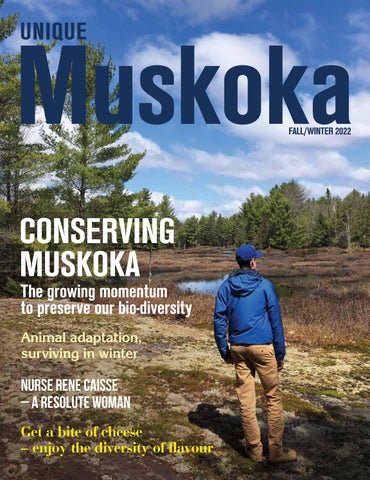
Photography by Muskoka Conservancy Land stewarded by Muskoka Conservancy represents the diversity of the region and the importance of the variety of landscapes, wetlands, shorelines, forests - each are key elements of a wild, natural Muskoka.
What’s Happened
Article by Matt Driscoll The Township of Muskoka Lakes seeks input on its dark sky bylaw and Torrance Barrens Reserve introduces a limited number of campsites. Music On the Barge concert series in Gravenhurst recognizes its organizer for 50 years of service, Deerhurst Resort celebrates 125 years of tourism and a motion picture filming in Muskoka Lakes boosts the local economy. The municipal election goes electronic and wood ash collection returns for Friends of the Muskoka Watershed.
[48]
58
Cottage Country Cuisine
Article by K.M. Wehrstein Photography by Tomasz Szumski For the love of cheese and all its versatility… whether part of a cheese plate or charcuterie board, blended and whipped in a dessert or incorporated into your grilling as a meal, cheese can blend in or stand out as part of your fall and winter feasts.
[58]
Fall/Winter 2022 UNIQUE MUSKOKA 5
…telling the Muskoka story
stoneway marble & granite inc.
Unique Muskoka is published six times per year by Unique Publishing Inc. Donald Smith Publisher Meghan Taylor Editor Donna Ansley Sales Lisa Brazier Design Susan Smith Administration
Les and Renata Partyka 1295 Muskoka Rd. 118 West, Bracebridge | 705.645.3380 | stoneway.inc@gmail.com
From screening to cleaning … All your rental management needs are taken care of. From marketing your cottage, to managing the booking, to assessing potential guests, to problem-solving, to cleaning, we do it for you.
1.877.788.1809 www.
OntarioCottageRentals.com
6 UNIQUE MUSKOKA Fall/Winter 2022
Bronwyn Boyer J. Patrick Boyer John Challis Matt Driscoll Doug Ford Eleanor Kee Wellman Josianne Masseau Tomasz Szumski Meghan Taylor K.M. Wehrstein Contributors Annual Subscription Rates: (including HST where applicable) In Ontario $30.00 All Other Provinces $36.00 U.S. $60.00 All Other Countries $72.00 HST: 773172721 Canada Post Publications Mail Agreement Number: 43268016 Copyright © 2022 Unique Publishing Inc. No content published in Unique Muskoka can be reproduced without the written permission of the publisher. Mailing Address Box 616, Bracebridge ON P1L 1T9 Street Address 28 Manitoba St., Bracebridge ON P1L 1S1 www.uniquemuskoka.com info@uniquemuskoka.com 705-637-0204
THANK YOU Frontline Workers ...we appreciate all that you do!
IT ’ S YOUR DREAM. WE BRING IT TO LIFE. CUSTOM HOMES & COTTAGES FOR OVER 45 YEARS For over 45 years, Tech Home has helped clients realize their vision of a beautiful & uniquely personal custom home. We build to the highest standards of quality at the most affordable pricing in cottage country. Visit our Gravenhurst Model Home or Toronto Design Centre, & we’ll bring your dream to life.
GRAVENHURST MODEL HOME
2278 Hwy 11N.| Gravenhurst, ON | P1P 1R1 1.888.417.8761
GREATER TORONTO AREA DESIGN CENTRE
130 Konrad Cres, Unit #18 | Markham, ON | L3R 0G5 905.479.9013
SERVING MUSKOKA / GEORGIAN BAY / HALIBURTON
1-888-417-8761 www.techhomeltd.com
D E SI G N
•
CO NS TR UCT ION
•
Restoring Muskoka’s heritage and building new traditions for over 45 years
R ESTOR ATI ON
LOOKING TO JOIN OUR TEAM? Call us today to discuss our opportunities for carpenters and administrative support
Quality workmanship and customer satisfaction far beyond any written warranty. Jack Judges 705-646-7424 Wayne Judges 705-645-0480 email: jackjudges@gmail.com
mba
Muskoka Insights Elsewhere in this issue of Unique Muskoka, we’re pleased to share with you features on a broad cross-section of Muskoka. While talking of biodiversity, we’ve always been interested in how the many creatures which call Muskoka home survive the cold days of winter. We think you’ll find the article on their adaptive skills a good read. As we look back in Muskoka’s history, the tenacity of many Muskokans offers stories worth sharing. For those who want to learn more about alternative medicine and the work of nurse Rene Caisse, the article written by historian and regular contributor Patrick Boyer takes an in-depth look at a life dedicated to “helping suffering humanity.” Protective of her work but seeking the recognition that would let her provide relief to others, nurse Caisse’s story is compelling. Following a family tree can also uncover an interesting past, as was the case for author Carol Marie Newall. In her first book, Newall shares the story of learning her grandmother was one of many young children sent to Canada and other countries as part of a program that rehomed children from impoverished and difficult backgrounds. Some found their new homes no better than those they left. When it’s recognized that ten per cent of Canadians are descended from British home children, this article and book are well worth a read. From the newfound talents of a local luthier to exploring Muskoka by snowmobile, you’ll enjoy a read of this Unique Muskoka. Being a part of telling the Muskoka story is what has made the publishing of Unique Muskoka such an enjoyable experience. Happy reading. Photograph: Susan Smith
Over the years, we have been impressed with the focussed and consistent approach of one devoted community organization in preserving Muskoka’s natural environment, ensuring its well-being for future generations. Built on the decades of dedicated efforts by the volunteers behind the Muskoka Heritage Foundation and the Muskoka Heritage Trust, the Muskoka Conservancy was born a decade ago from the merger of these two organizations. From an organizational standpoint, it was the right move but it was much more. In the ensuing years, the Muskoka Conservancy has directed its attention to a mission that allows the organization to grow in leaps and bounds. With the acquisition and protection of a growing portfolio of land and shoreline, the conservancy is doing more than amassing property; it is creating an ever-growing awareness of our natural environment and our biodiversity – what makes Muskoka special. The numbers are substantial – 3,750 acres of land, over 50 properties and some 60,000 feet of shoreline. Of particular importance are the 675 acres of wetland – distinct ecosystems that are home to a wealth of animal and plant life. And, as we are learning, an integral component in providing flood relief. In this issue of Unique Muskoka, our newly-appointed editor, Meghan Taylor, tells the story of the Muskoka Conservancy. A show of the organization’s maturity and growing strength is its “Quick Strike Fund” – a financial tool that provides Muskoka Conservancy with the flexibility to acquire prime conservation land when it enters the real estate market. Muskoka’s future is so dependent on our ability to preserve its natural environment. If you’re looking for a Muskoka group to support, we’d suggest giving the mission of the Muskoka Conservancy some consideration.
Our local team is here to provide you with personalized insurance solutions. For the coverage your family deserves, call us today.
46 Ann Street, Bracebridge 705-646-9995 | 877-877-3929 www.LesBell.ca TRUST • INTEGRITY • SERVICE
Your Home and Cottage Mattress Centre
MUSKOKA CURATED COLLECTION by Marshall Mattress
THE LARGEST SELECTION OF IN-STOCK MATTRESSES IN MUSKOKA
6 Monica Lane, Bracebridge 705.646.2557 www.mattressesofmuskoka.com
Fall/Winter 2022 UNIQUE MUSKOKA 9
Customizable with over 300 fabrics; Modular design to fit any configuration; Canadian Made; Solid hardwood construction
Let us Surprise You
Outside the Gate: The True Story of a British Home Child in Canada, released on September 22, 2022, is author Carol Marie Newall’s first book. Based on her own family history, Newall spent ten years researching and writing after receiving a box of momentos that belonged to her “Granny Winnie”.
Article by K.M. Wehrstein / Photography by Josianne Masseau
I
n 2011, Carol Marie Newall received a small cardboard box containing mementos of the life of her “Granny Winnie” from her elderly aunt Margaret. She knew that Winifred Jane Cooper Gordon, born in 1895, had been taken away from her impoverished and abusive family in Scarborough, England as a teen and shipped to Canada as part of a governmentsanctioned program that would now be considered child trafficking.
Margaret died a few days after producing the box, and Newall became a woman on a mission: to learn all the details of Winnie’s life. The result of ten years of research and writing is her book Outside the Gate: The True Story of a British Home Child in Canada. The book was released on September 22 of this year. Apparently-effortless excellence in pacing and braiding separate timelines, poetic descriptions, excellent “characterization” of
Fall/Winter 2022 UNIQUE MUSKOKA 11
~ Muskoka ~ Serving Muskoka and area for 35 years
DIVERSE SELECTION OF PRODUCTS TRADITIONAL AND CONTEMPORARY DESIGNS KNOWLEDGEABLE STAFF TO ASSIST YOU WITH BEST SELECTIONS, WORKING ALONGSIDE YOUR ARCHITECTS, DESIGNERS AND BUILDERS ON YOUR NEW OR RENOVATION PROJECTS
sales@windowworksmuskoka.net 2358 HWY #11, RR#1 GRAVENHURST, ONTARIO
705-687-7617 1-800-668-9858 www.windowworksmuskoka.net Authorized Dealer
Initially, Carol Marie Newall felt she did not have enough information to include anything biographical in her book. However, as she began to research she discovered there were significant records, especially of her granny’s file from Dr. Barnardo’s Homes. real people, heartfelt and insightful autobiographical passages, sparkling dialogues with accents conveyed accurately (Newall consulted with an expert), all presented in a deft natural style – Newall’s first book has it all, reading like the work of a seasoned literary pro. A business-program graduate of Toronto Metropolitan University, formerly Ryerson, Newall has worked in market research at IBM and various other jobs, as well as raising three children and doing volunteer work. She and her husband moved from Aurora to their Muskoka cottage in spring 2020 to avoid COVID and are still here.
In Outside the Gate, she lays out her ancestors’ relationships, struggles, successes, bereavements and wrongdoings, rivetingly and non-judgmentally. A fair-minded reporter, she includes no closet skeletons for which she couldn’t find corroborating evidence. In a family full of strong women, Winnie’s personality in particular shines out as cheery, witty, self-willed and taking no excrement from anyone. More tragic is the lifelong feud of two of her daughters. “I didn’t feel I had enough information to write anything biographical at first,” says Newall. “But when I started to research, I
found there is a lot, including Granny’s file from Barnardo’s.” Yes, the famous British children’s charity has a stain on its past, having sent 40,000 youngsters to Canada, out of 100,000 in total who arrived, to work in homes and on farmland, stripped of any citizenship. Penniless, often abused, the “home children” were told their parents were dead when that was true only for 12 per cent of them. They were further stigmatized as corrupt and delinquent street trash. As a result, they kept quiet about their origins when they grew up, leaving another guilty silence in Canadian history.
Born in 1895, Winifred Jane Cooper Gordon, or “Granny Winnie” as Carol Marie Newall knew her, was taken from her family in Scarborough, England as a teenager and migrated to Canada. Newall was determined to uncover the full details of her grandmother’s life after receiving a box of her belongings in 2011. Fall/Winter 2022 UNIQUE MUSKOKA 13
“It wasn’t anything she talked about when I was a child,” says Newall of her grandmother. “When I tracked down Myra, her brother George’s daughter, I found out he never told her he was a home child. The shame was too great.” The Canadian government only admitted its role in 2010. It’s a big guilty silence. “Ten per cent of Canadians are descended from British home children but most of them don’t know that,” Newall says. “When I started talking about it, people began telling me ‘I think I had an uncle’ or ‘the farmers all had a home boy’. Grade 9 or Grade 10 Canadian history is when it should be taught.” She tells the home children’s history in an appendix in the book, but also on her information-packed website. Newall is hoping the book will be distributed in the U.K. as well as Canada. It’s not all indictment, however. “Barnardo saved my grandmother,”
says Newall. “He was a hero. Thousands showed up for his funeral.” Newall is already working on her next book, a novel about another strong female senior. The 89-year-old protagonist, placed in a home for her own safety by her daughter, decides she’s had enough and leaves. Part of Newall’s writing chops she attributes to being a bibliophile. She also learned much from the six editors she hired over her ten years working on Outside the Gate. “Writing is very therapeutic,” she shares. “It’s like mindful meditation.”
It wasn’t until Carol Marie Newall was researching for Outside the Gate that she even knew much of the history of British home children. Her granny never spoke of it, nor did other relatives but Newall discovered 10 per cent of all Canadians are descended from British home children and are unaware.
Floors for Home & Cottage
HARDWOOD • LAMINATE • VINYL PLANK & TILE • VINYL ROLLS CARPET • CERAMIC • NATURAL STONE & MORE MODERN HOME CARPET ONE 350 Ecclestone Drive • Bracebridge
705.645.2443 carpetonebracebridge.ca
14 UNIQUE MUSKOKA Fall/Winter 2022
TAYLOR CARPET ONE 30 Cairns Crescent • Huntsville
705.789.9259 taylorcarpetonehuntsville.com
THE MOST TRUSTED GUARANTEED REPLACEMENT COST COTTAGE INSURANCE PROGRAM IN ONTARIO
DON’T SETTLE FOR BASIC COVERAGE If all your current insurance company can offer you is basic coverage on a secondary/seasonal home, make the switch to CottageInsure and fully protect your cottage and belongings in the same way your home insurance policy does.
GUARANTEED REPLACEMENT COST ON DWELLING & CONTENTS
COTTAGE & LAKE ASSOCIATION MEMBER DISCOUNTS
DISCOUNTS FOR FIREBOAT RESPONSE SERVICE
EXTRA COVERAGES FOR GARAGES, GUEST CABINS & WATERCRAFT
Get a FREE Quote in just five minutes by clicking: cottageinsure.ca or Call 1-877-541-9022 We’ve been protecting Ontario cottages since 1910.
' Article and Photography by John Challis There are over 40 species of tree native to Muskoka and another 24 smaller trees classified as shrubs. All play significant roles in the balance of Muskoka’s ecosystem. This series explores some of the more visible of our trees.
A
Hemlock and fir are distinguishable, despite their numerous similarities. Balsam firs are slender trees; from the distance a cluster will look like church steeples. The balsam fir is quite at home with a host of other boreal species – birch, aspen, poplar, spruce and pine. 16 UNIQUE MUSKOKA Fall/Winter 2022
s autumn closes in, the conifers – trees that have cones – become the most colourful trees in the region. They continue to show greenery while the world turns grey, and eventually white. Of the 10 species of conifer in our forests, balsam fir and eastern hemlock are possibly the trickiest evergreens to identify. Both are alike in their conical pattern of growth. They both have shallow root systems to reach out for nutrients in the shallow soils in which they thrive. Hemlock and fir both have flat, dark green needles that splay out horizontally from the twigs. All other evergreens have square or round needles – except cedar, which has its own distinct, scaly, frond-like leaves. These two conifers, found throughout Muskoka, are also the most fragrant in the forest. Balsam fir’s rich fragrance often makes it a popular choice as a Christmas tree. However, the true purpose of its fragrant aroma is to repel insects. Despite their similarities, there are ways to distinguish hemlock and fir. Balsam firs are slender trees; from the distance a cluster will look like church steeples. Eastern hemlocks grow taller, and stretch their limbs out more enthusiastically. Their branches always have a delicate droop at their ends.
Hemlock has scaly bark that develops deeper fissures as the tree ages. Large stands of hemlock are dark, moody places where only the odd beam of sunlight slips through, riding on shrouds of mist. In winter, these sheltered spots are sought out by deer. Fir has longer needles than hemlock. best in cool, damp climate. Large stands of sheltered spots are sought out by deer. Upon close inspection with a magnifying hemlock are dark, moody places where only Both fir and hemlock are rich in vitamin glass, hemlock needles have tiny stems that the odd beam of sunlight slips through, C. Some historians believe Jacques Cartier’s attach to the twig, while balsam fir needles riding on shrouds of mist. In winter, these crews survived scurvy by heeding the advice attach directly to the twig. of First Nations people to Young balsam fir bark is consume the needles of grey and covered in small balsam fir. Hemlock’s blisters which ooze sticky sap needles make a nice cup — the arboreal equivalent of of tea that may help ward teenage acne. As they mature, off common colds. the bark becomes more Both trees have been brownish, and the acne clears put to many uses by up. Hemlock on the other Indigenous cultures. hand has scaly bark that Tinctures treat develops deeper fissures as rheumatism and arthritis. the tree ages. The oblong Poultices have been used cones of balsam fir grow on cuts, infection and upright, unlike any other insect bites. The boughs conifer except tamarack. were spread on the floor The balsam fir is quite at of sweat lodges to sweeten home with a host of other the air. The tannin in boreal species – birch, aspen, hemlock bark was believed to be good for poplar, spruce and pine. Needles can distinguish hemlock and fir. Both have flat, dark green needles that splay treating burns. Hemlocks tolerate other out horizontally from the twigs but on close inspection with a magnifying glass, balsam The tannin in hemlock species, but they are at their fir needles attach directly to the twig, as seen here.
Fall/Winter 2022 UNIQUE MUSKOKA 17
The underside of a hemlock twig showcases the tiny stems attaching the needles to the twig (top). Eastern hemlock branches always have a delicate droop at their ends (bottom). also played a major role in the economic development of Muskoka. In the 1880s, hemlock bark was used in leather tanneries that sprang up across the district – the AngloCanadian Company and Beardmore Tanneries, to name two. The leather products were sold around the world and may have been used in the First World War by both sides. It seems a shame these trees are also smashed into pulp for paper and cardboard when their benefits and uses are varied and wide-ranging. Next time you’re in the woods, look for flat, dark green needles and give them a rub between your hands. Their rich, tangy fragrance will remind you of their true value.
18 UNIQUE MUSKOKA Fall/Winter 2022
SOFA SALE
bubbler buddy
HISTORIC LIBRARIES – THEN AND NOW
H
Photograph: Muskoka Heritage Place Collection, Huntsville, Ontario
Photograph: Tomasz Szumski
Huntsville Public Library’s current building, purpose built in 1995, is much improved from the numerous buildings the library occupied throughout its history, including its 1929 home in a white frame house (below) at 12 Main Street West.
Article by J. Patrick Boyer
untsville’s library didn’t just happen. It was conjured up by willful advocacy. “A good library in a central place like Huntsville is of very great importance,” library proponent Rev. R.N. Hill wrote in the Huntsville Forester on December 6, 1878. On a practical note, the man for whom Hillside is named, then added, “Settlers for a
radius of 10 or 15 miles could change their books when in the village on business.” On a loftier plateau, he envisaged how “The pioneers of this country will put in motion influences that will impress their character for ages to come.” The grand and ultimate objects of libraries, he suggested, “ought to be to induce a taste among the great masses of society for moral and
Fall/Winter 2022 UNIQUE MUSKOKA 21
Photograph: Tomasz Szumski
Like all libraries, services shifted during COVID. Patrons’ use of facilities became more intensive, yet in radically different forms and formats, while the tasks of library staff advanced into new counterpart dimensions. Huntsville Public Library is reappraising the needs of its facility in relation to these changes. intellectual improvement.” Hill envisaged a library enabling such uplift with patrons “communing with the best minds the world has produced on any subject we please.” Fifteen months later, Huntsville’s Mechanics’ Institute Library was
22 UNIQUE MUSKOKA Fall/Winter 2022
incorporated on May 1, 1880. Beginning operations with 35 members, books costing $109.70 were on its shelves. The directors next planned to open a reading room, then organize evening classes. The Huntsville library progressed for 14
years, but nobody knows how well. On April 18, 1894, fire consumed the heart of the town, including the library and its recordrich minute books. Only 30 volumes on loan to members and out of reach of the flames were spared. Insurance paid $350 for the lost furniture, fixtures and books. In need of new quarters, Huntsville’s library began its long march through rental spaces for which it holds the Muskoka record of different sites. Its second home, a room rented for $4 a month from a Mr. Flaxman, was presided over by William Randalson, first head librarian for Huntsville on record. Then, from 1897 to 1926, the library was housed above the Dominion Bank at 18 Main Street East, before it progressed to space over Casselman’s Garage at 2 Main Street West. In 1929, it was again on the move, now to a white frame house at 12 Main Street West. In 1943, the library relocated to the upper storey of Superior Boyd’s Store at 90 Main Street East. At this location, the only access to the library was a covered outside staircase whose darkness and rickety nature deterred many.
Photograph: Tomasz Szumski
An extensive collection of Muskoka documents and books plus the library’s proximity to Muskoka Heritage Place’s rich archival collection keeps Huntsville in the forefront of preserving the district’s historical records and making them publicly available. The library’s well-designed community room draws people together for Indigenous Circles, author talks, classes, and community meetings. Despite all these moves, a communitybuilding pattern was consistent. Wherever it came to rest, Huntsville’s library was in the centre of town, readily accessible to all. In 1959 when the federal post office moved out of the town hall into its stand-alone structure, the library moved in and operated at 37 Main Street until 1971. Then, its books and shelves were again carried, this time to the
Simpsons-Sears Building at 49 Main Street East. By now, another pattern was clear: Huntsville’s library would continue to be a “mobile” one, so long as it depended on leasing other people’s space. Thus 1977’s move to 7 Minerva Street East was most significant. Still in the centre of town, but for the first time in a building of its own, Huntsville’s library would
successfully operate at the same location, now for nearly a half-century. The present fine library building on Minerva Street East was purpose-built in 1995, replacing the prior liquor store structure. An extensive collection of Muskoka documents and books plus the library’s proximity to Muskoka Heritage Place’s rich archival collection keeps Huntsville in the
When a power outage strikes,
SOMMERS RESIDENTIAL GENERATORS ensure your home or cottage automatically stays powered on
MUSKOKA • PARRY SOUND Your Source For All Your Electrical, HVAC, Backup Power And Home Automation Needs 705.765.0600 • Port Carling www.sifft.ca ECRA / ESA 7002295 • TSSA 000365522
A full range of generators that can be custom built to suit your home or cottage’s specific needs, so you’ll always have standby power ready. Fall/Winter 2022 UNIQUE MUSKOKA 23
The Sportage Photograph: Huntsville Public Library
I N T R O D U C I N G THE K I A
Huntsville’s head librarian Bessie Marshall, seen here in 1980 at the library’s Minerva Street premises, is clearly happy at the centre of action. No longer directly on Main Street, the Huntsville Public Library remains in its pivotal centre-oftown location, just one block east of Main and near the Town Hall. MUSKOKA KIA
21 Robert Dollar Dr, Bracebridge, ON P1L 1P9
705-645-6575
Muskoka Barging
Family run construction company with over 35 years experience operating in the Muskoka Lakes area. No job is too small or too big.
705-764-0765 | muskokabarging.com | 1163 Milford Bay Rd, Milford Bay ON
BARGING ● STEEL & CRIB DOCKS ● SEPTIC SYSTEMS ● LANDSCAPING
24 UNIQUE MUSKOKA Fall/Winter 2022
forefront of preserving the district’s historical records and making them publicly available. The library’s well-designed community room draws people together for Indigenous Circles, author talks, classes and community meetings. Like the libraries at Dwight and Gravenhurst, Huntsville is considering expansion plans with altered library uses from COVID in mind. Now all three are prudently reappraising structure and operations. “This is up in the air now,” says CEO and chief librarian David Tremblay. “We have to factor in location, changes in literacy and strategies for future community service.” As he also explains, library services shifted during COVID. Patrons’ use of facilities became more intensive, yet in radically different forms and formats. In tandem, the tasks of library staff advanced into new counterpart dimensions. Expectations have changed. Participation levels are an issue. Space requirements need to be reappraised. Originally from North Bay, David Tremblay chose library work because he believes in “strengthening democracy” and “the importance of freedom of information.” Based on his initial musings of the critical nature of a local library, R.N. Hill would be contented by the trajectory of Huntsville Public Library.
Eavestrough and Gutter Protection
Lose the leaves... get Clearwater
Make your eavestroughs maintenance free. Repel leaves, sticks and branches, no rusting, chipping or peeling.
Alu-rex
Protects your eavestroughs from damage caused by snow and ice.
Our Selection of Rainware Products will Help your Home or Cottage Weather the Storm
Embrace Your Exterior! Siding • Roofing • Soffit • Fascia • Decking • Eavestrough • Gutter Protection
www.norstarexteriors.com SERVING THE MUSKOKA, PARRY SOUND & HALIBURTON REGIONS
Supply & Install • Cash & Carry T: 705-645-8404
T/F: 800-732-0158
F: 705.645.7263
Article by Bronwyn Boyer Photography by Josianne Masseau
I
f someone had told Claude St. Denis in his youth that he would eventually become a guitar builder, he wouldn’t have believed it. Luthiery, the art of building and repairing stringed instruments, is certainly not a career most people consider, but especially not someone like St. Denis, who spent 35 years as a police officer. After retiring from policing in 2014, St. Denis wasted no time stepping into a brand-new lifestyle. He enrolled in Sergei de Jonge’s luthiery course in Chelsea, Quebec that same year, and the rest is history. Before apprenticing with de Jonge, St. Denis had already dabbled in the craft, having put together a few guitars from a kit. But when his wife Sandy sent him to the course as a retirement present, his love for luthiery deepened. “It was the best five weeks I’ve ever had, bar none,” says St. Denis. “That was when the light bulb went off, because I finally understood the finer details
What sets a luthier apart from a builder or manufacturer is that they make every piece of the guitar by hand except for the frets and tuners. Claude St. Denis painstakingly crafts all the elements of his guitars, buying wood from Alaska by the case, then cutting, carving, tapping and testing for tone until the resonance is just right. 26 UNIQUE MUSKOKA Fall/Winter 2022
Ensuring every guitar he makes achieves the pinnacle of sound, beauty, and playability means Claude St. Denis only makes about six per year. Each guitar takes about two hundred hours to build, so the care and attention to detail is ensured. If he were to accelerate the process, the quality and character would be lost. of what makes a high-quality instrument. I’ll never forget when Sergei put his hand on my shoulder and said, ‘you’re going to make great guitars.’ I don’t know if he says that to all his students, but it was very encouraging.” The unconventional teaching style offered by de Jonge was refreshing for St. Denis. It wasn’t just about the mechanics of the work, but also the emotional connection to the guitar as it was being formed. According to St. Denis, de Jonge said there should always be music playing in the shop while the guitar is being made. It shapes the character of the wood, like a baby being exposed to new sounds as the brain develops. While de Jonge said it with humour, considering the fine guitars he makes, there might be some truth to it. “He’s a very intelligent man who is full of surprises,” says St. Denis. “When the course ended, it was very emotional for me.” St. Denis grew up in the Ottawa Valley. He was uncertain what career path he would
take until one of his friends became a police officer and he decided to follow suit. He worked in Mississauga, Brampton and Edmonton for a few years. Then in 2002, he rejoined the OPP and worked in Hearst, but it was gruelling being that far north. Since his wife is originally from the Almaguin Highlands area, their move to Emsdale in 2006 made sense. That’s when the two worlds began to collide. His interest in luthiery was sparked by a fellow police officer friend who was also a woodworker. “It’s a very different landscape,” St. Denis explains, “Being a police officer
requires a lot of teamwork. Success isn’t always measured by your ability alone. So, one thing I really love about luthiery is the fact that my success depends on only me, and nobody else. I love the freedom and independence of working on my own.” There are certain skills that St. Denis has been able to bring to luthiery that he gained from being a policeman. “The discipline and organization skills are applicable, even if there isn’t the same level of regimentation to it,” he says. “It’s a chapter of my life that is closed, but I’ve been able to take the best things from it and apply it to building guitars.”
Fall/Winter 2022 UNIQUE MUSKOKA 27
During each build, Claude St. Denis sends progress shots as the guitar gets made, ensuring his customers feel connected and involved in the process. Some musicians even say they can pick out a St. Denis guitar when they hear it. 28 UNIQUE MUSKOKA Fall/Winter 2022
St. Denis’ friend Bob Gray helped him get his name out and become established as the local luthier. Gray ran the Third Friday Coffee House concert series in Burk’s Falls, so he introduced St. Denis to the many musicians in the area. Those introductions allowed him to build a sense of rapport with his clients that are more like friendships. During each build, he sends progress shots as the guitar gets made, so the customer feels connected and involved in the process. Some musicians even say they can pick out a St. Denis guitar when they hear it. “The most important thing for me is making people happy with the work I do,” says St. Denis. “I’m really big on customer service. I want every customer to be as happy as they can possibly be, and I’ll do whatever it takes to achieve that because there is no greater thrill than seeing one of my guitars being played on stage.” Ensuring every guitar he makes achieves the pinnacle of sound, beauty and playability means he only makes about six per year. It takes about two hundred hours to build the guitar, so the care and attention to detail is ensured. If he were to accelerate the process, the quality and character would be lost. “A lot of builders aren’t luthiers,” St. Denis explains. “They’re more like assemblers, because they buy each part and then put them together. A luthier makes every piece of the guitar by hand except the frets and tuners. That’s what sets them apart.” When it comes to designing his guitars, St. Denis is inspired by classic elements found in the work of his predecessors and applies them in his own way. “I don’t think anything I do is really original,” he explains. “I just see different styles I love and find new ways to use them. I never make the same guitar twice. I might use a Rosewood back and Sitka spruce top in one guitar, so if I use that combination again, I’ll use a different binding. That way, no two guitars are exactly the same.” Unlike many luthiers, St. Denis doesn’t think of himself as an artist. “I still think like a policeman,” he says. “It’s hard for me to think outside the box. I’m scared to try to something really different for fear of failure.” Despite the fact that the creative mindset doesn’t come naturally to him, it’s clear that
It’s safe to say guitar building has given Claude St. Denis the ability to transform himself into an individual rather than a component of a collective, as he was during his career as a police officer. The creation of a guitar is analogous to the work of recreating himself and his place in the world. St. Denis has found his calling. “It’s the best thing that’s ever happened to me because it’s something I never thought I’d be able to do,” he says. “When my friends see a guitar I made they say, ‘wow, I never knew you could do that,’ and I say, ‘neither did I.’” St. Denis buys his guitar wood from Alaska by the case and then he cuts them down using a template. As he carves, he taps the tops to test for tone, and doesn’t stop until he gets just the right resonance. “In mass production factories, this doesn’t happen. It makes the process more painstaking, but it’s always worth it in the end,” he explains. “I touch every single part of the guitar, and I think putting so much of myself into it makes it more rare and valuable.” St. Denis believes that having a love of music is an integral part of building instruments. He started playing guitar in his early 30s, taught by his good friend Ron, a former biker he formed an unlikely but deep
friendship with. It was through this friendship that St. Denis learned that it’s never too late to venture down a new path. “Ron passed away nine years ago,” he says. “And whenever I’m making a guitar, I always think of him. One of these days I’ll make a special guitar in his honour, because if it wasn’t for him, I wouldn’t be doing this.” St. Denis also does repairs, as that’s another important facet of luthiery. Not all guitars are worth fixing, so he mostly focuses on the valuable ones that are most cherished and well loved. “I enjoy getting old guitars that are people’s babies, and I do my very best to restore them back to playing condition,” he says. “I will spend a good amount of time talking to the customers in detail about what’s involved in the repair and educating them on their instrument, free of charge. I love meeting and connecting with musicians that way.” The courage to venture into brand new territory has given St. Denis an edge when it
Fall/Winter 2022 UNIQUE MUSKOKA 29
Claude St. Denis believes that having a love of music is an integral part of building instruments. During his luthier training with Sergei de Jonge, his teacher said there should always be music playing in the shop while the guitar is being made. It shapes the character of the wood, like a baby being exposed to new sounds as the brain develops.
comes to his craft. Being moldable was a prerequisite when he trained to be a police officer as he needed to be shaped into a specific role and mindset. Similarly, when it came to his luthiery training, being a blank slate served him well. “Sergei loved the fact that I didn’t know anything about woodworking, let alone building guitars,” he explains. “He said, ‘Great! I can teach you the proper way because you don’t have any preconceived notions.’” It’s safe to say guitar building has given St. Denis the ability to transform himself into an individual rather than a component of a collective. The creation of a guitar is analogous to the work of recreating himself and his place in the world. In this way, it shows that reinvention and rebirth is always possible. “I think what matters most in life is doing what makes you happy,” St. Denis says. “Until a luthier makes a name for themselves, which can take up to 30 years, there’s not much money in it. But guitar making is a real passion for me. It’s something I absolutely love to do.”
Muskoka's Largest Home Service Company!
30 UNIQUE MUSKOKA Fall/Winter 2022
“The clearest way into the Universe is through a forest wilderness.” – John Muir “The clearest way into the Universe is through a forest wilderness.” – John Muir
Kayley Amo Photography
Conserving Nature in Muskoka. Join us today. Kayley Amo Photography
A registered charity.
Article by Meghan Taylor
In addition to their work conserving lands, Muskoka Conservancy offers programs that give participants a more in-depth look at the spaces they protect. A number of their protected lands are publicly accessible for walking, hiking, paddling and wildlife observation.
32 UNIQUE MUSKOKA Fall/Winter 2022
Photograph: Muskoka Conservancy
N
ature conservation is not a new concept. As humans have flourished, so too has our knowledge and understanding of our impact on the planet we inhabit. The philosophy behind the conservation movement centres on the protection of biodiversity, protection of species from extinction and the maintenance or restoration of habitats. When settlers first came to Muskoka, the land was relatively untouched. It was a beautiful, wild and untamed space. As land grants incentivized living in the region, farming, clearcutting and eventually, tourism took hold, impacting the landscape and wildlife for generations to come.
Fall/Winter 2022 UNIQUE MUSKOKA 33
Photograph: Muskoka Conservancy
Photograph: Jane Spencer Photography/Muskoka Conservancy
Despite Muskoka’s reputation as of species live. Shorelines are a a wilderness escape, the region is no critically important piece of land exception when it comes to within ecosystems. Wildlife, both requiring stewarding for future land-based and aquatic, use generations. Muskoka Conservancy shorelines for breeding and nesting is one charity that works tirelessly as well as food and water. A to protect nature in the region. shoreline is considered the first “If you take a quick look around 30-metres of land around a lake, Muskoka right now, there is a lot of river or bay and supports 70 per development pressure,” says Scott cent of land-based wildlife and 90 Young, executive director of the per cent of aquatic species at some Muskoka Conservancy. “Muskoka Wetlands (above) and shoreline are critically important pieces of point in their lifetime. has the appearance of being a land within ecosystems and are at great risk with the volume of “When people are building a development in Muskoka. Wetlands play important roles in water natural place with a lot of gigantic boathouse, a deck, a dock quality and slowing the flow of water over land, preventing flooding. wilderness but the more you look and bunkie across every bit of Natural shorelines support 70 per cent of land-based wildlife and around, there are places being 90 per cent of aquatic species at some point in their lifetime. shoreline, we’re really threatening a developed that never would have vast number of species that call that been previously – lots of shorelines and close proximity to villages, towns and cities. home,” explains Young. wetlands.” “Certain types of property are really under Of similar importance to shorelines, and There is a marked difference between pressure,” says Young. “Specifically, that equally threatened, are wetlands. Wetlands living on the land and living with the land. means wetlands and waterfront. The have a high biodiversity and are critical While there is ample wild land across shoreline on our big lakes is really under habitat to 20 per cent of Ontario’s species at Canada, that doesn’t remove the need to pressure and any stretches of natural shoreline risk. Wetlands play important roles in water protect lands occupied by humans. If are a real plus.” quality by providing filtration and slowing anything, there is a duty to be more cautious Natural shorelines are a boundary zone the flow of water over land, preventing with lands, shorelines and watersheds in between land and water where a vast number flooding which has been an issue across
Downtown Orillia 9 Mississauga Street, East 705.326.9611
Downtown Bracebridge 30 Manitoba Street 705.645.2152
Barrie South End 531 Bryne Drive, Unit B1 705.719.1474
www.pdmurphyjewellers.com • pdmurphy@bellnet.ca
Call Mike Morrow
705.765.3195 www.morrow-electric.com
ESA License #: 7000286
Serving Muskoka Lakes since 1952
rewiring • alterations • heating
NEVER be left in the DARK or COLD: get a quality home standby generator by GENERAC
34 UNIQUE MUSKOKA Fall/Winter 2022
Muskoka in recent years. “Wetlands are pretty much everywhere across Muskoka, and the first thing developers think of is to fill them in when they get a hold of them,” says Young. “They want to get rid of mosquitoes or have flat land.” Also important are large contiguous forests, explains Young. “Lots of people love Muskoka and want to be here and so there’s more pressure to build new roads across what would have been uninterrupted forest,” shares Young. “Habitats are being fragmented by roads, construction and other development. The more the area is developed, the less nature we have to support the natural ecosystems in place here.” Certain animals need a large space to survive. The pine marten is a good example of that. Martens are solitary creatures, requiring approximately eight square kilometres as hunting ground, just to survive. “Just think, how many places can you drive for eight kilometres in any direction in Muskoka without seeing another road,” questions Young. “There aren’t that many places in Muskoka that are uninterrupted for nature to exist.” Since its inception in 1987, Muskoka Conservancy has protected 50 properties, including 3,750 acres of land, 60,000 feet of natural shoreline, and 675 acres of wetlands. Protected lands, and those with public access, can be viewed on the conservancy’s website with a detailed map. The lands stewarded by the conservancy represent the diversity of the region and the importance of the variety of landscapes. Many of the conservation lands are on or near the many lakes in the area, including the “big three” lakes, Lake Muskoka, Lake Joseph and Lake Rosseau, and smaller but popular lakes, such as Skeleton Lake, Fairy Lake, Lake Vernon and Lake of Bays. In 2021 and 2022, Muskoka Conservancy added four new properties to their land trust – Pinelands Bay Nature Reserve, Sage Creek Nature Reserve, Highlands Island Nature Reserve and Bear Cave-Koetitz Nature Reserve. Three of these new land reserves were donated, while one was purchased by the conservancy. “Sometimes we purchase land but when it’s a donation there’s a bit of a process for us to
Photograph: Muskoka Conservancy
The lands stewarded by Muskoka Conservancy represent the diversity of the region and the importance of the variety of landscapes. Many of the conservation lands are on or near the many lakes in the area, including Lake Muskoka, Lake Joseph, Lake Rosseau, Skeleton Lake, Fairy Lake, Lake Vernon and Lake of Bays. Joseph and Lake Rosseau, these lands are an example of Muskoka Conservancy working together with municipal government, cottagers and residents to protect the region for future generations. In late 2020, the conservancy purchased
Photograph: Muskoka Conservancy
hold the land,” explains Young. “That’s the boring stuff but it’s an important part of the work we do.” Pinelands Bay Nature Reserve is an 82acre property that was previously set for development. Located inland between Lake
Muskoka Conservancy offers a variety of programs throughout the year, including guided hikes, a native plant program and species monitoring. Programs are open to a variety of ages and are supported by staff and volunteers.
102 acres of land. As part of the massive $1 million fundraising process, the conservancy agreed to transfer seven small lot additions to six of the neighbouring landowners. The approval of the consents, along with rezoning the retained 82 acres as environmentally protected, officially established the Pinelands Bay Nature Reserve. Like Pinelands Bay, Sage Creek, Highlands Island and Bear Cave-Koetitz Nature Reserves all feature a mixture of aquatic and terrestrial habitats. Sage Creek Nature Reserve is a 166-acre property that includes a portion of Sage Creek where it empties into the north branch of the Muskoka River. The property was donated in 2021 by Fowler Construction. Highlands Island Nature Reserve, donated in August 2022, is approximately 25-acres of land with over 3,000 feet of waterfront located near Minett on Lake Rosseau. These lots were zoned for development but the generosity and dedication of local cottagers has seen the area protected by their donation. The Bear Cave-Koetitz Nature Reserve is the largest nature reserve by area under Muskoka Conservancy’s stewardship. Donated by Rose-Maria Koetitz in August of 2022, the property includes two water sources into Lake Rosseau, the Rosseau River
Fall/Winter 2022 UNIQUE MUSKOKA 35
Photograph: Muskoka Conservancy
The Bear Cave-Koetitz Nature Reserve, donated by Rose-Maria Koetitz in August of 2022, is the largest nature reserve by area under Muskoka Conservancy’s stewardship. The property includes significant wetlands as well as two water sources into Lake Rosseau, the Rosseau River and the Shadow River. “Anyone with a special expertise in ecology, biology or any ology, we could use your assistance when we assess property,” shares Young. “Whether you’re a retired high school biology teacher or expert ecologist, we can use specialized help but we can always use any volunteer help to maintain trails we offer as a free service to the public. There are many ways to get involved.”
Photograph: Jane Spencer Photography/Muskoka Conservancy
and the Shadow River, as well as significant wetlands. “There’s a legal process, just like buying a house,” says Young. “It’s a typical land transaction so we’re constantly doing due diligence on the land we’re acquiring. We have to be accountable to our members and ensure these transactions have long-term viability.” Surveys, environmental assessments, insurance and legal fees are all part and parcel of the detailed administrative processes Muskoka Conservancy undertakes to secure and maintain lands in trust. Land taxes owed on these lands could quickly cause a funding issue. Participation in the land tax incentive program reduces these taxes to a minimal level, ensuring the conservancy can hold the lands and protect them in perpetuity. “It can be expensive to acquire land here, particularly the sensitive land along our waterfront and it does cost money,” explains Young. Unfortunately, Muskoka Conservancy’s ability to protect and conserve land can be restricted based on their limited resources. Assessing potential land donations is key to ensuring the long-term viability of protected lands and of the conservancy itself. The conservancy has established a “Quick Strike Fund” for when prime conservation land enters the real estate market for sale.
Pressure to build roads and develop more rural areas of contiguous forest in Muskoka threatens species who require large, uninterrupted forests to hunt and survive, like the pine marten. 36 UNIQUE MUSKOKA Fall/Winter 2022
In addition to their work protecting lands, Muskoka Conservancy offers a variety of programs throughout the year, including guided hikes, a native plant program and species monitoring. Programs are open to a variety of ages and are supported by staff and volunteers. Often, programs take place on lands protected by the conservancy and give participants a more in-depth look at these protected spaces. “The one thing I would emphasize is the saying ‘think globally, act locally’,” says Young. “When you’re supporting your local land trust, it’s part of a broader movement. It’s a global solution to some very big problems, including the climate change crisis, extinction crisis and biodiversity crisis.” Contributing to land conservation, whether with time, money or word of mouth promotion, helps to protect land in the community in a localized way. Across Canada millions of acres of land are protected through conservation. There are several thousand land trusts across North America, further increasing the impact of local support. Muskoka’s landscape is ever-changing, particularly as development and tourism increase. Preserving the natural beauty and biodiversity of the region for generations to come must remain a priority.
FINE SCOTTISH AND IRISH WOOLLENS
CARDIGANS, SWEATERS AND SHAWLS
SHOP ONLINE
28 MANITOBA STREET, BRACEBRIDGE
www.uniquemuskoka.com
SWEATERS • HATS • SCARVES • CAPES • JACKETS • BLANKETS • GIFTWARE
Article by Meghan Taylor Photography by Eleanor Kee Wellman
S
tunning in every season, Muskoka is home to an alternating cast of characters – humans and wildlife. As the seasons fluctuate and change, people are not the only ones who adjust their lifestyles and habits. Muskoka’s animal population, guided by each species’ instincts, transitions their behaviours with the onset of winter. There are a number of ways animals manage as the seasons change and the snow flies. Some choose slumber, fattening up through the fall and then slowing their heart rate and breathing and reducing their body temperature to hibernate through the winter. Squirrels, skunks, raccoons and bears are the most commonly considered hibernating species in Muskoka. According to Aspen Valley Wildlife Sanctuary’s newsletter The Guardian, hibernation has little to do with the change in temperature. “Rather, it is a survival tactic used by animals to weather a scarcity of food. Essentially, wildlife prepares for the winter months by increasing body fat and supplies. After that, they slow themselves down to conserve energy.”
38 UNIQUE MUSKOKA Fall/Winter 2022
Chickadees are often more noticeable during winter with their active family flocks. Chickadees have an increased memory capacity throughout the winter, meaning they can recall where they’ve stored their food for up to a month.
A fox sitting in a field may look like it's doing nothing at all but with their keen senses, they can hear and smell scurrying mice and voles below the snow. Foxes wait until just the right moment to pounce on their prey, unseen by the casual observer. Other species choose to pack up and head out, alone or in larger groups. Typically, like people heading south for the winter, animals and birds who call Muskoka home in the spring and summer months, migrate to warmer climates with more readily available food sources during Muskoka’s fall and winter seasons. But what of those who stay? How do those who choose to remain among the sub-zero temperatures survive, and even thrive? The animals who endure Muskoka winters adapt; from gathering stores of food for safekeeping (and winter snacking) to seeking suitable shelter to physically changing the thickness of their fur or feathers and even the colour of their coats. Adaptation takes many forms. The easiest to note is the snowshoe hare – if you can catch a glimpse of one amongst the snowbanks. Changing its fur from brown to
white provides much needed camouflage for the hare during the winter. This coat change is driven by changes in daylight, not temperature or the snow fall. Beyond changing their coat colour to blend in with their surroundings, snowshoe hares grow additional fur on their feet, increasing the surface area so they can run across the snow, just like a snowshoe. For many smaller species of prey, such as mice and voles, winter is no time to halt activities. Just below the snow, these mammals stay insulated, warm and protected from predators. Venturing to the surface for food is a necessary task for survival, although dangerous. Foxes, well known for their wily ways, are adaptive hunters with incredibly keen senses. A fox sitting in a field may look like it’s doing nothing at all but it can hear and smell the
activity below the snow. Scurrying mice can be sensed over great distances, with foxes waiting until just the right moment to pounce on their prey, unseen by the casual observer. Beyond their hunting skills, foxes adapt to the colder weather much like their wolf and coyote cousins – a thick coat of fur. Their beautiful, bushy tails are employed as blankets, wrapping around their body and snouts to reduce heat loss. Landscapes change through the winter. As lakes, ponds and streams freeze, it is easy to assume that beavers would fall into the hibernation category. Evidence of beaver activity is easily seen in warmer months, but beavers still need to chew all year long. Beavers remain active; inside their lodges, out felling trees and even taking chilly dips in ponds, lakes or streams, below the ice. The
Fall/Winter 2022 UNIQUE MUSKOKA 39
The aptly named snowshoe hare, in addition to changing its coat colour from brown to white, grows additional fur on its feet. The larger surface area acts just like a snowshoe so the hare can run across snow. 40 UNIQUE MUSKOKA Fall/Winter 2022
construction of a beaver lodge with its mixture of sticks, logs and mud freezes in the winter, providing additional protection from predators. Beavers have waterproof coats, as an aquatic mammal, and their thick, coarse overcoat becomes even thicker as temperatures dip. A beaver’s tail, more than just a noisemaker, stores fat for lean times, such as winter, and also assists in regulating their body heat. While wildlife encounters can occur in any season, animal tracks are more likely to be noticed in the snowy months. Tracks in the snow can share more about the activities of wildlife in Muskoka than the direction they headed recently. From stalking prey and foraging for food to fleeing from a predator or seeking shelter, identifying and understanding tracks can provide a look into animals’ habits in the winter season. Squirrels, alternating between periods of wakeful activity and hibernation, deer and snowshoe hare are readily identifiable and common tracks to see in your backyard. Farther away from human life and into the wilderness, tracks of wolf, moose, lynx, bobcat, martens and even fishers may be found, if you know what to look for. Moose store up large quantities of fat for their bodies to use throughout the winter months, shares Aspen Valley. “Another adaptation is the extensive thickening of their coats, which can pose a problem when faced with a mild winter. Heat stress and tick infestations are common in moose when lakes are frozen and there is nowhere to cool off.” White-tailed deer, when seen in the open, are large mammals and often in herds. However, look away and they’ve disappeared into the foliage. Their colouring provides camouflage, similar to the snowshoe hare, as their brown coats merge with the tree bark and brush, and their white tails mimic snow caught on branches. As winter deepens and snowfall increases, deer will reduce their range, often wintering in conifer groves, protected from the elements and near preferred food sources, including bark and trees. For carnivores, winter is the time when injured, ill and weak prey is more vulnerable. Wolves and coyotes can thrive during the season by targeting small to medium sized
prey. Thickening their fur and fattening up in the fall while food sources are still active also support their winter survival. Muskoka is far enough south for some more northern-ranging bird species to consider it a warmer climate for the winter. Birds of prey, including great grey owls and bald eagles, make Muskoka their hunting grounds during the cold season. Owls, like coyotes, wolves and foxes, continue to hunt small prey in order to survive the winter. Bald eagles, which typically choose to dine on fish, scavenge during the snowy months. While it may seem gruesome, a bald eagle dining on a large carcass left by other carnivores is a memorable sight indeed. On the smaller scale of birds, chickadees are well-known as winter birds. Seeming more active in these months, their hallmark song rings out clearly through snow-covered trees and trails as they search for insects and larvae,
An extensive thickening of their coats and storing quantities of fat on their bodies allows moose (top) to weather the challenges of winter in Muskoka. Beavers (bottom) also thicken their coat based on temperature and rely on fats stored in their tail for additional sustenance and heat regulation. Fall/Winter 2022 UNIQUE MUSKOKA 41
SERVING MUSKOKA & PARRY SOUND FOR OVER 70 YEARS
Sales & Service of Major Propane Appliances (refrigerators, ranges, fireplaces, furnaces & more) Safe & reliable No electricity required Bulk propane delivery to your home or cottage
705.645.4294 TF: 866.645.4294 STORE: 228 TAYLOR RD., BRACEBRIDGE OFFICE: 1646 WINHARA RD., GRAVENHURST
42 UNIQUE MUSKOKA Fall/Winter 2022
Cardinals, both the bright red males and the more subdued brown females, provide a much needed pop of colour among the often colourless, drab landscape of Muskoka in the winter. dormant and hidden within tree bark. Always in a family grouping, chickadees have evolved the ability to increase their memory capacity throughout the winter. Their unique adaptation means they can recall where they’ve stored their food for up to a month after they’ve left it. A talent that could make all the difference during a particularly harsh winter with few food sources. The bright red of a male cardinal is a flash of colour in a white winter world. But even the less colourful females are eye-catching, their light brown feathers with red highlights contrasting against the evergreens they prefer for winter shelter. As long as they can find secluded nesting areas and suitable food sources, cardinals will remain in an area.
Even in the winter, humans will share space with wildlife. Although less common than in the other three seasons, people can unknowingly make poor choices when confronted with what seems to be a wildlife emergency. Whether the situation is an animal in distress, or the animal is orphaned, injured or considered a nuisance, Aspen Valley encourages anyone to contact them in advance of interfering in a wildlife situation, no matter the season. Wildlife in Muskoka, through evolution and adaptation, have refined their survival skills for what many consider the harshest of the seasons. While humans adapt to the changing of the season, we should all pause to take note of the changing scenery and marvel at the wonders of winter wildlife.
every hand makes a difference volunteer at ReStore or on our salvage team
Alternative Medicine in Muskoka
Article by J. Patrick Boyer
44 UNIQUE MUSKOKA Fall/Winter 2022
Photograph: Donna Ivey Col
lection
M
ainstream “Western” medicine has long sought a cure for cancer. To date, the primary treatment for the disease has seen physicians, nurses, pharmacists and therapists treating patients’ symptoms with combinations of drugs, radiation and surgery. Methods for healing and well-being outside of mainstream medicine are considered “alternative” treatments. Although long resisted by the established medical community, alternatives from China, India and North American Indigenous healers, have found ever-widening acceptance in the Canadian mainstream. A significant player in the phenomenon that challenged the medical establishment was Bracebridge nurse Rene (pronounced Reen) Caisse. Caisse was born August 11, 1888, to Friselda Caisse, whose husband Joseph was a Bracebridge barber. By June 1904, the 16-yearold had scored high enough in arithmetic, grammar, geography, spelling, diction and composition to pass the “entrance exams’’ for high school. That summer she worked as a hostess aboard a Lake Muskoka steamship. That winter she was her hockey team’s top scorer. But more than either of those pursuits, Rene Caisse wanted to “help suffering humanity” and left Muskoka to learn nursing. In Connecticut, Dr. Fritz Hyde taught his students to make poultices for drawing out
During July and August 1937, eminent American medical doctor Emma Carson came from Los Angeles to Bracebridge to study Rene Caisse’s work with Essiac. After Dr. Carson published a fulsome endorsement of the Canadian clinic in a California daily, Caisse incorporated it in one of her brochures.
Photograph: Bracebridge Public Library, Rene Caisse Archive
In the laboratory at the Brusch Medical Centre in Cambridge, Massachusetts, Nurse Rene Caisse (third from right) holds a lab mouse while a colleague injects it with Essiac. Dr. Charles Brusch established the medical centre in 1951 after his wife and two sisters perished from cancer. day, brought a patient suffering advanced breast cancer a mason jar of herbal tea. Traditional doctors in Haileybury had judged the patient’s case as terminal, but the woman improved. When she was discharged from hospital cancer free, the astonished Caisse asked for the recipe for the herbal treatment. After writing down the names of the plants, Caisse found them growing wild and experimented boiling their roots as she’d been instructed. Months later, back in Muskoka, Caisse gave the medicine man’s decoction to one of her aunts, whose cancer went into remission. With her development of the Ojibwe herbal medicine, Caisse fine-tuned her personal mission by treating cancer patients
Photograph: Bracebridge Public Library, Rene Caisse Archive
poison, dry and wet cupping for bloodletting to treat particular conditions, and the imperative to comply strictly with set procedures. Caisse realized his indoctrination to “always respect the doctor” meant total dominance over nurses. Dr. Hyde also discouraged her from reading medical books because young females could not comprehend them and, besides, must leave medical practice to qualified physicians. By 1910, Caisse was back in Bracebridge, a graduate nurse with an attitude about the male-dominated medical profession. Finding no openings at the “nursing homes” Muskoka women were operating, she responded to a typhoid epidemic crippling Temiskaming District which created a desperate demand for nurses. For several years, Caisse nursed at rudimentary hospitals in Cobalt, Elk Lake and Gowganda, travelling by snowshoe or horse-drawn open sleigh, sleeping where she could. Nursing across the rugged northern frontier, she attended to injured miners, mothers in labour and ailing homesteaders suffering wounds and illnesses unknown in Dr. Hyde’s Connecticut. Returning home into the arms of her large Bracebridge family, Caisse filled up days visiting relatives. However, her cause to “help humanity” went unanswered while at home. By the early 1920s, Caisse was in Haileybury, game for another stint of northland nursing. She learned of an Indigenous medicine man who, day after
male doctors dismissed as “hopeless cases.” She resolved to keep her herbal medicine’s ingredients a tightly-guarded secret. Caisse called the clear amber liquid “Essiac” – her surname reversed. After successfully treating those afflicted with cancer for some time, Caisse sought attention for helping humanity in ways she felt nobody else could. She told a Huntsville Forester reporter it was “time for some recognition.” First the Muskoka newspapers and then Toronto dailies seized the story. Not every day did a single news item affect so many readers: cancer victims and their families, doctors, hospitals, medical researchers, elected officials, government health regulators, others touting cancer cures, and global humanity in general. Caisse’s story then gained even more legs with sensational American press coverage of “Canada’s Cancer Nurse.” Based on reported remission of peoples’ tumours, newspapers headlined BRACEBRIDGE NURSE DISCOVERS CURE FOR CANCER. The renown of Caisse’s alternative medicine spread. In the press and public mind, “treatment” morphed into “cure.” Vehicles with license plates from all over North America began pulling up at Caisse’s Bracebridge clinic, opened during the 1920s in the made-over British Lion Hotel on Dominion Street facing the Muskoka District Court House. Members of the medical profession paid increasing attention, and public health
Through the 1920s and 1930s, Rene Caisse’s Cancer Clinic on Bracebridge’s Dominion Street was constantly visited by people from across North America seeking treatment with Essiac, or officials arriving to scrutinize her operations. Fall/Winter 2022 UNIQUE MUSKOKA 45
46 UNIQUE MUSKOKA Fall/Winter 2022
er Library
who’d “discovered a cure” was solidly entrenched. Caisse continued operating her Bracebridge clinic through the 1930s and 1940s, and in the 1950s served flocking hopefuls from her home on Kimberley Avenue beside Memorial Park. Caisse’s story became a who’s-who of powerful and prominent people with whom she interacted – from Dr. Frederick Banting and his research laboratories in Toronto to Dr. Charles Brusch and his medical clinic near Boston, from the Sloan-Kettering Institute for Cancer Research in New York to the laboratories of Northwestern University in Chicago. Rich American entrepreneurs sought partnerships with Rene Caisse to provide funding in exchange for the formula, intending to cure millions while making Caisse and themselves very rich in the process. She took a pass. Her campaign with alternate medicine began in Muskoka but was not confined to this district. It was waged wherever people received a cancer diagnosis and sought treatment. Caisse’s cause became the large drama it did because of major U.S. involvements, especially in Connecticut, New York, Massachusetts, Ohio, Michigan, Illinois and California. Yet it extended even further afield, from Ayurvedic medical practitioners in India to appeals in 1952 from Eva Peron on her deathbed in Argentina. In 1977, Caisse entrusted her formula in a sealed envelope to Ontario LieutenantGovernor Pauline McGibbon, the first Canadian woman to serve in a vice-regal position. Making a special trip to Bracebridge on August 15 to receive the envelope, McGibbon kept the recipe “in trust” secured in her personal safety deposit box at a Toronto bank. The Ojibwe recipe contained eight herbs, which Caisse refined to four – sheep sorrel, burdock root, slippery Patrick Boy
then two, finally just one. Her recovery was complete. Friselda lived to 90. Since the 20th century began, cancer deaths had increased alarmingly, replacing tuberculosis as the second cause of death after heart disease. In 1931, Ontario created a Royal Commission to advise on establishing cancer research institutes and clinics to facilitate treatment with radium and x-rays, and a focus equally on “alternate medicine.” The commissioners launched a 10-month inspection tour of 80 countries, not holding a formal meeting until late 1934. In 1932, the impatient government created the Ontario Cancer Institute whose skilled personnel would guide research, set up laboratories, control government-owned radium for treatment, and make policies for cancer control. 1932 was also the year Caisse received the recognition she craved. The January 23 headline “DOCTORS BACK NURSE CLAIMING SECRET HERB AIDS CANCER VICTIMS” dominated the Toronto Star’s front page. Reporters had interviewed doctors and editors were impressed by the dramatic case studies these physicians personally confirmed. Caisse was quoted about “having received her Indian herbal remedy from a patient she was nursing up north” and that it was – except for tumours – perfectly harmless. “When I was nursing cancer cases, I used to take a dose once in a while myself, and it never did me the slightest harm.” Despite the Star now putting on record that “Miss Caisse got her recipe from an Indian,” by this date her renown as the nurse
Photograph:
officials grew concerned about what she was doing. Was Essiac quackery? Non-traditional medicine was easily given that reputation in the 1920s and 1930s, and certainly there were charlatans exploiting desperate people. The storm intensified Caisse’s resolve to guard her “secret formula.” At this point, her unidentified herbal medicine and Caisse’s career became an intractable problem. To the orthodox, she was a dangerous nuisance, practicing medicine without a license. Essiac’s ingredients were unknown, so what were people drinking? The Medical Association confronted her and, when selling bottles of Essiac in Peterborough, Caisse reached the brink of being arrested. However, cancers occur without discriminating for peoples’ wealth, standing, vocation, education or power. Canada’s Cancer Nurse had a geographically widespread and socially diverse army of advocates supporting her alternative treatment. While the Medical Association and doctors challenged by Caisse’s program stood opposed, other doctors, many politicians and most newspapers backed her. Officials wanting a cure for cancer, including Premier Mitch Hepburn, supported Caisse’s work because of evident cases of success with Essiac. Hundreds, and eventually thousands, of testimonials about Essiac’s efficacy gave hope to millions, one of them her own mother. In 1930, when Friselda became gravely ill, a few doctors were consulted. Dr. Roscoe Graham of Toronto said her liver was a nodular mass, diagnosed cancer, and predicted death within days. Dr. Peter McGibbon of Bracebridge, Muskoka’s MP and public health officer, diagnosed gallstones, but said Friselda’s heart was too weak for surgery to remove them. When Caisse expressed frustration, McGibbon, not a supporter of her growing medical practice, snapped, “Why don’t you do something?” “I’m certainly going to try, doctor.” Telling her mother he’d ordered it as a tonic, Caisse immediately began administering Essiac. After ten days Friselda’s improvement led Caisse to reduce treatments to three a week,
Documentaries, magazine features, pamphlets, and books about “Canada’s Cancer Nurse” and her Essiac treatment include Donna Ivey’s Clinic of Hope (a comprehensive wellresearched biography) and Essiac: The Secrets of Rene Caisse’s Herbal Pharmacy by Sheila Snow and Mali Klein.
Photograph: Bracebridge Public Library, Rene Caisse Archive
Her desk loaded with hundreds of petitions endorsing her Essiac cancer treatment work, Rene Caisse RN knew she had widespread support in her on-going battle with the medical establishment. The many petitions were for her presentation to the Ontario Legislature’s Private Bills Committee investigating her “alternate medicine” Essiac treatment. elm inner bark and turkey rhubarb root. The ingredients were just the beginning. Knowing the methods of powdering or preparing them, the ratios and sequence for combining, the amount of water, the time of boiling, the procedure for cooling and the containers to use were, as with any recipe, just as important. By the mid-1970s, uranium mining tycoon Stephen Roman became the financial backer of Resperin Corporation, which had gained the top-secret Essiac formula. They sought to resume clinical trials with the Brusch Medical Centre in Massachusetts, and work out protocols with the Department of Health in Ottawa for controlled dispensing of Caisse’s remedy under supervision of licensed doctors in Canada. In general, the corporation sought to move Caisse’s life-long quest beyond that of a lone nurse’s personal mission into a broadly-based, systematically organized, and medically-approved operation on a sound financial footing. In 1980 Resperin registered the Essiac name as a trademark, something Caisse had previously attempted. By 1991 it transferred the name, along with exclusive Canadian production and distribution rights for the herbal remedy, to David Dobbie of Campbellton, New Brunswick. He transferred those rights to Mankind Research Foundation of Maryland, which then asserted exclusive world rights to both the Essiac name and the original formula. Beginning in late 1992, three major distributors began selling Essiac “purely as a food supplement” to health food stores and pharmacies across Canada. Rene Caisse’s career exposed the troubling
dichotomy in North American medical culture to distinguish between “mainstream” and “alternative” methods of treatment. She battled the institutional power of professional organizations which pressured doctors to reverse their prior independent conclusions about Essiac’s beneficial effects, and elected officials conducting a public inquiry that closely resembled an inquisition. Apart from keeping her formula secret, Caisse bent over backwards to co-operate with doctors and researchers. She had sound reasons for taking the course she did in her life’s remarkable, yet tortured, quest. Hers was a pioneering journey along a fear-filled frontier whose nebulous boundary is the line between life and death, medical politics and alternate treatments, and the personal turmoils and hungry hopes of people seeking to escape cancer’s grip. Rene Caisse died in South Muskoka Memorial Hospital December 26th, 1978, after falling in her Hiram Street home and breaking a leg in November. Like her mother, she’d also reached 90. From the day Rene first learned the Indigenous formula at Haileybury Hospital to the end of her long and eventful life, her mission to help suffering humanity unfolded amidst fear and hope, rivalry and cooperation, avarice and generosity, public affairs and health care politics, traditional medicine and alternate remedies. Always at the centre of swirling interpretations, a resolute woman lived out a vow that required her to stand firm against the mainstream to do so.
ple Orchard a M Farms We’re Celebrating our
35 YEARS
THANK YOU
with some Sweet Deals
- FACTORY OUTLET SPECIALS -
$16 99
PURE MAPLE SYRUP
1 Litre
ASSORTED CHOCOLATES
MAPLE COOKIES 350 g.
$2 99
1.800.461.5445
info@mapleorchardfarms.com 14 Gray Road, Bracebridge, ON P1L 1P8
Fall/Winter 2022 UNIQUE MUSKOKA 47
Article by Matt Driscoll / Photography by Tomasz Szumski
H
ighway 11, Highway 60, Highway 400… any resident or regular guest to cottage country knows these major transportation arteries. They know their landmarks, their twists and turns and the best way to get from point A to point B. But for several months a year, Muskoka is also home to another set of highways. These hidden highways run across lakes, through freezing forests and across stark, white fields. Like the year-round highways, these welltravelled routes lead to destinations both
48 UNIQUE MUSKOKA Fall/Winter 2022
within Muskoka and to regions north, south and east. Unlike other highways, these routes are often travelled for the pure pleasure of travelling and to experience the sights and sounds of Muskoka under a brilliant white blanket of snow.
With an average annual snowfall upward of 110 inches and more than 1,600 kilometres of trails, the Muskoka region is famous for its many trails and snowmobiling opportunities.
Unlike other highways, snowmobile routes are often travelled for the pure pleasure of cruising and to experience the sights and sounds of Muskoka under a brilliant white blanket of snow.
In Muskoka, the snow typically begins to fly in November and December, but the trails are often unsuitable for travel until midJanuary. Muskoka’s proximity to Georgian Bay and Lake Huron result in some of the highest snowfall accumulations in all of Ontario. On average about 282.7 cm or 111.3 inches of snow falls every year in the region. This typically gives Muskoka a head start on winter over southern Ontario and helps stretch out the season, offering abundant opportunities for winter fun.
With all that snow and more than 1,600 kilometres of trails, the Muskoka region is famous for its snowmobiling opportunities. Catering to the snowmobiling crowd has been a major initiative of local accommodation providers in recent years. There are now an abundance of deals to be found on everything from lodging to food and beverage providers. Provincially, the Muskoka region is known as District 7, which stretches from the shores of Georgian Bay to the boundaries of Algonquin Park. District 7 is a hub of the Trans Ontario Provincial (TOP) trail network with a number of TOP trails intersecting throughout the region and is an integral part of Round Algonquin Park
(RAP) Tour. Local snowmobile clubs have maintained snowmobile trails in Muskoka and surrounding areas for over 30 years. Few people know the twists and turns of Muskoka’s snowmobiling trails like Darren Scott. Born and raised in the Bala area, Scott has spent the past seven winters running Muskoka Stay and Play Tours. “I think by the time I was about six months old I was on the back of a machine with my father driving,” Scott says. “When I was three and a half or four-years-old, my parents bought me a Junior Brute Alouette, and I’ve been riding ever since.” Scott typically runs with a staff of four to six people and 12 machines. They offer a number of guided trips and ice fishing adventures.
A snowmobile adventure is a chance to view the area from a different perspective, during a season with exceptional scenery.
Fall/Winter 2022 UNIQUE MUSKOKA 49
Muskoka’s snowmobile trails run across lakes, through freezing forests and across stark, white fields. Like the year-round highways, these routes lead to destinations both within Muskoka and to regions north, south and east.
Scott says over the years he’s been on virtually every trail in the region. One of his favourites is the Gibson Trail, which begins in Bala and heads west towards Gibson Lake in Georgian Bay Township. The trail takes roughly three hours for a round trip and is for average riders but might be a little bit much for a novice. The trail features a wideopen area, as well as some sections of more enclosed trail with tight turns. The majority of the route runs along Crown Land, making it one of the less densely populated trails available in the region. “You can drive for about 40 minutes and not see a single cottage,” Scott says. “It’s just you and your machine.” On the flip side of the coin, the 125-km loop known as the Muskoka Magic Tour is one of the most heavily used trails in the region. The lengthy trail is a chance to explore some of Muskoka’s cultural landmarks, as well as its natural ones. Muskoka Magic circles Lake Muskoka and offers some spectacular views of the lake in winter. Guests are encouraged to visit midweek, if possible, as the trails are quieter,
Muskoka Discovery Centre Open year round!
Featuring: Grace & Speed Boathouse Stunning Exhibits Family Activities Private Events KidZone
Tickets & Information WWW.REALMUSKOKA.COM 1-866-687-6667 MUSKOKA WHARF, GRAVENHURST 50 UNIQUE MUSKOKA Fall/Winter 2022
Local snowmobile clubs have maintained snowmobile trails in Muskoka and surrounding areas for over 30 years. In recent years, a major initiative of local accommodation providers has seen them catering to the snowmobiling crowd. There are now an abundance of deals to be found on everything from lodging to food and beverage providers. conditions are often better, and bargain Bracebridge. There are many options to fuel short side trip to visit Huckleberry Rock, one THE RIOBEL MOMENTI™ COLLECTION hunters can find midweek accommodation up and grab a snack or some lunch in of the best lookout locations in all of AVAILABLE AT KNOWLES PLUMBING! deals on overnight snowmobiling packages. Bracebridge, as the trail runs through the Muskoka. The ideal starting location for the loop is business area known as Balls Flats, where The trail runs over the floating bridge at at the Muskoka Wharf in Gravenhurst. several fast food restaurants and eateries are the Port Carling locks and riders have Riders can then head out northeast as the located. another chance to gas up and grab something route runs parallel to Highway 11, towards Heading west, travellers will want to take a to eat in Port Carling. Those who might BAT H & KI TC H E N SH OW R O O M DESI GN. INSTALLATION. REPAIR S E RVI NG A LL OF MUSKOKA 279 MA N ITOBA ST, B R AC EBR ID G E
70 5 . 6 45.2 67 1
K NOWLESP LUMBI N G .COM @MUSKOKABATH
Muskoka’s Bath & Plumbing Centre
BATH & KITCHEN SHOWROOM SALES • INSTALLATION • REPAIR SERVING ALL OF MUSKOKA
279 Manitoba Street, Bracebridge
705.645.2671 @knowlesplumbing knowlesplumbing.com Fall/Winter 2022 UNIQUE MUSKOKA 51
Muskoka Magic Tour is a 125 km loop and one of the most heavily used trails in the region. The ideal starting location for the loop is in Gravenhurst and the route circles Lake Muskoka, offering spectacular views of the lake in winter. want to break the trip in half can also spend the night at the Crestwood Inn. Heading back southwards the trail runs through Bala, and if the timing is right, riders can take in an unparalleled view of the night sky at the Torrance Barrens Dark Sky Preserve.
From there it’s just a short trip back to Gravenhurst where there are many food options, as well as opportunities to spend the night right at the snowmobile staging area at the Residence Inn Gravenhurst Muskoka Wharf.
Those who don’t mind heading slightly further north can take a day ride on the Lake of Bays Watch Tour. This trail spans roughly 200 km, traversing through the Lake of Bays and Huntsville areas. There are many highlights on this
DONATE TODAY
www.hospicemuskoka.com/donate Hospice Muskoka
Dying with Dignity and in Comfort is Everyone’s Right
YOUR WILL IS POWERFUL Help Us Help Others with a charitable gift in your Will, while still supporting those you love.
The truth is, you could be using your Will to do a lot more. You can take care of your family while making a big difference for the causes you care about! To learn more visit www.willpower.ca
Consider Supporting Hospice Muskoka in your Will. Every dollar raised stays in South and West Muskoka and supports the programs and services of Hospice Muskoka and Andy’s House. We are thankful to each and every donor for your generosity, for investing in our communities, and for considering Hospice Muskoka as your charity of choice. 52 UNIQUE MUSKOKA Fall/Winter 2022
Classic Handbags Traditional Quality Contemporary Style Crafted from one of the most desirable textiles in the world, Elle Zed handbags are made from 100% pure wool that is handwoven in the Outer Hebrides of Scotland.
HANDBAGS BY
ElleZed Creations Available at
28 Manitoba Street, Bracebridge, ON 705-637-0204
In Muskoka, the snow typically begins to fly in November and December, but the trails are often unsuitable for travel until mid-January. But no matter the trail or the starting point, exploring Muskoka by snowmobile is an unforgettable experience. excursion including impressive ice cliffs, the historic Big East River Bridge, scenic Oxtongue Rapids and the breathtaking Dyer Memorial. The loop runs through Baysville and Dorset, and near the towns of Huntsville and Dwight and the many gas stations and restaurants in each of the communities. Starting the loop from the Port Sydney Ultramar offers ample parking and a chance to gas up before beginning the tour. Regardless of which route you decide to take, exploring Muskoka by snowmobile is an unforgettable experience. A snowmobile adventure is a chance to view the area from a different perspective, during a season with exceptional scenery.
ECRA/ESA #7010474
GENERATORS SMART HOME SYSTEMS NEW CONSTRUCTION LIGHTING
519.865.6209 ARKLTD.CA
RESIDENTIAL • COMMERCIAL INDUSTRIAL
Fall/Winter 2022 UNIQUE MUSKOKA 53
Whats Happened Dark sky bylaws debated in Muskoka Lakes Photograph: Ryan Hutton
The night sky over Muskoka Lakes has been the topic of much discussion at the municipal level during the past few months. Until October 30, the Township of Muskoka Lakes is seeking public input on its dark sky bylaw. The dark sky bylaw regulates outdoor illumination to ensure responsible lighting, light pollution mitigation and conservation of the dark sky environment. The current dark sky bylaw was enacted in 2014, and is posing enforcement challenges and confusion among residents. Among the news changes being considered, the township is looking at regulating the amount of indoor light allowable. Muskoka Lakes councillors recently debated the topic and considered a number of changes to the existing bylaws. Councillor Barb Bridgeman said she had received numerous communications from members of the public who were concerned with the levels of light emanating from inside buildings. Councillor Peter Kelley said enforcing greater controls on light emanating from inside a building would be a challenge. “It will be difficult to measure, so we’ll have to appeal to people’s common sense,” said Kelley. “To me, we’re opening up a
The Township of Muskoka Lakes is currently seeking public input regarding the dark sky bylaw, originally adopted in 2014. The bylaw regulates outdoor illumination to ensure responsible lighting, light pollution mitigation and conservation of the dark sky environment. Pandora’s Box of enforcement. Can we prescribe things like blinds on new builds as part of a site plan agreement?” Township staff informed council that items like blinds and shades do not typically fall under site plan agreements. Councillor Donelda Hayes said she would like to see several changes to the bylaw that includes only allowing one week of festive lights at Halloween, and Christmas lighting only to be allowed between November 15 and January 31. Members of the public are encouraged to view the dark sky bylaw page on Muskoka Lakes Township’s community engagement platform at www.engagemuskokalakes.ca.
Photograph: Town of Gravenhurst
Barge organizer recognized for 50 years of service
Fred Schulz has been recognized by the Town of Gravenhurst for his contributions and commitment to the Music on the Barge concert series for half a century. 54 UNIQUE MUSKOKA Fall/Winter 2022
For half a century, Fred Schulz has been a driving force behind the Music On the Barge concert series in Gravenhurst. Now his name will be forever etched at the park where the concerts are held. Every summer, attendees and the community will navigate the walkway in Gull Lake Rotary Park, now named “Fred Schulz Walkway”. In the motion approved by council on August 9, staff were directed to review the feasibility and costing to purchase and install a sign at the entrance of the pathway to the Gull Lake Rotary Park Barge.
Torrance Barrens introducing limited number of campsites Changes are on the way for Torrance Barrens Reserve in Muskoka Lakes Township. Following the advice of a working group, it was recently decided to establish the Barrens as a backwoods camping destination with designated campsites, to encourage responsible use and unlock additional resources for monitoring and enforcement. Six interior campsites were recently selected and proper toilet facilities and fire pits constructed. Campers will be able to reserve a campsite online through the Ontario Parks reservation system and park officers will now be able to address the uncontrolled use.
Wood ash collection returns Fall has arrived and the Friends of the Muskoka Watershed (FOTMW) are collecting household wood ash again. In the past three years, over 1,000 people have contributed 27,000 kilograms of ash to the FOTMW to help protect Muskoka’s forests and watersheds. During this time, FOTMW has undertaken scientific research on the benefits of adding ash to tree soil for improved growth and health. Early results
Motion picture filmed in Muskoka Lakes
Friends of the Muskoka Watershed are once again seeking donations of wood ash from home fireplaces to support their studies of the impact of wood ash on tree growth and strength.
Municipal election is online Local municipal government looks after everything from drinking water and waste management to firefighting and ambulance service. This fall, Muskokans will cast their votes to decide who will be in charge of making key decisions on the future of these topics and many more. The District of Muskoka comprises six different lower tier municipalities – Gravenhurst, Bracebridge, Huntsville, Georgian Bay, Muskoka Lakes and Lake of Bays – all of which will be holding elections on October 24, 2022. As well, representatives from each of these municipalities will be elected to sit on the upper tier District of Muskoka Council For this election, all voting will be done
Photograph: Township of Muskoka Lakes
It was lights, camera, action in Muskoka Lakes earlier this year, as a major motion picture was filmed in the region. The film - My Old Ass - was shot in and around the Port Carling area throughout August and September. The movie is being produced by Lucky Chap Entertainment, which is owned by Australian actress Margot Robbie. Filming incorporated dozens of local actors as extras and brought some 300 cast and crew members into the region for filming. The Muskoka Lakes Chamber of Commerce estimated the film will pump up to $6 million into the local economy.
Photograph: Friends of the Muskoka Watershed
indicate that adding wood ash is a natural way to replenish the calcium lost over decades of acid rain. Increasing the calcium in trees can make the trees stronger, potentially reducing the impacts of climate change and seasonal flooding. Wood ash from homes heated by firewood have supported the study and FOTMW are now seeking further donations from the community. The first ash collection for this season was September 24 at the Rosewarne Transfer Station in Bracebridge at 1062 Rosewarne Drive. More dates will be announced soon.
Filming in and around the Port Carling area incorporated dozens of local actors as extras and contributed an estimated $6 million to the local economy. Fall/Winter 2022 UNIQUE MUSKOKA 55
INTRODUCING INTRODUCING
APPAREL APPAREL
YOUR STORE FOR UNIQUE GIFTS
KEEP WARM THIS WINTER It’s getting cooler and we’ve stocked up with Tilley toques and Tilley winter hats (The warm hats with hide-away ear warmers – both stylish and practical.)
Canadian-Made Canadian-Made Shop Online Canadian-Made uniquemuskoka.com Shop Online or In-Store uniquemuskoka.com or In-Store
28 MANITOBA STREET BRACEBRIDGE | 705-637-0204 28 MANITOBA STREET BRACEBRIDGE | 705-637-0204
28 MANITOBA STREET, BRACEBRIDGE
56 UNIQUE MUSKOKA Fall/Winter 2022
SHOP ONLINE
www.uniquemuskoka.com
electronically, by internet or telephone. Eligible voters will receive a personalized Voter Information Letter in the mail that will include a web address and telephone number to allow them to cast their vote. The District of Muskoka has created a “Muskoka Votes” interactive election map which can be accessed via the district’s website. Click on the map or enter an address to learn about the candidates who are running in the municipal election in any area. Seasonal residents should take note they can vote in more than one municipality in Ontario. In fact, property owners and their spouses can both vote in every municipality where they have property (notwithstanding that it is not their permanent residence). Potential voters can visit voterlookup.ca to make sure they are registered to vote.
Deerhurst marks major milestone One of Muskoka’s most storied resorts is celebrating 126 years of tourism. Deerhurst Resort, which opened its doors in 1896, will mark the occasion with two oversized Muskoka chairs painted with heritage murals at both Deerhurst and in downtown Huntsville. Deerhurst founder Charles Waterhouse, who emigrated to Canada from England, had his sights set on farming, but was convinced by Captain George Marsh of the Huntsville Lake of Bays Navigation Company to open a resort on the shores of Peninsula Lake. It was a decision that would lead to decades of hospitality and put Huntsville on the map as a prime tourism destination. Billed at the time as a fine English tourist house with 18 rooms, Deerhurst offered a week’s stay and three meals a day for just $3.50 per person. Until the 1930s, guests could only access the resort via steamship
Feature by Matt Driscoll
Photograph: Deerhurst Resort
Photograph: Element5 Digital
Municipal elections will take place on October 24, 2022. For this election, all voting will be done electronically, by internet or phone. Visit voterlookup.ca to ensure you are registered to vote.
through the canal between Fairy and Peninsula Lakes, which was excavated by hand in the 1880s. Deerhurst remained a summer resort until the 1970s when Bill Waterhouse, Charles’s grandson, embarked on ambitious renovations to make Deerhurst a year-round operation with conference facilities, a lounge with entertainment – home to Canada’s longest-running variety stage show and where country superstar Shania Twain got her start – and winter activities. A redesigned Deerhurst Lakeside golf course and a new Deerhurst Highlands golf course cemented the resort’s reputation as a go-to destination. In 1989, the Waterhouse era ended when the family handed the reins to new owners. In June 2010, Deerhurst, and Huntsville by extension, were featured on the international stage when world leaders gathered at the resort for the G8 Summit. By that time, Deerhurst had grown to 760 acres from its original four and could welcome more than 1,000 overnight guests, but its growth did not stop there. A residential community was later developed around Deerhurst Highlands golf course. In 2015, a $500-million masterplanned community complete with hotel, residential and mixed-use buildings was approved. The first project of that master plan, Lakeside Lodge, opened in 2019 on the site of the original lodge. “Deerhurst is the crown jewel of Huntsville,” says Kelly Haywood, executive director of the Huntsville Lake of Bays Chamber of Commerce. “They have put Huntsville on the map. It would be such a different community without them.”
Deerhurst Resort, celebrating 126 years of tourism in the Town of Huntsville, was originally only accessible by steamship, such as the Algonquin. Fall/Winter 2022 UNIQUE MUSKOKA 57
For the love of cheese Article by K.M. Wehrstein / Photography by Tomasz Szumski Cheese is known and loved for its ability to change and elevate various foods and recipes. Better still, cheese can be enjoyed just as it is as well. Pizza. Mac ‘n’ cheese. Wine and cheese. Fondue. Raclette. Baked Brie. Cheese, which comes in a bewilderingly large number of varieties from innumerable cultures, is an indispensable ingredient in many cuisines. Would Italian be Italian without cheese? How about French? Or Mexican? Alas, there are no retail-level cheese producers in Muskoka, according to Kelli Ebbs of the Muskoka North Good Food Co-op in Huntsville. However, the Co-op sources their cheese selection mostly from producers near Muskoka. “We try to get a variety of at least two dozen,” Ebbs says, “ranging from ordinary to artisanal specialty
Chef Rob Huff of Bartlett Lodge shares his tips for a delectable cheese board; a 30-year traditional breakfast at the lodge. A variety is important in cheese selection but most important, according to Huff, is that all of the items on the board go together. 58 UNIQUE MUSKOKA Fall/Winter 2022
cheeses.” If you haven’t checked lately, your local supermarket might have more varieties than you think albeit from further afield. Let’s start our cheese tour by taking the electric boat to Bartlett Lodge in Algonquin Park, where business has been booming as things get back to normal. At the lodge, a morning charcuterie board for guests is a 30-year tradition. Usually it offers two meats, two pickled vegetables, two fruit chutneys or jams and two imported cheeses, plus the obligatory crostini and rice crackers. But specially for Cottage Country Cuisine, Chef Rob Huff
prepared a charcuterie board with no meat, fruit slices and compotes, roast grapes, microgreen sprigs for colour and four different cheeses – two of them… blue. More on this later. Born in Brantford, Huff started cooking there in his mid-teens, then attended George Brown College’s culinary program, class of 1989. After working under “some very great cooks” in B.C. for eight years or so, he opened Robert’s Casual Fine Dining in Paris, Ontario, and worked there for 10 years.
Roast Grapes (supplemental mini-recipe) – Rob Huff
Method
They’re actually not roasted, but sauteed. • Use a dry pan, heating it up super-hot on your range, and stop cooking them before they fall apart. • The skin should be partially broken down by the heat, giving them greater tenderness and a taste quite different from raw grapes.
After stints in Las Vegas and other locales, he found himself missing experiences he had enjoyed as a boy at the family cottage in Temagami, such as camping, canoeing and fishing. Arriving at Bartlett in 2018, he now enjoys running an upscale kitchen in the midst of a vast, amazingly-quiet wilderness heaven. And sometimes, he serves blue cheese. Even for those who are not picky eaters, are blessed to have no food allergies, intolerances or restrictions and who could count on the fingers of one hand the foods they avoid, blue cheese is often one of them. In case you were unsure, the “blue” for which the cheese is named is exactly what it looks like: mould. But blue cheese has status as a delicacy and many people swear by its entirely-unique flavour and… well, I never say don’t try something. Charcuterie, instructs Huff, actually starts with luncheon-style meat on crunchy breads or crackers. The other ingredients originally added to frame and enhance the meat, but then expanded to complement cheeses. Thus, Huff advises, “It’s nice to have something like a spicy Dijon mustard to go with meats on crostini, and fruit jam or compote to go with the cheeses. Pickles stand alone, due to their acid and spices; they’re not something you put on a crostini with a sauce.” On this cheese board, elegantly presented in tiny
Inspired by his surroundings, Chef Jesse Klie-Ricard uses blueberries and birch syrup to accompany a grilled Halloumi cheese dish. Halloumi is a “squeaky” cheese, made from a combination of goat milk, sheep milk and cow milk. Due to its high melting point, it is ideal for grilling or frying. white vessels on a plaque of slate, the slices of hard fruit, apple and pear give crunch as well as sweetness. Pear, in particular, Huff says, has a special kind of marriage with blue cheese, as do grapes. “Queen Elizabeth Blue, made in Quebec, I found a little sharp; the Castello Danish Blue from Denmark is gentler,” says Huff. Both blues are enjoyable when buried well between two compotes made from this year’s first Niagara peaches and blueberries picked just outside Algonquin Park.
The other two cheeses are delightful. The award-winning COWS Creamery in Prince Edward Island produces its two-year-aged cheddar from the milk of local Holsteins and based on a recipe from the Orkney Islands of Scotland. Mountainoak’s Smoked Gouda, made in New Hamburg, Ontario, is smoked using applewood, and to die for, it’s that good. Key concept of charcuterie, per Huff –
Fall/Winter 2022 UNIQUE MUSKOKA 59
When you shop in our store...
you’re supporting the work of local artisans, writers, craftspeople and other Muskoka businesses.
Grilled Halloumi Appetizer for Two – Jesse Klie-Ricard
Ingredients 400 g Halloumi cheese 2 Tbsp olive oil Zest of half a lemon 1 Tbsp birch syrup (or maple syrup if birch is not available) ½ Tbsp each, chopped: mint, oregano and chives ½ cup fresh or frozen blueberries (thawed and strained) 1 Tbsp pickled mustard seeds 1 pinch black pepper
Method • Unwrap and pat dry halloumi. • In a non-stick or cast-iron pan on medium heat, gently sear cheese in olive oil until it starts turning golden brown on both sides. • Remove and mark on your favourite grill: propane, charcoal, griddle pan, George Foreman, whatever you prefer. • Plate halloumi, topping with blueberries, mustard seeds and chopped herbs. • Finish with lemon zest, black pepper, and an artistic drizzle of olive oil and birch syrup. Serve with crackers or crusty bread.
28 MANITOBA STREET, BRACEBRIDGE
Canadian Craft & Original Art Open weekends to Dec. 18 1073 Fox Point Road Dwight, 705.635.1602 oxtonguecraftcabin.com
Lynn Chidwick, stained glass; Barb Sachs, raku pottery
60 UNIQUE MUSKOKA Fall/Winter 2022
memorize this – “Everything here goes with everything else.” Chef Jesse Klie-Ricard’s parents met in a quintessentially Bracebridge way, both working at Santa’s Village as teens. When he himself was 13, he began cooking at the small family restaurant his father owned in Wellington, Ontario, then moved to Toronto at 17 to work in restaurants there. A five-year period of selling hospital equipment in Montreal reminded him that kitchens are where he is happiest. After another ten years rising up the culinary ranks in Toronto, he
Pickled Mustard Seeds Ingredients
½ cup white wine vinegar ½ cup water 2 tsp white sugar (or more for sweeter; can be 3 tsp) ½ tsp kosher salt 1/3 cup yellow mustard seeds
Method
• Combine all ingredients except the mustard seeds in a medium saucepan. • Bring to a simmer, then stir in the seeds. • Cook on low until seeds are tender and plump looking. Allow to cool. • Can be stored in an airtight jar for up to two months.
Chef ’s Tips
• You can skip the marking… or, in fact, the frying by just putting it straight on the grill. Heat doesn’t make Halloumi melt, just browns it. • Deep fry with a little marinara sauce also works. • For plate art, use olive oil first and syrup on top, which will then bead up. You can do this with balsamic vinegar also. • For crusty bread, Klie-Ricard says, “we use grilled ciabatta.” • Why birch syrup is so expensive: because birch sap has much less sugar in it than maple, it must be reduced to one per cent, as opposed to two and a half per cent like maple.
Allora’s lemon-meringue cheesecake, a perennial dessert favourite shared by Chef Nick Harriss, combines two cheeses (cream cheese and mascarpone) for the cake, zingy lemon crème anglaise, a shortbread-like base, courtesy of Henrietta’s Pine Bakery, and a meringue topping torched to a gentle brown.
came full circle, now living in downtown Bracebridge and plying his trade at Seasons, the restaurant of Patterson-Kaye Resort. “This is where I’m comfortable,” KlieRicard says. “I feel like I’ve won the lottery. My priorities changed; I needed the nature. Between lunch and dinner sometimes I’ll go for a hike in the woods, and I love working out of town. My commute is the best part of my day.” The restaurant industry’s infamous high-stress life, Klie-Ricard opines, only happens if you make it. “I mean, come on guys, relax, we’re not saving lives here… it’s a sandwich. It’s hard work, but I like hard work.” He credits his kitchen colleagues – including Don Hutchison, who Cottage Country Cuisine readers will remember as the husband who had the panache to propose to his wife via a magazine article – with keeping things cool. “We don’t even have one person who does the dishes,” Klie-Ricard says. “We all pitch in.” About the origin of this recipe, KlieRicard explains: “I was talking to my supplier about cheeses for charcuterie. He told me about Halloumi. I decided to get
some and see what I could do with it.” The Halloumi he uses is made in Cyprus and combines goat milk, sheep milk and cow milk. Adding fruit followed logically, as he likes to foil super-salty ingredients with sweet, although Halloumi being called super-salty may be up for debate. “I like to be inspired by my surroundings,” Klie-Ricard says of the choice of blueberries, which applies also to the birch syrup. “Mustard seeds are an interesting texture – they’re fun, and people don’t see a ton of them everywhere.” Klie-Ricard has one word for what is a regular part of this feature, the combining of opposites for a tension-creating hence taste-bud-intriguing whole: juxtaposition. This dish inspired me to utter what the co-star of the classic Wallace and Gromit claymation series declares upon tasting the material of which the moon is made: “It’s unlike any cheese I have ever tasted!” For one thing, it fights back, makes you chew it and squeaks against your teeth. Klie-Ricard compares its texture to that of paneer, and he has a point. Its flavour is not strong, but delicate with a curious top-note
Mascarpone Cream Cheese Cheesecake Base – Nick Harriss
Ingredients
1 cup 35% cream 1 touch vanilla bean paste or ¼ or 1/8 tsp vanilla extract (to taste) 1 cup cream cheese, cubed ½ cup mascarpone ¼ cup extra-fine sugar (regular white sugar also works)
Method
• Whip the 35% cream with the vanilla until it holds soft peaks. • Remove cream from mixing bowl and begin whipping the mascarpone. • Slowly add cream cheese cubes while whipping. Once the two cheeses are fully incorporated, slowly add sugar. • Once all combined, fold in whipped cream in two batches, making sure to not deflate the cream. • Add to your tart/vessel, and accompany with any curd, compote, or fresh fruit.
Chef ’s Tips
• This recipe requires a full cream cheese, not light or lactose-free, to lend the cheese layer enough structural integrity to carry whatever you top it with. Philadelphia is good, as is Tre Stelle mascarpone. • You can use store-bought tart or pie crust if you don’t want to prepare a shortbread crust (but the latter is lovely and soft).
Fall/Winter 2022 UNIQUE MUSKOKA 61
that is vaguely fruity and yet also sort of metallic – but good! Words don’t quite suffice here. The mustard seed, as promised, will surprise you. Klie-Ricard is pondering a winter version of the dish with sage – definitely worth looking for on the Seasons menu. Another chef who comes by his passion honestly is Nick Harriss, who co-owns the Huntsville restaurant Allora with his wife, Jess. His parents own and operate the renowned Henrietta’s Pine Bakery in the same town, his father being a pastry-chef by trade, originally from South Africa where Harriss was actually born. “Jess and my brother Kyle and I worked for them,” shares Harriss. “I was there for 15 years, moving from dish pit to head baker. The bakery really gave me the background on how to handle dough for desserts.” Like many chefs, Harriss is creative in other ways, having chased the dream of a career as a rock and roll guitarist playing Toronto clubs. He and Jess, who is also an artist (she designed Allora’s unassumingly upscale décor), both acquired university degrees, then found themselves so burned out from school that they just wanted to work. “We wanted to do something just ourselves,” Harriss recalls. The high-ceilinged building on Main Street, once home of the local Salvation Army Thrift Store and before that, a grocery store, had been given an elegant wood-andstone facelift on the outside. It was just a shell on the inside, necessitating the Harrisses to add plumbing, wiring and heating to their section. Next was the adventure of installing a 5,500-pound wood-fired pizza stove, imported from Italy, without breaking the floor. “Regrettably,” Harriss says matter-offactly, “we opened in November 2020.” However, as he notes, pizza and takeout are pretty synonymous, and to get through the paroxysm that Muskoka’s entire hospitality sector suffered due to the pandemic, they offered everything else on the menu as takeout as well. “This is our first summer unencumbered,” Harriss says. “With the patio and indoors, we finally got to operate the way we wanted to.”
62 UNIQUE MUSKOKA Fall/Winter 2022
DIRECTORY YOUR GUIDE TO SERVICES AND RESOURCES
Certified septic installer specializing in environmentally friendly Ecoflo® systems CONTACT US TODAY!
greenleafexcavation.ca | 705-229-9985 | racheson@greenleafexcavation.ca
YOUR FURNITURE & CUSTOM UPHOLSTERY SPECIALISTS Call Curt and Paula Today! 705.784.0906
muskokauph@gmail.com • MuskokaUpholstery.com
We’ll take care of your propane needs for your home, cottage, or business.
Serving: Muskoka • Gravenhurst • Haliburton • Barrie • Simcoe County www.budgetpropaneontario.com
Budget Propane Sales & Service
705.687.5608 Toll Free 1.888.405.7777
BRACEBRIDGE GENERATION LTD. Water Power Generating a Cleaner Environment Interested in more information or a free tour? www.bracebridgegeneration.com
JOHNSON LOG HOME RESTORATIONS Staining Chinking Log Repairs Sandblasting Timber Frames Renovation Log Wash Custom Builds LogHomeRestore.ca
705-738-7831 jcd.johnson@hotmail.com
For Harriss, the restaurant’s motto “authenticity with a twist” means authenticity with the pizza and “fun with everything else.” The pizza flour is imported from Italy, the tomatoes are a variety from north of Naples. The dough is fermented for 24 hours and shaped entirely by hand, and the pies sit in the 900 – yes, nine zero zero – degree oven for all of a minute and a half. The couple, whose second child was born on August 26, learned much about making pizza in Tuscany, where they also got married. Planned for the fall season, Allora is also offering a four-cheese charcuterie board. Enter the fun with Allora’s lemonmeringue cheesecake, a perennial dessert favourite. “I love a good tart dessert,” Harriss says. “Lemons aren’t quite synonymous with Italy, but they’re common.” This sweet and piquant four-layer delight combines a shortbread-like base shipped in through Huntsville from Henrietta’s, a cake layer requiring two cheeses, a zingy lemon crème anglaise, and a meringue topping torched to a gentle brown. All four layers melt in your mouth deliciously and complexly, or you can try them one by one. A touch of lime zest makes for tiny lime explosions on your tongue. There are even different temperatures in this dessert, ranging from the refrigerated middle layers to the torch-warmed meringue. But in keeping with our theme, we will concentrate on the cheese layer, as this is what we have the recipe for. It combines cream cheese, mascarpone and whipped cream flavours for a kind of light fluffy brightness, and despite the sugar, is not overly sweet. “There’s no cheese similar to mascarpone, the central ingredient in tiramisu,” Harriss instructs (Allora has tiramisu on the menu too). “It’s not a sweet cheese, it’s a really rich cheese. It adds texture.” Its straightforward semi-sweet flavour also stretches a fine canvas on which to install your dessert art. Berry compote, chocolate ganache, maple syrup, gelato, banana (or other fruit) slices, marmalade, Chantilly, chopped nuts, candied peel, Baileys Irish Cream or other liqueurs are all potential toppings, and Harriss objected to none of them. As Harriss does: have fun!
Fall/Winter 2022 UNIQUE MUSKOKA 63
Muskoka Moments
Muskoka – there’s no place like it Article by Doug Ford, Premier of Ontario
64 UNIQUE MUSKOKA Fall/Winter 2022
and no matter who you are or where you come from, there’s something for everyone here. Having Muskoka as my second home has also helped me in my job as premier. It’s shown me another side of the province, away from the big city. It’s so important to hear from people outside the downtown bubble and that’s what I get to do when I’m here. It’s allowed me to understand the needs of small town and rural Ontario, like improving access to health services and broadband internet. On top of that, I’ve made great friendships along the way, some that have even transitioned into the political world. Graydon Smith, the now former mayor of Bracebridge, is not only a friend but has been a phenomenal steward for this region, and I’m so thrilled that he’s joined our team at Queen’s Park. Muskoka and the people who live here are one of a kind. It’s always been important to me to promote the region whenever I get the chance because there’s really no place like it. I’ll continue to do so as premier. I love this region and everything it has to offer. Muskoka is and always will be my second home. Photograph: Office of the Premier
Muskoka is my second home. I’ve been coming here for 35 years and while I wouldn’t trade living in Etobicoke for the world, my family and I have always loved being able to take a break from the big city and escape to our place in Port Sydney. The memories I’ve made in Muskoka are very special to me, and when I had a family of my own, I couldn’t wait to pass those experiences down to my kids. Muskoka has always given our family a place to be together. Even as our lives got more hectic, whether we were busy running the family business or jumping into public life, we could always come here to slow down. This remains true to this day. Now that my girls are building their own careers and starting their own families, Muskoka is where we get away to spend quality time as a family. Whether it’s sitting around the campfire or out boating or riding the ATV, there’s just something about the peace and quiet you get when you’re in Muskoka and enjoying its natural beauty. But anyone who knows the region knows it’s not just a day at the lake. It’s so much more than that. Muskoka is a community, and the people are second to none. They care very deeply about the region and about making it the very best it can be. It’s the world-class destination that it is because of the people. That’s especially true for the countless small business owners who go above and beyond to make people visiting the region feel so welcome. Whether it’s the restaurant owners, hotel managers, the people who run the clothing
shops, or work at the marinas, they make sure you’re taken care of when you’re in town. That’s what is so great about this place. It’s inviting to anyone who gets the chance to visit it. My family has always loved to host people at our home, and I’ve tried to carry on that tradition with our place in Port Sydney. I want everyone to get a taste of what Muskoka has to offer. That’s why, over the years, I’ve opened our doors to kids from underprivileged communities who might not otherwise get the chance to experience this incredible region. I’m a strong believer that giving young people opportunities that they might not get can make a real difference in their lives. This region has so much to offer
Doug Ford was elected as the MPP for Etobicoke-North in 2018. Previously, he served as a Toronto city councillor from 2010-2014. He is a life-long resident of Etobicoke, and lives there with his wife Karla. They have four daughters. Ford is the 26th and current premier of Ontario, and has held that position since June 2018.
YOUR STYLE YOUR HOME YOUR LIFE
BEDROOM
705.732.4040
Innovative. Inspired by nature. Infused with tradition.
KITCHEN / BATH
HILLTOPINTERIORS.COM
LIGHTING
FURNITURE / DÉCOR
1150 HIGHWAY 141, ROSSEAU, ON P0C 1J0