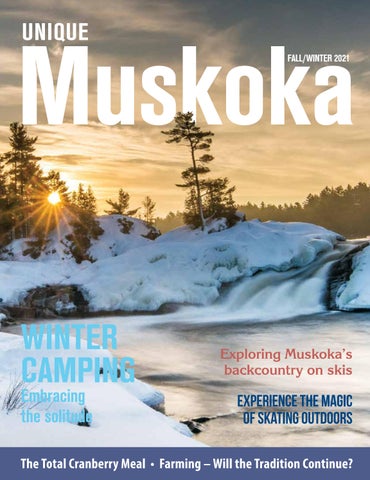
FALL/WINTER 2021
WINTER CAMPING Embracing the solitude
Exploring Muskoka’s backcountry on skis
EXPERIENCE THE MAGIC OF SKATING OUTDOORS
The Total Cranberry Meal • Farming – Will the Tradition Continue?
(Port Carling) Limited (705) 765-5700 brownsappliances.com
[10]
...telling the Muskoka story 26
Winter Camping – Embracing the Winter Experience
Features 10
Cross Country Skiing – Heading into the Back Country
Article by Matt Driscoll / Photography by Tomasz Szumski Muskoka is known as one of the top cross-country destinations in the province. Increasingly, backcountry skiing has become a more popular take on cross-country skiing. Backcountry skiing provides an opportunity to view the unique geography and scenery of the area. Whether using groomed trails or background exploring, Muskoka offers great experiences.
[26]
19
On the Cutting Edge of a Tradition
Article by Meghan Smith / Photography by Kelly Holinshead Always interested in history, art and craftsmanship, Craig Henshaw researched his way into his blacksmithing career following life-changing circumstances. With several years of experience and training and hundreds of hours dedicated to crafting perfect knives, Henshaw has honed his career skills and is poised to join an elite group of accredited bladesmiths.
2 UNIQUE MUSKOKA Fall/Winter 2021
Article and Photography by Andy Zeltkalns As the icy fingers of winter grip the landscape and Muskoka is blanketed with snow, spending the night outdoors in a tent is not an activity that many consider. Although winter camping can be challenging, with the right equipment and careful planning, it can be unique and rewarding. It offers a new perspective on the beauty and peace that winter in Muskoka can provide.
30
Skating Outdoors on Lakes, Ponds and Outdoor Rinks Article by Matt Driscoll / Photography by Andy Zeltkalns Outdoor rinks all share one common denominator – they offer fun for all ages during what can otherwise be a dark and dreary stretch of the calendar. Shovelling off a patch of a lake or a local pond can be just as challenging as maintaining a backyard rink but the joy they bring will create memories for a lifetime.
[19]
~ Muskoka ~ Serving Muskoka and area for 34 years
DIVERSE SELECTION OF PRODUCTS TRADITIONAL AND CONTEMPORARY DESIGNS KNOWLEDGEABLE STAFF TO ASSIST YOU WITH BEST SELECTIONS, WORKING ALONGSIDE YOUR ARCHITECTS, DESIGNERS AND BUILDERS ON YOUR NEW OR RENOVATION PROJECTS
sales@windowworksmuskoka.net 2358 HWY #11, RR#1 GRAVENHURST, ONTARIO
705-687-7617 1-800-668-9858 www.windowworksmuskoka.net Authorized Dealer
CREATE YOUR DREAM SPACE
All About Kitchens The possibilities are endless BRACEBRIDGE 3 Gray Road 705.646.0347
HUNTSVILLE 4 Centre St. N. 705.789.6161
www.allaboutkitchens.ca
36
44
Article and Photography by Tim Du Vernet Long-established family names, closely intertwined over the generations, represent one of the continuing farming legacies in Muskoka. While the concepts of locally grown foods and sustainable lifestyles are concepts often set aside in the name of “growth,” there are some families, who have a passion for fresh produce and a sustainable pattern of life, who are following a different path.
Article by J. Patrick Boyer A medical insurance plan, unique in Canada, was one of the features of early healthcare in Muskoka. All three of Muskoka’s major towns offered hospital services that often involved the funding participation of the local municipal council in getting them the finances their owners required for construction and operation. From beginnings in private [36] homes to major publiclyfunded facilities, healthcare has taken many turns.
Farming in Muskoka – A Tradition with an Uncertain Future
Our Cover
Photography by Andy Zeltkans In addition to being a contributing photographer to Unique Muskoka, Andy Zeltkalns is an outdoor enthusiast who says he is able to combine his passion for both with excursions to locations such as Moon Falls.
Opinion
Muskoka’s First Hospitals – Innovation, Politics and Privatized Healthcare
[44]
9
Muskoka Insights By Don Smith
60
Muskoka Moments
By Norah Fountain
Departments 52 [52]
Cottage Country Cuisine
Article by Karen Wehrstein Photography by Tomasz Szumski The Total Cranberry Meal: one main dish, one salad, one baked good to accompany the main, one dessert and all including cranberries is the perfect touch for any fall or winter occasion. And, with cranberries grown in Muskoka, the key ingredient has a uniquely local flavour. Fall/Winter 2021 UNIQUE MUSKOKA 5
I N T R O D U C I N G THE K I A
…telling the Muskoka story Unique Muskoka is published six times per year by Unique Publishing Inc. Donald Smith Publisher and Editor Curtis Armstrong Director of Sales and Digital Marketing Donna Ansley Sales Lisa Brazier Design Susan Smith Administration
21 Robert Dollar Dr, Bracebridge, ON P1L 1P9
705-645-6575
J. Patrick Boyer Matt Driscoll Tim Du Vernet Norah Fountain Kelly Holinshead Meghan Smith Tomasz Szumski Karen Wehrstein Contributors Annual Subscription Rates: (including HST where applicable) In Ontario $30.00 All Other Provinces $36.00 U.S. $60.00 All Other Countries $72.00 HST: 773172721
stoneway marble & granite inc.
Canada Post Publications Mail Agreement Number: 43268016 Copyright © 2021 Unique Publishing Inc. No content published in Unique Muskoka can be reproduced without the written permission of the publisher.
Mailing Address Box 616, Bracebridge ON P1L 1T9 Street Address 28 Manitoba St., Bracebridge ON P1L 1S1 www.uniquemuskoka.com info@uniquemuskoka.com 705-637-0204
Les and Renata Partyka 1295 Muskoka Rd. 118 West, Bracebridge | 705.645.3380 | stoneway.inc@gmail.com
6 UNIQUE MUSKOKA Fall/Winter 2021
GET GUARANTEED REPLACEMENT COST INSURANCE ON YOUR COTTAGE & CONTENTS
DON’T SETTLE FOR BASIC COVERAGE If all your current insurance company can offer you is basic coverage on a secondary/seasonal home, make the switch to CottageInsure and fully protect your cottage and belongings in the same way your home insurance policy does.
COTTAGE & LAKE ASSOCIATION MEMBER DISCOUNTS
DISCOUNTS FOR FIREBOAT RESPONSE SERVICE
EXTRA COVERAGES FOR GARAGES, GUEST CABINS & WATERCRAFT
Get a FREE Quote in just five minutes by clicking: cottageinsure.ca or Call 1-877-541-9022 We’ve been protecting Ontario cottages since 1910.
D E SI G N
•
CO NS TR UCT ION
•
R ESTOR ATI ON
Restoring Muskoka’s heritage and building new traditions for over 45 years Quality workmanship and customer satisfaction far beyond any written warranty. Wayne Judges 705-645-0480 Jack Judges 705-646-7424 email: judges@muskoka.com
mba
Muskoka Insights would suggest the pandemic precludes any long-term perspective, I’d argue the opposite is true. Without a plan, we’re destined to flounder; we have no road forward, no benchmark. For me, there will be the additional reflection that comes with a milestone birthday. As one uncle who circumspectly found a way to age people would have said, I’ll be entering my eighth decade this winter and that most certainly has to give one pause – I need to decide what I’m going to do when I grow up! In the meantime, I know I’m going to be taking more time to appreciate so much of what Muskoka naturally provides. And, both the autumn and the winter have much to offer in Muskoka as you’ll find out when you read this issue of Unique Muskoka. For those who are outdoor enthusiasts, there’s no shortage of activities. Contributors Matt Driscoll, Andy Zeltkalns and Tomasz Szumski share the fun that can be had by skating and skiing, particularly in the backcountry. For the more adventurous who are seeking bigger rewards, Zeltkalns goes one step further by chronicling his personal experiences while winter camping. What would winter be without celebrating food? And, in particular, food with local flavours. Contributor Karen Wehrstein’s culinary journey of Muskoka – all focussed on the cranberry – is certain to delight your tastebuds. For these and more great articles, enjoy this issue of Unique Muskoka. Happy reading! Photograph: Susan Smith
Casting about for inspiration for this column, I thought I would take a moment to glance at my past writings for the Fall / Winter issue of Unique Muskoka. I found there was considerable reflection but one item of note was my observation in last year’s issue of the many Muskokans who were bracing for the second wave of the pandemic. Now in its fourth wave, the pandemic has encouraged each of us to dig deep and demonstrate our resolve to go forward. While respecting the dangers it threatens – we’ve shown we can continue to go about our lives, albeit it with reservation and changed circumstance. Encouragingly, many entrepreneurs have found the fortitude to open new businesses, countless others have embraced innovations in finding new ways of doing business and all have been supported by a general public that recognizes the importance of shopping locally and supporting Muskoka businesses – owners and employees – who have put their collective hearts and souls into continuing to thrive. Not to be overlooked are the members of the medical community, local government employees, volunteers, those offering individual acts of kindness and so many others who are ensuring we get through the current challenges together. When the bright colours of autumn’s splendour give way to the overcast days of November, it’s like nature provides us with a pause button before winter’s snow blankets the landscape. Lingering over an extra cup of coffee or relaxing in front of a warm fire gives one the opportunity to reflect. Those are the times I like to look back, take stock and contemplate the future. This November, it will be more important than ever to take time for a second thought, recognize the blessings we have, remember those around who may be less fortunate and to plan for next year. While there may be those who
Our local team is here to provide you with personalized insurance solutions. For the coverage your family deserves, call us today.
46 Ann Street, Bracebridge 705-646-9995 | 877-877-3929 www.LesBell.ca TRUST • INTEGRITY • SERVICE
Your Home and Cottage Mattress Centre
MUSKOKA CURATED COLLECTION by Marshall Mattress
THE LARGEST SELECTION OF IN-STOCK MATTRESSES IN MUSKOKA
6 Monica Lane, Bracebridge 705.646.2557 www.mattressesofmuskoka.com
Fall/Winter 2021 UNIQUE MUSKOKA 9
Article by Matt Driscoll / Photography by Tomasz Szumski
T
here are few better ways to appreciate the beauty and solitude of winter than experiencing the thousands of kilometres of cross-country skiing trails that can be found everywhere in Muskoka or by heading out on your own through the back country. The region is known as one of the top cross-country destinations in the province and has hosted a number of competitions over the years. While all cross-country skiing essentially boils down to using your own power to move over snow covered-terrain, there are a number of different ways to take part. The two most widely practiced forms of cross-country skiing are classic skiing and skate skiing. Skate skiing is typically the faster of the two but it requires more effort and a higher skill level than classic skiing. Skate skiing also requires specialized skate skis and specially-
10 UNIQUE MUSKOKA Fall/Winter 2021
groomed trails. Increasingly, Muskoka backcountry skiing has become a more popular take on crosscountry skiing. Backcountry skiing is essentially any time a skier leaves a groomed trail. While it is usually more strenuous than the other forms of cross-country skiing, new technology has made the practice of backcountry skiing accessible to more people than ever. “In this area a lot of people want to go out to the bush or out on the lakes and the new style of skis are making that much more accessible and easier to navigate,” says Randy Mitson of Algonquin Outfitters. This new style of ski can essentially go anywhere you would typically snowshoe but also allows the user to ski. Mitson says this type of cross-country ski, which they call ski shoes but also go by a number of brand names, have been so
popular that they haven’t been able to keep them on the shelves. Mitson says Nordic skis of every variety were in high demand last year as the pandemic limited vacation travel and any indoor gatherings. “In the summer, I think it’s a little bit easier to get outside but in the wintertime – and especially during the pandemic – people need something to help them get outside,” he says. Mitson says he prefers backcountry skiing himself, mostly on a small trail system located on his own property in Kearney. A large part of his love for backcountry skiing is due to his fondness for photography. He says photographs he takes in the winter can be particularly breathtaking and the lack of foliage allows one to look deeper into the underbrush and also view more animal tracks. “Our wilderness here is just as beautiful in
Increasingly, Muskoka backcountry skiing has become a more popular take on cross-country skiing. New technology has made the practice of backcountry skiing accessible to more people than ever. the winter as it is in the summer and the added bonus is there are less people around,” he says. While cross-country skiing isn’t considered a very risky sport, Mitson suggests taking some lessons to ensure your trip is as enjoyable as possible. “I think as Canadians we kind of feel like
we should know certain things from birth but even in taking a few lessons, you can learn a lot and make it much more enjoyable,” he says. Algonquin Outfitters website also hosts an interactive map of the region highlighting the various cross-country skiing locations. Cross-country skiing has seen a renaissance
in recent years, agrees Peter deMos of Liv Outside, largely due to improvements in the equipment, and amplified by the pandemic. “Cross-country skiing was stale for many, many years but about four or five years ago, we saw a lot of advancements with skins and then bindings began to improve as well,” says deMos. “Worldwide, there are so many more
Fall/Winter 2021 UNIQUE MUSKOKA 11
Call Mike Morrow
705.765.3195 www.morrow-electric.com
Serving Muskoka Lakes since 1952
ESA License #: 7000286
rewiring • alterations • heating
NEVER be left in the DARK or COLD: get a quality home standby generator by GENERAC
Classic Handbags Traditional Quality Contemporary Style Crafted from one of the most desirable textiles in the world, Elle Zed handbags are made from 100% pure wool that is handwoven in the Outer Hebrides of Scotland.
HANDBAGS BY
ElleZed Creations Available at
28 Manitoba Street, Bracebridge, ON 705-637-0204
12 UNIQUE MUSKOKA Fall/Winter 2021
Backcountry skis do exceptionally well in ungroomed, fresh powder conditions. people interested in Nordic skiing these days, and in this area a large number of those people are interested in backcountry skiing.” Climbing skins, which have become commonplace in recent years, are strips that attach to the bottom of Nordic and alpine touring skis to help while ascending backcountry slopes. According to deMos, they’ve been a game-changer for the sport. Backcountry skis do exceptionally well in ungroomed, fresh powder conditions, says deMos, and the ideal terrain is wide open with some rolling hills. Thankfully, the Muskoka area has an abundance of such locations, says deMos, citing Torrance Barrens, Limberlost Forest and Wildlife Reserve, and the Doe Lake area of Gravenhurst as some of the best local backcountry spots. Liv Outside also hosts guided backcountry tours in the Henry Road area of Bracebridge, which deMos says is another ideal spot located near the Trans-Canada Trail and Kerr Park with a great deal of accessible land nearby. Located on Reay Road in Gravenhurst, the Gravenhurst KOA offers 15 km of groomed and track-set cross-country skiing trails through 785 acres of wilderness. The trails were first established in the early 1980s and have been upgraded and expanded over the years. “Last year, I think we probably sold 10 times as many season passes as we typically do,” says Paul Cook, the owner-operator of the KOA. “I think that was probably an anomaly because so many people weren’t able to go south and there was also no downhill skiing allowed last winter. That being said the numbers do remain pretty steady year over year. I think either you do it and you like it or you don’t like it and you don’t do it again.” Cook says the goal is typically to be open
Make some tracks this winter!
• Crosscountry skis • Backcountry skis • Snowboards • Alpine skis • Snowshoes • Hot tents
While all cross-country skiing essentially boils down to using your own power to move over snow covered-terrain, there are a number of different ways to take part. The two most widely practiced forms of cross-country skiing are classic skiing and skate skiing. by Christmas but that hasn’t happened for the last two years due to insufficient levels of snow. He says they can begin setting the tracks with as little as one foot of snow but more is always better and consistent cold is a must for some of the trails, as they traverse wetlands. The site offers eight different trails in any given year but Cook says not all of the trails are opened every year. A lack of snowfall has kept their most challenging track closed for the past two years. Cook says over the past couple of decades he’s noticed a trend towards “warmer and weirder” winter conditions, which leads to challenges in opening and grooming the trails. He says both he and his wife enjoy hitting the trails when time allows. “It’s all about getting a chance to be outdoors,” he says. “You get a bit of exercise but there’s also the opportunity to stop and look around while you’re out.” The trails at the KOA are typically flat
and cater more towards novice cross-country skiers, but at Arrowhead Provincial Park, just north of Huntsville, they offer several more challenging trails and they are perhaps the best-known crosscountry skiing location in Muskoka. The park is extensively groomed and caters to both
shop online and in store shop.algonquinoutfitters.com Fall/Winter 2021 UNIQUE MUSKOKA 13
Come Visit Us
and make yourself at home.
www.muskokafurniture.net 705.645.8183 195 WELLINGTON STREET, BRACEBRIDGE
classic and skate skiing. The site features a total of 33 km of groomed Nordic ski trails including 22 classic and 11 skate skiing options. The park is also home to the Arrowhead Nordic Ski Club. Although the provincial park maintains and administers access to the trails, the ski club runs ski programs for children and adults in addition to hosting a variety of races throughout the winter. In 1995 the Muskoka Nordic Ski Club was formed to provide a racing club structure Skate skiing is typically a faster for local high school athletes to compete at form of cross-country skiing but the Ontario Cup circuit. Subsequently, in it typically requires more effort 1998, future Olympian Dan Roycroft of Port and a higher skill level than Sydney was selected to the National Team classic skiing. Development Centre in Thunder Bay. During this time, there was another group called Huntsville Jack Rabbits instructing Nordic skiing for youth in the region. In TH E RI OBEL MOMENTI™ COL L ECTION 2000 the two groups agreed to combine opportunity to viewES thePLUMB unique ING! ski slope, which at one point boasted the first AVAa I unique LABLE AT KNOWL efforts to create Arrowhead Nordic Ski Club. geography and scenery of the area from their mechanized ski tow lift in the region. Over the years the club has continued to own set of cross-country skiing trails. Now the forest and wildlife preserve grow and develop. With its higher elevation, Limberlost contain some 25 km of groom trails, which Further off the beaten path, the trails at the frequently enjoys heavier snowfall than other are offered free of charge, for classic skiing BAT H Forest & KandI TCH SH OOM Limberlost WildlifeEN Preserve offerOW areasRand was, in fact, the home of a downhill suitable for both novices and advanced skiers. DESIGN . IN STA L LATI ON . REPA I R SERVIN G AL L O F MUSKOKA 279 MANITO BA ST, BR ACEBR ID GE
70 5. 64 5 . 267 1
KNOWL ES PLU MB ING.COM @ MU S KO KABATH
Muskoka’s Bath & Plumbing Centre
BATH & KITCHEN SHOWROOM SALES • INSTALLATION • REPAIR SERVING ALL OF MUSKOKA
279 Manitoba Street, Bracebridge
705.645.2671 @knowlesplumbing knowlesplumbing.com Fall/Winter 2021 UNIQUE MUSKOKA 15
Located to the south on Highway 11 in Bracebridge, the Bracebridge Resource Management Centre also offers free access to their 16.5 km of groomed trails. In addition to being an ideal site to view the unique flora and fauna of the area, the resource management centre also offers scenic views of the Muskoka River. While trails abound in Muskoka for all skill levels a good rule of thumb is to stick with shorter, less hilly trails to begin with. It’s also vital to make sure you’re dressed appropriately for the trip or you could find yourself cold, damp and unhappy. There are different ways to get started but many people will use a shuffle technique sliding one ski ahead of the other and then repeating. After just a little while this technique can intuitively evolve into a kick stride and a glide. From there it’s just a matter of working on extending your glide and improving your performance. Before you know it, you could find yourself hooked on traversing the area’s many groomed ski trails or finding some backcountry routes Backcountry skis can essentially go anywhere one would typically snowshoe but also allows the user of your own. to ski.
STYLE DESIGN INNOVATION
Frameless Glass Railings mounted onto mini posts with adjustable standoffs
mba
excelrailings.ca 705-646-2508
16 UNIQUE MUSKOKA Fall/Winter 2021
.
SIDING • SPECIALTY ROOFING • WINDOWS AND DOORS • DECKING • EAVESTROUGHS AND GUTTER PROTECTION
EMBRACE YOUR EXTERIOR We pride ourselves on offering the highest quality exterior products for your home or cottage, including siding, specialty roofing, windows and doors, decking, rain water management products and much more. Our experienced team leaders and installation specialists ensure every project has an organized schedule and that product, delivery, and installation specifications adhere to NorStar’s exacting standards.
norstarexteriors.com 705.645.8404 | 800.732.0158 SERVING MUSKOKA, PARRY SOUND & HALIBURTON REGIONS SINCE 1976 Supply • Install • Cash & Carry
THANK YOU Frontline Workers ...we appreciate all that you do!
IT ’ S YOUR DREAM. WE BRING IT TO LIFE. CUSTOM HOMES & COTTAGES FOR OVER 45 YEARS For over 45 years, Tech Home has helped clients realize their vision of a beautiful & uniquely personal custom home. We build to the highest standards of quality at the most affordable pricing in cottage country. Visit our Gravenhurst Model Home or Toronto Design Centre, & we’ll bring your dream to life.
GRAVENHURST MODEL HOME
2278 Hwy 11N.| Gravenhurst, ON | P1P 1R1 1.888.417.8761
GREATER TORONTO AREA DESIGN CENTRE
130 Konrad Cres, Unit #18 | Markham, ON | L3R 0G5 905.479.9013
SERVING MUSKOKA / GEORGIAN BAY / HALIBURTON
1-888-417-8761 www.techhomeltd.com
I
n less than a year, Craig Henshaw will face one of the most difficult tests he has taken in his life. With several years of experience and training and hundreds of hours dedicated to crafting perfect knives, Henshaw will have six of his blades tested in June of 2022 to determine if he will be stamped as a Journeyman with the American Bladesmith Society. If he succeeds, Henshaw will join an elite group of accredited bladesmiths. More than just the designation, Henshaw feels drawn to both the history and the artistry of knives. They are one of the most basic, primitive tools
Craig Henshaw is a retired teacher turned bladesmith. He has dubbed many of his knives as “Muskoka shoreline” for the patterns created by the layers of differing steels.
Photograph: Shirley Burton
Article by Meghan Smith / Photography by Kelly Holinshead used by humans for centuries. The equipment in his current shop may not look like ancient pictures of a smithy. However, the smithing process, including heating, welding, pressing and shaping, endures. “I had always been interested in knives,” shares Henshaw, a Huntsville resident and
owner of Henshaw Blades. “I didn’t know you could do that as a job.” In order to qualify for consideration for the title of Journeyman, the candidate must be an active Apprentice Bladesmith for no less than three years or two years along with a certificate from an American Bladesmith Society approved course under the guidance of a Master Bladesmith Instructor. Achieving the title of Journeyman indicates the blades Henshaw crafts can pass extreme tests of performance and have the work found to be “very good” to “excellent” by a panel of Master Bladesmith judges. While there are 115 Master Bladesmiths accredited by the American Bladesmith Society in North America, there are only two in Canada. Henshaw will be working
Fall/Winter 2021 UNIQUE MUSKOKA 19
Celebrating another naturally beautiful 150-acre property that features headwaters of Three Mile Lake! We could not have protected this land without our members! Together we are making a difference! Thank you!
Conserving Nature in Muskoka. Join us today. A registered charity.
with one of them, Wally Hayes, to prepare for his Journeyman test. “I’m really excited about it,” says Henshaw. “I have the whole winter to make six perfect knives. We’ll find out by June if I get my Journeyman Smith papers.” “When I forge, I really feel connected to history,” explains Henshaw. “It’s really remained unchanged since steel was born. Forging, putting a piece of metal in a fire, heating it up and hitting it. This process is thousands and thousands of years old and I feel really lucky to have the chance to sort of touch that past.” Always interested in history, art and craftsmanship, Henshaw researched his way into his blacksmithing career following lifechanging circumstances. Henshaw’s first career was in the trades as a carpenter and timber framer. He was a teacher for many years and spent the early part of his career teaching traditional and media arts. In 2007, he transitioned to teaching tech classes and stayed in that field until he retired early in 2011. “I had gone back to school at 26 which I think is a really good choice for a lot of people,” shares Henshaw. “I really loved teaching. It was the greatest job I ever had. I really enjoyed all of the students I taught.” In 2014, Henshaw underwent hip replacement surgery but it was not as successful as he had hoped. Although he completed all of the required physiotherapy and other tasks to make the replacement as successful as possible, after half a year of recovery Henshaw was antsy. While reading his entire library at home and perusing the internet, Henshaw realized that
The forge is the heart of any blacksmith’s shop, says Craig Henshaw. While small, his custom-built forge heats quickly and efficiently with propane. blacksmithing was something he had not yet tried within the trades. “I was a shop teacher and I love working with my hands,” explains Henshaw. “I felt like I could kind of get around enough and my muscles were strong enough that I could probably do something. If I’m going to exercise, I want to be making something. That’s kind of the way I am.” In November 2014, Henshaw started blacksmithing lessons with Dave Robertson as his teacher. Not only was it a full body workout, but blacksmithing allowed Henshaw to get creative and learn something new. Over a couple of years, Henshaw learned from Robertson and also had the opportunity to train with Taro Asano, a swordsmith from Japan. Asano is also the reason Henshaw uses a
After hours of melding and forging steel, Henshaw’s blades are ready for grinding, sharpening and the addition of handles.
Japanese kanji stamp on all of his blades, along with his initials. After four years of trying new things and experimenting, Henshaw became laserfocussed on learning the craft in 2018. He was invited to join The Artists of the Limberlost tour in 2019. He participated in the tour for two or three days and received a year and a half ’s worth of commissioned work. “I’m so thankful that people want to use my knives because I love big family dinners,” says Henshaw. “That’s what I grew up with. Anywhere that there’s a lot of love in a kitchen, that’s really the most important part of my work.” Henshaw has spent the pandemic crafting more knives than ever before, estimating that over 60 of the 90 knives he’s made in the past three years have been crafted over the past 18 months. “I had this really great eastern influence and I had this really great western influence, and I kind of slammed them together,” says Henshaw. “I find both of them are really intriguing. They get to the same edge. They just do it in a different way.” While much of what Henshaw has worked on for the past 18 months has been custom requisitions, for the next eight months, he plans on offering what he has already made for sale and focussing on his Journeyman test. Once that work is complete, he’ll once
Fall/Winter 2021 UNIQUE MUSKOKA 21
Muskoka Barging
Family run construction company with over 35 years experience operating in the Muskoka Lakes area. No job is too small or too big.
705-764-0765 | muskokabarging.com | 1163 Milford Bay Rd, Milford Bay ON
BARGING ● STEEL & CRIB DOCKS ● SEPTIC SYSTEMS ● LANDSCAPING
22 UNIQUE MUSKOKA Fall/Winter 2021
again open his books for custom designs. “Sometimes, I’ll just spend a couple days working on ideas and play,” says Henshaw. “I think it’s important to play, as adults, as children and as students of life. We learn better when we play.” Creativity and imagination are evident in Henshaw’s craft, from the varieties of steel used in his blades to the collection of handles prepared for future use. Henshaw has been experimenting with a combination of Damascus steel and tool steel that he has dubbed “Muskoka shoreline”. “I didn’t invent it, but I love it,” laughs Henshaw. “If you look at the patterning, it waves and then stops like a shoreline or a contour map.” Henshaw creates blades from a variety and combination of steels, even crafting some steel from chainsaw blades. Another type of steel Henshaw has been working with recently involves a tool steel core that creates a dark line within the pattern of the blade. Colours and patterns in blades depend on the steel used in production. In mass produced knives, the shine, and lack of patina or weathering, is caused by the use of stainless steel in production. Henshaw does not include stainless steel in his blades. Mainly, his blades are crafted with a combination of tool steel, Damascus steel, O1 grade steel, 1095 steel, or sometimes Japanese tamahagne steel. “People take my knives home and I warn them ahead of time so no one calls to complain,” explains Henshaw. “But you’re going to cut tomatoes. You’re going to cut lemons. You’re going to cut all kinds of acidic food. Your blade is going to get grey and it’s going to get spotted. That is perfectly natural. It won’t affect the edge at all.” Henshaw stands by the durability of his knives; confident they will last. The life and function of the knife depends on the care it receives, ensuring the blade isn’t left wet and is used as intended. “Saira is awesome. I love my wife but she is an absolute monster and I know she’s going to read this,” laughs Henshaw. “She is my roughest customer. If I can make something where she can’t snap the tip off and if it doesn’t wind up rusting, then I know I’ve got a big winner on my hands.” In building steel billets for knives, Henshaw
SERVING MUSKOKA & PARRY SOUND FOR OVER 70 YEARS
Craig Henshaw prides himself on crafting blades with an exceptional edge that won’t dull. explains that there are three components to balance – toughness, sharpness and flexibility. As a blade becomes tougher and sharper, it loses flexibility. Alternatively, a blade with too much flexibility and toughness may not retain its edge the same way. “You have to figure out where to balance it,” says Henshaw. “I love making high quality stuff.” Handles are another important part of the knife-crafting process, one that Henshaw connects to his surroundings and his background in carpentry. From his own property and his neighbour’s sugar bush, Henshaw collects various types of wood and burls to make into handles. His cabinets are well-stocked with handles, ready for new knives. “The stuff that’s really important to me is
coming from the forest right behind me,” says Henshaw. “I think that any time an artist can ground themselves in where they are and who they are, it comes out in their work. My landscape and how I think and how I feel, that comes out in my knives.” While much of his work life was spent living in the Greater Toronto Area, Henshaw and his wife, Saira, purchased property in Huntsville just over 10 years ago and built their current home on the property six years ago. However, Henshaw spent the majority of his childhood summers at his grandparent’s home on Peninsula Lake. Henshaw recalls summers and falls spent in Muskoka, enjoying canoeing, swimming and meals with family. He remembers camping at age 12 and even embarking on his first solo camping trip to Algonquin Park at 16.
Sales & Service of Major Propane Appliances (refrigerators, ranges, fireplaces, furnaces & more) Safe & reliable No electricity required Bulk propane delivery to your home or cottage
Handles for Craig Henshaw’s blades are shaped from wood collected from his and neighbouring properties in Huntsville.
705.645.4294 TF: 866.645.4294 STORE: 228 TAYLOR RD., BRACEBRIDGE OFFICE: 1646 WINHARA RD., GRAVENHURST
Fall/Winter 2021 UNIQUE MUSKOKA 23
Drawing inspiration from his surroundings and landscape, Craig Henshaw wants each and every knife he creates to reflect Muskoka.
“I’m from Muskoka, my heart is from Muskoka and I love Muskoka,” explains Henshaw. “My family is from here. My parents live maybe 200 metres down the road. I grew up swimming in this bay. I’m a firm believer that you have to ground yourself in where you are. No matter where you’re from as an artist, you should really lean into it and embrace it.” Teaching continues to play a role in Henshaw’s life as he welcomes people into his shop to learn how to craft their own knives. On top of his teaching workshops and lessons, he
currently has an apprentice and is welcoming a high school co-op student this fall as well. While he’s booked for the fall, he’ll open opportunities again around March 2022. “It’s a creative experience to have people come into the shop,” says Henshaw. “We’ll make a really great basic knife and they walk away with success. If I want to be
known for something, I want to be known for quality knives that are around long after I’m gone. High quality and a big smile.” The route to Journeyman bladesmith has only just begun for Henshaw. But really, with his interest in carpentry, career in teaching, Muskoka lifestyle and history and zest for learning new crafts and exploring creative techniques, Henshaw’s been studying for this test his whole life.
Die cuts in many shapes and sizes are used by Craig Henshaw in fashioning his blades.
GBS Contracting Inc.
24 UNIQUE MUSKOKA Fall/Winter 2021
Uncover EXCEPTIONAL
STEARNS & FOSTER® - CRAFTING THE WORLD’S FINEST BEDS!
We know that creating the perfect mattress takes time, care and passion. That handmade details and the finest materials aren’t only worth uncovering, they make something truly exceptional. That lavish comfort and unparalleled design are at the core of everything we do. From hand-stitching to hand signature, our craftsmanship reflects the history of quality behind our name. Since 1846, we’ve shown countless generations the unrivaled quality of the Stearns & Foster® experience. Today, we invite new generations who appreciate supreme comfort and timeless design to indulge in the perfect complement to their life.
MUSKOKA
Bracebridge
Huntsville
6 Robert Dollar Drive Bracebridge, ON P1L 1P9 Telephone: (705) 645-2279
67 Silverwood Drive Huntsville, ON P1H 2K2 Telephone: (705) 789-5589
Regular Hours: Mon - Thu
9:30 AM - 6:00 PM
Saturday
9:30 AM - 5:30 PM
Friday
9:30 AM - 7:00 PM
Sunday
10:00 AM - 4:00 PM
of publication date, stores open thepublic publicwith within the limits As “As of publication date, ourour stores areare open toto the limited traffic at setany by one the provincial are practicing stringent sanitation procedures time. We government. are practicingWe stringent sanitation procedures which includes which includes perpetual, hygienic cleaning, pillowand shields in our bedding galleries perpetual, hygienic cleaning, single-use mattress pillow shields in our bedding and counter all associates wearing galleries, plexi-glass screens and allmasks.” associates wearing masks.
Winter camping provides many opportunities for capturing great winter scenes such as the early morning light before sunrise of the Moon Falls.
Article and Photography by Andy Zeltkalns
C
amping in Muskoka is traditionally enjoyed during the longer, warm days of Spring and Summer or in Autumn when trees are changing colour and there is a crispness in the air. As the icy fingers of winter grip the landscape and Muskoka is blanketed with snow, spending the night outdoors in a tent is not an activity that many consider. Although winter camping can be challenging, with the right equipment and careful planning, it can be unique and rewarding. Winter camping does bring certain advantages to the table such as no pesky bugs and no crowds of people vying for a campsite. Winter can offer a special solitude and an opportunity to experience nature in a more
26 UNIQUE MUSKOKA Fall/Winter 2021
intimate way according to Gavin Marr. A well-seasoned outdoor enthusiast who works at Algonquin Outfitters, Marr has spent close to 20 years in this field. “I like the silence of camping in the winter,” says Marr, “the bigger challenge” this experience offers. The cold can be intimidating when considering a winter camping excursion. My personal preference is to head out in late February or early March when temperatures tend to be a bit more moderate and you can take advantage of the warmer sun and longer daylight hours. Temperatures between 0C and -10C are in a comfortable range that can be managed with proper preparation. Although tempera-
tures above zero are nice, they can also make the snow soggier and can cause gear to get damp. Marr’s advice for staying warm and dry is to use clothing layers which can be adjusted easily as needed, to stay active and to eat something just before bed. I personally enjoy going for a short hike before bed to rev up my metabolism so I am nice and toasty before crawling into my sleeping bag. This is also a good time to gaze up at the stars and soak in the peacefulness of a still winter night. Jamie Honderich, owns and operates Find Your Wild, a company that introduces people to a variety of outdoor activities. He has been an outdoor educator for many years and is a former wildlife researcher. Having spent a lot
your winter camping excurof time in the wilderness, sion will be much more Honderich also loves the enjoyable and safer. With solitude and tranquility of any outdoor venture, safety winter camping and enjoys should always be a key the fact that you can explore element when preparing, the landscape more easily on especially in winter where the frozen terrain. there is much less room for “You can travel anywhere,” error. Honderich states. Swamps When you are more and marshes that are accomplished, you can inaccessible during warmer journey further from home weather can be toured with and there are a variety of ease. One of Honderich’s ways you can travel. Unless favourite winter activities is you are following packed to study and follow animal down trails, the standard way tracks in the snow. Wildlife to move across the winter leaves behind many visible landscape is by snowshoe clues that are intriguing to either carrying a pack or investigate. pulling a sled. I have done As a photographer, I love both and if the terrain and taking advantage of the early conditions allow, a sled is the morning and evening light to way to go. You can carry capture images of nature in more gear and weight than the frosty landscape. The cold using a pack and it is easier crisp atmosphere of winter on the body. lends itself to night Another method for photography and is a great movement in winter is using time to photograph the wide skis with synthetic shimmering stars and the skins which allow you to Milky Way. Photographing silently glide across the snow moving water in winter can and traverse up and down also yield stunning images hilly terrain. In certain due to the randomly created Top: Using a sled to haul gear over the snow can be a preferred way to travel on conditions these skis can be ice and snow formations that winter camping excursions. Above: Nat Faulkner prepares dinner for two hungry much faster than snowshoes, result from water freezing and campers. A higher calorie intake during winter camping is needed to help one stay not to mention a few free thawing. warm. rides down the slopes. For people hoping to try A good quality four-season tent works winter camping for the first time it is best to well during a winter outing but if you want start with small steps. Choosing a campsite an epic cold weather experience, you can that is fairly close to your home or your build your own shelter. When there is a lot vehicle is ideal. Honderich advises first of fresh snow available, some outdoor time campers to go with an enthusiasts will build a snow cave or experienced person if possible; quinzhee which can keep you warm in someone who can help you navigate the coldest temperatures. Due to the the obstacles that winter camping structure of fresh snow, it contains a lot can bring. of tiny air spaces that have the ability Basic skills like starting a fire, to provide excellent insulation. preparing the site for your tent, When designed correctly, it can be managing food and water in the cold -20C outside and 0C inside the snow and, of course, staying warm are shelter making it comfortable to sleep in essential and can be honed with with a winter rated sleeping bag. practice. Building a snow shelter requires the Once you have mastered these skills,
Fall/Winter 2021 UNIQUE MUSKOKA 27
right snow conditions and extra time and energy. While not everyone’s cup of tea, spending the night in a quinzhee is an achievement of which to be proud. Dwight resident, Craig Macdonald, a former ranger in Algonquin Park, takes winter camping to a completely different level. Since 1963, Macdonald has spent countless days living and surviving in the bush and has done many extended winter excursions into the wild. He has crossed Algonquin Park in winter and journeyed down the coast of James Bay. Macdonald calls his winter adventures “hard core” and at times has covered distances of 200km 300km per trip. Macdonald’s journeys are done by employing techniques learned from Indigenous peoples. He uses wooden snowshoes and moccasins while hauling a sled and utilizes gear that he has designed and built himself based on Indigenous traditions. Setting up camp at the end of the day can take up to two hours which includes gathering firewood and setting up a 7’ x 9’ tent with a high roof that is heated using a homemade tin stove. “When on extended trips, your gear gets damp,” states Macdonald, and you need to dry it out overnight in the tent. While not
Waking up to a beautiful landscape at the Moon Falls on Moon River is what winter campers get when they have a tent with a view. for everyone, this type of winter camping demonstrates how it was done for many years before the advent of modern gear and technology. There are several established places in Muskoka where you can try a winter sojourn in a more controlled and safer environment. Arrowhead Provincial Park offers seven winter drive-in sites that have electricity
available along with a heated comfort station. You can bring your tent and gear to enjoy a winter camping outing with a bit of a safety net. For first time campers, this is a great opportunity to practice important skills such as fire making in winter conditions and allows you to test out gear needed for cold weather and snow. Find Your Wild near Huntsville offers
Ten minutes of packing down the snow with snowshoes creates a stable surface to set up camp by Healey Creek. The tent, with the fly off, allows for stargazing but requires a winter-rated sleeping bag. 28 UNIQUE MUSKOKA Fall/Winter 2021
Taken using a tripod and self-timer, this photo shows the author enjoying his favourite winter camping activities which are night photography and gazing at the stars.
winter camping in a heated tent where you can establish a comfortable home base and have the opportunity to explore a beautiful piece of Muskoka under the guidance of Jamie Honderich. He is also available to assist people who want to bring their own
gear to the property and have a desire to try a more rugged but supervised experience. Limberlost Forest and Wildlife reserve, a publicly accessible private year-round facility with 10,000 acres of Muskoka wilderness, has several 10’ x 10’ tent structures with
The author and friend Nat Faulkner enjoy an early winter camping trip in November before the heavy snow arrived. Preparation is key to ensuring a winter camping trip goes well.
solid walls and propane heating. These are drive-to campsites. In addition, Limberlost allows people to snowshoe or ski into remote designated campsites for a more advanced winter adventure. Muskoka also has other private facilities and areas of Crown land that offer the opportunity to winter camp. There are plenty of places to explore but always check whether permission is needed to camp in non-designated locations. When possible, I try to choose a site near running water like a creek or river where I can easily find fresh water. You can create your own water by melting down snow but this requires a lot of time and uses precious fuel. As with any trip into nature it is essential to practice good outdoor ethics and camp in an environmentally responsible way. Camping can be a wonderful way to commune with nature at any time of the year. If you’re yearning for a new challenge, perhaps trying this activity when most others are huddled in the warmth and comfort of their homes will give you a new perspective on the beauty and peace that winter in Muskoka can provide.
Fall/Winter 2021 UNIQUE MUSKOKA 29
Nostalgia inspired Carol and Corbie Kent to create a rink on Lake Muskoka in Milford Bay for their young family.
T
he roots of skating in Canada likely go back further than European colonization with oral histories passed down of Iroquois skating by strapping animal shin bones to their footwear using leather thongs. French explorers are recorded as having skated in Canada as early as 1604, and ice skating was introduced as a sport in Canada for British garrison officers in the 1840s. The first covered rink in the world was built in Quebec City in 1852, but the early commercial rinks were still made
30 UNIQUE MUSKOKA Fall/Winter 2021
from natural ice – with shelters provided to combat the harsh Canadian winters. Fast forward more than two centuries and although the equipment might have changed, many people still enjoy the experience of skating outdoors on natural ice every winter in Muskoka. Some rinks are more elaborate than others with boards and outdoor lighting to help them play into the night. Others are little more than shovelled off patches of a frozen pond.
Photograph: Carol Kent
Article by Matt Driscoll / Photography by Andy Zeltkalns
The Annie Williams Memorial Park outdoor rink in Bracebridge is a favourite spot for ice hockey. Regardless of how elaborate these outdoor rinks may be, they all share one common denominator – they offer fun for all ages during what can otherwise be a dark and dreary stretch of the calendar. Scott Young lives on the Muskoka River in Bracebridge where the river flows too quickly to freeze over suitably for skating in the
wintertime. In his backyard, a watershed plays host to otters, bears, wolves, deer and all other manner of wildlife in the summertime. However, in the winter, the simple beaver pond becomes the Montreal Forum and Maple Leaf Gardens reincarnated. Young first began working on the rink in 2004 – the same year his son Winston was born.
“We started out because we wanted something fun for him to do in the winter. At first, that was just pulling him around on the toboggan,” says Young. In those days, his rink was a small section of ice scraped off the backyard pond with a snow shovel. However, as Winston learned to skate and his skill level improved, the rink
A backyard rink created by Scott Young and family on a pond behind their Bracebridge home is a winter attraction for family and friends. Fall/Winter 2021 UNIQUE MUSKOKA 31
Used day and night, the rink at the Kmiec family’s home is always busy in winter.
grew larger and larger. “He plays shinny every winter with all his friends and our neighbours,” says Young. “I’ve played hockey my entire life and for me, playing shinny outdoors is the purest form of hockey, and the most fun.” In all their years skating on the pond, Young says last year was one of the best years they’ve ever had. The snow levels were manageable and the thaw and freeze cycle served as a sort of “natural Zamboni,” smoothing out chips and cracks in the ice. Young says, in total, the family got nearly four months of use out of the outdoor rink, flooding with their backyard hose roughly a dozen times to make sure conditions were tip-top. “Some years it can be really challenging and there can be quite a lot of work involved,” he says.
32 UNIQUE MUSKOKA Fall/Winter 2021
Young says that’s when it really pays to have his son Winston and all of their friends and neighbours there to chip in on the work side of things. Surrounded on all sides by woods, this particular backyard rink gives the feeling of playing in a secluded grove, despite being a 10-minute walk from downtown Bracebridge. Young says he looks forward to carrying on the tradition for many more years to come but he is
The magic of skating outdoors prompts many families to invest in the time to create outdoor rinks.
concerned climate change could throw a wrench into those plans, making backyard rinks a less common feature in Muskoka backyards or a things of the past altogether. “To me this is one of the best parts about living in Muskoka,” says Young. “It makes me look forward to the winter every year.” Using a much larger sheet of ice as a canvas, the Kent family of Milford Bay are relative newcomers when it comes to creating outdoor rinks but their rationale is the same. With two young daughters and a pandemic in full swing, the Kents decided to make full use of having Lake Muskoka in their backyard. “We initially tried to build a rink on land, but it was much more difficult to build, so we ended up just shovelling off the frozen lake,” says Carol Kent. “My parents live beside us and we’ve had many rinks on the lake in front of our house. It’s quite nostalgic for me. I remember spending lots of time on the frozen lake as a child.” After initially clearing off the lake, Kent said she and her husband Corbie found the
Fall/Winter 2021 UNIQUE MUSKOKA 33
Photograph: Bailey Burke
upkeep of their newly-established rink to be something of a challenge. “It came with it its own set of issues because it was difficult to keep level. The further we got into the season, the more uneven it became,” she says. “The bonus of having the rink on the lake was that it was massive. It was basically as big as Corbie was willing to shovel. He was probably a little ambitious at first, and I think regretted it as the winter went on, and he had to keep up all of the shovelling.” Carol says that Corbie would hit the lake every time it snowed and get busy clearing the rink. To keep the ice smooth, they would employ a variety of ad hoc flooding techniques. “Corbie‘s preference was to use hot water. To do it, we filled a cooler with hot water and then let go of the drain so the water slowly poured out,” says Carol. “Corbie skated around the rink pulling the cooler which slowly leaked water and we attached a towel to the cooler which spread out the water.” As the winter went on, the snow continued to fall and the banks continued to get higher and higher - making the process of clearing off the rink increasingly more exhausting. “Although the rink was a ton of work, I’m so glad we did it,” says Carol. “Our youngest daughter Camryn really improved her skating over the season and we all had a lot of fun spending time outside.” Some of the greatest hockey players in history, including Wayne Gretzky, himself, had their start on the backyard rink created by their parents. Countless dreams of on-ice superstardom have been launched on frozen ponds and backyard rinks across Canada. Such could well be the case for Gage and Olive Burke, whose parents, despite living in an urban area of Bracebridge, also took their first crack at creating an outdoor skating surface last winter. “As northern kids, we really thought it was important that they learn how to skate,” says Bailey Burke, who was herself a competitive figure skater through her teenage years. “We saw so many people on social media skating on lakes and ponds, and it really looked like a lot of fun.” The family had been trekking down to the Top: When winter conditions allow, the Schandlen family create a rink on Lake Muskoka outside their public outdoor skating rink in Memorial Park home. Below: While there is a great deal of upkeep involved in rink maintenance, the Burke family of most times when they felt like a skate, and the Bracebridge found it was a great experience for everyone.
The outdoor skating rink, located at Memorial Park in Bracebridge, is often a hub of activity for the community. idea of having one directly out their back door was too good to pass up. “It turns out it’s not so easy,” says Bailey with a laugh.
Bailey and her husband Damien didn’t begin the rink until January, but having snow on the ground allowed them to pack and smooth a level surface over otherwise uneven
ground. They then put down a special ice skating tarp and Damien constructed boards around the circumference of the rink. They then waited for an appropriately cold forecast and turned on the water. “It actually turned out really well,” she says. “It didn’t have to be particularly large because Gage is just learning, but for Damien and me, it was a little hard to get going with any speed. We were basically just going in one constant circle.” Four-year-old Gage started the winter using the help of a “pusher” to skate but Bailey reports that by the end of the season he was tearing around the backyard rink all by himself. Although Bailey admits there was a great deal of upkeep involved as the winter wore on, she says it was a great experience for the whole family and one they plan to repeat again this winter. “The winter nights can be long here, and you need to find a way to get out and embrace it,” she says. “On nights when you’re out there and a powdery snowfall is coming down, there’s just something about it. It’s magic.”
Floors for Home & Cottage
HARDWOOD • LAMINATE • VINYL PLANK & TILE • VINYL ROLLS CARPET • CERAMIC • NATURAL STONE & MORE MODERN HOME CARPET ONE 350 Ecclestone Drive • Bracebridge
705.645.2443 carpetonebracebridge.ca
34 UNIQUE MUSKOKA Fall/Winter 2021
TAYLOR CARPET ONE 30 Cairns Crescent • Huntsville
705.789.9259 taylorcarpetonehuntsville.com
Susan and Robert Goltz continue the tradition of operating the family farm, near Windermere, with occasional help from their grandchildren while hay baling.
Article and photography by Tim Du Vernet
T
he Goltz or Longhurst name is an easy one to find in Muskoka, especially around Milford Bay and Windermere. The family names, closely intertwined over the generations, represent one of the few continuing farming legacies in Muskoka. Land, especially open farmland, may be valued more in terms of “development” opportunities. The concepts of locally grown
36 UNIQUE MUSKOKA Fall/Winter 2021
foods, sustainable lifestyles and their legacies are concepts quickly set aside in the name of “growth.” There are some trying to show a different path, who have a passion for fresh produce and a sustainable pattern of life. The Down to Earth farm on the Windermere road near Dee Bank is a new enterprise, starting in 2016, that hopes to establish roots. Taylor farm, around the corner from Windermere on the Deebank Road has
become the local destination for strawberries. Norm Woods, known to some as a man with a passion for speed behind the steering wheel of a race boat, has a farm near Bracebridge. The Windermere area is one part of Muskoka where several family names have continued through the generations and as long as anyone can remember, Goltz families have been farming in the area. Robert and Sue Goltz continue to go through the yearly
cycles of farm life in much the same way as previous generations with a few changes and adaptations. A local road in the Milford Bay area was called the Butter and Egg Road for a reason. Farms were at one time plentiful along this route. Susan and Robert were bringing in the hay when interviewed. The bailer counts the number it packs, and Robert estimated that about 150 bales were stacked by his wife and two grandchildren. It was an easier day than some, despite the humidity and heat. The most Robert remembers bringing in on a single day was 500. Robert confessed that on some hot days, you’d drink a lot of iced tea with little after effect. Of course, all the hay must go somewhere, and the barn will hold thousands of bales. Robert explained that on the day of the interview, he set the baler to make slightly smaller bales. “We aren’t getting any younger and it is easier for the grandchildren to lift. It’s all good,” he emphasizes. The process of bringing in the hay in a single field takes several days and this summer it was delayed due to the frequent rains. Robert cuts hay from his own land as well as for fields near by. After cutting the hay, it must be turned in the field and then dried for baling. The baler is a noisy machine that gathers up the loosely laid grasses and creates the rectangular chunks, to be wrapped tightly in string. After the baler, which needs emptying every so often, deposits the bales in the field, Susan brings up a large flatbed towed by another tractor and loads the bales with help from the grandchildren. The bales were stacked four to five high by the end of the session, all lifted there by hand. A conveyor belt helps to get them up into the barn. Susan believes there is strong agreement amongst all the farmers that much has changed and the challenges are just getting greater. The Goltzs explain that government regulations have increased costs and affect nearly every aspect of farming, from the water the cows drink to where and how they get processed as meat. Sue explained that it now costs $125 per large animal, $7.50 for chickens and $9.50 a turkey, which is the fee for government inspections. This is on top of the transportation costs to facilities that can
Top: Fewer and fewer farms in Muskoka have livestock such as cattle and sheep. Above: The process of bringing in the hay in a single field takes several days and this summer it was delayed due to the frequent rains. After cutting the hay, it must be turned in the field and then dried for baling. be some distance away. When asked about history and family stuff, Robert Goltz points to his wife Susan. “She keeps track of all of that, I just work the farm,” he adds. Susan remarks that at one time there were barn raising and threshing “bees.” The maple syrup festivals and other farming traditions have mostly receded to memory. Susan laments the loss of the sense of community, partly as a result of the pandemic, but also due to demographic shifts. In the words of Bob Dylan, “For the times, they are a-changin’.” The rewards of farming for the Goltz clan,
who acquired the farm through a land grant, is seeing the involvement of the grandchildren as they visit and work on the farm from time to time. Susan notes the future of the farm as a working farm for subsequent generations is undetermined as each generation will decide for themselves. Several land grant farms still operate in some form in Muskoka. Farming requires being a “jack of all trades.” Veterinary skills, carpentry, engine maintenance, landscaping, plumbing and more are a part of the routines on the farm. While lifting one of the hundreds of bales lined on the field, Susan remarks, “there is a
Fall/Winter 2021 UNIQUE MUSKOKA 37
KEEP WARM THIS WINTER
It’s getting cooler and we’ve stocked up with Tilley toques and Tilley winter hats (The warm hats with hide-away ear warmers – both stylish and practical.)
Don and Mandy Maric hope to satisfy the desire for fresh, locally-grown produce with crops from their farm, Down to Earth, located near Windermere.
28 MANITOBA STREET BRACEBRIDGE | 705-637-0204
Fine Canadian Craft Studio Jewellery Original Art Open Weekends Oct. 9 - Dec. 19 1073 Fox Point Rd Dwight, Lake of Bays 705.635.1602 Loyal Loot, Log Bowls
oxtonguecraftcabin.com
38 UNIQUE MUSKOKA Fall/Winter 2021
lot of manual labour.” Don and Mandy Maric, a husband and wife team, who founded Down to Earth a few years ago near Windermere, have come to farming from a different route. Mandy explained they began by transforming their urban lawn into a vegetable garden. It’s a practice that would likely have a dramatically positive impact on the environment in so many ways if more urbanites were to take it up. Beets and a few other plants are grown along side the tomato plants to maximize the space. Much of the success of farming is out of the control of the farmer and this summer has so far been very challenging with an excess of rain. Mandy shared some of the difficulties this has presented as well as the opportunities it created. Some spaces
bordering the field became wetlands suitable for a wide diversity of wildlife. Furthermore, a non-farmer looking at the ground would likely see only weeds. Mandy admits, “it looks kind of crazy, but the different kinds of clovers add nitrogen and are important for the pollinators. And when the wind and surrounding noises calm, you can hear the bees buzzing.” One of their specialties is an organic salad mix. It has been well received at local shops such as Stephen’s Butcher shop, Field of Greens and the Farmer’s Daughter in Huntsville. Don outlines what’s on the menu. “We currently have our mixed lettuce blend, baby kale and green onions, garlic, cucumbers, a variety of herbs, tomatoes and heirloom
tomatoes for sale. Zucchini, carrots cherry tomatoes and green beans follow. In the late summer we have a baby potato mix and winter squash available. We are also hoping the Somerset variety grapes we planted will be ready this September. This variety is a smaller sized red seedless grape. It grows well in more northern climates.” Restaurants and specialty stores love to be able to promote foods grown or prepared with extra care, and Don recognizes that local businesses have been very supportive and patient. The feedback has been encouraging. People in the area have been supportive. “Customers to our little store have thanked us for being here,” explains Don. “We have had volunteers that have generously given of their time and labour. And neighbours that have helped us out quite a bit on this farm with different projects. We have been told that they like the quality and freshness of our product. We have an advantage of selling local in that sense because we are close by and don’t have to ship what we grow to far off places. “However, the reality of the marketplace is convenience is king,” notes Don. “It’s very
challenging to provide the consistency these business need. We received a grant and business training from Muskoka Small Business from the Starter Company Plus Program. This went a long way for us to address some of these issues in our business. It’s still very much a work in progress.” In early summer when the first crop of strawberries ripens, the fields at Taylor Farm near Windermere are filled with families. The pick-your-own is a hit with youngsters, who probably eat more than they put in the basket. There truly is nothing like strawberries fresh from the field. Taylor Farm grows several varieties so the “season” can last through the summer. The seasonal nature of farming is one the eternal challenges. Susan Goltz laid out the calendar of events. Calving season starts at the end of February and continues through March and April. “We try to be on hand to assist, since problems can arise and a veterinarian is more than an hour away,” says Susan. The fences are checked in April before the cows go out in May. In June, weather
Pssst...
Do you love knowing what’s going on in your community? Since 2015, Doppler has been North Muskoka’s go-to source for local news.
SOUTH MUSKOKA DOPPLER IS UP AND RUNNING
and will bring the same dedication to the communities of Bracebridge, Gravenhurst, and Muskoka Lakes. Head to southmuskoka.doppleronline.ca and sign up for FREE to get the scoop.
READ LOCAL
Our mantra is local: from features on local people doing extraordinary things, to local business spotlights, news and sports coverage, all supplemented by provocative opinion pieces on topics near and far. Sun ripened tomatoes are one of summer's tastiest pleasures, especially when fresh from the vine, such as these from Down to Earth farm, near Windermere.
For more information contact MATT DRISCOLL Editor – South Muskoka Doppler Matt.driscoll@doppleronline.ca
Fall/Winter 2021 UNIQUE MUSKOKA 39
With most Muskoka farms, chickens and eggs are a ubiquitous feature. depending, haying begins – cutting, baling and stacking into the barn. All this can last well into July, as this year, with rain delays. Up to 7,000 bales of hay will eventually get stacked. Meanwhile, the water trough for the cattle
needs to be refilled, up to four times a day in dry weather. As the season progresses and becomes drier and the grasses less plentiful in the pasture, hay is brought out to supplement. Calves are weaned from their mothers in mid-September in advance of the sale of
cattle happening toward the end of September. Cattle are brought into the barn for the winter in November. Robert and Susan point out that it is difficult to survive on just farming for an income. Most farming families supplement their livelihood. Susan points out that farming is a way of life, not a pastime or hobby, and with the growing year-round population in Muskoka, the number of farms is likely to decline even more, with the pressures on the commercial value vs. the returns for farmland. Farming as a business means taking advantage of good breaks in weather and timing your day to make the most of it. The team who run Taylor Farm may be cutting grass one moment or loading up gravel the next. A team of local youth run the country store where the strawberries and other items from the farm as well as popular seasonal produce such as corn, peaches and cherries are sold. Not every farmer’s route to the field is the same. Some 26 years ago, Norm Woods was more likely to be found behind the wheel of a speedboat than attending to the breech
1-705-706-4927 SUNROOMSBYDAVLIN.CA info@sunroomsbydavlin.ca
Don’t have your project put on hold RECEIVE DELIVERY IN 5 to 6 WEEKS!
40 UNIQUE MUSKOKA Fall/Winter 2021
birth of a calf. Norm retired from being a professional race boat driver in 1999 following a spectacular accident in which his boat blew apart after it hit a wave and sank. “The capsule I was in had 30 minutes of air,” he explains. “After I sunk, the divers came down and rescued me.” Woods explained that the capsule concept was a solution to lessen the death toll of drivers in the open boats at speeds beyond 130 miles per hour. Woods said this experience played a big role in his decision to retire. Woods is a decorated international sports star and has certainly shifted gears at his farm on Stephen’s Bay Road near Bracebridge. With cows, sheep and chickens, he has his hands full tending to the farm. He clearly enjoys every minute of it, especially when his grandchildren – three-year-old Matthew and Tommy, who just turned five, come to visit and, of course, when a new-born calf arrives. Woods described how he had a lovely house not too far from where he is now, but it was too big after the children went on their way. It happened that the farm came on the market, Boat racer and businessman turned farmer Norm Woods enjoys the excitement of a newborn calf at and he took the plunge. During his racing his farm in Bracebridge.
When a power outage strikes, SOMMERS RESIDENTIAL GENERATORS ensure that your home or cottage automatically stays powered on. A full range of generators that can be custom built to suit your home or cottage’s specific needs, so you’ll always have standby power ready.
MUSKOKA • PARRY SOUND Your Source For All Your Electrical, HVAC, Backup Power And Home Automation Needs. 705.765.0600 • www.sifftelectric.com • Port Carling ECRA / ESA 7002295 • TSSA 000365522
Fall/Winter 2021 UNIQUE MUSKOKA 41
INTRODUCING
APPAREL
Norm Woods left the competitive world of boat racing after a near fatal crash to enjoy life on his farm beside the Muskoka River in Bracebridge.
Canadian-Made Shop Online uniquemuskoka.com or In-Store
28 MANITOBA STREET BRACEBRIDGE | 705-637-0204
42 UNIQUE MUSKOKA Fall/Winter 2021
days, Woods didn’t think he could ever imagine having his arm up a cow, wearing a long plastic sleeve, to help with the birth of a calf. “But Blackie,” notes Woods, “is a great mom, she never has any problems.” Norm showed off the newborn, just days old, as it learns to suckle. Finally, the camera-shy sheep come close enough to Woods to be caught for a photo with him. They had been playing hide and seek around the property. Pointing out the corn growing near the river at the Nichols farm, one was reminded of the great corn Edith Nichols would have in the summer. Woods says it is now cattle corn. One particular season, Woods grew table corn, and he was looking forward to a great crop. The night before he planned to pick it at its peak, deer came through and made a mess of it. Woods brings in his own hay, cutting and baling it from a field over by the tree line. Such are the demands, surprises and
challenges of running a farm. There is a lot of history in these fields. A song surely suitable for the likes of Gordon Lightfoot. What these lands were before the settlers uprooted the trees for hay, cattle and crops is lost to memory. Susan Goltz remembers members of the Indigenous community coming to their fields looking for sweet grass, used in baskets and for ceremonies. The sweet grass baskets could be bought from the Roads craft shop in the “Indian Village” in Port Carling. The farmers’ markets in towns feature local fare that can come directly to the public. Wednesday is Gravenhurst, Thursday is Port Carling and Huntsville, Saturday is Bracebridge. Some of the markets run into mid-October, while others end in September. Check for COVID protocols as well. While farms represent a stark transition from the land as it was before settlers, that is nothing compared to what Muskoka is facing now.
The simpler challenges of gathering his sheep provide pleasure for former businessman and boat racer Norm Woods.
when we say your donations are life-changing,
we really mean it. Meet John, Aiden, and Shannon, our newest Habitat homeowners in Midland. What does the prospect of owning a safe, decent, accessible, and affordable home mean for this family? Read their story at www.habitatgatewaynorth.com/meet-our-families
Jacob Hart and Francis Howland competed on the same Huntsville turf to provide the best private hospital. This is Dr. Howland’s new hospital, built at the corner of Main and John streets in 1893, again a response to Dr. Hart’s upgraded facilities.
Article by J. Patrick Boyer
44 UNIQUE MUSKOKA Fall/Winter 2021
Photographs: Muskoka Heritage Place Collection, Huntsville
I
n 1874, on a chill November evening, six The men devising this private arrangement that, he was drawn to Huntsville by the Huntsville men thrashed out how to agreed to pay the doctor a $600 “bonus” – “guaranteed payment” plan and the appealing entice a medical man to their fledgling topping up whatever income he could earn prospect of getting some of the “Muskoka settlement. Focusing on the connection directly by charging fees and selling Cure” for himself. between money and healthcare, they decided medications to non-subscribers in Huntsville Large in stature and personality, the small at that November 28th gathering to offer, not and north Muskoka. In 1875, their advertised village’s sole licensed medical practitioner exactly a bribe but an “award” to the doctor plan netted Dr. Francis L. Howland. held the record for many local “firsts.” Dr. who came. In exchange, as they then publicly Born in Whitby, Howland had graduated Howland received the first telegram in advertised, the doctor would “give his advice, from McGill in 1867, opening a medical Huntsville. At his grand home he built attendance and medicine to the subscribers practice in Woodstock. After eight years of Huntsville’s first tennis court. He was free of charge” for a year. appointed Huntsville’s first medical That peculiar reference to officer of health by Ontario’s Liberal “subscribers,” rather than “townsfolk” government. In 1877, he launched or “patients,” was because they were Huntsville’s first newspaper, pioneering a medical insurance plan straight-up clarifying his partisan unique in Canada. Like all such affiliation by calling it The Liberal. plans, it was somewhat convoluted. Although he initially provided For $5 per year, a married man could doctoring services from his home, “subscribe” to coverage entitling his Francis Howland’s spiraling success entire family to a year’s worth of free enabled him to buy one of George medical services for injuries and Hunt’s buildings on Main Street, illnesses. Single men could sign up for $2.50. Patients not covered by the Huntsville plan – the nonAbove: Dr. Hart relocated his hospital to this large addition to his subscribers – would pay for the home. Right: Dr. Howland offered a healthcare insurance program doctor’s services at rates from $5 to first. Dr. Hart improved with healthcare “tickets.” This ticket was $12 per week. in use in 1900.
As Bracebridge’s Memorial Hospital, this 1878 structure was officially opened in 1928, ten years to the day after a November 11, 1918 general armistice ended World War I.
Left: Dr. Francis Howland, Huntsville’s first doctor, arrived in the village in 1875. Right: Dr. Jacob Hart arrived fresh from medical school in 1885 and opened Huntsville’s first hospital. “up-to-date system of hot and cold baths.” Rooms were “comfortably heated, especially well ventilated, had plumbing and sewage of the best, and featured Lawson Tait beds.” (Tait’s improvements in hospital beds included wire carefully coppered and lacquered to prevent rust.) A couple of hospital developments in 1902 further altered the Huntsville scene. One was a hastily-built isolation facility to quarantine a local man with smallpox, giving the town its third hospital. The era’s attitude about people with a communicable sickness was reflected in the isolation hospital being dubbed the “Pest House.” This small building to segregate individuals with infectious diseases became derelict because need for it was rare. One May night in 1907, a community-minded arsonist converted Huntsville’s isolation hospital to ashes. The second 1902 event was Dr. Hart moving his Chaffey Street hospital into a new facility – 36 rooms and offices added to his King Street home. By 1909, he would begin calling this facility The Huntsville Hospital and Rest Home, because it functioned as a sanitarium as well, with rooms exclusively for patients with communicable diseases. After all, the Pest House had been eliminated, and it was now the era of sanitariums. The 1890s was a “laissez-faire,” or handsoff, era for government. Municipal governments, not provincial or national ones, were front-line responders and they fielded a very short list of the public’s needs. Individuals, families, and civil society were as self-reliant as possible – because they had to be. Those providing medical support were
Fall/Winter 2021 UNIQUE MUSKOKA 45
Photographs: Muskoka Heritage Place Collection, Huntsville
Purchasing a $5 ticket entitled the subscriber to a year’s worth of medical and surgical treatment at Hart’s Hospital, plus board in cases of sickness or accident. Hart was obviously an entrepreneurial physician, bold enough to come to town and build a hospital. Applying another of his modern ideas, the doctor offered Huntsville’s Duncan H. Sutherland a commission on ticket sales. That winter, travelling by dog team to north Muskoka homesteads and lumber camps, he did brisk business selling subscription tickets to farm families and loggers. Not to be overshadowed by Dr. Hart, and giving Huntsville its second hospital, in 1893, Dr. Howland built one of his own. On property bought from Capt. Hunt, the 44 x 51-foot structure stood east of the Muskoka River near the swing bridge, at the corner of John and Main streets. “Howland’s General Hospital,” as it was called, accommodated 30 patients. Francis Howland emphasized that, unlike medical facilities in converted residences, his hospital was “especially erected for a hospital.” Howland’s facility was made-over in 189596 according to plans by local architect William Proudfoot. The newly bricked building, modified to 40 x 60 feet dimensions, now accommodated 100 patients who could be “admitted at all hours.” The General Hospital’s “electric lights, speaking tubes (an 1890’s intercom), elevator, telephone and telegraph connections” were “in service day and night.” The “abundance of water from the town waterworks” supplied the hospital’s
Photograph: Boyer Family Archives
where he prospered carrying on his muchneeded medical practice. By 1885 the Grand Trunk Railway had pushed its tracks north to Huntsville. On June 26 the next year, its first passenger train pulled into the station. Onto the platform stepped a dapper doctor by the name of Jacob W. Hart. A recent graduate from Trinity Medical College in Toronto, Hart promptly purchased lots 47 and 48 on Chaffey Street and swiftly built the “Huntsville Hospital,” a two-storey wood frame structure with picket fence to keep grazing cows at bay. A long hall ran through the ground floor “Hart’s Hospital,” as locals called it to avoid confusion with other Huntsville medical facilities like “Howland’s” clinic on Main Street. His doctor’s office and the hospital’s dispensary were conveniently near the entrance, handy for patient visits and pharmacy purchases. Further along was his well-equipped operating room, which doubled as a delivery room for babies. At the far end, a dining room with adjacent kitchen is where patients took their meals. The second-floor wards were segregated by gender, and four smaller upstairs rooms were exclusively for contagious or critically ill patients. Not only was Dr. Hart’s hospital the first in Huntsville and all Muskoka, it was also Canada’s first “ticket hospital” – a subscription system providing an early form of medical insurance that was in fact a close adaptation of the Huntsville plan pioneered in 1874-5 that gave rise to Dr. Howland’s practice. The “ticket” was the new feature, something Hart learned was being done in the U.S.
Photograph: Gravenhurst Archives
Reacting to the exclusivity of high-fee TB care at Muskoka Cottage Sanatorium, a Free Hospital Sanatorium for Consumptives was opened as Gravenhurst’s second major hospital in 1902 – seen here with later additions to the high-demand facility. primarily local private players: doctors with their own clinics, the Red Cross Society, women operating convalescent nursing homes, midwives, Muskoka chapters of the Women’s Institute, members of the Imperial Order of Daughters of the Empire, women’s church auxiliaries, and the Victorian Order of Nurses. It was from this mix that Muskoka's various types of hospitals emerged, and in which poor people needed medical care. In Huntsville, hospital matters had hit a major snag. Competitors Dr. Hart and Dr. Howland, each piloting their own privateenterprise hospitals, shared common interests and displayed patterns of close collaboration. Prior to this, they had jointly sought to improve their Huntsville hospitals’ bottomlines. Selling annual subscriptions for health services produced operating cash flow for the two hospitals but the doctors still found it difficult to keep up financially. Both doctors worked, or were on call, every day all year. Payment for their services often took the form of vegetables and firewood. Jacob Hart’s billings exceeded his collections. Claiming he might not be able to continue, he sought “charity status” for his hospital. Ontario’s Liberal government readily granted his request in spring 1897. Quickly Howland, who seemed to follow Hart in most everything, and who was equally well regarded as a “friend” of the governing powers at Queen’s Park, achieved the same financially beneficial status. Despite the fact they were profit-making businesses, Huntsville’s two privately-owned “charity” hospitals now got yearly provincial grants to cover operating costs.
46 UNIQUE MUSKOKA Fall/Winter 2021
Then in 1905, shortly after the Muskoka by-election in which Dr. Howland ran for the Liberals, came a province-wide general election. The Liberals, who’d been in office for an unbroken run of 33 years, lost to the Conservatives. Doctors Hart and Howland, both official Liberal candidates whose private hospitals had been aligned by the friendly Liberal government to receive public money, could hardly have been surprised when those arrangements were cancelled. Although both hospitals continued to take patients, the two doctors became increasingly strict about admitting only those who could pay in full. Townsfolk next learned that Huntsville’s medical duo was seeking an exemption from municipal taxes. Councillors grudgingly voted the tax exemptions – for both doctors’ private hospitals – even as they lamented on the public record that it was “an injustice to the general ratepayers of the village.” Other Huntsville doctors were now practising medicine from their homes or offices. With the hospitals of doctors Hart and Howland effectively closed except to the rich, these solo first-responders included Dr. C.C. Casselman, Dr. J.M. McRuer and Dr. J.D. MacDonald. As dedicated physicians, they made “house calls,” carrying their doctor’s hallmark black bag of instruments and medicines not only to households around town but far out into the countryside as well. Members of the North Muskoka Women’s Institute began campaigning for a public hospital. By 1916, they’d been led to believe town council would contribute $1,000 to a 20-bed facility, expected to cost about
$15,000. However, the required bylaw never proceeded. The councillors stalling it did not see their role to spend money on a hospital. The town’s experience through the 191819 Spanish Flu pandemic gave fresh impetus to the quest for a public hospital. By 1921, cost of the proposed hospital had risen to $30,000. A hospital committee looked for a suitable site. A plan was devised to raise funds by public subscription. However, the matter was stubbornly deferred by Huntsville council and surrounding larger municipalities. The potent force of inertia had overtaken local government. The Red Cross became deeply concerned about the humanitarian situation in Huntsville. In 1924 Dr. Routley, medical director of the Ontario Red Cross Society, and W.H. Alderson, chairman of the Red Cross Emergency Relief Committee, then actively developing hospital accommodation across northern Ontario communities, arrived in town to explore reopening Dr. Hart’s hospital. Routley suggested a 10-patient facility for a comparatively small capital outlay. Once again, a committee was struck to plan the new hospital and, once more, the town was asked to contribute funds. With no public hospital, several nurses began operating private ones. Initially for birthing babies and caring for mothers, these nursing centres also began treating patients recuperating from surgeries and serious illness. Town doctors came to them and performed appendectomies, tonsillectomies and other emergency surgeries. In 1915, a Miss Hanson had a nursing practice on Main Street and by 1922 on Mary Street, Mrs. George Morgan set up a private hospital. When she left town in 1923, another nurserun hospital took Morgan’s place when Mrs. Baverstock opened Hillcrest Hospital on Church Street. A little later, Mrs. A.W. Whitehouse opened her private hospital on Cora Street. The Whitehouse Hospital, stated her 1926 advertisement, was “Equipped with accommodation for a limited number of patients. Competent nurse, with many years’ experience, in charge. Large, well-lighted and ventilated. Rates $7.50 to $21.” Even Huntsville’s chapter of the Imperial Order of Daughters of the Empire pitched in, paying the Victorian Order of Nurses for the services
Photograph: Hospitals Division, Department of Health. Boyer Family Archives.
tuberculosis patients. The Sanitarium offered hope for Canadians suffering from deadly TB, introduced a unique component to the Gravenhurst community and opened a new dimension in taking “the Muskoka Cure.” Thanks to clean air and convenient location, Muskoka became the Canadian anchor for hospitals catering exclusively to those with tuberculosis who required complete rest – a medical prescription. At Gravenhurst, where the play was all about tuberculosis hospitals because the town was hosting the first and for a while the only, dedicated TB treatment facility in Canada, money was clearly in the picture. The town’s strategic location and self-promotion as the “Gateway to Muskoka” reinforced the message of medical doctors and other prominent Torontonians who were already summer residents in the district. Helping these elements crystallize, Gravenhurst council ponied up $10,000, adding to the $25,000 pledge of Sir William Gage, the philanthropic Toronto publisher, for a hospital facility. This money was pooled with other substantial gifts, including another $25,000 donation from tractor manufacturer Hartland Massey, whose 23-year-old son had died from TB. In its first year, the “Muskoka Cottage Sanitarium” had space for 35 patients. The name itself suggested important features of this Muskoka treatment centre. On one level, it tapped into the coveted allure of a second home, a “cottage” close to nature, which for many had become an integral benefit of living
Muskoka Cottage Sanatorium opened in 1897 at Gravenhurst. Offering a new version of “the Muskoka Cure,” it was Canada’s first tuberculosis sanatorium.
Photograph: Hospitals Division, Department of Health. Boyer Family Archives.
of Mary Ririe, R.N., to serve the people of Huntsville in 1923 – beginning a decadeslong procession of 13 successive VON nurses in town. The arduous fits-and-starts campaign to establish a public hospital in Huntsville culminated a generation later, in the 1940s. Under the leadership of Harmon E. Rice, a weekly newspaper editor and publisher, and also Huntsville’s mayor, a citizens’ committee pressed ahead to land a Red Cross “outpost hospital.” The Red Cross paid $40,000 of the building’s $250,000 costs and ran the hospital for several years before entrusting it to a local board. The Ontario government contributed $40,000, the Town $10,000, and the rest came from private donations. The Second World War was still far from over in July 1944 when the citizens’ committee decided to call the long-sought facility a “Memorial Hospital” to honour those who perished in the war. They purchased William Kellock’s property on the east bank of the Muskoka River, where in 1949 the Huntsville and District Memorial Hospital, a 26-bed facility, finally opened its doors. On August 21, 1897, Gravenhurst townsfolk mingled with a trainload of daytrip dignitaries from Toronto, all converging on the east side of Muskoka Bay around a brand-new sanitarium. In formal attire befitting a Victorian Age official ceremony, they were participating in a moment of Canadian history. The “Muskoka Cottage Sanitarium” – part hospital, part resort – was Canada’s very first treatment centre for
Full front view of Bracebridge Memorial Hospital, initially a Red Cross facility, as it appeared draped in the British flag in 1928. in Canada. On another level, “cottage” connoted simplicity. Access to Muskoka Cottage Sanatorium required patients whose TB was “not too far advanced,” so treatment had a chance to be effective, and who could pay for top-of-theline treatment. It wasn’t cheap. Some families boasted of having a member “at the Cottage Sanatorium in Gravenhurst,” the way they’d brag about their child attending a prestigious high-tuition university. This inescapable nexus between money and healthcare arose and the understandable social backlash led to opening of “Muskoka Free Hospital for Consumptives” in 1902. The first such facility anywhere, the Free Hospital “was a welcome addition to Ontario tuberculosis facilities,” noted the authors of Gravenhurst: An Album of Memories and Mysteries in 1993, “despite its less-than-upbeat name which correctly implied that other TB hospitals were not ‘free.’” This extensive facility became a homey complex, complete with its’ own vegetable gardens producing fresh produce for patients. As Gravenhurst became pre-eminent in the field of tuberculosis treatment, between these two TB hospitals, a third facility took shape between 1908 and 1916. The Calydor Sanatorium for tuberculosis patients did not start out as a health recovery institution, but as the Minnewaska Hotel. A luxury resort initially offering the standard “Muskoka
Fall/Winter 2021 UNIQUE MUSKOKA 47
Photograph: Muskoka Heritage Place Collection, Huntsville
Cure” and catering to well-to-do Gravenhurst’s town council southern Ontario families, the promptly granted an operating Minnewaska’s imposing buildings, license in February 1909. The located along the eastern shore of following year, the hospital hotel Muskoka Bay in the sanitariums’ was enlarged with open-air neighbourhood, boasted all the verandahs and sunrooms, fresh modern amenities. Guests enjoyed air being part of “the cure.” By good indoor dining, dancing, and 1913, Dr. Parfitt and his billiards in well-appointed rooms, associates laid plans, notes while the resort’s expansive Gravenhurst historian Cecil grounds, running along a beach, Porter, for “a modern sanatorium included tennis courts, gardens, of exceptional quality to be built and lawn-bowling greens. a few hundred yards away.” In The very first “hospitals” in Muskoka were small quarantine buildings – The Minnewaska opened its April 1916, the attractive new dubbed “the Pest House” – to isolate individuals with contagious deadly doors in 1897, the same season diseases such as scarlet fever or diphtheria. health centre, named Calydor the Muskoka Cottage Sanatorium meaning “beautiful water,” began operations. Being in close proximity, business began slipping away to even more officially opened its doors. the two places were soon caught up in a prestigious resorts further up the lakes, such The town itself did not have a general common destiny. Rich visitors arriving in as the Royal Muskoka and Windermere public hospital. Physicians, as elsewhere in Gravenhurst to see their wealthy TB-patient House, its convenient and underutilized Muskoka, practiced medicine from their friends found it convenient, and exceedingly facilities began accommodating patient homes or handy doctor’s office. Women pleasant, to spend time “just next door” at the “overflow,” too. In 1908 Dr. Charles Parfitt, reliably provided nursing centres, convalescent Minnewaska for a fine Muskoka holiday physician-in-chief at Muskoka Free Hospital, homes and birthing facilities. And, despite while performing a duty. The year-round orchestrated its makeover from tourist hotel the community’s understandable gulf between resort became increasingly drawn into the to private sanatorium. contagious tuberculosis patients at the local TB treatment economy. As the hotel’s First called the “Minnewaska Hospital,” sanitariums and people in the town, there was
48 UNIQUE MUSKOKA Fall/Winter 2021
Photograph: H. Oakman, Gravenhurst Archives
interaction at the medical level. Medically trained personnel living in Gravenhurst responded to intermittent neighbourhood emergencies – a burst appendix or a broken leg. Bracebridge was a municipal leader in several categories – establishing a library, acquiring its own electricity generating plant – but getting a hospital was not on the town’s agenda. So, for decades of community development, doctors practiced medicine from their homes or adjacent offices and women (often widows) opened their houses as “nursing” facilities for birthing, recovering from sickness and patients healing after receiving a doctor’s care. The first structure in Bracebridge to be called a hospital was, as in Huntsville, a simple structure to sequester individuals with a deadly contagious disease, such as scarlet fever or smallpox. A primitive shed, it, too, was called the “pest house.” In the pest house, a person suffering from a contagious disease, especially smallpox, was “denned up” with some brave person to look after him. “Except the doctor, no other person
This aerial view underscores the impressive extent of facilities of the Cottage Sanatorium, Main and Gage, by the shore of Muskoka Bay, Gravenhurst. Muskoka’s clean air was an important part of TB treatment. then entered. Food and fuel were deposited well outside the building.” Those driving the rigs making the deliveries “doubtless stayed well away from the structure.” In 1911, Bracebridge council finally responded to years of urgings for an isolation hospital and purchased 16 lots in the vicinity of Pine, Cedar, and Woodward streets from George Denniss for $225, and then bought a building previously the offices of Ontario Land Surveyor William Galbraith, moving it onto the new town property. So, once again,
Bracebridge at least had a quarantine hospital. It didn’t last long. In 1937, when Ontario was swept with a poliomyelitis epidemic causing the schools to be closed that fall, a temporary isolation hospital was opened in “St. Anne’s House” of the Sisters of St. Margaret Anglican religious order. Pioneering use of an iron lung, operated by quarantined nurse Mabel Haylett, R.N., was its remarkable life-saving feature. Of Bracebridge women providing private nursing and medical care at their residences,
Fall/Winter 2021 UNIQUE MUSKOKA 49
Photograph: Gravenhurst Archives
Photograph: Boyer Family Archives.
recognized as Bracebridge’s hospital. most prominent was Mrs. Arnott, A more formalized institution, a resilient widow with the fortitude Bracebridge Memorial Hospital, to carry on a business herself and required the Great War deaths of initiate caring for the sick. She many soldiers from the community opened the Arnott Nursing Home and the determined leadership of for those requiring special nursing Muskoka veterans championing a and doctor’s attention at the north local hospital in their memory. end of Manitoba Street, by the While Huntsville and Gravenhurst corner of McDonald Street, which had “purpose-built” hospitals, a was at the edge of early 1900s source of local pride, a general Bracebridge. A “practical nurse,” pattern across Ontario was rewrote Patricia M. Boyer in her purposing existing buildings. book Looking at Our Century, Arnott Nursing Home for those requiring special nursing and doctor’s Back in 1878 James Lucas Fenn, “Arnott was part of the great army attention at the north end of Manitoba Street, by the corner of a contractor and hardware of capable women who’d learned McDonald Street in Bracebridge. merchant, bought Macaulay by experience how to help the sick, establishing a “real” hospital in Bracebridge, Township land and, in October 1893, began the dying and the newborn.” Her large home not only lent itself to this persuading council to submit a ballot question building his distinctive double-turret brick purpose but simplified life for families living to voters seeking approval to spend $5,000 home. In 1897 the place became more at a distance, because now an ill member for a public hospital in town. In the January renowned when lumberman Angus McLeod, could be accommodated with greater 1914 municipal voting, the hospital who represented Muskoka in the House of Commons, bought and lived in it. As the convenience for the doctor, more patient referendum was defeated, 136 to 130. Fanny Arnott, trained by her mother to settlement expanded, the township property comfort and less anxiety for the family. The operating room of Arnott Nursing Home care for patients, entered Toronto Western became included in the town. By 1923 occupied a large space in the front room, Hospital to become a registered nurse. another lumberman, John G. Golden, with a large alcove window that post- Graduating in 1920, the dedicated R.N. bought the residence and it was he who sold operative patients could look out from their returned to Bracebridge and put her training it on November 5, 1928 to the Trustees of bed, until able to be moved to patient rooms and devotion into service alongside her the Bracebridge Memorial Hospital. Within upstairs. As a recovery room, this bay window mother at their Nursing Home. Dr. Peter the week, a massive November 11 public area had little in the way of life-saving McGibbon of Bracebridge, who was also ceremony on the tenth anniversary of equipment but the view of blue Muskoka Medical Officer of Health and Muskoka’s Armistice Day (since renamed Remembrance skies and gently swaying leafy boughs was a member of parliament, arranged to fully equip Day) dedicated the hospital to the memory pleasing re-entry to consciousness from their hospital’s operating room. Two more of the town’s fallen soldiers. Operated as a anesthetics. Working with Bracebridge registered nurses, Gertrude Fenn and Elizabeth Red Cross hospital, Miss Fanny Arnott, pharmacists and physicians, Mrs. Arnott was Hamilton, joined the staff of what, R.N., became its first administrator – the person Bracebridge people frequently increasingly, was taking shape and being marking a seamless shift from Bracebridge’s private to public hospital. sought out for healthcare, The converted large brick and her facility was keeping residence had patient capacity pace with the era’s advances for 12 adult beds and three in medical knowledge and cots. A 1932 two-storey brick skill. addition provided a further 16 In 1912, fortunately, no beds. In 1963, the increasingly patients were on the premises improvised structure would be when a November fire replaced by an enlarged and destroyed her private hospital. modernized “South Muskoka With need for such a place so Memorial Hospital” with acute, and because Mrs. support from Gravenhurst Arnott and her daughter and other municipalities. The Fanny were so devoted to inclusion of “South Muskoka” caring for those in need, she may have appeared responsive decided to rebuild. Women were the backbone of healthcare services in Muskoka. At Gravenhurst, to Gravenhurst having no By 1913, the town’s board surrounding Dr. Harry Hazelwood, physician-in-chief of the Muskoka Sanitorium, hospital of its own. of trade took up the cause of are 11 female staff members.
50 UNIQUE MUSKOKA Fall/Winter 2021
FINE SCOTTISH AND IRISH WOOLLENS
NOW AVAILABLE IN MUSKOKA
SHOP ONLINE
28 MANITOBA STREET, BRACEBRIDGE
www.uniquemuskoka.com
SWEATERS • HATS • SCARVES • CAPES • JACKETS • BLANKETS • GIFTWARE
The Total Cranberry Meal
Muskoka chefs pull out all the stops Article by Karen Wehrstein / Photography by Tomasz Szumski For the Fall / Winter 2021 issue, we’ve decided to help you get through the winter by going big with a uniquely Muskoka experience. The challenge was to put together The Total Cranberry Meal: one main dish, one salad, one baked good to accompany the main, one dessert and all must include cranberries. Three chefs, one baker. Here we go… Nine years ago, Lisa Barclay was working in a Bay Street skyscraper doing investor relations for a huge Colombian oil company, while her husband Michael Holbrook ran his own IT business. “I was the weird hippy of the office who always had good lunches,” says Barclay, who is originally from Bowmanville. “I’m obsessed with food and cooking. I started learning to cook when I was nine. All the women in my family cooked and baked. I loved it from an early age because food is awesome.” Multi-talented Barclay is probably the only baker around who went to the Ontario College of Art and Design. “There are lots of transferable skills,” she says. “From ceramics to rolling dough… cake decorating I picked up quickly.” Holbrook’s digestive problems urged both husband and wife to acquire knowledge about how eating and illness relate, driving Barclay’s culinary interest in a health-oriented direction. The young couple wanted to stop cottaging in Muskoka and start living here. After saving up for a year they bought a forest-surrounded house near Huntsville in 2013. Already keen customers of the
52 UNIQUE MUSKOKA Fall/Winter 2021
Cranberry Pumpkin Spice Muffins Lisa Barclay
Wet Ingredients
2 eggs 1 cup pure pumpkin puree 1 cup brown sugar 1/3 cup olive oil 1 tsp vanilla
Dry Ingredients
1 cup Bob’s Red Mill 1:1 Gluten Free Flour (available at finer supermarkets) ½ tsp baking soda ½ tsp baking powder 1 Tbsp cinnamon 1 tsp pumpkin pie spice ¼ tsp salt 1½ cup fresh or frozen (and thawed) cranberries, rinsed and dried. 2 Tbsp Turbinado sugar (for garnish).
Lisa Barclay of Blue Moon Bakery admits to being obsessed with food and cooking.
Method
• Preheat oven to 350°F. Line muffin pans with muffin papers. Beat eggs until frothy. Add sugar, oil, pumpkin puree and vanilla and combine. • Whisk dry ingredients in medium bowl and add to egg mixture. Gently fold batter together until combined. Add cranberries to batter, fold in, and place batter in muffin papers. Sprinkle some Turbinado sugar on top of each muffin. • Bake approximately 25 minutes or until a toothpick comes out clean or muffins spring back to the touch. Yield: 12 muffins Baker’s Tip: Vegans: substitute store-bought egg replacer for the eggs; follow the instructions on the package.
Chef Everett Bell at the Lake Joseph Club’s Water’s Edge restaurant likes simple, fresh, good ingredients with a local source when preparing his salads. gluten-free bakery Wheat-Free Delights, they leapt at the opportunity when its owner let them know she was selling it. “It just came up. It was a dream,” Barclay recalls. “We said, ‘we wanted to do this – let’s do it!’” In March 2015, the deal was closed and Blue Moon Bakery, specializing in gluten-free and dairy-free goods, was born. Because Holbrook is a classically-trained Italian barista, the couple also added an espresso bar to the bakery, much to the delight of Huntsville’s coffee aficionados. “We serve Rufino beans and offer several milk choices, organic and a few dairy-free options,” Barclay says. In aid of the total cranberry meal, Barclay follows her dictum, “Pumpkin does good stuff in recipes.” She says, “It’s a take on a recipe I found years ago. I tweaked it a bit here and a bit there, thought it would make a nice muffin.” It does indeed. If I didn’t know better, I’d say it tastes too good to be gluten-free. Its pumpkin-piereminiscent flavour is very much the taste of autumn, especially combined with cranberries. It’s pleasantly moist due to the pumpkin puree used in it, and the
Turbinado gives it a nice crunch. My son Raphi, who has lived gluten-free most of his life, gave his verdict in one word: “Delicious!” For our salad, we turn to Chef Everett Bell, executive chef at the Lake Joseph Club’s summer restaurant, Water’s Edge. Born in New Liskeard, he grew up on Manitoulin Island and spent most of his summers at his grandfather’s farm near Thessalon. “I grew up around farms and food,” he says. “My career as a chef has been 95 percent in Muskoka and 90 percent on this lake.” Starting as a dishwasher at 14, Bell was cooking by 15, and got his epicurean education at Canadore College in North Bay, followed by on-the-job training under Chef Ken Schulz at Grandview Resort. After receiving his Red Seal certification in 2009, Bell spent some winters in Kananaskis, Alberta, then returned to Grandview to stay in Muskoka. He joined Clublink in 2012,
leading the culinary programs at Sherwood Inn and Rocky Crest Golf Resort, then was hired by the Lake Joseph Club in 2020. Director of operations Matt Rouse notes admiringly, “Our members across the board will recognize Chef Everett’s style. He’s left his impact.” Bell’s philosophy of cooking is brief: “Simple, fresh, good ingredients. We use as much local produce as we can. Everything’s fresh. The greens tend to speak for themselves: they’re clean, fresh, organic, and local, at the very least grown in Ontario. Our beef is certified Angus – Canadian protein. I’ve been using these same local suppliers for nine years.” Maple and roasted shallot vinaigrette is a staple, Bell notes. “Shallots go sweet when you cook them, and they add texture. To make it more local, we added blueberry wine. Arugula is good because it’s peppery, and with the bitter lettuce it pairs well with sweet dressing. Goat cheese – that flavour goes really well with all the others. Spicy pecans give it a little kick.” This really is a lovely salad. Didn’t think
Fall/Winter 2021 UNIQUE MUSKOKA 53
grape tomatoes could go with cranberries? Think again; they do here. The chevre melts scrumptiously in the mouth. The spicy pecans are my favourite part and would make a great snack. The ringmaster of this circus of flavours is the vinaigrette, pulling it all together. While it is popular as an
Water’s Edge Garden Salad Everett Bell
Muskoka Lakes Winery Blueberry Wine, Maple and Roasted Shallot Vinaigrette Preparation time: 1 hour Yield: 4 cups
Ingredients
½ bottle Muskoka Lakes Winery Blueberry wine ¾ cup real maple syrup 2-3 whole shallots 1 Tbsp grainy Dijon mustard (regular also works) ¾ cup white wine vinegar or white balsamic vinegar 2½-3 cups canola oil Salt and pepper to taste
Method
• Preheat oven to 375°F. Prepare shallots: peel, slice in half and place on tinfoil with a dash of salt, pepper and oil. Wrap up tightly and roast in the oven until soft, 30-40 minutes. Allow shallots to cool and finely chop. • In a small saucepot, add the wine. Simmer over medium-low heat until reduced by 50 percent. • In a medium-sized bowl, add the maple syrup, shallots, mustard, vinegar and wine reduction. This is where the stick blender you received for Christmas comes in handy! (A whisk is sufficient, but more work.) While blending or whisking, slowly pour in the oil until emulsified. Lightly season with salt and pepper to your preference.
Spiced Pecans
Preparation time: 15 minutes Yield: 2 cups
Ingredients
2 cups whole pecans 2 Tbsp brown sugar ½ tsp cinnamon ½ tsp cayenne pepper 1 tsp salt 2 Tbsp water
54 UNIQUE MUSKOKA Fall/Winter 2021
appetizer or side at the club, Bell says, “I envision as a family salad, everyone sitting around a big table having some.” And now for our knock-your-socks-off main dish: Ducturkhen, created by chef Glenn Kitchen of Bracebridge.
Method
• Pre-heat oven to 350°F. • In a small bowl, whisk together brown sugar, cinnamon, cayenne and water. Add pecans and toss until evenly coated. • Spread out on a parchment -paper-lined baking sheet, avoiding clumps. Bake for 8-10 minutes and keep a close eye; these will burn easily!
The Salad
Preparation time: 5 minutes Yield: 1 large salad, suitable for a family of four
Ingredients
6 cups assorted artisan greens ¾ cup Johnston’s apple-juice dried cranberries (get at Muskoka Winery) ¾ cup chevre goat’s cheese 1 cup halved fresh grape tomatoes 1 cup sliced cucumber ¾ cup spiced pecans ¾ cup blueberry wine, maple and roasted shallot vinaigrette
Method
• Place all ingredients except the vinaigrette in a large bowl. Drizzle vinaigrette over top and lightly toss. Enjoy with your friends and family!
Chef ’s Tip
For the artisan greens: “Use anything you like: fresh lettuce from your garden, spring mix from the market, mixed arugula, baby spinach and mizuna. Any lettuce is a great choice for this salad.”
Born and raised in Coldwater, he started cooking as a child. “I always blame it on my grandmother,” he says. “We used to stay with her when we were kids and she taught us to do a lot of cooking.” His talent-spotting high school hospitality teacher presented him with a half-filled-out application to George Brown College as a subtle hint; he took both the hint and the program. “I’ve done about 95 percent of my training and work in Ontario, with the exception of six months in Australia,” Kitchen recalls. He and his wife and fellow chef Diane, best known now for running Kitchen’s Buttertarts in Bracebridge, cooked their way all around that continent. In Ontario, he has worked for about 20 employers including Casino Rama, Pinelands Lodge and Windermere House. In June or so of this year, his son Johnathan hired him to cook for his new business, Cottage Country Catering. “We don’t have a menu, we sit down and ask you,” the elder Kitchen says. “We cook what people want to eat.” Over his years working in Muskoka, he has gathered a group of excellent local suppliers for his raw materials. Ducturkhen is Kitchen’s response to our request for the “ultimate” main dish with cranberries. “Poultry means Thanksgiving and fall,” he says. “To be able to include all three kinds of meat in one dish that people can do at home – how much more ultimate can you get?” No doubt you have heard of Turducken; quite likely you (like me) have avoided it because, in Kitchen’s words, “It’s so big, you need a hundred people to eat it. This is suitable for a family.” And less expensive: “You’ll spend maybe $35 for the meats.” Ducturkhen may sound sort of ordinary with typical stuffing ingredients such as bread, thyme and rosemary, and even with less-typical ones such as golden raisins and apricots. But every now and then your tongue will run into a secret ingredient or two not at all typical of Thanksgiving cooking. “Whoa,” your tongue will say, “what’s that doing there? …I love it!” Those little touches, along with the three-poultry combo, puts this dish into the stratosphere of scrumptiousness.
Beginning his cooking career with the encouragement of his grandmother and a high school teacher, chef Glenn Kitchen features three types of poultry in his main dish.
My serving came with roast parsnips, sweet potato, carrots and acorn squash, plus mashed potatoes, a big sprig of rosemary as a garnish, and – of course – cranberry sauce. All of which worked well. A lovely gravy can be made from the bones and the drippings (thicken with roux). “You can do this dish with any three poultries – say, chicken, Cornish hen and quail,” says Kitchen. (Chicornquail?) He adds, however, “Quail are hard to debone.” Finally, the total cranberry meal’s stunning conclusion: a dessert so amazing you might be making it over the course of two days and your family and guests won’t know what hit them. Chef Christina Chen is first pastry cook
Ducturkhen Glenn Kitchen
1 whole duck 1 whole Cornish hen 8 oz whole turkey breast 3 oz dried apricots, diced 3 oz golden raisins 1 cup baby spinach ½ cup cranberries ½ cup diced apple 4 slices bread, diced Salt and pepper (to taste) ¼ tsp Chinese five-spice powder ¼ tsp thyme, finely chopped ¼ heaping tsp rosemary, finely chopped 2 eggs
Method
• Debone duck and Cornish hen, keeping in one piece. Butterfly turkey breast and remove skin.
at the Rosseau, a JW Marriott Resort and Spa in Minett. Her culinary education began at Seneca College; a co-op placement in Alberta got her passionate about baking. She joined The Rosseau team in 2015 and continues to develop her expertise in using unique ingredients and ground-breaking techniques by studying cookbooks, blogs, documentaries and social media devoted to the art, as well as the mentorship of Executive Chef Shaun Crymble. She introduces new dessert creations several times a week, no less. “Every day is a learning experience,” Chen says. “The people I work with continue to
Apricot Stuffing
• Mix together two slices diced bread, apricots, golden raisins, thyme, rosemary, baby spinach, 1 egg and salt and pepper to taste.
Cranberry Stuffing
• Mix together two slices diced bread, apple, cranberries, five-spice, 1 egg and salt and pepper to taste. • Lay duck on cutting board, skin down. Spread apricot stuffing over it, covering it completely. Lay butterflied turkey breast on top, spread half of cranberry stuffing over it, covering it completely. Lay Cornish hen on top, place remainder of cranberry stuffing on top. Roll it all together rightly and tie together with butcher twine. • Bake at 325°F till internal temperature
inspire, motivate and nurture me.” Earlier this year, the Rosseau decided to do a featured dessert every week, placing a picture of it in the lobby to tingle the tastebuds of guests. Featured during the last week of August was one entitled “Muskoka Forest,” inspired, of course, by where Chen lives. “Everyone was wowed by it,” she says, “especially the smoke effect. That makes it a surprise.” The version we are presenting is adapted to our theme. Smoke effect, you ask? This might be a bit much to do at home, but at The Rosseau they place a glass dome over the plate and fill it with specialized smoke from a special smoke-making device so that the dish is hidden as if in fog. At the table, the server lifts the dome with a flourish, the smoke vanishes and there it is: Muskoka Forest.
is 168°C (yes, you must use a meat thermometer), 1½ to 2 hours depending on size.
Chef ’s Tips
• Ummm… Debone duck and Cornish hen, keeping in one piece? • “Go from the backbone out, so the heavy part of the breast is in the middle,” Kitchen advises. It starts with a straight cut down the back from neck to tail, then you peel the meat away from the central bone structure. Don’t do any cuts for the legs and wings; instead: “pull the bone out, as it’ll seal the hole as the skin tightens when it cooks.” Use a combination of your fingers and a sharp little paring knife. Feel your way into it. “Do your best.”
Fall/Winter 2021 UNIQUE MUSKOKA 55
Muskoka Forest Christina Chen
Preparation time: six hours, spaced out over 24-48 hours
Cranberry Gel Ingredients
300 ml water 150 g frozen cranberries 200 g sugar 2.5 g agar agar powder
Basil Cremeux Ingredients
1 bunch basil, leaves picked 115 g milk 115 g thickened cream Half a vanilla bean, split lengthwise 2 egg yolks 50 g caster sugar 3.5 g gold gelatine (available at higher-end stores) 1 pinch kosher salt
Method
Method
• Boil cranberries, sugar, and water until cranberries are soft (15-20 minutes on high heat). Add agar agar and boil for two minutes. Puree with a hand blender until smooth. Set in the fridge until firm. • Pour jelly into a blender and puree to a smooth pink gel, then into six 35 x 55 x 60 mm silicone dariole moulds.(Ramekins or small cups can also be used.) Freeze for 3-4 hours.
• Bloom gelatine in cold water. • Bring a small saucepan of water to the boil. Meanwhile, prepare an ice
bath in a small bowl. • Blanch basil leaves for 10 seconds until bright green. Transfer with a slotted spoon to the ice bath. Once ice cold, drain using a sieve and squeeze out excess water using several sheets of paper towel. • Combine milk and cream in a small saucepan. Add vanilla bean and its seeds, scraped out. Bring mixture to simmer then remove from the heat. • Whisk together egg yolks, sugar and salt in a medium bowl. Discard vanilla bean then gradually whisk hot milk mixture into yolk mixture. Return mixture to the saucepan and stir over low heat until mixture reaches 80°C (use candy thermometer). • Remove from the heat and pour into the canister of a stick blender. Add the drained bloomed gelatine and basil leaves. Process with a stick blender until smooth and combined. Pass through a fine sieve into a jug then pour into six 40 mm silicone dome moulds (or small bowls), and freeze until solid, about 3-4 hours.
Hospice Muskoka
As we reach our ONE YEAR anniversary on October 13th, we want to say Thank you to all of our generous donors, volunteers, staff, families & friends! WE ARE TRULY GRATEFUL!
For more information call 705-646-1697
56 UNIQUE MUSKOKA Fall/Winter 2021
ww w.hos pi c emus koka.c om
D O N ATE TO D AY
Chocolate Soil Ingredients
45 g almond meal 45 g caster sugar 20 g all-purpose flour 0.25 g salt 20 g unsalted butter, diced 1 egg yolk 8 g cocoa powder 8 g matcha powder
Method
• Place almond meal, caster sugar, flour and salt into the bowl of a stand mixer fitted with a paddle attachment. Mix on low speed until combined. (A spoon also works.) Add butter, and mix to a sandy consistency. Add egg yolk and mix until a soft dough forms. • Divide the mixture evenly between two bowls. Mix cocoa powder into one and matcha powder into the other. Roll each out between two sheets of baking paper to 2-3 mm thick. Place onto trays and remove the top layer of baking paper. • Bake at 350°F for 15-18 minutes. Allow to cool then break into shards and crumble into small and large crumbs. Set aside in an airtight container.
Vanilla Mousse Mushroom Dome and Stalk Ingredients
75 ml milk 220 ml thickened cream 1 vanilla bean 1 egg yolk 30 g caster sugar 4 g corn flour 1 pinch kosher salt 4 g gold gelatine, bloomed in cold water
Method
• Once the cranberry gel and basil cremeux are frozen, prepare Vanilla Mousse: Combine milk, 60 ml cream and scraped vanilla bean and seeds in a small saucepan. Bring to a simmer over low heat. Remove from heat. • In a separate bowl, whisk together egg yolk, caster sugar, corn flour and salt until pale and creamy. Discard the vanilla bean then gradually whisk hot milk mixture into yolk mixture. Return mixture to the saucepan and stir until mixture reaches 80°C. Strain mixture through a fine sieve and whisk in gelatine until dissolved. Set aside to cool. • Whip remaining 160 ml cream to soft peaks, and fold through cooled vanilla mixture. Pour vanilla mousse into six 60 mm wide dome silicone moulds (or bowls) until half full. Place a small dome of frozen basil cremeux in the centre. Cover with a little more vanilla mousse and level the surface. • For the mushroom stalk, unmould frozen cranberry gel. Trim the gel so that it is a little narrower. Pour vanilla mousse into the silicone dariole mould until halfway. Place a trimmed frozen cranberry gel into the centre. Cover with a little more vanilla mousse and smooth the top of the surface. • Transfer filled dome and dariole mould in freezer to set, about 3-4 hours.
Pistachio Sponge Ingredients
2 eggs 1 egg white 50 g unsweetened pistachio paste 30 g caster sugar 14 g plain flour
Method
• Place all ingredients into the canister of a stick blender and process until combined. Strain into a siphon gun and charge twice with NO2. • Puncture the base of two disposable coffee cups with a few holes. Dispense the sponge mixture from the syphon
gun until cup is half full. Cook one at a time in the microwave for 45 seconds each. Set upside down onto a wire rack to cool. Remove the sponge from the cups and place into an airtight container until required.
White Chocolate Coating Ingredients 100 g 28% white chocolate couverture chips 50 g cocoa butter Cocoa powder for dusting
Method
• Prepare when vanilla mousse is frozen: Melt the white chocolate and cocoa butter in a double boiler until temperature is 35-40°C. Remove from the heat and pour mixture into a small canister. Allow to cool slightly. • Remove “mushroom” domes from silicone mould. Working quickly, use a pastry brush to brush white chocolate mixture onto the flat surface of each dome. Return to freezer to set. • Unmould “mushroom” stalks from silicone mould which has been setting in the freezer. Push a skewer into the flat side of each stalk and then fully submerge into the white chocolate mixture. Working quickly, use a firm pastry brush to create brush strokes in the chocolate lines to resemble the stem of a mushroom. Return to freezer to set. Repeat with remaining stalks. • Using a clean dry pastry brush, brush coated stalks with cocoa powder. Remove skewers and seal the hole with a clean finger. Set aside, flat side down, onto a sheet of baking paper.
Coloured Mirror Glaze (optional) Ingredients 9.5 g powdered gelatine 75 g water 150 g caster sugar 100 g condensed milk 1 Tbsp vanilla extract 175 g 28% white chocolate couverture chips Brown gel food coloring
• Bloom gelatine in cold water. • Bring water, caster sugar, condensed milk and vanilla in a saucepan over low heat to a gentle simmer. Turn off heat and
Joining The Rosseau team in 2015, Chef Christina Chen develops her expertise by using unique ingredients and ground-breaking techniques. Fall/Winter 2021 UNIQUE MUSKOKA 57
DIRECTORY YOUR GUIDE TO SERVICES AND RESOURCES We’ll take care of your propane needs for your home, cottage, or business.
Experience You Can Trust
Serving: Muskoka • Gravenhurst • Haliburton • Barrie • Simcoe County www.budgetpropaneontario.com
Budget Propane Sales & Service
705.687.5608 Toll Free 1.888.405.7777
Better Blasting & Drilling We Know the Drill
Experienced drilling & blasting for roads, ditches, foundations and septic systems. Exceptional service and top-quality results.
CONTACT US NOW FOR A FREE ESTIMATE!
705.645.4098
contact@muskokadrillingandblasting.ca
When you shop in our store...
you’re supporting the work of local artisans, writers, craftspeople and other Muskoka businesses.
Ontario Cottage Rentals Full Service Rental Management SIMPLE. LOCAL. PROFITABLE.
28 MANITOBA STREET, BRACEBRIDGE
SHOP ONLINE
www.uniquemuskoka.com
58 UNIQUE MUSKOKA Fall/Winter 2021
1.877.788.1809 www.OntarioCottageRentals.com
30 Plastic Bottles = One Nomadix Towel
SUSTAINABILITY IS WOVEN INTO EVERY FIBRE OF NOMADIX TOWELS Available at
28 MANITOBA STREET, BRACEBRIDGE
BRACEBRIDGE GENERATION LTD. Water Power Generating a Cleaner Environment Interested in more information or a free tour? www.bracebridgegeneration.com
Rotary Centre for Youth 131 Wellington St., Bracebridge
705-644-2712
www.clubrunner.ca/bracebridge
stir in bloomed gelatine. • Place white chocolate chips in a medium bowl, pour sugar mixture over them through a sieve to remove any lumps. Stir until chocolate is melted and mixture is incorporated together, about 5-10 minutes. • Blend until smooth and homogenous with a stick blender, fully submerged to avoid introducing air bubbles. Add drops of brown gel food colouring to achieve desired mushroom colour and process until evenly combined. • Allow glaze to cool to 28°C, stirring occasionally to prevent a film from forming on the surface. • Unmould frozen domes and place chocolate side down onto a 4 cm round cutter on a wire rack set over a tray. Pour mirror glaze over the domes, making sure all surface is covered. Set aside in the fridge. Once glaze has set, trim excess from the edges with a sharp paring knife. • Putting it all together was not included in the recipe, but was demonstrated to me. Obviously, you’re going to put the stalks and domes together into “mushrooms” and place them artistically on plates, or more than one on a platter. Sprinkle the chocolate “soil” evenly around the mushroom(s) as the base for your “forest floor.” Place the pistachio sponge pieces as “rocks”. You can also use cake icing technique to place dollops of cranberry gel on the “ground,” add raspberries, basil leaves, edible flowers – what-have-you. You’re sweetly imitating wilderness; let your imagination run wild! Yield: 6-8 1-mushroom portions.
Chef ’s Tips
• How to bloom gelatin powder: sprinkle over cold water and set aside until a gel forms. • Don’t stint on the long freezes – it really is 3-4 hours. • If you don’t have a siphon gun, make your “rocks” out of roasted pistachios (keep a close eye on them to avoid burning). • We don’t need to tell you the wine pairing for the total cranberry meal, do we? Muskoka Lakes Farm and Winery’s award-winning Cranberry Wine, of course. Made with cranberries grown in marshes right on the property, aka Johnson’s Cranberry Marsh, it has won multiple awards and is heartily recommended by online reviewers as a dinner wine, pairing well with turkey, chicken, salad and Thanksgiving Dinner.
Fall/Winter 2021 UNIQUE MUSKOKA 59
Muskoka Moments
Favourite season? Winter. Mitts down.
Photographs: Stan Hunter
By Norah Fountain
My four-year-old self stared down our backyard toboggan hill with trepidation. My sister Irene was urging me on, which made me suspicious. She wasn’t exactly Lucy yanking the football away from Charlie Brown, but she sometimes enjoyed setting me up as the family’s crash test dummy. Still, being the youngest of four, I knew it was best to show no fear. She gave me a hefty push on our old wooden toboggan. When the front dug in, I flew up and over, landing fully covered in fresh, fluffy snow. I popped back up, screaming so loud that all
60 UNIQUE MUSKOKA Fall/Winter 2021
Torrance could hear, “I LOVE SNOW!” While I can’t recall the exact moment my love affair with winter began, I suspect that day sealed the deal. Don’t get me wrong: I love summer, boating and warmth, but winter in Muskoka is exceptional. Like many youngsters, I first learned how to skate on a frozen pond (also in my backyard sand pit), and then took figure skating lessons at the Bala arena. I was never great at it but hearing the scrape of blades on newly flooded ice still gives me nostalgic chills. When on a Gravenhurst High School field trip, I discovered a new, and now lifelong passion: alpine skiing. I’ve been a ski instructor; my daughter was a ski racer. I’ve skied the Alps, and across North America, but I take special pleasure in looking over Peninsula Lake from the top of The Face at Huntsville’s Hidden Valley. Sure, the runs are shorter, but so are the lift lines, the snow’s great late into the season, and I’ve had so much fun at the annual Ladies Day! Last winter, my friend introduced me to an antique Vermont kick sled. It sort of looks like a short dog sled. You can propel it yourself standing on the runners, or you can have someone push from behind while you sit up front. Of course, I had to find the steepest hill to try it out. Just like when I was four, I ended up flying off into the snow, laughing all the way. The payoff at the end of a snow day is finding a sheltered spot to do some serious sunbathing. I’ve soaked up the sun many times after snowshoeing up Huckleberry Rock or helping break a trail my friend used to keep up on 40 acres near Milford Bay. Some readers may think I’m fibbing
about my adoration for winter as they know I love scuba diving in southern climes. It’s true. I do. But I’ve peered into skies from some of the best Caribbean beaches, and while lovely, no view can match that of the night sky in Torrance on a cold winter’s night. Even when working in Toronto, every weekend my daughter and I would drive home to the house I’ve lived in since birth. Some Friday nights we got lucky. If the snow was falling, we’d make fresh tracks across Muskoka Road 38 through Wahta Mohawk Territory. That drive is magical, and I’d start to feel excited the closer I got to home. Stepping out of the car, I was ready for that first inhale of sharp cold air, followed by the sight of my outbreath almost freezing in place. Never did I race for the door. Always, I took time to look way up, and marvel at how much brighter the stars were in winter. There’s a reason why winter night skies are so spectacular. The stars in the Northern Hemisphere’s winter sky shine brighter, and on a cloudless night, the sky looks extra clear. Scientists explain it’s because in winter, Earth is facing away from the galactic center and toward the depths of space. It makes for a great show in the snow in Muskoka. Just don’t forget your woollies.
Norah Fountain is a lifelong Muskokan, writer and Muskoka cheerleader who leads the Muskoka Lakes Chamber of Commerce. If you’ve never experienced the breathtaking stillness of a winter night sky at, or near, the Torrance Barrens Dark Sky preserve, Norah advises you to put it on your bucket list.
YOUR STYLE YOUR HOME YOUR LIFE
BEDROOM
705.732.4040
Innovative. Inspired by nature. Infused with tradition.
KITCHEN / BATH
HILLTOPINTERIORS.COM
LIGHTING
FURNITURE / DÉCOR
1150 HIGHWAY 141, ROSSEAU, ON P0C 1J0