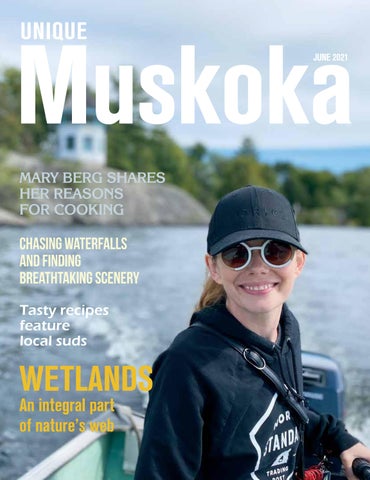
JUNE 2021
MARY BERG SHARES HER REASONS FOR COOKING
CHASING WATERFALLS AND FINDING BREATHTAKING SCENERY Tasty recipes feature local suds
WETLANDS An integral part of nature’s web
(Port Carling) Limited (705) 765-5700 brownsappliances.com
Your vacation begins here We have a variety of waterfront cottages, condos and cabins perfect for spring, summer, fall and winter. Let us match your family with the ideal holiday cottage or cabin rental for your next family vacation!
OntarioCottageRentals.com Find Us
1-877-788-1809 info@ontariocottagerentals.com
MUSKOKA | NEAR NORTH | GEORGIAN BAY | PARRY SOUND | HALIBURTON | KAWARTHAS | ORILLIA
CONSIDERING RENTING YOUR COTTAGE? LET’S CONNECT.
Call us toll free at 1-877-788-1809 or e-mail us at sales@ontariocottagerentals.com
[11]
...telling the Muskoka story 24 [32]
Wetlands – An Integral Part of the Web of Nature
Article by John Challis Wetlands are an integral part of the web of nature and are wellsprings of biodiversity. Described as the kidneys of the landscape by improving water quality and supporting microbial, bacterial and algal activity that digests nutrients, wetlands have drawn a lot of recent attention for their ability to control water flow during flooding.
32
Chasing Waterfalls – Breathtaking Scenes Abound
Features 11
For Mary Berg, The Reason to Cook Is to Share
Article by Sandy Lockhart Making delicious meals for family and friends was always a favourite way for Mary Berg to spend time at her Lake Muskoka island cottage. Today she is known as the star of CTV’s Mary’s Kitchen Crush and author of her first cookbook, Kitchen Party, and the winner of MasterChef Canada Season 3.
2 UNIQUE MUSKOKA June 2021
18
Sculptor Elise Muller Celebrates Femininity and Motherhood
Article by Bronwyn Boyer Photography by Kelly Holinshead From an early age, Elise Muller knew she would be an artist. When she took a stone carving course at Haliburton School of Art and Design in 2001, Muller knew she’d found her calling. Muller’s style is very evocative of femininity and motherhood. The mother and child theme has become a mainstay throughout her career.
Article by Matt Driscoll Photography by Andy Zeltkalns Waterfalls have long captivated guests to Muskoka and nature lovers, alike. The sheer granite rock faces of the area present a breathtaking backdrop for its many waterfalls. In this article, we look at a cross-section of waterfalls from around the region, including wellknown local attractions and lesserknown hidden gems.
[18]
CREATE YOUR DREAM SPACE
All About Kitchens The possibilities are endless BRACEBRIDGE 3 Gray Road 705.646.0347
HUNTSVILLE 4 Centre St. N. 705.789.6161
www.allaboutkitchens.ca
38
Changing Times, Changing Techniques – Ontario Fire College Closes
Article by J. Patrick Boyer The 20th century transformed firefighting as industrialization produced different fires which in turn spawned new equipment that required additional skills. For over 60 years, the Ontario Fire College in Gravenhurst would be a mainstay of fire service training and emergency planning until changing techniques and visions saw it close, earlier this year.
[38]
Opinion 9
64
By Don Smith
By Cheryl Cooper
Muskoka Insights
Muskoka Moments
47
Creating a New Purpose from Something Old
Article by Meghan Smith Photography by Tomasz Szumski In the digital world we now live in, it’s easy to find clothing swaps, second-hand stores, thrift shops and even family heirlooms through websites and social media. Muskoka artisans and businesses are finding unique uses for previously loved goods that are qualitymade, keeping these items from ending up in the garbage.
[47]
Departments 52
56
Article by Matt Driscoll and Karen Wehrstein Despite major flooding in the past decade, Muskoka experienced lower than average water levels, earlier this spring. District councillors couldn’t find a way forward when they debated the size of council, leaving any decision to the province. Policy changes are planned for Torrance Barrens, the province has confirmed $4.25 million in spending on the watershed while a romance story had a Unique Muskoka angle. For this and more, turn to What’s Happened.
Article by Karen Wehrstein Photography by Tomasz Szumski So, do you think beer is just for chugging down at a raucous bar or party? Please raise the level of your mental discourse just a bit to consider that, just like wine, Muskoka’s favourite brews can be used to flavour haute cuisine. Four Muskoka chefs share their recipes from main courses to desserts – all featuring local suds.
What’s Happened
JUNE 2021
Cottage Country Cuisine
[56]
MARY BERG SHARES HER REASONS FOR COOKING
CHASING WATERFALLS AND FINDING BREATHTAKING SCENERY Tasty recipes feature local suds
WETLANDS An integral part of nature’s web
Our Cover
Photography by Aaron Mariash Television cooking personality Mary Berg has been coming to her family's Muskoka cottage since she was a baby. Making delicious meals for family and friends is a favourite way for Berg to spend time at the Lake Muskoka island retreat. June 2021 UNIQUE MUSKOKA 5
…telling the Muskoka story
I N T R O D U C I N G THE K I A
Unique Muskoka is published six times per year by Unique Publishing Inc. Donald Smith Publisher and Editor Curtis Armstrong Director of Sales and Digital Marketing Donna Ansley Sales Lisa Brazier Design Susan Smith Administration Bronwyn Boyer J. Patrick Boyer John Challis Cheryl Cooper Matt Driscoll Kelly Holinshead Sandy Lockhart Meghan Smith Tomasz Szumski Karen Wehrstein Andy Zeltkalns Contributors
21 Robert Dollar Dr, Bracebridge, ON P1L 1P9
705-645-6575
Contemporary buildings in the natural landscape.
Annual Subscription Rates: (including HST where applicable) In Ontario $30.00 All Other Provinces $36.00 U.S. $60.00 All Other Countries $72.00 HST: 773172721 Canada Post Publications Mail Agreement Number: 43268016 Copyright © 2021 Unique Publishing Inc. No content published in Unique Muskoka can be reproduced without the written permission of the publisher.
Mailing Address Box 616, Bracebridge ON P1L 1T9 Street Address 28 Manitoba St., Bracebridge ON P1L 1S1 Peter Berton T: (416) 560-0630
72 Stafford Street, Suite 200 Toronto, ON M6J 2R8
6 UNIQUE MUSKOKA June 2021
E: pberton@plusvg.com w: plusvg.com
www.uniquemuskoka.com info@uniquemuskoka.com 705-637-0204
Inspired byNature w w w. b r a c k e n r i g . c o m | 7 0 5 - 7 6 5 - 5 5 6 5 |
info@brackenrig.com
D E SI G N
•
CO NS TR UCT ION
•
R ESTOR ATI ON
Restoring Muskoka’s heritage and building new traditions for over 45 years Quality workmanship and customer satisfaction far beyond any written warranty. Wayne Judges 705-645-0480 Jack Judges 705-646-7424 email: judges@muskoka.com
mba
Muskoka Insights Interestingly, for many, the ability to continue much of their daily routines has been remarkable. And, with that in mind, we have attempted to produce this issue of Unique Muskoka much as we have in the past. The environment has always been a priority for Unique Muskoka and in this issue, you can read about the integral role wetlands play in not only sustaining life but as mitigators of the impact of spring flooding in the feature Wetlands – An Integral Part of the Web of Nature by John Challis. Or, you can experience the outdoors through the photography of Andy Zeltkalns and the accompanying article by Matt Driscoll on Muskoka’s breathtaking waterfalls. Television cooking personality Mary Berg reminds us preparing food is much more than the act of creating something to satisfy our palates – it’s the opportunity to share with others. While we’re on the subject of food, we’d be remiss if we didn’t mention the offerings from Muskoka chefs in our regular feature, Cottage Country Cuisine, that includes the use of local brews in everything from main courses to dessert. Contributor Patrick Boyer chronicles the legacy of the Ontario Fire College and what lead to its closure earlier this year. Political decisions brought about its creation and political decisions, 60 years later, resulted in its demise. For those interested in being creative, you’ll enjoy learning about stone sculptor Elise Muller or the new life local craftspeople are breathing into cast-offs. Happy reading! Photograph: Susan Smith
For more than a year, Muskokans have shared a common concern with fellow Canadians and for that matter, most of the world. The impact of COVID-19 has been far-reaching. For many, referring to it as a concern trivializes the onslaught of a pandemic that has caused tremendous misery and made others confront death. It is important to recognize lives have been torn apart and sometimes, at a time of greatest need, many have only been able to comfort themselves with memories of good times. However, as I write this column, there are reasons to have hope and to feel positive. Many Muskokans have risen to the occasion, demonstrating their resiliency by volunteering, fund raising, sharing with their neighbours, being respectful of differing perspectives, finding ways to ease the pain. It is inspiring to hear those stories when they are shared. Hope also comes in the arrival of a summer that will soon be here and the knowledge COVID vaccinations of Canadians are surging. With summer comes the opportunity to be outdoors, even if we need to continue to take care with pandemic precautions. With the anticipation Canadians wanting a vaccine will have received the all-important jab in their arm within the next few months, there is reason to confidently begin planning for the future. That’s not to suggest there will suddenly be a change in course or that we can forget the challenges. We will have reason to celebrate but we must also take a step back and reflect on what could have been done better. While it has been 100 years since the world faced a pandemic of this scope, we also know there is no guarantee it will be generations before another one makes its way around the globe. It will be the lessons learned that will be so important for preparing for what might come.
Our local team is here to provide you with personalized insurance solutions. For the coverage your family deserves, call us today.
46 Ann Street, Bracebridge 705-646-9995 | 877-877-3929 www.LesBell.ca TRUST • INTEGRITY • SERVICE
Your Home and Cottage Mattress Centre
MUSKOKA CURATED COLLECTION by Marshall Mattress
THE LARGEST SELECTION OF IN-STOCK MATTRESSES IN MUSKOKA
6 Monica Lane, Bracebridge 705.646.2557 www.mattressesofmuskoka.com
June 2021 UNIQUE MUSKOKA 9
MENTION THIS AD AND SAVE AN ADDITIONAL 5% ON ANY CURRENT PROMOTION OF TEMPUR-PEDIC PRODUCT*
A great night’s sleep is just a call away. To learn more, call one of our Sales Professionals or visit our showroom galleries in Bracebridge and Huntsville.** Details are also available on our website www.leons.ca.
#1
IN CUSTOMER SATISFACTION WITH RETAIL MATTRESSES IN THE U.S. 3 OUT OF 4 YEARS*
part of the family Tempur-Pedic received the highest score among retail mattresses in the J.D. Power 2017 & 2019-2020 U.S. Mattress Satisfaction Studies of customers’ satisfaction with their mattress purchase.Visit jdpower.com/awards
*5% discount ends June 30 2021 **Pending ease of Covid-19 closure restrictions.
Photograph: Submitted by Mary Berg
Article by Sandy Lockhart
M
aking delicious meals for family and friends was always a favourite way for Mary Berg to spend time at her Lake Muskoka island cottage. Today she is known as the star of CTV’s Mary’s Kitchen Crush and author of her first
cookbook, Kitchen Party, and the winner of MasterChef Canada Season 3. Berg explains it was some of those same family and friends who convinced her to apply and compete in MasterChef Canada back in 2016. “I applied for Master Chef begrudgingly,”
she explains. “I auditioned with very few hopes.” She was also a bit nervous wondering, if she had professional success cooking, would it still bring her joy and help her relax. Would it, instead, cause stress if it was her career.
June 2021 UNIQUE MUSKOKA 11
Photograph: Geoff George/ CTV Life Channel
For Mary Berg, it’s the act of making a meal for someone else that is so important. She’s missed feeding family and friends through recent COVID restrictions but has adapted.
12 UNIQUE MUSKOKA June 2021
gathering for food at the house.” So, Berg saw a spot to be filled in her family. “When I was about seven, I started to make lunches and did some baking.” She recalls
Photograph: Submitted by Mary Berg
“I didn’t want to lose something I love,” she says. Berg says she is not competitive (except when playing euchre at the cottage) so competition was not the driving factor on Masterchef Canada. Instead, she pushed herself to learn all she could from the experience. “It was not my kitchen so there was no normalcy. It was a total 180 degrees from cooking in my own kitchen – with the cameras, not knowing what was coming next,” she says. “But I still felt comfortable, it was exciting and fun. It was the start of me publicly cooking.” Berg has cooked privately for years, both at the cottage and at her Toronto home. When she was about four years old, her family was in a car accident and her father died. Despite her young age, Berg saw how much it meant to her mother when people brought food to her house during this time. “Even if it was noodles and cheese from a neighbour,” she says. “I learned love, appreciation and family could be conveyed through a meal.” Her father had been the family cook and was known to feed a crowd. “My mother missed the people too,
Myra Berg has been bringing her daughter to the family’s island cottage since Mary was a baby and still spends time there each year.
“I’m not a weekend warrior,” Mary Berg says, explaining she
Photograph: Submitted by Mary Berg
doesn’t come up every weekend but instead making cornflakes and water for her mother comes for extended stays at the family cottage. when she was even younger, about 4. Her normal routine is to come up for three full weeks. “I used water because I was not old enough to be allowed to get the milk out of the fridge on my own.” By 11 or 12, she was making meals for the family. “I could help my mom and do something I enjoyed. My mother never liked cooking. She says, ‘it’s too messy.’” To Berg, it’s the act of making a meal for someone else that is so important and appreciated. “People get nervous about always having to cook something that is perfect.” Berg’s family has been in Muskoka for generations. “The island was my great, great grandfather’s logging camp on my mom’s dad’s side,” she says. Every original building was once something else, a bunkie or the mess hall. Today, signs of those old days can be found. THE RIOBEL MOMENTI™ COLLECTION Along the shore, there are large bolts in theAVAILABLE AT KNOWLES PLUMBING! rocks, that were once used to chain the floating logs. Like her mother and grandfather before her, Berg has been coming to the cottage since she BAT & spends KI TC EN was a baby H and still timeH there eachSH year. OW R O O M DESIGN. INSTALLATION. REPAIR S E RVING A LL OF M USKOKA 279 MA N ITOBA ST, BR AC EBR ID G E
70 5.6 4 5.2 67 1
K NOWLESP LUMBI N G .COM @MUSKOKA BATH
Muskoka’s Bath & Plumbing Centre
BATH & KITCHEN SHOWROOM SALES • INSTALLATION • REPAIR SERVING ALL OF MUSKOKA
279 Manitoba Street, Bracebridge
705.645.2671 @knowlesplumbing knowlesplumbing.com June 2021 UNIQUE MUSKOKA 13
marble & granite inc.
Les and Renata Partyka 1295 Muskoka Rd. 118 West, Bracebridge | 705.645.3380 | stoneway.inc@gmail.com
Granite steps & entrances Pathways & patios Retaining walls & boulder accents
14 UNIQUE MUSKOKA June 2021
Shrubs & trees Shoreline restoration Driveways & lot grading
Photograph: Geoff George/ CTV Life Channel
stoneway
She’s partial to the water in Muskoka Bay and explains why. “I believe the water you’ve been going to since you were a kid feels the best. I’ve been swimming at other cottages on other lakes but it’s not the same. The Muskoka Bay water of Lake Muskoka is the best!” The island has a shallow side. “That’s where I used to make mud pies with rocks and shells to decorate them,” she says. “As we got older, we went to the other side. At the rock face, it was deeper and we just jumped right in.” It was a great place to grow up because most residents of the island were family. As the years have passed, some cottages have sold but islanders are part of what Berg calls the “cottage family.” “I’m not a weekend warrior,” she says, explaining she doesn’t come up every weekend but instead comes for extended stays. As an adult, her normal routine is to come up and stay up for three full weeks, near the end of the summer. Last year was a bonus, as they spent almost three months at the cottage, staying well into fall. “The cottage is my favourite place to cook by far,” she says, “Both inside and outside.” At the lake, breakfast is a big deal. At least once a week, Berg makes blueberry pancakes
Photograph: Geoff George/ CTV Life Channel
Mary Berg plans to continue to develop new recipes and cook great new food. She’ll be releasing a new cookbook in the fall of this year.
– always purchasing the blueberries from the same Gravenhurst blueberry stand every year. “Eating the pancakes reminds me of being a kid,” she says. Outdoor cooking is a big part of cottage life. It’s an annual island tradition for everyone to gather for a potluck dinner which includes a huge clam linguini prepared by Berg. She says the big pot used to prepare the meal is so giant that it was her cottage bathtub when she was small. The cottage is also one of Berg’s most productive work environments. Every recipe for her TV show Mary’s Kitchen Crush in 2018 was written at the cottage. A new cookbook is coming out in the fall of 2021. “A whole chapter is dedicated to summer cottage recipes,” she says. These recipes were written at the cottage with Berg in the Barca lounger. “It’s my most productive place to work,” she says, and then adds, “hopefully, I can have some time to veg there this summer.” And a bit of cottage living is coming to TV this fall. Berg is filming a new series Mary
When a power outage strikes, SOMMERS RESIDENTIAL GENERATORS ensure that your home or cottage automatically stays powered on. A full range of generators that can be custom built to suit your home or cottage’s specific needs, so you’ll always have standby power ready.
MUSKOKA • PARRY SOUND Your Source For All Your Electrical, HVAC, Backup Power And Home Automation Needs. 705.765.0600 • www.sifftelectric.com • Port Carling ECRA / ESA 7002295 • TSSA 000365522
June 2021 UNIQUE MUSKOKA 15
Photograph: Submitted by Mary Berg
“I believe the water you’ve been going to since you were a kid feels the best,” says Mary Berg. “The Muskoka Bay water of Lake Muskoka is the best!” Makes It Easy on CTV. Rumour is that one of the 23 half-hour shows will feature the giant clam linguini celebration. She has missed feeding family and friends
16 UNIQUE MUSKOKA June 2021
through the last year’s COVID restrictions but has adapted. “Kind of in my own way, I’m able to continue through sharing food and recipes,”
Berg says of her time developing recipes for her book and television show. “I also do doorstop drop-offs. “I need to share – the reason to cook is to
Mary Berg is known as the star of CTV’s Mary’s Kitchen Crush and author of her first cookbook, Kitchen Party, and the winner of MasterChef Canada Season 3.
Photograph: Submitted by Mary Berg
share,” she says. And to those lucky enough to receive a drop off from Berg, it comes with a little responsibility. With recipe development, she needs comments and constructive criticism and appreciates feedback. Or when she’s made three cakes in one day, she just can’t eat that much food and her lucky friends receive the rewards of Berg’s hard work. And when it’s time to relax, she will be back up in Muskoka. “The products of Muskoka, are out of control delicious – it all tastes like summer.” This longtime Gravenhurst cottager is quick to list a few of her culinary favourites. “The Bakery has delicious apple fritters that are the size of your face. The butter tart lady at the Gravenhurst Market – I don’t make butter tarts because hers are the best and her gingerbread is fantastic, too. “Oh, and I love Sawdust,” she says. “They are brewing beer where I used to buy my stink baits for fishing when it was a Canadian Tire. From the Oar Restaurant, we had a really, really great take-out for our anniversary last year.” As for the future, Berg plans to continue to develop new recipes and cook great new food – and we know a lot of that will be taking place at the cottage. If you follow her on Instagram, you might see mention of some of her cottage favourites along with her other experiences. Berg is passionate about cooking. “I want to help others love it and to get as much joy out of cooking for others as I do.”
Muskoka Barging
Family run construction company with over 35 years experience operating in the Muskoka Lakes area. No job is too small or too big.
705-764-0765 | muskokabarging.com | 1163 Milford Bay Rd, Milford Bay ON
BARGING ● STEEL & CRIB DOCKS ● SEPTIC SYSTEMS ● LANDSCAPING
Call Mike Morrow
705.765.3195 www.morrow-electric.com
ESA License #: 7000286
Serving Muskoka Lakes since 1952
rewiring • alterations • heating
NEVER be left in the DARK or COLD: get a quality home standby generator by GENERAC
June 2021 UNIQUE MUSKOKA 17
Article by Bronwyn Boyer / Photography by Kelly Holinshead
E
lise Muller has never been confused about her calling in life. From an early age, she knew she would be an artist. Her grandmother Edith Muller was a stone carver, and although she passed away when Elise was quite young, the torch (or more accurately, the chisel) was successfully passed forward two generations. “I’d been around her sculptures growing up and I was always so drawn to them,” says Muller. “I have one of
18 UNIQUE MUSKOKA June 2021
her carving tools, which is really special to me. It was misplaced in her paint box that I ended up with, so I knew I was meant to have it.” A native of Hamilton, Muller attended an art design and mixed media program at a college in Dublin, Ireland for a year after high school. Next was fine art at McMaster University for two years. But when she took a stone carving course at
Haliburton School of Art and Design in 2001, Muller knew she’d found her calling. “I always loved art in all forms,” she recalls, “but I truly fell in love with stone carving. I felt I finally found my passion, the area that I really wanted to focus on.” The rest of Muller’s training was selftaught. Over the following 19 years, she continued experimenting with different stones and techniques. It wasn’t too long before the student became the teacher, and she became a part of the faculty at Haliburton
School of Art & Design teaching Soap Stone Carving Basics, which was the first course she took. In 1999, Muller and her partner Cirvan Hamilton settled in Muskoka on a 13-acre property near the Muller family cottage on Otter Lake. “I spent every summer there growing up,” she recalls. “It was so beautiful, and I could never get enough of canoeing and exploring the natural landscape.” Over the next few years, the couple worked away at building their business until Stone Tree Studio was born.
Elise Muller’s first sculpture was of a pregnant mother holding a child, carved after she had a miscarriage. The mother and child theme has been a mainstay throughout her career.
Initially, they both worked in the same small shop, which is now Muller’s showroom. Now, she works in what she calls her “stone shack,” attached to Hamilton’s furniture building studio. It has a garage door where she can bring large stone pieces in and out with a forklift. It also gives her a well-ventilated space to work, which is important due to the dust created by carving into stone. Meandering gardens featuring Muller’s work are situated between the buildings. They’ve been enjoyed by patrons of the Muskoka Autumn Studio Tour and the Dorset Studio tour over the years. The COVID 19 Pandemic has most certainly transformed the way artists approach their livelihoods, and Muller is no exception as she’s now making video tutorials for teaching or facilitating creative projects people can learn during quarantine. In 2018, Muller was the winner of the Canadian Sculpture Competition at Kingsbrae Garden in St. Andrews, New Brunswick. Attunement, a large sculpture of a mother and child, was her submission. Muller used red granite to carve the piece, which is special to the area. The sculpture is a permanent fixture of the Kingsbrae garden, which is a career highlight for Muller. “It was very exciting,” Muller recalls. “I didn’t expect to win at all. I’d seen the beautiful garden and the calibre of the other sculptures that were there, so I was very surprised.” Muller’s style is very evocative of femininity and motherhood. Her signature series is a collection called Bodies in Motion that features bodies swimming, diving, walking and skateboarding, to name a few. But even when the figure is meditating or relaxing in a dream, there is a natural movement that gives it life. Inspired by Kintsugi, the Japanese practice of putting broken pottery pieces back together with gold, Muller also paints gold leaf to extenuate the natural fault lines in the stone. In this way, Muller achieves a balanced marriage of stability and delicacy – solid archaic forms adorned with veins of sophistication and beauty.
June 2021 UNIQUE MUSKOKA 19
Sculptor Elise Muller begins the carving process with a diamond blade on an angle grinder to rough in the shape. Muller then uses smaller chisels to do the finer work. Mother and child, goddess archetypes, gargoyles and fantasy creatures, seen only in Muller’s imagination, are represented in her work. The shapes look abstract at a glance but upon closer inspection, the characters emerge. And this cast of characters ranges from giant statues to tiny, delicate figurines. The small ones can be challenging since the stone is not as forgiving. Jewelry is her bread and butter item. “It got me thinking, maybe I should take a jewelry making course and I thought, ‘oh no, here I go again – I’m all over the place!’” Muller has a good laugh at her endless drive to learn new creative mediums. “But it’s fun to see my necklaces floating
around,” she adds. “It’s a really nice feeling, I must admit.” Always eager to explore the many directions
an artist can take, Muller has also delved into formal training in art therapy. Muller’s first sculpture was of a pregnant mother holding a child, carved after she had a miscarriage. The mother and child theme became a mainstay throughout her career. She sold the piece at her first art show in 2003. “It was really hard to let go of that one,” she recalls. “But it inspired me to keep creating, and to help others do the same. Many people say they don’t have a creative bone in their body, or they can’t draw a straight line. But as soon as you give them the tools to play, they have the time of their lives. They learn that it’s not about the finished product. It’s about living in the moment and enjoying the process.”
While recent years have seen Elise Muller completing sculptures on a larger scale, smaller pieces, particularly jewelry, are her bread-and-butter items. 20 UNIQUE MUSKOKA June 2021
Whatever form her creativity takes, Elise Muller’s passion lies chiefly with creating her own sculptures. She finds working with stone, an ancient medium, is the most natural choice for her. Whatever form her creativity takes, Muller’s passion lies chiefly with creating her own sculptures. Working with stone is the most natural and ancient medium. “Stone is malleable but very durable,” Muller says. “That’s what I like most about it. It lasts forever.” Certainly, no matter how new the piece is, it looks like an ancient wonder found on an archeological dig. It comes as no surprise that Muller has always been drawn to archeology, which may well have contributed to her attraction to the art form. Muller begins the carving process with a diamond blade on an angle grinder to rough in the shape. Then smaller chisels, rifflers (curved files) do the finer work. The final stage is polishing with waterproof sandpaper in various grits. In this stage, high grit sandpaper must be rinsed out continually to keep it clean. Diamond backed fabrics are preferable for this job as they last longer than sandpaper, which gets used up in minutes on the rough stone. “There are so many different things you can do,” Muller explains. “Sometimes I leave a part rough to make a certain texture, such as a person’s hair, while the rest is sanded smooth.” Sometimes, tool marks are left to create a pattern or texture Muller likes. It could be considered a “mistake” in a sense, but she uses it to her advantage. Muller sources her stone online from the
U.S., Quebec and Vancouver primarily. Large blocks of yellow and purple limestone are shipped from B.C. as they can’t be found in Ontario. She also sources stone locally from other carvers and instructors whenever possible. There are advantages to each type of stone. Soap stone and alabaster come in a wide variety of colours. Muller likes St. George red granite for its durability and Italian Cararra marble for its beauty. Working with Cararra also makes her feel connected to famous stone carvers throughout the centuries. In recent years, Muller has been completing sculptures on a larger scale. In 2016 she sculpted a family taking a walk, which lives in front of the Dorset Health Hub. The Dancers is a large sculpture of a couple dancing in Indiana limestone for the Elora Sculpture Project, commissioned for the town of Fergus. Muller is also working on a large abstract piece of Cararra marble for a series inspired by rubber band shapes.
Floors for Home & Cottage
HARDWOOD • LAMINATE VINYL PLANK & TILE • VINYL ROLLS CARPET • CERAMIC • NATURAL STONE & MORE MODERN HOME CARPET ONE 350 Ecclestone Drive • Bracebridge
705.645.2443 carpetonebracebridge.ca
705-375-2797
muskokaseptic@gmail.com
TAYLOR CARPET ONE 30 Cairns Crescent • Huntsville
705.789.9259 taylorcarpetonehuntsville.com
Muller found that crumpled rubber bands create very interesting shapes, like Celtic knots. “Whenever I see a shape I like in a rubber band, I take a photo of it,” she explains. “Then I can carve my favourite ones later.” Muller would like to feature this series in a show called Tension and Release, in which photos and sketches of the rubber bands would accompany the sculptures. “I’d been wanting to try abstract sculptures but I needed inspiration,” Muller explains. “That’s where the rubber bands came in. You never know what’s going to inspire you.” Ultimately, Muller’s process is a co-creation between the artist and the medium. Some of the sculptures are planned out with a sketch or maquette (small plasticine or clay model) while others are improvised. “Sometimes I just go for it,” Muller says. “It feels like I’m just releasing what’s already there, as if the stone is in control of what it wants to be. Sometimes a piece will break off and the plan changes and ends up being something else entirely. It’s intuitive, working with the stone rather than against it. I try to listen to what the stone wants to be.”
Septic Pumping muskokasepticservices.com
Specializing in WATER ACCESS PROPERTIES 22 UNIQUE MUSKOKA June 2021
“Stone is malleable but very durable,” Elise Muller says. “It lasts forever.”
.
SIDING • SPECIALTY ROOFING • WINDOWS AND DOORS • DECKING • EAVESTROUGHS AND GUTTER PROTECTION
EMBRACE YOUR EXTERIOR We pride ourselves on offering the highest quality exterior products for your home or cottage, including siding, specialty roofing, windows and doors, decking, rain water management products and much more. Our experienced team leaders and installation specialists ensure every project has an organized schedule and that product, delivery, and installation specifications adhere to NorStar’s exacting standards.
norstarexteriors.com 705.645.8404 | 800.732.0158 SERVING MUSKOKA, PARRY SOUND & HALIBURTON REGIONS SINCE 1976 Supply • Install • Cash & Carry
Photograph: Scott Young for Muskoka Conservancy
Article by John Challis
W
etlands may seem an odd thing to emphasize as they tend to suffer from bad press. Ancient Greeks feared the Nile’s pestilential vapours. The Slough of Despond in The Pilgrim’s Progress was composed of the “scum and filth” of all humanity’s sins. Politicians talk of “draining the swamp.” On the other hand, First Nations hold wetlands in reverence. Mohawk culture, which includes the Wahta Nation, regards wetlands as a source of riches for medicine, food and raw materials. They offer a supply of black ash and sweet grass for making baskets, utensils and bowls, and ceremonial items. The new Water is Life display at the
24 UNIQUE MUSKOKA June 2021
Muskoka Discovery Centre relied heavily on knowledge of water and wetlands provided by the Chippewas of Rama First Nation. Aerial maps of Muskoka show wetlands are everywhere. On Highway 11, the entry to Muskoka is straight through the Jevins Lake complex, a wide-open expanse of cattails and willows and alders on the east leading into Jevins Lake. It’s a classic Muskoka wetland, dotted with peat mats, flanked by rocky barren uplands, giving way to fens, marshes and beaver ponds. It’s alive with aquatic insects, turtles and amphibians. Rare plant species and several hundred species of shrub, tree, rush, grass, reed and sedge thrive.
To the west, cut off by Highway 11, there’s a triangle with more of that marshy expanse. That’s emblematic of the fate wetlands often suffer. It’s easy to build roads through them, easy to blame them for the mosquitoes, easy to forget that they exist. We are beginning to realize, however, that wetlands are an integral part of the web of nature. Rather than being bleak and lifeless, they are wellsprings of biodiversity. They benefit both land and waterways. On April 20, the Ontario government renewed its pledge of funding to build a new initiative to protect and manage the Muskoka River watershed including its wetlands. Sixteen of 19 recommendations submitted to the province last year by the Muskoka River Watershed Advisory Group will be supported with the funds. Guiding it all will be an Integrated Watershed Management approach; a master blueprint to protect the ecosystem of the watershed and manage economic and human demands on it. It’s the holistic approach the advisory group’s chair, Mardi Witzel, was hoping for. A significant part of that approach will involve one niche of the watershed: wetlands. The proposed Integrated Watershed Management approach will be able to quantify how much Muskoka’s wetlands determine the health of the rest of the watershed. Unlike southern Ontario, where more than 72 per cent of the wetlands have been lost to development and agriculture, most of Muskoka’s wetlands are still intact. They make up an estimated 7.6 per cent of the entire Muskoka River watershed — an area of approximately 420 square kilometres. “We’re very fortunate in Muskoka,” says Muskoka Conservancy executive director Scott Young, “because we are in a position where we can protect wetlands, and nature. Further south, it’s all rehabilitation or restoration.”
There are some who feel the estimate of wetland area is low. Aaron Rusak, the land stewardship coordinator for the Muskoka Conservancy, says factoring in the linkages between wetlands — vernal pools, headwater creeks, and smaller fens and bogs – would add to the total. By that definition, Rusak says, “you could walk for miles in Muskoka and never leave a wetland.” Even a wetland mapping update commissioned by the District in 2009, using new digital aerial photography, acknowledged the challenge of defining wetland. The consultant found “the boundaries of the wetland often varied significantly, specifically in the southwest where the network of wetlands becomes very complex.” Broadly, a wetland is a transition zone between open water and dry land. The storybook image is of an area with ponds and water lilies and bulrushes. But a reedy shoreline or stream winding through a forest could qualify. It can also be an abandoned beaver pond; beavers have been the master architects of wetlands and meadows for centuries. Science classifies four basic types of wetland in Ontario: marshes, swamps, fens, and bogs. Marshes are areas that are almost always inundated with water and are dominated by non-woody plants such as reeds, cattails, rushes, sedges and grasses. Rusak breaks down marshes into cattail marshes and open water marshes: the difference is just as their names imply. Swamps are forested wet areas with trees that tolerate water around their roots: silver and red maples, black spruce, and large shrubs like alder and willow. The two remaining types, fens and bogs, are lookalikes. They both exist in depressions and build up deep deposits of peat formed by layers of vegetation that accumulate over centuries. Fens are fed by
June 2021 UNIQUE MUSKOKA 25
groundwater or streams, whereas bogs get all their water from rainfall or runoff. The locally scarcer bogs are more acidic and have low nutrient levels, while fens have higher oxygen content, more nutrients and more life to them generally. Highlighting just a few wetlands reveals the diversity of Muskoka’s wetlands. In 1992, the Muskoka Heritage Areas Program surveyed the 425-hectare (1,052 acre) Fawn Lake complex, describing it as “one of the largest intact conifer swamp forests in the District.” It stretches north from Bonnie Lake into Fawn Lake near Stephenson Road 1. Regionally uncommon
26 UNIQUE MUSKOKA June 2021
Swainson’s thrush, ring-necked snakes and blue spotted salamanders were found there. The survey identified at least 50 species of birds, 10 species of dragonflies and 161 species of plants, among a host of other creatures. Toward the southeast end of Gravenhurst, the Lewisham Wetlands is a 786-hectare (1,942 acre) network of marshes, bogs and forest swamps and features a great blue heron rookery. Regionally rare species of plants, ducks and butterflies are recorded. a vegetation list covers some 203 species of plants.
This baby blue Heron, captured near the Muskoka Conservancy’s Upjohn Nature Preserve, is among the species that rely on wetlands for their nesting and nursery.
Photograph: Jane Spencer for Muskoka Conservancy
Photograph: Lyndsie McGregor for Muskoka Watershed Council
Wetlands are an integral part of the web of nature. Rather than being bleak and lifeless, they are wellsprings of biodiversity.
Georgian Bay Township’s wetlands are ubiquitous, reflecting the region’s glacially scoured topography. Some are awe-inspiring, like the recently protected 2,300-hectare (5,700-acre) Tadenac wetland south of the Moon River. An appendix to the township’s official plan identifies 23 provincially significant wetlands. Life in wetlands is also diverse and complex, and Aaron Rusak enthuses about the changes from season to season. He sees the earliest signs of springtime activity in vernal pools — large puddles, basically, that fill up in fall and winter and dry out in summer. As the ice melts in those pools, wood frogs and salamanders arrive to mate and lay their eggs. Out in marshes, the first perceivable activity will be songs from returning song sparrows, then red-winged blackbirds, then common grackles: all welcome signs that warm weather is on its way. Not long after, the spring peepers begin their chorus. These tiny frogs gather in numbers so great their song can be deafening. They’ll be joined by the lazy snoring of leopard frogs. By June, green frogs and bullfrogs will be calling, and turtles will be laying their eggs. Above the reeds and cattails, uncounted species of butterflies, dragonflies, beetles and other insects will be filling the sky. In fens or bogs, pitcher plants and sundews patiently wait to trap and digest insects. Under the water, there’s a little-witnessed drama unfolding. It’s a rush to eat or be eaten. Dragonfly nymphs are voracious hunters, gobbling mosquito larvae and other invertebrates. Water tigers, predacious diving beetles, giant water boatmen, caddisfly larvae and water striders are all on the hunt for other aquatic meals. Wetlands are essential to nature but there are broader ecological and human benefits. They’ve been described as the kidneys of the landscape, improving water quality,
Photograph: Jane Spencer for Muskoka Conservancy
Loons, such as this family near Muskoka Conservancy’s Wolf Mountain Conservation Easement at Pen Lake, will benefit from efforts to maintain a healthy watershed in Muskoka. much water the wetlands can store, and how much that might help in a flood year. Trimble indicates that there are hydrology models that can determine the contribution of different features to flood storage but reiterates that a model needs data: the size, type and water retention of each corner of the watershed. Wetlands have additional value in urban areas. Anyone who’s watched a thunderstorm in town knows how quickly ditches and storm sewers overflow where there is nothing but concrete and rooftops. In the wilderness, Cragg says, the flow of precipitation is tempered by being caught in tree canopies. Remaining water trickles into the ground, or
runs into wetlands before being released slowly to rivers and lakes. In urban areas, wetlands that haven’t been infilled can sponge up runoff. The Muskoka Watershed Conservation and Management Initiative mandate is “to protect the environment and support economic growth.” Witzel laments that the value of wetlands in achieving those objectives has not been well appreciated in development policy. “Given the vital role that wetlands play in our natural environment, it is difficult to understand why they so often lose in the contest between development and preservation,” Witzel says. “Perhaps it is
Photograph: Scott Young for Muskoka Conservancy
supporting microbial, bacterial and algal activity that digests nutrients, including fertilizers and sewage runoff, that contribute to blue-green algae blooms. Kevin Trimble adds that wetlands buffer climate change. An ecological consultant with 30 years of experience in watershed ecology, Trimble is past chair of the Muskoka Watershed Council. He explains that layers of peat laid down by bogs and fens over generations create large storehouses of carbon. And wetlands help maintain the “water budget” — the storage and slow release of flood flows —moderating water levels both in high water and droughts. “Muskoka is one of the clearest examples of a strong link between the economy and the ecosystem,” Trimble says. The role of wetlands in flood flow has drawn a lot of recent attention. In the Muskoka Watershed Council report “The Evolution of Water Management in the Muskoka River Watershed,” author Chris Cragg recommended that wetlands be assessed for their capacity to retain floodwater. It’s not a novel idea: in Winnipeg, wetlands are being successfully employed as temporary reservoirs during spring flood along the notorious Red River. Cragg’s report also noted the use in other countries of inflatable rubber dams to temporarily increase the storage capacity of wetlands. The new provincial dollars will help gather data important to understanding how wetlands can be integrated into a locally designed flood control program. Currently, Cragg explains, there is a lack of data on how
Unlike southern Ontario, where more than 72 per cent of the wetlands have been lost to development and agriculture, most of Muskoka’s wetlands are still intact. June 2021 UNIQUE MUSKOKA 27
THANK YOU Frontline Workers ...we appreciate all that you do!
IT ’ S YOUR DREAM. WE BRING IT TO LIFE. CUSTOM HOMES & COTTAGES FOR OVER 45 YEARS For over 45 years, Tech Home has helped clients realize their vision of a beautiful & uniquely personal custom home. We build to the highest standards of quality at the most affordable pricing in cottage country. Visit our Gravenhurst Model Home or Toronto Design Centre, & we’ll bring your dream to life.
GRAVENHURST MODEL HOME
2278 Hwy 11N.| Gravenhurst, ON | P1P 1R1 1.888.417.8761
GREATER TORONTO AREA DESIGN CENTRE
130 Konrad Cres, Unit #18 | Markham, ON | L3R 0G5 905.479.9013
SERVING MUSKOKA / GEORGIAN BAY / HALIBURTON
1-888-417-8761 www.techhomeltd.com
Photograph: Scott Young for Muskoka Conservancy
because their value, even as it is widely understood in both ecological and economic terms, is not fully quantified and considered in environmental impact assessments.” She adds that the spectre of climate change is “threatening the function, resiliency and existence of these wetlands.” Over the past 30 years there has been incremental loss of wetland, a trend that could have negative consequences for the watershed if allowed to continue. However, Summer Valentine, the District’s director of planning asserts new policies give more teeth to wetland protection. The newest version of the District of Muskoka’s Official Plan exceeds requirements in the Planning Act, by protecting all wetlands regardless of their level of significance. “The current policy landscape is highly protective of (wetland) features in recognition of their environmental, social, and economic values,” Valentine states, adding that almost any development today will require a full environmental impact study to protect not just the features on the property but in adjacent areas. Still, development pressures continue to rise
Aaron Rusak, the land stewardship co-ordinator for the Muskoka Conservancy, says “you could walk for miles in Muskoka and never leave a wetland.”
STYLE DESIGN INNOVATION
Shoe Mount Glass
excelrailings.ca 705-646-2508
June 2021 UNIQUE MUSKOKA 29
Photograph: John McQuarrie for Muskoka Watershed Council
Life in wetlands is diverse and complex. The loss of wetland is a trend that could have negative consequences for the watershed, if allowed to continue.
in Muskoka. The conservancy’s Young worries about the impact on existing wetlands. “People are developing land where wildlife should be the priority, where there are intact ecosystems,” Young says. Fragmentation of habitat is another serious problem. Lots cannot be created without road access, and roads break up important habitat for species that need the larger territory. Outside policy, there is strength in citizen action. Such is the case with Bracebridge’s Henry Marsh. The area has been the site of a number of concerns. Local residents and members of the Muskoka Field Naturalists Club have reminded town councils of the natural and ecological value of the area. They showed that Henry Marsh is part of a much larger hydrological feature called Beaumont Wetlands Complex, beginning as a series of springs running from glacial deposits underneath Muskoka Airport. Springs in this wetland complex feed waterways and ponds in a wide swath of territory west and south between Muskoka Beach and Stephens Bay, including Henry Marsh, all eventually leading into Lake
Muskoka. The complex supports a significant variety of bird life, including the rare and threatened Least bittern. Migratory birds stop here to recharge before continuing their journeys. Al Sinclair, a founder of the club, is rightly proud that many ill-advised projects over 30 years have not proceeded or have been altered, at least in part due to the club’s efforts. Muskoka’s protected lands are growing. Muskoka Conservancy has acquired more than 1,100 hectares (2,700 acres), much of it wetland. The Georgian Bay Land Trust and the Lake of Bays Heritage Foundation conduct similar work. With the Crown Lands included, the protected space adds up. But, says Young, “It’s a drop in the bucket.” As more land is protected, more people gain awareness. “We want people to learn more about nature, because you can’t love something you don’t know anything about,” Young says. With more awareness, and more love, Muskoka’s wetlands may continue to thrive and benefit both wildlife and humans.
CRUISE & DISCOVER! Featuring: Amazing Cruises Stunning Exhibits Family Activities Private Events
Tickets & Information 1-866-687-6667 WWW.REALMUSKOKA.COM MUSKOKA WHARF, GRAVENHURST
30 UNIQUE MUSKOKA June 2021
~ Muskoka ~ Serving Muskoka and area for 32 years
DIVERSE SELECTION OF PRODUCTS TRADITIONAL AND CONTEMPORARY DESIGNS KNOWLEDGEABLE STAFF TO ASSIST YOU WITH BEST SELECTIONS, WORKING ALONGSIDE YOUR ARCHITECTS, DESIGNERS AND BUILDERS ON YOUR NEW OR RENOVATION PROJECTS
sales@windowworksmuskoka.net 2358 HWY #11, RR#1 GRAVENHURST, ONTARIO
705-687-7617 1-800-668-9858 www.windowworksmuskoka.net Authorized Dealer
The Black River tumbles over several falls near the community of Vankoughnet. Smaller sections of the falls are visible from the road but the larger ones, bordered by private property, can only be seen from a canoe or a kayak.
Article by Matt Driscoll / Photography by Andy Zeltkalns
F
rom the raging torrent of Bracebridge Falls in the springtime to the diminutive trailside streams trickling their way towards Muskoka’s countless lakes and rivers, waterfalls have long captivated guests to the region and nature lovers alike. With an estimated 1,600 different lakes, two major watersheds and numerous subwatersheds, Muskoka is home to dozens of waterfalls of all sizes and descriptions. The waterfalls of the region are unlike any others in the province as the waterways in Muskoka traverse the southern tip of the Canadian Shield. The rugged rock formations of the region
32 UNIQUE MUSKOKA June 2021
have been carved by the lakes and rivers of retreating glaciers in prehistoric times. The sheer granite rock faces of the area present a breathtaking backdrop for its many waterfalls. In this article, we look at a cross-section of waterfalls from around the region, including well-known local attractions and lesser-known hidden gems. Although the waterfalls in Muskoka range widely in terms of size, drop and water volume, it is important to remember that bigger does not always mean better. Some of the smallest falls in the area are also some of the most enchanting.
Waterfalls are often a favourite subject for nature photographers and many of the waterfalls in the region are located near public lands or parks making them easily accessible to everyone. However, it is also important to note that one must exercise caution in their vicinity, as water conditions at the falls can be dangerous, specifically during the spring months, and conditions can change quickly. If Muskoka is known as one of the waterfall capitals of Ontario, then the town of Bracebridge is the cornerstone. Bracebridge has many beautiful smaller waterfalls that can be found tracing alongside hiking paths and
country roads but the largest and best known in the municipality are Wilson’s Falls, High Falls and Bracebridge Falls. Located in the heart of the downtown, Bracebridge Falls is the town’s most prominent natural landmark and has been since the town was established. Aside from its natural beauty, Bracebridge Falls has also been a vital component of the area’s industry and economy for more than a century. In 1894, the Bracebridge Village Council purchased a waterpower generating plant at the falls to supply electricity to the community. The decision marked the town as a pioneer in the creation and supply of hydroelectricity, as Bracebridge became the first municipality in Canada to own and operate its own water-powered electrical generating station. The 84 kilowatts of electricity produced at the plant provided for the early needs of Bracebridge’s residents. The value of the installation was apparent and a second turbine was installed to pump water up the main street of town.
Located in the heart of the downtown, Bracebridge Falls is the town's most prominent natural landmark. By purchasing a waterpower generating plant in 1894, Bracebridge became a pioneer in the creation of hydroelectricity. A new turbine and generator were added at the falls in 1905, and a significant upgrade was completed in 2012 which expanded the facility’s capacity to 2.6 MW. Upgrades to the facility involved modifications to the
existing powerhouse, turbine and generator replacement, installation of a new penstock, electrical system upgrades and deepening of both the intake and tailrace channels. The latest upgrades were also followed in 2017
Wilson’s Falls is a series of waterfalls that span a longer stretch of the Muskoka River than Bracebridge Falls but are comprised of a more gradual vertical drop.
June 2021 UNIQUE MUSKOKA 33
High Falls (in both photos, above) is easily accessible to the public and intrepid explorers can find five separate waterfalls located at the High Falls site. High Falls Park and the accompanying trail system offer the chance to stop for a picnic and trek around the falls. by the addition of a colourful permanent light display for both the power plant and the falls. Public trails circle Bracebridge Bay where the falls are located and trail goers can even traverse a walkway over the top of the falls. The hydro plant provides a viewing platform to look at it over the falls, while the
34 UNIQUE MUSKOKA June 2021
Bracebridge Bay parkette on the north side of the bay and Kelvin Grove Park on the south provide a different look at the falls as they carry the Muskoka River west to Lake Muskoka. Thousands of spectators typically pack Bracebridge Bay on Canada Day for the annual fireworks and laser light show.
Further east along the Muskoka River, Wilson’s Falls also boasts a power plant of its own and a network of scenic trails nearby. The power plant at Wilson’s Falls is slightly newer than the plant at Bracebridge Falls, having become fully operational in 1910 with a 600-kilowatt capacity. The build came after the plant further downriver at Bracebridge Falls proved extremely successful. Along with the existing plants, the new plant at Wilson’s Falls provided enough capacity to see the region through both the first and second world wars. In 2010, the plant, penstock and intake were demolished and a new 2.9 megawatt double regulated Kaplan turbine was installed at a cost of $9 million. Wilson’s Falls is a series of waterfalls that span a longer stretch of the river than Bracebridge Falls but are composed of a more gradual vertical drop. The falls and accompanying trails are accessible to the public via a parking lot on River Road, or several trail heads in the residential neighbourhoods in north Bracebridge. The 3.6 km Wilson’s Falls trail system is a local favourite, winding down a hilly upper section towards the falls and along the banks of the Muskoka River. Further north, up the river and just off Highway 11, High Falls Park and the accompanying trail system offer the chance to stop for a picnic and watch the Muskoka River cascade some 16 metres over the rugged Canadian Shield. High Falls is the third major waterfall in Bracebridge and also boasts a hydroelectric plant operated by Bracebridge Generation. As the demand for electricity increased dramatically following the Second World War, the local hydro providers decided to harness the waterpower of one of the region’s largest waterfalls. The total cost to construct the High Falls plant was $233,000 which at the time created a surplus of about 750 H.P. (560 kilowatts) of capacity. In 2005, Unit 2 was installed at a cost of $4.5 million. High Falls is easily accessible to the public and intrepid explorers can find five separate waterfalls located at the High Falls site. Those falls include Pott’s Falls, Muskoka Canyon Falls, Little High Falls, Big High Falls and a fifth man-made falls.
Rosseau Falls consists of the upper and lower Rosseau Falls, which together serve to empty the Rosseau River into Lake Rosseau. In the spring, a torrent drops more than 30 metres. To the east of the town of Bracebridge, although still technically located within the municipality, the quaint village of Vankoughnet also plays host to its own unique waterfall. Vankoughnet lies along the banks of the
Black River, which tumbles over several falls near the village. Although some smaller sections of the falls are visible from the road, the larger ones are bordered by private property and can only be seen from a canoe or a kayak. The same holds true for several
other waterfalls along the Black River. By contrast, Rosseau Falls are much more easily accessible, with a parking lot located just off Highway 141, roughly 7 km southeast of the village of Rosseau. Rosseau Falls consists of the upper and
Skeleton Lake Falls, which is sometimes known as Hatchery Falls, can be accessed by parking at the now closed Skeleton Lake Fish Hatchery on Fish Hatchery Road. Trail signage on the way to the waterfalls offers information on local flora and fauna. June 2021 UNIQUE MUSKOKA 35
Sales & Service of Major Propane Appliances (refrigerators, ranges, fireplaces, furnaces & more) Safe & reliable No electricity required Bulk propane delivery to your home or cottage
The Hollow River descends over a smooth granite surface to form the Hollow Falls, also known as Long Slide Falls, slightly north east of Dorset, off Haliburton County Road 8. A brief hike reveals a gently sloping waterfall sliding over the Canadian Shield at a roughly 30-degree angle. lower Rosseau Falls, which together serve to empty the Rosseau River into Lake Rosseau. In the spring, a torrent drops more than 30 metres. As water volume decreases later in the year, the exposed granite presents an entirely different vista.
Situated just a few kilometers to the east along Highway 141 lies Skeleton Lake Falls, which is sometimes known as Hatchery Falls. This waterfall system can be accessed by parking at the now closed Skeleton Lake Fish
705.645.4294 TF: 866.645.4294 STORE: 228 TAYLOR RD., BRACEBRIDGE OFFICE: 1646 WINHARA RD., GRAVENHURST
36 UNIQUE MUSKOKA June 2021
Bala Falls marks the location where the water from Bala Bay on Lake Muskoka empties into the Moon River. In turn, the Moon River winds some 40 km before flowing into Georgian Bay.
Hatchery on Fish Hatchery Road, and then by following a 15 to 20 minute trail through open fields and woods. The trail includes interpretive signs which educate guests on the surrounding flora, fauna and geography. The falls themselves consist of water cascading over a roughly 8 metre drop, which carries the Skeleton River into nearby Skeleton Lake. In the community of Bala, guests can find the scenic Bala Falls situated in the heart of the community. These falls are easily viewed by all guests as they are located directly underneath the main roadway in town – District Road 169. For the best view of the falls, head out onto the viewing platform attached to the hydro plant. The observation deck is open to the public daily beginning on Victoria Day weekend from 9 am to sunset. COVID protocols do apply so please bring your masks and stay socially distanced. Access to the bottom area of the north falls is also available via Margaret Burgess Park, and access to the bottom area of the south falls will be available again when the work to the Portage Landing Park is complete. The work is expected to be complete by the end of June. The falls mark the location where the water from Bala Bay on Lake Muskoka empties into the Moon River. In turn, the Moon River winds some 40 km before flowing into Georgian Bay. On the opposite side of Muskoka, the Hollow River descends over a smooth granite surface to form the Hollow Falls, also known as Long Slide Falls. These falls are located slightly north east of Dorset, off Haliburton County Road 8. The falls are largely hidden from the roadway by trees and a high granite ridge. However, a brief hike reveals a gently sloping waterfall sliding over the Canadian Shield at a roughly 30-degree angle. Regardless of where you might find yourself in Muskoka, you will never find yourself very far from a waterfall. With a little bit of research and planning, one can find themselves whiling away the hours or even the days discovering what makes the region sought-after by nature lovers and waterfall chasers near and far.
CANOE TRIPS & DAY TRIPS
NEW ONLINE STORE
ALGONQUIN PARK • HALIBURTON HIGHLANDS • MUSKOKA 1-800-469-4948 ALGONQUINOUTFITTERS . COM 705-787-0262
NEW
Muskoka residents who call 9-1-1 with heart attack symptoms may be taken directly to RVH in Barrie An advanced cardiac team is ready and waiting at RVH to deliver specialized care. Always call 9-1-1. Never take yourself, or your loved one, to hospital.
Royal Victoria Regional Health Centre
Know the signs:
· chest discomfort · sweating
· neck and jaw discomfort · shortness of breath
· nausea · light-headedness
June 2021 UNIQUE MUSKOKA 37
Article by J. Patrick Boyer
38 UNIQUE MUSKOKA June 2021
William J. Scott, a 35-year-old lawyer from Owen Sound, had become Ontario’s second Fire Marshal. Scott designed a comprehensive plan to vastly upgrade firefighting and emergency civil defence responses in Ontario. Education and training of all members of the province’s fire services, organized principally through Ontario’s 450 fire departments, would be a two-track initiative. One track would school fire officers, those who supervise and direct local fire brigades, devise strategy on-site to combat infernos and give orders. They would be taught and trained at one central fire college. The other track, for the much larger number of front-line firefighters who follow fire officers’ orders, would receive ongoing regional training by the FMO and in their own fire Public Archives
services. Hearst named Edward P. Heaton the province’s first fire Marshall and he was still holding the position almost 30 years later when Liberal leader Mitch Hepburn became premier in 1934 and began firing everyone appointed by Conservatives. By 1935
Photograph: Gra venhurst
F
rom Ontario’s inception, dousing fires and saving lives was a local matter. After all, who better to respond to emergencies than those closest to them? Once communities did form fire departments, whatever training firemen got was still local, consisting of a welcoming word followed by learning on-the-job. A fire hall and gear were whatever cash-strapped councils provided. Cities hired and paid firefighters while smaller centres depended on volunteers. Such details paint the larger picture across Ontario. The 20th century transformed firefighting as industrialization produced different fires which in turn spawned new equipment that required additional skills. In 1933 Bracebridge replaced its horse-drawn fire wagon and wintertime fire sleigh with a fire truck. Rock and Tom, the Town’s handsome team of workhorses, went to toil on Captain Wes Archer’s Browning Island farm, while teamster Aboil Leishman learned to drive the new truck. During the First World War, and reflecting the evolution in firefighting by 1916, Premier William Hearst’s Conservative government established a provincial office to co-ordinate fire
The program for official opening ceremonies of the Ontario Fire College on August 22, 1958, shows Ontario Premier Leslie M. Frost in white fire chief’s helmet and Ontario Fire Marshal William J. Scott.
Photograph: Gravenhurst Public Archives
Above: At a fire college burn building to train in attacking a residence fire, three platoons, left to right, deploy to a split-level entrance, a ground-level door, and reaching a top floor window by ladder. Below: In 1957, for the college’s class on Atomic Fire Hazards in Industry, hand-lowered blinds darkened the lecture room for projected images on the wall screen. departments by officers who’d been to fire college. Ontario’s premier Leslie Frost agreed with Scott that a special campus devoted exclusively to training and educating fire officers was needed. In 1949, Attorney General Porter introduced the Fire Departments Act in Ontario’s legislature, implementing Scott’s training policy. Section 17 authorized the Fire Marshal to establish, maintain and operate a central fire college for the training of fire department officers; establish and operate regional fire schools for the training of firefighters; and provide travelling instructors for firefighters. Costs would be paid out of funds the Legislature appropriated for these purposes. On November 24, 1950 the Globe and Mail reported Premier Frost and AttorneyGeneral Porter’s jointly announced “Ontario’s new training college for firemen will be set up immediately at the ranger school near Dorset.” In addition to programs featuring the latest firefighting apparatus and devices for the complete training of firefighters, civil
defence training for fire departments was to be included in the curriculum. In Cold War lingo, “civil defence” was shorthand for dealing with the aftermath of atomic bombing, including raging fires and deadly radiation. Fire Marshal Scott emphasized these training schools, every other year, would bring all the region’s fire departments together for both awareness and training. Scott referenced the importance of measures ensuring the ability of neighbouring fire departments to work together. In tandem, converting over
103 different hose-thread sizes and 24 hydrant opening nut sizes across Ontario’s fire departments was a precedent-setting step that became a model for other jurisdictions. These steps and use of common standards across the province meant firefighters could, as Scott and Frost put it, “coordinate their actions” for “the effects of atomic warfare.” Despite a fire college being authorized by the legislature, Ontario’s Fire Marshal had to keep pushing it, because the government seemed stalled. He had advised the premier and cabinet he thought Dorset was unsuitable. Its existing forestry facilities had other purposes. It was a small community lacking resources to support a college attended by thousands of fire officers each year. Even reaching the village straddling the MuskokaHaliburton boundary was inconvenient in the early 1950s, with no railway or airport nearby. But where was the college to go? With his Fire Marshal opposed to Dorset, Frost simply turned to other more pressing issues. However, delay spawned a paralyzing
June 2021 UNIQUE MUSKOKA 39
Photograph: Boyer Family Archives
In 1962, this officially designated heritage building, anchoring the Ontario Fire College from inception, was named Scott Memorial Hall in honour of Ontario’s visionary and hard-driving Fire Marshal William Scott, who served from 1935 until his death in 1960. Above all others, Scott can be credited for OFC’s creation, the first residential fire training college in Canada. counties and their many fire departments. Passenger trains reached the town several times a day. An airport was close at hand. The land in question fronted directly on Lake Muskoka’s limitless water supply for firehose training. He provided contacts, agreed to arrange an on-site meeting, and answered all the Fire Marshal’s questions about the town and its unused hospital facilities. When well-pleased Fire Marshal Scott stepped back out onto the front verandah, a structure built in 1884, it momentarily seemed the entire plan for a fire college might come to naught. Scott was excessively portly. He signaled for his driver across the street, then began to heavily descend the heritage steps. The man’s great bulk on the top one
Photograph: Gravenhurst Public Archives
tug-of-war for the increasingly coveted college. Frost had to face Fire Marshal Scott in a 1956 high-stakes showdown over establishing the fire college. The dilemma was all about location, nothing more. Scott, too, wanted a central location in the province, but for strategic rather than political reasons. Frost concluded Muskoka District could serve admirably – part of Ontario’s northland, yet convenient to populous southern Ontario where most fire departments operated. He understood perfectly how attending college in Muskoka would be seen by fire officers as a rewarding sort of working-vacation. At Frost’s suggestion, Scott arrived in Muskoka to discuss locations with the District’s representative to Queen’s Park, Bob Boyer. MPPs did not attend sessions most of the year, as they do today, and continued to carry on their other work in their electoral districts. That summer in Bracebridge, Boyer answered the phone in his editor’s office at The Herald-Gazette. When the man phoning identified himself, the freshman MPP suggested a more private place to meet. In the front room of Boyer’s Kimberley Avenue home, he readily agreed with Ontario’s Fire Marshal Scott that a provincial training college could be ideally located in Muskoka District. Boyer recommended to Scott, the lands of Gravenhurst’s tuberculosis sanitariums would ideally suit a fire college. Gravenhurst was in Muskoka’s south, closest to Ontario’s populous
Proper staging of fire-fighting operations includes preparation of required personal protective gear, as seen spread out on a staging tarp at Ontario Fire College. 40 UNIQUE MUSKOKA June 2021
was all it took for him to disappear. With a loud crash, the eminent person vanished amidst a rising cloud of wood dust. Boyer, his face redder than any fire engine had ever been painted, scrambled down into the rubble, just as the Fire Marshal’s chauffeur sprinted from the street. The MPP’s son, who’d eavesdropped on their entire conversation, rushed to help. On August 15, 1957 the Ontario Government bought the Muskoka Free Hospital property from the National Sanitorium Association. Gravenhurst Mayor Wanda Miller and Muskoka MPP Bob Boyer were informed of this historic step for the province and District. Each felt triumphant. Fire Marshall Scott’s pent-up desire to bring information and training to the fire service about civil defence, the aftermath of atomic war and risks of radiation generated the fire college’s first course in October 1957 – almost a year before he and Premier Frost officially opened the place. This component of the college’s curriculum would become a mainstay of fire service training and emergency planning for the next two decades. Ten months after that inaugural course on atomic fire hazards, on the bright summer morning of August 22, 1958, Leslie Frost came over to Gravenhurst from his home in Lindsay to share with Fire Marshal Scott the long-anticipated opening of Canada’s first residential fire college, also one of the first in North America. On hand for this ceremony were some 300 Muskoka, Ontario, Canadian, American and international officials, as well as proud local citizens.
Photograph: Gravenhurst Public Archives
Various sanitorium structures – including Massey Hall, the Director’s Residence, and the Instructors’ House – would continue to serve the new institution. The spartan dining hall, which seated 45, offered simple fare. Gravenhurst restaurants flourished. Many drinking spots in town also gained favour with fire college students, some with walls jubilantly displaying dozens of Ontario fire department crests. Swimming in Lake Muskoka from the fire college dock was popular. As for Ontario Fire College, or OFC, itself, many more buildings and structures – from laboratories and firegrounds to more classrooms, a library, residences, and a fitness and workout room for staff and officerstudents – would be added, reconfigured, and modernized, right up to 2020. Through the 1990s, the college’s curriculum not only kept advancing in tandem with increasingly complex fire events and rescue incidents but expanded to training in corporate management of fire departments. The fire college forged partnerships with community colleges and provincial universities for courses in management and adult education including diploma and degree-related programs. From the 1950s to the 1990s, Fire Marshal Scott’s two-track configuration for fire service training underwent plenty of reshaping. Emphasis on civil defence had faded. Methods and equipment for firefighting and responding to other emergencies evolved over the six decades of the fire college’s existence, which gave rise to continuous advances in facilities and training programs. Buildings were added and expanded to accommodate a student enrollment as it grew from about 200 officers in the early years to over 6,000 students enrolled annually in various courses and programs. An example of the changing emphasis was the fire college’s “flashover unit,” designed to let firefighters view the all-consuming flash fire without the full effect of its intense heat. Great risks face firefighters from “flashovers,” the rapid significant increase in fire growth from a specific source to every other combustible object in the enclosed room or building, without actual flame contact, because intense heat has brought the objects
Ontario Fire College had many laboratories for technical instruction in fire prevention and control, including fire alarms, fire extinguishers, and fire suppression systems (above). to their flash point, usually temperatures from 500 to 1,000 degrees. The flashover is deadly for those caught in it. Central to officer training operations was the multi-purpose Fire Technology Building, opened in 1967. Its amphitheatre-style classroom and fire engineer’s laboratory and offices were the main features. The fire engineer conducted investigations into fatal fires using fire-scene reconstructions and test burns. A number of non-traditional classrooms were also created as demonstration labs for practical training of fire-prevention officers. For instance, the Alarm Systems Lab, with the many types and variety of alarm systems wired for demonstration purposes, enabled hands-on learning about the warning devices in high-rise office towers and residential apartments and condominiums, and in industrial premises. Combating fires is the consistent core skill of fire services, developed at the college in tandem with other aspects of fire service work – from civil defence to rescue, responses to terrorist events, and administration of modern-day fire departments operating in a maze of government regulations and behavioural protocols. In late 1989, three decades after the fire college opened, Director Garnet Schenk decided the college needed a library. He asked
local resident Judy Humphries, a teacher/ librarian, to open a small library. It would require just “a few hours a week,” assembling “a few books and fire journals in a small portable.” He’d bought the modest library’s used portable at a bargain from adjacent Muskoka Regional Centre, another provincial institution occupying another former sanitarium. In January 1990, Humphries began as fire research librarian of the college. Within five years, the portable had been outgrown. College carpenters added a walkway to a second, double-width portable. By 2005, during a robust construction and expansion program at the fire college, a new library was included as part of the fire tech building. When adding art to the Library in 2005, it became clear the affection and respect people held for Ontario’s Fire College. The Training Officers’ Association, Mnjkaning Fire Department and the Tel Aviv Fire Service – all donated artworks. Ontario Fire Marshal John Bateman added another original oil painting by Robert Bateman, his brother. Continuously upgrading fire college facilities meant major renovations and additions in 2004 and 2005. A new entrance was constructed, a reception area added, and an atrium. A large classroom for 150 officerstudents with embedded technology was added, its sliding wall able to convert the
June 2021 UNIQUE MUSKOKA 41
Photograph: Gravenhurst Public Archives
space into two classrooms. The one captain. original bays for fire apparatus The Fireground included a and the mechanic’s office were high-rise burn-building, and a fully reconstructed. split-level suburban house, Starting in 1957 with first where flames roared up and director D.E. Barrett, until 1990, pushed smoke out windows. the college’s succession of Firefighters now had to deal with directors lived in what had once the situation, practicing various been the hospital director’s skills under direction of a ground residence. In 1990, the entire commander, while a fire safety building became the college’s officer engaged rapid administrative centre, with offices intervention teams and rehab for the registrar and her assistant Fighting fire at a ground-level door, these fire officers implement training officers in addressing the fireon the ground floor, with the instruction about keeping low, supporting each other and contending with fighting operation. extreme hose pressure. second and third floor residential The fire college in recent accommodation available for visiting suspended life as we knew it and then the decades saw the provincial government dignitaries. government closed its fire college. increasingly expand permitted use of its A new residence for officer-students The 2004-2005 reworking of the fire facilities for training others besides fire opened in 1984, offering individual quarters college included a new road cut through officers. Among these are the Ontario for 100 students, common washrooms, quiet bedrock to a slightly lower section of the Provincial Police marine unit, the OPP’s study rooms and a computer lab, continued property where a newly erected fire hall Canine Unit, the Municipal By-Law to be updated and refurbished. In January housed five apparatus bays, classrooms and an Enforcement Officers Association, staff teams 2020, all hundred student rooms were office. At this “Firegrounds” facility, working on special projects for the Solicitor entirely refreshed with new flooring, drapes, combinations of officers and firefighters were General’s ministry, as well as employees of the beds, desks, chairs and lamps. Only a few trained to deal with a variety of scenarios, Attorney General’s ministry engaged on were slept in since because COVID- forming into platoons of four firefighters and special assignments.
1-705-706-4927 SUNROOMSBYDAVLIN.CA info@sunroomsbydavlin.ca
Your Muskoka Specialist for Sunrooms, 3 season windows, Aluminum and Glass railing systems Available through your contractor or directly through Davlin
June 2021 UNIQUE MUSKOKA 43
Photograph: Gravenhurst Public Archives
By the 1990s, leaders of Ontario’s fire service had begun pushing for fire officer education to be decentralized from Gravenhurst. The college at Gravenhurst then created curriculum to these standards for all major positions within fire departments. To enable local fire departments and regional centres to offer provincial-standard teaching and training in their own communities, the fire college next partnered with Ryerson University and several community colleges to gain recognition for its courses so that fire officers passing them could earn certificates and degrees in their area of fire service management. Launch of this fire college train-the-trainer program was a significant shift in what had been practiced from the college’s inception. For decades, officers who’d studied at the college in turn passed on their learning, and applied it themselves, in their own departments. This revamp now meant fire departments could teach the curriculum inhouse, completed by several days of finishingoff instruction at the fire college. These steps led to moving more and more of the program out of the fire college – not to
This memorial to firefighters who perished when saving the lives and property of others was dedicated by Lieutenant-Governor Lincoln Alexander. Each October, a memorial service is held. existing local fire departments but to newly built regional centres. By 2021, the college campus of 26 buildings included labs, classrooms, a library, a 100-person dormitory, full fire hall with fire engines, and many buildings for fire-training practice. To officially close the fire college doors for the last time this year may seem, to those who judged it had completed its mission, just a necessary formality. To others, this current event is seen differently: a
wrenching, unnecessary and even irresponsible end to a training facility evolved and operating with resounding success. As a reminder of the human cost of service to community, the Firefighters Memorial on a grassy knoll in the heart of the campus enshrines in memory those in firefighter ranks who perished while carrying out their duties. Each October, it also became site of a memorial service, held in conjunction with simultaneous services at the provincial firefighter monument at Queen’s Park. As reminder of the power of individuals to think, act and leave the world a better place, the splendid heritage building anchoring first the Free Hospital and then the fire college was renamed “Scott Memorial Hall” in 1962, two years after the death at age 60 of Ontario’s remarkable Fire Marshall William J. Scott, OBE, Q.C. His ardent desire to improve fire services during 25 years in public life had many dimensions, beyond being the individual most responsible for the fire college’s existence, all stemming from his resolve to better equip others for perilous work in front-line emergency service.
GBS Contracting Inc.
44 UNIQUE MUSKOKA June 2021
GET GUARANTEED REPLACEMENT COST INSURANCE ON YOUR COTTAGE & CONTENTS
DON’T SETTLE FOR BASIC COVERAGE If all your current insurance company can offer you is basic coverage on a secondary/seasonal home, make the switch to CottageInsure and fully protect your cottage and belongings in the same way your home insurance policy does.
COTTAGE & LAKE ASSOCIATION MEMBER DISCOUNTS
DISCOUNTS FOR FIREBOAT RESPONSE SERVICE
EXTRA COVERAGES FOR GARAGES, GUEST CABINS & WATERCRAFT
Get a FREE Quote in just five minutes by clicking: cottageinsure.ca or Call 1-877-541-9022 We’ve been protecting Ontario cottages since 1910.
itted by Mary An
n Gonneau
M
uskoka has a wild beauty – an environment that people work fiercely to protect. Recycling initiatives, watershed councils, landfill monitoring, invasive species control and flood prevention are all factors in preserving the natural allure of the region. Artisans and business owners are inspired by the landscape. Depicting and appreciating the natural surroundings has developed and continued the appreciation Muskoka. However, there are also those who work and draw inspiration from what others have cast off or no longer want. For Theresa McFadyen and Terry Marsh, owners of Crimson Yard Co., choosing sustainability and eco-friendly partners is what drives their business. The couple have deep roots in Muskoka, with years in
Photograph: Subm
Article by Meghan Smith Photography by Tomasz Szumski
construction trades and woodworking for Marsh and family history in boat building and finishing for McFadyen. Their creativity and their mutual love of furniture and home décor spawned their Crimson Yard candles and their newest endeavour, Home by Crimson Yard, which focuses on custom upcycled furniture. “We always wanted to start a business together,” shares McFadyen. “We started off wanting to make furniture but the candles are what took off initially. We were both still working full-time and we had to make a choice about what to focus on first.”
Mary Ann Gonneau’s repertoire covers everything from upcycled clothing to driftwood art to a china hutch built from old pallets. Gonneau’s studio is filled with reclaimed materials and ideas waiting to come to fruition.
June 2021 UNIQUE MUSKOKA 47
Pssst...
Do you love knowing what’s going on in your community? Since 2015, Doppler has been North Muskoka’s go-to source for local news.
Coming soon,
south muskoka DoPPler
will bring the same dedication to the communities of Bracebridge, Gravenhurst, and Muskoka Lakes. head to southmuskoka.doppleronline.ca and sign up for Free to get the scoop.
reaD loCal
Our mantra is local: from features on local people doing extraordinary things, to local business spotlights, news and sports coverage, all supplemented by provocative opinion pieces on topics near and far.
For more information contact matt DrisColl Editor – South Muskoka Doppler Matt.driscoll@doppleronline.ca
48 UNIQUE MUSKOKA June 2021
Sue Carley, an avid cyclist, uses a variety of items, creating one-of-a-kind jewelry that may be similar but never the same (above and below). Their soy wax candles are hand-poured into recycled tin. The dust cover on top is filled with wildflower seeds so it can be planted in the tin when the candle is finished or just tossed outside to flourish. Even the ink is environmentally friendly. “In the last year and a half, we had time to focus on everything,” explains Marsh. “We got to think about what our goal was and what we want to do. The creativity for the furniture became more present for us.” In creating furniture and home accents, Marsh and McFadyen use various materials from old tires to well-loved furniture. They work with eco-friendly and eco-conscious brands for paint and other supplies and they utilize everything possible, like creating wooden beads from leftover projects. “We really try to think over everything we can,” says McFadyen. “We look at the company’s priorities because customers expect that from us. It’s known that we take care. We’re big on the environment and doing what we can as
a business to limit our carbon footprint.” While the world changes rapidly, there is a growing push towards the “slow movement,” advocating for a cultural shift to slow down in all aspects of life. In consumption and fashion, the slow movement involves local artisans and the use of eco-friendly materials, with the goal of preserving crafts and the environment and, ultimately, providing value to both consumers and producers. Gravenhurst resident Sue Carley, an avid cyclist, is putting old bike parts to use, saving these items from landfills and putting the funds raised from her jewelry to a good cause with the help of her friend and salesperson, Michelle Patterson-Griff. For many years, Carley has participated as a volunteer and as a participant in the Tour for Kids; a multi-day cycling event raising funds and awareness for childhood, youth and young adult cancer. As a participant, everyone must donate or fundraise for their entry. Carley disliked having to continuously ask the same people for donations and wanted to find another way to fundraise. At one of the annual events, Carley saw and purchased a bike chain bracelet. “I thought it was cool and thought, ‘I should start trying this’,” explains Carley. “I talked to Alison Dawes at the Purple Bike Shop about things I could make. They saved me old bike parts
Worth Repeating, a consignment store in downtown Bracebridge, focuses on items that are in mint condition and ready to go to a new home. Individuals on the hunt for an old-fashioned or well-built item will often turn to a store like Worth Repeating with a large inventory. galore, so I could do what I needed to do.” owner of The Backyard Bear Arts and Crafts “I see something and my mind starts to After researching different ideas, Carley Studio, embraces the reuse of all kinds of imagine what it could be and I bring it began making her own creations. Each piece products in her art and in her everyday life. home,” says Gonneau. “I like organic items requires significant cleaning and “processing” “I feel that if something can be re-loved, such as wood and metal. The rustier the before items can be repurposed. Carley works why toss it?” says Gonneau. metal the better.” to use a variety of items, creating one-of-aHer current project is a recently purchased As a child, Gonneau remembers her kind jewelry that may be similar but never 120-year-old farmhouse in the Carnarvon mother had to be creative with art supplies. the same. area that she intends to bring back to its They lived in the country and her mother did “I use the inner tubes from bikes, the former glory. However, Gonneau’s repertoire not drive. Therefore, Gonneau was given chain, the cables, the sprockets,” shared covers everything from upcycled clothing to whatever was at home to create her art. Carley. “Whatever I can get my hands on, I driftwood art to a china hutch built from “I remember her giving me an old Eaton’s find ideas for.” old pallets. catalogue with a home-made glue mixture of Upcycling has increased in flour and water, and she said to popularity in recent years. The make her something,” recalls practice involves reusing discarded, Gonneau. “I made dolls and useless or unwanted products to stuffed animals out of old create a product of higher quality clothes, cards from photos cut or value than the original. from magazines, games from “If something can be repurposed pieces of wood or cardboard. and redone, rather than thrown Whatever I could find to use, I away, why not?” says Marsh. found a way to make it into Upcycling could be considered something else.” similar to refinishing a piece of Because she wasn’t given furniture but it extends beyond specifics or instruction, her own that. The environmental impact of imagination took hold, allowing upcycling is unknown but the her to kindle her own creativity. artistic value is notable. From She learned quickly ideas can furniture to décor to clothing, come from anywhere. Gonneau “We provide the service of helping people with excess furniture and Mary Ann Gonneau, artist and collectibles to liquidate them,” explains Karin Nickel of Worth Repeating. admits to spending a significant
June 2021 UNIQUE MUSKOKA 49
Choosing sustainability and an eco-friendly business are driving forces partners Theresa McFadyen and Terry Marsh, owners of Crimson Yard Co. In creating furniture and home accents, they use various materials from old tires to well-loved furniture. amount of time visiting yard sales, preCOVID, to search for materials and inspiration. “They don’t make things like they used to” is a long-standing, but appropriate, cliché.
Consumerism and the rise of single-use items, disposable packaging and products not designed for re-use or lifetime use are all contributing elements of the throw-away society. Far too often, the general mentality
Sales from the jewelry created by Sue Carley are donated as a fundraising initiative for the Tour for Kids; a multi-day cycling event that raises funds and awareness for childhood, youth and young adult cancer. 50 UNIQUE MUSKOKA June 2021
is that a replacement is always available and new is better. Collecting everything from scrap metal and vintage doors to old tools, scrap metal and even clothing, Gonneau’s studio is filled with ideas waiting to come to fruition. She has even found uses for “ugly old sweaters” by crafting mittens and using old wool and fabric to make dryer balls. “I pick out what most people would think are pretty ugly, pretty grandmotherly, too worn or too dated to wear,” she says. “From those sweaters, I make mittens that the person, who would have by-passed that sweater, would love to buy because they are different and one of a kind.” Fast fashion is the term for inexpensive clothing produced rapidly by mass-market retailers in response to the latest trends. Fast fashion produces and sells somewhere between 80 billion and 150 billion garments a year globally, with only about 15 per cent of consumer-used clothing being recycled or repurposed, as Gonneau works to do. Electronics and appliances are now considered out-of-date after only a year or
two. In the past, appliances were built to last for 30 years or more. “Unfortunately, we live in a society where you buy it, use what is needed and then throw the rest away,” comments Gonneau. “Most people seem to have an out-of-sight, out-of-mind mentality. Items from years ago were made to last.” Household items were once built durably, intended to stand the test of time with expert craftsmanship. There are current producers, businesses and brands doing their part to bring items to market that are durable and sustainably made, rather than just what’s the latest trend. Alternatively, and potentially more impactful, is keeping older goods for continued use or finding ways to pass them on. “Often times, these are pieces that have stood the test of time,” says Karin Nickel, certified appraiser and owner of Worth Repeating for over 18 years. “They’re built better. A dresser that’s 40 or 50 years old, it was built with pride. A lot of current items are in an easy price range but it’s not built for the long term. Or it’s just something that’s in fashion.” Consignment shops are another way to avoid tossing items that may still have useful life but are no longer required by the original owner. Consignment involves a shop selling goods on behalf of the owner. The owner retains their ownership until the item is sold and pays a commission on the sale to the shop as compensation for selling the item. Nickel knows first-hand the value of wellmade goods. “We provide the service of helping people with excess furniture and collectibles to liquidate them,” explains Nickel. “Or we help people locate these items. Honestly, I have more offers than I could ever take!” Nickel explains her business focuses on items that are in mint condition and ready to go to a new home. But sometimes, individuals are on the hunt for an old-fashioned or wellbuilt item they can upgrade themselves by changing the level of distress, updating the colour or switching the hardware. “Inventory is always changing, every day,” explains Nickel. “I might go to look at a dining suite but I’m asked to look at something else. Often people are surprised
THERE’S A TILLEY FOR EVERY OCCASION
A coin bank, made with a door from U.S. postal service box, are among the intriguing items at Worth Repeating. what might be worth something and what might not.” In the digital world we now live in, it’s easy to find clothing swaps, second-hand stores, thrift shops and even family heirlooms through websites and social media. Finding uses for previously loved goods that are quality-made reduces the impact on the environment, keeping these items from ending up in the garbage. “Not only am I saving items from going to the landfill but I am also saving money on materials,” says Gonneau. “It’s a win-win situation.” “For us, it’s a no brainer,” says McFadyen. “We have one planet, so it’s what can we do as an individual and as a business to support sustainability and support other businesses that are eco-conscious. Plus, it’s fun to think outside of the box.” Shopping consciously, in all avenues of life, can make a difference. Every person can research their purchases, ensuring the sustainable sourcing of materials or understanding the afterlife cycle, before choosing a product or brand. Before kicking something to the curb, consider extending the life of items by repairing or altering, donating to a cause, selling through consignment or repurposing and upcycling. Residents, cottagers and visitors can all help Muskoka’s natural, wild beauty continue to thrive.
LARGEST SELECTION OF TILLEY CLOTHING & HATS IN MUSKOKA
28 MANITOBA STREET BRACEBRIDGE | 705-637-0204
SHOP ONLINE
UNIQUEMUSKOKA.COM
John Doherty Hand-painted, custom carved, maple paddle
Fine Canadian Craft Studio Jewellery Original Art Open daily in July & August See website for Spring & Fall hours 1073 Fox Point Rd, Dwight 705.635.1602
oxtonguecraftcabin.com June 2021 UNIQUE MUSKOKA 51
Whats Happened Despite experiencing lower than average levels in the early spring, Muskoka’s lakes and waterways have now reached average levels. Speaking in early May, Ministry of Natural Resources and Forestry spokesperson Jolanta Kowalski said that water levels within managed lakes in the Muskoka River watershed are around normal and what would typically be expected for this time of year. Snowfall for the region was around average this year, she said, and an early warm spring melted all of the snow in the area by late April. Kowalski said those early warm temperatures and little precipitation through March and early April caused water level inflows to be slightly below normal, but significant rainfall at the end of April and early May had brought levels back up to typical amounts. Kowalski said the primary concern with lower water levels, in terms of fish and wildlife, is ensuring the right water temperature for fish spawning. With the recent increase in water levels, they appear to have hit their target and walleye have been observed spawning in the Muskoka watershed. Earlier this spring, the District of Muskoka also announced the public can now monitor real-time water levels in Muskoka from anywhere. Flood plain mapping and real-time water levels for Muskoka are available through the Muskoka GeoHub, the District’s online web mapping portal. The District’s Geomatics Information Systems (GIS) team has recently embedded a new feature in the mapping application that now displays a water level station layer showing real-time water levels in Muskoka. With this new tool, residents will be able to see what the water level is at their property in Muskoka in real-time and compare that with the previous day’s water level reading as well as the historic high water level. The information is linked directly to map services
52 UNIQUE MUSKOKA June 2021
Photograph: April Barber
Muskoka water levels nearing normal
Water levels within managed lakes in the Muskoka River watershed are around normal and what would typically be expected for this time of year. from Natural Resources Canada and the data is updated automatically every day.
District council composition remains unchanged Proposals to change the composition of Muskoka District council have been turned down by councillors at District. The two proposals would have seen the number of District seats reduced from 22 plus a chair to 18 councillors plus a chair with each proposal featuring a different method of representation. Several lake and cottage associations – including Muskoka’s largest, the Muskoka Lakes Association – had been advocating for a change in the system, as they feel waterfront residents are not properly represented at District council. In January the District’s Municipal Modernization Committee approved a change to equal seats for all municipalities but the three town mayors later reversed their approval and proposed that seats be allocated and decisions made based on a representation by population model. The proposal of the three town mayors was rejected by the District council in March, as was a weighted voting proposal put forward by the three township mayors. Instead, the status quo was recommended by District councillors. However, the status
quo did not receive the required support of two thirds of the area municipalities. Any decision on changes in the composition of Muskoka councils is now in the hands of the Minister of Municipal Affairs and Housing.
Changes coming to Torrance Barrens Rowdy parties, excessive garbage and parking problems have all led to proposed changes at Torrance Barrens Dark Sky Preserve. Last year, the province fielded a number of complaints concerning large crowds and general misuse of the property. As a result of those concerns, the Ministry of Environment, Conservation and Parks (MECP) representatives are now working alongside community members, to change a number of policies and regulations to ensure the long-term health and preservation of the Torrance Barrens. MEPC is working to reorient the Barrens to a park designation as opposed to a conservation reserve. This gives the province a better way to regulate and control use. The ministry is also planning a trial visitor tracking system that monitors the cell phone location of everyone while they are in the Barrens. The system uses data provided by the cell phone tower operators and can
The chef, his dream wife and the magazine (a love story)
monitor any phone that is turned on. While the cell phone carriers can match phone numbers to customers, only the area code tied to each phone will be disclosed to address concerns over privacy, while helping to identify where people are coming from to visit the Barrens. If real-time monitoring is implemented, police could be called if a large group is gathering or to alert park rangers when someone is camping away from a designated campsite or without a permit. Despite the changes, enforcement will likely be an issue for MECP again this summer due to limited available manpower. One of the benefits of converting the Barrens to a provincial park will be specific funding for park wardens.
Photograph: Tomasz Szumski
Observant readers of last issue’s Cottage Country Cuisine in Unique Muskoka will have spotted this quizzical passage about Chef Don Hutchinson (who contributed a delectable Christmas duck recipe) and his girlfriend Debbie Urbanski: “I’m going to ask her to marry me,” he says, “right about now.” Don Hutchinson (Not to worry; Ms. Urbanski has and Debbie Urbanski been informed in a timely fashion.) will marry September 18. What happened was that “She cried,” Hutchinson recounts and Hutchinson, eager to propose to the video confirms. They hugged long and woman he described as his “dream wife” in intensely. And yes, the answer was “yes!” a memorable way, asked me as I was The wedding is planned for Sept. 18 at interviewing him if he could do so in the Hutchinson’s workplace, Patterson-Kaye column. I would work the magic words in Resort. The chef on duty that day will lay somehow, and he would casually hand her out the spread. the issue, ready to be on his knee just as Was the bride-to-be embarrassed? Nah. she read them. “I thought it was neat and very inventive, I admit I was thrown for a bit of a loop, very imaginative. I photocopied it and put as this has never happened before in my it up at work so I can read it.” 30-odd years in journalism. But… well, Did the groom-to-be have nerves? how could I say no? Nope. “I’m not the type of person who’s One should always lend a hand to love. nervous. I just wanted a way of asking that Editorial approval was given. I wrote. was unique.” Special plans were made to get Hutchinson Perfectly put—unique is what we’re all a copy ahead of all other copies, so that about. Urbanski would not find out prematurely. Congratulations to the happy pair and Hutchinson’s daughter furtively prepared may they enjoy many years of marital bliss. to catch the moment on camera. Aaaaand… (drumroll)… By Karen Wehrstein
INTRODUCING
APPAREL
New funding invests in watershed projects A recent provincial funding announcement spells good news for the Muskoka River Watershed. In April the Ontario government announced they are investing more than $4.25 million to further protect the Muskoka River Watershed. The funding is intended to support projects that will help safeguard the region from environmental pressures, such as severe weather and flooding, while also improving the health of the watershed. “The Muskoka region is one of Ontario’s crown jewels, and we want to ensure that we continue to protect its environment which is
Canadian-Made Shop Online uniquemuskoka.com or In-Store
28 MANITOBA STREET BRACEBRIDGE | 705-637-0204
June 2021 UNIQUE MUSKOKA 53
so important to the local economy and the great people who live there,” said Premier Doug Ford when the announcement was made. “This investment will help protect this area known around the world for its spectacular lakes and rivers so it can continue to be a thriving hub for Ontario’s tourism industry.” The Ontario government is funding 16 projects led by the District of Muskoka and the Town of Bracebridge, as part of the province’s initial $5 million commitment to the Muskoka Watershed Conservation and Management Initiative. The projects run the gamut and are
concerned with all manner of issues pertaining to the area’s watershed with a view to an integrated watershed management. They include creating a natural capital inventory to identify, assess and map natural capital within the Muskoka River Watershed and creating task forces to address water quality, and land and water quantity management in the Muskoka River Watershed. Another key component will be a siltation study of the Muskoka River to study options and develop recommendations for the management of sediment at the delta of the Muskoka River to Lake Muskoka.
Photograph: Submitted by The Robinson Family
After 100 years, Robinson’s General Store has left family ownership and, effective this May, is now owned by Mike and Katie Hinbest.
Dorset landmark changing hands For the past 100 years, Robinson’s General Store has been a cornerstone of life in Dorset and of four generations of the Robinson family. That all changed at the beginning of May when new owners officially took over the venerable establishment. “We’re very excited to be a part of the Dorset community,” said new owner Mike Hinbest. “We want to let everyone know that the store is 100 per cent here to stay. The staff are here to stay and most importantly, the traditions Robinson’s has in the community for the last 100 years are what we look to build upon and hopefully be a part of our family for the next 100 years.” Mike and Katie Hinbest are the former owner/operators of a Napa Auto Parts location in Orangeville. They recently moved to Huntsville with their two children and purchased Robinson’s along with the Old Mill Marina, also located in Dorset. Robinson’s General Store was opened in
Hospice Muskoka
May 2 to May 8 marks Hospice Palliative Care Week in Canada! IT IS A GOOD TIME TO REFLECT ON THE ELEPHANT IN THE ROOM AND HOW HOSPICE MUSKOKA CAN HELP YOU WITH THAT DIFFICULT CONVERSATION.
Due to Covid-19 Stay at Home Orders, we cannot participate in the Annual “Hike for Hospice,” but we can still have fun! Henrietta, the Hospice Muskoka mascot, has offered to hike on your behalf across South and West Muskoka to show you just how many communities we serve! She is exercising daily to get in shape!
Join our “WHERE IS HENRIETTA?” contest MAY 10 - 29, 2021 Pictures of Henrietta hiking will be posted on www.facebook/HospiceMuskoka Monday to Friday each week at 9:00 am (Total of 15). Guess where she is each day and then send your list, along with your estimate as to how many kilometers she hiked in total, to info@hospicemuskoka.com Entries with most correct guesses will be pooled and one lucky winner will be drawn for a Hospice Muskoka tote bag. The closest guess of total kilometers travelled will win a tote bag too!
Full details on www.hospicemuskoka.com or call 705.646.1697 54 UNIQUE MUSKOKA June 2021
1921 by Harry and Marguerite Robinson, who both worked in the store right up until their deaths in 1975 and 1976, respectively. Robinson’s was originally a 25 foot by 50 foot store that catered primarily to the needs of loggers in the area. The store has grown considerably over the years and now consists of a menagerie of different departments sprawling over some 14,000 square feet. The store sells everything from footwear and clothing, to gifts and souvenirs, and incorporates a Food Town supermarket and a Home Hardware location. Brad Robinson took over the store from his parents 65 years ago and he continues to be a regular presence at the store to this day. In 1991, Brad’s daughter Joanne returned to the store after having moved away for a period and brought her husband Willie and their son Ryan, who would go on to be the fourth generation of the Robinson family to work in the store when he started part-time. Brad, now 85, says the time has come for the family to move on to other adventures, but they’re grateful to the community of Dorset for a century of support and look forward to the store being a presence there for many more.
COMFORTABLE FASHION
New program targets shoreline naturalization A national program to help naturalize shorelines is coming to Muskoka. This year the Muskoka Watershed Council will be offering Watershed Canada’s popular Natural Edge program. In announcing the program, the Muskoka Watershed Council said shorelines are one of the richest environments on earth, but they are also among the most threatened. Habitat loss and degradation, water quality impairments, and increasing pressures from shoreline development can deteriorate lakes and rivers, making them a priority for environmental stewardship and restoration. The Watershed Council offers the resources needed to get started through the support of funding sponsors. Site visits are free and the Shoreline Re-Naturalization Starter Kit has a one-time cost of $250.
28 MANITOBA STREET, BRACEBRIDGE | 705-637-0204
SHOP ONLINE
www.uniquemuskoka.com
By Matt Driscoll June 2021 UNIQUE MUSKOKA 55
Breweries offer key ingredients to Muskoka’s flavourful cuisine Article by Karen Wehrstein / Photography by Tomasz Szumski The Old Station BeerBattered Blue Cod John Cooper, The Old Station
Ingredients
1 cup Muskoka Brewery Craft Lager 1 cup club soda 2 cups all-purpose flour 3 tsp baking powder 2 tsp Kosher salt ½ tsp white pepper 5-8 fillets Blue cod (or any firm-fleshed white fish) Canola oil for deep-frying.
Method
So, do you think beer is just for chugging down at a raucous bar or party? Please raise the level of your mental discourse just a bit to consider that, just like wine, your favourite brew can be used to flavour haute cuisine. Beer-battered fish and chips, for instance, is a menu staple of many of Muskoka’s fine eateries including the Old Station Restaurant in Bracebridge, where Chef John Cooper cooks up a delicious version with a secret ingredient. “It’s always been on the menu,” he says, “and is never coming off.” Bracebridge native Cooper’s culinary
56 UNIQUE MUSKOKA June 2021
For 30 years, beerbattered fish and chips has been a menu staple of the Old Station Restaurant in Bracebridge, where chef John Cooper cooks up his delicious version. journey started with a degree in philosophy at the University of Toronto, funded by his work in a Toronto restaurant kitchen. Eventually, he says, “It occurred to me that I was making a lot more money cooking than philosophizing,” and he devoted himself entirely to cuisine, moving back to Muskoka after his wife unexpectedly became pregnant. In 2010, after a one-year stint at the Inn at the Falls, he settled into his 12th overall cooking job at the Old Station.
• Pat fish dry with paper towel then dredge lightly with flour, shaking loose any excess. • Combine beer, soda, flour, baking powder, salt and pepper, and let stand 10 minutes. • Bring oil up to 335° F (use a thermometer!) • Dip each fillet in batter and let excess run off. Using tongs, slowly and carefully dip each fillet into the oil. Only release as the cod begins to float. • Turn after three minutes and let cook an additional two minutes. Let drain on a cooling rack or paper towel. Repeat until finished, and serve with lemon, coleslaw, tartar sauce and fries. Serves five to eight. Beer pairing: Muskoka Brewery Craft Lager.
Chef ’s Tips
What happens if you put all the fillets into the oil at once? “A huge explosive disaster. The key to deep-fried fish is letting it float into the oil. You’re not dropping it.”
Kataclysm Beef Stew Mark Verok, Katalyst Brewing
Ingredients 1 tbsp olive oil (for browning beef ) 2.5 lbs. sirloin tip ½ tsp each salt and pepper ¼ tsp curry powder 4 cloves garlic, minced 2 onions, diced 250 grams diced pancetta (can substitute bacon) 355 ml Katalyst Kataclysm Stout 4 tbsp tomato paste 3 cups beef broth 3 carrots, sliced into medallions 2 diced celery stalks 2 sprigs thyme, macerated without removing leaves from stems
Method • Cut beef into 2-inch cubes and season with salt, pepper and curry. Heat oil in a pan over high heat and brown meat on all sides. • Remove meat from pan. Add garlic and onions, sweat them both by cooking for four minutes, then add bacon. Once bacon is cooked through, add celery and carrots. • Transfer mixture into a large pot. Add Kataclysm and beef broth. Bring to a simmer and add beef cubes. • Simmer for a minimum of two hours. Remove thyme sprigs. Serves four.
Every recipe used in the 30-year-old establishment, Cooper says, has been tweaked over the years. He uses Muskoka Brewery Craft Lager in this one because it’s light enough not to overpower the flavour of the fish, and in respect of the restaurant’s long-standing good relationship with the 25-year-old brewery. “We’ve always had their beer on tap,” he says. The secret ingredient? Club soda in equal amounts to the beer. “Half and half is more complementary to the fish,” explains Cooper. “It seems sweeter because there’s no bitterness.” Fish and chips always have a comforting, homey feeling, and this version grew on me as I sampled. The batter is thick yet fluffy, fried a crispy golden brown, and mixes gently with the tender cod flesh. With lemon and made-in-house tartar sauce, it combines sweet, savoury and sour beautifully. Katalyst Brewing is one of the newest kids on the block among Muskoka craft breweries, located in the antique building formerly used by Muskoka Brewery in
downtown Bracebridge. Born and raised in North York, co-owner Mark Verok became familiar with Muskoka as a child, visiting friends’ cottages with his family. His wife and co-owner Krystal Perepeluk grew up in Kitchener. Finding his career in real estate unsatisfying, Verok, along with Perepeluk, decided to make her beloved hobby of home-brewing beer into a business, starting with contract brewing in Toronto in 2016. Faced with Toronto’s astronomicallyexpensive rents for brewery space, the couple decided they could locate elsewhere. “We started looking everywhere from Parry Sound to Haliburton, and ended up stumbling on this building,” recounts Verok. Despite unwittingly choosing an inauspicious time to open the business, January 2020, they have persisted, currently brewing 10-12 varieties of suds, each of whose name has a story behind it. “Overdraft: the state of my bank account,” says Verok. “Damage Control: first batch of beer through the new equipment.” Barrel Roll is descriptive of an actual car accident; Vacation Voucher commemorates a Mexico trip the couple unfortunately booked for March 2020.
Katalyst Brewing co-owner Mark Verok shares his recipe for Kataclysm beef stew, a stout beer from the Bracebridge brewery.
Wine or beer pairing: Red wine or any dark beer. If it’s spicier, use Mexican lager or similar.
Brewer’s Chef-like Tips: How to macerate the thyme without de-leafing the stems: “Gently smack it.” Verok uses a table and rolling pin. Have a smoker? Try smoking instead of braising the beef, using applewood chips. “The result is amazing.”
June 2021 UNIQUE MUSKOKA 57
this is why we build
fundraising is underway for two energy-efficient, universally accessible homes in bala and midland to support, go to www.habitatgatewaynorth.com/donations
Dry Rib Rub for Smoking or Braising Randy Vowels, Tall Trees
Ingredients 1 cup brown sugar ½ cup paprika 2 tbsp black pepper 2 tbsp salt 2 tbsp chili powder 2 tbsp garlic powder 2 tbsp cayenne pepper
Method • Combine all ingredients together, rub on 3-inch bone-in beef short ribs (3 lbs.) and leave in fridge overnight. • To SMOKE: Place ribs unwrapped in smoker at 250° F for 4 hours. Wrap in tinfoil and place back on the smoker until internal temperature reaches 210° F. • To BRAISE: Place ribs in an ovensafe pan, add water until just covered. Place in oven for 3 hours at 400° F until tender, remove and grill ribs on barbecue. • Add a little Canvas Ember to your favourite barbecue sauce (¼ cup beer to one cup of sauce, adjusted to taste) and sauce the ribs.
Chefs Randy and Ashley Vowels of Tall Trees in Huntsville offer a Smoked Beef Short Rib recipe that can include Canvas Ember Red Ale among its ingredients. Verok does not reveal the origin of the name of the beer he adds to his beef stew – Kataclysm – but we do know it is an imperial stout with chocolate, and it won a bronze medal in the Spiced Beer category at the 2020 Ontario Brewing Awards. From his mother’s recipe, he substituted sirloin tip for chuck and added this dark, chocolatey, decadent brew. It works. The other new brewster kid on the
Honey Sriracha Coleslaw Ashley Vowels, Tall Trees
through all smoky and barbecued meats and sweet/spicy sauce, getting you ready for another mouthful.”
Ingredients
Chefs’ Tips:
½ head green cabbage, sliced fine 1½ cups mayonnaise ¼ cup honey 2 Tbsp sriracha Salt and pepper to taste
Method • Combine all ingredients and adjust seasonings. • Serve over the sauced ribs. Beer pairing: Canvas Original, a German-style lagered ale. To quote its flavour profile: “Subtle sweet flavour and finishes crisp and refreshing, this will cut
Muskoka block is Canvas Brewing Company in Huntsville, now famous for taking an old Dollarama store and transforming it into a double-patio, wildly-muralled, would-be-crammed-exceptfor-COVID hotspot. “We were going to do a grand opening on the May 2-4 weekend of 2020,” sighs brew master and co-owner (with Steve Koncan) Jeff Woodworth.
With ribs, says Chef Randy, “it’s about the temperature. Everyone’s oven is different, everyone’s smoker is different.” Use that thermometer. For second-day nibbling: just reheat the ribs in the sauce. “For adding more crunch to the coleslaw,” explains Chef Ashley, “add some thinly-sliced onion that has been lightly dusted with flour and deep fried.” Like innumerable Muskoka chefs, the Vowels like to garnish with microgreens from Four Seasons Greens.
Canvas Brewing Company in Huntsville and co-owner Jeff Woodworth work with Tall Trees Restaurant and collaborate on cross-promotions. June 2021 UNIQUE MUSKOKA 59
“If you truly love nature, you will find beauty everywhere.” -Vincent van Gogh
Jane Spencer Photography
Conserving Nature in Muskoka. Join us today. A registered charity.
Beer Brownies with Baileys Whipped Cream Iain Irvine, The Oar
Ingredients:
1 box (440 grams) Betty Crocker Brownie Mix, or Quaker Chocolate Fudge Brownie Mix, or any mix or recipe that includes water, skipping the water 1 medium egg (or two if you want a more cake-like texture) 1/3 cup vegetable oil 1/3 cup your favourite beer (avoid hoppier beers)
Method
• Preheat oven to 350° F • Grease edges of 9-inch baking sheet and place parchment on the bottom • In a bowl, mix egg, oil, and beer together until combined • Add brownie mix to liquid and stir until mixed through. It is okay to have some lumps in the batter. • Bake for 20-25 minutes in a pan large enough that the brownie mix is half an inch deep, turning halfway through. It’s done when a toothpick inserted into the middle of the brownie comes out almost clean. • Remove and let cool for 30 minutes.
Ingredients:
½ cup 35 per cent cream 1 tsp sugar (optional) 1 tsp vanilla ¾ oz. Baileys Irish Cream liqueur (or 1 oz. if you’re okay with the cream being more liquid)
Method
• In a chilled metal bowl add cream, sugar and vanilla. Use a whisk or electric mixer on medium-high and mix until the cream has become whipped and stable; you should be able to create stiff peaks with the whisk. Slowly fold in the Baileys with a rubber spatula until it is completely blended together. • Cut or tear apart brownies and top them artistically with whipped cream, berries and fresh mint. • Makes four large portions.
Canvas has a close association with Tall Trees Restaurant, further west in Huntsville, based on a friendship going back to childhood between Huntsville-born Ashley Vowels, who co-owns the restaurant with her husband, Novar-born Randy Vowels, and Woodworth, whose family moved to Huntsville when he was six. The two businesses collaborate on cross-promotions and, currently, a food delivery service supporting local charities. Woodworth’s beer career started with home-brewing, then took him to two breweries in British Columbia, then Niagara College for brewing courses and some travel in Europe to experience its beer cultures. He worked at Muskoka Brewery for about five years and a Barrie brewer for roughly the same time, before co-founding Canvas, whose name was conceived as a very Muskoka double entendre, connoting both the arts and the outdoors. Meanwhile the Chefs Vowels took different paths: Randy studied at Georgian College then worked at Huntsville’s 3 Guys and a Stove for 11 years, while Ashley went to Humber College, fed politicians at Parliament Hill’s eatery, competed in
Beer and dessert? Yes, those two words can go together, according to chef Iain Irvine of The Oar in Gravenhurst who offers beer brownies for a finishing touch to a sudsy meal.
international contests, and worked as executive chef at both Hidden Valley and Deerhurst Resorts. She met Randy at 3 Guys. Together, they bought Tall Trees on May 6, 2019. “Good food is about balance,” says Randy. “It’s sweet, it’s spicy, it’s acidic, it’s all about balance.” The couple decided to transform the restaurant’s décor to something more casual – it has a lot of warm red-browns and nature motifs and not so many white cloths – while maintaining the quality of fare that Tall Trees clients expect. “The best things,” Ashley observes, “are often simple.” The Vowels have shared with us two goodies out of their Summer BBQ Mix Grill Box: Smoked Beef Short Rib in Tall Trees Signature Rub, slathered with a sauce spiked with Canvas Ember Red Ale; and Honey Sriracha Coleslaw. They’re keeping secret their signature barbecue sauce recipe, which they plan to offer for sale within the year, but after a little taste-test I can tell you this: the original is sweet, intense, spicy and delish, and with the Ember it’s a whole different sauce, with more of a bite in the aftertaste and much more of a depth to the delish. That principle of balance is demonstrated in the hot richness of the ribs versus the cool freshness of the coleslaw, and the divergent tones of sweet and spicy in both. So now we know great entrees can include beer: how about a dessert? Take another swig from your tankard to clear your palate for Beer Brownies with Baileys Whipped Cream as made by executive chef
Chef ’s Tip: Also works with vanilla ice cream.
June 2021 UNIQUE MUSKOKA 61
DIRECTORY YOUR GUIDE TO SERVICES AND RESOURCES
BRACEBRIDGE GENERATION LTD. Water Power Generating a Cleaner Environment Interested in more information or a free tour? www.bracebridgegeneration.com
ElleZed Handbags
Experience You Can Trust
Better Blasting & Drilling We Know the Drill
Experienced drilling & blasting for roads, ditches, foundations and septic systems. Exceptional service and top-quality results.
CONTACT US NOW FOR A FREE ESTIMATE!
705.645.4098
contact@muskokadrillingandblasting.ca
Experienced, knowledgeable environmental science and public policy professionals.
Contemporary style in traditional Harris Tweed and now available in bright summer cottons
Zygoptera Consulting 28 Manitoba Street, Bracebridge, ON 705-637-0204
SHOP ONLINE
www.uniquemuskoka.com
62 UNIQUE MUSKOKA June 2021
705-644-2251 zygopteraconsulting@gmail.com zygoptera.ca
We’ll take care of your propane needs for your home, cottage, or business.
Serving: Muskoka • Gravenhurst • Haliburton • Barrie • Simcoe County www.budgetpropaneontario.com
Budget Propane Sales & Service
705.687.5608 Toll Free 1.888.405.7777
HOW DO YOU FIND CUSTOMERS? HOW ARE YOUR CUSTOMERS FINDING YOU? Unique Muskoka has introduced a powerful suite of digital marketing solutions to present your business to your potential customers.
Iain Irvine of The Oar in Gravenhurst. Cooking is in Irvine’s blood – pretty much everyone in the family who isn’t retired has worked at one restaurant or another – and this one is a family business. Irvine’s culinary education was all on-the-job, aided by his father Alain’s connections. Now he has another chef heading up the kitchen while he concentrates on catering, but his mother still does admin. “A brewery approached us asking for a recipe,” Irvine recalls. “We just substituted beer for water, which added some moisture and made the brownies softer. We liked it so we put it on the menu.” It’s still available from the catering service. Chantilly creams have been around forever, Irvine notes – even savoury ones such as Porcina mushroom whipped cream atop soup. “What liqueur you add depends on what flavour you want in the cream.” Black licorice? Pernod or Sambuca. Almonds? Amaretto. Vanilla? Frangelico. The sky is the limit. This colourful and shamelessly boozy dessert is to die for. The Baileys is the perfect complement to the chocolatey brownies, and they have juicy hunks of chocolate in them. Add berries and mint and they’re a sweet symphony. Bon appetit and – cheers!
Beer Brownies with Baileys Whipped Cream, as made by executive chef Iain Irvine of The Oar in Gravenhurst, is the perfect conclusion to a brew-inspired meal.
For a complimentary consultation, email us at: info@uniquemuskoka.com
June 2021 UNIQUE MUSKOKA 63
Muskoka Moments
Journals embrace the past The very best days of my life have been lived in Muskoka. Beginning in the early 50s, my maternal grandparents, Paul and Isabelle Moreland, and my paternal grandparents, Sam and Margaret Evans, had cottages side-by-side on little Camel Lake, north of Bracebridge. Every summer, I spent four, fun-filled weeks there in the company of aunts, uncles and cousins. The hours were carefree and magical, spent swimming, water-skiing, playing kick-the-can, picking red and black raspberries, capturing leeches that dared to trespass our beach, learning how to replicate the call of a loon with a slim blade of grass, and exploring the mysterious woodlands behind our cabins. I thank my older self every day for keeping those memories burning brightly in my heart and mind in journals that I began writing at the ripe old age of 11. Fifty years on, I have reached a page count of 5,946, and the 47 volumes, holding the pages of my life’s history, are locked away in fire-proof safes for posterity. When we are younger, we cannot believe we will ever forget moments and milestones but sadly, many are lost along the way. How wonderful it is to be able to flip through the pages of my teenaged years and relive my adventures in Muskoka. How wonderful to read conversations from yesteryear between family members and friends written in my own, youthful words. Events and feelings long buried in the frenetic minutiae of living rise again: hilarious nights battling hordes of mosquitoes; my shrieking reaction to the mama leech that attached herself and her babies to my legs; losing the top of my bathing suit while attempting to show off my water-skiing skills; finding a sunken rowboat I was convinced had been one of Christopher Columbus’s lost ships; and the thrill of my Grandpa Moreland’s epic
64 UNIQUE MUSKOKA June 2021
Photographs: Kelly Holinshead
By Cheryl Cooper
breakfasts of Vita-B porridge, half an egg, one slice of bacon, Wonder Bread and instant coffee served to his “by invitation only” guests at his dining table in the sun porch while Gordon Sinclair delivered the news on CFRB. Following the death of my beloved grandparents, the Evans cottage was sold and the Moreland cabins were passed on to my aunts. It was around this time that my husband and I decided to live permanently in Bracebridge. Once our two sons were in school full-time, my journaling expanded to writing articles for local publications and ultimately to a series of novels set on the high seas during the War of 1812. In 2002, my husband and I purchased an old cottage on Browning Island. Every weekend spent there over the past 20 years has included time for journaling and reflection, and the creation of my naval characters and plots. With pen in hand or fingers flying over the keys of my laptop, I write. Around me the lofty pines whisper their secrets; cottagers laugh in the distance, the Segwun blows her soul-stirring whistle, and the passing wind riffles the gleaming hues of blue and green on Lake Muskoka. Oft-times, my friends
have accompanied me to the island where they would write their own stories in a solitary location of their choosing: the dock, the deck, the loft, the boat. And in the evenings, as the sun begins her slow descent and the haunting cries of the loons echo through the night air, we would gather to share our chapters and discuss them in the spirit of literary camaraderie. It is now time to bid farewell to Browning Island. Despite leaving behind our cherished neighbours, the magnificent vistas of Lake Muskoka and the pines trees I have come to know and love, I am looking forward to a new adventure. In this, the latter chapter of my life, I shall be returning to Camel Lake, coming full circle, surrounded by cousins and the memories of my youth, back to the dear little place where my writing and journaling first began.
Cheryl Cooper has lived in Bracebridge for 32 years. She is a former teacher of the Deaf and is presently a public speaker and author of Come Looking for Me, Second Summer of War and Run Red with Blood, works of historical fiction set on the high seas during the War of 1812.
www.muskokawindowanddoor.ca