Preserving the Monarchs
BRIDGING GAPS IN MUSKOKA Landmarks connect us with our heritage
TURTLES IN TRAUMA GET LIFESAVING HELPING HAND Dream Weaver is Inspired by Nature
(Port Carling) Limited (705) 765-5700 brownsappliances.com
Richard Scully
MUSKOKA
705.644.9393 RScully@Muskoka.com Port Carling
www.MuskokaCottagesForSale.com
...telling the Muskoka story
[26]
Features 10
Preserving the Reign of the Monarchs
Article and Photography by Heather Douglas With its orange wings and black markings, the Monarch butterfly is one of the most recognizable and studied butterflies in the world. Its annual migration between Canada and Mexico is a well-documented and awe-inspiring feat and its arrival in Muskoka seems to really herald the arrival of summer.
32
The Bridges of Muskoka Connect More Than Land
Article by J. Patrick Boyer Photography by Tomasz Sumski Muskoka’s modern history began in 1858 with a basic beam bridge. Spanning the Severn River, it carried the Muskoka Colonization Road. Bridges expand freedom, save time and serve as identifiable landmarks. As snapshots in time, they also display an era’s engineering skills, construction materials and cultural values.
[10]
16
Botanical Skincare with Roots in Muskoka
Article by Meghan Smith / Photography by Heather Douglas In the wild landscape across Muskoka, plants, flowers and trees flourish throughout the spring and summer seasons. There is a balance and rhythm to the fresh growth and flowering of the forests and meadows to which Ashley Love, founder of Love North botanical skincare, is attuned.
46
Indigenous Interpretations are the Focus of Water is Life Exhibit
22
Turtles in Trauma
Article by J. Patrick Boyer At the Muskoka Discovery Centre in Gravenhurst, a large Indigenous exhibit is being created by First Nation peoples whose ancestral connections to these lands run back 7,000 years. Even while that is taking shape, a new Water Is Life exhibit has been completed and is ready for viewing.
Article by John Challis In Muskoka, where cottage access roads weave a web of hazards, the rate of vehicle injuries to turtles is high. However, turtles have remarkable healing powers and, given some gentle care, a turtle that seems beyond hope can be healed and back in action in eight to 12 weeks.
26
Dream Weaver Nathan Sowrey Shapes Nature into Fantasy
Article by Bronwyn Boyer Photography by Heather Douglas For Nathan Sowrey, nature is both medium and muse, flavoured by the spice of fantasy. And in most cases, it’s larger than life. Many of the pieces that begin in Sowrey’s shop in Novar outgrow it before their completion.
2 UNIQUE MUSKOKA August 2020
[22]
CREATE YOUR DREAM SPACE
All About Kitchens The possibilities are endless BRACEBRIDGE 3 Gray Road 705.646.0347
HUNTSVILLE 4 Centre St. N. 705.789.6161
www.allaboutkitchens.ca
[56]
Opinion
Departments
9
52
Muskoka Insights
What’s Happened
By Don Smith
64
Muskoka Moments
By Miranda Mulholland
Article by Matt Driscoll From cottagers who are making the choice to relocate permanently and work in Muskoka to the shortage of real estate listings, COVID-19 continues to drive change in Muskoka. Also, learn about Muskoka’s first cannabis store, changes facing the local Shoebox project, new waste disposal for islanders, exciting developments at Muskoka Discovery Centre and board games with a local twist.
56
use this cover
Cottage Country Cuisine
Article by Karen Wehrstein / Photography by Tomasz Szumski For as long as people have gathered or grown fruits and vegetables, they’ve noticed huge amounts of them are available during some parts of the year, while absolutely none are to be had at other times. The art of preserving has changed all of that. Preserving the Monarchs
BRIDGING GAPS IN MUSKOKA Landmarks connect us with our heritage
TURTLES IN TRAUMA GET LIFESAVING HELPING HAND
[32]
Dream Weaver is Inspired by Nature
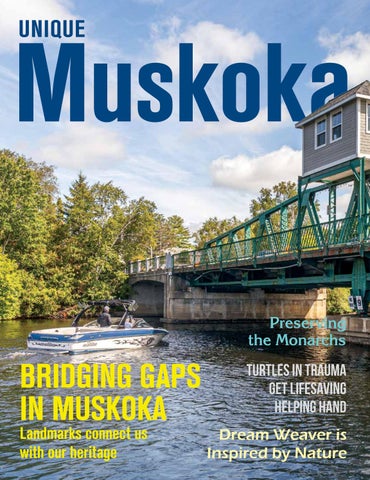
Our Cover
Photograph by Tomasz Szumski Since the earliest days of Huntsville, a major focal point of the community has been the Main Street Bridge. Over the decades, the bridge itself has changed many times but never its location. August 2020 UNIQUE MUSKOKA 5
JUST ARRIVED
THE ALL-NEW 2021 …telling the Muskoka story
Kia's All New 5 Seat Subcompact SUV Featuring a Balanced Exterior Design and Dynamic Interior
Unique Muskoka is published six times per year by Unique Publishing Inc. Donald Smith Publisher and Editor Donna Ansley Sales Lisa Brazier Design Susan Smith Administration
21 Robert Dollar Dr, Bracebridge, ON P1L 1P9
705-645-6575
Natural Gas & Propane Available
Bronwyn Boyer J. Patrick Boyer John Challis Heather Douglas Matt Driscoll Eleanor Kee Wellman Miranda Mulholland Meghan Smith Tomasz Szumski Karen Wehrstein Contributors Annual Subscription Rates: (including HST where applicable) In Ontario $30.00 All Other Provinces $36.00 U.S. $60.00 All Other Countries $72.00 HST: 773172721 Canada Post Publications Mail Agreement Number: 43268016 Copyright © 2020 Unique Publishing Inc. No content published in Unique Muskoka can be reproduced without the written permission of the publisher.
CREATE YOUR OWN GREAT OUTDOORS!
Bring style, elegance and comfort to your yard with these amazing fire features! Contact our team at The Fireplace Stop to assist in making your yard a show stopper!
Mailing Address Box 616, Bracebridge ON P1L 1T9 Street Address 28 Manitoba St., Bracebridge ON P1L 1S1
6048 Highway 9 Schomberg
6 UNIQUE MUSKOKA August 2020
1-800-843-1732 www.fireplacestop.com
www.uniquemuskoka.com info@uniquemuskoka.com 705-637-0204
Inspired byNature w w w. b r a c k e n r i g . c o m | 7 0 5 - 7 6 5 - 5 5 6 5 |
info@brackenrig.com
D E SI G N
•
CO NS TR UCT ION
•
R ESTOR ATI ON
Restoring Muskoka’s heritage and building new traditions for over 45 years Quality workmanship and customer satisfaction far beyond any written warranty. Wayne Judges 705-645-0480 Jack Judges 705-646-7424 email: judges@muskoka.com
mba
Muskoka Insights of the vast space between our communities. As Boyer notes, the construction of this infrastructure provides insights into the early techniques used to overcome the challenges of building roads and railways. This work also mirrors the evolving methods of construction, engineering improvements and community priorities of the time. The size of this feature, illustrated by photographs taken by Tomasz Szumski and from historic archives, is the largest article ever published in Unique Muskoka as we attempted to provide coverage from throughout the district. Muskokans are well-known for being connected to the natural environment and all five of our other features, in one way or another, reflect this inherent desire to both respect and protect what the district offers. The Reign of the Monarch tells the story of one woman’s effort to provide a helping hand to the butterflies that make a regular summer appearance in our forests and fields. As the numbers of turtles are threatened by the growing presence of humans, it is good to know there is a group of volunteers and professionals who are collaborating to treat some of these reptiles when they become injured or to assist in bringing their hatchlings to maturity. By sustainably harvesting local plants, one entrepreneur is creating a line of skincare products that is attuned to the natural environment while a local artist is crafting larger than life fantasy creatures from local twigs and branches. For a truly long look at our roots, the recently completed Water is Life exhibit at the Muskoka Discovery Centre provides us with an Indigenous interpretation of the importance of water to our lives. There’s much to get you connected in this issue. Happy Reading! Photograph: Susan Smith
Connections are so important to us as humans and particularly so, as we deal with the continuing circumstances of the COVID-19 pandemic. For those with elderly relatives, it has been indeed welcome news that loosening restrictions will allow visits to once again be held with loved ones. Our “social bubble” has been expanded. Each time that happens, we’re able to embrace our family unit and get a better sense of community – we’re able to connect. All of this, however, should not suggest caution can be thrown to the wind. COVID-19 concerns are still with us and I suspect they will remain for quite some time. It is most encouraging, therefore, to see how Muskokans – permanent and seasonal residents – have accepted protective actions as part of their routines. From social distancing to wearing masks and from hand sanitizing to respecting those who are challenged, Muskokans have generally adopted responsible actions. Certainly, wearing a mask on a hot summer day, is somewhat less than pleasant. However, such action should not be seen as acquiescence to government authority. Rather, it is the taking of an unselfish action by one human to support another. Quite simply, masks are worn to protect our friends and family, not out of any selfinterest, as the protection they provide prevents COVID-19 from being spread to others, not for the purpose of protecting the wearer. Interestingly, making physical connections is the theme of our major feature in this issue of Unique Muskoka – The Bridges of Muskoka: Connecting More Than Land. Written by respected local historian and regular Unique Muskoka contributor Patrick Boyer, this substantial feature looks at the significant history of bridges throughout the district. It tells of the integral role bridges have played in settlement and making physical connections
Our local team is here to provide you with personalized insurance solutions. For the coverage your family deserves, call us today.
46 Ann Street, Bracebridge 705-646-9995 | 877-877-3929 www.LesBell.ca TRUST • INTEGRITY • SERVICE
Your Home and Cottage Mattress Centre
MUSKOKA CURATED COLLECTION by Marshall Mattress
THE LARGEST SELECTION OF IN-STOCK MATTRESSES IN MUSKOKA
6 Monica Lane, Bracebridge 705.646.2557 www.mattressesofmuskoka.com
August 2020 UNIQUE MUSKOKA 9
10 UNIQUE MUSKOKA August 2020
Article and Photography by Heather Douglas
W
ith its orange wings and black markings, the Monarch butterfly is one of the most recognizable and studied butterflies in the world. Its annual migration between Canada and Mexico is a well-documented and awe-inspiring feat and its arrival in Muskoka seems to really herald the arrival of summer. Capturing the black, yellow and white caterpillars and watching them create the stunning green and gold chrysalis to transform into a butterfly has been a pastime of kids everywhere. It has also become a pastime of many adults across the continent who are committed to helping continue the reign of the Monarch. Huntsville resident Suzanne Baxter has spent the past three summers learning about Monarchs and helping the caterpillars in her garden become butterflies. She first became involved in the process when she received a scolding from her neighbour. “I had cut down a pile of milkweeds that were in front of my house. It was a new house and I thought they were just weeds,” she said. Her neighbour, who had come for a visit, had a keen interest in the Monarchs. Baxter said she took one look at her garden and was aghast that she had cut the plants down. Monarch caterpillars feed almost exclusively on milkweed. “I had no idea,” Baxter said. “I had never really paid attention to the Monarch prior to that, other than thinking they were a beautiful butterfly.” Baxter said she likes to think she is very environmentally conscious and was mortified when she learned what she had done. So, she decided to educate herself and started to research the Monarch on the internet.
stoneway marble & granite inc.
Les and Renata Partyka 1295 Muskoka Rd. 118 West, Bracebridge | 705.645.3380 | stoneway.inc@gmail.com
“I discovered a Facebook page, The Beautiful Monarch, which is a continent-wide page with a wealth of information and comments,” she said. “I was surprised at how many thousands of people there are who are helping to raise Monarchs.” The Facebook page has almost 34,000 followers. Baxter learned the fate of the Monarch is precarious because of climate change, loss of habitat, parasites, pesticides and predators, and she made the decision to help the ones she could. Her first summer was a huge learning curve and she discovered raising Monarchs is a lot of work. “There is so much information about them, because there is so much involved in raising them,” she said. There is the egg, caterpillar, chrysalis and butterfly stage and each one is complicated, if you are to raise them properly. The first job is finding the caterpillar which is then placed in a container with a mesh lid to keep it contained. The caterpillars eat almost constantly, so it is imperative to continuously replenish the container with milkweed as well as keep the container clean from the continuous caterpillar poop. The caterpillar moults five times, known as instar stages and when it reaches the fifth stage, it
P.O. Box 330 Bracebridge, ON P1L 1T7 Phone # 705-645-4874 E-mail: mcnairelectric@muskoka.com www.chuckmcnairelectric.com
Photograph: Suzanne Baxter
ECRA / ESA Licence No. 7001083
Fine Canadian Craft, Studio Jewellery & Original Art 1073 Fox Point Road, Dwight
705.635.1602
oxtonguecraftcabin.com 12 UNIQUE MUSKOKA August 2020
28 MANITOBA STREET BRACEBRIDGE | 705-637-0204
Black, yellow and white striped Monarch caterpillars munch their way through milkweed leaves before moving on to becoming a chrysalis and then emerging as a butterfly.
Suzanne Baxter has spent the past three summers learning about Monarchs and helping the caterpillars in her garden become butterflies. must be moved to another container where the caterpillar will attach itself in a J-shape and become a chrysalis. It takes between nine to 14 days for a caterpillar to complete all five instar stages. The caterpillar will spend another 10 to 12 days as a chrysalis before finally emerging as a butterfly. Baxter said it is important to keep the process outside to allow the caterpillars to be kept in their natural environment. “Basically, what we are trying to do is give the Monarchs the best protection we can,” she said. “First and foremost against the Tachinid fly, that will lay its eggs inside the caterpillar which will kill the caterpillar.” It is a lot of work and Baxter says you need be dedicated and committed. But it is also hugely satisfying when a healthy
butterfly emerges and flies away. She adds, when a butterfly emerges, you can tell right away if it is in trouble and won’t survive. She finds that heartbreaking. “You do get emotionally attached,” she says. At one point, Baxter had 15 chrysalis and estimates she has released 80 new butterflies. If people are not able to do the work involved in raising the caterpillars, Baxter said they can always help the species by simply not using pesticides and not removing the milkweed. And it is a good start to educate yourself on what a milkweed plant looks like. Baxter wishes Huntsville would establish a Monarch Watch Waystation which is a location created to provide an oasis for the Monarch. There needs to be ample milkweed
The Monarch caterpillar moults five times, known as instar stages, when it will attach itself in a J-shape and become a chrysalis. It takes between nine to 14 days for a caterpillar to complete all five instar stages. The caterpillar will spend another 10 to 12 days as a chrysalis before emerging as a butterfly.
705.645.4294 TF: 866.645.4294 STORE: 228 TAYLOR RD., BRACEBRIDGE OFFICE: 1646 WINHARA RD., GRAVENHURST
August 2020 UNIQUE MUSKOKA 13
Suzanne Baxter says it is hugely satisfying when a healthy butterfly emerges and flies away.
and space for the creatures. As well, education is so imperative to help the Monarch survive. Many milkweed plants are cut down by municipalities when they are cutting ditches. People have placed signs in
heavy growth areas in hopes the drivers will lift the blade in those areas sparing the milkweed and the caterpillars. As of May 17, there were 28,210 Monarch Waystation habitats registered with Monarch
Watch. Interested parties can contact Monarch Watch through its website at Monarchwatch.org and be a part of the group committed to ensuring the survival of the Monarch.
STYLE DESIGN INNOVATION
excelrailings.ca 705-646-2508
14 UNIQUE MUSKOKA August 2020
GET GUARANTEED REPLACEMENT COST INSURANCE ON YOUR COTTAGE & CONTENTS
DON’T SETTLE FOR BASIC COVERAGE If all your current insurance company can offer you is basic coverage on a secondary/seasonal home, make the switch to CottageInsure and fully protect your cottage and belongings in the same way your home insurance policy does.
COTTAGE & LAKE ASSOCIATION MEMBER DISCOUNTS
DISCOUNTS FOR FIREBOAT RESPONSE SERVICE
EXTRA COVERAGES FOR GARAGES, GUEST CABINS & WATERCRAFT
Get a FREE Quote in just five minutes by clicking: cottageinsure.ca or Call 1-877-541-9022 We’ve been protecting Ontario cottages since 1910.
Article by Meghan Smith Photography by Heather Douglas
I
n the wild landscape across Muskoka, plants, flowers and trees flourish throughout the spring and summer seasons. There is a balance and rhythm to the fresh growth and flowering of the forests and meadows to which Ashley Love, founder of Love North botanical skincare, is attuned. “As lily of the valley pops up, I know what’s next on my radar,” says Love. “I hike in to spots I’ve memorized now with a tracking system for specific times of year.” As a child growing up in Bracebridge, Love spent countless hours among the forests, ravines, lakes and meadows, playing and exploring. Now, her forays into the wilderness are more purposeful but no less exhilarating. Her love of nature and natural medicine have only grown since her childhood. Family history, on both her mother’s and father’s sides, has factored significantly in Love’s personal growth and the evolution of her career. Through her father’s side, Love’s family has been living in Muskoka since the 1800s. At that time, her family worked in the lumbering industry and eventually opened the then wellknown Elgin House resort where the Lake Joseph Club is now situated.
Left: The distillation process used by Ashely Love requires a copper still, which Love has at her home production facility. Right: Love harvests many of the items required for her products, here, in Muskoka. 16 UNIQUE MUSKOKA August 2020
Through her mother’s family, Love can trace her roots to a Cree First Nation in Alberta. Her maternal family’s traditional approach to farming, respecting the land and using earth-based skills impacted Love’s own values and how she developed her business.
“I learned a lot about plants from my grandmother, her knowledge and her teaching,” shares Love. “I didn’t have an elder teaching me but I’ve been able to come back to it. I feel I’m reconnecting to those lost generations.”
Love credits her maternal family for her current business and the knowledge of the land and her paternal family for her work ethic and entrepreneurial outlook. “When I was still fairly young, I lost almost my entire mother’s side of the family,”
August 2020 UNIQUE MUSKOKA 17
Floors for Home & Cottage
HARDWOOD • LAMINATE VINYL PLANK & TILE • VINYL ROLLS CARPET • CERAMIC • NATURAL STONE & MORE MODERN HOME CARPET ONE 350 Ecclestone Drive • Bracebridge
705.645.2443 carpetonebracebridge.ca
TAYLOR CARPET ONE 30 Cairns Crescent • Huntsville
705.789.9259 taylorcarpetonehuntsville.com
explains Love. “My grandparents, my mother and my aunt all passed away when I was growing up. Through the business, I’m honouring them, their experiences and the things they taught me.” Working at the Muskoka Natural Food Market in Bracebridge, her first job after returning home from her university degree and working overseas, piqued Love’s interest in natural medicine and natural products. Her boss, at the time, encouraged all of the staff to learn about the products they were selling and to learn from each other. “I saw a lot of American products and was almost dumbfounded there weren’t more Canadian products,” recalls Love. “There is so much medicinal value in plants that are here, locally.” Her interest in learning more about natural medicine, utilizing local plants and developing holistic, simple products led Love to go back to school. Attending the Living Earth School of Herbalism, Love studied western herbal medicine. Her course work involved handson identification of plants, flowers and trees as well as understanding the interactions between the constituents of the plants. “A big component of our practical learning was on ethical wild harvesting,” says Love. “There are strict rules to follow such as no
GBS Contracting Inc. Proudly Serving Muskoka for over 20 years. We get the job done! ROOFING • SIDING • DOORS • WINDOWS & GENERAL CONSTRUCTION
Where one call does it all. 2288 Highway 11 North, Gravenhurst, Ontario P1P 1R1 705-687-9143 • info@gbscontrac�ng.com • www.gbscontrac�ng.com
ElleZed Handbags Contemporary style. Crafted from Harris Tweed – one of the most desirable textiles in the world.
28 Manitoba Street, Bracebridge, ON 705-637-0204 18 UNIQUE MUSKOKA August 2020
“The products we’re making are love from the north, for your body,” says Ashley Love.
harvesting anywhere close to a side or back road, harvesting no more than 10 per cent of a colony of plants and absolutely do not harvest anywhere near industry.” With her schooling completed in 2012, Love began crafting face and body care products and tea infusions and taking them to local farmer’s markets to sell. Building a brand has been a rewarding challenge and
Love continues to search for ways to utilize her skills and learnings and grow her business. Love’s newest product line, soon to launch, features distillations of 100 per cent local ingredients including cedar, sweetgrass and balsam fir. From the plant in the forest to the final product, Love must follow multiple processes but each and every one is executed with great care and precision.
“When plants are in their natural habitat, unharmed, the quality and the medicinal properties are almost incomparable to cultivated plants,” explains Love. Extracting the desired properties from plants can be achieved in a variety of ways. Love utilizes three main techniques: drying, distillation and herbal oil extracts. Drying plants on racks allows Love to create herbal teas with medicinal qualities. Distillation requires a copper still, which Love has at her home production facility in Bracebridge. Distillation produces direct essence of the plant in either oil (essential oil) or water-soluble (hydrosol) form. Herbal oil extracts require quicker action in order to have the medicinal constituents take to the oil. Out in one of over 30 different forests she harvests T HE RIO BEL MOMEN TI ™ COL L EC TI ON from, Love collects the plant and AVAIL AB LE AT KN OW L ES P LUMBI N G! immediately macerates it, places it in a
BAT H & KI TCHE N S HOW R OOM D E SI GN . INSTA L L AT IO N. RE PAIR
From the plant in the forest to the final product, Ashley Love must follow multiple processes.
S E RV I N G A L L O F M U SKO KA 279 M A N I TO BA ST, BR AC EB R I D G E
70 5.6 4 5 .2 67 1
K N OW L E S P LU M B I N G .CO M @ M U S KO KA BATH
Muskoka’s Bath & Plumbing Centre
BATH & KITCHEN SHOWROOM SALES • INSTALLATION • REPAIR SERVING ALL OF MUSKOKA
279 Manitoba Street, Bracebridge
705.645.2671 @knowlesplumbing knowlesplumbing.com August 2020 UNIQUE MUSKOKA 19
jar and covers it with olive or apricot oil. The plant must be completely submerged in the oil. Back at home, Love shakes the mixture daily for 30 days. Following the process, all of the medicinal properties of the plant are transferred to the oil. Once strained, the oil
can be used in Love North body care products. “I chose the name Love North because it’s my last name and I always think of Muskoka as the beginning of the
north,” shares Love. “Plus, the products we’re making are love from the north, for your body. For Love, nature and the environment we live in and how we treat ourselves can play a major role in our health. Starting with physical self-care, in the form of simple, wellmade products to nourish the physical self can play a big role in a person’s overall wellbeing. “If each individual begins caring for themselves, for their own overall health, that action creates a deeper relationship with self,” says Love. “You can love a lot of people from your own self-care. It’s subtle healing work but the body is the entrance point for the healing process.” The basis of Love’s work stems from self-love, selfcare and a connection to the land around us.
Extracting the desired properties from plants can be achieved in a variety of ways, says Ashley Love.
When a power outage strikes, SOMMERS RESIDENTIAL GENERATORS ensure that your home or cottage automatically stays powered on. A full range of generators that can be custom built to suit your home or cottage’s specific needs, so you’ll always have standby power ready.
MUSKOKA • PARRY SOUND Your Source For All Your Electrical, Backup Power And Home Automation Needs. 705.765.0600 • www.sifftelectric.com • Port Carling ECRA / ESA 7002295
20 UNIQUE MUSKOKA August 2020
Meals & Memories are made here
See Muskoka’s largest selection of quality appliances from famous brands like Whirlpool, KitchenAid, Maytag,Amana, Frigidaire, Samsung, LG, Bosch and GE. Free delivery to your home* with our lowest price guarantee. *within our free delivery zones, see store for details Bracebridge 6 Robert Dollar Drive Bracebridge, ON P1L 1P9 Telephone: (705) 645-2279
Huntsville 67 Silverwood Drive Huntsville, ON P1H 2K2 Telephone: (705) 789-5589
Regular Hours: Mon - Thu
9:30 AM - 6:00 PM
Saturday
9:30 AM - 5:30 PM
Friday
9:30 AM - 7:00 PM
Sunday
10:00 AM - 4:00 PM
MUSKOKA
part of the family
Article by John Challis
A
female snapping turtle won’t lay her first eggs until she’s almost 20 years old. She could live more than a century, scraping a nest in sand or gravel early each summer to lay up to 50 eggs. But because of a staggeringly high mortality rate, it’s estimated she will need to lay 1,500 eggs to produce just two surviving adult turtles to succeed her and one mate. It’s the same for all eight of Ontario’s turtle species. They’re having a hard time keeping up their numbers, and several species are listed as endangered. Much of their wetland and forest habitats have been lost to human development. Nests laid in roadside gravel or people’s lawns are easy pickings for coyotes, raccoons and foxes.
And there’s road mortality: In Muskoka, where cottage access roads weave a web of hazards, the rate of vehicle injuries to turtles is high. When you see a turtle at the side of the road oozing blood through a cracked shell, you’re witnessing the visible evidence of population decline. Unless, like a growing number of people, you offer a helping hand. Turtles have remarkable healing powers, and given some gentle care, a turtle that seems beyond hope can be healed and back in action in eight to 12 weeks. In Muskoka, about a dozen local veterinarians here are trained as
Photograph: Eleanor Kee Wellman
“first responders.” They stabilize injured turtles and send them to the Ontario Turtle Conservation Centre (OTCC) in Peterborough for full medical treatment. At the centre, thousands of surgeries (a record 1,498 last year) are performed on turtles from across the province. The conservation centre also incubates turtle eggs that have been transferred from vulnerable nests – last year the centre received 6,000 eggs for incubation. Dr. Sue Carstairs, who runs OTCC, says a disproportionate number of calls originate from Muskoka, so she was especially keen on recruiting help here. Dr. Greg McWatt of the Animal Hospital in Gravenhurst, a former veterinary school classmate of Carstairs, took up the challenge. But it was his veterinary technician, Candace Vlietstra, who became hooked.
“She (Carstairs) came up and demonstrated how to look after injured turtles,” Vlietstra says, “and she showed some pictures and procedures at the centre. And I kind of fell in love with it.” This is her third summer tending to turtles at the clinic. “It’s a very rewarding experience; it really is quite a pleasure to work with Sue Carstairs and her team.” In her first year she took in a very large snapping turtle which was late for winter hibernation. It had severe frostbite over most of its body. For more than a day, it remained in a stupor. Vlietstra took it home overnight to monitor it. On the drive back to the clinic the next day, the turtle escaped from its tote and clambered up onto the centre console beside her. “I screamed,” she says with a laugh. Dudley, as she named him, remained an escape artist, frequently sneaking out of its tub at the OTCC. In a month, Dudley was well enough to release back to its home wetland. As a first responder, Vlietstra needs to triage her patients. “The first thing I’ll do is get a weight for the turtle,”
In Muskoka, where cottage access roads weave a web of hazards, the rate of vehicle injuries to turtles is high, especially when they attempt to lay eggs in the roadside gravel. August 2020 UNIQUE MUSKOKA 23
Photograph: Eleanor Kee Wellman
Due to a staggeringly high mortality rate, it’s estimated a female turtle will need to lay 1,500 eggs to produce just two surviving adult turtles. she explains. “Then I get fluids into it, under the skin, and then we administer pain and anti-inflammatory medication. I tape up the shell so it won’t move around … it can be quite painful. They’ll get fluids three or four times a day.” If there is an open hole, she’ll fill it with gauze. “If it’s too late to deliver, or on the weekend, I’ll take it home for a sleepover,” Vlietstra adds.
Already this year, their clinic has received 20 turtles. She agrees the annual injury rate in Muskoka might be due to summer traffic on backroads. However, the high numbers may also be because more people with greater awareness and concern for the welfare of turtles are calling. “We received close to 200 (turtles) last year,” she adds. “On one trip, I took 18 turtles in the car to Peterborough. And I came home
with two clutches of 75 hatched young ones – 150 in all — and released them.” At the Ontario Turtle Conservation Centre, Dr. Carstairs relies on a network of hundreds of volunteers who act as ambulance drivers, feed and clean the turtles in the centre, conduct research and, with special provincial permits, retrieve eggs. There are many other like-minded organizations linked to OTCC as well. Scales Nature Park in
1-705-706-4927 SUNROOMSBYDAVLIN.CA info@sunroomsbydavlin.ca
Your Muskoka Specialist for Sunrooms, 3 season windows, Aluminum and Glass railing systems Available through your contractor or directly through Davlin
24 UNIQUE MUSKOKA August 2020
NEW PHON E NUMB ER
Photographs: Ontario Turtle Conservation Centre
Orillia, partnered with START (Saving Turtles At Risk Today), has permits to retrieve eggs. Found an injured turtle? If you find an injured turtle, it’s wise to wear gloves when you pick it up. Place the turtle in a clean, dry tub with a towel or blanket under it, and keep it in a quiet area. Call the Ontario Turtle Conservation Centre in Peterborough, at 705-741-5000. The OTCC will quickly assess who’s available in your area, and connect you with an available veterinarian to make arrangements for the drop-off – usually on the same day. Families are normally invited to witness the successful release of a healed turtle, or a clutch of raised young. This year’s social distancing has ruled that out but families are always informed of the outcome of their rescue. Recently, Candace Vlietstra had a visit
Top: Dr. Sue Carstairs, who runs Ontario Turtle Conservation Centre in Peterborough, says a disproportionate number of her calls originate from Muskoka. Bottom: After treating an injured turtle, Dr. Carstairs tapes the shell so it won’t move around. from two young boys who brought in a turtle with a slight cut to its leg. It wasn’t much, she said, but the boys were upset. “It’s bleeding!” they told her in distress. “I told them I was so proud of them and they were so good to bring it in.” The cut healed in two weeks, and the boys’ little patient was discharged from hospital and sent back out to its pond. Another happy ending for both warm and cold-blooded animals.
August 2020 UNIQUE MUSKOKA 25
26 UNIQUE MUSKOKA August 2020
Article by Bronwyn Boyer / Photography by Heather Douglas
I
Photograph: Nathan Sowrey
magine meandering through the woods one day, not really paying attention to the path ahead. Suddenly, you stop short, and so does your heart: You see a giant mythical creature blending perfectly with the trees, its white eyes and teeth gleam from a nest of coiled wood strands like a million serpents working together. You might feel like you’ve stumbled across a film set for a fantasy horror film, or you’ve entered a parallel world of dreams. Such is the impact of happening along a sculpture created by Nathan Sowrey. For Sowrey, nature is both medium and muse, flavoured by the spice of fantasy. And in most cases, it’s larger than life. Many of the pieces that begin in Sowrey’s shop in Novar outgrow it before their completion. A landscaper by trade, Sowrey’s experience with loose stone stacking naturally progressed into stick weaving. The first spark of inspiration happened about 15 years ago while he was making a fence to keep deer out of his yard. Before he knew it, the weave started to emerge as he experimented with different ways of structuring it and filling it. What began as function also became art. With no sculpting or artistic background, Sowrey’s next build was a 40
Opposite: Nathan Sowrey’s dragon project kept growing until it quite literally outgrew his shop. Above: “Each stick has its own movement and lifespan” Sowrey explains.
August 2020 UNIQUE MUSKOKA 27
Cutting Bros. Inc. Artistic Woodwork & Timber Frame Design
Over 125 years experience Custom Stairs, Doors, Woodworking, Timber Frame and Design Port Carling 705.765.1615
Visit our website www.cuttingbrosinc.com cuttingbrosinc
28 UNIQUE MUSKOKA August 2020
foot dragon, created out of woven saplings. The frame was made of birch poles and the rest was layered on through trial and error. “At that time, I didn’t use wire or nails or anything,” Sowrey explains. “I just kept adding to it until it looked right. By then I had an enormous dragon that had out-grown itself.” It wasn’t long before Sowrey’s unique cast of creatures were summoned from the dream world into waking life. Though he’ll tackle any custom project for clients, his trademark pieces are along the lines of dragons, owls, gargoyles and witches. His heart won’t truly be in a project unless he’s building something original and truly inspired. “I want to bring fairy tales to life,” Sowrey explains. “Why make a deer when you could have a nymph – or a horse when you could make Pegasus?”
Sowrey first showed his work a few years ago at Nuit Blanche North in Huntsville at the encouragement of friends. “I’m uncomfortable in crowds,” he admits. “But it got easier.” Soon after that, Sowrey began exhibiting at Artists of the Limberlost and the Collingwood Art Crawl. Witnessing the response to his creations made the experience worthwhile. “Even though some of the sculptures are kind of creepy, I can see the joyful spark in the eyes of little old ladies,” he says. “There’s a sense of childhood wonder, and the years just drop away.” Sowrey’s inspiration is ignited by fantasy and nature. As a native of the secluded forests of Emsdale, his creativity is fuelled by places untouched by human influence. Solitude is paramount for a busy mind such as his, as the ideas are overwhelming at times. “I work on three or four pieces at a time, partly because my imagination doesn’t shut off – my head is a whirlwind,” he explains. The creatures quickly come to life through the spontaneity and impulse. “I don’t sketch or plan what I want to do, because it changes anyway. It depends on the sticks and the mood. I start out with an idea, but sometimes it morphs into something else entirely.” It took Sowrey almost eight years of experimentation to perfect his craft, although he is continually looking for ways to improve it. After trying different saplings in every possible
Nathan Sowrey’s creatures quickly come to life through his spontaneity and impulse.
Nathan Sowrey’s inspiration is ignited by fantasy and nature. Solitude is paramount for a busy mind such as his, as the ideas are overwhelming at times. condition, his favourite is cherry. “Each stick has its own movement and lifespan” he explains. “It took a long time to figure out which ones break down too quickly or snap too easily.” Gathering materials and transporting the
sculptures is a team effort, so Sowrey gets by with help from his friends. Not only are they his moving crew, but they also help collect gemstones for smaller details and peel the bark from sticks to make lighter shades for colour contrast. Pieces of quartz gathered
Paul Garbett, Wolves at Dusk, encaustic on panel, 68” x 48”
from job sites and wilderness treks are used for eyes and teeth. “I wouldn’t be able to do any of this without them,” he says. “I call them and they’re always there for me. We roam around the bush for miles gathering material. Most
111 Medora St. (Hwy 118 West.) Port Carling, Muskoka 705 765 7474, www.redcanoegallery.com Painting by Paul Garbett, 72” x 48”
August 2020 UNIQUE MUSKOKA 29
Call Mike Morrow
705.765.3195 www.morrow-electric.com
Serving Muskoka Lakes since 1952
ESA License #: 7000286
rewiring • alterations • heating
NEVER be left in the DARK or COLD: get a quality home standby generator by GENERAC
Muskoka Barging
Family run construction company with over 35 years experience operating in the Muskoka Lakes area. No job is too small or too big.
705-764-0765 | muskokabarging.com | 1163 Milford Bay Rd, Milford Bay ON
BARGING ● STEEL & CRIB DOCKS ● SEPTIC SYSTEMS ● LANDSCAPING
30 UNIQUE MUSKOKA August 2020
of it would otherwise rot on the ground.” The process takes longer because they’re careful not to clear-cut so that it’s done in the most sustainable way possible. Also, what doesn’t get used right away gets stockpiled. Sowrey’s shop is lined with un-used sticks, progressively becoming a giant walk-in sculpture in its own regard. Creating the sculptures is almost an entirely organic art form and everything is locally sourced. Nothing is wasted, and it has a natural birth and death. In this way, the creatures are transformed by their deterioration. “That first dragon I made lasted 10 years,” Sowrey recounts. “By the end of it, he had his head bent down and his wings were folded in. I tried to revive him by putting a new layer on him to give him a new skin but in the end, I finally buried him. I really felt the loss. There’s a lot of energy invested in the pieces and that’s what brings them to life.” A lot of energy is certainly what it takes to create something so large and detailed, especially for someone who’s self-taught. When he gets inspired, Sowrey works continually for 10-hour periods, so focused on the work he can easily get lost in it. “Another way my friends help me is they tell me when something is finished,” he says with a laugh. “Otherwise they can easily get out of control. I’m trying to make them smaller so they’re easier to manage.” Though someday he may experiment with adding colours, Sowrey prefers to keep the material as natural as possible. The various red and brown shades are the result of using maple tips that come up in the spring along the roadsides. Ironwood makes very strong frames. Larger sticks and random pieces of driftwood are carved into horns or become wizard staffs with pieces of amethyst glued to the end. Sowrey’s muse is one that works cooperatively with nature, rather than trying to force it to be
For Nathan Sowrey, nature is both medium and muse, flavoured by the spice of fantasy.
something it’s not. The sculptures are mostly held together by the weave itself to form bone structure, muscle, flesh and serpentine waves. Some of the sticks grow gnarled and crooked, which adds an extra supernatural element to the creatures. “The natural flow of the sticks creates the movement and size,” Sowrey explains. “I like
letting the rocks and the sticks do the talking. And then at the end of it, I have something surprising. I almost can’t take credit for it.” As for future projects, Sowrey has endless ideas of things to build. “I’ll probably never be able to get to them all,” he says. “But no matter what it is, it has to have movement. Even the fences and panels I build should do
more than serve a practical purpose – they should be works of art as well.” If there is a deeper message in Sowrey’s work, it’s the impermanence of art that gives it value. “It’s what keeps things going,” Sowrey concludes. “That’s the power of Mother Nature – no matter what we do, she always wins in the end.”
For everyone’s safety...
COVID-19 UPDATE: Changes to Services
CALL FOR ALL YOUR
BUILDING AND RENOVATION NEEDS
As elective diagnostic imaging services resume, effective immediately X-rays can no longer be provided as a ‘walk-in’ service. Appointments are required. Patients will be contacted with an appointment date/time.
705.645.8881
Changes to services are required to adapt to a ‘new normal’ and adhere to strict distancing requirements that are more difficult to achieve in aging buildings with little flexibility to expand waiting area spaces.
P.O. Box 330, Bracebridge, ON P1L 1T7
We appreciate your patience and understanding as we continue to manage COVID-19 to keep patients and staff safe.
admin@cedarbeachgroup.ca
August 2020 UNIQUE MUSKOKA 31
32 UNIQUE MUSKOKA August 2020
The Grand Trunk Railway’s line to Bracebridge, built in 1885, required two bridges and a major rock cut. The first crossed the south branch of the Muskoka River by Sharpe’s Creek. The steel superstructure of the railway bridge over the south branch, one of Muskoka’s longest spans, is built on large cut-stone footings.
Article by J. Patrick Boyer
M
as identifiable landmarks. As snapshots in time, they also display an era’s engineering skills, construction materials and cultural values. Including that initial bridge across the Severn River, the basic design of Muskoka’s early wood bridges, using logs and stone-filled cribs, was the simple “beam” bridge – a horizontal stringer or beam supported at each end by a vertical pier or abutment. Suited to short distances, they could also bridge wider spaces by using a series of beams supported on a number of piers. Across Muskoka, as elsewhere, truss bridges came into vogue with the Industrial Revolution’s possibilities of iron, steel, cables, meshwork and reinforced concrete. A truss, usually some variant of a triangle, is a rigid form that transfers load throughout the bridge by working variations on the beam structure, with enhanced reinforcements. Trusses handle both tension and compression, with the diagonal ones (for instance, supporting the deck) in tension, and the vertical ones (holding the structure in place) in compression. Beam and truss bridges represent major differences from arch bridges, which evolved from Roman times, and support load by distributing compression across and down the arch. Engineered variations on beam, truss and arch bridges have safely carried most loads in Muskoka since colonization began 160 years ago.
By 1930, the structure which gave its surrounding community the name Severn Bridge had yet again taken new form. The silo-like chimney was for the sawdust burner at the Mickle-Dyment sawmill.
By 1896, the fourth bridge to span the Severn River into Muskoka was this steel queen-post structure with a plank sidewalk. With a sawmill on the south bank and a general store and a school on the north, there was considerable pedestrian traffic on the bridge.
Photographs: Muskoka Discovery Centre Archives, Gravenhurst
uskoka’s modern history began in 1858 with a basic beam bridge. Spanning the Severn River, it carried the Muskoka Colonization Road over the district’s southern frontier into land where Indigenous people had been present since long before the pyramids ever arose in Egypt. Pushing north through untouched wilderness, this winding, hilly, crude Muskoka Road became the main street of Gravenhurst, Bracebridge, Huntsville and various villages. Other provincial, township and private roads spread out from, or linked up with, this spinal route as homesteaders and vacationers arrived. From the 1920s, what is now Highway 11 shadowed the essential pathway of the Muskoka Road. And through it all, as the Severn proved from the outset, roadbuilding over the Canadian Shield’s rugged landscape and irregular watershed depended on bridges. From the 1850s to 2020, from Bala to Dorset, from wood and stone to concrete slab and iron, from floating bridges to prefabricated ones, from single-lane to multi-use, from decks of plank or cement bridge to steel grating, from fixed structures to bridges that swing aside or rise up, with signage about weight loads and swimming, Muskoka’s bridges clear chasms and waterways. They expand freedom, save time and serve
A stone cairn, an informative nod to history and situated on the border between Huntsville and Bracebridge, incorporates photographs of the two prior bridges at Stephenson Rd. 1. One of those bridges was originally situated in downtown Bracebridge before being moved to the border location.
The Bridge on Stephenson Road One East Roads running east and west from Muskoka’s south-north colonization road helped homesteaders penetrate township interiors, claim free land and start farming. Stephenson, one of Muskoka’s larger original 22 townships with 40,000 acres of land and 3,000 of water including scenic Mary Lake, is a good place to start talking about bridges because it’s named for Robert Stephenson, one of the world’s fabulous bridge engineers. Among Stephenson’s many ingenious structures was his two-mile long tubular “Victoria Bridge” over the St. Lawrence River
at Montreal, which for years was the longest in the world. Heading east from the Muskoka Road, the Stephenson Road (along the concession line with neighbouring Macaulay Township) opened the township’s rewarding interior to settlers. In 1875, a wooden bridge was built across the north Muskoka River so settlers could advance further. The two-span structure, with a mid-river pier and crib abutments on each bank, was dubbed McCamus Bridge for nearby homesteader James McCamus who’d actively promoted its construction. The bridge proved its value for land development. Three years later, road builder W. Chalmers extended the
Deciding to build anew was a joint decision of Huntsville and Bracebridge councils, as township amalgamations for District Government in 1971 made Stephenson Road the boundary between the two enlarged towns. 34 UNIQUE MUSKOKA August 2020
Stephenson Road seven more miles east at $145 a mile. Further upstream, settlers petitioned in 1876 for a road between Port Sydney and the Stephenson Township line. When government stalled, they built one themselves – a floating bridge south of the second concession road – to link other farms which the river bisected, since surveyors hadn’t adopted natural boundaries when imposing their grid of lots upon the landscape. The bridge’s huge pine logs supported heavy loads. Hinged ramps at each bank allowed the main section to rise or fall with seasonal water levels. In 1896, township council sought funds for a permanent bridge here, but again, with no money from the province, the floating bridge continued its durable service into the 1920s. As for McCamus Bridge, in 1921, one span fell away from its riverbank crib. Needing to replace the 1875 wood bridge, a surplus one in Bracebridge coincidently became available. The two-span pin-trussed iron bridge had crossed the same river further downstream since 1892. That year, the town’s original wood bridge at the head of Bracebridge falls near Henry Bird’s woollen mill had been replaced by this iron bridge.
remedying one flawed But after three decades of coupling that caused heavy and increasing use as twisting. Alternatively, it the only road crossing for could have been relocated, as growing Bracebridge, the a similarly rare truss heritage 1892 bridge was slated for bridge of this design and replacement. To clear the vintage recently was in space, the 1892 structure Michigan, for pedestrian use was detached, lifted aside by across a walking trail gulley. crane, and parked on the However, despite its rarity, nearest flat land: lumberman this 1892 specimen has been George Tennant’s newly destroyed. opened lumber yard (today’s “This beautiful heritage Rona site). Bracebridge’s truss could have been new bridge was then lowered preserved,” Holth concluded, into position and riveted down in February 1922. Shortly before the First World War, Dorset’s wood bridge was replaced by a Warren but instead became “a victim of bad abutments and a lack That spring its temporary pony truss bridge manufactured by Western Bridge and Equipment Company of Chatham. After the war, iron railings and a pedestrian sidewalk were added. of local appreciation.” wood planking was replaced The only river crossing between Port Deciding to build anew was a joint by cement, and the bridge’s superstructure painted, just in time for a May 23 opening decision of Huntsville and Bracebridge, since Sydney and High Falls, the Stephenson Road township amalgamations for District Bridge crosses the north branch between ceremony. Having a used bridge obstruct his new Government in 1971 made Stephenson River Valley Drive and Balsam Chutes Road, lumber yard led to Tennant, himself, Road the boundary between the two enlarged uniquely tying together the many-layered contracting to move the iron sections of the towns. On May 26, 2017, Ontario Premier saga of Muskoka bridges from earliest to used 1892 bridge to the Stephenson- Kathleen Wynne officiated at the bridge with most recent. Macaulay township line where it was next mayors Scott Aitchison and Graydon Smith celebrate its completion and needed. The two-span bridge, reassembled, to Dorset’s well-travelled thus continued in service over the same river, intergovernmental partnering. The province contributed $1.1 million, funding that is single lane bridge several miles upstream. This double service gave the 1892 contingent on both environmental and structure extended life, but in 2016 it was heritage preservation studies. Dorset, like several other “Muskoka” The 1892 iron bridge did not, according border communities, is not entirely in replaced by a new bridge. This single-span steel crossing rests on concrete abutments, to independent on-site evaluation by Nathan the District. Its fortified against erosion, at each bank. A Holth of the Historic Bridges organization, Haliburton stone cairn incorporates photographs of the suffer intrinsic failings. It could, he reports, have continued in service by two prior bridges, an informative nod to history.
The “downtown” Dorset bridge’s unusual hump-back design remains intact. Providing greater clearance for boats, this alternative to swing or lift bridges shows the advantage of an arched deck.
Photograph: Boyer Family Archives, Bracebridge
half begins along the main street’s centre line. The village’s mixed identity also owes something to name changes – from Cedar Narrows (an English translation of the locale’s Ojibwe name), to Colebridge (instituted by colourful pioneer Zachariah Cole in his own honour), then next Dorset (as again revised by nostalgic settlers from southwest England.) In any case, fur-trading oriented the settlement toward Lake of Bays, along whose shoreline Dorset nestles on a natural channel between aptly named Big Trading Bay and Little Trading Bay. In 1859, the Bobcaygeon Road, another of the province’s colonization roads, reached the Cedar Narrows channel, over which the road builders placed a floating bridge. Zach Cole, one of the road surveyors, saw the area’s potential and returned in 1862 to trade fur with the Chippewas. He started farming, established a brick yard and operated a still to swap liquor for fur. Then Cole changed the place’s name and built a more substantial bridge. Shortly before the First World War, Cole’s wood bridge was replaced by a Warren pony truss bridge manufactured by Western Bridge and Equipment Company of Chatham, set on a concrete base. During the war, its wood plank deck was upgraded to concrete. After the war, iron railings and a pedestrian sidewalk were added. A bypass bridge was built by Ontario’s Department of Highways in 1957. In that decade, many Muskoka communities were
This iron Matthiasville bridge over the south branch of the Muskoka River dates from the 1920s. It supplanted an 1870 log bridge and served until the late 1940s, when the entire community was flooded behind a dam built by Orillia’s Power Commission. getting this bypass treatment to alleviate the booming postwar traffic congestion as vacationers with cars turned the main streets of Muskoka towns and villages into summertime parking lots. The 1957 structure became known locally as the new bridge. Another crossing, the Paint Lake Bridge, built along the line of a natural animal crossing, was for some time a humped bridge, like the downtown bridge. But in 1940, instead of resorting to traffic lights, which were developing but still uncommon in Ontario, the municipal government simply flattened its roadbed. The “downtown” Dorset bridge’s unusual hump-back design remains intact. Providing greater clearance for boats, this alternative to swing or lift bridges shows the advantage of an arched deck. Its metal 6-panel rivet-
This Matthiasville bridge, built in 1922, long a light colour, was in time painted black to blend into its scenic setting and became known to locals as “the Black Bridge” to differentiate it from Matthiasville Bridge. It is currently being replaced.
36 UNIQUE MUSKOKA August 2020
connected truss is fixed, as are its multi-beam metal stringer approach spans. With modern era increase in automobiles, the bridge’s centre rise still meant drivers gambled when starting across, often creating awkward summer traffic jams. But without changing the artful bridge, cars are now efficiently metered onto its single lane by traffic lights at either end.
The Black Bridge on Matthiasville Road Draper Township’s 1870s pioneer settlement of Matthiasville, east of the Muskoka Road at a turbulent chute on the Muskoka River’s south branch, boasted a miller, storekeeper, blacksmith, carpenter, cobbler, preacher and land developer – all embodied in one man, William Matthias. This high achiever built a dike alongside the river above the falls, diverting water into a mill race to power his sawmill and gristmill. He constructed a village church for Protestant use, erected a splendid octagonal home for his family and in 1880 filed subdivision plans for Matthiasville in the Bracebridge Registry Office, the village’s name having been proposed by John Classon Miller, a lumber merchant and Muskoka’s MPP at the time. Matthias also opened a blacksmithy, ran a shoemaker’s shop and operated a general store. By the late 1890s, he employed a dozen men in his sawmill, producing 10,000 feet of lumber daily, while his son Samuel ran the mills as a woodworking business and feed-
Photograph: Boyer Family Archives, Bracebridge
The iron bridge, which replaced the original log structure of the Muskoka Colonization Road, is central to this 1890s photo of Bracebridge taken from Henry Bird’s octagonal home. Logs in the river will fly down the raceway chute beside the falls. The railway bridge, built in 1885, is another sign of town progress. chopping enterprise. In 1870, at the start of it all, William Matthias had built a wooden king post truss bridge over the South Muskoka River, making his settlement the allimportant crossing point in this section. That original wood crossing was replaced by an iron bridge at the top of the falls around 1922. That year, a second bridge was constructed further downstream, at a southerly bend in the meandering river, supported by concrete abutments on each bank. This 120-foot single-span steel through-truss bridge of the Pratt design was a metal six-panel rivetconnected structure. By 1949, most Muskoka waterfalls had been harnessed but not Matthiasville’s. So, here, the Orillia Water Light & Power Commission built a million-dollar hydroelectric plant. The huge 882-foot wide dam spanned the valley near the top of Matthias Falls and back-flooded a new lake for two miles upstream, drowning the heritage village. The Commission had first purchased, dismantled and relocated some of the buildings. As for the bridge, Gary Long, acknowledged authority on the Muskoka River, notes the bridge at Matthiasville near the top of the falls remained in operation “until the Orillia power development was built, at which time a new concrete bridge was built lower down the falls, just upstream of the powerhouse.” Downstream, the 1922 bridge, long a light colour, was in time painted black to
consultation with locals for heritage considerations, and Bracebridge pitching senior levels of government to split its projected $2.5 million cost. The new bowstring truss bridge would replicate the former’s single-span, onelane design, use part of one 1922 abutment plus deep pile foundation on the north side, and footings keyed into the south bank’s bedrock. The deck’s surface would be concrete, with a dedicated walkway for pedestrians incorporated on the downstream side.
Bracebridge’s prominent Silver Bridge
Top: The narrowest crossing at Bracebridge was at the top of the falls, where a felled white pine served as a walkway. In this same location by 1872, the north branch of the Muskoka River was bridged by this log beam structure. Bottom: Bracebridge’s prominent Silver Bridge, a Pennsylvania-style through-truss bridge, was constructed in the early 1930s. blend into its scenic setting and became known to locals as “the black bridge” to differentiate it from Matthiasville Bridge. By 2016, Bracebridge engineers reported it unsafe; bubbling black paint even revealed its lighter undercoat. Replacing the bridge included an environmental impact study,
In 1861, when Muskoka road contractors reached North Falls (Bracebridge) on the Muskoka River’s north branch, the easiest place to bridge was the narrowest – at the top of the falls. Three rock-filled log piers – one atop a midstream rock outcropping, the others on each bank – supported its wood beam flooring and side rails. In 1892, it was replaced by another two-span bridge, manufactured by the Central Iron Bridge Company of Peterborough, for which the town paid $400, the Crown Lands Department, $2,000. In 1893, the town made the contractor rebuild its faulty foundations. In 1923, Howard Ferguson, an ardent proponent of northern development,
August 2020 UNIQUE MUSKOKA 37
Photograph: F.W. Micklethwaite / courtesy Bill Micklethwaite
This photograph of Port Carling’s 1872 locks and swing-bridge shows the bridge for roadway and pedestrian traffic has been moved aside at the right while the highway of water takes precedence. became Ontario’s premier and soon the “Ferguson Highway” from Toronto to Cochrane was a major project. In Muskoka, the highway tracked, where it could, the original colonization road. But in Bracebridge, as Lee Ann Smith explains in Muskoka’s Main Street, the authoritative work on the Muskoka Road, it was “far too hilly and crooked to be part of a modern highway.” Government surveyors found a better route to the foot of Bracebridge’s main street, by crossing the mouth of the Muskoka River’s south branch, curving alongside the north branch to Bracebridge Bay’s Kelvin Grove Park, edging past a rockface, and crossing the falls just downstream from the town’s existing colonization and railway bridges. In 1929, town council approved the plans for this gentler and more scenic entrance which would also bypass two level railway crossings, important with that era’s high frequency of trains. In 1930, after council expropriated the land needed for the Ferguson Highway, including the fine home of Dr. J.F. Godson at Ontario and Manitoba streets which had survived a devastating town dynamite explosion in 1906, only to now be demolished for the new highway, engineer Kenneth Rose of Ontario’s Northern Development Department hired local labourers to clear the right-of-way for the alternate town entrance. William Lowe took charge of building a bridge over the south branch, while Birmingham & Sons of Kingston won the contract for the $10,000 steel falls bridge,
38 UNIQUE MUSKOKA August 2020
retention walls and roadwork. Work proceeded for a full year on this Pennsylvania-style through-truss bridge, its trusses joined across their top and its 10 panels rivet-connected. In August 1930, grading through Kelvin Grove Park had been finished, one span of the bridge was in place, and a light railway on the new roadbed carried away blasted rock. Twelve months and another 10,000 rivets later, the superstructure was together, the cement flooring poured, two coats of paint were applied and new sidewalks completed. Electric lights on the bridge and its approaches highlighted Bracebridge Bay’s new centrepiece, a crown atop the cascading falls. These small electric lights (in some eras, many-coloured; other times, white) have spread gentle enchantment into night-time darkness for generations.
In 1973-74, the replacement of Port Carling’s main street swing bridge was a bascule bridge which, from the French for seesaw, means it rotates upward.
Port Carling’s two main streets and its moving bridges Just when things might have normalized, Muskoka’s bridges had to adjust to the Steam Age revolution. Steamships traversing highways of water and traffic proceeding over land needed bridges engineered to enable them to cross paths. In 1872, a swing-bridge and locks were put into service at Port Carling to allow movement of water and land traffic where river and road intersected. Apart from being functional, this transportation service provided onlookers with a fascinating drama in the heart of the village. Many times a day throughout navigation season, the bridge and the lock’s gates swung open and closed, moved by the muscle-power of two men, usually the lockmaster and his assistant. Such heavy moving pieces and their gears require continuous attention and intermittent changes. In 1902 and 1903, the lock was enlarged to accommodate longer steamships. In 1909, the lock gates needed replacement. When new oak ones were installed, the old waterlogged gates were safely hauled to deep water and sunk for convenient disposal, though some believed the public works superintendent who explained it was “to have them on hand in case of accident to the new gates.” But bridges themselves need replacement. During 1921-1922, in the course of yet
Port Sandfield’s evolving and rotating bridge Anticipating requirements of steamer travel gained high priority as Muskoka’s central lakes became home to colonizing settlers and seasonal residents. In 1871-72, a channel was cut between lakes Rosseau and Joseph, with dredging contracted to Joseph Wallace, to bring both to the same level and save money and inconvenience by avoiding trans-shipment costs. The opportunity for such an expedient undertaking only existed during a brief pre-development phase, before docks and boathouses dotted the higher lake’s shoreline. Although steamships and other craft now moved readily between both lakes through “The Cut,” it took six years to reconnect the severed land. This might have happened
Photograph: F.W. Micklethwaite / courtesy Bill Micklethwaite
another major reconstruction of the locks, a better engineered swing-bridge was mounted on a round concrete base. The large amount of steel needed was delivered to Bala by train, transported to Port Carling over winter ice by teams and sleighs, and then, in an era before cranes, hoisted into place using a derrick pole. There’s also more than one way to shift a bridge, so a ship can pass; what goes sideways might instead rise up. In 1973-74, the next replacement of Port Carling’s main street swing bridge was a bascule bridge which, from the French for seesaw, means it rotates upward. Several riverside buildings had to be demolished for the extra space needed. In the bargain, motors replaced muscle power to open and close the lock’s gates, and to raise and lower the bridge. The first craft under this lift bridge, on September 12, 1975, was Lady Muskoka out of Bracebridge. With water navigation and road transport so important to life in Muskoka, maintaining and upgrading bridges and locks is significant. In 2018, for instance, Muskoka District spent $2,245,900 for yet another set of new gates on Port Carling’s primary and secondary sets of locks – necessary upkeep for a transportation corridor which Anne Duke Judd, describing the Indian River, aptly calls “the real main street of Port Carling.”
Top: Largest vessel of the Muskoka Steamship Line, the Sagamo’s celebrated “100 Mile Cruise” included passing through The Cut at Port Sandfield, where the swing bridge facilitated travel. Bottom: In 1993, the swing-bridge was again fully reconstructed by the District of Muskoka, this time as a steel girder structure. sooner if Port Sandfield, named for Ontario Premier Sandfield Macdonald, was more than what Lake Joseph’s historian William Gray has noted was more geographic expression than a populated village. By 1876, an elevated timber trestle stretched high above the Cut, restoring a land connection while maintaining the new water passage. This high-level stationary bridge was replaced by a more practical timber swingbridge in 1887, which in 1924 was in turn replaced by a steel truss swing-bridge, constructed on the same plan and design as the 1887 one. People, grown pleased with what had become familiar, wanted to maintain the look. In 1993, the swing-bridge was again fully reconstructed by the District of Muskoka, this time as a steel girder structure.
Huntsville’s constant yet changing river bridge “Since the earliest days of Huntsville,” said the town’s heritage committee two decades ago, “the focal point of the community has without doubt been the Main Street Bridge.” There were many reasons. When Prohibition ruled half of Huntsville, the bridge connected dry and wet sides of town. By enabling boat and road traffic to interact, the swing-bridge fostered a lively downtown waterfront. And monopolizing traffic gave the bridge and downtown Huntsville exclusive prominence for years, until bypass bridges for Highway 11 and Centre Street diluted traffic. Over decades, the bridge itself has changed
August 2020 UNIQUE MUSKOKA 39
Contemplating re-roofing, renovating or building new?
Endless Possibilities.
Trust the experienced professionals at Norstar who will recommend the right roof to help protect your home or cottage investment.
R
BUILDING PRODUCTS
Environmentally Friendly Rubber Roofing
STEEL • SHINGLE • RECYCLED RUBBER • SLATE • POLYMER SHAKE
Celect® Cellular Composite Siding urges you to demand all of it: seamless beauty, weather defiance, maintenance freedom and unlimited home design possibilities. Begging the age old question... why compromise?
Siding • Roofing • Soffit • Fascia • Decking • Eavestrough • Gutter Protection SERVING MUSKOKA, PARRY SOUND & HALIBURTON REGIONS SINCE 1976 Embrace Your Exterior! Supply • Install • Cash & Carry
norstarexteriors.com 705.645.8404 | 800.732.0158
Photograph: Muskoka Heritage Place, Huntsville
Top: In 1888-89 Huntsville advanced from a fixed-link land bridge over the Muskoka River to this swing bridge. Located in the same place as the first bridge, it would itself be replaced in 1902, and again in 1938. Bottom: By the 1980s, its swing mechanism, unused for decades, the bridge was welded shut. many times but never its location. From the outset, veteran Ontario land surveyor John Stoughton Davis warned that although the spot between lakes Vernon and Fairy where a shoal created rapids and narrowing pointed to a bridge site, the actual distance between embankments would be some 30 metres, making it more costly to build and harder to maintain. Yet that’s where Huntsville’s bridge was constructed and has remained ever since 1870 – the year Ontario’s Crown Lands Department spent $1,701.44 for the bridge and approaching road work. That first version of Huntsville’s bridge crossed a considerably lower river than people know today. It needed to support only light traffic of walkers and animal-drawn wagons and sleighs. It was an all-wood beam bridge, with log piers and wooden planking. Everything went well for five years until new locks downstream near the Brunel Road elevated the water level, submerging river islands and challenging the bridge’s integrity.
A specific problem faced steamship Northern, launched at Port Sydney in 1877. Navigating upriver from Mary Lake carrying people and freight for Huntsville and lakes Vernon and Fairy, the bridge blocked her. The Crown Lands Department solved this by raising the bridge. In regular navigation season, the Northern would pass under the structure. Next it became clear that height wasn’t the only problem. The narrow channel between the piers (only 30 feet) caused the Northern, especially with spring flooding, to sustain damage trying to pass through. By 1879, the department proposed removing one pier and constructing a 70-foot central span, to more than double the width of the navigable passage under the bridge. Elsewhere, district bridge designs enabled intersecting traffic to cross in sequence, with the land bridge lifted or swung aside long enough for vessels to pass. Huntsville bridgework did not, however, immediately attract this swing-bridge solution. The
department didn’t remove the middle pier and build a longer span, as contemplated in 1879, but for awhile relied instead on the Northern’s captain and crew honing their navigation skills. By 1884, the departmental estimates included funds for a new Huntsville bridge with a 135-foot swinging span, though that year the department spent a bit of its general appropriation to repair the piers and deck planks, and pictures after that date show the familiar wooden beam structure on piers. Yet there’s confusion. A decade and a-half later, the department’s 1901 report confusingly said the bridge had been built in 1884, whereas it seems work had merely been delayed until 1888. That 1901 report then outlined plans for building a new swingbridge, to “take the place of one erected in 1884 which had become decayed to such an extent as to endanger the safety of the public.” A new swing bridge was constructed at Huntsville in 1901, as a 1902 photograph of it, with the Anglican church atop a hill behind, shows its clean-lined structure. Just three and a-half decades later, in 1937, another replacement bridge was ordered. It, too, would be a swing bridge of painted steel from Hamilton Bridge Company – a rivetconnected polygonal truss bridge in the Warren Pony style, set on large concrete piers. The Depression-era contract, let by Ontario’s Department of Highways to Atkin & McLachan of St. Catharines, gave needed local employment through the winter of 1938. A photo of this work shows a temporary bridge carrying traffic during construction. The era’s engineering design for the triangulated structure incorporated gusseted connector plates, exposed rivet heads and grated deck. The bridge’s outer sides had plank-and-plywood surfaced pedestrian sidewalks with a diamond-grill railing. Electricity played its helpful role, lighting each end of the 224-foot bridge, and powering the swing mechanism. The bridge master’s wood-framed cabin, atop the north span, gave a crow’s nest view over the entire scene for the operator to conduct the dance of waterborne and roadway traffic – by swinging the 170-foot mid-section on its centrebearing pier sideways from the riverbank’s fixed rigid-frame concrete approach spans –
August 2020 UNIQUE MUSKOKA 41
THANK YOU Frontline Workers ...we appreciate all that you do!
IT ’ S YOUR DREAM. WE BRING IT TO LIFE. CUSTOM HOMES & COTTAGES FOR OVER 45 YEARS For over 45 years, Tech Home has helped clients realize their vision of a beautiful & uniquely personal custom home. We build to the highest standards of quality at the most affordable pricing in cottage country. Visit our Gravenhurst Model Home or Toronto Design Centre, & we’ll bring your dream to life.
GRAVENHURST MODEL HOME
2278 Hwy 11N.| Gravenhurst, ON | P1P 1R1 1.888.417.8761
GREATER TORONTO AREA DESIGN CENTRE
130 Konrad Cres, Unit #18 | Markham, ON | L3R 0G5 905.479.9013
SERVING MUSKOKA / GEORGIAN BAY / HALIBURTON
1-888-417-8761 www.techhomeltd.com
Photograph: F.W. Micklethwaite / courtesy Bill Micklethwaite
Left: This pastoral view of the Bala Bridge, with a cow about to cross and a couple approaching as the woman’s full-length skirt glances over mud, also gives a view of the Canadian Pacific Railway’s viaduct. In early days, both national railways had stops in the Muskoka Lakes area. Right: Today, trains from both still pass through the communities but don’t stop. so that a majestic steamboat could pass, to the thrill of passengers and satisfaction of onlookers alike. Ontario’s Minister of Public Works, Collin Campbell, speaking from a decorated truck that served as a mobile stage for the July 1938 official opening, told a large assembly of proud Huntsvilleites their exceptional bridge had cost $150,000. Huntsville Citizens’ Band filled the air with lively sound. By 1952, the post-war boom had changed Muskoka’s vacation economy. That spring, the bridge’s wood sidewalks were replaced by durable concrete for the increasing summer pedestrians but that fall, the last steamship to ever pass through the bridge completed its final voyage. Automobiles and motorboats brought down the curtain on “the steam era” in Muskoka. By the 1980s, its swing mechanism, unused for decades, was welded shut. As centrepiece of dynamic Huntsville, and one of the few preserved heritage truss swing-bridges in Ontario, in 1983 the provincial Heritage Board officially listed the Swing Bridge for historic protection.
Bala’s many bridges for railways The Age of Steam had not only lifted Muskoka’s vacation economy for decades, propelling a vast fleet of steamships through District waters and powering trains carrying thousands of visitors, but the passenger and freight cars steaming in recast the local
economy and society, providing a connecting link – like a bridge between the far-famed vacationland and those seeking to enjoy it. By 1906, railway interest in Bala hit fever pitch. The Canadian Northern Ontario Railway’s route entered Muskoka through Washago, reached Port Stanton at Sparrow Lake, then continued via Torrance across Bala Park Island and on up the west side of Lake Joseph. That same year, the Canadian Pacific Railway’s Toronto-Sudbury line was being run across the Severn River into Muskoka and up the west side of Muskoka through Bala then north right alongside competitor CNOR’s tracks. Two thousand men of diverse nationalities, labouring to push these railways through Bala, dynamited tons of rock and built bridges over the south and north falls [shown as they appear today]. Their work included a railway swing bridge, and three train stations, the main ones for each company, plus the CPR’s “Summer Station” at Bala Harbour to handle the flood of eager vacationers. Extensive blasting caused faulting in the Canadian Shield. It filled a channel into Bala Bay with rock, blocking steamships servicing Bala and damaging vessels and facilities alike. The social chaos for local police caused the OPP to open its very first provincial detachment in Bala. The throngs of detraining Americans led Canada Customs to open an inland office here as well. Bala, hub for the Muskoka Lakes western shores, throbbed with action. The CNOR officially opened its Bala
service in October 1906, the CPR in July 1907. CNOR brochures picturing Muskoka and listing train schedules and fares stimulated a frenzy of tourism. The CNOR’s first train of the 1907 summer season arrived in June, across its Bala bridges, and pulled to a stop. Vacationers were delighted by the pleasing station, painted beige, with green trim and red roof. They happily proceeded to steamship Islander, arriving on schedule to meet them, as Muskokans, rail services, steamers, and resorts all seamlessly bridged their respective components into an integrated vacation economy.
Two railway bridges overcome Bracebridge’s rugged typography The Grand Trunk Railway’s line to Bracebridge, being built north from Gravenhurst in 1885, required two bridges and a major rock cut. The first crossed the south branch of the Muskoka River by Sharpe’s Creek, the second the Muskoka’s north branch over the Bracebridge Falls, and between them a channel had to be cut through a dense barrier of bedrock. The same South Muskoka River had challenged builders of the Muskoka Colonization Road, whose first bridges over the majestic South Falls gave breathtaking views. Today’s Highway 11 concrete walled bridges and the speed of vehicles preclude
August 2020 UNIQUE MUSKOKA 43
Photograph: Boyer Family Archives, Bracebridge
Above: This northbound Grand Trunk Railway freight train crosses the steel bridge over the Bracebridge Falls. Built in 1885, it is still in daily service, today. The log chute alongside the falls is well displayed. Below: The steel superstructure of the railway bridge over the south branch, one of Muskoka’s longest spans, is erected upon large cut-stone footings.
THERE’S A TILLEY FOR EVERY OCCASION LARGEST SELECTION OF TILLEY CLOTHING & HATS IN MUSKOKA
SUMMER TILLEY SALE
40% OFF Buy a Tilley hat and get 40% OFF any in-stock Tilley clothing
28 MANITOBA STREET BRACEBRIDGE | 705-637-0204
44 UNIQUE MUSKOKA August 2020
many travellers from knowing they are even crossing a river and what might have been developed as Muskoka’s most dramatic natural venue. The steel superstructure of the railway bridge over the south branch, one of Muskoka’s
longest spans, is erected upon large cut-stone footings, as is the second railway bridge over the North Falls in the centre of Bracebridge. The rock cut itself proved arduous work for unpaid workers who remonstrated on the town’s main street for their wages until Bracebridge Clerk James Boyer read the Riot Act to the mostly Italian-speaking navvies who then departed the scene. These adept labourers opened a fairly level passageway north into town, leading onto the long trestle for the second bridge. Rock from the cut, produced by small dynamite blasts and much handlabour with picks, heavy lifting and wagons provided fill for the bridge approaches. The 154-foot central main span is a rare example in Ontario of a pin-connected deck truss. The bridge’s two end spans are fixed metal-deck girders. This article’s sampling of Muskoka bridges opens wider dimensions about the heritage protection of bridges, increased concerns for safety, jurisdictional overlaps, maintaining an aesthetic satisfying to permanent and seasonal Muskokans, reappraising the unappealing industrial-style of contemporary roads and bridges, and how crossings are best incorporated into their attractive settings to enhance Muskoka’s all-important vacation economy.
~ Muskoka ~ Serving Muskoka and area for 32 years
DIVERSE SELECTION OF PRODUCTS TRADITIONAL AND CONTEMPORARY DESIGNS KNOWLEDGEABLE STAFF TO ASSIST YOU WITH BEST SELECTIONS, WORKING ALONGSIDE YOUR ARCHITECTS, DESIGNERS AND BUILDERS ON YOUR NEW OR RENOVATION PROJECTS
sales@windowworksmuskoka.net 2358 HWY #11, RR#1 GRAVENHURST, ONTARIO
705-687-7617 1-800-668-9858 www.windowworksmuskoka.net Authorized Dealer
Photograph: Chief Lady Bird
One of the featured artworks in the Water Is Life exhibit is by Indigenous artist Chief Lady Bird.
Article by J. Patrick Boyer
D
uring Expo 67 in Montreal, a gigantic pavilion dubbed “Indians of Canada” drew visitors like a visual magnet. Inside, the 30-metre tall teepee showcased dimensions of Indigenous life untold in schools, unmentioned in texts, unreported in the press and misrepresented in movies. Riveting displays of First Nations history
46 UNIQUE MUSKOKA August 2020
refocused what had long been distorted through Canada’s cultural and racial biases, religious beliefs, national differences and political imperatives. Financed by the federal government but under First Nation control, the pavilion offered the general public – in photographs, text and sound – an Indigenous view of Canada.
Photographs: Yannik Gosselin
This same concept is now being implemented at Muskoka Discovery Centre in Gravenhurst. A large Indigenous exhibit is being created by First Nation peoples whose ancestral connections to these lands run back 7,000 years. Even while that is taking shape, a new Water Is Life exhibit has been completed, ready for public viewing once COVID constraints allow. Both exhibits, as with the Expo 67 pavilion, are within the Muskoka Discovery Centre’s overall facility but their content is presented from Indigenous perspectives. A dozen years ago, the Discovery Centre’s demonstrations for Canoe Day on Muskoka Bay included leadership and participation by skilled Chippewa canoeists of Rama First Nation. The canoe itself, of course, is a brilliantly designed watercraft by which its creators extensively traversed North America’s highways of water for countless centuries. Following those shared Canoe Day events at Gravenhurst, this bridge between cultures slowly strengthened. First Nations and nonIndigenous people shared more experiences, earning trust and gaining understanding. In 2019, leaders of Rama First Nation and Muskoka Discovery Centre met to explore participation in future exhibits. Ted Williams, who in the 1980s was a member of Rama Council and chief for a term, and who is currently a councillor of the Chippewas of Rama, has become a strong supporter of these two new exhibits. “We were very pleased with what we had seen at Muskoka Discovery Centre and how they had represented the Chippewas of Rama and Anishinaabe people on environmental issues, specifically relating to water.” For its part, the Centre under chair Gary
Water Is Life provides a gateway into the Muskoka Discovery Centre’s displays by conveying a larger interpretation of how human societies themselves understand water, particularly from an Indigenous perspective. Getson was clear that, going forward, displayed information had to come from First Nations. Over millenniums, various Indigenous nations had developed connections with the land that is currently Muskoka District, and descendants still retain this somewhat attenuated link, which is why the Chippewas of Rama, having the most extensive and contemporary bond, are helpfully taking a lead in developing the two new exhibits. The larger of the two displays, a 3,000 square foot second-floor permanent exhibit, will include what Councillor Williams calls “The Oldest Story in Canada.” The Mnjikaning Fish Fence, located at the Atherley Narrows in Orillia, is a 5,000-year-
old fishing system which, as he notes, predates the pyramids. “It had been a meeting place of nations, prior to colonization. The Chippewas of Rama know the story keenly and are passionate about telling it.” Meanwhile, the exhibit now ready for viewing, Water Is Life, reframes the Centre’s popular Watershed Wonders display which has been engaging visitors of all ages and backgrounds. And while it educates people in just about every conceivable dimension on nature and Muskoka’s watershed, including a component pertaining to First Nations, that Indigenous role is portrayed as an element within the whole – somewhat akin to showing how beavers or microscopic marine life play their parts in a watershed. Now, and in line with the Truth and Reconciliation Commission calling museums to action, this new Water Is Life exhibit places the existing interactive experience itself within a wider context, to achieve higher consciousness. Funding for Water Is Life by Rick McGraw and his family foundation is testament to his commitment to Muskoka’s true story and the national relevance of the Discovery Centre. The permanent touchscreen interactive exhibit is located on a waveshaped wall in the entry corridor leading to the current Watershed Wonders display.
August 2020 UNIQUE MUSKOKA 47
Did you know ReStores rely on generous community donations as inventory? Every donation supports Habitat for Humanity's affordable home ownership program, helping families build strength, stability and self-reliance. Donate your gently used furniture, home decor, appliances and more to a ReStore near you.
every purchase helps build brighter futures
visit habitatgatewaynorth.com/restore
shop donate volunteer
Photograph: Ontario Department of Travel and Publicity / Irwin Douglas collection
In 1967 an historic site marker was unveiled by the “Huron Fish Weirs” whose history runs back five thousand years and is today “keenly known and passionately told” by the Chippewas of Rama and will be featured in new displays at Muskoka Discovery Centre in Gravenhurst. The Watershed Wonders venue had already become a major accomplishment at the Centre for imparting to the public the full picture and particular details of what a watershed is. But, just as host-town Gravenhurst has long been a Gateway to Muskoka, Water Is Life now provides a gateway into this educational marvel by conveying a larger interpretation of how human societies themselves understand water. Unless a person connects to such basic elements of life as water and earth in a relationship that conceives of them having intrinsic importance – indeed, in traditional indigenous knowledge, their own character and spirit – the most important dimension of the interconnectedness of all life on the planet is missing. “Although Water Is Life is being told by Rama First Nation,” says Ben Cousineau, the community’s researcher and archivist, “its message isn’t uniquely ours. Saying that ‘water is life’ is one of those rare statements every human being – regardless of race, religion, gender, or beliefs – can agree on. We all need water to survive.” Since last October, Cousineau and colleague Vicki Snache of Rama have had key roles implementing the agreement between Rama First Nations Groups and Muskoka
Discovery Centre to develop an exhibit on water from an Indigenous perspective. Design has been assisted by Bouw Agency of Ottawa, experienced with Indigenous displays in Nova Scotia and Quebec. “As Anishinaabe,” continues Cousineau, “we know the importance of water. We understand how water is a being with a spirit, not simply a commodity to be bought and sold. Perhaps this understanding makes us uniquely positioned to share our views on water.” The exhibit incorporates a number of themes, each illustrated by several stories. Themes include: Water is a Human Right, Muskoka’s Waters, The Water Provides, Water in Crisis, Ecological Threats, Unsafe to Drink, Protecting Our Water, Source Water Protection, Protecting Ways of Life, Water Keepers, Knowing Water, Traditional Ecological Knowledge, Whose Water Is It Anyway?, Traditional Governance, and Canadian Governance & Treaty Rights. The illustrative stories, rich and diverse, include “water keepers” who dedicate their lives to the wellbeing of water. One is Autumn Peltier, the young Anishinaabe woman from Wikiwemikong (the unceded territory of Manitoulin Island), an internationally known and respected water
THERE’S A TILLEY FOR EVERY OCCASION LARGEST SELECTION OF TILLEY CLOTHING & HATS IN MUSKOKA
SUMMER TILLEY SALE
40% OFF Buy a Tilley hat and get 40% OFF any in-stock Tilley clothing
28 MANITOBA STREET BRACEBRIDGE | 705-637-0204
August 2020 UNIQUE MUSKOKA 49
50 UNIQUE MUSKOKA August 2020
Entering Watershed Wonders through the new gateway of Indigenous perspectives on “Life Is Water” is why this place on the shores of Muskoka Bay can rightly be called a discovery centre. This combined presentation also keeps Muskoka unique. “This collaboration between the First Nations community and the nonIndigenous community is something I get excited thinking about,” says seasoned Chippewa spokes-person Ted Williams. “You’d be hard pressed to find the kind of relationship we have going with the people of Muskoka and the Chippewas of Rama community. It’s a strong relationship, built on trust. We still have a long way to go, but we’re learning about each other, we’re sharing each others’ experiences, and it should be a nice, fruitful relationship for years and years to come.”
Photograph: Linda Roy
advocate who at age 13 addressed the United Nations General Assembly and in 2019 was named their chief water commissioner by the Anishinabec Nation. Another is the late Josephine Mandamin-ban, who walked thousands of kilometers around the Great Lakes to look after the water. The Mnjikaning Fish Fence is another illustration. “Up until the 1850s,” explains Ben Cousineau, “our ancestors and other First Nations gathered at the Narrows to harvest fish from the fence. The big, older fish were left to continue to provide. Younger fish were harvested and preserved for winter sustenance. We practiced conservation methods before the term existed.” “Small but powerful” is his apt way to describe this interactive presentation. Seeing something familiar from a new perspective may radicalize a person’s thinking, meaning getting down to the radical or root of things. When specific rivers have been given legal personality in New Zealand (the Whanaganui) and India (the Ganges and Yamuna), meaning they have rights, such as the right not to be polluted, you can sense change is afoot.
Autumn Pelletier holds a copper pot she presented to Prime Minister Justin Trudeau when challenging his policies on water. An internationally known and respected water advocate, Pelletier at age 13 addressed the United Nations General Assembly on water issues.
25% O
In-stock In FF & Custom ventory Orders F or the Bala n of the Sum ce mer
Whats Happened After what can only be summed up as an extremely challenging season so far, staff at the Muskoka Steamships and Discovery Centre remain optimistic for the future of their facility and organization. A large part of the success will hinge on the successful completion of a new $5.5 million expansion of the Discovery Centre. “COVID has delayed the project and it’s definitely hurt us financially but we were able to get things started about a month ago,” said John Miller, the president of the Muskoka Steamships and Discovery Centre in early July. “This project is a huge challenge but it will be transformational to the organization, just like the Discovery Centre and the launch of Wenonah II were.” The Discovery Centre’s new expansion will consist of three additions. The first is the Stanley Meek Gallery, which is primarily a modern history of Muskoka, describing how it came to be what it is today. The second addition is the restored and electrified steam yacht Wanda III and boathouse for the vessel. The Wanda III is a unique working historical artifact, which was built in 1915 for Margaret Eaton, whose husband was the founder of the Eaton’s department store empire. The vessel will be presented in a specially designed boathouse and be available once again for charter on the Muskoka lakes. “We’re very excited to be able to preserve the steam story by electrifying Wanda III,” says Miller. “This is going to allow her to cruise all three of the big lakes with the same speed and range as the other vessels.” The third addition is an Indigenous Gallery, which will be located on the second floor and will explore the richness and diversity of Indigenous culture and history. The featured story will centre on the Mnjikaning fish weirs, a National Historic Site, which are over 5,000 years old. So far, the steamships have raised roughly $3 million and are now looking for the
52 UNIQUE MUSKOKA August 2020
Photograph: Muskoka Discovery Centre
Steamships expansion navigates turbulent waters
Muskoka Discovery Centre's new $5.5 million expansion, now under construction, will consist of three major attractions. balance of $2.5 million from corporations, foundations and individual donors. Plans for a major fundraiser have been delayed due to COVID-19 but they hope to have a revamped fundraiser ready to roll for summer of 2020, with plans to complete the expansion next year as well.
Cottage sales soar The current pandemic has had one unexpected positive spin-off, as cottage sales have risen dramatically. According to Catharine Inniss, the president of the Lakelands Association of Realtors, cottage sales for July of 2020 were poised to smash all-time records. “Sales so far this month are just under $200 million. The peak before this was August 2019 at just over $130 million,” said Innis on July 17. The median price of waterfront property in Muskoka this year is $810,000, compared to a high of $760,000 in April of 2018, she said. The dramatic jump is likely due to a number of factors. “I think that buyers have realized that investing in Muskoka is a better bet than the stock market and it’s an investment in
family and lifestyle as well,” she says. “A Muskoka buyer’s investment can be enjoyed while accruing value.” Inniss says another factor is that travel outside of the country is likely no longer going to be as easy or as certain as it was in the past. Staycations are growing rapidly in popularity and increasingly people are applying their travel budget towards home renovations or purchasing a cottage. More people have also opted to move to Muskoka on a permanent basis, as the ability to work from one’s cottage becomes more viable. “There are quite a number of people who can now telecommute because their employers realize how productive they can be, without having to go into an office daily,” she says. “Entrepreneurs are realizing opportunities because of the population becoming more year-round and the freedom of having their business base at home.” While prices continue to rise for the time being, Inniss cautions that supply is limited. “It is a seller’s market and prices continue to rise. They want to get into the market before it becomes unaffordable,” she says. “Sellers understand that if they have been contemplating selling, now is the time to sell.”
Cottagers relocating permanently
Photograph: Muskoka Shoebox Project
It appears many seasonal residents have decided to make Muskoka their permanent home over the past few months. As the COVID-19 crisis has hit the GTA considerably harder than the rest of the province, many have relocated from urban centres to more rural surroundings. In a typical year, many of those relocating to Muskoka permanently are retirees but the 2020 demographics appear to skew more towards a younger age group. “It appears that a lot of people are moving up with their families and businesses, and they’re looking for more broadband and high-speed internet,” says Chris Litschko, the CEO of Lakeland Holding Ltd., which provides fibre optic networks and wireless service among others. “Usually the levels of usage we see in February, March and April are quite low but this year we saw a spike during that period up to summer peak levels, as a lot of people moved up from the city.” In terms of fibre optic internet connections, Litschko says they’ve been primarily focused on building up the Burks’ Falls and Sundridge area. In the Bracebridge, Gravenhurst and Huntsville areas, where Lakeland has already done a
In a typical year, the Muskoka Shoebox Project, organizers have had up to 50 volunteers filling and sorting gift boxes. rollout of fibre optic service, they’re now going back to take care of people that weren’t connected the first time around. “I surmise that many temporary people are moving up for safety sake and now that they have good internet service, they’re staying here permanently,” he says.
Shoebox project changes gears
Photograph: Lakeland Networks
The provision of improved wireless internet service has been a major factor for many cottagers who are now deciding to call Muskoka home.
After five years of helping thousands of women and dozens of organizations, the Muskoka Shoebox Project is headed for a sea change in 2020 - 21. The Muskoka Shoebox Project’s founders Joanne Buie, Barb Baldwin and Penny Burns are stepping away in favour of new organizers and a new format. “We always felt we were on the right path but we also knew there would come a time when we needed to step back and let someone else take over,” says Buie. The Muskoka Shoebox Project collects and distributes gifts in the form of shoeboxes to women in need across the Muskoka region. Since the entirely volunteer-driven project started five years ago, nearly 5,000 boxes have been distributed. “They’re a powerful reminder for a woman that she has not been forgotten and that she remains a valued and respected member of her community,” says Buie. “For those giving gifts, the Shoebox Project is an opportunity to give back to someone in the community. It’s a small gesture of kindness that has an immediate and positive impact
on the woman who receives it.” In a typical year, the Muskoka Shoebox Project, organizers have up to 50 volunteers filling and sorting boxes in close proximity. Many of the boxes are filled during “shoebox parties,” where groups of friends and co-workers have filled up to 204 boxes in a single sitting. In the age of COVIDm19, Buie said carrying on the project in its existing format was simply untenable. “Our volunteers are disappointed but the majority of them are seniors and many of them have said they’re just too nervous,” she says. The good news is that two new organizers are currently in the process of being vetted by the head office of the Shoebox Project to see if they can take over the Muskoka version of the event. Their project will likely still proceed in 2020, but in some type of virtual edition. The details are currently being worked out.
Garbage project targets island cottagers The District of Muskoka is rolling out a new pilot project to assist water access cottagers impacted by the removal of garbage bin sites across Muskoka. In 2019, the Ministry of the Environment, Conservation and Parks (MECP) informed the District more than 80 unlicensed bin sites across Muskoka will have to be removed by April of 2023. In making its decision, the MECP said the sites pose risks to the environment and
August 2020 UNIQUE MUSKOKA 53
different cannabis dispensaries human health, especially have publicly stated their when waste is not disposed of intentions to open stores in properly in and around bin the town of Huntsville and are sites. According to the currently awaiting approval District, many bin sites are from the AGCO. located very close to lakes and rivers, and they pose a high risk of contamination. In June of 2020, the District announced the new project which will focus How would you like a shot exclusively on service for at becoming Muskoka’s next water-access and island real estate titan? residents in the Township of Now could be your big Muskoka Lakes. During the chance as two local versions of pilot project this summer, the classic board game collection trucks will be at Monopoly offer the players the three locations (Foot’s Bay, opportunity to buy everything Windermere, and Beaumaris) from Santa’s Village to Lions’ on Sundays for scheduled 1.5 Muskoka cannabis connoisseurs can now visit Bud Heaven, a retail location in Lookout. hour periods to accept downtown Bracebridge, that is the first of its kind in the district. In June, the Canadian household bagged garbage Muskoka Grown, a craft cannabis company, company Outset Media released and sorted recycling. Bracebridge-Opoly and Huntsville-Opoly in The project is intended to target residents but the two businesses are not affiliated. local Wal-Mart locations as part of a Joel Stevens is the owner of Bud Heaven whose homes are accessible by boat and not partnership with the retailer. and has worked for several years in the those who receive curbside collection or for Both versions quickly sold out and cannabis industry across Canada. He moved bulky and large items. Outset immediately began re-printing the back to Ontario from western Canada to Since the decommissioning of the bin games to meet demand. help his brother in Oshawa, after he was one sites was announced, the District’s been “We’re ecstatic that the citizens of of the first to receive a retail cannabis license working with MECP for approved Muskoka have chosen to welcome us into as part of the Alcohol Gaming Commission alternatives to waste collection for watertheir homes this summer and include us in access and island residents. The District says of Ontario (AGCO)’s lottery system. weekly game nights with friends and Stevens was planning for a store of his they’ll have staff on-site during any of their family,” says Jean Paul Teskey, senior pilot project alternatives to see if they’ll turn own in Muskoka when the space became vice-president of Outset Media and a available on the main street of Bracebridge. out to be viable options. seasonal Muskoka resident. “We look “I’m from Toronto...but I wanted Planning consultation sessions are still forward to continuing the celebration of somewhere I could create that rural lifestyle planned this summer and early fall with bin in nature,” says Stevens. “I felt like Muskoka Muskoka and other local communities site hosts, cottage and lake association across Canada.” could offer that lifestyle while still being representatives, and impacted communities. Outset has a large range of “opoly” games accessible to the GTA.” There’s also a survey available on the featuring cities and towns from across After two unsuccessful bids to win a District’s website at www.engagemuskoka. Canada. license, the AGCO made Stevens aware he ca/bin-site-transition-plan. For the Muskoka versions, the creators was in the queue in May, and they received tried to target some of the more notable their official license to open in late June. locations across the region including “The planning was a bit difficult because we had to account for the changing COVID Deerhurst Resort, Muskoka Brewery, Conroy Park and many others. protocols but we also had to meet the Part of the impetus for the new line of Muskoka cannabis connoisseurs can now AGCO’s standards at the same time,” he “opoly” games was the COVID pandemic visit a retail location in downtown said. “So far, it’s been pretty steady. We’re and the fact many families are spending Bracebridge and plans for other Muskokaseeing a mix of local customers and considerably more time at home and based dispensaries are in the works. cottagers.” looking for ways to stay occupied. In early July, Bud Heaven opened at 77 Bud Heaven is currently the only Manitoba Street in Bracebridge. The cannabis retailer between Barrie and North – Written by Matt Driscoll location was previously occupied by Bay but they likely won’t be for long. Three Photograph: Bud Heaven
Muskoka gets the board game treatment
Muskoka welcomes first cannabis retailer
54 UNIQUE MUSKOKA August 2020
You cannot begin to preserve any species of animal unless you preserve the habitat in which it dwells. Disturb or destroy that habitat and you will exterminate the species as surely as if you had shot it. So conservation means you have to preserve forest, river and lake. This is not only vital for the preservation of animal life generally, but for the future existence of humans themselves – a point that seems to escape many people. – Gerald Durrell
Conserving Nature in Muskoka. Join us today. A registered charity.
Preserving – the Art of Jam
Muskoka preservists produce jars full of flavour Article by Karen Wehrstein / Photography by Tomasz Szumski For as long as people have gathered or grown fruits and vegetables, they’ve noticed huge amounts of them are available during some parts of the year, while absolutely none are to be had at other times. The art of preserving has changed all of that. Storing fruit in honey, which is chemically a natural preservative, goes back at least 8,000 years. The ancient Greeks are known to have stored honey-covered quince in jars, a technique refined by the Romans by cooking the fruit and honey together
before jarring. The first jam recipe appears in the first known cookbook, De Re Conquinaria (“The Art of Cooking”), dated to the First Century AD. Middle Eastern cooks created more complex jams that Crusaders brought back to Europe. Joan of Arc is said to have eaten quince jam before battle for courage, and the famous prognosticator Nostradamus wrote a treatise with a recipe for aphrodisiac
jam that was claimed to produce in a woman “a burning of her heart to perform the love-act.” (We are not aware of a current-day version.) Once sugar cane was discovered in the New World, it superseded honey as the preservative of choice. In 1785, when Napoleon offered a reward to anyone who could invent a way of preserving food for his armies, one Nicholas Appert won it for showing that boiling food at high temperatures then
Angie Ponte and Rohan Riley of Brooklands Farm in Milford Bay pick strawberries. Picking strawberries at the farm has been a summer tradition for many. 56 UNIQUE MUSKOKA August 2020
As well as about 100 flavours of jam and jelly produced in her Baysville kitchen, Lynn Murden makes and sells oil-free vinaigrettes, flavoured maple syrups, pepper-jelly condiments, chutneys, mustards and barbecue sauces. sealing it in airtight containers would preserve it. The art of preserves was brought to Muskoka by its first pioneers and the rest is modern history, leading up to the jam artisans of today. Lynn Murden’s business, Yummies in a Jar, is renowned throughout Muskoka and beyond for its plethora of flavours, combining ingredients you wouldn’t necessarily expect in jams. Muskoka Maple Cappuccino jam, anyone? Ginger, Pear and Cinnamon? Mango, Orange and Pineapple? How about Fuzzy Navel or Drunken Blueberry? You need not ask for a recommended wine pairing for these delights; it’s already included. Murden got her start after finding herself left with an excessive amount of rhubarb stems and strawberries after a pie-making session in 1992. She decided to make them into jam and sell it at the Baysville Walkabout, a popular annual summer festival in the village. “I got such a thrill out of people buying things that I had made that I decided this was what I wanted to do,” she says. The rest is preserving history. As well as about 100 flavours of jam and jelly, she makes and sells oil-free vinaigrettes, flavoured maple syrups, pepper-jelly condiments, chutneys, mustards and barbecue sauces. Customers include
Muskoka resorts such as Deerhurst, Taboo and Windermere House, and restaurants such as Three Guys and a Stove and Main St. Local Kitchen in Huntsville. Yummies has even been lauded in a speech made by Muskoka MPP Norm Miller to the Ontario Legislature at Queen’s Park. Yummies has two outlets of its own, one in central Baysville and one on a property just west of the village owned by Murden and her husband John, who is renowned as a painter as she is a preservist. The Highway 117 store is also an art gallery, offering paintings by John (“he owns the walls”) as well as other crafts such as pottery, glass and jewelry by other artists and artisans. You can also get body care products and gourmet foods supplied by other kitchens such as meat pies, smoked trout, spring rolls and curries. After two months’ worth of renovation, the store/gallery has been made much more open concept. “People were coming in and seeing the Yummies
Getting “a thrill” out of people buying things she had made inspired Lynn Murden to produce her line of popular preserves.
side, and not seeing all the other beautiful things we have here,” says Murden. “Now people come in and ask, ‘Did you always have all this pottery here?’” Adapting to the pandemic meant much more selling online. “I learned more about my website than I ever wanted to know,” she laughs. The business’s biggest hit was wholesale sales to stores that were mostly closed at time of writing. “They’re opening again but they’re not sure what the summer’s going to look like.” The Yummies stores are now open seven days a week and will revert to just
Muskoka Cranberries and Port Wine Jam
Lynn Murden, Yummies in a Jar Ingredients 9 cups (1,000 grams) fresh or frozen cranberries 1 ¾ cups + 2 Tbsp water 1 ¾ cups + 2 Tbsp white sugar 2 Tbsp raisins ¾ tsp cinnamon ¾ tsp cloves ¾ tsp nutmeg ½ tsp allspice 6 Tbsp port wine (optional)
Method • Combine all ingredients except the cranberries and port wine in a large pot. Stir as you bring everything to a boil and the sugar dissolves. Add the cranberries. Cook till soft, about five minutes. Use a potato masher to crush the cranberries, but don’t over-mash. When the berries are soft and the mixture is fairly thick, remove from heat and stir in the Port Wine. Mix well and if the mixture seems weekends after Labour Day, as usual. All staff are back at work and sales, Murden has noticed, are actually up compared with last year. “I think we’re going to be fine.” Muskoka Cranberries and Port Wine is a seasoned veteran of a jam – you’ll see what I mean – boasting
too thick, add boiling water, 1/4 cup at a time, until you get the desired consistency. Pour the hot mixture into the warm, sterilized jars, seal with a hot lid and put the jars upside down on a tea towel. After a couple of minutes, put the jars right side up to cool. Store in a cool place, away from light and use within one year. Makes 6-7 cups. Preservist’s Tips • Any kind of jar will do for making jam, Murden advises you just can’t re-use the same lids. Or if you do, keep the jam in the refrigerator or use it up soon. The first step in making jam is to prepare your jars. Option 1: Baking. Wash jars in soapy water, rinse well and dry upside down on a clean cloth. Heat oven to 280 degrees F (140 C). Put clean jars in a cake pan and bake for 10 minutes. Option 2: Boiling. Bring enough some 25 years in the Yummies collection. “I probably came up with it for the cranberry festival,” Murden recalls, referring to Bala’s famed annual post-Thanksgiving weekend bash. “I’m pretty good at picturing the end taste or picking a fruit and what would go well with it,” Murden
water to cover the jars to a boil. Reduce heat to low, add jars, cover with a lid and bring back to a boil. Boil for 15 minutes. Remove with tongs and place upside down on a clean tea towel. Pour boiling water over new lids and let them sit for 5 minutes to sterilize. Both options do the same thing. Boiling is a little faster, but on a hot, humid summer day you might prefer baking. Why turn the jars upside-down? “It heats up the air space and sterilizes it,” says Murden, though she’s not actually 100 per cent certain why she started doing it. Possibly it’s actually a good-luck ritual, partly responsible for the success of Yummies in a Jar. May it work to make your jams successful, too!
elaborates. “I wanted savoury flavours, Christmas and holiday flavours, symbolic of the seasons – the sort of spices used in mulled wine. It’s all about cinnamon and cloves and nutmeg, and I was looking to make a cranberry sauce. The two paired beautifully. It gave me a condiment to serve at the festival.” This jam is really only semi-sweet. “All cranberry preserves have not much sugar in them,” she says. “Just enough to take the bite off the cranberry tartness.” Asked what sort of customer response Cranberries and Port Wine gets, Murden simply points out that it’s been selling for more than 25 years. Its flavour does indeed whisper of a holiday feast with a cup of good cheer, and should work on a festive turkey or with any delicate-flavoured cheese or Murden’s suggestion, cheesecake – as well as any other meat, even strong-flavoured. Try this: slices of smoked ham and Fruilano cheese slathered with this jam for a ham sandwich extraordinaire. Mwah!
Sue Smith of Tabletop Farm, a little east of Baysville, grows the main ingredients of her preserves right on the farm. Of European extraction, she credits her grandparents for her appreciation of good food. “My father would dig up horseradish,” she reminisces. “The timeframe from harvest to consuming was very short, so the density of the nutrition was preserved. I try to grow food that is very nutrient dense.” Smith’s parents emigrated to Canada when she was 12, lived in Toronto for a while, then bought a farm in Orillia, despite not being farmers. “Country life was good,” she recalls. This led to her studying farm management at Sir Sanford Fleming College, followed by some intense years of motherhood, raising five children. “I had lots of kids to feed and I was homeschooling,” she says. “So, it made sense to grow food. I like good food and you can’t buy it most of the time; so, grow it.” A business opportunity for Smith’s husband brought the family to Muskoka. “We came, here, and it was a hot May bug season. This woman was pushing a carriage wearing a snowmobile suit, and I thought ‘Why am I moving here? It’s crazy!’” That was in 1983, and they bought the land on which she still lives nonetheless, now a parcel of 67 acres after severing some off. Smith now runs the farm, living a frugal life and growing a huge variety of herbs, vegetables and fruit, including 20 different varieties of tomatoes. “They’re all different colours and shapes and tastes,” she says. “There’s nothing like a tomato grown outside.” She uses two greenhouses to start plants early in the year and heats her house with wood. While she has not gone through the paperwork of getting her products certified organic, she uses no chemicals. “I love weeds, actually,” she says. “A weed is just a plant out of place.” The lemon juice and sugar she puts in her black currant and rhubarb jam, as described in the recipe below, are organic. Timing of output depends on timing of harvest. “When I have a whole whack of tomatoes and peppers, I’ll make salsa,” she says. “When the black currants are ripe, I do jam.” She does not have her own kitchen but
Contemporary buildings in the natural landscape.
Peter Berton E: pberton@plusvg.com
T: (416) 588-6370 w: plusvg.com
72 Stafford Street, Suite 200 Toronto, ON M6J 2R8
Unique Muskoka Ad August 2020.indd 1
2020-07-09 11:28:43 AM
SHANNON STARK R.H.N.
Registered Holistic Nutritionist Live and Dry Blood Analyst
Patterson Kaye - Resort & Restaurant on Lake Muskoka -
COTTAGE RENTALS
122 Kimberley Avenue, Suite 2 Bracebridge ON P1L 1Z8
705.646.3546 shannonstark1@gmail.com
Benefits of a Holistic Nutritionist Auto-Immunity - Allergies - Digestion Dietary Changes - Fatigue Hormone Imbalances Sleep - Aging - Weight Loss and more
www.shannonstark.com
SEASONS RESTAURANT PATIO OPEN
www.PattersonKayeResort.com 1 855 645 4169 PK_Muskoka
Patterson Kaye Resort
August 2020 UNIQUE MUSKOKA 59
Sue Smith of Tabletop Farm, a little east of Baysville, grows the main ingredients of her preserves right on her farm.
Black Currant Rhubarb Jam Sue Smith, Tabletop Farm
Ingredients 4 cups black currants 3 cups rhubarb, cut into ½ to 1-inch pieces 4 cups sugar 4 Tbsp lemon juice 1 cup water
Method • Stir together rhubarb, currants, sugar and lemon juice in a large bowl. Cover and let stand for four hours, stirring occasionally. (Why? “The sugar starts to draw the juices out of the fruit,” Smith explains. “It becomes more uniform and you don’t have to cook it so long. Gets everything going.”) • Transfer to a large stainless-steel or enamel pot. Add water. Bring to a boil and boil rapidly for 2-3 minutes, stirring constantly. Mixture will boil up high in the pot; make sure it is large enough to prevent a boil-over. • Remove from heat, stir for two minutes to settle fruit, to prevent floating fruit. Ladle into sterilized 250-ml jars and process in boiling water in canning pot (or large part with silicon mat on the bottom to keep jars from moving) for eight minutes. Turn off heat and let stand for five minutes before removing jars, to ensure a clean seal. rents time from a commercially-certified kitchen in Baysville. “They’re all certified now,” she says of kitchens in community centres, churches, etc. “It’s an opportunity.” Flavour has been a lifelong interest, she says. “I knew how to make a cake from scratch without a recipe when I was seven.” She sells her preserves
60 UNIQUE MUSKOKA August 2020
through the Muskoka North Good Food Co-op in Huntsville, Humble Pie in Baysville and other outlets. Black Currant Rhubarb Jam has been her own favourite for 10 years. She developed the recipe by looking at different books and performing trials until she got it the way she liked it, and the response is positive. “A lot of the European
Preservist’s Tips Why so little water? “Most of the water comes from the rhubarb,” Smith says. Right: those thick, juicy stems. Why no pectin? “Enough pectin comes from the black currants.” Jam au naturel.
crowd likes the black currant,” she says. “It’s kind of an acquired taste, has a different flavour than a lot of other fruit. Many have had it at their grandmother’s place, and say they’ve been looking all over and are glad to find it.” Look no further, here it is!
CHELSEY PENRICE R E A L E S TAT E B R O K E R 705-205-2726 • www.muskokaluxuryproperties.ca
Lake Muskoka $3,495,000
Lake Rosseau $6,250,000
4 BEDROOM CUSTOM COTTAGE 259 FT OF FRONTAGE ON ALMOST 2 ACRES SOUTH EXPOSURE FOR ALL DAY SUN
LUXURIOUS 6 BEDROOM LOG HOME PROFESSIONAL AND MATURED LANDSCAPING MATCHING 2 BEDROOM BOATHOUSE
HARVEY KALLES MUSKOKA REAL ESTATE IF YOU’RE SEARCHING FOR A COTTAGE IN BEAUTIFUL MUSKOKA YOU’VE COME TO THE RIGHT PLACE
CHELSEY PENRICE
1A LEE VALLEY DRIVE, PORT CARLING, ONTARIO P0B 1J0 705-205-2726 • CHELSEY@MUSKOKALUXURYPROPERTIES.CA
WWW.MUSKOKALUXURYPROPERTIES.CA
DIRECTORY YOUR GUIDE TO SERVICES AND RESOURCES
Summer was made for cottage
Rotary Centre for Youth 131 Wellington St., Bracebridge
705-644-2712
1-877-788-1809
www.clubrunner.ca/bracebridge
info@ontariocottagerentals.com
AVAILABLE AT
28 MANITOBA STREET BRACEBRIDGE 705-637-0204
•Granite Staircases •Walkways / Patios •Fire Pits •Retaining Walls •Renaturalization & Tree Planting •Driveway Builds & Grading •Drainage •Site Development & Blasting
generationslandscape.ca
KEVIN DAWE
705.801.0524
•Septic Systems •Snow Plowing & Sanding
62 UNIQUE MUSKOKA August 2020
generationslandscape.ca
Experience You Can Trust
Better Blasting & Drilling We Know the Drill
Experienced drilling & blasting for roads, ditches, foundations and septic systems. Exceptional service and top-quality results.
CONTACT US NOW FOR A FREE ESTIMATE!
705.645.4098
contact@muskokadrillingandblasting.ca
Specializing in WATER ACCESS PROPERTIES
BRACEBRIDGE GENERATION LTD.
705-375-2797 SEPTIC PUMPING muskokaseptic@gmail.com mu sk ok ase pticse r vi ces.co m
Water Power Generating a Cleaner Environment Interested in more information or a free tour? www.bracebridgegeneration.com
We’ll take care of your propane needs for your home, cottage, or business.
MUSKOKA MADE
CAPTURE THE SCENTS OF MUSKOKA
Crimson Yard
CANDLES Available at
Serving: Muskoka • Gravenhurst • Haliburton • Barrie • Simcoe County www.budgetpropaneontario.com 28 Manitoba Street, Bracebridge
Budget Propane Sales & Service
705.687.5608 Toll Free 1.888.405.7777
August 2020 UNIQUE MUSKOKA 63
Muskoka Moments
Stillness brings a renewal of energy By Miranda Mulholland Muskoka has always been the place that felt like home. As a touring musician, I have spent more than half of each year for over 20 years on the road. I’ve toured all over the world and moved countless times but the only consistent place I could return to was my family’s cottage on Gull Lake. It’s small and homey – nothing like anything you’d find on Millionaire’s Row but it’s the most glorious place I know. In a life full of travel and motion, it’s where I’ve always come for stillness, renewal of energy and inspiration. My family arrived in Gravenhurst in the 1800s and my great-great grandfather was Charles Mickle, who served more than one term as the Mayor of Gravenhurst and was the visionary who had the Opera House built on the main street. He believed arts and culture could unite humanity. At the time, his vision wasn’t fully appreciated and the hall was known as “Mickle’s Folly.” Over a century later, the historic Opera House has witnessed the birth of summer theatre in Canada, hosted countless concerts from local and international stars and is recognized as being in the top 10 venues with the best acoustics in Canada. I love the architecture – the hall looks like an upsidedown boat. Church-like, it soars over the heads of the audience. I was taken there to see theatre from when I was a child and I always wanted to perform there when it became clear the path I was intent on was that of a professional musician. Life as a professional musician is not easy. When I started at university, a professor said, “If you can do anything else, do it.” Trying to find enough work to sustain
64 UNIQUE MUSKOKA August 2020
you, trying to grow your artistic practice, connecting with other musicians and constantly networking, following up and hustling, it is not for the faint of heart. That said – the reward of creating something ephemeral with fellow musicians and an audience – something that will never happen again in the same way simply because of the presence of those exact people in a room at that exact time – is like alchemy. This is why I love the live music experience. A few years ago when I was up at the cottage, fresh off the road and taking a breath to take stock and recharge and while staring at the view down Lily Bay – a view I will never get tired of, I had the idea of starting a music festival in Gravenhurst. With the help of a spectacular team and the support of some incredible members of the community, my dream was realized and we launched in 2017 with our headliner Jim
Cuddy performing at the Opera House built by my great great grandfather. Over the last three years, Muskoka Music Festival has brought over 70 bands to Gravenhurst and has attracted music lovers from as far away as Mexico and Australia! I have had the immense satisfaction of bringing my two great loves together – Muskoka and live music! This year is obviously different but we didn’t want to take a complete pause. We commissioned music videos from six amazing bands and they will be shown all summer long before movies at the Muskoka Drive In. I’m hopeful that we will return in 2021 to celebrate our fifth year in person. Out of this year’s stillness will be a renewal of energy and the inspiration for next summer’s Muskoka Music Festival in my favourite place on earth, Gravenhurst! Named the “sweet secret weapon of Canadian roots music” by the Globe and Mail’s Brad Wheeler, JUNO nominated Miranda Mulholland is a versatile performer and in high demand as a fiddler and singer covering a wide range of styles. She is a member of Harrow Fair, a duo with Andrew Penner of Sunparlour Players. In 2014 she started her own label, Roaring Girl Records, which has a reputation as a home for diverse and excellent artists. She is the founder and artistic director of the Muskoka Music Festival. Miranda currently sits on the board of governors of Massey Hall/Roy Thomson Hall and is chair of the Music Canada Advisory Council.
HillTop I N T E R I O R S
YOUR STYLE YOUR HOME
Innovative. Inspired by nature. Infused with tradition.
YOUR LIFE
BEDROOM
705.732.4040
KITCHEN / BATH
HILLTOPINTERIORS.COM
LIGHTING
FURNITURE / DECOR
1150 HIGHWAY 141, ROSSEAU, ON P0C 1J0