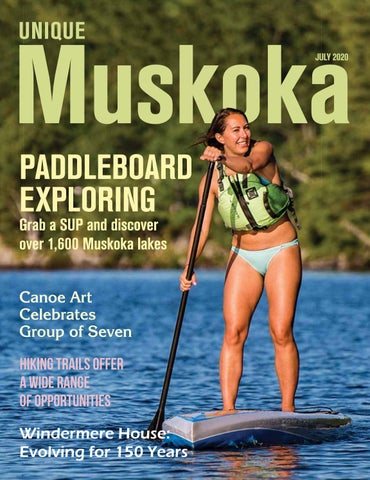
JULY 2020
PADDLEBOARD EXPLORING Grab a SUP and discover over 1,600 Muskoka lakes Canoe Art Celebrates Group of Seven
Hiking Trails Offer a Wide Range of Opportunities Windermere House: Evolving for 150 Years
(Port Carling) Limited (705) 765-5700 brownsappliances.com
Richard Scully
MUSKOKA
705.644.9393 RScully@Muskoka.com Port Carling
www.MuskokaCottagesForSale.com
...telling the Muskoka story [10]
[16]
24
Exploring Muskoka by Paddleboard
Article by Sandy Lockhart Photography by Andy Zeltkalns Today, it seems every true cottager has a stand-up paddleboard. Muskoka is made for paddleboarders, with hundreds of lakes and so much access. Just pull up to any boat launch, grab your board and gear, and carry it down to the water. There is something to see around every corner from the elevated position of a paddleboarder.
Features 10
Gerry Lantaigne – Celebrating 100 Years of the Group of Seven Article by Karen Wehrstein Photography by Heather Douglas Tom Thomson and Group of Seven reproduction murals now grace the walls of buildings all over Huntsville and Lake of Bays, largely due to the efforts of Gerry Lantaigne. Honouring the 100th anniversary of the formation of the famous group, this year’s Outdoor Gallery event will feature the painting of seven canoes.
34
Windermere House – Part of the Hospitality Evolution for 150 Years
16
Take a Hike in a Good Way
Article by John Challis / Photography by Andy Zeltkalns Muskoka is blessed with trails just a few minutes’ walk from any town centre. Trails meander through all our topography, from wetlands to rock barrens to mature forest. There are paved trails for those with limited mobility, and rocky wilderness treks for those who seek a challenge. 2 UNIQUE MUSKOKA July 2020
[24]
Article by J. Patrick Boyer Windermere House epitomizes Muskoka’s vacation economy. It is a summer resort hotel which people themselves popularly christened “The Lady of the Lake.” For 150 years, it has been the major economic and social pillar of its namesake village, Windermere.
CREATE YOUR DREAM SPACE
All About Kitchens The possibilities are endless BRACEBRIDGE 3 Gray Road 705.646.0347
HUNTSVILLE 4 Centre St. N. 705.789.6161
www.allaboutkitchens.ca
50
Printer Revives the Proud History of a Traditional Craft
Article by Meghan Smith Photography by Tomasz Szumski The Morgan Davis Printing Museum is the culmination of a lifelong love of printing that spans seven decades. For museum founder Morgan Davis, it’s also the celebration of a family tradition that spans three generations.
[43]
43
[50]
Stan Tait – Life Experiences Nurture Creativity
Article by Meghan Smith / Photography by Kelly Holinshead In Muskoka, the artistic outlook is original and fresh, and Stan Tait’s own artistry has thrived in this environment. Honouring those values and the values of his fellows within the artistic community has kept his work far from being cookie cutter. Musically-inclined Tait correlates his need to design from a purposeful place.
JULY 2020
PADDLEBOARD EXPLORING
Opinion
9
64
By Don Smith
By Mardi Witzel
Muskoka Moments
Muskoka Insights
Grab a SUP and discover over 1,600 Muskoka lakes
Departments
Canoe Art Celebrates Group of Seven
54
58
Article by Matt Driscoll Like all of the world, Muskokans – permanent residents and cottagers, alike – have been responding to the impact of the COVID-19 Pandemic. Innovators in Muskoka have developed new ways to serve the community and others throughout Canada and the world. Others, such as artist Bonnie Bews, have continued to celebrate important people.
Article by Karen Wehrstein Photography by Tomasz Szumski Blueberries! We love to pick them, buy them, eat them. There’s blueberry everything – jams, tarts, muffins, pancakes, yogurt and even chocolate-coated blueberries. You can drink blueberry tea, sip blueberry wine and use them in creative ways, even in mostly savoury dishes.
Hiking Trails Offer a Wide Range of Opportunities Windermere House: Evolving for 150 Years
Our Cover
Photograph by Andy Zeltkalns Paddleboarder Cara McLeod has a choice of 1,600 lakes to explore in Muskoka as well as many miles of rivers.
What’s Happened
Cottage Country Cuisine
[58]
July 2020 UNIQUE MUSKOKA 5
Floors for Home & Cottage
…telling the Muskoka story Unique Muskoka is published six times per year by Unique Publishing Inc. Donald Smith Publisher and Editor Donna Ansley Sales Lisa Brazier Design Susan Smith Administration
HARDWOOD • LAMINATE VINYL PLANK & TILE • VINYL ROLLS CARPET • CERAMIC • NATURAL STONE & MORE MODERN HOME CARPET ONE 350 Ecclestone Drive • Bracebridge
705.645.2443 carpetonebracebridge.ca
TAYLOR CARPET ONE 30 Cairns Crescent • Huntsville
705.789.9259 taylorcarpetonehuntsville.com
Muskoka Barging
J. Patrick Boyer John Challis Heather Douglas Matt Driscoll Kelly Holinshead Sandy Lockhart Meghan Smith Tomasz Szumski Karen Wehrstein Mardi Witzel Andy Zeltkalns Contributors Annual Subscription Rates: (including HST where applicable) In Ontario $30.00 All Other Provinces $36.00 U.S. $60.00 All Other Countries $72.00 HST: 773172721 Canada Post Publications Mail Agreement Number: 43268016 Copyright © 2020 Unique Publishing Inc. No content published in Unique Muskoka can be reproduced without the written permission of the publisher.
Family run construction company with over 35 years experience operating in the Muskoka Lakes area. No job is too small or too big.
Mailing Address Box 616, Bracebridge ON P1L 1T9 Street Address 28 Manitoba St., Bracebridge ON P1L 1S1
705-764-0765 | muskokabarging.com | 1163 Milford Bay Rd, Milford Bay ON
BARGING ● STEEL & CRIB DOCKS ● SEPTIC SYSTEMS ● LANDSCAPING
6 UNIQUE MUSKOKA July 2020
www.uniquemuskoka.com info@uniquemuskoka.com 705-637-0204
The finishing touch is in the siding.
You’ve taken the time and care necessary to buy or design your home with the perfect layout and style to suit your needs. From the kitchen cabinets to the furniture and window treatments, you’ve thought of every detail. But what if you could give your home even more style, elegance and quality than you imagined? That’s where we come in.
Celect® Cellular Composite Siding urges you to demand all of it: seamless beauty, weather defiance, maintenance freedom and unlimited home design possibilities. Begging the age old question... why compromise?
Siding • Roofing • Soffit • Fascia • Decking • Eavestrough • Gutter Protection
SERVING MUSKOKA, PARRY SOUND & HALIBURTON REGIONS SINCE 1976 Embrace Your Exterior! Supply • Install • Cash & Carry
1-800-732-0158 • 705-645-8404
norstarexteriors.com
D E SI G N
•
CO NS TR UCT ION
•
R ESTOR ATI ON
Restoring Muskoka’s heritage and building new traditions for over 45 years Quality workmanship and customer satisfaction far beyond any written warranty. Wayne Judges 705-645-0480 Jack Judges 705-646-7424 email: judges@muskoka.com
mba
Muskoka Insights dubbed a “new normal” that not everyone is sharing in the economic turnaround. Everyone’s circumstance is different. During this time of upheaval and transition, two of the most important words will be understanding and respect. One person’s health concern may seem inconsequential to another while a desire to open a business may be a low priority for those whose family is challenged by aging relatives and those who are immunocompromised. Understanding each other’s concern in a respectful manner will be so important, if we are to regroup in a positive manner. Heated debates, threats, arguments and worse will do nothing to address this situation. Interestingly, in this issue of Unique Muskoka, historian Patrick Boyer tells the story of Windermere House which is marking its 150th anniversary. This iconic “Lady of the Lake” has navigated many challenges during its long lifespan; not the least of which was the Spanish Flu pandemic of 100 years ago that did not spare Muskoka as it claimed lives throughout the world. We do not want to minimize the impact of COVID-19 nor to suggest it won’t be a disruptor in economic terms. Rather, Boyer's article is an indicator there will be a way forward but that we all need to be understanding and show respect as we find that new direction. Other articles in this Unique Muskoka include two features on getting out and enjoying Muskoka’s natural beauty, the life stories of two very different artisans who have been influenced by Muskoka’s attributes and the tradition being preserved by local printer Morgan Davis. And, our culinary feature focuses on a quintessential Muskoka favourite – the blueberry. Happy reading! Photograph: Susan Smith
Since we last had an opportunity to chat, life has changed; not only in Muskoka but throughout the world. Due to the impact of the COVID-19 pandemic, we decided to miss our June issue as everyone struggled to determine the way forward. However, the challenges of our publishing schedule were minimal compared to those encountered by so many others. In many ways, when it came to the most important issue – personal health – most Muskokans fared well. While many businesses cautiously open their doors, the impacts of the world-wide pandemic have left most in a state of wariness whether it be for their wellness or the future of the economy. The closure of international borders has done much to isolate Canadians from those jurisdictions where COVID-19 is infecting higher numbers of the population. However, a reduction in travel also means fewer tourists. In Muskoka, as we head into the summer, tourism is so essential to the success of the economy. Tourism operators are reeling. Take for instance, just one sector of this critical part of our economic jigsaw puzzle – overnight summer camps. With their establishments tucked away on the many Muskoka lakes, owners of these largely seasonal businesses have been told they can’t open for this summer. While camp operators have put the well-being of their charges first, the impact of the closures on the Muskoka economy will reverberate for some time. Summer students, year ‘round workers, suppliers, main street merchants, restaurants, local resorts, service stations and more – all benefitted directly or indirectly from the success of these businesses. The coming and goings of campers, counsellors and parents visiting their children resulted in hotel stays, dinners in town and purchases of treasures to recall a summer visit. In that context, it’s important to recognize as we return to what is being
Our local team is here to provide you with personalized insurance solutions. For the coverage your family deserves, call us today.
46 Ann Street, Bracebridge 705-646-9995 | 877-877-3929 www.LesBell.ca TRUST • INTEGRITY • SERVICE
Your Home and Cottage Mattress Centre
MUSKOKA CURATED COLLECTION by Marshall Mattress
THE LARGEST SELECTION OF IN-STOCK MATTRESSES IN MUSKOKA
6 Monica Lane, Bracebridge 705.646.2557 www.mattressesofmuskoka.com
July 2020 UNIQUE MUSKOKA 9
Gerry Lantaigne’s big picture artwork
Article by Karen Wehrstein / Photography by Heather Douglas
S
ent away from Huntsville Town Hall before he could even finish his presentation to town council in 1996, Gerry Lantaigne was certain it was the end of his idea for giant downtown murals. “I was shocked,” Lantaigne recalls. “I left with my tail between my legs. I was asking them for a lot of money... $114,000.” But he had been confident, based on the experience of a small town on Vancouver Island where tourist traffic had jumped after it raised three murals, that the project would pay for itself. In the municipalities of Huntsville and Lake of Bays, where Tom Thomson and Group of Seven reproduction murals now grace the walls of buildings all over, viewers may judge the success of the Group of Seven Outdoor Gallery for themselves.
10 UNIQUE MUSKOKA July 2020
This year, in honour of the 100th anniversary of the formation of the Group of Seven, the annual Outdoor Gallery event will feature seven canoes whose hulls will be painted with one reproduced work of each of the original Group of Seven members. Lantaigne is slated to do five canoe paintings and Gravenhurst muralist Tim Webb the other two. Paintings, dates, locations and the degree to which the public will be able to participate, as has been the tradition, are all undecided at time of writing (check the Huntsville Festival of the Arts website for updates). What we do know from Lantaigne is the nature of these particular “canvasses” will require departure from the Gallery’s usual policy of exact replication. “We’re giving ourselves artistic license,” says Lantaigne. “We’ll probably take Harris’s mountains and play with them on the canoe,
Gerry Lantaigne’s most recent work in progress features the northern lights and incorporates some of the stylistic presentations found in the Group of Seven artwork he has recreated in murals.
July 2020 UNIQUE MUSKOKA 11
JUST ARRIVED
THE ALL-NEW 2021
Kia's All New 5 Seat Subcompact SUV Featuring a Balanced Exterior Design and Dynamic Interior
21 Robert Dollar Dr, Bracebridge, ON P1L 1P9
705-645-6575
one of Thomson’s trees and play with it... we’re definitely going to be ad-libbing.” Look for the canoes to be displayed prominently in the town this summer and next, including at the 2021 edition of Nuit Blanche North, then auctioned off in September 2021 as part of the Algonquin Outfitters Charity Paddle Art Auction. The original Group of Seven – Franklin Carmichael, Lawren S. Harris, Arthur Lismer, Frank Johnston, J. E.H. MacDonald, Fred Varley and A.Y. Jackson – formed in 1920 and had their first show on May 7 of that year at the Art Gallery of Toronto (which would become the Art Gallery of Ontario). But their story truly starts with Tom Thomson, who had died in 1917. What people who derided Thomson’s impressionism-on-steroids brushwork style couldn’t argue with was that his colours could be hyperrealist. “I think Tom Thomson had a mind like a digital camera,” Lantaigne enthuses. “He saw pixels! His skies... meteorologists could tell what the weather would be in a few hours from them.” Upon first seeing Thomson’s work, MacDonald and Harris subsidized him
P.O. Box 330 Bracebridge, ON P1L 1T7 Phone # 705-645-4874 E-mail: mcnairelectric@muskoka.com www.chuckmcnairelectric.com ECRA / ESA Licence No. 7001083
Special Guest
Scott Barnim
July 18 & 19
Open daily July & August
M-Sa: 10-5; Su: 11-4 1073 Fox Point Road, Dwight
705.635.1602
oxtonguecraftcabin.com 12 UNIQUE MUSKOKA July 2020
28 MANITOBA STREET BRACEBRIDGE | 705-637-0204
Tangled Garden, based on the work of J.E.H. MacDonald, is one of the early murals painted by Gerry Lantaigne.
The Canoe, originally a community mural, was repainted by Gerry Lantaigne after it had deteriorated. quitting his graphic design job for a year to devote all his time to painting. “He spent the summer of 1912 in Algonquin Park,” Lantaigne recounts. “When he brought his paintings back, it was a ‘eureka’
moment. That’s when Harris and MacDonald said ‘You have captured what Canada means in paint and modern art.’ People didn’t use colour like that. Nobody ever painted rocks and trees and lakes, it was all pastoral scenes.
Paul Garbett, Wolves at Dusk, encaustic on panel, 68” x 48”
This was uniquely Canadian art painted in a uniquely Canadian style.” Thomson’s work and the first Group of Seven show, like many unprecedented movements in art, hit the art world like a bomb. Some reactions were so negative that Johnston felt compelled to leave the group and change his first name to Franz to save his career. The remaining members didn’t take it lying down, however. “They didn’t get a lot of support from major galleries, dealers and collectors,” says Lantaigne, “so they took their work on the road, showed in small towns and schools and libraries. They brought the arts to the people, coast to coast. People liked their art, and that’s how they became the icons they are.” Some decades later, another young artist began a career path somewhat similar to the Group of Seven in its commercial component. “I always had an affinity with art,” says Lantaigne, who grew up in Scarborough, went to an art-designated high school and then the Ontario College of Art (which would later add “and Design”). His thoughts were already on art of large stature: set design
111 Medora St. (Hwy 118 West.) Port Carling, Muskoka 705 765 7474, www.redcanoegallery.com Painting by Paul Garbett, 72” x 48”
July 2020 UNIQUE MUSKOKA 13
and scenic art. Landing a spot in an offcampus program in New York, he worked for an off-Broadway company, doing housepainting on the side. “That’s where I learned to paint big,” he says. On returning to Scarborough, he worked for his brother-in-law’s sign company, painting big letters, and when that wound down, he was offered a job with Mur-Ad, a Toronto company specializing in mural advertising. “I quickly learned how to paint sides of buildings to look like photographs, became a production manager within weeks,” Lantaigne reminisces. “But they were put out of business overnight by the inkjet banner.” Like many GTA natives, Lantaigne was familiar with granite country from camp stays as a child and trips in his 20s to Algonquin Park. “I always wished I could live up north but I was stuck in the city,” he says. His first foray was an unsuccessful bid to rent advertising murals; all three Muskoka towns refused to support his idea. Lantaigne was in his late
20s when he had his own ‘eureka’ moment. “This is where it all took place,” he remembers thinking. “This is where Tom Thomson made his pictures!” The outdoor gallery idea was born, and he put together a 72-page report and slide presentation only to get the bum’s rush out of Huntsville Town Hall.
Robin Fortunato has encouraged Gerry Lantaigne to follow different opportunities.
A local business owner chased after him, apologized on behalf of the community, and offered to commission what he could afford: one mural. This mega-rendition of Thomson’s The Jack Pine still hangs on the building, facing north into Kent Park. About three years later, the Huntsville BIA, whose leaders had kept the 72-page report on file, gave the Outdoor Gallery its real start. The rest is art history. With more than 100 works – including 36 murals on Huntsville High School alone, and Brenda Wainman-Goulet’s iconic bronze statue of Thomson near the town hall – the gallery has expanded to every town or village within the bounds of Huntsville and the Township of Lake of Bays. Mural creation was transformed into a festival, with anyone and everyone invited to make a brushstroke – including the world leaders at the 2010 G8 Summit, all eight of whom agreed. Lantaigne leads gallery tours and the gallery has its own website.
1-705-706-4927 • SUNROOMSBYDAVLIN.CA
Your Muskoka Specialist for Sunrooms, 3 season windows, Aluminum and Glass railing systems Available through your contractor or directly through Davlin
14 UNIQUE MUSKOKA July 2020
Call Mike Morrow
705.765.3195 www.morrow-electric.com
Serving Muskoka Lakes since 1952
ESA License #: 7000286
rewiring • alterations • heating
One of Gerry Lantaigne's favourite mural creations is based on Tom Thomson’s Northern River. During the first festival, in the summer of 2006, Lantaigne was scheduled to paint three murals, so he rented a cabin in exchange for painting a cottage – and happened to fall in love with the owner’s sister-in-law, Robyn Fortunato. “It took three or four years to convince her to go out with me,” Lantaigne recalls. “She finally conceded defeat and dated me, and we’ve been together ever since.” Finally, he made his escape from the city to Huntsville. Fortunato encouraged Lantaigne to enter the real estate business, a less physicallystrenuous occupation now that he has reached middle age. He is in his second year selling real estate, and has just arranged with Hunter’s Bay Radio to host a radio show, The State of Real Estate, Sunday mornings at 7 a.m., featuring a weekly market report, interviews with real estate-related pros and real estate tips. The first episode aired on June 7. But in this hectic life, Lantaigne is still able to make time for his own art. “The canvas I’m working on right now is a painting of the northern lights,” he says. “I’m using some of the techniques I use to do murals, recreating what oils look like with acrylic. I’ve never done that before with my own art.” Gerry Lantaigne is a happy person. “Fate brought me here,” he says. “I feel blessed for sure. Painting is Zen. Life is peaceful.”
NEVER be left in the DARK or COLD: get a quality home standby generator by GENERAC
Contemporary buildings in the natural landscape.
Peter Berton E: pberton@plusvg.com
72 Stafford Street, Suite 200 Toronto, ON M6J 2R8
T: (416) 588-6370 w: plusvg.com
July 2020 UNIQUE MUSKOKA 15
Article by John Challis / Photography by Andy Zeltkalns
The Huckleberry Rock Lookout Trail provides an awe-inspiring view of Lake Muskoka and surrounding areas.
I
t took years – millions of them – for humans to evolve the unique set of muscles and skills needed to stand and walk upright. Yet many of us still run out of breath just climbing a flight of stairs. It’s just too handy to take the elevator, ride the car to the corner store, or tell Alexa to
16 UNIQUE MUSKOKA July 2020
turn on the music. More than 150 years ago, Henry David Thoreau wrote; “I took a walk in the woods and came out taller than the trees.” In 2000, a local evolution happened when the Trans Canada Trail was opened through Muskoka.
Interestingly, downhill skiing hall-offamer Liisa Savijarvi wrote to the prime minister years earlier suggesting the idea of a hiking trail across Canada. Today it’s happening again as people grow weary of the incessant
pace and noise of modern life and turn to trails. Unlike our sporadic interest in walking, the medical profession has been reminding us continually about the need to put one foot in front of the other. “Thomas Friedan of the Centers for Disease Control said walking is the closest
thing that we have to a miracle drug,” says David Kent, a retired physician who has promoted walking paths and daily physical activity for decades. He lists the oftenrepeated benefits of walking: reduced heart disease, reduced risk of stroke, better cardiovascular fitness, improved mobility,
preventing diabetes and even dementia. The truth is, hiking is just… good. Depending on who you talk to, it’s healing, fun, spiritually uplifting, educational or an excellent fitness routine. Muskoka is blessed with trails just a few minutes’ walk from any town centre. Trails meander through all our topography, from wetlands to rock barrens to mature forest. There are paved trails for those with limited mobility, and rocky wilderness treks for those who seek a challenge. On Bracebridge’s Wilson’s Falls trail, the town’s bustle vanishes beneath the waterfall’s rush and roar. Gravenhurst and Port Carling both have interpretive mural walks through their downtowns. Huntsville has a stunning shoreline boardwalk along Hunter’s Bay. Muskoka Lakes has the spectacular lookout at Huckleberry Rock. On Lake of Bay’s Oxtongue Rapids trail, you follow in the footsteps of Group of Seven painters. “My favourite walk is Hardy Lake Provincial Park,” David Kent says. A hike on the park’s 8.5-kilometre loop around the lake will take better than two hours. It’s a bouquet of different wild spaces, from boardwalks by wetlands to deep forest to outcrops along the shoreline. Emerging back to the parking lot by Muskoka Road 169, one feels flooded with images, smells and textures — tired and exhilarated. The Japanese have a word for it: shinrinyoku, most often translated as “forest bathing.” Lest you find that a tad on the flaky side, consider: In Japan, they learned that “taking in the forest air” (another translation) reduced the underlying causes for unprecedented rates of heart disease and autoimmune disease resulting from their industrial boom. The concept is gaining traction worldwide. As a certified forest therapist, Kristie Virgoe says research shows surprising changes after walking in the forest: Blood pressure drops by an average six per cent; saliva samples show levels of cortisol, a key marker of stress, drop; the body’s immune system functions, amazingly, can improve by as much as 54 per cent. The immune response, she explains, may be connected to chemicals called phytoncides that the trees release to fight fungus or insects.
July 2020 UNIQUE MUSKOKA 17
Natural Gas & Propane Available
Bring style, elegance and comfort to your yard with these amazing fire features! Contact our team at The Fireplace Stop to assist in making your yard a show stopper!
CREATE YOUR OWN GREAT OUTDOORS!
6048 Highway 9 Schomberg
1-800-843-1732 www.fireplacestop.com
ElleZed Handbags Contemporary style. Crafted from Harris Tweed – one of the most desirable textiles in the world.
28 Manitoba Street, Bracebridge, ON 705-637-0204
GBS Contracting Inc. Proudly Serving Muskoka for over 20 years. We get the job done! ROOFING • SIDING • DOORS • WINDOWS & GENERAL CONSTRUCTION
Where one call does it all. 2288 Highway 11 North, Gravenhurst, Ontario P1P 1R1 705-687-9143 • info@gbscontrac�ng.com • www.gbscontrac�ng.com
18 UNIQUE MUSKOKA July 2020
Virgoe stresses that her practice is about teaching her clients to connect to the forest. “The forest is the therapist; I’m just the guide,” she says. Sessions are slow: as long as three hours and may only involve a kilometre’s walk. Her own son, Quaid, has been plagued with anxiety, like a lot of young pre-teens and teens. She tried using forest therapy to help him disconnect from his worries. One day he stunned her when the 12-year-old turned to her and said, “it’s like some of your soul stays with the trees, and you absorb some of the soul of the tree, and so all the creatures in the forest all get a bit from each other, and your soul gets bigger.” Sue Regan Kenney knows that feeling well. Walking in the wilderness, she says, makes her feel like she’s “being nurtured. My mind slows down and I’ll pay attention to one leaf, or a big red mushroom. It’s a very simple approach to life; it makes all the emails and chores disappear.” Kenney has written books on walking and has completed the legendary El Camino pilgrimage through France and Spain some 28 times. She also takes walking a step further than most of us: she travels barefoot. Being barefoot has a spiritual element to it, she says. “I’ve built a relationship with Mother Earth; it’s become an agreement to care for one another.” There are good physical reasons for doffing the shoes, she argues: “There are almost 200,000 nerve receptors in the sole of each of your feet.” The feet are highly attuned to respond to every change in terrain. Shoes and boots hide those cues — and the support from footwear weakens foot and ankle muscles, creating potential balance problems in old age. It takes time to build the feet up for a trail walk, she admits. You only need to think back to your childhood, though, to know how great it felt to kick off the shoes once school was finished in June, and how tough your feet were when the school footwear went back on eight weeks later. The Kahshe Barrens is Kenny’s favourite trail. The trail is a set of two loops through deep forest, over rocky hills and across beaver meadow complexes. It’s right off Highway 11 behind the Muskoka Tourism office and is something the tourism promotion agency
With many scenic stops, a hike on the Hardy Lake Provincial Park’s 8.5-kilometre loop around the lake will take better than two hours. likes to showcase as a highlight of the vacation opportunities in Muskoka. An informal tally shows there are more than 400 kilometres of municipallymaintained trails, and more private trails, in Muskoka. They’re a variety of lengths, with the longest being the Muskoka leg of the Trans Canada Trail, now known as the Great Trail, snaking 121 kilometres through
wilderness and downtown corridors from south to north. Leah Leslie, the chair of the board of Muskoka Tourism, points out there are a myriad other trail uses in Muskoka. Canoeing, skiing and snowshoeing, mountain biking and fat biking, and zip lines all offer a more vigorous use of the muscle groups we were born with, and the resorts
and parks of the district have facilities in abundance. On the Muskoka Tourism’s website, discovermuskoka.ca — click on the Things to Do link, and search for trails. It has a long list of locations where you can take your walk up a notch. Leslie suggests the popular “View the Lakes Chair Tour” which guides visitors to trails at 10 Muskoka Lakes Township
GOING HIKING? Here’s what you need:
Light coloured, long sleeved, loose fitting clothing and a wide brimmed hat. This will keep biting insects off you and protect from too much sunlight. Hiking boots or closed-toed shoes with ankle support (read up and practice before trying barefoot walking). Hydration. On a hot day you can lose a lot of fluids. Water is all you need. Your cell phone, in the event of an emergency. Maps, either on your phone or hard copy from a store, especially if you’re not familiar with the terrain. Snacks. Trail mix, fruit, or sandwiches without any perishable foods in them. If you’re keen on knowing what you’re seeing, bring binoculars and one or two field guides.
On Lake of Bay’s Oxtongue Rapids trail, hikers will follow in the footsteps of Group of Seven painters. July 2020 UNIQUE MUSKOKA 19
Signage on hiking trails in the Township of Muskoka Lakes are informative with details on points of interest, routes and other features of the trail.
RIOBEL MOMENTI™ COLLECTION locations where a Muskoka chair overlooks aTHE visitors and locals creates an urgency for much organizational capacity is needed to AVAILABLE AT KNOWLES PLUMBING! scenic vista. maintenance and development. It’s a point keep a trail system thriving. “There are so many options for every level Chuck Greene of Bracebridge has been At present, Greene feels there is the lack of of skill, every age group, even a few pressing for five or six years. He helped build a “real trail culture” in the community or on wheelchair-friendly routes,” Leslie says. the 266-kilometre Tahoe Rim Trail in town councils. He warns that anticipated The increasing interest in trails among California andMNevada, and knows how growth in both tourism and new residents BAT H & KI TC H E N SH OW ROO DESIGN. INSTALLATION. REPAIR S ERVING ALL OF MU SKOKA 279 MA N ITOBA ST, B R AC EBR ID G E
705 .6 45.2 67 1
KNOWLESP LUMBI N G .COM @MUSKOKA BATH
Muskoka’s Bath & Plumbing Centre
BATH & KITCHEN SHOWROOM SALES • INSTALLATION • REPAIR SERVING ALL OF MUSKOKA
279 Manitoba Street, Bracebridge
705.645.2671 @knowlesplumbing knowlesplumbing.com 20 UNIQUE MUSKOKA July 2020
has the potential to overwhelm Muskoka’s trails. Muskoka had roughly 1.8 million vacation visits in 2017, the most recent statistics available from the tourism agency. Of those visits, 530,455 included hiking as one of the activities. Add to that the number of yearround residents who use trails, and the system is already getting a lot of wear and tear. The Torrance Barrens, a provincial Conservation Reserve and the world’s first Dark Sky Preserve, is a case in point. The area attracts thousands of astronomers, hikers and campers, annually. All that use has taken its toll, leaving litter, trampled sensitive areas and rotted boardwalks. The group Guardians of the Barrens has been working for several years to get municipal and provincial governments to better manage the site. It’s slow progress; a garbage bin was placed at the trailhead last fall, helping reduce the litter problem. Michael Silver, who developed the dark sky designation, says Muskoka Lakes Township council has advanced a proposal to commit funds to replace the boardwalks. If approved,
The diversity of Muskoka trails provide many options for every level of skill, every age group, even a few wheelchair-friendly routes. the Ministry of Environment, Conservation and Parks will do the work. While trail development resources are scarce, they do exist. The non-profit Muskoka Trails Council began as an informal liaison between local trail committees and incorporated in 2006. Muskoka Tourism’s
online trails guide offers both private and public choices. Each town commits some of its funds to trails — some, like Bracebridge and Gravenhurst, have dedicated staff — but it’s a line that often gets trimmed come budget time. Bracebridge Mayor Graydon Smith says
When a power outage strikes, SOMMERS RESIDENTIAL GENERATORS ensure that your home or cottage automatically stays powered on. A full range of generators that can be custom built to suit your home or cottage’s specific needs, so you’ll always have standby power ready.
MUSKOKA • PARRY SOUND Your Source For All Your Electrical, Backup Power And Home Automation Needs. 705.765.0600 • www.sifftelectric.com • Port Carling ECRA / ESA 7002295
July 2020 UNIQUE MUSKOKA 21
A hike of the trail at Hardy Lake Provincial Park off Muskoka Road 169 leaves one tired and exhilarated but flooded with images, smells and textures.
705.645.4294 TF: 866.645.4294 STORE: 228 TAYLOR RD., BRACEBRIDGE OFFICE: 1646 WINHARA RD., GRAVENHURST
22 UNIQUE MUSKOKA July 2020
last year’s appointment of Gillian Mitchell as parks and trails foreperson could bring new energy to the trails, which he describes as “an underappreciated resource.” For her part, Mitchell says over the short term she wants to work to improve maintenance and signage, and pinpoint gaps in trails. Over the long term, she says, “I will work with stakeholders and engage the community during the planning, design and development stages of trail improvement projects.” She envisions links between trails to create an interconnected
network. The efforts to build momentum won’t continue without public support, across Muskoka. If you’re keen on seeing the trails system evolve and grow, volunteer with the Muskoka Trails Council and get involved on their board. Town councils need to hear encouragement to keep trail development on their agendas. Most importantly, get out and experience the trails. As Quaid Virgoe suggested, it could enlarge your soul.
HIKING and COVID-19
The Simcoe Muskoka District Health Unit — www.smdhu.org/covid19 — has a few simple recommendations for everyone considering getting out for a walk. You can, and perhaps should, if: • You haven’t been diagnosed with the COVID-19 virus. • You don’t have any of the symptoms of COVID-19. • You haven’t travelled outside Canada in the last 14 days. • If you do get out, avoid places where large numbers of people are gathering. Keep that recommended minimum two metres (6 feet) distance between you and other people; keep that in mind when you are passing or being passed by someone else. If you’re taking a dog with you, keep it on the leash, and keep both you and your pet the same distance away from others. At the end of your outing, wash your hands with soap and water or alcoholbased sanitizer.
Hordes of people crowding parks and beaches in larger urban areas have made a lot of headlines lately and might be making people shy away from getting out for a walk. The urge to get outside and enjoy the first warm weeks of spring and summer are understandable. There are also public health reasons for getting out: it’s good for your heart health; being in nature helps reduce stress; and some researchers suggest outdoor air may be better at dispersing aerosols or droplets from other people. The National Collaborating Centre for Environmental Health website states that, although there is currently very little research on the behaviour of the virus in outdoor space, “Because maintaining a (two-metre) radius is logically easier in outdoor spaces, we would expect a reduced risk of transmission in uncrowded outdoor spaces compared to indoor spaces.”
Article by Sandy Lockhart / Photography by Andy Zeltkalns
I
t wasn’t that long ago that a canoe, preferably red, was a staple for every cottage. Then a few decades ago, it was replaced by a yellow kayak. The kayak’s heavy-duty plastic hull was great for cottage guests and younger family members. But today, every true cottager has a standup paddleboard. Those who have had one since the early days remember boaters and people on docks staring at them.
24 UNIQUE MUSKOKA July 2020
“What are those things?” they were asked. “Is it hard to balance?” “That must give a pretty good view of the lake, eh?” was commonly heard as the paddleboards became more prevalent on the lakes. Luckily, it’s not too hard to balance and “yes” the view from that height is incredible. And Muskoka is made for paddleboarders, with hundreds of lakes
and so much access. Just pull up to any boat launch, grab your board and gear, and carry it down to the lake or river. “Muskoka’s countless bodies of clean, sparkling water make it a great paddleboard destination,” explains Katie Hearn, marketing manager at Muskoka Tourism. “From views of the Canadian Shield rocks to hidden beaches and stunning
“In Muskoka, there are so many places where I can park my car and carry my board a few metres to the water,” says Jordan Kupferschmidt, who likes to explore many of the waterways in the district.
DISCOVERING THE CALM AND QUIET
waterfalls, the paddleboard experience allows you to get up close to view Muskoka’s beauty.” According to the District of Muskoka, the area has 1,600 lakes. Muskoka has miles of river too, and when paddling, there is something to see around every corner. Jordan Kupferschmidt had been paddleboarding at the family cottage for years. “Even before there were paddleboards, we took my Opa’s old windsurfer board and ordinary paddles and made our way across the lake. I think I was about eight when I first did that,” she says.
“That board was very tippy.” When she grew up, with a career and responsibilities, she could no longer spend the entire summer at the cottage. “I bought a board and straps to attach it to my car,” she says. “Now I can go paddleboarding anywhere there is water. “I’ve always been a water baby,” says Kupferschmidt. “I like anything to get me on the water. Even if it’s too cold to swim, you can go out and be on the water.” She doesn’t always need to go for a long trip, even half an hour is good if her time is limited. “Standing on the board, in the
middle of the lake, your whole perspective changes,” Kupferschmidt says. “It also feels less invasive, going along the shoreline quietly versus out in the lake in a big boat.” Kupferschmidt says every day on a board is different. “On a calm day, it is relaxing. On a windy rough day, it is a physically demanding workout. “ At the family cottage, Kupferschmidt leaves the board by the shore and goes out alone or with friends and family. “It’s easy to paddle and talk when you go out with friends.” Other times, she straps the board on her
July 2020 UNIQUE MUSKOKA 25
Above: Standing on a paddleboard in the middle of the lake, paddleboarders get a whole different perspective. Below: Paddleboard fins prevent the tail of the board from slipping sideways and better enable the board to move forward. SUV and explores different spots. “In Muskoka, there are so many places where I can park my car and carry my board a few metres to the water. “ Last summer, she and a couple of friends paddled to the far end of a small lake, climbed a small hill and crossed a bog to find a secluded little pond on Crown land. “You can get to places that you feel no one has ever been to before.” Kupferschmidt also enjoys doing yoga on her board. “It’s fun to challenge yourself and do different poses . . . like standing on one foot or even a headstand,” she says, adding all it takes is a couple of weights attached to the board to make sure you don’t float away while doing yoga. Mark Verbeek is a lifelong paddler who discovered paddleboarding, just four years ago. As a veteran of family canoe trips and a whitewater paddler who has experienced paddling all over the world, he originally thought paddleboards looked slow and cumbersome. Then he saw some pretty cool looking boards for a good price and purchased a
26 UNIQUE MUSKOKA July 2020
couple, thinking they would be good for the kids. The first trip out changed his mind. “Wow, this is incredible. I clearly misinterpreted this,” he says. “I kind of got hooked and now, by choice, I paddle my paddleboard more than anything else.” Like Kupferschmidt, he appreciates the ease and convenience. “I can pick it up, walk down to the river, throw it in.” One of his favourite spots is heading down to Annie Williams Memorial Park on the Muskoka River. “I can paddle into town or out to Lake Muskoka. Up towards High Falls is also very scenic. It’s a beautiful place to go.” Verbeek likes the calm of the early morning. “Around 6 or 6:30 a.m., there is no wind, the water is calm and sometimes there is a bit of mist or fog – it’s so peaceful.”
Paddleboarders say they feel less invasive when paddling quietly along the shoreline. Many like the ability to observe fish, turtles and other water creatures in their natural habitat. When travelling on the north branch of the Muskoka River, paddleboarders need to watch out for deadheads, he explains. However, he still likes to paddle that waterway, noting “It is generally very quiet and calm.”
When he’s travelling around Muskoka by car, he’s always watching for scenic spots that might be a good next paddleboard excursion. “It’s so easy to put my board on my car and take it to a lake or river somewhere.” “Zen, relaxing, very calm – it’s not about
going fast,” says Verbeek. He adds that it’s also about seeing everything in a new way. Because one is standing on the board, they can look down into the water. “I spend as much time looking down as around and ahead,” he says. “Even if I’ve paddled the
STYLE DESIGN INNOVATION
Frameless Glass Railings mounted onto mini posts with adjustable standoffs
mba
excelrailings.ca 705-646-2508
July 2020 UNIQUE MUSKOKA 27
IT ’ S YOUR DREAM. WE BRING IT TO LIFE. CUSTOM HOMES & COTTAGES FOR OVER 45 YEARS For over 45 years, Tech Home has helped clients realize their vision of a beautiful & uniquely personal custom home. We build to the highest standards of quality at the most affordable pricing in cottage country. Visit our Gravenhurst Model Home or Toronto Design Centre, & we’ll bring your dream to life.
GRAVENHURST MODEL HOME
2278 Hwy 11N.| Gravenhurst, ON | P1P 1R1 1.888.417.8761
GREATER TORONTO AREA DESIGN CENTRE
130 Konrad Cres, Unit #18 | Markham, ON | L3R 0G5 905.479.9013
SERVING MUSKOKA / GEORGIAN BAY / HALIBURTON
1-888-417-8761 www.techhomeltd.com
Muskoka’s many rivers are attractive locations for paddleboarders, often accessible to the urban areas of the district. Below: Paddleboards are easy to carry; important when wanting to reach out-of-the-way waterways.
same route a hundred times in a canoe, I see something different when standing on my paddleboard.” Down from Annie Williams Memorial Park, there is a sunken boat that he estimates he’s passed in his canoe about 100 times, but never saw it until he was on a paddleboard. Verbeek doesn’t have recommended routes but suggests paddleboarders just follow whatever interests them. “I go in at Muskoka Falls,” he says. “I put in at the locks in Huntsville and paddle across Fairy Lake into Huntsville and have a coffee on a cold day or if its hot, ice cream and then come back.” The beauty of a paddleboard is that a boat launch is not required. “You just need a place to park and you can carry your board.” Verbeek recommends that beginners stick with calmer waters and smaller water bodies. He’s paddled Lake Muskoka a
few times but warns out in the large open part of the lake, it can get challenging.
“It’s not great with the wind and waves. “Waves can come up quickly and it can take hours to come back.” In the early morning, it is normally calm and the winds also settle down in the evening. Verbeek always wears a lifejacket and insists others do the same. He explains that with paddleboarding, as opposed to canoeing and kayaking, you are more likely to end up in the water because you are standing up and can lose your balance. If you fall in, the lifejacket strapped to the board is not going to be any help, he says. He paddles alone, with family and often with his medium-sized dog. “He’s my paddleboarding buddy, but he falls off when he gets too excited.” Paddleboarding is a sport that is
July 2020 UNIQUE MUSKOKA 29
A lifejacket is a must for paddleboarders. As opposed to canoeing and kayaking, boarders are more likely to end up in the water because they are standing up and can lose their balance. as easily enjoyed alone as with a group. One can enjoy a short paddle as much as a long adventure. Both Verbeek and Kupferschmidt enjoy a short paddle when they have limited time.
“Sometimes I just go out for 20 minutes, just to get out on the water. It doesn’t take a lot of prep,” says Verbeek. Paddleboards are appearing on more and more cottage docks for a reason. It doesn’t
take a lot of practice to become a competent paddler. With a paddleboard, there are many spots on Muskoka’s lakes and rivers to be explored and some to yet be discovered.
SHANNON STARK R.H.N.
Registered Holistic Nutritionist Live and Dry Blood Analyst
122 Kimberley Avenue, Suite 2 Bracebridge ON P1L 1Z8
705.646.3546 shannonstark1@gmail.com
Available at
S’MORES... a taste of summer in your mug 30 UNIQUE MUSKOKA July 2020
28 MANITOBA STREET BRACEBRIDGE | 705-637-0204
Benefits of a Holistic Nutritionist Auto-Immunity - Allergies - Digestion Dietary Changes - Fatigue Hormone Imbalances Sleep - Aging - Weight Loss and more
www.shannonstark.com
~ Muskoka ~ Serving Muskoka and area for 32 years
DIVERSE SELECTION OF PRODUCTS TRADITIONAL AND CONTEMPORARY DESIGNS KNOWLEDGEABLE STAFF TO ASSIST YOU WITH BEST SELECTIONS, WORKING ALONGSIDE YOUR ARCHITECTS, DESIGNERS AND BUILDERS ON YOUR NEW OR RENOVATION PROJECTS
sales@windowworksmuskoka.net 2358 HWY #11, RR#1 GRAVENHURST, ONTARIO
705-687-7617 1-800-668-9858 www.windowworksmuskoka.net Authorized Dealer
SPECIALTY METALS & PROCESSING Copper Brass Aluminum Stainless Zinc
$5,000 +
• Muskoka Builders’ Association • Norstar Exteriors • Tamarack North • Muskoka Lumber • Rolston Home Building Centre • Muskoka Window & Door Centre • Lovegrove Construction • Muskoka Timber Mills • Northern Wide Plank • South Parry Lumber & Millwork • Anonymous
$2,500 to $4,999
• Sifft Electric • Coulson Bros Scow Service • Rockscape • Hall Construction • McNair Electric • Erborn Electric • McDonald Custom Builders • Mazenga Building Group • JS Custom Builders • Muskoka Ready Mix Inc. • P. Medley & Sons
$0 to $2,499
• Kurt Browne • Mike Archambault • Katy McGregor • Tracy Owen • Brad Bedard • Johan Bolle • John Wood • Tony Robinson • Simply Caulking • Coulson Bros Arboriculture • Duncan Drywall • Cowden’s General Contracting • CR Systems • Karl Hakkarainen • Foreshew Design Associates • Muskoka Rock Company • Cheryl & Kevin Browne • Ryan & Nicole Solman • Gravenhurst Plumbing, Heating & Electric • Chip & Pat Loughead • Dwayne Gagne • Anonymous 03 • Ken & Karen Bowins • Earl Ferguson Construction Inc. • Wendy Laver • Muskoka Custom Insulation • Dave & Heather Duke • TEC REPAIR • Paul/Mike Copeland/Gould • Orillia Drywall • Judges Contracting Ltd. • Your Local HVAC Team Inc. • Propeller Fine Homes Ltd. • Fox Bay Project Management • RONA Parry Sound • Ken & Lorelei McMorran • Peter Kiddell • Coote, Hiley, Jemmett Ltd. • Cutting Bros. Inc. • Soundseals Insulation • Wrk Construction • Anonymous 04 • Will Miller • Judy Geller • John Wright • Heather Walden Beitz • TAB Electric Trevor Boyde • Anonymous 05 • Marnie Stora • Belinda McRoberts • Liz Lester • Barrie Trim & Mouldings Inc. • A. F. Construction • Butterwick Building Co. Ltd • Excel Enclosures & Railings • Donna McPherson • Wanda Cutler • Audrey Ho • Cooper Equipment Rentals • Jake & Julie Morrice • James & Jen Sjaarda • Canadian Brass & Copper Co. • CRB Disability Insurance Agency • Anonymous 06 • Mike Carlson • Robin Dyck • B.C. North Electric • Home Building Centre Gravenhurst • Brad King • Steenhof Building Services Group • Stepping Stone Masonry Ltd. • RONA Bracebridge • Windmill Window and Door • Marshall Well Drilling • Laurie Spencer • Judy Simmons • Dorset Timber Mart • Muskoka Split Rock Inc. • T. McMurray & Sons Construction Inc. • Vertex Custom Carpentry • Vertex Landscape & Design • Modern Home Carpet One • Port Carling Home Hardware • Laura Distasi • Cam Perro • Muskoka Barging & Construction Ltd. • Knowles Plumbing • Fiona McBride • Natalie Everitt • Tim Bryson Forestry Services • Robinson Haulage Inc. • Jackie Mitchell • Judy Schannell • Candace Wiese • Lee Plumbing
32 UNIQUE MUSKOKA July 2020
Thank Yo You
Together we have raised over $140,000! As of May 22, 2020
Port Carling
YOUR CONSTRUCTION COMMUNITY CARES The Muskoka Builders’ Association kickstarted a MUSKOKA & PARRY SOUND COVID-19 RELIEF FUND uniting ALL Contractors, Subtrades and Suppliers to support our local Food Banks, Shelters, and Hospitals Foundations. The following organizations will benefit directly from this relief fund: Manna Food Bank • Table Soup Kitchen Foundation • West Muskoka Food Bank • Muskoka Women’s Advocacy Group • South Muskoka Hospital Foundation • Huntsville Hospital Foundation • West Parry Sound Health Centre Foundation • Gravenhurst Salvation Army We could not have done this without you! Thank you for answering the call and showing why we are leaders of our industry. Your generosity matters.
Special thanks to our media partners • The Moose FM (99.5, 103.3 and 105.5) • Country (102.3) • The Dock {104.1) • The Bay (88.7) • Mike Fry • Unique Muskoka • Muskoka Info Radio (98.3) • Allair Media • StarMetroland Media • North 45 Communications • Muskoka 411 • Rhondi St. Onge Peacock
July 2020 UNIQUE MUSKOKA 33
Popularly christened “The Lady of the Lake,” Windermere House is marking its 150th anniversary in 2020.
I
n 1863 Thomas Aitken, a 31-year old Scottish immigrant farmer, trekked from Peterborough into Canadian Shield wilderness looking for farmland “flatter than a pancake” near Lake Rosseau where his brother-in-law David Fife had already begun homesteading. Today, Aiken’s Windermere House epitomizes Muskoka’s vacation economy. It is a summer resort hotel which people themselves popularly christened “The Lady of the Lake.” It’s long been an economic and social pillar of its village, Windermere. It earned its pre-eminent status by a satisfying blend of style, tradition and service. Above all, the pioneering saga of Windermere House teaches that for a vacation economy,
34 UNIQUE MUSKOKA July 2020
evolution is essential. Evolving is complex and layered, but begins by first creating something to work with: in this case, a farm. Thomas located a gently sloping stretch of arable land and built a lonesome cabin at its height. The next year his brother-in-law persuaded him to build nearer his house by the lake. David Fife’s wife Ellen, mother of their four children, was Thomas’s sister. These homesteaders were clearing farm acreage before the township had even been surveyed. They not only got proper lot numbers in 1865 when the township was surveyed but were proud it was named Watt for a fellow Scot. James Watt’s advances in
Thomas Aitken arrived in Muskoka in 1863 as a 31-year old Scottish immigrant farmer, locating on a property beside his brother-in-law in Windermere.
Photograph: Florence Aitken / Windermere Area Archive
Article by J. Patrick Boyer
Photograph: Supplied by Windermere House Photograph: F.W. Micklethwaite
steam engine technology were then with two children, whose outgoing powering the world’s Industrial manner warmed him like sunshine. Revolution. But the still-grieving Thomas could In 1868, the vicinity’s scattering not yet remarry. After more than a of homesteads was named decade, in 1872, he returned to Windermere, after a resort village court Mary Traill. Before long, the and lake in northern England, for a married couple, back in post office designation. The next Windermere with her children John year, in addition to farming, Thomas and Mary, would add two more was Windermere’s postmaster, children of their own, William and sorting and delivering mail. Minnie, to the family. Meanwhile, his spinster sister Out on the lake, things were By 1902 the further extension of Windermere House shows the much Elizabeth Aitken had arrived to picking up, too. Alex Cockburn’s keep house, so he could tend to longer front section running to the left, while in the foreground, the new steamer Waubamic, now able somewhat improved wharf Thomas Aitken built served the Muskoka horses, cattle, sheep, chickens and to sail the upper lakes thanks to Steamships from Gravenhurst as vacationers awaited a daytrip cruise. crops. She was a companionable locks built at Port Carling in 1871, helpmate at the farm but no sister could fill Janet perished trying to birth their first child. began making calls along Rosseau’s eastern Thomas’s deeper void. In Scotland, he’d been Starting over in Canada at Peterborough in shore, landing at Portage Bay. Aitken, fearing overwhelmed by grief when his beloved wife 1860, he’d met Mary Sanger Traill, a widow Windermere’s demise, built a wharf so the
July 2020 UNIQUE MUSKOKA 35
Photograph: Airmaps Limited, Toronto / Windermere Area Archive
This panoramic aerial view shows Windermere House and its setting in summer, prior to the Second World War. hospitality spread to other lakefront farms. Next door, Ellen and David Fife opened Fife House, Charles and Fanny Minett’s farm was reborn as Clevelands House, Francis and Ann Judd’s cabin was reborn as Juddhaven and John Montieth upgraded his place to Montieth House. On Lake Joseph, Lambert Love turned his home into Elgin House, at Port Sandfield the Cox family opened Prospect House and in Port Carling, Richard Penson converted his Ferndale house into a small hotel.
Photograph: Windermere Area Archive
steamship could land by his lakeside clearing. He sweetened the deal by proving a steady supply of cordwood to fuel Cockburn’s steamships. Mail service would henceforth be direct to Aitken’s post office home. Windermere Landing was on its way to becoming a regional trans-shipment centre, the main place for freight and passenger connections to and from inland farms and thriving settlements like Dee Bank with its sawmill for lumber, grist mill for flour, shingle mill, two stores and leather tannery. In this wider community network of collaborative services, the Aitkens and Fifes were pivotal. From the mid-1870s, once railway connections from the south reached Gravenhurst, Cockburn’s waiting steamers would take American sportsmen to Windermere. They came to fish bountiful Lake Rosseau and hunt its nearby teeming woods. Thomas and Mary Aitken started hosting anglers and hunters, grandly dubbing their modest abode Windermere House. In this first stage of evolution, they boarded and fed guests who paid with cash. In cash-strapped Muskoka’s economy, which functioned extensively on barter, they began to envisage a more prosperous future. This evolution from domesticity to
Windermere House’s immaculate dining room with freshly laundered white linen tablecloths, fresh cut flowers from the hotel’s nearby gardens and a seating plan to reward long-loyal patrons, were hallmarks of Mary Elizabeth Aitken’s perfectionism. 36 UNIQUE MUSKOKA July 2020
This incremental evolution explains why 2020 was chosen to celebrate the 150th anniversary of Windermere House. Pegging a beginning date of circa 1870 is a reasonable choice from that time of transition. Who could have known it would align with COVID constraints? But, a pandemic is not the first hurdle this Muskoka resort has successfully weathered. At first in the 1870s, sportsmen seeking a wilderness adventure were grateful for a square meal in a farmhouse and a straw tick to sleep on at night, while the family migrated to their barn. A rising wave of city people wanted a vacation in the true meaning of the word. They were seeking wholesome extended leisure time around a lake, in clean air and sunshine, hiking woodland trails, swimming and boating Muskoka’s clean waters. The second stage in resort evolution now required embracing this remarkable mix of hedonistic pleasure and spiritual regeneration. This did not displace Muskoka’s lure as a sportsman’s earthly paradise, but significantly broadened the vacationland economy’s foundation. Although Thomas Aitken was rigid and aloof in social settings, Mary’s hospitable manner made her a natural hotelier. She not only gave Windermere House a welcoming character but her parlour charm was twined with backroom practicality: cooking tasty meals, making guests’ beds and cleaning the premises. Besides creating a comforting venue
forward, next woman up. From 1883 on, a new surge of expansion resumed at Windermere House. With continuous additions, more summer guests were accommodated each year. Capacity had jumped to 35, next 100, then over 200. Working with the next generation of Aitkens, who ranged considerably in age, Thomas and Lizzy continued to expand Windermere House facilities, as evolution dictated: a spacious ballroom, tennis courts, shuffle boards, bowling greens and swimming facilities. In the bargain, Lizzy gave Thomas
Photograph: Windermere Area Archive
for vacationers, Mary’s refined breeding, which distinguished all the Traill sisters, contributed elegance of design to structures Thomas was adding to Windermere House as they upgraded their accommodations. Even the décor changed. Walls of Muskoka’s early resort houses, fostering the masculine ambiance relished by hunting party guests, featured stuffed heads of moose and deer. With Mary’s attentiveness to city folks’ sensibilities, dead animals yielded to oil paintings, a number featuring Cockburn’s steamboats plying Muskoka’s majestic waters. In the push-pull of this reciprocating vacation economy, homesteaders and city dwellers merged hinterland values and metropolitan tastes. The prestigious class of visitors coming to Windermere House expected more and unstintingly paid more for it. The next evolution thus required adding new types of recreational activities. By the mid-1870s, the Aitken’s future looked bright. In fact, not only was their resort expanding, but Mary and Thomas were again going to add to their family. Thomas had started a new life in Canada after his wife and infant agonizingly perished in Scotland in 1859. Now, 17 years later at Windermere, his beloved second wife Mary died struggling to birth a daughter. The evolution of Windermere House seemed stalled without her. Seymour Penson of Port Carling, encountering Thomas at this time, described him as “dark.” Seven stubborn years later, Thomas went to Bracebridge to complete registry office paperwork for a property transfer to himself from David Fife with land conveyancer James Boyer. Work done, Thomas had supper at James and Hannah Boyer’s Manitoba Street home and met Hannah’s 34-year old sister, Elizabeth Boyer. A New York seamstress unable to find a marrying man, desperate “Lizzy” had accepted her sister’s invitation to try out her prospects in Muskoka. Thomas’s acute need was for a wife to help him with Mary’s four growing children and his ever-demanding hotel. They wed in Bracebridge on July 4, 1883, the bride acquiring at a single stroke – a husband, children and a prestigious Muskoka resort. It was now Lizzy Aitken’s turn to step
Leslie Aiken stands proudly before a prospering Windermere House. He became owner and operator of the resort when his father Thomas died in 1919. two more children, without complication. The Aitken’s resort, like others sprouting from lakeside farms, had a convenient supply of garden-fresh vegetables and berries. Cows provided milk and chickens laid eggs. When called on for more dedicated commitment to the vacation economy, the animals contributed beef, poultry, mutton and pork. The resort’s evolution required rising above basic farm-kitchen fare. With creative attention to the menu and guests’ dining pleasures, Windermere House’s fertile soils were now also planted with spice and flower gardens, leading to enhanced flavour of chef-
prepared meals and increased elegance of the dining room in which vacationers were served. In the mid-1890s, when Thomas added telegraph service to his hotel, he dispatched son William and daughter Minnie to Owen Sound to learn telegraphy. All family members worked to advance Windermere House, too, including William’s wife Annie Matilda Forge, Gertrude Aitkin’s husband George Roper and Thomas’s stepdaughter Mary Traill who confusingly carried her late mother’s name. None got rich from the resort, because proceeds went to maintain facilities and expand amenities. Pumps were installed to lift water from Lake Rosseau. New acetylene gas jet lights illuminated the wide corridors and gave the roomy place an enchanting appearance across the black waters of nighttime Lake Rosseau. Extensive wrap-around verandahs and upper balconies heightened the sense of the resort’s rustic opulence. The posh “Lady of the Lake” had become a principal Lake Rosseau landmark. Lizzy did much of the work running the place. She also set a moral tone in line with her Methodist beliefs to ensure Windermere House patrons avoided sin’s slippery slope. Neither alcoholic drink nor card playing was allowed. Thomas listed strict rules, too, about paying bills, not drinking and advising the front desk in advance about check-out. However, the hotel library offered guests enjoyment and erudition, there were board games, and good music was ever welcome. Live orchestras played serenely for guests during dinner and continued with lively dance tunes as the evening progressed. Summer resorts require support services and providing them meant considerable evolution in the community of which the hotel was an integral part. In 1912, William Aitken bought Windermere’s general store, across the road from the hotel, which he and Annie made a sparkplug for progress, offering a wide range of goods for summer guests and Watt Township locals, alike. Their general store lived up to its branding, selling foodstuffs and clothing from biscuits to socks, dishes, paint and hardware. The Aitken’s began cutting ice from Lake Rosseau in winter and selling it at the store in summer
July 2020 UNIQUE MUSKOKA 37
for peoples’ kitchen ice boxes. William moved the post office and telegraph office from the hotel to the store and in 1920, officially became Windermere postmaster. Another resort community service at Aitken’s general store was a barber shop, operated during summer’s busy months by Thomas Edgar Fraser. In the 1920s, their general store was the first place in the village selling gasoline, another transformative change as automobiles and gas-powered motorboats were increasing because of internal combustion engine improvements during the First World War. In 1924, William and Annie’s son Fred began Aitken Transport to haul hardware items, food, agricultural needs such as feed and seed, lumber, furniture, and other merchandize by truck between Windermere and Bracebridge, connecting with trains. Next, in the 1930s, when Ontario’s Liberal government mandated that all milk be pasteurized to eradicate bovine tuberculosis, William established Windermere Dairy to pasteurize raw milk from the dairy herds of Watt Township and sell it to the public and other resorts. The hotel’s founder reached age 87 in 1919 and, two days before Christmas, died. In his final year, Thomas Aitken had seen the Great War end, the Spanish Flu kill many Muskokans and constrict resort business, and a golf course begun. With his death, ownership and operation of Windermere House passed to his 30-year old son Leslie, and his daughter Gertrude. Lizzy would
remain a slightly haughty presence in the village, earning from locals the nickname “Queen Victoria,” while around the hotel she hobnobbed with prestigious guests until dying in 1936, mid-way through the Great Depression. Leslie Aitken had married a Windermere House guest, the talented Cleveland pianist Maude Dakar. Music was always valued at Windermere House. In 1920, Leslie oversaw completion of one of Muskoka’s earliest resort golf courses, built for 9-hole play, with fees of $10 per season. The greens were square. Located on what had been Thomas Aitken’s “back forty” fields, this symbolized Muskoka’s shift from farming to a vacationland economy. In time, the course would evolve to 18-holes, expand to 124 acres, and boast innovative circular greens. While running Windermere House, Leslie was as austere as his father had been. Once again, the more winning ways of a charming wife carried the day. Maude Aitken was an excellent hostess. She was especially at home with the hotel’s many American guests, her fellow citizens. For several years she and Leslie kept current with latest methods in resort management, while enjoying warm weather, by spending their winters running a hotel in Florida. When Leslie died in 1952, the hotel was inherited by their daughter Mary Elizabeth Aitken, the only child in his line. She’d grown up so entwined with the business that she seemingly knew every windowpane and fork In front of the Windermere general store, William in Windermere House. University educated Aitken enjoys time with his grandson Allen.
July 2020 UNIQUE MUSKOKA 39
Photograph: Windermere Area Archive
Photograph: Windermere Area Archive
A half-dozen riders, Windermere House guests, are mounted and ready for a Muskoka countryside outing. The hotel had its own stables and horse trainers
and astute in business management, Mary Elizabeth blended the male Aitken’s formal bearing with her attentive female engagement of hotel guests and staff. No one ever doubted who was in charge. Mary Elizabeth changed the hotel’s interior to provide larger suites and more bathrooms. She added condominium units as a new feature and built a series of housekeeping cottages and installed a swimming pool. Looking to expand opportunity and business, she booked spring and fall conventions at the hotel. Mindful of the resort and the community, she arranged for Dr. Fennell Archdekin of Port Carling to serve as physician for village residents and her hotel guests at an office she provided. Mary Elizabeth strove to balance the exacting standards which three generations of Aitkens had bequeathed her against the changing requirements of Windermere House guests. The battle front in this tug-ofwar ranged from formal versus casual, maintaining classic standards or anythinggoes, and the “dry” versus “wet” conundrum. To offer liquor, she initially obtained special occasion permits for spring and fall shoulderseason conventions. She reluctantly concluded evolution demanded lounge service for alcoholic beverages on a regular basis. The wet-dry battlelines in Windermere were hard and hostile. One of Mary
Photograph: Supplied by Windermere House
Cutting Bros. Inc. Artistic Woodwork & Timber Frame Design Windermere House’s reconstruction in the hotel’s heritage design ensures this classic resort hotel will continue its traditions. Elizabeth’s own uncles led the prohibition attack against her for wanting liquor in the village and was bitter when the wet vote prevailed. Evolution in Muskoka, never automatic, is often painful. For its first century, this pioneering project in vacation hospitality was an all-consuming project of the Aitken family. Classy Mary Elizabeth Aiken devoted her life to the resort hotel and ran it herself from 1952 to 1980. Robert Boyer, a publisher and Muskoka’s MPP, said of his unwed cousin, “Mary Elizabeth was married to Windermere House.” Thirty-five years ago, the Aitken era of Windermere hoteliers ended when Mary Elizabeth “finally grew weary of trying to reconcile old-fashioned dignity with modern tastes,” as historian Richard Tatley put it. In 1981, she sold the hotel to George Ember of Toronto. Ownership has cycled through several hands since, but most important was who owned it at the time of the single most important decision in the history of Windermere House. Over the decades Windermere House and other Muskoka resorts have toughed out rough periods caused by events beyond local control – the Great War’s dislocations of workers and reduction of services and guests, the Spanish Flu’s deadly spread
Over 125 years experience Custom Stairs, Doors, Woodworking, Timber Frame and Design Port Carling 705.765.1615
Visit our website www.cuttingbrosinc.com cuttingbrosinc
40 UNIQUE MUSKOKA July 2020
Photograph: Windermere Area Archive
Of the family’s fourth generation, Mary Elizabeth Aiken commanded Windermere House operations with grace and firmness. She insisted staff follow her own manner by helping guests with discreet professionalism.
in 1918-19, the Prohibition Era’s double standards during the Roaring Twenties, the Dirty Thirties economic collapse, a second world war, this year’s Covid-19 pandemic. But none of these matched the hotel’s complete destruction by fire in 1996. To rebuild? If so, to replicate the same look, or try something completely different? Battle lines formed between those wanting a “brass and glass” structure which holds intrinsic attraction but is alien to traditional Muskoka structures and style. As usual, the tipping point was a contest between urban tastes and hinterland values. In the end, architect Joe Sibbald understood people wanted the Windermere House to look exactly the same and pledged “Snow White and the Seven Dormers.” Those at the helm – especially Catherine Macnaughton, Jim Twiss, Bill Wakefield and Ann Green – entered Muskoka’s history books as valiant upholders of a new vacation economy attribute: sustainable heritage. Some 150 years ago, Thomas Aitken could not have imagined he’d create such an exemplary resort that in 1997 Ontario’s premier would call it “a great Canadian institution.” Windermere House’s reconstruction in the hotel’s heritage design with contemporary safety standards and upgrades for accessibility ensures this classic resort hotel can continue, as it does this year, marking a century and a-half of exceptional operation and balanced evolution, to serve and please generations to come.
Inspired by Nature LANDSCAPING F L A G S T O N E PAT I O S & W A L K W AY S RETAINING WALLS STONE S TA I R W AY S DESIGN SERVICES
w w w. b r a c k e n r i g . c o m 705-765-5565 info@brackenrig.com
GET GUARANTEED REPLACEMENT COST INSURANCE ON YOUR COTTAGE & CONTENTS
DON’T SETTLE FOR BASIC COVERAGE If all your current insurance company can offer you is basic coverage on a secondary/seasonal home, make the switch to CottageInsure and fully protect your cottage and belongings in the same way your home insurance policy does.
COTTAGE & LAKE ASSOCIATION MEMBER DISCOUNTS
DISCOUNTS FOR FIREBOAT RESPONSE SERVICE
EXTRA COVERAGES FOR GARAGES, GUEST CABINS & WATERCRAFT
Get a FREE Quote in just five minutes by clicking: cottageinsure.ca or Call 1-877-541-9022 We’ve been protecting Ontario cottages since 1910.
Article by Meghan Smith / Photography by Kelly Holinshead
M
uskoka’s artistic community is a varied mosaic of talents and backgrounds. As a group, artists in Muskoka are eager to share their love of the natural surroundings and to support each other’s growth and creativity. A self-proclaimed outsider, Stan Tait, artisan and musician, recognizes that his west coast roots have shaped his talent right along with his years of living and creating in Muskoka.
“People who are drawn to this landscape have exceptional standards and a rich appreciation for things of beauty,” says Tait. “As an example, look at the history of wooden boats. Those are the epitome of gorgeous workmanship and beautiful sculpture, and they were a function of the cottagers and the resorts that were built here. The influx of world visitors we have just adds to the appreciation and the passion for Muskoka.”
July 2020 UNIQUE MUSKOKA 43
Did you know ReStores rely on generous community donations as inventory? Every donation supports Habitat for Humanity's affordable home ownership program, helping families build strength, stability and self-reliance. Donate your gently used furniture, home decor, appliances and more to a ReStore near you.
every purchase helps build brighter futures
visit habitatgatewaynorth.com/restore
shop donate volunteer
44 UNIQUE MUSKOKA July 2020
Stan Tait’s entrance into designing and crafting jewelry began in 1974 when he was gifted a box of tools from an acquaintance who was leaving art school.
Tait’s admiration for the landscape, the people and the community is strengthened by the local history. The long-standing, symbiotic relationship between locals and visitors, going back over a hundred years, is an integral part of what has made Muskoka what it now is. In Muskoka, the artistic outlook is original and fresh, and Tait’s own artistry has thrived
in this environment. Honouring those values and the values of his fellows within the artistic community has kept his work far from being cookie cutter. “I’m surrounded by beautifully gifted and deeply committed artists,” says Tait. “This is the most inspiring group of artists, probably in Canada.” Born in White Rock, British Columbia, Tait learned of his family’s early history as pioneers of the logging industry and developed an appreciation for hard work. Growing up, his first love was music and Tait worked in a recording studio in the early 1970s as a studio musician. Music and song writing helped to connect Tait to an emotional, creative space within himself. As he began his journey into craftmanship and physical art, his artistic expression continued to well from a meaningful place. Musically-inclined Tait correlates his need to design from a purposeful place best
expressed as the difference between the Beatles and the Monkees. “The difference was the Beatles didn’t plan on becoming the Beatles,” shares Tait. “They just did what they did. The Monkees were manufactured. I like things that are created. There’s a substantial difference in that.” Tait’s entrance into designing and crafting jewelry began in 1974 when he was gifted a box of tools from an acquaintance who was leaving art school. In the mid to late 70s, there were many potters and artists, but not many artisans. Tait was inspired by world class artists from varying backgrounds. “I taught myself by watching,” he explains. “I watched an artist named Chan Sun for about an hour or more and then I went home, got out my tools and started making jewelry.” He knew he needed to sell his work in order to keep making it. The first outlet Tait approached to sell his work was a gallery called The Quest, a premier gallery with locations in Vancouver, Victoria and Banff. “After three weeks of making jewelry from scratch, with primitive tools, I went to meet the manager of the Gastown location of
Growing up, Stan Tait’s first love was music. He worked in a recording studio in the early 1970s as a studio musician.
July 2020 UNIQUE MUSKOKA 45
Saving Muskoka 103 acres at a time!
Celebrating our 42nd nature conservation property with special thanks to Kenneth M. Molson Foundation
Conserving Nature in Muskoka. Join us today. A registered charity.
The Quest,” shares Tait. “She looked at my work and asked how long I’d been doing this and I said ‘it feels like forever’.” That day, the manager made an order that paid his rent in full for the month. “It wasn’t until after that meeting was over that I realized how important that first meeting was,” says Tait. “From there, I was selling to the aquarium, the planetarium, museums and art galleries.” Few places were selling artisan’s work at the time and Tait found he was introducing many stores to the idea that there was a market for selling jewelry. As the market shifted, after a productive eight years of wholesaling, Tait sold the houseboat he was living on in west Vancouver and decided to relocate to his partner’s childhood home: Rosseau. In September 1984, Muskoka seemed as good a place as any to make a fresh start. Upon settling in Muskoka, Tait again used his initial approach from the west coast and looked through the Yellow Pages for places to sell his work. “I went and met with the manager of the Ontario Craft Council’s guild shop in 1985,” explains Tait. “She had never heard of me but I took everything I had and I listed off everywhere I’d sold my work in the west coast.” The manager of the guild shop asked to have every item he’d brought and ordered more, requesting more variety and bigger pieces of jewelry. Tait knew he had made the right decision. In addition to the Ontario Craft Council, Tait began to discover events like the One of a Kind Craft Show and Art in the Park. On the west coast, he’d only ever participated in one craft show but Tait wanted to be more g re a t l y
Throughout Stan Tait’s career, his intention has been to design pieces of art, inspired by emotion. Tait’s appreciation for Muskoka is reflected in some of his creations. involved in the local artistic community. “Coming to Muskoka, I had no idea what I was coming to,” shares Tait. “I very quickly discovered an organization called Muskoka Arts and Crafts.” Tait attended a Muskoka Arts and Crafts meeting. He wanted to get involved but did not want to be juried by a panel in order to participate. “I was juried in Vancouver by a body there and I did well but I didn’t like it,” explains Tait. Being juried is not a requirement of joining Muskoka Arts and Crafts. Only that a member lives in, owns property, works in Muskoka or has year-round gallery representation within the district and so Tait became a member. In doing so, he was introduced to other members, including Jon & Suzann Partridge, Beth Barry, Jamie Sherman and others. The vast array of artisans welcomed Tait. “Those artists introduced me to everything about art in Muskoka,”
says Tait. “I was warmly accepted by members, patrons and the arts community as a whole.” His next goals were to join the Muskoka Autumn Studio Tour and attend the One of a Kind Craft Show as a vendor. Tait relocated from Rosseau to Port Carling, and built a studio so he had a space to welcome people to visit and be a part of the fall studio tour. He’s had a working gallery since 1990. “I’ve only missed the studio tour once but I’ve been on it since 1994,” says Tait. Tait’s lifework has been designing jewelry. Although he has been a producer for many years delivering high volumes of product, he has also taken great care in producing individual commissions. By surrounding himself with inspiration and like-minded, talented people, Tait’s own art and craftsmanship has continued to evolve. “I’ve never done it for fashion,” explains Tait of his jewelry. “Over the years, I’ve at times had a spiritual challenge with jewelry because it can seem frivolous. Approaching it from the perspective of making a piece of art has allowed me to manifest my designs.”
Stan Tait shares a home gallery with his wife, Sue, an artist in her own right. July 2020 UNIQUE MUSKOKA 47
With commissions, people are sharing a piece of their personal history, their emotions and their own story when they’re requesting a piece of jewelry or a small collection. Wanting to encapsulate a feeling, like hope, or commemorate an achievement, like completing a marathon, are individual experiences that Tait has to understand and appreciate before conveying artistically. “The entire nature of the work I’ve done all my life has shifted,” comments Tait. “And, for me, it’s landed in an almost sacred space.” Inspiration for designs can come from anywhere. The power of suggestion, formally or passively, has led to the development of some of Ta i t’s most beloved pieces. A father looking for a gift for his daughter’s graduation from The Juilliard School resulted in a simple treble clef. For years, Tait wanted to design a tree but had never managed to settle on it. While living in Port Carling, every day he would walk from his house to the post office and he began working on his tree. He’d finished the design and was selling his tree when one day, while out for his walk to the post office, he stopped at the corner and looked up. The tree he walked by every day, and barely registered due to familiarity, was the tree he’d designed and was now selling. “The trick is almost to not really know what you’re doing, to allow it to unfold,” muses Tait. “It gives respect to experiencing what’s around you, rather than focussing on the idea. Sometimes it better to not even have an idea and just be open to a new design coming to you.”
In December 1999, a customer called on the Monday morning following Tait’s 14 days at the One of a Kind Craft Show. Exhausted, he took the call. The customer had been visiting a friend in the United States who was sick. She requested an angel, in 14K gold and needed it to be sent out by Wednesday. In two days, Tait designed the piece, ordered the materials, crafted the piece and shipped the necklace out. Since creating that one pendant over 20 years ago, Tait has been making and selling angel pendants and shipping them all over the globe. “That piece just blew me away,” shares Tait. “That piece said, ‘I love you, I’m here for you and, even when I can’t be there, I’m thinking of you.’ I felt that was such a beautiful message.” Tait’s intention, throughout his career, has been to design pieces of art, inspired by emotion. Having lived throughout Muskoka in his over 30 years here, Tait’s appreciation for all the area has to offer has only deepened. “The craftsmanship that’s here, in every industry, makes this an incredibly special place on the planet,” shares Tait. “Artists are an integral part of the group, just like contractors or the cottagers. These are the anchors within this community. To be welcomed into that, is just an absolute gift.” Painters, potters, jewelers, photographers, glass artists and countless other talented artisans all hold space as inspiration for Tait. Even more special is sharing his home gallery with his wife, Sue, and daughter, Mikaela, both artists in their own rights. “I’m so happy to be part of the artistic community and the community in general here,” shares Tait. “My utmost respect and gratitude to the other artists because the people here are incredible. I love this place.”
Above: Originally designed 20 years ago for the unwell friend of a customer, the angel pendant has become one of Stan Tait’s signature pieces and is now shipped all over the world. 48 UNIQUE MUSKOKA July 2020
A Message to Our Community About COVID-19 Planning a gradual and cautious ramp-up for resuming hospital services Our everyday lives have changed dramatically with the COVID-19 global pandemic and the same is true for hospital operations. Over the past two months, Muskoka Algonquin Healthcare (MAHC) has been nimble to implementing service changes to do our part to contain community transmission of COVID-19, to preserve critical resources for when they are most needed, and most importantly to keep our patients, staff and physicians safe. To ensure hospitals in Ontario had enough beds to care for a surge of COVID-19 patients, scheduled non-urgent surgeries and procedures were paused in mid-March. Visitor restrictions were implemented, and our hospital auxiliary members stepped away from their volunteering duties. We put in place screening measures and made infrastructure changes to be able to expand our limited number of private rooms to meet isolation precautions for a highly infectious virus. Though it may have seemed that scaling back services meant less activity in the hospitals, our teams were implementing and adjusting to doing different things, or at a minimum doing things differently. Every function changed in one way or another. It was not business as usual for our staff, and I am exceptionally proud of every member of our team for their hard work, dedication and courage during an incredibly unprecedented and extraordinary time. As the Province of Ontario takes steps to reopen the economy, the health care world is also assessing its readiness and preparing plans for a gradual and cautious reopening process. This will not happen with the flip of a switch, nor will it be a one-size-fits-all ramp-up plan. We all must recognize the pandemic continues while we co-exist with COVID-19, safety precautions will continue for some time, and there will be a new normal for all of us. Hospitals and their regional partners are figuring out together where, when and how scheduled care can safely resume for waiting patients. We appreciate the frustration and angst that delays in care have caused, and we too want to provide care as soon as possible. Regardless, our top priority is to make sure everyone will be safe when they return to the hospitals, and this includes making more changes that will protect against the spread of the virus, like respecting the ongoing need for physical distancing and other public health measures. Recovery planning is not just about restoring what we had the way it was, but also about rethinking and redesigning how we provide care in the future, reduce safety risks, embrace virtual care, and remain ready to respond to unexpected COVID-19 surges. As MAHC gradually resumes elective surgery across both sites in a measured way, we must continue to be vigilant and able to ramp down surgery should there be an increase in COVID-19 cases in the region. Hospitals must respect and meet other government-imposed criteria such as ensuring enough protective equipment, medication, staff and community-based services to care for recovering patients. If you are waiting for your surgical procedure to be rescheduled, please remain patient. The backlog of cases won’t be eased overnight. Patients will be contacted to advise them when their procedure will be scheduled. This message reinforces that health care has changed dramatically over the past two months, resuming other outpatient services that were paused will take weeks not days and hospital operations will look very different as we move forward. And in the meantime we encourage everyone to continue with self-isolation precautions to reduce the risk of exposure to COVID-19, continue to flatten the curve and avoid the potential for a second wave. To stay updated as the situation at MAHC changes, please visit www.mahc.ca/COVID-19/
Natalie Bubela, Chief Executive Officer, Muskoka Algonquin Healthcare
July 2020 UNIQUE MUSKOKA 49
Article by Meghan Smith / Photographs Tomasz Szumski
T
he Morgan Davis Printing Museum is the culmination of a lifelong love of printing that spans seven decades. For museum founder Morgan Davis, it’s also the celebration of a family tradition that spans three generations. Davis was born in Toronto, growing up in the Downsview area. At the age of 15, he began his career in printing, following in the footsteps of his father and his grandfather before him. While working as a truck driver for a consolidated printer, a foreman of the offset press department offered him a role in the shop. The foreman knew Davis’ family background and thought he might be interested in moving from driver to printer. He never looked back. “At 19, I sold my car to buy a printing press and put it in my mother’s basement,” explains Davis. “She wasn’t too pleased at first.” For over 20 years, Davis ran a successful printing company, embracing his love of the design work and creativity built into the printing process. He grew his single printing press to a company of 15 employees with a workspace in Richmond Hill. However, following a heart attack at the age of 43, Davis sold his printing business from his hospital bed. He retained the building, with rent as a source of income, but moved away from printing for two decades.
50 UNIQUE MUSKOKA July 2020
After purchasing a property on Muldrew Lake Road for development, Davis made the permanent move to Muskoka 20 years ago. Acting as the general contractor, Davis built a home and sold it. That meant he needed to find somewhere new to live, but he knew he would be staying in Muskoka. “Muskoka is the place to be,” shares Davis. “There’s nowhere else like it.” Since that first home he built and sold upon moving to Muskoka, Davis has built and sold three others. Not quite as many as his father, who built and sold six homes throughout his life, but enough to be confident in both trades, construction and printing, like his father before him. After selling that first property, Davis began to re-discover his love of printing. “I’m a lithographer by trade but I’m also a printer,” explains Davis. “My grandfather worked as a lithographer, my father as a printer and as a builder. It’s all in the family.” Davis’ family ties and career have granted him an understanding and appreciation of printing and the steps involved in the processes. Both lithography and letter press printing manufacture a printed product. The actions and means used to generate the print are the difference.
Lithography evolved from the use of stone plates to various kinds of metal to reproduce type and images. First developed in 1798, the offset methods for printing on paper were refined in the early 1900s. In the offset lithography, or offset printing, process the inked image is first printed on a rubber cylinder, which then offsets, or transfers, the image to paper or other materials. With the flexibility of the rubber cylinder, offset lithography can be used to print on many surfaces beyond just paper, such as wood, cloth and leather. Since its creation, offset printing has been used to produce printed matter including newspapers, maps, books, magazines, stamps, packaging, cards, and more. However, artists in the 21st century also returned to using the offset process for non-commercial, artistic means. In comparison, letterpress printing was founded in the 1500s. Letterpress is the direct, repeated impression of an inked surface against many sheets of paper. Engraved metal or wood were traditionally used to make the impressions, with the paper most commonly found in rolls. Printing by hand in the letterpress style was tedious. Letterpress printing evolved through first the industrial revolution, through steam-power and hydropower and then to what we know today, through the technological revolution’s electronic and computing advances. “A number of years ago, I was called by a man in Liberty, Indiana, because he’d heard about me and got in contact,” explains Davis. “He didn’t want his family to send his collection to the dump, so I took a truck and loaded it all up. I use those presses to make cards and other things now.” Over the last 15 years, Davis has acquired printing presses from all over North America, such as Pennsylvania and Indiana, in addition to one from just north of Huntsville. The collection of items may be considered antique and useless to some, but several of the presses are in perfect working order. Davis has carefully curated the
Top: Morgan Davis began his printing career seven decades ago as a teenager, following in the footsteps of his father and grandfather. Above: Two working Linotype machines are among the many pieces of historic printing equipment to be found in the Morgan Davis Printing Museum in the tiny Muskoka community of Glen Orchard. July 2020 UNIQUE MUSKOKA 51
items in his museum and is well-versed in their history and use. “I can and do print pretty much anything you can think of,” says Davis. “Envelopes, letterhead, business cards, placemats for restaurants. I design greeting cards, over 30 designs, and we sell them in the gift shop.” Today, most graphic design for massproduced cards, advertising and other printed materials is completed using computers and digital printing. Davis, however, has continued to work with offset lithography, along with collecting antique printing presses. “Printing is a creative process, especially what I’ve been doing for the past little while,” shares Davis. “I quite enjoy designing and making cards. You think on the designs for a
while and make them your own.” Since his return to print making, Davis has drawn inspiration from his local surroundings, iconic images like the Muskoka chair or the wind-swept pine. He
A Gordon press was a standard piece of equipment in many printing shops in the 1800s and well into the third quarter of the 20th century.
also flexes his creativity by taking on commissioned designs for everything from restaurant menus to letterhead. “I’ve even done wedding invitations for couples that were from Turkey and Afghanistan,” shares Davis. “One couple was planning to come to Muskoka to get married on the Segwun and they found my information online. It was incredible.” Davis opened the museum in September 2019, sharing space with Moose Feathers Gift Shop, located on Highway 118 West, between Port Carling and Glen Orchard. The museum showcases 58 cases of movable type and a complete printing shop including two Linotype machines and much more. Now 86, Davis continues to reside in Muskoka Lakes with his wife, Barbara. He likely will not be building any more homes, but he does
Hospice Muskoka
90% OF CANADIANS WISH TO DIE AT HOME, BUT 75% DIE IN HOSPITAL. Hospice Muskoka provides compassionate end of life care and support to individuals and their families, free of charge. DONATE TODAY
Your $300 “Buy a Brick” donation will fund: One bed, for one resident for one day at Andy’s House.
www.hospicemuskoka.com
705.646.1697
We are disappointed that the opening of Andy’s House has been postponed, but our need to financially sustain the facility has not Your support is needed. DONATE TODAY
52 UNIQUE MUSKOKA July 2020
C
Now 86, Morgan Davis runs his museum as an operating printing shop. Producing everything from wedding invitations to restaurant menus and more, Davis sells stationery in a gift shop attached to his printing business. Davis’ family ties and career have granted him an understanding and appreciation of printing and the steps involved in the processes. plan to continue printing and sharing his knowledge with locals and visitors alike. “People are interested in the history of printing,” shares Davis. “We’ve had a great response when people come in and hear about the process and the history. I’d be
interested in having groups of students come in as well. “I welcome everyone to come by,” says Davis. “I take great pride in sharing my knowledge.” With modern technology, printing a
THERE’S A TILLEY FOR EVERY OCCASION
document or an image can be the work of a few keystrokes and only a moment in time. Davis’ printing museum, and his continued practice of the trade, transports his visitors back to a time when patience and artistry came together in the printing process.
Largest selection of Tilley Hats & Clothing North of Toronto
28 MANITOBA STREET BRACEBRIDGE | 705-637-0204
July 2020 UNIQUE MUSKOKA 53
-19 ka D I o COV Musk in
Whats Happened
The COVID-19 situation has left educators and students confused and scrambling to find new ways of learning. At Rosseau Lake College (RLC), they have circled the globe virtually in their efforts to keep students on track and in touch with their school family. “When our students left for a two-week March break on March 6, we had no idea they wouldn’t be returning to campus to finish their academic year,” says Kim Bissonette-Morton, RLC’s director of advancement and communications. “As the reality of COVID-19 set in, one of the many terrifying questions Rosseau Lake College faced was how do we continue to strengthen and support learning and each other while scattered across the globe?” The staff immediately started working on a dynamic new system. RLC’s 110 students missed a grand total of one day before their new Global Campus was officially launched. The switch is particularly impressive considering roughly 50 percent of their students are international, and based out of some 13 different countries. A part of the new Global Campus was finding a way to celebrate the culmination of students’ academic careers at RLC. “In a normal world, the class of 2020 and their families would have enjoyed an iconic steamship ride on the Wenonah II from Rosseau Lake College to the Muskoka Lakes Golf & Country Club where, as a community, we would celebrate their accomplishments with a formal dinner and recognition ceremony,” says BissonetteMorton. Although it wasn’t quite the celebration the class of 2020 was expecting, students gathered via Zoom from homes around the world earlier this month for a virtual ceremony. “We’re confident that the small size of our community and our remote location in
54 UNIQUE MUSKOKA July 2020
Photograph: Supplied by Rosseau Lake College
Rosseau Lake College goes global
Although it wasn’t quite the celebration the class of 2020 was expecting, Rosseau Lake College students gathered via Zoom from homes around the world earlier this month for a virtual graduation ceremony. the village of Rosseau will serve us well in returning to our new normal life at Rosseau Lake College,” says Bissonette-Morton.
Locally produced COVID-19 mask could be a game-changer Some of Muskoka’s sharpest minds have come together for a potential game-changer when it comes to protection against COVID-19 and the health of the local economy. In conjunction with several other companies from across Ontario and around the globe, True North Printed Plastics is producing N95 masks, with the potential to be an N98 mask, that are unlike anything else on the market. In addition to filtering out virtually all airborne contaminants and being re-usable, these particular masks are also equipped with Bluetooth technology, sensors to gauge the wearer’s temperature and respiration and other features. “This has the potential to be huge,” says Rick Struthers, the chief technology officer
at True North Printed Plastics. “There are many potential applications. A floor nurse at the Pines, could monitor all of their patients. A teacher could monitor students and see if anyone is running a fever.” To build the device, True North has leased a 20,000 square foot commercial space in Bracebridge and bought $2 million worth of equipment. They plan to hire up to 50 people to run the facility. The device is the brainchild of a group of engineers from across the region. Struthers says a group consisting of himself and several other engineers have been meeting for years brainstorming and coming up with innovative tech ideas. When the COVID-19 crisis started, they immediately turned their focus towards how they could help. As the idea evolved, Struthers said they were soon joined by researchers from six different universities, and Muskoka Futures agreed to step in with a financial assist. Now companies from Minden to Renfrew and Etobicoke make parts to create the masks. True North plans to ramp up production throughout the summer, with the potential for more local job openings to come.
As many of the area’s small businesses face an uncertain financial future due to the impact of COVID-19, Muskoka Futures has partnered with the District of Muskoka to help make sure fewer businesses slip through the cracks. Launched in the first week of June, the Muskoka Business Recovery Fund (MBRF) was created to help any business established prior to March 1, 2020 that has attempted to access federal relief support but was deemed ineligible. Under the fund any small business that didn’t qualify for other grants can now seek up to $40,000. The loans have zero per cent interest and Muskoka Futures won’t be asking for any repayments until Dec. 31, 2022. David Brushey, the executive director of Muskoka Futures, said the fund actually stems from concerns coming from the area chambers of commerce. “What we were hearing was that all of the assistance programs being offered to date were great but there were still a number of smaller, main street-type businesses in Muskoka that were falling through the gaps,” says Brushey. Muskoka Futures then sought out the help of FedNor and the District of Muskoka, who both came on board with funds to get the project rolling. Brushey said demand for the funds has been significant, as Muskoka Futures fielded 45 applications within 48 hours of the program’s launch. Anyone interested in applying for the MBRF can do so at muskokafutures.ca. To find out more information or to get help contact Muskoka Futures investment consultant Tyler Lockhart at rrrf@ muskokafutures.ca.
many larger urban centres, the team at Muskoka Algonquin Healthcare (MAHC) have instituted radical changes over the past several months in an effort to ensure they can face the potential surge in cases. “Our everyday lives have changed dramatically with the COVID-19 global pandemic and the same is true for hospital operations,” says Natalie Bubela, CEO at Muskoka Algonquin Healthcare. “Over the past two months, MAHC’s been nimble in implementing service changes to do our part to contain community transmission of COVID-19, to preserve critical resources for when they are most needed and, most importantly, to keep our patients, staff and physicians safe.” To ensure hospitals had enough beds to care for a surge of COVID-19 patients, scheduled, non-urgent surgeries and procedures were paused in mid-March. Visitor restrictions were implemented and MAHC’s hospital auxiliary members stepped away from their volunteering duties. They also put in place screening measures and made infrastructure changes in an effort to be able to expand their limited number of private rooms to meet isolation precautions. “It may have seemed that scaling back services meant less activity in the hospitals, but our teams were implementing and adjusting to doing different things, or at a minimum doing things differently,” says Bubela. “Every function changed in one way or another. It was not business as usual for our staff.”
As the Province of Ontario takes steps to reopen the economy, the health care world is also assessing its readiness and preparing plans for a gradual and cautious reopening process, says Bubela. While the delays have undoubtedly led to some anxiety and frustration from those seeking care, Bubela says they’re working as quickly as possible to ensure things come back online in as safe a manner as possible. However, she says MAHC needs to meet some strict guidelines before they can make too many changes. “The government, which must approve our plan, has set out strict criteria that must be met before hospitals can resume elective surgeries,” she says. “For example, the number of COVID-19 cases in the region must be manageable; hospitals must ensure they have enough protective equipment, medication, staff and community-based services to care for recovering patients, and we can’t start to ramp-up if our inpatient occupancy rate is above 85 per cent.” Nonetheless, Bubela acknowledges that the health care system may never return to exactly how things were before the pandemic. “Recovery planning is not just about restoring what we had the way it was, but also about rethinking and redesigning how we provide care in the future to reduce safety risks, embrace virtual care, and remain ready to respond to unexpected COVID-19 surges.”
Photograph: Supplied by Muskoka Algonquin Health Care
New fund targets those falling through the gaps
Muskoka Algonquin Healthcare pivots to face COVID-19 Few sectors have had to alter their existing models as dramatically as the health care sector. While Muskoka may not have faced the onslaught of COVID-19 cases faced by
Emergency department staff ready a trauma room. During COVID-19, both of MAHC’s emergency departments have remained open 24/7 with added precautions. July 2020 UNIQUE MUSKOKA 55
After being delayed for more than a month due to COVID-19 concerns, the District of Muskoka now has their 88 non-supervised garbage sites back in action. Service for the sites typically begins the last week in April but the District, who operates the sites, delayed putting out the bins as a result of the COVID-19 crisis. “Back in mid-April, our committee thought things would be back to normal by mid-May and that the bin sites would be returned,” said Phil Harding, chair of the District engineering and public works committee, during a recent District meeting. “As the state of emergency was continuing, the committee decided to hold an emergency meeting knowing the seasonal residents were coming north and that there existed a divide between seasonal and permanent residents. Committee worked to reinstate some of the seasonal bin collections and District directed the bins be set up ASAP.” The delay caused by COVID-19 has also caused some confusion with the District’s bin site transition plan. In late summer of 2019, the District of Muskoka was ordered by the Ministry of Environment Conservation and Parks (MECP) to eliminate the 88 non-supervised garbage bins within four years. The ministry also identified 13 high-risk sites that cannot be put back into service. Councillors heard that director Stephanie Mack, the District’s director of waste management and environmental services, is working on the alternatives for these bins. Mack said some high priority sites will
also be moved to better locations at the direction of the MECP and the District will monitor all bin sites for illegal dumping activity.
Municipalities extend tax waivers Municipalities across Muskoka have now extended the waiver period for interim tax penalties. All six of Muskoka’s lower tier municipalities announced early on in the COVID-19 crisis they would waive penalties imposed on unpaid 2020 interim taxes after the tax due date. Many of those waiver periods have since been extended. Check your local municipal website for the latest updates. Payments will continue to be accepted and processed, and property owners that have the means to make their payment are encouraged to do so.
Bracebridge artist reveals her Silent Hero
Photograph: Supplied by District of Muskoka
When Bonnie Bews began planning her latest art exhibit eight months, she couldn’t have imagined how much the world would have changed before she got the chance to put it on display. Nonetheless, her latest project Silent Hero, which officially opened June 20, might just be the perfect tonic for these strange and stressful times. An undertaking as close to her heart as any she’s done before, Silent Hero is the visual biography of Bonnie’s father, Bruce Bews, who died in 2015. “It wasn’t until his death and during the celebration of life that I heard stories from his friends and co-workers of his past and what he did behind the scene,” says Bonnie. “This visual biography is to give him a placement. People will come and see his story: a boy, a man, a husband, The District of Muskoka has been ordered by the Province to eliminate father, grandfather, its non-supervised garbage bins within four years. hard worker, lover of
56 UNIQUE MUSKOKA July 2020
Photograph: Supplied by Bonnie Bews
Unsupervised bin sites return to service
Silent Hero is the visual biography of Bonnie’s father, Bruce Bews, who died in 2015. life and a hero in his daughter’s eyes.” Bruce Bews was a 25-year full-time firefighter in Toronto and ran Gullwing Lake Park in Torrance for 14 years after his retirement. The cancer that eventually took Bruce’s life was directly linked to his work as a firefighter, says Bonnie. Still, Bonnie says her father had no regrets about his chosen profession. “He didn’t blame his profession and he said if he had a choice, he would do it again, even though it meant his life was shortened,” she says. Bonnie Bews has been a full-time reverse glass (known as hinterglas) artist since 1992. Bonnie moved to Muskoka in the mid1990s and has been active with the area’s arts community ever since. By the late 1990s, she was showcasing her work in Muskoka through galleries, and then in her own studio gallery at Walker’s Point. In 2015, she moved to Bracebridge and renovated an old livery to become her new gallery. Bews’ new show takes place in an octagonal gazebo, located at her Bracebridge Studio. “It consists of seven outdoor glass panels which can be viewed from both sides,” she says. “It offers lots of room to social distance. Who knew my project would fit in so well with these health guidelines?” Visit bonniebews.com for more information on the exhibit and studio hours of operation.
– Written by Matt Driscoll
CHELSEY PENRICE R E A L E S TAT E B R O K E R 705-205-2726 • www.muskokaluxuryproperties.ca
Georgian Bay $939,000.00
Lake Rosseau $2,849,000
Lake Muskoka $3,495,000
• OUTSTANDING VIEWS AND SUNSETS ACROSS GEORGIAN BAY • WALKING DISTANCE TO BALM BEACH AMENITIES AND BEACH • X2 3 BEDROOM SELF CONTAINED COTTAGES • DEVELOPMENT AND OR RENTAL POTENTIAL
• YEAR-ROUND COTTAGE WITH 4 BEDROOMS • 1 BEDROOM BOATHOUSE WITH ACCOMMODATIONS • OVER 18 ACRES ON AN EXTREMELY PRIVATE LOT • TREMENDOUS DEVELOPMENT POTENTIAL
• BRAND NEW CUSTOM 4 BEDROOM 3.5 BATH • SPECTACULAR LONG LAKE VIEWS • SOUTHWEST EXPOSURE PROVIDES ALL DAY SUN • WATERFRONT DEVELOPMENT POTENTIAL
LAKE ROSSEAU | $6,495,000 Distinguished, 6 bedroom estate overlooking Lake Rosseau. Every inch of this exceptional cottage has been skillfully built and custom designed throughout. Outside, the cottage is surrounded with tall trees, stunning landscaping, and expansive long lake views. Landscape includes 2 waterfalls, stone patios, forested pathways, entertaining areas, night lighting and a flag stone firepit. At the water the 2-slip boathouse matches the main cottage and offers two more bedrooms, another living area and plenty of outdoor space.
CHELSEY PENRICE
1A LEE VALLEY DRIVE, PORT CARLING, ONTARIO P0B 1J0 705-205-2726 • CHELSEY@MUSKOKALUXURYPROPERTIES.CA
WWW.MUSKOKALUXURYPROPERTIES.CA
The glorious blueberry Cooking with a quintessentially Muskokan ingredient Article by Karen Wehrstein / Photography by Tomasz Szumski
Blueberries and cranberries are Muskoka’s only native-grown fruits, says Wendy Hogarth of Muskoka Lakes Winery and Farms which produces wines featuring both berries.
Blueberries! We love to pick them, buy them, eat them. There’s blueberry everything – jams, tarts, muffins, pancakes, yogurt and even chocolatecoated blueberries. You can drink blueberry tea, sip blueberry wine and use them in creative ways, even in mostly savoury dishes. What’s not to love? You might even have memories of them. Clambering
58 UNIQUE MUSKOKA July 2020
up a stony outcrop, finding a friendly patch of the woody little plants, spotting amongst their green the tiny spots of unmistakable blue, each one a beckoning promise of that inimitable burst of sweetness in your mouth. Native to North America, the plant is found in two varieties, the more productive high-bush blueberry and
the hardier low-bush blueberry. High-bush blueberries have been cultivated in Ontario since 1976, according to Foodland Ontario, and are a good source of fibre and Vitamin C, which should offset your sugar-guilt some. Our blueberry tour starts at Muskoka Lakes Winery and Farms, a place historically more famous for cranberries, but which has its own Blueberry Hill (and yes, co-owner Wendy Hogarth does think she had the song in the back of her mind when she named it). The winery’s philosophy is to use what
Jeff Suddaby, 3 Guys and a Stove
Ingredients
3 cups pre-cooked basmati rice (one and a half cups of raw rice will give you three cups cooked rice) 3 Tbsp canola oil 3 cloves crushed garlic 6 cups mixed chopped bite-sized vegetables (onion, red and/or yellow pepper, turnip, zucchini, mushroom, eggplant, asparagus, or anything you have in your refrigerator) 1 tsp dried basil 2 tsp dried oregano 1.75 cups vegetable stock (store bought or homemade) 6 tsp yellow curry powder ½ cup fresh pineapple, cubed 1 cup wild blueberries 3 ounces raisins 12 cleaned and deveined large shrimp, tails removed 6 Tbsp roasted almonds 6 Tbsp sweet shredded coconut 6 Tbsp mango chutney (store bought or homemade) 6 Tbsp plain yogurt
Method
• In a cast iron skillet, on mediumhigh heat, add oil and sauté garlic, vegetables and herbs, until vegetables have a little colour, about one to two minutes. Add stock, curry, pineapple, blueberries, raisins, and shrimp; stir. Add rice and reduce heat; cook until liquid has absorbed into the mixture, stirring occasionally. • Divide into portions. Garnish with coconut, and almonds and dollop with mango chutney and plain yogurt. Serves 4-6 (more shrimp can be added if necessary).
grows naturally in the place Hogarth, her husband Murray Johnson and their children love: Muskoka. “Blueberries and cranberries are Muskoka’s only native-grown fruits,” she says. “Blueberries grow all over the farm, but they’re hard to harvest.” Hence for about five years, the family has been experimenting with blueberry cultivation on the hill, looking at hardy, high-bush and half-high (hybrid) varieties. Blueberry Hill is part of the winery tour. The winery’s first blueberry-sourced product was, of course, wine, starting out with Cranberry Wine in September 2001 and followed with Cranberry-Blueberry Wine the same December, to a fast sell-out. These and other vintages – all created from cranberries and blueberries – have won numerous national and international awards. “The French have a term in wine-making, ‘terroir’,” says Hogarth. “It means that wine should be an expression of the region in which it’s grown. The land should be expressed in it.” This is, perhaps, why the winery’s blueberry vintages are particularly popular in parts of Ontario further north, such as Sudbury and North Bay. Blueberry Wine is an “off-dry, with sweetness forward, a dry finish and a richer, fuller mouth-feel,” says Hogarth, who is a certified sommelier and continually experiments with styles and blends. Cranberry-Blueberry Wine, she notes, “balances the lively tartness of cranberries with the delicate sweetness of blueberries.” It’s selling wine that allowed the business, originally devoted purely to growing cranberries, to open year-round. Other wines
of the Muskoka Lakes label include Muskoka Red, a dry red blueberry wine comparable to a Merlot, and, coming this fall, a new port-style dessert wine, Portage, whose label will display a man with his canoe on his shoulders. “It has some aging (2017 to be exact), some complexity, some oak,” says Hogarth. Other blueberry beverages coming out this year: a cider and a spritzer. If you’re a teetotaler and thinking there’s something blueberryish for everyone but you, you’d be wrong. The making of cranberry and blueberry preserves on the farm started with Murray Johnson’s mother, June, who produced them full-time for a time. Now the winery offers multiple wine jellies and a cranberry/blueberry jam whose other ingredients are water, sugar and – quite possibly the ingredient that makes it – lemon juice. Oh and, as if all that’s not decadent enough, at the winery you can buy a snack that combines what might be your two favourite flavours in the world. Yes, we do mean chocolate-covered blueberries. Life doesn’t get sweeter than that. In search of a savoury dish incorporating blueberries, we (virtually) stopped by the renowned Huntsville restaurant, 3 Guys and a Stove, where owner and chef Jeff Suddaby creates complex and well-seasoned dishes. It re-opened for curbside pick-up on May 29; check its website for whether it’s open for sit-down now. Also opened on that day was its new next-door On Focaccia Food Truck, which serves
Huntsville chef Jeff Suddaby’s savoury blueberry-incorporating curry dish has its roots in his work with an Indian chef in Toronto. He says the blueberry “calms” the curry.
Photograph: Kelly Hollinshead
Curried Shrimp & Vegetable Rice with Wild Blueberries & Mango Chutney
July 2020 UNIQUE MUSKOKA 59
typical food-truck fare – breakfast omelettes, lunch and dinner sandwiches, burgers, etc.—but with a difference: it’s all on focaccia bread. Suddaby grew up on a farm in Simcoe, Ontario, and so was raised on homegrown veggies and meat. He became a precocious cook after his parents moved to their cottage near Huntsville, and his uncle John Eberhart, who was a chef at Deerhurst Resort, took him under his wing. “By the time I’d graduated high school, I had my chef ’s papers,” he recalls. By his late teens, he was running the Deerhurst kitchen. After taking some business courses, Suddaby moved to Guelph where he personally cooked for the president of the University of Guelph and helped produce a banquet for Canada’s first Prime Minister named Trudeau, Pierre. From there, Suddaby returned to Deerhurst to work as executive chef, then opened the uptown Toronto restaurant The Daily Planet in partnership with Tip Top Tailors owner Ben Dunkleman. Suddaby’s next project was to start a restaurant franchise business that opened outlets from Montreal to Burlington, all owned by pro hockey players, then finally started his own restaurant upon making the move back to Huntsville: The Navco Diner. “That was fun food,” he says. “I wanted to do something a little higher end. So, I sold the Navco and started 3 Guys.” That was in 1996, and Suddaby has never looked back. In a successful bid to publicize the fledgling eatery, he wrote two cookbooks, copies of which you can still buy there, and became a TV personality, hosting Who’s Coming for Dinner, a nationallybroadcast cooking show on Global TV, for nine years. His schedule included travelling all over Ontario for shoots and cooking workshops for the sponsor, Loblaws. “It was fun, but my family suffered,” Suddaby admits. Accordingly, he has settled down, though without ruling out another kick at the TV can in the future. “It’s nice living in Muskoka. This is the first time I’ve got to really enjoy it a little bit.”
60 UNIQUE MUSKOKA July 2020
Blueberry Tart
Shaun Crymble, JW Marriott The Rosseau Muskoka Resort & Spa
Crust 2½ cups all-purpose flour 1½ tsp sugar 1 tsp salt ½ cup unsalted butter ½ cup shortening 5 Tbsp ice water • Mix flour, sugar and salt in a food processor, add butter and shortening, using pulse feature to make the mixture into a coarse meal. • Place in a bowl and add 5 Tbsp. ice water. Mix until moist clumps form, make into a ball, divide in half and flatten with rolling pin to about 1/8 inch thick. Chill 30 minutes. • Cut into 9-inch pie shell shape or tarts in your tart pan, as desired. Blind-bake for 5 minutes in a 350-degree F oven.
Filling 1 cup sour cream ¾ cup sugar 2½ Tbsp all-purpose flour 1 egg, beaten ¾ tsp almond extract ¼ tsp salt 2½ cup blueberries
• Whisk together sour cream, sugar, flour, egg, almond extract and salt in a mixing bowl. • Add in blueberries (so you don’t smush them). • Add to baked crust, bake at 350 degrees F, approximately 30 minutes.
Topping 1 Tbsp all-purpose flour ¼ cup butter, soft, cut into small ¼-inch cubes 1/3 cup pecans, finely chopped 2 Tbsp sugar 1 tsp lemon zest Pinch of cinnamon • Mix flour and butter in bowl, add remaining ingredients. • Sprinkle over pie, bake until lightly browned, about 12 minutes. Chef ’s tips This crust should turn out flaky, and to accomplish that you can’t skip the 30-minute chill. “It allows the gluten to relax,” Crymble explains. “Gluten is what holds the dough together, so if you don’t let it relax you get a tougher dough.” Why butter and shortening both for flakiness? “The butter gives the flavour, the shortening gives more of the spreadability of the dough.”
A longtime family recipe provided the guidance for a blueberry tart prepared by Chef Sean Crymble of JW Marriott The Rosseau Muskoka Resort & Spa.
Suddaby’s savoury blueberryincorporating curry dish has its roots in his working with an Indian chef in Toronto who was “all about spices,” so that Suddaby had to calm down his own curry blend to please the Canadian palate (and you can use store-bought curry). Otherwise, it’s traditional. “Multi-level flavouring is very typical of Indian cuisine,” Suddaby says. “You get the spice offsetting of the sweetness of the natural fruit, mixed with the vegetables. It’s lovely.” If you’d like, you can substitute pan-seared chicken, lamb, or scallops for the shrimp. You can also add cayenne for however much of the Indian smoke-coming-out-of-your-ears approach as you dare. Blueberries are more typically an ingredient for desserts, so we turned to Chef Sean Crymble of JW Marriott The Rosseau Muskoka Resort & Spa for one. The Rosseau, incidentally, also re-opened on May 29. Crymble, born in Toronto, also was introduced to cooking at a tender age. As a pre-teen, his father asked his son and daughter to help him give their mother a night off by cooking Sunday dinner, even if it was a simple as a can of soup or spaghetti. “My favourite was fondue, as my family had been doing it for years,”
Crymble recalls, which seems a clear indication that he would inevitably become a chef. “I got my own fondue pot for Christmas one year. We’d go to the St. Lawrence Market, pick up some beef, chicken, pork, a fresh loaf of bread and salad.” His dad also taught him an interesting savoury French toast, using eggs and milk combined with garlic and garlic powder as the batter, and ketchup as the seasoning. Uninterested in following said dad into the insurance business, Crymble worked at a restaurant in Meadowvale during his final year of high school, then landed a three-year apprenticeship in the kitchen at Delta Hotels Meadowvale, while acquiring his culinary education at Humber and George Brown Colleges. Upon completion, he hit all the hotels on the Pearson Airport strip with job applications, the Marriott asked for an interview, and he has been with the Marriott chain ever since. From the Airport Marriott, he worked stints of some years in the Marriott in Boston and the Marriott in Palm Springs, California. After the death of his father, he decided to return to Canada, and was offered a job at the first Marriott in Canada, the JW Marriott The Rosseau Muskoka Resort & Spa in Minett. Like many in the GTA, Crymble had connections with cottage country from childhood. “I had come up for summers in Parry Sound,” he reminisces. “I can remember taking a boat to the Rosseau General Store. Muskoka’s great. We’ve got the beautiful wilderness, open spaces, fresh air and water.” Asked to come up with a blueberry dessert, Crymble dug into old family recipes, and found a gem. You’ve got the option of doing it without the topping. In both, the filling is rich and creamy and bursting with sweetness. There’s a certain depth to the flavour that comes from the almond extract and the minute amount of salt. With the topping it’s even better, due to the additional classic flavours of pecans and lemon, and again a not-quite-directly-taste-able soupcon of seasoning in the cinnamon. Oh, and blueberries, of course. You can’t go wrong with them.
Patterson Kaye - Resort & Restaurant on Lake Muskoka -
WATERFRONT PATIO OPEN
SEASONS RESTAURANT IS PLEASED TO OFFER TAKE OUT & DELIVERY DURING THE PANDEMIC
www.PattersonKayeResort.com 1 855 645 4169 PK_Muskoka
Patterson Kaye Resort
CALL FOR ALL YOUR
BUILDING AND RENOVATION NEEDS 705.645.8881 admin@cedarbeachgroup.ca
P.O. Box 330, Bracebridge, ON P1L 1T7
July 2020 UNIQUE MUSKOKA 61
DIRECTORY YOUR GUIDE TO SERVICES AND RESOURCES
Summer was made for cottage
•Granite Staircases •Walkways / Patios •Fire Pits •Retaining Walls •Renaturalization & Tree Planting
generationslandscape.ca
KEVIN DAWE
•Driveway Builds & Grading •Drainage •Site Development & Blasting
1-877-788-1809
info@ontariocottagerentals.com
705.801.0524
•Septic Systems •Snow Plowing & Sanding
generationslandscape.ca
We’ll take care of your propane needs for your home, cottage, or business.
Experience You Can Trust
Better Blasting & Drilling We Know the Drill
Experienced drilling & blasting for roads, ditches, foundations and septic systems. Exceptional service and top-quality results.
Serving: Muskoka • Gravenhurst • Haliburton • Barrie • Simcoe County www.budgetpropaneontario.com
Budget Propane Sales & Service
705.687.5608 Toll Free 1.888.405.7777
62 UNIQUE MUSKOKA July 2020
CONTACT US NOW FOR A FREE ESTIMATE!
705.645.4098
contact@muskokadrillingandblasting.ca
Specializing in WATER ACCESS PROPERTIES
705-375-2797 SEPTIC PUMPING muskokaseptic@gmail.com mu sk ok ase pticse r vi ces.co m
Rotary Centre for Youth 131 Wellington St., Bracebridge
705-644-2712
www.clubrunner.ca/bracebridge
BRACEBRIDGE GENERATION LTD.
MUSKOKA MADE
Water Power Generating a Cleaner Environment Interested in more information or a free tour? www.bracebridgegeneration.com
B&B Sanitation Services Ltd. FORMERLY B&S B&S SANITATION SANITATION FORMERLY
CAPTURE THE SCENTS OF MUSKOKA
Crimson Yard
CANDLES Available at
28 Manitoba Street, Bracebridge
July 2020 UNIQUE MUSKOKA 63
Muskoka Moments
Five generations of loving Muskoka My family has owned our Lake Joseph property since 1920 and I’ve always counted myself very lucky with the timing. After spending a few summers at Belmont Manor, paddling down the shore and – I’m told – sunbathing nude behind some bountiful growth, my great-grandfather threw in the towel on Centre Island politics and bought “the old Henshaw property.” The poor Henshaws had come up from Ohio and tried to farm sand. By the time my grandfather discovered his “sunny nook,” they were long gone and he bought it for back taxes. My husband and I are thrilled to be raising our four children, here, every summer. For 20 years, I have been on Lake Joseph for the duration of July and August, and much of the shoulder season. We work hard, play hard and we are devoted to Muskoka. My grandmother wielded a chainsaw, rewired lamps and generally ruled the roost. At 16, my dad rowed his punt across the bay to pump gas at Port Sandfield. Our kids chafe under the weight of chores but they do them. Owning a cottage in Muskoka is a great privilege and a great responsibility. I am an only child. When I was little and people asked about my family, I proudly told them I had two dogs and a big cottage. My “big” cottage was not so big. We slept in the old Henshaw farmhouse. The upstairs floorboards were so slanted that when I fell out of bed, my grandmother (the other one) had to fetch me out from under the bed. I collected clamshells, carried mulch, swatted mosquitos and played in the shallow water in our punt. I proved my endurance swimming ability doing laps between Clorox bleach bottles in my grandmother’s presence. That won me the privilege of using a boat. We were not “fancy” cottage people. As a special treat, my grandmother would take us for an ice cream cruise after dinner in her little runabout. It had a 40 hp Johnson and
64 UNIQUE MUSKOKA July 2020
Photograph: Tomasz Szumski
By Mardi Witzel
that was our “big boat.” At age 18, I came into joint possession of a tinny with a 9.9. I shared it with my cousins. This was my first taste of freedom, and armed with a heavy sandbag in the front, I went everywhere. As it turns out, so did the tinny. During one summer waitressing at Elgin House, I woke to find the tinny floating in the hotel pool, courtesy of friends. Yes, still friends today. I have made good friends, here, in Muskoka over the years, but perhaps nothing so momentous as meeting my husband. He is a newbie – his family arrived in 1967. Muskoka runs deeply in our veins. It is literally cultural DNA. Our children have spent every summer in Muskoka, doing the chore thing, playing sports, working at summer jobs and building lifetime friendships. It is thrilling to us how many of their friends are the children of our friends. You can’t make that happen. In 2019, I was invited to chair the Muskoka Watershed Advisory Group by Ontario’s Minister of the Environment,
Conservation and Parks. While I have taken more than a passing interest in Muskoka’s history and current affairs, this has been a journey surpassing all expectations. I have worked hard, learned a lot and I think, with the advisory group as a whole, made great headway in our mandate, advising the Minister in developing the Muskoka Watershed Initiative. The Muskoka Watershed Initiative will help protect the Province’s water resources and pass on a cleaner environment, to future generations. As I watch my fifth generation children enjoying Muskoka, I am both honoured and reassured to be supporting the Muskoka Watershed Initiative. Muskoka is about family, friends and nature. Generations of kids have jumped off our dock and played in the shallow water. Multitudes of friends have sat on our dock on sunny Sunday afternoons, sharing drinks and conversation. There are fewer punts, and too many loud boats, but Muskoka still boasts mostly safe water – water that is safe for drinking, playing, boating, living. I could not feel more blessed to be here. I never knew my great-grandfather, but I hope he knows how much we are enjoying Sunnynook, one hundred years later. Mardi Witzel holds an Honours BA in political studies from Queen’s University and graduated from Wilfrid Laurier University with an MBA. She served as director of product management and marketing during 10 years with AT&T Payment Processing Solutions. Past-Chair of the KidsAbility Foundation, Mardi is serving two Provincial appointments, as chair of the Muskoka Watershed Advisory Group and a member of the Council of CPA Ontario. Mardi has lectured at the Wilfrid Laurier School of Business and has previously been a contributor to the Waterloo Region Record. Mardi lives in Waterloo with her husband and their four children.