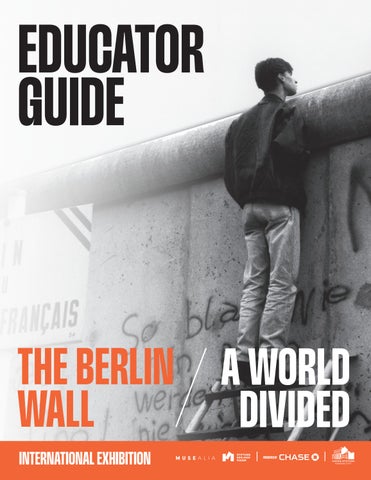
EDUCATOR GUIDE
INTERNATIONAL EXHIBITION
WELCOME The fall of the Berlin Wall on November 9, 1989, marked one of the most significant turning points of the twentieth century. For nearly three decades, the Wall stood as a powerful symbol of the Cold War, dividing families, communities, and a nation. Yet the story of the Berlin Wall is much larger than Germany alone. It is the story of a world shaped by competing ideas, political systems, fear, hope, and the enduring human desire for freedom. Through immersive environments, artifacts, personal stories, photographs, media, and primary sources, this exhibition explores how global events influenced everyday life and how ordinary people helped shape extraordinary historical change.
Why This Exhibit Matters Today: BECAUSE FREEDOM IS FRAGILE: The Berlin Wall reminds us that freedoms often taken for granted—including movement, expression, access to information, and participation in civic life— can be restricted or lost. BECAUSE HISTORY IS PERSONAL: The Cold War was not simply a conflict between governments. It shaped the daily lives of students, families, workers, and communities. Behind every headline were individuals making difficult choices in extraordinary circumstances. BECAUSE DIVISION HAS HUMAN CONSEQUENCES: The Berlin Wall physically divided a city, but its effects reached far beyond concrete and barbed wire. Families were separated, opportunities were limited, and trust was challenged. The exhibition encourages students to consider how division impacts communities and relationships. BECAUSE CHANGE BEGINS WITH PEOPLE: The fall of the Berlin Wall demonstrates the power of civic participation, collective action, and the belief that ordinary citizens can influence the course of history. BECAUSE ITS LESSONS STILL MATTER: Questions about freedom, security, democracy, human rights, information, and civic responsibility continue to shape our world today. The story of the Berlin Wall invites students to reflect on the choices individuals and societies make when confronted with challenges, conflict, and change. This educator guide is designed as an inquiry-based companion to support teachers before, during, and after their visit to the exhibition. The activities and discussion prompts students to analyze historical evidence, consider multiple perspectives, make connections to contemporary issues, and explore the enduring questions raised by the Cold War and the Berlin Wall.
RECOMMENDED GRADE LEVELS Middle School (Grades 6–8) | High School (Grades 9–12)
Compelling Question for Inquiry The Berlin Wall is more than a story about Germany. It is a story about freedom, power, citizenship, and the choices people make in times of conflict and change. This compelling question invites students to explore how historical events shape the lives of individuals and societies, and how ordinary people can influence the course of history.
COMPELLING QUESTION: How do freedom, division, courage, and change shape the lives of individuals and societies?
Exploring the Human Experience The story of the Berlin Wall invites students to explore enduring aspects of the human experience that transcend time and place. Through stories, artifacts, and personal accounts, students will investigate four recurring aspects of the human experience:—freedom, division, courage, and change. These universal struggles help us make meaning of the past while reflecting on their relevance in our lives and communities today.
ASPECT OF THE HUMAN EXPERIENCE
GUIDING QUESTION
FREEDOM: People value the ability to make choices, express ideas, and determine their own futures. Throughout history, individuals have risked their safety and security to protect or pursue freedom.
What freedoms do people value most?
DIVISION: Political, ideological, and physical barriers can separate communities, families, and nations while shaping how people see themselves and others.
What happens when people are separated by borders, beliefs, or political systems?
COURAGE: Periods of conflict and change often require individuals to make difficult choices and take risks for what they believe.
What risks are people willing to take for what they believe?
CHANGE: Historical change is often driven not only by leaders and governments, but also by the actions of ordinary people.
How do ordinary people change history?
BEFORE YOUR VISIT Teacher Note: Select the activities that best support your instructional goals and available time. The Museum in a Backpack activity and one Historical Lens provide a strong foundation for most visitors.
Recommended Preparation Step 1: Thinking Like a Historian (Recommended for All Visitors) • Human Stories Behind History • Museum in a Backpack: This activity introduces students to the idea that objects tell stories and prepares them to analyze artifacts throughout the exhibition. (10–15 minutes) • Tools of Historical Inquiry: The Artifact Analysis Warm-Up
Step 2: Choose a Historical Lens Select one or more Historical Lenses that connect to your curriculum, grade level, or student interests. • A Battle of Ideas • Crisis, Choices, and Consequences • State Control and Individual Liberty • Life on the Cold War Home Front • The Power of Civic Action Each lens includes inquiry questions, explorations, exhibit connections, and standards alignment.
Step 3: Curiosity Paths (Optional) Choose an aspect of the Human Experience to investigate: • Freedom • Division • Courage • Change
Step 4: Vocabulary Investigation (Optional) • Create a Cold War Inquiry Journal.
Thinking Like a Historian Human Stories Behind History History is often remembered through major events, political leaders, and important dates. Museums help us discover another side of history - the experiences of ordinary people. Through artifacts, photographs, oral histories, and personal accounts, we can better understand how individuals experienced the challenges, fears, hopes, and opportunities of their time. Throughout the exhibit, students will encounter personal artifacts that reveal stories of fear, courage, loss, hope, resilience, and change.
Guiding Question • How can personal stories and artifacts help us understand history?
Supporting Questions • How do objects tell stories? • What can we learn from personal experiences? • Why do museums preserve artifacts? • What perspectives can artifacts reveal that textbooks sometimes miss?
Museum in a Backpack Ask students if historians discovered your backpack 100 years from now: • What would they learn about you? • What might they misunderstand? • What object best represents your life today? Invite students to share and discuss how everyday objects can reveal information about a person's interests, routines, relationships, and experiences.
TOOLS OF HISTORICAL INQUIRY Historians do more than memorize facts and dates. They ask questions, analyze evidence, consider multiple perspectives, and develop conclusions based on available information. Throughout the Berlin Wall exhibition, students will have opportunities to use the same inquiry practices employed by historians and social scientists.
Artifact Analysis Warm-Up: Show students an image from the exhibit (a Mickey Mouse doll, the atomic ID tag, the escape sled, etc.).
Ask: • What do you notice? • What do you think this object was used for? • What questions do you have? Throughout the exhibition, you will use these same inquiry skills to investigate artifacts and uncover the stories they tell.
Historical Lenses for Inquiry The Berlin Wall can be studied through many different perspectives—from politics and government to culture, citizenship, and personal experience. These Historical Lenses help students investigate the exhibition through multiple viewpoints, encouraging them to ask questions, analyze evidence, and uncover the complex stories behind historical events.
HISTORICAL LENS:
QUESTIONS FOR INQUIRY:
EXPLORATIONS & ACTIVITIES:
EXHIBIT CONNECTIONS:
LEARNING STANDARDS:
What are we investigating?
What are we wondering?
What are we doing?
What will we see and analyze?
Why does it matter academically?
HISTORICAL LENS 1: A BATTLE OF IDEAS Historical Lens
Questions for Inquiry
Explorations & Activities
A Battle of Ideas
Guiding Question
Design a Society
The Cold War was more than a military and political conflict—it was a competition between two different visions for organizing society. Students examine the contrast between democratic capitalism and state-owned communism and explore how differing beliefs about individual freedom, the collective good, market economies, and government authority shaped life on both sides of the Iron Curtain.
• How does a society’s core belief system influence the way it organizes government, education, economics, and daily life?
In small groups, students create a fictional society. Students must decide: • Who makes decisions?
Supporting Questions • What beliefs shape a society? • How do governments reflect their values? • What is the difference between democracy and communism? • How do political systems influence daily life?
• How are resources distributed? • What rights do citizens have? • What responsibilities do citizens have? After creating their societies, groups compare systems and discuss the advantages and challenges of different approaches to government, economics, and citizenship. Possible Reflection Questions: • Which decisions were easiest to make? • Which decisions created disagreements? • How did your values influence the society you designed? • What tradeoffs did your group make between individual freedom and the common good?
Exhibit Connections
Learning Standards
As students explore the exhibition, look for evidence of how democratic and communist societies viewed themselves and one another.
Missouri 9-12.WH.T4.S2.B — Compare limited and absolute governments and their impact on individuals and societies.
Key Exhibit Artifacts • The Anti-Acheson Poster (1952): Soviet caricature of the U.S. foreign minister. • The Anti-Stalin Poster (1950s): American propaganda portraying communism as a threat. • Soviet School Propaganda Poster (1953): Comparison of Soviet and American education systems. • Interbau and Stalinallee Urban Models: Competing visions of modern housing and city design. Consider: • What values are reflected in these artifacts? • How does each side portray itself? • How does each side portray its opponent? • What similarities and differences do you notice?
Kansas Standard 3 — Societies are shaped by the identities, beliefs, and practices of individuals and groups.
HISTORICAL LENS 2: CRISIS, CHOICES, AND CONSEQUENCES Historical Lens Crisis, Choices, and Consequences The Cold War was marked by a series of highstakes crises that brought the world to the brink of conflict. Students investigate major flashpoints, including the Berlin Blockade, the Berlin Airlift, the construction of the Berlin Wall, and the Cuban Missile Crisis. Through these events, students examine how leaders navigated competing priorities, weighed risks, and made decisions that affected millions of people around the world.
Questions for Inquiry
Explorations & Activities
Guiding Question
What Would You Do?
• When global tensions reach a breaking point, how do leaders balance the need to protect security while avoiding catastrophic conflict?
Present students with historical scenarios before revealing the actual event.
Supporting Questions • How do leaders make decisions during crises? • What are the consequences of those decisions? • How do competing perspectives influence decision-making? • Is there ever a perfect choice during a crisis?
Scenario: A neighboring country blocks all road, rail, and water access to a city of more than two million people.
What would you do? A. Use military force to reopen access. B. Negotiate and seek a diplomatic solution. C. Supply the city another way. D. Propose another solution.
• How might different Students discuss and defend choices change the course their reasoning using evidence of history? and anticipated consequences. Reveal: This scenario mirrors the Berlin Blockade of 1948–49, which led to the Berlin Airlift.
Exhibit Connections
Learning Standards
Throughout the exhibition, students will encounter artifacts and stories connected to moments when Cold War tensions threatened to escalate into broader conflict.
Missouri: 9-12.AH2.T5.S1.B (Evaluate responses of American leaders to global tensions).
Key Exhibit Artifacts • US Air Force Flour Transport Bag (1948): Used during the Berlin Airlift to deliver essential supplies to West Berlin residents. • Original Roll of Barbed Wire (1961): One of the first materials used to separate East and West Berlin. • Daniel Southard’s US Medic Armband: Worn during the October 1961 Checkpoint Charlie tank standoff.
• Washington–Moscow Hotline Teleprinter (1979): A communication system created to reduce the risk of nuclear conflict Extension: following the Cuban Assign small groups different Cold War crises and have them Missile Crisis. analyze the choices available Consider: to leaders, the decisions that were made, and the resulting • What problems were consequences. leaders attempting to solve? Possible Reflection • How did each artifact Questions: represent a response to • Which choice seemed most a crisis? reasonable at first? • Which artifacts symbolize • What risks were associated conflict? Which with each option? symbolizes cooperation? • How might citizens have • What might have viewed these decisions happened if different differently than political decisions had been made? leaders? • What factors should leaders consider during international crises?
Kansas: Standard 1 (Choices have consequences).
HISTORICAL LENS 3: STATE CONTROL AND INDIVIDUAL LIBERTY Historical Lens State Control and Individual Liberty Students explore surveillance, censorship, border enforcement, and restrictions on movement while considering the impact these policies had on everyday citizens. Through the story of the Berlin Wall and the East German surveillance state, students examine how governments balance security, order, and individual liberty.
Questions for Inquiry
Explorations & Activities
Guiding Question
The Freedom Spectrum
• What happens when governments prioritize control over individual freedom?
Present students with historical scenarios before revealing the actual event.
Exhibit Connections
Learning Standards
Throughout the exhibition, students will encounter stories of surveillance, censorship, border controls, and escape attempts that reveal how governments can influence the daily lives of citizens.
Missouri 9-12.WH.T4.S2.B — Compare limited and absolute governments and evaluate their impact on individuals and societies.
Supporting Questions
Post statements around the room:
• Why do governments create rules?
• Safety is more important than freedom.
• When can rules become harmful?
• Governments should monitor citizens to prevent crime.
• What freedoms do people value most?
• Citizens should be free to travel wherever they want.
• How does surveillance affect trust within a community?
• Governments should be • Voluntary Assistant allowed to limit speech during Armbands: Worn by times of crisis. civilian volunteers who • Privacy is more important assisted state surveillance than security. efforts.
• What happens to the social fabric of a society when neighbors, friends, and family become informants?
Students position themselves along a continuum and explain their thinking using evidence and examples. Reflection Questions • Which statement was most difficult to answer? • Did your position change after hearing others’ perspectives?
Key Exhibit Artifacts • East German Official House Book (c. 1985): A mandatory log used by authorities to track overnight visitors.
• Watchtower Searchlight & Ladder (1970s): Equipment used to monitor the border and identify escape attempts. • Steel Barrier with Spike Gratings: Border fortifications designed to prevent crossings.
• Can freedom and security coexist?
• Stasi Surveillance RestStop Cameras: Hidden surveillance equipment used to monitor citizens and visitors.
• What responsibilities come with freedom?
Consider: • What do these artifacts reveal about daily life in East Germany? • How might surveillance influence people’s behavior? • What freedoms were restricted? • How might citizens respond to these restrictions?
Kansas Standard 2 — Individuals have rights and responsibilities.
HISTORICAL LENS 4: LIFE ON THE COLD WAR HOME FRONT Historical Lens Life on the Cold War Home Front The Cold War was not only fought through governments, military alliances, and political leaders. It also influenced daily life in homes, schools, communities, and popular culture. Students examine how Cold War tensions shaped childhood, media, education, technology, and everyday experiences in both the United States and Germany.
Questions for Inquiry
Explorations & Activities
Exhibit Connections
Learning Standards
Students will discover how Cold War tensions shaped families, schools, media, popular culture, and daily life.
Missouri 5.H.3.I.b — Identify social and domestic consequences of the Cold War. Kansas Standard 5 — Relationships between people, places, and environments are dynamic.
Guiding Question
Artifact Detective
• How does a global conflict influence everyday life?
Show students images of:
Supporting Questions
• A Duck and Cover poster
• What fears influence communities?
• A Red Menace trading card
Key Exhibit Artifacts
• A Mickey Mouse doll
• Iwao Sugiyama’s Pocket Watch
Ask:
• Red Menace Trading Cards
• How does culture reflect history? • How do governments use media and education to influence public opinion? • How does a global political conflict alter the toys children play with, the media they consume, and the daily routines they experience?
• A fallout shelter sign
• What does this object tell us about the time period? • What fears or hopes does it reveal? • Who might have used this object? • What can it teach us about everyday life during the Cold War?
• Atomic Identification Tags • Handmade Mickey Mouse Dolls • The “Jazz Lift” Record • Duck and Cover materials • Atomic Test Dosimeter & Protection Goggles
HISTORICAL LENS 5: THE POWER OF CIVIC ACTION Historical Lens
Questions for Inquiry
Explorations & Activities
The Power of Civic Action
Guiding Question
Change Makers
• How can ordinary people influence extraordinary change?
Have students brainstorm: Who changed history without being a president, king, or military leader?
The fall of the Berlin Wall was not caused by a single leader or event. It emerged from a combination of political reforms, growing public dissatisfaction, grassroots resistance movements, and citizen action across Eastern Europe. Students investigate how ordinary individuals and communities challenged systems of power and helped bring about one of the most significant political transformations of the twentieth century.
Supporting Questions • How do people create change? • What makes people speak up? • What role do citizens play in democracy? • What risks do people take when advocating for change? • When a powerful government controls the media, the military, and the borders, what strategies can ordinary citizens use to reclaim their freedom?
Examples: • Rosa Parks • Malala Yousafzai • Greta Thunberg • Local community leaders • Student activists Discuss: • What gave them influence? • What obstacles did they face? • What actions did they take? • What can we learn from their experiences? Extension Activity: Students identify a challenge in their school or community and develop a plan for creating positive change through civic participation, collaboration, or advocacy.
Exhibit Connections
Learning Standards
Students will encounter stories of resistance, escape, protest, reform, and citizen action that contributed to the fall of the Berlin Wall and the transformation of Eastern Europe.
Missouri 9-12.WH.T5.S2.C — Analyze the collapse of the Soviet Union and its satellite states.
Key Exhibit Artifacts • Wadewitz Family Escape Sled (1955): Packed during a sudden political escape. • The Radischewski Leather Bag: Used to exchange goods across the border through a clothesline connection. • Helga Kuhn’s WindowJump Passport (1961): Preserved during her dramatic escape into West Berlin. • Wooden Structural Piece of Tunnel 29 (1962): A section of a tunnel built by citizens to help others escape East Berlin. • The Synowzik Silver Lobster Forks: Carried during a dark, eight-hour sewer line escape • Conscript Notes Thrown Over the Wall: Secret communications from border guards expressing service displeasure Consider: • What risks were individuals willing to take for freedom? • What forms of resistance are represented by these artifacts? • How can small actions contribute to larger social change? • What do these objects reveal about courage, perseverance, and hope?
Kansas Standard 4 — Societies experience continuity and change over time.
Curiosity Path (Individual Investigations) Choose a Curiosity Path Before visiting the exhibition, students may choose one topic of interest to investigate.
PATH 1: FREEDOM
PATH 2: DIVISION
PATH 3: COURAGE
PATH 4: CHANGE
INVESTIGATE:
INVESTIGATE:
INVESTIGATE:
INVESTIGATE:
• What freedoms do
• Why do societies become divided?
• What makes people take risks?
• What causes social and political change?
• What are the consequences of division?
• How do individuals stand up for their beliefs?
• How do citizens influence governments?
• How do people overcome barriers?
• What acts of courage have changed history?
• What can we learn from past movements for change?
people value most? • How do societies protect freedom? • What happens when freedom is restricted?
Vocabulary Investigation Create a Cold War Inquiry Journal As students prepare for their visit, invite them to explore key vocabulary that will help them understand thepeople, events, and ideas featured throughout the exhibition. Students select 10 terms and create a Cold War Inquiry Journal that includes: • Definition • Sketch, symbol, or visual representation • Connection to today: Why does this term still matter? Choose from the following:
COLD WAR
DEMOCRACY
COMMUNISM
PROPAGANDA
SURVEILLANCE
FREEDOM
HUMAN RIGHTS
NATO
IRON CURTAIN
BERLIN AIRLIFT
CHECKPOINT CHARLIE
REUNIFICATION
CENSORSHIP
REFUGEE
CIVIC ACTION
WARSAW PACT
At the Exhibit Throughout the exhibition, students will encounter authentic artifacts, personal stories, photographs, media, and primary sources that reveal how global events shaped everyday lives during the Cold War. From escape tunnels and propaganda posters to family keepsakes and protest movements, students will discover how ordinary people experienced extraordinary moments in history.
Visitors may encounter: • Personal objects carried during escape attempts • Propaganda from both communist and democratic societies • Artifacts connected to the nuclear age • Objects from everyday life in East and West Berlin • Stories of families separated by the Wall • Evidence of protest movements and civic action • Artifacts that reveal how ordinary people experienced extraordinary events
Student Exhibit Guide The Student Exhibit Guide is designed to help students engage actively with the exhibition through observation, inquiry, analysis, and reflection. Students may complete all three sections or teachers may select the activities that best support their instructional goals and available time.
Part 1: Notice • Wonder • Connect Students use an inquiry routine to record observations, ask questions, and make connections while exploring the exhibition. This activity encourages curiosity, critical thinking, and personal reflection as students engage with artifacts, stories, and historical events.
Recommended Time: Throughout the exhibit visit
Part 2: Artifact Investigation Students select a single artifact for deeper analysis. Using observation, interpretation, questioning, and reflection, students investigate what the artifact reveals about life during the Cold War and the human experiences connected to it.
Recommended Time: 15–20 minutes
Part 3: Exploring Themes Students identify artifacts, stories, and experiences that connect to recurring themes found throughout the exhibition, including freedom, division, courage, change, daily life, hope, and conflict. This activity encourages students to synthesize their learning and recognize broader patterns across the exhibition.
Recommended Time: Throughout the exhibit visit or as a concluding reflection
Part 4: Reading History Through Stories Students Many of the most powerful moments in the exhibition are found in the stories of ordinary people. This activity invites students to analyze historical narratives using literacy skills commonly associated with literature, including character, conflict, theme, symbolism, and perspective. Students select a story, artifact, or personal account from the exhibition and examine how an individual’s experiences help illuminate larger historical events and themes. The activity supports both social studies inquiry and ELA standards by encouraging students to interpret evidence, identify themes, analyze perspective, and connect historical experiences to contemporary issues.
Recommended Time: 10–15 minutes ELA Connections: Character and perspective • Theme and central idea • Conflict and resolution • Symbolism • Evidence-based analysis • Historical narratives Part 5: Map & Timeline Challenge Students select one map or timeline in the exhibit to analyze and understand changes over the time of the war.
Teacher Tip Consider assigning students one of the exhibition's Historical Lenses or Curiosity Paths before their visit. These frameworks can help students focus their observations and make meaningful connections as they complete the Student Exhibit Guide.
After Your Visit The Berlin Wall exhibition tells a story that extends beyond a single city, country, or historical event. Through artifacts, personal stories, and historical evidence, students encounter enduring themes of freedom, division, courage, change, hope, and the power of ordinary people to shape history. The experiences in this section invite students to reflect on what they learned, make connections to their own lives and communities, and consider how the lessons of the past continue to influence the present. Through discussion, creative expression, civic inquiry, and design challenges, students can deepen their understanding of the human stories behind history while exploring the relevance of these ideas in today's world. Suggestion: Teachers may select the activities that best support their instructional goals, available time, and student interests.
Recommended Follow-Up Sequence 1. Reflection: Human Experience Reflection 2. Civic Connections: Then and Now 3. One Creative Project or Design Challenge
REFLECTION & DISCUSSION Human Experience Reflection
Then and Now
Choose one artifact, story, or individual from the exhibition.
Compare an issue from the Berlin Wall era with a current event or challenge.
Reflect: • What surprised you?
• What similarities do you notice?
Students move to:
• What challenged your thinking?
• What differences exist?
• Strongly Agree
• What emotions did it evoke?
• Agree
• Why do you think this story was important to preserve?
• What lessons from history might apply today?
Four Corners: Freedom or Security? Post a statement such as: Governments should sometimes limit freedoms to keep people safe.
• Disagree • Strongly Disagree Discuss using evidence from the exhibition.
• What responsibilities do governments have to protect both security and human dignity? • How do political decisions affect families and communities? • What can we learn from history when addressing complex issues today? • Why is it important to understand multiple perspectives when studying current events?
CREATIVE PROJECT IDEAS Create a Museum Exhibit
Voices from the Wall
Artifact Storytelling
Students design a mini exhibit around one theme:
Create a collection of poems, diary entries, letters, or monologues from multiple perspectives:
Select an artifact from the exhibition and tell its story through:
• Child
• Short film
• Parent
• Graphic novel
• Border Guard
• Illustrated children’s book
• Protester
• Digital story
• Freedom • Division • Courage • Change • Hope Include artifacts, captions, and an exhibit introduction.
• Refugee • Journalist
• Podcast
CIVIC CONNECTIONS Change Makers Then and Now
Community Stories Project
Why Remember?
Research a historical figure from the Cold War and a modern individual working for change.
Interview someone who lived through a significant historical event.
Discuss:
Compare:
Ask:
• Challenges
• What do you remember?
• Strategies
• How did it affect daily life?
• Risks
• What lessons should younger generations learn?
• Impact
• Why should future generations continue to learn about the Berlin Wall? Students create a public service announcement, poster, or social media campaign encouraging others to learn from history.
DESIGN CHALLENGES • How might we create a memorial that helps future generations understand the impact of division? • How might we tell the story of freedom through objects? • How might we help others understand the human impact of political decisions? • How might we design an exhibit that helps visitors see history through multiple perspectives? • How might we preserve personal stories so they are not lost over time? • How might we help people recognize the warning signs of division before communities become separated? • How might we use storytelling to build understanding across differences?
CREATIVE CHALLENGE: CURATE AN ARTIFACT FOR THE FUTURE Ordinary objects can tell extraordinary stories. If you could place one object in a museum to represent life today, what would it be? • Select an object • Write a museum label • Explain why future generations should study it
Exhibition Content Standards Museum collections provide a unique opportunity for students to engage directly with primary sources and material culture. Through artifacts, personal narratives, photographs, maps, and historical documents, students encounter history not only as a series of events, but as lived human experiences.
Standard Alignment At A Glance for Museum Exhibit Sections
EXHIBIT SECTION
BIG IDEAS
MISSOURI STANDARDS
KANSAS STANDARDS
1.1 A New Threat
Origins of the Cold War, nuclear tensions, competing worldviews
9-12.WH.T5.S1.A; 9-12.AH2.T5.S1.A
Standard 1; Standard 3
1.2 A Global Cold War
Democracy vs. communism, ideological conflict
9-12.WH.T4.S2.B
Standard 3
2.1 A City in Crisis Mode
Berlin Blockade, Berlin Airlift, leadership decisions
9-12.AH2.T5.S1.B
Standard 1
2.2 Cold War Rivalry
Propaganda, culture, competing systems
9-12.WH.T4.S2.B; 9-12.AH2.T5.S1.A
Standard 3
3.1 Division
Construction of the Berlin Wall, consequences of political decisions
9-12.WH.T5.S1.A
Standard 1; Standard 5
3.2 The Border Regime
Surveillance, restrictions, state control
9-12.WH.T4.S2.B
Standard 2
Border Area
Security systems, escape attempts, human rights
9-12.WH.T4.S2.B; 9-12.AH2.T5.S1.C
Standard 2; Standard 5
4.1 Reform and Resistance
Civic action, citizen movements, changing governments
9-12.WH.T5.S2.C
Standard 4
4.2 Revolutions of 1989
Democratic movements, collapse of Soviet influence
9-12.WH.T5.S2.C
Standard 4
4.3 Germany Reunified
Change over time, lasting impact of the Cold War
9-12.WH.T5.S2.C; 9-12.AH2.T5.S1.A
Standard 4
MISSOURI SOCIAL STUDIES STANDARDS HIGH SCHOOL WORLD HISTORY (POST-C. 1450) Learning Standard
Potential Exhibit Connections
9-12.WH.T4.S2.B: Compare and contrast limited and absolute governments and the extent of their impact on individuals and society.
Students examine how democratic and communist governments approached power, citizenship, freedom, and control. Through propaganda posters, surveillance artifacts, border enforcement technologies, and personal stories, students analyze how government structures influenced daily life and individual rights.
9-12.WH.T5.S1.A: Analyze the origins, major conflicts, and consequences of the Cold War.
Students investigate the ideological conflict between the United States and the Soviet Union, major Cold War crises, and the long-term effects of division in Germany and throughout the world.
Examples from the Exhibition • Soviet and American propaganda posters • East German House Book used to track visitors • Stasi surveillance equipment and informant materials • Border fortifications, watchtower artifacts, and escape stories • Personal accounts of restricted travel and separated families
• Post-World War II occupation of Germany • Berlin Blockade and Berlin Airlift artifacts • Cuban Missile Crisis materials • Construction and evolution of the Berlin Wall • Revolutions of 1989 and German reunification
High School American History (Post-c. 1870) Learning Standard 9-12.AH2.T5.S1.A: Describe the causes, major conflicts, consequences, and enduring legacy of the Cold War.
Potential Exhibit Connections Students explore how competing political systems, nuclear tensions, and global rivalries shaped both international relations and everyday life. The exhibition illustrates the lasting impact of the Cold War on governments, communities, and individuals.
Examples from the Exhibition • Hiroshima artifacts and nuclear-age materials • Red Menace cards and Duck-and-Cover culture • Berlin Airlift artifacts • Personal stories from East and West Berlin • Artifacts connected to reunification and democratic movements • Berlin Airlift materials connected to President Truman’s response to the Soviet blockade
9-12.AH2.T5.S1.B: Evaluate the responses of American leaders to the challenges of global tensions.
Students examine how American leaders responded to Cold War crises through diplomacy, military preparedness, economic aid, and strategic alliances.
• Checkpoint Charlie and Cold War military standoffs • NATO-related content and alliance-building efforts • Washington-Moscow Hotline teleprinter developed following the Cuban Missile Crisis • Presidential speeches and policy decisions highlighted throughout the exhibition • Atomic testing equipment and dosimeters • Nuclear preparedness materials
9-12.AH2.T5.S1.C: Trace changes in military strategies and technologies as a response to the challenges of the Cold War.
Students investigate how military technology, intelligence gathering, border security systems, and nuclear deterrence evolved throughout the Cold War.
• Border surveillance technology • Searchlights, barriers, and security infrastructure along the Berlin Wall • Communications technology including the Washington-Moscow Hotline • Military artifacts associated with Berlin and Checkpoint Charlie
MISSOURI SOCIAL STUDIES STANDARDS (continue) CROSS-CUTTING INQUIRY SKILLS Learning Standard 6-12.AH.1.WH.1.A: Create and use maps, graphs, statistics, and timelines to explain historical relationships and trace regional change.
6-12.AH.1.WH.1.B: Explain connections between historical context and peoples' perspectives at the time.
Potential Exhibit Connections Students analyze maps of divided Berlin, Cold War alliances, migration and escape routes, timelines of major Cold War events, and visual representations of geopolitical change over time.
Examples from the Exhibition • Maps of East and West Berlin • Berlin Wall border systems • Cold War timelines • Decolonization and global change displays • Family separation stories
Students examine how historical events influenced the perspectives, decisions, and experiences of individuals living during the Cold War.
• Bernauer Strasse accounts • Border guard communications • Oral histories and personal testimonies • Escape narratives and protest movements • Soviet and American propaganda posters
6-12.AH.1.WH.1.C: Develop and support points of view and historical claims using a variety of primary and secondary sources.
Students evaluate evidence from artifacts, propaganda, photographs, oral histories, government documents, and exhibit text to support interpretations and historical claims.
• Political speeches and government messaging • Personal artifacts connected to escape attempts • Letters, identification documents, and travel records • Oral histories and first-person accounts
MISSOURI ELA STANDARD CONNECTIONS Grades 6-12
An artifact exhibit acts as a “text.” These following align with interpreting non-linguistic data, human narratives, and visual themes.
Learning Standard
Potential Exhibit Connections
Reading Informational Text RI.6-12.3: Analyze how individuals, events, and ideas develop and interact throughout a text.
Students trace how decisions made by leaders affected the lives of ordinary citizens.
RI.6-12.8 (Evaluating Evidence ): Evaluate arguments and claims in a text.
Students analyze competing claims made by democratic and communist governments.
RI.6-12.2 (Theme & Central Idea): Determine a central idea or theme and analyze its development.
Students identify recurring themes of freedom, division, courage, and change throughout the exhibition.
RI.6-12.6 (Point of View & Perspective): Determine an author’s point of view or purpose and analyze how it is conveyed.
Students compare propaganda posters, political speeches, media sources, and personal accounts.
6-12.RI.1.A (Evidence & Inference): Draw conclusions, infer, and analyze by citing relevant and thorough textual or physical evidence to support what the “text” says.
Students infer life during the Cold War by analyzing letters, uniforms, or personal rations.
MISSOURI ELA STANDARD CONNECTIONS (continued) Grades 6-12
An artifact exhibit acts as a “text.” These following align with interpreting non-linguistic data, human narratives, and visual themes.
Learning Standard
Potential Exhibit Connections
6-12.RI.2.D (Evaluating Diverse Media): Integrate and evaluate information presented in diverse formats and media, including visually, quantitatively, and orally.
Directly mirrors the experience of rotating through audio journals, video footage, and physical mockups in a museum.
6-12.RI.3.B (Author’s Perspective & Bias): Analyze how an author uses rhetoric, perspective, and point of view to shape a message or influence an audience.
Ideal for breaking down the ideological symbols used by both the US and Soviet Union.
6-12.SL.1.C (Diverse Perspectives): Respond thoughtfully to diverse perspectives, summarize points of agreement and disagreement, and justify views based on evidence.
Used for post-exhibit classroom debates surrounding the human cost of proxy wars or political censorship.
KANSAS HISTORY, GOVERNMENT, AND SOCIAL STUDIES STANDARDS Learning Standard Standard 1: Choices Have Consequences
Students examine the motivations behind historical choices and evaluate their short- and long-term outcomes.
Standard 2: Individuals Have Rights and Responsibilities
Students analyze the relationship between governments and citizens and examine how rights and responsibilities shape societies.
Standard 3: Societies Are Shaped by Beliefs, Ideas, and Diversity
Students investigate how competing ideas, values, and belief systems influence societies.
Potential Exhibit Connections Throughout the exhibition, students encounter individuals, governments, and nations making difficult decisions during times of uncertainty. From the Berlin Airlift and the construction of the Berlin Wall to escape attempts and citizen protests, students analyze how choices shaped both personal lives and world events.
Students explore how governments influence individual freedoms and responsibilities through laws, surveillance, border controls, and political systems. Personal stories reveal the human impact of restrictions on movement, expression, and opportunity.
Examples from the Exhibition • The Berlin Airlift and the decision to supply West Berlin • Construction of the Berlin Wall in 1961 • Escape attempts through tunnels, windows, and border crossings • Soviet and American responses during Cold War crises • Citizen-led demonstrations leading to the fall of the Berlin Wall
• East German House Book used to monitor citizens • Stasi surveillance equipment and informant networks • Border fortifications and travel restrictions • Stories of separated families • Personal accounts of resistance and civic participation
The Cold War was rooted in competing political, economic, and social ideologies. Students examine how democratic capitalism and state-owned communism shaped government policies, education, media, housing, and daily life.
• Soviet and American propaganda posters • Soviet school propaganda materials • Interbau and Stalinallee architectural models • Political speeches and government messaging • Cold War cultural artifacts and media
KANSAS HISTORY, GOVERNMENT, AND SOCIAL STUDIES STANDARDS (continued) Learning Standard Standard 4: Societies Experience Continuity and Change Over Time
Students investigate how societies evolve and how historical events contribute to continuity and change.
Standard 5: Relationships Between People, Places, Ideas, and Environments Are Dynamic
Students analyze how geography, physical spaces, political boundaries, and human interactions influence one another.
Potential Exhibit Connections
Examples from the Exhibition • Postwar occupation of Germany
The exhibition traces the transformation of Germany and Eastern Europe from the aftermath of World War II through the Cold War and eventual reunification. Students examine how political systems, communities, and individual lives changed over time.
Students explore how geography and political boundaries shaped life in Berlin. The Wall transformed transportation systems, neighborhoods, economic relationships, and family connections while creating new physical and psychological barriers.
• Construction and expansion of the Berlin Wall • Revolutions of 1989 • German reunification • Artifacts documenting life before and after the Wall
• Maps of divided Berlin • Checkpoint Charlie materials • Border fortifications and wall segments • Transit route maps and transportation changes • Escape routes and tunnel artifacts • Stories of communities divided by physical barriers
The Historical Lenses throughout this Educator guide provide opportunities for students to engage directly with the Kansas History, Government, and Social Studies Standards Framework while investigating the people, events, ideas, and experiences represented in the exhibition.
Historical Lens
Kansas Standard
Crisis, Choices, and Consequences
Standard 1
State Control and Individual Liberty
Standard 2
A Battle of Ideas
Standard 3
The Power of Civic Action
Standard 4
Life on the Cold War Home Front
Standard 5
KANSAS ELA CONNECTIONS Grades 6-12
An artifact exhibit acts as a “text.” These following align with interpreting non-linguistic data, human narratives, and visual themes.
Learning Standard
Potential Exhibit Connections
RST/RI 6-12.1: Cite specific textual evidence to support analysis.
Students use artifacts, exhibit text, and oral histories as evidence for historical claims.
RST/RI 6-12.7: Integrate information presented in different formats.
Students analyze photographs, artifacts, maps, audio recordings, timelines, and exhibit text.
W.6-12.1: Write arguments supported by evidence.
Students defend conclusions about freedom, government power, civic action, or historical change.
Point of View & Perspective RI.6-12.6: Determine an author's point of view or purpose and analyze how it is conveyed.
Students compare propaganda posters, political speeches, media sources, and personal accounts.
STUDENT EXHIBIT GUIDE Part 1: Notice • Wonder • Connect As you wander the exhibit, consider the following questions and write down your thoughts.
NOTICE
WONDER
CONNECT
• What do you see?
• What questions do you have?
• What meaning can you make?
• What stands out?
• What do you want to learn more about?
• How does this connect to Freedom, Division, Courage, or Change?
• What surprises you? • Which artifacts capture your attention?
• Why did this happen?
• How does this connect to one of the Historical Lenses?
• What was this person’s experience like?
• How does this connect to your life or the world today?
Part 2: Artifact Investigation Choose an artifact that captures your attention:
What material is it made of? (circle all that apply):
BONE
POTTERY
METAL
WOOD
LEATHER
GLASS
PAPER
CARDBOARD
PLASTIC
FABRIC
STONE
OTHER
Observe: What do you notice? Describe the artifact as if you were explaining it to someone who can’t see it. Think about: shape, color, texture, size, weight, age, condition, movable parts, or anything written on it.
Interpret: What does this reveal about life during the Cold War? • What can you learn about the people connected to this object? • What is a similar item from today?
Questions: What questions does this artifact raise?
Human Story: What story does this artifact tell about life during the Cold War?
Connect: • What did you find out from this artifact that you might not learn anywhere else? • How does this artifact connect to Freedom? Division? Courage? Change? • Why might this artifact still matter today?
Historical Lens: Which Historical Lens does this artifact best represent? • A Battle of Ideas • Crisis, Choices, and Consequences • State Control and Individual Liberty • Life on the Cold War Home Front • The Power of Civic Action
Part 3: Exploring Themes Find artifacts that connect to the different themes woven into the exhibit.
THEME
FREEDOM DIVISION
COURAGE
CHANGE
DAILY LIFE
HOPE
CONFLICT
ARTIFACTS/STORIES
What does it reveal about the human experience?
Part 4: Reading History Through Stories History is more than dates and events. It is also a collection of human stories. As you explore the exhibition, look for a story that captures your attention. It might be the story of a family, a child, a border guard, a protester, or someone seeking freedom. Choose one story and respond to the questions below.
Character • Who is at the center of this story? • What do you learn about this person?
Conflict • What challenge, obstacle, or difficult choice did they face?
Theme • Which theme best connects to this story? • Freedom • Division • Courage • Change • Hope • Conflict Explain your thinking.
Symbol • Was there an object, artifact, photograph, or place that became a symbol in this story? • Why is it important?
Connection • How does this person’s story help you better understand life during the Cold War?
Then and Now • How might this story still matter today?
Part 5: Map & Timeline Challenge Find one map or timeline in the exhibit. • What does it help you understand? • What changes over time can you identify? • How does it help explain the events of the Cold War?