DEEP
OUR ENVIRONMENT
NOTRE ENVIRONNEMENT
NUESTRO MEDIO AMBIENTE

DEEP
OUR ENVIRONMENT
NOTRE ENVIRONNEMENT
NUESTRO MEDIO AMBIENTE
AT THE NATIONAL LEVEL
Organising the profession
Regulating lawyer-client relations
Ensuring compliance with professional ethics
Promoting access to law and justice
Defending the Rule of law
Making life easier for lawyers
AT THE INTERNATIONAL LEVEL
Ensuring the defence of defence throughout the world
Simplifing the exercice of the profession abroad
Raising the profile of the paris legal and arbitration centre
Encouraging the development of relations between the bars and business activity
Contributing to strengthening the attractiveness of the law



3 6 82 62 74 28 8 15 22
President’s Message I Le mot du Président I Mensaje del Presidente
Editorial I L'édito I Editorial
Interviews I Entretiens I Entrevistas
Using VRT to Treat Trauma Victims
New Frontiers I Nouveaux horizons I Nuevas fronteras
IA, mode et perspectives légales Sustainability and Greenwashing in EU Agri-Food: Legal Framework and Use of Innovative Technologies
What Matters I L’essentiel I Lo Importante
Juger les crimes environnementaux devant la CPI : menaces ou promesses ?
Harnessing Neurodiversity in the Legal Field
Arc of the Law I Évolution du droit I Panorama jurídico
The Ascent of Women and Women Lawyers in North America
Deep Dive - Our Environment I Le dossier - Notre environnement I El informe - Nuestro Medio Ambiente
28 Un jugement qui fait le tour du monde 32 Droit de l‘environnement et bail commercial : un engagement durable ! 35 Energy Justice and the Global Transition to Clean Energy 39 Cinco enfoques para el control y la prevención de la deforestación 43 The Sustainability Reporting of Law Firms: Insights from the First Market Experiences 46 Climate Change: A Lawyer’s Professional Responsibilities in the Age of Environmental Degradation 50 Derecho de la sostenibilidad corporativa 53 KDIPA Law in Kuwait Includes Promoting Investments in Environmental Services Sector 56 Combatting Climate Change and Species Protection: An Indian Perspective 58 Greenwashing : une nouvelle directive pour lutter contre certaines allégations environnementales des entreprises
The Wider View I Grand angle I Visión amplia
EU to Address Digital Platform Risks with New Security and Democracy Rules
Protection de l’investissement étranger et protection des droits humains : à la recherche d’un juste et nécessaire équilibre Droit et Littérature
My Own Backyard I Autour de moi I Mi entorno
Justice privée, décisions publiques : la favor arbitrandum en droit libanais
Swiss Law Considerations for a Foreign Family Lawyer Fiscalidad de la venta de SPV en el sector de las renovables: cambio de criterio
Legal Spotlight I Brèves juridiques I Breves jurídicos
JURISTE INTERNATIONAL
Editorial Policy
The Juriste International offers robust and diverse perspectives on subjects of interest to lawyers. The views expressed herein are the views of the authors and do not necessarily imply UIA policy or editorial concurrence. Publication or dissemination of advertising or support of any product, service or organization does not constitute an endorsement.
Politique éditoriale
Juriste International offre des perspectives approfondies et diverses sur des sujets d’intérêt pour les avocats. Les opinions exprimées ici sont celles de leurs auteurs et n’impliquent pas que l’UIA et/ou le Comité éditorial, en les publiant et les diffusant, les partagent, ni les soutiennent. L’UIA n’avalise pas nécessairement le matériel publicitaire ou promotionnel de tout produit, service ou organisation publié ou diffusé par le Juriste International.
Política editorial
Juriste International ofrece perspectivas sólidas y diversas sobre temas de interés para los abogados. Las opiniones aquí expresadas son las de sus autores y no implican que la UIA y/o el Consejo Editorial, al publicarlas y difundirlas, las compartan o apoyen. La publicación o difusión de publicidad o soporte de cualquier producto, servicio u organización no constituye un respaldo.
Photos credit I Crédit photos I Crédito fotos
Cover : © shuttertim82– Shutterstock / P 9 © Fit Ztudio –Shutterstock / P 11 © Shutterstock IA image generated / P 15 © oliverdelahaye – Shutterstock / P 16 © Thx4Stock team – Shutterstock / P 18 © Paralaxis – Shutterstock / P 19 © Vitalii Vodolazskyi – Shutterstock / P 24 © Everett Collection – Shutterstock / P 1 & 28 © Frontpage –Shutterstock / P 30 © Sambulov Yevgeniy – Shutterstock / P 32 © page frederique – Shutterstock / P 41 © Brester Irina – Shutterstock / P 42 © Solano Soares Ramos –Shutterstock / P 44 © PeopleImages.com - Yuri A –Shutterstock / P 50 © dee karen – Shutterstock / P 55 © Nuamfolio – Shutterstock / P 1 & 56 © Hardik Shelat – Shutterstock / P 60 © Content Angel – Shutterstock / P 61 © Ivan Marc – Shutterstock / P 1 & 62 © Christophe Licoppe – Shutterstock / P 65 © Lalaka – Shutterstock / P 68-69 © elenabsl – Shutterstock / P 76 © HakanGider
– Shutterstock / P 78 © Dee Karen – Shutterstock / P 79 © Morakod1977 – Shutterstock / P 81 © Alexander Supertramp – Shutterstock / P 82 © Irina Shats –Shutterstock / P 83 © Riccardo Mayer – Shutterstock
UIA PUBLICATION I PUBLICATION DE L’UIA I PUBLICACIÓN DE LA UIA
Publication Director I Directeur de la publication I Director de la publicación
Présidente Jacqueline R. Scott, Washington DC, USA
Editor-in-Chief I Rédactrice en chef I Redactora jefa Barbara Gislason, Minneapolis, MN, USA, barbara@gislasonlaw.com
Deputy Editors I Rédacteurs adjoints I Redactores adjuntos
English Language: Ashu Thakur, Mumbai, India, ashu@ataindia.co.in
French Language: Agathe Blanc, Paris, France, ablanc@ftmsavocats.com
Fannie Bruneau, Paris, France, fanniebruneau@fcaavocat.com
Spanish Language: Jesús Granados, Marbella, Spain, jesus.granados@jglex.com
Executive Director I Directrice exécutive I Directora ejecutiva Marie-Pierre Richard, Paris, France - mprichard@uianet.org
Editors I Éditeurs I Editores
north america i amérique du nord i américa del norte
Pierre G. Bélanger, Ottawa, Canada, pbelange@gmail.com
Hon. Peter M. Reyes, Jr., Minneapolis, MN, USA, petermreyes@gmail.com
Rebacca Salazar, Princeton, NJ, USA, rebecca.salazar@rutgers.edu
Mira Vats-Fournier, Minneapolis, MN, USA, MVats-Fournier@Taftlaw.com
Angela Velez, Brooklyn, NY, USA, angela.n.velez@gmail.com
central and south america i amérique centrale et du sud i américa central y del sur
Eugenio M. Curia, Buenos Aires, Argentina, Emcuria@yahoo.com
Juan Eduardo Palma Jara, Santiago, Chile, jpalma@palma.cl
Jaime Alberto Sandoval Mesa, Bogota, Colombia, jaisandoval@yahoo.com
Alan de la Torre Lobera, Mexico DF, Mexico, delatorre@quct.net
Wilfrido Fernández, Asunción, Paraguay, w.fernandez@zafer.com.py
europe i europa
Kato Aerts (Revenue Officer), Brussels, Belgium, kato.aerts@lydian.be
Juan Pablo Correa Delcasso, Barcelone, Spain, juanpablo.correa@laguardlegal.com
Romina Bossa Abiven (UIA IROL Liaison), Paris, France, rbossa@uianet.org
Clémence Colin, Paris, France, ccolin@jpkarsenty.com
Marine Parmentier, Paris, France, mparmentier@woogassocies.com
Camille Vuillemin-Loup, Geneva, Switzerland, camille.vuillemin-loup@crsblaw.com
Marco Imperiale, Milan, Italy, marco.imperiale@betteripsum.net
Paolo Lombardi (UIA News), Torino, Italy, paolo.lombardi@elexi.it
David Greene, London, UK, david.greene@edwincoe.com
africa i afrique
Fayçal Drioueche, Algiers, Algeria, cabinetdrioueche@gmail.com
Olufemi Sunmonu, Lagos, Nigeria, fsunmonu@aliantlaw.ng
Olajide J. Ajana, Nigeria, unlimitedsolicitors@gmail.com
Aboubacar Fall, Dakar, Senegal, a.fall@aflegal.sn
Mbula E. Nzuki, Kenya, mbula@mnlegal.net
Mohamed Hassanein, Cairo, Egypt, m.hassanein@elattarlawfirm.com
asia i asie
Jansy Wang, Beijing, China, wangxiujuan@anjielaw.com
Yoshihisa Hayakawa, Tokyo, Japan, haya@rikkyo.ac.jp
Jumanah Behbehani, Kuwait City, Kuwait, lawyer_jbehbehani@hotmail.com
Typesetting and Printing I Composition et impression I Composición e impresión
Evoluprint, Parc Industriel Euronord, 10 rue du Parc, CS 85001 Bruguières, 31151 Fenouillet Cedex
Circulation - Distribution I Tirage - Distribution I Tirada - Distribución
3 000 copies / exemplaires / ejemplares
Union Internationale des Avocats (UIA), 23 rue de la Victoire, 75009 Paris (France)
Tél. : +33 1 44 88 55 66 - Fax : + 33 1 44 88 55 77 - E-mail : uiacentre@uianet.org Site Web : www.uianet.org - ISSN : 0758-2471



One of the most pressing issues of our time is the environment. Our planet faces unprecedented and potentially life-altering challenges, ranging from climate change and deforestation to pollution and biodiversity loss that impact our health, economy, natural resources, and future generations. We, as lawyers, have a vital role in addressing these challenges.
Lawyers are agents for change, who advocate for environmental justice by working to shape and enforce laws that protect our air, water, and land. We help draft legislation that promotes sustainable practices and combats environmental degradation. We are defenders of rights who represent those who suffer from environmental harm and ensure that vulnerable populations are heard. We serve as negotiators between stakeholders, striving for solutions that meet environmental concerns while also considering economic and social factors. Finally, lawyers are innovators who are instrumental in developing creative legal approaches to new challenges resulting from climate change and ever-changing technological advances.
Let us embrace our unique and important role and work together to ensure the health of our planet.
L’environnement est l’une des problématiques les plus urgentes de notre époque. Notre planète est confrontée à des défis sans précédent et susceptibles de changer la vie, allant du changement climatique et de la déforestation à la pollution et à la perte de biodiversité, qui ont un impact sur notre santé, notre économie, nos ressources naturelles et les générations futures. En tant qu’avocats, nous avons un rôle essentiel à jouer pour relever ces défis.
Les avocats sont des agents pour ce changement. Ils défendent la justice environnementale en travaillant à l’élaboration et à l’application de lois qui protègent l’air, l’eau et la terre. Nous contribuons à l’élaboration de lois qui encouragent les pratiques durables et luttent contre la dégradation de l’environnement. Nous sommes des défenseurs des droits qui représentent ceux qui souffrent en raison des atteintes à l’environnement et veillent à ce que les populations vulnérables soient entendues. Nous servons de négociateurs entre les parties prenantes, nous efforçons de trouver des solutions qui répondent aux préoccupations environnementales tout en tenant compte des facteurs économiques et sociaux. Enfin, les avocats sont des innovateurs qui contribuent à développer des approches juridiques créatives face aux nouveaux défis résultant du changement climatique et des avancées technologiques en constante évolution. Acceptons notre rôle unique et important et travaillons ensemble pour garantir la santé de notre planète.
Uno de los problemas más acuciantes de nuestro tiempo es el medio ambiente. Nuestro planeta se enfrenta a retos sin precedentes y potencialmente alteradores de la vida, que van desde el cambio climático y la deforestación hasta la contaminación y la pérdida de biodiversidad y que repercuten en nuestra salud, economía, recursos naturales y generaciones futuras. Nosotros, como abogados, tenemos un papel vital a la hora de abordar estos retos.
Los abogados somos agentes del cambio que abogamos por la justicia medioambiental trabajando para elaborar y aplicar leyes que protejan nuestro aire, nuestra agua y nuestra tierra. Ayudamos a redactar leyes que promuevan prácticas sostenibles y combatan la degradación medioambiental. Somos defensores de los derechos que representamos a quienes sufren daños ambientales y garantizamos que se escuche a las poblaciones vulnerables. Actuamos como negociadores entre las partes interesadas, esforzándonos por encontrar soluciones que respondan a las preocupaciones medioambientales sin dejar de tener en cuenta los factores económicos y sociales. Por último, los abogados son innovadores que desempeñan un papel decisivo en el desarrollo de enfoques jurídicos creativos para los nuevos retos derivados del cambio climático y de los avances tecnológicos en constante evolución. Asumamos nuestro papel único e importante y trabajemos juntos para garantizar la salud de nuestro planeta.
Jacqueline R. SCOTT UIA President, Présidente de l’UIA, Presidenta de la UIA 2023-2024 president@uianet.org

Imagine stepping through a wardrobe portal in C.S. Lewis’ Chronicles of Narnia and finding a world where animals talk, and a wise lion protects them. In this fantastical place, animals have names, personalities, and emotions. While our reality may not mirror Narnia exactly, many animals exhibit impressive communication abilities and complex behaviors. Species like bees, whales, elephants, chimpanzees, octopuses, parrots, and of course dogs, show intelligence that challenges our understanding of animal cognition.
Astronomer Neil deGrasse Tyson proposes an intriguing thought experiment: Humans share 99% of their DNA with chimpanzees, yet the 1% difference is significant. If we met a life form with DNA just 1% more advanced than ours, how would that affect our treatment? This question urges us to reconsider our own interactions with animals, and to acknowledge their cognitive capacities.
Linguistic studies reveal that the language we speak influences our thoughts, beliefs, and culture. For instance, many Native American languages use the same grammatical structures to refer to both humans and animals, fostering a view of animals as “kin.” By contrast, English often uses “it” for animals, thus distancing them from humans. Research shows that native Japanese speakers process insect sounds in the same brain hemisphere as they do human speech, unlike speakers of other languages,
who process these sounds similarly to music. This may explain why insects are prevalent in Japanese art and culture, but not in English speaking countries.
While it is clear that some animals possess linguistic abilities, we are only beginning to understand them. Toshitaka Suzuki at Kyoto University found that the Japanese tit bird uses specific calls for different predators and requires a certain sequence for the message to be understood, much like syntax in human language. It is also interesting to speculate about how the linguistic structures of click languages, found predominantly among the Khoisan peoples of southern Africa, and in some Bantu languages, can reflect deep ecological knowledge and use terms reflecting respect for nature.
It is time to change our relationship with the natural world. Lawyers can help by changing outdated legal frameworks so that the dignity and well-being of animals become a priority. This journey, much like stepping into Narnia, invites us to awaken and enrich ourselves in following with other living beings.
Imaginez que vous franchissiez le portail d’une armoire dans les Chroniques de Narnia de C. S. Lewis et que vous découvriez un monde où les animaux parlent et où un lion sage les protège. Dans ce monde fantastique, les animaux ont des noms, des personnalités et des émotions. Même si notre réalité ne reflète pas exactement celle de Narnia, de nombreux animaux font preuve de capacités de communication impressionnantes et de comportements complexes. Des espèces comme les abeilles, les baleines, les éléphants, les chimpanzés, les pieuvres, les perroquets et, bien sûr, les chiens, font preuve d’une intelligence qui remet en question notre compréhension de la cognition animale.
L’astronome Neil deGrasse Tyson propose une expérience de pensée intrigante : l’homme partage 99 % de son ADN avec le chimpanzé, mais la différence de 1 % est significative. Si nous rencontrions une forme de vie dont l’ADN est à peine 1 % plus avancé que le nôtre, comment cela affecterait-il notre traitement ? Cette question nous incite à reconsidérer nos propres interactions avec les animaux et à reconnaître leurs capacités cognitives.
Les études linguistiques révèlent que la langue que nous parlons influence nos pensées, nos croyances et notre culture. Par exemple, de nombreuses langues amérindiennes utilisent les mêmes structures grammaticales pour désigner à la fois les humains et les animaux, ce qui favorise la perception des animaux comme des « proches ».
Barbara J. GISLASON • Editor-in-Chief, Juriste International, Rédactrice en chef, Juriste International, Redactora Jefe, Juriste International • barbara@gislasonlaw.com
“ Lawyers can help by changing outdated legal frameworks so that the dignity and well-being of animals become a priority.
”
En revanche, l’anglais utilise souvent le mot « it » pour désigner les animaux, ce qui les éloigne des humains. Les recherches montrent que les locuteurs natifs japonais traitent les sons des insectes dans le même hémisphère cérébral que la parole humaine, contrairement aux locuteurs d’autres langues, qui traitent ces sons de la même manière que la musique. Cela pourrait expliquer pourquoi les insectes sont très présents dans l’art et la culture japonaise, mais pas dans les pays anglophones.
S’il est clair que certains animaux possèdent des capacités linguistiques, nous commençons à peine à les comprendre. Toshitaka Suzuki, de l’université de Kyoto, a découvert que la mésange japonaise utilise des cris spécifiques pour différents prédateurs et qu’elle a besoin d’une certaine séquence pour que le message soit compris, un peu comme la syntaxe du langage humain. Il est également intéressant de spéculer sur la manière dont les structures linguistiques des langues à clics, que l’on trouve principalement chez les Khoisan d’Afrique australe et dans certaines langues bantoues, peuvent refléter des connaissances écologiques approfondies et utiliser des termes reflétant le respect de la nature.
Il est temps de changer notre relation avec le monde naturel. Les juristes peuvent y contribuer en modifiant les cadres juridiques obsolètes afin que la dignité et le bien-être des animaux deviennent une priorité. Ce voyage, un peu comme l’entrée dans Narnia, nous invite à nous éveiller et à nous enrichir à la suite des autres êtres vivants.
Imagina que atraviesas el portal de un armario en las Crónicas de Narnia de C. S. Lewis y encuentras un mundo donde los animales hablan y un león sabio los protege. En este lugar fantástico, los animales tienen nombre, personalidad y emociones. Aunque nuestra realidad no sea exactamente igual a la de Narnia, muchos animales muestran impresionantes capacidades de comunicación y comportamientos complejos. Especies como las abejas, las ballenas, los elefantes, los chimpancés, los pulpos, los loros y, por supuesto, los perros, muestran una inteligencia que desafía nuestra comprensión de la cognición animal.
El astrónomo Neil deGrasse Tyson propone un intrigante experimento mental: Los humanos compartimos el 99% de nuestro ADN con los chimpancés, pero la diferencia del 1% es significativa. Si nos encontráramos con una forma de vida con un ADN sólo un 1% más avanzado que el nuestro, ¿cómo afectaría eso a nuestro trato? Esta pregunta nos insta a reconsiderar nuestras propias interacciones con los animales y a reconocer sus capacidades cognitivas.
Los estudios lingüísticos revelan que la lengua que hablamos influye en nuestros pensamientos, creencias y cultura. Por ejemplo, muchas lenguas nativas americanas utilizan las mismas estructuras gramaticales para referirse tanto a los humanos como a los animales, fomentando una visión de los animales como
«parientes». En cambio, el inglés suele utilizar «it» para referirse a los animales, distanciándolos así de los humanos. Las investigaciones demuestran que los hablantes nativos de japonés procesan los sonidos de los insectos en el mismo hemisferio cerebral que el habla humana, a diferencia de los hablantes de otras lenguas, que procesan estos sonidos de forma similar a la música. Esto puede explicar por qué los insectos son frecuentes en el arte y la cultura japoneses, pero no en los países de habla inglesa.
Aunque está claro que algunos animales poseen capacidades lingüísticas, sólo estamos empezando a comprenderlas. Toshitaka Suzuki, de la Universidad de Kioto, descubrió que el herrerillo japonés utiliza reclamos específicos para distintos depredadores y requiere una secuencia determinada para que se entienda el mensaje, de forma muy parecida a la sintaxis del lenguaje humano. También es interesante especular sobre el modo en que las estructuras lingüísticas de las lenguas clic, presentes sobre todo en los pueblos khoisan del sur de África y en algunas lenguas bantúes, pueden reflejar profundos conocimientos ecológicos y utilizar términos que reflejan el respeto por la naturaleza. Es hora de cambiar nuestra relación con el mundo natural. Los juristas pueden ayudar cambiando los marcos jurídicos obsoletos para que la dignidad y el bienestar de los animales se conviertan en una prioridad. Este viaje, parecido a entrar en Narnia, nos invita a despertar y enriquecernos en el seguimiento de otros seres vivos.

Interview of Skip Rizzo
Ô Skip Rizzo est Directeur de recherche à l’Université de Californie du Sud (USC) pour les technologies créatives, en particulier la thérapie par la réalité virtuelle. Psychologue clinicien, il est également professeur chercheur au département de psychiatrie et de sciences comportementales de l’USC et Directeur scientifique de Cognitive Leap Solutions, une entreprise de santé mentale à la pointe de la création de solutions numériques et thérapeutiques liées aux problèmes de santé mentale. Grâce à Bravemind, les personnes originaires de zones de guerre et souffrant du syndrome de stress post-traumatique reçoivent un traitement en réalité virtuelle contre l’anxiété et la peur, basé sur la vue, les sons, les vibrations et une thérapie fondée sur des témoignages afin de soulager l’anxiété et la peur aiguës.
Editor’s Note
Skip Rizzo is the Research Director at the University of Southern California (USC) for Creative Technologies, particularly virtual reality therapy. A clinical psychologist, Professor Rizzo is also a Research Professor with the USC Department of Psychiatry and Behavioral Sciences, and the Chief Scientific Officer for Cognitive Leap Solutions, a mental health company at the forefront of creating digital and therapeutic solutions related to mental health problems. Through Bravemind, those from war zones with PTSD receive virtual reality treatment for anxiety and fear with sight, sounds, vibrations, and evidence-based therapy to relieve acute anxiety and fear.
When meeting with Skip Rizzo, the Research Director at the University of Southern California’s (USC) Institute for Creative Technology for Medical Virtual Reality on Zoom, he presents himself as a casual California man with shoulder length hair and a well-groomed beard and mustache. Rizzo speaks with a low key and methodical cadence and reveals a compelling blend of humor and resolute faith in the effectiveness of his work. His words resonate deeply. Behind him, he displays dazzling backgrounds from outer space, and when he talks about what excites him, he infuses his enthusiasm as if he is almost sparkling on the screen. This is a rare ability.
While working as a clinical psychologist and neuropsychologist in the 1990s, Rizzo was an early user of what was then “primitive” virtual reality (VR). He foresaw that as this technology evolved, it could be used to help with trauma recovery through using “compelling visual experiences as a treatment modality” in simulation environments, not
Ô Skip Rizzo es el Director de investigación de la Universidad del Sur de California (USC) para tecnologías creativas, en particular la terapia de realidad virtual. Psicólogo clínico, el profesor Rizzo es también catedrático de investigación del Departamento de psiquiatría y ciencias del comportamiento de la USC, y Director científico de Cognitive Leap Solutions, una empresa de salud mental a la vanguardia de la creación de soluciones digitales y terapéuticas relacionadas con problemas de salud mental. A través de Bravemind, las personas procedentes de zonas de guerra con TEPT reciben tratamiento de realidad virtual para la ansiedad y el miedo basado sobre la vista, sonidos, vibraciones y terapia fundada sobre pruebas para aliviar la ansiedad y el miedo agudos.
unlike simulations used to train airplane pilots. Rizzo has already helped treat American soldiers who experienced prolonged trauma in Afghanistan and Iraq, including sexual trauma, by placing them in simulation environments where the clinician can control stimuli while communicating with the person in the virtual world. In Afghanistan, Rizzo helped create 14 virtual worlds that ranged from the Afghan village in the mountains, to an operating base, to a marketplace in a city. Rizzo refined his treatment methods to help his clients process their environments, manage frightening experiences, and manage their trauma symptoms, thereby treating their underlying conditions.
Rizzo and I discussed the golden age in brain science while I described a program that I had just watched on Science Friday. There, Ed Lein of the Allen Institute for Brain Science, explained that we have 170 billion brain cells and they have already typed more than 3,000 different kinds of cells in the brain based upon what the gene inside each cell activates. This type of breakthrough, which Rizzo regards as akin to improved hardware, then informs Rizzo’s efforts in the development of effective software code to treat traumatic symptoms.
Often, the “way people think about their trauma isn’t necessarily so accurate as to what actually happened because the memory was coded during the event,” he said. Rizzo went on, “Initially…you get them to talk about the experience and then as they talk about it, you know more about what simulation elements would benefit

them, such as intensity, or having the simulation be at nighttime.” While the simulations are not exact replicas of the explosion, fires, sounds, and destruction, “it is enough to activate those emotions as patients actively narrate the trauma experience with the clinician rather than avoiding thinking about it and avoiding going to places that are actually safe in the civilian world because it reminds them of the trauma,” he said. Trauma focused therapy enables the patient to gradually confront and process the emotional memories of their trauma, “not to run away from it, and not to smoke a joint and forget about it,” he continued.
Rizzo and his team are developing software code specifically designed to help those suffering from Post Traumatic Stress Disorder (PTSD) in Ukraine. Rizzo said that he felt as if he has been getting ready to help Ukraine for the last 20 years.
Rizzo’s team at USC has donated their time to work with Ukrainian developers and clinicians on Ukraine relevant content by building two virtual worlds important for treatment needs. The first is a rural village that “has been bombed and attacked, and maybe Russian tanks come through, or Russian soldiers are walking around and looking at houses, which creates an experience like the Russians are coming for them.”

The second simulation has a woman looking out of a highrise window seeing missiles coming and blowing up the building in front of her, and then hitting her building. “But you don’t start at that point as they need to get used to being in that space in that way, and then the clinician systematically brings an explosion,” Rizzo explained. “The patient can talk about their experience, and the clinician can freeze the virtual world in that moment“ to give individuals time to process it.
On the clinician side, virtual reality software coding enables clinicians working with practitioners to observe the individual’s “brain activation,” so that the clinician can further systematically manipulate the pace and type of the stimulus presentation “while looking at measurements of brain activation in real time.”
As the person narrates, the clinician may ask them when that happened to them, what they felt, and what they are thinking about now. “We can take it to the logical conclusion, many missiles flying, and missiles hitting the floor below. We hope we don’t have to make it that provocative to still get the therapeutic exposure,” said Rizzo.1 Substantial funds will enable them to develop many more software simulations to help both soldiers and civilians in Ukraine.
To support Skip Rizzo’s development of software to treat trauma victims in Ukraine, consider donating to www. aidacrossborders.org. ■
Interview by Barbara GISLASON Editor-in-Chief, Juriste International barbara@gislasonlaw.com
1.
the Russian invasion.
Ô AI is revolutionizing fashion by influencing business practices and raising major legal issues. Though AI enhances personalization and efficiency, it raises intellectual property concerns. Legislative loopholes require adjustments that lend themselves to new legal reasoning. Regulatory measures are underway, notably in Europe, to ensure responsible use. The fashion industry is thus called upon to balance innovation and preserve its integrity, while capitalizing on the advantages offered by this technology.
Ô La inteligencia artificial está revolucionando la moda, influyendo en las prácticas comerciales y planteando importantes cuestiones jurídicas. Mejora la personalización y la eficacia, pero también suscita inquietudes, sobre todo en materia de propiedad intelectual. Las lagunas legislativas requieren ajustes que se presten a nuevos razonamientos jurídicos. Se están tomando medidas reguladoras, sobre todo en Europa, para garantizar un uso responsable. Así pues, la industria de la moda está llamada a equilibrar la innovación para preservar su integridad, aprovechando al mismo tiempo las ventajas que ofrece esta tecnología.
Depuis ces dernières années, le système d’Intelligence Artificielle (ci-après désignée « IA ») est en plein essor. Défini sur le territoire européen comme « un système automatisé qui est conçu pour fonctionner à différents niveaux d’autonomie et peut faire preuve d’une capacité d’adaptation après son déploiement, et qui, pour des objectifs explicites ou implicites, déduit, à partir des entrées qu’il reçoit, la manière de générer des sorties telles que des prédictions, du contenu, des recommandations ou des décisions qui peuvent influencer les environnements physiques ou virtuels »1, il s’immisce
1. Article 3 du Rectificatif à la position du Parlement européen arrêtée en première lecture le 13 mars 2024 en vue de l’adoption du règlement (UE) 2024/ du Parlement européen et du Conseil établissant des règles harmonisées concernant l’intelligence artificielle et modifiant les règlements (CE) n° 300/2008, (UE) n° 167/2013, (UE) n° 168/2013, (UE) 2018/858, (UE) 2018/1139 et (UE) 2019/2144 et les directives 2014/90/UE, (UE) 2016/797 et (UE) 2020/1828 (règlement sur l’intelligence artificielle) P9_TA(2024)0138 (COM(2021)0206 – C9-0146/2021 – 2021/0106(COD)).

dans de nombreux secteurs d’activité pour révolutionner les pratiques et modèles économiques établis. « ChatGPT », « Midjourney » ou plus récemment le français « Mistral » en constituent des applications de référence, désormais intégrées dans le quotidien de nombreux utilisateurs.
L’industrie de la mode n’échappe pas à cette tendance et fait face à des transformations profondes sous l’impulsion de l’IA. Les applications sont multiples et variées, allant de la création de vêtements à la personnalisation de l’expérience client, en passant par l’optimisation de la logistique.
Afin de mieux appréhender la situation, un rappel de quelques chiffres clés s’impose. Selon une étude réalisée par le spécialiste de l’analyse de marché et de prospective Kantar2, le marché mondial de l’habillement devrait enregistrer une progression de 3,9 % chaque année d’ici 2025, et donc croître de 64 milliards de dollars au total en cinq ans. Ce secteur emploie plus de 300 millions de personnes dans le monde et constitue un enjeu économique majeur pour de nombreux pays. Cette industrie reste toutefois confrontée à des sujets importants, tels que la surproduction, la pollution et les conditions de travail précaires, qui appellent à une transformation profonde de ses pratiques.
Dans ce contexte, l’IA apparaît comme une solution prometteuse pour relever ces défis et améliorer la compétitivité des acteurs du secteur. Cette technologie présente un impact significatif sur toute la chaîne de valeur, de la conception des produits à l’expérience de vente et de consommation.
Ces avancées technologiques soulèvent néanmoins de nombreuses questions juridiques, notamment en matière de propriété intellectuelle, de responsabilité ou encore de protection des données personnelles.
De quelle manière protéger et encadrer les créations assistées par l’IA ? Qui est responsable en cas de dommages causés par ce système ? Comment garantir la conformité aux réglementations sur la protection des données personnelles ?
2. Marion Deslandes, « Le marché mondial de l’habillement va progresser de 3,9 % par an d’ici 2025 », article paru le 7 février 2020 sur le site fr.fashionnetwork.com.

Autant de questions qui appellent une analyse des enjeux et défis juridiques liés à l’insertion de l’IA dans le secteur concerné (I) afin d’aborder les perspectives et solutions réglementaires (II).
Les algorithmes d’apprentissage des systèmes d’IA peuvent facilement intégrer tout processus de création et de design, ce qui constitue une aubaine pour le secteur de la mode. Pour ceux fonctionnant à partir de requêtes dites prompts, ils matérialisent la pensée de l’utilisateur à grande vitesse en interprétant les instructions fournies afin de générer des réponses pertinentes en temps réel.
Cette technologie est d’abord précieuse en matière de création. Selon les lignes directrices communiquées par l’utilisateur, certaines applications permettent de concevoir des motifs et formes inédits, inspirés d’une base de données de modèles préexistants ou explorant de nouvelles pistes originales. L’application « Style-Transfert » développée par Google représente une avancée supplémentaire puisqu’elle propose de transposer le style d’une création ou la patte d’un styliste pour concevoir un nouvel article. Enfin, la possibilité offerte par cette technologie de réaliser des vêtements « intelligents » et connectés constitue une autre illustration d’exploitation novatrice.
L’IA joue également un rôle croissant dans l’optimisation de la production et de la chaîne d’approvisionnement. Le logiciel « AiDA » se présente par exemple comme un assistant pour accélérer le processus créatif en passant rapidement des croquis aux défilés tandis que d’autres systèmes aident les entreprises à anticiper les tendances et ajuster leur production en conséquence, en tenant compte des données relatives aux ventes, aux stocks et aux préférences des consommateurs.
Par ailleurs, elle peut être utilisée afin d’améliorer la traçabilité des produits et partant, lutter contre la contrefaçon,
en utilisant des technologies telles que la chaîne de blocs ou les puces RFID. Dans cette perspective, les groupes LVMH, Prada et Richemont se sont alliés pour mettre en place la plateforme baptisée « Aura », laquelle vise à garantir l’authenticité et la provenance des produits de leurs différentes marques3. Cette avancée offre en outre de nouvelles opportunités en matière de personnalisation et d’expérience client, particulièrement exploitées dans le secteur de la mode. Les algorithmes de recommandation et d’agents conversationnels permettent aux marques de proposer des expériences d’achat sur mesure, en fonction des préférences de leur clientèle. La start-up française « Heuritech »4 a ainsi développé une solution d’IA destinée aux marques qui souhaitent prédire les tendances et adapter leur offre en conséquence (sur la base de millions de données provenant des réseaux sociaux, blogs et sites marchands).
L’IA joue également un rôle croissant dans l’optimisation de la production et de la chaîne d’approvisionnement.
Pour finir, l’IA s’avère un outil intéressant en matière de communication puisqu’elle permet de générer des contenus personnalisés et interactifs, notamment des vidéos ou des images conçues en fonction des préférences des consommateurs. Le géant de la cosmétique L’Oréal a ainsi développé une application mobile baptisée « ModiFace », laquelle permet aux utilisateurs d’essayer virtuellement des produits de maquillage avant de les acheter5
3. Dominique Muret, « LVMH, Prada et Cartier (Richemont) lancent Aura, leur propre blockchain », article paru le 20 avril 2021 sur le site fr.fashionnetwork.com.
4. Article « Heuritech, quand l’intelligence artificielle chasse les tendances » paru le 17 septembre 2019 sur le site thegoolife.fr.
5. https://www.loreal.com/fr/science-et-technologie-beaute/beautytech/ deouvrez-modiface/.
Ce rapide panorama met en lumière les avantages indéniables que représente l’IA pour cette industrie. Ces avancées fulgurantes, arrivées sur le marché sans se soucier des règles légales, ne vont pas sans soulever des problématiques juridiques d’envergure appelant une adaptation rapide du droit pour faire face aux enjeux émergents.
L’une des préoccupations principales concerne sans doute la protection des créations assistées par l’IA. En effet, la législation actuelle en matière de propriété intellectuelle ne prévoit pas explicitement la protection des œuvres générées par des algorithmes, ce qui soulève des questions quant à la titularité des droits et aux conditions de leur exercice, outre des questions en matière de responsabilité civile. Dans ce contexte, il semble nécessaire d’adapter rapidement le cadre juridique actuel pour prendre en compte les spécificités des créations assistées par cet intermédiaire et garantir un équilibre entre protection et innovation.
L’une des préoccupations principales concerne sans doute la protection des créations assistées par l’IA.
Le recours à l’IA implique par ailleurs le traitement de données personnelles, notamment pour personnaliser l’expérience client, optimiser la production ou cibler les campagnes marketing. Les acteurs du secteur doivent donc veiller à respecter les dispositions du Règlement général sur la Protection des Données (RGPD) et autres textes applicables en la matière. Les entreprises doivent notamment s’assurer de recueillir le consentement des personnes concernées avant de collecter et de traiter leurs données, de mettre en place des mesures de sécurité adaptées pour protéger les données contre les accès non autorisés et de garantir l’exercice effectif de leurs droits (droit d’accès, de rectification, d’opposition, etc.).
Un besoin de clarté se pose pareillement en matière de concurrence déloyale et parasitisme […].
L’utilisation de cette technologie peut enfin occasionner des risques en matière de responsabilité, notamment en cas de dommages causés par des systèmes d’IA défectueux ou mal configurés. Cela étant, il est important de déterminer les responsabilités respectives des différents acteurs impliqués dans le développement, la commercialisation et l’utilisation de l’IA. L’objectif à cet égard est de garantir une répartition équitable des risques et des coûts.
Face aux défis juridiques posés par l’IA, les pouvoirs publics et les acteurs du secteur du monde entier ont engagé
plusieurs initiatives visant à adapter le cadre juridique et promouvoir une IA éthique et responsable.
Au niveau européen, l’adoption historique du Règlement du Parlement européen et du Conseil établissant des règles harmonisées concernant l’intelligence artificielle le 13 mars 2024, constitue une avancée significative dans la régulation de ce système. Première loi du genre sur le plan international, elle a notamment pour vocation de mettre en place des garanties relatives à l’IA, outre des exigences de transparence. Pour les systèmes à hauts risques par exemple, l’article 52 leur impose de notifier les personnes qu’elles sont en train d’interagir avec une IA, sauf si cela est évident.
Les systèmes d’IA à usage général, et les modèles sur lesquels ils sont basés, devraient désormais publier des résumés détaillés des contenus utilisés dans le cadre des processus par lesquels ils sont formés. Les systèmes d’IA plus puissants seront soumis à des exigences supplémentaires afin de mesurer les risques et les atténuer le cas échéant, tout en signalant les éventuels incidents. De plus, les images et les contenus audio et vidéo artificiels ou manipulés (aussi appelés deep fakes) doivent être clairement signalés comme tels.
Reste que cette législation se concentre sur une appréciation des risques liés à l’utilisation de l’IA dans nos sociétés et sur une définition de la responsabilité qui incombe aux entreprises qui créent les logiciels concernés. Il ne statue pas clairement sur les problématiques liées à la propriété intellectuelle et aux éventuelles violations des règles en la matière.
La jurisprudence européenne devrait contribuer à l’émergence de grands principes. Pour l’heure, un seul jugement a pu être identifié en matière de droit d’auteur. En l’occurrence et selon jugement définitif rendu en octobre 20236 , le Tribunal municipal de Prague a pu se prononcer sur la qualification ou non d’œuvre de contenus générés par un système d’IA. Cette juridiction refuse la protection par le droit d’auteur d’une création (en l’espèce, une photographie) réalisée avec assistance de l’IA aux motifs que les prompts rédigés par l’auteur revêtent un caractère générique. Protéger le résultat dans ce contexte reviendrait à accorder une protection à une idée qui, pour rappel, doit demeurer de libre parcours. Cette solution suggère néanmoins que de telles créations pourraient bénéficier d’une protection au titre du droit d’auteur dès l’instant où l’auteur parviendrait à démontrer une implication allant au-delà de la simple rédaction de directives conceptuelles. Ce premier éclairage européen concorde ainsi avec les premières décisions du genre rendues aux Etats-Unis et en Chine qui soulignent la pertinence de démontrer le rôle central de l’auteur des créations assistées par IA.
6. Tribunal municipal de Prague, 13 octobre 2023, č. j. 10 C 13/202316 : https://justice.cz/documents/14569/1865919/10C_13_2023_10/ 108cad3e-d9e8-454f-bfac-d58e1253c83a.
Un besoin de clarté se pose pareillement en matière de concurrence déloyale et parasitisme alors qu’en France, la notion de style en tant que telle n’est pas protégeable. Les tribunaux français ont toutefois pu considérer que le fait de puiser son inspiration dans l’univers de collections tierces peut être constitutif d’une faute sur le fondement du parasitisme. Dans l’attente d’une réglementation plus précise, c’est cette voie d’action qui pourrait être privilégiée s’agissant de litiges qui auraient pour origine un prompt à l’occasion duquel l’utilisateur aurait sciemment tenter de reproduire la patte d’une maison de couture par exemple. Finalement, la prise de mesures complémentaires et à plus grande échelle pourrait apporter des solutions intéressantes. Ainsi, l’Organisation des Nations Unies (ONU) a établi un groupe d’experts sur l’intelligence artificielle, chargé d’élaborer des recommandations pour promouvoir une IA éthique et responsable, respectueuse des droits de l’homme et des principes éthiques. Ce groupe a publié en 2021 un rapport contenant des recommandations tendant à un cadre mondial de gouvernance qui s’articule autour de six principes clés : l’équité, la non-discrimination, la transparence, l’explicabilité, la responsabilité et la sécurité. Plus spécifiquement, les acteurs de l’industrie de la mode ont également engagé des initiatives pour promouvoir une IA éthique et responsable, en adoptant des chartes, des codes de conduite ou des bonnes pratiques. Poursuivant cette même idée de promouvoir les intérêts des créateurs et des détenteurs de droits d’auteur, il pourrait être béné-

fique d’établir des ententes impliquant les développeurs d’IA, les organismes de gestion collective ainsi que les marques, maisons de mode ou les stylistes et autres créateurs eux-mêmes. Ces accords réglementaires viseraient à encadrer l’utilisation de l’IA dans la création de mode, en garantissant une rémunération équitable aux auteurs et/ou détenteurs de droits, adaptée aux réalités et besoins spécifiques de chaque espèce. De telles solutions pourraient ainsi stimuler l’innovation tout en encourageant les stylistes et maisons de mode à continuer de créer, favorisant ainsi une cohabitation harmonieuse entre création et innovation.
Ces différentes démarches témoignent de la prise de conscience croissante des enjeux liés à l’utilisation de l’IA dans différents domaines d’application et de la nécessité d’encadrer cette utilisation pour garantir le respect des droits fondamentaux et des principes éthiques. Elles devraient contribuer à l’émergence d’un cadre juridique adapté et équilibré, favorisant l’innovation et la compétitivité du secteur, tout en assurant la protection des droits et des intérêts des individus.
En attendant, inclure des dispositions relatives à l’IA dans les contrats reste une voie conseillée pour encadrer les interactions entre les parties impliquées dans le développement et l’utilisation de cette technologie. En définissant clairement les droits, responsabilités et obligations de chaque partie en la matière, ces clauses contractuelles peuvent contribuer à établir un cadre juridique solide et équitable. Elles peuvent notamment aborder des questions telles que la propriété intellectuelle, la protection des données, la responsabilité en cas de dommages, et la conformité aux normes éthiques et réglementaires. En adoptant une approche proactive dans la rédaction des contrats, les acteurs peuvent ainsi anticiper les défis potentiels liés à l’IA et promouvoir une utilisation responsable de cette technologie.
Parallèlement, pourquoi ne pas envisager la création d’un droit spécifique pour protéger les investissements financiers, humains ou matériels des acteurs impliqués dans le processus créatif de l’IA... le fil de possibilités reste à dérouler.
En conclusion, l’IA représente à la fois un défi et une opportunité pour l’industrie de la mode, qui doit adapter son cadre juridique pour tirer pleinement parti des potentialités offertes par ces technologies, tout en garantissant le respect des droits fondamentaux et des principes éthiques. Les initiatives législatives, réglementaires et sectorielles engagées ces dernières années témoignent d’une prise de conscience croissante des enjeux liés à l’IA et devraient contribuer à l’émergence d’un cadre juridique adapté et équilibré. ■
Solène DAGUIER Avocate, DTMV Paris, France
solenedaguier.avocat@gmail.com
Ô L’article se penche sur la dynamique de la durabilité et de l’écoblanchiment dans le secteur agroalimentaire de l’UE, en soulignant la pertinence et la définition actuelles de l’écoblanchiment du greenwashing. Il souligne le rôle essentiel des technologies innovantes dans la lutte contre ces pratiques trompeuses qui sapent les véritables efforts de développement durable. Cet article explore les mises à jour significatives des réglementations de l’UE visant à renforcer la protection des consommateurs et à garantir l’exactitude des déclarations environnementales. Une discussion sur l’adoption de technologies de pointe telles que la blockchain et l’Internet des objets (IoT) démontre comment ces outils sont essentiels pour promouvoir la transparence et la responsabilité dans les chaînes d’approvisionnement agricoles, en les alignant plus étroitement sur des objectifs de durabilité authentiques.
Ô El artículo profundiza en la dinámica de la sostenibilidad y el greenwashing o lavado ecológico dentro del sector agroalimentario de la UE, destacando la relevancia y definición actuales del lavado ecológico. Subraya el papel fundamental de las tecnologías innovadoras para hacer frente a estas prácticas engañosas que socavan los auténticos esfuerzos de sostenibilidad. El documento explora las importantes actualizaciones de la normativa de la UE para mejorar la protección del consumidor y garantizar la exactitud de las alegaciones medioambientales. Un debate sobre la adopción de tecnologías de vanguardia como blockchain y el Internet de las cosas (IoT) demuestra cómo estas herramientas son fundamentales para promover la transparencia y la rendición de cuentas en las cadenas de suministro agrícola, alineándolas más estrechamente con los auténticos objetivos de sostenibilidad.
Growing awareness of the need to protect soil and the entire ecosystem, as well as promote biodiversity, has significantly shaped recent domestic and EU policies. This

shift in perspective extends beyond traditional agriculture as threats from climate change and environmental degradation are better understood. The risk of emptying the concept of environmental sustainability, defined as the ability of entities to engage in behaviors capable of preserving environmental resources for future generations, through the expansion of phenomena such as “greenwashing,” is now more concrete than ever.
The term “greenwashing” refers to a communication or marketing technique that tries to capitalize on the growing demand for products and behaviors with low environmental impact by highlighting actions that are not authentic but promoted solely to appear more “sustainable.”
Indeed, in the sale of “greenwashed” services and products, it is evident that the correctness of the sustainable image conveyed by the selling company and its adherence to reality are fundamental elements in assessing the legality of the behavior adopted. This is also because the consumers’ right to make informed and conscious purchases, as enshrined in the EU consumers’ protection directive, is strongly violated in the case of greenwashing practices aimed at deceiving the buyer through the presentation of ecological aspects of the company and products that are not possessed or in any way verifiable by it. Accordingly, the EU aims to systematically develop a modern, efficient, and more equitable framework.
Greenwashing represents a significant violation of the Directive 2005/29/EC, which specifies the unfair businessto-consumer commercial practices that are banned across the EU because they consist of acts or omissions directly connected to the promotion, sale, or supply of a product by a trader to consumers, which infringes the consumers’ economic interests before, during, and after the transaction.
The Directive 2005/29/EC, yet amended by Directive (EU) 2019/2161 to enhance enforcement and modernize EU consumer protection rules, and to address market innovations, particularly in online marketing, has recently been strengthened by Directive (EU) 2024/825, which empowers consumers for the green transition through better information and protection against unfair practices.
In general, all Business to Consumer (B2C) commercial practices that are false, contrary to professional diligence,
or likely to appreciably distort the economic behavior in relation to the product of the average consumer it reaches or to whom it is directed, including the usually tolerated advertising practice consisting of exaggerated statements or statements made not intended to be taken literally, are now forbidden in the case of using terms of sustainability not scientifically proven or demonstrable. These statements must be considered unfair and thus prohibited.
In particular, to avoid engaging in greenwashing practices, business operators should use labels able to set apart and promote a product, a process, or a business by reference to its truly environmental or social characteristics. An “environmental claim,” provided in any form, “which states or implies that a product, product category, brand or trader has a positive or zero impact on the environment or is less damaging to the environment than other products, product categories, brands or traders, or has improved its impact over time,” is subject to the same high standards.
Intending to standardize the methods for evaluating “green” choices made to the public, the EU is developing more initiatives under the Green Deal and Sustainable Development Goals (SDG) policies. Increasing the relevance of the adoption of eco-compatible choices, both at a macroeconomic and microeconomic level, forces a particular focus on the agri-food sector as these are among the most heavily affected by pan-sustainability.
The difficulty in defining strict parameters in the regulation of low-environmental-impact products, unlike in the case of organic agri-food products, leads to challenges in creating rules that are globally and uniquely applicable, aimed at reducing pollutants and carbon dioxide (CO2). No longer can promises be made to consumers that there is lack of sufficient scientific data to support what is stated or that presented images lead consumers to believe that the product sold has a positive impact on the environment.
Among the cases of greenwashing sanctioned by the Italian authority, it is worth remembering the case related to the spread of false information through the packaging of products and the product websites www.nappynat. com/it and www.nappynat.it. Advertising messages promoted diapers while attributing the characteristics of eco-compatibility. The products were indeed advertised as “100% natural“ and “made with raw materials of vegetable origin, “ suggesting biodegradability, compostability, bacteriostatic properties, and the natural origin of the raw materials employed. However, these claims could not be attributable to such products as the company did not scientifically demonstrate them.
Yet before the 2024 Green Claims Directive, the Italian Competition Authority – AGCM – pronounced negatively on the use of messages such as “green component” and “renewable component,” together with the recourse to
other environmental protection claims for green diesel fuel, a product by its nature highly polluting but qualifying it as eco-compatible. This was considered misleading for consumers and a deceptive advertisement.
The case with which labels exalting sustainability are used, especially regarding agri-food products and the perspective of their valorization, has led to an increase in business models adopted by companies defined as green marketing. These systems are mainly substantiated in advertising campaigns and marketing strategies aimed at exalting attention to the environment, and despite an exaltation of the eco-compatible aspects of the product declared, it is not possible to obtain reliable, independent, and verifiable evidence based on the most recent scientific methods and results.
Such information, capable of conferring added value to the good, results mainly in advertising messages that exalt the “rusticity” of the product, its connection to the land, and agricultural traditions considered sustainable in themselves. The common recourse to slogans exalting green colors, bucolic settings, and fairy-tale landscapes often animated by humanized creatures, as well as the promotion of reforestation initiatives, planting of green areas that do not consider the highly polluting activities carried out by the company, induce the consumer to purchase under the mistaken belief of performing a gesture in favor of the environment.
Green marketing indeed influences the choice capacity of the consumer, impacting primarily two aspects: one related to the environmental impact of the product and the “ecological sensitivity” of the consumer, i.e., the perception that through their purchase choices, they are making an effective contribution to the protection of the environment; and a second related to the “economic sensitivity” of the consumer who, convinced of obtaining a final economic saving, purchases products of which the energy saving connected to regular use is highlighted.
Greenwashing represents a significant violation of the Directive 2005/29/EC […].
The recourse to incorrect communication that passes through the vagueness and genericity of the language, proclaiming of companies as “green” only concerning a marginal phase of the production process, thus omitting to inform the consumer about the environmental impact that the other stages of the cycle generate, and depriving consumers of the necessary data to allow their verification or the replicability of the performance, are all deceptive behaviors. They are also stigmatized based on the Directive 2024/825/CE, which is a result of the European Green Deal approaches to transform the EU economy towards a more sustainable future.
The reference to the truthfulness of data, its relevance, and verifiability, as well as the principle of loyalty or correctness in consumer information practices, when applied to agrifood products, necessitates a comprehensive view of the
information communicated. Consequently, even mandatory communications may prove inadequate in correcting a wrong or ambiguous impression created by other optional elements on the label, including images or symbols on the packaging that suggest a low environmental impact.
In order to address the emerging issues related to the proliferation of unverifiable information concerning the eco-sustainable aspects of products and organizations, the EU legislature has long begun a slow process toward defining methodological standards to be applied in communicating to consumers the environmental choices made by businesses. The issue of greenwashing takes on specific significance in the context of agri-food products for two primary reasons: firstly, the direct and immediate link between the utilization of land and other environmental resources and the resultant food products, and secondly, the profound relationship between nutrition, health, and environmental well-being, influenced by consumers’ informed and conscious eating behaviors.
At the EU level, the Product Environmental Footprint (PEF) and the Organization Environmental Footprint (OEF) can be helpful not only to mitigate the risks arising from the implementation of greenwashing practices, but also because of the proposal of methodologies aimed at uniformly measuring environmental performance, making them verifiable. There is also an initial dialogue plan towards the creation of systems that can take the form of national or EU-wide intervention plans for specific agricultural production sectors, including the drafting of standards related to individual supply chains.
Green marketing indeed influences the choice capacity of the consumer […].
At the Italian level, the emergence of unique systems for the assessment and communication of sustainability, with a view to greater analytical completeness in areas of particular importance, such as the agri-food sector, have the merit of being related to individual supply chains. Among these are the voluntary certification system and the related sustainability label for the wine supply chain. There is the “Disciplinare del sistema di certificazione della sostenibilità del settore vitivinicolo” (D.D. MIPAFF n° 124900 on 16/03/2022), where eco-sustainable choices and adherence to the established standards are confirmed through verification by an independent third-party certification entity.
Additionally, the standards are subject to an annual review to continually respond to advances in science and technology and evolving economic, environmental, and social sustainability principles. The transition of businesses’ eco-sustainable decisions from adherence to internally developed standards to incorporation into expansive,
publicly recognized frameworks, mirrors successful practices in the wine industry. This approach seems to address the challenges of greenwashing effectively. Furthermore, aligning supply chain needs with the finest technical and scientific benchmarks essential for substantiating these standards is now imperative and will ensure the integrity of green communication strategies.
Systems such as blockchain and the Internet of Things (IoT), already widely used in the agri-food sector, demonstrate their ability to meet the growing needs for control and optimization of supply chain performance within a framework of increasing sustainability. Furthermore, the provision of standards containing strict parameters to make the business more eco-sustainable both in the field and in the transformation phase of the agricultural product could involve the adoption of computerized systems or suitable instruments to guarantee significant improvements in the use and management of resources within the supply chain, also favoring the desirable full traceability from field to table, essential in the marketing of products that can be correctly labeled as “sustainable,” thus ensuring complete and correct communication to the final consumer.
The use of blockchain and computer tools applicable along the entire supply chain, such as, among others, Global Navigation Satellite System (GNSS), Earth Observation (EO), Unmanned Aerial Vehicles (UAVs), IoT, and related industries, indeed facilitates the possibility to act based on scientific data and obtained measurements, implementing shared internal policies which permit the initiation of positive circular economy pathways. Consider, for example, the development of Decision Support Systems capable of promoting the conscious and effective use of wastewater in agriculture or systems able to consequently reduce the production of waste and greenhouse gas emissions, which could well support the PEF or OEF and be a base for the action plans of the European Commission. Technologies and instruments suitable for tracking, measuring, and optimizing the phases of the supply chain could also be used in the context of a more radical transformation of consumption models, thus representing a starting point for an activity of systematization of the area and correct dissemination of a green philosophy. It is indeed undeniable that an economy allowing the reuse of resources along with consistent, effective economic growth, dissociated from the use of the same, must be based on a complex approach that rests on broad and flexible foundations, where not only is the path of improvement made by the individual valued, but also the ability of the latter to assume measurable and verifiable behaviors post hoc. ■
Dr. Beatrice LA PORTA Attorney at Law, Professor of “Food trade and Safety Legislation”, A.Y. 2023/2024
Fulbright Schuman Visiting Scholar at the Food Law and Policy Clinic, Harvard Law School Università degli Studi di Palermo Palermo, Italy beatrice.laporta@fulbright
CLARA GÉRARD-RODRIGUEZ
Ô The Prosecutor of the International Criminal Court recently announced that it will soon adopt a general policy on environmental crimes, aimed at increasing the transparency and predictability in his Office’s work in this crucial area. This article details the previous attempts to prosecute grave offences against the environment before the International Criminal Court, and addresses the legal mechanisms that could be put in place to achieve this goal, as well as the practical obstacles the Office of the Prosecutor may face in this endeavour.
Ô El Fiscal de la Corte Penal Internacional anunció recientemente que pronto adoptará una política general sobre delitos contra el medio ambiente, con el objetivo de aumentar la transparencia y la previsibilidad en el trabajo de su Fiscalía en este ámbito crucial. Este artículo detalla los intentos anteriores de enjuiciar delitos graves contra el medio ambiente ante la Corte Penal Internacional, y aborda los mecanismos jurídicos que podrían establecerse para alcanzar este objetivo, así como los obstáculos prácticos a los que la Fiscalía podría enfrentarse en este empeño.

Ukraine, Russie, Israël, Palestine… la Cour pénale internationale (CPI) est sur tous les fronts et n’a jamais fait l’objet d’autant d’attention, que ce soit pour décrier sa lenteur, appeler à un renforcement de ses moyens ou dénoncer sa prétendue ingérence dans les affaires politiques. Pourtant, une information n’a pas eu le retentissement qu’elle aurait mérité.
Le 7 février 2024, le Procureur de la CPI, Karim A. A. Khan KC, était invité à la réunion internationale « Justice, Générations futures et Environnement », accueillie par le Conseil Constitutionnel à Paris. Devant une centaine de présidents et juges de cours nationales, régionales et internationales, il a annoncé sa volonté de poursuivre les crimes environnementaux à La Haye.
« Si le Statut de Rome se concentre avant tout sur les crimes contre les individus ou les objets protégés comme les églises, les mosquées, les synagogues ou le patrimoine de l’Unesco, nous devons élargir notre horizon au cours de ces conflits : l’environnement est très souvent ciblé et très souvent la lutte pour les ressources sur l’environnement est un moteur de conflits » a-t-il souligné, donnant l’exemple du Darfour où « la pénurie d’eau et les sécheresses, (...) a également déclenché de l’animosité ».

Quelques jours plus tard, le 16 février 2024, le Bureau du Procureur de la CPI a officiellement lancé une consultation publique en vue de l’adoption d’un projet de politique générale sur les crimes environnementaux. Universitaires, représentants de la société civile et professionnels du droit ont répondu présents à l’appel et soumis leurs observations sur les principes et modalités de la poursuite de tels crimes devant une juridiction pénale internationale.
Poursuivre les crimes environnementaux devant la CPI ne nécessite pas nécessairement de modifier le Statut de Rome.
L’objectif annoncé de cette nouvelle politique générale est l’adoption d’une « approche systématique pour lutter contre les crimes impliquant, ou entraînant, des dommages environnementaux relevant de la compétence de la Cour », afin de « faire prévaloir le principe de responsabilité et à accroître la transparence et la prévisibilité de l’action du Bureau dans ce domaine crucial »1
Ce document est attendu pour décembre 2024, après une seconde phase de consultation.
Ce n’est pas la première initiative visant à voir les principales atteintes à l’environnement reconnues comme crimes internationaux et poursuivis comme tels.
En 2016 déjà, la précédente Procureure de la CPI, Fatou Bensouda, avait annoncé que son Bureau « s’intéressera[it] particulièrement aux crimes visés au Statut de Rome impliquant ou entraînant, entre autres, des ravages écologiques, l’exploitation illicite de ressources naturelles ou l’expropriation illicite de terrains »2
Cette annonce avait suscité l’espoir : courant 2021, des représentants de communautés autochtones et d’organisations non-gouvernementales ont annoncé avoir transmis au Bureau du Procureur des dossiers accusant l’ancien Président brésilien Jair Bolsonaro de crimes contre l’humanité, à raison de son rôle allégué dans l’accaparement de terres autochtones, la déforestation massive de la forêt amazonienne et l’aggravation des impacts négatifs du changement climatique.
Les suites données à ces communications n’ont toutefois pas été rendues publiques, tandis qu’aucun dossier de

cette nature n’a été ouvert par le Bureau du Procureur à ce jour…
Surtout, à partir de 2020, un groupe d’expert indépendants réunis par la Fondation Stop Ecocide a travaillé à un projet d’amendement, visant à introduire le crime d’écocide dans le Statut de Rome, en faisant une cinquième infraction relevant de la compétence de la Cour, aux côtés du crime de guerre, du crime contre l’humanité, du génocide et du crime d’agression.
Déjà évoquée par le Premier ministre Suédois Olof Palme, en 1972, lors de la Conférence des Nations Unies sur l’environnement humain, la notion d’écocide emprunte au terme grec « oikos » (« maison/domicile » élargi à « habitat/environnement ») et au suffixe latin « cide » (« tuer ») sur le modèle du terme de génocide créé en 1944 par Rafael Lemkin. Elle vise à criminaliser les atteintes à l’environnement les plus graves et les plus étendues.
La version finale du projet d’amendement, adoptée par la Fondation Stop Ecocide en juin 2021, définit l’écocide comme : « des actes illicites ou arbitraires commis en connaissance de la réelle probabilité que ces actes causent à l’environnement des dommages graves qui soient étendus ou durables »3.
Selon ses auteurs, cette définition permettrait ainsi de poursuivre non seulement les personnes ayant effectivement et intentionnellement causé de graves dommages environnementaux, mais également celles qui auraient fait preuve d’une « négligence coupable » en ayant eu « conscience d’une réelle probabilité de causer des dommages graves qui soient étendus ou durables ».
1. Communication de la Cour pénale internationale, Le Bureau du Procureur lance une consultation publique sur un nouveau projet de politique générale visant à établir les responsabilités pour les crimes environnementaux en vertu du Statut de Rome, 16 février 2024 - https:// www.icc-cpi.int/fr/news/le-bureau-du-procureur-lance-une-consultationpublique-sur-un-nouveau-projet-de-politique.
2. Bureau du Procureur de la CPI, Document de politique générale relatif à la sélection et à la hiérarchisation des affaires , 15 septembre 2016, para. 41 - https://www.icc-cpi.int/sites/default/files/itemsDocuments/20160915_OTP-Policy_Case-Selection_Fra.pdf.
Cet élargissement des modes de responsabilité prévus par le Statut de Rome est sans nul doute l’un des principaux points de blocage à l’adoption du projet d’amendement, la
3. Fondation Stop Ecocide, Commentaire de la définition, juin 2021https://www.stop-ecocide.fr/definition-legale.
plupart des États parties n’étant à ce jour pas prêts à un tel élargissement de la responsabilité pénale internationale. Mais dans l’attente d’une réforme statutaire, certaines atteintes à l’environnement peuvent d’ores et déjà être poursuivies devant la CPI.
Poursuivre les crimes environnementaux devant la CPI ne nécessite pas nécessairement de modifier le Statut de Rome.
Le document constitutif de la CPI donne à celle-ci compétence pour poursuivre et juger quatre infractions : crime de guerre, crime contre l’humanité, génocide et agression. Or, dans les mots du Procureur : « Attaquer une centrale nucléaire, un barrage, utiliser des produits chimiques, par exemple, pour financer un conflit, par l’extraction de minerais précieux, tout cela peut être des méthodes par lesquelles des dommages environnementaux sont causés dans un contexte de commission de génocide, de crimes de guerre, de crimes contre l’humanité, voire de crimes d’agression ».
La qualification des atteintes environnementales comme crime de guerre ne cause pas de difficulté majeure. Depuis 1977 en effet, les articles 35(3) et 55 du Premier Protocol Additionnel aux Conventions de Genève interdisent aux parties à tout conflit armé « d’utiliser des méthodes ou moyens de guerre qui sont conçus pour causer, ou dont on peut attendre qu’ils causeront, des dommages étendus, durables et graves à l’environnement naturel ».
Ces textes visent à prohiber l’utilisation de tout armement susceptible d’entraîner des conséquences désastreuses sur l’environnement – tels l’arme nucléaire à Hiroshima et Nagasaki ou l’agent orange au Vietnam –, mais également la destruction délibérée de l’environnement comme arme de guerre – tels les incendies des champs de pétrole au Koweït.
A ce titre, l’article 8)2)b)iv) du Statut de Rome vise déjà parmi les crimes de guerre relevant de la compétence de la Cour : « Le fait de diriger intentionnellement une attaque en sachant qu’elle causera incidemment […] des dommages étendus, durables et graves à l’environnement naturel qui seraient manifestement excessifs par rapport à l’ensemble de l’avantage militaire concret et direct attendu ».
Prenons en exemple la destruction du barrage de Kakhova en Ukraine, le 6 juin 2023. Si l’enquête dira précisément comment, par qui, et pourquoi le barrage a été détruit, les premiers éléments rendus publics tendent à suggérer que cette infrastructure a été intentionnellement détruite par les forces russes, afin d’empêcher les troupes ukrainiennes de traverser le Dniepr.
Si un tel objectif est parfaitement légitime en temps de guerre, la destruction du barrage est susceptible de constituer un crime de guerre, s’il est établi que les dommages
ainsi causés à l’environnement sont « manifestement excessifs » par rapport au but militaire recherché.
Aucun barème fixe n’ayant été établi pour apprécier la proportionnalité d’une atteinte à l’environnement à un objectif militaire, celle-ci devra être évaluée au cas par cas, sur la base des éléments de preuve qui seront rassemblés par les enquêteurs. A ce jour, il est déjà relevé que la destruction du barrage a causé l’inondation de 620km² de terres dont de nombreuses zones naturelles protégées, le déversement d’eaux contaminées aux métaux lourds, la destruction d’écosystèmes et de nombreuses espèces animales et végétales, sans compter les risques de pénuries d’eau potable et d’irrigation des terres agricoles, ainsi que les menaces pesant sur la sécurité de la centrale nucléaire de Zaporijia…
Quelques jours après la destruction du barrage, le Procureur général d’Ukraine a annoncé ouvrir une enquête pour crime de guerre sur ce fondement, mais également pour écocide, ce crime ayant été introduit dans le Code pénal ukrainien dès 2001.
Qualifier les atteintes à l’environnement de crime contre l’humanité ou de génocide peut s’avérer plus difficile.
Qualifier les atteintes à l’environnement de crime contre l’humanité ou de génocide peut s’avérer plus difficile. La première de ces infractions requiert d’établir que celles-ci ont été commises dans le cadre d’une « attaque généralisée ou systématique lancée contre toute population civile et en connaissance de cette attaque » et qu’elles constituent par ailleurs des actes inhumains causant intentionnellement de grandes souffrances ou des atteintes graves à l’intégrité physique ou à la santé physique ou mentale des populations visées.
S’agissant du crime de génocide, son application requiert de démontrer que les dommages environnementaux ont été commis « dans l’intention de détruire, en tout ou en partie, un groupe national, ethnique, racial ou religieux, comme tel » et qu’ils constituent par ailleurs des faits de meurtres ou d’atteintes graves à l’intégrité physique ou mentale de membres du groupe, de soumission intentionnelle du groupe à des conditions d’existence devant entraîner sa destruction physique totale ou partielle, voire qu’ils visent à entraver les naissances au sein du groupe.
Si de telles qualifications peuvent, de prime abord, ne pas aller de soi, elles pourraient venir s’appliquer notamment à des situations où la destruction de l’environnement vise intentionnellement à affamer une population civile, ou à la soumettre à des conditions d’existence conduisant à son extermination.
A ce titre, il est intéressant de relever que, lors de l’annonce de la prochaine adoption d’une politique générale sur les crimes environnementaux, le Procureur de la CPI a spécifiquement visé l’exemple du Darfour. Or, cette situation est à ce jour la seule pour laquelle la Cour a émis un mandat d’arrêt pour génocide, visant l’ancien Président
du Soudan Omar Al-Bashir, notamment en ce qu’il aurait ordonné le pillage systématique des ressources agricoles, l’accaparement des terres et la contamination des puits et pompes à eau des groupes visés.
La nouvelle politique générale devra préciser quels types d’actes sont susceptibles de susciter l’ouverture d’une enquête par le Bureau du Procureur, quels éléments de preuve sont nécessaires pour caractériser les infractions poursuivies, mais également – sinon surtout – quelles catégories de personnes peuvent voir leur responsabilité pénale engagée de ce chef.
Or, le Statut de Rome, dans sa rédaction actuelle, ne permet pas de poursuivre des personnes morales devant la CPI […].
Donnant quelques exemples de situations pouvant relever de la compétence de la Cour, le Procureur a souligné que les conflits modernes prennent souvent « la forme d’une offre commerciale pour obtenir des terres rares, des diamants de conflits, de l’or, du bois et du bois d’œuvre » ou encore que l’usage du mercure et du cyanure pour extraire des minerais précieux causent « des écosystèmes entiers dégradés, voire détruits, des rivières pleines de vie, de plantes sauvages et de poissons deviennent des friches où règnent la mort et le désespoir ».
De tels exemples tendent à porter le regard non seulement sur les responsables étatiques et chefs de groupes armés (soit les cibles habituelles de la CPI) mais également sur des représentants du crime organisé, voire des acteurs privés et des entreprises dont les activités extractives, productives ou commerciales sont susceptibles d’entrainer des dommages graves à l’environnement.
Le dernier rapport d’Europol sur les crimes environnementaux, publié en juillet 2022, souligne ainsi que « [l]a majorité des acteurs de la criminalité environnementale sont des propriétaires/gérants d’entreprises légales opportunistes qui décident d’augmenter leurs chances de profits en créant une entreprise criminelle », citant en particulier les secteurs de la gestion des déchets, de la production ou de la vente d’appareils électroniques, de la production de biocarburants, de l’exportation de matières premières, de la pêche, etc.4
Or, le Statut de Rome, dans sa rédaction actuelle, ne permet pas de poursuivre des personnes morales devant la CPI : seules peuvent être poursuivies les personnes physiques de plus de 18 ans ayant commis, ordonné, sollicité,
encouragé, ou facilité la commission d’un crime relevant de la compétence de la Cour.
Juridiquement, rien ne s’oppose à ce que des dirigeants d’entreprises soient poursuivis, à titre personnel et individuel, devant la CPI, pour avoir contribué à la commission de crimes environnementaux dans le cadre de leurs activités, à condition que ceux-ci puissent être qualifiés de crimes de guerre, crime contre l’humanité, ou génocide.
Toutefois, la CPI n’a, à ce jour, jamais eu à s’interroger sur la manière dont les modes de responsabilité prévus par son Statut pourraient s’appliquer au monde de l’entreprise. Sociétés-mères et filiales, sociétés absorbantes et absorbées, sociétés écrans, gérants de droit et gérants de fait, délégations de pouvoirs, prête-noms… sont autant de concepts dont les juridictions pénales nationales sont très familières et la CPI très étrangère.
La nouvelle politique générale devra ainsi nécessairement s’interroger sur les mécanismes propres aux crimes environnementaux et anticiper la manière dont les modes de responsabilité prévus par le Statut de Rome pourraient s’appliquer aux acteurs privés et à leurs dirigeants.
« Une idée en tant que promesse ou espoir est très différente d’une politique réfléchie » a souligné Karim A. A. Khan KC devant l’assemblée réunie par le Conseil constitutionnel, souhaitant vraisemblablement se démarquer de sa prédécesseuse, qui avait annoncé que son Bureau s’intéresserait aux crimes environnementaux sans plus de précision.
L’avenir nous dira si ces déclarations sont suivies d’effets ou si elles restent menaces – ou promesses – en l’air. ■
Clara GÉRARD-RODRIGUEZ Avocate, FTMS Avocats Paris, France cgrodriguez@ftmsavocats.com
4. Europol, Environmental Crime in the age of climate change, Threat assessment 2022, traduction libre – https://www.europol.europa.eu/ publications-events/publications/environmental-crime-in-age-of-climatechange-2022-threat-assessment#downloads.


TOMMASO DAVI
Ô L’intégration de la neurodiversité dans le domaine juridique signifie un changement substantiel vers l’inclusion et l’innovation. Cette approche reconnaît les troubles tels que les TSA, le TDAH et la dyslexie non pas comme des handicaps mais comme des atouts, car ils offrent des capacités cognitives et des perspectives uniques. Malgré la lenteur du taux d’adoption, l’intégration des talents neurodivers promet d’améliorer la résolution des problèmes, l’adaptabilité et la richesse de la culture du lieu de travail, tant dans le domaine juridique qu’au-delà.

Ô La aceptación de la neurodiversidad en el ámbito jurídico supone un cambio transformador hacia la inclusión y la innovación. Este enfoque reconoce que trastornos como el TEA, el TDAH y la dislexia no son una desventaja, sino una ventaja, ya que ofrecen capacidades cognitivas y perspectivas únicas. A pesar del lento ritmo de adopción, la integración del talento neurodiverso promete mejorar la resolución de problemas, la adaptabilidad y una cultura del trabajo más rica, tanto en el ámbito jurídico como fuera de él.

Picture a legal practice where diversity in brain function and perspective does not just gain acceptance; it forms the bedrock of the firm’s strategic and operational excellence. This concept, anchored in the philosophy of neurodiversity, understands conditions such as Autism Spectrum Disorder (ASD), Attention Deficit Hyperactivity Disorder (ADHD), Dyslexia, and Tourette Syndrome not as liabilities, but as assets. These conditions bring to the table an extraordinary array of cognitive abilities and viewpoints. In an industry as nuanced and tradition-bound as law, recognizing and leveraging neurodiversity can break new ground. It fosters innovation, enhances problem-solving capabilities, and equips firms to adapt more fluidly to change.
A growing body of research and advocacy highlights the benefits of neurodiversity, not just for individuals but for the organizations that employ them.
The neurodiversity movement reframes variations in neurological functioning as part of the rich tapestry of human diversity. Viewing these differences not as shortcomings but as unique attributes offers a fresh perspective, especially in fields that have historically valued a narrow set of skills. Dependent on both genetic and environmental factors, it is estimated that between 15-20 percent of the world’s population experience some form of neurodivergence 1 Considering the aforementioned statistics, we could assume that – in fields like the legal one, which has been slower to embrace diversity in all its forms – this could result in significant risks for underutilization of talent.
In the heart of the legal profession, a quiet but powerful transformation is unfolding. This change is driven by an increasing recognition of some of the untapped potential that neurodivergent individuals offer. Their innate abilities – such as unparalleled memory recall, superior pattern recognition, and a propensity for out-of-the-box thinking – are now being acknowledged as game-changers in the meticulous and often rigid world of law. Despite this growing awareness, the presence of initiatives for hiring and retaining neurodivergent professionals within the legal ranks remains surprisingly low. This means that there is still a significant gap to fulfill between the profession’s capabilities and its practices.
1. N. Doyle, Neurodiversity at work: A biopsychosocial model and the impact on working adults, Br Med Bull; 2020.
This disparity is not just a matter of statistics; it reflects a broader issue within the legal industry’s approach to diversity and innovation. The slow pace of change suggests a deeply ingrained reluctance to deviate from the “tried and true,” to the detriment of both the profession and the individuals it serves. Yet, evidence suggests that embracing neurodiversity could be the key to unlocking a new era of legal awareness and problem-solving.
Some neurodivergent individuals possess a natural affinity for the kinds of analytical and strategic challenges that define legal work. For instance, those with ASD might excel in identifying patterns and inconsistencies in case law, a skill that can lead to more thorough and effective legal analyses. Similarly, individuals with ADHD, known for their dynamic thinking and ability to maintain high energy levels under pressure, can thrive in fast-paced legal environments, offering fresh perspectives and resilience in negotiations, brainstorming sessions, or courtroom settings.
On the other hand, such individuals could experience diverse needs dependent on their different brain functioning, like the need to take more frequent and short breaks, implement communication strategies and systems to avoid bias, work at times in isolation from intrusive sensory stimuli, or rely on digital aids to plan, organize, and execute their day-to-day work. Some of these methodologies and tools can be implemented easily in the context of the legal profession, and several neurodivergent practitioners are already successfully sharing their knowledge and experience in doing so –whether in law schools, law firms, or legal departments. This often results in an opportunity for the improvement of the work of their non-neurodivergent colleagues.
Yet, today, the current representation of neurodivergent talent in law is not merely an issue of underutilization; it is a reflection of the barriers these individuals face, from recruitment processes that fail to recognize their strengths to work environments that do not accommodate their needs. The industry’s historical emphasis on conformity, hierarchy, and traditional work patterns often sidelines those who could bring much-needed diversity of thought and innovation.
This scenario is ripe for change. A growing body of research and advocacy highlights the benefits of neurodiversity, not just for individuals but for the organizations that employ them. Progressive legal firms and departments are beginning to take note, experimenting with new approaches to hiring, training, and workplace design that prioritize inclusion and harness the unique strengths of neurodivergent professionals. These pioneers in the field are not only challenging the status quo, but also setting a new standard for excellence and innovation in law.
As the legal profession confronts its future, the inclusion of neurodivergent talent represents a significant opportunity. By breaking down the barriers that have historically excluded these individuals, law firms and legal departments can tap into a rich vein of creativity, analytical prowess, and resilience. The path forward involves not just
accommodating neurodiversity but actively seeking it out and nurturing it, recognizing that the future of law is not just about who gets represented, but also about who gets to do the representing. This shift towards a more inclusive, neurodiverse legal profession is not just about doing what is right; it is about doing what is smart, leveraging a broad spectrum of human capability to navigate the complexities and challenges of modern legal practice.
To sculpt a legal landscape where neurodiversity flourishes, law firms, legal departments, and institutions must embark on a deliberate journey of transformation. This adventure requires courage, creativity, and a commitment to reinvent at every level. Here, we map out the vibrant strategies that can ignite this change, fostering a legal ecosystem rich in diverse talents and perspectives.
(i) Adopting new recruitment strategies. The gateway to a neurodiverse legal profession is through innovative hiring practices. It is time to dismantle the conventional recruitment playbook and craft a new narrative that highlights the unique strengths and potential of neurodivergent talent. Law firms can achieve this by partnering with organizations specializing in neurodiverse employment and by adopting nontraditional assessment methods that allow candidates to showcase their abilities in a supportive environment.
(ii) Redesigning Workspaces . Our work environments speak volumes about our values. By crafting spaces that cater to a spectrum of sensory preferences and cognitive needs, law firms and companies can create a place where neurodivergent professionals can thrive. This could mean offering options for lighting adjustments, quiet zones free from auditory distractions, and flexible seating arrangements. Such tangible changes demonstrate an understanding of individual needs, fostering a culture of respect and accommodation.
(iii) Cultivating Knowledge and Empathy . Education is the linchpin of cultural change. By implementing comprehensive training programs on neurodiversity, law firms and legal departments can illuminate the strengths and challenges associated with neurological differences. These sessions, infused with real-life stories and insights from neurodivergent individuals, can transform perspectives, encouraging empathy and collaboration across the team. This shared understanding becomes the foundation for a more inclusive, supportive workplace.
(iv) Fostering Connection and Growth . Mentorship and peer support networks are crucial for navigating the professional landscape, especially for those who may feel isolated by their differences. Establishing programs that connect neurodivergent professionals with allies
and mentors within the legal field provides invaluable guidance and support. These relationships not only aid in professional development, but also build a sense of community and belonging, vital for sustaining engagement and innovation.
(v) Aligning Roles with Strengths. The true magic happens when individuals are empowered to leverage their unique talents. Law firms can lead the charge by aligning tasks and projects with the innate strengths of their neurodivergent staff. This strategic matching process allows individuals to shine in their roles, enhancing job satisfaction and productivity. Whether it is detailed research, creative problem-solving, or strategic planning, recognizing and utilizing these unique abilities can propel firms to new heights of success.
(vi) Redefining Success Metrics . Traditional measures of performance often fail to capture the diverse contributions of neurodivergent professionals. Law firms can pioneer a more inclusive approach by developing evaluation criteria that reflect the unique strengths and accomplishments of all employees. This shift not only ensures fairness, but also encourages a broader definition of success, one that values innovation, creativity, and diverse problem-solving approaches.
The journey toward integrating neurodiversity into the legal domain is not just an ethical imperative, but an innovation of strategic nature. It signifies a paradigm shift towards a more equitable, inclusive, dynamic, and effective legal practice. This transformation promises a legal profession that is not only reflective of the society it serves, but also equipped to navigate the complexities of the modern world with agility and insight. As the movement for neurodiversity gains momentum, the legal sector stands on the brink of a renaissance, poised to redefine excellence in a way that embraces the full spectrum of human potential. ■
Tommaso DAVI Founder, Neuro-Sive, ESCP Business School EMBA Verona, Italy tommaso.davi@icloud.com
Marco IMPERIALE
Founder and Managing Director, Better Ipsum Bologna, Italy marco.imperiale@betteripsum.net
BARBARA J. GISLASON
Ô On assiste à une progression de la place de la femme dans la société contemporaine d’Amérique du Nord depuis cinq siècles. Alors qu’elles étaient autrefois des biens personnels ou réduites en esclavage, cet article aborde la façon dont les femmes ont progressé d’un point de vue culturel et juridique, ainsi que les obstacles monumentaux auxquels elles ont été confrontées.
Ô Las mujeres han progresado enormemente en Norteamérica durante los últimos cinco siglos. Aunque antaño eran propiedad personal o estaban esclavizadas, este artículo aborda cómo avanzaron las mujeres desde una perspectiva cultural y jurídica y los monumentales obstáculos a los que se enfrentaron.
Curating themes, movements, laws, and women to select for this article, which spans five centuries, until women finally joined the ranks of lawyers, judges, arbitrators, prestigious corporate and non-profit positions, and high governmental offices, is not for the timid. For those readers who would have preferred different selections, please contribute to the body of literature with your perspective on this important topic, as much has been forgotten.
In the 17th century, when the French established colonies in what is now eastern Canada, and the English in eastern United States, women endured limited autonomy, had short life expectancies, and navigated religious and economic milieu within a patriarchal system.
While broad generalizations pertaining to women across the centuries are presented, it is understood that women also faced racial, ethnic, religious, and other obstacles. While Hispanic women and immigrants from Ireland, Italy, Finland, China, and Japan, as well as Jewish immigrants from Germany and Russia, faced their own unique

hardships, we will focus first on the plight of indigenous and African women before offering a broader perspective about women.
Indigenous peoples from more than 500 tribes in what would become the U.S., and 60 in Canada, were impacted by colonists, settlors, government agents, and militia that caused tribes to lose their land, resources, and sovereignty through brute force, broken treaties, and laws. Some argue colonization was a genocidal practice, or at least one involving cultural genocide.
The Canadian Indian Act of 1876 allowed for the expropriation of indigenous lands; other takings were allowed under the Doctrine of Discovery. The U.S. Dawes Act of 1887 caused expropriation of communal lands, as did the 1903 landmark U.S. Supreme Court’s decision, Lone Wolf v. Hitchcock, which enabled the U.S. Congress to abrogate treaty rights.
Many native people experienced inter-generational suffering from forced assimilation, resulting in loss of their culture, language, and traditions, and their children were forced to attend overcrowded boarding or residential schools, where they were given new names and inadequate healthcare. The passage of Section 35 of the Constitution Act in 1982, directed at Canada’s relationship with First Nations, Inuit, and Metis in Canada, importantly clarified past and continuing rights, including native people having both inherent rights and rights to self-governance.
African women, forced to come to North America through the transatlantic slave trade, experienced forced labor, including on plantations and in households; physical and sexual violence, including whippings and rape; and other exploitation. They also faced language and cultural suppression, were denied access to healthcare and educational opportunities, and were coerced to adopt the religious practices of their “owners.” Even when allowed to marry, marriages between enslaved people were
neither legally recognized nor protected, and any family member, including a child, could be sold.
Phyllis Wheatley, who was captured in Western Africa, proved to be a brilliant slave “girl.” Her owner gave her a solid education and supported her writing efforts, including the publication of her poetry book, which reflected an art form widely admired in 18th century poetry. Wheatley gained the attention of General George Washington and prominent clergy, who wrote to her personally and with respect. Others vilified her as a woman from Africa who could not have written what she did.
Freedom arrived in North America in the 19th century with Canada’s passage of the Slavery Abolition Act in 1833, and the U.S.’s passage of the Thirteenth Amendment in 1865. However, whilst former slaves opened businesses and became prosperous, white male racial hierarchies reacted by creating a system referred to as “Jim Crow” that promoted racial segregation and discrimination in education, employment, transportation, and housing, along with voter suppression, some of which persisted into the 21st century. It is pertinent to note that these problems were less prevalent in Canada, where there was a less entrenched slave system.
Both black and indigenous women were disproportionately subjected to forced sterilization practices, particularly during the eugenics movement in the mid-20th century.
In the U.S., Native American women were also subject to government pressure for non-native families to adopt their children, whereas in Canada, children were placed in the child welfare system, which could result in children’s adoption by non-indigenous families. Black and indigenous women continued to face and successfully overcame many barriers, including access to quality education, applying and being considered for good jobs, and career advancement with good pay.
The U.S. became a country in 1776, following the adoption of the Declaration of Independence, and significantly grew in 1803 because of a treaty with France called the Louisiana Purchase, which resulted in it doubling in size through the acquisition of land west of the Mississippi, notwithstanding Indian sovereignty. In 1839, the U.S. Congress passed the Indian Removal Act and forced eastern tribes from their ancestral homes to lands west of the Mississippi. This process is enshrined in history as “The Trail of Tears,” an apt description for the white man’s forced and deadly efforts to destroy the Cherokee Nation.
The Mexican American War of 1846-1848 resulted in the Treaty of Guadalupe Hidalgo, under which Mexico lost 55 percent of its territory, including California and Texas. The expansion of what would become Canadian territory was particularly impacted by the Quebec Act of 1774, the British North America Act of 1867, and the Rupert’s Land Act of 1868. The passage of the British North America Act of 1867 established the Dominion of Canada.
Understanding the ascendence of women in North America would not be complete without considering what happened in the 17th century to “witches.” Those accused of witchcraft would include women who were: (1) non-traditional healers; (2) rivals regarding property, inheritances, or businesses; (3) widowed, childless, elderly, or unmarried; (4) non-conforming regarding behavior, dress, or speech; (5) attractive to men and therefore, fuel for sexual jealousy; (6) non-mainstream in their religious or spiritual practices; (7) scapegoats as the cause of social unrest or national disasters; and (8) known for their leadership qualities. Those deemed witches were often tortured and executed. The plight of such women was reflected in the infamous Salem Witch Trials of 1692 and forever captured in Arthur Miller’s play, The Crucible . Even today, criminal and civil defendants characterize investigations against them as witch hunts, so ingrained in this specter in American minds.
Black and indigenous women continued to face and successfully overcame many barriers, including access to quality education […].
At the onset of the colonial period, settlors presumed they got sick from drinking water, including water from lake and river sources, and hence, consumption of alcohol throughout the day became a part of everyday life, which continued for several centuries. When hard liquor like rum became cheap, men drank more. As men not only controlled but owned their families and family’s finances, their alcohol use led to unemployment, domestic violence, lack of participation in their families, and health problems. Women were incentivized to become active outside of their homes, which sowed the seeds for women’s rights and suffrage.
While early in the temperance movement of the 1700s, activists’ prevalent goals were to achieve moderate drinking; as time passed, others expressed moral or religious positions and became abolitionists. It was common for women to organize and develop the skills necessary to advocate for women’s rights and suffrage, along with a temperance agenda, such as 19th century’s Susan B. Anthony.
Through the mid-20th century, women continued to lack support networks and role models of successful women in their homes and family systems, in their religious institutions, in governance, and in the judiciary. Women also lacked legal recourse within their family systems when they suffered from physical violence and sexual assault by their husbands, much less access to shelters and legal aid organizations. It is noteworthy that domestic abuse laws did not exist until the 1970s.
Upon marriage, not only was women’s property in the U.S. subsumed or merged with their husbands’ property through coverture laws that continued through the late 19th century, but women and the children they bore also often became their husbands’ property. When their husbands died, the widows were granted only a life estate of one-third of his property through dower rights.
In the 19th and 20th centuries, many individual states and provinces passed married women’s property laws whereby women could continue to hold property in their own name once they married.
In the 19 th and 20 th centuries, many individual states and provinces passed married women’s property laws whereby women could continue to hold property in their own name once they married, as well as control their earnings and enter into contracts.
In 1862, the Homestead Act was passed by Congress, whereby those who lacked money but who fulfilled the Act’s conditions could acquire land in their own name from the government. This was soon followed by the Fourteenth Amendment of the U.S. Constitution in 1866, which gave women equal protection under the laws, but not the right to vote. U.S. voting rights were delayed five more decades.
Canada encouraged settlement through laws like the Dominion Lands Act of 1872. Married women’s property laws were also passed in Canada throughout the 19th century. Neither the U.S. nor Canada have yet passed a federal equal rights amendment.
In the 1960s, the Civil Rights Movement resulted in the U.S. Civil Rights Act of 1964, which focused primarily on racial discrimination and advanced protections against gender-based discrimination. The Canadian Human Rights Act, addressing some of the same rights, was passed in 1977. The Bilingual Education Act of 1974 advanced educational opportunities for Hispanic women in the U.S.
In April 1982, the Canadian Charter of Rights and Freedoms came into being, giving greater force to the constitutional principles already in place concerning the use of languages in the federal, Quebec, and Manitoba courts. It reaffirmed that bilingual services were available in the federal government and confirmed that New Brunswick was the only province that was fully bilingual. It integrated the right to education in a minority language in Canada for Canadian citizens who were in an official language minority, thereby ensuring the survival of linguistic communities. The principles of New Brunswick’s legislation establishing the equality of its two official
language communities were thereafter enshrined in the Charter in 1993.
Women were expected to primarily perform domestic roles in the 17th through the late-20th centuries, and their education was a low priority. While lacking access to education in schools, some received basic instruction in reading, writing, and arithmetic through informal home schools organized by women known as dames. In the 19th century, public education systems were developed in both the U.S. and Canada that enabled girls to receive primary, and less so, secondary education. Class curriculums were often different for girls and boys, and therefore, there were efforts to gain gender equality, in part through the co-education movement.
Through most of the 20th century, the premier institutions of higher learning had formal or informal policies that either excluded women from admission or made it difficult for them to enroll or get financial support. This helps explain why high-quality women colleges were formed, including Mount Holyoke in 1837, Vassar in 1861, and Bishop University in 1871. The passage of Title IX in the U.S. in 1972 and the Human Rights Act of Canada in 1977 positively impacted women gaining financial aid necessary for them to attend prestigious institutions.

Even when women were college educated and from families with high socioeconomic status, the male dominated power structure failed to take them seriously. Women encountered skepticism and prejudice, as reflected by discriminatory hiring practices, wage disparities, and denial of promotional opportunities. In newspapers and magazines, women were usually portrayed in roles consistent with societal norms that emphasized their role in domestic spheres, although by the 19th century, there was more media coverage concerning women’s rights, education, and employment.
Significantly, attorney Eleanor Holmes Norton, representing 60 female employees of the U.S. weekly Newsweek in 1970, brought the media giant before the U.S. Equal Opportunity Employment Commission and emerged victorious. Finally, women could be reporters and writers for this male-dominated institution.
Discriminatory practices long prevented married women in North America from practicing law, obtaining professional licenses, or joining bar associations as they were expected to continue in their traditional roles. Many barriers, including the exclusion of women from power structures where networking flourished, such as men’s clubs at universities, meant they lacked access to potential mentors to help them navigate the legal profession effectively, made even more important because of the dearth of professional female role models.
For centuries, most of the powerful roles in religious institutions, including the roles of priests, pastors, and bishops, were reserved for men only, which meant women were excluded from religious rituals and were sometimes segregated from men, even in religions where there were female deities. Women were expected to fulfill gender specific roles both in their places of worship and in their families. Consistent with the advancement of women in general, the 20th century brought an increase in the ordination of women as ministers, pastors, priests, chaplains, deacons, and rabbis, as well as spiritual directors and counselors.
In the Colonial Period, many women married early and died young, often before age 35. Lacking accessible medical care and birth control knowledge, married couples often tried techniques without understanding a women’s monthly cycle, used barrier methods (such as animal intestines), and herbal methods, none of which were reliable. Infant and maternal mortality were as high as 50 percent in the 16 th and 17 th centuries and remained high well into the mid-19th century when hygienic practices and sanitation became better understood. Women’s survival rates fur-
ther improved in the mid-20th century, when germs were understood, and antibiotics became readily available. The government in the U.S., both federally and in states, made and continues to make decisions that usurp women’s bodily autonomy and ability to protect their health.
Women were expected to fulfill gender specific roles both in their places of worship and in their families.
The acknowledgement and recognition of lesbian identities was negligible until the late 19th century, and women in same sex relationships were stigmatized, ostracized, and criminalized, or subjected to violence. Beginning in the late 20th century, laws emerged to decriminalize homosexuality and legalize same sex relationships, and anti-discrimination laws passed, too. In June 2015, in the landmark decision of Obergefell v. Windsor, the U.S. Supreme Court determined that same-sex marriage is a fundamental right.
Fashion impacted women’s comfort, credibility, and sense of identity. In the 1700s and 1800s, germs had not yet been discovered and families lacked hygienic practices, such as washing their clothes, bodies, and hair. Appropriately dealing with menstruation was also a challenge as the subject was taboo and pads rudimentary.
Most women in North America owned two to four outfits that covered their knees and elbows. Women often wore their dirty hair in buns, or under a cap. They were expected to wear stays made of whalebone or other materials to enhance their posture and curves. Depending on the weather, women wore up to five petticoats or skirts. They wore dresses while farming and skirts while hunting. By the 21st century, though fashion choices were broader, some women wore shapewear for similar effects, and others wore pointed toe high heeled shoes known to harm them.
By the 1800s, women wore wide bustles, impacting their movement. The death of Queen Victoria of England in 1901 brought an end to the Victorian period. The next two centuries led women into sports, which required new attire. The practical demands of women holding new work positions while men went abroad to fight world wars further caused women’s fashion to change. Women could breathe easier and wear clothing appropriate for their activities, including pants.
Mercury in beauty products caused skin problems or worse, and in more recent centuries, arsenic and asbestos did.
The makeup women wore was far from safe. Leadbased cosmetics, such as face powder, could lead to lead poisoning. Mercury in beauty products caused skin problems or worse, and in more recent centuries, arsenic
and asbestos did. Cosmetic ingredients could impact respiration, cause allergic reactions, or affect reactivity to sunlight. Hygiene related to makeup application was not understood.
There is little to be said about the advancement of women lawyers in North America prior to 1900, with rare exceptions like Margaret Brent, Belva Lockwood, and Lutie A. Lytle. Margaret Brent, a cousin of Lord Baltimore, arrived in the colonies in 1638 and had an astonishing career as the first woman lawyer in the U.S. A woman of means, she was able to purchase major real estate holdings and was widely known for her shrewd intelligence and ability to make and execute deals, not only for herself, but for the Maryland provincial governor. In an eight-year period, Brent was involved in 124 court cases. Despite her many accomplishments, when Brent failed to secure the right to vote, she left Maryland with disdain.
By 1996, Canadian women made up half of the Canadian workforce, although they earned 66 percent of what men did.
Belva Lockwood, who was admitted to the District of Columbia Bar in 1873, was one of the earliest women to practice law in the U.S. She ran for the President of the U.S. as the nominee of the National Equal Rights Party in 1888. In 1870, the census noted five women lawyers in the U.S. This makes it even more remarkable that in 1898, African American attorney Lutie A. Lytle was the first female law professor in the world when she joined the faculty of Central Tennessee’s College of Law.
By 1900, there were 1,010 women lawyers in the U.S. and perhaps a dozen in Canada. It was not until 1919 that Yale Law School admitted women students, while Harvard delayed women’s law school admission until 1950. The University of Toronto Faculty of Law in Canada began admitting women in 1885, while the Osgoode Hall Law School, also in Toronto, began admitting women in 1888.
In the 1900s, women advocated that they were capable of reason and making their own decisions regarding reproduction. They sought the right to advanced education, to hold public office, to be selected for jury duty, to own property, and to claim custody of their children. They also wanted to prevent family violence. The British government recognized Canadian women as persons under the law in 1925.
The suffrage movement culminated in the Nineteenth Amendment of the U.S. Constitution, finally coming into being in 1920, granting all women the right to vote; the
same year that Canadians gained full suffrage and the right to vote.
Throughout the 19th century, state laws varied as to who could gain access to contraception, as some states limited access to married people. There were, and continued to be, significant differences between the states regarding the right to have an abortion or to make decisions about embryos if involved in fertility efforts. There were outright abortion bans, partial bans with exceptions, such as incest or rape, bans with vague exceptions for the life of the mother, and there could be the requirements of notice and consent, along with state threats of civil liability and criminal prosecution of women, their doctors, and those who assist them, including through transportation. Other states had no bans. The landmark Supreme Court decision in Roe v. Wade in 1973 protected the right to abortion in the U.S. as a Fourteenth Amendment due process privacy right; this decision was overturned in 2023.
In the mid to late 20th century, attention was paid to assaults on women. Joan Little made history in 1975 after she killed a man who sexually assaulted her and was charged with first-degree murder. Little’s acquittal, based upon the defense that she used deadly force to resist a sexual assault, gained national attention in the U.S.
During the 20th century, marital rape became unlawful, women’s shelters were opening, and federal laws were passed in the U.S., including the Violence Against Women Act of 1974. In Canada, there was a double standard concerning the application of the criminal code regarding cross-examining women and men in criminal proceedings involving rape. Women claiming they were assaulted could be extensively questioned about their sexual history, while male defendants could not, but could still assert that sex was consensual. Laws began to change, replacing the word “rape” with the words “sexual assault”, and “violence,” a distinction made famous in a 21st century defamation lawsuit against a U.S. presidential candidate.
Canada passed a federal law in 1925 allowing women to obtain a divorce on the same grounds as men. Women slowly became successful in obtaining public office, being elected to federal parliament and provincial legislatures, and a few were appointed to the Senate. By the 1990s, half of Canadian law school graduates were female, although they comprised only 20 percent of what the Canadians call the practicing bar, as many women lawyers secured corporate and government jobs. By 1996, Canadian women made up half of the Canadian workforce, although they earned 66 percent of what men did.
Women slowly increased their visibility in sports in the 20th century. This requirement would lead to major changes to the National Collegiate Athletic Association (NCAA) in the next century. By 2024, women’s college basketball championship games gained 18.9 million viewers.
Importantly, the U.S. Congress passed the Equal Pay Act of 1965, the Equal Credit Opportunity Act of 1974, and the Pregnancy Discrimination Act of 1977.
While in the 1950s, less than three percent of women attended law schools in North America, law school enrollment significantly increased in the 1990s, when women law school enrollment reached 45 percent in the U.S. As there were women law school graduates, women lawyers were now poised to make significant gains, a select few of which will be honored herein, beginning with three women who ascended to the U.S. Supreme Court.
Sandra Day O’Conner, a 1952 graduate of Stanford Law School and staunch advocate of judicial independence, became the first female U.S. Supreme Court Justice in 1981, when she yielded enormous power as she often held the swing vote. She was followed in 1993 by Ruth Bader Ginsburg, who attended both Harvard and Columbia Law Schools and graduated in 1959. She championed women’s rights and was a trailblazing jurist. It was another 16 years before another woman, Sonia Sotomayor, joined the bench. Justice Sotomayor is a Hispanic woman who grew up in a Bronx housing project, graduated from Yale Law School in 1979, and is well known for her advocacy of civil rights and equality.
In Canada, outstanding women lawyers include Marlys Edward, who earned a law degree from Osgoode Hall Law School and then a master’s from Berkley’s Bolt Hall in the mid-70s. She was the first woman to practice
criminal law in Canada. She fought to overturn criminal convictions, represented Canadian detainees abroad, and served as the Commissioner Counsel for the Kramer Inquiry regarding the contamination of Canada’s blood supply.
Finally, we salute Louise Arbour, who gained her LLB from the Université de Montréal in 1970. Not only did she serve as a Justice on the Supreme Court of Canada beginning in 1999, but she went on to be the prosecutor before the International Tribunal for Rwanda and the former Yugoslavia, and then became the UN High Commissioner for Human Rights. She also served as the UN Special Representative for International Migration.
Ultimately, the ascent of women over five centuries is a testament to their collective unwavering determination to use their intellect, talents, and courage to shatter barriers, exceed expectations, and create a just society. They have set the bar high for those who succeed them. As a female lawyer beneficiary to those who came before me, I express my gratitude and pride in their accomplishments. I also recognize that women must not only be committed to further pursuing equal rights, but also vigilant, less these rights slip away. ■
Barbara J. GISLASON
Editor in Chief – Juriste International Lawyer, Law Office of Barbara J. Gislason Fridley, MN, United States barbara@gislasonlaw.com
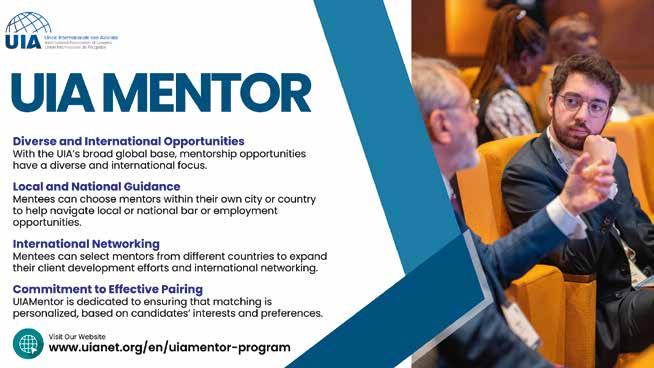


Ô In April, the European Court of Human Rights handed down a landmark verdict in the case of the Senior Citizens for Climate Protection (Klimaseniorinnen) against Switzerland. It recognised for the first time that climate protection is a human right. States that fail to fulfill their obligations in this area may infringe the rights protected by the European Convention on Human Rights, and, in particular, the right to health guaranteed by Article 8.
Ô En abril, el Tribunal Europeo de Derechos Humanos dictó una sentencia histórica en el caso de las Ciudadanas Mayores por la Protección del Clima (Klimaseniorinnen) contra Suiza. Reconoció por primera vez que la protección del clima es un derecho humano. Los Estados que incumplen sus obligaciones en este ámbito pueden vulnerar los derechos protegidos por el Convenio Europeo de Derechos Humanos, en particular el derecho a la salud garantizado por el artículo 8.
Il est des procédures judiciaires qui marquent à jamais, le mandataire comme le grand public. L’affaire des aînées pour la protection du climat contre la Suisse (Klimaseniorinnen vs Switzerland) est assurément l’une d’elles, non seulement par l’épilogue spectaculaire qu’elle a connu en avril de cette année, avec un jugement pionnier de la Cour européenne des droits de l’homme qui a fait le tour du monde, mais aussi par son histoire hors normes sous forme d’épopée au long cours.
Dans le monde entier, les « procès climatiques » constituent aujourd’hui une réalité judiciaire en forte croissance. Encore insignifiants au tournant des années 2000, les « procès climatiques » sont aujourd’hui estimés à plus de 2 000, dans tous les domaines du droit (droit public, droit civil, droit pénal, etc.)1. L’émergence progressive, durant les deux dernières décennies, de règles de droit en matière de lutte contre les dérèglements climatiques, à l’échelle internationale et en droit interne, a rendu possible la saisine des tribunaux. Le contrôle judiciaire de l’activité des États, voire des entreprises, à l’aune de leurs obligations climatiques, est devenu une forme connue et reconnue d’action pour différents acteurs affectés ou concernés par le réchauffement climatique. La vaste documentation scientifique sur le phénomène, ses causes anthropiques et ses conséquences sur la vie sur terre, a certainement contribué à accélérer ce phénomène. Le lien entre les obligations des États en matière de lutte contre les dérèglements climatiques et les droits humains n’avait pour l’heure jamais fait l’objet d’une attention spécifique dans un arrêt en matière climatique. Les autres arrêts célèbres – à l’image, sur le continent européen, de l’arrêt Urgenda contre Pays-bas (tribunal de district de La Haye aux Pays-Bas, 2015), de l’arrêt Notre Affaire à tous contre France (tribunal administratif de Paris, 2021) ou encore de l’arrêt Neubauer contre Allemagne (Bundesverfassunggericht allemand, 2021), portaient avant tout sur des griefs de droit interne. C’est ce que l’affaire des Klimaseniorinnen a changé, mettant les projecteurs pour la première fois sur cette question pourtant centrale.
L’aventure commence en 20152. L’arrêt Urgenda aux Pays-Bas a été, à n’en pas douter, le déclencheur de la démarche menée en Suisse. Plusieurs avocats3 et milieux
1. United Nations Environment Programme (2023). Global Climate Litigation Report: 2023 Status Review. Nairobi. Voir aussi sur le sujet : Christel Cournil (dir.) (2020), Les grandes affaires climatiques, DICE Éditions, Aix-en-Provence.
2. L’historique détaillé ainsi que la documentation complète sont disponibles sur le site internet des aînées : https://ainees-climat.ch/.
3. Les aînées pour le climat ont été représentés dès 2016 par une équipe juridique emmenée par Me Cordelia Bähr (Zurich), avec † Me Ursula Brunner (Zurich), à qui Me Martin Looser (Zurich) a succédé, et le soussigné, avocat à Lausanne ; pour la procédure devant la Cour européenne des droits de l’homme, l’équipe a été agrandie par l’arrivée de Jessica
intéressés se sont mis à réfléchir à un moyen de porter la question climatique devant les tribunaux suisses puis ont joint leur force, avec le soutien logistique et financier de Greenpeace. Il est vite apparu que le droit de procédure serait une possible entrave à la recevabilité d’une action judiciaire. En Suisse, pour éviter toute forme d’actio popularis, seul dispose de la qualité pour saisir la justice celui qui est atteint personnellement et directement, avec une intensité suffisante, par la mesure étatique qu’il critique. En outre, les droits de recours spéciaux des organisations environnementales ne sont pas ouverts en matière climatique. C’est ainsi que s’est constituée en 2016 une association de femmes âgées de 64 ans et plus (« aînées pour la protection du climat »), dont le but était de faire valoir en justice leur vulnérabilité particulière face au réchauffement climatique. De nombreuses études documentent cette vulnérabilité : les personnes âgées sont plus affectées par les hausses des températures, épisodes de canicules, etc., et cela vaut en particulier pour les femmes.
Plusieurs avocats et milieux intéressés se sont mis à réfléchir à un moyen de porter la question climatique devant les tribunaux suisses puis ont joint leur force […].
Aux côtés de quatre aînées, requérantes individuelles souffrant de diverses troubles médicaux (cardio-vasculaire, respiratoire, etc.), l’association des aînées a déposé une requête devant le Département fédéral en charge de l’environnement en automne 2016. Cette requête tendait en substance à ce que le Département constate diverses carences dans l’arsenal législatif et réglementaire en matière climatique, ainsi que dans sa mise en œuvre, et prenne des mesures correctrices. Sans surprise, le Département a rendu une décision d’irrecevabilité, considérant que la démarche des aînées, tant à titre individuel qu’en tant qu’association, s’apparentait à une actio popularis, ouvrant ainsi une voie de recours devant les juridictions administratives fédérales.
Le Tribunal administratif fédéral, puis le Tribunal fédéral en dernière instance, ont débouté les aînées en déclarant leur recours successifs irrecevables. Ils n’ont jamais examiné le fond des critiques soulevées par les ainées, déclinant de différentes manières le même argument relatif au défaut de qualité pour recourir : les aînées n’ont pas la qualité pour recourir en justice car elles ne sont pas concernées avec une intensité suffisante par les dérèglements climatiques. Dans son arrêt, le premier du genre, rendu en 2020, le Tribunal fédéral n’a pas brillé par une argumentation très convaincante. Il a dénié la qualité pour recourir des aînées au motif que le dérèglement climatique n’avait pas encore atteint un stade suffisamment aigu pour que l’on puisse parler d’une intensité suf-
Simor KC et Marc Willers KC, tous deux avocats à Londres.

fisante4, en dépit du consensus scientifique déjà acquis à cette date.
Les aînées n’ont eu d’autre choix que de se tourner vers la Cour européennes des droits de l’homme à Strasbourg, invoquant, d’une part, la violation de leurs droits de nature procédurale et, d’autre part, leur droit à un environnement sain5. La discussion juridique allait donc porter sur le lien entre droits humains et dérèglements climatiques et sur les obligations des États en la matière.
La cause a été jugée prioritaire par la Cour, qui l’a déférée devant sa Grande Chambre. La Cour a aussi annoncé vouloir traiter cette affaire avec deux autres affaires climatiques qui lui avaient été soumises, l’une portée par six jeunes Portugais contre 33 États du Conseil de l’Europe et l’autre par un ancien maire d’une commune française du littoral contre l’État français. Dans l’attente de ces trois premiers jugements de principe, la Cour a suspendu toutes les autres affaires portant sur la question climatique, témoin du rôle pionnier qu’elle leur a conféré. Les audiences ont eu lieu en 2023 et la Cour a rendu ses trois arrêts le même jour, le 9 avril 2024.
Dans un jugement très fourni de plus de 250 pages, la Cour a commencé par faire un panorama complet des sources des obligations des États en matière de lutte
4. Selon les termes du Tribunal fédéral : « Selon l’Accord de Paris sur le climat, le réchauffement climatique devrait être limité à un niveau bien inférieur à 2 degrés. Même sans que des mesures supplémentaires ne soient prises, cette valeur ne serait atteinte qu’à moyen ou long terme »
5. Art. 6 (droit à un procès équitable) et art. 13 (droit à un recours effectif) ; art. 2 (droit à la vie) et art. 8 (droit au respect de la vie privée et familiale).
contre les dérèglements climatiques. Elle a considéré l’objectif de limitation du réchauffement à maximum 1,5° C comme contraignant pour les États et jugé que la Convention consacrait un droit à une protection effective, par les autorités de l’État, contre les effets néfastes graves du changement climatique sur la vie, la santé, le bien-être et la qualité de vie. Sur le plan procédural, elle a considéré que les quatre requérantes individuelles ne remplissaient pas les critères relatifs à la qualité de victime et elle a déclaré leurs griefs irrecevables. Elle a considéré en revanche que l’association requérante avait été habilitée à agir pour se plaindre des menaces liées au changement climatique au sein de l’État défendeur. La Cour a conclu à la violation du droit au respect de la vie privée et familiale de la Convention et à celle du droit à l’accès à un tribunal. La Cour a conclu que la Confédération suisse avait manqué aux obligations qui lui incombaient en vertu de la Convention en matière de changement climatique.
Pour des raisons procédurales (défaut d’épuisement des instances internes pour les jeunes Portugais et défaut de qualité de victime pour le maire français), la Cour n’est pas entrée en matière sur les deux autres requêtes.
L’arrêt de la Cour dans l’affaire des Klimaseniorinnen fera à n’en pas douter couler beaucoup d’encre et mériterait de nombreux commentaires sur plusieurs aspects intéressants. Dans le cadre imparti par la présente contribution, on se contente d’insister sur deux points saillants du raisonnement de la Cour.
Premièrement, la Cour a reconnu la nature spécifique des dérèglements climatiques – qui, par nature, concernent tout le monde – et posé des critères innovants concernant la qualité pour agir des associations dédiées à la lutte contre les dérèglements climatiques. Il n’est pas nécessaire que l’association soit composée de personnes qui toutes ont la qualité de victime avec un degré d’intensi-
té suffisant. Les conditions sont désormais les suivantes : l’association (i) doit être légalement constituée (ii) doit démontrer qu’elle poursuit un but spécifique, conforme à ses objectifs statutaires, dans la défense des droits fondamentaux de ses adhérents et d’autres individus touchés contre les menaces liées au changement climatique et (iii) doit être véritablement représentative et habilitée à agir pour le compte de personnes pouvant faire valoir de manière défendable que leur vie, leur santé, leur bien-être et leur qualité de vie tels que protégés par la Convention se trouvent exposés à des menaces ou conséquences néfastes spécifiques liées au changement climatique. L’association des Klimaseniorinnen remplissait ces conditions, selon la Cour.
Deuxièmement, la Cour a défini de façon précise les obligations des États en lien avec le changement climatique, et cela de la façon suivante6 :
« Pour déterminer si un État est resté dans les limites de sa marge d’appréciation, la Cour recherche si les autorités internes compétentes, qu’elles soient législatives, exécutives ou judiciaires, ont dûment tenu compte de la nécessité
a) d’adopter des mesures générales précisant le calendrier à respecter pour parvenir à la neutralité carbone ainsi que le budget carbone total restant pour la période en question, ou toute autre méthode équivalente de quantification des futures émissions de GES, conformément à l’objectif primordial correspondant aux engagements nationaux et/ou mondiaux en matière d’atténuation du changement climatique ;
b) de fixer des objectifs et trajectoires intermédiaires de réduction des émissions de GES (par secteur ou selon d’autres méthodes pertinentes) qui sont considérés comme aptes à permettre, en principe, d’atteindre les objectifs nationaux globaux de réduction des émissions de GES dans les délais fixés par les politiques nationales ; c) de fournir des informations montrant si elles se sont dûment conformées aux objectifs pertinents de réduction des émissions de GES ou qu’elles s’y emploient (alinéas a) et b) ci-dessus) ;
d) d’actualiser les objectifs pertinents de réduction des émissions de GES avec la diligence requise et en se fondant sur les meilleures données disponibles ; et e) d’agir en temps utile et de manière appropriée et cohérente dans l’élaboration et la mise en œuvre de la législation et des mesures pertinentes.
La Cour a ainsi considéré que les objectifs de réduction des gaz à effet de serre d’un État devaient être façonnés et ancrés en droit interne de façon suffisamment robuste pour qu’ils permettent effectivement de contribuer à limiter à maximum 1,5° C le réchauffement terrestre. En revanche, la Cour n’a pas prescrit les moyens permettant
6. Arrêt Verein Klimaseniorinnen Schweiz et autres c. Suisse (requête n° 53600/20), §550.
d’atteindre ces objectifs, qui demeurent dans la marge d’appréciation des États. Les différentes politiques sectorielles ayant un impact sur le dérèglement climatique (énergie, transports, industrie, etc.) ne sont donc concernées que de façon indirecte par l’arrêt de la Cour. Les États demeurent en première ligne pour adopter des mesures internes aptes à atteindre ces objectifs.
Certaines réactions virulentes ne se sont pas fait attendre en Suisse, d’aucuns se plaignant de l’ingérence des juges de Strasbourg dans la politique climatique suisse, d’autres en appelant même à dénoncer la Convention européenne des droits de l’homme. Une fois ces premières réactions passées, viendra le temps de la mise en œuvre de l’arrêt, qui impliquera des mesures de rang législatif et réglementaire pour adapter les objectifs internes aux prescriptions de la Cour. La jurisprudence de la Cour étant contraignante pour les autorités suisses, y compris les tribunaux, une mise en œuvre incomplète de l’arrêt pourrait donner lieu à une nouvelle saisine de la justice à l’échelon national, par l’association des aînées ou par une autre association analogue. En outre, la Convention européenne des droits de l’homme prévoit ellemême un mécanisme de suivi de l’exécution des arrêts de la Cour, par le biais du Comité des Ministres. Des lacunes d’exécution peuvent donner lieu à des mesures prises par le Comité des Ministres à l’encontre de l’État défendeur récalcitrant.
La Cour a conclu que la Confédération suisse avait manqué aux obligations qui lui incombaient en vertu de la Convention en matière de changement climatique.
Au-delà de sa mise en œuvre en Suisse – et dans les autres États du Conseil de l’Europe où il fait également office de précédent – cet arrêt va certainement intéresser d’autres tribunaux, ici et ailleurs. A commencer par la Cour internationale de Justice à La Haye qui prépare actuellement un avis consultatif sur la responsabilité des États en matière de lutte contre le réchauffement climatique, suite à une résolution adoptée en mars 2023 par l’Assemblée générale de l’ONU sur requête de la République de Vanuatu. Nul doute qu’elle s’inspirera, du moins indirectement, des considérants de la Cour européenne des droits de l’homme dans cette affaire retentissante. Le juge n’est définitivement plus cantonné aux seconds rôles dans la lutte contre les dérèglements climatiques. ■
Raphaël MAHAIM
Avocat au barreau à Lausanne (Suisse) Conseiller national (parlementaire) r&associés avocats Lausanne, Suisse rmahaim@r-associes.ch

Ô Today, environmental issues are at the heart of our concerns: they permeate political and economic debate, and are inevitably reflected in the legal sphere. In France, the legislature is incorporating these new environmental considerations into the body of law, with the aim of changing behavior in light of current environmental issues. A case in point is the commercial lease, a legal and economic tool that has been heavily influenced by environmental law in recent years.
Ô Hoy en día, las cuestiones medioambientales están en el centro de nuestras preocupaciones: impregnan el debate político y económico y se reflejan inevitablemente en el ámbito jurídico. En Francia, los legisladores están incorporando estas nuevas consideraciones medioambientales al corpus legislativo, con el objetivo de cambiar los comportamientos a la luz de los problemas medioambientales actuales. Un ejemplo de ello es el arrendamiento comercial, una herramienta jurídica y económica que en los últimos años se ha visto muy influida por el Derecho medioambiental.

Introduction
La question environnementale est aujourd’hui au cœur de nos préoccupations : elle imprègne le débat politique et économique et se reflète inévitablement dans le domaine juridique. En France, le législateur intègre ces nouvelles considérations environnementales au sein du corpus juridique, l’objectif étant de faire évoluer les comportements à la lumière des problématiques environnementales actuelles.
En témoigne le bail commercial, outil juridique et économique largement imprégné par le droit de l’environnement depuis quelques années.
I. La conclusion du bail commercial et les obligations précontractuelles d’information environnementale
En France, la conclusion du bail commercial s’inscrit désormais dans un cadre réglementaire renforcé par des exigences environnementales visant à assurer une prise de décision éclairée de la part des parties. Parmi les obligations d’information, le Diagnostic de Performance Énergétique (DPE) occupe une place centrale. Ce document, obligatoirement annexé au bail, informe le preneur sur la performance énergétique du bien, influençant ainsi sa décision de prendre à bail le local concerné. En outre, la loi impose une mise à jour régulière du DPE afin de refléter fidèlement les améliorations ou détériorations énergétiques du bâtiment, garantissant ainsi une transparence continue entre les parties.
De plus, l’introduction de l’État des Risques et Pollutions (ERP) au sein du bail commercial, par la loi Grenelle II puis la loi Climat et Résilience au 1er janvier 2023, renforce cette dynamique de transparence et de précaution. Désormais, dès la première visite du bien loué, le bailleur est tenu de communiquer l’ERP au potentiel preneur, document qui recense entre autres les potentielles pollutions aux sols auxquelles le bien est exposé. Cette obligation d’information préalable, suivie d’une mise à jour de l’ERP
en cas de nécessité, permet au preneur d’objectiver les données environnementales du local concerné.
Enfin, le décret n° 2019-771 du 23 juillet 2019, dit « décret tertiaire », impose aux propriétaires de bâtiments à usage tertiaire, y compris les espaces commerciaux, d’entreprendre des actions visant à réduire leur consommation énergétique à des seuils définis. En plus de l’obligation de réaliser des travaux d’optimisation énergétique, les bailleurs doivent communiquer les données de consommation énergétique sur la plateforme OPERAT, favorisant ainsi une gestion plus durable et responsable des biens immobiliers. Par conséquent, les bailleurs et les preneurs à bail commercial se voient obligés de déterminer en amont, avant même la conclusion du bail, quels seront les dispositifs les plus opportuns à mettre en place pour remplir les objectifs fixés. Le but est aussi d’éviter de se voir infliger les sanctions prévues par les textes dans le cas contraire. Cependant, les sanctions financières étant assez faibles, le législateur mise davantage sur la bonne volonté des acteurs du secteur tertiaire.
La non-transmission des données peut entraîner une mise en demeure par le préfet, voire mener à la publication des noms des entreprises sur un site de l’État : “Name and shame”, au risque de porter atteinte à l’image des sociétés concernées.
Les considérations environnementales sont prises en compte dès la conclusion du bail commercial et influencent les négociations entre les parties.
Les obligations environnementales concrétisées lors de la conclusion du bail invitent à une rédaction attentive des clauses pour assurer leur respect et leur pérennité. Cela se manifeste notamment par l’inclusion de « clauses vertes », dispositions contractuelles visant à encadrer les pratiques des parties en matière d’environnement pour une gestion durable du bien loué.
A titre d’exemple, les clauses de performance énergétique engagent le bailleur et le locataire à respecter certaines normes ou objectifs en matière d’efficacité énergétique des locaux loués. L’objectif est d’améliorer la performance énergétique mais aussi d’atteindre des objectifs de consommation précis et de mettre en œuvre des pratiques éco-responsables durant la vie du bail. S’agissant, par ailleurs, du décret tertiaire évoqué ciavant, il édicte plusieurs obligations (reporting, rénovation énergétique etc.). Il laisse toutefois aux parties une grande liberté sur la répartition contractuelle de celles-ci. Citons par exemple l’organisation contractuelle du transfert de la charge de la réalisation de travaux, des mises en conformité ou encore de la transmission des informations de consommation. Dans la pratique, il convient aussi de fixer des règles sur la refacturation des charges liées à ces obligations. Ces éléments soulignent l’importance d’une
approche proactive et responsable des parties dès la rédaction du bail commercial, témoignant ainsi de l’importance du droit de l’environnement lors de la formation du bail.
Enfin, lors de la rédaction du bail commercial les parties peuvent également définir les conséquences en cas de non-respect des engagements environnementaux qui peuvent prendre la forme de sanctions, incluant des mécanismes de pénalités, ou même la résiliation anticipée du bail.
L’intégration de ces responsabilités dans le bail commercial permet notamment de renforcer la prise de conscience et l’action proactive en faveur de l’environnement, contribuant ainsi à la transition vers des pratiques commerciales plus vertes, durables et responsables.
La phase d’exécution du bail commercial est cruciale pour la mise en œuvre des engagements environnementaux pris lors de la rédaction du bail. Outre les obligations d’informations spéciales lors de la conclusion du bail, s’ajoutent de nouvelles obligations spécifiques à l’exploitation du bien loué.
En effet, le décret tertiaire rappelle l’obligation de réduire le niveau de consommation d’énergie du bâtiment et de réaliser des travaux de rénovation énergétique durant le bail commercial pour s’y conformer. La plupart des informations obligatoires lors de la conclusion du bail doivent ensuite être mises à jour durant le bail : cela permet un suivi réel et efficace pour le preneur et le bailleur durant l’exécution.
Le bailleur est soumis à une obligation de délivrer et de maintenir le local conforme à l’usage convenu avec le preneur. Ainsi, le local doit être en conformité avec les réglementations environnementales en vigueur, pour permettre l’exercice de l’activité projetée. L’obligation de délivrance du bailleur revêt ici une portée environnementale.
Désormais, dès la première visite du bien loué, le bailleur est tenu de communiquer l’ERP (État des Risques et Pollutions) au potentiel preneur […].
Le non-respect des obligations environnementales durant l’exécution du bail peut avoir des conséquences significatives pour les parties, mettant potentiellement en jeu leur responsabilité, et impliquer des sanctions contractuelles (financières notamment). Concernant la responsabilité du bailleur, ce dernier peut être tenu responsable si les locaux loués ne respectent pas les normes environnementales dès le début du bail ou si des travaux nécessaires à la mise en conformité n’ont pas été réalisés alors qu’il en avait la charge. Cela peut entraîner des pénalités financières, des obligations de réaliser des travaux correctifs à ses propres
Le non-respect des obligations environnementales durant l’exécution du bail peut avoir des conséquences significatives pour les parties […].
frais, et potentiellement des dommages-intérêts au profit du locataire. Cela peut également induire une résiliation du bail aux torts du bailleur. De son côté, le preneur est responsable du respect des « clauses vertes » durant l’exécution du bail, notamment en ce qui concerne la gestion des déchets, la consommation d’énergie et l’entretien des installations. Le non-respect de ces engagements peut conduire à des sanctions contractuelles, voire à une résiliation du bail par le bailleur. À noter qu’il existe aussi des cas de responsabilité partagée, l’obligation reposant conjointement sur le bailleur et le preneur.
Finalement l’exécution du bail commercial dans le respect des engagements environnementaux nécessite une attention particulière concernant la maintenance, les travaux d’amélioration de la performance énergétique, la gestion des déchets, et l’utilisation de ressources durables.
Ces pratiques soulignent l’importance d’une gestion proactive et collaborative du bail commercial, axée sur le respect de l’environnement, bénéfique pour les parties et contribuant également au développement durable.
La fin du bail commercial est un moment clé pour anticiper et gérer les incidences environnementales de l’exploitation des locaux commerciaux : il s’agit d’assurer une transition écologiquement responsable et conforme aux réglementations en vigueur.
La fin du bail commercial est donc un moment décisif pour intégrer et valoriser les pratiques environnementales des parties.
En effet, à l’approche de la fin du bail commercial des négociations peuvent avoir lieu pour le renouvellement ou non du contrat. Les améliorations durables qui ont pu être réalisées par le locataire doivent être reconnues et valorisées, notamment grâce à des compensations financières ou des conditions de bail avantageuses pour le locataire ayant investi dans des mesures éco-responsables. Cet aspect encourage les locataires à participer activement à la réduction de l’empreinte écologique des locaux commerciaux. La renégociation du bail peut également être l’occasion de réévaluer et d’adapter les obligations environnementales, en tenant compte de l’évolution des réglementations et des pratiques durables.
Si le bail n’est pas renouvelé, la restitution des locaux peut être soumise à un audit environnemental qui va souvent de pair avec l’organisation contractuelle de la remise en état du site en fin d’exploitation en fonction de l’usage projeté du site après sa restitution.
L’état des lieux de sortie constitue un moment charnière pour évaluer les incidences environnementales résultant de l’occupation des locaux. Cette évaluation doit non seulement identifier les éventuelles dégradations, mais aussi mesurer l’empreinte écologique de l’activité exercée.
Ainsi, le non-respect des obligations environnementales prévues dans le bail peut avoir des conséquences financières significatives au moment de la restitution des locaux.
La fin du bail commercial est donc un moment décisif pour intégrer et valoriser les pratiques environnementales des parties.
La restitution des locaux, la reconversion écologique des espaces et la prise en compte des améliorations durables dans les négociations de bail, sont autant de dimensions à considérer pour assurer une transition éco-responsable. Ces pratiques reflètent une prise de conscience croissante de l’importance de l’environnement dans le secteur immobilier commercial et soulignent l’engagement des parties prenantes vers une gestion plus durable et respectueuse de notre planète.
L’influence du droit de l’environnement sur le cycle de vie du bail commercial permet d’affirmer et de témoigner l’intégration croissante des préoccupations écologiques dans les relations locatives commerciales. Elle reflète également l’importance que revêt le droit de l’environnement dans le secteur immobilier et tertiaire.
Le Législateur a donc intégré un puissant arsenal juridique environnemental affectant la vie du bail commercial, soulignant l’émergence d’un ordre public environnemental et l’encadrement de la liberté contractuelle au profit de considérations environnementales. L’enjeu étant de concilier la réalité économique du bail commercial avec les nouveaux objectifs environnementaux. Il est aujourd’hui indispensable, pour les acteurs du secteur immobilier commercial, de s’adapter aux nouvelles exigences environnementales. ■
Marine PARMENTIER
Avocate, Cabinet Woog Paris, France marine.parmentier@gmail.com


Ô La transition mondiale vers les énergies propres, pro voquée par le réchauffement climatique, a eu des répercus sions considérables. Pour garantir une collaboration mon diale efficace, il est essentiel de redistribuer équitablement les avantages et les coûts. Le concept de justice énergétique est utilisé pour analyser ces impacts. Une transition énergétique nécessite d’équilibrer les intérêts divergents et de mettre en œuvre des responsabilités communes mais différenciées dans le domaine de l’énergie et les domaines connexes. Cette transition doit également être inclusive et transparente dans son processus de prise de décision.
Ô La transición mundial hacia las energías limpias, impulsada por el calentamiento global, ha tenido repercusiones de gran alcance. Para garantizar una colaboración mundial eficaz, es crucial redistribuir equitativamente los beneficios y los costes. Para analizar estas repercusiones se utiliza el concepto de justicia energética. Una transición energética justa requiere equilibrar intereses contrapuestos y aplicar responsabilidades comunes pero diferenciadas en materia de energía y ámbitos afines. Esta transición también debe ser inclusiva y transparente en su proceso de toma de decisiones.
The burning of fossil fuels for energy is a primary driver of climate change, which has led to global issues such as sea-level rise, extreme weather events, and disruptions to ecosystems. This has prompted a global transition to clean energy, which is described as “affordable, reliable, sustainable, and modern energy for all” in the
Sustainable Development Goals adopted by the United Nations in 2015. However, this transition has also raised new concerns at the environmental, social, and economic levels, which has sparked a broader debate about energy justice. If a fair mechanism cannot be established to realize a solution for this global problem, it will be difficult to achieve universal recognition of the need to change our behaviours and gain full cooperation from various groups, countries, or regions.
To address the pressing concerns, this article first examines its positive and negative impacts. It then analyzes the winners and losers through an idealized dichotomy model and the concept of energy justice is introduced to address the unfair distribution of benefits and costs. Next, it emphasizes the importance of a just transition, achieved through a balanced approach to competing interests (a common but differentiated responsibility) through an inclusive and transparent decision-making process. Additionally, it also highlights the interconnectedness of the energy sector with other sectors and the need for balancing interests across multiple domains to promote broad participation and global cooperation. Finally, it offers precise conclusions.
The transition to clean energy could bring about numerous benefits at both the national and global levels.
The transition to clean energy could bring about numerous benefits at both the national and global levels. The primary goal of this transition is to significantly reduce greenhouse gas emissions, thus mitigating the
negative impacts of air pollution and climate change. This shift could create a healthier living environment and improve public health. By adopting clean energy sources, a country or region can reduce its dependence on fossil fuels and ensure a reliable and stable energy supply, thereby promoting sustainability, independence, and security in energy provision. Furthermore, the clean energy transition can accelerate the development and growth of new technologies and industries, as well as create new job opportunities.
an important role in the success of the energy transition. Therefore, the advantages of HICs are likely to widen further, while the development of LMICs may be further constrained, contributing to increased global inequality.
The central tenets of energy justice – distribution, recognition, and procedure – are an important perspective to solve problems of energy transition.
However, the transition to clean energy also brings forth new environmental, economic and social challenges. As the global demand for energy continues to rise, there is an urgent need to increase the production of critical materials used in clean energy technologies, such as lithium, cobalt, nickel, silicon, copper, and earth elements.1 Yet, large-scale mining to meet this demand can harm ecosystems, water resources, and land use, having a significant negative impact on local environments. Moreover, the transition to clean energy often requires the gradual phasing out of conventional energy sources, leading to job losses and economic disruptions, particularly in regions heavily reliant on fossil fuel industries. Unfortunately, during this transition, fossil fuel companies maintain their profitability, while the general public bears the burden of increased energy costs.2 This, combined with the rise of unemployment in the traditional energy sector, has a disproportionate impact on low-income and marginalized communities, particularly in low- and middle-income countries (LMICs).
The challenges associated with the energy transition are not limited to individual countries, but also arise between different countries and regions, making the issue increasingly complex and pressing. High-income countries (HICs) often outsource mineral extraction to other countries, thereby offloading the negative environmental impacts to these regions. Moreover, some nations may resort to discharging pollutants into international waters, shifting the responsibility from the originating countries to the global community. On the economic front, HICs have an advantage in economic and technological development, enabling them to benefit more substantially from the energy transition. This advantage may lead to the exploitation of LMICs. Furthermore, the participation of LMICs, which are more dependent on fossil energy, plays
1. James Morton Turner, “The Matter of a Clean Energy Future”, 2022, 376(6600) Science 1361.
2. Alain Naef, “The Impossible Love of Fossil Fuel Companies for Carbon Taxes”, 2024, 217 Ecological Economics 108045.
The implications of the real-world energy transition are multifaceted and complex, and adopting an idealized dichotomy model for analysis helps to reveal the underlying contradictions. The impacts of the energy transition, whether positive or negative, can be attributed to the collective actions of humanity. However, the distribution of benefits and costs associated with the transition is markedly uneven, with some communities or countries enjoying a disproportionate share of the advantages while others bear a greater burden of the costs.3 This has created two opposing sides to the transition – one that experiences comparative gains and one that incurs comparative losses. At the jurisdictional level, for instance, those newly employed in the clean energy sector can be considered the winners, while the unemployed in the traditional energy industry are the losers. At the global scale, HICs with advanced clean energy technologies are the winners, while LMICs, whose economic development has predominantly relied on fossil fuels, are the losers.
This disparity has given rise to the critical issue of energy justice. Energy justice can be defined as “a global energy system that fairly disseminates both the benefits and costs of energy services, and one that has representative and impartial energy decision-making.”4 The central tenets of energy justice – distribution, recognition, and procedure – are an important perspective to solving the problems of energy transition.5 To easily understand these tenets, one can envision that achieving a truly just outcome requires: 1) identifying the distribution of benefits and costs associated with the transition, 2) determining which stakeholders and communities are affected by this uneven distribution, and 3) establishing appropriate means and mechanisms to rectify the identified imbalances. The concept and tenets underscore the need for a more equitable allocation of the resources, risks, and rewards associated with the energy transition, ensuring that no individual, community, or country is unfairly disadvantaged in the pursuit of a sustainable energy future.
Having ascertained the unequal distribution of winners and losers resulting from the energy transition, it is
3. Sanya Carley and David M Konisky, “The Justice and Equity Implications of the Clean Energy Transition”, 2020, 5(8) Nature Energy 569.
4. Benjamin K Sovacool and Michael H Dworkin, “Global Energy Justice”, Cambridge University Press, 2014, 13.
5. Kirsten Jenkins et al, “Energy Justice: A Conceptual Review”, 2016, 11, Energy Research & Social Science, 174.
now imperative to strike a balance between them. This equilibrium is vital for building a sustainable future that we all share. Yet, herein lies the true crux of the matter: how to effectively actualize energy justice within the clean energy transition. To this end, two complementary perspectives emerge as potential pathways forward – the imperative to balance competing interests and the notion of differentiated responsibility.
The adjustment of competing interests is a means of promoting a more balanced consideration of diverse stakeholders during the energy transition process. At the jurisdictional level, implementing targeted policies and programs can help mitigate the uneven distribution of benefits and burdens, but this requires a robust central government with the institutional capacity to enact such measures effectively.
Local authorities tend to prioritize the interests of their respective regions, so the central government must adopt diverse approaches to balance the interests of various localities and respond to their unique demands, facilitating the smooth and equitable implementation of the energy transition. Similarly, at the global level, the divergent interests of different countries or regions in the energy transition require careful balancing, which can be achieved through mechanisms that draw upon the balancing processes within individual jurisdictions, but in a more complex and multifaceted manner. Such a balancing mechanism is essential to ensure the realization of a truly global and just energy transition.
The concept of differentiated responsibility, as enshrined in the United Nations Framework Convention on Climate Change (UNFCCC), recognizes the disparate historical impacts and current capabilities of countries in addressing global challenges. The clean energy transition is inextricably

UIAdvance is a membership option for law firms specially designed to enhance their global outreach. Find out more www uianet org
linked to the issue of climate change, and the notions established in climate change treaties can be applied by analogy to the energy transition. Article 3(1) of the UNFCC stipulates that “the Parties should protect the climate system … in accordance with their common but differentiated responsibilities and respective capabilities.”
The notion aligns well with the requirements of the energy transition. Historically, there has been a positive correlation between a country’s income level and its consumption of fossil energy. Consequently, current HICs have accumulated and continue to maintain relatively high greenhouse gas emissions compared to LMICs. Thus, by analogy with the allocation of liability in tort, on the issue of climate change, HICs should be held more responsible for compensating for the high levels of greenhouse gas emissions resulting from past high rates of economic development. Applying this notion to the energy transition would entail tailoring the burdens and obligations of individual countries or groups based on their unique circumstances and capacities.
Balancing competing interests can be seen as a logical foundation for the principle of common but differentiated responsibilities, which emerges as a consequence of applying this balancing approach within the context of a just energy transition. However, this balancing approach must be accompanied by a strict adherence to principles of procedural justice. Procedural justice is essential for building broad consensus among diverse stakeholders and creating inclusive and transparent regulations and policies.
This requires the implementation of decision-making mechanisms that give voice to all affected groups and carefully consider their unique claims, concerns, and circumstances. Such procedural safeguards are particularly

important in the context of global cooperation, where a multitude of parties with varying interests and priorities must work together to achieve a common goal. The energy transition involves a range of different clean energy sources, and the adjustment strategies required for each are not uniformly applicable. Therefore, it is vital that decision-making processes provide ample opportunities for all stakeholders to fully express their demands and engage in collaborative brainstorming. Only through such inclusive, deliberative approaches can the delicate balancing of diverse interests be achieved.
The clean energy transition is inextricably linked to the issue of climate change […].
In pursuing a just transition, our perspective must not be limited to the energy sector alone. It requires a comprehensive redistribution of benefits and costs across various domains, including science and technology, environment, economy, and more. The energy transition, by nature, has far-reaching implications that extend beyond the energy sector, impacting every aspect of human life, as well as the plant and animal life and natural world. Therefore, negotiations within the energy sector alone may not lead to a general consensus. However, comprehensive consultations across a wider range of areas can facilitate the active participation of all parties. Thus, the balancing of interests can be achieved in multiple ways and areas, which is crucial for the global energy transition and fostering international cooperation towards peace and shared development.
The energy transition, by nature, has far-reaching implications that extend beyond the energy sector, impacting every aspect of human life […].
As countries and regions have different needs and capacities to develop clean energy, cooperation in a wider range of areas can complement each other to promote the clean energy transition of both sides. While science and technology development and energy transition are different areas, they can mutually reinforce each other and achieve a broader balance of interests. For instance, patents that promote sustainability, such as those related to solar panels, can drive the transition to cleaner energy sources and help mitigate climate change. However, the development and deployment of such patents requires substantial long-term investment, and there exist significant barriers to the transnational application.
The application of such patent products in LMICs is frequently accompanied by high patent licensing fees,
even when the underlying industrial infrastructure in some of these countries may be inadequate to manufacture the products in question. Balancing the competing interests in this context could involve HICs subsidizing the research and development of such patents within their borders, while designating such technologies as eligible for compulsory licensing by LMICs for a specified period and within a reasonable range. Alternatively, HICs could adopt various mechanisms to support some LMICs in the construction of basic scientific and technological infrastructure, as well as the training of necessary personnel. Additionally, there is a carbon trading mechanism called carbon offsets and credits that allows entities like governments or businesses to offset their greenhouse gas emissions by investing in projects that reduce emissions elsewhere. This mechanism can promote the global energy transition by encouraging HICs to support greenhouse gas reduction in LMICs in exchange for carbon credits, which can offset their own emissions. In such cases, LMICs could pay fair and reasonable fees, contribute resources, or provide carbon credits in exchange for equitable access to these technologies, facilitating their widespread adoption.
The climate change prompts a transition to clean energy which raises concerns about energy justice and the need for a fair mechanism to ensure a sustainable future. The article stresses the need for a fair and inclusive transition to a sustainable energy future, achieved through a balanced approach to competing interests in multifaceted fields and a transparent decision-making process. Despite the challenges of implementing policies to transition to clean energies, promoting global justice is essential to the transformation process. Local governments and countries must cooperate together to ensure a brighter future. ■
WANG Gang
PhD candidate, Faculty of Law, University of Macau Macao, China yc37241@um.edu.mo
YANG Haibo
Partner, Hiway Law Firm Hefei Office Hefei, China 18955186248@163.com

Ô The purpose of this article is to address deforestation from four regulatory approaches: proactive, preventive, punitive, and compensatory. These four approaches are involved in plans, programs, and strategic projects within environmental policies at state, regional, and local levels; but also in the classification of behaviors used to determine the civil and criminal liability of those individuals or companies that engage in forestry activities without the corresponding permits that cause environmental damage. As a contribution, the article proposes a fifth regulatory approach from an intersectoral body for the control of deforestation, taking as a reference the case of the Intersectoral Commission for the Control of Deforestation and Integral Management for the Protection of Natural Forests in Colombia.
Ô L’objectif de cet article est d’aborder la déforestation à partir de quatre approches réglementaires : proactive, préventive, punitive et compensatoire. Ces quatre approches ont une incidence sur les plans stratégiques, les programmes et les projets dans le cadre des politiques environnementales aux niveaux national, régional et local, mais aussi sur la classification des comportements afin de déterminer la responsabilité civile et pénale des personnes ou des entreprises qui s’engagent dans des activités forestières sans autorisation ou qui causent des dommages à l’environnement. En guise de contribution, l’article propose une cinquième approche réglementaire d’un organisme intersectoriel pour le contrôle de la déforestation, en prenant comme référence le cas de la Commission intersectorielle pour le contrôle de la déforestation et la gestion intégrée pour la protection des forêts naturelles en Colombie.
Introducción
La deforestación como conjunto de actividades efectuadas por el hombre, contempla desde la tala, corte y arranque, hasta la quema o destrucción de áreas continuas o discontinuas de bosque natural. Lo
anterior, para diversos fines, como el acaparamiento de tierras, uso de terreno cultivable o para la construcción de infraestructura, entre otros. La deforestación como problemática socioambiental ha experimentado desde la Revolución Industrial un crecimiento exponencial a escala global1, a tal punto de situarse en primeros lugares dentro de las agendas y políticas públicas de lucha contra los daños ambientales, así como en materia de cambio climático y protección de la biodiversidad.
En este sentido, el presente texto tiene por objetivo abordar este fenómeno desde cuatro enfoques regulatorios; a saber, proactivo, preventivo, punitivo y resarcitorio. Estos cuatro enfoques tienen injerencia en planes, programas y proyectos estratégicos dentro de las políticas ambientales a nivel estatal, regional y local. Asimismo, estos enfoques intervienen en la tipificación de conductas, de forma tal que se pueda determinar la responsabilidad civil y penal de aquellos individuos o empresas que incurran en actividades de forestación; todo ello, sin los permisos correspondientes y/o que ocasionen un daño ambiental.
Como aporte, se planteará un quinto enfoque regulatorio desde un organismo intersectorial para el control de la deforestación, tomando como referencia el caso de la Comisión Intersectorial para el Control de la Deforestación y la Gestión Integral para la Protección de Bosques Naturales en Colombia; presentando así unas consideraciones finales a modo de cierre.
A. Enfoque proactivo
Desde el enfoque proactivo, se ha venido promoviendo desde la responsabilidad social y ambiental empresarial acciones concretas para incentivar un uso responsable de
1. Jed O. Kaplan, Kristen M. Krumhardt, Niklaus Zimmermann, “The prehistoric and preindustrial deforestation of Europe”, Quaternary science reviews, 2009, vol. 28, n° 27-28, p. 3016-3034.
los recursos forestales; así como estimular la inserción y el posicionamiento en el mercado de aquellos productos que son elaborados mediante un uso sostenible de estos recursos, a través de iniciativas como sellos ecológicos o ecoetiquetas.
Este ha sido el caso de la Alianza para los Bosques o Rainforest Alliance y su marca distintiva, la cual promueve sistemas eficientes de gestión forestal por medio de modelos de economía circular de aprovechamiento y reaprovechamiento. También se encuentra el caso de la etiqueta FSC, que se utiliza bajo el amparo del Forest Stewardship Council (FSC), reconocido en todo el mundo como un logo que asocia productos y procesos comprometidos con la protección forestal.

Figura 1. Marcas de certificación verde: FSC y Rainforest Alliance
Estas iniciativas han permitido que las empresas adopten voluntariamente prácticas ambientalmente responsables, teniendo un retorno de la inversión en reputación, posicionamiento del mercado y ventas2. La regulación de este enfoque se puede concebir tanto desde la normalización técnica (ej. normas ISO) sobre el uso de marcas verdes y ecoetiquetas; como desde el régimen de propiedad industrial, que permite el registro y posterior uso exclusivo de estos signos distintivos como marcas.
B. Enfoque preventivo
Desde el enfoque preventivo, la aplicación del principio de precaución como enfoque anticipatorio del riesgo, ha ocupado un lugar relevante en la adopción de medidas mitigatorias y preventivas de daños ocasionados de forma directa o indirecta por actividades que implican deforestación o destrucción de bosques.
Dentro de esta categoría, los delitos asociados a las actividades de deforestación pasan a ser castigados con penas privativas de la libertad de 5 a 15 años […].
Este principio, contemplado en el Derecho Internacional Ambiental desde la Conferencia de Río de Janeiro de 1992 como parte de la Declaración suscrita por los Estados parte, exige la suspensión de cualquier actividad, proceso o producción que implique un deterioro ambiental y que pueda causar daños a la salud o al ambiente;
todo esto, en un contexto de incertidumbre sobre el alcance de dichos daños.
En contraposición, este enfoque preventivo también promueve la invocabilidad del principio de prevención, el cual busca anticipar daños potenciales de actividades, procesos o productos, de cuyo origen se reputen riesgos ambientales, y de los que se tenga un grado de certeza razonable sobre su ocurrencia o posibles impactos3 Al igual que el principio de precaución, el principio de prevención tuvo su origen en el vorsorgeprinzip, un concepto ideado en el derecho alemán, en la década de los setenta, en respuesta a la degradación de los bosques y la contaminación del mar.
C. Enfoque punitivo
El tercer enfoque, denominado punitivo, lleva la regulación – y la disuasión – de las actividades de deforestación al escenario del Derecho Penal, y en donde países como Colombia, han sido pioneros en la inclusión expresa de las actividades de deforestación como delitos ambientales.
Dentro de esta categoría, los delitos asociados a las actividades de deforestación pasan a ser castigados con penas privativas de la libertad de 5 a 15 años; y con multas que van desde los 134 hasta los 50.000 salarios mínimos legales mensuales vigentes. La norma establece que en las mismas penas incurrirán quienes promocionen o financien estas actividades de deforestación4
A lo anterior, se suman como agravantes las actividades que se ejecuten en ecosistemas naturales propios, incluyendo áreas protegidas por el Estado. Cabe resaltar que son agravantes aquellas actividades consideradas como delitos ambientales, cuando estas se ejecuten por grupos ilegales, mediante el uso de nuevas tecnologías, pongan en peligro la salud e integridad humana u ocasionen erosión genética o alteraciones irreversibles en suelos o recursos hidrobiológicos.
D. Enfoque resarcitorio
Por último, el enfoque resarcitorio se despliega en el ámbito del derecho de daños o de la responsabilidad civil contractual y extracontractual y del Estado, como mecanismo de reparación económica por los perjuicios ocasionados a los ecosistemas, derivados de las actividades de deforestación. Estos regímenes de responsabilidad contemplan el reconocimiento de los perjuicios que se ocasionen de forma directa o indirecta a los individuos o colectividades, quienes pueden verse
3. Iván Vargas-Chaves, Andrés Gómez-Rey, Adolfo Ibáñez-Elam, “Electromagnetic pollution and precautionary principle: from twilight rule to binding criteria” , Revista Guillermo de Ockham, 2020, vol. 18, n° 1, p. 55-67.
2. Lee. Paddock, “Stemming the deforestation tide: The role of corporate no deforestation commitments”, Geo. Wash. J. Energy & Envtl. L., 2016, vol. 7, p. 205.
4. Colombia, Congreso de la República, Ley 2111 de 2021, por medio del cual se sustituye el título XI “De los delitos contra los recursos naturales y el medio ambiente de la Ley 599 de 2000, se modifica la ley 906 de 2004 y se dictan otras disposiciones”.
afectadas colateralmente en lo social y económico por el deterioro ambiental que la deforestación trae consigo. Si bien, desde un punto de vista económico los daños ambientales no se pueden reparar con rigor. Pues, estos daños, en ocasiones, pueden ser irreversibles; a través de este cuarto enfoque se pretende disuadir a empresas y particulares en la realización de actividades que impacten los ecosistemas, generen pasivos ambientales o pongan en riesgo la disponibilidad de los recursos forestales para las generaciones actuales y futuras.

II.
regulatorio e institucional desde un organismo intersectorial para el control de la deforestación
Volviendo al caso de Colombia que, además de ser pionero en la regulación de las actividades de deforestación, goza de un territorio rico en recursos naturales y biodiversidad, en el año 2017 se emitió el Decreto 1257 que creó la Comisión Intersectorial para el Control de la Deforestación y la Gestión Integral para la Protección de Bosques Naturales, por sus siglas CICOD. Desde este organismo intersectorial se reorientaron las políticas, actividades, planes, proyectos y actividades para el control de este fenómeno; todo lo anterior, articulado en la gestión sostenible y estratégica de los bosques naturales en el territorio nacional.
En su conformación, se dispuso la activa participación del Gobierno central a través de varios de sus ministerios los cuales, liderados desde el Ministerio de Ambiente y Desarrollo Sostenible, tienen la misión de coordinar las actuaciones y la articulación interinstitucional para el control de la deforestación, con la intervención de la sociedad civil, representantes de colectividades y entidades de orden territorial.
A partir del norte adoptado desde el quinto enfoque, se analiza la información que allegan autoridades ambientales y demás unidades territoriales, locales o nacionales, con el fin de contar con un estado actualizado de los impactos sociales, económicos y ambientales. De este modo, se proponen lineamientos para la intervención coordinada de todas las entidades a cargo del control de la deforestación.
Hoy, la Estrategia Integral de Control a la Deforestación y Gestión de los Bosques que se impulsa desde la CICOD con la participación de entidades del orden nacional y territorial, es la gran apuesta del país para reducir los indicadores de degradación forestal, promoviendo una gestión sostenible y responsable de los bosques en territorio nacional. Ello, bajo un enfoque integral de desarrollo rural, económico y sostenible, y, a la vez, acorde con el norte que se adopta en materia de lucha contra el cambio climático.
Como resultado de este quinto enfoque, el Estado colombiano cumple compromisos internacionales suscritos en el marco de la Estrategia REDD+, y a instancias de la Convención Marco de las Naciones Unidas sobre el Cambio Climático5. Las acciones requeridas para el control de la deforestación, la degradación de bosques y las emisiones de gases de efecto invernadero asociadas, son discutidas en primer lugar en esta instancia intersectorial, para orientar o reorientar las decisiones en esta materia, al tiempo que se garantiza un desarrollo integral y sostenible del país.
A lo anterior, deben sumarse los avances significativos en implementar los cuatro ejes o pilares requeridos para REDD+ por la citada Convención Marco, a saber, en primer lugar, un sistema robusto e interconectado de monitoreo forestal (SNMB); en segundo lugar, la fijación de un marco referencial de emisiones forestales (NREF); en tercer lugar, el diseño de una estrategia nacional REDD+ o plan de acción; y, por último, un sistema información de salvaguardas o SNS.
La deforestación como fenómeno que abarca un conjunto de actividades como la tala, el corte o arranque de árboles, la quema o destrucción de áreas boscosas, entre otras – cuyo objetivo es el de satisfacer necesidades propias o fomentar modelos de desarrollo económico, donde la acumulación del capital prevalece sobre el desarrollo sostenible –, se ha convertido en una de las principales preocupaciones de la comunidad internacional y de los Gobiernos en materia ambiental.
Con la revolución industrial, la deforestación ha venido experimentado un crecimiento exponencial e incluso
5. Jean Carlo Rodríguez-De-Francisco, et al. “Post-conflict transition and REDD+ in Colombia: Challenges to reducing deforestation in the Amazon. Forest Policy and Economics”, 2021, vol. 127, p. 102450.
alarmante, no solo por las graves consecuencias que genera para el medio ambiente sino para la sociedad, ya que sus efectos trascienden e impactan al hombre. Estas consecuencias pueden caracterizarse en una pérdida progresiva de la biodiversidad, aumento de emisiones de gases de efecto invernadero (GEI), erosión del suelo y alteración de los ciclos hídricos y biológicos.
Desde el rol activo que los sectores público, privado y la comunidad internacional asumen, se han implementado una serie de enfoques que buscan contrarrestar esta problemática. En la implementación de estos enfoques, participan además diversos actores, como gobiernos locales y territoriales, empresas, comunidades locales y la sociedad civil.
Con la revolución industrial, la deforestación ha venido experimentado un crecimiento exponencial e incluso alarmante […].
El primero de ellos, que es el enfoque proactivo, busca incentivar medidas preventivas para evitar la deforestación, como la promoción de prácticas sostenibles, la innovación ambiental y la responsabilidad social y ambiental de las empresas. El segundo enfoque, de naturaleza preventiva, establece normas y regulaciones que limiten la deforestación en aplicación al principio de precaución. A partir el enfoque punitivo se sancionan a individuos o empresas que incurran en actividades de deforestación ilegal, mediante multas e incluso penas privativas de li-

bertad y, el cuarto enfoque, de naturaleza resarcitorio, contempla la reparación del daño ambiental causado por la deforestación.
A lo anterior, se suma un quinto enfoque desde la institucionalidad con la conformación de entidades responsables directamente de coordinar las actuaciones de todas las partes, y de la articulación interinstitucional para el control de la deforestación. El caso de Colombia es un caso a resaltar con la creación de la Comisión Intersectorial para el Control de la Deforestación y la Gestión Integral para la Protección de Bosques Naturales, y su estrategia integral de control a la deforestación y gestión de bosques.
Son cinco enfoques que requieren un compromiso conjunto de todos los sectores, actores y partes involucradas, pues, al final, el control de la deforestación hace parte de la responsabilidad que tienen las actuales generaciones en solucionar un problema que afectará a las generaciones futuras. ■
Iván VARGAS-CHAVES, Ph.D. Profesor de la Facultad de Derecho, Universidad Militar Nueva Granada Bogotá, Colombia ivan.vargas@unimilitar.edu.co
Referencias
Colombia, Congreso de la República, Ley 2111 de 2021, por el cual se sustituye el título XI: «De los delitos contra los recursos naturales y el medio ambiente» de la Ley 599 de 2000, se modifica la ley 906 de 2004 y se dictan otras disposiciones.
Colombia, Ministerio de Ambiente y Desarrollo Sostenible, Decreto 1257 de 2017, por el cual “se crea la Comisión Intersectorial para el Control de la Deforestación y la Gestión Integral para la Protección de Bosques Naturales y se toman otras determinaciones”.
Jed O. Kaplan, Kristen M. Krumhardt, Niklaus Zimmermann, „ The prehistoric and preindustrial deforestation of Europe”, Quaternary science reviews, 2009, vol. 28, no 27-28, p. 3016-3034.
Organización de las Naciones Unidas, Declaración de Rio sobre el Medio Ambiente y Desarrollo, 1992.
Lee Paddock, Stemming the deforestation tide: “The role of corporate no deforestation commitments”, Geo. Wash. J. Energy & Envtl. L., 2016, vol. 7, p. 205.
Rodríguez-De-Francisco, Jean Carlo, et al. “ Postconflict transition and REDD+ in Colombia: Challenges to reducing deforestation in the Amazon”, Forest Policy and Economics, 2021, vol. 127, 102450.
Iván Vargas-Chaves, Andrés Gómez-Rey, Adolfo IbáñezElam, “Electromagnetic pollution and precautionary principle: from twilight rule to binding criteria”, Revista Guillermo de Ockham, 2020, vol. 18, n° 1, p. 55-67.

Marco Cristiano Petrassi
Ô La durabilité est devenue un enjeu pour la gestion des cabinets professionnels. Les caractéristiques fiduciaires de la profession juridique et les éléments de durabilité, tels que le capital humain et intellectuel et la gestion de la réputation, fournissent facilement la preuve de leur importance pour la création et le maintien de la valeur économique des entreprises. L’information sur le développement durable devient donc doublement importante pour ceux qui investissent dans l’entreprise et pour les parties prenantes telles que les employés ou les clients qui sont obligés, selon les dernières réglementations nationales et internationales, de surveiller les impacts produits tout au long de la chaîne d’approvisionnement.
Ô La sostenibilidad se ha convertido en un problema para la gestión de los despachos profesionales. Las características fiduciarias de la profesión jurídica y los elementos de sostenibilidad, como el capital humano e intelectual y la gestión de la reputación, demuestran fácilmente su importancia para la creación y el mantenimiento del valor económico de las empresas. La información sobre sostenibilidad se convierte así en doblemente material para quienes invierten en la empresa y para las partes interesadas, como los empleados o los clientes, que están obligados, según las últimas normativas nacionales e internacionales, a supervisar los impactos producidos a lo largo de la cadena de suministro.
Sustainability has become an issue for the management of professional firms. Fiduciary features of the legal profession and elements of sustainability, such as human and intellectual capital and reputation management, easily provide evidence of their materiality for the creation and maintenance of economic value by firms. Sustainability information thus becomes doubly material for those who invest in the firm and for stakeholders such as employees
or clients who are obligated, according to the latest national and international regulations, to monitor the impacts produced along the supply chain.
Sustainability is the new economic-social background with which all economic operators must deal.
The approach to and management of sustainability issues calls upon organizations to conform to the demands of their clients (and in particular, large industrial groups) on the one hand, and, on the other, to face growing competition in the acquisition and management of human resources.
Already, major economic players have asked their legal advisors to declare and document their policies on sustainability. In the future, such choices will become a necessary market practice given the policies adopted by some governments, including the European Union, which require large companies to monitor and prevent negative impacts on human rights and the environment along the entire value chain. In this sense, the Corporate Sustainability Reporting Directive (CSRD) and Corporate Sustainability Due Diligence Directive (CSDDD) directives recently approved by the European Union may be mentioned.
As to the competitive question, it may be pointed out that, even before what may be called the “Great Resignation of 2023,” a tendency had emerged in some European countries for professionals of structured law firms to find new job opportunities, often migrating to in-house offices or other firms able to guarantee a better work-life balance or new career prospects.
Soon, law firms will have to measure their performance by publishing sustainability reports in line with international standards such as Global Reporting Initiative (GRI), Integrated Reporting, European Sustainability Reporting Standards (ESRS), or Sustainability Accounting Standards Board (SASB). Accordingly, the selection of the information to be published should be preceded by a careful analysis of the materiality of sustainability issues.
Materiality must be understood in a double-materiality meaning considering both the financial impact and the socio-environmental effect.
Information will be relevant if it is useful to understand the economic and financial results of the law firm or the socio-environmental impacts on the reference community. In other words, the material information will be the key factors influencing the investment choices of the capital carriers or the other stakeholders, including customers and suppliers, to establish or maintain business relations with law firms.
The concept of double materiality is more easily intuitive precisely for law firms and organizations that provide consulting services. Indeed, for companies operating in these sectors of the market, the central aspects of the approach to sustainability are linked to the specific and infungible characteristics of their performance: the professional service, the provider's personality, and the trust that clients put in that provider. The importance of the personality requires that, even in the most complex organizations, the performance is rendered by a specific professional to whom the client is assigned. The feature of the personality requires that, even in the most complex organizations, the performance is rendered by a specific professional, to whom the client has given the assignment.
The concept of double materiality is more easily intuitive precisely for law firms and organizations that provide consulting services.
It is significant that, in some European countries, the advisory assignment cannot be conferred impersonally to the “ law firm ” but, necessarily, to one or more professionals identified with the customer. Although the responsibility of professionals in charge may delegate the execution of the assignment to other collaborators of the firm, this will not free them from their responsibility to the customer. On the other hand, the personality of the service provider carries with it the fiduciary character of the relationship: if the trust of the client fails, the assignment ceases.
Moreover, in law firms, the personal and fiduciary character of the service means that, where the professional in charge of the mandate has a fiduciary relationship with the client, and then moves to another firm, the client will most likely follow that lawyer.
This brief description makes clear that there are at least two relevant elements of the value chain of advocacy and the issues that, in the context of sustainable management, an association or a company among professionals must face as well as properly report: the protection of human and intellectual capital as well as relational capital.

The loss of a lawyer because of a lateral hire is not only a loss of human capital, but also, in all probability, a risk for losing relational capital (relationship with the customer) and, ultimately, the bottom line. Investments made by law firms for the management of employees, for the development of customers, and for innovation is therefore also significant for the financial stakeholders who have invested in the law firm because it also helps them to prosper.
Below are some examples of the type of information or key performance indicators (KPI) that seem to be relevant to law firms:1
• Human Capital: Information on the number of employees, gender, age group composition, pay gender gap management, career progression, training, and information that illuminates the culture of human resource management, highlight the firm's orientation to the growth of the individual professional and retention. Indeed, only a balanced achievement of these goals allows the firm to continue to channel energy and survive.
• Intellectual Capital: Information on investments made in the purchase of technologies or the development of management systems is useful to make processes more efficient. The usefulness of the promotion of internal cross-selling among the studio’s professionals is important. The cross-selling practice, in addition to strengthening the relationships between the firm’s components, increases the reputation of the latter in terms of quality and efficiency and is an element that, in an era of increasing specialization of professionalism, can prevent the flight of customers.
• Relational Capital: Information on the composition of customers (by number, size, and geographical location),
1. The proposed nomenclature follows the pattern of the ‘‘IR‘‘, the Integrated Reporting framework developed by the IIRC.
as well as investments in customer loyalty towards the structure, are important. From this point of view, communication and engagement policies are certainly effective, not only in the sense of marketing, but in a broader perspective, which is oriented to the verification of customer satisfaction and the management of complaints or friction points with the customer.
• Natural (or Environmental) Capital: Although the environmental impact to the legal profession and other professions is probably not the most material one, the law firm will be required to report the use of paper, the policies for managing energy consumption that the transition to the drafting of digital documents and electronic storage or cloud make more current, and the management of waste, including those related to technology, such as computers and other disused devices.
Similar challenges will be faced by professionals who will continue to practice the profession individually, and for the latter, it will be progressively relevant to highlight to customers their commitment to sustainability issues and the sharing of customer goals. The issues analyzed above have long been at the center of the reflections of professional market operators and of standardization bodies and other standard setters.
Some law firms have already begun to publish integrated reports, social reports, and sustainability reports. They are used not only by international top tier firms, but also by mid-sized national ones, even if not incorporated in the form of companies.
The “Guide to Practice Management for Small and Medium-Sized Practices,” issued by the International Federation of Accountants, deals with a rethinking of the firm management system and points towards a process organization that addresses the issues of people management, communication, and customer orientation. More recently, Uni (the Italian body for certification standard), has developed its own rules.
In conclusion, the world of professional law firms is in turmoil on sustainability issues. While sustainability calls for a socially responsible approach to the conduct of economic activity, it should be remembered that legal professions have always provided themselves with codes of ethics that arise precisely from the awareness of the role that orderly institutions play in affecting the social function performed by their members in society. ■
Marco Cristiano Petrassi Partner, SZA Law Firm Milano, Italy petrassi@sza.it

CONTACT
Anne-Marie VILLAIN 23 rue de la Victoire 75009 Paris Tél. : +33 1 44 88 55 66 E-mail : avillain@uianet.org


Andrew GROSSO, Esq.
Ô En raison du changement climatique et de la dégradation de l’environnement, la planète est en danger. Une question se pose : quelles responsabilités avons-nous, en tant que conseillers et défenseurs, pour avertir et guider nos clients dans leurs programmes et projets qui affectent la terre, la mer, l’air et les populations ? L’UIA a récemment adopté une série de principes concernant ces responsabilités. Nous examinons ces principes, ainsi que leurs implications et leurs fondements dans le droit national et international.
Ô Debido al cambio climático y a la degradación del medio ambiente, el planeta tiene problemas. Surge la pregunta: ¿qué responsabilidades tenemos, como asesores y defensores, para advertir y orientar a nuestros clientes con sus programas y proyectos que afectan a la tierra, el mar, el aire y las poblaciones? La UIA ha adoptado recientemente una serie de principios que abordan tales responsabilidades. Examinamos los principios, así como sus implicaciones y fundamentos en el derecho nacional e internacional.
“A civilization can die,”... and the end can be “brutal.” “Things can happen much more quickly than we think.” This warning, written in The Economist and quoting President Emmanuel Macron of France,1 was about the “survival of Europe as the guarantor of... prosperity and the liberal order” in the face of mounting tensions. But it also applies to environmental degradation – and not just to the civilization of Europe, but to that of the entire globe.
This was recognized by the UIA with its Resolution on Sustainability and the Role of the Legal Profession, presented and approved at the General Assembly held
1. “How to Rescue Europe: An Interview with Emmanuel Macron”, The Economist 42 (4 May 2024).
in Rome in October 2023.2 Among its multiple provisions are the following:
The UIA urges all lawyers:
* * * *
To assume their essential role in advising clients of the importance of the SDGs [Sustainability Development Goals3], the Ten Principles,4 and ESG [Environmental, Social, and Governance] factors . . . . and,
The UIA calls upon all Bar Associations, Law Societies, and legal educational Institutions:
* * * *
To facilitate dialogues to create solutions to the crises posed by climate change, loss of biodiversity, water management, and the need for a circular economy.
In other words: lawyers are to educate and advise about the ecological impact of the conduct, projects, and proposals of those with whom they deal, including but not limited to their own clients.
This poses several questions: must lawyers advocate to their clients for ecological friendly conduct; and must they affirmatively advise against conduct that will damage the environment? Put another way, must lawyers affirmatively guide clients in directions that might be otherwise averse to their clients’ stated goals and financial interests, so as to protect humanity as a whole? Ultimately, what is the higher calling within a lawyer’s professional responsibility: protecting a client’s stated interests; or protecting the interests of humanity as a whole, when those interests approach the realm of the existential?
2. https://www.uianet.org/sites/default/files/uia_resolution_on_sustainability_and_the_role_of_the_legal_profession_final_en.pdf.
3. See The United Nations Definition of Sustainability, at http://www. un.org/en/academic-impact/sustainability.
4. See The Ten Principles of the UN Global Compact, at https://unglobalcompact.org/what-is-gc/mission/principles
The answer to these questions requires an analysis of two more questions:
First: May an attorney counsel or otherwise assist a client in the commission of criminal or otherwise unlawful conduct?
Second: Does environmental degradation amount to such conduct?
We address the second question first.
In the early 1970s, a computer model developed at the Massachusetts Institute of Technology (MIT) “predicted” that human civilization would effectively collapse beginning in the year 2040. The model was based on the growth of the human population and the consumption of earth’s resources. The results were published in a bestselling book, “The Limits to Growth.”5 More recently, a study by KMPG conducted in 2021 concluded that, so far, the milestones on the road to this collapse, as identified by MIT, are being met, and are being met on schedule. The words of the MIT researchers from the 1970s eerily parallel those of President Macron quoted above from The Economist:
“If the present growth trends in world population, industrialization, pollution, food production, and resource depletion continue unchanged, the limits to growth on this planet will be reached sometime within the next one hundred years. The most probable result will be a rather sudden and uncontrollable decline in both population and industrial capacity." (emphasis added).
The main focus of this article is on climate change, and for that reason, we look at its effects.
In the last year, our global average atmospheric temperature has, for the first time, breached the level of 1.5º C (2.7º F) above the per-industrial age. More significantly, the amount of carbon dioxide in the atmosphere reached 425 parts per million. And, most ominously, the heat content of the oceans, which absorb 90% of the heat produced by mankind’s industrial and agricultural activities, has risen to the highest levels ever recorded. This accumulation of heat in the oceans is accelerating, even as atmospheric temperatures increase.
These temperatures and heat affect human agriculture and our living conditions. Collectively, these effects are adverse. They include:
• Temperatures in the tropics and subtropics that are not merely “uncomfortable,” but unlivable
• Rising sea levels, requiring the abandonment of coastal cities and lands with the loss of productive food producing areas
5. Donella H. Meadows, Dennis L. Meadows, Jørgen Randers, William W Behrens III, “The Limits to Growth; A Report for the Club of Rome’s Project on the Predicament of Mankind” , 1972, New York: Universe Books. ISBN 0876631650.
• Drought, with the loss of agricultural production
• Storms, with destructive loss of property and life
• Forest fires, destroying homes and pumping more carbon dioxide, as well as smoke and soot, into the atmosphere, affecting those hundreds and even thousands of miles from the fires.
All of this will result – and has already resulted – in emigration, famine, and civil conflicts. Eventually, it will result in the displacement and mortality of not millions, but billions. The process has begun, and it will continue, absent a concerted effort by all countries to not only stop this process, but to reverse it.
Why do I say, “reverse the process”? Because the planet has a momentum of its own. A gentle nudge here or a slight tap there, and the planet will return to its “normal,” stable state that civilization has enjoyed for the last ten thousand years or so, that is, since the ending of the last ice age. But human's industrialization is more than a gentle nudge: it has been a “sledgehammer.” The planet, now being kicked out of its stable state, is moving on its own to a new climate state that will be unable to support mankind’s population of eight billion. The reasons? Feedback loops.
[…] Lawyers are to educate and advise about the ecological impact of the conduct, projects and proposals of those with whom they deal, including but not limited to their own clients.
A feedback loop is movement in a given direction that causes an additional movement in the same direction. For climate, this means that an increase in the average temperature of the planet causes an additional increase in temperature. Once the process begins, it continues on its own. Thus, at some point, the temperature rise becomes self-generating and no longer society's to control.6
Scientists often describe this process using the concept of “tipping points,” these being processes that, once a certain level is exceeded, cannot be stopped. Examples of some tipping points are the melting of the Arctic ice cap, the slowing of the Atlantic Meridional Overturning Current, and the destruction of the Amazon rain forest. Each of these processes has points after which they cannot be stopped. And each is interconnected with other processes that, when one goes, so will others.
Let us further examine this situation. The Earth’s climate is a complex system, as is the Earth itself. As such, it has two important factors inherent in any long-running complex machine: (1) resiliency; and (2) the interconnection of its parts. Taken together, this means that the Earth’s climate can maintain a level of stability even as it suffers a reasona-
6. See “Addressing the Climate Change: a Bold Roadmap for the Role of Law”, by Andrew Grosso, Juriste International 2021-1 at 28.
The United Nations previously recognized environmental degradation as a crime against nature.
ble level of injury to its operating components: the system can appear stable even as the planet experiences injuries, such as industrial carbon dioxide pumped into the atmosphere, deforestation of the Amazon, slowing ocean currents caused by excess ocean heating, melting ice sheets, etc. But only up to a point. Beyond a certain point, a failure of one part of the climate system will adversely affect the other aspects that have kept the system stable. For example, a melting ice sheet will allow the oceans and land to absorb more sunlight; which will heat the planet and cause forests to dry out; which will cause forest fires; which will produce soot that alights on ice sheets; which absorb sunlight and warm the ice sheets so that they melt faster... And at some point, the planet is unable to adjust to the cascading effects, and all the ice sheets will melt and most of the forests will be decimated, and other parts of the system will also collapse. This is a slow process – until it is not, à la Macron So – that is the science.
The law? The United Nations previously recognized environmental degradation as a crime against nature. More recently, it issued a “code red” for humanity. There is a push to enact laws criminalizing “ecocide” in various countries, with one definition of ecocide being:
“Unlawful or wanton acts committed with the knowledge that there is a substantial likelihood of severe and either widespread or long-term damage to the environment being caused by those acts.”
In March 2024, the Council of the European Union approved a Directive “on the protection of the environment through criminal law . . . .” The Directive expressly referenced climate change, loss of biodiversity, and environmental degradation as harms to be addressed not merely by civil law or regulations, but also by criminal law.7
This seems to make sense: causing loss of the planet as a stable habitat for living beings and human civilization does qualify as a conduct to be considered unlawful, and it makes no difference if the laws of a person’s own country do not recognize this conduct as violations of law. We look to the Nuremberg Principles, established by the International Commission of the United Nations as a result of the Nuremberg Trials after World War II:
Principle Number One of the Nuremberg Principles states, “Any person who commits an act which constitutes a crime under international law is responsible and therefore liable to punishment.”
Principle Number Two provides that, “The fact that internal law does not impose a penalty for an act which constitutes a crime under international law does not relieve the person who committed the act from responsibility under international law.”
We, as lawyers, are responsible not only for the laws of our own nation, but for those of the international community.
The bar codes of few, if at any, jurisdictions permit a lawyer to advise his or her client how to commit a crime. There is no reason why recognized crimes against nature and crimes against humanity should enjoy an exemption.
The American Bar Association’s Model Rule of Professional Conduct 2.1 provides as follows:
“In representing a client, a lawyer shall exercise independent professional judgment and render candid advice. In rendering advice, a lawyer may refer not only to law but to other considerations such as moral, economic, social and political factors, that may be relevant to the client’s situation.”
Rule 1.2(d) is more specific:
“A lawyer shall not counsel a client to engage, or assist a client, in conduct that the lawyer knows is criminal or fraudulent, but a lawyer may discuss the legal consequences of any proposed course of conduct with a client and may counsel or assist a client to make a good faith effort to determine the validity, scope, meaning or application of the law.”
Similarly, the Model Code of Conduct for European Lawyers provides:8
“Lawyers shall not support or assist clients in committing or attempting to commit conduct, which is illegal, criminal, or fraudulent. Lawyers’ duty is to advise clients on the extent and applicability of the law.”
Moving beyond law for the moment, protection of the environment from exploitation is the subject of numerous moral teachings, a prominent example being the 2015 encyclical on climate change and inequality by Pope Francis, Laudato si’, subtitled “On Care for Our Common Home.”
Taken together, we may summarize a lawyer’s responsibilities under the model rules and moral guidance in this manner: a lawyer must not advance a client’s interests in criminal or unlawful conduct, and has the option to avoid advancing a client’s interest
7. Directive (EU) 2024 of the European Parliament and of the Council [on] the protection of the environment through criminal law (https:// data.consilium.europa.eu/doc/document/PE-82-2023-INIT/en/pdf). See also, “Environmental crime: Council clears new EU law with tougher sanctions and extended list of offences,” Press Release of the Council of the EU (26 March 2024).
8. Rule 5 of the Model Article on Relations with Clients (adopted 27 November 2021).
in conduct that violates generally accepted moral and social strictures. In both such situations, the attorney may provide guidance to the client to accomplish the client’s ultimate goals by alternative means that avoid criminal, moral, and social abuses.
The UIA’s Board of Governors recently discussed9 whether there are obligations for lawyers to advise their clients with respect to their business operations about the impact of those operations on climate and the ecology. The consensus seemed to be that lawyers do in fact have such an obligation – although this consensus was by no means unanimous.
This article lays out an analysis for concluding that, yes, lawyers should and must advise clients to avoid conduct that causes more harm to our planet than has already occurred through human industry. But the analysis goes further: it also permits and encourages lawyers to advise clients about methods to conduct business operations while simultaneously avoiding such harm.
I provide a concrete example. A corporate client wishes to build or fund a power plant that will burn fossil fuel. Are there ways to accomplish this without harming the climate? A suggestion might be to ensure that the project be carbon-neutral, and that it be realistically carbon-neutral. Carbon capture might absorb all carbon emissions from the power plant; and further processing might solidify them, so they could be buried or, better, a commercial use could be found for them (such as being used for building material – and a model for doing this is already successful in the proof-of-concept phase). Or, for an entity that is financing the plant, the suggestion could be offered that, for each anticipated unit of carbon that will be produced, the entity will also finance the planting and nurturing of trees in a forest. The list of what can be done to move industry to a carbon-neutral state is limited by only human ingenuity, and by the global recognition of the existential importance of accomplishing this goal.
Some years ago I read a short story from a book that I had borrowed from a friend. The name of the story was “The Weapon.”10 It was very short, and the plot went something like this:
A scientist was sitting at home, working on a project. His son was with him. The boy was fifteen years old, but, sadly, was intellectually disabled, being possessed with a simple, childlike personality. The project on which the scientist was working was a weapon of immense power that had the capacity to destroy civilization. It was, from
9. UIA Governing Board Meeting, 23 March 2024, Tokyo, Japan.
10. “The Weapon”, by Frederic Brown (1951).
all appearances, part of some government’s military research program.
While the scientist was working, someone knocked at the door. It was a stranger, but the scientist nonetheless invited him in and offered him a drink. They began conversing, and the stranger’s purpose for his visit, it became clear, was to talk the scientist out of working on the project. Yes, the scientist acknowledged, the weapon he was designing will be dangerously powerful; yes, the scientist acknowledged, it will be placed in the hands of leaders in a political environment where there could be no guarantee that it would not be used; and yes, the scientist further acknowledged, civilization itself would be at risk if the weapon were in fact used.
We, as lawyers, are responsible not only for the laws of our own nation, but for those of the international community.
But to the scientist – none of this was of any account. His job and his vocation in life was research and development, and designing this weapon was his job and his vocation. Nothing else mattered.
Realizing that he had failed in his mission, the stranger accepted the scientist’s offer of a drink. While the scientist stepped away to prepare it, the stranger took the opportunity to visit the childlike fifteen year old in his bedroom. The scientist spotted the stranger as he was exiting the bedroom. Then, the stranger politely declined the drink, saying that he needed to leave. But he also explained that he had given to the son a “small gift.”
When the scientist stepped into the bedroom to check on his son and see the gift, he was shocked. He carefully talked his son into handing the “gift” to him, slowly and gently. The story’s closing sentences read, “When he had it safely, his hands shook as he examined it. He thought, only a madman would give a loaded revolver to an idiot.”
The stranger had given a simple but terrifying message to the scientist about his work, and his responsibilities.
Climate change is existential for our civilization. Lawyers have an obligation to advise and guide clients so as to preserve that civilization. This is not negotiable. ■
Andrew
GROSSO, Esq. President of the UIA Biotechnology Law Commission Attorney, Andrew Grosso & Associates Washington, D.C., United States agrosso@acm.org

Ô This article explains the Corporate Sustainability Law, which is the group of instrumental rules that aim at ensuring the fulfilment by companies of the substantive law concerning the environment, social issues, human rights and governance.
Ô Cet article explique la loi sur le développement durable des entreprises, qui est un ensemble de règles instrumentales visant à garantir le respect par les entreprises du droit substantiel concernant l’environnement, les questions sociales, les droits de l’homme et la gouvernance.

La protección ambiental en la UE es hoy una de sus políticas vertebradoras. Así puede verse ya en sus normas más básicas, como los arts. 11 y 191 a 193 del TFUE y el art. 37 de la Carta de los Derechos Fundamentales de la Unión Europea.
La importancia de la protección ambiental ha evolucionado con el paso de los años con carácter general, y en especial para las empresas. Desde la regulación con base en las tres ideas fundamentales (reparación, prevención y participación), se ha pasado al Derecho de la sostenibilidad corporativa, que defino como el conjunto de normas de carácter instrumental aplicable a las empresas para asegurar el mejor cumplimiento del Derecho sustantivo en materia de derechos humanos, medio ambiente, cuestiones sociales y gobernanza. Como ve, su objeto no se ciñe al medio ambiente, sino que relaciona esta materia con otras igualmente importantes.
Este Derecho comprende las tres áreas que se van a ver a continuación: divulgación de información, taxonomía y diligencia debida.
En materia de divulgación de información sobre sostenibilidad, la norma básica y general es la Directiva 2013/34/ UE, sobre los estados financieros anuales, los estados financieros consolidados y otros informes afines de ciertos tipos de empresas, según ha resultado modificada por la Directiva (UE) 2022/2464.
Los sujetos obligados a divulgar información sobre sostenibilidad en régimen general (aparte, pues, de regímenes especiales que pueden existir, tanto por razones subjeti-
vas como temporales) son las sociedades matrices de un grupo grande; las grandes empresas y las pequeñas y medianas empresas (a excepción de las microempresas), que sean entidades de interés público tal como se definen en el apartado a) del art. 2.1 de la Directiva; las empresas de seguros (cf. art. 2.1 de la Directiva 91/674/CEE); y las entidades de crédito (cf. art. 4.1.1 del Reglamento (UE) 575/2013) (cf. arts. 1.1, 1.3, 1.4, 3, 19 bis.1 y 29 bis.1).
En esencia, la obligación que deben cumplir estas empresas consiste en incluir en el informe de gestión la información necesaria para comprender el impacto de la empresa (o del grupo) en las cuestiones de sostenibilidad, y la información necesaria para comprender cómo afectan las cuestiones de sostenibilidad a la evolución, los resultados y la situación de la empresa (o del grupo). Esta información debe poder identificarse claramente en el informe de gestión mediante una sección específica (arts. 19 bis.1 y 29 bis.1), y los Estados miembros pueden exigir que pongan el informe de gestión a disposición del público en su sitio web de forma gratuita (art. 30.1).
La información sobre sostenibilidad que con carácter general debe comunicar la empresa, o la sociedad matriz, abarca, entre otros extremos, los siguientes (apartados 2 y 3 de los arts. 19 bis y 29 bis):
• Una breve descripción de su modelo de negocio y de su estrategia, o del grupo
• Una descripción de sus objetivos relativos a las cuestiones de sostenibilidad, incluyendo el horizonte temporal.
• Una descripción de la función de sus órganos de administración, dirección y supervisión en lo que respecta a cuestiones de sostenibilidad, así como de sus conocimientos y capacidades.
• Una descripción de sus políticas en relación con las cuestiones de sostenibilidad.
• Información sobre la existencia de sistemas de incentivos ligados a cuestiones de sostenibilidad y ofrecidos a los miembros de los órganos de administración, dirección y supervisión.
• Una descripción del procedimiento de diligencia debida aplicado en relación con las cuestiones de sostenibilidad; los principales efectos negativos reales o potenciales relacionados con sus actividades y con su cadena de valor, las medidas adoptadas para detectar y vigilar dichos efectos y otros efectos negativos; y cualesquiera medidas adoptadas para prevenir, mitigar, subsanar o poner fin a los efectos negativos reales o potenciales, y el resultado de dichas medidas.
• Una descripción de los principales riesgos relacionados con las cuestiones de sostenibilidad, y la forma en que se gestionan dichos riesgos.
• Los indicadores pertinentes para la información a que se refieren los párrafos anteriores.
El artículo 29ter complementa lo anterior señalando cómo debe comunicarse esta información, por remisión a actos delegados de la Comisión.
El Reglamento 2020/852, relativo al establecimiento de un marco para facilitar las inversiones sostenibles, tiene por objeto establecer los criterios para determinar si una actividad económica se considera medioambientalmente sostenible a efectos de fijar el grado de sostenibilidad medioambiental de una inversión (art. 1.1). Esto debe facilitar las inversiones en actividades sostenibles, y debe permitir distinguir entre lo que es sostenible del greenwashing
El Reglamento (UE) 2020/852 se estructura en tres capítulos, referidos respectivamente al objeto, ámbito de aplicación y definiciones (Capítulo I); a las actividades económicas medioambientalmente sostenibles (Capítulo II); y disposiciones finales (Capítulo III). A continuación me refiero a las actividades económicas medioambientalmente sostenibles, y en concreto a su definición (arts. 1 a 4 y 9 a 19).
De acuerdo con el art. 3, una actividad económica tendrá la consideración de medioambientalmente sostenible cuando cumpla cuatro requisitos:
1. Que contribuya sustancialmente a uno o varios de los objetivos medioambientales previstos en el Reglamento, que son (art. 9):
• Mitigación del cambio climático, para mantener el aumento de la temperatura media mundial muy por debajo de los 2 °C y continuar los esfuerzos para limitarlo a 1,5 °C respecto de los niveles preindustriales. Por ejemplo, si contribuye sustancialmente a estabilizar las concentraciones de gases de efecto invernadero en la atmósfera (art. 10).
• Adaptación al cambio climático actual y previsto, y a sus repercusiones (art. 2.6). Por ejemplo, si incluye soluciones de adaptación que reduzcan de forma sustancial el riesgo de efectos adversos del clima actual y previsto en el futuro sobre dicha actividad económica (art. 11).
• Uso sostenible y protección de los recursos hídricos y marinos. Por ejemplo, si contribuye sustancialmente a lograr el buen estado de las masas de agua (art. 12).
• Transición hacia una economía circular. Por ejemplo, si la actividad usa los recursos naturales en la producción de modo más eficiente (art. 13).
• Prevención y control de la contaminación, contribuyendo de forma sustancial a la protección frente a la contaminación del medio ambiente, por ejemplo, previniendo las emisiones contaminantes a la atmósfera, el agua o la tierra (art. 14).
• Protección y recuperación de la biodiversidad y los ecosistemas. Por ejemplo, si contribuye de forma sustancial a proteger los ecosistemas que ya están en buenas condiciones (art. 15).
2. Que no cause ningún perjuicio significativo a alguno de esos objetivos medioambientales. Esto ocurrirá en función del impacto ambiental de la propia actividad y de los pro-
ductos y servicios generados por ella a lo largo de todo su ciclo de vida (art. 17). Por ejemplo, se considera que la actividad causa un perjuicio significativo a la mitigación del cambio climático cuando dé lugar a considerables emisiones de gases de efecto invernadero; o que causa un perjuicio significativo a la economía circular, cuando genere importantes ineficiencias en el uso de materiales o en el uso directo o indirecto de recursos naturales.
A día de hoy aún no hay una norma en la UE sobre la diligencia debida de las empresas en materia de sostenibilidad.
3. Que la actividad se lleve a cabo de conformidad con las garantías mínimas para asegurar su conformidad con las Líneas Directrices de la OCDE para Empresas Multinacionales y los Principios Rectores de Naciones Unidas, incluidos los principios y derechos establecidos en los ocho convenios fundamentales a que se refiere la Declaración de la Organización Internacional del Trabajo relativa a los principios y derechos fundamentales en el trabajo y la Carta Internacional de Derechos Humanos; y que la actividad cumpla el principio de “no causar un perjuicio significativo” a que se refiere el artículo 2.17 del Reglamento (UE) 2019/2088, sobre la divulgación de información relativa a la sostenibilidad en el sector de los servicios financieros (art. 18).
4. Que se ajuste a los criterios técnicos de selección que hayan sido establecidos por la Comisión. El art. 19 establece cómo deben ser estos criterios técnicos. Por ejemplo, deberán determinar las contribuciones potenciales más importantes para un objetivo medioambiental determinado respetando al mismo tiempo el principio de neutralidad tecnológica, teniendo en cuenta las repercusiones a corto y largo plazo de una actividad económica precisa; deberán ser cuantitativos y contener umbrales en la medida de lo posible o, si no, ser cualitativos; y deberán tener en cuenta el ciclo de vida. Así, por ejemplo, el Reglamento Delegado (UE) 2021/2139, sobre los objetivos de mitigación del cambio climático o a la adaptación al mismo, modificado por el Reglamento Delegado (UE) 2022/1214.
A día de hoy aún no hay una norma en la UE sobre la diligencia debida de las empresas en materia de sostenibilidad. Existe un borrador de Directiva muy reciente, de este mismo año 2024. Este borrador modifica la propuesta de 2022, que ha encontrado una oposición considerable para su aprobación. Lo esperable es que finalmente se apruebe una norma sobre diligencia debida corporativa en materia de sostenibilidad, si bien es posible que tarde más de lo esperado, hasta que se llegue a un acuerdo que satisfaga a todas las partes implicadas. Por esta razón, me limito a apuntar las cuestiones básicas que puede implicar la diligencia debida, tomando como base el borrador existente.
El objeto del procedimiento de diligencia debida debe ser identificar, prevenir, mitigar, eliminar y en su caso reparar los efectos adversos sobre los derechos humanos, el medio ambiente y cuestiones sociales relacionados con las operaciones de las empresas para contribuir al desarrollo sostenible. Este procedimiento se aplicará no a todas las empresas, sino solo a las que superen determinados límites (por ejemplo, número de empleados y/o cifra de negocios) y en su caso, a determinadas empresas relacionadas con ellas.
Como posibles obligaciones que pudieran imponerse a las empresas, estarían las siguientes:
• Integrar la diligencia debida en sus políticas y sistemas de gestión de riesgos.
• Identificar y evaluar impactos adversos potenciales o reales.
• Prevenir o, si no es posible, mitigar los efectos adversos potenciales sobre los derechos humanos y sobre el medio ambiente.
• Eliminar los efectos adversos reales o, si no es posible, minimizar su alcance.
• Establecer un mecanismo de notificación y un procedimiento de quejas.
• Divulgar información relativa a su actividad en lo que se relacione con la diligencia debida, y en coordinación con la Directiva 2013/34 que acabo de comentar en el apartado 1 anterior.
La UE es la región del mundo que con mayor decisión está encarando los desafíos que plantea la degradación ambiental, incluyendo el cambio climático, y la consecución del desarrollo sostenible.
En materia de sostenibilidad corporativa, destacan los ámbitos referidos a la divulgación de información, la taxonomía y la diligencia debida.
La Directiva en materia de divulgación de información sobre sostenibilidad y el Reglamento de taxonomía pretenden dar una mayor transparencia a una parte relevante de las empresas en la UE, lo que debe redundar en una mejor consecución del desarrollo sostenible. En esta misma línea debe ir la futura Directiva sobre diligencia debida, cuando se apruebe. ■
Carlos DE MIGUEL PERALES
Abogado, Profesor universitario Universidad Pontificia Comillas Madrid, España cmiguel@comillas.edu

Lina ADLOUNI
Le Koweït a développé de nouvelles stratégies d’investissement étranger qui promeuvent les investissements dans le secteur des services environnementaux et qui offrent des incitations aux investisseurs. En mettant en œuvre l’Autorité koweïtienne de promotion des investissements directs (KDIPA), le Koweït prévoit d’atteindre ses objectifs de dura-
Ô Kuwait ha desarrollado nuevas estrategias de inversión extranjera que promueven las inversiones en el sector de los servicios medioambientales y que ofrecen incentivos a los inversores. Mediante la puesta en marcha de la Autoridad de Promoción de la Inversión Directa de Kuwait (KDIPA), Kuwait prevé alcanzar sus objetivos de sostenibilidad para 2035.
The Kuwait Direct Investment Promotion Authority (KDIPA) was established in accordance with Law n° 116 of 2013 on Encouraging Direct Investment in the State of Kuwait. It was published in the official gazette “Kuwait Today” on June 16, 2013, came into force six months after the date of its publication, consists of 38 articles, and utilizes the Executive Regulations issued by a Ministerial Decision n° (502) of 2014. Both were enacted with the aim of developing and improving the investment environment in Kuwait, facilitating procedures for investors, and attracting and capturing both foreign and domestic direct investment in the country.
KDIPA recognizes the significance of incorporating ecofriendly investment practices and opportunities. Its Guide for Impact Investment in the State of Kuwait, 2022 showcases 12 potential investment sectors and lucrative investment opportunities under them catering to achieve the National Vision 2035, which aims to transform Kuwait into a financial and commercial hub and contributes to attaining the sustainable development goals (SDGs) of 2030.
This article aims to uncover the goals behind KDIPA’s tasks for holding and attracting value added directly
among those 12 sectors. Among these sectors, this article shall shed light on the overview of the Environmental Services Sector, by which Kuwait signifies the country’s commitment globally to utilize green forms of energy and reduce dependence on fuel-based sources of energy dimensions. KDIPA offers interested investors in this sector incentives and benefits to host mega investment opportunities in environmental service projects.
The KDIPA law allows foreign investors to choose from the following legal entities for their investment in Kuwait:
Kuwaiti Company
Established according to the Commercial Companies Law for the purpose of direct investment. Foreign ownership can be up to 100% for shareholding companies, limited liability companies, or single-person companies.
Branch of a Foreign Company
Licensed to operate in Kuwait for the purpose of direct investment.
Representative Office
Limited to studying the market and production possibilities without engaging in commercial activities or acting as a commercial agent.
By providing these options, Kuwait aims to attract foreign investors and facilitate their participation in the country’s economic development.
Therefore, an increasing number of memorandums of understanding (MOUs) demonstrate KDIPA’s efforts to encourage direct investment, as KDIPA continued to expand its relations with its counterparts in friendly countries by approving, in principle, KDIPA’s request to proceed with signing procedures for a number of draft MOUs in the field of encouraging direct investment.
Furthermore, since 2019, KDIPA annual reports indicate that KDIPA was nominated as a liaison officer to communicate with the team of United Nations Economic and Social
Commission for Western Asia (ESCWA) for cooperation, to identify potential areas for Kuwait to benefit from its membership in ESCWA, and to address targets under its New-Kuwait 2035 Vision and pillars.
According to the KDIPA annual report 2022-2023, for the second consecutive year, it continued to gradually demonstrate various aspects of dealing with sustainability along its economic, social, and environmental dimensions.
KDIPA amended its contribution to the Sustainable Development Goals (SDGs) 2030 by exerting efforts to attain the 7th Goal of SDG, “Affordable and Clean Energy.”
Targeted investment entities licensed by KDIPA under Law n° 116 of 2013 shall participate in many activities and events that support sustainability in its environmental aspects, relating to protection from pollution and waste management, among others. They will participate in social activities to interact with the local community, including participating in World Cleanup Day, where environmental awareness campaigns are launched to reduce waste, clean beaches, and recycle, among other initiatives.
To enhance sustainability, KDIPA has developed a project listed in its extended interim strategic plan for the transitional period (2023-2025), approved by its Board of Directors on 23 January 2023. It stems from Kuwait’s support for sustainability in its economic, social, environmental, and governance dimensions, and emphasizes Kuwait’s international commitments for environmental protection and to combat climate change. The project is designed to improve workflow and reduce printing and paper use by 30% of the total annual cost. Towards this end, KDIPA released an internal announcement to limit the use of printers’ ink to protect the environment and reduce solid waste.
To foster a secure and attractive environment investment, the Kuwaiti government has established robust legal guarantees and supportive measures for investors in environmental services.
KDIPA amended its contribution to the Sustainable Development Goals (SDGs) 2030 by exerting efforts to attain the 7th Goal of SDG, “Affordable and Clean Energy.” This includes expanding the infrastructure and upgrading technology for supplying modern and sustainable energy services for all in developing countries. KDIPA further continues to strive to implement the 7th Goal of SDG Indicators as follows: (1) invest in energy efficiency as a proportion of GDP, (2) address the amount of
foreign direct investment in financial transfer for infrastructure, and (3) develop technology to achieve its sustainable development services.
KDIPA’s Environmental Services goals include:
• Powering a sustainable future with affordable and clean energy
• Building sustainable cities and communities
• Making responsible choices by reducing waste
• Being responsible in consumption and production
• Taking climate action for a healthier planet
• Safeguarding life on land for all
KDIPA plays a vital role in promoting knowledge-sharing platforms. Experts can exchange ideas, implement best practices, and take innovative approaches to environmental management by organizing and participating in conferences, workshops, and seminars to discuss sustainable development opportunities, challenges of environmental awareness, and methods of improvement. This would be accomplished by offering substantial opportunities in solid waste recycling, wastewater treatment, and solar energy. These efforts contribute to Kuwait’s goal of seeking a greener future by reducing carbon emissions by 2050, and taking actions aligned with its National Vision 2035’s sustainability goals.
Furthermore, by emphasizing its commitment to environmental protection, The Environment Public Authority of Kuwait, established in 1995, issued a new environment protection Law n° (42) of 2014 amended by Law n° (99) of 2015. It ensures a strict adherence to the environmental regulations stated and prohibits unlawful dumping of harmful solid waste in Kuwait.
The Kuwaiti Municipality has licensed a massive Solid Waste Treatment Facility through a Public-Private Partnership (PPP) model. With a capacity of 3,275 tons per day and an estimated cost of USD 1.9 billion, this project signifies a significant step towards responsible waste management.
The government of Kuwait is also pursuing the increase of the capacity of the Al Sulaibiya and Kabd plants to 600,000 m3/day and 250,000 m3/day, respectively. The Ministry of Electricity and Water and Renewable Energy, the Kuwait Municipality, and the Public Authority for Housing Welfare, are scheduled to construct, operate,
and monitor rooftop grid-connected photovoltaic (PV) systems for a total of 150 Kuwaiti homes, at a rate of 50 homes per year over the course of three years.
To foster a secure and attractive environment investment, the Kuwaiti government has established robust legal guarantees and supportive measures for investors in environmental services. These provisions, outlined in Law No. 116 of 2013, aim to build trust and confidence and encourage participation in driving Kuwait's sustainable development journey. This framework provides several key protections and benefits, outlined below, ensuring transparency, safeguarding investments, and facilitating successful collaboration. Let us delve deeper into the specific safeguards and support offered to investors:
• No Investment Entity licensed in accordance with the provisions of this Law shall be confiscated nor be deprived of its property except in the public interest and only in accordance with the applicable laws and against compensation equivalent to the true economic value of the expropriated project at the time of expropriation, estimated in accordance with the economic situation prior to any threat of expropriation.
• The Investor shall have the right to transfer abroad its profits, capital or proceeds resulting from the disposal over its shares or participation in the Investment Entity or the compensation set forth in this Law. Moreover, employees in the Investment Entity shall have the right to transfer their savings and entitlements abroad.
• The merger of two or more Investment Entities can be carried out with the consent of the Board, following a joint request submitted to the Authority in this regard.
• By virtue of this law, the Investor shall be entitled to the basic principles of confidentiality in respect of the technical, economic, and financial information relevant to the investment and to safeguard initiatives in accordance with the provisions of the laws and regulations in force in the country.
• Unless there is a special provision in this Law, the laws and regulations applicable in the country shall govern Direct Investments falling within the scope of this Law, and all international conventions in force in the country related to investments and the avoidance of double taxation shall be observed.
KDIPA offers comprehensive support to investors, including recognizing the crucial role investors play in advancing environmental services in Kuwait. KDIPA extends comprehensive support to attract and empower them. This dedicated support system goes beyond legal safeguards, encompassing a range of practical services

designed to streamline the investment process and maximize the success of ventures. Let us explore the specific measures KDIPA offers to support investors in environmental services:
• Simplified procedures and streamlined investment process.
• Access to infrastructure.
• Facilitation in obtaining necessary permits and licenses.
KDIPA plays an important role in promoting and facilitating investment in critical environmental services. By outlining clear goals, fostering knowledge sharing, and undertaking impactful projects, KDIPA actively contributes to achieving Kuwait’s National Vision 2035’s sustainability goals. Moreover, the stable legal framework and investor guarantees outlined in Law n° 116 of 2013, coupled with comprehensive KDIPA support, provide a secure and attractive environment for investors to contribute to a greener future for Kuwait. KDIPA’s dedication to supporting environmental services establishes a commendable model for other nations seeking to transition towards a sustainable future through responsible and collaborative initiative. ■
Lina ADLOUNI Lawyer, Founder
Adlouni & Partners Law Firm lina.adlouni@adlounilegal.com

Ô Dans l’affaire indienne Great Indian Bustard, la Cour suprême indienne est confrontée à une question difficile : Qu’est-ce qui est le plus important : sauver un oiseau magnifique de l’extinction ou autoriser les lignes électriques aériennes des générateurs d’énergie renouvelable qui traversent l’habitat de l’oiseau en danger critique d’extinction ?
Ô En el Caso de la Avutarda India, el Tribunal Supremo de la India se enfrenta a una cuestión difícil: ¿Qué es más importante, salvar de la extinción a una magnífica ave o permitir que las líneas eléctricas aéreas de los generadores de energía renovable atraviesen el hábitat de esta ave en peligro crítico?

On 21 March 2024,1 the Indian Supreme Court revisited its own previous judgment in a case concerning the protection of the Great Indian Bustard (henceforth, GIB).2 The previous decision rendered on 19 April 2021 gave a fighting chance to the GIB, a species on the brink of extinction.
The GIB is one of the heaviest flying birds in the world, about a meter in height and with a wingspan of around seven feet. Until the 1960s, it ranged across the grasslands of Western and Southern India. It has all but disappeared and now survives in small pockets in the States of Rajasthan and Gujarat. The number of GIB in the wild is down to around 100 birds, and the International Union for Conservation of Nature (IUCN) classifies the GIB as a critically endangered species.
While several factors contributed to the decline in GIB numbers, including shrinking grasslands and the use of insecticide and pesticide, resulting in a reduction of locusts and grasshoppers which form part of the GIBs’ prey, one factor stood out: overhead power lines. A 2018 study by the Wildlife Institute of India found that every year, 100,000 birds die due to power lines as the GIB has poor frontal vision. The report concluded that unless power line mortality is mitigated urgently, extinction of the GIB is certain.
The Indian Constitution mandates that “The State shall endeavor to protect and improve the…wild life of the country.”3 It is the fundamental duty of every citizen “to protect...wild life, and to have compassion for living creatures.”4
1. M K Ranjitsinh v Union of India 2024 INSC 280.
2. M K Ranjitsinh v Union of India 2021 15 SCC 1.
3. See, the inclusion of Article 48A in the Constitution of India through the Forty-second Amendment to the Indian Constitution. The Constitution (Forty-second Amendment) Act, 1976.
4. See, the inclusion of Fundamental Duties in the Indian Constitution through the insertion of Article 51A, specifically the duty to protect the environment in Article 51A(g). Ibid.
This prompted public interest litigation as the extinction of a species on the watch of the present generation was unacceptable. In April 2021, the Supreme Court accepted the submission. The court identified several dozen overhead power lines in the States of Rajasthan and Gujarat and required the undergrounding of these power lines, subject to technical feasibility. The court also required the installation of bird diverters on overhead lines that could not be removed for technical reasons. The diverter is a device suspended from power lines which uses reflectors and helps birds alter their flight path.
The Government of India, whose conservation and recovery programs to increase GIB numbers had spectacularly failed, asked the Supreme Court to revisit its embargo on new overhead transmission lines. The Government claimed that the judgment jeopardized ambitious targets for renewable energy, particularly solar power generation. The additional cost associated with undergrounding transmission lines would render solar tariffs uncompetitive.
In this round, the Supreme Court retreated from its previous position requiring that the GIB must be saved and that overhead transmission lines cutting through the GIB habitat must yield to the species’ interest.
The court highlighted the necessity for renewable energy as an imperative to cut back on fossil fuel usage. It expressly held that “the people have a right against the adverse effect of climate change” and pegged this newly articulated right as a facet of the right to life. It also explained with an illustration how the adverse impact of climate change would affect the right to equality, saying, “If climate change and environmental degradation lead to acute food and water shortages in a particular area, poorer communities will suffer more than richer ones.”
Since the court lacked expertise, it constituted an expert committee to determine the feasibility and extent of overhead and underground electric lines in the priority areas identified in the reports of Wild Life Institute of India. Priority areas comprise 13,663 sq. kms. where the surviving GIB populations exist.
The future of the GIB hangs in balance. In mid-August 2024, the Supreme Court will consider the report to be prepared by the expert committee and will then chart the future course for protecting the GIB in the wild. ■
Shyam DIVAN President, Lawasia New Delhi, India shyamdivan@gmail.com

Stay updated with our latest news and share your experience with lawyers around the world
Our social networks are open to all, whether UIA members or non-members.




Ô “Environmentally friendly,” “Carbon neutral by 2030,” “100% offset”. These environmental claims, so ubiquitous in our daily lives, are now strictly regulated by the European Directive “Empowering Consumers to Make the Ecological Transition”. This article strengthens the legal arsenal against misleading environmental claims and greenwashing. Companies will have to be more cautious in their communications aimed at promoting the environmental sustainability of their products.
Ô
“Respetuoso con el medio ambiente”, “Carbono neutro de aquí a 2030”, “100% compensado”: estas afirmaciones medioambientales, omnipresentes en nuestra vida cotidiana, están ahora estrictamente reguladas por la Directiva europea “Capacitar a los consumidores para la transición ecológica”. Este texto refuerza el arsenal jurídico contra las alegaciones medioambientales engañosas y el greenwashing. Las empresas tendrán que ser más cuidadosas en sus comunicaciones destinadas a promover la sostenibilidad medioambiental de sus productos.
Introduction
Selon une étude de la Commission européenne, 53,3 % des allégations environnementales examinées dans l’Union européenne (UE) sont vagues, trompeuses ou infondées et 40 % ne sont pas étayées. L’absence de règles communes pour les allégations écologiques volontaires des entreprises favoriserait le risque de greenwashing et créerait des conditions de concurrence inéquitable sur le marché de l’UE, au détriment des entreprises réellement durables1
1. Commission européenne, Direction générale de l’Environnement, Allégations environnementales dans l’UE Inventaire et évaluation de fiabilité, 2020.
Greenwashing : une nouvelle directive pour lutter contre certaines allégations environnementales des entreprises
Afin de lutter contre ces pratiques, la Commission, dans le cadre du pacte vert pour l’Europe, a proposé deux directives distinctes.
La première, la Directive « Donner aux consommateurs les moyens d’agir pour la transition écologique »2, a été publiée le 6 mars 2024 au Journal officiel de l’Union européenne (Directive n° 2024/825). Elle vise à encadrer les allégations environnementales des entreprises qui induisent les consommateurs en erreur et les empêchent de faire des choix de consommation durable. Ce texte modifie ainsi la Directive sur les pratiques commerciales déloyales3 et la Directive relative aux droits des consommateurs4, en les adaptant aux nécessités de la transition écologique. Les États membres ont jusqu’au 27 mars 2026 pour adopter et publier la législation nécessaire pour se conformer à cette nouvelle Directive et les mettre en œuvre à partir du 27 septembre 2026.
Une deuxième proposition de Directive intitulée « Green claims » est en cours de discussion au Conseil européen. La proposition vise à compléter la Directive n° 2024/825 par des dispositions portant spécifiquement sur les allé-
2. Directive 2024/825 du Parlement européen et du Conseil du 28 février 2024 modifiant les directives 2005/29/CE et 2011/83/UE pour donner aux consommateurs les moyens d’agir en faveur de la transition verte grâce à une meilleure protection contre les pratiques déloyales et grâce à une meilleure information.
3. Directive 2005/29/CE du Parlement européen et du Conseil du 11 mai 2005 relative aux pratiques commerciales déloyales des entreprises vis-à-vis des consommateurs dans le marché intérieur et modifiant la directive 84/450/CEE du Conseil et les directives 97/7/CE, 98/27/CE et 2002/65/CE du Parlement européen et du Conseil et le règlement (CE) n° 2006/2004 du Parlement européen et du Conseil.
4. Directive 2011/83/UE du Parlement européen et du Conseil du 25 octobre 2011 relative aux droits des consommateurs, modifiant la directive 93/13/CEE du Conseil et la directive 1999/44/CE du Parlement européen et du Conseil et abrogeant la directive 85/577/CEE du Conseil et la directive 97/7/CE du Parlement européen et du Conseil.
gations écologiques5. Ce texte instaurerait de nouvelles obligations relatives à la justification des allégations environnementales, ainsi que la mise en place d’une autorité dotée de pouvoirs de sanction accrus.
Ces deux directives s’inscrivent dans un ensemble d’initiatives étroitement liées visant à obliger les entreprises à divulguer des informations environnementales fiables, comparables et vérifiables, notamment à travers la publication d’un rapport de durabilité (Directive sur la publication d’informations en matière de durabilité) et d’un plan de vigilance (Proposition de Directive n° 2022/0051 sur le devoir de vigilance des entreprises en matière de durabilité).
Les entreprises devront donc veiller à ce que les allégations environnementales présentes dans ces documents et dans leur communication soient cohérentes entre elles.
La Directive « Donner aux consommateurs les moyens d’agir pour la transition écologique » (ci-après la Directive) complète le cadre français déjà existant. Depuis la loi n° 2021-1104 dite « Climat et résilience », certaines allégations environnementales ont été ajoutées à la liste des pratiques commerciales trompeuses (article L. 121-2 C. conso.).
Sur ce fondement, les associations de protection de l’environnement multiplient depuis 2021 les recours à l’encontre de sociétés (ex. : Confédération consommation, logement et cadre de vie c/ Nestlé Nespresso et Nespresso France, 31 mai 2021 ; Zéro Waste France c/ Adidas et New Balance, 22 juin 2022 ; Greenpeace France, les Amis de la Terre France et Notre Affaire à Tous c/ TotalEnergies, 2 mars 2022).
Le renforcement du cadre européen visant à lutter contre le greenwashing pourrait encore accroître le nombre de contentieux dans ce domaine.
La Directive oblige ainsi les entreprises à adapter leur communication environnementale (1) et leur impose de mettre à la disposition des consommateurs certaines informations afin de les aider à faire des choix écologiques et durables (2).
La Directive n° 2024/825 introduit en droit européen une définition de l’allégation environnementale : « tout message ou toute déclaration non obligatoire […] sous quelque forme que ce soit, […] dans le cadre d’une communication commerciale, et qui affirme ou suggère qu’un produit, une catégorie de produits, une marque ou un professionnel a une incidence positive ou nulle sur l’envi-
5. Proposition de Directive n° 2023/0085 du Parlement européen et du Conseil du 22 mars 2023 relative à la justification et à la communication des allégations environnementales explicites.
ronnement, est moins préjudiciable pour l’environnement que d’autres produits, catégories de produits, marques ou professionnels, ou a amélioré son incidence environnementale au fil du temps ».
La Directive ajoute plusieurs types d’allégations environnementales à la liste de la Directive sur les pratiques commerciales déloyales (ex. : allégations environnementales futures, allégations de compensation carbone, allégations environnementales génériques, etc.). Certaines de ces allégations étaient déjà reconnues comme trompeuses par les lignes directrices d’interprétation de la Commission européenne.
C’est d’ailleurs sur le fondement des pratiques commerciales trompeuses que l’entreprise KLM a été condamnée par un tribunal néerlandais (Rechtbank Amsterdam) le 20 mars 2024. Le tribunal a constaté qu’une allégation de KLM suggérant que les trajets en avion pouvaient être compensés par la participation des clients au financement d’un projet de plantation d’arbre était trompeuse. Il a jugé que les effets environnementaux de ce projet étaient incertains et qu’il n’existait aucun lien direct entre la contribution financière du client et l’impact environnemental de son vol.
Le renforcement du cadre européen visant à lutter contre le greenwashing pourrait encore accroître le nombre de contentieux dans ce domaine.
Les allégations écologiques devront désormais être étayées à l’aune de critères standard permettant d’évaluer leur incidence sur l’environnement. L’objectif est de contraindre les entreprises à communiquer des informations fiables, comparables et vérifiables aux acheteurs afin qu’ils puissent prendre des décisions plus durables.
Les entreprises devront être particulièrement attentives aux allégations environnementales suivantes :
Allégations environnementales futures
La Directive souligne que les allégations environnementales, en particulier celles liées au climat, font de plus en plus référence à des performances futures, en évoquant une transition vers la neutralité carbone à un certain horizon, sans garantie concrète. De nombreuses entreprises affichent, par exemple, sur leur site internet, qu’elles seront « 100 % neutre en carbone d’ici 2050 ».
Désormais, les allégations environnementales relatives aux performances environnementales futures doivent être étayées par des engagements clairs, objectifs, accessibles au public et vérifiables. Ces engagements devront être présentés dans un plan de mise en œuvre détaillé, réaliste et régulièrement vérifié par un tiers expert indépendant, dont les conclusions seront mises à la disposition des consommateurs.
Par exemple, une entreprise ne pourra plus affirmer qu’elle sera « neutre en carbone à horizon 2030 », à
moins que cette allégation ne soit justifiée par des engagements et des objectifs régulièrement vérifiés par un tiers indépendant.
Allégations de compensation carbone
Les allégations de compensation carbone comprennent les mentions « neutre pour le climat », « bilan carbone positif », « climatiquement compensé », « impact réduit sur le climat » et « empreinte CO2 limitée ».
La Directive interdit par principe les allégations environnementales génériques, formulées en termes vagues [….].
Les entreprises ne pourront plus affirmer qu’un produit a un impact neutre, réduit ou positif sur l’environnement sur la base de la compensation des émissions de gaz à effet de serre, à moins que ces allégations ne soient fondées sur les incidences réelles sur le cycle de vie du produit en question (et non sur la compensation des émissions de gaz à effet de serre en dehors de la chaîne de valeur du produit).
Par exemple, les entreprises ne pourront plus affirmer que leur chocolat est neutre en carbone, simplement parce qu’elles achètent des crédits de compensation carbone (les crédits carbone peuvent être acquis par le financement d’un projet qui réduit ou séquestre des émissions de gaz à effet de serre, tel que la restauration d’une forêt).
Les entreprises pourront cependant continuer de faire la publicité de leurs investissements dans des initiatives environnementales, y compris des projets de crédit carbone, pour autant qu’elles fournissent ces informations d’une manière qui ne soit pas trompeuse.
Désormais, les allégations environnementales relatives aux performances environnementales futures doivent être étayées […].
En France, depuis la loi Climat et Résilience, les allégations de neutralité carbone sont d’ores et déjà spécifiquement encadrées (article L. 229-68 C. env.). La Directive va néanmoins au-delà en posant un principe d’interdiction, non seulement des allégations de neutralité carbone, mais également des allégations d’impact réduit ou positif sur le climat.
Allégations environnementales génériques
La Directive interdit par principe les allégations environnementales génériques, formulées en termes vagues, telles que « respectueux de la nature », « vert », « écologique », « bon pour l’environnement », « à faible intensité de carbone », « biodégradable », ou d’autres affirmations similaires.
Toutefois, l’allégation est autorisée lorsque la spécification de l’allégation est fournie en des termes clairs et bien visibles sur le même support ou si le professionnel est en

mesure de démontrer l’excellente performance environnementale reconnue en rapport avec l’allégation.
L’excellente performance environnementale reconnue peut être démontrée si elle est conforme au règlement (CE) n° 66/2010 ou aux systèmes de label écologique EN ISO 14024 des États membres, ou si elle correspond à la meilleure performance environnementale pour une caractéristique spécifique en vertu d’une autre législation applicable de l’Union.
Il est à noter qu’en France certaines mentions telles que « biodégradables » ou « respectueux de l’environnement » sont purement et simplement interdites sur les produits et les emballages depuis la loi n° 2020-105 dite loi AGEC (article L. 541-9-1 C. env.).
Labels de développement durable
Lorsque l’affichage d’un label de développement durable suggère ou donne l’impression qu’un produit a un impact environnemental positif ou neutre, ou est moins nocif que des produits concurrents, ce label doit être considéré comme une allégation environnementale.
Afin de garantir la transparence et la crédibilité des labels de développement durable, la Directive interdit l’affichage d’un label de développement durable qui n’est pas fondé sur un système de certification ou qui n’a pas été mis en place par des autorités publiques.
Le contrôle du système de certification devra être effectué par un tiers compétent et indépendant vis-à-vis du propriétaire du système, et de l’entreprise.
Les obligations d’information sont renforcées à travers la création d’une notice et d’un label harmonisés sur la garantie légale de durabilité et une extension des informations précontractuelles envers les consommateurs.
Notice harmonisée et label harmonisé sur la garantie légale de durabilité
Afin de garantir que les consommateurs sont bien informés et comprennent facilement leurs droits, la Directive prévoit la mise en place d’une notice harmonisée et d’un label harmonisé concernant la garantie légale de durabilité.
Les nouvelles règles imposeront aux professionnels l’obligation de communiquer des informations sur la question de savoir :
• si le producteur d’un bien de consommation offre une garantie commerciale de durabilité d’une durée supérieure à deux ans ;
• si le producteur n’a pas fourni d’informations sur cette garantie, pour les biens consommateurs d’énergie ;
• si des mises à jour logicielles sont fournies, pour les biens comportant des éléments numériques, du contenu numérique et des services numériques.
En France, l’affichage de l’indice de durabilité applicable aux équipements électriques et électroniques est prévu aux articles R. 541-215 à R. 541-221 du code de l’environnement.
Extension des obligations précontractuelles d’information sur la réparabilité
Enfin, la Directive impose aux professionnels, avant que les consommateurs soient liés par un contrat, de leur four-
nir des informations sur l’existence et les conditions des services après-vente, y compris les services de réparation, lorsque ces services sont proposés.
En outre, afin de permettre aux consommateurs de prendre une décision commerciale en connaissance de cause, les professionnels devraient, le cas échéant, fournir l’indice de réparabilité du bien établi par le producteur, avant la conclusion du contrat.
En conclusion, la Directive « Donner aux consommateurs les moyens d’agir pour la transition écologique » vise à lutter contre les pratiques commerciales trompeuses en matière d’allégations environnementales et impose aux entreprises la communication de certaines informations, notamment sur la durabilité la réparabilité ou la recyclabilité des produits. Les entreprises doivent donc redoubler d’attention concernant leurs allégations environnementales et s’assurer de la cohérence de l’ensemble des supports de communication, en ce compris les plans de vigilance et rapports de durabilité. ■
Sarah BECKER
Avocate associée, VingtRue Avocats
Paris, France sbecker@vingtrue.com
Julie FABREGUETTES
Avocate associée, VingtRue Avocats
Paris, France jfabreguettes@vingtrue.com


ANDREA MICHINELLI
Ô La réglementation européenne évolue pour répondre à l’influence omniprésente des risques liés aux plateformes numériques sur la sécurité, la démocratie et les droits fondamentaux. Cette influence s’étend à la manipulation de la dynamique sociale et peut compromettre la sécurité nationale. La réponse de l’UE comprend la loi sur les marchés numériques et la loi sur les services numériques, qui introduisent des règles plus strictes pour gérer les risques liés aux mastodontes numériques tels que les GAFAM, en renforçant la responsabilité des plateformes et en essayant même de protéger le processus électoral politique libre. Ces mesures visent à protéger de manière proactive les citoyens de l’UE et leurs droits grâce à une nouvelle approche.

Ô La normativa de la UE está evolucionando para hacer frente a la omnipresente influencia de los riesgos de las plataformas digitales en la seguridad, la democracia y los derechos fundamentales. Esta influencia se extiende a la manipulación de las dinámicas sociales y puede comprometer la seguridad nacional. La respuesta de la UE incluye la Ley de Mercados Digitales y la Ley de Servicios Digitales, que introducen normas más estrictas para gestionar los riesgos de gigantes digitales como GAFAM, impulsando la responsabilidad de las plataformas, e incluso tratando de proteger el libre proceso político electoral. Estas medidas pretenden proteger de forma proactiva a los ciudadanos de la UE y sus derechos con un nuevo enfoque.
In discussions about banning TikTok across Europe and the United States, the subtext is remarkably clear: in an era where digital conglomerates wield economic heft and geographic reach that dwarf the capacities of many sovereign states, these pivotal actors in the digital arena are being increasingly scrutinized as formidable forces capable of disturbing the social and political fabric, at a profound level. Such a pervasive influence, sprawling and unchecked, might well demand sharp, calibrated interventions. This influence might reach into the manipulation of psychological and social dynamics, potentially undermining fundamental rights and even the very processes that underpin democratic governance. There are also threats to the national security of EU member states. While such assertions may seem hyperbolic, a closer analysis of the contemporary milieu and the latest regulatory frameworks underscores the seriousness of the predicament. Throughout the pandemic, social media platforms were not only ubiquitous but also overwhelmingly informative, giving rise to the term “infodemic” to encapsulate the deluge of information – and misinformation/information disorder – permeating the digital space concerning the crisis and its myriad risks and harms. These platforms have also come under scrutiny for allegedly manipulating and swaying political elections through online propaganda. A
pertinent case is the recent motion for an EU resolution that addresses fresh allegations of Russian interference in the European Parliament ahead of the impending EU elections, underscoring the profound impact such actions in the digital field could have on the Union. Increasingly, our reliance on the digital milieu extends beyond utility to shape our very social and political realities.
This moment represents a significant pivot: European institutions are now openly recognizing the dangers that experts have long warned about, dangers overshadowed by the zealous pursuit of a “purported” free market and the expansion of a digital society that has, in turn, birthed its own breed of “behemoths.” The transition from enthusiasm to distrust is palpable.
Such concerns are reflected in the architecture of recent EU regulations, designed to mitigate phenomena associated with major digital conglomerates like GAFAM (Google, Apple, Facebook-now-Meta, Amazon, Microsoft). These regulations are increasingly empowering administrative authorities and the European Commission; they deliberately bypass slower, more costly judicial routes which may be inadequate for providing swift protection in our fast-evolving digital age. Two recent pieces of European legislation, aimed to curb and control the “drifts” of these platforms, introduce more appropriate rules for digital services and markets.
The Digital Markets Act (DMA), EU Regulation 2022/1925, which came into full effect on 2 May 2023, represents a significant legislative stride toward safeguarding competitive markets and curtailing the monopolistic overreach that has become emblematic of the digital era. Its focus extends beyond the mere regulation of antitrust issues to address the wide potential threats that arise when massive digital platform oligopolies consolidate power unchecked. The DMA confronts long-standing inadequacies in European antitrust oversight, where previously lenient regulations and authorities allowed such conglomerates to flourish.
Fundamentally, the Act grapples with the implications of having vast amounts of European data-encompassing both personal details and sensitive business information – under the stewardship of platform providers whose operational bases lie outside the EU, often in jurisdictions whose governmental reach might extend into what should be confidential data reservoirs. These conditions create a precarious situation where the data sovereignty of EU citizens and companies could be compromised by being subject to foreign laws that permit governmental access to ostensibly confidential personal and non-personal data. Recall the landmark decision by the European Court of Justice known as “Schrems II,” and the subsequent U.S.EU Data Privacy Framework adequacy decision regarding the transfer of personal data to the United States. Indeed,
the CJEU invalidated the previous data transfer agreement in light of U.S. regulations permitting government access to European personal data, and the Commission has negotiated an agreement with the U.S. for enhanced measures and safeguards.
The DMA introduces several provisions about so-called “gatekeepers,” the major platforms influencing the digital power structure. Among the main ones, there are requirements for service interoperability, the prohibition of self-preferencing (i.e., favouring their own services, as platforms, over those of hosted third parties), and the right to data access for thirdparty companies. By now, the DMA gatekeepers list provided by the Commission includes the following actors: Alphabet, Amazon, Apple, ByteDance, Meta, and Microsoft.
Yet, the DMA contains inherent paradoxes and potential risks.1 The mechanisms established could lead to greater security vulnerabilities, e.g., the right to access user data generated on platforms by operators using them to offer goods or services to users. These systems could be exploited by malicious actors, including foreign states, which can leverage system weaknesses with extensive reach, perhaps via fake accounts and through the extensive use of AI tools to extract valuable data easily from platforms and thereby acquire sensitive knowledge.
The second pillar of the European Union’s digital strategy framework, the Digital Services Act (DSA), EU Regulation n° 2022/2065, which fully activated on 1 January 2024, marks a significant evolution in the EU’s approach to digital governance. This substantial legislative instrument advances beyond the foundational measures established by the earlier E-Commerce Directive 2000/31 and various European Codes of Conduct (mainly the 2022 Strengthened Code of Practice on Disinformation ). The DSA offers a far-reaching blueprint for regulating digital platforms, aiming to create a safer, more accountable online environment. This regulation not only refines but also extends the principles laid out in its predecessors, addressing the complex challenges
The DMA introduces several provisions about so-called “gatekeepers,” the major platforms influencing the digital power structure. This regulatory strategy is aimed squarely at the multifaceted challenges posed by digital platforms.
1. https://cepa.org/comprehensive-reports/reining-in-the-gatekeepersand-opening-the-door-to-security-risks.
and dynamics of today’s digital ecosystem with nuanced, forward-thinking provisions. The DSA encapsulates the EU’s commitment to adapting its legal frameworks to keep pace with rapid technological advancements and to shift digital landscapes.
Firstly, the DSA’s enforcement scope extends to entities considered “very large” (online intermediaries and search engines - termed “VLOP” and “VLOSE” in acronyms) and includes more burdensome obligations for those facing the greatest risks. These entities are periodically evaluated by the European Commission,2 representing the primary bulwark in protecting the European Union’s territory, as inferred from its powers. Despite this, national tasks and oversight responsibilities remain with the authorities of individual states, such as the national “Coordinators of digital services,” which was established by the DSA.
The DSA even considers extending safeguards to address the propagation of “harmful” non-illegal content due to its analogous potential for adverse effects.
The design of platforms often favours advertising business models, creating potential societal issues. Hence, VLOP and VLOSE must assess risks associated with the operation and use of their services, implementing mitigation measures that respect European fundamental rights. The risk assessment should consider the severity and likelihood of adverse effects, such as the potential impact on large numbers of people (not only individuals, but also social groups and society at large) or the difficulty in restoring the previous situation.
Protection must be extended against so-called “systemic risks,” which, although not conceptually defined in the DSA text, are richly exemplified in four categories (in recitals 80-83 of the DSA). They are:
1) illegal content and activities (dissemination of illegal content and sale of illegal products);
2) impact on fundamental rights (algorithmic bias, abuse of services to silence dissident voices or hinder competition, and interfaces that exploit vulnerabilities);
3) threats to democracy and public security (negative effects on democratic processes, public debate, and elections, and risks to public security); and
2. Currently, the list goes far beyond GAFAMs and includes the following entities and services: AliExpress International (Netherlands) B.V., Amazon Services Europe S.à.r.l., Apple Distribution International Limited, Aylo Freesites Ltd., Booking.com B.V., Google Ireland Ltd. (Google Play), Google Ireland Ltd. (Google Maps), Google Ireland Ltd. (Google Shopping), Google Ireland Ltd. (YouTube), LinkedIn Ireland Unlimited Company, Meta Platforms Ireland Limited (MPIL) (Facebook), Meta Platforms Ireland Limited (MPIL) (Instagram), Infinite Styles Services Co, Ltd. (Shein), Snap B.V. (Snapchat), Technius Ltd. (Stripchat), TikTok Technology Limited, Twitter International Unlimited Company (TIUC), WebGroup Czech Republic (XVideos), Wikimedia Foundation Inc 3 (Wikipedia), Zalando SE; Google Ireland Ltd. (Google Search), and Microsoft Ireland Operations Limited (Bing).
4) impact on public health and well-being (public health disinformation campaigns, online interfaces promoting addictive behaviours, and negative impact on mental and physical health). The DSA even considers extending safeguards to address the propagation of “harmful” nonillegal content due to its analogous potential for adverse effects.
All these risks can be amplified by the wide reach and ease of dissemination inherent in these platforms (e.g., algorithmic viral trends). This justifies the rather onerous DSA obligations on the part of the major entities, such as the assessment of systemic risks with related mitigation measures and a certain severity of possible sanctions and fines. Additionally, the DSA anticipates the establishment of crisis protocols designed to swiftly counteract emergent threats, such as the proliferation of large-scale misinformation (do you remember the infodemic?).
And a very strong power lies with the Commission, according to the DSA: in the event of an imminent risk of serious harm to users, the Commission can take sound provisional measures, even before concluding an investigation. These measures could include ordering platforms to block certain content or restrict their functionalities.
Last, but not least, the DSA has recently found a complement in an EU Regulation on political advertising targeting n° 2024/900, which will come into force in 2025. Anticipating some of its effects, the European Commission issued an act of guidance based on the DSA, 3 which included mitigation measures against election risks. In the meantime, it is an act that seeks to fill the vacuum of adequate protections for the European elections. This confirms that these regulations are designed to protect the best interests and the very functioning of the European Union, not just the market, as one might hastily suppose.
To underscore the implications in terms of national security, consider the hypothetical situation where unchecked data harvesting by a foreign-owned platform could enable the subtle influence on campaigns, potentially swaying electoral outcomes in the EU. Such a scenario highlights the necessity for stringent measures to protect against external digital threats.
The picture just mentioned signals a trend: there is now greater awareness of the risks posed by platforms, and the European regulator has decided to intervene with numerous provisions. The new approach goes so far as to impose the protection of fundamental rights on private subjects, subjects moreover almost always under non-EU law. This is a real novelty given that up to now, these
3. The act is entitled “Communication from the Commission on Guidelines for providers of Very Large Online Platforms and Very Large Online Search Engines on the mitigation of systemic risks for electoral processes pursuant to the Digital Services Act (Regulation (Regulation (EU) 2022/2065)”, C(2024) 2121 final, dated 26 March 2024.

fundamental rights have been subject to prescriptions only for public entities and European member states.
The European Union’s choice to implement measures as regulations – applying them uniformly across all member states rather than as directives, which require national adaptations – speaks volumes about its commitment to decisive and homogeneous action. This regulatory strategy is aimed squarely at the multifaceted challenges posed by digital platforms. The seriousness of these risks warrants what some might describe as an “aggressive” approach: eschewing the slower, often convoluted process of integrating varied national laws. The EU has opted for a more forceful, direct imposition of a single set of rules across the entire union. This method underscores a stark recognition of the urgent need for consistency in the digital domain, reflecting a pragmatic acknowledgment that the pace at which digital platforms evolve, and the scale of their influence, demands swift and uniform regulatory responses, even if “brutally” imposed on all member states.4
The DSA, akin to the General Data Protection Regulation (GDPR), embodies a regulatory philosophy deeply rooted in risk management. This approach has nurtured a particular form of contemplation within legislative circles, a reflection aimed at crafting compliance measures that remain relevant amid the swiftly evolving contours of our digital society. In an era where technological advancements can render legal frameworks antiquated almost as soon as they are enacted, the DSA strives to establish rules that are prescient rather
4. See what Papakonstantinou and de Hert state on the “act-tification” of the European Union in “The regulation of digital technologies in the EU”, Routledge, 2024.
than reactive. The focus is on pre-emptive and proactive protections, designed to avert violations and threats before they occur, rather than merely addressing them post facto. This shift underscores a broader recalibration towards safeguarding digital spaces in a way that anticipates future challenges while responding to current realities.
The recent AI Act is the latest, controversial result of this approach, going beyond the platform economy scenario we have been talking about. However, it is yet another attempt made, among other things, to address risks that may affect fundamental rights, including those that may pose a threat to public safety and national security.5
Time alone will reveal whether this European Union’s fragmented regulatory agenda, comprising a myriad of complex regulations and inter-related acts increasingly difficult to manage and synthesize, will effectively safeguard the interests and rights jeopardized by the overwhelming influence of digital platforms. As these legislative measures multiply, they weave a dense tapestry of rules that must be navigated with precision and foresight. There is an underlying hope that this regulatory framework does not devolve only into a desperate invocation of a form of “sovereignty” that, in the digital age, risks becoming an anachronism, stripped of its former clarity and power.
Andrea MICHINELLI Lawyer, Of counsel 42 Law Firm
Milan, Italy a.michinelli@42lf.it
5. https://www.csis.org/analysis/addressing-national-security-implications-ai.

la recherche d’un juste et nécessaire équilibre
ABOUBACAR FALL
Ô The theory that international law is fragmented into a number of areas (environment, investment, human rights, etc.) which are strictly separated is increasingly contradicted by international practice. This is particularly true of international human rights law, which has close links with various fields, including international investment law. The purpose of this article is therefore to show how this paradigm change has manifested itself in recent international doctrine and, in particular, in arbitration awards relating to investment disputes.
Ô La teoría de que el Derecho internacional está fragmentado en una serie de ámbitos (medio ambiente, inversiones, derechos humanos, etc.) estrictamente separados se contradice cada vez más con la práctica internacional. Esto es especialmente cierto en el caso del derecho internacional de los derechos humanos, que mantiene estrechos vínculos con diversos ámbitos, incluido el derecho internacional de las inversiones. El objetivo de este artículo es, por tanto, mostrar cómo se ha manifestado este cambio de paradigma en la doctrina internacional reciente y, en particular, en los laudos arbitrales relativos a litigios sobre inversiones.
Il convient de rappeler que le droit international met à la charge des États un certain nombre d’obligations, notamment, celles de protéger les droits de leurs citoyens.
Il est généralement admis que le droit international connait des bouleversements, voire une transformation, si l’on considère l’expansion de son champ d’application, la spécialisation de son objet et la diversification de sa pratique qui tendent inéluctablement vers sa division, voire sa fragmentation en différents régimes spécialisés. Sans prendre position sur la question doctrinale de savoir si cette fragmentation est positive ou négative, nous nous limiterons à observer, à titre d’illustration, que le droit
international des droits humains a, été, jusqu’à une époque récente, considéré comme séparé de façon étanche du droit international des investissements. Cette vision est totalement erronée puisque ces deux branches du droit international entretiennent des relations fécondes et enrichissantes pour l’une et l’autre. En effet, lorsque les États assument des obligations au titre des traités bilatéraux d’investissement (TBI), ils se trouvent souvent dans une situation d’équilibre précaire, à savoir : (i) offrir un certain degré de prévisibilité et de sécurité aux investisseurs qui, à juste titre, recherchent la stabilité et des règles du jeu claires, d’une part et, (ii) conserver aux États leurs pouvoirs en matière de politiques publiques pour gérer les investissements et répondre à l’évolution des circonstances et aux besoins de l’intérêt général et des droits humains, d’autre part. Cette tension conduit souvent à des différends avec les investisseurs qui peuvent percevoir les changements de politiques publiques comme des atteintes aux droits que leur confèrent les TBI. Dès lors, le défi consiste à trouver un équilibre entre la protection de l’investisseur et l’obligation internationale de l’État de protéger l’environnement et les droits humains, c’est-à-dire l’intérêt général.
Avant d’analyser les évolutions et développements intervenus dans ce débat, notamment dans le cadre des TBI de la seconde génération (III), nous allons procéder à un rappel des justifications qui ont longtemps légitimé la seule protection de l’investisseur et leurs conséquences sur les politiques publiques et les règlements des différends (II).
II. Traités bilatéraux d’investissement (TBI) et protection des intérêts de l’investisseur :
Les traités internationaux d’investissement, en général, et les traités bilatéraux, en particulier, sont fondés sur le principe de la reconnaissance formelle du rôle de l’investissement étranger comme moteur de développement économique. En effet, pour les États d’accueil, l’investissement doit contribuer, notamment, à générer de la croissance économique et à créer des emplois. Cependant, il est à remarquer que toutes les études empiriques menées à cet égard ont conclu à l’absence d’un lien indiscutable de causalité entre la conclusion de TBI et le développement économique. Toutefois, la croyance en ce sacro-saint principe
a prévalu pendant plusieurs décennies, justifiant ce qu’il est convenu d’appeler les TBI de la première génération dans lesquels l’investisseur bénéficie d’importantes protections sans aucune contrepartie d’obligations juridiques au profit de l’État-hôte. Cette situation a engendré deux conséquences majeures : (i) les difficultés pour l’État d’accueil de protéger les droits humains, c’est-à-dire l’intérêt général et (ii) l’absence d’une vraie prise en compte par les juridictions arbitrales des droits humains dans le règlement des différends relatifs aux investissements.
A. Politiques publiques et protection des droits humains
Il convient de rappeler que le droit international met à la charge des États un certain nombre d’obligations, notamment, celles de protéger les droits de leurs citoyens. Cette protection s’effectue à travers des politiques publiques, telles que l’adoption de législations et réglementations visant à promouvoir, notamment, un environnement sain, un droit du travail équitable, des mesures raisonnables de santé publique, etc. Toutefois, ces politiques publiques de protection des droits humains ont, très souvent, fondé des actions en responsabilité de la part des investisseurs, aux motifs qu’elles violeraient des obligations de protection dont l’État est débiteur à leur égard, au titre des TBI.
A titre d’illustration, l’on peut noter que plusieurs États ont été attraits devant les juridictions arbitrales pour avoir mis en œuvre des mesures de confinement destinées à protéger les populations de la pandémie du Covid-19. De même, dans l’affaire du CIRDI Foresti v. South Africa, (ICSID Case No ARB (AF) /07/01 Award 4 aout 2010) des investisseurs européens ont estimé que le régime minier post-apartheid du Black Economic Empowerment (BEE) violait les termes des traités de protection des investissements conclus entre l’Afrique du Sud, l’Italie et le Luxembourg. Il apparait, dès lors, que les investisseurs ont souvent dénié aux États la possibilité de protéger leurs populations, alors même qu’il s’agit pour ceux-ci d’une obligation internationale souscrite dans le cadre d’instruments juridiques internationaux telle que la Déclaration Universelle des Droits de l’Homme à laquelle renvoie le Préambule des Constitutions nationales. Il convient de remarquer, par ailleurs, que la position adoptée par les juridictions arbitrales n’est pas, non plus, exempte de reproches.
B. L’arbitrage d’investissement
Les sentences arbitrales mettant en jeu les obligations de protection de l’investissement et celles relatives aux droits humains ont connu une appréciation différenciée selon les tribunaux arbitraux. Quelques rares tribunaux arbitraux ont réaffirmé le lien entre investissement étranger et développement économique de l’État d’accueil. Ainsi, des sentences ont précisé que l’objectif des accords internationaux d’investissement « was not to protect foreign investment per se, but as an aid to the development of the domestic economy » (Joseph Charles Lemire v. Ukraine ICSID Case No ARB/06/18 du 28 mars 2011) ) Par ailleurs, en interpré-
tant l’article 25 (1) de la Convention du CIRDI, à l’occasion de la sentence Salini v. Morocco ( ICSID Case No ARB /00/4 du 23 juillet 2001) , le tribunal arbitral a jugé que l’investissement doit satisfaire quatre critères, à savoir : (1) un apport d’argent ou d’actifs ; (2) une certaine durée; (3) un certain risque et (4) une contribution au développement économique de l’État-hôte. Toutefois, cette approche, qui privilégie le développement économique de l’État d’accueil, est largement minoritaire, la majorité des sentences accordant la priorité à la protection des seuls intérêts de l’investisseur, au détriment de l’intérêt général, des droits humains et des objectifs de développement durable. En effet, dans leur analyse, les arbitres ont considéré les moyens et arguments fondés sur la protection de l’environnement et des droits humains comme non economic issues et, en conséquence, accordé toute l’importance à la seule protection des intérêts économiques de l’investisseur.
La protection de l’environnement et des droits humains ne doit plus être considérée comme accessoire […].
C’est le cas des sentences dans lesquelles étaient en jeu le droit à la santé, le droit à l’eau, le droit à un environnement sains etc. A cet égard, voir, notamment les sentences Biwater v. Tanzania (ICSID No ARB /05/22 du 4 juillet 2008) ou bien Suez v. Argentina (ICSID Case No ARB /03/17 du 30 juillet 2010), ou encore Achmea B.V. v. Slovak Republic UNCITRAL, PCA Case No 2008-13 (formely Eureko B.V. v.The Slovak Republic) du 7décembre 2012.
Face à cette situation, les États d’accueil ont décidé de développer des moyens juridiques destinés à faire de la protection des droits humains un objectif aussi important que la protection des intérêts de l’investisseur. En somme, la protection de l’environnement et des droits humains ne doit plus être considérée comme accessoire, mais comme le principal objectif de l’investissement qui est de promouvoir le développement durable. Les TBI de la seconde génération s’inscrivent dans cette perspective.
dans la promotion des droits humains : les TBI de la seconde génération :
Plusieurs moyens juridiques ont été développés visant à inclure très largement les droits humains dans les nouveaux TBI dits de la « seconde génération ».
1. Inclusion d’une clause par référence
La disposition relative à la protection des droits humains et de l’environnement est exprimée par voie de référence ou de renvoi. C’est le cas du Préambule du TBI conclu entre le Cap-Vert et la Hongrie qui stipule que l’Accord vise « to ensure that investment is consistent with the promotion
and protection of internationally and domestically recognized human rights »1
Certains TBI interdisent expressément à l’État d’accueil « to lower human rights standards to encourage investment ». Il s’agit donc de rappeler à l’État de ne pas renoncer à son obligation d’édicter des mesures de protection des droits humains dans un objectif d’intérêt général. D’autres TBI prescrivent des exemptions très spécifiques comme c’est le cas, notamment, du TBI entre l’Egypte et l’Ile Maurice qui dispose que « nothing in the Agreement shall prevent the State parties from taking measures to fulfill its obligations to protect public health »2
Des États ont inclus dans leurs TBI ou modèles d’accord des dispositions contraignant l’investisseur à exécuter ses obligations en matière de protection des droits humains.
Bien que ces dispositions n’aient pas de réelle force obligatoire, elles n’en demeurent pas moins utiles pour guider les arbitres dans leur interprétation des TBI.
2. Des obligations mises à la charge de l’investisseur
(i) Une première approche a été développée visant à faire peser sur l’investisseur des obligations en matière de protection de l’environnement et des droits humains. Celle-ci se manifeste différemment de ce qui précède puisqu’elle peut prendre la forme d’une simple recommandation par laquelle l’État d’accueil encourage l’investisseur à s’engager volontairement à respecter les droits humains.
(ii) Une approche un peu plus contraignante a été initiée pour inciter l’investisseur à mettre en œuvre tous les efforts possibles pour respecter les droits humains, dans le cadre de ses opérations. Ainsi, il est laissé à l’investisseur le choix des voies et moyens par lesquels il entend respecter et protéger les droits humains.
(iii) Une dernière approche beaucoup plus contraignante est apparue dans le cadre des TBI de la seconde génération. Il en est ainsi du TBI Maroc-Nigéria qui impose à l’investisseur “ to uphold human rights in the host state, act in accordance with core labor standards, and not manage or operate investments in a manner that circumvents international environmental, labor and human rights obligations” 3 . Il est intéressant de souligner que cette même approche a été adoptée par l’Acte Additionnel du Code des Investissements de
1. https://edit.wti.org/document/show/46bdb04e-721b-4cac-830a1c346c25c96c.
2. https://investmentpolicy.unctad.org/international-investment-agreements/treaties/bit/3551/egypt---mauritius-bit-2014-.
3. https://investmentpolicy.unctad.org/international-investment-agreements/treaties/tips/3711/morocco---nigeria-bit-2016.
la Communauté Economique des États de l’Afrique de l’Ouest (CEDEAO). Toutefois, ces dispositions ne pourront être effectives que si elles sont exécutées par l’investisseur.
3. Des moyens de contraindre l’investisseur à exécuter ses obligations
Plusieurs moyens ont été développés, notamment à l’occasion de procédures arbitrales afin d’obliger l’investisseur à respecter et à protéger le droit à l’environnement et les droits humains. Il en est ainsi de l’utilisation par l’État d’accueil des demandes reconventionnelles. Dans la célèbre sentence Urbaser v. Argentina, (ICSID Case No ARB/ 07/26/ du 8 décembre 2016) le tribunal arbitral a déclaré recevable la demande reconventionnelle de l’Argentine fondée sur la violation par l’investisseur Urbaser de son obligation de garantir aux populations argentines le droit à l’eau. Le tribunal a, en effet, confirmé que le droit à l’eau est un droit humain, en vertu du droit international. D’autres décisions ont favorablement accueilli des demandes reconventionnelles de l’Étathôte. Il s’agit, par exemple des sentences Aven v . Costa Rica (ICSID Case No UNCT /15/3 du 18 septembre 2018) Ressources Inc v. Ecuador (ICSID Case No ARB/08/5 du ou bien Perenco v. Ecuador)
Outre les demandes reconventionnelles, des États ont inclus dans leurs TBI ou modèles d’accord des dispositions
contraignant l’investisseur à exécuter ses obligations en matière de protection des droits humains. Voici quelques exemples de clauses :
“ The contracting parties must take appropriate steps to ensure, through judicial, administrative, legislative or other appropriate means, that when such abuses occur within their territory and or jurisdiction, those affected have access to effective remedy”.
(TBI Modèle des Pays-Bas).
“ If the host state suffers from a loss, destruction, or damages with regard to its public health or life, then the foreign investor must provide the host state with adequate and effective compensation”. (Accord de Protection des investissements conclu entre la République du Bengladesh et le Royaume du Danemark).
« Le droit de chaque Partie de légiférer sur son territoire pour atteindre des objectifs politiques légitimes, notamment en ce qui concerne la protection de l’environnement, et la lutte contre le changement climatique, la protection des consommateurs ou la protection de la santé, de la sécurité, des droits des peuples autochtones, de l’égalité des sexes et de la diversité culturelle ».
(Modèle Canadien d’Accord sur les Investissements)
Trouver un équilibre juste et nécessaire entre la prévisibilité pour les investisseurs et la préservation du droit voire de l’obligation de l’État de légiférer et réglementer dans l’intérêt général constitue un défi majeur qui, comme l’indique un auteur « continuera de façonner le paysage de l’arbitrage des traités d’investissements à l’avenir, compte tenu de la complexité et la diversité des relations d’investissement modernes’ »4
Si les TBI de la seconde génération ont imaginé et confectionné des solutions et moyens juridiques destinés à contraindre les arbitres à intégrer pleinement la protection des droits humains dans leur interprétation de ces instruments juridiques, il convient toutefois, dans un souci d’équilibre et d’équité, de faire peser sur l’État d’accueil la charge de la preuve de la pertinence des mesures de protection des droits humains qu’il a prises, d’une part, et d’évaluer celles-ci à l’aune du principe de proportionnalité, d’autre part. Il s’agit en effet, de vérifier que ces mesures sont justifiées et équilibrées.
Cette question d’un équilibre juste et nécessaire entre la protection des intérêts de l’investisseur et celle des droits humains appelle, à n’en point douter, une approche et une solution uniformes. Les acteurs et professionnels du droit international de l’investissement s’en donneront-ils les moyens ? ■
Aboubacar FALL Avocat associé, AF Legal Dakar, Sénégal a.fall@aflegal.sn
Références bibliographiques
• Aboubacar Fall, Pour une approche africaine du droit international de l’investissement , Juriste International 2024-1.
• Paris Arbitration Week (PAW) 2024. Addleshaw Goddard Evolving Perspectives on the Right to Regulate : Shaping Investment Arbitration Treaty , Kluwer Arbitration Blog, 25 March 2024.
• United Nations Working Group Report on Human Rights-Compatible International Investment Agreements (IIAs) A/76/238, 27 July 2021.
• Barnali Choudhury Carving out a Role for Human Rights in International Investment Law, South views, n° 228, 15 October 2021, www.southcentre.int.
• Anne-Charlotte Martineau, Une analyse critique du débat sur la fragmentation du droit international, Thèse, Université Paris 1-Panthéon-Sorbonne 2013.
4. Olivia Danic, L’émergence d’un droit international des traités bilatéraux d’investissement et de la jurisprudence du CIRDI , Thèse, Université Paris-Nanterre, 28 novembre 2012.

Ô Law and literature are interconnected as written language influences society and thought. In this sense, this article explores the duality between literary fiction and legal reality, showing how law can contain elements of fiction and how literature can influence law. It also highlights the importance of precision in legal and literary language, and how bad legislation can lead to negative social consequences. Ultimately, for the author, there is no doubt that the dialogue between law and literature enriches the understanding of both fields.
Ô El derecho y la literatura están interconectados, ya que utilizan el lenguaje escrito para influir en la sociedad y el pensamiento. En este sentido, el artículo explora la dualidad entre ficción literaria y realidad jurídica, mostrando cómo el Derecho puede contener elementos de ficción y cómo la literatura puede influir en el Derecho. También destaca la importancia de la precisión en el lenguaje jurídico y literario, y cómo una mala legislación puede acarrear consecuencias sociales negativas. En definitiva, para el autor, no cabe duda de que el diálogo entre el Derecho y la Literatura enriquece la comprensión de ambos campos.

Introduction
Le droit et la littérature sont deux domaines qui, à première vue, semblent distincts, mais qui entretiennent des liens profonds et complexes. Dans cet article, nous explorerons ces deux concepts et analyserons comment ils s’influencent mutuellement.
Le droit est un ensemble de règles qui régissent la conduite des individus au sein d’une société. Ces règles définissent les droits et les devoirs des membres de cette société, ainsi que les relations entre les individus et les institutions. Le droit englobe des domaines variés tels que le droit civil, le droit pénal, le droit international, et bien d’autres. Il repose sur des textes législatifs, des jurisprudences, et des doctrines, et il évolue constamment pour s’adapter aux changements sociaux et aux besoins de la communauté.
La littérature, quant à elle, est l’ensemble des œuvres écrites qui ont une finalité esthétique. Elle va au-delà de la simple communication d’informations pour exprimer des émotions, des idées, et des réflexions. La littérature englobe des genres variés tels que les romans, les poèmes, les essais, les pièces de théâtre, et les contes. Elle est le fruit de l’imagination, du savoir, et de la méditation des auteurs. La littérature est également un moyen de transmettre des connaissances sur une époque, une culture, ou un milieu spécifique.
En somme, le droit et la littérature se rejoignent dans leur utilisation du langage écrit, leur capacité à influencer la pensée et la société, et leur rôle dans la construction du sens et de la signification. Dans la suite de cet article, nous explorerons plus en détail ces interactions et leurs implications.
L’étude du lien entre le droit et la littérature revêt une importance capitale pour plusieurs raisons :
• Compréhension des Concepts Juridiques : La littérature offre un cadre où les concepts juridiques peuvent être explorés de manière plus vivante et nuancée. Les romans, les pièces de théâtre et les poèmes permettent d’illustrer des dilemmes éthiques, des conflits de loyauté
et des questions de justice d’une manière qui va au-delà des textes juridiques bruts. A ce propos, par exemple, l’œuvre de Camus « Les justes » est un très bon prétexte pour sonder la notion de justice.
• Réflexion sur la Société et la Culture : La littérature reflète les valeurs, les normes et les tensions sociales d’une époque donnée. En étudiant les œuvres littéraires, les juristes peuvent mieux comprendre les contextes historiques et culturels dans lesquels les lois ont été élaborées.
• Perspective Critique : La littérature encourage une réflexion critique sur le droit. Elle peut remettre en question les normes établies, mettre en lumière les injustices et susciter des débats sur des sujets tels que les droits de l’homme, la discrimination et la liberté individuelle.
• Développement des Compétences Littéraires : Un juriste doté d’une aptitude littéraire solide est mieux équipé pour rédiger des plaidoiries convaincantes, des opinions judiciaires claires et des textes juridiques accessibles. La maîtrise de la langue et de la rhétorique est essentielle dans la pratique du droit.
• Influence Mutuelle : La littérature inspire le droit et vice versa. Des auteurs comme Kafka, Dostoïevski et Camus ont influencé la pensée juridique, tandis que des affaires judiciaires célèbres ont inspiré des romans et des films. En somme, l’étude du lien entre le droit et la littérature enrichit notre compréhension des deux domaines et nous rappelle que le pouvoir des mots transcende les frontières disciplinaires.
II. Fiction et réalité : une dualité essentielle
La littérature et le droit partagent un intérêt pour les mots et leur signification. Le droit, en tant que discipline, repose sur des termes précis et des concepts juridiques1. Cependant, il est important de reconnaître que le droit lui-même n’est pas dépourvu de fiction. Victor Hugo, par exemple, exalte la laideur et le grotesque dans ses écrits, tandis que le droit, dans ses premiers grands textes, utilise également des images iconographiques2. Ainsi, plutôt que de se concentrer sur l’esthétique, nous pouvons explorer le concept de fiction.
La fiction, issue du verbe latin fingere, signifie à l’origine « modeler dans l’argile ». Elle représente une « construction de l’imagination », souvent exprimée sur un support matériel, visant à représenter une réalité absente. Cette double dimension, à la fois concrète et abstraite, crée un rapport ambivalent à la vérité.
D’une part, la fiction n’est pas la réalité. Seul le support matériel sur lequel elle s’exprime est réel au moment de la représentation. Pourtant, elle peut produire une impression de vérité, que ce soit par une démarche réaliste ou par un imaginaire affranchi des contraintes du réel. D’autre part, la représentation dans l’œuvre littéraire repose sur un « pacte romanesque » entre l’auteur et le lecteur. Le roman est une « œuvre de mauvaise foi », où le romancier présente comme vrai ce qu’il sait pertinemment être faux, et le lecteur feint de prendre pour vrai ce qu’il sait être fictif.
Celui qui nomme mal, écrit mal, légifère mal.
Le droit, quant à lui, semble s’opposer à ces problématiques fictionnelles. Il hiérarchise, tranche, et postule la généralité et l’abstraction. Cependant, il est également influencé par la littérature. Une histoire doctrinale du droit et des institutions dans la littérature, ainsi que l’analyse des rapports d’influence réciproque entre les œuvres littéraires et le droit, sont des sujets riches et complexes.
L’écrivain et philosophe Albert Camus avait raison lorsqu’il disait : « Mal nommer une chose, c’est ajouter au malheur du monde ». Cette phrase simple, mais profonde, souligne l’importance de la précision dans notre langage et notre communication.
En droit, la précision des termes est essentielle. Un juriste doit nommer avec exactitude les phénomènes et les faits sociaux pour résoudre les problèmes et trouver des solutions. Un problème bien nommé est déjà un pas vers sa résolution. A l’inverse, nommer incorrectement une chose peut entraîner des conséquences néfastes, des erreurs d’interprétation et des décisions injustes.
La littérature et le droit partagent un intérêt pour les mots et leur signification.
La littérature, quant à elle, nous rappelle que les mots ont un pouvoir immense. Ils peuvent émouvoir, persuader, et transformer notre compréhension du monde. Les écrivains choisissent leurs mots avec soin pour créer des mondes fictifs, mais ces mondes ont un impact réel sur nos émotions et nos réflexions.
Celui qui nomme mal, écrit mal, légifère mal. Sur ce point, le Professeur Isaac Yankhoba Ndiaye3, qui a toujours regretté la faiblesse de la rigueur dans la production du droit, serait
1. G-O. Châteaureynaud, Adresse à un étudiant en droit ou en lettres en un temps de charabia , Revue Droit & Littérature 2020/1 (N° 4), pages 23 et 24.
2. P. Ségur, Droit et littérature : Éléments pour la recherche, Revue Droit & Littérature 2017/1 (N° 1), pages 107 à 123.
3. Il a très souvent indexé le fait que la législation sénégalaise pêche, parfois, par une clarté relative. Voir à ce propos I-Y. Ndiaye, L’art de mal légiférer (Propos irrévérencieux sur certains textes de lois), Revue EDJA, Revue de l’association sénégalaise de droit pénal, juilletdécembre 1995, pp. 53-62.
tout à fait d’accord avec nous. L’art de mal légiférer est un sujet qui soulève des préoccupations importantes dans le domaine juridique. Lorsqu’un législateur rédige des lois de manière incohérente, ambiguë ou contradictoire, cela peut avoir des conséquences néfastes pour la société. Voici quelques réflexions sur cette question :
• Manque de clarté : Lorsqu’une loi est mal rédigée, elle peut prêter à confusion. Les citoyens, les avocats et les juges peuvent interpréter différemment les dispositions légales, ce qui entraîne des litiges et des incertitudes.
• Injustice potentielle : Une législation confuse ou mal conçue peut aboutir à des décisions injustes. Par exemple, des lois discriminatoires ou des exceptions mal définies peuvent entraîner des traitements inéquitables.
• Complexité inutile : Des lois trop complexes ou excessivement détaillées peuvent entraver la compréhension et l’application. Un excès de détails peut également rendre difficile la mise en œuvre effective des règles.
• Changements fréquents : Lorsque les lois sont modifiées fréquemment sans justification claire, cela peut perturber la stabilité juridique et créer de l’incertitude pour les citoyens et les entreprises.
• Conséquences sociales : Les lois mal légiférées peuvent avoir des répercussions sur la vie quotidienne des gens. Par exemple, des lois fiscales complexes peuvent affecter les finances des contribuables, tandis que des lois sur la sécurité routière mal conçues peuvent mettre en danger la vie des conducteurs.
En définitive, le dialogue entre le droit et la littérature est riche et complexe. La littérature offre au juriste un espace de détente, de réflexion et d’interprétation, tandis que le droit, bien que distinct de la littérature, s’appuie sur une aptitude littéraire solide pour nommer avec précision les phénomènes sociaux et trouver des solutions. Leur interaction continue d’enrichir nos compréhensions et nos pratiques dans ces deux domaines. Que ce soit dans la salle d’audience ou dans les pages d’un roman, le pouvoir des mots reste au cœur de notre compréhension du monde. ■
Mamadou SEYDI
Juriste Interne, AF Legal Dakar, Sénégal darams135@gmail.com

Webographie
• 1. Définitions : droit – Dictionnaire de français Larousse : https://www.larousse.fr/dictionnaires/ francais/droit/26842.
• 2. Droit – Définition – Dictionnaire juridique. https://www.dictionnaire-juridique.com/definition/ droit.php.
• 3. https://bing.com/search?q=d%c3%a9finition +litt%c3%a9rature.
• 4- Définitions : littérature - Dictionnaire de français Larousse. https://www.larousse.fr/dictionnaires/ francais/litt%c3%a9rature/47503.
• 5- Littérature, Dictionnaire de l’Académie française, 9e édition. https://www.dictionnaireacademie.fr/article/A9L1058.
• 6. Littérature – Définition de Littérature – Centre National de https://www.cnrtl.fr/definition/ academie9/litt%C3%A9rature.
• 7. Littérature – Définitions, synonymes, prononciation, exemples | Dico en. https:// dictionnaire.lerobert.com/definition/litterature.
• 8. Undefined : http://www.oxforddictionaries. com/.
• 9. Droit et littérature, Cairn.info. : https://www. cairn.info/revue-droit-et-litterature-2017-1page-107.htm.
• 10. Droit et littérature, Portail Universitaire du droit, UNJF. https://univ-droit.fr/recherche/ actualites-de-la-recherche/parutions/34178-droitet-litterature.
• 11. Lettres et lois. Le droit au miroir de la littérature, Presses : https://books.openedition. org/pusl/20845.
• 12. Revue Droit & Littérature, Cairn.info. : https:// www.cairn.info/revue-droit-et-litterature.htm.
• 14. Droit et littérature, droit comme littérature, OpenEdition Journals : https://journals. openedition.org/tangence/1424.




Joséphine HAGE CHAHINE

Ô Traditionally, arbitration offers the dual advantages of speed and confidentiality compared to state justice. In practice, however, this dual advantage is increasingly undermined. Indeed, the unsuccessful party to an arbitration often seeks to set aside the award, exploiting all the grounds for annulment provided for by the legislature, especially since under Lebanese law, an action for annulment suspends enforcement, unless the award has been provisionally enforced by the arbitral tribunal that rendered it.
Cet article a pour but d’offrir une analyse d’un arrêt de la Cour d’appel du Mont Liban du 13 janvier 2022 et d’un arrêt de la Cour d’appel de Beyrouth rendu le 23 mai 2023, en matière de recours en annulation contre des sentences arbitrales, lesquels et dans une approche in favorem arbitrandum héritée du droit français, ont rejeté les deux recours.
1re décision : Cour d’appel du Mont Liban, ch. 17, décision n°1 du 13/1/2022
1er motif : absence de clause compromissoire et dépassement de mission par le tribunal arbitral 1
Les parties avaient signé un contrat de construction qui comportait une clause compromissoire, ainsi que deux annexes qui ne reprenaient pas ladite clause, à savoir une liste des travaux à construire et une étude d’architecture. Selon le demandeur, le tribunal s’est appuyé sur ces deux annexes, dépourvues de clause compromissoire, afin de fixer les honoraires dus en contrepartie de ces travaux, de sorte que la sentence aurait été rendue sans convention d’arbitrage (art. 800 al. 1 et 3 NCPC). La cour a rejeté cet argument en précisant que ces annexes font intégralement partie du contrat et sont soumises à la clause compromissoire y contenue. La question était de savoir si le tribunal pouvait, sans
1. Le terme « tribunal » désignera tout au long de cet article le tribunal arbitral.
Ô Tradicionalmente, el arbitraje ofrece la doble ventaja de la rapidez y la confidencialidad en comparación con la justicia estatal. Sin embargo, esta doble ventaja se ve cada vez más socavada en la práctica. En efecto, la parte perdedora de un arbitraje intenta a menudo anular el laudo, explotando todas las causas de anulación previstas por el legislador, tanto más cuanto que, según el derecho libanés, la acción de anulación suspende la ejecución, a menos que el laudo haya sido provisionalmente ejecutado por el tribunal arbitral que lo dictó.
dépasser sa mission, se référer aux annexes du contrat, et non celle de savoir si les litiges y afférents sont soumis à l’arbitrage. La cour aurait pu simplement préciser que le tribunal dispose d’un pouvoir souverain d’appréciation des moyens de preuve pour asseoir sa conviction, en l’occurrence pour déterminer les honoraires dus à l’une des parties. Le fait pour les annexes de ne pas reprendre la clause compromissoire n’est pas une raison pour les exclure du débat, en ce qu’elles constituent des éléments de preuve.
2e moyen : non-respect par le tribunal de la mission d’amiable composition2
Le demandeur a prétendu que le tribunal aurait violé l’art. 777 NCPC, alors qu’une mission d’amiable compositeur lui avait été confiée, puisqu’il n’a pas utilisé l’expression « amiable composition » dans sa sentence. La cour a rejeté ce moyen en précisant que l’absence de l’expression « amiable composition » ne signifiait pas pour autant que le tribunal aurait violé sa mission. Nous en déduisons que le défaut de référence expresse à l’équité ne peut à lui seul ouvrir droit à l’annulation de la sentence dès lors qu’il ressort de la motivation de la sentence qu’elle est également fondée sur l’équité3. Or cette approche risque d’octroyer à
2. L’amiable composition est la mission confiée par les parties à l’arbitre d’écarter en tant que de besoin la règle de droit, pour statuer en équité.
3. Arrêt ITM Alimentaire international de la cour d’appel de Paris, 26 sept. 2023, n° 20/10405 : « Le tribunal arbitral, auquel les parties ont conféré la mission de statuer comme amiable compositeur, doit faire ressortir dans sa sentence qu’il a pris en compte l’équité ».
la cour un pouvoir de révision au fond de la sentence aux fins de contrôler son adéquation avec l’équité. La justification lapidaire de la cour peine à convaincre dans la mesure où l’emploi d’expressions comme « amiable composition » ou « en équité » sont autant d’indices permettant au juge de l’annulation de vérifier si le tribunal a bien statué en amiable composition, sans examen du raisonnement au fond. Cela dit, si le juge de l’annulation devait s’en tenir aux apparences, cela risque de faire de la référence explicite à l’équité une simple clause de style. Un équilibre périlleux entre ces deux approches est donc à trouver.
3e motif : non-respect des droits de la défense et du principe du contradictoire
Selon le demandeur, les écritures et pièces avaient été enregistrées sur un « CD », lequel a été transmis au tribunal mais ne lui a pas été communiqué (art. 800 al. 4 NCPC).
La cour a précisé qu’au cours de la conférence de gestion de procédure, il était expressément prévu que les écritures devaient être communiquées sur CD au tribunal. Elle a souligné que la communication sur CD ne concernait que le tribunal, dans le but de faciliter la rédaction de la sentence et non en remplacement de la communication des versions papier entre parties. Ainsi les deux jeux d’écritures du défendeur ont été communiqués en copie papier au demandeur, lequel y a répondu. Au regard de ces éléments, la cour a rejeté ce motif.
4e motif : absence de motivation de la sentence
Le demandeur a prétendu que la sentence n’était pas motivée (art. 800 al. 5 NCPC) mais la cour a indiqué que la sentence comportait toutes les mentions obligatoires prévues sous peine de nullité y compris les motifs de la sentence. Nous regrettons que la cour n’ait pas justifié concrètement l’existence matérielle de la motivation, en se référant aux paragraphes précis de la sentence incriminée, ni précisé que son rôle en tant que cour de contrôle se limitait à vérifier l’existence de la motivation, et non sa pertinence, ou la cohérence du raisonnement du tribunal ou son caractère convaincant4.
5e motif : absence de délibéré
Le demandeur a soumis que les arbitres n’ont pas délibéré avant la reddition de la sentence, du fait que celle-ci a été rendue à la majorité et non à l’unanimité. Précisons que
4. Cour d’appel de Paris, 23 janv. 2024, n° 22/00275 : « Le contrôle du juge de l’annulation se limite toutefois à vérifier l’existence d’une motivation sans apprécier la pertinence, le bien-fondé, l’intelligibilité ou la cohérence de celle-ci, sauf à violer le principe de non-révision au fond des sentences arbitrales ». Il en résulte que l’examen de la cour est circonscrit à l’hypothèse d’une absence totale de motivation, tout autre grief n’est pas admis. La cour le rappelle, en soulignant que « les griefs de dénaturation des demandes, d’omission de statuer, d’application erronée de la loi, de rejet d’arguments factuels présentés par une partie, d’imprécisions et de contrariété de motifs […] ne constituent pas non plus des moyens d’annulation d’une sentence au sens de l’article 1520 du code de procédure civile ». Voir également, Cour d’appel de Paris, 9 janv. 2024, n° 21/14563 : « Le juge l’annulation, qui doit s’interdire toute révision au fond de la sentence, ne peut en effet se prononcer sur le raisonnement suivi par les arbitres ni contrôler la qualité ou le contenu de leur motivation. La dénaturation du contrat, la contradiction de motifs, l’erreur de droit ou la violation de la loi ne constituent pas des motifs d’annulation de la sentence, la demanderesse recherchant ici une révision au fond de la sentence que n’autorise pas le recours en annulation ».
l’art. 800 du NCPC ne prévoit pas de manière explicite « l’absence de délibéré » comme motif d’annulation de la sentence. L’absence de délibéré pourrait être rattachée à la violation de la mission confiée par les parties aux arbitres, en ce sens que si les parties ont confié à plusieurs arbitres le soin de trancher leur litige, c’est pour que la sentence soit le fruit d’une discussion entre eux. La cour a répondu que la reddition de la sentence à la majorité ne signifie pas l’absence de délibéré, bien au contraire, cela constitue la preuve qu’un des arbitres, après le délibéré, n’était pas d’accord avec les deux autres. Le demandeur aurait pu invoquer, au lieu d’une absence de délibéré, une violation du secret du délibéré, car le fait pour un des arbitres de ne pas avoir signé la sentence révèle le contenu du délibéré, en l’occurrence le désaccord avec les deux autres. Quoiqu’il en soit, cette exception au secret du délibéré est autorisée par l’art. 788 NCPC qui dispose qu’« en cas de pluralité d’arbitres, ils délibèrent en secret, et la sentence est rendue soit à l’unanimité, soit à la majorité des opinions ».
La question était de savoir si le tribunal pouvait sans dépasser sa mission, se référer aux annexes du contrat […].
2e décision : Cour d’appel de Beyrouth, ch. 4, décision n° 385 du 23/05/2023
1er moyen : la clause compromissoire est nulle
Selon le demandeur, la clause compromissoire serait nulle car elle ne précisait pas l’objet du litige ni les demandes des parties (art. 800 al. 1 NCPC).En l’espèce, le demandeur a confondu la clause compromissoire et l’acte de mission (document préparé conjointement par le tribunal et les parties comprenant notamment : les noms et adresses des parties et des arbitres, un exposé sommaire des prétentions respectives des parties, les principales règles applicables à la procédure, le lieu de l’arbitrage et une liste des points litigieux à résoudre).
Selon la cour, même si l’acte de mission ne contenait pas toutes les mentions qui devraient normalement y figurer, cela n’entraînerait pas la nullité de la sentence, conformément à l’art. 800 du NCPC, lequel énumère les chefs d’annulations de manière limitative, et ne fait pas état d’un défaut des mentions obligatoires de l’acte de mission. Quoiqu’il en soit, même si la clause compromissoire omettait de faire mention de l’objet du différend, cela n’ouvrirait pas non plus droit à l’annulation de la sentence, car l’art. 763 NCPC ne prévoit pas comme condition de validité de la clause compromissoire la détermination de l’objet du litige et des demandes des parties.
2e moyen : dépassement de mission par le tribunal
Selon le demandeur, le tribunal a dépassé sa mission en rejetant les demandes fondées sur la prescription et le défaut de qualité et intérêt alors qu’aucune partie n’a soulevé ces deux arguments
(art. 800 al. 3 NCPC).En l’espèce, la cour a donné une définition du dépassement de la mission et de l’objet du litige, tout en précisant que la délimitation de l’objet du litige par les parties ne limite pas la possibilité de l’arbitre de choisir le fondement légal pour motiver sa sentence. Ainsi, le tribunal ne s’est pas écarté de l’objet du litige tel que défini par les parties puisqu’il peut selon l’art. 370 NCPC soulever d’office des fondements non invoqués par les parties, à condition de respecter le contradictoire. A notre avis, le relevé d’office est une application de l’adage jura novit curiae, et n’altère pas l’objet du litige, à savoir les questions de droit que le tribunal doit trancher. Toutefois, le relevé d’office pose le problème de la rupture d’égalité entre les parties puisque l’argument soulevé d’office servira forcément la cause d’une partie aux détriments de l’autre.
3e moyen : violation des droits de la défense et du principe du contradictoire
Selon le demandeur, le tribunal a soulevé d’office la prescription sans permettre aux parties d’en débattre (art. 800 al. 4 NCPC). Il est intéressant de noter que le demandeur se prévaut non seulement de l’alinéa 4 de l’art. 800 NCPC propre à l’arbitrage, mais également de la violation des art. 3725 et 3736 du NCPC, lesquels figurent dans un chapitre propre au procès devant un juge étatique. Le défendeur a soutenu que le moyen relatif à la prescription de la demande était un motif surabondant auquel le tribunal a eu recours pour motiver sa sentence et n’a pas été repris dans le dispositif, puisque la demande de condamnation a été rejetée en particulier pour défaut de qualité, lequel a été soulevée par le défendeur. La cour a rappelé la définition des droits de la défense et du principe du contradictoire, puis a précisé que le tribunal a rejeté la demande de condamnation pour défaut de qualité et non pour prescription, en reprenant l’argumentation du défendeur. Selon la cour, le tribunal arbitral a simplement procédé à la requalification du moyen soulevé par la défenderesse à l’arbitrage. Cette dernière avait demandé le rejet de la demande car elle « aurait dû être adressée à la société et non aux associés », expression ensuite requalifiée par le tribunal de défaut de qualité. Il ne s’agissait donc pas d’un véritable relevé d’office. Par conséquent, le motif ayant trait à la prescription soulevée d’office n’était qu’un motif surabondant, qui n’a pas été déterminant de la décision du tribunal, lequel a pu appuyer son raisonnement sur un autre argument invoqué par le défendeur à l’arbitrage.
4e moyen : absence des mentions obligatoires
Selon le demandeur, la sentence ne comportait pas toutes les mentions obligatoires (art. 800 al. 4 NCPC), car elle n’a pas répondu à toutes les demandes notamment celle relative à la quote-part du demandeur à l’arbitrage dans les dividendes. Le tribunal n’aurait pas correctement appliqué les art. 122 et 123 du code des obligations et des contrats
5. Un jugement ne peut être rendu contre une partie qui n’a pas été entendue ou qui n’a pas été en mesure de présenter sa défense.
6. D’après cet article, le juge doit respecter et faire respecter en toutes circonstances le principe du contradictoire et ne peut adopter dans son jugement des moyens, des précisions ou des pièces invoqués par une partie sans avoir donné l’occasion à l’autre partie d’en débattre contradictoirement. De même il ne peut asseoir son jugement sur de moyens soulevés d’office à moins d’avoir donné aux parties l’occasion d’en débattre contradictoirement.
à sa demande d’indemnisation. Selon la cour, la sentence doit comporter, sous peine de nullité, les mentions obligatoires relatives aux prétentions des parties, aux moyens et arguments évoqués à leur appui, les noms des arbitres, les motifs de la sentence, son dispositif, sa date et la signature des arbitres. Ce qui était le cas en l’espèce. En réalité, ce grief est une demande de révision déguisée, conclusion avec laquelle nous sommes d’accord puisque le demandeur se plaint d’un mal jugé plutôt que d’un défaut de motivation.
Le demandeur a soumis que le gérant d’une société est responsable à l’égard des tiers de sa faute de gestion et que le tribunal aurait dû retenir sa responsabilité par application des art. 122 et 844 du code des obligations et des contrats libanais.
La cour, tout en reprenant une définition classique de l’ordre public (art. 800 al. 6 NCPC) a rejeté ce moyen car il constitue une demande de révision au fond. Nous regrettons cette conclusion lapidaire pour deux raisons : d’abord, pour ne pas avoir rappelé le principe selon lequel l’appréciation du juge de la violation de l’ordre public international s’opère in concreto, en vérifiant si la solution consacrée par la sentence porte réellement et matériellement atteinte aux objectifs poursuivis par la règle d’ordre public en cause7. Ensuite, en n’expliquant pas pourquoi le fait d’écarter la responsabilité à titre personnel du gérant de la société à l’égard des associés (solution à laquelle a abouti le tribunal) ne porte pas atteinte à une règle ou à un principe ayant pour objectif la sauvegarde d’un intérêt public fondamental. Il ressort de l’analyse de ces deux arrêts que la partie qui succombe dans une procédure arbitrale, et sous couvert d’une demande de révision au fond, tend à invoquer tous les alinéas de l’art. 800 du NCPC, en faisant parfois un amalgame entre des notions de base (telles que la clause compromissoire et l’acte de mission, l’absence totale de motivation et l’erreur de droit, le dépassement de mission et le pouvoir souverain d’appréciation des moyens des parties), tout en se prévalant de plusieurs articles qui s’appliquent classiquement au procès devant les tribunaux étatiques, et qui peuvent aisément s’appliquer dans le cadre d’un recours en annulation mutatis mutandis. Cette référence à des articles propres à la procédure étatique est aussi l’œuvre de la cour, qui dans un souci de pédagogie n’hésite pas à rappeler certaines définitions ainsi que le principe de la non-révision au fond. ■
Avocate aux barreaux de Paris et de Beyrouth, Docteur en droit Collaboratrice, Jeantet Paris, France jhagechahine@jeantet.fr
7. Le contrôle de l’ordre public international « s’attache seulement à examiner si l’exécution des dispositions prises par le tribunal arbitral viole de manière caractérisée les principes et valeurs compris dans cet ordre public international ». Voir en ce sens les arrêts Sogea-Satom (Cour d’appel de Paris, 4 juill. 2023, n° 21/19249), Garcia (Cour d’appel de Paris, 27 juin 2023, n° 22/02752), Trasta (Cour d’appel de Paris, 23 mai 2023, n° 22/05378) et Belokon (Civ. 1re, 23 mars 2022, n° 17-17.981).

Ô Les litiges dans le domaine du droit de la famille ne connaissent plus de frontières. L’article qui suit présente diverses considérations en la matière, sous l’angle du droit suisse. Conditions pour déposer une demande en divorce, régimes matrimoniaux, subtilités procédurales à garder à l’esprit pour un avocat étranger qui traite d’une affaire internationale avec un lien avec la Suisse ou encore partage d’avoirs de prévoyance professionnelle accumulés et détenus en Suisse en cas de procédure à l’étranger sont quelques-uns des divers sujets qui seront abordés ci-après.
Ô Los litigios en el ámbito del derecho de familia no conocen fronteras. El siguiente artículo presenta diversas consideraciones en este ámbito, desde la perspectiva del derecho suizo. Las condiciones de presentación de una demanda de divorcio, los regímenes económicos matrimoniales, las sutilezas procesales que debe tener en cuenta un abogado extranjero que se ocupe de un asunto internacional vinculado a Suiza y el reparto de los activos de pensiones acumulados y conservados en Suiza en caso de procedimiento en el extranjero son algunos de los diversos temas que se abordarán a continuación.
Introduction
Family law matters are increasingly cross-border. Families may relocate, own assets in a number of countries, and may not all share the same nationality. Switzerland is home to a significant number of international families. Like all jurisdictions, the Swiss legal system has its own peculiarities, and, for some families who relocate here, the approach to family law in practice may appear foreign.
Family law is governed by the Swiss Civil Code that applies across Switzerland. The courts are organised differently from canton to canton and, as a result, knowledge of the relevant cantonal system is often essential.
Divorce law is in principle governed by the Swiss Code of Civil Procedure.
2. Divorce Basics Pursuant to Swiss Law
a. Divorce Application
Spouses can file a joint divorce in Switzerland when the applicant or the defendant is a Swiss resident.
A unilateral petition for divorce can be filed with the competent Swiss court only after two years of separation. The burden of proof lies with the applicant.
b.
The Swiss default matrimonial property regime is the so-called “participation in acquired property” regime ( participation aux acquêts; Errungen schafts beteiligung ).
If spouses have married in Switzerland without entering into a marriage contract, this default regime applies. It also applies to spouses who have not chosen a matrimonial regime abroad and who are both domiciled in Switzerland upon their divorce.
If both spouses are not domiciled in Switzerland at the time of their divorce, the matrimonial property regime is the law of the state of their last joint domicile.
In the event of a divorce, the spouses’ matrimonial regime is liquidated. Swiss law distinguishes between acquired property ( acquêts; Errungenschaft ) and individual/ personal property ( biens propres; Eigengut ). Acquired property are assets acquired during the marriage, such as salaries and bonuses, while personal assets include those accumulated before the marriage or inherited (before or during marriage).
If the spouses are subject to the acquired property regime, upon divorce, the assets acquired during their marriage are shared in half.
Regardless of the applicable matrimonial property regime, in the event of divorce, spouses must always split – as a rule, in half – the pension fund assets accumulated by each of them during the marriage.
Spouses (whether of the same or opposite sex) can choose, by entering into a marriage contract, to adopt one of two other available matrimonial regimes: community of property or separation of property.
A marriage contract can be entered into before or after the marriage was celebrated.
Spouses with foreign nationalities can also sign a marriage contract before a Swiss notary public, electing for the law of that nationality to govern their matrimonial property regime.
The discretion of the court is limited when a marriage contract has been signed, in comparison to common law jurisdictions. There is no “equitable distribution” and the assets are divided according to the rules of the property regime that applies.
Pursuant to the community of property regime (communauté de biens; Gütergemeinschaft), in the event of a divorce, spouses share all their property, whether personal or acquired during their marriage.
Couples entering the separation of property regime (séparation de biens; Gütertrennung), keep their property separate and each spouse retains ownership, management, and use of his or her own assets. In the event of a divorce, each spouse takes back their assets.
A marriage contract can be entered into before or after the marriage was celebrated.
The form of a marital property agreement is valid if it fulfills the requirements of the law applicable to the substance, or of the law of the place where the agreement was entered into. If a marriage contract is entered into in Switzerland, it must be in the form of a notarial act.
A divorce can lead to important changes in a spouse’s immigration status in Switzerland.
As it is not required that both parties seek independent legal advice, nor that parties fully disclose their assets, it can be deemed quite a light procedure.
In contrast to other jurisdictions, the areas a marriage contract can cover are fairly limited in Switzerland. Generally, pre-conditions for a divorce, matters relating to children, maintenance, and pension divisions are not binding.
The applicable matrimonial property regime is also relevant in the context of the death of one of the spouses.
First, marital assets will be divided according to the matrimonial property regime. The result constitutes the estate of the deceased spouse. Second, the estate will then be divided according to inheritance law and, in particular, according to the rules set out in a valid will or other testamentary disposition.
Inheritance agreements between spouses are binding. In practice, property and inheritance arrangements are often combined in one agreement signed before a notary public.
When serving foreign court documents on Swiss residents or Swiss court documents on foreign residents, the rules on judicial assistance must be respected.
The Hague Convention of 15 November 1965 on the Service Abroad of Judicial and Extrajudicial Documents in Civil or Commercial Matters (ratified by many European states, the UK, and the USA, among others) requires parties to request service of documents abroad via their competent central authority. In Switzerland, it is the Federal Office of Justice (FOJ) which is competent. The FOJ then contacts the relevant cantonal central authority, depending on the canton in which the person resides. The former will serve the documents personally or by post. Swiss law does not accept direct service through diplomatic or consular agents nor any other direct form of service. Consequently, any judicial document must be served through the competent central authority.
Switzerland has enacted blocking statutes which prevent the taking of evidence for use in foreign court proceedings. Switzerland has very strict rules on giving evidence in foreign court proceedings. If these rules are not respected, a person who carries out activities that are the responsibility of a Swiss public authority can face criminal consequences.
Obtaining evidence in Switzerland by a foreign authority (witness statements, production of documents, expert opinion, including the conduct of a hearing by video conference of a party or witness located in Switzerland for instance) constitutes an international judicial assistance act by a public authority on Swiss territory. It is therefore prohibited unless expressly authorised.
Switzerland is a contracting state party to the Hague Convention of 18 March 1970 on the Taking of Evidence Abroad in Civil or Commercial Matters. Upon receipt of a letter of request – and assuming the letter complies with the requirements of Swiss law (note, for example, the
reservation to Article 23 of the Convention), evidence will be taken at the place of domicile of the witness or via a videoconference hearing. Switzerland also has bilateral treaties on the taking of evidence abroad.
Even if a foreign court makes an order against one of the parties to the marriage, this does not prevent that person from having access to any assets in Switzerland. A foreign court cannot order a bank domiciled in Switzerland or a Swiss court land registry office to block an asset.
In such cases, a freezing injunction should be obtained at the place in Switzerland where the asset in question is located. Such an injunction can be obtained quickly ex parte provided that a number of conditions are satisfied.
Since 1 January 2017, Swiss pension funds no longer enforce foreign divorce decisions deciding on the splitting of Swiss pension fund assets. Only Swiss judges are competent to decide on the division of pension assets with a Swiss institution.
Due to the exclusive jurisdiction of the Swiss court, foreign divorce judgments can no longer be recognised insofar as they concern the division of Swiss pension assets.
Consequently, if one of the spouses has pension fund assets in Switzerland which are to be split, a complementary action shall be filed with the competent Swiss courts. Action is usually brought at the place where the pension fund institution has its seat.
However, according to case law, foreign judgments relating to the division of a pension fund with a Swiss institution that came into force before 1 January 2017 can be recognised in Switzerland under the conditions of the previous law.
A divorce in Switzerland impacts a couple’s life not only on a personal level, but can have other consequences on the spouses’ immigration status or on their taxes, for instance.
A divorce can lead to important changes in a spouse’s immigration status in Switzerland.
For “B-permit” holders (long term permit), the situation is complex. As a general rule, EU citizens can apply for a residence permit if they are employed in Switzerland or have sufficient financial means to live in Switzerland.
For non-EU citizens (including UK nationals following Brexit), after a divorce, they will retain their immigration status (i) provided their marriage lasted at least three years and (ii) if they can prove successful integration in Switzerland or (iii) there are compelling personal reasons.
A spouse holding a “C-permit” (settlement permit) will not see their right to stay in Switzerland affected following a divorce.
Switzerland has enacted blocking statutes which prevent the taking of evidence for use in foreign court proceedings.
Clients and advisers should also consider the Swiss tax implications where maintenance is paid or Swiss assets transferred.
Maintenance payments paid in the form of annuities are deemed income in Switzerland. If paid to a Swiss resident, taxes are payable. It is hence important for the creditor spouse to take into account the taxes amount in the calculation of the maintenance payment. Conversely, the debtor spouse can usually deduct from his or her taxes the maintenance payments paid to a former spouse and/or children.
Specific tax advice in the canton of residence or situs of the asset should be taken.
The international mobile family should reflect on whether their move to (or from) Switzerland will impact their matrimonial and estate planning. Many – but particularly those who come from a common law background – may underestimate the relevance of their matrimonial property regime and the consequences of that regime in the event of divorce, death, and bankruptcy. ■
Joanna
METAXAS Avocat, Charles Russell Speechlys Paris, France joanna.metaxas@crsblaw.com


Ô When constructing start-up renewable energy production facilities, whether they are solar photovoltaic plants or wind farms, the project will have numerous milestones. The most important is the achievement of «ready to build» (RTB) status, which is when all the necessary permits, licenses, and authorizations for the construction of the plant have been obtained.
Ô La construction et la mise en service d’installations de production d’énergie renouvelable, qu’il s’agisse de centrales solaires photovoltaïques ou de parcs éoliens, nécessitent de nombreuses étapes et le projet passe par de nombreux jalons, dont le plus important est l’obtention du statut «prêt à construire» (APC), c’est-à-dire le moment où tous les permis, licences et autorisations nécessaires à la construction de l’installation ont été obtenus.
La Dirección General de Tributos (DGT) ha reconocido recientemente la posibilidad de aplicar la exención del artículo 21 de la Ley del Impuesto sobre Sociedades (LIS) (exención del 95%, con carácter general) a las ganancias de capital derivadas de la transmisión de las participaciones en filiales dedicadas a la promoción de plantas solares fotovoltaicas al considerar que desarrollan una actividad económica desde el momento en el que concurre una clara voluntad de realizar dicha actividad de promoción, aunque no se hayan iniciado las obras de construcción. Lo ha hecho en la consulta vinculante V2200-23, de 26 de julio de 2023, publicada en septiembre de 2023 (la Consulta).
La Consulta supone un cambio de criterio respecto de la posición que había adoptado anteriormente la DGT en su
contestación a la consulta V2265-21, en la que calificaba como patrimonial a una sociedad que había tramitado y obtenido todos los permisos necesarios para el desarrollo de la instalación, pero que no había iniciado la promoción de la planta solar, al considerar que dichas actuaciones eran “simples actuaciones preparatorias o tendentes a comenzar el desarrollo efectivo de la actividad”. Por ello, se entendía que no cabía hablar de inicio material de la actividad y, en consecuencia, los activos no se consideraban afectos a una actividad económica. De ahí que la DGT concluyese que no era aplicable la referida exención.
Un cambio de criterio por parte de la DGT se inició con la publicación de la consulta vinculante V0863-23 que, si bien estaba referida al sector del juego online, supuso un importante precedente. En virtud de este, ya adelantábamos en otra anterior publicación que el criterio sentado por el órgano consultivo podía aplicarse al caso de los proyectos RTB en el sector de las renovables. En la Consulta que aquí analizamos se determina que la ganancia de capital obtenida en la venta por parte de una entidad holding de la participación en unas filiales (que son sociedades vehículo, en adelante SPV) participadas al 100%, cuya actividad principal es la gestión, compraventa y análisis técnicos de todo tipo de instalaciones de energías renovables, así como la promoción, comercialización y explotación de plantas fotovoltaicas, puede beneficiarse de la citada exención del 95%. Dichas filiales tramitan y promueven varios proyectos fotovoltaicos en España, si bien todas las SPV se encuentran en una fase de promoción o desarrollo, no habiéndose iniciado en ningún caso las obras de construcción de los parques solares fotovoltaicos, ya que están tramitando los oportunos permisos, licencias y autorizaciones para alcanzar el estado RTB.

Asimismo, las SPV, durante la etapa de tramitación y legalización de los proyectos, no cuentan con medios personales propios para el ejercicio de dicha actividad económica, sino que se ha optado por la externalización de todos los trabajos a la entidad holding. Por tanto, los medios materiales y humanos de las SPV para el ejercicio de la actividad administrativa de desarrollo de plantas solares fotovoltaicas provienen de la entidad holding y del resto de los proveedores que previamente han sido seleccionados y validados por aquella.
En este contexto, y basándose en determinada jurisprudencia y doctrina administrativa (cita sentencias del Tribunal Supremo y de la Audiencia Nacional, así como dos resoluciones del Tribunal Económico-Administrativo Central), la DGT concluye que, atendiendo a las circunstancias del caso, cabe considerar que cada una de las SPV desarrolla la actividad de promoción o desarrollo de plantas solares fotovoltaicas, por lo que dichas entidades no tendrían la consideración de patrimoniales, ya que sus elementos estarían afectos al desarrollo de una actividad económica. En definitiva, la DGT manifiesta que, en la medida en la que la actividad realizada por las SPV determine la existencia de una ordenación, por cuenta propia, de medios de producción o de recursos humanos, propios o de terceros, con la finalidad de intervenir en la producción o distribución de bienes o servicios en el mercado, la entidad que transmite las participaciones podrá aplicar la exención del artículo 21 de la LIS sobre la plusvalía obtenida siempre
y cuando cumpla el resto de sus requisitos establecidos en el citado precepto. Por lo tanto, la DGT extiende al sector de las renovables el criterio que había manifestado recientemente en relación con el sector del juego online, abandonando así el criterio seguido en la citada consulta V2265-21, que tanto revuelo generó en el sector.
No obstante, la propia DGT introduce en su contestación una salvaguarda al indicar que “se trata de una cuestión de hecho que el contribuyente deberá acreditar por cualquier medio de prueba admitido en derecho”, correspondiendo su valoración a los órganos competentes en materia de comprobación de la Administración Tributaria.
Por consiguiente, a la vista de todo lo expuesto, consideramos que es preciso analizar las circunstancias concretas de cada caso de cara a poder determinar si nos encontramos ante un supuesto de hecho que permita aplicar el criterio manifestado por la DGT en las consultas analizadas. ■
Lourdes PÉREZ-LUQUE Socia, Toda & Nel-lo Madrid, España lourdes.perezluque@todanelo.com
Javier GÓMEZ MÁRTINEZ Asociado Senior, Toda & Nel-lo Madrid, España javier.gomez@todanelo.com
In January 2024, Indonesia issued a presidential regulation on carbon capture and storage (CCS) which will allow CCS operators to set aside 30% of their storage capacity for imported carbon dioxide (CO2). CO2 stored for CCS operations could come from emissions by upstream oil and gas activities, refineries, power plants, and from industrial activities, with 30% of their total carbon storage capacity for storage of carbon originating from abroad. To store carbon from abroad, the government must have a bilateral agreement with the government where the emission occurred, among other requirements. Energy ministry data shows there are 15 CCS and carbon capture, utilization, and storage (CCUS) projects in various stages of preparation in the country, with notable investments made by BP. The Indonesian government would collect royalties from storage fees charged by CCS operators.
The above efforts reflect the Indonesian government’s pledge to achieve net-zero by 2060. Already, there are 16 CCS/CCUS projects being planned or under development, including BP’s proposed CCUS project at the Tangguh field in Eastern Indonesia. Pertamina has also signed memoranda of understanding with Exxon Mobil and Chevron to invest in CCS/CCUS initiatives and projects in the country. The government issued Minister of Energy and Mineral Resources (MEMR) Regulation n° 2 of 2023 on the implementation of CCS/CCUS (MEMR 2/2023) in March 2023.
The use of therapy or facility dogs able to give emotional support to vulnerable victims and witnesses in criminal and juvenile cases is expanding. California has already passed Cal. Pen. Code Section 858.4. While courts have long permitted vulnerable and child witnesses to have a comfort item in their lap while testifying, they are now learning that trained dogs may prevent their re-traumatization and reduce anxiety when they testify. A Golden Retriever named Nova received the Professional Animal of the Year award in Minnesota on 4 February 2024 after being the first dog to assist a witness testifying in court. She had been trained to observe subtle emotional cues, give gentle, reassuring nudges, and to lie at the feet of a testifying individual, or put her face in their lap.
La Corte Internacional de Justicia el 30 de abril de 2024, rechazó la solicitud de medidas cautelares solicitadas por Nicaragua a Alemania en la medida en que las dos pretensiones requeridas habían sido cumplidas con anterioridad. En efecto el suministro de ayuda a Israel se disminuyó del año anterior a la fecha en forma significativa, además de que no habían sido autorizadas más licencias de Armas, de modo que no era necesaria la solicitud. Así mismo, los aportes al fondo de víctimas y refugiados de palestina (UNRWA) habían sido objeto de ayuda importante por parte de Alemania y por lo tanto no existían fundamentos de las pretensiones presentadas por Nicaragua. Este último país aceptó la decisión de la Corte Internacional de Justicia en los términos mencionados.
Le 4 avril 2024, au tribunal correctionnel de Paris, une avocate enceinte à un stade très avancé, a demandé le renvoi de son affaire au regard de son état de santé. L’avocat du plaignant ne s’y est pas opposé. En revanche le Procureur si. La situation se tendant, le Bâtonnier de Paris a été appelé pour intervenir. C’est en effet l’usage en France, en cas d’incident d’audience entre avocats et magistrats. Vanessa Bousardo, Vice-Bâtonnière, a alors soutenu le renvoi sollicité par l’avocate. Après délibération, le tribunal a rejeté la demande de report de l’audience. Quelques minutes après, l’avocate a perdu les eaux et les secours sont intervenus. L’audience a été suspendue. La demande de renvoi a finalement été acceptée le lendemain, et l’affaire sera jugée par une autre chambre du tribunal de Paris au mois de décembre 2024.
Florida Governor Ron DeSantis signed a new law which took effect on July 1, 2024. The law erases most references to climate change from state law. The new legislation negatively impacts power-generating wind turbines offshore or near Florida’s coastlines and state grant programs related to energy conservation and renewable energy, negates state agency obligations to use climatefriendly products and purchase fuel-efficient vehicles, and prevents municipalities from passing ordinances restricting gas appliances. As Florida is uniquely vulnerable to harm from rising seas and faces the loss of marine life, and where homeowners’ insurance costs have risen due to major insurers abandoning the state, this law poses a fateful action.
On 28 June 2024, the Supreme Court of the United States overturned a 40-year-old precedent-setting doctrine by undermining the power of federal government agencies, invalidating the “Chevron Doctrine.” Essentially, this Doctrine required judges to show deference to the interpretations of the law made by specialized agencies – the anti-pollution agency, the food and drug agency, and the fisheries regulatory agency. For a long time, the industry has complained about the severity of regulation and the “excessive” power of government agencies.
In 1984, the Supreme Court ruled that unless there was a truly unreasonable or outright decision by an agency, judges should not substitute their judgment for that of the experts of these agencies, nor did courts have to choose one policy over another. The irony is that the 1984 Chevron Doctrine dismayed environmentalists. They had challenged a decision by the anti-pollution agency, deeming it too permissive towards the oil company Chevron. (Chevron v. Natural Resources Defense Council). The Court had set out the rule of judicial restraint and modesty in the face of areas with which the Court was not familiar. Forty years later, in a case involving herring fishermen, the Court has now decided that this judicial restraint principle no longer holds because the Constitution assigns to judges, not public servants, “the territory of interpretation of laws,” says Chief Justice John Roberts.
Child marriages are widespread in some cultures. They are motivated by many reasons, some related to strengthening the ties among tribes and others related to sexual tastes or cultural motives to have a wife “well-disciplined” from an early age. According to medical reports, child marriages relate to both early pregnancy and high death rates. Girls who are forced to marry at early ages often suffer from domestic abuse, which leads to their depression and suicide. Based upon factors like these, Sierra Leone has issued a new law that bans child marriages. Under the new law, any man who marries a girl under the age of 18 could face at least 15 years in prison and a fine of around $4,000. Parents or those attending such marriage ceremonies could also face fines. This new law has been applauded as representing a pathway forward for other African nations, such as Tanzania and Zambia, to revoke laws that permit child marriages and the resulting harm to girls.

In 2023, Japan enacted a new law which punishes filming a person in a sexually explicit manner without their consent. In many sports competitions, including the Tokyo Olympic Games 2020, athletes have been in danger of being photographed and filmed without their consent for sexual purposes, in part because infrared cameras can show athletes’ underwear under their uniforms and can be used to take non-consensual photographs of an athlete. After the enactment of the new act, filming athletes with an infrared camera is strictly sanctioned, although it is practically impossible to find someone using an infrared camera for sexual purposes in a large stadium. As an additional countermeasure, for the Paris Olympic Games 2024, Japan female national teams of volleyball and table tennis have adopted new uniforms made of fibers with advanced technologies so that their underwear cannot be seen with infrared cameras.

Egypt has 1,798 public hospitals that are operated by the Ministry of Health. The Egyptian parliament issued law n° 87/2024 on 24/06/2024 that allows for leasing public hospitals for the private sector to operate for at least three years, and not more than 15 years. The new law requires the operating entity to keep at least 25% of the workers in these hospitals, which created a lot of fears in the health sector community of losing many jobs. Some have said it would have been better to encourage the private sector to build new hospitals rather than lease public hospitals. The Egyptian minister of health has defended the new law by arguing that it will allow for updating public services and make a recovery given the governmental incapability to develop structures, instruments, and pay health workers’ salaries.
The Nigerian Customs Service (NCS) has, in ascension to the Nigeria’s obligations to WTO’s Trade Facilitation Agreement, launched a service window that enables importers and exporters to request and obtain a legally binding opinion, ”Advance Ruling,” on how Customs will assess and treat their goods. The cardinal aim of the Advance Ruling process is to establish commercial/economic predictability to costs and timings for customs rates and procedures and thereby simplify and expedite cross-border trade, enhance predictability, and foster compliance by businesses engaged in international trade. It seeks to reduce discretionary decision-making and the concomitant abuses that flow from subjective use of discretion. An Advance Ruling opinion is binding on both Customs and the trader, uniformly applied, and valid for set periods. An Advance Ruling may be requested by a carrier, a freight forwarder, a Customs broker, or any legal representative of any person with a justifiable cause to request an opinion; however, an Advance Ruling mechanism cannot be used where the question raised in an application is already before another governmental agency or competent tribunal for adjudication.
On 1 June 2024, in a 6 to 3 decision written by Chief Justice Roberts, the Supreme Court of the United States held in Trump v. United States that the nature of presidential powers entitles a former President to immunity from criminal prosecution for acts within “his conclusive and preclusive constitutional authority.” The court further held that the President is entitled to at least presumptive immunity for unofficial acts. The Supreme Court made this ruling notwithstanding that neither the U.S. Constitution nor U.S. federal laws explicitly grant these powers to the President. The underlying facts of this case are that President Donald Trump was indicted by a federal grand jury on four counts arising from his efforts to overturn the legitimate results of the 2020 presidential election, which culminated in the January 6 attack on the U.S. Capitol. Trump argued that unless the U.S. House of Representatives impeached him, and the U.S. Senate convicted him, he could not be prosecuted for his official acts.
Justice Sotomayor, in her dissent that was joined by two other justices, said that the immunity now granted to the President extends to “actions performed within the outer perimeter of his official responsibilities.” She observed that the very Supreme Court that “offered this immunity” will determine “which acts warrant it.” She further opined that the “relationship between the president and the people he serves has shifted irrevocably. In every use of official power, the president is now a king above the law.”
Depuis l’entrée en vigueur du nouveau droit de la protection des données en septembre 2023, la Suisse a listé les pays offrant un niveau de protection suffisant, permettant l’envoi de données personnelles vers ces pays sans garanties supplémentaires. Emboîtant le pas de l’Union Européenne et grâce au Swiss-US Data Privacy Framework, le Conseil fédéral a enfin inclut les Etats-Unis à la liste des pays « sûrs ». Il sera ainsi possible dès le 15 septembre 2024 de transférer des données de la Suisse vers des entreprises certifiées sises aux US selon la liste du Data Privacy Framework Program.
Contributors to the Legal Spotlights in this issue are Pierre-Gilles Bélanger, Agathe Blanc, Fannie Bruneau, Barbara Gislason, Mohamed Hassanein, Yoshihisa

BUILD YOUR PROFESSIONAL NETWORK EARLY IN YOUR CAREER.
CONNECT WITH LAWYERS FROM ALL AROUND THE WORLD. Are you a Law
LEARN FROM LAWYERS WITH DECADES OF EXPERIENCE.
GAIN INSIGHTS AND FAMILIARITY WITH THE LEGAL PROFESSION BEFORE GRADUATING.

NETWORK WITH OTHER YOUNG LAWYERS AND STUDENTS.
www.uianet.org/en/commissions/next-gen-network