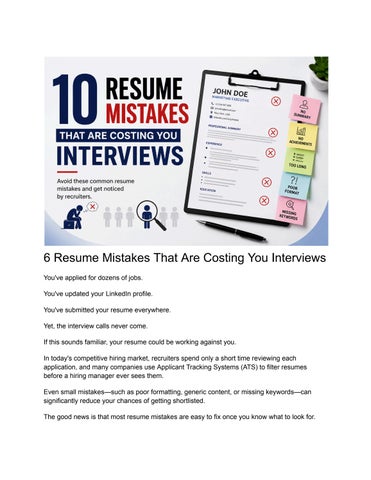
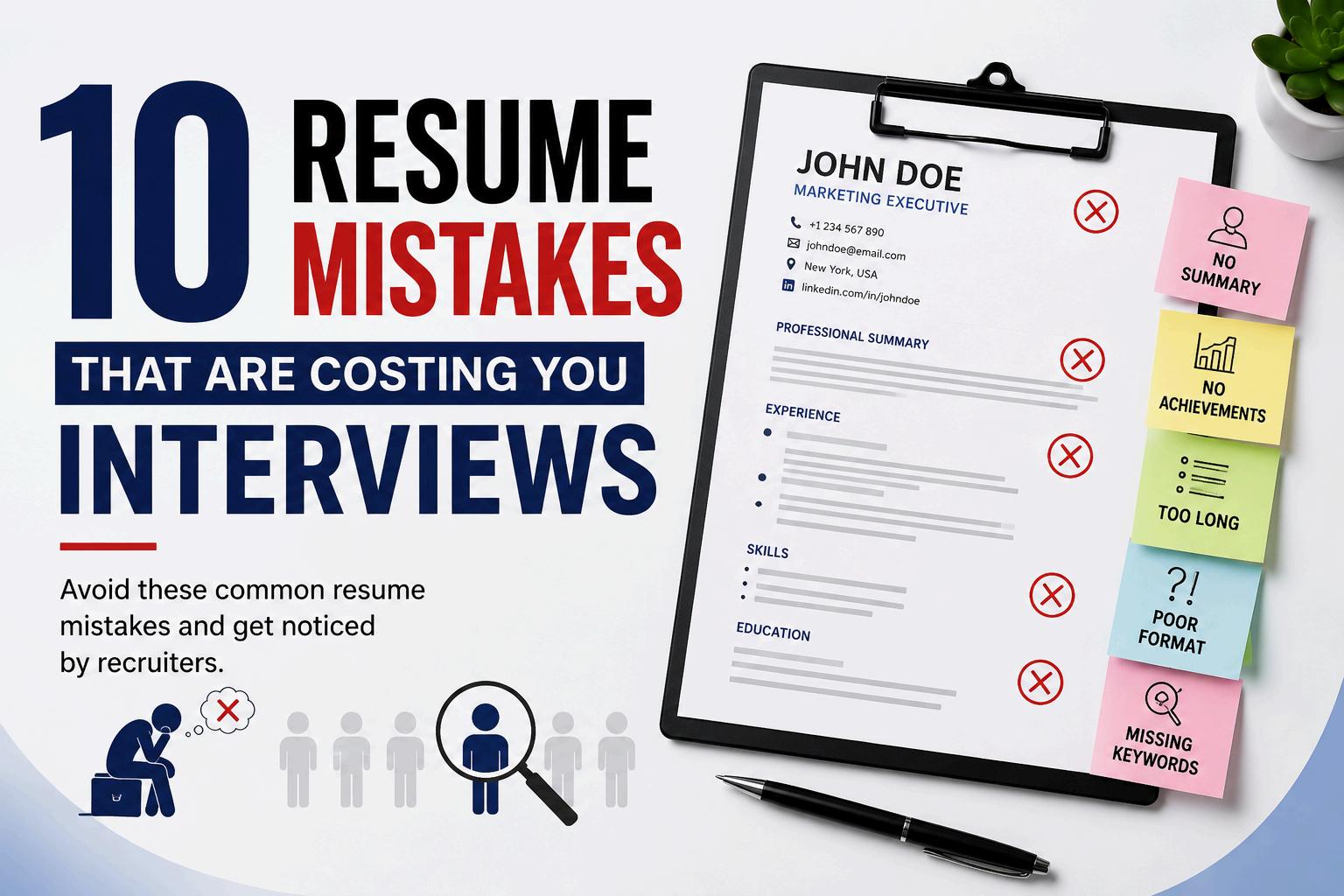
6 Resume Mistakes That Are Costing You Interviews
You've applied for dozens of jobs.
You've updated your LinkedIn profile
You've submitted your resume everywhere.
Yet, the interview calls never come
If this sounds familiar, your resume could be working against you.
In today's competitive hiring market, recruiters spend only a short time reviewing each application, and many companies use Applicant Tracking Systems (ATS) to filter resumes before a hiring manager ever sees them
Even small mistakes—such as poor formatting, generic content, or missing keywords—can significantly reduce your chances of getting shortlisted
The good news is that most resume mistakes are easy to fix once you know what to look for.
In this guide, we'll explore the 10 most common resume mistakes that prevent candidates from getting interviews and show you how to avoid them to improve your chances of landing your next job
Why Resume Mistakes Matter
Your resume is often your first interaction with a potential employer.
It doesn't need to tell your entire career story it needs to convince a recruiter that you're worth interviewing.
Even qualified candidates can miss out on opportunities because of avoidable resume mistakes, such as poor formatting, irrelevant information, or failing to tailor their resume to the job.
By identifying and fixing these issues, you can create a stronger first impression and improve both ATS compatibility and recruiter engagement.
Mistake #1: Using the Same Resume for Every Job
One of the biggest reasons candidates don't get interviews is sending the same resume to every employer
Every job posting is different, and recruiters look for candidates whose experience closely matches their requirements.
How to Fix It
Before applying:
● Read the job description carefully
● Highlight important skills and qualifications.
● Update your professional summary
● Reorder your achievements based on relevance.
● Naturally include keywords from the job posting.
Example
Instead of:
Submitting a generic marketing resume to every company.
Try:
Tailor your resume for each role by emphasizing the skills and achievements that best match the employer's requirements
Mistake #2: Listing Responsibilities Instead of Achievements
Many resumes simply describe daily tasks
Recruiters already know what a Digital Marketing Executive or Software Developer typically does
What they want to know is the value you delivered.
Poor Example
● Managed social media accounts.
● Created reports
● Ran Google Ads campaigns.
Better Example
● Increased Instagram engagement by 45% through data-driven content planning.
● Reduced cost per lead by 30% by optimizing Google Ads campaigns
● Created weekly performance dashboards that improved campaign decision-making
Whenever possible, include numbers that demonstrate your impact
Mistake #3: Ignoring ATS Optimization
Many resumes never reach a recruiter because they fail ATS screening
Common ATS mistakes include:
● Using graphics or icons
● Multiple-column layouts
● Missing keywords.
● Unusual fonts
● Images containing important information.
ATS-Friendly Resume Tips
✔ Use standard headings
✔ Include relevant keywords naturally
✔ Keep formatting simple
✔ Avoid text inside images.
✔ Save your resume as a PDF unless instructed otherwise
Mistake #4: Writing a Weak Professional Summary
Your professional summary is one of the first sections recruiters read
A generic statement doesn't explain why you're the right candidate.
Weak Example
Looking for a challenging opportunity where I can grow professionally.
Better Example
Results-driven Digital Marketing Executive with 3+ years of experience managing Google Ads and Meta Ads campaigns Skilled in performance marketing, SEO, and campaign optimization, with a proven track record of improving lead generation and reducing acquisition costs.
A strong summary immediately communicates your experience, skills, and value
Mistake #5: Including Irrelevant Information
Not everything belongs on your resume
Avoid adding information that doesn't support your application, such as:
● Outdated technical skills.
● Irrelevant work experience.
● Personal details not requested by the employer
● Lengthy career objectives
● Hobbies that don't add value.
Focus on information that helps recruiters understand why you're a strong fit for the role
Mistake #6: Using Poor Resume Formatting
Even if you have excellent qualifications, a poorly formatted resume can discourage recruiters from reading it
Large blocks of text, inconsistent fonts, excessive colors, and cluttered layouts make it difficult to quickly find important information
Common Formatting Mistakes
● Using multiple fonts
● Overusing bold or italics
● Adding bright colors or graphics
● Large paragraphs instead of bullet points
● Inconsistent spacing and margins
● Using decorative fonts
Best Practices
✔ Use a clean, professional font like Calibri, Aptos, Arial, or Helvetica
✔ Keep font size between 10–12 pt.
✔ Use clear headings and bullet points
✔ Leave enough white space to improve readability.
✔ Keep formatting consistent throughout the resume
Remember, your resume should be easy to scan within seconds.
Resume Mistakes Checklist
Before sending your next application, make sure you can answer "Yes" to each of these:
✔ I customized my resume for the job
✔ My resume highlights achievements, not just responsibilities
✔ I included relevant keywords from the job description
✔ My formatting is clean and ATS-friendly
✔ My professional summary clearly communicates my value.
✔ I removed outdated or irrelevant information
✔ My resume has been proofread for spelling and grammar.
✔ My contact information is correct
✔ My resume is concise and easy to read.
✔ I saved my resume in the format requested by the employer
Taking a few extra minutes to review your resume can significantly improve your chances of getting shortlisted