

ISBN: 9789211548723
Published in April 2026
© UNICRI

Assessing the nexus between terrorism and criminal activities in Africa

The opinions, findings, conclusions, and recommendations expressed in this publication are solely those of the authors and do not necessarily reflect the views or positions of the United Nations, UNICRI, the Ministry of Foreign Affairs and International Cooperation of Italy or any other national, regional, or international entity involved. The content of this publication may be quoted or reproduced, provided that the source is acknowledged.
Neither UNICRI nor the authors bear responsibility for any use made of the information contained herein. The designations used and the presentation of material in this publication do not imply any opinion on the part of the United Nations Secretariat or UNICRI regarding the legal status of any country, territory, city, or area, or its authorities, nor regarding the delimitation of its frontiers or boundaries. Mention of specific institutions, or companies does not constitute an endorsement or recommendation by the United Nations Secretariat or UNICRI over others of a similar nature.
The United Nations Interregional Crime and Justice Research Institute (UNICRI) gratefully acknowledges the Ministry of Foreign Affairs and International Cooperation of Italy for its support of this project. UNICRI wishes to thank local and national partners as well as all the stakeholders who took part in the consultations, meetings and workshops that led to the development of this report.
Elena Dal Santo, Tala Lakiss, Aziz Abdel Mossi, Luca Raineri, Anicet Zran, B.A.A.*
Editing: Stephanie Briggs; Graphic Design: Marianna Fassio *One author

Illicit economies and armed violence intersect in multiple regions of Africa, where terrorist organizations operate in environments characterized by informal markets, weak governance, and cross-border criminal flows. Activities such as artisanal mining, livestock trade, fuel smuggling, and trafficking networks create economic systems that can be exploited by violent extremist groups for revenue, logistics, and territorial control. Understanding how terrorist actors interact with these criminal economies is essential to assessing security risks and designing effective policy responses.
This report examines the relationship between terrorist actors and criminal activities in Africa, with a specific focus on West Africa, and addresses the question of how and to what extent designated terrorist groups engage with criminal economies. While discussions about a “crime–terror nexus” have become prominent in policy and academic debates, empirical evidence remains uneven and often relies on limited data or generalized assumptions. These limitations are particularly pronounced in African contexts, where illicit economies are deeply embedded in local livelihoods and governance systems.
To address these gaps, the report adopts a broader analytical perspective that moves beyond terrorism financing. Instead of focusing solely on structured criminal organizations, the report analyzes criminal markets and illicit economic systems in which a wide range of actors—including extremist groups, traders, intermediaries, and corrupt officials—participate. In many African contexts, the boundaries between licit, informal, and illicit activities are fluid, and violent extremist actors interact with these markets in pragmatic and opportunistic ways.
Conceptually, the relationship between terrorism and crime is approached as a continuum of interactions rather than a single form of collaboration. These interactions may include transactional cooperation, parallel coexistence within the same economic spaces, competition over resources or territory, or, more rarely, organizational convergence. To capture this diversity, the report employs a fourfold analytical framework consisting of cooperation, coexistence, convergence, and conflict.
Using a desk-based approach, the study focuses on eight groups affiliated with Islamic State in Iraq and the Levant (ISIL)/Da’esh or Al-Qaida and operating in Africa. These groups were selected based on their operational reach, territorial presence, and documented interactions with criminal economies. Findings from the desk research informed the field-based qualitative research. Field research was conducted in Benin, Côte d’Ivoire, and Nigeria, where emerging terrorist dynamics intersect with established criminal markets and cross-border trafficking routes. Between June and September 2025, UNICRI conducted interviews and focus group discussions with 151 respondents, including national authorities, local officials, community leaders, civil society actors, and individuals involved in local economic activities.
The findings indicate that interactions between terrorist actors and criminal economies are predominantly opportunistic and context specific. In most cases, the relationship takes the form of transactional arrangements, including taxation, extortion, protection rackets, and access to smuggling routes. Durable organizational
alliances between terrorist groups and criminal networks appear limited. Instead, violent extremist groups frequently embed themselves within existing informal and illicit markets.
Across several regions of West Africa, resource-based economies emerge as particularly vulnerable to exploitation. Activities such as artisanal gold mining, livestock trading, and fuel distribution generate significant revenues for groups including Jama'a Nusrat ul-Islam wa al-Muslimin (JNIM), Islamic State in the Greater Sahara (ISGS), and Islamic State West Africa Province (ISWAP) through structured systems of taxation and coercive extraction. At the same time, by acting as premium buyers, violent extremist groups secure supply while reinforcing governance and influence over local communities. In East and Southern Africa, the nexus between terrorism and criminal activities is evolving towards a more sophisticated reliance on financial and technology-enabled tools. Al-Qaida and Da’esh-affiliated actors exploit mobile money services, remittance systems, and informal financial networks to move funds across borders and obscure financial trails.
In numerous settings, informal and illicit economies function as vital livelihood strategies, particularly among borderland communities. These economies rely on dense networks of micro transactions, local distribution circuits, and informal wholesale–retail chains, creating repeated points of interaction that violent extremist groups exploit to embed themselves within community life. Such engagement not only secures their access to essential commodities but also bolsters their perceived legitimacy. In these contexts, informal and extra legal economies can also become liminal spaces where alternative norms and local logics of legitimacy take shape: when terrorist groups enable or exploit these dynamics, they mobilize hidden grievances of marginalized populations and offer them an organized outlet, sometimes strengthened by pre-existing social and kinship ties that facilitate recruitment and logistical support.
The relationship between terrorist actors and criminal networks is not always cooperative. While overt conflict remains a minor category of interaction compared to more functional or neutral arrangements, in many contexts, actors coexist without direct collaboration or competition over control of resources, trade routes, and communities. Lack of cooperation, however, should not be mistaken for harmless parallelism: the simultaneous presence of criminals and extremists can amplify governance gaps, deepen corruption, and erode public trust.
Effective policy responses therefore require de-securitizing and formalizing informal economies, strengthening local governance, and designing interventions that account for survival imperatives, social embeddedness, and nuanced power dynamics. Strengthening border governance, improving oversight of extractive sectors, addressing corruption, and supporting local economic resilience are key elements in preventing the harmful convergence of terrorism and criminal activities, while avoiding measures that could inadvertently push communities towards extremist influence or undermine local livelihoods.
The nexus between organized crime and terrorism is a complex and continuously evolving phenomenon that draws significant attention from practitioners, policymakers and scholars due to its implications for global security and stability. Despite efforts to define and address this intersection, analytical flaws and data gaps persist, particularly in certain regions. This report aims to address these gaps by examining some of the existing linkages between terrorist and criminal actors in Africa. While the conceptual framework and definitional boundaries of this analysis are discussed in the methodological section, it is important to state at the outset the primary research question guiding this work: “What is the relationship, if any, between terrorist actors and criminal activities in Africa?”.
Although this research is part of the debate on the nexus between terrorism and organized crime, it embraces a wider perspective with respect to the dynamics considered. It moves beyond a terrorism-financing paradigm and reconceptualizes the unit of analysis, from organized criminal groups to the broader configuration of criminal markets, where heterogeneous actor typologies operate within clientelist and hybrid governance structures. The analysis intends to identify key patterns, examine typologies of illicit activities and assess broader security implications associated with Africa-based terrorist actors. The study contributes to informing targeted interventions to prevent and counter the harmful convergence of terrorism and criminal activities.
The relationship between terrorism and (organized) crime is best understood as a spectrum rather than a fixed category. At times, the nexus appears purely transactional with groups cooperating for specific operational needs, such as smuggling routes or financing, without establishing long-term alignments.1 In other cases, the nexus takes an organizational form where criminal and terrorist activities coexist in the same space and time, sometimes producing hybrid entities that simultaneously pursue ideological and profit-driven goals.2 At the far end of the continuum lies transformation, with terrorist organizations evolving into a quasicriminal enterprise or, conversely, criminal groups adopting political or religious motives and acquiring terrorist characteristics.3 Although criminal and terrorist organizations sometimes cooperate, they may also compete or clash: terrorist organizations may view some criminal activities as illegitimate and proscribe them; while criminal actors may resent the ideological rigidity and political attention that terrorist organizations carry with them. Noting this inherent complexity, the guiding research question aims to help explore where, along this spectrum, the relationships observed across the African continent -particularly in West Africa - fall.
Africa represents a highly relevant case-study in the nexus perspective. The continent
1 UNICRI, Policy Toolkit on The Hague Good Practices on the Nexus between Transnational Organized Crime and Terrorism, 2019, p. 2, https://unicri.org/sites/default/files/2021-12/PT_EN_0.pdf.
2 Tamara Makarenko, The Crime-Terror Continuum: Tracing the Interplay between Transnational Organised Crime and Terrorism, Global Crime, 6(1), pp.132–135, 2004.
3 Tamara Makarenko, The Crime-Terror Continuum: Tracing the Interplay between Transnational Organised Crime and Terrorism. Global Crime, 6(1), pp.135–138, 2004.
is a hub for several illicit flows, 4 such as counterfeit goods, drugs, financial crimes, human trafficking and natural resources, originating from or transiting through African States. Over the past decade, Sub-Saharan Africa has seen the sharpest regional decline in security with terrorist attacks increasing by 157 per cent and related fatalities by 73 per cent since 2014.5 Although the policy relevance of these intertwined phenomena is undeniable, persistent data limitations remain. Moreover, the structural ambivalence between official anti-crime discourse and clientelist governance practices accommodating extra-legal economies6 hinders comprehensive understanding and fosters reductive interpretations and speculative narratives. The context and topics under consideration thus underscore the need for a more nuanced, empirically grounded analysis tailored to African realities.
The focus of this study holds important implications for policymakers and practitioners, particularly those engaged in counterterrorism and crime prevention, while its findings can also contribute more broadly to strengthening governance and institutional resilience. In counterterrorism and the prevention of violent extremism, overlooking or misunderstanding the crime-terror nexus may undermine preventive responses, as this relationship can act as an “enabler of terrorism”.7 Where relevant, integrating crime analysis into counterterrorism enhances prevention, strengthens detection and improves understanding of how terrorist groups operate through and thanks to illicit markets.8 From the perspective of organized crime control, weak enforcement enables criminals to “operate” more freely and even “provide services to terrorists”,9 while perceptions of high-level corruption and impunity may be leveraged by terrorist organizations in their own propaganda. In this regard, anti-corruption reforms become pivotal, together with continued efforts in good management of border security. Beyond the security sector, the nexus may have a direct impact on governance and development more broadly, eroding “political, economic and social stability and development”.10 Addressing these challenges effectively requires structural interventions, including enhanced service provision, the promotion of employment opportunities, and the strengthening of community resilience, as highlighted by the findings of this research. Furthermore, the locally grounded evidence presented in this report can inform tailored, context-specific interventions.
From a research perspective, the nexus between terrorism and (organized) crime
4 ENACT, Africa Organised Crime Index 2025: The past, present and future of organised crime, 2025: https:// enact-africa.s3.amazonaws.com/uploads/pages/1764100937228-2025-11-18-africa-oci-2025-v3.pdf.
5 Institute for Economics & Peace, Global Terrorism Index 2025: Measuring the Impact of Terrorism, Sydney, March 2025, p. 39, https://www.economicsandpeace.org/report/global-terrorism-index-2025.
6 Luca Raineri and Francesco Strazzari, ‘The data that we do (not) have: studying drug trafficking and organised crime in Africa’, Trends in Organized Crime, 26(4) 2023, pp. 358–378.
7 Louise Shelley, The Unholy Trinity: Transnational Crime, Corruption, and Terrorism (Cambridge University Press, 2005), p. 55.
8 Ibid.
9 Ibid.
10 UNICRI, Policy Toolkit on The Hague Good Practices on the Nexus between Transnational Organized Crime and Terrorism, 2019, p. 2: https://unicri.org/sites/default/files/2021-12/PT_EN_0.pdf.
remains conceptually unsettled and contested. Explanatory models face limitations: scarcity in primary data, lack of a systematic conceptual structure and the absence of universally agreed definitions, affect analysis and hinder cumulative knowledge.11 While a diverse range of connections between various forms of organized crime and terrorism are possible and have sometimes been observed, the need for additional research involving diverse contexts is evident, particularly since generalizations are hard to prove across regions. These shortcomings are especially pronounced in some African contexts, where these dynamics remain underexplored. In these settings, the interplay of factors, such as political instability, societal tensions and limited economic opportunities, can increase vulnerability while persistent data gaps leave room for conjecture and conspiracies that may undermine evidencebased policymaking.
Although the nexus is broadly understood as the interaction between crime and terrorism, its conceptual boundaries remain fluid and contested, with diverse theoretical underpinnings shaping differing interpretations and perspectives on its nature, scope and manifestation(s).
Before the turn of the century, research and policy responses addressing organized crime and terrorism developed largely in isolation from one another.12 Academic interest in exploring the nexus grew after 9/11, together with the expansion of the literature on terrorism. Makarenko’s theory on the crime–terror continuum frames organized crime and terrorism as poles of a spectrum, with intermediate stages and full convergence occurring when a group transforms its tactics and motivations to such an extent that it evolves into the other. Contextual variables can accelerate or facilitate the process, in particular in the “black hole”, where “weak or failed states […] create a safe haven for the continued operations of convergent groups”.13 The author further refined her analysis by proposing a three-plane framework –operational, organizational and evolutionary – that explains alliances, hybrids and transformations as sequential but potentially overlapping processes.14 Shelley and Picarelli15 propose an evolutionary model, moving from tactical borrowing to full
11 Letizia Paoli and Cyrille Fijnaut, ‘Taking stock of the literature on the nexus between organized crime and terrorism’ in The Nexus Between Organized Crime and Terrorism, Letizia Paoli and Cyrille Fijnaut, eds. (Cheltenham, Edward Elgar Publishing, 2022), pp. 29–32.
12 James Windle, John F. Morrison, Aaron Winter and Andrew Silke, ‘Hawking the historical method in organized crime and terrorism studies’, in Historical perspectives on organized crime and terrorism, James Windle et al., eds., Abingdon: Routledge, 2018, pp. 1–2.
13 Tamara Makarenko, ‘The Crime-Terror Continuum: Tracing the Interplay between Transnational Organised Crime and Terrorism’, Global Crime, 6(1), 2004, pp. 129–45.
14 Tamara Makarenko, ‘The Crime-Terror Continuum: Tracing the Interplay between Transnational Organised Crime and Terrorism’, Global Crime, 6(1), 2004, pp. 129–45.
15 Louise I. Shelley and John T. Picarelli, ‘Methods and Motives: Exploring Links Between Transnational Organized Crime & International Terrorism’, Trends in Organized Crime, 9(2), Winter 2005.
transformation. The authors suggest that methods and practical considerations tend to be more influential than motives, at least in the initial stages of interaction, with ideological or goal alignment emerging only at more advanced stages. They also hypothesize that the decline of state sponsorship can push terrorist groups towards organized crime as a source of funding.
Scholars have questioned whether collaborative relationships between criminal and terrorist organizations extend beyond a few isolated cases. 16 Some caution that the nexus may be overstated, amounting to a form of threat inflation that limits its analytical utility. In a recent collective analytical exercise, Paoli and Fijnaut17 attempt to tackle both the lack of conceptual clarity and the shortage of empirical studies examining the crime–terror nexus. They argue that, contrary to claims of a single growing link between organized crime and terrorism, such connections are generally not systematic. Rather, the relationship can take multiple forms, ranging from occasional exchanges of goods or services to rare collaboration or imitation. They propose a tripartite conceptualization of the nexus: interaction, transformation/ imitation and similarities. While transformation/imitation and similarities do not require the coexistence of terrorist and criminal actors, the interaction type of nexus assumes the presence of both actors in a given context. It ranges from occasional resource transfers (e.g., manpower, money, weapons) to more substantial forms like regular collaboration or alliances.
After 9/11, attention shifted away from the presumed centrality of the crime–terror nexus, as subsequent attacks revealed that even large-scale terrorist operations could be carried out at minimal cost. This challenged assumptions about the necessity of collaborating with transnational crime syndicates and drew attention instead to the role of individual actors and small networks. In line with this shift, analyses of individual paths of radicalization and engagement in terrorism highlighted the prevalence of criminal backgrounds. However, this overlap appears to occur primarily at the individual level, as recent research finds scant evidence of traditional organizational collaboration between terrorist and criminal groups. Rather, it often emerges through shared social networks and environments. In this context, the emphasis is on the role of social milieus rather than structural convergence, 18 as criminal experience can provide operational advantages – such as access to weapons, forged documents and evasion skills – and small-scale crime can be sufficient to fund terrorist actions.19 Ljujic, van Prooijen and Weerman suggest that marginalized socioeconomic conditions, together with a history of criminal activity, delineate the pool of individuals vulnerable to recruitment into violent and terrorist
16 See, for example, A.P. Schmid, ‘Links Between transnational Organized Crime and Terrorist Crimes’, Transnational Organized Crime, 2, 1996, pp. 40–82.
17 Letizia Paoli, Cyrille Fijnaut and Jan Wouters, ‘One, none, multiple nexuses between organized crime and terrorism and the challenges of their control’, in The Nexus Between Organized Crime and Terrorism, Letizia Paoli and Cyrille Fijnaut, eds. (Cheltenham, Edward Elgar Publishing, 2022), pp. 489–497.
18 Rajan Basra and Peter R. Neumann, ‘Criminal Pasts, Terrorist Futures: European Jihadists and the New Crime–Terror Nexus’, Perspectives on Terrorism, 10(6), 2016, pp. 25–40.
19 Magnus Ranstorp, ‘Microfinancing the Caliphate: How the Islamic State is Unlocking the Assets of European Recruits’, CTC Sentinel, 9(5), 2016, pp. 11–15.


groups.20
Most of these studies, however, draw conclusions from cases and data about the West, thereby risking reinforcing the often-noted contextual bias in terrorism research.21 Comparative studies have more recently addressed the linkage between crime and terrorism from an African perspective,22 including by highlighting Africaspecific phenomena such as the so-called “jihadization of banditry” and/or the “banditization of jihad”.23 Primary data support the idea that the crime-terror nexus should be understood as a continuum rather than a binary relationship. A consistent pattern across cases is the prevalence of transactional links, such as alliances and appropriation of tactics, that generate immediate operational benefits – for example access to counterfeit documents, revenue or smuggling. In Africa, many interactions between terrorism and organized crime take the form of short-term service-forhire arrangements rather than durable mergers driven by ideological alignment. 24 These findings align with broader observations that organized crime networks on the continent are fluid and adaptive. They operate across multiple illicit markets, ranging from trafficking in drugs, ivory and vehicles, to smuggling counterfeit goods and human trafficking, while maintaining a pragmatic, transactional approach to collaboration. Among bandits, criminal groups and terrorist actors, pragmatism and survival take priority over ideology, leading them to adopt each other’s tactics and co-opt each other’s resources whenever operational needs demand it.
At the same time, existing research cautions against overstating the alleged links between criminal and terrorist actors. In the Sahara–Sahel region, the dominant discourse on narco-terrorism reflects a normative and political framing that risks oversimplifying the realities on the ground. Rather than forming stable alliances, terrorist groups and criminal networks engage in fluid and sometimes contradictory interactions shaped by local power dynamics and strategic considerations.25 Similarly, claims suggesting a link between elephant poaching, ivory trafficking and violent extremist groups in Africa have often proven unsubstantiated.26
20 Vanja Ljujic, Jan Willem van Prooijen and Frank Weerman, ‘Beyond the crime-terror nexus: Socio-economic status, violent crimes and terrorism’, Journal of Criminological Research Policy and Practice, 3(3), 2017, pp. 158–172.
21 Richard English, ‘The Future Study of Terrorism’, European Journal of International Security, 1(2), 2017, pp. 135–149.
22 Anouar Boukhars and Catherine Lena Kelly, ‘Comparative Perspectives on Linkages between Violent Extremism and Organized Crime in Africa’, African Security, 15(1), 2022, pp. 26–50.
23 James Barnett, Murtala Ahmed Rufa’I and Abdulaziz Abdulaziz, ‘Northwestern Nigeria: A Jihadization of Banditry, or a “Banditization” of Jihad?’, CTC Sentinel, 15(1), 2022.
24 Annette Hübschle, ‘From theory to practice: Exploring the organised crime–terror nexus in Sub-Saharan Africa’, Perspectives on Terrorism, 5(3/4), 2011, pp. 81–95.
25 Djallil Lounnas, ‘The links between jihadi organizations and illegal trafficking in the Sahel’, Middle East and North Africa Regional Architecture: documents de travail, 30, 2018; Lemine Ould M., Le Ben Laden du Sahara. Sur les traces du jihadiste Mokhtar Belmokhtar (Paris: Ed. La Martinière, 2014).
26 Natasha White, ‘The ”White Gold of Jihad”: Violence, legitimisation and contestation in anti-poaching strategies’, Journal of Political Ecology, 21(1), 2014, pp. 452–474; Alice Kelly Pennaz et al., ‘Not Seeing the Cattle for the Elephants: The Implications of Discursive Linkages Between Boko Haram and Wildlife Poaching in Waza National Park, Cameroon’, Conservation and Society, 16(2), 2018, pp. 167–178; Kristof Titeca and Patrick Edmond, ‘Outside the Frame: Looking Beyond the Myth of Garamba’s LRA Ivory–Terrorism Nexus’, Conservation and Society, 17(3), 2019, pp. 209–221.
Even when direct interaction may be limited, the instability created by one actor may be beneficial for the other to operate. This is the case, for example, in Nigeria where bandit groups are well-established and operate with significant autonomy making it difficult for terrorist movements to assert control over them. However, terrorist actors have exploited the instability created by banditry in the northwest to carve out some footholds, which persist on the basis of pragmatic arrangements that allow coexistence and occasional tactical cooperation when interests align.27 This dynamic is not unique to Nigeria but reflects broader patterns across West Africa, where criminal economies have become deeply intertwined with insecurity. Armed groups and criminal actors exploit porous borders, weak governance and strategic trade corridors to sustain their operations. Activities such as cattle rustling, illicit arms trade, illicit gold trade, kidnapping, and extortion and protection racketeering, serve as “accelerant markets” in the regional conflict environment,28 with illicit economies exploited for financing purposes to ensure resources but also to build legitimacy among local communities.
Underlying these patterns are several enabling conditions, including cross-border permeability, areas of limited statehood, weak institutions, corruption, prison recruitment and financial or ideological support by diaspora networks. Shelley29 observes that interactions are “more likely to occur” in regions with shadow economies and conflict zones, particularly where state authority is absent, such as borderlands, failing states or prisons. Boukhars and Kelly note that in the Sahel and Horn of Africa, convergence is most visible in contexts of chronic insecurity where violent extremist groups monopolize illicit markets and governance functions.30 Corruption also acts as a critical driver. By eroding governance and accountability, corruption not only facilitates criminal and terrorist operations but also strengthens the transactional connections between them, making cooperation easier and more profitable.31 In this regard, the relationship between terrorism and organized crime in Africa can be seen as a context-dependent continuum: typically transactional, occasionally hybrid and only rarely transformative. It is shaped by governance gaps, illicit economies and fragile conflict settings.
27 James Barnett and Umar Musa*, ‘Kachallas and Kinship: Understanding Jihadi Expansion and Diffusion in Nigeria’, CTC Sentinel, 2026, pp. 1–27.
28 Lyes Tagziria and Lucia Bird, Illicit Economies and Instability: Illicit Hub Mapping in West Africa 2025, GI-TOC, October 2025, https://globalinitiative.net/wp-content/uploads/2025/10/Lyes-Tagziria-Lucia-Bird-Illiciteconomies-and-instability-Illicit-hub-mapping-in-West-Africa-2025-GI-TOC-October-2025.v3.pdf.
29 Louise Shelley, The Unholy Trinity: Transnational Crime, Corruption, and Terrorism (Cambridge University Press, 2005), p. 58.
30 Anouar Boukhars and Catherine Lena Kelly, ‘Comparative Perspectives on Linkages Between Violent Extremism and Organized Crime in Africa’, African Security, 15(1), 2022, pp. 26–50.
31 UNICRI, The Nexus between Transnational Organized Crime and Terrorism in Latin America, 2024, https:// unicri.org/sites/default/files/2024-06/The%20Nexus%20between%20Transnational%20Organized%20 Crime%20and%20Terrorism%20in%20Latin%20America.pdf.


Existing studies highlight the need for a nuanced and diversified understanding of the nexus – or, perhaps more appropriately, the plurality of the possible nexuses – between organized crime and terrorism in Africa. Understanding how the nexus unfolds requires evidence-based scrutiny, as it is strongly influenced by structural fragilities, poor governance and transnational illicit economies. To capture this diversity and properly address this study’s research question, we put forward a conceptual framework based on a fourfold taxonomy of possible nexuses –convergence, cooperation, coexistence and conflict.
Convergence refers to the institutional transformation whereby sustained interaction results in criminal and terrorist organizations becoming virtually indistinguishable. Cooperation, by contrast, emerges in the form of transactional arrangements between criminal and extremist actors, including protection fees or logistical support.32 These deals are typically opportunistic rather than strategic, reflecting the fluidity of local political economies where survival and profit override ideological divides. Coexistence is another form of interaction between criminal and terrorist actors in Africa. For example, traffickers and terrorists may share routes for drugs, arms and migrants without direct collaboration, maintaining parallel spheres of influence to avoid costly confrontation.33 This tacit tolerance can be further nourished by community actors and facilitated by corrupt officials who mediate access to markets and mobility. In addition, competition, possibly resulting in conflict, may take place over territory, resources and social control, often underpinned by divergences in ideology as well as distinct domestic and international alliances.
This fourfold taxonomy offers a useful conceptual framework to apprehend the inherent diversity of a complex phenomenon, leaving to empirical analysis the task of verifying which of these categories (if any) reflects the specificities of local realities in different African contexts. Drawing on the examination of eight ISIL/Da’esh and Al-Qaida affiliated groups and the local dynamics in three relevant geographical areas, the study aims to explore the category that best captures their interaction with criminal actors and economies.
32 Anouar Boukhars and Catherine Lena Kelly, ‘Comparative Perspectives on Linkages Between Violent Extremism and Organized Crime in Africa’, African Security, 15(1), 2022, pp. 26–50.
33 Erik Alda and Joseph L. Sala, ‘Links Between Terrorism, Organized Crime and Crime: The Case of the Sahel Region’, Stability: International Journal of Security and Development, 3(1), 2014, pp.1–9.
This report is based on extensive data collection using a two-phase research design: an initial desk-based analysis followed by field research. The first phase consisted of a thorough review of secondary sources, including academic publications, reports from non-governmental organizations, think tanks, civil society organizations, international bodies and official government documents. This review provided a foundational understanding of the variety of nexuses between terrorism and criminal activities taking place in Africa. Findings from this phase informed the selection of priority areas for further investigation. The process began with a continent-wide mapping of terrorist activities, which led to the identification of eight Islamic State of Iraq and the Levant (ISIL)/Da’esh and Al-Qaida affiliated groups based on their operational scale, intersections with criminal economies, territorial control and strategic role in sustaining and expanding terrorist networks at local, regional and interregional levels: Ahl al-Sunna wal-Jama‘a (ASWJ) also known as Islamic State Mozambique; Al-Shabaab; Allied Democratic Forces (ADF) in light of their relationship with Da’esh; Ansarul Muslimina fi Biladis Sudan; Da’esh in Somalia also known as Islamic StateSomalia (IS-Somalia); Islamic State in the Greater Sahara (ISGS); Islamic State West Africa Province (ISWAP); and Jama’a Nusrat ul-Islam wa al-Muslimin (JNIM).
The desk-based research examined these groups’ interactions with criminal activities and networks and mapped the ramifications of illicit activities both locally and across borders. The review considered a wide spectrum of illicit activities and financial mechanisms that sustain these networks, including major enterprises such as drug
trafficking, kidnapping for ransom, migrant smuggling and human trafficking, illegal mining and arms trafficking, along with context specific illicit economies such as cattle rustling, the trafficking of cultural properties and fuel smuggling. The analysis also encompassed counterfeit medicines, motorbike and vehicle trafficking, and diverse financial flows ranging from diaspora remittances and business networks to charitable organizations and cryptocurrency transactions. Additional areas of inquiry involved piracy, protection rackets and taxation systems (including practices such as the coerced zakat34 collection, extortion and the exploitation of natural resources through charcoal and wildlife trafficking. By incorporating this broad typology of criminal economies, the research aimed to capture the complexity and adaptability of possible linkages between terrorist and criminal actors across different regional contexts.
The findings from this first phase informed the selection of three case studies in relevant geographic areas, which were examined in greater depth through qualitative data collection. The case selection was based on the overlap between high rates of terrorism and criminal activity, as identified through established indicators and datasets, including the Global Terrorism Index, the Global Organized Crime Index (published by the Global Initiative Against Transnational Organized Crime, with contributions from the EU-funded ENACT programme), and the Armed Conflict Location & Event Data Project (ACLED), and corroborated by existing literature. While acknowledging that criminal economies may also occur in virtual spaces as is the case, for example, of illicit financial flows, the presence of entrenched, in situ criminal activities was prioritized to ensure the relevance of ground-level data. Additional considerations included the feasibility of conducting fieldwork given security conditions and logistical constraints. Following this rationale, Benin, Côte d’Ivoire and Nigeria were selected for field research.
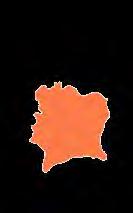
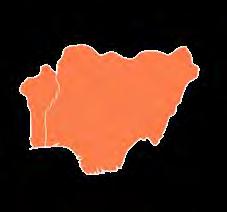
Building on the desk research findings, the second phase involved primary data collection in selected regions of Benin, Côte d’Ivoire and Nigeria. The selection of the communes of Dassa, Kandi, Malanville, Savalou, Savè and Sègbana in Benin; Bouaké, Bounkani and Tengrela in Côte d’Ivoire; and Oyo, Niger and Sokoto States in Nigeria reflects their strategic position within transnational smuggling corridors and their role in emerging crime–terror dynamics. Bounkani and Tengrela are located in northern Côte d’Ivoire, close to the borders with Burkina Faso and Mali, where gold trafficking and cattle smuggling intersect with JNIM’s operational zones. This positioning makes them critical sites for understanding how extremist networks penetrate resource economies. In Benin, the selected sites cluster along the northern and central belt, spanning border towns such as Malanville and Sègbana – key gateways for crossborder trafficking – and inland trade hubs such as Dassa, Savalou and Savè, which connect informal markets to coastal routes. These areas illustrate how illicit supply chains link local licit, illicit, formal and informal economies to regional criminal
34 Zakat is a compulsory form of charitable giving in Islam and one of the five pillars of the faith. Muslims whose wealth exceeds a certain level are generally required to donate 2.5 percent of certain types of accumulated assets. The practice aims to promote social justice by redistributing resources to those in need. According to the Quran, Zakat is intended to support specific groups, including people living in poverty, individuals in financial hardship, and travelers in distress.
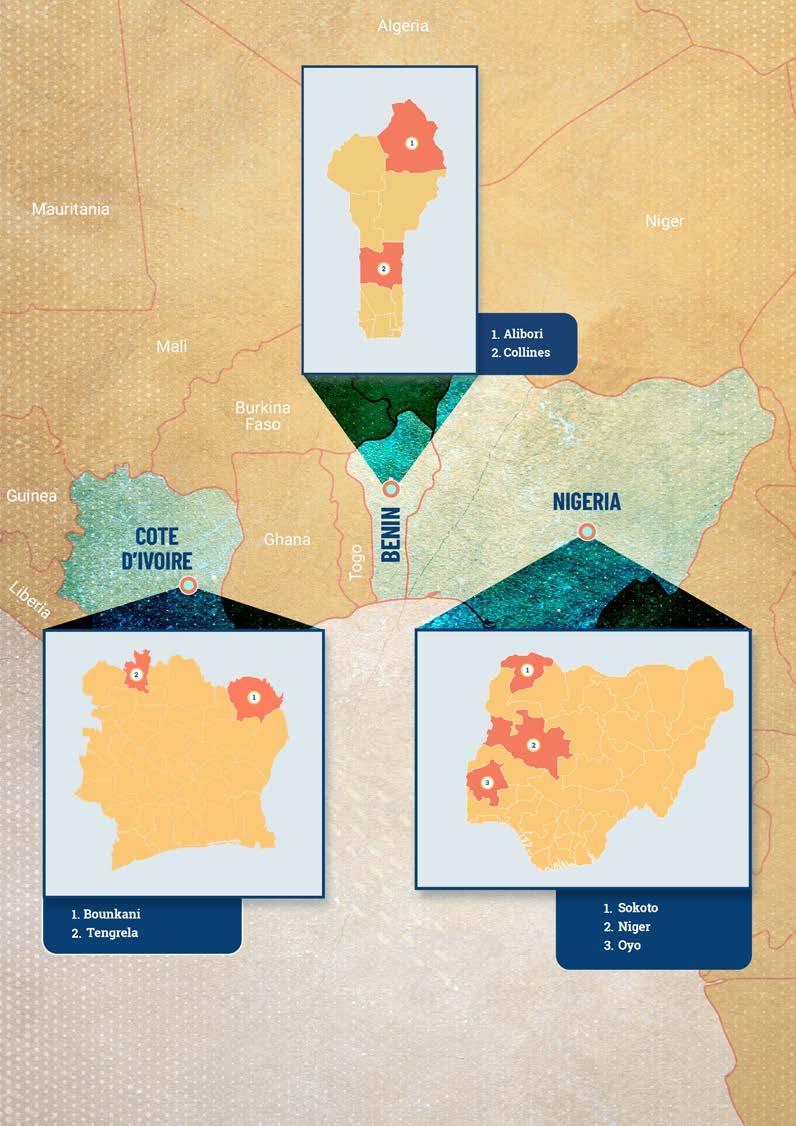
networks. In Nigeria, Niger and Sokoto States are epicentres of the northwest’s evolving nexus between banditry and terrorism, where cattle rustling, kidnapping for ransom and fuel smuggling converge, while Oyo State offers insights into southern transit dynamics and the spillover of northern insecurity into commercial corridors. Together, these locations capture the geographic diversity and economic drivers of the nexus, enabling comparative analysis of borderland vulnerabilities, market integration and adaptive criminal-terrorist interactions. Additional interviews were conducted with relevant national authorities and institutions in Abidjan, Côte d’Ivoire and Cotonou, Benin, in order to triangulate data and consolidate findings.
Between June and September 2025, UNICRI interviewed a total of 151 respondents through semi-structured interviews (95) and focus group discussions (56). Respondents included a variety of stakeholders, such as community members, local authorities and national government representatives. The field research engaged a diverse range of stakeholders who are directly or indirectly affected by, or involved in responding to, the possible links between terrorist actors and criminal activities. These included national and local authorities responsible for security and justice, specialized units addressing organized crime and terrorism, financial intelligence and anti-corruption bodies, as well as agencies overseeing extractive industries and pharmaceutical regulation. In addition, the study consulted international and regional organizations, law enforcement actors, judicial institutions, civil society representatives, as well as media professionals. Community and religious leaders provided insights into community dynamics, local perceptions and ideological narratives, while informal security actors, such as vigilante groups and hunters, shed light on grassroots security arrangements and the movement of violent extremist groups. The study also involved youth and women leaders, and livelihood groups such as traders, transport unions and motorcycle associations to capture the socioeconomic dimensions of vulnerability and resilience. This multi-stakeholder approach enabled a holistic understanding of the nexus across governance, security, community and economic spheres. Where available, UNICRI also reviewed official documents such as government reports to triangulate the data collected. Data was analysed using a thematic approach involving categorization around three key dimensions: the nature of the relationship between terrorist and criminal actors; the typology of illicit economies; and the role of local communities in these dynamics.
To reduce subjective interpretation bias, data collection was carried out by a diverse group of researchers in terms of nationality, ethnicity and gender, with decades of combined research experience in these fields. Given the sensitivity of the topics, particular care was taken to ensure confidentiality and data protection. Accordingly, all qualitative sources have been anonymized.
Clarifications on key terminology and concepts
TERRORISM: The analysis of terrorism-related phenomena comes with definitional challenges. Terminology used to evoke concepts and notions linked to terrorism is varied and not universally harmonized. A globally accepted definition of terrorism does not exist, although some key characteristics have been identified in international documents, resolutions and conventions.35 In recent years, the notion of violent extremism has complemented that of terrorism at the international level, aiming to capture a broader spectrum of behaviors and drivers associated with engagement in violence.36 While local contexts may employ different expressions and labels, and actors designated as terrorist can vary across jurisdictions, this study focuses on eight ISIL/ Da’esh (QDe.115) and Al-Qaida (QDe.004) affiliated groups, many of which are sanctioned by the UN Security Council, namely Islamic State West Africa Province (ISWAP) (QDe.162), Islamic State in the Greater Sahara (ISGS) (QDe.163), Da’esh in Somalia, Allied Democratic Forces (CDe.001), and Ahl al-Sunna wal-Jama‘a (not listed), Jama'a Nusrat ul-Islam wa al-Muslimin (JNIM) (QDe.004), Al-Shabaab (SOe.001)37 , and Ansarul Muslimina fi Biladis Sudan (QDe.142).
It is important to note that, at the local level, the colloquial use of labels such as ‘terrorist’ or ‘jihadist’ often encompasses a wide spectrum of armed actors accused of violence against civilians, including criminal networks, self-defense militias, and, in some cases, state security forces. While this report preserves respondents’ terminology when citing field data, in its own analysis it employs the terms ‘terrorism’ and ‘violent extremism’ in alignment with the core characteristics outlined in United Nations instruments.
35 See, for example, the UN General Assembly in its Declaration on Measures to Eliminate International Terrorism (resolution 49/60, 17 February 1995), affirming that terrorism includes “criminal acts intended or calculated to provoke a state of terror in the general public, a group of persons or particular persons for political purposes” and that such acts “are in any circumstances unjustifiable, whatever the considerations of a political, philosophical, ideological, racial, ethnic, religious or other nature that may be invoked to justify them”. The United Nations have been working for decades on the development of a comprehensive framework to counter the issue of terrorism, with 19 legal instruments elaborated since 1963, see https://www.un.org/ counterterrorism/en/international-legal-instruments.
36 United Nations General Assembly, A/70/674, 24 December 2015, Plan of Action to Prevent Violent Extremism. As stated by the UN General Assembly in 2015, although “violent extremism is a diverse phenomenon, without clear definition”, it is commonly recognized that it is characterized by messages of “intolerance […] to challenge our shared values of peace, justice and human dignity”.
37 Al-Shabaab was accepted as an affiliate of Al-Qaida by Aiman Muhammed Rabi al-Zawahiri (QDi.006) in February 2012
ORGANIZED CRIME AND CRIMINAL ACTIVITIES: while the UNTOC38 definition provides a legal baseline, emphasizing structured groups committing serious crimes for material benefit, this study adopts a broader conceptualization. It examines criminal activities as an adaptive governance system embedded in illicit and informal economies. This system involves heterogeneous actors, including state-embedded officials, facilitators, and non-state armed groups, who organize, protect, and exploit criminal markets through corruption, coercion, and collusion. This framing captures the blurred boundaries between licit and illicit activities and between state and non-state authority, which are particularly salient in African contexts. The notion of criminal economies is closely associated with illegal, illicit, and informal markets. Recognizing that what is licit may also be illegal, and what is illicit may at times be legal39 , this report explores a wide spectrum of activities and trades ranging from informal to overtly criminal, where boundaries remain fluid, overlapping, and constantly shifting. In contexts where trade forms the backbone of local livelihoods 40 , extra-legal markets often serve as alternatives or complements to formal economic systems, embedded within a dense and adaptive web of social relations 41
NEXUS: this report examines the interaction between eight selected ISIL/Da’esh and Al-Qaida affiliated groups and criminal activities and economies in Africa. While these groups are designated terrorist organisations whose activities are criminal in nature, the report focuses on how they engage with, exploit, or integrate into broader criminal dynamics and economies, across both highly organised and loosely structured forms of criminal activity. In this context, the “nexus” refers to the nature, manifestation and purpose of the relationship, including transactional arrangements for financing, logistics, or smuggling, as well as potential deeper structural overlaps. This framing allows us to move beyond simply identifying revenue sources and instead analyze the dynamics, incentives, and implications of these interactions for peace, security, and development.
38 United Nations, United Nations Convention against Transnational Organized Crime, 2225 U.N.T.S. 209, 2000, https://www.unodc.org/documents/treaties/UNTOC/Publications/TOC%20Convention/TOCebook-e.pdf
39 Willem Van Schendel and Itty Abraham, eds., Illicit flows and criminal things: States, borders, and the other side of globalization (Indiana University Press, 2005).
40 Luca Raineri, ‘Cross-border smuggling in north Niger: The morality of the informal and the construction of a hybrid order’, in Governance beyond the law: The immoral, the illegal, the criminal, Abel Polese, Alessandra Russo and Francesco Strazzari, eds. (Cham: Springer International Publishing, 2019), p. 230
41 Abel Polese, Alessandra Russo and Francesco Strazzari, eds., Governance beyond the law: The immoral, the illegal, the criminal (Springer: International Publishing, 2019)
The eight groups affiliated with ISIL/Da’esh and Al-Qaida, selected for their operational reach, engagement in criminal economies, territorial presence and strategic role in sustaining and expanding terrorist networks are:
Ahl al-Sunna wal-Jama‘a (ASWJ)
Also known as Islamic State in Mozambique (ISM) or Mashabab, the group emerged as a sustained insurgent force from 2017 onward in Cabo Delgado (Mozambique) consolidating a presence in districts such as Mocímboa da Praia, Macomia, Quissanga, and Palma42 and counting a core of 300–400 fighters.43 Its expansion relies on territorial control, coercive governance, and the exploitation of local vulnerabilities. While empirical data on foreign financial inflows into Mozambique remains limited,44 the group reportedly sustains its operations through increased kidnappings for ransom and exploitation of natural resources.45
Al-Shabaab Active since 2006, it is consistently identified as the most immediate threat to peace and security in Somalia and continues to conduct a sustained campaign of attacks across Somalia and Kenya, with periodic spillover effects in neighboring Ethiopia and Uganda.46 Al-Shabaab operates as a sophisticated, mafia-style organization that has deeply embedded itself into Somalia’s economic fabric, functioning almost as a shadow state47. The group reportedly generates over $150 million annually48 by exploiting a highly organized criminal economy built on systematic “taxtortion” at checkpoints, ports, and markets.
42 Martin Ewi et al., Violent Extremism in Mozambique: Drivers and Links to Transnational Organised Crime, Institute for Security Studies, 2022, pp. 9–12, https://issafrica.org/research/southern-africa-report/violentextremism-in-mozambique-drivers-and-links-to-transnational-organised-crime
43 Armed Conflict Location & Event Data Project (ACLED), ‘Cabo Ligado Update: 10–23 February 2025’, https:// acleddata.com/update/cabo-ligado-update-10-23-february-2025.
44 United Nations, Security Council, Letter dated 13 June 2023 from the Group of Experts on the Democratic Republic of the Congo addressed to the President of the Security Council, S/2023/431, 2023, pp. 10–13, https:// digitallibrary.un.org/record/4013781?ln=en&v=pdf
45 United Nations, Security Council, Letter dated 21 July 2025 from the Chair of the Security Council Committee pursuant to resolutions 1267 (1999), 1989 (2011) and 2253 (2015) concerning Islamic State in Iraq and the Levant (Da’esh), Al-Qaida and associated individuals, groups, undertakings and entities addressed to the President of the Security Council, S/2025/482, 2025, https://docs.un.org/en/S/2025/482
46 United Nations, Security Council, Letter dated 7 October 2016 from the Chair of the Security Council Committee pursuant to resolution 751 (1992) concerning Somalia and Eritrea addressed to the President of the Security Council (S/2016/919), 7 October 2016, p. 3, https://digitallibrary.un.org/record/846995/usage?v=pdf
47 Jay Bahadur, ‘Terror and taxes: Inside al-Shabaab’s revenue-collection machine’, Global Initiative Against Transnational Organized Crime, 2022, https://globalinitiative.net/wp-content/uploads/2022/12/AS-protectioneconomies.-WEB.pdf
48 United Nations, Security Council, Letter dated 15 October 2024 from the Chair of the Security Council Committee pursuant to resolution 2713 (2023) concerning Al-Shabaab addressed to the President of the Security Council, S/2024/748, 2024, https://docs.un.org/en/S/2024/748
Operating under the banner of the Islamic State Central Africa Province (ISCAP) since 202049, the Allied Democratic Forces have a long-lasting presence in the eastern side of the Democratic Republic of the Congo (DRC), particularly across the Beni territory and parts of Ituri, where they carry out repeated attacks against civilians, including ambushes along the Beni–Mbau–Kamango axis and in localities such as Oicha and Eringeti.50,51 ADF’s operational footprint has historically included systematic violence against civilians .52,53
Ansaru was born in north-west Nigeria in late 2011, mainly as a splinter from Boko Haram. The organization’s early rise to prominence is linked to a handful of high-profile kidnappings targeting Western contractors and engineers, signalling its gravitation in Al-Qaida’s African orbit. The group progressively lost power after 2013, while several militants were reabsorbed into Boko Haram following a change in leadership. The group remained inactive for several years before re-emerging in 2018 in north-western Nigeria, with several dozen fighters identifying themselves as Ansaru. Some analysts argue that the new Ansaru merely adopted its predecessor’s name but that its membership has changed. Ansaru’s activities, mainly located in Kaduna and Zamfara states, include urging Fulani communities to join the armed insurgency.
49 Although the group has pledged allegiance to ISIL, this report makes use of the name Allied Democratic Forces (ADF) for consistency with the UN designation used in Security Council reports and monitoring mechanisms.
50 United Nations, Security Council, Letter dated 19 June 2014 from the Group of Experts on the Democratic Republic of the Congo addressed to the President of the Security Council, S/2014/428, 2014, pp. 6–10, https:// www.securitycouncilreport.org/atf/cf/%7B65BFCF9B-6D27-4E9C-8CD3-CF6E4FF96FF9%7D/S_2014_428.pdf
51 United Nations, Security Council, Letter dated 12 January 2015 from the Group of Experts on the Democratic Republic of the Congo addressed to the President of the Security Council, S/2015/19, pp. 14–17, https://docs. un.org/en/S/2015/19
52 United Nations, Security Council, Letter dated 19 June 2014 from the Group of Experts on the Democratic Republic of the Congo addressed to the President of the Security Council, S/2014/428, 2014, pp. 7-8, https:// www.securitycouncilreport.org/atf/cf/%7B65BFCF9B-6D27-4E9C-8CD3-CF6E4FF96FF9%7D/S_2014_428. pdf
53 United Nations, Security Council, Letter dated 23 December 2020 from the Group of Experts on the Democratic Republic of the Congo addressed to the President of the Security Council, S/2020/1283, pp. 4–5, https://docs. un.org/en/S/2020/1283
Da’esh in Somalia
Islamic State in the Greater Sahara (ISGS)
Also known as Islamic State–Somalia (IS-Somalia), it emerged in late 2015 as a splinter faction from al-Shabaab in northern Somalia and is based primarily in Puntland. It remains a small but persistent Islamic State affiliate. Despite maintaining a modest force of 300 to 700 fighters, the group functions as a sophisticated financial and logistical engine for the continent. Through its “Al-Karrar” regional office, it is believed to channel funds, propaganda, and foreign fighters to affiliates in the DRC, Mozambique, and South Africa.54, 55
The group emerged around 2015 in the Liptako–Gourma tri-border region connecting Mali, Niger, and Burkina Faso.56 From its early development through its later consolidation, ISGS sought to embed itself locally through practices aimed at cultivating (or enforcing) acceptance among populations in contested areas. This included presenting itself as a provider of security for marginalized groups, conducting anti-banditry operations, regulating markets, guarding trade routes, and offering protection for pastoralist communities against livestock theft in exchange for payments framed as religious obligations. While the group initially acted under the ISGS banner, in 2019 it was redesignated as the Sahel Province of the Islamic State (ISSP).57
54 Caleb Weiss and Luke Webber, ‘Islamic State–Somalia: A Growing Global Terror Concern’, CTC Sentinel, 17(8), 2024, pp. 1–2
55 Weiss et al., Fatal Transaction: The Funding Behind the Islamic State’s Central Africa Province, Program on Extremism, George Washington University, 2023, p. 26.
56 United Nations, Security Council, ‘Islamic State in the Greater Sahara (ISGS)’, https://main.un.org/securitycouncil/ en/content/islamic-state-greater-sahara-isgs
57 Héni Nsaibia, ‘Newly restructured, the Islamic State in the Sahel aims for regional expansion’, Armed Conflict Location & Event Data Project (ACLED), 30 September 2024, https://acleddata.com/report/newly-restructuredislamic-state-sahel-aims-regional-expansion
Islamic State West Africa Province (ISWAP) emerged in 2015–2016 when a faction within Boko Haram aligned itself with the Islamic State.58 Since this restructuring, ISWAP established itself as a major terrorist actor in the Lake Chad Basin, operating primarily across northeastern Nigeria and adjacent areas of Niger, Cameroon, and Chad. 59 ISWAP reorganized itself around governance and regulation by developing administrative departments (dawāwīn) responsible for taxation, dispute resolution, da'wa, and public-order enforcement.60 ISWAP is believed to earn more than USD 191 million annually, mainly from taxes on fishers and livestock owners61
58 International Crisis Group, ‘Facing the Challenge of the Islamic State in West Africa Province (ISWAP)’, Report No. 273 (2020), 16 May 2019, https://www.crisisgroup.org/rpt/africa/nigeria/273-facing-challenge-islamicstate-west-africa-province
59 Malik Samuel, Boko Haram’s deadly business: an economy of violence in the Lake Chad Basin, West Africa Report 20, ISS, September 2022, https://issafrica.s3.amazonaws.com/site/uploads/war-40-revised.pdf
60 International Crisis Group, ‘Facing the Challenge of the Islamic State in West Africa Province (ISWAP)’, Report No. 273 (2020), 16 May 2019, https://www.crisisgroup.org/rpt/africa/nigeria/273-facing-challenge-islamicstate-west-africa-province
61 Malik Samuel, ‘When rebels rule: ISWAP’s formula for winning support in Nigeria’s northeast’, 24 July 2025, https://www.thenewhumanitarian.org/analysis/2025/07/24/when-rebels-rule-iswap-formula-winning-supportnigeria-northeast-tax-control
Jama’a Nusrat
ul-Islam wa al-Muslimin (JNIM)
Formed in 2017 through the merger of Ansar Dine, the Macina Liberation Front, Al-Mourabitoun, and the Saharan branch of Al-Qaida in the Islamic Maghreb62, the group has consolidated significant territorial influence across central Mali, particularly in Mopti, Ségou, and Timbuktu, 63 and expanded its operations into Burkina Faso, Niger, northern Benin, northern Togo64 and west-central Nigeria65. In 2024, JNIM was assessed as the second deadliest terrorist organization globally, with deaths attributed to the group rising by 46 per cent compared to 202366. The group frames its operations around an anti-foreign intervention narrative and through its taxation systems, control over mobility corridors, and provision of security and dispute-resolution mechanisms, exercises de facto governance functions and embeds itself as a crucial socio-economic actor in several borderland communities.67
62 Héni Nsaibia, Eleanor Beevor and Flore Berger, Non-State Armed Groups and Illicit Economies in West Africa: Jama’at Nusrat al-Islam wal-Muslimin (JNIM), Global Initiative Against Transnational Organized Crime and Armed Conflict Location & Event Data Project, October 2023, p. 11, https://globalinitiative.net/wp-content/ uploads/2023/10/JNIM-Non-state-armed-groups-and-illicit-economiesin-wWest-Africa-GI-TOC-ACLEDOctober-2023.pdf
63 Institute for Economics & Peace, Global Terrorism Index 2025: Measuring the Impact of Terrorism, Sydney, March 2025, p. 17, https://www.economicsandpeace.org/report/global-terrorism-index-2025
64 Héni Nsaibia, Eleanor Beevor and Flore Berger, Non-State Armed Groups and Illicit Economies in West Africa: Jama’at Nusrat al-Islam wal-Muslimin (JNIM), Global Initiative Against Transnational Organized Crime and Armed Conflict Location & Event Data Project, October 2023, pp. 3-4, https://globalinitiative.net/wp-content/ uploads/2023/10/JNIM-Non-state-armed-groups-and-illicit-economiesin-wWest-Africa-GI-TOC-ACLEDOctober-2023.pdf
65 Al Jazeera, Al-Qaeda linked JNIM says one killed in its first Nigeria attack, 31 Oct 2025, https://www.aljazeera. com/news/2025/10/31/al-qaeda-linked-jnim-says-one-killed-in-its-first-nigeria-attack
66 Institute for Economics & Peace, Global Terrorism Index 2025: Measuring the Impact of Terrorism, Sydney, March 2025, p. 17, https://www.economicsandpeace.org/report/global-terrorism-index-2025
67 Héni Nsaibia, Eleanor Beevor and Flore Berger, Non-State Armed Groups and Illicit Economies in West Africa: Jama’at Nusrat al-Islam wal-Muslimin (JNIM), Global Initiative Against Transnational Organized Crime and Armed Conflict Location & Event Data Project, October 2023, pp. 5–7 and pp. 11–14, https://globalinitiative. net/wp-content/uploads/2023/10/JNIM-Non-state-armed-groups-and-illicit-economiesin-wWest-Africa-GITOC-ACLED-October-2023.pdf
Methodologically, the study of the crime–terror nexus remains constrained by data, definitions, geography and scholarly divergence. Challenges include reliance on fragmentary intelligence, anecdotal cases and poor coordination between counter-terrorism and organized crime units, all of which complicate verification.68 Makarenko69 stresses that the “evolutionary” plane is especially difficult to observe because it is conceptual rather than empirical knowledge.70 Paoli and Fijnaut similarly warn that apparent convergence may reflect only “similarities”, raising the risk of misclassification. These difficulties are compounded by definitional ambiguity, as terms such as “nexus”, “hybrid” and “transformation” are applied inconsistently – Shelley treats them as discrete categories, while Makarenko emphasizes their blurred boundaries. The lack of agreed definitions is evident not only in scholarly studies but also in legal and regulatory frameworks, undermining analytical and policy coherence.
Security constraints in high-risk areas can restrict access to certain communities or stakeholders, partially limiting the depth of primary data collection. In addition, informant bias and reliability pose challenges, as respondents may withhold information or provide selective narratives due to fear or political interests. The fluidity of criminal–terrorist interactions further complicates analysis, as findings merely represent a snapshot in time: networks and dynamics can shift rapidly, making longitudinal generalisation difficult. Logistical and resource constraints also limit coverage across all relevant hotspots. Moreover, data on criminal economies is inherently incomplete, particularly in the African context, where findings often reflect donor priorities. The research also relies heavily on qualitative data which, while rich in context, would benefit from consolidation from a quantitative perspective concerning the scale of illicit flows or financial transactions. These limitations underscore the need to triangulate with secondary sources and exercise caution when extrapolating findings beyond the study areas. Overall, the findings presented in this report provide a detailed analytical overview of the interactions between terrorist actors and criminal activities in selected regions of Africa.
68 Louise Shelley, ‘The Unholy Trinity: Transnational Crime, Corruption, and Terrorism’, Brown J. World Aff., 11, 2004.
69 Tamara Makarenko, ‘The Crime-Terror Continuum: Tracing the Interplay between Transnational Organised Crime and Terrorism’, Global Crime, 6(1), 2004.
70 Letizia Paoli and Cyrille Fijnaut, The Nexus Between Organized Crime and Terrorism, eds. (Cheltenham, Edward Elgar Publishing, 2022).
Analysis of secondary data identified two overarching trends that shape the nexus in Africa. Firstly, resource-based economies in West and Central Africa, particularly those reliant on artisanal gold mining, fuel distribution and livestock trade, are highly vulnerable to collaborative interactions between criminal and terrorist actors.
Livestock-related activities represent one of JNIM’s most important sources of revenue. The group engages in cattle rustling, particularly in areas where its control is weaker. On the other hand, it imposes zakat-style taxation that can be paid in livestock in areas where it holds a stronger influence. Estimates indicate that looted livestock in Mali’s Mopti region alone is valued at approximately USD 800,000 annually, while internal sources linked to Ansarul Islam, a Burkinabè JNIM affiliate, reported monthly revenues of USD 50,000 from cattle rustling in 2021.71 Artisanal gold mining also constitutes a significant pillar of JNIM’s financial architecture. The group generates revenue through infiltration of selected artisanal mining sites, collection of access fees and taxation of gold extraction and trade in areas with limited state presence.72,73 The group also obtains fertilizers (particularly ammonium nitrate) diverted through illicit supply chains in mining regions. These substances are subsequently used in the construction of improvised explosive devices.74 As miners and intermediaries often pay JNIM actors to access and receive protection inside mining zones, the group is perceived as an alternative authority that enforces order.75
In much the same way, in areas under ISGS control, the group extracts fees from artisanal mining sites, including gold and manganese, by supervising access, controlling production zones and charging miners for security and passage.76 The group further administers market taxation by supplying goods such as fuel, food and medicine to local markets and profiting from their circulation through fixed
71 Héni Nsaibia, Eleanor Beevor and Flore Berger, Non-State Armed Groups and Illicit Economies in West Africa: Jama’at Nusrat al-Islam wal-Muslimin (JNIM), Global Initiative Against Transnational Organized Crime and Armed Conflict Location & Event Data Project, October 2023, pp. 8–11, https://globalinitiative.net/wp-content/ uploads/2023/10/JNIM-Non-state-armed-groups-and-illicit-economiesin-wWest-Africa-GI-TOC-ACLEDOctober-2023.pdf.
72 Héni Nsaibia, Eleanor Beevor and Flore Berger, Non-State Armed Groups and Illicit Economies in West Africa: Jama’at Nusrat al-Islam wal-Muslimin (JNIM), Global Initiative Against Transnational Organized Crime and Armed Conflict Location & Event Data Project, October 2023, pp. 22–24, https://globalinitiative.net/wpcontent/uploads/2023/10/JNIM-Non-state-armed-groups-and-illicit-economiesin-wWest-Africa-GI-TOCACLED-October-2023.pdf.
73 Christian Ani Ndubuisi, Economic warfare in southern Mali: intersections between illicit economies and violent extremism, OCWAR-T Research Report No. 13, pp. 1–3, ECOWAS Commission, 2023.
74 Héni Nsaibia, Eleanor Beevor and Flore Berger, Non-State Armed Groups and Illicit Economies in West Africa: Jama’at Nusrat al-Islam wal-Muslimin (JNIM), Global Initiative Against Transnational Organized Crime and Armed Conflict Location & Event Data Project, October 2023, pp. 26–27, https://globalinitiative.net/wpcontent/uploads/2023/10/JNIM-Non-state-armed-groups-and-illicit-economiesin-wWest-Africa-GI-TOCACLED-October-2023.pdf.
75 Héni Nsaibia, Eleanor Beevor and Flore Berger, Non-State Armed Groups and Illicit Economies in West Africa: Jama’at Nusrat al-Islam wal-Muslimin (JNIM), Global Initiative Against Transnational Organized Crime and Armed Conflict Location & Event Data Project, October 2023, pp. 30–32, https://globalinitiative.net/wpcontent/uploads/2023/10/JNIM-Non-state-armed-groups-and-illicit-economiesin-wWest-Africa-GI-TOCACLED-October-2023.pdf.
76 Global Initiative Against Transnational Organized Crime, IS Sahel: Consolidating territory and reviving economies, Risk Bulletin No. 11 October 2024, https://riskbulletins.globalinitiative.net/wea-obs-011/01-issahel-consolidating-territory-reviving-economies.html.
fees imposed on traders.77 These mechanisms are reinforced by checkpoint taxes imposed on bus companies operating between Gao and Niamey – a route used heavily by traders and migrants.78
A similar trend is observed in Mozambique, where artisanal ruby mining in Montepuez has repeatedly been linked to ASWJ activity, including taxation, facilitation and participation of displaced artisanal miners.79 In 2025, ASWJ became more involved in the mining sector around Minhanha, Nairoto and Ravia, prioritizing persistent presence and operational engagement over violent activities.80 In addition to mining, timber and charcoal trafficking, particularly towards Tanzania, are among the more consistently documented revenue sources linked to ASWJ-held areas, with multiple assessments indicating that significant volumes of timber originate from the conflictaffected zones.81
As well as the infiltration of illicit and informal economies, the imposition of a transit fee can be observed extensively across different regions. ISGS engages in and profits from cross-border commerce in food, fuel, medicines and motorbikes, supplying markets with goods smuggled largely along corridors linking Mali, Niger and Nigeria.82 Similarly, along key trafficking routes in Burkina Faso and Mali, JNIM taxes transporters,83 imposing levies on both licit and illicit goods, including food,84 fuel and medicines and, to a lesser extent, timber.85
77 Héni Nsaibia, ‘Newly restructured, the Islamic State in the Sahel aims for regional expansion’, Armed Conflict Location & Event Data Project (ACLED), 30 September 2024, https://acleddata.com/report/newly-restructuredislamic-state-sahel-aims-regional-expansion.
78 Global Initiative Against Transnational Organized Crime, IS Sahel: Consolidating Territory and Reviving Economies, Risk Bulletin No. 11 October 2024, https://riskbulletins.globalinitiative.net/wea-obs-011/01-issahel-consolidating-territory-reviving-economies.html.
79 Anneli Botha, Insurgency, organised crime and resource exploitation in Cabo Delgado, ENACT, Issue 48, December 2024, https://enact-africa.s3.amazonaws.com/uploads/pages/1734536554759-research-paper-48. pdf.
80 Peter Bofin, Ransom, gold, and spoils of war: Islamic State Mozambique’s new cash flow, ACLED Mozambique Conflict Monitor – Cabo Ligado, 22 January 2026, https://acleddata.com/report/ransom-gold-and-spoils-warislamic-state-mozambiques-new-cash-flow.
81 Environmental Investigation Agency, Shipping the Forest, 2024, pp. 18–25, https://eia.org/wp-content/ uploads/2024/06/EIA_US_Mozambique_Timber_Report_0424_FINAL_SINGLES-5-13.pdf.
82 Global Initiative Against Transnational Organized Crime, IS Sahel: Consolidating territory and reviving economies, Risk Bulletin No. 11 October 2024, https://riskbulletins.globalinitiative.net/wea-obs-011/01-issahel-consolidating-territory-reviving-economies.html.
83 Ndubuisi Christian Ani, Economic warfare in southern Mali: Intersections between illicit economies and violent extremism, OCWAR-T Research Report 13, November 2023, pp. 1–2, 4–5, https://issafrica.s3.amazonaws. com/site/uploads/ocwar-t-report-13-eng.pdf.
84 Héni Nsaibia, Eleanor Beevor and Flore Berger, Non-State Armed Groups and Illicit Economies in West Africa: Jama’at Nusrat al-Islam wal-Muslimin (JNIM), Global Initiative Against Transnational Organized Crime and Armed Conflict Location & Event Data Project, October 2023, pp. 17–18, https://globalinitiative.net/wpcontent/uploads/2023/10/JNIM-Non-state-armed-groups-and-illicit-economiesin-wWest-Africa-GI-TOCACLED-October-2023.pdf.
85 International Security Studies Institute (ISS), ‘Timber logging drives JNIM’s expansion in Mali,’ 2023, pp. 1–2. JNIM derives revenue from the timber economy in central Mali, where it imposes levies on logging activities and controls mobility through forested areas to extract payments from transporters. However, it is important to acknowledge that in most localities JNIM is enforcing a ban on cutting trees, which provide major tactical benefits to the group – shelter against aerial detection – arguably exceeding the material benefit resulting from sale.
JNIM derives substantial income from fuel looting. The group frequently intercepts and seizes fuel trucks, especially 14,000-litre tankers, using part to supply its operations86 and selling the remainder when profitable. The group taxes illicit fuel flows transiting through its areas of influence, including along the Benin–Burkina Faso corridor, particularly around Koualou/Kourou, a well-known fuel-trafficking hotspot.87 Beyond revenue generation, fuel looting enables JNIM to disrupt supply lines to government-held towns and assert its own governance over contested areas.
These commodities are attractive because they are low-risk, high-value and easily integrated into informal trade networks that span porous borders. Revenues are generated by direct involvement in the market as well as by protection rackets and taxation. The taxation system can be extremely structured and profitable, as in the case of ISWAP, generating revenues estimated at over USD 191 million annually.88 Enforced zakat-style taxes include compulsory levies on cattle-owning farmers amounting to roughly USD 3.7 million per year, calculated through a graded livestock scale. In addition, a tax known by the Hausa word haraji, is imposed on non-resident economic actors, such as fishers, fish dealers and seasonal farmers. This tax generates millions of dollars annually from entry fees, fishing-zone payments and per-carton commissions on the dried-fish trade. A flexible arbitrary fiscal instrument, known as darayib, is applied when additional funds are needed, with collections estimated at USD 4.8 million annually.89 ISWAP’s taxation of commodities in Lake Chad border zones is an excellent example of the group’s sophisticated system: ISWAP taxes the flows of commodities which can include arms, fuel and tramadol that pass through its checkpoints on the Cameroon-Nigeria axis.90 ADF are also reportedly involved in localized taxation and extortion in rural communities, particularly in agricultural zones, providing the group with a limited but consistent income.91,92
86 Héni Nsaibia, Eleanor Beevor and Flore Berger, Non-State Armed Groups and Illicit Economies in West Africa: Jama’at Nusrat al-Islam wal-Muslimin (JNIM), Global Initiative Against Transnational Organized Crime and Armed Conflict Location & Event Data Project, October 2023, p. 28, https://globalinitiative.net/wp-content/ uploads/2023/10/JNIM-Non-state-armed-groups-and-illicit-economiesin-wWest-Africa-GI-TOC-ACLED-


Across these contexts, the groups under considreation exploit these markets not only for revenue generation but also for logistical advantages, embedding themselves within local economies and leveraging community ties to secure access and protection. JNIM, ISGS and ISWAP have developed a highly structured and coercive system that imposes zakat-style levies on herders, enforcing payments under threat of violence and confiscation of livestock.93 Non-compliant groups and individuals are subjected to large-scale cattle rustling and predation, which arguably represents one of the main sources of funding of the group. Taxation and protection rackets also form the backbone of Al-Shabaab finances and exemplify both the importance and structural complexity of these economic systems. The group imposes levies on agricultural produce, livestock and commercial goods including sugar, and profits from transport and trade through an extensive network of checkpoints across southern and central Somalia.94 In 2011, the United Nations Monitoring Group estimated its annual revenue at USD 70–100 million from duties at ports and airports, taxes on goods and services, zakat-style levies, extortion framed as religious obligation and external assistance.95
The second overarching trend is that financial and cyber-enabled flows in East and Southern Africa represent an evolving frontier for the nexus, complicating enforcement and regulatory responses. Unlike resource-based trafficking, these activities, such as illicit financial flows, money laundering and digital transactions, operate through transnational financial systems and exploit regulatory gaps in formal banking and mobile money platforms. Groups like Al-Shabaab and Da’esh affiliated groups in East Africa increasingly rely on these mechanisms to move funds across borders, obscure financial trails and connect with global criminal networks. Al-Shabaab, for example, exploits vulnerabilities in Somalia’s largely unregulated remittance and mobile-money systems, which facilitate both domestic and cross-border transfers.96 Alongside domestic revenue collection, Al-Shabaab benefits from external inflows: since at least 2007, individuals in Europe and the United States of America have

been implicated in financial support to the group.97 Kenyan authorities have identified a network of suspected individuals who used hawala money transfer services,98 transport companies and non-governmental organizations to facilitate the major attacks of 2015, including the attack on Garissa University College.99
Furthermore, crowdfunding through encrypted messaging apps, such as Telegram and Signal, and the use of crypto wallets are increasingly employed by Al-Shabaab affiliates to transfer small amounts while evading detection. This shift towards intangible assets and virtual channels reflects both a broader societal adoption of digital technologies and a strategic diversification by terrorist organizations, which adapt to counterterrorism pressures by embracing less visible, technology-driven methods of financing.
Integration of hawalas, mobile-money channels and cash networks100 is at the heart of the Da’esh Somalia financial structure. The Al-Karrar office, headquartered in Puntland, oversees the movement of funds and communications enabling transfers to Islamic State branches in Central Africa, Mozambique, Turkey, Yemen and other locations.101 Da’esh has provided financial support to the ADF since at least 2019, through a complex financial scheme involving several countries, emanating from Somalia and going through Kenya, South Africa and Uganda.102 South Africa-based Islamic State sympathizers and terrorist cells are believed to have exploited small shops, third-party payment providers and remittance payment systems including hawala and other legitimate and illegitimate financial systems to the benefit of several Da’esh affiliated groups, including in Mozambique.103 Investigations also shed light on international transfers being received by the ADF from the United Kingdom of
97 United Nations, Security Council, Letter dated 19 October 2015 from the Chair of the Security Council Committee pursuant to resolution 751 (1992) concerning Somalia and Eritrea addressed to the President of the Security Council, S/2015/801, 19 October 2015, pp. 31–33, https://docs.un.org/en/S/2015/801.
98 Hawala is a money transfer service originating centuries ago in the Middle East and South Asia. It avoids cash circulation and traditional banking mechanisms. Built on interpersonal trust and a network of intermediaries, it uses a system of recorded balances among participants to settle accounts, providing a rapid, low-cost and often discreet alternative to conventional financial channels. Some of its characteristics make this system vulnerable to exploitation by criminal actors for transferring of illicit funds and values. See, for example, UNODC, The Hawala System: Its operations and misuse by opiate traffickers and migrant smugglers, 2023, https://www.unodc.org/documents/data-and-analysis/AOTP/Hawala_Digital.pdf.
99 United Nations, Security Council, Letter dated 1 November 2019 from the Chair of the Security Council Committee pursuant to resolution 751 (1992) concerning Somalia and Eritrea addressed to the President of the Security Council, S/2019/858, 1 November 2019, pp. 14–15, https://docs.un.org/en/S/2019/858; United Nations, Security Council, Letter dated 28 September 2020 from the Chair of the Security Council Committee pursuant to resolution 751 (1992) concerning Somalia and Eritrea addressed to the President of the Security Council, S/2020/949, 28 September 2020, p. 20, https://docs.un.org/en/S/2020/949.
100 Weiss et al., Fatal Transaction: The Funding Behind the Islamic State’s Central Africa Province, Program on Extremism, George Washington University, 2023, pp. 3 and 26.
101 United States Department of the Treasury, Fact Sheet: Countering ISIS Financing, 27 February 2024, p. 1.
102 United Nations, Security Council, Letter dated 13 June 2023 from the Group of Experts on the Democratic Republic of the Congo addressed to the President of the Security Council, S/2023/43, 13 June 2023, https:// docs.un.org/en/s/2023/431.
103 Martin Ewi, Liesl Louw-Vaudran, Willem Els, Richard Chelin, Yussuf Adam and Elisa Samuel Boerekamp, Violent extremism in Mozambique: Drivers and links to transnational organised crime, Institute for Security Studies (ISS), Southern Africa Report 51, August 2022, p. 38, https://issafrica.s3.amazonaws.com/site/uploads/ sar-51_2.pdf.
Great Britain and Northern Ireland.104 These illicit transactions make use of a range of financial mechanisms, including mobile money platforms, international transfers and hawala networks. For example, a single SIM card tied to an ADF combatant processed over USD 60,000 in transactions in just three months in 2021.105
The involvement of actors in other African countries as well as linkages to European countries underscore the globalized nature of these flows. Such a globalized threat is amplified by the groups’ ability to exploit online ecosystems and platforms to coordinate operations, mobilize resources, and disseminate propaganda. Groups affiliated with ISIL/Da’esh and Al-Qaida maintain an active presence on widely used platforms – such as Facebook,106 WhatsApp, Telegram, X and Rocketchat, as well as more niche or encrypted services including XMPP and Threema. Beyond fundraising, these online environments are leveraged to spread propaganda, circulate videos of past attacks and reach audiences globally107
The governance strategies of the groups studied are sustained by extensive protection rackets, which often constitute a primary source of revenue. These systems extort fees from local communities engaged in everyday livelihoods, such as farming, cattle rearing and trade, highlighting economic activities that are often overlooked in favour of more sensationalized domains like drug or arms trafficking. In fact, only limited evidence supports claims of direct involvement in drug trafficking. One example is ASWJ: the group has intermittently benefited from the heroin and cocaine transit economy as Cabo Delgado , Mozambique sits along regional trafficking corridors, but direct and systematic ASWJ participation in these drug routes remains inconclusive.108 Notwithstanding, it seems that taxation, while imposed in different forms, represents a cross-cutting common strategy among the groups analysed.
104 United Nations, Security Council, Letter dated 12 January 2015 from the Group of Experts on the Democratic Republic of the Congo addressed to the President of the Security Council, S/2015/19, pp. 10-11, https://docs. un.org/en/S/2015/19.
105 United Nations, Security Council, Letter dated 10 June 2022 from the Group of Experts extended pursuant to Security Council resolution 2582 (2021) addressed to the President of the Security Council, S/2022/479, 14 June 2022, https://docs.un.org/en/s/2022/479.
106 Moustafa Ayad, Anisa Harrasy, Mohammed Abdullah A, Under-Moderated, Unhinged and Ubiquitous: Al-Shabaab and the Islamic State Networks on Facebook, ISD Global, 2022, https://www.isdglobal.org/wp-content/ uploads/2022/06/Undermoderated-Unhinged-and-Ubiquitous-al-shabaab-and-islamic-state-networks-onfacebook.pdf.
107 In response to increasing counterterrorism pressure, many affiliates have progressively migrated to less moderated platforms and are leveraging outlinking techniques to spread content hosted across the Internet including through .onion sites on the dark web.
108 Anneli Botha, Insurgency, organised crime and resource exploitation in Cabo Delgado, ENACT, Issue 48, December 2024, pp.11–12, https://enact-africa.s3.amazonaws.com/uploads/pages/1734536554759research-paper-48.pdf.
Opportunistic predation across affected districts, such as extortion, taxation of local populations and businesses, and coercive resource collection is reported in areas under the influence of ASWJ.109
Taxation is also central to Al Shabaab’s financial resilience, providing the group with a steady, predictable and largely self-sustaining source of revenue that is believed to raise tens of millions of dollars annually. In many areas under its influence, AlShabaab’s administrative structures are described as functioning more effectively than those of the Federal Government of Somalia.110 In a similar dynamic, extortion and local taxation constitute the central and best-documented revenue streams for Da’esh in Somalia. The group developed a high-yield, extortion-driven financial system, collecting money from businesses and economic activities in northern Somalia and Mogadishu. Revenues were estimated to be at least USD 100,000 per month in early 2023, rising to approximately USD 360,000 per month by mid-2024, equivalent to over USD 4 million annually.111
In parallel to coerced taxation and protection rackets, punitive measures against non-compliant individuals, including fines, raids and kidnappings for ransom, are often enforced: these actions not only generate income but also serve to instill discipline and consolidate a new social order.
Kidnapping for ransom constitutes, for example, a central component of ISWAP’s political economy. ISWAP draws significant funds from hostage-taking by primarily targeting aid workers, government officials, security personnel and non-Muslims, but has resorted to execution after failed negotiations or unfavourable government decisions, underscoring the tactical value hostage-taking holds for the group beyond revenue generation.112
Similarly, kidnapping for ransom constitutes a significant funding stream that JNIM inherited from its predecessor groups, particularly Al-Qaida in the Islamic Maghreb (AQIM) and Al-Mourabitoun.113 While abductions of foreigners have persisted, often
109 Martin Ewi, Liesl Louw-Vaudran, Willem Els, Richard Chelin, Yussuf Adam and Elisa Samuel Boerekamp, Violent extremism in Mozambique: Drivers and links to transnational organised crime, Institute for Security Studies, Southern Africa Report 51, August 2022, pp. 20–23, https://issafrica.s3.amazonaws.com/site/uploads/ sar-51_2.pdf.
110 Jay Bahadur, ‘Terror and Taxes: Inside al-Shabaab’s revenue-collection machine’, Global Initiative Against Transnational Organized Crime, 2022, https://globalinitiative.net/wp-content/uploads/2022/12/AS-protectioneconomies.-WEB.pdf.
111 Caleb Weiss and Luke Webber, ‘Islamic State-Somalia: A Growing Global Terror Concern’, CTC Sentinel, 17(8), 2024, pp. 3–4.
112 Malik Samuel, Boko Haram’s deadly business: an economy of violence in the Lake Chad Basin, West Africa Report 20, ISS, September 2022, pp. 5–6, https://issafrica.s3.amazonaws.com/site/uploads/war-40-revised. pdf.
113 Héni Nsaibia, Eleanor Beevor and Flore Berger, Non-State Armed Groups and Illicit Economies in West Africa: Jama’at Nusrat al-Islam wal-Muslimin (JNIM), Global Initiative Against Transnational Organized Crime and Armed Conflict Location & Event Data Project, October 2023, pp. 14–15, https://globalinitiative.net/wpcontent/uploads/2023/10/JNIM-Non-state-armed-groups-and-illicit-economiesin-wWest-Africa-GI-TOCACLED-October-2023.pdf.
for ransom114 or prisoner exchange, targeted abductions of local actors have also been used to assert control and intimidate communities.115
Both the ADF and ASWJ derive revenue from kidnappings. The ADF exploits abductees for financial and operational purposes,116 while ASWJ uses them to recruit, terrorize communities,117 and generate funds. According to ACLED analyses, ransoms are typically paid to ASWJ via mobile money services where victims are instructed to send funds to accounts likely controlled by ASWJ collaborators in urban areas, most probably registered under fake identities.118
Kidnapping for ransom has long been a secondary activity for ISGS, but recent incidents in Niger119 suggest it may be gaining importance. Although it remains unclear whether the primary objective is economic or political, these cases point to sustained cooperation with criminal networks.
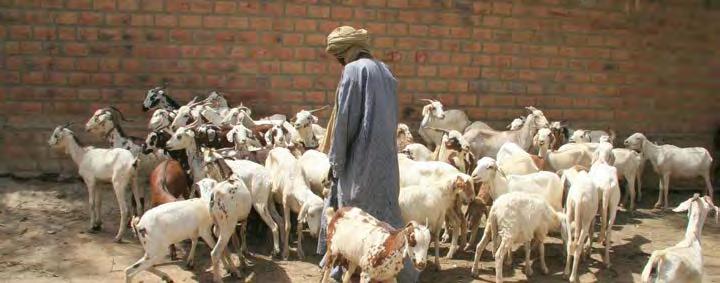
114 JNIM earned one of its biggest ransoms, reportedly around USD 50 million, by abducting an Emirati royal and two aides near Bamako, Mali. The victim was deeply involved in Mali’s gold trade. This episode highlights how JNIM exploits both kidnapping and the region’s informal gold economy to finance its operations, with indications of an alleged additional covert arms deal: https://www.jeuneafrique.com/1738118/politique/ au-mali-rancon-record-et-suspicion-de-livraison-darmes-les-coulisses-de-la-liberation-de-lotage-emirati/.
115 Héni Nsaibia, Eleanor Beevor and Flore Berger, Non-State Armed Groups and Illicit Economies in West Africa: Jama’at Nusrat al-Islam wal-Muslimin (JNIM), Global Initiative Against Transnational Organized Crime and Armed Conflict Location & Event Data Project, October 2023, pp. 14–16, https://globalinitiative.net/ wp-content/uploads/2023/10/JNIM-Non-state-armed-groups-and-illicit-economiesin-wWest-Africa-GI-TOCACLED-October-2023.pdf.
116 United Nations, Security Council, Letter dated 23 December 2020 from the Group of Experts on the Democratic Republic of the Congo addressed to the President of the Security Council, S/2020/1283, p. 5, https://docs. un.org/en/S/2020/1283.
117 Saide Habibe, Salvador Forquilha and João Pereira, Islamic Radicalization in Northern Mozambique, Cadernos IESE nº17/2019, pp. 14–17, https://www.iese.ac.mz/wp-content/uploads/2019/12/cadernos_17eng.pdf.
118 Peter Bofin, Ransom, gold, and spoils of war: Islamic State Mozambique’s new cash flow, ACLED Mozambique Conflict Monitor – Cabo Ligado, 22 January 2026, https://acleddata.com/report/ransom-gold-and-spoils-warislamic-state-mozambiques-new-cash-flow.
119 ISGS is believed to be involved in a series of kidnappings, including that of an Austrian woman (January 2025), a Swiss woman (April 2025), five Indian electricians (April 2025), and a United States missionary. See: https:// www.bbc.com/news/articles/ckgy015l22do; https://www.reuters.com/world/africa/five-indians-kidnappedattack-niger-2025-04-30/; https://www.aljazeera.com/news/2025/10/22/us-missionary-abducted-in-nigerscapital-state-department-confirms.
Due to their expanding significance in West Africa’s illicit resource economy, Benin and Côte d’Ivoire were identified as priority countries for primary data collection. Their geographic position along smuggling corridors that connect the Sahel to coastal markets makes them highly vulnerable to convergence between criminal and terrorist actors. Both countries appear prominently as transit and processing points for artisanal gold which has become a critical revenue stream for groups such as JNIM and ISGS. In addition to gold, these countries also exhibit patterns of cattle and fuel trafficking, underscoring the multiplicity of informal economies that sustain extremist networks. Studying the realities in border areas of the two respective countries represents an opportunity to understand how local trade systems, weak border governance and community-level actors may shape interactions even without direct terrorist control.
Nigeria, and specifically its northwest region, represents a distinct but increasingly significant case in relation to the nexus. Unlike the Lake Chad Basin where ISWAP is said to dominate tramadol and cattle smuggling, the northwest is characterized by rapidly evolving hybrid threats involving terrorist actors, bandit groups and criminal entrepreneurs. Emerging actors, such as Lakurawa and heavily armed bandits, have complexified the interactions and intersections between ideological violence and profit-driven criminality. These groups exploit weak governance, rural insecurity and porous borders with Benin and Niger, creating a volatile environment where cooperation and competition may develop rapidly. Investigating this region provides critical insights into how localized criminal economies intersect with extremism in the context of fragmented authority and escalating violence.
Since the interplay between terrorist groups and criminal activities depends on local conditions, the next section provides an in-depth analysis of these contexts. The case studies of Benin, Côte d’Ivoire and Nigeria provide a closer look at how the dynamics identified at the macro level manifest in practice, providing an analysis of the localized expressions of the interactions between terrorist actors and criminal activities and their impact on security and governance.
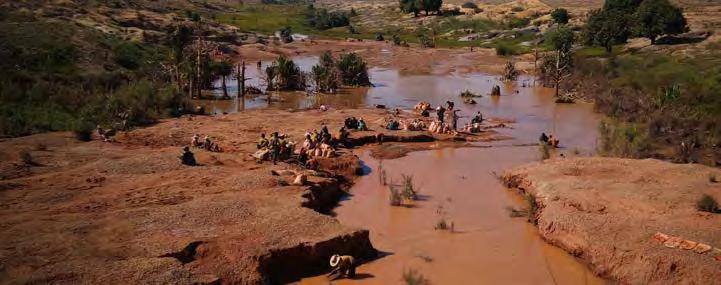
Since 2019, the security situation in Benin has deteriorated, partly in connection with the deterioration of the security situation in eastern Burkina Faso and western Niger. In 2024, Benin ranked 26th among the countries most affected by terrorism in the world, while its neighbours Burkina Faso, Niger and Nigeria ranked 1st, 6th and 5th respectively.120 Cobly, Kérou, Matéri and Tanguiéta in the Atacora region; Banikoara, Kandi, Karimama, Malanville and Sègbana in the Alibori region, along with the commune of Kalalé in the Borgou region, appear particularly vulnerable due to their geographical location and socioeconomic situation. While jihadist groups’ incursions into northern Benin initially originated from Burkina Faso and Niger, recent trends attest to the vulnerability of the border with Nigeria and the insurgents’ progress towards the south of the country.
Different localities in northern Benin have frequently been affected by terrorist attacks, resulting in numerous fatalities among both civilians and members of the Defence and Security Forces. While violent actions were initially contained within the Arly-Pendjari-W Complex on the borders with Burkina Faso and Niger, since 2021 incidents have increasingly extended to populated areas surrounding the parks. From 2024 onwards, new areas, such as Angaradébou, Kalalé, Madécali, Sonsoro and Wara in Ségbana121 have been attacked. In 2025, a series of deadly assaults were conducted against military outposts inside W and Pendjari National Parks, culminating in an April 2025 attack by JNIM that killed over 50 soldiers and resulted in the loss of significant military assets.122
The primary security threat in Benin is posed by JNIM, which is responsible for nearly all attacks in the country.123 JNIM operates through several sub-groups strategically positioned along the borders and protected areas, especially in the Pendjari and W parks, exploiting cross-border dynamics and the limitations of local security forces, and using the parks as safe havens for training, logistics and movement across Burkina Faso and Niger. JNIM has reportedly also revitalized the group once known as Ansaru. Formed by a small number of fighters from Mali and Nigeria in 2020, Ansaru has expanded in the past years. It uses the Babana forest as a base and is believed to be responsible for several attacks conducted against the national security
120 Institute for Economics & Peace, Global Terrorism Index 2025: Measuring the Impact of Terrorism, Sydney, March 2025, p. 6, https://www.economicsandpeace.org/report/global-terrorism-index-2025.
121 Héni Nsaibia, New Frontlines: Jihadist Expansion Is Reshaping the Benin, Niger, and Nigeria Borderlands, Armed Conflict Location & Event Data Project (ACLED), 27 March 2025, https://acleddata.com/report/newfrontlines-jihadist-expansion-reshaping-benin-niger-and-nigeria-borderlands.
122 Radio France Internationale, Nouveau bilan de l’attaque du 17 avril dans le nord du Bénin: 54 militaires tués, 23 April 2025, https://www.rfi.fr/fr/afrique/20250423-nouveau-bilan-de-attaque-du-17-avril-dans-le-nord-dub%C3%A9nin-54-militaires-tu%C3%A9s.
123 Héni Nsaibia, New Frontlines: Jihadist expansion is reshaping the Benin, Niger and Nigeria borderlands, Armed Conflict Location & Event Data Project (ACLED), 27 March 2025, https://acleddata.com/report/newfrontlines-jihadist-expansion-reshaping-benin-niger-and-nigeria-borderlands.
forces.124 The latest terrorist attacks suggest a shift towards highly coordinated and heavily armed raids, expanding beyond military targets to include police stations and civilian kidnappings, thus demonstrating a diversification of tactics as well as a transformation of northern regions into a key battleground for the terrorist actors of the broader region. The escalation in terrorist-related activities has been accompanied by an increase in trafficking and criminal activities: “The main threats are linked to extremism/terrorism, which is rampant and gaining ground. This threat feeds on others, such as those related to drugs, small arms, all forms of human trafficking and the ease of crossing our borders; these crimes are interconnected, one feeds the other”.125 Field data points to the following crimes as the most prominent: fuel smuggling (for local consumption and export); drugs trade (mainly cannabis and Indian hemp from Ghana via Togo); counterfeit medicines (primarily from Nigeria and secondarily from Ghana); cattle rustling (from the central Sahel or Nigeria); trade in weapons and ammunition (from Ghana); trafficking in human beings (young people and women for lucrative agricultural or domestic work); and the smuggling of fertilizers, motorcycles and various locally grown or imported food products.
The findings concerning Benin draw upon field research carried out in Alibori and Collines departments (August 2025) as well as interviews with national authorities, international organizations and sectoral actors in Cotonou (September 2025). The respondents interviewed for this study represent a diverse range of stakeholders involved in local governance, law enforcement, transportation and community services across several communes, including police commissioners, municipal officials and administrative leaders, as well as representatives from transport unions and informal transport operators. Kandi, Malanville and Sègbana in Alibori department, and Dassa-Zoumé, Savalou and Savè in Collines department, present strategic relevance for studying the nexus between terrorism and illicit activities due to their geographic, socioeconomic and security dynamics. Alibori, located in the northernmost part of Benin, shares borders with Burkina Faso and Niger. Alibori represents a potential corridor for cross-border movements of goods and people, facilitated by porous borders and limited state presence. Collines, situated centrally, functions as a key transit zone linking northern and southern Benin. Findings from both regions were further triangulated through interviews with national actors in health regulation, digital and judicial investigations, drug control and law enforcement. A complex web of illicit economies emerged in (potential) connection with terrorist actors active in the Sahel region, including fuel trafficking, livestock market, pharmaceuticals, narcotics and kidnapping for ransom.
124 Interview with security and intelligence sources, Cotonou, September 2025.
125 Interview with a senior police official, Cotonou, August 2025.
While a variety of illicit activities and economies were identified in relation to terrorist actors in the broader Sahel region, particularly Ansaru, JNIM and ISGS, some results were more prominent, starting with fuel trafficking: “All these factors are present: the sale of psychotropic drugs in industrial quantities, the sale of adulterated fuel, which gives us a slight advantage…”.126 Violent extremist groups, notably ISGS and JNIM, have established alliances with fuel traffickers to secure supply and revenues for their operations. In return, they offer protection and logistical support across strategic areas, including Karimama, Kourou-Koualou, the tri-border zone within W National Park and along the Niger River.127 Fuel smuggling is not exclusively linked to terrorist groups: it represents a broader illicit trade serving different types of consumers. Traffickers and supply sources cater to a variety of buyers including terrorist actors. To supply terrorist groups, traffickers rely on discreet intermediaries such as motorcycle taxi drivers, pirogue (small boat) operators or even farmers who use bypass routes to avoid detection. Although this illicit trade existed independently of terrorist involvement, their presence has significantly altered its economics: fuel typically purchased abroad for CFA 500 (approximately USD 0.80) per litre is generally sold in Benin for around CFA 1,200 (USD 2). However, it is now often sold to buyers in connection with terrorist actors for a higher price, fetching up to CFA 3,000 (USD 5) per litre. While other factors such as tighter border controls may also influence price dynamics, local respondents and representatives of national authorities have connected this price fluctuation to the influence exerted by terrorist actors installed in the Sahel region.128
A rise in cattle rustling and kidnappings for ransom has also been observed since 2024. In Atacora, over 10 cases of livestock theft were reported in 2025, involving approximately 100 head of cattle per raid, amounting to losses estimated to be nearly CFA 200 million (approximately USD 350,000).129 Perpetrators are herders with expertise in livestock management. The flow is often one-way, with animals stolen in Benin, moved through Pendjari National Park into Burkina Faso and sold in markets such as Fada N’Gourma and Namouno. The collaboration between JNIM militants and local pastoralist networks pursues the threefold objective of raising funds, securing food supplies and ensuring intelligence of local trends. Between 2019 and 2023, at least 101 cases of kidnapping or attempted abductions have been recorded, with 2023 accounting for roughly three-quarters of the cumulative figure.130 This growing trend has recently affected Babana and Segbana, where Ansaru-linked
126 Interview with a resident, Kandi, August 2025.
127 Interview with national security officers, Cotonou, September 2025.
128 Interview with a specialized judicial official, Cotonou, September 2025.
129 Interview with national security officers, Cotonou, September 2025.
130 Flore Berger, Lyes Tagziria and Aziz Mossi, Hostage to violent extremism: Kidnapping in northern Benin, OCWAR-T Research Report 15, February 2024, https://globalinitiative.net/wp-content/uploads/2024/03/ Flore-Berger-Lyes-Tagziria-and-Aziz-Mossi-Hostage-to-violent-extremism.-Kidnapping-in-northern-BeninOCWAR-T-February-2024.pdf.
cells increasingly engage in kidnappings for ransom, reportedly demanding up to CFA 10 million (USD 17,500) per hostage. In Ségbana, local populations suspect collusion between JNIM elements and criminal actors involved in kidnappings for ransom. As one local official put it: “Kidnappers are the jihadists’ Ministry of Finance. That’s why they regularly move towards the sanctuary zone controlled by kidnappers – the Kainji forest”.131
Looking at the traffic of pharmaceutical products, it should be noted that, despite recent institutional reforms, Benin remains a hub for counterfeit medicines,132 with suspected terrorist demand allegedly driving prices upward.133 While previously this illicit trade was largely confined to small, informal markets, the past few months have seen significant seizures in northern areas such as Dassa, Malanville and Natitingou.134 Local traffickers source products mainly from Ghana and Nigeria, distributing them through informal networks using motorcycle taxis,135 bush taxis136
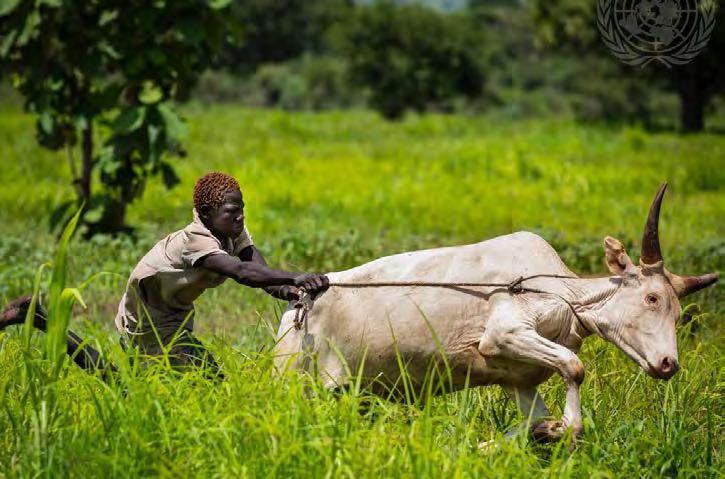
131 Interview with a local official, Ségbana, August 2025.
132 According to a local officer of the Police Républicaine, more than 1.5 tons of counterfeit medicines were discovered and seized in a store at the beginning of 2025.
133 Interview with an official from a national regulatory body for medicines and related products, Cotonou, September 2025.
134 Interview with a specialized judicial official, Cotonou, September 2025.
135 Interview with a police officer, Savalou, August 2025.
136 Interview with a police officer, Dassa, August 2025.
and river pirogues.137 Indian hemp, cultivated in Atacora and Donga, is routed via Kourou-Koualou towards Burkina Faso and Mali. Additional cannabis flows originate from Ghana through Togo, reaching Benin’s borders with Niger and Nigeria. Although a small percentage remains in the country, drugs are mostly destined for neighbouring countries, with Malanville emerging as a major hotspot – locally dubbed “Colombia” due to its prominence in the narcotics trade. Illicit drug trafficking frequently occurs through regions affected by terrorist activity, with a portion of these substances ultimately reaching terrorist actors. The consumption of drugs appears to constitute a coping mechanism for individuals engaged in terrorism, enabling them to endure the harsh environmental conditions prevalent in remote areas such as forests and savannas. Furthermore, some respondents suggest that drug use may contribute to the perceived resilience, audacity and unwavering commitment exhibited by these actors.138
Benin serves as both a transit and destination country for illicit arms trafficking. Seizures of 12-gauge cartridges at Collines’s borders reveal supply chains originating from Benin, Ghana and Togo, often concealed in fuel trucks or transported by motorcycle.139 The trafficking of firearms, ammunition and components used in the manufacture of improvised explosive devices including detonators, fertilizers, fuel and sulfur, constitutes a significant portion of the illicit trade benefiting terrorist actors operating in northern Benin and across Sahelian countries.140 Weak border controls and multiple unofficial transit routes facilitate proliferation, fuelling community conflicts – particularly between farmers and herders – as firearms become increasingly accessible.
The JNIM threat has progressively extended its influence towards Benin, especially around the W and Pendjari National Parks, the forests of the “three rivers” zone, and in Alibori, Atacora and Borgou (particularly the commune of Kalalé). The group has leveraged illicit networks to finance operations, recruit fighters and secure logistical supplies. Challenges to the regional management of the phenomenon including, for example, the closure of the Burkina Faso and the Niger borders, created fragmentation in counterterrorism efforts. In turn, isolation has heightened vulnerability with severe consequences on the resilience of border communities. One of the primary factors contributing to insecurity and exposing certain areas to infiltration of illicit activities by terrorist actors is the geographical configuration of northern regions. These areas are adjacent to the national parks which provide cover for illicit activities. Traffickers maintain strong control over clandestine corridors that connect Benin to neighbouring countries, outmaneuvering state agents tasked with border surveillance. As one local authority representative in Alibori noted: “Our exposure to the terrorist threat is linked to our proximity to W Park. Terrorists find refuge there because the park is protected, while poachers and herders exploit it by sending animals unattended,
137 Interview with a police officer, Malanville, August 2025.
138 Interview with a specialized judicial official, Cotonou, September 2025.
139 Interview with police officers, Savalou and Savè, August 2025.
140 Interview with a departmental official of the Republican Police in northern Benin, August 2025.

which return regardless of the obstacles they encounter”.141
Sociocultural similarities between communities on both sides of the border also facilitate cross-border exchanges. Shared languages, cultural practices and interdependent livelihoods enable the formation of transnational networks of informants, recruiters and brokers with deep knowledge of local geography and social dynamics. This environment is compounded by the weak institutional presence of the state: limited access to basic public services (civil registration, education, health, infrastructure, security) and poor anticipation of borderland challenges. State institutions in these areas are often described as under-resourced, demotivated and corrupt, with some officials prioritizing personal gain over public service. As one local authority in Kandi observed: “Over time, institutions risk collapse. If justice goes to the highest bidder, institutions will weaken. Entering a trial means measuring your financial capacity. There are cases of security force abuses due to poor intelligence and lack of professionalism”.142 This institutional fragility encourages communities to engage in smuggling. Regulatory inconsistencies across neighbouring states, such as divergent frameworks for controlling trade, further complicate enforcement and create opportunities for illicit trade.
The strategy by which terrorist actors infiltrate informal and illicit economies shows a high degree of adaptability and responsiveness to state countermeasures. Some respondents mentioned kidnappings for ransom as an emerging practice in certain areas such as Kandi. Recent military operations targeted informal gold mining in Atacora (Mékrou and Perma) and Alibori (Banikoara and Madécali) in light of concerns regarding infiltration by cross-border traffickers with possible links with terrorist groups.143 The use of advanced information and communication technologies,144 as well as modern weaponry, was also highlighted as part of adaptation strategies, enabling criminal actors in border areas to evade or counter state control and enforcement efforts. According to some sources, these weapons are often more sophisticated than those used by the national army.
The relationship between criminal networks and terrorism in Benin remains largely opportunistic, with little to no friction between criminal and terrorist actors. While conflict is essentially absent between the two entities, coexistence is most evident in illicit markets that serve a broad, diverse consumer base and pre-date the recent expansion of violent extremist groups in the Sahel region. This is the case, for example, of narcotics and counterfeit pharmaceuticals. While violent extremist actors have become significant end-users, they do not appear to have fully captured or monopolized these specific supply chains that remain largely managed by informal networks of motorcycle taxi drivers, pirogue operators and regional brokers.
141 Interview with a local official, Alibori, August 2025.
142 Interview with a local official, Kandi, August 2025.
143 Interview with national security officials, Cotonou, September 2025.
144 Interview with a senior police official, Cotonou, August 2025.
Collaboration between extremist groups and criminal actors is prominent, particularly in the case of JNIM, which exploits pre-existing illicit economies by creating strong financial incentives for traffickers to engage with the group and by leveraging these markets to sustain its operations. Although the nature of the interaction remains transactional, the space occupied by terrorist actors in these markets highlights the risk of possible future convergence. As a local resident of Kandi put it: “In the coming years, if things continue this way, our own children will become our jihadists. They don’t want to work and they want money. The children will be prey for the jihadists. They will be given money and asked to go and do dirty work. We are not spared in Kandi because of the proximity to the military camp”.145 Terrorist groups reportedly actively target pisteurs (local trackers) and bandits who possess intimate knowledge of terrain, smuggling routes and borderlands. These individuals provide critical operational advantages, including navigation through dense forests and evasion of security patrols. Rather than building new criminal infrastructures, terrorists capitalize on existing informal networks, offering higher prices and protection in exchange for logistical support. This approach minimizes their exposure while embedding them within local economies, paving the way for a loyalty process that, in the long term, could evolve into a convergent transformation. As a matter of fact, illicit and informal economies in northern Benin provide violent extremist actors with an entry point into local governance structures. While leveraging pre-existing trafficking networks, the expansion of illicit trafficking has transformed Benin from a transit corridor into a destination for contraband, including cannabis, firearms and tramadol. Ghettos in Kandi and Malanville illustrate the deepening of these markets. By positioning themselves as reliable buyers and protectors, extremists gain influence over key social groups, especially among youth, transport operators and farmers, who depend on these informal systems for livelihoods. Control over illegal hunting, fishing
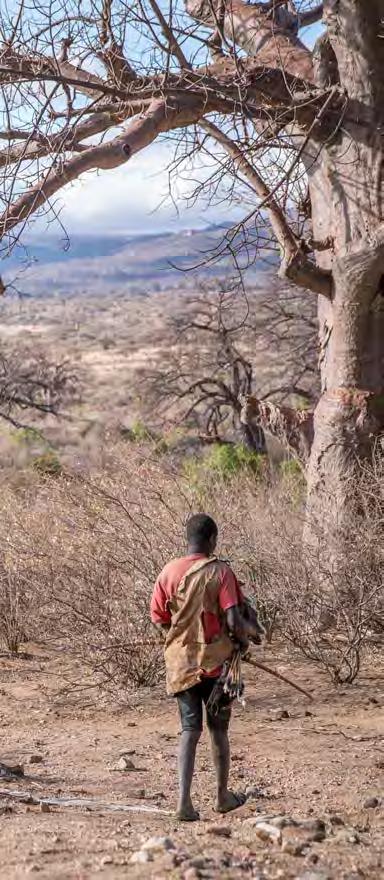
145 Interview with a local resident, Kandi, August 2025.
and logging in protected areas, such as Arly (Burkina Faso), W National Parks (Benin and Niger), and the “three rivers” zone near Nigeria, further embeds these actors within community dynamics, enabling them to regulate access to resources and consolidate authority beyond the reach of the state. Emerging accounts suggesting that terrorist actors may be enforcing zakat in northern areas raises concerns about their ability to exert territorial control. Although terrorist actors do not exercise stable or enduring control in northern Benin, they rely on adaptive strategies that create the appearance of permanence, particularly by deploying small, highly mobile units across dispersed terrain which project an image of widespread presence and territorial influence. Such practices could strengthen their perceived legitimacy and position them as actors within local governance structures.
COEXISTENCE Observed(groupsoperateindepend entl y lanoitcasnartylniam(devresbO dna ehT(tneipicnI ”ruetsiP“ ledoMevitcA: iurcer emt n t Not evidenced(nofrictiondetected) insharedillicitmarkets) erotdetal )seilppusdnaytilibom )srekcartdnastidnablacolfo Observed(mainlytransactiona l and relatedtomobilityandsupp l ies) r e crui tment oflocalbanditsandtrackers) I nci pient(The “ Pisteur”Model:Active
In 2016, Côte d’Ivoire was severely hit by a terrorist attack claimed by AQIM that killed 19 people and injured dozens.146 After four years of apparent calm, a series of attacks147 affected several cities and villages in the area bordering Burkina Faso in 2020–2021, particularly targeting security and defence forces while threatening local communities in search of financial and logistics support. In addition to these terrorist incidents, in the past seven years, the northern regions of Bounkani and Tchologo have experienced a notable rise in insecurity, marked by the proliferation of roadblocks, armed robberies and kidnappings for ransom. Part of these criminal actions and illicit activities are believed to be connected to a broader terrorismfinancing strategy.148
The findings concerning Côte d’Ivoire draw upon field research carried out in Abidjan (July 2025) as well as in two border regions of Bagoué and Bounkani (August 2025). Interviews were also conducted in Bouaké (August 2025) to explore possible illicit trafficking routes connecting the north of the country with the central and southern regions. Interviews with national authorities, international organizations and sectoral actors shed light on key dynamics linking illicit economies and terrorism in Côte d’Ivoire. Respondents consistently identified livestock trade, artisanal gold mining, fuel trafficking and informal money transfer systems, such as hawala and mobile money platforms, as sectors most exposed to terrorist financing. While a decline in kidnappings for ransom has been observed, persistent trafficking of arms, cigarettes, fuel, livestock, materials for improvised explosive devices, forged documents and wildlife were reported.149 Livestock trafficking emerged as the most prominent activity where possible links with terrorist groups might have occurred or might develop. Young people aged 16–30 are frequently involved, supported by structured laundering networks moving animals from border regions to Abidjan. Porous borders and unofficial entry points facilitate these flows and are exploited by distinct criminal networks depending on the commodity.150 Investigations into terrorism financing and money laundering suggest links with mining and illicit financial flows.151 Ancillary crimes, such as document forgery, were also noted as
146 Ange Aboa, Ivory Coast trial opens for 18 accused in Grand Bassam beach attack, Reuters, 1 December 2022, https://www.reuters.com/world/africa/ivory-coast-trial-opens-18-accused-grand-bassam-beachattack-2022-11-30/.
147 In June 2020 a joint army-gendarmerie post was attacked by JNIM. Two improvised explosive device-related incidents were registered on the road between Nassian and Kafolo in April 2021, while other incidents were registered in Kolobougou in March 2021 and in Tougbo in June 2021. For further details see: https://issafrica. org/iss-today/terrorism-in-Côte-divoire-is-no-longer-just-an-external-threat and https://www.crisisgroup.org/ africa/west-africa/Côte-divoire/b192-keeping-jihadists-out-northern-Côte-divoire.
148 Global Initiative Against Transnational Organized Crime, Nord de la Côte d’Ivoire : nouvelles menaces djihadistes, anciens réseaux criminels, Risk Bulletin No. 1, September 2021, https://globalinitiative.net/wp-content/ uploads/2021/09/Nord-de-la-Co%CC%82te-dIvoire-nouvelles-menaces-djihadistes-anciens-re%CC%81seauxcriminels.pdf.
149 Interview with national security officials, Abidjan, July 2025.
150 Interview with representatives of an international organization, Abidjan, July 2025.
151 Interview with national judicial officials, Abidjan, July 2025.
potential points of convergence between terrorism and human trafficking networks, although evidence is scarce in this regard.152 Relevant recruitment and financing dynamics were also described in northern regions, particularly around Comoe Park. While intensified security operations have curtailed the physical presence of terrorist groups, these actors increasingly rely on existing trafficking networks to sustain their activities rather than seeking territorial control.153
Recent designations under Côte d’Ivoire’s implementation of United Nations Security Council Resolution 1373154 support the trends identified by the respondents in the security, judicial and mining sectors as well as findings by international organizations and research bodies. The most prominent activities include illegal artisanal gold mining, which provides easily convertible assets and cash flows in remote areas; fuel smuggling, often directed at groups operating across porous borders; and cattle theft and resale, a traditional livelihood that may serve as a funding stream for extremist networks. Additionally, contraband of pharmaceuticals and other goods leveraging informal trade routes, emerges as a recurrent tactic, alongside the use of general commerce and transport networks, including the use of tricycles and bus convoys to move resources and launder proceeds. The geographic footprint of these activities is concentrated in northern Côte d’Ivoire and involves areas that are rural, sparsely governed and strategically located on transnational trade routes. According to the consolidated list of individuals designated as affiliated with terrorism under Resolution 1373 and published by the Ivorian Financial Intelligence Unit in February 2025, key hotspots include the Bounkani region, with Doropo and Togbo repeatedly cited for activities like cattle smuggling and contraband of medicines; the Tchologo region for fuel trafficking to armed groups; the Hambol region, mainly linked to cattle convoying and resale; and the Dabakala department which is cited for its connection to gold mining. These zones sit along transnational routes linking Côte d’Ivoire to Burkina Faso, Guinea and Mali, facilitating the movement of goods and people. While rural areas play a prominent role, some designations also reference urban nodes like Abidjan and Bouaké, highlighting that logistical and financial support networks can extend into major commercial hubs.
By virtue of their position, border areas are generally more exposed to trade activities, including smuggling and trafficking. In these contexts, the distinction between legal and illegal economies is often blurred: rather than being binary opposites, the formal and informal sectors frequently overlap and reinforce one another.155 In the case of northern Côte d’Ivoire, informal, illicit and sometimes illegal economic
152 Interview with a senior officer from a transnational organized crime unit, Abidjan, July 2025.
153 Interview with a subject matter expert, Abidjan, July 2025.
154 Cellule Nationale de Traitement des Informations Financières (CENTIF), Liste nationale 1373, February 2025, https://www.centif.ci/wp-content/uploads/2025/02/listenationale1373.pdf.
155 Abel Polese, Alessandra Russo and Francesco Strazzari, ‘Introduction: “The good, the bad and the ugly”: transnational perspectives on the extra-legal field’, in Governance Beyond the Law: The Immoral, The Illegal, The Criminal, Abel Polese, Alessandra Russo and Francesco Strazzari, eds. (Cham: Springer International Publishing, 2019), pp. 4–6.
activities represent a survival strategy for some members of the local communities, while also offering entrepreneurial opportunities for individuals seeking to improve their livelihoods. The deterioration of regional security has expanded these extralegal economies while deepening the risk of exploitation by terrorist organizations operating across West Africa. The research relied on qualitative interviews and direct observation in locations strategically selected due to their proximity to Côte d’Ivoire's borders with, respectively, Burkina Faso and Mali’s southern areas, where terrorist organizations thrive. Field work was also designed to focus on the three most relevant illicit activities: cross-border trade and illicit trafficking; cattle trade, trafficking and theft – mainly relevant for Bouna in the northeastern Bounkani region; and gold mining and smuggling, which is particularly pervasive in Tengréla in the northwestern Bagoué region.
Cattle trade, theft, trafficking and laundering in Bounkani
In Bounkani, livestock breeding and farming have long formed the backbone of the local economy. Recurrent spikes in livestock theft, particularly during the start of the academic year and major celebrations such as Eid and year-end festivities, have been observed. To counter them, a local reporting network has been established and linked to a national system. Supported by judicial measures, this mechanism initially helped reduce theft cases. However, recent years have seen an unprecedented surge in stolen cattle numbers, with official estimates now exceeding 100,000 heads,156 accompanied by a parallel rise in theft incidents. The security crisis in the Sahel has fuelled a black market for livestock, creating opportunities for illicit trade. In addition, in areas like Bouna, Doropo, Nassian and Téhini where economic actors compete aggressively for market share, theft cases are often under-reported to avoid disrupting the industry,157 prompting herders to relocate their livestock to safer zones.
Current research highlights two distinct dynamics. Firstly, a recent resurgence of cattle rustling within the region that appears disconnected from terrorist operations, with animals sold directly to butchers or on illegal gold mining sites;158 and secondly, organized cattle rustling networks linked to terrorist actors, connecting the Sahel region with Côte d’Ivoire and Ghana.
Some cases have shed light on the possible involvement of members of the Volunteers for the Defense of the Homeland ( Volontaires pour la défense de la patrie , VDP) in cattle rustling. 159 Many herders and cattle owners in the Bounkani region increasingly report that primary sources of threats are linked to VDP members rather than JNIM, with thousands of animals reportedly
156 République de Côte d’Ivoire, Région du Bounkani, Économie Ivoirienne, https://www.economie-ivoirienne.ci/ pole-competitif/region-du-bounkani.html.
157 Interview with an international organization official, Bounkani, August 2025.
158 Interview with an international organization official, Bounkani, August 2025.
159 The Volontaires pour la Défense de la Patrie are civilian auxiliaries established by Burkina Faso in January 2020 to support the armed forces in countering terrorism insurgencies. Recruited on a voluntary basis, they receive short-term training and basic equipment to defend local communities.
stolen.160 In February 2025, the Tougbo village was attacked by armed individuals firing shots into the air and stealing the equivalent of two herds of cattle.161 Some of these animals were traced to Mangodara in Burkina Faso where emissaries attempted, unsuccessfully, to negotiate their return. The local population suspects the possible involvement of VDP members. Some inhabitants of the villages around Téhini openly expressed sympathy for the VDP and seemed to believe that the thieves try to recruit informants from among resellers of phone credit, mobile money and shop managers.162 In April 2025, a herder was killed in Kalamon, a village near the Burkina Faso border in Doropo department, by unidentified armed men. The stolen herd, estimated at around 100 cattle, was taken across the border. 163 The event occurred in an area where VDP is known to operate and the presence of terrorist groups is not reported, leading some community members to consider possible VDP involvement. The trafficking routes go beyond the Ivorian-Burkinabe border, with seven herds reportedly stolen in 2024 in Pieye and transferred into Ghana. 164 In parallel to alleged direct VDP’s involvement, their deployment in Burkina Faso also acted as a catalyst for JNIM, incentivizing both targeted attacks and cattle rustling as a means to weaken local resilience and assert control.165
The evidence of the way cattle rustling contributes to terrorist financing in northern Côte d’Ivoire dates to 2017, with proceeds from illicit livestock sales reportedly supporting JNIM operations.166 A comprehensive understanding of terrorist actors’ involvement in cattle rustling requires a preliminary analysis of the structural and socioeconomic dynamics underpinning local livestock farming systems. Livestock farming in the Bounkani region is largely managed by Fulani pastoralist communities, whose presence reflects a long and complex history of mobility and settlement.167 These communities maintain strong transnational ties, particularly with Burkina Faso and Mali, following migration routes that date back to early 20th-century movements, linked to agricultural expansion and environmental crises in the Sahelo-Sudanian zone, as well as more recent migration flows fleeing climate-induced resource scarcity and conflict in the Sahel. Some herders in the Bounkani region reportedly own large herds, often numbering in the thousands, which they split into smaller
160 Flore Berger, Cattle Rustling and Insecurity: Dynamics in the Tri-Border Area between Burkina Faso, Côte d’Ivoire and Ghana, Global Initiative Against Transnational Organized Crime, July 2025, pp. 12–13, https:// globalinitiative.net/wp-content/uploads/2025/07/Flore-Berger-Cattle-rustling-and-insecurity-Dynamics-inthe-tri-border-area-between-Burkina-Faso-Co%CC%82te-dIvoire-and-Ghana-GI-TOC-July-2025.v3.pdf.
161 A herd is estimated at 50 oxen.
162 Interview with a representative of a regional pastoralist network in West Africa, Bounkani, August 2025.
163 Interview with an international organization official, Bounkani, August 2025.
164 Interview with a representative of a regional pastoralist network in West Africa, Bounkani, August 2025.
165 Flore Berger, Cattle Rustling and Insecurity: Dynamics in the Tri-Border Area between Burkina Faso, Côte d’Ivoire and Ghana, Global Initiative Against Transnational Organized Crime, July 2025, https://globalinitiative. net/wp-content/uploads/2025/07/Flore-Berger-Cattle-rustling-and-insecurity-Dynamics-in-the-tri-border-areabetween-Burkina-Faso-Co%CC%82te-dIvoire-and-Ghana-GI-TOC-July-2025.v3.pdf.
166 Ibid, p.9
167 Francis Akindes, Les peul dans les zones frontalières du nord de la Côte d’Ivoire, Equal Access International, July 2023, p. 13, https://www.equalaccess.org/wp-content/uploads/2024/06/Fulani_Dynamics_FRE_lowres. pdf. The Bounkani region is caracterized by high levels of transhumance fluxes, as reported by the International Organization for Migration in Organisation Internationale pour les Migrations (OIM) et Réseau Billital Maroobé (RBM), Matrice de suivi des déplacements (DTM), Côte d’Ivoire, August 2025.
groups and disperse across multiple sites and borders to mitigate the risk of financial losses. Interviews suggest that cattle theft linked to terrorist actors is possibly connected to such social and economic structures. Family ties across borders play a crucial role, with individuals who have joined regional terrorist networks maintaining connections with relatives managing livestock in Côte d’Ivoire. When cattle are stolen in neighbouring countries where terrorist groups operate, relatives reportedly help move the animals across porous borders into Côte d’Ivoire and blend them into family herds. Once integrated, the cattle can be sold through regular market channels. This makes their origin nearly impossible to trace168 and complicates efforts to assess how profits are divided among actors involved in cattle theft and resale. Large-scale cattle traders, known for their long-standing role as cattle importers, are sometimes cited as facilitators; their legitimate business activities allow them to move animals through unofficial crossing points 169 without raising suspicion. Several interviewees observed that some major operators saw their herds grow dramatically since insecurity escalated in southern Burkina Faso.
FIRST CORRIDOR
SECOND CORRIDOR
168 Interview with a Fulani herder, Bounkani, August 2025.
169 The United Nations Children’s Fund estimates the existence of 45 informal crossing points in the regions of Bounkani and Tchologo, with an approximate 1:20 ratio of formal to informal passages. UNICEF, Mission de formulation d’un programme pour l’accélération des objectifs de développement durable dans le Bounkani et le Tchologo, January 2022, https://www.unicef.org/Côtedivoire/media/3646/file/Diagnostic%20 communautaire%20dans%20le%20Nord-Est%20(Bounkani%20et%20Tchologo).pdf.
Interviews with herders reveal that cattle stolen in Burkina Faso follow wellestablished routes to access Côte d’Ivoire, depending on where the theft occurs. Two main corridors were mentioned. The first begins in the Bobodioulasso area of Burkina Faso, with cattle moving through Mangodara and Elintera before crossing into Côte d’Ivoire via Govitan and Gogo to reach the Doropo market – one of the largest of Côte d’Ivoire – or continuing through Niamoué if destined for Bouna. The second corridor runs eastward from Gaoua and Batié in Burkina Faso, passing through Wechiau Kpale and Goyiri in Ghana, before entering Côte d’Ivoire at Tame-Koulda.170
These trajectories suggest that the Black Volta river, far from providing an impassable barrier, is in fact a major smuggling axis. This finding corroborates similar observations regarding the Benin-Niger border along the Niger river, which has reportedly become a major smuggling corridor over the last few years.171 Once inside Côte d’Ivoire, stolen cattle take different paths. Some are sold directly to local butchers, which is a sector that has grown rapidly in recent years, while others are transported to major urban centres, such as Abengourou, Abidjan and Daloa, or to Ghana through Bondoukou and Sampa, where prices are reportedly higher. By contrast, cattle rustling from Mali to Côte d’Ivoire remains limited. This is likely due to a number of factors, including the limited ground presence of terrorist actors in
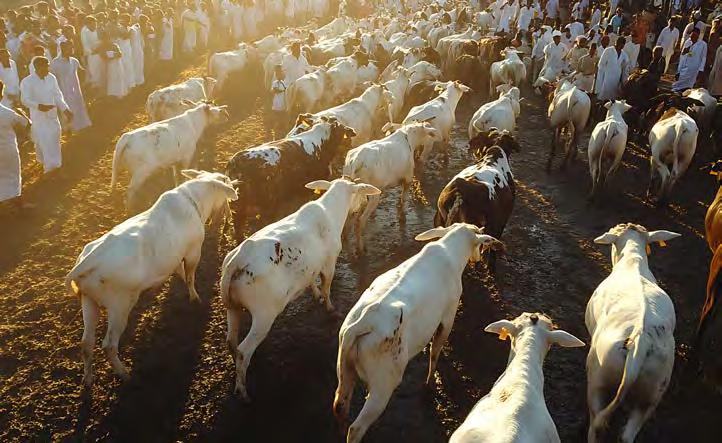
170 Tamin is an Ivorian village on the border with Ghana with a large Fulani community. Some testimonies suggest that a number of local youths may have been exposed to or drawn into regional terrorist groups.
171 Global Initiative Against Transnational Organized Crime, Benin–Niger border closure drives surge in migrant smuggling profits, Risk Bulletin No. 11, October 2024, https://riskbulletins.globalinitiative.net/wea-obs-011/04benin-niger-border-closure-drives-surge-migrant-smuggling-profits.html.
southern Mali as well as the countermeasures launched by the Ivoirian authorities. In 2019, for example, a major network with presence in Ouangolodougou and ties to Katiba Macina operatives was dismantled.172
Market prices reveal the strong economic incentives behind cattle trafficking. In Burkina Faso, a calf sells for around CFA 80,000 (approximately USD 145), while in Côte d’Ivoire’s Bounkani region, the price rises to about CFA 150,000 (USD 270). Mature cows can sell for up to USD 715, and certain prized breeds reach as high as USD 1,785. The meat trade follows a similar pattern. In most northern localities, beef sells for roughly CFA 1,600 (USD 2.80) per kilogram, but prices climb to CFA 2,500 (USD 4.40) in Bouna and CFA 3,000 (USD 5.30) in Abengourou. By the time the product reaches Abidjan, the price can soar to CFA 4,000 CFA (USD 7) per kilogram. These margins make cattle trafficking a lucrative business, especially when combined with porous borders and growing urban demand.
The historical involvement of the Fulani community in the livestock economy has frequently fuelled social and political narratives that link them to farmer-herder conflicts and cattle theft, ultimately facilitating a harmful and oversimplified equivalence with terrorism. These perceptions have nourished accusations that Fulani are responsible for insecurity in the north, deepening crises of intercommunal coexistence. In border communities affected by terrorist attacks, Fulani are often subject to mistrust, discrimination and stigmatization as a result. This dynamic has contributed to the emergence of a “community mal aimée”173 (unloved community) narrative among Fulani people, who increasingly perceive themselves as marginalized and socially excluded. Combined with the rustling economy and ethnically influenced security responses, these dynamics leave Fulani communities trapped between violent extremist groups and repressive measures, exacerbating vulnerability and fuelling cycles of displacement and mistrust.174
Although informal gold mining remains a concern in some areas of Côte d’Ivoire, enforcement efforts in the Comoé National Park have significantly curbed such activities. By contrast, the Bagoué region stands out as a major hub for illicit gold extraction. A combination of different actors contribute to the local gold economy, as shown in Figure 4:
172 Flore Berger and Anicet Zran, North-eastern Côte d’Ivoire: Between illicit economies and violent extremism, Global Initiative Against Transnational Organized Crime, 2023, p. 16, https://globalinitiative.net/wp-content/ uploads/2023/09/Flore-Berger-et-al-North-eastern-Côte-dIvoire.-Between-illicit-economies-and-violentextremism-GI-TOC-October-2023-.pdf.
173 Francis Akindes, Les peul dans les zones frontalières du nord de la Côte d’Ivoire, Equal Access International, July 2023, p. 8, https://www.equalaccess.org/wp-content/uploads/2024/06/Fulani_Dynamics_FRE_lowres. pdf.
174 Flore Berger, Cattle Rustling and Insecurity: Dynamics in the Tri-Border Area between Burkina Faso, Côte d’Ivoire and Ghana, Global Initiative Against Transnational Organized Crime, July 2025, pp. 26-27, https:// globalinitiative.net/wp-content/uploads/2025/07/Flore-Berger-Cattle-rustling-and-insecurity-Dynamics-inthe-tri-border-area-between-Burkina-Faso-Co%CC%82te-dIvoire-and-Ghana-GI-TOC-July-2025.v3.pdf.
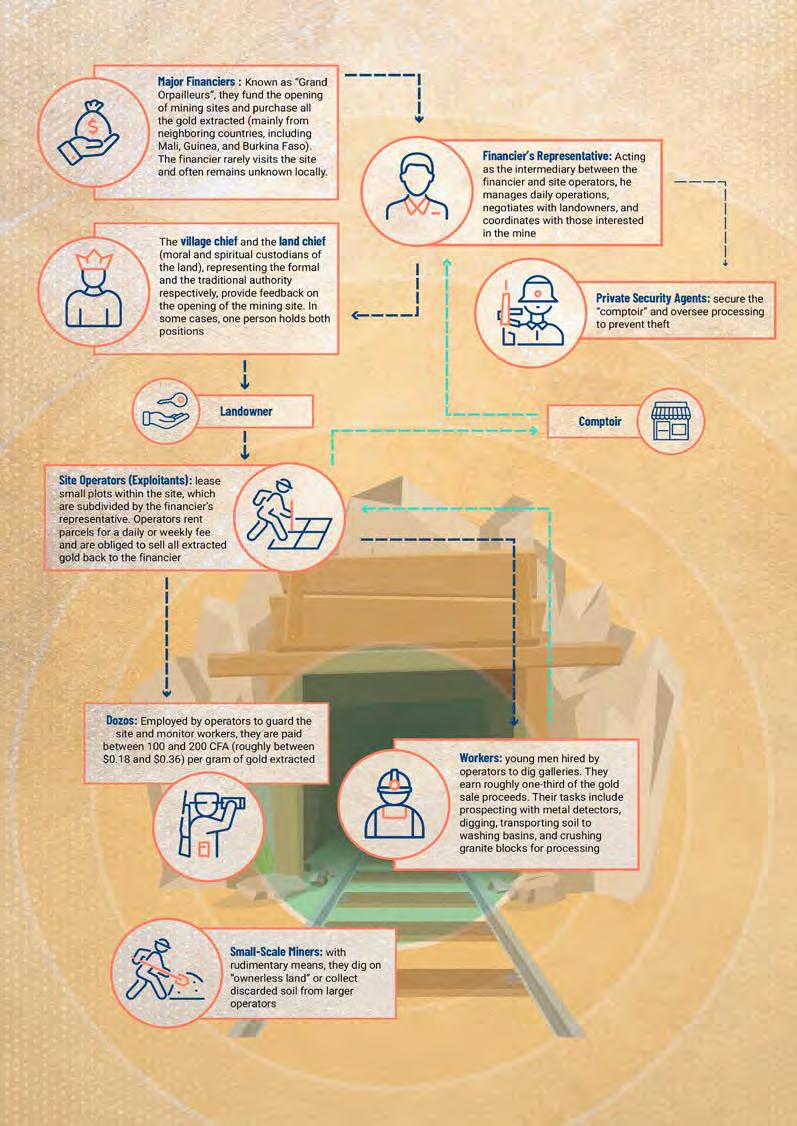
The raw gold extracted is sold directly on the mining site to the financier’s representative. After a work period that may last from a single day to a full week, transactions take place at the comptoir, where operators resell the gold extracted by their teams at a price previously set by the financier.175 The gold is then discreetly smuggled outside the site, as described by a local gold miner: “No one knows when the purchased gold leaves the site. You can spend weeks there without ever seeing it happen.”176
Most testimonies indicate that the purchased gold is resold in Mali, and two main routes emerge from these accounts. The first one involves gold passing through Bouaké, where major financiers of mining sites are based, and evidence suggests that the Special Group for Combating Illegal Gold Mining (Groupement Spécial de Lutte Contre l’Orpaillage Illégal) has conducted related arrests in the area.177 The second route takes gold directly from Tengréla into Mali. To facilitate this trade, transport companies linking the two locations have been established in the town and are mainly managed by Burkinabè and Malian operators.178
Illegal gold mining forms the backbone of socioeconomic development in this region: “[Tengréla]’s growth, the construction of buildings and the expansion of trade are all linked to gold mining”.179 This transformation reflects two converging dynamics. Firstly, revenues from gold mining are reinvested directly into the town by successful Burkinabè, Guinean or Malian operators: “They sell the gold in Mali and come back to invest here”.180 Secondly, a government-led campaign aimed at reducing security risks encouraged miners to abandon makeshift rural camps and settle permanently in urban areas. This initiative prompted many to build houses in Tengréla and to start operating in the gold sector and related activities,181 reshaping the local economy. In addition to these trends, local actors in well-established social positions have also entered the sector. The chief of the village of Zanékaha, for example, reportedly financed the construction of his community’s sub-prefecture entirely through mining proceeds.182 In Papara, gold panning has supplanted all other activities: “What was once a clandestine practice has become an openly illegal phenomenon, as it is no longer concealed, owing to the complicity of both the administration and security forces. The former subprefect of the city was involved and was removed from his post. Illegal activities have declined since the gendarmerie carried out a raid in the city”.183
175 Interview with a gold miner, Bagoué, August 2025.
176 Interview with a gold miner, Bagoué, August 2025.
177 Official information from the national police. One person was arrested in possession of nearly half a billion francs (CFA 469,446690), USD 350, EUR 60 and GBP 25.
178 Information emerged from separate interviews with a gold miner, a civil servant and a non-governmental organization representative, Tengréla, August 2025.
179 Interview with a youth leader, Tengréla, August 2025.
180 Interview with a youth leader, Tengréla, August 2025.
181 Interview with an international organization official, Tengréla, August 2025.
182 Interview with a member of a local non-governmental organization, Tengréla, August 2025.
183 Interview with a civil servant, Papara, August 2025.

Recent events suggest a connection between illegal gold mining and terrorist financing. In late 2024, a major operation was launched by security forces in Papara to arrest the president of an artisanal mining cooperative184 suspected of terrorism financing. The raid uncovered 25 kilograms of gold, firearms and a hidden smelting facility in his residence, along with proof of transactions with a Malian individual closely connected to terrorist groups operating in Mali.185 In January 2025, several individuals were arrested in Tengréla and their assets were seized: “Among those arrested, some had performed outstanding acts for the benefit of the region and were seen as role models of social success [...]. Those arrested face charges of financing terrorism. They are suspected of having links with Malian buyers who have connections with terrorists in Mali”. 186 These episodes were followed by administrative changes to address possible risks of corruption.
Field data confirms that the line between cross-border trade and smuggling is often blurred, as the same products circulate in both channels. In Bounkani, there is significant trafficking of various goods from agricultural products to general merchandise. Commercial agricultural products leave the region for Burkina Faso and Ghana: “Cocoa from the south of the country transits through Bouna and Doropo to Burkina Faso. Around 200 tons of cocoa were seized in 2025”.187 In April 2025, a shipment of more than 300 tons of cashew nuts loaded onto 13 trucks was intercepted by the Bouna gendarmerie. The organizer of the operation, a member of the Lobi community, was arrested in August 2025 and brought before the Economic and Financial Criminal Court (Pôle Pénal Economique et Financier). Initial investigations revealed contacts with members of terrorist groups, prompting the anti-terrorism prosecutor’s office to take over the case.188 In February 2025, 20 tons of substandard medicine worth about CFA 1 billion, was seized by the Bouna gendarmerie,189 believed to be connected to a national smuggling network. Hidden in several trucks coming from Ghana, these products were destined for a network covering the northern part of the country: goods received in Bouna were distributed to clients in Boundiali, Ferkessédougou, Korhogo, Tengréla and other towns, with destination cities explicitly marked on the packaging.190 Counterfeit goods, including food products (coffee, milk, oil, rice) and consumer goods (bleach, cigarettes, machetes, soap, textiles, toothpaste, etc.), circulate between Burkina Faso, Côte d’Ivoire and Ghana. Although interviews did not reveal a direct link between these trafficking rings, mainly managed by national actors, they indicated that such groups
184 Sionfolo Soro, Vive tension entre forces de l’ordre et jeunes de Papara suite à une tentative d’arrestation d’un PCA de la coopérative Tiéborogo, January 2025, https://www.aip.ci/149665/Côte-divoire-aip-vive-tension-entreforces-de-lordre-et-jeunes-de-papara-suite-a-une-tentative-darrestation-dun-pca-de-la-cooperative-tieborogo/.
185 Interview with an international organization official, Bagoué, August 2025.
186 Interview with a civil servant, Tengréla, August 2025.
187 Interview with a journalist, Bouna, August 2025.
188 Interview with an agent of the Bounkani defense and security forces, Bounkani, August 2025.
189 Interview with an agent of the Bounkani defense and security forces, Bounkani, August 2025.
190 Interview with an agent of the Bounkani defense and security forces, Bounkani, August 2025.
could potentially use these established routes to get supplies, such as fuel and pharmaceuticals. Fuel trafficking is particularly notable for its potential links to terrorist groups operating in the Sahel region. Young men from Bolé, Moro-Moro and Tougbô act as logistical intermediaries and, sometimes in collusion with gas stations particularly in Tougbô, they fill jerrycans and transport them at night to villages near the border. Testimonies indicate that people who are believed to be connected to terrorist and violent extremist organizations pay three times the pump price: a 20-litre jerrycan sold at CFA 17,000 (approximately USD 30) at the station is bought for over CFA 50,000 (USD 89).
In Tengréla, cross-border commercial activity is particularly intense due to a combination of geographic, social and infrastructural factors. The town borders Mali on all sides except its southern access point and hosts a sizeable Malian community with long-established cross-border trading networks. This configuration, defined by a 200-kilometre frontier with only one official checkpoint, combined with limited state presence, has facilitated the emergence of an extensive informal network: an estimated dozens to over 200 unofficial tracks, all bypassing formal customs.191 According to interviews with local authorities, smuggling activities along these routes are dominated by two categories of goods – mattresses and motorcycles – which are routinely transported from Tengréla in Côte d’Ivoire to Mali via unofficial crossing points. In the case of motorcycles, a local civil servant reported that: “Around 50 disassembled motorcycles arrive daily from Abidjan to Tengréla. Young men assemble them in front of storage shops and then transport them to Mali via back roads”.192 These activities are highly lucrative with some individuals earning around CFA 75,000 (USD 120) weekly, roughly equivalent to the minimum wage, by assembling up to 30 motorcycles. Transporting these goods across the border can generate between CFA 15,000 and 25,000 (USD 24–40), depending on the season and urgency. Faced with such financial opportunities, many young people in the locality have specialized in such activities. A similar cross-border motorcycle trade in Bounkani eventually revealed links to terrorist groups: from 2023 to late 2024, an increasing number of motorcycles were sold to terrorists through traders operating from Côte d’Ivoire. A motorcycle dealer in Doropo, arrested by Ivorian police in October 2024, used to employ young men known as “les bons petits” to deliver motorcycles to suspected terrorists in Burkinabé localities such as Hélintira, Lorepeni and Mangodara. Terrorists reportedly paid triple the market price, and each delivery earned the courier a commission of CFA 250,000 (USD 400).193 Mattresses also arrive by the hundreds in Tengréla, destined for Mali. While trade towards Mali has long been substantial, the growing flow of motorcycles and mattresses, mostly via unofficial tracks, has raised concerns among local authorities who suspect this might be connected to the recent expansion of terrorist groups’ influence in the south of Mali, close to the Ivorian border.
194 These flows illustrate how licit supply chains
191 Interview with a police officer and representatives of non-governmental organisations, Bounkani, August 2025.
192 Interview with a civil servant, Tengréla, August 2025.
193 Interview with a security forces officer, Doropo, August 2025.
194 Global Initiative Against Transnational Organized Crime, Motorbike trafficking is critical to armed groups’ mobility in the Sahel, Risk Bulletin No. 7, April 2023, https://riskbulletins.globalinitiative.net/wea-obs-007/03motorbike-trafficking-critical-to-armed-groups-mobility.html.

are repurposed within informal economies, creating opportunities for criminal actors and, potentially, for terrorist groups to exploit smuggling networks for logistical and financial purposes.
Figure 5: Trade and trafficking routes vulnerable to exploitation by terrorist actors
The relationship between criminal activities and terrorist actors in Côte d’Ivoire is best described as a pragmatic and transactional interaction. The four-category taxonomy proposed in this study reveals a notable absence of the conflict category. No evidence of direct, violent and persistent hostility within the regions and economies under review was collected. While there are reports of terrorist groups coercing individuals involved in illicit activities like gold mining in Comoé Park,195 these have remained isolated pressures rather than full-scale violent clashes. Côte d’Ivoire has witnessed a rise in criminal activity characterized by corruption, drug trafficking, environmental crimes, counterfeiting and fraud, with many offenses connected to money laundering - especially via real estate - and growing susceptibility to terrorist financing.196
Although it is difficult to fully examine the category of coexistence as violent extremist actors are not installed in Côte d’Ivoire but rather perform incursions and/or exploit certain markets for funding or supplies, it seems reasonable to argue that coexistence applies to some markets and in some areas. It is the case, for example, of drug trafficking – a sector that appears to be predominantly managed by organized criminal networks. Latin American cartels play a major role in cocaine production and shipment, while Lebanese criminal networks are involved in money-laundering activities and, to a certain extent, in wholesale distribution.197 Major European
195 William Assanvo, Côte d’Ivoire must cut ties between terrorists and illicit markets, 18 September 2023, https:// issafrica.org/iss-today/Côte-divoire-must-cut-ties-between-terrorists-and-illicit-markets.
196 GIABA, Anti-money laundering and counter-terrorist financing measures – Côte d’Ivoire, Second Round Mutual Evaluation Report, 2023, https://www.fatf-gafi.org/content/dam/fatf-gafi/fsrb-mer/Côte-d-IvoireMER-Giaba-2023.pdf.coredownload.inline.pdf.
197 Lucia Bird, Kingsley Madueke, Mouhamadou Kane, Cocaine markets in West Africa: Mapping impacts, routes,
criminal groups, including the ’Ndrangheta,198 Galician networks and Dutch kingpins, are significantly involved in the cocaine trade affecting West Africa.199 The seizure of more than two tons of cocaine in 2022 and the subsequent investigations that led to the arrest of Miguel Ángel Devesa, exposed a highly sophisticated network that positioned Côte d’Ivoire as a key hub for transnational drug flows.200 Operating through the ports of Abidjan and San Pedro, the network funneled shipments of high-purity cocaine from South America, collaborating closely with Latin American cartels and regional actors from Ghana and Nigeria for processing and distribution. Investigations also highlighted systemic corruption enabling the trade, enlisting police officers, port officials and even military personnel to secure routes and evade detection. Although potential links to terrorism financing were investigated, no evidence was found for this specific case.201 In addition to the specific dynamics linked to drug trafficking, while violent extremist actors are, directly or indirectly, involved in some illegal economies in the northern regions, they tend not to saturate or monopolize the sector but rather exploit a share of it.
Driven by the objective of exploiting informal and illicit economies, terrorist groups often engage in collaborative relationships when entering a market, operating as high-value or “premium” customers, as evidenced by the extremist-linked buyers in the Bounkani region, who pay almost three times the official price for fuel, and the motorcycle trade in Tengréla which has become a professionalized logistical pipeline. Smuggling of different types of commodities, from mattresses to pharmaceutical products, also are transactional in nature.
While still attributable to some form of cooperation, two sectors appear to be particularly at risk of convergence – the livestock economy and gold mining. The former interactions, including cattle rustling and sale as well as broader smuggling and logistical support, may serve dual purposes, combining economic opportunity with ideological alignment and political support at community level. These relationships manifest through functional exchanges, such as procurement of fuel and motorcycles, concealment strategies (e.g., blending stolen cattle into legitimate herds) and logistical facilitation along unofficial tracks. While cooperation is primarily oriented towards operational gains, interactions in this sector are strictly linked to local influence, legitimacy and power dynamics that, in the long term, might facilitate the transition from cooperation to convergence. In the gold mining sector, the potential for convergence is driven less by social grievances than by the
trends and actors, Global Initiative Against Organized Crime, March 2026, https://globalinitiative.net/analysis/ mapping-drug-markets-in-west-africa/
198 Lucia Bird, Saša Đorđević, Fatjona Mejdini, Under the Radar: Western Balkans’ cocaine operations in West Africa, Global Initiative Against Organized Crime, September 2025, p. 38, https://globalinitiative.net/wp-content/ uploads/2025/08/Lucia-Bird-et-al-Under-the-radar-Western-Balkans-cocaine-operations-in-West-Africa-GITOC-September-2025.pdf.
199 Lucia Bird, Kingsley Madueke, Mouhamadou Kane, Cocaine markets in West Africa: Mapping impacts, routes, trends and actors, Global Initiative Against Organized Crime, March 2026, https://globalinitiative.net/analysis/ mapping-drug-markets-in-west-africa/
200 Marine Jeannin, Le narcotrafic en Côte d’Ivoire selon Miguel Angel Devesa Mera : « Ma vie est très agitée et je brasse beaucoup d’argent », Le Monde, 2 April 2024, https://www.lemonde.fr/afrique/article/2024/04/02/ le-narcotrafic-en-Côte-d-ivoire-selon-miguel-angel-devesa-mera-ma-vie-est-tres-agitee-et-je-brasse-beaucoupd-argent_6225610_3212.html.
201 Interview with specialized judicial unit, Abidjan, July 2025.
high liquidity of the trade and the influence of local elites. In Papara and Tengréla, high-profile arrests were made of individuals involved in the gold sector and linked to violent extremist groups in Mali. These individuals, often seen as role models of local success, were found to operate specialized infrastructures that serve both the illegal gold trade and terrorist financing. These developments have enabled the emergence of hybrid actors, notably mining businessmen who also act as facilitators for terrorist activities.
riskmarkets , initialconvergence business elitesandterroristfacilitators) I nci pient(gold miningandlivestock are
COEXISTENCE Observed(groupsoperateindepend entl y
lanoitcasnartylniam(devresbO dna kcotsevildnagninimdlog(tneipicnI era Not evidenced(nodocumentedactive ni )yhpargoegderahs relatedto mobilityandsupplies) risk-markets , initialconvergence betwee n ,seitilitsoh )noicreocdetalosi icaftsirorretdnasetilessenisubil tta o r s ) CONVERGENCE COLLABORATION Observed(mainlytransactiona l and relatedtomobilityandsupp l ies)
The Ivorian case illustrates a set of enabling conditions that together create fertile ground for interaction between violent extremist organizations and criminal actors. These conditions include: porous borders and the existence of several unofficial tracks which allow goods and people to move with minimal oversight; shadow economies in border areas where informal trade is culturally relevant and economically interesting for local communities; and governance mechanisms that provide cover for illicit transactions. Economic incentives amplify these structural vulnerabilities. Price differentials across borders in cattle, meat and fuel, for example, create profitable opportunities, while the portability and high value of assets like gold make them particularly attractive as a means of moving, storing, or transferring funds. At the same time, informal logistics ecosystems, including the presence of young couriers, motorcycle assemblers and transport operators, provide low-cost and flexible services that terrorist actors can exploit without exposing themselves to direct operational risk. These arrangements form what can be described as service markets, where extremist groups purchase mobility, concealment and distribution capabilities rather than integrating organizationally with criminal groups. However, transactional and opportunistic relationships may evolve into a more stable collaboration and co-governance of illicit markets, blurring the line between criminal and terrorist economies. L
Nigeria’s security landscape remains volatile despite a decline in the number of terrorist attacks since 2024. While Boko Haram formally fractured in 2016 into ISWAP and Jama’atu Ahlis-Sunna Lidda’awati wal-Jihad (JAS), local communities often fail to distinguish between the two, frequently using Boko Haram as a blanket term for terrorist actors.202 Although incidents fell by 37 per cent in 2024, fatalities rose by 6 per cent, driven largely by clashes between JAS and ISWAP,203 with civilians being the primary victims. The country currently faces a dual-front security challenge. In the northeast, Borno remains the epicentre of ISWAP and JAS activities. Meanwhile, the northwest, including Kebbi, Niger, Sokoto and Zamfara States, is witnessing a complex evolution of threats beyond traditional banditry. Between the end of 2025 and the first quarter of 2026, fighters, commonly attributed to Lakurawa, have carried out deadly raids in Kebbi and Sokoto, killing dozens and clashing with security forces. The origin of Lakurawa is difficult to trace, although according to different sources it began as a self-defence militia of herders from Mali and Niger, later hired to fight bandits in northwestern Nigeria. Over time, it transformed into an armed faction imposing strict religious interpretation, taxing communities and engaging in violent attacks, resulting in it being declared a terrorist organization by the Nigerian Government in January 2025. The experiences and testimonies of people living in affected areas call into question whether a cohesive and uniform group exists, especially as the fighters and militants do not refer to themselves as Lakurawa.204 While Lakurawa’s modus operandi indicates possible links with Ansaru and JNIM, the group has reportedly pledged alliance to ISGS,205 suggesting that the term Lakurawa might be used to describe members affiliated with both ISIL/ Da’esh and Al-Qaida.206 Their operations include cattle rustling, kidnapping and gold smuggling, creating a convergent situation that blurs the line between ideological extremism and profit-driven violence.
According to the interviewees, Lakurawa maintains dominant control across nearly all regions of the Tangaza local government area, except for a few towns, while
202 As the term Boko Haram remains in widespread colloquial use, it is used when reflecting the specific language of interviewees to preserve the integrity of field data, while JAS and ISWAP are employed for analytical elaborations.
203 Institute for Economics & Peace, Global Terrorism Index 2025: Measuring the Impact of Terrorism, Sydney, March 2025, p. 27, https://www.economicsandpeace.org/report/global-terrorism-index-2025.
204 For further information, see: Rufa’i, Murtala Ahmed, ‘Importing Militant Jihadists: Analysing the Response of Traditional Authorities to Muslim Youth Extremism in the Nigeria-Niger Border Areas of Sokoto State’, Traditional Authority and Security in Contemporary Nigeria, Routledge, 2023, pp. 151-168; https://unidir.org/ wp-content/uploads/2025/03/UNIDIR_Lakuwara_North_West_Nigeria_Newest_Threat.pdf; https://www. jeuneafrique.com/1740578/politique/qui-sont-les-lakurawa-qui-sement-la-terreur-au-nigeria/.
205 United Nations, Security Council, Letter dated 21 July 2025 from the Chair of the Security Council Committee pursuant to resolutions 1267 (1999), 1989 (2011) and 2253 (2015) concerning Islamic State in Iraq and the Levant (Da’esh), Al-Qaida and associated individuals, groups, undertakings and entities addressed to the President of the Security Council, S/2025/482, 2025, https://docs.un.org/en/S/2025/482.
206 James Barnett, Who Are Nigeria’s “Newest” Jihadist Militants?, 15 October 2025, https://www.hudson.org/ terrorism/who-are-nigerias-newest-jihadist-militants-james-barnett.

in Gudu their presence extends to most areas outside the main town.207 Fighters referred to by respondents as Boko Haram reportedly maintain strongholds in North Central Nigeria.208 In Niger State, the arrest of Ansaru leader Mal Mahmuda in mid-2025 triggered significant organizational changes within the group. Following this leadership change, Ansaru relocated its base from the Kainji National Park area, a long-standing stronghold and strategic hideout, to Babana on the Benin–Niger border.209 This move appears to have been driven partly by mounting pressure from a recently established JNIM faction seeking influence in the region, creating inter-group strain and intensifying territorial competition. The shift away from Kainji National Park, which has historically offered cover and logistical advantages, suggests that Babana’s position as a cross-border hub now provides Ansaru with opportunities for smuggling, recruitment and operational flexibility. 210 In Oyo State, armed actors, described by some reports as having individuals of Fulani background among them, reportedly traverse the forest reserve connecting Kwara and Niger States, operating in Saki before retreating across state boundaries.211
Data collected in Niger, Oyo and Sokoto States sheds light on a complex web of different illicit activities, including arms and drugs, illegal mining and kidnapping for ransom. Along Nigeria’s northern transit corridors,
207 Interview with a member of local security services, Gudu LGA, Sokoto State, August 2025.
208 Interview with a clerical leader affiliated with hunters’ guilds, Oyo State, August 2025.
209 Interview with a youth leader, Borgu LGA, Niger State, August 2025.
210 Interview with a youth leader, Borgu LGA, Niger State, August 2025.
211 Focus Group Discussion with local authorities, community representatives and members of local security services, Saki West LGA, Oyo State, August 2025.
drugs 212 and pharmaceutical opioids, mainly tramadol, move through routes connecting Benin, Ghana, Niger and Nigeria.213 Drugs pass through local transit hubs such as Saki in Oyo State214 to be sold in urban areas, such as Kwannawa and Mami Market in Sokoto, with a rise in drug abuse among youth and a normalization of the drug trade.215
Weapons are smuggled across Nigeria’s porous borders, mainly towards the northern and central regions, particularly through routes connecting the country to Benin, Burkina Faso, Libya, Mali and Niger,216 to the benefit of cross-border actors including Lakurawa and bandit networks.217 Military-grade weapons are also believed to be smuggled into the country via aircraft in Sokoto’s border zones218 or concealed in vehicles.219 Within Nigeria, bandit leaders and terrorist groups also engage in the internal circulation and resale of arms, supplying networks that extend from Niger State to Bauchi, Kogi and Taraba.220 Meanwhile, both locally produced and imported weapons circulate in southern transit hubs such as Oyo State, suggesting the coexistence of artisanal production with imported arms.221
Kidnapping for ransom represents a key activity for both profit-oriented criminal networks and violent extremist groups, with blurred boundaries between the two. Kidnappings in Oyo State predominantly target wealthy individuals or foreign farmers, with abductors crossing state or national borders to evade capture.222 Conversely, in Sokoto State, some accounts suggest that groups like Lakurawa occasionally intervene to suppress bandit-led abductions, highlighting a complex interplay between banditry, insurgent influence and territorial control, occasionally escalating into clashes between terrorist and criminal actors.223 In Niger State, local informants and officials report that both bandits and terrorist actors engage in kidnapping as
212 Some cannabis varieties are grown within Nigeria while stronger strains known as “Loud” and “Colorado” are smuggled from outside the country.
213 Focus Group Discussion with private-sector representatives and members of security services, Illela LGA, Sokoto State, August 2025.
214 Interview with a law enforcement official, Saki West LGA, Oyo State, August 2025.
215 Interview with a correction officer, Sokoto State, August 2025.
216 Interview with a youth leader, Borgu LGA, Niger State, August 2025; Focus Group Discussion with private-sec representatives and members of security services, Tangaza LGA, Sokoto State, August 2025.
217 Focus Group Discussion with private-sector representatives and members of security services, Tangaza LGA, Sokoto State, August 2025; Interview with a member of local security services, Gudu LGA, Sokoto State, August 2025.
218 Interview with a member of local security services, Gudu LGA, Sokoto State, August 2025.
219 A truck was intercepted in Kwara State carrying hidden ammunition – Interview with a customs official, Saki West LGA, Oyo State, August 2025.
220 Interview with a youth leader, Borgu LGA, Niger State, August 2025; Focus Group Discussion with local residents, Shiroro LGA, Niger State, August 2025.
221 Interview with a law enforcement official, Saki West LGA, Oyo State, August 2025.
222 Interview with a clerical leader affiliated with hunters’ guilds, Oyo State, August 2025; Interview with a law enforcement official, Saki West LGA, Oyo State, August 2025; Focus Group Discussion with local authorities, community representatives and members of local security services, Saki West LGA, Oyo State, August 2025.
223 Focus Group Discussion with private-sector representatives and members of security services, Illela LGA, Sokoto State, August 2025; Interview with a member of local security services, Gudu LGA, Sokoto State, August 2025; Interview with a correction officer, Sokoto State, August 2025.

a major income source.224 Community testimonies from Shiroro describe ransom demands not only in cash (often around NGN 2 million, equivalent to USD 1,480) but also in kind, including cannabis, fuel and tramadol.225 While economic ransom remains the overall dominant motive, in certain northern areas kidnapping also serves political purposes, reinforcing the power and legitimacy of armed groups that tax communities, negotiate releases and leverage abductions as a tool of control within contested regions.226
The exploitation of natural resources appears to be a crucial activity for both criminal actors as well as for terrorist groups. In Niger State, illegal mining, particularly of gold, is one of the most common criminal activities: “It is through these mining activities that they generate income other than trafficking of arms”.227 Illegal mining is often linked to broader networks involved in kidnapping and livestock rustling.228 According to community members, insecurity is deliberately orchestrated to enable illegal mining and resource capture.229 In Sokoto State, for example, insecurity pushed the licensed miners to leave unregulated zones vulnerable to informal exploitation. 230 In Niger State, accounts from Borgu reveal that illegal logging and fishing are more recently intertwining with militant activity, as bandits and terrorist groups establish training bases in forested areas such as Kainji National Park, exploiting both the natural cover and resource value of these protected zones.231 Local wood-loggers report being coerced by armed actors to continue felling timber and transporting it in exchange for protection and access, turning forest exploitation into both a survival mechanism and a means of financing violent actors. 232 In Sokoto State, firewood collection and trade similarly blur the line between livelihood and criminal collaboration as wood gatherers and vendors are reported to act as informants and supply agents for bandits and Lakurawa, providing firewood, petrol and food to camps in the bush.233 This intersection between local trade, smuggling networks and violent extremist groups’ logistics mirrors patterns observed in Niger State, where respondents describe extensive trafficking of fuel, vehicles, motorcycles and chemical materials like sulphuric acid used for the production of improvised explosive devices.234 Victims of kidnapping are even compelled to provide fuel as part of ransom payments, highlighting how smuggling is embedded in conflict economies.235 In Saki, Oyo State, officials and residents acknowledge fuel smuggling
224 Interview with a youth leader, Borgu LGA, Niger State, August 2025; Interview with a health professional, Niger State, August 2025.
225 Focus Group Discussion with local residents, Shiroro LGA, Niger State, August 2025.
226 Interview with a youth leader, Borgu LGA, Niger State, August 2025.
227 Interview with a youth leader, Borgu LGA, Niger State, August 2025.
228 Interview with a health professional, Niger State, August 2025.
229 Focus Group Discussion with local residents, Shiroro LGA, Niger State, August 2025.
230 Interview with a security professional, Sokoto State, August 2025.
231 Interview with a youth leader, Borgu LGA, Niger State, August 2025.
232 Interview with a youth leader, Borgu LGA, Niger State, August 2025.
233 Focus Group Discussion with private-sector representatives and members of security services, Illela LGA, Sokoto State, August 2025.
234 Interview with a youth leader, Borgu LGA, Niger State, August 2025.
235 Interview with a security professional, Niger State, August 2025; Focus Group Discussion with local residents, Shiroro LGA, Niger State, August 2025.
and the transport of contraband goods such as rice and vehicles through land borders with Benin, noting that these practices have become normalized within local commerce despite government prohibitions,236 facilitated by weak border management, complicity among local actors and the adaptive tactics of smugglers.237
Illicit trafficking and criminal activities are also interlinked with human trafficking and migrant smuggling, with labour exploitation overlapping with informal mining in Saki West, Oyo State,238 sexual exploitation in Niger State239 and child trafficking in Sokoto State.240
The presence of terrorists and armed actors is constantly shifting, creating a volatile and unpredictable environment that impacts local communities while making targeted interventions difficult. In Niger State, the presence of JNIM has altered the geography of trafficking and mining, gradually taking over border areas and reshaping the routes used for arms and resource flows.241 Meanwhile, in Sokoto, repeated attacks and the expansion of bandit-controlled territories have forced thousands to seek refuge in nearby cities such as Illela, Gwadabawa and Tangaza, while Lakurawa redirects its movements into previously unaffected settlements.242 The displacement has created new humanitarian pressures while increasing the vulnerability of border communities.
The level of awareness among local communities about possible connections of the above-described activities with terrorist actors varies according to the nature and extent of the illicit trafficking. In Niger and Oyo States, traffickers and facilitators are believed to be partially aware of the “dangers and security implications” of their actions. Involvement is often justified for livelihood purposes 243 or out of fear,244 which could also help explain the low level of resistance reported. Poverty has been repeatedly identified as “the major driver of recruitment and illicit trafficking”, compounded by the absence of security operatives and governance in border areas like Borgu and Shiroro, which serve as entry points for armed groups from Kaduna
236 Interview with a clerical leader affiliated with hunters’ guilds, Oyo State, August 2025; Interview with a public official, Saki West LGA, Oyo State, August 2025; Interview with a law enforcement officer, Saki West LGA, Oyo State, August 2025.
237 Interview with a public official, Saki West LGA, Oyo State, August 2025.
238 Mining operations in Saki West, Oyo State, were reported to be largely legal and licensed, focused on precious stones such as gemstones rather than gold – Interview with a public official, Saki West LGA, Oyo State, August 2025; Interview with a law enforcement official, Saki West LGA, Oyo State, August 2025.
239 Focus Group Discussion with local residents, Shiroro LGA, Niger State, August 2025.
240 Interview with a security professional, Sokoto State, August 2025.
241 Interview with a youth leader, Borgu LGA, Niger State, August 2025.
242 Focus Group Discussion with private-sector representatives and members of security services, Illela LGA, Sokoto State, August 2025.
243 Interview with a youth leader, Borgu LGA, Niger State, August 2025; Focus Group Discussion with local residents, Shiroro LGA, Niger State, August 2025.
244 Others, like in Tangaza and Gudu, admitted recognizing groups such as Lakurawa as threats but cooperated out of fear. Focus Group Discussion with private-sector representatives and members of security services, Tangaza LGA, Sokoto State, August 2025; Interview with a member of local security services, Gudu LGA, Sokoto State, August 2025.

State.245 The lack of permanent security structures has left many communities exposed, forcing some residents into cooperation or recruitment by necessity rather than ideology.246 In a downward spiral, locals sometimes obstruct security operations in favour of traffickers as illicit markets have become socially embedded and economically essential,247 with illicit activities being perceived as legitimate livelihoods rather than crimes.248 Other forms of violence erode traditional livelihoods, drive mass displacement249 and heighten exposure to sexual and physical assault.250 The prevailing insecurity and growing sense of uncertainty have created conditions where, in some instances, individuals refrain from seeking assistance from legitimate security forces: “Just yesterday, the Lakurawa arrived […] on two motorcycles and delivered a letter to the vigilante leader, stating they did not need their activities in the area. The vigilante informed the district head, but no action was taken. Consequently, the vigilante group has withdrawn from their activities as they cannot confront the Lakurawa”.251
Youth remain central to these dynamics, with multiple sources emphasizing their dominance in illicit activities and violence, such as thuggery and drug trafficking, often intertwined with addiction and mental health issues.252 Border regions such as Illela, Saki and Tangaza are particularly vulnerable, where unemployment, cross-border mobility and poor state presence intersect with insecurity, facilitating the spread of banditry and extremist influence.253 Vigilantes in Gudu and Tangaza confirmed that dozens of locals, mostly youth, joined extremist groups like Lakurawa, driven by both material hardship and ideological manipulation.254
In Nigeria, extremist actors and bandits engage in similar and sometimes overlapping illicit activities. In Niger State both terrorists and criminal networks reportedly participate in gold mining, kidnapping, livestock rustling and hard-drug trafficking,
Interview with a youth leader, Borgu LGA, Niger State, August 2025; Focus Group Discussion with local residents, Shiroro LGA, Niger State, August 2025.
Focus Group Discussion with local residents, Shiroro LGA, Niger State, August 2025.
Interview with a law enforcement official, Oyo State, August 2025.
Interview with a law enforcement official, Saki West LGA, Oyo State, August 2025.
Focus Group Discussion with private-sector representatives and members of security services, Illela LGA, Sokoto State, August 2025; Focus Group Discussion with private-sector representatives and members of security services, Tangaza LGA, Sokoto State, August 2025; Interview with a member of local security services, Gudu LGA, Sokoto State, August 2025.
Focus Group Discussion with local residents, Shiroro LGA, Niger State, August 2025.
Focus Group Discussion with private-sector representatives and members of security services, Illela LGA, Sokoto State, August 2025.
Interview with a health professional, Niger State, August 2025; Interview with a youth leader, Borgu LGA, Niger State, August 2025.
Inter view with a public official, Saki West LGA, Oyo State, August 2025; Focus Group Discussion with private-sector representatives and members of security services, Illela LGA, Sokoto State, August 2025; Focus Group Discussion with private-sector representatives and members of security services, Tangaza LGA, Sokoto State, August 2025.
Focus Group Discussion with private-sector representatives and members of security services, Illela LGA, Sokoto State, August 2025; Interview with a member of local security services, Gudu LGA, Sokoto State, August 2025.
creating blended profit structures: 255 “There is strong collaboration between them. [In] the attack [on] the Wawa Military Cantonment, those killed and those arrested were a mixture of bandits, locals and extremists’ groups. They also collaborate with mining and sharing of arms during operations. […] those bandits that join the terrorist Ansaru and Mal. Mahmuda group have been supporting each other with information about our communities and security within Borgu LGAs [local government areas]. Also, we observe their joint operations in attacks and cattle rustling”.256 Drug trafficking represents a particularly lucrative avenue of financial convergence, with some terrorist actors believed to use drug-sale proceeds to fund their operations: this is the case of the Mamuda group, linked to ISIL/Da’esh and operating across Kwara, Niger and Oyo States.257 Respondents reported that members of Boko Haram consistently have access to both licit and illicit drugs and referred to a case of a Boko Haram member, intercepted and killed on his way back from Kaduna to the group base, who, according to local sources, “was carrying a large quantity of illicit drugs, including tramadol, ice [methamphetamine] and many other hard substances that the locals could not identify”. 258 Involvement in drug trafficking, however, varies depending on the group. Lakurawa, for example, are reported to be “against drug use”.259 These activities, typically undertaken for profit rather than as part of the group’s ideological objectives,260 also represent a strategic entry point for influencing local governance mechanisms. Boko Haram members,
255 Interview with a health professional, Niger State, August 2025; Focus Group Discussion with local residents, Shiroro LGA, Niger State, August 2025.
256 Interview with a youth leader, Borgu LGA, Niger State, August 2025.
257 Interview with a law enforcement official, Saki West LGA, Oyo State, August 2025.
258 Focus Group Discussion with local residents, Shiroro LGA, Niger State, August 2025.
259 Focus Group Discussion with private-sector representatives and members of security services, Tangaza LGA, Sokoto State, August 2025.
260 Interview with a youth leader, Borgu LGA, Niger State, August 2025.
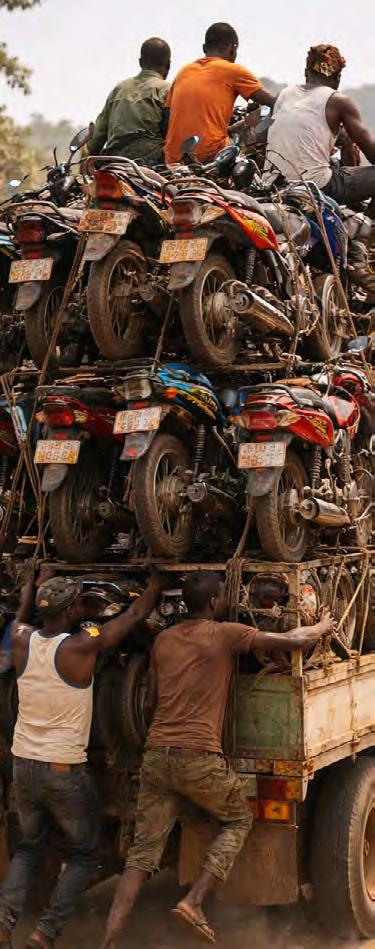
for example, established a functioning clinic within the Sadiqu camp in the Allawa Game Reserve, staffed by a Boko Haram member and stocked with a wide array of medical supplies. In Sokoto, Lakurawa engages in burglary, cattle rustling and motorcycle theft, while also exerting control over local territory. 261 These cases illustrate the quasi-governance capacities intertwined with the illicit resource systems.262
Territorial overlaps are evident across multiple borders and rural zones where mobility, weak governance and fluid boundaries enable overlapping operations by multiple groups. In some instances, bandits and terrorist actors coexist peacefully, such as in Kainji National Park, with military offensives inadvertently strengthening their cooperation.263 However, the arrival of JNIM forced other groups to relocate, illustrating how quickly peaceful coexistence can escalate into conflict. It is important to note that territorial influence goes beyond the area where the group is established. In Niger State, for example, bandit leaders trade arms and ammunition from forested areas, supplying weapons across multiple states264 and creating a marketplace that extends beyond their immediate operational zones. 265 Furthermore, connections go beyond national borders with foreign actors allegedly collaborating with Nigerian herdsmen in kidnapping operations266 and foreigners being recruited into vigilantes’ groups.267 Disputes over territorial control have led to some clashes. In Sokoto, bandits have been exerting territorial control over areas including Basanta, Gudungudun, Makina Dan Tsalle, Makina Tudu, Runji and Tunbulunqun, but the emergence of Lakurawa has pushed them into settlements such as Runjin Dutse and Takimba.268 Both groups are present simultaneously across areas of Tangaza.269
Criminal–terrorist interactions involve complex forms of cooperation: bandits reportedly hire Boko Haram fighters for operations due to their superior weaponry,270 while motorcyclists collaborate with bandits to transport drugs, food and supplies,271 and helicopters allegedly deliver heavier weapons directly to bandits in remote bush areas.
272 In Sokoto, Lakurawa exercise operational control over bandits, directing them to conduct cattle rustling, intervening with heavy weapons to repel security
261 Including more than five hundred animals from areas such as Augie and Gudalawa – interview with a member of local security services, Gudu LGA, Sokoto State, August 2025.
262 Interview with a clerical leader affiliated with hunters’ guilds, Oyo State, August 2025.
263 Interview with a youth leader, Borgu LGA, Niger State, August 2025.
264 Including Bauchi, Kogi, Nasarawa, Plateau and Taraba.
265 Interview with a youth leader, Borgu LGA, Niger State, August 2025.
266 Interview with a law enforcement official, Saki West LGA, Oyo State, August 2025.
267 Interview with a public official, Saki West LGA, Oyo State, August 2025.
268 Focus Group Discussion with private-sector representatives and members of security services, Illela LGA, Sokoto State, August 2025.
269 Focus Group Discussion with private-sector representatives and members of security services, Tangaza LGA, Sokoto State, August 2025.
270 Focus Group Discussion with local residents, Shiroro LGA, Niger State, August 2025.
271 Focus Group Discussion with private-sector representatives and members of security services, Illela LGA, Sokoto State, August 2025.
272 Focus Group Discussion with private-sector representatives and members of security services, Illela LGA, Sokoto State, August 2025.
forces and ensure bandit escape, and delivering weapons to bandits afterwards to continue exploiting them for cattle rustling.273 The relationship has also resulted in reports of some bandits integrating into the Lakurawa ranks over time.274 This symbiosis is often transactional: respondents reported a case in which bandits who had rustled a large herd of cattle offered the livestock to Boko Haram after military raids threatened their assets, prompting Boko Haram to attack the military as part of the exchange.275 Kidnapping likewise forms part of a transactional economy with armed groups sometimes abducting individuals to obtain ransom paid in commodities such as hard drugs or fuel rather than money.276 Generally speaking, a perceived limited direct relationship was reported between bandits and Lakurawa in Sokoto, while stronger connections have been hypothesized between Boko Haram and bandits in other regions such as Birnin Gwari and Katsina. 277
The relationship between terrorist and criminal actors in Nigeria evolves in response to emerging variables and can shift rapidly from collaboration to conflict. Boko Haram and bandit groups that initially cooperated later turned against each other. Bandits began hiring Boko Haram fighters for joint attacks due to the latter’s superior weaponry, with cooperation becoming evident when bandit-led assaults featured Boko Haram’s ideological markers, such as the use of religious slogans during raids. However, the alliance later fractured as differences in intent and ideology surfaced. While Boko Haram’s prioritizes undermining the Nigerian State and targeting security forces, bandits are primarily motivated towards revenue-generating activities such as mass kidnappings for ransom.278,279 Despite such conflicts, these groups occasionally suspend rivalry when confronting a shared adversary, collaborating against Nigerian security forces where required.280 Competition also emerges through coercive dominance as the Lakurawa’s arrival in Gudu led them to forcibly suppress bandit activities, killing non-compliant bandits and driving others away.281 Other accounts emphasize an adversarial posture, with Lakurawa reportedly attacking bandits and disrupting their kidnapping activities as part of efforts to assert control rather than cooperate:282 “[Lakurawa] sometimes rescue kidnapped individuals from bandits”.283 Instances of armed clashes with the state such as bandits killing eight soldiers using buried explosives, further highlight how competition among groups may coexist with moments of unified hostility against security forces.284
273 Focus Group Discussion with private-sector representatives and members of security services, Tangaza LGA, Sokoto State, August 2025.
274 Interview with a member of local security services, Gudu LGA, Sokoto State, August 2025.
275 Interview with a clerical leader affiliated with hunters’ guilds, Oyo State, August 2025.
276 Interview with a clerical leader affiliated with hunters’ guilds, Oyo State, August 2025.
277 Interview with a health professional, Sokoto State, August 2025.
278 Focus Group Discussion with local residents, Shiroro LGA, Niger State, August 2025.
279 Interview with a clerical leader affiliated with hunters’ guilds, Oyo State, August 2025.
280 Interview with a clerical leader affiliated with hunters’ guilds, Oyo State, August 2025.
281 Interview with a member of local security services, Gudu LGA, Sokoto State, August 2025.
282 Interview with a correction officer, Sokoto State, August 2025.
283 Focus Group Discussion with private-sector representatives and members of security services, Illela LGA, Sokoto State, August 2025.
284 Focus Group Discussion with private-sector representatives and members of security services, Illela LGA, Sokoto State, August 2025.
The situation is further complicated by additional variables, such as forms of manipulation of violence “deliberately created” by some individuals to destabilize resource-rich areas for profits.285 In addition, although state actors are often perceived as vulnerable to attacks along border zones rather than complicit,286 overall systemic weakness, corruption287 and lack of political commitment allow for criminal and terrorist actors to expand their operations.
Nexus Taxonomy in Nigeria
Precarious(groupsoccupythe same area b ut lanoitcasnartgnivres(devresbO otnignitargetnistidnab(devresbO irorretts O bserved(coercivedominance,territorial the relationshipquicklyshifts int o getartsdna )sesoprupci ,sknar ”ecnanrevog-isauq“ tsserutcur d isp lacementandideologicalfriction) conflictorcollaboration) )smetsyslaicnanifdednelb CONVERGENCE COLLABORATION Observed(servingtransactiona l andstrateg icpurposes) t errorist ranks , “ quasi-governance” structures ,blendedfinancialsystems) Ob served(banditsintegrating into
7 - Mapping the nexus in Nigeria
285 Interview with a clerical leader affiliated with hunters’ guilds, Oyo State, August 2025.
286 Interview with a youth leader, Borgu LGA, Niger State, August 2025.
287 Interview with a correction officer, Sokoto State, August 2025. Correctional actors noted that some bandits secured release from prison through bribery, pointing to corruption within the penal system.
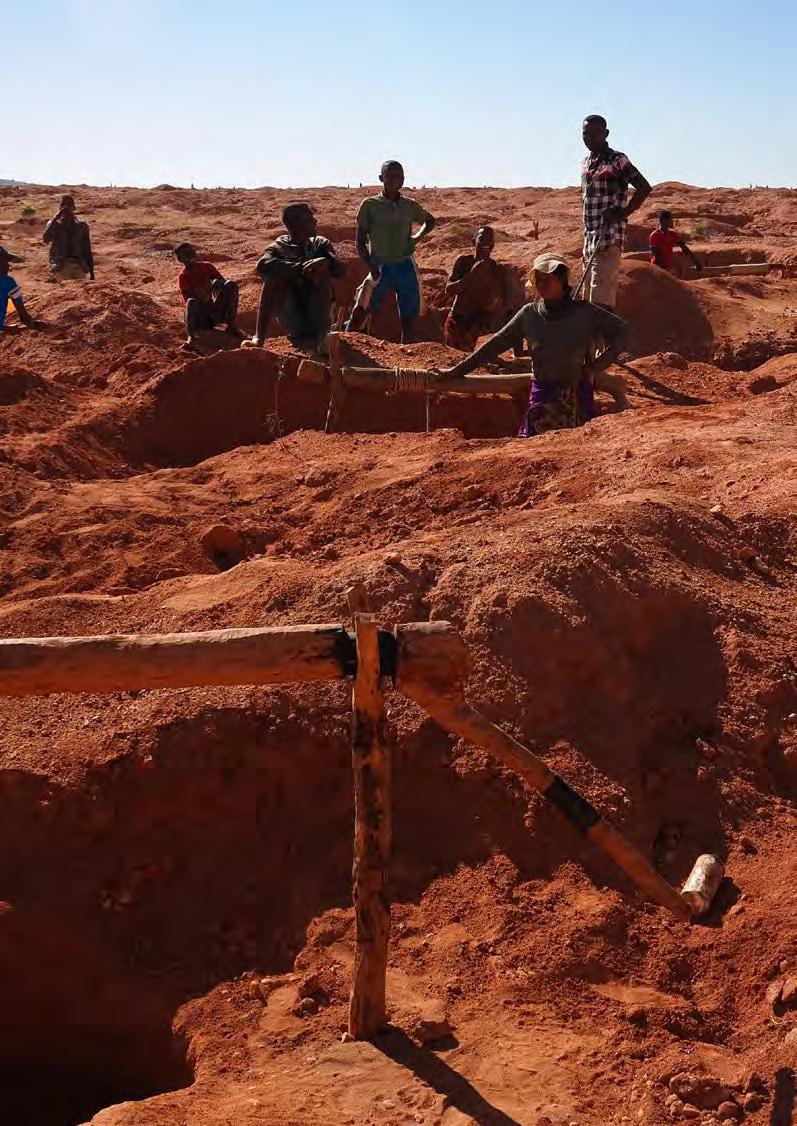
Figure 8: Continuums of interaction between terrorism and criminal activities in West Africa
Across models and cases, most of the existing literature suggests that the nexus between terrorism and organized crime should be understood as a dynamic continuum, ranging from tactical alliances to hybrid forms and, rarely, transformations. Empirical findings reported in scholarly and policy literature across diverse geographic areas report recurring patterns. In many cases, no interaction occurs between terrorist and organized crime groups, even in complex contexts characterized by fragile state institutions and a multiplicity of non-state armed groups.288 The lack of or limited interactions make more intense types of relationship hard to observe. However, framing research around the relationship between terrorist actors and criminal activities in Africa allows for a broad range of nuances to be considered, as the analysis includes a variety of criminal transactions, rather than entities, and sheds light on subtle power dynamics.
The analytical framework used for this research follows a relational progression that moves from mere coexistence to either a progressive evolution from cooperation to convergence, or a divergent one leading to competition and/or conflict. Coexistence
288 Mark Micallef and Matt Herbert, ‘Largely fleeting and hardly convergent: Libya’s crime–terror nexus’, in The Nexus Between Organized Crime and Terrorism, Letizia Paoli and Cyrille Fijnaut, eds. (Cheltenham, Edward Elgar Publishing, 2022).
emerges as a common pattern, especially in connection with certain markets historically dominated by organized criminal networks across Africa, including drug trafficking, migrant smuggling, human trafficking, arms trafficking, financial crimes, non-renewable resource exploitation and wildlife trade. 289
Since the 2000s, West Africa has become as a major transit hub for cocaine shipments moving from Latin America towards Europe, revealing the involvement of transnational trafficking groups, including well - structured and mafia- style organizations that exploit weak borders and corrupt intermediaries to manage logistics, protection and distribution across multiple states.290 Although coastal states serve as maritime entry points for containerized and non-containerized narcotics, few cases point to a connection between transnational drug traffickers and violent extremist organizations in West Africa. At times, AQIM is believed to have provided protection services or imposed illegal taxation on drug smuggling routes in the Sahel, generating revenue without direct operational involvement in trafficking, with some individuals affiliated with the group involved in cocaine transport.291 Similarly, JNIM has enabled traffickers to move through areas under its influence in exchange for payments, while the rerouting of trafficking flows through Gao and Menaka, caused by counter-terrorism operations in Mali, appears to have increased ISGS access to cocaine-related revenues292. However, evidence of direct cooperation beyond taxation and protection rackets remains limited. A similar pattern is observed in other major criminal economies: despite the scale and regional embeddedness of markets such as migrant smuggling - where Nigeria acts as a key hub for networks spanning West and North Africa293 and Côte d’Ivoire serves as both a transit and origin country - primary and secondary evidence does not reveal systematic or operational connections between these smuggling networks and terrorist actors, reinforcing coexistence as the prevailing configuration.
Although violent extremist organizations are present in several regions of the continent, including in areas also affected by these criminal economies,294 coexistence between these actors is frequently observed. However, coexistence should not be understood as neutral or incidental nor should it be read as benign. Rather, it reflects a complex and often mutually reinforcing set of contextual conditions shaped by local power dynamics, governance vacuums and the pursuit of survival
289 ENACT, Africa Organised Crime Index 2025: The past, present and future of organised crime, November 2025, https://enact-africa.s3.amazonaws.com/uploads/pages/1763470624152-2025-11-18-africa-oci-2025.pdf.
290 ENACT, Africa Organised Crime Index 2025: The past, present and future of organised crime, November 2025, https://enact-africa.s3.amazonaws.com/uploads/pages/1763470624152-2025-11-18-africa-oci-2025.pdf.
291 Kwesi Aning and John Pokoo, 'Understanding the nature and threats of drug trafficking to national and regional security in West Africa', Stability: International Journal of Security and Development, 3(1), 2014.
292 Lucia Bird, Kingsley Madueke, Mouhamadou Kane, Cocaine markets in West Africa: Mapping impacts, routes, trends and actors, Global Initiative Against Organized Crime, March 2026, https://globalinitiative.net/analysis/ mapping-drug-markets-in-west-africa/
293 SOM Observatory, Migrant Smuggling From Nigeria: Research Findings on Migrant Smuggling of Nigerians, UNODC Observatory on Smuggling of Migrants, September 2022, https://storymaps.arcgis.com/stories/ edc15a9dd4cf411c8d8edd061c6c9460.
294 Lyes Tagziria and Lucia Bird, Illicit Economies and Instability: Illicit Hub Mapping in West Africa 2025, GI-TOC, October 2025, https://globalinitiative.net/wp-content/uploads/2025/10/Lyes-Tagziria-Lucia-Bird-Illiciteconomies-and-instability-Illicit-hub-mapping-in-West-Africa-2025-GI-TOC-October-2025.v3.pdf.
or strategic advantage. Fragile environments provide fertile ground for criminal activity to expand, just as a certain level of criminality can help violent extremist groups establish themselves within a territory. Coexistence, therefore, shall not be understood as harmless parallelism. Non-interference or tolerance can lead to destabilizing consequences: even when these actors do not directly cooperate, their simultaneous presence can overwhelm local institutions, deepen corruption and erode public trust. These dynamics are reflected in the moderate correlation observed between state fragility and elevated levels of criminality.295 A similar logic applies in the virtual sphere: while digital tools can facilitate the collection of funds, media proficiency and a presence on online platforms can also serve the purpose of recruitment, as evidenced by groups such as Al-Shaabab and IS-Somalia.
When physical proximity intensifies, the relationship easily evolves into an opportunistic form of cooperation, as revealed by the three case studies examined in this report. In northern Benin, Côte d’Ivoire and Nigeria, different illicit and/or informal activities appear vulnerable to connections with terrorist actors, including the trade in arms, fuel, gold, livestock, medical supplies, motorbikes and timber. These interactions often coalesce into what can be described as service markets, where extremist groups leverage informal logistics ecosystems, including youth couriers, motorcycle assemblers and transport operators, to purchase mobility and concealment without direct organizational integration. Collaboration can take various forms and may rapidly evolve in response to contextual variables. The relationship often presents a transactional nature, with examples ranging from terrorist actors being recruited by bandits for raids due to their superior weaponry, to bandits handing over rustled cattle to terrorist groups as payment for attacks against the military. This economic logic is further illustrated by the willingness of extremist groups to pay up to three times the market price for pump fuel to local intermediaries to secure their supply lines. In some cases, a more intense form of collaboration has led to joint operations. This is particularly evident in Nigeria, where blended profit structures have emerged in gold mining and kidnapping, as seen in the attack on the Wawa Military Cantonment which involved a mixed force of bandits and extremist elements. Proximity facilitates intelligence sharing, with bandits and extremist groups like Ansaru and the Mal. Mahmuda group supporting each other with information regarding local communities and security movements. Such cooperation serves to sustain a broad set of illicit and informal activities, and emerges when actors engage in transactional arrangements for mutual benefit. Cooperation does not necessarily require actors to share the same geographical space as exemplified by Côte d’Ivoire, where intensified security operations have curtailed the physical presence of violent extremist actors: interactions now occur through trafficking networks rather than territorial control.
While collaboration is often initiated for immediate economic gain, these transactional ties can evolve into forms of quasi-convergence, where boundaries blur and governance functions emerge. In high-value sectors such as gold or precious metals
295 ENACT, Africa Organised Crime Index 2025: The past, present and future of organised crime, November 2025, https://enact-africa.s3.amazonaws.com/uploads/pages/1763470624152-2025-11-18-africa-oci-2025.pdf.
and stones, noted for their discreet and mobile financial flows, the sheer scale of economic advantage can become so dominant that it may lead to the establishment of hybrid operators that are profit-driven while also intentionally facilitating terrorist groups. Livestock economy, one of the major sources of revenue for violent extremist organizations in West Africa, is also vulnerable to non-financial dimensions of the nexus between terrorism and crime. The livestock sector, with its frequent face-to-face interactions along transhumance routes and shared market spaces, creates fertile opportunities for propaganda, recruitment, social penetration, and coercive taxation. Similar dynamics also apply to illicit pharmaceuticals and fuel smuggling, as demonstrated by the Beninese and Nigerian case-studies, where discreet transporters are used not only as smugglers but also informants. These markets rely on dense micro-transactions, community - le vel distribution and informal wholesale–retail chains, creating repeated touchpoints conducive to the enforcement of new governance dynamics at local level. This posture not only secures access to critical commodities but also enhances terrorist groups’ legitimacy among local communities where they are perceived as protectors rather than disruptors of livelihood systems. In these settings, economic pragmatism can easily translate into the strategic co-optation of governance vacuums. Authority is further reinforced through the provision of basic services, as illustrated by Boko Haram’s establishment of a functioning clinic in Niger State, Nigeria, staffed and stocked with medical supplies likely obtained through illicit trafficking.
While coexistence and various forms of cooperation appear to prevail in the African context, interactions between terrorist and criminal actors can also turn into competition. As illustrated by the example of Nigeria where Boko Haram and bandits initially cooperated, their relationship deteriorated as their objectives –state destabilization versus revenue maximization – diverged. Most of the examples of conflictual relationship are drawn from Nigeria and are
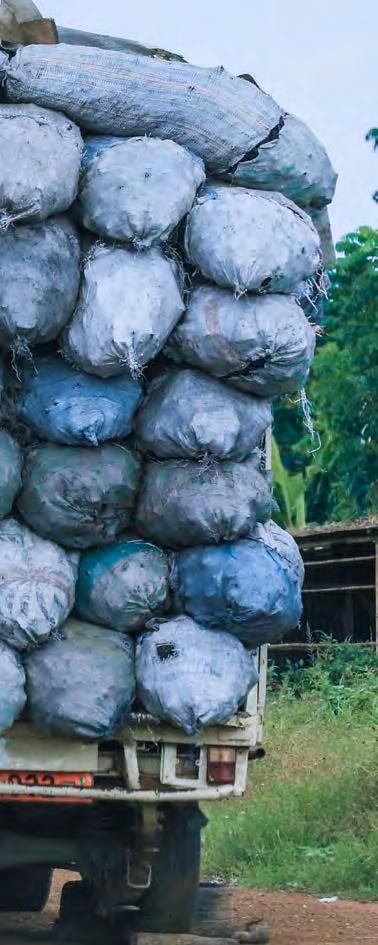
linked to Lakurawa, which reportedly intervenes occasionally to suppress banditled abductions. Conflict can be tied to territorial control, as is the case of JNIM forcing others to relocate and Lakurawa narrowing down the areas of influence of bandits in Sokoto. Conflictual relationships can also take the form of coercion, as observed in Sokoto State, where Lakurawa has directed bandits to conduct cattle rustling. The group has reportedly intervened with weapons to repel security forces and ensure the bandits escape, while also supplying them with arms. Over time, this relationship has reportedly led some bandits to integrate into Lakurawa’s ranks. Yet competition does not preclude episodic collaboration: groups occasionally suspend hostilities to confront shared adversaries such as Nigerian security forces. This fluid interplay of cooperation and conflict underscores the volatility of these relationships and the need for analytical models that capture their dynamic, non-linear character.
This report suggests that the nexus between terrorism and crime exists along a dynamic continuum. Interactions range from coexistence and cooperation to convergence and competition/conflict, and can shift rapidly in response to changing incentives and local conditions. The diversity of these dynamics underscores the analytical limitations of broad generalizations and highlights the necessity of localized, context-specific research to accurately capture the complexity of realworld interactions.
In many African contexts, like the ones observed in this study, terrorists and criminals operate in the same geographical space without necessarily interacting. Assuming a link could lead to threat inflation. Equally, the same case studies suggest that terrorist groups often expand in zones of optimal disorder which include a level of informality that allows access to resources and logistical support without exposing the organization to the existential risks resulting from competition with powerful criminal networks. 296
The involvement of small-scale service providers, such as artisanal miners, brokers, herders and transporters, indicates that the nexus is not limited to structured criminal organizations. Instead, it is embedded within broad ecosystems of local actors whose actions may be opportunistic, survival-driven or shaped by the ambiguity between legality and illegality.
At the community level, distinctions between criminals and terrorists are not always clear or meaningful: these labels come from academic and policy circles rather than from local populations’ lived experience, making it hard to separate actors involved in violence, predation or informal governance. The repeated use of certain terms often reflects how global and national narratives are imposed on local communities and then reproduced – not because they accurately describe local realities, but because they are the most familiar or socially acceptable words available. As a result, the terminology used locally may show an adherence to outside narratives rather than bottom-up distinctions rooted in local socio-political dynamics.
• Adopt flexible analytical models that move beyond static binaries and capture the fluid, opportunistic nature of interactions between violent extremist organizations and criminal actors.
• Shift units of analysis from structured groups to service nodes and micro-level actors involved in logistical supply chains.
• Differentiate between survival economies and predatory criminality, as conflating the two can lead to harmful or counterproductive interventions.
• Map social and kinship networks, recognizing that cooperation can be sustained by longstanding obligations and community embeddedness rather than ideology or profit alone.
• Promote coordination between academia, law enforcement, and financial intelligence bodies to enhance data collection methodologies and analytical rigor.
296 James Barnett and Umar Musa*, 'Kachallas and Kinship: Understanding Jihadi Expansion and Diffusion in Nigeria' CTC Sentinel, 2024, https://ctc.westpoint.edu/kachallas-and-kinship-understanding-jihadi-expansionand-diffusion-in-nigeria/.
Informal and extra-legal economies in borderlands should not be understood solely as security threats, nor should they be read merely as sources of revenue for local communities: these practices may represent forms of everyday resistance. This may hold especially true for pastoralist communities, particularly among those populations for whom cross-border mobility challenges colonial-era boundaries perceived as artificial or exclusionary.297 Whether intentional or not, cross-border trade outside of legal frameworks may function as a strategy of resistance towards boundaries that are seen as artificial tools of material and ideological domination, thereby expressing a quiet refusal to recognize the legitimacy of the nation-state. In this sense, informal and extra-legal economies may function as liminal spaces of action where worldviews challenge official narratives, norms and jurisdictions. Within these spaces, communities may elaborate frameworks that validate practices such as poaching, tax evasion or unauthorized movement, reframing them from acts of criminality into legitimate strategies of self-preservation and autonomy. In such a context, when terrorist groups enable or exploit these practices, they weaponize local communities’ “infrapolitics”,298 namely the sum of the low-profile, unorganized acts that undermine the power of the government without involving direct confrontation. In West Africa, terrorist groups like JNIM and ISGS have identified the “hidden transcripts” of marginalized rural populations, grievances that were previously expressed only through whispers or quiet non-compliance, and offer them a violent, organized outlet. This process is further facilitated in areas where terrorist actors can rely on pre-existing social ties with local communities, which often prove more effective for recruitment and territorial consolidation than appeals to formal factional affiliation alone.299 Evidence from interviews suggests that, when families who are deeply integrated into the livestock economy face forms of discrimination, they tend to utilize their existing (formal and informal) cross-border networks to defend the name and honour of their families and communities. Violent extremist groups take advantage of community grievances while exploiting the existence of strategic cross-border family ties for logistics, financial revenues and recruitment.
Over-securitizing or criminalizing informal sectors can therefore be counterproductive. Securitizing illicit trade may produce self-fulfilling dynamics, forcing local actors into alliances with violent extremists for protection and pushing communities into a corner where violence becomes a tool for survival, thereby performing the
297 Richard Olaniyan, Faleye A. Olukayode and Inocent Moyo. (eds.), Transborder Pastoral Nomadism and Human Security in Africa: Focus on West Africa (Abingdon: Routledge, 2022).
298 James C. Scott, Domination and the Arts of Resistance: Hidden Transcripts (New Haven: Yale university press, 1990).
299 James Barnett and Umar Musa*, Kachallas and Kinship: Understanding Jihadi Expansion and Diffusion in Nigeria, CTC Sentinel, 2024, https://ctc.westpoint.edu/kachallas-and-kinship-understanding-jihadi-expansionand-diffusion-in-nigeria/.
initial stereotype. The above-described dynamics are further compounded by the limited ability of international actors to adequately understand and engage with the polycriminal nature of borderland economies. In some cases, external intervention has not only failed to dismantle illicit systems but has actively contributed to their consolidation.
300
Governance and socio-economic development
• Prioritize service delivery over securitization: focus on state presence through the delivery of essential services (healthcare, education, water) to reduce the appeal of shadow governance provided by extremist groups.
• Avoid indiscriminate criminalization of the informal sector: implement policies that facilitate the formalization of relevant markets, including artisanal gold mining, to provide sustainable alternatives while offering spaces for socio-political dialogue to put forward the demands that might, otherwise, be channeled through engagement in the informal sector.
• Implement tailored anti-corruption measures: address corruption and clientelist governance, which serve as critical drivers that facilitate the illicit movement of goods and undermine community trust.
• Design social inclusion programs: targeted efforts to reintegrate marginalized pastoralist groups into the national political dialogue to address grievances that risk to be exploited by violent extremist groups for recruitment purposes.
Law enforcement
• Target service nodes and logistical enablers: shift focus from groups, whose membership might rapidly change and whose range of affiliation remains blurry, to specific service nodes that provide logistics.
• Enhance cross-border intelligence: strengthen regional cooperation to monitor transnational corridors, particularly for high-risk markets, like livestock economy and gold mining.
• Adopt hyper-localized responses: tailor approach to specific contextual needs to address granular dynamics.
300 Guillaume Soto-Mayor, 'Trafics et trafiquants : éléments structurants des sociétés sahéliennes', Recherches Internationales, 117, January-March 2020, pp. 117–135.