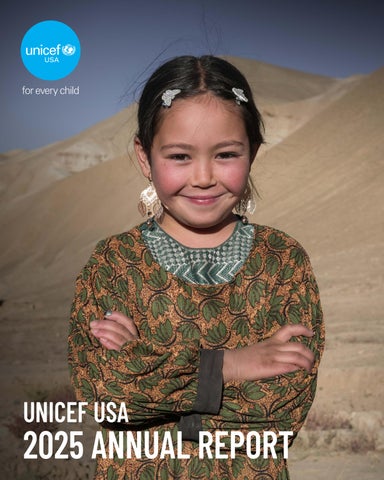
UNICEF USA 2025 Annual Report

Page 1


2025 ANNUAL REPORT UNICEF USA

IT IS POSSIBLE TO BUILD A BETTER WORLD FOR CHILDREN. TO PROTECT AND ENABLE THEIR RIGHTS. TO KEEP THEM HEALTHY, EDUCATED, PROTECTED AND RESPECTED. AND TO SHOW, DESPITE CHALLENGES, WHAT THE WORLD CAN BECOME WHEN YOU PUT THEM FIRST.

NOTE: UNICEF USA’s 2025 Annual Report highlights our work — and financial results — for Fiscal Year 2025 (July 1, 2024, through June 30, 2025). Some general statistics are also pulled from the remaining months of 2025, and they are noted as such in the report.

 A newborn at a health center in Dokolo District, Uganda, where UNICEF supports solarizing health facilities for uninterrupted care.

PRESIDENT’S LETTER

One of my favorite quotations is attributed to the great American orator Frederick Douglass: “It is easier to build strong children than to repair broken men.”

His simple statement is a pearl of wisdom worth remembering amid the decisions made by the world’s policymakers during the previous fiscal year.

It could refer to the decision to cut critical investments that provide support to the world’s children. In a telling statistic from 2025, the National Retail Federation found that spending by the U.S. Government on humanitarian aid had dropped below what Americans spent that year on Halloween candy.

It could also refer to the lives of adults in places like Ukraine, Venezuela, Gaza, Sudan and even here in the U.S., where issues of national borders have taken priority over the universal needs of children. Catering to the political interests of today’s adults comes at the expense of children’s futures in ways we will likely regret.

But I also take encouragement from Mr. Douglass’s quote.

UNICEF’s work builds strong children. It gives them healthy bodies, so that they can go to school. It offers social protections that help them cope with trauma, so that traumatic experiences will not stunt their development. It provides learning, so that they acquire skills to become tomorrow’s productive adults.

I’m proud that UNICEF and UNICEF USA are standing by children, investing in their health and education, and working relentlessly to fill the gaps that have been left by cutbacks. Your support has helped make that possible. Your belief in this mission is the reason UNICEF USA can continue to play an increasingly important role: voicing Americans’ commitment to supporting children everywhere.

Children show us what hope looks like. Even in challenging times, every child represents the possibility of something better ahead. When we focus on building strong children, as Mr. Douglass advises, we can make that possibility a reality.

Thank you for standing with us. Thank you for standing by children.

 Students focus in a UNICEF-supported program to keep adolescent girls in school in Vondrozo, Madagascar.

STANDING BY CHILDREN

Over the past year, too many children experienced a world that shifted and hardened around them, jeopardizing their welfare and futures. Their rights were trammeled as the deadliest conflicts of this century raged. Mass displacement left too many fending for themselves. The abrupt pullback of bedrock humanitarian funding by the U.S. and other governments left fragile countries in chaos and children without essentials like health care or water.

With young lives and decades of progress increasingly on the line, UNICEF’s mission was never more relevant than in the past year — and our determination to deliver progress for children has never been stronger.

The content in this report captures the scale of what UNICEF, with help from UNICEF USA and its partners and supporters, was able to accomplish this fiscal year and provides a snapshot of ongoing responses to fast-changing realities on the ground. It reflects the promise of all that is possible for the world’s children when their rights are prioritized — a position we at UNICEF USA hope more leaders will embrace.

 One of 2,000 children attending a World Children’s Day celebration in Bamako, Mali.

GROUNDBREAKING MALARIA VACCINATIONS IN AFRICA

For all the challenges to vaccine delivery in Fiscal Year 2025 — war, growing skepticism, the United States’ exit from the World Health Organization — UNICEF remained the largest global vaccine procurer and distributor. In Africa, UNICEF continued its historic rollout of malaria vaccines, expected to save hundreds of thousands of lives a year.

Before piloting malaria vaccination programs in 2019 in Ghana, Kenya and Malawi, UNICEF and partners had long supplied mosquito nets and medicine for protection. But this subtropical disease remained one of the top three causes of death for children under five. Stemming its toll means leveraging the new vaccines across more African countries. Many, including Democratic Republic of Congo (DRC), present steep challenges. This country, which has the second-highest burden of malaria cases globally, also faces competing outbreaks of mpox and cholera, as well as ongoing conflicts and natural disasters.

But complicated does not mean impossible. In June 2024, UNICEF’s vast supply chain successfully transported and stored the first 693,500 malaria vaccine doses in DRC. From there, health workers were trained to administer the four doses that start at six months of age. And parents and communities were educated about the safety of the vaccine, which has been shown to prevent more than half of malaria cases in the year after vaccination. Such groundwork in strengthening health systems and supply chains was also instrumental to delivering the country’s first mpox vaccinations for children in October 2024.

As with any large-scale vaccination campaign, UNICEF’s role securing government buy-in was critical. In October 2024, when DRC’s health ministry integrated the malaria vaccine into the routine immunization schedule, this protection became standard for generations to come.

A MASSIVE MENTAL HEALTH RESPONSE IN GAZA

Gaza is the only place on earth where UNICEF has found that every single child requires mental health treatment. After two years of deprivation, violence and displacement, children who lost parents, homes and schools have yet to regain their sense of safety and stability. “For children it’s not PTSD, because the trauma is ongoing,” UNICEF spokesman James Elder said after a 2025 visit.

IN

2024, 2.79 BILLION VACCINE DOSES WERE DELIVERED ACROSS 69 COUNTRIES

 UNICEF is introducing malaria vaccines in several African nations and pairing them with mosquito nets for extra protection.

UNICEF began responding to this unprecedented child health crisis with emergency mental health care: sessions held in multipurpose tents that teach children simple ways to manage intense fear and anxiety. Describing homes that no longer exist, meals they hadn’t had in months, terrified sprints past tanks, children started the long process of reckoning with what one 10-year-old described as the “memory stuck in my head.”

In groups, children practiced controlling intrusive thoughts and flashbacks and worked together on breathing exercises to regulate physical responses to deep-rooted fear. Facilitators offered visualization tools like the “worry sponge" or the “image changer" to reshape jarring memories. The goal is not only to help children cope in the coming months but also to stem the damage trauma brings to young brains.

Sessions in 2024 reached around 25,000 children and more than 6,000 caregivers. Although paused in May 2025 due to intensified violence, they prepared teams to reintroduce mental health and psychosocial interventions swiftly during the subsequent ceasefire.

PILOTING AI INNOVATIONS IN EDUCATION

Years of progress in providing education in low- and middle-income countries was imperiled this year. While conflict and aid cuts were major factors keeping students from class, so was a growing digital divide — one that goes deep for children with disabilities.

Where digital learning materials are scarce, accessible versions are rare. To help children with disabilities keep up with their peers in Fiscal Year 2025, UNICEF pursued ways to scale up the production of accessible digital textbooks as part of its larger efforts that helped 18.3 million children access education online.

This year, a pilot program in Uruguay set out to lower the typical $20,000 to $50,000 cost of creating a single accessible resource while speeding production. Leveraging Artificial Intelligence, the work enhanced a first-grade textbook with features like a textto-speech function, sign language videos, image descriptions and simplified language. After working with educators and students to refine initial results, the tool helped produce an accessible version up to 90 percent more quickly and more cheaply than other methods. As the project turns to creating resources for higher grades, its replicable, scalable model is expected to improve learning outcomes in other countries, too.

UNICEF AT SCALE

26 MILLION CHILDREN AND ADOLESCENTS ACCESSED EDUCATION IN 2024, INCLUDING MORE THAN 9 MILLION DURING EMERGENCIES

VACCINES AND MALNUTRITION TREATMENT IN ETHIOPIA

Government donors suddenly pulling funding from Ethiopia this fiscal year added to the challenges the country has experienced in recent years: rainy seasons that never arrived to sustain crops, conflict that stubbornly held in hard-to-reach provinces, refugees arriving from neighboring war-torn Sudan.

The cuts hit a country where, despite major progress in reducing childhood mortality since 1990, too many young children lack both the nutrition and vaccines that work together to protect vulnerable young bodies. The country ranks third in the world for “zero-dose children,” those who’ve received no vaccinations at all, while 900,000 children face life-threatening severe wasting due to drought and displacement.

Recognizing that both remain a top investment in the health and development of the world’s youngest children — UNICEF pioneered pairing malnutrition screening with routine vaccinations for Ethiopia’s children in Fiscal Year 2025. The initiative benefited from the reach, resources and efficiencies of Child Nutrition Fund (CNF) contributors.

The Child Nutrition Fund is a UNICEF-led coordination and funding mechanism designed to accelerate the scale-up of sustainable policies, programs and supplies to end child undernutrition in high-need countries.

In 2024, mobile health teams went door to door, from village to village, to screen 570,000 children for malnutrition, with a goal of reaching 10 million by 2026. On these visits, frontline health workers also vaccinated children against diseases such as polio and provided protections such as vitamin A supplementation and deworming. Villagebased outreach and community health days also helped provide essential protections for children’s well-being in the face of recent cycles of both drought and flooding.

After USAID cuts later imperiled this work, UNICEF Deputy Executive Director Kitty van der Heijden visited the region. Seeking to shore up stocks of ready-to-use therapeutic food to meet the needs of 74,500 children a month, she reminded leaders that “investing in children’s survival and well-being is not only the right thing to do, it’s the most economically sound choice any government can make.”

MORE THAN 441 MILLION CHILDREN, PREGNANT WOMEN AND BREASTFEEDING MOTHERS WERE REACHED WITH PROGRAMS AND SERVICES TO PREVENT MALNUTRITION IN 2024

UNICEF AT SCALE

FINANCIALS

Thanks to the generosity of donors and partners, UNICEF USA ended Fiscal Year 2025 with the highest total revenue results since Fiscal Year 2022. This fiscal year's strong result is due primarily to a generous multi-year partnership with the Bezos family in support of the Child Nutrition Fund. Additionally, our fundraising strategy also yielded our highest ever proportion of flexible funding, which enables UNICEF to respond most effectively to the needs of children.

Throughout the year, UNICEF USA also continued to monitor the effectiveness, efficiency and overall financial health of our organization. Significantly streamlining our financial processes resulted in a record speed for our fiscal year close, while sustaining strong controls and complying with all regulatory requirements. This enabled earlier completion of our audited financial statements and will contribute to an earlier filing of Federal Form 990.

UNICEF USA continued its commitment to abide by the principles of the Sarbanes-Oxley Act as they apply to not-for-profit corporations and to use strong internal controls and reporting methods that emphasize documentation, implementation, review and approval.

Subject to the oversight of UNICEF USA Board’s Audit Committee, UNICEF USA’s management continued to maintain robust controls that emphasize compliance, accountability and information technology systems data security and reliability to mitigate risks that could impact the internal control systems of the organization. Our Enterprise Risk Management (ERM) program continued to highlight key risk areas, trends and the associated mitigation plans.

UNICEF USA is also compliant with Payment Card Industry (PCI) standards as well as Federal Form 990 and Pension Plan 403(b) Form 5500 audit requirements. As a result, we continued to maintain the highest level of ethical, business and financial practices, enabling UNICEF USA to remain financially sound and sustainable.

The financial summary on pages 16–17 highlights our financial statements, which KPMG LLP has audited. A complete set of our financial statements, including the related notes with auditor’s unqualified opinion, is available upon request and can also be found on our website.

We believe our internal controls provide a reasonable assurance that our financial reports and statements are reliable and that they comply with U.S. generally accepted accounting principles.

 A girl in Arauca, Colombia, where UNICEF helps deliver community-based programs to combat gender-based violence.

FISCAL YEAR 2025 CONSOLIDATED STATEMENT OF ACTIVITIES

Summary of UNICEF USA’s sources of support and how we distribute our program assistance.

Total

Direct

Major

Corporate partners (inclusive of in-kind support)

Foundation partners

Cause partners

Other

$702,479,014 798,897 13,689,679 346,678 — $14,835,254 $717,314,268 $594,753,020 24,622,141 1,627,125 $621,002,286 16,662,810 87,612,639 $104,275,449 $725,277,735 ($7,963,467) $221,488,494 $213,525,027

NOTE 1

UNICEF USA’s Public Affairs Department advocates for policymakers to prioritize children’s rights and well-being in legislative and funding decisions. This includes informing the Administration and Congress about the value of U.S. voluntary contributions to UNICEF. Despite strong advocacy efforts, Congress eliminated all Fiscal Year 2025 UNICEF funding in the Summer 2025 rescissions bill.

UNICEF USA also engages on broader foreign assistance and humanitarian funding, including maternal and child health, malnutrition and access to safe water in emergencies — areas that help shape the hundreds of millions of dollars the U.S. government provides directly to UNICEF each year. These government contributions do not appear as revenue in UNICEF USA’s Consolidated Statement of Activities, though related advocacy expenses are included in UNICEF USA’s program services.

NOTE 2

As of June 30, 2025, UNICEF USA has total net assets of $463 million that consist of:

Without donor restrictions $155,039,975

With donor restrictions $308,743,226

Total net assets $463,783,201

Without Donor Restrictions — Net assets that are not subject to stipulated restrictions.

With Donor Restrictions — Net assets that are subject to donor-imposed restrictions that will be met either by actions of UNICEF USA and/or by the passage of time. Such net assets may also be subject to donor-imposed restrictions that stipulate that they be maintained permanently by UNICEF USA but permit the organization to expend all or part of the income derived from these assets to support operations.

Included in the Net Assets with Donor Restrictions is UNICEF USA's endowment consisting of individual donor-restricted funds of $4.4 million. Net assets

with donor restrictions will be used to fund various programs, such as child protection and child survival, including nutrition and health, emergency response and various other programs.

NOTE 3

This summary was prepared by UNICEF USA from its consolidated financial statements, which were audited by KPMG LLP. The complete consolidated financial statements, including the related notes and auditor’s report, are available upon request by emailing Stewardship Services at support@unicefusa.org or on UNICEF USA’s website at unicefusa.org

NATIONAL BOARD OF DIRECTORS

The National Board has the primary and ultimate governance and fiduciary responsibility for UNICEF USA, including, but not limited to, establishing strategic direction, ensuring adequate resourcing, promoting values-led and ethical behavior, and providing proactive oversight to maximize results for children. Names shown here reflect board membership during the fiscal year covered by this report.

CHAIR

Bernard Taylor, Sr.

VICE-CHAIR

Robert T. Brown

PRESIDENT AND CEO

Michael J. Nyenhuis

SECRETARY

Janet E. Truncale

ASSISTANT SECRETARIES

Jessica Leinwand

Michele Walsh

TREASURER

Nicole Giles

ASSISTANT TREASURERS

Michael Chen

Maria Middleton

DIRECTORS

Glen Baptist

Robert T. Brown

Steve Eaton

Philippe Gilbert

Nicole Giles

Ken Graboys

Carol J. Hamilton

Andrew Hohns, Ph.D.

Laura Jones

Aaron Mitchell

Michael J. Nyenhuis

John O’Farrell

Lata N. Reddy

Ewout Steenbergen

Bernard Taylor, Sr. Brannigan C. Thompson

Janet E. Truncale

Kelly Wilson

In a displaced persons site in Goma, Democratic Republic of

HELP SUPPORT UNICEF’S LIFESAVING WORK

Organized under the laws of New York State as a not-for-profit corporation, the U.S. Fund for UNICEF (also doing business as UNICEF USA) is exempt from tax under Section 501(c)(3) of the Internal Revenue Code and is governed by an independent and nonsalaried board of directors. UNICEF USA qualifies for the maximum charitable contribution deduction by donors. A summary of activities and financial highlights for the fiscal year ending June 30, 2025, is described in this report. For more than eight decades, the United Nations Children’s Fund (UNICEF) has built an unprecedented global support system for the world’s children. UNICEF relentlessly works day in and day out to deliver the essentials that give every child an equitable chance in life: health care and immunizations, safe water and sanitation, nutrition, education, emergency relief and more. UNICEF USA advances the global mission of UNICEF by rallying the American public to support the world’s most vulnerable children. Together, we have helped save and meaningfully improve more children’s lives than any other humanitarian organization.

CREDITS

Photographs – front cover: © UNICEF/UNI877888/Karimi; page 1: © UNICEF/UNI874308; page 2: © UNICEF/UNI881383/Abdul; page 4: © UNICEF/UNI912415/ Andriantsoarana; page 6: © UNICEF/UNI688087/Bamba; page 9: © UNICEF/UNI884200/Bizuwerk; page 10: © UNICEF/UNI580053/Baba; page 13: © UNICEF/ UNI623555/Dejongh; page 14: © UNICEF/UNI898862/Yepes; page 18: © UNICEF/UNI585998/Vumbi; back cover: © UNICEF/UNI909641/Htet

UNICEF USA 2025 Annual Report by UNICEF USA - Issuu