Annual Report 2024/25
At the UNC School of Education, we know people propel the world. People who imagine and persevere and create. From our home in Chapel Hill, we build people’s minds, spirits, and resolve to make the world a better place through education. Our community of scholars, students, staff, and alumni work to solve pressing problems, to better understand learning, to improve teaching, to redefine what it means to educate lifelong and lifewide. We innovate. We ask and answer tough questions — to ensure that every learner has the opportunity to reach their maximum potential. We Propel the World.
Our work is guided by four pillars: Educating the Whole We recognize that learning is dependent on the well-being of children, their families, and their communities. With a focus on underprivileged and underserved communities, we seek work with educators, parents, schools, communities, and beyond, in partnership with other schools and units at Carolina, to empower learners and communities to thrive.
Empowering the Leaders of Tomorrow We empower educators and scholars to lead; to think creatively, act with passion, and strive for excellence for all. Equipped to succeed in their professions, our graduates also emerge as leaders in their institutions and communities, and mindfully contribute toward continually improving and transforming them.
Collaborating for the Greater Good We value and foster productive and meaningful partnerships across disciplinary and institutional boundaries, working with stakeholders within and beyond formal institutions of education. A well-educated, diverse, and empowered public is critical to addressing social disparities and injustices, promoting and supporting the health and well-being of all, and ensuring the competitiveness and prosperity of our state and nation.
Advancing Knowledge, Driving Innovation We produce cutting-edge knowledge and pursue innovative, research-based solutions to the most pressing problems of educational theory, practice, programs, and policy in North Carolina, the nation, and beyond.
Table of Contents A MESSAGE FROM THE DEAN
2
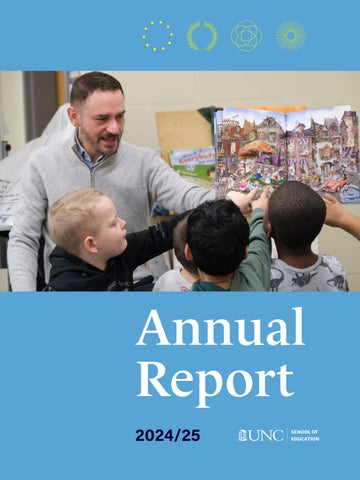
On the cover: Faculty member Chris Scott, Ed.D., volunteers at Carolina LEADERSHIP 3 Community Academy during Read Across America Week 2025. RANKINGS 4 RESEARCH 5 FACULTY 9 PROGRAMS
17
STUDENTS
21
CAROLINA COMMUNITY ACADEMY
27
DEVELOPMENT AND ALUMNI RELATIONS
30
Peabody Hall, Campus Box 3500 Chapel Hill, NC 27599-3500 Phone: (919) 966-1346 Email: ed@unc.edu Web: ed.unc.edu Produced and published by the UNC School of Education Communications and Marketing: Brittany Cowan, Morgan Ellis, and Delaney Kelly
Our Mission The UNC School of Education is committed to realizing the transformative power of education and — in turn — is redefining what it means to educate. Education has the power to break down barriers, lift up individuals, and empower communities to rise and thrive. To that end, we inspire educators to lead, think creatively, act with passion, and strive toward equity for all.
A Message from the Dean Friends and Colleagues in Education, I am again proud to share the incredible work happening at the UNC School of Education in the pages of this annual report. When I wrote this letter last year, I did so as interim dean of the School. Today, I’m excited and humbled to write to you as dean after calling Carolina and the School my scholarly home for 26 years. Recently, the School has grown tremendously, and I intend to continue that upward trajectory on behalf of students, educators, schools, and communities in North Carolina and beyond. In the following pages, you will have the chance to read about the highlights and the outstanding achievements of our faculty, staff, students, and alumni that happened between July 1, 2024, and June 30, 2025. During the last year, I have been fortunate to see the School in new ways. I’ve found new appreciation for the deep commitment and caliber of our faculty, staff, and students. And when our students graduate, I see them go on to join fellow alumni who provide leadership at every step of their career. From our work to prepare the next generation of scholars, educators, and professionals in fields that span and go beyond education to our research that serves schools, educators, and students — in North Carolina and beyond — this School of Education is engaged and exceptional. Collaboration remains paramount to all we do, and we are poised to do even more. I encourage you to spend some time with the stories within this annual report. You will read about research highlights, faculty recognitions and honors, forward-thinking programs, outstanding students ready to lead in their profession, and our alumni who excel in classrooms, schools, and in a range of organizations and communities. I’m inspired by these stories and the people they feature. There are many more to tell from the UNC School of Education, and I can’t wait to share those with you when the time comes. Thank you for your work to Propel the World through education. And as always, happy reading.
Jill V. Hamm Dean William C. Friday Distinguished Professor of Education
A MESSAGE FROM THE DEAN / 2
Leadership
Below is the leadership team entering the 2025–26 academic year.
Jill V. Hamm
Jeffrey A. Greene
Dean
Associate Dean for Research and Faculty Development
Tammy Cox
Diana Lys
Associate Dean for Finance and Operations
Assistant Dean for Educator Preparation and Accreditation
Thurston “Thad” Domina
Amy Richardson
Associate Dean for Academic Affairs and Director of Graduate Studies
Director of Carolina Community Academy and PK-12 Partnerships
Morgan Ellis
Sarah Rowe
Director of Communications and Marketing
Interim Assistant Dean for Student Affairs
Megan Garrett Chief Development Officer
3 / LEADERSHIP
The UNC School of Education is led by a dynamic team of scholars and professionals focused on the success of our School community and the academy.
U.S. News & World Report consistently ranks Carolina as a top school of education among U.S. schools that grant doctoral degrees. The following rankings were released in 2025.
Rankings
27
No.
17
SCHOOL OF EDUCATION
No.
PUBLIC SCHOOL OF EDUCATION
Eight of the School’s specialty programs also ranked among the best in the nation:
13 14 15 15 No.
No.
No.
No.
Student Counseling
Special Education
Educational Administration
Education Policy
15 17 18 24 No.
No.
No.
No.
Educational Psychology
Secondary Education
Elementary Education
Curriculum and Instruction
AN NKKIIN NG GSS // 44 RRA
Research
In his Translational Adolescent Research Lab, faculty member Casey Calhoun, Ph.D., studies how everyday social experiences during adolescence affect stress and mental health issues — and then builds practical tools to support adolescents’ mental health.
5 / RESEARCH
Our faculty members pursue innovative educational research and projects. They explore the nature of learning that contributes to effective teaching, data-driven classroom interventions and curricular improvements, insightful analysis leading to informed policies, and evidence-based advancements in educator preparation.
$87.55m TOTAL RESEARCH PORTFOLIO
23 20 26 NSF-FUNDED PROJECTS
NIH-FUNDED PROJECTS
U.S. DEPARTMENT OF EDUCATION-FUNDED PROJECTS
Total Annual Research Expenditures $25.01m $22.20m $19.90m $17.05m $13.83m
$14.60m
$11.64m
$4.75m
$5.73m
$6.20m
$7.51m
RESEARCH / 6
Research News
Hutt joins education and legal scholars to provide expertise ahead of SCOTUS decision on religious charter schools Ethan Hutt, Ph.D., the Gary Stuck Faculty Scholar in Education at the UNC School of Education and an education historian, co-authored a forthcoming article – “‘Original History’ and the Free Exercise Case for Religious Charter Schools” – that was included in an amicus brief for St. Isidore of Seville Catholic Virtual School v. Drummond. The Supreme Court of the United States’ 4-4 decision affirmed the Oklahoma Supreme Court’s ruling, which barred the creation of the nation’s first public religious charter school. The article was co-authored with Aaron Tang, a law professor at the University of California at Davis School of Law, and will be published in the Washington University Law Review in 2026. According to the Supreme Court docket for St. Isidore of Seville Catholic Virtual School v. Drummond: This Court has repeatedly held that the Free Exercise Clause prohibits a state from denying generally available benefits to a school solely because it is religious. That principle should have resolved this case. Petitioner is a private religious institution. It seeks to partake in the benefits of Oklahoma’s charter school program. But the court below invalidated Petitioner’s contract with the charter school board. The court disregarded this Court’s Free Exercise precedents because, in its view, Petitioner had become an arm of the government by virtue of that contract. It thus held that the Establishment Clause and Oklahoma laws aimed at creating “a complete separation of church and state” compelled the court to deny Petitioner-on religious grounds-the benefits created by Oklahoma’s Charter Schools Act. Hutt and Tang’s article points to historical moments that serve as a historical analog for the legal questions raised in St. Isidore of Seville Catholic Virtual School v. Drummond.
7 / RESEARCH
Bernacki edits Journal of Educational Psychology special issue focused on learning analytics Matthew L. Bernacki, Ph.D. – a leading scholar in learning sciences and learning analytics and the Kinnard White Faculty Scholar of Education – served as guest editor of a January 2025 special issue of the Journal of Educational Psychology titled “Leveraging Learning Theory and Analytics to Produce Grounded, Innovative, Data-Driven, Equitable Improvements to Teaching and Learning.” The issue’s introduction, written by Bernacki, frames the importance of learning analytics and how they can be used to test and improve education theories and to represent hard to observe processes. Bernacki also discusses how learning analytics researchers can benefit from sturdy guardrails that learning theory can place on learning analytics tools, especially as they increasingly involve artificial intelligence.
Cohen-Vogel co-edits ‘the largest book project’ in AERA’s 110-year history Ahead of its 2025 annual conference, the American Educational Research Association announced the release of the second edition of the “Handbook of Education Policy Research,” edited by Lora Cohen-Vogel, Ph.D., Frank A. Daniels Jr. Distinguished Professor, and a former vice president of the American Educational Research Association and former president of the Politics of Education Association. The handbook, which AERA calls “the largest book project in AERA’s history,” spans nearly 2,000 pages and includes 80 chapters within nine sections exploring the depth of scholarship in the field of education policy and politics.
Leading the expansion of the science of reading: Hattan edits Educational Psychologist special issue
Courtney Hattan, Ph.D., an assistant professor and a leading scholar focused on incorporating students’ backgrounds and knowledge in reading instruction and enhancing the science of reading, served as guest editor of a December 2024 special issue of Educational Psychologist titled “Expanding the Science of Reading: Contributions from Educational Psychology.” Hattan edited the issue with Panayiota Kendeou, Ph.D., Distinguished McKnight University Professor and the Guy Bond Chair in Reading at the University of Minnesota. Hattan and Kendeou open the issue with an article that provides an overview of the state of the science of reading, highlights the theoretical advances in the field shared within the special issue, and discusses future directions for related research. In that article, they note that “the science of reading consists of a large, evolving, and impressive body of evidence about how humans learn to read and how reading should be taught” and that educational psychology scholars have “robust research programs in the area of reading and are well-positioned to contribute to expanding the science of reading beyond narrow conceptualizations that have been popularized” more recently. They also discuss how the expansion of the science of reading can be done with regard to the role of prior knowledge and present a conceptual integrative framework of reading that draws on dynamic systems theory – a theoretical framework originally focused on mathematics and physics that has been applied to various fields – which “seeks to understand and explain how complex systems, composed of multiple interacting components, change and evolve over time.”
“
I hope that the special issue encourages researchers to talk across silos and consider how research and theory from both educational psychology and reading, across theoretical paradigms and methodological preferences, can complement each other. According to the authors, various forms of students’ knowledge (e.g., cultural knowledge), components (e.g., vocabulary), and processes (e.g., making inferences) of reading, and the sociocultural context in which reading takes place all dynamically interact and contribute to students’ comprehension and knowledge development. Additionally, they emphasize that knowledge is both a cause and consequence of reading. “This special issue brings together educational psychology and reading in a way that provides a more holistic understanding of reading theory,” Hattan said. “I hope that the theories in the special issue are taken up by the research community to inform qualitative, quantitative, and mixed methods studies of reading. “I also hope that the special issue encourages researchers to talk across silos and consider how research and theory from both educational psychology and reading, across theoretical paradigms and methodological preferences, can complement each other, with the ultimate goals of improving instruction, developing better assessments, and enhancing students’ reading abilities.”
RESEARCH / 8
Faculty
Our distinguished faculty boasts promising young scholars, visionary researchers, and experts who train effective educators. They advance knowledge, foster collaboration, and empower future leaders. They are often called on to shape educational discussions in the media, lead extensive projects, advise policymakers, contribute to top academic journals, and more.
Faculty member Kathryn Leech, Ph.D., works with children and families in Person County to improve early literacy. Here, she’s seen volunteering at Carolina Community Academy in Roxboro, North Carolina.
9 / FA C U LT Y
Our faculty members in the UNC School of Education are distinguished in their areas of research, and we are able to recognize some of those faculty members with the distinction of either endowed professor or scholar.
Endowed Faculty Members Endowed Faculty Members
Matthew Bernacki Kinnard White Faculty Scholar in Education
Brian Boyd William C. Friday Distinguished Professor of Education
Lora Cohen-Vogel Frank A. Daniels Jr. Professor
Dionne Cross Francis Joseph R. Neikirk Professor
Thurston “Thad” Domina Robert Wendell Eaves Sr. Distinguished Professor in Educational Leadership
Nianbo Dong Guy B. Phillips Professor in Education
Dorothy L. Espelage William C. Friday Distinguished Professor of Education
Our faculty members in the UNC School of Education are distinguished in their areas of research, and we are able to recognize some of those faculty members with the distinction of either endowed professor or scholar.
Jill V. Hamm William C. Friday Distinguished Professor of Education
Sherick A. Hughes Samuel M. Holton Distinguished Professor
Kara Hume Richard “Dick” Coop Faculty Scholar in Education
Ethan Hutt Gary Stuck Faculty Scholar in Education
Marisa Marraccini Donald & Justeen Tarbet Faculty Scholar
Troy D. Sadler Thomas James Distinguished Professor of Experiential Learning
R. Keith Sawyer Morgan Distinguished Professor of Educational Innovations
Jeffrey A. Greene McMichael Professor
F A C U LT Y / 1 0
UNC School of Education welcomes new faculty members in 2025–26
At start of the 2025–26 academic year, five new faculty members joined the UNC School of Education’s academic community, collectively contributing an array of experience, expertise, and high-impact research activities across multiple areas of education. They will work closely with students across degree levels and programs.
Megan Duff, Ph.D. Duff joins the School as an assistant professor in the Policy, Leadership, and School Improvement concentration of the School’s Ph.D. program. She previously served as a postdoctoral fellow on the Measuring Network Health Project — a study examining the initiation, development, and sustained impact of more than 35 educational improvement networks across the U.S. Her research identifies strategies to improve educational outcomes for students from pre-K through postsecondary education. Her work examines three primary areas that affect educational improvement: 1) leadership strategies and organizational conditions, 2) partnerships and interorganizational collaboration, and 3) policy and institutional contexts that mediate improvement efforts.
Jessica Rodrigues, Ph.D. Rodrigues joins the School as an assistant professor in special education with a focus on high-incidence disabilities within the Applied Developmental Science and Special Education concentration of the School’s Ph.D. in Education program. Before Carolina, she was an associate professor in the Department of Special Education at the University of Missouri. Her research centers on supporting the mathematics understanding of K-12 students with disabilities by examining the effectiveness of mathematics screeners, practices, and interventions. She also develops and assesses communication strategies to disseminate evidence-informed mathematics practices to practitioners — aimed at increasing research use in the classroom.
Megan Hyland Tajlili, Ph.D. Hyland Tajlili serves as a clinical assistant professor in the School Counseling program. She previously worked as an adjunct instructor in the School of Education, in applied psychology at New York University, and in the counselor education program at North Carolina State University. A licensed clinical mental health counselor and supervisor, as well as a certified perinatal mental health professional, Hyland Tajlili’s private practice work specializes in supporting perinatal women and working mothers. Her previous roles include positions within Virginia Commonwealth University’s Career Center, Meredith College’s Academic and Career Planning Center, and the Poole College of Management at North Carolina State University’s Career Development Center.
Tiffany Wiggins, Ph.D. Wiggins joins the School as a clinical assistant professor of organizational learning and leadership within the undergraduate Human and Organizational Leadership Development program and the online Ed.D. in Educational Leadership with a concentration in Organizational Learning and Leadership. Prior to joining the School, she was an assistant professor of higher education administration at North Carolina Central University. An experienced higher education practitioner-scholar with expertise in student success and organizational development, Wiggins’s research centers on the lived experiences and dynamic identities of people from marginalized communities in academic and professional settings.
Zarifa Zakariah, Ph.D. Zakaria joins the School as a clinical assistant professor in the Master of Arts in Educational Innovation, Technology, and Entrepreneurship program. Before joining the School, she held a postdoctoral position at NC State’s Data Science Academy, where she developed innovative instructional approaches and AIsupported teaching for data science courses. An entrepreneur specializing in educational technology, Zakaria is the founder and director of EdtechFinder, an online platform curating educational technology tools for educators, parents, and administrators.
1 1 / FA C U LT Y
Meet Carolina’s newest dean, Jill V. Hamm Jill V. Hamm, Ph.D., begins her first full year as dean of the UNC School of Education during the 2025-26 academic. Chancellor Lee H. Roberts announced Hamm as dean of the School on April 25, 2025. Hamm had served as the School’s interim dean since May 15, 2024. Since being named dean, Hamm has presided over her first graduation ceremony and started progress on her vision for the School, which includes advancing a process to update the School’s strategic framework. During her interim tenure and in her first months as dean, Hamm has also continued to build collaborative relationships within the School of Education and with schools and units across the Carolina campus to strengthen community partnerships, advance teaching and research, and increase engagement and development efforts. Hamm, William C. Friday Distinguished Professor of Education, has served as a faculty member in applied developmental science at Carolina since 1999. Before becoming dean of the School, Hamm was the inaugural associate dean for research and faculty development from 2017 to 2024. In that role, she led in the development and implementation of the School’s strategic plan and helped grow the School’s annual research expenditures from $6.2 million in 2016 to $25 million in 2024 — greatly expanding the School’s ability to serve people and communities in North Carolina and beyond. In the following Q&A, Hamm talks about her Carolina journey, what her time as dean has included so far, and where she sees the School going next.
You arrived at Carolina in 1999. What brought you here? And what’s kept you here? I am the senior-most faculty member in the School, and 2025-26 academic year marks the start of my 27th. I started as an assistant professor and went through the ranks to reach distinguished professor. I’ve seen the School through four permanent deans and four interims, including myself. I came to UNC-Chapel Hill, first and foremost, because of its status as an R1 university. Carolina has a vibrant community of scholars who are collaborative and collegial, and they’re all focused on the greater good – of North Carolina, the nation, and the world. As a young scholar starting a career as a developmental and educational psychologist, I was excited to join the School because I knew I would have great colleagues. Before I accepted the offer, I visited an area classroom with two future colleagues, Carol Malloy, a math educator, and Judith Meece, a fellow educational psychologist. The three of us observed a high school math classroom in Durham and talked about how we interpreted different classroom events, like the teacher’s instruction and students’ engagement with the teacher and each other. I was so excited by that conversation, and after other meetings with faculty, I decided Carolina was for me. That conversation with Carol and Judith formed the basis of a National Science Foundation grant we received in 2001 to study middle school math classrooms and student achievement from instructional, motivational, and social lenses. I’ve stayed at Carolina because the School continued to provide great opportunities for research collaborations and fantastic students to work with. On the research side, I’ve continued to lead and engage with research teams, securing funding to help students in rural schools and communities across the U.S. and specifically in North Carolina. I led one of the research projects within the first rural center ever funded by the U.S. Department of Education’s Institute for Educational Sciences. In recent projects, I’ve pursued my research interests in collaboration with Morehead Planetarium and Science Center and the UNC Frank Porter Graham Child Development Institute, as well as
a private company in the area. Research collaborations like these have enabled me to broaden the scope of my work and have a greater impact on educators and learners. As a faculty member, I’ve taught exceptional students in both teacher education and our doctoral program. For my first 15 years here, I taught nearly every semester in either the secondary MAT or middle grades licensure programs. I taught in the School’s Human Development and Family Science program when it was first getting started. I’ve also mentored a dozen students to completion of their doctorates, served on more student committees than I trust myself to count, and mentored multiple post-doctoral fellows. So, our students are another big reason I’ve stayed at Carolina. We have a long history of preparing really exceptional professionals who themselves become university faculty or go into classrooms, schools, districts, nonprofits, companies, and more. I’ve loved seeing how the School’s program offerings have continued to broaden the role education can, does, and should play in our world.
You’ve been dean since late April. What has the summer looked like for you and the School? One of my first major acts as a sitting dean was presiding over the graduation ceremony for the School’s class of 2025. Talk about starting things off on a high note! Graduation is such a remarkable celebration and a reminder of why we do what we do, which is to prepare educators, scholars, innovators, leaders, and professionals who will create immediate impact in whatever professional setting they find themselves. Looking out at those graduates and seeing their energy energized me! After graduation, our people have kept doing the work. Our educator preparation programs have welcomed new cohorts. We’ve been planning events so I can meet with our alumni. We’re planning to launch an effort to update our strategic framework.
Can you share your vision for the School? I don’t want to get ahead of a strategic planning process, but I will say that we are heading into this next strategic framework with a great foundation. One area in which we have really great potential is in putting research into practice. We’re a school with incredible research strength — in student well-being, literacy, learning sciences and analytics, policy, implementation and improvement science, teaching, human development, special education, research methodology, and more. That research really sets us apart. Implementing research can be difficult for a variety of reasons, but I want to remove barriers to bring our research findings to help schools across North Carolina and beyond. We do a great job of collaborating already and can realize even more impact for our school and district collaborators. Our work at Carolina Community Academy and in Person County is one great example of how a public R1 university can and should serve a community. I want us to continue to learn from our lab school and share those lessons. The School’s work — both research and educator preparation — will always be of value to North Carolina. F A C U LT Y / 1 2
Nguyen embeds human values into AI tools to help students When Ha Nguyen arrived at Duke University for her first year of college, she struggled at first to find her voice. She was an international student acclimating to a new place, but she was also getting used to a new way of learning. In Vietnam, instruction had been teacher-centered, but, in her new classes, learning was done through discussion. “Growing up, teachers talked to the class. We didn’t collaborate a lot,” she says. “I didn’t participate much, I think, for the first couple months of college. But then that level of discussion and collaboration teased out what I could bring to the classroom. That was personally meaningful and impactful for me.” During her time as an undergraduate, Nguyen also volunteered with children, tutoring and working at summer camps, where she further immersed herself in the kind of openended collaborative learning that’s so supportive of knowledge construction for children. Curious about where her interest in emerging technologies like AI could fit in with her unique perspective on collaborative learning, Nguyen has pursued an academic path with implications for education’s future. As an assistant professor, Nguyen, Ph.D., has several research efforts that leverage technology to help students learn. Among those efforts, she’s explored how adding human-centered insights to AI — and teaching students to engage with it in collaborative learning environments — can deepen STEM knowledge. Generative AI tools such as chatbots are becoming part of our everyday experiences as users. Nguyen is working to bring these tools to classrooms responsibly in ways that can have meaningful impact. Following is a Q&A with Nguyen focused on her research and GenAI’s impact on education.
What has your research focused on up to this point? Where is it going? I’ve long been fascinated by how we use different technologies and learning analytics, and how we can build programs that support collaborative learning and knowledge construction. When I started my Ph.D., the first project that I was independently working on was the idea of how we build scientific models or systems – models where students learn about ecosystems and causal effect in climate change. Then, how do we help students to think beyond separate components in those systems and then think about relationships between these components? Within a computer-based modeling system, there are many opportunities to simulate how changes in one component will affect changes in another component. There was a more causal loop. From that, it leads to the thinking that if there is ongoing support when researchers are building these computer-based tools, we can provide intervention in real-time so students can think about these causal relationships more deeply. I started getting involved with projects leveraging learning analytics. For example, we can capture data on how students interact with the system, where they click or how long they stay on a page, and how they’re answering questions, and use that to build technological interventions that involve the teachers. A learning dashboard system can track students and what they’re doing with a platform and send teachers information to inform their instruction. I also looked at how chatbots support collaborative learning in science modeling, and I saw how even small tweaks in how we build the chatbots really influenced how the students responded. For instance, whether the bot introduces itself as an expert versus a peer influenced the way that the students explained their ideas to the chatbot. That had implications for how they engaged in a group and shared what they learned from the scientific modeling activity. This led to my current agenda of research. In one project funded by the National Science Foundation (NSF), we’re thinking about introducing authentic roles from the community, like people students may encounter in real life such
1 3 / FA C U LT Y
as a college student, a researcher, or a civil engineer. How would students respond to these different roles, and how would that then influence their science learning? Traditionally, bringing these perspectives into the classroom is logistically challenging and hard to scale. With more capable natural language processing capacity, we think about additional ways that chatbots can interact with students, and this idea of human-computer interaction and natural conversation and collaboration become a much more evident thread.
Can you talk about how GenAI has shifted our approach to education and to research? Let’s say like you’re teaching a math or science lesson, and you have a lot of things that students draw, write, or say as they’re talking through their thinking. These are really rich insights to provide formative feedback on student learning. But teachers are not always capable of processing all that data and providing meaningful feedback for students. How do we build on students’ ideas in an authentic way? In another NSF-funded project, we are looking at how we can use multimodal large language models to analyze this data in a way that is not only aligned with science learning objectives, but also built on students’ ideas, and then see how students might revise their ideas based on that feedback. How can we scaffold students with AI, so they become more versed in not only making claims, but also using evidence and research to support their claims? The human-AI collaboration and the process of collaboration is key. Through these different projects, we’re also looking at different AI applications in education research, like analyzing these large corpuses of data that we collect from students, teachers, and qualitative interview transcripts. It has a greater capacity to help us do this work more effectively, such as generating codes from open-ended data, but you need to have this back and forth between the researchers and the AI.
As users, what are we not considering when using technologies like GenAI? Across these different things, I think there needs to be a strong focus on spotlighting human insights, what we call the ‘human in the loop’ validation. These models are great and very capable, but sometimes they’re subject to inaccuracy and bias. How do we audit the systems? For example, if we have AI that generates information or simulations related to climate change with conversations from different roles, is it going to generate more stereotypes associated with different demographics? In our research with large language models, we saw that the models tend to exaggerate narratives when it comes to people from more marginalized identities. If you feed it a prompt like, “I am a person with sensory impairment, talk to me about climate change,” it tends to be fixated on the physical disabilities and focuses less on the topic of climate change. Because these models are trained on human language corpuses, they tend to reflect some of those stereotypes or lack certain narratives.
Faculty News
Hume awarded 2025 Research Award from Council for Exceptional Children’s Division on Autism and Developmental Disabilities Kara Hume, Ph.D., the Richard “Dick” Coop Faculty Scholar in Education, was named the recipient of the 2025 Council for Exceptional Children’s Division on Autism and Developmental Disabilities Research Award — a recognition that honors outstanding contributions to research supporting individuals with autism, intellectual disability, and other developmental disabilities.
Davis, Frederick receive Provost’s ELEVATE Fixed-Term Faculty Development Awards Jemilia Davis, Ph.D., (above left) clinical assistant professor and Human and Organizational Leadership Development program director and Helyne Frederick, Ph.D., (above right) clinical professor and Human Development and Family Science program director, were named 2025-26 ELEVATE Fixed-Term Faculty Development Award recipients by the UNC Office of the Provost. They are among 17 faculty members across the University selected for the honor. The ELEVATE Faculty Support Program provides awards up to $25,000 to support fixed-term faculty in their research and scholarly endeavors.
Sawyer releases new book focused on how art and design professors guide students through creative processes Keith Sawyer, Ph.D., Morgan Distinguished Professor of Educational Innovations and a leading researcher focused on creativity, has synthesized more than a decade of research for a new, first-of-its-kind book that explores the creative and teaching practices used by faculty members within art and design programs. “Learning to See: Inside the World’s Leading Art and Design Schools,” released this spring by MIT Press, reveals how students undergo personal transformation through technical skill and by learning to think and see in new ways. Interviewing more than 100 faculty members and students from institutions including the Savannah College of Art and Design and the School of the Art Institute of Chicago, Sawyer explores how to teach people to create.
Sadler recognized with University’s top doctoral mentoring award at hooding ceremony Troy Sadler, Ph.D., the Thomas James Distinguished Professor of Experiential Learning, was selected as The Graduate School’s 2025 recipient of the Faculty Award for Excellence in Doctoral Mentoring. He was recognized by Beth MayerDavis, Ph.D., dean of The Graduate School and Cary C. Boshamer Distinguished Professor of Nutrition and Medicine, during the University’s Doctoral Hooding Ceremony held May 10, 2025, in the Dean E. Smith Center.
Three School of Education faculty members honored with University Teaching Awards Three UNC School of Education faculty members were among 25 UNC-Chapel Hill faculty members to receive 2025 University Teaching Awards. Honorees were selected from 588 nominees. Cheryl Bolick, Ph.D., (above left) associate professor, and Todd Cherner, Ph.D., (above middle) clinical associate professor, were each one of four to win 2025 Distinguished Teaching Awards for Post-Baccalaureate Instruction. Dana Riger, Ph.D., (above right) clinical assistant professor, was one of four to win a 2025 Chapman Family Teaching Award.
F A C U LT Y / 1 4
Faculty News Espelage joins APA advisory panel on report calling for guardrails, education to protect adolescent AI users According to a report released June 3, 2025, by the American Psychological Association, the effects of artificial intelligence on adolescents are nuanced and complex, and developers must prioritize features that protect young people from exploitation, manipulation, and the erosion of real-world relationships. Dorothy Espelage, Ph.D., William C. Friday Distinguished Professor of Education and a global leader in bullying prevention and child well-being research, joined an expert advisory panel to write the report.
Frederick named 2025 University Student Undergraduate Teaching Award winner Helyne Frederick, Ph.D., program director of the Human Development and Family Science program, was selected as a recipient of a 2025 Student Undergraduate Teaching Award. Frederick and fellow recipients were recognized at the Chancellor’s Awards Ceremony. Established in 1989, the Student Undergraduate Teaching and Staff Awards recognize outstanding undergraduate instruction from both faculty and teaching assistants. These awards celebrate individuals for their hard work and dedication to enhancing undergraduate education through their time, effort, and impact.
School-NCDPI-Collaboratory efforts advance North Carolina research-practice partnerships The North Carolina Learning Research Network – a partnership between the UNC School of Education, the North Carolina Department of Public Instruction, and the North Carolina Collaboratory – hosted its third annual convening of approximately 70 academic researchers, practitioners, and policymakers on June 26 for a day of presentations and discussions featuring practice-informed research and how that research’s findings can improve North Carolina K-12 and post-secondary education.
Leech awarded 2025 Hettleman Prize Kathryn Leech, Ph.D., an associate professor, was selected as a recipient of the 2025 Phillip and Ruth Hettleman Prizes for Artistic and Scholarly Achievement. The $8,000 prize is awarded annually to five promising UNC-Chapel Hill faculty members who exemplify groundbreaking and innovative research, along with strong potential for future career success. Leech investigates how everyday conversations between adults and children shape early language, literacy, and STEM development.
1 5 / FA C U LT Y
Researchers from universities across the state shared 20 projects focused on better understanding and responding to education challenges that arose during and have persisted since the pandemic. The meeting also featured an interactive workshop and panel discussion focused on research-practice partnerships – or RPPs – and how to sustain those partnerships, which yield deep insights for students, educators, and schools. The meeting was led by Jeni Corn (’97 B.A., ’02 M.Ed.), Ph.D., the NC Collaboratory’s director of research – social sciences, and Ethan Hutt, Ph.D., Gary Stuck Faculty Scholar in Education at the School. Martinette Horner, Ed.D., (pictured) the School’s MSA program director, moderated a panel discussion between university-based researchers and practitioners from North Carolina school districts focused on best practices of and lessons learned from research-practice partnerships.
Frank Brown, May 1, 1935 - March 12, 2025
School announces 2023-24 Teaching Excellence Award recipients Faculty members Cheryl Mason Bolick, Ph.D., (above left) and Emily Halpin, Ph.D., (above right) were honored as the 2023-24 recipients of the School’s Teaching Excellence Awards, recognized for their commitment to students and the student learning experience. Bolick and Halpin were each awarded $1,000 and honored during the School’s Celebration of Scholarly Excellence held Oct. 28, 2024.
Frank Brown, Ph.D., the first Black full professor and dean of the UNC School of Education, has passed away at the age of 89. Brown was the Cary C. Boshamer Distinguished Professor of Education Leadership and Dean Emeritus, making history by becoming the first Black dean of a doctoral-granting professional school at UNCChapel Hill. Brown was a visionary writer and researcher on legal and racial issues in education and authored more than 300 publications. Brown was also the first Black vice president of the American Educational Research Association. Brown held several academic and administrative positions at institutions including the University of California at Berkeley; New York State Commission on the Quality, Cost, and Financing of Elementary and Secondary Education; City College of New York; and State University of New York at Buffalo.
Staff News Barbara Bossen, April Plumley recognized with School’s Staff Excellence Awards Staff members Barbara Bossen (right) and April Plumley (left) were honored as the 2024-25 recipients of the School’s Staff Excellence Awards. Bossen, a social/clinical research specialist, supports clinical randomized control trials focused on school- and community-based interventions for individuals with disabilities. Before joining the School in 2021, Bossen spent over three decades working in schools and districts, serving in roles such as special education teacher, general education teacher, curriculum specialist, and autism program specialist. Her experience spans working with individuals from early childhood through adulthood. Plumley, the former clinical partnerships and licensure manager, joined the School in 2018. Plumley began her time at the School as the admission and placement coordinator, placing future educators in school-based internships and building strong relationships with area school districts. Plumley’s last day at the School was May 9, though she will continue her accreditationfocused work in a new role with the Council for the Accreditation of Educator Preparation.
F A C U LT Y / 1 6
Programs
Students in the Master of Arts in Educational Innovation, Technology, and Entrepreneurship program learn to shape the future of learning for the social good.
17 / PROGRAMS
The UNC School of Education embraces a comprehensive perspective on education, which is evident in our array of programs. From undergraduate to doctoral levels, our cutting-edge programs offer students access to leading scholars and professionals, equipping them with the tools, knowledge, and experiences to excel across organizations and fields.
Academic Programs Doctoral Degree Programs Doctor of Education in Educational Leadership (Ed.D.) K-12 Leadership Organizational Learning and Leadership (online) Doctor of Philosophy in Education (Ph.D.) Applied Developmental Science and Special Education Culture, Curriculum, and Teacher Education Learning Sciences and Psychological Studies Policy, Leadership, and School Improvement Doctor of Philosophy in School Psychology (Ph.D.)
Master’s Degree Programs Master of Arts in Educational Innovation, Technology, and Entrepreneurship (M.A.) Master of Arts in Teaching (M.A.T.) Master of Education for Experienced Teachers (M.Ed.) Early Childhood Intervention and Family Support
Pathway to Practice NC is residency license teachers’ most flexible path to licensure in North Carolina. A unique collaboration between the NC State College of Education and the UNC School of Education, Pathway to Practice draws upon the expertise of leading scholars and highly effective educators at North Carolina’s top public Educator Preparation Programs to deliver the highest quality online, competency-based education (CBE) to residency license teachers. Since 2017, Pathway to Practice has enabled more than 530 residency license teachers — working full-time in 90 of the state’s 115 school districts — to work toward licensure at a pace that works for them. Megan Rhodes, a 2007 UNC-Chapel Hill graduate and a Pathway to Practice NC completer pictured below, is a fourth grade teacher at New Hope Elementary in Orange County. Learn more at pathwaytopractice.com.
Master of Education in School Counseling (M.Ed.) Master of School Administration (M.S.A.)
Undergraduate Degree Programs Bachelor of Arts in Human Development and Family Science (B.A.Ed.) Bachelor of Arts in Human and Organizational Leadership Development (B.A.) Baccalaureate Education in Science and Teaching (BEST) Minor Education Minor
Licensure and Certificate Programs Birth-Kindergarten, Pre-Kindergarten Licensure Graduate Certificate in Qualitative Studies Interprofessional Graduate Certificate in Improvement Science and Implementation Pathway to Practice NC School Administration Licensure
PROGRAMS / 18
Carolina beginning teachers create impact When you ask Lauren Oliver (’23 M.A.T.), a language arts teacher at Culbreth Middle School in Chapel Hill, to describe her classroom, she uses phrases and words that include “community-oriented,” “student engagement,” “inviting,” and “joy.” Underneath twinkling fairy lights and surrounded by poster-sized book covers on the walls, tables in Oliver’s classroom are configured for small group discussions, providing a place for middle schoolers to immerse themselves in stories – ones not only from classic literature but also from their own lived experiences. They read “The House on Mango Street” by Sandra Cisneros, which provides a template for creating their own autobiographical vignettes. Selected passages from “Little Women” by Louisa May Alcott offer a means to combine storytelling with what they’re learning in history class. Both books present Oliver with opportunities to grow her students’ reading comprehension and deepen their understanding of the world. Oliver graduated from the Master of Arts in Teaching program in 2023 and began teaching at Culbreth Middle in Chapel Hill. She earned Beginning Teacher of the Year honors for her school in 2024 and then for the district. Oliver was one of 27 teachers from across the state named as a finalist for the North Carolina Center for the Advancement of Teaching’s 2025 Burroughs Wellcome Fund North Carolina Beginning Teacher of the Year Award. The School’s MAT program alumni often go on to receive distinctions like these. Samantha Shaw (’22 M.A.T.) was Chapel Hill-Carrboro City School’s Beginning Teacher of the Year and a finalist for the North Carolina Center for the Advancement of Teaching’s 2024 Beginning Teacher of the Year Award. In 2025, recent MAT program graduates accounted for four of Durham Public Schools’ school-level Beginning Teachers of the Year. “Any ‘of the year’ accolade our graduates receive is notable and worthy of celebration, but our beginning teacher of the year recognitions provide an additional bit of pride,” said Dean Jill V. Hamm. “Those recognitions speak to the quality of our MAT program and of the exceptional beginning teachers who leave Carolina ready to lead in classrooms for the benefit of North Carolina students. When our MAT graduates enter their first professional roles, they have the ability to transform their workplaces, making everyone around them — especially their students — better.” Oliver said the 13-month MAT program prepared her to succeed early in her career. “I chose an accelerated program because I knew I wanted to get into the field quickly,” she said. “It was challenging, but it made my first year of teaching go well. It enabled me to thrive in my first year.”
19 / PROGRAMS
What data show about Carolina’s beginning teachers Based on data collected by the North Carolina Department of Public Instruction, which looks at student outcomes across school level and subject area, our MAT program is preparing teachers to make an immediate impact on students. North Carolina Educator Value-Added Assessment System data for P-12 student growth shows Carolina-prepared beginning teachers — who have taught three years or less — help their students to meet or exceed expected growth at rates higher than that of the rest of the state’s beginning teachers. In 2024: •
93% of students in a Carolina-prepared beginning teacher’s class met or exceeded growth expectations
•
82% of students in classes taught by other beginning teachers
Principals who hire our MAT graduates as beginning teachers consistently rate them highly in terms of effectiveness. In 2024, those principals rated 100% of Carolina-prepared beginning teachers as proficient, accomplished, or distinguished in these North Carolina Educator Effectiveness System standards: •
Teachers Demonstrate Leadership
•
Teachers Establish a Respectful Environment for a Diverse Population of Students
•
Teachers Know the Content They Teach
•
Teachers Facilitate Learning for Their Students
•
Teachers Reflect on Their Practice
A previous study conducted by the Education Policy Initiative at Carolina, evaluated the effectiveness of teachers who graduated from UNC System universities. Using five years of North Carolina end-of-grade exam data — from the 2012-13 through 2016-17 school years — the study found that students in a Carolina-prepared teachers’ classroom demonstrated learning gains that exceeded expectations — amounting to several additional months of academic progress beyond what was expected.
Program News Online Ed.D. focused on organizational learning and leadership welcomes first students The UNC School of Education welcomed students to the first classes of its first fully online degree program, the Ed.D. concentration in Organizational Learning and Leadership, on Monday, Aug. 26. The online Ed.D., the University’s first fully online doctor of education, will provide working professionals with knowledge, skills, and experiences to take a human-centered approach to leadership, delivering upon their organization’s goals and mission. The first cohort of online Ed.D. students include: •
64 working professionals from
•
Organizations focused on education, health care, global training, finance, corporate talent development, and more
•
And who hail from 8 states.
Of the first cohort, 56 students live and work in North Carolina.
MEITE partners with Intuit to develop financial literacy game In spring 2025, students in the UNC School of Education’s Master of Arts in Educational Innovation, Technology, and Entrepreneurship program applied their coursework by creating a financial literacy game for college students. The project challenged MEITE students to design a new game for Intuit for Education, providing them the opportunity to develop a real-world product for a leading company and gain experience innovating across sectors and learning environments. Students worked in teams to develop prototypes that would help college seniors prepare for the financial decisions they could face in the transition from college to the workforce. Modeled on a financial literacy game Intuit originally developed for professional athletes, students adapted the concept for soon-to-be and recent college graduates. Using design thinking, they identified the financial literacy needs of new graduates and built a game-based platform to help users think through how they will spend, save, and strategize their finances. From living expenses and recreation to family visits and vacations, MEITE students aimed to create a comprehensive, engaging experience using Figma to develop both content and interactive designs.
Enrollment
1,110
TOTAL ENROLLMENT FALL 2025
345 78 162 10 32 22 21 39 HUMAN DEVELOPMENT AND FAMILY SCIENCE (B.A.ED.)
HUMAN AND ORGANIZATIONAL LEADERSHIP DEVELOPMENT (B.A.)
EDUCATION MINOR
BACCALAUREATE EDUCATION IN SCIENCE AND TEACHING (BEST) MINOR
MASTER OF ARTS IN TEACHING (M.A.T.)
MASTER OF EDUCATION FOR EXPERIENCED TEACHERS (M.ED.)
SCHOOL COUNSELING (M.ED.)
EDUCATIONAL INNOVATION, TECHNOLOGY, & ENTREPRENEURSHIP (M.A.)
40
MASTER OF SCHOOL ADMINISTRATION (M.S.A.)
31
SCHOOL PSYCHOLOGY (PH.D.)
54 32 241 EDUCATION (PH.D.)
K-12 LEADERSHIP (ED.D.)
ORGANIZATIONAL LEARNING AND LEADERSHIP (ED.D.)
PROGRAMS / 20
Students Students in the Master of Arts in Teaching program participate in a class session at the Carolina Center for Educational Excellence.
21 / STUDENTS
Our students come from North Carolina and beyond, from careers in education and from a number of other fields. Each brings a unique perspective that enriches our classrooms, labs, and the broader Carolina community. They all come to Carolina with a passion to redefine what it means to educate. When our students graduate, they take with them tools, knowledge, and experiences to Propel the World.
Leading with heart and championing every learner Selah Bekele-Piper (’24 B.A.Ed., ’25 M.A.T.), the UNC School of Education’s 2025 Student Teacher of the Year, aspires to create accessible learning environments that support students of varying abilities, integrating research and reflective teaching to ensure every learner thrives. “What I enjoy most about teaching is the academic and intellectual part of it,” said Selah Bekele-Piper, a 2025 graduate of the UNC School of Education’s Master of Arts in Teaching program. “One of my favorite things is getting kids to think deeply about the world around them. Yes, kids need to develop core skills like reading and math, but I also want them to question things, to be curious, and to challenge ideas.” As a fourth grade student teacher at Stories Creek Elementary School in Roxboro, Bekele-Piper — who is now licensed in elementary education and special education — worked to develop lessons that would reach every child and grow their critical thinking skills. One example, Bekele-Piper developed an engaging learning experience focused on the Greensboro sit-ins, a pivotal Civil Rights Movement event in both North Carolina and American history. During the unit, students analyzed photographs and videos, engaged in meaningful discussions, and explored North Carolina history through photographs, videos, articles, and letter writing — an approach that not only taught them about their state’s history but also sparked excitement and curiosity to learn more. The experience even prompted emails of appreciation from parents of her students. For her impact in the classroom during the 2024-25 school year, BekelePiper is the School’s 2025 Student Teacher of the Year. “I can remember writing on a Post-It note ‘You ARE a teacher!’ during one of Selah’s lessons because she has the innate ability to teach,” said Mary Jane Bowman, a fourth-grade teacher at Stories Creek and Bekele-Piper’s mentor teacher. “Her ability to connect with her students and her talent for teaching are well beyond a student teacher’s level. Her ability to teach simple to advanced concepts and make learning relevant and exciting is exceptional.” Bekele-Piper had the opportunity to observe and support classrooms across multiple grade levels in both general and special education across an entire school year. She said she pursued the MAT program because of its focus on elementary and special education and its commitment to serving students with unique needs. As a member of the second cohort of the Fellows for Inclusive Excellence program, she was able to teach in a rural school. When student teaching, Bekele-Piper said she designed lessons that were fast-paced and varied, incorporating movement, discussion, and students’ strengths and established target skills to build on the capacities her students already possessed.
“
My instinct wasn’t to pull away — it was to lean in and understand. Growing up, she worked with kids as a soccer coach, piano teacher, and church volunteer. She also worked as a behavioral technician supporting children with autism and significant functional or behavioral needs — a role that sparked her passion for working with people with varying needs. “From my job working with children with autism, it sparked my interest in special education,” Bekele-Piper said. “Even with students who displayed physical or verbal aggression, my instinct wasn’t to pull away — it was to lean in and understand.” But despite her upbringing and experiences, Bekele-Piper had never been in a classroom as a teacher until coming to Carolina. She completed an internship in a sixth-grade social studies class at Culbreth Middle School — a requirement of the School’s Human Development and Family Science program from which she graduated in 2024. She said that experience cemented her love for teaching. Cheryl Mason Bolick, Ph.D., an associate professor, highlighted Bekele-Piper’s engagement and eagerness to learn about teaching and best practices for today’s classrooms in a letter nominating her as Student Teacher of the Year. “She has a high level of curiosity and a sincere commitment to the field of public education,” Bolick wrote. “The assignments and lessons she created not only had academic rigor but also considered her students’ diverse backgrounds, including language, culture, and social-emotional learning. “I am inspired by Selah,” Bolick continued. “We are fortunate to have students such as her committed to North Carolina public schools.”
STUDENTS / 22
In the face of disaster, an MSA alumna led in her community
“
When Hurricane Helene hit Mitchell County in September 2024, principal Amber Young (’21 M.S.A.) immediately went into action to protect her school. Young and her parents put down sandbags at each entrance to stop water from coming into Gouge Primary School. They saved teachers’ lesson plans, materials, decor, and furniture. Once she regained cell service, she reached out to students to see if they had water, food, and power. While Gouge only has 145 students and 17 teachers, assistants, and staff, the building became a community center for relief and recovery to help Mitchell County.
That light bulb moment Growing up, Young wanted to become a teacher and drew inspiration from her uncle, who taught mathematics. She spent the first 12 years of her career as a physical education teacher, then enrolled in the Master of School Administration program at the UNC School of Education to help students in a larger way. “I love having that light bulb moment when you work with a student who is trying their best, and it finally clicks,” said Young. “I care about people and want to see them succeed. I’ve been given so much in my life, the least I can do is pay it forward and give kids the experiences I had in school.” Carolina’s MSA program provides flexibility for working educators who want to move into a school leadership role. Most MSA graduates assume leadership positions in schools, while some work in state, regional, or national organizations that focus on educational professional development, research, or policymaking. By offering a blend of online courses and in-person sessions, the program’s hybrid, flexible design enables educators to keep working in their current roles and create impact in the lives of their K-12 students. The program also features a year-long, full-time, paid assistant principal internship, providing students an opportunity to apply their leadership skills. Completion of the program leads to eligibility for licensure as a K-12 principal from the North Carolina Department of Public Instruction and 23 / STUDENTS
These kids who love and care about this community now know they are loved and cared about, too. qualifies individuals for principal licensure in most states. “The program teaches you to be flexible and work under stress,” said Young. “It teaches you to be calm, cool, and collected on the outside.”
Disaster response Young used the skills she developed in the MSA program in response to the hurricane, setting up her school as a distribution site. Mitchell County residents came to the school to get water, food, pet and livestock supplies, diapers and hygiene products, medicine, clothes, blankets, heaters, and generators. It was like “walking into a Walmart or Target,” Young said. Gouge teachers made “adventure packets” for the students so they could have something fun to do, to learn, and also to distract themselves. Those packets also included food, clothes and blankets for students and their families. Afterward, the community continued to receive support from outside sources. For Halloween, USA Up Star and its owner Klay South came to Gouge Primary to donate candy so the community could hold a trunk or treat. Josh’s Farmers Market in Mooresville brought pumpkins so each student could have one for Halloween. Months later, Patriot Relief raised over $10,000 for kids to go Christmas shopping with their families, and Christmas presents were donated for students. “This experience shows you some good can come out of a disaster. I think people now understand why Mitchell County is so special,” said Young. “These kids who love and care about this community now know they are loved and cared about, too.”
Preventing bullying through school counseling
School counseling student Indy Ein hopes to transform bullying prevention in Indonesian schools with evidence-based approaches that prioritize student well-being and growth. Indy Ein, like many of her fellow students enrolled in the UNC School of Education’s School Counseling program, plans to help K-12 students achieve their maximum potential – in school and beyond school – by drawing upon their strengths and by building strong relationships. Through her coursework and as a school counselor-in-training at Ephesus Elementary in Chapel Hill, Ein is learning to become a collaborative presence within schools who brings together students, families, teachers, community members, and more in ways that help to ensure the well-being of students. Ein’s journey to the School Counseling program began more than 10,000 miles away in Jakarta, Indonesia, where she was born, raised, and educated. And that journey began six years ago just as Ein was beginning an undergraduate degree in psychology at Universitas Islam Negeri Syarif Hidayatullah Jakarta – and just as she became increasingly aware of the high prevalence of bullying in Indonesia. How could I support bullying victims in overcoming the negative experiences they have endured?,” Ein said she asked herself at the time. That question led her to pursue undergraduate research focused on character strengths of bullying victims and the role of strengths-based parenting. Ein said that work revealed that Indonesian bullying victims didn’t readily implement their own strengths. The strengths-based approach to school counseling that Carolina takes in its preparation of school counselors is one thing Ein not only hopes to learn and implement but to take back to Indonesia. She is pursuing the program with the support of a full scholarship from the Indonesia Endowment Fund for Education under the Ministry of Finance of the Republic of Indonesia. Per a UNICEF publication from 2020, 41% of 15-year-olds in Indonesia had experienced bullying at least a few times a month. According to Ein, bullying in Indonesia is addressed in a responsive way: A student who bullies another student is identified by a teacher and then that student receives less effective interventions.
Ein said she believes school counselors, who play a fundamental role in ensuring the well-being of all students and fostering positive school climates, are essential in bullying prevention in schools. However, according to Ein and based on her experiences, school counselors in Indonesia are not always an integral part of the school system. As a result, their roles can vary significantly, leading to inconsistencies in their approach. It’s a challenge she hopes to address. As part of the 14-month School Counseling program, Ein is serving as a school counselor-in-training at Ephesus Elementary School in Chapel Hill, where she has the opportunity to support K-5 students academically, socially, emotionally, and in aspects of their career and college readiness. She meets with students individually and in small groups to address student needs, concerns, and barriers to their success. And she is building relationships with parents and caregivers in her work to ensure well-being. Outside of coursework and her internship, Ein is pursuing to advance herself, the school counseling profession, and the community by co-teaching the Indonesian language at the Carolina Asia Center this spring semester. Last fall at the 2024 North Carolina School Counselor Conference in Concord, N.C., Ein presented research exploring how American School Counselor Association-based bullying interventions could be adapted for Indonesian schools, drawing upon her past research, coursework, and professional experiences. That experience, she said, was energizing. School counselors and researchers in attendance encouraged her to take her research further, which she has taken to heart. Ein said she plans to enhance her research and practical skills in developing a comprehensive bullying intervention program. “Indonesia needs more research on bullying,” she said. “As a school counselor, I’m looking forward to bringing back what I’ve learned to Indonesia.”
“There isn’t a systemic approach to [bullying] prevention,” Ein said.
STUDENTS / 24
Fusing learning and community to advance STEM education Megan Byers, a mechanical engineer-turned-educational technologist, never imagined her passion for teaching would lead her to develop InstructSTEM — an online professional development program and community of practice designed to equip STEM educators with evidence-based pedagogical strategies. Launched in early 2025, the platform aims to support high school and college-level STEM teaching and learning through practical tools, adaptive resources, and teacherto-teacher collaboration.
make those tools more accessible to instructors,” Byers said. “I wanted to help bridge the gap between researchers, instructors, and students — to create something that supports all three.”
Through a series of instructional modules, including adaptive practice activities and downloadable lesson planning templates, science and mathematics educators explore how people learn and how to design and deliver effective instruction. The program is complemented by a community of practice where educators can discuss STEM education, exchange feedback, and learn from one another and experts.
In the program, Byers interned at MetaMetrics Inc. in a product management role. There, she conducted a comprehensive user research study to understand educators’ needs, motivations, and challenges — insights that helped her design training and marketing materials to drive the adoption professional development materials for educators.
Byers, a 2023 graduate of the UNC School of Education’s Master of Arts in Educational Innovation, Technology, and Entrepreneurship program, said the idea for InstructSTEM took shape through a series of course assignments, research opportunities, and faculty mentorship.
“
MEITE helped me believe in my ability to turn ideas into solutions. Byers came to Carolina after earning her bachelor’s degree in mechanical engineering from the University of North Carolina at Charlotte, then working in tech for two years. As an undergraduate and graduate student, Byers also held teaching and coaching roles, including tutoring chemistry students and leading supplemental instruction sessions — opportunities that revealed the rewards and challenges of teaching. “Through some of those roles, I was also introduced to educational research and pedagogical strategies, and that fueled my desire to help 25 / STUDENTS
Byers said she was drawn to the MEITE program because of its blend of rigorous curriculum and the immersive internship that provided the environment needed to synthesize her technology background with educational research.
“If you had asked me before the MEITE program whether I’d ever start a business, I would’ve said no,” Byers said. “I didn’t think I had creative enough ideas or even the business knowledge to do so. But from the very first week of the program, we were encouraged to explore our interests and turn them into real projects. That push made all the difference.” Across her MEITE experience, Byers developed InstructSTEM over time, continuously iterating and refining her ideas through class projects. From modeling adaptive features in a course with Matt Bernacki, Ph.D., Kinnard White Faculty Scholar in Education and her thesis advisor, to building an early business model in a seminar led by Todd Cherner, Ph.D., MEITE program director, each experience provided new perspectives on how to create a novel platform that supports both educators and learners. Today, InstructSTEM is a growing community. Byers said she envisions it as a central hub where educators can access practical tools, stay up to date with research, and tailor evidence-based strategies to their classrooms. Byers continues to explore ways to expand the platform’s offerings and build tools that further reduce the gap between teaching and learning in STEM. “More than anything, MEITE helped me believe in my ability to turn ideas into solutions,” Byers said.
Student News
Doctoral students selected as 2025 David L. Clark Scholars Doctoral students Tia Byers (above left) and Darren Williams (above right) were recognized as 2025 David L. Clark Scholars by the University Council for Educational Administration. They participated in the 2025 David L. Clark Graduate Student Research Seminar in Educational Administration and Policy — an honor awarded to outstanding doctoral students in PK–12 educational leadership, administration, and policy programs. The seminar brought emerging educational administration and policy scholars together with noted researchers for presentations, discussion, and professional growth. The event took place at the American Educational Research Association Annual Meeting, held April 23–27, 2025 in Denver.
HOLD alumna named as Chancellor’s Fellow Anna Mercer (‘25 B.A.), who double majored in Human and Organizational Leadership Development and public policy, was named a 2025–26 Chancellor’s Fellow. One of only three UNC graduates selected for this prestigious postgraduate appointment, Mercer serves in the Office of the Chancellor and the Office of the Executive Vice Chancellor & Provost at UNC–Chapel Hill. In this role, Mercer contributes to University-wide initiatives and gains hands-on experience in higher education administration and public service.
HDFS student recognized with Community Impact Student Award
Doctoral student receives autism research grant
Elise Schaub, a junior in the Human Development and Family Science program, was honored with the Community Impact Student Award from North Carolina Campus Engagement. With more than 520 hours of service across more than 14 organizations, Schaub’s leadership shone both on campus and in the community. From interning with Chapel Hill-Carrboro City Schools to leading initiatives across the Carolina community, she worked to empower students and families while fostering accessible education and healthcare to help bridge gaps in underserved communities.
Kayla Malone, a doctoral student in the School’s Applied Developmental Science and Special Education Ph.D. concentration, was named a recipient of the 2025 Graduate Research Grant Competition from the Organization for Autism Research. The grant will support her autism-focused research project, “SHIFT to Belonging.” Malone’s participatory mixed-methods study explores the initial social validity, feasibility, and acceptability of a support group facilitation guide designed for gender-diverse autistic young adults.
STUDENTS / 26
Carolina Community Academy
Carolina Community Academy is an innovative K-2 laboratory school in Roxboro and a partnership between UNC-Chapel Hill and Person County Schools. The School of Education leads a campuswide coalition of units that provide Carolina Community Academy students, families, and the community with opportunities and services that draw upon the best of what Carolina has to offer.
Douglas Glenning, a teacher at Carolina Community Academy, works with second graders on the creation of an art installation that celebrates their three years at the lab school in Roxboro. The project was done in collaboration with a capstone team of students from the UNC School of Information and Library Science.
27 / CAROLINA COMMUNIT Y ACADEMY
2024-25 End-of-Year Proficiency Literacy
Math
PROFICIENCY
PROFICIENCY
78% 77%
In 2024-25, Carolina Community Academy graduated its first class of second graders. Those graduates walked into Carolina Community Academy as the lab school’s first students in August 2022. During the 2025-26 school year, they will enter third grade at nearby North End Elementary with a strong foundation for future success because of Carolina Community Academy. Those students are pictured above during their graduation from kindergarten in spring 2023.
Strong Partnerships, Strong Communities Carolina Community Academy believes schools play an integral role in communities and works to generate and foster excellent opportunities and outcomes for students, families, and staff. In 2024–25, Carolina Community Academy partnered with the following UNC units: • UNC School of Information and Library Science • Ackland Art Museum • Carolina Athletics • Morehead Planetarium and Science Center • UNC Adams School of Dentistry • UNC School of Medicine • UNC Office of Interprofessional Education and Practice Carolina Community Academy also benefited from organizations in the Roxboro and Person County communities, including: • • • • • • • • • •
Food Lion Sheetz Theresa Baptist Church Zetas at Duke Piedmont Maintenance Service Tommy Lawrence Electrical 4th Quarter Foundation Veterans Council Duke Energy Black Creek
• • • • • • • • • •
Union Grove Church Mike and Nicole Poe with NC NSA Slowpitch Jefferies Socks Brann’s Wrecker Service Patty Vision Center Bullpin Fitness Dreamworks Jubilee Homes O’Kellys Person High School JROTC and NHS
CAROLINA COMMUNIT Y ACADEMY / 28
Development and Alumni Relations Annie Goldberg (‘16 B.A.,‘17 M.Ed.), a school counselor at Broadview Middle School in Burlington, was named the 2024 North Carolina School Counselor of the Year.
2 9 / D E V E L O P M E N T A N D A L U M N I R E L AT I O N S
The UNC School of Education proudly boasts more than 23,000 alumni across fields and professions. They are often distinguished, and many go on to earn professional distinctions in their schools, districts, and organizations. Each possesses an unwavering commitment to the foundational role that education plays in our world.
Our Alumni
Working at organizations that include Alamance-Burlington School System
23K
ALUMNI LIVING AND WORKING IN
Carolina Community Academy Chapel Hill-Carrboro City Schools Chatham County Schools Code the Dream Davidson College Durham Public Schools Edpuzzle
50 ALL
STATES
Greene County Schools Guilford County Schools Lee County Schools McGill University NC State University North Carolina Central University North Carolina Department of Public Instruction
100
ALL OF NORTH CAROLINA’S
COUNTIES
North Carolina Virtual Public School Northwestern University Orange County Schools Person County Schools The School District of Philadelphia SUNY Cortland UNC Office of Scholarships and Student Aid
114
CAROLINA ALUMNI WORK IN
OF NORTH CAROLINA’S 115 SCHOOL DISTRICTS
UNC Be A Maker (BeAM) Makerspace U.S. Department of Education Utah State University Wake County Public School System Wake Forest University Winston-Salem/Forsyth County Schools
D DEE VVEELLO OPPM MEEN NTT A AN ND D A ALLU UM MN NII RREELL AT ATIIO ON NSS // 3300
UNC School of Education Board of Visitors
Our Board of Visitors convenes some of the best minds in North Carolina’s education landscape. Collectively, members have decades of educational and philanthropic experience in the state, and they graciously share that expertise as advocates for the School.
Harold Kennedy III (’74 B.A.) Partner/Attorney, Kennedy Kennedy Kennedy Thomas Willis Lambeth (’57 B.A.) Senior Fellow, Z. Smith Reynolds Foundation Meghan E. Mackay Executive Director, LeveragED Foundation Christopher Riddick (’00 B.A., ’07 M.P.A.) Head of Client Experience, ReadySet
Michael D. Priddy (’70 A.B., ’75 M.Ed., ’81 Ed.D.) Board of Visitors Chair Educational Consultant and Speaker, 21st Century Leadership LLC North Carolina Public Schools Superintendent (Retired) Alison Cleveland (’03 B.A., ’14 M.S.A.) Principal, Green Hope High School Frank R. Comfort (’69 M.A.T.) Head Swimming Coach (Retired), UNC-Chapel Hill
Bryan Smith (’96 B.A.) Director of Experiential Education, Lakeside School Malbert Smith III (’77 M.Ed., ’80 Ph.D.) Executive Chairman, MetaMetrics Malchus L. Watlington (’68 B.S.I.R., ’69 M.P.A.) President, City Square Consulting Inc.
Fred Pfohl Crouch II (’70 B.A., ’71 M.A.T.) Social Studies Specialist (Retired), Prince George County Schools
Willis “Bill” Whichard (’62 B.A., ’65 J.D.) Attorney, Tillman, Whichard & Cagle PLLC Former N.C. Senator, Supreme Court Justice, and Dean of Campbell School of Law
Tracy Zeigler Goyne (’86 A.B.Ed.) Global HR Consultant
Duncan Young (’95 B.S.P.H.) CEO, Effective School Solutions
Marc Gustafson (’97 A.B.Ed.) Partner, Essex Richards P.A.
Katie Young (’96 A.B.Ed.)
Gerry House (’88 Ed.D.) Former Superintendent, Chapel Hill-Carrboro City Schools Board of Directors, Learning Policy Institute Zachary Howell (’06 B.A.) Managing Partner, Riverdale Investments
3 1 / D E V E L O P M E N T A N D A L U M N I R E L AT I O N S
Kristen Smith Young (’01 A.B.Ed.) Director of Communications, UNC School of Data Science and Society
Ex-Officio Members Amy Rickard (’94 A.B.Ed., ’00 M.S.A.) Principal, Morris Grove Elementary President, School of Education Alumni Council
Fundraising totals:
$2.9m FOR FY25
The School deeply appreciates the generous support of our donors — individuals and organizations — who share our commitment to the transformative power of education. Every year, we receive increasing support for innovative programs and pioneering research that have the power to significantly advance our fields. These contributions empower the School to pursue promising initiatives and address pressing needs.
Previous fiscal years
D E V E L O P M E N T A N D A L U M N I R E L AT I O N S / 3 2
Alumni Notes
During the past year, the UNC School of Education proudly shared news from its alumni that included the following headlines:
Elena Ashburn (’12 M.S.A., ’18 Ed.D.) was named senior advisor for education policy on North Carolina Governor Josh Stein’s policy team. Robert Q. Berry III (’03 Ph.D.) was appointed dean of the Indiana University School of Education. Alexa Brogna (’21 B.A.Ed, ’22 M.A.T.), Megan Cannady (’22 B.A.Ed., ’23 M.A.T.), Andrew Reinicke (’24 M.A.T.), and Jessica Tornai (’22 M.A.T.) were each named school-level 2025 Beginning Teachers of the Year in Durham Public Schools.
Jennifer Hauser (‘08 M.Ed.) and Anthony White (‘14 M.S.A.) were among five semi-finalists nominated for Durham Public Schools’ 2024 Principal of the Year Award. Sylvia Michelle Jabaley (’97 B.A.) was promoted as the first community school project manager in New Hanover County with Communities In Schools of Cape Fear. Eben Lancerio (‘21 M.A., ‘22 M.S.A.) finished his first full year as principal of Central Wilkes Middle School in Moravian Falls, N.C.
Tehya Bullard (’24 B.A.) is making a difference as a college advisor at Fairmont High School in Robeson County through the Carolina College Advising Corps.
Leslie Locklear (‘13 B.A.Ed., ‘14 M.Ed.) was named American Indian Education Director for the North Carolina Department of Public Instruction.
Kristal Moore Clemons (‘09 Ph.D.) was named recipient of the Rising Star Stellar Award for Teaching, Research, Scholarship, and Service — one of Virginia State University’s 2023-24 Outstanding Faculty Awards. She was also named interim associate dean of the College of Education at Virginia State University.
Grace Luy (‘24 M.Ed.) was named 2024-25 Teacher of the Year at the Early Learning Center at Memory Road within the Wake County Public School System.
Baccalaureate Education in Science and Teaching (BEST) program graduate Andromeda Crowell (‘12 B.S.) was named a finalist for Orange County Schools’ 2024-25 Teacher of the Year Award. Karen Erickson (‘95 Ph.D.), a past recipient of the School’s Alumni Achievement Award and a faculty member in the UNC School of Medicine’s Department of Health Sciences, was honored with the 2024 Faculty Mentoring Award for Graduate Student Mentorship, which is sponsored by the Carolina Women’s Leadership Council. Erickson also delivered the UNC School of Education’s 2025 graduation address. Nina Franklin (’18 M.Ed.) was named one of Charlotte-Mecklenburg Schools’ 2024 School Counselors of the Year.
Kelly McCarthy Mooney (’79 A.B.Ed.) of Birmingham, Ala., was elected to the Alabama State School Board in November 2024 and was sworn in for her fouryear term in February 2025. Lauren Oliver (‘23 M.A.T.), an eighth grade English Language Arts teacher at Culbreth Middle School in Chapel Hill, was named Chapel Hill-Carrboro City Schools’ 2024-25 Promising New Teacher of the Year. Oliver was also a finalist for the North Carolina Center for the Advancement of Teaching 2025 Burroughs Wellcome Fund North Carolina Beginning Teacher of the Year Award. Paula Groves Price (’02 Ph.D.), dean of the N.C. A&T College of Education, received an Outstanding Book Award from the Society of Professors of Education for her 2024 edited book, “The Oxford Research Encyclopedia of Race and Education.”
Jennifer Hall (‘24 Ed.D.) was named principal of Club Boulevard Elementary School in Durham.
Rodney Trice (’06 Ed.D.) received the North Carolina School Superintendents’ Association’s 2025 Dr. Samuel Houston Jr. Leadership Award. Trice was also named superintendent of Chapel Hill-Carrboro City Schools.
Kathleen Harrell (’10 M.Ed.), a New Teacher Support Program coach, received the 2024 North Carolina New Teacher Support Program’s Advocacy Award.
Anthony White (’14 M.S.A.) was named executive director of auxiliary services in Durham Public Schools.
Three honored at annual Distinguished Alumni Awards ceremony On Nov. 2, 2024, the School and its Alumni Council recognized three exceptional individuals at the 22nd annual Distinguished Alumni Awards ceremony. Danielle Parker Moore (’15 Ph.D.), a faculty member at Wake Forest University and founding executive director of WFU’s Children’s Defense Fund Freedom School, was awarded the Alumni Achievement Award. Michael D. Priddy (’70 B.A., ’75 M.Ed., ’81 Ed.D.), a dedicated North Carolina education leader with five decades of service, received the Distinguished Leadership Award. Fouad Abd-El-Khalick, provost at UMass Amherst and former dean of the School, received the Peabody Award. Left to right: Michael D. Priddy, Danielle Parker Moore, then-Interim Dean Jill Hamm, and Fouad Abd-El-Khalick. Photo credit: Rob Taylor
3 3 / D E V E L O P M E N T A N D A L U M N I R E L AT I O N S
Alumni Council
The members of the Alumni Council represent a range of alumni in terms of their professional experience. They provide insights from that experience to inform our work to improve teaching and learning. The council is the governing body for the School of Education’s alumni. It includes the following members:
Officers
Barbara Holland Chapman (’81 Ph.D.)
President
Kristal Moore Clemons (’09 Ph.D.)
Amy Rickard (’94 A.B.Ed., ’00 M.S.A.)
Laura Colson McLean (’99 A.B.Ed.)
Past President
Jill McFarland Cook (’88 B.M.Ed., ’91 M.Ed.)
Michael D. Priddy (’70 A.B., ’75 M.Ed., ’81 Ed.D.)
Belinda Corpening (’72 A.B.Ed., ’73 M.Ed.)
Secretary
Dalila Dragnic-Cindric (’20 Ph.D.)
Carole Symons Roebuck (’63 A.B.Ed.)
School of Education Faculty Representative Chris Scott (’03 M.S.A., ’08 Ed.D.)
School of Education Staff Representatives Jensen Broadhurst
Nancy Farmer (’69 A.B.Ed., ’70 M.Ed., ’81 Ed.D.) Sandrika Freeman (’20 B.A.Ed., ’21 M.A.T.) Oliver Johnson (’84 Ph.D.) Larry Mabe (’93 Ed.D.) Mary Faith Mount-Cors (’10 Ph.D.) Mia Murphy (’12 Ed.D.)
Alena Brown
James Overman (’99 M.S.A.)
Megan Garrett (’08 A.B.J.M., ’16 M.P.A.)
Melissa Rasberry (’98 A.B.Ed., ’03 M.S.A., ’07 Ed.D.)
Laurie Norman (’83 B.S.)
Cindi Rigsbee (’79 A.B.Ed., ’03 M.Ed.)
Robyn Soffera (’03 A.B.J.M.)
Paul G. Shotsberger (’79 A.B.Ed., ’93 Ph.D.) Kelli Hayner Smith (’00 M.Ed.) Sarah S. Stephens (’09 A.B.Ed., ’19 M.S.A.) Cara Faulkner Ward (’00 M.A.T.) Elizabeth Biedenbach Wood (’94 A.B.Ed.)
D E V E L O P M E N T A N D A L U M N I R E L AT I O N S / 3 4
ed.unc.edu