
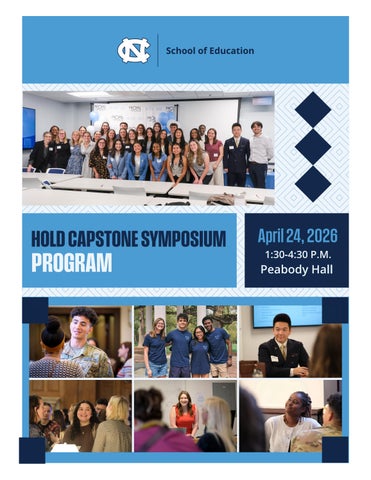
2026 HOLD Capstone Symposium Program Booklet

Page 1


ABOUT HOLD

The Human and Organizational Leadership Development (HOLD) program prepares students to lead with purpose across a range of organizational settings. Designed for those who seek to understand how people learn, grow, and work together, the program offers a strong foundation in the science of learning, leadership and organizational theory, research methods, and data-informed decision-making. Students explore how learning and development unfold within mission-driven organizations — businesses, nonprofits, government agencies — and build the skills to navigate these environments with insight and intention.

Through an engaging combination of theory, classroom discussion and engagement, and invaluable professional experiences, HOLD students develop critical thinking, creative problem-solving, collaboration, and communication skills that establish the foundation for careers as dynamic organizational leaders. HOLD’s multidisciplinary and hands-on learning approach prepares graduates for a wide range of leadership careers in human resources, education policy and administration, nonprofit organizations, and government agencies.

SCHEDULE

Session Block #3

Session Block #4 4:00 – 4:30 PM

Closing Reception

Welcome + Supervisor Appreciation 4:00 – 4:30 P.M. | Room 2040

2:00 – 2:25 P.M. | 6 Rooms 2:30 – 2:55 P.M. | 7 Rooms 3:00 – 3:25 P.M. | 7 Rooms 3:30 – 3:55 P.M. | 6 Rooms

Session Presentations & Locations

Room # Session 1 - 2:00-2:25 P.M.

3044

G050

G070

2010D

2050D

G040A

Dylan Hammonds American Indian Center

Scholars Connect: A Community-Based Approach to Research

Margaret Batchelder Career Services, Student Leadership Carolina Advantage: StrengthsFinder Leadership Development Program

Ariana Sirotyuk Veradigm Vera-Buddy Mentorship Program

Mia-Paris Spagnoletti UNC Operational Excellence

Nealey Casteen

Expand With Libby

Jess Guillen-Hernandez Versado Training

Room # Session 2 - 2:30-2:55 P.M.

3044

G050

Noah Houston

Jasmine Berry

G070

Daphne Stier

2010D

Anna Blair

Cooperative Christian Ministry (CCM)

H.E.A.R.T.S. (Helping Each Adolescent Reach Their Spark)

Leading from Within: Transformative Change Management Training at UNC

Expand with Libby: Building Capacity for a Woman-Owned Small Business

Solidify and Scale Instructional Design at Versado Training

Improving Spanish Language Accessibility at CCM

Building a Standardized HR Framework to Support Organizational Growth at H.E.A.R.T.S.

CORRAL Riding Academy Hay, We Did It: Developing Grant Writing Volunteers and College-Ready Students at CORRAL Riding Academy

Carolina Collegiate High School

2040

2050D

G040A

Trinity Sanders

Clinton Health Access Initiative

Sarah Diener

Riley Holland

Human Recourses Puerto Vallarta (HRPV)

UNC Public Affairs

Recipes for Success: Developing a Robust College Preparation Program at Carolina Collegiate High School

Designing the Manager Development Program at the Clinton Health Access Initiative (CHAI)

Pathway to Progress: Leveling Up Training For HRPV

Carolina in the Capitol: Building UNC’s DC Alumni Network

Reimagining Membership Value & Retention for Carolina Alumni G050 Kassandra Ciriza Monreal

Services- Student Leadership Learn to Lead: A Carolina Advantage G070 Roxanne

Community Academy Family Transitions from Second to Third Grade

Strengthening Communications at the North Carolina Learning Research Network

and

for The UNC Health Service Delivery Team

the Bag: Establishing Sustainable Nutrition Literacy at TABLE

Global Learning in Action: Integrating COIL, Institutional Collaboration, and Malawi Engagement G050

Shubansai Gouru

Strengthening Structure and Culture at Virnika; A Rapidly Growing Voice AI Startup

Can Advocacy-Based Nonprofits Overcome Donor Hesitation in Fundraising Efforts?

Session Presentations & Locations Presenter Details

(Alphabetized by Presenter’s Last Name)

Presenter: Margaret Batchelder  |  Session #1 — 2:00 – 2:25 PM  |  Room G050

Capstone Site: Career Services, Student Leadership

Presentation Title: Carolina Advantage: StrengthsFinder Leadership Development Program

Abstract: Carolina Advantage is a StrengthsFinder-based leadership development program launching at UNC Chapel Hill. Designed to address the absence of a cohesive, university-wide leadership framework, the program integrates Gallup's CliftonStrengths assessment into first-year orientation and expands into a four-year pathway. With secured campus partnerships and funding, Carolina Advantage connects strengths development to career readiness, building student self-awareness, campus belonging, and professional confidence from day one at Carolina.

Presenter: Jasmine Berry  |  Session #2 — 2:30 – 2:55 PM  |  Room G050

Capstone Site: H.E.A.R.T.S. (Helping Each Adolescent Reach Their Spark)

Presentation Title: Building a Standardized HR Framework to Support Organizational Growth at H.E.A.R.T.S.

Abstract: This presentation explores the development of a standardized Human Resources framework to support organizational growth at H.E.A.R.T.S., a youth�serving nonprofit in Durham, North Carolina. Through analyzing onboarding gaps, documentation inconsistencies, and role clarity challenges, this project produced updated manuals, job descriptions, and onboarding training pathways designed for long�term sustainability. Attendees will learn how intentional HR systems strengthen retention, improve organizational consistency, and empower staff and volunteers. Reflections highlight key lessons in leadership, systems thinking, and mission�aligned design.

Presenter: Anna Blair |  Session #2 — 2:30 – 2:55 PM  |  Room 2010D

Capstone Site: Carolina Collegiate High School

Presentation Title: Recipes for Success: Developing a Robust College Preparation Program at Carolina Collegiate High School

Abstract: Rapid advancements in AI and shifting labor market demands are redefining college readiness. High schools must adapt to ensure students thrive in this evolving landscape. This project identifies challenges and best practices in college preparation by synthesizing a literature review with five focus groups (including students and parents) and comprehensive student and community surveys. The findings inform school leaders and stakeholders about best practices to align secondary education with post-graduation success.

Presenter: Emily Cancro | Session #4 — 3:30 – 3:55 PM | Room G040A

Capstone Site: Carolina Athletics

Presentation Title: Carolina Athletics: Driving Student Attendance and Engagement Through Data-Driven Insights

Abstract: This presentation explores Carolina Athletics Marketing’s initiative to enhance its promotional strategy through research-driven insights further. It centers on leveraging insights gathered from an annual student survey to understand better student motivations, preferences, and behaviors related to game attendance. These findings are complemented by a targeted analysis of peer institutions to provide additional context and benchmarking. By integrating firsthand research with external insights, the approach enables more informed decision-making, refined promotional planning, and enhanced student engagement across athletic events.

Presenter: Nealey Casteen | Session #1 — 2:00 – 2:25 PM | Room 2050D

Capstone Site: Expand With Libby

Presentation Title: Expand with Libby: Building Capacity for a Woman-Owned Small Business

Abstract: This presentation examines strategies to increase organizational capacity for Expand with Libby, a solo Enneagram coaching and consulting practice. The project addresses the challenge of targeting qualified client inquiries while maintaining personalized engagement, given limited administrative capacity. Structured outreach, AI-supported workflows, social media branding, lead tracking, and centralized email communication streamlined the process of reaching ideal clients and improved operational efficiency. The presentation outlines the project plan, impact, and recommendations to support meaningful, authentic client connections and sustainable growth.

Presenter: Kassandra Ciriza Monreal | Session #3 — 3:00 – 3:25 PM | Room G050

Capstone Site: Career Services- Student Leadership

Presentation Title: Learn to Lead: A Carolina Advantage

Abstract: UNC’s mission includes preparing the next generation of leaders. To further support student development, the university is investing in the implementation of the Gallup StrengthsFinder Assessment as a leadership development tool available to all incoming students. This presentation will outline the background of the program and describe the key steps involved in its implementation.

Presenter: Sarah Diener | Session #2 — 2:30 – 2:55 PM | Room 2050D

Capstone Site: Human Recourses Puerto Vallarta (HRPV)

Presentation Title: Pathway to Progress: Leveling Up Training For HRPV

Abstract: This presentation outlines the development of a structured training and promotion framework for Human Resources Puerto Vallarta (HRPV), a remote support firm. By addressing inconsistencies in international onboarding, the project introduced a modular competency model and standardized operating procedures. The framework establishes clear performance benchmarks and transparent pathways for advancement. Attendees will learn how these systems professionalize remote workflows, reduce the time required for new hires to work independently, and foster long-term organizational growth.

Presenter: Roxanne Dudley | Session #3 — 3:00 – 3:25 PM | Room G070

Capstone Site: Carolina Community Academy

Presentation Title: Carolina Community Academy Family Transitions from Second to Third Grade

Abstract: Interested in family engagement, the whole child, or standardized testing? Come learn about Carolina Community Academy's second to third grade transition. The K-2 lab school is associated with UNC-CH's School of Education and Person County Schools. This discussion will address current practices, community feedback, and sustainability.

Presenter: Gilda Ferrie | Session #4 — 3:30 – 3:55 PM | Room G070

Capstone Site: NC Cure

Presentation Title: How Can Advocacy-Based Nonprofits Overcome Donor Hesitation in Fundraising Efforts?

Abstract: My capstone project centered on my engagement with NC CURE (Citizens United for Restorative Effectiveness), particularly through fundraising efforts for their “Running for Restoration 5k" event. The objective of this undertaking is to comprehend the reasons behind individuals' reluctance to donate to nonprofit organizations perceived as political, as well as to investigate strategies that can enhance the effectiveness of fundraising initiatives. A significant aspect of this research involves examining how messaging, outreach, and incentives can affect individuals' willingness to support various causes.

Presenter: Shubansai Gouru | Session #4 — 3:30 – 3:55 PM | Room G050

Capstone Site: Virnika

Presentation Title: Strengthening Structure and Culture at Virnika; A Rapidly Growing Voice AI Startup

Abstract: As early-stage startups rapidly scale, they may outgrow existing informal structures revealing operational gaps hindering the team's progress. At Virnika, a Chapel Hill-based startup building a suite of Voice AI agents for restaurants, I conducted interviews with the entire team and surfaced unique insights. These findings informed the creation of scalable recommendations following Entrepreneurial Operating System frameworks around building long-term operational workflows, greater role clarity, and product road mapping.

Presenter: Victoria Griffin | Session #4 — 3:30 – 3:55 PM | Room 2050D

Capstone Site: Mount Airy High School

Presentation Title: Leveled Literacy Interventions in English II Classrooms

Abstract: This presentation outlines the implementation of a Leveled Literacy Intervention (LLI) inspired program in high school English II classrooms at Mount Airy High School. It is designed to address diverse reading abilities among sophomore students; the program adapts traditionally elementary LLI structures to meet the academic and developmental needs of secondary learners. The instructional framework emphasizes EOC-aligned comprehension skills, vocabulary development, and active reading strategies. Students engage in structured, collaborative learning environments while facilitators circulate to provide individualized support and promote engagement. Observations indicate increased student participation, improved reading confidence, and stronger written responses aligning with NC grade-level standards. This project demonstrates how LLI principles can be effectively adapted to a high school setting to enhance literacy outcomes and support diverse learners.

Presenter: Jess Guillen-Hernandez | Session #1 — 2:00 – 2:25 PM | Room G040A

Capstone Site: Versado Training

Presentation Title: Solidify and Scale Instructional Design at Versado Training

Abstract: Versado is a training and adult education organization in the life sciences industry but at its core it is an instructional design (ID) company. ID at Versado has been so successful that the company is growing quickly- profits are breaking company records and the internal team has grown by over 30% to keep up!

Presenter: Dylan Hammonds | Session #1 — 2:00 – 2:25 PM | Room 3044

Capstone Site: American Indian Center

Presentation Title: Scholars Connect: A Community-Based Approach to Research

Abstract: The development and impact of Scholars Connect, a program created through the American Indian Center, strengthens scholarly engagement among undergraduate students. Grounded in community-based support, the program provides a low-pressure space for students to share research, build skills, and connect with mentors. The program’s structure, implementation, and outcomes highlight how culturally grounded, relationship-centered approaches can improve student confidence, academic belonging, and long-term engagement in research.

Presenter: Devon Henderson | Session #3 — 3:00 – 3:25 PM | Room 3044

Capstone Site: Carolina Alumni

Presentation Title: Reimagining Membership Value & Retention for Carolina Alumni

Abstract: The Carolina Alumni Association (CAA) serves as the primary alumni engagement organization for the University of North Carolina at Chapel Hill, connecting more than 371,000 living alumni worldwide. Despite this expansive alumni base, CAA faces a significant membership challenge: approximately only 18% of living alumni hold active paid memberships, and engagement skews heavily toward older demographics, particularly those aged 65 and above.

Presenter: Riley Holland | Session #2 — 2:30 – 2:55 PM | Room G040A

Capstone Site: UNC Public Affairs

Presentation Title: Carolina in the Capitol: Building UNC’s DC Alumni Network

Abstract: Carolina in the Capitol is an initiative designed to create a centralized alumni engagement network connecting UNC students and alumni in Washington, D.C. The project addresses the lack of structured connectivity within one of UNC’s largest alumni hubs by leveraging existing university platforms to build a cost-effective and scalable solution. The network facilitates professional connections, shares job and internship opportunities, and promotes engagement between students and alumni pursuing careers in public service and policy.

Presenter: Noah Houston | Session #2 — 2:30 – 2:55 PM | Room 3044

Capstone Site: Cooperative Christian Ministry (CCM)

Presentation Title: Improving Spanish Language Accessibility at CCM

Abstract: This project focuses on improving the accessibility and quality of Cooperative Christian Ministry's services for Spanish-speaking clients within the organization's financial and food services areas. Cooperative Christian Ministry (CCM) is a nonprofit organization in Concord, North Carolina that provides food, financial, and housing services for families in times of crisis in Cabarrus County and Kannapolis but lacks tools to navigate Spanish language access, the language barrier and anxiety around receiving assistance and enhancing service for Spanish-speaking clients.

Presenter: Emma Montero | Session #3 — 3:00 – 3:25 PM | Room 2050D

Capstone Site: TABLE

Presentation Title: Beyond the Bag: Establishing Sustainable Nutrition Literacy at TABLE

Abstract: The "Beyond the Bag" initiative establishes a digital toolkit to complement TABLE’s in-person education programming, promoting nutrition education retention among food-insecure families in Orange County. By compiling community-created on-demand videos, short-form content, and kid-friendly recipes, this project bridges the knowledge gap of families between monthly in-person events and weekly deliveries. This model, sustained through a comprehensive Intern Playbook, empowers families with culinary knowledge and product-specific expertise, ensuring equitable access to both nutritious food and the information necessary to leverage it.

Presenter: Samantha Morinville | Session #4 — 3:30 – 3:55 PM | Room 3044

Capstone Site: UNC School of Nursing

Presentation Title: Global Learning in Action: Integrating COIL, Institutional Collaboration, and Malawi Engagement

Abstract: This capstone examines how intentional collaboration across three university offices within the School of Nursing can strengthen global engagement initiatives. It highlights the role of Collaborative Online International Learning (COIL) in fostering cross-cultural exchange and integrating global perspectives into academic spaces. Drawing on applied work with partners in Malawi, the project demonstrates how aligned communication and coordinated efforts enhance program effectiveness. The findings underscore the importance of institutional connectivity in advancing sustainable, equity-centered global partnerships and improving outcomes across diverse educational and community contexts.

Presenter: Riley Peltz | Session #3 — 3:00 – 3:25 PM | Room 2040

Capstone Site: UNC Health

Presentation Title: Quality and Growth for The UNC Health Service Delivery Team

Abstract: UNC Health employs more than 40,000 individuals, as a result maintains a multi-tiered Human Resources structure to manage a wide range of employee inquiries. The Service Delivery Team functions as the initial point of contact for all HR-related cases. Due to the high volume of cases, UNC Health has faced challenges in establishing a consistent and sustainable measurement for the quality of information provided by the advisors. This project introduced a standardized framework to evaluate and improve the accuracy of information provided by the Service Delivery Team.

Presenter: Trinity Sanders | Session #2 — 2:30 – 2:55 PM | Room 2040

Capstone Site: Clinton Health Access Initiative

Presentation Title: Designing the Manager Development Program at the Clinton Health Access Initiative (CHAI)

Abstract: This capstone project focuses on the design of a blended Manager Development Program (MDP) for the Clinton Health Access Initiative (CHAI), aimed at strengthening core people management skills among global managers. While CHAI has historically relied on on-the-job learning and virtual training, increasing organizational expectations around performance development have highlighted the need for more applied, practice-based learning experiences.

Grounded in needs assessment data (including stakeholder interviews, focus groups, and review of existing training) this project identifies key gaps in areas such as feedback delivery, navigating performance challenges, cross-cultural management, and leading through change. In response, the MDP is structured as a multi-day, in-person program that builds on CHAI’s existing online Manager Foundations Program and emphasizes real-world application through a “through-line challenge,” where participants work on a live management issue from their own context.

Presenter: Ariana Sirotyuk | Session #1 — 2:00 – 2:25 PM | Room G070

Capstone Site: Veradigm

Presentation Title: Vera-Buddy Mentorship Program

Abstract: Mentorship plays a vital role in professional growth, with 98% of Fortune 500 companies implementing formal programs to support employee development. This presentation explores the value of mentorship in leadership skills, engagement, and organizational success. It also highlights how Veradigm will integrate mentorship this summer, creating meaningful connections and growth opportunities. Understanding mentorship’s impact demonstrates how it benefits both individuals and organizations, driving long-term development and a more empowered, supported workforce.

Presenter: Mia-Paris Spagnoletti | Session #1 — 2:00 – 2:25 PM | Room 2010D

Capstone Site: UNC Operational Excellence

Presentation Title: Leading from Within: Transformative Change Management Training at UNC

Abstract: Operational Excellence at University of North Carolina at Chapel Hill seeks to address limited capacity for supporting campus change initiatives by developing a scalable change management training workshop. This project outlines the creation and implementation of comprehensive training materials to empower campus partners to independently lead transformation efforts. By increasing organizational capability, strengthening partnerships, and reducing internal workload, the initiative promotes continuous improvement while enhancing professional development and institutional effectiveness across the Carolina community.

Presenter: Daphne Stier | Session #2 — 2:30 – 2:55 PM | Room G070

Capstone Site: CORRAL Riding Academy

Presentation Title: Hay, We Did It: Developing Grant Writing Volunteers and College-Ready Students at CORRAL Riding Academy

Abstract: Nestled on a farm, CORRAL Riding Academy combines equine-assisted psychotherapy with academic and life skills programming for adolescent girls, making grant funding essential to its mission. As a Development Intern, I expand capacity by designing a training program to onboard a grant writing volunteer team. As an Education Intern, I support college and career readiness through lessons, college tours, and a career fair, helping harness the potential of the organization and the teens we serve.

Presenter: Andrea Sydow | Session #3 — 3:00 – 3:25 PM | Room G040A

Capstone Site: University Development Office

Presentation Title: UDO Onboarding Toolkit

Abstract: My toolkit presentation explains a structured onboarding solution for new frontline fundraisers at UNC. It highlights the problem of inconsistent onboarding and introduces a clear 90-day framework with actionable steps, key systems like Davie, and essential support teams. The toolkit is designed to help new hires build confidence, understand expectations, and start strong in their roles. It also reflects insights from staff interviews and focuses on making onboarding more consistent, practical, and effective across the organization.

Presenter: Aidan Williams | Session #3 — 3:00 – 3:25 PM | Room 2010D

Capstone Site: North Carolina Learning research Network

Presentation Title: Strengthening Communications at the North Carolina Learning Research Network

Abstract: The NC Learning Research Network (NCLRN) connects education researchers, practitioners, and policymakers across North Carolina to promote learning research and evidence-based practice. Despite its broad network, NCLRN faced a communication gap: an outdated, hard-to-navigate website and no consistent outreach left stakeholders under informed and disengaged. This capstone project addressed these gaps through two initiatives. First, it restructured the website, auditing and reorganizing over 40 pages, rewriting content for clarity and accessibility, standardizing navigation and branding, and creating a style guide for sustainability. The site was also registered as a UNC domain, boosting credibility and discoverability. Second, a monthly newsletter was revived, now reaching over 100 stakeholders per issue. These efforts have created a more accessible, professional, and sustainable communication infrastructure to strengthen stakeholder relations and amplify NCLRN's impact in North Carolina's education research community.

Presenter: Abigail Workman | Session #4 — 3:30 – 3:55 PM | Room 2010D

Capstone Site: Discovery Education

Presentation Title: Social Studies Essentials

Abstract: Discovery Education is an ed-tech corporation that serves students and educators across the world. Recently, the company determined they lack offerings that bridge the gap between their core and supplemental curriculum. This perceived gap led to the creation of the Social Studies Essentials Project, with a goal to develop "Pathway-to-Core" curriculum containing ready-to-use lessons and assessments. As a part of this project, the Assessments Team set out to create six units worth of assessments for Grades K-5.

ACKNOWLEDGMENTS

With gratitude to our partners and capstone sites.

• BMW

• Boy Scouts of America

• Carolina Athletics

• Carolina Collegiate High School

• Carolina Community Academy

• Carolina Performing Arts

• Career Services

• Clinton Health Access Initiative

• College Advising Corps

• CollegeBound Foundation

• Cooperative Christian Ministry

• CORRAL Riding Academy

• Discovery Education

• Ericsson

• Expand Coaching and Consulting

• Expand With Libby

• Girls on the Run

• H.E.A.R.T.S. (Helping Each Adolescent Reach Their Spark)

• Habitat for Humanity

• Human Resources Puerto Vallarta

• Kelaca

• Mount Airy High School

• NC Cure

HOLD Program Team

• Jemilia Davis, Ph.D. — HOLD Program Director

• Monica Green — Program Support Specialist

• North Carolina Learning Research Network

• North Carolina Teaching Fellows

• NxtWork

• Participate Learning

• Proofpoint

• Room to Read

• Solimar International

• Student Leadership

• TABLE

• The Robert and Janice McNair Educational Foundation

• Toshiba

• UNC American Indian Center

• UNC Health

• UNC Office of Institutional Integrity and Risk Management

• UNC Office of the Chancellor

• UNC Office of Undergraduate Admissions

• UNC Operational Excellence

• UNC Public Affairs

• University Development Office

• Veradigm

• Versado Training

• Virnika

• we are: working to extend anti-racist education

• Samantha Morinville — Programming Assistant

• Peilin Qiu — Graduate Assistant

Congratulations to the HOLD Class of 2026!

Turn static files into dynamic content formats.
Create a flipbook
2026 HOLD Capstone Symposium Program Booklet by UNC School of Education - Issuu