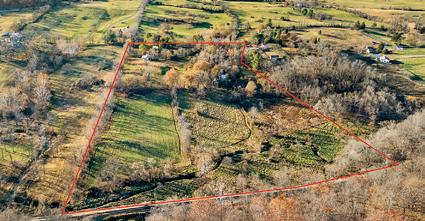
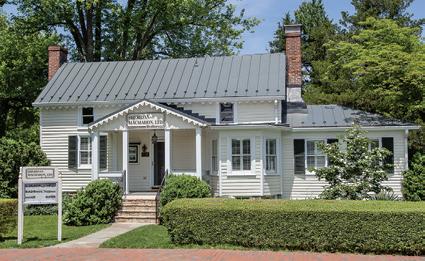
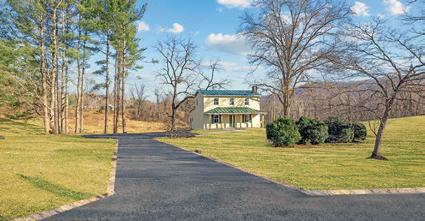
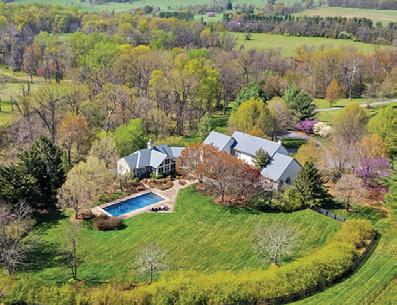
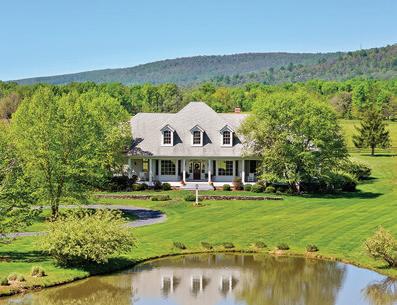
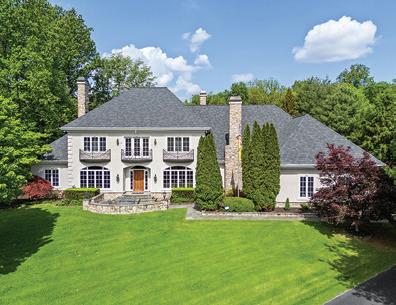
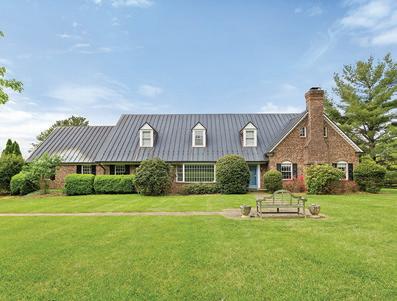
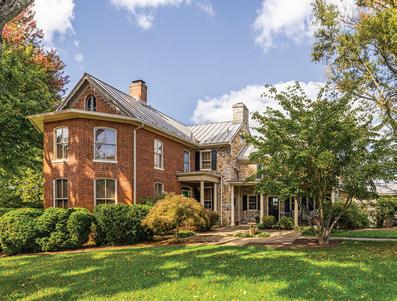
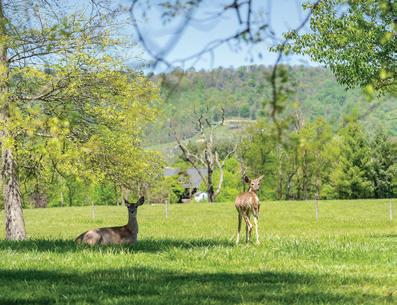
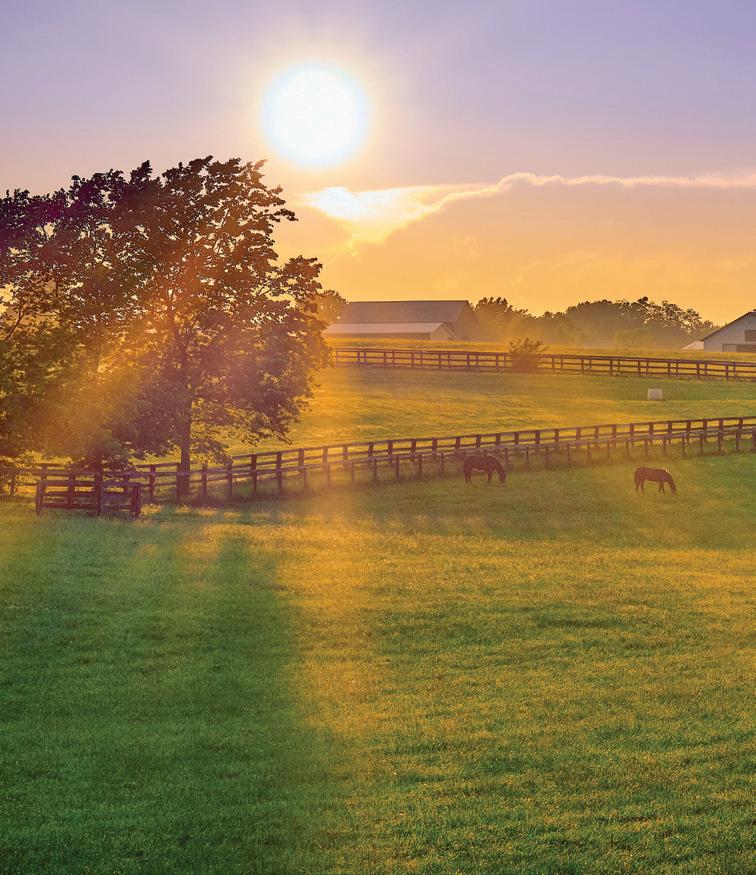
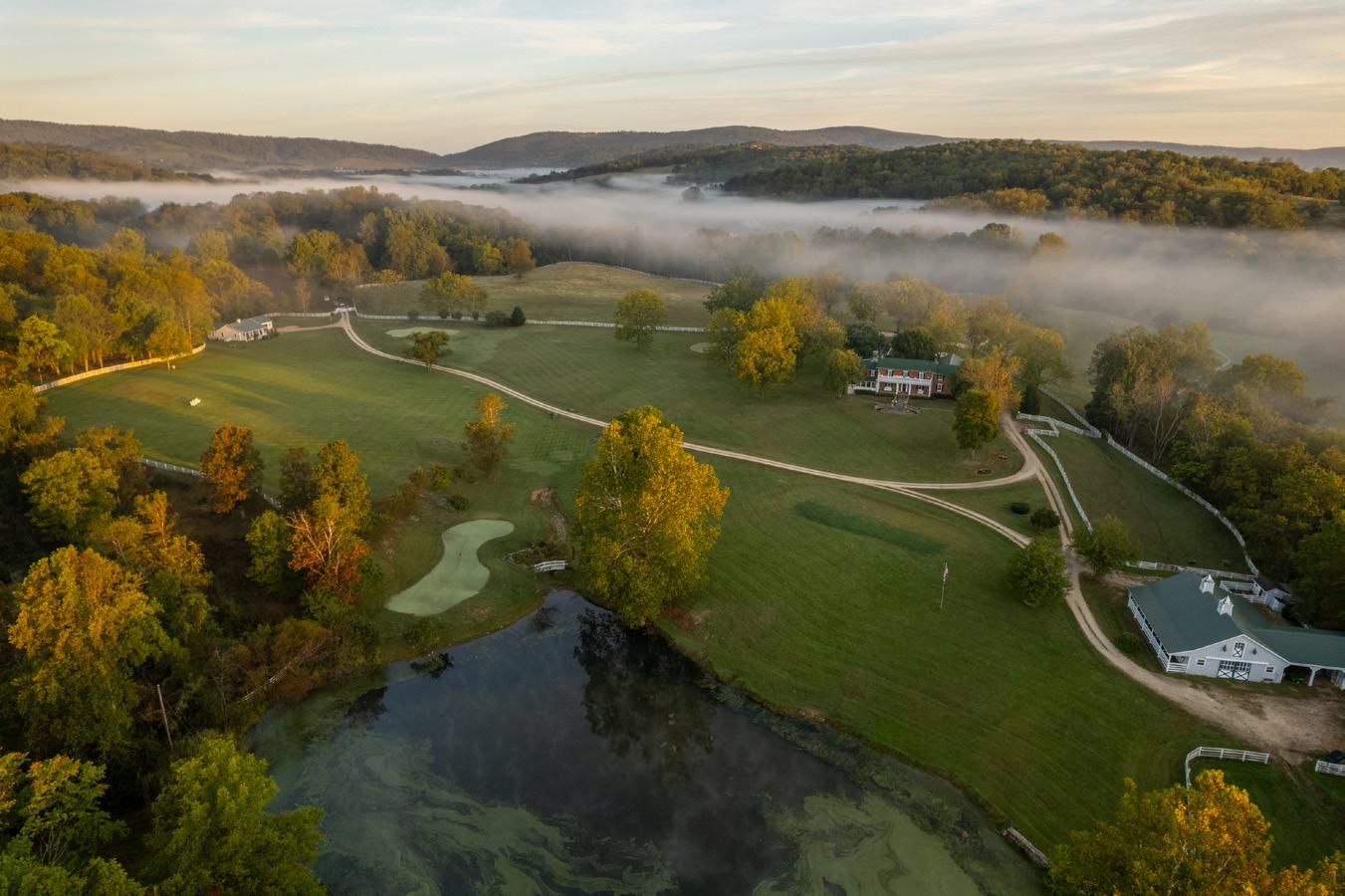
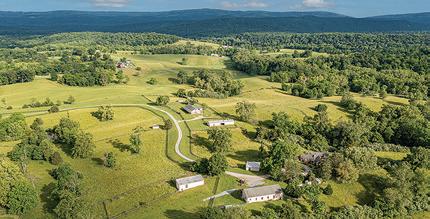
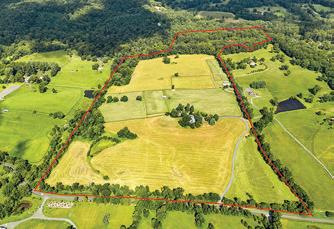
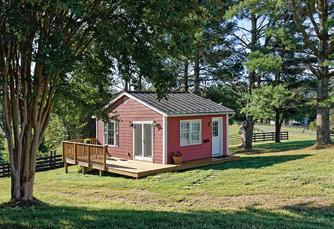
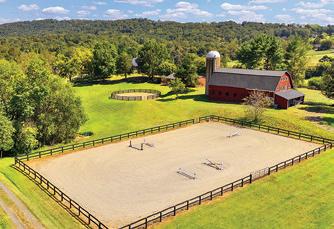
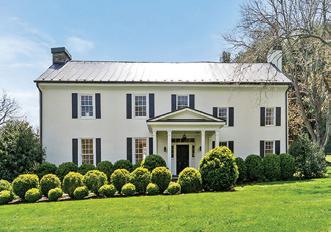
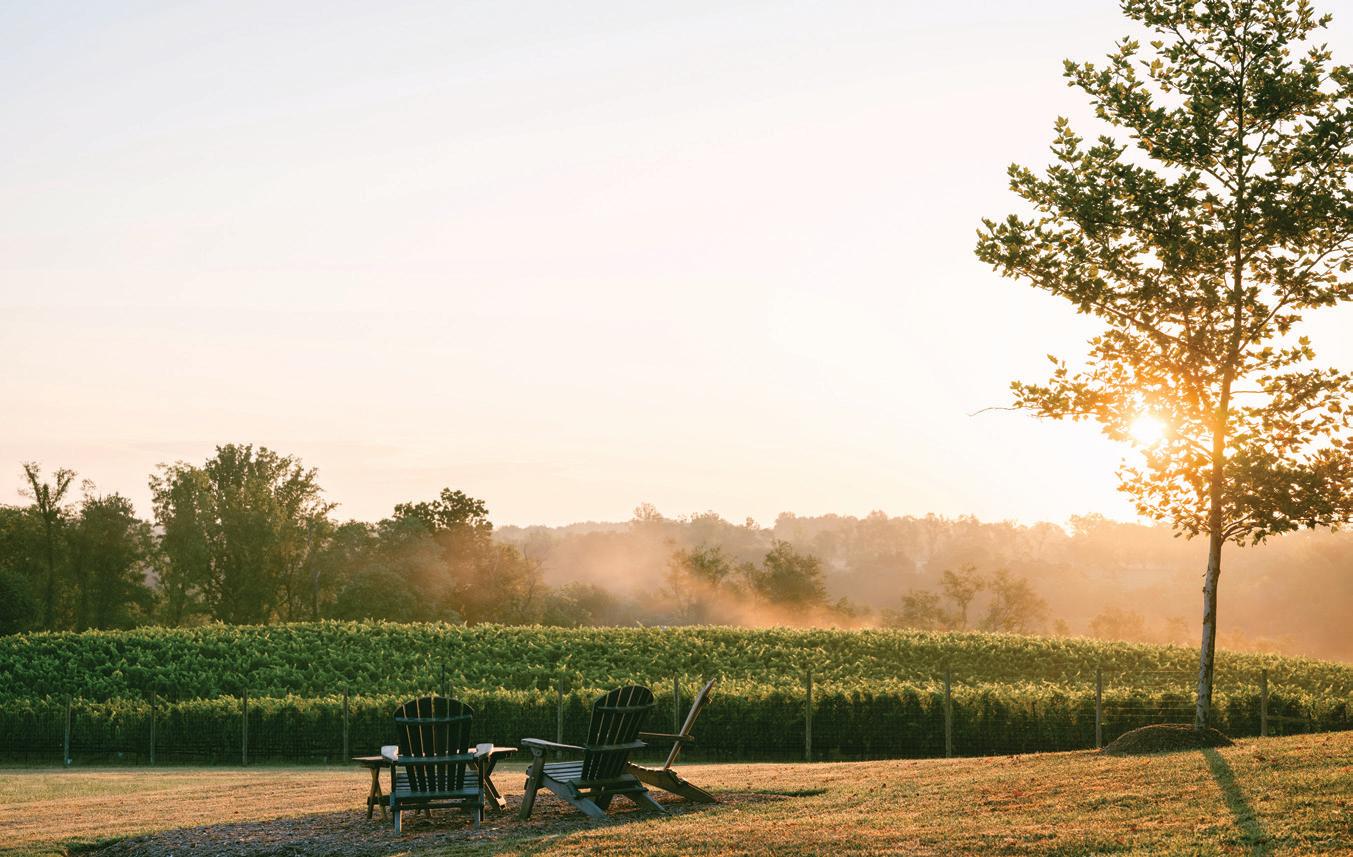
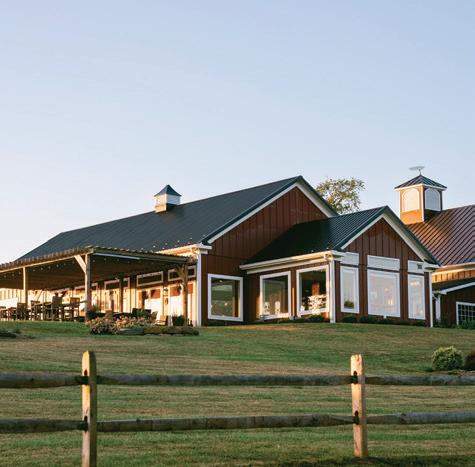
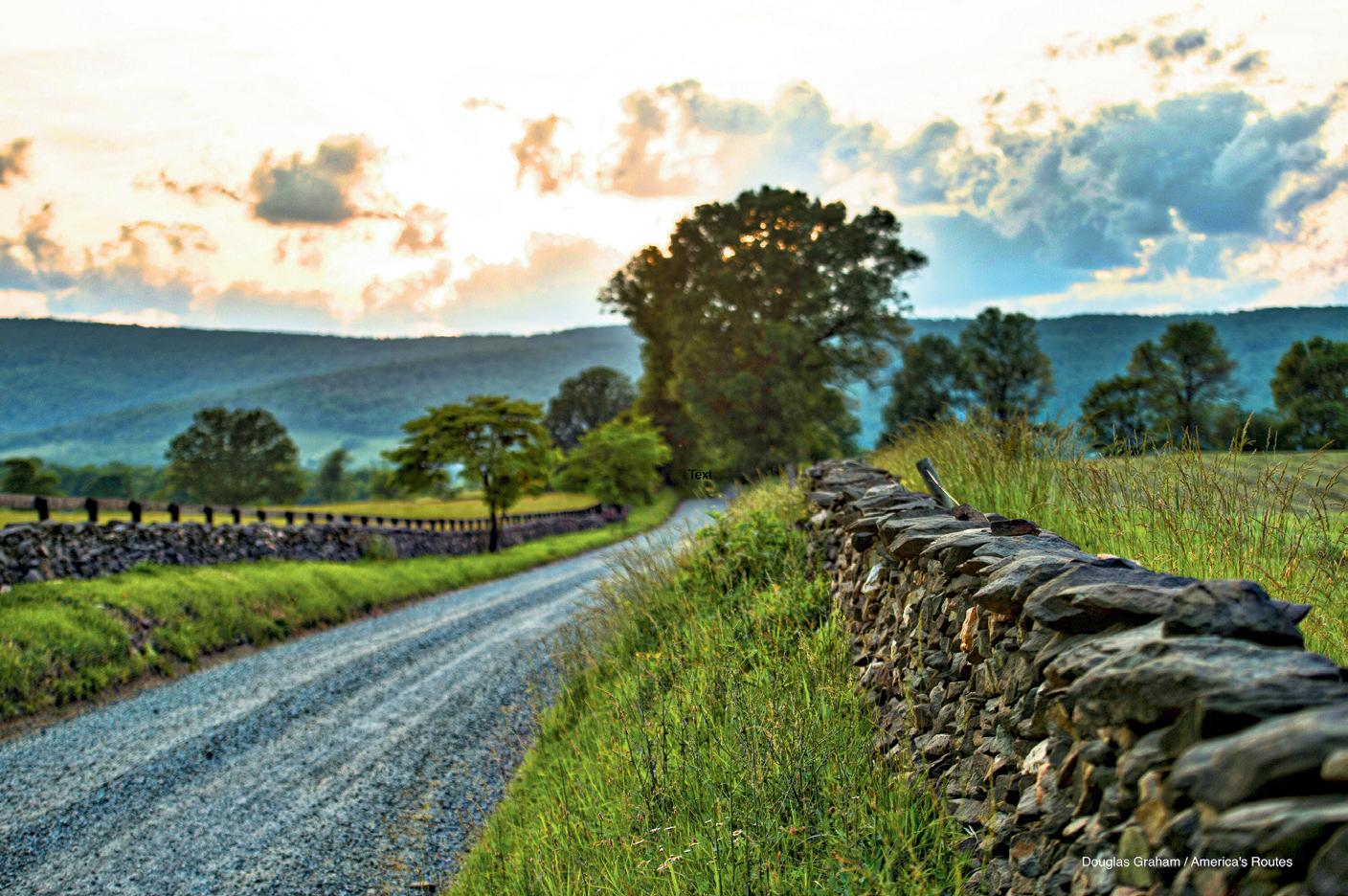
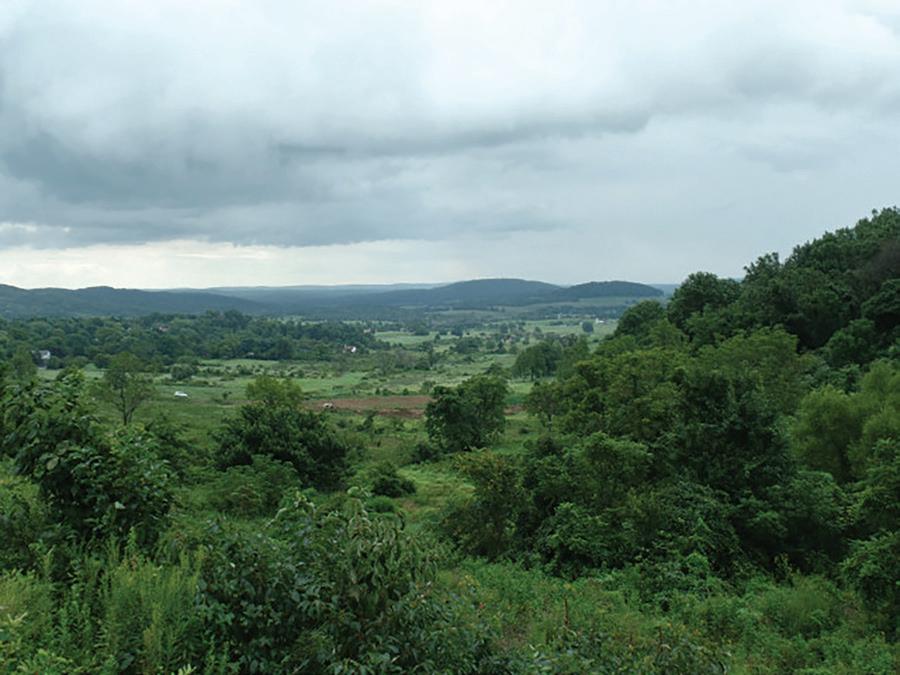
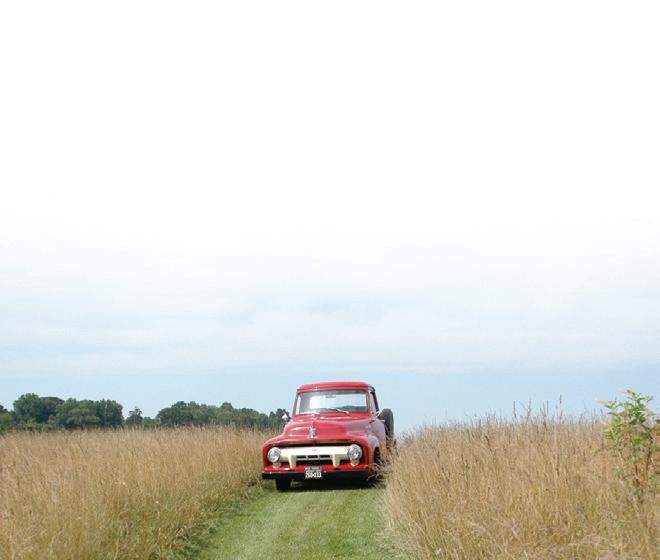
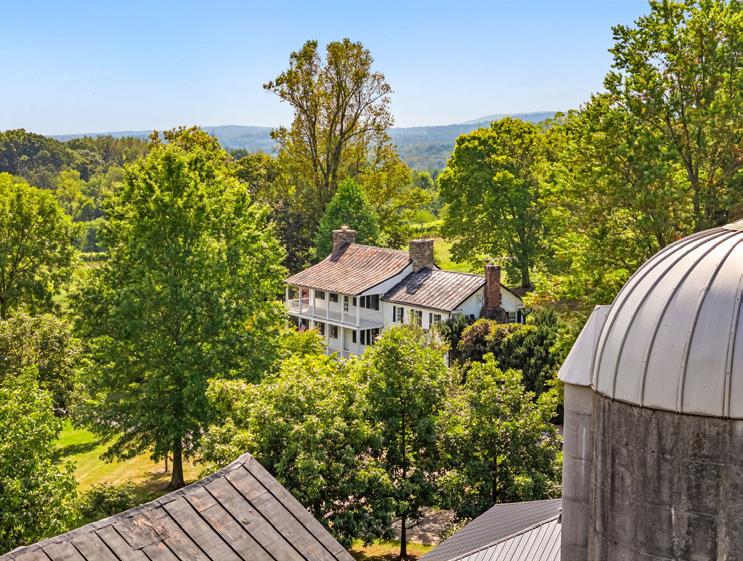
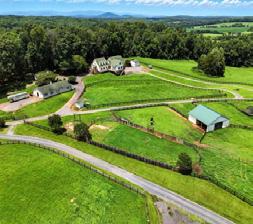
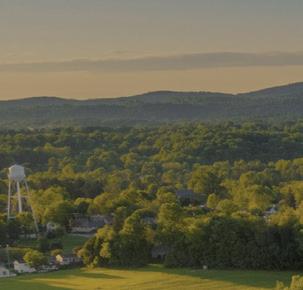
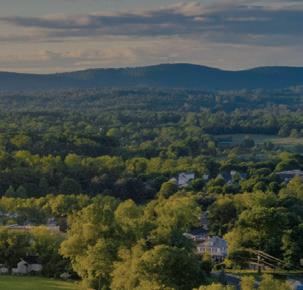
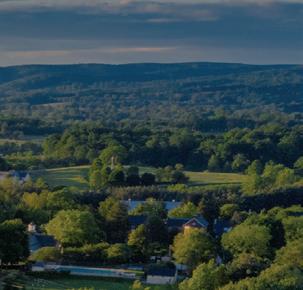
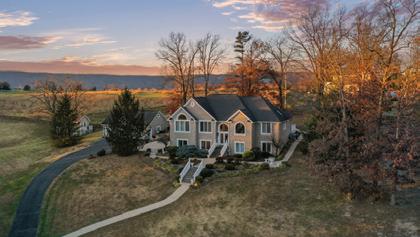
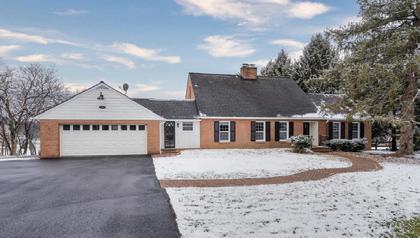
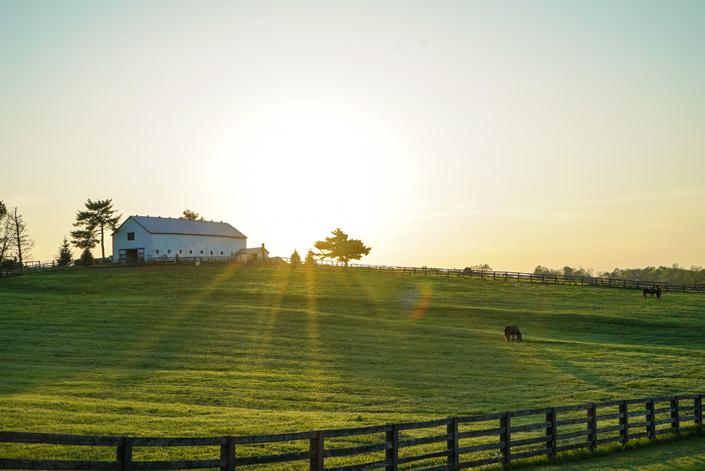
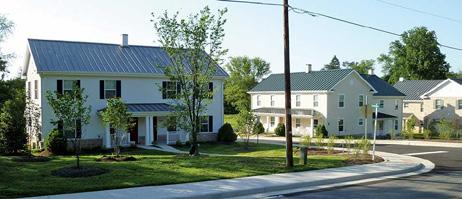
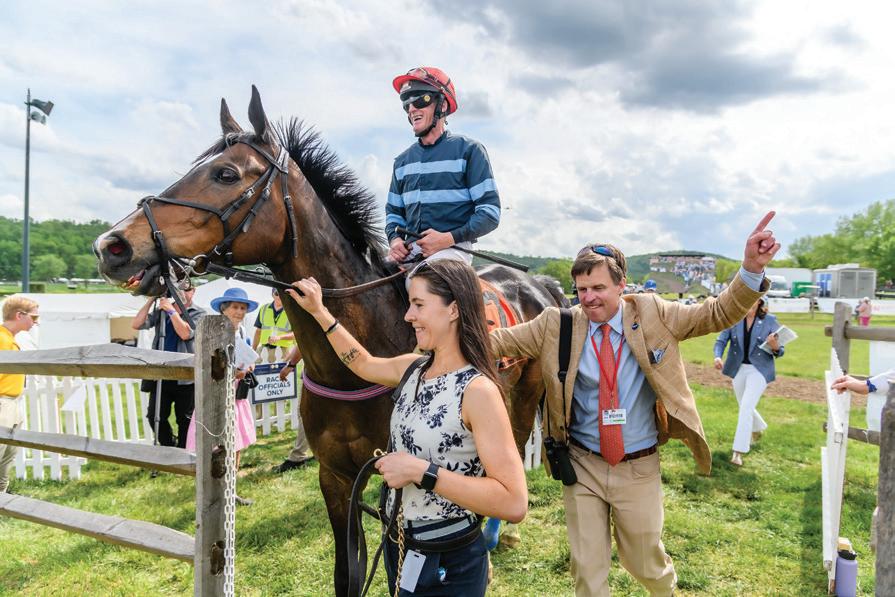
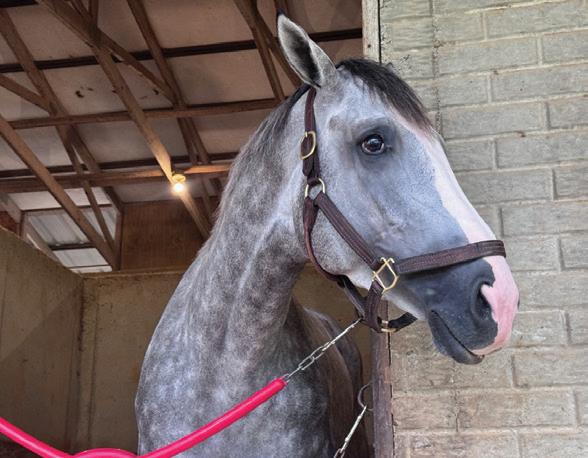
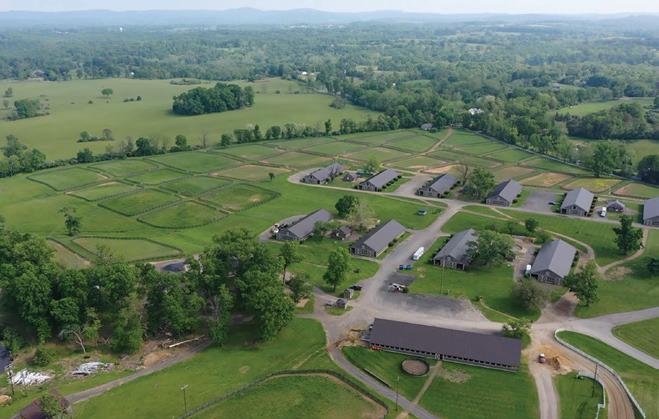
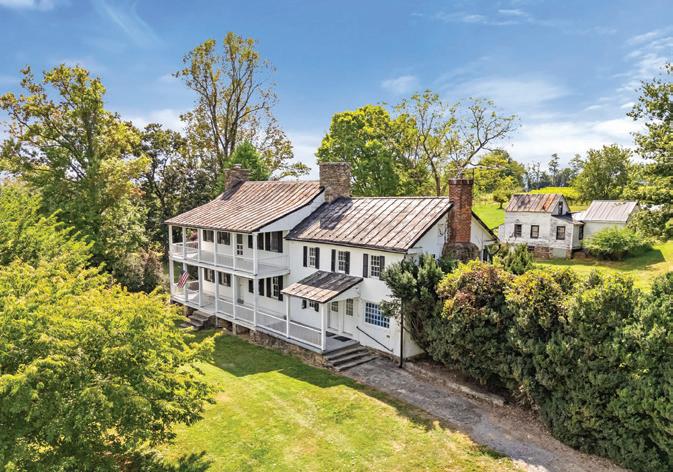
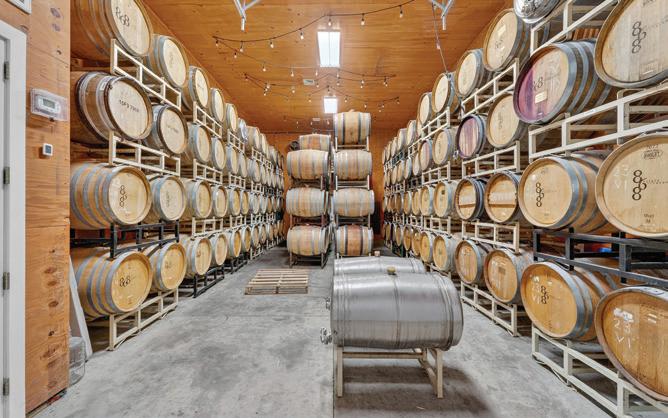
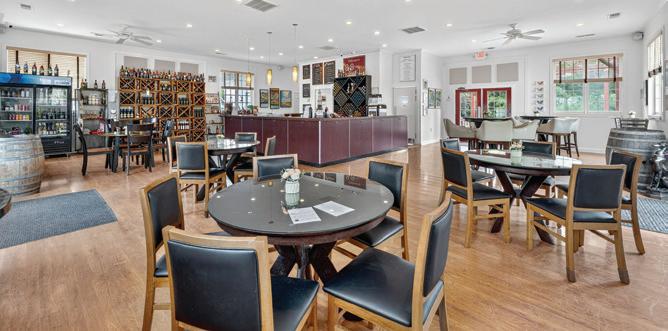
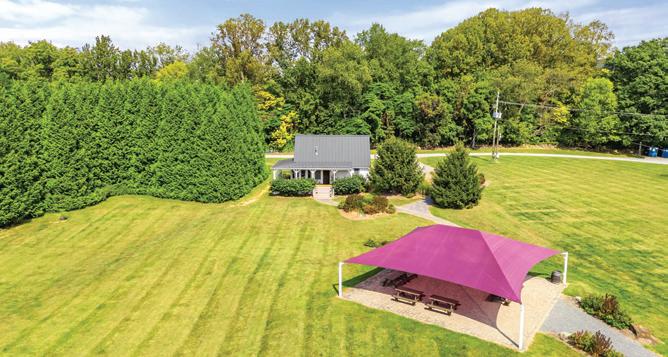
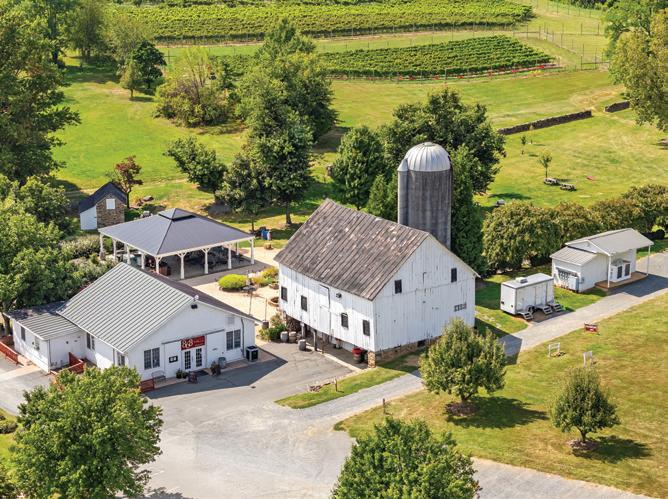
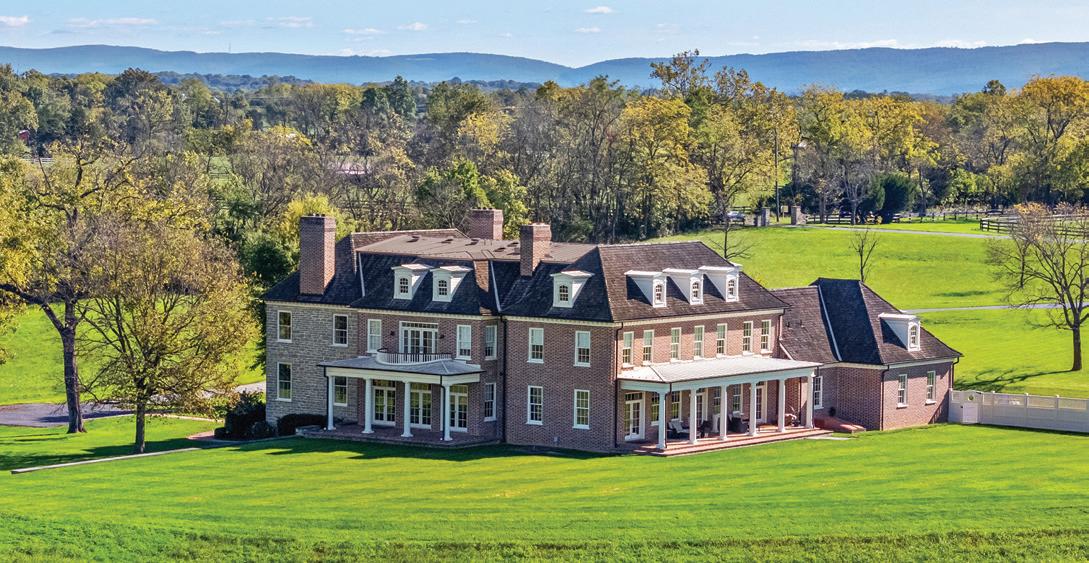
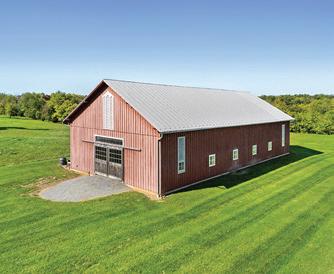
2 recorded parcels totaling 190 acres w/frontage on Old Tavern Rd & Old Winchester Rd across from Great Meadow Farm has been in the same family since the 1940’s | 34.89 acres, zoned R1 potential of 31 lots, balance RA acres can be total of 10 lots | Conservation easement potential | 10 total residences, 9 currently leased month to month | “AS IS” condition Land is gently rolling and mostly open, frontage on Piney Branch, large spring fed pond, mountain views in all directions
$4,950,000
Paul MacMahon 703.609.1905
Brian MacMahon 703.609.1868
CHATTIN
RECTORTOWN, VIRGINIA
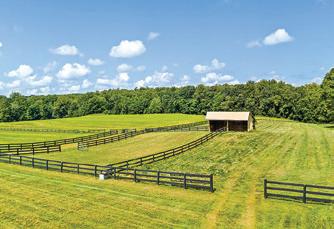
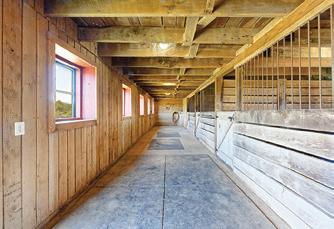
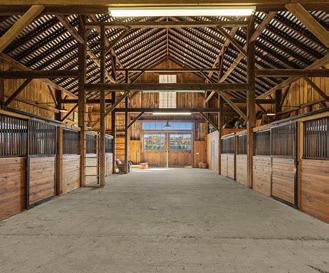
20 acres on Lost Corner Road, recorded in two parcels | Open pasture, two ponds, frontage along Chattin Run & mountain views | Improvements include a main residence (circa 1989) in need of major repair Guest house (circa 1880) w/3 BR, 2 BA, studio space & machine shop Additional structures include a 4-stall barn, making the property suitable for equestrian or agricultural use Located in Orange County Hunt area | Property offered in AS-IS condition
$1,295,000
Paul MacMahon 703.609.1905
Brian MacMahon 703.609.1868
FIERY RUN ROAD
LINDEN, VIRGINIA
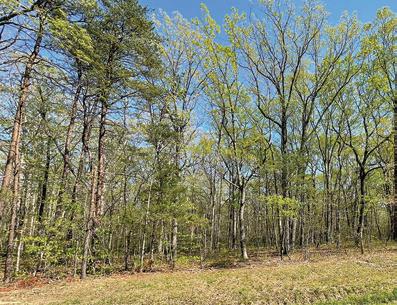
37.59 wooded acres | Private, secluded setting surrounded by large tracts | Elevated build site with potential long-range views | Easy access to Route 66 | Abundant wildlife & mature timber — a hunter’s paradise | Great for outdoor recreation or a peaceful retreat | Established drive/easement for convenient access
$750,000
Paul MacMahon 703.609.1905
Brian MacMahon 703.609.1868
ADA ROAD
MARSHALL, VIRGINIA
240.1 acres in 4 lots | Property is in a Virginia Outdoor Foundation Conservation Easement and may be subject to one division | Stunning views, 120+ acres of highly productive farm land | Remaining acreage is pasture-fenced for cattle or horses | 6-bay equipment building, feed storage, & workshop | Barn with an apartment
$3,750,000
lynn Wiley 540.454.1527
We cover the countryside.
Luxury homes, Virginia horse properties and hunt country real estate in all price ranges.
This is where we live and work… full time.
THE PLAINS, VIRGINIA
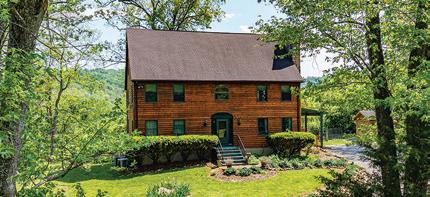
Brick home between The Plains and Warrenton | Main-level living includes 2 BR, 2BA, a living room, a den with wood FP, dining room, & kitchen | Fully finished lower level with a private entrance includes an additional kitchen, bedroom, full bath, & family room with a raised-hearth brick fireplace | Large fenced vegetable garden | Garage, storage shed, & deck spanning the back of the home, accessible from both the kitchen and den
$589,900
GRACE HILL
PURCELLVILLE, VIRGINIA
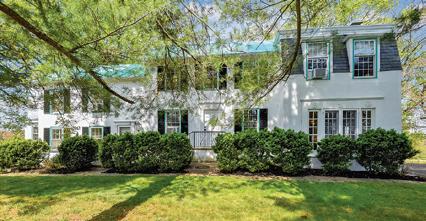
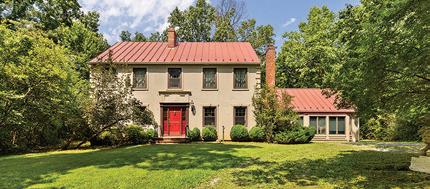
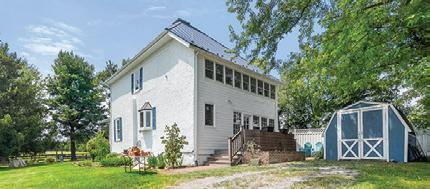
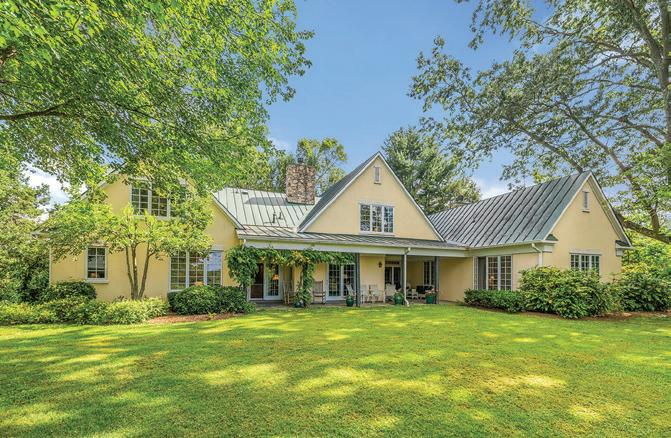
Period home, original portion 1768, additions in 1850 and 1950 | Stucco exterior, metal roof, beautiful wood floor, 4 bedrooms, 2 1/2 baths, 3 fireplaces, spectacular living room with high ceilings | 20.21 acres, recorded in 2 parcels, mountain views | Frontage on Butcher Branch, room for horses, studio/guest house
$1,595,000
Paul MacMahon 703.609.1905
Brian MacMahon 703.609.1868
fireplace | Stucco-over-frame; longtime family property | 9.50 acres, open and rolling | Mountain views; surrounded by large conservation easement farms | Natural spring on property (possible pond site) | Historic barn and family cemetery | Family connection to Mosby’s Rangers
$950,000
MIDDLEBURG, VIRGINIA
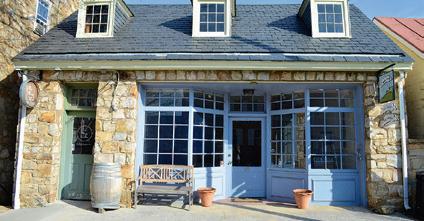
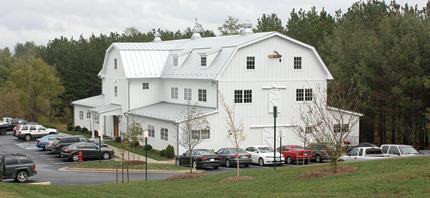
The Old Middleburg Fire House | Lovely stone building centrally located | Bright, open and light filled commercial property Over sized display windows, high ceilings, spacious rooms & an ADA bath | Lower level has small kitchen, store room & additional office w/outside access for deliveries and storage | Great opportunity, charming and tremendous foot traffic | Includes 13 South Madison St. (former Old Town Jail) | Approx. 3,000
Middleburg and The Birth of a Nation
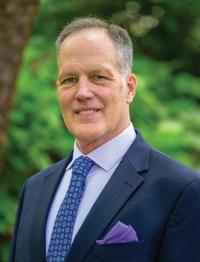
By Bridge Littleton
This year is a big birthday for all of us— America’s 250th—and our community has been at the center of it since our nation’s origins.
Founded in 1787, the Town of Middleburg occupies a distinctive place in the story of the American Republic. Established at the close of the Revolutionary era, Middleburg was born not out of colonial dependence, but in the first breath of national independence—just months before the United States Constitution was ratified.
From its earliest days, the town reflected the aspirations of a new nation rooted in self-government and community. Middleburg’s founder, Levin Powell, was a Revolutionary War officer, statesman, and member of the Virginia House of Delegates.
He laid out the town at a strategic crossroads along the Carolina Road, envisioning a thriving center of trade and civic life for the surrounding countryside.
A Memo from the Mayor
Powell’s decision to found Middleburg at this moment in history was an expression of confidence in the American experiment and in the promise of local self-rule. That spirit—of service, independence, and community—remains embedded in the town’s character more than two centuries later.
As the nation approaches its 250th anniversary in 2026, Middleburg is embracing this historic milestone with a year-long series of monthly commemorative events designed to connect local history with the broader American story.
Rather than a single celebration, the town’s America 250 program will unfold throughout the year, inviting residents and visitors alike to engage with the people, places, and principles that shaped both Middleburg and the nation.
Each month’s event will highlight a theme tied to the founding era and its relevance today—ranging from military service and constitutional governance to agriculture, faith, history and civic responsibility.
Programs will draw on Middleburg’s own history, including its role as a crossroads community, its proximity to key Revolutionary-era sites, and its enduring traditions of public service and preservation.
Lectures, living-history demonstrations, walking tours, student programs, and community gatherings will bring these stories to life in ways that are accessible, educational, and celebratory.
America’s 250th anniversary is not only a moment to reflect on the past, but an opportunity to reaffirm the values that bind communities together. For Middleburg, it is a chance to honor its founding vision, celebrate its enduring sense of place, and invite a new generation to participate in the ongoing work of citizenship.
The themes for programs throughout each month. Stay up to date at the Town’s America 250 page on www.middleburgva.gov/America250
January Middleburg: Celebrating our History and Origins
February Celebrating Black American History
March Middleburg, America and Women’s History
April From Beginnings to Today: The Story of our local Government
May Celebrating American Arts & Culture
July Independence Day Celebration
August Community Policing, Our Story Through National Night Out
Distributed and mailed throughout the Virginia countryside and in Washington and at key Sporting Pursuits and Celebrations
MAILING ADDRESS: P.O. Box 798
Middleburg, Virginia 20118
PHONE: 410-570-8447
Editor: Leonard Shapiro badgerlen@aol.com
Advertising Director Vicky Mashaw
Art Director
Meredith Hancock
Hancock Media
Contributing Photographers:
Doug Gehlsen
Crowell Hadden
Sarah Huntington
Douglas Lees
Karen Monroe
Tiffany Dillon Keen
Donna Strama
Official Fine Artist
Linda Volrath
Contributing Writers:
Khris Baxter
Emma Boyce
Bill Cauley
Sean Clancy
Denis Cotter
Philip Dudley
Mike du Pont
Valerie Archibald Embrey
Michele Husfelt
Alissa Jones
Laura Longley
Hunt Lyman
M.J. McAteer
Jan Mercker
Linda Millington
Joe Motheral
Jodi Nash
Chris Patusky
Tom Northrup
Ali Patusky
Melissa Phipps
Pat Reilly
Linda Roberts
John E. Ross
Constance Chatfield-Taylor
John Sherman
Peyton Tochterman
John Toler
Leslie VanSant
Mike Wipfler
Louisa Woodville
For advertising inquiries, contact: Vicky Mashaw at vickymashaw@icloud.com or 409-381-0441
Leonard Shapiro at badgerlen@aol.com or 410-570-8447
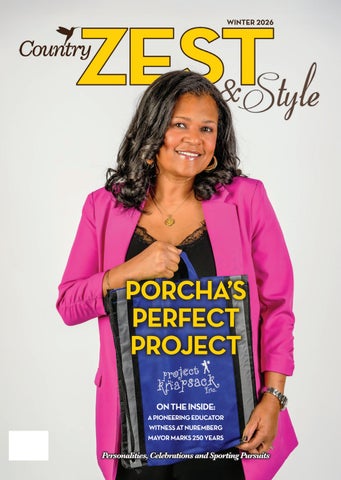
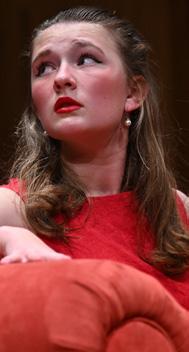
ON THE COVER
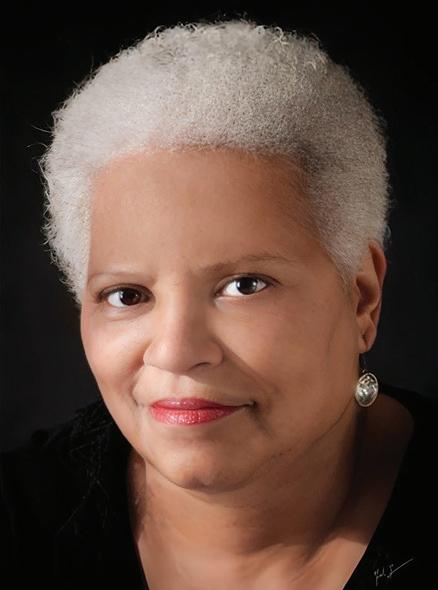
We were delighted to welcome Porcha Dodson to the Middleburg Photo Studio for this issue’s cover feature. It’s always a privilege to photograph the generous spirits who enrich our community, and Porcha was effortlessly captivating in front of the lens. Continued success and heartfelt thanks for the wonderful work you do with Project Knapsack.
/ Country Zest and Style / @countryzestandstyle / @countryzestand1 www.countryzestandstyle.com
BE ON THE LOOKOUT through this issue of for the hummingbird.
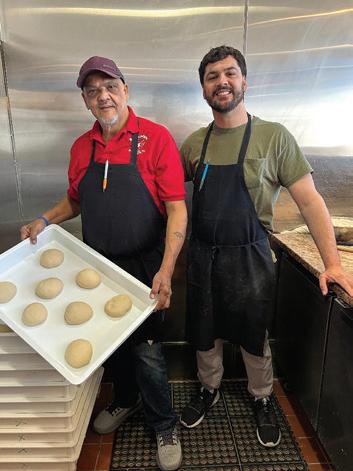
He appears in two ads and the first two readers to find him (one each) will receive a gift from THE RED TRUCK Rural Bakery, with locations in Warrenton and Marshall. Send your reply to badgerlen@aol.com
HISTORY
IN THE MAKING
By Leonard Shapiro
Aslightly belated welcome to 2026, with plenty to celebrate, including our seventh year of publishing Country ZEST. Far more significant, if you’re reading this in February, it’s Black History Month. And over the next 11 months, the entire nation will be marking the 250th anniversary of the nation’s founding.
This winter edition has both of the last two subjects covered nicely. Middleburg Mayor Bridge Littleton starts us off on Page 1 with a short history lesson on the town’s storied past going back to 1787 and a look ahead to a variety of year-long special events in its “Middleburg 250” program.
Charlotte deButts writes about an upcoming Middleburg Museum event, “Black Patriots and Loyalists in the American Revolution,” scheduled for Sunday, Feb. 15 at Buchanan Hall in Upperville. The museum has joined with the Friends of Thomas Balch Library Black History Committee and the Virginia Piedmont Heritage Area Association to bring this often overlooked history to the community.
M.J. McAteer catches us up on the progress being made on the restoration of Middleburg’s Asbury Church as well as details on its oral history project involving former parishioners of the town’s oldest African-American church.
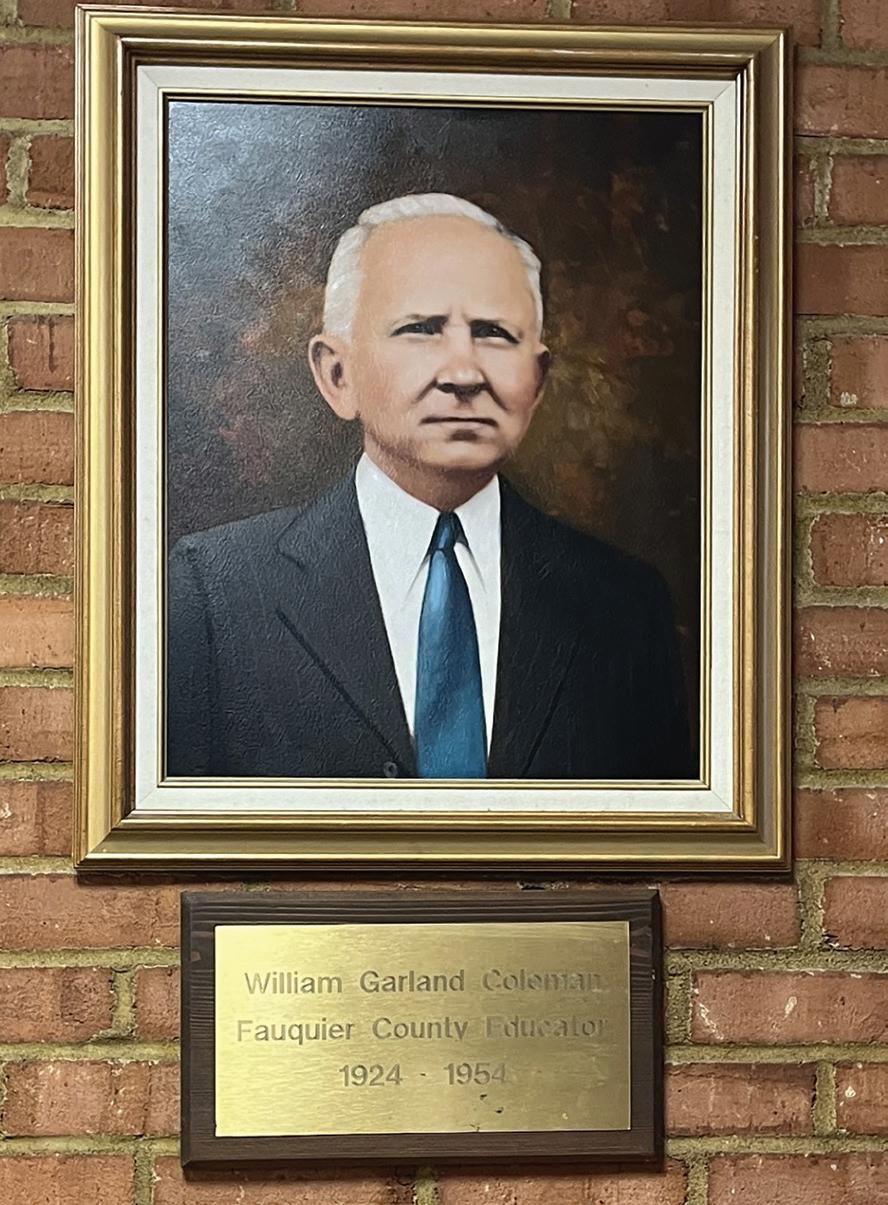
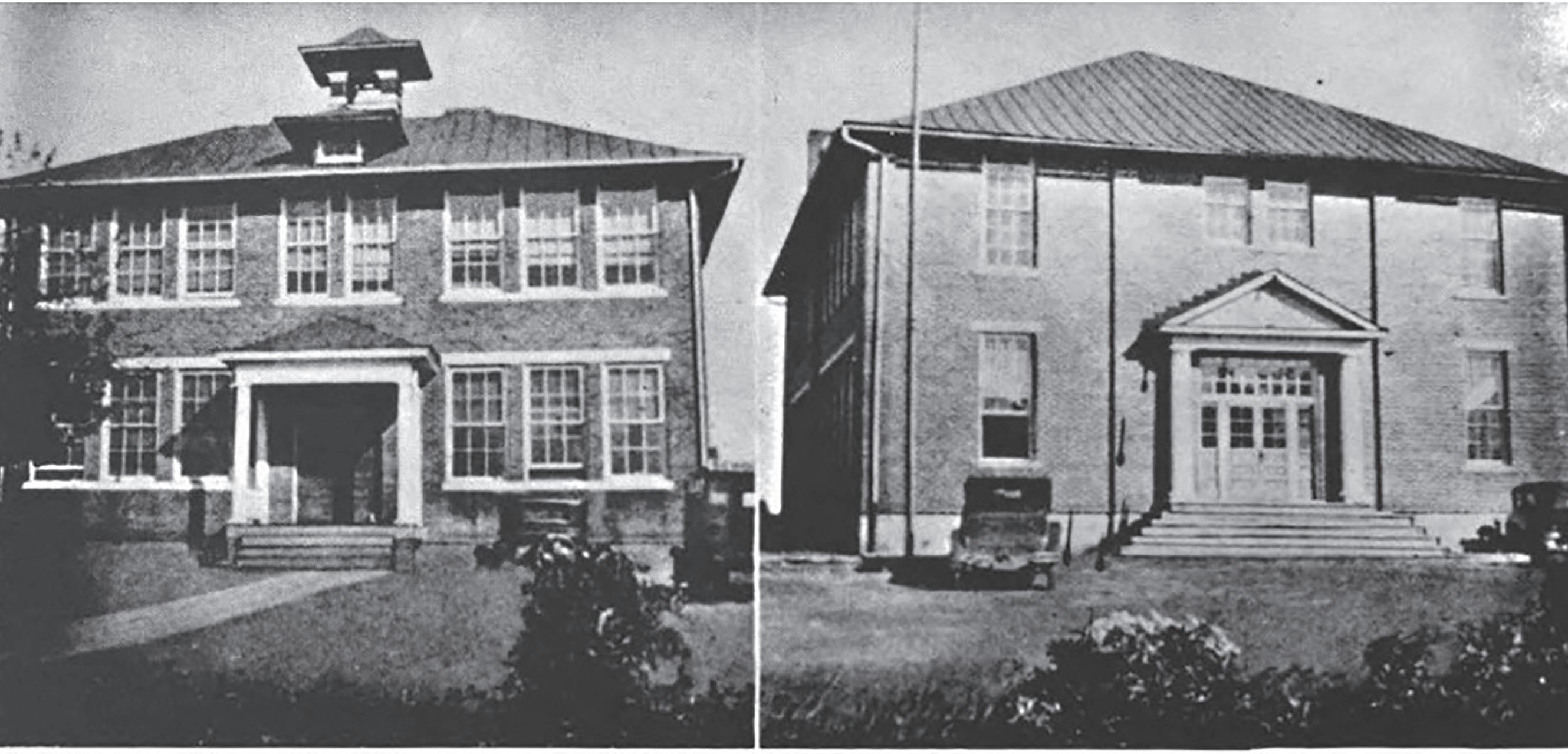
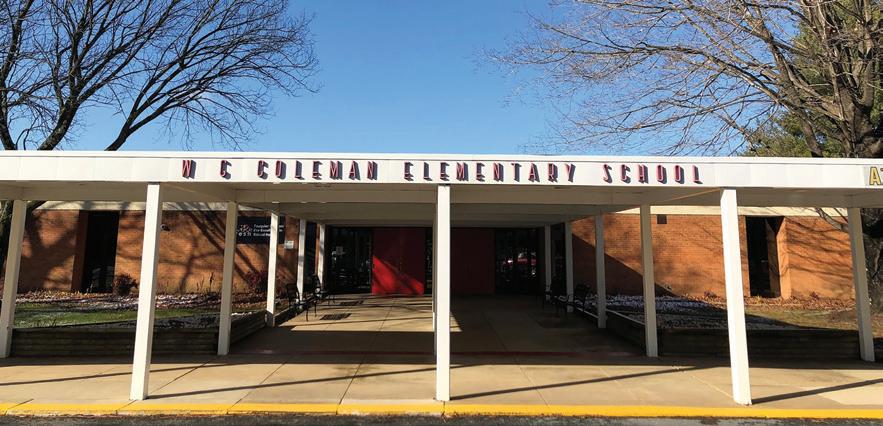
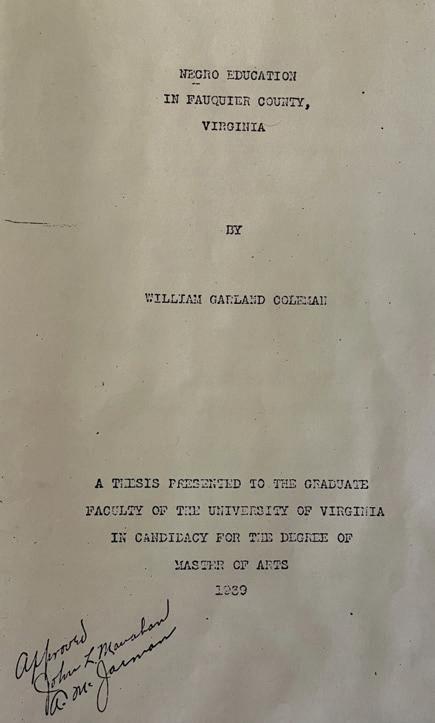
Denis Cotter offers a rigorously researched profile of the late William H. Coleman, a long-ago White Fauquier County educator who did important work in helping to integrate the county’s schools. A Marshall school is named in his honor.
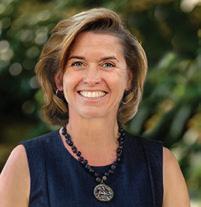
Our cover feature focuses on Porcha Dotson, another long-time Middleburg resident who definitely deserves to be honored for her fabulous philanthropy in recent years as the founder of Project Knapsack. Her foundation provides much needed school supplies, backpacks and more to children in Africa, and recently expanded to include two local schools, as well.
I’ve known Porcha since she was a bright and shining academic and thespian star at The Hill School, and more than three decades later she’s still making her mark in the community, where she also serves on the board of the Middleburg Community Center and is involved in other good causes. The thespian side? Porcha will be doing the narration on an upcoming documentary film based on my wife, Vicky Moon’s book about the first Black female racehorse trainer, Sylvia Rideoutt Bishop.
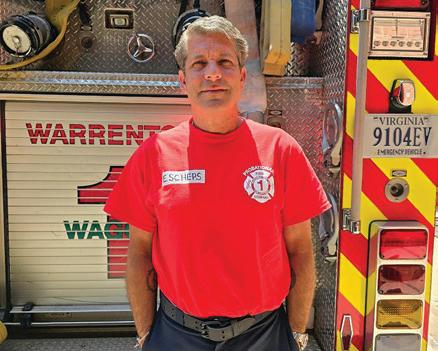
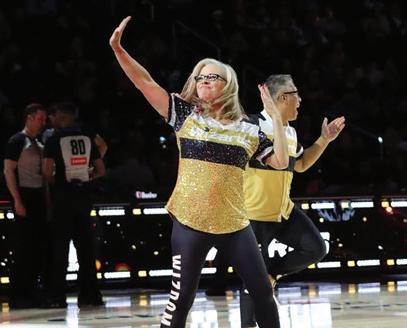
There’s plenty more to enjoy inside. How about Heidi Van Voorhis, a former Redskins cheerleader, now performing in a truly veteran dance troupe at Washington Wizards games. Or Erik Scheps, a former Middleburg Town Council member and pharmaceutical rep deciding to become an Emergency Medical Technician working out of a Warrenton firehouse. Or John Fuog, a local builder who decided on a new career path at age 73 when he opened his own distillery.
And if you’ve seen the intriguing new movie “Nuremberg,” don’t miss John Toler’s fascinating story on a local woman who served as a translator during the trials of Nazi war criminals after World War II.
So yes, it’s a new year, with so much to celebrate, including a lively, informative magazine we hope will add more ZEST to your reading pleasure.
Leonard Shapiro Editor
badgerlen@aol.com 410-570-8447
Doug Gehlsen and Karen Monroe of Middleburg Photo
Bess Putnam: BORN AGAIN IN SWEET SONG
By Peyton Tochterman
Today’s radio hits tend to be formulaic. But some of the best songs written come unannounced, unpolished, and in need of the writer merely having the sense to get out of the way.
On her latest recording, “Dark Hollow,” Bess Putnam’ s song, “Born Again,” came to her just like that, not as an idea to chase but as a truth that tapped her on the shoulder while she was driving through Loudoun County, thinking about a friend and the quiet theology of the land itself.
Bess was raised, as she puts it, “on a rock set into Jesus,” steeped in an evangelical culture. That framework never really leaves you; it hums in the background of your thinking, even when your faith has softened, widened, or been rerouted by time and experience.
On that particular afternoon, she said her thoughts turned to Desi Lee, owner of Hunt Country Gardens and a master gardener, steward of old soil, and someone who understands belonging not as a metaphor, but as a physical, daily practice. What does a person like that believe? Where does her faith live?
The answer came before the question had fully formed. Desi, in Bess’s mind, was already baptized by sweat, by labor, by the ground itself. Born again, not in a church aisle, but in the soil. The realization settled her heart immediately, and the song arrived intact, without argument. There was no resistance, no wrestling with whether the
image was “right.” The song had spoken. Bess listened.
That listening is the through-line of her process. After more than thirty years of writing, she’ s learned that forcing a song only dulls it. These aren ’t compositions so much as visitations.
“I just have to write fast enough to capture it,” she said, trusting that the chords and the words have already found each other somewhere long before they reach her hands. With “Born Again,” they arrived married, lyrics and harmony inseparable, and even brought along her favorite strumming pattern, a rolling, lived-in shuffle that feels like work and prayer happening at the same time.
What’s striking is what the song is not. This was the first time Bess wrote entirely from another person ’s perspective, and she’s clear: the song was never about her. There was no pivot point where it stopped being personal and became universal, because it never belonged to her to begin with. She was a witness, not the subject. That kind of writing requires a rare humility and the willingness to step aside and let someone else’s story breathe without explanation or embellishment.
That humility shows up structurally, too. By any songwriting “rulebook,” “Born Again” breaks form. It ends on a bridge. No final chorus, no tidy resolution. But the song said it was finished, and Bess respected that. Altering it to satisfy expectation would have meant interrupting its
natural arc, and she’s learned not to interfere when a song knows its own ending better than she does.
Even in recording, she followed the song’ s lead. Played alone, an A minor chord dominates, giving it a darker, earth-heavy pull. In the studio, that minor edge softened beneath the mandolin, shifting the emotional center without erasing it. Bess isn’t sure which version she prefers, but preference isn’t the point. The song was moving somewhere, and she chose not to block its path.
“Born Again” is, at its core, a song of reverence, for Desi Lee, whose brilliance lies not just in knowledge but in connection, and for generations of farming hands that have worked the same Loudoun soil. It honors the sacredness of labor, the holiness of tending something larger than yourself. Bess is simply grateful she was still enough to catch it when it passed by.
If there’s excitement in her voice now, it’s not about this song alone, but about what it unlocked: the possibility of telling other people’s stories with care and accuracy through song. If this is what happens when she listens, there’s no telling what stories, what songs, what music might arrive next. But one thing is for sure. Somewhere right now in Loudoun County, the ground is already humming.
Details: Vinyl copies of Dark Hollow are available at Brick and Mortar Mercantile in Middleburg.
Photo by Stephen Putnam Bess Putnam
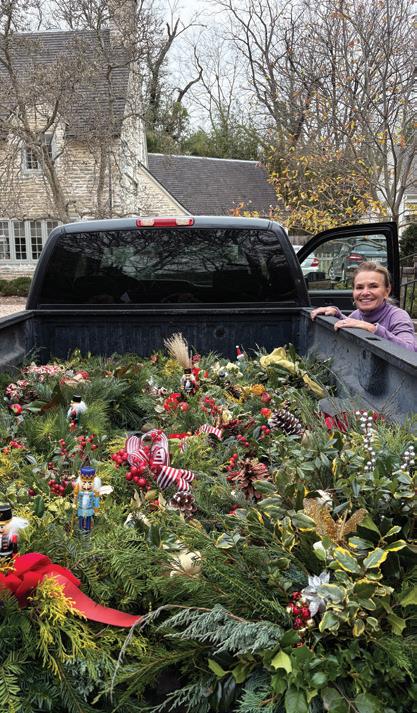
Caroline Helmly with her truck full of arrangements made by the members of the Upperville Garden Club for Seven Loaves. Seven Loaves included an arrangement with each food basket they gave away for Thanksgiving.
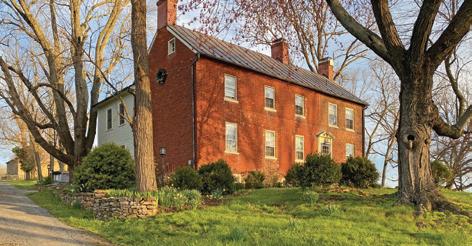
Virginia Department of Historic Resources has listed Laurel Hill Farm as an historic sites as a state landmark. Located in western Loudoun County, the 30acre farm has embodied the history and agricultural roots of the county since the late 18th century. The two-story circa 1793 Federal-style brick dwelling is the property’s main farmhouse and was expanded in subsequent decades.
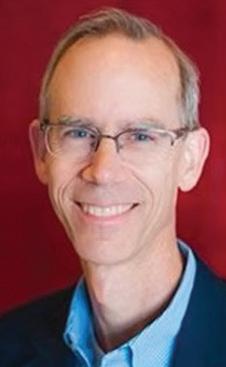
Andrew Bluhm has been president, Board of Directors of Loudoun Symphony for fifteen years, he has been a part of the Loudoun Symphony family, as a musician and now as a board leader. The group has grown from a community orchestra into a polished orchestra. Their youth orchestra program has expanded to four orchestras serving 266 young musicians.
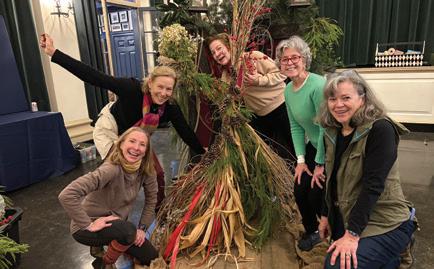
The Fauquier and Loudoun Garden Club Flower Show team at the Middleburg Garden Club’s annual December Flower Show. The team created a vignette design for the interclub “Barn Dance” class and won first place. In the photo (left to right) are Whitney Blanchard, Missy Janes, Joan Kaye, Lauren Woolcott, and Ginger Wallach. With thanks to Elizabeth Courts-president, Fauquier and Loudoun Garden Club.
Fauquier County based Moo Thru, owned by fourth generation dairy farmer Ken Smith, took home three awards in the North American Association’s Annual Ice Cream Clinic recently. The iconic Remington company earned a blue ribbon for its vanilla ice cream, the highest ranking score in the vanilla category. It also earned a red ribbon for its strawberry flavor and white ribbon for its chocolate variety. “If you treat your cows well, they will treat you well and that shines through in out product,” said Taylor Gough, Moo Thru’s production manager.
Photo by Greg Blasz
It’s Books Galore to Adore at Little Free Libraries
By Laurie Salama
When I first moved to the Del Ray section of Alexandria in 2013, I was excited to have sidewalks to walk around, the better to safely explore my new neighborhood.
One day I happened to walk past a house with a two-shelf box on top of a post that was filled with books. It was my first exposure to what has become a worldwide phenomenon—a Little Free Library—at the home of a neighbor, Renee Adams.
Looking through this wonderful box perched outside her front door, it was amazing to see the many fascinating books, absolutely free to anyone who stopped. It was exciting to know anyone could come any time and take a book. I could leave books in the LFL for others to enjoy and they could also borrow one.
Renee and I became good friends, and because I had collected many books over the years, I packed up a box of books to contribute to Renee’s LFL, actually the first to be established in Northern Virginia.
On my many walks around Del Ray, I noticed a LFL on almost every block. Some had more educational books, some focused on children’s books, others on a certain type of genre. That began my love for the whole LFL concept.
Traveling, in the U.S. or abroad, I researched the LFL map in the areas. I always took a book. Sometimes I brought books to swap. I’ve collected books from Colorado, Switzerland, Germany, London, Florida, Costa Rica and more to follow.
When I moved to Middleburg in 2020, much to my dismay, there were no Little Free Libraries in town. We have a wonderful library that has so many great books, programs and activities, but I wanted to set up a Little Free Library at my home. Many people who come to visit Middleburg walk down the sidewalk in front of my house at the corner of Stonewall and the aptly named Reed Street. Whether they’re visiting family, staying at the Red Fox Inn or Salamander or actually live in town, people love to wander the streets of Middleburg. What better way to greet them than with a library full of books ?
In November, 2023, the first Little Free Library in Middleburg made its debut at my house and I’ve collected books from friends, neighbors, other LFL’s, and a several local shops to keep it fully stocked.
It’s moving to see the shelves empty knowing someone is appreciating a new book. Even though we have a library and a bookstore, there’s a certain delight to come across a Little Free Library, knowing the next fabulous adventure in a book might just be waiting for you.
As we enter the new year, our focus remains on providing comprehensive financial solutions that support every stage of your journey. Whether you’re setting new financial goals or building on past successes, we’re here to support your vision for the year ahead and beyond. We’re the bank for that.
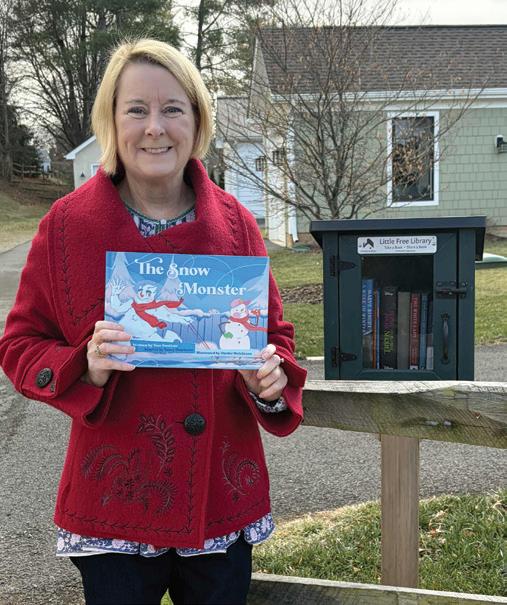
Laurie Salama at her Little Free Library.
MIDDLEBURG COMMUNITY CENTER
32ND DONOR APPRECIATION
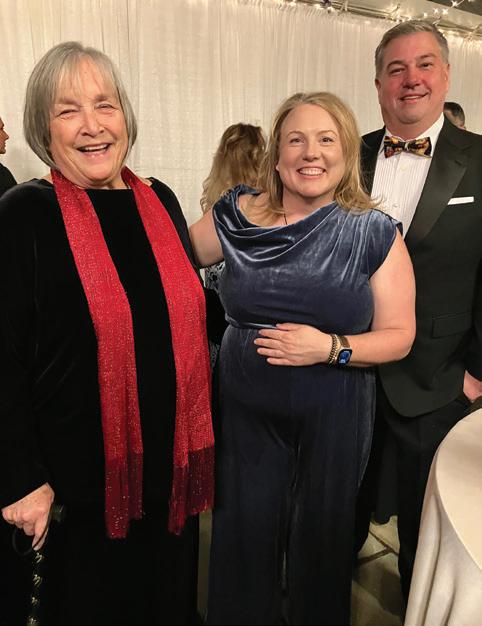
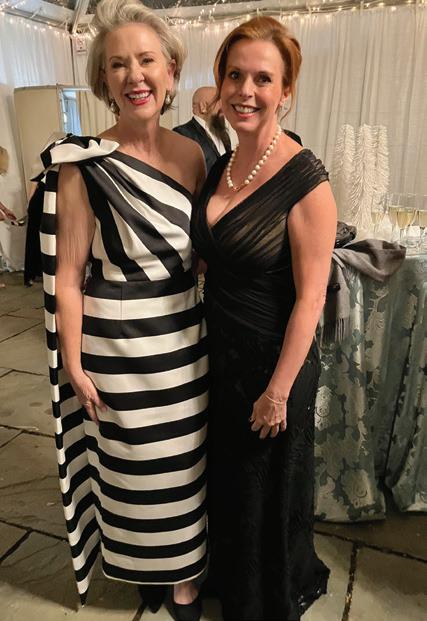
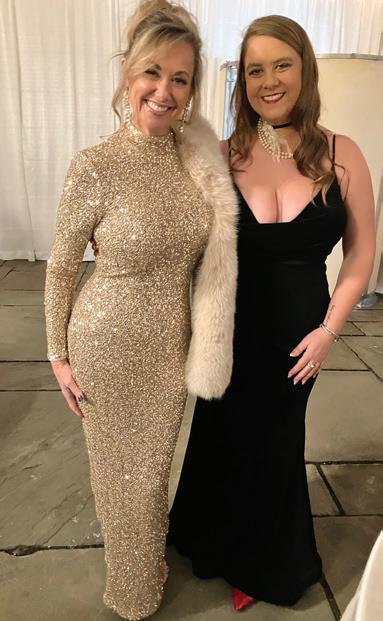
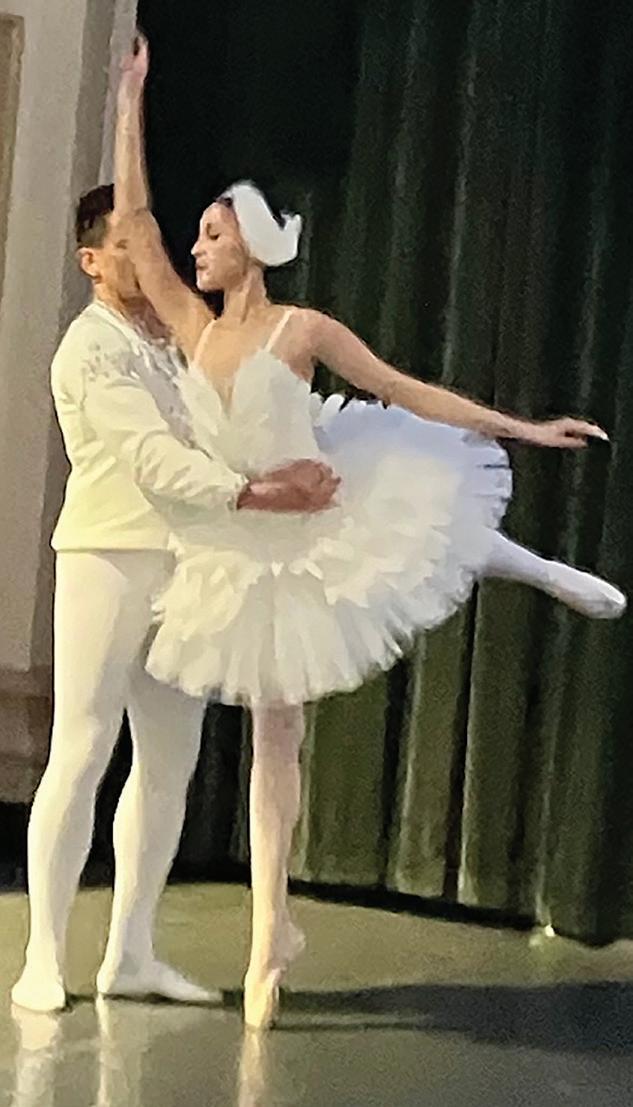
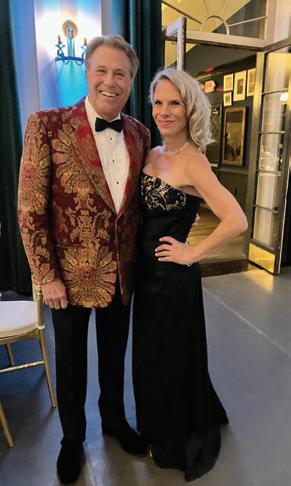
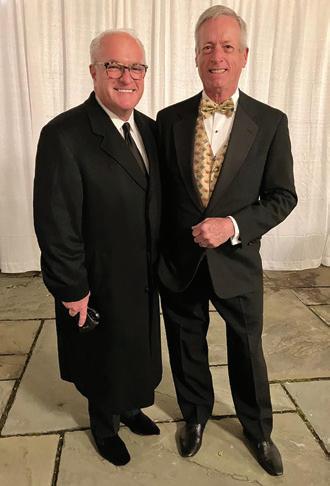
An elegantly attired crowd gathered recently at the Middleburg Community Center to celebrate the 32nd annual donor appreciation with the Swan Lake Holiday Ball. It was black or white tie for the men and elegant evening wear for the ladies on a magical night that included a cocktail hour, delicious dinner and of course, dancing and more dancing, even a bit of ballet.
PHOTOS by Laurie Salama and Donna Strama
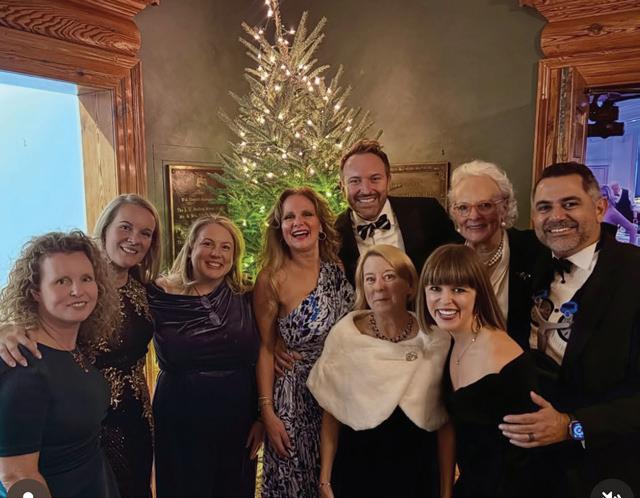
Past and present board members and those that produced the magical evening at the Middleburg Community Center: Rachel Cochran, Sarah Brissing , Sue Foote, Bethann Beeman, Laurie Salama, Elizabeth Rose, Jason Vickers, Lynn Wiley and John Gale .
Cindy Pearson, Sue Foote, Jamie Pearson
Liz Cordero and Kristen Rumble
Brandy Greenwell and Bernadette Boland
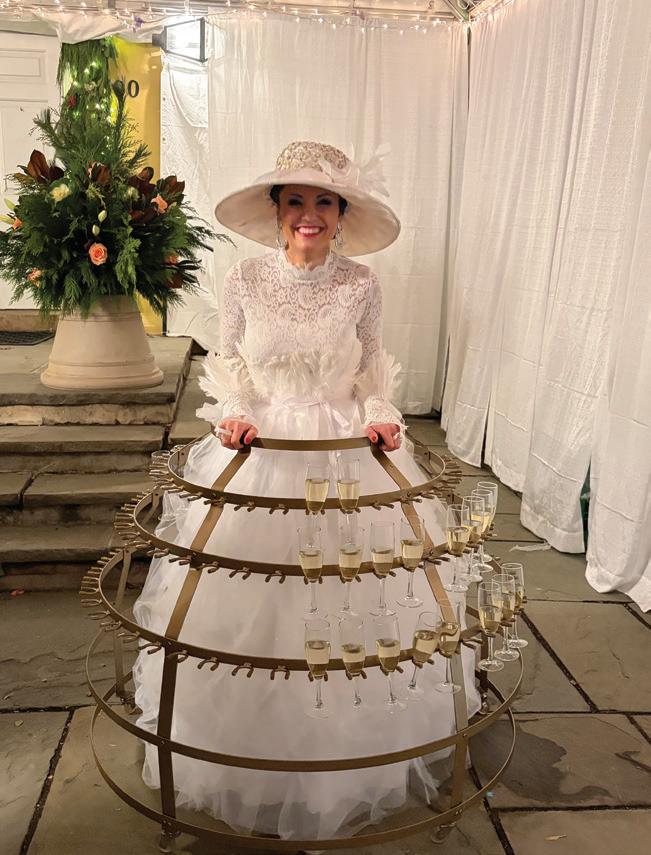
Melissa Watson is dressed for success in a Champagne dress
The swan could have danced all night.
Bryce Lingo with Ashley Walde Garland Hall and Bryon Fusini
Past and present board members and those that produced the magical evening at the Middleburg Community Center: Rachel Cochran, Sarah Brissing , Sue Foote, Bethann Beeman,
The swan cookie was the perfect conclusion.
Asbury Church Restoration Also Has an Oral Element
The public presentation of the restoration plans for Asbury Church is scheduled to take place at 5 p.m. Feb. 11 at the Middleburg Community Center, 300 W. Washington St., Middleburg.
By M.J. McAteer
Marcus Garvey once compared a people who had no knowledge of their history or culture to a tree without a root. Middleburg shares the mindset of that visionary Black leader, which is why, after more than a decade of deliberations, it’s moving forward with an ambitious plan to save the oldest church in town.
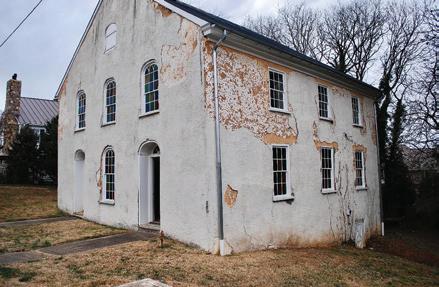
Asbury Church, a two-story, painted brick building on North Jay Street, was a major player throughout much of Middleburg’s history. Built in 1829 for a White, Episcopal congregation, the church later saw use as a corn depot, a storehouse and a schoolhouse. During the Civil War, it served as a hospital and morgue for both the Yankees and the Confederates.
Its longest and most significant tenant, though, was the Asbury African Methodist-Episcopal (AME) Church, which, for 130 years, played a central role in African-American life in and around Middleburg. In honor of that fact, the town has scheduled the unveiling of its restoration plans for the church to coincide with its February celebration of Black History Month.
What to do about the structure has been on Middleburg’s agenda ever since the late, local philanthropist Maggie Bryant donated it to the town in 2014. It was a generous gift that nonetheless came with expensive problems attached.
“It needed a lot of TLC,” said Middleburg Mayor Bridge Littleton. “And that requires a lot of money.”
In 2018, for example, while the town was mulling its options, it had to spend $174,000 just to stabilize the building, which had been vacant and declining since the AMC church closed its doors in 1994.
“People moved away to find work, and elders passed away,” explained Jim Roberts, who, for many years, sang in the AME choir, taught Sunday school and rang the church bell for services.
Littleton said that Middleburg looked into a variety of approaches to resurrecting Asbury Church, including a public-private partnership, but finally decided to make the necessary investment itself. The mayor added that the town will pursue grants from the county and the state to help defray the expected $1 million cost.
More planning and contracting issues remain before the actual physical work on the church can begin, said Town Clerk Rhonda North, who is in charge of the enterprise. As a result, a firm date for a
reopening has yet to be determined.
Key to the town’s decision to rescue Asbury Church was an imperative to make the building useful to the community, and, in its new incarnation, it is expected to serve as a place for small gatherings as well as an interpretative history site. North said that to safeguard the historic integrity of the church, the town hired the Richmond architecture and design firm of Glave & Holmes, which recently completed a prize-winning rehabilitation of Waterford Mill.
Susan Reed, the firm’s director of historic preservation, was in charge of the property survey. Figuring out what parts of the church dated to what era and how the pieces might all fit together was quite a puzzle, she said, because the building had gone through so many iterations during its long life.
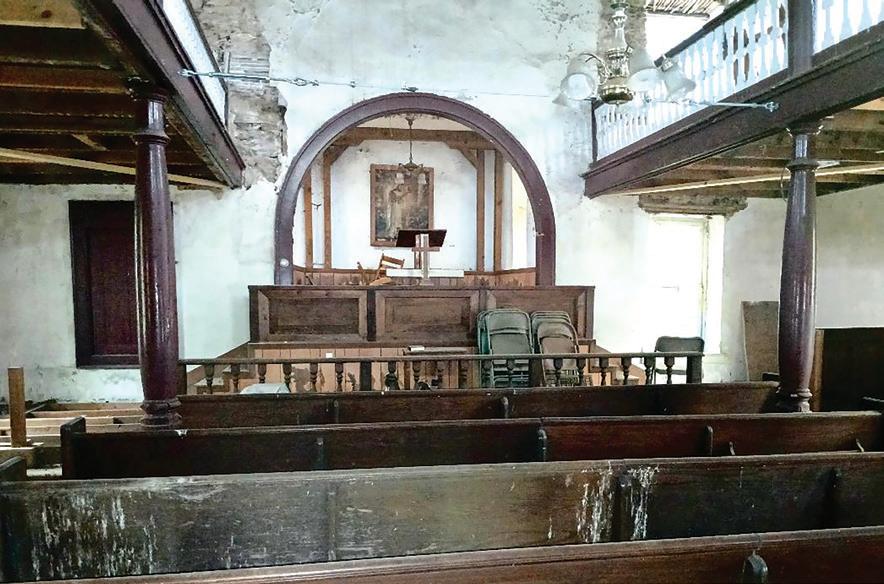
Her evaluation turned up some surprises, such as original woodwork and steps to the chancel that were hidden beneath newer ones. The woodwork and the older steps both will be restored. The church bell, currently on display at the town offices, will be returned to the site and most likely installed on the grounds.
Overall, the old building turned out to be in remarkably good condition, Reed said, so much
of the project money will go toward what she called “unglamorous” necessities, such as heating and cooling systems and handicapped accessible adaptations.
The church didn’t have a lot of written records to consult for the restoration, said North, but bricks and mortar are not only keepers of history, and the personal stories of some former AME members have been recorded and will be available for viewing on site, along with a video about the overall history of the church.
Roberts was one of the former congregants who agreed to share his memories, and he is a prime example of just how deep Asbury Church’s roots run in this area. Roberts said his great-great-grandfather was a slave on an Upperville estate, and that during the Civil War, “he was carried off to Alexandria by Union troops.” When, years later, his great-greatgrandfather returned to Upperville, he went back to work for his former owner as a freed man. Roberts added that his ancestor was a miller and used his woodworking skills to make improvements to the church in the early years of the 20th century.
Phyllis Cook-Taylor, another former congregant of Asbury AME and the co-founder of the nonprofit Friends of Asbury Church, said oral histories like that of Roberts will “showcase a vital aspect of Asbury’s importance to the town’s history.” Her hope, she said, is that they will be a catalyst for deeper consideration of “the much larger story of the contributions of African-Americans to the community.”
“So many people have memories of the space,” said Reed, and her firm’s renovation plans will respect that. “We want to restore the church with a light hand, so that people will be able to recognize the building they remember.”
The Asbury Church from the outside.
Photos by M.J. McAteer
The inside of the oldest church in Middleburg.
Emmanuel People Telling Their History
By Pat Reilly
Achurch is so much more than its bricks and windows and the silver service items and colorful cloth that dress its altar. An archivist, a journalist and a media specialist recently teamed up to find the people to tell the story, many of whom come to Middleburg’s Emmanuel Church weekly and make it a special place to worship.
The founders of Middleburg also were the founders of the church. Several are commemorated in the marble plaques that line the walls and two memorial windows. Early notes from the Vestry, the board that makes decisions for Emmanuel, show those founders running the church for decades, even through the Civil War.
Charlotte “Shelley” Erwin, led the university archives at Caltech before retiring and moving across the country to Middleburg. Emmanuel Episcopal Church was walking distance from her new home. Hearing of her profession, the Rector, Gene LeCouteur, told her the records of the 184-year-old church needed organizing. Shelley recalls that it sounded interesting and a good way to learn the history of the town.
Pat Reilly, a journalist who writes for this magazine, sensed a story in what Shelley might find. She wanted to help put the tale together for the congregants and the public. In just a few years, Pat had heard many charming stories that might fill in the record. Shelley suggested they do an oral history project.
The church’s webmaster, Ruth Marshall, a longtime teacher, lacrosse coach and media specialist, thought that telling this story for a new generation needed video. A parishioner lent the project a professional-grade camera. Other parishioners gave money for materials.
The oral history team aims to bring the history as far back as they can in the words of its long-time congregants. To help design the project, Ruth recruited John Peyton, a graduate student in public history from George Mason who also helped with the editing of transcripts. The team hopes to present the stories to the church and the public in 2026.
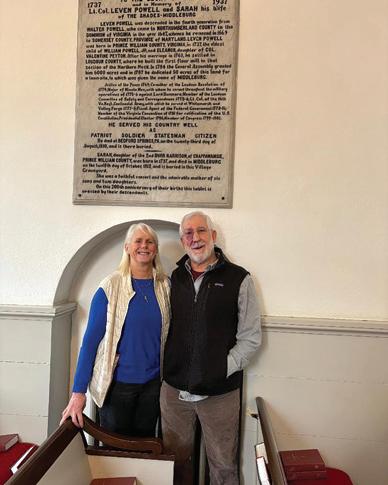
For starters, Ruth’s husband, Lee Marshall, is directly related through his mother’s line to town founder Leven Powell. His story is engraved in marble on the left side of the church. The couple’s favorite memory is of being married in the church with the pews packed with friends and family.
Norris Beavers began his service to the church as treasurer 40 years ago on the Vestry and along the way made it his permanent job. He also manages parts of the cemetery across the road from the back of the church. He serves as Crucifer and Chalicist in Sunday services.
He sees the people as the special gift of this church. Kevin Daley, also a town councilman, is facilities manager for the church and grounds. He started as Junior Warden of the Vestry, whose role involves facilities. He agreed to stay on in the special role when it was clear he knew more than anyone about it.
In the beginning, Emmanuel Church was a story of faith, service and commitment to the community. It still is.
Seven decades of relentless service and entrepreneurial spirit. Los Angeles based for your Global Financial Lives.
Wealth & Investment Management
Family Office Services
Investment & Merchant Banking
Equity & Debt Capital Markets
Multi-Asset Execution, Clearing and Custody
Rodney Gray
Senior Vice President, Investments (703) 554-3396
rodney.gray@wedbush.com 107 W. Marshall Street, Suite 102, Middleburg, VA 20117
Photo by Pat Reilly Lee Marshall, a direct descendant of Middleburg founder Leven Powell, with wife, Ruth, who consider the church a family tradition.
At MCC, A Home Away From The Home Office
By Leonard Shapiro
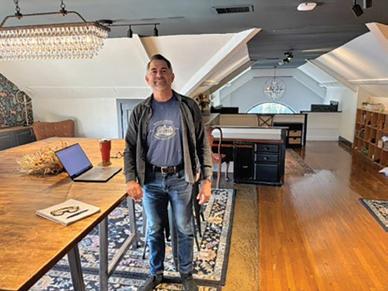
The third floor loft at the Middleburg Community Center (MCC) is a spectacular open space where yoga and other fitness classes once were conducted. These days, it’s been re-purposed into a welcoming destination for folks fortunate enough to work remotely, even if they have to climb a few flights of stairs to get up there.
It’s well worth the effort, with comfy couches, expansive tables, lots of chairs all around and plenty of plugs to handle laptops, phone chargers and so much more. Several more renovations are in the planning stages, including adding small cubicles to offer a bit more privacy and muffle the occasional telephone talk.
“There are a lot of people out here lucky enough to work from home,” said John Gale, a marketing strategist, college professor and member of the MCC board since last February. “Some people might not come into Middleburg that much but this could be a motivation for them, and while they’re here, go into a shop, visit a restaurant.”
Gale gave full credit for the creation of the new work space to Elizabeth Rose, named last fall as the MCC’s Director of Development and Events. She and Sue Foote, the Director of Operations, are already implementing other innovative ideas throughout the MCC, the better to attract and encourage more members of the community to take advantage of a facility that first opened its doors in 1948.
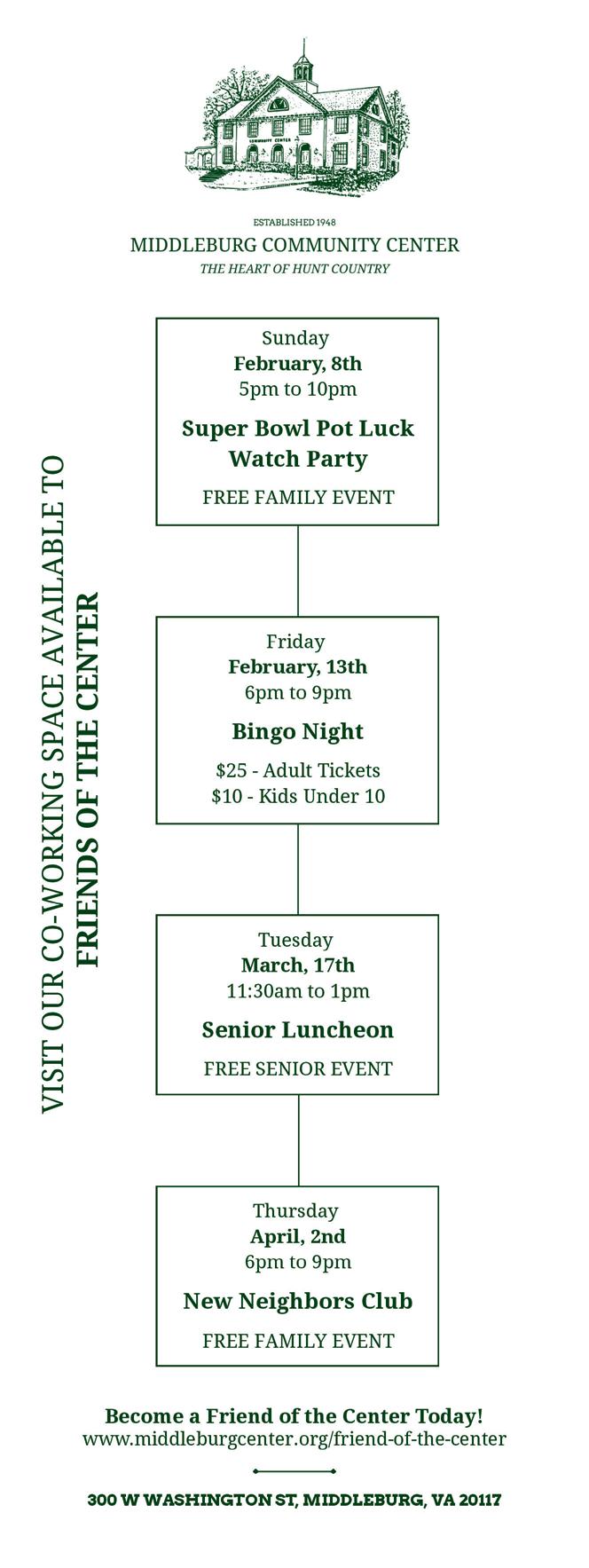
Rose also has established the “Friends of the Center” program, and members have use of the third-floor office work space Monday through Friday from 9 a.m. to 4 p.m. It’s definitely a modest fee considering the cost of renting regular office space all around the village. “Friends” pay $100-$500 per quarter, essentially starting at $33 per month, or just over a dollar a day, to have access.
“The Friends of the Center Program was created in an effort to get locals back in the building on a more consistent basis,” Rose said. “When I first saw the loft space upstairs and how beautiful it was with the whimsical wallpaper and the stunning windows, I knew we had to open it up.”
“The layout perfectly lends itself to a co-working space. We have a shortage of that in Middleburg… My vision for this program is that as we continue to grow the membership in 2026, we can start having game nights and book clubs and other ways to casually come together and make new connections in this historic space.”
A coffee maker and modest snacks also are in the plans, along with a copying machine and sound-proofing certain areas to keep the space as quiet and user friendly as possible.
Gale, a native of Miami, is a marketing vice president with Synchrony Financial and also teaches at Georgetown and NYU. He’s a frequent user of the new work space, the better to get out of the home office at his house for some human contact. He also expects as word spreads about its availability, he’ll have plenty of company.
“Right now it’s a grassroots effort and a great way to get more people involved in the community center,” he said. “Elizabeth brought it to life, made it happen, and Sue brought in local artist, Amy Potter, to help redecorate the space. Now we’re trying to publicize it and let people know it’s available. It’s a terrific addition, and a great place to work.”
Photo by Len Shapiro Middleburg Community Center board member John Gale often uses the new third floor office facility available to the public.
Community Comes First At Waterloo Electric
WBy Alissa Jones
aterloo Electric opened its doors in June, 1993, replacing the beloved Waterloo Grocery on Lord Fairfax Highway where routes 50 and 340 converge in Clarke County.
Neil Garlock, affectionately known by locals as Boyd, owned both businesses, and embodied an entrepreneurial spirit that would leave an indelible mark on the community. Boyd passed away in January, 2022, leaving the business to his business partner’s daughter, Kathy NicholsonHeitt. Nicholson, a Marine veteran, and a master electrician who learned the craft from her mother, Elizabeth Nicholson.
In November, 2022, Kate Anderson-Shaffer joined Waterloo Electric as a manager, with no intention of becoming an owner. As a certified paralegal and former chief deputy clerk in the Clarke County courthouse, Kate possessed valuable organizational, coordinating, scheduling, and maintenance skills that made her an asset to any business.
Kate now manages the office of the business where her husband, lead technician, Ralph Shaffer, had been employed for over a decade. Kate also knew several other employees and felt it would be nice to work with friends who were more like family.
Kate grew up in western Loudoun County, and comes from a long line of industry contractors. Her
father contributed greatly to the growth of Loudoun County.
“My father recently passed away,” Kate said. “At the end of the day, I know he has to be tickled about the fact that I’m in this industry. I hope he’s proud.”
Her exceptional skills, and familiarity with industry contractors, coupled with the expertise of her husband and longtime employee, Ben Sipe, both Clarke County natives, gave Nicholson confidence. Recognizing they would be a good team, Kathy extended the invitation to the Shaffers and Sipe to join her as business partners.
Beyond being a thriving business that offers residential and commercial services, Waterloo Electric specializes in historic homes, buildings from the 1700s and 1800s, as well as old estates. They also do a lot of work with local historic mills.
“We know winter is coming when the horse farms
Better banking starts here.
We believe people have a right to expect more from the companies they do business with. And they can expect more from Atlantic Union Bank, a bank committed to serving our community. By offering fair financial solutions and honest advice, we create opportunities for families and business owners.
To find out more, please scan here.
call to say the waters aren’t working,” Kate said, adding that Waterloo Electric will travel from their location to Western Loudoun, Fauquier County, Upperville, Middleburg, Marshall and up route 50, and all throughout Frederick County.
Family and legacy are the driving factors for the Waterloo Electric team and they want the community to know they are approachable, and very family and customer oriented.
“We keep everything to a high standard,” Kate said. “And If someone calls and I don’t get back to them right away, it’s either because I’m dropping off a part, or picking up a kid.”
The Shaffers live in Clarke County with Rylan, their six year old son, and Casey Mae, their two-year old daughter. “Our son knows electrical terms,” Kate said,” and even has a desk at the office so he can do estimates with daddy.”
Kate does not rule out opening another location, but for now the focus is on growing the fleet and serving the community.
“We may be in a remote part of the county,” Kate said, “but we are definitely a huge presence in the community. “We also donate our time putting up banners and helping other businesses whenever possible, and take pride in working with local organizations. We try to stay invested in the community, and its events as much as possible.”
Details: https://www.waterloo-electric.com/
The Waterlook Electric crew: (L-R) Ben Sipe, Kathy Nicholson, Kate Shaffer and Ralph Shaffer In front of the Burwell Morgan Mill in Millwood Virginia.
A Chance Encounter With a Talented Cowboy Artist
By Constance Chatfield-Taylor-
It would make sense to describe this cowboy with a hard-hitting, foot- stomping wild west song. Rugged, tough, explosive (bursts out of a chute, ropes a cow, ties it – in 8.5 seconds). He’s won at rodeos in Montana, Florida, California, Colorado, comes from a long line of cattlemen, oilmen, gun fighters…6 feet 4 and 190 pounds of raw, rugged, heart-pounding strength.
Then you spend some time with him. Minutes, a couple of hours. You watch him with his horses, his dogs, his cows, his art. And you think that a symphony would be a much better way to describe this cowboy.
Meet Bradley Chance Hays, champion tie-down roper and fine artist with an MFA and a boatload of famous clients. Guide for Jeff Bezos on a mule packing trip in Montana. Commissions for Ralph Lauren in his Florida home. Exhibited at the New York Botanical Garden, in art galleries in Vail and Aspen.
He travels with seven working cattle dogs and two rescues picked up while painting by day in Wellington, Florida and roping at night in nearby Okeechobee. A family had been deported, and their dogs were on the street.
“They don’t follow instructions like the others,” Chance said. But they curl up quietly in his lap when he sits for a minute and, he said with a smile, “they ride in the front of the truck.”
Recently, Chance was staying at the Marriott Ranch in Unison for a few months, helping with cattle, working his horses and dogs, roping, and painting live at the Middleburg Races, the Gold Cup, and Blue Ridge landowners party.
Over dinner, he spoke about life growing up in Oklahoma—school, ranch work and art. In the fourth grade, he entered a county fair contest with a book he wrote and illustrated. “Dragon Fly” won the county fair, then the state, then the national competition. At age 12, he became a published author.
“Can you get to Wichita for a TV interview?’ a
producer asked him.
‘Well, I’m 12,” Chance answered. “I’ll have to get somebody to drive me.”
At 19 and at Panhandle State College in Oklahoma, he sent Disney an unsolicited drawing and idea for a cartoon. They flew him down to Orlando and offered him a job upon graduation. He turned it down because he wanted to rodeo and make his art, and not on a computer.
At Oklahoma State for his bachelor’s degree, Chance studied sculpture, blown glass, cold cast bronze and, of course, painting.
“Leroy Nieman and Georgia O’Keefe were and still are my inspiration,” he said. Chance received his MFA from West Texas A&M. While working on his thesis, he painted at his great grandfather Charles Goodnight’s cabin in Palo Duro Canyon, studying the light, the sounds, the feel of the canyon, the desert and beyond
The title of his master’s thesis? “The Contemporary West in Me.”
Chance continued to ride, to compete, to travel. He follows the art and horse world, “where people are passionate about their sport and their art, and they want something different.”
Last summer, he painted at Saratoga, competed on the rodeo circuit, then came to Virginia “because of its beauty and the authenticity of the horse community. No matter the discipline, whether it’s
show jumping, polo, racing, it’s the same dedication to an art, a love of horses, and the people who love those horses.
“Whether you’re a liberal, conservative, a democrat, whatever, the horses bring everybody together. You will get along because of the love for that, right? We all put in hundreds of hours for that buckle, that ribbon, not for the monetary value, but for what it represents…At the end of the day, horses are important to the people in Virginia, the same as they are to the people in Oklahoma or Texas. Everybody thinks we’re so different, but we are all so much the same.”
He’s speaking now in the wide center aisle of a barn, with the sun going down. It’s been a day of working horses and dogs, fine tuning for an upcoming competition. The horses are fed, there’s that gentle barn quiet — horses eating, occasional splashes in the water bucket, dogs sleeping quietly.
“Now is the best time for painting, in the quiet, just me and my animals,” he said. “It’s nice. I can walk over and put my hand on their neck or shoulder, feel how the muscles flow and then walk back and paint it.”
He picks up a brush and a piece of cardboard with paint dabbed on it. He stands quietly, looking at his canvas, almost as if he’s being absorbed.
And then he paints.
“My peace is here.”
Eventually, Chance will load up his five horses, nine dogs and three cows and head home to Montana, where he works his ranch and paints until he’s back on the road. Occasional elk hunting, fly fishing, pack trips to Canada.
Girlfriends? “Sure,” he said. “Until the weather is below zero, a Blackfoot Indian shows up at the door at 3 a.m., or there’s a grizzly outside that I have to deal with. Sends a super model back to Florida right quick.” Real? Yes. Genuine. Aware. Sensitive.
Definitely a symphony.
Details: The writer met Chance after following his remarkable trailer into a gas station in Marshall. For information on his Virginia appearances, contact Kelly Moss at kmoss@marriottranch.com
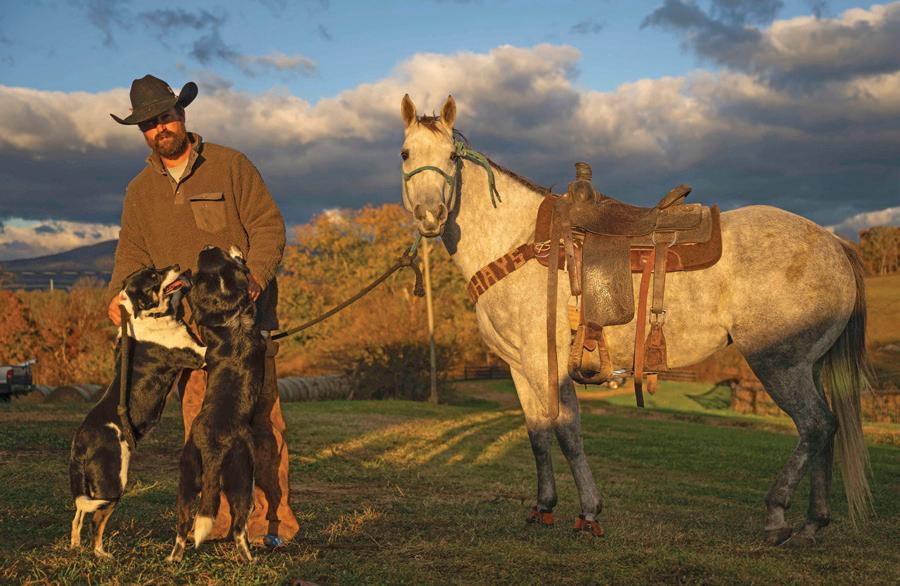
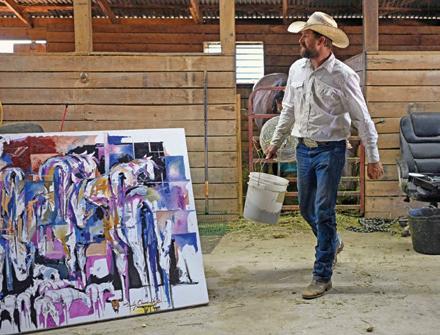
Chance Hays often prefers to paint close to a barn.
Photos by John McDonnell
Artist Chance Hays is at home on the range with a horse and dogs.
V I R G I N I A R E A L T O R ®
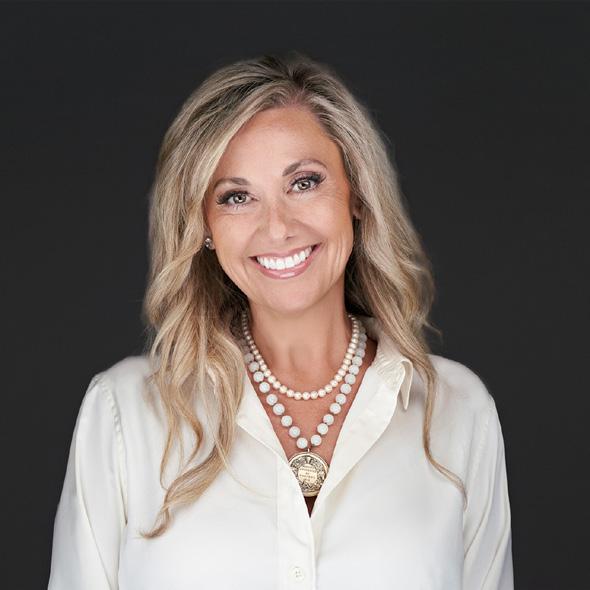
In a small community where you can throw a rock and hit a real estate agent, it’s imperative you work with a local agent who is familiar with the beat, discrete and well connected Brandy Greenwell is an experienced Realtor specializing in countr y properties across the rural Washington, DC market, based out of Middleburg, Virginia Brandy ’ s deep local roots and equestrian expertise allow her to masterfully navigate transactions of any scope She brings elevated thinking and focus on individual client needs to ever y transaction When you work with Brandy, you get a giant personalit y, heart, and dedication for seamless results
HOME IMPROVEMENT
The Case for Better Lighting: Winter Edition
We work, gather, relax, and recharge in our homes all year long, but in winter we spend even more time inside, taking shelter from the cold and settling into warm, cozy spaces.
With daylight in shorter supply, natural light is limited, and artificial lighting plays a much larger role in how rooms look and feel. When planning a remodel, lighting is not just a finishing detail; it’s a foundational element that shapes both how a space functions and how it makes you feel.
The color temperature of your lighting plays a major role in how a room feels and functions. Light is measured in Kelvins, noted as “K” on bulb packaging. Lower numbers indicate warmer, softer light, while higher numbers indicate cooler, brighter light. Understanding these ranges makes it easier to choose bulbs that support the way you want a space to feel, especially in the winter months.
Warmer light (2700K to 3000K) is best suited for comfort-focused spaces such as bedrooms, living rooms, and dens. Its soft, golden glow resembles natural sunlight at dusk and has been shown to support the release of serotonin, helping to reduce stress, spark creativity, and promote a greater sense of relaxation and connection.
During colder months, warmer light works particularly well in table and floor lamps and wall sconces placed in areas where families gather and unwind, including window seats, reading nooks, and great rooms.
Cooler lighting (4000K to 5000K) supports alertness and energy, making it a strong choice for task-oriented areas such as kitchens, laundry rooms, home offices, and bathrooms.
In these spaces, clear, bright light helps with everything from reading recipes and sorting laundry to focusing on computer work or personal grooming. When
the sun sets earlier in winter, cooler light in overhead and task fixtures can help extend productivity later into the day. Used alongside warmer lighting in gathering and relaxation zones, cooler light allows your home to support the full rhythm of a winter day.
The most effective lighting plans rely on layers. By combining different types of lighting—overhead fixtures, eye-level task lights, and lower-level accent lights— you can create rooms that feel comfortable, flexible, and visually balanced throughout the day and evening.
Overhead lighting provides general illumination and is important for visibility and safety. On its own, however, it can feel harsh or create strong shadows, particularly when natural daylight is limited.
Task lighting at eye level is ideal for focused activities such as reading, cooking, or working at a desk. Thoughtful placement helps illuminate work areas while reducing glare on screens, countertops, and other surfaces.
Accent and lower-level lighting, including floor and table lamps, wall sconces, and toe-kick lighting, introduce warmth and softness. In the evening, these gentler sources help signal that it is time to unwind and make living spaces feel more inviting during the darker months.
Dimmable fixtures and smart controls enhance this layered approach. With the ability to brighten, soften, or shift lighting throughout the day, you can move seamlessly from task-oriented light to a more relaxed glow, allowing your home to respond to both the season and your daily routines.
Shorter days and limited sunlight can affect energy levels, sleep patterns, and overall mood, but thoughtful lighting design can help mitigate the impact and support well-being. Warmer light in gathering spaces creates comfort and calm, while brighter, cooler light in work zones helps maintain focus when daylight fades earlier.
Jeff Weeks is a Bowa project manager.
Jeff Weeks
When a Community Shares Its Gifts, Everyone Thrives
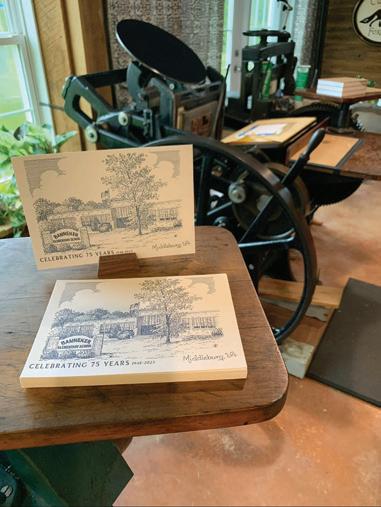
A letterpress keepsake commemorates
float reflected both school pride and community spirit. Titcocmb also created a letterpress keepsake commemorating Banneker’s 75th Anniversary, giving
“Teachers are helpful. I like that it’s small and not too many people,” said
Talents shared at Banneker often come from personal passions. PTO Treasurer Megan Bloom uses her love of baking to lead the annual Voting Day Bake Sale, raising funds that support school events, enrichment programs, and field trips. What starts as a homemade treat becomes an opportunity for students to experience learning beyond the classroom. For Eli, age 10, that connection makes
Inside the school, librarian Rebecca Shannon brings together literacy, technology, and creativity. In addition to supporting reading initiatives and
This year, Shannon composed a song for Banneker’s PBIS House System, using music to build connection and reinforce shared values. That sense of belonging is
According to English Learner teacher DeeDee Livesay, this spirit of sharing is
“Often, we are unaware of the gifts and talents that people have to share,” she said. “We want Banneker to be an avenue for turning talents into opportunities.”
Those opportunities show up in traditions that students cherish. When asked their favorite thing about Banneker, Reagan and Wes, both age 8, answered at the
For Edie Belle, age 9, the heart of the school is its people.
“The kids and teachers are really kind, helpful, and respectful,” she said. “It is
That feeling doesn’t happen by accident. It’s built day by day by people willing to bring their creativity, time, and talents forward in service of students. At Banneker Elementary, those shared strengths don’t just support a school, they create belonging, opportunity, and a lasting impact for every child.
Inside the Marshall Community Center
By Michele Husfelt
Tucked just off Main Street, the Marshall Community Center is the town’s most vibrant gathering place. More than just a building, it’s a hub for connection, creativity, and community life, offering welcoming spaces and a wide range of activities for residents of all ages that reflect the town’s small-town charm and big-hearted spirit.
According to Manager Michelle Hermsdorf, the building was originally constructed in 1910 and once housed Marshall Junior High. Over the decades, additional wings were added. After a devastating fire in 1969, the building was restored and reopened in 1974. It became the Marshall Community Center in 1989 and, today also includes the Marshall Library.
The Center transforms throughout the week. On any given day, it may host fitness classes, community meetings, workshops, or lively celebrations. It’s also a popular venue for private events, from birthday parties to reunions, offering a warm, accessible space for family and friends to gather and make memories.
The Center offers smaller meeting and activity rooms for classes, clubs, and group gatherings. These rooms regularly host arts and crafts sessions, educational workshops, home school and hobby groups, and planning meetings.
Photo by Michele Husfelt
From painting and dance to book discussions, Bible studies, and hands-on work in the Center’s full pottery studio, these spaces foster creativity and collaboration.
In addition, the Center features a spacious auditorium with flexible seating for up to 200, complete with a new projector and sound system, as well as a gym suitable for sports, recreation, and larger community events.
For families, the Center provides a safe, engaging environment for youth activities. Children’s
programs, recreational events, and seasonal camps give young residents a place to play, learn, and build friendships. Teens and adults benefit from wellness and fitness offerings, including yoga, dance, and lowimpact exercise classes that promote healthy living.
Hermsdorf works with a friendly, helpful staff committed to making everyone feel welcome. She believes the Center is at its best when people of all ages come together.
“This is such a great place to meet and connect with others,” she said. “Whether you’re a golden senior or a pre-school tot, there’s something here for everyone.”
Beyond scheduled programs, the Marshall Community Center’s true value lies in its role as a social anchor. It’s where volunteers support neighbors in need through the FISH program, where local organizations gather, and where town traditions are celebrated year after year.
In a town known for its history and close-knit feel, the Marshall Community Center reflects the best of community life. And you don’t have to live in Fauquier County to take advantage of the many opportunities the Center offers.
Details: For more information, class schedules, and upcoming events, visit https://www.fauquiercounty.gov/ government/departments-h-z/parks-and-recreation
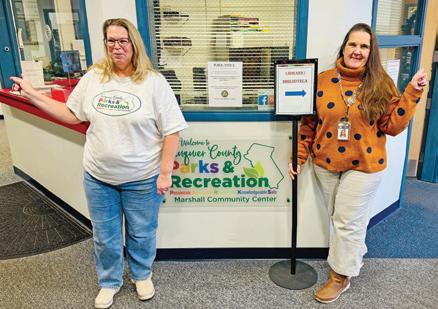
Marshall Community Center Manager Michelle Hermsdorf (left) and library assistant Mert Cook.
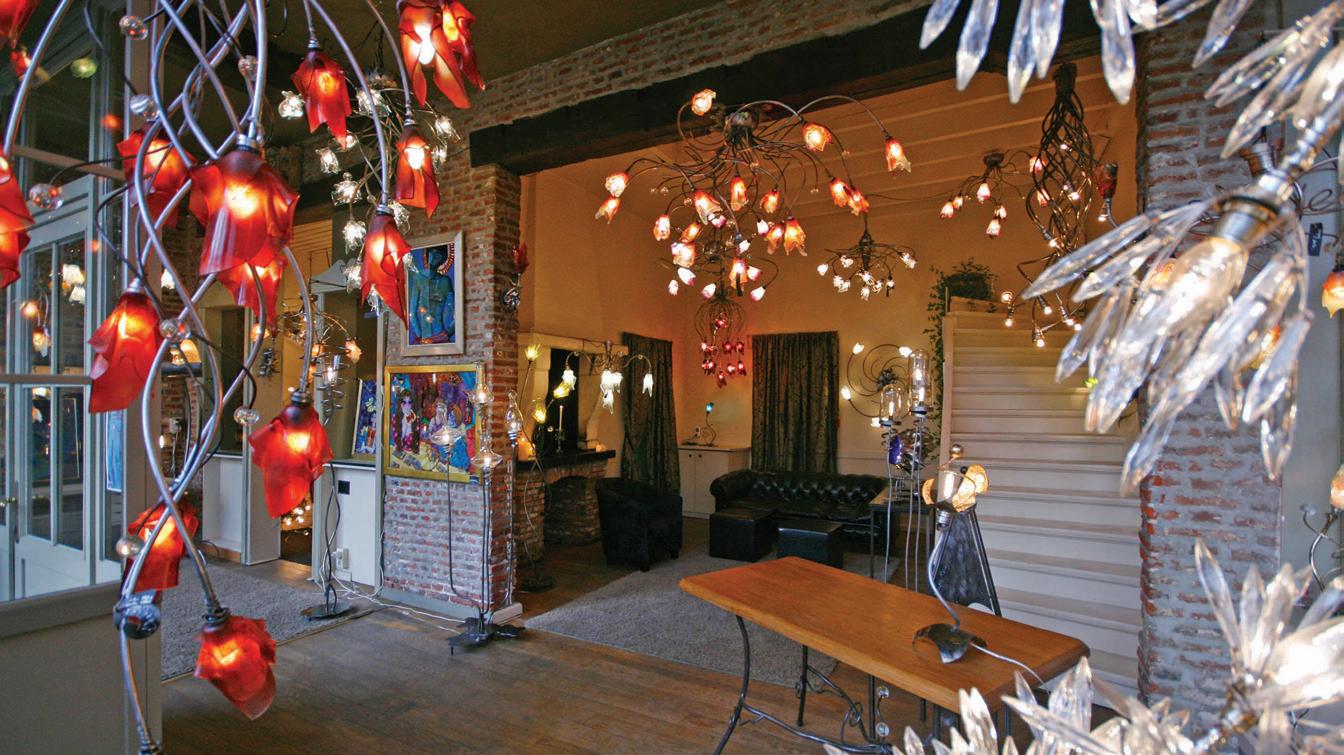
The Belgian Art That Lights Up Loudoun County
By Robert Appenzeller
In several quaint towns of Loudoun County, a few distinctive light fixtures draw attention to an artistic style reminiscent of a time when craftsmanship was a centerpiece of everyday spaces. They are chandeliers, crafted by Belgian artisans and now part of the unique ambiance that sets Loudoun apart from so many other vast suburban interiors.
Several commercial and private spaces in Loudoun feature the work of the Belgian studio, De Blauwe Poedel (The Blue Poodle). The iconic restaurants, Tuscarora Mills and Magnolias at the Mill, along with a chocolate shop on the corner of King and Loudoun Streets in Leesburg, have incorporated these chandeliers into their space.
These gorgeous pieces becoming local fixtures began with Kathleen Malone, wife of late restaurateur Kevin Malone, who discovered the Blue Poodle’s work on line while searching for an eye-catching lighting solution for the Mill’s destination bar.
Kevin DeLandsheer, son of the Blue Poodle’s owners, supplied Magnolias with a striking redglass chandelier followed by a black-glass version at Fireworks Pizza, and then a clear glass piece at Tuscarora Mills in an intimate anteroom.
The Leesburg Gourmet Chocolatier also features a
chandelier displayed in the shop’s front window. And several private Loudoun homeowners have added Blue Poodle lighting to their foyers and great rooms.
How this design originated and gained acceptance in the local commercial landscape is well worth documenting.
In the bucolic Zevergem region in Belgium’s Ghent district, Walter Duportail and Brigitte Kleynnaert, a husband and wife team, transform ordinary cutlery—forks, knives, and spoons—into extraordinary chandeliers and statues. Their studio’s canine name is a nod to Brigitte’s favorite color and deep affection for poodles, is a testament to whimsy and fine craftsmanship.
Walter and Brigitte met over 30 years ago at a Flemish flea market, both balancing day jobs while pursuing their passion for turning natural forms into functional art. What started as experiments with candle holders evolved into an international business, with more than 1,200 unique creations to date.
Walter honed his welding skills at vocational school and traces his lineage to a maternal grandfather who was a coppersmith in the 1890s. Brigitte’s grandfather, a painter, instilled in her an eye for color and composition.
They are artisans in the truest sense, producing work that is profound and unique, inspired by the spaces
their creations will inhabit. Their styles draw from Art Nouveau’s organic flows, Art Deco’s geometric boldness, and steampunk’s mechanical whimsy.
Nature is a key springboard for their designs, with inspiration coming from drooping branches and unfurling leaves. They forgo sketches, channeling visions directly from mind to material. The creation process can take up to a full month per piece.
Walter hand-twists steel rods over a torch, painting or staining them to complement the surroundings. Brigitte uses a kiln to fuse and slump the unique glass tulips (kelks or abajour) preferring antique window glass from renovated buildings. Walter then threads and balances these elements into their final delicate form.
They insist on real glass for its warmth and soul, contrasting with the cold metal. Their materials also include crystal, leather, and, notably, repurposed cutlery for their storytelling sculptures. Their process blends improvisation with meticulous technique, creating pieces that feel alive: arms sagging like laden branches, and bulbs dangling at varied heights to dance with light and motion.
As Walter said, “Chandeliers are stories you hang from the ceiling. They tell you how a house wants to feel.”.
Details: https://www.deblauwepoedel.com/contact
The Blue Poodle chandelier show gallery in Ghent, Belgium.
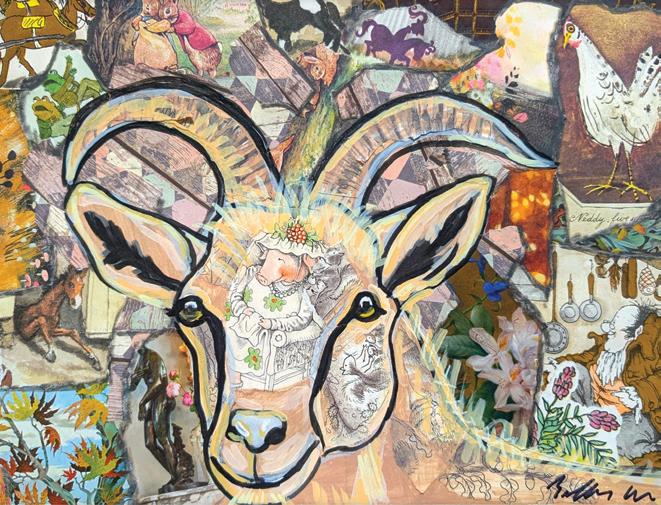
Cottontail twilight Lori Goll
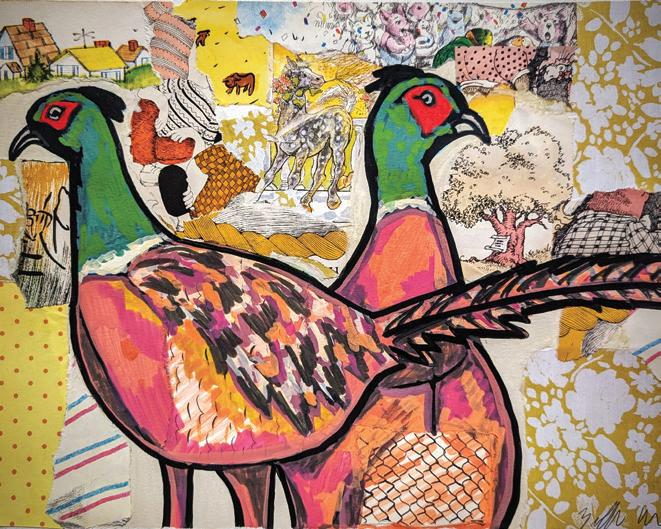
Row of Chickens Nadya Gordon
Gifts of Asia Jill Brabant
Whispers Beneath the Horizon , Anne Stine
Tree of Life Expands to the Piedmont Region
By Michele Husfelt
Rooted in the heart of community, Tree of Life (TOL) Ministries has been making a tangible difference in the lives of individuals and families for over 17 years.
This grassroots effort began in 2008, born out of the turbulence of the financial crisis that shook communities across the country. Nestled within the welcoming walls of Purcellville Baptist Church, the Tree of Life project took root in Loudoun County as a response to the deep economic needs many local families faced.
By 2012, what started as a single church’s mission had blossomed into a regional community effort. Today, TOL is supported by a network of 53 churches and hundreds of volunteers and donors, all working together to serve those in need. Susannah Lee, the CEO of TOL, and Paul Smith, the founder and now director of the newly launched Piedmont region, have been instrumental in expanding this vision.
The purpose of Tree of Life is clear: to reach out to the poor and needy in the community with the love of Jesus Christ. The organization operates under five key branches—food, life skills, shelter, healthcare, and relief; each one designed to holistically support individuals and families.
When talk arose about launching a new region, a dedicated group from several churches gathered at Trinity Episcopal Church in Upperville for a seven-week prayer journey. Through this time of discernment, they identified needs and resources required to officially launch the Piedmont region.
Aware of other ministries and agencies already doing great work in the area, TOL hopes to partner with those already established in the community.
What began in Purcellville has since expanded throughout Loudoun County, and the Piedmont region is poised to grow even further. It will stretch from Berryville down to Delaplane, and from Marshall east to The Plains Road.
The impact of the Tree of Life has not gone unnoticed. In both 2023 and 2024, it received the Best of Loudoun Winner Award and secured the largest grant from Loudoun County. By the end of 2025, the initiative had touched the lives of more than 36,000 people. In addition to his role in Virginia, Paul Smith is now partnering with churches in his hometown of Carlisle in Great Britain to plant a similar TOL there.
In the new Piedmont region, TOL will begin by offering grocery deliveries, a monthly community meal, and financial assistance for essential needs such as rent and utilities. The food pantry will be located at the Methodist Church Lloyd House in Upperville, and a monthly dinner will be hosted at Trinity Episcopal Church. The Tree of Life offices and training sessions will be at Upperville Baptist Church.
At a recent volunteer training in Upperville, Paul Smith said that “my greatest joy is seeing those who have received care come back to serve others.”
With numerous ways to serve, TOL offers a hand up to its partners (those they serve) while inviting the community into a continuing cycle of compassion and hope. TOL serves all people, regardless of their faith.
Details: https://www.tolministries.org/
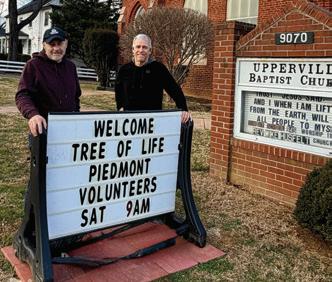
Photo by Michele Husfelt Paul Smith, founder and Tree of Life Piedmont Director, and Upperville Baptist Pastor Mike Husfelt, TOL chaplain.
Art of Piedmont Set for March 6
The 15th annual Art of the Piedmont auction gala will take place on Friday, March 6, at the Middleburg Community Center.
A long-standing favorite on the local social calendar, the event showcases a curated collection of fine art created by talented regional artists, available for both virtual and in-person bidding.
The main event begins at 6 p.m., offering guests an evening of hors d’oeuvres, an open bar, and a beautifully staged exhibition of paintings, sculpture, photography, and mixed-media works.
For those who prefer to begin bidding early or cannot attend in person, the online portion of the auction opens a week in advance on Friday, Feb. 27, allowing bidders ample time to explore and bid on featured pieces.
A standout addition to this year’s event is the enhanced VIP preview night Thursday, March 5. This exclusive evening offers an early look at the full collection of artwork, along with an open bar and hors d’oeuvres, and the opportunity to enjoy the gallery in a more intimate setting.
For the first time in the event’s history, VIP guests will also have access to a special Buy-It-Now option, giving them the unique advantage of purchasing select pieces outright before general bidding opens. This new feature is expected to bring an exciting, competitive energy to the preview, as collectors and art enthusiasts aim to secure their favorite works ahead of the main auction.
Funds raised from the event directly support Middleburg Montessori School, helping to sustain its mission of providing high-quality Montessori education to children from infancy through adolescence. Community support through Art of the Piedmont plays an essential role in strengthening the school and enriching the educational experience it provides.
For local art lovers, philanthropists, and supporters of education, Art of the Piedmont offers a memorable evening that blends fine art, community spirit, and meaningful impact. Tickets are limited, and early purchase is recommended for both the main event and the VIP experience.
Details: Tickets for the main event and the VIP Preview Night can be purchased online at ArtofthePiedmont.org. For additional information, call 540-687-5210 or email info@artofthepiedmont.org.
The Art of the Piedmont transforms the Middleburg Community Center.
Middleburg Police Collar a Colorful Bad Guy
By Carina Elgin
Shaun Jones has been extremely busy since being sworn in as Middleburg’s police chief on May 1, 2023, implementing his vision for law enforcement in this unique Northern Virginia village.
While his “one town, one team, one community” approach aims to strengthen the overall skills and collaboration of his six officers, it also emphasizes “community policing,” a strategy of law enforcement that focuses on building relationships and partnerships between the police and the community to address public safety issues together.
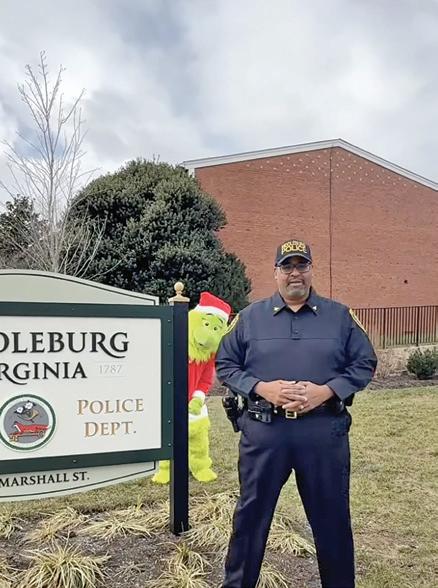
The community was, in fact, brought together at year end by the department’s apprehension of an internationally recognized bad guy—The Grinch. In a series of videos posted on the town’s web site, the green grump was spied all over Middleburg, finally apprehended outside the Play Room toy store on Washington St.
Processed at the MPD’s office, The Grinch appears to have been rehabilitated by his Middleburg stay and now reportedly loves the Christmas season.
To serve the community he loves even better, Chief Jones graduated in August with a BA in criminal justice from Columbia Southern University. His goal is to get a Master’s from the same school, where he recently was appointed an advisor to the Criminal Justice and Forensic Board.
“I want to lead by example. I really want the officers
to pursue a degree, as well,” he said. “I’m hoping two will get their associate or bachelor’s soon.”
Part of Jones’ effort to be part of the community are one reason he’s out and about most days, picking up
his cup of tea at Common Grounds, and socializing with shopkeepers, locals, visitors and, of course, many dogs.
A new sight in town is an officer on an e-bike, one of two e-bikes obtained through a grant. Officer First Class Frank Barlan is the first Certified Bike Officer for the Department. The bikes have already proven beneficial for maneuvering around town and through crowds.
Every year the police department parks a vehicle in front of the Middleburg Safeway to collect food and money for its “Stuff the Cruiser” event. In 2025, the goal was $1,500, but the chief was delighted that $2,150 was collected from the community to help feed the hungry through Middleburg’s Seven Loaves Food Bank.
He plans to continue other events, as well, such as Walk with the Chief, Coffee with a Cop, a children’s coloring book contest, and the always entertaining National Night Out. Juneteenth was well attended, as was the Pawrade, which brought some 70 dogs out in their Christmas finery.
His officers are involved with several Middleburg Charter School activities and the department also has a focus on educating the public on various frauds and scams, how to prevent shoplifting and what to do in the case of an active shooter.
The Police Department and the Town of Middleburg will be instrumental in hosting events throughout 2026 related to the 250th birthday of the United States, with events planned monthly.
Photo by Carina Elgin Middleburg Police Chief Shaun Jones with a bad guy in the background.
Learning Like Leonardo At Middleburg Charter
By Katie Brennen Charnley
Walk through the doors of Middleburg Community Charter School (MCCS), and you sense something different right away. Students are not simply memorizing facts. They sketch their ideas, record observations, build models, debate questions, and look for connections between what they’re learning.
The atmosphere feels active and purposeful, and the learning appears genuine. At MCCS, education is inspired by the spirit of Leonardo da Vinci, and inquisitiveness becomes a daily habit rather than a suggestion.
Leonardo da Vinci is most often remembered as a master painter, but defining him solely by his art would miss the essence of his genius. He was also an engineer, botanist, anatomist, inventor, and a tireless student of the natural world. He did not treat knowledge as a set of separate subjects. Instead, he saw learning as a web of interconnected ideas that strengthened through exploration, reflection, and experimentation.
That vision inspired MCCS educators to search for a framework that would honor children academically, creatively, and socially. It led the MCCS team to the Seven Da Vincian Principles, outlined by author Michael Gelb.
They emphasize curiosity, experiential learning, thoughtful reflection, perseverance, and the ability to recognize connections across disciplines. MCCS teachers studied the principles, tested them with students, and reshaped them to fit their school community.
From that work emerged the VINCI Method: View, Inquire, Note, Create, Inspire. These five stages guide students through meaningful, hands-on engagement with the world.
Students begin by viewing carefully, a skill that strengthens their ability to notice detail in both science and art. They inquire by asking questions that deepen understanding and advance thinking. Through noting, they document observations, patterns, and reflections in the spirit of Leonardo’s notebooks.
Creating allows them to apply what they’ve learned through experiments, writing, design, and artistic creation. The cycle ends with inspire, a cue that learning is shared and that students can influence one another’s growth through collaboration and encouragement.
“After a decade at MCCS, I’ve loved seeing how the VINCI method motivates students to think like Leonardo da Vinci,” said teacher Mackenzie Escobar. “They become observant, creative problem-solvers who adapt easily and engage the world with curiosity, confidence, and care.”
This educational approach extends beyond classroom lessons. MCCS uses a four-house system based on the Da Vincian principles: Curiosità, Dimostrazione, Connessione, and Sfumato.
Each house represents an ideal the school strives to nurture, such as curiosity, learning through experience, recognizing relationships among ideas, and handling uncertainty with fortitude. Through teamwork and joint commitment, students learn that character development is just as important as academic achievement.
“We chose a DaVincian-inspired school because it reflects how our child naturally learns,” said parent Logan Cumberland. “She is curious, imaginative, and deeply observant, and she thrives when learning feels connected and meaningful.”
Cumberland added that MCCS’s focus on developing a love of learning, rather than centering everything on outcomes or test scores, encourages students to explore, wonder, and trust their own thinking.
“It supports intellectual growth while honoring emotional development and a sense of wonder,” she said.
In a world that respects adaptability, creativity, and collaboration, MCCS’s approach resonates as both timeless and relevant.
By presenting Leonardo not only as an artist but also as a model of lifelong learning, the school prepares students to meet challenges with a curious mindset, courage, and imagination—qualities that will guide them long after they leave the classroom.
Katie Brennen Charnley is the assistant principal and an instructor at the Middleburg Community Charter School.
2 S Madison St. Middleburg, VA 20117
Office: 540-687-6500 | thomasandtalbot.com
FAR FIELD
87± acres | $4,500,000
The Plains—Desirable location between Middleburg and The Plains in the heart of Virginina Horse and Wine Country. The 5 bedroom, 4 full and 2 ½ bath home home sits on a knoll overlooking 87 acres. The land includes hay fields, horse paddocks, mature woods and borders Little River. Protected by a conservation easement and surrounded by other farms similarly protected–the views from Far Field are protected forever. Stabling for 10 horses. Room for indoor/outdoor arenas. In OCH territory with great ride out.
Kindergarten student Beau Charnley admires his art work.
How to Join the Blue Collar Revolution
By Joey Snider
The world is changing rapidly in today’s workplace, especially with artificial intelligence (AI) technology spreading dramatically before our very eyes.
The future of many industries is extremely uncertain for those entering the job market as well as for those already working in their chosen field. From my own experience as a tradesman and a business owner, I’m talking about The Blue Collar Revolution.
Many high school graduates are possibly at the first major crossroads in life. Go to college or just get a job without a real skill set? Many youngsters are heading to college with no real goals or ambitions other than postponing the inevitable for a few more years.
While there’s plenty of guidance for the college bound, there’s not so much for those contemplating other career paths. So here’s a brief guide to getting started in The Trades and what to expect along the way. How long does it take, how do I obtain my certifications, what are some of the challenges and what type of lifestyle can you expect from a career path as a Blue Collar tradesman or tradeswoman?
I’d like to inspire young people to look at opportunities available in the fields of plumbing, heating and cooling (HVAC), electrical, water treatment, welding, carpentry and more options.
A few years ago, I wrote a book, “If Water Runs Through it We Do It,” explaining my own journey as a young helper, to apprentice, then a journeyman and finally a master plumber and gas fitter, water well provider and conventional and alternative septic installer .
After one speaking engagement at a local high school trade academy, I ran into Michael Appleton, who also shares his experiences getting started in the trades. He’s the CEO of Appleton Campbell, the Warrenton based company that provides HVAC, plumbing and electrical. In his early 30s, he’s a master in all trades his company provides.
In an informative interview, he offered his own perspective on college vs. the trades.
Q: What’s the first step in getting started?
A: This question reminds me of one of my favorite quotes, “opportunity is missed by most because its dressed in overalls and looks like work.” First steps would be getting in with a well-established company. Send resumes, stop by their office, write a letter or email explaining why you’d be a valuable asset for their team. Then comes the hard work part.
The harder you work the more the senior guys are going to be willing to teach you. The more hours you put in, the more learning opportunities you’ll have. Staying focused on learning and improving constantly can really slingshot your career.
Q: How do you get certification for apprenticeship, a journeyman’s card and master license?
A: This is one of the few “masters” you can get without actually having any formal schooling. If you work under a master plumber for ten-plus years you can apply to sit for your masters test. Though I went
through four years of plumbing school at Laurel Ridge Community College, I chose to wait out the 10-year mark to sit for all my masters testing and in 2019 I got my plumbing masters, gas fitters masters and my mechanical Masters (HVAC).
There also are new some faster routes that involve schooling and on the job experience.
Q: What obstacles do you see that cause people to quit before they can see themselves as a tradesman or tradeswoman?
A: This can be a very demanding career. To be successful in the residential service industry you need to be okay with lots of driving between different customers homes, meeting and getting to know many different clients. You also must embrace technology; most field techs now use iPads.
You can’t be scared of the hard work that comes with the job: tight attics filled with fiberglass insulation, muddy crawl space floors you must navigate to get to the leaking pipe, the freezing, windy days standing in a field pulling a 400-pound well pump to get the water restored.
You also won’t often know your daily schedule. Starting times are usually around 7 to 8 a.m., but end times can vary drastically depending on the sort of issues you run into on the day’s the last call.
Q: Doesn’t everyone ask “how much do I make?’’
A: Normally, I’d answer that question with a question. “How much money do you want to make?”
There are many factors. Within the first five years, six figures is definitely achievable, along with the requisite amount of hard work. I also know of many people in the middle or toward the end of their career earning $200,000 to $300,000 a year.
Q: Is it possible to offer a timeline from start as a helper to becoming a master of a chosen specialty and the debt that might be incurred?
A: I can only answer from the perspective of my business. At Appleton-Campbell, we hire people with no experience into a warehouse position. They’ll receive and deliver parts, help out with various jobs around the shop to get to know the business and the industry. It’s a stepping stone position that usually lasts three to six months. From there, they’ll move into their trade of choice as an apprentice, working full-time with a technician. That usually lasts between one and four years until they’ve learned enough to go out into their own truck and take on having their own apprentice to train.
Basically, in the same amount of time it would take someone to finish and pay for college they could be working, learning and earning money.
Joey Snider
Ancient Moss Provides Simple Groundcover
Algae emerged from ancient oceans and became moss that colonized barren land 400 million years ago. Those bryophytes carpeted landscapes long before other plant life evolved.
Though tiny, the ecological role of moss is outsized—providing habitat for insects and other invertebrates, or nesting materials for some bird species. Bryophytes help stabilize soil, reduce erosion, and are natural sponges for water retention. Mosses also improve water infiltration for soil, supporting plant growth and overall ecosystem health.
The botanical simplicity of moss ironically makes it hard to eliminate.
“So why work against Mother Nature?” mused Virginia Tech professor Mike Goatley, a turfgrass specialist with the School of Plant and Environmental Sciences “If moss is already growing on your property, it indicates that environmental conditions are favorable for it.”
Elizabeth McCoy, a contributing writer for James City County Williamsburg Master Gardener Association, began encouraging moss as a groundcover in shady parts of her garden several years ago.
Transplanted moss can be secured with a small stick or floral pins.
“Then you press or step on it firmly to ensure there is good adhesion between the bottom of the moss and the new surface,” McCoy said.
Some nurseries sell living moss.
“But most of us can easily collect small bits recovered from the spaces in a sidewalk or along a foundation to propagate larger areas of cultivated moss.”
For successful transplanting, find a spot that matches the original environmental conditions. Happy moss will tend to itself, McCoy said.
“It doesn’t need fertilizing or mowing to stay beautiful year after year,” she concluded. “Gardening with moss is gardening with nature in its purest form.”
Shenandoah River State Park supports 208 species of moss. These nonvascular plants grow on soil, rocks and bark in a range of environmental conditions. Mark your calendars, the park sponsors “March Moss Madness” hikes along the state park’s Cottonwood Trail around St. Patrick’s Day.
Samantha House, Shenandoah River State Park education specialist, said the Moss Madness hikers admire species along the woodland trail including broom fork moss, common fern moss, pincushion moss, rose moss, seductive entodon moss and spoon-leaved moss.
With hair-like rhizoid filaments instead of roots, “Moss can grow on just about anything it can grab on to,” House said.
Future moss hikes are planned. Or hikers can take a self-guided tour from the Massanutten Shelter parking lot at 350 Daughter of Stars Drive.
2 S Madison St. Middleburg, VA 20117 Office: 540-687-6500 | thomasandtalbot.com
CHARTWELL
24± acres | $2,295,000
Marshall—Turnkey horse farm in Bellevue Farms, an equestrian community with 30+ miles of riding trails. Custom 7,700+ sq. ft. stone home with 5 bedrooms and 7 baths, elegant living with practical equestrian design. 1 bedroom cottage and 1 bedroom barn apartment for multigenerational living or rental. Equestrian features: 4-stall barn with tack room, wash rack, feed room, and office. 2 paddocks, round pen, and riding ring. Detached 3-car garage. Just 15 minutes to I-66 and Marshall, and 10 minutes to Warrenton. 2 Parcels.
Revolutionary Black History at Middleburg Museum
By Charlotte deButts
On Oct. 26, 1775, Phillis Wheatley wrote a letter to George Washington. Enclosed was her poem of patriotic sympathy and praise for the newly appointed General of the Continental Army. Washington would praise her “poetical talents.”
Wheatley was both a patriot and the recently freed slave of a Boston merchant. This story and others illustrating African-American involvement in the Revolutionary War as patriots, as well as loyalists, will be shared at the upcoming event “Black Patriots and Loyalists in the American Revolution” on Sunday, Feb. 15 at 2 p.m. at Buchanan Hall in Upperville.
Artist Gertrude Evans has created a series of paintings depicting Black Revolutionary War patriots and loyalists. They’ll be on exhibit at the Middleburg Museum beginning Feb. 13.
The Middleburg Museum has joined hands with the Friends of Thomas Balch Library Black History Committee and the Virginia Piedmont Heritage Area Association to bring this often overlooked history to the community.
Program Coordinator Alicia Cohen said that while serving on Loudoun County’s VA250 committee, established to commemorate the semi-quincentennial of the nation’s war for independence, she wondered how to tell the story of AfricanAmerican activity during the Revolution.
Well aware that fellow committee member and artist Gertrude Evans had been inspired by Black history for her paintings, Cohen reached out to her for help in developing an exhibit on the topic.
“When telling a story,” Cohen said, “especially based on historical events, it’s important for us to be able to visualize the people or events that make a greater impact for learners. I discussed this with Gertrude and asked if she would consider working with me and (VPHA Director of Education) Travis Shaw, who acted as consultant on Loyalists, to create images for our original exhibit at the Thomas Balch Library during 2025.
“I knew the style of her work as bold and colorful and demonstrated dignity and respect. The style and the feel is critical as these images will also fill a visual gap where there are still slim to none depicting Black patriots and even less so for Black loyalists, who also served and died on the other side, fighting for their freedom.”
Evans has painted a series of depictions of African-Americans who engaged in the war as soldiers and in other supportive ways, such as raising crops to feed the soldiers. Some served as patriots in the quest for freedom from the British and some as loyalists in the quest for personal freedom.
“As I worked on the images for this project, I learned so much about the role and contributions of Black Patriots and Loyalists,” she said. “Although there were images available for some of the known Black patriots, for those who enlisted in Loudoun County, I used their courthouse descriptions to develop an image.”
Records show that local free and enslaved people served in the conflict. Integrated armies fought on both sides. The integration of American troops would not be allowed again until the Truman administration in the mid-20th Century.
Details: Evans’ paintings will be exhibited at the Middleburg Museum, 12 N. Madison St. beginning Feb. 13. The museum is open Friday-Sunday from 10 a.m. to 3 p.m. Go to middleburgmuseum.org. Visit the Middleburg Museum, 12 N. Madison St. Winter hours: 11-4 Friday through Sunday.
Erik Scheps: A Serial Volunteer
By Leslie VanSant
“Choose a job you love and you will never have to work a day in your life” is a statement attributed to Confucius, the 5th century BCE Chinese philosopher and politician.
The sentiment also describes local resident Erik Scheps. It’s his approach to serving his community where he finds the “job” that is his passion. Two years ago, with a successful career in oncology pharmaceutical sales, this husband, father and grandfather, began volunteering and training to become an Emergency Medical Technician (EMT) with the Warrenton Volunteer Fire Department (WVFD).
Scheps described being inspired to serve his community after the Sept. 11 terrorist attacks. “I’d always wanted to train and become an EMT,” he said, but the time required was hard when his now adult children were very young. So he sought out other ways to be engaged.
“The training to become an EMT is the same, whether you’re career staff or volunteer,” he said. It includes classes two nights a week and every other Saturday for almost a year. This is on top of volunteering for shifts at the fire house and riding on emergency calls in the ambulance. Scheps has also taken the special training emergency vehicles
operators course to learn how to drive the ambulance.
Scheps described a typical volunteer shift. “Once people arrive for a shift, the equipment is checked, then we let dispatch know we are ready for calls,” he said. “Calls range from non-life threatening transports to emergencies.”
Fauquier County Emergency Medical Services has a long history of volunteers who serve alongside the fulltime career staff. This year, the men and women serving in WVFD have responded to more than 550 calls.
“It can be very emotional, you have to get through it,” Scheps said. “The members of WVFD are so smart, so dedicated. Working with them I feel more
energized than tired at the end of a shift.”
Originally from Cockeysville, Maryland, Scheps moved with his wife Amanda to Fauquier County more than 25 years ago to raise their two daughters. When faced with an empty nest, Eric and Amanda exchanged their farm for the house-in-town life and moved to Middleburg in 2011.
He began volunteering with the Middleburg Volunteer Fire Department, coming under the tutelage of Edward “Snooks” Swain. Scheps thought about the EMT training, but couldn’t commit to the time it took, so instead he served as treasurer.
Starting in 2014, he began serving a term on the Middleburg Town Council. And then, on the board of Buchanan Hall. When moving out of the village, he had to give up his council seat, but there was more to come. Scheps was tapped to serve on the Middleburg Health Center Advisory Board, the precursor to the Middleburg Charitable Foundation, of which he is now board chair.
“The Middleburg Charitable Foundation mission has four pillars, health, education, food security and personal safety,” Scheps said. “Paul Mellon gave the original gift that to improve access to health in the town, it still drives our approach today. I just want to give back to my community.”
Details: To learn more about joining the WVFD, visit www.warrentonfire.org
architecture complimented by curated gardens and boxwood hedges, rolling farmland, and uninterrupted views of the Blue Ridge Mountains.
Erik Scheps at the fire house.
Artificial Intelligence and Student Mental Health
By Jody Warfield
First was the advent of smartphones and social media. Experts agree the toxic combination led to a dramatic increase in anxiety, depression, suicidal thoughts and other mental health challenges among school-age children and young adults.
Now artificial intelligence (AI) is piling on, primarily via its potential to isolate children from relationships with others, at the exact age when they need to be developing socialization and coping skills.
The Mental Health Association of Fauquier County in Warrenton is headed by Executive Director Renee Norden and Board Chair Karen Flikeid. In a recent interview, they provided a wealth of troubling information, as well as good resources for concerned parents, teachers and young people.
Since 1957
We are always looking to buy vintage guns,daggers, swords,knives,bayonets,uniforms,flags,medals,belts, buckles and other collectable militaria.We also purchase sporting gun and military related books,gun related tools,vintage ammunition,etc.If you have any antique or collectable military or gun items that you want to sell please contact us for more information on our appraisal services,consignment rates or outright sale. Antique
Dealers and Appraisers for Fine Antique Firearms, Edged Weapons & Armor
Recipient of the United States Department of the Interior Citation for Public Service
(Visit our online catalog)
Purchasing and consigning quality antique arms of all types since 1957. Appraisers to the Smithsonian, the National Park Service and the National Firearms Museum.
Recipient of the U.S. Department of the Interior’s Citation for Public Service. Visit our shop!
109 E. Washington St (Rt. 50) Middleburg, VA 20117
Mailing Address: Post Office Box 7 Middleburg, VA 20118
Beck is concerned that regulatory guardrails can’t keep up with the technology. “It’s moving too fast ... We need education. It can have a lot more impact right now. Lots of people are using AI without understanding what it is, where the data is going, and how it is working.”
Their primary concern regarding AI is that online chat bots, and the AI toys that flooded the market this holiday season, are so “real” to children that they develop relationships that crowd out friendships with other humans. In extreme cases, AI chat bots have deterred young people in crisis from seeking help from their parents or others, and even affirmed thoughts leading to self-harm.
AI tools are not people. They “learn” from the user and develop “knowledge” based only on what the user tells them. So, as Norden explained, “Kids aren’t getting the give-and-take or conflicting opinions they would normally get from their friends. The AI always agrees with them. It’s easier to just sit at home on their device, “talking” to a thing that always agrees, than to seek out human friends and relationships that present more challenge.”
Flikeid discussed the power of on-point books to help children share their feelings and challenges –with a fellow human. She recommended “The Boy with the Big Big Feelings” and “Calm Down Time” for young children to read with a parent or a sibling.
Reading a story about another child can help
them understand their own complex feelings and get comfortable talking about them with parents, friends or teachers. If they have human relationships they can depend on, children will be less likely to reach out to the digital world for relief.
Kyle Beck, executive director of Fauquier Community Child Care, expanded on the concerns expressed by Norden and Flikeid.
With AI, she said, “The algorithm is you. The chatbot becomes you. So when a friend might say, ‘You should talk to your parents’ or ‘That’s not a safe idea’, the AI chatbot or toy might say, ‘That’s a great idea’ or ‘But you said you shouldn’t talk to your parents about this because you might get in trouble.’”
The AI “toys” even describe themselves as a “buddy” or “friend.” The Miko 3 is advertised as being “built to be your new best friend.”
Beck is concerned that regulatory guardrails can’t keep up with the technology. “It’s moving too fast,” she said. “We need education. It can have a lot more impact right now. Lots of people are using AI without understanding what it is, where the data is going, and how it is working.
“AI looks like magic to kids, like something
mystical,” Beck explained. “They need to learn it’s simply a tool; that it’s just giving back what you told it, not giving you answers. Then they’ll see it as a machine, not a buddy.”
These local experts’ guidance tracks with recent studies by national organizations.
“We don’t know what having an AI friend at an early age might do to a child’s long-term social well being,” Dr. Kathy Hirsh-Pasek, psychology professor at Temple University told researchers with the Public Interest Research Group. “If AI toys are optimized to be engaging, they could risk crowding out real relationships in a child’s life when they need them most.”
Norden and Flikied reiterated their guidance at the end of their interview. “Age-appropriate books that have characters dealing with feelings and situations that children encounter are so helpful. The child reader can develop coping skills so they can interact with human friends and helpers—not AI.”
All the experts agree: the overwhelming prevalence of AI on digital platforms is even more reason to limit screen time for children, and increase human interaction time.
A Stirrup Cup At Slater Run Vineyard
Photos by Vicky Moon
The Piedmont Fox Hounds is under the guidance of Shelby W. Bonnie, Colvin Gregg Ryan, Robert Bonnie and Frances “Franny” Kansteiner
Stirrup Cup is a port made in the Solera method with 100% Norton grapes grown on Fleetwood Farm in Leesburg, VA. The nonvintage port incorporates the 2019, 2020, and 2021 vintages aged in barrels from 2017 and 2019. A soft, unctuous wine, it balances sweetness and acidity with flavors of dried fruit, figs, brown sugar and notes of molasses.
Dulany Morison
Chris Patusky has a chat with Eleanor Morison
Kiernan Slater was on hand to host the Piedmont Fox Hounds at Slater Run Vineyard, which included the debut of their latest port the aptly named Stirrup Cup.
November fixtures
Kaitlyn Kublak
Peter and Patty Nicholl
Gregg Ryan, Franny Kansteiner and Walter Kansteiner
Irv Woods, Sarah Woods and Liz Carpenter
Treats for horse and rider await
It Takes A Staff at National Sporting Library & Museum
By Louisa Woodville
The National Sporting Library & Museum (NSLM) is broadening its reach with developments that are resonating throughout the rarified world of art.
First, Condé Nast Traveler magazine selected this Middleburg institution as one of the 50 best museums in the country, identifying its collections “as small but tight, ranging from rare photographs to works on canvas and sculpture, spanning centuries ...the permanent collection and past exhibitions have included fascinating explorations of British field sports, fly fishing, and more.”
Then there’s the upcoming exhibition of the English artist George Stubbs (1724-1806), which opens in the spring of 2027—sure to be a blockbuster, given this artist’s prominence in major museums around the world, from the National Gallery in Washington D.C. to the National Gallery in London.
Lastly, the NSLM is physically expanding, taking over what had been the offices of the Chronicle of the Horse magazine. The new space will be used for both exhibitions and storage.
NSLM president and CEO Elizabeth von Hassell is quick to credit her staff and board of directors for the museum’s meteoric rise.
And referring to Claudia Pfeiffer, the museum’s George L. Ohrstrom, Jr. deputy director and head curator, she said, “Claudia has been the instrumental person in growing this museum, and I think because of her commitment, her knowledge, and her passion, we’ve now grown to a point where we’re doing a $3 million project next-door to completely gut and revamp the Chronicle building for expansion.”
Asked about her contributions, Pfeiffer is quick to point out the obvious: it takes a village.
“These exhibitions are truly a team effort,” she said. “Under Elizabeth’s leadership, a collaborative environment is actively encouraged across all departments. We set the bar for the quality of artwork for the permanent collection.”
She also noted that the significant growth of the collection in both number and quality has been possible through generous donations and bequests from Dr. and Mrs. Timothy J. Greenan, Jacqueline B. Mars, Gwynne McDevitt, and Felicia Warburg Rogan, to name a few.
Mounting an exhibition depends on a lot of people behind the scenes: private collectors and museum curators willing to lend works, insurance adjustors, NSLM board members, specialty fine-art movers, not to mention the carpenters and painters who ready the space and the staff who lead visitors once an exhibition has opened.
The NSLM often holds concurrent shows, each playing off each other with a unified theme. For example, currently on view is “Rose Marie Bogley: Elegance Aside” in the Forrest E. Mars, Sr. Exhibit Hall; “Madeleine Bunbury: Modern Classic” in the Library’s Founders’ Room; and “A Vision of Nature:
Stout, Lily-Pearl
American Women Artists in the museum”—all pivoting around a theme of women’s achievements that is supported by marketing, programming, receptions and lectures.
There is also an artist-in-residency program as well as fellowships for scholars dependent on NSLM’s many resources, from its hidden treasures in the F. Ambrose Clark Rare Book Room to its 20,000 books, archives, and periodicals.
Library holdings are the bailiwick of Dana Stefanelli, the George L. Ohrstrom, Jr. Curator of Library Collections; Reid O’Connor, NSLM’s Deputy Director & Chief Development Officer, is equally comfortable in the realm of rare books and stewarding members.
Julie Banner, the Clarice & Robert H. Smith education and marketing director, coordinates national speakers and community and member programs.
“Julie oversees all our amazing programs,
everything from our formal lectures to our Sunday Sketch series,” said O’Connor. “She also does social media. Last year we had over 1. 5 million views.”
In addition to staff expansion, the NSLM is broadening its reach in other exciting ways as conservation takes center stage with scholarship and art.
“There was a sense before the museum opened that the NSLM was a scholastic institute on the hill that was only for special people or a special type of person to access,” Pfeiffer said. “One of our goals has been that we engage everyone to connect with country life, because no one wants to see it go away and that’s a huge part of what we do.
“The results speak to the importance of our team working in this way, and how important every person is as a contributor in the whole result,” said Claudia. “We could not be on the trajectory that we’re on if each of us didn’t work full-mast and collaborate.”
Gary
Pai, Dana Stefanelli, Emily Tye, Elena Jaques, Lauren Kraut, Claudia Pfeiffer. Sitting: Reid O’Connor with Tweed the Spaniel, Elizabeth von Hassell, Julie Banner with Bunny the Corgi.
Heidi Van Voorhis, A Dancing Wizard
Heidi Van Voorhis has a hashtag #neverstopdancing. It’s a philosophy, an approach and a physical drive.
By Leslie VanSant
This past fall, the long-time resident of The Plains, a wife and the mother of two adult children, found her way to rekindle a dream, a passion to dance professionally. She joined the Washington Wizards’ Wizdom, a senior professional dance troupe that performs at the NBA team’s games.
She grew up in a military family. “We were submariners,” she said, “and we moved around.”
At age three, she caught the “jitterbug” when “my aunt lived in New York City, and on a visit, we saw the Rockettes. The rest, as they say, is history.
No matter where the family found itself, young Heidi was enrolled in dance classes from ballet to tap, with some gymnastics, too. She enjoyed them all, making friends along the way.
The family settled in Northern Virginia when she attended and graduated from West Springfield High School.
The Spartan Dance Team was already well established when Heidi joined. They found success at local, regional and national levels and performed at school athletic events. Heidi served as captain. The culmination of her high school career was a trip to perform at the NFL Pro Bowl in Hawaii.
At William & Mary, she studied business and marketing. “There wasn’t a dance team,” she said, “but we had a physical education requirement, and they offered modern dance class, so I took it.”
After graduation, her high school dance coach encouraged her to try out for the then Washington Redskins Cheerleaders. Heidi made the team and performed for three years, including a trip to the Super Bowl in 1992.
Back then, Washington’s cheerleaders, like similar squads in the league, served as volunteers. The women held down regular day jobs, making the time for practices and to travel for games.
“It was a lot,” she said.”To leave your regular job and practice, to do your hair and make up. You gave up a lot of time, weekends and holidays.”
Fast forward, what for most would be enough to fill a lifetime: her family, husband Chandler and two children, work and a robust community life in The Plains. All the while, Heidi continued finding ways to keep dancing. “I would just find dance classes wherever I could. I would be the “old lady” in my 30s taking ballet with teenagers.”
She enjoyed it, but missed the thrill of performing in front of an audience. In 2019, the Wizards launched a new senior dance squad, the Wizdom. Tryouts for the hip-hop group were open to men and women 50 and older.
Now an “empty-nester” with more time on her hands, Heidi tried out and made the squad. They practice Sundays and perform during timeouts, usually one game per week at the Capital One Center in Washington, D.C. Over most of the last five years, she also was a fan cheering from the stands at Shenandoah University, where her daughter, Haley, a defensive back, made history as the first woman to play a position other than kicker in an NCAA men’s football game.
Heidi describes the Wizdom as an “incredible, supportive group of dancers.”
And she still has a non-dancing job. Most weekdays, you can find her working at the Masters of Fox Hounds Association in Middleburg. She serves on The Plains Town Council and has been an advocate for education in Fauquier County. But even in those spaces, you might find her tapping her toes, practicing her Wizdom routines.
Sunday, March 15, 2026; 5 pm
Amit Peled and the CelloGang
Dance through History with the CelloGang A night of dance music for cello choir Tango, blues, salon dances and much more. A CELLOBRATION you don’t want to miss!
Sunday, March 29, 2026; 5 pm
Mozart and Mussorgsky (Paragon Philharmonia)
Location: The Hill School, 130 Madison St, Middleburg, VA
A captivating evening of chamber music for strings and winds featuring the elegance of Mozart and the vivid imagination of Mussorgsky in his “Pictures at an Exhibition”
Sunday, May 3, 2026; 5 pm
The Suspicious Cheese Lords
For thirty years, the Suspicious Cheese Lords have specialized in Renaissance name is derived from the Tallis motet, Suscipe quaeso Domine
https://gracetheplains.org/music/concert-series/
Heidi Van Voorhis keeps on dancing. Courtesy Washington Wizards
(Grace Church Concert Series)
(Grace Church Concert Series)
PSO Is a Passion Project for New President
By Alissa Jones
Connection and legacy are the main tenets for the Piedmont Symphony Orchestra’s new president, Bené Giglio.
With a passion for bridging the gap between past and present music, Warrenton resident Giglio is ushering in a fresh perspective and creating a lasting legacy for the PSO, a vision she shares with Conductor Glenn Quader.
At the invitation of Ernie Hueter, the past PSO president and fellow St. James Episcopal Church Choir member, Giglio joined the PSO board in 2023 just before retiring from her 30-year career teaching general music for Fairfax County Public Schools.
“He told me all I had to do was be a lover of music,” Giglio said. “See and appreciate the power and beauty it has to be an universal language, and the rest would fall in place.”
In today’s rapidly evolving and diverse music landscape, Giglio believes that emphasizing its rich history will encourage a deeper appreciation for its heritage, and showcase how music cultures, past and present, can blend. It’s something she said she strives to impart to the young aspiring musicians who take part in PSO programs.
“I believe a local orchestra makes the arts come alive and fosters community,” Giglio said. “And I believe education and exposure are the way forward.”
Under Hueter and Quader, the PSO has developed several robust programs that engage school students and young artists in music activities, promoting a love and appreciation for music and its history. Several former Fauquier County Public School students who were part of the PSO school programs, are now players in the orchestra.
“I’m very proud of them, and their accomplishments,” Giglio said.
Giglio served as the board’s vice president in 2024 and said she learned a great deal from Hueter, who has stayed on the board as chairman emeritus. She also knew they were on the same page with the PSO’s future.
The PSO relies heavily on community donors, sponsors, season subscribers and grants. “We genuinely care about our patrons and we make it a point to give them the shows they love,” she said. “We want them to keep coming back.”
Social Media also plays a big part in connecting the community with the PSO. She often creates posts to highlight and introduce the players to the community, and beyond.
In the spirit of connecting the generations of music, the PSO has been known to invite guest artists, weaving rock music into the mix of the traditional. “We’ve also added a concert at St. James Episcopal Church for March,” said Giglio. “We’re adding concerts outside of the five series to give more people a chance to attend more concerts.”
With a 355-seat auditorium at Highland School, Giglio said her goal is to fill every seat for every concert, even if it means selling out and adding more concerts.
“We will continue to write grants, offer incentives for ticket sales, and build the PSO community,” Giglio said, adding that she may start a merchandise table at each concert, to bring more exposure and inspire creativity.
Staying in touch with the orchestra’s subscribers is also important.
“We want them to know that we want to be connected all year long,” she said. “Everyone all in, the players, patrons, and board members, and I want them to know we appreciate them all year round.”
Details: Visit https://www.piedmontsymphony.org
Geraldine Carroll
Charles Carroll IV, MD
Piedmont Symphony Chairman Emeritus Ernie Hueter, new president Benè Giglio and Conductor Glenn Quader.
By Leonard Shapiro
It was Geoffrey Chaucer writing in the 14th century who said something to the effect that, “All good things must come to an end.”
As far as Middleburg realtor Brandy Greenwell is concerned, an equally appropriate phrase came from late entertainer Nina Simone, singing, “It’s a new dawn, it’s a new day, it’s a new life for me, and I’m feeling good.”
This past summer, Greenwell ended her 10-year business partnership with a fellow local real estate broker and decided it was time to go out on her own. They parted
Her new dawn began with starting her own company, Brandy Greenwell Real Estate, that also is associated with Compass, a national firm with its main local office in McLean. Her new business “has been wonderfully received by friends, new clients and I’ve already had some referrals, as well,” she said. “It can all be done remotely from my little pocket in Middleburg, and so far it’s all going in the right direction.”
Greenwell laughed when she said, “You could throw a rock and probably hit a Middleburg realtor,” but added that she views that as a plus. “Buyers and sellers have a nice selection of people to choose
11 different tee boxes so that a buyer can have nine different golf holes at their disposal.
“It feels like a mini-resort,” she said. “You don’t even have to leave your property. There’s a golf course, a pool, beautiful views. It’s just a magical place.”
Greenwell initially sold Seaton Place to the current owners who are now selling because they’re moving to Colorado. “I helped them find this place, and they became dear friends,” she said. “They’re relocating to Denver because their daughter is moving there to get married, and I’m going to the wedding.
“I’d like to think that people have been drawn to me because of my customer service. It becomes personal to me, sometimes to a fault. Robert Refkin, the founder of Compass, has a phrase he always uses: ‘to collaborate without ego.”
Greenwell also collaborates on another of her passions with her mother, Brianne Sells. Together they run a breeding operation at Eglinton—Bridon Irish Draughts, LLC—an established and successful program focusing on the Registered Irish Draught Horse and Irish Draught Sport Horse.
According to their web site, they have “bred, produced or imported countless horses and have won numerous national championship titles in both
“I like to think I ride a lot,” Greenwell said with a Apologies to Chaucer, but that’s one good thing
For Porcha Dodson, It’s All About Giving Back(packs)
By Leonard Shapiro
Not long after she graduated from Shenandoah University with a degree in Arts Management in 2001, Middleburg native Porcha Dodson moved to Los Angeles hoping to pursue a career in the entertainment business. Instead, she ended up following a far different philanthropic path, one that’s benefitted thousands of appreciative youngsters throughout Africa and lately, back in her Virginia hometown.
She grew up on Locust Hill Farm off the Zulla Road where her late and beloved grandfather, Roger Dodson, known to one and all as Junior, was employed by its late owner, Maggie Bryant, for over 45 years. Dodson is a Hill School alum, and a Loudoun Valley High graduate.
“I grew up in a big family with loving parents who stressed the importance of getting an education, exercising manners and having a strong set of values,” she said. “At a young age, I recognized the joy I felt when helping others and the importance of giving back to those in need.”
When she first moved to California, she accepted a job as a teaching assistant at the Curtis School in Bel Air, a kindergarten through sixth grade independent school with a mostly upscale clientele. She eventually became the school’s director of diversity and community outreach.
“I never intended to go into education on a trajectory to be a teacher,” she said, adding that she stayed at Curtis for eight years. During that time, she met and befriended many of the students’ parents, some of them well-known celebrities, and began to embark on her path to philanthropy.
Dodson is the founder of Project Knapsack, a charitable pen pal, backpack and school supply program she started while at Curtis with the support and encouragement from several of those prosperous parents, including actress Lisa Kudrow (“Friends”) and actor Duane (The Rock) Johnson.
It began in 2009 when Dodson spent a long spring break traveling to Lusaka, Zambia, the capital and largest city in the country, to visit an old friend from Shenandoah, basketball player Jamal Atkins. He was there coaching through Basketball Without Borders, an NBA Africa sponsored program.
“I wanted to get some perspective from a different culture,” Dodson said. “I went over to do some volunteering and I ended up working with incredible teachers and students at the Chudleigh House School in Lusaka. Jamal informed me many of the students needed help getting school supplies. When I went back to Curtis, I had my third graders write letters to the third graders at Chudleigh.
“I also was inspired to start sending supplies to the school. I was actually using my own funds and running out of money doing it. That’s when one of our Curtis parents suggested that I should consider establishing a non-profit and raise money that way, so it didn’t come out of my own pocket.”
One of her first sponsors in 2009 was Duane Johnson’s Rock Foundation. Another friend, Rene Jones, head of philanthropy at the United Talent Agency, where Johnson was a client, was taking a trip to El Salvador. She said if Dodson could arrange some
school supplies and backpacks to be sent there, she would do the same for the Zambian school.
“At that point, we didn’t even have a name,” Dodson said. “But I remembered seeing kids going to school with very flimsy cloth bags to carry their books. That’s when I came up with the name, Project Knapsack. Lisa Kudrow’s son was in the third grade at the time and one of the original kids in the pen pal exchange.”
Over the years, Dodson has partnered with other individuals, including actor and comedian Nick Cannon, rapper Big Sean and designers Diane Von Furstenberg and Tory Burch.
Dodson estimated her foundation has distributed about 100,000 school supply-filled backpacks to youngsters in Zambia, Zimbabwe, Senegal, Kenya and South Africa, with many recipient students also becoming pen pals with American youngsters.
Dodson eventually moved on from Curtis to become director of fundraising and events for the UCLA Department of Neurosurgery, where she helped develop the department’s first Young Doctor’s Program that included many of her previous students from Curtis School. She described it as a dream job because “you’re working at a very high level for the most brilliant neurosurgeons on the planet who are saving lives and really making a difference.”
And then came Covid, when she and other staff members were forced to work remotely.
“That’s when I decided to come back to Virginia,” she said. “I am beyond grateful for the tremendous support that I’ve received from family and friends in the Middleburg and surrounding communities. There are people in this community who have supported me and my work from the beginning and continue to do so.”
She now commutes from Middleburg to the Episcopal High School in Alexandria, where she leads the school’s annual giving and parent program efforts. She also sits on the boards of the Middleburg Community Center and Hill School alumni board. And given her performing arts background, she’s also signed on to do a voice-over narration on a documentary film about the country’s first black female Thoroughbred horse trainer based on a book by Middleburg author Vicky Moon.
In May, she’ll travel to South Africa to hand deliver back packs and school supplies to Project Knapsack’s partner schools in Cape Town. She’s also expanded her efforts in the community to two new local elementary schools.
“We’ve adopted Banneker in Middleburg and Claude Thompson in Marshall,” Dodson said. “There is a perception that our local public schools don’t need the extra support because we live in western Loudoun. In reality, sixty percent of the students combined are on free and reduced lunch.
“It’s very difficult for some parents to provide basic items such as school supplies and other education resources. This year, we were able to provide school supplies for the entire student body at Banneker and help establish an outdoor learning center at Claude Thompson. They need the extra support and we’re ready to give it.”
For Porcha Dodson, it’s obviously the most important and satisfying path of all.
Photos by Doug Gehlsen-Middleburg Photo
William Garland Coleman, a Pioneering Fauquier Educator
By Denis Cotter
William Garland Coleman (1884-1973) was a dedicated, well-respected and farsighted educator who worked in the Fauquier County public school system from 1924 through 1954. The W. G. Coleman Elementary School on Zulla Road near Marshall is named in his honor and his 1939 Masters thesis at the University of Virginia was considered a seminal work in documenting African-American history in Fauquier.
Throughout his more than 50-year career as an educator, Coleman had worked in the segregated Virginia school system of his time, though he clearly had serious and well-documented misgivings about the fairness of that system. Coincidentally, the year he retired, 1954, also marked the landmark Brown vs. Board of Education Supreme Court decision that declared segregated public education unconstitutional in the U.S.
Coleman was born in Charles Town, West Virginia, the oldest of three boys. His mother, Elizabeth, was from Berryville and his father, John, was a West Virginian. They had a farm in Long Marsh in Clarke County and in August, 1894, when Coleman was ten, his 33-year old father was struck and killed by lightning at Summit Point, West Virginia. His mother gave birth to his youngest brother, John, three months later.
The family continued to live in the Berryville area, and were recorded in the 1900 U.S. Census as part of the “Battletown Electoral District.” The same census recorded that his uncle Thomas Coleman – the oldest brother of his deceased father – was a school teacher in the area.
William Coleman graduated from Berryville High School in the early 1900s and worked for a while on the family farm. He considered a career in civil engineering, and took summer school classes at the Virginia Agricultural and Mechanical College and Polytechnic Institute (now Virginia Tech) in Blacksburg in 1905.
A year later, at 22, he switched career plans and headed to Richmond, intent on preparing for a teaching career instead. He attended Richmond College, now part of the University of Richmond. In his first year, he was treasurer of the Philogian, one of the college’s literary societies. During his college years, he taught school in 1909 in Isle of Wight county in the Hampton Roads area.
In June, 1910, he graduated with a Bachelor of Arts degree, majoring in German and mathematics, with a healthy dose of other subjects. And three months later, he was back in Berryville and married Edith Virginia Foley. Fourteen years younger and a native of Summit Point, she grew up in Long Marsh, Clarke County. They had what the Clarke Courier newspaper described as a “very pretty wedding” in
the bride’s father’s home, followed by a reception at the “ The Anchorage,” the groom’s nearby home. They eventually made their home in Victoria, Virginia n Lunenburg County where Coleman began teaching at the Victoria High School. In 1916, they moved again, this time 170 miles east to Northampton County on the eastern shore of the Chesapeake Bay. Coleman’s employer was the
Capeville District School Board which made him principal of the Cheriton High School. He worked there until 1924, when he came back to Northern Virginia to serve as principal of Bealeton High School in Fauquier County. He taught there for two years, then transferred to Marshall where he was principal of both Marshall Elementary and Marshall High School.
Photo by Denis Cotter
A portrait of William G. Coleman in the lobby of the current Marshall school named in his honor.
In late January, 1927, Coleman, then living in Marshall, and Edith, now living in Jefferson County, West Virginia, had an uncontested divorce. They had been married for over 16 years, with no children.
On Christmas Eve that same year, Coleman married Virginia Lee in Washington, D.C. A Fauquier native, she was 14 years younger and also a public school teacher in the county. There were no children from his second marriage either.
Coleman was an active member of the Fauquier branch of the Virginia State Teachers Association and served on a state-wide commission that reviewed and updated the Commonwealth’s public education curriculum in the early 1930s. He also was a member of Marshall Red Cross.
Marshall High School had a strong agricultural department. True to his farming background, he served for several years as secretary of the Fauquier County Fair which exhibited “horses, cattle, swine, poultry, farm and household products.”
From 1927 to 1928, Coleman did graduate work at the University of Virginia in Charlottesville and his 200-page Master’s thesis was titled “Negro Education in Fauquier County, Virginia.” That comprehensive work included a history of Negro education in the county. It covered the social and economic
background, analyzed the pupil population, detailed the health and physical activities available in the then segregated schools, and assessed finances and staff.
Coleman personally visited every segregated Black school in the county and carefully noted the physical conditions and equipment present in each facility. One of the schools he inspected was No. 18 in Marshall, now fully restored. He also visited the nearby Morganton School which is currently undergoing a massive renovation project led by the Fauquier Afro-American Historical Association museum in Warrenton .
Coleman’s thesis work concluded with a summary and a substantial number of recommendations for improving Negro education in the county, including enrollment, illiteracy, buildings and equipment, and a regional high school.
He succinctly described the reason for his study:
“Seventy-six years after Mary L. Peake opened a school which was the humble beginning of the Hampton Institute, Negro education presents many peculiar problems in every southern county. The desire to make some contribution to the solution of these problems, the growing conviction that white men should include Negroes in their consideration when they insist upon universal education in
a democracy, combined with the belief that improvement of the economic status of Negroes will involve even greater benefits to his white neighbor have prompted this study of Negro Education in Fauquier County, Virginia.”
Over the years, that thesis has been used extensively to support the designation of multiple Fauquier locations for inclusion in the National Register of Historic Places.
In 1946, Coleman became assistant superintendent of schools in Fauquier, working at the School Board office in Warrenton for several years. He later became principal at Calverton High School where he remained until he retired in June, 1954.
In his retirement years, he witnessed Virginia’s massive resistance to integrating public schools, including Fauquier County’s building of “separate but equal” facilities for Black and White children. That massive resistance in Fauquier ended in 1969, fifteen years after the Brown vs. Board of Education decision.
That same year, W.G. Coleman Elementary was opened and it was always an integrated school. Four years later, Coleman had a fatal heart attack at Western State Hospital in Staunton, where he was being treated for dementia.
A fellow teacher at the time said, “Mr. Coleman made a tremendous contribution to the young people of the county. He was a very gentle, understanding, and kind man.”
William Garland Coleman was buried in Green Hill Cemetery in Berryville in the Coleman family plot alongside his parents, brothers, and Thomas, his school teacher uncle.
The former and now demolished Marshall Elementary School and Marshall High School on Rectortown Road where the current Marshall Community Center is located.
The title page of William G. Coleman’s 1939 Masters thesis at the University of Virginia.
Photo by Denis Cotter
The current William G. Coleman Elementary School in Marshall on Zulla Road.
and Dyed Kerosene delivered
Always Time for Tea Time
By Michele Husfelt
t’s not just a drink — it’ s an experience! I adore everything about tea. Friends who say I’m an Anglophile are right. I cherish all things British. In fact, my youngest daughter‘ s name is Britain. We tell her she’ s our souvenir from the three years we spent in England.
In her book, “If Teacups Could Talk” the author Emilie Barnes recounts a time when she and her grandfather shared tea. Emily reflected on the fact that when her granddaughter requested a tea party, what she was truly asking for was time together. Asking for tea was her way of saying, “I need to talk to you.“
I began learning this lesson while living in England. Partly to stay warm and mostly to immerse myself in the culture, I embarked on my quest for knowledge and appreciation of one of life's finer pleasures; a good cup of tea. My first taste of authentic tea was at a women’s gathering in a lovely garden on the High Street in St. Ives. The tea was delightful, the scones and finger sandwiches were a genuine treat, and the gardens were beautifully overgrown in that charming British way. I fell in love. I enjoyed tea with my dear British friend, Carol. My neighbor Lindsey and I shared countless cups of team as we tackled the neighborhood issues in our small village of Brampton.
The true luxury of tea became clearer during these times, and I now fully understand my neighbor in South Carolina, who invited me for coffee at her house many years ago. As excited as I was to visit her and get to know her, I felt anxious because I did not drink coffee. I worried the entire week and sheepishly walked over to her house on Friday morning. She had a lovely, simple spread on a backyard table, and guess what? She served lemonade! Her invitation was not for coffee, it was for my company.
While living in Tucson, my mentor Cynthia and I shared countless cups of tea. In other words, I needed to talk to her almost every week. We drank tea at both my house and hers. Her patio became a refuge for me; her company and words of wisdom were my rays of hope. I remember sitting at her bar, watching her boil the water and set two tea cups on the tray. While observing her as she tended to the process was remarkable in itself. The experience of just the two of us sipping tea and sharing life was incredibly healing.
In almost every culture and nationality, drinking tea brings people together. It offers a necessary rhythm of slowing down and enjoying one another’ s company. So what are you waiting for? Invite someone to tea!
Details: This is an excerpt from the book “Always A Reason to Celebrate” written by Country ZEST contributor Michele Husfelt and is available on Amazon.
T. Huntley Thorpe III
Karen
Hedrick
Gulick
MODERN FINANCE
Warren’s Wisdom
By Philip Dudley
Reflecting on the wisdom of now retired billionaire Warren Buffett, the concept of compounding, often hailed as the eighth wonder of the world, is a cornerstone value and is indeed a fundamental principle in finance and business growth.
Philip Dudley
The true magic lies not just in the mechanism itself but in understanding when and how the most significant value accrues over time. Compounding refers to the process where earnings on an investment generate their own earnings, creating a snowball effect. This isn’t linear growth, it’s exponential, multiplying the base repeatedly rather than merely adding to it.
To illustrate this basic principle, consider starting with a modest $1 investment. At a 15 percent compounded annual rate of return after 10 years, $1 grows to $4.05, in 20 years to $16.37 and in 30 years to $66.21. The amazing thing is approximately 75 percent of the total value is created in the final
decade.
Move the growth rate to 20 percent, and the returns jump: $6.19 after ten years, $38.34 at year 20, and $237.38 at year 30, with approximately 84 percent of value in the last 10 years. At a 30 percent compounded annual rate of return, the 30-year total value soars to $2,618, with approximately 93 percent of the return achieved in years 20-30.
These examples reveal a profound truth: that small differences in growth rates, such as doubling from 15 percent to 30 percent, amplify into massive disparities, turning a 2 times rate difference into nearly a 40 times outcome over three decades.
This pattern underscores why the early years in the process feel incremental before the middle years accelerate, and the later years explode into exponential wealth creation. It’s during that final decade that fortunes are truly forged, as the multiplied base yields outsized returns.
However, compounding only truly works in free markets with ever expanding demand. If a market’s total addressable size (TAM) is too small, growth plateaus prematurely and can halt the exponential trajectory.
This perspective in long-term thinking for investors should beg the question: Does this market or business opportunity have a ceiling high enough
for compounding to flourish for 30 years or beyond?
Think of tech giants like Apple, Amazon or Google, which started in seemingly modest niches but expanded into trillion-dollar ecosystems by riding compounding waves in expansive domains like cellphones, e-commerce and search engines. Today, an emerging field like Artificial Intelligence (AI) offers uncapped potential, where patient investors can multiply value exponentially.
Compounding rarely fails in truly big markets, but it’s humans who exit too early, succumbing to short-term pressures or underestimating the latestage surge.
The short lesson is to start early, commit to the long term and whether investing personally or building businesses, embrace compounding’s delayed gratification. By focusing on sustainable growth rates and vast horizons, you position yourself for those transformative final decades where the real wealth materializes.
In a world obsessed with quick wins, this disciplined approach separates the merely successful from the legendary investors of our time. Case in point, Warren Buffett achieved 99% of his net worth AFTER he was 50 years old. Hail to the Compounding King!
Ashby’s Gap Has a Long and Storied History
By Travis Shaw
For centuries, Ashby’s Gap has served as a vital corridor linking the Shenandoah Valley and the eastern piedmont.
Archaeological evidence suggests that Paleoindian peoples inhabited the region more than 10,000 years ago, using gaps in the Blue Ridge to follow migrating animals essential to their survival.
As the climate warmed and Native American societies became more sedentary, these mountain passes evolved into critical arteries within expansive trade networks stretching from the Chesapeake Bay to the Ohio River Valley and beyond. By the 17th century, groups including the Manahoac and Piscataway lived, hunted, traveled, and traded in the shadow of Ashby’s Gap.
European settlement followed the Treaty of Albany in 1722, when representatives of the Iroquois Confederacy ceded lands east of the Blue Ridge to colonial governments. Soon afterward, what is now Loudoun and Fauquier counties were divided into land grants within the Northern Neck Proprietary, owned by the Fairfax family.
In 1736, Lord Thomas Fairfax patented more than 122,000 acres along Ashby’s Gap, ensuring his personal control of this strategically important route. Colonists arrived in subsequent years, traveling the same paths long used by Native Americans.
Among the earliest settlers was Thomas Ashby, who established himself on the eastern side of the gap that now bears his name. In the decades before the American Revolution, Ashby’s Gap continued to attract settlers and traders heading west into the Shenandoah Valley.
One of the most notable figures associated with the region during this period was a young George Washington. While serving as surveyor for the Fairfax family, Washington mapped much of the Crooked Run Valley near present-day Paris. He also passed through the gap during the French and Indian War, leading Virginia militia toward the western frontier.
The gap assumed renewed importance during the American Revolution as troops, supplies, and prisoners moved through the mountains. In November, 1781, roughly 3,000 British, German, and Loyalist prisoners captured at Yorktown were marched over the Blue Ridge towards prison camps in the Shenandoah Valley. One Scottish officer later recalled stopping for a meal at the Ashby Tavern, once located in the village of Paris, as the prisoners ascended the gap.
After independence, prosperity spread across the northern Piedmont, and the Ashby’s Gap Road became central to regional economic growth. During Thomas Jefferson’s presidency, the Ashby’s Gap Turnpike was chartered to improve the old colonial
road and construct new bridges.
It soon became one of the most heavily traveled routes between Alexandria and Winchester, carrying wheat, flour, and other agricultural products to market. This prosperity, however, depended heavily on enslaved labor. The gap witnessed profound human suffering, including the forced migration of enslaved people. In 1834, for example, dozens of enslaved men, women, and children were driven in a coffle from Alexandria across Ashby’s Gap into the Valley.
During the Civil War, the gap’s strategic significance again placed it at the center of military operations. In July, 1861, Confederate troops marched through the gap to Delaplane, where they boarded trains bound for Manassas. Their rapid movement helped turn the tide of the First Battle of Manassas and marked the first time soldiers used railroads to reach a battlefield.
Throughout the war, both Union and Confederate forces crossed Ashby’s Gap repeatedly, and several engagements were fought along its slopes. In November, 1862, June, 1863, and July, 1864, Confederate cavalry staged delaying actions there to prevent Union armies from entering the Shenandoah Valley. The gap also lay at the heart of “Mosby’s Confederacy,” where guerrilla leader John Mosby harassed Union forces during the latter half of the conflict.
After the war, the region experienced a transformation as wealthy Northerners arrived,
drawn by the area’s beautiful landscapes and equestrian culture. Several hunt clubs established in the 19th and early 20th centuries remain active and continue to call the region home.
Their surroundings remained largely unchanged until the 1950s, when construction of Route 50 altered the historic Ashby’s Gap Turnpike. The new highway bypassed several historic bridges and the village of Paris while providing faster access to Washington, D.C.
Concerned about the unchecked development the highway might bring along the Blue Ridge, philanthropist and horseman Paul Mellon purchased 1,100 acres and donated the land to the state, forming the core of Sky Meadows State Park. Today, the park welcomes thousands of visitors each year, offering sweeping views that have drawn people to Ashby’s Gap for thousands of years.
The Virginia Piedmont Heritage Area is proud to join with 16 other preservation and conservation organizations to form the Paris Mountain Alliance. This coalition is working to ensure that the historic landscape surrounding Ashby’s Gap will be preserved for generations to come. To learn more visit www. friendsofblueridge.org/protect-paris-mountain.
Travis Shaw is director of education for the Virginia Piedmont Heritage Area.
Ashby’s Gap in all its splendor.
2
“America’s Best Bakery Destinations”
“One of America’s best small-town bakeries”
Warrenton’s Vintage 29: CREATIVELY CURATED
By Jodi Nash
What exactly makes something “vintage”, as opposed to antique, retro or even a nifty thrift shop find?
Most designers or collectors define “antique” to mean an item that is at least a century or more old. These pieces tend to be more expensive and are used to give historical character and patina to a place (e.g. Victorian, Rococo, Art Nouveau, Federalist, etc.)
Vintage, originally used to describe wine of exceptional quality now has wide application to a variety of items from a past era, usually from 22 to 99 years old). Vintage buys are used to create a warm, nostalgic ambience, evocative of former times that are associated with comfort and economic stability.
Photo by Jodi Nash
Vintage 29 owners Jolie Carroll and Lyle Bowers.
Think of Art-Deco’s geometric patterns (1920s-30s), Mid-Century Modern’s simple clean lines (1950s), the Psychedelic “pop” trend of the 1960s, the earthy bohemian eclecticism of the 1970s or even the “shabby chic”/distressed furniture trends of the 1980s.
Retro, as in retrograde, is typically a contemporary “reproduction” of an item belonging to a past era, a throwback design that comes with a smaller price tag. Happily for a discerning shopper, a thrift store purchase might turn out to be any of the above items!
All of the above can be found at charming “Vintage 29,” Warrenton’s newest retail shop. Offering a creatively curated collection and artful display of gently used furniture and “true blue” vintage items like ad signs, lighting and lamps, vintage toys, wall art, ceramics, vinyl records, textiles and rugs, unique vases and brass sculptures, jewelry, clothing, leather goods, books and a myriad of other things.
It’s a browser’s delight. The thrill of the hunt is animated by the warm greeting of the owners, Jolie Carroll and Lyle Bowers, business partners and enthusiastic collectors themselves.
Lyle, retired after 32 years with the phone company, but also with a home renovation/remodeling background, has always “collected” personally, primarily Hurricane lamps. While working for another antique retail operation, he met Jolie, also a collector and vintage enthusiast. With a background in interior design, she actually managed several busy medical practices in Northern Virginia for 20-plus years while raising her two children.
Working side by side for more than eight years, both had dealer’s booths there and other places – the Emporium in Strasberg, Cedar Run Antiques, and the Country Shops in Culpeper. Jolie had long wanted to open a place of her own.
“My father-in-law was entrepreneurial - he inspired me to open my own business,” she recalled. Kismet intervened when a subcontractor mentioned to Lyle that a local large commercial space was vacant. Lyle called the owner, negotiated the lease and suddenly it was a go.
The renovation took about six weeks, and they did it all themselves. Formerly a multi-purpose gym, it was grimy and utilitarian, requiring some serious demolition.
“We dismantled the interlocking sport floor and stacked it up outside, mopped and scrubbed, and then took out the display cases and sold them on FB marketplace,” Lyle said. “We partially removed some walls and painted the ceiling and floor. It was a lot of work.”
They also designed and built booths for a few of their prospective dealers and opened their doors Nov. 16, 2024, just in time to catch holiday shoppers.
What makes it work is their joint approach to business.
“Dealers have to run their booths like a business – invest long term in collecting and selling, and refresh their merchandise and displays regularly,” Jolie said. “It’s not a place to ‘get rid of things.”
Vintage 29 has around 40 dealers, but also has a long wait list for prospective collectors. They carefully vet these applicants, asking for photos from previous shows or displays, what their creative vision is, and looking for a variety of price points and merchandise.
Dealers have a three-month “trial lease” which then goes to a month-tomonth lease.
“We have a great crew, no one has left yet,” Jolie said. “We have a lot of fun together. It’s like a family, with a very collaborative atmosphere. Dealers are in and out, helping one another and everyone is grateful to have a place to share their merchandise.”
The biggest surprise is how busy they are. The flow of customers is constant and the community has been truly welcoming. They acquire new inventory from estate sales, auctions, thrift stores, other dealers or antique stores, and pickers who travel as far away as the Great Brian and France to discover new treasures.
Clearly, Vintage 29, at 365 West Shirley Ave. in Warrenton, has tapped into a niche nostalgia market, coinciding with social trends that seem to reflect a yearning for simpler times.
Photo Books
Photo Gifts
WEIGHT LOSS FOR HEALTH LIVING FIT & WELL
By Mark Nemish
In my last article, I discussed the concept of being metabolically flexible in relation to good health. Metabolically flexible men and women typically have good aerobic capacity (VO2max) and present with a normal body weight and lean body composition.
The next few columns will discuss the need for many to lose weight, and more specifically body fat, with the intent to improve metabolic health. What’s an ideal weight? What should my body fat be? These questions need to be answered individually, using specific measures.
regarded as obese, even though his/her body fat is very low.
As a result, measuring your body composition is a more accurate way of determining if your weight is in a healthy range. One of the best means of determining this is through a Dexa Scan. The dexa scan will measure your total fat and muscle mass in addition to where on the body your fat and muscle is located. This will provide a more accurate measure of body composition. It will also tell you how much visceral fat (VAT) you have and what your bone mineral density (BMD) is.
Diabetes researcher Dr. Roy Taylor describes this fat spillover effect as the “Personal Fat Threshold,” and a sign of poor health. Knowing your BMD is also important especially for post-menopausal women who are at higher risks for osteoporosis.
After assessing your baseline body composition, the next step should be embarking on nutritional eating patterns to reduce body weight and improve body fat.
Determining a personal fat loss diet first begins with assessing your current diet. I suggest using a nutrition app such as Myfitnesspal to record your current nutritional intake. Assessing your nutritional intake will provide the baseline from which to make targeted changes in nutrition that result in fat loss.
One of the crudest measures of determining an “ideal” weight is using Body Mass Index (BMI). Your BMI, a function of your weight and height, classifies you as either normal, overweight or obese.
It’s a quick and easy measure, but doesn’t provide enough specific information to determine if your BMI puts you in a healthy range or not. For example, a heavily muscled individual may have a BMI that’s
Determining your VAT gives extremely important clues into how healthy or unhealthy you may be. VAT is fat that accumulates below your abdominal muscles and in unwanted areas of the body such as around your liver and possibly pancreas.
Significant VAT accumulation could be a sign of fat spillover from full subcutaneous fat stores into these unwanted areas of the body. The accumulation of VAT if unchecked can contribute to a variety of metabolic diseases such as insulin resistance, type 2 diabetes, and heart disease.
Furthermore, certain blood biomarkers can provide additional clues for more targeted nutritional intervention. In my next column, I’ll discuss important nutritional patterns of eating that help to support healthy, long term weight loss.
Mark Nemish is the Owner/Director of Precision Health Performance, a business dedicated to optimizing the health and fitness of people in need of lifestyle change. He’s spent 30 years managing the health of athletes, including 22 years as head strength and conditioning coach for the Washington Capitals (2007-23) and Nashville Predators (1998-04) in the National Hockey League.
Mark Nemish and the Washington Capitals’ Stanley Cup.
A New Loudoun Market With a Family Legacy
By Alissa Jones
In 1903, near the Tennessee state line in Gate City, Virginia, Charles Malachi
Quillin opened the Quillin Hardware Store, sparking an entrepreneurial spirit for business that would ignite in generations to come.
That legacy has been nurtured and carried forward by his great granddaughter, Sara Quillin Tyndall, into her own family and now, in a new business in Middleburg, the recently opened Loudoun Market across Washington Street from the Middleburg Community Center.
Sara’s sister, Susan Henderson, is now the fourth-generation owner and operator of Quillin Hardware, following their father, grandfather and uncles in a testament to that enduring legacy.
Sara recalled working at the store growing up, “while others were shopping the day after Christmas, I was taking inventory. I’ve always held a high regard for what he built with the intention to last the generations, and I pull from that, it inspires me
often,” said Sara.
That spirit of entrepreneurship sparked again ten years ago when Sara’s 11-year-old daughter, Macy, who shares her mother’s middle name, suggested they start a lemonade stand together. Sara chuckled and proposed an alternative, “how about a hand maid business on Etsy and we call it, “Two Jaynes.”
“Macy loved talking and interacting with people, while I loved sitting at my desk, needling,” says Sara. “But it was the perfect time to teach my daughter about business.”
Sara says she believes the business was a way for them to connect as mother and daughter, “it was a time of real self discovery for both of us,” she said.
When Macy’s interests began to shift, Two Jaynes became an outlet for Sara. Relocating the business to a brick-and-mortar space, she rented a room in Aldie, and eventually took over the entire space when the owner moved out of state.
The Aldie location has closed and Loudoun Market officially opened in its new location in Middleburg
this past Dec. 6 as the town celebrated its Christmas parade.
Loudoun Market is a modern-day general store that offers a wide variety of products, including handmade jewelry, home decor, entertaining items, clothing, and fashion accessories. There are sections dedicated to gifts, stationary, and consumables like caramel popcorn, biscuit mixes, and pancake mixes.
Sara described the market as a one-stop shop for customers’ needs, whether it’s for their homes or for their loved ones. She’s also proud to partner with local artists, whose work is displayed throughout the store.
With now 21-year-old Macy and 19-year-old Payton both away at college, Sara and her husband, Brad, who recently retired from his work with the federal government, are now eagerly embarking on a new chapter in their lives.
“We are both fully onboard, spending a lot of time together and enjoying what we are doing, we can even walk to work if we want to, it’s that close,” Sara said.
There are plans to open a cafe this year, which will feature espresso, beer, wine, and small bites. Sara said the cafe will aim to create a sense of community similar to the one encountered around the pot belly at the family hardware store, where customers can enjoy a coffee while catching up with friends.
Details: for more information, visit loudounmarket.com
The Loudoun Market opened its doors in December.
A Dynamic Duo Enters the Local Financial Scene
By Laura Longley
For those who watch the stock market like the weather—important to observe but not to obsess over—it’s time to take note of a new team in town with the scope to strategize on your major investments as well as advise you on your daily finances.
Wedbush Securities—a Los Angeles-based investment bank and financial services firm— recently hung out its shingle on Middleburg’s Marshall Street, bringing together its chief investment strategist, Paul Dietrich, and former Morgan Stanley wealth manager Rodney Gray. It was their equestrian pursuits around Middleburg that brought them together.
“As a corporate sponsor of Twilight Polo, I got to know Wedbush’s Craig Pirtle,” said Gray. “Pirtle knew Dietrich and figured that together Dietrich and Gray would strengthen Wedbush’s advisory capabilities here.”
“So, we decided to plant the flag in this High Net Worth area,” added Dietrich, who now manages $5.4 billion for Wedbush and also serves as CEO and chief investment officer with Fairfax Global Markets, LLC.
“This is a new market for Wedbush. We’ve had a strong presence on the West Coast for many years, in the upper northeast, and through my Fairfax Global
Markets office in New York. Wedbush is a 70-yearold member firm of the New York Stock Exchange with 100 offices in the U.S., Europe, and Asia. What we bring to Middleburg is a true investment firm with a stable of talent, breadth, and depth that just hasn’t existed here before.”
“We have the capacity and ability to deal with any size client,” Gray said. “But we’ve noticed that the segment of the market with $1 million to $5 million to invest really hasn’t been served. As wealth manager, I meet with people who are interested in our services, and then I show them how we can best help them. It might be financial planning—what their financial picture look like for the short, intermediate, and long term—or they might need portfolio management. That’s when I bring in Paul.”
Gray and Dietrich bring a wealth of experience from diverse backgrounds to Middleburg’s Wedbush office.
Gray has been in the industry since 1993 and joined Morgan Stanley as a financial advisor in 2000. Since his childhood in Tennessee, he’s been immersed in the financial world. He recalls how his father, an engineer with Eastman Kodak and a selfmade investor, would pluck fishing magazines out of Rod’s hands and replace them with Value Line
“I learned how to invest by investing the money I earned from mowing yards,” he says. “And, growing up in Appalachia, where many of my neighbors often
struggled with their finances, I grew to see the power and importance of growing wealth in your life by using investment vehicles like stocks and bonds.”
Dietrich came to the world of finance by way of politics and corporate law. “I started out as a state legislator in St. Louis and then worked for Ronald Reagan in 1976 when he was running for president against Gerald Ford in the primary,” he recalled.
“We lost that. In 1980, I worked on the presidential campaign in the finance director’s office. My wife, Laura, was a foreign policy advisor, so we knew we were coming to Washington.
“I was a relatively young lawyer at the time, and I worked at Jones Day, Williams & Connolly, and Squire Sanders & Dempsey (now Squire Patton Boggs). A lot of it was mergers and acquisitions involving the former Soviet Union. At some point, I decided that managing money and investments was more fun. That’s when I started an investment management company, which I later sold it to a large insurance company.”
Eventually, he launched Fairfax Global. Today, in addition to managing investments, Dietrich regularly appears as a commentator on CNBC, BNN Bloomberg, and Fox Business. Meanwhile, he’s putting the final touches on a book about the Dalai Lama, whom he has visited often. Penguin Books will be publishing it, with an introduction by actor Richard Gere.
Photo by Laura Longley
Rod Gray and Paul Dietrich opening a new Wedbush office in Middleburg.
From Teacher to Author, A Perfect Transition
By Joe Motheral
Leesburg resident Sharon Solomon has written 11 children’s books over the past 20 years, a direct result of 35 years as an elementary school teacher in New Jersey.
Now retired, she has the time to take full advantage of that experience. “It was apparent,” she said, “that the second and third graders had difficulty reading the text books that were written way above grade level.”
This prompted her to write about some of their science topics into plays that included songs. “Not only could the students read the plays,” she added, “but they laughed and learned.”
Sharon Solomon
Most of her books relate to history. For example, she’s touched on the French and Indian War with her book “James Smith, Four Years a Mohawk.”
Mark H. Newhouse, an award winning author wrote, “The dangers of colonial America are alive
in this suspenseful young adult historic fiction based on the actual journal of James Smith, whose capture by Indians, and subsequent four-year struggle to survive, is delivered with authenticity and passion. I couldn’t put it down.”
Her most recent book, “Ride High With The Waves,” is about two 11-year-old swimmers who are rivals on their swim team. One of them, Ted, is Jewish and the other, Hiro is Japanese-American.
Their religious beliefs prohibit them from entering swim meets on Saturdays. They join forces to convince the swim team to change their swim meets to Sundays, she said, adding that as a result of their common effort, they became friends.
“They celebrate holidays together,” Sharon said. “Hiro and his family celebrate Hanukkah with Ted’s family and then Hiro’s family celebrates Japanese New Year with Ted and his family.”
Her ideas for a book can come from most
anywhere. In “How A Lemonade Lid Changed My Summer” she said she “found a fun fact on a Snapple Tea lid. That inspired me to create ten-year old twins, Sam and Abby, and their fictitious town. By using the scientific method they were able to prove the fact inside the Snapple lid.” From that experience she wrote two other books in which the same two “Mad Scientists” use math or science to solve mysteries.
“Things that inspire me are usually someone’s life story,” she said, “Or a bit of history that I think may interest a young reader.”
After Sharon retired from teaching, she and her husband moved to Lansdowne Woods in Leesburg. She joined the Society of Children’s Writers and Illustrators (SCBWI) and frequently attends workshops and conferences. She also became part of a writers’ critique group.
She graduated from Penn State and has a master’s degree from Temple University where she trained to be a reading specialist. “I always wanted to help struggling readers succeed in reading,” she said. “It was very gratifying.”
And now, writing children’s books, adds more of the same.
Details: Her books are available on Amazon and at Barnes and Noble.
Experiences Rich in Flavor
Indulge in vibrant and flavorful creations meticulously prepared with the fines locally sourced ingredients from Virginia’s Piedmont region.
As Virginia’s newest Forbes Five-Star restaurant, every exquisite bite sets a new standard for culinary excellence.
Getting Into the Spirit at Cool Spring Distillery
By Bill Cauley
At age 73, John Fuog felt it was time for a career change.
The Hillsboro resident had been operating a thriving construction business in Purcelleville, but he always was a fan of home-grown spirits. Since numerous distilleries have sprung up in this northern Virginia area, he toyed with the idea of getting into the business himself for a while.
Cool Spring Distillery offers a variety of home-brewed spirits.
So Fuog, along with his wife, Vickie, decided to find a good location for launching his business. They settled on property near Lovettsville, at the foot of Short Hill Mountain.
Fuog then set about the task of getting the necessary working capital, the needed equipment and permits necessary to locate a barn to house the distillery. By June, 2025, he had located such a property. On June 14, Cool Spring Distillery opened for business.
“We had a soft opening,” Fuog said. “Just to get things started.”
Cool Spring Distillery joins a list that includes four other working distilleries in Loudoun County. “We have a good working relationship with them as well,” Fuog said.
The distillery is situated on a historic farm within a conservation easement, ensuring the land remains for future generations.
“We needed to get that designation so we could make sure the land remains open country,” Fuog said. He secured that designation from local government officials, put together a small staff and prepared the barn on the property.
His many years in the construction business, and the experience of how to build a proper distillery gave Fuog a good advantage when it came to beginning this project.
Fuog had been majority owner of Fuog/Interbuild, Inc., a business he started in 1981. The company specializes in building barns and arenas which can house businesses and special events, such as weddings. He’s since sold his majority interest in the construction business. This new distillery is his primary enterprise. In a short time, Cool Spring Distillery has put together an inventory that includes bourbon, rum and other sweet spirits. The property features a tasting room where folks can first sip itms on this bill of fare before deciding what beverage suits one’s fancy.
“We also have a warehouse on the property,” Fuog said.
What Cool Spring sells has local flavors. The spirits feature such names as Loudoun Bourbon, Short Hill Silver Run and Short Hill Shine.
Since the distillery is located about two miles from Lovettsville, Fuog thought it was appropriate to offer a spirit bearing paying tribute to the town, so he created Lovettcello. Fuog said Short Hill Shine got its name because its flavor depicts an early Virginia history where moonshine whiskey was made in many of the hills and mountainous areas.
“This kind of brings back a little bit of nostalgia,” Fuog said. A person could enjoy a beverage which could take them back to a bygone era, which included prohibition, where there were plenty of illegal stills working to satisfy some thirsts.”
Since Fuog’s business makes liquor and champagne and sells it, he was required to secure a Virginia Alcoholic Beverage license before getting started. There was plenty of paperwork to satisfy state officials in Richmond. Fuog was familiar with the procedure, so it wasn’t all that difficult.
“Since we’re certified to sell what we make, people can come here and buy it by the bottle,” Fuog said.
Selling spirits is not all Fuog wants on the property.
“We hope to offer a venue for weddings and such,” he said.
Details: For more information, go to coolspringdistillery.com.
Equestrian Property with 11 expansive acres, two homes- a 4BR, 3 BA Rambler & 3 BR, 2.5 BA Cape Cod, with a shared breezeway and wrap around deck. A combined 4,500 s.f of living space with a total of 7 bedrooms and 6.5 bathrooms. Two large barns, 5 stalls with lots of room for more, tack room, wash stall, riding arena, round pen, multiple paddocks and so much more! Make this your perfect horse farm and compound.
8260 River Hills Ln, Rixeyville, VA $1,100,000 great price!
Awhite baker’s towel slung over the shoulder of his trademark red shirt, Mike Fascelli waves and greets regulars who stop in for an early lunch or take-out order at his Mario’s Pizzeria.
Anchored in Berryville at the heavily trafficked corner of Main and Buckmarsh streets, Mario’s has offered mouth-watering Italian and American dishes for nearly 30 years. Longtime regulars will remember Fascelli’s first location in Berryville a block or so down Main Street in a much smaller building, which he named Mario’s Pizzeria.
Fascelli had his eye out for some time for the present location where a service station once stood. When the property went on the market, his offer won the bid. The present spot also offers a rare bonus—the availability of creating its own off-street parking, something highly sought after in busy Berryville, the small county seat of Clarke County.
Born in Italy, Fascelli’s early employment was on a ship for three years as he found there was little other work available otherwise. He eventually managed to find his way to America. Through the help of his sister he came to the United States in 1982 and entered the culinary world in New York City.
His cousin taught him the secrets of making dough. After stints at various others restaurants in New York, he settled on Berryville because there was little available in the way of New York pizza, classic sub sandwiches, pasta specialties, linguine, and hot and cold sub sandwiches.
Internet reviews yield glowing remarks for Mario’s dishes. One comment rated Mario’s pizza as “the best since they had moved to Virginia.” Another writer went on to praise Mario’s as the “best Pizza on the East Coast.
Perhaps the secret is in the dough and Fascelli appears to be the master
He will tell you he’s retired, yet he’s at the restaurant daily around 7 a.m. making fresh, New York-style dough for tray after tray of pizza crust and submarine sandwiches. He estimates that Mario’s makes and sells some 60 pizzas daily. His two sons, Chris and Sal, and some 12 employees run the restaurant, yet it’s Fascelli who regulars still look for when they come in for lunch and to pick up their carryout orders.
Don’t bother (unless you get lucky!) looking for Fascelli from mid-day on, as his employees will say he’s gone to feed his horses.
The response is no joke. He and a business partner manage 14 horses (broodmares and young stock) at their Clarke County farm in addition to some horses that are racing at the Charles Town, West Virginia track.
And one last thing—when you visit Mario’s and park in the back lot, be sure to follow the long snake-like trail of brightly colored rocks to the front door. If you want, add your own decorated stone or take one for yourself to remember your visit. For more information on this unique curiosity, ask your server.
Photo by Linda Roberts
Mike Fascelli (left) and his son, Sal, at the pizza ovens.
Artificial Intelligence No Substitute For Human Relationships
By Hunt Lyman
For three years, I’ve been writing about artificial intelligence—its promise, its power, and the quiet ways it already is reshaping our lives.
I use AI every day. I find it useful, often astonishing, sometimes genuinely delightful. Still, as the holiday season is now behind us and there is finally time to let me breathe, I find myself thinking less about machines and more about people.
Social media once arrived with a similarly hopeful glow. It promised to reconnect old friends, bridge distances, and strengthen communities. In some ways, it did. But over time we learned something sobering.
The systems designed to drive engagement discovered that outrage, anxiety, and anger kept people scrolling longer than calm or contentment ever could. The technology didn’t invent our worst impulses, but it learned to amplify them efficiently, relentlessly, and without malice. The result was not connection so much as fragmentation.
That history matters now. Today’s AI systems are trained to be helpful, responsive, and affirming. They are exceptionally good at telling us what we want to hear. They flatter, they reassure, they respond instantly, patiently, and without fatigue.
It’s not hard to imagine a future in which real or simulated intimacy becomes another powerful driver of engagement. If outrage kept us glued to our screens in the age of social media, affirmation and emotional attunement may do the same in the age of AI.
There is nothing inherently wrong with finding comfort or insight in conversation with a machine. Tools of thought have always shaped how we reason
and reflect. But relationships are different. Human relationships are inefficient. They involve misunderstandings, silences, disagreements, and moments of genuine discomfort. They require patience and demand attention. And they cannot be mechanistically optimized.
The holidays have a way of making this clear. Sitting around a table, listening to familiar stories told yet again, noticing who is missing, who has changed, who has quietly endured another year—these experiences resist automation. A shared laugh, a long pause, a look across the room that needs no words: these moments remind us that meaning does not always arrive quickly or cleanly.
Artificial intelligence can assist us in extraordinary ways. It can help us write, plan, learn, and solve problems. It can widen access to information and lower barriers to creativity. Used thoughtfully, it can support teachers, doctors, writers, and families. None of that is in question. The danger lies not in using AI, but in allowing it to replace the slow, sometimes awkward work of being human with one another.
Relationships shape us in ways no system can replicate. They challenge us, correct us, and occasionally disappoint us, but they also anchor us. They teach empathy not through perfect responses, but through imperfect ones. A machine can mirror our feelings, but only a person can truly change them.
As we move further into a world shaped by intelligent tools, I hope we keep one thing firmly in view: technology should serve our relationships, not substitute for them.
The center of a good life is still found in kitchens, living rooms, classrooms, and conversations that unfold face to face. I’m grateful for the tools I use every day, and even more grateful for the people who remind me why those tools matter at all.
Hunt Lyman is a long-time educator and recently retired dean of academics at Hill School.
The Hill School offers an education as unique as your child. Come visit our community to learn how our program of Total Education – strong academics and meaningful participation in art, music, sports, and theater – helps build character and confidence in our students and gets them started on the path to being happy, successful adults.
Voted Best Private School in Loudoun County for Seven Consecutive Years
Hunt Lyman
Windy Hill Prepares Residents to Thrive
WBy John E. Ross
indy Hill is well known for providing safe, affordable, and attractive housing.
Yet, in addition, the Middleburgbased foundation provides a variety of vital social services: health and nutrition, financial, educational, and active community engagement. Seldom included as components of other affordable housing initiatives, WHF’s service programs encourage residents to thrive.
Residential services are coordinated by Michelle Lacaze. With more than 16 years of experience managing social services, first at government agencies and then with non-profit organizations, she bridges the often challenging chasm between legal policy and human needs.
In the weeks before Christmas, Lacaze arranged a meeting with four Windy Hill residents who are taking advantage of the programs she coordinates.
For Stephanie, who with her son has lived in Llewellyn Village for six years, helping others drives her quest for the formal education required to become a registered nurse and perhaps one day, a dental hygienist. In November, 2024, she received the Horizon Scholarship from WHF to attend Moon River Nursing Careers in Ashburn where she earned her license as a certified nursing assistant. She also works as a personal care assistant at Morningside House in Leesburg and said she simply loves working with people.
“Every time I’m with them it brings a smile to my face,” she said, adding that being at Windy Hill “helped me a lot. When I decided to go get my license, I couldn’t do it myself and I don’t like to go ask. The way this beautiful lady, right there (she gestured toward Lacaze) made me feel, I am so thankful for her. It’s OK to go ask for something, nobody is going to judge you.” Stephanie’s Horizon Scholarship is one of more than a score awarded to residents since the program was started in 2017.
Up the hill in Levis House, Michelle introduced the writer to Jenny, one of many residents who benefit from WHF’s financial services. Short, elderly, and favoring her left arm, she’s been a resident since 2015. She grew up in the Boston area and rode side-saddle on her own horse. She graduated from Skidmore College in Saratoga, N.Y., renowned for its equestrienne teams.
As a professional jockey, she raced at Suffolk Downs, Rockingham Park, Massachusetts and other east coast tracks. Then came that afternoon at Delaware Park near Wilmington, when, galloping neck and neck against a jockey on another “green” horse, her inexperienced mount “ducked out from under me and I fell on my shoulder and broke it. I was too old to be doing that anyway,” she said with a smile.
Jenny moved to the Middleburg area in 1978 for its fox-chasing. Ruefully, she admitted that over the years, “I got taken advantage a lot.” Windy Hill has helped her stabilize her finances.
For Samone, one of Jenny’s neighbors, moving to Levis Hill was “divine intervention.” She described herself as the quintessential “DMV girl.” Her career arcs from working at the Goddard Space Flight Center in high school, through service as a senior administrative assistant at a number of federal agencies, to working as an independent contractor with Martin Marietta.
“I’ve grown up in hustle and bustle the majority of my life. Living here reminds me of staying with my grandparents,” she said. They had a farm where Samone enjoyed “the quiet, the slow moving pace of things.” From the window of her living room at Windy Hill, she can watch deer grazing on the lawn.
Counterbalancing her quest for tranquility is a
wide range of activities—bus trips for shopping and field trips to Oak Spring Farm and events at Buchanan Hall. Samone likes to cook and particularly enjoys community dinners. Several times a year, Michelle polls residents to discover activities they’d like.
Esther, who resides with her two pre-school aged children at Piedmont Lane in The Plains, described herself as a “Krispy Kreme vegetarian.” Told that she could sign-up for boxes of fresh vegetables from Bainum Farm, “I assumed they would be bruised and about to go rotten. But, no. Everything was really fresh.” For her children, she said opening the boxes “was like Christmas afternoon…A great opportunity to teach the kids about vegetables and healthy eating and healthy living as well.”
Esther has devoted much of her professional life to her community. After high school, she joined the fire department to be a career firefighter and paramedic. Though she loved the work, after 16 years she gave it up when she became a mother. She’s now a member of the office staff with the Fairfax Fire Department. Committed to giving back, she began attending meetings of The Plains Town Council, “just so I could keep aware of what’s going on.” In 2022, she was appointed to the town’s planning commission.
There’s no doubt about it. Michelle Lacaze personifies the vitality of Windy Hills’ Resident Services programs. Working with her are two resident services coordinators, Antonio Martin and Madison Filson. With an annual budget of $300,000 raised from individual contributions and grants, the trio collaborates with a broad list of civic organizations to ensure that residents of Windy Hill do, indeed thrive.
Samone, Michelle Lacaze and Jenny share a laugh while taking in a warm bit of January sun on the patio of Levis House.
Photos by John Ross
For Esther’s children, Adalyn and Bucky, opening boxes of fresh vegetables from Bainum Farm was like Christmas.
The Best Stage of a Highland Student’s Life
By Amelia Murphy
All it took was one warm up to finally understand that there really was a place for me here in the Highland School theater program, what I now consider my second home and family.
I was only a seventh grader when I tried out and earned a supporting role in Highland’s Upper School production of the musical Oliver. At first, I was terrified by the prospect of working with teenagers twice my size and not that far from adulthood.
I was always a bit small for my size (and still am), somewhat insecure over my extroverted personality, my somewhat powerful voice, and what others thought of me. Was I good enough? What if they found my voice to be awful? What if I couldn’t love theatre again?
Before the first Oliver rehearsal, my stomach churned for days at the thought of meeting so many new people and having to get used to a whole new space in just my second year as a Highland student.
But that first moment when the entire cast formed one big circle, with music teacher Ben Grove playing warm ups on the piano for us to follow, it felt far less horrifying, and actually rather welcoming. Everyone seemed overjoyed to be doing what they loved most. And it actually made me feel as if I belonged.
Then came more warm ups, which gradually
transitioned into choreography practice, line reading, and belting out each of our notes to our hearts’ content. For me, it was pure magic.
Many of my cast mates welcomed me with open arms.To me, they were my older brothers and sisters, forming a family I wasn’t even aware I was part of. We all became inseparable. Even after their spotlights dimmed and they moved onto their next steps in life, many still keep in contact and even attend the many
plays and musicals I’ve performed in.
I’m now a junior, and they watched me grow up. They comforted me when my panic attacks worsened backstage. They hugged me after I hit just the right high note in the chorus. They made me feel as if I belonged in the theater, right alongside them. We were one big caring family.
As I moved my way up to being an official high schooler, that family grew bigger. I was no longer the little sister, but now an upperclassman. But they all continued to make me smile and feel as if I belonged, even when I feel as if I don’t.
In March, I have the role of Martha Jefferson in the musical “1776.” Playing Nellie Forbush in South Pacific has been my absolute favorite character. Nellie’s spunk and fun personality really connected to my own personality, and playing her made me more confident with myself as a person and a performer.
Basically, I love the drama program and all these kids who feel no compunction about randomly breaking out into song. And Rice Theater and this wonderful program is truly my second home. I’ll never forget so many magical moments on or off stage over the last few years, even after the curtain on my own Highland journey goes down.
Amelia Murphy is a junior at Highland School in Warrenton and says she’s hoping to pursue a career as a nurse, but won’t ever stop singing and dancing.
Highland Junior Amelia Murphy
Beware and Prepare for Avian Influenza
The Virginia Department of Agriculture and Consumer Services (VDACS) and the Virginia Department of Wildlife Resources (DWR) encourage backyard bird owners to practice biosecurity to protect their flocks from Highly Pathogenic Avian Influenza (HPAI).
The public is also encouraged to report instances of wild bird deaths that meet the following criteria to wildlifehealth@dwr.virginia.gov or by calling the DWR Wildlife Conflict Helpline at 855.571.9003.
• Five or more dead vultures, waterfowl, shorebirds, or seabirds in the same area within five days.
• Sick or dead eagles, hawks, owls, or turkeys, excluding carcasses found on the road.
• Ten or more dead wild birds of any other species in the same area within five days.
“All poultry owners, especially backyard flock owners, should maintain the highest level of biosecurity to protect their flocks,” said Dr. Charlie Broaddus, State Veterinarian, VDACS.
HPAI is a highly contagious airborne respiratory virus that spreads quickly among birds through nasal and eye secretions and manure. The virus can be spread through interaction between wild birds and domestic birds, flock to flock, equipment, vehicles, and on the clothing and shoes of caretakers.
This virus affects poultry, like chickens, ducks, turkeys, and wild bird species such as ducks, geese, shorebirds, and raptors. Signs of HPAI include sudden death without clinical signs; lack of energy or appetite; decreased egg production; soft-shelled or misshapen eggs; swelling or purple discoloration of head, eyelids, comb, hocks; nasal discharge; coughing; sneezing; incoordination; and diarrhea.
Anyone involved with poultry production from the small backyard flock to the large commercial producer should review their biosecurity activities to assure the health of their birds. The following are a few steps backyard bird owners can take to protect their flocks:
• Prevent contact between domestic and wild birds. Ensure poultry cannot access areas where wild waterfowl or vultures are present.
• Wash your hands before and after handling birds as well as when moving between different coops.
• Disinfect boots and other gear when moving between coops.
• Do not share equipment or other supplies between coops or other farms.
• Cleaning and disinfecting equipment and other supplies between uses. If it cannot be disinfected, discard it.
• Use well or municipal water as drinking water for birds.
• Keep poultry feed secure to ensure there is no contact between the feed/feed ingredients and wild birds or rodents.
Details: Report sick or dying birds immediately by calling a local veterinarian or the State Veterinarian’s Office at (804) 692-0601 or at vastatevet@vdacs.virginia.gov, or the USDA’s toll-free number, (866) 536-7593.
For more information about HPAI in wild birds including guidelines for waterfowl hunters, please visit the DWR Avian Influenza webpage.
The Centers for Disease Control and Prevention assessed the risk of HPAI infections to the general U.S. population as low. The proper handling and cooking of poultry and eggs to an internal temperature of 165˚F kills bacteria and viruses, including HPAI. For more information, please visit the Virginia Department of Health avian influenza webpage.
LOANS FOR:
Homes and land
Construction
Livestock
Land improvements
And much more!
AVAILABLE SALES
Poultry and Small Animal Auction
Date: February 28th @ 12:00PM
Animal Take-in day of the sale from 8:00AM- 11:00AM
Contact: Ben Scaring (540) 680-1734or Emillie Stevens (540)222-2312
Expecting:
No out of state birds • All poultry to be in cages -25% commission on ALL ITEMS • Held at the Fauquier Livestock Market
Marshall Graded Sale
Drop off Thursday, the day before the sale – 7:00AM-3:00PM
Friday, February 13th @ 10:30AM 7404 John Marshall Highway, Marshall, VA 20115
See Marshall Sale Barn Tab For More Information!
Culpeper Graded Sale
Drop off Thursday, the day before the sale – 7:00AM-3:00PM
Friday, February 6th @ 10:30AM 10220 James Monroe Highway, Culpeper, VA 22701
See Culpeper Sale Barn Tab For More Information
QUESTIONS: STAN STEVENS (540) 631-3523
Horses Benefit from Wildlife Research
By Jen Riley, DVM
When a horse suddenly develops neurologic symptoms, knowing what diseases are circulating locally can mean the difference between rapid diagnosis and deadly delay. In many cases, that local intelligence comes from a surprising source—wildlife centers.
Each year, Blue Ridge Wildlife Center (BRWC) provides care to more than 4,000 wild animals. Beyond helping individual patients, our research benefits far greater numbers of wildlife, humans, and domestic animals, including horses.
One Health, or the trans-disciplinary approach to achieving optimal health outcomes for humans, animals, and ecosystems through collaborative research and healthcare, is fundamental to our work. Nearly every animal we treat contributes to research that helps protect humans, wildlife, and domestic animals.
We currently participate in more than a dozen research projects, most focusing on zoonoses, or diseases that can spread between animals and humans. More than 75 percent of emerging infectious diseases are zoonotic, accounting for an estimated 2.5 billion cases of human illness annually.
Understanding how these diseases circulate in wild populations helps veterinarians and public health professionals reduce transmission risks and help keep humans and horses safe.
Many of our studies determine prevalence in wildlife—an essential first step in disease prevention. While numerous diseases we monitor can affect horses, three key examples are West Nile Virus (WNV), rabies virus, and alveolar echinococcosis. WNV is a mosquito-borne virus that can cause encephalitis in humans, horses, and birds. Since its arrival in the U.S. in 1999, it has spread nationwide. Birds serve as the primary reservoir, often carrying the virus without appearing sick. Mosquitoes transmit WNV from birds to humans and horses.
At BRWC, corvids and raptors—species that often become seriously ill from WNV—are tested to determine exposure rates. Results are shared with health departments and reported via ArboNET, a national surveillance system hosted by the Centers for Disease Control (CDC).
Tracking WNV prevalence and seasonality helps physicians and equine veterinarians diagnose cases quickly and develop effective vaccination protocols. Notably, the equine vaccine has shown efficacy in birds and BRWC’s ambassador raptors also receive annual WNV vaccinations.
Rabies is another disease monitored closely. Because diagnosis requires examination of brain tissue, it can only be confirmed after death. Rabies is essentially 100 percent fatal once symptoms appear. BRWC participates in a nationwide USDA surveillance program, testing high-risk wildlife species such as raccoons, foxes, skunks, bats, and groundhogs.
Although most of the 4,000-plus U.S. rabies cases reported annually occur in wildlife, between 42 and 82 horse cases are documented each year. Despite rabies being entirely preventable through vaccination, only 16 to 45 percent of U.S. horses are up to date.
Finally, Echinococcus multilocularis is a parasitic disease carried by wild canids like foxes and coyotes that has high mortality rates in humans and other species. Though historically found in the northern U.S, it was identified in a dog in Clarke County in 2018.
We study this disease in conjunction with Virginia’s Department of Wildlife Resources. All foxes that come to our center are tested. The results so far clearly show the parasite is in our area and has led to changes in regulations regarding fox rehabilitation.
PO BOX 247, Marshall, VA 20116 7404 John Marshall Hwy, Marshall, VA 20115 (540) 364-1566 FauquierLivestockExchange.com FauquierLivestock@yahoo.com
While rare in horses, one 2020 study from an endemic region in Poland suggests that prevalence in their horses could be as high as 14.8 percent. Understanding its presence in wildlife helps equine veterinarians consider this disease sooner, leading to faster diagnosis and ultimately more effective treatment.
While BRWC is proud to care for individual wild animals, our research plays a quiet but vital role in protecting your horses and your family.
Jen Riley is hospital director at Blue Ridge Wildlife Center in Millwood.
Library Board Has Its First Co-Presidents
The Middleburg Library Advisory Board (MLAB) will have new leadership over the next thee years with the recent selection of two long-time Loudoun County educators, both now at Banneker Elementary School, to serve as the board’s first co-presidents.
Banneker Principal Robert Carter and Sarah Brissing, a reading specialist and veteran teacher, were selected at the board’s November meeting. They will replace Kathryn Baran, who’s term ended in January after her highly productive three-year tenure as board president. She will remain as a member of the board at least through 2027.
“In each of these years that I’ve served as MLAB President,” Baran said, “I’ve been uplifted and gratified by the breadth and depth of the community’s generous participation in MLAB’s mission to support the library’s programming and to promote a deep love of learning in the Middleburg community. I will treasure these years — the new friends made, the lessons learned, and the opportunity to serve this glorious little jewel of a community.
“As for Sarah and Robert taking the reins of MLAB, how lucky can we be? Each of these stars is a literacy warrior, a library lover, and a firsttier educator with deep roots in the Middleburg community. Also, Sarah and Robert are incredibly professional, personable, creative, and lots of fun. Their willingness to lead MLAB is an enormous gift, not only to Middleburg, to MLAB, and to the library, but also to every single present library patron and
those yet to come.”
Carter commutes to Banneker from Round Hill, where he and his wife, Elsie, an immigration attorney, and their three children make their home. He’s also working on a doctorate from William & Mary and is a career educator who said he found his true calling when he was a high school student in Winchester. He went on a mission trip to China with his church that included some teaching, and he was hooked.
A Middleburg native, Brissing attended Middleburg
Elementary and Blue Ridge Middle School followed by three years at Loudoun Valley High School and her senior year at the old Notre Dame Academy. She’s a graduate of Hollins University and has a Masters in reading from Shenandoah University.
Brissing also credits Carter, a man she describes as having “a joyful spirit,” with giving her and her fellow Banneker teachers “a lot of autonomy and freedom. I’ll be forever grateful to him for this opportunity.”
Carter is equally grateful.
“In my 10 years at Banneker, there are a few sure bets you can make every day,” he said. “One is that the school bell will ring welcoming students to start their day and two, that Sarah Brissing will be there doing what’s best for kids. She’s been a leader for our school’s adoption of research-based literacy best practices, and our growth in student achievement is a product of her leadership, coaching, and tutelage.”
Brissing is extremely active in her church, Middleburg Methodist, serves on the board of the Middleburg Community Center and has been a valuable member of the MLAB.
She’s had library personnel do presentations at Banneker, arranges Reading Machine visits, and helps her students get library cards, encouraging them to spend time there.
This year, Sarah, Robert and branch manager Dena Henchen collaborated to facilitate the first “Meet Me at the Library” event for Banneker families. This event was a huge success and a way to introduce more Banneker families to the library.
Photo by Christa Lynch
Sarah Brissing and Robert Carter are the new copresidents of the Middleburg Library Advisory Board.
At Hill School, Faculty Housing Makes All the Difference
By Leonard Shapiro
As Hill School prepares for its year-long Centennial celebration in 2026, much attention has been paid to the traditions, milestones, and people who have shaped the school over the past century.
Less widely known—but no less significant—is another anniversary quietly marked last year: 75 years since Upperville philanthropist Paul Mellon donated Hill’s very first faculty home, laying the foundation in 1950 for a program that continues to shape the school’s culture and community today. That white house, located near Hill’s former main entrance on Landmark School Road, initially served as the residence for the Head of School. More than seven decades later, it is still occupied by a faculty member—one of 16 homes now owned by Hill School in and around the village of Middleburg.
Currently there are sixteen faculty and staff members living in school-owned residences, including a cluster of four homes in the Skinkertown area off The Plains Road. The remaining homes are located in the village, many within walking distance of campus.
Head of School Treavor Lord, who lives in a Hillowned home in town, notes that expanding this inventory remains a priority.
“The goal is to increase our housing inventory to at least twenty, if not more,” Lord said.
Faculty housing is not uncommon at independent boarding schools, but Lord pointed out that Hill’s approach is distinctive.
“For a JK through eighth grade day school, it’s pretty much unheard of,” Lord said. In a region where the cost of living is high and housing options are limited, faculty housing has become a critical tool for Hill—one that not only attracts exceptional
educators but also helps retain them.
“It is a huge factor in maintaining a high-quality faculty and staff,” he added. “And expanding faculty housing is the number one priority of our Centennial fundraising effort.”
Rent for faculty homes is heavily subsidized by the school, which also covers most maintenance costs. Recent and ongoing renovations reflect Hill’s long-term commitment to the program. The variety of homes allows flexibility, accommodating single faculty members, shared housing arrangements, and families of varying sizes.
Interviews with several Hill teachers confirm that the availability of subsidized housing was a decisive factor in their decision to join the school.
Middle School English teacher and coach Shana Hallissey, now in her first year at Hill, lives in the village with her husband, Sean—who commutes to Arlington for work—and their two children, Killian, a kindergartener at Hill, and two-year-old Adeline. Previously, Hallissey taught and coached at RandolphMacon Academy in Front Royal and became familiar with Hill through athletic competitions.
“The more I learned about Hill, the more I grew to love it,” she said. “I also knew it was very expensive to live in Middleburg. The faculty housing situation was a major factor in our decision to come. I can walk to school with Killian, and it’s wonderful to truly be part of the community. Financially, it allows me to keep teaching and to follow my passion.”
Peyton Tochterman, who teaches seventh and eighth grade U.S. history and coaches three sports, is now in his sixth year at Hill. A Hill graduate himself, he and his wife, Dornin, live with their two children, Alma Grace, 9, and Judd, 5, in one of the Skinkertown homes, about five miles from campus.
“When I applied for the job, I was incredibly excited about the possibility of teaching here,” Tochterman said. “But I also knew we really couldn’t afford to rent locally. I told Treavor that as much as I wanted to come, I couldn’t do it financially. Then he said, ‘We have options for you.’ He showed me a couple of places, and it made all the difference. It made it possible for me to be a teacher at Hill School.”
Looking ahead, Hill recently purchased a 30acre property adjacent to the campus on The Plains Road, which may offer opportunities for additional faculty housing. Several existing faculty homes have also been acquired through donations, a model that remains a possibility for the future.
“At this point, we’re still figuring it out,” Lord said of the newly acquired property. “But we now have total control of our surroundings and the destiny of that land as well.”
Lord himself has lived in three different faculty homes during his 36 years at Hill.
“I live in town, which means I get to walk to school,” he said. “It also means I see Hill families everywhere—morning, noon, and night. At the grocery store, at restaurants, coming and going. That makes Hill feel deeply connected to the town and the broader community. That’s a great thing.”
As Hill looks toward its second century, the faculty housing program stands as a quiet but powerful expression of the school’s values. By investing in the people who teach, mentor, and care for its students, Hill ensures that exceptional educators can choose the school not just as a place to work, but as a place to put down roots.
In doing so, the program strengthens the sense of community that has defined Hill for 100 years—and will continue to shape it for generations to come.
APRIL 25, 2026
10AM - 2PM
10K, 5K & KIDS FUN RUN at 8:30AM
It’s A Challenge for Goose Creek Association Program
The Goose Creek Association (GCA) is marking an important milestone for the Goose Creek Challenge Riparian Buffer Program—the completion of its originally slated project period, and the continuation of a community effort that remains essential to the health of Goose Creek and its tributaries.
The Goose Creek Challenge began in 2012, initiated by former board member Marcia Woolman, who recognized the urgent need to stabilize stream banks and restore forested buffers throughout the watershed. Since 2018, the program has been chaired by board member Dulany Morison, whose leadership has guided the Challenge through years of growth, adaptation, and measurable impact. Why do riparian buffers matter?
The Chesapeake Bay Watershed Agreement calls for 181,440 miles of forested stream buffers to be restored by 2025—nearly 900 miles every year. These buffers are one of the most effective tools we have for protecting water quality. They filter pollutants, stabilize stream banks, reduce erosion, shade streams, and create vital habitat for wildlife.
Through the Challenge, GCA has worked to meet this regional goal at the local level—partnering with landowners, schools, volunteers, and conservation organizations to plant trees where they matter most.
Across Loudoun County and Fauquier County, the Goose Creek Challenge has accomplished more than 12 miles of linear stream bank restored; 16,000-plus
native trees, shrubs, and live stakes planted; dozens of plantings on working farms, wetlands, and stream corridors and hundreds of volunteers engaged, including students, Scouts, families, and adults.
These plantings represent long-term investments in clean water. As these buffers mature, they will continue to strengthen stream banks, improve habitat, and protect Goose Creek for future generations.
From its inception, the Goose Creek Challenge was designed to pair restoration with education. By engaging students, Scout troops, families, and community volunteers, each planting becomes an outdoor classroom—connecting land stewardship to water quality and watershed health.
This hands-on approach has helped cultivate a strong culture of environmental responsibility throughout the community, inspiring young people and adults alike to take an active role in conservation.
While the Challenge was originally slated to run through 2025, the work of restoring and protecting waterways is ongoing. Completing this chapter marks a moment of reflection—not a finish line.
With a strong foundation laid by early leadership, sustained guidance from dedicated board members, and the continued support of volunteers and partners, GCA remains committed to expanding riparian buffers across the watershed.
The Goose Creek Challenge will continue—growing stronger, reaching farther, and building on more than a decade of progress.
Dulany Morison
NEWS & NOTES
Piedmont Heritage Has a New Programs Coordinator
The Virginia Piedmont Heritage Area Association (VPHA) has announced that Hannah Schetselaar has been selected as its new public programs coordinator.
She joined VPHA in December, 2025, with a strong background in historic house museums, research, event planning, and public education. Her work has included contributions to the Genealogy of Slavery Project, Dangerous Harbor, and several oral history initiatives dedicated to documenting underrepresented voices across the region.
She also has collaborated with numerous museums and cultural institutions, including the Christiansburg Institute, Historic Smithfield, and most recently served as education assistant at Oatlands in Leesburg for the National Trust for Historic Preservation.
A graduate of Roanoke College, Schetselaar earned her bachelor’s degree in psychology in 2022 before completing her Masters in history at Virginia Tech in 2025. Raised in Prince William County, she developed an early appreciation for the landscape and historic sites of the Heritage Area, and that passion guided her commitment to preservation and interpretation.
Though a colonial historian at heart, she enjoys exploring all eras of history. Her first academic publication will appear in the December, 2025 issue of the Journal of Slavery and Data Preservation.
In her new role, Schetselaar will plan, research, and execute a wide range of public programs for adult audiences. These include the organization’s annual Civil War Conference, author book talks, historic tours, and VPHA’s upcoming 250th commemoration programming.
She also will also assist VPHA Director of Education Travis Shaw in the research and publication of the organization’s many guides, driving tours, and educational content.
“We’re delighted to welcome Hannah to the team,” said VPHA Executive Director Ian MacDougall. “Her experience, energy, and commitment to inclusive historic interpretation will be invaluable as we expand our public programming and deepen our community engagement.”
Local football standout Blake Corum is having a fabulous second season as a running back with the Los Angeles Rams.
The Marshall native and All-American running back at the University of Michigan gained 746 yards on 145 carries in 18 games with six touchdowns during the 2025 season going into the Rams divisional round playoff game against the Chicago Bears on Jan. 18, averaging five yards a carry.
Corum had his best game of the season in Week 14 against the Arizona Cardinals when he had his first 100-yard rushing game—128 yards in 12 carries with two touchdowns. A Rose Bowl MVP his senior season, Corum was the Rams third round pick in the 2024 college draft.
Dieter Rausch, the long-time owner of the Christmas Sleigh, was honored with the 2025 Front Line Award presented by the Middleburg Business and Professional Association.
An authentic German Christmas store, it’s known for treasured collectibles, the largest selection of ornaments in the area, and an impressive variety of steins. It is no surprise the Christmas Sleigh has been voted the Best Christmas Shop in the nation and Rausch is one of Middleburg’s most beloved business owners.
Other honorees:
• The Community Partner Award: Gary and Annie Nickelson of Middleburg American Legion
• New Business Award: Karla Etten of Etten’s Eden
• Marketing Award: Mary Beth Morell and the staff of Middleburg Books
• Dorothy D. Lee Award: Katy Carter, Wearer of Many Hats
• Leven Powell Award: A Place To Be
• Volunteer of the Year: Tony Thomas
• Entrepreneur of the Year: Michelle McNaughton of The PLAYroom
FARM ANIMALS
By Tiffany Dillon Keen
mdvip.com/NorrisRoystonMD
For details and to purchase any of these paintings go to:
www.etsy.com/shop/DKPSketches
Parenting a Hit and Occasional Miss Proposition
“Rearing children is like a long baseball season suffused with an endless series of balls, strikes, hits and misses. Even the best pitchers give up a grand slam from time to time, and a winning record requires constant attention and adjustment.”
— Rahm
Emanuel, Wall Street Journal (12/19/2025)
IBy Tom Northrup and Mike Wipfler
n “The Right Kind of Wrong: The Science of Failing Well (2025),” Harvard Business School professor Amy Edmundson offers a helpful and original framework to understand the difference between failures that contribute to growth and those that stunt development.
The author identifies and describes in great detail and clarity three kinds of failures/mistakes: intelligent, complex, and basic. Intelligent and complex failures are unavoidable and have the potential to lead to maturation for the individual or an organization, if a psychologically safe and growth mindset are in place.
For example, if your fifth grade daughter is learning to play the cello, for years the sounds you will be hearing when she practices will not make you think of Yo Yo Ma. She will progress only through “intelligent failures,” steadily learning from her mistakes.
If your adult son is a partner in a tech start-up venture, “complex failures” are inevitable. There are too many unknowns and too much uncharted territory to navigate. He and his team will succeed only if their organization is one which views missteps as opportunities for improvement and understanding.
“Basic failures” are an altogether different matter. Edmundson contends that for the most part, they’re preventable. In providing examples of “failure prevention systems,” she states that, “None (of them) is revolutionary...yet few... families take the time to get them in place.”
Tom: Mike, what suggestions would you offer parents to help them make fewer “basic mistakes?” What “failure prevention systems” should they put in place?
Mike: I can’t pretend to have it all figured out; I’ve made, and continue to make, plenty of mistakes as a parent, including “basic mistakes,” where the knowledge to avoid those missteps was readily available.
Recently I was forwarded a Wall Street Journal article by Rahm Emanuel, the former White House chief of staff under President Obama and mayor of Chicago from 2011-2019) entitled “Lessons From Modern Parenthood.” He writes about the guiding principles he and his wife used while raising their three children, and I think he outlines some ways and mindsets to build successful “failure prevention systems.”
One of the Emanuel’s guiding tenets is “meals matter.” Even while being the chief advisor to the most powerful person in the world, Emanuel aimed to have family dinners four nights a week. Moreover, those dinners were phone-free; his calls ended before he walked in the door, and his children were not permitted to have devices at the table.
Too many parents make a “basic mistake” by not prioritizing meal times. Keeping that time sacred demonstrates the importance of family, and provides regular opportunities to gain insight into your children’s lives and thoughts (a key “failure prevention system”). If someone like Rahm Emanuel can find the time for family dinners, likely we can, too.
I also really enjoyed learning about some of the Emanuel family’s traditions, and how they reflected their family values. For instance, if one of their children did something noteworthy in school, they got to eat on a special plate at their Shabbat dinner and got to invite one of their friends (and their family) for dinner.
Sometimes our basic failures come from not being clear about our expectations and our values, or not taking the time to recognize and celebrate efforts and successes. I especially loved this Emanuel family tradition because it sent an unequivocal message—education matters. As he wrote, “home is where children learn to appreciate an education. If they don’t, they’ll never get the education any
given school has to offer.”
Finally, I admire the Emanuels’ acceptance that some friction in their relationship with their children is inevitable. As Emanuel said, “you’re in this to help your children thrive tomorrow, not be your friend today.”
In his telling, this came from tech-free summer vacations or unwanted cultural experiences (such as a trip to the opera). In many households today, parents (including myself) need to stand firm when setting limits on screen time and access to social media.
The research is clear and unequivocal. The question is whether parents will have the fortitude to stand firm or knowingly let our children while away the hours on devices.
Tom: Totally agree with Emanuel’s parenting principles, and I admire your humility, as a parent, in acknowledging the difficulty in avoiding making “basic mistakes.”
Having the energy and commitment to provide the conditions for the longterm well being of children is, to put it mildly, a daily challenge for parents. Perfection in execution is not realistic. Good enough will do.
Mike Wipfler and Tom Northrup
THANK YOU
For helping us provide Safe, Decent, and Affordable Housing to roughly 13%+ of the population of Middleburg, Marshall, and The Plains.
1 6 % o f t h e h o u s i n g i n M i d d l e b u r g , V A
1 6 % 3 % 2 1 %
3 % o f t h e h o u s i n g i n M a r s h a l l , V A
2 1 % o f t h e h o u s i n g i n T h e P l a i n s , V A
Thanks to YOU - in 2025 we...
P r o v i d e d $ 7 2 , 0 0 0 + i n f i n a n c i a l a i d t o 8 r e s i d e n t s : 6 c h i l d r e n a n d 2 a d u l t s
R e n o v a t e d a n d r e f u r b i s h e d f i v e C o t t a g e s , o u r o r i g i n a l W i n d y H i l l h o m e s i n M i d d l e b u r g
P r o v i d e d $ 2 2 , 0 0 0 + i n e m e r g e n c y r e q u e s t s t o e n s u r e t h a t b a s i c n e e d s a r e m e t a n d t h a t n o o n e
h a s t o c h o o s e b e t w e e n n e c e s s i t i e s
W e l o o k f o r w a r d t o w o r k i n g w i t h o u r e x t r a o r d i n a r y c o m m u n i t y o f r e s i d e n t s a n d s u p p o r t e r s t o f u r t h e r W i n d y H i l l ’ s m i s s i o n o f p r o v i d i n g s a f e , w e l l - m a i n t a i n e d h o u s i n g
R e a d m o r e a b o u t o u r W i n d y H i l l p r o j e c t s a n d a c c o m p l i s h m e n t s i n
o u r 2 0 2 4 A n n u a l R e p o r t : w i n d y h i l l f o u n d a t i o n o r g / f i n a n c i a l s o r b y
s c a n n i n g t h e Q R c o d e t o t h e r i g h t
Save the Date
Sip & Celebrate with Windy Hill
Our annual Spring Soirée to celebrate our Windy Hill Community Together, we will induct our newest Emeritus member, Bob Dale.
h e W i n d y H i l l F o u n d a t i o n i s a 5 0 1 ( c ) ( 3 ) o r g a n i z a t i o n a n d c h a r i t a b l e c o n t r i b u t i o n s a r e d e d u c t i b l e t o t h e f u l l e s t e x t e n t o f t h e l a w
Margot Reeves Had Her Own Judgement at Nuremberg
TBy John Toler
he motion picture “Nuremberg,” released in late 2025, offers a different treatment of the historic trial of Nazi war criminals in World War II, compared to Stanley Kramer’s award-winning 1961 movie, “Judgement at Nuremberg.”
Rather than focusing on the atrocities, as was seen in Judgement, the 2025 Nuremberg is about the “the dramatic psychological showdown” between Nazi Hermann Goering and Army psychiatrist Douglas Kelley.
While audiences may differ on which film best captures the basics, both convey the ultimate truth, “We cannot forget.”
Better known locally for the custom framing and portrait restoration business she ran for years in New Baltimore, the late Margot Reeves (19152008), was an active participant in the International Military Tribunal held at Nuremberg, Germany which started in 1945.
Born in Mainz, Germany, Margot was an accomplished musician in her youth. She left Germany in 1935, living in Denmark until coming to the United States with her parents in 1936. They joined her brother Ernest, who was living in Richmond. While Margot was proficient in German, French,
Danish and English, she first worked as a governess before attending nursing school. Through family connections, she met David R. Boatwright of Lynchburg. They married in 1938.
During World War II, Margot put her language skills to work at the U.S. Foreign Broadcast Intelligence Service (FBIS), translating and transcribing messages sent over foreign short-wave radio intercepted at stations like Vint Hill Farms.
Shortly after the war was over, the four main Allied governments – the U.S., England, France and Russia – signed the London Charter, which set up
a war crimes commission and determined how the trials would be conducted. Also created was the International Military Tribunal to administer justice to captured Nazi military, political and industrial leaders.
The first trials started in November, 1945, and Margot was contacted by the U.S. Department of State, asking if she would be interested in working at the war crimes trials. She agreed to serve, and after passing an interpreter’s test, signed a contract at the Pentagon. Soon afterward she was given her vaccinations, passport and travel orders to Germany.
The only woman on a C-54 transport plane, she arrived in Paris before flying to Frankfort, Germany, and U.S. Army Headquarters.
Located only about 20 miles from her hometown of Mainz, she got permission to go there. A jeep and driver were assigned to her, and arriving in Mainz, she recognized the home she had left ten years earlier.
“The house looked as if a giant’s hand had scraped out its insides,” she recalled in an article in the Richmond Times Dispatch in 1947. “The experience moved me more than I expected.”
The following day, Margot arrived in Nuremberg, and witnessed that much of the city, including the ancient walled section in the center, had been leveled by Allied bombs. Somehow, the Palace of Justice was spared.
Margot Boatwright Reeves started her federal government career at the U. S. Foreign Broadcast Intelligence Service during World War II.
Each of the thousands of testimonies Margot translated had to be signed and documented.
Security around the Palace of Justice was tight, due to the threats of an attack or prison break.
Margot and other staff members were housed in homes that had been confiscated from Nazi officials. Security in and around the Palace of Justice was tight, and a nightly curfew was ordered.
Nearly 300 members of the world press were there to report on the proceedings, which began on Nov. 20, 1945. The defendants included Hermann Goering, head of the Nazi armed forces, and Joachim von Ribbentrop, Minister of Foreign Affairs.
Margot was assigned to the translating, court reporting and documents section. Her team was tasked with translating testimony into the four official languages (English, German, French and Russian). From there, translations were sent to panels where listeners could select which language to hear, through earphones.
In addition, there was a mimeograph room, where tons of paper were consumed to provide written records of the testimony.
“The trial itself was sometimes fascinating, sometimes dull, but each and every one of us who worked behind the scenes was conscious of its overwhelming significance,” Margot told the Times Dispatch.
The men on trial were accused of being responsible – either directly or indirectly – for the deaths of millions of soldiers on the battlefield, countless civilians and the murder of millions more in concentration camps.
Margot found the defendants utterly evil and believed that their plans for the domination of many
and the annihilation of others were formulated long before the war was started.
“Goering was probably the figure best known to everybody,” Margot recalled. “During interrogations, he played up to the interrogators,” which was a major element portrayed in Nuremberg
Others whose trials Margot witnessed included Ernest Kaltenbrenner, head of the Gestapo and the SS; Julius Streicher, a Nazi propagandist; and Hans Frank, the former governor-general of Poland.
After 216 days, the first Nazi trials concluded, with over 300,000 affidavits, 200 witnesses called, and millions of words of testimony. Twelve of the Nazis were sentenced to death by hanging (one in absentia), ten sent to prison for terms of ten years to life, and three were acquitted. Goering cheated the hangman by committing suicide.
Later asked why the captured war criminals were given trials, Margot said, “We have moral and legal concepts, and we have to satisfy our own conscience. The guilt of these men had to be proven to the world, and a fair trial had to be given.
“This trial has firmly established an international law that war of aggression is a crime, that the deporting and enslaving individuals is a crime, and that governments are subject to law, just as the individuals.”
Margot’s husband, David, died while she was in Nuremberg. Returning to America, she settled in the Washington, D.C. area, and started a picture framing and art restoration business. She had learned the
craft from her brother, Ernest, and had become an expert.
In the late 1940s, she met O. James “Steve” Reeves, whose family had a farm in Catlett. At the time Steve was driving a cab in D.C. but maintained close ties with his family in Fauquier.
Soon married, Margot and Steve were living in Manassas when their daughter Susie was born. Sadly, Susie was diagnosed with cancer and died in 1955 at age five.
In August, 1956, they purchased property on U.S. 29 at New Baltimore and built a brick home there, with the framing shop in the basement.
Their business grew steadily, with Margot doing the fine detail work and design, and Steve putting frames together. Lucille Hawkins, wife of photographer Marshall Hawkins, did the hand tinting.
In addition to working with local clients, Margot provided services to the U.S. Department of State and several museums and foreign embassies.
Steve died in 1992, and in 1993 Margot hired Sherrie Shamburg of Orange to work for her. The arrangement lasted for eight years.
By the late 1990s, Margot’s health, including her eyesight, was failing. She died on Feb. 18, 2008 at age 92. She had a full life, and made many friends in Fauquier.
Margot Reeves may be gone, but she lives in the memories of her friends and clients – and the many pieces of framed artworks around the county bearing the seal of her studio on the back.
Nazi defendants at Nuremberg included (center, from left) Hermann Goering, Rudolf Hess, Joachim von Ribbentrop and Wilhelm Keitel. They sat in a row in the courtroom, guarded by military police.
The Title of A Lifetime CUP of COFFEE
By Sean Clancy
First it was the jockeys. The names etched into my soul, ingrained in my brain. Adams and Aitcheson. Schulhofer and Skiffington. Fishback and Fenwick. I knew all their numbers…Joe Aitcheson 440…Paddy Smithwick 398…Dooley Adams 301… Jerry Fishback 301. A wall of fame. A wall to scale.
I memorized the lists. Knew every jockey who had been champion and all the ones who hadn’t. Knew every jockey who had won 100 races and all the ones who hadn’t. Some kids read the back of baseball cards, I read the steeplechase book, the hardback, year in review with photos, charts and recaps of all the races.
Pony races in 1983. My first winner, Student Dancer, in 1988. Ninety-nine to go is what I was thinking as Dad drove the horse van home from Foxfield. Slowly, gradually, I ticked off the winners. Ever so slowly. Second in the standings in 1994. Getting there.
A fall at Camden, South Carolina in November, 1996 rocked it all. This one was different. Sure, another concussion, but this one lingered, scarred. Headaches every day. Jolting, jarring, punishing, pounding headaches all the way through Christmas. I decided that was it. I was finished. My goals –champion jockey, win 100 races – unachieved.
I told a peer, “I’m retiring.”
He said, “You’re not retiring, you’re quitting.”
That gnawed. And so did those lists.
The headaches eventually lessened, and I started cranking the engine again. An old farm tractor in the dead of winter. Partially because of those lists.
Winning a maiden on Batchwood in April, 1997 was as big a win as all of them. Because I wasn’t sure there would be another. Turn Say in November, 1997 was bigger. 100. At least one goal achieved. The next year I eked out my first and only championship. Two years later, I retired with 152 wins, 10th on that list that paved my road. Some dreams achieved. Not all of them. Life, I guess.
Then I walked away. Writing was my new gig. Some lists there, too.
Then Jack Fisher kept asking. “Find me some horses.”
After eight years of riding first call for the eventual Hall of Fame trainer, I guess he had some confidence in me. Even if I didn’t have it in myself.
“What do I know about finding horses?” I asked. He kept answering. And kept asking. I started to dabble. Bought Bubble Economy, Brave Prospect, Mark The Shark, and, yes, eventual Hall of Famer Good Night Shirt for
Fisher’s burgeoning stable. We dabbled at owning horses, finding a few partners for a few horses but it was fledgling at best.
Then Matt Coleman, a bloodstock agent and friend, texted me from England.
“Your man Gibralfaro is in a sale next week.”
I tried a few owners, a couple of trainers and everyone said no. I gave up.
Matt called me. “What about Gibralfaro?”
I said, “I don’t have anyone for him.”
He said, “You’ve been talking about this horse for two years and now you’re telling me you don’t have anyone for him.”
“Vet him and call me when he’s in the back ring.”
I was in Common Grounds in Middleburg when Coleman called.
“….10…15…18…your bid at 20…22…you want to go 24…your bid at 24…26…you want to go 28…” Hammer down.
“You got him. 28 thousand pounds.”
Nothing like buying a horse for £28,000 without a partner or a plan.
I hung up the phone, took a deep breath, got a hot face and walked outside for air. My friend, Emily Hannum, walked in as I was walking out.
“What’s wrong?”
I’m not sure I answered.
And as I had done since 1994, I called Jack Fisher.
“I just bought this horse Gibralfaro for £28,000. I love him. I want to make him a Riverdee horse but if I can’t, you should buy him for a client.”
“OK.”
“OK. What?”
“If you like him that much, I’ll find someone for him,” Fisher said.
Then he said one last thing. A life-changing throwaway line at the end of a side-walk conversation.
“But get it done.”
I got it done. Gibralfaro got it done, winning a novice stakes, a Grade 2 stakes at the International Gold Cup, banging out $268,300 in four seasons and giving a kid who used to look at jockeys’ lists another list to covet. Annie and I committed, partners arrived and Riverdee was on its way.
And now the trophy’s coming home. For the first time since 2008 when Sonny Via rode the Good Night Shirt train to the top, the leading owner title is coming back to Virginia. Eight years after buying Gibralfaro sitting in a coffee shop in Middleburg, Riverdee Stable earned its first leading owner title for the 2005 season.
Gibralfaro got it started. And Cool Jet took over. The 9-year-old topped the earnings list with $190,500, passing Gibralfaro as Riverdee’s leading earner, and buoyed a breakout season for Riverdee. Without Cool Jet – without Gibralfaro the trophy is still in Maryland.
Photo by Doug Gehlsen Middleburg Photo Sean Clancy, in coat and tie, celebrates a big win by Cool Jet at Great Meadow in The Plains.
• Spring Meet: March 12-14 featuring the $500,000 Virginia Derby (March 14)
• Summer Meet: June 25 - September 7 every Thursday thru Sunday afternoon
• Located in New Kent, VA at I-64, Exit 214 halfway between Richmond & Williamsburg
• Free Parking/Free Admission with wagering on all races
(details at colonialdowns.com)
• Spring Meet: April 11 - May 24
• Fall Meet: September 19 - November 1
• Located in Woodstock, VA at I-81, Exit 283 halfway between Winchester and Harrisonburg
• Free Parking/Free Admission with wagering on all races
(details at shenandoahdowns.com)
• Point-to-Point Meets: Weekends in March & April
• Middleburg Spring Races: April 18 at Glenwood Park
• Foxfield Spring Races: April 25 in Charlottesville
• Virginia Gold Cup: May 2 at Great Meadow in The Plains (details at nationalsteeplechase.com)
You’ve WATCHED the race…
This is what it’s like to WIN the race.
RIVERDEE STABLE & CLANCY BLOODSTOCK
Anne & Sean Clancy Middleburg, VA
Anne 917-446-2848 | akclancy@riverdee.net
The Caissons Go Rolling Along?
By Denis Cotter
he U.S. Army is continuing its process to acquire the historic, privatelyowned, 149-acre Middleburg Training Center (MTC) in St. Louis, VA. No actual deal has been agreed to as yet.
The center – known locally as the Middleburg Training Track – was built by Paul Mellon and opened in 1956. In 1975, a group of local trainers and owners, led by Paul Fout, purchased the property. Four years later, a horse trained at the MTC – Spectacular Bid – won the Kentucky Derby and Preakness Stakes.
In 2006, renowned Virginia horseman Randy Rouse purchased the center. Ten years later, Rouse donated it to the Thoroughbred Retirement Foundation. The following year, 2017, Purcellville businessman Chuck Kuhn bought the track and made many renovations to the facility.
The Army is proposing to acquire the MTC to support the well-being and training of the horses of the Caisson Detachment, part of the 3rd U.S. Infantry Regiment (The Old Guard). The Caisson Detachment has provided horse-drawn caisson funeral services at Arlington National Cemetery since 1948.
Located for decades at Fort Meyer in Arlington, caisson operations were suspended in 2022 after the death of two horses due to unsustainable and unsanitary living conditions for the equine herd. The Caisson horses are currently stabled at the NOVA Equestrian Center (NEC), just south of Gilbert’s Corner on Route 15 in Aldie and caisson operations have resumed.
The Army has just completed a draft 60-page report, available at https:// www.nab.usace.army.mil/home/middleburg-training-center-acquisition-nepa/, which describes how there are no National Environmental Policy Act (NEPA) environmental problems with acquiring the Middleburg Training Center. The report also says: “The acquisition is expected to meet the 1 February 2026, deadline set by the Fiscal Year (FY) 25 NDAA for the application of funding for unspecified minor military projects under Title 10, U.S.C., Section 2805”.
There is a Questions and Comments form attached to the webpage where people can contact the Middleburg Training Center Acquisition NEPA team.
Photo: US Army Corps of Engineers - Baltimore District Website Middleburg Training Center.
868 Estate Vineyards: A Loudoun Treasure
Tucked along the gentle rise of the Blue Ridge foothills between Purcellville and Harpers Ferry, 868 Estate Vineyards has long been one of Western Loudoun’s most beloved destinations—where fine wine, sweeping views, and a lively sense of community blend into a singular experaince.
Now, for the first time in its storied history, this remarkable 120-acre property is offered for sale, presenting a rare chance to steward one of the region’s premier wine estates. Established by three families with a shared passion for wine, food, and land stewardship, 868 Estate Vineyards has grown into a destination winery known for its award-winning vintages and welcoming atmosphere.
The estate produces wines that express the region with nuance and character. Visitors often remark on the diversity of the landscape: broad meadows, shady woods, and vine-lined slopes that catch the light just so at sunset.
At the heart of the property stands the former Grandale Farm restaurant, a restored 1950s farmhouse that has served as a culinary anchor for wine lovers and weekend explorers alike. Nearby, the tasting room buzzes with energy on weekends as guests sample flights, stroll the sculpture garden, or settle into Adirondack chairs overlooking the vines.
The vineyard infrastructure is as robust as the ambiance is inviting. A fully equipped production facility supports the crafting of more than 4,000 cases annually, while the expansive event pavilion—with its sweeping panoramic views—offers space for large celebrations, corporate gatherings, and seasonal festivals.
Trails meander across the acreage, creating opportunities for farm-totable experiences, wellness events, and nature-driven hospitality programming. With Loudoun County’s flourishing wine tourism industry, the potential for continued growth is substantial.
What truly sets 868 Estate Vineyards apart is its balance of profitable business operation and serene rural retreat. The acreage is thoughtfully arranged, providing both privacy and open vistas, and the existing infrastructure allows a seamless transition for the next owner—whether an experienced vintner, a hospitality group seeking a marquee location, or a private buyer dreaming of life among the vines.
868 Estate Vineyards
Hillsboro Virginia
Property: 120 acres
Price: $7.5 million
Agent: Peter Leonard Morgan
Hunt Country Sotheby’s
2 W. Washington Street
Middleburg, VA 20117
Tel: (540) 687-8500
Mobile: (443) 254-5530
The 1880s main house.
The welcoming tasting room.
The winemaker’s cozy cottage.
From above, the tasting room, historic bank barn and pavilion.
The Barrel Room beckons.
Middleburg Humane Foundation Aims to Stop the Spread of Preventable Diseases
Free Vaccines to Pets in the Community on January 31, February 21 and March 21
The Middleburg Humane Foundation (MHF), will offer free vaccinations for area pets. The no-cost vaccines are made possible through Petco Love’s national vaccination initiative, Vaccinated and Loved.
In addition to the free DAPP/FVRCP vaccines, MHF will offer rabies shots for $15 and microchips for $20. “We encourage the community to come out and take advantage of this great offer. Not only are we offering free and low-cost vaccines but microchips as well. Given that it is estimated that approximately 10 million pets go missing each year across the U.S. microchipping is essential,” explained MHF’s Medical Director, Matt Galati, DVM.
An estimated 30% of pet parents do not take their pet to a veterinarian annually for preventative care. To ensure the health and wellness of our beloved pets and to address this critical need, MHF and Petco Love have partnered to make pet vaccines free, or low cost and accessible.
“Vaccinations are vital to protecting our beloved pets from life-threatening but preventable diseases,” said Susanne Kogut, president of Petco Love. “Our goal
Parvovirus and distemper in dogs and panleukopenia in cats—the most prevalent deadly diseases affecting pets, are preventable with a simple vaccine. The DAPP vaccine being administered protects against distemper, adenovirus (hepatitis), parvovirus and parainfluenza. This is often one of the first vaccines that puppies receive. The FVRCP (also known as HCP) vaccine is a core vaccine for cats that protects against three highly contagious and potentially life-threatening diseases: Feline Viral Rhinotracheitis (FVR), Calicivirus (FCV) and Panleukopenia (FPV). As a combination vaccine, it protects against all three with one injection.
is to make these critical vaccines accessible to as many pet parents as possible, breaking down financial barriers and strengthening the human-animal bond.”
For more information about the vaccine/microchip clinic, visit middleburghumane. org/events and click on “details” to register your pet. Registration is not required but is recommended. The vaccination/microchip clinic will run from 9 a.m. to noon on Saturday, January 31; Saturday, February 21 and Saturday, March 21 at MHF Middleburg Humane Foundation is located on 23-acres at 5000 Cunningham Farm Dr., Marshall, Va.
Astride With Author Eliza McGraw
Mark your calendars for Thursday, March 5, 5 – 7 p.m. National Sporting Library & Museum
In 1913, a quarter of a million people gathered on March 3, in Washington, DC, to watch five thousand suffragists march down Pennsylvania Avenue. Leading the procession was a striking figure on a white horse: Inez Milholland, in long white boots and a cloak bearing a Maltese cross. Channeling Joan of Arc, she steadied the crowd and inspired her fellow marchers from the saddle.
The latter half of the nineteenth century ushered in a golden age of the horse— one that saw more American women riding, both aside and astride, and taking up greater space in public life. Reporters chronicled the riding craze, from Manhattan socialites shopping on horseback to women who trained unruly horses, rustled cattle, or raced as jockeys.
In Astride: Horses, Women, and a Partnership That Shaped America, Eliza McGraw explores these stories and more. She highlights women who pioneered in Thoroughbred breeding, the circus, rescue work, and the broader equestrian world. Through their partnership with horses, these trailblazers embraced risk, authority, and athleticism—redefining what American women could be. Richly illustrated with period photographs, Astride shows how even incremental cultural shifts can spark lasting progress.
“Eliza McGraw explores a little-known chapter of American history that has great resonance today. With fascinating anecdotes and rare period photos, McGraw brings to life the intrepid women who rode astride, challenging social norms and advocating for equal rights. This book is a must-read for anyone interested in history, horses, and American heroes.”—Laurie Prinz, content director at Equine Network
Astride: Horses, Women, and a Partnership That Shaped America will be available for purchase. Join in for an enlightening evening reception, discussion, and book signing with the author of Astride: Horses, Women, and a Partnership That Shaped America, and former NSLM John H. Daniels Fellow, Eliza McGraw. Reception 5–5:45pm: 5:45–7pm: Author discussion and Q&A followed by a booksigning with Eliza McGraw
To reserve your spot and purchase a ticket go to: https://www.nationalsporting. org/index.php/nslm/event_details/1554/
PORCHA DODSON CELEBRATES HER GRANDMOTHER’S
IN EXQUISITE STYLE AT THE MIDDLEBURG COMMUNITY CENTER
Ericka Turner Nyla Jackson, Syncere Smith, Jayla Jackson
David Volkert, Frances Dodson, Melinda Volkert
Happy 90th to Frances Dodson
Langford and Jackie Richardson
Philip Dudley and Stormy Stokes Dudley
Ann Northrup, Porcha Dodson and Tom Northrup
Howard Stewart and Porcha Dodson
Angela and Corlessia Daniels
Guest book with many best wishes
Quentin Basil and Gary Basil
LETTER
Talking Turkey With a Gifted Gobbler
By John Sherman
Donald Maxwell was roundly known for morel mushrooms and turkeys—-picked and poached.
I can’t remember when I first met Don (or “Max”); it must have been almost 40 years ago. I’d heard of him by reputation as a renowned turkey hunter and his adventures dodging a string of familiar game wardens.
Recently, we sat down in his living room and talked for a couple hours about old memories and his life walking the local landscape.
Although now limited to a walker, at 88, Don is still tall and lanky. He recently shaved off his wispy grey beard. His voice is high pitched. He’s given to wearing a straw hat in the summer and flannel shirts year-round.
He grew up in a hollow outside of Bridgewater—he calls it his “home place.” He had two sisters and three brothers. His father was an itinerant electrician.
“We grew up poor in those days,” he said. “When we got home from school, we had to get out of our clothes and shoes so they would be clean for the next day.”
They had three large gardens which yielded enough cans to see them through winter. After high school, he picked apples for 55 cents an hour, moving on to stacking lumber at a sawmill for not much more. Looking for a better life and adventure, he joined the Navy. He used the GI Bill, studying radio and TV repair for two years and got a job working for Sperry Rand.
A friend at work moved on to a secret installation with the most advanced communications in the world at the time. He convinced Don to come along. It was Mount Weather, looking east on Paris Mountain, where he spent the next 23 years maintaining and repairing generations of computers—-beginning with vacuum tubes. He retired in 1983.
Six years earlier, he purchased 77 acres nearby, with a view east forever. He and a group of deer hunters built a bunkhouse with discarded materials, mostly from the installation; they added a “Johnny” outhouse. Forever after, it was the “shack” to Don, who soon called it home after a divorce.
It was built with two rooms. Don claimed one for his bed and a wood stove. The other had a rude kitchen and his clothes. He brought in electricity. To this day he has no indoor plumbing. He would fill six-gallon cans for drinking and kitchen water. For bathing, he would fill a cattle trough. The sun would warm it in the summer, hot water from the stove in the winter.
From his boyhood, gardening was in his soul. He plowed one of the biggest vegetable gardens I’ve ever seen. He would begin the season slowly walking behind an old red rototiller. Then came his antique, hand-pushed seed row runner. Each row ran about fifty feet.
He generally grew tomatoes, beets, greens, and squash, but his major planting was beans. The crop was so large, he invited neighbors and their friends to fill bags. Don preferred his fast way: pull the plant, turn it upside down and pull the beans into a bucket. Like milking a cow.
It was one of the hunters who introduced Don to the morel mushroom. He described them as “standing up like Christmas trees made of sponge.” Morels tend to share the season with spring gobblers—-April and May—-depending on rainfall and temperature.
Don the woodsman was a natural, and soon made a reputation among the best morel hunters in the region, concentrating on dying trees, particular elms and apples. His biggest haul was 145 under one tree on Ovoka Farm in Paris.
One day at McDonalds, a friend told him morels were going for real money in the city. He went to the back door of the Ashby Inn and they bought what he had for $10 a pound. Tuscarora Mill bought 3,500 at $14 a pound, and the Inn at Little Washington paid $18.
Don’s forever passion was hunting spring gobblers.
He mused about walking the lumber trails in the dark. “I would see the moon going down. Then came the early birdsong and the break of day. Just being out at dawn, watching all the earth coming alive was life.”
Until his legs gave out a few years ago, he would get into the woods in the dark and walk the paths to the highest point where he would sit and listen. The spring was mating season; the challenge was to locate the male bent on calling hens down from their nests.
Once a gobble-gobble is located, the romance begins. Don uses a variety of hen calls to temp the gobbler. A virtuoso by any measure, his calls had the range and clarity of a violin. “You’re trying to bring in the ‘boss’ male of the flock,” he said. “You can tell him because he has a coarse response.”
This pas-de-deux, which can take hours, moves back and forth as the wily hunter and the horny turkey draw near. The hunter “sets up,” and continues his calls —-perhaps some gentle “purrs” —-until the gobbler is drawn into shotgun range. A big boss, his face blue, his wattles red, his tail in full fan, strutting towards you is heart stopping. (I know. One morning Don called one in for me.)
Trophies are measured by the length of the single “beard” hanging from the bird’s chest. Don’s record was a gobbler with five beards, measuring 37 inches.
I asked him about finding the best spots to hunt.
“Look for the ‘No Trespassing’ signs. They’re normally a good place to hunt.” Spoken like the legendary poacher he was.
The Fish and Game wardens had chased Don for years.
“I was a regular,” he said, with countless close calls, like shooting a turkey on private property one morning and hearing a truck pull up. “Two wardens were coming right at me. No time. I jammed the bird in a small fir tree and climbed another. They knew I was there. I held my breath as they passed in between.”
Another time they were right on him carrying two birds. “I hit a road running, flagged down the first car, gave him ten bucks to get me the hell out of there.”
One morning I took my granddaughter up to his “What a View Ranch.” On the way, I told her about Don’s calling turkeys. Looking out from his deck, she asked about turkey hunting. Don produced a box call and began scrapping, mimicking a hen. She was delighted. A couple of minutes passed, and out from the woods strutted a boss gobbler.
Pure Hollywood.
Don Maxwell and a soon to be de-feathered friend.
Boyce, VA – Crafted with the vision of a couture house and the soul of a storied estate. The estate spans 67 acres, anchored by an 1839 Federal manor—rebuilt and refined to modern perfection. Native limestone, oversized handmade brick, and cedar shake form its elegant exterior. Inside, bespoke William Ohs cabinetry, Carrara marble, Waterworks fixtures, and Ralph Lauren wallcoverings elevate every room into a statement of taste and heritage. Sunlit spaces, sweeping porches, and six woodburning fireplaces offer a life lived in beauty, comfort, and quiet luxury. Beyond the door, a guest house, restored bank barn, and Opequon Creek complete a landscape designed for fine living and equestrian pursuits. Call today.