Distributed and mailed throughout the Virginia countryside and in Washington and at key Sporting Pursuits and Celebrations
MAILING ADDRESS: P.O. Box 798
Middleburg, Virginia 20118
PHONE: 410-570-8447
Editor: Leonard Shapiro badgerlen@aol.com
Managing Editor: Vicky Moon
Advertising Director
Vicky Mashaw
Art Director
Meredith Hancock Hancock Media
Contributing
Photographers:
Doug Gehlsen
Crowell Hadden
Sarah Huntington
Douglas Lees
Karen Monroe
Tiffany Dillon Keen
Donna Strama
Official Fine Artist
Linda Volrath
Contributing Writers:
Khris Baxter
Emma Boyce
Bill Cauley
Sean Clancy
Denis Cotter
Philip Dudley
Mike du Pont
Valerie Archibald Embrey
Michele Husfelt
Alissa Jones
Laura Longley
Hunt Lyman
M.J. McAteer
Jan Mercker
Linda Millington
Joe Motheral
Jodi Nash
Chris Patusky
Tom Northrup
Ali Patusky
Melissa Phipps
Pat Reilly
Linda Roberts
John E. Ross
Constance Chatfield-Taylor
John Sherman
Peyton Tochterman
John Toler
Leslie VanSant
Mike Wipfler
Louisa Woodville
For advertising inquiries, contact: Vicky Mashaw at vickymashaw@icloud.com or 409-381-0441
Leonard Shapiro at badgerlen@aol.com or 410-570-8447
Picture Perfect at the Races of NOTE
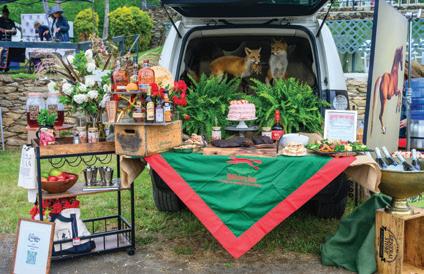
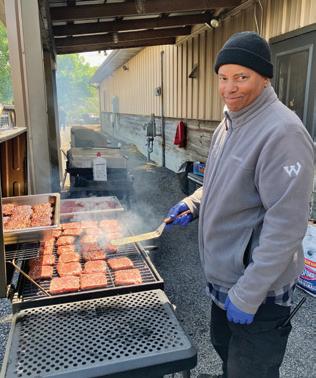
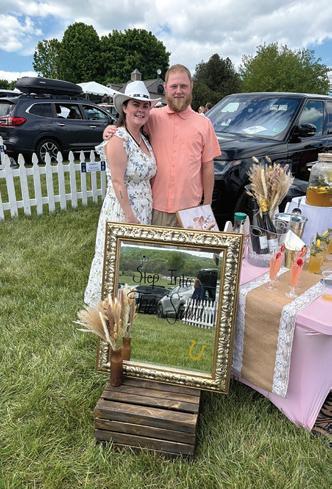
Congratulations to photographers Doug Gehlsen and Karen Monroe for their picture-perfect tailgate display at the Middleburg Hunt Point-to-Point races. Their artist talents were (as always) over the top and acknowledged as the winner. Then, we add the culinary talents for a delightful day at the races. Middleburg Photo
/ Country Zest and Style / @countryzestandstyle / @countryzestand1 www.countryzestandstyle.com
BE ON THE LOOKOUT through this issue of for the hummingbird.
He appears in two ads and the first two readers to find him (one each) will receive a gift from THE RED TRUCK Rural Bakery, with locations in Warrenton and Marshall. Send your reply to badgerlen@aol.com
MOTORCYCLE MARATHON MAN
By Leonard Shapiro
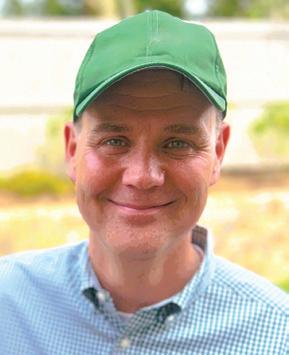
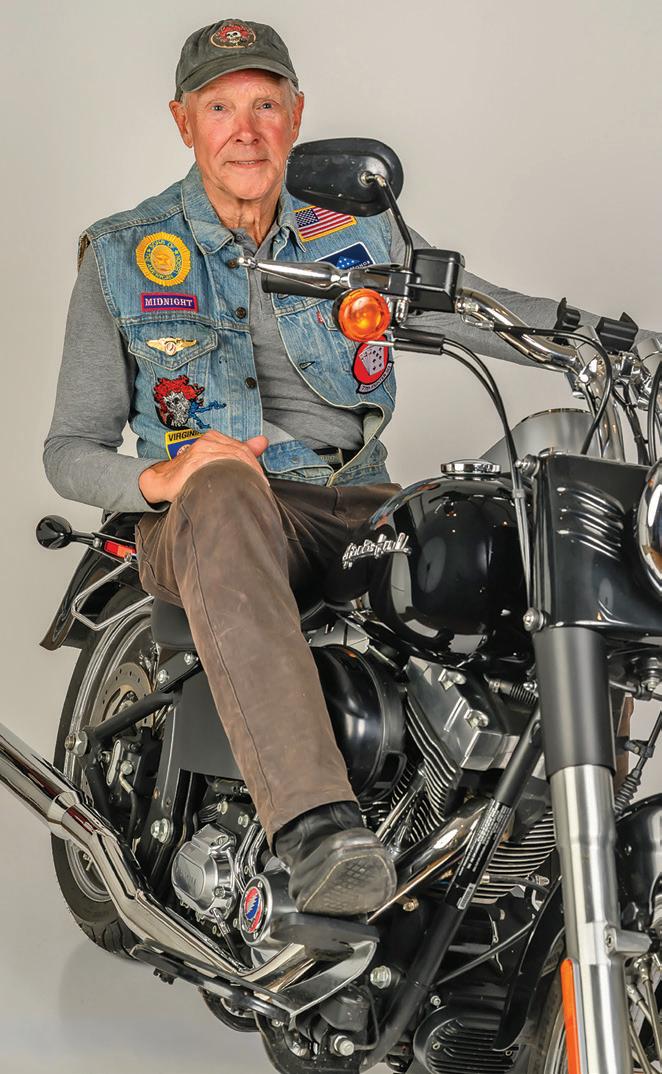
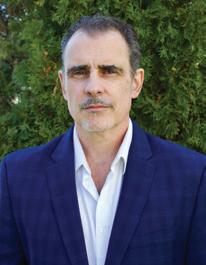
Over the last seven years, we’ve had all manner of interesting props to enhance our cover photos—horses, hounds, lambs, artwork, sculptures, wheelbarrows, rolling pins, street signs and confetti, among others. And now, here comes Jim Herbert and his Harley-Davis motorcycle rolling into the Middleburg Photo studio.
Jim is best known around these parts as the long-time volunteer organizer of the wildly popular and nationally recognized Middleburg Christmas Parade. He’s also been a motorcycle enthusiast since childhood and recently completed a grueling marathon 1,000-mile ride over a 24-hour period for a very good cause.
With pledges from 65 different donors, he raised over $7,000 for a nonprofit organization called Stop Soldiers Suicide, by far the largest total of anyone in a nationwide fundraising drive. Hooray for him, and the veterans who will benefit from his long day (and night) on the bike.
And speaking of good causes, be sure to read about Middleburg native Bob Ball, the owner of Middleburg Millwork and a man who also could use some help. Specifically, he has a damaged liver and needs a transplant from a donor willing to undergo what would be a lifesaving procedure for Bob. There’s no such thing as so-called “routine” surgery, but the recovery period for a donor is relatively short, and for more information, check out the story on page 20.
The Hill School had its 100th anniversary celebration weekend in early May, and we have the photos to prove a good time was had by one and all. And John Arundel writes about a very special day at the Middleburg school when he helped students unseal a fascinating time capsule his late father contributed 25 years ago.
On the history front, Denis Cotter takes a long look at the Mount Defiance Civil War battlefield just outside the village and John Toler has an intriguing story on some now long-gone but once storied homes and properties in Fauquier and Prince William counties.
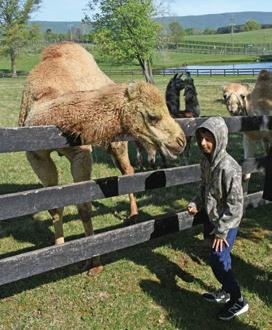
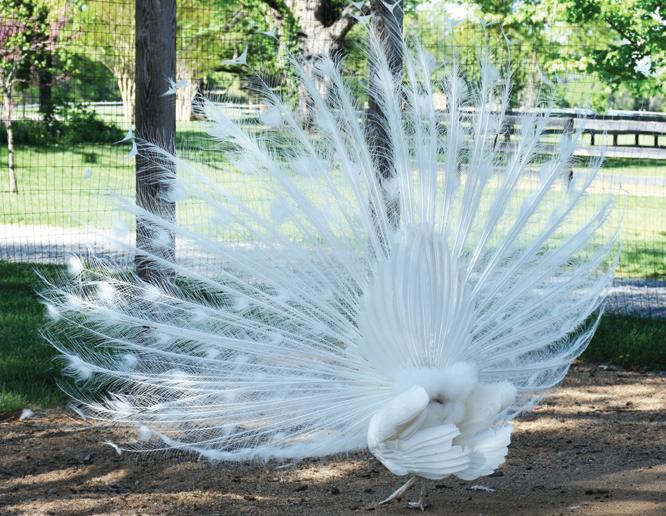
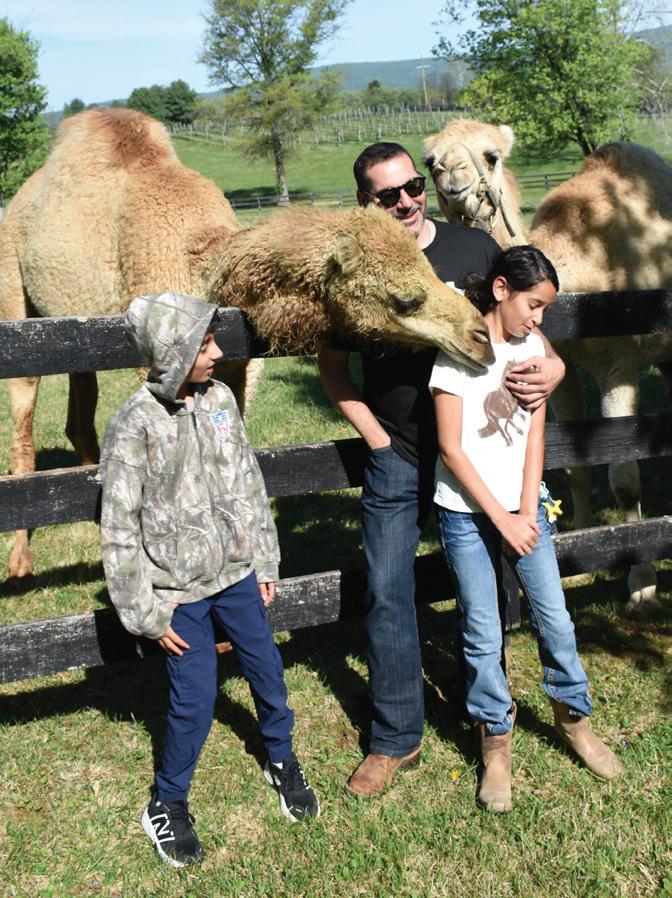
There’s also a whole menagerie of intriguing animals living on a still very visible property in Upperville. Next time you’re headed west on Route 50, check out the pastures on the left at the Horsefields farm not far from the Upperville Horse Show (make a note: June 1-7) grounds. Chances are you’ll see a couple of camels roaming out in a field, and how they got there is an interesting tale, as well.
One young Wakefield student also has a fascinating story to tell, likely for the rest of his life. While on spring break and sitting near the Middleburg Community Center, he actually became a witness to the recent Truist bank robbery when one of the perpetrators ran past him. He was able to give police a description of an incident he surely won’t soon forget.
There’s plenty more in this issue to add a heaping helping of ZEST to your summer reading pleasure, motorcycles and camels included.
Leonard Shapiro Editor badgerlen@aol.com
410-570-8447
A boy and his Upperville Camel.
PLANNING FOR THE FUTURE
EBy Bridge Littleton
very two years, the Middleburg Town Council meets over a weekend to develop its strategic plan. After our most recent gathering, I’m pleased to share an overview of the Council’s adopted Strategic Initiatives for 2026 and 2027—an ambitious yet thoughtful roadmap that reflects our shared commitment to preserving Middleburg’s character while preparing responsibly for its future.
At the heart of these initiatives is the continued preservation, restoration, and adaptive reuse of Asbury Church. This historic landmark is not only a cornerstone of our town’s heritage, but also a powerful symbol of community.
Over the next two years, we’ll be focusing on completing design plans, identifying sustainable funding sources, and ensuring that the church’s history is honored as we prepare for construction and future public use.
Equally important is our commitment to strengthening communication and engagement with all residents. We recognize that a connected community is a stronger community. In particular, we plan to deepen outreach to the Windy Hill neighborhoods to ensure every resident feels heard, included, and fully part of the life of the Town.
We also will prioritize economic vitality and accessibility through targeted infrastructure improvements. Efforts will include pursuing funding and construction options for
enhancements to South Madison Street, alongside broader sidewalk improvements to make our town safer and more walkable for residents and visitors.
Infrastructure reliability remains a core responsibility. The town will continue investing in critical upgrades to our water and sewer systems, focusing on water supply, treatment, distribution, and quality, as well as necessary sewer main repairs.
These investments ensure both public health and longterm sustainability.
With these improvements comes the responsibility to manage costs carefully. The Council will review and adjust our utility rate structure to balance affordability for residents with the need to fund ongoing operations and infrastructure.
Housing remains an important priority. We’ll work with nonprofit partners to support and expand opportunities for those most in need, helping to maintain the diversity and vitality that define Middleburg.
Finally, we’re going to update our comprehensive plan to reflect changes since 2019, explore thoughtful zoning amendments—such as rooftop dining—and evaluate our town government structure to ensure we’re well-positioned to serve our community effectively into the future.
Together, these initiatives reflect a clear vision: honoring our past, serving our present, and building a resilient future for Middleburg.
I had the pleasure of working with Appleton Campbell when they replaced my AC unit and coil, and I couldn’t be more impressed. From start to finish, they were extremely professional, knowledgeable, and efficient. They took the time to explain everything clearly, worked quickly without cutting corners.”
Mayor Bridge Littleton
At Mount Defiance, A “Small But Important Riot”
By Denis Cotter
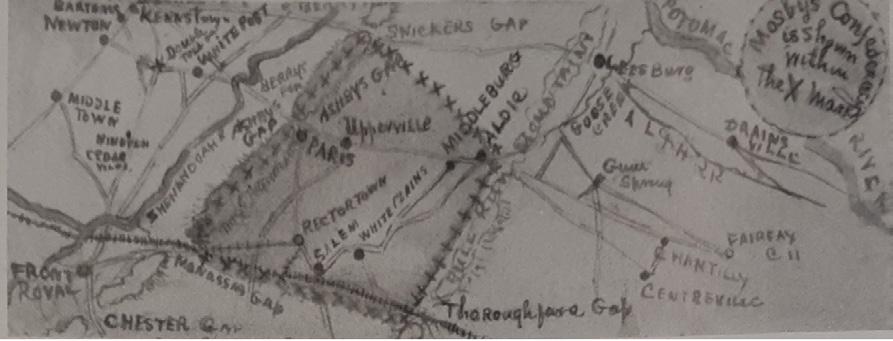
The Civil War Battle of Middleburg was fought from Wednesday, June 17 through Friday, June 19, 1863. The temperature all three days was in the high 90s and one of the principal locations of the conflict was Mount Defiance, a low ridge about a mile west of the mansion house in the center of town—known today as the Red Fox Inn.
Despite the name, Mount Defiance was far from being a mountain. Its highest elevation was 525 feet with a ridge that stretched across the Ashby Gap Turnpike—now Route 50– near the Zulla Road.
The Mount Defiance of 1863 consisted of two main parts—the area on the south side of the pike that now comprises the Mount Defiance Historic Park opened in 2019. The other was the area on the north side of the pike that contains today’s Middleburg Downs subdivision.
Mount Defiance got its name as a result of a land dispute between the two oldest families in Middleburg— the Chinns and the Powells. Rawleigh Chinn was the original recipient in 1731 of a land grant of 3,300 acres around what later would become Middleburg.
His oldest son, Joseph, a first cousin of George Washington, sold his 500-acre portion of the property in 1770 to Leven Powell, who founded the Town of Middleburg in 1787. Powell sought to buy additional land from the other Chinns, but it did not go well.
The Powells and the Chinns ended up in court for over 40 years, haggling about who really owned 700 of the original 3,300 acres and where the actual boundary lines were located.
Long after the original litigants were dead, a Leesburg court rendered final judgment in April, 1814. The Powells had to give back the 700 disputed acres, but the Chinns had to give the Powells’ 318 acres on the north side of the Ashby Gap Turnpike. Part of that included Thomas Chinn’s house.
The Chinns celebrated by building a house they named Mount Recovery (not a mountain, either—elevation, 400 feet) on Wolver Hill, north
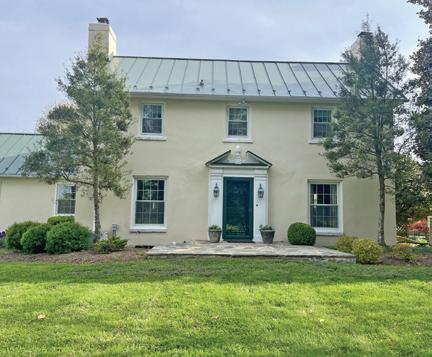
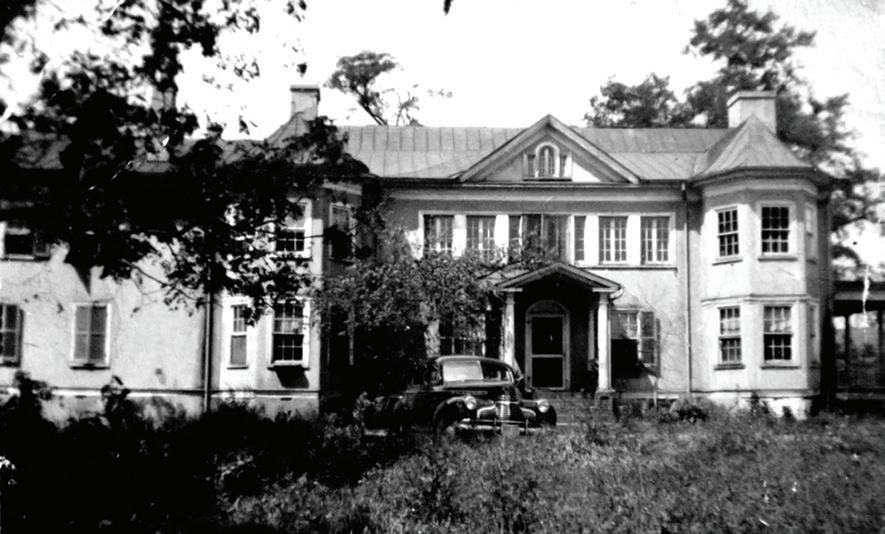
of Middleburg. Not to be outdone, the Powells expanded Thomas Chinn’s house and re-named it Mount Defiance. It still exists today, significantly enlarged, in Middleburg Downs, but was renamed The Carter House in the late 19th century.
The Powells of 1814 also built a long stone wall, still standing, to separate the land and the families forever. Almost 50 years after the wall was built, the Civil War came to Mount Defiance.
The Battle of Middleburg followed the Battle of Aldie, which had been fought earlier in the day on June 17. The action at Mount Defiance was the precursor to the Battle of Upperville, fought on Sunday, June 21. All three battles were cavalry events. The principal historian of the battles, Robert F. O’Neill, Jr., called them “small but important riots,” a phrase first used by U.S. Infantry Captain John Ames at the time.
Except around Middleburg, the battles have almost been forgotten. They were wedged between two overshadowing events. One was the Battle of Brandy Station in Culpepper County on Tuesday, June 9—the largest cavalry battle of the Civil War and a Confederate victory.
The other was the Battle of Gettysburg, Wednesday, July 1 through Friday, July 3, the largest land battle ever fought on the North American continent. It was a Union victory and the turning point of the war.
In Aldie, Middleburg, and Upperville, the conflicts were inconclusive, with no clear winner in any of them. If there was a victor, it was Confederate General Robert E. Lee who was leading his army north through the Shenandoah Valley. They were on the other side of the Blue Ridge Mountains, heading for Pennsylvania.
The three local battles along the Ashby Gap Turnpike were a prelude to Gettysburg. Lee’s subordinate, General J.E.B. Stuart, the Confederate commander around Middleburg, successfully screened the movement of Lee’s army from prying Union army eyes.
Lee felt safe enough to stop for Sunday service at Grace Episcopal Church in Berryville on June 21. The
spot where his horse, Traveler, was tethered outside while the general prayed has its own memorial historical marker.
There are ten historical markers at Mount Defiance Historic Park. A visitor follows the markers to unfold the detailed story of the Battle of Middleburg.
Records for the three battles along the Ashby Gap Turnpike are incomplete. On the Confederate side, under Stuart, nearly 9,000 troops defended the Blue Ridge Mountain gaps. On the Union side, under General Alfred Pleasanton, some 8,000 men were involved in the fight. About 1,360 men in total were killed or wounded – 850 Union, 510 Confederate.
In Middleburg alone, there were about 400 casualties, many at Mount Defiance, by the time the battle ended when a thunderstorm arrived in the late evening of June 19.
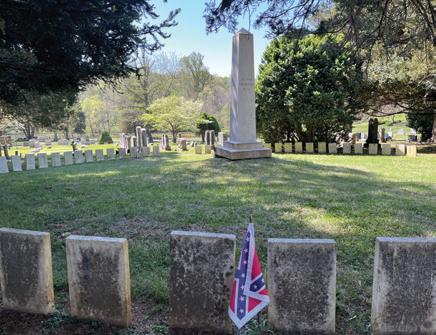
Wounded soldiers from both sides were treated in local churches, homes, and barns. The Confederate dead were buried in local cemeteries such as Sharon Cemetery in Middleburg and Mt. Zion Old School Baptist Church in Aldie. Many Union soldiers were initially buried where they fell and later moved to national cemeteries in Virginia.
On a more positive historical note, 48 years after the Battle of Middleburg, in 1911 local equestrian legend Daniel Cox Sands in 1911 held the first Middleburg Races at Mount Defiance.
Photo by Leonard Shapiro Confederate Circle at Sharon Cemetery.
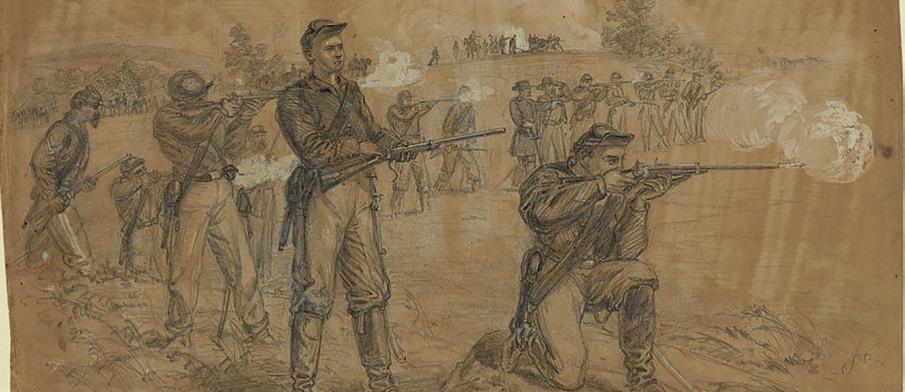
Courtesy Library of Congress
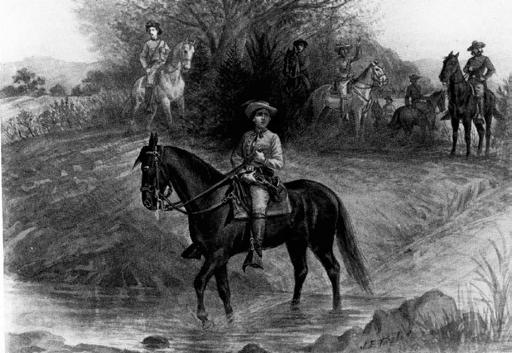
The 1st Maine Cavalry skirmishing at Mount Defiance in a live sketch by Alfred Waud.
Photo by Denis Cotter
Mount Defiance house in Middleburg, later known as the Carter House.
A Little Church in Marshall With Big Plans
By Leonard Shapiro
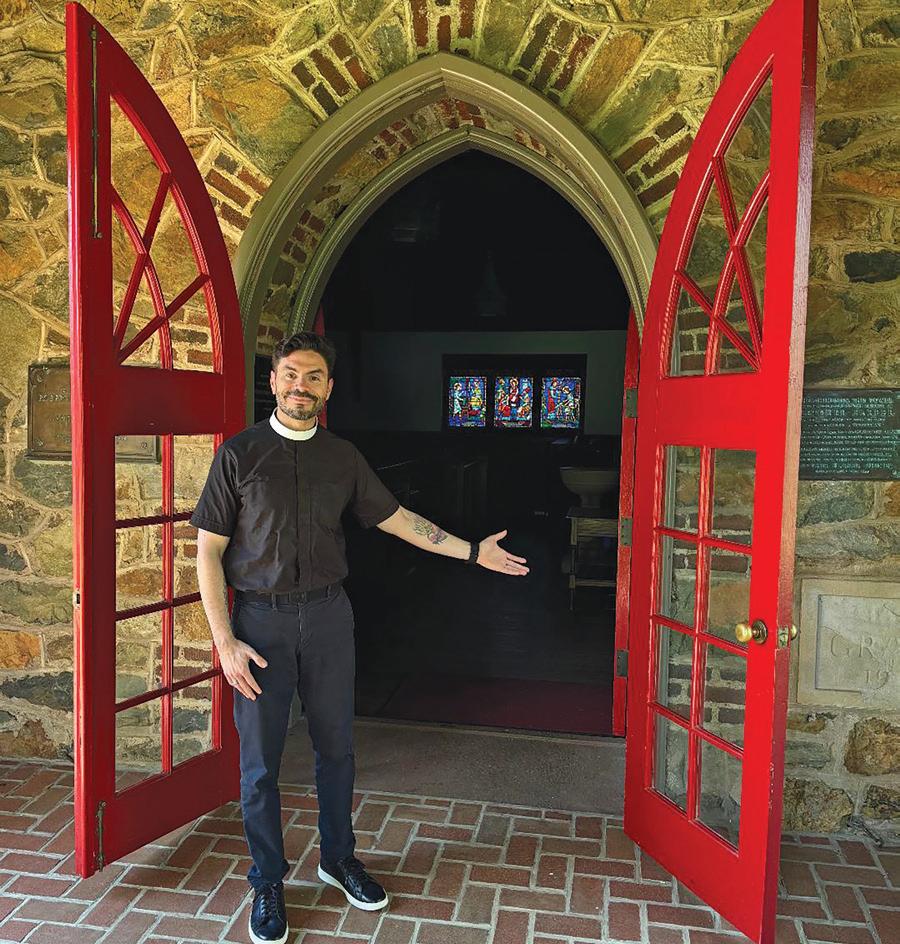
It’s been an interesting year at the little church not far from the only traffic light in the town of Marshall. The Anglican Church of Saint John The Baptist now occupies a comfy, cozy building first erected in 1849. And over the last dozen or so months, much of that space has undergone a major and much needed renovation.
What’s so interesting?
Even as construction was going on in the church’s main worship area, including the replacement of a badly water-damaged floor and all of the church pews, Rector Jonathan J.D. Ostman never missed a beat. He managed to conduct daily morning and evening prayer sessions at 9:30 a.m. and 5:30 p.m. Monday through Saturday, as well as the regular 10:30 a.m. Sunday service.
Construction began in April, 2025 and Father Ostman said weekends were particularly challenging when building materials, machines and tools had to be moved out of the way in order to set up folding chairs for the main Sunday service. When it ended, away went the chairs, back came the construction materials and work began again until the following weekend, when they did it all over again.
“That lasted pretty much through Christmas,” said Father Ostman, who lives a five-minute drive away
in the appropriately named Rectortown and will celebrate 20 years as the church’s rector in 2027. “It was quite a challenge, to say the least, but we’re just about finished and very pleased with the outcome.”
About 25 families from all around Northern Virginia are regular parishioners. According to a welcome brochure available at the church, “While our faith is rooted in the Anglican tradition, we welcome all Christians to worship with us. Many of our present members have joined from other denominations, favoring our Anglo-Catholic worship.”
Father Ostman said the renovation cost about $200,000, with a major portion donated by the
estate of two deceased long-time parishioners and the rest coming from contributions by other church members.
The project began three years ago when prominent Washington D.C. architect James McCrery, who’s firm specializes in the design of churches, civic and university buildings, was first approached about handling the project.
“He came out and just loved the church,” Rev. Ostman said. “Then his team came out and measured everything. We got the drawings last spring, and then we figured out who could do it. It was DEA Construction in Fredericksburg, basically a contractor and his helper, and it was just amazing to watch them work.”
The new red oak pews were finished by this past Christmas. A baptismal font was in place by Easter and Father Ostman said a church bishop will come up from Columbia, South Carolina in late June to bless the project and help celebrate its completion.
The church building is located on 1.75 acres, and Father Ostman said there is also a long-term plan to eventually construct a parish hall and a classroom building on the property. Fundraising has already begun for what could be a $3 million project, and he’s hoping work can start by late 2027.
Clearly, even more interesting years are yet to come for Marshall’s little Anglican church.
Photo by Leonard Shapiro Rector Jonathan J.D. Ostman
Angela Killinger
Riding That Unpredictable Wave of Life
By Angela Killinger
Sometimes I feel like life is like riding an ocean wave.
There are days, even months, when I’m on top of that wave, riding high and feeling so many great joys. And then, the wave crashes me into the shoreline, drags me under, holds me down, twisting and turning, only to spit me right back up on the wave again.
Some days the crash is what I feel most.
Six years ago, my beautiful daughter Ellie Rose was diagnosed with an aggressive form of Lupus. While the rest of the world was navigating COVID, we were learning a new language of mystifying medical terms I never wanted to know. At the very same time, our other three children were winning awards, being named team captains, graduating at the top of their respective classes and receiving accolades all along the way. It was a constant pattern of crashing and riding the wave.
The cycle can take a toll on the human spirit, and because of that, I’ve had to lean more heavily than ever on strategies I first learned in high school to help me get through some very difficult days.
People teased me when I was younger because I adored Oprah Winfrey’s TV show. I set my VCR to record the 4 p.m. broadcast and I rushed home from tennis practice to watch it each afternoon. Of course, I loved the makeovers and the giveaways, but I was most inspired by the stories of people she interviewed who had faced unimaginable pain or loss and yet managed to persevere. And thrive.
Through Oprah, I was introduced to the idea of a gratitude journal. I was 23, recently out of college and in graduate school and had never journaled before. I was inspired by the concept that if we focused on what we were grateful for, there wouldn’t be room for self-pity.
I began writing daily about the things I was grateful for and soon noticed a shift in my mindset. The more I focused on gratitude, the less space there was for what felt missing, unfair, or wrong.
When my daughter became seriously ill, I wrote that I was grateful to knowledgeable doctors, for a career that provided quality health insurance, for a loving family willing to help, and especially for my dear friends and neighbors. More recently, our family has faced another series of unimaginable challenges. Ellie Rose suffered a vertibral artery dissection that led to five strokes, temporarily taking away her ability to walk and talk and leaving her in terrible pain with a long road to recovery.
Recently, my son Keagan experienced a collapsed lung and required emergency surgery, during which part of his lung had to be removed. In the same week, our daughter Lilly committed to attend the University of Virginia and was inducted as Cum Laude at her high school and our daughter Chloe was a guest speaker at UNC Chapel Hill and won her Regatta race.
As much as I can feel the wave trying to pull me under, I’m also reminded of just how much I have to be grateful for—the gift of each of my children, the incredible community I live in, for an unwavering support system, and for the exceptional doctors caring for our children. Over the last 30 days, our community has delivered meals to our home among many other small acts of kindness that have been lifelines during these overlapping family crises.
And so, for now, I’ll continue to ride that wave of life—sometimes soaring, sometimes crashing—but always holding gratitude in my heart.
Riverkeepers Keep Watch Over Local Waterways
By Linda Roberts
Mark Frondorf has an intimacy with rivers that few possess. Since childhood, Frondorf has been in, and on, rivers that lured him to fish, boat, canoe, swim, guide and study waterways that filled a growing interest as he matured. Even his home in Page County sits on land that overlooks the Shenandoah River.
A civilian military analyst for over 30 years, Frondorf spotted a posted position over a decade ago with the Potomac Riverkeeper Network’s affiliates (Shenandoah, Potomac and Upper Potomac). It was a job he thought his background and skills made him an ideal candidate to fill the job requirements and the Riverkeeper network was looking for someone who knew the Shenandoah.
“I’m very comfortable with the river (Shenandoah),” he said, “having served as a fishing guide on this river for 20-plus years.”
Now in his 11th year with the nonprofit network, Frondorf can usually be spotted in his canoe on the Shenandoah, giving community presentations and leading guided walks, driving to Georgetown for meetings of the Potomac Riverkeeper
Network, or in Richmond when the General Assembly is in session. It’s a multi-faceted job, one that’s ideally suited to Frondorf’s knowledge and lifelong love for the waterways he has lived near.
The Potomac Riverkeeper network is a Washington, D.C. based nonprofit that protects the Shenandoah and the north and south branches of the Potomac through pollution enforcement, advocacy and community engagement. It promotes safe use of the rivers for swimming, fishing and other recreational activities. It builds partnerships and targets community involvement and education.
Although the Shenandoah was not affected by the crises earlier this year on the Potomac with its highly publicized District of Columbia sewage leak, it certainly was a call to action for the Riverkeeper Network and its affiliates.
Frondorf also recalled issues that occurred years ago on the Shenandoah when a massive fish kill stopped fishing and swimming, as well as other recreational water activities.
He described it as a “convergence of many factors, including bacteria and chemicals,” that brought about the disaster. More recent Riverkeeper work included a project that would keep livestock and agricultural run-off out of the river.
An Unwanted Designation
Last month, the Potomac River was ranked No. 1 on the Most Endangered Rivers list for 2026.
Events that created this designation include the horrific January sewage spill in Washington. That untreated sewage placed new and unacceptable stress on this river, which is essential to the surrounding communities it serves and for wildlife, which also depend on the river. The rapid spread of data centers is yet another major threat to the rivers.
Years ago, then President Lyndon B. Johnson once referred to the Potomac River as “a national disgrace.” However, because of many concerned citizens working tirelessly and the ultimate creation of the Riverkeepers organization, the Potomac rebounded as a source of drinking water, recreation, and economic opportunity.
The Potomac is a 380-mile river system that serves more than six million people and is the sole drinking water supply for many.
The Riverkeeper organization urges citizens and communities to take action now by joining the Potomacriverkeepernetwork.org and become a voice for the rivers, which we so much value as part of the region’s surrounding scenic beauty.
For information directly concerning the Shenandoah River, contact Mark Frondorf, Shenandoah riverkeeper at Mark@prknetwork.org or visit potomacriverkeepernetwork.org.
The massive undertaking involved many landowners, farmers and livestock herds. It also required a mandate from the General Assembly. Funding from the Commonwealth helped tackle this lengthy and ongoing project designed to keep livestock fenced out of the Shenandoah.
Frondorf said there are new concerns affecting area communities—the rapidly emerging data centers and chemical products that have created a growing threat to surrounding water resources. He cautioned that the Riverkeeper Network must keep a watchful eye on current issues that affect the water quality it protects.
“We are the voice of the river,” Frondorf said. “We must be watchful. What happened on the Potomac earlier this year is something that could happen anywhere.”
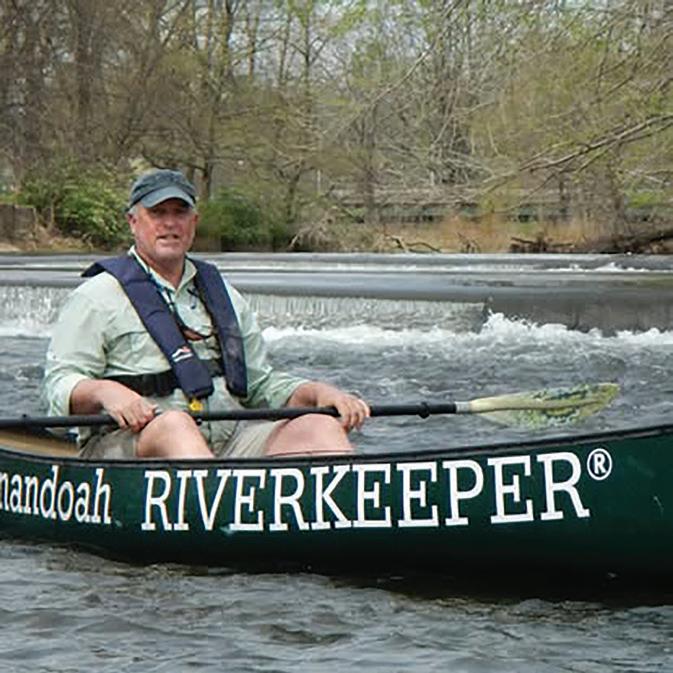
Shenandoah Riverkeeper Mark Frondorf keeping a watchful eye from this canoe.
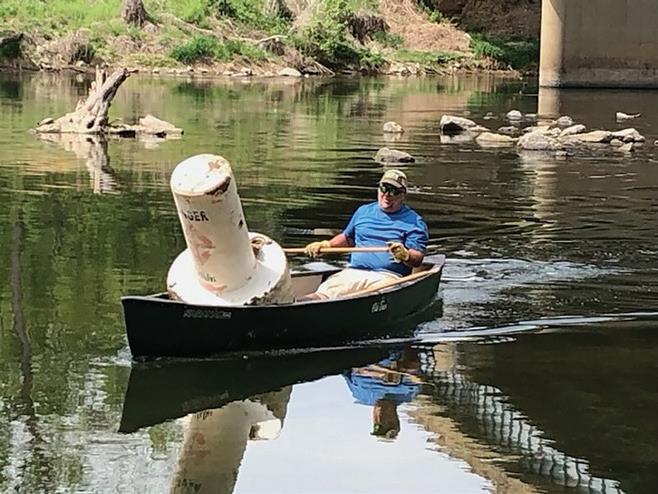
Eric Sours from White House Farm transports this disused buoy during one of the Trash Free Shenandoah cleanups for Earth Day in April.
Danny Davis: Middleburg’s Loss is Loudoun’s Gain
By Leonard Shapiro
You just might say that Danny Davis, Middleburg’s widely regarded town manager since 2018, has decided to go back to the future starting on July 2, when he becomes deputy county administrator for Loudoun County.
After all, during his senior year at Purcellville’s Patrick Henry College in 2004, he had a Loudoun government internship that turned into a full time job after he graduated, working for a county supervisor.
“I’m a true champion of local government,” Davis said in a recent interview. “Within a couple of months of that internship, I realized how much you could impact people’s lives. And it’s always been a career goal to go back with Loudoun County. I was chief of staff to the county administrator until 2015 and I wanted to go back at some point.”
That point comes after Davis, an Atlanta native with a Masters degree in public administration from George Mason University, has had a significant impact on Middleburg. Said Mayor Bridge Littleton, “We’ve been very lucky to have Danny as our town manager.
“It’s been an absolute joy to work with him, his dedication to community, his intelligence, and hard work ethic have come through in so many ways. For me, Danny has been more than just a town manager, he’s a trusted friend.We’re going to miss him, but wish him the best for his future at Loudoun County.”
Davis lives near Gilberts Corner with his wife, Angela (“the rock star of our family,” he said), and three children, Amelia, 20, Addysen, 18 and Clara, 13. He was hired by the town after
two years as assistant town manager in Purcellville.
“This was my first opportunity to be the leader of a team,” Davis said. “In the recruiting process, I remember them talking about the character of the town but also wanting to move it forward with new events and activities.
“The challenge was doing a lot with a smaller team than I was used to. We have an extremely forward-thinking mayor and town council with many projects they want to complete. And we have a great staff to help get it done. Will Moore (deputy town manager) and Rhonda North (town clerk) are the backbone of this team and they all do an incredible job.”
Over Davis’s tenure, a number of events popular with both locals and visitors have been added, including Oktoberfest, Art in the Burg, the Miglia auto rally and Middleburg Day.
The town continues to attract new businesses, has managed to keep resident utility bills reasonable and been prompt to deal with infrastructure issues that must be repaired or updated. And there’s still an $11 million reserve fund to handle unforeseen issues affecting its 700-plus residents.
It hasn’t always been easy. Fifteen months into his Middleburg tenure, Covid reared its ugly head, in a rather frenetic period when the stunning new town hall also was being planned and constructed before opening in 2023 to mostly rave reviews.
It’s the same sort of outstanding review Danny Davis gives to the town.
“Middleburg is truly a community that cares, and that makes it a really special place,” he said. “In a broad sense, there’s a misconception that it’s elitist, but nothing could be further from the truth. We are a diverse community with a broad range of ages, incomes, backgrounds and experiences. As a town, this is a breath of fresh air.”
Photo by Leonard Shapiro Danny Davis
Witness To A Robbery
By Pat Reilly
On Tuesday, March 24, Kyvin Donovan, 13, was on spring break from Wakefield school. That unusually warm afternoon, he and another seventh grader were getting ready for a “double sleepover” at his Middleburg house.
“We were riding around for fun,” Kyvin recalled, into the village on “professional trick scooters.” Kyvin had brought along some loose change he had saved.
His father, Mike, had suggested he get wrappers from the bank and sort the coins by denomination before cashing out. Kyvin went to the Atlantic Union Bank next door to the post office on West Washington Street, he said, because “it’s more inviting.”
Coin wrappers in hand, he and his friend went back across West Washington to the privacy of the Middleburg Community Center pool area and found a bench, not far from another bank, Truist.
At about 4 p.m., a man who appeared to be a recreational jogger came running past the two boys. He looked athletic, Kyvin later told Loudoun County Sheriff’s detectives, and wore a black long-sleeve shirt with a maroon vest and maroon hat. He had on khaki golf pants and Nike sneakers, no mask, and ran into the bank.
Kyvin was not at all alarmed until about 10 minutes later when he heard the wail of police sirens and saw a tall “intimidating” uniformed policewoman come
out of the Truist bank. Even more intimidating were all the guns he saw. He said one policeman had FBI branded clothes. Another officer told Kyvin and his friend, “You guys have to get away as fast as you can.”
Kyvin did not see anyone he recognized as a member of the Middleburg Police. He told his friend to follow him to the nearby Middleburg Library, where he told the librarians what he saw.
His friend had to use his own cell phone to call Kyvin’s mother, because Kyvin’s phone was dead. By then, helicopters were flying low over the village when Mike Donovan entered the library to collect the boys. He remembers they looked shaken.
It wasn’t until the next morning that Kyvin realized he didn’t have his coins. He and his dad went first to the police department in the Town office building. Finding no one there, they walked around the corner to the main municipal office, where a woman at the desk told them to go back to the police office.
Instead, Kyvin asked her to check the lost and found for the $13.80 in rolled coins. No luck. His dad then called the mayor’s cell number. Mayor Bridge Littleton picked up and offered to meet them. He told them he was prepared to give the $13.80 to Kyvin as a gift from the town.
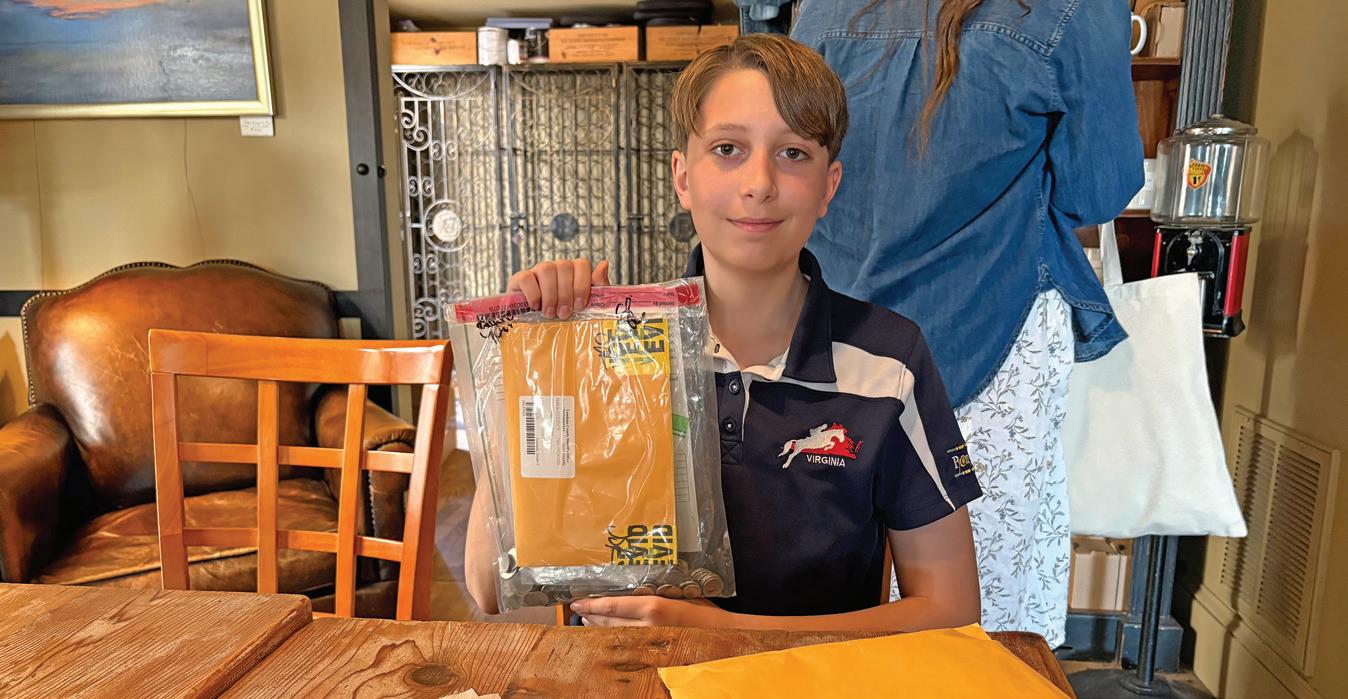
On Friday, a Loudoun Sheriff’s deputy called the Donovans to say they had Kyvin’s money. They returned the coins right away in an evidence bag and told Kyvin they also needed a description of “the jogger” he had seen days earlier near the Truist bank.
“Any little thing could be helpful,” Kyvin said the detective told him. Kyvin recalled that the runner had “olive skin and blue eyes.” It wasn’t until the next day that he remembered the Nike brand of sneaker the man wore. He called that in, too.
Along with his coins, which he’s now decided to keep along with the sheriff’s evidence bag, Kyvin has since received a Challenge Coin branded for the Loudoun County Sheriff’s Department. He also plans to collect those.
When school started again the following week, Kyvin Donovan also had a story to tell, one he’s not likely to forget any time soon.
Editor’s note: Three weeks after the robbery, Josiah Jackman barricaded himself in his Hamilton house as Loudoun Sheriff’s deputies tried to serve search and arrest warrants in connection with the Middleburg bank robbery. Loudoun media reported the robber’s suspected accomplice, Paul Peter Gerardi Jr. of Leesburg, had been arrested the same day in Herndon and charged with robbery and conspiracy to commit a felony. Gerardi had driven the getaway car in the Truist robbery and had been parked at the Middleburg Library. He never entered the bank.
Both men had been implicated in other bank robberies in Northern Virginia. Jackman was found dead in what police said was a suicide after SWAT team members entered the barricaded house. Loudoun media reported he was identified in court records as the man who entered the bank. The take was $1,091.
Kyvin Donovan with the evidence bag from the bank robbery.
Middleburg Common Grounds
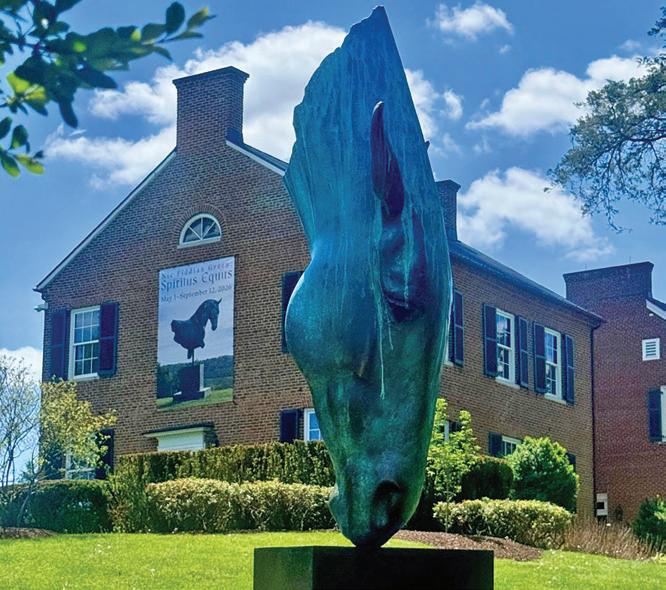
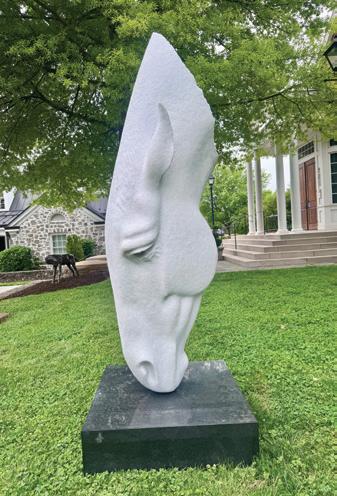
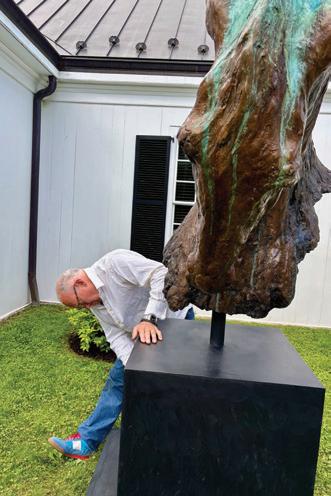
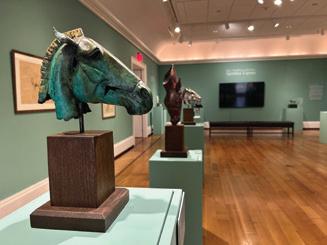
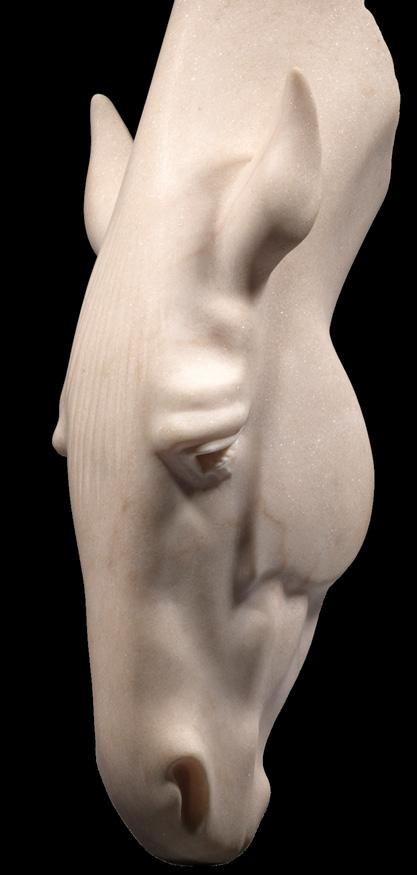
Since 2012, the magnificent sculpture, Still Water (2011), has graced the entrance of the NSLM’s Museum and been emblematic of the institution’s collections. To form the iconic 9-foot-tall horse head at water, artist Nic Fiddian Green (British, b. 1963) hammered sheets of lead, securing them with copper rivets. For decades, he has worked with a vibrant array of materials— not just shaping lead, copper, gold, and silver sheets, but also casting his early lead and bronze sculptures, hand-carving marble and semi-precious stones, and drawing with charcoals.
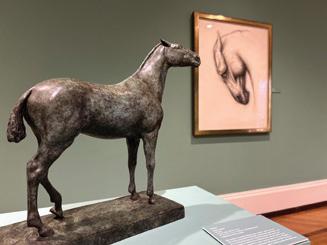
Although Fiddian Green’s chosen media has evolved, and sizes have ranged from diminutive to monumental over time, he has been driven by a constant and deeply rooted fascination with the spirit of the horse. Nic Fiddian Green: Spiritus Equus celebrates his vision with five monumental works installed in prominent outdoor locations, four medium-size works complementing the NSLM’s Still Water in the main first-floor gallery, and 18 sculptures and 7 drawings upstairs. The major exhibition is, in fact, the first retrospective of Fiddian Green’s equine subjects ever presented, with works created between 1983 and the present.
Several have never been on public view before. The earliest sculpture, Transcription Project, 1983, dates to the origins of the artist’s preoccupation with the Classical horse. While attending Chelsea College, Fiddian Green visited the British Museum to work on an art transcription assignment. Upon seeing one of the Elgin Marbles, a broken-off horse head known as Horse of Selene from a pediment that adorned the Parthenon, Fiddian Green was struck by its form. Decades later, in 2024, he noted in an interview for Equestrian Living magazine, “These Greek principles of perfection, harmony, and proportion, balance, and seamless craftmanship have stayed with me ever since.”
A sincere thank you to the Sladmore Gallery, London, who have represented Nic Fiddian Green for the last 30 years, for their support in mounting this exhibition. On view at the National Sporting Library & Museum May 1, 2026 - Sep 12, 2026.
Nic Fiddian Green (b. 1963), Still Water, 2025, Carrara marble, Unique, 7 feet high (excluding base)
Photo by Vicky Moon
Nic Fiddian Green applies touches of wax on his sculpture Into The Wind
Roman Horse, 2018, Bronze, 6 feet tall (12 feet including base), On loan from artist
India, cast 2009, Bronze, Artist copy, edition of 9, 16 3/8 x 16 6/8 x 5 7/8”
Photo by Vicky Moon
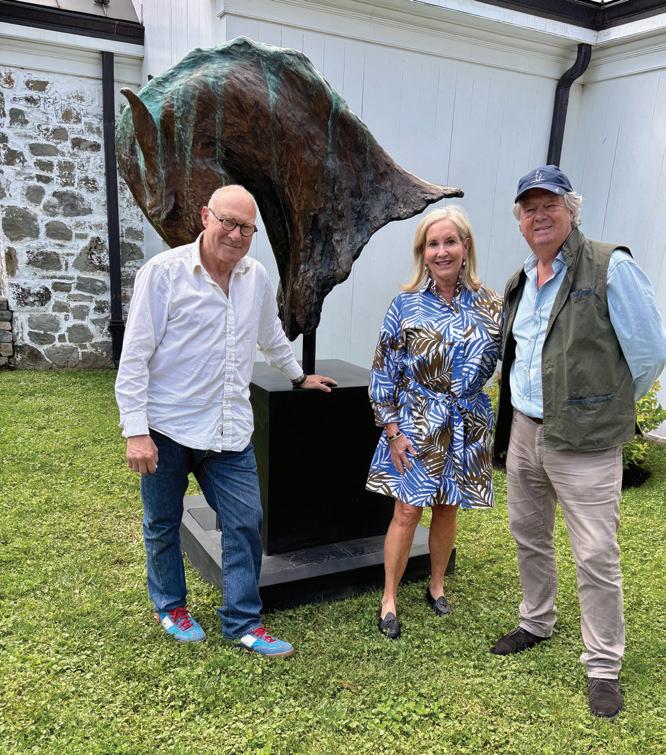
Sculptor Nic Fiddian Green, Elizabeth von Hassell, president and CEO of the National Sporting Library & Museum and Edward Horswell of Sladmore Gallery in London.
ON THE SHOULDERS OF GIANTS: The Tortoise, Evolution, and the Future of Galápagos
Photos by Nancy Kleck
The Galápagos Islands have inspired the curiosity and imagination of scientists, explorers, and historians for centuries. Hugo Mogollón, president and CEO of Galápagos Conservancy, told the story of the archipelago through the eyes of its most emblematic inhabitants, the giant tortoises at the National Sporting Library & Museum.
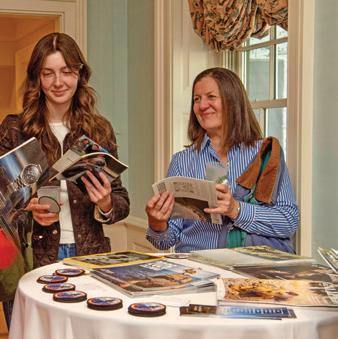
Guests look over booklets and information on the island.
Hugo Mogollón (President & CEO of Galápagos Conservancy) with Lavinia Currier.
Kevin O’Connor, Alexi von Keszycki and Amy Brown.
Natalie Brown, Matt Gavin with Julie Banner (Clarice & Robert H. Smith Education and Marketing Director).
Elizabeth von Hassel (NSLM President and CEO), Hugo Mogollón (President and CEO of Galápagos Conservancy), Jacqueline B. Mars, Kat Imhoff.
Good-bye Long Island, Hello Virginia
By Vicky Moon
Sue attributes her success to a combination of classical training from superior horsemen and horsewomen and using “feel” to direct her. She allows the horse to tell her what they need and for when they are ready.
Sue Lyman found her way to the horse haven of Middleburg in 1981 after growing up on Long Island, crowded with countless houses and congested highways. Yes, there were some nice beaches, but it was hardly a conducive environment for this horse happy 19-year-old girl.
And she had a plan.
Sue told her father she was taking a gap year after high school and would be heading south to Virginia. She took jobs riding field hunters and also did work that required a pitch fork and broom. With a loan from her mother, she made her first investment with a Thoroughbred named Simbalu. “He made a career for me,” she says simply. And, did we mention, he was a stallion?
The first time Sue led Simbalu over some small jumps, “He had perfect form,” she recalled. The bonus came both in the mornings and afternoons. She was able to breed him in the morning before showing him in the afternoon four-foot hunter classes. The horse took it all in stride and never got too “frisky” in the show ring, winning countless blue ribbons. His stud fees ranged from $1,500 to $2,500, with a lot of takers.
Offers to purchase Simbalu came all the time, but she turned them all down. “He had a good mind and was a nice show horse,” she said of a talented horse who died in 2010 .
Sue has been operating her business, West Riding in Middleburg, for more than 30 years. Over that time, she has started or retrained many other successful show hunters, including Roxdene, Irregardless, El Roy and Movado. She’s married to Hunt Lyman, a long-time teacher and academic dean at the local Hill School. Now retired, he writes about and utilizes artificial intelligence—its promise and power, and the quiet ways it’s reshaping our lives.
Earlier this year, Sue helped launch the $25,000 Upperville Thoroughbred Hunter Derby. So, mark your calendar now. The event will take place at the Upperville Horse Show in the Parker Ring on the afternoon of Tuesday, June 2.
Photo by Treavor Lord Simbalu was a Thoroughbred stallion who began his career on the racetrack and found his way to Sue. Together, they rose to the top of the hunter divisions.
Sue Lyman with Executive Privilege owned by Nancy Milburn.
For Michael Reed, It’s About Enhancing The Senses
By Leonard Shapiro
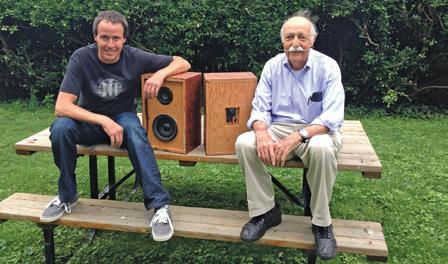
Michael Reed was 12 when he and his dad built stereo speakers from scratch at their Friendship Heights home in Washington, D.C. They provided many years of sweet music for their family, and it also marked the beginning of Michael’s audio career.
These days, his Middleburg-based firms— Metamorphosis Environments and Tech Butler— provide clients with a wide variety of essential services for their homes and businesses.
For example, the Metamorphosis website indicates that, “We are dedicated to transforming your living space into a truly immersive and personalized environment. Our full-service offerings encompass cutting-edge technologies in lighting, shades, audio, and video, all designed to enhance your home’s comfort, functionality, and aesthetic appeal.”
Tech Butler is all about wi-fi systems and network solutions.
“Our mission is to provide top-notch personal device and home systems services,” the web site advertises. “We strive to make technology easy for our clients…from device set-up to training and tutorials if you are struggling with your iPhone, iPad, computers, we can help.”
Said Reed, “it’s basically digital baby-sitting. You’re visiting grandma at Christmas and she gets an iPad under the tree. The kids are too busy to help her figure it out, and then everyone leaves and grandma
viewing and listening pleasure.
In 2010, he moved to Middleburg.
“I had some friends living here and I came out one day to check it out,” he said. “I fell in love with the town, and I’m still here.”
He now works out of his home office at Windcrest Farm, occasionally traveling to south Florida where Tech Butler has gained a foothold in Palm Beach. Among many projects there, his firm installed spectacular outdoor lighting on the Chilton Trust building he’s particularly proud of. And plenty more.
has that iPad and now she doesn’t know her Apple ID password and she has no clue. She’s stuck and Tech Butler swoops in to help her out.”
Reed has been doing this sort of work for most of his adult life. Born and raised in D.C. and a graduate of Gonzaga High School, he attended the University of California-Santa Cruz, then stayed in Los Angeles to work for his aunt and uncle, movie producers Pat and Bill Finnegan.
He was a production coordinator on a number of movies, including “Lawnmower Man,” actor Russell Crowe’s first appearance in an American film. He became schooled in all things audio and visual and eventually moved back to Washington after the 9/11 terrorist attacks. He started a business in 2006 called Wired Up Home Theater that specialized in doing just that for homeowners looking to enhance their
Back in the Middleburg area, he cleaned up the wiring mess at Hunters Head tavern, installed the sound system and motorized a window shade at Common Grounds coffee shop and upgraded Middleburg Tennis Club’s television and wi-fi systems. Many home and farm owners also have used his services. Ovoka Farm in Paris had him install a huge sound system—36 indoor speakers, 16 more outside.
Reed enjoys giving back as a volunteer. He greatly improved the sound system for the Middleburg Christmas parade and the police department’s National Night Out summer celebration. He also provides free charging stations at the Upperville Horse Show for the hunter and jumper riders lounges as well as the 1853 VIP tent.
He’s clearly come a long way since assembling those speakers as a 12-year-old, with many more sights and sounds to come, wi-fi included.
Michael Reed with the first set of speakers he built at age 12. Photo circa 2016 with his now late father, Dick Reed.
Memories of the Old Gap Road
By John Toler
The highway that passes through northern Fauquier between Prince William to Warren County is known as John Marshall Highway or State Route 55. It was originally called the Gap Road – a reference to the passage at Thoroughfare Gap.
The Gap Road is rich in history, with early farms, homes, villages and water-powered mills. On both sides of the road between the Prince William County line and The Plains, significant structures once stood, recalling times gone by. Most are gone now.
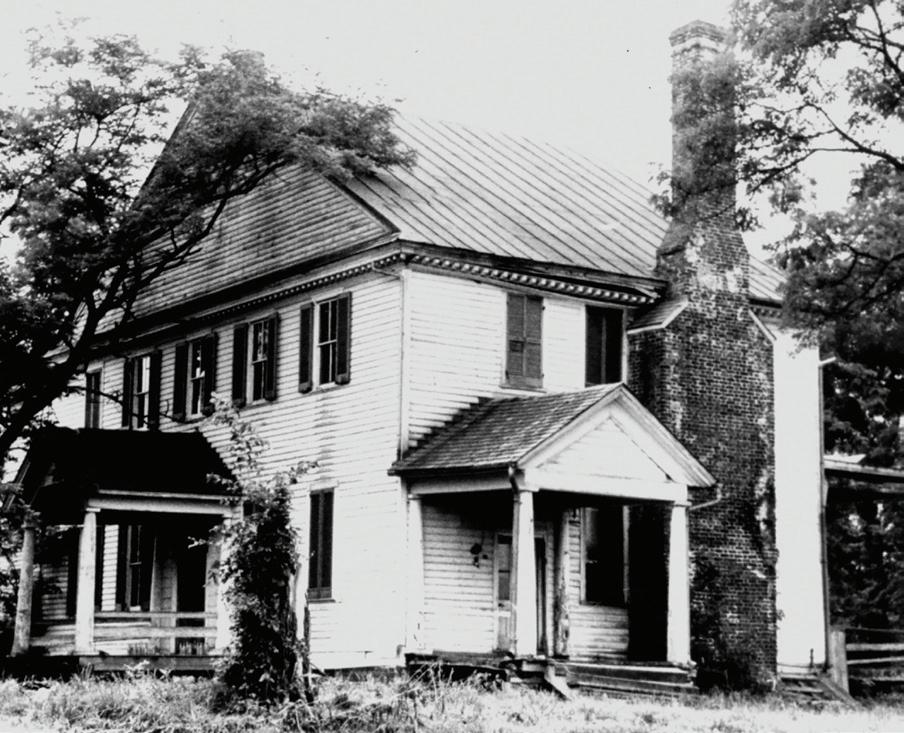
Cloverland
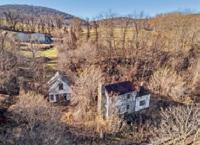
The main house at Cloverland, just inside Prince William County, was built in 1797 by Edward Carter (1767-1806). Later owners of the property included Commodore Bladen Tasker Dulany (17931856) and his wife, Mary Walker Carter Dulany (d. 1840). After Mary’s death in 1840, Bladen married Caroline Rebecca Nourse (1819-1893) of the Nourse family of Weston.
Cloverland continued to stay in the family with the marriage of Bladen’s daughter Rosa to Thomas Chew Jr. (1845-1924). After Tom’s death, their daughter Jeannette and husband Dr. Samuel Claggett lived there until moving to Baltimore. In the years that followed, Cloverland had several owners. By the mid-1950s, the house was in poor condition and eventually torn down. In 20032004, the 371-acre Cloverland property was placed in a conservation easement through the Virginia Outdoors Foundation.
Chapman-Beverley Mill
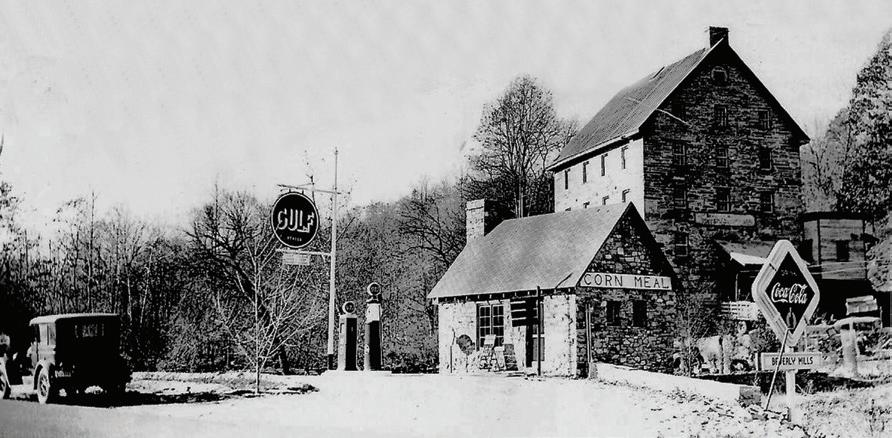
For many years, the best-known business in Thoroughfare Gap was the Chapman-Beverley Mill, originally built in 1749 by Jonathan Chapman and his son Nathaniel.
Over the years, four generations of Chapmans owned and operated the mill, the last being John Chapman (1819-1866).
At the beginning of the Civil War, the mill was taken over by the Confederate Army. A slaughterhouse was built below the mill, which was used to store the meat. It was abandoned and nearly destroyed in June 1862, and was involved in the Battle of Thoroughfare Gap on August 28, 1862.
After the war, Col. Robert Beverley of nearby Avenel purchased the mill from the Chapman estate and turned the operation over to his son William (1852-1937). Business was good until the 1880s, but by 1893 the mill was out of business.
Thus began a series of new owners, including Charles C. Furr, who added the mill store about 1930. In 1937, William Wilbur of Warrenton joined the business as a full partner and business agent. By the mid-1940s, demand for stone-ground food products had diminished. Walter P. Chrysler purchased the mill in 1944, and kept the business going until 1951.
Chrysler sold the property to Cdr. and Mrs. Mack West, who operated an antique store there and used the boarded-up mill for storage.
The next owner was Mrs. Morton Smith of Middleburg, who purchased the property in 1973 with the intention of restoring the mill. In late 1998, a group of local preservationists were poised to purchase the mill from Mrs. Smith but on Oct. 22, 1998, it was burned, a victim of arson. Mrs. Smith donated the property to the preservationists, who manage the property today as the Turn the Mill Around Campaign.
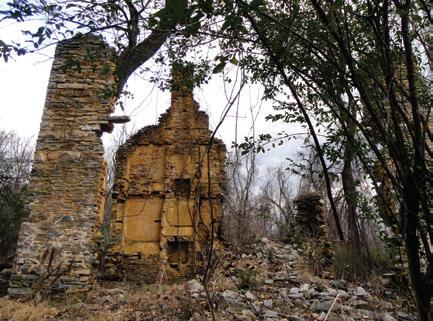
Ruins of Meadowland
On the high ground above the Chapman-Beverley Mill are the ruins of Meadowland, the home built by Jonathan Chapman about 1740. Five more generations of the Chapman family – Nathaniel,
Cloverland
Chapman-Beverley Mill
Ruins of Meadowland
Pearson, John, George and another John – lived at Meadowland until the last John’s death in 1866. It was acquired by the Bleight family of Haymarket in1870, but was lost to fire the 1880s. Near the ruins is the Chapman family cemetery.
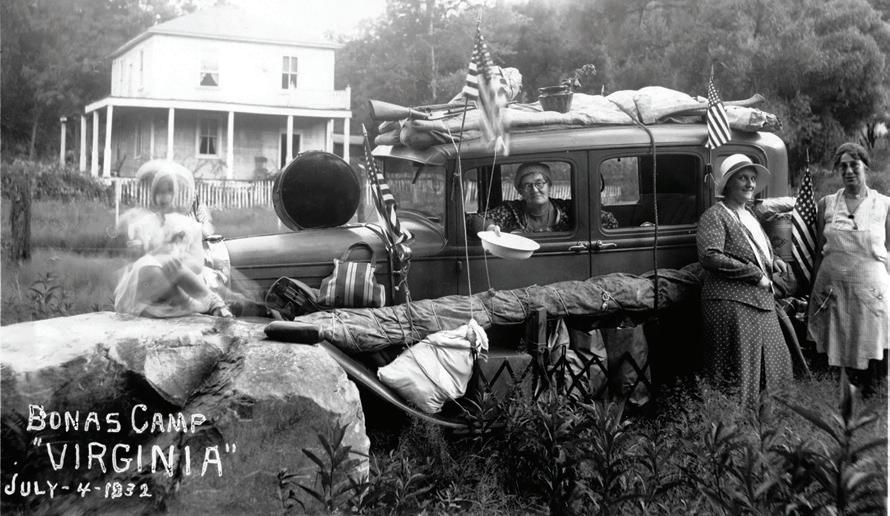
The White family of Broad Run
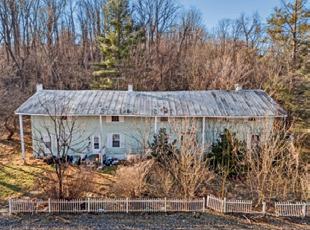
The homes of the White family were across the Gap Road from the Chapman-Beverley Mill. The largest of the homes, built in 1904-05, can be seen behind this gathering of family and friends on July 4, 1935.
Hugh Watkins White (1839-1912) was born in Upperville, and served with Col. John S. Mosby’s Rangers. In 1869, he married Elizabeth Jane “Bessie” Jordan (1847-1929), the daughter of Benoni and Jane Jordan of LaGrange, near Waterfall. They first lived in Upperville, and in 1874 moved to “Bee Cottage” (so named for its beehives) in Thoroughfare Gap, where they raised their four sons and three daughters.
Hugh White opened a shop in Little Georgetown, where he repaired and built furniture, and Bessie raised vegetables and gathered eggs from her hen house, which she traded for groceries at the stores at Little Georgetown and Broad Run Station.
During the 1898 Spanish-American War, a large group of soldiers were sent to Thoroughfare Gap to recover from the effects of a flu epidemic. A sick soldier named Robert Drowne was placed in the care of a male nurse at Bee Cottage. During his convalescence, his brother Frederick (1880-1930) came from Rhode Island to visit him.
In 1902, Fred Drowne and Hugh’s daughter Lila Charity White (1880-1960) fell in love, and eloped to Rhode Island. Back in Thoroughfare Gap, Lila’s brothers began work on a new home for their parents in the meadow below Bee Cottage.
“It was an elegant house of seven large rooms, a big hall through it, a wrap-around porch that was covered over to make an upstairs porch,” according Fred and Lila’s daughter Mary Drowne Gale. “It also had a lean-to kitchen with a pass-through to the dining room, and a bathroom.”
Fred died in1930, and Lila returned to live in the Gap in 1935. She designed a new home on the site of Bee Cottage, where she had been born 55 years earlier. It was completed by the summer of 1936. Lila stayed in her home until 1952, after which
she lived with Mary in Rhode Island. She died in December, 1960.
In the years since then, much has changed where the White family once lived. Bee Cottage and the “elegant” house built for Hugh and Bessie are gone. Only Lila’s unique stone residence has survived.
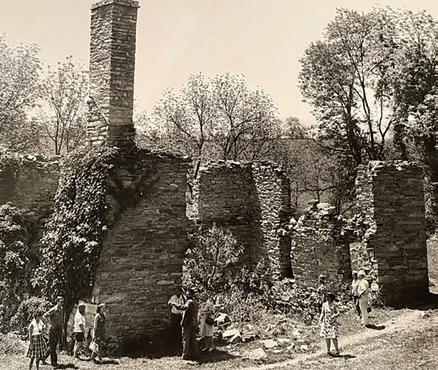
Stover’s Mill on Trapp Branch
Abraham and Rachel Stover and their sons Ralph, Charles and Albert came to Virginia from Bucks County, Pa., in 1833. A year later, they purchased the Trapp Branch Mill, a lofty structure of beautiful stone built in 1732 by William Skinker. They lived in a small house above the mill.
Until his health failed, Abraham actively operated the mill. Ralph and Albert took over the milling, while Charles worked the surrounding farmland.
Eventually, ownership of the mill passed to Charles, and later to Ralph. In 1889, Ralph sold the property to William Beverley, but the property returned to the Stover family in 1894, when it was purchased by Robert C. Stover. It was operated as a mill until 1935 or 1936, after which time the building was used for storage.
The next owner was Dr. William Pinkney Herbert,
who bought the mill in 1943 from Ella Antrim Stover (1893-1990). In 1955, it was sold again to Wendell M. Adamson.
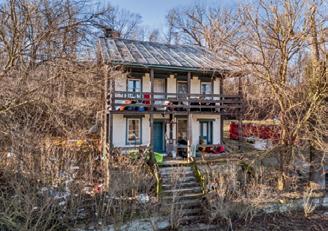
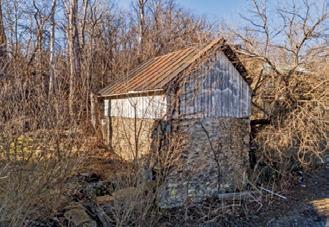
Stover’s Mill was destroyed by fire on the night of Nov. 12, 1961. About 2,000 bushels of grain and 900 bales of hay were also lost. The ruins stood for many years; but now only scattered stones remain.
Kalarama
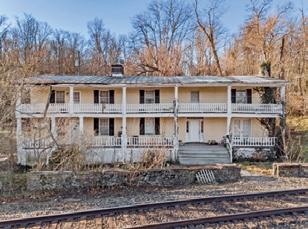
Approaching The Plains, a large home originally called Kalarama once stood off the side of the Gap Road. It was built in 1837 by Sylvester Welch, and in 1868 sold to Capt. Drayton Meade, who renamed the home Beulah.
Later owners included H. Teller Archibald (18791936) and his wife Dorothy (1898-1977), who also owned nearby Archwood Manor. Widowed in 1936, Dorothy married J. D. Stetson Coleman (1905-1975) in 1944.
The Colemans lived at Archwood and rented Kalarama to the family of Mrs. Mary Margaret Lunceford. All three children of her daughter and son-in-law, Clyde and Ella Pearson, were born at Kalarama. Although she was very young when the family moved from Kalarama, their daughter Jane (b. 1937) remembered the house well.
“It was so big that we would take tricycles and ride from the upstairs all the way through there,” Jane once recalled. “I loved that house. It was so big and interesting. Years later, we wanted to go back and see it, but it had burned in March, 1985.”
The White Family of Broad Run
Stover's Mill on Trapp Branch
Kalarama
Help Wanted For Middleburg Millwork Owner Bob Ball
By Leonard Shapiro
There is always a well-charged cell phone within an arm’s length of Bob Ball’s reach, with the ringer set at maximum decibels and every call, spam or not, answered within a ring or two. After all, it could well be a matter of life or death.
Ball and his wife, Joyce, own Middleburg Millwork, celebrating 57 years since Ball’s father, David, founded the business—the town’s far friendlier and a tad smaller version of Home Depot— on April 1, 1969. Bob, now 66, began hanging out on the property at age nine and started working there full time ten years later. David, 88, and retired, now lives in Orlando, Florida.
About three years ago, Bob inexplicably started to put on weight and had a serious fluid buildup in his legs. He was diagnosed with cirrhosis of the liver, permanent scarring that damages the organ, interferes with its functioning and can lead to liver failure.
One day, he was visiting a local attorney’s office to sign some papers and couldn’t do it because, he said, “I had no idea where I was. At home, I had to go to the bathroom, but I walked out the front door and didn’t know where the bathroom was.” The damaged liver caused a high ammonia level in the blood which causes cognitive impairment, confusion, and tremors.
At that point, Joyce called 911 and it was off to the hospital and a barrage of tests.
Cirrhosis is the result of persistent liver damage over many years, with the most common causes a result of viruses like hepatitis, genetic issues, other metabolic factors or excessive alcohol or prescription drug and recreational drug use.
And a possible cure?
A transplant.
That, of course, explains the importance of any call that activates Ball’s cell phone these days. For three years, he’s been on a transplant list for a new liver from a deceased donor and being treated by the Hume-Lee Transplant Center at Virginia Commonwealth University Hospital in Richmond.
So far, there have been three different calls telling him to prepare for an imminent full transplant. Each time, there were complications with the organ itself that forced cancelation of the procedure.
“They don’t really tell us a lot about why it didn’t happen,” Joyce said. “They just say it wasn’t viable. Then the wait begins again.”
A heart or kidney transplant requires a complete organ substitution. But a damaged liver needs only a piece of a healthy liver from a living donor to be attached to begin a healing process “and it can actually grow back to full strength,” Ball said.
Several months ago, his liver doctor suggested finding possible living donors willing to voluntarily undergo the procedure to help. He’s now actively trying to get the word out about his condition in hopes of speeding up the process.
Family, friends and even total strangers are eligible to be on that living donor list. Bob and Joyce are hopeful someone reading this story, or seeing appeals on social media, or hearing about it at his church or even the local Safeway might be willing to step up and donate.
Obviously, living donors must have a healthy liver. It’s usually a short hospital stay for them and the liver grows back to normal size and function within a few weeks with a four to six week recovery period. Joyce volunteered, of course, but
she’s Bob’s primary caregiver and, at 66, not an ideal candidate. His daughter, Cierra, 37, offered to undergo the procedure, but it was determined her liver would not be suitable.
Ball undergoes a complete physical examination at VCU every six months and takes a number of medications that keep him strong enough to commute from his home in Winchester daily to the Middleburg Millwork, where he often puts in a full working day.
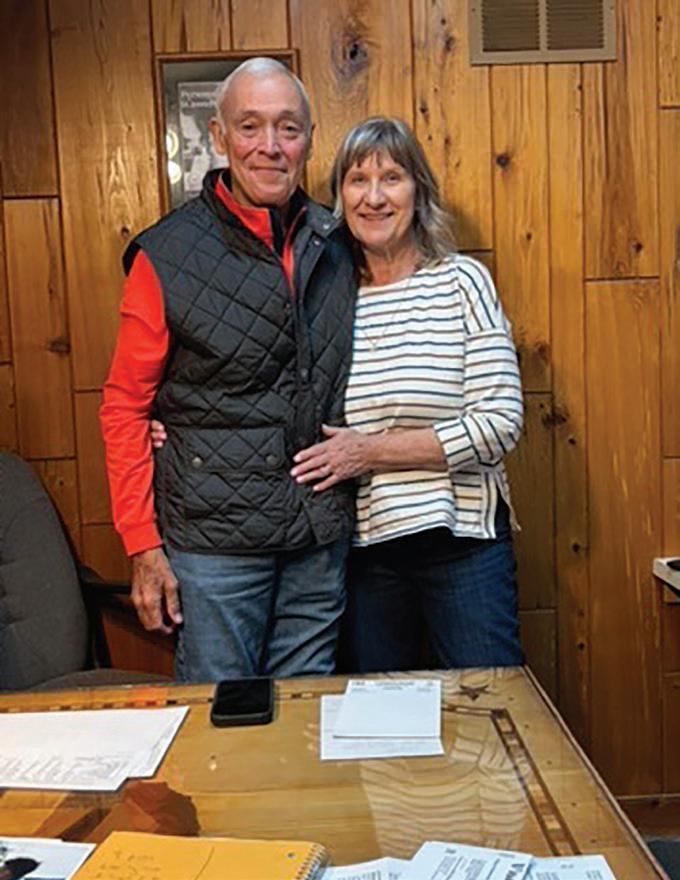
“Right now it’s a day-to-day thing,” Ball said, sitting in his Millwork office at a gorgeous wooden desk his grandfather designed and built. “Joyce has been a great caregiver and I’m still able to come to work and be active. I’ve tried to have a good attitude and stay positive. We’re just waiting for that phone call.”
Bob Ball can be contacted at Middleburg Millwork, 540-687-6318. For more information on becoming a potential living transplant donor, go to https://www. vcuhealth.org/livingdonors or call (804) 828-2762.
Photo by Leonard Shapiro Bob and Joyce Ball
Thank you for joining us! Sip & Celebrate with Windy Hill
On Thursday, April 9, more than 250 community members gathered for Windy Hill Foundation’s annual Sip & Celebrate reception, the Foundation’s largest fundraising event of the year The evening brought together supporters, residents, Board members, and community partners to celebrate Windy Hill’s mission and the families it serves throughout Loudoun and Fauquier counties
During the event, Windy Hill proudly recognized Bob Dale and Ann Northrup as Emeritus Board members in honor of their longstanding dedication, compassion, and commitment to the community Former board members Beth Ann Mascatello and Julie Coles shared heartfelt tributes reflecting on Bob’s meaningful relationships with residents and Ann’s thoughtful spirit and dedication to uplifting others
Guests also learned more about Windy Hill’s Education, Home Repair, and Emergency Needs Funds, which provide critical support and resources to residents living in Windy Hill’s affordable housing communities
Through sponsorships, ticket sales, and generous contributions made throughout the evening, Sip & Celebrate raised more than $200,000 to help Windy Hill continue maintaining safe and stable housing, expand educational opportunities, and provide assistance to residents facing unexpected challenges
The evening also included a meaningful $100,000 f ive-year pledge f rom Co-President Shannon and Jim Davis honoring the legacies of Valerie Dove and Lisa Ben-Dov and their lasting impact on the Windy Hill community
If you were unable to join us but would like to make a 100% tax-deductible donation, scan the QR Code to support Windy Hill’s to provide safe, decent, and affordable housing to low- and It’s not too late! Help us meet our goal.
lower- income individuals and families, including older adults, in Loudoun and Fauquier Counties, while also encouraging selfimprovement and self-sufficiency among its residents.
Thank you to our 2026 Sponsors!
ALA Painters, LLC
Jan & Kathryn Baran
Bank of Clarke Foundation
Jane & Andrew Bishop
Patricia Callahan
Bailey & Bradley Davis
Joe Perta & Carl Davis
Shannon & Jim Davis
Guy O Dove III
The Ellison Family
Alice & Todd Frazier
abrielle Gallegos & Scott Johnston
The Hersh Family
Carolyn & Michael Hylton
Imagine Life Coaching
DeeAnn & Jamie Jeremiah
Jolly de Give
KVB Incorporated
Annie Lake & Paul Mahon
J Preston Levis Foundation
Loudoun Commercial Title
Jacqueline B Mars
McGraw Foundation
Middleburg Books
Monoflo International, Inc
Ann & Tom Northrup
Oak View Bank
George L Ohrstrom
Karin & Mark Ohrstrom
Nicole H Perry & Andrew Stifler
Piedmont Environmental Council
Bonnie & Kevin Piper
Quantum Real Estate Management, LLC
Rockbridge Investment Management
Sheridan-MacMahon, Ltd
Slater Run Vineyards / The Patusky F
Anne & Ken Terry
Thomas & Talbot
Virginia Housing
Suzanne & Mitch Voss
Judy Washburn
Helen Wiley
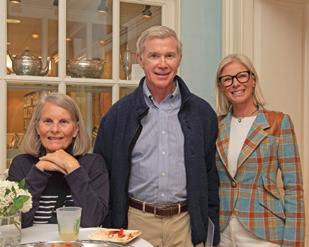
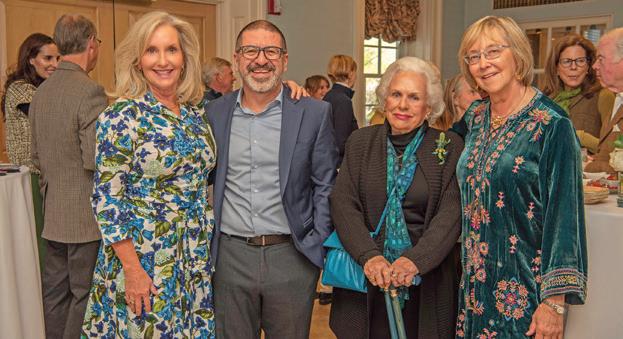
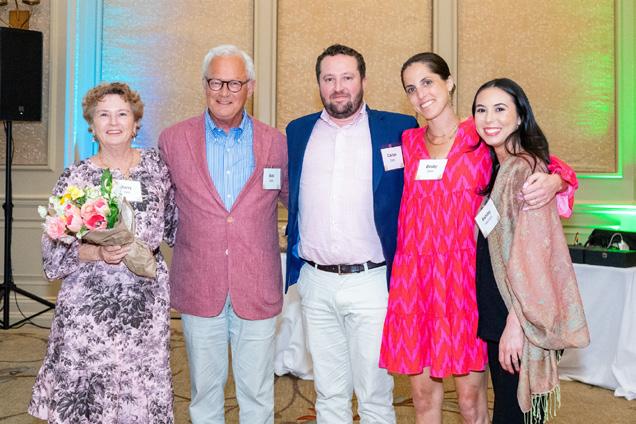
Pictured above (left to right): Kerry Dale, Bob Dale (Emeritus Board Member), Carter Dale, Emily Dale and Ashley Helmick Photo by: Hannah McBain Chasm Captures
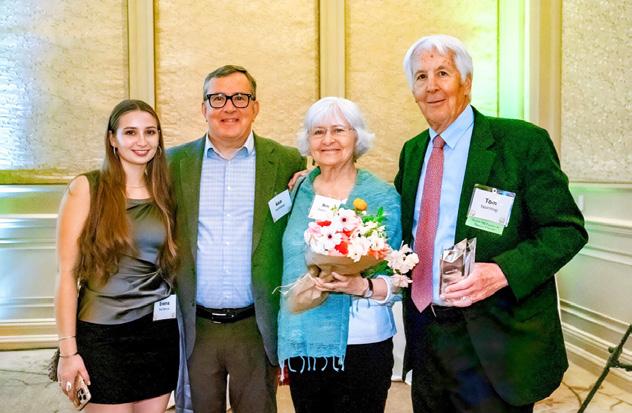
Pictured above (left to right): Emma Northrup, Alex Northrup, Ann Northrup (Emeritus Board Member) and Tom Northrup Photo by: Hanna McBain Chasm Captures
Windy Hill Foundation is a 501 (c) (3) organization and charitable contributions are deductible to the fullest extent of the
LOANS FOR:
Homes and land
Construction
Livestock
Land improvements
And much more!
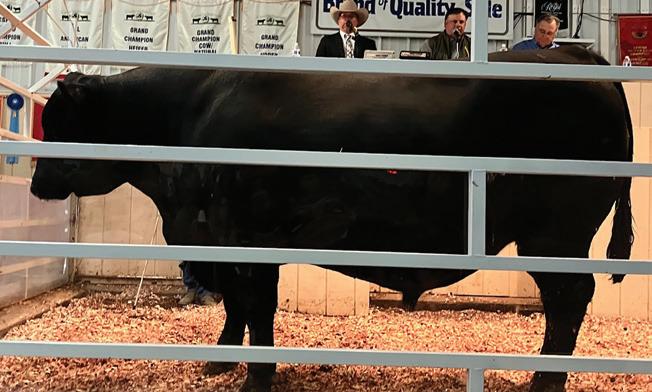
Friends and aficionados of the mighty bovine gathered at Whitestone Farm for their 33rd annual Angus Bull and Female Sale at their 2,000 acre facility outside of Aldie.
Photos by Donna Strama
Kennedy MacMillan with My Mint Julep
Owner George Lemm
big boy sold for $20,000
Kelvin Scott, guess what’s for lunch?
Middleburg Library Hosts History Series
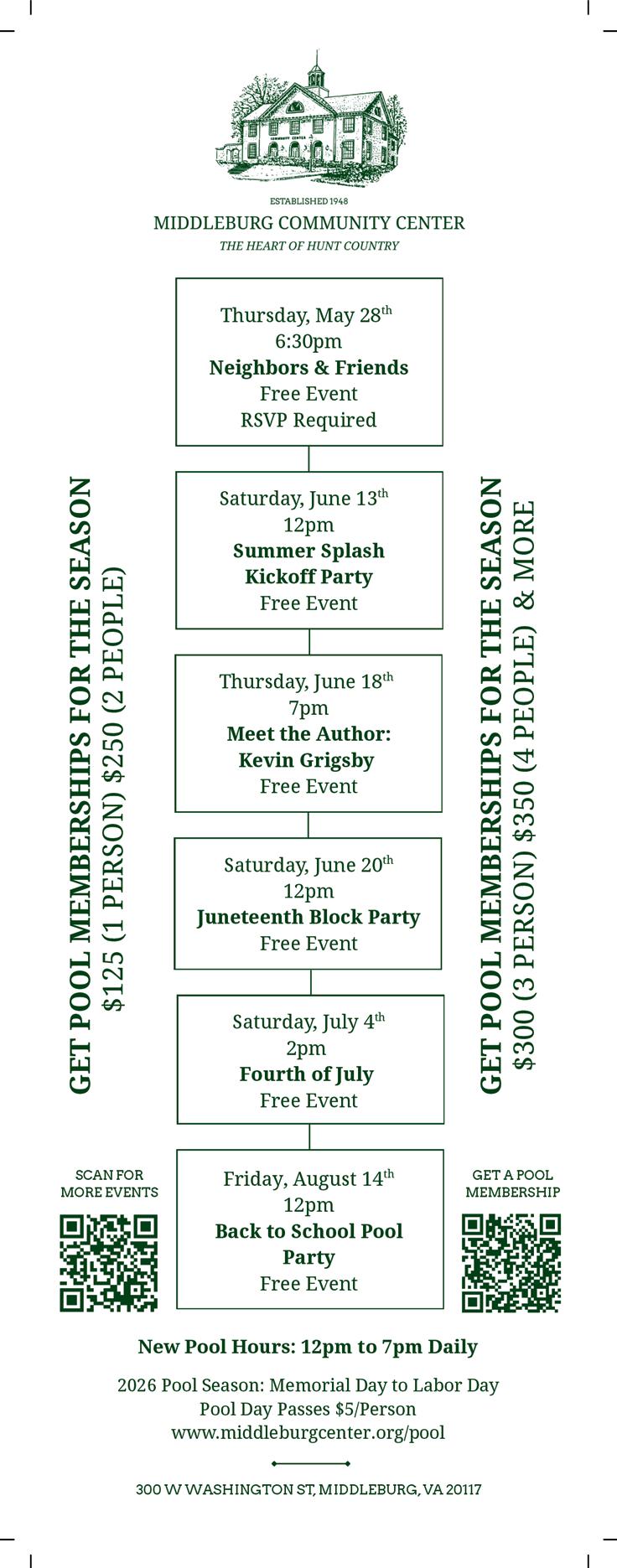
As the nation prepares to celebrate its 250th anniversary, the Middleburg Library has launched an American history series featuring presentations by local authors and historians. The next session, featuring author Kevin Grigsby speaking about his book, “A Story of Hope & Freedom,” is scheduled at the Middleburg Community Center on Thursday, June 18 starting at 7 p.m. The final four sessions will be held at the library, all starting at 7 p.m. On July 16, Dr. Emily Southgate will talk about “Land cover of Loudoun County in 1776.” On August 20, Jeffrey Joyce will discuss “For the Common Defense.” Travis Shaw will speak on “The Heroes of Brandywine” on Sept. 17 and Marc Leepson will present “The Marquis de Lafayette and the Revolutionary War” on Oct. 15. The entire series is free and open to the public.
The Foxcroft School recently hosted local singer, songwriter, and musician Bess Putnam as its 2026 Helen Cudahy Niblack (1942) Visiting Artist. Known as the Blue Mountain Songbird, Putnam shared her passion and process with the Foxcroft community. Beginning with a song, Putnam captured the audience from the first notes, as she sang about
UNDER CONTRACT!
NEWS & NOTES
growing up nearby in a family of musicians, singing, “They raised me up to love the land and sing the songs caught in my chest,” foreshadowing themes that would appear throughout her presentation. Following her presentation and performance, Putnam hosted a workshop for budding songwriters and musicians as part of Foxcroft’s annual weeklong Festival of Arts. Established in 2007 by Austi Brown (1973) in memory of her mother, Helen Cudahy Niblack, the series seeks to bring a variety of fine, literary, performing, and practical artists and designers to Foxcroft to share their work.
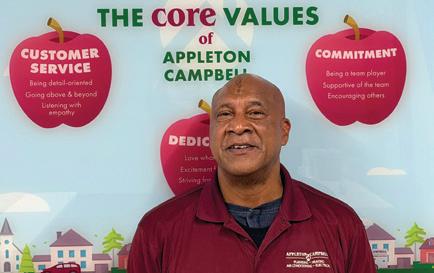
Appleton Campbell has announced the promotion of Ronnie Bland, with over 22 years of service as an HVAC technician, into a new leadership role
guiding the company’s HVAC Pro Path technicians. Well-known and respected by both customers and colleagues, Bland has built a reputation for exceptional workmanship, reliability, and deep technical expertise throughout his career.
In his new position, he’ll lead and mentor the next generation of HVAC technicians through the company’s Pro Path program. His transition into this role ensures that his decades of hands-on experience and industry knowledge will continue to benefit both the team and the customers they serve.
Hollywood Casino at Charles Town Races recently hosted the ceremonial signing of Senate Bill 1060 by West Virginia Governor Patrick Morrisey, a significant piece of legislation that will provide a major boost to the state’ s Thoroughbred industry.
The bill adds approximately $1.5 million to the West Virginia Thoroughbred Development Fund by allowing the state’s Thoroughbred tracks to retain more of the revenue generated through video lottery terminals and simulcast wagering. It also establishes a new West Virginia Certified Thoroughbred program, which requires horses to spend at least six consecutive months in the state prior to their threeyear-old season to qualify.
Ronnie Bland of Appleton Campbell
THIS & THAT
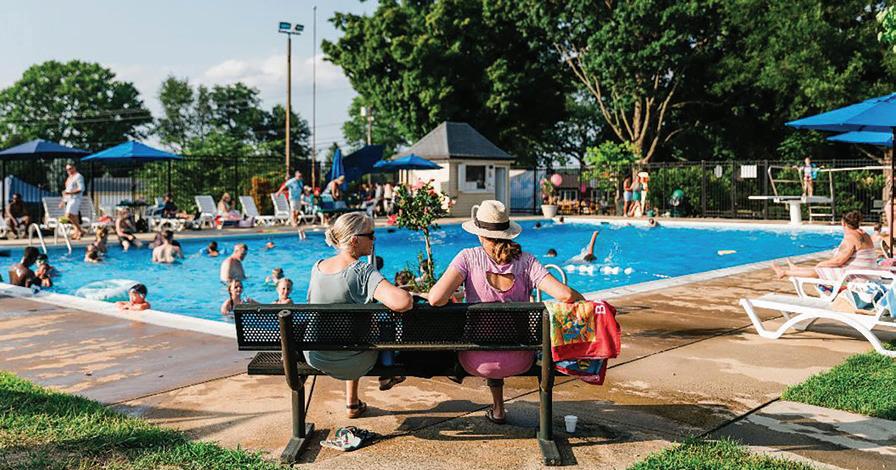
to cut the ribbon marking the official opening of the spectacular new Champions Pool. On the one-acre site, 145,000 gallons of purified water gently flow through a series of heated bodies of water.
Photo by Leonard Shapiro
Jolly DeGive, Heather Taylor and Virginia Jenkins at Welbourne for kick-off party for DocWeekMiddleburg.
Photo by Vicky Moon
Brad Russell, founder of Washington West Film Festival, with his wife Amy at Welbourne for DocWeekMiddleburg party.
Photo by Leonard Shapiro Sheila Johnson, founder and owner of Middleburg’s Salamander Resort, was ankle deep in the water
Photo by Vicky Moon
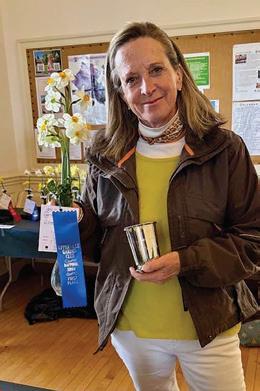
Constance Chatfield-Taylor won the Janet Tayloe award for a novice who has never won a blue ribbon in a vase of three stems at the Daffodil Show held at Trinity Church Cox Hall.
Photo by Vicky Moon
Blue Mountain Songbird Bess Putnam and former chairman Steve Price were honored for their outstanding efforts on behalf of the Virginia Piedmont Heritage Area Association at reception at Welbourne.
Photo by Donna Strama
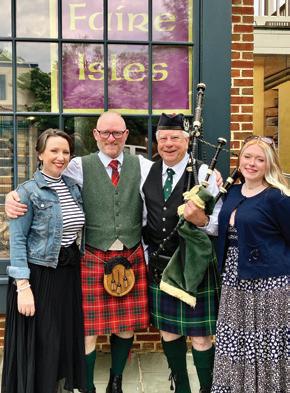
Stephanie Shahan, Adam Shahan and Emily Shahan with bagpiper Gene Shultz for the opening of their new shop, Faire Isles, in Middleburg.
Marshall’s Field & Main Honored in National Competition
By Leonard Shapiro
Field & Main in Marshall, a popular destination restaurant in Virginia’s hunt country, has been named a 2026 James Beard Award finalist for Outstanding Wine & Beverage Program, one of the industry’s most prestigious national honors.
The recognition places Field & Main among a select group of restaurants across the country acknowledged for excellence in beverage programs that demonstrate depth, originality, and a strong sense of place.
Since opening in 2016, Field & Main has built a reputation for locally sourced, internationally inspired cuisine and a wine program that reflects both a global perspective and a deep regional focus. Located just outside Washington, DC, the restaurant has become a draw for diners seeking a thoughtful, seasonal dining experience rooted in Virginian agriculture and warm hospitality.
Since opening in 2016, Field & Main has built a reputation for locally sourced, internationally inspired cuisine and a wine program led by co-owner, culinary director, and sommelier Neal Wavra, who is widely regarded as an expert on Virginia wine.
In addition to his work at Field & Main, Wavra serves as director of the Loudoun County Wine competition and as a judge for the Virginia Governor’s Cup. His approach to wine is shaped by both international experience and a longstanding commitment to elevating local producers.
A graduate of the Culinary Institute of America, Wavra began his career working with iconic restaurant owner Charlie Trotter in Chicago before continuing to Blackberry Farm in Tennessee where he met his wife, Star.
Together they later served as innkeepers and Neal as sommelier at The Ashby Inn & Restaurant in Paris, Virginia, where he developed a wine program recognized for its depth and focus on regional wines. These experiences inform his philosophy at Field & Main, where the beverage program is designed to complement the restaurant’s seasonal menu while highlighting both established and emerging voices in wine.
The James Beard Foundation Awards are widely considered among the highest honors in the American food and beverage industry, recognizing excellence across culinary, hospitality, and beverage disciplines. The Outstanding Wine & Beverage Program category specifically honors restaurants that demonstrate exceptional care, creativity, and leadership in their beverage offerings.
This national recognition underscores Field & Main’s role in shaping the evolving identity of Virginia dining and its growing reputation as a destination for both food and wine.
Neal Wavra and his wife, Star, founders of Field & Main.
Sip & Celebrate!
Photos by Leonard Shapiro
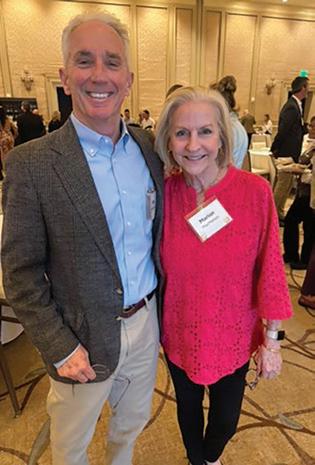
Paul and Marion MacMahon
Gloria Armfield and Bob Foosaner
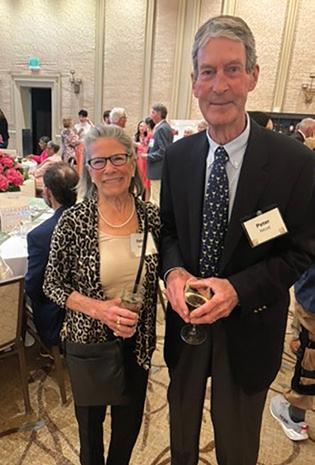
Patty and Peter Nicholl
Sheila Harrell, Mark Harrell, and Molly Harrell
Jan and Kathryn Baran
Windy Hill Executive Director Eloise Repeczky
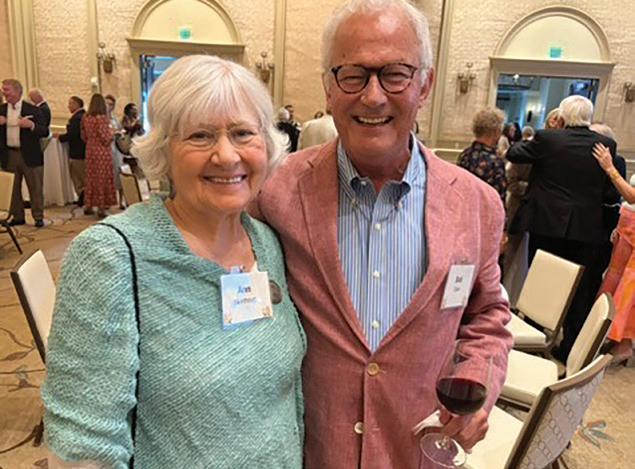
Honorees Ann Northrup and Bob Dale
HOW WELL’S THE WATER
By John E. Ross
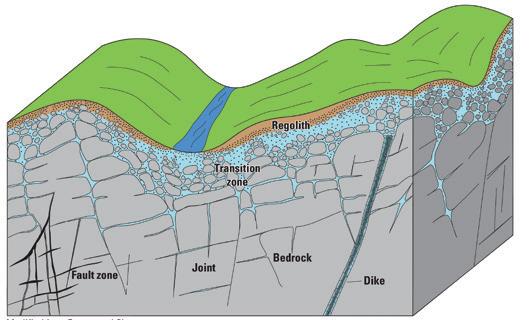
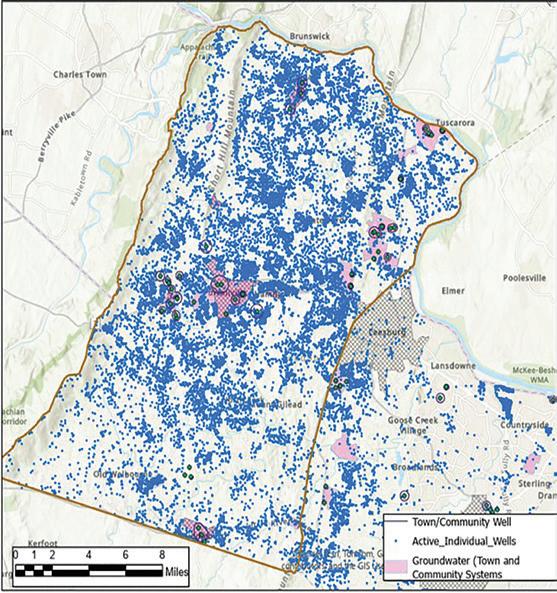
Beneath soils of our rolling countryside lies a bed of small broken rock (regolith). Underneath is a zone of fractured rock that carries the aquifer tapped by 33,000 wells in Loudoun and Fauquier Counties. (Dominick J. Antolino and Laura N. Gurley, USGS)
Rain falling on rolling landscape soaks down through soil into the water table. When being pumped, each well creates a cone of depression in the water table.
Half of the wells in Loudoun County are within 200 feet of each other, and 90 percent are within 550 feet of a neighbor’s well. Concentrated housing developments cluster wells creating rapid drawdown of groundwater.
More than 33,000 private wells provide water to residents of Fauquier and Loudoun Counties. Twelve municipal wells serve residents of Round Hill, and five townowned-wells provide water to residents of Middleburg. Paris, Marshall, The Plains, and Warrenton receive their water from The Fauquier County Water and Sanitation Authority which operates 46 wells in that county.
Purcellville takes half of its water, about 300,000 gallons per day, from 1,272-acre J. T. Hirst Reservoir which relies on surface water from Harris, Potts, and Cooper Springs. The balance of the town’s water comes from three large wells. Loudoun Water provides 80,000 households in and around Leesburg with water drawn from the Potomac River and Goose Creek.
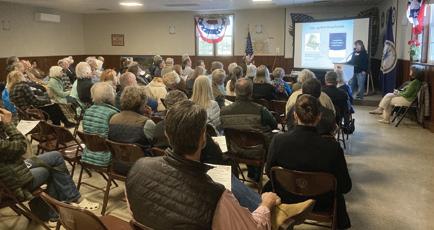
Madeline Skinner, Loudoun County Preservation and Conservation Commission, leads discussion during Loudoun Groundwater’s presentation at the American Legion Hall on April 20.
All of the wells tap groundwater stored in fractures and joints in bedrock. Generally speaking, these fissures are no wider than an inch though they may extend for dozens to hundreds of feet. The rock itself is not “permeable.” The zone of saturated broken bedrock is frequently, and correctly, referred to as an “aquifer.”
But in many minds, an aquifer is often thought of as an underground river. While gravity causes water in an aquifer to flow from higher to lower elevations, it moves ever so slowly.
Due to thin soil cover, rain falling on eastern slopes of the Blue Ridge and western slopes of Bull Run Mountain enters the aquifer much more rapidly than rain on our rolling countryside with its relatively thick soils. However, rain and snow on terrain between the mountains are the main sources of water feeding our aquifer.
In our area, on average, each of the 33,000 wells is about 500 feet deep. When a pump comes on to refill a water pressure tank in a home or business, it draws the water table around the well down between 100 to 200 feet. Pumping creates a groundwater depression shaped like an inverted cone. Each real estate development, not served by a town’s public water supply, creates a cluster of cones. The closer the wells are together, the greater demand on the water table. Heavy pumping, especially in times of drought, lowers the water table and can cause shallower wells to run dry.
From 1990 to 2020, the population of Loudoun County more than quadrupled from 86,129 to 420,959. During that same period the number of houses increased from 32,932 to 142,074. With increases in population and houses also came more commercial and industrial construction as well as increased width of paved roads and parking lots. New construction vastly increased impermeable surfaces resulting in ever higher volumes of stormwater run-off that drained directly into streams and rivers.
From 1990 to 2020, annual precipitation remained virtually unchanged from 45.33 inches in 1990 to 49.46 inches in 2020. But since then, yearly rainfall dropped to 30.18 inches last year, a decline of nearly 40 percent. However, according to climatologist Benjamin Cook, author of Drought, An Interdisciplinary Perspective, rainfall over northern Virginia fits the pattern he forsees “…the long term trend across much of the eastern US, including Virginia, is towards overall wetter conditions, more precipitation and rainfall. He notes, however, that the trend does not preclude major drought events especially as we move into the warmest months.
To explain drought, how it affects us, and what we can do about it, Loudoun Groundwater held community information sessions in Purcellville, Lucketts, and Middleburg in April. More than 150 area residents attended the session at the American Legion Hall in Middleburg on April 20. Making presentations were: John Ellis, Save Rural Loudoun; Madeline Skinner, Loudoun County Preservation and Conservation Commission; Gem Bigol, Piedmont Environmental Council; and David Ward, Loudoun Groundwater Commission. Ward was the principal author of Loudoun County’s groundwater study.
According to Danny Davis, Middleburg’s soon-to-be former town manager, and Vince Gugliotta who operates the town’s water and sewage treatment facilities, Middleburg’s five wells have ample capacity to weather periods of extreme drought. That is as long as residents and businesses observe, when posted, restrictions on water usage – limited times for outdoor watering outdoor plants and bans on washing of cars, patios, and other outdoor surfaces; topping off swimming pools; and serving water to diners in restaurants except upon request – when the town announces warnings of extreme drought.
Citizens should also contact Rep. John McAuliff and Sen. Russet Perry and urge them to support HB30 which will provide $200,000 to initiate an extensive study of challenges groundwater supplies in western Loudoun and Fauquier Counties.
It’s All About Preserving The Countryside
PIEDMONT ROOFING
Q: Where does the story of rural conservation in the Piedmont begin?
A: The roots of conservation in the Piedmont stretch back generations. Long before most of us were here, dedicated leaders were working to protect the landscape and traditions that define this region. They led by example on their own properties, advocated for thoughtful policies, and took on development challenges one by one. The rolling green hills we enjoy today are not preserved by chance. They’re the result of years of commitment by individuals who believed deeply in safeguarding this land.
Q: Why is continued involvement in conservation so important today?
A: The fight to preserve our countryside is ongoing. Each generation inherits both the benefits of past efforts and the responsibility to continue them. That means staying informed, getting involved, and embracing tools that support preservation. Without active participation, decades of progress could be undone. Conservation isn’t a one-time achievement; it’s a continuous effort that depends on community engagement.
Q: What was the purpose of the Rural Landowner Manual?
A: In 2023, the PFH Conservation Fund (PFHCF) created the Rural Landowner Manual as a practical guide for those living in the northern Piedmont. Its goal was to help landowners make the most of their properties through conservation-focused practices. The manual brings together expert guidance, available programs, and opportunities to enhance and even economize land. It goes beyond theory by offering best management practices, sustainability strategies, and environmental protection options. It also highlights economic pursuits that align with conservation values. In short, it equips landowners with the knowledge to care for their land responsibly while maintaining its productivity and beauty.
In 2024, PFHCF followed up in 2024 with a companion pamphlet, Financial Incentives for Conservation. This concise, three-page resource highlights funding opportunities for conservation efforts, including land easements, stewardship practices, and compatible economic activities.
Q: How has the project evolved since then?
A: The initiative has grown into My Rural Piedmont, a website designed as a central hub for rural engagement. Building on the foundation of the manual and pamphlet, the platform offers an up-to-date, interactive resource for residents and visitors alike.
Dulany Morison
The website features information on local events, conservation incentives, and best management practices throughout the year. Regular updates ensure users have access to current opportunities and insights, while a quarterly newsletter keeps the community informed with seasonal stewardship tips and ideas for enjoying rural living year-round.
Q: What kind of content does the newsletter include?
A: The newsletter is both informative and engaging. A recent spring edition included articles on farmer’s markets, gardening with native plants, and the impact of frequent mowing on pollinators. It also provided guidance on handling encounters with unattended infant wildlife.
In addition to educational content, the newsletter highlights upcoming events such as steeplechase races, historic house tours, trail rides, conservation hikes, and community gatherings. The goal is to create a well-rounded, easy-to-digest resource that celebrates all aspects of rural life.
Q: Is the platform only for local residents?
A: Not at all. One of the key goals of My Rural Piedmont is to enhance the visitor experience as well. The website includes a comprehensive list of events and volunteer opportunities, encouraging broader participation. The philosophy is simple: the more people who experience the charm and “magic” of the countryside, the more likely they are to value and protect it. Expanding awareness is a crucial step in ensuring the longevity of these landscapes and traditions.
Q: What’s next for My Rural Piedmont?
A: The goal is to establish My Rural Piedmont as the go-to resource for rural living in the region. Upcoming outreach includes a presence at Stoke Farm during Trinity Church’s Hunt Country Stable Tour, where visitors can learn more about the project and its mission. There are also plans for a Field Day event that would bring together conservation organizations alongside local farms, vineyards, and breweries. This event would showcase the richness of the countryside while fostering deeper connections between the community and the land.
Q: How can individuals get involved?
A: Community engagement is essential. PFHCF encourages people to connect with rural life and participate in conservation efforts. Whether it’s following My Rural Piedmont, attending events, or sharing information with others, every action helps. Preserving the rural character of the Piedmont is a shared responsibility.
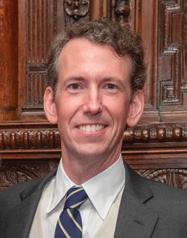
Dulany Morison currently serves as chair of the PFH Conservation Fund, chair of the Riparian Buffer Program of the Goose Creek Association, vice chair of the Land Trust of Virginia, vice chair of the Piedmont Fox Hounds, vice chair of the Great Meadow Foundation, president of the Willisville Preservation Foundation and Chair Emeritus of the Virginia Piedmont Heritage Area Association.
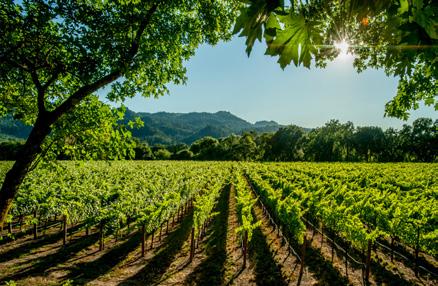
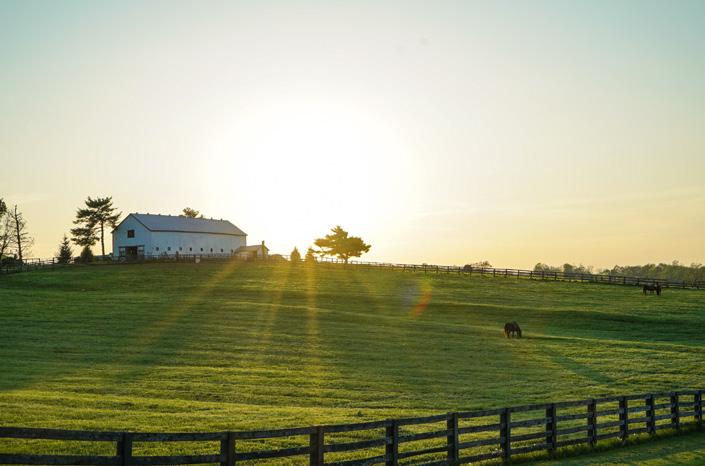
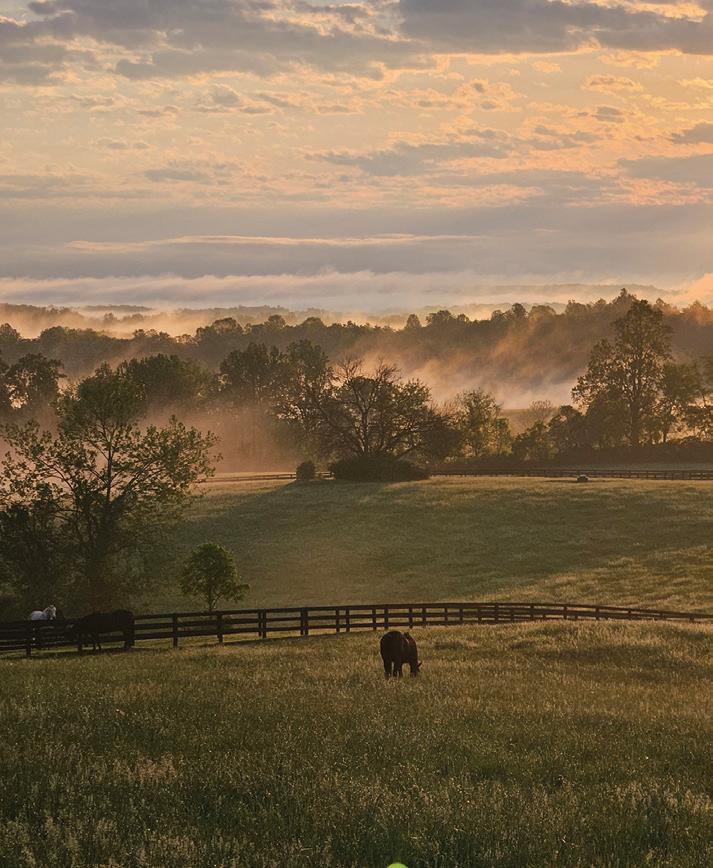
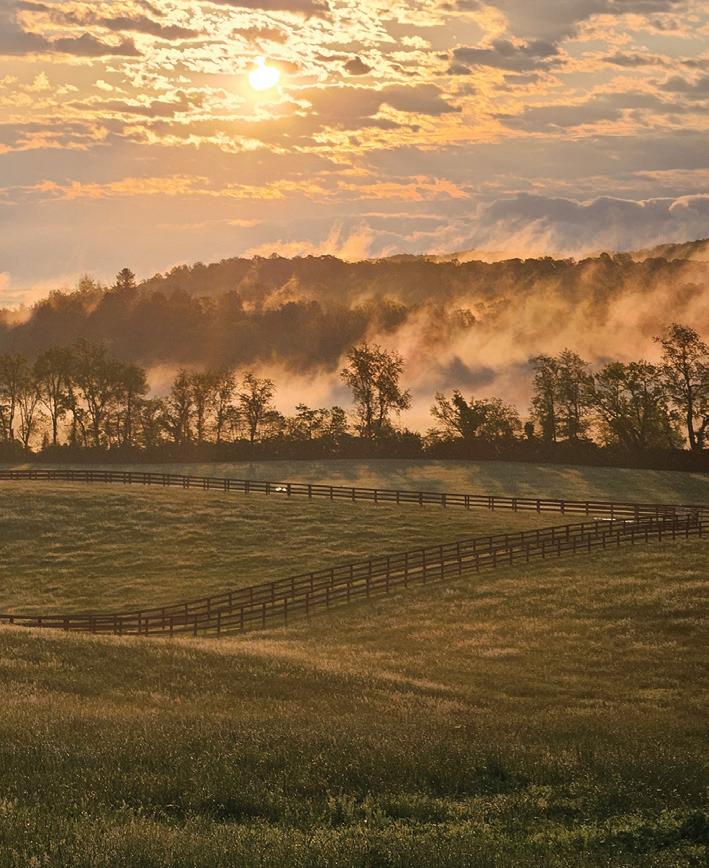
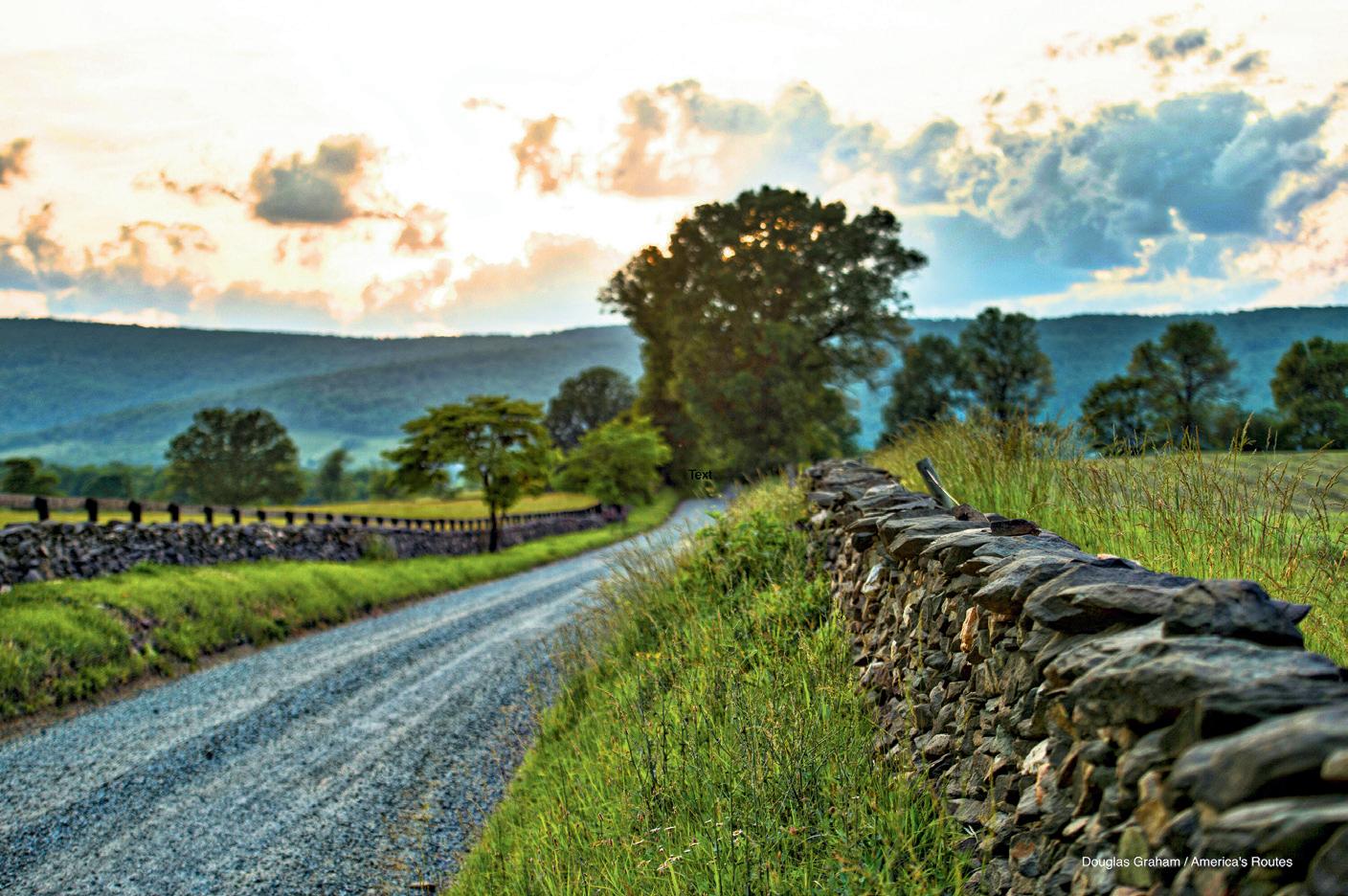
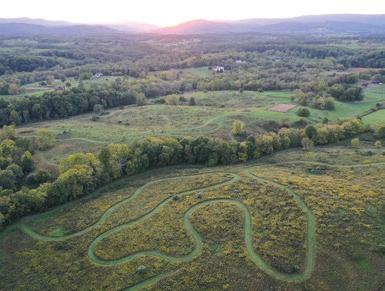
The beautiful Virginia countryside in all its glory.
Community Grant Empowers Banneker
By Sarah Brissing
Banneker Elementary School recently announced that its Parent-Teacher Organization (PTO) has been awarded a $5,000 grant from the Middleburg Charitable Foundation to support innovative and meaningful educational opportunities for students.The foundation selected Banneker’s proposal as part of its 2025 grant cycle, awarding the full amount requested.
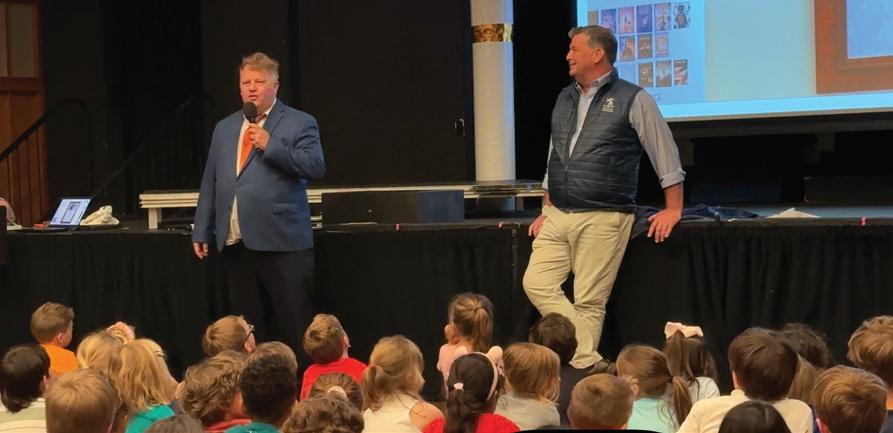
The grant will fund educational experiences for Banneker students. The goal is to enhance learning through engaging programming during the school day. These funds will directly support enrichment opportunities, such as assemblies, and provide classroom resources for teachers.
These types of experiences are already making an impact across all grade levels at the school. In fifth grade, students participated in a trip to Camp Highroad, where they engaged in team building challenges that fostered both personal growth and collaboration.
As teacher Christa Lynch said, “Camp Highroad provided our fifth grade students with meaningful opportunities to grow both individually and as a team. They were presented with real challenges that required problem solving, communication, and collaboration. For some students, that meant overcoming a fear of zip-lining, for others it meant finding their voice and actively participating in group challenges.
“Through these experiences, they built confidence, strengthened their teamwork skills, and learned how to support one another. These are skills that will transfer directly back to the classroom and continue to impact them in school and in life.”
Similarly, fourth grade students experienced immersive learning during their visit to Harpers Ferry, connecting classroom content to real-world exploration.
Fourth grade teacher Kathryn Cook said, “Harpers Ferry was an amazing day for our fourth
grade students. The kids had such a fun time being immersed in the history and science we have been learning in class. None of them had ever been there before, and so many had never been hiking. It was a very memorable day for all.”
The impact of the grant has been felt school-wide, expanding opportunities for students to engage in meaningful learning experiences.
As Banneker PTO President Cathleen Titcomb said, “Our school has always run on a whole lot of heart and the incredible dedication of our teachers and families, but the generous support from the Middleburg Charitable Foundation was a true blessing this year. It expanded the opportunities our organization could offer our students, allowing us to host two magical, interactive math assemblies and to ensure that every child could experience the joy of our field trips.
“These hands on moments are the heartbeat of a well-rounded education. We’re beyond grateful to have a community partner who believes, just like we do, that every student deserves the chance to learn, explore, and make lasting memories together.”
In addition to student programming, the grant will also support classroom materials that empower teachers to meet the needs of their students. Banneker Elementary is known for its strong sense of community and dedication to student growth and continues to build meaningful partnerships that support both students and teachers.
Photo by Sarah Brissing Banneker students recently took a field trip to historic Harpers Ferry.
Horsing Around With New Web Possibilities
By Leonard Shapiro
Sebastian Langenberg smiles when he says, “I get bored easily,” one way to explain his fascination with language, computer software and all things horse.
After all, he learned to read and write ancient Greek and Latin in high school and college and has taught himself to speak Dutch, his mother, Margriet’s native language. He’s also getting more fluent by the day in writing computer software programs designed specifically for the same people who share his own great passion for equestrian sports, particularly polo, which he’s played since age eight.
Lately, that’s translated into a new venture for Sebastian and his equally horse-loving wife, Sophie, a long-time rider herself, a talented writer, devoted community volunteer and the mother of their three young children, all five and under. They call their new business Stableware, designed to take the drudgery out of mundane tasks like registering for horse show or racing events, signing liability waiver release forms, scheduling lessons or future competitions and so much more.
The idea of basing a business on such necessities came to the Langenbergs a year ago when the Middleburg Orange County (MOC) Beagles asked for help reducing paperwork for their upcoming Hunter Pace event.
Sebastian created PaceMaster, a timing tool for events that base their scoring around an optimum time. The teams can see their standings instantly and without organizers fumbling with stopwatches and pencils. PaceMaster is linked with their very own digital signature platform, RideRelease, allowing participants to register, sign a waiver, and pay for the event all at once.
Sebastian has his own real estate business and is about to start law school in the fall. He also sold software for three different companies over the last four years, igniting an interest in doing some computer programming himself. The MOC Beagles’ request piqued his interest and eventually was the first step in exploring a possible start-up of a new equestrian-centric enterprise.
“If I’m selling something,” he said, “I should know how to use it. So I started tinkering with the software myself, and I now understand how to do it.”
“I’ve been along for the ride as a user,” Sophie added. “I make suggestions on how I want to interact with these programs, and Sebastian is usually able to work it out.”
Sebastian recalled at first being somewhat befuddled about how to design RideRelease to accept two different signatures from separate people.
“I stayed up all night trying to figure it out, how to build it,” Sebastian said. “It took a lot of trial and error, but it eventually worked. It’s been hard sometimes, but fun.”
Basically, it’s all about streamlining various processes that simplify things for everyone involved. Most recently, they’ve launched their third product, what they’re calling CloudPolo, a polo club management program.
Because polo has grown exponentially in the Middleburg area in recent years, with more clubs, more fields, more leagues and more opportunities to play, the site essentially offers one-stop shopping for players who want to sign up, keep track of their season stats, and stay up to date with events. It includes managing participants’ contact information, live scoring, competition schedules, and more.
“We’ve told a lot of our friends involved with horses about this and asked them for ideas about what would help modernize things so they can focus more on their clients and horses,” Sophie said. “We’re also hoping this will help build more of a sense of community by streamlining communication. Our goal is to be totally hands on, to show people how to use it and make it very easy for them.”
No ancient Greek, Latin or Dutch language skills necessary.
Sophie and Sebastian Langenberg
A GREAT Day At The Gold Cup
Photo by Leonard Shapiro
The Washington Scottish Pipe Band offered entertainment all day.
Photo by Leonard Shapiro Hailey and Mason Alger.
Photo by Vicky Moon It was an egg-citing afternoon
Photo by Doug Gehlsen Middleburg Photo Gold Cup champion Keys Discount in the winner’s circle, trained by Jack Fisher, with jockey Jamie Bardary in the saddle.
Photo by Doug Gehlsen Middleburg Photo
Keys Discount soars over a hurdle on his way to victory in the 2026 Gold Cup at Great Meadow.
Photo by Leonard Shapiro Bruce Rose and his 1957 Chevrolet.
Photo by Leonard Shapiro Pam and Brad Ryder.
Photo by Vicky Moon Trowbridge Littleton chats with Morton Irvine Smith, whose late father Morton W.”Cappy” Smith was long-time family friend.
DOWNS
RACING
• Summer Meet: June 25 - September 7 every Thursday thru Sunday afternoon
• Located in New Kent, VA at I-64, Exit 214 halfway between Richmond & Williamsburg
• Free Parking/Free Admission with wagering on all races
SHENANDOAH DOWNS
• Spring Meet: April 11 - May 24
• Fall Meet: September 19 - November 1
• Located in Woodstock, VA at I-81, Exit 283 halfway between Winchester and Harrisonburg
STEEPLECHASE RACING/TAILGATING
• Point-to-Point Meets: Weekends in March & April
• Middleburg Spring Races: April 18 at Glenwood Park
• Foxfield Spring Races: April 25 in Charlottesville
• Virginia Gold Cup: May 2 at Great Meadow in The Plains (details at nationalsteeplechase.com) COLONIAL
• Enjoy steeplechase races on June 29, July 23, Aug. 13 & Sept. 3 (details at colonialdowns.com)
• Free Parking/Free Admission with wagering on all races (details at shenandoahdowns.com)
Lessons from Life… and Death
We live as if we have unlimited tomorrows. We postpone hard conversations. We delay reconciliation. We assume there will be another birthday, another anniversary, another chance to say “I love you” or “I’m sorry.”
By Ken Falke
Life is life’s best teacher. Not theory. Not ideology. Not the curated wisdom of social media. Life itself — in its triumphs and tragedies — teaches us what matters. And sometimes, the clearest lessons about how to live come from confronting death.
I was reminded of this truth recently as I sat in a church pew at the funeral of one of my best friends, a U.S. Navy SEAL and special operations explosive ordnance disposal (EOD) operator.
There’s something clarifying about a funeral. The noise of the world quiets. The constant churn of politics, business, ambition, and distraction fades into the background. In its place comes a stark and unavoidable reality: one day, this will be our service. One day, people will gather and speak about us in the past tense.
The Roman Catholic priest who delivered the homily understood something profound. He did not focus solely on grief. He did not dwell only on loss. Instead, he spoke about the lessons that death teaches the living.
First, death exposes what actually matters. No one stands at a casket and talks about quarterly earnings. No one praises a perfectly curated résumé. The stories shared are about kindness. Loyalty. Laughter. Courage. Forgiveness. The time someone showed up when it counted. The quiet sacrifices no one saw. The love that was given freely.
Death strips away illusion. It reminds us that our lives are ultimately measured not in accomplishments, but in impact.
My dad used to say that when you die, you leave behind only two things: your reputation and your kids. That simple statement contains more truth than most leadership books. Your reputation is built upon your character and is the story people tell about you when you’re no longer in the room — and eventually when you’re no longer on the earth.
Ken Falke
Reputation is built in small, daily decisions: how you treat others, how you handle conflict, whether your actions solidify that your word means something. Your reputation cannot be manufactured at the end. It is forged over a lifetime of your actions.
And if you’re blessed with children, they carry more than your name. They carry your example. Your standards. Your habits. Your world view. They absorb who you are far more than what you say.
At a funeral, both are on full display. The reputation echoes in the stories shared. The children, if there are any, stand as living testimony to a life lived — or not lived — with intention.
Second, death teaches urgency.
We live as if we have unlimited tomorrows. We postpone hard conversations. We delay reconciliation. We assume there will be another birthday, another anniversary, another chance to say “I love you” or “I’m sorry.”
A funeral confronts that dangerous assumption. The priest said something that struck me deeply: live in a way that leaves nothing important unsaid.
That’s not morbid advice. It’s liberating. When we internalize the reality of mortality, we stop procrastinating on what truly matters. We make the call. We take the trip. We mend the fence. We speak the truth.
In the end, your reputation is shaped by those moments. And your children — biological or those you mentor — are watching how you handle them.
Third, death clarifies identity.
When someone dies, we do not debate their possessions. We remember their character. Were they generous? Were they brave? Did they make others feel seen? Did they lift burdens or add to them? Death reveals that character outlives circumstance.
In our daily lives, we can become consumed with status, comparison, and competition. But funerals reset our compass. They remind us that the ultimate scoreboard is internal, not external. It is written in
the lives we touch and the example we set.
Fourth, death teaches humility.
No matter our strength, our intelligence, our wealth, or our accomplishments, we’re all subject to the same human condition. Mortality is the great equalizer. It humbles arrogance and exposes the fragility we all share. That humility is not meant to diminish us. It’s meant to sharpen us.
It asks a simple question: If today were your last day, what would your reputation say? And what would your children carry forward?
Finally, death teaches gratitude.
The pain of loss is proportional to the gift of relationship. We grieve deeply because we loved deeply. The ache in our chest is evidence that something meaningful existed.
Funerals are not only about saying goodbye. They’re about receiving instruction. They are classrooms disguised as sanctuaries. They offer a curriculum we would never choose but desperately need.
The lesson is simple and profound: live deliberately. Build a reputation that your children will be proud to inherit. Raise children — and influence others — in a way that strengthens the world rather than weakens it. Invest in relationships rather than resentments. Choose gratitude over grievance.
Life is life’s best teacher and death is life’s most honest tutor.
And in the end, when everything else fades, only two things remain: the reputation you built and the lives you shaped.
Rest in Peace Frank.
Ken Falke is a 21-year veteran of the U.S. Navy Special Operations Explosive Ordnance Disposal community and currently chairman of Boulder Crest Foundation in Bluemont. He is also the co-author of “Struggle Well: Thriving in the Aftermath of Trauma” and the author of “Lead Well: 10 Steps to Successful and Sustainable Leadership.”
DRAWING THE LINE
By Hunt Lyman
On April 1, The Plaid Horse magazine published an “exclusive press release” announcing that a coalition of major governing bodies was piloting an AIassisted judging system for horse show hunter and equitation classes.
The system would use high-speed cameras and motion sensors to evaluate stride consistency, jump arc symmetry, and pace regulation. One fictional show manager was quoted as saying, “We’re tired of getting feedback that the judge wasn’t looking when a horse made a mistake.”
Hunt Lyman
It was, of course, a joke, but a good April Fools’ prank precisely because it was just believable enough to make you pause before you laughed.
The gold standard for sports April Fools’ jokes remains George Plimpton’s 1985 masterpiece in Sports Illustrated, introducing the world to Sidd Finch, a N.Y. Mets prospect who had learned to throw a 168-mile-per-hour fastball through yoga, Buddhist meditation, and one bare foot. Thousands of readers believed it. What made both jokes work was the same factor: we’re already living in a world where the implausible keeps becoming real, so the truly absurd requires only a slightly shorter leap.
Which brings me to why the AI judging joke is worth thinking about seriously.
There are genuine and exciting ways AI is changing equine care. Researchers have developed systems that detect lameness by analyzing a horse’s gait with greater precision than the human eye. A 2025 study achieved 90 percent accuracy using a single lightweight sensor. A 2024 study from Ghent University developed AI-powered boots that detected colic with over 91 percent accuracy compared to attending veterinarians. For any horse owner who has faced a middle-of-thenight emergency, these are potentially lifesaving advances.
But AI in the judge’s booth? That’s a different conversation.
Tennis and baseball have already had this conversation, with instructive results. Both sports now use computer technology to call balls, strikes, and lines -- and the systems work. Yet neither sport has gone all the way. Players still get a limited number of challenges. The fully automated strike zone remains contested. Why the hesitation?
Because sports are not optimization problems. They are human dramas. We could “improve” baseball further by replacing pitchers with robotic arms delivering a perfect slider at 97 miles per hour every time. We do not, because at that point we’re no longer watching baseball.
Judging in the hunter ring involves an aesthetic sensibility: an eye for presence, elegance, style of jumping and the ineffable quality of a horse that moves in harmony with its rider. That is not a data set but a judgment call, in the fullest human sense. Removing it might make the sport fairer, but it would also make the sport disappear.
Sports may be teaching us something important about AI’s broader applications. The question is never simply whether AI can do something. The question is whether we want it to, and what we lose when it does.
Getting this balance right will be one of the defining challenges of the next decade. The Plaid Horse joke landed because we recognized the world it described. The question is whether we’ll be thoughtful enough, and brave enough, to make sure it stays a joke.
Lyman retired in 2025 after 41 years of teaching at The Hill School in Middleburg.
Middleburg Smiles is a family-friendly dental office, offering a full range of services.
All care is provided by our dedicated dentist, Dr. Kelly Lincoln, who has been proudly serving patients in Loudoun County for over 15 years.
Sue Foote, Operations Manager of the Middleburg Community Center, says she’s excited about the new partnership with the YMCA of Metropolitan D.C., particularly because it guarantees a “fun and safe summer” at the vintage pool while keeping the affordable price, still only $5 a day and even more affordable with a membership.
YMCA Metropolitan Area President and CEO Pamela Curran is not only a Middleburg resident, but also serves on the Town Council. After 22 years with the YMCA, she knows about running pools and camps. The YMCA has so many pools in the Metropolitan area, which includes Maryland, Virginia and D.C., that they have many lifeguards, trainers and camp counselors who have made it a career.
As the high school and college years get longer while the outdoor pool season runs from Memorial
Day to Labor Day, the supply of lifeguards who can cover the traditional summer has dwindled. It’s not a problem for the YMCA, which runs indoor pools year-round. Pamela Curran says the lifeguards love working in beautiful Middleburg in the summer.
Foote noted that the Community Center welcomes local residents who may be interested in lifeguarding opportunities at the pool. The Center would be happy to connect interested applicants with the YMCA, as maintaining a strong local presence at the pool remains important to MCC.
The pool is open seven days a week from noon to 7 p.m. The Snack Shack will be open during pool hours with a selection of ice cream, candy, snacks, and drinks.
The first big event of the pool season, according to Sue Foote, will be the “Summer Splash Kickoff” on June 13, from noon to 4 p.m. featuring a Moon Bounce.
Details: Check the website, https://www.middleburgcenter. org, click pool for updates. The Center provides a banner above the page for your feedback and suggestions.
The Hill School offers an education as unique as your child. Come visit our community to learn how our program of Total Education – strong academics and meaningful participation in art, music, sports, and theater – helps build character and confidence in our students and gets them started on the path to being happy, successful adults.
Voted Best Private School in Loudoun County for Seven Consecutive Years
The Middleburg Community Center offers a fun summer.
Helping Wildlife Starts in Your Backyard
By Annie Bradfield
At Blue Ridge Wildlife Center (BRWC), we see the consequences of habitat loss and human/wildlife conflict every day. The good news is that one of the most effective ways to help wildlife is also one of the most accessible: creating better habitat right where you live.
Native plants have co-evolved with local wildlife over thousands of years. That relationship is so specific and essential that without native plants, many native species cannot survive.
Native plants produce fruits, seeds, and nectar that directly feed birds, mammals, and pollinators. Just as important, they support native insects. Caterpillars and other invertebrates are the primary food source for many bird species, especially during breeding season. A yard without native plants may look green, but often functions as a food wasteland for wildlife.
Wildlife also needs safe places to rest, nest, and avoid predators. Native shrubs offer unique coverage and native grasses provide shelter for ground-nesting birds and small mammals in ways non-native shrubs and grasses cannot.
Native plants attract and sustain bees, butterflies, and hummingbirds, all responsible for pollinating not only wild plants, but also many crops we rely on. Supporting pollinators in your yard contributes directly to broader ecosystem health and food security.
Healthy plant communities improve air and water quality, stabilize soil, and help regulate temperature. These are not abstract benefits. They reduce runoff, improve local water systems, and create more resilient landscapes for both wildlife and people.
You do not need a large property to make a meaningful impact. What matters most is how you design the space.
Build layers: In nature, plants grow in layers: canopy, understory, shrubs, and ground cover. Replicating this structure provides wildlife with places to perch, forage, and take shelter throughout the day.
White Oak supports hundreds of caterpillar species and provides food and habitat for dozens of birds and mammals. Prairie Willow offers dense cover and supports a wide range of insects. And Little Bluestem creates shelter for small animals and produces seeds that feed birds.
Provide food across seasons: Wildlife need reliable food sources throughout the year. Choose plants that bloom, fruit, or seed at different times.
Blackhaw flowers in spring and produces berries in summer. Aromatic Aster provides critical late-season nectar for pollinators. Coral Honeysuckle offers nectar from spring through fall.
Support pollinator diversity: Different pollinators are attracted to different colors and flower shapes. A variety of blooms increases the number of species your yard can support. Native roses like Prairie Rose and Swamp Rose attract a wide range of pollinators. Foxglove Beardtongue is especially valuable for bees. Black-eyed Susan draws pollinators in summer and provides seeds for birds in fall.
Start Local: Sourcing plants locally ensures they are adapted to your region and more likely to thrive. The Virginia Native Plant Society is a strong starting point for finding native plant resources and nurseries.
Creating a native garden does not require specialized expertise or a complete landscape overhaul. Even small changes, like replacing a section of lawn or adding a few native shrubs, can significantly increase the habitat value of your yard.
At a time when nearly all of the patients we treat are impacted by human activity, restoring habitat is one of the most direct ways to make a difference. It starts at home.
Annie Bradfield is executive director of the Blue Ridge Wildlife Center in Millwood.
Pollinators like bees are attracted to different colors and flower shapes.
THE HILL SCHOOL CELEBRATES 100 YEARS
Jack and Sydney Bowers and Hunt and Sue Lyman
Hill Head of School Treavor Lord Meg Davis with her father Jim Davis
Teachers past and present Mike Wipfler, Don Woodruff and Steve Banks.
David and Anne Walker
Henry Holtzman, Jonas Winkler, Matthew Elliott (Class of ’25)
Sophie Pellerito and Wren Egende
April Woodson and Babette Thomas-Smoot
The centerpiece flowers were done by Karla Etten of Etten’s Eden
Create your own Middleburg Moment!
Start the Day… Noon - 2:00 at the Middleburg Museum National Anthem, Colors Presented, Reading/Reenatment of the Declaration of Independence and the Benjamin Banneker Letter, Linton Hall School Fife and Drums, Refreshments
2:00 at the Artists in Middleburg Gallery Live Painting with Matt Pravone
5:30 at the Middleburg Community Center Kids’ Parade Down Main StreetRide Your Bike, Ride in Your Wagon, Lead Your Dog - All Decorated in Red, White and Blue
forFunthe Whole Family!
Noon - 5:00 at the Middleburg Community Center Free Swimming, Hot Dogs and Popsicles, Games, Decorate your Bicycle/Wagon for the Kids’ Parade
6:00 Grounds open at the Middleburg Charter School Prizes for “Best” in the Kids’ Parade, Welcome from the Mayor, Food Trucks and ‘Burgers from the American Legion, Ice Cream, Live Music/Dancing Finishing with Fireworks Display starting at 9:15!
Smile, Dr. Kelly Lincoln Will See You Now
By Laura Longley
Plenty of us will find any excuse not to go to the dentist, let alone to one we don’t know. Fear not if your next appointment is with Dr. Kelly Lincoln at Middleburg Smiles.
The past few months have seen a major changing of the guard at the dental offices next door to Emmanuel Episcopal Church. Dr. Robert Gallegos recently retired after serving the community with his expertise in restorative, esthetic, and airway dentistry for some 20 years, but not before searching for the right person to take over his practice.
Dr. Kelly Lincoln
Although she’s been in Middleburg less than a year, Dr. Lincoln is well known to many dental patients in the region, having practiced in the area for more than 15 years. She worked with Dr. Gregory DiRenzo in Purcellville for six years, then with the Herbert Dental Group in Leesburg, and later at a practice near Stone Springs Hospital. In the same period, she and her husband, Leesburg attorney Michael Overson, welcomed two daughters, now 13 and 10.
Dr. Lincoln’s path to dentistry started with her father, Michel E. Lincoln, who served as acting and deputy director of the Navajo Nation Health Service.
“My father is Navajo,” said Dr. Lincoln, “and we lived on the Navajo reservation (in Arizona) until I was in fifth grade. Then we moved to Maryland for his job.”
Always into science and math, she went on to study biology at Boston College.
“I had a friend who was a year older who was applying to dental school,” she said. “I was still on the fence about what I wanted to do. She said, ‘I think you would really like dentistry, there’s an artistic component to it.’ Since I grew up as a ballet dancer, I thought, it’s a good combination, right? I researched it and decided I think this is something I’d like to do.”
She received her doctor of dental surgery degree from the University of Maryland’s Baltimore College of Dental Surgery in 2007. She also sees a lot of change in dentistry today, including investment firms buying up dental practices.
“I think what drew me to this particular opportunity is the feeling that we have this wonderful town with its town dentist. It’s a real community, and you can build relationships with other businesses and the schools, as well as with patients.
“Everyone has different needs. I really try to figure out what everyone’s needs are, for example what kind of X-rays we take, how often we take them. Things like that can be different from one person to the next. Sure, one person has never had a cavity in their life, and someone else has full crowns or veneers on every tooth. Those are two different people. I really strive to figure out plans for each person individually.”
A favorite treatment with patients in the practice is Invisalign.
“Invisalign and whitening can really change your smile and make it more functional, too,” Dr. Lincoln said. Should a patient need periodontal care or an implant, she will refer them to a periodontist or an oral surgeon…We have some great specialists in the area.”
A Chilly Challenge at Virginia Vineyards
By Kiernan Slater Patusky
Vineyards look beautiful, even some times when they’re in deep distress.
On April 22, I woke up to seeing gorgeous online Facebook photos of rows of candle-lit “smudge pots” in many Virginia vineyards, glowing like luminaires lining walking paths to an evening party. Very romantic.
In this case, however, the burning pots were out there under close care all night as they strained to protect the emerging vine shoots overnight from “The Freeze” that struck most of Virginia wine regions that night.
At Slater Run in Upperville, the temperature fell below freezing at 1 a.m. and kept dropping until bottoming out at 25.3 degrees Fahrenheit at 4:30 a.m. It stayed below 32 degrees until 8 a.m.
We did not use smudge pots, and so we lost all the green tissue that had emerged on the vines, mostly in our white varietals: Chardonnay, Pinot Gris and Sauvignon Blanc. What to do? Our hope is that secondary buds will emerge as the weather warms again so that we can harvest a partial crop in the fall.
The story is much larger than our vineyard because it affected vineyards throughout the state, including ones that typically escape spring frosts.
Two main factors influenced the wider swath of damage. First, this was not an early morning frost. It was a sustained freeze over the course of eight or more hours in many places. Second, the green
growth was more advanced than usual, due to much warmer than usual early April temperatures.
Our weather station recorded a high of 91 degrees and a low of 25.3 degrees just a few days apart. Damage did not follow an exact pattern, but the vineyards that fared best typically were either planted at higher elevations or burned smudge pots.
Why don’t we all just burn smudge pots? Though they tend to work in this circumstance, it’s an expensive solution. To be most effective, they’re placed approximately every four feet down each row middle, requiring more than 1,200 pots per acre.
The cost of purchasing them, fueling them, placing and monitoring them through the night is significant. Vineyards typically choose to place the pots in their most vulnerable spots and/or their most valued blocks because it’s too labor-intensive to protect the whole vineyard. Other fires can be lit strategically around the vineyard, often using the canes that come out of the vineyard at pruning as small bonfires, but they’re not as effective.
Another way to raise the temperature around the vines is to create a thermal inversion by using large fans or hiring helicopters to “stir” the warm upper air with the colder air that has settled below.
Sprays also can be effective at elevating the temperature a few degrees for several hours around daybreak. A potassium nutrient spray can be applied to the green tissue the day before, and can raise the freezing temperature of the vine by a few degrees until the plant metabolizes the nutrient.
Alternatively, if you have overhead irrigation, you can spray the vines with water so it freezes around the plant and protects the green tissue from belowfreezing temperatures.
Additionally, more innovations are coming out of Europe where they’ve experienced some devastating frosts in the past decade, including solar powered heaters that could be attached to the trellis system. They produce much cleaner heat and can be left out for the duration of the frost threat season, since they wouldn’t block the row middles.
At this point at Slater Run, we’re prioritizing next season’s potential fruit. As we monitor new green growth, we observe where it emerges on the vine and protect the shoots at the head of the trunk that will develop into next year’s crop. If the vine can support grape clusters without compromising the health of the whole plant, we’ll allow them to ripen until harvest.
It will be critical this season to reduce any other stressors as much as possible: better control of competing weeds, Spotted Lanternflies and disease pressures.
We’re resilient and committed to see what future vintages bring. So please visit local vineyards, orchards, farmers’ markets, and restaurants that source from local farms. And cheers to all who support the farmers, big and small, who take on this chilly challenge.
Kiernan Slater Patusky and her husband Chris Patusky are the owners at Slater Run Vineyards in Upperville.
A spring freeze had a chilling effect at Virginia vineyards.
Photos by Chris Patusky One cold night caused significant damage.
The Town Duck Waddles Into Middleburg
By Jodi Nash
Jeanne-Marie Tufts does multiples well. The already busy mother of triplets Charlotte, Caroline, and Camden (age 16) and a son, Mills (10), and owner of The Town Duck, the inimitable anchor store on Main Street in Warrenton, she recently opened a second location in Middleburg.
Located at 4 West Marshall Street, it offers the same carefully curated selection of wines, fine food and specialty gifts, but with a “cottage” feel, right down to a stone fireplace in one of many rooms.
A customer can peruse a delightfully eclectic collection of stationery and cards, toiletries and candles, tabletop and kitchenware, baby gifts, jewelry and select resort wear and garden items. Jeanne-Marie purchased the original business in March, 2020 just in time to face down Covid. She doesn’t discourage easily.
“Gifts then were non-existent,” she said, “but food and wine exploded… Plus, I inherited a good client base.”
Her mother, Anne Schalestock, a long-time employee of the original Town Duck, was able to provide continuity through her working experience and served as an encouraging presence.
A William & Mary graduate with a degree in French, Jeanne-Marie is not afraid to shift gears in life. After volunteering at a physical therapy clinic in 2001, the long-time sports and outdoor enthusiast attended community college to fulfill certain additional medical pre-requisites, then applied to NYU, which offered a doctoral program in physical therapy.
“I had great access there to clinical programs-–Cornell’s burn center, the Spine Center at Mt. Sinai Hospital, cerebral palsy center in Brooklyn,” she said. “I lived in New York 3 1/2 years, riding the trains to Harlem and Brooklyn and exploring city life.”
Quite a change for a girl raised in bucolic Fauquier County, but JeanneMarie thrives on change. And life accelerated rapidly after she NYU. She married Max Tufts, another Warrenton resident she’d known since fourth grade and started dating in her early 20s.
He joined the Marine Corps, training to be a pilot in Pensacola, Florida where the couple lived for seven months, before posting to Texas for his additional training. Jeanne-Marie worked flexible hours in a variety of clinics and hospitals, until Max was assigned to active duty in Beaufort, S.C.
Unknown to her at the time, she was pregnant with triplets (he deployed two weeks later). With a high-risk pregnancy and a husband serving in threeyear rotating cycles, she came back to Virginia to be near family, later giving birth to her three daughters at Fair Oaks Hospital. Then it was back home to S.C. and much warm loving chaos, in a charming small southern town she remembers fondly.
In 2015 their son was born, and when Max left the Marines in 2016, they decided to move back to Fauquier County. “We moved to the family farm, a mid-century ranch about two minutes from Max’s family. My parents lived in Warrenton. The kids attended The Hill School, so we were driving to Middleburg every day, and making close friends in that community.”
Jeanne-Marie continued working part-time at Warrenton-based Blue Ridge Orthopedic & Spine Center, also becoming certified to teach yoga.
When long-time Town Duck owner Annette Johnson decided to retire, the opportunity to become part of the Warrenton downtown merchant community
was suddenly very appealing.
“I’ve always been open to pivoting in life,” she said. “When a door opens unexpectedly, I’m willing to explore new options. It’s worked well for me, and certainly our years in the service taught me the value of resilience.”
These days, Jeanne-Marie is clear about what she values in a brick and mortar “traditional” storefront business.
“I try to preserve the soft skills which bring customers in,” she said. “We do complimentary gift wrapping, and cultivate a personal knowledge of our customers’ tastes. In fact, it’s our friends and patrons who help curate our inventory through their suggestions.”
When friends in Middleburg enthusiastically suggested she have a shop there, she listened. Opening in March, it took feet on the ground to get it up and running. She now works at least 60 hours a week, has a half-dozen part time employees, and between both stores, is open seven days a week.
Middleburg is a tourist destination, so she hopes to capitalize by hosting wine tastings in the shop and offering tailgate packages for steeplechase races and other outdoor events.
“I hope to let this location go through the same natural evolution as the Warrenton store,” she said. “With family, friends and patrons curating our inventory and services. And the Middleburg business community has been so welcoming.”
As Jeanne-Marie might say, “Same duck, different pond.”
Details: The Middleburg Town Duck is open Wednesday to Saturday, 10 a.m. to 5 p.m., and Sunday noon to 5 p.m. In Warrenton, Monday to Saturday from 10 a.m. to 5 p.m. and Sunday “by chance.”
Photo by Jodi Nash Town Duck owner Jeanne-Marie Tufts and her mother, Anne Schalestock
Virginia Piedmont Heritage
A Sketchy View From The Civil War
By Travis Shaw
Late in the summer of 1864, James E. Taylor returned to northern Virginia. It wasn’t his first time in this particular stretch of the Piedmont. Two years earlier, he marched through as a soldier in the 10th New York Infantry, but now he was here in a different role.
The young ex-soldier was a skilled sketch
artist, and he was in Virginia to follow General Sheridan’s campaign in the Shenandoah Valley as a correspondent for Leslie’s Illustrated magazine.
Taylor would spend months traveling up and down the Valley and the surrounding area, producing numerous sketches and taking meticulous notes in his diary. In the decades after the war he used this diary as the basis for a massive volume entitled With Sheridan up the Shenandoah Valley in 1864: Leaves From a Special Artist’s Sketch Book and Diary
The manuscript contains an edited version and annotated version of the original diary, as well as more than 500 sketches drawn from his wartime work. It’s an amazing work of both history and art, and provides a fascinating look at the Civil War through Taylor’s eyes.
One of the many subjects that drew Taylor’s attention was John Mosby. The artist spent a great deal of time in what is now the Heritage Area, and the exploits of the area’s most famous raider made great adventure stories for his readers.
men in the distance. He wrote about the encounter in his own, very particular way:
“Here for the first time Mosby’s men were in evidence, but we were not disturbed by their presence as they were scant in number and kept a respectful distance…Naturally we were much interested in our friends the enemy as they were with us, and not only kept a sharp lookout, but our binoculars as well, on the alert “Vigilantes” ever ready for a swoop, numbers warranting…One of the rangers, on a powerful black in the run, standing out in relief against the bank, especially attracted. His face was the face of a Devil may care, not yet out of his teens who with eyes strained eagerly scanned us while fingering his Colt as if tempted despite the distance, to salute us with a leaden compliment. I drew him with my glass till I had gotten his features by heart from his remaining immovable like one posing before a camera.”
Taylor himself traversed “Mosby’s Confederacy” many times—often alone—to restock his art supplies at Harper’s Ferry, and the capture by Mosby’s men was an ever-present threat. In his manuscript, he gave Mosby a unique nickname. Today we tend to think of Mosby as the “Gray Ghost,” but to Taylor he was the “Panther of the Valley.”
Taylor’s first encounter with Mosby’s Rangers occurred early in his journey. The artist was spending time with Union horsemen of Cole’s Maryland Cavalry stationed at the Old Chapel near the village of Millwood. As the blue-coated troopers rode off in the direction of White Post, Taylor caught a glimpse of several of Mosby’s
That encounter, occurring along what is now Old Chapel Road near Boyce, would not be Taylor’s only encounter with Mosby’s men. Throughout the final months of the Civil War, the artist remained fascinated by the “Panther of the Valley” and his exploits, recording various raids and skirmishes along with sketches imagining what these actions must have looked like. Today, Taylor’s sketchbook provides local historians with an intimate (and well illustrated) look at “Mosby’s Confederacy.”
Details: To learn more about “the Panther of the Valley,” sign up for VPHA’s 28th Annual Conference on the Art of Command in the Civil War. Several renowned Civil War scholars will be exploring the role of John Mosby and other partisan leaders in northern Virginia. For information and tickets, go to www. piedmontheritage.org/events
The young Ranger encountered in the creek near White Post, as sketched by Taylor
ALL IMAGES CREDITED TO THE WESTERN RESERVE HISTORICAL SOCIETY Taylor’s sketch map of “Mosby’s Confederacy”
The “Panther of the Valley”
A Time Capsule at Hill Produces Many Memories
By John Arundel
There are certain spring days in Virginia horse country that feel suspended in time. The dogwoods are blooming. The hills around Middleburg glow emerald green after the winter thaw. Steeplechase season returns. Old friends gather again beneath white tents and ancient oaks at Glenwood Park and Great Meadow. And somewhere in the distance, you can almost hear the echoes of another era.
This past April brought one of those rare fullcircle moments for me.
I was honored to he invited to The Hill School in Middleburg to speak about the legacy of my late father, Arthur W. Arundel — known simply as “Nick” to many across Northern Virginia and the Piedmont. Twenty-five years ago, my father donated the Arundel Family Library to the school and placed a time capsule inside it, meant to be opened 25 years later by a future generation of students he would never meet.
In April, during Hill School’s 100th anniversary celebration inside the Sheila Johnson Auditorium, those students finally opened it.
What they discovered was more than memorabilia. It was a snapshot of another America. The children pulled out beautifully handwritten
examined old photographs and artifacts from a world before smartphones, social media, or artificial intelligence. But what may have stunned them most
Courtesy The Hill School
John Arundel addresses Hill students as Head of School Treavor Lord looks on.
Massive, thick editions of The New York Times, The Washington Post, The Fauquier Times, and Loudoun Times Mirror — overflowing with reporting, advertising, sports, culture, politics, and local life. To many of the students, it looked almost unbelievable.
I explained to them that when my father sealed that capsule, newspapers still ruled the world. Communities depended on them. Reporters covered town councils, school boards, church suppers, Little League games, wars overseas, and every triumph and heartbreak in between.
Today, more than 2,500 American communities have become “news deserts” with no local newspaper at all. My father would have found that heartbreaking.
Nick Arundel loved newspapers because he believed informed citizens built stronger communities. After serving his country — earning two Purple Hearts fighting in Korea and Vietnam following his graduation from Harvard — he returned to Northern Virginia and built one of the great local newspaper groups in America.
His 17 Northern Virginia weeklies won more than 400 first-place journalism awards. He also pioneered all-news broadcasting with the launch of WAVA radio in 1962, helping shape a format that eventually
inspired hundreds of stations nationwide, and preceded CNN and Fox News Channel.
Growing up, my father often told his five children something simple: “The first part of your life you learn. The second part you earn. And the third part you give back.”
That philosophy shaped everything he did.
In the third chapter of his life, he devoted himself to philanthropy and education — co-founding George Mason University, helping establish the Marine Corps Museum in Quantico, saving The Virginia Gold Cup from development by creating Great Meadow, and funding libraries at schools and institutions he loved, including Potomac School, the National Sporting Library, and The Hill School.
He believed deeply that education changes everything. “If you want others to enjoy a better future,” he used to say, “invest in their education.”
Standing there at Hill School, watching a new generation of students carefully place their own keepsakes into a newly sealed time capsule set to open 50 years from now, I found myself wondering what kind of world they will inherit.
Will newspapers even exist? Will horses still thunder across The Plains at Great Meadow? Will
children gather in classrooms or learn through machines we cannot yet imagine? What will Virginia horse country look like in 2076?
No one knows.
But I suspect my father would have loved the questions themselves.
He would have loved seeing curiosity, optimism, and tradition carried forward by young people standing in the very library he helped build.
And he certainly would have loved the poetry of recent weeks in Horse Country.
Just days before the 101st running of The Virginia Gold Cup at his beloved Great Meadow, Queen Camilla visited his hometown of The Plains. Then, three days later, the Arthur W. Arundel Memorial Steeplethon was run during the Gold Cup before more than 50,000 spectators at Great Meadow — the field my family helped preserve for future generations.
For one fleeting Virginia spring moment, the past and future seemed to meet.
And somewhere, I think Nick was smiling.
John Arundel is a journalist and communications specialist who lives between The Plains and Washington.
Backed by handshakes, not hype Let’s talk about
treat
A Home Grown Aldie Music Festival
By M.J. McAteer
You won’t see a cover band or an oldies group at the Mountville Folk Festival, and you won’t hear songs you’ve heard on the radio, either. The grass-roots celebration is all about promoting “the people’s music,” independent, original voices, many from this region.
“Virtually all the music you hear was written by the person performing it,” said Dana Connor, who, with her husband, Rich Wilkinson, hosts the yearly festival on their Aldie property.
In 1994, local singer-songwriter Andrew McKnight decided he wanted to provide a venue where his musical friends could perform and share their work. At that time, he lived on the Snickersville Turnpike in Mountville, thus the name of the festival.
As word spread, the attendance gradually grew to as many as 200 or 300 people. In 2009, Connor, who sings and plays flute, and Wilkinson, a bass player, stepped up to host and run the event from their property by the headwaters of historic Bull Run.
The festival is a passion project, and no one involved is in it for the money. The 40 or so people who help put it on are all volunteers, and the entirety of the equipment is loaned or donated.
Local sponsors, which have included Shamrock Music Shoppe, Catoctin Creek Distillery and Endhardt Vineyards in Purcellville and the Aldie Ruritans, pitch in, too. Admission is by donation and the nonprofit festival depends on audience
generosity to help pay its performers.
The festival “is a lot broader than Peter, Paul & Mary,” Connor said. In recent years, it’s been everything from jazz to traditional Appalachian and Celtic music to blues and soft rock.
The paid performers do 45-minute sets inside a handsome pavilion Connor and Wilkinson had built, mostly without nails and all from Virginia wood.
This year, McKnight will be one of the pavilion headliners, performing with his band, Beyond Borders, which he co-founded with former Nitty Gritty Dirt Band member Les Thompson. Spice Cake Music out of Maryland is another regular.
Guitarist Miles Spicer and vocalist Yaya Patterson present a blend of jazz and blues, and their first CD is now up for three Wammies (Washington Area Music Association awards).
“Everything is done at a high level,” Spicer said. “The sound is good, and the whole vibe is warm and inviting.”
“We always have more people who want to perform than we can accommodate,” Connor said, adding that the festival’s music makers are not limited to paid performers.
After that stage goes dark, the audience members, everyone from teenagers to octogenarians-plus, can join the song circles and campfire jams that spring up all over the four-acre property. Since some 60 festival attendees regularly take advantage of first-come, first-served camping on the property during the event, these impromptu, spontaneous musical sessions can sometimes go until 2 a.m.
Although the food, drink and tents are all “BYO,” the festival is still a tremendous amount of work to stage. After 32 years, “We’re now handing [some of the duties] over to new adults who never knew a time with no festival,” McKnight said.
With their support, the plan is for the beat to keep on keeping on in Aldie.
Details: The 2026 Festival takes place Friday, June 19 and Saturday, June 20. https://mountvillefolk.org/home and join the email invite list.
Land Trust of Virginia works with landowners to permanently protect the farms, forests, waterways, wildlife habitat, and historic landscapes that define the Virginia we love
LTV Easement #18, Fauquier County
Photo by M.J. McAteer
The Mountville pavilion is the epicenter of the annual folk festival.
5
2
Before You Leave for Summer, Be Prepared
By Nan Knisley
When summer arrives, so does a shift in how we use our homes.
Patios host long dinners, pools offer a welcome escape from the heat, and outdoor entertaining areas see more consistent use. At the same time, summer is also when many homeowners are away more often, making it just as important to think about how these spaces are protected and maintained.
Outdoor areas are designed to be enjoyed, but they are also exposed to constant wear. Sun, humidity, sudden storms, and fluctuating temperatures can all take a toll over the course of a single season. Without the right preparation, even well-built spaces can show signs of damage more quickly than expected.
A strong starting point is the condition of the hardscape itself. Decking, patios, and exterior finishes should be inspected early in the season. Minor cracks, loose boards, or worn sealants may seem cosmetic at first, but they can quickly worsen with repeated exposure to heat and moisture.
Addressing these early by tightening loose fasteners, filling small cracks, and reapplying sealant where needed helps prevent more extensive repairs and preserves the overall integrity of the space.
Outdoor furnishings and fixtures should be approached with the same level of care. Cushions, umbrellas, and fabrics should be stored or covered when not in use for extended periods.
Built-in elements like outdoor kitchens or bar areas should be properly cleaned and protected with fitted covers, sealed surfaces, or by shutting off water and gas lines to prevent buildup and deterioration. These small steps go a long way in preserving the overall experience when you return home.
Pools and water features require a more technical approach. Consistent maintenance is key, especially during stretches when no one is actively using them. Ensuring that filtration systems are functioning properly, water levels are monitored, and chemical balances are maintained helps avoid more complex issues later.
For homeowners planning extended time away, coordinating with a trusted service provider can offer added peace of mind. Without that consistency, issues can escalate quickly, especially in the warmer weather.
Beyond maintenance, thoughtful design decisions also can make a lasting difference in how outdoor spaces perform over time. Covered areas, integrated drainage, and durable material selections, like stainless steel or teak wood, all contribute to resilience. These are the types of considerations that are best addressed early in the design process, creating spaces that are not only beautiful but also built to withstand seasonal demands.
Ultimately, protecting your outdoor spaces comes down to being proactive. A little preparation at the start of the season can prevent unnecessary repairs and ensure that your home is ready to be enjoyed whenever you are.
For homeowners considering improvements, summer often brings clarity around what is working and what could improve. It is an opportunity to rethink how outdoor spaces function, how they connect to the home, and how they hold up over time.
Nan Knisley is a project leader at Bowa.
Photo by Cyndy Porter
Bowa project leader Nan Knisley
Defining Experiences Can Be Risky Business
“A risk is a risk.... If risks always paid off they wouldn’t be risks...the promise of stretching is not success, it’s learning...It’s self-insight.”
-
Chip Heath and Dan Heath, from their book, The Power of Moments
By Tom Northrup and Mike Wipfler
The Heath brothers, Chip and Dan, in The Power of Moments (2017) offer a valuable framework to understand why some of our experiences in life can have a profound impact. Both teach at major universities (Stanford and Duke) and have co-authored several other books on psychology and organizational behavior.
Tom: Mike, thanks for recommending this book—it’s a light read, and organized in such a way to be accessible and valuable to parents, teachers, or organizational leaders.
Mike Wipfler and Tom Northrup
The Heaths contend that our most impactful experiences can be classified in four elements— elevation, insight, pride, and connection. They explain that some of these defining experiences can be planned by families, educators, and organizations; others occur randomly.
I’d like to discuss the first two elements–elevation and insight. Let’s begin with the concept of “elevation.” Please explain what the Heaths mean by it.
As a teacher, do you agree with them that you should be more deliberate in planning lessons and activities which may have a lasting and valuable impact on your students?
Mike: As someone who all too often doesn’t see the forest for the trees, this book was a helpful reminder to take a step back and look at a much larger picture.
How can I help others have more defining experiences in their lives—moments that will last in their memories and may help shape their character and their vision for themselves?
One way we can help create more peak moments is to intentionally “elevate” or raise above the ordinary specific lessons and events. Looking back on my years as a classroom teacher, I wish I had created more memorable assignments.
My close friend, John Daum, does a remarkable job of creating lessons, projects, and experiences his fifth graders will remember long after graduating from The Hill School. For instance, for social studies, his students re-create the Bayeux Tapestry, draw panels from the Sistine Chapel, and build their own medieval castles.
Each of these assignments takes weeks of work, but because of the immense effort it takes to complete these assignments, students also feel a tremendous sense of accomplishment and pride when their work is done.
Another example is his class’s “Tournament of Champions,” an end-of-year quiz bowl. While cumulative review games are commonplace, John raises the stakes. Students dress up, parents are encouraged to attend, and the winning team receives trophies. It maches, or even surpasses the pomp and circumstance of a big sporting event!
Tom: I wouldn’t underestimate the long term effect your careful planning and well designed lessons had on your students. Many of them have shared with me what they learned by observing a master craftsman at work.
Parents and teachers who design “elevating” family traditions and classroom lessons which will create memories and have lasting value for children have invested a great deal of thought and work in their creation and execution. This is not easy work.
Let’s move on to what the Heaths describe as a person’s second kind of defining experiences–”insight.” These moments are unplanned, unscripted, and individually experienced. They can often seem unsettling when they occur, but they provide an indispensable opportunity to learn. Sometimes, we do this alone, gaining valuable self-knowledge. Other times, our growth is supported with the counsel of a mentor.
Mike: While we often learn the most about
ourselves in unscripted moments, the Heath brothers argue that one way we can accelerate our self-education is by putting ourselves in new and challenging situations, which they call “stretching for insight.”
As a parent, I’ve loved watching my children try new activities—theater, talent shows, sports teams, hiking trips, sleep-away camp, and soon boarding school.
And while each of these new experiences holds the potential to be affirming—for uncovering new passions and feelings of accomplishment—others may result in struggle and disappointment. Either way our children will gain something valuable–self knowledge–in how to deal with success and failure.
Tom: An unscripted moment in my childhood which led to irreplaceable insight for me: At 13, I recall failing to defend Turk, an “uncool” and true friend of mine, from some cutting and hurtful remarks made about him by one of my “cool” classmates. I observed and said nothing. I had failed to step up to defend my friend. I remember to this day the hurt in Turk’s eyes when he realized he was on his own. Home alone that evening, I resolved to do better in the future.
Sometimes, as adults, we err when we try to protect our children from their missteps. My experience has been that all of us learn more from struggles and mistakes than from easy successes. We should be confident and comfortable remembering and embracing that reality.
RAISE YOUR GLASSES: Hunter’s Head Is Alive and Well
By Laura Longley
“Cheers!” The time has come to salute Alannah and Noel Sweeney, Jarad Slipp, and Sandy Lerner for pulling off what many thought impossible: a successful handoff of Upperville’s beloved Hunter’s Head Tavern.
When word got out last December that Lerner was selling to the Sweeneys, owners of the farm that adjoins the pub, much handwringing and naysaying ensued. But these days, many folks feel it’s pretty hard to tell where the “old” Hunter’s Head ends and the “new” Hunter’s Head begins.
You’ll still find mushy peas on the menu and Welsh rarebit, bangers ‘n’ mash, chicken pot pie, plus a ploughman’s lunch and a generous burger. Scotch egg made with curry-spiced lamb sausage is now a featured starter, and a Guinness milk shake is sure to finish you off.
In the category of “Every Day Is Like Sunday,” look for braised pork belly, rosemary lamb loin, and côte de boeuf with Bordelaise sauce, Yorkshire pudding, roast potatoes, and butter glazed carrots.
As for atmospherics, Hunter’s Head still feels like a village pub, if a bit more Brit. But don’t let muddy boots keep you from stopping in to try the fish ‘n’ chips and sample Slipp’s ales, wines, and whiskeys. Prices? Most dishes are a few dollars higher than similar ones at the “old” Hunter’s Head, but they’re comparable to other popular local eateries. One thing regulars are mourning—no more heavenly bread and butter that arrived at the table without charge.
Sudden as the change seemed, the seeds were planted well before last fall. Noel Sweeney is an
immigrant from County Donegal who studied engineering in college in Belfast, then joined an Irish family-owned construction firm, C.J. Coakley, in Falls Church.
On the side, he tended bar and sang in pubs, including The Dubliner on Capitol Hill. There he met Alannah Boyle, an Irish dance school owner whose family also hailed from Donegal.
Together, Noel and Alannah began flipping houses in south Arlington. Over time, their projects and business grew. One in Prince William County involved converting a 1939 dairy barn into an event facility.
“So, when we came to Upperville in 2019, neighbors were concerned we might turn our farm into a wedding venue,” Noel said. “That was never in our plans.”
With the pandemic, they settled in, home schooling their three young children, acquiring cattle and horses, and expanding their custom closet business and residential property development portfolio.
At the same time, classically trained chef and master sommelier Jarad Slipp was busy meeting the Covid needs of Middleburg’s housebound diners by creating Knead Wine, a takeout pizza and wine shop. He’s since opened a second Knead Wine in Purcellville and the Middleburg wine bar, Tremolo.
Sandy Lerner, the Cisco Systems co-founder who rescued the village founder’s 1750 home, turning it into Hunter’s Head and provisioning it from her nearby Ayrshire Farm, began thinking it might be time to move on. And who better to take on her prized, 24-year-old pub than the former pub owners next door.
“‘We are not buying another pub!’” Alannah
recalled telling Sandy time and again. “Last year, though, Sandy got serious. ‘Guys, if you don’t want to buy it, I’m going to sell it.’ Now, we come from a very small village in Ireland, and the pub is where we all go. ‘Okay, we’ll buy it, Sandy,’ we said, ‘but we don’t want to run it.’ So, we started interviewing different people, and Jarad really stood out.”
“But just to be sure he was the right choice,” Noel added, “we said, ‘Let’s pop over to Purcellville’s Knead Wine.’ When we walked in the door, there was Jarad running the cash register. Wow, that impressed me! He brought us a pre-batch cocktail; I tasted it, and I looked at Alannah and said, ‘This is over.’ Then we tried his pizza—he blew us away.”
After signing a long-term agreement, Jarad headed to England to scout pub dishes while the Sweeneys supervised the renovation—and bought another Upperville hub: the post office.
It wasn’t as if the Sweeneys didn’t have enough on their plate, but, Noel explained, “I knew the lease was going to end in June, and somebody could come in, buy it, and tell the village, ‘Sorry, the post office is gone.’ We’ve already reached out to renew it, and hopefully, as long as the U.S. Postal Service stays around, that place will be a post office.”
Sweeney had another, more personal reason.
“My father, who passed away in 2017, was the postmaster in our village for 40 years,” he said. “I spent my childhood working there, counting stamps. Now I think of my father and have that memory of him and my childhood every time I pass by.”
Details: Hunter’s Head is open Monday and Thursday 11 a.m. to 8 p.m., Friday and Saturday 11 a.m. to 9 p.m. and Sunday 11 a.m. to 8 p.m. Closed Tuesday and Wednesday.
New owners Noel and Alannah Sweeney with Sandy Lerner (center), at Hunter’s Head.
Bravo! The Atoka Store Is Making a Comeback
By Emma Boyce
If you’ve driven through Atoka lately halfway between Middleburg and Upperville, you might have noticed some activity surrounding one of the area’s most beloved landmarks, the historic Atoka Store.
Perhaps you also spotted the addition of a giant avocado sign out front. No, you’re not hallucinating, but soon, you might be salivating. After its much lamented hiatus, the neighborhood staple at the crossroads of Atoka and Route 50 officially will return under new management in June, and it comes with an eagerly-awaited Mexican twist.
Isaac Aquino was no stranger to the Atoka Store when he leaped at the opportunity to bring it back to life. Born in Southeastern Mexico, in Quintana Roo, Aquino moved to the U.S. and eventually became a general contractor for the well-known NOVA Builders based in Winchester.
For years, working on nearby construction projects, he drove past the Atoka Store, often stopping between jobs for pizza. However, when PizzAtoka shut its doors last year, Aquino wasn’t
the only one to feel the void at the core of the crossroads. Suddenly, seeking out something as simple as a Coke and chips meant driving into Upperville or, worse, braving the Middleburg traffic.
“It’s been a long time with nothing in this corner,” Aquino says. “People need it here. I believe we can make great food for the working people in the area. I have an excellent team behind me.”
The newly named Atoka Store & Mexican Grill aims to pay homage to the recipes of Aquino’s grandmother, while also celebrating the storied history of Atoka. Led by Chef Jose Martinez, the menu will feature a rich combination of flavors, as well as
everybody’s favorite Mexican staples: tacos, burritos, quesadillas, and, for those looking for a lighter lunch, soups and salads.
“We’re bringing the authentic flavors of the Riviera Maya to town,” Aquino said. “It’s inspired by our grandmothers’ recipes– tradition, rich seasoning, and the true taste of home in every dish.”
But he not forgotten that, at its heart, the Atoka Store is still a place of convenience.
“It’s an oasis for locals and travelers alike,” Aquino
said. “We’ll provide essential services, great food, and a welcoming place in an area where options are limited.”
Besides Mexican fare, patrons can look forward to everything from fresh produce and fruit to every day essentials, snacks and drinks. Anything one would need driving through on Route 50 or on a hot summer day stuck on the farm.
“The Atoka Store & Mexican Grill gives people another option,” Aquino added. “You know, it’s been a store for a very long time. The community recognizes its importance.”
In recent months, Aquino has been busy upgrading the inside, while still staying within the historic parameters of a building that dates back to the 1890s.
In its long, history, the Atoka Store has had more lives than a cat. From a post office, reeling in the wake of the Civil War, to a modern-day gas station, a deli favorite, a convenience store, and, more recently, a pizzeria, each incarnation has played a central role in the community and beyond. In 2004, the Atoka Store finally earned its place on the National Register of Historic Places.
“By choosing the avocado as our logo, we’re sharing a simple message: fresh produce, authentic Mexican food, and quality you can trust, all in one place.”
Everyone can agree on an avocado. The leathery exterior, the creamy, rich inside and at its core, the seed that keeps growing.
Photo by Emma Boyce
Isaac Aquino has big plans, Mexican food included, for the soon to open Atoka Store.
A Losing Lesson Learned and Victory Earned
By Jemal Smith
The moment that helped shape who I am today occurred during my freshman year at Highland School, when our varsity basketball team lost in the 2024 VISAA Division II state championship game to Millersville School of Charlottesville.
At the time, it was heartbreaking. After many months of hard work, coming up short on the biggest stage felt like the worst possible ending to an otherwise strong season.
Looking back now, I’m genuinely grateful it happened because of everything that came after. In the weeks and months following that loss, returning players on the team didn’t drift apart. We grew closer. We spent more time together during that spring and summer. We weren’t just training, but bonding in ways that went far beyond basketball. The players who had been just my “teammates” or “friends” became like family to me.
That shift changed everything.
When school started again the following the fall, our connection was stronger than ever. I wasn’t just walking into a new school year and season, I was walking in with a support system. Having older teammates I was close to made a big difference in my life off the court, too. I felt comfortable reaching out for help, whether it was with schoolwork, advice, or just needing someone
Jemal Smith will return for his senior season in 2026-27.
to talk to. I knew they had my back.
That same connection showed up on the court. We trusted each other, played unselfishly, and had each other’s best interests in mind every game. What we built through that shared loss turned into something legendary on the basketball court
RURAL BAKERY
“America’s Best Bakery Destinations”
Last year, my sophomore season, Highland won 42 games, beat the then No. 1 ranked team in the country (Prolific Prep in Fort Lauderdale, FL), earned a conference championship, and, for the first time in Highland history, won a Division I state championship when we defeated Arlington’s Bishop O’Connell High.
This year’s young team lost to Bishop O’Connell in the Division I semifinals. It hurt, of course, but was hardly devastating.
With only one returning senior, several midseason injuries disrupted the team’s development, which contributed to coming up short at the end of the season. While we didn’t take home the state trophy, Highland still won the conference title in one of the most competitive leagues in the area.
That losing experience my freshman year definitely taught me a lot about resilience, leadership, and the value of strong relationships.
It showed me that sometimes, failure is not the end of the story. It’s the beginning of the next story. Losing that state title game championship my freshman year was one of the toughest moments I’ve had at Highland. Then again, it also ended up being one of the most important.
Jemal Smith was a 6-foot-3 starting guard on the Highland basketball team and will be a senior in 2026-27.
“One of America’s best small-town bakeries”
A Middleburg Baseball Tradition Plays On
There was
no
ESPN, no constant national sports coverage, no flood of highlights. Baseball arrived by newspaper ink and distant radio static, and perhaps because of that, it stayed.
By Peyton Tochterman
There are baseball fields that announce themselves with lights, bleachers, dugouts, concession stands, and the hard geometry of public recreation. Then there’s the field at The Hill School in Middleburg, where spectators bring their own folding chairs and coolers, where the outfield is bordered by a split-rail fence, and where the late-afternoon light can make a summer game feel less like an event than a memory returning. That field did not simply appear. Ted Eldredge built it. More precisely, he willed it into being, out of childhood memory, town loyalty, and a lifelong affection for a game that first took hold of him as a boy at Hill in the late 1960s.
Back then, baseball was not available at every hour on every screen. You had to go looking for it. Eldredge remembers scraping together a quarter to buy the Washington Evening Star from a newspaper box in town, just to read the box scores.
At night, he would lie in bed with a transistor radio tuned to WCAU in Philadelphia or KMOX in St. Louis, catching major league games from far away. There was no ESPN, no constant national sports coverage, no flood of highlights. Baseball arrived by newspaper ink and distant radio static, and perhaps because of that, it stayed.
In the summer of 1993, Eldredge and his friend Marcus Bulmer played a season with the Warrenton Orioles in an adult amateur league in the Washington area. They enjoyed the competition, but they wanted something closer to home and more their own. So they did what baseball people have always done when they find themselves without a team. They made one.
The Middleburg Red Sox
The name came partly from Eldredge’s memories of a 1970s trip to Boston’s iconic Fenway Park and listening to Red Sox games at boarding school in Massachusetts. He’d always been a Dodgers fan, but baseball allegiances are complicated things. Sometimes the right name is the one that carries the right sound, the right color, the right story.
Recruiting was, and remains, the hardest part. Players move away, start families, get hurt, or simply run out of Sundays. Eldredge has always had to search for enough committed men to keep the thing going. And some of his best finds came by accident.
He met Ivan Montalvo at the old BP gas station in Middleburg. Montalvo had played professionally in Mexico and became one of the finest players the league had seen, holding down shortstop for the Red Sox for four years before returning home. He also had the maddening habit of arriving five minutes before game time, a trait that probably endeared him to no manager and every storyteller.
In the early years, the team played at Mickie Gordon Park. But Eldredge wanted a permanent home, and in 1999 approached Hill Head of School Tom Northrup. The school agreed to let him build a baseball field on land donated by the Stephen Clark family.
Eldredge hired Leo Construction to lay out the diamond. Dirt was brought in for the infield. A splitrail fence went up along the outfield, fitting naturally into the Virginia countryside. There were no bleachers, no grand design, no municipal polish. Just a field, open space, and the promise of games to come.
Over 32 years, the team has grown from a handful of local men into something with a real identity. Veterans have taught younger players how
to carry themselves. Players such as Dan Cogan, Chris Catteano, and Jimmy Weyler helped hold the club together through experience and leadership. Talented players have passed through, too: Keith Wallace went on to play at Coppin State, Daniel Quintana pitches at Radford University, and Greg Duncan continues to play professionally in Mexico.
The Red Sox have won four league championships, the latest in 2024 against the Arlington Arsenal, a team that had captured four of the previous six league titles. Still, Eldredge’s deepest pride may not be in any single trophy. It’s that the team is still here.
They now draw players from Middleburg, Leesburg, Washington, and beyond. Opposing teams may complain about the drive, but once they arrive and see the field, the countryside, and the town, the mood often changes. Families come along. Players linger for lunch, dinner, a beer, or a vineyard visit.
Eldredge has many titles: founder, player, coach, recruiter, mentor, groundskeeper, water boy, snack provider. He still cares for the infield dirt and the mound himself. It’s labor, certainly, but also gratitude to the school that gave him baseball, to the town that shaped him, and to the game that has carried him from transistor radios to championship Sundays.
Asked why after all these years he still does it, Eldredge said without hesitation and a contemplative smile,” I love baseball.”
In a world where institutions fade and traditions scatter, Ted Eldredge has built something wonderfully old-fashioned: a team, a field, and a summer ritual rooted in place. Middleburg baseball does not need lights to shine. It has memory, dirt, the crack of a bat, and the sound of a ball finding leather.
The Middleburg Red Sox still playing after 32 years.
Michelle Dupwe Finds Community Through Song
By Michele Husfelt
Many people in Upperville first came to know Michelle Dupwe as the lively assistant manager and trivia queen at Hunter’s Head Tavern. During weekly trivia nights, she brought music, laughter, and a sense of community to the local pub. Guests especially loved it when she sang clues or encouraged teams to sing the answers together.
Even though Hunter’s Head no longer hosts trivia nights and Michelle has moved on after more than 20 years there, many locals still follow her to hear her perform at wineries, private parties, and special events.
Music has always been part of her life. “My grandfather sang and had a really beautiful voice,” she said. “My dad also sang, and my mom played piano.”
One of her earliest memories of performing dates back to when she was five years old. While the song “Runaway” played in the background at home, Michelle danced and sang to the delight of her parents and their friends.
“That’s when I realized I loved performing and making people feel something,” she said.
Because her father served in the Army, Michelle spent much of her childhood moving from place to place, including time in France and Saudi Arabia. Those experiences helped shape her resilience and outgoing personality.
Family remains especially important to her, particularly her close relationship with her brother, Timmy, who has special needs. She said music has strengthened their bond throughout the years. Michelle often takes him to hear local musicians perform, and her parents frequently bring him to her own shows.
“Music has always been a very positive thing in my life,” Michelle said. “Being a singer has really enabled
me to bond with Timmy.”
Michelle joined her first band at age 16 and eventually spent nearly three decades with the regional group Brandy Stills Band, performing country music and classic rock throughout Northern Virginia, Maryland, and West Virginia.
Today, she performs with Sunny Lane and the Dirty Hippies, in addition to singing with the Piedmont and Frederick Symphony Orchestras.
“Singing with a symphony is completely different,” she said. “You cannot improvise because the orchestra is reading music. It really challenged me as a singer.”
Her musical influences include Linda Ronstadt, Faith Hill, Stevie Nicks, and Grace Slick. Audience members often request Fleetwood Mac songs and Jefferson Airplane’s “White Rabbit,” which suit Michelle’s raspy, powerful voice.
One of the most meaningful moments of her career came after the 9/11 terrorist attacks, when she performed in New York with a Harlem choir for families who had lost loved ones. “It was emotional, but beautiful,” she said. “You get to sing and help heal people.”
Whether performing with an orchestra, singing classic rock at a winery, or leading a room full of trivia players in song, Michelle continues to do what she loves most: bringing people together through music.
Details: To contact Michelle, go to Dupwechick@aol.com.
*
American Board of Physical Therapy Specialties
BOX 893 MIDDLEBURG, VA 20118 540-687-6565
204 E. FEDERAL ST. P.O. BOX 893
MIDDLEBURG, VA 20118 540-687-6565
www.middleburg-pt.com
Photo by Michele Husfelt Singer Michelle Dupwe has a loyal following.
Playing the Long Game: Focusing on Fridays at MCCS
By Katie Charnley
At Middleburg Community
Charter School, education has never been just about preparing students for a test; it’s about preparing them for life.
Throughout this school year, MCCS embraced a school-wide initiative called “Playing the Long Game,” a philosophy centered on authentic learning, enrichment, leadership, and whole-child development that benefits students beyond academics.
At the heart of the initiative was a reimagined approach to Fridays. Rather than treating Fridays as simply the end of the week, MCCS transformed them into meaningful opportunities for enrichment, exploration, collaboration, and realworld learning through a redesigned schedule called Focus Fridays.
These Fridays are a source of pride and excitement for our community, showcasing our commitment to holistic growth. While standardized tests remained an important measure of academic growth, MCCS recognized they represented only one piece of a much larger picture.
The school focused on helping students develop communication, collaboration, creativity, and critical thinking skills that would serve them long after leaving the classroom.
Each Friday, they participated in enrichment experiences that connected academics with authentic, hands-on learning. Students in grades K–2 rotated through engaging topics such as animals and botany, global studies, and STEAM, while also preparing classroom plays during the fourth quarter that blended creativity, teamwork, and academic content, fostering skills applicable outside school.
In grades 3–5, Fridays focused on family and consumer sciences, fine arts with an emphasis on art history, and participation in “The Amazing Shake,” a nationally recognized leadership and communication program.
Through activities that simulated real-world scenarios, students practiced public speaking, professional introductions, eye contact, interviewing, and confident communication.
Whether students were engaging in hands-on projects, collaborating with peers, participating in performances, or attending field trips and enrichment activities, Fridays helped students connect classroom learning to the world around them.
Focus Fridays also complemented—not replaced—core academics. The enrichment block lasted just one hour each Friday, ensuring that students continued to receive strong instructional support throughout the week while still benefiting from intentional enrichment experiences.
They also continued receiving Spanish and music, while weekly classroom guidance lessons focused on social/emotional learning, conflict resolution, selfawareness, and goal setting.
Friday afternoons also provided dedicated common planning time for classroom teachers and specialists to collaborate, adjust curriculum, analyze student needs, and ensure instruction remained aligned with MCCS’s mission and vision.
This collaborative time strengthened the school’s ability to meet the diverse needs of students while staying committed to innovative, student-centered learning.
“I’m incredibly grateful for the ‘Playing the Long Game’ initiative,” said parent Kelly Bare. “Immersing our students in the arts, expanding their world view, and building their soft skills is invaluable. It creates a genuinely holistic environment that empowers scholars to make meaningful connections between the classroom and the outside world, rather than just teaching to a test. MCCS has my deepest gratitude.”
Another parent, Sheena Custer, echoed that sentiment.
“Playing the long game in education means choosing growth over quick wins, building a school culture where patience, consistency, and relationships matter more than immediate results,” she said. “As a parent, it reminds me that success isn’t measured by a single grade or moment, but by the kind of person a child becomes over time.”
Katie Charnley is assistant principal at the Middleburg Community Charter School.
Photo by Katie Charnley
Ava Paschall showcases the pancake she learned to cook.
Boyce – 3 BR / 1.5 BA huntbox. Exterior paint and new roof. Hardwood floors throughout, high ceilings, 2 working fireplaces. Blue Ridge Mountain views.
Boyce – Historic 3BR / 2.5BA Cape Cod in Blue Ridge hunt country. Original floors, beamed ceilings, renovated kitchen. 4-stall center aisle barn. 1 hour from Dulles.
It Takes An Iron You-Know-What To Ride 1,000 Miles
By Leonard Shapiro
Jim Herbert has always been about giving back to the community where he grew up and has lived virtually his entire life. For many years, he volunteered as the organizer and major domo of the Middleburg Christmas parade, turning it into a festive extravaganza drawing thousands to the village every December.
He stepped down in 2021, and recently his giving back took an intriguing twowheel turn. On Sunday, March 29, at a frigid 4 a.m. in Opal, Virginia, he and two fellow members of Warrenton’s American Legion Post 72— Mark Grapin and Ryan Blankenship—started their motorcycles and roared off into the chilly darkness.
They eventually completed a 1,000-mile ride in less than 24 hours, contributed over $7,000 for a national organization known as Stop Soldier Suicide (SSS). It was Herbert’s idea to make the grueling ride after reading about SSS on Facebook. A total of 65 donors contributed to his ride, and nationwide $276,000 was raised. Herbert’s donor funds were the largest of all national participants, by far.
“My donors contributed funds that will provide over 100 life-saving clinical sessions through the ROGER Wellness Service at no cost to the veterans and service members,” he said. “That’s 100 people on the edge of darkness brought through counseling back into the light.”
According to a recent press release, SSS, a non-profit based in Raleigh, N.C., “has been at the forefront of providing critical support and resources to those in need since 2010…SSS has grown into an innovative suicide intervention effort… focused on preventing suicide every day for service members and veterans at the highest risk.”
SSS also partners with the American Legion to help identify and provide that critical counseling. Herbert’s next door neighbor, Andy East, was a member of the Warrenton post, and Herbert, the son of a World War II fighter pilot, eventually joined. The Warrenton chapter also included several motorcyclists, some who had participated in past marathon fundraising rides.
“It’s a great group,” Herbert said. “They do a lot of really good things for the community. I set $500 as a goal to raise that was met in 24 hours, so I changed my SSS challenge to ride an additional mile for each additional dollar raised, up to 600 more miles. This would meet an IBA Saddle Sore 1,000 mile requirement. People just kept contributing.”
IBA stands for the “Iron Butt Association,” made up of long-distance riding enthusiasts. It also sponsors an annual “Four Corners” event that takes riders from Key West to San Diego to Anchorage to Portland, Maine and must be competed in two weeks.
Herbert, 74, has been enamored with motorcycles since childhood. After the war, his father, James H. Herbert, raced dirt motorcycles and young Jim was constantly tinkering with old bikes himself. He bought his first Harley Davidson in 1972, and ten years later, sold it to buy an engagement ring for his wife, Stewart.
“Then came the wedding,” he said with a smile. “Then came two children (son Browning and daughter Tommie), and then came Stewart saying, ‘relax, no more bike, you’re a dad.’ I didn’t start riding again until about three years ago. I got the papal blessing from Stewart and here we are.”
And there he went on March 29, accompanied by Grapin and Blankenship, “two guys who stepped up and said ‘you plan the route and we’ll come with you,’” Herbert said. “That was a sign that I should go ahead and do it.”
It began in Opal in 31-degree temperatures that didn’t climb much higher until after 7:30 as the sun came up, somewhere between Greensboro and Charlotte.
“At 65 mph, that’s 10-degree wind chill for nearly four hours,” Herbert said.
“It took a while to thaw out, especially me. Our turn-around point was Rodney Scott’s BBQ in Charleston, South Carolina. I had been there many times before. I let them know we were coming, so they hosted lunch for us.
“We made ten fuel stops in all to share coffee, warm up, rest, check on each other. Ryan pushed through some mechanical problems on the last legs, but we all three made the IBA Saddle Sore 1,000 mile completion.”
Herbert, as always, wore his late father’s flight wings and squadron patch on his cycling vest and said he thought about his dad throughout the ride. Clearly, it was a memorable experience, but when asked about a next possible long-distance adventure, there was a quick response.
“Don’t ask me to do it again,” he said. “I will do 1,000 miles to the same destination. But I will definitely not do it on the same day.”
Photo by Doug Gehlsen/Middleburg Photo Jim Herbert
MODERN FINANCE
A Serious Diagnosis From Dr. Copper
By Philip Dudley
It’s widely bantered about that Dr. Copper, the reddish metal prized for its unmatched electrical conductivity and thermal efficiency, has a PhD in economics but it is also emerging as a critical choke point in the twin revolutions of artificial intelligence (AI) and global electrification.
Demand for copper is surging while supply struggles to keep pace, creating structural deficits that could reshape industries, inflate costs, and slow technological progress.
In my opinion, electrification is the primary driver as electric vehicles require roughly four times more copper than internal combustion engines. Renewable energy adds further pressure as solar, wind turbines, and especially grid modernization demands vast quantities for transmission lines, substations, and transformers all of which need copper.
AI only supercharges this trend as hyper-scale data centers, built to train and run large language models, are extraordinarily copper-intensive.
As an example, a single large scale AI facility in Northern Virginia can consume up to 50,000 tons of
As an example, a single large scale AI facility in Northern Virginia can consume up to 50,000 tons of copper for power distribution, electrical components, and advanced liquid cooling systems. That’s three to four times more than traditional data centers.
copper for power distribution, electrical components, and advanced liquid cooling systems. That’s three to four times more than traditional data centers.
Data center electricity demand, already 1.5 to 5 percent of global supply, could reach 14 percent of U.S. electricity by 2030. AI is responsible for much of the spike and it’s been forecast that copper demand will average 400,000–500,000 tons annually through the decade.
The need for copper is “non-negotiable". This leads us to supply, which is not scaling in lockstep with demand.
Global refined copper production hovers around 25–28 million tons today, but new mine development takes 15–17 years and ore grades around the world
have fallen sharply. That forces copper miners to process far more rock for the same output and drives costs higher. Additionally, environmental permitting, labor disputes, under investment, and geopolitical risks compound the problem.
Plainly put, the simple math is grim as copper deficits are projected to widen significantly by 2030. Copper prices have already responded to the upside in early 2026 as the metal once taken for granted is now the new strategic resource of the electrified, intelligent age.
Meeting the challenge will demand policy awareness, technological advances, and investment at a scale matching the ambition of AI. Be prepared to welcome Dr. Copper into your life. The current diagnosis demands it.
Philip Dudley
Nic Fiddian Green (British, b. 1963), Still Water 2025, rose marble, unique, 31 1/2 inches high (excluding base), on loan from the artist
A sincere thank you to the Sladmore Gallery, London, who have represented Nic Fiddian Green for the last 30 years, for their support in mounting this exhibition.
Oak & Ember, An Aldie Hot Spot
By Michele Husfelt
Tucked into the heart of Aldie, Oak & Ember is quickly becoming one of the area’s most talkedabout dining destinations. The restaurant and tasting room, led by owner Christian Puccio, blends refined culinary experience with a deep commitment to local roots, creating a place that feels both elevated and unmistakably grounded in community.
Christian’s journey to Oak & Ember has been anything but accidental. A longtime veteran of the hospitality industry, following in his father’s footsteps, he first cut his teeth opening delis in the Leesburg area in his mid-20s. After years of running his own businesses, he transitioned into the fast-paced restaurant scene of Washington, D.C. and Arlington, working with the Metropolitan Hospitality Group to help open and manage several popular establishments.
“I spent about ten years down there,” Christian recalls. “It was a great experience, but the hours were intense, with late nights and long commutes. At a certain point, being closer to family became more important.”
That shift brought him back to Loudoun County, where he continued building his career in hospitality leadership, including time at Creighton Farms. Still, the idea of opening something of his own never left him. When the opportunity to launch Oak & Ember in the previous Black Market space arose, he didn’t hesitate.
“I told them, ‘I’ll be there tomorrow,’” he said with a laugh. “Sometimes things just fall into place.”
At its core, Oak & Ember is farm-to-table, with an emphasis on sourcing ingredients locally whenever possible. A chalkboard inside the dining room proudly lists partner farms, reinforcing the connection between the kitchen and the surrounding agricultural community.
From dry-aged ribeye sourced from Maryland’s Roseda Farms to freshly baked bread from Lyon Bakery, the menu reflects both craftsmanship and care. Executive Chef Tarek Kipriy and the kitchen team are central to that effort, consistently delivering dishes that highlight seasonal ingredients and thoughtful preparation.
“I’ve been incredibly blessed with my team,” Christian said. “Most of them have been in the industry a long time. They know what they’re doing, and they take pride in it.”
The restaurant also boasts a carefully curated wine program, featuring selections from smaller, lesser-known producers around the world. While some may expect a focus on Virginia wines, Christian made the deliberate decision to look beyond the immediate region.
“There are so many great wineries nearby,” he explained. “But it’s hard to represent them fairly when guests can visit those places directly. Instead, we highlight unique wines from places like Portugal, Spain, and Argentina; producers people may not discover otherwise.”
Despite being just months old, Oak & Ember already has built a loyal following. Early buzz, fueled in part by social media exposure, has led to fully booked weekends and reservations stretching weeks in advance. Still, the atmosphere remains rooted in the relaxed charm of the surrounding rural community.
“There’s something special about this area,” Christian said. “It reminds me of where I grew up, a small-town feel, people supporting each other. That’s what we ’re trying to be a part of here.”
Sunday, JUNE 7 - 3PM
Virtuoso pianist Thomas Pandolfi, will perform the towering Piano Concerto no. 2 by Sergei Rachmaninoff…stepping in at the last minute, and marking the first time we have ever had a soloist open AND close our season! Also on the program are selections from the masterfully orchestrated Prince Igor by Borodin. Join us as we celebrate the finale of our monumental 30th Anniversary season!
Photo by Michele Husfelt Oak & Ember owner Christian Puccio.
BULL RUN CONSERVANCY
Life Depends on What’s Beneath
TBy Michael Kieffer
he most diverse and numerous life forms on land happen to live underneath our feet.
As the great entomologist E.O. Wilson once wrote, “If I were to begin my life’s work again, I would study life in the soil around the base of one tree.” This from a man who spent much of his career studying ants, probably the most familiar soil critter to us all and the smallest of creatures in most people’s minds.
Soil and its erosion were recognized as one of the first signs of land degradation by one of the founders of conservation, Aldo Leopold. In fact, it was his work in the Southwest and the serious erosion issues occurring there in the early 1900s that began to influence his thoughts and was an essential component to developing his “Land Ethic” based on the lands “integrity.”
Soil is the upper layer of earth where the mineral world and the organic world become intertwined in a matrix of plant roots and fungal mycelium. In an average cubic meter of ground, there are 10 trillion); 10,000,000,000 protozoa; 5,000,000 nematodes; 100,000 mites; 50,000 springtails; 10,000 rotifers
Since 1957 Dealers and Appraisers for Fine Antique Firearms, Edged Weapons & Armor
Recipient of the United States Department of the Interior Citation for Public Service
Purchasing and consigning quality antique arms of all types since 1957. Appraisers to the Smithsonian, the National Park Service and the National Firearms Museum. Recipient of the U.S. Department of the Interior’s Citation for Public Service. Visit our shop! 109 E. Washington St (Rt.
We are always looking to buy vintage guns,daggers, swords,knives,bayonets,uniforms,flags,medals,belts, buckles and other collectable militaria.We also purchase sporting gun and military related books,gun related tools,vintage ammunition,etc.If you have any antique or collectable military or gun items that you want to sell please contact us for more information on our appraisal services,consignment rates or outright sale.
Toll Free 1-800-364-8416
109 E. Washington St. (Rt. 50)
Post Office Box 7 Middleburg, VA 20117 Middleburg, VA 20118
Tel. 540-687-5642 Fax 540-687-5649
Email: info@davidcondon.com www.davidcondon.com
Courtesy Bull Run Conservancy
This exotic looking mushroom, a violet toothed polypore, serves an important purpose.
As the great entomologist E.O. Wilson once wrote, “If I were to begin my life’s work again, I would study life in the soil around the base of one tree.”
This from a man who spent much of his career studying ants, probably the most familiar soil critter to us all and the smallest of creatures in most people’s minds.
and tardigrades; 5,000 insects, myriapods, spiders, and diplurans; 3,000 potworms and earthworms; 100 snails and slugs; and one vertebrate. All kingdoms of life are well represented in this hidden world.
Soil formation begins with the breakdown of rock. All rock, no matter how hard, will succumb to the relentless forces of lichen, wind, water, topography, climate, and time. These forces break rock into smaller and smaller sizes eventually creating sand, silt, and clay sized particles. These particles make up the mineral components of all soil types and, depending on the percentage of each of these particles, a soil’s texture is named.
Equal contributions of sand, silt, and clay form a loam soil, optimal for life. A sandy loam, which is characteristic of the Bull Run Mountains, has less nutrients, moisture, and humus than a loam soil.
Lichens are the first visible signs of life on the earth’s barren surfaces. These organisms begin a cascade of events that add to the connection between the mineral world and the organic world by combining and recycling both inorganic and organic components. Lichens, half algae and half fungus, have many advantages to begin life on rock, such as
abundance and longevity (an individual lichen may live hundreds if not thousands of years).
They can also produce acids unique to the kingdoms of life that aid the breakdown of rock. These pioneers pave the way for mosses, ferns, herbs, shrubs, and trees that take advantage of each other, as well as each bringing a myriad of life into the fold, including animal decomposers, detrivores, scavengers, herbivores, and predators.
It seems that life has evolved to trap energy on land before its eventual loss to the sea. The more time nutrients from the soil cycle through living things the more time the natural processes that create new soil have to replace the eventual loss.
Bacteria and fungus do the bulk of the work to provide the minerals and elements that are the building blocks of all life. Solar radiation provides the energy that drives photosynthesis in autotrophic bacteria, lichens, and plants. Energy is stored in sugars that reciprocally feed the bacteria and fungus.
The mammals, birds, reptiles, and amphibians, which are composed of the minerals from this matrix, add to the process by keeping the recycling process
going. Many bring nutrients “back uphill” and away from the water as they decompose on land. This is a loop that is run over and over again, as players in the circuit evolve and go extinct, in a process that has produced the most fascinating results.
This all assumes the bedrock and mineral soil relationship is still intact — a situation that many who are living in suburban and urban landscapes no longer experience in their daily lives. Many homes are built on and then surrounded by fill dirt brought in from other areas. In addition, our farming practices, especially since mechanization, have led to not only the loss of tremendous amounts of soil, but rely on inputs, such as nitrogen, produced in factories.
To keep soils constant or even building in nutrient capacity takes soil nutrients moving through a diverse food web. Humans have passed on knowledge through language and writing for thousands of years and many have “discovered” the importance of maintaining natural communities that start with intact soils.
However, as Aldo Leopold famously wrote, we continue to “…live on the land, but not by the land.” Maybe it’s time to heed those words.
A Long and Winding Road to Grace in The Plains
“We want your gifts and talents, your voice, with inclusivity of diversity.”
— THE REV. SANTIAGO RODRIGUEZ
TBy Carina Elgin
he journey that led The Rev. Santiago Rodriguez to Grace in The Plains was certainly not the traditional path to his current position as the church’s recently selected rector.
Serving at Grace Episcopal in Alexandria, he had heard of Grace in The Plains, but did not visit until 2025 when he was mapping out a route for a 100-mile pilgrimage. Father Santiago led a group of hikers from Alexandria to Shrine Mont, the Episcopalian retreat center in Orkney Springs, Virginia during its centennial.
Stopping in The Plains did not end up on the final walk. But Father Santiago said he was intrigued by a community he said was “grounded in worship, beauty, and a genuine love for one another and for God.”
With his strong interest in conservation, as well as his love of dogs, it seemed to be a perfect fit.
A native of Colombia, South America, Santi, as he is affectionately called, moved to Miami, Florida, where he earned undergraduate degrees in history and philosophy at the University of Miami. He then headed to Canada, where he received a master’s in political science from York University in Toronto.
Raised a Catholic, he was drawn to the Jesuit Order’s approach to social justice, including human dignity through the inherent worth of every individual, and unity and support for marginalized communities.
He was a member of the Jesuit Order for seven years, engaged in helping those in greatest need. Based out of Marquette University in Milwaukee, Father Santiago worked through the Young Adult and Campus Ministry of the Pope’s Worldwide Network of Prayer. He also had the great fortune to meet his wife, Julius, who was then a Coast Guard officer.
Father Santiago was accepted into the Anglican Church in Canada in 2015, and after returning to the U.S., he graduated in 2021 from the Episcopal Seminary of the Southwest in Austin, Texas. Julius attended the same seminary and is also an Episcopalian Minister, currently serving as the Associate Rector at The Falls Church Episcopal. They joke that as a “clergy couple,” they are very seldom in the same place on a Sunday morning.
Father Santiago took a position with Grace Episcopal in Alexandria from June, 2022 until November, 2025. This past March, he was called by the Discernment Committee and Vestry as Priest-inCharge at Grace Episcopal in The Plains. His family plans to remain living in Alexandria until their son, Tyson, graduates from St. Stephens & St. Agnes School. Other important family members include a
blue heeler named Bleu and a rag-doll cat, Ciel.
Father Santiago emphasized that all are welcome at Grace, a church where “people of all ages and backgrounds will be seen, heard, and at home.”
Grace is already a central part of the larger community, he added, “a place to find peace and mercy, whatever your faith. A place to learn from others, exchange ideas, and to open up your curiosity and sense of wonder.”
He described the church, established in 1855, to be “well-kept, but more importantly, well-loved.”
Grace already is home to many community activities, from the Grace Montessori School, the Grace Concert Series, the Peas and Grace Food Bank, the Piedmont Regional Art Show and Sale, the Wood Ministry and various classes open to one and all. There are always volunteer opportunities, as well.
“We want your gifts and talents, your voice,
with inclusivity of diversity,” Father Santiago said, adding that he’s looking forward to bringing in other community events and has already started with “Adult Forums” from 9:15 to 10:15 a.m., between Sunday services.
He enjoys being outdoors, hiking and, in a recent letter to the parish, he wrote that, “What excites me most about this call is the opportunity to hear your stories, your hopes, and your faith. I don’t come with all the answers, but with a deep trust in the Spirit and a desire to walk beside you as priest, pastor, and fellow pilgrim.”
And that 100-mile pilgrimage from Alexandria to Shrine Mont?
They followed the Washington and Old Dominion (W&OD) Trail and also walked part of the Appalachian Trail to get there in six days. Best of all, it was the beginning of his perfect path to Grace in The Plains.
Photo by Carina Elgin
The Rev. Santiago Rodriguez welcomes one and all to Grace Episcopal Church in The Plains.
Prep With The Police Is Educating Children
OBy Janelle Brevard
n a recent afternoon, students at Middleburg Community Charter School sat in rapt attention to the tutor at the front of the class. They were going through reading exercises, and the tutor was using games provided by the teacher to keep the students engaged.
Except this wasn’t just any tutor. It was Middleburg Police Chief Shaun Jones and members of his team kicking off a new effort called “Prep With the Police.” The goal of the new initiative is to help children prepare for the SOLs, the state-mandated tests to measure proficiency in subjects like reading and math.
“We’re all about creating things that are going to impact the community,” said Jones, who was named chief three years ago and has set a vision for the department of “One Town. One Team. One Community. We’re one town. We work together to take care of one another.”
Assistant Principal Katie Charnley said she was immediately on board when the chief approached her about the idea.
Charnley mentioned to him about the upcoming state testing, and a new initiative was born. About 74 of the school’s 149 students will take the state tests, which are for third, fourth and fifth graders.
Charnley said in a short amount of time, the program, which takes place after school, has been a boost for the students.
“They were so excited,” Charnley said. “They said it was fun to play the games, and it made reading fun. You’re with your parents all the time. When you see your parents, your teachers and your community believing in you, that adds a whole other layer. They are going to be super confident walking into that test.”
Charnley credited the chief for “creating a routine around the police being part of our school community.”
Chief Jones, who still gets a chuckle from a reading exercise he did with students on synonyms and antonyms, the “Prep with the Police” program is policing at one of its most impactful levels.
“We’re a small town. Our policing style is different,” he said. “I think it’s important to develop relationships so in the future, they aren’t afraid to come up. Our goal is to help kids make positive decisions. We want to help our kids succeed.”
“The police stop by here all the time,” she said. “They are probably here every single day…to see what we’re doing at school, what things they can help out with. He said, ‘I saw in other districts where the police will actually do homework with the kids. Is there anything we can do?’”
PEC Farm Serves Science and Families
By Alissa Jones
The Piedmont Environmental Council (PEC) has been committed to preserving and revitalizing the lands and waters of the Virginia Piedmont since its founding in 1972. In 2019, the PEC started a Community Farm that sits on a strategically conserved piece of property at Gilberts Corner, the Intersection of routes 15 and 50, a piece of land that was originally slated twenty years ago for a housing development, grocery store, and retail spaces.
The farm offers public access to sustainable farming practices, enabling individuals to actively participate in the process.
“We have a pretty robust volunteer program,” farm manager Teddy Pitsiokos said, “with two volunteer days a week, we see between 15 and 30 people come out to do planting and harvesting.”
The PEC’s thriving school program welcomes groups of students to the farm for field trips. Additionally, they host corporate and nonprofit groups.
Pitsiokos joined the PEC in 2022, bringing a wealth of knowledge in food systems education, farming, and nonprofit work as well as extensive experience working on several organic farms in North Carolina and Virginia.
“The landscape of the land would look very different without the conservation of it through the PEC,” he said.
The work of the PEC is divided into two main categories: produce production and food donation. They grow between 50,000 and 60,000 pounds of food, which they generously donate to local food pantries, with Loudon Hunger Relief in Leesburg the primary recipient. Pitsiokos said the organization serves around 900 families each week.
One of the founding goals of the PEC was to showcase sustainable land management practices on the deer fenced farm.
On track with that goal, Pitsiokos and Ashish Kapoor, the Senior Energy and Climate Advisor at the PEC, have been collaborating to produce a groundbreaking, one of a kind project that merges solar energy with farming.
“Virginia has a pretty robust conservation easement program,” Kapoor said. “And a tax credit has allowed over 1.2 million acres of land in Virginia to be permanently conserved through conservation easements. That’s a pretty strong land conservation ethic in Virginia and we’ve been part of that process for over 50 years.”
The solar project aligns with PEC’s vision for renewable energy in the region and spans approximately a quarter of an acre, featuring 42 solar panels. It constitutes a slightly over 17 kilowatt system that powers all the farm’s electrical needs.
“Since its installation,” Pitsiokos said, “we haven’t had to purchase any energy. We’ve planted vegetables beneath the solar panels and between the rows of panels. There are three rows, each with 14 panels and the panels are positioned due south to maximize sunlight exposure.”
Additionally, Pitsioko says they are growing vegetables on the southern side of the panels, which serves as a control group.
Aside from the normal in-ground growing of crops, the farm utilizes raised beds as well.
“They’re more similar to what can be done in a parking lot setting or an urban farm,” said Pitsiokos. “We’ ve set it up as an experiment to be able to share data with other farmers or those looking to install one of these projects.
“The whole idea of this project is that we want the information that we’re gathering and the voices that we’re bringing to the table to be relevant and useful for people who might not have agricultural soil to be growing in, for those who might be thinking about doing this in an urban farming setting on a nonpermeable surface.”
Details: For more information, visit www.pecva.org
PEC Farm Manager
Teddy Pitsiokos
AVAILABLE SALES
MARSHALL GRADED SALE
Drop off Thursday, the day before the sale – 7:00AM-3:00PM Friday, June 12th @ 10:30AM 7404 John Marshall Highway Marshall, VA 20115 540-364-1566
SPECIAL COW SALE
Tuesday, June 9th, 2026 @ 6PM
Animal Take-in June 8th 7AM-3PM. Cows will be preg checked by a vet.
Contact: Ben Scaring (540) 680-1734 or the Office (540) 364-1566
Held at the Fauquier Livestock Market 7404 John Marshall Highway, Marshall, VA 20115
See Marshall Sale Barn Tab For More Information!
CULPEPER GRADED SALE
Drop off Thursday, the day before the sale – 7AM-3PM Friday, June 5th @ 10:30AM Friday, July 17th 1st @ 10:30AM **Please note date**
10220 James Monroe Highway, Culpeper, VA 22701
See Culpeper Sale Barn Tab For More Information!
From the Range to the Hunt Field: It’s Mustang Magic for Cricket Bedford
“There are thousands of Mustangs in need of homes and with great trainers like we have in Middleburg. I’m hoping more people consider adopting. They come in all sizes, colors, and body shape. Most have amazing feet and are sturdy. If you have a good eye, lots of time and patience, you can end up with a lovely horse.”
—TRAINER COLLEEN ROBERTS
By Vicky Moon
Cricket Bedford’s new horse, Magic, didn’t come with a brand — just a microchip and a lifetime of wild instincts. Captured in November, 2023 from Devils Garden, a Herd Management Area in northeastern California managed by the U.S. Forest Service, this three-year-old Mustang would go on to do something few could have predicted: gallop with the
His journey began at the Mustang Heritage Makeover in Tennessee, where he and a companion named Minion were purchased at auction following a 90-day training program. But the road to the hunt field wasn’t smooth.
“Within a week of arriving home, both horses had reverted to near-feral behavior,” said trainer Colleen Roberts. They spooked at saddle pads, equipment, and sudden movements. Rather than pushing forward, Colleen made a pivotal decision: restart completely. Nearly seven months of patient groundwork followed before anyone climbed into the saddle.
That patience paid off in extraordinary ways. Magic went on to complete a full hunting season — roading hounds, staff hunting, whipping in, and tackling challenging terrain and water crossings without hesitation. When seasoned rider and trainer Lindsay Kelley took him out with the Piedmont Hunt, she spent days afterward grinning and texting photos. He eventually found a perfect home with Cricket, a skilled, caring rider and long-time Thomas & Talbot real estate agent
Colleen had initially asked Lindsay of Phase 2 Performance Horses at Kinross in Middleburg for an opinion. She tried him with Piedmont Hunt and had a blast of a day. So Colleen continued to work with the Mustang, focusing on opening gates and jumping. He had no problem leaving the field and also was easy to ride among the group of horses and soon began to learn to jump.
Meanwhile, Cricket was looking for a small horse and Magic was a perfect fit.
“I couldn’t find one thing wrong with him,” Lindsay told Country ZEST. “He gallops in the open, ducks under trees, yet before taking a sip in a creek he looks
“Both being in Lindsay’s barn and having such a skilled and kind person as Cricket,” Colleen added. “It was sad to say goodbye but I couldn’t ask for a more perfect home and know he will continue to progress in his training and hopefully educate many about the American Mustang.”
Magic’s story is clearly proof of what’s possible. The Bureau of Land Management and U.S. Forest Service oversee over 200 herd management areas across the country, and thousands of mustangs are waiting. With patience, good horsemanship, and realistic expectations, you might just find your next great
Photo by Doug Gehlsen of Middleburg Photo Cricket Bedford on Magic
A Custom Home Without a Construction Wait
Looking for a custom home near Middleburg, but prefer not to wait for new construction?
Welcome to Affirmed Park Court, a stunning French transitional home located just minutes from downtown Middleburg in Banbury Cross Reserve, an exclusive enclave of custom homes.
Offering over 6,000 square feet of beautifully finished living space, this home was thoughtfully designed for today’s discerning buyer and is move-in ready. The floor plan includes four bedrooms with ensuite baths, plus the flexibility for a fifth bedroom and bath on the lower level, ideal for guests or an in-law suite.
The home is privately sited at the end of a quiet cul-de-sac, and the premium lot enjoys protected views of fields and woods under permanent open space easement. Stone gate posts and a paved driveway lead to the all-brick residence with a deep front porch, mahogany entry doors, and designer carriage lighting.
Inside, wide-plank white oak floors, soaring 10-foot ceilings, and extensive custom millwork set the tone. Highlights include a formal dining room, private office, living room with built-ins, wet bar, and a dramatic family room with coffered ceilings and a floor-to-ceiling stone fireplace.
The gourmet kitchen features Omega cabinetry, quartz countertops, a 12foot island, and premium Sub-Zero, Wolf and Cove appliances. The kitchen opens to the light-filled breakfast room with doors to the rear deck, complete with a gas-connected grill and an automatic awning for outdoor entertaining.
Upstairs, the luxurious primary suite offers a sitting room, dual walk-in closets, and a spa-like bath with soaking tub and oversized shower. Three additional ensuite bedrooms, plus a wellappointed laundry room with double washers and dryers, complete the second floor.
The unfinished lower level offers abundant potential for recreation, fitness, a guest space and storage. Residents enjoy walking the community roads and the protected open spaces and easy access to Route 50.
Affirmed Park
23084 Affirmed Park Court
Middleburg VA 20117
Acres: 3.17
Price: $2,845,000
Agent: Cricket Bedford, Thomas & Talbot 540-229-3201
cricket@Thomasandtalbot.com
Stone pillars mark the main entrance to Banbury Cross homes.
The primary bedroom suite offers a sitting room, dual walk-in closets, and a spa-like bath with soaking tub and oversized shower.
Room for relaxing rocking chairs at the handsome front entrance.
An aerial view of the 3.7-acre property minutes from Middleburg.
Nestled on a quiet cul-de-sac, privacy is all around.
Restoring The Slave Quarters in Arcola
By Joe Motheral
The quarters once occupied by 32 enslaved people are located off Evergreen Mill Road in Arcola and the building and property is now in the process of being preserved by Loudoun County.
In 2001, a nonprofit organization known as The Friends of the Slave Quarters was formed, with a primary goal to find descendants of the area’s enslaved population.
“Friends was created after a call went out to the community to preserve the site,” said Arlean Hill, a descendant herself who said she had read about the Arcola slave quarters in a newspaper and that prompted her “to work to preserve the property ever since.”
The 1,750-acre Lewis plantation, where the quarters were finally located, originated some time between 1744 and 1746 by Vincent Lewis. As time went on the number of slaves increased during succeeding generations.
When Charles Lewis the owner of the estate passed away in 1843 he had no children, so the property went to the children of his deceased brother. They, in turn, kept the names and records of all the enslaved people on the property and the list is in the hands of Friends, offering the opportunity to search for descendants.
Following emancipation, an African-American family lived and worked on the Lewis Plantation property as tenant farmers until around 1900. After a series of ownership changes, the land and the quarters ended up in the hands of Loudoun County about 25 years ago.
“Centuries ago, the fields surrounding the Arcola Quarters looked completely different than they do today,” said Larry Branch, president of the Friends of the Slave Quarters. “Preserving the history of the area and the quarters is imperative. Through supporters like Google, we are able to ensure that the stories of our American ancestors are and continue to be told.”
The county intends to restore and preserve the land around the enslaved quarters, including funding to develop a park and restoration of the quarters. There also will be a visitors center to house educational resources, a pavilion for gatherings, a parking area and trails throughout the undeveloped property.
The project’s design elements are guided by the Arcola Quarters for the Enslaved Interpretive Master Plan, developed by Loudoun County and the Friends of the Slave Quarters. The site is maintained by Loudoun County’s Department of Parks, Recreation and Community Services and is currently not open to the public.
Following the design phase, the project’s construction is currently estimated to continue through the summer of 2027.
The property is listed on the Virginia Historic Landmarks Registry and on the National Historic Registry.
Details: For more information about the Arcola Quarters for the Enslaved project, including a link to sign up for updates, visit loudoun.gov/arcolaenslavedquarters.
Photo by Joe Motheral
Slave quarters in Arcola are being preserved by Loudoun County.
& WELL
The Role of Dietary Protein LIVING FIT
By Mark Nemish
In previous columns, I discussed the need for aging individuals to incorporate resistance training (RT) to help mitigate functional strength loss and muscle mass loss (sarcopenia). Now let’s discuss the critical role of dietary protein.
As we age past 60, it can be much harder to build and maintain skeletal muscle mass even with RT and eating an average amount of protein. This “anabolic resistance,” or blunted response, to RT and dietary protein can contribute to sarcopenia.
Many of us tend to reduce our caloric intake due to a reduced appetite, loss of teeth to chew, or in our attempts to lose weight. Unfortunately all too often the decreased calories are at the expense of protein intake.
Many experts believe that for older individuals,
Mark Nemish
response in older adults compared to younger adults.
A meal containing 30plus grams of protein for older adults may be required to elicit a similar response to a 20-gram feeding in younger adults. It’s also important how your protein is divided up into meals throughout the day. Studies have shown that after a protein rich meal, three to five hours is needed for the body to reset before the next meal with protein should be consumed.
For example, if the goal is to consume 100 grams of protein during the day, then three meals between
breakfast in relation to dinner.
Since your first meal of the day follows a prolonged fast in caloric consumption associated with the previous night’s sleep, breakfast may be the most important meal to consume a significant proportion of your daily dietary protein.
Research also has indicated that the quality of protein is important in combating sarcopenia through nutrition. Complete proteins with all nine essential amino acids are key to maximizing muscle protein synthesis (MPS).
As long as the type of protein is complete with those essential amino acids, it doesn’t matter whether the source of protein is from animal, dairy, or plantbased sources. What does matter is that sufficient, quality sources of protein spaced evenly throughout the day in combination with RT have been shown to mitigate sarcopenia more effectively than just RT
Mark Nemish is the owner/director of Precision Health Performance, a business dedicated to optimizing the health and fitness of people in need of lifestyle change. He spent 22 years as head strength and conditioning coach for the Washington Capitals (2007-23) and
A Menagerie of Tranquility in Upperville
By John E. Ross
Roughly 6,500 cars and trucks stream through Upperville on Route 50 every day. Often, I’m among them. Usually my memory drifts back to those idyllic years when my late wife Katie and I lived in the village. That is, unless, something grabs my attention, like those strange quadrupeds grazing in the small pasture behind the front pond at Horsefields. Camels? “Naaa, couldn’t be,” I told myself. But if so, how appropriate on a farm named Horsefields in the middle of hunt country. Why? Everyone knows that a camel is a horse designed by a committee.
My eyes weren’t deceiving me. Two camels were munching grass in the pasture along with two llamas and two alpacas. A few days later, I was sitting on the patio at a Horsefields cottages with the farm’s owner, Rueben Bajaj, equestrian overseer Elise Rogers and operations manager Colt Taylor.
I started popping the obvious question: “Camels?” Elise chimed in, “and llamas and alpacas.”
“Why?” I wondered out loud.
“This is the question we ask as well, all the time,” Elise said. Rueben smiled and added, “We love animals.”
Residing on the farm are 29 horses, 20 cows, 70 goats, 10 sheep, 8 peacocks, 500 chickens, 10 pigs, and innumerable wild birds, ducks, geese, quail, fox, coyotes, rabbits, woodchucks, and field mice.
“It’s like a sanctuary,” Rueben said. “We don’t kill anything here. We have a nokill policy on the farm.”
“And where is this going to lead you in the future?” I asked.
“Homeless,” grinned Elise as Colt added, “We’re running out of room.”
“We are giving some away,” Rueben said. “We’ve just gotten to the point where there are too many goats, too many cows. I have friends that I offer them up to first, then Colt will offer to others, but the prerequisite is that they won’t be eaten or killed.”
What led to this epiphany?
“Karma,” Reuben rsponded. “When you love something and something is part of your family, you don’t kill it. You do everything you can to take care of them.”
Rueben is descended from an immigrant family from India all deeply and very successfully involved in corporate information technology. His business, though, is commercial real estate, and he owns Barrel Oak Winery in Delaplane. He lives with his 11-year-old twins, Rayne and Ken, in Potomac. As he and his former wife were planning their family, Rueben wanted a farm for their two children. He looked at several and settled on Horsefields because “the energy was just amazing. It was the one we just had to have. There is a magic to it, the magic of peace, tranquility, and love. There’s lots of love here.”
Grapes from Horsefields’ 20-acre vineyard go to the winery, and two acres of
the farm are planted in vegetables. Produce not sold to local restaurants or at farmers’ markets is donated weekly to the Tree of Life food pantry in Purcellville.
As for the camels, Rueben said, “We just wanted something we didn’t have.” adding that Virginia has “very tight laws on what you can have. We would love to get a giraffe, and we actually looked into it.”
Camels were the best possibility because, according to Virginia Administrative Code, they are not considered dangerous wild animals.
Just over two years ago, Colt drove to a breeder’s farm in east Texas and picked up a pair of seven-week-old camel calves. Knowing he couldn’t stay in motels on the way home, he tried truck stops. He managed to get some rest, but the calves’ wild piercing howls woke up nearby truckers who banged on the truck’s windows and yelled threateningly, “Buddy, you’d better move.”
For their first nine months at Horsefields, Elise, Colt, and the twins fed them two-liter bottles of warm powdered milk three times a day. Named Lola and Sultana, the calves were turned out into a pasture. Lola became infected with a bacterial disease common among horses and to which most have inbred immunity. She was lethargic, lay on her side, and wouldn’t eat.
Colt called Dr. Thomas Massie at the Rose Hill veterinary practice, in Washington, Virginia. After intravenous feeding, Lola began to regain her strength. A subsequent round of cardiac ultrasound investigation determined fluid was collecting in her pericardia sac. Her treatments continued, and Colt fenced off the paddock by the pond where the camels now spend their days distracting drivers. Lola is completely recovered.
In so many ways, Ruben said, the camels are for the twins.
“You bring them up around animals,” he said, ”and when they experience that kind of love and responsibility, they’ll generally end up being good people.”
Photo by John Ross
All in the family at Horsefields – Ken, Lola the camel, Rueben, Sultana the camel, and Rayne.
Photo by John Ross
A white peacock in the Horsefields collection shows off its fabulous feathers.
Horse Farms & Country Estates Loudoun, Clarke & Fauquier 16 years in
Whether you're buying or selling in Loudoun, Clarke, or Fauquier, Kristin delivers insider knowledge and sharp market insight, with the full marketing power of Thomas & Talbot.
Kristin Dillon-Johnson's passion, drive, and focus keep her rising to the challenge when competing horses. As an experienced real estate agent, the same traits push her to be her best every day.
When Kristin is focused on your investment goals, she is committed to helping you achieve exceptional results.
In such an active and competitive real estate market, it pays to have the right information and insight before you buy or sell in Northern Virginia. That's why more people turn to Kristin Dillon-Johnson to find the tools and resources they need to seize investment opportunities. Kristin will guide you in researching current market trends and current property listings resulting in the unparalleled edge you need for success.
Over 7,300 square feet of beautifully crafted living space where hand-hewn Vermont timber beams, locally sourced wide-plank oak floors, and elegant millwork and cabinetry tell a story of genuine care and artisanship. French doors open to balconies and terraces on three levels, framing countryside views that feel almost cinematic at every hour of the day. 122+ verdant acres with eight miles of private trails winding through open meadows and wooded hillsides. The rolling terrain, the southern exposure, the quiet tributaries of Goose Creek—it is, in the truest sense, a private sanctuary. Heartland is a unique estate with potential for a Family Compound, and just minutes from the storied villages of Middleburg and Upperville.