Body Copy - no indent 1st paragragh. Drop 1st letter x4. Indent paragraphs after first
For over 30 years, Worth Magazine has been an authority on the intersection of business, finance, and innovation.
Uncorrelated attendees will receive a free one-year subscription to Worth Magazine. Scan the QR Code to claim your subscription. For more information about worth and to sign up for our newsletters, visit Worth.com
To lead what’s next, you need to think differently now.
Investment professionals leading today’s markets aren’t just knowledgeable—they bring clarity, judgment, and a deep understanding of where capital is moving next.
The CAIA Charter gives you all three.
If you want to stay relevant, build influence, and earn the confidence to navigate what’s coming next, CAIA is where you start.
Learn more at caia.org.
Next isn’t coming. It’s here.
The Power of Integrating Technology and Investment Operations
68
Closing the Friction Gap The New Rules of Fund Administration in the Retail Era
Andrew Dipkin, Zedra
74 The Next Phase of Puerto Rico’s Economy is Underway
Invest Puerto Rico
78 The Case for American Single Malt: A New Frontier in Alternative Assets
Ryan La Valle, ASM Capital Parters
Toni Mazzacca, Grassi
88
82 Structuring for Success What the Sirius Solutions Ruling Means for Business Founders Cannabis and the Institutional Question: Why Allocators May Need to Reconsider the Sector
Daniel Firtel, TRP Co
92 Puerto Rico’s Tax Incentive Architecture: A Capital Allocator’s Guide to the Most Overlooked Opportunity in U.S. Jurisdictions
Gustavo Diaz Skoff, IncentivesPRO
100
Stephen J. Inglis, AI Capital LLC & Financial Analysts’ Society of Puerto Rico Puerto Rico as an Important Financial Center
WHY PUERTO RICO NOW
BY ADAM GREENFADER AG&T
Every crisis creates opportunity. In my recent book, Why Puerto Rico Now: A Masterplan for Resurgence, Resiliency, and Long-Term Economic Growth, I examine how Puerto Rico has moved beyond recovery and is positioning itself in 2026 for robust economic expansion.
Today, we are navigating the aftermath of the global COVID-19 pandemic, escalating geopolitical
conflicts, and the increasing devastation caused by the ongoing climate crisis. Supply chain disruptions and inflation have highlighted the vulnerability of global markets. Nation blocks are prioritizing the domestic production of essential goods, including pharmaceuticals and medical supplies. As countries implement stricter trade policies, tariffs, and border controls, the world is shifting toward a new era of isolation and eco-
nomic self-reliance.
At the same time, environmental pressures continue to demonstrate that no region can address these risks in isolation. Cooperation is essential.
Wildfires in California, flooding across the southern United States, heat waves in Europe, and stronger hurricanes in the Caribbean reflect a shared pattern of climate stress. These are not isolated events. They signal the need for coordinated global action.
Puerto Rico sits at the front line of this reality. As storm intensity increases, coastlines erode, and temperatures rise, the island faces immediate adaptation and resilience challenges. Its experience is not unique. It is an early indicator of what many coastal markets are beginning to face.
In this complex landscape, Puerto Rico stands at a pivotal crossroads. With over 70 years of leadership in pharmaceutical and critical manufacturing, Puerto Rico is uniquely positioned to strengthen the United States' supply chain resilience. Its strategic location, highly skilled workforce, and robust industrial infrastructure make it an indispensable asset in ensuring national economic security.
In recent years, what once seemed improbable has begun to reemerge. Following the closure of major military installations across Puerto Rico, the island’s strategic role appeared to decline. Today, shifting geopolitical dynamics are reversing that trend.
Recent U.S. actions in Venezuela, including direct intervention and control over key energy assets, alongside the ongoing war with Iran, have reshaped global security priorities and supply chains. This oil instability has reinforced the importance of maintaining a strong U.S. presence in the Caribbean basin.
In this context, Puerto Rico is once again emerging as a critical strategic location. Its geographic position enables rapid air and maritime deployment across the Caribbean and into South America. Existing infrastructure, including airfields, ports, and logistics networks, supports both military and humanitarian operations. This renewed strategic importance reinforces a broader point. Puerto Rico is not only an economic and investment story, but also a geopolitical one, shaped by global conflict, energy security, and its role within the United States.
This triple role, as a manufacturing powerhouse, climate crisis leader, and strategic geo-political location positions Puerto Rico as a vital case study for how island communities around the world can thrive in the face of global uncertainty.
But before that can be done, Puerto Rico will need to pull itself out from its long-term economic challenges. Economic reconstruction is not easy, and, in the case of Puerto Rico, it calls for abandoning old approaches and cultural biases that have persisted since 1898. Puerto Rico's economic development is not simply putting things back as it was before; or by replacing previously inadequate infrastructure or existing systems, but by making profound restructuring of existing ones.
Those who do not learn from the past are doomed to repeat it.
Since the beginning, U.S. Congress has employed a two-pronged approach to the island's economic growth: encourage Puerto Rico to borrow heavily to perform critical government functions and create lucrative tax incentives to motivate U.S. companies to move to the island. Triple tax-exempt bonds were first introduced in 1917. The bonds were used to finance the island's economy. Companies were also provided lucrative tax incentives to industrialize Puerto Rico. For a long while, it worked extraordinarily well. By the 1960s, The New York Times called Puerto Rico "one of the most spectacular economic achievements of the post-war era." Puerto Rico prospered for thirty years. It had one of the highest per capita incomes and became one of the world's top pharmaceutical production hubs (it still is today).
Globalism and the end of the cold war however revealed cracks in Puerto Rico's economic policy. U.S. companies, searching for even cheaper labor and raw materials, were going farther across the planet. Ease of credit and tax incentives ultimately deflected attention from the fact that Puerto Rico did not have fundamental economic revenues models in place. "Real estate taxes, land use planning and zoning for instance, were ineffective to generate sufficient revenue to fund its own budget internally.
Lucrative tax incentives like Section 936, also could not hide structural economic deficits; high unemployment, a large informal economy, and people emigrating
to the U.S. mainland to find better paying jobs. When the Section 936 incentive expired, Puerto Rico went into debt. Adding real injury to insult, two category five hurricanes and multiple deadly earthquakes slammed Puerto Rico, causing more than 100 billion dollars of damage and the loss of over 4,700 lives. Then in 2020, the Covid 19 pandemic brought massive quarantines and huge reductions in tourism and other industries.
Amidst these challenges, there are rays of hope. Puerto Rico formally exited bankruptcy on March 15, 2022, after completing the largest public debt restructuring in U.S. history. This milestone followed a federal judge's approval of the debt adjustment plan on January 18, 2022, which set the stage for the territory to begin its financial recovery. The restructuring process, initiated in 2017 under the Puerto Rico Oversight, Management, and Economic Stability Act (PROMESA), will address approximately $70 billion in debt and $50 billion in pension obligations.
As the island is recovering, it has now regained access to capital markets. Its banks are extremely well capitalized according to the Tier 1 Capital Ratio which is used to determine a bank's financial health and ability to absorb potential losses.
Puerto Rican bank’s ability to outperform U.S. banking powerhouses in Tier 1 Capital Ratios signals resilience and significant growth potential, making them attractive to domestic and international investors, inspiring confidence and solidifying their role as pivotal components of the island's economic stability and growth.
Notwithstanding overall stability in Puerto Rico's banking sector, commercial lending remains significantly below pre-pandemic levels. Banks continue to prioritize real estate lending and liquidity management, limiting financing options for businesses. Policymakers and financial institutions must work together to create incentives encouraging business lending, particularly for SMEs. Commercial lending remains stagnant despite economic recovery efforts. Compared to 2014 levels, commercial lending has declined by 34.7%, suggesting that banks remain risk-averse in lending to businesses.
While the traditional banking has waned, Puerto Rico's alternative capital ecosystem is filling the vacuum and is experiencing significant growth with
International Banking Entities (IBE) and International Financial Entities (IFE). The IFE Act (Act 273) was created to modernize Puerto Rico’s financial sector and attract a wider range of financial services companies beyond traditional banking. The primary goal of this legislation is to attract U.S. and foreign investors to Puerto Rico by authorizing entities to engage in specific banking and financial activities, primarily with non-residents.
While IBEs were primarily focused on offshore banking, IFEs allow investment banking, asset management, fintech, and other financial innovations. As a result, many IBEs are transitioning to IFE status to take advantage of broader services and more attractive tax incentives. As of 2020, Puerto Rico's financial services sector included 27 International Banking Entities (IBEs) managing $59.3 billion in assets. The International Financial Entities Act provides significant tax incentives to encourage the establishment and operation of these entities in Puerto Rico. Benefits include a fixed 4% income tax rate on net income, full property and municipal license tax exemptions, and favorable tax treatment for shareholders on distributions.
Puerto Rico's insurance market is notably diverse, encompassing 47 domestic insurers, 33 international insurers, and 271 foreign insurers. International insurers in Puerto Rico are companies established under the International Insurance Center, offering services primarily to clients outside the island. These insurers benefit from Puerto Rico's favorable tax incentives and regulatory environment. Notable international insurers include AIG Insurance Company-Puerto Rico, MAPFRE Life Insurance Company, Chubb Insurance Company of Puerto Rico and Pan American Life Insurance Company of Puerto Rico.
The island hosts over 1,247 private companies within its startup ecosystem, spanning various sectors. This includes 96 new fintech startups in Puerto Rico, including notable companies like Zenus Bank, EVERTEC, FV Bank, Ready Player DAO, and Olé Life. Of these, 27 startups have secured funding, with 8 reaching Series A or beyond. This expansion highlights Puerto Rico's emergence as a burgeoning hub for fintech innovation and entrepreneurship.
Fueling the growth of both traditional and alterna-
tive financial sectors, Puerto Rico has been granted the largest allocation of federal relief funds in U.S. history. Dubbed "Operation Bootstrap 2.0," the island has already received over $35 billion to rebuild homes, develop critical infrastructure, implement renewable energy solutions, and fund other essential projects. This unprecedented federal investment is a crucial opportunity for Puerto Rico to rise from the ashes and emerge more resilient and self-sustaining.
In addition to relief funds, the Puerto Rican government and the U.S. Internal Revenue Service have introduced a series of tax incentives to attract businesses and individuals to Puerto Rico. Among these, Act 60 (previously Acts 20 and 22) offers significant tax advantages, including an exemption from almost all U.S. federal income taxes for United States citizens! The ACT has led to an influx of over 3,500 high-net-worth individuals and pioneering entrepreneurs. With thousands of new residents bringing innovative ideas, global connections, and significant capital, Puerto Rico is experiencing a rapid transformation.
Act 60 grants are contractual in nature, typically issued for a 15-year term with the possibility of extension, and the broader incentives framework is currently authorized through 2035. Puerto Rico has granted more than 5,800 investor tax decrees since 2012, along with nearly 4,000 export services decrees. However, only about 2,600 investor decrees remain active today, reflecting both attrition and stricter compliance.
As the island navigates this unprecedented growth, the challenge is ensuring these investments result in long-term benefits for all island residents, not just individual beneficiaries.
Financial support from the United States Government, however, is not limitless. The urgency to implement new strategies has never been greater. Rebuilding Puerto Rico for the long term requires a forward-thinking approach that moves beyond temporary relief and toward lasting economic independence. In my book, “Why Puerto Rico Now,” (available on amazon) I explore Puerto Rico’s historical economic landscape to uncover valuable lessons from the past. More importantly, I present forward-thinking strategies and innovative solutions for the future. By examining key industries, emerging technologies, and transfor-
mative opportunities, “Why Puerto Rico Now” is an out-of-the-box blueprint for economic self-sufficiency, innovation, and adaptability.
Whether you're an entrepreneur, investor, policymaker, community leader, or just someone who wants to come back home, Puerto Rico invites you to play a pivotal role in the island’s future. This is your chance to not just witness change, but to actively impact Puerto Rico’s future. The window of opportunity is wide open, and the time to act is now.
Adam Greenfader Chairman AG&T
Since 1993, AG&T is a premier Caribbean real estate development and advisory firm headquartered in Miami, Florida. AG&T has played an integral role in over 55 high-profile development projects valued over $1.5 billion, including master-planned communities, luxury hotels, affordable housing, and private island resorts. Key markets include Puerto Rico, Sint Maarten, Jamaica, USVI, Costa Rica, and Mexico. AG&T proudly serves a clientele that includes developers, hedge funds, private equity firms, and various institutional capital groups. Adam Greenfader is the Chairman of AG&T. He has notably chaired the Caribbean Council at the Urban Land Institute (ULI) and currently serves as the Florida Liaison for the Puerto Rico Builders Association. His recent work, the 2025 edition of “Why Puerto Rico Now: A Masterplan for Resurgence, Resiliency, and Long-Term Economic Growth,” encapsulates his vision for a vibrant, forward-thinking future for Puerto Rico.
SCALING DISTRIBUTION IN THE DIGITAL ASSET ERA: PERSPECTIVES FROM THE UNCORRELATED CRYPTO MASTERMIND
A synthesis of industry perspectives on Bitcoin cycles, institutional crypto adoption, and the evolving landscape of digital asset investment strategies from the inaugural Crypto MasterMind, at the Miami 2026 Uncorrelated Alternatives Conference
BY DAN HUBSCHER Changing Market Strategies LLC
Opening the Dialogue: A Quest for More
(DISCLAIMER: This commentary is provided for general informational and educational purposes only and reflects current views on macro trends in crypto and blockchain, which are highly speculative, rapidly evolving, and subject to extreme historical volatility. Any
examples, projections, or forecasts are illustrative only, may reflect exaggerated upside or downside scenarios, are not guarantees of future results, and should not be relied upon as investment advice or as a prediction of actual market performance.)
On January 28, 2026, at The Ritz-Carlton in Miami Beach, the inaugural Uncorrelated Crypto MasterMind convened with a select group of Bitcoin cycle
experts, fund managers, allocators, and infrastructure specialists as founding members. Dan Hubscher, managing director and founder of Changing Market Strategies, moderated the session.
This MasterMind format was structured as an exclusive, invitation-only forum designed to share distribution best practices among crypto and blockchain fund managers, allocators, and service providers. The strategic objectives included accelerating mass adoption, bridging traditional finance with digital assets through enhanced institutional trust, and generating actionable content for all participants.
The discussion began with the observation that everyone present wants more. Whether MasterMind participants were already successful managers seeking greater distribution and scale, aspiring managers looking to break through, or investors wanting enhanced opportunities, all shared a common goal: creating more abundance in an industry with untapped potential.
The Bitcoin Cycle Debate: Mathematical Precision Meets Market Reality
The discussion quickly centered on whether Bitcoin's cyclical patterns remain intact or have fundamentally changed in the current market environment.
One participant argued that the common perception of a four-year cycle is incorrect, insisting instead on an approximately 46-month cycle, driven by an event that occurs, more precisely put, after every 210,000 blocks - the “halving”.
(Supplemental explanation for context: This event is Bitcoin's supply policy in action, automatically halving the bitcoin mining reward rate paid to bitcoin miners. In other words, bitcoin miners are paid (rewarded) in bitcoin (BTC), at a predetermined reward rate that halves at predetermined intervals - every 210,000 blocks mined and added to the blockchain - ensuring scarcity.)
According to the participant’s thesis, the current cycle operates under a 3.125 BTC reward structure, with the next halving projected for late March or early April 2028. Each cycle contains four distinct phases: Spring (halving to all-time high), Summer (peak price),
Fall (bubble pop),
and Winter (capitulation).
A critical insight shared was that the halving is not always at the same time—rather, it always occurs after a specific number of blocks have been mined and added to the blockchain. This nuance explains why the cycle hovers around 46 months rather than precisely four years.
This participant emphasized that critics may claim the cycle is broken, but the halving mechanism operates on block count rather than calendar time, creating cycles that are trending closer to 48 months while maintaining their fundamental structure through 33 projected cycles extending to 2140.
This framework supporter maintained that cycles remain unbroken, pointing to the precision of historical patterns where bubble peaks have occurred at regular intervals—specifically around 1,064 days from bottom to top. The participant argued that while single occurrences might be coincidental, patterns repeating three times may not be coincidental.
Discussion participants further noted how scarcity dynamics differ between Bitcoin and other rare commodities such as gold. They characterized Bitcoin as possibly the scarcest asset available, contrasting its mathematically enforced and diminishing issuance with gold's relatively higher rate of market introduction, and continuing production.
However, the current cycle showed notably compressed returns compared to historical patterns. Participants noted that while a 2x return would typically be considered successful in traditional markets, in Bitcoin's context it felt like failure given historical expectations of much higher multiples. The discussion revealed that projections had anticipated triple-digit returns based on past cycles, and that the role of macroeconomic factors in cycle dynamics sparks debate from critics.
(Supplemental: further discussions on the potential improvement of compressed returns, and commentaries on the macro environment, are summarized further below.)
Some critics argue that macro conditions now dominate over halving effects. The participants held that halvings, in reality, drive the fundamental cycle while macro conditions create variance around that baseline.
(KEY TAKEAWAY: The bitcoin cycle is driven by the halving, which operates on block count rather than calendar time, and the fundamental structure currently remains unchanged.)
The ETF Paradox: Paper Bitcoin Versus Self-Custody
The role of ETFs in Bitcoin's evolution revealed fundamental philosophical tensions within the crypto community.
The discussion turned to whether ETF holdings represent genuine Bitcoin ownership, noting that ETFs could be understood as second derivatives rather than direct Bitcoin ownership. Participants noted a distinction between paper Bitcoin—derivatives that don't require underlying asset holdings—and ETFs, which must actually purchase and custody Bitcoin to back their shares, although the implementation is not necessarily straightforward, which is a risk in dealing with the scarcity. This led to a broader exploration of how ETFs must be able to demonstrate custody of the Bitcoin they claim under management, unlike certain gold derivatives that have historically operated without full physical backing. The conversation revealed nuanced views about what constitutes "real" Bitcoin ownership in an era of proliferating investment vehicles.
Participants noted that while ~80% of traditional financial markets consist of derivatives, only ~20% of Bitcoin trading involves derivatives—a ratio expected to change as institutional involvement grows. The discussion highlighted that ETFs must demonstrate custody of actual Bitcoin to claim management of specific dollar amounts, unlike some gold derivatives that lack physical backing.
Risk considerations emerged around institutional custody. Participants acknowledged that while major institutional ETF issuers are perceived as unlikely to fail, the participants also considered the hypothetical risk that in extreme scenarios, ETF holders would receive IOUs rather than Bitcoin. Whether that scenario is realistic or not, the discussion noted that while not all investors are ready to trust institutional custodians, investors are similarly unsure whether to trust themselves as custodians, questioning the often used digital asset
ecosystem aphorism, “not your keys, not your coins”. And as crypto self-custody might not be for everyone, participants noted that this issue is not unique to digital assets. Most investors must trust institutional custodians, rather than face the challenge of burying gold in the ground in order to buy exposure to gold, for instance.
The tension between Bitcoin's original permissionless ethos (including self-custody) and institutional adoption (including institutional custody) was acknowledged as creating a paradox: growth requires accessibility that may compromise founding principles.
The proliferation of investment instruments, vehicles and system infrastructure variations—from ETFs to exchange custody to various fund structures (including hedge, venture, credit, etc.)—was recognized as fundamentally changing Bitcoin ownership dynamics, making the asset accessible through traditional brokerage accounts but potentially diverging from its self-sovereignty roots.
(KEY TAKEAWAY: industry growth requires accessibility that may compromise founding principles)
Risk Management: Lessons from Market Dislocations
The October 10th, 2025 market event provided crucial lessons about leverage, risk management, and the dangers of potentially mislabeled strategies.
Participants recounted how October tariff threats appeared to have triggered cascading liquidations. When threats of 100% tariffs on China emerged, major crypto exchanges experienced immediate selling pressure, forcing market makers to deleverage. One particular market maker reportedly faced such severe losses that they were forced into sustained daily selling regardless of buying pressure. A market bounce that occurred after selling ceased was not perceived by the discussion participants as the typical V-shaped recovery, in hindsight. Looking back, the bounce was instead what participants characterized as the initiation of the fall phase of the market cycle, and not yet the winter phase, noting that the market had not yet reached a bottom.
Discussion of market neutral strategies revealed widespread misunderstanding and potential mislabeling. Where allocators were reportedly surprised about
losses in supposedly market neutral strategies, discussion participants pointed out that these strategies may not have been truly market neutral—highlighting failures in both strategy labeling and possibly trade execution by managers. Further, investors’ failures in patience with these strategies stemmed from not understanding the intended behaviors; participants for instance illustrated that the market neutral strategies’ alpha sources are not correlated to general market direction or fundamentals.
The discussion therefore captured multiple risk management failures: leverage that destroyed positions during the October 10th event, potentially incorrectly labeled market neutral strategies that suffered losses, impatient investors who exited at the wrong times, and widespread misunderstanding and implementation of proper market modeling and risk management techniques.
Retail investors were identified as particularly sensitive to volatility, with participants noting that 80% drawdowns are psychologically unbearable for most non-professional investors who lack experience with such extreme price movements in traditional asset classes.
The
Macro Environment:
Policy Uncertainty and Market Impact
The group’s perception of the Trump administration's influence on Bitcoin markets emerged as a source of frustration.
Despite being characterized by the group as the first pro-Bitcoin president, participants argued that the current administration had presided over poor macro conditions for crypto markets. The regulatory environment was described as problematic, with existing frameworks viewed as worse than having no frameworks.
(Supplemental: though this part of the discussion touched on politics, participants were generally not overly political,nor argumentative,voicing criticisms of Republican and Democratic efforts alike. Instead, the discussion focused on the impacts of political realities upon the market environment.)
The impact of policy announcements via social me-
dia was highlighted as a potentially major contributor to volatility. Tariff threats reportedly preceded dramatic price swings, including one instance where, as one participant described, Bitcoin reached a peak price above $120,000 just days before October 10th, 2025, and was still near that level when on that day tariff threats appeared on social media, followed by the deleveraging event.
(Supplemental: this is the same dislocation event described above; by late November, Bitcoin’s price fell to below $85,000. This period was characterized as the start of the fall phase of the market cycle.)
Bitcoin as Defense: A Fundamental Reframing
A philosophical perspective emerged in the room, positioning Bitcoin as a defensive rather than offensive asset.
Participants debated the view that Bitcoin serves as protection against systemic risks rather than a vehicle for speculation. This perspective frames Bitcoin as the sole defense against economic disruptions that may occur in the future.
Discussions included deep concerns about the global derivatives complex, noting that the notional value approaching five quadrillion dollars represents various risks. Participants viewed the traditional financial system with extreme skepticism.
Systemic risks in the financial system were viewed as severe, with participants proposing that central banks may lack sufficient capital reserves to survive future conditions; and that insurance companies may face insolvency. This led to expressions of extreme bearishness about traditional financial markets.
Additionally, a super cycle thesis emerged suggesting that increasing Bitcoin adoption, while Bitcoin's supply remains on its fixed schedule, could reverse the trend of diminishing growth of returns seen across Bitcoin cycles.
Participants also presented a radical reframing of risk, arguing that Bitcoin should not be viewed as a risky asset but rather as a lack of risk. One participant’s perspective held that when traditional assets are priced in Bitcoin terms rather than fiat currencies, the long-term performance of those traditional assets ap-
pears dismal—citing for instance that the S&P 500 has never exceeded its 1999 high when measured in gold, and both equities and bonds show dramatic underperformance when denominated in Bitcoin.
(Supplemental: the notion expressed here reflects alternative frameworks for valuing traditional assets, particularly the argument that measuring assets against other stores of value like gold or Bitcoin reveals a very different performance picture than fiat currency measurements.)
According to this view, the real risk lies in fiat-denominated assets, which face unlimited downside from monetary debasement, while equities carry infinite operational risks from management decisions, regulatory changes, and social policies. This philosophy suggests that conventional risk assessments have the relationship backwards, by not recognizing Bitcoin as the stable denominator against which all other assets should be measured.
(KEYTAKEAWAY:Some discussion participants viewed Bitcoin as potentially less risky than traditional assets over any time period if viewed as the fixed standard against which everything else inevitably depreciates.)
Technology Evolution and Infrastructure Development
Discussion of Bitcoin's layer 2 revealed emerging developments. While some participants viewed Bitcoin layer 2 efforts as failures, the discussion highlighted that failed business use cases or execution failures may be unrelated to technology limitations or possibilities.
(Supplemental: “Layer 2” in Bitcoin refers to secondary protocols built on top of the Bitcoin blockchain that process transactions off-chain to improve scalability and reduce fees, while still using the main Bitcoin network for final settlement. “Ordinals”, as referenced below, are not layer 2 developments strictly speaking, but are similarly “built on bitcoin” - enabling the inscribing of data—including images, videos, or text— directly onto the smallest units of Bitcoin, effectively transforming them into unique digital artifacts similar to NFTs. “DeFi”services - Decentralized Finance applications such as lending and borrowing - are layer 2 services.)
Participants pointed out that while Ordinals have yet to achieve widespread adoption, that may still occur. However, native DeFi services on Bitcoin are nascent, and may possibly be much more important developments, according to the participants.
Bitcoin's relatively slow pace of change, in contrast to more rapidly evolving platforms, was characterized positively by the group, prefering its perceived stability as a potential basis for the US economy vs. modeling other countries’ economies.
Environmental Considerations and Mining Dynamics
Participants forcefully challenged environmental criticisms of Bitcoin mining, arguing that Bitcoin’s use
of pure energy as its input has a modernizing effect on energy grids. They cited examples like the ERCOT grid in Texas, describing a symbiotic relationship between mining and energy infrastructure that contradicts common environmental criticisms.
(Supplemental: ERCOT - the Electric Reliability Council of Texas - is the organization that manages the electric power grid for most of the U.S. state of Texas. In the relationship described above,Bitcoin miners provide crucial grid stability by moderating power demands and selling electricity back to the grid in peak periods.)
Further, participants pointed out that this effect is unique to Bitcoin mining, i.e. an effect not produced by the use of any other financial asset, and counter to the environmental impact of data centers generally, including those run by financial institutions. Finally, participants considered deliberately avoiding politicizing negative environmental impacts in order to more effectively deal with the general data center problem.
Future Perspectives: Expanding the Conversation
Near the end of the session, the group considered questions about perspective diversity, asking who wasn't represented in the room that could enhance future discussions. Participants acknowledged that the group consisted of similar perspectives—experienced practitioners rather than newcomers who might bring fresh viewpoints to challenge established thinking.
Conclusion: Navigating Transition in Digital Asset Markets
The inaugural Uncorrelated Crypto MasterMind revealed an industry grappling with fundamental transitions—between cypherpunk origins and institutional adoption, between mathematical cycles and macro forces, between self-custody ideals and accessibility demands.
Key questions emerged around whether Bitcoin cycles are truly broken or simply misunderstood, how fund managers and investors should evaluate Bitcoin's risk profile compared to traditional assets over various time horizons, and whether Bitcoin participation rep-
resents an offensive or defensive strategy in the current economic environment.
The session demonstrated that while tactical disagreements persist, crypto market participants share a vision of expanding opportunities in digital assets. The path forward into broad Traditional Finance adoption—whether through institutional products, self-custody solutions, algorithmic strategies, or cycle-based investing—remains a subject of vigorous debate among practitioners seeking to scale distribution and create abundance in the evolving digital asset landscape.
The MasterMind sessions will continue at future Uncorrelated conferences throughout the year, with findings to be published in future issues of Uncorrelated Magazine.
Dan Hubscher Managing Director Changing Market Strategies LLC
Changing Market Strategies (CMS) provides middle market FinTech product, service, and data providers with additional sales and marketing resources to scale their distribution. FinTech firms access the CMS platform for industry introductions to financial market participants including broker dealers, fund managers, investment advisors, exchanges, and trading technology vendors, to name a few. Market participants can also discover new innovations, and gain collaborative insights about new technologies in quant, crypto, blockchain, AI & alternative data.
NAVIGATING THE NEW MACRO REGIME: WHY HONG KONG IS THE CRUCIAL ANCHOR FOR RISK DIVERSIFICATION
BY KING LEUNG InvestHK
For the better part of four decades, institutional allocators operated under a relatively reliable set of assumptions. The global economy was characterised by the ‘Great Moderation’—a prolonged period of low inflation, steady growth, and accommodative monetary policy. In this environment, portfolio construction was straightforward: equities provided the growth engine, whilst sovereign bonds
acted as the ballast. The negative correlation between the two asset classes was the bedrock of modern portfolio theory, allowing the traditional 60/40 portfolio to deliver consistent, risk-adjusted returns with minimal structural volatility.
Today, that paradigm has fundamentally fractured.
We have entered a new macroeconomic regime defined by structural inflation, geopolitical fragmentation,
For sophisticated allocators, family offices, and fund managers, the search for true diversification—idiosyncratic growth that does not simply mirror the beta
and the end of zero-interest-rate policies. As central banks in Western markets have pivoted to aggressive tightening cycles to combat sticky inflation, the historical negative correlation between equities and fixed income has broken down. In 2022, allocators witnessed a simultaneous, double-digit drawdown in both asset classes—a stark wake-up call that traditional diversification models are no longer sufficient. Furthermore, as Western markets become increasingly synchronised in their economic cycles and monetary policy responses, cross-asset correlations have spiked. Finding genuine, uncorrelated return streams has transitioned from a theoretical luxury to an absolute fiduciary necessity.
of the S&P 500 or the yield curve of US Treasuries— points inevitably towards the East. The Asia-Pacific (APAC) region is decoupling from Western economic cycles, driven by intra-regional trade, a burgeoning middle class, and distinct monetary policy trajectories. However, accessing this structural alpha requires more than just capital; it requires an operational anchor that offers stability, regulatory rigour, and deep institutional liquidity.
In this multipolar economic reality, Hong Kong has re-emerged not merely as a regional financial hub, but as the indispensable super-connector for global capital seeking uncorrelated returns. Hong Kong is tipped to be world’s top financial centre amid China’s push to internationalise yuan’s reach.
The Search for Idiosyncratic Growth
To understand why capital is migrating, one must first analyse the shifting macroeconomic tectonic plates. In the United States and Europe, the focus remains heavily on managing the trailing edge of inflation, managing debt burdens, and navigating the transition to a higher-for-longer interest rate environment. These factors have compressed equity risk premiums and made traditional public markets highly sensitive to central bank signalling.
As the technology from China – new/renewable energy, life science, AI, robotics, etc. are increasingly recognized for their worldclass level by international investors, and many of these companies have their IPOs in HK. HK becomes the central hub to access these world-leading new economy companies. Notable examples include CATL, Zhipu, Minimax.
The economic narrative in Asia is fundamentally different. The region is experiencing a distinct cycle. Inflationary pressures have been notably more subdued, allowing policymakers greater flexibility to support growth rather than suppress demand. Furthermore, the economic drivers in Asia are increasingly structural rather than cyclical. The transition towards high-tech manufacturing, the rapid adoption of green energy technologies, and the digitisation of consumer economies are creating vast pools of idiosyncratic growth. However, Asia is not a monolith. It is a highly
complex, fragmented landscape of emerging, frontier, and developed markets, each with its own regulatory regimes, currency risks, and capital controls. For a global allocator sitting in London, Zurich, or New York, deploying capital directly into these disparate markets carries a high degree of operational and jurisdictional risk.
This is the precise friction point where Hong Kong’s value proposition becomes unparalleled. It serves as the ultimate risk-mitigation bridge. It allows global capital to access the high-growth, uncorrelated opportunities of the APAC region—and specifically the vast scale of Chinese Mainland—whilst remaining firmly anchored within a familiar, world-class regulatory and legal framework.
Jurisdiction, Rule of Law, and Capital Fluidity
Institutional capital is inherently pragmatic; it flows to where it is treated best, protected most rigorously, and allowed to move most freely. Hong Kong’s enduring status as a premier global financial centre is built upon a foundation that cannot be easily replicated: the "One Country, Two Systems" framework.
This constitutional principle guarantees that Hong Kong maintains its own distinct economic, legal, and social systems. For the international allocator, one of the most critical element of this framework is the preservation of the common law system. Hong Kong is the only common law jurisdiction within China. For private equity firms executing complex cross-border buyouts, or hedge funds engaging in sophisticated derivatives trading, the predictability, transparency, and enforceability of common law are non-negotiable prerequisites. Contracts are interpreted with legal certainty, and disputes are resolved by an independent judiciary that includes eminent jurists from other leading common law jurisdictions around the globe.
Coupled with this legal certainty is the absolute free flow of capital. Unlike many emerging markets where capital controls can trap liquidity during times of stress, Hong Kong maintains a fully open capital account with no restrictions on inward or outward fund movements. Furthermore, the Hong Kong Dollar (HKD) remains firmly pegged to the US Dollar (USD) since 1983 under a robust Linked Exchange
Rate System (LERS), providing a stable monetary anchor. In an era of heightened currency volatility, this peg provides a crucial layer of stability. It allows US and European allocators to underwrite Asian growth opportunities without taking on unhedged, outsized emerging market FX risk.
A Deep Institutional Ecosystem
A financial centre is ultimately defined by the depth of its ecosystem and the calibre of its participants. In this regard, the data speaks volumes about where smart, agile capital is positioning itself.
Hong Kong currently manages an astounding HK$35.1 trillion (approximately US$4.5 trillion) in assets under management (AUM). It ranks as the largest hedge fund centre in Asia and the second-largest private equity centre in the region. These are not merely vanity metrics; they represent a powerful network effect. When an allocator deploys capital through Hong Kong, they are plugging into a mature ecosystem of top-tier prime brokers, global custodians, elite legal practices, and specialised accounting firms. The infrastructure required to support complex, multi-strategy institutional mandates is already fully operational and battle-tested. Perhaps the most compelling leading indicator of Hong Kong’s future trajectory is the rapid influx of family offices. A recent comprehensive study conducted by Deloitte revealed that there are currently 3,384 single-family offices operating in Hong Kong – recording an increase of 681 over the past two years.
Family offices are widely considered the "canaries in the coal mine" for global capital flows. Unlike institutional pension funds, which are often constrained by rigid, multi-year asset allocation models and bureaucratic investment committees, single-family offices are highly agile. They possess the flexibility to look past short-term market noise and allocate capital based on long-term, secular trends. The fact that hundreds of the world’s most sophisticated families are choosing to domicile their wealth in Hong Kong is a profound vote of confidence.
This migration is being driven by the greatest intergenerational wealth transfer in history, particularly within Asia. As first-generation wealth creators transi-
tion their businesses and assets to the next generation, there is a pronounced shift towards institutionalising that wealth. These families are setting up sophisticated structures in Hong Kong to co-invest alongside top-tier private equity GPs, access exclusive private credit deals, and diversify their holdings across global markets. For international fund managers, this represents a massive, highly concentrated pool of potential LP capital that is actively seeking deployment.
The Super-Connector to the Greater Bay Area and Beyond
Whilst Hong Kong is a global hub, its immediate proximity to, and integration with Chinese Mainland remains its most potent structural advantage. Hong Kong is the undisputed super-connector between the world and the world's second-largest economy.
Through pioneering mechanisms such as the Stock Connect, Bond Connect, and the recently expanded Wealth Management Connect, Hong Kong provides the most efficient, liquid, and regulated channels for two-way capital flows between Chinese Mainland and the rest of the world. As China transitions its economy towards high-value sectors such as advanced manufacturing, biotechnology, and green technology, the nature of the investment opportunity is evolving.
Furthermore, Hong Kong is the central financial artery for the Guangdong-Hong Kong-Macao Greater Bay Area (GBA). The GBA is an economic powerhouse with a population of over 87 million and a GDP equivalent to that of a top-ten global economy. It is home to some of the world’s most innovative technology hardware and electric vehicle manufacturers. By establishing a presence in Hong Kong, allocators and fund managers gain direct, frictionless access to the deal flow, talent, and capital originating from this hyper-growth region.
Regulatory Catalysts in Private Markets and Web3
To remain at the forefront of global finance, a jurisdiction cannot merely rely on its historical advantages; it must actively innovate to capture the next wave of financial evolution. The Hong Kong government and its financial regulators have demonstrated a clear, proactive commitment to institutionalising emerging asset class-
es, providing the regulatory clarity that allocators crave.
Two specific catalysts highlight this forward-looking approach, both of which are highly relevant to the search for uncorrelated returns: private credit and digital assets.
Following the retrenchment of traditional banks from middle-market lending, private credit has exploded into a multi-trillion-dollar global asset class. In Asia, the structural demand for bespoke, flexible financing solutions is immense, yet the private credit market remains relatively nascent compared to North America and Europe. This supply-demand imbalance creates a highly attractive premium for private debt investors. Recognising this opportunity, Hong Kong is set to implement significant expansions to its tax concession regimes in 2026. These enhancements are specifically designed to encompass private credit and debt investments, providing a highly tax-efficient environment for global credit funds to structure their Asian operations and originate loans.
Simultaneously, Hong Kong is positioning itself as the premier, regulated hub for the institutionalisation of digital assets and Web3 technologies. Whilst other jurisdictions have struggled with regulatory ambiguity or resorted to regulation-by-enforcement, Hong Kong has taken a fundamentally different path. The Securities and Futures Commission (SFC) has established a comprehensive, transparent, and rigorous licensing regime for virtual asset trading platforms.
For institutional allocators, The upcoming 2026 tax concessions will also extend to digital assets, further solidifying Hong Kong’s status as the jurisdiction of choice for forward-thinking alternative asset managers.
The Strategic Imperative
The era of easy beta is over. The macroeconomic tailwinds that propelled the 60/40 portfolio for decades have reversed, replaced by a complex landscape of sticky inflation, geopolitical realignment, and elevated cross-asset correlations. In this challenging new regime, the role of the allocator has never been more demanding. Generating sustainable, risk-adjusted returns requires a fundamental rethink of portfolio construction and a willingness to seek out genuine, structural diversification.
The Asia-Pacific region offers the idiosyncratic growth and uncorrelated return streams that modern portfolios desperately require. However, accessing this growth demands a sophisticated operational anchor. Hong Kong provides the perfect synthesis of East and West. It offers the unparalleled growth potential of the Greater Bay Area and broader Asia, combined with the ironclad legal certainty of a common law jurisdiction, the stability of a US Dollar peg, and the deep liquidity of a world-class financial ecosystem. With proactive regulatory enhancements on the horizon for private credit and digital assets, and a rapidly expanding base of agile family office capital, the infrastructure for the next generation of wealth creation is already in place.
For the sophisticated fund manager or institutional allocator, Hong Kong is no longer just an option for regional expansion; it is a strategic imperative for global portfolio diversification and rebalancing.
King Leung
Global Head of Financial Services, FinTech & Sustainability
Invest Hong Kong
Invest Hong Kong (InvestHK) is the investment promotion agency of the Government of the Hong Kong Special Administrative Region (HKSAR). It supports overseas and Chinese Mainland companies and institutions, from multinational corporates to startups, to plan, set up their business in Hong Kong, and to expand their operations and international reach via Hong Kong. It collaborates with investment promotion agencies from around the world to facilitate this twoway investment.
Hong Kong
In Hong Kong, your business has the perfect canvas to connect with all opportunities around the world, against a backdrop of unrivalled advantages:
■ Strategic location
■ Advanced infrastructure
■ World-class talent
■ Simple and low tax regime
■ Convenient access to vast markets in the region
Invest Hong Kong supports your business setup and expansion in our city with free, confidential and customised services.
ANOMALY-BASED TRADING STRATEGIES IN THE REAL ESTATE SECTOR
BY RADOVAN VOJTKO
Quantpedia
This study examines the effectiveness of several anomaly-based trading strategies applied to the real estate sector represented by the RlEst index from the Fama–French 48 industry portfolios. Using monthly data from July 1, 1926, to December 1, 2025, we analyze whether selected strategies are capable of generating superior risk-adjusted returns compared to both the standalone RlEst index and the broader market represented by the Fama–French 12-industry portfolios. The tested approaches include trend-following strategies based on moving averages, momentum strategies based on the rate of change of the index, and seasonality-based strategies utilizing different look-back periods.
Introduction
Real Estate Investment Trusts (REITs) are companies that own, operate, or finance income-generating real estate. They offer investors a way to gain exposure to
real estate markets without directly purchasing properties and often provide attractive dividend yields. Given the significant role of REITs in financial markets, it is of interest to identify effective investment strategies that could generate consistent profits in this sector.
Our research was inspired by a study The Market Timing Power of Moving Averages: Evidence from US REIT Indexes1 that examined REITs using a 24-month moving average over the period 1980–2010. In addition to trend-following and moving average analysis, this topic has also been addressed in studies Uncovering Trend Rules2 and Why have asset price properties changed so little in 200 years3. However, none of these works take seasonality into account. Moreover, none of these studies are recent, and some of them do not cover a sufficiently long period for robust testing. Therefore, we attempted to approach this area from a different perspective.
For a more comprehensive analysis, it is important
to consider a long historical period. To achieve this, we use the RlEst index from the Fama-French4 48 industry portfolios as a proxy, which allows us to extend the testing period back to July 1, 1926.
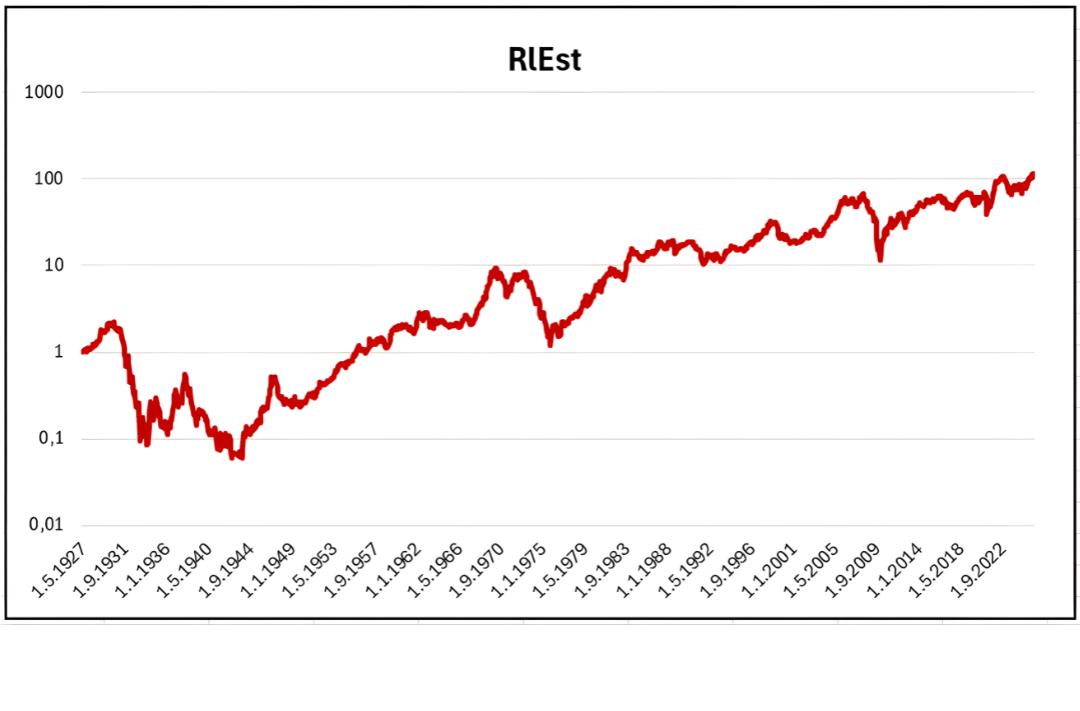
Figure 1: Performance of the RlEst index from July 1, 1926, to December 1, 2025, shown on logarithmic scale.
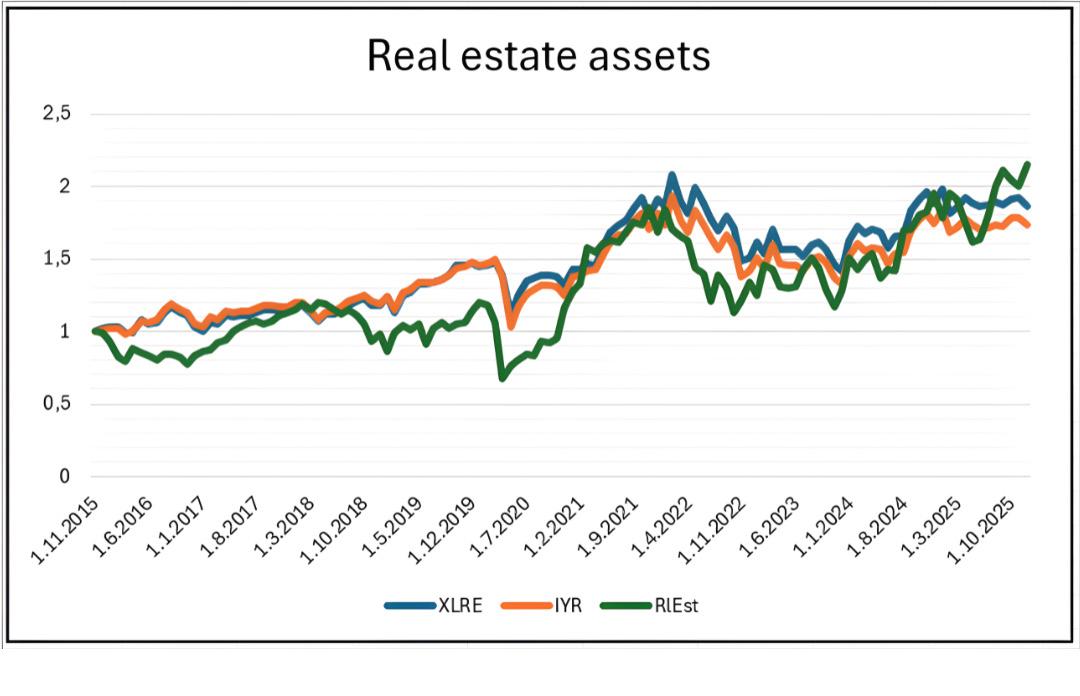
Figure 2: Comparison of 3 real estate assets, specifically XLRE, IYR and RlEst, from November, 2015 to December, shown on logarithmic scale.
For instance, as shown in Figure 2, RlEst serves as a good approximation for Real Estate Investment Trusts ETFs, capturing the main trends. This extended time frame enables us to observe REIT performance across multiple historical economic cycles.
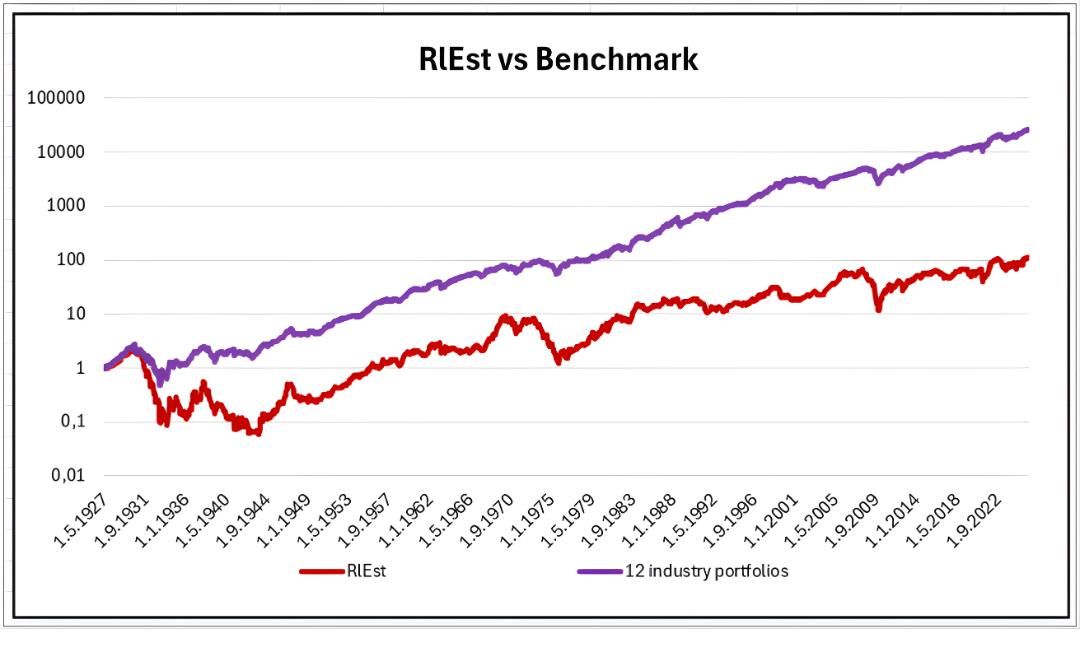
To ensure that the investment strategy is robust, we also compare it against a benchmark composed of the 12-industry portfolios from Fama-French, which represents the broader market through a diversification across 12 sectors. While RlEst focuses specifically on real estate, the 12-industry portfolios provides a broader
market context for evaluation.
Figure 3: Comparison of the RlEst asset with its benchmark, the 12 industry portfolios, from July, 1926 to December, 2025, shown on logarithmic scale.
Historically, the real estate sector has experienced several notable crises. For instance, during the early 1930s, the U.S. real estate market suffered as part of the Great Depression. Although the Great Depression officially ended in the mid-1930s, outstanding debts and mortgage issues persisted for years, keeping property values and REIT returns under pressure. At the same time, the outbreak of war in Europe in 1939 created additional economic uncertainty. Investors worried about potential recessions or market volatility, contributing to drawdowns around 1940. In the 1970s, high inflation and economic stagnation affected property values. More recently, the 2008–2010 Global Financial Crisis, triggered by the U.S. housing bubble and mortgage defaults, led to severe declines in REIT valuations worldwide.
However, our main focus was whether any approach, based on long-term or medium-term anomalies, exists that could achieve a strong, profitable strategy capable of improving return-to-risk ratios of the passive B&H strategy of holding REITs.
Methodology
As mentioned in the introduction, we utilized monthly data of the RlEst index, representing real estate trusts available in the 48-industry portfolios dataset, from July 1, 1926, to December 1, 2025. This dataset, as well as the benchmark dataset of the 12-industry portfolios, was sourced from Fama-French5. The strategies combined investing in RlEst with holding capital in cash, represented by the BIL ETF. This switching
mechanism reflects a more realistic investment scenario.
Basic performance characteristics in each strategy characteristics table are presented as follows: the notation perf represents the annual return of the strategy, st dev stands for the annual standard deviation, max dd is the maximum drawdown, adjusted Sharpe r is calculated as the ratio of perf to st dev and adjusted Calmar r as the ratio of perf to max dd
For better visualization, all graphs are presented on a logarithmic scale.
With the aim of identifying the most efficient approach, we tested several approaches, which are introduced separately. Each strategy is rebalanced monthly, starting with an initial portfolio value of 1.
Trend-following strategy
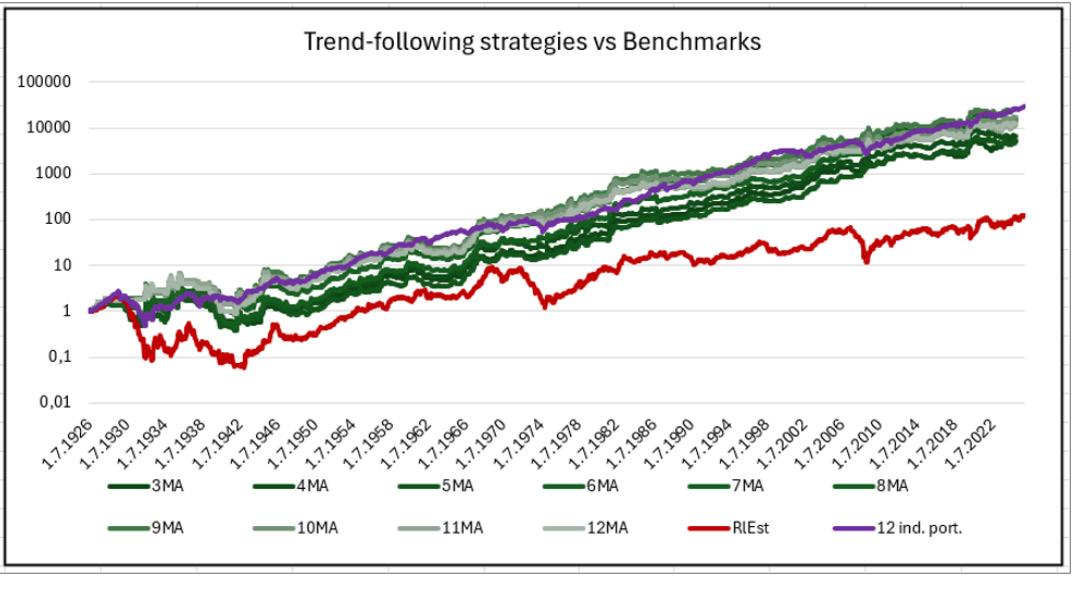
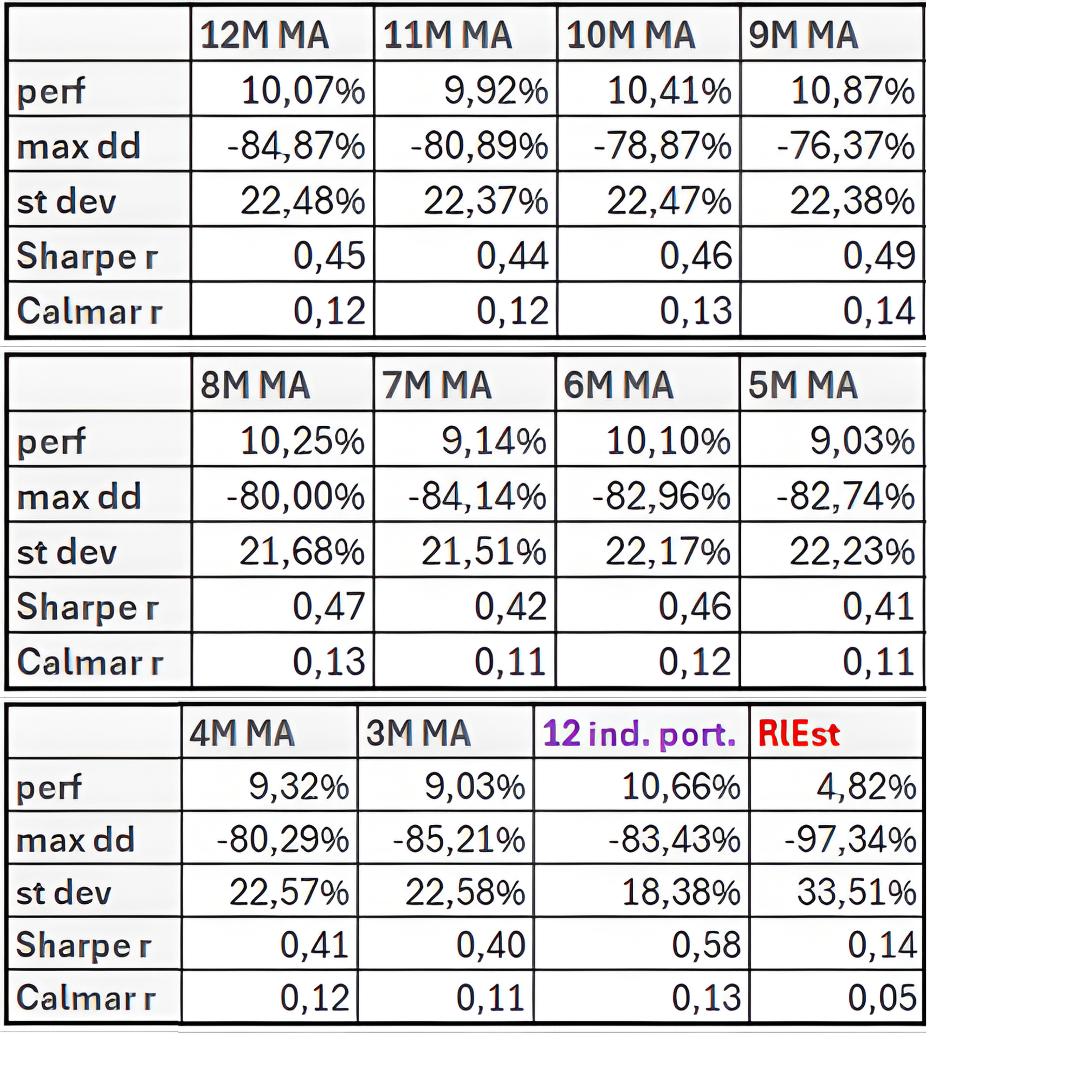
We began by examining a trend-following pattern using various forms of a moving average (MA). At the end of each month, the average RlEst value over the specified period was calculated. This value was then compared to the actual RlEst value for that month. When the actual value exceeded the moving average, a signal was generated to invest in RlEst in the following month. Otherwise, capital was held in cash. The process was repeated each month with the corresponding RlEst value and its moving average.
This methodology was applied 10 times, each with a different moving average window, starting with a 3-month (M) and 4-month period, and continuing up to a 12-month period.
Figure 4: Performance of the trend-following strategies compared with the benchmarks, the RlEst index and the 12-industry portfolio, from July 1, 1926, to December 1, 2025, shown in logarithmic scale.
Table 1: Basic performance characteristics of the trend-following strategies compared with the benchmarks, the RlEst index and the 12-industry portfolio, from July 1, 1926, to December 1, 2025.
As shown in both Figure 4 and Table 1, all of the strategies easily outperformed the RlEst index, with Sharpe and Calmar ratios up to three times higher, demonstrating that the trend-following approach is very useful in increasing the performance (and decreasing a risk) in comparison to simple B&H of the real estate sector. However, compared to the broader market, represented by the 12-industry portfolios, the strategies are less effective. Although some moving average windows were more profitable and even outperformed the market during certain periods, ultimately all strategies achieved lower Sharpe and Calmar ratios than 12-industry portfolio.
Therefore, we proceeded to examine another anomaly.
Momentum strategy
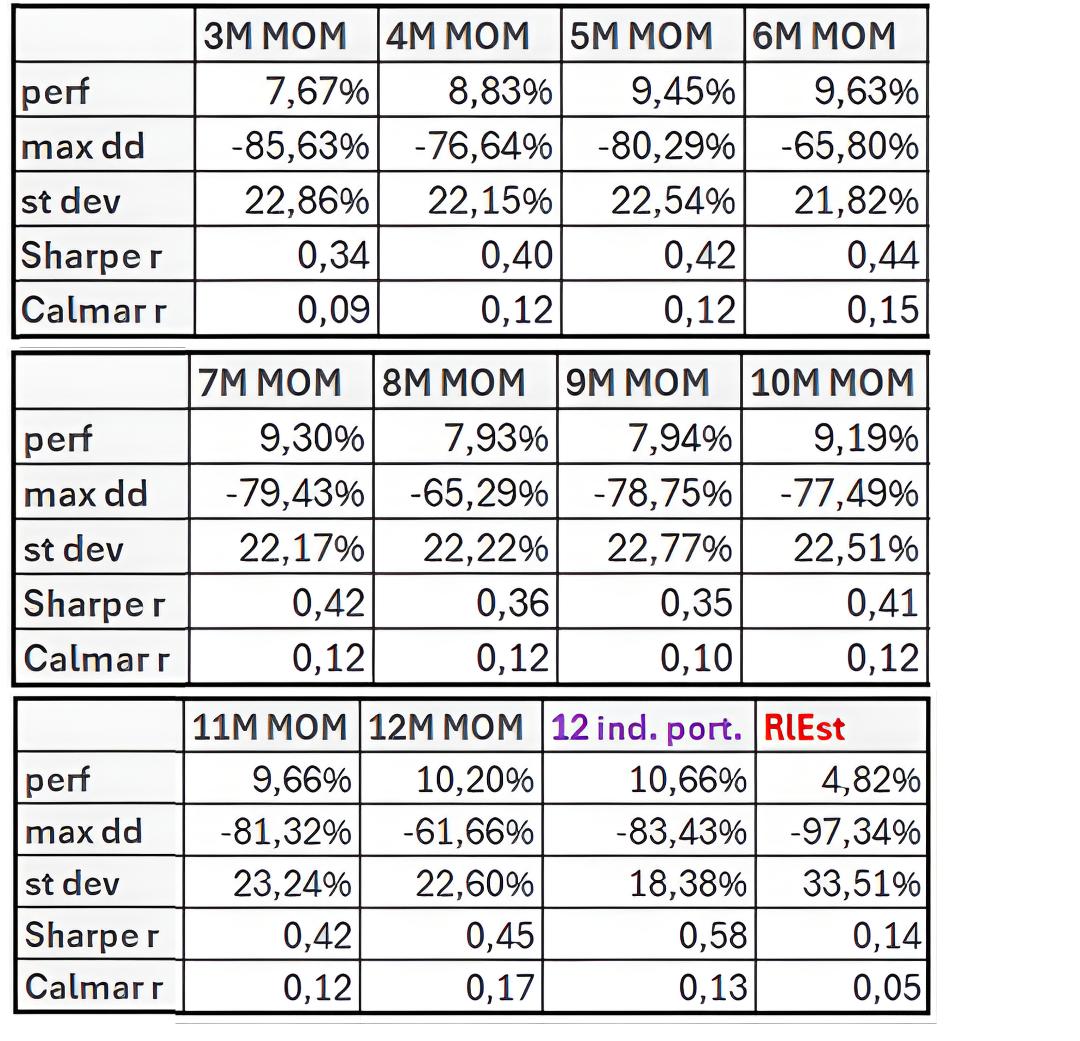
The second strategy is based on the rate of change (momentum) of the RlEst value. At the end of each month, we calculated the momentum (MOM) of RlEst. If the momentum was positive, a signal was generated to invest in RlEst for the following month, otherwise, capital was held in cash. Similar to the trend-following strategy, this procedure was repeated on a monthly basis
and tested across several time windows for momentum calculation, starting with a 3-month and 4-month period and continuing up to a 12-month period.
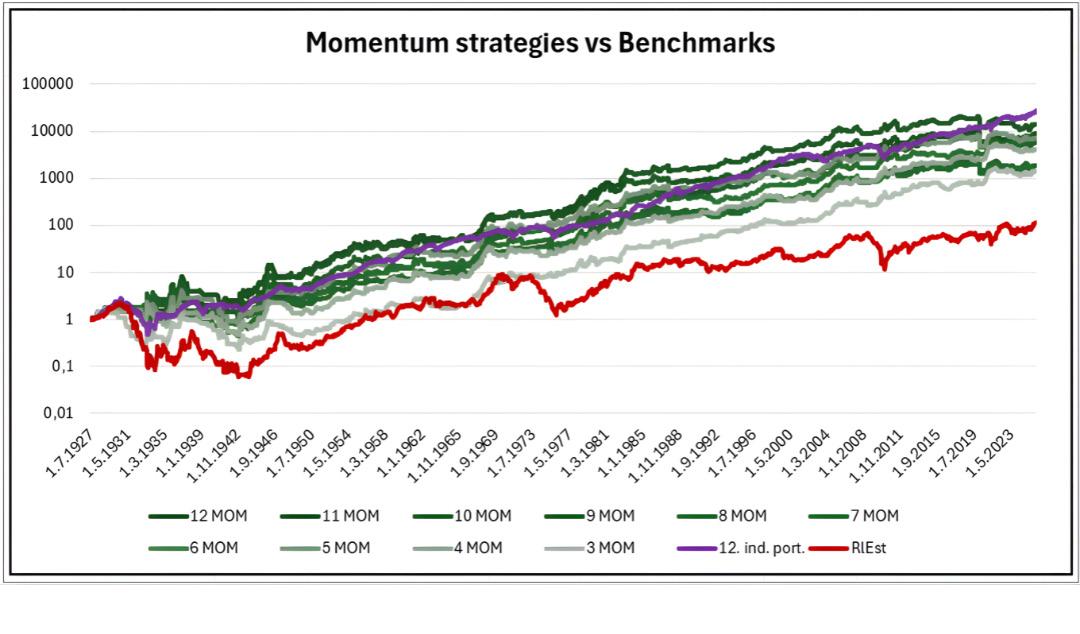
Figure 5: Performance of the momentum strategies compared with the benchmarks, the RlEst index and the 12-industry portfolio, from July 1, 1926, to December 1, 2025, shown in logarithmic scale.
Table 2: Basic performance characteristics of the momentum strategies compared with the benchmarks, the RlEst index and the 12-industry portfolio, from July 1, 1926, to December 1, 2025.
The behavior of the momentum strategies is very similar to that of the trend-following strategies. Each strategy was able to outperform the RlEst index, however, they were not as effective as the previous approach. Some strategies with longer momentum time windows were able to outperform the market for most of the time, but with the lower Sharpe and Calmar ratios.
After that we moved on to a different anomaly and
sought to examine seasonality.
Seasonality
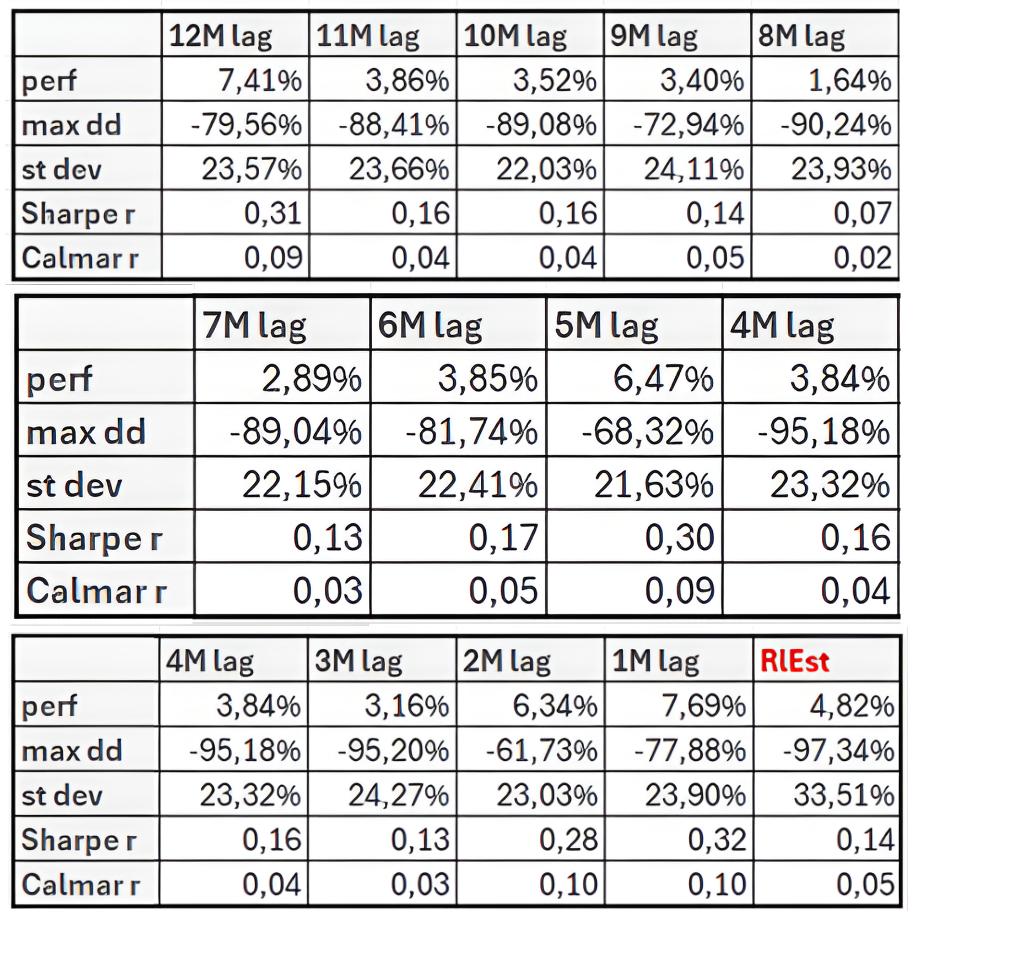
Seasonality in real estate trusts has not been as thoroughly examined as the previous anomalies, therefore, we were curious whether any time patterns could be used in trading. Each month, we examined whether the RlEst returns were positive a specific time ago in order to identify any repeating pattern that might indicate an upcoming profitable month. If the return was positive, we invested in RlEst for the following month, otherwise, no action was taken. For this analysis, we again tested several look-back periods, starting with 1-month and 2-month windows and continuing up to 12-month periods. This procedure was repeated on a monthly basis.
Table 3: Basic performance characteristics of the seasonality strategies compared with the RlEst index, from July 1, 1926, to December 1, 2025.
Results in Table 3 show that most effective is the approach with 12-month look-back period, which is the longest examined time window, and strategies with the shortest time window, using 1-month and 2-month look-back period. Therefore, we decided to combine these 3 approaches and create a composite strategy.
Average strategy
The new strategy combines three seasonality approaches using 1-month, 2-month, and 12-month look-back periods, as these achieved the most favorable results. Each month, we test whether to invest in RlEst
for the following month based on its performance 1, 2, and 12 months earlier, evaluated separately. In the combined strategy, all three signals are then considered simultaneously, with each decision assigned a weight of 1/3.
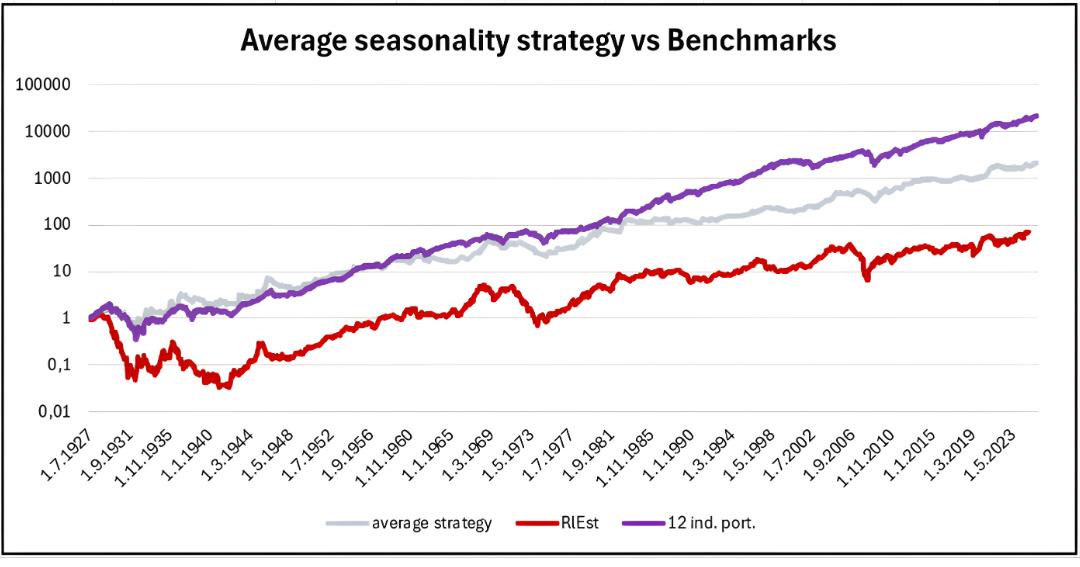
Figure 6: Performance of the strategy combining the 3 most effective seasonality approaches compared with the benchmarks, the RlEst index and the 12-industry portfolio, from July 1, 1926, to December 1, 2025, shown in logarithmic scale.
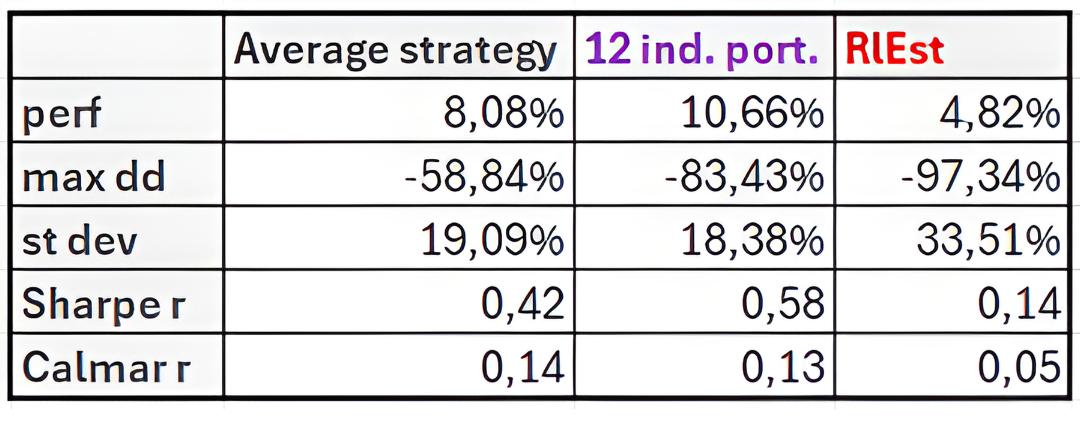
Table 4: Basic performance characteristics of the strategy combining the 3 most effective seasonality approaches compared with the benchmarks, the RlEst index and the 12-industry portfolio, from July 1, 1926, to December 1, 2025.
The combination of the 3 most effective seasonality approaches proved beneficial, achieving nice Sharpe and Calmar ratios and thus reflecting its effectiveness. As a final attempt, we decided to enhance this average seasonality strategy by incorporating cash holdings. The procedure is almost the same -> when the analyzed return of the RlEst index in the past (1-, 2-, and 12-months ago) is positive, this generates a signal to invest in RlEst for the following month. Otherwise, the capital is held in cash. As before, this process was repeated on a monthly basis, separately considering the 1-month, 2-month, and 12-month seasonality lookback periods, with each signal assigned a weight of 1/3.
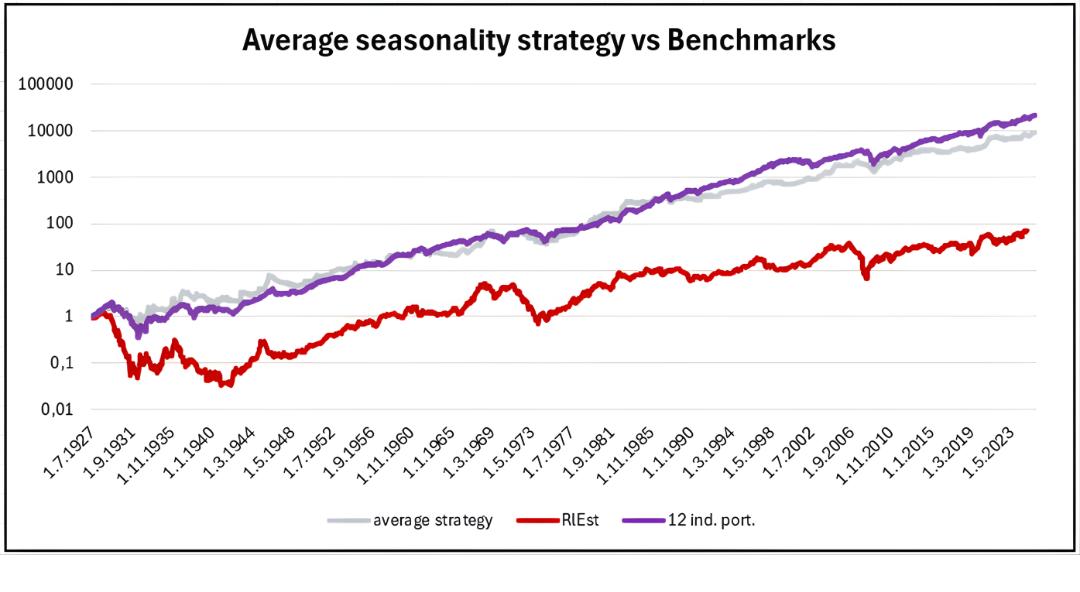
Figure 7: Performance of the strategy combining the 3 most effective seasonality approaches and cash compared with the benchmarks, the RlEst index and the 12-industry portfolio, from July 1, 1926, to December 1, 2025, shown in logarithmic scale.
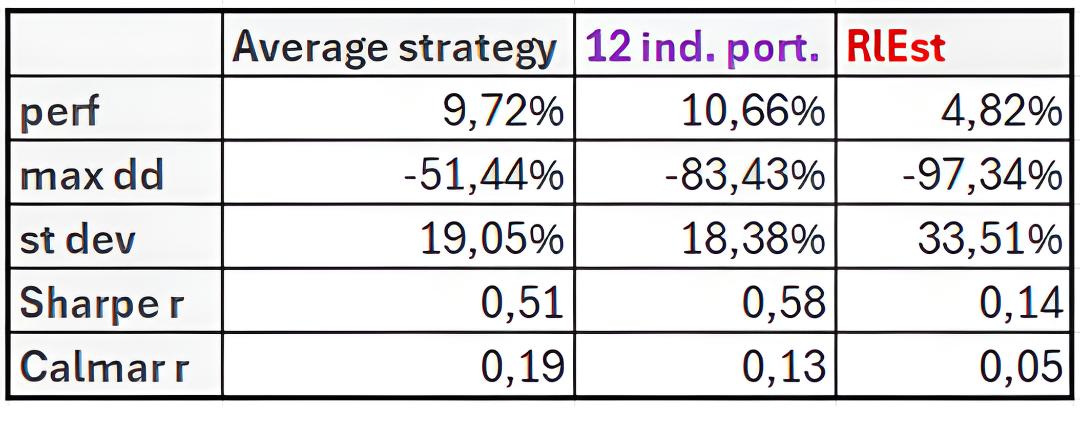
Table 5: Basic performance characteristics of the strategy combining the 3 most effective seasonality approaches and cash compared with the benchmarks, the RlEst index and the 12-industry portfolio, from July 1, 1926, to December 1, 2025.
Considering holding capital in cash as an alternative to investing in RlEst improved the strategy, increasing the Sharpe ratio to 0.51 and the Calmar ratio to 0.19, which are the highest values achieved in this study. Composite seasonality strategy nearly matches performance and return-to-risk ratios of the broad equity market, which underscores the added value of seasonality signals.
One question still remains unanswered: why do the 12-month look-back period and the 1- and 2-month periods perform the best, even though they represent opposite ends of the time horizon?
One possible explanation is that the 1–2 month and 12-month look-back periods capture two different market effects. Short look-back periods, such as 1 or 2 months, may reflect short-term momentum or persistence in returns, where positive performance tends to continue briefly due to delayed investor reactions
or market frictions. On the other hand, the 12-month look-back period is commonly associated with the well-documented long-term momentum effect observed in financial markets.
Intermediate horizons between these extremes may contain more noise or partial mean reversion, which weakens the predictive power of the signal. As a result, the very short-term and the longer-term signals can perform better, even though they represent opposite ends of the time horizon.
Another potential explanation relates to structural characteristics of REITs. Unlike typical equities, REITs distribute the majority of their income as dividends and operate within the slower-moving real estate market, where information and fundamental developments are incorporated into prices gradually. Short-term predictability may therefore reflect temporary continuation around dividend cycles, institutional fund flows, or delayed investor reactions to macroeconomic developments affecting the real estate sector. Meanwhile, the predictive power of the 12-month lag may capture longer-term persistence in property market fundamentals, annual portfolio rebalancing by institutional investors, or broader momentum effects that are well documented across equity markets. These mechanisms may coexist, leading to stronger signals at both very short and longer horizons, while intermediate horizons are more affected by noise and partial mean reversion.
Conclusion
The real estate trusts index itself could be consistently outperformed by all tested strategies. Both the trend-following and momentum approaches improved the risk-adjusted performance compared to holding the RlEst index alone.
The most promising results were achieved with the seasonality-based strategies. In particular, combining the most effective seasonality signals with 1-month, 2-month, and 12-month look-back periods produced stronger results than the previously tested approaches. Further improvement was achieved when the strategy allowed capital to be held in cash during unfavorable periods. This final approach achieved the highest Sharpe and Calmar ratios within the study and came closest to matching the performance of the broader equity market. Although none of the tested strategies were able
to consistently outperform the equity market benchmark represented by the 12-industry portfolios, the strategies significantly improved performance relative to the standalone RlEst index. This result may be partly explained by the fact that the troubled real estate sector historically experienced deeper drawdowns during major economic crises compared to the broader market. Adding a trend-following, momentum, and/or seasonality filter helps to mitigate losses in such crisis periods and should be thoroughly considered.
Radovan Vojtko is a former Systematic Portfolio Manager, in the past, he worked for the Tatra Asset Management company (which is the biggest asset management company in the Slovak Republic and it has over 2.5 billion EURs of assets under management). He personally managed over 300+ million EUR in several quantitative funds. These funds were focused on multi-asset managed futures and trend-following strategies, global tactical asset allocation, market timing, and volatility trading. He made his next big step in 2015 and became CEO of Quantpedia.com - The Encyclopedia of Quantitative Trading Strategies, a quant research company with a mission “to turn financial academic research into a more user-friendly form to help anyone interested in algo/quant trading and systematic investing”.
YIELD IS A FEATURE. TRUST IS THE PRODUCT WHAT LP CONVERSATIONS IN PRIVATE CREDIT TAUGHT ME
BY ELJONA SHKRELI Stratus Financial Fund
When I first started telling people that Stratus Financial Fund lends to commercial pilot students, I braced for confused looks. Aviation training? Like… flight school? Yes, exactly like flight school.
What I didn’t expect was how quickly that confusion would turn into curiosity, and how often that curiosity would lead to some of the most honest conversations I’d have with prospective LPs all year. Something about how unexpected the answer seemed to take people off script. They stopped asking standard diligence questions and started asking real ones.
That shift taught me something I now consider one of the most important lessons in private credit investor relations: the story behind what you lend into matters far more than the yield you put at the top of
your deck. Because yield, in today’s market, is everywhere. Trust, real, earned, structural trust, is not.
The Crowded Room Nobody’s Talking About
Private credit has had an extraordinary run. Assets under management have grown from roughly $500 billion a decade ago to well over $2 trillion today, and the flow of capital shows no signs of slowing. For allocators, whether family offices, RIAs, or high-net-worth individuals, the pitch is compelling: floating-rate returns, low correlation to public markets, senior secured positions, and consistent income in a world where traditional fixed income underdelivered for years.
All of that is real. But what I started noticing,
about two years into this role, was that the questions began to change, and rightfully so.
Allocators are no longer just asking, “What’s the yield?” They’re asking who else is in this space, and what crowding does to spreads over time. They’re asking what happens to borrowers if rates stay elevated longer than expected. And they’re asking how we know, concretely, that we actually understand the assets we’re underwriting, not just that we have a compelling thesis.
Those are exactly the right questions. And they highlight something important: not all private credit is created equal. As capital has moved quickly into the space, many funds have ended up offering similar-looking products backed by very different levels of underlying expertise. The marketing materials start to converge. Track records are often short. And the real differentia-
tors are sometimes more about distribution than actual credit experience.
In an environment like that, skepticism isn’t just healthy. It is necessary. The allocators who are navigating private credit well today are the ones who look past the headline return and focus on the people and processes behind it.
What Aviation Training Lending Taught
Us About Underwriting
When Stratus identified aviation training finance as a core focus, it wasn’t a marketing decision. It was an underwriting one. Commercial pilot pipelines have a structural supply problem that isn’t going away anytime
soon. Airlines globally are projected to need hundreds of thousands of new pilots over the next two decades. At the same time, the training infrastructure, including flight schools, simulator programs, and accelerated certification tracks, has historically been underfunded by traditional lenders.
Banks don’t typically underwrite this kind of exposure. The collateral is non-standard, the borrowers are pre-income, and evaluating credit risk requires a working understanding of licensing pathways, employment outcomes, and aviation labor dynamics that most credit committees simply don’t have.
That’s exactly where the opportunity comes from. But it’s also where discipline matters most. What this niche reinforced for us, and what now anchors many of our LP conversations, is that genuine sector knowledge is a real risk mitigant. Not just the seniority of the lien. Not just the loan-to-value ratio. But a clear understanding of what you own, and why the borrower will ultimately repay you.
Those are not the same thing.
When we walk a family office through how FAA certifications work, what airline hiring pipelines look like, and how we think about downside scenarios in a weaker hiring environment, it leads to a very different kind of conversation. It moves beyond spreadsheets and into something more tangible. It builds conviction not because the numbers are attractive, but because the thinking behind them is clear.
And that’s where real differentiation tends to come from in private credit. Not scale, not branding, but depth of understanding that takes time to build.
Interestingly, this depth also shows up on the borrower side. The flight schools and training programs we work with aren’t just looking for capital. Many have been turned away by lenders who didn’t fully understand their business. When you can speak their language and demonstrate that understanding, the relationship changes. You are no longer just a source of capital. You become a partner in their growth. That dynamic has real implications for both credit performance and deal flow.
The LP Relationship Is Longer Than the Fund
One thing many managers are reluctant to admit is
this: the capital raise isn’t the finish line. It’s the beginning of a relationship that, if done well, should outlast any single fund.
The family offices and RIAs we work with are thinking in longer time horizons. They’re not reallocating in and out of private credit every quarter. When they commit, they’re making a judgment not just about the strategy, but about the people behind it.
They’re asking whether they trust this team to make sound decisions when conditions change. Whether communication will be clear when things don’t go as planned. And whether their interests will remain aligned with the manager’s over time.
That shapes how we approach every interaction, from initial conversations to ongoing updates. We try not to treat communication as something tied to a schedule. If something changes in the market or in the portfolio, that is usually a reason to reach out, not wait.
Our approach has always been intentionally focused. Not because we have to be, but because we think it leads to better outcomes for both the portfolio and the relationships around it. When you have a smaller, more deliberate LP base, you are naturally more accountable. You cannot rely on volume or complexity to carry the relationship. You have to be clear, responsive, and consistent.
And in practice, it is often the smaller details that matter most. Remembering an LP’s preferences around liquidity. Understanding their broader portfolio exposures. Knowing when a conversation is helpful, even if it is not strictly necessary.
These may seem like small things, but over time, they compound. And in this business, that compounding shows up in trust.
What I’d Tell Any LP
Considering Private Credit Today
The opportunity in private credit is real. The structural drivers, including banks stepping back from certain types of lending, demand for income in diversified portfolios, and the benefits of floating-rate exposure, are all still in place.
But the dispersion in manager quality is also real,
and often wider than it appears on paper.
A few things are worth paying close attention to:
Understand the niche, not just the label. “Private credit” covers a wide range of strategies. What matters is whether the manager has real expertise in the specific areas they lend into. Ask them to explain their underwriting in plain terms. Ask what could go wrong in their portfolio and listen closely to how they answer.
Ask about the difficult credits. Every manager can talk about their wins. The more telling conversations are about the investments that didn’t go as planned. What happened, how it was handled, and what changed afterward. That’s where you see discipline and learning.
Treat communication as a signal, not a courtesy. How a manager communicates before you invest is usually a good indicator of what comes after. If interactions feel rushed or surface-level early on, that pattern tends to continue.
Match the vehicle to your liquidity reality. Private credit is illiquid. Not somewhat illiquid, but genuinely illiquid over the life of the investment. That is often where the return premium comes from, but it requires an honest assessment of your own liquidity needs before committing.
Pay attention to how the team views borrowers. This one is less quantitative, but it matters. Managers who see borrowers purely as exposures tend to approach the business differently than those who understand that borrower success and portfolio performance are closely linked.
The Skyward View
I think back often to those early conversations where aviation training would get a puzzled reaction. I get fewer of those now, partly because the opportunity is better understood, and partly because consistency over time builds credibility in a way no pitch deck can.
But those early moments were valuable. They created space for real conversations about why certain parts of the credit market remain underserved, what it takes to understand them well, and why staying focused can matter more than following broader market trends.
At its core, private credit still comes down to something relatively simple. Not just spreads or structures, though those matter, but whether the people
managing capital understand what they’re doing, communicate honestly about it, and treat the relationship as something worth maintaining over the long term.
The funds that matter a decade from now may not be the ones with the most assets today. They will be the ones whose LPs never had to wonder where they stood.
Eljona Shkreli is the Head of Investor Relations at Stratus Financial Fund, a private credit manager specializing in aviation training finance. The views expressed here are of her own views and experience.
Eljona Shkreli Head of Investor Relations
Stratus Financial Fund I is a 506(c) passive income fund strategically designed to finance purpose-driven loans for commercial aviation training while delivering strong returns for investors. As part of Stratus Financial, one of the fastest-growing super-prime U.S. consumer credit strategies, the fund focuses exclusively on a massively underserved $2 billion market.
With a compelling preferred return, Stratus Financial Fund I serves as a cornerstone in private credit investment strategies. Our proprietary underwriting credit model, combined with a strict focus on lending to super-prime and prime borrowers, ensures a disciplined, high-quality approach to financing the next generation of commercial pilots while maximizing investor returns.
Stratus Financial Fundn
BUILDING AN ENERGY GRID WORTHY
OF GENERATIONS
WHY PUERTO RICO’S BROKEN GRID REPRESENTS ONE OF THE MOST COMPELLING INFRASTRUCTURE OPPORTUNITIES IN THE U.S. TERRITORY SYSTEM
BY RYAN PADDOCK Aperion Energy
If you have spent any time evaluating opportunities in Puerto Rico over the past several years, you have almost certainly encountered a version of the same conversation. The tax incentives are extraordinary. The real estate pipeline is accelerating. The demographic shift of high-net-worth individuals relocating under Act 60 is real and measurable. But at some point, every serious investor asks the question that cuts through the optimism: what about the power? It is the right question. And the honest answer
is that Puerto Rico’s electrical grid remains one of the most fragile and expensive systems under any American flag. That fragility is not merely an inconvenience. It is a structural risk that touches every asset class on the island, from commercial real estate to hospitality to the luxury residential corridor now taking shape along the east coast. It is also, for those willing to look past the headline risk, one of the most compelling infrastructure investment opportunities available today.
The Grid That Time Forgot
To understand why energy represents such an asymmetric opportunity in Puerto Rico, you first have to understand how broken the existing system truly is. The island’s electrical infrastructure was aging and underinvested long before Hurricane Maria made landfall in September 2017. That storm did not create Puerto Rico’s energy crisis. It revealed it.
Prior to Maria, the Puerto Rico Electric Power Authority, known as PREPA, operated a centralized generation and transmission system that was over forty years old in many of its critical components. Transmission and distribution losses were estimated at roughly twice the mainland U.S. average. Deferred maintenance had compounded for decades. The utility was already in bankruptcy proceedings when the storm hit, carrying more than nine billion dollars in debt obligations it could not service.
Maria destroyed approximately eighty percent of the island’s transmission and distribution infrastructure. The entire island lost power. Some communities did not see electricity restored for nearly a year. The reconstruction that followed was extensive but uneven, and much of it amounted to rebuilding the same centralized, vulnerable architecture that had failed in the first place.
Today, under the management of LUMA Energy, the private consortium that took over transmission and distribution operations in 2021, the system remains deeply unreliable. Residents and businesses across the island experience frequent outages, voltage fluctuations, and rolling blackouts during periods of peak demand or adverse weather. The average Puerto Rico resident experiences power interruptions at a rate that would be unacceptable in any mainland market. For a luxury residential buyer considering a multi-million-dollar com-
mitment on the island, that level of unreliability is not a minor amenity issue. It is a dealbreaker.
Where Capital Meets Kilowatts
This is the tension that creates the investment thesis. Puerto Rico is experiencing a genuine real estate boom on its east coast, driven by the convergence of Act 60 tax incentives, limited ultra-luxury inventory, government-backed infrastructure investment at Roosevelt Roads and Ceiba Airport, and a sustained influx of high-net-worth relocators. Over four thousand highnet-worth individuals moved to Puerto Rico in 2023 and 2024 alone, with more than five thousand additional applications in backlog. East of Dorado, there is virtually no luxury housing product to absorb that demand, outside of a handful of existing communities.
Developers are responding. Master-planned luxury communities are in various stages of planning and construction along the eastern corridor. The pipeline includes resort-style developments with branded residences, estate homes, community amenities, and hospitality components. These are not speculative land plays. They are serious, capitalized projects targeting a buyer demographic that expects mainland-quality infrastructure in every dimension, including energy.
And yet the grid cannot deliver what those buyers require. A luxury estate home running central air conditioning, a pool system, a home automation platform, security infrastructure, and the other mechanical loads typical of high-end residential construction can easily draw fifteen to twenty-five kilowatts at peak. Multiply that across a community of several hundred residences, add a resort and commercial facilities, and the aggregate demand is substantial. The existing grid infrastructure serving Puerto Rico’s east coast was never designed to accommodate that kind of load growth, and it cannot be made reliable enough through incremental upgrades alone.
This is not a problem that will solve itself. It is a problem that requires private capital, deployed intelligently, into purpose-built energy infrastructure. And it is a problem where the economics are remarkably attractive.
The Economics of Energy Independence
Puerto Rico’s electricity rates are among the highest in any U.S. jurisdiction, frequently exceeding thirty cents per kilowatt-hour for residential customers and fluctuating with global fuel costs because the island still generates a significant share of its power from imported petroleum and natural gas. By contrast, the levelized cost of solar energy in Puerto Rico’s high-irradiance environment is now well below ten cents per kilowatt-hour, and battery energy storage system costs have declined by more than seventy percent over the past decade.
That spread between grid electricity cost and the cost of locally generated and stored renewable energy is the fundamental economic engine driving investment in distributed energy resources on the island. But the opportunity extends well beyond simple cost avoidance.
Puerto Rico’s grid operator actively procures ancillary services from battery energy storage systems. Frequency regulation, voltage support, demand response, spinning reserves, and capacity payments all represent revenue streams available to grid-connected storage assets. The island’s CBES and CBES+ programs create structured frameworks for battery operators to participate in demand response events, discharging during peak periods and charging during off-peak or high-renewable-output windows. These programs are not theoretical. They are active, and they pay.
For an investor, this means that a well-structured solar and battery storage deployment in Puerto Rico is not simply a cost center or an insurance policy against outages. It is a revenue-generating asset with multiple income streams: avoided electricity cost, grid services revenue, demand response payments, capacity payments, and in the context of a luxury development, a premium that energy reliability adds to residential property values. When you combine those revenue streams with the federal Investment Tax Credit (ITC), accelerated depreciation, and Puerto Rico’s own renewable energy incentives, the returns on deployed capital become very difficult to ignore.
Beyond the Traditional Model
The typical approach to energy infrastructure in a
master-planned community is straightforward and limited. A developer installs a certain amount of rooftop or ground-mounted solar, perhaps pairs it with a battery system, connects to the grid as a backup, and calls it done. This approach checks a marketing box, but it does not solve the underlying problem. The solar array is constrained by available land within the development. The battery system is sized for a narrow use case. The software managing the system is a generic platform designed for utility-scale applications, not for the specific needs of a residential community. And when a hurricane or extended grid outage occurs, the system’s limitations become painfully apparent.
The next generation of energy solutions for Puerto Rico’s luxury developments looks fundamentally different. The model that is emerging, and that I believe will define the market, is the virtual power plant: a networked architecture where distributed energy resources across multiple scales, from individual home battery systems to community-level storage to grid-scale solar and storage plants located off-site, are aggregated and coordinated through a unified software platform.
In this model, a luxury community does not need to dedicate twenty-five or thirty acres of prime land to solar panels. The bulk of the generation capacity can be located off-site on less valuable real estate, connected to the community through the existing distribution infrastructure and managed through a custom energy platform. The on-site footprint shrinks to a battery system and whatever rooftop or distributed solar makes sense architecturally. The community gets reliable, resilient power without sacrificing developable land. The off-site generation asset earns revenue from both the community and the broader grid. And individual homeowners who install their own battery systems can participate in the community energy marketplace, strengthening the network while generating returns on their own equipment.
This is not a theoretical construct. The technology to build and manage virtual power plants at this scale exists today. The software platforms that coordinate distributed energy resources, manage grid interactions, optimize charge and discharge cycles, and execute energy arbitrage are mature and deployable. The hardware, lithium iron phosphate battery systems, utility-scale invert-
ers, advanced metering infrastructure, is commercially proven and available at scale. What has been missing in Puerto Rico is the integration: the combination of construction expertise, energy engineering, grid-scale development capability, local permitting knowledge, and capital formation necessary to bring all of these pieces together in a single, coordinated deployment.
The Investment Structure
For allocators evaluating Puerto Rico energy infrastructure, the investment structure matters as much as the technology. The most compelling deployments combine multiple capital layers. At the grid scale, a solar and battery storage plant of twenty megawatts or more represents a significant infrastructure asset with long-duration revenue contracts and grid services income. At the community scale, a five to twenty megawatt-class system paired with resort and commercial facilities creates a resilient microgrid with both cost savings and revenue generation. At the residential scale, homeowner-purchased battery systems create a distributed network that strengthens the overall platform while generating marketplace revenue and can be scaled to meet the independent homeowner’s critical load requirements.
This tiered structure distributes risk across multiple revenue sources and multiple capital partners. The gridscale asset can be financed through traditional project finance structures, leveraging tax credits and long-term power purchase agreements. The community-scale system can be structured as a development partnership, with costs shared between the energy operator and the real estate developer. The residential systems are purchased by homeowners, creating a capital-light expansion of the network that generates recurring software and transaction revenue for the platform operator.
The federal incentive landscape further strengthens the economics. The Investment Tax Credit for solar and storage remains robust, and the Inflation Reduction Act’s provisions for energy communities and domestic content bonuses can enhance returns further. Puerto Rico’s own incentive programs, including Act 60 provisions for energy businesses and various territorial tax credits for renewable energy deployment, add additional layers of tax efficiency. And the Department of Energy’s Loan Programs Office has shown increasing interest in
Puerto Rico energy infrastructure, creating potential pathways for low-cost project-level debt.
Risk and Resilience
No honest assessment of Puerto Rico energy investment can ignore the risks. Hurricane exposure is real and must be engineered against, not wished away. Battery systems must be designed to withstand Category 5 wind loads and flooding. Communication infrastructure must include redundant pathways, including RF-based fallback systems that operate independently of cellular and internet networks. The grid interconnection and permitting process in Puerto Rico is complex, involving multiple regulatory bodies and requiring experienced local navigation. And the island’s political and regulatory environment, while broadly supportive of renewable energy development, carries the same uncertainties that characterize any jurisdiction in transition.
These risks are manageable, but they are not trivial. They require operators with genuine on-island presence, established relationships with permitting authorities and grid operators, and engineering teams that understand both mainland best practices and the specific demands of the Puerto Rico environment. The margin for error is thinner than in most mainland markets, and the consequences of getting the engineering wrong are more severe.
That said, the risk profile must be weighed against the opportunity. Puerto Rico’s energy market is not a mature, efficiently priced market where returns are competed away. It is a market in fundamental transition, where incumbent infrastructure is failing, demand is growing, the economics of new technology strongly favor deployment, regulatory incentives are aligned, and the supply of experienced, well-capitalized operators is limited. For investors who understand infrastructure and are comfortable with the operational complexity, the risk-adjusted returns are among the most attractive in any U.S. energy market.
A Generational Cycle
Puerto Rico is in the early stages of what I believe is a generational real estate and infrastructure cycle. The demographic forces are powerful and durable. The tax incentive framework, while always subject to political
risk, has created genuine structural demand. The physical beauty of the island, particularly the east coast, is extraordinary and non-replicable. And the infrastructure deficit, particularly in energy, creates an opportunity for private capital to step in and build what the public sector cannot.
The developers who will succeed in this cycle are the ones who understand that energy is not a line item to be minimized. It is a foundational capability that determines whether a luxury community can deliver on its promise. The investors who will generate the strongest returns are the ones who recognize that deploying capital into energy infrastructure is not an act of philanthropy or corporate social responsibility. It is an investment in a revenue-generating asset class with multiple income streams, strong tax efficiency, and a structural tailwind that will persist for decades.
The grid is not going to fix itself. The demand is not going away. The technology is ready. The question for the investment community is straightforward: are you going to participate in building Puerto Rico’s energy future, or are you going to watch from the sideline while others capture the opportunity?
Ryan Paddock CEO Aperion Energy
Aperion Energy is a Puerto Rico–based energy company focused on the deployment and management of scalable residential to grid-level solar and battery energy storage solutions. Through its custom DERMS (Distributed Energy Resource Management Software) platform, Aperion creates virtual power plants for luxury residential communities in partnership with CrownCore Construction and Ventana Investments.
THE 2026 ALPHA PLAYBOOK: DATA AS THE NEXT UNDERWRITTEN ASSET CLASS
BY GULP DATA
In early 2024, a seemingly minor financial headline sent a major signal to the alternative investment world: Reddit signed a $60 million annual deal to license its user-generated content to Google. For most, it was a tech story about training AI models. For the sophisticated allocator, however, it was a "proof of concept" for a new frontier of alpha. This transaction signaled a fundamental migration. Data is no longer just an operational "exhaust" or a cost center—it is transforming into a primary, financeable, and underwritten asset class. As we look toward the
Uncorrelated Alts conference in Puerto Rico this April 2026, the question for family offices and niche managers is no longer if they should value their data, but how to leverage it for uncorrelated returns.
The Death of the "Free Lunch": From Scraping to Sovereignty
For a decade, the AI revolution was fueled by a "wild west" mentality of free, scraped web data. That
window has now slammed shut—both literally and legally. High-profile litigation and the rise of data sovereignty laws have codified what many in the industry already knew: the "free lunch" is over.
While the behavior of buying and selling data has existed since the late 1990s, the current AI arms race has moved these transactions from the back office to the boardroom. Organizations are no longer looking for "public" data; they are hunting for proprietary data—the kind that exists behind paywalls, within private healthcare systems, or tucked away in the historical logs of boutique fund managers. This scarcity is driving a massive acceleration in data-buying behavior, turning once-stagnant companies into high-value targets.
The Clearlake Bridge: Underwriting the "Data Lake"
To see this shift in action, one need only look at Clearlake Capital’s landmark acquisition of Dun & Bradstreet. While D&B is a legacy business information provider with roots stretching back to 1841, Clearlake’s multi-billion dollar bet wasn't just on traditional revenue-multiple stability—it was a strategic move to capture one of the world's most preeminent proprietary datasets for the AI era.
However, Clearlake is far from alone in this "Data-First" underwriting approach. The market is witnessing a concentrated wave of transactions where data and compute capacity are the primary value drivers:
• The Microsoft-Taylor & Francis Deal (2024): In a move that signaled the end of the "free scraping" era, Microsoft paid an estimated $75 million to the academic publisher Informa (parent of Taylor & Francis) specifically for data access to train its AI models. This turned a legacy library of academic journals into a high-margin, liquid licensing asset.
• Thoma Bravo’s Aviation Software Pivot (2025): Thoma Bravo’s $10.5 billion acquisition of specialized aviation software assets from Boeing highlighted a transition toward "Verticalized Data." The play wasn't just about the software's functionality, but the decades of proprietary flight and maintenance data that are indispensable for next-gen aerospace AI.
• Blackstone’s $70B Infrastructure Bet (2025-2026): Blackstone has pivoted its massive real estate engine to become the world’s largest AI infrastructure investor. Through its ownership of QTS Data Centers, Blackstone is essentially "warehousing the world's data," treating digital infrastructure as a core utility with even more predictable appreciation than traditional commercial real estate.
These acquisitions act as a real-world bridge, showcasing that top-tier private equity firms and hyperscalers are no longer just buying companies for their EBITDA; they are underwriting them for their "Data Sovereignty." In the AI era, proprietary records— whether they are centuries of business data from D&B or niche academic research—are being reclassified from "intangible assets" to "senior-secured value."
The "Uncorrelated" Bridge
For the family office and institutional allocator, the allure of data as an asset class isn't just growth—it is the lack of correlation. While traditional equity and credit markets move in lockstep with macro shifts, the value of a proprietary dataset is frequently insulated from interest rate hikes or geopolitical volatility.
Data doesn't trade like a stock. It functions more like a royalty stream or a specialized real asset. By treating data as a distinct pillar of the portfolio, investors can find a hedge that provides yield and appreciation independent of the standard market cycle.
Tactical Execution: The Four Pillars of Data Capital
To navigate this shift, allocators must move beyond theoretical appreciation and toward structured deal-making. Below are the four tactical pillars, complete with deal outlines and projected impact for the modern investor.
Pillar 1: Identifying Hidden Alpha in Acquisitions
When reviewing mid-market acquisitions, the traditional "revenue multiple" approach often hides the true potential of the target.
• The Opportunity: Identify legacy firms with
"high-fidelity" datasets—long-term customer histories, supply chain logs, or specialized scientific data—that have never been productized.
• The Investor Lens: If the asking price is based solely on a 5x or 8x EBITDA multiple, the data asset is effectively being valued at zero.
• Deal Outline: An investor acquires a specialized logistics firm for its cash flow. Post-acquisition, the investor uses a third-party valuation (such as Gulp Data) to quantify the data asset. By licensing that data to an AI firm, the investor effectively lowers their entry multiple and creates a high-margin revenue stream.
• Strategic Impact: A+
• Projected Alpha Lift: 1.5x – 3.0x MOIC Expansion. By underwriting the data at a $0 cost-basis, you effectively "buy" a second company inside the first, significantly boosting the exit multiple.
Pillar 2: Monetizing and Financing Receivables
Given the nascent awareness of this asset class, there is a massive opportunity to provide liquidity to firms that sit on valuable data but lack the "AI-ready" infrastructure to sell it.
• The Opportunity: Act as the bridge between "Data Owners" and "Data Buyers" (AI labs, hedge funds, or researchers).
• The Investor Lens: Look for companies with highly marketable data assets and broker the licensing deals or, more attractively, provide an advance on the data licensing contract for credit-worthy buyers.
• Deal Outline: A family office identifies a healthcare tech firm with a $10M multi-year data licensing contract from a blue-chip pharmaceutical company. The investor provides a "Data Receivable Financing" facility, advancing 70% of the contract value today for senior-secured, long-tail cash flow.
• Strategic Impact: A
• Projected Alpha Lift: 20% – 40% Yield Enhancement. Converting stagnant data into a recurring licensing royalty creates immediate, high-margin EBITDA growth with minimal CAPEX.
Pillar 3: Data-Backed Credit and Structured Income
As data valuations become standardized, data is
moving from a "soft" intangible to a viable form of senior-secured collateral for specialized credit facilities.
• The Opportunity: Issue "Data-Asset Backed Loans" (DABLs) secured by proprietary datasets rather than depreciating physical equipment.
• The De-Risking Strategy (Data Escrow): To derisk capital exposure, investors require a Physical Data Collateral agreement where the lender takes custody of an encrypted copy of the dataset (with regular updates).
• Deal Outline: A private credit fund provides a $25M loan to a fintech company, secured by proprietary credit-scoring data. In a default scenario, the lender has physical possession of a liquid asset that can be sold to a competitor or AI firm to recoup principal.
• Strategic Impact: B+
• Projected Alpha Lift: 300–500 bps Risk Reduction. Physical data escrow significantly reduces "Loss Given Default" (LGD) by providing a portable, liquid collateral independent of the company's operating success.
Pillar 4: Jurisdictional and Structural Arbitrage
The location of where data is centralized, governed, and "processed" is becoming a major factor in tax efficiency and asset protection.
• The Opportunity: Leveraging specific jurisdictions that offer incentives for Intellectual Property (IP) and data-intensive businesses.
• The Investor Lens: Puerto Rico has emerged as a premier hub for this via Act 60, which encourages the exportation of services and the development of IP.
• Deal Outline: A fund manager centralizes their data-monetization subsidiary in Puerto Rico. By utilizing the 4% corporate tax rate on exported services, the fund maximizes the net-yield of its data licensing revenue while operating within a US-compliant legal framework.
• Strategic Impact: A-
• Projected Alpha Lift: 10% – 15% Net IRR Boost. Optimizing the tax friction of data commerce directly increases the flow-through of data-driven profits to LPs.
A New Standard for Operational Due Diligence (ODD)
In this new environment, data sophistication has become the new benchmark for manager quality. At Gulp Data, we have observed that the most common mistake for capital providers is overlooking the monetization potential within their own portfolio companies.
Valuing these assets now requires a robust framework that considers data quality, scarcity, and market demand. This is becoming a critical component of modern ODD: if a manager isn't underwriting the data value of an acquisition in 2026, they are leaving significant alpha on the table.
Looking Ahead: San Juan, April 2026 Opportunities for uncorrelated data-asset transactions are no longer theoretical; they are maturing rapidly as institutional giants enter the space. The upcoming Uncorrelated Alts conference at the Vivo Beach Club will serve as the premier forum for these "Capital Conversations"—the curated, high-stakes dialogues that define the next vintage of alpha.
In the Caribbean, where global allocators and niche managers meet for the "Uncorrelated Layer" of private deal-flow, we will dive deeper into the frameworks of data capital. We are moving toward a financial
frontier where a specialized "Data Valuation" will be considered as essential to fiduciary duty as a standard Fairness Opinion.
The 2026 playbook is clear: the window of mispricing is closing. The most valuable asset you own might be the one you haven’t yet put on your balance sheet.
Gulp Data gulpdata.com
The Data as an Asset Company
Gulp Data is #1 in Data Valuation, Data Loans, and Data Monetization
THE SILVER TSUNAMI HAS ARRIVED. THE OPPORTUNITY IS IN EXECUTION.
BY CARL MITTENDORFF Voralto
The most important question in senior living today is not whether demand is coming. It is who will be prepared to serve it with precision.
More than 10,000 Americans reach retirement age every day. By 2030, roughly one in five Americans is expected to be 65 or older. Even more important for this asset class, the 80-plus population (the age cohort most likely to need assisted living, memory care, and other forms of supportive housing) is expected to grow sharply over the next decade. At the same time, new development has slowed to historically low levels. That combination is creating one of the clearest supply-and-demand imbalances in commercial real estate. For investors seeking current income, durable cash
flow, and exposure to a needs-based asset class that is less tied to the same drivers shaping many public equities and conventional property sectors, senior living deserves serious attention. But investors should be careful not to mistake it for a simple real estate trade. The opportunity is real, yet so are the pitfalls. In senior living, the difference between a strong outcome and a weak one often comes down to one thing: operations.
That is because senior living is not simply real estate with older residents. It is a service-intensive operating business, housed inside a real estate asset. The building matters, of course, but the business inside the building matters far more, most of the time. That distinction is what makes the sector both compelling and unforgiving, and it is also why the best opportunities
tend to belong to seasoned operators or “operator-investors” rather than generalists chasing a demographic theme.
The Demand Story Is No Longer Theoretical
The phrase “silver tsunami” has been used so often that it risks sounding like a slogan. It is not. It is simple arithmetic.
The United States is moving into one of the most visible demographic shifts in modern history. The 80plus population is growing, families are aging into harder care decisions, and the need for supportive housing is expanding accordingly. This is not a short-term trend, and it is not a speculative story that depends on perfect timing. It is a long-duration demand wave that is already underway.
Senior living demand behaves differently from the demand drivers that underpin many other investments. Office demand can change with workplace patterns. Retail demand can change with consumer habits. Hotel demand can weaken with business travel, leisure spending, and oil prices. Apartment demand remains tied to affordability, wages, and household formation. Senior living, by contrast, is driven by age, health transitions, and necessity, all of which are durable and accelerating forces in the United States.
When families begin searching for assisted living or memory care, they are rarely making a discretionary lifestyle decision. They are responding to a change in circumstance that often cannot be postponed. A fall. A hospital discharge. Cognitive decline. Medication complexity. Social isolation. Caregiver burnout. Senior living can move from a future “maybe” to an immediate necessity very quickly, and that need does not disappear simply because the broader economy is under pressure. That need-based demand profile is one reason the sector can show resilience through economic volatility. Families still need safe environments, quality care, and structured support for loved ones even when markets are unsettled. That does not mean senior living is immune to economic conditions. No asset class is. But it does mean the sector’s core demand driver is more durable and less discretionary than what supports many traditional commercial real estate categories.
For investors, that kind of visibility is increasingly valuable.
Underdevelopment Is Creating A Scarcity Premium
If favorable demographics were the only story, senior living would be interesting enough. The reason the opportunity is truly compelling is that supply has not kept pace with what is coming.
New development in the senior living space has fallen to historically low levels, with annual inventory growth running below 1 percent and only 809 units delivered in the second quarter of 2025. Current projections suggest that, if development continues at anything close to its recent pace, the industry could face a meaningful structural shortfall of nearly 370,000 units by 2030.
That would be notable in any property sector. In senior living, it is especially important because demand is accelerating while supply remains constrained.
The reasons are not hard to understand. Senior living is more difficult to finance, more expensive to build, more heavily regulated, and more operationally demanding than conventional multifamily housing. Construction costs remain elevated. Lenders have been cautious on new development. Entitlement and licensing processes vary by state and can be complex. Labor challenges continue to affect both construction and long-term operations. For many developers and generalist real estate investors, that is enough to send capital elsewhere.
But those same barriers that discourage new entrants also protect existing owners and disciplined capital providers. Underdevelopment does not simply create scarcity. It creates a moat around well-located communities that are already operating effectively, or that can be acquired and improved by experienced operating teams. In many markets, there is no new wave of supply on the horizon ready to dilute occupancy or put a cap on pricing power.
That is the heart of the opportunity. Senior living is not just benefiting from favorable demographics. It is benefiting from favorable demographics in a sector that has materially underbuilt supply against those demographics.
The Real Story Is Operational,
Not Just Demographic
This is where many investors get the story half right.
They see the demographic wave. They understand the real estate component. They recognize the supply shortage. And then they assume the opportunity is largely about just being invested in the sector. That is the wrong lens.
In senior living, the operator is not a footnote to the investment thesis. The operator is the investment thesis.
Staffing stability, care quality, leadership, referral relationships, family communication, clinical compliance, sales conversion, pricing discipline, and local market reputation all have a direct impact on investment performance. In many real estate sectors, mediocre ownership can sometimes be rescued by rent growth, a favorable cycle, or cap-rate compression. In senior living, mediocre operations are far less likely to be forgiven. Families notice poor execution. Staff turnover amplifies poor execution. Referral networks eventually punish poor execution. Regulators notice poor execution too.
The reverse is also true. A strong operator can create substantial value even in assets that are underperforming at acquisition. Better leadership, better accountability, stronger sales discipline, improved labor management, sharper referral outreach, and tighter dayto-day execution can materially change both occupancy and margins over time.
We have seen this firsthand. In one of our recent investments, a five-asset senior living portfolio was around 60 percent occupied at acquisition, losing roughly $600,000 of annual cash flow. Our returns didn’t come from just “buying it right” or waiting for the market to rescue the investment. It came from our affiliate operator rebuilding the operating cadence: strengthening community leadership, restoring local referral momentum, improving accountability, and creating tighter execution at the property level. Within roughly three years, the portfolio was generating more than $5 million of annual net operating income. We refinanced that portfolio last year, returning more than 125 percent of
initial equity to investors, effectively de-risking the deal, while preserving future upside.
We have also seen the reverse.
When operator alignment weakens, performance can deteriorate much faster than many investors expect. Occupancy slips. Staffing instability rises. Culture weakens. Local reputation suffers. Referral channels cool. Once that cycle begins, recovery is neither quick nor easy. That is why sponsor selection matters so much in this sector.
In senior living, the building can be the same. The market can be the same. The demographic tailwind can be the same. The outcome can still be radically different depending on who is actually operating the asset and how disciplined their culture and people systems are.
Why Performance Can Strengthen From Here
As occupancy recovers and new supply remains limited, pricing power improves. In senior living, that can be especially meaningful because the revenue model is more layered than a conventional apartment business. In a well-run community, performance is not driven by housing revenue alone. It can also include care fees tied to resident needs, ancillary service revenue, and community or move-in fees. That gives operators more levers to improve top-line performance than the typical annual rent increase available in many other property types.
That structure is part of why senior living can occupy a differentiated place in a broader portfolio. That is part of what makes senior living relevant in an uncorrelated portfolio discussion. Its revenue base is less tethered to the same variables that often dominate public markets and many traditional real estate sectors. It is not insulated from the economy altogether, but it does operate on a different axis.
This matters even more when one considers where the industry sits in its maturity curve. Senior living is institutionally recognized, but it remains fragmented. The largest operator still controls only a small share of total inventory. That fragmentation creates room for consolidation, operational improvement, and differentiated sponsorship. In other words, the market has identified the theme, but not everyone has figured out how to capitalize on it properly. That gap is often where the
most attractive opportunities exist.
The Opportunity Belongs To Operators Who Can Execute
The next phase of senior living investment will not be defined merely by access to capital. Capital alone is not scarce. What is scarcer is disciplined capital paired with expert operational judgment.
That distinction is becoming more important, not less. As more investors begin to appreciate the magnitude of the demographic shift, more capital will continue to move toward the sector. But the investors most likely to benefit will be the ones who enter with the right framework before the space becomes more crowded, more efficiently priced, and more competitive for quality opportunities.
Senior living offers a rare combination of characteristics: current income potential, appreciation tied to a durable demand imbalance, relative insulation from some of the broader economic forces affecting other sectors, and meaningful social utility. It is one of the few areas where investors can pursue attractive risk-adjusted returns while also helping meet a real and growing human need.
That is the lens through which we view the sector at the Voralto Senior Living Fund. We know better than to treat senior living as a generic demographic trade, and we also know not to think about the asset class as though real estate alone will do the heavy lifting. Durable value is created in senior living where demographic certainty, supply scarcity, and operational excellence intersect. That is why we approach senior living as an operator-led investment strategy first and a real estate strategy second, supported by disciplined systems, data, and hands-on execution.
The Silver Tsunami is not a catchy phrase, and it is not a passing narrative. It is one of the clearest long-duration demand stories in alternative investments and commercial real estate today. Demand is already here. Supply remains constrained. The opportunity is real.
The more important question is not whether senior living will matter. It will. The more important question is which teams have the multi-decade experience, discipline, and operating capabilities to convert that demand into durable value for residents, families, and investors.
For those evaluating where demographics, defensiveness, and operator-led value creation can converge, senior living may be one of the most important conversations to start now rather than later.
If you are attending Uncorrelated Puerto Rico or Beverly Hills, I would welcome the opportunity to compare notes.
About the Author
Carl Mittendorff is a seasoned senior living investor, operator, and developer with more than 21 years of experience in the sector and involvement in more than $3.8 billion of senior living investments across acquisitions,developments,recapitalizations,and turnarounds. He leads the Voralto Senior Living Fund (www.voralto. com), an operator-led investment platform with roots dating back to 1977. Voralto combines long-standing operating discipline with modern systems, analytics, and practical AI-enabled tools designed to strengthen leadership, labor management, marketing execution, and day-to-day performance across senior living communities.
Partner Voralto
Voralto focuses on the senior living sector, investing across active adult, independent living, assisted living, and memory care solutions.
Over the past 20 years, Carl has invested over $1.5 billion in equity, with 82 individual company investments across 22 states. Cumulative asset value exceeds $4.2 billion.
We are committed to sustainable investments and community engagement, aligning financial performance with positive social impact.
Carl Mittendorff Managing
WHY PUERTO RICO BELONGS IN THE AEROSPACE INVESTMENT CONVERSATION
BY CARLOS J. RÍOS PIERLUISI
Local Redevelopment Authority for Roosevelt Roads (LRA)
In alternative investing, some of the most compelling opportunities emerge not from the most obvious trends, but from the places where structural advantages remain underappreciated. Entire sectors can remain overlooked not because they lack
momentum, but because the market has not yet fully repriced the value of geography, infrastructure, jurisdiction, and timing. Aerospace—particularly the broader commercial space economy—is one of those sectors. For many observers, aerospace is still framed pri-
marily through the lens of launches, satellites, or frontier technology. But for investors who focus on long-duration themes, infrastructure-backed opportunities, and differentiated exposure, the more interesting story lies elsewhere. It is about industrial ecosystems. It is about supply chains. It is about physical platforms capable of supporting advanced manufacturing, engineering, testing, logistics, mission support, and the kinds of adjacent businesses that grow around high-complexity industries.
That is why Puerto Rico deserves a more serious place in the aerospace investment conversation.
This is not because the island is chasing a futuristic narrative. It is because Puerto Rico already possesses many of the characteristics that sophisticated investors look for when evaluating emerging industrial opportunities: U.S. jurisdiction, legal and regulatory familiarity, access to federal systems, a technically capable bilingual workforce, a strong manufacturing legacy, and a strategic geographic position at the intersection of North America, Latin America, and the Caribbean.
Those
Fundamentals Matter
More Than The Headlines
The global aerospace economy is no longer a speculative frontier. It is a maturing market driven by public investment, private capital formation, national security priorities, advanced manufacturing demand, and the expanding commercial use of space-enabled technologies. The sector is growing not only in orbit, but on the ground. As commercial and public-sector activity increases, the supporting physical footprint of aerospace grows alongside it. Facilities, industrial campuses, testing environments, logistics corridors, engineering capacity, specialized maintenance, and operational support systems are all becoming more valuable.
This shift is particularly relevant to the alternative investment community because it changes the nature of the opportunity set. Aerospace is often perceived as a venture-style bet—high upside, high uncertainty, and concentrated around technology risk. Much of the durable value in this sector may accrue to the enabling assets beneath it. These are the assets that institutional investors, private capital, infrastructure managers, and real asset specialists know well: land, utilities, mobility,
redevelopment platforms, specialized facilities, and the ecosystem investments that emerge when a strategic site begins to activate.
Seen through that lens, the aerospace story becomes less about speculation and more about strategic positioning.
Puerto Rico Is Well Positioned For Exactly That Kind Of Conversation
For decades, Puerto Rico has demonstrated that it can compete in complex, highly regulated, high-value sectors. Its industrial base did not develop by accident. The island became a major player in pharmaceuticals, medical devices, and advanced manufacturing because it could support precision, compliance, technical operations, and integration into broader U.S. and global supply chains. Those capabilities are not incidental. They are the foundation of a market that already understands how to host sophisticated industries.
That legacy matters because aerospace does not represent a break from Puerto Rico’s strengths - it builds on capabilities the island has already proven at scale.
This is an important point for investors. Markets often struggle to recognize continuity when a new sector emerges. They treat an opportunity as if it must be built from scratch, when the core ingredients may already exist in another form. Puerto Rico’s history in advanced industry provides an existing base of operational discipline, workforce potential, and industrial credibility. That does not eliminate execution risk, but it does materially change how the opportunity should be assessed.
In Investment Terms, That Distinction Is Critical
It also helps explain why Puerto Rico occupies a unique position relative to many jurisdictions now seeking a role in the aerospace economy. The island is not an offshore outlier operating outside the U.S. framework. Nor is it simply another mainland industrial market competing in already saturated corridors. Puerto Rico sits in a rare middle ground: it offers the certainty and integration of U.S. jurisdiction while providing geographic and strategic advantages that few domestic lo-
cations can replicate.
That combination matters in sectors where capital is patient, projects are complex, and the quality of the operating environment can be just as important as the underlying thesis.
This position is also consistent with the broader economic development priorities of Puerto Rico’s current administration, which has placed renewed emphasis on competitiveness, infrastructure activation, and the attraction of high-value industries that can strengthen the island’s long-term economic resilience. For investors, that alignment is significant. Capital tends to move with greater confidence when strategic assets, public policy, and institutional execution are aligned around a clear long-term direction.
For allocators and managers focused on differentiated exposures, this is where Puerto Rico becomes particularly compelling. In a market increasingly crowded by consensus trades, many investors are searching for opportunities shaped by long-duration structural change rather than short-term sentiment. Reindustrialization, supply chain resilience, critical infrastructure, advanced manufacturing, national security-adjacent industries, and public-private redevelopment are all themes that continue to attract serious attention. Aerospace intersects with all of them.
Yet the investable thesis in aerospace is often misunderstood because market participants tend to focus on the most visible layer of the sector. The launch vehicle is visible. The satellite deployment is visible. The breakthrough technology is visible. But the infrastructure that supports these outcomes—and the geographic platforms that make them possible—often receives less attention than it deserves.
This Is Where A Place Like Roosevelt Roads Becomes
Strategically Relevant
Located on Puerto Rico’s eastern coast in Ceiba, Roosevelt Roads is one of the most significant redevelopment platforms under U.S. jurisdiction in the Caribbean. Its strategic value lies not in any single project, but in the fact that it combines scale, location, and multimodal access in a way that few sites can. It offers mar-
itime connectivity, airfield adjacency, roadway access, and the physical footprint required to support phased, long-horizon development. In practical terms, it is the kind of platform that can host more than a single use. It can support an ecosystem.
That Distinction Is Essential
High-complexity industries rarely create value in isolation. They create value through clusters. What begins as one industrial use often expands into related services, specialized vendors, technical support, logistics operations, workforce partnerships, educational pipelines, and secondary real asset opportunities. This is one of the reasons why sophisticated investors increasingly evaluate sites not simply as parcels of land, but as platforms for compounding economic activity over time.
Roosevelt Roads Fits That Framework
Its relevance to aerospace should therefore not be viewed narrowly. The more strategic question is not whether a single aerospace-adjacent use can be accommodated. The more important question is whether Puerto Rico can position a site like Roosevelt Roads as a long-term node for advanced industry—one that supports multiple layers of value creation across time. If the answer is yes, then the opportunity extends well beyond aerospace in the strictest sense. It begins to touch industrial redevelopment, utility modernization, logistics, workforce alignment, construction, specialized services, and the broader ecosystem of investments that emerge when a large-scale site starts to activate with purpose.
That Broader Framing Is Especially Relevant To Readers Of Uncorrelated Alts
Alternative investors are accustomed to finding value where conventional market narratives are incomplete. They understand that some of the best opportunities do not fit neatly into traditional asset labels. They may sit at the intersection of infrastructure and operating businesses, real assets and strategic policy, industrial redevelopment and emerging sectors. They often require conviction before consensus forms. And they tend to re-
ward investors who can distinguish between noise and structural change.
Puerto Rico’s Aerospace Positioning Belongs In That Category
This is not an argument for hype. It is an argument for disciplined attention.
As global capital continues to search for differentiated, less-correlated opportunities, investors are increasingly drawn to themes rooted in physical necessity and long-term strategic relevance. Aerospace infrastructure and its adjacent ecosystems align with that mindset. The opportunity may not always present itself as a pure-play aerospace investment. In many cases, it may be embedded in land activation, utility infrastructure, redevelopment platforms, logistics-adjacent assets, industrial facilities, or service businesses tied to a broader site strategy. For experienced allocators, that is not a drawback. It is often where the most durable forms of value are found.
Timing also matters
The Caribbean is entering a period in which its strategic relevance is being reassessed. Historically, much of the region has been viewed through the lenses of tourism, trade, or logistics. Those remain important, but they are no longer the full story. Increasingly, the region is becoming part of larger conversations around resilience, connectivity, infrastructure modernization, digital systems, and next-generation industrial capacity. Jurisdictions that recognize this shift early—and build credible platforms to participate in it — will be better positioned to shape their role in the next cycle of capital formation.
Puerto Rico has a distinct advantage in that context. It is not simply part of the Caribbean. It is a U.S. jurisdiction with institutional familiarity, regulatory alignment, and a capacity to integrate with federal and private-sector frameworks in ways that many regional markets cannot. For capital providers assessing execution risk, that difference is meaningful. In complex sectors, jurisdictional certainty is not a detail. It is often one of the central pillars of the investment case.
And while infrastructure and location are essential, no long-term industrial thesis is complete without workforce.
Ultimately, one of the strongest arguments for Puerto Rico’s participation in the aerospace economy is human capital. The island is home to students, technicians, engineers, and professionals pursuing disciplines aligned with advanced manufacturing, aviation, engineering, technology, mathematics, and other fields that support aerospace-adjacent growth. Puerto Rico’s challenge has rarely been the absence of talent. More often, it has been the need to create enough high-value, future-facing opportunities to fully retain and deploy that talent locally.
That Is
Why Sectors Like Aerospace Matter Beyond Their Immediate Economic Metrics
When a market creates a credible pathway into advanced industry, it changes the long-term expectations of its workforce. It gives students and skilled professionals a reason to see the island not simply as a place of education, but as a place of career formation and innovation. For investors, that is not a symbolic benefit. It is a practical one. Human capital is not an abstract variable; it is a core input in execution, scalability, and long-term competitiveness.
In the end, the aerospace opportunity in Puerto Rico should not be reduced to the most visible symbols of the sector. The rocket may capture attention. The concept of launch may dominate headlines. But for investors who look beneath the surface, the more durable story lies in the enabling platform: the land, the infrastructure, the logistics, the jurisdictional framework, the industrial continuity, and the human capital that together make long-term value creation possible.
That Is The Conversation Puerto Rico Belongs In
And that is why sites like Roosevelt Roads matter—not simply as redevelopment assets, but as strategic platforms that can support the next chapter of industrial
growth in a market whose structural advantages remain, in many cases, underpriced.
In alternative investing, the most compelling opportunities are often the ones that emerge before the broader market fully understands what it is looking at. Puerto Rico may be one of those opportunities.
Carlos J. Ríos Pierluisi Executive Director
Local Redevelopment Authority for Roosevelt Roads (LRA)
Carlos J. Ríos Pierluisi has built a distinguished career in Puerto Rico’s legal field and public service. Born in San Juan, he is recognized for his strategic vision, tenacity, and commitment to Puerto Rico’s economic development.
His academic background includes a Bachelor’s degree in Biochemistry from Villanova University, a Juris Doctor from the University of Puerto Rico School of Law, and an LL.M. from Georgetown University.
He began his professional career as an intern at the law firm Jiménez, Graffam & Lausell, at the Puerto Rico Court of Appeals, and at the U.S. District Court for the District of Puerto Rico. He later worked as a Paralegal at Bird, Bird & Hestres under the mentorship of Attorney Eugene F. Hestres Vélez and served as a Research Assistant to the Dean of the School of Law, Professor Vivian I. Neptune Rivera, contributing to the writing
and review of a book on electronic evidence.
After passing the bar exam in October 2016, he returned to Bird, Bird & Hestres, where he developed extensive experience in both state and federal litigation. In February 2017, he joined the Supreme Court of Puerto Rico as Law Clerk to Associate Justice Hon. Mildred G. Pabón Charneco, further strengthening his legal and judicial expertise.
In April 2019, he joined the Puerto Rico Industrial Development Company (PRIDCO) as Executive Assistant. In January 2022, he was appointed General Legal Counsel and Legislative Affairs Advisor at the Department of Economic Development and Commerce (DDEC), where he led the legal operations for both PRIDCO and DDEC, overseeing litigation, legislative affairs, contracts, procurement processes, and federal and environmental matters.
In March 2023, he was appointed PRIDCO’s Deputy Executive Director, spearheading key initiatives including the restructuring of the corporation’s debt, the implementation of new technological systems, the launch of island-wide demolition projects, and the development of modern design prototypes to support emerging industries.
In 2025, he assumed the role of Deputy Secretary of the Department of Economic Development and Commerce. In December 2025, he was appointed Executive Director of the Roosevelt Roads Local Redevelopment Authority (LRA), where he leads the strategic redevelopment of the former Roosevelt Roads Naval Station. In this capacity, he oversees infrastructure reconstruction, economic revitalization initiatives, public-private partnerships, and long-term projects aimed at positioning Roosevelt Roads as a key engine for investment, job creation, and regional growth in Puerto Rico.
Ríos Pierluisi’s career reflects a strong commitment to public service, institutional transformation, and sustainable economic progress. His leadership continues to focus on strengthening Puerto Rico’s competitiveness and building a resilient future for the Island.
CLOSING THE FRICTION GAP: THE NEW RULES OF FUND ADMINISTRATION IN THE RETAIL ERA
BY ANDREW DIPKIN ZEDRA Group
The "democratization" of alternative investments was once a theoretical horizon. By 2026, it’s become the primary growth engine for the global private markets. As institutional allocations hit their natural ceilings, GPs have pivoted toward the estimated $100 trillion held in individual wealth globally.
However, as we move into this "Retail Era," a dangerous rift has emerged. It is the gap between the sophisticated, high-friction reality of private assets and the "on-demand," frictionless expectations of the retail investor. For the fund administrator, this is no longer a matter of simply processing trades; it is fundamental re-engineering of the industry’s plumbing.
If the front office is where the capital is raised, the back office is now where the reputation – and the viability – of the fund is defended.
Retail capital doesn’t just change who invests, it changes how a fund has to operate. That shift plays out end to end: onboarding at scale, managing semi liquid flows, meeting real time reporting expectations, navigating new regulatory pressures, and building the technol-
ogy backbone that makes all of it workable. Each layer adds friction and, together, they reveal how unprepared private market infrastructure is for retail capital.
These pressures show up in predictable places across the operating model. The first is the expectation gap between private markets and the habits of retail investors.
The Expectation Gap
In a market where robo-advisors have normalized $10,000 minimums, automated rebalancing, and instant account statements for over $2.7 trillion in assets globally, the illiquid paper-based, quarterly reporting world of alternatives can feel like stepping back decades. Retail investors expect transparency, instant liquidity, and digital-first interaction.
Private assets, by their nature, are the antithesis of this. They are opaque, illiquid, and legally dense. The structural gap exists because private equity, credit, and real estate were never built for the many; they were built for the few. This stems from decades of regulatory requirements that made it difficult, if not impossible, for
the retail investor to have access to this asset class. With the easing of some of the regulatory hurdles for retail investor access, closing this gap requires more than just better marketing – it requires an administrative "translation layer" that can turn lumpy, slow-moving private data into a streamlined retail product.
Scaling Onboarding for Thousands, Not Dozens
In the institutional world, a fund administrator might manage 40 LPs for a $1 billion fund. In the retail world, that same $1 billion could represent 10,000 individual investors.
The traditional "white-glove" onboarding process – manual passport checks, physical signatures, and back-and-forth emails regarding source of wealth – collapses under this volume. If it takes days to onboard an investor who is only committing $50,000, the cost of acquisition exceeds the lifetime value of that client, both for the fund manager and the fund administrator.
In 2026, the alternatives industry has moved well beyond document scanning. Fund administrators are now integrating with third-party KYC providers to verify an investor’s identity once, cryptographically encode it, and store it as a portable digital credential, reusable across every fund subscription. Rather than repeatedly uploading all of the KYC documentation, an investor can complete a biometric KYC check and receives a verifiable credential covering identity, AML, and accreditation status that is then stored in their digital wallet. When investing in a new fund, the investor shares that credential with the manager’s platform and the fund administrator receives cryptographic proof of compliance without ever storing that underlying sensitive data.
JP Morgan’s Project Epic whitepaper found that reusable KYC infrastructure can boost onboarding efficiency by up to 90%. The global digital identity verification market is projected to exceed $20 billion by 2030 primarily driven by the pro-regulatory momentum for digital ID wallets, such as the EU’s eIDAS 2.0 framework and SEC’s ever-expanding guidance on tokenized securities.
For the administrator, the task is no longer performing the KYC, but orchestrating the data. By leveraging blockchain-based identity or API-led verification
hubs, administrators can reduce onboarding from weeks to minutes. This "KYC at Scale" is a major hurdle in the retailization race; those who cannot automate the entry point will be buried under an avalanche of administrative burden.
The Liquidity Illusion
As private equity investing continues to be the fastest-growing asset class for private fund managers, a significant structural challenge is the mismatch between the underlying assets (which may take 7 to 10 years to realize) and the investor’s desire for an exit. The industry has responded with "semi-liquid" or "evergreen" fund structures.
These funds offer periodic, limited redemptions, typically around 5% per quarter. But for a fund administrator, "semi-liquid" is a misnomer; it is an operational high-wire act. Administrators must now play a role in monitoring cash buckets and liquidity profiles to ensure redemptions can be met without forcing a "fire sale" of underlying assets or other costly arrangements to meet permitted redemptions.
In an institutional fund, quarterly valuations are the norm. In a retail-facing fund, the demand for "daily NAV" or at least "monthly NAV" is increasing. This requires a transition from "stale" historical accounting to dynamic, data-driven valuation models that can account for market shifts in real-time.
From Back Office to Strategic Infrastructure
Institutional LPs are content with a multi-page quarterly PDF for their updates on their private investments. Retail investors and the financial advisors who represent them, on the other hand, want a dashboard that can be accessed 24/7.#
The challenge for administrators is data transparency and granularity. Retail investors want to see the "look-through" performance of their $10,000 investment. They want to know the portfolio composition, the geographic exposure, or the real-time yield, for example. They want a self-service experience supported by easily accessible personal assistance.
Furthermore, tax reporting remains a massive friction point. Preparing K-1s at scale requires deep tech-
nology investment and expertise. Administrators are now tasked with converting complex partnership tax data into simplified 1099 equivalents, ensuring that an investor in a private credit fund isn't forced to file for an extension on their personal taxes because the fund’s books aren't closed until June.
Regulators globally (the SEC, ESMA, FCA) are walking a tightrope. They want to allow individuals to build wealth through alternatives, but they are terrified of a "retail blow-up."
As a result, the regulatory burden on retail-facing funds is exponentially higher. We are also seeing heightened requirements around suitability and appropriateness testing, where administrators may need to evidence that investors understand the product’s risks, alongside growing demands for full fee transparency.
Regulators are also cracking down on "hidden" layers of fees. Administrators must ensure that every basis point – from management fees to the cost of NAV financing – is clearly attributed and accounted for.
We are getting to the end of the "spreadsheet era" in fund administration. The service market demands speed, accuracy, and near real-time access. Add in the volume of retail data and it is simply too great for human teams to manage alone. Enter Agentic AI.
Agentic AI helps solve one of fund administration’s core needs – processing large volumes of data from multiple sources in multiple formats. In the back office of 2026, these agents are being deployed across all operational functions.
From accounting tasks – such as performing autonomous, near perfect reconciliations – to resolving simple investor queries (“Where is my tax form?” or “How do I update my bank details?”), AI agents are increasingly being deployed to monitor transactions at scale and identify potential fraud or AML red flags that a human might miss in a dataset of 20,000 investors.
AI is the "force multiplier" that makes scaling operational capacity profitable. It allows the administrator to maintain the accuracy of a boutique firm while operating at the scale of a retail bank.
The Path Forward
The retailization of alternatives is not a trend; it is a structural transformation. However, the success of this
movement does not depend on the quality of the investment strategies alone. It depends on the robustness of the infrastructure.
The "structural gap" is real, but it is bridgeable. By solving the onboarding bottleneck, mastering the complexity of semi-liquid reporting, and deploying AI agents to handle the massive data load, fund administrators are doing more than just "accounting." We are building the engine that will power the next decade of capital formation.
For GPs, the implication is clear: retail ambition is ultimately constrained or enabled by operational infrastructure. The ability to onboard at scale, manage liquidity effectively, and deliver timely, transparent reporting is no longer a secondary consideration, but a core requirement for operating at scale in a retail-facing environment.
ZEDRA works with fund managers across the full lifecycle, from structuring through to ongoing administration, helping build operating models that can support retail participation at scale while maintaining the governance, control and reporting standards expected in private markets.
Andrew Dipkin Head of Funds, Americas ZEDRA Group
ZEDRA is a global professional services firm delivering comprehensive fund administration across asset classes and jurisdictions. Led by experienced Directors and supported by fully integrated, cloud-based infrastructure, ZEDRA provides institutional capability delivered through senior partnership.
THE NEXT PHASE OF PUERTO RICO’S ECONOMY IS UNDERWAY
A new generation of companies is helping shape Puerto Rico’s next phase, building capabilities in emerging industries and expanding the island’s role in the global economy.
BY INVEST PUERTO RICO
Aquiet transformation is underway in Puerto Rico’s economy, and it is not being driven only by the usual players. A new generation of companies is beginning to define it.
For decades, the island’s economic story has been closely tied to large multinational companies, especially in advanced manufacturing and life sciences. That foundation remains essential. But alongside it, another layer of growth is taking shape: a new wave of small and midsize companies is choosing Puerto Rico and helping define the next phase of the island’s economy.
These companies are not simply entering established sectors. They are expanding what is possible, introducing new capabilities across artificial intelligence, defense technology, human-centered engineering, and advanced aquaculture. In doing so, they are driving innovation, strengthening local expertise, and creating new opportunities across talent, infrastructure, and sup-
ply chains.
Players like Topdoerr, a company developing applied AI solutions from Puerto Rico. Its technology helps businesses forecast demand, optimize operations, and identify risks across industries such as e-commerce, aviation, and fuel distribution. Its acceptance into NVIDIA Inception signals that the company is building globally relevant technology from the island. At the same time, it is helping accelerate the development of a local AI ecosystem by creating demand for specialized talent and connecting advanced tools with more traditional sectors.
In another highly specialized field, iTerra Solutions is helping position Puerto Rico within defense technology and electronic warfare. The company develops tools that detect and analyze radiofrequency signals, the backbone of many security and defense systems. Its work ranges from identifying unauthorized devices
to helping protect critical infrastructure and interpret potential threats across the electromagnetic spectrum. Originally founded in Virginia, iTerra later moved to Puerto Rico, drawn by talent, quality of life, and opportunity for growth.
Puerto Rico is also becoming a platform for advanced, knowledge-based services tied to innovation. Aptima, a firm dedicated to human-centered engineering, is expanding on the island with expertise at the intersection of technology and human performance. The company works on complex challenges related to training, decision-making, and system design, often in highly technical environments. Its presence reflects a broader shift: the island is attracting not only production, but also high-value engineering and specialized services that are increasingly critical to modern industries.
Meanwhile, Cultimar Technologies is building a different kind of industry altogether. Inside a 30,000-square-foot facility, the company is producing fresh fish through land-based aquaculture systems. The model reduces dependence on imports, strengthens supply resilience, and introduces a more technology-driven approach to food production, with ambitions to serve both Puerto Rico and the wider Caribbean.
Individually, these companies are promising ventures. Collectively, they represent something larger: the early formation of Puerto Rico’s next generation of industry. In areas where ecosystems were largely nonexistent just a few years ago, new value chains are now taking shape, driven by companies that are hiring specialized talent, collaborating with research institutions, and reactivating underutilized infrastructure.
They are not growing in a vacuum. Puerto Rico has built a more robust entrepreneurial platform than many outsiders realize. The island attracted more than $520 million in startup investment in 2022 and has recorded more than 120 funding rounds since 2020. At the center of that ecosystem is Parallel18, whose programs for international and local founders have supported more than 600 startups across 17 countries.
Around it, a more intentional talent pipeline is taking shape. Universities such as the University of Puerto Rico are working more closely with entrepreneurs and early-stage companies to develop the commercial, technical, and applied skills these industries require. The re-
sult is an ecosystem that not only attracts new ventures but also actively builds the workforce needed to sustain and grow them.
A notable part of this shift is who is driving it. Many of these companies are led by Puerto Ricans who studied or built their careers abroad and are now returning with technical expertise and global networks. Their decision to build in Puerto Rico reflects a growing confidence in the island’s ability to compete and win in emerging industries, combining global ambition with the advantages of operating within a U.S. jurisdiction and direct access to the mainland market.
Puerto Rico’s economic foundation is entering a new phase, one shaped not only by global corporations but by a new generation building what comes next.
Invest Puerto Rico www.investpr.org/why-puerto-rico
InvestPR works to elevate Puerto Rico as a world-class business destination.Our mission is to promote Puerto Rico as a competitive investment jurisdiction to attract new business and capital investment to the island. Our vision is to be a transformational and results-oriented accelerator of economic development in Puerto Rico.
Puerto Rico is your next business destination
Invest Puerto Rico helps companies land and grow on the island—guiding you through every step, from market evaluation to connecting with the right partners and establishing your operations. We collaborate across the business ecosystem to attract new investment, strengthen existing industries, enhance Puerto Rico’s competitiveness, and support partners committed to the island’s economic future
Learn
THE CASE FOR AMERICAN SINGLE MALT: A NEW FRONTIER IN ALTERNATIVE ASSETS
BY RYAN LA VALLE ASM Capital Partners
In a market increasingly defined by volatility, correlation risk, and rapidly evolving technology, investors are once again asking a familiar question: what actually holds value when everything else re-prices?
For decades, the answer has rotated through real estate, private credit, infrastructure, commodities and the list goes on. Today, an unexpected contender is emerging from outside traditional financial markets altogether: American Single Malt (“ASM”) whiskey.
What was once a fragmented and unprotected category is rapidly becoming one of the most compelling expressions of both premiumization and scarcity-driven investing. Two forces that have historically underpinned some of the strongest performing alternative assets.
A Category Born at the Right Time
American Single Malt is not just another extension of the whiskey market; it is a category coming of age at precisely the right macro moment.
Officially ratified by the U.S. government in January 2025, ASM has transitioned from a nomad into a legitimate, scalable whiskey category with a truly global consumer base. That recognition matters. In spirits, as in investing, classification creates capital flows, and the flows are already beginning.
The category is projected to grow at a CAGR of ~15% annually through the next decade, driven by a global consumer shift toward premium, authentic, and
story-driven products. Unlike legacy categories weighed down by scale, ASM remains structurally undersupplied, offering a rare combination of early-stage growth with tangible asset backing.
Alpha & Scarcity: A SupplySide Dislocation
To understand the opportunity, one must look at the "Bourbon Divergence." After a 20-year boom, the bourbon market is entering a period of normalization. Inventories have swelled to more than 16 million barrels in Kentucky alone, a level that raises legitimate questions about future pricing power.
While large-scale bourbon faces the realities of overproduction, American Single Malt exists on the opposite end of the spectrum. With roughly 300,000 barrels nationwide, less than 2% of the bourbon supply, the category remains constrained. In investing, constraint often equals opportunity. Where oversupply erodes margins, scarcity preserves them.
in supply that prevents rapid market dilution and ensures value appreciation is mathematically tethered to the barrel’s age.
A Global Palate, A Domestic Advantage
While domestic demand is strong and growing, the longer-term story for ASM is undeniably global. The primary tailwind is India, the world’s largest whiskey-consuming nation.
The Biological Moat
One of the most misunderstood narratives in today’s market is the idea that alcohol consumption is declining. In reality, consumers are simply drinking "up." They are skewing toward products that offer authenticity, provenance, and narrative.
This shift aligns perfectly with the value proposition of ASM, but it is protected by a Biological Moat. Unlike digital assets or fintech, where a competitor can burn capital to disrupt a market, whiskey requires the one thing capital cannot buy: Time. You cannot spend your way into a 10-year-old aged inventory; you can only wait for it. This maturation process creates a lag
By some estimates, India consumes more whiskey by volume than the rest of the world combined. Historically, this volume was dominated by local spirits, but a massive shift is underway. As import tariffs decline and barriers on bulk whiskey imports are waived, a sophisticated Indian middle class is "trading up" at a staggering rate.
ASM is perfectly positioned to capture this market. Global consumers already understand the "Single Malt" architecture via Scotch, but ASM offers a new, premium interpretation. Driven by more dynamic U.S. aging environments and lower domestic grain costs, ASM delivers exceptional quality and a distinct American story at a competitive price point, positioning it to capture a dominant share of the world’s most explosive growth market.
The Case for Whiskey as an Asset
For investors, the appeal of whiskey extends beyond consumer trends. At its core, it is an asset defined by characteristics that are increasingly difficult to find:
• Low Correlation: Independence from traditional equity and interest rate cycles.
• Intrinsic Value: Tangible assets with a built-in appreciation mechanism driven by time.
• Institutionalization: A craft market transitioning into a recognized asset class.
Unlike financial assets, whiskey matures on a fixed timeline. That time constraint introduces a powerful dynamic: value creation that is largely decoupled from market sentiment. In periods of uncertainty, that kind of independence is not just attractive; it is essential.
An Opportunity in Plain Sight
The broader spirits industry is entering a new phase. Capital is becoming more selective, and the dispersion between average and exceptional assets is widening.
American Single Malt is positioning itself on the right side of that divide. It is early enough to offer growth, but established enough to offer credibility. Most importantly, it reflects a broader shift in how value is being defined. In a world searching for uncorrelated
returns, the answer may not lie in something new; it may simply lie in something aging quietly, predictably, and increasingly valuable over time.
Ryan La Valle Managing Partner
ASM
Capital Partners
ASM Capital Partners is an investment firm specializing in the American Single Malt Whiskey category. With over a 100 years of collective expertise in the whiskey and investment industries, our team is dedicated to identifying emerging investment opportunities, maximizing potential returns for our clients and elevating the recently ratified American Single Malt whiskey category as a whole. In 2024 ASM Capital partners launched a closed end private placement whiskey barrel fund to further this mission.
ASM Capital Partners has identified a growing supply gap within an infant whiskey category, American Single Malt. The TTB, the federal agency responsible for alcohol, only officially ratified the ASM category in December, 2024. This gives the category legal protections, marketability, and competition similar to Scotch, Irish, Japanese and Bourbon whiskey. ASM, already the fastest growing whiskey category, is now poised to cement itself at the top of premium spirits. This sudden growth has been great for the industry but has lead to a shortage of mature single malt stock. The team at ASM Capital Partners had the industry experience and insight to identify this supply gap ahead of time. We've positioned ourself alongside industry leaders to help support the category with much needed capital in the exciting years to come.
STRUCTURING FOR SUCCESS: WHAT THE SIRIUS SOLUTIONS RULING MEANS FOR BUSINESS FOUNDERS
BY TONI MAZZACCA, CPA Grassi
An appellate court ruling has recently clarified how limited partnershipistreatedforself-employmenttaxpurposes,pushing back on a narrowed IRS definition and offering greater certainty for emerging managers and business founders.
If you are starting an investment management firm or another closely held business, you have likely been advised to structure your ownership as a limited partnership, often with a 1% general partner (GP) and a 99% limited partner (LP) interest. The reason is simple, yet strategic: under long standing tax law, income allocated to an LP is generally not subject to self employment (SE) tax.
The Internal Revenue Service (IRS) has challenged this approach for years, asserting that “limited partners” who are materially involved in business operations should not receive “passive” tax benefits. However, a recent ruling1 from the U.S. Court of Appeals for the Fifth Circuit has provided meaningful clarity, and a measure of reassurance, to business owners navigating limited partnership structures.
The Stakes and the Savings: Why Structure Matters
Self employment tax effectively replaces Social Security and Medicare taxes for individuals who are not classified as employees. It currently applies at 15.3% on the first wage base (Social Security) plus 2.9% for Medicare, with an additional Medicare surtax at higher income levels. For profitable businesses, the distinction between income subject to SE tax and income exempt from it can easily amount to six or seven figure savings over time.
The Conflict: Defining a Limited Partner
The Internal Revenue Code (IRC) provides an exception from SE tax for an LP, excluding guaranteed payments for services. However, the code does not define the term “limited partner,” an omission that has sparked decades of debate. Generally, an LP contributes capital, has limited liability, and does not participate in day to day management.
The evolution of business structures (including the rise of LLCs and management companies) has introduced new interpretations and debates surrounding this concept. The IRS has argued that individuals actively working in the business, those with management authority, or whose income is tied to services should not
be treated as an LP for SE tax purposes.
Prior to the Fifth Circuit’s decision, courts and the IRS increasingly applied a “functional” analysis that focused on a partner’s level of involvement rather than legal status. This approach was reflected in the Tax Court’s decision in Soroban Capital Partners, which narrowed the limited partner exception by emphasizing activity rather than legal status. The Fifth Circuit’s ruling in Sirius Solutions marked a clear shift away from that approach.
The Turning Point: Recent Court Rulings
In Sirius Solutions, the Fifth Circuit Court of Appeals rejected this narrowed interpretation, holding that the statute focuses on status under state law, not dayto-day activity.* A partner in a limited partnership with limited liability may qualify for the SE tax exclusion. Congress — not the IRS — must change the rule if it believes working LPs should be taxed.
*The Fifth Circuit decision provides meaningful guidance, but the decision is binding only within that jurisdiction. Other courts are continuing to evaluate similar issues, and future rulings could either reinforce or narrow the current interpretation elsewhere.
In doing so, the court adopted a statutory interpretation of the LP exception and rejected the use of a functional or “passive investor” test to determine eligibility. This was widely viewed as a favorable outcome for taxpayers.
Structural Considerations for Today’s Managers
For founders setting up a new management company today, these rulings provide real world guidance. From our perspective, emerging managers should continue to evaluate structuring approaches that include:
1. Using a limited partnership management company structure
2. Structuring ownership between 1% GP and 99% LP split
3. Allocating profits primarily to the LP interest
However, guaranteed payments for services remain subject to SE tax, and the GP’s income is generally subject to SE tax. Just as important, proper facts and documentation remain critical. Documenting intentions and operations thoroughly establishes operational discipline and substantiates your entity selection, which strengthens your position with both regulators and institutional investors.
A Practical Example
Assume a new investment manager earns $2 million in net profits:
• $200,000 is paid as guaranteed payments (SE tax applies).
• $1.8 million is allocated to the LP interest.
Under current law and recent rulings, the $1.8 million allocated to the LP may not be subject to SE tax, resulting in substantial savings.
Closing Insights for Emerging Managers and Founders
The key takeaway is to structure thoughtfully, not simply to seek tax efficiency, but also to demonstrate operational and institutional maturity. This recent decision reaffirms that long standing planning structures continue to work when properly implemented. However, as scrutiny around fund structures increases and the legal environment continues to evolve, investors and allocators are evaluating not only your tax position but also the durability and risk management underpinning your organization.
While the area is complex and unsettled nationwide, a rigorous, informed approach to structure can be a powerful tool for building a resilient, tax-efficient business from day one.
Supporting Emerging Managers and Founders
Grassi’s Financial Services2 advisors provide coor-
dinated tax, assurance and advisory services designed to help emerging managers and founders navigate a highly regulated environment while building scalable businesses. Our team brings a practical, industry focused perspective to help clients manage risk as their businesses grow.
For tailored guidance on entity structure, regulatory considerations, and growth planning, connect with a Grassi advisor today.
1https://www.ca5.uscourts.gov/opinions/pub/24/24-60240-CV0. pdf
Grassi is a leading independent, employee owned advisory, tax, and accounting firm serving financial services organizations and other complex, growth driven businesses. With deep industry expertise across broker dealers, investment advisors, private equity firms, and fintech companies, the firm delivers tailored solutions in audit, tax strategy, compliance, and risk management. Ranked among the nation’s top accounting firms, Grassi helps clients strengthen performance and achieve long term success.
CANNABIS AND THE INSTITUTIONAL QUESTION: WHY ALLOCATORS MAY NEED TO RECONSIDER THE SECTOR
BY DANIEL FIRTEL TRP Co
For most of the past decade, cannabis has been easy for institutional investors to ignore.
Not because the market lacked size or growth, but because it lacked the structural conditions that serious capital requires. The regulatory backdrop was unstable, access to banking and capital markets was constrained, governance standards were inconsistent, and early public market performance left a long trail of losses that reinforced skepticism. For many allocators, cannabis became less an emerging asset class and more a cautionary tale—an example of what happens when capital runs ahead of structure.
regulatory breakthrough. It is something quieter, but potentially more important: the early stages of institutional normalization. The signals are not coming from retail flows or speculative IPOs, but from strategic capital, adjacent industries, and policymakers. For allocators, the question is no longer whether cannabis is investable today. The more relevant question is whether the conditions that historically kept institutional capital on the sidelines are beginning to shift in a way that warrants renewed attention.
That framing, however, may now be outdated. What is happening in cannabis today is not a resurgence of speculative enthusiasm, nor is it a sudden
One of the clearest signals of that shift comes from a transaction that, at first glance, might appear technical, but on closer inspection reflects a meaningful change in how sophisticated capital is approaching the sector.
In March 2026, Charlotte’s Web announced that
British American Tobacco (BAT) would convert an existing convertible debenture into equity while also committing an additional $10 million of new capital. The conversion removed a substantial liability from Charlotte’s Web’s balance sheet and increased BAT’s ownership stake in the company. This was not a passive restructuring. It was a decision to move from optionality to ownership.
That distinction matters.
Convertible debt, particularly in uncertain or emerging sectors, is often used as a way to maintain exposure while preserving downside protection. It reflects interest, but not necessarily conviction. By converting that position into equity, BAT made a different statement. It signaled that the long-term value of the busi-
ness justified full participation in its upside, even at the cost of relinquishing creditor protections.
More importantly, this was not an isolated move. BAT has been building exposure to cannabinoid-related businesses for years as part of a broader effort to expand beyond traditional tobacco. The Charlotte’s Web transaction is best understood as a continuation of that strategy—a doubling down by a global, highly regulated operator with deep experience navigating complex consumer and regulatory environments.
For allocators, the relevance is not Charlotte’s Web itself. It is the behavior of the capital behind it.
Institutional capital rarely leads in sectors like this. It follows signals from credible operators—those with scale, regulatory experience, and long-term capital al-
location discipline. When those actors begin increasing exposure rather than reducing it, it suggests that the underlying risk profile of the sector may be evolving.
At the same time, it is important to understand what this transaction does not represent. Charlotte’s Web is not a U.S.-listed marijuana operator on a major exchange. It is listed in Canada and trades over-thecounter in the United States, and its business is focused on hemp-derived CBD rather than federally illegal cannabis. In many ways, it exists in a regulatory gray zone that has allowed it to operate where others cannot.
That gray zone, however, is now under pressure— and that may ultimately be a positive development for institutional investors.
The origin of that gray zone traces back to the 2018 Farm Bill, which legalized hemp and, by extension, opened the door for a wave of hemp-derived cannabinoid products. Over time, this created what has become known as the “Farm Bill loophole,” allowing products like Delta-8 and hemp-derived THC beverages to proliferate outside the stricter regulatory framework applied to marijuana.
For several years, this loophole enabled rapid product innovation and market expansion, but it also introduced inconsistency, uneven enforcement, and a lack of clear standards—conditions that are fundamentally incompatible with institutional capital. Markets built on regulatory ambiguity can grow quickly, but they are difficult to underwrite.
Now, that environment is beginning to change.
Policymakers are increasingly focused on closing or narrowing the Farm Bill loophole, particularly around intoxicating hemp-derived products. At the same time, industry participants—including alcohol companies— are pushing not for prohibition, but for regulation. That distinction is critical. The conversation is shifting from whether these products should exist to how they should be governed.
For allocators, this is exactly the kind of transition that matters.
Closing the loophole does not necessarily shrink the market—it formalizes it. It replaces regulatory arbitrage with regulatory clarity. And while that may create short-term disruption for certain operators, it ultimately strengthens the foundation for institutional partici-
pation.
This is where the role of the alcohol industry becomes particularly relevant.
Rather than opposing cannabis, alcohol companies are increasingly engaging with it, particularly in the emerging category of hemp-derived THC beverages. Industry groups have begun advocating for a regulated framework that would allow these products to exist within a clear, enforceable system. That is not defensive behavior. It is strategic positioning.
Alcohol companies understand regulated consumer markets. They understand distribution, compliance, and taxation. And perhaps most importantly, they understand how categories evolve when new products are introduced in controlled ways. Their involvement suggests that cannabis—especially in consumable formats—is moving toward integration with existing consumer infrastructure rather than remaining a parallel, fragmented market.
For allocators, that shift carries weight.
These are not early-stage venture investors experimenting at the margins. They are established operators with global scale and long-term planning horizons. Their willingness to engage, and to advocate for regulatory clarity rather than avoidance, is a form of validation that the sector is maturing.
At the same time, broader policy developments are reinforcing that trajectory.
The proposed rescheduling of cannabis from Schedule I to Schedule III remains one of the most significant potential catalysts for the sector. While it falls short of legalization, it would materially change the economics of cannabis businesses, particularly by eliminating the tax constraints imposed by Section 280E. That change alone could improve profitability, strengthen balance sheets, and allow operators to be evaluated using more conventional financial metrics.
But here again, the importance lies not in a single policy outcome, but in the direction of travel.
Cannabis is moving—incrementally—from a prohibited substance to a regulated industry. From a capital markets perspective, that transition is more important than any individual milestone. Institutional capital does not require perfection, but it does require trajectory. It requires confidence that the rules of the game are be-
coming more stable, not less.
What makes the current moment particularly interesting is that multiple aspects of that trajectory are converging at once. Strategic capital is deepening its involvement. Policymakers are addressing both taxation and classification. And regulatory gray areas, such as the Farm Bill loophole, are being reevaluated in ways that could ultimately bring more of the market into a formal framework.
For allocators, this creates a different type of opportunity set.
Cannabis is not a single asset class. It is an ecosystem, with segments that are likely to institutionalize at different speeds. Hemp-derived products may continue to serve as an entry point for public markets. Canadian operators provide a more established, though imperfect, structure. U.S. plant-touching businesses remain constrained but potentially offer significant upside if regulatory barriers continue to fall. And a growing layer of ancillary businesses provides exposure without direct regulatory risk.
The key is not to treat cannabis as a binary decision, but as a spectrum.
That perspective allows allocators to engage selectively, to underwrite specific opportunities rather than broad themes, and to position themselves ahead of broader institutional flows without taking on unnecessary risk.
None of this suggests that cannabis is ready to become a core allocation for most portfolios. The sector remains complex, and in many cases, difficult to access within traditional mandates. Regulatory uncertainty has not disappeared, and governance standards continue to vary.
But the threshold for consideration is changing.
For allocators with flexibility and a willingness to engage with evolving sectors, cannabis is beginning to present a different question. Not whether it is investable today, but whether the process of becoming investable is already underway—and whether waiting for full clarity means missing the most asymmetric part of that transition.
That is ultimately the allocator’s dilemma. In most asset classes, capital arrives after risk has been reduced and returns have been compressed. In
emerging sectors, the opportunity lies in recognizing when the nature of the risk is changing, even if it has not yet disappeared.
Cannabis may now be entering that phase.
The BAT and Charlotte’s Web transaction suggests that sophisticated capital is willing to increase exposure. The push to regulate rather than prohibit hemp-derived products suggests that policymakers and industry participants are converging on a more structured market. And the gradual closing of regulatory loopholes suggests that the sector is moving away from ambiguity and toward clarity.
For institutional investors, those are the signals that matter.
They do not demand immediate allocation. But they do suggest that the cost of ignoring the sector entirely is increasing.
And in a market where true diversification and differentiated return streams are increasingly difficult to find, that alone may be enough to justify a closer look.
Daniel Firtel Co-Founder and President TRP Co
Founded in 2019, TRP is a retail, cultivation, and distribution platform purpose-built to solve the challenges of regulated cannabis. We combine decades of investment, legal, regulatory and real estate experience with knowhow from long standing cannabis operators.
Our footprint in 14 states and 2 countries exclusively produces and sells the most recognized brands including Cookies, Dr. Greenthumb’s, Insane, and more.
PUERTO RICO’S TAX INCENTIVE ARCHITECTURE:
A CAPITAL ALLOCATOR’S GUIDE TO THE MOST OVERLOOKED OPPORTUNITY IN U.S. JURISDICTIONS
BY GUSTAVO DIAZ SKOFF
IncentivesPRO
A Conversation Worth Having
SAN JUAN, Puerto Rico — Most conversations about Puerto Rico’s tax advantages stop at the Resident Individual Investor decree. That program, formerly Act 22, was recently extended through 2055 under Act 38-
2026, with a 4 percent rate on capital gains, interest and dividends for post-2026 applicants.
For the GPs, family offices and institutional allocators at Uncorrelated Alts, the real thesis is elsewhere.
Approximately 45 percent of the island’s incentive-eligible businesses have never filed for a tax decree,
"Agriculture accounts for over 7,430 eligible businesses, the largest single category. Incentives include personal income tax exemptions for qualifying agricultural entrepreneurs and access to federal programs and grants."
according to internal research conducted by IncentivesPRO, an AI-powered platform that helps businesses and investors identify, apply for and maintain compliance with Puerto Rico's federal, state, municipal and zone-specific tax incentive programs.
The firm’s data identifies over 49,356 businesses in Puerto Rico. More than 22,000 are estimated to be eligible based on NAICS classification and business activity for programs under the Incentives Code, known as Act 60, or other municipal and federal programs. Nearly half operate without any decree.
Act 60, enacted in 2019, consolidated decades of prior legislation — including the former Acts 20, 22, 73 and 74 — into a single framework designed to promote economic development through investment, innovation and job creation. It covers manufacturing, export services, tourism, agriculture, creative industries, financial services and individual investors.
Under Section 933 of the Internal Revenue Code, qualifying Puerto Rico-source income is exempt from federal tax. Corporate rates under Act 60 start at 4 percent. Layered incentives span federal, territorial, municipal, and zone-specific programs. The inefficiency is the opportunity.
I. Market Opportunities by Sector
Research & Development
Puerto Rico offers a 50 percent transferable tax credit on eligible R&D investment. It is volume-based and dollar-for-dollar — structurally superior to the incremental framework under IRC Section 41, according to a comparative analysis published by Exactera (“Why Puerto Rico’s R&D Tax Credit is a Game-Changer?”).
A company spending $1 million on qualified R&D in Puerto Rico generates $500,000 in credits. The same spend under the federal structure, after calculating incremental excess against a historical base, might yield $28,000 to $65,000. Credits require an active tax exemption decree, a DDEC certification supported by an Agreed-Upon Procedures report from a licensed Puerto Rico CPA, and are subject to reinvestment requirements.
Credits may be sold to Hacienda, Puerto Rico's Treasury Department, at a refund equal to 90 percent
of face value for credits granted after June 30, 2021, according to Grant Thornton Puerto Rico ('The Ins and Outs of Puerto Rico Tax Credits as a Tax Savings Tool,' June 2023). Hacienda may adjust this percentage based on market conditions. Credits may also be used internally to offset the company's own tax liability, sold to third parties, or financed by capital partners.
Eligible activities include new product and process development, acquisition and relocation of intellectual property to Puerto Rico (subject to transfer pricing and economic substance requirements), and development of R&D facilities committed to research for 15 years. Clinical trials, infrastructure, renewable energy and operational expenditures also qualify. IP-related claims require additional documentation. In the current AI cycle, machine learning R&D, computational experimentation and data-intensive model development all apply.
The underlying infrastructure supports the thesis. Puerto Rico generates over $53 billion in life sciences exports annually to more than 120 countries, according to Pharma Boardroom’s “Puerto Rico Pharma Report 2025.” Eleven of the world’s top pharmaceutical companies and more than 30 medical device manufacturers operate locally. Six of the top 10 biologics are produced on the island.
Puerto Rico R&D Tax Credits as Non-Dilutive Capital for Manufacturing Expansion
In September 2025, Amgen announced a $650 million expansion of its biologics manufacturing facility in Juncos, according to a company press release dated Sept. 26, 2025. In October 2025, Eli Lilly announced a planned investment of more than $1.2 billion to expand and modernize its Lilly del Caribe manufacturing site in Carolina, according to a company press release dated Oct. 29, 2025.
Selling credits converts R&D spend into non-dilutive capital, extending runway without equity dilution. Firms like Green Isle Capital actively finance tax credits on the island, converting future tax value into deployable capital.
The credit can offset up to 100 percent of a business’s tax liability, taken in installments: up to 50 percent claimable in the certification year, with the remainder in subsequent years. Cash received from a credit sale is excluded from taxable income under Act 60, according
to Grant Thornton Puerto Rico (“Tax Benefits for Investing in Local R&D and Innovation,” October 2024).
Manufacturing & Reshoring
Gov. Jenniffer González-Colón signed Executive Order 2025-012 in March 2025, formalizing a Reshoring Task Force. The group comprises DDEC, PRIDCO, Invest Puerto Rico and the Puerto Rico Science, Technology & Research Trust.
DDEC Secretary Sebastián Negrón-Reichard said the agency has identified 51 companies for active pursuit. Last fiscal year: 626 new businesses, 4,900 job commitments and $733 million in investment, according to News Is My Business (“DDEC outlines results of 1st 100 days,” April 2025).
Products manufactured in Puerto Rico carry the “Made in USA” designation. There are no tariffs and no customs barriers.
Manufacturing constituted 44.2 percent of the island’s GDP in fiscal year 2024, according to the DDEC’s “Puerto Rico’s Manufacturing Profile 2025.”
Chapter 6 of Act 60 extends well beyond pharmaceuticals. Eligible activities include: exporting unfinished goods, manufacturing services at scale, industrial development machinery, animal raising for research, recycling, hydroponics, aquaculture, milk pasteurization, agricultural biotechnology, industrial-scale agriculture, packaging, value-adding at island ports including Roosevelt Roads, software development, telecom and data storage centers, IP licensing, repair and maintenance of sea and air transport vehicles, and videogame development.
Over 2,100 manufacturing businesses selected by NAICS code and performing activities that may qualify under Chapter 6 of Act 60 operate without a tax decree. These businesses can access: 4 percent corporate tax, 75 percent property tax exemption, full exemption on raw materials and machinery/equipment, and 30 percent or greater cash grants from PRIDCO for job creation, machinery/equipment purchases and infrastructure. WIOA workforce training funds and the 50 percent R&D credit stack on top.
The opportunity lies in acquiring these businesses and applying for a new decree post-acquisition. The cash flow improvement comes from future operations under the decree — not from prior unclaimed periods.
Leveraging SBA manufacturing loans for capitalization and unlocking incentives, cash grants and credits creates immediate value from the point of decree issuance forward.
Tourism
In three decades, only 3,000 to 4,000 new hotel rooms were added to the island’s inventory. Between 2014 and 2020, more than 30,000 unique short-term rental listings were documented on Airbnb and Vrbo, with 83 percent classified as entire homes, according to “The Impact of Short-Term Rentals in Puerto Rico: 2014-2020” published by the Center for a New Economy.
Revenue has concentrated among professional operators: 39 percent of Airbnb hosts managed 69 percent of total listings and captured 79 percent of revenue, the report found.
Senate Bill 238 is advancing municipal registries and uniform STR licensing, according to News Is My Business (“Puerto Rico revisits short-term rental regulation,” April 2025).
IncentivesPRO has identified over 2,300 of those listings that meet minimum unit or bed requirements for transition into endorsed tourism businesses under Act 60.
The transition requires job creation, infrastructure development, front desk staffing and compliance with Regulation 8856, the Reglamento de Hospederías enacted by the Puerto Rico Tourism Company in 2016.
Tourism projects qualify for a 30 to 40 percent tax credit covering property purchase, remodeling or construction, and the first 12 months of operating expenses, subject to minimum investment thresholds, job creation commitments and endorsement by the Puerto Rico Tourism Company. Additional income and property tax exemptions apply.
As STR operations face growing regulatory headwinds and municipalities formalize licensing requirements, the window to acquire, transition and endorse properties at attractive basis is narrowing.
Agriculture & Export Services
Agriculture accounts for over 7,430 eligible businesses, the largest single category. Incentives include personal income tax exemptions for qualifying agricul-
tural entrepreneurs and access to federal programs and grants.
Depending on size and scope, agricultural projects may also qualify for manufacturing or tourism incentives, creating additional layering opportunities.
Export services: 5,755 eligible businesses spanning consulting, software, R&D, creative industries, financial services and shared services centers. The framework delivers a 4 percent corporate tax on services performed in Puerto Rico for off-island clients, 75 percent property tax exemption (100 percent for the first five years for businesses under $3 million in volume) and full exemption on dividends. Decree terms run 15 years.
Additional sectors include housing (1,530 eligible businesses) and the film industry (1,040).
II. The Incentive Architecture: The Value is in Layering
A manufacturing company in an Opportunity Zone can simultaneously access: 4 percent corporate tax under Act 60, 50 percent R&D credit, 30 percent-plus PRIDCO cash grants, federal OZ tax deferral and gain exclusion, WIOA training funds, municipal license tax exemptions, and 75 percent property tax reductions.
Approximately 95 percent of Puerto Rico is designated as a Federal Opportunity Zone — 863 tracts out of roughly 8,700 nationally, according to BLS Strategies and PwC Tax Summaries. Local OZ provisions add an 18.5 percent rate on OZ fund income, a 100 percent exemption on interest and dividends, and up to 25 percent investment tax credits.
For fund managers structuring vehicles around Puerto Rico assets, the OZ overlay provides both a capital-raising narrative and a structural tax advantage that layers on top of Act 60 benefits.
The Individual Investor program, extended through 2055 under Act 38-2026, preserves 0 percent on qualifying passive income for existing decree holders. Post-2026 applicants face a 4 percent rate, a sixyear prior non-residency requirement and a property purchase within two years recorded in the Puerto Rico Property Registry.
The IRS has increased audit activity specifically
on Individual Investor decree holders. The U.S. Government Accountability Office reported that 381 individuals who claimed the incentive in 2021 had relocated from California alone, according to GAO-26-107225 (“Puerto Rico: IRS Should Improve Oversight of Taxpayers Claiming Exemption from Federal Taxes,” December 2025). Compliance documentation — travel logs, utility records, 183-day presence verification — is nonnegotiable.
For local founders and long-term residents without an Individual Investor decree, capital gains exemptions can be structured through a Puerto Rico Private Equity Fund when properly structured in compliance with applicable law. This gives homegrown entrepreneurs an edge when building, exiting and capturing generational wealth. Professional tax counsel is essential.
The barrier is complexity. Overlapping programs, agency-specific compliance and historically expensive professional services leave over $1 billion in incentives uncaptured annually, according to IncentivesPRO estimates.
III. IncentivesPRO: The Operating System That Manages Tax Credit Financing
& the Full Incentive Lifecycle
IncentivesPRO is the first and only AI-powered tax incentive platform — the operating system for the full incentive lifecycle from discovery through compliance and credit monetization.
Unified Incentive Discovery & Management
The platform consolidates federal, state, municipal and special-zone incentives into a single interface. It is built on a proprietary Incentive Knowledge Graph with more than 28,000 tax rules.
It maps every program a business qualifies for and every program it’s missing. Real-time qualification tracking, compliance monitoring, renewal management and audit-ready evidence generation are automated — over 85 percent of application and compliance tasks.
AI
Transaction Classification
The engine monitors and classifies financial trans-
actions against Act 60 and other applicable codes in real time. It tracks every benefit, tax exemption, rebate, cash grant and tax credit — whether Tourism, R&D, Film, Machinery & Equipment, WIOA or other programs — as transactions occur, not retroactively at tax time.
Automated classification against each program’s criteria, projected credit and grant value modeling, compliance risk flagging and incentive-adjusted return forecasting through scenario analysis.
Tax Credit Financing
IncentivesPRO provides access to capital partners with preferential terms. Clients do not have to wait until the last moment to sell at the market. They do not have to forgo 50 percent of the tax credits they’ve earned. They do not have to incur 20 percent interest on capital used to finance credits. And they do not have to sell all their credits in bulk. All credits are tracked, monitored and communicated through the platform to the client and pertinent parties.
The Thesis
Puerto Rico: 4 percent corporate tax. Fifty cents recovered per R&D dollar through transferable credits. Tariff-free manufacturing with 30 percent-plus cash grants. Ninety-five percent Opportunity Zone coverage. Tourism credits at 30 to 40 percent on property, construction and first-year operations.
An estimated 45 percent of eligible businesses operate without a decree. Acquiring or developing those businesses — and securing decrees that generate job creation, economic development and community impact — unlocks immediate cash flow improvement and reduces effective tax rates.
IncentivesPRO is the infrastructure that makes this executable — without a $20,000-plus upfront price tag and without forgoing 40 percent or more of all your tax credits. IncentivesPRO offers a tiered subscription based on the complexity and number of incentives, with AI-driven precision.
The question for this audience is no longer whether Puerto Rico’s incentives are real. It is whether you have the operating system to capture them. Schedule a call with IncentivesPRO at www.incentives-pro.com.
Gustavo Diaz Skoff is the president of IncentivesPRO, the first AI-powered tax incentive platform, headquartered at the Puerto Rico Science, Technology & Research Trust in San Juan. Contact: support@incentives-pro.com.
We exist to make capital certainty the default, not the exception.
Every year, billions of dollars in tax incentives go unclaimed—not because companies don't qualify, but because the system is broken. Complex regulations, expensive consultants, and fragmented processes lock out the very businesses that need support most.
We're building the infrastructure that makes tax incentives accessible, automated, and trustworthy. From Puerto Rico's reimbursement programs to federal and municipal opportunities, we're creating a future where every founder has the tools to maximize their capital efficiency—without the Big 4 price tag.
PUERTO RICO AS AN IMPORTANT FINANCIAL CENTER
BY STEPHEN J. INGLIS, CFA
AI Capital LLC & Financial Analysts’ Society of Puerto Rico
On March 4th of this year, the Financial Analysts’ Society of Puerto Rico in its ongoing mission to promote Puerto Rico as an important financial center, held a roundtable discussion between industry leaders representing various segments of the Financial Services sector, the Department of Economic Development and Commerce (DDEC), InvestPR and staff members of the Economic Growth and Revitaliza-
tion team at the Financial Oversight & Management Board for Puerto Rico (FOMB). The discussion focused on opportunities, challenges and recommendations for the growth of the financial services, fintech and crypto industries in Puerto Rico identified by private sector participants. The event took place in San Juan at Parallel 18 headquarters. The format was a brief presentation by each of the FASPR participants with response and discussion by the FOMB, DDEC, and InvestPR
side for about an hour and a half, followed by a Q&A from the audience.
Financial Oversight & Management Board for Puerto Rico
Juan Eugenio Rodríguez, Economic Growth & Revitalization
Romano Zampierollo, Economic Growth & Revitalization
Departamento de Desarrollo EconómicoY Comercio
Diego Salinas Garrido, Ayudante Ejecutivo Senior
Invest Puerto Rico
Alan Taveras, Business Development Director
FASPR
Roundtable Participants
Omara Méndez Bernard, Esq., Partner at Pirillo Law, LLC
Sergii Grybniak, PhD, Founder of Waterfall
Baxter Hines, CFA, Managing Partner, Honeycomb Digital Investments
Jesús Daniel Mattei, CFA, Vice President, Sygnus Capital PR, LLC
Angel M. Rivera, CFA, CPA, FRM, Popular Asset Management, LLC, Subsidiary President
The objective of the roundtable was to proactively identify solutions to bottlenecks for Puerto Rico to improve its standing as a financial center. There was a general consensus acknowledging that the incentives in place are second to none and are the primary reason companies and individuals from the mainland relocate to the Island.
Puerto Rico’s most recent official ranking placed it at 65th out of 190 economies in the World Bank’s Ease of Doing Business Index (2019), the final year the index was published treating Puerto Rico as a sovereign state. To put this ranking in perspective the mainland USA ranked 6th and neighbor Dominican Republic rank 115th in that year. Historically the Island Commonwealth ranked well in contract enforcement and investor protections, but poorly in permitting, tax complexity,
and bureaucratic delays.
Act 60 of 2019 was drafted to consolidate and update existing incentives such as Act 20 & 22 along with new incentives under one law. Among the first beneficiaries of Act 60 were the legal and accounting communities who are needed to navigate the labyrinth of incentives, tax, the bureaucracy and to obtain permits. Access to skilled professionals makes doing business in Puerto Rico relatively easy, but quite difficult for those who don’t have the budget for competent accountants and lawyers.
A basic constraint shared among various participants to elevate Puerto Rico’s position as an important financial center is access to capital. This applies across the finance spectrum from venture capital to portfolio asset management and especially business loans. There is a risk stigma from both off and on Island financial institutions that is no longer deserved. Attendees shared a belief that best practices implemented through the Financial Oversight & Management Board (FOMB)policy prescriptions, have made great progress improving the fiscal integrity of the Island economy. One of the goals is to achieve investment grade status for Puerto Rico’s debt to once again be able to tap the debt mar-
L-R- Alan Taveras, Romano Zampierollo and Juan Eugenio Rodriguez
kets. To reach this goal there a number of public policy initiatives were proposed that could be implemented alongside private actions.
Asset managers face a dilemma. At the round table discussion Banco Popular’s Angel Rivera raised the problem of lack of critical assets under management (AUM) to attract investors. The dilemma is that to attract sizable investments, a manager needs to have a sizable AUM in spite of having an excellent track record.
Angel summed up the situation and proposed the following fixes. To develop Puerto Rico as a leading financial center, it is vital to expand opportunities for the local asset management industry to serve diverse sectors within the region. To that end, he suggested that the Government of Puerto Rico could strategically assign elevated importance to the advancement of local money managers as an essential element for developing and maintaining a resilient and sophisticated financial sector. This approach can serve as a foundation for high-quality job creation, and increased tax revenues for Puerto Rico.
The allocation of investment reserve assets by several governmental agencies in Puerto Rico currently favors external money managers over qualified local professionals who have demonstrated competitive performance. For example, the Pension Reserve Trust (“PRT”), created to secure pension obligations and funded by the Government of Puerto Rico, follows an investment policy framework that inadvertently excludes local portfolio managers from participating in the Request for Proposal (RFP) processes due to minimum AUM requirements that are set at levels most local firms cannot meet, thus substantially limiting their participation opportunities. By considering adjustments to the selection criteria and actively including local portfolio managers, the Government has the potential to support and strengthen Puerto Rico’s financial sector.
Most of the jurisdictions throughout the United States have established policies giving preference to regional money managers over non-local firms. To be recognized as a bona fide local money manager, an organization must maintain a significant operational presence in Puerto Rico, directly oversee assets from within the Island, and show sustained commitment to developing Puerto Rican talent. The mere presence of a
sales representative in Puerto Rico does not suffice—local managers are expected to employ local professionals in critical decision-making positions and actively foster the advancement of the Island’s financial expertise and workforce.
Currently, many talented finance students feel forced to leave Puerto Rico because there are not enough professional opportunities for them in their field. By fostering the growth of our industry, we can reverse this trend, hiring and retaining exceptional talent locally. As the sector expands, Puerto Rican asset managers will be better equipped to pursue and fulfill mandates from which they are currently excluded due to their relatively modest AUM.
Policies that remove unnecessary barriers in government investment mandates will catalyze innovation and stimulate job creation. Prioritizing local asset management expertise will help Puerto Rico grow as a regional financial hub and achieve lasting economic gains. This is a relatively easy policy to implement, requiring nothing more than political will.
The risk premium in Puerto Rico was also noted by investment banker Jesús Daniel Mattei at Sygnus. In many ways Puerto Rico is treated as if it had sovereign risk. Vetted local deals face a higher, and arguably unjustified, risk premium from financial institutions, especially larger transactions that require funding from the mainland. This being a prime example of the need for local financial institutions to have much larger capital bases and AUMs.
Similar capital needs are experienced in the venture capital sector. There are several incentives in place, such as the Young Entrepreneurs program, that encourage start-ups. However, as recounted by Jaime Rodota at Parallel 18, Puerto Rico does not need to be a high-volume startup hub. It needs the small amount of venture capital available to be aligned with its structural advantages. Local funds do not need to lead every round, but they need to be present early enough to share in upside and maintain durable relationships. (It’s uncommon for a company outside of SF/NYC who skips local VCs for their first few rounds to return to their home market later.)
Financial centers are built through liquidity, not just capital inflows. For Puerto Rico to rank and attract more venture capital investment requires one or two locally rooted, venture-backed companies that scale globally, generate meaningful employee ownership, and exit successfully. That liquidity creates operators, angels, LPs, and future fund managers. Without that recycling of human and financial capital, venture remains programmatic rather than self-sustaining.
Sergii Grybniak, PhD, Founder of Waterfall, pointed out that the small country of Estonia made its mark in venture capital with the development of Skype. After being sold to eBay in 2005, Skype was sold to Microsoft in 2011 for $8.5 billion. PR is well positioned as an innovation lab for a Skype type blockbuster deal by offering low-cost validation in the local market to gauge the potential success of a national product launch in the mainland. Sergii, who has been involved in several “crypto hubs” including Puerto Rico recommends avoiding over-speculation; prioritize utility, compliance, and sustainable funding. To be a major financial center PR needs to continue blending traditional finance (asset management, private equity) with next-gen tech (tokenization, stablecoins) and non-tokenized use cases, driving growth, and reversing outflows.
A capital market unique to Puerto Rico is being established based on R&D Tax Credits. Act 60
provides an incentive that issues tax credits on 50% of invested capital attributed to R&D. The definition of R&D is loosely described as “solving a business problem” and the tax credits, when received, can be sold for cash to a Puerto Rican taxpayer. Since the time to receive tax credits is subject to filing a tax return and having the application for the tax credits to be audited and processed, there is somewhat indeterminate lag. Therefore, there is a need for debt instruments so future tax credits can be sold at a discount. While these credits are already being monetized by some local banks and fund managers in private transactions, a new transparent debt capital market is now being launched in conjunction with the University of Puerto Rico (UPR).
The online marketplace currently being set up provides a registry of research capabilities across the UPR system to match up with an Act 60 company in need of R&D support. The company presents a proposal for research which, following third party due diligence, is matched to a UPR department. A contract to carry out the research is then entered into with the initial payment made either by direct payment or by monetizing future expected tax credits. The company pledges all future R&D tax credits for the life of the contract.
The first such contract has already been initiated with UPR Mayaguez’s Department of Engineering to design a mobile modular cacao fermentation plant by Act 60 company Green Acres R&D Processors. For more information and how to participate in the UPR Tax Credit Exchange contact cbx@nexusmarkets.io.
While it is acknowledged that the government incentives in place are attracting investors and companies to Puerto Rico there are a number of ways “ease of doing business” can be improved.
Amendments to the Legal framework to further strengthen PR’s position as a financial center were proposed by Omara Méndez Bernard, Esq., Partner at Pirillo Law, LLC. She identified certain laws and regulations affecting the financial industry and capital creation, that need to be modernized. Specifically, update the Puerto Rico Uniform Securities Act (PRUSA) and its regulations to incorporate recent amendments and regulatory approaches under the U.S. Securities Act and the federal securities framework. Aligning local laws with Federal laws would support more efficient offer-
L-R Sergii Grybniak & Jesús Daniel Mattei
ings and exemptions for small businesses and their investors, so that great companies can be built using the capital markets. Such an initiative would require a bill to amend PRUSA and the Puerto Rico Investment Company Act, as well as legislation to update or consolidate other financial industry laws including Act 136-210 –Money Services Business Regulatory Act; Act 68-1964 – Retail Installment Sales and Financing Companies
Act; Act 214-1995 – Financial Intermediary Act; and Act 106-1965 – Small Personal Loans Act, among others. This would require also updating corresponding regulations under some of these statutes. With respect to the Puerto Rico Investment Company Act (Act 93 2013), amendments could help clarify the framework following the post 2018 elimination of Puerto Rico’s exemption under the U.S. Investment Company Act
(ICA), including whether locally organized investment vehicles should look solely to the federal ICA or also Act 93 2013 for registration or exemption requirements and other compliance matters. She also identified the possible adoption of recently proposed Article 12 of the Uniform Commercial Code to provide legal certainty for digital asset transactions. Given recent updates to Federal rules and guidance regarding crypto assets, an important business segment in PR, now is a good time to consider legal amendments.
Q&A Session
To further improve the ease of doing business, Baxter Hines of Honeycomb Digital Investments proposes that Puerto Rico considers a Singapore approach to adopting crypto and blockchain technology. By implementing smart contracts for inventive programs that automatically process and dispense tax credits and tax exemptions to bypass the bureaucratic delays and time-consuming application process. Off-the-shelf distributed ledger (aka blockchain) technology exists, which a number of small countries like Singapore are adopting to impose smart contract payments and business permitting issuing protocols. This would reduce bureaucratic frustration, allow faster attrition of the civil service and thereby reduce the government overhead. Rosy scenario. Puerto Rico is already poised to be an important financial center. Capital investment continues to grow as companies and investors continue to migrate to enjoy the incentives, educated labor force, and a Caribbean lifestyle. The March 4th FASPRFOMB round table discussion distills to a need for a
greater access to local capital. A number of easily implemented actions to improve the ease of doing business were identified. None of the proposals discussed are difficult to implement apart from getting the political will. Government action aside, the current environment does lend itself to capital market innovations such as the UPR R&D Tax Credit Exchange and the introduction of blockchain technology smart contracts. While doing business in Puerto Rico still has some challenges to address, the outlook is for a robust and efficient financial industry.
Stephen J. Inglis CEO, AI Capital LLC Co-Founder
Financial Analysts’ Society of Puerto Rico
Altruism for Ethics and the Advancement of Financial Analysis
The Financial Analysts’ Society of Puerto Rico is established as a community for financial professionals, not just CFA Charter holders, as a forum to share knowledge, mentor young professionals, and for networking. We are politically agnostic and require our members to follow the CFA Code of Ethics.
Over the past six years we have hosted three Ethics Challenge Events with The University of Puerto Rico to help instill ethics in business as part of the academic curriculum.
We Create New Standards for Exceptional Living
Miami Tropic Residences
Cora | The WELL Coconut Grove | EDITION Residences, Miami Edgewater | Edge House Miami | Villa Miami | The Standard Residences, Midtown Miami | Jean-Georges Miami Tropic Residences | The Cloud One Hotel & Residences Wynwood | ONE Park Tower by Turnberry | The Residences at Six Fisher Island | Five Park Miami Beach | The Ritz-Carlton Residences, South Beach | The Shore Club Private Collection | The Perigon Miami Beach | 72 Carlyle | Ocean Terrace Residences | Avenia with Interiors by FENDI Casa | Rivage Bal Harbour | The Delmore Surfside Miami | The WELL Bay Harbor Islands | Colette Residences | The Residences at Shell Bay, Auberge Resorts Collection | St. Regis Resorts & Residences, Bahia Mar Fort Lauderdale | Selene Oceanfront Residences | Andare Residences, Design by Pininfarina | Viceroy Residences Fort Lauderdale | Ombelle Fort Lauderdale | ALINA Residences | Glass House Boca Raton | Mr. C Residences, West Palm Beach | The Berkeley | The Ritz-Carlton Residences, West Palm Beach | The Ritz-Carlton Residences, Palm Beach Gardens | Forté Luxe | Four Seasons Private Residences Jacksonville | Banyan Tree Residences Bimini
uncorrelated.
Jean-Georges
SIENA LANE PARTNERS
U.S. Market Entry & Growth Advisors
ABOUT US
Siena Lane Partners is an advisory practice that works with Italian venture capital and private equity sponsors and their operating companies to develop and execute strategies to break into and thrive in the U.S. market.
SERVICES
The firm provides market analysis, site selection, business development, and cross-border transactional advisory services. Our directors combine decades of experience in venture capital, private equity, economic development, and investment promotion, with deep personal and professional ties to Italy.
WHY ITALY? WHY NOW?
Italian businesses have lower valuations compared to U.S. multiples. Not because their technology is weaker, but because their SME economy has fewer equity-backed companies and fewer high-profile exists or international platforms. The “why now” is not because Italy suddenly became innovative. It is because Italy’s best founders, managers, and sponsors, are building with an international mindset, while the capital stack remains thinner. These issues represent significant opportunities for U.S. investors.
Siena Lane Partners
GLOBAL ACCESS | RELATIONSHIP-FOCUSED APPROACH | DATA-DRIVEN ADVISORY
Ikonic Yachts is redefining the yachting experience as a fully integrated yachting ecosystem with a focus on extraordinary service, investment-level advice, and industry-leading asset management and valuation.