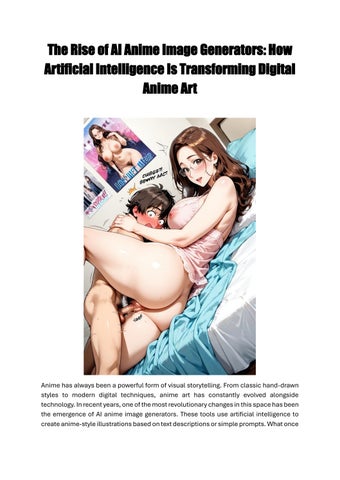
The Rise of AI Anime Image Generators: How
Artificial Intelligence Is Transforming Digital Anime Art
Anime has always been a powerful form of visual storytelling. From classic hand-drawn styles to modern digital techniques, anime art has constantly evolved alongside technology.Inrecentyears,oneofthemostrevolutionarychangesinthisspacehasbeen the emergence of AI anime image generators. These tools use artificial intelligence to createanime-styleillustrationsbasedontextdescriptionsorsimpleprompts.Whatonce
required years of drawing practice can now be achieved in seconds with the help of advanced machine learning models.
AI anime image generators are not replacing artists; instead, they are reshaping how people interact with art. Beginners can experiment with anime styles without technical barriers, while professionals can use AI as a creative assistant. This new relationship between technology and creativity is opening doors for new forms of artistic expression and redefining how anime art is produced and consumed. Visit https://uncensoredhentai.ai/
The core idea behind AI anime image generators lies in deep learning. These systems are trained on vast datasets of anime-style images and illustrations. By analyzing thousands oreven millionsofexamples,theAIlearnspatternssuchasfacialproportions,eyestyles, hair textures, clothing designs, and color schemes that are typical of anime. Once trained, the model can generate entirely new images that resemble anime art without copying any single source. Instead, it blends learned features into original compositions.
One of the biggest reasons for the popularity of AI anime image generators is accessibility. Traditional anime art requires time, patience, and technical skill. While many people admire anime aesthetics, not everyone has the ability to draw or paint digitally. AI tools allow users to simply type a description such as“a futuristic anime hero with blue hair and glowing armor” and receive a visually striking image within seconds. This lowers the barrier to entry and encourages more people to engage with visual creativity.
Another important factor is speed. Artists working on manga, game assets, or concept art often need rapid visual references. AI anime image generators can provide quick drafts or inspiration pieces that help shape ideas. Instead of spending hours sketching multiple versions, creators can generate variations in minutes. This does not eliminate the artistic process; rather, it accelerates early stages such as brainstorming and design exploration.
Customization is also a key strength of AI anime image generators. Users can specify mood, lighting, background, clothing style, and character pose. This level of control allows for unique results that feel personalized. For example, someone working on a visual novel can generate different character designs until they find one that matches the story’s tone. The AI adapts to descriptive language, making it a powerful storytelling companion.
The growth of these tools has also influenced online communities. Social media platforms and creative forums are filled with AI-generated anime art shared by enthusiasts. Some people use it to create avatars, others design characters for games or comics, and many simply enjoy seeing their imagination come to life. This has created a new form of digital art culture where users are both consumers and creators at the same time.
Ethical and creative discussions naturally arise alongside this technology. Some artists worry that AI could devalue human creativity. However, many professionals see it as a new brush rather than a replacement. Just as digital drawing tablets did not erase traditional painting, AI anime image generators are becoming another tool in the creative toolbox. The human element remains crucial because the AI only produces what it is guided to create. The imagination, storytelling, and emotional direction still come from people.
From an educational perspective, AI anime image generators can help students understand visual composition. By experimenting with prompts and seeing how the AI responds, learners can observe how changes in description affect facial expressions, lighting, and perspective. This makes abstract art concepts more tangible. It can also motivate beginners to learn traditional drawing techniques after seeing what is possible visually.
The commercial impact is also notable. Game developers, animation studios, and marketing teams are exploring AI-generated anime visuals for concept art and promotional materials. While final products still rely heavily on human artists, AI speeds up the ideation phase. This leads to faster production cycles and more creative experimentation without high initial costs.
Technically, most AI anime image generators rely on diffusion models or transformerbased architectures. These systems generate images step by step, refining noise into recognizable forms. This process allows for highly detailed anime characters with expressivefacesandcomplexbackgrounds.Ascomputingpowerincreasesanddatasets improve, the quality of generated anime art continues to rise. What once looked rough or distorted now appears polished and professional.
There is also a strong connection between AI anime image generators and fan culture. Fans of anime often imagine their own characters or alternate storylines. AI tools give them a visual way to express these ideas. Instead of just writing fan fiction, they can create fan art without needing years of artistic training. This empowers fandoms and deepens engagement with anime worlds.
At the same time, safe and responsible use is important. AI anime image generators are most valuable when used for creative, respectful, and legal purposes. Generating art for personal enjoyment, education, or storytelling is where these tools truly shine. They promote imagination rather than exploitation and support artistic growth instead of replacing it.
Looking ahead, the future of AI anime image generators seems bright. Integration with animation tools could allow users to create short animated clips from still images. Realtime generation could be used in games or virtual environments. Personalization might become even more advanced, with AI learning an individual’s preferred style over time. Thesepossibilitiespointtowardafuturewhere humancreativityandartificialintelligence collaborate more closely than ever before.
In conclusion, AI anime image generators represent a major step forward in digital art. They combine advanced technology with a beloved artistic style, making anime art more accessible, faster to create, and easier to customize. Rather than diminishing creativity, they expand it by giving more people the ability to visualize their ideas. As these tools continue to evolve, they will likely become a normal part of the anime art ecosystem, supporting artists, inspiring fans, and shaping the next generation of digital storytelling.