CHEMISTRY AT THE UNIVERSITY OF NORTH CAROLINA AT CHAPEL HILL
Department Chair Jeffrey Johnson A. Ronald Gallant Distinguished Professor jsj25@email.unc.edu Associate Chair for Research 919-962-5518 Ralph House, Ph.D. rlhouse@email.unc.edu Associate Chair for Business Administration Laura Yurco 919-962-2173 laura_yurco@unc.edu Associate Director of Development Amberly Anne Nardo 919-962-0108 amberly.hendel@unc.edu Newsletter Editor, Designer, and Photographer Lars E. Sahl sahl@email.unc.edu At the Department of Chemistry, we feel strongly that diversity is crucial to our pursuit of academic excellence, and we are deeply committed to creating a diverse and inclusive community. We support UNC’s policy, which “affirms the University’s commitment to providing an inclusive and welcoming environment that is free from discrimination on the basis of age, color, creed, disability, gender, gender expression, gender identity, genetic information, national origin, race, religion, sex, sexual orientation or veteran status.” CONTACT US Department of Chemistry University of North Carolina at Chapel Hill Campus Box 3290 Chapel Hill, NC 27599-3290 chemistry@unc.edu 919-843-7100
Read more about the Wilkerson-Hill Group on page 12
WINTER 2019 3 4 5 6 7 8 10 11 12 14 14 16 17 18 21 22
TABLE OF CONTENT From the Chair Why I give to Chemistry Morehead Laboratories in the Future Cyclic Voltammetry Bootcamp Letter from the Dean of the College of A&S The Knight Research Group Student Wellness - SWELL Graduate Professional Development The Wilkerson-Hill Group NSF Graduate Research Fellows Faculty Awards New Staff Members New Faculty Members Sustainability at Carolina Chemistry Staff Awardees SAY YES!!
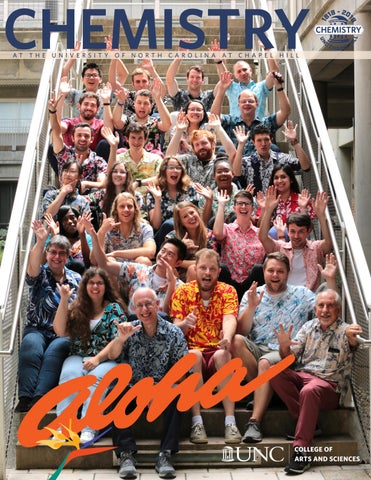
FRONT COVER Staff, Faculty, Students, and Postdocs gathered at one of our “Aloha Friday” celebrations BACK COVER This year’s crop of reindeer, carolers, and other holiday revelers, representing Chemistry in the annual ‘Jingle Bell Run/Walk.’
2 | CHEMISTRY AT THE UNIVERSITY OF NORTH CAROLINA | CHEM.UNC.EDU
From the Chair
O
Jeffrey Johnson
A. Ronald Gallant Distinguished Professor; Department Chair
On Mother’s Day I had the privilege of giving the commencement address to an exceptional cohort of newly minted degree recipients at the Department of Chemistry’s commencement exercises. The very loose title of the talk was “And One.” If there happen to be any basketball fans (!) and/or former denizens of Wollen Gymnasium among the readership, you will immediately recognize the phrase to describe the event when a shooter is fouled, makes the shot, and is awarded a free throw, the latter being the ‘and one.’ Fundamentally, the ‘and one’ is a reward for being tough. The ‘And One’ of May’s commencement talk began, but did not end with where we found ourselves in the department’s history. Many of you are aware that the UNC Department of Chemistry was founded in 1818 and last year the department celebrated its bicentennial. In April 2018 we welcomed over 300 alumni and friends back to Chapel Hill to share the history and stories and successes of Carolina Chemistry. Much of what I wrote about last year focused on the rich history of the department. So what is the connection to the notion of ‘And One’? Celebrations and milestones are important, critically so. They can represent culminations and achievements and longevity, strength and accomplishment. But milestones are very seldom the end of the journey, but rather a pause – we are metaphorically pulling off the highway to view a spectacular yet ephemeral sunset. The department celebrating its bicentennial allowed us to pause and reflect on our staying power, our advances, our amazing people…but the march to year 201 was ineluctable, inevitable, and necessary. The department’s history moves on; the past is critically important, but we live in the present and have to embrace the opportunity and uncertainty in shaping our future. Two hundred ‘and one’, or n+1, is always coming. The entropy of a system is increasing. For our graduating seniors considering their ‘system,’ their disorder was about to take a step function up. Life very seldom looks more complex, or can even be conceived of being more complex or disordered than the moment you currently inhabit. Your high school self could scarcely conceive of how simple things were for your middle school self, while the college graduate chuckContinued on page 19 CHEM.UNC.EDU | CHEMISTRY AT THE UNIVERSITY OF NORTH CAROLINA | 3
v
Why I Give It was the year 1992 - it was summer. Not only had I completed my undergraduate degree in chemistry at the University of North Carolina-Greensboro, but had also married Sharon, now my wife for twenty-seven years. It was a wonderful summer.
My undergraduate Professors Terry Nile and Jim Barborak had conChris Killian, Ph.D. vinced me to pursue my Ph.D. in chemistry, and to do so at UNC-Chapel Hill. I was wide eyed and a bit apprehensive in thinking on what my upcoming graduate school experience would have in store for me. Little did I know, that the next four years would change the trajectory of my professional life in ways I could not imagine at the time. During my first year at Carolina Chemistry, I was challenged and inspired by professors Templeton, DeSimone, Evans, and Brookhart. The academic course work was intense and challenging, but also brought with it the broader Carolina experience and a lot of new friends. Being a newlywed made my time at Carolina Chemistry one of the best experiences of my life. Spring semester of my first year, I was invited to join Professor Maurice Brookhart’s research group to work on Ni and Pd catalyst for olefin polymerization. Professor Brookhart epitomizes the collegial nature and spirit of the UNC Department of Chemistry. He is a first-class human being of high character, a great teacher, mentor and advisor. He often invited his group up to Franklin Street for food and fellowship. We also spent many evenings at his home enjoying his and his wife Mary Hughes’ hospitality. Brook challenged us all to develop a first principles understanding of the research we were pursuing–a principle I have instilled in the teams that I have led in my twenty years of leading R&D organizations. Professor Joe DeSimone also had a tremendous impact on my academic and professional development. The nature of my research had both a heavy organometallic component and a heavy polymer component, leading me to become an adopted member of the DeSimone group.
Joe was an incredible mentor and teacher. I began to shape my leadership style and professional ambitions through weekly engagements with him. He took a special interest in me and my work, which I appreciate to this day. My research opened many doors, including an industrial collaboration with DuPont and many speaking engagements. Upon graduation, I knew I wanted to go into industry, do research for a period and then grow into technology/R&D management. Shortly after my defense and graduation, I took a position with Eastman in 1996, after considering offers from several global chemical and materials companies. My time in the UNC Department of Chemistry prepared me well for my career at Eastman and for a life-long journey of personal/professional growth and development. I have had the chance to lead teams in the commercialization of dozens of new products, including Eastman Tritan™ copolyester, new to the world engineering plastic, and Visualize Material™ 500, used in compensation films for smart phones. I am currently Vice President of Technology for two of Eastman’s four reporting business segments. Sharon and I have given back to the department in many ways over the years, including regular financial contributions and through my participation on the Chemistry Advisory Board. Very recently, Sharon and I have chosen to have a long-term strategic impact on the quality of the graduate student experience through the creation of an endowed fund for supporting graduate students in the department. This was an easy choice for Sharon and me to make, as I can say with confidence that my time at UNC and the relationships I built have been instrumental to the accomplishments I have been blessed to be a part of. I hope that the current and future graduate students of the UNC Department of Chemistry experience the blessings of growth, personal/professional development, and accomplishment that I did.
“The greatest danger for most of us is not that our aim is too high, and we miss it, but that it is too low, and we reach it.” -Michelangelo
4 | CHEMISTRY AT THE UNIVERSITY OF NORTH CAROLINA | CHEM.UNC.EDU
Advancing Undergraduate Chemistry Education at UNC Chapel Hill by Re-envisioning the Modern Chemistry Teaching Laboratory Nita Eskew, Ph.D., Director, Undergraduate Laboratories Chances are high if you are reading this article and graduated within the past 30 years, you have a story to tell about time you spent in Morehead Labs. Each year, over 5,000 UNC undergraduates take laboratory courses in the same building and gain meaningful training in laboratory and research skills. For over three decades, Morehead Labs has been serving students from across the university over a broad range of majors and backgrounds. While its walls stand unchanged, the nature of chemistry pedagogy to best train and educate students in STEM has evolved significantly. If we are to maintain our leadership in undergraduate STEM education, the spaces within Morehead Labs must be re-imagined and subsequently renovated to meet the demands of the modern chemistry teaching curriculum. As a foundational discipline, chemistry is by definition convergent, cross-cutting, and collaborative. The future chemistry professional will need to be trained to work and communicate within multidisciplinary teams. Traditional chemistry lab modules that pair students together to take turns running the same experiment is foundational, but modern chemistry demands that we do more.
We have invested heavily, but opportunities for giving are numerous. Our goal is to transform every laboratory in Morehead within the next decade. Your gifts have a direct and tangible impact on our department. We hope you will consider joining our effort to transform undergraduate Chemistry at Carolina for tens of thousands of students.
The ideal teaching lab will bring pairs into collaborative teams of students around a designated space with the ability to work on meaningful research problems and share their results both within and between teams. Ventilation stations dedicated to each student pair will remain an invaluable resource, enabling students to safely conduct rigorous experiments that wouldn’t otherwise be possible. The design of a pilot laboratory that embodies each of these features is well underway. Graphic renderings are shown in the accompanying figures. Thanks to generous support from the Dean of the College of Arts and Sciences and the Department of Chemistry, we have raised the $1.5 M required to begin construction in the Summer of 2020 to transform two labs into Labs of the Future.
Continued on page 27
Ralph House, Ph.D., Associate Chair for Research CHEM.UNC.EDU | CHEMISTRY AT THE UNIVERSITY OF NORTH CAROLINA | 5
Cyclic Voltammetry
Bootcamp This Cyclic Voltammetry Bootcamp was designed to provide students with the opportunity to learn the basics of cyclic voltammetry without taking a formal class. The two-day workshop allowed 17 participants from all different backgrounds to gain the practical skills necessary to utilize cyclic voltammetry and other basic electroanalytical techniques in their own research. During the workshop, students were introduced to both theoretical and practical aspects of electrochemistry through lectures.
gave them the opportunity observe the differences in signal between a large electrode and a very small electrode. Ultimately, the goal of the workshop was to equip students from several different backgrounds with the tools necessary to design electroanalytical experiments, carry out experiments, troubleshoot common problems, and analyze the data that was generated.
With eight electrochemical workstations lent by Pine Research Instrumentation, students were given an opportunity to go into the lab and get their hands wet with three different experiments. One lab was devised to force students to troubleshoot common problems, and another
!
This workshop was enabled by support from the Department of Chemistry ‘Say Yes Fund,’ equipment and instructional support from Pine Research Instrumentation, and the graduate student teaching assistants from the Jeffrey Dick and Jillian Dempsey labs who helped develop, test, and supervise the lab activities.
6 | CHEMISTRY AT THE UNIVERSITY OF NORTH CAROLINA | CHEM.UNC.EDU
From the Dean Earlier this fall, I visited Carolina Chemistry as part of a “listening and learning tour” that I embarked on after being appointed interim dean of the College of Arts & Sciences in February. I have been part of the dean’s office since 2012, serving for seven years as senior associate dean for fine arts and humanities, but it was important for me to have firsthand knowledge about the research activity of our faculty in the natural sciences and mathematics. I was deeply impressed by the research and innovation that is happening in that department. It is no surprise that Carolina Chemistry is one of top-ranked programs in the nation. Working in solar and thermal energy, nanomedicine, polymer science, mass spectrometry and other areas, our chemistry faculty are leading the way in defining solutions for some of the major challenges of our time. Students and faculty are also teaming up with colleagues in other disciplines to tap into the power of interdisciplinary problem-solving. This culture of collaboration and outside-the-box thinking is what we mean by the College of Arts & Sciences’ tag line: Synergy Unleashed. Carolina Chemistry faculty are also extraordinary instructors and mentors for our undergraduate and graduate students, regularly winning awards for their teaching. They are preparing our students to become the innovators and scientist-entrepreneurs of tomorrow. I look forward to 2020 being another year of Carolina Chemistry innovation and accomplishment. Terry Ellen Rhodes Interim Dean, College of Arts & Sciences
Sincerely,
Terry Ellen Rhodes Interim Dean, College of Arts & Sciences
CHEM.UNC.EDU | CHEMISTRY AT THE UNIVERSITY OF NORTH CAROLINA | 7
The Knight Re The Knight Research Group is one the newest in the UNC Chem-
Her work on designing materials for the remediation of hexava-
istry Department, as Abigail, “Abby,” Knight joined us as an As-
lent chromium contamination, the toxin that received world-
sistant Professor in the summer of 2018. However, Abby is a
wide attention with the story of Erin Brockovich, was highlight-
returnee to Carolina Chemistry. She completed her undergrad-
ed in Wired magazine with an article titled “We’ve got the secret
uate science degree here, majoring in Chemistry, with minors in
to cleaner water: more plastic.” Concepts and techniques
Mathematics and Biology.
from this work including peptidomimetic synthesis, design of high-throughput strategies, and the application of interdis-
As an undergraduate she was a participant in the Public Service
ciplinary approaches to identify new tools to approach global
Scholars Program, served as a Resident Advisor, and she com-
problems are at the forefront of the Knight group’s current re-
pleted an honors thesis in Professor Marcey Waters’ research
search goals.
group, developing new ligands for RNA and DNA structures. As her research interests crystallized around the overlap of After graduating from UNC, Abby continued her doctoral stud-
chemical biology and materials science, Abby selected a post-
ies in the chemical biology program at the University of Califor-
doctoral position with Prof. Craig Hawker at the University of
nia, Berkeley, where she joined the lab of Professor Matthew
California, Santa Barbara. An Arnold O. Beckman postdoctoral
Francis. Her doctoral research focused on the development of
scholar, she designed smart nanomaterials with a multitude of
a platform applying combinatorial libraries for the identification
architectures, including the development of peptide-polymer
of selective metal ligands to address major challenges in water
amphiphiles that assembled into distinct nanomaterial shapes
and environmental remediation and metal poisoning.
upon coordination of different transition metal ions. These pursuits provided expertise in materials characterization, support-
8 | CHEMISTRY AT THE UNIVERSITY OF NORTH CAROLINA | CHEM.UNC.EDU
esearch Group ing the Knight Research Group’s mission to design synthetic
and transport and catalysis with finely tuned metal-binding
nanomaterials that rival the binding capabilities of proteins.
sites. Another group is taking inspiration from Nobel Prize winning directed evolution to identify a complementary screening
When Abby returned to Carolina in July of 2018, the group con-
strategy to identify synthetic materials with desirable binding
sisted of her and a single undergraduate student, Delaney Da-
properties.
vis, who spent the summer assembling the research laboratory on the third floor of Caudill Laboratories. Since then, the Knight
Outside of the lab, Abby is engaged in the department through
Research Group has rapidly grown and now consists of six un-
developing a new course in bioorganic chemistry, as an advi-
dergraduate students, six graduate students, and a postdoc-
sor to the Graduate Committee for Professional Development,
toral researcher.
and through leading the organization of the first annual graduate student proposal development competition “Sci-athon,”
Abby’s research targets a deeper understanding of how to
modeled after the Scialog program sponsored by the Research
generate macromolecular materials with complex functions
Corporation for Scientific Advancement to promote cross-divi-
inspired by biological systems. To tackle this challenge, her
sional scientific dialog.
interdisciplinary research team uses techniques and perspectives from synthetic chemistry, chemical biology, and polymer
In the broader scientific community, Abby is a member of the
science.
Early Career Advisory Board for ACS Biomaterials Science and Engineering and her group is actively engaged in bringing their
One group of researchers is targeting mimicking metallopro-
research to the larger North Carolina community.
teins – proteins that serve critical biological roles in storage CHEM.UNC.EDU | CHEMISTRY AT THE UNIVERSITY OF NORTH CAROLINA | 9
Stress could be considered synonymous with chemistry graduate school. A first year student faces challenging courses, teaching assistantships, grading assignments, and navigating the path to a doctoral advisor and research group — all while acclimatizing to life in a new place. Later in the PhD program, students venture into new and uncharted research areas where frequent failure is commonplace. Postdoctoral scholars face a short timeline to learn new skills and make discoveries that will propel them to permanent employment. But what is the toll of such stress? A 2017 mental health and wellness survey of UNC Chapel Hill students found that 60% of graduate students felt overwhelming anxiety and 31% felt so depressed that it was difficult to function. We believe that the department can help graduate students and postdocs reach their full potential by building an environment with multiple layers of support. The need for an improved departmental climate was underscored by a 2018 climate survey led by graduate students in the department. The high (70%) response rate itself highlights an engaged community eager to improve itself. While there were positive signs, a significant fraction of students felt isolated in the department for personal or professional reasons. Others had experienced
conflicts or disagreements with peers of faculty. Few acted to address these challenges. In response to national and local trends, the Department has founded the Student and Postdoc Wellness Committee, SWELL, with a mission to foster a healthy and vibrant graduate student & postdoc community. SWELL is comprised of 8 faculty and staff, led by cochairs Leslie Hicks and Alex Miller. The committee has representation from teaching and research faculty from various disciplines and staff from the teaching laboratories and student services. Many in this diverse group have completed formal trainings including Safe Zone, Mental Health First Aid, and Haven. The committee will play several roles, including advising on disagreements/conflicts, health issues, or any other concerns; organizing community-building activities within the department; and curating and distributing information about campus resources pertaining to mental health and general wellness. In the 2019-2020 academic year, SWELL is focused on several major initiatives. A new SWELL Website provides a centralized and curated information on resources, reporting, training opportunities. A new graduate student and postdoc lounge was completely renovated and had its grand opening in October on the first floor of Kenan Labs. The framework of a peer mentoring network is being built for launch in 2020, with senior graduate students paired with first years upon arrival. The SWELL Committee holds two weekly office hours where students and postdocs can find a supportive place for discussions. The committee will also partner with other campus entities to ensure low-barrier access to professional mental health and wellness resources.
10 | CHEMISTRY AT THE UNIVERSITY OF NORTH CAROLINA | CHEM.UNC.EDU
GCPD
Pictured above, from left to right: Brittany Huffman, Jacob Pawlik, James Custer, Sarah Morley, Sondrica Goines, Tayliz Rodriguez, Aldo Jordan, Hannah Ferguson-Johns, Emily Beyer. Not pictured, Megan Schutzbach-Horton
Graduate Committee for Professional Development
One of the findings of the recent Department Climate Survey was the need to further foster professional development, especially when it came to non-faculty career paths.
As a response to this, the Graduate Committee for Professional Development, GCPD, pictured above, was created in January of 2019 to define and execute a department wide plan to prepare and educate students and postdocs about potential career paths available to chemistry Ph.D.s. Since their inception the committee has hosted several workshops and information sessions, such as “Plotting a Career Timeline” and “Business Certificates Available to Graduate Students”. In addition they have created a seminar series, “Career Answers for Chemists”, that brings in professionals from different disciplines, from working at a chemical company like BASF, to working in science policy in DC, and has them share their stories and tips on how to plot an exciting career path. Keep an eye out for GCPD in 2020 as these talented individuals draw on the successes from prior events to bring in more speakers from out of town. They are also planning to host a full day career development conference for senior students that aims to bring in industry professionals for intimate networking and accelerated professional development.
CHEM.UNC.EDU | CHEMISTRY AT THE UNIVERSITY OF NORTH CAROLINA | 11
The Wilkerso The Hill group is yet another new group at Carolina Chemistry. Members in this laboratory strive to develop new enantioselective reaction methodology in order to synthesize complex molecules with important biological function. This research merges Assistant Professor Sidney Wilkerson-Hill’s training in synthetic organic chemistry and enantioselective catalysis, to address unsolved problems in synthesis with the long-term goal to provide new non-invasive tools for studying the living human brain, using positron emission tomography, PET. With these methods the group members will advance the knowledge of chemical reactivity in complex environments and provide new knowledge about how the central nervous system, CNS, functions. Specifically, the group members are interested in developing new biomimetic cyclopropanation reactions using 1) frustrated Lewis acid-base pairs, FLP’s, 2) ketenes, bisketenes, and their equivalent compounds, and 3) asymmetric functionalization reactions of pyridines.
Natural Products
Isolated from plants, bacteria, marine sponges and other natural sources, complex secondary metabolites, natural products, often have important biological function, for example, active in the central nervous system, anti-HIV, anticancer. As such, this chemical matter provides a unique starting point for the development of
12 | CHEMISTRY AT THE UNIVERSITY OF NORTH CAROLINA | CHEM.UNC.EDU
on-Hill Group new pharmaceuticals. Additionally, these compounds are often used as tools for understanding biology, and their complex architectures are well-suited for investigating molecular reactivity in complex chemical environments.
A major thrust in the Hill lab focuses on using natural products as tools for understanding complex biology. Group members are currently trying to access plagiochianin B, a pyridine-containing ent-2,3,-seco-aromadendrane derivative reported in 2018. The lab members are excited about this molecule due its relationship to plagiochilal B, a small molecule isolated in 1991 from Plagiochila fruticosa. Plagiochilal B was reported to enhance choline acetyltransferase activity in rat cerebral hemisphere, which may make it an important molecule for studying Alzheimer’s disease. Continued on page 24
CHEM.UNC.EDU | CHEMISTRY AT THE UNIVERSITY OF NORTH CAROLINA | 13
Graduate Resea
Pictured, from left to right: Candice Crilly - P anian Group, Quentin Tercenio - Alexanian G - Dempsey Group, Quinton Bruch - Miller Gro Group, Aldo Jordan - Dempsey Group, Tessa
We are proud to present our current cohort of NSF Graduate Fellowship awardees. They were selected through a rigorous and highly competitive selection process. Their success reflects the National Science Foundation’s confidence in their abilities to address important chemistry questions and evolve into the next generation of scientific leaders. The NSF Graduate Research Fellowship Program (GRFP) helps ensure the vitality of the human resource base of science and engineering in the United States and reinforces its diversity. The program recognizes and supports outstanding graduate students in NSF-supported science, technology, engineering, and mathematics disciplines who are pursuing research-based master’s and doctoral degrees at accredited United States institutions. As the oldest graduate fellowship of its kind, the GRFP has a long history of selecting recipients who achieve high levels of success in their future academic and professional careers. The reputation of the GRFP follows recipients and often helps them become life-long leaders that contribute significantly to both scientific innovation and teaching. Past fellows
Faculty Awards
Professors Dorothy Erie, Gary Pielak, and Matthew Redinbo have been awarded Excellence in Basic Science Mentoring Awards
14 | CHEMISTRY AT THE UNIVERSITY OF NORTH CAROLINA | CHEM.UNC.EDU
arch Fellows
Pielak Group, Jacob Pawlik - Warren Group, Benjamin Morgan - Sheiko Group, Thomas Kolb - Klotsa Group, Jack Sundberg - Warren Group, Christina Na - AlexGroup, Anna Fraser - Dingemans Group, Michael McLaughlin - Johnson Group, Madeline Stark - Warren Group, Rachel Bangle - G. Meyer Group, Tayliz Rodriguez oup, Carolyn Hartley - Dempsey Group, Brittany Huffman - Dempsey Group, Vincent Pistritto - Nicewicz Group, Hannah Starr - Gagne Group, Anton Gudz - Gagne a Bartges - Hicks Group. Not Pictured: Samantha Ervin - Redinbo Group, Matthew Tierney - Alexanian Group
include numerous Nobel Prize winners, U.S. Secretary of Energy, Steven Chu, Google founder, Sergey Brin and Freakonomics co-author, Steven Levitt. Fellows share in the prestige and opportunities that become available when they are selected. Fellows benefit from a three-year annual stipend of $34,000 along with a $12,000 cost of education allowance for tuition and fees, paid to the institution, opportunities for international research and professional development, and the freedom to conduct their own research at any accredited U.S. institution of graduate education they choose. NSF Fellows are anticipated to become knowledge experts who can contribute significantly to research, teaching, and innovations in science and engineering. These individuals are crucial to maintaining and advancing the nation’s technological infrastructure and national security as well as contributing to the economic well-being of society at large.
Joanna Atkin received the NSF CAREER Award, Frank Leibfarth was named a Beckman Young Investigator by the Arnold and Mabel Beckman Foundation, and also selected for the Young Investigator Prize from the Army Research Office. Professor Sid Wilkerson-Hill received the 2019 Thieme Chemistry Journals Award.
CHEM.UNC.EDU | CHEMISTRY AT THE UNIVERSITY OF NORTH CAROLINA | 15
New Staff Members Pictured, from left to right: D’Angelo Best, Mandy Melton, Gail Harris, Diane Weatherspoon, Maribel Borger, and Diane Weatherspoon.
D’Angelo Best D’Angelo is a new member in our accounting and research administration department, where he assists faculty with grant management. He holds a B.S. in Business Administration from the University of Mount Olive. He served five years in the United States Marine Corps, at Camp Pendleton, California. In addition, he has both human resources and research administration experience. D’Angelo enjoys the outdoors, particularly fishing, and spending time with his family. D’Angelo loves serving and helping others.
Mandy Melton Mandy works in the Administrative Front Office as an Administrative Support Person. She is from Concord, North Carolina, where she was born and raised, and where her parents still reside. Mandy completed her undergraduate degree here at UNC Chapel Hill, with a double major in English and Computer Science. She plans to continue her education here at UNC.
Gail Harris Working in Kenan Labs as an Administrative Support Associate, helping faculty with a variety of administrative tasks. Gail is from Staten Island New York, and thrives in the warm climate here in the south. She has an Associate’s Degree in Business Administration, and loves her new position with Carolina Chemistry.
Diane Weatherspoon Diane works in the Mass Spectrometry Core Laboratory, and is a North Carolina native, originating from
Salisbury. She graduated from the University of North Carolina at Greensboro with a Bachelor of Science in Biochemistry and a Master of Science in Chemistry. She studied under Dr. Nadja B. Cech, focusing on mass spectrometry based metabolomics analysis of natural products. Diane also worked in the Triad Mass Spectrometry Facility assisting Dr. Daniel A. Todd. She has ample experience in mass spectrometry, analytical chemistry, and metabolomics data analysis. She is excited to be joining us and hopes to further her mass spectrometry knowledge and challenge herself with the available research avenues.
Maribel Borger Maribel, another Salisbury, NC, native, joined the team of the Morehead Lab Supervisors in August of this year. In 2014, she graduated from UNC Chapel Hill with a Bachelor of Arts in Chemistry and Global Studies. As an undergraduate, she worked with Professor Jeff Johnson. She earned her Ph.D. in Chemistry in May from Florida State University, working with Prof James Frederich.
Tyler Motley Tyler is working as a Supervisor of the Undergraduate Labs, and a laboratory instructor at Carolina Chemistry. Tyler graduated from Virginia Tech in 2013 with a B.S. in Chemistry, came to UNC in 2013 for graduate school, and joined the research group of Dr. Gerald Meyer. He completed his Ph.D. in 2018.
16 | CHEMISTRY AT THE UNIVERSITY OF NORTH CAROLINA | CHEM.UNC.EDU
New Faculty Members Anna Curtis Teaching Assistant Professor Chemistry Education Kenan Laboratories C 147E 919-962-3804 accurtis@email.unc.edu
Anna’s graduate work focused on understanding the electronic dynamics in semiconductor nanomaterials with applications in solar cell technology as well as studying students’ ability to think scientifically in the general chemistry classroom. My research focuses on chemical education, particularly in course assessment and reform. I have been involved in curriculum development for the general chemistry classroom and laboratory with a focus on scientific thinking and inclusion. As both a teacher and researcher I am committed to constantly improving my knowledge of current research and best practices in chemical education as well as incorporating this knowledge into my teaching.
Zhiyue Lu Assistant Professor Physical Chemistry Caudill Laboratories 020 919-962-1696 zhiyuelu@unc.edu
The Lu research group combines nonequilibrium thermodynamics theory and numerical simulation approaches to reveal the fundamental physical principles underlying these complex cellular functions. Furthermore, we apply these principles to designing smart artificial materials and biomimetic devices. The range of applications include self-healing materials, programmable biomedical nanorobots, and adaptive drug delivery system. Specific topics of our focus include temporal-responsive materials, cellular information processing, biochemical analog computers, kinetically enhanced molecular separation, and energy harvesting from nonequilibrium environments. We welcome applications from talented scholars!
Alex Zhukhovitskiy Assistant Professor Polymer, Organic, and Inorganic Chemistry Murray Hall 2202J 919-962-4054 alexzhuk@email.unc.edu
Research in the Zhukhovitskiy group draws upon organic synthesis, organometallic and inorganic catalysis, nanoscience, supramolecular self-assembly, and polymer science, and consequently, group members receive a highly interdisciplinary training: from design, to synthesis, and ultimately characterization and property evaluation—both in the context of small molecules and polymers. Collaboration, often critical to the success of interdisciplinary projects, is encouraged in our group. Undergraduates, graduate students, and postdocs with a passion for any flavor of synthesis and/or an interest in macromolecules are welcome to apply!
CHEM.UNC.EDU | CHEMISTRY AT THE UNIVERSITY OF NORTH CAROLINA | 17
Sustainability
At the department’s annual “State of the Department” address, Professor and Chair Jeff Johnson asked “What is the department doing to be sustainable?” Inspired by this question, the department formed a new Sustainability Committee in August to guide and inform our efforts to become more sustainable. The committee is comprised of faculty, staff, graduate students, and post-docs from across the department. Since its inception, the committee has been working towards improving sustainability practices on both small and large scales within the department, and collaborating with groups in Chemistry and across campus. One project involves collaborating with the UNC Office of Waste Reduction and Recycling, and UNC Green Labs, to educate the department members on UNC’s recycling policies with the goal of increasing recycling participation across the department.
Pictured, from left to right: Nicole Parsley, Lauren McRae, Jessica Coleman, Marcey Waters, Kelsey Kean, Hannah Ferguson Johns, Katherine Albanese, Emilia Leon, and Mandy Melton. Not pictured from the Sustainability Committee: Tyler Motley, Ian VonWald, and Randy Simmons
Following the lead of our teaching labs, research labs are now widely participating in nitrile lab glove recycling through VWR. Additionally, the department is participating in a pilot program with Thermo Fisher Scientific to recycle plastic films. Along with the Social Activities Committee, the committee works to make department-wide events greener, with a focus on reducing waste and using compostable or reusable items whenever possible. For the future, the committee has set their sights on establishing composting across the department, providing recommendations for sustainable practices in the laboratory, and ultimately working towards having solar panels in use across the chemistry building complex. In a big department like ours, even taking these small steps towards reducing, reusing, and recycling are making a huge impact!
18 | CHEMISTRY AT THE UNIVERSITY OF NORTH CAROLINA | CHEM.UNC.EDU
From the Chair Continued from page 3
les conspiratorially at its 18-year-old predecessor, wondering how he or she had it quite so easy. The assistant professor dreams of inventing the 25th and 26th hour of the day, while the department chair looks longingly at his or her 30-year-old version who only had to worry about teaching and research and service. To our graduates, I conveyed that even with my limited wisdom I could confidently share that there are two ways one can meet the inevitable march of rising entropy. The first is to struggle, fret, and worry over the demands, the deadlines, all the “adult” stuff; however, it’s called a law of thermodynamics for a reason. So I recommended a second course of action, which is to embrace the disorder and look at it as the challenge and opportunity that it is. The world one enters as a B.S. or B.A. or Ph.D. graduate is undeniably entropic, messy and complex, but I would contend that it is those very characteristics that are nearly custom built to allow us to assert our vision and make an impact. However, it means accepting that life gets more complex as we go, and that is probably a good thing. The march in “year 201” continues unabated. We welcomed three new faculty colleagues to our ranks in July, with the arrival of Professors Zhiyue Lu, Alex Zhukovitskiy, and Anna Curtis. The department has commenced a new student wellness initiative, SWELL, and its launch coincides with the complete upgrade and renovation of the graduate student lounge. Professors Jillian Dempsey and Jeffrey Dick launched a Cyclic Voltammetry Boot Camp. Professor Frank Leibfarth was recognized as a Beckman Young Investigator and as one of Chemical and Engineering News’s ‘Talented 12,’ while Professor Leslie Hicks rang the awards bell multiple times, having been selected by Iota Sigma PI, the National Honorary Society for Women in Chemistry, to receive the 2019 Agnes Fay Morgan Research Award, by the ACS Women Chemists Committee as a 2020 Rising Star Awardee, and by Marshall University for the Distinguished Alumni Award. Emeritus Professor Tom Baer was celebrated by former
co-workers with a symposium on the occasion of his 80th birthday, while alumni of Professor Jim Jorgenson’s group returned to Chapel Hill in May to fête Jim on the occasion of his retirement from the university, recognizing a remarkable career filled with scientific excellence. These are but small vignettes in the vibrant 201st year of the department. I invite you to explore the pages of this missive to learn more about what is happening here at UNC Chemistry. Finally, I would like to share that my term as the department chairperson ends on June 30, 2020. It has been an honor to lead such an impressive group of people. There will be a local decrease in entropy associated with this particular member of the faculty, but I feel confident that global disorder will continue to obey all the relevant thermodynamic laws, and that the department will continue to embrace the opportunities that circumstance presents. As always, we welcome visitors to the department and I extend an open invitation if you find yourself in Chapel Hill. Of course, I am wishing all of our Carolina Chemistry community a very prosperous and happy 2020.
CHEM.UNC.EDU | CHEMISTRY AT THE UNIVERSITY OF NORTH CAROLINA | 19
The Wilkerson-Hill Group
Continued from page 12
Reaction Methodology
The development of new reactions is critical for advances in many fields such as pharmaceutical, biological, and material sciences, because doing so permits access to unique chemical space. Structurally complex dimeric products represent unique chemical space, because reactions that allow cross dimerization reactivity are lacking.
Linchpin strategies are a nontraditional take on dimeric components and provide the advantage of being convergent and opportunities to access dimers that lack bilateral symmetry. In the Hill lab, members have developed a new linchpin reagent bis(2-chloroacrylonitrile) and are currently investigating its reactivity and ability to provide dimeric natural products which contain, or lack, bilateral symmetry.
Total Synthesis
The sequence of reactions by which a complex natural product is obtained is of paramount importance. Unique synthetic strategies can result in the development of innovative reaction methodologies, uncover new reactivity of small molecules, and begin to address shortages natural compounds used as leads for drug development. Total synthesis also provides a means to confirm the structure of natural products, which can be critical for understanding how they function.
20 | CHEMISTRY AT THE UNIVERSITY OF NORTH CAROLINA | CHEM.UNC.EDU
The Hill lab members are excited about developing new cyclopropanation strategies to access complex molecules. Specifically, they have begun to access the core fragment of cerorubinic acid III. This complex molecule facilitates insect communication, and to our knowledge is the most complex known to do so. Interestingly, the core structure of this compound resembles that of a class of anticancer compounds discovered here in the research triangle, paclitaxel, so building these molecules could provide derivatives with unique anticancer activities. Consequently, we are developing a new cyclopropanation strategy to do so which makes use of unconventional carbene precursors.
Outreach and Service
As a native of Kinston, NC, outreach and making an impact on the broader community has always been important to Professor Wilkerson-Hill. During his research experiences, he has also discovered that science is a subject with the power to address, if not drastically change, socioeconomic situations by the inherent virtues that this subject instills, curiosity, critical thinking, teamwork, et cetera. Consequently, Dr. Wilkerson-Hill’s future role as a research scientist is not only to produce great science that will have greater impacts on the global community, but to help produce great scientists who will do the same, while simultaneously fostering curiosity and a sincere appreciation for the sciences in the general public. To accomplish this, Professor Wilkerson-Hill has developed and participated in programs that promote science and diversity on local and global levels such as Teach for Madagascar, self-designed - undergraduate, Berkeley Science Network, graduate, and the California Alliance, graduate, National Organization for the Professional Advancement of Black Chemists and Chemical Engineers, NOBCCHe, post-doctoral and, faculty member. These efforts have had a broader impact on underrepresented groups participating in the sciences.
Staff Awardees Jill Fallin
Extra Mile Award
Laura Yurco Selected for the UNC ULEAD Program
Laura Condie Extra Mile Award
CHEM.UNC.EDU | CHEMISTRY AT THE UNIVERSITY OF NORTH CAROLINA | 21
!
T R O P Y P R SU EMIST CH
The “Say Yes” fund in Chemistry allows the Department Chair to say “YES” to special and often urgent requests from faculty and students for small amounts of support, which contribute greatly to their research and education. Even your smallest gift will make a tremendous difference in the Chair’s ability to support our outstanding faculty and students. Please follow the link below to help our Chair say “YES!” Your continued support is greatly appreciated. Thank you!
CLICK TO SAY YES! 22 | CHEMISTRY AT THE UNIVERSITY OF NORTH CAROLINA | CHEM.UNC.EDU
Give to Chemistry!
Morehead Laboratories Continued from page 5 We are also happy to report that Interim Chancellor Guskiewicz has committed to funding infrastructure upgrades for the entire building, including HVAC, exhaust ventilation, and environmental controls. These infrastructure upgrades will be completed in phases that run through Summer 2021. The University, College of Arts and Sciences, and Department of Chemistry have recognized the importance of cutting-edge undergraduate laboratory education to ensure Carolina alumni remain amongst the most competitive in the international chemistry workforce. At the heart of our educational mission is our basic infrastructure, and the quality of our spaces are an integral part of our teaching effectiveness.
My name is Amberly Hendel, class of 2014, and I am thrilled to be working with Chemistry on behalf of the College of Arts and Sciences Foundation, to help the department accomplish its goals. In my role, I work with fellow UNC alumni and friends of the University to raise private funding that allows the department to make strategic improvements as well as provide direct student support. With many exciting projects on the horizon, private philanthropy has and will continue to play a critical role in the department’s ability to maintain its stature of excellence. For gift options, including multi-year pledges, stock donations or planned gifts, please do not hesitate to contact me. I hope to meet many of you in the year ahead. Sincerely,
Amberly Hendel Assistant Director of Development The Arts and Sciences Foundation 919-962-0108 amberly.hendel@unc.edu
We have invested heavily, but opportunities for giving are numerous. Our goal is to transform every laboratory in Morehead within the next decade. Your gifts have a direct and tangible impact on our department. We hope you will consider joining our effort to transform undergraduate Chemistry at Carolina for tens of thousands of students. If you haven’t yet, please take a moment to recall your Morehead story and drop us a note if you’re willing to share. Also feel free to stop in for a visit if you’d like to learn more about our plans or contact: Associate Chair for Research Ralph House rlhouse@email.unc.edu or 919-962-5518.
CHEM.UNC.EDU | CHEMISTRY AT THE UNIVERSITY OF NORTH CAROLINA | 23
H y p p a H
! s y a olid