envision
INNOVATE achieve
Summer 2017
SUMMER 2017
IN THIS EDITION
3
CREDITS
Overcoming poverty is a personal matter Throughout the Unbound world, families have the greatest voice in choosing their own sponsorship benefits.
14 Child accounts offer the most flexibility for families
Unbound’s evolution to child bank accounts has given families the financial flexibility they need to plan for and work toward future goals.
20 Parents increase benefits using power of community
Small groups provide a platform for families to flourish through accountability, training and microfunding.
27 Reflection from the Unbound community Joe Sundermeyer, director of outreach, shares what makes Unbound different.
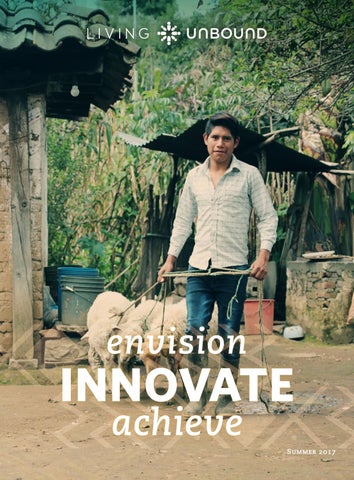
ON THE COVER Ronaldo, a sponsored youth in Guatemala, wrangles sheep he’s raised to sell. He chooses livestock as a sponsorship benefit to earn money for college. On the back cover, Ronaldo, his parents and siblings stand in front of their home. To read about Ronaldo’s journey, go to unbound.org/Ronaldo.
PRESIDENT/CEO Scott Wasserman DIRECTOR OF SPONSOR EXPERIENCE Mary Geisz EDITORS Jordan Kimbrell Loretta Shea Kline Larry Livingston Maureen Lunn DESIGN April Befort-Neumann Anne Peetz CONTRIBUTORS Tristan John Cabrera, Philippines Henry Flores, Colombia Regina Mburu, Kenya Daniel Peréz, El Salvador Joe Sundermeyer, U.S. PRODUCTION MANAGERS Alexandra Stonestreet Xander Jobe
Unbound is an international nonprofit founded by lay Catholics grounded in the Gospel call to put the needs of the marginalized and vulnerable first. We build relationships of mutual respect and support that bridge cultural, religious and economic divides. We invite all people of goodwill to join us. Unbound is not affiliated or associated with or endorsed by Heart of the Father Ministries or Unbound Philanthropy.
OVERCOMING
POVERTY
IS A PERSONAL MATTER
Lack of options is one of the greatest indignities for people living in poverty. Unfortunately, it’s also one that often goes unaddressed, even by those trying to help. Many traditional forms of charity are based on a generalized model of benefit distribution. People get whatever is offered to them. But while this approach is helpful in some situations, it doesn’t honor the basic desire all human beings have to decide for themselves. 3
LIVING UNBOUND
At Unbound, we believe that the families in our programs know better than we do what they need. That’s why one of the essential attributes of Unbound sponsorship is personalized benefits. From the earliest days of our organization we’ve never stopped working to bring more choices to sponsored members and their families.
personal loans for livelihood initiatives. Each represents significant progress in our ability to serve sponsored members. More importantly, they represent major steps forward on the journey of families toward self-sufficiency.
This issue of Living Unbound explores two of the most significant developments in the Unbound program: conditional cash transfers for sponsored members and
and efficiently. From vouchers that parents can use to purchase preferred supplies to direct cash transfers into the personal bank accounts of sponsored
Program innovations allow local Unbound centers to serve families more personally
Sponsored children, their families and Unbound staff celebrate a birthday party on the shore of the Indian Ocean in Dar es Salaam, Tanzania. For many families, such outings provide a rare opportunity to enjoy the natural beauty of their home countries. 4
LIVING UNBOUND
members, we continually strive to bring greater autonomy to the lives of sponsored members and their families. Unbound parent support groups encourage their members and even help them create new and innovative livelihood initiatives. These groups bring a contemporary twist to the age-old wisdom of neighbor helping neighbor. Both economically and in terms of mutual support, they’re helping revitalize communities throughout the Unbound world.
5
Families living in poverty face heartbreaking choices daily. Do they pay to fix the roof or buy medicine for the baby? Do they send the children to school or put them to work in the field? Will half the family go to bed hungry tonight or the whole family tomorrow? With the help of their sponsors, the choices of families in the Unbound program become more about possibilities and less about doing without. This frees them to embrace hope. And when hope meets opportunity, great things happen.
LIVING UNBOUND
IT TOOK A VILLAGE Jonah, 10, sits outside his school in Kampala, Uganda. When his mother, Jane, moved away temporarily for work, Jonah struggled to stay in school. Members of the local Unbound mothers group stepped in to provide support and help him keep up his studies. Today, Jonah is doing well in school, loves math, and Jane is back home and active in the mothers group.
A SECURE DWELLING The home of sponsored youth Angelica, 20, lies outside Zamboanga City in the southern Philippines. It was repaired with sponsorship funds the family set aside for that purpose. Rotting floorboards and flimsy walls were replaced with durable materials that help keep Angelica and her family safe and secure. The refurbished home has also become a comfortable gathering place for the local Unbound parents group.
STITCHING TOGETHER A LIVING Maria, 68, and her husband JosÊ, 66, make school uniforms in their community in El Salvador. The seasonal work doesn’t provide enough income to get them through the year, so the food and personal care items Maria receives as an Unbound sponsored elder provide needed support. The couple live in a small town that was nearly destroyed by the Salvadoran civil war in the 1980s and has never fully recovered.
ADORNED WITH ABILITY Mothers of sponsored children in Unbound’s program in Addagutta, a community in the greater metropolitan area of Hyderabad, India, show earrings they made as part of a skills training workshop held earlier this year. The workshop was conducted by the mother of one of the sponsored children. The women also created charm bracelets and other colorful bangles to sell as a potential livelihood initiative.
A MOTHER’S WORK Amali, the mother of sponsored child Maria, trims excess pieces from items produced at a local plastics factory. Amali took a loan from her Unbound mothers group to pay a deposit that allows her to take the materials home, so she can earn money while taking care of her family. On a good day, she can trim up to 7,000 pieces, earning a small income. The family lives in Madurai in southern India.
DREAMING OF THE FUTURE Ever, 11, does homework while sitting on his bed. He lives in Colombia with his parents and older siblings. Ever is sponsored by Guadalupe and Patricia from Texas. As part of his sponsorship, he set personal goals to become a soccer player and electrical engineer. Ever keeps a poster of these goals above his bed as a reminder to keep working toward his dreams.
A
mother looks out at her neighborhood as the light creeps over the mountains, the crowing of roosters filling her ears. Her home sits high on a mountain, the city of Medellín sprawling before it. The mother’s eyes pass over the half-finished wall at the front of her house. She and her husband have been building their home a little at a time over the years, and now have four finished rooms and a bathroom with running water. She turns from the waking city and enters her home, ready to start breakfast. But first she peeks in at her four sleeping children in their shared bed. Soon they will be awake and getting ready for school. A soft beeping fills the room as the mother turns to the cooktop. She takes her phone from her pocket and sees a small light flashing to indicate a new message. The mother smiles as she reads the message. The monthly benefit money from Unbound was just delivered to her child’s sponsorship account, and she and her family already have a plan for how to use it to better their lives. 14
LIVING UNBOUND
Maria and her 8-year-old son, Samuel, who is sponsored by Curtis and Susan from Louisiana, share a tender moment outside their home in Colombia.
ARRIVING AT PERSONALIZED BENEFITS
Since Unbound was founded in 1981, our sponsorship program has transformed in many ways, including how benefits are delivered to sponsored members. In the early years, we partnered with institutions such as schools and orphanages, which were already operating in the countries of our sponsored families. This meant that benefits mostly went toward schooling, food and clothing. We realized there might be ways to create an even bigger impact for the families in community-based programs, outside of the institutions.
16
As Unbound transitioned out of institutions into our own freestanding program offices with our own staff, the benefit model evolved. In many areas, mothers began meeting in support groups on a regular basis. This led to a bulk-buying model, in which mothers would vote on the types of benefits they wanted their children to receive and the staff would buy them in bulk. But even though mothers could choose something else, like food or medicine for a sick child, instead of that month's bulk benefit, this method of benefit distribution still didn't allow for much personalization.
LIVING UNBOUND
Gloria documents how she's utilizing her son's sponsorship benefits in her “Supporting My Dreams” booklet. Families use the booklet to record their goals and plans for how they want to use sponsorship benefits. Gloria's son Juan, sponsored by Vanessa in Texas, wants to become an engineer.
•
“Many times we had needs and had to cover them and Unbound would give us the same type of benefit, … so we ended up having two of the same,” said Gloria, mother of 14-year-old sponsored child Juan from Colombia.
•
Of these three, individual child accounts, also known as conditional cash transfers (CCTs), allow for the most personalization and give the greatest flexibility to the family.
Unbound believes it's important to make sponsorship benefits highly personalized. It's something we've been evolving toward since our inception, but have been intensely focused on in recent years.
“No [Unbound] project that has gone to child accounts has gone back,” said Dan Pearson, director of international programs. “I think that's a powerful thing to keep in mind. The majority of projects are now using child accounts, and many others that are using some other method of highly personalized benefits are in the process of transitioning to child accounts.”
Currently, almost 90 percent of sponsored children and elders are in a program location that has highly personalized benefits. There are three main ways we accomplish this: •
assisting the family in determining what they need and purchasing it for them, and depositing sponsorship funds into individual child bank accounts.
distributing store vouchers that allow families to purchase what they need,
17
LIVING UNBOUND
Our Antioquia program, based in Medellín, Colombia, has one of our most highly developed CCT models. Each month, Antioquia staff transfer sponsorship benefit funds into individual child accounts, and the account holders, typically mothers of younger children, receive notification via text
can make their own decision on how to use the funds for the well-being of their own children. They feel secure because they are the ones who know what the need of their child is.”
messages that the funds have arrived. The staff started training families on the new process in October 2014, and the first transfer was made in January 2015.
best position to determine how best to use sponsorship benefits.
As parents are intimately familiar with the needs of their children, they are in the
Program coordinator Diana Patricia Lopez Rios said the change in the way sponsorship benefits are delivered has been positive for families.
“Receiving the funds allows each mother in each of these thousands of families to provide what her child really needs and not what we think the child needs,” Diana said. “This is reaching out to the needs of each individual family we have.”
“After a little more than two years, I can say that it has been a successful transition,” she said. “Nowadays mothers feel happy that they
Mothers meet in small groups and individually with Unbound social workers to receive training and make plans for how the Unbound program
can best benefit their children. Each family has a booklet in which they record their family goals and the sponsored child's personal goals, and there's space to write how they plan to invest their benefits to reach those goals.
an extra sewing machine, and the goal of my child is to be a fireman. The short-term goal for this year is for Samuel to enter some swimming classes and first-aid training, which are courses that will help him in his long-term goal of being a fireman.”
Maria is a young mother of four in Medellín who has training in design and dressmaking. Her son Samuel is sponsored through Unbound. She makes some money doing alterations from home. Her husband, Ledys, is a construction worker, but the work is not steady. Maria's family provides a good example of how child accounts create space for families to set short-term and long-term goals. “The goal as a family is to improve our dressmaking business,” Maria said. “We need
Child accounts are important because they help empower families to lift themselves out of poverty. “There's dignity in purchasing,” Dan said. “If you were in the situation that our families are in, would you rather go to the bank, withdraw some money and buy something for your child, or would you rather stand in line and have something handed to you?”
Left: Diana Patricia López Rios is a program coordinator in Colombia. She's one of the many staff members working with families to identify goals and make plans for how they want to accomplish them. Center: Maria hems a pair of jeans on her sewing machine. She brings in a small income by doing alterations from home. Right: Maria checks her phone for the notification that sponsorship benefits have been delivered to her son's account.
Maxensia shovels compost made from pig manure produced on her farm in Uganda. She uses it to fertilize her coffee plants. Maxensia’s son, Lawrence, 21, is sponsored by Albert in Washington.
M
axensia, a widowed mother of eight, tends to her coffee plants in a village in Uganda. Nearby, 11 pigs sunbathe in a sty built of rough wood. At age 50, Maxensia has become an entrepreneur. Her pig farm is growing, and she also runs a small coffee farm. After her husband died 17 years ago, Maxensia struggled to provide for her children’s basic needs. Her son, Lawrence, was sponsored in 2006, and she joined the Unbound support group for parents of sponsored children. Through the group, she got a boost toward economic self-sufficiency.
21
“I have gained a lot by being a member of the group,” Maxensia said. “I have been empowered to improve my life and that of my family.” In Uganda, like in many other countries where Unbound works, parent groups serve as the foundation of the sponsorship program for children. When a child is sponsored, parents or guardians join the local group. They receive training from Unbound staff, save money by making small contributions to the group savings and gain access to loans. In parent groups, the impact of sponsorship is multiplied through the power of community.
LIVING UNBOUND
Charles, father of a sponsored child in Uganda, smooths mud and clay into brick form. He runs a successful brickmaking business with the support of his Unbound parents group.
The result is something that’s often overlooked: the ability to make choices for one’s life. People who live in poverty are often in survival mode, living day-to-day, unable to choose their career, home or future path. But the boost of sponsorship, along with the support of parent groups and Unbound social workers, alleviates the stress of survival, allowing families to make life-changing choices. Charles, a single father who also lives in Uganda, joined a parent group when his son Lukuwya was sponsored, but he didn’t
22
have enough income to make the monthly savings contributions that help fund the group loans. “The group supported, nurtured and encouraged me to start an incomegenerating activity so that I could support my children and myself,” Charles said. “The business would also assist me to make my monthly contributions to the group.” With the wisdom and guidance of the other group members, Charles chose a
LIVING UNBOUND
new path — brickmaking — to support his family. He saved part of his income as a contract worker until he had enough money to rent a site for his new venture. It wasn’t long until Charles was able to make monthly contributions to the group, which meant he would soon be able to take out a loan to advance his business.
Unbound parent groups work to replenish the capital base for loans by saving and increasing their contributions over time.
Now his earnings sustain his family, and he even has a few employees. He’s already planning for the future when he’ll be too old for the hard labor of brickmaking, and is saving to construct a salon or a retail shop.
With small contributions from parents and the savings held among them, the groups essentially function as small banks run by trusted peers, with support, accountability and impeccable bookkeeping.
They also meet regularly, strengthening relationships that provide support and connection in times of need and empowering one another to grow.
Charles displays freshly dried bricks, which he'll soon sell to support his family. Charles' son, Lukuwya, is sponsored by Kerry in Delaware.
Zita, mother of a sponsored child in the Philippines, works on loan paperwork in the Unbound office. Her daughter, Jakielyn, is sponsored by David and Michelle in California.
In the Philippines, parents of sponsored children have a matching contribution program. Parents each contribute 50 pesos (about $1) or more per month from their own income, and Unbound matches it with 50 pesos of sponsorship money. This small percentage of monthly contributions from sponsors is growing exponentially for long-term impact in the lives of families. “To thoroughly explain to the parents the use of this matching [contribution], we give them training and seminars,” said Susan Espiritu, program coordinator in Payatas, Philippines. “This is where we open the door of opportunity for [families] to plan their future.” Zita is the mother of sponsored child Jakielyn in the Philippines and president of the parent group in her area. Leaders like her help review loan requests, keep track of accounts and encourage members to pay their loans back on time.
“[The matching donation] teaches us to save money even if it is just a small amount,” Zita said. “[Unbound] really reaches out to families like us and helps us to uplift our lives and look forward for a brighter future for our children.” Parents like Maxensia, Charles and Zita are the foundation of Unbound’s program. The parent groups they belong to provide economic opportunity that often continues even after a child completes their participation in the sponsorship program. The combination of sponsorship benefits and the support of a community brings a powerful result — fueling a family’s ability to make choices about their future. “Absolutely nothing is as good as developing capacity of community members,” said Kamya Feresino, senior social worker in Masaka, Uganda. “[Parents groups] are a unified voice of knowing sponsored members’ decisions, needs and interests.” Some parents choose brickmaking, some choose owning a shop and others choose raising pigs. All of them choose a better future for their families.
25
LIVING UNBOUND
On any given day, Unbound has approximately 13,000 children, youth and elders waiting for sponsors. Make a difference in someone's life by sharing a profile from our waiting list with your friends, family or community. Contact our Outreach team at (800) 875-6564 or outreach@unbound.org to get started.
By finding just one more sponsor, you can help grow the Unbound fam ily.
Diana, an 11-year-old girl from Uganda, has good reason to smile. She recently became sponsored by Tammy from Kansas.
Have you ever wondered how your letter gets to your sponsored friend? Visit unbound.org/letters to watch a video explaining the process and find great tips on writing letters. You can also learn about our eLetter option, which allows you to upload a photo.
from the Unbound Community
Sponsored child Merlyn, 12, enjoys riding her bike in the streets around her home in Guatemala. Merlyn’s parents, like others in the Unbound program, have a voice in choosing the benefits that best serve their family’s needs.
This is what makes Unbound different By Joe Sundermeyer, director of outreach The stories in this issue of Living Unbound are
Together, you and the rest of the Unbound
about the innovative ways that your sponsorship
community of sponsors provide opportunity.
helps people around the world, delivering personalized benefits that give families the
At Unbound, we do not dictate solutions. We offer
means to lift themselves out of poverty.
help. It’s a deeply personal model for support that relies on your willingness to get involved in
What you may not see is how exceptional these
the life of someone else.
solutions are. Unbound sponsorship nurtures the desire of Unbound is leading the way toward a new kind of
all people to take control of their own lives —
service. The programs that you support look first
even under the most difficult circumstances.
to the wisdom and the creativity of the people we
We encourage self-sufficiency, creativity and
all serve. Conditional cash transfers help families
personal agency.
take charge of their own lives. Parent groups provide microloans to their members who start
We respect the lives and dreams of people
businesses and change whole communities.
everywhere. We do not foster pity or cast ourselves or the sponsors who join us as the
And these methods work. Contrary to the
rescuers of poor people. The people we serve lift
myth that giving people money makes them
themselves out of poverty — with a little help
lazy, research around the world shows that
from us, and from you.
conditional cash transfers like the ones Unbound employs have positive long-term impacts.
All of this makes Unbound different. But we
Children stay in school longer, their overall
like to think of it as sponsorship the way it was
educational and health outcomes improve and
intended to be.
they grow up to get better jobs. 27
LIVING UNBOUND
NON-PROFIT ORG. U.S. POSTAGE
PAID
1 ELMWOOD AVE. KANSAS CITY, KS 66103
UNBOUND
FORWARDING SERVICE REQUESTED
UNBOUND.ORG
800.875.6564
© UNBOUND 2017
UNBOUND RECEIVES AN A+ RATING FROM CHARITYWATCH AND A 4-STAR RATING FROM CHARITY NAVIGATOR