3501 University Boulevard East Adelphi, MD 20783-8000 USA umgc.edu/art
The Drawings of Joseph Sheppard UNIVERSITY OF MARYLAND GLOBAL CAMPUS • ARTS PROGRAM
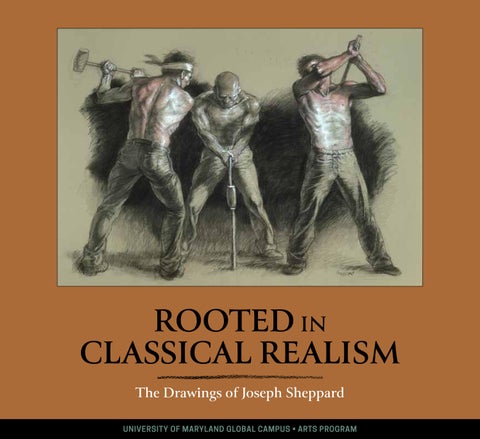
Cover Artwork: Putting Up the Tent, not dated, charcoal, colored pencil, and white conté on paper, 38 x 49¾ in.
26-ARTS-008 (6/26)
The Drawings of Joseph Sheppard
Photo by Katherine Lambert
PRESIDENT’S STATEMENT
Gregory W. Fowler, PhD President University of Maryland Global Campus
I AM PLEASED TO INTRODUCE this catalog of works by Joseph Sheppard, an artist with deep roots in Maryland and in its arts community. A native of Owings Mills, he studied at the Maryland Institute College of Art and later returned there as an influential instructor, teaching painting and drawing for 15 years. In 2010, the Leroy Merritt Center for the Art of Joseph Sheppard opened at our global headquarters in Adelphi, Maryland, where it serves as both a tribute to his work and a resource for scholars, patrons, and students of the arts.
Among Sheppard’s many gifts, his mastery of realism and his command of the human figure stand out. Whether in paint or in bronze, his works—at rest, in motion, in grief, in triumph—reflect decades of careful study and a deep respect for the traditions of figurative art. These pieces invite the viewer to pause, to look more closely, and to learn. That invitation is at the heart of our Arts Program and aligned with our mission, contributing to the community by offering a space where we can encounter and reflect on the ways that art reveals the human experience. By sharing these works with staff and faculty, learners and guests, we help deepen awareness of the role that art plays in our shared life while highlighting more of the ways that a university extends beyond its classrooms and into the very cultural fabric of the communities it serves. In presenting this exhibition, our Arts Program continues its work of celebrating the learning journey and the power of art to touch and transform lives. I hope you find these works as engaging as I do, and I thank you, as always, for your support of our university and our Arts Program. 2
Photo by Tracey Brown
DIRECTOR’S STATEMENT
Eric Key Director, Arts Program University of Maryland Global Campus
THROUGHOUT HIS CAREER as a visual artist, Joseph Sheppard has paid homage to the past with paintings, drawings, sculptures, and other artworks that depict scenes he witnessed or researched. No matter where his career has taken him—from Maryland to New York to Italy—he has held fast to his commitment to realism. His prodigious talent and roots in classical realism are celebrated in this exhibition.
Sheppard’s natural talent flourished at the Maryland Institute College of Art, which he attended from 1948 to 1952 on a four-year scholarship. He studied with Jacques Maroger, a former technical director of the Louvre who is credited with the rediscovery of the old master painting techniques. Sheppard’s long career in art is too extensive to discuss here in full. His artistic journey is best articulated in the following articles. On behalf of the Arts Program at University of Maryland Global Campus (UMGC), I hope you enjoy this glimpse into the artist’s extraordinary career.
3
THE ARTIST AS A
DRAFTSMAN
J
OSEPH SHEPPARD’S 1959 exhibition at the Grand Central Galleries in New York City was my first experience with the artist’s work. Even then, the quality of his early figure studies revealed his historical awareness of the nude as a compulsive subject. Any analogy should end here, however, for the artist had clearly demonstrated his ability to relate to the nude with new vitality and significance. A later exhibition for the Westmoreland Museum of Art in 1966, followed by a second success in 1972, brought us together in his Baltimore studio. Since that time, Sheppard’s professional career as an instructor in anatomical drawing has culminated in five important books: Anatomy, Drawing of the Female Figure, Drawing of the Male Figure, Learning from the Masters, and Drawing the Living Figure. I recall our many conversations about the history of the figure and its importance as a meaningful symbol in the aftermath of World War II. The following essay is an attempt to examine these ideas in light of both our philosophies on the continuing significance of the human form in art. The post-war decades have been ones of severe transition, in which the threat of extinction of the entire human race has towered above the loftiest of ideals in a manner similar to its symbol, the mushrooming cloud of atomic detonation. With each successive hostility, contemporary man has sought, often in vain, to temper this flux. His search for security has manifested itself in leagues and pacts which concur upon the most salient factors to arrest his immediate danger. Yet the presence of expediency, and the temporal aspects of these efforts, limit the degree of success which they may attain, and instill anxieties which are politically, socially, and individually enervating.
Back View of Rib Cage, 1973–74, pencil on paper, 171/2 x 91/2 in., UMGC Permanent Collection, Maryland Artist Collection, Photo by John Woo
That which is primal is that which can furnish a propitious base upon which to build a new temple in which subsequent generations can securely reside. That which is primal is man. 5
Man is the cause célèbre, and today, in a world less unified theologically, intellectually, and politically than ever before, man is the agent of his own fate. Within him are the seeds of his own destruction, or his own fruition. That man must prevail is the ultimate concern, and that he is the power which shall ensure his prevalence is the ultimate reality.
The ultimate importance of an artist depends as much on qualities of character and opportunity, as on native abilities. The determination and persistence required to extract the full possibilities from an idea is as vital as the imagination which first creates the idea. Sheppard certainly possesses these qualities in rendering homage to the human form.
By what means may this new “humanism” find expression? To achieve the goal of spiritually uniting men and their actions in an effort to overcome tyrannies and predilections of willful demagogues, what sort of activity may best succeed? Traditionally, the arts have been the residuum of human expression. Is it then the arts which must again assert themselves as the champion of man?
Joseph Sheppard’s style is classical, and he shares Rubens’ delight in the plastic, supple beauty of the nude. The drawings in the exhibition are representative of the artist’s ability to demonstrate various drawing styles. It is obvious that Sheppard has studied the drawing styles of the Old Masters and, as a result, his drawing techniques reflect the knowledge and discipline of anatomical correctness using the academic mediums of sanguine, charcoal, and ink, heightened with white on various colored papers. The artist’s anatomical style is also in the tradition of academic classicism where the muscular contours of the figure are achieved by the means of chiaroscuro drawing.
A study of the creative forces at work in America since the end of the Second World War indicates a resurgence of humanity as expressed in the image of man in the visual arts. A sufficiently strong body of American painters has arisen in these decades to use the human figure realistically in a variety of styles exemplified by Reginald Marsh, Isabel Bishop, Henry Koerner, Paul Cadmus, Larry Rivers, Willem de Kooning, Lester Johnson, and Philip Pearlstein, as well as the more blatant proponents of “Pop” imagery. There is a positive current of identification running through this group of artists, who seem united in a common concern for man.
Among those elements in art that will always remain constant, the human figure has a particular significance. Since the reappearance of classical ideals in the quattrocento, each generation of artists has dealt with the aesthetic beauty of the human form in its own way. Joseph Sheppard has added meaningfully to this literature in our time. PAUL A. CHEW DIRECTOR EMERITUS, WESTMORELAND MUSEUM OF ART
Foremost among these is Joseph Sheppard and the elevation to which he has carried the art of the figure. Consistently and magnanimously, he has explored the image of man to its fullest that he might reiterate and discover nobility and meaning in this, the oldest and greatest of visual subjects. Sheppard has thus attained a degree of profundity, and with it a degree of success, which are unrivaled in his particular métier.
Reprinted from Joseph Sheppard: 50 Years of Art. Firenze, Italy: Arti Grafiche Giorgi & Gambi, 2001.
6
Man Pulling, not dated, charcoal on paper, 22 x 36 in., Photo by John Woo
7
DRAWINGS
S
classical canons of form are never ends in themselves; they are tools that help the artist to capture the unique character of the living form.
OMEONE ASKED PONTORMO, “Which is the greater art, painting or sculpture?” Pontormo replied, “Drawing.” Maybe that dialogue really took place, and maybe it did not. But it is a story you never forget if you love drawings. For Pontormo was saying something that every serious artist knows: drawing is the purest form of visual art.
Sheppard does not draw an idealized classical figure—he draws a unique human body. He draws a specific person. His figures are handsome, of course, but their beauty is not achieved merely by imposing an abstract system of classical forms on the model. Above all, he finds beauty in the characteristic shape, stance, and gesture of that model.
The act of drawing is the artist’s most direct, most intense, and most personal response to nature. The speed and simplicity of the drawing process reveals everything: how much the artist knows about nature and his craft; how decisively he can visualize what he sees or what he imagines; and how he really feels. Drawing is an utterly transparent art form. We feel closest to the artist in his drawings.
Joseph Sheppard is fascinated by the specifics of the human body. Each drawing is an attempt to discover the qualities that make each human figure different from all others. His wonderfully relaxed, yet precise, line moves down the contours of the figure, searching for the exact curves and authentic detail of real bone and muscle. A stick of white chalk glides over the surface of the figure, tracing the exact movement of the light over the form. A drawing by Joseph Sheppard glows with a soft, inner light. The shapes have a swelling, resilient quality that makes the figure sprint to life.
Looking at Joseph Sheppard’s drawings, you know immediately that he is fascinated by anatomy—like the Renaissance and baroque masters who inspire him. Sheppard knows that to draw the human figure with authority, you must understand how the human body works. His drawings have such remarkable vitality and conviction because he knows the human body from the inside out.
Joseph Sheppard’s beautiful drawings reveal an artist who is passionate about the human figure, superbly trained in traditional craftsmanship, profoundly enriched by his study of the masters, yet always deeply rooted in realism.
And like the masters of the fifteenth, sixteenth, and seventeenth centuries, Sheppard is clearly schooled in the classical ideal of beauty. The forms and proportions of Greek art, rediscovered in the Renaissance, lend grace and logic to his drawings.
DONALD HOLDEN EDITORIAL CONSULTANT WATSON-GUPTILL PUBLICATIONS NEW YORK, NEW YORK
But the handsome drawings in this book are far more than anatomical exercises, and far more than the schematic renderings of the human figure that are too often produced by artists who work self-consciously in the Renaissance manner. (It is easy for any skilled draftsman to create a pastiche of classical forms and stop there.) For Sheppard, however, anatomy and
Reprinted from The Work of Joseph Sheppard: Selected Paintings, Drawings, Watercolors, and Sculpture from 1957 through 1980. Firenze, Italy: Arti Grafiche Giorgi & Gambi, 1982.
9
FEATURED
ARTWORKS
Study for Parade, not dated, watercolor on paper, 14 x 18½ in.
1111
Seated Male Nude, not dated, charcoal and white conté on paper, artist’s proof, 28 x 25 in. 12
Study for a Fountain, 1992, charcoal and white conté on paper, 50½ x 43 in. 13
Cart Carrier (Rickshaw Man), not dated, charcoal and white conté on paper, 25½ x 24 in. 14
Mother and Crying Child, not dated, charcoal and white conté on paper, 32¼ x 25¼ in. 15
Standing Male Nude, Front View, not dated, charcoal and white conté on paper, 28 x 20 in. 16
Seated Male Nude, Back View, not dated, charcoal and white conté on paper, 21½ x 17 in. 17
Last Supper, not dated, charcoal, watercolor, and white conté on paper, 34½ x 48½ in.
18
Merry Company, not dated, charcoal and white conté on paper, 49 x 41 in. 19
Seated Nude, not dated, pastel on paper, 28¾ x 21½ in.
20
Head Studies (Studies of an English Girl), not dated, charcoal on paper, 25 x 20 in.
21
Execution, not dated, charcoal, colored pencil, and white conté on paper, 18¾ x 24¾ in.
Man Being Carried, Study for Painting, not dated, watercolor and charcoal on paper, 25 x 29¾ in. 22
Angel, not dated, charcoal and white conté on paper, 43 x 51 in.
23
Study for Volleyball 1, not dated, charcoal and white conté on paper, 27 x 25¾ in. 24
Study for Volleyball 2, not dated, charcoal and white conté on paper, 27 x 25¾ in. 25
Girl with Sheet, 1991, charcoal and white conté on paper, 49¾ x 38 in. 26
Nude Lying Face Up, 1992, charcoal and white conté on paper, 50½ x 42¾ in. 27
Three Studies of a Dog, not dated, pen and ink on paper, 10 x 19½ in.
Farmer and Oxen, not dated, charcoal, watercolor, and white conté on paper, 19¼ x 27¾ in. 28
Putting Up the Tent, not dated, charcoal, colored pencil, and white conté on paper, 38 x 49¾ in.
29
Study for Brooks 1, not dated, charcoal on paper, 23 x 20¾ in. 30
Study for Brooks 2, not dated, charcoal on paper, 23 x 20¾ in. 31
Il Palio 1, 1976, charcoal, watercolor, and white conté on paper, 28½ x 41 in.
32
Il Palio 2, 1976, charcoal, watercolor, and white conté on paper, 31½ x 31½ in. 33
Fighter’s Locker, not dated, lithograph proof on paper, 25/150, 30 x 26 in. 34
Three Males, Locker Room, not dated, charcoal and white conté on paper, 55 x 44½ in. 35
Two Young Girls, not dated, charcoal and white conté on paper, 61 x 41 in. 36
Seated Female Nude, not dated, charcoal, colored pencil, and white conté on paper, 24¼ x 17½ in. 37
Photo by Katherine Lambert
ARTIST’S BIOGRAPHY
Joseph Sheppard His portraits include President George H. W. Bush; Senator Barbara Mikulski; Cardinals Lawrence Shehan, William H. Keeler, and John P. Foley; and Pope Benedict XVI.
Born in Owings Mills, Maryland, Joseph Sheppard studied at what is now known as the Maryland Institute College of Art (MICA) from 1948 to 1952 with Jacques Maroger, a former technical director of the Louvre. Sheppard was artist-in-residence at Dickinson College in Pennsylvania from 1956 to 1957, when he was awarded a Guggenheim Fellowship to study in Florence, Italy. He returned to MICA to teach painting, anatomy, and life drawing from 1960 to 1975.
Sheppard has been awarded numerous honors, including the 27th International Award of St. Francis and Claire of Assisi (2019); the Tuscan American Association Award (2016); the 18th Annual International Award, Pietrasanta and Vesilia (2008); and the Gold Medal, Percival Dietsch Prize, from the National Sculpture Society (1994). He was named Sports Artist of the Year in 2015 by the U.S. Sports Academy.
Some of Sheppard’s commissioned public works in Baltimore include the bronze of baseball player Brooks Robinson (2011), the statue of Pope John Paul II (2008) at the Basilica of the Assumption of the Blessed Virgin Mary, and the Holocaust Memorial sculpture (1988). Among several murals in the city are Schaefer’s Splash at the National Aquarium (2019) and seven large paintings in the Baltimore City Police Department (1972).
His work can be found in galleries and museums throughout Italy and the United States, including the Smithsonian National Portrait Gallery in Washington, D.C.
38
EXHIBITION LIST Angel, not dated, charcoal and white conté on paper, 43 x 51 in.
Man Being Carried, Study for Painting, not dated, watercolor and charcoal on paper, 25 x 29¾ in.
Standing Male Nude, Front View, not dated, charcoal and white conté on paper, 28 x 20 in.
Merry Company, not dated, charcoal and white conté on paper, 49 x 41 in.
Study for a Fountain, 1992, charcoal and white conté on paper, 50½ x 43 in.
Execution, not dated, charcoal, colored pencil, and white conté on paper, 18¾ x 24¾ in.
Mother and Crying Child, not dated, charcoal and white conté on paper, 32¼ x 25¼ in.
Study for Brooks 1, not dated, charcoal on paper, 23 x 20¾ in.
Farmer and Oxen, not dated, charcoal, watercolor, and white conté on paper, 19¼ x 27¾ in.
Nude Lying Face Up, 1992, charcoal and white conté on paper, 50½ x 42¾ in.
Cart Carrier (Rickshaw Man), not dated, charcoal and white conté on paper, 25½ x 24 in.
Fighter’s Locker, not dated, lithograph proof on paper, 25/150, 30 x 26 in. Girl with Sheet, 1991, charcoal and white conté on paper, 49¾ x 38 in. Head Studies (Studies of an English Girl), not dated, charcoal on paper, 25 x 20 in. Il Palio 1, 1976, charcoal, watercolor, and white conté on paper, 28½ x 41 in. Il Palio 2, 1976, charcoal, watercolor, and white conté on paper, 31½ x 31½ in. Last Supper, not dated, charcoal, watercolor, and white conté on paper, 34½ x 48½ in.
Putting Up the Tent, not dated, charcoal, colored pencil, and white conté on paper, 38 x 49¾ in. Seated Female Nude, not dated, charcoal, colored pencil, and white conté on paper, 24¼ x 17½ in.
Study for Brooks 2, not dated, charcoal on paper, 23 x 20¾ in. Study for Parade, not dated, watercolor on paper, 14 x 18½ in. Study for Volleyball 1, not dated, charcoal and white conté on paper, 27 x 25¾ in. Study for Volleyball 2, not dated, charcoal and white conté on paper, 27 x 25¾ in.
Seated Male Nude, not dated, charcoal and white conté on paper, artist’s proof, 28 x 25 in.
Three Males, Locker Room, not dated, charcoal and white conté on paper, 55 x 44½ in.
Seated Male Nude, Back View, not dated, charcoal and white conté on paper, 21½ x 17 in.
Three Studies of a Dog, not dated, pen and ink on paper, 10 x 19½ in.
Seated Nude, not dated, pastel on paper, 28¾ x 21½ in. 39
Two Young Girls, not dated, charcoal and white conté on paper, 61 x 41 in.
UMGC Arts Program Mission Statement The UMGC Arts Program is dedicated to furthering the university’s objectives by creating a dynamic environment in which our diverse constituents, including students and the general public, can study and learn from direct exposure to our art collections, exhibitions, and educational programs. About UMGC University of Maryland Global Campus was founded more than 75 years ago specifically to serve the higher education needs of working adults and military servicemembers. Today, UMGC is the largest provider of postsecondary education in Maryland and continues its global tradition with online and hybrid courses, more than 175 classroom and service locations worldwide, and more than 100 degrees and certificates backed by the reputation of a state university and the University System of Maryland. For more information, visit umgc.edu.
About the Arts Program at UMGC Since 1978, UMGC has proudly shown works from a large collection of international and Maryland artists at its headquarters in Adelphi, Maryland, a few miles from the nation’s capital. Through its Arts Program, the university provides a prestigious and wide-ranging forum for emerging and established artists and brings art to the community through special exhibitions and its own collections, which have grown to include more than 3,000 pieces of art. Artworks are on display throughout the College Park Marriott Hotel & Conference Center and the Administration Building in Adelphi. The main, lower-level gallery in Adelphi is open to the public from 9 a.m. to 9 p.m. seven days a week, and the Leroy Merritt Center for the Art of Joseph Sheppard is open to the public from 9 a.m. to 7 p.m. seven days a week. More than 75,000 students, scholars, and visitors come to the Adelphi facilities each year.
Catalog published in conjunction with the exhibition
© 2026 University of Maryland Global Campus.
Rooted in Classical Realism:
All rights reserved. Copyright credits and
The Drawings of Joseph Sheppard
attribution for certain illustrations are cited
UMGC Arts Program Gallery
internally proximate to the illustrations.
June 28, 2026–June 27, 2027
ISBN: 979-8-9932665-3-4
40
Contributors Eric Key
Director, Arts Program
Treston Sanders Curator
Sandy Bernstein
Senior Writer/Editorial Director
Barbara Reed Senior Editor
Olya Kalatsei
Senior Web and Graphic Design Manager
Jennifer Norris
Senior Web and Graphic Designer
Laurie Bushkoff
Senior Account Manager
Scott Eury
Print Production and Vendor Relations Manager
René A. Sanjines
Fine Arts Technician
Tawanna Manago
Administrative Assistant Artwork photography by Greg Staley unless noted otherwise.
Cover Artwork: Putting Up the Tent, not dated, charcoal, colored pencil, and white conté on paper, 38 x 49¾ in.
26-ARTS-008 (6/26)
3501 University Boulevard East Adelphi, MD 20783-8000 USA umgc.edu/art
The Drawings of Joseph Sheppard UNIVERSITY OF MARYLAND GLOBAL CAMPUS • ARTS PROGRAM