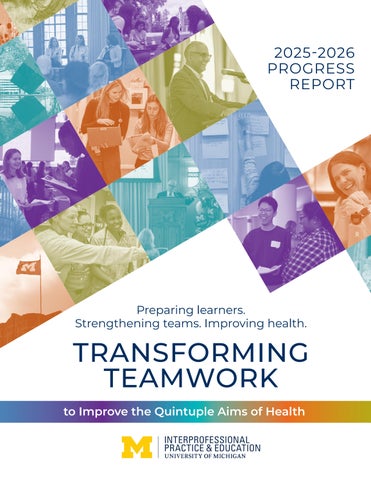
2025-2026 PROGRESS REPORT
Preparing learners. Strengthening teams. Improving health.
TRANSFORMING TEAMWORK to Improve the Quintuple Aims of Health
FIVE STRATEGIES FOR IMPROVING THE QUINTUPLE AIMS OF HEALTH
EXECUTIVE DIRECTOR’S MESSAGE Interprofessional practice and education (IPE) are at a crossroads nationally. After years of growth and experimentation, the field now faces a defining question: will academic health centers lean into the hard work of making IPE a durable, system-level cultural force that fundamentally changes how we educate and practice, or will they wait for someone else to show the way? At the Michigan Center for Interprofessional Practice and Education, we have chosen to lead. That choice was not made lightly, and it was not made alone. This past year, we completed a rigorous external review in full partnership with the Provost’s Office and the Health Sciences Council of Deans. The reviewers were unambiguous: “The University of Michigan has the potential to become one of a very small number of national models in demonstrating the impact of interprofessional education on health AND learning outcomes.” They also issued a clear charge to move quickly from our pilots to full-scale implementation, before we lose the advantage we have built. We take that charge seriously. It affirms the direction we have been heading, and it sharpens our sense of urgency. The pressures we face are real and converging. IPE centers across the country are financially vulnerable, dependent on higher education investment and community grants that are increasingly under threat. Meanwhile, the clinical learning environments where our students train remain largely untransformed, and the health system outcomes IPE is positioned to improve continue to worsen. Workforce attrition, burnout, fragmented care, and preventable harm are the daily realities of the systems our graduates will enter, and they are precisely the problems that interprofessional teamwork is built to address. Health system leaders need what IPE offers. Our work, in part, is helping them see it.
2
At our center, education, systems transformation, and community health form a unified approach to preparing learners for the realities they will face and transforming the systems in which they will work. Our interprofessional longitudinal curriculum scaffolds intentional learning throughout the health science curricula,
embedded in authentic practice settings with patients and families as teachers. Thriving Together brings that same collaborative approach into Michigan Medicine, using an evidence-based approach to improving team culture. Through the Interprofessional Community Health Collaborative, we work to extend collaborative practice into the neighborhoods and populations we serve. How we change the culture of teamwork in the practice setting ultimately shapes what our students learn, and this, in turn, shapes our future teams. This annual report captures the momentum of that integrated work, including progress on our evolving curriculum, the expansion into community-based learning and practice settings, advances in our research infrastructure, and the results of strategic planning shaped by the external review. You will also see the outlines of what comes next: a center that is laser-focused, attuned to outcomes, and driving the national conversation about where our field must go. None of this happens without you. The faculty, staff, students, and partners who make up this community are the reason Michigan is positioned to lead. Thank you for your continued commitment to this work, and for the trust you place in us to carry it forward. Rajesh S. Mangrulkar, M.D., F.N.A.P. Director, Michigan Center for Interprofessional Practice and Education (CIPE)
MICHIGAN CENTER FOR INTERPROFESSIONAL PRACTICE AND EDUCATION TEAM OUR TEAM
MORE THAN A NAME In 2025, the Center for Interprofessional Education officially became the Center for Interprofessional Practice and Education, reflecting how its work has evolved over the past decade.
Mangrulkar
Patterson
Buckenmeyer
Edwards
The addition of “Practice” underscores the center’s commitment to preparing learners not only to understand teamwork, but to experience it in clinical and community settings where collaboration directly shapes health. Announced during the center’s 10-Year Anniversary Celebration, the change reflects the organization’s expanding role across education, practice, research, and community engagement while preserving the familiar CIPE acronym.
MISSION Farris
McGraw
Innovating and transforming interprofessional education, collaborative practice and research to achieve the quintuple aims of health.
COLLABORATING U-M SCHOOLS AND COLLEGES Smith
Telega
Rajesh S. Mangrulkar M.D., F.N.A.P., Director Vani Patterson M.P.H., F.N.A.P., Administrative Director
School of Dentistry College of Education, Health & Human Services (UM-Dearborn) College of Health Sciences (UM-Flint) School of Kinesiology
Amy Buckenmeyer Ph.D., M.P.H., R.N., C.P.H., C.P.N.P.-P.C., F.N.A.P., Director of Community Health
Medical School
Hannah Edwards M.H.M., Education and Curriculum Program Manager
School of Nursing (UM-Flint)
Karen Farris Ph.D., M.P.A., F.N.A.P., Director of Research Johnny McGraw M.A., Marketing and Communications Specialist
School of Nursing College of Pharmacy School of Public Health School of Social Work
Laura Smith P.T., D.P.T., Ph.D., F.N.A.P., Director of Interprofessional Engagement and Development Lindsay Telega B.A.A., Administrative Specialist
3
FIVE STRATEGIES FOR IMPROVING THE QUINTUPLE AIMS OF HEALTH
RECOGNIZING INNOVATION AND EXCELLENCE IN INTERPROFESSIONAL EDUCATION The annual IPE Innovation and Excellence Awards recognize educators, practitioners, researchers, teams, and learners whose work advances interprofessional education, collaborative practice, and innovation across the University of Michigan.
2025 IPE Innovation and Excellence Awards Presented during the center’s 10-Year Anniversary Celebration, the 2025 awards recognized individuals and teams whose leadership helped shape the first decade of interprofessional education at Michigan.
Brenner
Lapidos & Wolfe
Anderson
Amin
AWARD FOR IPE INNOVATION Michael Brenner Individually Arranged Rotation in Otolaryngology TEAM AWARD FOR IPE EXCELLENCE Adrienne Lapidos & Jason Wolfe Understanding and Improving the U.S. Healthcare System
AWARD FOR IPE EXCELLENCE Olivia Anderson Foundational IPE Curriculum Leadership and Scholarship STUDENT AWARD FOR IPE EXCELLENCE Sharmi Amin Leadership in Learner Engagement and Curriculum Innovation
2026 IPE Innovation and Excellence Awards Beginning in 2026, the awards found a new annual home at the Health Professions Education (HPE) Connect conference, bringing recognition of interprofessional excellence and innovation into a new signature gathering for U-M’s three campuses and Michigan Medicine.
Bird
Pardee
AWARD FOR IPE INNOVATION Michele Bird Mobility Team Program
AWARD FOR IPE EXCELLENCE Michelle Pardee Leadership in Team-Based Clinical Decision Making, TEAMS, and the Interprofessional Community Health Collaborative
Together, these awardees represent the creativity, leadership, and collaborative spirit that continue to shape the future of interprofessional practice and education at Michigan.
2025
4
READ MORE ABOUT OUR AWARDEES
2026
5 STRATEGIC INITIATIVES CIPE’s work is guided by five strategic initiatives that reflect our commitment to advancing interprofessional education, collaborative practice, and better health through teamwork.
LONGITUDINAL INTERPROFESSIONAL CURRICULUM
INTERPROFESSIONAL COMMUNITY HEALTH From left: Carol Anne Murdoch-Kinch, Rajesh S. Mangrulkar, Mark Fitzgerald, Frank Ascione, and Laurie McCauley
2025 Frank Ascione Award for Distinguished Leadership in Interprofessional Education Named in honor of CIPE’s founding director, Frank Ascione, Pharm.D., M.P.H., Ph.D., the award recognizes individuals whose leadership has advanced interprofessional education at the University of Michigan. Mark Fitzgerald, a longtime champion of collaborative health professions education, was selected as its inaugural recipient. It’s deeply meaningful to see this award carry forward the spirit of collaboration that shaped the early years of the center. Mark, who was extensively involved since the beginning, embodies the values that make interprofessional education transformative: curiosity, respect for all disciplines, and an unwavering belief that students learn best when they learn together. His leadership has helped Michigan become a model for others.”
SYSTEMS AND INTERPROFESSIONAL PRACTICE-BASED TRANSFORMATION
DEVELOPMENT AND ENGAGEMENT
INTERPROFESSIONAL PRACTICE AND EDUCATION RESEARCH
Frank Ascione, Pharm.D., M.P.H., Ph.D.
5
FIVE STRATEGIES FOR IMPROVING THE QUINTUPLE AIMS OF HEALTH
THE NEXT CHAPTER This year marked a defining moment for the center. As the center marked its tenth anniversary, it also underwent a comprehensive external review led by the Provost’s Office and the Health Sciences Council of Deans. Together, the two milestones offered an opportunity to reflect on a decade of progress while charting an ambitious course for the future. On October 9, 2025, the center hosted its 10-Year Anniversary Celebration at the Michigan League, welcoming faculty, staff, learners, health system leaders, and community partners from across the University of Michigan’s three campuses and Michigan Medicine. Through workshops, an interprofessional panel of university leaders, and a keynote from Thomas Lee, M.D., the event celebrated the relationships, trust, and teamwork that have shaped the center’s first decade while looking ahead to its next. I truly feel that the University of Michigan is exceptionally well-positioned to build environments of trust and connection in their health system and across the university’s campuses. When teams can rely on strong relationships and shared purpose, they are better equipped to provide excellent care, innovate, and support each other as learners and professionals.” Thomas Lee, M.D., Chief Medical Officer of Press Ganey and Editor-in-Chief of the NEJM (New England Journal of Medicine) Catalyst That future-focused perspective was reinforced by the external review. National leaders in interprofessional practice and education concluded that the University of Michigan is uniquely positioned to become a national model for demonstrating how interprofessional education can improve both learning and health outcomes. Reviewers affirmed the center’s shift toward experiential learning, practice transformation, and community-engaged work while recognizing growing momentum in research and evaluation. They also highlighted the extraordinary commitment of faculty, staff, students, clinicians, administrators, and community partners across the university, emphasizing that the University of Michigan’s opportunity is significant, but so is the need for action. The past ten years established CIPE as a transformative leader in interprofessional education,” said Provost Laurie McCauley, D.D.S., M.S., Ph.D. “The next ten years are about growing that impact.” To fully realize that potential, and incorporating feedback from the reviewers and U-M leadership, the center is now fully committed to two priorities: Scaling the longitudinal interprofessional curriculum for all relevant University of Michigan learners by expanding opportunities for interprofessional learning and practice in healthcare and community settings through observation, reflection, and collaborative practice transformation. Strengthening research, evaluation, and assessment efforts to demonstrate the impact of the longitudinal curriculum on learning, professional practice, and health outcomes. 6
7
FIVE STRATEGIES FOR IMPROVING THE QUINTUPLE AIMS OF HEALTH
INTERPROFESSIONAL LONGITUDINAL CURRICULUM Preparing Learners for the Teams They Will Join
Introduction to IPE
Team-Based Clinical Decision Making
Didactic
INTRODUCE
REINFORCE
Experiential
INTRODUCE
REINFORCE
TEAMS 1
Patient/Community Interaction
PRACTICE
TEAMS 2
TEAMS 3
Longitudinal Interprofessional Family-based Experience (LIFE)
Health and healthcare are becoming more complex. Patients are living longer with multiple conditions. Care teams are growing larger and more specialized. At the same time, burnout, turnover, and fragmentation continue to challenge health systems nationwide. Healthcare today requires professionals who can communicate effectively, understand one another’s roles, and work together to solve increasingly complex challenges. The future of health care depends on professionals who know how to operate and excel in teambased environments. That is why we create opportunities for learners to learn about, from, and with other professions throughout their education. Our interprofessional longitudinal curriculum prepares graduates and learners at every level not simply to work on teams, but to excel at teaming and help those teams deliver better care.” Patricia Hurn, Ph.D., R.N., F.A.A.N., Vice President for Research and Innovation, U-M, Former Dean, U-M College of Nursing Today’s learners will enter environments where collaboration is essential to delivering safe, effective, and equitable care. The center’s interprofessional longitudinal curriculum is built with that reality in mind. Over the past year, the center continued its shift toward more experiential, practice-oriented learning opportunities. 8
The goal is to help learners develop the skills, behaviors, and perspectives required to contribute to real teams in real settings. Learning experiences are intentionally spread across programs and stages of development. Foundational concepts are introduced early, reinforced through structured learning experiences, and applied through authentic practice opportunities. This year, TEAMs (Teams Engaging to Acquire Meaningful Experiences) learning experiences continued to expand across multiple health science programs, while a first-of-its-kind interprofessional debriefing model was piloted to help learners reflect on teamwork after authentic practice experiences.
2025-2026 Interprofessional Longitudinal Curriculum Reach CORE OFFERING
STUDENTS
Intro to IPE
1993 LIFE
344
Team-Based Clinical Decision Making
357
TEAMS 1 TEAMS 2 TEAMS 3
26 109 69
= 20 STUDENTS
From Understanding Teamwork to Practicing It Increasingly, health organizations are asking more from health professional programs: graduates who can communicate effectively, navigate uncertainty, collaborate across disciplines, and lead within complex systems. CIPE’s curriculum is evolving accordingly. Two cornerstone experiences anchor that work. Introduction to Interprofessional Education (IPE) introduces learners to the principles and practices of collaborative, team-based care, while the Longitudinal Interprofessional FamilyBased Experience (LIFE) connects interprofessional student teams with patients managing chronic illnesses, allowing learners to develop and apply the IPE Competencies of communication, teams and teamwork, values and ethics, roles and responsibilities, and intercultural humility over time. Both courses continue to evolve in response to the changing realities of healthcare. Ongoing enhancements place greater emphasis on experiential learning, patient and family perspectives, psychological safety, and opportunities for learners to practice navigating the complex interpersonal and systems challenges that shape team performance every day. At the same time, CIPE is building a more intentional approach to learner assessment and course evaluation. New assessment strategies will help the center understand how the IPE offerings influence confidence, behaviors, and readiness for collaborative practice over time.
Student Testimonials These skills will help me become a more thoughtful and effective leader by teaching me how to assess team dynamics and identify root causes of performance challenges. In future roles, I can use structured observation to understand why teams are succeeding or struggling and to guide targeted improvements.” This experience provides a perspective that classroom learning alone cannot. Hearing directly from patients and families about their healthcare journeys makes the impact of teamwork, coordination, and system barriers more tangible.”
The question is no longer whether learners have been exposed to interprofessional education. The question is whether they are prepared to strengthen the teams, workplaces, and systems they will one day inherit, as a result of IPE. 9
FIVE STRATEGIES FOR IMPROVING THE QUINTUPLE AIMS OF HEALTH
IMPROVING COMMUNITY HEALTH THROUGH INTERPROFESSIONAL PRACTICE Where Teamwork Meets Community Needs Chronic disease, health inequities, barriers to care, and the social determinants of health are complex challenges that no single profession can solve alone. Improving community health requires professionals who understand how to work together, recognize the unique expertise each discipline brings, and partner with communities to develop solutions that reflect local priorities. The Interprofessional Community Health Collaborative (ICHC) was built around that idea. Drawing on best practices in communityengaged scholarship and practice, the initiative brings together students, faculty, healthcare professionals, and community organizations to identify community priorities and respond collaboratively. By learning and working alongside one another in community settings, participants gain a deeper appreciation for how different professions contribute complementary knowledge and skills while building relationships that strengthen both education and community impact. Its approach is straightforward: before designing programs, understand what the recipients of these programs actually need. That philosophy has shaped the development of a structured model for community health needs assessment that can be adapted across organizations and settings.
From Listening to Action
10
One of the collaborative’s newest efforts focuses on improving care transitions for individuals experiencing homelessness after being discharged from the hospital. Working alongside medical respite care centers and other community partners, CIPE is helping develop a community health needs assessment (CHNA) informed by community-based participatory research strategies.
This work brings together community members, organizational leaders, faculty, learners, and professionals from disciplines including nursing, medicine, pharmacy, social work, public health, physical therapy, and health administration. Each profession contributes unique expertise. Physicians and nurses help improve care transitions, pharmacists address medication access, social workers connect individuals with community resources, physical therapists support mobility and independence, and public health professionals help identify broader community needs. Through interviews, relationship-building, and collaborative planning, partners are developing a roadmap that will guide future interventions and ensure solutions reflect community priorities. For ISICL (Interprofessional Students: Innovating. Collaborating. Leading.) participant Austin Geer, the experience offered a firsthand look at how community engagement shapes meaningful change. I came away with a much greater appreciation for the expertise that exists within communities. The people most affected by a challenge often have insights that you won’t find in a report or dataset. Taking the time to listen and build trust changes the conversation. It helps ensure that the solutions we develop are grounded in what people actually need rather than what we assume they need.” Austin Geer, Pharm.D and Ph.D. candidate, Health Services Research Students across health professions are involved throughout the process, from helping assess community needs to helping design the interventions that emerge from those findings. By participating in both discovery and implementation, learners gain experience working alongside community partners to identify challenges, develop solutions, and evaluate impact.
A Model Built for Sustainability The ICHC’s goal extends beyond individual projects. Alongside community partners, faculty, and learners, the ICHC is working to develop approaches that can be adapted, refined, and applied across a wide range of community health priorities. This year, the ICHC continued to strengthen the infrastructure needed to support that work, including partnership development, faculty mentorship, learner engagement, and tools that help guide interprofessional teams in community settings. The result is a growing model for community-engaged learning and practice that can respond to local needs while creating meaningful opportunities for students to work alongside community members to improve health for all. As new partnerships emerge and existing relationships deepen, the ICHC is helping build capacity not only for individual initiatives, but for sustained collaboration between the university and the communities it serves. The work also broadens learners’ understanding of teamwork. In community settings, effective collaboration extends beyond healthcare professionals to include patients, families, community organizations, and residents themselves. Learning to listen, build trust, and work alongside community partners prepares students for a future in which health is shaped as much by relationships and lived experience as it is by clinical expertise.
At its core, the initiative reflects a simple belief: Communities are not passive recipients of care or support. They are essential partners in shaping it.
Building Connections Beyond Michigan This year, Amy Buckenmeyer, Ph.D., M.P.H., R.N., C.P.H., C.P.N.P.-P.C., F.N.A.P., CIPE Director of Community Health, partnered with Brian Cross, Pharm.D., B.C.A.C.P., C.D.E., Assistant Vice Provost and Director, Center for Interprofessional Collaboration at East Tennessee State University, and the National Academies of Practice to explore the development of a broader Community Health Collaborative. The effort aims to bring together professionals from multiple disciplines to address complex community health challenges through partnership, shared learning, and collective action. The collaboration reflects growing momentum around interprofessional approaches that extend beyond healthcare settings and into the communities where health is shaped. It also highlights the expanding reach of the collaborative’s work and the opportunity to build new partnerships around a shared commitment to improving health and well-being. 11
FIVE STRATEGIES FOR IMPROVING THE QUINTUPLE AIMS OF HEALTH
SYSTEMS-BASED PROBLEM SOLVING Healthcare’s Biggest Challenges Rarely Exist in Isolation Healthcare organizations are under pressure from every direction. While the practice setting remains the most influential learning environment for students, increasing strain on healthcare teams means those environments are not often positioned to intentionally model the interprofessional collaboration and teamwork skills learners need to succeed.
CIPE responded by launching the Systems Transformation Committee, which designed and oversees Thriving Together, a new initiative designed to strengthen interprofessional teamwork as a strategy for improving workforce and patient outcomes, while optimizing these impactful environments where our students learn. Rather than treating symptoms in isolation, Thriving Together focuses on great interprofessional teamwork as the engine of improvement and learning.
Why Teams Matter Both national and local research increasingly suggest that workforce and patient outcomes are deeply connected, with teamwork being a vital driver of both. Recent analyses from Press Ganey, which measures workforce engagement and patient experience across thousands of healthcare organizations, further support this relationship.
Interprofessional education is evolving. The focus is shifting from building programs to demonstrating how interprofessional education supports collaborative practice to strengthen health systems. Organizations that connect education, practice, and continuous improvement will be best positioned to improve outcomes for healthcare teams, patients, and communities.” Christine Arenson, M.D., F.N.A.P., Director, National Center for Interprofessional Practice and Education
12
CIPE partnered with leaders across Michigan Medicine to better understand the challenges they face, and those conversations revealed a recurring pattern. While issues varied by setting, nearly all of the concerns these leaders described were fundamentally team-sensitive: communication breakdowns, role confusion, competing priorities, fragmented workflows, frustration of patients in their experience of coordinated care, and the gradual erosion of trust that can make complex work harder than it needs to be.
Organizations prioritizing team cohesion, employee experience, and workforce well-being achieved the strongest gains in patient experience. Employees in highly engaged organizations reported significantly stronger perceptions of teamwork, safety culture, and error prevention. At Michigan Medicine, teamwork has been found to be a key driver of staff engagement, faculty engagement, and patient experience. Team dynamics directly impact what leaders think about every day, and it’s where I spend most of my time focusing. Strong team cultures create conditions where healthcare professionals can thrive, leading to greater engagement, better patient experiences, and improved retention. Conversely, when teamwork breaks down, it often shows up quickly in staff morale, patient flow, and overall experience. So a big part of leadership is creating consistency, accountability, and trust within teams.” Dayna Riley, Administrative Manager
13
FIVE STRATEGIES FOR IMPROVING THE QUINTUPLE AIMS OF HEALTH
SYSTEMS-BASED PROBLEM SOLVING Transforming Teams, Strengthening Care The CIPE works alongside Thriving Together Champions Teams to co-design interventions, provide ongoing coaching, and strengthen local leadership capacity towards a team-based culture.
For the first time, patient experience, employee engagement, faculty engagement, quality, and safety data were intentionally examined together to identify opportunities for improvement. This “crosswalk” approach helped uncover patterns that may have remained invisible when viewed through traditional organizational silos.
Inattention to Results
Developed by Patrick Lencioni
Incentivize Results
Avoidance of Accountability
Transparency in Goals & Standards
Lack of Commitment
Involve Team in Decision-Making
Fear of Conflict
Psychologically Safe Environment
Lack of Trust
Model Vulnerability
Five Dysfunctions of Teams
Addressing Team Dysfunctions
Teams begin with a comprehensive assessment process, as shown in the baseline assessment components figure, and apply evidence-based frameworks to examine and analyze team dynamics, operational processes, workplace culture, and performance indicators. Findings then inform customized development opportunities tailored to the needs of each clinical environment. Frontline team leaders, functioning as a Thriving Together Champions Team, receive continuous coaching and support to develop their interprofessional and collaborative leadership skillset, helping sustain progress beyond any single intervention. The leaders will also guide their broader team through deliberately selected training sessions to foster a team-based culture.
14
Thriving Together was designed as a demonstration project in both settings, but the lessons learned are intended to scale. What works in an ambulatory clinic or inpatient unit can inform future improvement efforts across Michigan Medicine and beyond.
Baseline Assessment Components ASSESSMENT COMPONENT
AMBULATORY
INPATIENT
Interviews
16
25 Unlike many organizational improvement efforts that focus primarily on workflows, metrics, or isolated process changes, Thriving Together begins with the relationships that enable teams to function effectively. Through direct observation of care delivery, structured analysis using established interprofessional teamwork frameworks, and meaningful dialogue with frontline teams, the center helps clinical environments better understand not only what is happening, but why. The ultimate goal is not simply to solve today’s challenges, but to cultivate the trust, communication, and collaborative culture that allow teams to continue improving long after the formal engagement concludes. Healthcare is too complex for any one profession to do alone. Students learn a great deal in the classroom, but they also learn from the teams they see every day. When they observe nurses, physicians, pharmacists, therapists, and other team members communicating openly, asking questions, and speaking up for patient safety, they learn that quality care depends on a supportive culture for teams. Those same qualities help create better experiences for patients, healthcare professionals, and future members of the workforce.” John Swirple, M.S.-M.S.L., B.S.N., R.N., C.N.M.L., Clinical Nursing Director, Clinical Adjunct Faculty
6
Observations (of meetings)
Shadowing (of daily activity)
12
13 4
Survey Completion (by team)
23
34
Sources: Press Ganey, Patient Experience and Employee Experience: How They Work Together to Improve Outcomes (2024); Supporting Patient Safety Requires Higher Employee Engagement (2022); and Why Employee Engagement Matters for Optimal Healthcare Outcomes (2025).
15
FIVE STRATEGIES FOR IMPROVING THE QUINTUPLE AIMS OF HEALTH
EDUCATOR ENGAGEMENT AND DEVELOPMENT Building a Community Around Better Teamwork Interprofessional practice can be difficult work to advance, as systems are not typically built to support collaboration across silos. Many educators, clinicians, and administrators are trying to solve similar problems in different corners of the university and health system, often with limited opportunities to learn from one another. CIPE’s development and engagement efforts are designed to bring those people together. The Interprofessional Education and Collaboration (IPEC) Community of Practice, developed in partnership with the Center for Research on Teaching and Learning (CRLT), continued to grow this year, bringing together more than 110 participants representing 23 disciplines from across the university and health system. Through highly interactive, inperson sessions, participants explore practical approaches to strengthening teamwork, psychological safety, leadership, and collaborative teaching while building relationships that extend well beyond each meeting. What participants share is a common interest in improving how people learn, work, and deliver care together. For some, that means exploring new approaches to teaching. For others, it means addressing challenges in clinical practice, workforce development, or organizational culture. The Community of Practice creates space for those conversations to happen across traditional boundaries. The Community of Practice is one part of the center’s broader development and engagement strategy, which now includes in-person, virtual, and self-paced learning opportunities designed to meet educators and clinicians wherever they are. This year, the center expanded opportunities for engagement through the new virtual Interprofessional Learning Series, which brings faculty, clinicians, community partners, and patient advisors together to exchange practical strategies and real-world experiences, as well as Introduction to Interprofessional Education for Educators, which helps faculty integrate collaborative practice principles into their teaching. 16
The Community of Practice consistently introduces me to new ideas and practical strategies that I can apply in my own work. Tools like Mood Checks have helped strengthen team connection and engagement, while the diverse perspectives in each session continue to challenge and inspire me.” Steve Vinson, M.H.S.A., Belonging and Experience Program Manager, Michigan Medicine Ambulatory Care Department
From Connection to Collaboration Those opportunities had a lasting impact on Linda Sorensen, Ed.D., M.P.A., R.H.I.A., C.H.P.S. Connections she built through CIPE proved instrumental in advancing the health records initiative she leads for the Health Equity, Action, Research and Teaching (HEART) Clinic, a student- and faculty-run collaborative pro bono health clinic in the UM-Flint College of Health Sciences. They expanded collaborations, strengthened research efforts, created new opportunities for students, and connected expertise across Michigan Medicine and the University’s Ann Arbor, Flint, and Dearborn campuses. The connections I made through CIPE helped me figure out whom to connect with and how to move ideas into action. Through those relationships, HEART grew from a project with potential into something much bigger than I could have built on my own. The expertise, partnerships, and opportunities that emerged accelerated our work in ways I never expected.” Linda Sorensen, Ed.D., M.P.A., R.H.I.A., C.H.P.S., Program Director of Health Informatics and Information Management and Assistant Professor at the University of Michigan-Flint
The center also continued expanding access to interprofessional learning through partnerships with Michigan Online, the Center for Academic Innovation (CAI), the U-M Medical Improvisation team, the Office of Patient Experience, and others. Collaborations are helping extend interprofessional learning beyond traditional classrooms and into clinical practice, community settings, and new stages of professional development.
Connecting a Community of Educators Both the center and RISE (Research. Innovation. Scholarship. Education.), Michigan Medicine’s health science education innovation unit, share a commitment to advancing health professions education through collaboration, innovation, and scholarship. This year, that partnership was on full display through Health Professions Education (HPE) Connect ‘26, a reimagined university-wide annual conference that brought together nearly 200 faculty, staff, and learners from across the University of Michigan’s three campuses and Michigan Medicine. Through presentations and open dialogue, participants explored how teamwork, innovation, and interprofessional collaboration can help address some of the most pressing challenges facing health professions education. The event also created opportunities for educators, learners, and leaders to truly connect across disciplines, share and generate ideas, and learn from one another.
Developing the Next Generation of Leaders This year, the inaugural cohort of Interprofessional Students: Innovating. Collaborating. Leading. (ISICL) completed its year-long leadership development experience. Bringing together students from across health science schools, the program combined mentorship, experiential learning, and opportunities to build relationships across professions. Throughout the year, participants worked alongside interprofessional leaders, explored challenges facing healthcare and higher education, and strengthened the collaborative skills that enable high-performing teams. Through activities using the Enneagram to better understand individual strengths and team dynamics, Mood Checks to foster psychological safety, and Ikigai to explore purpose and motivation, students developed greater selfawareness and practiced leading with intention across professional boundaries. At its core, working in healthcare is working with people. Whether they are patients or colleagues or administration, there are so many different roles that go into delivering patient care and creating a health system that can help and impact people positively.” Erin Nicholas, Third-year medical student and inaugural ISICL participant 17
FIVE STRATEGIES FOR IMPROVING THE QUINTUPLE AIMS OF HEALTH
INTENTIONAL MEASUREMENT AND RESEARCH Building the Evidence for Teamwork Higher education and healthcare leaders are asking increasingly practical questions about teamwork and IPE. Does IPE lead to clear behavioral differences in practice? Does it improve care quality and safety? Does it improve employee retention? Does it influence patient experience? Can stronger team cultures contribute to better outcomes for patients and healthcare professionals alike? For years, much of the IPE field focused on implementation: building curricula, creating learning experiences, expanding opportunities for students from different professions to learn together, and creating learning experiences that students generally evaluated favorably. That work remains important, but the conversation is expanding. Health systems, universities, and funders increasingly want more robust evidence that IPE and teamwork influence the outcomes they care about most. CIPE is poised to lead the way on this research agenda. Building on a robust foundation of scholarship, U-M educators and researchers are now coming together strategically to examine how interprofessional education influences behavior, and how behavior influences workforce well-being, patient experience, safety, quality, and community health. The work taps into the idea that workforce engagement, patient experience, and team culture are deeply connected, while seeking to better understand how interprofessional education contributes to those outcomes.
The Need Is Clear Healthcare professionals enter this field because they want to make a difference in people’s lives. Creating environments where teams communicate well, trust one another, and feel supported in their work is essential to helping them do that. When interprofessional teams are strong, the benefits extend beyond the workforce to patients, families, and the overall care experience.” Julie Ishak, D.N.P., R.N., N.P.-B.C., C.E.N.P., Chief Nurse and Operations Executive, Michigan Medicine Healthcare organizations continue to face significant workforce challenges. As healthcare organizations seek solutions to workforce strain, understanding how interprofessional teamwork contributes to engagement, well-being, and retention has become increasingly important. Ten years ago, much of the field’s work focused on proving that interprofessional education could be implemented at scale. The charge now is to demonstrate what changes because of it. 18
For years, I’ve studied ways to improve healthcare delivery. What excites me about this work is the opportunity to better understand how teamwork influences the experiences of both healthcare professionals and patients. The more we learn about what helps teams succeed in practice, the better we can prepare learners for the environments they will enter. Even when frontline providers are describing difficult realities, you can hear how much they care and how hard they are striving to deliver excellent care. The people we spoke with made it clear that the experiences of patients, healthcare professionals, and learners are deeply connected.” Karen Farris, Ph.D., M.P.A., F.N.A.P., CIPE Director of Research
Measuring What Matters As CIPE’s work becomes increasingly experiential and practice-focused, assessment and evaluation strategies are evolving alongside it. The center has launched a renewed focus on longitudinal evaluation to mirror the longitudinal IPE curriculum, following learners over time and measuring how educational experiences translate into collaborative practice. This approach reflects the principles of backwards design: First identifying the outcomes learners should achieve in practice, then using those outcomes to shape the longitudinal curriculum, assessment, and continuous improvement.
Rather than simply measuring participation, the center is building an evaluation framework that helps determine whether learners are developing the knowledge, skills, and behaviors needed to thrive on interprofessional teams. Validated assessment tools, expanded data infrastructure, and new experiential assessment methods are helping create a more complete picture of learner development while generating insights that can continuously strengthen the curriculum. That work is laying the foundation for the next phase of interprofessional education at Michigan. The center has outlined a roadmap for scaling practice-based interprofessional education across all 26 health science programs spanning the University’s 10 health science schools and three campuses. The vision is one in which learners from the health sciences routinely learn together while caring for patients and communities. Achieving that scale will require trained preceptors, shared assessment approaches, and evaluation strategies capable of measuring outcomes across learners, teams, organizations, and communities. The University of Michigan has the potential to become one of a very small number of national models in this space – given the University’s overall strengths in education, research, and care delivery, perhaps in time THE national model. What is learned and demonstrated at the University of Michigan impacts the health and health professions education of the nation and beyond.” CIPE External Review Report Executive Summary
Sources: Press Ganey, Employee Engagement in 2024 (2024); What Keeps Healthcare Workers Engaged? (2025); Why Employee Engagement Matters for Optimal Healthcare Outcomes (2025).
19
Michigan Center for Interprofessional Practice and Education 5100 THSL, 1135 Catherine Street • Ann Arbor, MI 48109 IPEcenter@umich.edu interprofessional.umich.edu x.com/umichHealthIPE linkedin.com/company/michigan-center-for-interprofessional-practice-and-education The Michigan Center for Interprofessional Practice and Education is supported by the Provost and the Health Sciences Council of Deans.
Our Partners We are grateful for our collaborating partners who help support our mission.
University of Michigan Partners Center for Academic Innovation (CAI) Center for Research on Learning & Teaching (CRLT)
External Partners American Interprofessional Health Collaborative (AIHC) Big Ten IPE Alliance Canadian Interprofessional Health Collaborative (CIHC) Interprofessional Education at East Tennessee State University The Marteney Group
Department of Learning Health Sciences (DLHS) Health Equity. Action. Research. Teaching. (HEART) at UM-Flint Information and Technology Services (ITS) Institute for Healthcare Policy and Innovation (IHPI) Taubman Health Sciences Library (THSL) University of Michigan Student-Run Free Clinic (UMSRFC)
Midwest Interprofessional Practice, Education, and Research Center (MIPERC)
Health Information and Technology Services (HITS) University of Michigan Human Resources
National Academies of Practice (NAP)
University of Michigan Medical School Office of Faculty Affairs and Faculty Development
National Center for Interprofessional Practice and Education (NEXUS-IPE)
Office of Patient Experience (OPE)
Packard Health
Michigan Medicine Office of Well-Being
Press Ganey University of Toronto Centre for Advancing Collaborative Healthcare & Education (CACHE)
Quality Department/Office of Patient Safety Research. Innovation. Scholarship. Education. (RISE) University of Michigan Health University of Michigan Medical Group (UMMG)
CONNECT WITH US Do you have an interest in learning more about interprofessional practice and education? We invite you to connect with us on social media, join our mailing list, or reach out for more opportunities. Learn more by scanning the QR code.
Executive Officers of Michigan Medicine David C. Miller, M.D., M.P.H., C.E.O., Michigan Medicine, Executive Vice President for Medical Affairs, University of Michigan, President, University of Michigan Health, and Professor of Urology; Thomas J. Wang, M.D., Dean, U-M Medical School, Josiah Macy, Jr. Professor, Chief Academic Officer, Michigan Medicine; Margaret Dimond, Ph.D., President, U-M Health Regional System; Julie Ishak, D.N.P., R.N., N.P.-B.C., C.E.N.P., Chief Nurse and Operations Executive, Michigan Medicine. Regents of the University of Michigan Jordan B. Acker, Michael J. Behm, Mark J. Bernstein, Paul W. Brown, Sarah Hubbard, Denise Ilitch, Carl J. Meyers, Katherine E. White. © 2026 Regents of the University of Michigan Nondiscrimination Policy Statement The University of Michigan, including the Ann Arbor, Dearborn, Flint campuses as well as Michigan Medicine, as an equal opportunity employer, complies with all applicable federal and state laws regarding nondiscrimination. The University of Michigan is committed to a policy of equal opportunity for all persons and does not discriminate on the basis of race, color, national origin, age, marital status, sex, sexual orientation, gender identity, gender expression, disability, religion, height, weight, or veteran status in employment, educational programs and activities, and admissions. Photography and Images Michigan Photography Services, Kaley Joy, Office of University Development, Johnny McGraw, U-M CIPE