Maryland Fire and Rescue Institute • University of Maryland
July - September 2026 vol.56 no.3
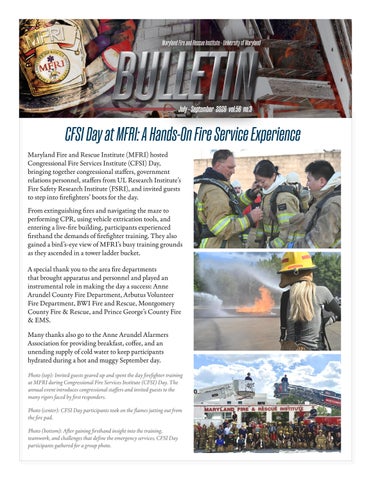
CFSI Day at MFRI: A Hands-On Fire Service Experience Maryland Fire and Rescue Institute (MFRI) hosted Congressional Fire Services Institute (CFSI) Day, bringing together congressional staffers, government relations personnel, staffers from UL Research Institute’s Fire Safety Research Institute (FSRI), and invited guests to step into firefighters’ boots for the day.
From extinguishing fires and navigating the maze to performing CPR, using vehicle extrication tools, and entering a live-fire building, participants experienced firsthand the demands of firefighter training. They also gained a bird’s-eye view of MFRI’s busy training grounds as they ascended in a tower ladder bucket. A special thank you to the area fire departments that brought apparatus and personnel and played an instrumental role in making the day a success: Anne Arundel County Fire Department, Arbutus Volunteer Fire Department, BWI Fire and Rescue, Montgomery County Fire & Rescue, and Prince George’s County Fire & EMS. Many thanks also go to the Anne Arundel Alarmers Association for providing breakfast, coffee, and an unending supply of cold water to keep participants hydrated during a hot and muggy September day.
Photo (top): Invited guests geared up and spent the day firefighter training at MFRI during Congressional Fire Services Institute (CFSI) Day. The annual event introduces congressional staffers and invited guests to the many rigors faced by first responders. Photo (center): CFSI Day participants took on the flames jutting out from the fire pad. Photo (bottom): After gaining firsthand insight into the training, teamwork, and challenges that define the emergency services, CFSI Day participants gathered for a group photo.
2026 July - September MFRI Bulletin The Maryland Fire and Rescue Institute of the University of Maryland is the state’s comprehensive training and education system for all-hazard responses. The Institute plans, researches, develops and delivers quality programs to prepare agencies and individuals to protect life, the environment, and property. Bulletin Staff Managing Editor: Jennifer Ginn Graphics Manager: Ana Maizel Assistant Editor: Jenna Robles-Leone Contact MFRI tel: 301-226-9921 fax: 301-314-0752 www.mfri.org bulletin@mfri.org The Maryland Fire and Rescue Institute Bulletin (MFRI) University of Maryland (ISSN 1074-2298) is published quarterly by the Maryland Fire and Rescue Institute of the University of Maryland, College Park, MD 20742. Send email address changes to: bulletin@mfri.org. The MFRI Bulletin is distributed as a public service of the University of Maryland. The Bulletin is dedicated to the publication of information that will help educate its readers on the subjects of fire protection, emergency medical services, rescue, leadership, and training. This publication may contain some articles and illustrations provided by readers. MFRI does not necessarily agree with information nor endorse any products depicted in the Bulletin. The MFRI Bulletin is produced entirely in house. We extend our sincere gratitude to our contributors who make this publication possible.
For more information on MFRI classes and events www.mfri.org
Executive Director’s Message It is impossible to dispute the changes the fire service has experienced over the last two decades. From personal protective equipment and apparatus to appliances, tactics, building construction, and training props, virtually every aspect of the profession has evolved. At the same time, there has been a tremendous amount of research focused on improving overall safety. One significant area of study has been focused on fire dynamics, with researchers analyzing fire behavior, how conditions change during an incident, and how fireground operations can influence those conditions. Agencies like UL Research Institutes’ Fire Safety Research Institute, along with investigative agencies like the Bureau of Alcohol, Tobacco, Firearms, and Explosives (ATF) have studied, recreated, and modeled fire incidents to better understand these conditions and their impact on fireground operations. The findings from these studies and investigations have contributed to the development of new policies, procedures, practices, and tactics designed to reduce serious injuries and prevent the loss of life among both occupants and emergency responders. This research has led to the design and development of new props that are being used in training environments across the country. I am pleased to report that the Maryland Fire and Rescue Institute is among the organizations bringing these advancements into the training environment. The Institute has purchased new fire dynamics training props and is in the process of training instructors on their use. We are also constructing water-mapping props for all MFRI training centers to provide firefighters with a hands-on understanding of hose stream deployment, water movement, and air entrainment during fire suppression operations. There will continue to be change in the fire service. As new research, technology, and practices emerge, the faculty, staff, and instructors at MFRI will continue to adapt and advance our training to help make this profession stronger, safer, and better prepared to meet the challenges of the future. Michael E. Cox Jr.
page 2
2026 July - September MFRI Bulletin
A Lifetime of Teaching:
Frank Tremel Celebrates 50 Years as a MICRB Instructor When Frank Tremel was presented with a plaque recognizing his 50 years of service as a Maryland Instructor Certification Review Board (MICRB) instructor, the milestone came with an important footnote. Frank had already been teaching at MFRI for 16 years before instructor certification became a requirement. This totals his MFRI teaching career to more than six decades.
The plaque presentation carried special meaning for Michael Schaefer, regional training coordinator at MFRI’s Southern Maryland Regional Training Center and one of Frank’s former pumps students.
“I was honored and privileged to officiate at the presentation,” said Mike, who was a live-in at the College Park Volunteer Fire Department from 2001 to 2005. “Frank was a live-in at the same station from 1958 to 1962, and he was my pumps instructor.” At 18, Frank joined College Park and got involved with the University of Maryland’s Fire Service Extension Department’s pumps school, where Frank learned the fundamentals of pump operations and hydraulics.
Frank eventually became an instructor and continued teaching as he advanced through the ranks of the fire service. His volunteer experience proved valuable during his 43-year career with the D.C. Fire Department, where he ultimately served as deputy fire chief. In his later years with the department, he had the final say on equipment purchases. And teaching remained a constant.
Over the decades, Frank has taught firefighter classes, aerial operations, apparatus operator, and company drill classes. He is best known for teaching pumps. His practical experience, technical knowledge, and ability to connect with students have earned him a reputation as a respected instructor.
Those who have learned from Frank describe an instructor who does more than explain how equipment works. He makes people want to understand it.
“He’s smart, knowledgeable, and he’s a wonderful guy to learn from,” said John Berryman, who met Frank when he was chief at College Park in the 60’s. “I wanted to show him that he was teaching me.” Frank’s impact is found not only in the firefighters he taught directly, but also in the instructors, officers, and leaders those firefighters went on to become.
“He’s the real thing,” Berryman said. “He’s someone I wanted to emulate.” MFRI Executive Director Michael Cox agreed, “Frank was co-instructor of my own pumps class and he was patient, committed, and knowledgeable. As luck would have it, I was assigned to Galesville Fire Department when Frank was chief at the time and we had a lot of interaction.” Tremel’s teaching philosophy has been shaped by a lifetime of experience in both the volunteer and career fire service. For him, technical knowledge and leadership have always gone hand in hand. Photo: Reaching a remarkable milestone, Chief Frank Tremel was recently recognized for his 50-year anniversary as a MICRB instructor. Fittingly, he received a recognition plaque from former student Michael Schaefer, coordinator for MFRI’s Southern Maryland Regional Training Center.
continued on page 10
page 3
2026 July - September MFRI Bulletin
Air Rescue Responders from Puerto Rico Take On HazMat Training Further honing their rescue skills, 36 fire leaders from Puerto Rico’s Air Rescue and Firefighting Unit trained in Hazardous Materials Awareness and Hazardous Materials Operations at MFRI headquarters this fall. With collective responsibility for nine airports in Puerto Rico, the Air Rescue Unit is fulfilling requirements established by the Federal Aviation Administration (FAA). “We are the first to respond to incidents at our airports,” said Fire Chief Efrain Torres Marcano. “Everything learned in this course will be frequently applied and employed at our sites.”
“The HazMat Awareness course focused on identifying hazards and properly notifying the appropriate personnel, which is an essential part of our responsibility,” said Chief Torres. “At the Operational level, participants learned how to establish barriers and contain hazardous materials when necessary.” Classes were led by MFRI instructors Jimmy Artis, Ron Beyerlein, and Robert Gordon. Chief Torres said that the unit is making significant changes to their training, equipment, and personnel development. “The impact of this training and partnership in our community has been very positive. We believe the knowledge and standards we are gaining through training with MFRI are helping us strengthen our capabilities and bringing our first responders to a higher level of preparedness and professionalism.” “For our personnel, the training is an even greater challenge because of the language barrier but the resources and support available at MFRI make it
page 4
the top choice when it comes to taking care of its students.”
MFRI instructor and firefighter Alejandro “Alex” Velazquez served as the class interpreter, with Special Programs Business Manager Raquel Logan and Grace Sokolowski of the Maryland Fire Service Personnel Qualifications Board also providing language support. In total, three groups of firefighters from Puerto Rico came to MFRI for HazMat training this fall. Puerto Rico has more than 1,800 frontline first responders, including state and municipal firefighters, emergency management personnel, paramedics, and volunteers.
Photo (top): Firefighters from Puerto Rico’s Air Rescue Unit trained in HazMat Awareness and HazMat Operations at MFRI headquarters. Photo (bottom left): With responsibility for responding to incidents at nine airports across Puerto Rico, Air Rescue Unit members gained essential knowledge and skills through their training. Photo (bottom right): Members of Puerto Rico’s Air Rescue and Firefighting Unit practiced donning chemical-resistant PPE for HazMat response.
2026 July - September MFRI Bulletin
MFRI Summer Training Builds Skills and Confidence This summer, more than 90 aspiring emergency responders took the next step toward serving their communities through MFRI training.
The North East Regional Training Center in Edgewood guided more than 70 students through accelerated EMT and Firefighter I programs, while 20 students successfully completed Firefighter I at MFRI headquarters in College Park.
At the North East Regional Training Center, two accelerated EMT classes, led by instructors Dave Brown and Ryan Blosser, enabled students to build emergency medical skills through a combination of classroom instruction and hands-on training. Instructor Scott Goldstein also brought his triage trailer to the center, deploying more than 35 moulaged manikins for a realistic triage and treatment exercise. Students remained engaged throughout, applying their knowledge in a practical setting. The training center also hosted an accelerated Firefighter I program led by Instructor Chris Staley.
Despite the summer heat and humidity, recruits remained focused and determined as they worked through the demanding six-week program, developing the knowledge, skills, and confidence needed to begin their careers in the fire service. At MFRI headquarters in College Park, Firefighter I recruits spent the summer building essential fireground skills, including ladder operations, forcible entry, and hose handling. Under the instruction of Michael Schaefer and Ed Rachinskas, they practiced managing hose lines and streams as they prepared for their first realistic, live-fire, controlled scenarios.
Congratulations to all of the EMT and Firefighter I students on their accomplishments. This summer’s training is more than the completion of classes, it is the preparation of capable, confident responders ready to answer the call. A special thanks to the instructors whose expertise, encouragement, and dedication helped guide these students every step of the way.
Photo (top left): This summer, MFRI’s North East Regional Training Center trained more than 70 students through accelerated EMT and Firefighter I programs. Photo (top center): Twenty students completed MFRI’s accelerated Firefighter I class this summer. Photo (top right): NERTC Firefighter I cadets build teamwork and hose-handling skills. Photo (bottom left): NERTC EMT students practice triage and treatment. Photo (bottom right): MFRI Firefighter I students sharpen hose line skills prepping for real-world emergencies.
page 5
2026 July - September MFRI Bulletin
High School Cadets Honor 9/11 Fallen First Responders On September 11, cadets from Charles County High School paused their training to take part in a stair climb at the MFRI Southern Maryland Regional Training Center (SMRTC), honoring the first responders who lost their lives 25 years ago. According to SMRTC Administrative Assistant Linda Carrillo, who documented the day, cadets were told how 9/11 impacted first responder training, and the hazards they faced. “Taking the time to pause and reflect on the sacrifice of the 343 first responders who lost their lives that day 25 years ago is proof that their loss was not in vain,” said Linda. After the commemoration, the cadet class was presented with the final evolution of technical rescue: Common Passenger Vehicle Rescue/ Extrication Course. This scenario involved two vehicles, one inverted on the other, with three adults and one infant that needed to be extricated. Photo: High school cadets participated in a memorial stair climb at MFRI’s Southern Maryland Regional Training Center honoring 9/11 firefighters.
continued on page 11
MFSPQB Celebrates 200,000th Pro Board Certification Rojas received a commemorative plaque, MFSPQB portfolio, and 40th Anniversary challenge coin at the Mechanicsville VFD monthly business meeting.
On August 10, Christopher Rojas of the Mechanicsville Volunteer Fire Department in St. Mary’s County was recognized for earning the 200,000th Pro Board certification issued by the Maryland Fire Service Personnel Qualifications Board (MFSPQB). page 6
The milestone certification was issued February 24, 2026. Like previous recipients milestone certifications, Rojas received a lifetime free MFSQPB certifications for life. Accredited by the National Board on Fire Service Professional Qualifications (Pro Board) and the International Fire Service
Accreditation Congress (IFSAC), MFSPQB celebrates 40 years of service to Maryland’s fire service in 2026.
Photo (left to right): Anne Arundel County Fire Department Deputy Chief Michael Pfaltzgraff, MFSPQB Vice Chair Christopher Rojas; and MFRI Certification Facilitator Bob Rose. Not pictured is Richard Redmond, St. Mary’s County delegate to the MFSPQB, who helped coordinate the presentation.
DON’T DELAY... CERTIFY TODAY!
2026 July - September MFRI Bulletin
INSTRUCTOR HIGHLIGHT Recognizing excellence in fire and rescue training
JEREMY DULIN “When I came into the fire service in 2007 without any prior fire experience, the patch on my shoulder said, ‘Pride Protecting People.’ I took that to heart,” said MFRI instructor Jeremy Dulin. Today, Jeremy is a Firefighter First Class with the Annapolis Fire Department, serving on its dive team and as a tactical medic with the Annapolis Special Emergency Team. He also assists the Training Division and has completed Shipboard and Wildland Firefighting training. Jeremy began his career with the Baltimore City Fire Department and discovered a passion for teaching at the Baltimore City Fire Academy in 2016. He has taught at MFRI for more than three years. “I was inspired to teach because I felt like I had valuable knowledge and skills to share through my experiences as an officer,” he said.
“And I believe in the mission of the fire service.”
develop critical-thinking skills that they’ll carry into the field.”
“Stressful situations regularly encountered on the job require strong coping skills and the ability to act quickly and competently,” he added. “With the right tools and guidance, they can realize their full potential and accomplish what they never thought possible.”
On the training ground, Jeremy gives students 110% and expects the same in return. “I’ll never ask a student to perform a skill that I would not demonstrate first,” he said. “If someone is struggling, I’ll work with them until they’re successful. We all have different strengths and weaknesses. A good leader helps people discover their strengths, overcome weaknesses, build confidence, stay focused, and reach their potential.”
At MFRI, Jeremy teaches Firefighter I and II, Pumps, and Aerial Operator, with Firefighter Safety and Survival among his favorites for its focus on decisionmaking under stress. He also helps teach the statesponsored Annapolis Cadet Program, a partnership between MFRI and the Annapolis Fire Department that prepares young adults for fire service careers. “My goal is for students to be motivated and inspired by my class. I love the fire service, and I hope to spark that same interest and enthusiasm in my students,” said Jeremy. “In the classroom, I like to engage the students and prompt them to demonstrate their knowledge base. Then we can add to that base through dynamic classroom conversations.” “My students can count on me to be fair and honest,” he said. “I try to give context to every skill by sharing situations where a technique worked or didn’t work. Those conversations help students
“There have been many memorable moments, but one of the best parts is seeing students from many different backgrounds succeed,” he said. One encounter stands out above the rest. “I was getting on a rollercoaster with my oldest son and the ride operator told me I was her fire instructor,” said Jeremy. “I was surprised that she recognized me, and it made me think about what an impact a person can make as an instructor. Needless to say, my son and I got to ride in the front row.” Teaching at MFRI keeps Jeremy connected to the fire service community. “The fire department becomes part of your identity after you’ve been doing it for so long. Teaching at MFRI is my way of giving back to the fire service and connecting with old friends and colleagues.” page 7
2026 July - September MFRI Bulletin
The Importance of MFRI Surveys by QA/QI Manager Michael McAdams
Surveys are a critical component of MFRI’s commitment to quality assurance, continuous improvement, and student-centered training.
Through the learning management system (Canvas), surveys provide a structured and efficient mechanism to capture feedback directly from students and instructors across all six campuses and Special Programs.
This feedback serves as a valuable data source for evaluating training effectiveness, identifying strengths, and detecting areas for improvement in course design, instructional delivery, and the overall student experience. continued on page 9
Sparking Interest in Emergency Services Careers In July, twelve high school students came to MFRI’s Western Maryland campus as part of Exploring Careers in Health Occupations (ECHO), an interactive program that introduces students to careers in healthcare and emergency services.
Welcoming the students to campus, MFRI Western Regional Training Center Coordinator Todd Dyche said, “Please ask questions. The people assembled here have a wealth of experience to share.” Under the guidance of an experienced team of first responders, students learned Stop the Bleed techniques, CPR, and tourniquet application. They also toured an ambulance with a paramedic and took part in an introduction to firefighter training by navigating the maze, extinguishing live fire, and practicing hose skills. The weeklong ECHO program also provided students with opportunities page 8
to explore a variety of healthcare settings. Participants visited the R Adams Cowley Shock Trauma Center, the Department of Microbiology, Immunology, and Cell Biology at West Virginia University, Garrett Regional Medical Center, Chase Brexton Health Care, and a local dental practice.
Through these immersive experiences, students gained a broader understanding of the many career opportunities available in healthcare and emergency services while interacting with professionals working in the field. Photo (top): High school students explored careers in healthcare at MFRI’s Western Maryland Regional Training Center learning about the vital roles of first responders. Photo (bottom): EMS training included Stop the Bleed, CPR, and tourniquet use. Students also toured an ambulance with a paramedic from Cresaptown Volunteer Fire Department.
2026 July - September MFRI Bulletin
MFSQPB Presents Donation to the Maryland Fire-Rescue Services Memorial Foundation Once again, the Maryland Fire Service Personnel Qualifications Board (MFSPQB) demonstrated its ongoing commitment to honoring Maryland’s fallen firefighters and rescuers with a generous donation to the Maryland Fire-Rescue Services Memorial Foundation at their annual gala held September 26th in Annapolis, Maryland. Traditionally, the MFSPQB has strived to donate one dollar for each certification issued. Having issued 5,537 certifications in 2025, the MFSPQB upped their contribution this year to $15,000.
continued on page 11
SATURDAY, FEBRUARY 27 AND 28, 2027
James N. Robey Public Safety Training Center 2200 Scott Wheeler Dr, Marriottsville, MD 21104 Presented by the Maryland Fire Chiefs and Maryland Fire and Rescue Institute
The Importance of MFRI Surveys continiued from page 8
From a quality improvement perspective, surveys enable MFRI to move beyond hearsay observations and utilize data-driven decision-making. Student experience surveys help assess clarity of instruction, course organization, and perceived relevance to real-world operations. Instructor assessments provide insight into teaching effectiveness, professionalism, and adherence to curriculum standards. Additionally, instructor feedback on course content allows MFRI to evaluate whether training materials are current, relevant, and aligned with evolving fire, rescue, and EMS practices. Equally important, surveys promote accountability and transparency across the organization. By systematically
collecting and analyzing feedback, MFRI can track trends over time, compare performance across campuses, and implement targeted improvements. The process also reinforces a culture of engagement, where students and instructors feel their input is valued and directly contributes to program enhancement. Ultimately, an effective survey system supports higher levels of student satisfaction, improved instructional quality, and better training outcomes. It ensures that MFRI continues to meet its legislative mandate to educate and train career and volunteer fire and rescue personnel while adapting to the changing needs of Maryland’s first responders.
page 9
2026 July - September MFRI Bulletin
Connecting Hose Streams and Water Mapping to Fire Behavior By Instructor Ed Rachinskas
MFRI has completed construction of a Hose Stream Mechanics/Water Mapping Prop at our headquarters in College Park training facility. Based on research and training concepts developed by the UL Research Institutes’ Fire Safety Research Institute (FSRI), the prop provides firefighters with a hands-on opportunity to see and understand what happens when water and air move through a structure during fire suppression operations. FSRI’s research examined how factors including nozzle type, stream pattern, nozzle movement, flow and pressure, stream location, and application angle influence the distribution of water within a compartment. The research demonstrated that effective water application is strongly influenced by stream placement and angle of impact, reinforcing that firefighters must understand not only how to operate a nozzle, but where the water is going and what surfaces it is actually reaching. MFRI’s prop turns those research findings into a visual learning experience. Its transparent construction allows students to observe water distribution and surface coverage as different stream types, nozzle positions, application angles, movements, and deflection techniques are demonstrated. Flags and lightweight banner strips can also be positioned throughout the prop to visually demonstrate air entrainment and air movement created by the hose stream, helping students recognize
continued on page 12
A Lifetime of Teaching continued from page 3
“I guess bottom line is I enjoy what I do and MFRI gives me the pathway to do it,” he said. That pathway has allowed Frank to continue sharing knowledge with generation after generation of firefighters.
After receiving his plaque, Frank thanked those who took part in the surprise recognition ceremony. “You all really surprised me, and you said some very nice things on that plaque,” he said. “Time has passed much too quickly, but I have made many friends along the way.” And apparently, six decades in the fire service hasn’t slowed him down.
“Now off to do more hay!” Frank said, readying to head back to his 10-acre farm. page 10
2026 July - September MFRI Bulletin High School Cadets Honor 9/11 continued from page 6
Crews worked to stabilize both vehicles, remove all doors and vehicle roofs, and displace both dashboards to gain access to the patients. The complex and strenuous evolution tested each student’s ability to recognize hazards, develop a rescue plan and independently execute the necessary steps to complete the rescue.
SAVE THE DATE!
Join us for a week of leadership development, learning, and connection as nationally recognized emergency services experts explore the current and emerging challenges facing today’s first responder leaders.
Photo: Cadets completed the final evolution of their technical rescue training with a vehicle rescue and extrication scenario. Photos from Linda Carrillo, MFRI SMRTC.
More details coming soon.
Maryland Fire Service Personnel Qualifications Board continued from page 9
The MFSPQB’s cumulative donation to the Foundation over the years now totals over $84,000. Foundation President Dennis Beard expressed his appreciation for the donation, and others received that evening, citing the need for ongoing maintenance and renovations to the memorial. In a lighter moment, Dennis presented a challenge coin to Bob Rose from John Hoglund’s personal collection. Bob reciprocated with one of Mr. Hoglund’s favorite quips, “That’ll be cracker jack.”
Photo (from left to right): Gary Rains, Foundation Board Member; Sharon Owens, Foundation Treasurer; Teresa Ann Crisman, Foundation Board Member; Steven Mandragos, Foundation Vice President; Dennis Beard, Foundation President; Bob Rose, MFSPQB Executive Secretary; Mike Pfaltzgraff, MFSPQB Vice Chair; Teri Heinicke, Foundation Gala Committee Member.
page 11
2026 July - September MFRI Bulletin Connecting Hose Streams and Water Mapping to Fire Behavior continued from page 10
that operating a nozzle moves more than water—it also moves significant amounts of air through the structure. FSRI specifically identifies understanding when air entrainment can be beneficial and when it can work against suppression objectives as an important component of hose stream mechanics.
Most importantly, the prop transforms an abstract concept into something firefighters can see: Where is my water going? What surfaces am I actually cooling? What air am I moving? And how can I use the hose stream more effectively to accomplish my fireground objective?
The prop provides MFRI with a valuable instructional bridge between fire dynamics, hose streams, and fire attack. Students can first learn the science of fire behavior and flow paths, then physically observe how water application and hose streams interact with the compartment environment before progressing into live-fire training.
By incorporating FSRI research into a repeatable hands-on training environment, the MFRI Hose Stream Mechanics/Water Mapping Prop provides an opportunity to move students beyond simply learning how to flow water and toward understanding how to apply water with purpose.
BE PART OF THE FUTURE OF THE FIRE SERVICE AT MARYLAND WEEKEND 2027 Advance your knowledge, strengthen your leadership, and enhance your readiness through specialized training at the National Fire Academy in Emmitsburg.
2027 MARYLAND WEEKEND AT THE NATIONAL FIRE ACADEMY (301) 729-0431 page 12
February 20 / 21 • Emmitsburg, MD tdyche@umd.edu
www.mfri.org