ABOUT THE PROGRAM
Program Notes by Dr. Richard E. Rodda
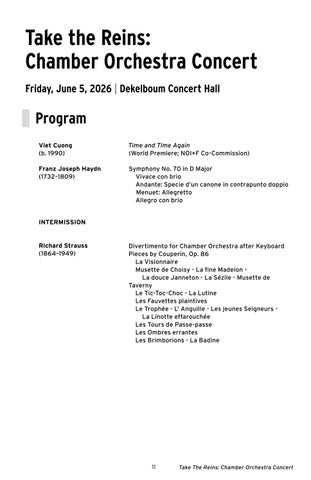
Time and Time Again
Viet Cuong
Time and Time Again suggests recurrence–the quiet familiarity of something returning, never quite the same as before. A gesture resurfaces, a pattern reappears and what once seemed fleeting gradually takes on new meaning through repetition and change.
In Time and Time Again, this sense of return unfolds through a network of musical echoes operating at several different scales. At times gestures seem to echo themselves, their notes repeating and softly tapering, their sounds lingering in the air. These moments ripple outward as other instruments take up the lines in imitative, syncopated counterpoint, creating overlapping chains of reflection across the ensemble. At a broader scale, entire sections of the piece return in transformed forms, revisiting earlier ideas from new vantage points.
The result is a musical landscape shaped by echoes both immediate and distant. The music continually moves forward while glancing back at its own reflections, allowing sounds, gestures, and entire passages to reappear in new forms, time and time again.
Symphony No. 70 in D Major
Franz Joseph Haydn
Since Haydn’s name is so closely associated with the genres of instrumental music, it is perhaps surprising to learn that in the year he wrote this Symphony–1779–he was one of the busiest opera producers in Europe. As part of his duties at Esterháza Palace he was not only responsible for the regular Tuesday and Saturday instrumental concerts, but he was also in charge of the opera and marionette theaters. He composed music for all these functions, organized the repertory and performers, oversaw the music library and instrument collections, and conducted the performances. To say that he was busy is to seriously understate his situation.
With so much of the social life at Esterháza focused around its magnificent theaters, the fire that devastated the opera house on November 18, 1779 was a stunning calamity. Not only was the building a complete loss, but the costumes and sets, many valuable musical instruments, and much of Haydn’s performance library were consumed by the flames. Prince Nicolaus was not to be denied his passion for opera by a mere conflagration, however. The
premiere of Haydn’s most recent opera, L’isola disabitata, composed for the name-day of Nicolaus, December 6, was moved to the intimate confines of the marionette theater (whose stage was specially renovated to accommodate the full-size singers) and plans were instituted immediately for the rebuilding of the opera house. Within a month of the fire, the building’s gutted shell had been razed, the specifications for its replacement drawn up, and a ceremony organized for the laying of the cornerstone of the new theater on December 18. Haydn wrote the Symphony No. 70 in D Major as the centerpiece for that program. The new opera house was projected to be completed by the following December, but bad weather and inadequate planning delayed its opening until February 1781, when Haydn again took up the full range of his exhausting duties.
The Symphony No. 70, one of Haydn’s most daring and austere creations, is rooted throughout in the tonality of D, though it finds stark contrast in the juxtaposition of the cheerful major-mode side of that key and its dark minor-mode counterpart. The Symphony opens in sun-bright D Major with the bounding, energetic material that provides the thematic source for all that follows in this compact, sonata-form movement.
The following Andante, which Haydn labeled “canon in double counterpoint,” is quite another matter. A “canon” is a piece in strict imitation (i.e., all the lines are derived from a single melody–Row, Row, Row Your Boat, for example, is a canon), and here two separate canons are going simultaneously, a not inconsiderable feat of compositional technique. The form of the movement is built from the alternations of the somber opening strain and a more cheerful episode in D Major.
The Menuet exudes the high spirits and good cheer that usually characterize Haydn’s movements in that form, but the central trio, despite maintaining the D major tonality of the Menuet, is startlingly barren, composed of two wandering, skeletal melodic lines, unsoftened by a single harmony, that move about tentatively before simply stopping on a quizzical, unsettled note. The return of the Menuet rounds out the movement’s form, but does not resolve the expressive ambiguity posed by its trio.
The finale is extraordinary. It begins with five isolated, repeated notes, equivocally harmonized, sounded high in the violins and tried out several times before the music
pauses on a soft, held chord. The movement, now clearly settled into the stern key of D Minor, then launches into a wondrous contrapuntal maze woven from three separate themes, one of which incorporates the repeated notes. After the vigorous working-out of this masterful exercise, the music again stops and then resumes with the recall of the opening measures. Only in the closing page of this remarkable, eccentric Symphony does the work’s nominal tonality of D Major finally return, and even then it supports nothing more than a greatly compressed reminiscence of the earlier three-voice counterpoint and a few more iterations of the repeated-note motive.
Divertimento for Chamber Orchestra after Keyboard Pieces by Couperin, Op. 86
Richard Strauss
Part and parcel of early-20th-Century music was an interest in bygone times and ancient styles. Stravinsky looked to Giovanni Pergolesi for material for his Pulcinella in 1920. (“A good composer doesn’t borrow,” Stravinsky asserted. “He steals.”) Respighi issued his first set of Ancient Airs and Dances, beguilingly arranged for chamber orchestra, in 1917. In that same year, Vincenzo Tommasini transcribed a clutch of Domenico Scarlatti’s sparkling keyboard sonatas as the ballet The GoodHumoured Ladies, and Ravel completed Le Tombeau de Couperin as a tribute to his distinguished predecessor. In 1912, Richard Strauss joined this expedition of historical spelunkers with his interpretation of 17thcentury French aristocratic society in some incidental music for Molière’s Le Bourgeois Gentilhomme. Though the music evoked the style of Jean-Baptiste Lully, chief composer to the glittering court of Louis XIV, Strauss composed everything anew except for two themes borrowed from Lully.
Strauss’ next foray into the courtly world of old France brought him closer to the musical source. In 1922, when he held the prestigious position of music director at the Vienna Opera, he devised a special entertainment for the upcoming carnival season, the round of seemingly endless parties and balls known as Fasching that is still a fixture of Viennese social life. The centerpiece for the soirée was to be a set of dances performed by the corps de ballet of the Vienna Opera to arrangements for orchestra of the music of
François Couperin. Strauss himself undertook the transcriptions, and the ballet, François Couperin: Aristocratic and Theater Dances in the Style of Louis XV arranged by Richard Strauss, was presented in the Redoutensaal of the Hofburg on February 17, 1923. Strauss extracted eight movements from the score that were published as the Couperin Tanzsuite (“Dance Suite”).
In 1940, the conductor Clemens Kraus approached Strauss, who withdrew from public life to his villa in GarmischPartenkirchenduring World War II, with a proposal to revive the Couperin ballet. Krauss suggested that the work be extended by the addition of several more Couperin transcriptions, and that it be re-choreographed following the style of the French ballet master Le Feuillet, who flourished in Paris around 1700. Strauss agreed to the project, and the new production was premiered in Munich on April 5, 1941 with the title Verklungene Feste (“Bygone Festivals”). It was from the score for this work that Strauss derived the Divertimento, Op. 86, using different excerpts than those in the earlier Dance Suite.
Strauss’ tasks in these various undertakings consisted of selecting individual movements from the vast storehouse of Couperin’s works for harpsichord, ordering them in an appropriate sequence, and enfolding the originals in the luscious sounds of the post-romantic orchestra. He made few changes in the notes of the source works, but he did delete repeats, enrich textures and compose some connecting tissue to join these miniatures into groups of two or more continuous selections. The effect created by these orchestrations differs greatly from the harpsichord’s brittle clangor, for which this music was originally fashioned. Strauss’ reworkings of Couperin’s pieces are rather a tonal equivalent of schlag–whipped cream–that heavenly confection applied to seemingly every Viennese baked good: a calorific Sacher torte rather than an airy brioche.