ABOUT THE PROGRAM
Echoes of Rome
by Maggie Molloy
When in Rome, do as the Romans do! We’re happy to oblige in the kaleidoscopic musical voyage that is Ottorino Respighi’s Roman Trilogy. History knows it as the “Eternal City,” the ancient Romans believing that no matter what happened in the world, no matter how many empires rose or fell, the glory of Rome would live on forever. From the soul-stirring celebrations of Rome to the sparkling fountains, the epic legends, and the towering pine trees watching over it all, Respighi invites us to discover the treasured city that inspired so much of his life and work.
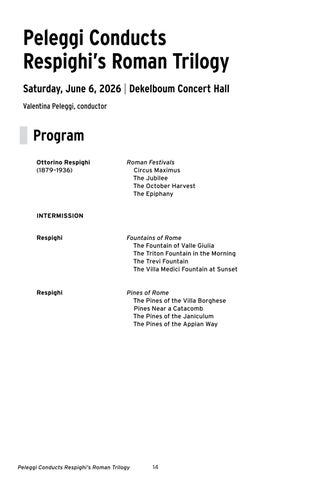
Roman Festivals
Ottorino Respighi
The best way to get to know a place is through its people–and Ottorino Respighi is proud to be our tour guide. He offers us a front row seat to the history, culture, rituals and religion of Rome in this expansive orchestral showpiece. Originally conceived as the extravagant finale to his Roman Trilogy, Respighi’s Roman Festivals are bursting with symphonic color. From trumpets and horns to tam-tams, tambourines and snare drums, he lavishly expanded the brass and percussion sections of the orchestra. He pushed the limits of early 20th Century orchestral size and volume to paint a magnificent, awe-inspiring portrait of Rome–in all its glorious splendor. Drawing on celebrations both ancient and contemporary, each movement captures a glimpse into the enduring spirit of Rome, painting a portrait of Respighi’s beloved city that transcends time, memory, and spectacle.
I. Circus Maximus
Beneath the mottled light of a thunderous sky, we step inside the Circus Maximus, the greatest stadium in ancient Rome–and possibly in human history. Trumpet fanfares announce the grim spectacle about to unfold. As the heavy iron gates unclench, a surge of gladiators storms forth, readying the strength to fight before a frenzied crowd. Their prayers swell above the snarl of the beasts, a religious hymn rising through the stadium before ultimately being drowned out in the tumult.
II. The Jubilee
In true Roman Catholic fashion, the brutal violence is followed by a cleansing of sins. In the Catholic Church, a Jubilee Year is a
kind of spiritual reset, a year of grace and forgiveness of sins, debts and misdeeds. As a crowd of medieval Catholics make the long pilgrimage to the Holy City, we hear their shouts of joy as they catch a glimpse of the summit of Monte Mario, the highest hill in Rome offering a gateway view to the city. Their hymn of praise bursts forth from the hilltop, answered in glorious triumph by the metallic peal of the Roman church bells below.
III. The October Harvest
A bountiful harvest is celebrated with hunting, drinking, dancing and romancing late into the evening. Through Respighi’s warm orchestration we are swept away to the rolling hills of the Roman countryside, where a vine-covered castle provides a romantic backdrop for this wine-fueled celebration. Horns soar, strings swell and bells chime in this enchanting Roman postcard. And as the sun goes down and twilight falls upon the happy evening, a tender mandolin serenade greets the stars above.
IV. The Epiphany
A sea of revelers spills into the Piazza Navona (one of Rome’s central squares) on the night before the Epiphany. We’re jostled around the boisterous crowd, wading our way through the clamor of trumpets, lively street music and merry folk dancing. Dense in color and saturated in sound, with a keen ear you might catch the organ grinder’s melody swirling past the carnival lights, or a drunken trombone stumbling across our path. But the joyous noise grows steadily into something bigger, and as we make our way across the square, we hear these wide-ranging musical threads converge into a single confetti burst of sound—bombastic, cinematic and full of life.
Fountains of Rome
Ottorino Respighi
Imagine sitting down at a blank canvas with some art supplies and trying to draw a fountain. Not a very simple task! How do you create movement? How do you capture the elusive color of the water, or the light mist sparkling around each little splash? The Fountains of Rome is an exercise in doing precisely that—Ottorino Respighi used the orchestra as his canvas to capture the spirit and essence of four different Roman fountains at four different times of day, observing all the changes in light,
color, texture and energy. In Respighi’s own program note for the piece, he described it this way: “In this symphonic poem the composer has endeavored to give expression to the sentiments and vision suggested to him by four of Rome’s fountains, contemplated at the hour in which their character is most in harmony with the surrounding landscape, or in which their beauty appears most impressive to the observer.” Water spritzing softly upon our faces, we listen as Respighi gushes about the history and mythic legends of the Eternal City–and the epic fountains within.
I. The Fountain of Valle Giulia at Dawn
Our day begins with the damp mist of a Roman dawn, the sun slowly rising over a pastoral scene with cattle grazing in the countryside. In the stillness of the morning light, we see the colors and shadows shifting around the edges of this charming fountain, with stone turtles meandering slowly around its broad basin. The fountain’s modest height and simple design blends into the beauty of the surrounding landscape, offering a glimpse of Rome as a quiet, living landscape awakening to the day ahead.
II. The Triton Fountain in the Morning
A loud and joyous horn call swiftly announces our arrival to the Triton Fountain: it’s the thundering conch shell of the mythological Triton, son of Poseidon, god of the sea. As the day awakes, we hear Triton summoning troops of naiads, fish, and salty sea life, who splash, play, dance and chase one another through the squirting jets of water in a sparkling celebration of life.
III.
The Trevi Fountain
By midday we’re standing, jaws dropped, before the mythic Trevi Fountain: the largest fountain in Rome, set against the opulent backdrop of the Palazzo Poli. In full daylight, we see the sunlight glistening off each cascading stream, the marble figures alive and in motion. Bold brass and sweeping strings depict the triumphant Titan Oceanus, riding in a shell-shaped chariot pulled by sea horses and guided by two Tritons. One Triton is calm and orderly, a symbol of controlled waters—while the other captures the turbulent, unpredictable power of the sea. As we gaze upon this Baroque spectacle, awestruck in its mist, we reflect on the majestic balance and harmony of nature.
IV. The Villa Medici Fountain at Sunset
All epic adventures must eventually come to an end–and our fountain tour of Rome draws to a close at the nostalgic hour of sunset, our literal (and figurative) cup overflowing as we contemplate the wide, elegant coupe that forms the Fountain of the Villa Medici. Its Renaissance design speaks to the ideals of ancient Rome, where fountains and aqueducts represented civic greatness. Overlooking the city of Rome, the sky alive in washes of orange and pink, we find a quiet, peaceful oasis to end our day of travel. Bells are heard tolling in the distance, birds chirping, and leaves rustling as the sherbet skies slowly melt into night.
Pines of Rome
Ottorino Respighi
On a hot summer day in Rome, you might find some sweet reprieve under the shade of the pine trees—with their tall, thin trunks bursting into huge canopies at the top, almost like a broccoli bloom. They’re sometimes called the “parasol pines.” The pines have been in Rome since ancient times, where they once watched over the likes of Julius Caesar and Marcus Aurelius. They can grow between 60 and 80 feet tall, and they’re the source of those delicious little pine nuts we enjoy in pesto, salads and cookies.
Ottorino Respighi must have spent many an afternoon under those trees, because he started to hear a kind of music in them; a kind of poetry in the leaves rustling beneath the sizzling Roman sun. He takes us for a tour in the Pines of Rome. Strolling arm-inarm with Respighi through his beloved city, we discover the music and stories hidden within.
I. The Pines of the Villa Borghese
Our tour begins at the gardens of the Villa Borghese, one of the largest public parks in Rome. Children laugh and shout as they dart amid the pine groves, playing soldiers, by turns marching and fighting, chanting and dancing. Bursting with sun and sparkle, the music swoops and swarms, ending just as quickly as it began-with the children dashing off into the distance in pursuit of the next game!
ABOUT THE CONDUCTOR
Valentina Peleggi
Valentina Peleggi has been Music Director of the Richmond Symphony (Virginia) since the 2020-2021 Season and recently renewed her contract to Summer 2028, having already revitalized the orchestra’s artistic output. While focusing on developing the orchestra’s own sound she has also launched new concert formats, joined national co-commission partnerships, started a three-year composerin-residence program, launched conducting masterclasses in collaboration with the local universities and championed neglected composers from diverse backgrounds. During the pandemic she sat on the jury of the first virtual Menuhin Competition hosted by the Richmond Symphony.
In 2025-2026, Peleggi returned to the Pacific Symphony and made her Australasian debut with the Tasmanian Symphony and New Zealand Symphony, championing works by Puccini, Verdi and Rossini. Peleggi’s past guest appearances in North America have included the Chicago, Dallas, Baltimore, New World, Kansas City, Indianapolis, Colorado and Vancouver symphonies and at the Grant Park Music Festival. In Europe, she has previously conducted the London Philharmonic, Royal Philharmonic, BBC National Orchestra of Wales, Ulster Orchestra, Brussels Philharmonic, Liege Philharmonic, Antwerp Symphony, Nuremberg Symphoniker, Gulbenkian Orchestra, Norrkoping Symphony, Orchestra della Toscana, Pomeriggi Musicali di Milano and Arena di Verona orchestras; she has also conducted at the Teatro Colon in Buenos Aires.
Opera (especially bel canto) is a vital part of Peleggi’s activity. In May 2025, she debuted at Opera de Rouen and in Paris at the Theatre des Champs-Elysees with Rossini’s Semiramide, and in 2026 she will return to Opera North to lead the production of The Marriage of Figaro at the Opera North. She has previously conducted Le Comte Ory with the Philharmonia Orchestra at Garsington Opera and Rigoletto at the Teatro Verdi in Trieste, and made her Opéra de Lyon debut with Piazzola’s Maria de Buenos Aires. Whilst a Mackerras Fellow at English National Opera in 2018 and 2019 she conducted a wide range of repertoire including Carmen and La bohème.
The year 2021 saw the release of her first CD, featuring a cappella works by Villa Lobos in a new critical edition for Naxos guest edited by Peleggi and performed by the São Paulo Symphony Chorus, where she returned in 2023 to conduct an a cappella concert. While acting Principal Conductor and Artistic Advisor of the Chorus, she was concurrently Resident Conductor of the São Paulo Symphony Orchestra and Music Director (responsible for Italian repertoire) of the Theatro São Pedro in São Paulo.
The first Italian woman to enter the conducting program at the Royal Academy of Music of London, she graduated with distinction and was awarded the DipRAM for an outstanding final concert, as well as numerous other prizes, and was recently honored with the title of Associate. She furthered her studies with David Zinman and Daniele Gatti at the Zurich Tonhalle and at the Royal Concertgebouw masterclasses. She won the 2014 Conducting Prize at the Festival International de Inverno Campos do Jordão, was awarded a Bruno Walter Foundation Scholarship at the Cabrillo Festival of Contemporary Music in California and received the Taki Alsop Conducting Fellowship 2015-2017 under Marin Alsop.
Peleggi holds a master in conducting with honors from the Conservatorio Santa Cecilia in Rome, and in 2013 she received the Accademia Chigiana’s highest award, going on to assist Bruno Campanella and Gianluigi Gelmetti at Teatro Regio di Torino, Opera Bastille Paris, Lyric Opera of Chicago, Teatro Regio di Parma and Teatro San Carlo. She also assisted on a live worldwide broadcast and DVD production of Rossini’s Cenerentola with the Orchestra Nazionale della RAI. From 2005 to 2015 she was the Principal Conductor and Music Director of the University Choir in Florence and remains their Honorary Conductor, receiving a special award from the Government in 2011 in recognition of her work there.
Peleggi is passionate about the arts and holds a Master in Comparative Literature.