Saturday, May 30, 2026 | Dekelboum Concert Hall
John Morris Russell, conductor
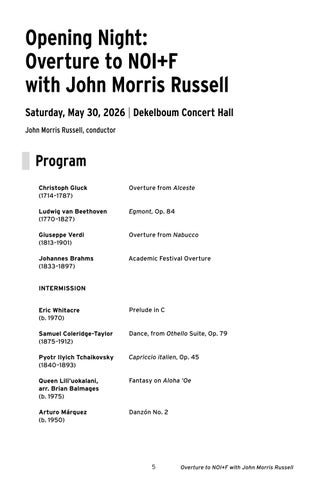
Saturday, May 30, 2026 | Dekelboum Concert Hall
John Morris Russell, conductor
Christoph Gluck (1714–1787)
Ludwig van Beethoven (1770–1827)
Giuseppe Verdi (1813–1901)
Johannes Brahms (1833–1897)
INTERMISSION
Eric Whitacre (b. 1970)
Samuel Coleridge-Taylor (1875–1912)
Pyotr Ilyich Tchaikovsky (1840–1893)
Queen Lili’uokalani, arr. Brian Balmages (b. 1975)
Arturo Márquez (b. 1950)
Overture from Alceste
Egmont, Op. 84
Overture from Nabucco
Academic Festival Overture
Prelude in C
Dance, from Othello Suite, Op. 79
Capriccio italien, Op. 45
Fantasy on Aloha ‘Oe
Danzón No. 2
by Maggie Molloy
When you finally sit down at a restaurant you’ve been dying to try, mouth watering and stomach growling, it can be difficult to pick just one single entrée. And you shouldn’t have to! The Spanish got it right when they invented tapas: small, shareable plates that allow you and your dining companions to try a little bite of everything.
At the musical feast that is the National Orchestral Institute + Festival, this Opening Night concert is designed to be a table full of “tapas.” Overtures, preludes, fantasies and dances that are concise, colorful and bursting with flavor. “You get all of these little plates that are so distinctively Tchaikovsky, so distinctively Beethoven,” says conductor John Morris Russell. “And you don’t have to invest 45 minutes in a big symphonic work to get to know what each composer is about. For new listeners, it’s really nice because you get this wide pastiche.”
As the program shapeshifts through different eras and styles of music, the audience (and the musicians, too) discover new connections between composers. Some pieces may share similar themes or even ingredients, but each tells its own unique story.
The first half of the program begins where all great stories do, with overtures that set the stage and offer a taste of the music to come. In the United States, as we look ahead to the 250th Anniversary of the Declaration of Independence this summer, we hear how the human struggle for freedom and selfdetermination is threaded into the fabric of each of these works. “We hear composers dealing with the same concepts of freedom and independence but seeing it through a world view as opposed to just our view here in North America,” says Russell.
On the second half of the program, we widen our aperture to orchestral miniatures that speak to the deeply human yearning for beauty, connection and adventure. As we reflect on the state of our country and our world today, it’s music that reminds us of the importance of gathering, creating, and cultivating community with one another. “As musicians, our role in society is to tell stories and to bring people together,” says Russell, “And to raise people up to high ideals.”
In a world increasingly dominated by technology and artificial intelligence, the concert hall remains one of few cherished spaces to unplug from screens and connect with one another. Performances like this one, for audiences and musicians alike, invite us to participate in a centuries-old tradition celebrating the human imagination and spirit. “Some people say symphonic music is dying,” Russell says. “But actually, I think it’s becoming a lot more precious and a lot more vital.”
As we celebrate together during the Opening Night concert of the 2026 National Orchestral Institute + Festival, thank you for sharing in the music with us.
Christoph Gluck
“At the height of the Independence Movement in the United States that compelled us to write the Declaration of Independence,” Russell says, “Alceste was premiering in Paris.”
We travel across the pond for Christoph Willibald Gluck’s operatic tale of love and sacrifice. When King Admeto of Thessaly is on his death bed, his wife Queen Alceste offers her life to the gods in exchange for his. As she says her tearful goodbyes, he follows her into the underworld, determined not to live without her. But just as all hope is lost, the heavens open and Apollo descends in a bursting ray of light, proclaiming that the gods have restored both their lives as a reward for their steadfast love.
On both sides of the Atlantic Ocean, we hear how messages of bravery, sacrifice and liberation were resonating with audiences of the late 18th Century. “It’s a deeply emotional, psychological drama that set the stage for a lot of Romanticism to come,” says Russell. “So, we wanted to start off with a piece that was actually written at the same time as our country was beginning.”
Ludwig van Beethoven
Freedom of thought and freedom of expression were close to the heart of Ludwig van Beethoven, who often explored the role of the artist as a hero in his music. He felt that he himself was on a heroic quest to push the boundaries of classical music.
So naturally, Beethoven was drawn to the heroic tale of Count Egmont who, in the 16th
Century, campaigned for the liberation of the Netherlands from Spanish control. His subsequent beheading sparked the national uprising that eventually led to the independence of the Netherlands. Egmont’s tragic story is recounted in full dramatic splendor in Johann Wolfgang von Goethe’s 1788 play of the same name, for which Beethoven composed this music.
“The story of Egmont is all about freedom,” says Russell. “And it has a lot of parallels to the Age of Enlightenment and the idea of freedom of people over kings and queens. And so, the same theme that our Founding Fathers were expressing are in this music drama, Egmont.
Giuseppe Verdi
If you think politics have no place in the concert hall, think again! Many of Giuseppe Verdi’s operas had deep political resonance for the people of 19th century Italy—though in the case of an opera like Nabucco, the political message was cleverly hidden beneath a Biblical story to avoid censorship.
The opera follows the plight of the Jews as they’re conquered and exiled from their homeland by the Babylonian King Nabucco. The power-hungry Nabucco eventually repents, though not before declaring himself a god, sinking into raving madness, and losing control of the kingdom to his ambitious daughter. In the end, the remorseful Nabucco embraces humility and faith and helps free the Hebrew slaves from captivity.
Here’s where things get interesting. Verdi was writing at a time when Italy was divided among many different powers in Europe, and there was a political movement to unify Italy and establish independence from foreign rule. “There were the powers that be in the intellectual community and political community who tried to send this message all over Italy,” says Russell. “And they did it through Verdi’s operas.” It didn’t take much for the Italian people to hear parallels to their own story. “All of Verdi’s operas in this time period were about freedom and people wanting to come together to break the chains of the oppressor,” says Russell. “The main theme of the opera Nabucco is called Va, pensiero, which means essentially, Go and fly. And it’s the song of the Hebrew slaves.”
Through operas like Nabucco, Verdi became a national hero in Italy. The slogan “Viva VERDI!” was even used as a covert expression of support for a unified Italy, an acronym standing for “Viva Vittorio Emanuele Re D’Italia (Long Live Victor Emmanuel, King of Italy).” “Even Verdi’s name itself was this call for freedom,” says Russell.
Verdi’s music not only helped to inspire a nation, but it unified its people around a common Italian identity and language. As we consider the ever-changing role of the artist in the 21st century, stories like Verdi’s remind us of the soul-stirring power of music to change the world.
Johannes Brahms
“This one’s a party piece, let’s be honest,” laughs Russell. “It’s youthful, it represents the new generation and all of our young musicians coming into the world with their bright optimism.” In the midst of another graduation season, Johannes Brahms reminds us to celebrate not only the academic achievements but also the camaraderie, energy and joyful community that can be found in places of learning.
Suffice to say, Brahms didn’t take himself too seriously when the University of Breslau awarded him an honorary doctorate in 1880. In fact, when the conductor who nominated him for the degree convinced Brahms that he should write some music for the ceremony, his cheeky response was to compose this Academic Festival Overture. The joke was that Brahms filled the piece with student drinking songs (beautifully orchestrated, of course).
Brahms’ clever blend of academic pomp and playful satire drew plenty of laughter and applause from the new graduates, who would have known the melodies by heart. Brahms himself conducted the premiere at the ceremony, where he accepted his honorary doctorate with his tongue firmly planted in cheek. “It’s just so joyous and life-affirming,” says Russell. “A great way to end the first half.”
Eric Whitacre
At some point or another, every piano student learns Johann Sebastian Bach’s Prelude in C, the first piece from The Well-Tempered Clavier. But we hear this familiar melody through new ears in this breathtaking orchestral work from composer Eric Whitacre, an old friend of tonight’s conductor. The piece was originally co-commissioned as part of a celebration of Russell’s 10-year anniversary as conductor of the Cincinnati Pops Orchestra.
“As he likes to describe it,” Russell says of Whitacre, “It was like if Bach had written the music out in ink and while the ink was still wet, he had taken his hand off it and just kind of blurred all the lines.” The individual lines of music seem to stretch and blur together like paint across the canvas, the perfect music to set the stage for the beauty and color of the second half. “It slows down your pacing, how you’re viewing the world,” says Russell. “Your heart rate goes down, and you open up your ears to a different time.”
Samuel Coleridge-Taylor
When you’re telling a grand and epic story, there are some things words alone can’t communicate—even if you’re William Shakespeare. That’s where music comes in handy. Samuel Coleridge-Taylor originally composed his Othello Suite as incidental music for a 1912 production of this classic Shakespearean tragedy at His Majesty’s Theatre in London. We’re swept straight into the action with this opening “Dance,” which sets the stage for the elegant and noble world of Othello—and hints at the drama yet to unfold. Coleridge-Taylor crafts an atmosphere of order and social harmony that becomes increasingly fragile as we descend into a tale of manipulation, jealousy, and betrayal. It’s all the drama of Shakespeare—without any of the words!
Pyotr Ilyich Tchaikovsky
Sometimes a change of scenery is all it takes to spark new inspiration. Especially if that change of scenery involves delicious food and wine, centuries of art history and music in the streets.
It’s no wonder Pyotr Ilyich Tchaikovsky found music on his visit to Rome during the festive Carnival season of 1880. He was there to escape his disastrous marriage—and he had come to the right place: extravagant street parties, lively music, the colorful costumes of Carnival. There, perhaps lounging on a villa balcony or sipping espresso at a sidewalk café, he began sketching melodies for his Capriccio Italien, which begins with the bugle call he heard echoing from the barracks next to his hotel room each morning.
Queen Lili‘uokalani (arr. Brian Balmages)
The Hawaiian word aloha means both “hello” and “goodbye”–but beyond simple greetings and farewells, it also carries the Native Hawaiian values of love, compassion, unity and respect. These are precisely the messages expressed in Aloha ‘Oe by Queen Lili‘uokalani, the last sovereign monarch of the Hawaiian Kingdom. Composed in 1878, the tune was originally inspired by the sight of two lovers parting after a deep embrace–but has since come to represent the farewell of a queen to her country and a heartfelt lament for the loss of Hawaiian sovereignty. “It’s just such a beautiful untold story of America–the good, the bad and the ugly,” says Russell. “But at the same time, it’s just such a gorgeous piece and a deeply emotional work.”
John Morris Russell

John Morris Russell’s embrace of America’s unique voice and musical stories has transformed how orchestral performances connect and engage with audiences. As conductor of the world-renowned Cincinnati Pops Orchestra since 2011, the wide-range and diversity of his work as a musical leader, collaborator and educator continues to reinvigorate the musical scene throughout Cincinnati and across the continent. As music director of the Hilton Head Symphony Orchestra in South Carolina, Russell conducts the classical series as well as the prestigious Hilton Head International Piano Competition.
A GRAMMY®-nominated artist, JMR has worked with leading performers from across a variety of musical genres, including Aretha Franklin, Emanuel Ax, Amy Grant and Vince Gill, Garrick Ohlsson, Rhiannon Giddens, Hilary Hahn, Brian Stokes Mitchell, Cynthia Erivo, Sutton Foster, George Takei, Steve Martin, Brian Wilson, Leslie Odom, Jr., Lea Salonga, Mandy Gonzalez, Rick Steves and Bob Weir.
A popular guest conductor, Russell has worked with the Chicago Symphony Orchestra, Los Angeles Philharmonic, The Cleveland Orchestra, New York Philharmonic, the Boston Pops and the National Symphony Orchestra of Washington, D.C. He frequently conducts Canadian orchestras including Toronto, Calgary and Vancouver, and has led the orchestras of St. Louis, Milwaukee, Pittsburgh, Detroit, Houston, Indianapolis, Dallas and Minnesota; Utah Symphony, Oregon Symphony, Colorado Symphony and New Jersey Symphony. His work in opera and musical theater includes Cincinnati Opera, where he conducted its first production of Hans Krasá’s Brundibár, and the world premiere of Blind Injustice, which was released on CD in 2021. He has also worked with Wolf Trap Opera, New York City Ballet and led semi-staged productions of The Music Man and Ragtime with the Cincinnati Pops.
For over two decades, Mr. Russell has led the Cincinnati Symphony Orchestra’s wildly successful Classical Roots program, honoring and celebrating Black musical excellence, which has garnered record-breaking, inperson and online audiences. Featured artists have included Marvin Winans, Alton White, George Shirley, Common, Donald Lawrence and Hi Tek, as well the 150-voice Classical Roots Community Chorus, Nouveau Chamber
Players, and hundreds of regional actors, dancers, artists, singers and musicians.
Russell has contributed seven albums to the Cincinnati Pops Orchestra discography, including 2023’s holiday album JOY!. In 2015, he created the “American Originals Project” which has won both critical and popular acclaim, and two landmark recordings: American Originals (the music of Stephen Foster) and the GRAMMY® nominated American Originals 1918 (a tribute to the dawn of the jazz age). Other American Originals concerts have included King Records and the Cincinnati Sound with Late Show pianist Paul Shaffer in 2020, honoring legendary recording artists associated with the Queen City, and Harlem Renaissance with renowned jazz pianist Marcus Roberts, to be released in a live recording in Spring 2026. In 2025, JMR served as co-producer and conductor of American Public Television’s Rick Steves’ Europe: A Symphonic Journey carried on PBS stations from coast to coast. During the Pops 25/26 season JMR performs Peter Boyer’s newest work American Mosaic with celebrated actor Martin Sheen. Russell’s American Soundscapes video series with The Pops and Cincinnati’s CET Public Television has surpassed one million views on YouTube since its launch in 2016.
John Morris Russell served as music director of the Windsor Symphony Orchestra between 2001 and 2012 where he conducted over 40 world premieres and recorded the Juno Award-nominated album of Prokofiev’s Peter and the Wolf. During his time with the WSO, he was a two-time recipient of Ontario’s Lieutenant Governor’s Award for the Arts. In 2011 the University of Windsor awarded him an Honorary Doctorate and the following year he was named the WSO’s first Conductor Laureate. JMR recently concluded his nine-year tenure as Principal Pops Conductor of the Buffalo Philharmonic Orchestra, following in the footsteps of Doc Severinsen and Marvin Hamlisch.
John Morris Russell earned degrees from the University of Southern California, Los Angeles, and Williams College in Massachusetts, and has studied at the Guildhall School of Music and Drama in London, The Cleveland Institute of Music, the Aspen Music Festival and School in Colorado, and the Pierre Monteux School for Conductors in Hancock, Maine.