ABOUT THE PROGRAM
Program Notes by Dr. Richard E. Rodda
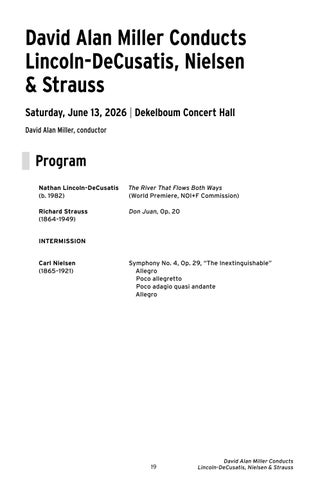
The River That Flows Both Ways
Nathan Lincoln-DeCusatis
The River That Flows Both Ways is a journey in sound tracing the path of the Hudson River, a watercourse unique in that it changes the direction of its flow based on the influence of the tides. After years of outdoor exploration along its path, the river seems like an old friend and a beacon that has led me to countless adventures in the mountains, waterfalls, waterways and dramatic landscapes that it shapes and frames along its course.
This piece takes its flow and form from the river itself and uses the natural landmarks surrounding the Hudson as episodes on a musical journey southward that spans from its headwaters in the Adirondacks to its dramatic terminus in New York City. We begin in icy stillness high on Lake Tear of the Clouds below Mt. Marcy with metallophone percussion and string harmonics evoking melting snow at the river’s point of origin. After rushing through the Hudson Gorge during the spring run-off, the second section traces the slowly building energy of the river as it receives its tributaries, beginning with pointillistic string pizzicato and percussion and building to climactic brass fanfares at the confluence with the Mohawk.
The fast-moving creeks and waterfalls draining out of Catskills are passed around the violins and instrument choirs in fast toccata-like runs until the introduction of a maestoso “mountain chorale” in the brass that signals the Wind Gate where the river narrows as it rushes through a dramatic pass in the Hudson Highlands. A dramatic climax in the full orchestra is suddenly interrupted by the entry into the tidal estuary where the river reverses course, and the opening idea returns like a memory of the river’s origin.
From this dream-like world, the river widens into the Tappan Zee, a broad inland lake that is represented by an ascending lyrical melody in the strings until spiraling forte-pianos announce the sharp, vertical diabase cliffs of the Palisades. The finale of the piece is the “Metropolis,” a mosaic of overlapping, pulsating rhythms that brings us to the river’s end in New York City, where, after reversing course a few times to recall earlier themes, it finally empties into the Atlantic in a dramatic finish.
Don Juan
Richard Strauss
For the program of his tone poem inspired by Don Juan, Strauss went not to da Ponte, the librettist of Mozart’s Don Giovanni, nor the Spanish authors who were the source of the fantastic character, but to the 19th Century Hungarian poet Nicolaus Lenau. In the author’s words, “My Don Juan is no hotblooded man, eternally pursuing women. It is the longing to find a woman who is to him womanhood incarnate and to enjoy in the one all the women on earth whom he cannot as individuals possess. Because he does not find her, although he reels from one to another, at last Disgust seizes hold of him, and this Disgust is the Devil that fetches him.”
In Lenau’s version, Don Juan meets his death in a sword duel with the father of one of the women he has seduced. Disillusioned and empty, ready for death, he drops his guard and welcomes his fate.
Strauss’ tone poem captures the feverish emotion and charged sensuality of Lenau’s drama, but other than three abstruse excerpts from Lenau’s poem that appear in the score, the composer never gave a specific program for Don Juan. (He learned early that he could get far more publicity by letting critics and commentators contend over such matters.) The body of the work comprises themes associated with the lover and his conquests. The vigorous opening strain and a stentorian melody majestically proclaimed by the horns belong to Don Juan. The music depicting the women in his life is variously coquettish, passionate and ravishing. (Norman Del Mar called the beautiful oboe melody “one of the greatest love songs in all music”). In the closing pages, an enormous crescendo is suddenly broken off by a long silence. A quivering chill comes over the music. A dissonant note on the trumpets marks the fatal thrust. Quietly, without hope of redemption, the libertine dies.
Symphony No. 4, Op. 29, “The Inextinguishable”
Carl Nielsen
“In every man or woman there is something we would wish to know, something which, in spite of all defects and imperfections, we will like once we look into it; and the mere fact that when in reading about a person’s life we often have to say ‘Yes, I too would have done that!’ or ‘He ought not to have done that!’ is valuable because it is life-giving and fructifying.” Life-giving and fructifying: the essential elements of Carl Nielsen’s philosophy and the driving forces of his art, as he expressed them in the opening lines of his little autobiographical book called My Childhood. Throughout his life, Nielsen believed in the basic goodness of life and the ability of music to express that goodness and to confirm and enrich it. “Music is life and, like it, is Inextinguishable,” he inscribed at the head of the score of the Fourth Symphony, and continued, “Under this title–‘The Inextinguishable’–the composer has endeavored to indicate in one word what the music alone is capable of expressing to the full: The elemental will of life.”
It is significant and indicative of Nielsen’s attitudes toward life and music that he produced a symphony about mankind’s “inextinguishable” essence during the dark years of World War I, from 1914 to 1916. He said that there was no specific “program” or “message” behind the Fourth Symphony, other than telling a friend that the violent kettledrum episode in the finale meant “something about the war.” This stunning passage and the inspiring apotheosis that follows it distill the conflicts of this Symphony–anarchy and violence against compassion and hope–that Nielsen sought musically to reconcile, or at least to adjudicate, in favor of hope and optimism. In this he was like Beethoven, who also unquestioningly chose the life force, most memorably in the grand major-tonality finales of the predominantly minor-key Fifth and Ninth symphonies. To create a meaningful final “victory” for his symphonic musical/philosophical essays, Nielsen, like Beethoven, had to create large, integrated structures whose emotional progression would be clear, yet which would not slip into Pollyanna-ish bathos in their closing pages. His masterful Symphony No. 4 is testimony that he succeeded.
Nielsen’s universal message–that life is inextinguishable–is embodied in the content and musical structure of the Fourth Symphony, which comprises four distinct movements played without pause. Rather than simply a quirk of formal thinking, this plan is essential to the impact of the work, just as the direct connection of the scherzo and finale of Beethoven’s Fifth Symphony clarifies the emotional progression of that score. The dynamic motivation driving Nielsen’s “Inextinguishable” Symphony is the contention of opposing forces represented by contrasting types of music–one fearsome, demonic and threatening; the other, life-affirming, hopeful and inspiring. The single, large, four-part span of music allows for the symbolic struggle between them and the eventual triumph of “good.” The victory is only as sweet and convincing as the struggle was difficult, and Nielsen built this symphony to a luminous, transcendent climax.
The warring forces are set in place early in the first movement. The Symphony opens as if in mid-thought with a violent outburst from the full orchestra, characterized by its churning rhythm, biting dissonances and unsettled tonality. These opening gestures, if lifted out of context, would show Nielsen to be a harsh modernist. Taken as the first sentence in an expansive essay, however, their aggressive character is seen to be a necessary foil to the soothing quality of the contrasting theme that follows. The second theme, presented tenderly in close harmony by the clarinets after a brief, chattering episode from the woodwinds, is lyrical, hymnal and long-limbed. It gathers authority to reach a magnificent climax spread across the full orchestra led by the trombones. The central development section begins quietly with choppy figurations from the solo flute and violins punctuated by a curious, hammering motive on a single pitch in the violas. The two themes of the exposition engage in close combat as the development unfolds, most dramatically in several abrupt exclamations of the first theme that attempt to silence the sweet intervals of the lyrical melody. The two achieve an uneasy truce (first-theme triplets in the strings as accompaniment to the second theme in the winds) which is shattered by the ferocity of the recapitulation of the main theme in compressed form. The second theme is given in response, but not with enough conviction to carry the day.
Quiet strokes on the timpani lead without pause to the second movement, a pleasant
respite from the rigors of the preceding struggle. The movement is built on a charming, country-dance tune announced by the woodwinds. (Nielsen was engaged at the time of the Fourth Symphony in setting much Danish folk poetry to music.) Pizzicato strings accompany long melodic phrases for solo instruments–oboe, clarinet, bassoon, cello–in the movement’s ethereal central section. A shortened recall of the country-dance tune ends the movement and serves as the bridge to the Adagio that follows.
The struggle of the first movement is rejoined in the adagio, though the venue is different. A broad melody, intense and lyrical, is initiated by the violins before being taken over by the violas and cellos. Opposing this wide-ranging theme is the movement’s central portion, dominated by a massive crescendo built on a powerful, uneven rhythmic figure. Briefly at the close of the movement, the lyrical mood of the opening is recalled by a few bold entries in the strings that quickly die away. A sudden, whirlwind passage in the strings leads to the finale.
The final scene of Nielsen’s titanic musical battle begins with a silence, the lull before the storm. Through several episodes of contrasting character, it becomes clear that the timpani (scored for two players) represents one pole in the argument, broad lyricism the other. The climactic sequence of the symphony directly opposes the two forces: a violent, pounding timpani assault of terrifying intensity–the most elemental expression of brute force in the entire work–is finally and heroically overcome by a transcendent proclamation by the full orchestra of the hymnal melody from the first movement. The triumph and lifeaffirming joy of the closing pages of Nielsen’s “Inextinguishable” Symphony are matched by few other works of the 20th Century.
David Alan Miller Conducts Lincoln-DeCusatis, Nielsen
ABOUT THE CONDUCTOR
David Alan Miller

Grammy Award-winning conductor David Alan Miller has established a reputation as one of the leading American conductors of his generation. Music Director of the Albany Symphony since 1992, he now also serves as Artistic Advisor to the Sarasota Orchestra. Through exploration of unusual repertoire, educational programming, community outreach and recording initiatives, he has reaffirmed the Albany Symphony’s reputation as the nation’s leading champion of American symphonic music and one of its most innovative orchestras. He and the orchestra appeared twice at “Spring For Music,” the festival of America’s most creative orchestras at New York City’s Carnegie Hall, and in 2018 at The Kennedy Center’s “Shift Festival.” Other accolades include Columbia University’s 2003 Ditson Conductor’s Award, the oldest award honoring conductors for their commitment to American music, the 2001 ASCAP Morton Gould Award for Innovative Programming and, in 1999, ASCAP’s first-ever Leonard Bernstein Award for Outstanding Educational Programming.
Recent guest appearances include the Tucson and Hawaii Symphonies, Sacramento and Buffalo Philharmonics, the American Youth Symphony Orchestra, National Orchestral Institute + Festival, Vietnamese National Orchestra in Hanoi, Chicago Symphony at the Ravinia Festival and Portugal’s Estoril Festival. Frequently in demand as a guest conductor, Mr. Miller has worked with most of America’s major orchestras, including the orchestras of Baltimore, Chicago, Cleveland, Detroit, Houston, Indianapolis, Los Angeles,
New York, Philadelphia, Pittsburgh and San Francisco, as well as the New World Symphony, the Boston Pops and the New York City Ballet. In addition, he has appeared frequently throughout Europe, Australia and Asia as guest conductor. He made his first guest appearance with the BBC Scottish Symphony in March 2014.
Miller received a Grammy Award in January, 2014 for his Naxos recording of John Corigliano’s Conjurer, with the Albany Symphony and Dame Evelyn Glennie. His extensive discography also includes recordings of the works of Todd Levin with the London Symphony Orchestra for Deutsche Grammophon, as well as music by Michael Daugherty, Kamran Ince and Michael Torke for London/Decca, and of Christopher Rouse and Luis Tinoco for Naxos. His recordings with the Albany Symphony include discs devoted to the music of John Harbison, Aaron J. Kernis, Roy Harris, Morton Gould, Don Gillis, Peter Mennin and Vincent Persichetti on the Albany Records label.
A native of Los Angeles, David Alan Miller holds a bachelor’s degree from the University of California, Berkeley and a master’s degree in orchestral conducting from The Juilliard School. Prior to his appointment in Albany, Miller was Associate Conductor of the Los Angeles Philharmonic. From 1982 to 1988, he was Music Director of the New York Youth Symphony, earning considerable acclaim for his work with that ensemble. Miller lives with his wife and three children in Slingerlands, NY.
David Alan Miller Conducts