YOUR IMPACT REPORT INSIDE
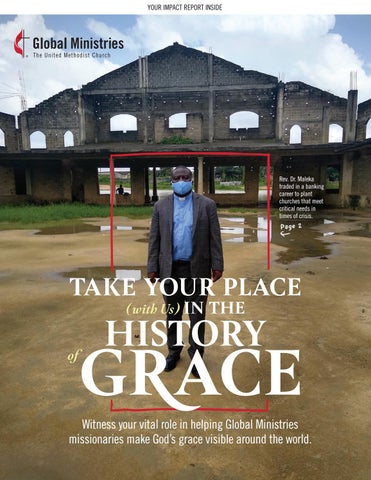
Rev. Dr. Maleka traded in a banking career to plant churches that meet critical needs in times of crisis.
Pa ge 2
TAKE YOUR PLACE (with Us) IN
of
THE
HISTORY
GRACE
Witness your vital role in helping Global Ministries missionaries make God’s grace visible around the world.
“THE
Yo u a r e HERE
WORLD IS MY PARISH”
AST IVO R Y C O
YOU HELP PEOPLE FIND THEIR PLACE IN THE HISTORY OF GRACE WHEN YOU SUPPORT A GLOBAL MINISTRIES MISSIONARY. Respond t o d a y. 2
Your story within God’s mission: How you can expand and strengthen the global church.
F
or the Rev. Dr. Jean Claude Masuka Maleka, the church should first and foremost be an epicenter of community and reconciliation.
As a native of the Democratic Republic of Congo (DRC), Rev. Dr. Maleka was an eyewitness to the carnage of war and civil conflict.
“I grew up in a country where war was an everyday business,” he says. “But as a church, we are supposed to preach peace. We are supposed to preach justice. We are supposed to preach reconciliation among the people. That’s the Gospel of Jesus Christ. I want to help people understand that Jesus came to give life—abundant life.” A former “Missioner of Hope for the Children of Africa,” Rev. Dr. Maleka eventually traded in a banking career to become a United Methodist missionary in 2011. Fluent in six languages and holding multiple advanced degrees, including a Doctor of Ministry from Wesley Theological Seminary in Washington, D.C., Rev. Dr. Maleka now serves as a United Methodist evangelist and church planter in the Ivory Coast.
IVORY COAST: WHERE THERE’S A WELL, THERE’S A WAY Not long ago, Rev. Dr. Maleka identified Kouassiblekro, a village of 5,000 people in southeastern Ivory Coast, near Ghana, as an ideal location for a new church. He embarked on what is always his first course of action: assessing a community’s most pressing needs. Clean water, it turned out, was the village’s scarcest commodity. Women and children were walking on foot two miles a day to fetch water for their families. Often brackish and yellow, the water was unfit for washing—let alone human consumption. In partnership with the community, Rev. Dr. Maleka helped facilitate the building of a new well. With accessible, clean water came the opportunity for more children (especially girls) to return to school. Villagers began to get sick less often and experience
better longterm health outcomes. For the people, experiencing the love of God in this tangible way built trust, and they rallied around the founding of a new church community in their midst. Since his commissioning as a United Methodist missionary, Rev. Dr. Maleka has helped plant three churches in Kenya and 46 in Ivory Coast (16 of which now have constructed permanent sanctuaries). Each time, he begins by taking careful stock of a community’s needs and challenges and then does what he can to help.
“I grew up in a country where war was an everyday business. But as a church, we are supposed to preach peace, justice, and reconciliation among the people. Jesus came to give life—abundant life.” —REV. DR. JEAN CLAUDE MASUKA MALEKA Rev. Dr. Maleka is fond of quoting John Wesley’s statement: “The world is my parish.” “These words are alive in my life,” he says. “I am deeply committed to the development of a viable church that can help address the critical needs of a community that emerge during times of crisis.”
LIFTING UP SOUTHEAST ASIA’S TRIBAL GROUPS
SO UT HE AS T AS IA
Like Rev. Dr. Maleka, United Methodist missionaries Rev. J. and Pastor T. Park believe in the power of the church to serve as the focal point of community.
Born in Korea, both grew up feeling deep gratitude to the foreign missionaries who carried the Gospel of Jesus Christ to Korean soil in one of the most successful global forays into evangelism and church planting ever executed.
3
Not long ago, the Parks accepted a call to serve in Southeast Asia. Rev. Park, with 20 years of pastoral service in the United States behind him, serves as the country director of the Southeast Asia Mission Initiative. Pastor T. Park, who previously served as a children’s pastor for 10 years, is the Southeast Asia Mission Initiative’s Christian education coordinator. Still acclimating to their new surroundings, the Parks have begun reaching out to members of the area’s acutely underserved ethnic tribal groups. Facing discrimination from the government and majority citizens alike, the country’s dozens of ethnic minority groups struggle under extreme poverty and lack of resources, opportunities, and basic human rights. Recently, the couple visited a local tribal church in which the 70 or so children of parishioners present were reported to be led by a single overworked teacher on any given Sunday. Together, the couple are working on a vision to help empower minorities by affirming the value of their cultures and mother tongues; educating church leaders on the importance of Christian education for children; and advocating on their behalf for improved human rights and access to resources.
MINISTRY IN ETHNICALLY DIVERSE EURASIA Few places in the world were more ripe for the Gospel than Moscow after the fall of communism.
EU R A SI A
After 74 years of religious repression, residents of this teeming international city began to seek out religion to help manage the ensuing social and economic chaos. Rev. Young Chuel Cho and his wife Rev. Susanna Cho were among the first missionaries on the scene, serving with the Russia and Eurasia Initiative launched by Global Ministries in the early 1990s. After serving in Moscow from 1990 to 1996, the Chos returned to Russia from the United States in 2014.
4
Young Chuel works as director of church development and spiritual life for the Eurasia Annual Conference and Susanna as pastor of the United Methodist Korean Ministry. In addition to teaching seminarians and assisting with church growth, the couple helps oversee community development initiatives, like the digging of wells in dry rural areas and offering economic opportunity via livestock farming. Once a week, they break bread with the indigent and very poor in a food distribution site known informally as the “garbage village.”
“I believe that Jesus Christ is the only answer for every person and nation,” says Young-Chuel. “My hope is to introduce Jesus Christ to people in Central Asia who have wounded hearts from their troubled histories.” —REV. YOUNG CHUEL CHO “I believe that Jesus Christ is the only answer for every person and nation,” says Young-Chuel. “My hope is to introduce Jesus Christ to people in Central Asia who have wounded hearts from their troubled histories.”
LIVING TESTAMENTS OF GOD’S GRACE You are our letter, written on our hearts, known and read by everyone. You show that you are Christ’s letter, delivered by us. You weren’t written with ink but with the Spirit of the living God. You weren’t written on tablets of stone but on tablets of human hearts. 2 CORINTHIANS 3:2-3 We invite you to write your story with ours and, together, let us become living testaments of God’s grace across the globe. Please partner with Global Ministries and UMCOR, today.
OF PENICILLIN AND POTHOLES:
The ROAD
TO BETTER
MEDICAL CARE Whether building hospitals or running health education programming, Global Ministries missionaries are improving medical outcomes and systems around the world—with your help.
B
ased in South Congo, Global Ministries missionary and Swiss-native Jean-Paul Dietrich is well versed in the challenges of public health. With a master’s degree in public administration and United Nations experience, Dietrich advises and oversees a diverse array of projects and programs that include hospital renovations. Currently underway is the renovation of Samuteb Memorial Hospital in Democratic Republic of Congo’s town of Kapanga. The long underfinanced and under-resourced rural hospital, which serves more than 120,000 with a staff of 3 doctors and 60 personnel, is only accessible via very poor roads and at the mercy of a rainy season that makes construction impossible for months at a time.
A recent storm blew the roof off the kitchen, leaving staff to cook on a bare floor under the elements for several months.
“I feel as if I am part of a big family, a large group of missionaries doing very good work in many different places.” —JEAN-PAUL DIETRICH Through budget reductions, climate impediments, cultural communication challenges, and tight deadlines, Mr. Dietrich with a team of local workers has persevered in stretching resources as far as possible to stabilize walls, install new floors and roofs, and upgrade electrical systems.
those I serve. I feel as if I am part of a big family, a large group of missionaries doing very good work in many different places.” Just to the east of where Mr. Dietrich serves, Ivory Coast-native Patrick Abro serves as health operations manager in the Burundi Annual Conference. With advanced degrees in communications, human resources, and the social sciences, Mr. Abro oversees the coordination of care for HIV-positive individuals and other patients. Mr. Abro helps ensure high-quality care by creating alliances between government ministers and hospital staff. Like Mr. Dietrich, he also helps oversee the refurbishment of medical facilities and leads community education programs on malaria, clean water, and other pertinent health issues. “We enlist many people in the fight against malaria,” says Mr. Abro. “Community leaders, women, and all the village leaders join in our efforts to teach people that pregnant women and children under five years old should sleep under nets.”
Yo u a r e HERE
DE M OC RA TI C RE PU BL IC of CO NG O
Mr. Abro recalls the story of a woman who lived outside the reach of a hospital and who lost five babies to malaria. A nurse in his program taught her how to protect her future children by using a malaria net and found her a supportive program to lean on.
“We still need more,” says Mr. Dietrich. “My ambition before I leave next year is to finish that hospital. Maybe there will be a dentist, and better medical equipment. I pray we can do that.” “The good news for us is when we see these people learn from our programs and become empowered to help “When you see the beneficiaries, namely the patients and their families and communities,” says Mr. Abro. medical personnel who worked through unimaginable conditions, and the children who have waited so long for a new school, you see the love of God,” he says. What does mission mean to him? Simply put, he says, he serves because “God shows his love to me. I am also trying to show my love, from me to
Born into a Christian home, Mr. Abro was drawn to service at a young age. “God opened my heart, my mind, my spirit, and my strength. He touched me, and led me into his mission,” he says.
When you write your story with our stories, you too are part of a “big family doing very good work in many different places!” 5
SERVICE to the HEART, from the
HEART
How you help Global Ministries missionaries holistically care for survivors of natural and civil disaster. New wells, refurbished schools, roof reconstruction after hurricanes. These are some of the more familiar ways in which UMCOR assists survivors of calamities. But survivors also often face other traumatic effects, less visible to the eye. Many nurse deep emotional turmoil and spiritual wounds long after the final bricks, flagstones, and shingles have been replaced.
congregational development and works with nongovernmental and secular organizations to strengthen the Honduran Mission, focusing on balancing her constituency’s physical and emotional needs. Given that 48.3% of the Honduran population lives in poverty, it is not surprising that the population she serves largely comprise economically marginalized people with limited formal education.
A trained psychotherapist, United Methodist missionary Yorleni R. Jiménez Rojas is uniquely positioned to guide survivors’ emotional and spiritual journeys. A native of Costa Rica, Ms. Jiménez has helped counsel abuse survivors aged 2 to 12, has served as a pastor and coordinator of Christian education in the local church, and has taught seminary students.
Natural disasters and the COVID-19 pandemic have disproportionately affected the nation’s poorest, and the country buckles under one of the highest rates of violence in the world. Desperate, many have no choice but to take their chances in one of the much-publicized immigrant “caravans” in search of asylum in the United States.
Ms. Jiménez’s own life experience convinced her of the soul’s importance. During a stage in her Christian pilgrimage, she began looking for genuine Christian spirituality centered on being, not doing.
“Christian leadership is a matter of service,” Ms. Jiménez observed in a recent devotion. “And service is a matter of the heart. If there is no transformation of the heart, one cannot aspire to serve with love and selflessness.”
“This helped me to a deeper understanding of our human nature, in contrast to the divine nature,” she says. “It helped me to resize issues such as faith, grace, salvation, and mission.” As the current mission program director for the United Methodist Mission in Honduras, Ms. Jiménez oversees
it h R es p o n d to d ay wp ly th e en cl o se d re ur ca rd an d fi n d yoo ry p la ce in th e hi st o f gr ac e.
The Global Mission Fellows Program Turns 70! For 70 years, Methodists have been sending young adult missionaries to investigate the root causes of global human suffering, examining issues like public health (including HIV/AIDS), migration/immigration, education, and poverty. A member of the 2019-21 cohort, Mónica Arango sparked support for Brazilian nonprofit Projeto Meninos e Meninas de Rua (Street Boys and Girls Project) by driving monthly support for 300 families despite worsening COVID-19 conditions. This year we celebrate the contributions of the hundreds of young fellows like Ms. Arango who have crisscrossed the globe over the past 70 years.
6
HONDURAS
ACTING in GOOD
FAITH: A LAWYER’S DEFENSE OF ASYLUM SEEKERS Your support for United Methodist missionaries provides for outreach to people displaced by forced migration. missing son. An absent father. A mother fighting desperately for justice, even under threat of life. These were the daily details of Cristian Schlick’s life as an attorney and missionary during his recent two-year-long service to El Salvador. Commissioned in 2019, Schlick graduated with a law degree from the University Arturo Prat, and he calls Iquique, Chile, home. During Mr. Schlick’s work in El Salvador, he offered legal assistance to people in desperate, sometimes life-threatening circumstances and helped direct them toward others who could provide holistic programming for asylum seekers and support their journeys to the United States. One case in particular sheds light on the people’s common distrust and fear of law enforcement. After two teenagers disappeared—one aged 17 and the other 18—Mr. Schlick provided legal support to the mother of one teenager. She undertook enormous risk to file a request for support from international enforcement. Local law enforcement couldn’t be trusted because evidence suggested that the police were involved in the abduction itself. In El Salvador, local police and members of the military sometimes brandish their authority by targeting lowincome communities with extrajudicial killings. Tragically, the woman’s son has still not materialized, and the mother is still fighting.
Yo u a r e HERE
“I always like to mention the women's role in this, especially mothers fighting for justice for their children,” says Mr. Schlick. “It always touches me because the men usually decide not to get involved because the risk of fighting for justice is too high.” Such injustice leads to an epidemic of migration as a last resort.
You Help Them Be Heard When you support this vital work, your story merges with our story, forming an even more remarkable story of partnership within God’s mission. Use the reply card enclosed and respond today.
The world is experiencing the largest forced migration of human beings since World War II, and Mr. Schlick’s clients were among them. “Imagine how hard your reality must be to reach the point where you’re willing to take your children and walk through the desert,” he says. “My Methodist tradition and formation came with the ideas that you should always fight for the good causes because it's a Christian duty. We are amplifiers of the victim’s voices. We provide space in which to tell their stories.” Mr. Schlick continues to serve as a missionary based in Mexico, responsible for the facilitation and coordination of ministries focused on multiple direct services, support, and advocacy programs serving migrant populations throughout Central America and Mexico.
EL SA LVA D O R
OUR SHARED NARRATIVE OF GRACE EQUIPS GLOBAL MINISTRIES MISSIONARIES TO: › Grow the church through discipleship and evangelization › Assist survivors of forced migration and natural and civil disasters › Build community health resiliency by strengthening health systems, mitigating disease, and providing preventive and curative medical care. 7
Got a picture in my head today Of how heaven might look someday I see the people there So I pull up a chair And their stories, they blow me away ’Cause I can see it on every face The evidence of grace… (MIZELL & WEST, 2005, “NEXT THING YOU KNOW” STANZAS 6-7)
UMCOR: Serving our Neighbors with Compassion and Care for 80 Years Global Ministries: Connecting the Church in Mission for 200 Years
THE POWER
ONE of
THE WORLDWIDE IMPACT OF PEOPLE LIKE YOU Inspired by what he experienced during three visits to Cambodia, Paul Brockus recently established a Donor Advised Fund in support of the Brockus-Chapin Clean Water Project, which will ultimately provide clean water and sanitation to 14 communities and 700 people. The team at Global Ministries’ Community Health and Agriculture Development (CHAD) program in Southeast Asia helped facilitate Mr. Brockus’ desire to ally with the Cambodian people he met during his visits by developing a plan to install wells and latrines in the areas of greatest need.
Respond today
CE F IN D YO U R P LAR Y IN T H E H IS TO O F G R AC E
Expensive? Not really, when you consider that a well that serves many people during their lifetimes costs $1,500. A properly construct-
ed latrine costs only $250, and water filters are priced at $15 apiece. The benefits to the health of generations of Cambodians? Priceless. Mr. Brockus’ story will be intertwined with generations of Cambodians whose lives will be transformed by access to clean drinking and cooking water. His story will also live on among the people who serve in direct ministry with Global Ministries and UMCOR and are deeply committed to serving others. How can you write your own story of impact? Partner with Global Ministries and UMCOR today and share the love of Christ with those in need. For more information, contact Tom Farley, Dir. of Fund Development, at (404) 832-7782, ext. 1267, or by email at tfarley@umcmission.org.
WE INVITE YOU TO WRITE YOUR STORY WITH OURS AND, TOGETHER, LET US BECOME LIVING TESTAMENTS OF GOD’S GRACE ACROSS THE GLOBE. Find your place in the history of grace. Partner with Global Ministries and UMCOR, today!
General Board of Global Ministries | The United Methodist Church | 458 Ponce De Leon Avenue NE | Atlanta, Georgia 30308 | 888-252-6174 | umcmission.org