Ultra Vires
THE INDEPENDENT STUDENT
EDITORS-IN-CHIEF
EDITORS-IN-CHIEF
Sakina Hasnain and Puneet Kanda
BUSINESS MANAGER
Sam Zhang
NEWS EDITORS
Rachel Chen and Sahara Iman Mehdi
ASSOCIATE NEWS EDITOR S
Adria Lao and Jocelyn Mattka
FEATURES EDITORS
Julia Allen and Asra Areej
ASSOCIATE FEATURES EDITORS
Tyler Lee and Mia Jain
OPINIONS EDITORS
Abby McCormick and Mariam Patsakos
ASSOCIATE OPINIONS EDITORS
Emma Malcho and Alexandra Broun
DIVERSIONS EDITORS
Kiwan (Paul) Kim and Madura Muraleetharan
ASSOCIATE DIVERSIONS EDITORS
Juliette Lee and Charlize Yao
PUZZLE EDITORS
Matthew Farrell and Navya Sheth
ADVERTISING
If you are interested in advertising, please email us at business@ultravires.ca
ASSOCIATE PUZZLE EDITOR
Zach Gorman
RECRUIT EDITOR
Yuha Khan
EDITOR-AT-LARGE
Cherry Zhang
ASSOCIATE EDITOR-AT-LARGE
Taban Isfahaninejad
ONLINE EDITOR
Siegfried Kahama
STAFF WRITERS
Allie Fong, Matthew Grace, Harleen Grewal, Jake Rogers, Jeanine Varney, and Grace Xu
RECRUIT REPORTERS
Alexia Lee, Melanie Mah, and Yebin Shin
STAFF PHOTOGRAPHER
Kabir Singh Dhillon
SOCIAL MEDIA COORDINATOR Bilqis Meer
LAYOUT EDITOR
If you notice any errors, please email us at editor@ultravires.ca. SUBMISSIONS
If you would like to submit a tip, letter, or an article, please email us at editor@ultravires.ca. Ultra Vires reserves the right to edit submissions.
SAKINA HASNAIN (3L) & PUNEET KANDA (3L)
Alas, the end has come.
While we never expected to become EICs for Ultra Vires, it has been an honour to serve for vol. 27. Whether it be frantically looking through recruit results, snooping Saucy for the latest gossip, or finding some solace in Intra Vires, we hope Ultra Vires has been here to support you—it sure has for us.
But that being said, Ultra Vires is nothing without the team that makes it all possible. With our last issue of vol. 27, we’d like to thank our team: our staff writers, photographers, editors, the business team, the recruit team, and everyone else who has submitted a piece, a photo, or even filled out a survey that contributed to an article.
We’d also like to take this opportunity to highlight that Ultra Vires is an independent student-run newspaper for the Faculty of Law. It strives to bring the latest updates and topical opinions of law students, by law students, for law students and the broader U of T Law community. In addition to our comical and lighthearted articles which attempt to reassure students they’re not alone, UV also reports the essential views and voices of U of T law students. From providing critiques of the accommodations policy, in-depth accounts of the Faculty budget in 2022, being the first to expose the grades scandal in 2001, extensive reporting on the IHRP hiring controversy over 2020-2022, or even calling out the administration for islamophobic EDI modules last year, UV provides a platform for students to advocate for change. However, we can only be as loud as the voices that speak. We urge our fellow students to overcome hesitations of being perceived or voicing opinions and harness the opportunities that UV provides.
We once again echo the words of a wise former Editor-in-Chief of Volume 13: “I’m not worried about the fucking journal continuing because absolute keener, kiss-ass, resume-stuffers are always going to want to volunteer for that pointless job. But UV is an institu-

tion that is really just there to augment the joy of student life. It’s not good for the resume; it has no ancillary benefit other than making U of T Law a great place to go and a fun place to be a student.”
We are honoured to pass the UV torch to Abby McCormick (1L) and Jake Rogers (1L). It has been incredible to see the growth of UV over the past year and we are excited to see it grow even further in the
capable hands of our Volume 27 EiCs.
If you have any comments, are looking for ways to get involved with UV, or just want to say hi (or now goodbye), you can always reach us at editor@ ultravires.ca or @ultravires.ca on Instagram.
While this may be a farewell as your EICs, we hope this isn’t a complete disappearance. We hope to chat again soon, whether in the form of an alumni advice
column or a feature from an event we come back to attend—you will see us again! Thank you for following along for our vol. 27 journey. It’s been a pleasure.
Signing off, one last time, Sakina & Puneet co-Editors-in-Chief Ultra Vires Vol. 27
CHELSEA MUSANHU (3L)
Dear Students,
As we head into exam season and wrap up the academic year, I wanted to take a moment to share one final update and to say goodbye as your Student’s Law Society (SLS) President.
It has been a privilege to serve you and to be part of the SLS as one of many intelligent and committed student representatives. This year, the SLS was committed to representing your voices, advocating for more flexible accommodations and improved security, strengthening mental health and academic supports, and ensuring that student perspectives remain at the forefront of faculty decision-making. We were also committed to supporting student initiatives by providing funding to clubs across the school and helping to make your events and panels more accessible throughout the year.
This year was packed with some of our favourite traditions. Frost Week brought a much-needed break in the middle of winter with hot chocolate, cookies, and an Ugly Sweater Spirit Day. We enjoyed seeing you all spread the love with your classmates in February. And as usual, we continued our signature Call to the Bar nights. Most recently, at our Annual Law Ball, you all fully embraced the Bridgerton theme with your regency-inspired looks and a level of commitment that did not go unnoticed. It was a night to remember, and a fitting way to close out the social calendar.
Last month, we had the opportunity to host our fourth salon-style workshop with leading life and business coaches, Milisa Burns and Barbara Frensel in collaboration with the CDO’s Leadership Skills Program. This semester, the theme focused on navigating success and failure. It was incredible to see so many of you show up for that conversation. It reminded us that while academic success is important, it is also important to build a sense of meaning, resilience, and strong inner authority as we navigate law school, our careers, and our personal lives.
As you move into exams, the SLS will be providing free snacks outside the library to support you through the season (because we know sometimes a small boost goes a long way). Students can also access an updated study guide on the SLS website for additional study tips and support.
Looking ahead, I have a great deal of trust in the future of the SLS and the students who will continue this work. And to all of you, I encourage you to actively shape the law school experience you want to see. Be confident in pursuing your goals and interests. Don’t let setbacks or comparisons pull you off your path. This is your story, and it doesn’t have to look like anyone else’s. Even when it seems similar, it is still uniquely yours, so write it well.
It has been an absolute honour.
Goodbye, and take care.
The Faculty Council, the governing body for the law school, convened on February 25th for what turned out to be its shortest meetings of the academic year so far, but also one of the most well-attended by professors. It was the first Council meeting chaired by Dean Chris Essert. The main focus of the meeting was the approval of sessional dates for the 2026–27 academic year, with focus on Fall 2026.
Associate Dean Richard Stacey presented a proposal to address scheduling pressures created by a late Labour Day (September 7, 2026) and the University’s year-end closure on December 24. Without adjustments, this year’s post-Labour Day start would compress class and exam schedules and place an undue burden on students and administrative staff.
Associate Dean Stacey explained that the Records Office needs at least two full working days between the final written work deadline and the University closure in order to process grades. For Fall 2026, those processing days would be December 22 and 23, which sets the final written work deadline on Monday, December 21 at 10:00 a.m. The Faculty also follows a practice of holding the last exam on the weekday before that deadline,
which in 2026 will be Friday, December 18.
With those dates fixed, the available time for exams would become quite tight, according to the administration. If Upper Year classes finish on December 7 and First Year classes on December 10, there would be only nine weekdays for Upper Year exams between December 8 and 18, and only six weekdays for First Year exams between December 11 and 18. Associate Dean Stacey described this as highly challenging for scheduling and potentially very stressful for students, since many could face multiple exams in close succession.
To avoid this outcome, the administration has decided to keep the Fall term start date on Tuesday, September 8, but to treat four Fridays during the semester as additional teaching days. On these Fridays, the timetable will run as though it were another weekday. This will allow the Faculty to deliver the classes that would normally have taken place in the first week of September, without pushing regular teaching further into December.
Key dates:
• First Year Orientation: Monday, August 24
– Friday, September 4
• Labour Day: Monday, September 7
• Classes begin: Tuesday, September 8
Special Friday teaching days
• Friday, September 18 treated as Monday
• Friday, October 16 treated as Tuesday
• Friday, November 13 treated as Wednesday
• Friday, November 27 treated as Thursday
End of classes
• Upper Year classes end: Monday, November 30
• First Year classes end: Thursday, December 3
Exam periods
• Upper Year exams: Tuesday, December 1 –Friday, December18
• First Year exams: December 7 – Friday, December 18
Deadlines and closure
• Final written work deadline: Monday, December 21 at 10:00 a.m.
• Grade processing days: Tuesday, December 22 – Wednesday, December 23
• University closure: Thursday, December 24
Both students and faculty during the meeting raised concerns about the impact these Friday additions will have on the law school community, specifically that using Fridays in this way will require clear communication well in advance, since students often use Fridays for clinics, moots, part time work, caregiving and travel obligations. Nevertheless, there was a majority vote that formalized the upcoming schedule.
Apart from the discussion of these new sessional dates, the Council also approved the addition of a new course to the GPLLM Program entitled, “Financial Crime in a Global Context,” for the upcoming academic year under the Business Law concentration.
The full schedule for the 26-27 academic year and minutes for all Council sessions can be viewed on the Faculty Council’s Website: https://jackmanlaw.utoronto.ca/my-uoftlaw/faculty-council.
SAKINA HASNAIN (3L)
The final Faculty Council of the year was held on March 25. It was described as a ‘lightning round’ after the March 18 meeting was cancelled due to scheduling conflicts for Dean Essert.
SLS President Chelsea Musanhu gave her final address as a JD student and member of the SLS. She first invited all faculty and staff to join students in Law Follies, a long-standing tradition at U of T Law, going back to 1982. She then announced the successful completion of the SLS elections* and the results of the Community and Graduation Awards.
Recipients of the Community Awards are nominated by students across all years and selected by the SLS Awards Sub-Committee.
First-Year Community Builder Award: Taylor Tucci & Ethan Tucker
This award recognizes two 1L students who have made significant efforts to bring their peers together and build a supportive community at the law school.
Upper-Year Mentorship Award: Sakina Hasnain (3L) & Fateh Hayer (3L)
This award is intended to recognize outstanding mentorship to members in years below them in both official and unofficial capacities.
Friend of the SLS Award: Sako Khederlarian
This award is given to one professor or staff member who is an ally to law students. Chelsea emphasized how Sako engages with students proactively, listens, and takes concrete action to address concerns as they come up, and truly champions students’ interests.
Chelsea then highlighted that the SLS acknowledged the many members of staff and faculty who continue to show up for students, who listen ,and place students at the forefront of their work in thoughtful and impactful ways. In particular, the SLS thanked Professor MacIntosh and Professor Green for their ongoing support and commitment to the student community.
Recipients of this year’s Graduation Awards were nominated and selected by this year’s graduating class.
SLS Staff Appreciation Award: Sako Khederlarian
This award is given to one staff member at the law school, whom the graduating class wishes to recognize for their hard work. Because behind every successful student experience at the law school is a group of staff who work tirelessly, often behind the scenes, to make sure things run smoothly, and their contributions shape our day-to-day lives in more ways than we often realize.
The SLS again acknowledged the dedication of all of the members of staff who go above and beyond for students, and in particular, Chantelle Brown-Kent and Lindsay McKay for their care, dedication, and a genuine commitment to supporting students.
Alan Mewett Award for Excellence in Teaching: Professor Martha Shaffer
This award is given to one professor who exhibits excellence in teaching, as selected by the graduating class. It recognizes faculty members who have gone above and beyond in their commitment to student learning, engagement, and support, and have made a lasting impact on the academic experience of our students. Professor Shaffer has won this award 3 years in a row, and a total of 8 times in 22 years. She was also the very first recipient of the award back in 2004.
Hail and Farewell Speaker Award: Professor Abdi Aidid
This award is given to one professor, who will present the Hail and Farewell address to the graduating class on behalf of all faculty members at the post-Convocation ceremony. Chelsea highlighted that this award is a special honour, reserved for a professor who has made a lasting impression on students, not only through their teaching, but through their mentorship, guidance, and presence within the law school community.
John Willis Award for Leadership & Gina Caldarelli Memorial Prize for Spirit: Emily Elizabeth Ernst
This award is presented to a student who embodies not only strong leadership, but also the energy, generosity, and sense of community that bring our law school to life, as selected by their fellow graduates.
Class Valedictorian Award: Chelsea Musanhu
This award is an honour given to the student who will reflect the voice, experiences, and collective journey of the graduating class, selected by their fellow graduates, and present the valedictory address at the post-Convocation ceremony.
Chelsea concluded her remarks by thanking the faculty and staff for their care, effort, and dedication in supporting students year after year. She also extended a special thanks and congratulations from the SLS to Brittney Twiss on her transition into her new role as Head of Strategy and Transformation, and Senior Advisor to the Dean. Assistant Dean, JD Program, Birttney Twiss has been a shining light within
the law school community, showing incredible commitment and support to students.
GLSA President Brooke Evans then made her remarks. She began by thanking everyone who supported the GLSA, and in particular, Assistant Dean, Graduate Programs, Emily Orchard. She announced that the GLSA ball would be on June 13 and invited faculty to attend.
After thanking both for their remarks, Dean Essert turned to the Graduate Program Approvals. There were four main approvals needed. First, as for every year, Assistant Dean Orchard asked for approval for authority for the Associate Dean to make course changes or approvals over the summer as needed, until Faculty Council reconvened. The motion carried.
The next three proposals were presented by Associate Dean Vincent Chiao and dealt with updates to the SJD, LLM, and MSL programs.
LLM Program: Changes are aimed at creating a clearer functional division between the GPLLM and LLM programs. They include changes to the courses LLM students are required to take, including a course focusing on research proposal development, literature review, and legal scholarship; a course focusing on the foundations of legal theory; a course focusing on research methods; and a workshop for LLM students in the winter.
SJD Program: After consultation with students who desired more engagement in the academic environment, the proposal raises the residency requirement from 2 semesters to 3 years. Following questions, Associate Dean Chiao explained that this would bring U of T Law in line with peer schools across Canada, the US, and the UK, as well as in line with other faculties at U of T. They do not anticipate this change having a significant impact on the immigration status of students.
MSL Program: The changes would bring the program in line with the LLM program. They clarify credit hours and writing components.
While a motion for all three proposals was carried, select faculty members abstained. There were concerns that the SJD residency change was radical and should have had more discussion.
Associate Dean Richard Stacey then brought a proposal for the 2026/2027 JD Program, which was carried. Assistant Dean Sara Faherty brought a proposal to move forward with working on a joint JD/
MPH program. This program would be with the Dalla Lana School of Public Health, and the currently proposed streams include Occupational and Environmental Health, Social & Behavioural Health Science, Black Health, and Epidemiology. She noted the extensive planning and efforts made to prevent revenue loss with the program. With Faculty Council support, they would continue exploring a JD/MPH program. The motion carried.
Dean Essert then highlighted that there were reports shared by the various committees, but they were not being presented. These reports did not require votes, and were not presented due to the fact that this faculty council meeting had been merged with the previous cancelled meeting. They include the reports by the Curriculum Committee (Professor Richard Stacey), the EDIA Committee (Assistant Deans Maxwell-Allyene & Twiss), the Mooting and Advocacy Committee (Professor Stewart & Assistant Dean Faherty), the Mental Health and Wellness Committee Assistant Deans Maxwell-Allyene & Orchard), the Truth and Reconciliation Committee (Professor Sanderson) and the Financial Aid Committee (Professor Green and Assistant Dean Twiss).
Faculty Council then concluded with the In-Camera Items of Clerkships Update and Financial Aid Office update.
Please note that all reports and meeting notes for all Council sessions can be viewed on the Faculty Council’s website: https://jackmanlaw.utoronto.ca/myuoftlaw/faculty-council.
*Chelsea announced the incoming SLS President Ishaan McLachlan (1L). The complete election results are as follows:
• President: Ishaan McLachlan (89/267 votes, 33.3%)
• Vice President Social: Danya Assaf (164/272 votes, 60.3%)
• Vice President Finance: Emma Malcho (254 ‘Yes’ votes, 94.8%)
• Vice President Student Life: Olivia Carter (134/246 votes, 54.5%)
• Vice President Academic: Jayden Daniels (169/271 votes, 62.4%)
• 2L SFC Representatives: Drew Bolivar, Taylor Tucci (both acclaimed)
• 2L SLAC Representatives: Layla Razek, Ethan Tucker, Cameron Miranda-Radbord, Daphne Embry
40th Anniversary Ron Ellis Moot
Mooters: Sophia Cornacchia (3L), Julia Ford (3L), Eli Howard (3L), and Jerry Zhao (3L)
Coaches: Maryth Yachnin and Dora Chan (Staff Lawyers at IAVGO Community Legal Clinic)
This was the first year that this moot was held to celebrate 40 years of Ontario’s Worker’s Safety and Insurance Appeals Tribunal (WSIAT). The problem was a judicial review of a decision by the WSIAT, engaging with issues about what behaviour disallows a worker from receiving benefits under the province’s injury compensation scheme.
Adam F. Fanaki Competition Law Moot
Mooters: Evan Chow (3L), Jamie Blunt (2L), Oscar Judelson-Kelly (2L), and Tyler Lee (2L)
Student Coaches: Vlad Mirel (3L), David Niddam-Dent (3L), and Cam Flanagan (3L)
Coaches: Michael Laskey (Stikeman Elliott LLP) and Nathaniel Read-Ellis (Adair Goldblatt Bieber LLP)
The Fanaki Moot is an annual competition law moot organized by the Competition Bureau, the Competition Tribunal, and the Canadian Bar Society. This year, the moot focuses on the new Greenwashing provisions in section 74.01 of the Competition Act. It questions how ISO scopes 1, 2, and 3 figure into misleading advertising, what constitutes “adequate and proper testing” of environmental claims made by SMEs, and what the appropriate monetary penalty should be for violating these provisions.
The moot will take place on March 27–28, after this article has been written.
Arnup Cup Trial Advocacy Competition and Sopinka Cup National Trial Advocacy Competition
Mooters: Humza Khan (3L) and Rachel Bernardo (3L)
Coaches: Corie Langdon (Toronto Region Crown Attorney’s Office), Emily Marrocco (Crown Law Office – Criminal, Ministry of the Attorney General) and Royland Moriah (Moriah Law PC)
The Arnup Cup is an annual regional trial advocacy competition for Ontario law schools. The top teams at the Arnup Cup proceed to participate in the Sopinka Cup National Trial Advocacy Competition in Ottawa, Ontario. This year’s problem was an attempted murder involving a drug robbery gone wrong and a victim hit at speed with an SUV.
Humza Khan and Rachel Bernardo acted as the Crown against Windsor University Faculty of Law school at the Arnup Cup. Rachel and Humza were the second ranked team and best Crown team at the Arnup and proceeded to the National Sopinka Competition in Ottawa on March 12-14. They switched sides to defence and had a hard-fought round against the University of Saskatchewan. They took home an award for the best Closing Statement of the competition delivered by Humza.
Callaghan Competitive Program
Mooters: Aliyah Mancini (2L), Amanda Yu (2L), Cassandra Heward (2L), Dima Kiwan (2L), Erica Walter (2L), Hanaya Akbari (2L), Jamie Dibble (2L), Jordan Guberman (2L), Katie Power (2L), Neil Ryan (2L), Paul Huang (2L), Rayyan Esmail (2L), Simren Sharma (2L), Srivani Edupuganti (2L), Tourang Movahedi (2L), and Zane Shammas-Toma (2L)
Chief Justices: Katherine Getler (3L), Delaney Cullin (3L), and Alana Kiteley (3L)
Student Coaches: Alana Kiteley (3L), Alex Byrne (3L), Amanda Currie (3L), Emma Farrell (3L), Grace Xu (3L), Megan Raber (3L), Roxanne Locke (3L), Sharon Liyento (3L), and Tyler Hastings (3L)
Faculty Advisors: Diane Shnier (Judicial Research Lawyer – Court of Appeal for Ontario), Shemara Dadhisheth, and Professor Hamish Stewart
The Callaghan is U of T’s in-house moot, focusing on issues in criminal and constitutional law. This year's problem was based on Attorney General of Quebec v Luamba, currently on reserve at the Supreme Court of Canada. The problem had mooters engage with whether random highway traffic stop provisions can be invalidated on the basis that they provide a vector to racial profiling under ss. 9 and 15 of the Charter, or whether such profiling is better remedied under s. 24. This year’s winning team and the best appellant
team was Cassie Heward and Rayyan Esmail. The best respondent team was Dima Kiwan and Hanaya Akbari. First, second, and third place oralists were Rayyan Esmail, Srivani Edupuganti, and Katie Power, respectively. The best appellant factum was awarded to Cassie Heward and Rayyan Esmail. The best respondent factum was awarded to Paul Huang and Tourang Movahedi. The runner up factum was awarded to two teams: Dima Kiwan and Hanaya Akbari, and Jamie Dibble and Neil Ryan.
Cassels Cup Moot (Baby Gale)
Mooters (all 1L): Rory Banfalvi, Samuel Bowers, Taylor Dallin, Ishmeet Johal, Robert Howden, Monique Ingram, Anna Lisa Lowenstein, Jocelyn Mattka, Julian Miller, Asha Nenshi Nathoo, John Doyle-Raso, and Madeline Ritter
Coaches: Sakina Hasnain (3L), Aaditya Juvekar (2L), Sarah Mackenzie (3L), and Evan Tanovich (2L)
The Cassels Cup, also known as the Baby Gale, is a competition between U of T Law, Osgoode Hall Law School, and Lincoln Alexander School of Law. It shares the same moot problem as the Gale Cup, which can be found below.
U of T won the 2026 Cassels Cup! We are incredibly proud of all the mooters who brought home the cup—especially as this was the first year that Lincoln Alexander School of Law participated, making it an especially rigorous competition among all the law schools in Toronto. Rory Banfalvi and Madeline Ritter were named the Top Appellant Team, and Anna Lisa Lowenstein and Julian Miller were named the Top Respondent Team. Rory Banfalvi also took home the Top Oralist award, and Madeline Ritter won Third-Place Oralist.
Davies Corporate/Securities Law Moot
Mooters: Belaal Hamid (2L), Jordan Rosenfeld (2L), William Mitchell (2L), and Yebin Shin (2L)
Student Coaches: Hugo Liu (3L) and Karina Vandenhoven (3L)
Coaches: Shane D’Souza (McCarthy Tétrault LLP) and Chris Puskas (McCarthy Tétrault LLP)
The Davies Corporate/Securities Law Moot has students engage with current legal problems in the world of corporate and securities law. This year’s problem comprised a myriad of corporate and securities law issues all revolving around an Italian wine producer. When a competing producer sought to acquire shares in the company while a separate business combination was being negotiated with a third party, a dispute arose as to whether the company was permitted to block the share acquisition, and whether it could go through with the business combination as planned.
U of T won Second Place Factums and Third Overall Team.
Donald G. Bowman National Tax Moot
Mooters: Daniel Austin-Boyd (2L), George Macauley (3L), Ke Xu (2L), and Talha Mahmood (2L)
Student Coaches: Michael Roclawski (3L), Leon Liao (3L), and Annie Wang (3L)
Coaches: Martha Macdonald (Torys LLP), Andrew Boyd (Blake, Cassels & Graydon LLP), and Professor Robin Morgan
The Tax Moot is Canada’s first competitive moot on taxation. The problem this year was based on a fictional appeal of Brown v Canada, 2022 FCA 200. The mooters were tasked with arguing what the proper framework is for determining whether there is a source of business or property income under s. 9 of the Income Tax Act.
Daniel Austin-Boyd and Ke Xu advanced to the semi-finals.
Gale Cup Moot
Mooters: Aaditya Juvekar (2L), Evan Tanovich (2L), Sakina Hasnain (3L), and Sarah Mackenzie (3L)
Student Coaches: Sarah Zaitlin (3L), Humza Khan (3L), and Akash Jain (3L)
Coaches: Meghan Bridges (Lenczner Slaght LLP), Holly Kallmeyer (McCarthy Tétrault LLP), and Ema Ibrakovic (Daniel Brown Law LLP)
The Gale Cup Moot is a national moot focusing on a constitutional/criminal law issue. The case this year was R v IM, 2025 SCC 23, which considered how the
Youth Criminal Justice Act should be interpreted when deciding if a youth offender should be sentenced as an adult.
Sarah Mackenzie received the "Dickson Medal for Exceptional Oralist Performance.”
Hamish Stewart Cup Moot (Baby Callaghan)
Mooters (all 1L): Saiyah Aujla, Tara Hanson-Wright, Aliza Kraft, Daniel Minden, Diya Courty-Stephens, Maya Nicholson, Sarah Angelou, Emily Frank, Sarah Zhao, Sophie Teed, Aliyah Yagboyaju, Cameron Miranda-Radbord, Saira Camminga, Katie Grierson, Zack Kuan, John Oh, Isaac Menghisteab, Nathaniel Jote, Zaid Kaddoura, Owen Logtenberg, Zena Shamli Oghli, Asha Saha, Sam Sarjeant, Camryn Booth, Avreet Jagdev, Ema Radovanovic, Tristan De Cotiis, Nicholas Hepner, Lauren Lindfors-Bruno, Layla Razek, Cindy Guo, Annie Chen
Student Coaches (all 2L): Myles Whelen, Justin Wang, Jamie Blunt, Marwan Yousif, Rayyan Esmail, Katie Martin, Jordan Guberman, Amanda Yu, Hanaya Akbari, Simren Sharma, Srivani Edupuganti, Zane Shammas-Toma, Daniel Austin-Boyd, Sam Zhang, Iryn Mcmechan, Romina Hajizadeh
The Stewart Cup, also known as the Baby Callaghan, is an internal moot for 1L students. It shares the same problem as the Callaghan, which can be found above.
The winning appellant team was Saiyah Aujla and Tara Hanson-Wright. The runner up appellant team was Sarah Angelou and Emily Frank. The winning respondent team was Aliyah Yagboyaju and Cameron Miranda-Radbord. The runner up respondent team was Aliza Kraft and Daniel Minden. The top, first runner up, second runner up oralist awards went to Aliyah Yagboyaju, Tara Hanson-Wright, and Daniel Minden respectively.
Harold G. Fox Intellectual Property Moot
Mooters: Alexia Lee (2L), Annie Chang (3L), Caleb Lakhani (2L), and Sam Zhang (2L)
Student Coaches: Shireen Faisal (3L) and Michael Barbour (3L)
Coaches: Andrew M. Shaughnessy (Torys LLP) and Emily P. Kettel (Bennett Jones LLP)
The Harold G. Fox Moot is designed to promote the furtherance of education in the intellectual property field and to provide participants with the opportunity to interact with jurists and with experienced practitioners of intellectual property law. This year’s problem explored a dispute over whether a patented algorithm for recommending guitar strings constitutes a valid invention, and if so, how liability should be assessed when a competitor adopts it without authorization.
Caleb Lakhani and Sam Zhang won Semi-Finalist Mooting Team.
Immigration, Refugee, and Citizenship (IRC) Law Moot
Mooters: Tyrone Fang (3L), Pourochista Rahmati (3L), Alexandra Broun (2L) and Osaid Diar Bakerli (3L)
Coaches: Joycna Kang (Battista Migration Law Group) and Mathew Wilton (Battista Migration Law Group)
The IRC Moot is a relatively new moot founded in 2020. This national and bilingual moot seeks to advance legal education related to issues of migration. This year’s problem concerned a rejection of a Permanent Residence Application on grounds of criminal inadmissibility, the application of informer’s privilege in immigration law contexts, and the interpretation of s. 36(2)(c) of the Immigration and Refugee Protection Act.
The U of T team this year was selected through a new tryout process within the course of Advanced Migration Law.
Julius Alexander Isaac Moot
Mooters: Bridget Le Donne (2L), Bruce Yao (2L), Jacob Meloche (3L), and Paula MacPherson (2L)
Student Coaches: Natallie Chow (3L) and Zeru Hu (3L)
Coaches: Ada Maxwell-Alleyne (Assistant Dean, Equity, Diversity, and Inclusion)
Hosted by the Black Law Students' Association of Canada, the 2026 Julius Alexander Isaac Moot concerns an appeal from R v Murray, 2025 ONSC
4127, where mooters are invited to address police racial mistreatment using Charter jurisprudence and critical race theory. The goal is to explore ways to combat anti-Black racism in Canadian law.
The entire U of T team won the top school award. Paula MacPherson and Bruce Yao won second place. Bridget Le Donne and Jacob Meloche won third place.
Kawaskimhon National Aboriginal Law
Moot
Mooters: Julia Alvi (2L), Ritica Ramesh (2L), Navya Sheth (3L) and Cameron Smith (2L)
Coaches: Bryce Edwards (Olthuis Kleer Townshend LLP) and David Walders (Indigenous Relations at the Ontario Energy Board)
This year, the Kawaskimhon involved a negotiation between Indigenous communities and bodies of the federal and provincial governments, responding to the recent passage of Bill C-5 by the Government of Canada. Parties had to craft a consultation process for the development of major projects. U of T represented the Government of Alberta and worked with the Elders and the Council of Treaty 6 First Nation, the Ice River First Nation, and various federal bodies to arrive at a commitment to a shared vision for future development.
Unlike other moot competitions, the Kawaskimhon is a negotiation and participants do not receive awards. Parties work through the problem together and hopefully come to some kind of resolution, considering both the common law and Indigenous law. The Kawaskimhon invites participants to interrogate the colonial nature of the common law and emphasizes the necessity of Indigenous law in the Canadian legal system.
Laskin Moot
Mooters: Amit Nehru (3L), Josephine Winsor (3L), Marwan Yousif (2L), and Romina Hajizadeh (2L)
Student Coaches: Benjamin Beiles (3L), Sarah Rosa (3L), and Navya Sheth (3L)
Coaches: William Maclarkey (Ontario’s Ministry of the Attorney General, Crown Law Office Civil), Padraic Ryan (Constitutional Law Branch of Ontario’s Ministry of the Attorney General), and Christina Sibian (Assistant Crown Attorney)
The Laskin is a national bilingual constitutional and administrative law moot. At least one team member must be capable of mooting in French. This year, the moot centred on a dispute between the Effené First Nation (EFN) and the Government of Canada and dealt with issues surrounding a fictitious amendment to the Indigenous Languages Act. The central questions were (1) whether EFN had an entitlement to a homogenous Effené-language high school under the Act, or just a class within an English high school; (2) whether Canada had breached the duties flowing from the Honour of the Crown in renegotiating a contract for EFN's Effené-language primary school; and (3) whether regulations enacted by the Minister (which created a committee to implement minimum standards for Indigenous-language schools) should be quashed.
National Labour Arbitration Competition (NLAC)
Mooters: Ethan Sabourin (2L) and Ivy Chen (2L)
Student Coaches: Kabir Singh Dhillon (3L), YeYoung Lee (3L), and Sydney Ofiara (3L)
Coaches: Lauren Pearce (Jones Pearce LLP), Stephen Shore (Littler LLP), and Kathryn Bird (Hicks Morley LLP)
The NLAC Moot is a simulation of a grievance arbitration hearing before tri-partite panels. Each team argues once on behalf of the Union and once on behalf of the Employer in the two initial rounds of the competition. This year’s problem featured two labour grievances in the context of an evolving understanding of mental health and disability in safety-sensitive work environments and the largest marine ecological disaster in Canada’s history. U of T placed second overall in this year’s NLAC Moot.
ANNIE WANG (3L)
Oxford International Intellectual Property Law Moot
Mooters: Shireen Faisal (3L) and Michael Barbour (3L)
Members of the 2025 Fox Moot team are competing in the Oxford International Intellectual Property Law Moot this year. This year’s problem concerns the case Aggarwal & Roper Television Productions v Holly-Jaye Hayes. In this case, the producers alleged that Hayes breached her participation contract by posting online and defying social-media restrictions, while Hayes countered that the edits misrepresented her performance and infringed her moral rights.
The moot will be held at Oxford University from March 25-29, after this article has been written. Best of luck to the mooters!
Philip C. Jessup International Law Moot Court Competition
Mooters: Hasti Jamalomidi (2L), Justin Wang (2L), Samraggi Hazra (2L), and Yuha Khan (2L)
Student Coaches: Matthew Farrell (3L), Chloe Merritt (3L), and Alex Kelly (3L)
Coaches: Misha Boutilier (counsel to the Chief Justice of Ontario at the Court of Appeal for Ontario) and Maureen Whelton (Stevenson Whelton MacDonald & Swan LLP)
The Jessup is a competitive moot focused on international law problems. This year's problem focuses on the right of states to intervene in judgments before the International Court of Justice, the status of the principle of free, prior, and informed consent in international law, the workings of extradition treaties concerning whether ne bis in idem is a general principle of international law, and state immunity in the context of wrongful death by a corporation.
The team finished 3rd overall at the National Rounds in Ottawa. Justin Wang was the fifth placed oralist, and he and Samraggi Hazra argued the final round inside the Federal Court of Appeal room at the Supreme Court. Hasti Jamalomidi and Yuha Khan received the first place Respondent Memorial, and overall the team received the second place memorial score. The team is progressing to the international rounds, which take place from March 28 to April 4 in Washington, D.C. Best of luck to U of T’s Jessup team!
Tort Law Moot Competition
Mooters: Erika Mackenzie (2L), Harleen Grewal (2L), Myles Whelen (2L), and Sofia Sucevic (2L)
Student Coaches: Amanda Kennedy (3L) and Kate Shackleton (3L)
Coaches: Christopher McKenna (Bennett Jones LLP) and Andrew Sahai (Bennett Jones LLP)
The Tort Law Mort is a moot competition designed to promote advocacy and excellence in the fields of tort, insurance, and health law. This year's Tort Law Moot focused on whether firearm manufacturers owed a duty of care to third parties who are harmed by gun violence. The problem was based on the class action arising from the Danforth Shooting in Toronto and also required mooters to make submissions on standard of care and causation.
Erika MacKenzie and Sofia Sucevic won the Best Mooting Team. Myles Whelen and Harleen Grewal won the Best Factum. Erika MacKenzie and Sofia Sucevic were tied for Best Oral Advocate.
Torys Cup (1L Competition Law Moot)
Mooters (all 1L): Matthew Davidson, Jacob Johntson, Daniel Kim, Victoria Percival, Ajay Ranganathan, Grady Simpson, Arjun Thayaparan, and Kasia Wodz
Student Coaches (all 2L): Oscar Judelson-Kelly and Tyler Lee
The Torys Cup is a 1L competition law moot that uses previous Adam F. Fanaki Moot problems and upperyear U of T factums. The moot takes place at Torys’ Toronto office. This year's problem concerned a merger review of dating apps. This was the second year of the Torys Cup and saw the introduction of 1L mooters from Osgoode. Despite tough competition, U of T managed a clean sweep, making up both teams in the final and securing all the awards.
The winning appellant team was Daniel Kim and Arjun Thayaparan. The winning respondent team was Victoria Percival and Kasia Wodz. The top, first runnerup, and second runner-up oralist awards went to Victoria Percival, Arjun Thayaparan, and Grady Simpson.
Walsh Family Law Moot
Mooters: Annabelle Lim (2L), Chelsea Musanhu (3L), Georgia
Gardner (3L), and Madura Muraleetharan (2L)
Student Coaches: Alexandra Beck (3L) and Jane Byun (3L) Coaches: Maureen Edwards (McCarthy Hansen and Company LLP), Abigail Lidster (McCarthy Hansen and Company LLP), and Martha McCarthy (McCarthy Hansen and Company LLP)
The Walsh Moot is a competitive moot focused on issues in family law. This year’s problem was based on M.A.B. v. M.G.C., 2022 ONSC 7207, which addressed whether trial exhibits containing images of the parties’ children documenting alleged abuse should be sealed from public access. The case raised broader questions about balancing the open court principle with the privacy and protection of children, particularly when the parties involved are famous or otherwise in the public eye.
The U of T team won First Place Team and Second Place Respondent Factum.
Walsh Family Law Negotiation Competition
Mooters: Madison Delaney (2L), Chrisoula Angelis (2L), Natalie Murphy (2L), and Stefania Vlasie (2L)
Coaches: Samantha Eisen (Samantha Eisen & Company)
The Walsh Family Law Negotiation has students working in teams of two, using facts for each partner in a family law dispute, to negotiate with opposing teams from different law schools in three successive rounds. This year, each team had to grapple with issues of parenting, property division, child support, and spousal support arising from the breakdown of a three-year marriage. The positions of the parties were complicated by interference from other family members and by several contentious decisions made by the ex-spouses themselves.
Madison Delaney and Chrisoula Angelis were awarded First Place for Best Negotiation Plan.
Warren K. Winkler Class Actions Moot
Mooters: Harjaap Brar (3L), Rebecca Dragusin (JD/MGA 2027), Allie Fong (3L), and Iryn McMechan (2L)
Student Coaches: Hannah Beltran (JD/MBA 2026), Jaerin Kim (3L), and Audrey Wu (3L)
Coaches: Joseph Blinick (Bennett Jones LLP) and Shaan Tolani (Bennett Jones LLP)
The Winkler Class Actions Moot gives students a
unique opportunity to make submissions on a motion to certify a class proceeding. In this year’s moot problem, the proposed class members were Canadian users of a mobile application owned by the defendant, a US-based company. The defendant disclosed app users’ data, including sexual orientation, political opinions, and travel interests, to a Toronto-based travel agency. An Ontario court’s jurisdiction over a claim against a foreign company was a main issue in this moot problem. The plaintiff's claims included privacy breaches under the Personal Information Protection and Electronic Documents Act (PIPEDA) and intrusion upon seclusion.
Harjaap Brar and Rebecca Dragusin advanced to the finals as the best defendant team. The U of T team won all top three oralist awards. Iryn McMechan, Allie Fong, and Harjaap Brar won the first, second, and third place oralist awards, respectively.
Wilson Moot
Mooters: Alicia Parker (2L), Alysha Mohamed (2L), Katie Martin (2L), and Tenzin Shomar (2L) Student Coaches: Emma Blake (3L), Emma De Tommaso (3L), and Ikran Jama (3L)
Coaches: Joseph Cheng (General Counsel with the Department of Justice Canada, National Litigation Sector) and Cheryl Milne (Executive Director, David Asper Centre for Constitutional Rights)
The Wilson Moot is a constitutional moot focused on Charter-based legal issues and promoting justice for those disempowered within the legal system. This year’s Wilson Moot problem examined the use of artificial intelligence in refugee decision-making through the case of Nadia Malik, whose claim for protection in Canada was denied with the assistance of an AI tool called Maple. The problem posed questions regarding whether Maple’s involvement rendered the process procedurally unfair and violated Ms. Malik’s rights to life, liberty, security of the person, and equality under the Canadian Charter of Rights and Freedoms. The case also raises broader questions about the legality and limits of AI-assisted decisionmaking in high-stakes administrative proceedings.
U of T received third place team overall. In addition, Alysha Mohamed, Katie Martin, and Tenzin Shomar were named first, second, and third place oralists, respectively.
This is a headline you should have heard directly from admin as soon as the decision was made. Instead, they have chosen to stay silent, despite being warned of the need to share this news with students as soon as possible.
This decision was made by Associate Dean Richard Stacey with the approval of the Faculty Council. The issue was originally raised in the Curriculum Committee, where SLAC representatives warned of the burden Friday classes would put on students. The recommendation of the Curriculum Committee was to start classes the week prior to Labour Day.
Nonetheless, Stacey brought a motion to Faculty Council to approve the sessional dates with four Friday sessions. This is unsurprising, given that one professor reportedly called the idea of starting before Labour Day “excruciating.” When SLAC representa -
tives inquired about starting the semester earlier, Stacey responded that too many faculty members would be on vacation the week before Labour Day.
Extending the semester by a few days was apparently not an option, as the Records Office needs time to “process grades” following the written work deadline. It’s unclear what exactly is being processed during this time, as it seems to imply that professors will be done grading by December 22.
Stacey did not explain how the Fridays were selected, but with two of the dates being in November—the last of which is the Friday before upper-year exams—the allocation seems problematic.
This decision will be detrimental to many students in our community, but particularly to our incoming 1L students, commuters, those with Friday externships and clinics, and certain religious groups. Assuming
three mandatory Friday sessions for 1Ls, seven of the twelve weeks will be five days long.
And for our Jewish classmates and some Sabbatarians (i.e., those that observe Sabbath starting around sundown on Friday), the situation is worsened by the fact that half of the dates are after daylight savings ends, putting sunset around 4:45. When asked what consideration policy would be in place for these Fridays, Stacey responded that the ordinary policy would apply.
Make no mistake: this criticism does not come from a place of laziness or wanting more days off school. I love law school. I gave up a career, being near family and friends, and an entire life back home to be here. And for me, like many of my classmates, Fridays have never really been a day off; they’re a day to sit at the library for 8-12 hours. They allow us to go to the doctor or the grocery store, to volunteer in our
community, to deepen our practical skills through mooting and externship opportunities, and maybe–if we’re really lucky–they allow students to spend time with loved ones. So instead, this criticism comes from a place of frustration as I watch student voices become trivialized. This decision creates additional barriers for students, particularly when admin has been unwilling to work with the SLS to develop a more accommodating recordings policy.
The reasons given for this decision, the way the decision was made, the specific dates chosen, the absence of a meaningful considerations policy, and the fact that admin have yet to announce this change all send a clear message: faculty vacations paid for with our tuition money take priority over student wellbeing.
Enjoy your extra week of summer, Jackman!
Seeking accommodations can be an insurmountable source of stress for students in an already hectic environment. These are supports that are established in order to encourage flourishing and promote accessibility throughout the law school. Numerous law students, since time immemorial, have raised concerns with the accommodations structure at Jackman.
Accommodations are designed with the student body in mind, so Ultra Vires (UV) reached out to the students of Jackman Law to comment on accommodation and accessibility services offered by the law school. This is a recurrent issue, and considering the substantial balancing exercise that must take place to institute such policies, the Faculty at Jackman Law have a considerably challenging duty to fulfil. UV also sought comment from faculty members and staff involved with accommodations decisions.
Collectively, these remarks illustrate the nuanced nature of creating an effective, meaningful accommodation policy, and UV hopes to provide insights on the uniquely rigorous academic policies at U of T and Jackman Law. This article is not meant to harangue the administration to change the accommodations structure, it is instead meant to initiate a discussion about accommodations at the law school and the perspectives thereon.
How do accommodations work?
Students with ongoing illnesses or disabilities register for accommodations through U of T’s central system used university-wide. Otherwise, temporary, extraordinary or one-off accommodations (deemed “considerations” by the Faculty of Law) for different personal circumstances are handled by Jackman’s own internal Academic Accommodations procedure. Regardless of it being long-term or temporary, all requests are subsequently reviewed by the JD Accommodations and Considerations Committee.
Accommodations are usually based on medical documentation. Otherwise, when granting considerations, the law school administration looks for “unforeseen problems over which the student had no control”. These may be supported by providing doctor’s notes, obituaries, flight cancellations, or really anything they can provide to establish the need for the consideration. Considerations may also be granted for religious observances, which require a simple description of the observance.
What’s working well?
UV canvassed opinions from JD students and received several comments on the efficacy of the accommodations structure. The most frequently used accommodations were examination/assignment deferrals, provision of adaptive equipment, notetaking, and lecture recordings. Foremost, students appreciated the variety of accommodations available. They explained that the breadth of services offered helped them find a support that actually made a meaningful difference in their learning.
Some students intimated that there was always a form of support to address their ongoing accommodations needs, whether it be exam timing, notes from peers, or bespoke supports to facilitate learning in class. In particular, some students felt that their needs were effectively addressed by the number of supports to choose from.
Another recurring acclaim was the prompt communication between the accommodations advisors and students. The office was generally diligent in responding to emails and correspondence within a couple of days. Moreover, students appreciated the interplay between the Student Wellness team and accommodations; people felt that the support provided by Student Wellness, and the staff involved, helped promote accessibility and contribute to mental well-being for individual hardships. Furthering this point, students commended the quality of the support provided by the accommodations advisors when speaking with them directly. Learning strategy supports and advice on disability related matters were identified as particularly effective accommodations.
The Administration has also clarified several safeguards in an effort to deliver high-quality, equitable accommodations and considerations. The Accommodations Committee defers to official medical forms, such as the “Verification of Student Illness or Injury” form that allows doctors to indicate whether a student’s need is “severe,” “serious,” “moderate,” or “mild,” and indicates the beginning and end dates of the impairment. The Faculty has said that it aims to treat similar requests similarly while also giving deference to expert staff at the Accessibility Services. Students are also given a chance to be interviewed to share their needs about their needs Moreover, the University and the Faculty continue to make efforts to educate students about how these processes work. There is a dedicated page on the law school website devoted to describing accommodations and considerations, and these processes are referenced to students before and during orientation. Students are also notified and encouraged to attend online wellness events throughout the academic year.
The Faculty has also taken the opportunity to discuss the nature of the lecture recording policy. One large consideration in forming this policy was the emphasis on in-person attendance, stating that “[f]ace-to-face engagement through in-person education creates opportunities for students to learn core skills and competencies that are essential to legal careers.” As per the Faculty’s response, the reason for the high level of protection for lecture recordings is to encourage in-person attendance so as to not impair student engagement.
When the going gets tougher and tougher
Responses from UV’s survey highlighted many of the consistent flaws in the accommodations system. Many of the grievances with the accommodations structure are with the process, though the actual services received are not without fault.
Foremost, Jackman Law has staunchly protected its lecture recordings, and the procedure for obtaining these lectures has been described as notoriously onerous. The most commonly identified issue was how burdensome it was to provide adequate proof for a lecture recording or other accommodations. Students often criticized the policy for requiring hard-to-obtain evidence for certain compassionate and personal circumstances. As well, students have described that these recordings are hard to obtain if the reason for requesting them is a one-off compassionate consideration or from impermanent circumstances such as fasting periods. While the law school promotes in-person attendance for its classes, the obstinately protected lecture recordings has caused some students to feel that this policy derogates from an atmosphere of accessibility. As another hurdle, since distributing lecture recordings is partially up to the discretion of the professors, some students shared that they were not able to obtain a recording despite being eligible under accommodations criteria. A survey respondent aptly challenged the policy for being overly paternalistic, and wished that law students, as burgeoning professionals expected to meet certain standards of integrity while learning and practicing law, were given more deference.
The accommodations services were also cited by students as being inconsistent in quality. Just by the nature of the accommodations being student-driven, the provision of services like note-taking are contingent upon whether students would be able to contribute or not. If peers do not contribute their notes to a student requesting said notes, then the student needing accommodations is left without any recourse. As of now, the Faculty does not provide their own notes when requested note-taking services are unfulfilled. This, in conjunction with the elusive provision of lecture recordings has left a few students feeling stranded.
One of the other salient issues with the accommodations process is the lack of promotion of the services on offer. A few students described that they were not made aware of what accommodations may have been available, if they were eligible for an accommodation, or even how to go about making a specific request. Relatedly, many answers discussed how the law school is a hyper-competitive environment, and the accommodations are not well-integrated into the ethos of Jackman Law. This has made certain students feel uncomfortable to reach out and request an accommodation or any similar support.
Having to go through a disability advisor as a liaison between the student and the professor, to be expected to provide a certain level of evidence to describe a deeply personal circumstance, and to go through many administrative hurdles has soured many students on the accommodations services at U of T. The Administration has responded that this is in place to ensure consistent and equal treatment across the law school as well as to preserve anonymity. As one respondent points out however, this prin-
ciple of anonymity is rendered ineffective for those with a visible disability seeking considerations/accommodations from professors. People eventually get what they need, but a few students have described the process as “demoralizing” and “denigrating”, and the program itself is inflexible to students’ needs.
Where do we go from here?
The administration has provided comments on the concerns posed by students, and are hoping to continue building towards a robust accommodations and accessibility structure. While there are no significant upcoming policy changes, the Faculty is always open to hearing feedback to make the program more responsive to students’ needs.
The considerations structure at Jackman Law is a live issue, and the Faculty has described ongoing remedies to mitigate some of the concerns raised by students. With regards to notetaking, the Administration emphasizes that students are rewarded for providing their notes, and law school specifically makes extensive efforts to identify gaps in notetaking for Accessibility Services. The quality of the lecture recordings was also identified by students as something that needs attention. In response, the Faculty stated that “while we do not validate recordings, the Faculty has work[ed] over the past year to upgrade classroom technology to support the classroom experience.” It is expected that technology fails from time-to-time, and in these instances, the Faculty suggests that students get notes from their peers. Finally, the Faculty wanted to share that the staff at Accessibility Services are well versed in the use and implementation of various learning technologies and adaptive devices, and students should feel encouraged to access these accommodations.
Ultimately, accommodations is a communitybased framework. An accessible accommodations structure is established through a difficult balancing exercise between consistent treatment and individualized empowerment. The Faculty has clarified that students are not expected to be aware of accommodations, and that “it is incumbent upon their advisors to be aware of all the options available and match them to each student’s individual needs.” Students thus have a role to play in pushing for changes to the accommodations structure.
Many students have identified shortcomings in the accommodations and considerations scheme at Jackman Law, but for as contentious as the accessibility structure is, no single action from the Administration is going to be the panacea for the program’s frailties. Students suggest that the Faculty continue to listen to students and develop a greater sense of trust between them and the student body. Otherwise, the Faculty suggests that accommodations can be found in actions between peers. Achieving accessibility at Jackman Law will be a collaborative effort. Effective accommodation policies are not about documentation, deception or deindividualization. This is about the human element and validation in learning.

On February 12, 2026, Ontario’s Minister of Colleges and Universities, Nolan Quinn, announced a sweeping overhaul of post-secondary funding: a $6.4 billion investment over four years, paired with structural changes to tuition and student aid. While the province has framed the announcement as a long-overdue response to financial strain in higher education, students across Ontario are raising concerns that the reforms will come at a significant cost.
At the heart of the controversy is a dramatic shift in the Ontario Student Assistance Program (OSAP). Beginning in the 2026–2027 academic year, the proportion of non-repayable grants available to students will drop sharply, from as much as 85 per cent of aid to a maximum of 25 per cent. The remaining 75 per cent will be delivered as loans. The province will also lift its years-long tuition freeze, allowing institutions to raise tuition by up to two per cent annually for three years.
The province has justified the reforms as necessary to stabilize Ontario’s post-secondary sector. Universities and colleges have faced mounting financial pressure in recent years, exacerbated by declining international student enrolment following federal caps and longstanding concerns about underfunding.
The new funding package promises 70,000 additional seats in high-demand programs, increased support for costly fields, and higher per-student funding. However, for many students, the benefits of institutional funding increases are overshadowed by the immediate impact on affordability.
Because OSAP is jointly funded by federal and provincial governments, these changes will primarily affect the provincial portion, roughly 40 per cent of total aid. Still, the impact may be significant. Estimates suggest that students receiving maximum assistance could see approximately $3,500 shift from grants to loans in the upcoming academic year.
Voices from the Frontlines
On March 4, hundreds of students gathered at Queen’s Park to protest the changes. Ultra Vires spoke with students from across Ontario, many of whom described the reforms as a step backward for accessibility. Johan, a second-year business student at Seneca Polytechnic, emphasized the broader social implications. “Many students depend on this support just to access education,” he explained. “Investing in students isn’t a handout; it’s an investment in Ontario’s future workforce. This model can be sustainable: today’s taxpayers fund today’s students, and graduates contribute back into the system. Reducing support like this risks pushing us toward a US-style system of lifelong student debt. That’s a step in the wrong direction.”
Others highlighted the uneven impact across institutions, where the concerns are even more acute for students at private career colleges. Fin, a student at Toronto Film School, noted that grants were essential in making their education possible. “Removing grant eligibility for private-college students doesn’t just hurt me; it will make it nearly impossible for future students in similar financial situations to pursue the education they want.” This
sentiment was echoed by artists and art students who see the cuts as a cultural affront. A father and actor at the rally, whose two children will be directly affected by these newly announced funding cuts, saw the move as a devaluation of the arts. “It’s an insult,” he said.
For prospective students like Milo, a Grade 12 student from Brampton hoping to study urban planning or economics, the changes are already shaping his future. “This makes post-secondary education harder to afford,” he said. “I believe education should be free. The government is completely out of touch with our realities.”
Perhaps most striking was the presence of students who will not be personally affected by the changes but attended in solidarity. Vic, a political science student at York University, was there to support classmates who rely on OSAP. “This is an attack on students,” Vic stated plainly. “They’re shifting the burden onto domestic students through tuition hikes and reduced grants. It’s an equity issue.”
Nathaniel, a fourth-year philosophy student at U of T, offered a philosophical perspective on the policy’s implications. “Wealthier students retain the freedom to study what they choose,” he observed. “Others will be pressured into ‘economically viable’ programs solely because of financial constraints. That’s not just unfair to individuals; it could oversaturate those industries and limit job opportunities. Education has value beyond job training—it prepares people for democracy, for cultural and intellectual life. That’s what’s being threatened here.”
The Law School Perspective
While the impact of OSAP changes will vary across disciplines, law students may face particular challenges. Legal education is already among the most expensive forms of post-secondary study in Canada. Tuition, living expenses, and licensing costs combine to create a substantial financial burden, often requiring students to rely heavily on a mix of OSAP funding, private lines of credit, and institutional aid.
For prospective law students like Santiago, a fourthyear student preparing to apply to law school, the shift from grants to loans is especially concerning. Coming from a lower-middle class background, he expects to depend on financial aid to pursue legal education. Increased reliance on loans, he said, may force students to work more during school and graduate with significantly higher debt.
“These changes will make continuing my education far more difficult,” Santiago explained. “Shifting aid from grants to loans means I’ll have to work more during school and carry heavier debt into my early career. It’s not just about arts students either. The government talks about ‘in-demand’ fields, but even students pursuing healthcare or STEM programs will face higher barriers and more debt under this system.”
The implications extend beyond individual finances. Higher debt loads may influence career decisions, potentially discouraging graduates from pursuing public interest law or lower-paying areas of practice.

Over time, this could have broader consequences for access to justice and the diversity of the legal profession.
In response to the OSAP overhaul, SLS released a faculty-wide statement acknowledging the additional financial pressure the changes would place on students, particularly those concerned about accessibility to higher education. While the SLS committed to advocating with the administration, the statement distanced itself from the March 4 rally, clarifying it was “not associated with this rally or involved in its organization.”
Ultra Vires reached out to the Faculty’s Financial Aid office to understand how the school plans to respond to the recent changes. In their response, the office indicated that they were also “surprised” by the changes but remained committed to supporting students with demonstrated financial need. The office explained that OSAP funding is split between federal and provincial sources, and that most grants are treated as financial resources when assessing a student’s need. With the reduction in provincial grants, some students will appear to demonstrate greater financial need. The Faculty indicated it expects to address this gap through their internal bursary program and assistance with Professional Lines of Credit.
Crucially, the Financial Aid office highlighted the robustness of its internal resources. Their budget has grown from $5 million to an expected $6 million for the upcoming year, and over the past five years, their bursaries have covered 90 to 100 per cent of “unmet need” as defined by their policies. “With the additional donor support recently secured,” the office wrote, “we anticipate continuing to meet students’ demonstrated financial need at levels consistent with recent years.”
Looking at the Big Picture
At its core, the OSAP overhaul reflects a shift in how the province conceptualizes higher education funding.
Under a grant-heavy model, the cost of education is shared more broadly across society, with public funding reducing the burden on individual students. By contrast, a loan-heavy system places greater responsibility on students themselves, effectively treating education as a private investment rather than a public good.
This shift risks entrenching inequality, as students from lower-income backgrounds may be more debtaverse or less able to absorb financial risk. Supporters, however, may view it as a more sustainable model in the face of fiscal constraints.
For law students, and the legal profession more broadly, the stakes are particularly high. Access to legal education has long been tied to questions of representation, equity, and public service. Changes that affect who can afford to attend law school may ultimately shape who becomes a lawyer, and whose interests the legal system serves.
As details of the new OSAP framework continue to emerge, uncertainty remains about its full impact. What is clear, however, is that students will be navigating a more complex and potentially more burdensome financial landscape.
For now, student protests signal that the debate is far from settled. Whether the province’s investment in institutions will offset the increased costs borne by students remains to be seen.
In the meantime, for those considering legal education, the question is becoming increasingly difficult to ignore: not just whether to pursue a law degree, but at what cost—and for whom that cost will be too high.
On February 12th, the Government of Ontario announced major changes to Ontario Student Assistant Program (OSAP) funding. Starting Fall 2026, the maximum amount students will receive through OSAP grants will decrease from 85% to 25%. Instead, at least 75% of provincial assistance will be provided as loans. These changes will place additional financial pressure on students and create barriers to accessing education.
Why UofT Law Students can't ignore the changes to OSAP
This recent change is among several changes to federal and provincial laws that threaten the future of public post-secondary education. Equitable access to higher
education is an issue that concerns all students, not just those who rely on government grants. Changes to how education is funded will result in changes to the makeup of the student body, and it will influence the kinds of programming offered at colleges and universities.
The major cuts to OSAP grants are only one part of Ontario’s changes. Since the Ontario Progressive Conservative Party took office in 2018, university tuition fees have been frozen at 2018 levels. Now, the Government of Ontario has lifted the 7-year tuition freeze, allowing universities to raise tuition by 2% per year (approximately $600/year for U of T Law students). This did not come with any additional provincial funding, and has led to program cuts and restructuring of post-
secondary institutions.
This means that along with the rising tuition of international and out-of-province students, Ontario students will also be asked to shell out more to attend U of T law. None of us are safe from the astronomically increasing cost of education. Coupled with the removal of the tuition freeze, this means that the average law student could graduate with significantly more debt than ever before.
What this means for the Faculty of Law’s Financial Aid Program
UofT Law currently has one of the largest needsbased financial aid programs in the country, with
over 40% of domestic students receiving a bursary. However, the SLS is concerned that as the overall need for all students rises, less of the financial need of each student will be covered.
Under the law school’s financial aid program, grants from the province are considered student resources, whereas provincial loans are not counted. As OSAP is set to rely more heavily on loans rather than grants, it may increase one’s deemed need under the financial aid program’s calculation. This in turn will increase the strain on a limited pool of financial resource support. Without an injection of funds to the Financial Aid Program, students will be increasingly financially strained and indebted. The Financial Aid
Office also expressed its confidence that, relying on donors and the recent Jackman donation, they will be able to cover any increased deemed need under the Financial Aid Program.
What the SLS has done so far
The SLS Executive has communicated with the UofT Law Administration to understand how the Faculty will respond to these changes. In response, the administration restated how the recent Jackman gift includes some anticipated contributions to the fi-
nancial aid program which will help offset some of these changes.
This is in reference to the recent $80-million donation to the faculty from Henry N. R. Jackman. It is important to note that this $80-million donation is not a lump sum gift, but is rather structured as an endowment to provide a more gradual, long-term increase in the faculty’s spending.
What are the next steps?
The SLS is committed to investigating how to
best support students through this transition. Our advocacy will be centralized on problemsolving discussions with the administration, looking for new and creative ways to revise the supportive capacity of the school. The SLS will continue communicating with the student body on its efforts, including ways individual students can get involved in advocacy initiatives.
If you have any questions, concerns, or feedback for how the SLS can best advocate for your interests, please reach out to studentslawsoci-
ety@gmail.com or any of your SLS elected representatives.
If you have questions about your personal financial aid eligibility or your personal financial situation going into next year please contact the financial aid office at: financialaid.law@utoronto.ca. And finally, contact your MPP directly to tell them you want these changes to OSAP overturned! You can use this form letter if you are interested at handsoffoureducation.ca.
MARYAM
HELMY (2L)
As Bill 21 made its way up to the Supreme Court of Canada, it hit me that the law could speak about me without ever speaking to me. Watching the hearing, I was no longer just a law student watching a constitutional case unfold, but someone whose identity and choices were suddenly up for debate. When I first started wearing the hijab, I knew I would stand out. I knew not everyone would understand. And I knew that, in many ways, I would come to represent an entire religion that has so often been misrepresented in the media. I made peace with the fact that I was, in some sense, making myself a visible target. I felt that most sharply while traveling during undergrad, and constantly being pulled aside for ‘random’ security checks at airports. After a while, it stops feeling random. But alongside that came something else I did not fully expect: a feeling of empowerment. There is a quiet strength in walking into spaces not built for you, where no one looks like you, and insisting on being seen, not for how you look, but for your ideas and your intellect. Wearing the hijab is a commitment to that reality. It means choosing, every day, to stand firm even when it would be easier not to.
That feeling followed me into law school. I remember walking in on the first day of orientation and immediately noticing how much I stood out. I felt it again, more sharply, when I was targeted in the library during exam season in an Islamophobic incident in my 1L year. Moments like that force you to confront how visible you are. I know that many of you, seeing me in the halls, may have wondered: why does she wear it? Was it her choice? Was she forced into it like the women in the media?
I’ve always understood the confusion. Many people simply haven’t had the chance to learn about the hijab beyond the narratives that have been perpetuated in the media. But it is that very misunderstanding that leads to statements like the one made by Christiane Pelchat, a representative of the feminist organization Pour les droits des femmes du Québec, during the Bill 21 hearing at the Supreme Court of Canada. She suggested that women who wear head coverings are lowering themselves to men in many parts of the world, especially when contrasted with “enlightened societies.” Ideas like this don’t come from malice alone; they come from a failure to understand what the hijab actually means to
those who choose to wear it. So allow me to explain to you what it means to me.
First and foremost, it is a commitment to my faith and to God. It is a choice I make every single day, especially on the days when it feels difficult. It is not passive, and it is not imposed. It is active, deliberate, and deeply personal. But it also represents something broader. In a world where women are constantly measured against narrow and often unattainable beauty standards, choosing to wear the hijab is my way of rejecting that framework altogether. It is a statement that my worth is not contingent on how I look, that I decide what parts of myself I share with the world. And that, at its core, is about autonomy. About choice. About the same principle that underlies so many movements for women’s rights. Whether a woman chooses to cover her hair or not, that decision should be hers and hers alone.
It is important to acknowledge the reality that in some parts of the world, like Iran, women are forced to wear the hijab. That coercion is real, and it is wrong. But it is wrong for the same reason it would be wrong to force a woman to take it off. Both deny
women the very autonomy that, for me, is fostered through the hijab. To respond to that coercion by banning the hijab altogether misunderstands the problem entirely. It is like saying that, because forced marriages exist in some parts of the world, no one anywhere should be allowed to get married. It strips away agency in the name of protecting it. And perhaps what underlies all of this is a deeper discomfort: the idea that a woman might choose to reject the standards society sets for her. That she might define empowerment differently.
So as law students fill lecture halls to watch the Bill 21 hearing unfold, I find myself returning to a simpler question: how often do we actually try to understand the people around us? Think about the last time you had a real conversation with a Muslim woman about why she wears the hijab. If this is the first time you’re encountering that perspective, then let it be an invitation. Not just to agree or disagree, but to listen. Because the law does not exist in a vacuum. It is shaped by how we see each other—or fail to. And the more we understand the lives behind the legal questions, the better we become, not just as future lawyers, but as people
JEANINE
VARNEY (1L)
Small group classes are an important part of the 1L experience at UofT. Small groups are somewhat random and can be a foundational experience to meet and develop strong relationships with peers and professors. An important consideration is which small group class and subject is the most advantageous, and how small group subjects can fit into the wider scheme of 1L subjects. In my opinion, the best small-group classes complement and reinforce the other semester-long subjects students study and provide a welcoming landing pad for students to integrate into the law school experience.
Arguably, the best small group class is the one you are most interested in. I am in Drassinower’s property small group, which has allowed me to learn about intellectual property, one of the areas I am especially interested in. I have noticed how much I enjoy delving into deep discussions of property in my small group. In this way, my passion for property law furthers my interest in the subject and my drive to learn more. Thus, a student's interest in the subject of
the small group class can become a self-reinforcing fire of interest for that subject, different from what occurs in a larger setting.
However, if your subject is of less interest to you, I believe it falls more to the powers of the professor to keep a student engaged in the subject. One student I talked to was not particularly interested in criminal law, but noted that her small group professor, Kent Roach, kept her engaged in the subject.
Another key factor is whether aspects of the small group subject are integrated into other 1L subjects. I find that property law does remarkably well in this respect. Property law is often found in a variety of other 1L subjects, including Indigenous law, constitutional law, and tort law. Most notably, property law and contract law heavily overlap, with competing ways to understand certain issues, such as leases, which appear in both courses. Having a basic understanding of property through my small group helped me with contracts, and vice versa.
However, every small-group subject in 1L can serve as either a reinforcement or a foil for other 1L classes. Constitutional law can help students understand Indigenous law and criminal law, and tort law can serve as a foil for each in understanding the differences between public and private law and how they resolve disputes. I do not believe there is a single small group that puts students at a disadvantage because of how its subject matter relates to other courses.
Finally, one of the most important variables in a small group setting is the professor. A captivating and passionate professor can make disinterested students engaged in the small-group topic, while a less enthusiastic one can make a small-group class a year-long slog.
I mostly heard good things about the small group professors from the students I talked to. Their professors were all engaging and showed them a new side of their small group subject. In particular, when I asked for student experiences with small groups, over ⅕ of Professor Aidid’s small
group individually reached out to emphasize how captivating, kind, and understanding he is as a professor. The only problem some students had with their professors was how assignments were allocated. Multiple students from Professor Lee’s small groups noted that, despite Professor Lee being an engaging professor who gave them a new appreciation for constitutional law, being the only small groups to have a final exam put them at a disadvantage compared to other students who had only to study for two winter term finals instead of the three.
Overall, there are opportunities for success in small groups across all subjects. Your enjoyment of a small group largely comes down to how engaged you are in the subject, either at the beginning of the course or as you progress through the unique small group environment over the course of the year. I believe that there are only the best small groups, and there really are no ‘worst’ small groups to have in your 1L year.
YEBIN SHIN (2L) & MELANIE MAH (3L)
For this year’s LSSEP recruit, a total of 41 students responded to UV’s survey. Respondents had the option to abstain from answering any given question. Their responses have been anonymized and reproduced below.
Please note that, as with some of UV’s other recruit surveys, we expect students who performed better or were more satisfied with the outcome of the recruit to have been more likely to participate in this survey.
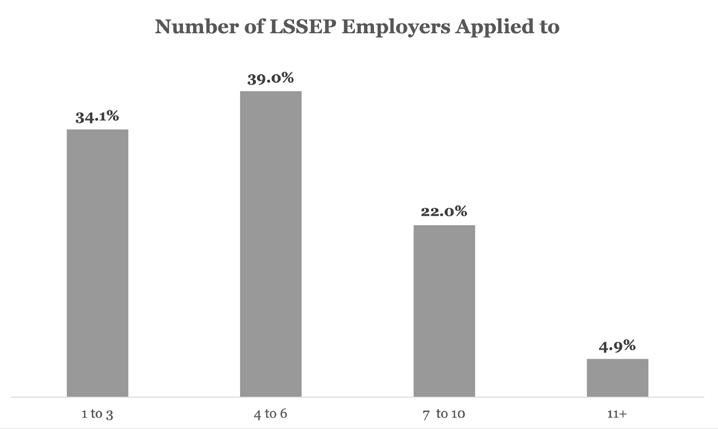
A significant portion of students (64.1%) applied to between one to six LSSEP employers. While only 4.9% of students applied to more than 11 employers, this was an increase from the 2.5% of students who applied to more than 11 employers last year.
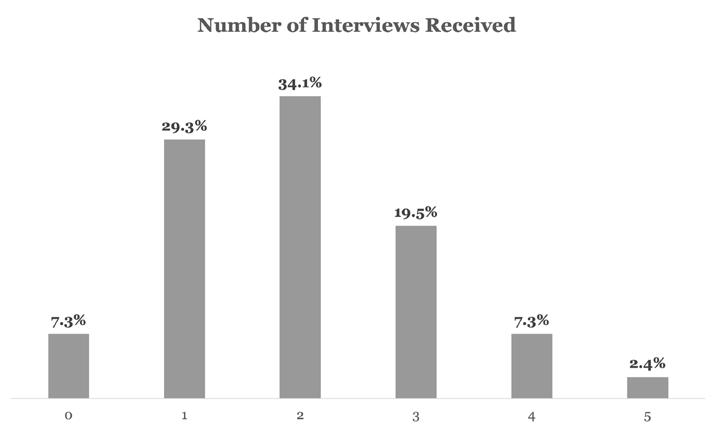
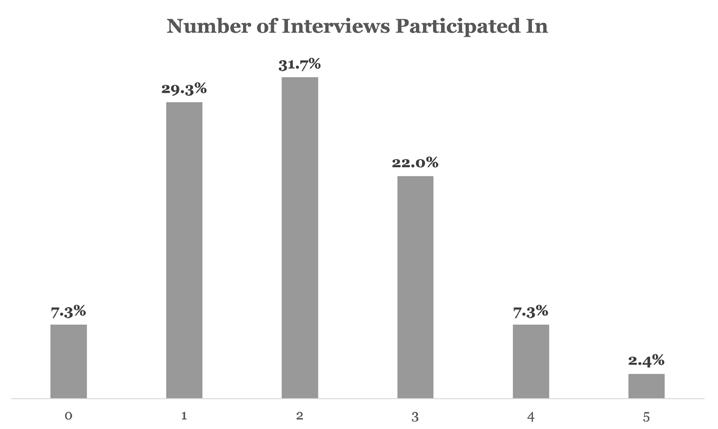
The majority of students received one to three interview offers (63.4%) and, similarly, most students participated in one to two interviews (61%).
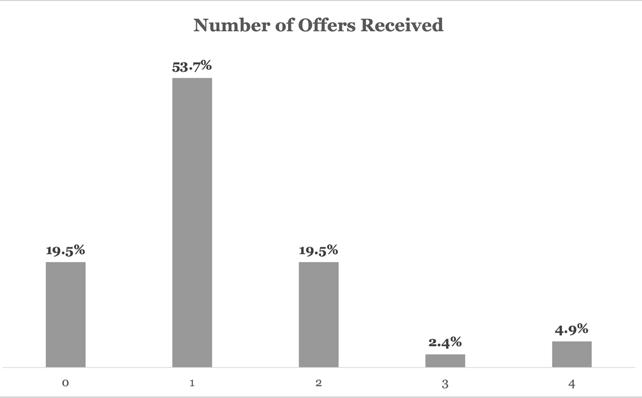
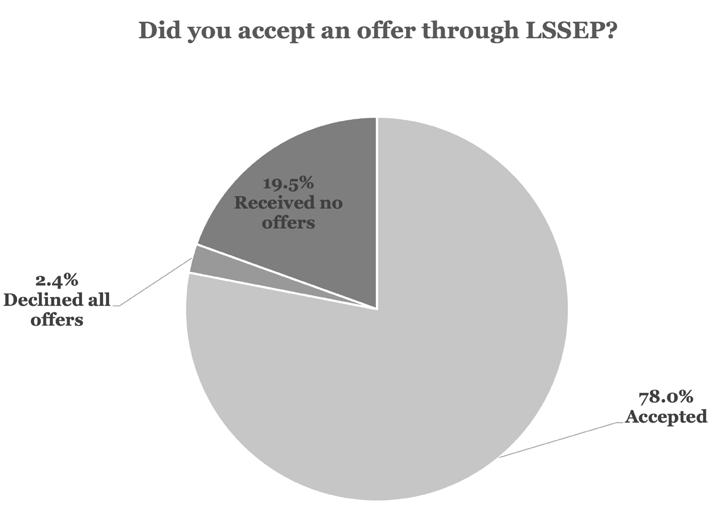
A large majority of the survey respondents (80.5%) reported receiving at least one LSSEP offer through the process. The highest number of offers received, reported by 4.9% of students, was four.
As for the final breakdown, 78.0% of survey respondents accepted a summer job offer through LSSEP, 2.4% declined all offers, and 19.5% received no offers. This was a higher number of students who did not receive an offer compared to last year, which represented 7.5% of the previous year’s survey respondents.
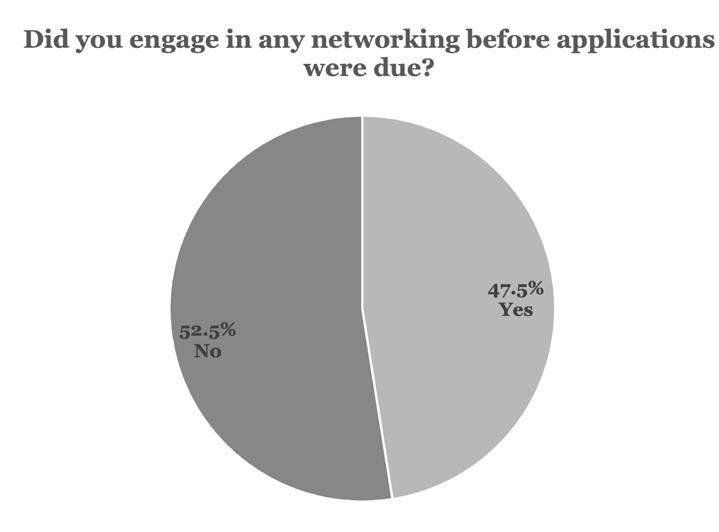
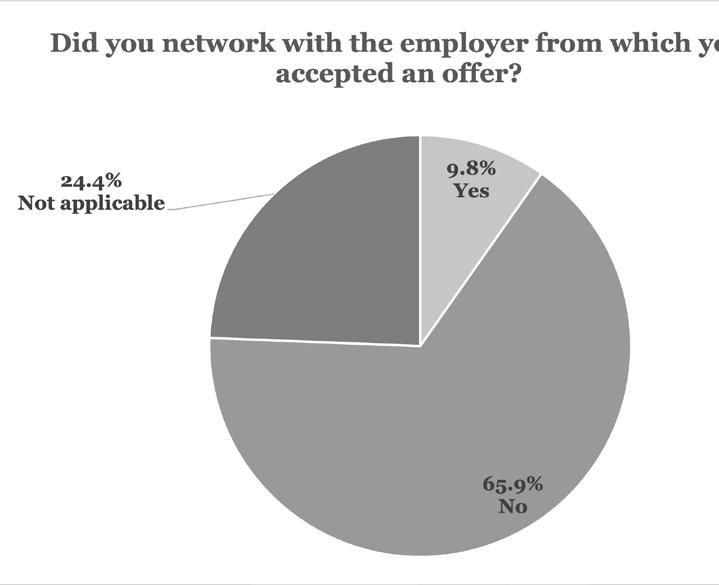
Survey participants were also asked whether they had engaged in networking, both generally and with the employer from whom they received an offer.
The majority of students (47.5%) reported networking for LSSEP. However, only 9.8% of survey respondents reported networking with the employer from which they accepted an offer.
Many students expressed that networking with former and current students was helpful to under-
2.0
At least 30 U of T Law 1Ls headed to NYC in 2027
In light of the new recruitment timelines in U.S. Big Law recruiting, Ultra Vires is reporting on the results of the New York Recruit for Summer 2027. This semester, 39 students responded to UV’s survey, with 30 students reporting that they accepted a position. Of the 30 successful candidates, 25 were 1L JD students, and 5 were JD/MBAs in year two of the fouryear program. This represents a decline from the 36 students who self-reported securing work in NYC for Summer 2026 back in October.
In light of the changes to the recruit process, UV
stand the employer better, but was not necessary.
I think it’s really helpful. Each clinic definitely has a certain skill set / experience they’re looking for and chatting with upper years helped me frame my application in a way the clinic I ended up going with wanted.
Networking with the employer and upper-year students who have worked in the positions you are applying to is very helpful. Speaking with the employer gave me a better sense of what they were looking for in a cover letter, and speaking with upper-years helped me to anticipate the questions employers would ask in the interview.
It definitely helped me decide where I was most interested in working, as well as helped craft cover letters which I think contributed to my receiving multiple interview offers. But I don’t think it’s necessary, because the job I ended up getting I didn’t network for at all.
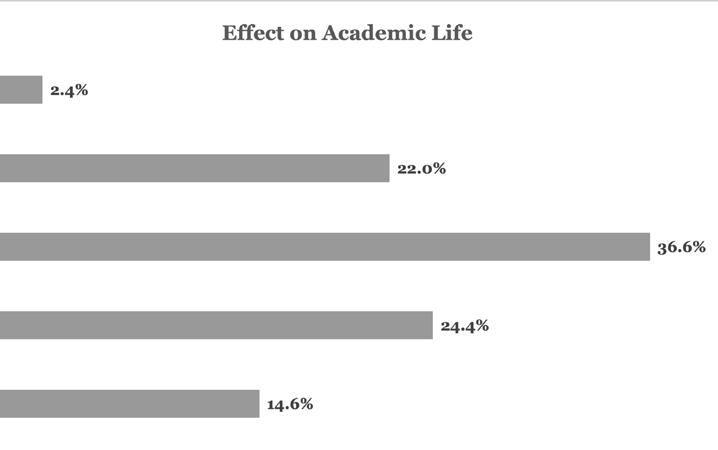
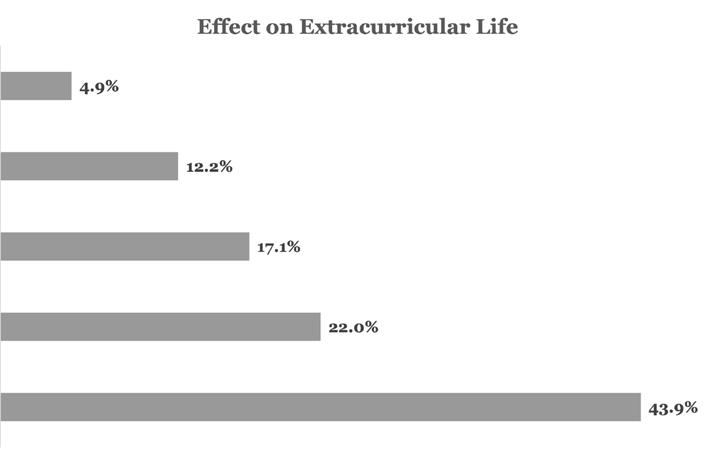
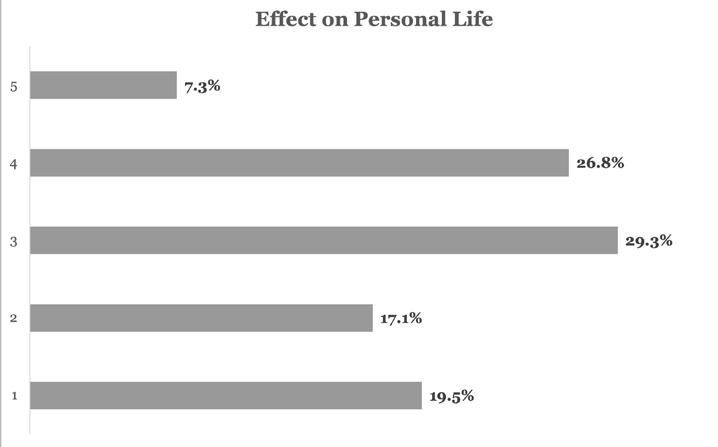
I think chatting with upper year students is a good way to learn more about the positions that you are interested in but I don't think it is necessary. It also may help you figure out what you should highlight in your application/ interviews.
Effect of the process
To close out the “numbers” section of the survey, students were asked to rank the effects of the recruit on their academic, extracurricular, and personal life, with a ranking of one meaning that there was “no disruption” and a ranking of five meaning that there was a “significant disruption.” Most student rankings fell between two and four.
What advice would you give to future LSSEP participants?
Many respondents recommended starting the process early, as it took longer than expected to tailor each application. Participants also reflected on the competitiveness of the LSSEP Recruit, possibly due to the lack of positions. Below are some students’ thoughts.
Try not to procrastinate. You definitely can start prepping over winter break if you want but it isn’t necessary, a few weeks ahead of the deadline is fine. Try to talk to upper years and get them to review your materials or give you some advice - everyone’s happy to chat.
Start early and don’t wait until the last minute, apply broadly (granted there are multiple positions that actually interest you, and that you could see yourself working in).
Start early and work on tailoring your application for each employer. You can't really apply to LSSEP positions with a "one size fits all" cover letter and (for me at least) this process took way longer than I thought. Also, make an appointment with the CDO! It was really helpful to have the CDO look over some of my materials, and they give good advice that you can apply to all your materials.
Start early! Ask upper years who have experience with the interview process about their experience. LSSEP is more competitive than they make it seem. Get someone else to review your materials before submitting. Practice interviewing with a friend ahead of time, and if possible talk to an upper year student who has already gone through the interview process so you have a better idea of what to expect. Whether you want to apply broadly or just to the positions you really want is a personal choice that depends on the breadth of your interests/experience and how much time you’re willing to dedicate to the process.
I wish the CDO would’ve been more transparent about how competitive the process is. It would’ve been nice to know ahead of time roughly how many people will be selected for an interview. Also, I wish the process for accepting/declining interviews was faster (e.g. auto declining interviews for people who got 1L jobs). I was on the waitlist for an interview up until the student decision deadline, and it wasn’t until the day after the extended deadline that I got off of it. This was really stressful and frustrating and I feel like it could’ve been avoided by having a more streamlined process for accepting/declining interviews.
Regardless of whether you secured a position or not through LSSEP, UV would like to offer sincere congratulations to everyone who participated in and made it through the process. As some students from the survey expressed, there are so many things you can do with your summer, and your summer experience is by no means a measure of your success or worth. With that said, best of luck to everyone with the homestretch of this year of law school!
asked students about the timeline. Many applications opened in November 2025 through January 2026. The earliest reported offer to interview was in December 2025; however, most students received interview invitations in late January 2026 or early February 2026. When asked about the timing of offers, respondents overwhelmingly received offers in February 2026 (24 students, or 80% of successful candidates). Six students obtained offers in January 2026, and one student in March 2026. Regarding plans for Summer 2026, five respondents indicated they will
YUHA KHAN (2L)
This year, Ultra Vires reached out to 19 employers who participated in the official 2026 Toronto 1L Recruit. Notably, Bennett Jones LLP joined the firms participating in the formal 1L recruit.
At least 80 students secured a 1L summer
position through the Toronto 1L recruit— a slight decrease from the 89 students hired last year. This decrease could be attributed to the fact that fewer employers responded to UV compared to last year. Of the participating firms, Osler, Hoskin & Harcourt
LLP (“Osler”) hired the most students, with 15 1Ls joining their office this summer. Osler is followed closely by Blake, Cassels & Graydon LLP, with 14 students hired, and Aird & Berlis LLP, with nine hires.
Following the trend of previous years, U
of T Law continues in first place with the highest number of students hired (24), with Osgoode in second place (19). Western and Queens tied for third place, with 11 students securing 1L summer positions through the recruit.
ALEXIA LEE (2L)
Ultra Vires reached out to a total of 20 employers that participated in the official 2026 Calgary 1L Recruit this year. At the time of publication, 14 employers had responded and disclosed their recruit numbers to UV.
Based on reports from participating employers, at least 73 students secured a 1L summer position
The University of Calgary, like in the 2025 Calgary 2L Recruit, was the most successful in this recruit, with 24 students (making up 32.9% of the total number of students hired through the recruit) securing 1L summer positions. However, this is a decline from the 2025
through the recruit—a higher number than the 59 2L students reported to have secured a position in the 2026 Calgary 2L Recruit. Of the firms that responded, Osler, Hoskin & Harcourt LLP (“Osler”) and Burnet, Duckworth & Palmer LLP (“BDP”) hired the highest number of students, with ten students each. Following Osler and BDP, Blake, Cassels & Graydon and Borden Ladner Gervais hired eight students each.
Calgary 1L Recruit, where the University of Calgary made up 51.70% of the total number of students hired through the recruit. In second and third place are the University of Alberta and the University of Saskatchewan with 11 and 6 students hired respectively. At least two University of Toronto students were also hired in the 1L Calgary Recruit.
This year, 1L classes were subject to a new New York recruit model. For 2L summer positions, firms no longer hired students at the end of 1L; instead, most opened their applications in November. This new timeline caused significant uncertainty when a rather sombre CDO first revealed the change at the start of the first semester. However, students were also happy to see that, if they landed, they would receive an industry-standard stipend of $50,000 USD, typically requiring only six weeks of public-interest work, if that.
Given that this year’s 1L class was the proverbial ‘canary in the coal mine,’ their experience is most representative of the New York recruit process that future classes will face. This article, therefore, asked several questions related to mental health, networking, and firm conduct to capture a relatively complete picture of what this year’s recruit looked like beyond the ultimate outcomes.
Among the students who responded to my request to answer questions, the average number of applications submitted to New York firms was roughly ten. There was little correlation between the number of applications respondents submitted and ultimate outcome.
Application Timing
Generally, respondents began preparing their materials in November, around reading week. Some began applying at the same time, submitting on a rolling basis until the deadline. However, there was variance. Some respondents began submitting applications only after the grade release.
The perceived effect of application timing varied. Some respondents primarily received callbacks from firms they applied to early in the process and, in turn, found that application timing had a significant effect on their result. Others found little correlation between application timing and result.
It is worth acknowledging that only a small number of respondents submitted applications exclusively after
grade release, but all who did so still landed. It is therefore difficult to derive any firm conclusions about timing and its effect on individual outcomes.
Alumni Support and Networking
All respondents found that alumni at their target firms were supportive. In fact, lawyers, generally, were supportive. Many respondents noted that the lawyers they networked with were, for the most part, empathetic and acknowledged the difficulties posed by the new recruit timeline.
Overall, the perceived value of networking was mixed. Some found it very helpful; some found it helpful only after receiving callbacks, so they could get interview tips and facts about the firm to discuss; and some did not network at all. Almost all respondents who networked stressed that one should be pragmatic about the value of networking, understanding that it can help, but other elements of one’s application, such as grades, are likely far more important.
The Perceived Value of Grades
Almost all respondents perceived grades as the most important factor in their outcomes, whether they landed in the recruit or not. Accordingly, almost all respondents stressed that grades should be the primary focus for any 1Ls who plan to go through the recruit.
Almost all respondents who applied for positions before the fall exams reported that their participation in the recruit affected their academic performance. The most common impact respondents reported was that their study habits were disrupted and that they found it difficult to complete readings due to the volume of work the recruit required.
The Effects of the Recruit Timeline on Mental Health
All respondents indicated that the recruit had a relatively severe effect on their mental health. Numerous reasons were provided as to why. Some reasons were
inherent to the overall recruitment process, such as selfcomparison with classmates who seemed to be doing better. However, multiple respondents also cited the stress of managing school and job applications, as well as the significant disruption to their personal lives. One respondent noted that, in part, the impact was attributable to the recruit timeline forcing students to simultaneously pursue two goals that require external validation: academics and career prospects.
The Effect of the Timeframe on Participation in Other Recruits
Many respondents received New York offers after the deadline for the Toronto 1L recruit and LSSEP recruits applications had already passed. Most therefore participated to some degree in both.
The majority of respondents who participated in both the Toronto 1L recruit and the LSSEP recruit reported that the New York recruit timeline affected how they approached their applications. Some found that they were exhausted by the New York recruit, and therefore were not able to participate in the Toronto 1L recruit and LSSEP recruit to the extent that they would have liked, while others simply found they needed to be conscious of the limited time that they had, given everything that was on their plate.
Notably, some respondents also chose not to participate in the Toronto 1L recruit because of the New York recruit timeline. For those respondents, this was primarily a decision made due to time and energy constraints, not necessarily a lack of interest in Toronto positions.
What Would be Done Differently, If Given the Chance to Redo the Process
Respondents offered a wide range of answers to the question of what they would do differently if given the chance. For two respondents, the answer was to take earlier second looks at firms after receiv-
ing offers, for others, it was to start preparing applications earlier, and, finally, for some, it was starting materials or interviews later, choosing to focus on school more than early applications, networking and/or the earliest interview date.
Multiple respondents cited the lack of information available about the new recruit format as a reason they went about the process as they did.
Miscellaneous Comments
All respondents were given the opportunity to provide advice for future students going through the New York recruit that was not covered by other questions in this article. Some respondents recommended pursuing public interest involvement and law journals. Others focused on the value of talking to associates, given that they can, to some degree, pull back the curtain on how firms are approaching the recruit. Multiple respondents also noted that mock interviews with upper-years who have gone to New York or are going to New York were quite helpful. One respondent noted that students should partake in virtual interviews if available. That respondent noted that the travel and time required to conduct in-person interviews were exhausting.
Conclusory Notes
All responses to questions about the value of grades, networking, and application timing were speculative and primarily based on firsthand experience. Law firms have different preferences and priorities; therefore, while networking, for example, may not be necessary to land at one firm, it may be at another.
The fact that a majority of respondents landed in the recruit does not necessarily mean that a majority of recruit participants from U of T Law landed. Self-selection bias may have led individuals who landed to be more likely to respond to my request for contribution.
ALLIE FONG (3L)
Law school can be stressful. Studying law is conceptually difficult, and the volume of work puts strain on work-life balance. The standards are high, and the pressure to do well is intense, especially in 1L and 2L. The competition can be fierce, and the insular nature of law school makes it difficult to avoid comparison with your peers. Comparison, famously, does not tend to boost one’s confidence or self-esteem.
It’s no surprise, then, that many students struggle with their mental wellbeing during law school. A 2016 study surveying over 11,000 students at 15 American law schools found that over one third of respondents “screened positive for moderate or severe anxiety.” While individual circumstances vary, it’s clear that mental health is a serious concern for the law school population as a whole.
One factor that can exacerbate feelings of isolation in law school is the stigma attached to speaking about mental health. Recent academic work on law student mental health suggests that, “stigma not only affects individual students’ wellbeing, but also perpetuates a culture of silence and neglect when it comes to mental health within the profession.” As exam season
approaches and stress increases, it’s important to be open and support each other to the extent that we can.
To that end, here are some things to keep in mind for exam season that I’ve learned over the years. The purpose of this list isn’t to provide the best possible study advice for getting good grades, but to compile a list of things that may be helpful for maintaining the balance between studying and protecting one’s mental health during the exam period. These approaches aren’t novel and won’t work for everyone. They’re also not meant to be “curative” or to minimize or oversimplify the complexities of mental health struggles. But I hope that they can provide a starting point or ideas for finding balance during this stressful time.
Be concrete with what you have to do, make lists, and be organized
The idea of exam season can feel overwhelming. While mapping out what you have to do can be intimidating, it gives you a real sense of what you need to do to make it through exam season, which can help avoid catastrophization or procrastination.
Spend time figuring out how you study best
I spent a lot of time in 1L trying to make my maps look like the ones on the SLS database. While those resources are fantastic starting points, studying is not a one-size-fits-all approach. Taking time to figure out how you study best can save you stress in the long-term.
Rely on those around you
At the beginning of law school, I was a staunch independent studier, which I quickly learned made me feel isolated and more stressed. Relying on those around you during exams can help you feel supported and less alone. This could mean things like forming study groups to help review or talking to the people in your life about stress.
Try and maintain a routine to the extent possible
Easier said than done. However, some form of a routine can help reduce stress by adding predictability to your days. Routines can be as detailed or as vague as you want, but the point is that having some amount of structure can re -
duce the mental load during periods of high stress.
Get out of the law school bubble, whatever that means for you
It can be hard to have perspective when you’re in the thick of exam season. Getting outside of the law bubble may help restore perspective when everything feels overwhelming. This could mean hanging out with non-law friends, going to study spots that are less frequented by law students, or exploring new areas of the city.
Practice self-empathy
Not always easy, but always important. Recognize that you’re doing the best that you can. Doing well does not demand perfection. Understand that accommodation requests are an option
Keep in mind that ongoing accommodation requests for extensions can be made. While there’s no guarantee that the requests will be accepted, it’s important to keep the option in mind if you’re struggling. Here is the JD Accommodations and Considerations Policy that includes links to the rules and accommodations forms.
I am also including the note below about programming that the law school is offering during and in advance of exam season, as well as mental health resources outside of the law school.
A Note from Chantelle Brown-Kent, Wellness and Student Success Program Manager
As the exam season approaches, your Student Programs Team, including Chantelle Brown-Kent, Wellness and Student Success Program Manager, Andrea Johns, Indigenous Initiatives Office Program Manager, and Sako Khederlarian, Student Programs Manager, want to remind you to prioritize some self-care.
To assist, we have put together a set of healthy breaktime activities, running from March 30th to April 8th, 2026. These include Doggie Day and a Beading Circle
+ Medicines Drop-In, as well as a “make your own stress ball” activity, to name a few. The aim is to help you pause and find moments of ease.
We have also heard that your Library team will be providing a variety of comfort-focused tools in the Bora Laskin Law Library during the exam season, including puzzles and colouring.
For those who might find movement helpful, please remember that campus athletic spaces are open, including Hart House, which is only a short distance from us. Making a little time for your wellness supports you and your studies!
If moral support alone is not sufficient and you find yourself needing mental health support, Health & Wellness is another important resource available for your medical and mental health needs. Here at Jackman, you can reach out to our On Location Counsellor, Mona Shannir. Appointments can be booked by calling 416-
978-8030 ext. 2 for primary care and ext. 5 for mental health care directly. For support outside of regular campus hours students can also access:
• U of T Telus Health Student Support: Provides students with real-time and/or appointment-based confidential, 24-hour support for any school, health, or general life concern in 146 languages (1- 844-451-9700 (can access worldwide).
• Good2Talk: 24/7 free, confidential resource for Ontario post-secondary students (1-866925-5454) or text 686868.
• Gerstein Crisis Line: 24/7 telephone crisis support for those 16+ living in Toronto. Support provided in 180 languages. 416-9295200.
• Distress Centre of Greater Toronto: A confiden-
tial help-line available 24/7/365 to people in emotional distress 416-408-4357.
• Black Youth Helpline: Available 9:00 a.m. to 10:00 p.m. (416) 285-9944
• LGBT+ Youthline: free and anonymous support and counseling. Sunday to Friday, 4:00 to 9:00 p.m. (647-294-4275)
• Hope for Wellness (Indigenous Phone Service): 24/7 by call or chat (1-855-242-3310)
Additionally, you are always welcome to reach out to Chantelle (chantelleb.kent@utoronto.ca) whether you have questions, are feeling overwhelmed, or just need a check-in, she’s here to listen, support you, and help however she can.
We hope you’re able to find a few supports here that feel helpful in the weeks ahead! Remember, your community is here for you, and there are lots of us here cheering you on from the sidelines!
TYLER LEE (2L)
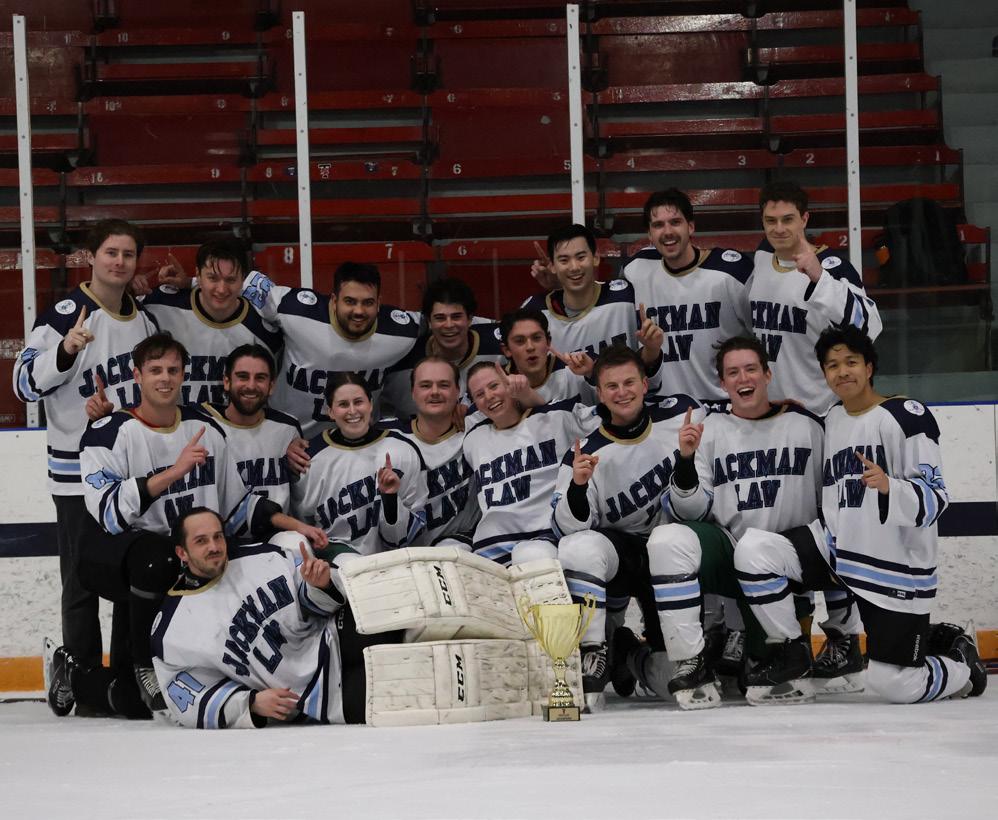
In a game defined by camaraderie, structure, and sheer resolve, the Faculty of Law Hockey Team captured the Jennings Cup (Division 1) title with a 1-0 victory over Rotman Commerce on Monday, January 16. The Team ends the winter intramural season undefeated with a 4-01 record in the regular season, and 2-0 in the playoffs.
The championship game was decided by the narrowest of margins. Every inch of ice was contested, yet the Team remained composed against a reckless and antagonizing Rotman squad. With less than five minutes left in the third period, the game remained deadlocked at 0-0. Fighting for leverage in front of the net, a Rotman defender hacked down Tyler Lee (2L), triggering a crucial powerplay late in the game. Despite confident direction from pointman Joe Hawkins (1L), the team couldn’t capitalize on several chances in the first push. Several cannons off the sticks of Lucas Fisher (3L) and Jor-
dan Schulting (2L) were deflected wide. Finally, in the powerplay’s dying seconds, trusty centreman Derek McVey (2L) broke through. After a flurry of blocked shots, McVey fought his way through traffic to deposit a rebound in the back of the Rotman net.
With the clock winding down, pressure intensified as Rotman prepared a final push. Winger tandem Jordan Guberman (2L) and Jordan Rosenfeld (2L) would be trusted to seal the game. A Rotman forward would deliver a reckless hit on Rosenfeld, allowing the Law Hockey Team to control the final seconds of the game on another powerplay.
Between the pipes, Andrew Pietras (1L) delivered a flawless performance, turning aside crucial shots to keep the team ahead in the final minutes. He earned his second shutout of the intramurals season, finishing the playoffs with a perfect 1.000 SV percent. The stout goaltender was awarded Finals MVP.
Entering the 2025/26 season, co-captains Tyler Lee and Jordan Guberman (2L) had a mission to revitalize the hockey program and return the Team to Jennings Cup glory. Thanks to the determination and commitment of this year’s roster, that mission was successful. The Team wishes every success to outgoing veterans Ethan Blumberg (3L) and Lucas Fisher (3L) as they begin their pro careers on Bay Street. Looking forward to next season, the Team is excited to announce the new leadership of cocaptains Jordan Schulting (2L) and Kate Randazzo (2L).
Winter Intramurals Roster: Jordan Guberman (C), Tyler Lee (C), Ethan Blumberg, Lucas Fisher, Keaghan Croke, Eric Dong, Graeme Hambleton, Derek McVey, Andrew Peters, Jordan Rosenfeld, Jordan Schulting, Justin Waun, Tillie Burlock, Tristan De Cotiis, Ian Gourlay, Joe Hawkins, Benjamin Katz, Andrew Pietras, Kate Randazzo, Michael Tapley
SAHARA I. MEHDI (3L)
On Friday, March 13th, the U of T Fashion Law Society (U of T FLS) co-hosted their annual fashion show in collaboration with the Osgoode Fashion Law Society (Osgoode FLS). The Church of the Holy Trinity was transformed into a Romantic Gothic dream where local designers showcased their talents to support the nonprofit Artists’ Legal Advice Services. This year, the sold-out show raised over $3000.
The evening opened with a live organ performance by 2L student Evan Tanovich, which embodied the haunting theme of Curia Nocturna. The audience showed up in their best outfits, the crowd clothed in black lace and dark velvets. The hosts, president of the U of T Fashion Law Society Emily Ernst, and Osgoode student Paris Molokwu, brought incredible energy and kept the crowd entranced. The event was planned and executed by U of T FLS and Osgoode FLS with the help of Emily Ernst, U of T FLS Vice President Matthew Goldenberg, and U of T FLS Vice President of Events, Sol Gedlu.
The mesmerising show featured ten incredible designers, each one demonstrating unique styles and designs: LUNARA, Suburban Deviant, Fatalie, Haus of Angel, After Imagine, YVESIGNER, Jamilles Co, Limerence of Emmeline, Eliane, and In Love With Vivian.
Both U of T Law and Osgoode’s fashion societies collaborated over seven months to put together this astounding production, which caught the attention of Toronto’s fashion industry. Notable attendees included Vanja Vasic, the founder and executive producer of Fashion Art Toronto, as well as representatives from the Intellectual Property Institute of Canada.
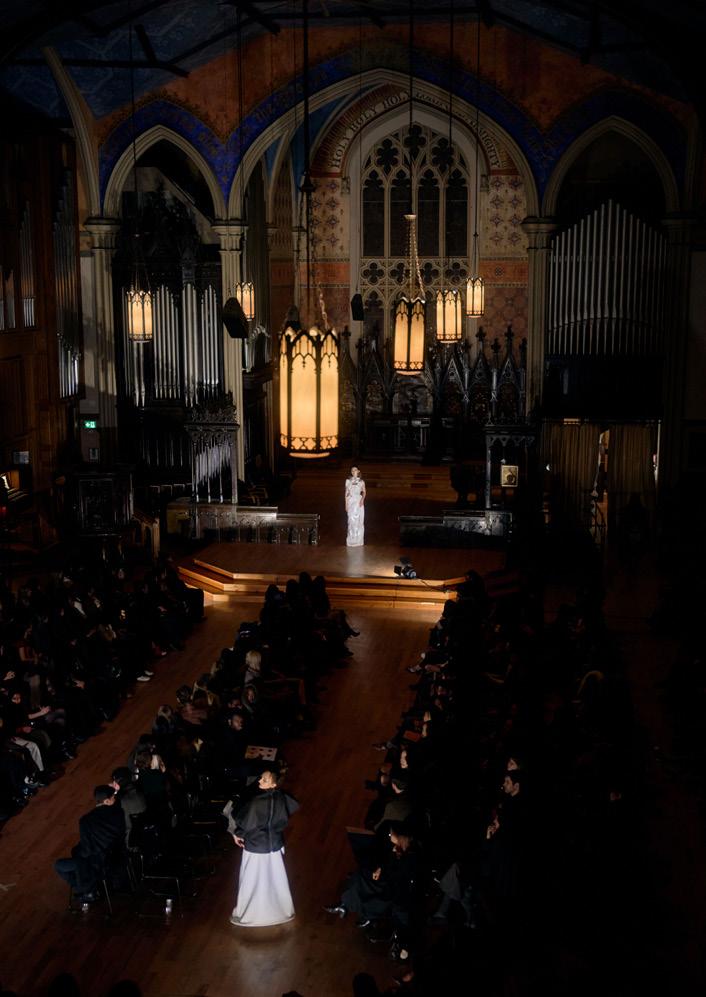

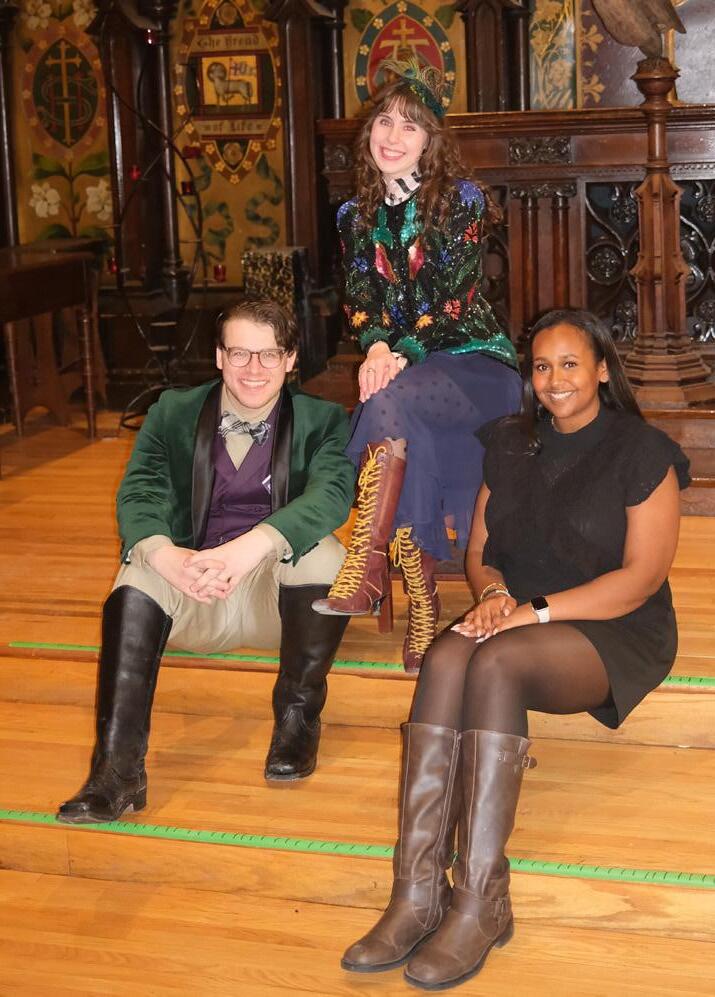
Guests had an enchanting evening experiencing breathtaking
with their legal and fashion community. We can’t wait to see what next year’s show brings!
On a Super Flattering Note: This fashion show would not be possible without the
amazing efforts of the ever radiant and chic Emily Ernst and inspiring Sol Gedlu. They have demonstrated incredible dedication, commitment and work-ethic in organizing and executing this year’s fashion show. More than that, their eye for fashion and design has spurred what has become one of the most stand-out and highlight events of the year. And, more than that, they
looked incredibly fashionable as they did so, if we do say so ourselves. Thank you Emily and Sol for all your hard work!
ALEXIA LOUMANKIS
Thank you to everyone for participating in our 9th annual poetry contest — we are happy to provide an outlet for students’ creativity. We appreciate the effort students put into writing the poems and the mettle it takes for submitting them. Thanks also to staff from Events and Facilities Services for helping us select the top three poems (which was difficult to do given how poignant they all were). Until next year…
Alexia Loumankis
Bora Laskin Law Library
Admissible (by Cassandra Brooke Evans –1st place)
I arrived in sentences already written about me footnotes of doubt trailing every step through the stone ribs of the law building, where even the light seemed annotated, filtered through glass like precedent.
In the first lecture they spoke a language that sounded like verdicts
Ratio. Obiter. Reasonable person. I searched the room for someone else quietly translating themselves into something admissible.
Everyone else looked cited.
Case-bound. Highlighted. Certain. I felt like marginaliaa question mark in soft pencil beside someone else’s authority.
The halls remembered other voices. You could hear them if you stayed late enough, whispers pressed into oak doors, ambition stitched into carpet fibers, ghosts of arguments that had already won.
I thought belonging was a ruling, handed down from somewhere higher a clerked decision, sealed, bearing my name in careful serif. I did not know you could grow it the way ivy grows: slowly, clinging to whatever will hold.
There were nights I vanished from my own argument days I came apart quietly as my tears fell until my reflection in the laptop screen looked like someone waiting to be cross-examined. Who are you to be here? On what authority? State your grounds.
And I had none only a pulse, only a history of wanting, only the quiet defiance of not leaving.
Outside, Toronto moved without citations. Streetcars argued with rain. Strangers laughed without permission. The world did not footnote itself And still it stood.
So I kept showing up to cold mornings, to casebooks that weighed like verdicts in my bag, to classrooms where my voice trembled like a witness who knew the truth but feared the room.
And then one day not triumph, not revelation just a pause:
I heard myself speak and did not rush to apologize. The silence that followed was not absence but space.
It is strange, the moment you realize you are not standing outside the door but have been inside all along,
mistaking the echo for exclusion, the distance for glass.
I used to think belonging was recognition. Now I think it is endurance the quiet insistence of staying until the walls learn your name.
And maybe this place never changed. Maybe the stone was always stone, the air always air. Maybe it was only me Softening into my own outline.
Maybe the law was never the question. Maybe I was.
And maybe just maybe I belonged the whole time
Line 3L (by Humza Mehdi Khan – 2nd place)
I know that for an 11:10 Class, I have to get to Museum by 11 so I have to get on the 10:50 line 1 train from Union so I have to take the 9:57 GO train from Pickering so I have to leave my House at 9:37
I know that on the Go Train, The new cars Have outlets for charging
The old cars Have comfortable seats for recharging
The doors Have manual switches in case they won’t open
Rouge Hill Has the best view of the lake
I know that on the Subway,
I shouldn’t stand at the front Unless I want to walk the full length of Museum station
I shouldn’t try to get on once the lights flash Unless I want to get stuck in the doors
I shouldn’t sit on the blue chairs Unless I’m really tired I shouldn’t face backwards Unless I want to fall over
I know that at the Law School,
The study rooms Are always fuller than I’d like
The friends Are less toxic than outsiders would lead you to believe
The readings Are definitely things I’m going to do this year I swear
The students Are really into trivia for some reason
But I also know that in 2 Months, None of this knowledge might matter
I’m finally at the end of the line
It’s almost time to transfer to the next one After 3 years
I don’t know
Where that line will take me
Who I’ll meet on the train
How to stop myself from stumbling on it
If it’ll be worth all this hassle
But I hope to learn I hope wherever the next line goes, There’s a nice view
Reasonably Foreseeable Delay (by Zoe Brown – 3rd place)
The line at Terima winds through the atrium, busy with law students pretending this is self care. I run a quick negligence analysis:
Duty? To myself.
Standard? A latte before Admin. Risk? Walking in late to lecture.
Foreseeable? Absolutely. Avoidable? Never.
I take a sip, of caffeine, not courage, and head back downstairs, armed with a loyalty to Terima, which my budget cannot justify.
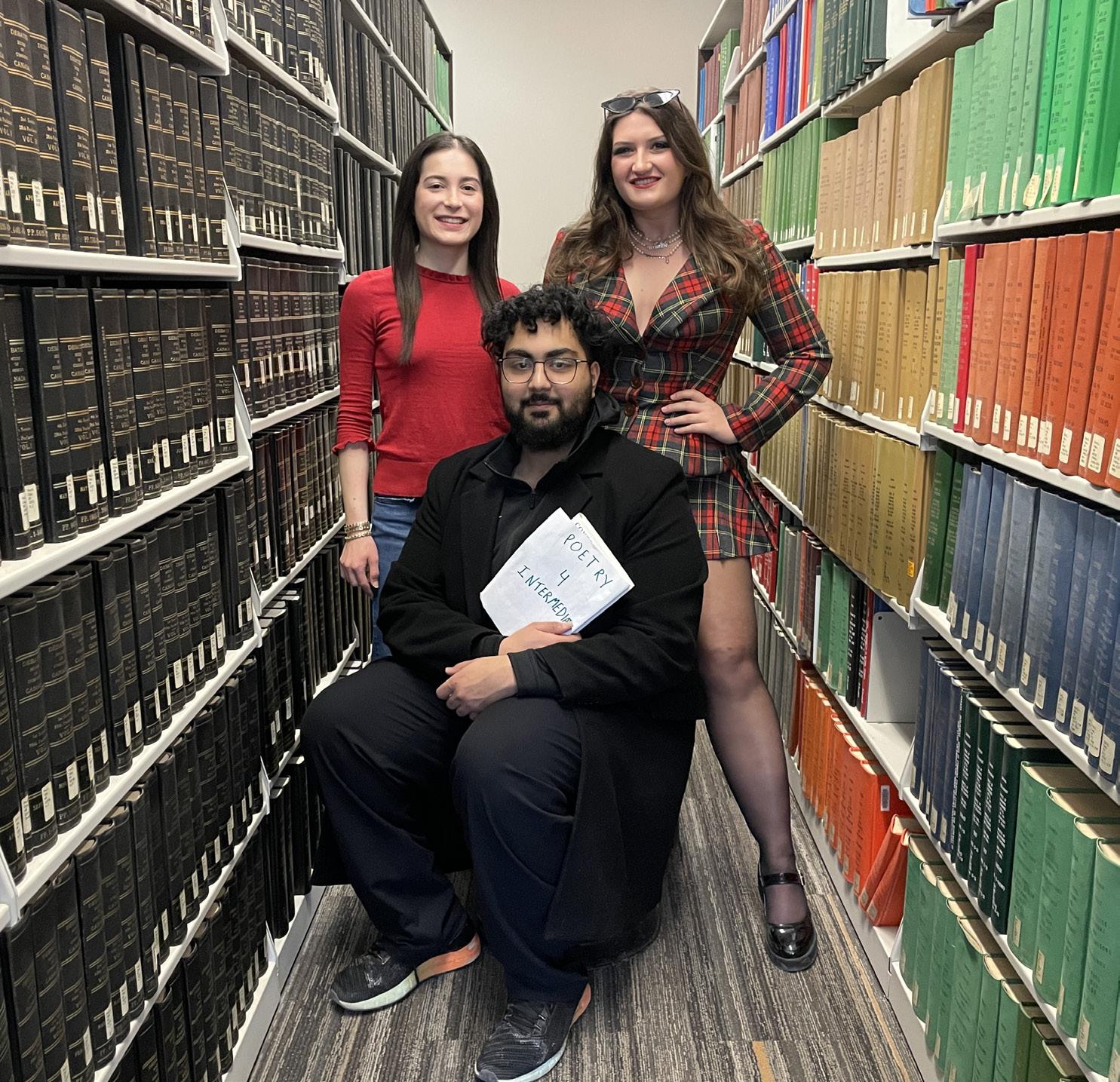

For the second year, the Competition Law Group (CLG) gave first-year law students a chance to dive into the deep end of business law. The result? A courtroom drama worthy of further elaboration. This year’s Torys Cup, the only business law-adjacent moot for 1Ls at U of T Law, was a resounding success.
The Problem: Swipe Right on a Monopoly?
Our mooters had to untangle a messy proposed merger between two titans of the heart: FYR Inc., the parent company of the ubiquitous dating app Bat Signal (a.k.a. Tinder), and Penguin’s exclusive, invite-only app Hero You Deserve (HYD, a.k.a. Raya), the preferred watering hole for Toronto’s self-proclaimed elites.
The Commissioner of Competition alleged that the $500 million acquisition would result in a substantial lessening and prevention of competition. FYR and Penguin tried to salvage the deal by selling HYD’s matchmaking algorithm, Emperor, to Riddler, which runs a trivia-based dating app called Gord. A noble effort, except the deal was
based on a non-binding Memorandum of Understanding and came with a bizarre condition: Penguin would keep the rights to use Emperor outside of Ontario for five years. Nothing says “clean break” like a five-year-long, long-distance algorithmic entanglement.
Adding to the intrigue were post-merger Five-Year Review documents that seemed to contradict their public stance. Meanwhile, Penguin’s CEO insisted HYD would remain exclusively for Toronto elites, leading some to wonder if he’d been ghosted by his own board.
The mooters had to navigate these thorny facts, arguing over whether the relevant geographic market was just Toronto or a broader Canadian market (a key distinction, given that apps can expand to new cities in 48-72 hours).
The Road to the Final
Our eight 1L mooters—Arjun Thayaparan, Daniel Kim, Victoria Percival, Kasia Wodz, Ajay Thayaparan, Matthew Davidson, Jacob Johnson, and
Grady Simpson—were thrown into the deep end. After their introduction to the problem, the CLG held five intense practice sessions over two weeks.
What started as a tentative exploration of competition law evolved into polished, persuasive advocacy. Guest judges, including past mooters and CLG founders Vlad Mirel and Cam Flanagan (3Ls), dropped in to share tips to prepare mooters for the big day. Over several weeks, the mooters devoted significant time and energy to their craft, eloquently navigating a maze of evidence and case law.
A New Rivalry is Born
This year’s moot marked a major milestone. Held at Torys LLP’s office, the moot expanded to include two teams from Osgoode Hall Law School, making it the first inter-school Torys Cup. All mooters from both schools put on a phenomenal show for the articling students and lawyers from Torys who served as judges.
The Osgoode Hall mooters were Saffron Remtulla and Pano Fragis for the Appellants, and Samuel Fanaki
The year was 2022. The Emergencies Act was invoked. Wordle was taking off. Team Canada won 26 medals at the Beijing Winter Olympics. The pandemic finally had an end in sight. And most importantly, the Class of 2026 was crafting their personal statements.
Every year, Ultra Vires asks the graduating class to reflect on their law school journey, and where it all started: their personal statement. Students submit excerpts from their personal statements and compare them with their post-graduation plans.
The following excerpts have been edited for brevity and clarity.
THE ENVIRONMENTALLY-CONSCIOUS FAMILY LAWYER
“It was not until I took a course on climate change biology in my third year that my interest in law was further solidified. [...] Given my academic background in science obtained in my undergraduate degree, I want to pursue a legal education in environmental justice and sustainability to gain the additional knowledge and skills required to advocate for the environment effectively.”
This student will article at a family law firm. They mentioned that their personal statement was genuine at the time, and they had attempted to pursue that path in 1L, but their dreams were crushed because: (1) they needed money and (2), they would need to represent the polluters to make money. Their interest in Environmental Law had disappeared by the time they took Administrative Law. They maintain that they still care about the environment, but find that Family Law is a much better fit for their personality, and they’ve thoroughly enjoyed their experiences so far. They highlight that in a way, they’re protecting the environment by detoxifying relationships (through divorces).
THE BUSINESS LAW RESISTOR
“When I first mentioned spending the next three years studying a second law degree in Canada to the supervising partner in my law firm, he was surprised. Why would I “start over” my legal career in Canada, when I was already well on my way to being a lawyer in Hong Kong? [...]
Through studying law in Canada, I hope to keep growing in my understanding of the law, and with it my ability to evaluate different perspectives critically. Having been raised and educated in Hong Kong, I’ve never had the opportunity to study outside my hometown. Yet, based on my experience working in an international law firm, I realised that lawyers are increasingly expected to not only be aware of the black letter law, but to understand the rationale behind a client’s case, the needs and wants of the parties involved and to generate commercial solutions. In order to do this, I believe I need to strengthen myself by stepping outside of the comfort zone of Hong Kong and delve into another culture and country. To this end, I see studying law in Canada as an opportunity to further my legal education, build relationships with future Canadian lawyers, and gain a greater understanding of the practice and culture of Canada.
As for the notion of “starting over”, I believe that my legal training and experience in Hong Kong will be an asset in my future studies and I look forward to sharing my perspective in the class-
rooms, lecture halls, and eventually, to clients. Ultimately, I hope that what others see as a restart of my career will be another step in my journey of becoming a better and more well-rounded lawyer.”
This student will be articling at MAG in the Criminal Law Division.
Looking back, this student reflected on having a business-oriented personal statement rather than speaking about their desire for public interest work. They had pitched themselves as having worked at an international law firm in Hong Kong and wanting to learn more about the culture and practices of a foreign country so that they can better serve their clients in the future. At the time, they thought that this narrative better aligned with their resume and work experience. However, after spending time exploring public interest opportunities and especially working in Downtown Legal Services, they came to realize that their passion was not in big law but rather in working within the criminal justice system. They note that in a way, they are thankful that while they entered law school with the intention to pursue a career in Big Law, they remained open to other opportunities and eventually discovered what they really wanted to do.
THE DISILLUSIONED CORPORATE
“I never imagined being a lawyer, not at first anyways. I originally envisioned becoming a scientist. I loved learning about the world and challenging myself to think critically about real-world issues. In science, everything abides by clear laws: Newton’s laws of physics, the law of entropy or the law of conservation. It paints a purely clinical image of science based on quantitative numbers and data. One could argue science can be kept in a box, existing separately from politics and law, free from any biases. This purity, though enticing, made less sense as I learned more about the world around me. Prejudices and bias plaguing society know no boundaries, and had seeped into science long ago, creating vast inequalities. I began to see how science existed in a vacuum of its own and remaining in science felt complacent, turning a blind eye to biases just to maintain objectivity.
The real world is messy. It does not fit neatly into a box or abide by the laws imposed onto it. In reality, science is inherently political. Take DNA, where sexism led to Rosalind Franklin’s discovery of the double helix to be credited to Watson and Crick, or climate action, where Fortune 500 companies hypocritically encourage individual actions against climate change but turn a blind eye to their own actions. These realizations proved to me that science was not objective, just as social injustices obeyed no laws or borders. They affect every aspect of life and existence. Science, though awe-inspiring, began to frustrate me.”
This student is headed to a full-service firm in the U.S.
Upon reflecting on their personal statement, this student was met with melancholy. They felt their 1L self had come into law school with a naive sense of the law and lofty ambitions. While they were part of various
public interest initiatives throughout law school, and found it to be essential work, they now describe themselves as now disillusioned by the law, the existence of international law, or human rights law. Nonetheless, they hope to practice public interest law full-time, but are currently attempting to pay off their student loans as fast as possible to be able to do so.
THE EX-PUBLIC INTERNATIONAL LAW HOPEFUL
“As I now turn to explore opportunities to make a tangible difference in this world, I believe that the law will be the medium through which I could amplify my voice and make a continued contribution to the community surrounding me. However, I am also cautious in saying that the law will be a solution to every existing problem, as my studies in social sciences have taught me that the law itself could be a profoundly flawed medium. As such, I wish to use law as a vehicle of social change while striving to deconstruct its oppressive legacy by engaging in the field of public international law. Career-wise, I am interested in becoming a mediator to explore a more inclusive, bottom-up approach to global peacebuilding as well as pursuing academia in the field of international law.”
This student will article at a litigation boutique.
While acknowledging their lofty goals, this student noted that they did follow through on the various clinical opportunities that initially drew them to U of T (IHRP, Asper Centre, etc). Though they may still have the same career goals, they are unsure of their feasibility due to financial burden. As a result, they see themselves practising commercial litigation on Bay Street for the foreseeable future.
THE TRUE-TO-THEMSELVES LAW STUDENT
“In the past two years, I have proved to myself and the world that my disability does not need to hold me back from pursuing my dreams. The next step in my journey is to attend law school to pursue a career in advocacy. As a journalist, I have reported on injustice, but this has never felt like enough. I do not only want to report on unjust and unfair things happening from an unbiased lens, I want to change them. Specifically, as a person with a disability, although the Charter of Rights and Freedoms guarantees that every person is considered equal, I can attest to the fact this is not true when it comes to providing accessibility. Our society assumes by default that every person is able-bodied, thus creating daily challenges for people like me. By attending the University of Toronto Faculty of Law, I will develop the skills to advocate for the rights of people with disabilities. As a lawyer, I will no longer only report on issues, but actively work to make Canada a better place. I hope you will consider me for admission.”
This student will article at a full-service firm, KPMG Law.
In retrospect, this student notes that while their statement now seems very naive and ambitious, the ethos and core of who they are hasn't changed. While they may be less optimistic and hopeful about how much can be changed, especially when going up against huge,
and Dominic Rochon for the Respondents.
After two preliminary rounds, the final came down to an all-U of T showdown. Arjun Thayaparan and Daniel Kim, representing the Appellants, squared off against Kasia Wodz and Victoria Percival for the Respondents. The arguments were tight, and the questions from the bench were pointed.
When the dust settled, Victoria Percival was named First Placed Oralist, with Arjun Thayaparan taking home Second Place Best Oralist and Grady Simpson rounding out the podium with Third Place Oralist.
Looking to the Future
The 2024 Torys Cup was a testament to the incredible talent of these 1L mooters and the strength of U of T Law’s mooting. It was a joy to watch these mooters grow into confident advocates. A huge thank you to the sponsors and judges at Torys LLP, the CLG executive, the Competition Law Society at Osgoode Hall, and the mooters themselves for making it an unforgettable day.
powerful institutions, they think their time at U of T has shown them that they don't need to change Canada or even the world. They highlight that their goal is to make their little corner of this earth a little better than it was yesterday and to bring a little more light into the lives of the people around them. They think their younger self would be proud of that.
THE CLINICAL EXPERIENCE ADVOCATE
“Despite being the youngest child in a large family, raised in a part of the city where there were few role models of people who had attained a bachelor's -- much less aspired to study law -- my journey to and through higher education showed me why a legal career aligns with the values and knowledge I gained. The support of programs like Pathways was crucial as a kid, because it brought me here, but its broader impact was teaching me why advocates matter, precisely because they made the biggest difference for me and the communities I grew up in. I learned the value of a person who helps others overcome barriers and fight for their interests, and law school will empower me to be that person. That's why I'm passionate about law: it's how I envision myself helping marginalized people access justice and overcome social and legal barriers. It's because of what I've learned during my undergraduate experience, both in and beyond books, that advocacy is central to what I want to pursue in a legal career.”
This student will article at a litigation boutique that mainly focuses on union-side labour law.
Looking back, this student noted that they did not pursue family, criminal, or immigration law as they had expected, nor did they hold onto the same perspectives on the legal system. Law school changed their understanding of the limits of legal advocacy as a way of advancing social justice. They don't feel as pollyannish that government lawyers are part of a system that cares much about the rights of offenders, nor are they as persuaded that our legal system generally leads to just outcomes as they had previously thought. They still believe in the importance of access to counsel and care deeply about using their legal education in a way that serves marginalized communities. Their career goals shifted towards union-side labour law because they became more passionate about representing workers, and wanted to pursue litigation that could achieve more systemic change for clients that represent broader sectors of society.
In reflecting, they emphasized their appreciation for their time at DLS and AIW, noting its importance over more academic or research-based extracurriculars. They believe that clinical experiences (specifically the kinds that target marginalized and underserved communities and allow students to be legal advocates for them) are crucial, and strongly support this school using some of the funds from its recent 'transformational gift' towards better resourcing the clinical programs that it offers.
The International Human Rights Program at the University of Toronto Faculty of Law An independent student-led publication
2025–26 Rights Review Editorial Board
Co-Editors-in-Chief: Rachel Brouwer (2L) and Mackenzie Birbrager (2L)
Senior Editors: Jeffrey Ma (3L) and Joy Cudjoe (2L)
Junior Editors: Jackie Tan (2L) and Sanaea Suntok (1L)
Fact-Checker: Hayden Godfrey (1L)
By Rachel Brouwer (2L JD/MGA)
Across Canada, communities are exposing a troubling pattern with increasing frequency: the country’s most dangerous environmental hazards are disproportionately located near Indigenous, Black, and low-income neighbourhoods. What was once dismissed as a coincidence is now widely recognized as environmental racism—a form of systemic discrimination that places racialized communities in closer proximity to environmental hazards and exposes them to higher levels of pollution. From pipelines and paper mills to landfills and oil refineries, these hazards are too often concentrated in communities that have been historically excluded from the political and regulatory decisions dictating where environmental harm is “allowed” to occur.
Few cases provide a better snapshot of the realities of environmental racism in Canada than the community of Shelburne, Nova Scotia. In the 1940s, the Town of Shelburne established the Morvan Road landfill, located directly uphill from the historically African Nova Scotian South End community, whose roots trace back to Black Loyalists who settled there in 1783. For decades, the Morvan Road landfill was used to burn residential, industrial, and even medical waste, which produced thick smoke that drifted into nearby homes and workplaces. Residents living next to the dump endured constant exposure to these emissions, raising longstanding concerns about their health and safety. Over time, the community has reported elevated rates of cancer and premature death relative to surrounding communities.
Although the landfill closed in 2016 after years of persistent community advocacy, the South End community continues to grapple with the 75-year legacy of environmental harm it left behind. One of the most pressing concerns is the toxins from the decommissioned site that have seeped into the groundwater, contaminating local wells and nearby water sources. Consequently, many residents have had to rely on purchasing bottled water as their primary means of accessing safe drinking water. The situation has become so alarming that Amnesty International conducted a site visit to Shelbourne in late 2025. Following the visit, David Matsinhe, Director of Research at Amnesty International Canada, remarked: “It’s very difficult to believe we are in a First World country because those conditions don’t represent a First World country.”
The fact that such conditions have persisted for more than a decade after the landfill’s closure raises troubling questions about the adequacy of Canada’s legal and policy frameworks to address the longstanding consequences of environmental racism. Recent legislative developments and governmental action suggest that governments are beginning to acknowledge the

problem. Yet the legal tools currently available to affected communities remain strikingly limited.
At the local level, the government of Nova Scotia commissioned a report examining environmental racism across the province. The draft report, completed in 2023, reportedly includes 14 recommendations, among them a call for a formal apology to affected communities as well as potential reparations and increased investment in environmental rehabilitation. The problem, however, is the lack of action. Despite pressure from opposition parties and community advocates to release the report, it remains unclear whether its findings will ever be made public—or whether key decision-makers have even reviewed the report. For communities like Shelburne that have waited decades for meaningful recognition and remedy, this lack of transparency and political inertia offers little reassurance that change is coming.
Federally, the Canadian Environmental Protection Act, 1999 (CEPA) was amended in 2023 to recognize the right to a healthy environment. On paper, the right appears significant–it affirms that every individual has the right to live in an environment protected from harmful substances, pollutants, and waste, and one that supports clean air and water, a stable climate, and healthy ecosystems and biodiversity. In practice, however, the right is limited in scope. The right merely applies to federal decisions made under the CEPA and does not create a new standalone cause of action through which individuals can seek redress for environmental harm. As Dr. Elaine MacDonald has explained, individuals may challenge government decisions they believe violate their right to a healthy environment, “but they won’t be able to go to court, for example, and say, ‘my environment is really polluted, and I want the government to do something about it.’” Accordingly, the recognition of this right offers little meaningful legal recourse for communities that have already spent decades living with the consequences of environmental racism.
Further legislative progress appeared to arrive in 2024 with the enactment of the National Strategy Respecting Environmental Racism and Environmental Justice Act (the Act). The Act requires the federal government to examine the relationship between race, socioeconomic status, and exposure to environmental risk, and to develop a national strategy aimed at preventing and addressing environmental racism. However, the extent to which the Act will produce meaningful change remains uncertain. Lily Farinaccio argues that, where environmental issues transcend jurisdictional boundaries, there is a risk that such an Act will obfuscate accountability regarding which level of government is responsible for remedying environmental racism. In order for the Act to translate into a meaningful ap-

proach to environmental racism, coordinated action across all levels of government remains essential. Moreover, because the legislation operates prospectively, it provides little recourse for communities like Shelburne, where environmental harm is deeply historic.
Finally, Canada’s disinterest in constitutionally recognizing a right to a healthy environment— combined with the reluctance of Canadian courts to recognize environmental harms as violations of section 7 or 15 Charter rights—further limits the ability of communities affected by environmental racism to obtain meaningful remedies. This limitation is particularly striking when compared with other countries that have embedded environmental rights within their constitutional frameworks.
For instance, Section 24 of the Constitution of South Africa provides that “everyone has the right to an environment that is not harmful to their health or well-being; and to have the environment protected, for the benefit of present and future generations.” Similarly, Article 112 of the Norwegian Constitution recognizes the right to a healthy environment and obliges the state to safeguard natural resources for both present and future generations.
Meanwhile, Article 66 of the Constitution of Portugal guarantees the right to a healthy and ecologically balanced environment and requires the state to prevent pollution and promote environmental quality.
Some constitutions go even further. Article 71 of the Constitution of Ecuador recognizes the rights of nature, providing that ecosystems themselves possess the right to exist, persist, and regenerate their vital cycles, and allowing individuals, communities, and organizations to bring legal actions on behalf of nature. Environmental rights protections also exist within subnational constitutional frameworks in the United States. For example, Article I, Section 27 of the Constitution of Pennsylvania provides that “people have a right to clean air, pure water, and to the preservation of the natural, scenic, historic, and esthetic values of the environment.”
From these examples, South Africa offers perhaps the clearest demonstration of how constitutional environmental rights can be used to protect marginalized communities. In Vukani Environmental Justice Movement in Action v Minister of Environmental Affairs 2022, the High Court of South Africa held that the government breached its constitutional duty under Section 24 to protect citizens from harmful air pollution. The judgment provided a meaningful remedy for communities in the Highveld Priority Area, where marginalized populations have long been exposed to severe air pollution. The court also emphasized that the constitutional right to a healthy environment imposes a positive and enforceable obligation on the state. While few countries have applied constitutional environmental rights with comparable success, the constitu-
tional frameworks in Norway, Portugal, and Ecuador nonetheless provide their citizens with a decisive advantage over Canadians: a robust constitutional entry point through which environmental racism and environmental harm can be challenged.
The gap between the promise of Canada’s environmental legal framework and the limited practical remedies available to communities, such as Shelburne, arguably places Canada out of step with evolving international standards for effective environmental governance. In 2022, the UNGA adopted United Nations General Assembly Resolution 76/300, formally recognizing the human right to a clean, healthy, and sustainable environment with 161 states, including Canada, voting in favour. Other soft-law instruments, such as the Framework Principles on Human Rights and the Environment, require states to ensure that environmental conditions are not discriminatory. Principle 3 stipulates that “States should prohibit discrimination and ensure equal and effective protection against discrimination in relation to the enjoyment of a safe, clean, healthy, and sustainable environment.” Principle 10 provides that states “should ensure access to effective remedies for violations of human rights and domestic laws relating to the environment.”
More recently, the International Court of Justice’s Advisory Opinion on Climate Change in 2025 affirmed that states have legal obligations to protect the environment and may incur responsibility, including reparations, for climate-related harm. Such obligations include protecting vulnerable and marginalized communities. While these instruments are non-binding, they signal a growing international expectation that states provide effective legal protections and remedies for environmental harm—an expectation that Canada’s current framework struggles to meet.
Consequently, for communities such as Shelburne, meaningful legal remedies are most likely to arise through private law claims, such as tort actions against responsible actors. Yet these avenues present formidable obstacles. Establishing causation between long-term exposure to environmental contaminants and specific health outcomes often requires decades of scientific evidence, detailed medical records, and extensive financial resources. These evidentiary and financial barriers make it extraordinarily difficult for communities already burdened by environmental harm to secure justice.
If Canada is serious about addressing environmental racism, it must ensure that new legal frameworks do not simply give the appearance of progress while insulating both levels of government from confronting past harms. Otherwise, communities like Shelburne—and many others across the country—risk becoming enduring reminders that environmental justice in Canada remains elusive.

The International Human Rights Program at the University of Toronto Faculty of Law An independent student-led publication
By Taj Donville-Outerbridge (MGA)

The international human rights framework faces a threat that is neither frontal nor obvious. It does not come from authoritarian states openly rejecting rights obligations. Instead, it comes from within; from transnational networks of well-resourced conservative organizations that have learned to fluently speak the language of human rights while systematically working to restrict protections for women, LGBTQI+ persons, migrants and refugees, and other marginalized groups. What distinguishes these malign actors is not normative disagreement but their strategic manipulation of institutional mechanisms by exploiting consultative status, flooding treaty body processes with coordinated submissions, and invoking universality or cultural relativism interchangeably, whichever serves the immediate goal of narrowing protections and shrinking rights for certain groups. The Bureau of Investigative Journalism has documented what this looks like in practice: CitizenGO, a Madrid-based platform partly funded by Russian oligarchs, ran coordinated campaigns in Kenya and Ghana that contributed to abortion clinic closures and anti-LGBTQ+ legislation imposing sentences of up to ten years, under the guise of defending authentic local cultures against Western imperialism.
Between 2007 and 2020, U.S. Christian Right groups spent at least USD $280 million funding global campaigns against abortion access, LGBTQI+ rights, and comprehensive sexuality education across the Global South. This figure is estimated to have grown into the billions since. Local actors across the Global South hold genuinely diverse views, and some conservative positions reflect real community values. Nevertheless, these transnational networks erase such nuance by selectively

amplifying conservative voices while marginalizing, for example, African LGBTQI+ activists drawing on precolonial traditions, Latin American feminists grounding rights claims in liberation theology, and Muslim scholars developing egalitarian interpretations of Islamic law. The problem is not diversity of view; it is that transnational networks have systematically captured the institutional mechanisms, funding channels, and civil society spaces through which rights are made and unmade.
Norm Contestation Under Conditions of Unequal Power
Conservative Anti-Rights NGO’s most characteristic tactic — invoking one’s rights claim to erode another — sits in direct tension with the principle of indivisibility enshrined in the Vienna Declaration and Programme of Action (VDPA). When these organizations invoke “parental rights” to oppose sexuality education that protects children from abuse, or “religious freedom” to justify discrimination against LGBTQI+ persons, they do not merely contest particular rights interpretations. They treat certain rights as legitimate while dismissing other protections for marginalized groups as culturally contingent, a hierarchization the VDPA explicitly rejects. Further, Article 30 of the Universal Declaration on Human Rights (UDHR) reinforces this, by prohibiting interpretation of the Declaration as implying any right to engage in activities aimed at the destruction of recognized rights. This limitation does not function as a licensing requirement for institutional participation, as human rights law rightly protects pluralism and freedom of association. Rather it offers a legal basis for asking whether organizations, whose explicit purpose is restricting protections for particular groups, can credibly claim alignment with the commitment to promoting rights
for all enshrined in the Article 1(3) of the UN Charter. ECOSOC Resolution 1996/31, which governs NGO consultative status, requires organizations to support the purposes and principles of the Charter. The gap between that requirement and current practice has gone largely unexamined.
Weaponizing Margin of Appreciation and Cultural Relativism
These organizations have proven especially adept at exploiting the margin of appreciation doctrine developed by the European Court of Human Rights. Originally conceived to respect legitimate cultural differences in implementing Convention rights, the doctrine was never designed as a general override for fundamental equality obligations, as the Court demonstrated in foundational cases including Dudgeon v. United Kingdom (1981). Yet conservative groups filing interventions at the European Court systematically argue for expanding the margin to permit near-unlimited state discretion on so-called “moral issues” — precisely the areas where marginalized communities most need protection from majoritarian preferences.
The colonial genealogy of these arguments deserves particular scrutiny. When transnational anti-LGBTQ networks in the Caribbean invoke cultural particularities to defend British colonial sodomy laws, three layers of erasure are at work: (1) the laws themselves are colonial impositions, not authentic cultural expressions, (2) the organizations making these arguments operate from the Global North, typically in the U.S., Canada, and the UK, and (3) the “cultural values” they defend reflect Victorian Christian morality exported through conquest, not precolonial tradition. The UN Human Rights Committee’s ruling in Toonen
v. Australia (1994) established that anti-sodomy laws violate Articles 17 and 26 of the International Covenant on Civil and Political Rights, confirming that these defences have no grounding in settled international law. Through what scholars call competitive mimicry, malign actors adopt the organizational forms and discursive frameworks of progressive civil society all while working toward opposite substantive ends, thereby appropriating mechanisms designed to democratize global governance to instead reinforce subordination.
Western governmental complicity compounds this phenomena. The attempted instrumentalization of ACP-EU negotiations exemplifies this dynamic. European-based organizations successfully recruited ACP and EU parliamentarians to pressure negotiators into removing sexual and reproductive health rights provisions from the Agreement, exploiting legitimate postcolonial concerns about Western governments using aid and trade access to impose their own human rights benchmarks on partner countries. This framing allowed anti-rights groups to present themselves as defenders of sovereignty and cultural autonomy, while advancing agendas that reinforce the subordination of women and girls within African, Caribbean and Pacific countries. UN-focused research confirms that Western state-backed organizations purport to align with Global South voices, while possessing institutional weight derived entirely from Western bases of power.
The Urgency of Institutional Interrogation
The core problem is that the international human rights framework currently lacks principled tools to distinguish legitimate normative disagreement from bad-faith instrumentalization of institutional mechanisms. UN treaty bodies issue extensive analyses of state compliance but rarely examine how non-state actors undermine those same obligations through strategic participation. The Human Rights Council debates civil society restrictions imposed by authoritarian governments but does not interrogate how well-resourced organizations funded by democracies exploit participatory openness to advance restrictive agendas. Such silence has become untenable. The collapse of U.S. foreign aid has created a “Trojan horse moment” in which anti-rights groups are actively filling the institutional void by exploiting structural vulnerabilities in the UN Economic and Social Council’s accreditation framework. These groups are seizing their opportunity at precisely the moment when progressive rights infrastructure is most depleted.
What is needed first is not policy intervention but institutional reckoning. International human rights bodies must openly debate whether organizations whose explicit purpose is restricting protections for particular groups can legitimately claim alignment with UN Charter purposes. Treaty committees could develop jurisprudence distinguishing legitimate cultural pluralism from strategic instrumentalization of difference, asking whose voices within cultures are empowered or silenced by particular interpretations. Concrete steps might include transparency requirements for transnational advocacy organizations and dramatically increased support for locally-led movements. None of this is possible without first naming the structural problem of internal appropriation that international human rights law faces. The greatest threat may not come from states that openly oppose rights, but from actors who have learned to leverage the framework’s own mechanisms, language, and unresolved contradictions against the people it was built to protect.
HASNAIN (3L) & KATE SHACKLETON (3L)
King Essert Presides Over Faculty Social Season
Dearest Gentle Readers, as you surely know, law students recently marked the highlight of the academic season at the annual Law Ball. However, while law students made polite conservation with their peers (drank copious amounts of rum and coke from the open bar and threw up in the Old Mill parking lot), our esteemed professors were enjoying their own social season. With King Essert atop the Faculty’s social hierarchy, this author believes that the DEsserts are greatly improved this season. It has also come to this author’s attention that Professor Shaffer was recently named the Diamond of the Season.
[REDACTED] Sues U.V. Over Superlatives Controversy
Graduating students recently cast their votes to determine this year’s superlatives. While some students were overjoyed to receive titles such as “Nicest Hair” and “Best LinkedIn Profile”, one disgruntled student found themselves the unwilling recipient of the Most Likely to Get Disbarred
award. They have reportedly launched a civil claim against U.V., the Faculty, and all 3L students. They seek $2 million in damages for intentional infliction of emotional distress, defamation, and online harassment. Since Intra Vires fears a similar defamation suit, we have redacted the litigious student’s name.
Follies Sweep at the Oscars
U of T Law students are flourishing in Hollywood and beyond! Inspired by the hit show Heated Rivalry, students recently scored a major win for Canadian content by winning multiple Oscars. While our students were, of course, thrilled by their victories, Intra Vires has reasonable and probable grounds to believe that the U of T Law contingent left the Oscars disappointed to have been left off the Vanity Fair Oscar Party guest list. The Follies Exec Producer, Humza Khan was reportedly heartbroken to miss out on seeing Shane and Ilya in real life.
Free Exam Coffee On the Horizon
As Jackman students head into their first exam
season under Dean Essert’s tenure, students are eager to see if his reign will usher in a new and improved complimentary exam beverage station. Will Essert be the first to finally break free from Terima’s claws and offer somewhat drinkable coffee? Will there be more delectable snack options? At least one of the Intra Vires authors would like to see a matcha station. Dean Essert, if you’re reading this, the only limits are the ones you put on yourself.
U of T Law: Where AI Pushes Education Back to Historic Frontiers
As we enter exam season, Intra Vires would like to take this opportunity to, on behalf of all students, sincerely thank the administration for protecting us from the most significant threat known to education-kind, AI. We thank the administration and faculty for pushing to exams over paper courses. We are confident that writing skills are not one that need to be developed in the legal field. Nor will we ever need to learn how to work with AI. Exams perfectly prepare us for practice. Further, the two-pagers being introduced are incredibly reassuring and don’t stress students out at all!
U.V. Crossword Emerges as New Source of Social Division
As loyal U.V. readers know, the crossword is no easy feat. Even those who spend every lecture doing crosswords find themselves regularly defeated by our puzzle writers. However, those who do solve the seemingly impossible puzzle find themselves widely-acclaimed within the law school community. While the Distinction List was once the key signal of success, the crossword has proved an even better way of separating the truly HH-worthy from the P-grade masses.
U of T Law Re-re-re-re-re-re-re-named one last time
Unsurprisingly, Hasnain, Shackleton & Khan are back at it again. This time, following a donation of $80,000,007, Hasnain & Shackleton have once again ousted Khan. They cite irreconcilable differences as the cause for their split after Khan reportedly left the legal world for cinema following the smashing success of Law Follies. Hasnain & Shackleton agreed to memorialize this final name change and hope their Intra Vires legacy will live on.
JAKE ROGERS (1L)
When generative AI tools exploded into public life, predictable anxieties followed. People worried about cheating in academic settings, the future viability of numerous professions, and whether students would forget how to think. However, my only concern was narrower than these general anxieties, and, in my opinion, more tragic: what would happen to the em dash?
For a while, the answer seemed clear—the em dash would disappear. This is because the em dash seemingly became one of the most recognizable tells of generative AI prose, and once that happened, its reputation changed almost overnight. A punctuation mark that had long been useful, flexible, and occasionally elegant
was suddenly exiled. Writers stopped using it, not because it had become bad practice, but because it had become suspicious punctuation.
That was always a little ridiculous. The em dash did not appear in 2023, conjured into existence by ChatGPT—it has been around for centuries. It has lived in prose, criticism, and verse for far longer than any generative AI model. Yet for a brief period, spotting one in writing became enough for some people to announce, with total confidence, that they had found AI. This was less close reading and more paranoid superstition.
The shift also made less sense as schools began adopting more realistic AI policies. Many instructors in
higher education now distinguish between using AI to generate work and using it to assist with editing, as one would use human assistance. In Legal Research and Writing this year, for example, students may use AI for editing, as long as they disclose and reflect on that use. In undergrad, I had a professor who permitted AI so long as it was cited like any other source. Those approaches differ, but—despite existing at different points on a continuum—they reflect that AI is a tool, and the real issue is how it is used. We do not ban writing centres because they improve sentences. We do not outlaw grammar checkers because they catch awkward phrasing. We allow the review of documents for editing and
proofreading, and there is no reason to restrict these practices just because a human is no longer needed. So, as conceptions of AI use in higher education evolve, it is time to bring the em dash back, with whatever disclosures are necessary. After all, sometimes a comma is too weak. Sometimes parentheses feel too detached. Sometimes a sentence calls for a sharp turn without a full stop. The em dash is needed then; it enables a writer to qualify, interrupt, or pivot with a simple option+shift+hyphen. It is not an indicator of AI writing—it is just a sign of punctuation doing its job, and the em dash should not be exiled just because people briefly forgot the difference between a tool and a sentence.
Completely real exam questions to help you prepare for the upcoming exam season!
ALLIE FONG (3L)
It’s that time of year again: the spring exam season. The time of year when the weather starts to get better, just as you’re trapped inside studying. In an effort to make studying easier, Ultra Vires has prepared some (totally real) exam questions to help you revise. Best of luck!
Legal disclaimer: Ultra Vires is not responsible for any negative exam outcomes that result from reliance on these materials.
Contract Law
Allie and Jimin talked about going to Law Ball together. However, Allie was reluctant to go without some sort of incentive (“it’s expensive, okay!!”). In an effort to entice her, Jimin tells Allie over text that she will make her ten homemade matcha lattes in exchange for her attendance at Law Ball. Allie responds by using the heart emoji to like Jimin’s message. Ten lattes later, Allie is nowhere to be seen at Law Ball. Can Jimin sue her for
breach of contract? Fully and critically evaluate the legal circumstances in which the parties find themselves.
Tort Law and IP Law
Former Jeopardy champion Professor Niblett hosted the 2026 Promise Auction Trivia. During Trivia, Professor Niblett summoned an AI likeness of Dean Essert to read some of the questions. If Dean Essert had not consented to his AI-ification, would he have a claim for the rare tort of appropriation of personality? In addition, make an argument that one’s likeness should be considered an original creation and thus protected under the Copyright Act.
Nick is standing while talking to his friends in the atrium when a 1L walks by and carelessly drops their constitutional law textbook on his foot. Later, during intramural basketball, a player on the opposite team jumps and lands on the same foot. A couple of hours
later, Nick’s foot is incredibly swollen, and he has to go to the hospital, where he’s told that he won’t be weightbearing for weeks. As a complicating factor, Nick is diabetic, which impacts the circulation in his feet. Does Nick have a claim in negligence, and if so, against whom? Examine the chain of causation.
Chuck (3L) was voted “most likely to sell their worldly possessions and go off the grid” in the SLS superlatives. Although Chuck is normally a chill guy, he’s recently been making it big as a luxury fashion influencer and is worried that the superlative goes against his “carefully curated online image”. Does Chuck have a claim against the SLS for defamation?
Evidence Law
Steven is being charged with stealing Don’s pet snail. There is no direct evidence of Steven’s guilt, and the snail (named Gary) was never recovered. Several weeks
after Gary’s disappearance, Steven performed at a slam poetry night where she referenced a snail named Gary. The performance was recorded and put on TikTok. Steven claims she was referencing SpongeBob and that the poem was metaphorical. Discuss the admissibility of the TikTok video.
Griffin and Fawn are getting a divorce. During their marriage, the couple spent a lot of time together playing Animal Crossing™ and created an elaborate joint island. Although it’s technically under Fawn’s account, Griffin has probably spent more time overall working on the island (he had a lot of free time on his hands, go figure). Griffin and Fawn both want the island and cannot agree on how to split its value. Griffin comes to you for legal advice. What advice do you give him regarding his entitlement to the island?
The semester is almost over. Summer is almost here. Your outlines are almost done.
Welcome to April. The sun is out, the patio is calling, and somewhere in Bora Laskin, someone is crying into an outline they just started. It’s that magical time of year when everyone starts pretending the semester’s already over. 3Ls have spiritually graduated. 2Ls are mentally on a rooftop patio. And 1Ls are hanging on by a thread, a highlighter, and the promise that it gets better. Here’s your horoscope to help you survive the month.
Aries
Happy birthday, Aries! April is your month, your moment, your excuse for everything. Exams are coming and they’ll humble you regardless, so you might as well spend the next two weeks doing exactly what you want. Have an opinion? Say it out loud, in class, unprompted, without raising your hand. You’ve spent all semester being reasonable. It’s time to say YOLO and get unhinged.
Taurus
Taurus, you’ve got that suspiciously calm pre-exam glow, like you’ve decided things will simply work out for you. In fairness, it is easy to feel at peace when you’re already mentally on a patio somewhere, preparing for a financially irresponsible summer. Just a heads-up: exam season is still very much happening. Before you start planning your escape, spend a little quality time with an outline. Even briefly. For optics.
Gemini
Gemini, April is yours and you know it. The problem is that you’ve said yes to approximately everything… except your outlines. The social calendar is immaculate.
The study schedule is a rumour. At some point over the next few weeks, those two realities are going to meet in a study room for a very uncomfortable conversation. Until then, enjoy being booked, busy, and just selfaware enough to know that you did this to yourself.
Cancer
Cancer, you've been flying under the radar all semester and April just blew your cover. You got coldcalled in Admin, knew the answer, and now people are looking at you like you might actually know what’s going on. Deeply inconvenient for someone who has built an entire personality around being mysterious and nonchalant. Alas. Being the underdog was fun while it lasted. Keep it moving and act like this was always the plan.
Leo
Leo, April has you feeling like the walls are closing in and you need out. Your soul is craving something bigger than a library, a group chat, and the same three Jackman hallways. A quick getaway, a spontaneous plan, even just one slightly chaotic day could reset your whole mood. But don’t sit around waiting for someone else to make the plan. You’re not a supporting character in someone else’s storyline. Act like it.
Virgo
Virgo, April has you in full administrative mode. Exams are approaching, summer is creeping in, and you are coping the only way you know how: reorganizing your entire life and pretending it counts as emotional regulation. Honestly, it might. Just keep an eye on
the line between being prepared and using a six-step productivity system to avoid your outlines.
Libra
Libra, April is asking you to stand on business, which is tough because your natural instinct is to keep the peace and then complain privately to three different people. Fortunately, the era of being endlessly accommodating is coming to an end. Say what you mean. Set your boundaries. Just be careful not to get so excited by your new backbone that you start picking fights recreationally. Save that chaos for your love life, where stirring the pot will be much better received.
Scorpio
Scorpio, the fog is lifting. You’ve been running on fumes for a while now, like a phone at 12% that is technically alive but clearly on its last leg. April is your charger. Your energy is returning, your heart is softening, and the version of you that wants to connect instead of brood from the sidelines is making a comeback. Invest in your people this month. That warm, unhurried, genuinelyglad-you-exist feeling? It’s available to you…if you let it in.
Sagittarius
Sagittarius, you are two seconds away from making a decision purely because it sounds fun, and honestly, April may reward that. You’re craving movement, novelty, and at least one story that begins with, “So this was a bad idea, but…” Say yes to the trip, the invite, the experience, the person who makes life feel a little less repetitive. Just maybe not to everything. Exams are still
technically on the calendar…even if you've spiritually unsubscribed.
Capricorn
Capricorn, you are the only person in Jackman who has already made a study schedule, stuck to it, and still somehow feels behind. April is not going to reward you for suffering more efficiently. Exam season is real and summer logistics are inching in, but not every item on your to-do list is a mortal threat. Take your foot off the gas for five seconds. Making it to the finish line is good. Making it there with a functioning nervous system is better.
Aquarius
Aquarius, April is prime revelation season. Suddenly everything is clicking, shifting, or exposing itself in a way that makes you want to text three people, start a new project, and reinvent your personality before finals. Respect. This month is asking you to follow the spark, but with some restraint. Say yes to what excites you, be clear about what you need, and maybe finish one thing before that 2 a.m. epiphany convinces you to begin six others.
Pisces
Pisces, April wants you outside and honestly, so does everyone else. Smell the flowers. Take the long way home. Stare wistfully into the horizon if you must—but leave the spiral at home. This month is less about dramatic reinvention and more about noticing that life is actually pretty nice. You just need some fresh air and maybe one meal that didn’t come from RCM or Terima. Y’know…the little things.
was the first dean of the U of T’s professional law school
JEANINE VARNEY (1L)
Bora Laskin gets all the fame, but there is another bust in the law school, that of Cecil Augustus “Caesar” Wright, the co-founder of the modern incarnation of UofT’s law school. We talked to Caesar to find his perspective on law, life, and living in the fishbowl.
Ultra Vires (UV): You’ve lived in the fishbowl for 10 years, what have you seen and what does it tell you about the state of legal education at UofT today?
Cecil Wright’s Head (CWH): Seeing students hard at work studying, and meeting in the study rooms is very encouraging. It tells me that the state of legal education has greatly improved compared to my day. When I was a student at Osgoode Hall, the casebook method of studying was only starting to gain prominence in Canada, and a large hindrance to it was the lack of time students were able to study due to their placements as articling clerks during most of the day. Instead, many courses still followed didactic and dictating lecture styles that I once referred to as “boring as they were unrealistic.”
I think building a culture and environment where students are able to devote significant time to study and thought about the law is essential to the modern law school I have created in Canada. It is also obvious that the casebook style of teaching greatly improved student interest in the material. I see students animatedly discussing cases with their friends, which was much rarer in my time as a student. Questioning and analyzing cases and legal principles is a necessary part of learning law, and seeing it every day would bring a smile to my face (if I could smile.)
UV: Do you like living in the fishbowl?
CLH: It’s rather chilly in winter.
UV: If you didn’t live in the fishbowl, where would you live?
CLH: I would live somewhere else in the library. I
think that a robust library is key to this modern law school.
UV: Should UofT’s law school install more busts?
CLH: No. Bora and I are perfectly fine with the present number.
UV: Which law school classroom are you?
CLH: According to the quiz, I got mostly D’s and am P105.
Now into more substantive questions:
UV: You experienced and pushed for changes in legal education from the LSO in your work leading the UofT law school. How was that and how do you feel about it today?
CLH: I think it was an essential change in how lawyers are trained and become a profession in Ontario. The Law Society of Upper Canada and Osgoode Hall were too narrow in directing legal education in a trade-like fashion towards the legal profession. In my view, law schools have to balance the competing aims of university scholarship in advancing knowledge, while still preparing lawyers for the necessities of their profession and the practical expertise required of being a practicing lawyer.
The changes in legal education allow students to engage in the scholarship of a university law school, while still building practical experience through articling and clinic placements. These placements do not take away from the core function of a university law school to provide education, but do provide students with a way to learn concrete practical skills that are harder to convey through the university law school format. I believe the University of Toronto law school has lived up to my vision of the university law school and how I tried to guide the law school during my time here as dean.
UV: Thoughts on the Cecil A Wright lecture?
CLH: While I am immovable and unfortunately could not attend, I believe it is an important subject to discuss. I am very passionate about the comparative study of the law, across jurisdictions. When I was young, Canadian legal study focused rather narrowly on English jurisprudence, with significantly less crosscultural study of jurisdictions across the Englishspeaking world, such as the US or Australia. When I studied at Harvard, my eyes were opened to the field of comparative legal study, and I feel it is important to examine legal topics from other jurisdictions. Thus, I am very glad this tradition continues at the University of Toronto Faculty of Law.
UV: The LSO is again pondering changes to the legal curriculum, what are your opinions or reflections?
CLH: I believe legal training should instill the values of fact consciousness, the capacity to recognize the issue at hand, comprehensiveness in viewing problems, foresight, the lingual sophistication of avoiding being fooled by words and catch phrases in a legal problem, precision and persuasiveness in speech, and thoroughness, as I cited in my 1950 speech in the Canadian Bar Review. I believe that the LSO should consider these objectives in making their changes and evaluating how to further improve legal education in the province.
UV: Favourite area of law?
CLH: I dabble in every area of law, but I especially like torts.
UV: Tips for studying?
CLH: May I suggest…The Library?
UV: Why are you forgotten?
CLH: I think I am forgotten because I am in a spot few people look, unlike Bora’s head outside the library
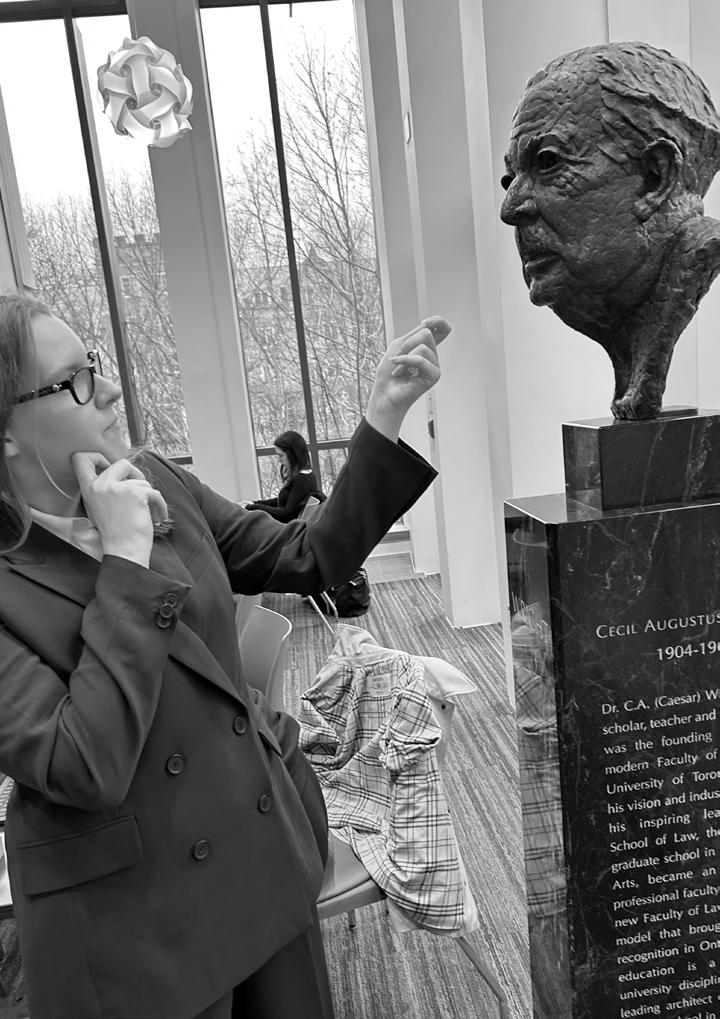
doors. Why don’t I get a water fountain? Additionally, I think that changing legal education is essential, but less flashy than being a supreme court justice.
UV: Last Words?
CLH: Modern fluorescent and LED lights really improve the amount of time students could spend studying, if only they stopped looking at their phones so much.
UV: Do you ever get a stiff neck?
CLH: Yes. It is the point of being a bust. If I didn’t have a stiff neck, I would be a bobblehead.
stuff is free stuff. But some free stuff is better than other free stuff. An investigation.
HARLEEN GREWAL (2L)
Orientation may be over, but its artifacts remain. Tucked into desk drawers, at the bottom of backpacks, or lost in the stratosphere, are the branded objects firms chose to introduce themselves with. Some were useful. Some were stylish. Some never saw the light of day. After a rigorous review process (meaning I asked two of my friends), we’re here to help firms improve their offerings for next year. Here is The Merch Report.
Exhibit A: The Mint-Gum Industrial Complex
Some firms offer tote bags. The smarter ones understand that law students are often one coffee away from needing emergency breath support.
The Winner: Mints (4.5/5): A mint is never glamorous, but it is reliable. Useful. Necessary, even. Pens are abundant. Fresh breath is fleeting. This category understands the stakes. Minor note on packaging: a tin that cannot close properly is a tin that has betrayed the assignment. Still, this is a public service.
Honourable Mention: Gum (3.9/5): New to the scene and showing real promise. Assorted flavours is a bold and appreciated move. The texture is a little hard and the flavour exits faster than a 1L leaving a networking event, but it gets the job done. We respect the effort. Keep refining.
Verdict: The people have spoken. Keep the breath refreshments coming. This is non-negotiable.
Exhibit B: The Desk Economy
This is one of the most competitive categories. A good desk item becomes part of someone’s daily life. A bad one becomes junk immediately. There is no middle ground.
Best Sleeper Freebie: Post-it Tabs (5/5): Untouchable. This is what happens when merch understands the assignment. Ideal for tabbing casebooks, flagging readings, and colour-coding a binder 10 minutes before an open-book exam. No gimmicks. Not overly branded. Just deeply practical and doing exactly what it needs to do.
Most Forgettable: Pens (3.2/5): Somewhere in Jackman right now, a branded ballpoint is doing its job and being completely taken for granted. Nobody chose this pen. Nobody will remember this pen. It will nonetheless come in clutch exactly once, at an oddly crucial moment, before vanishing forever into the bottom of a backpack. Reliable, yes. Memorable, no.
Least User-Friendly: Triangle Highlighters (2.4/5): I respect innovation. I do. But not when it feels openly hostile to the user. These highlighters are all concept, no ergonomics. The shape is awkward, the grip is hostile, and the overall experience feels like a product designed by someone who has never once highlighted a casebook in their life. Please. Just give us Sharpie highlighters. There is no prize for reinventing the wheel badly.
Verdict: Desk merch does not need to be exciting. It just needs
to not make your life worse. The Post-it tabs understand this. The triangle highlighter, unfortunately, does not.
Exhibit C: The Swag Docket
This is where merch stops pretending to be practical and starts trying to have a personality. The results are mixed. A good swag item earns real-life rotation. A bad one gets tossed in a drawer, rediscovered on moveout day, and briefly reconsidered before being thrown out anyway.
Most Divisive: Socks (3.7/5): The people are split. On one hand, good quality socks are good quality socks. On the other hand, heavily branded socks are currently built for concealment, not display. These socks have only one ill-fated destiny: the laundry day rotation, seen only by you and your roommate. The solution is not complicated - make them cute. The potential is undeniable. The designs need work.
Most Whimsical: Frisbee (3.5/5): Unexpectedly beloved. There is something about receiving a frisbee that makes law students briefly believe they are the kind of people who spend afternoons in Queen's Park, laughing carelessly in the sun. Are they? Statistically, probably not. But the frisbee makes them feel like they could be, and that is worth something. Points for committing to the bit. Full assessment pending - check back in July.
Most Practical: Water Bottle (3.2/5): A wa-
Throughout the year, a lot of you have been asking if Saucy is real. You’ve asked if there’s an actual inbox, if these are real people who’ve written to me, if these are real problems. These are all interesting questions, but does it really matter? You’re still reading, aren’t yo u?
Hey Sauce!
I just wanted to run my candidate platform through here to get more exposure. Thanks!
Hi U of T Law! I’m 1L Candidate #2 (not to be mistaken with 1L Candidate #1 or #3). In my extensive time at Jackman Law, during which I’ve definitely been able to focus on the school as a whole and what it’s capable of, I’ve identified some areas where the student experience can be improved. I speak for all students because I totally have the experience in this school to do so! My platform is as follows:
1. I will personally install a camera on top of the basement kitchen’s fridge so that we can finally catch the fridge thief. I’m sure the school has the budget for quality, so I’m thinking like a Panasonic AK-UCX100 4K Camcorder.
2. I will propose savoury items for Coffee with DEssert. I’ll ensure that we have a meat carving station.
3. I will train the squirrels on Philosopher’s Walk to stop coming near you when you have food. They get on my nerves, and I’m sure they get on yours!
4. I will install a swimming pool in the Atrium. It just seems like a lot of wasted space, so why not put it to good use?
Vote 1L Candidate #2 (not #1 or #3) for SLS President! Cheers, 1L #2
Hi 1L (#2),
Do not call me Sauce. You’re too fresh to be doing that. Your platform’s definitely something, but Saucy’s personal barometer for whether someone should be SLS president is whether they’ve ever had the option to take a class past 6 PM. In fact, the barometer is more so whether they’ve ever had to deal with Cognomos. Make of that what you will.
Best, Saucy
Hi Saucy, I decided to be charitable with my time and sign up for a Follies skit. There was a connection between me and another actor, and I know they felt it too. It bled into the work, and we managed to bring a semi-romantic tone to a completely unromantic skit. We haven’t been able to talk to each other since, and I imagine we will never be able to act together again (aka in next year’s Follies). What should I do?
Sincerely, Star-crossed Starlet
Dear Star-crossed,
This isn’t on you! While the magic of Law Follies is in the creation of a silver screen masterpiece using a school club budget (with no mysterious funding connections), protecting its actors is an objective worth expanding budgetary means. The time for a Law Follies intimacy coordinator is long overdue.
Cheers, Saucy
Saucy, It’s all coming to an end. My last few weeks of class. My last exam season. And as it approaches, I’m realizing I never really made any foundational memories at this school. I never glared at somebody in the fishbowl for being too loud. I never bought a matcha latte from Terima. I never joined an intramural team. I never went to any professor’s office hours. I never napped on the basement couches. I’ve left no imprints on this school, and in turn, it has left none on me. Did I miss out?
From,
Thoughtful 3L
Hey 3L,
Law school is what you make of it, and sometimes, it’s just school. Law school didn’t need to change you. It didn’t need to be the greatest experience you’ve had thus far. The only thing you had to do was get through it, and you did. That being said, it’s not over until it’s over – you’ve still got a month to throw tomatoes from the back of the classroom, or rile up the dogs during Doggy
day, or other such canonical and real experiences. Congratulations! Saucy
Deer Sossy, I am a squirel. I live on filosifer’s wok. My tale is brown and I like to run. I run and run up the trees. I will run for SLS prezedent. They told me I have to make prommises. I can make prommises. I can also eat eight nuts and run away from all dogs. This is my prommises:
1. I will not ask for you’re food. I can eat ate nuts so I don’t need you’re food.
2. I will sit on the cold frige to catch the theef. I can jump and I can hold on very titely.
3. I will change the name of our online resource network from ACORN to something that is not an active mockery of the squirrel species’ diet. Most of you will not understand because most of you are not squirrels. But I cannot wait for the sympathy of the boot while it stamps on my tail. My dignity cannot be expendable for your amusement. Like the whetted axe that fells the rotting tree, persistent and sure, one day our time will come.
I will be you’re friend. I will like being you’re friend.
Vote Squirel for SLS prezedent!
This mesij is from a Squirel
Hi Squirrel, Incredible job! In a surprise upset, you’ve provided more cost-effective solutions than half of 1L’s platform. Aren’t you just a cutie! To be honest, I never really read candidate platforms, so I don’t know what the rest of your promises are, but I’m sure they’re great because you’re just too cute and clever and totally like the rest of us, aren’t you? We will definitely be taking your candidacy seriously, little guy! Best wishes, Saucy
ter bottle clears most swag on concept alone. It is useful, visible, and one of the few branded items that can actually enter the daily rotation. Get it right, and people will carry it everywhere for years. Get it wrong, and it’s demoted to the bottle you keep only out of desperation. This is not the category to cheap out on.
Most on the Nose: Stress Ball (2.9/5): For the chronically stressed, it delivers exactly what it promises. For everyone else, it gets squeezed twice and then begins its second life as a drawer filler. That is not an indictment so much as a category reality. Still, there is room for evolution. Fidget rings, cubes, anything that better suits a population that is not just stressed, but professionally fidgety. Plenty of upside potential here.
Verdict: Swag lives or dies on one question: would anyone actually want this if it weren’t free? Know your audience, invest in quality, and maybe let someone under 30 weigh in on the sock designs before they’re printed.
At the end of the day, free is free and we are grateful. But the best merch understands a simple truth: law students will take almost anything for free, but they will only keep the good stuff. The people have assessed. The report is filed. We await next year’s crop with cautious optimism and, thanks to the mints, reasonably fresh breath.
Dearest Saucy, I was THRILLED to attend law ball this year—I mean I AM Bridgerton. Unfortunately, I may have been a bit TOO on theme for scandal. I don’t want to kiss and tell but I’m worried I might have been caught with one of my suitors—or all five. Is my reputation ruined???
HELP!!!
Not the Diamond of the Season
Dear Not the Diamond of the Season, Well—someone has to bring the drama to Law Ball and if not you, then who? Fear not what the society papers will have to say, all law students live for is the next scandal. Remember the drunken confession of unrequited true love? Or the law student who unsuccessfully brought their girlfriend and mistress to Law Ball? Of course not—I’m sure by next year you’ll be nothing more than an urban legend! Live your best life, Saucy
Hi Saucy, I’m a bit anxious writing this. You see, all I wanted was to leave a legacy behind once I left U of T Law. But I’m not quite sure what that is. What will the class of 2026 be remembered as? Are we more than the ill-conceived lists made by some?
Feeling melancholy, Departing 3L
Well Departing 3L, There isn’t much I can say—I try not to squabble with law students who are ever fleeting anyways. Yes, your year did have a troubling history with lists (ranking female classmates, unconsensual employment lists, lists on the advocacy people partake in and that’s just the lists we know). But if nothing else, know that your year will have a legacy of what not to do. Besides—some of your year has done a decent job cleaning up your year-ly image. Don’t let the door hit you on the way out!
JEANINE VARNEY (1L)
AITA for dropping my package?
I (M 33) was minding my own business carrying my package through the train station. They had changed what track my train was on so I was rushing a little, but when I got to the platform my train was already moving. I sprinted to the train and some rude train employees shoved me on, not understanding that I was carrying a package. My package fell onto the tracks and the employees didn’t pick it up, even though it was their incompetence that caused me to drop it! Once I was on the train, sans package, I saw the train run over my poor package. Then there was a huge boom that caused some scales to topple over onto a woman across the platform. I know the boom was from my package, but I wouldn’t have dropped it without those rude train employees. AITA for dropping my package?
Edit: I know, I know, my package contained fireworks. Carrying them on the train is really the only way to take my fireworks to my
new home. I can’t ship them or take them on a plane, and a car would be too dangerous. How did you expect me to get my fireworks to my new home??
AITA for not moving some hay?
I (M 45) stacked some hay on my property, because I was going to use it later as a game to see exactly how hard it would be to find a needle in it. Next thing I know, my annoying neighbour “Vaughan” (M 53) (fake name) is screaming at me, saying my hay was “a fire risk” and that it might “spontaneously combust.” I simply told him that I had no intention of setting my hay on fire, because who would do that to their own hay! I didn’t move my hay, and the next thing I know my neighbour is blowing up my phone saying that my hay would burn down his barn. How ludicrous! So, AITA for not moving my haystack?
AITA for arguing with my coworkers?
I (M 78) was talking about cricket with my coworkers at work one day. They were saying a local cricket club was in the wrong, simply for playing cricket! The cricket club had been around for over 70 years, and the people complaining to my coworkers were young upstarts who had no appreciation for the glorious game. I’m sure that they moved to their house next to the cricket field simply to stop the cricket games, obviously because of their utter hatred of cricket! They complain of balls occasionally landing in their garden, but I said, “So what!” Cricketers rarely hit balls into their garden, and besides, the cows who were the previous residents did not mind the cricket one bit! My coworkers “Geoff” (M 59) and “James” (M 65) say that the cricketers need to be more careful in where they hit their cricket balls. Geoff even says that they should stop
playing cricket because of this. I stormed out of the room at this outrageous proposition. Cricket is an ancient tradition in our town, and in response, I joined the cricket club. So, AITA for arguing with my crickethating coworkers?
AITA for upsetting my friend? My friend (F 30) and I (F 30) were at a cafe having some dessert. My friend had a ginger beer float kind of dessert, and she was getting a bit low on the ginger beer, so I poured the rest of the bottle of ginger beer onto her ice cream. A SNAIL CAME OUT! I looked at my friend, and she just looked shocked. Then she started turning green (for a moment, I thought she was going to turn into a snail). Afterwards, she complained of gastrointestinal distress and even went to the hospital. I feel so bad that I poured the snail onto her ice cream, and I feel like this was my fault that I upset her. AITA?
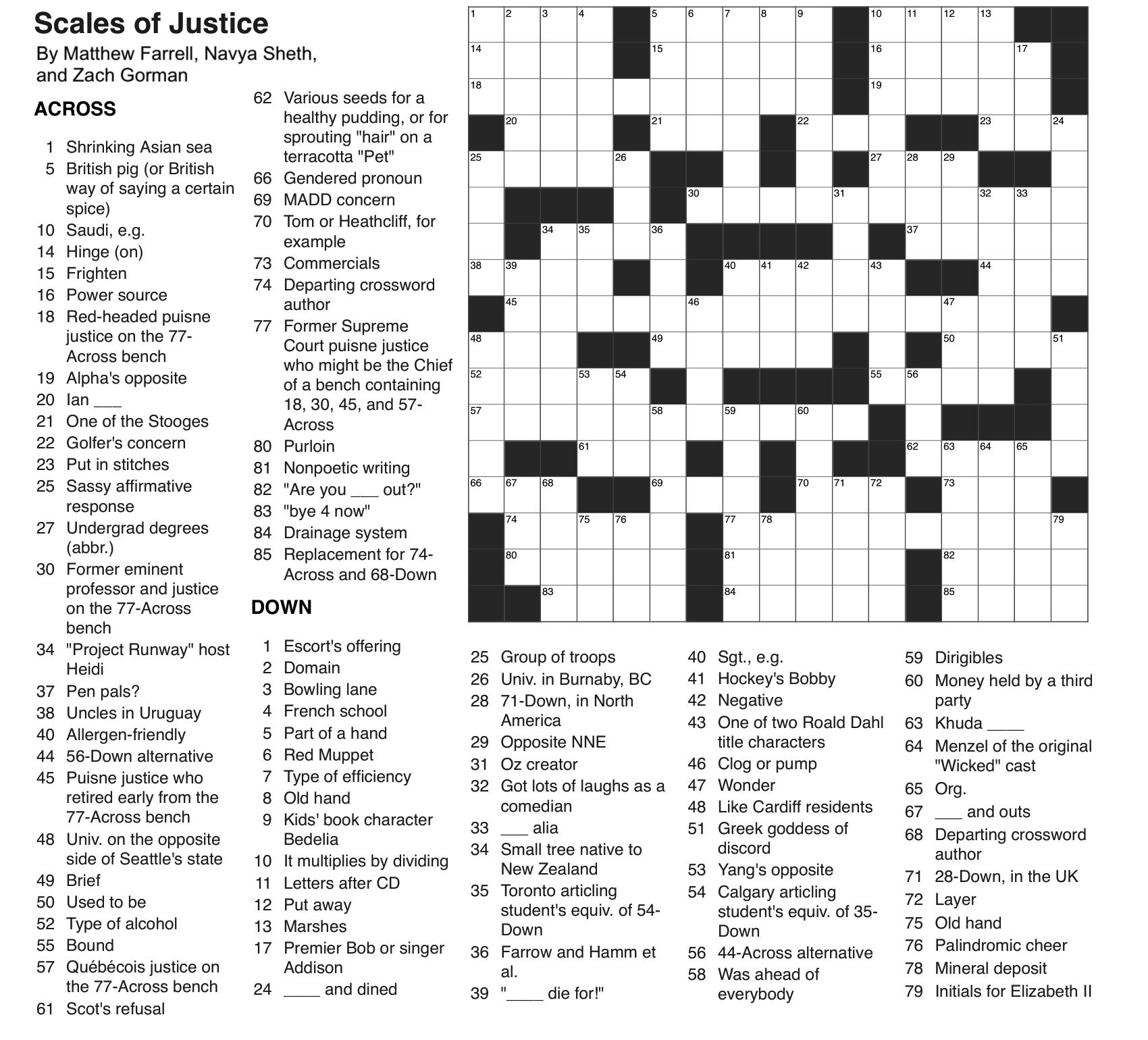
This 9 x 9 grid is divided into nine rows, nine columns, and nine 3 x 3 boxes. When the puzzle is solved, each digit from 1 to 9 will appear exactly once in each row, column, and 3 x 3 box. Some spaces have already been filled; use those digits to deduce the remaining spaces.
The terms in the 16 boxes below can be grouped into four categories. Each category will be based on a common trait shared by each term within that category. To complete the game, group each phrase into the correct category such that you have four groups of four terms apiece.
For easier gameplay, scan the QR code and play online! This will allow you to know when you have successfully identified a category.
The solutions can be found under the Sudoku puzzle.

Mars; ___ster: Ham, Lob, Prank, Young
Solid, White; Fourth Items of Sequences: April, Beryllium, D,
Rhymes: Day, Grey, K, Sleigh; Types of “Gold”: Fool’s, Rose,
SOLUTIONS:
CONNECTIONS
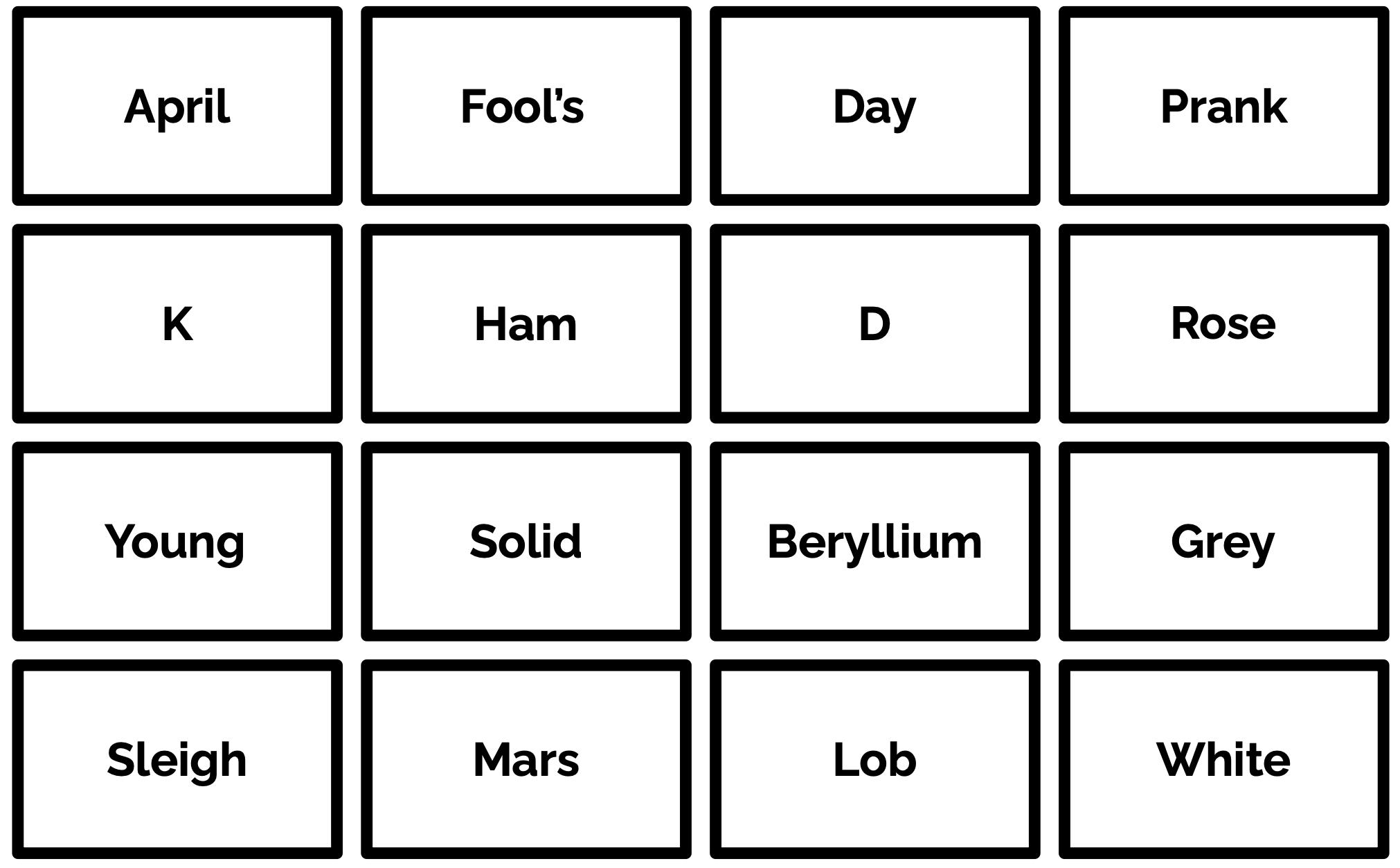
DANIEL ELGEZ (3L) & KITT SELLINGER (3L)
Follies 2026 was a smashing success—leaving attending students and faculty floored by the comedic genius of their fellow students. Thank you to the Follies executive team, Humza Khan (3L), Jayden Daniels (3L), John Haddad (3L), Olivia Parker (2L), Ivy Chen (2L), for all your amazing work!
Daniel’s Review
The 2026 Follies was a tour de force of writing, acting, and singing, showcasing the deep pool of comedic talent at our law school.
This year’s Follies, in contrast to the 2024 and 2025 shows, was less chaotic and more relaxed in its overall tone. It was a nice change of pace from the bombastic chaos of the 2024 Follies and the raw and biting humour of the 2025 Follies. It slowed down and allowed for laughs in the silence between witty remarks and awkward stares.
The Follies crew innovated on their formula and introduced a live component. The live hosts parodied the late night talk show model and gave a live performance in front of hundreds of their peers. They landed jokes effortlessly and kept the audience on their toes about what to expect next.
Here are some thoughts about some of my favourite sketches:
Steve Dorr the Clumsy Stevedore: A humorous satire on the facts of contract law caselaw. I never thought that contract law could be this funny, but watching clumsy stevedores awkwardly carry boxes around, fall over, get back up with their boxes, and continue to fall over, put a smile on my face like no other sketch did.
PATH: An instant classic about getting lost in
the PATH during the 2L recruit. A great way to open the show and set the tone.
The Bathroom Sketch: A n innovative take on toilet humour, a tried-and-true comedy staple. The flush had me cackling. The premise that followed: “I have this room booked”, turned a funny sketch into comedy gold.
School Name Change: This sketch danced effortlessly along the tightrope of controversy and landed perfectly on the side of funny.
Heated Rivlawry: Jayden and Matthew are the bravest and most confident men at the law school. No further comment.
Mixed Signal: Excellent writing. I was on the edge of my seat.
Getting to School: An exploration into the suffering of the commuter.
Bad Guy Essert: While Dean Essert was the butt of many jokes at this Follies, I really enjoyed the approach taken by the writers here. Portraying Dean Essert sympathetically, the sketch asks: “What if Dean Essert decided not to be nice anymore?”
Rough Exam Season: The best green screen usage of the night. Watching Ivy stack bales of hay that would subsequently light on fire, find a snail in her water, and drop her stevedore box onto an oil barrel resulting in an explosion, was a hilarious visual cacophony.
Evil Professors: It was great to see our professors on-screen and playing the opposite versions of themselves.
Early Recruit: Lmao so true.
Runnymede’s Woke Turnaround: It’s not
Follies without a joke at Runnymede’s expense! I found this sketch to be absolutely hilarious and respectful, at the same time.
One Asshole Policy: Excellent idea, excellent execution.
Law Island: Hilarious premise! I wonder who did that amazing Iain Stirling impression…?
Jackman Dean (Popular): Emily did an amazing job embodying Professor Brunnée and singing a cleverly written parody of the song “Popular” from Wicked.
Terima Loyalty Card: I love Terima! I make this statement under no duress!
Kitt’s Review
Even as a first-time viewer of Law Follies, I feel confident in saying that this was one of their best. While the show returned to some common themes and jokes across the law school (the curve, the recruit, the undrinkable coffee from Terima), events like Henry N. R. Jackman’s donation, Chris Essert being named Dean of the law school, and Heated Rivalry on Crave provided excellent fresh material for sketches.
First, the hosts were brilliant. Sahara Mehdi and Kabir Singh were a perfect pairing, and their friendship made their chemistry effortless. From their in-person banter to their “on the street” interviews and office politics sketch in the filmed portion of the program, they kept the energy up.
Starting off with a writer’s room sketch on punching up vs. punching down provided an opportunity for excellent humor that managed to address some more controversial content will staying
hilarious. It also set the tone for the show – Follies is about laughing together, not laughing at any student in particular (even if I felt personally attacked by the commuting bit).
The first section had some solid bits (Steve Dorr the stevedore was inspired) but the small moment that will stick with me is #LetWomenCook. Of course, the big moment that will stick with me was the Heated Riv-law-ry sketch. If you missed the show, you sincerely missed out. I heard someone describe this as the most memorable sketch in the three years of Follies they had seen. 10/10, no notes.
The intermission was followed by the weekend update. Sahara and Kabir interviewed Avery Chu, “The Big Law Biter.” Harjaap Brar’s quick mention of landing a new job on “Bite-I mean Bay Street” was gold. Having a live component to the filmed show was also wonderful, and I hope that stays in years to come!
The second half of the show was somehow even stronger than the first. The on the ground interviews offered biting social commentary (“can you name two black professors at the law school?”) as well as some genuinely touching moments (“what are you holding space for?” “Love”).
Of course, the highlight of the second half of the show was an original musical number written by Sahara Mehdi and performed by Emily Ernst. I didn’t even realize Wicked 2: For Good had come out because it wasn’t all that popular, but Wicked 2: Jackman Dean was spectacular.
Congratulations to the performers and organizers for pulling off such a great show!


PUNEET KANDA (3L)
Ever wondered what your classmates think of you? Wonder no more— after three years together, here’s what this year’s graduating class has to say
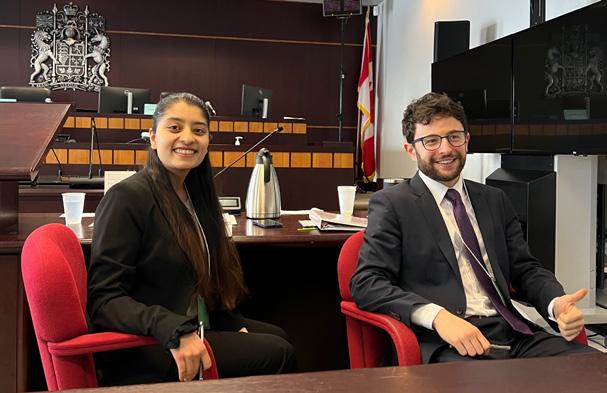








Most likely to be a SCC Justice: Navya Sheth and Ben Beiles
Most likely to be a politician: David Niddam-Dent
about their peers (we had a couple of people who were too fearful to be included).


Most ethical: Syeda Hasan and Josephine Winsor


Most likely to be on love island:



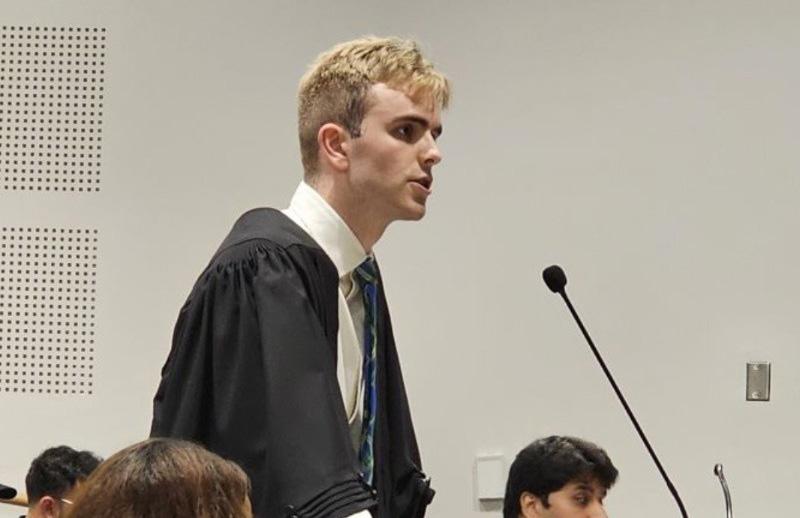
Most likely to put mooting / law review on their
likely to write your

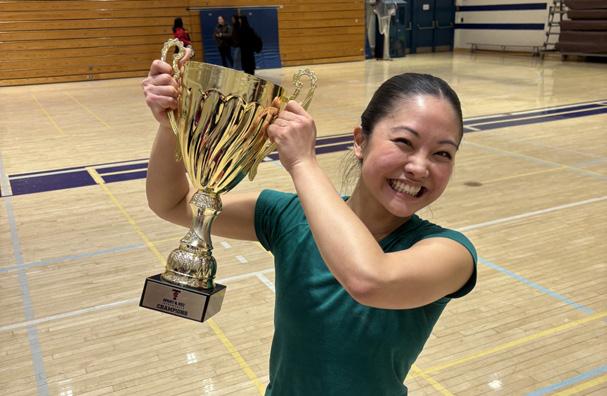
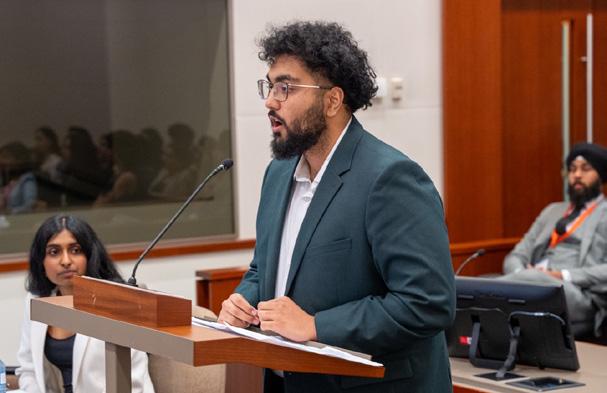

Most likely to start a firm intramural team: Ashley Kam (Matty G is a 2L guys)

Most likely to have an unnecessary amount of extracur-
Most likely to argue with a prof:
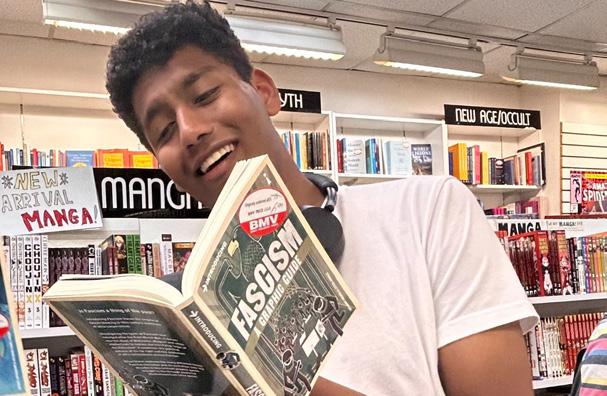
Not pictured
Most likely to be disbarred (least ethical): [REDACTED]
Most likely to be embezzle funds: [REDACTED]
Most likely to be a prof: Vlad Mirel
Most likely to black out at a CTTB: [WITHDRAWN]
Most likely to date a prof: [WITHDRAWN]
Terima's #1 hater: Too many people to put down
Most unhinged: Ryan Dickson