Ultra Vires
THE INDEPENDENT STUDENT

EDITORS-IN-CHIEF
EDITORS-IN-CHIEF
Sakina Hasnain and Puneet Kanda
BUSINESS MANAGER
Sam Zhang
NEWS EDITORS
Rachel Chen and Sahara Iman Mehdi
ASSOCIATE NEWS EDITOR S
Adria Lao and Jocelyn Mattka
FEATURES EDITORS
Julia Allen and Asra Areej
ASSOCIATE FEATURES EDITORS
Tyler Lee and Mia Jain
OPINIONS EDITORS
Abby McCormick and Mariam Patsakos
ASSOCIATE OPINIONS EDITORS
Emma Malcho and Alexandra Broun
DIVERSIONS EDITORS
Kiwan (Paul) Kim and Madura Muraleetharan
ASSOCIATE DIVERSIONS EDITORS
Juliette Lee and Charlize Yao
PUZZLE EDITORS
Matthew Farrell and Navya Sheth
ADVERTISING
If you are interested in advertising, please email us at business@ultravires.ca
ASSOCIATE PUZZLE EDITOR
Zach Gorman
RECRUIT EDITOR
Yuha Khan
EDITOR-AT-LARGE
Cherry Zhang
ASSOCIATE EDITOR-AT-LARGE
Taban Isfahaninejad
ONLINE EDITOR
Siegfried Kahama
STAFF WRITERS
Allie Fong, Matthew Grace, Harleen Grewal, Jake Rogers, Jeanine Varney, and Grace Xu
RECRUIT REPORTERS
Alexia Lee, Melanie Mah, and Yebin Shin
STAFF PHOTOGRAPHER
Kabir Singh Dhillon
SOCIAL MEDIA COORDINATOR Bilqis Meer
LAYOUT

SAKINA HASNAIN (3L) & PUNEET KANDA (3L)
Ah. The dreaded post-reading week return. There’s truly nothing worse than having to adjust back to classes with exam season looming over the horizon. But, maybe it’s time to really lean into the 3LOL attitude, regardless of whether you’re a 3L, a 2L ready for exchange (or still hopeful for one, sorry if that’s still a sore spot for some of you), or perhaps even a NY ready or freshly employed 1L. (1L’s please don’t read into that last one, you will all be more than fine and employed).
As February comes to a close and the last month of the semester approaches, we’re here to reassure you all that no, we haven’t been outlining; no, we didn’t put the reading into reading week; and no, we definitely don’t have a paper topic in mind. That’s all what March is for right? And if anything, working under pressure prepares us for life as real lawyers anyways. Right? Right? Well, if anything, maybe Jake Rogers (1L) has a point in The Jack-
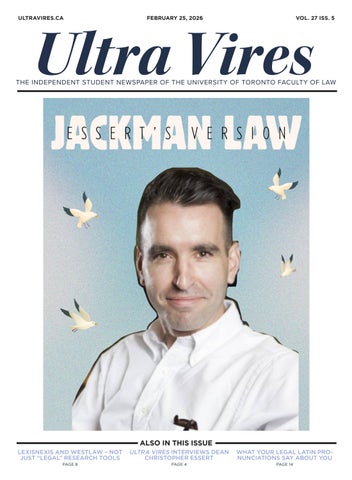
man Law Coffee Manifesto, and permanent free coffee is truly what we all need. Dean Essert, if you’re reading this, we know you can make our dreams a reality.
Speaking of Dean Essert, and the new era of Jackman Law, this issue includes a sit down with Dean Essert and his plans for the future. His current term as Dean began on Feb. 1, 2026, and will continue until Dec. 31, 2030. If the thought of 2030 approaching unnerves you, fear not, we have a new roster of puzzles to soothe your anxieties. In fact, perhaps even expand your existing puzzle roster with Jake Rogers (1L)’s puzzles ratings. If you’re looking for more certainty in what the future holds, our very own Harleen Grewal (2L) has your horoscopes ready.
Also in this issue, learn more about the incredible programming by the Indigenous Initiatives Office through our sit-down with Andrea Johns,
Program Manager. The Office’s programming is open to both Indigenous and non-Indigenous students and includes events such as beading circles, film screenings, and speaker series. Coming up next month is the annual Promise Auction, back for its 15th year. Read more about the initiative in Navya Sheth (3L)’s piece.
This issue also features an insightful piece examining legal research tools that law students and lawyers know all too well, Westlaw and LexisNexis, and their connection with ICE. The anonymous author explores how these research platforms are currently being used in the United States. The piece reminds us how the law never operates in a vacuum.
On a separate note, as we approach the preexam slog, we’d like to remind our fellow students that you’re never alone in feeling overwhelmed (by recruit, courses, exams or all of the
above). Law school can be a lot and it’s important to take a beat to recenter and ground yourself. Whether it be taking an actual coffee break, heading to trivia night (perhaps one upcoming one hosted by Jeopardy! Champion Anthony Niblett), or taking inspiration from the Olympics and heading to the ski hill. Reading week may be over, but that does not mean you can’t still take breaks! May we all successfully lock-in and lockout respectively.
As always, if you have any comments, are looking for ways to get involved with UV, or just want to say hi, you can always reach us at editor@ultravires.ca or @ultravires.ca on Instagram.
Until next time, Sakina & Puneet
Co-Editors-in-Chief Ultra Vires Vol. 27
CHELSEA MUSANHU
Dear Students, Welcome back from Reading Week! We hope you got some much-needed rest and reading done.
The SLS is proud to announce a collaboration with the Faculty’s Leadership Skills Program. Following the success of our salon-style workshops with life and business coaches, Milisa Burns and Barbara Frensel, the SLS and the CDO will be bringing another session this March: Navigating Success and Failure: Finding Your “Inner Leader” in the Midst of Uncertainty and Change. This workshop is for those moments when things don’t go as planned in law school, in our careers, or in our personal lives— when outcomes differ from what we hoped for, when an unforeseen challenge or curve-ball comes our way, and when we’re confronted with the thought, “Am I cut out for this?” In this session we will explore who we are outside of our successes and outside of what we label as failures. Keep an eye on your email for further details.
Valentines Week
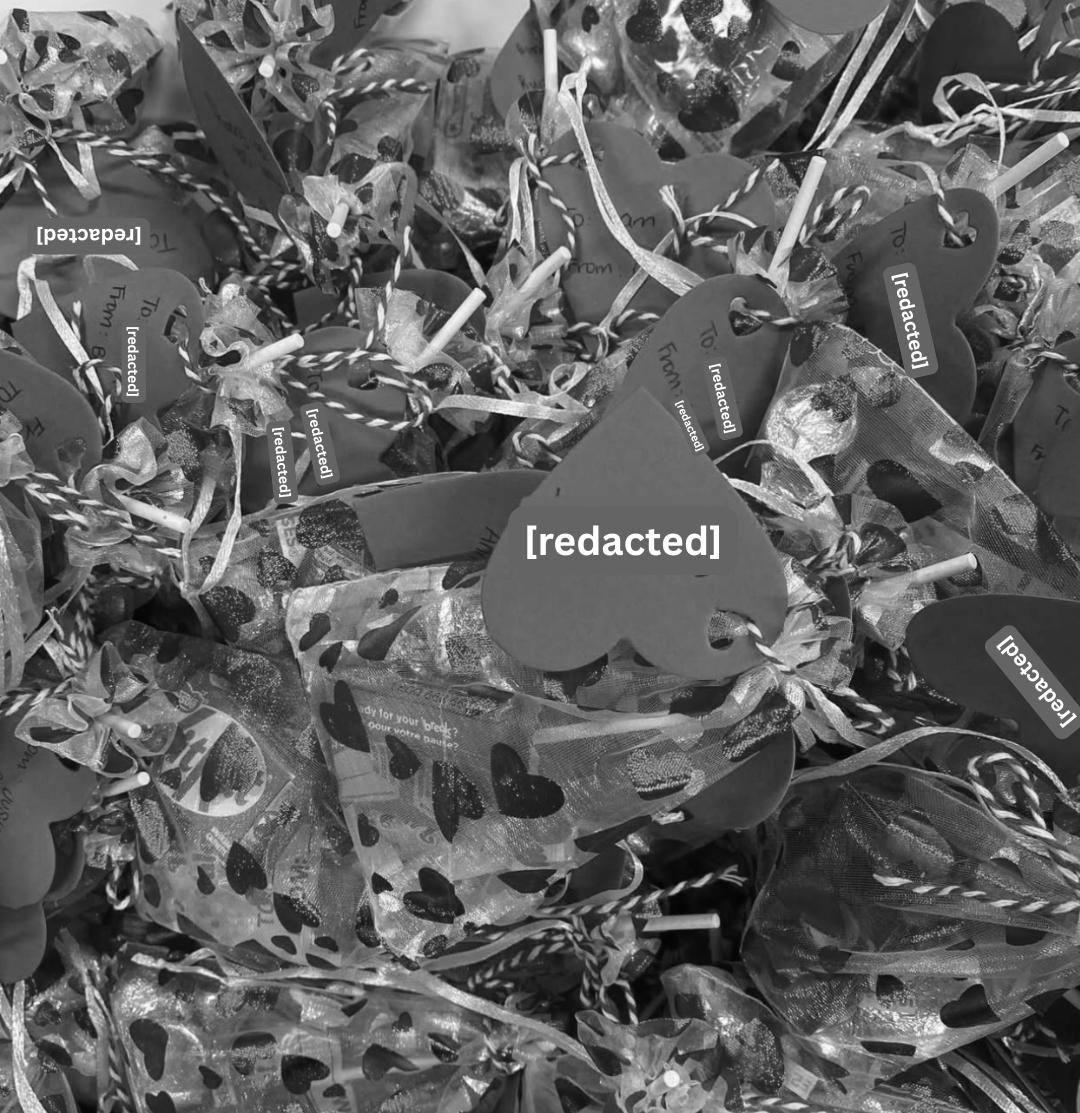
The SLS also has also been busy spreading some love this month! The Social and Finance Committee (SFC) kicked things off with Candy Grams—a free way to send a sweet note to your classmates. We love seeing just how hard you guys love. February also brought Valentine’s Week programming, including a “Send Some Love” board, a movie screening, Faculty Feud (students won!),
and the Malpractice Mixer at Hail Mary. These events were designed to bring some fun, connection, and community spirit to the law school, and we hope you enjoyed taking part.
Law Ball
SFC is also gearing up for one of the most anticipated events of the year—the Annual Law Ball on March 28 at the Old Mill! This year, we’re embracing a Bridgerton-themed ball, so get ready for a night of elegance and regency-inspired fun. Don’t worry if you’re unsure how to dress, SFC has shared a mood board with examples of Bridgerton attire on the SLS Instagram, or you can catch some inspiration by watching the show on Netflix! Law Ball is always a highlight of the semester, and we can’t wait to celebrate with everyone.
Updates
On the advocacy front, your SLAC representatives have been actively working to support students academically and personally. This month, efforts have focused on updating the study guide to reflect new exam policies, improving student supports, revamping the website, and re-launching SLS Weekly which is available for clubs to publicize their events. You can send your club updates to slsweekly123@ gmail.com.
As always, the SLS is committed to building a law school community where students can thrive, both inside and outside the classroom. Thank you for your continued engagement, and we look forward to another exciting month ahead!
SAHARA I. MEHDI (3L) & SAKINA HASNAIN (3L)

On Wednesday January 28, Dean Essert sat down with Ultra Vires to discuss his recent appointment as Dean. While the Coffee with DEssert cat is already out of the bag, we gained some insight into Dean Essert’s vision for the law school.
Note: This interview has been edited for brevity and clarity.
Ultra Vires joked in October when discussing the prospects for the new Dean that you were a fan favourite for some, but you hadn’t “sufficiently manifested an intention to acquire the role” of Dean at the time. Had you done so at the time? Is becoming Dean something that you always planned for or just something that ended up happening?
It was definitely the second, I submitted an application in September. Going back a few years, I didn't expect to be the associate dean, so in the spring of 2020, I was asked to do that, and it was like, “It's your turn at a certain point when you reach a certain level of faculty.” And so I was like, “Okay, I guess it's my turn.” What I discovered was that I didn't mind administrating and I didn't mind being involved in these kinds of decisions. I enjoyed interacting with students and my colleagues in a different way.
My feelings about the institution, my loyalty to the institution, and my sense that I have a grip on what it is that we're doing here and that I might have the ability to push us forward really crystallized over the course of the time that I was Associate Dean. If you would’ve asked me this in 2019, it would not have been remotely on my radar. But then once I got involved in the administration, then it started to become something that people would ask me about, and I started to think a little bit more about it.
We also wanted to ask more broadly about your vision for the future of the faculty, but I know you've spoken about it a bit. The question we wanted to ask to help you narrow it down is this: the current 1L class will be back here for their ten-year reunion in 2038. What are you hoping they remember of you? What are you hoping your legacy will be?
The thing about the legacy question and the big picture thing is … I don't think that what we need here is radical. I think the radical idea is that we don't need any radical change. I think this is a really, really amazing institution. I think that the challenge that any institution like this one has is: when you're at the top of the game, it's easy to rest on your laurels, and that's what we shouldn't be doing. In some sense, what I think we should be doing is everything that we're doing now, but better. So that's going to mean hiring people, continuing to think about admissions, broadening the range of classes
that we offer, taking advantage of the resources coming from the Jackman gift in terms of financial aid and the different kinds of programs, resources and co-curricular activities that we're going to be offering.
The founding ethos of this school is one that equips us to think about those things. When those guys started this law school 75 years ago, they had a good idea, which is our tagline as lawyers and leaders of tomorrow. And so, when people come back for their ten-year reunion, they're going to be partners at law firms, they're going to be running NGOs, they're going to be who knows, right? I want them to remember that this was the place that made that possible and this was a place that gave them a set of skills that they can use in all these different parts of the world.
We see that you’ve settled on the name Coffee with Dessert for your monthly meeting with students in the atrium. What’s your favorite dessert?
First, we need to have a conversation about what counts as dessert… I had a long term loyalty to chocolate chip cookies but arguably cookies are a snack. But, I guess if I were having a dessert, it would be tiramisu.
Are you planning to continue teaching as Dean?
It's a little up in the air. I really value being able to have the relationship with students that you get while teaching, and I really want to try to maintain that to the extent that I can. At this point, I just don't know what that extent is. So it's too early to say.
There is a rumour going around the law school that you've invited your current small group to move to the Dean’s office. Any comments for the record?
It's a sweet board room that is available for the Dean to use for the things that the Dean does. And so in this particular case, it turns out that they get that benefit. The Dean's boardroom is incredible and I feel like it's actually underutilized as a space.
How do you see this new chapter as the Dean of the Law School? How do you think it'll differ? How do you think it'll be the same?
The advantage of having done the Associate Dean job is I have a really good sense of not just teaching and the students, but also the process of the professionalism sessions in the fall, or the SLS, or the staff. The big difference is the Dean role involves my interacting with two different communities that are external to the law school, whereas the Associate Dean job is internal.
Those two constituencies are: the rest of the univer-
sity, so getting to know the President and Provost, getting to think about the role of the Law School vis-a-vis the rest of the institution, and thinking about ways that we might be able to build bigger connections with other parts of the university. The second one is the alumni community. That's a big part of the job—getting out, meeting alumni, and hearing what they think. Having those conversations that you mentioned earlier, like: what was it about the law school that you liked? What was it that you didn't like? With this perspective that you have with those years out, what do you think we've been doing differently? Or hearing from members of the profession about how their work is changing, and if that affects what we should be doing teaching-wise. It's getting to build relationships with employers, the government, the judiciary… all that stuff that's going to be new and exciting.
One of your constituents that you didn't really mention, but that plays a huge part of your role now, is donors. How are you planning on balancing your priorities between your duty to the faculty and the students, to the wider university and to the people that fund the school?
I think that we've had historically really great relationships with primarily alumni who provide funding. I think that the unifying theme is the one that I started with: I think these are all people who came here and thought, this place was life-changing. And then some of those people end up with the resources that allow them to say, I want to make sure that's still possible going into the future. Over the last 10 to 15 years, a major priority for fundraising has been student financial aid. We see it in the feedback that we get from students and prospective students with the huge impact that has on our ability to get them as students.
So, that's the model, there's no conflict, there's no balancing. We're all rowing in the same direction. I think the Jackman gift is going to be like that, too. If you look in detail at the way that gift is structured, it's like, here's money for hiring four new faculty members. Well, great, we need four new faculty members. The future of the law lab, more money for financial aid, more money for graduate students.
I think we want to continue building a shared understanding from all the different parts of the community in terms of how everybody sees how special this place is, and everybody wants to do what it is that they can do in their respective roles, from their respective directions to continuing pushing us forward.
The administration last year got some criticism from students because of the new exam policy and the push to a more closed-book
exam policy. Students think that closed-book exams are not as representative of real life lawyering. Do you plan on working more against AI and countering that within student learning or more of a push to learn with it, as lawyers are adapting tools to work with AI as well?
I want to say it's neither and both. I think that what AI does in this context is actually something that it does in a lot of contexts, which is that it just puts pressure on questions that have been open for a long time, and makes them particularly pointed. So the question here is: what is it that we should be thinking about when we're thinking about student evaluations? And how to understand whether or not the things that we're trying to teach you guys are getting through.
The experience from last year going into this year has been one where we are presented with an opportunity to think more broadly about: what is it that we're trying to be testing for and how should we be doing that? So it's impossible to say what the answer to that question is, it's a bit soon. We've had this picture about what we're doing here for a long time, and if we keep that picture in mind and remind ourselves that we're training people to think about how to resolve problems with other people in the context of a complicated, multicultural, liberal society… that's a load star that we can continue looking to when we ask ourselves does that mean testing people this way or this way?
Do you think the Dean is a primarily outward-facing role or inward-facing role?
I don't know if I want to choose between those two. It's important to me to have a really good relationship with everybody in the community.
You're known as a professor for having a pretty friendly rapport with most of the student body. As Dean, however, you're going to be having to face tough decisions, and also be the face of those tough decisions, which comes with a lot of criticism. How are you planning to try and manage that?
I’m hopeful that the relationships that I have with the students are going to be helpful in getting people to see that I'm a careful, thoughtful, reasonable person, and that I really do care about how students are experiencing their time in law school. That means when I’m going to be making tough decisions, I hope that students will trust that I'm making those decisions carefully. That doesn't mean that I'm going to make decisions everybody likes all the time, but the hope is that people will say, “maybe that's not what I would have done, but I can see why he would have done it and I trust that.”
You spent most of your career in academia and I think it's fair to say that a majority of our students end up in practice. How are you planning on cultivating a school that allows them to achieve those goals when that's not something that you've necessarily experienced firsthand?
That's the world that I've been living in this whole time. I’ve been teaching hundreds of students who go on to become lawyers, so I know about what we're doing. I actually do think when I teach, I'm trying to orient people in that direction. I think that's the role of the school: to set you up so then when you end up at the law firm and they're like, “well, here's all the practical stuff,” that stuff is easer for you after what we've taught you here.
There's a big team here, we have a great CDO. We have a great team of folks who are really attentive on the ground to the more particular things that employers are interested in and looking for. I'm also going to be out there in the world, talking to folks about that, seeing what law firms are looking for, seeing what government is looking for, seeing what other players are looking for, and trying to do our best to make sure that we're equipping students for the world that they're going into.
There's been some discontentment among students on course selection and the variety of courses being actually offered versus the potential the courses that we get when we first enter law school. What would you say to students who are concerned about the breadth
and variety of courses?
I share their concern. I want there to be more courses. We just don't have enough people in the building to be offering courses, so that's something that is front of mind for me, for sure.
One of the Truth and Reconciliation Committee’s calls to action, specifically #28, is implementing a course in Aboriginal people and the law. With Professor Borrows going on sabbatical, how will the law school ensure the implementation of this call to action is maintained?
The course is still going to be offered next year. I'm not completely up to date on all the details, but the curriculum is not going to be different materially. I think that the format of the course might turn out to be a little bit different than it's been in the past couple of years. But, it's an institutional commitment. We're really proud of
the fact that we're offering that course as a mandatory course in the first year, and we're going to continue to do it.
Is it going to be a priority to try and find an Indigenous professor to teach the course for next year?
Well, no, we're not going to be able to hire a full-time person for next year. I'm not totally sure what the plan is for next year in terms of who's going to teach it.
In 2020, during your time as Associate Dean five equity groups, the Asia Law Society (ALS), Black Law Students Association (BLSA), Indigenous Law Students Association (ILSA), Out in Law (OIL), and South Asian Law Students Association (SALSA) wrote an open letter calling for the Faculty to improve equity training, hire more racialized faculty,
KATE COURSEY (1L)


On Friday, January 9, 2026, I was privileged to attend a conference at Jackman Law honouring the life of the Honourable Justice Murray Sinclair. The event brought together students, faculty, legal professionals, and community members, many of whom have been impacted, directly or indirectly, by his work and legacy. From the beautiful opening given by Professor John Borrows, it was clear that this gathering was not only about Justice Sinclair’s professional accomplishments, but also about the person behind them.
Justice Sinclair’s contributions to Indigenous justice are well known. His work on Manitoba’s Aboriginal Justice Inquiry, the Truth and Reconciliation Commission of Canada, the inquiry into the Thunder Bay Police
and modify curriculum to recognize legacy of colonialism. Since then, we also had the Islamophobic modules last year and since then, have had a revamping of the EDI programming. What does a commitment to EDI look like to you, and how do you see those considerations evolving with law school?
The core of a commitment to EDI is bringing out deep connections between what’s going on in a lot of our classes already and the kinds of considerations that are usually talked about under the heading of EDI. I want to see how these things are connecting across different parts of the curriculum.
The people have been wondering: when you are going to update your headshot, because in the announcement, the pictures were very pixelated. Do you have any future plans? What's the situation there? Do we need to start
a GoFundMe to get you a photographer?
I think the currently scheduled date for the photographer to come in is February 26. I don't know. It is literally just one of the 8000 emails I've answered today.
They said there was going to be an extensive international search to find the new dean, so some of the student body was surprised when it was someone that we already knew. For people who are a little bit more apprehensive, what would you say differentiates you as Dean?
The law school is a really, really excellent institution, and I think you have to be there to see that. I think what I am bringing is the ambition to make this place better than it is, but that's grounded in a recognition of how great it is already. I think it would be a mistake to start from scratch and burn it all down. I think we've got some really great stuff going on, and I just want that to be better.



Services Board, and his time as a Senator have left a lasting impression on Canada. As the first Indigenous judge to sit in Manitoba—the second Indigenous Judge in the country—Justice Sinclair was a breaker of glass ceilings. His contributions to the Canadian legal system are plentiful, but what stood out throughout the day was how various speakers consistently returned to who he was as a person: his humility, patience, and deep commitment to listening.
In his opening address, Dr. Niigaan Sinclair offered a glimpse into what it was like to know Justice Sinclair not as a public figure, but simply as “Dad.” Hearing about his resentment as a child for missing time with his father brought a very personal aspect to the morning.
The familial sacrifices that come with a legacy should not be forgotten. Unfortunately, Dr. Sinclair’s remarks were cut short due to time constraints. I would have loved to listen to him speak about his father for several more hours. I found myself reflecting on the importance of giving time and space for what needs to be said, and who is given space to speak. Centering Indigenous voices is essential in a conference dedicated to honouring an Indigenous Jurist and his legacy.
Another highlight was the keynote address by Justice Michelle O’Bonsawin, who is herself a trailblazer as the first Indigenous judge to sit on the Supreme Court of Canada. After sharing her memories, she spent the remainder of her time opening the floor to attendees to share their own reflections. The stories offered were moving and spoke to the profound respect and affection so many held for Justice Sinclair.
Many individuals contributed to the day, including moderators Tanya Talaga, Professors Kent Roach and Professor John Borrows, as well as panelists and speakers that included justices, professors, and other notable
voices. The willingness of these leaders to contribute their time, energy, and thoughts spoke to the many lives touched by Justice Sinclair.
One review that I have is the wish for greater student involvement in the day, particularly Indigenous law school students. Justice Sinclair’s legacy is not just institutional, it is also generational. While I understand that many students likely did not have a personal relationship with Justice Sinclair, his legacy is still impactful. If there was more space and opportunity for Indigenous students to be involved, perhaps with hosting or assisting with an opening or a closing, this would have further strengthened the tone of the continuation of his legacy.
The conference was thoughtfully organized, balancing reflection with challenges. It reminded everyone of how far we have come, and also of how much work still lies ahead. It invited us, especially those of us in law, to consider how we might continue the work that Justice Sinclair has left behind. I look forward to the challenges that lay ahead in honouring his legacy.
On Wednesday, February 11, Ultra Vires sat down with Andrea Johns, the Program Manager of the Indigenous Initiatives Offices.
Note: This interview has been edited for brevity and clarity.
Ultra Vires (UV): For students who haven’t had the chance to meet you yet, could you introduce yourself and your role?
Andrea Johns (AJ): My name is Andrea Johns. I am a member of the Mohawk Nation (Six Nations of the Grand River) and would like to introduce myself in my language.
Shé:kon sewakwé:kon, Andrea ióntiats, Kanien’kehá:ka ni’i.
I am the Program Manager of the Indigenous Initiatives Office at Jackman Law and started working in this role in April 2025. Prior to that, I worked with the Office of Indigenous Initiatives (OII), which works to advance U of T’s calls to action across its three campuses. I’m also a U of T Academic Bridging Program graduate and returned to school as a mature student in my late 20s.
UV: What role does the Indigenous Initiatives Office play at Jackman Law?
AJ: The Office was established in 2010, and its purpose, vision, and mission is to embed Indigenous perspectives, worldviews, and cultures within the law school. This includes co-curricular and academic programming, advancing the Truth and Reconciliation Commission’s Calls to Action, specifically Call to Action 28 regarding law school education.
The Office is here to support both Indigenous students, staff, faculty, and non-Indigenous students, staff, and faculty to learn and engage with Indigenous perspectives and worldviews.
UV: I noticed you minored in Creative Expression and Society. Has that shaped how you think about programming in your role?
AJ: Yeah—I’m actually in the middle of making some miniature moccasins right now.
UV: Wait—is that felt?
AJ: They’re keychains made from leather!
I specialized in Indigenous Studies with a double minor in Book and Media Studies and Creative Expression and Society. I found it to be one of the few more hands-on, art-based programs at U of T. There’s a lot of art history and art theory but being able to create art within the university instead of writing essays about art is rare to come by.
I took a holography-making course in partnership with the physics department to make holograms. I’m also a beadwork artist and generally a creative person. Part of my approach with trying to get students engaged in programming is to offer a space where people can create with their hands, take a break from studying, and really engage with Indigenous learning—which oftentimes is rooted in doing.
UV: What does this programming look like in practice?
AJ: Our beading circles have been very popular. I started them in September, and each month we meet, have lunch, and create different projects together.
We’ve done an orange shirt pin for Truth and Reconciliation Day, beaded earrings, beaded poppies for Remembrance Day and Indigenous Veterans. We’ve also done a two-part bracelet workshop, and then this month we made charm bracelets or keychains, which people really got creative with.
We were at full capacity for that event, and I’m hoping to continue these circles. It’s a really great way for students to connect. I’ll usually start with some fun icebreakers to encourage people to get to know each other outside of law school. That’s a great way to build community outside of just talking about school, or surfacelevel conversation.
UV: For students who can’t make it to a beading circle, are there other ways to participate?
AJ: Most of the time, I try to record self-guided tutorials. If students can’t attend, they can stop by and pick up a kit to try it out at home.
UV: You mentioned Call to Action 28 earlier. Can you explain what it means for Jackman Law?
Truth and Reconciliation Commission, Call to Action 28:
“We call upon law schools in Canada to require all law students to take a course in Aboriginal people and the law, which includes the history and legacy of residential schools, the United Nations Declaration on the Rights of Indigenous Peoples, Treaties and Aboriginal rights, Indigenous law, and Aboriginal–Crown relations. This will require skills-based training in intercultural competency, conflict resolution, human rights, and anti-racism.”
AJ: While the call to action focuses on academic programming, the bigger piece is intercultural competency and anti-racism.
In my previous role at the OII, I developed cultural competency workshops for training across the university—like, what’s a land acknowledgement and its purpose? What is the history of Canada and residential schools?
It’s important that students have at least a baseline knowledge of Indigenous histories and Crown-Indigenous relations over 400 years of settlement, especially for students in law, social work, or medicine. Building awareness and working through this complex, deep, and long history can be challenging. For example, we might have international or transfer students who have never met an Indigenous person in their life. There’s an opportunity for everybody to come together and learn different ways of knowing and being.
UV: Have you brought these cultural competency workshops to Jackman Law?
AJ: That’s something we’re still working out. As a law school, part of our strategic planning should be to think about ways we can bring elements of these workshops into the school and create opportunities to learn.
In the past, the Office had a blanket exercise as a physical way to show people how land was taken over time and its impacts on people, communities, and nations. This form of experiential learning can really complement academic programing, because it's impactful and long-lasting.
UV: Shifting gears—how does the Office support Indigenous students day-to-day and long term?
AJ: We’re currently drafting a five-year strategic plan with core pillars to support our objectives. This includes building relationships between Indigenous alumni, current Indigenous students, and prospective students to cultivate an intergenerational network of support.
I developed the Indigenous Mentorship Program this year to facilitate these connections, so current and prospective students can ask questions about the LSAT, moving to Toronto, finding community, what supports are available, what life is like as an Indigenous student. Law school can be intimidating. And expensive. So being able to provide that visibility and foster these relationships to provide guidance is crucial.
UV: How do you decide what programming to run and collect feedback?
AJ: Evaluation is a big part of this role. At the beginning of the year, I send out an anonymized, comprehensive survey to gauge what students would like to see: more creative workshops, more legal scholars, a mix of both?
I also ask students who are comfortable sharing to self-identify their community or nation. It’s easy to do

“capital-I Indigenous,” but that doesn’t recognize the diversity of Indigenous nations. Through gathering this information, it helps me find knowledge keepers, lawyers, and speakers that represent a student’s nation or community. I try my best to provide diversity in teaching, but this may not always be possible because there’s about 600 First Nations communities in Canada, representing over 50 Nations and 50 Indigenous languages.
We also have post-event evaluations: Did you feel supported? Accessibility concerns? Additional support? How was the food? We always try to order really good food and appreciate the feedback we receive.
UV: What’s one thing you wish every student knew about Indigenous Initiatives at the Faculty?
AJ: Indigenous initiatives are not just for Indigenous students. Supporting Indigenous students is part of this role but most of our programming is open to the entire law school – both to Indigenous and non-Indigenous students, staff and faculty.
People are sometimes nervous to step into a space they don’t know a lot about – they don’t want to get cancelled, or feel like they’re culturally appropriating, or don’t feel like they can take up that space. But part of this role is building relationships with the entire law school community.
I encourage students to not be afraid to come to our events, our film screenings, speaker series, beading circles, have some food, and make some friends. That’s the Indigenous way of doing things. Ask questions. Don’t be afraid to learn and build relationships.
UV: If students want to be supportive allies, is there anything they should keep in mind?
AJ: The only thing I would say is being humble. It’s
okay not to know everything. It’s also okay to allow Indigenous voices and peoples to be centered at certain events. Be open to learning and listening to the lived experiences of Indigenous persons.
Humility is an Indigenous value. It’s one of the Anishinaabe Seven Grandfather Teachings. Having that humility and willingness to learn and being okay with making mistakes sometimes is important.
UV: Is there anything else you want students to know?
AJ: A great way to get involved right now is the annual Promise Auction. The proceeds will support six Indigenous organizations and students can participate by bidding in the auction. We’ve got a lot of great donations this year! You can also participate by offering something – a skill, a handcrafted item, baked cookies, tutoring, etc.
We also have a Trivia Night on March 5th! Students can sign-up in teams of two to five. There will be prizes for the winners and it’s hosted by Professor Anthony Niblett.
I’d also encourage student groups and clubs to reach out to me if they want to collaborate with the Office of Indigenous Initiatives — whether that’s guest speakers, film screenings, panel discussions, workshops, or other events.
For example, teaming up with the Environmental Law Society for a film screening or land-based walk, co-hosting an Indigenous design and intellectual property panel with Fashion Law Club; working with the Business Law Society on Indigenous economic development and entrepreneurship; 2Spirit Teachings with OutLaws, etc. These are just some hypothetical examples, and I encourage students to reach out if they are interested!
Questions: andrea.johns@utoronto.ca
One of the first extracurriculars I became involved with at U of T was the Promise Auction. In early October 2023, I fired off an email reply to a message from the IIO soliciting volunteers. Since then, I’ve loved my time on the organizing team: getting to know our regular donors, working to put together the auction website, and seeing people meet old friends and new at our Trivia Night (often attended by alumni as well)!
The Auction has been running at U of T Law for 15 years, with the goal of raising money for six awesome local Indigenous organizations. Every year, the Auction team collects “promises” from professors, faculty, and students and auction them off to our community. It’s amazing to see what people put up for auction every year—we’ve had everything from photography sessions to skincare and makeup sets donated by your ~influencer~ colleagues. We then set up an online auction open to members of the U of T Law community, which runs for about a week. Personally, I love bidding on the items as well: there’s nothing like the thrill of beating someone by $1 at the last minute! Last year, dinner with Dean Brunée was pretty competitive.
The event started as a regular live auction (one night only!), and has evolved over the years to be a week-long online bidding war. A couple years ago, it added a Trivia Night to the mix, which has since become a staple of the overall event (and is always hosted by our very own Prof. Niblett). It’s extremely rewarding to be able to say that we raise thousands of dollars each year for the following worthy causes: the First Nations Child & Family Caring Society, the
Indian Residential School Survivors Society, the Native Women's Resource Centre of Toronto, the Centre for Indigenous Theatre, Aboriginal Legal Services, and Toronto Council Fire Native Cultural Centre.
Now in my third and final year of law school, I’ve had the privilege of running this Auction with a wonderful group of volunteers for whom I am forever grateful (shoutout to Camryn Booth, Kate Randazzo, Ke Xu, and Penny He). This year’s Auction is shaping up to be the best one I’ve seen, and I’m really excited to share it with you all.
In terms of what you can expect: prizes at the Promise Auction are always exciting— but this year, with the help of Andrea Johns at the IIO, the promises are bigger and better than ever, including wild encounters at the Toronto Zoo and gift cards to Indigenous makeup brand Cheekbone Beauty! You can also bid on dinners with professors, art pieces from the most talented members of the law community, lots of baked goods, and many many more items. I’d also like to thank the UV team, who always contribute a *very* flattering article (though you’ll have to outbid Shaffer and Phillips, who often buy them for each other).
I’m especially excited about Trivia Night. As a diehard trivia lover, watching Professor Niblett’s creative genius at work has been extremely thrilling, and we’re excited to have him back in person this year. For the uninitiated, I’ll warn you that every year Professor Phillips enlists a crack team of 1Ls who quickly become the ones to beat—see if you can give him a run for his money!

To me, the Promise Auction is an event that celebrates community—both within and beyond the law school. I hope to see many more of our community members join the fun this year!
The 2026 Promise Auction will run from March 2-6, 2026. The Trivia Night will be
held on March 5, 2026 in J250. Donations for the auction and sign-ups for trivia close Feb 27.
Editor's Note: Ultra Vires is a regular contributor in the Promise Auction by promising a “superflatter article.”
TYLER LEE (2L)
On the weekend of February 6-8, the University of Toronto Faculty of Law Hockey Team participated in the Queen’s Law Cup: a competitive showdown between six law school hockey teams in Kingston, Ontario. U of T performed strongly on and off the ice.
The weekend began with a spirited match against Osgoode. The team produced strong offensive pressure throughout the game but was met by stout goaltending. Staying in lockstep with our Line 1 rival, the team remained defensively strong and trailed 2-1 into the late minutes of the third period. A crucial power play goal by new signee Jordan “Donger” Schulting (2L) levelled the score and sent the team to a shootout. Despite steady goaltending, U of T Law ultimately fell just short in the breakaway battle.
Just over an hour later, the team faced hometown Queen’s. Operating on nothing but granola bars (and some astute scouting), the team remained in striking range throughout the game thanks to a stout defensive core led by Lucas Fisher (3L). After some in-crease
antics by the wily Ian Gourlay (1L), the team made a late push thanks to another key goal from Schulting. However, the team was ultimately defeated, setting up a must-win game on Saturday morning against Windsor. Following the game, the team convened for critical meetings at several downtown watering holes. The team would face more adversity, overcoming soggy nachos and confused orders of chicken wings. Stalwart centreman Justin Waun (2L) led the charge, quickly polishing off (nearly) two pounds of wings in the dying minutes of the evening. Meanwhile, rookie defenseman Michael Tapley (1L) gained key strategic insights from a few locals.
The team would take those insights and execute, earning a resounding win against a physical Windsor team. Of note was the midtournament acquisition of Jordan “Gubes” Guberman (2L), who decided he was too Hollywood for the Friday games and drove up to Kingston early Saturday morning. Fueled by a quadruple-espresso-shot XXL cold brew,
he immediately got to work with a slick forehand tuck off the rush. Contributions from Keaghan “Karaoke” Croke (2L) and Jordan Rosenfeld (2L) would seal the deal, sending the team to the semi-finals.
After a key break spent refueling on Farmer’s Wraps, the team regrouped for their semifinal battle against uOttawa. The team would ultimately come up short against the eventual tournament champions. Nonetheless, a standout performance by goaltender Andrew “Roadman” Pietras (1L) gave fans something to smile about.
Despite being eliminated from finals contention, the team came together for a final performance on Saturday night. The effort was led by Croke, who hosted a pre-game video study showcasing vintage black-and-white footage of centreman Derek McVey (2L) and more recent highlights from Tapley. Croke and veteran Ethan Blumberg (3L) then marched the team over to the Grizzly Grill’s pool hall. After several agonizing matches, the team joined other players and coaches
from the six participating law schools for a night of festivities.
Overall, the team remained competitive throughout the weekend and is now poised for strong showings in subsequent outings. A strong off-season has yielded exciting new talent to pair with existing stars in the prime of their careers. The team is preparing for a strong finish to the intramural season, in hopes of returning to glory.
Forwards: Derek McVey, Blake Hayward, Keaghan Croke, Tyler Lee (C), Jordan Rosenfeld, Jordan Guberman (C), Tillie Burlock, Justin Waun, Ian Gourlay
Defense: Lucas Fisher, Ethan Blumberg, Kate Randazzo, Jordan Schulting, Michael Tapley, Joe Hawkins
Goaltender: Andrew Pietras
*Note: Some elements of this article have been embellished for humour. Tyler Lee is on the U of T Law Hockey Team.
Every day, law students and lawyers use legal databases from LexisNexis, owned by RELX Group P.L.C, and Westlaw, owned by Thomson Reuters, as important tools for their work. Immigrations and Customs Enforcement (ICE) agents in the US do something similar.
On January 14, 2026, the Governor of Minnesota, Tim Walz addressed the US public following a brutal crackdown on protests in response to ICE raids targeting migrants. His speech occurred just a week after the murder of Renee Good, and ten days before the murder of Alex Pretti. He stated, “My fellow Minnesotans, what’s happening in Minnesota right now defies belief. News reports simply don’t do justice to the level of chaos and disruption and trauma the federal government is raining down upon our communities. Two to three thousand armed agents of the federal government have been deployed to Minnesota. Armed, masked, undertrained ICE agents are going door to door, ordering people to point out where their neighbors of color live. They’re pulling over people indiscriminately, including US citizens, and demanding to see their papers. And at grocery stores, at bus stops, even at schools, they’re breaking windows, dragging pregnant women down the street, just plain grabbing Minnesotans and shoving them into unmarked vans, kidnapping innocent people with no warning and no due process.”
LexisNexis and Westlaw are data analytics and
brokerage companies that have held lucrative contracts with ICE to provide surveillance tools through platforms aggregating billions of personal records. LexisNexis is headquartered in the state of Georgia, while Westlaw’s parent company, Thomson Reuters, is headquartered in Toronto. In February 2021, LexisNexis Risk Solutions, a subsidiary of LexisNexis’ parent company, signed a $16.8 million contract with ICE, which includes access to the Accurint platform that provides “access to public records and state and local record management systems (RMS) and computer-aided dispatch (CAD) data from over 1,500 agencies nationwide, all in one search.” According to The Intercept, ICE searched the LexisNexis database “over 1.2 million times” within “a seven month period in 2021.” The contract is set to expire in late February, though there is the option for renewal. Meanwhile, Thomson Reuters has sold ICE access to its Consolidated Lead Evaluation and Reporting (CLEAR) platform, which provides similar data aggregating services.
ICE’s usage of data aggregates has confirmed fears that the agency is using tools to support the mass surveillance and deportation of immigrants. A public records request by journalists from The Intercept revealed details of the $16.8 million contract between LexisNexis Risk Solutions and ICE. The document notes that one of the purposes of the contract is to “identify potentially criminal and fraudulent behavior
before crime and fraud can materialize.” Julie Mao, a lawyer and co-founder of Just Futures Law, in speaking with The Intercept, stated that “the purpose of this program is mass surveillance at its core,” and characterized the document as “an admission and indication that ICE aims to surveil individuals where no crime has been committed and no criminal warrant or evidence of probable cause.”
Court documents claim that data brokers play a direct role in ICE targeting individuals for immigration enforcement. Lawsuits have been filed in the past against LexisNexis Risk solutions in the US, seeking damages and injunctive relief. One 2022 lawsuit in Illinois, Maria Fernanda Castellanos Ramirez et al. v. LexisNexis Risk Solutions, details how “LexisNexis makes much of this money by collecting and aggregating sensitive personal data from U.S. consumers, including Illinoisans, without their consent. It then sells that information to corporations, law enforcement, and government agencies, in violation of the privacy and consumer protection rights of Illinois residents.”
The lawsuit further specifies how ICE uses the data it gleans to surveil people without warrants, including “determining immigration status, identifying a home address or current location to conduct raids and arrests, and learning about immigrants’ families and those associated with them.”
In the US, LexisNexis’ and Westlaw’s ties to ICE have drawn protests in the past. In 2021, Inside Higher
Ed reported that law students at more than 20 schools held protests, including outside of the LexisNexis office in New York. The open letter “Reuters and RelxDrop Your ICE Contracts” drew signatures from over forty immigration advocacy organizations as well as numerous individuals, including law professors, librarians, lawyers, and law students.
In Canada, the British Columbia General Employees’ Union, representing more than 80,000 public workers, submitted a 2025 shareholder proposal to the Thomson Reuters annual general meeting, calling on the company to “strengthen its AI governance framework by aligning it with the UN Guiding Principles on Business and Human Rights (UNGPs).” According to The Washington Post, the proposal discusses the human rights concerns associated with ICE’s use of Reuters’ products for immigration enforcement, noting concerns about “surveillance, due process, and the rights of migrants and asylum seekers.”
ICE’s brutal immigration raids, crackdown on protests, defiance of judge’s release orders and systematic dismantling of due process, mean that the rule of law is under attack in the US. The services provided by Thomson Reuters and LexisNexis directly facilitate the actions of ICE, putting lives at risk in exchange for lucrative contracts. It is irresponsible for Thomson Reuters and LexisNexis to not disengage.
GRACE XU (3L)
Intensive Week 2026 is in the books, but before it gets shelved following students’ submissions of their final papers in early February, it is important to look back on the intensive process this year. Many subjects were on offer, and while nobody wants to cut their winter break short, choosing the right intensive class can make your mandatory return to the law school a little more palatable. Given the breadth of intensive courses offered, understanding what you want to get out of the first week in January is essential for narrowing down your selection. While it is a required course to meet your graduation criteria, there are reasons to take an intensive course beyond earning your degree (as good a reason as that already is).
The intensive classes on offer often explore many contemporary issues in law. Since the course is designed to fit within a single week, it can often serve as a ‘flash briefing’ on the most recent developments in
the legal world. For example, the aptly named Contemporary Issues in AI Regulation provided a look into the developments of one of the biggest legal debates in technology at the moment. The intensive courses are concentrated packets of specialized legal knowledge taught over the course of five days, potentially on niche areas of the law that you might not get to explore otherwise. A Brief Introduction to Water Law, which was offered this year, is an example of a course that might not warrant a semester’s worth of study, but is, nonetheless, a unique offering that deserves your attention for the week .
Relatedly, students may want to choose an intensive course that they are unsure they’d want to commit to for a full semester. If you want to explore intellectual property law, but don’t want to burn four credits on a course you are not entirely sure about, then an intensive course in intellectual property
might be for you. The low-risk opportunity to learn about something new is an especially compelling feature of the intensive curriculum.
Other students may want to return to something familiar. Jackman is full of students with diverse academic and professional backgrounds that may not necessarily be related to law; intensive courses may offer you the chance to return to your roots. For example, the Lawyering for Health Justice: Interprofessional Collaboration and the Medical-Legal Partnership Model intensive this year provided an interesting option, particularly to those who have a health sciences or other biopsychosocial degree. The opportunity to study something a little more distant from law and reminisce on your past academic experiences might be an excellent way to ease yourself back into the new semester by indulging in more of what you already know. Whether you were a crimi-
nal law aficionado in 1L or developed a passion for Indigenous law thanks to Borrows, there are plenty of intensive courses that serve as a return to form. It is bothersome to have to write a paper for an additional class on top of your busy winter semester, but the winter intensive can really be a meaningful experience. It facilitates the guilt-free exploration of a new legal subject, while promising not to get in the way of any of your full-semester courses. The intensive is also unique because it is taught by professionals coming from all the reaches of the globe, and getting to hear their insights on specialized areas of law is a real privilege. All this to say, do not dread the illtimed Cognomos notification declaring that you have been added to an intensive class during your winter break; it could actually be a pretty neat experience.

By Joy Cudjoe (2L)
The International Human Rights Program at the University of Toronto Faculty of Law An independent student-led publication
2025–26 Rights Review Editorial Board
Co-Editors-in-Chief: Rachel Brouwer (2L) and Mackenzie Birbrager (2L)
Senior Editors: Jeffrey Ma (3L) and Joy Cudjoe (2L)
Junior Editors: Jackie Tan (2L) and Sanaea Suntok (1L)
Fact-Checker: Hayden Gogfrey (1L)
In an era defined by information overload, the distinction between credible knowledge and misinformation has never been more consequential. Social media and digital platforms allow information to circulate globally in seconds, but they also enable outdated, misleading, or unreliable claims to gain traction just as quickly. In the international human rights context, where advocates, lawyers, policymakers, and researchers rely on accurate and timely information to respond to ongoing violations, the stakes of this distinction are especially high.
Human rights work is not abstract: it concerns people’s lives, liberty, dignity, and security. Effective advocacy and accountability depend on access to rigorous, up-to-date scholarship produced by experts who have dedicated significant time and care to understanding how law operates in practice. Ensuring that this scholarship is visible, accessible, and critically engaged with is, therefore, not a peripheral task—it is central to the project of advancing human rights. It is within this context that the International Human Rights Program’s (IHRP) Women’s Human Rights Resources (WHRR) working group operates.
The IHRP Women’s Human Rights Resources Working Group
Each year, the WHRR working group contributes to the IHRP’s mission by compiling and curating current scholarship on women’s human rights across more than 15 substantive topic areas. These topics span a wide range of issues, including genderbased violence, women in armed conflict, reproductive rights, climate justice, corporate accountability, and international legal frameworks such as the Convention on the Elimination of All Forms of
Discrimination
Each academic term, the WHRR Working Group updates a publicly accessible database that houses a comprehensive collection of scholarly resources. The database is designed to serve practitioners, researchers, students, and advocates working in the international human rights space in grounding their work in reliable legal and interdisciplinary research.
The curation process is deliberate and exacting. Sources included in the database must be recently published, reputable, and substantively meaningful. Rather than simply aggregating materials, the WHRR Working Group exercises judgment about which works genuinely advance understandings within a given field. The result is a resource that prioritizes quality over quantity and depth over breadth.
The WHRR Working Group is composed of nine 1L students selected through the Public Interest Clinic application process each October. These students volunteer their time to conduct the research that sustains the project, motivated by a shared commitment to international human rights and women’s equality.
Each term, student researchers select a WWHR topic area of particular interest to them and assume responsibility for identifying relevant academic sources, assessing their contribution to the literature, and preparing annotations for inclusion in the database. This work requires far more than surfacelevel engagement: students must read closely and critically, situating each source within its broader scholarly and legal context.
Importantly, the annotations are not merely descriptive summaries. Student researchers are expected to evaluate the strengths and limitations of each work, identify gaps or unresolved questions, and note methodological or conceptual constraints. This critical approach ensures that users of the database are not only informed about what a source argues, but are also alerted to where caution or supplementation may be necessary in relying on it.
By making these assessments transparent, the WHRR Working Group enhances the integrity of the resource and supports more careful, reflective use of scholarship in advocacy and research settings.
As one student researcher, Zoe Dutta (1L), reflects: “I really enjoyed volunteering with the WHRR group. I was able to deepen my understanding of an area I’m passionate about and turn that interest into meaningful work. It’s rewarding to contribute to a database that supports researchers and others working to advance women’s rights internationally.”
Project Leadership
This year, the WHRR Working Group is led by Sasha Broun (2L) and Joy Cudjoe (2L). Sasha is a caseworker with the Refugee and Immigration Division at Downtown Legal Services and also volunteers with a reproductive rights organization. Joy is a senior editor of the Rights Review journal and a former member of the Women, Peace and Security Network of Canada.
Both project leads share a strong interest in international human rights law, with a particular focus on the advancement of women’s rights. Their role involves coordinating research assignments, review-
ing and approving annotations, liaising with International Human Rights Program staff, and ensuring that the database maintains its scholarly and ethical standards.
In leading the WHRR Working Group, Sasha and Joy aim not only to produce a high-quality research tool, but also to mentor student researchers in developing strong research practices, critical reading skills, and an appreciation for the role that careful knowledge production plays in human rights work. Looking Ahead
The WHRR Working Group is, at its core, a collective investment in the infrastructure of human rights advocacy. By curating and critically engaging with contemporary scholarship, the project strengthens the foundations upon which legal arguments, policy interventions, and advocacy strategies are built. Looking to the future, the WHRR Working Group hopes to continue growing as a durable and widely used resource—one that evolves alongside emerging challenges in women’s human rights and remains responsive to changes in law, politics, and lived realities. In a field where accuracy matters and accountability depends on knowledge, the work of the WHRR Working Group is both timely and essential.
Women’s Human Rights Resources Working Group Members
Group Leads: Joy Cudjoe (JD/MA - 2L) and Sasha Broun (1L)
Group Members: Zoe Dutta (1L), Martine Falzone (1L), Avreet Jagdev (1L), Asia Nicht (1L), Rachel Paterson (1L), Nijhum Saha (1L), Arjun Thayaparan (1L), Katie Wilkinson (1L), Cindy Wang (1L)
By Cassie Heward (2L JD/MGA) and Veronica Axenova (2L)
About the Gender Justice in Afghanistan Working Group
The International Human Rights Program (IHRP)’s Gender Justice in Afghanistan (GJA) Working Group is committed to research and advocacy around the widespread, systemic violations of the rights of women and girls in Afghanistan. The IHRP first introduced the GJA in 2023, in tandem with Professor Ghizal Haress’s appointment to the Faculty of Law. Ghizal was Afghanistan’s first Ombudsman, leading anti-corruption efforts and investigating abuses of power at the highest levels of government. She was among the many government officials forced to flee Afghanistan when the Taliban regained power over Kabul in August 2021. Ghizal is our faculty advisor and has been critical to our efforts at the GJA. Our work is primarily centered on producing two re-

ports aimed at awareness raising and advocacy. The first report, which we are excited to publish within the next few weeks, focuses on the dire human rights situation in Afghanistan and Canada’s extraterritorial obligations to Afghan women and girls. The second report analyzes the Taliban’s violations of the Convention on the Elimination of Discrimination Against Women (“CEDAW”) and the ongoing case at the International Court of Justice (ICJ) pertaining to these violations.
We are always looking to engage with students who are interested in joining the GJA Working Group or learning more! We hope this article will shed light on the realities in Afghanistan and the work we are doing to advocate for justice for Afghan women and girls.
Background Information about the Situation in Afghanistan

Since regaining de-facto power in 2021, the Taliban has “establish[ed] and enforce[ed] an architecture of oppression” that amounts to systemic discrimination against Afghan women and girls, according to the UN Special Rapporteur on the situation of human rights in Afghanistan. Taliban edicts and decrees have worsened significantly since their rise to power in 2021, impeding women’s rights in all areas of life, including education, employment, mobility, healthcare, and the justice system. The Taliban’s laws violate all 30 Articles of the Universal Declaration of Human Rights, and have completely erased women from public life, effectively rendering them prisoners in their homes.
The Taliban’s horrific human rights violations are fueling an ongoing debate in international law about the recognition of “gender apartheid” as a crime against humanity, as the term is widely seen to “best [cap-
ture] the totality of the distinct and transgenerational harms committed against [Afghan women]”. The UN Special Rapporteur described the situation on the ground as a series of “inhumane acts committed in the context of an institutionalized regime of systematic oppression and domination by one gender group over any other gender group, or groups, and committed to maintain that regime”, and thus amounting to gender apartheid.
Current GJA Research and Advocacy Work
This year, the GJA Working Group aims to finalize and release the aforementioned second report on the gender injustices occurring in Afghanistan. The report builds on the initial draft developed last year and intends to support the ongoing case brought before the ICJ by Australia, Canada, Germany, and Continued on page 10

The International Human Rights Program at the University of Toronto Faculty of Law An independent student-led publication
the Netherlands concerning the Taliban’s violations of the CEDAW. We are currently compiling research on the various articles of CEDAW that the Taliban is alleged to have violated.
Additionally, our students will be engaging with Afghan women and civil society organizations in Canada to collect testimonies and case studies documenting human rights abuses under the Taliban regime. Ultimately, the GJA Working
Group seeks to produce a legal tool that the Canadian government and civil society actors can rely on as the ICJ proceedings move forward.
First Report Launch in March during International Women’s Month
The GJA Working Group is soon launching its first report, initially started in 2023. It documents Canada’s role in promoting and protecting the rights of women and girls against the Taliban’s abuses.
The report also includes a call to action with recommendations for Global Affairs Canada to ensure Canada adheres to its international obligations.
We intend to host an event in late March to share this report with students, faculty, and the broader community during International Women’s month. Keep an eye out for the official IHRP report launch event information in the upcoming weeks!!
Group
Group
By Jeffrey Ma (3L)
Two months ago, Julie Dabrusin, Canada’s environment and climate change minister, spoke at the COP30 climate conference in Belém, Brazil. In her speech, Dabrusin affirmed Canada’s pledge to take “meaningful action to implement the Paris Agreement by working in partnership with Indigenous peoples.” Despite rehashing lofty platitudes about Canada’s commitment to supporting Indigenous peoples and highlighting their “vital leadership and contribution,” Dabrusin was conspicuously silent on one pressing issue: the thousands of actual Indigenous peoples and supporters, mere metres outside, protesting the continued exploitation and destruction of their lands for the expansion of natural resource extraction projects. Back home, the contrast between official rhetoric and government policy has also become increasingly stark. The Canadian government under Prime Minister Mark Carney has signalled a realignment toward strategies such as “climate competitiveness,” which have, in reality, provided cover for considerable climate policy backsliding. These changes include scrapping the consumer carbon price and suspending the electric vehicle sales mandate, alongside a renewed commitment towards the development of extractive “major projects” related to mining, oil, and natural gas. To this end, Dabrusin’s presence at COP30 proved to be yet another example of this broader shift away from fulfilling Canada’s environmental responsibilities. However, the turmoil around this year’s summit also made the international dimension of Canada’s climate hypocrisy painfully clear: even as Canada proclaims solidarity with Indigenous peoples, poorly regulated Canadian companies operating in Brazil are among the key contributors to the destructive practices that drew thousands of Indigenous people to protest in Belém.
The IHRP’s Corporate Accountability Project for Indigenous Rights in Amazonas, Brazil
As a student with the University’s International Human Rights Program (IHRP) Clinic over the past semester, I have had the privilege of working
alongside the Human Rights and Atrocity Prevention Clinic at Cardozo School of Law and the Human Rights Clinic at the Federal University of Rio Grande do Sul in Brazil to investigate the human rights and environmental impacts of Canadian mining in the Brazilian Amazon. Our work is ongoing and focuses on developing a multi-pronged strategy for promoting corporate accountability for harms committed by Canadian companies against Indigenous communities. This has included working directly with affected Indigenous communities and local civil society organizations in Brazil to challenge mining efforts in the region and advance a collaborative strategy that engages international, regional, and domestic accountability mechanisms.
While it has been an honour to work alongside passionate community members and their allies, my experience has also been an important reminder of the grave impacts of Canadian companies acting abroad. Although our team has been working towards advancing accountability alongside our community partners, it is crucial to recognize the broader, systemic nature of the corporate accountability gap.
The Corporate Accountability Gap: Canada’s Role in International Human Rights Violations Perpetrated by Mining Companies Abroad
Despite our modest size, around 60 percent of the world’s mining companies are headquartered in Canada. In line with cynical expectations, many of these companies have been accused of pernicious actions abroad, including human rights violations and rampant environmental destruction. Thus far, the capacity and willingness of the Canadian government to prosecute these well-documented incidents have been woefully inadequate, with no existing legislation providing an avenue to hold Canadian companies accountable for abuses they commit abroad. To the contrary, past reporting on disastrous projects such as Vancouverbased First Quantum Minerals’ open-pit copper mine in Panama has revealed high-level support from the federal government.
What, then, is the upside? What do we, as Canadians, stand to gain from our government turning a blind eye to these human rights and environmental violations committed under our flag? One would not be faulted for assuming that, surely, these companies have purchased the complicity of our politicians through the promise of hefty tax revenue, at the very least. On the contrary, numerous investigative reports over the past decade have unveiled the sophisticated strategies Canadian mining companies have employed to avoid domestic tax liability, including “complex network[s] of tax haven subsidiaries” and taking advantage of “flow-through share donations” to charities.
When it comes to this pattern of predatory behaviour, the actions of Canadian mining companies in Brazil have proven to be no exception. Take, for example, the ongoing dispute over Toronto-based Belo Sun Mining Corp’s 2,400-hectare open-pit gold mine in Brazil’s Pará region. Despite claiming to have complied with relevant Brazilian laws and regulations, Belo Sun’s operations have been repeatedly faced with legal challenges from public authorities and local Indigenous communities, who have provided substantial testimony to the contrary. According to experts and local Indigenous leaders, Belo Sun has failed to adequately assess the environmental impacts of the proposed project, which has the potential to contribute to the “ecogenocide” of the surrounding environment and the Indigenous communities who live within it. Belo Sun’s treatment of Indigenous communities has already drawn international criticism, including from the UN’s special rapporteur on human rights defenders. Allegations span from coercive and rushed consultation proceedings, including during the COVID-19 pandemic, to the employment of lawfare in an attempt to criminally prosecute peaceful protestors. According to UN experts, the failure of the Canadian government to hold Belo Sun accountable has only further reinforced Canada’s internationally “poor reputation.”
Another Toronto-based mining company, Brazil Potash, has similarly landed in hot water over its Autazes mining project. For the better half of a de-
cade, Brazil Potash has been embroiled in a series of legal battles with federal authorities and local Indigenous communities who allege a litany of misconduct stemming from a contentious “consultation” process, including coercive land grabs, threats against community members, and the coopting of local Indigenous leaders. Despite the ongoing complaints by the local Mura community regarding unsanctioned intrusions into their traditional territory and the lack of meaningful dialogue, Brazil Potash has charged forward with its plan to construct the Autazes mine. While local communities have sought to bring national attention to their plight, reporting has emerged regarding Brazil Potash’s complex political lobbying operation, which has included meeting with the former Brazilian Agriculture Minister Tereza Cristina Dias in Ottawa. Beyond Brazil, the Mura community has also sought international scrutiny, denouncing the predatory actions of Brazil Potash during the recent 56th Session of the United Nations Human Rights Council in Geneva. However, when it comes to the Canadian government, under whose jurisdiction Brazil Potash operates, all the Mura have heard in response is deafening silence.
As we have continued to work on the IHRP’s Corporate Accountability project, I have been humbled by the tireless work and passion of my clinic partners, our partner institutions, and the affected communities who have generously given us their time and confidence.
Nevertheless, I have also been reminded that for these efforts to precipitate systemic change, our policymakers and regulators must make similar efforts. If our government is genuine in their commitment to supporting Indigenous peoples and reaffirming Canada’s leadership in the global fight against climate change, more than empty words are required. What is needed is bold leadership and initiative in holding Canadian corporations, like Brazil Potash and Belo Sun, to account. Unfortunately, thus far, true leadership of this kind has been absent.
When and why was the IHRP Cameroon Atrocities Project Working Group instituted?
The International Human Rights Program’s (IHRP) Cameroon Atrocities Project (CAP) Working Group was established in December 2019 as a part of the University of Toronto’s Cameroon Anglophone Crisis Database of Atrocities. The initiative was piloted in response to Cameroon’s Anglophone Crisis, which has been ongoing since 2016. Fighting between the Cameroon Security forces and separatists has resulted in civilians being subjected to school burnings, rapes, kidnappings, enforced lockdowns, and extrajudicial kill -

ings. Most recently, the tension surrounding Cameroon’s October 2025 presidential election led to outbreaks of violence and mass arrests, amid accusations of electoral fraud.
The CAP Working Group is dedicated to expanding the database, which aims to counter the prevalent culture of impunity by verifying and storing evidence for future accountability procedures, including by assisting activists and journalists. The database intends to function as a deterrence mechanism for perpetrators committing further atrocities.
To accomplish these objectives, IHRP law
student volunteers investigate incidents anonymously submitted to the database and verify as much information as they can about each incident regarding the location, time, and perpetrator(s). Students then write and submit reports on each event to be preserved in the database. The reports are used to keep track of incidents and support investigations and prosecutions where possible. The database is apolitical and nonpartisan, and incident investigations are reported accordingly. In addition to the student leads, the working group is guided by Brian Silverman, a Professor of Strategic Management at Rotman School of Management and Billie Burton,
the Co-Director of the Cameroon Database of Atrocities.
How has the work of this group changed in recent years?
While the nature of the CAP Working Group has not changed significantly this year, we have been receiving more interest from 1L students and have benefited from an expanded team. This may signal an increasing interest in human rights amongst the student body more generally. A larger team affords us more opportunities to use multiple methods of verification for increased precision and to pursue research leads more efficiently.
How does the CAP Working Group contribute to the IHRP experience?
IHRP student volunteers have the unique opportunity to be trained in using OpenSource Intelligence (OSINT) techniques that are not typically explored in law school classes. These tools involve using satellite, weather and sun data, and social media to pinpoint the location and time when photo and video evidence was collected. These skills complement the students’ legal skills and equip them to work in international human rights law, where
OSINT techniques may be essential. The CAP Working Group also provides students with hands-on experience in factchecking evidence of reported human rights abuses while strengthening their writing skills for public-facing reports. While investigating the incidents, students also develop their knowledge of a lesserknown human rights crisis.
Events
In March 2025, the Cameroon Atrocities Project working group welcomed Dr. Maximilienne Ngo Mbe for a presentation and
conversation. Dr. Mbe is the Executive Director of the Réseau des Défenseurs des Droits Humains en Afrique Centrale, (the Central Africa Human Rights Defenders Network - REDHAC) and a prominent human rights advocate from Cameroon. Her talk highlighted the realities of a career in international human rights law, as well as the critical need for international human rights lawyers. Dr. Mbe’s expertise and professional experience brought an incredible perspective to students in the CAP Working Group and beyond.
Group
Desserts receives 1.5 stars on Yelp
After a busy opening afternoon, the reviews are in: Coffee with DEssert has received a 1.5 star rating on Yelp. Patrons were generally impressed by the waffle bar and tiramisu, but expressed disappointment at the lack of spinach pastries (a favourite from recently closed venue J’s Java). After learning of the underwhelming reception online, owner C Essert has allegedly vowed to use a minimum of 25% of the Henry NR Jackman donation to hire Gordon Ramsay to prepare the pastries for the next edition.
First 3LOL Case Ever Reported in First Semester 1L
By second semester, it’s no surprise that most 3Ls are in full 3LOL swing, and after surviving the soul-sucking recruit, 2Ls are more than welcome to join the checking out movement. However, students have reported the
mindset usually unlocked in 3L in a 1L student. The student allegedly, after the early NY recruit, was eager to deploy cruise control. When asked about their attitude to the rest of law school, the student emphasized that “P’s get degrees” and we’ll all make it through anyways. One student reported that the 1LOL-er was allegedly unfazed at the thought of cold calling.
U of T Law Brings Home Record 23 gold medals from 2026 Law Student Olympic Games
While Canada’s top athletes were busy winning medals in Milano Cortina over the last two weeks, U of T students were competing in the Law Student Olympics. The team from U of T won an impressive 23 gold medals, including in events like Best LinkedIn Profile, Top Coffee Chatter, and Best “Tell Me About Yourself.” Unfortunately, U of T was defeated by fellow Ca-
nadian school Osgoode Hall in the Humility event.
2L’s Plan Escape from Jackman Law
After significantly increased demand and interest in going on exchange, various 2Ls were disheartened to realize that the entire cohort can’t flee the school. Upon learning of their devastating sentence to Jackman for their 3L year, one cohort of students decided to take matters into their own hands in planning their escape. One student allegedly made a plan to expand the tunnel network beneath the law school, while another is charting their own course to weather the waters of Lake Ontario. Allegedly the group first attempted strike action but the strike went unnoticed because the students had never attended classes or been part of extracurriculars anyways. Sources report that the Faculty will offer an exchange to Osgoode Hall for disappointed students, given it’s so far away that it may as well be a different
country.
U of T Law Re-re-re-re-re-re-named We hope your partner was as committed to you this Valentine’s Day as Hasnain, Shackleton & Khan are on whatever edition of this renaming feud they're on. It seems, Hasnain, Shackleton & Khan have put aside their past feud, and following a donation of $80,000,006, Hasnain & Shackleton now join the name of the school which will now be the Khan, Shackleton & Hasnain Faculty of Law. Rumour has it that the previous Khan Faculty of Law splurged all their funding on their vision for U of T Follies. To keep the law school from falling into comedic disarray, Hasnain & Shackleton have generously stepped in. But we have a feeling there’ll be another change coming soon.
DC ANONYMOUS
Editor’s Note: We know that for a lot of people, law school can be isolating. We bring back this article originally published in Volume 26: Issue 1 to remind students that they are not alone. More often than not, past students have been through the same struggles we face today. They somehow managed to survive, and you will too. We believe in you.
I am a recovering Diet Coke addict. It started innocently enough. A sip from a friend’s Diet Coke, also known by its street name DC, led me down a syrupy slope. I then started to buy a can every now and then.
But that was not enough to satisfy the hunger.
A can every now and then turned into bulk purchases of DC. As soon as my paycheque hit my bank account, I was back in Costco. The employees would avoid eye contact with me as I beelined to the soda section on all fours.
I stopped drinking water, the sweet nectar of DC fulfilling all my needs on Maslow’s hierarchy.
Once a bartender tried to trick me with
regular Coke. I noticed right away—the slight difference in pH, the lack of cleaning solution flavours. After getting into a heated argument with the bartender and being escorted off premises, my friends and family staged an intervention. They pushed herbal teas and flavoured waters. But they didn’t understand.
After a tough day, nothing truly relaxes you like a crispy DC. Little by little, my friends abandoned me. “All you talk about is Diet Coke,” “You have to stop embezzling funds from the school for your addiction,” “No one calls it DC,” “Stop blaming your childhood trauma,” they would say.
Fast forward to last week—I was knee deep in a sea of empty cans surrounding me like trophies of guilt. It all caught up to me—the enamel erosion, the shakes, the headaches—and made me realize: the aspartame won’t fill the giant hole in my heart. I have been sober for 12 hours, going on 13. If you too are struggling with DC addiction, you are not alone.


Style points: 4
Tab points: 0
Fasken’s wordmark is primarily sans-serif, but has slight swoops in the upper corners of the letters that give the illusion of a serif without any substance. Additionally, Fasken’s tab is just an orange triangle, making it impossible to identify from a tab.

Style points: 7 Tab points: 8
The round disk logo is always cool, especially with the variegated colours. The W in Gowling and WLG seems to be having some problems connecting both Vs. The round logo makes it clearly obvious on a tab.

Style: 7 Tab: 6
Nice wordmark that is not too blocky. The three initials kind of look like “nerf” on a tab.

Style: 4 Tab: 3
Dentons is slightly easier to tell on a tab than Osler, with the purple arrow, but still lacks distinguishability . The font on the wordmark looks generic.

Style: 9 Tab: 9
Similar to Torys, but red and more approachable. This is the “Georgia” font to Torys’ “Times New Roman”.

8

Style points: 6 Tab points: 7
McCarthys’ wordmark has an identity crisis. It can’t tell whether to be round or straight, so letters like the y are straight, but the m, c and t are much curvier and approachable. What is going on with the slashes at the bottoms of the letters? The m on the tab makes it clear it is McCarthys, but is not doing anything special.

Style: 7 Tab: 9
Modern in a practical sense, not a sleek sense. Finally using a different colour palette that’s not navy blue, red or orange. The tab is readily distinguishable from other firms’ logos.

Style: 9 Tab: 9
A modernized version of Torys. The wordmark does a good job of appearing contemporary, yet giving the same sense of classic elegance.
Style: 9 Tab: 9
The wordmark looks futuristic, and uniformly angular, while the logo is distinguishable and looks like the stars on the Chicago flag.

Style: 10 Tab: 10
Distinguished. Classic. The ultimate lawyer font. Very easy to tell on a tab which firm it belongs to.

10
9

Style: 7 Tab: 7
Very similar to McCarthy' s wordmark, except for the ‘ill’ in McMillan. This ‘ill’ trending upwards gives the vibe more akin to a business firm than a big law firm. Adding the ‘c’ on the tab makes it distinguishable from McCarthys.

Style: 8 Tab: 8
Sans-serif Torys. Also classic, but I think the Cassels wordmark was a bit better at modernizing the vibe of the Torys wordmark than Davies.
Style: 7 Tab: 10
Clear and uniform in style wordmark. Very easy to tell it’s Stikeman Elliott from a tab with just the underlined initials.
Style: 7 Tab: 8
The wordmark’s font is nice albeit nothing to write home about. The logo looks like benzene (complimentary).

Style: 8 Tab: 2
A modern, yet balanced, wordmark, with a nice sense of flow to the letters. Utterly unreadable from a tab.
The Awards:
Most Creative: BLG
Most Elegant: Blakes
Most Utilitarian: Stikeman Elliott or Aird & Berlis
Most Classic: Torys
JEANINE VARNEY (1L)
How cold are you?
a. Not cold
b. Not cold
c. Icicle
d. Not cold
Hobby outside of law school?
a. Fencing
b. Spelunking (are there caves near Toronto?)
c. Mooting (you never leave the law school)
d. Badminton
Mostly A’s: You’re FL219! You like classic fixtures, gentility, and feel at home in a boardroom. Your ideal career would be negotiating big business deals and becoming a partner at a big law firm. When you graduate, you will embody the stereotype of a lawyer.
Terima order?
a. Earl Grey tea
b. Americano
c. Iced latte
d. Double espresso
If you were buying a house, which colour would the kitchen appliances be?
a. Mahogany wood
b. Something cool and retro, like mint green
c. Stainless steel
d. White
Mostly B’s: You’re J140! You are focused, but with a fun side that peaks out. You are devoted to your future career in criminal law, but still make time for your hobbies outside of law school.
How many hours a week do you spend in the library?
a. 5
b. 20
c. 40
d. 88
How depressed and anxious are you right now?
a. Depressed but won’t go to therapy
b. Hiding in a cave
c. Constantly stressed
d. Only on page 50 of your outline
Mostly C’s: You’re J250! The quintessential law school lecture hall. You are fully devoted to your studies. You love mooting and want to be in big law litigation after law school. You spend a full work week in the library every week. You need to make sure that you occasionally stop and smell the flowers, and don’t let yourself get too stressed.
What type of law do you want to go into?
a. Mergers and Acquisitions
b. Criminal Law
c. Litigation
d. IP or Academia
Mostly D’s: You’re P105! The classic classroom. You are singularly devoted to your studies and truly love law as a subject, not just as a means to the end of making money. If you pass through big law in the future, it is only because it brings you interesting cases in your area of expertise. Otherwise, you’d be in academia, obsessed with your subject area.
MATTHEW GRACE (2L)

U of T has faced an unprecedented number of snow days—two. Travelling to-and-from the law school is simply not as feasible these days. Fear not. If you and your sweetheart find yourselves trapped at Jackman on a Friday attending a make-up class, you’ll still find plenty of quaint dating spots around the most romantic place on Earth.
The Fireplace Room + FL219: Arguably the most scenic room in the entire law school, the heart of Flavelle is teeming with exquisite artistry and meticulous woodwork (if that’s the sort of thing that gets you going). It’s also dark enough that you could sneakily squeeze in some work during your date, you studious go-getter, you!
Moot Court Room (J250): The largest classroom in the law school is a bold choice. It’s so bold, in fact, that it comes across as a grand gesture of love. Your partner will be thoroughly impressed that you were able to reserve the same room where copious amounts of 241 Pizza has been devoured. After hijacking the projector to put on your favourite movie in the Legally Blonde trilogy, you can partake in a fun post-date run after you realize that you can’t actually reserve J250 and the security guard inevitably chases after you.
Couches + Vending Machine by the Stikeman Elliott LLP Locker Bay: Coffee dates are becoming a thing of the past; Terima is no longer the greatest beverage proprietor at Jackman. Aside from being able to treat your date out to a crisp Coke Zero from the vending machine, you can demonstrate your chivalry by offering your date the one chair that has a rousing view of the staircase.
P353 or P368: These are the coveted corner study rooms in the library. These rooms are great because they’re out of sight and house whiteboards that you can use to prepare a romantic message. Better yet, the elusive P363 features frosted windows for even more privacy. This is a great option for all of 10 minutes until you realize that none of these rooms
are soundproof.
The Basement Lounge Area: With nothing else to look at other than a white wall, you guys will have to focus on each other. Plus, with the temperature always seemingly set to a feverish 40°C, things will always be steamy around here.
The atrium during recruit season: A date in plain sight. If you’re lucky enough to grab a spot in the atrium, you’ll have a panoptic view of all of the misery the law school brings. This way, you can demonstrate that the alternative of not being on a date with you is much worse by comparison. Further, your date will blend right in with all of the other coffee chats taking place.
Faculty offices: The only thing better than a date at Jackman is a date at Jackman that contributes to both of your participation grades. This way, if the spark dies, you can at least take solace in the fact that the professor knows your name. This is a great option for the most inquisitive among us, just as long as neither of you mind having a scholarly chaperone third-wheeling.
Falconer Hall + Solarium: This spot gets bonus points because of privacy facilitated by fob access. It’s nicely tucked away from the main part of the law school. It also has an antiquated, erudite charm about it, so you can convince your date that you really are a learned student-at-law. The only real downside is that there’s a demonstrable chance that you and your date will waltz into a “lunch and learn” presentation on a hyperspecific provision in the Defibrillator Registration and Public Access Act that you both now have to feign interest in. At least you and your date will become more informed than ever before, making it a true “lunch, learn and love”.
No matter your choice, hosting your beloved at the Henry N.R. Jackman Faculty of Law at the University of Toronto is sure to elevate your date to a date with distinction.
JAKE ROGERS (1L)

As is often the case with regime changes, there is a sense of optimism in the halls of Jackman Law. A new Dean is here, waffle stands have been set up, and there are rumours that LRW might be changed back to first semester—the school has been revived.
However, optimism never lasts long in these circumstances. Eventually, promises of change become the same old institutional talk and the masses in their cynicism, retreat to the same old complaints. So here is a proposal for the new order, simple enough to keep people happy and extreme enough to justify putting their Hal Jackman dollars where their mouth is: permanent free coffee for students.
Not a pilot program. Not an exam season charity table to keep students from slipping into madness. Something as simple as it sounds, coffee all day, every day, year-round. Now, why would the new regime do this? Student wellness, you say? No, that’s far too naïve. In fact, it is the opposite. Free coffee would make students more efficient, and efficiency is the first step toward being slightly less
human. When you remove the daily friction of paying for, hunting for, and rationing coffee, you do not get softer students. You get students with fewer excuses to be soft. Like the guy I knew in undergrad who followed Andrew Tate on Instagram before his account got suspended would often ask, "Who’s going to carry the boats?” Jackman Law students hopped up on 1000 mg of caffeine, that’s who.
But how exactly does free coffee lead to better students, you might further ask? This part is simple—it leads to caffeine withdrawal when one is separated from all the coffee they could ever want. Law school offers plenty of opportunities to practice irritation. There are absurd hypotheticals put forth by the gunner in the first row of the class. There are glitches in your footnotes. Some meetings could have been an email. Caffeine withdrawal when you’re away from school just adds one more source. It prepares you for the real world, where, separated from that golden table in the atrium, or worse, having to watch the firm Nespresso machine slowly drip out the only thing keeping you
from going into public interest, you’ll yearn for the days that were your time at Jackman Law. You’ll donate more money, maybe even $80 million, because of that nostalgia, and, better off, you won’t wilt under pressure; you’ll only be more efficient. That trial you’ve been preparing for? Guess what, it’ll be the only thing keeping you from your next cup of coffee. That deal that’s taking forever? Guess what? You don’t want that horrible coffee on the plane; you’ll make sure to get it done before you have to fly across the country to meet with two parties who can’t reach an agreement. You’ll end all legal conflict in the world just to get to the next cup of Joe.
Does it all sound a bit absurd? How could someone just waiting for their next shot of espresso succeed in a profession built on friendly relations? The reality is that the professional ideal is not actually kindness. It is competence under pressure. It is the ability to keep your tone steady when you would rather not. It is the ability to read something unpleasant and respond as if it is merely information. Free coffee
helps produce that temperament. It keeps students and practitioners awake long enough to finish their coffee as they graze their readings before noticing that there isn’t a coffee in their hand. It gives them the stamina to finish the thought instead of performing it, because that thought is the only thing standing between them and that sweet, sweet java. It breeds calmness under pressure, because students will only know pressure.
If the new regime wants to leave a mark, it should stop trying to inspire students and start producing professional disruptors. Free coffee for the entirety of one's law degree would not make the community kinder. It would make it cleaner, faster, and more relentless. It would train people who can keep going, who can look at a mess and treat it as a stepping stone. It can end legal disputes as quickly as one can say "subpoena."
Terima coffee and Mango Matcha lattes have gotten us nowhere. It's time for honesty, and it is easier to live with when it is constant, like the coffee in your life should be.

Prima Facie (first impressions matter)
Pree-muh Fa-shuh: This is a safe choice, if a little bland. It comes across as though you’ve heard conflicting pronunciations for this word and have decided to combine all of the options into one. You’re afraid of commitment. You’re also a little reluctant to experiment, and your complacency might come back to hurt you when you make oral submissions in the future.
Pree-muh Fay-shee: You’re a person that respects sophistication. This pronunciation may not be right, but it certainly sounds right. You’re cool. It shows that you know just enough to care, but not enough to want to spoil the mysteries of legal Latin.
Pry-muh Face-ee: You have either taken first-year torts with Professor Niblett or you are Professor Niblett. You are precious, and we love you. No notes.
Pree-muh Fa-key-eh: Ha, nerd.
Bona Fide (the real deal)
Bone-uh Fee-day. You eagerly tell people that you study law, as you should. You’re willing to learn just enough to sound convincing, but aren’t just ready to sell your soul to the omnipotent suit and briefcase. You’ve learned just enough about the law to parade
your knowledge around to family members that don’t know better.
Bone-uh Fye-dee: You share this pronunciation with Professor Vincent Chiao. If you are Professor Chiao, OMG thanks for reading! If you’re not, then this pronunciation is concerning. It’s a highly nuanced rendition of a well-known phrase often used outside of the legal context. Very few people can effectively wield this pronunciation.
Bawn-a-fied: You’re clinging on to your pre-law self. The lay-person’s pronunciation. Ol’ reliable, if you will. This is for people who haven’t yet read Bhasin v Hrynew or for those that yearn for a time before they did.
Ultra Vires (we’ll also accept “monthly donut source”)
Uhl-truh vye-reez: You’re easy-going, and you like to ride the wave. At one point, you Googled recruit numbers, and Ultra Vires came up. As far as you’re concerned, it doesn’t matter to you how it’s pronounced because you’ll only ever read it instead of saying it. Once you heard your Constitutional Law professor say it, you’ve stuck with their pronunciation and

don’t feel compelled enough to verify its veracity.
Uhl-truh vee-rez: You searched up how to pronounce this word online, and a Reddit thread from 6 years ago gave you conflicting information. It sounds correct enough to you, and it’s sufficiently different
JAKE ROGERS (1L)

Whether it’s a push notification from LinkedIn or someone in front of you in class playing Connections, puzzle games are seemingly inescapable nowadays. So, I thought I’d rate some of them (unofficially).
Scoring Criteria:
• Intuitiveness: 1 (impossibly difficult to learn)10 (immediate understanding)
• Difficulty: 1 (a toddler could finish the game) - 10 (requires significant practice)
• Accessibility: 1 (those with any form of motor function disability cannot complete) - 10 (anyone can complete)
• Time Commitment: 1 (it will take you years to do) - 10 (takes minutes to complete)
• Offerings: 1 (a singular game) - 10 (a large suite of games)
• Cost: 1 (significant financial barrier) - 10 (free)
1. Linkedin Games
LinkedIn now offers several relatively simple puzzle games that release daily at 3:00 AM EST. Most of them are classic games, such as Sudoku, and they seem to have grown in popularity over the past year or so— if my network is at all indicative of general trends. Overall, these games are unlikely to be that timeconsuming. They are relatively intuitive and seem like a thinly veiled attempt to allow competitive platform users to assert professional dominance over their network, given the leaderboard function that shows how you have performed relative to individual members of your network.
In general, these games are unlikely to satisfy hardcore puzzle game enthusiasts, but if you are someone who enjoys the New York Times games, you will likely enjoy these too. Moreover, they can operate as a nice supplement for those who have completed their daily Wordle, Spelling Bee, Mini and Connections.
Score:
• Intuitiveness: 8
• Difficulty: 2
• Accessibility: 7
• Time Commitment: 9
• Offerings: 6
• Cost: 10
2. New York Times Games
The New York Times seems like the OG of puzzle game apps, to some degree. By no means is it the oldest app, nor is its inventory the most extensive, but it has long been the most popular medium for puzzle game enthusiasts to pass their time.
The centrepiece of the New York Times’ offerings is Wordle, a game that they acquired in 2022 after it became a smash hit during the COVID-19 pandemic. Wordle is easy; all you need to do is guess a fiveletter word. However, other games like Spelling Bee and Connections can be a little bit more difficult to master. Overall, the suite of games is quite easy to get a workable grasp of, and with a little bit of practice, individuals should easily be able to get a Queen Bee score or sub-30 seconds Mini-Crossword time. There are harder games, such as the full-crossword, though.
Working in favour of the New York Times Games is its interface. All of its offerings are available within one app, or, if you use the web browser version, one column. Notably, more games are offered on the web browser version as well. One is not limited to the normal Connections or the daily Mini; they can also play niche variations of games, such as The Athletic’s Connections, a sports-based version of the game that shares its name. However, a major knock on the platform is the paywall. It costs ¢50 a week, a small amount, but one that is not present with many other options.
Score:
• Intuitiveness: 7
• Difficulty: 4
• Accessibility: 8
• Time Commitment: 7
• Offerings: 8
• Cost: 7
3. Squaredle
Squaredle is relatively easy to describe. It’s a free single-player Boggle. All you need to do is create as many words as possible from letters that touch. Given that it works well on mobile browsers, laptops, and monitors, I highly recommend it.
Admittedly, there are a few knocks here. The only
mildly annoying thing is how extensive the bank of “bonus words” can be. On one day, I played; 80 words fell under that title, and at times I would hit multiple at once. Of course, that increases the challenge, but it can also increase the time commitment and frustration if you are trying to achieve a high score.
Score:
• Intuitiveness: 10
• Difficulty: 5
• Accessibility: 10
• Time Commitment: 5
• Offerings: 2
• Cost: 10
4. New York Times Games Crossplay
This is a game from the New York Times. Is it included in the regular New York Times Game app, though? No. Maybe the multiplayer interface is why. Nevertheless, you’d think that the massive resources behind the New York Times machine would be able to solve that coding conundrum.
With that brief aside out of the way, the game is entertaining. It is, for all intents and purposes, an online version of Scrabble. It’s addictive, and lets you play up to 25 games at a time. The only knock is that the app contains only one game, and that game doesn’t seem to include some relatively common words in its word bank.
Score:
• Intuitiveness: 9
• Difficulty: 3
• Accessibility: 10
• Time Commitment: 8
• Offerings: 1
• Cost: 7
5. Minesweeper
Minesweeper is a relatively old logic puzzle game that comes in many variants nowadays. Admittedly, I haven’t played a lot of Minesweeper. It gives me flashbacks to when I took my first LSAT practice test and decided that I should take the real thing after the removal of logic games. However, I am including it on
this list because my friends are particular fans (shoutout to Avery).
Having played Minesweeper over the past few weeks so I could write this article, I think the biggest selling points are that you can play it as many times a day as you want and that it should help keep you sharp in a way other games won’t. At a certain point, one can simply feel their way through most of the games on this list, but that’s not possible with Minesweeper—you actually have to think about what you’re doing. Aside from the fact that it's a single game, that might also be its biggest knock, though—it’s just not all that intuitive.
Score (ranges reflect modes of difficulty available):
• Intuitiveness: 5
• Difficulty: 5-7
• Accessibility: 10
• Time Commitment: 5-10
• Offerings: 3
• Cost: 10
6. Washington Post Games
Admittedly, I never knew that the Washington Post had a suite of games before setting out to write this article. Most of these games have an archaic, nostalgic interface. They remind me of when I would go onto my nana’s monitor that was still running Windows 95, and I would see a million Solitaire games open. But their offerings range from multiple versions of Mahjong to Jigsaw puzzles, making this the most expansive suite of games on this list.
Given that the platform is free, offers multiple difficulty levels, and has many games, there are very few cons to note here. However, some of the games have a relatively unorthodox interface. Some games, based on classics, just don’t feel true to their source material as a result. I can’t really factor that in here, but it's worth noting.
Score (ranges reflect modes of difficulty available):
• Intuitiveness: 6
• Difficulty: 2-6
• Accessibility: 10
• Time Commitment: 3-8
• Offerings: 10
• Cost: 10

Not sure who’s been telling you to send your concerns to saucytheintruder@mail.utoronto.ca, but that’s the wrong email. I don’t really feel like giving you the right one though, so tough luck. Let’s get into it…
Dear Saucy,
The Valentine’s Day spirit had me feeling generous, so I sent a candygram to my moot partner. It was meant to be totally platonic and I kept it anonymous, but I think it might have gotten to his head a bit. He’s started covering my oral submissions during his time, he keeps smirking at the judges and using air quotes whenever he says “justice” or “justices,” and he’s started wearing a cologne that makes me sneeze whenever I present. Tips on reversing this?
From, Mournful Mooter
Hi Mournful,
How sweet of you to send a candygram to your moot partner! This was a very necessary lesson for you though: If you can help it, avoid all chances of boosting a law student’s ego. You can definitely do the mature thing and sit down and have a conversation with your moot partner, or you can do the thing that works and swing the pendulum the other way. Maybe offhandedly mention that you heard Law Follies is doing a skit about him, or that you’ll be splitting your summer between three firms in three different cities, or that one of your friends hacked the candygram system and sent anonymous candygrams to all the students she felt bad for. I’m just giving you the needle here—it’s your job to get the air out of your moot partner’s head.
Have fun!
Saucy
To: Ultra Vires Diversions Team,
I am a Capricorn and I am a loyal reader of your Horoscopes section. In your most recent issue, Harleen Grewal stated that I should stop pretending that the time I spend studying with others is really about studying. I assume that the column is written by a fellow law student, so I followed my horoscope advice with the gravity of following legal advice. Well, I have now been ostracized from all my study groups, and I have heard that people are starting to call me a creep, and desperate. I would like to know who I can hold liable for these damages to my dignity, my future grades, and my lifelong network.
Reply to: Crude Capricorn
Crude,
I’m not sure why Ultra Vires forwarded this to my inbox, I’m an expert on the human condition not the law. Seeing as I’m not in the position to provide you with legal advice, I instead propose that maybe you’ve been reading the wrong horoscope. What are the chances that you’ve actually seen your birth certificate? Isn’t the only reason you believe your birthday falls within the Capricorn season because your parents told you that you were born on that day? I think it’s time you did some investigating on your end before you pursue the legal route. To be clear though: This is not legal advice.
Happy Hunting!
Saucy
Hey Saucy,
I’ve asked an upper-year student for a list of interview questions I should anticipate for one of my LSSEP interviews, and they’ve said they’ll send one to me each time, but each time my inbox has been silent. When they think I’m not looking, I catch them glaring at me. I really need those interview questions. How do I get on their good side?
Sincerely,
Worried 1L
Hey there Worried, Don’t fret! Winning over an upper-year isn’t so hard. Next time you run into them, offer to take whatever they’re carrying off their hands. Try shining their shoes unprompted. Or, you can ask them if they need you to do any research for their assignments or clinic work. Or, you can try and figure out which profs they had last year and mention that one of them still talks about them fondly. Bootlicking is a skill you’re going to need for the future, and it’s good that you get started early!
Best, Saucy

Hi Saucy, I recently had my first coffee chat, and I’m wondering if I messed up. I got there super early, so I decided to drink a warm tea to calm my nerves before the associate arrived. I was walking back to an empty table when I bumped into someone and spilled my tea everywhere. Everywhere meaning, all over their suit, and all over the cloth laptop cover they were carrying. I was sort of in a rush and already nervous, so maybe I didn’t do the best job cleaning up the mess and apologizing. When I finally managed to get seated, I texted the associate saying that I’d arrived. I heard a phone ping. I turned around. The person I’d just bumped into was holding their phone up and looking around. I left before they could put everything together, but I’m not too sure I have a shot at this firm anymore. Chance me?
From, Social TravesTea
Hi Travesty,
You could’ve taken this question to Canlawforum, but I too have zero metrics nor a proper understanding of your personal situation, so other than me having a life, maybe there’s no real difference. If I were the associate, because I have the patience of a saint, the detachment of an ascetic, and really just all facets of internal divinity, I would have forgiven you for going ghost (or spilling tea all over me, if I were detective enough to figure it out), and ultimately I would not have let the in-
cident affect my judgement of your fit at my firm. What you just read? That’s the saucy world. Unfortunately, you live in the real world. But there is saving this! Maybe you can email them for another coffee chat, and if they don’t reply, try again and again. After all, persistence pays off.
Cheekily, Saucy
Dear Saucy,
Since I entered law school, I’ve been dreaming of working for this one firm. I went through the in-firm process with them, and what I thought would feel like a dream, felt more and more like total disillusionment. At first I was super into them, but as the partners kept showing more and more interest in me, I started feeling more and more distant. On day 3, the named partner pulled me aside and asked me what they could do to get first choice language from me. At that moment I felt so weird…my mouth went tense, my hands pulled back, my stomach tightened…almost like disgust? I didn’t end up choosing them because of it, and I’m wondering if I listened too much to my gut.
Sincerely,
Second-Guesser
Hi Second-Guesser,
There’s no point crying over spilled first-choice, but I can spell out what you were feeling during in-firms: I-C-
K. Known to happen when firms you love come on too strong, firms you’re indifferent about don’t come on strong enough, or by a revered partner’s sweaty handshake or coffee breath. Don’t feel bad about cutting them from your roster—all’s fair in recruit and law or whatever the saying is.
Stay cool, Saucy
Saucy!
I’ve come to a realization! I haven’t taken vitamin D all winter, and I feel totally fine. Or at least no different from summer. Could I be…superhuman?
Signed, Anonymous
Anonymous,
Could I ask what you were doing over the summer? Perhaps nervous about starting law school? Or running around to meet the demands of a summer job? Or stressing out about how you don’t have a summer job? Are you sure you’ve accounted for all variables to come to your conclusion of being superhuman? Let’s percolate on that.
Yours, Saucy

HARLEEN GREWAL (2L)
Spring cleaning isn’t just about finally getting rid of that funky shirt you swore you’d find an outfit for. It’s for your calendar, your camera roll, and the emotional junk drawer you’ve been shoving your feelings into since November.
Winter is finally clocking out of Toronto—the sun is out past 5 pm, the sidewalks are wet from rain and not slush (a win!), and Jackman is collectively pretending we’ve been okay all along. March is your seasonal reset: lighter energy, louder group chats, and patio optimism that borders on delusion. Use this month to tidy up your life before finals do it for you.
Aries
Aries, spring hits and suddenly you’re the Mayor of Momentum. You’re making plans, starting projects, and have a suspicious amount of confidence for someone who’s one TTC delay away from a crashout. This month’s spring cleaning is about decluttering your commitments—because you can’t be booked and brilliant and emotionally stable all at the same time. Instead of collecting side quests like Thanos’ infinity stones, pick a main quest and finish it before you announce your next “new era.”
Taurus
Taurus, you’re entering spring with a wellness influ-
encer rebrand: tidy space, soft lighting, and a little treat that mysteriously happens every day. Your reset is about cleaning up your routines and your spending, because “treat yourself” is not a financial plan. Toss the dead weight (clothing, group chats, Hinge matches you don’t even like) and keep what actually makes life feel soft without making your bank app scream. You’re not “high maintenance,” you’re just done settling.
Gemini
Gemini, spring has you coming back to life like Toronto the second it hits 10°C. You’re doing everything everywhere all at once—classes, coffees, and commitments you said yes to in a moment of weakness. Your energy is immaculate, but it’s scattering like confetti. This spring cleaning demands a mental reset: close the tabs, stop RSVP-ing out of FOMO, and finish what you already started. Pick a priority before your calendar picks one for you.
Cancer
Cancer, spring has you thawing, and that emotional defrosting is… a lot. You’re nostalgic, tender, and one playlist away from reopening a chapter that should stay filed under “closed.” Do a little emotional spring cleaning: delete the drafts, drop the “what ifs,” and
ZACH GORMAN (1L)
The terms in the 16 boxes below can be grouped into four categories. Each category will be based on a common trait shared by each term within that category. To complete the game, group each phrase into the correct category such that you have four groups of four terms apiece. For easier gameplay, scan the QR code and play online! This will allow you to know when you have successfully identified a category.
The solutions can be found under the Sudoku puzzle.

stop rereading old conversations like they’re exam notes. This month is about letting people in without it turning into a cross-examination. Romanticize fresh air, not a person who only exists in your Notes app.
Leo
Leo, the sun is back and so is your urge to be perceived. Suddenly you remember you’re hot, interesting, and legally entitled to attention. Love that for you. But your spring cleaning is decluttering the need to perform. Not everything needs to be an announcement, a soft launch, or a fishbowl cameo. Move like you’re already booked—show up, do the thing, and leave. Let the results speak louder than the theatrics. Quietly iconic is the goal; famous without the scandal, thriving without the extra.
Virgo
Spring makes you want to “get your life together,” and Virgo, you’re taking that personally. You’re reorganizing, optimizing, and pretending it’s relaxing. But don’t mistake control for clarity: color-coding your schedule won’t resolve the one uncomfortable conversation you’re avoiding. Your spring reset is lighter systems and lower self-pressure—fewer tabs, fewer grudges, fewer “I’ll do it later” lies. Declutter your space, but more importantly, declutter the pressure.
Libra
Libra, Spring has you flirting with possibility like it’s a part-time job. Your calendar is blooming and so is your indecision. Your spring reset is decluttering that “maybe” energy—stop saying yes out of guilt, stop ghosting out of discomfort, and stop outsourcing choices to vibes, tarot, and whoever replies fastest. You can be charming and decisive. Try it. It’s powerful.
Scorpio
Scorpio, spring has you reappearing like you didn’t spend the winter plotting in silence. Your spring cleaning is cutting cords cleanly, not dramatically. You don’t need a public breakup with every habit, person, or group chat that drains you. Craving transformation is a good thing—just don’t scorch-earth a relationship that could be fixed with honesty and mutual understanding. Keep what’s real, toss what’s performative, and stop letting other people’s mess live in your head rent-free.
Sagittarius
Sagittarius, the first warm-ish day is not an excuse to let your impulsivity run free without consequence. Suddenly you want trips, plans, chaos, a new personality. We love a rebrand, but you might need to slow your roll and breathe. Your spring reset is decluttering spontaneity—not every plan needs to derail into a side quest and a story you’ll tell for months. Choose adventures that actually nourish you, not ones that just make good lore.
Capricorn
Capricorn, Spring is making you slightly unwell because you can’t control it, measure it, or optimize it into arriving faster. You’re in your productive era, your disciplined era, your “I don’t need rest” era… and your body is filing a formal complaint. Your spring cleaning is decluttering responsibility: you are not the emotional manager of every room you walk into. Delegate, simplify, and stop treating exhaustion like a flex. You’ll get more done with less strain, even if your inner CEO hates that sentence.
Aquarius
Aquarius, your brain is in full bloom and unfortunately everyone around you can tell. You’ve got ideas, opinions, theories, and one niche obsession you will bring up unprompted. Your reset is decluttering the noise: less doomscrolling, fewer spirals, and fewer moments where you intellectualize your feelings like it’s a TED Talk. Ground your brilliance in one tangible thing—a project, a plan, a decision. Be a little more present. Yes, even you. Especially you.
Pisces
Pisces, spring turns you into a walking montage: music louder, feelings louder, everything suddenly more cinematic. And honestly? Hell yeah. Your spring cleaning is decluttering fantasy—not because dreaming is bad, but because you deserve a reality that can keep up. Don’t romanticize people who treat you like an option or projects you’ll never finish. March is gentle boundaries and soft confidence: you can be dreamy and discerning. If you need a sign, this is it—choose what feels like sunshine, not suspense.
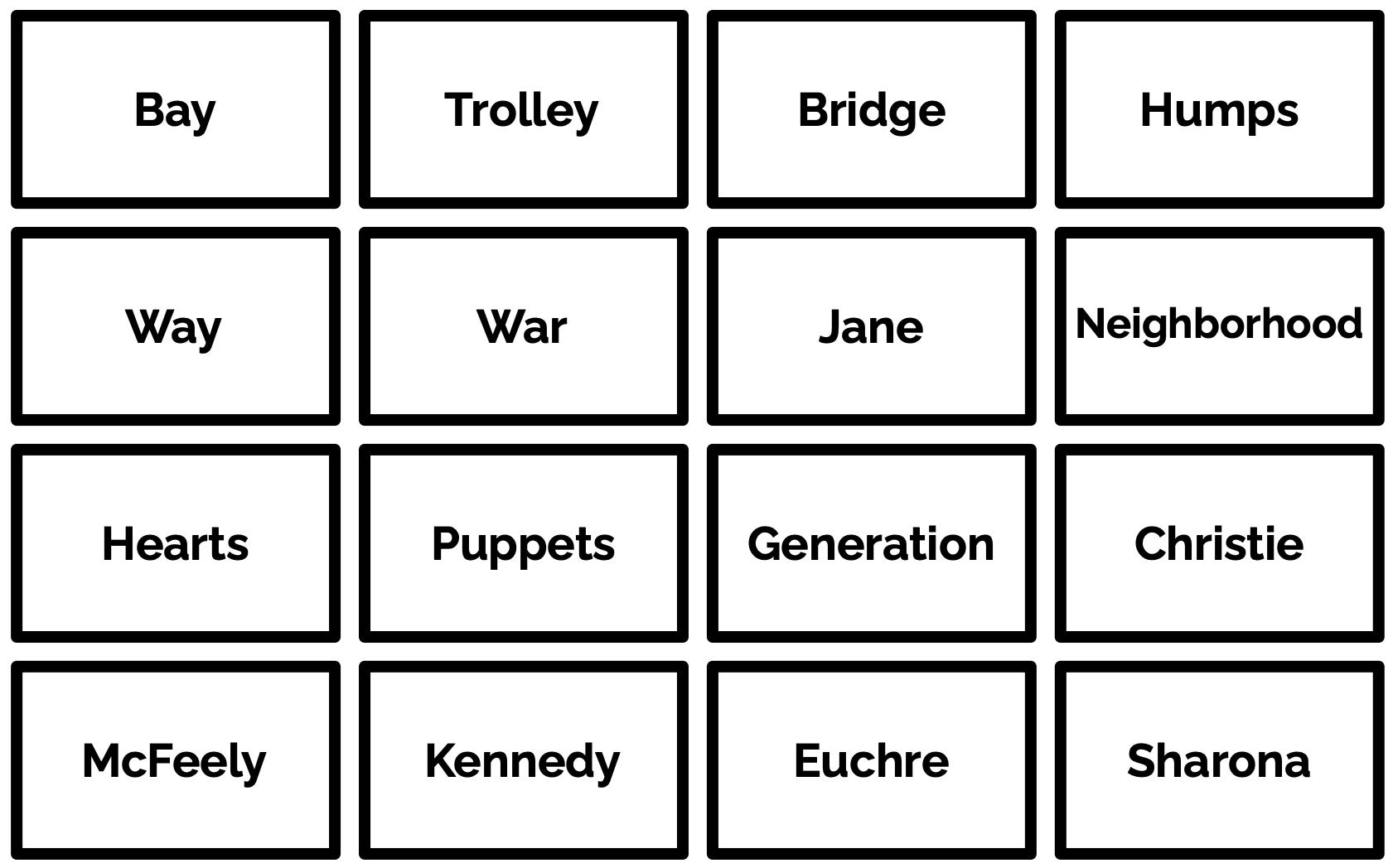
SHETH (3L) & MATTHEW FARRELL (3L)
This 9 x 9 grid is divided into nine rows, nine columns, and nine 3 x 3 boxes. When the puzzle is solved, each digit from 1 to 9 will appear exactly once in each row, column, and 3 x 3 box. Some spaces have already been filled; use those digits to deduce the remaining spaces.
CONNECTIONS SOLUTIONS: Card Games: Bridge; Euchre; Hearts; War; Stations on TTC Line 2: Bay, Christie, Kennedy, Jane; Things Associated with Mister Rogers: Trolley, Puppets, McFeely, Neighborhood; “My ___” in Song Titles: Generation, Humps, Sharona, Way
6 4 2 8 6 8 3 2 9 2 1 9 5 7 7 2 9 4 1 5 6 4 5 8 9
feb sudoku
By Navya Sheth
https://puzzleme amuselabs com/pmm/sudoku-pdf
By Matthew Farrell