
A fond farewell to the law school’s admissions legend

In February, Assistant Dean Brittany Twiss announced the retirement of Jerome Poon-Ting, Senior Recruitment, Admissions & Diversity Ofcer at the U of T Faculty of Law.
June 2025 marks the end of Jerome’s long stint with the Faculty of Law, which started in 2014, and his journey in student recruitment and admissions. Jerome has undoubtedly had a successful career, especially at the Faculty of Law where he has made signifcant contributions to the admissions program and student services, broadly. Jerome’s recognition with the 2024 Jill Matus Excellence in Student Services Award is a testament to his demonstrated excellence in the area of student services.
Jerome is the frst person with whom many of us were in contact during the admissions process. He may have been the one who called you to give you the good news of admission.
We (Abby and Manreet) are graduating, fnishing up at the same time as Jerome will be retiring. During our multiple interactions with Jerome, he has mentioned how law school students' admissions profles are forever embedded into his memory. So we thought it would be ftting–full circle–to get to know Jerome.
Ultra Vires (UV): How did you fnd yourself as the head of admissions at UofT Law—what was your journey to the Faculty like?
Jerome Poon-Ting (JPT): My journey be -
gan back at Queens University, where I did my undergraduate degree in Computing & Information Science. After my undergrad, I was working for the Queens radio station as a program director.
I came across my frst recruitment job accidentally. A friend of mine at Queens needed help with a job application for the position that I eventually got. I took a look at the job description, which was for recruitment of high schools to Queens, and I looked at it and I went “oh this is so me.” I had no idea that this kind of job existed because I was an international student. The premise of recruitment to university was a foreign concept to me because none of that stuf existed in the Caribbean back in those days. A week went by, I didn't hear from my friend. I reached out and my friend told me that he wasn’t going to apply, so I decided to apply and I got the job.
It was a one year job contract. They liked me so much that they put me in a regular full-time position.
So I said fne, sure, why not—it's one great adventure.
Half the time I did recruitment, and then the other half of the year, I did admissions. I already had to know the requirements for the programs for admissions reviews, so I just had to be able to talk about it, make it seem interesting. Then, I began coordinating the international exchange programs. I ended up giving myself
my own job title—I was Queens’ frst international coordinator of exchanges and international studies. Before I started, the exchange program was not centralized, it was inefcient and untenable.
After two years of that, I said enough Kingston. Kingston is great as a young person and at the end of your life. It’s a little boring for anyone in the middle—I found myself, on the weekends, in Toronto or Montreal. So I started to look for jobs in those bigger cities.
The frst job that came through was doing recruitment strictly from high school to undergrad at the University of Toronto Scarborough Campus. I did that for one year. I was then promoted to Assistant Registrar. I liked that job–it’s a part of what I do now, except that my scope is now limited to law school.
The number one thing you’re doing is providing opportunities for people to meet their future life goals, you’re facilitating that opportunity to make sure they are making an informed choice of where to go. There is also a fresh batch of people, so it’s never stagnant and boring because your clients change all the time. You feed of their eagerness and excitement.
I also liked the extensive travel that happened for the job, including international travel across Canada and the United States recruiting for U of T. I also travelled to the Caribbean, particularly Trinidad and Tobago, Jamaica, and Barbados. I was perfect for this because I speak the language, I know the educational system, I know which schools are the good schools to get the good students that U of T wants. I know when to go in the school year because I know the school system as I studied in the school system.
And then I left that job. I did a little hiatus, for a year and a half, at The Michener Institute for Applied Health Sciences doing purely admissions.
Then a new opportunity came up at the University of Toronto’s Faculty of Information at Robarts, which was back on the recruitment side again.
UV: So all this time you never left the student-facing role?
JPT: No I didn’t.
This whole thing has always been educationfocused or derived. And that is consistent with my family history. Both my parents are teachers. My dad was a teacher then an elementary school principal, and my mom was a frst grade teacher. My family is full of educators. The educational realm is not a foreign concept to me.
UV: But you never wanted to be a teacher yourself?
JPT: I didn’t want to be a teacher necessarily, but once I saw the job description it clicked. So I’m not teaching in the strict sense but I’m still imparting information. I’m just not doing subject matter stuf. The same principles underlie
my role. The basic premise of the journey from the start is the journey of making information comprehensible for people to make smart choices about their futures.
UV: How did the transition to law school admissions happen?
JPT: Everywhere I went, I was happy. Everything sort of came about through opportunities that I took. The premise all along has always been ‘when else am I going to get the chance to do this’ rather than a grandiose where do you see yourself in fve years. Don’t you hate that question? I can tell you what state I’d like to be in, but not necessarily where I want to be. I'm always doing things that I fnd that are enjoyable because I'm getting to help people.
The U of T Faculty of Information and Faculty of Law ofer a combined program—a JD with a Masters of Information. One year, I was doing recruitment at a grad school fair in Ottawa. The then-recruitment ofcer at the Faculty of Law buddied up with me for a table at Ottawa. Through him, I met the person who was the then equivalent of Erica Varga [Admissions and Financial Aid Coordinator at the Faculty of Law]. In the spring, when we were coordinating a joint degree student, she told me that there was a job opening. I wasn’t necessarily looking, but I took a look at the job description and they were paying a bit better. So I applied and I got the job for the position I now hold: Senior Recruitment, Admissions & Diversity Ofcer.
I started in the summer of 2014.
In 2014, the law school recognized that they needed to address the diversity situation at the law school. There was a vested interest to chip away at what was historical and create a newer version of the composition of the class.
My frst question when I started was: where I was with respect to the diversity piece?
I started from the frst principles. We didn’t have any meaningful data or statistics. In order to determine outcomes, to fnd holes and gaps, I needed to benchmark. So that’s where the survey came from. The Faculty didn’t limit me. They let me be in charge of the whole thing.
UV: That brings us to the application process. You have supported the Faculty’s Black Student Application Process. Can you tell us more about your eforts, including any challenges, in developing and implementing this process?
JPT: I mean it's no trade secret, given the history of Canada and the history of the legal profession, certain populations are underrepresented. The law school was cognizant of eforts to make improvements in representation from the Indigenous population. That was an easier thing to facilitate because there are already structures in place at the University, for example First Nations House.
Continued on page 3
CREDIT: SARAH FARB (3L)
MANREET BRAR (3L) & ABBY SASITHARAN (3L)
84 Queen’s Park Crescent Toronto, ON M5S 2C5
Ultra Vires is the independent student newspaper of the University of Toronto Faculty of Law. We provide a forum for diverse viewpoints on topics of interest to our readers. We aim to foster dialogue on academic and social issues between students, the faculty, and the broader legal community in Toronto, Ontario, and Canada. Our content does not necessarily refect the views of the Editorial Board. We print six issues per year. Ultra Vires is printed by Master Web Inc.
EDITORS-IN-CHIEF
Manreet Brar and Abby Sasitharan
BUSINESS MANAGER
Leon Xu
NEWS EDITORS
Rachel Chen and Malka Younas
ASSOCIATE NEWS EDITOR S Yuha Khan and Alex King
FEATURES EDITORS
Julia Allen and Asra Areej
ASSOCIATE FEATURES EDITORS
Tyler Lee and Madura Muraleetharan
OPINIONS EDITORS
Puneet Kanda and Mariam Patsakos
ASSOCIATE OPINIONS EDITORS
Kaitlyn Matthews and Yebin Shin
DIVERSIONS EDITOR
Sakina Hasnain
ASSOCIATE DIVERSIONS EDITOR
Kiwan (Paul) Kim
PUZZLE EDITORS
Matthew Farrell and Navya Sheth
RECRUIT EDITOR
Rosemary Fang
EDITOR-AT-LARGE
Cherry Zhang
ONLINE EDITOR
Siegfried Kahama
STAFF WRITERS
Katherine Fan, Georgia Gardner, Shelby Hohmann, Glenn Howard, Olivia Schenk, and Grace Xu
RECRUIT REPORTERS
Jane Byun, Alice Min, and Celine Tsang
STAFF PHOTOGRAPHER
Kabir Singh Dhillon
SOCIAL MEDIA COORDINATOR
Parker Hopkins
If you are interested in advertising, please email us at business@ultravires.ca ERRORS
If you notice any errors, please email us at editor@ultravires.ca.
UV INDEX
The training and mentorship that McMillan offers to its students is exceptional. This became immediately apparent, both during the interview process and when I started as a summer student. Having advanced within the Firm since then, I can confidently say that students are put in a position to succeed and the Firm’s commitment to investing in its talent is a major draw.
Mikolaj Niski Partner, Business Law


Profle: Jerome Poon-Ting
Continued from page 1
MANREET BRAR (3L) & ABBY SASITHARAN (3L)
We knew the next severely underrepresented group was the Black population.
It was tough for a faculty that didn’t have Black professors to make the law school appealing to the population. More than anything else, people want to see themselves refected. So, I couldn't do anything about the Faculty side of things because that's a bigger beast—those are bigger issues that will take much longer to take on.
But for the student experience two things could happen at the same time.
One, is to make sure the student services staf are building in things so people feel more included. Giving people opportunities, for example working with SLS [Students’ Law Society] or founding a BLSA club that has funding. People should feel that they have some sort of agency in the programming.
On the other side is the admissions side–to express information about the law school that makes it comprehensible.
We haven’t shied away from taking bold steps. We cannot wait for anyone else to take the step to do something concrete in the legal education scheme to advance the underrepresented population. The BSAP process was my bold thing.
We followed the example of the U of T medical school, which had created BSAP as a pathway, an application stream, to give Black candidates the opportunity to contextualize their lived experiences. We learned 2 things from them. One, if you want more of a certain type of student, you must support them. You need to have supports in place so that the students you are bringing in feel supported. I had to build up a little capacity on how student services operated so that they refected this. Two, the program had to have integrity. We didn’t want people to look at this as some sort of performative afrmative action program.
Then the question arises of how do you get in touch with undergrads? So we started the Black Future Lawyers initiative in collaboration with frms in November of 2018, which acted as a conduit to reach out to students. This was handin-hand with BSAP, which came a year after BFL in time for the 2020 admission year.
The BSAP application tried to get a sense of achievement for what you’ve had to overcome, contextually speaking. In conducting a holistic review, it is important to contextualize the information. The BSAP process involves review by Black staf and faculty members. Additionally, the BSAP applications are also reviewed
by alumni—a unique feature of this application process. Alumni understand the unique pressures that graduates face and have the lived experience to guide a contextual review.
UV: What is a highlight of your time here?
JPT: My memorable experiences all relate to getting the students who were ofered admissions late of the waitlist into the law school. The most memorable was an out-of-province student, who was admitted of the waitlist a week before the Monday before classes began. The student had never been to Ontario. They had to quit a job with less than a week of notice. And within four business days, they had to try and get as many things as possible. It was memorable because it meant that I had to take a big chunk of time, about three hours a day, to get this person up to speed. And we pulled it of. The person got themselves settled and graduated on time.
UV: That’s quite kind of you. We would think that your job ends once the student has gotten the ofer and the rest is up to the student.
JPT: Well what’s memorable is the extra thing you had to do to make sure someone was able to the point that they can pursue their goals.
UV: Can you ofer a comment on the future of law and the legal community that you have helped shape?
JPT: In general, it would be the impact of artifcial intelligence (AI). Not merely on the profession, but on the admissions process. I saw it when I read profles. While we place importance on the non-numerical aspects of the profle, what assurance do we have that AI is not playing a role? Do we do interviews? This would be more labour intensive and change the admissions process completely by introducing diferent biases. My rudimentary solution was to use the LSAT writing samples because the writing is live proctored. The writing samples help contextualize the profles, to assess whether there was a risk that AI was used. This prompted other law schools in Ontario to follow.
UV: What’s next for you?
JPT: A lot of relaxation and downtime. I’ll also be doing some elder care. My sister has been doing the heavy lifting in caring for my mom. I also have an Alaskan cruise booked in July!
Editor’s Note: This interview has been edited for brevity and clarity.
Letter from the Editors
April 3, 2025
MANREET BRAR (3L) & ABBY SASITHARAN (3L)
So, this is it. The last hurrah. This bittersweet moment calls for some thank yous and goodbyes.
Thank you to our lovely Volume 26 team (see our masthead for the extensive list!): staff writers, photographers, editors, the business team, the recruit team, and everyone else who has submitted a piece, a photo, or even filled out a survey that contributed to an article. Ultra Vires is an independent student-run newspaper and it is the hard work of students that keeps this scrappy little paper alive.
We are very excited to pass on the UV torch ( metaphorical only—no newspapers were burned ) to Puneet Kanda (2L) and Sakina Hasnain (2L). We have been thrilled to see the growth of UV over the past
year and are excited to see it grow even further in the capable hands of our Volume 27 EiCs.
If you have any comments, are looking for ways to get involved with UV, or just want to say hi, you can always reach us at editor@ultravires.ca or @ultravires. ca on Instagram.
We hope to chat again soon, whether in the form of an alumni advice column or a feature from an event we come back to attend— you will see us again! Thank you for following along on this wild journey.
Signing off, one last time,
Manreet & Abby co-Editors-in-Chief Ultra Vires Vol. 26

Students’ Law Society Update
March 2025 edition
ISABEL BRISSON (3L)
It’s hard to believe the year is nearly over and this is the last edition of Ultra Vires for the 2024-2025 academic year. It has been the Students’ Law Society’s pleasure to represent the student body, advocate on your behalf, and host many successful events this year. From social gatherings to important policy discussions, this year has been quite busy. I welcome the next year’s executive team
and am excited to see what they will accomplish.
In March, the Social and Finance Committee hosted Law Ball, taking an unexpected, but welcome, country-twist this year. From cowboy boots to cornhole it was a significant change from previous years. Our favourite part had to be watching the DJ lead students in a line dance! We understand that exam season is an
extremely stressful time for everyone. That is why the SLS is pleased to announce that we will be providing both earplugs and snacks again during exam season. And, of course—what every student looks forward to the most during this tough time—the Administration has confirmed that they will once again be providing free coffee and tea in the atrium.
This year has also been marked by impor -
tant advocacy efforts. I want to take this opportunity to thank all students who helped the SLS with our initiatives this year. Whether it was joining us at Faculty Council for the walk-in, visiting our townhall booth, or filing out even one of many surveys we sent out, your participation was essential. I hope to see you all at Call to the Bar of the year at Prenup Pub for one final celebration of all your hard work before exams!
MOST OF THE LOVELY 2024-2025 ULTRA VIRES TEAM.
2025 SLS General Election and Graduation Award Results
No scandal this time!
MADISON REGAN (3L)
This March,14 students ran during the Students’ Law Society (SLS) 2025 Spring General Election. Many candidates already held SLS positions in prior academic years, but several candidates made their SLS debut during this election.
Representative and executive positions were up for grabs this election. All representative positions were acclaimed, with two 3L SLAC positions and four 3L SFC positions remaining vacant. While most executive candidates ran unopposed, there was a close race between three candidates for the Vice-President, Finance position.
The voting period opened on Friday, March 21, and closed on Monday, March 24. Voter turnout this year was 23% of the law school (157 out of 689
students)—a 12% decrease in turnout compared to last spring. The results for the 2025 Spring Election are as follows:
Executive Committee
President: Chelsea Musanhu (2L)
Vice-President, Student Life: Sakina Hasnain (2L)
Vice-President, Academic: Kabir Singh Dhillon (2L)
Vice-President, Social: Robyn Cumiskey (2L)
Vice-President, Finance: Andre Lanoue (2L)
SLAC Representatives
2L: Jayden Daniels, Srivani Edupuganti, Ethan
Sabourin, Omar Saleh
3L: Emily Ernst, Ethan Kibel
SFC Representatives
2L: Danya Assaf, Kiwan Paul Kim, Alex Kouri, Sam Zhang
The remaining 3L SLAC and SFC representative positions will be flled in the 2025 Fall General Election.
Graduation Awards
The Chief Returning Ofcer also ran the election for graduation awards. The results are as follows:
First-Year Community Builder Award: Kiwan Paul Kim (1L)
Friend of the SLS Award: Assistant Dean Brittany Twiss Class Valedictorian Award: Brynne Dalmao (3L) John Willis Award for Leadership and Gina Caldarelli Memorial Prize for Spirit: Brynne Dalmao (3L)
Hail and Farewell Speaker Award: Professor Anthony Niblett
Alan Mewett Award for Excellence in Teaching: Professor Martha Shafer
Upper-Year Mentorship Award: Alison Borch (3L), Sammy Markowski (3L) and Mahnoor Noor (3L)
SLS Staf Appreciation Award: Theresa Chan
Faculty Council Celebrates Mooting Success, Hears SLS Complaints on EDI Sessions, and Changes Fall 2025 Reading Week Dates
February 2025 Faculty Council
GLENN HOWARD (2L)
The Faculty Council met for the third time this school year on February 26, 2025, where it discussed recent Faculty news, heard complaints from the SLS over content in the 1L EDI and Professionalism series, and moved the Fall 2025 reading break to late October to match the dates of the 2L Toronto recruit interviews.
Dean Jutta Brunnée began by celebrating the Faculty's mooting success. Students from the Faculty came frst in the Laskin Moot, Julius Alexander Isaac Moot, Fox Moot, and Wilson Moot. Students also fnished in the top three in the Immigration, Refugee, and Citizenship Moot and the Jessup Moot, with students from the Jessup Moot advancing to the international rounds in Washington. Several students also won oralist and factum awards. "It's important to highlight how well our students are doing," Dean Brunnée said, congratulating all students and coaches who participated.
Dean Brunnée also thanked Jerome Poon-Ting, Senior Recruitment, Admissions and Diversity Outreach Ofcer, whose retirement has been announced for June 2025. Dean Brunnée said, "Jerome has been instrumental in guiding students through the complexities of the admissions process. [...] His strong commitment to equity, diversity, and inclusion has created opportunities
for many students from diverse backgrounds to access legal education."
The Students’ Law Society (SLS) President Isabel Brisson (3L) spoke next and conveyed "a growing sense of dissatisfaction among law students due to a lack of meaningful opportunities for consultation," particularly over the exam policy change. She said the SLS is "actively exploring ways to formalize the student voice in key decision-making processes through formal government" and that the SLS will present a proposal in March.
The SLS is also disappointed by the Administration's response to the Muslim Law Student Association's complaint about content it called "blatantly Islamophobic" in the frst year EDI and Professionalism series.
"Unfortunately, we have found the administration's response to be largely inadequate," Brisson said. She reiterated the MLSA's demands, which include "a public apology by the administration for the harm caused, a commitment to not using any resources from this institution in the future, and a commitment to meaningful consultation with the MLSA and other equity groups when creating any future EDI training. This includes a comprehensive, and mandatory, Islamopho-
bia session this semester with the MLSA's involvement to rectify the harms caused by this course."
Dean Brunée said the administration has been in contact and met with various student groups including the MLSA and the SLS. She said the administration "deeply regrets the experience that students have had in the context of the EDI and Professionalism series. I know that some members of our community are deeply hurt and angry. ... We're taking this very, very seriously."
The Dean said she was in the process of striking a working group to review the EDI and Professionalism series, including its coverage of "specifc challenging topics like Islamophobia and Antisemitism." She added the working group will also address other unrelated feedback about "connecting the EDI training to what happens in the curriculum and what future legal professionals need to grapple with." She said student groups will be consulted as the working group undertakes this process.
The Graduate Law Students Association (GLSA) spoke next and said it had developed a formal process for student-run initiatives, that its constitutional amendment was ongoing, and reiterated GPLLM students'
Final Faculty Council Findings
March 2025 Faculty Council meetings
ABBY
SASITHARAN (3L) & MANREET BRAR (3L)
Two Faculty Council meetings were held in March on Wednesday, March 19 and Wednesday, March 26, to present reports from the various Dean’s Committees.
March 19
Dean Jutta Brunnée began the meeting by announcing that “a working group on the 1L EDI and professional series has been struck.” The Dean and Associate Dean Christopher Essert will co-chair the working group. The group aims to discuss how to tackle specifc problems related to the EDI and professionalism series.
Students’ Law Society (SLS) President Isabel Brisson (3L) spoke next. She stated that the SLS has decided to pursue alternative measures with regard to the exam policy. She also stated that Law Ball was a success with over 600 tickets having been sold. Brisson announced that the SLS general election was underway, with most positions having been acclaimed.
Professor Angela Fernandez presented the mental health action plan on behalf of the Mental Health and Wellness Committee. The Mental Health and Wellness Committee recommended a shared calendar to
inform professors about non-academic events, a ‘random acts of kindness’ week, and continued collaboration with the Disabled Law Students’ Association (DLSA). 1L Student Life and Academic Committee (SLAC) representative Ethan Sabourin (1L) asked whether there was the possibility of sick days for students such that they could access recordings without having to fll out a verifcation of illness form. Associate Dean Essert stated that it is a complex process that the Administration has previously considered.
Professor Hamish Stewart spoke on behalf of the
concerns over the exam policy change.
Professor Brenda Cossman and Assistant Dean Sara Faherty presented next on the Clinical and Experiential Advisory Committee. They highlighted the uniqueness of Faculty's various clinical and experiential opportunities and noted that the Committee will have a half-day workshop in March to further explore "challenging the divide between substantive, doctrinal learning and experiential learning."
Last, the Faculty Council approved the sessional dates for the 2025-2026 academic year, which included moving Fall 2025 reading week from early November to the last week of October. The reason for the change is that the International Bar Association's Annual Conference will be held in Toronto in early November, bringing some 80,000 lawyers to Toronto. The Law Society of Ontario and the law frms that participate in the 2L recruit did not want the conference and the recruit dates to confict and moved 2L Recruit interview dates to late October. Associate Dean Chris Essert noted that the SLS had been consulted on this change and that this solution would be less disruptive than having to excuse 2L students from class for interviews.
Mooting and Advocacy Committee. Professor Stewart re-iterated Dean Brunnée’s statement regarding the success of the mooting program as exemplifed by student success at external and internal moots. Professor Stewart stated “all seems generally well” with the student-run Moot Court Committee. U of T has received invitations for two moots, which the Committee has recommended to the Dean: the Hockey Arbitration Competition of Canada and the Workplace Safety and Insurance Board moot, which is intended to be a one-time moot. Timing is the primary issue with these moots, as their
dates are not consistent with the law school’s mooting schedule.
Professor Douglas Sanderson spoke on behalf of the Truth and Reconciliation Committee. A key issue with which the TRC has grappled is Indigenous identity verifcation. Currently, the Faculty of Law relies on selfidentifcation through an essay prompt that asks the student to “tell their story.” The Committee suggests amending the current process such that the applicant would swear that the story in their essay is true, thereby making it an academic ofence to falsify a story. Students may choose, but are not required, to provide documentation. Given the difculties pertaining to documentation, this would not be a desirable way to ascertain Indigenous identity.
Professor Richard Stacey asked whether there is a process in place when students misrepresent themselves in the process more broadly. Assistant Dean Brittany Twiss answered, stating that there is a verifcation and undertaking in the OLSAS application process; however, the existing process is not sufciently nuanced for the Indigenous applicants’ application process.
March 26
Dean Brunnée opened the meeting by congratulating the U of T team for winning the Oxford Interna-
tional Intellectual Property Law Moot. She also announced that the 2025-2026 grand mooters are Matthew Farrell (2L), Akash Jain (2L JD/MPP), Ikran Jama (2L), and Sarah Zaitlin (2L). Dean Brunnée also announced that there will, once again, be free cofee and tea during the exam period.
Before turning the foor to SLS President Brisson, Dean Brunnée thanked the SLS executive for their collaboration with the Administration and welcomed Chelsea Musanhu (2L) as the incoming president for the 2025-2026 academic year.
In her remarks, Brisson announced the SLS general election results, graduation awards, and SLS awards (see page 4 of Ultra Vires).
Next, the Graduate Law Students Association (GLSA) President Dimitrios Tsilikis (SJD) stated that some constitutional amendments will be made in May. Tsilikis also stated that the GLSA has picked up the pace of distributing funds to other cohorts, LLMs are thriving in terms of social events, and, in the coming year, the GLSA is looking to new streams of funding.
Associate Dean Essert presented the fnal report of the Curriculum Committee. The mandate of the Curriculum Committee was to discuss the changes to the structure of the 1L curriculum, particularly the switch of the Indigenous Peoples and the Law course
to the fall semester and the Legal Research and Writing course to the winter semester. Associate Dean Essert acknowledged that this switch has not been popular with students; however, he noted that one more year of this change is required to assess its pedagogical value. The Curriculum Committee relied on the SLAC student feedback survey to explore ways in which LRW instruction can be improved next year. The Council then approved the 2025-2026 Academic Curriculum.
Assistant Dean, Graduate Programs, Emily Orchard spoke next. The School of Graduate Studies requires Faculty Council to approve delegation of authority over the summer to allow the Associate Dean, Graduate Programs, to make course changes over the summer months. The Council approved the delegation.
Assistant Deans Ada Maxwell-Alleyne and Twiss, speaking for the Equity, Diversity, Inclusion, and Accessibility (EDIA) Committee, discussed the ways in which inclusion and belonging manifest at the law school. The EDIA Committee recommends integrating EDIA into courses through a dedicated research assistant, continued engagement with equity groups, and consultation with students. The EDIA Committee also recommends adding EDIA questions to the annual survey. Assistant Dean Maxwell-Alleyne recommended that for the
EDIA Committee next year, there should be a dedicated focused transparent discussion with accessibility stakeholders.
Professor Andrew Green presented the Financial Aid Committee report. The Financial Aid Committee recommends ofsetting the frst $10,000 of government debt against assets and recommends the use of the actual amounts of federal loans and provincial loans. The Financial Aid Committee changed the fnancial aid estimator to refect rising living costs. The Committee also discussed the post graduate repayment assistance program (PGRAP); however it did not make any changes to the program.
Assistant Dean Twiss noted that over $5.5 million was distributed in fnancial aid, stating that “U of T’s fnancial aid program is one of the most generous fnancial aid programs in the country.” Assistant Dean Twiss then provided an overview of the fnancial aid program, the distribution of fnancial aid, and an overview of PGRAP.
Professor Martha Shafer presented the clerkship results on behalf of the Clerkships Advisory Committee Update. See page 9 of Ultra Vires for the results. Professor Shafer stated that this was the strongest applicant group in recent years. This year, 23 U of T students secured clerkship positions.
McCarthy Tétrault Pauses 1L Black and Indigenous Program: What It Means for Law Students and
“The future of the profession will be shaped not by moments of momentum, but by what institutions choose to stand for when no one is demanding it.”
In a move that has sparked concern and conversation across Toronto’s legal community, McCarthy Tétrault LLP has paused its 1L Black and Indigenous Summer Program. The program, launched in 2020, was widely seen as a meaningful efort to address systemic barriers to entry in the legal profession. It ofered frst-year summer positions to Black and Indigenous law students, groups that have been historically underrepresented on Bay Street.
The decision has drawn criticism from members of the legal profession and raised broader concerns about the durability of law frm commitments to diversity, equity, and inclusion.
That summer, in 2020, the murder of George Floyd by police in Minneapolis ignited a wave of protests and public reckoning around anti-Black racism and institutional inequality. In Canada, it sparked renewed attention on the treatment of Black and Indigenous communities. Law frms, like
the
Legal Community
many other institutions, came under scrutiny for their historic lack of representation and the barriers that continued to prevent equitable access to legal careers. While statements of solidarity were widespread, the legal profession also faced growing calls to move beyond symbolic gestures and pursue meaningful structural change.
In response, several Canadian frms, including McCarthy Tétrault, announced new diversity-focused recruitment and retention initiatives. McCarthy’s 1L Black and Indigenous Program was one of the most visible among these: a targeted efort to provide early professional opportunities to students from communities historically excluded from Bay Street.
Now, fve years later, its suspension has prompted many to ask: What happened? What changed? And what does this say about the legal profession’s commitment to inclusion?
According to the frm, the pause is part of a broader review of its recruitment strategy. In a statement given to The Globe and Mail, McCarthy’s emphasized that diversity remains a core value and
stated its intention to come back with "even stronger" recruitment programs after the review. CEO Sunil Kapur noted, “This work is never over, and we’re excited about making our industry-leading recruitment programs even stronger following our strategic review.”
Walied Soliman, Chair of Norton Rose Fulbright Canada, took to LinkedIn to voice his concerns: “Giving well-earned opportunities to join the top of this great profession to women, minorities, economically disadvantaged and others and ensuring that our teams refect the communities and clients with whom we live and have the privilege to work, is our responsibility.”
His sentiment echoes a broader frustration among diversity advocates: many frms made bold commitments in 2020 but are now quietly rolling them back amid shifting public discourse. As public attention shifts and the urgency of that 2020 movement fades, there’s growing concern that programs are being scaled back without clear communication or long-term strategy.
The suspension of the 1L program is particu-
larly signifcant for students navigating an increasingly competitive job market. First-year summer positions are limited and often serve as gateways to second-year recruitment and eventual articling ofers. For Black and Indigenous students, dedicated programs like McCarthy’s have represented more than just employment opportunities: they have ofered mentorship, visibility, and a signal that the profession is striving toward greater inclusion.
McCarthy’s has not confrmed whether or when the program will return, but says it will share updates upon completing its internal review. In the meantime, the move has become a fashpoint in the ongoing conversation about what meaningful diversity in the legal profession requires, and whether the momentum of recent years will continue.
The question now is not just what frms promised in 2020, but what they are willing to sustain in 2025 and beyond. Because ultimately, the future of the profession will be shaped not by moments of momentum, but by what institutions choose to stand for when no one is demanding it.
Litigator vs. Transactional Lawyer
The BLSA and SALSA Host a Candid Career Panel
On March 6, 2025, the Black Law Students’ Association (BLSA) and the South Asian Law Students’ Association (SALSA) joined forces—for the first time—to present “Litigator vs. Transactional Lawyer,” a panel that highlighted two common legal career paths. The event offered students a glimpse into the realities of litigation and transactional law. The conversation was as rich in wisdom as it was in candour.
The event brought together a star-studded line-up of lawyers: Christopher Yung and Jennah Khaled of Lenczner Slaght LLP, champions of the courtroom, and Sanjeev Patel and Natalie Tershakowec of Wildebo -
er Dellelce LLP, architects of the business world. During the discussion, these lawyers laid bare the realities of their respective fields while also addressing the unique challenges faced by racialized and women lawyers in the profession. Litigators, as Yung put it, are the warriors of the profession. They live for the fight and thrill of advocacy. Khaled underscored the need for quick thinking, strong writing, and a love of persuasion. Patel, speaking from the transactional side, countered with a vision of lawyers as bridge-builders—crafting solutions, forging agreements, and helping businesses grow. Tershakowec added that
while deal-making is less adversarial than litigation, it still requires strong advocates, with the goal of aligning both parties toward a common goal rather than engaging in battle.
Yet, as the conversation made clear, the law is not a zero-sum game. Whether in litigation or transactional work, success hinges on preparation, patience, and the ability to anticipate challenges before they arise. But beyond technical expertise, the panelists stressed an even more crucial element of success—purpose: the reason you step into the arena in the first place.
The conversation also explored the barri -
ers that racialized and women lawyers encounter in the profession. Khaled discussed the difficulties in finding the right mentors as a minority. But she emphasized the importance of being resilient in finding the right mentors for you; those who understand your unique challenges, are willing to teach you, and champion your growth.
For the BLSA and SALSA members in attendance, the message was clear: whichever career path you choose, it is yours to shape.
Editor's note: Garvin Brutus (2L) and Simrin Dhah (3L) are co-presidents of the BLSA and SALSA, respectively.
GEORGIA GARDNER (2L)
GARVIN BRUTUS (2L) AND SIMRIN DHAH (3L)
The Wild West Meets Law Ball
A Review of the Annual Law Ball
PUNEET KANDA (2L)

On Saturday, March 8, hundreds of U of T law students headed to Old Mill Toronto to attend the annual Law Ball. Like many other students, Law Ball is my most anticipated event of the school year, providing the opportunity to dress up and talk with my friends and classmates in a more relaxed environment (aside from attending the occasional Call to the Bar).
The Theme
The Students’ Law Society (SLS) took it upon themselves to spice things up this year,
changing the theme dramatically from “James Bond” and "Viva Las Vegas" from the past two years, to “Barristers, Boots, and Bowties.” If I am being honest, I purchased my dress well in advance (March 2024), and my dress most definitely did not match the theme, nor did I want to buy another and let go of the opportunity to dress up. In my defence, with all my friends currently being single or already married, when else would I have the opportunity to wear a foor-length dress? While I opted not to follow the theme, many students were excited by the chance to strut in their fnest cowboy
hats, boots, and bolo ties. As such, this year's theme provided a fun way for students to cosplay as someone from the Wild West and made it more comfortable for those who wanted to dress more casually to do so.
The Location
As per the last few years, Law Ball was held at Old Mill Toronto, located on the border of the city of Toronto and Etobicoke. While Old Mill ofers a unique and spacious Tudor-style venue, some students, including myself, would have preferred a venue closer to downtown Toronto. Although subwaying is an option to reach Old Mill, I personally wouldn’t feel comfortable commuting in a dress after spending hours getting ready to potentially fall victim to a TTC mishap. This makes Ubering an additional cost on top of pricey tickets.
The Layout
Similar to last year, the venue was split into three rooms. Unlike last year, however, attendees could only enter and exit through the frst room. The frst room was dedicated to tables flled with food, snacks, and seating for those wanting to chat; the middle room doubled as a casino and bar (and the cornhole game), and the third room was a dedicated dance foor. There was a variety of food to choose from. For those not as hungry (or hoping not to look bloated in their outfts) there was a wide selection of candy and snacks, while those too busy getting ready to have dinner (guilty) could devour burgers and grilled cheese. Despite the range of food, there were a number of complaints that the burgers and grilled cheese were on the dry side. At least this year, unlike previ -
ous years, there was a dedicated water station.
As in other years, the casino was the highlight for many attendees. While there were a good number of tables, it may have been too many—attendees commented that there were more tables than dealers.
Another major critique was the change from multiple bars to the single bar. While the one bar had more bartenders, the line wrapped around the entire room. The first time I lined up, it took me about 30 minutes to reach the front, although the bartender let us take two drinks at a time, which helped. Still, with people cutting the line (I may have done this afterwards) it made getting drinks a hassle, and with how loud the music was, it was hard to talk to those I was waiting in line with. If I’m being honest, I thought the third room wasn’t being used for a good chunk of the night. I think it would’ve made more sense to designate the middle room as the one for dancing, as people would be more likely to cross it to get to the other rooms, creating more traction. The decline in dancing from last year may also be the result of the music. While the country theme was fun, the DJ seemed to have taken the theme too seriously. Instead of hearing repeats of the top country hits, many attendees would’ve appreciated more recent and trendy bops (circa 2000s, to be exact). One attendee also commented that they did not appreciate slow dancing at 11 pm and that it was “giving middle school vibes.” Despite my critiques, Law Ball was still a fun night to remember, and I appreciate the effort that the SLS put into planning the event. I look forward to attending again next year.
Refecting on “Empowering the Future: 75 Barrier Breaking Years of Women in Law” this International Women’s Day
On January 28, the Faculty of Law cohosted an event with the U of T Women and the Law Society celebrating 75 years of the modern law school. The event, called “Empowering the Future: 75 Barrier Breaking Years of Women in Law,” featured an incredible panel of alumnae including: the Honourable Rosalie Silberman Abella, Dean Emerita Mayo Moran, Amma Anaman (JD/MBA 2012), Atrisha Lewis (JD 2012), and the Honourable Anita Anand. The conversation was guided, with joy, humour, and wit, by Professor Brenda Cossman.
Each year, International Women’s Day pulls my mind in two directions. Unfortunately, but importantly, it reminds me of the struggles women continue to face and how far we are from substantive gender equality. The day highlights the injustices,
inequalities, and barriers that persist for women in both subtle and overt ways. From women’s underrepresentation in firm partnerships to the global rise of the “antigender” movement to gender-based violence and harassment, there is still so much work to do.
On the other hand, International Women’s Day also serves as a celebration. It’s an opportunity to honour the successes and triumphs of the women who paved the way before me. As we were reminded during the panel, women make up 56 % of this year’s incoming 1L class—a truly remarkable statistic. Having recently attended the panel, this International Women’s Day felt more uplifting than usual, despite all that’s happening in the world. Learning of the incredible accomplishments of all the panelists brought me hope. The panel also
reminded me of the strength that comes from community-building and the feeling of collective joy.
Before the panel, I watched as dozens of alumnae reconnected with one another. These women didn’t have the experience of seeing women make up more than half of their law school class, but it was clear that they shared meaningful friendships and connections—even though some had not seen each other since law school. Excitedly, they embraced one another and shared stories about their families and careers. The strength of their connections and the resilience they exuded was truly inspiring. I could only imagine how wonderful it must have been to return to your alma mater and witness the tangible progress in women's representation. It reminded me how truly privileged I am to attend law school at a
time when the majority of my peers are women, I can take classes like Gender Equality in the Transnational Legal Perspective with Professor Rebecca Cook or Reproductive Rights and Justice with Dr. Michele Goodwin, and, most importantly, where I feel a sense of belonging at the law school and in the legal profession. As we continue to move forward in our legal careers, I urge all of us to remember that our actions matter and have an impact. As the Honourable Rosalie Silberman Abella said during the panel: “leaders, in institutions and organizations, you have a responsibility to look over your shoulder and understand how what you do impacts those who work with you.”
Editor’s Note: Alexandra Beck is the co-President of the Women and the Law Society.
ALEXANDRA BECK (2L)
CREDIT: PUNEET KANDA (2L).
Toronto Summer 2025 1L Recruit Results
Slight increase in hiring from previous years
ROSEMARY FANG (2L) AND ALICE MIN (3L)
This year, Ultra Vires reached out to 18 employers who participated in the ofcial 2025 Toronto 1L Recruit. The total number of employers this year is notably higher than last year's 13. Moreover, Torys LLP joined the pack of employers, participating in the 1L recruit for the frst time. At least 86 students secured a 1L summer posi-
tion through the Toronto 1L recruit—a signifcant increase in the number of students hired from last year’s 69. This increase could be attributed to the fact that 17 employers responded to UV, compared to the previous year’s 13. Of the participating frms, Osler, Hoskin & Harcourt LLP hired the most students, with 12 1Ls joining their ofce
this summer. Osler is followed closely by Aird & Berlis LLP, with 11 students hired, and Dentons Canada LLP, with 10. As in previous years, U of T continues to lead the pack with the highest number of students hired (22). Osgoode, also following the trend of previous years, had the second-highest number of students
hired (17). Finally, Western rounded out the top three, with seven students securing 1L summer positions through the recruit. However, please note that both Borden Ladner Gervais LLP and McMillan LLP did not disclose which schools their students attended: the distribution data may be skewed as a result.
Calgary Summer 2025 1L Recruit Results
U of T Law 2025 LSSEP Student Survey Results
A review of results and students’ thoughts on LSSEP
ROSEMARY FANG (2L)
For the frst time, Ultra Vires surveyed U of T Law’s students on their experience with and thoughts about the Law School Summer Employment Program (LSSEP). A total of 40 students responded to UV’s survey, answering questions about their recruit results and providing comments on the process. Respondents had the option to abstain from any question. Their responses have been anonymized and reproduced below.
Please note that, as with some of UV’s other recruit surveys, we expect that students who performed better or were more satisfed with the outcome of the recruit may have been more likely to participate in this survey.
A QUICK LOOK AT THE NUMBERS Results

The vast majority of students (62.5%) applied to between four to six LSSEP employers. Meanwhile, only 2.5% of students applied to more than 11 employers. Students also had varying opinions on the ideal number of employers to apply to.
Some students suggested applying broadly. Apply widely! It’s more competitive than you think and it’s better to give yourself options.
Others advised taking a more selective approach to submitting applications.
Don’t just apply randomly. I was pretty picky and only applied to places that I was genuinely interested in. This allowed me to craft very individualized cover letters, which I think helped me get interviews.


Of the survey respondents, no student received or participated in more than fve interviews. The majority of students received three interview ofers (41.0%) and, similarly, most students participated in three interviews (35%).


Over half of the survey respondents (55.0%) reported receiving one LSSEP ofer through the process. The highest number of ofers received, reported by 10.0% of students, was four. As for the fnal breakdown, 87.5% of survey respondents accepted a summer job ofer through LSSEP, 5.0% declined all ofers, and 7.5% received no ofers.
Networking
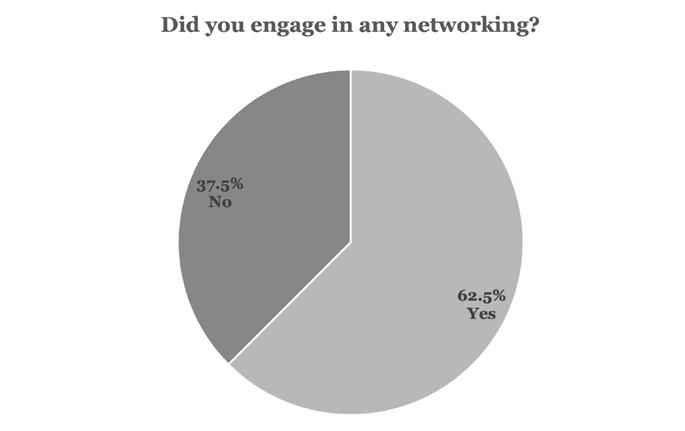

Survey participants were also asked whether they had engaged in networking, both generally and with the employer with which they received an ofer.
The majority of students (62.5%) reported networking for LSSEP. Virtually all students who reported networking clarifed that their networking involved cofee chatting with upper-years who had experience with the positions they were interested in. However, compared to the 62.5% of students who had engaged in networking, only 27.0% of survey respondents reported networking with the employer from which they accepted an ofer.
When asked about their thoughts on networking, some students expressed that they found it helpful.
I would recommend networking. Talking to students who had done the interviews and worked in the positions gave me a sense of what the job was like and what the employers were looking for in their candidates.
I found it worth speaking to employers early on to show interest.
Others took a more neutral stance.
I think it helps, but it’s defnitely not necessary. I would recommend it just to get a feel for what the jobs are like!
I think networking can be helpful, but it’s not super necessary. I did not feel that a lack of networking hindered my performance.
Finally, some expressed that they felt networking had little to no impact on their job prospects.
Networking is useless, based on my experience. If you have a strong application, you do not need to do anything else.
I don’t think networking is even remotely necessary for LSSEP. They just don’t care about that sort of thing in the same way that frms do.
Efect of the process


To close out the “numbers” section of the survey, students were asked to rank the efects of the recruit on their academic, extracurricular, and personal life, with a ranking of one meaning that there was “no disruption” and a ranking of fve meaning that there was a “signifcant disruption.”
Most student rankings fell between a two and a four.
STUDENTS’ THOUGHTS ON LSSEP
As part of UV’s survey, students were also encouraged to share their thoughts and comments on the LSSEP recruiting experience.
Do you have any comments on the application process?
Many students expressed that they felt the process of applying for LSSEP was long, confusing, and demanding.
The application process is quite demanding, taking extensive time to write cover letters.
It was a bit confusing with every application requiring diferent materials (diferent combinations of resume, cover letter, transcripts, reference letters, statements of intent, questionnaires, etc.). It made submitting more difcult than just a traditional resume and grades.
Some students also emphasized the importance of tailoring cover letters when applying to LSSEP positions.
I defnitely recommend getting materials reviewed by the CDO ahead of time—it really helped with my resume in particular. I also think it’s very important to tailor each cover letter specifcally to each employer.
Don't be afraid to diverge from the classic cover letter formula that the CDO suggests. My cover letters had personal stories that I tied into my work experience.
What would you change about the process?
Some students expressed a desire for more clarity and transparency from employers throughout the LSSEP process.
I received a fellowship ofer from an organization that never extended an interview—it would have been helpful to know in the LSSEP guide which employers interview and which do not.
Other students provided recommendations for streamlining the application process and making certain positions more accessible to students.
Some positions by the same organization required separate applications but ended up having only one interview. It might be easier for the applicants if such positions required one application (like DLS).
I would suggest that acceptances be done through the application portal rather than via email. I was on the waitlist for an ofer and was super stressed about it all day because the student who was originally ofered the position took several hours to reject the ofer. I think it would be less stressful for students to have the acceptances be done through the portal and have it auto-reject other ofers if possible.
Self-directed fellowships should be a separate cycle after the rest of the LSSEP. I felt like I couldn’t apply for a selfdirected fellowship because the amount of investment from the partner organization would mean I’d basically be forced to accept if I was ofered the position, and I wanted to know if I would get other jobs frst.
If professors know they have funding and need an RA for the summer, I would encourage them to be a part of the LSSEP recruit. It would spare them the pain of responding to independent emails from students asking for work and would also allow them to interview students.
Respondents also commented on the timing of the recruit and provided varying suggestions to make the process easier for students.
The application deadline was too close to 1L recruit which made it difcult to portion of an adequate amount of time to submit applications on time, especially given the
need to cater applications to each employer. Make the process shorter if possible so that people who are not successful in the recruit have more time to fnd other positions.
What advice would you give to future LSSEP participants?
Many students recommended speaking with upper-year students to get a sense of employers’ interview formats.
Practice with upper-year students that have gone through the recruit. It’s more important to share your genuine passions and personality than it is to memorize interview questions and answers. Practice discussing your career goals and speaking about your passions out loud!
Talk to upper years who have done the interview process! It removes a lot of the unknowns. Even if you don’t know anyone, the directory on the CDOs website is helpful for fnding students to reach out to.
Students also emphasized the necessity of preparing thoroughly for the recruit and expressed that LSSEP was more competitive than expected. Prepare thoroughly for the jobs you think you’re particularly interested in/qualifed for. The spots are very competitive, so if you don’t think you’re qualifed for a job, your time would not be well-spent focusing too much on securing that job.
It is much more competitive than the CDO makes it seem. The CDO also can’t help with public interest materials as much as they can with frm stuf. Talk to students who worked at the organizations you’re applying to.
Other students provided general reassurance to future applicants.
You'll be fne.
Be easy on yourself! It’s important to remember that the majority of 1Ls in Canada don’t work any legal related job whatsoever (at least I believe lol you can fact check me). LSSEP is a pretty competitive process and, in my opinion, is by no means indicative of your worth as a human being and future legal professional.
Do you have any closing thoughts?
Once again, many students expressed that the LSSEP recruitment process was more competitive than it had been made out to be.
Heard it from the upper years that last year LSSEP recruit was a bloodbath, so is this year.
LSSEP is more competitive than it seems but having a genuine and demonstrated interest will get you far.
The LSSEP recruit is defnitely still competitive; I don’t think people should always necessarily view it as a backup to the Toronto 1L recruit. I’d recommend people take extra care in preparing for the LSSEP applications if public interest is something they genuinely want to do. On the other hand, your conception of success as a law student should never be contingent on your ability to fnd a job—you are worth more than being able to fnd a job through any of these admittedly competitive recruits!
Finally, students provided some last pieces of advice that could be helpful for next year’s applicants to hear.
Watching all my friends secure positions before I did (in the Toronto Recruit and elsewhere) was rough. Try not to get caught up in what's going on around you. Focus on yourself, creating your own opportunities, and making good on the interviews you get.
As a 1L, you might not know what type of law you want to do, so the idea of "locking yourself in" to a practice area can be scary and overwhelming. What you do in 1L summer is not determinative. The main thing is fnding anything that you can spin positively for 2L.
LSSEP applications are stressful especially since we're surrounded by such brilliant colleagues who are also well-qualifed. Just make sure to review all your application materials, practice interviewing, and remember that you're smart and capable and deserving of these opportunities!
Regardless of whether you secured a position or not through LSSEP, UV would like to ofer sincere congratulations to everyone who participated in and made it through the process. As some students from the survey expressed, there are so many things you can do with your summer, and your summer experience is by no means a measure of your success or worth. With that said, best of luck to everyone with the homestretch of this year of law school!
Clerkship 2026-2027 Results
Another outstanding year for U of T
CELINE
TSANG (2L)
After a rigorous application process, 23 students from U of T will be clerking at various courts in 2026-2027. This number may be lower than the actual number of clerks, as clerkships are self-reported to the faculty’s Clerkships Advisory Committee, with the exception of the Ontario Court of Appeal
(“ONCA”) and the Supreme Court of Canada (“SCC”) which report directly to the Faculty of Law.
Clerkships are a one-year opportunity beginning in August of each year, which also fulfill the articling requirement. ONCA and SCC tied for taking the most U of T stu -
dents, totalling seven at each. At the SCC, U of T students will be clerking for 6 out of the 9 judges. Emily Chu (3L) and Samir Reynolds (4L JD/MPP) will be clerking with Justice Martin, Isaac Jonker (JD 2024) will be clerking with Justice Rowe, Flint Paterson (JD 2022) will be clerking with Justice Côté, Hannah Rosenberg (3L) will be clerking with Justice Karakatsanis, Foti Vito (JD 2024) will be clerking with Justice Jamal, and Henry Mann (3L) will be clerking with Chief Justice Wagner. Congratulations to all of our future clerks!
March Intellectual Property Debrief
Overview of Thomson Reuters v. Ross Intelligence and ongoing mRNA patent litigation
SAM ZHANG (1L)
Thomson Reuters Enterprise Centre GmbH v. ROSS Intelligence Inc. (United States District Court for the District of Delaware)
“None of Ross’s possible defenses holds water. I reject them all” – Judge Bibas
The dust settles in the frst legal battle of the ongoing war over Artifcial Intelligence (AI) copyright. The media giant Thomson Reuters, the owner of Westlaw, emerged victorious.
ROSS purchased from a third party a database of “legal questions” derived from and substantially similar to Westlaw headnotes, and used this database of questions to train its AI search engine. The search engine tool being developed would have been a direct competitor to Westlaw.
The United States District Court for the District of Delaware reversed its earlier decision in 2023, holding that ROSS’ use of headnotes did not constitute fair use. The judgement grounds its decision largely on the frst and fourth fair use factors. Regarding the frst fair use factor— the purpose and character of the use—the court found the use of headnotes to be commercial in
nature, and the resulting search engine would have a similar purpose as Westlaw. However, the fourth factor—value and market—was ultimately the deciding factor. The District Court held that the search engine developed by ROSS would serve as a market substitute for Westlaw and take away Westlaw’s market share, decreasing Westlaw’s value.
Practically, the case law has little consequence, as ROSS announced its shutdown in 2021, when Thomson Reuters launched its lawsuit. Nevertheless, this is a victory for the “media” side in the ongoing war over training data. It remains unclear what this case means for AI training data. The AI search engine developed by ROSS was a far cry from modern Large Language Models (LLMs). I leave you with this gem of an introduction from the judgement.
“A smart man knows when he is right; a wise man knows when he is wrong. Wisdom does not always fnd me, so I try to embrace it when it does––even if it comes late, as it did here” stated Judge Bibas, Thomson Reuters v. Ross Intelligence mRNA Kerfufe
The legal battle over mRNA patents continues. On March 5, the Düsseldorf Regional Court ruled that Pfzer and BioNTech violated the Moderna COVID-19 vaccine patent EP 3590 949. Pfzer claimed it had been authorized to use the patent during the pandemic until May 2023, when the WHO declared the pandemic to be over. Presiding judge Daniel Voß was unconvinced and found that a press release in March 2022 had revoked the use. The parties may appeal to the Higher Regional Court Düsseldorf. EP 949 and another patent are at the heart of the ongoing legal battle, both of which are highly contentious. In late 2023, Moderna lost the Dutch version of this case at the Hague District Court when the court declared the Dutch part of EP 949 invalid due to lack of novelty. The Court of Appeal in the Netherlands will likely review this decision sometime this summer. In July 2022, the UK high court found Pfzer and BioNTech to infringe Moderna’s EP 949. The UK Court of Appeal will likely hear it next year.
The same patent did not survive opposition in the US (US20120237975), Canada (CA2821992), and Australia (AU2011308496). BioNTech’s
stance continues to be that EP 949 is invalid. Within the same day, March 5, the United States Patent Trial and Appeal Board (PTAB) found the U.S. Patent Nos. 10,702,600 and 10,933,127 patents unpatentable as obvious. This result put an end to Moderna’s August 2022 lawsuit against Pfzer and BioNTech, alleging infringement of the two now invalid patents. That is, until Moderna appealed the PTAB’s decision to the Federal Circuit.
Moderna’s August 2022 lawsuit included the infringement of a third patent (No. 10,898,574), which remains in the District of Massachusetts. The result of that part of the case remains to be seen. The end of this legal battle is nowhere in sight.
Sources
Mathieu Klos, “Moderna and Freshfelds triumph in Düsseldorf against BioNTech and Pfzer” Juve Patent (5 March 2025)
Blake Brittain, “Pfizer convinces US Patent Office to cancel two Moderna COVID-19 vaccine patents” Thomson Reuters (5 March 2025)

Is DEI Going to Die?
McCarthy Tétrault indefnitely pauses Black & Indigenous 1L summer hiring program
SHELBY HOHMANN (3L)
In 2020, McCarthy Tétrault (‘McCarthy’s’) introduced its Black and Indigenous Summer Program, ofering 1L summer positions to Black and Indigenous law students. The program was part of the frm’s broader “Inclusion Now” plan launched in 2018, which refects their purported values of diversity, inclusion, and corporate social responsibility. Inclusion Now is the frst program of its kind in the Canadian legal space and is a “key priority” for McCarthy’s. The frm employs a full-time Chief Inclusion Ofcer, Charlene Theodore, a lawyer-turned-Diversity Consultant who in 2024 was named Canadian DEI Leader of the Year by the Diversity, Equity & Inclusion America’s Awards. Its inclusion eforts have likewise received wide recognition: for the past 12 years, McCarthy’s has been recognized as one of Canada’s Best Diversity Employers; in 2020, Inclusion Now was awarded Diversity Initiative of the Year at the Canadian Law Awards; and at the end of 2024, it received the Catalyst Award for 2025 in recognition of its advancements in gender equality and diversity. Evidently, the frm has taken many steps towards advancing diversity, equity, and inclusion (“DEI”) within it, its 1L hiring program being a signifcant and well-known one within the broader legal community.
The “Our Commitment to Reconciliation” page on McCarthy's website describes the frm’s 1L hiring initiative as being “designed to remove the historical and practical barriers that can discourage [Black and] Indigenous students from applying to large, full-service frms.”
However, earlier this month, the frm announced that it would be discontinuing this hiring initiative. The frm claims that this move is the result of an “overall recruitment review,” but the timing has raised concerns given the current political climate and McCarthy’s presence in the United States. Since Trump reclaimed ofce in
January of this year, he has used executive orders to begin a widespread dismantling of DEI initiatives across the United States. Prominent corporations have expeditiously done away with DEI programs in droves. Many of these changes have (at least ostensibly) been to comply with Trump’s anti-DEI executive order, but some companies, such as Boeing and Walmart, started to dispense with their DEI initiatives before he even took offce.
Like many big law frms, McCarthy’s serves clients internationally, including many American ones. The frm has a New York ofce that advises US clients operating in Canada and it regularly assists on cross-border deals throughout a range of industries. McCarthy’s states that having an ofce located in the US allows for “[American] clients to access the strongest frm in Canada” and highlights its “borderless client service.” Evidently, McCarthy’s has a serious interest in keeping its American corporate clients happy, leading many to side-eye the circumstances of their 1L hiring program’s discontinuation. As pointed out by Robyn Doolittle in The Globe and Mail, the frm has not discontinued all 1L hiring: they are maintaining their program for students interested in practicing intellectual property law, which is not connected to any diversity initiatives. As it currently stands, the suspension of the Black and Indigenous 1L hiring program seems to be indefnite. The frm has not released any timeline for when they will resume–if ever.
As previously alluded to, this move has drawn hefty criticism from the Canadian legal community. Many Reddit users openly shared their feelings in response to Doolittle’s article in the r/ LawCanada subreddit, taking advantage of the anonymity that the platform ofers. One user commented identifying the irony of the frm continuing to boast about its recognition in the area
of DEI: “And they are on LinkedIn CONGRATULATING themselves for winning the Canada Best Diversity Employers for 2025 award. I wish I could be vocal on LinkedIn. I would comment on their posts. But my LinkedIn is tied to my job.” Several commenters opined the decision as demonstrating that the inclusion eforts of McCarthy’s (and other big law frms) were performative all along and one questioned why the Chief Diversity Ofcer Theodore was not mentioned in The Globe article. The Reddit comments were not, however, exclusively anti-McCarthys: one user argued that the frm does “walk the walk” by taking on pro bono cases, representing, for example, the UR Pride Centre for Sexuality and Gender Diversity in their challenge to the Saskatchewan government’s invocation of the notwithstanding clause in relation to a policy requiring students under 16 to obtain parental consent for using their preferred name and pronouns at school. Another shared that they heard the change was due to individuals of other marginalized groups feeling excluded from 1L hiring (though it is diffcult to see how, if this truly was the issue, why they could not have just expanded eligibility).
While McCarthy’s lawyers have not publicly spoken out for obvious reasons, some lawyers from other large frms have been unafraid to voice their opinions. Walied Soliman, KC, Global Chair and Canadian Chair of Norton Rose Fullbright shared The Globe article with a simple question for McCarthy’s leadership: why?
The frm still does not seem to have directly responded to this query. At the time of writing, Soliman’s post has garnered over 1300 likes and 100 comments. Lawyers and non-lawyers alike expressed solidarity with his views in the comments. Arlene Dickinson (of Dragon’s Den fame) said: “Many of us will absolutely consider not having a DEI program as a disqualifer for doing future business with a law frm.”Michael Bryant,
former Ontario Attorney General and former CEO of Legal Aid BC commented: “A frm cannot congratulate itself for being a great leader, in the name of diversity, then axe the very program that helped McT win its recent award for diversity (trumpeted on its site).”
Some people did defend McCarthy’s, arguing Doolittle’s article was sensationalizing and inaccurate. Two notable voices in the comments of Soliman’s post were partners of the frm. A Business Law Partner from the Montréal ofce commented: “I would respectfully encourage all to get your facts straight and look beyond the headlines….that would be more productive ‘at the top of our profession’.” This comment was liked by a number of other McCarthy’s lawyers. The Managing Partner of McCarthy’s London, England ofce stated: “We need to keep some perspective. Quietly pausing one of our many DEI initiatives, that was operated in one of our ofces, while you assess its efectiveness is hardly a retreat and doesn't warrant a comparison with companies that are disavowing DEI in its entirety.” While the word of one managing partner cannot be taken to represent the views of the frm as a whole, this perspective may provide some comfort given the very real fears many are facing about the very real and continuing reverberations of Trump’s attacks on DEI.
The permanence of this change and whether it is a sign that other DEI initiatives at McCarthy’s will be cut remains to be seen. The fact remains, however, that this change will have an objectively negative impact on the accessibility of summer positions for the Black and Indigenous 1L who may face barriers in entering a profession that is still predominantly white. In the opinion of many members of the legal community, the frm has some explaining to do, especially if they don’t want people to jump to the inevitable Trump-related conclusions.
Future of Law Lab & Investor Protection Clinic Recap
Tackling the Future of Legal Innovation
ABBY SASITHARAN (3L)
The Future of Law Lab and the Investor Protection Clinic are two forward-thinking clinics at the Faculty of Law. Working groups at these clinics have spent the past year researching and developing innovative solutions to novel challenges faced by modern legal systems and investor protections. This piece explores the cutting-edge work of these two groups—ranging from safeguarding the rights of investors in a globalizing world to navigating the complexities of artificial intelligence (AI) governance.
THE FUTURE OF LAW LAB
AI Safety & Liability—A Literature Review of Regulatory Approaches
Members: Christopher Gardner, Justin Lim, Cindy Lu, Erika MacKenzie, Duncan McHattie, Derek McVey, Adam Wang, and Tony Chen
As AI advances, governments are debating how to regulate its risks while maintaining in -
novation. California’s Safe and Secure Innovation for Frontier Artificial Intelligence Models Act, mandates strict safety measures for companies investing over $100 million in AI. Supporters argue it mitigates catastrophic risks, while critics warn it could stifle innovation. This raises a key question: should Canada adopt similar legislation?
The AI Safety & Liability working group conducted a literature review on regulatory models, industry concerns, and global AI governance strategies. Canada’s AI and Data Act (AIDA) was intended to regulate highimpact AI systems, but its legislative progress is uncertain. Ontario currently relies on general privacy laws, which lack AI-specific oversight. The research reviews two key regulatory approaches: use-case-based regulation, which targets high-risk applications like healthcare, finance, and transportation, and computational-power regulation, which re -
stricts AI models based on their processing capabilities. The EU AI Act adopts a riskbased classification model, while U.S. regulations vary by state, with the Colorado AI Act focusing on algorithmic discrimination. This review highlights the trade-offs between regulatory clarity, innovation, and public safety. While some advocate for preemptive safety measures, others argue for a flexible, adaptive approach. Canada must decide whether to pursue a proactive or reactive strategy, ensuring AI accountability without hindering growth. This literature review serves as a foundation for future discussions on AI safety and liability.
Data, Privacy, and Canadian Healthcare
Members: Ivy Chen, Kyle Cheung, Matthew Grace, Aidan Mitchell-Boudreau, Emma Mundy, Yebin Shin, Erica Walter
The Data, Privacy, and Canadian Healthcare Working Group is examining how privacy-enhancing technologies (PETs) can improve patient data security in Canada’s healthcare system. Despite increasing digitization, sensitive medical information is still frequently transferred via unencrypted methods such as fax and email. Hospitals are also partnering with third-party vendors to improve efficiency, raising concerns about unauthorized data access and cybersecurity risks. This research aims to assess existing privacy challenges, analyze global best practices, and provide recommendations for integrating PETs into Canadian healthcare while ensuring compliance with privacy laws.
The group has explored how PETs, such as Multiparty Computation (MPC) and Homomorphic Encryption, could enhance patient data protection. Research on the U.S. healthcare system highlights concerns about the lack
of patient consent in the distribution of deidentified data. Existing frameworks, such as HIPAA, do not explicitly support PET adoption. The UK’s National Health Service (NHS) has begun implementing PETs to integrate data across separate systems securely. However, challenges persist, including regulatory uncertainty, technical complexity, and the need for clear implementation guidelines. In both the U.S. and UK, national agencies are increasingly supporting PETs, signaling a shift toward privacy-centric solutions. The working group will apply these insights to Canada, evaluating legal and technological barriers while proposing strategies to modernize healthcare data privacy.
The Investor Protection Clinic Collaboration project with the Financial Services Regulatory Authority of Ontario (FSRA)
Members: Rachel Bernardo, Tsahai Carter, Keaghan Croke, Sahib Grewal, Zedain Kara, Maggie Shi, Alexander Tower, Malka Younas
This research examines the evolving landscape of artificial intelligence (AI) regulation in financial services across multiple jurisdictions, including the US, UK, Canada, Australia, China, Japan, Ireland, and France. It explores the balance between fostering innovation and ensuring consumer protection, analyzing sector-specific regulatory frameworks, emerging legislation, and governance challenges such as algorithmic bias, transparency, and risk management. The study provides a comparative assessment of regulatory bodies and approaches, highlighting key principles, gaps, and trends in AI oversight. The findings contribute to the discussion on best practices for Ontario’s Financial Services Regulatory Authority (FSRA) and the Investment Protection Corporation (IPC) as they consider AI governance.
Students conducted detailed jurisdictional analyses, evaluating AI regulation in financial services through the lens of existing and proposed legislation, sector-specific policies, and regulatory trends. They examined key challenges such as bias, third-party dependencies, compliance enforcement, and international cooperation. Their research provided insights into the regulatory evolution of AI, from voluntary frameworks to structured oversight, and assessed the role of financial regulators in shaping AI governance. Some students focused on specific legislative measures, such as Canada’s AIDA and the UK’s sectoral approach, while others explored broader trends, such as AI’s integration in investment advisory, banking, and insurance. Additionally, students reflected on their findings, noting unexpected gaps in AI regulation, the tension between innovation and oversight, and the future direction of global AI governance. Their research not only strengthened their analytical and comparative evaluation skills but also contributed meaningful recommendations for regulatory frameworks in Ontario and beyond.
Collaboration project with the International Human Rights Program (IHRP)–Examining the Human Rights Impacts of Mining Development in the Ring of Fire
Members: Hyun Tae Kim, Alexander King, Robin Kovacs, Mehvash Saiyed, Selena Ying Sun, Julia Tillman
This working group aims to investigate and document the human rights impacts of mining development in the Ring of Fire, in collaboration with the International Human Rights Program (IHRP) at the University of Toronto Faculty of Law. By examining corporate and government compliance with Free, Prior, and Informed Consent (FPIC) under the United Nations Declaration on the
Rights of Indigenous Peoples and Treaty 9, the group seeks to highlight systemic issues in consultation processes, environmental risks, and Indigenous governance challenges. Research has already revealed legal gaps that allow corporations and governments to bypass meaningful consultation, as well as the significant environmental threats posed by mining, including water contamination, biodiversity loss, and peatland destruction. Additionally, findings show that corporate engagement often prioritizes business risk management over Indigenous inclusion, and policies such as Bill 197 further weaken Indigenous participation in decision-making. Legal cases, such as those involving the Eabametoong First Nation, further illustrate the broader failures in upholding Indigenous rights.
Moving forward, the group will refine its research by updating the timeline of key events related to mining activities, drafting sections of the final report—particularly on corporate and government responses—and conducting interviews with selected mining companies to assess their consultation practices. They will also analyze the financial risks associated with inadequate Indigenous consultation, exploring cases where companies have faced losses due to mismanaged relationships. Their findings will contribute to a comprehensive report featuring case studies that support advocacy efforts by the Anishnawbe Business Professional Association, with the goal of raising awareness, promoting corporate accountability, and strengthening legal protections for Indigenous rights and environmental sustainability.
Open Banking in Canada
Members: Emily Miller, Juyoung Ban, Talha Mahmood, Glenn Howard, Pe’er Krut, Dima Kiwan This working group explores the potential
benefits and challenges of open banking in Canada, particularly its implications for financial inclusion, consumer protection, and market competition. One focus is on how open banking could enhance financial literacy for underprivileged groups while also posing risks such as data security and regulatory concerns. Another perspective highlights the necessity of strong safeguards to maintain consumer trust, proposing a decentralized yet accountable liability model and improved whistleblower protections across various regulatory frameworks. From a legislative standpoint, Canada’s recent Consumer-Driven Banking Act is examined, comparing the country’s developing framework to international experiences and noting both the benefits and challenges observed in other jurisdictions. Additionally, the group analyzes fintech, banking, and government claims regarding open banking’s impact on financial literacy, while also investigating barriers to implementation and the actual effects on vulnerable populations, finding mixed evidence regarding its purported benefits.
Overall, the research underscores that while open banking has the potential to improve financial literacy, consumer choice, and market competition, its success depends on effective regulation, consumer awareness, and industry cooperation. Findings suggest that while some vulnerable groups may benefit from open banking tools, there is limited empirical evidence supporting broader claims of financial empowerment. Key challenges include regulatory fragmentation, privacy concerns, and the reluctance of traditional banks to share data with competitors. By comparing Canada’s developing approach with models in the UK, Australia, and the US, the group provides insights into both the promises and pitfalls of open banking, emphasizing the need for strong oversight, consumer protections, and clear accountability structures.
2L Recruit Networking for Introverts
Some perspective, tips, and tricks for navigating networking for the 2L Recruit for those of us less socially inclined
OLIVIA SCHENK (3L)
Are you someone whose social battery depletes rapidly in unfamiliar social situations? Has the mere idea of networking for the 2L Recruit felt like an insurmountable task? You are not alone! I hope this article will help my fellow introverts to better weigh the benefts of networking and develop strategies to help make the process easier.
Benefts of networking
The benefts of networking include asking questions early to determine which frms ft you best, gathering insider knowledge to show frms demonstrated interest, and practicing speaking to lawyers pre-interviews. While you can be successful in the 2L Recruit without networking, you will miss out on many benefts that may help boost your odds of success and reduce the overall stress of the OCI and in-frm interview process.
Insider information about frms gathered from networking can be leveraged to show frms you’re serious about them. Networking allows you to name-drop who you’ve already spoken
with, and it gives you insight that allows you to tailor your cover letter and ask more thoughtful questions during interviews. Firms like to know you’re serious about them and that your application was not simply an attempt to play the numbers game.
The most underrated beneft of networking is the information you can learn for your own personal frm preference ranking. If you are a strong applicant, you may have to pick and choose which interviews to ultimately proceed with or who to use frst choice language with. Interview capacity is something to be especially mindful of for more introverted people. I personally would literally combust if I tried to do more than 20 OCIs in two days. Instead, use networking to ask questions about frm culture and seek more candid answers from current and previous students at the frm. Consider what makes each frm unique and which would be the best ft for you.
Networking can be an opportunity to reduce the stress of interviews later by practicing speaking with unfamiliar lawyers now. Speak-
ing to strangers is hard, but speaking to strangers who you admire can be even harder. During the interview process, you will be speaking to many lawyers in increasingly higher positions. In my experience, starting with articling students and working my way up to speaking with associates during the networking phase made speaking with partners during the 2L Recruit a lot less intimidating. With each cofee chat, I became better at making conversation with interesting people. The start of each conversation eventually turned from nerves to natural curiosity.
Networking in your early 2L Recruit experience is an investment that your future self will appreciate. There are several tips I can ofer that personally made networking easier for me.
Networking Tips
First, determine what types of networking suit you best. Do you prefer in-frm events where you can blend in with a crowd, participate in group conversations, and potentially bring a buddy with you? Or do you prefer one-on-one
cofee chats within a defned duration and a quieter setting? You don’t need to do it all! I personally preferred cofee chats and found them the best way to gather information and connect with frm members. I did not attend a single in-frm event and never felt this held me back during the recruit process.
Second, start early and start slow. Try to schedule your networking events to begin early in the summer and give yourself ample time to ease in. Your frst event will be the most draining and require the most recovery time. As you become more comfortable, your capacity will also grow. As you become more confdent, you can increase the number of networking events without feeling overwhelmed. Minding your capacity will help you take full advantage of networking benefts while still protecting your peace.
Third, take time to prepare before each networking event. I found a lot of the social pressure associated with networking was relieved by researching who I would be speaking to in ad -
2L Recruit Networking for Introverts
Continued from page 11
vance. Reading headlines of cases the lawyers have been involved with and recent articles they wrote helped to organically inspire questions I genuinely became curious to ask. I reframed networking from a chore into an exciting opportunity to speak to an interesting person about topics I’m excited about, and this helped me a lot.
Alternatives to networking I don’t believe that networking is essential for success in the 2L Recruit. I have
been told by multiple student program managers that they do not explicitly weigh whether you attended an in-firm event or spoke with a high-level partner in their selection process. Networking is simply a tool for success, but there are other alternatives. For example, a lot of information about individual firms can be found online within the firm’s job listings, website, and social media.
If you want to develop your interview skills in solitude, I would suggest reading
How to Win Friends and Influence People by Dale Carnegie. I found this book provided incredibly helpful tips on how to make great first impressions and how to engage people in enjoyable conversations. Some tips include the importance of learning people's names and immediately using them, creating space for people to talk about themselves (everyone’s favourite topic) and the power of smiling.
Conclusion Any networking accomplished should be viewed as a bonus. If you only have the capacity to do a single coffee chat with your top firm, that is okay! The 2L Recruit is a great opportunity for personal development generally. Either you get a kick-ass summer job, or you become a formidable, seasoned applicant for the Articling Recruit. The skills I learned from networking for the 2L Recruit continue to help me navigate relationship-building in the world of law.
Intramural Year in Review
Res Ipsa Dodgeball: The Wins Speak for Themselves
MATTHEW GRAHAM (2L JD/MBA)
It’s been an incredible year for University of Toronto Law Intramurals! Across the board, law students brought energy, passion, and competitiveness to soccer, volleyball, basketball, hockey, and dodgeball. Whether you were chasing a championship, or looking for an excuse to avoid your readings, there was a team—and a jersey— waiting for you.
The Faculty of Law brought home some impressive hardware. Volleyball, led by Ethan Kelly (4L), Ashley Kam (2L), and Lakshmi Anandaraj (1L), fnished with a 2nd place fnish in Division 1 Mixed Volleyball and 3rd in Open Volleyball. Basketball placed 3rd in both Mixed 4s and Open divisions, while the Hockey team battled through a stacked Open Division 1 to also claim 3rd place.
And then there’s Dodgeball, where Law’s dominance has now become an expectation. Our Division 1 Dodgeball team brought home backto-back championships this year, winning both
semesters. They have now won the championship in fve of the last six semesters. At the heart of this dynasty are law students, including Alexander Kelly (2L), Olivia Maley (3L), and Humza Khan (2L). Their chemistry, clutch plays, and relentless energy set the tone for the team’s success and made them nearly impossible to beat.
This year’s Intramural MVPs are two elite athletes. Abby Bruyer (3L) capped of her incredible intramural career as a Tri-Campus Women’s Soccer Silver Medalist, Tri-Campus Player-ofthe-Week, Dodgeball Champion, and a member of literally every single team. Her relentless spirit, commitment to excellence, and (extremely) stubborn nature made her a pillar of U of T lLaw intramurals. Alongside her, Kelly was instrumental to the Law Dodgeball’s impressive reign, anchoring the team week-in -and -week-out. He’ll be vital as the team looks to continue its run in the 2025-26 season.
Anandaraj (1L) takes home the crown as Law
Intramurals Rookie of the Year. She dominated Division 1 Mixed Volleyball from her frst game, establishing herself as one of the elite volleyball players in the U of T Intramural leagues. Anandaraj faced triple blocks from opposing teams every attack and still delivered. She was the only unanimous MVP selection across the entire Law Intramural program.
The program is also saying goodbye to two legends: Bruyer and Maddy Regan (3L), both former Faculty of Law Athletic Association Presidents. Whether they were rallying various intramural teams, encouraging 1Ls to participate, or kicking a soccer ball, their impact has been enormous. Their contributions helped build the vibrant, inclusive intramural culture we all enjoy today. They will be missed.
This year’s Intramural “T” Award nominees recognize students who made lasting contributions across multiple seasons and sports. The 2025 nominees include:
Motion to Play
• Ben Eisen (3L) and Sammy Markowski (3L)
– Captains of the Hockey Team
• Olivia Maley (3L) – Dodgeball Heart Award winner
• Jarod Manuel (4L) and Ethan Kelly (4L) –Standout volleyball athletes
• Hassan Valji (3L) and Francis Rweyongera (3L) – Soccer stars
• Abby Bruyer (3L) and Maddy Regan (3L) –FLAA legends Intramurals continue to be one of the most rewarding ways to connect with the U of T Law community, get active, and represent the faculty. A huge thank you goes out to my FLAA co-President Allie Silcof (2L) for her tireless work organizing this year’s program. If you’re interested in getting involved next year, contact Matthew Graham and Allie Silcof at uoftlawathletics@gmail.com.
Editor’s Note: Matthew Graham (2L JD/MBA) is the co-President of the Faculty of Law Athletic Association.
A refection on my intramural journey / how intramurals changed my perspective of law school
When I started law school, I could’ve never imagined that some of my best memories would be from playing intramural sports. As a washed-up high-school athlete, I thought my athletic career was behind me. I thought my time would be spent reading countless legal cases and racking up hours in a library cubicle, and my days on a basketball court would become a distant memory. But this was before I experienced the simple joy of playing adult dodgeball, or playing a whole ultimate frisbee game with no subs. When I stepped into the Athletic Centre feldhouse for my frst 10:05pm intramural
game, two words came to my mind: “I’m back.”
In all seriousness, when I look back at my time in law school, intramurals were a large part of it. Besides the late start times and disorganized management, intramurals were a great way to meet new people and try new activities that I otherwise wouldn’t. Whether it was sharing time on the court or going for drinks at The Maddy post-game, I developed more genuine friendships through intramurals than I have in other areas of law school. I also found the athletic drive that I had been missing for some time, even if intramural games
came with weird rule modifcations. Despite these modifcations, I was surprised at how serious the level of competition was. But what surprised me most was that the Faculty of Law could compete, and we were actually good at sports: in the past three years, I’ve been a part of eight championship teams (and I have the intramural champion t-shirts to prove it).
While my time in U of T intramurals has come to an end, I hope that this is just the start of an illustrious rec-league career (though my right knee begs to difer).
If you’re thinking about trying intramurals next year,
go for it! I know it takes a lot of courage, especially in 1L, to try new things and put yourself out there, but I promise that joining an intramural team is worth it. Intramurals are open to all skill and experience levels, and our teams are always looking for players—unless you’re one of the people who “un-likes” the WhatsApp message right before game time so we forfeit (in that case, you’re my #1 opp). So, what are you waiting for?
You won’t be getting any professional ofers from playing, but intramurals might be some of your favourite memories of law school too.
OLIVIA SCHENK (3L)
ABBY BRUYER (3L)
Dean Brunnée Not Seeking Reappointment, Will End Term in December 2025
"I have work left to do as a scholar, and I feel that that work is urgent right now," said Dean
GLENN HOWARD (2L)

The University’s Provost has announced that Faculty of Law Dean Jutta Brunnée will not seek reappointment when her term ends on December 31, 2025. This marks the end of Dean Brunnée's term, which has been bookended by years of historical importance, beginning in January 2021 during the COVID-19 pandemic and concluding this year during the Faculty's 75th anniversary.
The second woman ever to serve as Dean, Brunnée is known by students for her classes on International Environmental and Climate Change Law, her speeches at capstone Faculty events like the annual Grand Moot, and for bestowing free cofee and food on the student body through her monthly event, "J's Java".
Isabel Brisson, President of the Students' Law Society (SLS), said, "On behalf of the [SLS], we thank Dean Brunnée for her dedication to the school and we wish her all the best in her next chapter."
Dean Brunnée is a preeminent scholar in public international law, environmental law, and international legal theory. Among many other professional accomplishments, she is a Fellow of the Royal Society of Canada, an Associate of the Nobel prizewinning Institut de Droit International, and a University Professor, a rank given by U of T that recognizes "unusual scholarly achievement and pre-eminence in a particular feld of knowledge.”
Commenting on Dean Brunnée’s term, Associate Dean Chris Essert said, “It has been an honour to work with Dean Brunnée over the past four years. Her dedication and commitment to the Faculty of Law as a whole and to all the various members of our community, including students and Faculty, has been really inspiring to see and has beneftted our community in too many ways to count. Her successor will certainly have big shoes to
Ultra Vires sat down with Dean Brunnée in February to discuss her term and her decision not to seek reappointment.
Ultra Vires (UV): You have held many leadership positions both within and outside the Faculty, including serving as the Associate Dean of Graduate Studies from 2010 to 2014 and the Interim Dean in 2014. Was it these leadership experiences, or something else, that led you to seek to become Dean of the Faculty of Law?
Dean Jutta Brunnée (DB): I would say that those experiences gave me a sense of what it was like to be in this kind of role and a sense that I would have something to ofer. The ultimate reason was that coming to the Faculty in 2000 made an incredible diference to me as a scholar and as a teacher. When you come here, you're surrounded by unbelievable colleagues from whom you learn a lot, who push you and give you new ideas. The same is true for our students. It really ignited my sense of joy being in the classroom. So, the short answer would be that being at the Faculty has given me such a boost as a scholar and teacher that being Dean struck me as an amazing opportunity to work for this community, to help faculty and students achieve their aspirations, and to tell our story far and wide.
UV: Your term began in January 2021 during the COVID-19 Pandemic. What was it like to lead the faculty through that period?
DB: It was really challenging, largely because, at least initially, everything happened online.
When you step into a leadership role, it's so important that you meet the people you're working with. It’s a lot harder to build those relationships online. It came to me almost a year and a half after I started when the President convened a meeting of all the deans, the provost, and other University leaders to discuss current issues. I walked into that room and thought, “Oh my gosh, I've spoken to these people so often, but I have not seen any of them in person in all this time.” In a way, that was sort of like a rebeginning of being dean.
UV: Your term as Dean coincided with the Faculty's 75th Anniversary. What are one or two notable aspects of the faculty’s history in your opinion?
DB: I'm so lucky to have the opportunity, during my term as Dean, to be able to help shape these celebrations. One thing I would mention is remembering the move that led to the creation of the modern law school. It was literally an act of rebellion that led to the creation of the Faculty of Law. It was a rebellion against legal education being vocational training run by what was then the Law Society of Upper Canada, and the pursuit of the idea that there should be academic legal education based at a university. That was controversial at the time, but it quickly caught on. Today, there are law faculties at universities across the country.
This is worthy of celebration because it is that academic approach to legal education that enables us to train, not just amazing lawyers, but adaptable, agile thinkers who can work in virtually any setting. That's why I've had the tagline for the Faculty: "Lawyers and Leaders for a Changing World." Because I think we train lawyers, but we also train leaders for all walks of society.
There is also a tightly knit community to which people remain committed. We've been reminded of this through this year's celebrations. When I meet with alumni here in Toronto or in New York or in London—wherever they are and whatever they do, whether they are lawyers or not—they share how pivotal having been here was for them. It is tremendously gratifying to hear that so consistently from alumni members of our community.
UV: What is the most challenging part of being Dean?
DB: The pace and the volume of the things that you deal with. Oftentimes, the day’s agenda is totally unpredictable. You think that you're going to be doing X and Y on a given day, and it ends up being something entirely diferent. There are diferent things coming your way that are each equally urgent, and you need to work towards solutions or responses. Whoever is involved in the issue will want answers relatively quickly, but you need to make sure that these answers also stand the test of time.
UV: What makes U of T law students unique? When speaking to students at events like J’s Java, what stands out to you?
DB: The students are all incredibly smart, committed, and interesting. They have all sorts of backgrounds and experiences. When I came here in 2000, it really gave me a big boost as a scholar and a teacher. I remember stepping into my frst teaching experiences and being wowed by the students. I've learned so much from students by getting a question or a perspective that I hadn't thought about. That experience has been a big aha moment for me coming to the faculty,
Brunnée
and I've not ceased to marvel at this. And it's not just me—when we had the most recent series of January intensive courses, without this being solicited, our visiting professors, who've taught all over the place, made exactly the kind of comment that I just made about our students. So, this is not just me being nice; it's actually true about our students.
UV: What led to your decision not to seek reappointment?
DB: It was a really hard decision to come to. In the end, the dominant note is that I have work left to do as a scholar of international and climate law, and I feel that that work is urgent right now, given all the things that are happening around us. There are only so many hours in anyone's day. In my case, there are only so many more years left to do that work. I had to make a choice, and that's what I did. I will miss many things about being in this role, and I hope that I will be able to make a small diference on that other front.
UV: What is next for you and your research?
DB: I'm anxious to go back to thinking and writing about how law—in my case, mostly international law—works or doesn't. I think of law as not just a thing or rules that you just take, apply, and out comes your answer. I think of law as a social practice. I developed a theory with a colleague and friend, which we call interactional law. Law is a certain kind of human interaction, and I would say it's a distinctive social practice. It's one that is grounded in, made by, and kept alive by a distinctive form of argumentation, reasoning, and justifcation. For the legal order writ large to exist, it must be upheld in practice. That means making not just any argument that seems to ft the point you want to make, but to make a disciplined legal argument. But it also means that when somebody else is outside of the scope of rules or makes an argument that isn't recognizable as legal to insist on legal justifcation. We do live in precarious times, and one of the things that is coming under pressure in the international arena, as well as in certain national contexts, is legality and insisting on upholding a legal order. My focus will be on, how can we preserve legality? How can we maintain the foundations of the international legal order, when more and more actors seem to be left and right of the rules, or even ignoring them altogether, when what we often hear is not legal argumentation? Also, in the climate context, what's the role for law and lawyers at a time when we often hear that you can't do this, we can't do that. What can we actually do?
UV: What is your advice for the next Dean?
DB: Never hesitate to ask for advice. Beyond that, build relationships and be present with the people in your community. You need to be immersed in what's happening in the faculty.
UV: What do you see as the future of U of T Law? Where is the Faculty headed?
DB: Part of this question is for whoever will take over as the next Dean. But broadly, I see the Faculty continuing to be the best law school in Canada and one of the top 20 law schools in the world. I think that our approach to teaching law is more important now than it's ever been before.
This interview has been edited for brevity and clarity.
10 Favourite 2025 Follies Moments
GEORGIA GARDNER (2L)
Inspired by the listed breakdown of Law Follies 2023, we’re back with a fresh roundup of thoughts on this year’s show. Law Follies is the annual sketch comedy and musical revue written, produced, and performed by U of T Law students. It’s equal parts satire, chaos, and inside jokes—and a highlight of the student experience.
When I walked into the Scotiabank Theatre, I wasn’t quite sure what to expect. What I got wasn’t what I expected either, it was better. And now, after watching Follies 2025, I think we can all agree: like “Professors Niblett and Essert” portrayed in the Wicked sketch, we’ve been changed “for good.”
Here are 10 of my favorite follies moments (in no particular order).
1. The student support group sketch hit a little too close to home. Every overworked, underslept 1L in the room felt seen. But just when I thought we were safely in “gentle satire” territory, it took a sharp left turn with the iconic “admission”: “Niblett called me a fat b—.” I’ve never heard a crowd laugh and gasp so simultaneously.
2. The Borrowzzz bit was genius, reimagining Professor John Borrows’ famously softspoken voice as a sleep-inducing audiobook service was both deeply respectful and deeply hilarious. The best part was him reading off his own resume in that soothing monotone… “Canada Research Chair... Officer of the Order of Canada...”
3. I was blown away by the student acting in Challengers, a scorching-hot legal drama inspired by the film Challengers, featuring two rival litigators (and former lovers, obviously) facing off in court while exchanging dangerously seductive glances and aggressively eating churros. The sexual tension? Off the charts. The legal arguments? Impeccable. The churro crumbs? Everywhere.
4. A highlight of the night was the way Follies took aim at law’s more exclusive and selfserious corners. The Runnymede Society sketch nailed the posh, genteel stereotype of the club, complete with a deadpan joke about its total absence of women. That vibe found its reckoning in a later sketch reimagining a young Rosalie Abella as an absolutely ruthless judge, (think—The Devil Wears Robes), who obliterated her clerks with withering criticism and impossible expectations.
5. The musical numbers were a chaotic delight. The Wicked parody featuring student portrayals of Professors Niblett and Essert, singing “For Good,” was oddly moving in all the right ways. A highlight: the impressively committed Niblett impression, complete with an exaggerated Australian accent. Never thought I'd get choked up watching Niblett and Essert (well, their stand-ins) harmonize about changing each other’s lives, but here we are. And the Hamilton parody? Elite. A show-stopping number and perfectly delivered jab at how the school might drain your
bank account, but at least you’re leaving with a job.
6. The Clerkship Club sketch was a crowd favorite, skewering the cult-like intensity of students obsessed with landing judicial clerkships.
7. Another standout was the sketch where professors (Follies regulars, Professors Shaffer, Phillips, and Fernandez) tried to use Gen Z slang to better appeal to students. Watching our professors drop words like “bruh,” “cheugy,” and “no cap” in earnest attempts to be relatable was equal parts hilarious and cringey.
8. One of the biggest laughs of the night came from the “David ASSper” gag, a play on the David Asper Centre for Constitutional Rights. The sketch featured students walking around the law school with oversized butt prosthetics.
9. One sketch hilariously skewered the OCI process with a “Tell me about yourself?” answer that simply refused to end. What started as a routine interview quickly spiraled into a never-ending monologue, with the student somehow talking themselves deeper and deeper into irrelevance. The longer it went, the funnier it got.
10. A timely recurring sketch took aim at the newly announced open-book exam policy, which restricts student access to hard drives. The sketch reappeared twice throughout the show, each time featuring an increasingly ine -
briated administrative representative trying (and failing) to explain the policy with a mix of buzzwords, confusion, and booze.
This year’s show was brutally honest, bitingly self-aware, and, above all, laugh-outloud funny. The show was also impressively well-rounded, offering a sharp, self-aware tour through nearly every corner of the U of T Law ecosystem.
After the show, I sat down with Follies coshowrunners Humza Khan (2L) and Megan Corbett (3L) to both congratulate them on a job well-done and to ask them what they wished law students knew about the show. They both emphasized that Follies is for everyone. Khan admitted he was nervous to get involved at first (“I didn’t think I was funny enough”), but ended up getting involved and helping bring a whole range of sketches to life. Corbett echoed Khan’s sentiment, emphasizing that while Follies is a big commitment, it’s also a big source of fun throughout the year, less about resumebuilding, more about enjoying the experience.
Follies 2025 was, above all, a really enjoyable show. Smart, weird, well-executed, and full of moments that had the whole theatre laughing. It’s clear how much work went into every sketch, song, and churro. The bar has officially been raised for next year. If this year’s show is any sign, the Follies tradition is in very good hands.
Announcing the Bora Laskin Law Library’s 8th Annual Poetry Contest Winners
ALEXIA LOUMANKIS
Thank you to everyone for participating in our 8th annual poetry contest—we are happy to provide an outlet for students’ creativity. Over twenty amazing poems were submitted this year (a record!), so selecting just three was very difcult. We appreciate the efort students put into writing the poems and the courage it takes for submitting them. Thanks also to staf from Events and Facilities Services and IT for helping us select the top three poems. Until next year…
Alexia Loumankis
Bora Laskin Law Library
Letters and Laws: A Father in Law School (by Michael Roclawski – 1st place)
The halls hum with eager minds, late-night readings, tight deadlines. Casebooks stacked like city towers, measuring our sleepless hours.
My classmates brief, debate, refne, while I check the clock - past dinnertime. Between Civil Procedure and Corporate Deals, I chase small footsteps, share warm meals.
While others plan for clerkship days, I soothe my child’s cries and stays. They draft in silence, crisp and neat, while bedtime stories wrap my week.
Income Tax weighs wealth and worth, but nothing rivals home’s own hearth.
A wife’s embrace, a toddler’s cheer, the sweetest laws I follow here.
The balance shifts, the days are tight, briefs by day and books by night.
But love rewrites the harshest clause -
this life is mine, and so, I pause.
For here at U of T, I fnd my waya husband, a father, day by day.
The Lights in the Fishbowl (by Humza Mehdi Khan – 2nd place)
Sometimes
The lights in the fshbowl move
They move like the people in the fshbowl move
Rhythmic and steady but with purpose
Moving but staying in place
Anchored to their chosen spot
The lights in the fshbowl sway
They sway like the people in the fshbowl sway
Rocking back and forth
Coming in and out
Each swing counting
The moments of their journey
The lights in the fshbowl spin
They spin like the people in the fshbowl spin
From one cycle to the next
Admissions, moots, recruits
Never reversing direction
No turning back the clock
The people in the fshbowl change
They bump into each other for a time
They see friends come and go
And in a few short years they too leave the fshbowl
The lights in the fshbowl do not
They have been together their whole lives
In this way,

A Dream of Justice (by Goldi Gill – 3rd place)
I wait for a time when law can be accessible to all.
Though we believe it is, we are kidding ourselves.
Law is for the privileged, with words in Latin that laypeople do not understand.
Once upon a time, I lived below the cost of living and have struggled to make it to where I am so that one day I too can be privileged enough to learn about the law.
I envy them.
But the law is a fortress, built with walls of
jargon,
A language foreign to those without the key. Its gates are guarded by the privileged few, While the rest of us stand outside, yearning to see.
I dream of a time when justice is a river, Flowing freely to every corner of the land. When knowledge of the law is not a treasure, But a right for all to understand.
Until that day, I will continue to strive, To break down the walls, to open the gates.
For a world where the law is accessible to all, Is a world where justice truly awaits.
CREDIT: KABIR SINGH DILLON (2L)
Singing the Praises of Professor Jim Phillips
The cyclist, singer, mentor, scholar, and professional teaser of Professor Shaffer
SHELBY HOHMANN (3L)


Professor Phillips is an incredibly accomplished Professor, historian, and legal scholar. When looking through his publications page on the U of T Law website, one has to scroll multiple times in order to make it to the bottom. He has served as a co-editor for numerous legal history essay collections and books on niche legal history topics, while also managing to write over 60 book chapters and journal articles. In his role as Editorin-Chief of the Osgoode Society of Legal History, Professor Phillips has overseen the publication of more than 60 books since he began his tenure in 2006.
His contributions to the study of Canadian legal history have been so signifcant that even the American Society for Legal History (“ASLH”) elected him as an Honorary Fellow (American spelling and all). In discussing ProfessorPhillips’ election, the ASLH described their criteria for choosing Honorary Fellows as follows: “The scholars we elect as Honorary Fellows are distinguished not simply by scholarship that has shaped the broad discipline of legal history and infuenced the work of others, but also by their commitment to building their felds and helping other, younger, scholars stand on their shoulders and carry the work forward.”
The professor and boss who sees and appreciates you Students and scholars alike can vouch for the fact that Professor Phillips is not only brilliant, but is also a kind and helpful mentor. Zoe Brown (2L), who worked as his Research Assistant over the past summer, described Professor Phillips as a “charismatic, hilarious, and [an] understanding boss” who made an efort to get to know her. Natan Snowbell (3L) served as his RA the year before and expressed a similar sentiment: “[Professor Phillips was] always very encouraging and had interesting comments to make on any of the work I did. I also think he really makes more of an efort than most staf to connect with the student body at our level both individually and writ large.” Brown shared that she has never had a professor believe in her abilities as strongly as Professor Phillips did. Snowbell also shared one particularly kind and generous gesture from Professor Phillips that stuck out to him. At the end of their time working together, he took Natan and a few of his friends from law school out to dinner at his own cost. I cannot confrm whether they ate British food, I have heard that he still has a penchant for the food of his home country.
One time when I was in Professor Phillips’ 1L Property class, I brought one of my friends who was an incoming 1L to a lecture so she could get a sense of a typical law school class. After class, Professor Phillips came up to us, immediately recognizing that my friend wasn’t one of his usual students. I explained the situation and he was very friendly, introducing himself and talking with her to see what she thought of the class and her impending transition to law school. This is a memorable example of the connections Professor Phillips forms with his students and shows just how kind and approachable he is. While I don’t remember ever speaking up in Property Law, when I emailed him at the beginning of this year to ask him to add me to the Quercus page for Trusts, he said it was nice to have me in class again. The fact that I dropped Trusts is, for the purpose of this story, irrelevant. I appreciated the fact that he remembered me, despite my feeling like I was not a very memorable student.
Scholarship gap-fller
Professor Phillips has also co-authored two volumes on the history of Law in Canada with Philip Girard and R. Blake Brown. The trio has a third volume forthcoming in 2026, which will focus on the twentieth century. Not only have these volumes flled gaps in Canadian legal scholarship and received wide praise, but in Professor Phillips’ opinion, they can also serve as great stepping stools if you (like Professor Shafer) fnd yourself
needing some help reaching the top of a bookshelf. Volume II was the winner of the Canadian Law and Society Award for the best book published in 2022. Reviewers of the volumes have also praised Professor Phillips and his co-authors for “the care and sensitivity with which the volumes address Indigeneity and Indigenous law, colonialism, race, gender and the legal experiences of various minorities within Canadian law” and state they should be required reading for all Canadian historians.
The Osgoode Society of Legal History, for which Professor Phillips serves as the Editor-in-Chief, is an organization of various members of the legal community, including lawyers, judges, and academics, who are interested in Canadian legal history. The Society is dedicated to “advancing scholarship in Canadian legal history through its publications, by supporting emerging scholars through research grants, and by conferring prizes for scholarship in the feld, all of which make the editor-inchief’s role more critical.” Professor Phillips also led the development of his Legal History workshop at U of T Law, a forum in which scholars at all stages can share their ongoing projects and receive invaluable feedback. This workshop has gained and maintained a global presence since the pandemic moved it over to Zoom. Recently, Professor Phillips has also been working on a book about the history of the law of divorce in Canada. ‘I Did Not Commit Adultery’: A Case Study of Marital Breakdown and the Law in Ontario, 1870-1885 will be published later this year. Professor Phillips’ sense of humour, which is well-known around the law school, evidently also extends to his book titles. In fact, many graduating classes have chosen Professor Phillips to provide their graduating addresses.
His signature attire of black-on-black is also wellknown, though Professor Phillips used to favour plaid shirts. In the words of Professor Shafer, Professor Phillips’ clerking companion-turned long-time friend, clothing coordination could be “a challenge” for him, so his black-on-black uniform eliminated any potential issues. Apparently when the pair were clerking together, Phillips would usually wear what she referred to as “weekend clothes’’ until he was called in to see his judge, when he would promptly change into a suit.
Earnest medal collector
In September 2024, Professor Phillips was elected a Fellow of the Royal Society of Canada, joining its Faculty of Social Sciences. And only a few days before I began writing this article, the Law Society of Ontario announced that Professor Phillips has received the Law Society Medal for his signifcant contributions and dedication to the legal profession. This medal is a massive achievement and will go great with his David Walter Mundell Medal for Excellence in Legal Writing, which he was awarded by the Attorney General of Ontario in 2013. Professor Phillips’ inimitable role in the advancement of Canadian legal history means that the accolades I have highlighted in this article are far from his only ones, but he maintains a reputation for being extremely humble. Zoe Brown (2L) said, “He is simply the type of person that treats everyone, from students to faculty, and everyone in between, with the same degree of respect and kindness.” She described how, in her time as his RA, Professor Phillips would send her to the archives with ‘to-do lists’ of artifacts he wanted her to fnd. While some days she would fnd a lot, the nature of historical research is such that there were some days when she could not fnd anything he wanted. In response to the apologetic emails Zoe sent on these days, Professor Phillips would always respond encouragingly, boosting her confdence and reassuring her that he knew she was doing her best. He always welcomed her questions and never made her feel like a bother, always maintaining his down-to-earth attitude: “His professional experi-
CREDIT: DEWEY CHANG
Singing the Praises of Professor Jim Phillips
Continued from page 15
SHELBY HOHMANN (3L)
ence and qualifcations certainly aford him the right to be immodest, yet he is one of the most humble people [at] the Faculty of Law.” Professor Phillips evidently also recognizes the importance of work-life balance and extends it to students working with him. When Christine Wang (4L) was serving as his Casebook Research Assistant a few years ago, he told her on their last day together that her fnal assignment for him was to “go out and enjoy the sunshine.”
Fierce volunteer
Professor Phillips is an avid enjoyer of the sunshine himself, rolling into the law school every day with his bike in tow. He has always been an avid athlete. When he and Professor Shafer frst became friends during their SCC clerkships, Professor Phillips was “a very serious runner.” He doesn’t keep his passion for cycling to himself, either, regularly donating guided tours to the annual Promise Auction and engaging with students who share his interest. Ben Merrell (3L) was in Professor Shafer’s small group in 1L and mentioned his passion for cycling during their year-end small group dinner (where Professor Phillips was of course in attendance because #besties). Over the summer, between Merrell’s 1L and 2L years, Professor Phillips took him out biking three to four times, showing him various trails around Toronto. As someone new to the city, Merrell really appreciated this gesture. He also felt that he got to see a diferent side of Professor Phillips when they were out together: “He is pretty ferocious on the road.”
Professor Phillips also contributes to the student body in other, more traditional ways. Given his comedic inclinations, it makes sense that Professor Phillips is both a regular attendee and an actor for various Follies skits. If you missed seeing this year’s Law Follies skit in which he used Gen Z slang, I’m sorry for your loss. Professor Phillips is also a supporter of Ultra Vires! The Moot Court Committee reached out to me to express their gratitude to me for his regular judging of competitive moot and
Grand Moot tryouts. On the MCC’s behalf, Olivia Schenk (3L) said: “He is always eager and generous with his time. Exceptionally so.”
Generous comrade and teacher
Before starting his teaching career, Professor Phillips obtained both his PhD, focusing on British Imperial History, and then his LLB, from Dalhousie University. He then served as an Assistant Professor at Dalhousie for four years before clerking for Madame Justice Bertha Wilson, the frst female judge to serve on the Supreme Court of Canada. Having completed a PhD prior to law school and having taught for a few years prior to clerkship, Phillips was a bit older than some of the others with whom he clerked. They looked up to him, metaphorically (and physically, in the case of Professor Shafer). He had a reputation for being one of the most efcient clerks and his skills were relied on by his comrades—a term of address he liked to use in many of the memos he wrote to fellow clerks. At the time Professors Phillips and Shafer were clerking, several Charter cases were hitting the SCC. Although their workload practically doubled, the number of clerks did not. If another clerk got behind, Professor Phillips was always willing to lend his precedents and help them out. Phillips somehow found the time to write ‘joke’ memos to his comrades..because of course he did. While we unfortunately cannot divulge a memo, it’s easy to imagine that they were a much-needed morale booster for those clerks, amidst their grappling with heavy workloads and other pressing and substantial objectives.
Professor Phillips joined U of T Law after completing his clerkship for Justice Wilson. Having been with the Faculty for so long, he has had the chance to shape many amazing legal minds—some of whom followed in his footsteps and went on to become U of T Law professors themselves. Professors Abraham Drassinower, Hamish Stewart, Ian Lee, and Douglas Sanderson all had the privilege of being Professor Phillips’ students

(a great club that I’d like to again point out I am also a part of…though I’m not seeing professorship in my future). Although he is retiring this year, Professor Phillips is far from leaving law school: he will still be teaching First Year Property and his Legal History Workshop next year!
“Danny Boy” enthusiast
Even though he is still teaching regularly, Professor Phillips’ retirement will hopefully bring a bit more time for him to enjoy the sunshine and spend more time on one of his favourite hobbies: singing. I can also assume he will also be simultaneously continuing another favourite hobby: making short jokes about Professor Shaffer (don’t worry, in his words–“she likes them!”). Professor Phillips’ described his decision to take up singing as a “mid-life crisis.” It was cheaper than a sports car–though it’s hard to imagine Professor Phillips trading in his beloved bike for a sports car. Before he started taking lessons, Phillips was told that he would never be able to
learn to sing, but obviously that didn’t stop him. He has now been singing for around twenty years. Learning to sing “Danny Boy” was one of his big achievements. Otherwise, his repertoire (unsurprisingly) includes traditional English folk songs. Sadly, I don’t believe he has ever performed for the student body, yet… Professor Phillips is a brilliant scholar and, arguably, an even nicer person. He goes above and beyond for his students. He has many memorable traits–including but not limited to–his quick wit, wonderful friendship with Professor Shafer, love for cycling, openness about his political views, monochrome outfts, and–of course–a plethora of signifcant academic accomplishments. The Faculty of Law is incredibly lucky to have had–and thankfully to largely continue to have–someone like Professor Phillips. I know he has made an impact on a lot of us, and I am sure he will continue to do so for his future students. But still, I know that we all wish you the very best (and ideally, at least some small semblance of rest) in your retirement, Professor Phillips!

TAKEN BEHIND THE LAW SCHOOL, A YOUNG PROFESSOR PHILLIPS (LEFT) WITH PROFESSOR ALAN MEWETT (RIGHT), FOR
WHOM THE ALAN MEWETT AWARD FOR EXCELLENCE IN TEACHING IS NAMED. PROFESSOR PHILLIPS RECEIVED THIS AWARD
FROM 2006’S GRADUATING CLASS.
RIGHTS REVIEW
The International Human Rights Program at the University of Toronto Faculty of Law An independent student-led publication
2024–2025 Rights Review Editorial Board
Editors-in-Chief: Jason Quinn (3L) and Daniel Pope (3L)
APPEASEMENT IN OUR TIME
HOW KEIR STARMER IS MAKING A MOCKERY OF THE COMMONWEALTH AND ENDANGERING CANADA
By Daniel Pope (3L)
The third month of Donald Trump’s second term as President of the United States is now coming to a close. Since his inauguration, the rules-based international order has faced its greatest challenge yet: its near-total abandonment by what was once its most powerful advocate. The Americans have upended core tenets of that system, from the commitment to free trade to such basic principles as the prohibition on forceful conquest. Around the world, governments have been scrambling to react. As the United States has performed its about-face on the defence of Ukraine against Russian aggression—attempting to coerce the Ukrainians into a capitulation by ceasing arms shipments, cutting of their intelligence sharing, and attempting to shift the narrative on the causes of the war to place Russia, not Ukraine, as the victim—many Western democracies have banded together to fll in the gaps, and keep Ukraine in the fght.
As the United States casts of its commitment to free trade—picking fghts with its closest allies through the imposition of tarifs—most of the targeted trading partners have chosen to retaliate in opposition to the rebirth of “might-makes-right” diplomacy, making clear they will not be turned into the Americans’ economic vassals.
Perhaps no country has shown more commitment to this resistance than Canada. As the United States began to take aim at its most important economic partner, Canadian governments, businesses, and individuals began searching for a reason. At the very same time, Trump began telegraphing one. First brushed of as a joke, Canadians have realized that the unthinkable may have become true: the United States has put annexation of its northern neighbour squarely in its sights. Donald Trump has repeated his desire for Canada to be integrated into the United States (puzzlingly, as a single state) ad nauseam, expressing a willingness to use economic force to bend Canada
into submission. Other countries targeted by the President’s jingoistic rhetoric—Panama and Denmark—have not been so lucky as to escape veiled threats of military action. In light of President Trump’s willingness to give efect to Vladimir Putin’s illegal annexation of vast swathes of Ukrainian territory, his own threats cannot be taken lightly. What all of these actions show is that the United States has cast of any pretense of adherence to vital peremptory norms of international law.
One world leader has been notably absent from the resistance. While Sir Keir Starmer, Prime Minister of the United Kingdom, has shown a willingness to underscore support for Ukraine in light of American withdrawal, he has shied away from any direct confrontation with the Trump Administration, whether in support of Great Britain’s more reliable friends, or in defence of his own country’s economic interests when faced with the same tarifs other countries have committed themselves to resisting.
Sir Keir’s priority appears to be staying on the President’s good side in order to obtain a free trade agreement which he seems to naïvely believe will save him from Donald Trump’s economic ire. While the lessons of the Canadian experience have been chasing him, Sir Keir has managed to outrun them. President Trump’s blatant disregard for a trade agreement that he negotiated personally—the United States-Mexico-Canada Agreement (the “USMCA”)—shows that no such reliance can be placed on a negotiated settlement with this administration.
In pursuit of Sir Keir’s vain hope of preferable trading terms with the United States, he and King Charles—on Sir Keir’s constitutionally binding advice—have abandoned one of its closest allies and the very values the Commonwealth of Nations claims to stand for.
When Starmer was asked about his government’s position on American statements of intent to an-
nex Canada, a country which came to Britain’s defence by its own volition in 1939, he chided the reporter for “trying to fnd a divide between [Sir Keir and President Trump] that doesn’t exist.” Trump has been given opportunities to walk back his statements, to which he has done nothing but double down.
With that in mind, it is extremely concerning that His Majesty has invited Mr. Trump to an unprecedented second state visit. While the King is legally distinct in his roles as King of the United Kingdom and King of Canada, the misappropriation of our head of state to court a government showing overt hostility to our country’s existence poses a serious risk to Canadian sovereignty. Since such an action can only be assumed to have been taken on Sir Keir’s binding instruction, the Government of Canada ought to inquire with their British counterparts as to the propriety of using our shared King in such a fashion.
Most recently, reports have surfaced that on this already questionable state visit, King Charles intends to ofer the United States a position as an associate member of the Commonwealth of Nations, which President Trump has expressed a willingness to accept.
As the successor organization to the British Empire, the Commonwealth has had an upwards battle in casting of its legacy of colonialism and imperialism. What was once a system of subjugation by a metropole of its international vassals has supposedly been transformed into a voluntary coalition of mostly former British colonies based on their shared history and commitment to shared values. These shared values, according to the Commonwealth, include “the development of education, just legal systems, fair and open democracies, good governance, and human rights,” as well as “the promotion of international understanding and world peace.”
The Americans’ lack of commitment to world
BEARING WITNESS
peace has been put on full display by its support of Russia’s war of conquest in Ukraine and their own threats of coercive annexation of its neighbours. Beyond this, the United States’ commitment to justice, education, democracy, and human rights have been called into serious question by this administration’s actions at home and abroad.
At home, the Trump Administration has moved to dismantle federal oversight and support for its already struggling education system, has shown a marked disdain for due process in the justice system, and has endangered the human rights of transgender people, undocumented migrants, and even those present on American territory legally, among others.
Quite aside from the insult to Canada that its aggressor would be granted a seat at a table which has included Canada for centuries, extending this invitation to the United States during the Second Trump Administration is a betrayal of the very fundamental values which the Commonwealth claims to uphold. Going forward, Mr. Starmer should be far more thoughtful in the messages his actions (including those indirectly given efect through King Charles) send to Canada, the current members of the Commonwealth, and the wider international community. Rather than take up the mantle as a champion of the existing international order, Sir Keir has lent legitimacy to the American attacks thereupon.
Absent a change in tack from the British, the Canadian government should listen to the message being sent. Where Mr. Starmer had the opportunity to stand against American aggression, he has chosen instead to, in the words of Winston Churchill, “feed the crocodile hoping it will eat him last.” Canada’s choice of friends has never mattered more. If Britain will not stand with us, we may need to look further afeld for allies.
A REFLECTION ON THE AUSCHWITZ EXHIBIT AT THE ROYAL ONTARIO MUSEUM
By Joy Cudjoe (1L)
On March 18, 2025, the International Human Rights Program (IHRP) organized a visit to the powerful exhibit Auschwitz: Not Long Ago, Not Far Away at the Royal Ontario Museum. This exhibit, a sobering and deeply moving account of one of history’s darkest chapters, provided an unfltered look at the Holocaust— the systematic extermination of six million Jewish people and millions of others by Nazi Germany. The visit was not only an educational experience but also a moment for deep refection on the past, the present, and the continued relevance of remembrance in our contemporary world.
A Journey Through History

The exhibit was meticulously curated, ofering a tour that detailed the events leading up to the Holocaust, its execution, and the aftermath. Walking through the dimly lit space, I was guided by a headset that provided detailed explanations of the artifacts on display. Each item—suitcases left behind by deportees, striped uniforms worn by concentration camp prisoners, children’s shoes—spoke to the unfathomable sufering endured by victims of Nazi terror. There was an eerie stillness as visitors moved through the exhibit, taking in the remnants of a genocide that occurred less than a century ago.
Despite knowing the history of the Holocaust, witnessing these artifacts frsthand made it

painfully real. Seeing personal belongings of those murdered at Auschwitz underscored the sheer scale of loss. One of the most harrowing moments for me was looking at the mugshot photographs of prisoners who, in a matter of days or hours, were reduced to statistics in the Nazi death machine. The experience was emotionally exhausting, yet necessary.
The Role of Memory in Preventing Atrocities
The Holocaust was a defning event in human history that led directly to the development of many foundational human rights instruments and institutions. The Genocide Convention, the Universal Declaration of Human Rights,
and the Refugee Convention were all responses to the horrors of Nazi persecution. And yet, as I walked through the exhibit, I couldn’t help but refect on the ways in which history is repeating itself. The world today remains fraught with war, persecution, and human rights abuses.
The quote at the end of the exhibit, attributed to Piotr M. A. Cywiński in 2024, encapsulated the necessity of remembrance: "Remembrance has helped us shape the post-war world. Today, we witness how our eforts to build a more just and humane world are under threat. We remember, so we are aware of what we must protect and nurture. Remembering
Continued on page 18

By Joy Cudjoe (1L)
gives us an awareness of what none of us can remain indiferent to." This statement resonated deeply, particularly in the context of ongoing global conficts and rising authoritarianism.
The Urgency of Remembrance in Today’s World
We live in an era where genocide and mass atrocities are not relics of the past. The war in Ukraine, the crisis in Gaza, the persecution of ethnic minorities in various parts of the world—these events serve as stark reminders that the lessons of the Holocaust have not been fully learned. The resurgence of fascist
BEARING WITNESS
CONTINUED FROM PAGE 17
ideologies, anti-Semitism, and xenophobia in many parts of the world, particularly in the wake of Donald Trump’s re-election and the global far-right movement, further illustrates the fragility of democracy and human rights protections.
Exhibits like Auschwitz: Not Long Ago, Not Far Away serve as essential tools for public education and consciousness-raising. They remind us that genocide does not occur in a vacuum—it begins with dehumanization, propaganda, and the erosion of democratic values. The Holocaust did not start with gas chambers; it started with rhetoric, laws that
segregated and persecuted, and the silent complicity of bystanders. Recognizing these patterns in the present is crucial if we are to prevent history from repeating itself.
Refections and Responsibilities
As law students and future practitioners in the feld of human rights, our responsibility extends beyond academic engagement. We must be vigilant against the forces that seek to undermine the international human rights system, and we must also advocate for policies that uphold the dignity and security of all people. This exhibit was a stark reminder that law alone is not enough; legal instruments must be
paired with collective moral courage and political will.
Walking out of the exhibit, I carried with me a renewed sense of duty—not only to remember but to act. The stories of those who perished in Auschwitz are not distant echoes; they are calls to action. If we truly honor their memory, we must commit ourselves to defending human rights, combating discrimination, and resisting the forces that threaten the very principles upon which a just society is built. History has shown us what happens when we look away. It is now up to us to ensure that we do not.
AN INTERVIEW WITH MEHMET TOHTI
“CHINA IS LAUGHING”
By Mackenzie Birbrager (1L)
Mehmet Tohti, a Uyghur-Canadian activist, has made a name for himself in Ottawa. Born in Kashgar, China (a city in the Xinjiang Uyghur Autonomous Region), Mehmet self-exiled at 26 due to the worsening conditions for Uyghurs. While the Chinese Community Party (CCP) has been discriminating against Uyghurs for decades, in 2014, the Chinese government instituted a policy of genocide against Uyghurs. Since arriving in Canada, Mehmet has been a fervent advocate for the Uyghur people and against the CCP’s ongoing genocide against Uyghurs. In response, the Chinese state police have followed, hacked, and repeatedly threatened Mehmet. In 2023, he got a call from the Chinese government notifying him that his mother and two sisters were dead. He suspects that they died in a “re-education” camp. Since 2014, millions of Uyghurs have been arbitrarily detained in concentration camps. The whereabouts of his other 30 family members remains unknown. Despite these vile attempts to silence his activism, Mehmet has remained steadfast in speaking out for the Uyghur cause.
I recently spoke with Mehmet, at this critical juncture both in Canadian politics, on the heels of a snap election, and in global politics, with the Trump administration’s growing assault on democracy. As a formidable human rights defender, I wanted to fnd out what his thoughts were on the implications of the United States (U.S.) tarifs against Canada and President Trump’s attack on democracy. Mehmet knows all too well that when democracy is under attack, authoritarian regimes are embold-
An Unprecedented Shift
When Trump announced tarifs on Canada, Mehmet was not only thinking about price hikes at grocery stores or gas pumps. He knew that when two democratic allies fght, there is only one clear winner — autocratic regimes. When democracies are busy sparring against one another, they detract from their joint eforts to ensure fundamental freedoms for all which is a sure victory for authoritarian governments whose power is predicated on thwarting such freedoms.
Remarking on how the Trump administration's economic policies are ultimately benefting China, Mehmet noted that while democratic countries once pushed to decouple from China, Canada is now moving to decouple from the U.S. Historically, the U.S. and Western countries criticized China for weaponizing its economy, and now, the U.S. is using that very tactic to penalize its allies. Arguably, the position of Russia and China in the global order has grown much stronger since Trump’s second presidential victory. In Mehmet’s view, Western allies fghting each other has “China laughing behind the scenes”.
As a vocal opponent of China’s growing power, Mehmet has reminded Canadian politicians that their eforts in speaking up against China are not fruitless. He notes that from time to time, China has conceded to Western pressure, changing its foreign policy, at least superfcially. However, now, the uphill battle in countering China’s increasing domi-
nance is much steeper. When human rights are seemingly of the table, it is a green light for China’s ongoing genocide against Uyghurs. Mehmet knows that the Chinese government is fully aware of the changing geopolitical landscape and recognizes that fewer obstacles, by way of respect for human rights, stand in the way of its genocidal policies. Consequently, millions of Uyghurs will pay a dear price, one that is much more costly than the plummeting DOW.
A Golden Era for China
When speaking with Mehmet, I was particularly curious about his opinions on the U.S. Secretary of State, Marco Rubio. As a Senator, Rubio was one of the most formidable opponents of China, co-authoring the Uyghur Forced Labour Prevention Act. Mehmet echoes the growing sentiment that, as Secretary of State, Rubio has abandoned his previously held values that defned his Senate record to capitulate to Trump. Regrettably, Rubio is justifying Trump’s reckless foreign policy through diplomacy.
Mehmet embodies the power of civil society in effecting policy. Mehmet founded the Uyghur Rights Advocacy Project in 2020. In just fve years, he has testifed before the House of Commons and Senate on numerous occasions and successfully lobbied the House of Commons to declare China’s treatment of Uyghurs a genocide, and pass a motion to resettle 10,000 Uyghurs in Canada. With Trump cutting funding from USAID, Mehmet warns that this move could potentially signal cuts to civil society organizations (CSOs). If that happens, the Uy-
ghur cause will be undermined. In regard to the Uyghur issue, without the support of CSOs, much of what we know about the CCP’s transnational repression would remain hidden, including forced labour, family separation, sterilization, and religious eradication. In Mehmet’s view, the vital tools that enable CSOs to do research and collect evidence may soon be in jeopardy.
Mehmet is a valuable voice in these tiring times. As an exiled Uyghur and proud Canadian activist, he strives to create a better Canada by pressuring the government to hold China accountable for its abysmal human rights record. His work is important because China’s treatment of the Uyghurs is a microcosm of China’s authoritarianism and changing global order. The Trump administration, in both its domestic and foreign policy, is eroding human rights and helping to shape the global terrain into one that is much more cordial to China.
In anticipation of a new federal government, Mehmet says he wants a Canada that does not compromise its values when dealing with the U.S. and China. In the face of growing economic pressure from U.S. tarifs, this means being intentional when diversifying to new markets and not running to China in the face of growing hostile U.S. relations. Following the federal government’s announcement concerning China’s execution of four Canadians convicted of drug charges earlier this year, one thing is clear: China is no friend of Canada.
BUILDING A CAREER IN INTERNATIONAL HUMAN RIGHTS WITH DIANE GOODMAN
GOODMAN SHARES HER CAREER JOURNEY AND ADVICE FOR GETTING INTO THIS CHALLENGING, BUT REWARDING FIELD
By Rachel Brouwer (1L)
“If you want to know what you’ll be doing in 30 years, this isn’t the career for you,” says Diane Goodman –an accomplished international human rights lawyer–who recently visited UofT law to discuss her experience building a career in international human rights. For the UofT law students looking to chart a path other than the one to Bay Street, the route forward can feel much more like traversing through mountains than taking a steady ride on fresh pavement. However, just because navigating a career in international human rights law is non-linear does not mean that it’s not possible.
IHRP Director James Yap opened Goodman’s talk
and shared that there is simply no recipe for building a career in international human rights law. Yap stated that working in international human rights requires creativity, innovation, and, frankly, a bit more appetite for risk and entrepreneurialism. However, this is the price to pay for work that can ultimately be much more rewarding and exciting. Goodman’s career provides a great example of this reality in action.
Goodman’s Journey to a Career in International Human Rights
Like many UofT alumni, Goodman started her career on Bay Street. After discovering that this was
not for her, she spent time travelling, which catalyzed her career switch to international human rights law. When Goodman returned from her travels, she joined the LLM program at UofT, which led her to a role at the Institute of Women’s Law at the University of Oslo. Through this position, Goodman travelled to Zimbabwe to do research and feldwork on the rights of women and children. Goodman was deeply impressed by the work of the NGOs she observed in Zimbabwe and decided that working in feld operations was a clear way for her to use her skills and meaningfully help others.
Protecting Women and Children Refugees in Ngara, Tanzania
When Goodman was starting her new career, most international organizations were not interested in hiring lawyers. A background in health or engineering was appealing, but being a lawyer was not. However, through grit and persistence, Goodman knocked on doors until one opened. This is when she began working with the United Nations High Commissioner for Refugees (UNHCR). Goodman’s frst role with the UNHCR landed her in Ngara, Tanzania, as a Protection Ofcer. Goodman arrived in Tanzania at the end of the Rwandan genocide and worked with refugees feeing the confict. Her makeshift home in Ngara consisted of living out of a safari tent and taking showers with buckets of hot
The
International Human Rights Program at the University of Toronto Faculty of Law
An independent student-led publication
water. Refecting on the experience, Goodman said, “I really liked this, but you have to like this–I couldn’t believe I had this job.”
Despite Goodman’s clear passion for feldwork, this was a challenging role. Goodman received minimal training and had to deal with challenges including insurgents hiding amongst the refugee population and men frequently trying to take control of the refugee camps. When she introduced herself as a Protection Ofcer to a Tanzanian police ofcer in one of the camps, he jokingly said, “And who do you protect?” Although they both laughed at the insinuation, there was no doubt that Goodman played an essential role in protecting people in these camps. Goodman worked on family separation cases, dedicated her time to women’s issues, and ensured unaccompanied children had a safe place to go. Notably, she also recorded testimony later used during the International Criminal Tribunal for Rwanda.
Working with Bhutanese Refugees in Kathmandu, Nepal
Later on in Goodman’s career, she worked with Bhutanese refugees in Nepal. Goodman noted that Nepal was a very diferent kind of situation than Ngara. The refugee situation in Nepal was longstanding. Refugees fed Bhutan and had been living in Nepal for 20 years–but there was simply no solution for them. Nepal did not allow the Bhutanese refugees to acquire citizenship, and Bhutan would not allow their return. The only option was resettlement, which was a very rare possibility that was usually only done when refugees had serious protection needs or experienced trauma or gender-based violence.
Now in a more senior role, Goodman was the UNHCR Deputy Representative in Nepal and coordinated the entire Bhutanese refugee resettlement
program. This program was a signifcant operation which included interviewing refugees and preparing them for life in Canada and the US. To aid the transition process, Goodman worked with a photographer who set up an exhibition to show the refugees what life looked like in the US. Afterwards, she participated in Q&A sessions to address concerns held by the refugees, such as how cold it would be or whether they would be able to fnd the spices they needed to cook their favourite foods.
Gender-based violence was a signifcant problem in the refugee camps. Goodman worked with the same photographer and an expert psychologist to engage with male refugees in a creative and educational program to challenge conceptualizations of masculinity. The photographer gave the men cameras and photography skills, and asked them to capture images of men and women in non-traditional roles. At the end of the program, they hosted another exhibition where participants showcased their work in the refugee camps. Goodman enjoyed working in diferent, creative ways, and to her, this type of work constitutes a career in international human rights law.
Navigating the 2015 European Refugee Crisis
After Nepal, Goodman became the Deputy Director of the UNHCR’s Regional Bureau for Europe. In 2015, the war in Syria incited a mass mobilization of refugees feeing to Europe. Goodman stated, “Europe was completely unprepared [and had] the worst conditions I’ve ever seen anywhere in the world in terms of reception conditions for refugees.”
Describing the dire situation, Goodman highlighted that “everyone was slow to the game,” and sometimes NGOs were criminalized for their eforts, such as rescuing refugees from small boats at sea.
While Europe was signifcantly underprepared, Goodman noted that a unique feature of this emer-
gency was how volunteers stepped up. Whether charging cell phones or providing food, many Europeans contributed however they could. Unfortunately, European countries quickly started closing their borders, which increased tensions and complicated the situation massively. Goodman and her colleague were at the Serbia-Hungary border just as it was closing, and as tensions grew, they were tear-gassed along with a group of refugees. As Deputy Director, Goodman predominantly engaged in advocacy-based work, which required her to consult with governments and NGOs to improve the situation. At one point during the crisis, refugees were living in warehouses in appalling conditions, but Goodman’s team secured more stable and improved living conditions, which was a signifcant win.
Addressing Systemic Issues within the UNHCR
Tips for Students Interested in International Human Rights Law
Goodman provided some actionable tips for students interested in a career in international human rights law. She encourages students to identify a passion in this feld and to take strategic coursework like international human rights law or other public international law courses. Goodman also stresses the importance of learning a second UN language, such as French, Arabic, Mandarin or Spanish. Lastly, she suggests that volunteering with the UN, studying abroad, or pursuing an international work experience, are great opportunities to consider.
The Reality of a Career in International Human Rights Law
Goodman ended her talk with an important reality check about pursuing a career in international human rights. This line of work can be dangerous. Goodman was evacuated twice–once from Sudan when Omar al-Bashir was indicted for war crimes–and a second time from Haiti due to civil unrest. There are also other drawbacks, like the need to make sacrifces, and missing things you care about while stationed abroad.
A certain degree of grit and fexibility are evidently required to work in this feld. Living out of a safari tent for more than a weekend is likely not for everyone. However, for students who are excited by the full panoply of prospects that come with working in international human rights law, Goodman’s dynamic career provides an inspiring example of what is possible.
In Goodman’s fnal position with the UNHCR, she was the Senior Coordinator for the Prevention and Response to Sexual Exploitation and Abuse and Sexual Harassment. Here, she was part of a broader efort to tackle sexual harassment within the UNHCR. Goodman noted that this position was created following the #MeToo movement, which prompted interest in improving the UNHCR’s internal systems and addressing shortcomings. Goodman worked with a multifunctional team to create NotOnlyMe, a platform that facilitates reporting incidents of sexual harassment. The platform’s primary goal is to encourage more people to seek support. The UNHCR has a mandatory retirement age, but Goodman prefers to call it “graduation.” Since her time at the UNHCR, she has held many other interesting roles in international human rights law. Goodman is currently the Senior Subject Matter Expert on the Prevention and Response to Sexual Exploitation and Abuse at the Joint Inspection Unit of the United Nations System.
2025 Competitive Mooting Roundup
OLIVIA SCHENK (3L)
Adam F. Fanaki Competition Law Moot
Mooters: Cam Flanagan (2L), Vlad Mirel (2L), David Niddam-Dent (2L) and Kristina Wolf (JD/MBA, 2026) Student Coaches: Emily Chu (3L) and Olivia Schenk (3L) Adjunct Coaches: Michael Laskey (Stikeman Elliott LLP) and Nathaniel Read-Ellis (Adair Goldblatt Bieber LLP)
The Fanaki Moot is an annual competition law moot organized by the Competition Bureau, the Competition Tribunal, and the Canadian Bar Society. The moot takes place at the Federal Court of Canada. This year, the mooters are faced with an abuse of dominance problem. Independent flm studio Wolfhouse has fled a complaint that an agreement between Dragonrider Pictures and Tallturret studios violates section 79 of the Competition Act.
The moot took place on March 28 to 29. The appellant team, Kristina Wolf and Vlad Mirel, was the second runner-up for the factum award. The respondent team, Cam Flanagan and David Niddam-Dent, was the frst runner-up for the oralist award.
Arnup Cup Trial Advocacy Competition and Sopinka Cup National Trial Advocacy Competition
Attorney’s Ofce), Emily Marrocco (Crown Law Ofce –Criminal, Ministry of the Attorney General) and Royland Moriah (Moriah Law PC)
The Arnup Cup is an annual regional trial advocacy competition for Ontario law schools. The top teams at the Arnup Cup proceed to participate in the Sopinka Cup National Trial Advocacy Competition in Ottawa, Ontario. This year’s problem was an assault causing bodily harm case. The defendant Mark Johnston claimed he saw a gun and was acting in self defence when he bashed the victim Jason Walters over the head with a barstool.
Olivia Schenk and Janna Getty acted as the defence against Queen’s University Faculty of Lawlaw school at the Arnup Cup. Schenk and Getty were fnalists and represented the only Arnup defence team to advance to the Sopinka Cup. At the Sopinka Cup, Schenk and Getty switched to the Crown side and faced of against the University of Manitoba’s law school.
Callaghan Competitive Program
(2L), Leon Xu (2L) and Jerry Zhao (2L)
Chief Justices: Abby Craswell (3L) and Julianna Lyon (3L)
Student Coaches: Yiwei Bian (3L), Alison Borch (3L), Abby Craswell (3L), Janna Getty (3L), Emily Jin (3L), Daniel Kiesman (3L), Julianna Lyon (3L), Hannah Rosenberg (3L), Jason Ruggeberg (3L), Maddy Schneider (3L), Angela Shi (3L), Zachary Train (3L) and Christine Wang (JD/MBA 2025)
Faculty Advisors: Diane Shnier (Judicial Research Lawyer – Court of Appeal for Ontario) and Professor Hamish Stewart
The Callaghan is U of T’s in-house moot, focusing on issues in criminal and constitutional law. This year’s problem asked whether the Good Samaritan Act precluded arrest and engaged with sections 9 and 24(2) of the Charter.
(NLAC)
Mooters: Kabir Singh Dhillon (2L) and Ye Young Lee (2L)
Student Coaches: Benji McLean (JD/MBA 2025) and Nathan McLean (JD/MBA 2025)
Coaches: Braxton Murphy (Paliare Roland), Alex Ognibene (Fasken), and Lauren Pearce (Jones Pearce LLP), Kate Shao (Paliare Roland), Stephen Shore (Ogletree Deakins International LLP) and Shyama Talukdar (Paliare Roland)
The NLAC Moot requires teams to participate in two rounds of mock labour arbitration. Each team will argue once for the union and once for the employer sides. The problem this year concerned the dismissal of a teacher with strong religious views. The problem engaged with the recent Supreme Court decision York Region District School Board v Elementary Teachers’ Federation of Ontario and required mooters to consider how the Charter should be applied in public workplaces such as schools.
Cassels Cup Moot (Baby Gale)
Mooters: Janna Getty (3L) and Olivia Schenk (3L)
Adjunct Coaches: Corie Langdon (Toronto Region Crown
Mooters: Alex Byrne (2L), Albert Cheng (2L), Delaney Cullin (2L), Amanda Currie (2L), Ben Elhav (2L), Emma Farrell (2L), Katherine Getler (2L), Tyler Hastings (2L), Ethan Kibel (2L), Alana Kiteley (2L), Sharon Liyento (JD/MSW-ITR 2026), Roxanne Locke (2L), Megan Raber (2L), Grace Xu
This year’s winning team werewas the appellants Alana Kiteley and Sharon Liyento. The top respondent team was Delaney Cullin and Katherine Getler. The second runner up best team was Emma Farrell and Amanda Currie. First, second, and third place oralists were Katherine Getler, Sharon Liyento, and Emma Farrell, respectively. The best appellant factum was awarded to Alana Kiteley and Sharon Liyento. The best respondent factum was awarded to Delaney Cullin and Katherine Getler. The runner up factum was awarded to Tyler Hastings and Leon Xu.
National Labour Arbitration Competition
Mooters: Jamie Blunt (1L), Srivani Edupuganti (1L), Cassie Heward (JD/MGA 2027), Alexis Hunt (1L), Hasti Jamalomidi (1L), Rehana Lalani (JD/MBA 2027), Katie Martin (1L), Alicia Parker (1L), Ethan Sabourin (1L), Tenzin Shomar (1L), Evan Tanovich (1L) and Ke Xu (1L)
Coaches: Akash Jain (JD/MPP 2026), Humza Khan
Continued on
2025 Competitive Mooting Roundup
Continued from page 19
OLIVIA SCHENK (3L)
(2L), Henry Mann (3L) and Sarah Zaitlin (2L)
The Cassels Cup, also known as the Baby Gale, is a competition between U of T Law and Osgoode Hall Law School. It shares the same moot problem as the Gale Cup, which can be found below.
The moot will take place on March 29–30th weekend, after this article has been written. Best of luck to all the participants!
David Corporate/Securities Law Moot
Mooters: Ivan Hsieh (3L), Hugo Liu (2L), Ben Merrell (3L) and Karina Vandenhoven (2L)
Student Coaches: Alexander McGuigan (3L) and Riya Thomas (3L)
Coaches: Shane D’Souza (McCarthy Tétrault LLP) and Chris Puskas (McCarthy Tétrault LLP)
This year, the Securities Moot took place on March 7–8th, with 15 law schools from across the country participating. This year’s problem explored a variety of issues, including material adverse efect, compliance with interim covenants and “time of the essence” clauses.
Donald G. Bowman National Tax Moot
Mooters: Daniel Fogel (3L), Leon Liao (2L), Michael Roclawski (2L) and Annie Wang (2L)
Student Coaches: Nina Varghese (3L)
Coaches: Martha Macdonald (Torys LLP) and Andrew Boyd (Baker McKenzie LLP)
The Tax Moot is Canada’s frst competitive moot on taxation. The problem this year was based on a fctional appeal of Glencore Canada Corporation v Canada, 2024 FCA 3. The mooters were tasked with arguing whether the Commitment and Non-Completion Fees were to be included in the taxpayer’s business or property income, or if the Fees constituted taxable or non-taxable capital gains.
Gale Cup Moot
Mooters: Akash Jain (JD/MPP 2026), Humza Khan (2L), Henry Mann (3L), and Sarah Zaitlin (2L)
Student Coaches: Brynne Dalmao (3L), and Elizabeth Hicks (3L)
Coaches: Meghan Bridges (Lenczner Slaght LLP), Holly Kallmeyer (McCarthy Tétrault LLP), and Paul-Erik Veel (Lenczner Slaght LLP)
The Gale problem this year was based on the recent Supreme Court case R v Bykovets, 2024 SCC 6. The problem had mooters engage with section 8 of the Charter. Henry Mann and Akash Jain were awarded the second best appellant factum.
Hockey Arbitration Competition of Canada (HACC)
Mooters: Paul Buzzelli (2L) and Thomas Mora (2L)
The HACC is a competition for sports law enthusiasts run exclusively by University of Toronto law students. Teams of law students across Canada represent the player or club side in mock salary arbitrations in front of experienced arbitrators, including NHL player agents and team executives. This year’s players were Jeremy Swayman, Martin Necas, and Ryan Lindgren.
Paul Buzzelli and Thomas Mora won the competition overall.
Hamish Stewart Cup Moot (Baby Callaghan)
Mooters (all 1L): Doyin Adeyemi, Daniel Austin-Boyd, Mackenzie Birbrager, Kyle Cheung, Becky Frohlinger, Harleen Grewal, Jordan Guberman, Romina Hajizadeh, Belaal Hamid, Ibrahim Hasan, Samraggi Hazra, Lynn Hu, Yunza Ji, Zedain Kara, Yuha Khan, Alexia Lee, Juliette Lee, Iryn McMechan, Kathryn Morse, William Mitchell, Omar Saleh, Simren Sharma, Angad Sidhu, Sasha Steeves, Sarah Thomas, Justin Wang, Myles Whelen, Bruce Yao, Marwan Yousif, Amanda Yu, Sam Zhang, and Cindy Zeng Student Coaches: Hannah Beltran (JD/MBA 2026), Kabir Dhillon (2L), Emily Ernst (2L), Shireen Faisal (2L), Matthew Farrell (2L), Allie Fong (2L), Sakina Hasnain (2L), Tyler Hastings (2L), Alana Kiteley (2L), Sarah Mackenzie (2L), Chloe Merritt (2L), Navya Sheth (2L), Karina Vandenhoven (2L), Josephine Winsor (2L), Audrey Wu (2L), and Angelina Zhang (2L).
The Stewart Cup, also known as the Baby Cal-
laghan, is an internal moot for 1L students. It shares the same problem as the Callaghan, which can be found above.
The winning appellant team was Daniel AustinBoyd and Mackenzie Birbrager. The runner up appellant team was Becky Frohlinger and Marwan Yousif. The winning respondent team was Justin Wang and Myles Whelan. The runner up respondent team was Romina Hajizadeh and Simren Sharma. The top, frst runner-up, second runner-up oralist awards went to Marwan Yousif, Daniel Austin-Boyd, and Justin Wang respectively.
Harold G. Fox Intellectual Property Moot
Mooters: Micheal Antifaof (3L), Michael Barbour (2L), Shireen Faisal (2L), and Dimitris Logothetis (3L)
Student Coaches: Mina Alam (3L), Avital Sternin (3L), Rebecca Tyli (3L) and Alessia Woolfe (3L)
Coaches: Andrew M. Shaughnessy (Torys LLP) and Emily P. Kettel (Bennett Jones LLP)
The Harold G. Fox Moot is designed to promote the furtherance of education in the intellectual property feld and to provide participants with the opportunity to interact with jurists and with experienced practitioners of intellectual property law. This year’s problem concerned an allegation of copyright and moral rights infringement.
Micheal Antifaof and Shireen Faisal won the Fox Moot Cup. The pair also won runner-up respondent factum. Michael Barbour and Dimitris Logothetis were both semi-fnalists and won best appellant factum. Faisal was awarded best oral advocate and best mooter in the 2L class.
Immigration, Refugee, and Citizenship (IRC) Law Moot
Mooters: Maria Bon (2L), Justin Gharibo (2L), Celine Tsang (2L) and Angelina Zhang (2L)
Student Coaches: Yashleen Jhand (3L) and Abby Sasitharan (3L)
Coaches: Joycna Kang (Battista Migration Law Group) and Nicholas Woodward (Battista Migration Law Group)
The IRC Moot is a relatively new moot founded in 2020. This national and bilingual moot seeks to advance legal education related to issues of migration. This year’s problem concerned an immigration detention of a refugee from South Sudan and the application of section 58(1)(a) of the Immigration and Refugee Protection Act.
The entire U of T team was named the runner-up oralist team. Justin Gharibo was awarded the third place oralist award.
Julius Alexander Isaac Moot
Mooters: Naxi Aze (3L), Matthew Chasmar (JD/MGA 2026), Natallie Chow (2L) and Zeru Hu (2L)
Student Coaches: Mahnoor Noor (3L), and Samir Reynolds (JD/MPP 2025)
Coaches: Solomon McKenzie (McCarthy Tétrault LLP) and Ada Maxwell-Alleyne (Assistant Dean, Equity, Diversity, and Inclusion)
The Isaac is an annual competitive moot that focuses on an area of law in which issues of equity and diversity arise. This year's problem addressed the legal standard for racial profling and whether it must be re-evaluated and arguably modifed to better accord with modern understandings of the social context and issues with the existing framework.
The entire U of T team won the top school award.
Laskin Moot
Mooters: Benjamin Beiles (2L), Manreet Brar (3L), Samar Moghal (3L) and Navya Sheth (2L)
Student Coaches: Chelsea Gordon (3L), Alex Horbal (3L) and Jenna Nadel (3L)
Coaches: William Maclarkey (Ontario's Ministry of the Attorney General, Crown Law Ofce Civil), Padraic Ryan (Constitutional Law Branch of Ontario’s Ministry of the Attorney General) and Christina Sibian (Assistant Crown Attorney)
The Laskin is a national bilingual constitutional and administrative law moot. At least one team member mustbut be capable of mooting in French. This year’s problem concerned the constitutional validity of a hypothetical law, the Climate Emergency Act, and the reasonableness of regulations made under the Act.
U of T won best school team and second best factum. Navya Sheth won best oralist. Benjamin Beiles won runner up best oralist. Sheth and Beiles were also named best pair.
Kawaskimhon National Aboriginal Law Moot
Mooters: Carson Cook (3L), Yu-Kai Chang (3L), Daniel Jolic (3L) and Jules Lyon (3L)
Coaches: Bryce Edwards (Olthuis Kleer Townshend LLP) and David Walders (Indigenous Relations at the Ontario Energy Board)
This year, the Kawaskimhon involved a negotiation between diferent First Nations regarding their positions on the proposed Deep Geological Repository for nuclear waste in Wabigoon Lake First Nation. Parties had to craft a dispute resolution framework for grievances that arise as a result of the project and other water governance issues using Anishinaabe and Haudenosaunee legal orders.
The Kawaskimhon is a negotiation and participants do not receive awards, unlike other moot competitions. The parties work through the problem together and hopefully come to some kind of resolution, considering both the common law and Indigenous law. The Kawaskimhon invites participants to interrogate the colonial nature of the common law and emphasizes the necessity of Indigenous law in the Canadian legal system.
Oxford International IP Moot
Mooters: Avital Sternin (3L), Rebecca Tyli (3L) and Alessia Woolfe (3L)
Members of the 2024 Fox Moot team competed in the Oxford Moot this year. The moot is held at the University of Oxford in England. This year's problem concerned the case Multilever plc v Greenland Supermarket plc [2024] HCE 337. The legal issues in this case related to registered trademarks, in particular, issues in relation to confusing similarity and the role and content of blurring and tarnishment as trade mark harms.
The U of T team won the moot overall and brought home the Oxford Moot Trophy to Toronto.
Philip C. Jessup International Law Moot Court Competition
Mooters: Matthew Farrell (2L), Alex Kelly (2L), Chloe Merritt (2L) and Jason Quinn (3L)
Student Coaches: Vidit Desai (3L), Arik Portnov (3L) and Eyal Wilk (3L)
Coaches: Misha Boutilier (counsel to the Chief Justice of Ontario at the Court of Appeal for Ontario) and Daniel Sisgoreo (Quinn Emanual LLP).
The Jessup is a competitive moot focused on international law problems. This year’s problem concerned universal jurisdiction over the crime of enforced disappearance, the scope of functional immunity for government ministers, the impact of rising sea levels on maritime delimitation, and the ability of insurrectionary groups to commit acts of state under international law.
In the Canadian rounds, Matthew Farrell received top oralist. Farrell and Jason Quinn received the second place applicant memorial prize. The entire team received the fourth place overall memorial award. U of T earned third place in the Canadian rounds, allowing the entire team to advance to the international rounds which will be held in Washington, DC from March 29–April 5. The international rounds will take place after this article has been written. Best of luck to U of T’s Jessup team!
Tort Law Moot Competition
Mooters: Damian Fitz (JD/MBA 2026), Cassandra Grifn (JD/MGA 2025), Amanda Kennedy (2L) and Kate Shackleton (2L)
Student Coaches: Alex Nyikos (3L) and Tiger Zheng (3L) Coaches: Christopher McKenna (Bennett Jones LLP)
The Tort Mort is a moot competition designed to promote advocacy and excellence in the felds of tort, insurance, and health law. In this year’s problem, two estates were defrauded by an addicted gambler. The estates sued the Ontario Lottery and Gaming Corporation for the knowing receipt of trust funds, unjust enrichment, and negligence.
Kate Shackleton and Amanda Kennedy won the best factum prize.
Walsh Family Law Moot
Mooters: Alexandra Beck (2L), and Jane Hyeyoung Byun (2L), Thomas Dobrovich (2L) and Olivia Maley (3L)
Student Coaches: Julia Fine (3L)
Coaches: Maureen Edwards (McCarthy Hansen and Company LLP), Zechariah Martin (McCarthy Hansen and Company LLP) and Martha Mccarthy (McCarthy Hansen and Company LLP),
The Walsh Moot is a competitive moot focused on issues in family law. This year’s problem was based on JFR v KLL 2024 ONCA 520. The case concerned the capacity and rights of an adult child before a parenting order is made on them. The case also raised constitutional concerns for the Divorce Act’s provisions as they apply to adult children of the marriage.
The Walsh Family Law Negotiations Competition
Mooters: Morgan Blimkie (3L), Kyle Girdhari (2L), Britney Han (2L) and Sian Shin (3L)
Coaches: Samantha Eisen (Samantha Eisen & Company), Judith Huddart (Past Executive Director, Collaborative Practice Canada) and Nikki Pangilinan (Samantha Eisen & Company)
The Walsh Negotiations Competition has students working in teams of two, using facts for each partner in a family law dispute, to negotiate with opposing teams in three successive rounds of increasing complexity. This year, each team had to grapple with issues of parenting, property division, child support and spousal support arising from the breakdown of a 17-year marriage with two children.
Morgan Blimkie and Sian Shin were awarded second place negotiation plan and third place overall negotiation team. Blimkie was also awarded third place individual student.
Warren K. Winkler Class Actions Moot
Mooters: Hannah Beltran (JD/MBA 2026), Christian D’Ambrosi (2L), Jaerin Kim (2L) and Audrey Wu (2L) Student Coaches: Noam Epstein Roth (3L) and Bjorn Wagenpfeil (3L)
Coaches: Joseph Blinick (Bennett Jones LLP) and Cheryl Woodin (Bennett Jones LLP)
The Winkler Class Actions Moot gives students a unique opportunity to participate in a class certifcation proceeding. This year, the moot problem concerned a motion to certify a class of protesters who were arbitrarily detained and strip-searched by police in violation of sections 8 and 9 of the Charter, as well as a subclass of protesters who experienced discrimination contrary to section 1 of the Human Rights Code. The protests took place at a conference venue where an environmental activist and politician was to deliver a speech advocating for a ban on farming a fsh valued for its caviar and nutritional benefts. The protesters opposed the speech, supporting the fsh farming industry for its economic and health benefts.
Hannah Beltran and Christian D’Ambrosi won best plaintif factum. Audrey Wu received the third place oralist award.
Wilson Moot
Mooters: Emma Blake (2L), Emma De Tommaso (2L), Ikran Jama (2L) and Joel Seifert (3L) Student Coaches: Carson Cook (3L), Jarren Fefer (3L), Liza Markova (3L) and Joshua Schwartz (3L)
Coaches: Joseph Cheng (General Counsel with the Department of Justice Canada, National Litigation Sector) and Cheryl Milne (Executive Director, David Asper Centre for Constitutional Rights)
The goal of the Wilson Moot is to explore legal issues concerning women and minorities, thereby promoting the education of students and the legal profession in these areas of pressing concern. This year, mooters were faced with a problem concerning the roll back of benefts and imposition of workfare conditions in a guaranteed income program, engaging arguments based on sections 7 and 15 of the Charter.
U of T won the moot overall, received top overall team and placed second for their factums. In addition, Emma Blake and Emma De Tommaso were named second and third place oralists, respectively.
Externships for Dummies
What the heck is an externship?
SARAH GRECH (3L)
So, you are considering doing an externship. First of—do it. You won’t regret it (but if you do regret it, I exempt myself from any and all liability for emotional or physical damages).
Externships are a type of clinical legal education that allows students to be placed in “legal clinics to do hands-on work under the careful supervision of experienced lawyers” in a variety of capacities. Externships are unpaid, for credit, and are done part-time alongside other coursework.
Before you commit 3 to 9 precious credits towards an externship, you may be asking yourself the following questions:
Is applying for an externship anything like the 2L recruit?
Short answer: no. However, the application process varies drastically between externships. You can fnd out the specifc application requirements for each externship on its respective course description page. Many, but not all, externships are restricted to students going into third year. Most externships require a current CV and statement of interest, typically sent by email to Sara Faherty on the day that pre-allocation course selection is due on Cognomos. However, waiting until the last minute to apply to some externships may not be a good idea. For example, the Barbra Schlifer Clinic accepts students on a rolling basis, and interested students are encouraged to apply early.
When writing an interest statement, it is helpful to share examples that illustrate your interest in the areas of law explored in the externship, whether those are courses you have taken, a moot, previous work experience (including non-legal work experience), or anything else that may be relevant. Externships may also require a separate list of relevant courses. A few externships also require an interview.
If you are completely burnt out from writing cover letters and interviewing, some opportunities do not require an application. These include the Crown Litigation and Legislative Assembly Statutory Interpretation externships. For these positions, your fate is completely in the hands of the all-powerful Cognomos. You may want to rank these kinds of externships highly on Cognomos as they can be very popular courses. For externships that require an application, you will be added to the course once you are accepted, so there is no need to rank it highly on Cognomos.
Will it be a lot of work?
The workload varies dramatically based on the placement you end up in, and even on the individual project within that placement. Many externships will state the estimated number of hours you will work on the course description.
According to the Faculty of Law, “[a]n externship that ofers two credits should involve six to eight hours of work a week; a three-credit externship should involve nine to twelve hours of work a week; and a four-credit hour externship should involve twelve to sixteen hours of work a week.”
While the hours may fuctuate over the term, the Faculty limits the number of hours a student can work in the externship to not exceed 1.5 times the maximum hours of work estimated for that placement’s credit weight.
Will I have to wake up at 7am to go to the Externship Seminar?
Well, that depends on how long your commute is. Every externship must be accompanied by an externship seminar that is typically scheduled at 8:30 am. Cruel, I know. If you do multiple externships, you will have to take this class multiple times. Downtown Legal Services and Innovation and Entrepreneurship placements have their own
separate seminars.
After talking to students about their externship experience, the seminar is typically not a highlight. You must take the seminar in the term in which you are completing the externship, and in the frst semester for full-year placements. However, there are only six mandatory classes, and you get one ungraded credit for completing the seminar, so I guess it is worth a 7am wake-up call.
Wow! Externships sound great. Where can I hear more about people’s experiences in individual externships?
Right here! In addition to my own experience, I spoke to a few students to get a brief explanation on a few externships:
Avital Sternin (3L), City of Toronto: Municipal Government Lawyering
Are you looking to get your nose out of the books and explore this great city? This externship may be for you! The City of Toronto externship balances weekly readings, discussions, and research memos with a unique “experiential component” which Sternin describes as feld trips. “This year, people visited a fre station, police station, attended a city council meeting, toured the new courthouse, and will get a tour of the Gardiner expansion project,” she says, adding, “And yes, I did get to turn on the lights of the big fre truck.”
Henry Mann (3L), Appellate Criminal Litigation Externship
This externship heavily focuses on research and writing, while providing opportunities to observe court proceedings. Mann chose his externship to complement his coursework and extracurricular experiences in the areas of criminal law and litigation. “It has been both a refreshing and interesting change of pace for me, and this externship has
been a highlight of my time in law school,” Mann says.
Samir Reynolds (4L JD/MPP), Media Law, Investigative Journalism Bureau/ Toronto Star
While Mann chose his externship to complement his coursework, Reynolds chose an externship in a niche area of law that would otherwise be difcult to gain exposure to in law school. “It [the Media Law Externship] seemed like a cool opportunity to get into the area, especially because it's not a huge feld in practice,” says Reynolds.
This opportunity provided Reynolds with a good balance of lectures on diferent media law topics (i.e. defamation, anti-SLAPP, privacy and access to information, court openness) and practical work. “The work is whatever the Star needs—defamation review of articles, getting access to documents and records, drafting pleadings and arguments, research and memowriting, or whatever they happen to need that week!” he says.
Sarah Grech (3L), Structural Genomics Consortium (SGC)
Finally, the externship that inspired this entire article. The SGC is a global public-private partnership that is dedicated to open science. This year, four students were placed at the SGC, and we completed a variety of tasks from contract drafting, to research into tax and charity law, to extensive patent searching for a freedom to operate analysis. This opportunity allowed me to gain practical intellectual property experience and combine my background in science with legal principles.
Whatever your interest area, there is bound to be an externship for you!
The Snap Election of the Decade
Canada’s snap election and where the party leaders truly stand
GRACE XU (2L)
On March 23, 2025, unelected Prime Minister Mark Carney called for a snap election that will send Canadians to the polls on April 28. This follows a rushed Liberal leadership race and nearly a decade of economic mismanagement under the party. It also comes precisely as President Trump escalates threats of annexation and punitive tarifs targeting Canadian exports.
Voters will decide whether they would like to give the Liberals a fourth term. The Liberal party seeks another mandate, positioning itself as a steady hand despite its policies facing much scrutiny in the face of Canada’s skyrocketing infation, unafordable housing, and rising crime rates. The unpredictable president south of the border does our country no immediate favours. The election timing raises questions: are the Liberals capitalizing on voter panic and a crisis they helped create or do they recognize the damage they inficted and are genuinely equipped to tackle it?
The Liberal party’s popularity took a plunge in recent months, with former Prime Minister Justin Trudeau stepping down due to growing concern within his own party. Trudeau announced his resignation on January 6, 2025, and prorogued government at a time when Canadians needed their government the most. His resignation left Canadians questioning whether he stepped down to save his party or to protect the country. After a month of government standstill, the Liberal leadership
race was fnally called on February 26, 2025, following which Carney was named the new face of the party.
While Carney’s credentials are impressive, his actual record proves less comforting. Although Carney has led two central banks, he has also been an advisor to the Trudeau government. Carney was governor of the Bank of Canada during the 2008 recession. However, he cannot be entirely credited for saving Canadian banks during that tumultuous phase. According to experts, the Canadian banking system survived due in large part to historic reasons. Former Prime Minister Stephen Harper further noted that Carney did not oversee the day-to-day management of the Canadian economy during the recession. Instead, Harper added that it was the late Finance Minister Jim Flaherty who helped Canadians navigate the fnancial crisis.
Carney's Bank of England tenure proved rather monotonous despite Brexit. As head of the British central bank, he cut interest rates and expanded bond purchases—resorting to policies that typically fuel infation. Despite his leadership, GDP growth in the UK remained relatively stagnant. Under his watch, infation fuctuated.
Domestically, Carney’s close ties to Trudeau government policies—including the carbon tax— suggest a rebranding, not real change. Carney has been advising Trudeau as early as the start of the
pandemic. The Trudeau government set in place a national carbon pricing plan, which Carney endorsed. The national carbon pricing plan has not been fully legally repealed despite a CBC report claiming that Carney killed the consumer carbon tax in his frst move as Prime Minister.
Trailing Carney in the polls is Conservative leader Pierre Poilievre. While Liberals dismiss him as an inexperienced career politician, Poilievre brings substantial government experience as former Minister of Employment and Social Development, Parliamentary Secretary to the Minister of Transport, Infrastructure and Communities and for the Federal Economic Development Agency for Southern Ontario, and Parliamentary Secretary to the Prime Minister and to the Minister of Intergovernmental Afairs.
Unlike Carney, Poilievre carries no privatesector baggage—though he qualifes for a government pension of over $230,000 annual from the moment he turns 65. Pollievre has heavily criticized Carney for his lack of transparency with his fnancial assets and involvement with Brookfeld Asset Management. Although Carney has placed his assets in a blind trust, Bay Street insiders remain troubled. Carney has also made attempts to downplay his role in relocating Brookfeld’s headquarters from Canada to the United States. Although Carney himself claims that he did not “have a connection with Brookfeld Asset Man-
agement” at the time of the relocation, documents show that Carney championed the decision as Brookfeld chairman.
Poilievre has centered his campaign on afordability, housing reform, and immigration. His economic message recently earned him a surprising endorsement from the International Brotherhood of Boilermakers union, marking a rare break from the labour union's ties with the New Democratic Party (NDP). The endorsement comes even despite Poilievre’s history of voting against healthcare funding and worker protections.
NDP's Jagmeet Singh enters his third federal election albeit as a leader of a severely weakened party. His decision to prop up the Trudeau government, while simultaneously criticizing Liberal policies, has eroded voter trust in his party. Singh himself admits that his party faces a "massive challenge" as polls show a massive tumble in the party’s popularity. His repeated rejection of Conservative non-confdence motions that even quoted his own criticism has left many progressive voters disillusioned.
As Trump's tarif threats dominate headlines, Canadians must look beyond crisis rhetoric and do their research. A decade of Liberal mismanagement won't be solved by a new face nor can an untested opposition leader promise quick fxes. In these turbulent times, informed votes matter more than panicked reactions.
Going Through Law School with a Disability
Meet Arthur
SAHARA MEHDI (2L)
My friends and I have named my rheumatoid arthritis “Arthur.” It is much easier to speak about my disability as if it’s a common enemy or an annoying roommate. “Arthur is being a jerk,” I’ll say, which is much easier than explaining that my joints feel like they’re on fre, or that my brain fog has overtaken my ability to focus on a textbook, or that I cannot get out of bed without cursing.
Arthur, as a despised character, is a much simpler scapegoat than having to explain the contradicting and dynamic ways my disability regularly afects my law school experience.
Law school on its own is already a physically grueling experience: the heavy textbooks, the long nights spent hunched over a desk, and the hours of sitting with tense shoulders. This is forgoing the physical efects of mental stress, which culminate over time and often trigger fare-ups
for autoimmune diseases like rheumatoid arthritis.
The school culture and personality type of most law students are not conducive to a healthy lifestyle. There is an emphasis on the “hustle” or the grind culture, whether it be bragging about how late you stayed awake to study or how many practice exams you’ve completed. Rest is not prioritized enough, and burnout is common, and even romanticized.
As a disabled law student, I often fnd the two defning aspects of myself at odds with each other. On the one hand, I know that rest and listening to my body’s limits are my only ways to ensure a consistent quality of life as a chronically ill person. On the other hand, the default belief is that you are never working hard enough—there is always something more you could be doing. You are never good enough on your own; you al-
ways have to prove you are better than everyone else.
This confict does not only play out in my own brain, but it has consequences for real lawyers in the feld. A recent study from the Université de Sherbrooke reported a burnout rate of 69.8% amongst legal professionals living with a disability. In contrast, the general burnout rate was reported at 47.3%.
Burnout has a harsher and more noticeable effect on people living with disabilities because we are already starting at a defcit. In my case, I’m very aware that I have less energy, stamina, and time than my able-bodied counterparts. Maintaining my health and managing my rheumatoid arthritis also take up an incredible amount of mental space, minimizing the endurance I have to pour into my schoolwork. Sacrifces must constantly be made just to survive, let alone thrive.
But, being a law student with a disability has given me an invaluable advantage that most of my peers don’t have: a change of perspective. While many of my friends thought their frst exam season in 1L was the most stressful period of their lives, I didn’t agree. That’s because most of my peers don’t have my lived experience as a disabled person. They haven’t undergone countless X-rays and blood tests and infusions. They haven’t had to inject themselves with medications that make them nauseous and strip away what’s left of their immune system. They haven’t had to be seated in a doctor’s ofce, hoping and wishing and praying for some solution for all of this immeasurable pain. All this to say, my disability has caused me a lot of pain and stress. It has brought me incredibly difcult struggles, but it has also made me realize that the ability to pursue a legal education is a privilege.
Choose Devotion Not Discipline
CHELSEA MUSANHU (2L)
As law students, it’s often our default to shame ourselves into working hard. Chances are, many of us have gotten this far by constantly reminding ourselves that we haven’t done enough yet, that our efforts aren’t quite good enough, and that we can always do more. We pick and prod at our perceived weaknesses and devote all our inner resources to fixing them. Or we look at our peers and measure ourselves against them and often find ourselves lacking. So, we pick and prod some more.
Often, we’ve spent so long beating ourselves down for our perceived faults, failings, and shortcomings that when we do win, we can hardly enjoy it. Instead of experiencing pride, fulfilment, and reward, we feel momentary relief from the insurmountable pressure we’ve placed on ourselves. And before long, that pressure returns because we keep moving the goalpost forward for ourselves. One conquered challenge is quickly replaced with another, and so the cycle of proving ourselves continues in a seemingly never-ending cycle of pressure, doubt and criticism.
Often, we are afraid that if we ease up on ourselves, we won’t perform as well—everything will fall apart, we’ll lose our discipline, and the fragile thread holding everything together will snap. After all, we’ve gotten this far by being this way. Or maybe we’ve come to accept feeling less than optimal, convincing ourselves that once we achieve that one
big thing, then it will finally stop. (Spoiler alert: it won’t). Your environment, your address, and your tax bracket might change, but you will always carry yourself with you wherever you go. The way you treat yourself now will likely be how you will continue to treat yourself in the future.
But it doesn’t have to be that way. We are afraid that if we stop berating ourselves, things won’t work as well—but that’s only because we’ve never given ourselves the chance to experience an alternative. We’ve spent so long doing things one way that it’s hard to imagine there could be another way. But there is.
Being hard on yourself might get results in the short term, but simultaneously, it chips away at your self-esteem, creates self-imposed limitations, and makes you feel unworthy of celebrating your own strengths and successes. It blinds you to your own greatness and prevents you from discovering the unique gifts that you have to share. You might even be operating under the delusion that you have nothing special to share— nothing could be farther from the truth. It only deprives the world of those gifts. Ironically, it even prevents you from recognizing your true weaknesses—because when you operate from a place of self-judgment, you can’t see yourself clearly.
Life is one of trying and testing. It will often require you to take a chance on yourself. But that’s difficult to do if the voice in your
head is constantly telling you that you aren’t quite good enough. That voice doesn’t just appear during high-stress times—it represents the way you relate to yourself all the time. If you pay attention to yourself, you will often notice that you likely give yourself a hard time not just in school but also in your relationships, your personal growth, and in every aspect of life.
Here's the thing, you will get much farther and enjoy the journey of your life far more if you become your own biggest fan. We often work harder and with more joy to prove the goodness that someone else sees in us than we do to disprove the bad. As you move forward in life, the most important person that needs to see your goodness is you. You need to be able to encourage yourself. You need to become your own biggest fan.
You can hold yourself accountable, not from a place of fear but from love. Choose devotion instead of discipline. Devotion to self means that you work hard because you deserve to see yourself shine at your brightest. It means taking care of yourself because you believe you are someone worthy of care. It means allowing yourself to rest because your body is worthy of respect. It means applying yourself fully to whatever you set your mind to because you believe you have what it takes to achieve everything you dream of. Loosening your grip doesn’t mean
you will drop the ball. You may discover that a looser grip gives you more flexibility, more fun, and might even make you a better player.
You deserve to be encouraged by you. You deserve to believe in yourself. Don’t deprive yourself of your own companionship. Many of us don’t realize that we walk through life with our own worst enemy inside us. Berating yourself will get you as far as your next goal until it doesn’t. Eventually, the weight of your own harsh judgement will begin to diminish your joy in life and your passion for what drives you. You may already be experiencing this right now. And yet, it doesn’t haven’t to be this way.
Many people will count you out before you even get a chance to try. Many people will decide you are not worthy of your ambitions. Many people will believe you don’t deserve the success you have. Don’t be one of them.
The most important person who needs to believe in you, is you.
Ask yourself every day: what would I do if I was someone that believed in myself? How would I treat myself? What thoughts would I have? How would I handle this situation differently? What opportunities would I go for instead? How would I relate to the world? Ask yourself that question in every moment of doubt, hesitation, fear, or perceived failure. Believe in yourself; it may be one of the most radical things you’ll ever do.
No Longer Our Shame
Law needs a culture shift in talking about sexual assault
Trigger warning: sexual assault, rape, violent crime.
In September 2024, the “Pelicot Rape Trial” began in France. One of the most intensely covered sexual assault trials of our generation, it brought the survivor, Gisele Pelicot, face-to-face with her attacker, her ex-husband Dominique. Mr. Pelicot was convicted of drugging and raping his ex-wife while she was unconscious and inviting 51 other men into their home to do the same.
The trial was unprecedented for two reasons. Firstly, in any sexual assault trial, it’s difcult to get evidence beyond the words of the survivor, or hearsay. Madame Pelicot was lucky. Her attacker recorded every encounter. There was no room for the old adage “he said, she said” to dismiss her experience.
Second, and perhaps more importantly, Gisele Pelicot released her name. Usually, sexual assault trials are done under the hush of anonymity, and for good reason. The survivor is often required to relive the horrors of their experience in court. Why also subject them to the media? Combine that with deep-rooted misconceptions about shame involved in these ordeals, and many choose to stay silent for fear of social repercussions (I’m sure we remember what happened to Christine Blasey Ford).
But not Madame Pelicot, who demanded that the trial be held publicly to help all survivors of sexual violence, “whose stories often remain in the shadows.” In the end, she left us with these words: “It’s not for us to have shame—it’s for them.” And law students, it’s time to listen to her. Madame Pelicot was right when she said that survivors have stories that “too often remain in the shadows.” By releasing her name, she was determined to change the social conversation surrounding sexual assault. And as members of a profession dedicated to both protecting sexual assault survivors and prosecuting the perpetrators, we should take Madame Pelicot up on her ofer. However, when doing so, we should begin to discuss sexual assault as not just the hypotheti-
cal experiences of our clients, but also as the lived reality of our colleagues. Something that, until now, has been severely lacking.
For the last three years, I’ve walked around this law school, attending classes to hear people debate in ‘theory’ the realities that I have had, and will have to live with for the rest of my life. There is a general ‘otherness’ with which we treat topics like sexual assault and disclosure, as though they’re theories to be debated, or stories of clients to be “saved.” Too easily we forget that general statistics also apply to members of our own profession, both as survivors and as perpetrators.
Like you, I am a law student. Unlike you (or perhaps more like some of you than many realize), I am also a victim like Madame Pelicot. I understand the trauma and horror of sexual assault as a lived reality. A few years ago, I was raped by my ex-boyfriend a few days before he started law school. It was a messy, violent altercation that left me with bruises, a concussion, and a constant self-gaslighting that every survivor seems to go through. After all, law students are supposed to uphold the law, right? Not break it. We tell ourselves we’re the “good guys,” and clad ourselves in self-righteousness, in the belief that these things could “never happen here.” That the perpetrators could never be “one of us.” But it can… and they are.
Five months later, in a diferent city, with a diferent law student, I was again, violently sexually assaulted. This time, there wasn’t even a question about consent. Just brute force, bitter tears, and too much blood for me to call it anything but (sexual) assault. And those same thoughts about law students being paragons of virtue still made me doubt my own experiences.
I have spent the last three years of my own time in law school thinking about those two men, who are now lawyers in the profession I will soon enter. I have spent the last three years hearing similar anecdotes about victims and about assailants, both of whom walk these halls. Through
Life as an SJD
these experiences, I realized one thing: we don’t talk about sexual assault within law schools or the profession enough, and when we do, we don’t talk about it like a personal reality for some of our own.
The victims of sexual assault are not just the clients we’ll take on as lawyers, but also members of our own profession. Collectively, we have ignored that reality for far too long. Rape rarely takes place in dark alleyways, and both its perpetrators and victims are not just our clients –they’re our classmates.
In confronting the men that raped me, I saw a replication of the pattern I’ve seen time and time again at school. Law students, when confronted with these issues, learn the tests for what constitutes sexual assault, and turn a lived experience into a debate about the intricacies of consent, and merits of evidence. Eventually, these claims of sexual assault are often dismissed, with the lack of consent boiled down to pithy one-liners like it’s a “he said, she said” and “this will never stand up in court.” These future lawyers turned their learning against me, turning what I knew to have happened into a question of evidence and threatening me with retaliation, including ruining my reputation in the profession we all share.
Madame Pelicot was right—she spoke for all those that cannot without actual consequences.
As a profession we must do better. As law students, we are not cloaked in virtue, and it’s time to take a closer look at our own actions (and inaction). We cannot continue to debate the merits of these experiences as though we’re defence counsel for a rape trial that will never be held. We cannot dismiss these experiences as though they’re a crim law exam problem. There is no worse way to create a culture where the victims are too scared to say anything.
There is also the question of evidence. Unfortunately, and all too often, the complex trauma of these brutal crimes disintegrates into what people call the “he said, she said” game. A pithy one-liner that makes the life-altering rape of a person look
like a diference of opinion rather than a crime. As a profession we must do better, not to force the survivors to speak out, but to make it part of the general dialogue. We are in a profession with high ideals, but we should check our own self-righteousness, lest we fnd ourselves excusing our own inexcusable actions. Or worse, making the mistake of thinking things like this could never happen here, to us, or by us (especially after learning the skills to defend against these crimes).
We all can’t be Madame Pelicot, willing to put our names out there to the scrutiny of the world, lest we ruin a career before it begins. Maybe many of us lack the evidence to do so. Maybe the perpetrators are those with the same training, attending the same classes, and armed with every trick in the legal rule book to silence us. In a career where reputation is paramount, there is a rationale for not wanting to publicize our stories. However, we cannot continue to silence them either. It cannot be our shame any longer, and it’s time to start talking about it among our own numbers. So, “merci” Madame Pelicot. You released your name for all the survivors that never could. But even in Jackman Hall, we exist, and as a collective, it’s time that we acknowledged it. It’s not just an outside problem. It’s also an ‘us’ problem, and per Madame Pelicot, it’s time we had a conversation.
Editor’s Note:
For all U of T services, programs and resources related to sexual violence, sexual assault and sexual harassment, contact the U of T Sexual Violence Prevention & Support Centre.
• Community Safety Ofce: 416-978-1485
• St. George Health & Wellness: 416-978-8030
• UTM Health & Counselling Centre: 905828-5255
• UTSC Health & Wellness Centre: 416-2877065
You can also contact Chantelle Brown-Kent, the Student Mental Health & Wellness Program Manager at the Faculty of Law, to receive support and resources.
A Different Kind of Law School Experience
DIMITRIOS TSILIKIS (SJD CANDIDATE)
My name is Dimitrios Tsilikis, and I am a third-year SJD student researching Bankruptcy Law and Private Law Theory, working on a moral understanding of insolvency and casually commenting on big corporate bankruptcies. In my short bankruptcy career, I have bid farewell to Northvolt, Hudson’s Bay, 23andMe, and crypto companies, and I am quite excited for more to come; I am also pretty certain I could not have picked a less hopeful opening (yeah, I know I must be fun at parties; not).
Ever since Abhirami reached out to me about sharing my graduate experience with you, I have been thinking about only one word, and that is “different.” Being an SJD student is completely different than being a JD/LLB or an LLM student; it entails nearly no mandatory courses, no class attendance, no cold calling or Socratic method, but it also entails not getting to know a lot of new people (hey, we are just 6-8 per year), not understanding a single pun made by Law Fol -
lies—but smiling all the same—and being somewhat on the sidelines of the societal part of Law School—though being in the forefront of the School’s research, at least as per our program’s advertisement. All in all, it’s a very different experience than anything that comes before it in the life of an aspiring scholar.
As SJD students, we spend our time in really weird activities: most of the day, we research very niche legal concepts that we are really enthusiastic about, and the rest of the day, we write long papers trying to get other scholars interested in them as well; and of course, we dream about the time we will plant, as Professors, easter eggs of our dissertations throughout our 1L syllabi—because obviously someone needs to learn about all the caselaw I studied on insolvent debtors gambling successfully (that’s not legal advice) their last available cash, duh! We also receive and comment on colleagues' papers, and we prepare and give
presentations. Through this process, we learn something called “constructive academic criticism,”,which practically translates to not being a pr*ck to our fellow scholars and building great patience in anticipation of the lunch break during conferences.
In any case, SJDs also have side hustles. Firstly, we have students, and we supervise or teach them. For me, that’s one of the best perks of the job because I get to interact with some students and help them formulate their own projects into complete papers, which provides a great perspective on what I am doing with my supervisor as well. We also do some work to keep our own program interesting, like organizing weekly work-progress groups or writing sessions with other SJDs. But our most important side hustle is to apply. We apply for seminars, scholarships, publications, post-docs, tenure, window repairs, and a better coffee machine; generally, once we enter our program, we understand
that the art of applying is an integral part of Academia—and probably what makes a 2000+ hour billing requirement on a Big Law salary a really, really appealing choice. Now, of course, since most of you, JDs, have not met any of us, you would be perfectly reasonable to wonder where we spend our days; the answer would be either the Bora Laskin Library or Falconer Hall, where our offices are—on the third floor, not the dungeons where the School has thrown the lovely Ultra Vires publication. A lot of SJDs elect to work remotely or do some semesters in a different university, but I prefer to spend most of my time on campus, in my office so that I get to interact with other students as well (COVID-19 remote work was a bleak experience indeed), and I’m more than excited to report that, since I started my program here in 2022, many more SJD students have elected to spend a significant amount of their time in school, socialize, and build a community in
Life as an SJD
Continued from page 23
DIMITRIOS TSILIKIS (SJD CANDIDATE)
Falconer.
Apart from that, SJDs also socialize a lot through GLSA—the graduate SLS, that is to say- sponsored events, like pub nights, throughout the year; and, though I may be self-promoting here since I am the current President, I do believe that the association helped put the graduate community back together in the post-COVID era by funding a
plethora of events and helping LLMs, GPLLMs, and SJDs get to know each other—we are working on doing the same with JDs as well. Walking into Falconer today is nowhere near doing the same a couple of years back.
Now, I am not sure how to wrap up this piece, but I guess I should conclude with some remarks on my experience as an inter -
Intra Vires
national student in Canada. Canada is just different as an experience; it has poutine, maple syrup (yeah!), trash pandas, like my lovely Marvin—the raccoon terrorizing my office—but also Canadian weather (literally, why? I am Mediterranean), ice skating (no, I cannot), a fixation on deadlines (mainly a UofTears feature), which I vehemently hate and never meet—sorry Abhirami, and the
fact that people interact a lot through sporting clubs (I am quite unsure whether any other country would consider a running club as a dating activity). But I have spent a lot of time here already to know that UofT, the Law School, and Canada feel homey. Oh, and s’mores in a campfire: what a wonderful thing I have been missing for 25 years on planet Earth!
Totally real news from a totally hard-drive access free law school!
SAKINA HASNAIN (2L) & KATE SHACKLETON (2L)
Never Fear, Printing Bursaries are Here!
As students continue to grapple with the Faculty’s new exam policy, the administration has stepped in to ensure that the cost of printing no longer constitutes a barrier to students. They have deposited a generous $7.50 per exam course to students. For those keeping track, $7.50 amounts to 50 pages per course. In other words, instead of paying $553.50 to print out the Income Tax Act, tax law students will now only have to pay $546. How revolutionary! One student reportedly fainted from gratitude.
Annual Career Fair Results in Several Networking Overdoses
On Friday, March 21, the Faculty was once again visited by employers from Toronto, New York, and beyond, seeking to promote their frms to bright, young, and impressionable 1Ls. While some students were no doubt able to form some meaningful (LinkedIn) connections, others were unable to network responsibly. It is re -
ported that after speaking with thirty consecutive litigation boutiques, one student was unable to stop repeating the phrase “I love mooting”. Another student allegedly passed out after distributing their resume to every full service frm. Experts have not yet discovered a cure for networking overdoses apart from complete abstinence (from law school and the legal profession as a whole).
Wanted: Literally All of the 3Ls. Seriously, Where Are You?
If you’ve noticed your upper-year courses seem to have fewer and fewer students, you’re not alone. The number of 3Ls attending class dwindles every day, as senioritis incapacitates an increasing number of students. While senioritis is a common condition which typically does not have any long term health consequences, we can’t help but worry about what impact the disease might have on the future of the legal profession. How will our graduates ever learn the intricacies of summary judgment motions if
they skip Civil Procedure every. single. week? Competitive Study Group Recruit Underway
While you may think study groups are an opportunity for collegial exam prep with friends, the reality is that study group formation is a high-stakes operation. As students aspire to exit the P-Train, diferent study groups are vying for those rare classmates who have actually done the readings. Students who understand federalism and remoteness are especially highly sought after. Did you think it was a coincidence that the girl you’ve never spoken to in a small group approached you to “study together” after learning you got an HH on the constitutional exam? Rumour has it that at least one study group is ofering free printing as an incentive to join.
Trade War Hits Faculty of Law
As economic tensions rise between the U.S. and Canada, the Faculty of Law is beginning to feel the efects. As more Canadians aim to buy local, Terima anticipates a marked increase in
their supply costs which they will be generously ofoading onto impoverished law students. For their part, students desperately in need of caffeine will heroically sacrifce their $1 McDonald’s iced cofee in exchange for a $5 cup of Terima battery acid (erm… cofee) in the name of patriotism.
S.N.A.I.L. Infestation Worsens While Toronto’s rodent infestation receives ample news coverage, law students are most directly afected by another epidemic: the S.N.A.I.L.S. While S.N.A.I.L.S. are a yearround problem, their numbers reliably spike around exam season as law students fght not only each other but science undergrads for space in the library. While S.N.A.I.L. traps are unfortunately illegal, lawful remedies for S.N.A.I.L. extermination include: pointed glares, not-sosubtle threats to snitch to the librarians, mistakenly spilling cofee only on students learning about the mitochondria, and locking them in the library basement.
Advice Column: The Saucy Intruder
So much sauce, I’m slipping and sliding. Do you have concerns, questions, thoughts that keep you up late at night—well so do I. Do not contact me.
Hi Intruder,
I have a fat friend crush on a fellow 3L. Our interactions started this year as a cofee chat, which turned into frequent chats at the call to the bars and now, we’ve fnally exchanged numbers.
I’ve tried to play it cool to not divulge my friend crush too easily. I can’t have them think I’m a loser. They’re so cool. I frequently check up on their social media accounts (mostly LinkedIn), plan out my texts to them well in advance, and (purposely) bump into them in the hallways. But unfortunately, the friendship hasn’t quite materialized. With the year about to end, I want to transition us from a law school acquaintanceship to a real-life friendship.
- Smithen
Hi Smithen,
Are you sure this is just a friend crush? I have to tell you—based on what you're describing, I'm leaning toward real crush territory here. When your heart skips a beat when you see them in the hallway or when your text conversations seem to last longer than they
should—it’s the start of something more. You might be in deeper than you realize.
Friend crush or real crush, the dilemma remains the same. How do you level this situation up?
Start with something lukewarm—sit with them in the fshbowl. While you might not get any studying done, you might “accidentally” brush elbows under the watchful eye of Cecil "Caesar" Wright. Then, take it further by inviting them to a non-law school activity. And no, cofee isn’t sufcient (cofee chats are the most unsexy thing you could do with someone). Saucy suggests cocktails, brunch, or a pottery class (recreate Ghost). And then, seal the deal by sending them memes (nothing screams intimacy louder than shared brain rot). Keep this going indefnitely, that’s how friendships are formed.
Stay smitten!
Dear Saucy Intruder, I run a well-established club at the law school. Recently we’ve come under some litigious fre for publishing “defamatory” content about another member of the student body. She claims the content will harm her future legal career (except, I don’t think she has to
worry about that because she’s taking over her parents’ frm). Will her libel claim be successful? Please advise me as if I was your client.
Thank you, LLB (Legally in Big trouble)
Hi LLB,
This sounds suspiciously similar to my torts exam. I got an LP on that exam, so I’m not sure you want to ask me for advice. But my answer is: it depends!
Your options are as follows:
1. Deny everything: Just say you’ve never heard of defamation. What are they going to do—cold call you on it?
2. Argue that is the truth. (anti-)SLAPP them—argue that they’re SLAPPing you!
3. Seek an out-of-court settlement: Perhaps an ofering of law school pizza will make this problem disappear. If all else fails, or if you don’t want to do any of these, you should do what the co-Presidents of every other club do—let the next year's executive team deal with it! I hope you’re graduating or staying far away from this club in that case.
Stay sued!
Hey Saucy, A dear—I would go so far as to say, the most dearest— friend of mine told me that they thought I got an LP in Legal Research and Writing in 1L. How I respond? For context, we’re both in our 4L, so they’ve held onto this belief for years.
Kindest of regards, Allegedly Illiterate
Dear Illiterate, First of all, I admire your restraint in calling this person a dear friend instead of immediately serving them with a defamation notice. Truly, you embody the spirit of professionalism. I recommend hitting them back with the “That’s crazy. I heard you got an LP in Legal Methods.”
Stay stupid!
Editor’s Note: It’s okay to get an LP! It just was not this individual!
Sunnyscopes
A school year ends, and a summer is born
MEGAN CORBETT (3L)
Ah, the end of another law school year. The sun’s shining later into the evening, the buds on the trees are just beginning to unfurl, and gentle breezes of the lake tease us with the warmth of summer. Don’t get too excited about our collective seasonal afective disorder melting with the last of the March snows, however: we still have to survive exams. Want to know what you have to look forward to this summer, assuming you make it through April? Read on to fnd out.
Aries: Oh, Aries, I have exciting news for you. Spring is generally pretty romantic—fowers are blooming, birds are nesting, and singles are redownloading Hinge to rally for yet another hot girl/ rat boy summer. But your spring and summer will be the most romantic of all. You’re going to be laid low by a big, fat, heart-eyes crush this summer, the kind that makes you want to listen to 80s power ballads and imagine little scenarios while you’re falling asleep about your beloved stumbling across your Goodreads profle and falling head over heels for your excellent taste. I know that a crush can be painfully bittersweet, but try to enjoy this feeling. As I read somewhere that I can’t remember (I think some celebrity’s comment on Instagram? Citation needed), feeling like you’re dying is a good indicator that you’re really living.
Taurus: Hey Taurus, have I ever told you how cool I think you are? I just love hanging with you and generally being in your proximity. Completely unrelated, your horoscope for this summer indicates only one thing with certainty: you’re going to host a rager. Whether you’re forced into it by a friend, or whether it’s by your own initiative, at some point this summer you’re going to fnd yourself asking your condo concierge how to book your building’s party room. Hosting can be stressful, but I would encourage you to lean into hosting this event with your trademark Taurus generosity and determination. A truly great party can be the source of a lifetime of inside jokes, stories, and happily hazy memories. If you take the opportunity the universe will hand you this summer, you’ll go down in friend group history as the host of all time, even topping your one friend who hosted that themed Severance fnale watch party complete with melon bar.
Gemini: I’ve got a warning for you, Gemini. This summer, you’re going to have to square up against a friend. You’ve both been holding onto some grievances, and tensions will heat up enough in the mugginess of summer to bring matters to a head. I know you’re generally alright with confict, but disagreeing with a close friend can shake even the most contentious among us. The best reassurance I can ofer you is that this confict is justifed and necessary, and you’ll resolve it, for better or for worse, by Labour Day. Your relationship with your opponent will be permanently changed, either bringing you two closer than ever, or putting some distance between you for the frst time in a while. Don’t feel bad if it’s the latter. Sometimes you need space to fgure out how close you actually want someone to be.
Cancer: You’re going to come to a big realization this summer, Cancer. As the months slip by, it’s going to slowly dawn on you that the work you’re doing is not what you’ve been put on this earth to do. Now, don’t panic if you’ve landed a job at a frm or clinic you’re really excited about. This doesn’t mean you need to drop out of law school and take up goat herding in the wilds of remote Saskatchewan. Rather, this is your sign to think more deeply about the work you want to do. Maybe the frm you wound up at is a perfect ft, but you’re actually destined to be in a diferent practice group than you initially thought you’d like. Or, if you have an un-
usual amount of soul for a U of T law student, maybe you got a big frm job and this summer you’ll realize you were actually born to be a public defender. Either way, don’t panic. Life is so long, and it would be so dull if we could never expect the unexpected. Just keep an open mind.
Leo: Let’s goooo, Leo! You might have the best horoscope of the bunch. This summer will be a Leo summer. You’re going to fgure out how to get on a boat. You’re going to be downing tequila and/or Sobrii shots left, right, and centre. You’re going to be wearing shorts or skirts that will display a generous, dare I even say distasteful, amount of thigh. You might even wear SPF 15 instead of 30—you’re so bad. I have no advice for you other than to stay hydrated and keep your phone charged. Make this a summer to make Oscar Wilde proud, and live lots of stories that you won’t tell your future kids about until they’re adults themselves and you can all be cool about stuf.
Virgo: While not everyone would fnd this to be the most exciting horoscope, it’s right up your alley, Virgo! This summer, you’re going to discover a new hobby or side-hustle that you will hyperfxate on to the exclusion of pretty much everything else. Something tells me it will be something along the lines of learning to knit or running a sourdough microbakery from your home, but the sky’s the limit. Use the extra time you’ll have this summer to allow yourself to enjoy doing something just because you want to. If you stick with it, this hobby or side hustle could grow into more than you ever dreamed—like maybe actually fnishing knitting a scarf for the frst time in your life!
Libra: My main takeaway for you, Libra: invest in some AirTags this summer. You’re going to lose something, or many things, repeatedly. This isn’t even a metaphoric loss, either: you’re literally just going to constantly misplace stuf like your keys, your wallet, your phone, and so on. It’s going to get to a point where the people you live with will be genuinely annoyed about how much you’re asking them for help scrounging through the couch cushions and standing in silence to listen for your ringtone. Tangentially, might I recommend locking in on your general life organization this summer? If you can build better routines for keeping your stuf together, it’ll pay dividends even beyond the sureto-be-chaotic next few months.
Scorpio: As a deeply nosy person, I am very envious of your summer ‘scope, Scorpio (nice, alliteration). At some point between now and September, you’re going to uncover a deliciously juicy secret. It might relate to your workplace, it might relate to your friends, or it could even be about your family, but whatever it is, it is tea. It’ll be up to your judgement whether to share what you’ve learned or not, but I’d recommend that you err on the side of caution. I know there’s no better feeling in the world than starting a conversation with ‘I have some gossip’, but remember, you can’t put toothpaste back in the barn once you let it out of the bag, or whatever. Make sure you’re yapping for good, if and when the moment comes.
Sagittarius: Get ready to be annoying on Instagram, Sag—you’re going to be doing a lot of travelling this summer! Even if you don’t currently have any international plans, you’ll end up doing a lot of little local jaunts and road trips. This is just as well, since you’ll be in need of some breathing room and time for refection over the next few months. Life during the school year is hectic and hardly leaves any time to step back and strategize about the big picture. And while travel isn’t always chill, being somewhere new and adopting a diferent routine for a bit can help you realize what you can and can’t
live without in your regular life. They say a rolling stone gathers no moss, but I disagree. I like to think that rolling stones get really good at knowing and honouring their highest priorities, like rolling down hills and being built into walls!
Capricorn: It can be hard to make new friends in adulthood, but this summer, that won’t be a problem for you, Capricorn. You know that moment in every guy in your middle schools’ favourite movie, Step Brothers, where they go ‘did we just become best friends’? You’re going to have basically that exact same moment at some point in the next few months. You’re going to meet someone who’s going to become a lifelong pal, as long as you open yourself up to the opportunity. Say yes to invites, strike up conversations where you normally wouldn’t. Once you fnd this person, you’ll become pretty much platonically inseparable until fall. This person is destined to become the salt to your pepper, the Frodo to your Samwise, the New York to your JD/MBA. I might suggest investing in some beads for the friendship bracelets you’ll be imminently making—your local Swiftie should have a good supply!
Aquarius: While your horoscope may not be as rewarding as Capricorn’s, it’ll defnitely be more interesting! Between now and next term, you’re go-
ing to make a brand new enemy. Maybe they’ll make a mean joke about your friend, maybe you’ll spill cofee on them. Either way, you’re going to begin a long-term social cold war against each other that could last years. While it’s no fun to be disliked, I know how you can take advantage of this situation. My recommendation? Start a series Spy vs. Spystyle escalating hijinks against each other until you realize your fxation is actually derived from your deep latent desires for one another. From there, I’ll leave it up to you!
Pisces: You’re not normally one for dramatic changes to your appearance: you’re just a chill guy. You’ve been burned by previous attempts to switch things up and have the photos hidden from your Facebook profle to prove it. But this summer, the stars will align just right for you to give yourself the makeover you’ve been mulling over for a while. The one thing you have to remember, Pisces, is that it all depends on you. If you slouch and fdget and ask too many people if they like the new look, it’s going to go over like a lead balloon. But, if you walk with pride, stick your chin out, and make it clear that you don’t care whether anyone else likes it or not, people will be impressed both with your new look and your new vibe. Say it with me: the best accessory is confdence. The second best accessory? Propeller hat.
Baby Crossword

Presents: Spring Cleaning!
Ending old cycles and starting anew

Spring is here and you can be whoever you want to be (it’s corny, but so serious)!
You can put this on when you’re cleaning up and re-calibrating that vision board for the months ahead. You can let go of what no longer serves you (goodbye snow, goodbye lack of sunlight) and step into the spring season with clarity.
Whether you’re tidying up your physical space or resetting your headspace, these tracks can guide you while you shake off old cycles, and make space for the good to come. Whether you’re letting go, moving forward, or simply making space for something new, this playlist is here to set the tone for your reset.
Open the windows, let the fresh air in!!!
Sudoku

EMILY CHU (3L) & SARA ESAYAS (2L)
MATTHEW FARRELL (2L) & NAVYA SHETH (2L)
The Ultra Vires Crossword

MATTHEW FARRELL (2L) AND NAVYA SHETH (2L)