
Tuition Increase for Out-ofProvince Students? Take Your Money Elsewhere
Differentiated tuition fees spark outrage amongst out-of-province students
HIRST (3L) AND MEAZA DAMTE (3L)On March 31, 2022, U of T’s Governing Council approved a three percent increase for domestic non-Ontario resident student (colloquially, out-of-province student) un dergraduate tuition across all faculties at the University. In their reasoning, Governing Council cited Premier Doug Ford’s 2019 tu ition cut and the ongoing cap on domestic tuition increases as justification to raise tu ition for students who reside outside of On tario. According to Governing Council, with rising operating costs and declining international student tuition revenues dur ing the pandemic, they didn’t have a choice. Governing Council also approved a five per cent increase on international student tu ition.
While the three percent increase may be minor on a $6,590 tuition bill, the same cannot be said for our law school. At the Faculty of Law, tuition is already thousands
of dollars higher than every other law school in Canada. The extra three percent is the last straw. With this increase, the highest ranked law school in the country further risks losing top talent from across the coun try, in exchange for roughly $120,000 (the approximate amount the tuition increase will generate) on top of a $30 million dollar budget. Students have already contributed significant time and effort advocating against U of T Law’s high tuition rates, but to what end?
Last year, Dean Brunnée struck a Tuition Roundtable, seeking constructive feedback about tuition-related issues. Shortly after the last Roundtable discussion, students be came aware of Governing Council’s inten tion to increase tuition for out-of-province students. Students were blindsided by this decision, immediately turning to Dean Brunnée and Faculty Council to advocate
for the out-of-province student population at U of T Law, which comprises roughly one fifth of the student body. Instead of advocat ing, the Faculty was silent, tacitly accepting the tuition fee changes. We took that person ally.
The Students’ Law Society (SLS) vocally opposed the policy decision. 2021–22 SLS
President Willem Crispen-Frei gave impas sioned and well-researched speeches at both Faculty Council and Governing Council. We were told that it was out of the law school’s hands. After volunteering *literally* hundreds of hours advocating on behalf of students to lower tuition, we were met with an even higher tuition invoice.
Doug Ford’s tuition cut in 2019 provided students at the Faculty with much-needed relief from the exorbitant tuition debt load. This relief, however, was short-lived. De spite good faith efforts to address the tuition

U of T Law Changes Lecture Recording Policy
New policy makes lecture recordings more accessible to students but does not guarantee universal access
TAYLOR RODRIGUES (2L)U of T Law has changed its Lecture Re cording Policy for the 2022–23 academic year, expanding the situations where lec tures can be recorded and distributed to students. Under the current Lecture Re cording Policy, instructors may choose to record their lectures and distribute the re cordings to the entire class. Alternatively, students may seek an accommodation to re ceive a copy of their instructor’s recordings or to make their own recordings of their in structor’s lectures. Instructors must notify their students in class or on the syllabus if any of their lectures will be recorded.
Under U of T Law’s earlier Pilot Lecture Recording Policy, in force from February 28 to August 18, 2022, the university permitted instructors to choose to record their lectures and distribute them to all students. Access to an instructor’s recordings was a potential accommodation for some disabilities, ill nesses and “one-off circumstances” (e.g., re ligious observances, caretaking responsibil ities, death in the family, etc). Students were not permitted to make their own recordings of their instructor’s lectures.
Neither the current Lecture Recording Policy nor the Pilot Lecture Recording Pol icy made substantive changes to U of T Law’s Attendance Policy. The Attendance Policy expects students to attend class in person on a “regular basis,” which usually means attending at least 75 percent of a course. U of T Law does not excuse students from attending class in person because they received a recording. The University can grant accommodations to the Attendance Policy for religious observations, illness and other personal circumstances.
Prior to the Pilot Lecture Recording Pol icy, the Faculty prohibited all recordings of lectures—even if the instructor and the class consented to a recording. This policy appears to have been inconsistent with the University of Toronto’s Provostial Guide lines on the Appropriate Use of Information and Communication Technology. The Pro vostial Guidelines state that U of T students may record instructors’ lectures if they re ceive the prior written consent of the in structor and that in the case of students re questing to record lectures as an accommodation for a disability, “the in structor’s consent must not be unreasonably
ULTRAVIRES.CA September 29, 2022 VOL. 24 ISS. 1 ALSO IN THIS ISSUE RECONSIDERING THE CROWN PAGE 19 RIGHTS REVIEW PAGE 16 GUIDE TO TORONTO PAGE 14
Continued on page 18 ELOISE
Continued on page 3 OUT-OF-PROVINCE TUITION INCITES FRUSTRATION FOR SOME U OF T LAW STUDENTS. CREDIT: SHAE ROTHERY Ultra
THE INDEPENDENT STUDENT NEWSPAPER OF THE UNIVERSITY OF TORONTO FACULTY OF LAW
Ultra Vires
84 Queen’s Park Crescent Toronto, ON M5S 2C5
Ultra Vires is the independent student newspaper of the University of Toronto Faculty of Law. We provide a forum for diverse viewpoints on topics of interest to our readers. We aim to foster dialogue on academic and social issues between students, the faculty, and the broader legal community in Toronto, Ontario, and Canada. Our content does not necessarily reflect the views of the Editorial Board. We print six issues per year. Ultra Vires is printed by Master Web Inc.
EDITORS-IN-CHIEF
Harry Myles and Shae Rothery
BUSINESS MANAGER
Griffin Murphy
ASSOCIATE BUSINESS MANAGER
Ashley Chana
NEWS EDITORS
Thomas Russell and Nicolas Williams
ASSOCIATE NEWS EDITOR S
Yashleen Jhand and Amanda Oprisan
FEATURES EDITORS
Angela Feng and Hye-seon Jung
ASSOCIATE FEATURES EDITORS

Julia Allen and Erin Lee
OPINIONS EDITORS
Stephen Mapplebeck and Rebecca Rosenberg
ASSOCIATE OPINIONS EDITORS
Manreet Brar and Abhirami Sasitharan
DIVERSIONS EDITORS
Amy Kwong and Fievel Lim
RECRUIT EDITOR
Hussein Fawzy
EDITOR-AT-LARGE
Vivienne Stern
ONLINE EDITOR
Alyssa Wong
STAFF WRITERS
Claire Bettio, Natasha Burman, Luka Knezevic, and Taylor Rodrigues
RECRUIT REPORTERS
Janice Fung and Jeffrey Liu
VISUAL COORDINATOR
Jennifer Sun
STAFF PHOTOGRAPHERS
Thomas Alexander and Ian T. D. Thomson
SOCIAL MEDIA COORDINATORS
Kaitlyn Nelson and Jasveen Singh
LAYOUT EDITOR
Alexandra Fox
ADVERTISING
If you are interested in advertising, please email us at business@ultravires.ca
ERRORS
If you notice any errors, please email us at editor@ultravires.ca.
SUBMISSIONS
If you would like to submit a tip, letter, or an article, please email us at editor@ultravires.ca.
Ultra Vires reserves the right to edit submissions.
UV INDEX
NEWS
U of T Law Changes Lecture Recording Policy 1
Welcome From Your SLS Executive Team 3
2022 Ushers in a New Curriculum for Incoming 1Ls 4
U of T Law Hosts 2022 Edition of Canadian Animal Law Conference 4
Students Rally for Climate Justice 5
Meet the 2022–23 Mooters 6
In Honour of Rosie 6
FEATURES
New York Summer 2023 Recruitment Results 7
Film Review: Taking on TIFF 7
U of T Law Goes Global! 8
U of T Law Welcomes a New Cohort of Exchange Students 9
Orientation Recap 9
An Exit Interview with Neil Dennis, former Director of Career Development Programs 10
Law Students Doing Cool Things: Foti Vito on a Summer in The Hague 11
A Summer of Criminal Law 12
September Patio-Sippers 13
Bienvenue à Toronto! 14
Meet Ada Maxwell-Alleyne 15
EDITORS' NOTE
Dear Readers,
We’re back! To the 1Ls, welcome to our hallowed halls, and to the upperyears, we hope you had a restful summer!
Ch-ch-changes! Boy, what a start to the year! It’s only been a month, but we’ve already had many changes come to the Faculty. First, and most obvious, classes are back in-person and without masks for the first time in two years. The law school’s revolving door seems to be working overtime—our heads are still spinning after a myriad of new hires and departures at the Faculty. Exchange is back, with many of our JD students studying abroad (Shae is ruling over Ul tra Vires (UV) from Dublin) and several international students joining us in To ronto this term. On top of all that, we have to adjust to eventually seeing a new face on our loonies and toonies.
We aren’t immune to change either. Our loyal readers likely noticed the welldeserved and long-overdue facelift on our front page—just wait until you see our website! Throughout the year, you can count on us for hot takes, deep dives, and a sense of humour that only a law student could truly appreciate.
In this issue, you’ll find an update on this year’s instalment of the never-ending 1L curriculum revamp, an exit interview with Neil Dennis, New York 2L Recruit numbers, an all-encompassing guide to Toronto (handy map included!), twocents on the new tuition differential for out-of-province students, and of course, thoughts and comments on Cognomos.
As always, if you have any comments, are looking for ways to get involved with UV, or just want to say hi, you can reach us at editor@ultravires.ca.
Best of luck with the start of term, and thanks for reading!
Harry Myles & Shae Rothery Co-Editors-in-Chief, Ultra
RIGHTS REVIEW
Interview with Marcia Kran 16
In Search of a Better World 17
OPINIONS
Tuition Increase for Out-of-Province Students? Take Your Money Elsewhere 1
Cognomos: A Thought Piece 18
The Right Time and Place 19
Welcome to Law School, You Will Probably Be Average 19
The Illusion of Choice in Upper-Year Classes 20
DIVERSIONS
Intra Vires 21
Positive Correlation Found Between Academic Performance and Buzzfeed Quiz Completion 21
Law School to Replace Cognomos Algorithm with DALL-E Neural Network in 2023 22
Fraudsters’ Law Society Demands More Robust Icebreakers 22
Some Things Never Change 22
Quiz: How Much of a Keener Are You? 23
Ultra Vires Presents: Sun Goes Down 23
The Ultra Vires Crossword 24
Emond Exam
emond.ca

ultravires.ca2 | September 29, 2022
Vires Vol. 24
Law School Guide
Prep • 1 Eglinton Ave E, Suite 600, Toronto ON
• emondexamprep@emond.ca • 1-888-837-0815 “How do I prepare for an open-book exam?” Answers to your most important questions and expert advice on how to succeed in your first year of law school. EMOND’S FREE GUIDE TO LAW SCHOOL: U.EMOND.CA/LSM-UV
Welcome from Your SLS Executive Team
Start of semester update from the Students’ Law Society
MEAZA DAMTE (3L), PRESIDENT OF THE STUDENTS’ LAW SOCIETY, 2022–231Ls, we hope U of T Law has welcomed you with open arms. Upper years, welcome to your first full year of the U of T Law experience! The following is an update on the Students’ Law Society’s (SLS) ac tivities.

What have we been up to on the Student Life and Academic Committee (SLAC)?
Course Selection: While Assistant Dean Sara Faherty’s inbox was and continues to be overrun, SLAC has also received our fair share of feedback on course selection. We took your nightmarish Cognomos experiences to the U of T Law adminis tration. The bad news—Cognomos, despite its seemingly endless problems, is sticking around. The
good news—hopefully it runs better next year, which is likely since there has been year-over-year improvement. We recognize this is little consolation to the Class of 2023, but we hear you and now the senior administration has also heard your grievanc es. If you are still having issues with your courses, email Assistant Dean Faherty.
Lecture Recording Policy: The administration recently published a new and improved lecture re cording policy, titled “JD Academic Accommoda tions and Considerations Policy.” This is a big win for students and the culmination of continuous ad vocacy by the Disabled Law Students Association (DLSA) and the SLS. However, the implementation of the policy has faced a myriad of obstacles and caused confusion for students and professors alike.
We have been working closely with the DLSA to ensure U of T Law is truly accessible to everyone. The SLS looks forward to collaborating with the DLSA and the administration over the course of the year.
What have we been up to on the Social and Finance Committee (SFC)?
SFC has been hard at work, planning a year full of in-person events to catch up on what we missed during the pandemic! Call to the Bar has resumed in full force and a Halloween event is already in the works!
The return to in-person learning means that clubs’ funding is fully available and waiting to be
spent. The SLS has allocated $5,000 dollars per semester to fund club events. We encourage club leaders to attend the Student Leaders Workshop hosted by Madison Frehlick (3L), Vice-President, Social, and Sara-Marni Hubbard, Student Pro grams Manager, on September 30 to learn more. You can find the club funding application here. Please try to apply at least 14 days in advance of when you need the funds. If you apply within 14 days of your event, we can’t guarantee we will get to your application on time.
Next month, load up on your law school merch with the SLS Clothing Sale, meet law students from across the city with our Toronto Law Student Mix er, and show us your spookiest outfits at the Hal loween Costume Contest!
U of T Law Changes Lecture Recording Policy Continued from page 1
withheld.”
For years, the Disabled Law Students’ Association (DLSA) and the Students’ Law Society (SLS) advocated for the Faculty to reevaluate their lecture recording policy, primarily to permit students with disabili ties to receive lecture recordings as an ac commodation. The DLSA and SLS said that the Faculty administration refused to change their lecture recording policy for several years, primarily because of the ped agogy of law school, which, in the Faculty’s opinion, requires in-person instruction.
The DLSA’s and the SLS’s advocacy to change the Pre-Pilot Lecture Recording Policy intensified after the COVID-19 pan demic caused law school classes to shift to online-only instruction. On February 14, 2022, then-U of T Law student Anushay Sheikh filed a human rights complaint against U of T Law for denying accommo dations for her disabilities that occasionally prevented her from attending class in per son. Sheikh’s preferred accommodation was
to attend class via Zoom when she was un able to attend in person.
The Provostial Guidelines state “the un authorized use of any form of device to au diotape, photograph, video-record or other wise reproduce lectures, course notes or teaching materials provided by instructors is covered by the Canadian Copyright Act and is prohibited.” Many universities assert that the Canadian Copyright Act and their codes of student conduct prohibit students from re cording lectures without the consent of the instructor or university. Simon Fraser Uni versity’s student conduct policy prohibits students from recording instructors without consent but concedes that fair dealing le gally allows students to record a portion of their instructor’s lecture (about 10 percent) without consent.
Associate Dean Christopher Essert said, “After the pilot we ran in winter 2022, as well as consultations with students, faculty, and staff, a few reasons emerged that led us to implement the new Lecture Recording
Policy. They include the way that record ings can allow students to make up for lec tures that they missed for a variety of rea sons, especially (but not only) in the context of the current state of the COVID-19 situa tion, as well as its responsiveness to the needs of some accommodated students, and the fact the technology is more familiar and easier to use now than it was in [the] past.”
Associate Dean Essert said U of T Law has no current plans to change the Lecture Recording Policy but “we’re always con tinuing to monitor the policy and its imple mentation, and we always welcome feedback from anyone about it, and if reasons emerge to make adjustments or changes, we’ll make them.”
The DLSA Steering Committee sees the adoption of the new Lecture Recording Pol icy as a step forward but has implementation concerns and would like to see the Policy changed to make it easier for students to ac cess lecture recordings. The DLSA Steering Committee said, “Certain professors will
only record their seminar courses if a stu dent identifies as disabled and needs this. The Law Accommodations Committee is not offering to communicate to the profes sor anonymously that this is a need. So, stu dents are being expected to self-disclose to professors, which is contrary to what ac commodations policy should be and the guidance around the duty to reasonably ac commodate.”
For years, Osgoode Hall Law School— which is bound by the same intellectual property laws as U of T Law—has had a more universal Lecture Recording Policy. Osgoode’s Student Handbook says, “the de fault will be that lecture courses at Osgoode will be recorded by the instructor. All stu dents will be entitled to all successful re cordings for lecture courses in which they are enrolled.”
U of T Law’s Lecture Recording Policy is scheduled to be in force until at least the end of the 2022–23 academic year.
THE SLS EXECUTIVE COMMITTEE (L–R): MADISON FREHLICK (3L), VICE-PRESIDENT, SOCIAL; JULIA CAMPBELL (2L), VICE-PRESIDENT, STUDENT LIFE; MEAZA DAMTE (3L), PRESIDENT; MARCO CICCONE (2L), VICE-PRESIDENT, FINANCE. CREDIT: IAN T. D. THOMSONultravires.ca September 29, 2022 | 3
NEWS
2022 Ushers in a New Curriculum for Incoming 1Ls
1L curriculum adds courses on Indigenous peoples and the law and removes Legal Process
NICOLAS WILLIAMS (2L)The Faculty of Law is no stranger to shifting aca demic requirements for the 1L class year after year, and the 2022–23 academic year is no different. Be ginning this year, two new separate but connected courses on Indigenous peoples and the law have re placed Legal Process as mandatory courses in the 1L curriculum.
The first of the new courses is already underway, as all 1L students participate in the one-credit course “Introduction to Indigenous Peoples & the Law” this term. This is an ungraded online class intended to provide students with basic competen cies on the history and present situation of Indige nous peoples in Canada. This will be followed by a three-credit graded course in the winter semester, “Indigenous Peoples & the Law,” which will be sub ject to a final examination.
The curriculum change is the product of longrunning discussions within the Faculty of Law,
which culminated in the Curriculum Committee’s recommendation to add both courses to the 1L cur riculum in March of last year. In 2021, the Dean’s Mandate tasked the Curriculum Committee with developing recommendations for a mandatory course on Indigenous peoples and the law, as well as potential resulting changes to the 1L curriculum.
The Dean’s Mandate reflected the fact that the 2015 Truth and Reconciliation Commission’s (TRC) Call to Action #28 tasked law schools with creating a course on Aboriginal peoples and the law. The Curriculum Committee met throughout the year and consulted with a range of stakeholders, in cluding the Indigenous Law Students’ Association and the TRC. The Committee also took into ac count the fact that other law schools across the coun try like McGill University and Dalhousie University already implemented the TRC’s Call to Action.
The courses present an opportunity to provide a
more wide-ranging and comprehensive learning experience about Indigenous peoples than what had existed previously. Coursework on Indigenous peoples and the law was primarily taught through constitutional and property law in past years. The intent of the ungraded course in the fall semester is to ensure that all students are “on the same page” with regard to non-legal understandings about Indigenous peoples. With the winter semester’s graded course, the Committee set out a broad range of subject matters that could be covered. Aboriginal law under s. 35 of the Canadian Charter of Rights and Freedoms and the Indian Act, Indigenous legal orders, and questions of international law including the United Nations Declaration on the Rights of Indigenous Peoples are among the areas that may be covered. The Committee recognized that in the interest of academic freedom, the content of the course should
be left up to the instructor. This year, Professor John Borrows, the inaugural Loveland Chair in Indigenous Law and leading expert on Canadian Indigenous law, is currently set to teach all three sections of “Indigenous Peoples and the Law.” As such, more clarity about the specific content to be covered will likely become available as the winter term nears.
As to the status of Legal Process, further news is likely to come in the coming months. The Curricu lum Committee’s Final Report in March of this year recommended that a decision on Legal Process should be made part of the Faculty Council mandate for the 2022–23 academic year. While the Commit tee suggested that a day of the 1L Legal Methods class could be dedicated to issues in legal process, that did not appear to have been the case this year. Fac ulty Council has yet to meet this year to begin consid ering any future place for Legal Process.
U of T Law Hosts 2022 Edition of Canadian Animal Law Conference
Members of the U of T Law Animal Justice club discuss their experiences at this year’s conference
EMILY SARAH HEAN (2L) AND OLIVIA SCHENK (1L)On September 16–18, U of T Law hosted the fourteenth annual Canadian Animal Law Conference (CALC). It was a welcome return to an in-person format after hosting the conference virtually for the past two years.

The weekend was very impactful for edu cators, legal professionals, animal advocates, and students alike. As Camille Labchuk, Ex ecutive Director of Animal Justice put it, “the annual Canadian Animal Law Confer ence brings together people from across Canada and around the world to share ex pertise on how to use the law to better pro tect animals. The stimulating discussion, high-calibre speakers, and knowledge-shar ing is unparalleled and the growth of the
conference reflects the general growth of the field of animal law.”
The weekend kicked off on Friday with the Scholar’s Track, hosted in collaboration with the North American Animal Law Conference. Presentations were given by academics from across the world. Professors Angela Fernan dez and John Borrows presented on topics in cluding “Animals as Property, Quasi-Proper ty or Quasi-Person” and “Animals in Law in Relation to Indigenous Law”, respectively. This day was unique as each talk was hosted by an individual scholar, giving the opportu nity for longer-form presentations.
The second and third days featured inter active panels with presenters from a variety of backgrounds including solicitors, academ
ics, and animal rights activists. There were a range of presenters with panels scheduled concurrently. With so many fascinating top ics, it was a challenge to decide which to at tend! Luckily, the variety of presentations meant there was something for everyone at this conference. Whether your passion lies in exotic animal issues, agricultural animal is sues, or companion animal issues, you could find multiple sessions to peak your interest.
Adjunct Professor Alexi Wood was part of “Ag Gag: Legal Political and Social Implica tions of Exposing Factory Farms,” bringing the number of presenters from U of T Law Faculty members in attendance to three. Some other notable speakers included pro fessors from Toronto Metropolitan Univer
sity, Lakehead University, Dalhousie Uni versity, and Harvard University.
Aside from the amazing speakers, the conference offered attendees wonderful swag bags and food over the duration of the event. Some swag bag highlights included LUSH bath bombs, collapsible Brooks Insti tute branded water bottles, vegan treats, and Eggcitables—a vegan egg substitute to try vegan cooking at home! Snacks and lunch provided at the conference also served as an opportunity to teach non-vegan attendees how delicious vegan food can be.
Overall, the conference was an incredible success. As students in our first and second years at the Faculty of Law, we both found that there was a lot to be learned. The net working opportunities were also amazing— being able to have discussions with top scholars in a field we are just breaking into was incredibly rewarding. One of Olivia’s highlights of the weekend was learning about the allyship opportunities between In digenous peoples and the animal rights com munity. Emily enjoyed seeing the way differ ent areas of law intersect with animal law, including family law and labour law.
Lucky for us, experiences like this don’t need to wait until next year. The U of T An imal Justice club will be hosting events throughout the year, including a vegan Thanksgiving, film screenings, and talks with animal law scholars from around the world. If you would like to learn more about the club and how to get involved, email ajstudents6@gmail.com. We look forward to connecting with you!
ultravires.ca4 | September 29, 2022 NEWS
ATTENDEES PARTICIPATE IN ONE OF MANY ANIMAL LAW LECTURES. CREDIT: RYANN FINEBERG
Students Rally for Climate Justice
U of T students organize to increase student turnout at citywide climate strike
HANNAH WEST (2L) AND TOM RUSSELL (3L)On the beautiful fall morning of September 23, 2022, a large group of students from the University of Toronto gathered together at Sidney Smith Hall. The students participated in a rally before march ing to Queen’s Park to take part in a citywide strike for the climate.

Strikes for climate action are not new. Think back to before the pandemic when there were large strikes held under the banner of “Fridays for Future.” The strike on September 23 was reminiscent of the pre-
pandemic strikes, with participants espousing in credible passion and enthusiasm for climate justice.
The rally at Sidney Smith was co-organized by Amy Mann. Mann describes herself as a middle man, using her positions as the Sustainability Com missioner for the Victoria University Student Ad ministrative Council (VUSAC) and an organizer with Climate Justice UofT to bring the two groups together to organize the strike. She is also involved with Fridays for Future (the group organizing the
citywide strike at Queen’s Park) as a member of their university committee. Ultra Vires sat down with Mann to better understand the objectives of the rally and the demands of the Sustainability Com mission and Climate Justice UofT.

This is the first year that a rally for U of T stu dents has been organized by Climate Justice UofT and VUSAC to coincide with the citywide climate strike. The leaders decided to organize the rally to get more U of T students engaged in climate issues
and to help ensure a bigger turnout of university students at the citywide climate strike after a small number of students participated in 2019. Mann ar gues that it remains important to engage U of T students on climate issues because the University still has a long way to go to achieve the green image it tries to curate. To understand what Mann is re ferring to, one only has to look at the demands of the Sustainability Commission and Climate Justice UofT, as follows:
(1) The University of Toronto should, at a minimum, match or exceed the City of Toron to’s plan to lower emissions and better utilize its many resources and experts to help achieve its climate action plan; (2) the University of Toronto must increase transparency around its invest ment policy; (3) the federated colleges of the Uni versity of Toronto must divest from fossil fuels; and, (4) programs should be modified to help prepare students for the reality that the future job market will be affected by climate change.
Given the large student turnout at the strike, the organizers’ work behind the scenes to mobilize the student body seemed to pay off, resulting in a more informed, collegial, and stronger student presence at the citywide climate strike. This success is one small step toward achieving VUSAC and Climate Justice UofT’s goals.
If you missed the strike but feel inspired to get involved with climate advocacy on campus, VUSAC is calling on students to endorse the strike. Endorsing the strike is a simple way to support VUSAC in their dialogue with the U of T admin istration because it demonstrates students care about the climate crisis and demand action from the University. Students interested in climate advo cacy on campus can reach out to Climate Justice UofT to learn more about the work being done on campus to address the climate crisis.
ultravires.ca September 29, 2022 | 5NEWS
U OF T STUDENTS MARCH TOWARDS QUEEN’S PARK TO SUPPORT THE CITYWIDE CLIMATE STRIKE. CREDIT: HANNAH WEST U OF T STUDENTS GATHER ON ST. GEORGE STREET FOR A CLIMATE RALLY. CREDIT: HANNAH WEST
Meet the 2022–23 Mooters
The first in-person moot tryout in three years
NATASHA BURMAN (3L)The 2022–23 upper-year competitive mooting try outs took place in person this year for the first time since the 2019–20 mooting season. First and secondround tryouts took place from September 14 to 16, five days after the release of the tryout problem on Septem ber 9. Several moots are still maintaining a virtual format this season.
Tryouts were facilitated by the Moot Court Com mittee (MCC), a student-run body in charge of orga nizing and running the tryouts within the Faculty’s parameters and finding student coaches for the moots. This year, following practices introduced the previous year, the MCC ran a number of initiatives aimed at helping minimize barriers to entry, including arrang ing virtual practice sessions with alumni judges and matching potential mooters with each other for a “Tryout Buddy” program.
Candidates were asked to argue the fictional 2018 Wilson Cup moot problem of Crawford v Nova Scotia (At torney General), which centred around a section 15(1) Canadian Charter of Rights and Freedoms (the Charter) claim. At issue was the rejection of Jerome Crawford’s application to become a police officer with the Halifax Regional Police (HRP). Jerome’s application was de nied due to a finding of 13 street checks on his record, denoting Jerome’s affiliation with individuals known to the police for their involvement in criminal activity.

This contravened section 4(1)(a) of the Police Regulations, which requires a candidate to have good character in order to become a police officer with the HRP. Candi dates represented the Crown, arguing that the good character requirement in section 4(1)(a) was justified under section 1 of the Charter.
Adam F. Fanaki Competition Law Moot
Hudson Manning (3L)
Gordon Milne (2L)
Edmund Nilson (2L)
Max van der Weerd (2L)
Callaghan Memorial Moot
Olivia O’Connor (2L)
Kyle MacDonald (2L)
Rose Ghaedi (2L)
Genevieve Citron (2L)
Gurratan Gill (2L)
Andrea Almeida-Pasko (2L)
Jordyn Selznick (3L/MBA)
Lucy Yang (2L)
Noa Levin (2L)
Rebekah Kim (2L)
Laura Hunter (2L)
Priti Gupta (2L)
Ronan Mallovy (2L/MA English)
Emily Hean (2L)
Ben Kitching (2L)
Hannah Im (2L)
Donald G. Bowman National Tax Moot
Matthew McGreer (2L)
John Metzger (3L)
Christian Wigger (2L)
Lillian Liu (3L)
Gale Cup Moot
Mackenzie Faulkner (3L)
Benjamin MacLean-Max (2L)
Adrianna Mills (3L)
Emma Danaher (2L)
Immigration, Refugee, and Citizenship Moot
Ikram Handulle (3L)
Shae MacPherson (2L)
Fatima Aamir (2L)
Daryn Tyndale (2L)
Julius Alexander Isaac Moot
Amy Kwong (2L)
Alexandra Guerra (2L) Duncan Crabtree (2L)
Erica Barrett-Fox (2L)
Jessup International Moot Nicolas Williams (2L) Jeffrey Ma (2L) Julia Cappellacci (2L) Jack Stewart (2L)
National Labour Arbitration Competition Sang Park (2L)
Clare Murray (2L)
Laskin Moot
Milana Grahovac (2L)
Irene Li (2L)
Hye-seon Jung (2L)
Madeline Eskandari (2L)
Walsh Family Moot
Hamza Naim (3L)
Niema Mohammad (3L)
Fievel Lim (2L)
Emily Rand (2L)
Wilson Moot
David Côté (3L) Nicholas Heinrich (2L) Caitlin Salvino (2L)
Laura Henderson-Cameron (2L)
Winkler Class Actions Moot Roya Shidfar (2L)
Ryan Reid (2L)
Apollonia Mastrogiacomo (3L) Caeleb “Rae” Goff (2L)
In Honour of Rosie
Justices from around the world celebrate Justice
Abella’s life and legacy after retirement from the SCC
SABRINA MACKLAI (3L JD/MI)On September 22, 2022, scholars and students from across the globe gathered to celebrate Jus tice Rosalie Silberman Abella at the Faculty of Law’s Justice Beyond Borders event. Justice Abel la served on the Supreme Court of Canada (SCC) for 17 years until her retirement last July. The roundtable discussion and dinner provided an opportunity to honour and reflect on Justice Abella’s many achievements and worldwide in fluence.
The roundtable featured three of Justice Abel la’s friends: Justice Susanne Baer of the Federal Constitutional Court of Germany, Lord John Anthony Dyson of the Supreme Court of the United Kingdom, and Associate Justice Elena Kagan of the Supreme Court of the United States. The discussion was moderated by Profes sor Stephen Toope, Vice-Chancellor of the Uni versity of Cambridge.
Each panellist shared stories on how Justice Abella influenced their life and legal careers. Lord Dyson spoke of his friendship with Justice Abella and her “warmth, informality, and kind ness.” He remarked how Justice Abella’s judg ments transcend the Canadian borders, in par ticular, her “powerful and principled” decision in Nevsun Resources Ltd. v Araya. Justice Baer gave a passionate speech on how Justice Abella’s reason ings are largely rooted in what she calls “postWorld War II constitutionalism.” That is, a com mitment to a substantive rule of law (as opposed to a formal, often empty notion), embracing judi cial review of legislation, and a holistic under standing of fundamental rights. Continuing the discussion on Justice Abella’s influence, Justice Kagan celebrated her renowned global reputa tion for being a changemaker, in contrast to her own characterization as an incrementalist judge.
From coining the term “employment equity” in Canada to being the first refugee on the SCC, Justice Abella’s many accomplishments make her one of the world’s most famous Supreme Court justices—one that everybody aspires to be.
The conversation shifted into a discussion on the applicability and relevance of international law. The panellists had diverging views on when, how, and if judgments from foreign jurisdictions can play a role in deciding domestic cases. While Justice Baer and Lord Dyson were more open to incorporating foreign judgments in their deci sion making process, with Justice Baer emphasis ing the importance of approaching “problems that know no borders” in a consistent and coher ent manner, Justice Kagan noted that it would be extremely rare for an American justice to con sider non-American case law. She explained that each jurisdiction has their own traditions and histories that generally take precedence over any foreign considerations.
Finally, Justice Abella took the stage to roaring applause. On the debate, she noted that there was not a single case at the SCC where she didn’t ask her law clerks to find relevant foreign jurispru dence. Even if she did not apply the foreign rea soning, she noted that, “it stretches the mind to think about law differently, knowing where it comes from, to think about life differently, politics differently… It makes you humble to know it is not just about you or your country. It is about being part of a global enterprise of judicial thinking.”
Although the justices at times had differing views, Justice Abella expressed how lucky she is to learn from them. “Something the public never
really gets to see is the obvious: judges are peo ple. My friends happen to be judges who are wonderful people.”
The hugging, tears, and stories continued into dinner, where Dean Emeritus Ronald Daniels gave a heartwarming speech on the 2002 Re verse Moot followed by Justice Abella’s reflec tions on the important people in her life.
During the dinner, Dean Jutta Brunnée also announced the creation of the new Rosalie and Irving Abella Chair for Justice and Equality. The chair is in honour of Justice Abella and her late husband, who spent a large majority of their lives working to advance equality rights. The Dean shared that the Faculty secured over two million dollars in donations for the chair.
Attendees left the evening’s festivities inspired. Many noted that Justice Abella was their “legal role model” and that her contributions to not only the Canadian judiciary but the global jus tice system will last for many years to come.
Reflecting on the event, Hussein Fawzy (3L) commented, “Justice Abella brought us back to the basics. She reminded us that the law is ulti mately about the people and that we owe them a duty to listen to their needs. It was also a call to action as we navigate a period marked with a rise in hate, discrimination, and intolerance. As she took us through her incredible life journey and the trauma that she and her family had to endure, it was a serious reminder that we shouldn’t take justice for granted, and that we should strive to do our best to attain and pre serve it.”
THE ROUNDTABLE DISCUSSION FEATURING (L-R): ASSOCIATE JUSTICE ELENA KAGAN, LORD JOHN ANTHONY DYSON, JUSTICE SUSANNE BAER, PROFESSOR STEPHEN TOOPE, JUSTICE ROSALIE SILBERMAN ABELLA, AND DEAN JUTTA BRUNNÉE. CREDIT: SABRINA MACKLAI people tried out for the 66 available spots. Below are the finalized tryout results.ultravires.ca6 | September 29, 2022
NEWS
75
New York Summer 2023

Recruitment Results
At least 28 U of T students secured work in NYC
HUSSEIN E. E. FAWZY (3L)U of T Law students are no stranger to se curing a coveted spot in the Big Apple. Last year’s New York recruit was remarkably promising, as 37 U of T Law students selfreported securing a position. Although this year did not match last year’s hiring explo sion, at least 28 U of T Law students are nev ertheless joining the other side of the border next summer.
35 students responded to Ultra Vires ’ infor mal survey this year, where 28 reported re ceiving an on-campus interview (OCI) or screening interview, 29 attended in-firm or call-back interviews, and 28 secured a 2023 summer associate position.

Most of the successful candidates who re sponded to the survey were 2L students (26), constituting 12 percent of the 2L cohort. The two remaining successful candidates were 3L students. Of the 28 total offers, 27 were JD students, and one was a combined-degree student.
Many students expressed their preference for the NY recruitment process over the To ronto recruit. Flexibility, in particular, was a common theme. Included below are com ments from some of the 2023 New York re cruit participants.
The NY recruit experience was significantly better than the Toronto recruit. Pre-OCIs, lack of first choice language, ability to network be tween screeners and in-calls, more possible in terview dates, and more time to decide on an offer made the experience smoother.
[O]verall, the experience was approximately
1000000x better than 1L recruit, and I ap preciated that the offers weren't 24hr-explod ing, so that I could actually ask real/meaning ful/tough questions before making my decision. I also liked that I didn't need to play the firstchoice game.
It was kind of annoying that my offers theo retically expired after 21 days (which, in my case, was before OCI-route call-backs would have happened), but I think they are often pretty generous about extensions…I got my offers ex tended by a week because of course selection and just being busy with work.
Several students also commented on the importance of the pre-recruit period and networking outside the formal recruit.
I applied and got the job during the pre-re cruit.
I secured my position through networking and applying outside the formal recruit.
[T]he pre-recruit is very important. I re ceived 4 offers through the pre-recruit and ended up declining all of my OCI offers.
Keep your eyes peeled for opportunities if you are interested in working in New York! There are many more opportunities than just the offi cial NY Recruit hosted by the school. Whether they be pre-OCI direct applications, or other field-specific applications (like Loyola for IP), try and do research ahead of time to maximize your chances of success if NY is your goal. Just something I wish I knew!
Film Review: Taking on TIFF
A review of Albert Serra's political thriller, Pacification
DOMINIQUE WIGHTMAN (3L)September 2022 marked the return of the To ronto International Film Festival (TIFF) for its 47th edition. From September 8–18, stars de scended on Toronto to celebrate Canadian and international filmmaking. For cinephiles, TIFF provides an opportunity to view both much-an ticipated and lesser-known films before they are scheduled for wide release. This year, I had the pleasure of watching Albert Serra's entrancing epic, Pacification
TIFF describes Pacification as ”an elliptical po litical thriller set in the languid island landscapes of French Polynesia, [starring] the extraordinary
Benoît Magimel as its shifty French High Com missioner. A grand, mesmerizing epic, Albert Serra's most ambitious film yet unfurls with nov elistic verve.”
The arthouse is an unlikely forum for geopoli tics, but Serra cunningly redefines the cutting edge of European cinema into an experimental new discourse analysis. Alongside Claire Denis’ White Material, Pacification sets a high watermark for 20th-century-set political cinema.
Ostensibly a “political thriller,” Pacification is not The Manchurian Candidate Pacification exists on the fringes of politics and the thriller genre.
However, Pacification’s distance from genre con vention in no way limits Serra’s ability to thrill or craft political intrigue.
While Denis and Serra are both deeply invest ed in the fallout of French colonialism, Pacification exceeds the scope of White Material by exploring the geopolitical implications of the French colo nial and nuclear project.
An elliptical and challenging viewing experi ence, Pacification displays a stylistic and substan tive nuance that both demands and commands the audience’s attention. The film’s uneasy tone and hypnotic atmosphere cast a spell of hazy in
trigue, inviting viewers to read between the lines of political double-talk. Serra plays his game with remarkable lucidity, where nothing is as it seems, and the stakes are cataclysmically high.
Pacification nestles nuclear anxiety and Great Power machinations deep within its pensive nar rative and hypnotic visuals. Interrogative with out lapsing into didacticism, Pacification is one of Serra’s most fully realized projects to date.
Editor’s Note: Dominique Wightman is the Chair of the Law Film Society.
NEW MISHAIL ADEELultravires.ca September 29, 2022 | 7FEATURES
YORK CITY SKYLINE. CREDIT:
U of T Law Goes Global!
Fall 2022 marks the return of outgoing student exchanges at the Faculty
SHAE ROTHERY (3L)After being grounded in Toronto for two academic years, U of T Law students have once again taken to the skies to study internationally this term. The Faculty’s student exchange programs, which were previ ously put on hold in response to the pandemic, allow upper-year JD students to study abroad for one semester at some of the top law schools in the world. Studying on exchange also satisfies the International, Comparative, and Transnational (ICT) course requirement students must complete in order to graduate. U of T Law currently has exchange agreements in place with 26 law schools across 14 countries.
This year, the Faculty sent 38 exchange students to 15 law schools in 11 countries, with all students completing their exchange in the first term. Despite the green light on travel, the number of law students on exchange has not yet returned to pre-pandemic levels. For comparison, 2018 saw a record 61 law students on exchange, and in 2019, the last year of travel before the pandemic, 51 law students went on exchange.
The most popular exchange destinations this term, by number of students, are the University of Amsterdam (Amsterdam, Netherlands), the Centre for Transnational Legal Studies (London, UK), Queen Mary University of London (London, UK), and Trinity College Dublin (Dublin, Ireland). However, Sara-Marni Hubbard, Student Programs Manager, noted that the number of spots available for exchange stu dents at each school is determined jointly by the host institutions and the University of Toronto Centre for International Experience. Hubbard explained that the number of spots available varies on several factors, and that the number of students studying at each school does not neces sarily indicate which destinations are most desirable.

U of T Law students are currently on exchange at the following schools:
Australian National University (Canberra, Australia)
University of Melbourne (Melbourne, Australia)
University of New South Wales (Sydney, Australia)
Centre for Transnational Legal Studies (London, UK)
Queen Mary University of London (London, UK)
University of Manchester (Manchester, UK)
Trinity College Dublin (Dublin, Ireland)
Jean Moulin University (Lyon, France)
University of Amsterdam (Amsterdam, Netherlands)
University of Geneva (Geneva, Switzerland)
Central European University (Vienna, Austria)
University of Copenhagen (Copenhagen, Denmark)
University of Oslo (Oslo, Norway)
National University of Singapore (Singapore)
University of Hong Kong (Hong Kong)
Ultra Vires caught up with three law students on exchange this term to discuss their experiences living and learning outside Canada.
Adam LaRiviere (4L JD/MBA) | Studying at Trinity College Dublin
Ultra Vires (UV): Why did you choose Trinity College Dublin (Trinity)?
Adam LaRiviere (AL): I chose to study abroad at Trinity for a few related reasons. First, I have always wanted to explore Ireland and con nect with my Irish roots, and there is no better way to do this than being fully immersed in Irish culture. Second, I have always wanted to eat and drink my way through Europe, soaking in everything that these unique cultures have to offer. Finally, the study abroad program is one of the few times legal professionals can escape reality for an extended period without sacrificing career progression—something all students should take advantage of.
UV: What have you found most different between Trinity and U of T?
AL: Life at Trinity moves much more slowly than at U of T. Reduced classroom time and fewer readings leaves more time for human interac tion and allows students to explore their true interests.
UV: Has anything surprised you about your experience at Trinity?
AL: I have been overwhelmed by the generosity and kindness of the people I have met here. Everyone is genuinely interested in what you have to say and more than willing to answer any questions you may ask.
UV: What has your favourite experience abroad been so far?
AL: Meeting other students in the LLM and exchange programs. Both have students from around the world and the chance to learn about each individual and their backgrounds has been very unique. It also creates a web of connections that may turn into free accommodations in the future.
UV: What is your favourite spot in Dublin?
AL: Just about any pub pouring Guinness and playing live music, pref erably ‘Irish trad.’
UV: What advice would you give to someone thinking about studying at Trinity?
AL: Do it! The experience truly is once in a lifetime, and although the process might seem difficult to navigate, I promise that if I was able to pull it off, so can you!
Erica Berry (3L) | Studying at the University of Amsterdam
UV: Why did you choose the University of Amsterdam (UvA)?
Erica Berry (EB): I chose UvA for a few reasons. I had visited Amster dam briefly and really enjoyed my time there—lots of museums, beauti ful parks, and a fun atmosphere. I left feeling like there was still a lot more to explore, so I leapt at the chance to spend a few months living here. On an academic level, I was attracted to the UvA exchange program’s broad focus on international law, which you can tailor to reflect more special ized international interests.
UV: What has your favourite experience abroad been so far?
EB: My favourite experiences have been making new friends and travel ling. The law exchange program at UvA is fairly small, so I’ve gotten to know people through class and student housing. We also have a pretty big group of U of T Law students here, so we’ve all integrated in a really fun way. It’s been exciting to explore Amsterdam together and travel to other places on the weekend. Amsterdam's central location makes it rela tively affordable and straightforward to travel to other places in Europe. Living here provides a great opportunity to visit smaller places that are harder to travel to from Canada. I’ve been lucky enough to do so with a mix of U of T friends and new friends, and it has been a great time.
UV: What advice would you give to someone thinking about studying at UvA?
EB: Do it! It’s a great opportunity to live in a different place, meet new people, and travel. Don’t hesitate to reach out to any upper-year students who have studied here before. Everyone’s very friendly and more than happy to talk about all aspects of the experience. If you have any specific questions or concerns about studying or living abroad, I’m sure we could be of assistance.
UV: What is your favourite spot in Amsterdam?
EB: I really enjoy walking around the Jordaan neighbourhood—think leafy canals, serene cafés, and interesting boutiques. One of my favourite places is called Café Twee Prinsen, where you can sit by the water while enjoying a glass of wine.
UV: What do you miss about Toronto?
EB: Gryfe’s bagels, crisp autumn days, and my dog.
UV: What do you miss about U of T Law?
EB: My friends! I’m excited to have a final semester together before we graduate.
Angela Feng (3L) | Studying at the National University of Singapore
UV: Why did you choose the National University of Singapore (NUS) to study abroad?
Angela Feng (AF): I’ve never really travelled to this part of the world before. Singapore is such a neat place and a great start for exploring South East Asia.
UV: What has your favourite experience abroad been so far?
AF: The food in Singapore is fantastic. Hawker centres are a huge part of the culture here. Singapore’s diversity is truly reflected in its food. Plus, to have Chinese, Indian, and Malaysian cuisine all in one place is such a treat.
UV: What advice would you give to someone thinking about studying at NUS?
AF: While it's hot and humid here, the air conditioning indoors is freez ing. Pack accordingly!
It’s also hard adjusting to new places—it's perfectly okay to experience a bit of homesickness while on exchange.
UV: What do you miss about Toronto?
AF: I miss my family and my dog! I also miss the cool, crisp fall weath er—it can be unbearably hot in Singapore.
These interviews have been edited for brevity and clarity.
ultravires.ca8 | September 29, 2022 FEATURES
U OF T LAW STUDENTS ARE ON EXCHANGE IN 11 COUNTRIES THROUGHOUT ASIA, AUSTRALIA, AND EUROPE. CREDIT: SHAE ROTHERY
U of T Law Welcomes a New Cohort of Exchange Students

A glimpse into the Faculty’s exchange program this term and a chat with one of the visiting students
CLAIRE BETTIO (2L)Coming back to school after a summer away is always a busy time at the Faculty of Law. There are so many new faces on campus and new people to meet. I’m not only talking about this year’s new cohort of 1Ls (although we’re very excited for them to join us), but also this semester’s interna tional exchange students.
With the relaxation of COVID-19 restrictions, U of T Law is able to welcome exchange students from all over the world. This semester, the law school is hosting students from the Australian Na tional University, Katholieke Universiteit Leuven (Belgium), Queen Mary University of London, University of Manchester, Trinity College Dub
lin, and the University of Auckland.
I spoke with Lia, one of our exchange students, to see how her time at the Faculty has been so far.
Originally from Greece but completing her de gree in London, UK, Lia is in her third year of undergraduate studies in Law. When asked about her thoughts about U of T Law, she said it was “a bit more intense” than the LLB program at her home institution, but this was to be expected as students here are completing JD and LLM de grees. One thing she really likes about the Faculty is the variety of courses that we can take. She ex plained that “in London, we can’t take as many credits as you can here; having more space in my
schedule allows me to try out different areas of interest.”
Lia did, however, express that she was “dis heartened” to find out she would not have access to the U of T Career Development Office (CDO), particularly as she “hoped to explore the Toronto job market while on exchange here.” The Faculty told Lia that she could not utilize the CDO be cause the law school’s outgoing exchange students don’t use their host institution’s career offices. The CDO answered requests for comment on the rationale behind this policy by clarifying the scope of their services. The CDO explained that “the policy of the Faculty of Law and the CDO is
for exchange students to continue to rely on the career services of their home institutions, which, in our view, will be best positioned to provide such students with fulsome career support. The CDO, in turn, continues to support our JD stu dents as they study abroad.”
In general, though, Lia has enjoyed her time on exchange so far and she thinks that Toronto is a “great city.” Thank you to Lia for having a chat with me, and welcome to all of our international exchange students! We are very excited that you are here, and we hope that your time at U of T will be the highlight of your degree.
Orientation Recap
Good experience overall, but room for improvement
LUKA KNEZEVIC (2L)As 1Ls start settling into their doctrinal class es, Ultra Vires asked a few to reflect on their orien tation experiences. For those not in the know, Emily Hean, Sophie Fu, and I were the Orienta tion Week (O-Week) coordinators this year. We delivered seven events: bingo night, movie night, a scavenger hunt, a trip to Canada’s Wonderland, an ice cream social, a virtual escape room, and a social mixer at an art gallery in Yorkville. The O-week team also provided t-shirts and daily snacks for the 1Ls. From my perspective, the two
weeks were delightful, and the incoming 1Ls were exceptionally friendly and polite. Many 1Ls shared their thoughts and opinions on what worked and how we can improve the orientation experience next year for the new incoming 1L students. We summarized some common themes and provided our explanations on a few matters.
More Social Events!
Quite a few 1Ls I spoke to suggested that there
be more social events for directed interaction be tween 1Ls. Specifically, some 1Ls noted that the bingo and movie night did not provide many op portunities for student interaction. As orientation coordinators, we really hoped to give students a chance to interact as much as possible, but it was challenging for a few reasons.
First, there were limitations on the dates of cer tain events since Legal Methods runs at the same time as orientation. In fact, we were explicitly warned that orientation “cannot interfere with any learning” that takes place during those first two weeks. Movie night and bingo night are lowintensity, inclusive events as they appeal to the more reserved students who might need a brief social reprieve. Additionally, it was difficult for us to host a pub night for two reasons: (1) it excludes those who refrain from drinking, and (2) it could potentially interfere more with schoolwork. This is probably the crux of most orientation related issues, whether justified or not, the social events seemingly take a back seat to Legal Methods. I will say that at least one 1L did express gratitude for Legal Methods as a soft landing to life at the law school.
Another challenge was finding outside venues for events. We did consider many places and ad ditional events, but because of the pandemic sub siding to a certain degree, there was an extremely high demand for venues that unfortunately put a lot of them out of budget. Budgetary concerns were undoubtedly a relevant consideration throughout orientation.
Conversely, the 1Ls expressed content with our
trip to Canada’s Wonderland. Many also ex pressed gratitude for the upper-year volunteers’ willingness to answer questions and give advice. A common suggestion for improvement was to include the Dean’s BBQ as part of orientation. Also, a special shout-out to the 1L who hosted a party and invited the entire 1L class!
Administrative Issues
Multiple 1Ls expressed frustration with ad ministrative matters during orientation. Many seemed genuinely frustrated by the Quercus sys tem, ACORN, and library services (e.g. Where to print? How to print?). 1Ls also noted that the building tour could have been more thorough and should have included more of the U of T campus beyond the Jackman Law building. Some also expressed feeling stressed as a result of handling logistical issues related to moving to Toronto in time for Legal Methods.
Final Thoughts
Finding the right balance between focusing on getting acclimated to school and socializing— when it comes to orientation—is always a chal lenge. I am hopeful the 1Ls feel comfortable reaching out to upper years for advice and guid ance. I wish I could take credit for that, but it was really due to the efforts of our volunteers and the overall friendliness of the Class of 2025. I am op timistic that whichever 1Ls become coordinators next year will deliver on an orientation better than any seen thus far!
ultravires.ca September 29, 2022 | 9
FEATURES
2022–23 O-WEEK COORDINATORS (L–R): SOPHIE FU (3L), EMILY HEAN (2L), AND LUKA KNEZEVIC (2L). CREDIT: IAN T. D. THOMSON
An Exit Interview with Neil Dennis, former Director of Career Development Programs
We will miss you Neil!
LUKA KNEZEVIC (2L)On August 5, Neil Dennis left his role as the Faculty of Law’s Director of Career De velopment Programs within the Career De velopment Office (CDO) to take on the role of Director, Professional Development at Blaney McMurtry LLP. Neil graciously sat down with Ultra Vires to talk about his time with the CDO and offer inspirational last words to students.
Ultra Vires (UV): Prior to working in career development, you worked in securities litigation, government enforcement, and white-collar defense. What prompted you to switch fields?
Neil Dennis (ND): The practice wasn’t re ally speaking to me the same way that men toring younger associates and students was speaking to me. It was a great experience, but working with student outreach programs was what I found to be truly exciting. The tell-tale sign came when I was looking to leave the second law firm in which I was practicing. I interviewed with various em ployers, including other firms, government agencies, and a career services position at Georgetown University Law Center. I re member I had a coach at the time, and while discussing these interviews, she said I be came much more animated when talking about the career services position compared to the other jobs. That realization helped ev erything click into place.
UV: In your position at the CDO, what
ND: The most rewarding aspect remained constant throughout my career in this field; it was getting messages from excited stu dents, letting the CDO know that they got the job (especially when it came from those who had to battle the odds to get there). It sounds cheesy, but that’s the key motivator in these kinds of roles. For many of us, we could have been earning more if we remained on the traditional law firm path, so this satisfac tion helps make it all worth it. Over these past two years, seeing students persevere through major challenges, such as COV ID-19, was definitely one of the highlights during my time at U of T Law.
The most difficult aspect was running the CDO at a time when there was a lot of uncer tainty, largely stemming from the pandemic. What was new for me was not having answers to students’ questions. That was so frustrat ing because if I’m counselling a student, I want to provide comfort and clarity, but of ten it was impossible to know if things were being delayed, cancelled, or moved from inperson to virtual. I always like to be trans parent when communicating with students, and the most I could communicate was, “we don’t know yet.” But, I learned from this ex perience that sometimes that is the best and most honest answer available.
UV: During your time as a career counsellor with the CDO, you were also
involved with the Black Future Law yers (BFL) Initiative and were a member of the Faculty’s Gender, Accessibility and Diversity Committee. Is there anything you learned in those roles that you would like to share?
ND: It was an exciting time working on BFL from the ground level. The U.S. legal market is much more advanced in terms of Equity, Diversity, and Inclusion (EDI) initiatives. They have well-established programs that have been around for decades. To be honest, when I came back to Canada, I was disheart ened by the lack of concern around these is sues. However, I really did notice an evolu tion during my time at U of T Law on these matters, especially with BFL and the Black Student Application Process—and that was immensely satisfying.
The EDI committee experience was also very interesting. We looked at how the re cruiting process affects equity-deserving communities and developed a feedback mechanism for any instances of harassment and discrimination that students might have experienced. I also recall reading [the Black Law Students Association’s (BLSA)] and oth er student groups’ open letter on anti-Black racism and white supremacy in the legal pro fession. The letter requested more CDO pro gramming around EDI issues, and I took that very seriously. I was adamant that we work hard on these matters and took action to implement programs around the recruit ing process from the perspective of BIPOC,
first generation, and mature students. I was grateful to have had the opportunity to sup port our students in this way.
UV: You studied law in the U.S. and worked there both as a lawyer and in professional development. What prompted you to return north of the border?
ND: My wife and I had always planned to come back to Canada to raise our children. The 2016 election helped accelerate that de cision. A part of me wishes I had done more during my time at Howard University, but the opportunity to work at U of T was in credible given the school’s location and repu tation, so I had to jump at it. I also complet ed my undergraduate studies at U of T, and it felt right for me to take the journey back.

UV: Do you have any parting advice for students going through one of the various recruits, or getting ready to take them on?
ND: The biggest thing, and sometimes this message gets lost amidst the rumours and outside advice students receive, is that all of these formal Toronto recruits (2L OCI, Arti cling Recruit, 1L Recruit) are just one piece of the puzzle for your job search. They are just one opportunity. There are so many op portunities outside of these recruits, so many job postings, so many employers you can reach out to, and even other recruiting pro grams you can participate in. You are never left without options, but you need to be pro active. And it’s fine to give yourself some time and space to be disappointed and frus trated by all the lost effort, but don’t dwell too long at the expense of missing out on the many available opportunities that will ap pear. Also, keep in mind that you’re not alone, so don’t give up!
That’s actually a big reason why I chose to work at the firm I’m at now, Blaney McMur try LLP. We are one of the great options that students can pursue outside of the recruit.
UV: Is there anything else that you want to say as parting words?
ND: My main approach to this role was al ways empowerment for students. You are in control of your career, whether in law or the many “non-traditional” pathways outside of the legal profession.
There are tons of pathways to get to where you want to be, and it is within your control how your career will be shaped. I always used these concepts of control and empower ment to guide how we serve U of T’s student community.
It was always challenging to find where improvements could be made at U of T. The caliber and success rate of U of T students were always high, so there wasn’t much room to move the needle there. But, I felt that ideas of empowerment and control could in still a greater sense of confidence in our stu dents, which in turn could yield happier ca reers. I truly hope students feel that way!
This interview has been edited for brevity and clarity.
did you find to be the most rewarding and most difficult aspects of the job?NEIL DENNIS, FORMER DIRECTOR OF CAREER DEVELOPMENT PROGRAMS AT THE LAW SCHOOL. CREDIT: NEIL DENNIS
ultravires.ca10 | September 29, 2022 FEATURES
Law Students Doing Cool Things: Foti Vito on a Summer in The Hague

Promoting international justice at the Office of the Prosecutor at the United Nations International Residual Mechanism for Criminal Tribunals
NATASHA BURMAN (3L)Foti Vito is a 2L student at U of T Law. In an interview with Ultra Vires, Vito shared his experi ence as the only Canadian law student intern with the Office of the Prosecutor (OTP) at the United Nations International Residual Mecha nism for Criminal Tribunals (the Mechanism) this past summer. Vito interned in-person in The Hague through a placement with the Faculty’s International Human Rights Program (IHRP). The Mechanism has jurisdiction over war crimes, crimes against humanity, and genocide charges related to conflicts in Rwanda and the former Yugoslavia. The UN Security Council es tablished the Mechanism to administer the func tions of the International Criminal Tribunal for the former Yugoslavia (ICTY) and the Interna tional Criminal Tribunal for Rwanda (ICTR) following their closure. These functions include hearing pending cases and appeals, overseeing post-conviction and contempt proceedings, tracking fugitives, enforcing sentences, and as sisting national authorities. The Mechanism has two branches: one in The Hague, responsible for the residual functions of the ICTY, and another in Arusha, responsible for the residual functions of the ICTR.
Ultra Vires (UV): Please describe what
your position as legal intern entailed this past summer.
Foti Vito (FV): As part of the Office of the Prosecutor in The Hague, I supported a team of international attorneys and prosecutors known as the “Transition Team.” To ensure as many per sons as possible suspected of war crimes are brought to justice, the Transition Team assists national authorities by passing on evidence and investigative dossiers that may be useful in local investigations in the former Yugoslavia. These are case files regarding suspects investigated by the OTP where no indictments were formally is sued by the Mechanism or the ICTY. Accord ingly, it becomes the responsibility of relevant bodies in the national judiciaries to complete the investigations and raise indictments where ap propriate.
During my internship, I had the opportunity to conduct legal research and factual analysis for an investigative case file concerning the responsibil ity for core international crimes committed in several municipalities within the former Yugosla via. My main assignment was to draft an eviden tiary report for use in local prosecutions. The fo cus was on crimes committed in a given municipality that involved the murder of civil ians and the subsequent concealment of their
bodies, large-scale destruction of property, and the forcible transfer of civilians.
Although the specifics of my work are largely confidential, I also worked on a range of tasks re lated to the continuing functions of the OTP. This included surveying the law on discrete is sues, translating documents, cite-checking legal submissions, conducting oral presentations for at torneys, and attending regular team meetings.

UV: What types of skills did you use in your work?

FV: In completing my core assignment, I ana lyzed over 100 witness statements and cross-refer enced them with documentary evidence, prose cutorial exhibits, and prior judgements from international criminal tribunals.

The hands-on nature of the work was certainly a big difference when compared to my first year of law school, especially given the size and complex ity of international criminal cases, but it allowed me to develop and make use of my analytical, or ganizational, and legal skills.
UV: What is one experience from this past summer that will stick with you throughout law school?
FV: Although it was beyond my work in the OTP, during my time at the Mechanism I had the privilege of attending a private screening of Quo Vadis, Aida? featuring a talk with the Mothers of Srebrenica. This 2020 Bosnian film dramatiz es the events of the Srebrenica genocide, and the screening took place in the very courtroom where
Ratko Mladić was tried and convicted for his leading role in the genocide. It was one thing to read witness statements detailing the crimes com mitted in the former Yugoslavia, but it was an en tirely different thing to hear the Mothers of Sre brenica describe their immense losses and their continual fight for justice ever since.
This experience will stick with me throughout law school. It taught me that justice is more than a lofty principle; it is tangible and requires defend ing. Without access to justice in reach, it can feel like nothing else is.
UV: What advice do you have for law students interested in this placement?
FV: For students interested in international legal placements, my most practical piece of advice is to apply as early and as broadly as possible. There are tons of great resources to help get you started early, including reaching out to upper-year stu dents and consulting the IHRP website for past fellowship experiences.
In your applications, it is valuable to demon strate your interest in international law through your studies, co-curricular activities, and any for eign language skills. However, internships at large organizations such as the UN are meant to be a learning experience and welcome all appli cants with strong skill sets. There is no straight path to practicing in international law, so I highly encourage you to seek out any and all opportuni ties that interest you regardless of your back ground.
This interview has been edited for brevity and clarity.
Paulultravires.ca September 29, 2022 | 11
FEATURES
McMillan LLP | Vancouver | Calgary | Toronto | Ottawa | Montréal | Hong Kong | mcmillan.ca Why did you choose McMillan? 2017 - 2022 Take the lead in your career. McMillan has fostered a culture that has allowed me to forge a career path that aligns with my goals and interests and makes the best use of my experiences and skills. I also get to work with professionals I respect and who are always eager and willing to assist. It is a firm full of lawyers who are passionate about their work.
Davis Partner, Capital Markets & Securities | Mergers & Acquisitions Chair of the Board of Partners FOTI VITO IN THE HAGUE. CREDIT: FOTI VITO
A Summer of Criminal Law
Your update on seminal Supreme Court cases
CRIMINAL LAW STUDENTS’ ASSOCIATION
Summer tends to have a muting effect on courts, as the Supreme Court closes for the month of August. Crime, of course, abounds. But Crown counsel, de fence lawyers, and judges alike postpone hearings and book their vacation time. However, this year the Supreme Court appeared busier than ever (the clerks certainly were). It handed down a series of criminal law decisions on topics ranging from automatism, constructive murder, right to counsel, and horizontal stare decisis. Here is a round-up of a few of the cases we found the most precedential.
APRIL:
R v J.D., 2022 SCC 15
The issue in R v J.D. was whether s. 669.2(3) of the Criminal Code (the Code) requires that trial judges in quire into whether an accused’s consent to file evi dence on a new trial as a transcript is voluntary, in formed, and unequivocal. Under this provision, when a new trial commences before the judge alone and there was no adjudication or verdict rendered, the new judge must commence trial as if no evidence had been taken. In this case, when the original trial judge fell ill, both counsel agreed to file the testimony of one witness as a transcript.
The Court held that s. 669.2(3) concerns jurisdic tion, not evidence, and accordingly that the applica tion of the regular rules of evidence persists. The trial judge was right to accept the testimony as a tran script, and absent reason to engage in further inqui ry, was not required to do so. Nevertheless, the trial judge has residual discretion to inquire on their own initiative where trial fairness may be undermined.
Other cases this month:
R v Stairs, 2022 SCC 11: The search of a home upon arrest does not violate s. 8.
R v Tim, 2022 SCC 12: The police erred in searching the accused’s vehicle when they saw a pre scription drug, but the evidence was admitted under s. 24(2) of the Canadian Charter of Rights and Freedoms (the Charter).
R v Dussault, 2022 SCC 16: The police violated s. 10(b) (the right to counsel) of the Charter by not al lowing a lawyer to see the accused.
MAY:
R v Brown, 2022 SCC 18
Mr. Brown was charged with breaking and enter ing, mischief to property, and aggravated assault fol lowing the consumption of alcohol and magic mush rooms. Relying on a defence of automatism, Brown was acquitted at trial. Although s. 33.1 of the Code denies the defence of automatism during instances of self-induced extreme intoxication, the trial judge held that this provision violates the principles of fun damental justice and the presumption of innocence, and that these violations are not justified under s. 1 of the Charter. In a unanimous decision, the Supreme Court of Canada held that s. 33.1 is unconstitutional.
R v Bisonnette, 2022 SCC 23
The Court held that s. 745.51 of the Code, which permits the sentencing of an offender to serve con secutive parole ineligibility periods, is unconstitu tional. A unanimous court found that the provision violates s. 12 (cruel or unusual treatment or punish ment) of the Charter and cannot be saved under s. 1 because a parole ineligibility period that exceeds an offender’s life expectancy is inconsistent with human dignity. Therefore, in cases involving multiple firstdegree murders, the parole ineligibility period is 25 years, retroactive to when the provision was enacted in 2011.
Other cases this month:
R v J.F., 2022 SCC 17: When the delay for a trial is reasonable, a delay for a retrial is considered sepa rately.
R v Sullivan, 2022 SCC 19: In this companion case to R v Brown, the court clarifies horizontal stare deci sis.
JUNE:
R v J.J., 2022 SCC 28
In R v J.J., the Court had the opportunity to con sider the constitutionality of ss. 278.92 to 278.94 of the Code—provisions that have been contested among Crown counsel and members of the defence bar since their enactment in 2018. These provisions establish additional procedural barriers for the intro duction of evidence relating to a complainant’s prior sexual activity or history when the records are in the accused’s possession. The Court’s majority rejected the two accused’s contention that the provisions vio late their ss. 7 (life, liberty, and security of the person) and 11(d) (presumption of innocence) Charter rights. In doing so, they explicitly recognized the need to remove barriers deterring victims of sexual offences from speaking out.
Other cases this month:
R v Goforth, 2022 SCC 25: Court restores seconddegree murder convictions for the death of a foster child.
JULY:
R v Lafrance, 2022 SCC 32
The accused, a 19-year-old Indigenous man, was suspected of murder. In March, a team of armed of
ficers executed a search warrant on his home. In April, upon interrogation, the accused confessed to killing the victim.
The Court held that the accused was detained during the police search in March. The police failed to inform the accused about his right to counsel upon detention and thereby violated his s. 10(b) Charter rights. The Court held that the accused had a right to re-consult his lawyer during the interrogation in April because the accused’s circumstances fell within the third R v Sinclair, 2010 SCC 35, category—reason to question the detainee’s understanding of his rights. Therefore, his s. 10(b) rights were violated, and the evidence obtained must be excluded.
R v Kirkpatrick, 2022 SCC 33
This appeal addresses whether condom use is rel evant to the presence or absence of consent under s. 273.1(1) of the Code. The appellant was charged with sexual assault after he had sexual intercourse with the complainant without a condom, notwithstanding that she had expressly conditioned her consent on condom use.
The SCC held that when consent to intercourse is conditioned on condom use, condom use forms part of the “sexual activity in question” and that there is no subjective consent to the physical act of inter course without a condom under s. 273.1(1). This con clusion best accords with Parliament’s intention to protect the complainant’s autonomy as well as the reality that intercourse with and without a condom are two distinct physical acts.
Other cases this month:
R v Sundman, 2022 SCC 31: Accused is guilty of constructive murder even though the victim was shot after escaping his kidnappers.
ultravires.ca12 | September 29, 2022 FEATURES
Explore | Engage | Learn Developing Future Leaders in Law
September Patio-Sippers
In Vino Veritas
TOM RUSSELL (3L)LCBO | $19.95
As many of you will recall, in early 2020, Snoop Dogg launched his debut wine, “Snoop Cali Red,” in partnership with 19 Crimes. How ever, you may not be aware that he has since re leased “Cali Rosé.” According to the wine app I use, this is one of the worst rated rosés. So, for this month’s review, I decided to grab some friends, head to the patio, and see if this rating is deserved.
This wine is a zinfandel blend with an alcohol content of 10% and a sugar content of 28 g/L. It has a beautiful neon-pink color as a final warning that you're about to get a cavity. It mainly tastes like juice, but I did pick up hints of melon and peach, just as advertised. The intensity of the sugar content was noticeable as it made my teeth completely numb after the first glass.
There was a distinct division in my household on whether this wine was drinkable, but I think it’s okay. If you like white-zinfandels, you might like this, but I doubt that I would recommend pairing it with anything.
10/10.
As we enjoy these final hot days of September, there’s no better way to celebrate still being able to drink outside than with a crisp, refreshing glass of white on a sunny patio. While there exists no short age of classically crushable whites from France and Italy to choose from, for me, this summer has been all about underappreciated Spanish varietals. Spe cifically, this Albariño from Rías Baixas, a region on the West coast of Spain, has quickly become a favourite of my friends and family for its dry, crisp, refreshing palate, its subtle citrus, stone fruit, and mineral notes, and its fun, effortless drinking vibes. It's also a total bargain, coming in at less than $14 at the LCBO.
On the nose are pleasant smells of green apple and lemon zest, while the first gulps bring flavours of peach and pear with delightful minerality and acidity. This wine is excellent without food (think pregaming) but also pairs well with seafood, chick en, and Asian, Spanish, or Mexican cuisine.
In general, Albariño is a great grape to mix into your rotation as it is affordable, approachable for all, and packed with a fun, unique flavour. I once knew an Advanced Sommelier who described Al bariño as tasting of bananas and pickles! This Lolo also comes adorned with cute little dogs on the la bel—how sweet is that?

If you find yourself loving this, the same produc er also makes a slightly fancier version that comes in at $20 at the LCBO, and Toronto restaurants are increasingly likely to carry an Albariño on their list.

Reya Manerikar (3L)
Orsogna Patch – 2021 Pinot Grigio
The Living Vine | $19.95
For my 3L year, I’m treating myself to a sub scription to The Living Vine’s Real Wine Club. Every other month, they send me 12 of their fa vourite organic, biodynamic, and natural wines from around the world. The September box was the perfect mix of summer sippers and autumn transitionals.
One of the bottles I received was a pinot grigio from Orsogna Patch. Cantina Orsogna is a wine collective from the Abruzzo region of Italy and specializes in making everyday wines from na tive varietals.
Patch, in my books, is the quintessential rosé: strawberry-forward with a hint of peach. Pinot grigios are known for being refreshing and crisp; this wine is no exception. The three-day skin contact that gives Patch its beautiful colour also adds a bit more body and a silkier mouthfeel than you would traditionally find with this varietal. While I did find the first few sips too sweet, my palate quickly adjusted, and I had no problem having a second glass.
Taking direction from the beach-towel label, I’d recommend pairing this rosé with your favou rite beach snacks! This wine would complement juicy stone fruits, salty chips, and even hotdogs.


Let’s face it—as an aspiring lawyer, you are not nearly trendy, cool, or interesting enough to get a Soho House membership. However, that doesn’t mean that your wine choices need to be as riskaverse as your career ambitions (or your ward robe, for that matter). Rosewood Estates Winery (Ontario’s biodynamic superstar) has got you cov ered for something funky, unique, and decidedly more relaxed than the bottom-shelf pinot gris you’ve been downing all summer.
Nebulous, their take on a refreshing pét-nat, is precisely the wine you want in your glass for these final few late-summer patio sessions. It’s bottled with its natural lees before fermentation has com pleted, creating natural-ferment pressure that re sults in a lightly sparkling wine swirling with hazy, sediment-laden goodness. Despite the un conventional colour, Nebulous is 100% pinot noir, as dry as Schneiderman’s humour, with dis tinctive cherry notes dancing on the palate. So ditch the starched collar and sensible blouse, call up your sole artistic friend, and pretend to be fun for the night—with a glass of Nebulous in hand, it just might be convincing.
Tom Russell (3L) 19 Crimes – 2020 Snoop Dogg Cali Rosé Quinn Hartwig (2L) Paco Lola – Lolo Albariño, Rías Baixas Jared Barkman (2L) Rosewood Estates Winery – 2021 Nebulous Rosewood Estates | $30 School is back in session and so are we! In Vino Veritas (IVV) is the law school’s wine club, and you can count on us each month for totally unbiased reviews of our favourite vinos. Nowadays, sunlight is becoming more sparse, school is becoming more demanding, and the weather is getting worse as each day passes. Summer is over, and it’s almost time to accept that. However, before we pack it in for another year, IVV has some top-notch summer wines to bring out for one last night on the patio. I took the opportunity to try a shockingly sweet zinfandel blend. Meanwhile, Quinn reviewed a crisp Albariño wine, Reya unboxed a pinot grigio—courtesy of the Living Vine’s Real Wine Club, and Jared indulged in a funky pinot noir. SNOOP DOGG’S CALI ROSÉ. CREDIT: TOM RUSSELL PACO LOLA’S LOLO ALBARIÑO. CREDIT: QUINN HARTWIG ORSOGNA PATCH’S PINOT GRIGIO. CREDIT: REYA MANERIKAR ROSEWOOD ESTATES WINERY’S NEBULOUS. CREDIT: JARED BARKMANultravires.ca September 29, 2022 | 13FEATURES
LCBO | $13.80
Bienvenue à Toronto!
A guide to navigating the city of neighbourhoods
JENNIFER SUN (3L)Starting a new life in a brand new city is undoubtedly exciting and nerve-racking. Whether you come from an even bigger glob al city or a smaller town, Toronto has a lot to offer. Popular tourist attractions include the CN Tower, Queen’s Park, Nathan Phillips Square, the Rogers Centre (formerly known as the SkyDome, if you want to be very “To ronto” about it), Scotiabank Arena (again, formerly known as the Air Canada Centre, if you want to blend in with the locals), and our very own University of Toronto campus. But there’s so much more to Toronto, which some call “a city of neighbourhoods.” Compared to our city’s plentiful visitors, you are here for the long haul and deserve adequate knowledge on how to explore Toronto like a local. Not sure where to go when you want to take a break from studying? Want a peaceful moment away from the downtown core? No problem, we’ve got you covered with some wonderful (and free!) places to visit.
Before we talk about where, let’s talk about how. Added on top of law school tuition, owning a car or constantly taking Uber may not be financially feasible. The Toronto Transit Commission (TTC) is our local pub lic transit system that can, slowly but surely,
take you to all corners of the city. Speed mat ters less when it’s cheap, right? However, walking or biking beats the TTC if you are travelling in the downtown core. Still, the subway is a close second as it is usually faster than getting stuck in our notorious down town traffic, giving the Don Valley Parkway (more like the Don Valley Parking Lot) and Highway 401 a run for their money. Also, take note that if you have a few places to vis it, the TTC is free for any re-entry within two hours from your first Presto tap onto the system. Unfortunately, the Line 1 Subway is often not running between St. Clair Station and Finch Station on weekends due to the Eglinton Crosstown light-rail transit con struction, so plan your trips accordingly.
So, where are some places worthy of ex ploring? Toronto’s cultural neighbourhoods, such as Little Italy, Chinatown, Greektown, Koreatown, Little Tokyo, Little Portugal, and Little India, are no-brainers and should be on your bucket list by default. In addition, these three neighbourhoods offer unique ex periences and are worth mentioning:
1. The Distillery District is a historic site with refurbished Victorian industrial buildings comprised of a full range of
shops, galleries, restaurants, and cafes. Its 190th-anniversary event is happening on September 29, 2022 (i.e., today, if you’re holding a freshly-released copy of the paper!).
2. St. Lawrence Market is another gem. Lo cated inside a massive building with rem nants of Toronto’s first City Hall, over 120 vendors are there to provide you with a spectacular community and food expe rience.
3. Kensington Market is closes to campus and is known as a ‘melting pot’ of food and cultures. People of all backgrounds converge to create one of, if not the most, diverse neighbourhoods in Toronto.
A concrete jungle is the inevitable out come of a prospering downtown, although at the law school, we are lucky to have Queen’s Park as a neighbour. Nevertheless, Toronto has an extensive park system that allows you to escape from the hustle and bustle to find a moment of serenity. Whether you want to seek refuge in greenery or relax on the wa terfront, each of these parks presents a dis
tinct natural beauty that won’t disappoint. One perk about Toronto parks: you can re serve picnic tables and firepits through the City of Toronto at a relatively low cost (un der $100) for large gatherings of up to 200 people. Some of Toronto’s finest parks in clude:
4. High Park
5. Trillium Park
Centre Island Ferry
Riverdale Farm
Scarborough Bluffs
Edwards Gardens
10. James Gardens
11. Colonel Samuel Smith Park
These are a few recommendations within an hour via transit to get you started. There is a lot more to be explored as you venture further into areas that were part of other municipalities before Toronto’s amalgama tion.
I hope you enjoy your new home in To ronto!
 AN ANNOTATED MAP OF TORONTO. IMAGES OF SCARBOROUGH BLUFFS, JAMES GARDENS, AND EDWARDS GARDENS COURTESY OF THE CITY OF TORONTO. IMAGE OF TRILLIUM PARK COURTESY OF ONTARIO PLACE. OTHER IMAGE CREDITS: JENNIFER SUN. MAP CREDIT: JENNIFER SUN
ultravires.ca14 | September 29, 2022 FEATURES
6.
7.
8.
9.
Meet Ada Maxwell-Alleyne
A conversation with U of T’s new Assistant Dean, Equity, Diversity, and Inclusion
 CLAIRE BETTIO (2L)
This semester, we welcome Ada Maxwell-Al leyne into the Faculty of Law as our new Assistant Dean, Equity, Diversity & Inclusion (EDI). Ultra Vires sat down with Assistant Dean Maxwell-Al leyne to chat about her new role.
Ultra Vires (UV): Can you tell us a bit about your background, education, and career?
Assistant Dean Ada Maxwell-Alleyne (AMA): I grew up in a small town in northern New Brunswick. My dad was from Ghana and my mom was Irish-Acadian. Growing up, we were the only Black family in the area, and while it was gen erally a friendly community, there were instances of subtle, casual racism. There were also instances of overt racism. I think these experiences planted the seeds for my interest and career in inclusion and anti-racism work. I studied Social Anthropology at Harvard and did graduate work in that field at U of T. Even though Social Anthropology evolved from a fairly racist theoretical standpoint, it is now a crit ical thought field. I studied concepts of othering, structural inequality, and social determinants of success and well-being. Law school—which I com pleted at Dalhousie—and my early career in policy helped me develop critical thinking and analytical tools which I apply to developing strategies aimed at enhancing equity.
UV: How has your time been so far at the Faculty?
AMA: It’s been great. The Dean and senior lead ership have been very welcoming, and they are all EDI champions, which is wonderful. The other As sistant Deans, the Associate Dean, and the student services team are so committed to creating a posi tive learning environment. I’ve had a chance to start meeting Faculty members and, in some cases, begin conversations about EDI strategies in teach ing and curriculum. And of course, I’m very excited to meet law students. I want to listen and learn from students about what they see as priorities in the EDI space.
UV: I saw that after completing law school, you went on to work at a national law firm in Toronto. What prompted you to leave practice and transition to working in EDI leader ship roles?
AMA: I always had an interest in this area, so the writing may have been on the wall. But during law school and my time on Bay Street, I experienced a heightened sense of being an outsider. I didn’t feel like I belonged at law school; I didn’t think I looked like a Bay Street lawyer, and my search to find a professional mentor and sponsor always came up empty. There were terrific community mentors that I connected with through the Canadian Associa tion of Black Lawyers (CABL) for example, but I did not find this in my law firm. Over the years, I realized that I was not the only one and that many lawyers from racialized and underrepresented communities shared a similar experience. It’s not just law firms by the way. When I moved into other sectors, I looked at the C-Suite and Senior Execu tive teams of my workplaces, and there weren’t any people who looked like me. These realizations gave me a stronger nudge into the EDI field.
UV: The position of Assistant Dean, Equity, Diversity, and Inclusion is new at
the Faculty. Would you mind describ ing to us what this role entails and what your primary responsibilities will be?
AMA: One of the most meaningful aspects of this role will be to support students and the community in navigating challenging equity issues and discus sions that will arise. This office will take an active role in supporting our students and colleagues from equity-seeking communities in being heard, seen, and included.
First, an important part of the role is fostering a safe environment to have meaningful and produc tive conversations about tough issues that will im pact our experiences at law school and beyond. Second, I also want to be a resource for students, faculty, and staff. I hope to contribute resources to the community on EDI that focus on the interplay between equity and the study, teaching, and prac tice of the law. For example, I am developing a re source hub on EDI topics and tools, and I am over seeing the EDI & Professionalism learning series. Third, I would like to design and deploy an EDI Action Plan for the law school that will include con crete strategies for enhancing EDI here at the Fac ulty. Finally, I would like to build on the great ini
tiatives already underway and further embed EDI principles into all aspects of the law society from academic, mentoring, and social events to recruit ment and alumni relations.
UV: I know it’s still very early in your time at U of T Law, but can you tell us about any changes you would like to implement at the Faculty?
AMA: I do believe there are many important ini tiatives and commitments in place here at the law school. I would like to see us move to a point where EDI is seen as a core component of legal education and relevant to all areas of law. I think there is a natural tendency to approach equity as adjunct to traditional teaching and learning models. Howev er, there is a movement in academia that questions that and challenges us to contextualize what we teach and what we learn within the existing struc tures of power. I would like to support moving in that direction here at the Faculty.
UV: What do you like to do for fun? Or, what are your hobbies?
AMA: Well, I have three sons ages 5, 4, and 2, so a
lot of my extracurriculars involve them! But I re cently read Wow, No Thank You.: Essays by Samantha Irby, and it was pretty great. Hilarious and timely as many of us let go of the “in-our-home-comforts” we may have gotten used to over the last couple of years. I like fitness, and I’m a fairly dedicated (rec reational) runner. One of my favourite things to do is hit the Moore Park Ravine or the Beltline trail with my sisters. I have four sisters who are all sur geons, judges, and lawyers, but when we are togeth er we like to be goofy and have fun.
UV: What is the best way for students to connect with you about their EDI concerns?
AMA: I welcome the opportunity to talk to stu dents about their concerns. Having platforms to have safe and respectful dialogue about the issues that matter to students and faculty is so important. You can reach me at my email (ada.maxwellal leyne@utoronto.ca), but people can always stop by my office in Flavelle 338.
This interview has been edited for brevity and clarity.
ASSISTANT DEAN MAXWELL-ALLEYNE ON THE BACK LAWN OF THE LAW SCHOOL. CREDIT: IAN T. D. THOMSONultravires.ca September 29, 2022 | 15FEATURES
2022–23 Rights Review Editorial Board
INTERVIEW WITH MARCIA KRAN
ON HER STUDIES, CAREER, AND WORK ON THE UNITED NATIONS HUMAN RIGHTS COMMITTEE (JUNE 2022)
By Rights Review Editorial BoardMarcia V.J. Kran, O. C., is an international lawyer with 40 years of professional experi ence working in human rights, criminal jus tice, and democratic governance as a se nior official at the United Nations (UN) Office of the High Commissioner for Human Rights in Geneva; the UN Development Programme (UNDP)’s Regional Centre in Asia and the Pacific in Bangkok, Thailand; the UNDP Regional Centre for Eastern Eu rope and the Commonwealth of Indepen dent States (CIS) in Bratislava, Slovakia; the UN Crime Prevention and Criminal Justice Programme in Vienna, Austria; and as Na tional Criminal Justice Reform Director at the Open Society Institute in Budapest, Hungary. In Canada, she was Criminal Law Policy Counsel at the Department of Jus tice, taught international human rights law as an adjunct professor at the University of British Columbia, and served as Crown Prosecutor for the Attorney General of Manitoba. Ms. Kran was nominated by Can ada and elected by Member States as an expert member to the UN Human Rights Committee in 2016. She is currently serving her second term on the Committee.
This interview has been edited for print.
Rights Review (RR): You have been an expert on the United Nations Human Rights Committee for the last five years. Did you always know you wanted to pur sue international law, or focus on human rights?

Marcia Kran (MK): Not exactly. From the time I was in high school in Morris, Manito ba, my aim was to practice criminal law. In my final year at law school at the University of Manitoba, I enrolled in the clinical edu cation program on criminal law which of fered the chance to move from theory to directly helping people with their legal claims. I articled with the office of the At torney General of Manitoba and then worked as a provincial Crown Prosecutor in Winnipeg until I decided to pursue a new trajectory, returning to university for gradu ate studies.
RR: Where did you first study interna tional human rights law?
MK: I became fascinated with human rights and the international mechanisms to pro tect them while enrolled in Stockholm Uni versity’s International Graduate Studies program. Sweden had ratified the European Convention on Human Rights , which grants individuals the right to claim a violation of human rights by a member state, in 1952. In the early 1980s, there was a dramatic rise in the number of complaints of human rights violations submitted to the European
Court of Human Rights against Sweden to the point where the country had proportion ately more cases against it than any other country belonging to the European Conven tion. I researched these cases and wrote my thesis on Sweden’s record in the European Court of Human Rights. Interestingly, the significant increase in the number of cases followed robust activities by the govern ment to teach lawyers about the Convention machinery and raise awareness among the general public of their rights under the Con vention. Decades later, I remain convinced that, when it comes to protecting human rights, all countries can be considered to be developing countries insofar as they have room for improvement. There is a vast dif ference between United Nations Member States in their level of commitment to pro tect, respect and fulfill human rights.
RR: Before you were recruited by the United Nations, you served as Legal Poli cy Counsel for the Canadian Department of Justice. Did your work as legal counsel for the federal government link with your later career at the United Nations?
MK : My responsibilities at the Department of Justice were directly related to interna tional law. Often, when Canada decides to ratify international treaties, amendments to national criminal law are necessary. For in stance, I advised on the changes to the Criminal Code that were needed to imple ment an international anti-terrorism treaty. Conversely, when national legislation is amended, Canada does so in a way that complies with the international treaties it has ratified. I advised on amendments to the Extradition Act to ensure that Canada’s international human rights obligations, such as those set out in the International Cove nant on Civil and Political Rights (ICCPR), were respected under the new law.
I was also part of the Canadian delegation to the quinquennial United Nations Con gress on Crime Prevention and Criminal Justice in Havana, Cuba, where we agreed on new norms and standards in criminal jus tice that were subsequently adopted by the United Nations General Assembly. I was closely involved in developing the Basic Principles on the Role of Lawyers which sets out peoples’ entitlements to lawyers of their choice to protect their rights and de fend them; the Guidelines on the Role of Prosecutors which, among other protec tions, bar prosecutors from using evidence obtained by torture or cruel treatment; and the Basic Principles on the Use of Force and Firearms which require the police to apply non-violent means to carry out their duties before resorting to the use of force and fire
arms, and then only when it is unavoidable. It was at the Congress in Havana that I grasped how consequential the Crime Pre vention and Criminal Justice Programme’s work was. Shortly afterwards, my husband (international criminologist Luis Molina) and I accepted our first jobs at the United Na tions.
RR: In some ways, your membership as an expert of the Human Rights Commit tee represents an amalgamation of expe rience gained throughout your unique le gal career. What sparked your interest in becoming an expert member of the Unit ed Nations Human Rights Committee? What are the prerequisites to being elected as an expert of the Committee?
MK: From my work in different offices at the United Nations, I was well aware of how im portant international human rights commit tees are as global accountability mecha nisms. I was keen to contribute to this work once I retired from the United Nations and moved back to Canada. The 18 experts of the Human Rights Committee are elected by State parties to the ICCPR which requires members to have “recognized competence in the field of human rights,” and also refers to the need for geographical diversity and the representation of different legal systems among the members. Historically, many members have possessed qualifications as academics, judges, or practicing lawyers. It is noteworthy that members do not serve on the Committee as representatives of their governments. The Covenant requires impar tiality since members must objectively as sess whether countries have fulfilled their obligations.
By 2016, when I was nominated, Canada had not nominated a candidate for member ship in any of the United Nations human rights committees for a very long time. State parties to the ICCPR re-elected me for a second four-year term in 2020. I am the only Canadian member on any of the 10 interna tional human rights committees and am honoured to participate in this valuable work strengthening the Human Rights Com mittee and the Treaty Body system.

RR: What does your role as an expert member of the Human Rights Committee entail?
MK: The Committee’s functions engage all 18 expert members and there are three ma jor mandates. First, the Committee reviews State parties’ compliance with their civil and political rights obligations under IC CPR. State parties submit their reports on their progress in implementing the rights set out in the ICCPR. Members of the Commit
tee engage in a constructive dialogue with official delegations, evaluating progress and identifying gaps and offering tailored observations to enable each State Party to better fulfill their obligations. These recom mendations to countries on how they can improve their national human rights poli cies, laws, and action are called Conclud ing Observations. In 2013, the Committee introduced a follow-up procedure to check whether countries have implemented se lected Concluding Observations. My ap proach to dialogues is to focus on improve ments on the ground, and whether and how countries act to protect and fulfill human rights obligations and prevent and address any violations.
Second, the Committee decides cases sub mitted by individuals who claim their rights under the OCCPR have been violated. The first Optional Protocol to the International Covenant on Civil and Political Rights , which entered into force in 1976, gives the Committee the jurisdiction to hear cases, referred to as individual communications, against State parties. Currently, there are 116 State parties to the Optional Protocol; these states have effectively given the Committee the mandate to hear cases against them. The first step is to determine if individual communications are admissi ble, that is if claimants have exhausted all domestic legal remedies available to them in their countries—or do not have access to effective remedies because they are not available. If a complaint is admissible, my colleagues and I will consider it. Over the years, the Committee has issued many de cisions which are referred to as “Views” and some of them have sparked significant legal and pragmatic reforms in the State concerned. Others have shaped interna tional legal developments such as the emergence of the so-called “climate change refugee” classification from our decision in Teitiota v New Zealand. In March 2022, we adopted Views in the case of Brazil’s former president, Luiz Inácio Lula da Silva, in which the Committee found that his prose cution for allegations of corruption violated his right to a fair trial, political rights, and right to privacy. The Committee empha sized that while there is a duty to investi gate acts of corruption and to keep the citi zens of a country informed of such charges, investigations must be undertaken with re spect for due process rights, including a fair trial. These cases are only two exam ples of the outcomes of the Committee’s process of applying the ICCPR to make critical decisions.
Third, the Committee develops General Comments which codify the status of inter
 The International Human Rights Program at the University of Toronto Faculty of Law An independent student-led publication
Co-Editors-in-Chief: Martha Côté (3L) and Julianne Schmidt (2L) Senior Editors: Duncan Crabtree (2L) and Ally Mastantuono (2L)
The International Human Rights Program at the University of Toronto Faculty of Law An independent student-led publication
Co-Editors-in-Chief: Martha Côté (3L) and Julianne Schmidt (2L) Senior Editors: Duncan Crabtree (2L) and Ally Mastantuono (2L)
R IGHTS R EVIEW ultravires.ca16 | September 29, 2022
ihrprightsreview ihrp.law.utoronto.ca/rights-review-homepage uoftrightsreview
national law and good practice on selected ICCPR rights. The Committee, after consul tation with State parties and civil society organizations, selects an issue that is topi cal and timely, one where State parties would benefit from specific guidance. The Committee then drafts comments suggest ing ways in which a particular right can be effectively implemented by Member States.
RR: Recognizing the widespread effects and instability created by the global CO VID-19 pandemic, what are some of the main challenges you see to the work of the Human Rights Committee today? Are there ways to maximize uptake b y coun tries of the recommendations issued by the Committee?
MK: Logistically, the global pandemic pre sented challenges that human rights com mittees and the Secretariat at the Office of the High Commissioner for Human Rights were unaccustomed to. Our Committee and the other Treaty Bodies had to adapt to remote capabilities, translation over an on line platform, and the conduct of State par ty reviews and adopting decisions across disparate time zones. The ability to adapt and continue to function clearly showed
the determination and commitment of mem bers [...]
Fundamentally, the backlog of individual cases is at a critical level: currently, over 1000 cases are pending. This situation risks rightsholders and other stakeholders losing confidence in the Committee. Concerned member states and civil society organiza tions alike have appealed for solutions which have not been forthcoming, exempli fied in a letter last month from 52 State par ties to the High Commissioner for Human Rights. They observed that “an outdated communications process … is no longer fit for the purpose it must serve.” Lengthy de lays prevent the Committee from effectively addressing the urgent appeals of individuals who believe that they have not received fair or just treatment by authorities within their countries. Timely resolution is a distinct in dicator of the Committee’s effectiveness. There are many well-publicized instances of countries manipulating international law to serve their own purposes and undermine re spect for human rights.
The solution to the case backlog is multifaceted and involves sound planning pro cesses, efficient case management, rele
vant technological solutions and, of course, adequate funding and staff. There is a lack of resources across United Nations depart ments, but this is amplified for the human rights pillar which has historically been un derfunded, receiving only a small fraction of the funds allocated to the other pillars. Hopefully, Member States collectively can be convinced to place more emphasis on upgrading the functioning of the internation al human rights pillar for the benefit of right sholders globally.
RR: Do you have any advice for law stu dents interested in international human rights work, including positions at the United Nations, stemming from your own experience? Are there particular chal lenges that you would advise preparing for?
MK: It may be useful to keep in mind the ad vantages of being flexible while looking for entry-level jobs with the United Nations. I would strongly recommend improving lin guistic abilities. Being fluent in the official languages of the United Nations is a re quirement in several jobs of the professional grade. Additionally, within the international organizations’ community itself, language
fluency allows you to foster a network that may not otherwise have been available to you and networking is a worthwhile way to explore job possibilities. Persistence and tenacity are also enormously helpful.
It may also be useful to fast forward and ap preciate that once you land a job in this area, it is surely not a career option for those who want an easy ride. It is a difficult and changing field with many moving parts, where success in achieving human rights goals is not guaranteed. Practically speak ing, opportunities for advancement require a high degree of expertise, communication and interpersonal skills, and the ability to collaborate and adapt. Ultimately, it is a re warding career that challenges you and en courages you to expand your knowledge base and skill set to serve a worthy pur pose. While relocating for different posi tions and growing accustomed to new envi ronments can seem overwhelming, the international community offers a strong network of institutional knowledge and sup port, and this interconnectedness among those who pursue international positions will become apparent and be valuable to you as you move along in your careers.
IN SEARCH OF A BETTER WORLD FILM DISCUSSION WITH PAYAM AKHAVAN
By Alex Foulger-Fort (2L) and Andrew Parker (2L)On June 17, 2022, Massey College hosted a screening of In Search of a Better World (2021). Directed by Robbie Hart and Mary Darling and inspired by Payam Akhavan’s book, In Search of a Better World : A Human Rights Odyssey (House of Anansi Press, 2017), the film documents Akhavan’s journey from a precocious teenager, eager to fit in with his Torontonian peers, to a seasoned in ternational lawyer. The screening was fol lowed by a panel discussion reflecting on the current state of human rights in the world.
In Search of a Better World follows the jour ney of international lawyer and human rights defender, Payam Akhavan. Akhavan’s back ground and his motivation to defend human rights are inspiring, and he is telling his story at a timely moment in international relations.
Born in Tehran, Akhavan and his family fled Iran when he was nine years old. Pressured into leaving by the threat of persecution due to their Bahá’í faith, they eventually settled in Toronto, though stories from Iran would con tinue to haunt them. As Akhavan remembers, “we felt like our world was encircled with gloom with all the terrible news we heard from Iran and the destruction of that world of innocence.”
Growing up in Canada, Akhavan followed re ports of the execution of Mona Mahmud nizhad, a 16-year-old Bahá’í activist hanged by Iranian authorities for speaking out against the persecution of her community. For Akha van, that was a “turning point.” Mahmud nizhad’s bravery in choosing to die rather than betray her faith served as a catalyst for his career in human rights and remains a source of inspiration for him today.
Akhavan has followed Mahmudnizhad’s ex ample of bravery and conviction throughout his career. He splits his time between Mon treal, where he serves as a professor at the McGill University Faculty of Law, and wher ever else his work takes him. Lately, this has meant travelling to Bangladesh to gather evi dence of the Rohingya genocide and docu ment survivors’ stories.
Akhavan’s semi-nomadic lifestyle reflects his fraught connection with the idea of “home.” Few anchors tie him down geographically. A grand piano in a mostly empty Montreal apart ment is among his few material possessions— his portal “to beautiful places.” Family is, of course, another anchor. The documentary in troduces us to Akhavan’s parents, whose cooking serves as a much-appreciated respite from the airplane food he has become accus tomed to as a jetlagged international lawyer. Through such details, In Search of a Better World beautifully chronicles Akhavan’s relent less pursuit of justice and the price at which it comes (one he gladly pays).
Following the screening, Rachel Pulfer, execu tive director of Journalists for Human Rights, moderated a “conversation about better.” Bob Rae, Canada’s Ambassador to the United Na tions (UN), opened the discussion virtually, in troducing the five panellists: Akhavan himself; Farida Deif, Canada Director at Human Rights Watch; James Orbinski, professor at York Uni versity and Director of the Dahdaleh Institute for Global Health Research; Bob Watts, Vice President of Indigenous Relations at the Nu clear Waste Management Organization, ad junct professor and distinguished fellow at Queen’s University, and Chair of the Downie & Wenjack Fund; and Marzieh Darling-Donnelly, student and youth activist who has spoken at the UN and COP26.
The panellists were asked several questions by the moderator and the audience. Their con tributions are summarized below.
Speaking on what is needed to achieve better human rights outcomes in our global institu tions of justice, Akhavan pointed out where we currently fall short. Existing global institutions lack the capacity to address emerging prob lems. A lack of political will, coupled with myo pic political elites and an apathetic public, combine to stymie progress in this arena. Far too often, institution building is calamity-driv en, with new institutions arising out of our col lective horror at witnessing yet another mass human rights violation. Akhavan cites the es
tablishment of the International Criminal Court following the atrocities in Yugoslavia as an ex ample. For Akhavan, creating social move ments with a profound sense of empathy and a global vision is the key to achieving “better.”
Farida Deif discussed her role in advocating for a “human rights respecting” foreign policy and identified key pathways for forging a future in this direction. Deif highlighted Canadian so ciety’s response to the war in Ukraine—watch ing with outrage and steadfastly supporting the Trudeau government’s dedication to pro viding aid to Ukrainians. This reaction, she says, should be the benchmark for our human itarian response to every crisis. Deif empha sized the importance of ensuring that the ex periences of those impacted by human rights violations remain front and center during our response to these crises. International justice is not confined to “the courtrooms and The Hague,” but rather lies in making sure that vic tims’ voices are heard.
Bob Watts addressed what Canadians can do individually and collectively to ensure that In digenous rights are respected today. He iden tified the Truth and Reconciliation Commis sion’s 94 Calls to Action as a useful source for Canadians to find their own, as Gord Downie once said, “reconciliaction.” Reflecting on the concept of justice, Watts described how, while talking and healing may be an important part of a victim’s journey, ultimately “justice is jus tice.” Watts put forth his model for decisionmaking, which focuses on “those things that are symbolic, those things that are substan tive, and those things that are systemic.” For Watts, a fourth “S”—spirit—is vital in unifying us collectively to make necessary social change.
Speaking from a global health perspective, James Orbinski reflected on what we learned from the COVID-19 pandemic. Echoing Watts’s observations, he posited that we are facing a “crisis of spirit.” Orbinski reemphasized Akha van’s perspective by noting that, historically, change has often occurred as a response to serious upheaval. The League of Nations and,
subsequently, the UN, for instance, were cre ated in response to crises. We are now faced with an opportunity to reform and rebuild our global institutions, re-equipping the outdated ones we rely on. Orbinski also highlighted the importance of the particular as well as the global; particular events, like the discovery of unmarked graves or the actions of individuals, can have immense influence to spark change on a global scale.
Marzieh Darling-Donnelly, responding to a question about how older generations can best support and encourage young people, re flected on the prevalent feeling of hopeless ness and anger among youth today. To Dar ling-Donnelly, this sense of anger is justified, but has begun to turn into dismay. She criti cized the role of the media and political offi cials in contributing to this “tide of hopeless ness.” Musing on how chiding young people to “be realistic” has often served to discourage them from getting involved and fighting for change, she underscored the importance of giving younger generations a voice and an op portunity to meaningfully participate, rather than treating their presence and contributions as a mere formal requirement to be met.
Akhavan’s story and each of the pan elists’ insights amount to a call to action—a call for sustained and meaningful engagement with human rights issues across generations.
For Akhavan, Mona Mahmudnizhad’s death in Shiraz in 1983 was a defining moment. For hundreds of Iranians today, the death of 22-year-old Mahsa Amini while in custody for wearing “improper” clothing has become an equally powerful turning point, as women take to the streets and protests spread across the country. In some ways, the upheaval of the past two years of the pandemic seems to be leveling off as we shift back to in-person inter action. Hopefully, this call for a return to “nor malcy” will not trigger a total reversion to the status quo ante and a loss of a crucial oppor tunity, as Orbinski pointed out, to reflect and reform.
The International Human Rights Program at the University of Toronto Faculty of Law An independent student-led publicationultravires.ca September 29, 2022 | 17RIGHTS REVIEW ihrprightsreview ihrp.law.utoronto.ca/rights-review-homepage uoftrightsreview
Tuition Increase for Out-of-Province Students? Continued from page 1

issue, Dean Brunnée has followed the same path as her predecessors.
Besides tuition, out-of-province students already pay more to attend U of T Law com pared to their Ontario peers. Students must cover moving expenses to and from Toronto, flights home for holidays, travelling for job interviews, and the cost of storage over the summer if they work in their home province.
On top of that, the option to live at home and save money on rent and groceries is not available for any out-of-province students (we acknowledge that this is not an option for many Ontario residents either). All of these expenses add up to an enormous debt load,
larger than many domestic students. And the kicker? The salaries are lower in our home provinces.
If you, like us, are already here, not all hope is lost. There is always the option to transfer, or go on a Letter of Permission, to another Canadian law school. You could even go on exchange to take a break from it all—it won’t do anything to lessen the finan cial burden, but at least you get to explore somewhere new while descending into debt. But hey, if you’re set on sticking around, join the Out-of-Province Students’ Association and commiserate with the rest of us, or write a cathartic op-ed piece for Ultra Vires !
At this point, you might be thinking to yourself “why attend U of T Law if you’re from out-of-province?” To which, we would counter that U of T Law markets itself as the best legal education available in Cana da—the professors are world-renowned, the corporate employment opportunities are plentiful, and your peers are brilliant. Why should out-of-province students be precluded from attending? Assuming you get accepted as an out-of-province student interested in attending U of T Law, it should be your choice to attend, free from additional financial burden. Whether it’s worth the money should be up to you,
though in all honesty, we’re not sure it is. We are abundantly aware that the cost of tuition for all students at U of T, whether from On tario, out-of-province, or outside of Canada, is absurdly high, but those issues are outside the scope of this piece.
So, to the out-of-province 0Ls out there contemplating which school to attend, think twice. U of T Law prioritizes students from Ontario, maybe you shouldn’t prioritize U of T.
Editor’s Note: Meaza Damte (3L) is the Presi dent of the Student’s Law Society
Cognomos: A Thought Piece
I’m sorry, you’re enrolled in how many classes?
VIVIENNE STERN (2L)For those of us returning to law school this fall, our year began with several chal lenges. For most people, one of those chal lenges involved class schedules. As a 1L, I didn’t think much about course selection, but I did attend Law Follies—a hilarious va riety show put on by U of T Law students every year—and Cognomos was the butt of a hard-hitting joke on more than one occa sion. So, I was aware that people were not the fondest of the system.
For people who don't know, Cognomos is the web-based application the law school uses to enrol upper-year JD students in classes. It is said to be powered by Nobel Prize-winning Economics. The selection process is gruelling; students are expected to rank twice the number of credits needed per term, meanwhile cross-referencing class
times for potential conflicts and ensuring graduation requirements are met. Classes are ranked by preference based on three categories: “Great,” “Good,” and “Accept able.” The system is lottery-based, and al though students have autonomy over the classes they rank, there is no guarantee they will actually be enrolled in any of those classes. One of the most stress-inducing parts of the whole process is the lack of transparency regarding how Cognomos ac tually works. The algorithm—known amongst my friends as “the all-powerful wizard in the sky”—is a mystery.
Right off the bat, there seemed to be a few problems with Cognomos this year. First, there was a delay in uploading the course data, meaning that the ability to preview classes was limited. Additionally, the course
selection information session that occurred in late-June conveyed too much high-densi ty information. Later, many students re ceived error messages while ranking their courses, the course selection result date was pushed back, and students were confused about signing up for intensive courses, which were given a separate ranking system this year.
I spoke with some of my fellow students for their take on the course selection process. One source claims they were enrolled in a total of three credits for the Winter term— far short of the 13–16 credits required—de spite ranking more than 30 credits. At the time of writing, the individual is reportedly still working on adding enough credits to their Winter schedule. They were also pro vided with an inadequate amount of credits
for the Fall term, which left them playing catch up by the time they were enrolled in a sufficient number of credits as Fall classes had already started. On the other side of the spectrum, a second source told Ultra Vires that Cognomos gave them double the number of credits per term, an issue seemingly caused by their enrollment in a year-long course. Lastly, some students reported not receiving any waitlist spots.
Now, don't get me wrong, the course se lection process does have an upside. Because the choice of classes is not first-come, firstserved, students who are travelling or living in a different time zone can relax and select courses at their leisure. However, this upside does not negate the sheer amount of time spent in frustration and the number of emails needing to be sent to administration.
DOMESTIC TUITION FOR OUT-OF-PROVINCE STUDENTS, 2003–PRESENT. CREDIT: MEAZA DAMTE AND ELOISE HIRSTultravires.ca18 | September 29, 2022 OPINIONS
The Right Time and Place
Criticism of the Queen’s reign must be acknowledged
ALISHA KRISHNA (3L)Queen Elizabeth II died on September 8, 2022. I received this news during the Facul ty’s Clubs’ Fair; it was a unique experience to see the varied reactions of the law school community in one place. Reactions were generally split three ways: some were uncon cerned, some expressed grief, and others dis cussed this news in light of the histories of colonialism and racism.
The sentiments I witnessed at Clubs’ Fair would be reflected in the online and national conversations of the coming weeks. For ex ample, South Africa, and several other coun tries called for the return of the Crown Jew els immediately following the Queen’s death and were angry at the outpouring of grief. At the same time, those grieving the Queen’s death asked for the time and space to mourn.
In 1999, Tema Okun and Kenneth Jones catalogued characteristics of “White Su premacy culture” to give people one way to identify the presence of its influences in their lives. For Okun and Jones, “White Suprema cy culture” is a way to divide racialized com munities and reify colonial power structures
through the idea that “whiteness is value.” One of these characteristics is the “Right to Comfort,” the idea that “those with power have the right to emotional and psychologi cal comfort,” often to the detriment of those calling out racism.
This colonial history must be acknowl edged, even if it is upsetting to some. On a personal level, as someone with Indian heri tage, it is impossible to mourn the death of a monarch whose state inflicted so much glob al misery. Notably, the crown placed upon the Queen’s coffin included the 317-carat Cullinan II diamond, which was cut from a 3,106-carat diamond unearthed in South Af rica in 1905 and gifted to the British monar chy in 1907. Those who urge us to see the Queen’s death as the loss of a “grandmother” ask us to ignore these very painful and con temporaneous histories in favour of respect ability.
The Queen’s death calls to mind Charles Roach’s 1988 lawsuit to remove the Canadi an citizenship oath that required new immi grants to swear allegiance to the Queen.
Roach, an alumnus of the University of To ronto Faculty of Law who was called to the Bar in 1963, was a notable Black activist in Toronto who immigrated from Trinidad and Tobago.
Roach felt that swearing the oath to a he reditary monarch “would violate [his] pas sionate belief in the equality of all human beings and [his] opposition to racial hierar chies.” Instead, he wanted to swear to “ob serve the laws of Canada.”
After his first motion was dismissed in Federal Court, Roach continued his action through a class proceeding in 2007 on the basis that the citizenship oath was an “un democratic vestige of a colonial experience that has no place in a modern and indepen dent Canada.”
Even at the temporary risk of his law li cense, Roach pursued this case until his death in 2012. Roach never took the citizen ship oath. The Superior Court ruled that the oath was constitutional in 2013, a result which was upheld by the Court of Appeal. The Supreme Court denied an application to
appeal.
Roach’s lawsuits show us that this dialogue has been brewing in Canada for a very long time and that a viable legal case can be made for constitutional change, even if it was origi nally dismissed. To many Canadians the monarchy may seem irrevocably entrenched in our constitution and national identity. Per haps the international conversation following the Queen’s death is an opportunity to recon sider our relationship with the Crown. This conversation must take into account the con tinuing effects of Canadian and British colo nialism on Indigenous peoples and the fact that, despite then-Prince Charles’ visit to Canada in May 2022, the Crown has yet to apologize for the roles of the Crown and An glican Church in the residential school sys tem.
Okun and Jones ask us to understand that “discomfort is at the root of all growth and learning.” The process and outcome of such a conversation about the Crown is, of course, unknown but that should not stop us from ac knowledging that our relationship with the monarchy may look different in the future.
Welcome to Law School, You Will Probably Be Average Tips to thrive in 1L from a mostly average 2L
TAYLOR RODRIGUES (2L)Dear 1Ls, congratulations on getting into one of the most selective and, some might say, the finest, law school in Canada! You were likely at the top of your program in un dergrad. You will likely be average in law school.
Most of you will get average grades, do av erage extracurriculars, and get average jobs. And there’s nothing wrong with that. Every one cannot be at the top of the class, but most of you will try. So here are some tips to thrive in 1L.
Tip #1: Do what works for you
You will receive a lot of advice from a lot of people during your 1L (including yours truly). Most of it is well-meaning and meant to apply to law students broadly. But not ev eryone is the same. Mimicking the study techniques of your professor who used to be a gold medalist in law school does not guaran tee you will be a gold medalist. Iterate! Try out pieces of advice: if they benefit you, keep them; if they don’t, drop them and try some thing else.
Tip #2: Take notes using a laptop
For each class, have one file (e.g., a Micro soft Word document) for lecture notes and one for textbook reading notes. This will al low you to easily search through your notes throughout the year and make outlining eas ier. Most people can type faster than they can hand-write, so they are less likely to miss important information in lectures by taking
notes with a laptop.
There are two main drawbacks to taking notes with a laptop: (1) students using a lap top are more likely to just transcribe the pro fessor instead of synthesizing, and (2) laptops are connected to an Internet filled with dis tractions. You can overcome (1) by practicing note-taking or synthesizing your notes after class. It’s better to cut down your notes than have important information missing from them. For (2), you can practice your self-con trol or use apps to block distracting websites during lectures.
Tip #3: Get a good work setup
I do most of my work from my home office, which has an ergonomic setup. I have a lap top stand, a second monitor, an ergonomic chair, an adjustable desk, an external key board, and a mouse. A second monitor is a game-changer. Once you get one, you will never want to go back. A second monitor al lows you to take notes and write more effi ciently by minimizing eye strain and con stant “alt-tabbing.”
You may think you are young and healthy now, but even you are not immune from re petitive strain injuries. Being hunched over a laptop for dozens of hours a week is not good for your posture, health, or sanity. Invest in a good ergonomic set-up now, and you will avoid future pain and rehab bills.
I prefer to use textbook PDFs over physical textbooks because you can search through them, and you don’t have to carry them around. However, when textbooks are only
sold as physical copies, you can get a cheap book stand to make reading more ergonomic.
Tip #4: Don’t be afraid to ask for help
There is no reward in law school for simply working hard. Work smarter, not harder. Use the resources available to you. If you cannot quickly find a judgment using the case cita tion, ask a librarian or someone else for help—don’t waste your time. If you cannot understand a key concept despite going to lectures and repeatedly going over the read ings, ask the professor for clarification or sign up for tutoring. You don’t have to do ev erything by yourself. Asking for help doesn’t mean you’re incompetent or a burden.
Tip #5: Take care of yourself
Law school is a marathon, not a sprint. You don’t want to burn yourself out before exams.
I think one of the worst pieces of law school advice I received was, “don’t go to sleep un less you have done all of your readings for the next day.” Sleep is important. Your health is important. Some things are more important than law school. It’s okay to take a mental health day or just take a day off. You can always catch up on your readings later.
It’s a false economy to trade your health or happiness for “grades.” You will study more effectively if you get enough sleep, exercise regularly, and eat healthy than if you spend every waking hour reading. Happy students are more productive students.
Law students and lawyers have dispropor tionately high rates of mental health issues and substance use disorders compared to the general public. If you are struggling with your mental health, please consider seeking the Wellness Support Services at the Faculty and the University or professional help. You can access resources confidentially.
Above all, be kind to yourself and each other. You are all going to make it.
Mental Health Resources:
• Supporting a student in distress: studentlife.utoronto.ca/service/facultysupport-for-responding-to-distressedstudents/
• U of T MySSP is available 24 hours a day, 7 days a week via telephone, video, or chat in multiple languages
Students can contact:
• The Health and Wellness Centre (M–F, 9am to 4:30pm): 416-978-8030, or visit the Student Mental Health Portal online
• CAMH 24/7 Psychiatric Emergency Department: 1051 Queen St. W, or call 416-535-8501
• Talk Suicide Canada helpline: 1-833456-4566
• See also: ontario.cmha.ca/documents/ are-you-in-crisis/; camh.ca/en/suicideprevention/get-help
ultravires.ca September 29, 2022 | 19OPINIONS
The Illusion of Choice in Upper-Year Classes
Seemingly few options in course selection
NAOMI CHERNOS (3L)The Faculty promotional material lures prospective students with the promise that in upper-years, you will “have the freedom to shape your studies to suit your interests and professional goals.” You can, they claim, choose from “over 180 courses that span the spectrum of legal practice and scholarship.”
Yet, once they arrive, students face a very different reality. For one thing, the numbers are off. For the 2022–23 year, there are at most 161 potential credit options on Cogno mos, many of which can’t really bear the ti tle “course.” Accordingly, students them selves feel their options are lacklustre. This year, in particular, students have voiced concerns that they feel forced into classes by both the algorithm and the lack of options.
Don’t just take it from me. Students’ Law Society (SLS) President Meaza Damte (3L) reports receiving “extensive feedback from students indicating that they are disappoint ed in the course offerings for the 2022–23 academic year.” The SLS has raised these concerns with the administration.
Quantitatively, the course offerings are undeniably a tight fit. Leaving course diver sity aside, operating on the assumption that there are roughly 420 upper-year JD stu dents, there are 1,664 available class seats in the Fall semester and 1,651 in the Winter semester this year. This excludes extern ships, journals, and moots, which are not processed through the usual course selection system. Again, assuming there are roughly 420 upper-year JD students, this leaves ap proximately 3.9 course spots per student each semester. If we assume that every stu dent will need roughly four classes a semes ter to hit the credit minimum, this is unde niably cutting it close.
After all, this is based on a number of as sumptions. First, that any student is perfect ly able to take any class without having any conflicts. Second, that courses with a large number of seats aren’t happening simultane ously. Third, that students don’t have course requirements they need to meet. And of course, it assumes that students don’t care about choosing the classes they take.
The diversity of course options is even bleaker. Although there are 161 total poten tial courses, 20 of these are moots, which students can only take one of and which are not really courses in any sense of the cur riculum definition. Four are journals which, again, require a different sensibility. Sever al are one-credit workshops, which are merely supplemental to a schedule rather than replacing a full class. Many are extern ships or internal clinics, which, though ben
eficial to the student experience and unbe lievably important, are likely not part of what the average student would consider a course option (not the least because Cogno mos does not allow you to include them in your rankings). Only about half of the options amount to actual, substantive courses offered during the term (see table).
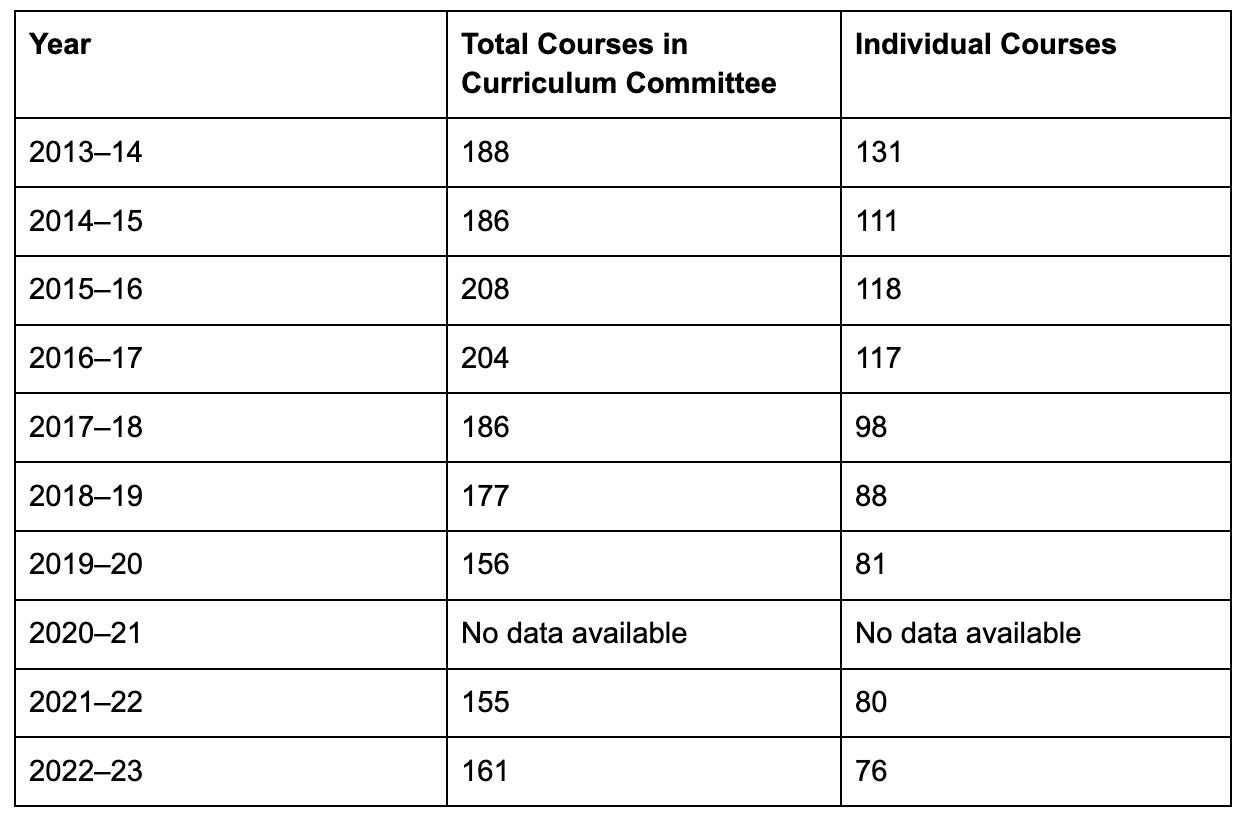
Of course, there are other factors that might affect how students view choice. After all, different sections of classes don’t func tion as supplemental choices for students be cause they can’t take both. Still harder to consider as “choices” are courses such as the “Externship Seminar,” which is merely a mandatory accompaniment to an extern ship. Courses offered for graduate students should obviously be struck. Furthermore, options such as “Supplemental Upper Year Research Paper,” or a “Directed Research Project” where students design their own work, cannot really be considered when as sessing the number of classes offered since they exist essentially as opt-outs of courses themselves.
There are essentially 76 courses to choose from. This is…not exactly 180.
It hasn’t always been this way. In 2013, when the Faculty brochure claimed only 130+ classes, there were 188 total credit op tions, or 131 unique lectures and seminars. That’s 55 more course titles (keep in mind, this is not the number of credits or sections of existing classes), for students to choose from than they can today.

Although the Faculty increases the num ber of JD students every year, the diversity of classes has been declining since 2013. The table below demonstrates this trend, using data from Curriculum Committee re ports dating from 2013 (the oldest available online). Total classes prior to 2017 routinely topped 200, until 2019, when they dipped to 156, then 155. In 2016–17, there had al ways been more than 110 potential classes for students to choose from. In the past four years, there have been only 80. This year has dropped that number further.
Course options aren’t everything. But this represents an undeniable decreasing
emphasis on offering students an array of choices in classes, or ways to define their legal careers. Without a diversity of classes, or any real meaningful choice in what they can take, students are inevitably paying for a piece of paper, rather than reaping the benefits of a world-class Faculty and course options that the administration claims jus tify our tuition. After all, if I’m paying thousands of dollars for a class, shouldn’t I at least get to be interested in it?
Hopefully, we see this trend start to re verse in the coming years. Damte assures that “it is the Students’ Law Society’s posi tion that not only should there be more courses offered next year, they should also be more diverse.”
The Faculty likes to pretend that we are here for the ability to explore legal areas and ideas. If we take away any meaningful choice in the kind of education we pursue, then that educational experience is undeni ably being cheapened, despite the growing price tag.
ultravires.ca20 | September 29, 2022 OPINIONS
Intra Vires
Totally real news from a fully in-person Faculty of Law
FIEVEL LIM (2L)Breaking news: the Queen is alive and well
Students were shocked to hear of the passing of a reigning monarch this week but fear not! The Queen of U of T Law herself, Jus tice Rosalie Silberman Abella, is alive and well, spotted strolling on campus just last Tuesday.
Rumours of a student mutiny against the imminent reopening of Goodmans LLP Café
After 3,506 weeks of waiting for Goodmans LLP Café to reopen, it appears that its opening is just on the horizon. The adminis tration has graciously provided free coffee in the meantime, sparking chatter and mur murs of a planned coup d’état to prevent re-
opening. Stay tuned for updates on the in evitable crusade for free caffeine.
The most eager incoming class of 2025
The new 1Ls were reportedly scheduling coffee chats with upper-years six weeks be fore orientation and are now chatting up ev ery 2L, 3L, and 4L that they see in the hall ways. Upper-years are reportedly unaccustomed to communicating outside of Zoom but are happy to oblige in sharing their law school complaints with uninitiated students.
Goodbye entertainment law, hello Hegel
Students wave goodbye to some of their most beloved courses this year, in what feels
like the most scant of course offerings in re cent years. Good thing no last-minute course changes were made!
Another year, another “Acceptable” schedule
Hundreds of students gather outside the Faculty for the yearly candlelight vigil for the passing of their ideal schedule, as their “Great” boxes are once again swept away in the current of an advanced Nobel Prizewinning platform. Consider yourself lucky if you were assigned more than 15 credits.
Pestilence returns after an all-toobrief reprieve
SNAILS (students not actually in law school) are once again prevalent around Jackman,
as key fob access has been relaxed. After all, nothing good can last forever. Watch out, your favourite corner of the library may be occupied by a second-year engi neering student! Exercise extreme caution, reports suggest a recent sighting of an unat tended organic chemistry textbook in the Fishbowl.
Adiós! Au revoir! Ciao! This semester marks the lowest number of students actually returning to campus in decades in what appears to be a mass exo dus for fairer weather, more exotic law schools, or perhaps simply in search of bet ter coffee. Too bad they can’t escape U of T Law tuition at their host universities!
Positive Correlation Found Between Academic Performance and Buzzfeed Quiz Completion
More quizzes equals higher grades
ALYSSA WONG (2L) AND AMY KWONG (2L)Early results of a multi-year study by the University of Toronto Faculty of Law re vealed a strong positive correlation between law students’ grades and the rate at which they complete Buzzfeed quizzes in class. Dr. Tom Denning, the world-renowned legal professional who headed the study, pub lished his initial findings online; the full pa per is expected to be published in Science later this year.
“The results are astounding,” said Dr. Denning. “Buzzfeed quiz completion rates are an even better predictor of law student success than other traditional indicators, like LSAT scores and undergraduate GPA.”
The study surveyed students who have at tended U of T Law since 2006—when Buzzfeed was founded—and compared their use of Buzzfeed quizzes to their final grades.
While students who completed quizzes out side of class in the late 2000s generally did better than peers who did not complete quizzes at all, the correlation between quiz completion and test performance grew no
ticeably stronger once students could access the quizzes in class using laptops or smart phones.
HH students in particular reported skyhigh in-class Buzzfeed quiz completion rates, with the average HH student complet ing upwards of three dozen quizzes in a two-hour lecture.
As part of the survey, students shared their strategies for finding and completing Buzzfeed quizzes efficiently. A popular strategy is for students to share links to quizzes in group chats. Once members of the group chat complete each quiz, they send screenshots of their results and receive emoji “reacts” from their peers.
Dr. Denning provided one possible expla nation for the phenomenon: “It may be that Buzzfeed quizzes simulate a testing environ ment. Students must answer as quickly as possible using what they already know about a variety of subjects, such as their likes and dislikes, how they would plan their dream wedding, and what they would put in their
ideal taco.”
Harriet H. Han, who graduated from U of T Law in 2019 with straight HHs, cred ited Buzzfeed quizzes for keeping her awake in class and for helping her discover her passion for family law. “While taking a quiz to determine which Jonas Brother is my soulmate, I realized that even though they're all in stable relationships, I wouldn’t hesitate to start divorce proceedings for him.” Han declined to disclose which Jonas Brother is her soulmate. Han has since clerked at the Supreme Court of Canada and is now on partner-track at a family law boutique.
Dr. Denning provided some tips for in creasing your in-class quiz consumption:
1. Start small. The vast world of Buzzfeed quizzes can be intimidating. Start with one or two quizzes per class and work up from there to avoid burnout.
2. Build a support system. Hold your self accountable by sending your quiz re sults to friends and family. Even better, send it to your study group so you can all increase your grades together.
3. Plan for failure . Getting off-track when building habits is inevitable, so it’s crucial to plan ahead. If you haven’t done the readings for class, will you feel the need to pay attention to the professor in stead of doing quizzes? Will you get kicked out of your group chat for sending 40 screenshots in a row? Consider what factors are likely to interfere with your quiz goals and plan ahead to mitigate them.
“It may be difficult for those who are not accustomed to the Buzzfeed Method,” Dr. Denning added, “but I believe anyone can easily incorporate these quizzes into their classroom habits and become a stellar stu dent.”
ultravires.ca September 29, 2022 | 21DIVERSIONS
Law School to Replace Cognomos Algorithm With DALL-E Neural Network in 2023
Surprise upcoming changes for course selection
AMY KWONG (2L)Last week, the administration announced that Cognomos will be retired for student course matching in the 2023–24 school year. Instead, all course matching will be conducted through a new system incorporating OpenAI’s artificial intelligence (AI) image generator DALL-E.
DALL-E made a stir in early 2022, when OpenAI announced that they trained a neural network to generate images from plaintext de scriptions and provided public access to the AI system.
“We value student feedback, and we’re al ways looking to improve our famously arduous and unpredictable course matching process,” said the administration in their formal an nouncement. “We’re very proud of this deci sion as it aligns with our current reasoning of using award-winning algorithms that have lit tle to no relevant application in the context of course selection.”
In an interview with Ultra Vires (UV), a member of the administration lamented that “the only downside is that DALL-E is open
source, which means the Faculty will no longer be able to pay undisclosed sums for a non-func tional third-party system.”
A test run by UV editors confirmed that in putting the text “600 happy U of T law stu dents with enough credits to graduate” still generates a set of timetables with less course conflicts and better credit distributions than this year’s Cognomos results. Editors were also pleased to note that the timetables could be generated in various colours and art styles.
“I guess it can’t get any worse,” commented Sarah Study, a 3L student who had been allo cated 30 credits in fall and three credits in win ter—and is still missing the mandatory Legal Ethics course despite ranking it first on her “Great” list.
When asked if there would be any solutions for those currently suffering from Cognomos issues in the meantime, the administration was quick to reply, “We hope you’re happy with your allocated schedules, and good luck. And if not, there’s always movement on the waitlists!”
Fraudsters’ Law Society Demands More Robust Icebreakers
Current icebreakers not enough for true friendship
LUKA KNEZEVIC (2L)The President of the Fraudsters’ Law Society (FLS; pronounced fuːlz) offered words of criticism this past week in rela tion to 1L professors’ seemingly common approach to icebreakers. “I can’t help but feel that the current approach to ice breakers is a huge waste of time. While asking each person what they studied in undergrad and a fun fact about them can be ‘interesting,’ I find it barely conducive to forging strong bonds with classmates with whom we’ll spend the next three years.”
When asked what would be preferable, the President, who wished to remain anonymous despite their high-profile ti tle, offered these comments: “Since some of us will spend our entire careers work ing together, I think it’s important for the icebreakers to be as thorough as humanly possible. I just personally feel [that] I
can’t really get to know my classmates unless I know the streets they grew up on, their mothers’ maiden names, their child hood pets and their childhood best friends’ names, where they went to ele mentary school, the last four digits of their social insurance numbers, who they bank with, the three digits on the back of each of their credit cards, blood types, pre-existing health conditions, places of birth, dates of birth…just the basic stuff, you know? It’s so we can really get com fortable with each other.”
Only time will tell if professors will adopt such a painstaking, time-consum ing, and intrusive approach.

On an entirely unrelated note, mem bers of the FLS have recently complained about fraudulent activity on their bank accounts leaving them unable to pay tu ition.
Some Things Never Change
JENNIFER SUN (3L)ultravires.ca22 | September 29, 2022
DIVERSIONS


ultravires.ca September 29, 2022 | 23DIVERSIONS Quiz: How Much of a Keener Are You? Take this quiz and find out! ALYSSA WONG (2L) AND AMY KWONG (2L) Merit is everything. If you’re talented and do great work, we have a place for you. dwpv.com/students @daviesstudents Ultra Vires Presents: Sun Goes Down Put your sunglasses away and get those pens out—it’s back to school! With the spectre of exams asleep for a few more months, now is the time to soak up the last bit of sun before you properly hit the books. Whether you want to get down to disco or continue the chill vibes of a warm sum mer night, these tracks will keep the summer mood going until the sun goes down. Featuring tracks by Kendrick Lamar, Jessie Ware, Tame Impala, Beyoncé, KAYTRANADA, and more! EMILY CHU (1L)
The Ultra Vires Crossword

“How Do You Like Them?”
RONAN MALLOVY (2L/MA ENGLISH)How should I describe my experience in the Philip C. Jessup International Moot Court Competition? I think Justice Mahmud Jamal’s speech at the Canadian National Rounds’ opening ceremony describes it per fectly. He said that people would certainly regret signing up for the Jessup while they struggled to complete their memorials (equivalent to a factum for other moots). I fully agree with that, as I remember those late nights where I was looking into numer ous sources and rephrasing my messy argu ments, thinking about why I decided to do the Jessup. But Justice Jamal also talked about how joyful and rewarding his experi ence was at the competition. I agree; my mooting experience was indeed the biggest
highlight of my time in law school.
The Jessup simulates a dispute between two fictional countries before the Interna tional Court of Justice. This year, the prob lem concerned an independence referendum taking place in the Sutha province of Antara. A pro-independence group, allegedly sup ported by Ravaria, operated a botnet that facilitated the spread of misinformation. Be ing able to explore the application of interna tional law in cyberspace was very exciting, as there were many novel questions that did not have concrete answers. I was responsible for the issues concerning Antara’s order to ban a prominent pro-independence professor from a popular social media platform, as well as Antara’s intrusion into Ravarian computer
Amos
operated by Carnival or Royal Caribbean
Shortly, poetically
Org. stereotypically run by NIMBY
Jumpsuit
U OF T LAW’S JESSUP TEAM. PICTURED (LEFT-RIGHT) MISHAIL ADEEL (2L), SEEMA SIDHU (3L), AND JONATHAN HOU (3L). CREDIT: MAUREEN WHELTONultravires.ca24 | September 29, 2022 DIVERSIONS
Across 1 Singer
5 Mole 8 Vessel
14
15
16
with short pant legs 17 Girl who might be found with a T-Bird 19 Nudges 20 Lively folk dance 21 More unusual 23 Aspect 26 Chart type 27 Enthusiasm and pep 31 Mineral homophonous with a desire for food 33 Brief summary (of a film or television show, say) 36 Wager 37 Greek meat cooked on a vertical spit 39 Keep tabs on 40 Doctor deterrent, or a hint to 5-, 17-, 49- and 64-Across 43 Post ______ 45 Therefore 46 Golf teacher 49 Member of the 300 51 Chorus 53 "Sorry, I'm busy" 54 Ice Bucket Challenge cause 56 Tool used by a 46-Across 57 World's deadliest mammal, for short 60 Consume 61 Having a pony in one's throat? 64 Food of the gods 69 Shoe part 70 Crowd violently 71 Nevada gambling mecca 72 Fried jalapeño snack 73 Word of assent 74 Container for gas or fish Down 1 Spigot 2 Demon of Japanese folklore 3 Florida governor DeSantis 4 Printer variety 5 Carpet variety 6 Two peas are cozy in one 7 Artist Kusama 8 Reputation on the street 9 Position 10 2007 Rihanna hit 11 Stock mkt. debut 12 Darn 13 Where bad accidents may take victims 18 Plaintiff, for one 22 Partner of Ctrl and Alt 23 ____ Four (Beatles nickname) 24 Mimic 25 Language of northern Spain 26 Criminal, in police-speak 28 Perch for a frog 29 Year, in Madrid 30 Fresh 32 Headstrong and intense 34 Able to drink legally, say 35 Ares, to a 49-Across 38 Chant at a fútbol match 41 Literary critic Frye 42 Fumbles 43 Advanced Biology degree, for example 44 MLA alternative 47 Surreptitiously fix 48 The loneliest number, in song 50 Word following kid or cat 52 Cutting reply 55 Like fertile soil 58 ___ of Dogs (2018 film) 59 Colleague 60 Wanes 61 Cool 62 Performance artist Yoko 63 Snake by the Nile 65 Simpsons barkeep 66 Location where a shanty might be sung 67 Quaint lodging 68 Totally fine