
Grand Moot 2024 Recap
Mooters expertly tackled federal invocation of the notwithstanding clause in the criminal context
GLENN HOWARD (2L) AND GRACE XU (2L)

DESAI (3L), RIYA THOMAS (3L), DEAN JUTTA BRUNNÉE, THE HON. JUSTICE SUZANNE CÔTÉ, EMILY CHU (3L), THE HON. CHIEF JUSTICE
MICHAEL TULLOCH, BRYNNE DALMAO (3L), THE HON. JUSTICE IRA PARGHI, JOSHUA SCHWARTZ (3L), AND NAVYA SHETH (2L). COURTESY OF THE FACULTY OF LAW
On Tuesday, October 1 before a packed house in the Rosie Silberman Abella Moot Court Room, four Faculty of Law students addressed issues related to the federal government's invocation of the notwithstanding clause in a criminal statute before a panel of esteemed jurists.
This year's Grand Mooters were Joshua Schwartz (3L) and Navya Sheth (2L) for the appellant, and Emily Chu (3L) and Brynne Dalmao (3L) for the respondent. The members of the panel to hear the appeal were the Honourable Justice Suzanne Côté of the Supreme Court of Canada, the Honourable Chief Justice Michael Tulloch of the Court of Appeal for Ontario, and the Honourable Justice Ira Parghi of the Ontario Superior Court of Justice.
For just under two hours, the audience was brought into the fictional country of Flavelle, where, in response to "rampant" gun violence, the Parliament of Flavelle enacted the Firearms Safety and Accountability Act. The Act made it an offence to knowingly possess an unauthorized firearm in a vehicle. The penalty for violating the Act was a 30-day driver's licence suspension and a prohibition from driving in any other province where the offender does not hold a license for a minimum of three to four years. Crucially, for the first time in Flavellian history, a criminal statute was invoked "notwithstanding ss. 7 and 12 of the Flavellian
Charter of Rights and Freedoms; the rights pertaining to life and the security of the person, the right not to be subject to cruel and unusual punishment, and all other rights therein."
Caught by the Act was the appellant, David Thomas, an owner-operator of a small trucking business. Thomas had mistakenly, but knowingly, drove away from his friend's house with her hunting rifle in his pickup truck. Thomas was subsequently arrested and prohibited from driving in another province, which prevented him from driving in the neighbouring province of Bloor. Access to Bloor was important to his business and personal life.
Thomas challenged the constitutionality of the Act on the grounds that (1) Flavelle's Parliament did not properly invoke the notwithstanding clause; (2) even if the clause was properly invoked, it violated his section 7 right to liberty and was not justified under section 1; (3) even if the clause was properly invoked, it violated his section 6 right to mobility and was not justified under section 1 of the Charter. The Superior Court found in his favour before the Court of Appeal reversed the decision. The case, based on a problem skilfully written by Moot Court Chief Justices Riya Thomas (3L) and Vidit Desai (3L), then came before the Supreme Court of Flavelle.
Joshua Schwartz began the appellant's submissions
by arguing that "the Federal Government omitted the right to liberty in its invocation of the notwithstanding clause—this court, respectfully, cannot put it back in." He received an immediate question from Justice Côté about what meaning should be given to the phrase "and all other rights therein." "That's the question I'm dreading," Schwartz said. He submitted that the phrase "refers to the principles of fundamental justice that serve to protect the life and security of a person. Parliament enumerated in the invocation, thereby leaving liberty excluded, even from that residual clause." Schwartz went on to argue that the notwithstanding clause must be construed strictly in the criminal context. Justice Tulloch asked whether there was any precedent to support his strict construction of the notwithstanding clause. Schwartz responded, "I must admit, it's a novel argument, but one I worked very hard to come up with..." which drew laughter from the crowd. Schwartz finished his submissions by arguing that the prohibition on driving engaged Thomas' liberty interest, and that the law did not accord with the principles of fundamental justice because it was overbroad.
Next, Navya Sheth argued that the interprovincial driving ban unjustifiably infringed Thomas' section 6(1) right to remain in Flavelle and his section 6(2)(b) right to pursue the gaining of a livelihood in any province. Neither of these infringements, Sheth argued, were justified under section 1. Sheth began by submitting that the right to "remain in" Flavelle under section 6 encompasses the right to move between provinces. She argued the court should protect the functional exercise of that right, for which Thomas requires the right to drive. Justice Côté asked whether there was an option other than driving available to Thomas to move between provinces. Sheth responded that it was not reasonable for Thomas to take a train or airplane, as he only lived 25 minutes from the border. "What about an Uber?" Justice Côté asked. Sheth suggested that given the long wait times for Uber, this too was an impractical alternative. After submitting that the Act breached Thomas' right to pursue a livelihood in another province, Sheth concluded that the Act was not justified under the Oakes test, before requesting the appeal to be allowed and the law to be found unconstitutional.
Brynne Dalmao led the respondents by submitting that (1) the notwithstanding clause was properly invoked and (2) Thomas’ liberty rights were not engaged or violated under the impugned provisions. Dalmao began by stating that the enumeration of section 7 in the Act was sufficient and that “nothing more was required.” Justice Côté quickly jumped in, noting that Parliament had indeed done more with the enumeration. Dalmao promptly explained that although Parliament provided more particulars than it was obliged to, it had nonetheless met the essential requirements. She argued that greater deference should be given to Parliament, as the use of the notwithstanding clause aligned with Parliament’s objective to enforce stricter
gun laws within the ambit of recognized democratic values, thereby limiting the court's role. Dalmao went on to elaborate that although the appellant’s concerns were limited to fundamental matters that are central to a person's dignity, they did not and should not extend to privileges like driving and possessing a driver’s license. Justice Côté introduced a hypothetical that challenged the respondent’s interpretation of liberty, suggesting that an individual in a rural region would be stripped of liberty if driving was their primary or only means of transportation. Dalmao’s response provided some appreciable alternatives and acknowledged her friend’s Uber suggestion.
Emily Chu concluded for the respondent, submitting that the Act did not limit Thomas’ section 6 mobility rights even under an expansive reading of the legislation. In the alternative, she argued that the infringement was justified under section 1 of the Charter. Chu purported that the Act was designed to protect the “pure mobility right of citizens to enter, leave, and remain in the federal state and country.” To that, Justice Parghi asked whether Chu was suggesting that there was no right to move about the country freely. Justice Parghi jokingly asked, “I can't get on a plane tonight to Saskatoon?” Despite joining in on the banter, Chu stood firm on her position that section 6 more broadly protects interprovincial mobility rather than pure mobility. Chu proceeded to turn to the authorities that the appellant relied on and expertly distinguished the facts of each case from the issue at hand to illustrate that even if the right to pure mobility was recognized, Thomas’ rights were not violated on the basis of residency. Chu’s submission was later praised by Justice Côté herself. According to Chu, the effects of the prohibitions could only be seen as an inconvenience to Thomas’s role as an operator of a trucking business and not a liberty-restricting prohibition. Chu then closed her submissions with a brief but cogent overview of the respondent’s section 1 Oakes analysis.
After the submissions finished, the audience erupted into applause. The panel then complimented the Grand Mooters. "You were extremely well-prepared," Justice Côté said, "better than some of the lawyers that appear before the Supreme Court of Canada." Côté added that she was positively "flabbergasted" with the outstanding submissions of the Mooters, including their "very well-written" factums. She ended by encouraging all of the Mooters to apply for clerkships at the Supreme Court. Justice Tulloch and Justice Parghi praised the Mooters for showing an incredible level of sophistication for students. Both Justices encouraged the Mooters to their respective courts.
The final decision was swift and clear: the Grand Moot was a success on all counts. The event would not have been possible without the Grand Moot Bench Clerks: Mathew Farrell (2L), Akash Jain (2L JD/ MPP), Katrina Sellinger (2L), Audrey Wu (2L), and Georgia Gardner (2L). As in previous years, the event benefited greatly from the sponsorship of the law firm McCarthy Tétrault.
VIDIT
84 Queen’s Park Crescent Toronto, ON M5S 2C5
Ultra Vires is the independent student newspaper of the University of Toronto Faculty of Law. We provide a forum for diverse viewpoints on topics of interest to our readers. We aim to foster dialogue on academic and social issues between students, the faculty, and the broader legal community in Toronto, Ontario, and Canada. Our content does not necessarily reflect the views of the Editorial Board. We print six issues per year. Ultra Vires is printed by Master Web Inc.
EDITORS-IN-CHIEF
Manreet Brar and Abby Sasitharan
BUSINESS MANAGER
Leon Xu
NEWS EDITORS
Rachel Chen and Malka Younas
ASSOCIATE NEWS EDITOR S Yuha Khan and Alex King
FEATURES EDITORS
Julia Allen and Asra Areej
ASSOCIATE FEATURES EDITORS
Tyler Lee and Madura Muraleetharan
OPINIONS EDITORS
Puneet Kanda and Mariam Patsakos
ASSOCIATE OPINIONS EDITORS
Kaitlyn Matthews and Yebin Shin
DIVERSIONS EDITOR
Sakina Hasnain
ASSOCIATE DIVERSIONS EDITOR
Kiwan (Paul) Kim
PUZZLE EDITORS
Matthew Farrell and Navya Sheth
RECRUIT EDITOR
Rosemary Fang
EDITOR-AT-LARGE
Cherry Zhang
ONLINE EDITOR
Siegfried Kahama
STAFF WRITERS
Katherine Fan, Georgia Gardner, Shelby Hohmann, Glenn Howard, Olivia Schenk, and Grace Xu
RECRUIT REPORTERS
Jane Byun, Alice Min, and Celine Tsang
STAFF PHOTOGRAPHER
Kabir Singh Dhillon
SOCIAL MEDIA COORDINATOR
Parker Hopkins
LAYOUT EDITOR
Fox Hill Creative
ADVERTISING
If you are interested in advertising, please email us at business@ultravires.ca
ERRORS
If you notice any errors, please email us at editor@ultravires.ca.
SUBMISSIONS
If you would like to submit a tip, letter, or an article, please email us at editor@ultravires.ca.
Ultra Vires reserves the right to edit submissions.
UV INDEX
Happy Halloween! It’s the spookiest time of year: recruit season for our dear 2Ls, stressabout-outlines season for our eager 1Ls, and of course, semi-alarming drinking season for all of you 3LOL-ers.
Curious about what comes next?
This issue features an inside look at what some of our 3Ls have been up to during their semester away from home, an overview of some unique summer work experiences, and a mooting review from a grand mooter herself. This issue also includes interviews with a few law school celebrities and coverage of the Toronto articling and New York 2L recruits.
2Ls, we’ve got your back. Step back from your interviewer stalk ing—uhm, research—and check out Toronto recruit advice from our wonderful CDO and reflections on the process from your fellow class mates.
Although some of you have mas tered your zombie looks (those eye bags look so authentic), we have some (very) last-minute costume ideas that we are hoping to spot on Instagram tomorrow.
And to wrap it up, try out our very new Connections game–creat ed by our puzzles editors, Navya and Matthew!
If you have any comments, are looking for ways to get involved with UV, or just want to say hi, you can always reach us at editor@ul travires.ca or @ultravires.ca on In stagram.
P.S. wish Manreet a happy birth day!
McMillan has fostered a culture that has allowed me to forge a career path that aligns with my goals and interests and makes the best use of my experiences and
about their work.
Paul Davis


Students’ Law Society Update
October edition
ISABEL BRISSON (3L)
We can’t believe that the second month of the semester is already over. Congratulations to all students, and especially to 2Ls participating in the recruit—we know how stressful this time of year can be, and we wish you luck going forward. The Student’s Law Society (SLS) would like to provide the following updates:
Club Funding
The Social and Finance Committee would like to remind student club members applying for club funding to submit their requests two weeks in advance of your event. Each semester, the SLS puts aside a set amount of money to fund student clubs and we want to ensure that we are making the best
use of these funds. Please note that all non-equity group events must be accessible to all students. Additionally, we would like to gently remind equity clubs that they should exhaust the funding available to them through the Student Programs Manager, Sako Khederlarian.
Halloween
Throughout the week of October 28th to the 31st, SLS has put on various Halloween events.
The SLS hosted our annual Halloween party on Friday, October 25! We heard your suggestions, and, for the first time in two years, the party was held off-campus at El Mocambo! It was a great kick off to ‘Halloween weekend’ and we
hope you had as much fun as we did. As usual, we loved seeing all of the great costumes and want to congratulate our costume contest winners!
We also got to see your creativity and carving skills at work at our pumpkin carving contest, judged by Dean Brunée. And we hosted a Halloween movie at lunch!
Advocacy
We are pleased to announce that the SLS has officially renewed our subscription to Headspace. The first 100 students to sign up will get a free year-long membership. This initiative would not have been possible without the Student Mental Health and Wellness Program Manager, Chan-
telle Brown-Kent.
Upcoming SLAC Initiatives
SLAC has been working hard to come up with ideas on how best to serve and advocate for students. The Dean’s Committees have been formed, and some have already begun to meet. We are hopeful that we will be able to share students’ perspectives and effect change within those. Further, students can expect to see old and new initiatives from SLAC, including Board Game Buddies and a pilot for Coffee Buddies. As always, the SLS wants to hear your ideas. Do not hesitate to reach out to your student representatives, a member of the executive team, or join us at the weekly meetings!
2024 Students’ Law Society Fall Election Results Are In 1L voter turnout was a record-high
STUDENTS’ LAW SOCIETY
Every September, the Students’ Law Society (SLS) runs a Fall General Election, which is managed and administered by the Chief Returning Officer who is responsible for all SLS elections and awards processes. The fall election gives 1Ls and new students the opportunity to get involved in student governance and represent their class. It also serves to fill upper-year positions left vacant from the Spring General Election.
This year there were 15 positions available: four 1L Social and Finance Year (SFC) Representatives; four 1L Student Life and Academic Year (SLAC) Representatives; two 2L SFC Representatives; one 3L SLAC Representative; and four 3L SFC Representatives.
All the upper-year positions, save for one 3L SFC Representative position, were acclaimed. 15 1Ls ran (more
than usual) in a hotly contested election.
SLS President Isabel Brisson (3L), expressing her thoughts on the election, stated, “We were elated to have so many 1L candidates running in this year’s Fall elections. It truly shows how dedicated our student body is to advocacy. We look forward to working with the newly elected representatives and encourage even more students to run in the Spring elections.”
The election results were released by email on Thursday, September 26. Voter turnout was 81.6 percent, with 204 of 250 eligible electors having participated. The record-high turnout may be indicative of the first year’s willingness to actively participate in student government.
The Fall General Election 2024 Results are as follows:
Social and Finance Committee
The Social and Finance Committee primarily coordinates SLS fees and finances; plans social events for students, including Call to the Bar events, pumpkin carving, and the annual Law Ball; and organizes club funding and club fair events.
1L: Danya Assaf, Bryan Ding, Paul Kiwan Kim, and Sam Zhang
2L: Jamie Oneschuk and Emily Segal
3L: Brynne Dalmao, Sammy Markowski, and Emma Tang
Their platforms largely focused on fostering friendships and a sense of community through memorable and inclusive social events.
Student Life and Academic Year Committee
The Student Life and Academic Year Committee speaks on behalf of students to the Faculty, with elected members sitting on Faculty Council, Dean’s Committees, and assisting with policy development.
1L: Jayden Daniels, Srivani Edupuganti, Ethan Sabourin, and Omar Saleh
3L: Manreet Brar
The incoming SLAC representatives are eager to advocate on behalf of their class with regards to Friday sessions, the curriculum, and mental health support. Congratulations to the candidates elected and all those who ran! The next SLS election will take place in Spring 2025.
Disability Groups Launch Charter Challenge of MAiD Law
A coalition of several prominent disability rights organizations launched a Charter challenge against the federal MAiD law’s application to people whose natural death is not reasonably foreseeable
OLIVIA SCHENK (3L)
On September 26, 2024, Inclusion Canada announced in a press release that a coalition of disability rights organizations, and two personally affected individuals, had filed a constitutional challenge alleging that Track 2 of Canada’s Medical Assistance in Dying (MAiD) law violated the Canadian Charter of Rights and Freedoms. The Charter challenge was initiated in Ontario’s Superior Court of Justice.
The disability rights groups forming the coalition include the following national disability organizations: Inclusion Canada, the Council of Canadians with Disabilities (CCD), Indigenous Disability Canada (IDC/BCANDS), and the DisAbled Women’s Network of Canada (DAWN Canada).
Inclusion Canada is a national federation working to advance the full inclusion and human rights of people with an intellectual disability by strengthening families, defending rights, and taking actions with the intent to transform communities into places where every-
one belongs.
The CCD is a national human rights organization of people with disabilities working to improve inclusion and accessibility in Canada. The CCD works to advance disability rights through its involvement in equality rights cases at all levels of court.
IDC/BCANDS is an internationally recognized and award-winning national Indigenous not-for-profit society serving the unique and diverse disability needs of Indigenous peoples across Canada.
DAWN Canada is an organization working towards the advancement and inclusion of women and girls with disabilities and Deaf women in Canada. Formed in 1985, it remains the only national feminist disability organization in the country, and one of only a handful in the world.
MAiD refers to the legal process that allows someone who is found eligible to access assistance from a medical professional in ending
their life. To be eligible for MAiD, a recipient is legally required to be at least 18 years old, be mentally competent, have a grievous and irremediable medical condition, and give informed consent.
MAiD’s origins began in February 2015 when the Supreme Court of Canada ruled in Carter v Canada that parts of the Criminal Code prohibiting medical assistance in dying were inconsistent with the Charter. In response, the Parliament of Canada passed the first MAiD legislation in June 2016. The law has continued to evolve rapidly since then. Track 2 of MAiD refers to the procedural safeguards applicable to a request for MAiD made by a person whose natural death is not reasonably foreseeable.
The Inclusion Canada press release outlined the coalition’s reasoning for the Charter challenge: “The coalition is urging the court to strike down Track 2 of Canada’s MAiD law, arguing that providing assisted death solely on the basis of disability is unconstitutional. They con -
tend that MAiD should only be available to people whose natural death is reasonably foreseeable.”
The press release also contained several quotes from the coalition’s leaders, including the following from the Executive Vice-President of Inclusion Canada:
“People are dying. We are witnessing an alarming trend where people with disabilities are seeking assisted suicide due to social deprivation, poverty, and lack of essential supports. This law also sends a devastating message that life with a disability is a fate worse than death, undermining decades of work toward equity and inclusion. It’s time to put an end to helping people with disabilities commit suicide and start supporting them to live.”
The coalition’s legal team is led by Joanna Birenbaum of Birenbaum Law and David Rankin of Osler, Hoskin & Harcourt LLP.
Letter From the CDO
A note of reassurance to 2Ls
CAREER DEVELOPMENT OFFICE

Dear 2Ls,
We were honoured to be asked once again by Ultra Vires to write a message in support of those who are participating in the Toronto 2L recruit as we approach interview week. This is always a special time for us because at this stage, we feel that we have truly gotten to know so many of you, and it has been a privilege to witness you develop from thoughtful and introspective 1Ls to the budding legal professionals we have the pleasure to advise today. We have so enjoyed getting to know each of you on a personal level. Hearing your stories of resilience, your paths to law school (no two the same), and your aspirations for the future make us excited and proud to welcome this next generation of incredible lawyers: you! As we connect with employers during this recruit season, we have been very proud of you on many occasions. Employers have spoken to us of the high quality of your written materials and how your intelligence, polish, and preparedness shine through in everything you do. We, too, have been impressed by this. However, what has been so special to us extends beyond the polish and poise – what has been truly wonderful for us to see are the kind, unique, and impressive human beings before us in our meetings and sessions, to see how thoughtful and considerate you are around the law school and in interactions with each other. We have so enjoyed witnessing the ways in which you show up for each other (our Community of Kindness event this year displayed that in full force). We have been moved by the sto -
ries you’ve told us in your mock interviews. We have laughed at both the stories you’ve prepared to tell employers and the more ‘off the cuff’ moments of humour and humanity we experience with you on a daily basis. We have been fascinated by you as you tell us more about your interests and hobbies— how you enjoy life outside of the law and law school. All of this makes us so very excited for you to enter the interview period and show employers not only how prepared you are for this (and you are), but also how unique each of you are. We are confident that they will be impressed with you, just as we have been.
Remember to stay true to yourself and be thoughtful about choosing an employer that aligns with your personality, passions, goals, and values. If you need support, don’t hesitate to reach out to the CDO, friends, or colleagues. We are here for you and have seen the impact of your support for each other. We know you will continue to show up for one another beyond law school and into your legal careers, and what a difference this will make to the quality of your lives and your career.
For those not participating in this recruit, rest assured that there are many more 2L summer opportunities ahead. The 2L Toronto recruit is just one of many. We will keep you informed about upcoming positions and recruits that may interest you and are here to support you through our programming and one-on-one appointments. Feel free to connect with us if you have any questions.
Self-Care During Recruit Season
Balancing your mental and physical
KATHERINE FAN (2L)
By now, call day has passed and in-firms are quickly approaching! You may be trying to get some mock interviews in, researching about the different firms, or looking at previous recruitment statistics on Ultra Vires; all while balancing law school itself!
But taking care of your mental and physical wellbeing is also important in ensuring that you show up during in-firms looking and feeling like your best self! Check out some opportunities available around Toronto and the University to recharge your mental and physical well-being!
Wellness Support Services Available at UofT:
Same-Day Counselling: For busy law students who may have hectic routines, UofT offers same-day counselling to students so that we can access support when we need it. The approach to these services is flexible and collaborative, so your approach with sessions can be tailored to your own priorities and preferences. These appointments can be booked in advance.
Book an appointment by calling Health & Wellness at 416-978-8030 (select option 5).
Mindfulness Program at the Faculty of Law: The Mindfulness Program at the Faculty of Law guides us on mindfulness practices that can be used both in your personal or professional life. Moreover, we can build our own mental fitness plan based on your personal needs and interests. Learning goals from these sessions include learning how to manage stress and burnout, and how to communicate skillfully in highpressure settings. The next session is on November 22.
Yoga/Meditation Classes
Drop-In Mindful Moments Yoga Sessions: Feeling a bit disconnected with your body and mind lately? The Mindful Moments offers yoga sessions at the Goldring Centre for High Performance Sport (100 Devonshire Place, Toronto) - Fitness Studio or at the Athletic Centre (55 Harbord St., Toronto)Dance Studio. These classes help support your mental wellbeing through achieving relaxation and fo-
well-being
cus, while improving your physical health as well!
To see the weekly drop-in schedule, please visit the Sports and Recreations Drop-In Page at https://kpe. utoronto.ca/sport-recreationrecreational-workoutsactivitiesgroup-fitness-workouts/mindful-momentsyoga.
“Breathe Well” Event (November 5 from 2:30 to 4:00pm)
Losing breath over keeping up with school? Relax and recharge by joining the upcoming “Breathe Well” event. This event will take place on November 5 from 2:30 to 4:00pm online (via zoom) facilitated by Brittan Coghlin, R.N and Aimee (Jiaqi) Feng, R.N. During the session, we will explore the benefits of restorative breath and learn about new techniques to help with tense muscles. But register soon! There are only a maximum of 40 spots!
To book, visit the UofT Folio webpage at https:// folio.utoronto.ca/students/events/detail/4127265.
Treat Yourself with a Drop-In Massage! Upcoming massage break drop-ins are available
on November 20 and 27, and December 4! Beginning at 12:45pm, you can sign up for a 10-minute massage.
For more info, please visit https://studentlife.utoronto.ca/program/wellness-wednesdays/
Take a Scenic Hike/Walk Around Toronto:
High Park: Take advantage of the scenic views of High Park with the autumn leaves. This park offers a mix of recreational and natural parks, filled with numerous trails in a relaxed atmosphere to escape the busy city life. This is a great option for those who aren’t looking for a challenging hike while wanting to connect with some wildlife (e.g. squirrels, chipmunks, birds)! Dogs are also welcome, with a designated offleash area!
Bluffer's Park: Don’t miss out on the beautiful views of bluffs and shorelines formed by the Wisconsinan Glacial Advance. While further away from the city, this park is a great mini-getaway for those who want a short escape from the busy recruit season.

New York Summer 2025 Recruit Results
At least 32 U of T Law students secured work in New York, Boston, and the Bay Area
Time and time again, a sizable group of U of T Law students find employment across the border, and this year is no different. 40 students responded to Ultra Vires ' informal recruit survey this year, with 32 respondents securing a 2025 summer associate position in the United States. Most students reported that they will be working in New York; however, one student will be splitting their summer between New York and Boston, one will be working in Boston, and one in the Bay Area.
Of the 32 successful candidates, 28 were 2L JD students and four were 3L JD/
MBAs.
Ultra Vires continues to collect information on whether successful candidates secured their offers through U of T’s official OCI or via ‘pre-OCI’ recruiting (where, as the name implies, students apply directly to law firms before the OCI period). Over the past few years, the New York recruiting timeline appears to have moved up — largely shifting to pre-OCI recruitment over formal OCIs. This year continues the trend, and Ultra Vires ’ survey results highlight New York employers’ continued focus on pre-OCI recruitment. The vast majority of successful candidates
obtained their offers aoutside of OCIs, with 26 students (81.25%) securing their offer through pre-OCI recruitment means. By comparison, five students (15.63%) reported securing their offer through U of T’s official OCIs. One student did not specify how they secured their employment.
When asked about their recruitment experiences and tips for students interested in the New York recruit, many survey respondents stressed the importance of participating in the pre-OCI process. Respondents also generally recommended applying early and broadly and network -
ing with upper-year students to learn the recruit's on-the-ground realities.
A few students also advised those interested in working in New York to apply for 1L summer positions with New York firms wherever possible. These students noted that, while the chances of landing a 1L summer associate position are slim, submitting an application could lead to expedited interviews down the line for 2L.
*One New York office, one Bay Area. **Boston office.
***Split summer between Boston and New York offices.
Toronto 2025-2026 Articling Recruit Results
Rethinking the 2L Recruit
We should all be taking a more critical approach to the 2L recruit and ask ourselves if we are getting what we really want from it
JONATHAN KU (2L)
I chose to approach the 2L recruit with a healthy dose of skepticism. I know my political values and I know that most legal careers don’t offer me the kind of work that I care about. Most won’t involve advocating for the little guy, because our legal system remains deeply inaccessible and inequitable. Racialized and low-income people are not only unable to afford representation: they are often targeted by the state and clients with the means to assemble armies of lawyers on their side. If we believe that a fair process is necessary to produce a fair result, then the problem is easy to spot (and you don’t have to be Chief Justice Wagner to realize this). As long as inequality persists in our society, injustice does too, because our legal system distorts itself to serve the interests of the wealthy to the exclusion of everyone else. The game gets stacked against the average person.
So what about people like me? What about people who came to law school with the goal of helping vulnerable people through challenging times? If that sounds like you, opting out of the 2L recruit is the only choice that makes sense. It’s easy to sympathize with the perspective of someone who says, ‘look, the 2L recruit is an easy path to a comfortable life. If I can secure a Bay Street job, I’m set.’ It’s easy to understand that thought process when tuition only seems to go up, when the cost of living in Toronto is doing the same, when the culture at the school seems to revolve around preparing us for Big
Law, and when, ultimately, the salaries of a corporate law career are a powerful incentive on its own. Those are certainly problems that we should care to address—collectively, as members of a broader public.
But none of those reasons touch on the motivation I described earlier, common to many of us who chose the path of law school. The feeling of wanting to fight for the little guy is also easy to sympathize with because I believe the feeling tells us what we know to be obvious: that a legal career can never simply be a means to an end. To practice law is to make a political statement, to profess your ethical values, and to pledge your allegiance to a cause.
Ultimately, and unfortunately, the 2L recruit is not designed for those whose cause is social justice. The clientele and case catalogs of the most prestigious corporate offices speak for themselves; and you won't hear them amplifying the voices of society's marginalized. At best, these firms might carve out time for pro bono work amid their bread-and-butter of mergers and acquisitions for multinational conglomerates. At worst, the summer position you secured in the recruit might involve actively using the skills you learned to bend the law against the everyday people who live in your community. The tenant who fears eviction with nowhere else to go, the service worker abused and exploited by their boss, or the newcomer family trying to build a life in this
country but about to be torn apart by deportation: who fights for them, and the millions of other decent, regular people, if those in our position don’t choose to?
To say that 2L recruit opportunities with legal aid, public interest, and non-profit organizations are scarce is an understatement; many simply aren’t posted during the main recruit period at all. That doesn’t mean these positions don’t exist. Plenty of options open up as the year progresses, and even more are available once articling rolls around. But it does create the illusion that corporate careers are the only option, so inevitably, over the summer before 2L starts, people will devote significant time and energy into making themselves the perfect candidate for those careers. And they will do so despite a nagging feeling that the jobs they are moving heaven and earth to secure—the countless hours editing cover letters, sending applications, preparing for OCIs, and doing mock interviews, then doing real interviews, attending dinners, using first-choice language, performing perfection as a candidate, and on and on—won’t ever let them fight for the people in their communities.
While the 2L recruit process is a powerful force, designed to move you through that conveyor belt, it’s worth taking a step back and thinking about what really does move us. When I did this, and thought about what I wanted my legal career to look like, it moved me out of applying in the 2L recruit. Well, al -
most. I applied to about ten positions, but it was easy to select them because so many of the options simply did not resonate with the reason I wanted to be a lawyer: to advocate for the underrepresented. Rather than mass-apply with a generic cover letter and treat the recruit as a numbers game, I spent more time on fewer applications. I can focus my attention on the offers I got, and I know even more opportunities will open up later.
To be clear, I am hopeful that one day the 2L recruit will be better-suited to people interested in public interest careers. Abstaining, alone, is not the goal, and we should all demand more from our school administration in terms of serving students who, surely, can’t all be expected to want a job on Bay Street. But for now, it’s enough to just devote more time to reflecting on why we are here and what the nature of a legal career is, because whatever it is, it isn’t an apolitical job path.
If your path to law school grew—even partially—from the belief that our legal system could be a tool to help people, then you don't just owe it to others to be a more conscientious law student. You owe it to yourself to be more skeptical about the path the 2L recruit represents, and to think more critically about what the opportunity to practice law truly offers you.
Editor’s Note: Jonathan Ku is a steering committee member of the University of Toronto Law Union.
Why you should submit to Forum Conveniens
MEGAN CORBETT (3L)
Forum Conveniens is the University of Toronto Faculty of Law Review’s (say that five times fast, or just once) blog (that one’s easier). Forum publishes shorter articles, submitted by members of the Law Faculty community, on topical legal subjects. Even if you’re no Shakespeare, here’s why you should submit to Forum !
1. Resumé booster:
If law school wasn’t always the plan for you, you might feel like your resumé is a little lacking in legal experience. Writing for Forum can help remedy that by letting you put ‘Law Review author’ in that barren Extracurriculars section, right above being President of your undergrad university’s Dumb Irrelevant Club!
2. Great conversation starter for OCIs: OCIs can be a nerve wracking experience, especially when interviewers ask you crazy questions like ‘what was your favourite 1L class’ and ‘what areas of law do you find especially interesting’. If you write an article for the Forum , you’ve got a law-related conversational ace up your sleeve, ready to be deployed as needed.
3. Learn more about interesting legal topics: Can’t get enough of torts? Just jonesing for in-depth analysis of arcane contracts issues? Me neither! But this had to be a list of ten, so, here we are. If you’re the kind of person who asks sincere questions to spark legal debate in your law school group chat, the Forum needs you just as much as you need an outlet for your overflowing legal mind.
4. Find another use for papers that you spent too long on: Wasted a whole weekend on a paper that barely cracked an H? Never fear! If you submit to the Forum, we can guarantee that our readership will also be mildly impressed with it, giving you more ROI for your sacrificed free time. Plus, we copyedit all the Forum submissions we publish, so you don’t even need to worry about the typos that knocked you down from an HH!
5. Have something to post on LinkedIn for the first time since you started law school: Are you worried that people you know
from highschool might think you’re dead? Write for Forum ! Once you’re published, you can post the article on LinkedIn along with a caption about what becoming a published author taught you about B2B SAAS sales, deeply confusing your network. By keeping them on their toes, you’re sure to have them stalking the rest of your social pages to see what’s going on with you in no time.
6. Brag that you’re a published author on dates: What’s more irresistible than red roses, dark chocolate, and the complex rhythms of Cbat ? Dropping hints to your dates that you’re an author (of a law school blog post, no less). You may not be able to write your beloved sonnets comparing them to a summer’s day, but you can write about such titillating issues as how Vavilov remade Canadian administrative law, or how Peoples and BCE have left corporations law a virtual wasteland (I can practically hear your date’s pupils dilating). Please note, this only works as a seductive technique if you can still also pay for the date.
7. Help me decide if it’s ‘Forum ’ or ‘the Forum ’: Sometimes I write Forum , sometimes I write ‘the Forum ’. Forum alone feels a little bit more correct, since it’s the proper name of the thing, like Facebook. But on the other hand, the word ‘forum’ is also used generically for online discussion pages, so sometimes calling it ‘the Forum ’ sounds better? It’s a bit like we named the website just Blog , so sometimes it feels weird to not call it ‘the Blog ’. If you have conclusive thoughts on this issue, please submit an article outlining your arguments in favour of one usage or the other.
8. Give the editors something to do: The Forum editors are a bit like Border Collies: incredibly intelligent, eager, and will start tearing up the drywall if they don’t have a job to do. Without your submissions, they’re just enjoying their lives, not overloaded with work, tumbleweeds blowing around in their inboxes. Are you going to stand by and let that happen? Submit your way-too-long articles and give these workaholics something to get out of bed for!
9. Help me solve the DB Cooper case:
In 1971, a mysterious man known as D.B. Cooper hijacked a plane, managing to extort $200,000 in ransom money before parachuting from the aircraft to an unknown fate. Cooper has never been identified, and what became of him and the
ransom money is still unknown. I’ve been working on a theory, and with your help, we can finally prove that D.B. Cooper actually adopted an English accent and became a humble property professor in Toronto, Canada. Please submit any evidence you have tying said professor to this notorious hijacking to the Forum using our submission form.
10. Give me something to do: The Editors-in-Chief have me writing Ultra Vires articles, for crying out loud! Only people with way too much free time do that. If you don’t submit some articles, they’ll probably make me write a Forum
sketch for Law Follies, too (meetings at 12:30 on Mondays). Save me!*
*To anyone who has written to the Forum inbox to whom I have not responded, please know this is a joke and I am working busily to respond to your request.
**To my Editors-in-Chief, please see above.
Jury in a Hurry: You Confide, We Decide!
Spooky secrets
JURY IN A HURRY
This month, your jurors discuss couples’ costumes, in-firm indecision, and academic apparitions.
*Boo, gavel, boo* It’s spooky season, baby! But don’t worry, your Jury in a Hurry is back to deliberate on the scariest thing of all… being a law student. Not scared? You should be!
Between OCIs and in-firm preparation, there’s a real Carrie -meets-Heathers vibe around Jackman. But fret not - your jurors are here to use their 3L privilege and take your mind off your problems. And how are we going to do that, you may ask? By drawing your attention to someone ELSE’s problems; namely, those of your friends and peers. So sit down, get cozy, and prepare yourself for a haunting yarn. We’ve screamed, we’ve schemed, but mostly, we’ve deemed. Everyone’s guilty of something, and it’s time to find out what that something is.
Dear Jury,
I’m overwhelmed by the pressure to find the “perfect” law firm. How do I figure out what I really want in a workplace without getting sucked into the prestige game??? Is there a way to prioritize my values without losing my mind in the process???
Love, Flirting with Firms
Dear Flirting,
It’s hard to find a good fit when you are just the perfect combination of cool, hot, and smart. We totally get it. But there is a law firm out there for everyone - it’s just about taking the first steps yourself.
Do your research. How does the firm view itself and its values? What have other students and lawyers said about the firm? Collectively, these sources can provide you with a good sense of what to expect from your potential future colleagues. You also have to ask yourself what you are looking for. Think of it like dating. If one person doesn’t know what they want, the whole affair crumbles no matter how good the other person may seem. The best thing you can do is show up authentically, enthusiastically, and with an open mind. If you are just projecting what you think the law firm
is looking for, you might find yourself in a bad fit. Interviews are not just for law firms - they are also for you. You spend a lot of time at your job, and no amount of prestige can make up for the misery of hating where you work. Although - a big ol’ paycheque might… NO! BAD JUROR! BAD! Ultimately, it’s up to you and where you see yourself in the future. Be prepared - that will help you make the best assessment possible.
We find you guilty of having values over loving value ($$$$$$). We sentence you to leaving law altogether and running away to an oasis where everybody sings songs and holds hands (which, according to some people, is Torys).
Dear Jury,
Call day happened on October 22nd. In my panic, I accepted a first-day interview with a firm I am not at all interested in! What should I do?
Love, OC-I Want to Cry
Dear OC-I,
Since you’re saying yes to everything, can we have a hundred bucks? Not to kick a guy when they're down, but we hope you didn’t put “works well under pressure” on your CV.
A blunder of this nature happens to almost everyone during the recruit. One of our jurors actually took it one step further and worked at a firm they had no interest in. We don’t suggest committing to the bit in this way.
We would suggest just going forward with the process. You’ve committed to the interview, so you might as well go into it with an open mind. Who knows, you might love the firm once you get a chance to see it in person. Equally, however, don’t over prepare for this interview at the expense of firms you know you’re interested in. There’s a fine balance to be achieved when participating in the recruit arena (woo-EEE-weee-ooo) ((to the tune of the Hunger Games Score)) ((((in case that wasn’t clear))).
If you really, truly would hate to even interview there, contact the CDO. Usually, they can help you word an email in a way that won’t jeopardize your future career.
Did we just offer some real advice? I guess there’s a first time for everything.
We find you guilty of being too agreeable. We sentence you to really consider giving us that one hundred bucks.
Dear Jury,
I recently found out that my boyfriend is planning to wear a couples’ costume with his female colleague for a Halloween party. While I trust my partner, I can’t help but feel a bit uncomfortable about the situation…
Love, Costume Cuckold
Dear Costume,
Who is this colleague? Is she single? One of our jurors recently went through a conscious uncoupling and is currently looking for someone to fill in as the Snooki to his Jwoww. (We’re mostly kidding).
The key to your dilemma is to ask what the couple's costume is. For your reference, we are providing two separate lists of what might constitute acceptable vs unacceptable costume ideas for coworkers.
Acceptable:
• Spongebob and Patrick (without fishnetsplatonic)
• Kamala Harris and Tim Walz (politicalplatonic)
• Mario and Luigi (brothers - platonic)
Unacceptable:
• Spongebob and Patrick (with fishnets - too sexy)
• JD Vance and a couch (political - too sexy)
• The Property Brothers (brothers - too sexy)
As you can see, the costume choice affects the tone of the entire endeavor. That being said, if you still feel uncomfortable you can always talk to your partner about how you’re feeling. It’s not unusual for you to be upset by your SO doing fun couples activities with someone else.
We find you guilty of caring about your romantic property, brother. (This was a joke about the property brothers - no one is someone else’s ro -
mantic property). We sentence you to suggesting a group costume.
Dear Jury,
Lately, I’ve been feeling a ghostly presence at the library. Late at night, I’ve started hearing whispers and rustling papers when I’m alone in the fishbowl. Last week in the basement, I saw a shadowy figure down one of the aisles.
I love the library, but with the ghostly presence around, I'm finding it hard to concentrate on more important things, like the Bay Street recruit and standards of review. How can I lock in on studies (and lock out the spirits)?
Love,
Spiritual Scholar
Dear Spiritual,
Are you sure it was a ghost? Around exam time, we jurors also look pale and moan in the library. If you are indeed certain that you are being visited by the supernatural, we have come up with a foolproof plan to address your paranormal obsession:
1. Book a study room with your friend - call the room Spirit Halloween (ghosts are comfortable there).
2. Bring a ouija board (you can make your own out of an old pizza box - we’re sure there will be leftovers from yet another poorly funded lunch time event)
3. Ask the ghost if they’re chill and what their deal is.
4. If the ghost is a chill former law student, ask them for their outline.
5. If the ghost is a non-chill SNAIL, it’s time to bust out the incense and cleansing candles.
6. If all else fails, we suggest you file a tort claim for nuisance - if you’re lucky, the courts will hear your case before YOU are a ghost. After all, the scariest thing you can be for Halloween this year is the access to justice crisis.
We find you guilty of being a bit too fond of late night study sessions. We sentence you to getting a life - before the after-life gets you.
And with that, we hope you have a safe and happy Halloween. Good luck to all the guys and ghouls participating in the recruit - the jury believes in you!

The International Human Rights Program at the University of Toronto Faculty of Law An independent student-led publication
WE KEEP SAYING UKRAINE MUST WIN. HAS IT BECOME AN EMPTY PROMISE? IT WILL TAKE MORE THAN MERE RHETORIC TO CHANGE THE COURSE OF THIS WAR

Listen to Ukrainians and you will understand the stakes of this war. In May, Lieutenant Colonel Oleg Tkach articulated them thusly: “We can either fight for Ukraine against Russia, or we will be overrun and forced to fight for Russia against Europe.”
United States House Speaker Mike Johnson finally seemed to understand the stakes when he passed the latest (seven months overdue) round of U.S. aid for Ukraine: “I think that Vladimir Putin would continue marching through Europe if he were allowed. I think he might go to the Balkans next. […] To put it bluntly, I would rather send bullets to Ukraine than American boys.”
President Joe Biden understands the stakes and he is deeply aware of the historical echoes. Paying tribute to the heroes of the D-Day invasion on its 80th anniversary, he asked, “Does anyone doubt—does anyone doubt that they would want America to stand up against Putin’s aggression here in Europe today?”
With full respect to President Biden, I will go one further: Does anyone doubt that those Allied troops who stormed the beaches of Normandy—including the almost 400 Canadians who laid down their lives on that world-altering day—would want us to be doing more to save Ukraine?
To do all we could to ensure Ukrainian victory rather than just enough to stave off Ukrainian defeat?
This is not to underplay how inspiring and impressive Ukraine’s war effort has been to date. Russia has been forced to expend enormous military assets, including upwards of 600,000 soldiers estimated to be dead or wounded. The Ukrainian people— fighters and civilians alike—have proven astoundingly resolute and resourceful in beating back a much larger foe whose laundry list of alleged war crimes includes the mass abduction of children, systemic sexual violence against men and women, and relentless strikes on Ukraine’s energy infrastructure in a bid to make the coming winter months insufferable for the civilian population.
For nearly three years, Ukraine has kept up the fight even as it has suffered its own brutal losses; the Ukrainian military is now drafting up to 30,000 people per month in order to keep pace with an enemy which has at times been willing to incur upwards of 1000 casualties per day to gain minimal territory. Ukraine’s technical ingenuity has created asymmetric advantages; as the great Anne Applebaum recently wrote in The Atlantic , “This can’t be said often enough: Ukraine, a country without much of a navy, defeated Russia’s Black Sea fleet.” When Russia’s full-scale invasion started, Ukraine essentially had no domestic arms industry; this year, it has 1012 billion dollars in weapons manufacturing capacity but now lacks the funding to reach that potential. Ukrainians still largely believe they can win the war but they are
becoming more receptive to the idea of ceding some portion of their territory in a peace deal, particularly if such a deal were to include security assurances from the West.
Since February 24, 2022, we have been living through the great moral battle of our time. The actions taken by Ukraine have been heroic; the actions taken by its allies, while requiring far less valour, have mostly been very commendable. The leaders of the Western world, with Biden at the forefront, have shown admirable strength and unity in the face of Putin’s barbaric aggression. But there is something which has been consistently lacking in our collective response and which I desperately hope would be present in a Kamala Harris administration (knock on wood)—that is, the stomach to do what is necessary to actually win
To borrow again from Applebaum’s excellent piece, what has fundamentally plagued the West’s support for Ukraine is “our lack of imagination. Since this war began, we haven’t been able to imagine that the Ukrainians might defeat Russia.” Sadly, it seems to me that the story of this conflict—the past, present, and, if we are not careful, the future—is, in many ways, the story of a continual failure of imagination by the West.
It was the failure to imagine a way to respond more assertively to Putin’s invasion of Georgia, intervention in Syria, and especially his initial land grabs in Crimea and the Donbas region. It was the Obama administration’s persistent refusal to supply Ukraine with lethal weapons to push back against pro-Russian forces, even as figures such as Senator John McCain were shouting, “For God’s sake, can’t we help these people defend themselves?”
In the lead-up to Russia’s full-scale invasion, it was the failure to imagine what Ukraine’s army was truly capable of—and what it could have been capable of had it received a fuller complement of Western military equipment (air and missile defence, battle tanks, fighter jets, long-range missiles, etc.) in advance of the Russian onslaught. As Adrian Karatnycky wrote in Foreign Policy last year, “Had a well-armed Ukraine fought back with full force, Russia’s massive territorial gains could have been avoided, and we might have been spared such Russian-perpetrated atrocities as Bucha, Irpin, and Mariupol.”
It was the failure to imagine a strategy that would have given Ukraine the best chance to force a resolution as soon as the opportunity arose (and it seems clear that late 2022 was the moment of maximal opportunity) rather than leading it into an unsustainable war of attrition against an opponent with a greater supply of manpower and munitions. Recent battles in eastern Ukraine have been some of the deadliest of the entire war, with Russia continuing to make gradual gains in strategically significant locations.
Now, with Ukraine’s stated goal of recapturing all territory within its 1991 borders looking increasingly far-fetched, many in the West seem to think it is time for Ukraine to come to the negotiating table. It is not in itself an absurd idea, but it yet again betrays our failure to imagine how we will truly get to a just outcome. Putin continues to call for Ukraine’s unconditional surrender and continues to tell his people that all of Russia’s war aims will be achieved. He is planning to draft over 130,000 additional soldiers by January, and to dedicate a staggering 40% of government spending to defence and security in 2025. His war machine has been substantially bolstered by his autocratic friends, and he may have North Korean troops on his front lines by the end of the year. Does this sound like someone who is itching to cut a deal?
As the scholar Robert Kagan argues in a recent op-ed, “Absent a substantial change of course soon, there might be no salvaging Ukraine’s chances, and no prospect for getting any kind of deal with Putin short of Ukraine’s effective surrender.” This is the frightening truth: for all that we have invested in Ukraine, materially and morally, our current approach is amounting to a slow, bloody march to defeat. It is time to see that we “are not going to be rescued by a peace deal,” as Kagan puts it, but only by greater ambition, risk tolerance, and a determined effort to move the dynamics of the war in Ukraine’s favour.
Biden vowed that he would not bow down to Putin; more than any of his other accomplishments as president, that is his great contribution to history. If, mercifully, Harris is elected his successor, let us hope that history will remember her as the president who rallied the global alliance of democracies to redouble our commitment to Ukraine, and turned Ukrainian victory from rhetoric to reality.
A SUMMER AS IN-HOUSE FELLOWS WITH THE IHRP
A TRANSFORMATIVE SUMMER OF RESEARCH, ADVOCACY, AND LEARNING IN INTERNATIONAL HUMAN RIGHTS LAW
By Rebecca Dragusin (2L) and Jaerin Kim (2L)
The 2024 in-house fellows for the International Human Rights Program (IHRP) had the opportunity to support the organization’s work through research projects and drafting related to current human rights issues that involve Canada. Among these projects, the fellows worked on creating reports for international bodies and drafting documents related to domestic interventions in ongoing cases. The IHRP also

facilitated weekly lectures with international law experts, which supported our research and allowed us to explore our individual interests in international law.
This year’s IHRP team was composed of Jaerin Kim (2L), Ostara McDonald (3L), and Rebecca Dragusin (2L). Our supervising team consisted of James Yap (Acting Director), Nabila Khan (Research Associate),

and Monika Hanna (Program Coordinator).
Open Source Research on Maternal Care in Gaza for a Submission to the UN Committee on the Elimination of Discrimination against Women (CEDAW Committee)
All In-House Fellows had an opportunity to contribute to the IHRP’s CEDAW report. This research was conducted with the Uni -
versity of Chicago Law School’s Global Human Rights Clinic, which allowed us to complete research that touched on various areas of maternal care. For example, the team looked into conditions in hospitals and field hospitals for women giving birth, access to care for pregnant women, available postpartum care, and pediatric care. This research was used to complete a submission to the CEDAW Committee

By Jared Sloan (1L)
CREDIT: PEXELS ON GOOGLE CREATIVE COMMONS.
The International Human Rights Program at the
University of Toronto Faculty of Law
An independent student-led publication
regarding Canada’s periodic review, which argued for Canada’s failure to comply with its extraterritorial obligations under Article 12, the Right to Health of the CEDAW Convention. This project gave us a unique opportunity to witness how a submission to an international legal body is done from scratch and contribute to a submission in collaboration with various law students and lawyers.
Research Projects to Facilitate the IHRP’s Future Work
Additionally, the In-House Fellows conducted independent research in the fall to facilitate future projects under the IHRP’s mandate. For example, one fellow completed an overview of climate change litigation cases wherein plaintiffs invoked legal rights. These cases included Canadian examples like Mathur and La Rose and international decisions from all continents. Another fellow worked on compiling all recent Supreme Court of Canada (SCC) cases that have commented on international law, such as Nevsun and Vavilov.
Throughout the summer, we greatly appreciated the personalized attention the IHRP team gave each of us. This attention allowed us to work on assignments that matched our individual interests and
backgrounds. The various assignments also taught us about different areas of law that we never thought would be directly relevant to our work in international human rights, from competition policy to tax law.
Guest Lectures from International Law Experts
The IHRP facilitated weekly guest lectures from international law experts to help us better understand our work and our personal interests in international law. The topics of these lectures included reproductive health law, investor-state dispute resolutions, and ethics in law. This aspect of our summer experience was incredibly rewarding because it provided us with a space for critical discussion and an opportunity to expand our understanding of the diverse aspects of international human rights law.
Reflections
Overall, our time at the IHRP was an incredibly rewarding experience. While all of us already possessed some background knowledge of international law before this summer, the fellowship confirmed our interests in international human rights law and provided us with solid legal work experience in the field. We are also deeply grateful that the fellowship has provided

us with a renewed interest in both our legal education and career. After an intense year of studying, it is easy to lose sight of important things outside of classrooms, such as our career aspirations and what we initially came to law school to accomplish. Spending our summer at the IHRP
allowed us to recharge our energy and regain our enthusiasm for the study and practice of law.
We are proud to call ourselves IHRP alumni and are looking forward to keeping in touch with the broader IHRP community!
A SUMMER INTERNSHIP AT THE UNHCR
ENGAGING WITH HUMAN RIGHTS INSTRUMENTS TO STRENGTHEN INTERNATIONAL PROTECTION FOR REFUGEES AND ASYLUM SEEKERS
This past summer, I had the pleasure of completing an internship at the Office of the United Nations High Commissioner for Refugees (UNHCR) in Geneva, Switzerland. With a background in international development and having worked and volunteered in immigration and refugee affairs, this was a great opportunity to blend my evolving legal toolkit and my interest in humanitarianism and dignified development.
The Office of the High Commissioner for Refugees (UNHCR) works for the international protection of refugees, asylum seekers, and people at risk of statelessness. My internship was within the Division of International Protection, which provides guidance on legal and policy issues and contributes to the development of international law to strengthen the protection environment by developing and ensuring international law and standards are appropriately employed for displaced individuals. I worked within the Human Rights Liaison Unit (HRLU), which liaises between international human rights mechanisms and UNHCR’s field teams to enable colleagues to operationalize international human rights law more effectively.
During my internship, I contributed meaningfully to much of HRLU’s work. My work included engaging directly with human rights mechanisms, conducting research on international protection issues, coordinating the UNHCR’s engagement at the Human Rights Council, and drafting guidance on international human rights treaties for field colleagues.
Engaging with Human Rights Mechanisms
Throughout the internship, I prepared several submissions to human rights treaty bodies such as the Human Rights Committee, which oversees the implementation of the International Covenant on Civil and Political Rights, and the Committee Against Torture, which monitors the implementation of the Convention against Torture and Other Cruel, Inhuman or Degrading Treatment or Punishment. I drafted feedback reports for field colleagues on recent country reviews through the Human Rights Council’s Universal Periodic Review process and crafted reports on the relevance of treaty bodies’ Concluding Observations to UNHCR’s operations in diverse country contexts.
Coordinating UNHCR’s engagement at the Human Rights Council
A key task involved in my role was the logistical and thematic coordination of UNHCR’s engagement at the 56th session of the Human Rights Council, which took place at the Palais de Nations in Geneva from mid-June to mid-July. I engaged with global colleagues and thematic experts in our division to gauge our priorities and explore potential opportunities of interest based on UNHCR’s current work. During the four-week session, I attended and took notes at various plenary dialogues and side events and served as the UNHCR focal point for interventions at Council sessions.
After the session ended, I drafted briefing notes on the events pertaining to topics on Afghanistan, Russia-Ukraine, Syria, Sudan, sexual orientation and gender identity, racism, migrants and trafficking in persons, among other pertinent topics. This was a unique opportunity to
work on pressing human rights issues and explore intersections with refugee and humanitarian law, cross-referencing our regional bureau and country team’s previous inputs to the mechanisms to be able to produce topical briefing notes for colleagues’ fieldwork.
Conducting Research on International Protection Issues and Interpreting Treaties
I also had the opportunity to complete and contribute to country-specific human rights profiles, collating various states’ human rights records and engagement with core international human rights instruments. Particularly, I focused on profiles for Afghanistan and Egypt, to support colleagues’ strategic planning and engagement in their field contexts. Responding to colleagues’ requests, I conducted specific research on Afghanistan’s status at the UNGA and the Human Rights Council, researching what accountability measures exist for the Taliban, currently recognized as de facto authorities, helping field colleagues to better understand the ways in which they can leverage the work of international human rights mechanisms. This entailed database research and analysis of relevant Concluding Observations from several treaty bodies on issues of pertinence to UNHCR.
I also worked on the development of a guidance note for UNHCR colleagues on the International Convention for the Protection of Migrant Workers, highlighting key opportunities for UNHCR. This involved researching the Convention’s Articles, academic papers, and country submissions to the Committee to better understand how the Committee has in -
terpreted the Convention and the protection it affords to forcibly displaced people. This presented a particularly unique opportunity for critical analysis as much of the work I undertook was to understand the Convention’s relevance to displacement and statelessness, despite the fact that migrants and migrant workers do not directly fall within UNHCR’s mandate. The final product was a drafted guidance note which will be made available to UNHCR colleagues globally in due course.
Reflections
My internship experience at UNHCR was enriching, eye-opening, and rewarding. I was able to gain familiarity with human rights mechanisms and their interactions with refugee and humanitarian law, and was able to witness firsthand through case-specific work that where national mechanisms are lacking, international legal frameworks and regional mechanisms have the potential to be leveraged as advocacy tools to create better protection environments for forcibly displaced persons. Being directly engaged in this work has been incredibly inspiring amid a time where intensifying global crises have put on display the shortcomings of our international, non-binding legal architecture.
Personal highlights of mine included having an inspiring conversation with Mr. Filippo Grandi, the High Commissioner for Refugees, on his key learnings as a humanitarian and the unique role of international protection in the contemporary landscape as well as a conversation with Special Rapporteur on climate change Elisa Morgera, exploring what intensifying climate change means for dis -
By Yasmin Rajwani (2L, JD/MGA)
The International Human Rights Program at the University of Toronto Faculty of Law
An independent student-led publication
placement in the global and regional planes. I also enjoyed the opportunity to be part of the agenda-setting consultations and meetings of the recently formed Platform of Independent Experts, consisting of the Special Rapporteur on Migrants, the Special Rapporteur on Trafficking in persons, and Rapporteurs from regional human rights commissions, being able to witness the value of collaborative and coordinated approaches to bolster human rights work. Working in Switzerland and getting to explore its beautiful nature, fondue, and chocolate was a great joy, and it was truly inspiring to experience the energy of the city of Geneva as an international cooperation and humanitarian hub.
As displacement intensifies and mixed movements become a common reality, there is an increasing need for international law and the humanitarian sector to respond in an equitable and effective manner. This experience has allowed me to dip my toes into the work of international protection and international law more broadly, highlighting the large gaps that exist but also underscoring the immense potential value of the legal advocacy work being done across the globe to combat human rights violations and provide displaced individuals access to justice.
I am deeply grateful to the IHRP team and program for enabling this experience to come to fruition. It truly was an incredible summer, and I look forward to continuing to add to my skill set in this area as I continue my legal studies.

OFFICE OF THE UNITED NATIONS HIGH COMMISSIONER FOR REFUGEES.
Justice Julie Thorburn of the ONCA Visiting U of T Law This Year
Justice
Thorburn of the Court of Appeal of Ontario discusses her education, her career, and her advice
GLENN HOWARD (2L)

The Honourable Justice Julie Thorburn of the Court of Appeal for Ontario is visiting the University of Toronto's Faculty of Law until April 2025 as she researches statutory interpretation in bilingual and bijural jurisdictions. She is also giving guest lectures, meeting with students, and auditing classes. Justice Thorburn said she sees her role at the Faculty this year as “a two way street, both being an access point for students and learning from students and faculty members."
Justice Thorburn has served on the bench for 18 years. She was first appointed to the Superior Court of Ontario in 2006, administered Ontario’s Divisional Court, and was then selected to Ontario's highest court in 2019. Before becoming a judge, Justice Thorburn was a partner with Cassels Brock & Blackwell LLP and the head of the firm's Information Communications and Entertainment law group. She is also a trained musician, holding an A.R.C.T. in Performance Piano, the Silver Medal in Voice from the Royal Conservatory of Music, and a Bachelor of Arts degree in classical singing from the l’Université de Montréal. She has litigated and adjudicated matters in both official languages, and co-authored a report about improving access to justice in French in 2015. Ultra Vires sat down with her
in September to discuss her career and her advice for law students.
Ultra Vires (UV): You previously said that, in law school, you had "a clear recollection of feeling like I just wouldn’t be able to make this work[.]" What would you say to a student who is struggling to find their place in law school?
Justice Thorburn (JT): I think it's really important to find that person who will notice and reach out to you. Sometimes that person just happens to see you looking particularly vulnerable and does something. But sometimes you have to seek them out. Sometimes you have to say, "I'm struggling. I need some help." Don't be afraid to ask. … I was lucky. I was too afraid to ask, but John Whyte, former Dean of Queen's University's law school, noticed …
I felt like everybody else who was there had studied a subject relevant to law: political science, economics or philosophy, and I thought, "What am I doing here? Should I really be here?" ... I think more people from different backgrounds come to law school now, which is a good thing, but in my day, I didn't know anybody else with my background. ...
It's important to remember that we all have
for law students
those moments. It's funny, when I came here the very first day, I had this feeling of, oh my gosh, It’s my first day of school! Who am I going to meet? Who's going to be here? … I'm in a new place and I don't know anybody. We all have that feeling, and it's not something to be ashamed of.
UV: How did your education in music affect your work in law?
JT: It was a very unusual route to law. Music was a passion for me from a very young age. I grew up in Kingston, Ontario, but I was also on scholarship at the Royal Conservatory of Music in Toronto while in high school and did courses on the history of music, harmony, analysis, counterpoint, piano, and voice. I practised many hours a day, and it was a lot on top of school. I thought that was my trajectory; that's what I wanted to do.
I moved to Montreal and then Italy, but I realized that, while I loved performing, and the rigour of practice, practice, practice... the lifestyle was very difficult. No job security, working nights, reliant on the approval of others. So, I thought I might combine the performance aspect through litigation, while at the same time having a saner lifestyle.
We are lucky that there's a job where one can both prepare with intellectual rigour and be a performer. Your performance is your trial, your examination for discovery, or your cross examination. And learning to practice, practice, practice: how to start in the middle; at the end; or at the second bar helped in the preparation for court proceedings.
Because sometimes you're in court and you have your script. You're ready, you've practiced, and you know how you want to present your argument. But the judge says, "I'm actually interested in this issue." That's at page nine, but you can't say, "I'm really sorry. When I get to page nine, I'll answer your question." They want an answer.
It was a good exercise for me to have practised my material well enough to be able to do it backwards, forwards, and inside out. And it helped me address the fear of performance.
UV: How did you come to focus your private practice on copyright issues?
JT: I spent my entire career at the same firm and they were very good to me. But I think that, even if you have an idea of what you want to do, it's a good idea to develop breadth of experience at the beginning of your career. I did commercial litigation working on bankruptcies, receiverships, contractual disputes, tort law issues, and other things. As I got more senior, I thought to myself: Where should I specialize? What value can I add? I can litigate in two languages and I have a background in music, and so I had some knowledge of copyright issues from that standpoint.
And then a file came into our firm. It was about neighbouring rights that allowed performers and producers to earn royalties when they performed. The clients needed someone who could do cross examinations in both English and French, and who understood the music world. So, guess what? That was a perfect file for me. I
was the lead counsel on that hearing and that [file] got me into that area of law. I was in some way marrying my knowledge of an area of the industry to my legal experience, which was very rewarding.
I guess the short answer to your question is, it sort of fell in my lap, but then it made me realize that I really wanted to spend more time on it.
I also did language rights cases and international commercial arbitrations, given my language skills and commercial litigation background.
UV: Do you remember what it felt like to sit for your very first case?
JT: I remember a friend and colleague, the honourable John Macdonald, who said to me, "There's one thing you need to remember: if you don't know what to do, take a brief recess and consult one of your colleagues.” It was very good advice and a reminder that I had many wonderful colleagues like him who were prepared to work with me and help me learn the ropes.
I was used to being a litigator, where you can't tell the judge that “15 minutes from now, I'll have a smart answer to your question." As a judge, it's important to get it right; to take the time to think things through and where necessary, consult your colleagues. You may ask them, “How do I handle this litigant who's going off the rails? How would you approach them? Should I be calling somebody to help?” You're in charge, but as a trial judge, you're by yourself. On the Court of Appeal, there are three of you so my first day as a Court of Appeal judge was a little easier than my first day as a trial judge.
UV: You have done so many different types of legal work. You've been a commercial litigator, an author, a course instructor, a judge—what advice would you give to students trying to choose a direction in the legal profession?
JT: I think you should look into yourself and ask, who am I and what do I want? It's important to ask: Am I the kind of person that wants to work in the rat race? Is that what's going to make me happy? Has my situation changed and are there new life priorities? And if you’re not happy, you need to think about that. Because you're not doing it for somebody else, you're doing it for yourself.
The other thing is, what are you good at? How is this going to marry interests that you already have? Because the truth is some of us are good at writing but not so great at cocktail parties. Some of us are good with people, or we're great mentors. So, try to marry your aspirations to your strengths. You may want to get involved in legal associations like the Advocates’ Society. Or you may be interested in social justice and want to work for legal clinics. Or you may want to do commercial deals, or criminal law. It's not a value judgement; it's about what you are good at and how you can best contribute to the system. And it's different for everybody; the short answer is, there is no one answer.
This interview has been edited for brevity and clarity.
THE HON. JUSTICE JULIE THORBURN OF THE ONTARIO COURT OF APPEAL CREDIT: ONTARIO COURT OF APPEAL
Reflections on Anishinaabe Law Camp 2024
KABIR SINGH DHILLON

On September 12, 24 law students and 12 faculty and staff members from U of T traveled to Mnjikaning (Chippewa of the Rama First Nation) for the Indigenous Law in Context program (Anishinaabe Law Camp). This intensive threeday program required participants to step out of their classroom comfort zone and on to the land to experience rich legal traditions steeped in Anishinaabe life ways. This year, the U of T participants joined students, faculty, and staff from Osgoode Hall Law School, TMU Lincoln Alexander School of Law, and the University of Victoria Law School. We camped out on a field adjacent to Lake Couchiching and had sessions around the site and one on the Rama Farm! The program offered us an introduction to Anishinaabe law through a land-based approach, where we received teachings on Anishinaabe law and legal traditions while also engaging in traditional practices and ceremonies.
A few of this year’s participants have generously shared some reflections on the experience of attending Anishinaabe Law Camp at Mnjikaning this year.
“Since the law camp, I have been thinking about the interplay of humility and leadership. Humility is often thought of as “not being too big.” However, we were taught this misses half of what it means to be humble. Taking up too little space, being “too small,” is just as arrogant as “being too big”. At the law camp, I struggled to identify myself as a camp leader. I was attending as a leader to help with logistics and organizing U of T students. I, as a settler Canadian, felt I could not use the label “leader” since I was not facilitating any sessions or any organizing on a campwide basis. I was not practicing humility; I was not acknowledging my role as a leader. We also were taught about leadership in Anishinaabe governance. Leaders will step up to lead when the time is right, and then step away from leadership when their knowledge, skills, and
kind of leadership are not right for the current situation. I struggled with this during the camp. I felt like I needed to be “on” as a leader at all times. I’m very grateful for pushing through those feelings and relaxing to have fun and make relationships. There is an interplay between humility and leadership, then. Leadership requires the humility to know when to step up, and when to step down” - Carson Cook
“After learning about Indigenous legal traditions at Mnjikaning, I am personally reflecting on the importance of incorporating Indigenous perspectives and law into the Canadian legal system. Anishinaabe law camp was an eye-opening experience, and I realized that understanding Indigenous law requires more than just formal knowledge that you learn in a conventional classroom; it's about opening yourself up to emotional experiences and connecting with others on a deeper level. Drawing on my own experiences and reflections, I explored concepts of humility, interconnectedness, and the role of emotions in Anishinaabe law for my final paper in this course. I also spoke about the importance of community healing and collective responsibility in Indigenous legal traditions. It's a personal exploration, but it also sheds light on how we can make the legal system more inclusive and equitable for everyone.” - Katherine Getler
“My reflections on the Indigenous law camp are undeniably shaped by my Jewish background. The opportunity to immerse myself in Anishinaabe law shed light on the ways in which we can embrace the narratives that locate our legal institutions. The entire camp was a celebration of renewal. As we learned about and shared in Anishinaabe traditions, I began to fully appreciate that, when we engage in shared practices, we are not merely following rules or studying stories, we are experiencing the possibility of a world in which the two coincide. This momentary glimpse enriches our communities and of-


fers inspiration for legal revitalization. Everyone should participate in the law camp. We invite new legal worlds through the braiding of law, narrative and practice; and, by inviting conversation among diverse peoples who honour and engage in this weaving.” – Benjamin Beiles “Coming into 2L, I had a bit more of an idea of what to expect in law school this year. I had no idea what to expect at Anishinaabe law camp. There, I learned not only about Anishinaabe law, but also how to learn the law. The teachings in nature, in a community of other students, professors, and community members taught me new skills. I learned to listen with more than a mind to take notes, critique and respond. Instead, our teachings directed us to use our heart-minds, to listen with a mind to absorb, feel and reflect. I learned that learning and practicing the law can be calm and unhurried – a revelation for a perpetually stressed-out law student in Toronto. Most importantly, Anishinaabe law camp highlighted the importance of humility (I highly recommend Dabaadendiziwin: Practices of Humility in a Multi-Juridical Legal Landscape by Lindsay Borrows to learn about humility). As lawyers we must be willing to acknowledge our limitations and put ourselves in situations where we don’t know everything, where we are uncomfortable. Only there can we learn from and rely on others to develop the law and further reconciliation. Everyone came to camp with such an open mind to learn, all of us being willing to step outside our comfort zones and immerse ourselves in a new legal order. Without that, I wouldn’t have had the same experience or learn as much as I did. I’m truly grateful for everyone who organized and participated in the camp; it was a unique and special experience and one I encourage everyone to apply for!” – Chloe Merritt
As these reflections show, every participant came away with unique and deeply personal learnings from the experience. This to me dem-
onstrates the importance of immersing ourselves in a non-extractive, reciprocal relationship to the land and to the more-than-human world from which we draw legal principles.
I come away from this experience with many reflections of my own and as I continue to sit with the teachings, more learnings continue to reveal themselves. For one, over the course of the weekend I was struck by all the beautiful embodiments of Anishinaabe law and ways of being. Slowing down, relating to the land, and participating in ceremony allowed the law that exists in and around us to shine through. I saw it in the way we were welcomed to Rama with such generous hospitality. I saw it in the way the presenters shared their deeply personal journeys and relationships with their tradition and how that factors into their work across diverse disciplines. I saw it in the way students and faculty from all these schools came together and cared for one another. I saw it in the way we all felt called to the lake each afternoon. I saw it in the way Grandfather sun glowed fiery red, setting into the lake as we all oriented ourselves around the ceremonial fire to receive teachings. I saw it in the way healing was attained collectively as we all gathered to initiate and support the Sweat Lodge.
Having returned to the familiar law school setting, I strive to find ways to recognize the law imbued in all things, seen and unseen. When we’re here, it’s easy to forget that the law permeates the world both within and outside the four walls of this school. As someone who has felt alienated in the law school environment, being on the land and being encouraged to listen and accept with my heart-mind was restorative. I hope to bring this approach to living the law, exemplified by Indigenous legal orders, back to how I study law here at UofT and hopefully to how I will practice law in the future.
With gratitude, Kabir Singh Dhillon
CREDIT: KABIR SINGH DHILLON

Meet Sako Khederlarian, UofT Law’s New Student Programs Manager
Answering your questions
about the person behind the student program emails
GRACE XU (2L)
The Faculty of Law welcomes Sako Khederlarian as the new Student Programs Manager in the Student Services department. In a Q&A with Ultra Vires, Sako shares insights into his role and how he helps enhance law students' experiences. He also sheds light on his work behind the scenes, including managing the Student Exchange Program.
Q: Can you tell us a little bit about your background, education, and career?
A: I have been working in higher education for 15 years now. I initially began my career overseeing orientation and transition programs at a university just north of Toronto. I joined U of T in 2018, overseeing student leadership, orientation, and engagement programs. I was also leading the UTM Interfaith program. I moved to Hart House in 2021, where I was the advisor to two groups: Debating Club and the Chess Club. I was also involved in coordinating large-scale and small community-building events for students. I have now been at the Faculty of Law for almost a year and have been loving every moment!
I have a BA Honours in History from Trent University, and a Master in Education from the University of Toronto.
Q: Are there aspects of your role as Student Programs Manager that you believe students might not fully appreciate or understand?
I think students may not fully grasp the breadth of the programs and initiatives that come out of the Student Services department. As part of overseeing the Academic Success Program, Peer Mentorship, international exchanges, student group support, orientation, convocation, and various committees (and that's just my portfolio), I want students to know that our entire student services team is committed to collaborating and innovating to make law school a memorable and impactful experience for everyone.
What drew you to your role as a Student Programs Manager at the Faculty of Law?
I have always loved working with students, and now I have the privilege of working with some one of the smartest and hardest-working students at U of T. This role is rich with so many different projects and initiatives. My favourite part of my role here is that each week comes with different opportunities and challenges. I also love the tight-knit community at the law school, and seeing familiar faces every day.

How has your time at the Faculty been so far? What is your greatest accomplishment in your time at the Faculty?
I have loved every moment at the Faculty of Law so far. I am blown away by the energy of the students here. So far, my greatest accomplishment was working with the three fantastic orientation coordinators to prepare for the 2-week orientation for the incoming 1L class. Together, we coordinated many events and activities. It was such a fruitful experience for me to work and prepare with them.
I also really loved the Solar Eclipse event that I put together in April earlier this year. Although it was a one-off event and casual gathering, we had a large turnout of students who gathered at the Back Lawn to witness this once-in-a-lifetime event. It was a great way to bring students, staff, and fac -
FEATURES
ulty together during the solar eclipse.
What do you like to do for fun? What are some of your hobbies?
In my spare time, I love to spend a lot of time at the gym. I mentor and train a young Hungarian student who attends a college in the city. I am always keeping myself active with gym workouts, walks, and runs. In fact, I am currently on a workout stream and have only missed one workout so far since Christmas last year.
I am also a professional piano player and occasionally perform side gigs. I enjoy spending time with friends, and love cooking from scratch, including making my own dressings, sauces, and even mayonnaise. I also enjoy reading.
On weekends, you'll often find me at the beach during the summer, or in a local café
working and reading.
If you could say something to every student at the law school, what would it be?
There are two things I think everyone would benefit from: being able to give gratitude to others,; and understanding the power of reflection.
Whether it is a classmate, a staff member, or a faculty member who helped you, showing your gratitude is important. Find an opportunity to send a quick email, write a card, or even a text to express gratitude to someone who has helped or positively impacted you. Surprisingly, it might be the first 'thank you' they've received in a long time.
Second, I think reflecting after a positive or negative experience is a great way to con -
tinue growing and learning. Whether you do it at the end of a project or test, or add it to your weekly routine, reflection is key to continuous growth and fulfillment. There are a number of questions you can ask yourself, but start with: what went well? What did not go well? How can I do this better next time? From there, you can ask more in-depth questions like: if I lived every week like I did in the previous seven days, where will I likely be in 5 years? Reflection is key to understanding different perspectives, learning more about yourself, and developing the confidence and self-awareness needed for success.
Students can reach out to Sako via email at sako.khederlarian@utoronto.ca if they are looking to navigate Student Services here at the Faculty of Law.
This interview has been edited for brevity and clarity.
Summer Internships at Rama First Nation
Finding meaningful, community-based work through the Debwewin and Callwood Scholarships

TO RIGHT: CARSON COOK, ALICIA CORBIERE, LUCAS EISEN, AND RIA NARULA. CREDIT: CHIPPEWA OF RAMA FIRST NATION
My name is Carson Cook, I am a settler Canadian in 3L. This past summer I worked in the Law & Governance Department of Rama First Nation’s Band Administration through the Debwewin Summer Program. The Debwewin program is a scholarship run by the Indigenous Justice Division of the Government of Ontario to place law students with a host organization or community to work on Indigenous, community-based legal projects.
My name is Alicia Corbiere, I am Anishinaabe and Mohawk, and currently in my 2L year. This summer I also worked in the Law & Governance Department of Rama First Nation. I got this position through the June Callwood Fellowship, a Fellowship offered by UofT Law for Indigenous students to work with Indigenous communities and organizations.
I (Carson) chose to apply to a very limited selection of firms in the 2L recruit, and was not successful. I had intended to find an LSSEP placement regardless, because there are great opportunities that align my interest in community-based legal work. Entering law school, I did not have experience working with Indigenous communities and had not considered it before. However, many of the questions and issues raised by Professor Borrows in Indigenous Peoples and the Law resonated with me. Over my 2L
year I pursued this resonance. I really appreciated engaging with Indigenous law in a few different courses, particularly the Anishinaabe Law Camp, as well as through Teachings on the Bundle. The more I engaged with Indigenous law and legal perspectives, the more my interest in this area of work grew. Aside from my career aspirations, I also wanted to continue the personal growth I had undergone. This led me to apply to the Debwewin Program, and although they prefer to hire students who have experience working with Indigenous communities, I was hired and placed with Rama First Nation.
Before I (Alicia) even began at UofT Law, I was aware of the Callwood Fellowship. The opportunity for Indigenous students to work within communities was a big pull for me to choose this law school. My goal with law has always been to help Indigenous communities, and I specifically hope to help Anishinaabe communities with legal sovereignty and revitalization of Anishinaabe law. When I began the Callwood application process, I knew that I wanted to work for Rama First Nation, as they are a very progressive Anishinaabe community less than 2 hours from Toronto. I reached out to the General Counsel at Rama First Nation to see if he could supervise me as a summer student. Once he agreed, I wrote a
brief proposal outlining the work I would be doing. I also wrote a statement of interest, outlining my reasons for wanting to do the Fellowship. Like any other job, I sent in my resume and grades, but there was no interview needed. The application process was difficult, and I often wondered if it was worth it to work on the proposal when I could find a job that would simply have everything laid out for me. However, when my proposal was approved, I knew I made the right decision. I got the opportunity to work in a community that I really look up to with no cost to the community itself, as my fellowship was paid for by UofT.
The work we did was meaningful. Our research contributed to long-term visions of the Chief & Council and how they make (by)law and approach governance in their Nation. Learning hands on and actually making a (small) impact was so valuable; being able to apply what we have been learning in school in a manner that makes a (small) difference was very rewarding. Even more rewarding was the personal aspect of the work. We both made amazing relationships within the Law & Governance department, and teachings from ceremonies and other learning opportunities outside of the office have remained present in our minds. Our supervising lawyer also decided to teach us how to draw over the course of the summer. This was a fun, and at times a little scary experience (especially for Carson!). Seeing my (Carson) drawing go from essentially stick figures to something recognizable was so rewarding, and taught me a lot about the process of perseverance and learning, particularly doing so with vulnerability. Learning how to draw also taught us how to think about law, such as seeing things from a different perspective and figuring out how to create small details that flush out the overall picture.
nous communities. After my classes in 1L, I had a hard time picturing how most of what we had learned could be applied in First Nations. The breadth of assignments we got while working in Rama allowed me to see how each area of law can affect a First Nation, and use the skills I had to work on various legal issues. This was not only important for me on a professional level, but it gave me a lot of motivation on a personal level. I was able to see how my time in law school can actually help Indigenous communities, and it assured me that I have the opportunity to make tangible contributions.
Many students could benefit personally, and professionally from working directly with communities. I do not just mean Indigenous communities, but any communities one may hold close to their hearts. Through this work, you can gain invaluable work and legal experience, as well as realize meaningful change for the community you work for.
There is a deep culture at U of T Law of focusing on Bay street jobs in corporate law. This pressure mounts within a few weeks of starting 1L, with job sessions for first years emphasizing the recruit process and gossip, rumours, and advice being passed down from upper year students. For some, this is a good fit. For some, it’s not. There are summer opportunities outside of Bay Street and outside of the formal recruit that are incredibly rewarding. I (Carson) deeply appreciate that my few OCIs went nowhere, and the trajectory of my legal career and personal growth is so much better for working, learning, and having fun at Rama First Nation.
I (Alicia) have always been passionate about working for First Nations and Indige -
Before entering law school, I (Alicia) never considered working on Bay street or for corporate firms. I was surprised to see how many 1L students have their mind set on these positions. While I can see the allure, I think many students could benefit personally, and professionally from working directly with communities. I do not just mean Indigenous communities, but any communities one may hold close to their hearts. Through this work, you can gain invaluable work and legal experience, as well as realize meaningful change for the community you work for.
CARSON COOK (3L) AND ALICIA CORBIERE (2L)
LEFT
U of T Law Around the Globe!
44 U of T Law students will be studying abroad this year
GRACE XU (2L)
This year, 44 U of T Law students are on exchange at 11 partner institutions located in 10 different countries. The Faculty’s International Exchange Program enables eligible law students to study abroad for one semester at some of the world’s top law schools. This year marks the third year of the program’s return since the COVID-19 pandemic. Last year, the Faculty sent 48 students on exchange to 13 different law schools across 11 countries.
Upper-year JD students with good academic standing are eligible to go on exchange. Students hoping to go on exchange in their second term of their graduating year must have successfully completed all of the JD requirements beforehand. While there are sufficient placement opportunities for all applicants, some students may not be able to attend their highest ranked school since most schools have limited spots. When applying, students are asked to rank the top five schools in order of preference. Exchange placements are then determined using a lottery system.
The list of host schools changes at any given year. Last year, the Faculty established exchange agreements with 16 law schools across 15 countries. Amongst the cohort last year, Queen Mary University (London, UK) saw the most U of T Law students, followed by Copenhagen University (Copenhagen, Denmark). Of course, the number of students attending an institution is not indicative of which location is most desirable.
This year, U of T Law students are on exchange at the following 11 institutions:
• Central European University (Vienna, Austria)
• Center for Transnational Legal Studies (London, England)
• Lund University (Lund, Sweden)
• Trinity College Dublin (Dublin, Ireland)
• University of Copenhagen (Copenhagen, Denmark)
• Université Jean Moulin Lyon III (Lyon, France)
• University of Manchester (Manchester, England)
• University of New South Wales (Sydney, Australia)
• University of Geneva (Geneva, Switzerland)
• University of Amsterdam (Amsterdam, Netherlands)
• University of Hong Kong (Hong Kong SAR)
Ultra Vires reached out to four students on exchange this term to learn a little about what they have been up to over the last little while. We are delighted to share their comments on their experience abroad so far.
Below you will find insights from Abby Bruyer (3L) who is at the University of Copenhagen (UCPH), Alice Min (3L), who is at Lund University, Pratishta Sharma (3L) who is at the University of Hong Kong, and Hassan Valji (3L) who is at Université Jean Moulin Lyon III .
UV: Why did you choose the university?
Abby Bruyer (AB): I chose UCPH because I had never been to Denmark and I heard really great things about both the city and the university!
Alice Min (AM): I’ve been to Lund before to visit a friend and loved the town. My mentor also recommended the school (the classes are interesting & easy) and it’s the perfect place to rest in between weekend trips.
Pratishta Sharma (PS): I’d never been to East Asia
before, and I really wanted to travel in the area.
Hassan Valji (HV): [Its] location in Central Europe, the week long classes rather than semester long classes, and great spots to go with friends.
UV: What advice would you give someone considering going on exchange?
AB: Do it! Exchange is the best thing that I have done in law school and I couldn’t recommend it enough. I think it is really valuable to live in a new country and experience different cultures, and exchange is a great opportunity to do this.
AM: It might be stressful finding housing, so I would start early! Otherwise, you’ll most likely still get housing but not until the start of the semester.
UV: What surprised you the most about the country?
AM: Swedes love taking coffee breaks (aka fikas). “Fika” is used as both a noun (“it’s fika time”) and a verb (“let’s get fika”). But if you’re looking to eat a meal, make sure to check if they’re open. One of my favourite restaurants is only open between 11am-3pm on weekdays, and another is only open between 11:30am-1:30pm and 5pm-7pm on weekdays.
UV: What is your favourite experience so far or experience they most look forward to?
AB: What I have enjoyed most about exchange so far is the ability to travel on the weekends and during reading week! With more free time, I have been lucky enough to take weekend trips to countries I have always wanted to visit. My favourite trip so far has been a hiking trip I took in Switzerland! My favourite experience
in Copenhagen has been meeting new people at UCPH and my student residence, and really embodying Danish “hygge” and wellness culture.
HV: Spending 2 days and a night riding camels, ATVing, Sandboarding, and lying under the stars in the Moroccan Sahara Desert (just did that this week) and visiting the birthplace of Golf and playing the Old Course in St Andrews Scotland (going in a week and a half).
PS: I’ve met some incredible people and made really great friends! I feel so lucky to be able to travel to different countries in Asia - I’ve been to Macau, Taiwan, and Japan so far, and am visiting South Korea and the Philippines next. Hong Kong itself also has such a vibrant culture, and some of the best beaches I’ve ever been to!
UV: What advice would you give someone considering going on exchange to your city?
HV: You don’t need to be anywhere near fluent in French to get by in Lyon. I barely speak any French and have been totally fine. My biggest suggestion is to do an exchange, be it Lyon or elsewhere. You’ll have some of the best experiences of your life.
PS: I’m a vegetarian, and it can be a bit of a struggle to find food in Hong Kong. Be prepared to do a lot of your own cooking if you have similar dietary restrictions! I also find I need to do a lot of research ahead of time whenever I’m travelling to another country to find restaurants that are accommodating of my needs - I’ve gotten used to it, but definitely something to keep in mind.
UV: What is a fun fact about Lyon?
AB: Copenhagen was voted one of the happiest cities in the world!
HV: Lyon is the gastrointestinal capital of France!

Reflections on the Grand Moot
My confidence has never been
lower
than
in the lead up to the 2024 Grand Moot
EMILY CHU (3L)
The Grand Moot is a special beast. Posters with your name on it go up around the school, it’s all any other law students talk to you about in the lead up to it, and a recording of the moot lives on YouTube forever. The spotlight is squarely on you, and there’s a certain pressure that comes along with that.
But I think the pressure comes from something slightly more precise and unique to this moot— living up to all the past Grand Mooters, who, year after year, display incredible poise in the face of a distinguished panel of judges in front of a live audience. They set a standard from which I never saw anyone falter from. And even though it’s not advertised and no one ever talks about it explicitly, living up to that standard felt like an implicit condition of being selected for the Grand Moot at the end of my 2L year. The lights were never too bright for my predecessors, so they couldn’t be for me either.
During preparation in the lead up to this year’s Grand Moot, I felt like upholding that standard was an impossible task. Factum-writing and practicing oral submissions overlapped for a few weeks, and during that overlap, nothing was going well for me. An effective factum uses clear and plain language to persuade, but my sentences obfuscated my arguments because I was nowhere close to really understanding the case law. To effectively respond to the panel’s
questions in oral submissions, you need to think about how your arguments bend or break—I couldn’t do that because I barely understood the arguments I was reworking in our factum the previous night. It was frustrating because this was the third moot I’ve done; I knew what made effective advocacy, but I just couldn’t put it together. It didn’t help that I was getting minimal feedback from those judging our oral practices because I wasn’t giving them anything to work with. They were nice about it, but I knew I was losing opportunities for valuable feedback because I couldn’t wrap my head around my submissions. I felt like I was lagging behind my peers.
But the real nail in the coffin for my confidence was judging upper year competitive moot tryouts, which happened around this same time. The students I judged were overwhelmingly polished and well-prepared. If I asked a question, they would answer persuasively. There could not have been a bigger gulf between the performances I watched and my own run-throughs just a few days prior — and I do not use hyperbole when I say that. I am fairly objective and realistic when evaluating my performance, whether that be in a moot setting or elsewhere. During these tryouts, I didn’t just feel like I was a significantly worse mooter, I knew that I was.
Every year, incredible advocates miss the opportunity to participate in the Grand
Moot because the margins are so thin for the tryouts in the spring. With that weighing on my mind, I realized that if I didn’t improve, I would be wasting an opportunity another equally-talented mooter could have used to their fullest. That “realization”, or whatever you want to call it, honestly ate away at me for several days. Although typically I could turn those negative feelings into motivation to improve, I just couldn’t do it this time. It is one thing to flounder, but another thing to not have any trust to realistically pull yourself out of a funk.
I can’t remember a time in my life where my confidence had been lower, law school or otherwise. Building it back up was a gradual process; I didn’t have a moment of self-assurance where I told myself “you can do this” and immediately felt better. Spending more time with my arguments helped, as well as leaning on the advice of my teammates. Through steady practice, I felt like I wasn’t squandering an opportunity anymore come the day of the moot, and I was proud of how I performed.
Now, I didn’t write this article to say that because “it all worked out in the end” for me, you can trust it will for you too. I wanted to write this because even though I consider myself to be a decently confident person, that self-belief was broken so thoroughly in preparation for the Grand Moot it made me reflect on whether, despite
being such a prestigious opportunity, doing the moot was worth it. Reflecting on the whole experience now, I think I can tell you that it was.
I also stand by what I have written elsewhere, that mooting has been my greatest source of enrichment in law school. That’s still true—if you’re thinking about mooting, do it, because it is an incredible growth opportunity. But you should be aware of how mooting will challenge you to grow, because I don’t think the struggles I’ve relayed here are particularly unique; I certainly experienced more mild versions of these emotions in practicing for the Stewart Cup in my 1L year. I’m sure others reading this article will relate to some of what I’ve said as well. Many aspects of mooting, whether that be the tryout process or the competition day itself, put a student’s confidence directly in the crosshairs. More than anything else, the Grand Moot taught me that how you respond to having your confidence shaken is almost as important to mooting as the actual quality of your advocacy, for better or for worse. We should all be a little more explicit about that reality. After all, a path is more easily walked when you know what lies ahead. And while I am not diametrically opposed to the idea that the occasional confidence whacking is a good thing for personal growth, I think we often forget just how difficult it can be to deal with—I know I certainly did.
Demystifying the Toronto OCI Process: ‘It Wasn’t as Bad as I Thought It Would Be’
Job Interviewing, meets Speed Dating,
meets Marathon Running
GEORGIA GARDNER
“Tell me about yourself.”
Then, repeat your answer a dozen more times, each to a new set of fresh faces, all while pretending to still be excited on the 13th time, as if you didn’t just say the same thing 12 times already.
This is the question that students participating in the Toronto 2L recruit answered this past October 10th and 11th during the Toronto recruit’s On Campus Interview (OCI) process. OCIs are a key component of the recruitment process for law students - law firms and government bodies overseen by the Law Society of Ontario, hold screening interviews, lasting exactly 17 minutes each. For employers, OCIs provide a streamlined way to meet and assess a large pool of talented candidates from law schools across Canada. Successful candidates are then invited for in-firm interviews.
The firms participating in this year’s OCI
process spanned a broad spectrum of legal practice areas, offering students a wide range of opportunities. The types of questions asked during the OCI process also varied widely. Many interviews included standard questions like, "How do you work in teams?" and "Tell me about yourself," which allowed candidates to showcase their interpersonal skills and personal background. Some firms took a more unconventional approach, asking more creative questions such as, "If you could have any superpower, what would it be?"
As a student who interviewed exclusively with private firms, most of my interviews felt like casual conversations. While most of the initial questions felt repetitive throughout the day, I enjoyed how each conversation eventually transitioned into a more relaxed, natural flow.
I appreciated how genuinely interested the
firms were in getting to know me as an individual. Many asked about items I had listed in the "interests" section of my resume, giving me the fun opportunity to discuss my favorite pastimes and hobbies. My most frequent talking point was "musical theatre commentary." Somehow, the musical Fame came up three separate times during different interviews— completely unprompted by me, I might add! These conversations allowed me to connect with interviewers on a more personal level, making the process feel less formal and more engaging.
Interviewing also brought me a surprising rush of adrenaline that kept me going throughout the two days. It wasn’t nearly as scary as I had imagined. One of the things I truly enjoyed from the process was the opportunity to meet so many new people and engage in meaningful conversations. Each interaction felt like
a unique exchange of ideas and stories; it was refreshing to connect with employers who brought their own experiences (and musical theatre preferences) to the zoom room.
The OCI process, while important, also comes with its own set of quirky, amusing features. One of my favorites: firms will send "intention to call" emails if they’re interested in bringing you in for interviews. But sometimes, they’ll go a step further and send "intentions to send intentions to call" emails. Yes, that’s a real thing. Apologies if you had to read that sentence more than once.
Above all, being present, authentic, and enjoying the process was key to fully appreciating my OCI experience. It’s easy to get caught up in the end result—focused on securing a position at a dream firm—but savoring the journey makes the whole experience much more rewarding.
Improving Accommodations
UofT Faculty of Law students share their personal experiences and provide insight to the school’s current
accommodations process
OLIVIA SCHENK (3L)
For students experiencing a sudden emergency, the vigorous temporary accommodation request process often aggravates an already stressful situation. For students experiencing long-term challenges, the accommodation process creates additional barriers to their law school success. After speaking with my fellow students and a representative of the Disabled Law Student Association (DLSA), I have learned more about the ongoing challenges and the future of accommodations. Thank you to everyone who took the time to share their experiences with me!
The Problems with Temporary Accommodation Requests
Requiring Unwell Students to Leave Home to Seek Documentation
Medical documentation must be contemporaneous with the illness itself. This means requiring contagious students to go out into the world to seek a doctor’s note. This compromises the students' healing process and increases the chance of disease spreading in the community. Given the hassle, a student may reasonably decide to just come to class instead and bring their illness to school with them.
The Burden of Proof Required is Extensive Placing this heavy burden upon students is also particularly problematic in the case of severe illness.
One student shared that their symptoms caused them to make errors in their request forms that ultimately led to the request being denied. Another student brought up how challenging it can be to seek a doctor’s note as an out-of-province student.
Slow Response Times for Requests
Students reported that receiving recordings often takes multiple days, cutting into the already limited two-week post-class period that recordings are available to request.
Poor Recording Quality
Several students said the poor quality of the audio recording often made comprehending lecture recordings difficult. Others noted the lack of highquality closed-captions and the fact there is no way to download recordings to acquire closed-captions through third-party services.
Unnecessarily Adversarial Process
One student shared that the process made them feel punished despite their legitimate request. Students with invisible disabilities already regularly feel invalidated, the accommodation process reinforces this harmful reality.
Medical Privacy Concerns
One student shared that their professor knew the details of their disability despite the fact that it was exclusively shared in confidence with the accommodations staff. Another felt frustrated by being asked to provide additional invasive details of a
medical appointment to justify its purported duration.
Lack of Communication About Unrecorded Lectures
Multiple students shared frustration over having paid for doctor’s notes or otherwise having relied on the accommodation process, only to later be informed that no lecture recordings were made for the class.
Blanket Rule that Pets are not Family Members
One student shared a devastating story about their beloved cat having a serious, unexpected health scare that consumed a large amount of their resources and time. They requested a single-day paper extension but were completely shut down the moment they mentioned it was their cat who was ill. They were told pets are not family. This completely ignores the reality that many people are deeply emotionally invested in their animals, often more than some of their human family.
The Problem with the Ongoing Accommodations Process
Under the JD Academic Accommodations and Considerations Policy (Accommodations Policy), students with ongoing accommodation requests are recommended to connect with Accessibility Services by early summer to ensure accommodations are set up before the start of the fall semester. The Accommodations Policy openly acknowledges the process may take a “significant length of time”.
Students must also reaffirm their accommodations repeatedly. Students shared how the repeated requirement of a “letter of support” from their advisor for every request created barriers and delays to receiving already documented accommodations.
The Problem with Lecture Recording Requests
As noted in the General Principles section of the Accommodations Policy, a committee is needed to review requests for exam deferrals and paper extensions to preserve the anonymity of grading. It makes sense that a deferral for an exam or paper, without reason, could put a student at an advantage over others by granting them additional time to study or to polish a paper. These reasonable considerations are almost entirely unapplicable to lecture recording requests. So then, why is the committee still involved in lecture recording requests?
Recording Policy is Predominately for Instructor Benefit
The Lecture Recording Policy reveals instructors are given three choices: 1) to distribute recordings freely to the class 2) to have recordings only available through the Accommodations Process or 3) to not record classes at all.
The most equitable option for students seems to
be option 1, yet the majority of professors seem to prefer option 2. Why?
If a professor is a private person, they may not want recordings of themselves available for students to rewatch and potentially disseminate illicitly. However, to access recordings students sign a contract stating they may face serious consequences if they share the recordings, sufficiently alleviating this concern.
If a professor is concerned about class attendance, limiting recordings may inflate attendance. However, if participation and attendance are graded, most students will attend the majority of classes to protect their grades. Furthermore, many students, including myself, prefer to attend in-person classes when able, regardless. In my experience, classes where professors freely distribute recordings do not have significantly lower attendance than those who limit them.
Student Suggestions for How to Improve the Accommodation Process
Re-add the Human Element
Multiple students shared that the accommodations process made them feel invalidated regarding their disabilities. As one student put it “I don’t feel like the accommodations process at UofT lets accommodated students, who are already dealing with the weird emotional burden of being accommodated at law school, keep their dignity.” Another student noted feeling frustrated by constantly being required to prove they are truly disabled enough to deserve accommodations. Bright line rules in the accommodation process may streamline requests, but they come at a high cost.
One student suggested that a specialized staff member should be hired to exclusively oversee accommodations at the faculty. Currently there are no specialized staff members working exclusively in accommodations.
Taking Inspiration from Other Accommodation Processes
One student pointed to the LSAC accommodation process as being simpler, with fewer steps and a broader registration window. Other processes also involve external equity/accessibility audits to hold themselves accountable.
Provide Each Student with “Free Passes”
Everyone will get sick from time to time. Providing students with a limited number of “free passes,” especially for lecture recordings, would reduce the burden on students while reducing concerns about fairness and class attendance.
Allow Virtual Attendance
This would allow students to reap the benefits of attendance even from home. Even if students had a limited number of virtual class attendances before requiring formal accommodations, this would serve a similar benefit as “free passes” to recordings. It
1L Course Re-Scheduling
See you later, LRW
SHELBY HOHMANN (3L)
This year, the Faculty has changed the schedule of 1L courses, swapping Legal Research and Writing (LRW) with Indigenous Peoples and the Law, with the latter now taking place in the fall semester and the former in the winter semester.
Why was this change made?
Ultra Vires received a lengthy comment from As-
sistant Dean Sara Faherty on the rationale behind this shift, which is appreciated. Assistant Dean Faherty advised that the primary motivations for the change were introducing the important and foundational knowledge of Indigenous Peoples and the Law at the beginning of law school and allowing for more land-based learning, an essential component of Indigenous knowledge-sharing. The rearrange-
ment was considered by the Curriculum Committee (the Committee), who determined that the twocredit fall LRW course was a close match to the three-credit Indigenous Peoples and the Law in terms of workload, and therefore recommended the change at Faculty Council.
The Committee did look at other alternatives such as swapping a five-credit doctrinal course with
would also fully maintain class attendance and mitigate concerns about recording misappropriation. One student suggested at minimum, allowing virtual access for students with disabilities that impact their ability to attend in-person.
Improve Lecture Recording Quality and Include High Quality Captions
Given that recording and AI caption generation technology is more powerful than ever, it is inexcusable that lecture recordings continue to be both low quality and lack quality captions.
Communicate Clear Guidelines
Multiple students reported struggling with navigating the accommodation process. Having clear instructions for the process in one regularly updated location would help immensely.
Advance Clear Notice Whether Lectures Will Be Recorded
One student shared neither syllabi for two of their classes this semester provided disclosure about the lack of lecture recordings. Students with disabilities would benefit from the option to avoid these classes if recording availability is essential for them.
Conclusion
The DLSA provided the following statement about recent and ongoing initiatives to help improve the accommodations process:
Last year, the Student Law Society and DLSA executives led an accessibility Roundtable that resulted in formal recommendations on accommodations to Dean Jutta Brunnée. They included, in part, more detailed accommodation information during Orientation (implemented), the use of accessibility checklists for events (being implemented), and improved lecture recordings through captions, video, and longer availability (under consideration). While this is pending, we have also been assisting Law Accessibility Advisor Sara Gold in building an Accommodated Exam Guide for students at the Faculty of Law. This would help clarify the existing system. In our understanding, accommodations are limited at the Faculty due to its uniquely rigorous academic policies. This year, we continue to advocate for interpretations of academic policy consistent with the University of Toronto’s commitment to the Accessibility for Ontarians with Disabilities Act. We are hopeful and continuing to meet with Assistant Deans Ada Maxwell-Alleyne and Brittany Twiss, who have kindly helped facilitate this work.
I am personally very impressed with all the work the DLSA is doing to advocate for a more accessible law school experience for all. If you would like to become involved in the DLSA’s ongoing initiatives, please reach out to uoftlawdisability@gmail.com.
Indigenous Peoples and the Law, but did not want to give 1Ls an uneven course load. According to Assistant Dean Faherty, keeping the credit load evenly balanced was a critical part of the equation. The decision-makers also believed that students having experience with doctrinal law would help with contextualizing LRW and its assignments.
Student members of the Committee stressed the
importance of the Faculty offering basic LRW sessions during the fall semester to assist students with developing essential skills. Assistant Dean Faherty said that so far, these student members believe the sessions have gone well. These sessions have replaced some of the Equity, Diversity, and Inclusion (EDI) sessions previously offered during the fall term. Per the First Year Mandatory Dates page, students have had three Friday LRW sessions thus far and will have one more session (combined with EDI) before the end of the semester.
How good of an idea was this?
While the reasons for moving Indigenous Peoples and the Law into the fall are understandable and I appreciate the amount of consideration put into this change, the choice to delay LRW seems impractical at best. At worst, it risks disadvantaging 1Ls, which U of T Law surely does not want to do. First of all, the Faculty has sacrificed a significant portion of the purportedly important Friday EDI sessions for these LRW lessons and workshops. Also, as much as the Friday sessions are “mandato-
ry,” I have put this in quotation marks for a reason—from my experience and observations, they just aren’t treated quite the same as a class (by students or Faculty). It’s difficult not to wonder whether these sessions are truly providing the same foundational knowledge that the LRW course does.
My main concern, however, is whether the reallocation of credits, while numerically even, will feel even for 1Ls in practice. The 1L job search takes place in the winter semester, which requires a lot of effort and time outside of classes. LRW may prove to be a lot to keep up with given that, unlike other courses (such as Indigenous Peoples and the Law), its grade is not based on a 100% final exam but on a series of assignments that must be completed throughout the semester. 1Ls also have their final small group assignment due at the end of the semester, which typically consists of a relatively lengthy paper. They will now also have to balance these with their final LRW assignments, which can feel quite substantial. It is unclear whether the fact that Indigenous Peoples and the Law and LRW have different modes of evaluation was considered in the
switch, but it arguably has a significant impact on whether the fall and winter semesters will actually have the same workload.
Presuming that students do in fact attend the Friday LRW sessions, they will have to rely on these one-off lessons for any skills they hope to put into practice in extracurriculars, which begin in the fall semester. Unlike the actual LRW course, the Friday sessions are all taught by different individuals and therefore risk being at least disjointed, if not inconsistent. One anonymous 1L student summarized their concerns over being unprepared for clinic work:
While I understand and appreciate the importance of us taking Indigenous Peoples and the Law in the first semester, I believe that pushing back Legal Research and Writing to the winter semester should not have happened.
I have very limited understanding of the expectations that come with written assignments and projects I take on in clinics. If we took Legal Research and Writing this semester, I believe we would have been more prepared and confident in our work.
The student also advised that they have not yet
done any land-based learning in Indigenous Peoples and the Law, despite this being cited as a reason for the course being moved up.
My ultimate concern is the general lack of transparency that surrounds decisions made by the authorities at this law school. I am thankful that Assistant Dean Faherty’s comments provided a great deal of insight, but without my solicitation of them for this article, I do not feel confident that the 1Ls would have understood the reasoning behind the course schedule changes. Most of the upper-years I have spoken to were not aware of LRW being moved to second semester, let alone the reason behind it. Assistant Dean Faherty did not clarify whether the 1Ls were informed about the shift, or if they were given any advance notice.
Ultimately, the change has already been made and approved by the Faculty Council. My hope is that 1Ls can now at least better understand the Faculty’s rationale for postponing LRW, and that this shift does not have any significant negative impacts. However, we will have to wait and see how things play out.
Fireside Chat with Doug Downey Shows His Lack of Insight Into Issues of Access to Justice
The Attorney General of Ontario failed to answer questions about low legal aid thresholds and accessibility issues created by modernization
LUKE YAN (2L)
On September 18, 2024, the Attorney General of Ontario, Doug Downey, spoke at a fireside chat hosted by the Runnymede Society at the University of Toronto Faculty of Law. Mr. Downey spoke at length about his political journey, as well as his efforts to improve access to justice by modernizing the court system. Unfortunately, Mr. Downey’s answers to two questions posed by the audience during the Q&A portion revealed his lack of insight into the problems faced by many Ontarians in acute access to justice.
Access to Legal Aid
Ontario faces significant access to justice problems due to restrictive financial eligibility criteria for legal aid. Under Ontario’s Legal Aid Service Rules, a single adult cannot receive legal aid services if they earn a gross annual income exceeding $22,720. This means that an Ontarian who makes more than $22,720 a year will not receive a legal aid certificate for a publicly funded-private lawyer, nor can they receive services from community legal aid clinics or duty counsel.[1]
When I did phone intake as a caseworker at Downtown Legal Services, I would often receive calls from Ontarians who didn’t meet the financial requirements for legal aid services but could not afford to hire a private lawyer. Individuals belonging to this so-called ‘sandwich class’ are in a quagmire because their income
prohibits them from effectively accessing legal services. I asked Mr. Downey a simple question: “How can we help these individuals?”
Mr. Downey addressed this question by explaining how his government has generally improved access to justice for low-income individuals. First, he explained that his government increased the funding of community legal clinics by seven million dollars. Second, Mr. Downey said that his government increased the remuneration of lawyers working on legal aid certificates by five percent over the span of three years, to encourage more lawyers to work on these files.
However, neither of his solutions addressed the issues experienced by those in the ‘sandwich class.’ These individuals cannot apply for legal aid certificates, receive services from community legal clinics, or get help from duty counsel because they do not meet the financial eligibility limits set by Legal Aid Ontario. Accordingly, increasing funding for community legal clinics or increasing lawyers’ remuneration does nothing for these individuals. In fact, it is troubling that Mr. Downey seems to believe that paying lawyers more is the solution to help people who cannot afford lawyers.
Accessing the Courts
The second question was posed by an audience member in response to a topic that Mr. Downey had brought up earlier. Mr. Downey
had proudly explained how he modernized the court system by transforming Landlord and Tenant Board proceedings from physical courtrooms to virtual ones. According to Mr. Downey, access to justice has improved because parties can now participate in court proceedings from the comforts of their home without having to step foot in a courtroom.
Unfortunately, the reality is that many tenants are involved in Landlord and Tenant Board proceedings because they have been evicted from their homes. While landlords can certainly attend hearings from the comforts of their homes, individuals who are now unhoused are often left searching for a suitable place to conduct their hearing.
Moving to remote hearings also poses other access to justice issues. Individuals who don’t have access to a smartphone or the internet might have trouble participating in virtual hearings. These difficulties might also be experienced by individuals who are not technologically adept or those who have an accessibility need which makes remote hearing more challenging.
An audience member highlighted these issues and asked Mr. Downey why parties in the Landlord Tenant Board cannot request in-person hearings. Mr. Downey responded by saying that in three Ontario cities, there are options for parties to appear in an in-person courtroom. Individuals may also be able to attend court pro -
ceedings in a community legal clinic. He emphasized that the move from in-person to virtual courtrooms was a response to the pandemic, and there is “no way” we can move back to fully in-person hearings.
Mr. Downey’s solutions are clearly unsatisfactory. It fails to address the issues faced by Ontarians who don’t live in a city where the parties may opt to hold hearings in-person. Asking overworked community legal aid clinics to solve this problem is also problematic since many individuals are not eligible for their services in the first place. In his eagerness to push forward with “modernization,” Mr. Downey seems to have failed to consider the experiences of marginalized groups.
Improving Access to Justice Starts
With Acknowledging That a Problem Exists
These issues are difficult. I am not suggesting that there is a simple, ‘magic pen’ solution to the problems of access to justice. But improving access to justice starts with acknowledging that there are individuals in a ‘sandwich class’ who are not eligible for legal aid and cannot afford a private lawyer. It comes with the realization that modernization of court systems may streamline the process for some but cause difficulties for others. Mr. Downey’s failure to recognize the nuances in these issues and provide a clear path forward should worry law students and Ontarians alike.
Intra Vires
Totally real news from a totally haunted law school!
SAKINA HASNAIN (2L) & KATE SHACKLETON (2L)
Have you seen the ghosts roaming the halls of Jackman?
Don’t be alarmed—the law school isn’t haunted. Those are just the 2Ls going through OCIs. We predict they should disappear by the end of recruit. If you encounter one, remember to remain calm. We advise avoiding eye contact and conversation to prevent spiraling about why you haven’t yet received an ITC from Blake’s.
Hunger Games to replace Law Games: A message brought to you by J’s Java
In a school revered for its fierce competition, why not up the ante? J’s Java will now be delivered in a Hunger Games style format where students offered as tributes must battle for sustenance. J’s Java has also decided to take panem et circenses to heart by even allowing faculty to sponsor tributes.
Bora Laskin Housing Market rivalling Toronto!
Toronto is no stranger to sky high housing costs, but the Bora Laskin Study Room market is about to put Toronto to shame. Demand has increased so significantly that lunch bookings have become next to impossible. In fact, current active bookings were placed in advance all the way back in 2008. Experts warn that bookings will only get more competitive as we get into exam season—and until then the market will only get hotter.
The right to office hours: ConstitutionaLEE protected?
The 1L cohort this year has taken a handson approach to the law. Facing incredible hardship in speaking to their professors and battling for office hours, the 1Ls have decided to take up the helm of zealous advocacy. Inspired by the various ground-breaking consti -
tutional cases of the past, one section is reportedly bringing their own Charter challenges. They prompt the law school to ask the tough questions—who deserves office hours? Are we not all equal in our quest for legal education? Is there no right to office hours? And most importantly, can it be justified under section 1?
Feeling under the weather?
With the changing weather, it seems to be that time of year where you’re either sick, getting sick, or about to be sick. Coming to class can become an even bigger challenge when you’re not feeling well. But, if you’re hoping to get a recording, be sure it’s a permanent fatal non-curable disease or that you have your own personal doctor on hand ready to sign their life away.
U of T Law launches new dating app modelled on the 2L Recruit
Dear single and lonely law students, the days
of fruitlessly swiping left are no more! With U of T Law’s new dating app “OC-I Love,” legal singles can now connect with like-minded aspiring lawyers. Instead of swiping, romantic hopefuls can express interest by sending standardized ITC emails to prospective matches. If you’re really excited about someone, you can even send them first choice language —but beware: you can only use it once!
Terima leans into monopoly It’s no secret that Terima has dominated the coffee market as the only player in the law building. But recently, it seems Terima has realized why stop at coffee? Why stop there, when Terima can be the law school’s coffee-sandwich-energy-drink-frozen-yogurt-affogatoand-whatever- else-they-can-think-of-place! Rumour has it they’re thinking about expanding into the textbook market (watch out bookstore!).
Hallow-scopes Find out your fate for all Hallow’s Eve and
beyond
MEGAN CORBETT (3L)
I’m a festive person, and as a seer of divine truth, I have a particular fondness for Halloween, when the veil between worlds is thinnest. To honour this most spooky time of year, this article’s theme is “What your classic Halloween costume should have been based on your horoscope!” Although it’s too late to run to Party City and grab new garb, hopefully this guidance will help make your Halloween more treat than trick.
Aries - Disney Princess : Recently, you’ve been posing as someone polished and poised who can make woodland animals do their bidding with just a song. The catch is that there’s almost no trace of the real you in the façade you’re projecting. No costume better matches this description than a Disney princess: perfect but two-dimensional. Perhaps this front you’re putting up makes life seem easier. But I promise, if you can be brave like Merida, bold like Moana, or soooo quirky ™ like Belle, you’ll find that the benefits of letting the real you shine through far outweigh the perks of being universally palatable.
Taurus - Legal Pun : You’ve been flourishing academically this term, so your perfect costume would be an obscure legal pun (Miss Trial?). Even though it’s great to do great, unfortunately, it can inspire frenemies to hope that you’ll answer an on-call wrong or LP your next assignment. Don’t sweat these NPCs: success inevitably grates on the less-successful. Just stay grounded, stay focused, and stay on that sigma grindset. Haters can hate, meanwhile you’ll HH.
Gemini - Witch : Lately, people have been talking over you, ignoring your great ideas, and generally brushing you off—and you’re (rightfully) sick and tired of it. That’s
why it’s time for you to tap into your well of inherent power, like a classic broom-riding witch. It will be hard for people to brush you off when you blast them in the face with thunderbolts/speak up for yourself! While you’re living your bad-witch fantasy, I’ll keep your floating bubble warm for when you’re ready to be a sparkly pink good witch again.
Cancer Vampire : I hate to be the bearer of bad news, so I’ll throw ‘the stars’ under the bus for this one. The stars are saying that, like a vampire, you’re being a little draining on the people around you lately. Whether it’s talking your friend’s ears off about the situationship that is definitely never going official or whining about how you barely got any OCIs, you’re asking for a lot of emotional labour that, like their life-sustaining blood, people can’t supply indefinitely. Maybe try listening instead of talking, and being positive instead of sucking (get it?)(sorry).
Leo - Pirate : It’s time for you to get your bag. This season is going to be your chance to hustle and build a foundation for material success that will last you well into next year. Much like the seafaring pirate, you shouldn’t feel like you have to play too nicely in your pursuit of booty: sometimes you have to throw elbows to get the gold. Just don’t lose sight of your true crewmates in the process: uncovering a lost cache of Spanish silver dollars isn’t half as fun when you have no one to spend it on parrots with.
Virgo - Ghost : Something important in your life ended recently, and you’ve been feeling like a shadow of your former self. Just know that it’s all going to be okay: the cycle of life and death brings new begin -
nings as well as endings. Embrace this period of rebirth and cut some eyeholes in a sheet to get in the spirit! (Just don’t forget a mouth hole for breathing and other activities. Like eating. Why, what were you thinking?)
Libra - Overdone Pop Culture Costume : Some costumes have been done to death, like Mean Girls, Scooby Doo, Barbie and Ken…(this article was a long-con for me to vent about costumes I’m tired of seeing on TikTok). What do you and these costumes have in common? You’re stuck in the past! Whether it was a bad breakup or an assignment you thought you nailed that you flopped, you have to move on. The future is bright and the world doesn’t stop for anyone, especially not for the emotional equivalent of a Thing 1 and Thing 2 costume.
Scorpio Too-Soon Couple’s Costume : You’ve been feeling like taking risks lately, and what could be riskier than asking the person you’ve gone on three dates with to do a couple’s costume? Think of the thrill as their eyes widen when you suggest that the two of you dress up as an inseparable duo like peanut butter and jelly, Romeo and Juliet, or Taylor Swift and a private jet. If you end up getting married, you’ll think it was cute that you were so invested so early on. If you end up mutually ghosting each other when you realize you have deeply incompatible views on Joe Rogan, make sure to scrub the pictures from your Instagram.
Sagittarius - Skeleton : You’ve been feeling empty lately, like something is missing. Skeletons are missing many things, like their skins, and their kidneys. I don’t know what your missing piece is, but the stars want you to pursue it. Tell that special
someone how you feel, or write that novel, or buy that little treat you’ve had your eye on that will definitely fill the gnawing void where your heart should be (at least until you see the next little treat).
Capricorn Alien : You’ve had your head in the clouds the last little while, but that’s not necessarily a bad thing. Like an alien, you’re seeking something far beyond the world you know, challenging yourself, and exploring the final frontier of your potential. Don’t forget, though, that to some, the alien is synonymous with the unwelcome, and not everyone wants a spot in the saucer. Don’t mind those Earth-dwellers, however: keep your eyes on the stars and you just might land among them.
Aquarius - Lingerie with Animal Ears : Your vibe right now is sexy and carefree. There’s no more fitting costume for that mood than lingerie with literally any pair of animal ears. Some people might call you basic, but only the boring ones who want a gold star for their “clever” (unbearable) word-play costumes. Bask in the warmth of your inner fire, and don’t let any wet blankets put you out.
Pisces - Mummy : Feeling overwhelmed? Like you’re buried in obligations? Like you’ve been wrapped in layers of cloth, entombed in a sarcophagus, and tucked under a million-ton pyramid? Your costume should have been the humble mummy. If you don’t believe your concerned friends and family, believe the fates: you need to unburden yourself. Unwrap that gauze, brush off the scarabs you’ve been cuddling with, and remember to look on the bright side of things. Life isn’t only about responsibility! Have some fun and party like it’s 1999 (BCE).
A Grave Injustice: The Faculty of Law’s Most Frightening Stories
Scarier than first choice
GEORGIA GARDNER
Professor Chris Essert and Professor Anthony Niblett, and Dean Jutta Brunnée
It’s that time of year again—when the leaves turn, the wind howls through the hallways, and strange sounds echo from deep within the stacks of library books. You know the ones. Is it just the squeaky floorboards of Falconer? The looming shadow of exams? The haunted stare of a sleep-deprived 1L who’s forgotten what daylight looks like? Or… is it something deeper—something far more insidious?
In the spirit of the spookiest month of the year, I wandered the halls of the Faculty of Law, determined to collect the scariest stories lurking within. Buckle up, because the Faculty has its own horrors, and they're scarier than forgetting to submit your paper on time.
Angela Fernandez
There’s a story about Pierson v. Post that’s haunted the Faculty for years. Legend has it, any student who digs too deep into the case starts hearing faint scratching sounds—like claws on wood. The case itself is about a hunter who chased a fox, only to have a saucy intruder swoop in and claim it. But some say the case was never really settled.
Every so often, a law student swears they hear that same fox, still out there, scratching, waiting for someone to finally close the case.
The Locker Thief: The Metal Dome That Knows I used to be unstoppable—sneaking around, steal-
language
ing whatever I could from those lockers. But ever since U of T put up that metal security dome, I can't sleep. Every night, I hear the hum of the cameras, the creak of the metal walls. The posters everywhere... “We are watching.”
I can't even get close anymore. I tried once, but the moment I stepped in, I froze. It’s like the dome’s watching me back. I’m terrified, but I can’t stop. I can’t take anything anymore. But they’re still watching me. They know
Dean Jutta Brunnée: The Haunting at J's Java
I had never seen that many students at J’s Java before, filling and refilling their cups and grabbing snack after snack. One said “Check out that coffee. It’s green!” Another chimed in “My tea is fluorescent—groovy!” Yet others marveled, “Did you see the dark red scones and the orange croissants?”
They all seemed to agree—the Dean had gone all out with the Halloween Java!
Just then, a ghostly figure put a cold hand on my shoulder and pointed at the sign. It read: “J’s Halloween Environmental Awareness Java.” The ghost rasped: “Do you like it? The coffee and tea represent polluted water. And the pastries are the colours of this year’s climate stripes.”
Well, at least the muffins weren’t the scariest thing at J’s Java this time!
The Career Development Office: The TwoDay Curse
It was peak season in the CDO office—July was always chaotic, but this? This felt different. The emails poured in like a relentless tide, and the pressure—the pressure—hung heavy in the air. Students were scrambling, sending résumés in every format imaginable.
Then, it happened.
A résumé arrived, but there was one problem: it was 1 hour past the two-day peak-season appointment submission deadline.
The moment it appeared, everything shifted. The room grew colder. The walls twisted and stretched, towering like a maze. A voice, soft but insistent, echoed from nowhere, repeating every CDO advisor’s worst nightmares: posted office hours snatched away in seconds, deadlines missed, résumés longer than two pages.
“Two days... two days...” it howled, growing more frantic with each pass.
Chris Essert and Anthony Niblett: Worst Nightmares Niblett’s worst nightmare
It happened so fast. I still can’t wrap my head around it. One day, life was normal—people went to their jobs, kids played in the park, the world turned as it always did. But then, overnight, everything fell apart. The apocalypse of the infected. The rise of the cursed. The news was frantic at first, but within hours, even the broadcasts went silent. I woke up to the moaning and screams, to the banging on doors, to the chaos outside. Now, I’m alone, hiding in my office, hoping they don’t find me. The world as I knew it is gone... It's all over. It's them.
They're all... deontologists
Essert’s worst nightmare
It happened so fast. I still can’t wrap my head around it. One day, life was normal—people went to their jobs, kids played in the park, the world turned as it always did. But then, overnight, everything fell apart. The apocalypse of the infected. The rise of the cursed. The news was frantic at first, but within hours, even the broadcasts went silent. I woke up to the moaning and screams, to the banging on doors, to the chaos outside. Now, I’m alone, hiding in my office, hoping they don’t find me. The world as I knew it is gone... It's all over. It’s them. They're all... economists
Terima Staff: The Terima Utensil Thief
We live in constant terror of one thing: the mysterious disappearance of plastic utensils. It started innocently enough—forks, spoons, and knives would vanish, always in small, seemingly harmless numbers. But then, one fateful night, a barista saw something they couldn’t unsee. A shadowy figure slipped behind the counter, grabbed an entire stack of plastic forks, and vanished into the night, leaving nothing but a cold chill and the faint sound of plastic clinking.
Now, every time someone orders takeout, we watch with growing dread. We whisper to one other, "Will it be the spoons tonight? Or the knives?" The terror’s not just in the theft; it’s in the eerie silence that follows. No one knows who—or what—is taking the utensils, but we all agree: the ghost of U of T Law is hungry and it’s collecting more than just forks.

Halloween Costumes for Legal Eagles
Costume contest wins incoming!
SHELBY HOHMANN (3L)
S.N.A.I.L.
Wear your Faculty of Medicine or Dentistry sweater and adversely possess a space that doesn’t belong to you. Alternatively, cover yourself in goo.
The Locker Thief
Dress in all black. Bring some bolt cutters and as many laptops as you can carry. If you only have one, feel free to really embrace the costume and steal some during the Federal Court hearing that is happening on Halloween. They’re not allowing anyone to bring their laptops in, so it’s the perfect time to make your return. Don’t worry, the Faculty will blame the students for not buying better locks.
Professor Niblett
Dress like any member of One Direction (RIP Liam Payne). For added effect, go take pictures in your costume on the stairs at the AGO. Beware: Toronto Life may come knocking at your door.
Professor Phillips
Wear a black button up and black dress pants. For added effect, recruit your most ripped friend
to be your sidekick—Professor Shaffer.
Alexis Nexis
Get all done up in your best red drag. WestLaw or CanLII may be your preferred platform, but their names just don’t translate as well into drag personas. If you look good enough, maybe you can put aside your legal career aspirations for a chance at becoming Canada’s Next Drag Superstar! Watch out Brooke Lynn.
Terima Fork
Dress in all white and put a 25 cent price tag on yourself. If people make plans with you and expect that you’ll be free, tell them you know your worth. Let the quarters roll in!
Point First Writing
Get a white tee with some words on it and a foam finger. Whenever you greet someone, point at your shirt before saying anything to them. If no one understands what you are supposed to be, the costume will be even more accurate.
Elle Pea
Don the classic Elle Woods costume, but ditch Bruiser Woods for some canned peas. This
Ultra Vires Presents: Summer into Fall
Settling into the changing seasons
CHU (3L) & SARA ESAYAS (2L)
The verdict is in—we are autumns! This playlist represents the subtle transition from summer into fall—a soundtrack for that in-between. It’s perfect for soaking up the last rays of sunshine— or for a cozy fall walk as the leaves change colours— and then start to fall. Transitions are often bittersweet, so these tracks are as equally bright as they are sombre.
This playlist features: Lizzy McAlpine, Maggie Rogers, Elliott Smith and Janet Jackson.
one is sure to frighten all of your overachieving classmates.
Supreme Court Clerk
The stereotypical ‘nerd’ costume will do for this one. (It’s okay if you’re punching up, right?)
LinkedIn Stalker
Head down to Value Village and find yourself a LinkedIn blue coloured jacket, or just wear a suit. Print out all of your friends’ headshots and resumes and stash them in your pockets, pulling them out whenever you can to look over them in secret. Stop yourself at random intervals, swear you won’t look at them again, and inevitably fail immediately. Demonstrate extreme shame if anyone catches you in the act. For an even more realistic costume, use the headshots and resumes of strangers and acquaintances rather than your friends.
Vexatious Litigant
Wear a normal outfit and carry around some ready-to-go Statements of Claim. Serve them immediately to anyone who dares to talk to you, and just be really annoying (which, let’s face it, shouldn’t be too hard).
11(b[ees])
Sport some black, yellow, and perhaps a stinger. Recruit ten friends to do the same. Or, if you’re like me and don’t have anywhere near ten friends, just incorporate the number 11 somewhere in your outfit. Walk (or buzz) around slowly and make sure to arrive late to any events you’re attending. If someone calls you out on your lateness, claim you were not unreasonably delayed, or that it was due to exceptional circumstances. The speed at which our justice system moves makes this another scary costume option!
Rejection Therapy
Any old U of T Law merch will do. After all, rejection is what this place is all about, even if you’re one of the (un)lucky ones who got in.
The Ghost of Law Students Past Paint yourself black and white and carry around whatever law textbooks you have. Tell everyone you wish you could go back to the good old days at U of T Law. Try not to react when they look back at you in horror.

The Ultra Vires Crossword
Laterals


MATTHEW FARRELL AND NAVYA SHETH
Ultra Vires Connections
MATTHEW
FARRELL AND NAVYA SHETH
Introducing the Ultra Vires Connections game—for when the New York Times one is not sufficiently frustrating enough for you. Find it too difficult? Let us know (we’ll make it harder to weed you out)!
Group four groups of words together to unveil their uniting theme.
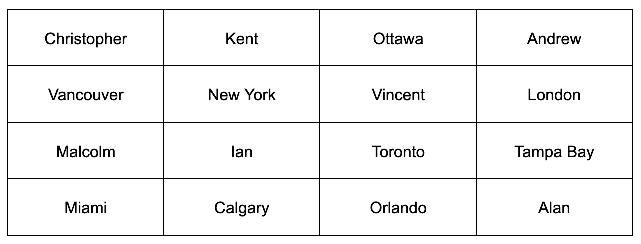
october sudoku
By Navya Sheth
First names of LOTR actors: Christopher, Ian, Orlando, Andrew
First names of criminal law professors: Kent, Malcolm, Vincent, Alan
Baseball cities: New York, Miami, Tampa Bay, Toronto