
Indigenous Law Intensive Course Marks Its Return
Participants reflect on their experiences learning Indigenous law on the territory of the Chippewas of Rama
Mnjikaning First Nation

In 2016, U of T Law introduced the Indige nous Law in Context program, a three-night intensive course designed to teach upper-year law students Indigenous law and legal tradi tions from a land-based perspective. Student participants in the program have the opportu nity to receive teachings from elders and other members of the community, while being im mersed in traditional practices.
After U of T Law paused the program dur ing the pandemic, it returned this year and in cluded joint activities with Osgoode Hall Law School students. Led by U of T Law Professor John Borrows, the program took place on the territory of the Chippewas of Rama Mnjikan ing First Nation, outside Orillia, Ontario. The program ran for four days and three nights from September 29 to October 2. Students camped as a group on the First Nation’s lands throughout the program.
To participate in the Indigenous Law in Context program, students were required to show a demonstrated and specific interest in learning about Indigenous law and legal tradi tions. Ultra Vires asked participants the follow ing question: what is one thing that will stick with you from your experience over the fourday intensive? Below are their thoughts.
Troy Klassen (3L):
“It's hard to choose just one thing. I consider the whole weekend to be one of the most en riching and formative experiences of my time in law school. In those four days, I was exposed to a vision of law beyond the assumptions of Western European traditions. I was introduced to law as an action done with others, focused on the relations between me and other beings (human or otherwise), not as self-interested in
dividuals, but as parts of a whole. It was more than an academic exercise. It was, dare I say, a spiritual experience, one that I hope will in form the way I practice law for years to come.”
Jasman Gill (3L):
“The Indigenous Law in Context intensive was an incredible experience! We were able to take part in various cultural practices of Indig enous people throughout the weekend. The events required us to be open, personable, and even vulnerable with one another. As a result, I was reminded about the importance of learn ing from my peers and the value of having a strong community. My personal favourite was the Sweat Lodge ceremony, a purification rite that leaves you in a tranquil state of balance.”
IN THIS ISSUE
HARRY MYLES (3L)
Professor Karen Knop passed away on September 26, 2022 to the shock and im mense sadness of students, Faculty mem bers, and the greater law community. Prof. Knop held the Faculty’s Cecil A. Wright Chair and taught international law. She was unique for her character and scholarship and left behind a vast net work of people deeply saddened by her loss.
Prof. Knop was born in 1960 in Halifax and earned a BSc and LLB from Dalhou sie University in 1982 and 1986 respec tively. She received an LLM from Colum bia University in 1990 and an SJD from the University of Toronto in 1990. She subsequently joined the Faculty that year as a special lecturer and became a fulltime faculty member in 1992.
Prof. Knop had an impressive reper toire of scholastic achievements. She spearheaded a feminist approach to inter national law and was globally recognized as a renowned public international law scholar. Most recently, Prof. Knop taught a course at The Hague Academy of Inter national Law in early 2020, attended the Helsinki Collegium for Advanced Studies as the Aatos Erkko Visiting Professor in Studies on Contemporary Society in 2020–21, and she was named one of the inaugural Max Planck Law Fellows in 2022, the highest honour awarded by the Max Planck Law network to scholars out side of the German Max Planck Society.
While writing this article, I reached out to the law school community for com ments about Prof. Knop that could con textualize who she was as a person be yond her academic successes. Every person I spoke to directed me to yet an other individual that Prof. Knop men tored or befriended. Uncannily, people often repeated the same sentiments: Prof. Knop was a kind, generous spirit with a compassionate demeanour; and above all else, she was an irreplaceable friend.
As an academic, Professor Knop was one of the most collegial people Professor Phillips ever met. The two first became acquainted at Dalhousie University when they were both studying law. Having known Prof. Knop for many years, Pro fessor Phillips emphasized her keen inter est in other people and humility. Despite being immensely accomplished, Prof.
ULTRAVIRES.CA October 27, 2022 VOL. 24 ISS. 2 ALSO
SURVIVING TORONTO OCIS PAGE 18 RIGHTS REVIEW PAGE 16 TORONTO ARTICLING RECRUIT RESULTS PAGE 8
Continued on page 3
NATASHA BURMAN
(3L)
“You Could Not Help Being in Awe of Her” The law community mourns the loss of Professor Karen Knop who tragically passed away on September 26, 2022
Continued on page 3 STUDENTS CANOE ON LAKE COUCHICHING DURING THE INDIGENOUS LAW IN CONTEXT: INTENSIVE COURSE. CREDIT: JULIE ANN SHEPARD
Vires THE INDEPENDENT STUDENT NEWSPAPER OF THE UNIVERSITY OF TORONTO FACULTY OF LAW
84 Queen’s Park Crescent Toronto, ON M5S 2C5
Ultra Vires is the independent student newspaper of the University of Toronto Faculty of Law. We provide a forum for diverse viewpoints on topics of interest to our readers. We aim to foster dialogue on academic and social issues between students, the faculty, and the broader legal community in Toronto, Ontario, and Canada. Our content does not necessarily reflect the views of the Editorial Board. We print six issues per year. Ultra Vires is printed by Master Web Inc.
EDITORS-IN-CHIEF
Harry Myles and Shae Rothery
BUSINESS
Griffin Murphy
ASSOCIATE BUSINESS MANAGER


Ashley Chana
NEWS
Thomas Russell and Nicolas Williams
ASSOCIATE NEWS EDITOR S
Yashleen Jhand and Amanda Oprisan
FEATURES
Angela Feng and Hye-seon Jung
ASSOCIATE
Julia Allen and Erin Lee
OPINIONS
Stephen Mapplebeck and Rebecca Rosenberg
ASSOCIATE
Manreet Brar and Abhirami Sasitharan
DIVERSIONS
Amy Kwong and Fievel Lim
RECRUIT
Hussein Fawzy
EDITOR-AT-LARGE
Vivienne Stern
ONLINE
Alyssa Wong
Claire Bettio, Natasha Burman, Luka Knezevic, and Taylor Rodrigues
RECRUIT
Janice Fung and Jeffrey Liu
Jennifer
Thomas Alexander and Ian T. D. Thomson
Kaitlyn Nelson and Jasveen Singh
Alexandra
Indigenous
Students’
The



Dear Readers, Boo! Spooky season is upon us, and it’s time to pull those dusty costumes out of the closet once again for another frighttacular Halloween. To help with your Halloween festivities, Diversions has you covered with a shockingly groovy playl ist, legal costume ideas, and some spooky drabbles about the law school.
Of course, October isn’t just spooky because of the ghosts and ghouls. The 2L recruit in terview process has officially begun, with on-campus inter views wrapping up last week and in-firms happening next month. We have you covered on how to survive the 2L recruit if you chose to participate, as well as advice for students not interested in the recruit. In this issue, we likewise have our To ronto 2023–24 articling recruit results, an interview with the new Director of Career Devel opment Programs, Theresa Chan, and a memorial piece on the late Professor Karen Knop.
If you have any comments, are looking for ways to get in volved with Ultra Vires, or just want to say hi, you can reach us at editor@ultravires.ca.
Best of luck with the second half of the term, and thanks for reading!
Harry Myles & Shae Rothery Co-Editors-in-Chief, Ultra Vires Vol.

RIGHTS
OPINIONS
ultravires.ca2 | October 27, 2022
MANAGER
EDITORS
EDITORS
FEATURES EDITORS
EDITORS
OPINIONS EDITORS
EDITORS
EDITOR
EDITOR
STAFF WRITERS
REPORTERS
VISUAL COORDINATOR
Sun STAFF PHOTOGRAPHERS
SOCIAL MEDIA COORDINATORS
LAYOUT EDITOR
Fox ADVERTISING If you are interested in advertising, please email us at business@ultravires.ca ERRORS If you notice any errors, please email us at editor@ultravires.ca. SUBMISSIONS If you would like to submit a tip, letter, or an article, please email us at editor@ultravires.ca. Ultra Vires reserves the right to edit submissions.
24 EDITORS' NOTE NEWS
Law Intensive Course Marks Its Return 1 “You Could Not Help Being in Awe of Her” 1
Law Society Update 4 Grand Moot 2022 Recap 4 “Woman, Life, Freedom” 5 Lawyers of Families of Nova Scotia Mass Shooting Victims Share Frustrations 5
Alberta Sovereignty Act, Explained 6 Law School Emond Exam Prep • 1 Eglinton Ave E, Suite 600, Toronto ON • emondexamprep@emond.ca • 1-888-837-0815 “How do I prepare for an open-book exam?” Answers to your most important questions and expert advice on how to succeed in your first year of law school. EMOND’S FREE GUIDE TO LAW SCHOOL: UV INDEX FEATURES 2023–24 Toronto Articling Recruitment Student Survey Results 6 2023–24 Toronto Articling Recruitment Results 8 Meet Theresa Chan, U of T Law’s New Director of Career Development Programs 9 Meet Jessie Kussin, U of T Law’s New On-Location Wellness Counsellor 10 No Alcohol November? 10 Spooky Season Wines and Movie Pairings 11 Film Review: Scream (1996) 12 Classic Album Review: Jeff Buckley, Grace (1994) 13 Book Review: Valley of the Birdtail 14 The A.I. Taxman: A U of T Law Movie Premiere 14 Bill C-5: Drug Decriminalization “Lite” 15 A Guide on How to “Show Interest” in Criminal Law 15 DIVERSIONS Intra Vires 21 Ultra Vires Defends Policy Against Hiring People With the Name Raymond 21 The Ultimate Law Firm Grading 21 Last Minute Legal Halloween Costumes 22 Spooky Stories From Jackman Hall 22 Animals in the Law School 23 Ultra Vires Presents: It’s Hallow’s Meme 23 The Ultra Vires Crossword 24
Surviving the Toronto 2L Recruit 18 OCWhys? 18 The Terrible, Horrible, No-Good, Very Bad Articling Recruit 19 Orange Shirt Day is Not a Metaphor 19 SNAILS? In My Library? 20 The Library Chairs Need to Go! 20 TORONTO I VANCOUVER I CALGARY cassels.com At Cassels, we don’t hire students hoping to mold them in our image. Our students are smart, diverse, accomplished individuals who bring their unique attributes to our firm and make us all better. Your success is our priority. GENUINE. HONEST. AUTHENTIC. Ultra Vires
REVIEW A Summer at PEN America’s Artists at Risk Connection 16 A Summer at the Center for International Environmental Law (CIEL) 16 A Summer with SASLAW Pro Bono 17 Reflections on International Criminal Law 17
Indigenous Law Intensive Course Marks Its Return

from page
Jane Fallis Cooper (3L):

“While the entire experience was incredibly impactful, the ability to learn and grow in a community environment, where people were so open to learning new things in a new way, was really special. As Professor Hewitt said on the first day when he encouraged us to take no notes and instead sit with the information and teachings, this way of learning really prompt ed us to work together and to ask each other about parts we may have missed. A big thank you/chi-miigwetch to the professors and Rama First Nation! To all 1Ls and 2Ls, I'd highly rec ommend attending next year if you're able.”
Rhea Murti (2L):
“One thing that will stick with me from the law camp weekend is a feeling of responsibility. It was quite impactful to experience the warmth and generosity with which members of Rama First Nation welcomed us into their community and brought together leading In digenous knowledge keepers, teachers, and lawyers for four days of immersion in Anishi naabe law and ceremony. The experience left me with a deep sense of gratitude and a clear understanding of my duty to put the knowl edge I gained into practice as a future lawyer
in Canada, by centering Indigenous legal or ders and helping to protect Indigenous land, rights, and ways of being.”

Mohammed M’Hiri (3L):
“I would say the need to deconstruct the formal thinking that we approach the law with. When law is seen—as it is in Anishnaabe legal tradition—as an action and way to live your life, law takes on a whole new meaning in its application to our day-to-day lives. We go from looking at it as a guideline to specific as pects of our lives—wear your seatbelt, don't speed—to a holistic approach to living for the benefit of all (including the natural world around us).”
Kyra McAlister (3L):
“One thing that will stick with me was the opportunity to learn about law outside of the classroom. This experience allowed me to con nect with the land, my peers, and my hosts in ways that were deeper than traditional class room learning. Overall, I developed a different perspective on Indigenous law and how Cana dian common law has impacted Indigenous communities from being outdoors and directly in the community.”

Knop often found genuine interest in oth ers’ work and enjoyed engaging with peo ple beyond her own academic pursuits.
Professor Dyzenhaus had a particularly close relationship with Prof. Knop and they previously co-taught courses togeth er. They lived near one another and often met for “international law drinks.” As he described, Prof. Knop’s “intellect made her a leading scholar, but her warmth, wit, and generosity of spirit are what we miss most.”
Echoing the above, Professor Shaffer described Prof. Knop as a “people per son” who “was always thinking about how to make life better for those around her.” She always took the time to support her students and colleagues in both a profes sional and personal capacity. Moreover,
she had “a hilarious sense of humour” and “brought out the best in everyone.”
Prof. Knop likewise had a profound ef fect on her students. Emily Albert (2L) worked briefly with Professor Knop on a personal project and said “she was always happy to hear from students and support them in exploring their interests and pas sions.”
Roxana Banu, Prof. Knop’s former SJD student, “could not help being in awe of her.” Working with her entirely trans formed Banu as a scholar and a human being. Prof. Knop was not only “the most brilliant and imaginative scholar” Banu ever met, “but the most gentle, generous, and compassionate soul.” Reiterating Professor Phillips’ sentiments, Banu said Professor Knop “always found something
to admire and cherish in anyone and she had a unique ability to bring people to gether.” Put simply, Professor Knop “was someone you could never forget or stop loving.”
I never had the opportunity to meet Professor Knop, but based on the people I spoke to while writing this article, it was an absolute privilege to know her. Prof. Knop was a unique academic. She was in ternationally recognized for her intellect, yet she remained humble and collegial, taking joy in the passions of others and supporting her colleagues. Most impor tantly, though, she was kind. Professor Knop was a person you did not soon for get and someone who had a profound im pact on your life. She will be deeply missed by many.
ultravires.ca October 27, 2022 | 3
Continued
1 NEWS
“You Could Not Help Being in Awe of Her”
Continued
from page 1LAW COMMUNITY SHOCKED BY THE SUDDEN
PASS ING
OF PROFESSOR KAREN KNOP ON SEPTEMBER
26, 2022. CREDIT: FACULTY
OF
LAW
HARRY MYLES (3L)
NATASHA BURMAN
(3L)
THE
TENTS STUDENTS CALLED HOME FOR THREE NIGHTS. CREDIT:
JULIE ANN SHEPARD
A COLLECTION OF WAMPUM BELTS. CREDIT: JULIE ANN SHEPARD
STUDENTS
LISTEN TO PROFESSOR JOHN BORROWS. CREDIT: JULIE ANN SHEPARD
Students’ Law Society Update
October’s very own
MEAZA DAMTE (3L), PRESIDENT OF THE STUDENTS’ LAW SOCIETY, 2022–23
Congratulations on making it through the second month of the semester! The Students’ Law Society (SLS) would like to provide the following updates:
Election Results
The Fall Election, run by our lovely Chief Return ing Officer Emily Sarah Hean (2L), took place last month. Please provide a warm welcome to your new est SLS Representatives!
1L Student Life and Academic Representatives: Akash Jain, Matthew Chasmar, Joshua (Do Eon) Lee, and Isabel Brisson
1L Social and Finance Representatives: Rachel Park, Taylor Clapham, Chris Kozak, and Quinn Rozwadowski
3L Student Life and Academic Representative: Naomi Chernos
Vice President Academic: Jane Jiang (2L)
We would like to thank everyone who put their names forward in this election. To the successful can didates—congratulations, and the SLS looks forward to working together this year.
Club Funding
The SLS would once again like to remind student leaders to apply for club funding. Our website clearly lays out the application information under the Club
Funding tab. The SLS explicitly set aside this money to fund student clubs, so it is in everyone’s best interest
to make use of these funds.
Additionally, U of T Law partially lifted the black out on approaching firms for funding. Interested stu dents should contact Sara-Marni Hubbard, Student Programs Manager, if they have a proposal. If Hub bard deems the proposal a good fit for firm funding, she will forward it to Jennifer Lancaster, Assistant Dean, Advancement. Students are still prohibited from reaching out to external sponsors directly.
The SLS is working with the Faculty to improve accessibility to funds for student events and initiatives. For now, students should continue to direct the major ity of their club funding requests to the SLS.
OCI Chats
The SLS would like to thank all of the 3L volunteers
Grand Moot 2022 Recap
that made the OCI Chats event a success! 2Ls participat ing in the formal recruitment process had the opportunity to ask upper year students from a variety of employers questions about on-campus interviews. We are sending good luck to all students on the job hunt this month, whether it is through the formal recruit or otherwise.
Halloween
Last but certainly not least, the SLS is hosting a Halloween party at the law school on Friday, October 28! You can purchase tickets through the Google Form sent out via email and posted on our Facebook pages. Bring your spookiest costumes and dancing shoes be cause it is sure to be a fun-filled night!
Mooters considered freedom of expression and equality concerns in social media regulations
SABRINA MACKLAI (3L JD/MI)Another year, another Grand Moot! This year, the mooters addressed the constitutionality of a law that regulates privately held social media platforms. In de ciding whether ChitChat, a platform similar to Twitter, must adhere to a law prohibiting viewpoint-based con tent moderation, the mooters were asked to consider potential infringements under sections 2(b) and 15 of the Canadian Charter of Rights and Freedoms (the Charter)
Benjamin MacLean-Max (2L) and Laura Goldfarb (3L) represented the appellant, ChitChat, while Ivy Xu (3L) and Adrianna Mills (3L) represented the respon dent, the federal government. The distinguished panel consisted of the Honourable Justice Rita J. Maxwell from the Ontario Superior Court of Justice and the Honourable Justices Lorne Sossin and Julie Thorburn from the Court of Appeal for Ontario.


The problem was written by the Moot Court Com mittee Co-Chief Justices, Charles Ma (3L) and Mack enzie Faulkner (3L). In their drafting, they were inspired by the recent First Amendment challenges to social media regulations in Texas and Florida.
“Building on this basic idea, we structured the prob lem to incorporate contemporary debates about social media’s role in democratic discourse, as well as compet ing conceptions of free expression,” commented Ma and Faulkner. “We included the s. 15 element as a novel
application of the [Fraser v. Canada (Attorney General), 2020 SCC 28] adverse effects discrimination framework and to explore the relationship between free expression and equality rights.”
The appellant argued that limiting the platform’s ability to censor content it deems problematic violates its right to free expression. “Hosting content is a form of expression,” MacLean-Max claimed in his oral submis sions.
In response, Justices Maxwell and Sossin drew the distinction between association and attribution, ques tioning whether ChitChat could experience compelled speech when it really acts as a forum for others’ speech.
On the section 15 argument, the appellant claimed the impugned law creates a discriminatory distinction of race, religion, sexual orientation, and gender identity by preserving discriminatory content that targets those groups.
Switching sides, the respondent argued that section 2(b) does not protect censorship on social media. In the alternative, even if the law does protect such censorship, it does not restrict ChitChat’s expression in purpose or effect. Indeed, the law could be considered to uphold the values underpinning freedom of expression, by ensur ing private actors cannot unduly influence public dis course.
“The point here is that there is no accountability mechanism to ensure that all platforms exercise good faith,” argued Xu in her oral submissions. “There is nothing to ensure that ChitChat itself doesn’t change its moderation policy. In fact, it could be under the threat of a hostile takeover tomorrow, by a certain billionaire who makes rockets and elec tric cars and has a very particular view of what pub lic discourse should [look] like.”
The judges pushed back on the respondent’s as sertion that content moderation is not sufficiently expressive to enter within the scope of section 2(b) protection. Justice Sossin noted that advertising and other forms of corporate speech are covered under section 2(b), and that the Supreme Court’s decision in Irwin Toy Ltd. v. Quebec (Attorney General) set a very low threshold for what constitutes expressive activity.
The respondent also argued that the law does not infringe section 15, citing a lack of causation be tween the claimed harm and the law. It could not be shown that permitting content moderation, contrary to the law, would make a meaningful difference to those cited by the appellant as being negatively im paired.
“One of the benefits of speaking last today— probably the only benefit—is that this Court has heard examples of both positive and negative forms of censorship. And there is nothing about censorship that is inherently beneficial for minority groups,” ar gued Mills.
Upholding the Grand Moot tradition, there are no losers and only winners in the Supreme Court of Flavelle. The judges lauded the mooters’ perfor mances and ability to field their questions, with Jus tice Maxwell reflecting that as a previous Grand Mooter herself, she was extremely impressed by the students.
In addition to commending the oral advocacy on display, the judges also praised the problem for its
contemporaneousness. In their comment to Ultra Vires, Ma and Faulkner noted that should this issue reach Canadian shores, they hope the problem “serves to inform students’ perspectives on this chal lenging question.”
The mooters provided some words of encour agement for their peers. Xu emphasized taking risks, noting that “in a moot, no one is going to jail, and there is no money on the line.” She explained that mooting allows students to experiment with different arguments and advocacy styles in a rela tively low-stakes environment that is not possible in real practice. She revealed that she even reframed a key part of her submissions on the morning of the moot, “which was probably the 10th version of it!”
Goldfarb also enjoyed her experience, noting that mooting provides students with the opportu nity to think more deeply about legal issues than what classes can provide.
“I loved thinking through complex issues of free speech, censorship, and equality alongside my teammates and with the help of many brilliant fac ulty members and lawyers,” commented Goldfarb. “For all those interested in mooting, the best advice I ever got was this: it’s always better to sound rea sonable than to sound clever, and preparation al ways wins.”
The Grand Moot is a U of T Law tradition showcasing the school’s top oralists. It is sponsored annually by McCarthy Tétrault LLP.
“As a firm with a continuing tradition of excel lence in advocacy, McCarthy Tétrault takes great pleasure in sponsoring the Grand Moot each year,” commented a spokesperson for McCarthy. “This event fosters and showcases the potential and devel opment of the next generation of advocates. This year’s Grand Mooters thoroughly impressed us with their preparation, thoughtfulness, and ability to respond to difficult questions from the bench.”
ultravires.ca4 | October 27, 2022 NEWS
FROM L-R: CHARLES MA (3L), DEAN JUTTA BRUNNÉE, MACKENZIE FAULKNER (3L), JUSTICE JULIE THOR BURN, JUSTICE RITA J. MAXWELL, JUSTICE LORNE SOSSIN, BENJAMIN MACLEAN-MAX (2L), LAURA GOLD FARB (3L),
IVY
XU
(3L), AND
ADRIANNA MILLS
(3L). CREDIT: THE FACULTY OF LAW THE 2022 GRAND MOOTERS. FROM L-R: IVY XU (3L), LAURA GOLDFARB (3L), BENJAMIN MACLEAN-MAX (2L), AND ADRIANNA MILLS (3L). CREDIT: THE FACULTY OF LAW
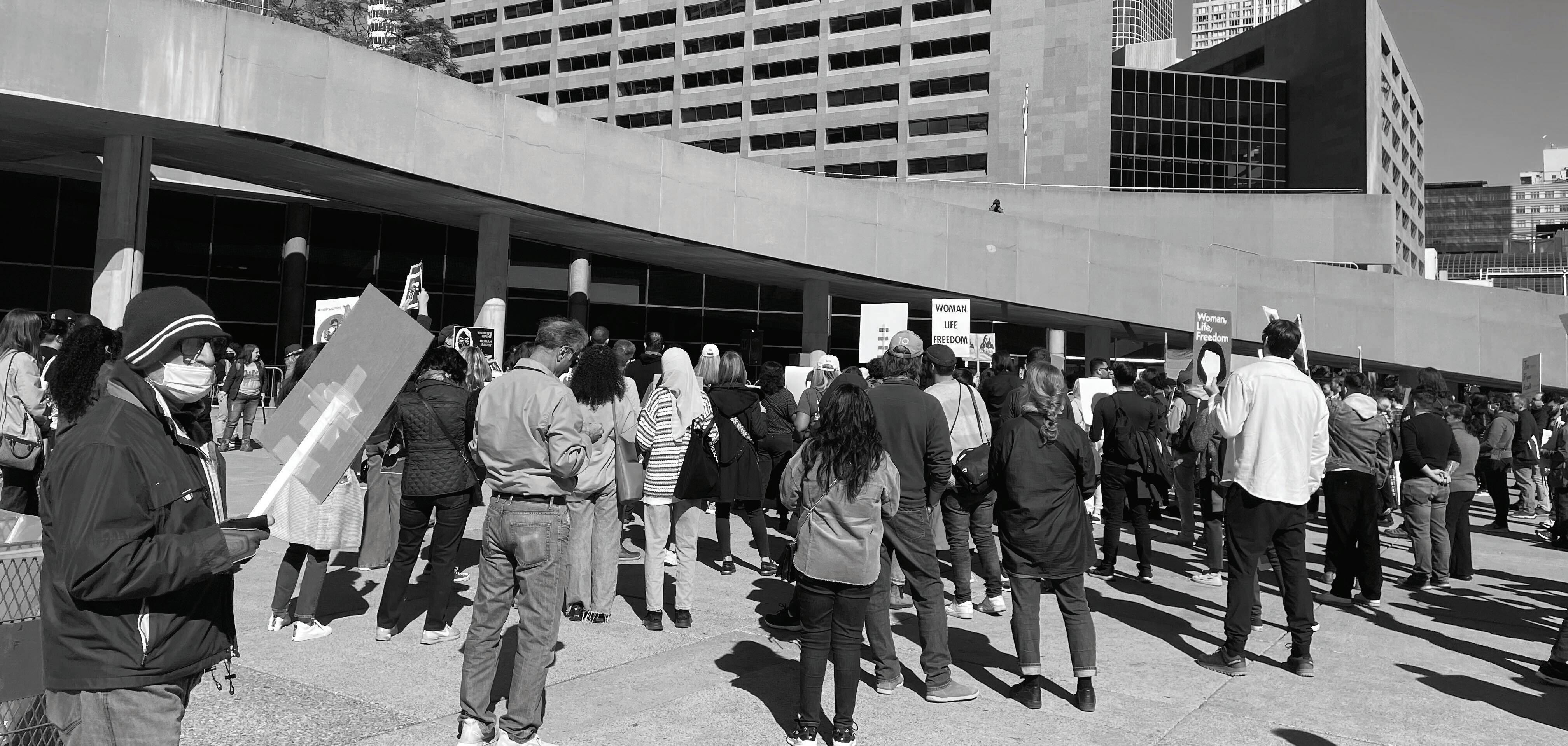
“Woman, Life, Freedom”
Iranian solidarity action takes over Nathan Phillips Square on October 2, 2022
YUKIKO KOBAYASHI LUI (SJD)On October 2, 2022, activists from the Iranian diaspora and beyond gathered in Nathan Phillips Square to show solidarity with ongoing protests in the Islamic Republic of Iran following the death of Mahsa (Jina) Amini, a 22-year-old Kurdish wom an, shortly after Iranian morality police released her from custody on September 16.
Suspicions around the use of torture and the cir cumstances of Amini’s death ignited a sustained protest movement across cities and university cam puses in Iran, which some observers believe is the largest of its kind in many years. Women protestors in Iran have refused to wear the hijab and cut their
hair to protest the government’s morality police. The protests have grown to encompass calls not only for the repeal of mandatory veiling laws in Iran but also for women’s rights more broadly, queer rights, and an end to Sharia law in the coun try.
Activists with the Feminists 4 Jina campaign planned a slate of solidarity actions in cities around the world, including the action held on October 2 in Toronto. Featuring speeches from local Kurdish activists, as well as Black and queer activists, work ers, and abolitionists, the action drew a crowd of a hundred protestors. In between chants of the Kurd
ish independence movement slogan “Jin, Jiyan, Azadi” (“Woman, Life, Freedom”) and “Say Her Name,” the diverse range of speakers addressed the assembled crowd.
Revolutionary feminist activists and refugees from Iran gave speeches explaining the context be hind the protests and shared statements from pro testors in Iran. Abolitionist speakers connected the Iranian protest movement to movements in North America for an end to police brutality and mass in carceration, including of political prisoners. Queer activists from Iran traced the history of feminist ac tivism in the country and the essential role queer
and LGBTQ2S+ activists have played in the devel opment of feminist activism in Iran. A representa tive of the Naujawan Support Network (NSN), a Greater Toronto Area-based group organizing in ternational workers and students, recalled the im portance of international solidarity for all move ments, including the movement for justice for Amini and the Indian farmers’ protests in 2020.
A counter-protester disrupted the action, but le gal observers resolved the situation quickly. Follow ing the speeches, the action merged with a nearby protest calling for an end to the Hazara genocide in Afghanistan.
Lawyers of Families of Nova Scotia Mass Shooting Victims Share Frustrations
Representatives share family criticisms of public inquiry investigating the atrocity
NICOLAS WILLIAMS (2L)Content warning: discussion of mass shooting and vio lence
On Tuesday, September 20, lawyers represent ing families of those killed in the 2020 mass shoot ing in Nova Scotia issued stark and wide-ranging criticisms of the Royal Canadian Mounted Po lice’s (RCMP) actions before, during, and after the shooting. The lawyers were speaking before the Mass Casualty Commission (the Commission), es tablished to examine the response by law enforce ment. The criticisms expressed frustration with how families of victims had been treated by the RCMP, as well as anger with the procedure of the Commission itself.
The Commission’s public inquiry comes over two years after the mass shooting shocked Canada and the world in April 2020. Over the course of thirteen hours, Gabriel Wortman committed mul tiple shootings across Nova Scotia, killing 22 peo ple and injuring three more before he was eventu
ally shot and killed by RCMP officers in the town of Enfield. Wortman was using an RCMP vehicle and RCMP paraphernalia for at least part of the 13-hour period, which may have assisted him in evading police.
In the years following the mass shooting, the families of victims pushed for an expansive inqui ry into RCMP failings before and during the event. There was significant public outcry after the Nova Scotia and federal governments initially decided to appoint an independent three-person review panel, a decision criticized as too narrow and lacking in transparency. Under this review structure, information collected by the panel as part of their review would remain confidential, and the panel could decide whether any hearing would be open to the public.
Following a negative public response, including rallies in Bridgewater and Halifax, Nova Scotia, on July 28, 2020, federal Public Safety and Emer gency Preparedness Minister Bill Blair announced
a public inquiry. However, there are significant questions about whether the Commission can have any effect. The Commission cannot compel testimony, and the RCMP’s Operations Manual authorizes police to lie to a public inquiry if neces sary to conceal the identity of confidential infor mants and agent sources.
Additionally, individuals who have spoken at the Commission have pointed to the fact that rec ommendations brought forward by public inqui ries are often not carried out.
During final submissions on Tuesday, lawyers speaking on behalf of victim’s families identified both concerns with the RCMP’s response and the Commission’s process itself. Sandra McCulloch of Patterson Law pointed to problems with officer training and equipment that limited the RCMP’s ability to look for an active shooter at night, as well as communication problems between the RCMP and the public. When it came to the Commission, victims’ families raised their concern that they
could not question significant witnesses like Wort man’s partner, who had helped arm him. Lawyer Tara Miller, who represents a relative of one of the victims, pointed to the fact that the Commission had relied heavily on documentation over direct testimony, further suggesting the evidentiary re cord may be lacking.
The Commission has been beset by delays since its initiation. An interim report was published in May 2022 and the release of the final report was originally slated for November 1, 2022. However, in August of this year, the federal and provincial governments granted a request to delay the release until March 31, 2023. The Commission cited a short timeline at the outset, COVID-19, and the unpredictable pace of document disclosure as rea sons necessitating the delay. As a result, families of the victims will have to wait until next year for any conclusions and recommendations the Commis sion may set out to ensure better public safety in the future.
ultravires.ca October 27, 2022 | 5NEWS
A CROWD OF PROTESTERS AT THE IRANIAN SOLIDARITY ACTION ON OCTOBER 2, 2022. CREDIT: YUKIKO KOBAYASHI LUI
The Alberta Sovereignty Act
ALYSSA WONG (2L)On October 11, Danielle Smith was sworn in as the 19th premier of Alberta after becoming the new leader of the ruling United Conservative Party (UCP). As former leader of the Wildrose Party, Smith led the Of ficial Opposition from 2012–14. The Wildrose Party later merged with the Progressive Conservative Party of Alberta to form the UCP. Premier Smith was a member of the Legislative Assembly (MLA) from 2012–15 but does not currently have a seat.
Former Alberta premier Jason Kenney triggered the UCP leadership race when he announced his res ignation in May 2022. The new UCP leader was se lected using instant run-off voting. Smith won a ma jority of votes (53.77 percent) in the sixth and final ballot count, defeating Travis Toews (46.23 percent), the former Minister of Finance of Alberta. Approxi mately 85,000 ballots were cast by eligible UCP mem bers.
One of the most controversial issues in the leader ship race was Smith’s proposed Alberta Sovereignty Act (ASA). The ASA would “assert Alberta’s Constitutional Rights within Canada to the furthest extent possible by effectively governing itself as a Nation within a Na tion” and would allow the Alberta government to avoid enforcing federal laws or policies it deems uncon stitutional. However, Premier Smith noted the ASA would still respect Supreme Court decisions. The ASA
may only be used if authorized by a free vote of all Alberta MLAs. It is intended to impose the rule of law on “a lawless Ottawa” by reaffirming the separation of powers. To date, Premier Smith has only released an overview of the legislation and intends to draft the ASA together with her cabinet and caucus.
Reactions to the proposal have been mixed. Sup porters claim that the ASA is an entirely constitutional way to assert the jurisdiction granted to Alberta by the Constitution Act, 1982. Others criticize the proposal as wholly unconstitutional and that to allow a provincial legislature to unilaterally decide whether a federal law is constitutional or not disregards the role of the courts in challenging a law’s constitutionality. Some support ers concede that the ASA may be unconstitutional but see it as a powerful message to the federal government that could strengthen Alberta’s interests or lead to positive constitutional change.
Others see it as a step towards Alberta separatism. The ASA appears to have its roots in the Free Alberta Strategy, a series of initiatives to make Alberta a sover eign jurisdiction. The Alberta separatism movement, sometimes known as “Wexit,” has experienced a re surgence in recent years.
While separatism remains a fringe concept, Alber tan discontent with Ottawa is not. A number of fed eral policies are commonly perceived as harming Al
berta’s energy industry, a key part of Alberta’s economy, without due consideration for how Alber tans would be affected. Protecting the energy industry from federal overreach is consistently a major issue in Alberta politics. For example, in 2019, Kenney launched the Canadian Energy Centre, commonly known as the “energy war room,” to promote the in dustry’s interests and respond to misinformation about oil and gas. There are also perceptions of federal over reach into areas like policing and pension manage ment.
One major grievance is the equalization payment system, through which the federal government makes payments to provinces to address interprovincial fiscal disparities. Alberta has not received a payment since 1965, even through recessions. In a 2021 provincial referendum, 61.7 percent of voters favoured removing equalization payments from the Canadian constitu tion. Though insufficient to change the constitution, these results gave “a powerful mandate to secure changes to equalization and other federal transfers.”
Despite these sentiments, other politicians have generally been critical of the ASA. Four other UCP leadership candidates held a joint press conference to express their opposition. Kenney called the proposal “catastrophically stupid” and said that it would scare away investors, create “political chaos,” “shred the
rule of law,” and “do devastating damage to jobs, the economy and the prospect of pipelines.” Lieutenant Governor Salma Lakhani said her office would inde pendently evaluate the law’s constitutionality before giving royal assent, raising concerns about the Lieu tenant Governor taking on a political role.
What’s next?
On November 8, Premier Smith will be running for MLA in the conservative-leaning riding of BrooksMedicine Hat. The riding’s former MLA, Michaela Frey, resigned on October 7, 2022.
There is uncertainty whether there is enough party unity to pass the ASA. To do so, Premier Smith may have to compromise on language and details.
Notably, only a small minority of Albertans voted in the UCP leadership election and a “large portion” of UCP members live in rural Alberta. More than 80 percent of Albertans live in urban areas, raising con cerns about whether the party’s actions will be repre sentative of Albertans’ interests. In the next general election, Premier Smith’s main opponent will be for mer premier and current Opposition leader Rachel Notley of the New Democratic Party. The next pro vincial election is scheduled for May 29, 2023.
Student Survey
 JEFFREY LIU (2L) AND HUSSEIN FAWZY (3L)
Past
ultravires.ca6 | October 27, 2022
, Explained Controversial proposed law could change Confederation as we know it
NEWS 2023–24 Toronto Articling Recruitment
Results
Students reflect on their recruit experiences Though Ultra Vires traditionally surveys 2L Toronto recruit experiences, this year we are pleased to publish the results of our inaugural articling recruit student sur vey. Eleven students responded to our survey. Their responses have been anonymized and reproduced below.
Recruit Experience Over 75 percent of the respondents participated in the previous year’s Toronto 2L summer student recruit, but 70 percent of these students did not accept a job offer in that recruit. Nevertheless, every respondent was employed during their 2L summer across various sectors, including legal clinics, full-service firms, specialized boutiques, and posi tions offered through the Law School Summer Employment Program (LSSEP). Most students reported that the recruit process was minimally disruptive to their em ployment responsibilities, though some experienced significant upheaval. FEATURES
Career Development Office (CDO) Services
Nearly every respondent consulted with the CDO in some capacity to prepare for the recruit. Most students found the CDO’s support indispensable.

Rachel [Weiner] was amazing. Super helpful in reviewing my materials/interview practice, but more importantly she has a very positive energy that made me feel really supported and encouraged.
The group info sessions, resume reviews, and mock interviews were all indispensable. Although the recruitment process can be stressful, I was at least able to go into it feeling prepared.
Neil [Dennis] was fantastic. Offered great insight into the market and my options.
I would be lost without Rachel's knowledge about different employers, particularly government and public interest employers, and advice on preparing for these different kinds of interviews.
However, some were dissatisfied with the CDO’s efforts to help students interested in public interest opportunities:
Very unhelpful for progressive employment opportunities [and] support.
Networking
Approximately 64 percent of respondents had virtual coffee chats with at least one par ticipating employer, while only one respondent attended an office tour or firm information session. Overall, respondents had mixed opinions on the necessity and effectiveness of networking.
Super helpful to learn about the kind of work articling students and junior associates do and get excited about employers, but less instrumental for the sake of name dropping.
Wish it wasn’t so necessary.
It seems to matter more to some firms than others, but it never hurts.

I don't enjoy doing it and not sure if it actually helps, but it seems to help others so maybe I'm just doing it wrong lol.
F*ck networking.
Articling Recruit Results
Respondents applied to a varying number of employers, ranging from five on the low end to 60 on the high end. The average was 30 employers per applicant, which resulted in an average of 10.6 interview offers and 2.1 job offers. Ultimately, students found jobs at large full-service law firms, boutiques, and with government employers.


ultravires.ca October 27, 2022 | 7FEATURES
Advice for Future Participants
Recruit
Overall, students
I got an offer that I'm
the recruit
feel like I made the right choice accepting that offer.
I ended up at my first choice firm and my summer experience was exactly what I had hoped for.
reported
I'm really happy and grateful that I finally have a job! I can now 3LOL. I'm still not used to saying "I will be doing x..." and still accidentally say things like "I think I will be doing x... or I'm trying to do x..." a lot. The process was exhausting so honestly, I feel very lucky.
I’m happy I got an offer, but the entire process was very stressful.
Got a job somewhere I'm ok with but the process took ten years off my life.
Some participants were put off by the behaviour of certain employers during the process, though 87.5 percent of respondents did not report experiencing any uncomfortable or inappropriate interactions.
The ‘first choice’ language was explicitly asked from one employer, which I'm pretty sure they're not allowed to do.

Did not make me uncomfy but some were obviously geared for white/affluent students only and not reflective of diverse applicants.
One employer called before 8am on call day to schedule and insisted on in-person interviews (instead of many firms indicating a strong preference but willingness to accom modate).
When asked to comment on Law Society of Ontario (LSO) recruitment procedures, responses were overwhelmingly negative

While I am happy I was successful, the process is unnecessarily stressful and creates a situation that allows firms to push students around.
I don’t know why different provinces have to have different interview weeks. It’s not the LSO’s fault, but I really wish all the law societies could sit together and solve this.
Probably the most ridiculous process I've ever been forced to partake in. From applications to call day to interviews to offers everything is designed to be the most stressful and least easy thing possible. I hate it.
Many respondents offered words of encouragement, nuggets of advice, and warnings to those looking to participate in future articling recruits.
Improving your grades in 2L will help significantly if you weren't very successful in 2L [on-campus interviews]. Also, there are a few firms/places that do articling recruiting immediately after the formal LSO recruit so keep a look out!
Know yourself and follow the processes that work best for you.
Get help from the CDO as much as you can. Stay in touch with your non-law friends/family who will remind you how great you are and that you can do this!
Take care of yourself, know the story you want to tell, and do your best to stay confident and enthusiastic. As cheesy (and easier said than done) it sounds, take this as an opportunity to meet a lot of cool lawyers, hear about their work, and put your best foot forward!
Be calm! Nothing is as high stakes as everyone wants to make it seem. You'll be ok.
Editor’s
ultravires.ca8 | October 27, 2022 FEATURES 2023–24 Toronto Articling Recruitment Results The 2023–24 recruit sees a significant increase in the number of participating employers and students hired JANICE FUNG (2L) AND JEFFERY LIU (2L) Organization Total U of T Osgoode Lincoln Alexander Queen s Western Ottawa Windsor Other Ontario Secondary School Teachers’ Federation 8 Goldblatt Partners LLP 7 Dentons LLP 6 Rosen Kirshen Tax Law 6 Legal Aid Ontario 5 Beard Winter LLP 4 Davies Ward Phillips & Vineberg LLP 4 Hicks Morley Hamilton Stewart Storie LLP 4 Kostyniuk & Greenside Lawyers 4 Lerners LLP 4 Ministry of the Attorney General Crown Law Office Criminal 4 Edward H Royle & Partners LLP 3 Epstein Cole LLP 3 Lee & Associates Personal Injury Lawyers 3 Levitt Sheikh 3 Ministry of the Attorney General Civil Law Division, Constitutional Law Branch 3 Ministry of the Environment Conservation and Parks Legal Services Branch (Ontario) 3 Radnoff Haworth LLP 3 Rogers Partners LLP 3 Torkin Manes LLP 3 Others 63 8 9 3 9 3 12 8 10 Total 146 22 25 8 19 9 20 16 26 * Visit ultravires ca for the full results of the 2023 24 Articling Survey 2 2 1 1 1 1 2 2 1 2 1 1 1 1 2 1 1 2 2 1 2 1 1 1 1 1 1 1 2 1 1 1 1 1 1 3 2 1 1 1 2 1 1 1 1 1 1 1 2 1 1 2 1 1 1 1 1 1 1 2 1 2 1 1 1
Experience
were satisfied with the outcomes they achieved in
but
feeling drained by the entire process.
extremely happy with and
The Toronto 2023–24 Articling Recruit saw
an increase in participating employers compared to last year’s cycle. 65 employers responded to this year’s survey, reporting a total of 146 students hired—a notable increase from the 52 students placed at the 48 participating employers last year. A few employers reported that they continue to send offers on a rolling basis. Similar to last year, Osgoode Hall Law School students secured the most positions with 25 hires. U of T Law and the University of Ottawa Faculty of Law followed with 22 students and 20 students securing articling positions, respectively.
Note: The 65 participating employers represented a 61 percent response rate. The remaining employers did not wish to participate in the survey or did not respond in time for publication.
Meet Theresa Chan, U of T Law’s New Director of Career Development Programs

How private practice prepared her to effectively support and mentor law students
NATASHA BURMAN (3L)This semester, we welcome Theresa Chan to the Faculty of Law as the Director of Career Develop ment Programs with the Career Development Of fice (CDO). In an interview with Ultra Vires, There sa Chan shared her experiences and thoughts about how her work in private practice prepared her for a role of support and mentorship.
Ultra Vires (UV): Can you tell us a bit about your background, education, and career?
Theresa Chan (TC): I was born in Toronto but spent my childhood in Saudi Arabia. I attended high school in the U.S. and completed an under graduate major in biology at Harvard. Then I came back to Toronto for law school at U of T. Since be ing back at the law school during these past few weeks, I’ve been very nostalgic, and particularly so as we step into the 2L recruit season.
I participated in the 2L recruit and accepted an offer at Blake, Cassels & Graydon LLP (Blakes), which for me, was an easy decision to make for a variety of reasons. The practice group I chose, the infrastructure and procurement group, was my home for many, many years. There, I learned my craft, received mentorship and mentored others, gained confidence, and grew into leadership posi tions. I ultimately became a partner. But I wasn’t done learning and growing—I took the space I needed to pursue my interest in coaching and coun selling when I felt it became a calling. That’s how I found my way back to the law school. It’s hard to remember sometimes that we’re people first and foremost and lawyers second, and sometimes the ways we grow as people can lead us to take unex pected turns in our careers.
UV: At Blakes, you assumed leadership roles in the recruitment, mentorship, training, and retention of diverse lawyers. Could you please discuss these roles a little bit more?
TC: I had lots of roles! I was a recruit host, then an on-campus interviewer, and a firm interviewer for every major recruit we did during my years at Blakes. I was on the student committee and the equity and diversity committee for a number of years and in those roles, I championed students and associates from equity-deserving groups. Certain lawyers led student mentorship groups at Blakes and I was one of them. I was one of the key decision-makers for hiring in my group and one of our primary goals was hiring diverse candidates.
It is one thing to hire folks from diverse back grounds, and it is quite another to train, engage, and retain them. To do that, they have to feel like they belong and that they are seen, accepted, and pro moted (introduced to clients, staffed on the best files, mentored effectively). When I started at Blakes, there were not many people who looked or sounded like me in positions of leadership. I was never the most out spoken, outgoing, or confident associate. It took me time, mentorship, skill-building, and self-reflection to reach the point where I felt confident enough to own my expertise. It took time to become an effective mentor because we can’t really give back until we come into ourselves. It didn’t even feel like a choice to mentor diverse associates—I don’t know if I would be an effective mentor to anyone else! I felt that I under stood what challenges they might be facing and what they needed to hear to learn and grow. One of my mentees is up for partner this year, and nothing
makes me happier or prouder.
UV: Why did you choose to move from pri vate practice to law school career develop ment?
TC: Coaches and counsellors have always been helpful to me at various points in my career. The more I learned about coaching and saw what an im pact it could make, the more I started to build coach ing into my own mentoring. More than anything I have ever done, coaching gave me joy and seemed to line up with who I am intrinsically as a person. I no ticed that and started moving into that space in my volunteer life, becoming a trained peer support fa cilitator and running mental health peer support groups in my free time.
During the pandemic, I had time to myself to think. I wasn’t in the office all the time, immersed in the hustle and bustle of the firm and the folks in my group. The voice that had kind of always been there, saying, “is this all you’re ever going to do, all you’re ever going to be?” grew louder and louder, and soon it was saying, “what if you’re not done learning and choosing? What if you could take yet another path?”
That thought seemed to fill me with impossible joy. I started doing some informational interviews with folks whose work included some element of coach ing/counselling. The year I was put up for equity partner, I told the senior partner in my group that I might be looking to make a career change and that I wanted a sabbatical. During the sabbatical, I fol lowed my joy—I took coaching classes and started coaching young associates, and then this role at the law school came along.
It was not an easy decision because in many ways, I was perfectly content in my practice. Yet the change felt like an imperative because I had grown so much as a person. With every choice, we choose not to do something else, and all we can do is make sure our choices are conscious and deeply true to ourselves.
UV: How do you plan to assist students with mental health and wellness concerns when navigating the recruit?
TC: This is an important question, and much bigger, in fact, than the recruit. The decisions students are called upon to make as they commence their legal careers can feel profoundly important and can make looking for a job feel very fraught. The process of looking for a job can bring up some very complex and powerful feelings and emotions which directly im pact the mental health of students.
Through Student Services, we have provided some important context to the University’s Health and Wellness Office about the potential effects of the 2L recruit on the mental health of our students so that students can be better supported. I am in contact with Student Services to ensure the CDO continues to be involved in the conversation around mental health at the law school.
UV: How does the CDO plan to better engage with non-corporate paths and to support students interested primarily in public in terest careers?
TC: The support we provide goes far beyond our programming (which includes the Public Interest Career panel, Lawyers Doing Cool Things, and
other panels where students can learn about the public interest opportunities). It goes beyond doing a full review of the public interest fellowship opportu nities available to students. The support is very indi vidualized and tailored for each student who comes to us and says that they are looking for a public inter est position. We ask questions to learn about what the student is interested in and [we] help them make connections in the field that excites them the most.
We will continue to build and strengthen rela tionships with public interest employers. For those of you who are interested in public interest opportuni ties, do visit our office—the more we understand what kind of opportunities you are looking for, the more we can assist!
UV: I know it’s still very early in your time at U of T Law, but can you tell us about any changes you would like to implement at the CDO?
TC: It is early days and I have the benefit of inherit ing a beautifully run office populated by an incred ibly passionate and talented team. One of the things I’m incredibly excited about is our Leadership Skills Program—I am working on finding speakers who are fun, engaging, and will add to the already formi dable skillsets of our students to ensure success in those summer and articling positions, and beyond.
UV: Do you have any advice for students cur rently going through the 2L Toronto recruit?
TC: Where to start! Trust yourself deeply. Breathe. Be present. Be kind to each other. Take time to en joy the things you love doing and be filled up by things that are separate from law school, the re cruit, and your career. Be yourself because there’s a long road ahead and it will only be sustainable if you are being true to yourself and your own values.
For those who get everything they want from this recruit, and for those who don’t (yes, it’s the same message): Bravo for going for what you wanted. This is the beginning of the beginning and I’m so excited to see what you make of this opportunity. It is so very easy to make this recruit mean more than it does. In truth, five or ten years from now it will seem like a very small and insignificant moment. Whether or not you were successful in the recruit means absolutely nothing about your worth, how good a lawyer you will be, or whether you belong here. Everyone reading this has a long career ahead. Everyone reading this belongs here. Every one reading this will figure it out. We are here to help in any way we can, and we are honoured to be part of your journeys!
UV: Thank you very much for your time, Theresa. In closing, how can students look ing for career development help reach you?
TC: They can email me at ts.chan@utoronto.ca. Can’t wait to meet you all!
interview has been
ultravires.ca October 27, 2022 | 9FEATURES
This
edited for brevity and clarity.
THERESA CHAN, THE NEW DIRECTOR OF CAREER DEVELOPMENT PROGRAMS AT THE LAW SCHOOL. CREDIT: THERESA CHAN
Meet Jessie Kussin, U of T Law’s New On-Location Wellness Counsellor
Jessie Kussin introduces the various modes of support the On-Location Counselling Program offers to law students
CLAIRE BETTIO (2L)U of T Law welcomed Jessie Kussin to the Fac ulty earlier this term as the new On-Location Stu dent Mental Health Counsellor. Ultra Vires sat down with Kussin to discuss her new role.
Ultra Vires (UV): I’d love to start off by get ting to know a bit more about your back ground. Would you mind telling us about your educational background and career?
Jessie Kussin (JK): I’m a Registered Social Worker working at the law school in the role of onlocation counsellor with the Health and Wellness Centre. For the past few years, I’ve been in the role of an on-location counsellor at another college at U of T. Prior to joining the University of Toronto Health and Wellness team, I worked in a variety of community mental health services in Toronto and Halifax for two decades. For the past 15 years, I’ve had the opportunity to work with young people and transitional age youth in a variety of support types, including mental health crisis supports, and walk-in and appointment-based counselling. I have completed a Bachelor of Social Work (BSW) and a Master’s of Social Work (MSW) degree in addition to training in several counselling modali ties and areas of focus.
UV: What do you like to do for fun, or what are some of your hobbies?
JK: I love to work with hands-on projects like sew ing and re-upholstering vintage furniture. Fabric and chairs can definitely start to take up space quick, so I try to keep it to one sewing project or / chair at a time, but that’s a work in progress!
UV: How has your time been so far at the Faculty?
JK: I’m really enjoying my time working here at the Faculty. People have been very welcoming and it’s been great getting to learn about the variety of types of supports that have been thoughtfully cre ated at the school.
UV: What inspired you to work in mental health and wellness?
JK: There are many aspects that I deeply appreci ate about working in mental health and wellness. Some areas that stand out to me include the op portunity to meet people in their work, to name their experiences, to be with their emotions, to ex plore areas of meaning and value, and connect with their insights, skills and resources in their ef forts to cope with challenges and support their movement towards their goals. It is a great privi lege to bear witness and collaborate with people in their healing work.
UV: Your position is “On-Location Well ness Counsellor” at the law school. How would you describe your role and responsi bilities? What kind of support can you offer to law students struggling with their men tal health?
JK: The on-location counselling role extends Health and Wellness services in a ‘local’ capacity. This program works from the idea that it is impor tant for students to have access to a counsellor who is informed with context and some local knowledge of the student’s specific faculty or program. This can include possible themes that students at the faculty or program may be experiencing or navi gating. At the same time, the program provides students with access to confidential mental health support that operates as part of the larger Health and Wellness services at the University of Toronto.
The on-location counselling program offers both one-at-a-time same-day counselling sessions and brief counselling appointments. For one-at-atime same-day counselling sessions, students can book one when they feel it could be helpful or something to try. In these conversations, we may explore their current top-of-mind concerns and focus the conversation based on what the student feels would be immediately helpful. This offers some flexibility for students who may want to try
a counselling conversation and/or may want oc casional support. Brief counselling appointments are a brief course of appointments typically fo cused on a few themes, goals, and time in a per son’s life where it could be useful to have support with some structure to the frequency of appoint ments.
In the first meeting with students, part of my work includes gaining an understanding of the student’s identified needs and hopes for support in order to help connect them with appropriate ser vices, whether it be the on-location counselling program, other supports at Health and Wellness, or supports in the community. Counselling work in the on-location counselling program often in volves exploring the areas of concern that are af fecting a person and their insights into the situa tion. Areas of focus can include personal values, skills or abilities, and resources that support a person in their efforts to cope with stressors and possible explorations of new strategies and per spectives to help move towards their preferred values and goals.
Part of the support can also include referrals and connecting students with other services at Health and Wellness, or supports within the Uni versity or community, such as longer-term coun selling.
UV: What do you think is a good indicator that a student would benefit from reaching out to you?
JK: My hope is that students will reach out to counselling services when they are experiencing something that impacts their emotional well-being and mental health. It’s been my experience that sometimes people may feel that they have to ‘wait it out” or that their concern would not be a “valid enough” reason to come to counselling, which pre vents people from accessing support in a timely way. I also want to be cognizant of the impact of stigma in our society and that some people have had negative experiences connecting with mental health systems and supports. This can impact peo
ple’s sense of what might be possible for them in relation to support. Accessing early intervention mental health services often prevents issues from becoming more intrusive and overwhelming.
UV: How can students set up an appoint ment with you?
JK: Students can contact (416) 978-8030 ext. 5 to access all Health and Wellness mental health ser vices. To request an appointment with the on-lo cation counsellor at the law school, please indicate you are a law student and would like to meet with the law school’s Wellness Counsellor. Virtual and in-person appointments are available. Students may also connect with other counsellors in our services based on availability or student prefer ences to see a counsellor of a specific gender. BI POC-identified students have the option to re quest a BIPOC-identified counsellor if preferred.
Mental Health Resources:
• Supporting a student in distress: stu dentlife.utoronto.ca/service/faculty-sup port-for-responding-to-distressed-stu dents/
• U of T MySSP is available 24 hours a day, 7 days a week via telephone, video, or chat in multiple languages
Students can contact:
• The Health and Wellness Centre (M–F, 9am to 4:30pm): 416-978-8030, or visit the Student Mental Health Portal online
• CAMH 24/7 Psychiatric Emergency De partment: 1051 Queen St. W, or call 416535-8501
• Talk Suicide Canada helpline: 1-833456-4566
• See also: ontario.cmha.ca/documents/ are-you-in-crisis/; camh.ca/en/suicideprevention/get-help
This interview has been edited for brevity and clarity.
No Alcohol November?
The sobering statistics behind unhealthy alcohol use in the legal profession and the benefits of going dry for a month
LUKA KNEZEVIC (2L)Content warning: discussion of substance use
As we all excitedly plan our Halloween haunts and reading week festivities, it might be worthwhile to look into a truly frightening topic: unhealthy alcohol use in the legal pro fession. Full disclosure: I enjoy an occasional glass of port or a fine Chianti, so this article is not meant to be a pious recital on the ills of alcohol. Rather, it is meant to raise awareness of the frequency with which many in our cho sen career path imbibe.
The Legal Profession Assistance Confer ence of Canada (LPAC) compiled studies across jurisdictions and found that the rate of alcoholism among lawyers ranged from 15 to 24 percent. Similarly, the American Addic
tion Centers (AAC) estimated that up to one in five attorneys struggle with problem drinking—twice the national average. It is clear that this is an undeniable problem in the legal profession. The Law Society of On tario (LSO) has also acknowledged that law yers may be at higher risk for alcoholism and substance use.
Unfortunately, while this problem is known, it is very difficult to address—par ticularly with the well-documented “work hard, play hard” culture that seems to glo rify substance use. It seems then that the onus is on the individual who plans on en tering the profession to develop robust cop ing mechanisms to deal with the stresses of the job in healthy ways. This is much more
easily said than done, but one recommenda tion that keeps popping up online is to chal lenge oneself to go dry for a month.
The UK-based non-profit Alcohol Change UK encourages individuals to give up alcohol for the month of January. It claims that going without alcohol for just one month can result in noticeably better sleep, better health, and saves money. This is significant because insufficient sleep, poor health, and financial strains are all tied to higher stress levels. As we all can attest to, stress is definitely not in short supply come November when exams and assignments start creeping, so it's beneficial to take mitigating action.
In addition to improved liver health, other
health benefits include improved blood pres sure, mental health, and clearer skin. There is also research that after the month is up, the majority of those who return to drinking do so more moderately than before for the fol lowing six months, bolstering the longer-term benefits of going dry for one month. This can be key to developing good habits before enter ing the legal profession. Obviously, if you are someone who is seriously concerned about your alcohol consumption, you should seek professional advice on how to proceed. But if you’re “sober curious” or just concerned about your long-term health as an attorney, maybe the best cure for your Halloween hangover isn’t pickle juice or ibuprofen but a no alcohol November.
ultravires.ca10 | October 27, 2022 FEATURES
Janice Fung (2L)

The Grinder – 2020 Pinotage

LCBO | $14.45
If it's difficult for you to choose between a post-dinner coffee or wine, this pinotage is an excellent alternative for you! This wine starts off sweet, with hints of coffee and mocha on the nose, and develops into a rich palate of blackberry, cherry, and dark chocolate, while mildly peppery. This South African wine is uniquely complex but still easy to drink. To celebrate its origin, I would pair this wine with the Johannesburg-based sci-fi thriller District 9 (2009).
Wines and

Tom Russell (3L)
Kahurangi Estate – 2020 Pinot Noir

LCBO | $24.95
If you're looking for a light, refreshing red wine to pair with a slasher, then the Kahurangi Estate Pinot Noir is a suitable choice. This is a dry, acidic wine from New Zealand with a sugar content of 2g/L. It has a light ruby colour and an aroma of dark cherry. I noted flavours of raspberry and cherry with a bit of smokiness. I wouldn’t say this is the best pinot noir I have ever had, nor is it the worst. For that reason, I think this wine would pair well with the 2007 Halloween remake; it’s no John Carpenter, but it’s an okay attempt.
Tom Russell (3L)

7 Deadly Zins – 2019 Old Vine Zinfandel

LCBO | $24.95
I love California wines, I love zinfan dels, and I hate puns. However, this month I made an exception for the 7 Deadly Zins. This is a smooth, bold, and soft wine with a sugar content of 7 g/L. It has a dark purple colour and a sharp, fruity odor, with flavours of vanilla, black fruits, and a peppery aftertaste. I found this wine surprisingly complex h the hint of vanilla, making it my favourite wine this month. Therefore, I think this wine would pair well with the 2018 cosmic horror, Annihilation —a surprisingly fun wine for a surprisingly fun film.
ultravires.ca October 27, 2022 | 11FEATURES ARE YOU READY FOR THE BAR EXAMS? Emond Exam Prep • 1 Eglinton Ave E, Suite 600, Toronto ON emond.ca • emondexamprep@emond.ca • 1-888-837-0815 u.emond.ca/EmondBarPrep save 10% on Preparation Courses. Online and live-webinar classes this fall in Toronto. Register at u.emond.ca/EmondBarPrep and use discount code 10UofT22 Online classes are available year-round. Promotion ends January 30, 2023 at 11:59 p.m. DON’T PANIc. Prepare with Emond’s Bar Exam Preparation Manual. Download it for free at u.emond.ca/EBP-Manual Full-length practice exams with realistic questions & a timer Detailed answer explanations & performance review Continuous access from purchase until next exam date TEST YOURSELF WITH ONLINE PRACTICE EXAMS Spooky Season
Movie Pairings In Vino Veritas JANICE FUNG (2L)
With Halloween right around the corner (and 2L recruitment well underway), we are definitely running deep into spooky season. This month, In Vino Veritas shares three wines to pair with some of our favourite scary thrillers!
KAHURANGI ESTATE’S
2020 PINOT NOIR. CREDIT:
TOM RUSSELL
7
DEADLY
ZINS’ 2019
OLD VINE ZINFANDEL.
CREDIT:
TOM RUSSELL
THE GRINDER’S
2020
PINOTAGE.
CREDIT: JANICE FUNG
Film Review: Scream (1996)

A classic slasher film to watch this Halloween
HARRY MYLES (3L)Confession time. I am not a fan of horror movies, as in I have mostly avoided all horror movies with a tenfoot pole my entire life. I am already quite high-strung, so combine that with a jump scare, and I’ll hit the ceil ing nearly every time. Over the past couple of years, however, I began an attempt to ease into the genre and push my limits.
I recently watched Scream (1996) for the first time to test my horror film boundaries and get into the spooky season. I must say, I loved it. I figured Scream was a good gateway film into the genre since it’s known for being more of a ‘fun’ scary movie than a ‘cover-youreyes’ terrifying horror flick. I watched this movie with a few friends, and, as they said, it’s great for those who appreciate the Halloween spirit but don’t actually want to be left scared out of their minds.
Scream is a slasher film within the horror genre, directed by Wes Craven and written by Kevin Wil liamson. The film features a roster of 1990s stars, including Neve Campbell, Courtney Cox, Matthew Lillard, and Drew Barrymore, sporting peak ‘90s fashion. The plot follows a high school student, Sid ney Prescott (played by Campbell), as Ghostface—a killer dressed in a ghost Halloween costume—tar gets Sidney and her friends. While it features a healthy dose of grisly murders, par for the course in any slasher, Scream also satirizes the clichés of the genre popularized by Halloween (1978), Friday the 13th
(1980), and A Nightmare on Elm Street (1984), among others. The characters often discuss the “rules'' of horror movies and the predictability of the plots, like the long outdated “virgins survive” trope. There are many times when the tension is broken by a gag or comical pratfall by Ghostface, allowing Scream to de liver horror movie thrills while not taking itself too seriously.
The film still follows through on those heart-rac ing chase scenes you expect and is certainly not all fun and games (we’re dealing with a serial killer, after all). You’ll often yell at the character on screen to go the other way, and that just adds to the fun. Simply put, Scream achieves what it set out to do: offer a scary movie spooky enough to fit the season, but lighthearted enough for the more timid fans to enjoy. As an added plus, the film is an excellent period piece of the late '90s, full of dated references to “cellulars,” “video stores,” and “VHS.”
(Confession time again: I may or may not have been walking a bit faster on my way home in the dark, and I *may* have checked over my shoulder occasionally to ensure a ghost-faced killer wasn’t lurking behind me.)
ultravires.ca12 | October 27, 2022 FEATURES
Editor’s Note: Harry Myles is a member of the Law Film Society (LFS). The LFS’s next screening is The Visitor on November 14, 2022.
PROMOTIONAL POSTER
FOR
SCREAM
(1996).
CREDIT: IMDB
Classic Album Review: Jeff Buckley, Grace (1994)
Even if alt-rock isn’t your thing, give this 1990s classic a spin—you just might feel something
EMILY CHU (1L)
Verdict: Buckley’s vocals and lyricism make Grace an alt-rock '90s classic that’s worth a listen on your moodier days. On the flip side, if you don’t like his voice, you probably won’t like this album.
Favourite Tracks: “Grace,” “Lilac Wine,” “Forget Her”
You might also like: Lana Del Rey, Norman Fucking Rockwell! (2019); Weyes Blood, Titanic Rising (2019)
American singer-songwriter Jeff Buck ley’s only studio album, Grace , was re leased at the end of summer in 1994. There’s no particular milestone coming up for this album, so why am I reviewing it for Ultra Vires in October 2022? Be cause I want you to listen to it, that’s all. When I first discovered the 11-track, hour-long record earlier this year, it in stantly joined my personal pantheon of all-time great albums. And I’m saying this as someone who doesn’t have a par ticular affinity for singer-songwriters or acoustic guitars. So I’m spreading the
word.
If you know any song on this album, it’s probably the cover of Leonard Cohen’s “Hallelujah,” which sits squarely in the middle of the tracklist. Buckley’s cover, which has amassed nearly 300 million streams on Spotify, is considered by many to be the definitive version of the song. As opposed to other covers, Buck ley’s version stands out for its minimal acoustic instrumentals and pared-back melodrama, allowing the emotion behind Cohen’s lyrics to really shine.
“Hallelujah” isn’t the only cover on the album; “Lilac Wine,” written by James Shelton, covered by Eartha Kitt and Nina Simone before Buckley, and popularized by Elkie Brooks, is a quietly hypnotic standout. Buckley’s vocal prowess is on full display as he balances restraint with emotion to grapple with the very relatable notion of being un ready for love.
I really can’t praise Buckley’s vocals enough. His voice is the bedrock of this
album and the main reason why I fell in love with it. He demonstrates incredible technical and emotional range that im mediately leaves you craving more from the first time you listen to him, even if, like myself, alt-rock isn’t necessarily your favourite genre of music. The tandem vo cal and instrumental crescendo on “Grace,” the use of gentle falsetto in “Corpus Christi Carol,” and the bridge through the final choruses on the closer “Forget Her” are all incredible vocal mo ments on the tracklist.
But this album captures magic in its more instrumental-focused moments as well, where guitars of different kinds take centre stage. The soft acoustic intro and outro on “Mojo Pin,” the warm and catchy band melody driving “Last Good bye,” and the tasteful instrumental breakdown in “So Real” also demand your attention.
Lyrics throughout the album carry a restrained, poetic quality. They em body my favourite kind of poetry—a
handful of simple words that say so lit tle, yet convey so much. Buckley has a lot to say about love, self-destruction, and even racism: “Racist everyman, what have you done? Man, you’ve made a killer of your unborn son,” he sings on “Eternal Life.” The words in this album can only be characterized as walking a balancing act between appreciating life’s beauties and struggling with the immense pain life frequently offers in return.
Grace is a heartbreaking album in many ways, not only for its subject matter, but also because it was Buckley’s sole studio album—released before his untimely death at the age of 30. It’s a real shame Buckley didn’t get the chance to pen and record more music, but I am extremely thankful for what he did leave us. To me, this album is what I like to call an “al bum of life”—a collection of songs that speak to your past, present, and future self all at once. In other words, I’ll be lis tening to this one for a while.
ultravires.ca October 27, 2022 | 13FEATURES
Explore | Engage | Learn Developing Future Leaders in Law
Book Review: Valley of the Birdtail
TALIA WOLFE (3L)Often, the best way to illustrate patterns of dif ference, particularly as it relates to State policy, is through direct comparison. In their new book, Valley of the Birdtail: An Indian Reserve, a White Town, and the Road to Reconciliation, Andrew Stobo Snider man and the Faculty’s own Professor Douglas Sanderson ( Amo Binashii ) seek to do just that.
Part narrative storytelling, part historical re view, Valley of the Birdtail endeavours to highlight, critique, and explain the well-documented divide in outcomes between First Nations communities living on reserve and the broader Canadian popu lation. This book follows the lives of two families living across the Birdtail River in Manitoba— Troy Luhowy and his father, Nelson: generational Ukrainian immigrants living in the settler town of Rossburn; and Maureen Twovoice, her mother, Linda, and her grandfather, Michael: Anishinaa beg living on the Waywayseecappo First Nation (Wayway) reserve.
Despite their close geographical distance, the communities of Rossburn and Waywayseecappo could not be further apart when it comes to educa tional opportunities. The book highlights the lack of equal educational opportunities between stu dents of Rossburn and Indigenous youth living in the community of Wayway. While students in Rossburn attend their provincially funded Ross burn Elementary with ease, Wayway youth have been denied the opportunity of safe, effective, ap propriate, and well-funded education for genera tions.
The children of Wayway were removed from their families and enrolled in residential schools hundreds of kilometres away, where they learned more about pain and religion than math and sci ence. Following the end of the residential school regime, in an attempt to improve outcomes, First Nations students were enrolled in the Rossburn lo cal school—where settler students and teachers, having never properly interacted with their Way way neighbours, tormented their classmates with racist bullying, stereotyping, and mistreatment— or were subsequently educated at a school on the reserve, where funding was $3,000 less per student than Rossburn, a deficit of a million dollars a year.
Valley of the Birdtail takes a deep dive into this reality, explaining the long history of policy and law that permitted such disparate educational sys tems and contextualizing it with the experiences of the students educated in each era. Through the story, readers begin to understand this separation in treatment as one component of a centuries-long history of racism, denigration, paternalism, and neglect from the agents of the Crown towards the first inhabitants of what is now Canada.
Valley of the Birdtail also explores the lives and de cisions of important historical actors in the Birdtail region. From those with complex records, such as Clifford Sifton (the man responsible for champion ing residential schools and for inviting hundreds of thousands of poverty-stricken Ukrainians to home stead in Canada for free) to outright villains, like Hayter Reed (a man who simultaneously sought to outlaw traditional dancing on reserves while per forming bastardized native dances himself at Par liamentary parties, complete with seized tradition al clothing and smudged red face paint), Sniderman and Sanderson take the reader on an expansive journey to illustrate the power held by the Depart ment of Indian Affairs and its agents, from the re serve pass system, to the denial of agricultural tech nology, to regimes of forced starvation.
Valley of the Birdtail contrasts this treatment of Indigenous communities with the history of Ukrainian settlement in Manitoba. At the same time as the Canadian government was forcing the First Nations onto smaller reserves, the country was granting hundred-acre plots to Ukrainian im migrants for free. While state agents were actively suppressing Indigenous dance and clothing, politi cians and bureaucrats were praising the new Ukrainian traditions of dancing and costuming these immigrants brought with them. And, when existing white settlers began to display racist atti tudes towards Ukrainian newcomers, local and national governments took action to stop those at titudes in their tracks and defend their newest Ca nadians. Such protection was not extended to In digenous peoples.
The Valley of the Birdtail offers a glimpse into the lived disparities between two communities divided only by race and a river. This book aims to demon strate the pervasive role that structural, systemic rac ism has played in the long-term outcomes of Indige nous peoples and how narrow or short-term solutions will always fail to achieve true equity. Sniderman and Sanderson end their book with several largescale, sweeping reforms they propose will more ef fectively address the inequities ingrained in the cur rent political status quo, from true Indigenous governance to transfers of jurisdiction over land. Overall, the Valley of the Birdtail is a compelling articu lation of complex systems of oppression—both social and legal—that First Nations communities face, of fering guidance and clarity on effective and thought ful ways forward. It is well worth the read.

The A.I. Taxman: A U of T Law Movie Premiere
REBECCA ROSENBERG (3L)On Thursday, September 29, the U of T Fac ulty of Law had its first movie premiere with the showing of The A.I. Taxman, an educational docu mentary about the development of artificial intel ligence (AI) in tax law. The documentary was pro duced by UDocs Media, a partner of the Hot Docs Canadian International Documentary Festival, in collaboration with Blue J Legal and the Future of Law Lab.
The A.I. Taxman focuses on Professor Benjamin Alarie, an expert in tax law and the co-founder of the legal tech startup, Blue J Legal, alongside fel low Faculty members Anthony Niblett and Albert Yoon, who also make appearances in the film. Blue J Legal develops software that employs AI and predictive technology to provide professionals with instant and reliable answers to tax, labour, and employment law issues. As described on the UDocs website, there is negative perception about
AI and its potential invasive impacts on legal and societal institutions. The documentary aims to combat such perceptions and demonstrate that AI can be a positive tool to address complex and un predictable legal issues.
The film—divided into chapters—covers the history of tax, the evolution of AI in tax law, and its future in the legal field. Along with Professors Alarie, Niblett, and Yoon, other experts discussed their thoughts on the cutting-edge world of AI in the law, including former Dean Edward Iacobucci and former Supreme Court Justices Marshall Rothstein and Louise Arbour. The documentary ends on a hopeful note for the future of AI, which Prof. Alarie argues could lead to legal singularity, meaning the accurate prediction of legal out comes.
The Future of Law Lab Director, Josh Morri son organized the premiere, which took place at
the Isabel Bader Theatre in Toronto. The event began with an address from Dean Jutta Brunnée, who discussed the importance of technology in the law in light of the changing norms of the 21st-Cen tury. Dean Brunnée praised Professor Alarie and his team for making impactful and innovative ad vances in the law and for now being a movie star.
Prof. Alarie made his own remarks on the film, expressing how proud he was of the Blue J Legal team and the developments they have made in their AI technology. Justice Rothstein then gave a keynote speech discussing his per spective on the evolution of technology in the law and his excitement for the possibilities that could arise from using AI in the legal system. The event concluded with a panel led by Assis tant Professor and Blue J Legal Innovation Strategist Abdi Aidid.
When asked about his experience at the pre
miere, Prof. Alarie said that “what was so magical about the evening was engaging with people who share my intense interest in the future of law. The turnout was strong, despite the cresting of yet an other pandemic wave that swept up lots of expect ed attendees (including several of my family mem bers).” He thanked Dean Brunnée for her generous opening remarks and noted Justice Rothstein’s “insightful” keynote. “Professor Aidid was com pelling in engaging with the panel. The panelists were candid in wrestling with what it all means for the future” and “the support of Josh Morrison and the Future of Law Lab was incredible.” Prof. Ala rie expressed his gratitude for being a member of “our curious and thoughtful law school communi ty.”
The A.I. Taxman is available via the UDocs Film platform and accredited for 1.5 hours of Law Soci ety of Ontario Professionalism training.
ultravires.ca14 | October 27, 2022 FEATURES
A compelling tale of two communities, one on each side of Manitoba’s Birdtail River, living drastically different livesFROM L-R: CO-AUTHOR ANDREW STOBO SNIDERMAN, THE COVER OF VALLEY OF THE BIRDTAIL, AND CO-AUTHOR PROFESSOR DOUGLAS SANDERSON (AMO BINASHII). CREDIT: PHOTOS BY NATASHA LAUNI AND DEWEY CHANG VIA THE UNIVERSITY OF TORONTO
Professor Benjamin Alarie featured on the big screen for U of T Law’s first movie premiere
Bill C-5: Drug Decriminalization “Lite”
Bill proposes to encourage non-carceral alternatives for drug offences
TAYLOR RODRIGUES (2L)The Liberal Trudeau government’s Bill C-5 (for merly Bill C-22 in the previous Parliamentary ses sion) is currently being considered in committee at the Senate and will likely come into force by the end of the year. Bill C-5 proposes to soften the harsh laws in Canada’s Criminal Code (the Code) and the Con trolled Drugs and Substances Act (CDSA) by making four main changes: (1) increasing judges’ sentencing dis cretion, (2) encouraging alternatives to criminal charges for personal drug possession, (3) creating a new exception to the offence of personal drug pos session and (4) creating automatic record suspen sions for convictions of personal drug possession.
Increasing Judges’ Sentencing Discretion
To appear ‘tough on crime,’ the Conservative Harper government significantly increased the number of mandatory minimum penalties (MMPs) for criminal offences. MMPs require judges to give a minimum jail sentence to everyone convicted of certain offences, regardless of mitigating factors or other circumstances. Bill C-5 eliminates 14 MMPs in the Code and all three MMPs in the CDSA, leav ing 56 criminal offences with MMPs (note, some lawyers disagree on what exactly constitutes an “of fence” and consequently the number of MMPs).
Most of the MMPs Bill C-5 proposes to repeal have already been found unconstitutional or are constitutionally suspect. The Supreme Court of Canada (SCC) put a target on all MMPs in R. v. Nur, 2015 SCC 15, and R. v. Lloyd, 2016 SCC 13 (Lloyd ), holding that MMPs are unconstitutional if a judge can think of a reasonable hypothetical scenario where the MMP is grossly disproportionate to an instance of committing the offence. Former Chief Justice Beverley McLachlin, writing for the majori ty in Lloyd, said that “mandatory minimum sentenc es for offences that can be committed in many ways
and under many different circumstances by a wide range of people are constitutionally vulnerable be cause they will almost inevitably catch situations where the prescribed mandatory minimum would require an unconstitutional sentence.”
Bill C-5 also proposes to repeal s. 742.1(c) of the Code, which prohibits a judge from issuing a condi tional sentence to a person convicted of an offence, prosecuted by way of indictment, with a maximum term of imprisonment of 14 years or life. The Court of Appeal for Ontario held that s. 742.1(c) was un constitutional in R. v. Sharma, 2020 ONCA 478 (Sharma), but the SCC’s decision on Sharma is still on reserve.
Encouraging Alternatives to Criminal Charges for Personal Drug Possession
Bill C-5 would create a “requirement” for police officers and prosecutors to consider alternatives to laying charges or prosecuting personal drug posses sion (s. 4(1) of the CDSA). These alternatives could include warnings, seizing drugs, and referring the accused to a drug treatment service.
This “requirement” would likely be duplicitous, as police officers and prosecutors already have the discretion not to lay charges or prosecute personal drug possession. Additionally, Bill C-5 would not introduce any new remedy for police officers or prosecutors who misuse their discretion. Converse ly, Bill C-5 would add s. 10.2(2) to the CDSA, which states that a police officer failing to consider alterna tives to laying charges for personal drug possession “does not invalidate any subsequent charges laid against the individual for their offence.”
Prosecutors’ discretion is ordinarily immune from judicial review. The possibility of Bill C-5 con straining prosecutors’ discretion to prosecute per sonal drug possessions exists in theory. In practice, it
would likely continue to be very difficult for the ac cused to file for judicial review of a prosecutor’s deci sion to prosecute them for personal drug possession. The SCC held in R. v. Nixon, 2011 SCC 34 and On tario (Attorney General) v. Clark, 2021 SCC 18 that prosecutors’ discretion is normally immune from judicial review. Thus, it would be challenging for an accused to prove the prosecutor did not consider al ternatives to prosecution.
A New Exception for Personal Drug Pos session
Bill C-5 would add s. 10.7 to the CDSA: “no social worker, medical professional or other ser vice provider in the community commits an of fence under subsection 4(1) if, in the course of their duties, they come into possession of a sub stance included in Schedule I, II, or III and they intend to, within a reasonable period, lawfully dispose of it.” The federal government has not ex plicitly stated this amendment’s purpose or in tended scope. Based on the Parliamentary sub missions and Committee discussion on Bill C-5, it appears to have been primarily motivated to re duce a legal barrier to public drug-checking ser vices.
Public drug-checking is a harm reduction ser vice that provides individuals with information regarding the content and purity of their substance in efforts to reduce use-related risks. Most public drug-checking services require individuals to give a small sample of a substance (e.g., 10-30 milli grams) to staff. The staff then tests the sample, pro vides the client with the results, and destroys the sample. Section 10.7 of the CDSA likely protects public drug-checking staff from being convicted of s. 4(1) of the CDSA, but the courts would have to interpret the scope of this new amendment.
Before Bill C-5, public drug-checking services could request an exemption under s. 56 of the CDSA to be exempt from s. 4(1), but this could be an opaque and time-consuming process. Many nonprofits operate public drug-checking services with out an s. 56 exemption, counting on police officers and prosecutors to use their discretion.
Automatic Record Suspension of Convic tions for Personal Drug Possession
Bill C-5 would create an amendment to the CDSA so that individuals convicted of personal drug possession after Bill C-5 comes into force would automatically have the record of their con viction suspended two years after the conviction or two years after the expiry of their sentence, which ever is later. A criminal record suspension (previ ously called a pardon) keeps an individual’s crimi nal record separate from other criminal records, meaning it will not appear in most criminal record searches.
Currently, the Criminal Records Act usually re quires individuals convicted of personal drug pos session to wait at least five years to be eligible to apply for a criminal record suspension. Bill C-5 would not be retroactive.
Cumulatively, Bill C-5 would make it more diffi cult for individuals to be convicted of personal drug possession and soften the consequences of conviction but would keep the offence on “the books.” On June 1, 2022, the Liberals and Conservatives voted down NDP Bill C-216, which proposed to repeal the of fence of personal drug possession.
Editor’s Note: Taylor Rodrigues was formerly the Na tional Policy and Advocacy Lead for the Multidisciplinary Association of Psychedelic Studies Canada where he advo cated for amendments to Bill C-5.
A Guide on How to “Show Interest” in Criminal Law
Advice from the CLSA for aspiring criminal lawyers
YULIYA MYKHAYLYCHENKOWhile much of 1L consists of simply trying to sur vive the year, students with an eye on their 2L col leagues taking part in the recruit might be thinking about their own recruit coming up next year. One of the biggest concerns 1L students interested in pursu ing criminal law have is how to show their interest on a resume after just one year of law school with stan dard classes and limited extracurricular opportuni ties.
If you fall into this boat, not to worry! I have com piled different ways you can show your interest in criminal law both within and outside of the law school (and learn more about it as you go).
Within the Law School
Attend Criminal Law Students’ Association (CLSA) events
I am shamelessly plugging our own club here…. but the CLSA is a great way to learn about criminal law. The CLSA hosts one panel a month of speakers who engage with different areas of criminal law. In my first year, I attended the Crown vs Defence panel, a CLSA staple and an exciting way to watch two tra ditionally adversarial parties talk about common is sues in the system. It’s also a great way to meet law yers who love their jobs and are often more than happy to talk with students one-on-one after the panel.
Previous panels include Financial Crimes and Corporate Compliance in conjunction with the Busi ness Law Society, Women in Criminal Law, and Fo rensic Sciences. Keep an eye on the mailing list or Facebook for this year’s panels!
Work with Downtown Legal Services (DLS)
Since the opportunity to volunteer at DLS was un available in my 1L year, I took the Criminal Law and Academic Offences Clinic course for credit in my 2L year. By the time the recruit rolled around just one month later, I already had both client-facing and court experience I could speak to from my work there. More importantly, DLS was my first exposure to how criminal law works outside of textbooks and academia. I came to understand that criminal law wasn’t for me, but I felt incredibly fortunate to have learned that before the recruit as opposed to after I had already begun a career in that field.
Participate in mock trial/mooting/other advocacy events
Whether defence or Crown, if you pursue criminal law, you will be in litigation—which means arguing in court. In my 1L year, we had the opportunity to do a mock trial. It was one of the highlights of my year. I learned that I loved the work that went into building
a case, such as crafting a convincing story, as well as the excitement of the courtroom. While we were ar guing a civil case, the atmosphere and the work that went into litigating a case made me passionate about litigation, which is something that I could speak to in my interviews.
Load up on criminal law classes
While U of T only has a few criminal law classes to choose from, loading your schedule with courses such as Wrongful Convictions, Criminal Procedure, Trial Advocacy, and Sentencing and Penal Policy is a great indication that you are seriously considering pursu ing criminal law.
Summer jobs
There are several criminal law-adjacent summer jobs offered through the Career Development Of fice. For instance, you could apply to work in the Criminal Division of DLS. You could also apply to teach Criminal Law through the Youth Summer Program (which is what I did in my 1L summer). It was a great way to stay fresh on criminal law while networking with the judges and criminal lawyers who attended the program (one of them later inter viewed me).
Another option is to apply to any public-interest
jobs, even if they are not strictly related to criminal law. Especially if you hope to pursue a job at the Crown, it’s great to signal your interest in public in terest work.
Beyond the Law School
Go to court
One great way to learn whether criminal law is for you is to go to court to observe a trial. There’s no need to email lawyers to shadow them—courts are open to the public. However, it can be hard to know what case to pick and what stage the case is on— luckily, the CLSA is working on putting together a small trip to a court, so stay tuned!
Look for a job/volunteering/shadowing opportunity outside the recruit
While it may seem daunting, there are plenty of defence firms which would be happy to take a law student on to shadow them for a day or even as a summer student. You can look up defence firms and cold email associates there or consult the directory to see the network of U of T law students working at various firms. Although it certainly takes courage, at the very worst, you receive a polite rejection email or no response. It’s worth a shot!
ultravires.ca October 27, 2022 | 15FEATURES
(3L), CO-PRESIDENT OF THE CRIMINAL LAW STUDENTS’ ASSOCIATION, 2022–23
By Julianne Schmidt (2L)
By the summer of 1940, while the Museum of Modern Art (MoMA) in New York was preparing an exhibition showcasing new acquisitions by young American painters and sculptors, many artists across the At lantic were scrambling to save themselves and their families—along with their life’s work. Some chose not to relocate from wartorn Europe, accepting the risk to their life and the potential destruction of their alleg edly “degenerate” modern art.
It was at this critical moment that Margaret Scolari Barr, wife of MoMA’s first director Alfred Barr, began coordinating museum efforts to assist at-risk artists. Working in collaboration with Peggy Guggenheim, Var ian Fry of the Emergency Rescue Commit tee (now the International Rescue Commit tee), and many others, Barr drafted visa paperwork, letters of reference, and affida vits of financial support and moral and po litical sponsorship for refugee artists. Un der her leadership, the MoMA helped successfully relocate over 40 artists and cultural professionals, including Marc Cha gall, Max Ernst, Jacques Lipchitz, and Te resa Żarnowerówna.
2022–23 Rights Review Editorial Board

AT

ART ON THE FRONT LINE
The Artists at Risk Connection (ARC) has come to fill a void left following Margaret Barr and the wartime NYC arts community’s informal support network. Established as a specialized team within PEN America in 2017, ARC is dedicated to safeguarding freedom of artistic expression, a fundamen tal right recognized jointly under Articles 19 and 27 of the Universal Declaration of Hu man Rights. In the past five years, ARC has helped hundreds of artists by facilitating applications for emergency funding, legal aid, temporary relocation programs, and artist residencies and fellowships. I was for tunate to become a part of this team as an International Human Rights Program (IHRP) fellow at ARC this summer.
Over the course of three months, my case work placed me in dialogue with artists from all corners of the globe, including Afghani stan, Bangladesh, India, Iran, Nicaragua, Sudan, and Syria. Their practice areas ranged from documentary filmmaking, po etry, and music to the performing arts, painting, and satirical cartoons. Many art ists contacted ARC due to recent political shifts that have placed creatives under as
sault, such as the Taliban takeover in Af ghanistan and the Ukraine war. Others reached out after facing repeated persecu tion and censorship of their work through out their careers.
A key part of ARC’s work has been adminis tering its Emergency and Resilience Funds for Ukrainian Visual Artists, funded by the Helen Frankenthaler Foundation and the Andy Warhol Foundation for the Visual Arts. First launched in April, the grant assists art ists affected by the war in Ukraine by pro viding funds to cover basic living expenses and work-related costs arising from planned artistic projects and cultural exchange pro grams. This international commitment to Ukraine’s contemporary art scene comes as Minister of Culture Oleksandr Tkachenko draws attention to Russia’s systematic tar geting of Ukraine’s cultural heritage. Rus sian troops have looted at least 40 muse ums since February. UNESCO has recorded damage to over 200 cultural sites, including churches, libraries, museums, and monu ments.
Near the end of my fellowship, on August 12, 2022, Salman Rushdie was stabbed on
stage during a lecture at the Chautauqua Institution in New York. Members of PEN America’s team were present at the event. Though the motive behind the attack re mains unconfirmed, the targeting of Rush die, coming decades after the 1989 fatwa issued against him for The Satanic Verses , reinforces the critical work that PEN Ameri ca, ARC, and their international network en gage in daily.
Artists stand at the forefront of human rights advocacy. Maxym Vehera pitched his easel in front of the barricades in Kyiv dur ing the Maidan Revolution. Masood Hus sain documented protests in Srinagar through reliefs reconstructing trails of shoes after a deadly stampede. The IHRP fellowship gave me an invaluable opportu nity to connect directly with artists working parallel to Hussain and Vehera—learning about their backgrounds, the many influ ences on their artistic disciplines, and their lifetimes of advocacy—while engaging in work that has a direct impact on their lives. I encourage everyone interested to seek out an organization or cause important to them and consider applying.
A SUMMER AT THE CENTER FOR INTERNATIONAL ENVIRONMENTAL LAW (CIEL) CROSS-BORDER COLLABORATION IN A HYBRID WORK ENVIRONMENT
 By Jane Fallis Copper (3L)
This summer, I had the privilege of working at the Center for International Environmental Law (CIEL), a public interest, not-for-profit environmental law organization. It was founded in 1989 in the United States to strengthen international and comparative environmental law and is well-regarded as an international environmental law advocacy organization. CIEL has two offices, one in Washington, D.C. and one in Geneva, Swit zerland, as well as an expanding roster of virtual employees. I worked as a legal intern with the D.C. office—mostly virtually, but with an in-person trip to meet my co-workers and supervisors.
I have admired CIEL’s work for years and have cited many of their reports and legal materials in environmental courses and writ ing projects. Getting a chance to meet and work with the individuals responsible for these wonderful materials was incredible!
As a D.C. legal intern, I worked on various projects spanning CIEL’s four legal focus ar eas: Promoting Environmental Democracy, Counter-balancing Corporate Power, Ensur ing Finance Serves People and the Planet, and Strengthening International Environ mental and Human Rights Law. My work

dealt with pension divestment, securities regulations, human rights legislation, and a project in collaboration with the Canadian or ganization Ecojustice. I also assisted in brainstorming novel legal arguments and helped draft a factum for an upcoming ap peal case in which CIEL is intervening. Final ly, I worked on a communications project alongside the other D.C.-based legal interns. Our goal was to expand the reach of some of CIEL’s legal tools and resources, including “Pushing Back: A Guide for Frontline Com munities Challenging Petrochemical Expan sion,” and build partnerships with other legal organizations doing similar work. I enjoyed participating in weekly staff meetings, equi ty-focused sessions, and board meetings as they came up. These experiences helped me feel very well-integrated into CIEL’s staff, something that can be particularly challeng ing as an intern, especially with largely re mote positions.
While in D.C., I stayed at Howard University with many other summer interns and stu dents. This gave me both the chance to ex plore the city and to participate in day-to-day office life at CIEL, from staff lunches to inperson meetings. Outside of CIEL, I was able to visit multiple Smithsonian museums, na
tional monuments, and different D.C. neigh bourhoods.
I had a wonderful summer and have taken away many important lessons and new legal
skills (for instance, this was my first time us ing The Bluebook ). I encourage all 1Ls and 2Ls to consider an International Human Rights Program fellowship for this upcoming
R IGHTS R EVIEW ultravires.ca16 | October 27, 2022
The International Human Rights Program at the University of Toronto Faculty of Law
An
independent student-led publication
Co-Editors-in-Chief: Martha Côté (3L) and Julianne Schmidt (2L)
Senior Editors: Duncan Crabtree (2L) and Ally Mastantuono (2L)
Junior Editors: Fatima Aamir (2L), Hannah Beltran (1L), and Vidit Desai (1L) Online Editor: Jason Quinn (1L)
ihrprightsreview ihrp.law.utoronto.ca/rights-review-homepage uoftrightsreview A SUMMER AT PEN AMERICA’S ARTISTS
RISK CONNECTION (ARC)
CIEL OFFICE
IN WASHINGTON D.C. CREDIT: JANE FALLIS COOPER
OUR SUMMER WITH SASLAW PRO BONO NEW PERSPECTIVES ON LABOUR LAW
 By Caeleb R. Goff (2L), Serena Meghji (2L), and Samantha Misner (2L)
Last summer, we participated in the fourth it eration of the South African Society for La bour Law (SASLAW) Pro Bono Canadian fel lowship program. SASLAW’s Pro Bono project is administered in South Africa’s four labour courts and aims to assist unrepresent ed, indigent litigants who would otherwise not have access to justice. SASLAW’s volunteer attorneys service free legal advice clinics on a rotational basis.
We spent two days each week at the embed ded Pro Bono office in Johannesburg’s stu dent district. Our tasks included administra tive work, helping bring in clients, and
updating the internal client tracking system. The rest of the week was spent visiting law firms and organizations throughout the coun try.
South Africa's unemployment rate is approxi mately 35 percent (55 percent, including infor mal workers). For comparison, Canada’s cur rent unemployment rate is around 5 percent. A myriad of factors contribute to the country’s high unemployment rate, one of which is the legacy of apartheid. Apartheid translates to “apartness” in Afrikaans and refers to the sys tem of institutionalized racial segregation that governed South Africa from 1948 to 1994. The
system was premised on social stratification by race, which ensured that South Africa was dominated politically, socially, and economi cally by the minority white population. The ef fects of apartheid cut across all aspects of life, from the segregation of public facilities and social events to housing, education, and em ployment opportunities.
Yet, the social and economic effects of apart heid continue, particularly in the labour sphere. We witnessed the racial divide while working at the Pro Bono office at the Labour Court where almost every client was Black, and the vast majority of judges and lawyers
were white. Even at the Pro Bono office, there seemed to be barriers to accessing justice at every turn. The travel necessary to access le gal assistance was most striking to us. When collecting the sign-in sheet for the day's ap pointments, clients arrived as early as 4am, with many having slept outside the court to get an appointment. We met with individual clients and heard their concerns, translating these into demand letters for payment of owed wages. Often, we got to see how these letters, especially when printed on formal firm letterhead, would enable clients to resolve matters with employers without going through the incredibly lengthy court process.
We believe the program aimed to provide an in-depth understanding of the field of South African labour law from multiple perspectives.
We met judges and visited historic legal land marks, 14 law firms, five different Pro Bono offices, as well as union offices, factories, women’s shelters, and children’s homes across South Africa. We had the opportunity to engage with internal employer processes, such as disciplinary hearings, including those that involved government workers. We drafted formal lines of questions to support these hearings and arguments for court cases, con sulting with practising attorneys and litiga tors. We also reviewed internal and external policies responsive to South Africa’s new ini tiatives to end gender-based violence and discrimination. Each day brought new oppor tunities to build our skills and our understand ing of labour law.
Our learning took place both inside and out side of the workplace. We were often con fronted with uncomfortable truths about the law’s potential for abuse and its undeniable role in the history of systematic oppression with which South Africa continues to grapple. At the same time, we saw how powerful the law can be in championing the principles that underpin the Constitution of South Africa, now considered one of the most progressive in the world.
REFLECTIONS ON INTERNATIONAL CRIMINAL LAW
A SUMMER AT THE UNITED NATIONS INTERNATIONAL RESIDUAL MECHANISM FOR CRIMINAL TRIBUNALS
By Foti Vito (2L)
My summer in The Hague was an incredi bly formative experience and a unique op portunity to gain exposure to international criminal law. At a time when our interna tional criminal law institutions stand at a critical juncture as victims and survivors seek justice for mass crimes being com mitted in Ukraine, it was a privilege to play a small but necessary role in advancing international justice as an International Human Rights Program (IHRP) fellow at the United Nations International Residual Mechanism for Criminal Tribunals (the Mechanism).
The UN Security Council established the Mechanism in 2010 to carry out the re maining essential functions of the Interna tional Criminal Tribunal for Rwanda (ICTR) and the International Criminal Tribunal for the former Yugoslavia (ICTY) following their respective closures in 2015 and 2017. In carrying out these functions, the Mech anism maintains the legacies of these two
pioneering ad hoc tribunals under one in stitution and strives to reflect best prac tices in international criminal justice. I completed my legal internship with the Of fice of the Prosecutor (OTP) in The Hague branch of the Mechanism, where I contrib uted to a large investigative case file con cerning responsibility for core internation al crimes committed in several municipalities within the former Yugosla via. As there are more than 3,000 suspect ed perpetrators of war crimes, crimes against humanity, and genocide to be in vestigated and prosecuted in Bosnia and Herzegovina, Croatia, and Serbia, the OTP continues to assist national authorities by passing on evidence and investigative dossiers for use in local prosecutions.
While I learned a great deal about inves tigating and prosecuting international crimes during my time in The Hague, I perhaps learned more about the divided reality of international criminal law. In
many respects, the field is separated into two parallel worlds: (1) the international bubble of lawyers in The Hague; and (2) the countries situated tens of thousands of miles away where alleged war crimes took place. This reality could not have been more apparent as the entire city was seemingly preparing to prosecute Russian aggression against Ukraine, awaiting the day for another ad hoc tribu nal to join its neighbours in The Hague. This was, of course, despite the fact that Russia would undoubtedly use its veto power on the Security Council to prevent such a tribunal from being established.
Now, two decades after the establish ment of the International Criminal Court (ICC) in 2002, this divided reality will likely remain a permanent one. Even after institutions like the Mechanism complete their remaining functions and close up shop, The Hague will continue to serve as a global criminal courtroom. Despite
clear shortcomings, there is good rea son for this. Many states are unwilling or unable to genuinely prosecute persons suspected of war crimes, especially those connected to the ruling elite. In addition, sometimes witnesses cannot be adequately protected during domes tic prosecutions of international crimes. As a matter of principle and respect for international human rights and interna tional humanitarian law, we also cannot let impunity reign.
Still, these reasons for having an interna tional mechanism for prosecution should not serve as an excuse for complacency.
In order to further strengthen the interna tional community's renewed commitment to international criminal justice during the Ukraine Accountability Conference (UAC) in The Hague this July, robust efforts should be taken to improve local access and victim participation in international criminal courts.
ultravires.ca October 27, 2022 | 17RIGHTS REVIEW ihrprightsreview ihrp.law.utoronto.ca/rights-review-homepage uoftrightsreview
The International Human Rights Program at the University of Toronto Faculty of Law An independent student-led publication
CONSTITUTIONAL COURT, JOHANNESBURG. CREDIT: CAELEB R. GOFF, SERENA MEGHJI, AND SAMANTHA MISNER
Surviving the Toronto 2L Recruit
Unsolicited advice from a 3L
SHAE ROTHERY (3L)Recruit season is here and in full swing! The 2023 Toronto Summer Student Recruitment pro cess, regulated by the Law Society of Ontario (LSO), began this summer with coffee chats, open houses, and a late-July application deadline. With on-campus interviews (OCIs) recently com pleted and in-firm interviews on the horizon, second-year law students are in the thick of the recruit. Juggling this process on top of course work, extra-curricular activities, and maybe even fitting in some time to relax can make for an in credibly demanding semester. As a third-year stu dent who has been through the process—I see you, I feel you, and I hope I can provide some sage words of wisdom.
As a major caveat, I am acutely aware that the formal recruit is not the only way to land a job in the legal field. Further, the recruit process is not limited to Bay Street employers. If you chose not to participate in the recruit, that’s totally okay. If you did choose to participate, that’s cool too. Whatever your motivations are for participating in the recruit (or not), I hope these tips can help in navigating the notoriously stressful, Hunger Games-esque process that the LSO sets out.
1. Put the process into perspective
First of all, congratulations on making it to this point. The recruit is a daunting challenge, and you should be proud of yourself for getting to this stage in your education where you’re eligible to participate in the process. For some of you, the recruit may feel like the culmination of many years spent preparing—countless late nights in the library throughout undergrad, uncovering the mysteries behind logical reasoning for the LSAT, and taking on six figures of student debt
for law school just to get here. Stepping through the doors of Jackman Hall is a big deal, and I hope you can take the time to reflect on that and recognize just how far you’ve come to get here.
That being said, the recruit is not the be-all, end-all. Whether you get a job through this pro cess or not bears no reflection on you or your ca pabilities as a person and future lawyer. From a purely statistical standpoint, not everyone will get a job in the recruit. That’s okay. There are many more opportunities down the line to find your niche. Don’t hesitate to reach out to upper-year students or the Career Development Office for help navigating your job search outside the re cruit process.
2. Find your support system
This is the most crucial advice I can give. This process takes an enormous amount of time, ener gy, and mental bandwidth to get through. Find someone objective who you can talk to and vent with. Being able to stay grounded and put things into perspective is so important in this process. Ideally, try to find someone who isn’t going through the recruit themselves. Beyond this, take time for yourself. Relax between interviews (as much as one can). Go outside. Don’t forget to eat throughout the day. Being compassionate with yourself and others will help you get through this process.
3. Be yourself
I know it’s a cliché, but be yourself. Seriously. If you feel as though you need to be a different ver sion of yourself to impress a potential employer, it’s probably not the right fit. In this process, you
OCWhys?
are interviewing prospective employers just as much as they are interviewing you. You probably won’t vibe with every prospective employer you meet, and that’s okay. Try to be the most genuine and authentic version of yourself throughout this process and see which employers you find your self drawn toward.
Once you have your foot in the door with an interview, you have much more control over the process than when you initially submitted your application. Maybe your grades aren’t as stellar as you’d like (mine certainly weren’t), but you can use your interviews to show prospective employ ers that you are more than just a transcript and a resumé.
It’s also okay if you don’t know what field you want to specialize in—I didn’t know during the process, and I still don’t have it completely figured out. That’s fine. Being honest and candid with your interviewers will go a long way in your favour.
4. Don’t compare yourself to others
While it’s easy to get wrapped up in endless hiring statistics in the Ultra Vires archive, the re cruit is not strictly a numbers game. You can only accept one position at the end of the process. Don’t assume the number of interview offers you get is indicative of your likelihood to get a job, and don’t assume that you’re a better or worse candidate than your peers based on this number. You may only have one in-firm interview and still end up with a job offer. Rather than fixating on numbers and likelihoods, put your best foot for ward with each employer and make each inter view count.
5. Enjoy the process
I know this is easier said than done, but try to have fun. If you can recognize the inherent ab surdity of the recruit and lean into it, you might just find yourself enjoying the process. Make yourself a pump-up playlist—I jammed out to “Hung Up” by Madonna before every interview. Take advantage of the format—virtual inter views can let your interests section shine (show and tell, anyone?). Use this as an opportunity to get to know yourself better. The process gets eas ier throughout the week as you get more comfort able with yourself and your interviewers.
Best of luck! It’ll be done before you know it!
Mental Health Resources:
• Supporting a student in distress: stu dentlife.utoronto.ca/service/faculty-sup port-for-responding-to-distressed-stu dents/
• U of T MySSP is available 24 hours a day, 7 days a week via telephone, video, or chat in multiple languages
Students can contact:
• The Health and Wellness Centre (M–F, 9am to 4:30pm): 416-978-8030, or visit the Student Mental Health Portal online
• CAMH 24/7 Psychiatric Emergency Department: 1051 Queen St. W, or call 416-535-8501
• Talk Suicide Canada helpline: 1-833456-4566
• See also: ontario.cmha.ca/documents/ are-you-in-crisis/; camh.ca/en/suicideprevention/get-help
Making a choice: abstaining from OCIs
JUSTIN NATHENS (2L)This year, I chose not to participate in the formal on-campus interview (OCI) process, otherwise known as the recruit. By OCIs, I am referring to interviews with Bay Street/ Big Law/corporate employers. In this opin ion piece, I want to explain why I chose not to participate in the recruit and explore some options available outside of the OCI process.
The work we do as law students is far from neutral. I take the position that the law acts as an organ of the State, maintaining a cap italist status quo and oppressing the working class and marginalized populations. This belief feeds into the view that legal practi tioners can either take on work that perpet uates this status quo or seeks to reduce its harms. For example, a union-side labour firm should apply the law in a manner that furthers the interests of unions, thereby pushing back against the exploitation of la bour. On the flip side, a management firm may seek to apply the law in favour of the employer, preventing power from being built within a workplace and individualiz ing the worker in a way that enables exploi tation. Broadly, I think the work each firm,
clinic, non-governmental organization, etc. takes on has broader implications for class struggle. Our decision to take on positions at these workplaces furthers class interests, whether or not we are aware of it.
The recruit hosts a number of firms that participate in work that either di rectly or indirectly facilitates exploita tion and oppression. As a law student who is solely interested in public interest work, which either mitigates oppression or fur thers the interests of working class and marginalized peoples, I did not think that I would find fulfilling work through the OCI process. And so, I did not apply to the recruit.
Many factors, especially at the Faculty, can make students feel like OCIs are the best route to employment. The Career Development Office has created many well-developed and well-researched ma terials in support of students seeking em ployment on Bay Street. Substantially fewer materials exist for those interested in public interest careers, which may con tribute to a belief that these positions are less viable financially or even less avail
able. Further, outrageous tuition fees and steadily increasing living costs make fi nancial security a concern for many (in cluding the author of this article). Com bined, these circumstances encourage students to participate in the OCIs, which represent visible access to well-paid em ployment.
However, I think it is important to rec ognize that several opportunities are available outside of the formal OCI pro cess—although many of these opportuni ties become available later in the year. In fact, most firms that practice public in terest work (e.g. union-side labour, crimi nal defence, environmental law, refugee/ immigration, etc.) appear to hire exclu sively outside of the recruit. It is true that many of these firms do not have the same resources as Bay Street, and most posi tions are available for articling students rather than for 2L summer students. Nonetheless, public interest firms present a path for those who might not be inter ested in the kind of work Bay Street offers but want to gain experience working at a firm.
Legal clinics are also an option, with many clinics outside of Downtown Legal Services accepting students through fellowships. Speak ing of fellowships, the Donner, Debwewin, June Callwood (available to students of Indig enous descent), International Human Rights Program, and Students’ Law Society fellow ships allow students to find and fund work that aligns with their values. While these positions may not pay as much as a summer position on Bay Street, they allow students to secure gain ful employment that furthers their careers without compromising on a desire to work in support of the public interest.
While it is ultimately your decision to par ticipate in OCIs, I encourage you to think about how your work feeds into capitalist pow er dynamics. If you are passionate about social justice and the support of class struggle, there are viable careers out there for you. It may take a little more work, and you may be paid a little less, but I believe that, in the long run, it will be worth it.
Editor’s Note: Justin Nathens is a member of the University of Toronto Law Union Steering Committee.
ultravires.ca18 | October 27, 2022 OPINIONS
The Terrible, Horrible, No-Good, Very Bad Articling Recruit And some suggestions to make it better
PALOMA ALAMINOS (3L)Let’s be real. This year’s articling recruit was hell. There were about five positions for every one to fight over and three days to do it. Ten sions were high and moods were low.
What is it that makes the articling recruit so exhausting, every single year? Well, the recruit normalizes self-sacrifice and unhealthy grind culture. It disempowers law students and per petuates ableism in the legal profession.
Let’s start with the narratives the legal com munity tells about the recruit. Every year, stu dents are told that the Law Society of Ontario (LSO)’s articling recruit is the only way to get an articling position. This is just not true. Many rewarding articling positions come up after the recruit at boutique firms, with in-house counsel, with sole practitioners, with firms that just don’t care about the recruit, you name it! And wheth er you get an offer is often not at all about how ‘good’ you are, but a combination of many fac tors outside your control, like systemic discrimi nation, the economy, or whether your interview er liked your ‘vibe.’ I was lucky in my recruit, but many weren’t; pushing the recruit as the one kick law students get at the metaphorical arti
cling can is the reason many students at the Fac ulty who did not have a successful recruit are now anxious, stressed, and blaming themselves for somehow failing.
The recruit’s structure also propagates ex tremely harmful attitudes towards work, worklife balance, and students’ labour by normaliz ing sacrificing health and well-being to succeed. Worried about missing the boat, students are incentivized to apply to dozens of positions and accept as many interviews as possible. The Law Society (for reasons unknown) requires all inter views to be shoved into the span of three busi ness days. This causes many students to be ter ribly stressed on a near-continuous basis for the better half a week. The 10-minute breaks be tween interviews barely allow for a respite, let alone a meal or the sprint to another in-person interview. The stress is exacerbated by students’ belief that they must be on-call and ready to re spond even after 5pm in case an interviewer writes or requests subsequent interviews.
Normalizing an uncompromising capitalist grind is just one of many ways that, as the Dis abled Law Students’ Association (DLSA) has
stated, “ableism is rampant throughout the re cruit processes.” Per a DLSA statement, stu dents with visible or disclosed disabilities “are frequently subject to inappropriate questioning and discriminatory treatment.” This is unac ceptable. Mandating that interviews can only happen on three specific days penalizes students who cannot attend due to life events or illness flare-ups. It sets up a relationship where stu dents are expected to ‘suck it up’ and sacrifice their health for their employers. The recruit thus forces students with disabilities to ignore their own needs and well-being to get through the process, thereby contributing to the contin ued exclusion of people with disabilities from the legal profession.
Law students deserve a recruit that respects them and their needs. The LSO has a lot of power to make next year’s recruit less painful and more equitable. Here are a few suggestions, courtesy of myself and the DLSA:
• Implementing mandatory breaks during the interview days where no recruit ac tivity is allowed
Orange Shirt Day is Not a Metaphor
On reconciliation as a process
 MATTHEW BENOIT (2L)
On the morning of Orange Shirt Day (September 30), I was able to turn my phone on just long enough to see that it had died at some point during the night and that it was currently 7:15am. Shit! I was late. I scrambled out of my tent and headed towards the Sunrise Ceremo ny. We were supposed to attend as part of the Indige nous Law in Context intensive, a four-day course in which students learned Indigenous law and legal tradi tions. The Sunrise Ceremony was open to community members, and many attendees were from the Chippe was of Rama Mnjikaning First Nation, our host com munity. By the time I arrived, the Ceremony had al ready begun, and I tried to diminish any possible interruption by quietly observing the Ceremony from a distance away with a student and a professor from Os goode Hall Law School.
I felt awful. I had been invited into this community and to this ceremony to stand shoulder to shoulder with people from Rama as they continued to heal from the indescribable atrocities of the settler-colonial residential school system. Orange Shirt Day began in 2013. The choice to use orange shirts to symbolize remembrance of children who suffered at the hands of a racist system comes from the experiences of Phyllis Webstad. Phyllis is a member of Stswecem'c Xgat'tem First Nation, whose personal possessions, including an orange shirt, were seized on arrival at residential school. The orange shirt is both representative of Indigenous children who had so much of their identity stripped away through co lonial genocide and affirms that no such atrocity will be committed again. In this latter element, Orange Shirt Day is an active and decolonial practice. While people can easily accomplish the performative wearing of shirts, the requirement of a sincere commitment to pre vent future harm can be a stumbling block.
What does Orange Shirt Day mean to me? To me, it was almost exactly what I did on that day. While I was too late to participate in the Sunrise Ceremony, it
was a day full of opportunities to think about recon ciliation in the context of land-based pedagogy. We had teachings on Anishinaabe law with Professor John Borrows, Wampum with Brian Charles, Anishi naabemowin with Vicki Snache, Quillwork with Dil lon Bickel, and Lacrosse with Professor Samantha Craig-Curnow (abley filling in for her firefighter uncle, Joe), and ended our day with Anishinaabe stories told by Professor Borrows. Some of my colleagues also had the opportunity to attend a Sweat Lodge, another kind of ceremony in Anishinaabeg traditions. Every in structor and knowledge keeper was Anishinaabeg, in cluding Professor Borrows. These individuals offered us an opportunity to both learn about the traditions of the Anishinaabeg peoples, on the land, and to be a part of their community for a short time. Not only were we offered the opportunity to learn about the people of Rama’s traditions, we were offered the chance to live in that community and to be part of that community, albeit for a short time.
What does Orange Shirt Day mean to me? When I returned to the law school, I was informed that some people felt that Orange Shirt Day on campus was lack lustre this year, and some felt that the intensive course overshadowed it. As a member of the University Af fairs Board, this concerned me. Reconciliation falls under its mandate and it is responsible for reconcilia tion throughout the University. One step I learned the Faculty of Law is entertaining is moving the intensive course to avoid coinciding with Orange Shirt Day the next time it is run.
Respectfully, I would not support such a move. While planning for the intensive course may have led to some institutional blindness in the need to meaning fully implement reconciliation in pedagogy, I would not trade the opportunity to spend Orange Shirt Day in Rama for the kind of Orange Shirt Day event that academies typically offer. An invitation to witness a
community's trauma, healing, and care for one an other, and to stand shoulder to shoulder in ceremony as part of their community, on their land, is a truly humbling experience that the Faculty, in my opinion, cannot deliver. I cannot speak for my colleagues who also attended, but spending Orange Shirt Day in Rama was transformative, and I hope I came out a better person for it.
What does Orange Shirt Day mean to me? I grew up without my culture; our heritage was a secret that my grandmother was forced to bear with shame. She didn’t get a chance to live in our culture until near the end of her life. Orange Shirt Day matters because this is, in some form or another, a universal story in our commu nities. We have experienced, and continue to experi ence, the worst of colonialism’s far-reaching and insidi
• Requiring employers to stop contacting students after a certain time in the eve ning so students can pace themselves, at tend to their needs, and prepare for their next day;
• Requiring position listings to include dis ability considerations and a point of con tact for students who require accommo dations;
• Spreading first and second interviews over a longer period than three days;
• Implementing make-up interview days; and,
• Writing clear guidelines so students know their rights in the recruit process and are empowered to make complaints about in appropriate employer conduct.
ously powerful impact while others benefitted and continue to benefit from our suffering. Orange Shirt Day matters because it is a statement: we can change nothing in the past, but we can do better for the future. Wearing an Orange Shirt is a commitment to ensuring that this future materializes. Eve Tuck and K. Wayne Yang wrote that “decolonization is not a swappable term for other things we want to do to improve our societies and schools.” If you wear the shirt, you accept the re sponsibility to effect that future.
So, why does Orange Shirt Day matter to me? For the same reasons that it matters to you.
Editor’s Note: Matthew Benoit is a member of the Indigenous Law Students’ Association. All views expressed are his own and formed according to his best understanding and intentions.
ultravires.ca October 27, 2022 | 19OPINIONS
Editor’s Note: Paloma Alaminos is a member of the University of Toronto Law Union Steering Committee.
THE SUNSET OVER LAKE COUCHICHING. CREDIT: RHEA MURTI
SNAILS? In My Library?
How many are too many?
STEPHEN MAPPLEBECK (2L)You’ve noticed it, haven’t you? The li brary is busy…too busy. Surely these can not all be highly motivated 1Ls diligently completing yet another Legal Research and Writing assignment. No, the SNAILS are back. That must be it. If you aren’t fa miliar, SNAILS (students not actually in law school) is an acronym used by law stu dents to describe non-law students. You may be particularly shocked if, like me, your introduction to the Bora Laskin Law Library was in its fob-protected state.
A friend of mine put it well, noting that she didn’t mind the occasional SNAIL in the library. After all, who among us hasn’t snuck in a friend every now and then? With that said, this becomes an issue when law students begin to have trouble finding study spaces in the law library. With the law building relatively isolated from other library options, law students’ need for a dedicated, available space is understand able.
Regardless, I was content to take the high road, or at least to keep my SNAIL-
related grumbling to a minimum. That is, until I heard a rumour that SNAILS were booking study rooms. If non-law students were hoarding these already limited re sources, the high road was no longer an option. I mean, there is no way they would be using them as intended: to show off one’s wit with a clever booking name.
So, I did what any good journalist would do: I investigated. I recruited a semi-con fused SNAIL to try booking a study room in the law library. Time after time, they received the same bold, beautiful response to their efforts: “The resource is not avail able for the selected date.”
With mixed emotions, I parted ways with the SNAIL. On the one hand it would seem our precious study rooms are safe. On the other hand, it makes it difficult to hit the 500 words I promised for this arti cle.
While my main gripe may be moot, I think it’s fair to say that SNAILS lurking in the library really aren't fair to us law students. Not (entirely) because we're
snobs, but because, logistically speaking, there’s a clear need for a law student dedi cated space. So while I don’t mind the oc
casional SNAIL, as long as they aren’t do ing math, an escargatoire (a large number of snails) is simply too much.
The Library Chairs Need to Go!
productive at the library. For whatever rea son, the result is that law students can spend eight hours or more sitting in the library chairs each day, staring at their laptop screens and textbooks (and let’s not even talk about the exponential increase during exam periods). Spending this amount of time in a chair without proper ergonomic support over the course of a semester, a school year, or a degree can cause students to develop a range of musculoskeletal disorders—further caus ing a detrimental impact on students' mental well-being. Studying administrative law is rough enough without having to work through the pain of your back seizing up or your hands going numb.
that when the matter had been brought up at a previous meeting, the Committee reported that the University said the situation would not be remedied due to a “budgetary issue.” The issue will likely be brought up again in November at the next Committee meeting. However, as the law library is one of the newer libraries on campus, we fear that im proving the quality of chairs here will likely be low on the University’s to-do list.
This brings us to the main point of this ar ticle: maybe it’s time for academic institu tions like U of T to start taking the ergonom ic needs of their student body more seriously.

We would like to draw your attention to a particularly sexy and studious topic. That’s right; we’re talking about ergonomic chairs. Ones with adjustable seat height, good lum bar support, and movement and stability. Do you know what’s neither sexy nor studious? Back and neck pain caused by the chairs in the library. You know the ones; they are grey, flimsy, and somehow the backrest can bend all the way to the floor if you are determined
enough. But in all seriousness, the chairs in the library have no ergonomic capabilities, which significantly affects the physical wellbeing of students at the law school.
For a variety of reasons, some students vir tually live in that library. It could be that they don’t have a quiet home space conducive to studying, that their commute is long and they do not want to waste time travelling back and forth, or maybe they are just more
After a strenuous exam season that includ ed ample use of the library chairs, Lauren Di Felice (2L) was left with significant back pain. She reached out to the Students’ Law Society (SLS) to see if there was anything that could be done about the chairs in the li brary. Her inquiry, dated May 26, 2022, ex pressed that the ergonomic chairs in the study rooms significantly mitigated the pain she experienced from using the regular grey library chairs. Her hope was that the SLS could advocate for better chairs throughout the rest of the library.

The SLS was responsive to her concerns and expressed that they had heard this com plaint from numerous students. The SLS also mentioned that the law library is a part of the central University, not the law school, mean ing the concern would have to be brought up at a Library Committee (the Committee) meeting. Further, the SLS informed Di Felice
Quality ergonomic seating should be a pri ority for all campus libraries, including (but not limited to) the law library. Based on the newsletter sent out by U of T Student Life on October 11, 2022, advertising an online “Let’s get ergonomic” workshop, U of T clearly seems alive to the problems caused by a non-ergonomic setup. The event descrip tion states that the workshop will help stu dents “[g]et tips for setting up your desk and learn how to incorporate movement to pre vent pain and injury when learning at home.” It struck us as strange that U of T would help prevent us from experiencing pain at home when they do not seem willing to provide us with the resources to do so at school. Considering the number of hours students spend sitting in library chairs look ing at their laptops, we think it is time that U of T invests in quality chairs for our librar ies. Doing so would be a sensible investment in student health and productivity.
ultravires.ca20 | October 27, 2022 OPINIONS
CLAIRE BETTIO (2L), LAUREN DI FELICE (2L), AND VIVIENNE STERN (2L)
My neck! My back! My carpal tunnel syndrome!
STUDENTS (MAY OR MAY NOT INCLUDE SNAILS) STUDY IN THE COLLOQUIAL FISHBOWL OF THE BORA LASKIN LAW LIBRARY. CREDIT: JACQUELINE HUANG
CHAIRS ON THE SECOND FLOOR OF THE BORA LASKIN LAW LIBRARY. CREDIT: IAN T. D. THOMSON
Intra Vires
Totally real news from a fall-themed Faculty of Law
AMY KWONG (2L) AND FIEVEL LIM (2L)Fall decor brightens up free coffee and tea
New fall-themed decor at the coffee and tea sta tion has improved students’ lives immeasurably and brought a cozy ambiance to their harried 8:30am coffee stops. Students note that the festive decorations have done more for their mood than all of the school’s mental health initiatives com bined. Reports indicate that the pumpkin spiceflavoured creamer is an especially popular addi tion.
Admin’s ghosting now related to spooky season
Admin was pleased to announce that their in consistent replies to student emails are officially a fun and seasonally appropriate way to celebrate Halloween. For this year’s celebration, they have chosen to embody a mysterious spirit who appears and disappears with no rhyme or reason, and is only helpful some of the time. We look forward to seeing how the admin will celebrate the next major holiday!
Security to start carding wherever there is free food
Following many complaints about SNAILS (students not actually in law school) sneaking into Jackman to get free drinks, pizza, and pastries, security will be randomly carding people around food distribution areas to verify they are mem bers of the law school. Information about suspi cious characters will be gathered into a database which will never ever be used for a negative pur pose. SNAILS claim the practice is discrimina tory and swear that by the time the issue reaches the SCC, they will be actual law students some where.
Out-of-province students to declare their own #wexit
Inspired by the apparent popularity of the Al berta Sovereignty Act, out-of-province (OOP) students have banded together to declare sovereignty from the law school. They will no longer allow U of T’s “lawless intrusion” into contentious OOP issues. From now on, OOPs will refuse to pay additional fees for simply having recently lived outside of On tario, and they will only pronounce the name of the province between Manitoba and Alberta as Saskatchew-IN.
Bubble Tea Equity Social wins award for highest attendance
Although the Grand Moot has traditionally held the record for being the most highly-attended event, a new winner emerged this year. The Asia Law So ciety’s (ALS) Bubble Tea Equity Social had students from literally all around the world coming to gather on the Jackman lawn. Exchange students were re portedly flying in from Dublin, Amsterdam, and even Australia to come get a taste of that sweet, sweet boba. The secret? No one can resist the allure of this sugary and chewy Taiwanese classic!
Checking your email past midnight good for health, study finds
A recent study has shown that those who con tinue to check their email after midnight are the least susceptible to burnout. It may be that these students who are the hard workers burning the midnight oil are also the ones who are naturally the most resilient. However, if you are not one of those students, fear not. The Faculty sends out To day’s Events emails at 12:43am each day, which is something that you can look forward to past mid night to try and keep up with this new study’s find ings.
Ultra Vires Defends Policy Against Hiring People With the Name Raymond
Spokesperson claims it’s not discrimination, it’s safety
LUKA KNEZEVIC (2L)Despite what the beloved ‘90s sitcom Everybody Loves Raymond would have you think, it seems there is some love lost between individuals with the name Raymond and the Ultra Vires (UV) Mast head. Indeed, despite being the 330th most popu lar name in 2021, there is not a single person on the UV team with the name Raymond.
We contacted UV asking about this lack of Raymond representation and initially were given excuses: “that’s not a very common name statisti cally,” and “no one named Raymond applied, so we couldn’t hire them.”
Despite how convenient or “truthful” these ex cuses sound, we investigated further, and eventu ally one spokesperson caved under the pressure of potentially facing a trillion-dollar discrimination suit. The anonymous spokesperson said, “The real reason we don’t hire anyone with the name Ray mond is if they join the team, they’ll become known as ‘Ultra Vires Ray’ aka ‘UV Ray.’”
They went on to elaborate: “UV Ray exposure is a known cause of skin cancer and increases the
risk of potentially blinding eye diseases, so we need to protect our classmates and faculty.” The science is inconclusive on how much an individual known as “UV Ray” roaming the halls of the law school would increase everyone’s risk levels, but everyone hates sunburns, so better safe than sorry.
The spokesperson also hinted that given the incredible pressure UV has faced from the public on this issue, they will be reviewing the policy for the 2023–24 school year. Potential solutions in volve having people with the name insist on being called “UV Raymond” and never “UV Ray,” encouraging them to apply with their middle names, or having them adopt an alternative spell ing of the name like “Rae.”
While we impatiently await the proposed solu tion to this travesty, the good news is that you don’t need to stockpile that sunscreen just yet. Prelimi nary results indicate that merely handling a copy of UV, while technically can be termed as “UV exposure,” does not increase any risks to your health.
The Ultimate Law Firm Grading
OCI decision fatigue? Pick your future firm based on the only metric that matters: how cool is the room they sponsor?
VIVIAN LI (2L)
A+
Let’s be honest, the only A+ is not being at school to begin with.
A
Osler, Hoskin & Harcourt LLP: The Atrium
Arguably the best indoor hangout spot in the law school. You’ll always run into someone you know, making it a prime location for network ing. Plus, it’s where free food often ends up—be it from Ultra Vires, J’s Java, or club leftovers.
B Goodmans LLP: The Café
We all know that Goodmans LLP will shoot to the top of the list as soon as the café reopens, but for now, its empty carcass is just a sad re minder of what once was. The free coffee is nice, though.
Norton Rose Fulbright LLP: Front Lobby
The guards at the security desk will smile at you every morning on your way in. Maybe there is some good in the world, after all.
Gilbert’s LLP/Borden Ladner Gervais LLP: J225/J230
Truly the platonic ideal of a classroom. Com fy chairs, fresh whiteboard markers, a plethora of outlets—what more could you want? Plus, unlike the basement rooms, these bad boys come with floor-to-ceiling windows, so you can get your daily dose of vitamin D without ever having to leave the building. We love a multi tasking king.
McMillan LLP: Library Reference Desk
Want to save money on textbooks? Forgot your Macbook charger? Need IT help? The lovely folks at the Reference Desk have got you covered. Beware of fines, though—sometimes books in the drop box take a few hours to get checked back in.
C
Paliare Roland Rosenberg Rothstein LLP: Students’ Law Society (SLS) Office
On one hand, it feels a little elitist to have the SLS be the only student organization with a sponsored room. On the other hand, if get ting a private office is what allows the SLS to function at maximum efficiency, it might be in our best interests to let them have this one.
Cassels Brock & Blackwell LLP: Back Lobby
First of all, it’s clearly a staircase. Not very impressive on its own, but the amount of foot traffic makes it a smart choice from a market ing perspective.
Lerners LLP: P238
As the very first study room in the library, anyone inside has to put up with an endless stream of passers-by. Still, it’s better than any of the open tables—or, god forbid, the Fishbowl.
Lax O’Sullivan Lisus Gottlieb LLP: Student Pro grams Office
So this is where all those emails come from. Home to our very own Sara-Marni Hubbard, it’s the true locus of power over all the Faculty’s
clubs. It’s a nice enough place, but it’s out of the way, and most students have little reason to visit.
Dentons LLP/Davies Ward Phillips & Vineberg LLP: J125/J130
A pair of run-of-the-mill classrooms. A single bonus point to Dentons for being slightly closer to the staircase—those extra seconds really come in clutch when you’re running late.
D Stikeman Elliott LLP: Locker Bay
Having assigned lockers is handy, but does that outweigh the mental anguish of being thrust back into high school?
Torys LLP: Torys Hall, aka the Fishbowl
Full of SNAILS (students not actually in law school) and desperate law students who couldn’t find a table elsewhere, the Fishbowl truly is a last resort when it comes to the li brary. Book yourself a study room instead— trust me, you’ll thank yourself later.
Blake, Cassels & Graydon LLP: Student Services Wing
Having snapped up the CDO, Admissions, Financial Aid, and Records offices, it seems like Blakes has decided to go all-in on market ing to the Extremely Stressed™ crowd. A bold choice, given that no one enters the wing will ingly.
Bennett Jones LLP: The Bridge
In theory, you could stand upon this bridge and gaze smugly downwards at all the inferior beings that pass below. In practice, being on this bridge makes you the inferior being, because you’re probably on your way to the Student Ser vices Wing.
DMcCarthy Tétrault LLP: The “Classroom Wing”
The sign on the wall might seem impressive, but it’s a little disingenuous once you realize that every room in this “classroom wing” is spon sored by someone else. By process of elimina tion, all McCarthy gets is the hallway.
Lenczner Slaght LLP: The Bookstore
“I can’t wait to spend even more money on law school,” said no one ever.
F
Fasken Martineau DuMoulin LLP: J305
Tucked away in a corner of the third floor, this “study room” would be the perfect place for a private cram session or a quick cry. Despite its name, though, the room is bookable only by Faculty members, making it of no use to any of us.
Torkin Manes LLP: P363
The only study room in the library with frost ed glass windows and double doors. What se crets lie within its depths? Alas, we shall never know, because this room is also unavailable for student bookings.
ultravires.ca October 27, 2022 | 21DIVERSIONS
Last Minute Legal Halloween Costumes
Easy ideas if you’re in a pinch
TAYLOR RODRIGUES (2L)Halloween is days away, and you still don’t have a costume? Have no fear, Ultra Vires (UV) is here with a dozen legal cos tume ideas that are guaranteed* to win you Best Dressed.
1. Cognomos
Ask all your friends what they want to do for Halloween, and then promise to maxi mize the spookiness of everyone’s night. Double-book some friends and “forget” to invite others out for Halloween. When your friends complain about your poor event planning, throw a graphing calculator or a Nobel prize at them.
2. Cold Calls
Wear some bags of ice (empty or full) and an old rotary phone. Repeat the affirmation “Everyone likes surprises and being put on the spot” three times to yourself before you leave the house. Crash every Halloween party you see with an unrelenting stream of Socratic questioning.
3. Affordable Law School Tuition
No one has seen you in quite some time. You were last spotted in Québec (when you were an in-province student). Skip the Hal
loween pub crawl for a BYOB house party— better yet, stay home and drink that sweet, sweet Toronto tap water.
4. SCOTUS’s Integrity
Cut cardboard into the shape of a tomb stone and spray paint it grey. Constantly change your mind throughout the night. Don’t forget to delete all references to stare decisis in your notes before you go out.
5. Elle Woods
You already go to the Harvard of the North so you’re halfway there. Dress up in all pink (or at least red), dye your hair blonde with box dye (who can afford salon prices with U of T’s tuition?), and “bor row” a small dog to carry around in a bag.
6. My Cousin Vinny
Choose an all-black outfit that would catch you a contempt charge if worn to court. Forget 95 percent of everything you learned in Evidence Law and Legal Pro cess (if you haven’t already). Bonus points if you keep up a Brooklyn accident all night.
7. Ingrid Yun (or anyone from Part ner Track )
Do you want to make partner? Or do you feel pressured “to want to make partner”? All of the main characters on Netflix’s hot test legal drama have a keen sense of style and questionable judgment, just like you. If you’re a 2L, splurge on some real Cham pagne and preemptively celebrate getting a 2L summer job at Davies.
8. Saul Goodman
If you can’t cut it as a criminal lawyer, you could always be a “criminal” lawyer. Hit up Value Village to grab the most flam boyant suit you can find, and put in a rush order to Vistaprint for business cards. If you can’t do “lateral networking” while party ing, you can at least do “client develop ment.”
9. Ben Shapiro
Put on a suit and bring your thickest case book to the Halloween party. Stay in char acter by reading the case book and ignoring everyone at the party. Refuse to stand near anyone who didn’t go to a T14 law school (or U of T).
10. A Legal Eagle
Grow some wings—literally or figurative ly! Making your own Halloween costume is for chumps. Convince a “pre-law” student that making you a bird costume would look great on their law school application.
11. A “Law-suit”
Accept you have no personality or creativ ity and just wear a suit. When people ask what your costume is, swallow your shame and tell them you’re a “law-suit,” and then order a Halloween costume for next year on Alibaba.
12. A “Formal Apology”
Once again, put on a suit. But this time tape an “I’m sorry” sign on your chest that has a seal.
If you need more spooky inspiration check out UV’s list of Halloween costumes from the COVID-era, list of CDO-Approved Hallow een costumes, or list of Halloween costumes from the “before times.”
*Editor’s Note: Gratuitous guarantees are un enforceable, but UV will take all the credit (and prize money) if you win a costume contest using one of our ideas.
Spooky Stories From Jackman Hall
Something wicked this way comes
AMY KWONG (2L)I. Night falls at the law school. You must have fallen asleep in the Fishbowl. You feel the hairs on the back of your neck prickling, as if someone is watching you, but there’s no one else in the library.
Needing a stretch, you walk up to the sec ond floor. The lights have been dimmed for the night, but you can’t shake the feeling that someone is up there. Out of the corner of your eye, you see the giant painting of Pierre Elliot Trudeau that hangs on the wall by the elevators. He’s holding his usual red rose, but his smirk seems more sinister in the low light.
You rub your tired eyes, and when you look again, he looks exactly as he always does—sitting on his chair, a book open on his lap, looking at you with his eyebrows arched.
You shake yourself off and decide to go to the basement instead. Maybe going up and down the stairs will get your blood circulat ing again.
The silence of the library basement is deafening. You approach the stacks, run ning your hands along the spines of the hardcover reference books, looking for something interesting before you head back to the Fishbowl.
You must have pressed a hidden switch, because a loud clunk sounds, and the stacks start moving. They roll towards you, carry ing the weight of hundreds of untouched hardcover reference collections. They pick up speed, but you’re frozen in place.
You scream.
II.
Night falls at the law school. You must have fallen asleep in the Fishbowl. Whew, it was only a dream. You decide a break from the library is warranted, and you head to the first-floor bathrooms.
As you approach, you notice a sign on the doors. “Emergency Water Disruption,” it reads. “Washrooms are out of service due to water main repairs.” You shrug off the mi nor inconvenience and head to the base ment.
Luckily, the downstairs bathrooms are open. The moment you step in, a toilet flushes, and you breathe a sigh of relief to know that someone else is in the building. You call out, but no one answers. Feeling slightly uneasy, you chalk it up to the auto matic toilet’s buggy sensor.
You stand in front of a sink and wave your hand under the tap, but only a trickle of lukewarm water comes out. Frowning, you
move to the next sink in the row. This time, the tap groans once before blasting a jet of ice-cold water, splashing off your hands and onto the front of your shirt.
You yelp in surprise and jump back, but the water keeps coming. It fills up the sink and starts overflowing, and you search for a manual switch, but you don’t find anything. All the taps start running, and an inch of water quickly floods the bathroom floor.
You try to leave the bathroom, but the door is locked. The waterline is rising, and you have no cell phone signal in the base ment.
You scream.
III.
Night falls at the law school. You must have fallen asleep in the Fishbowl. Whew, it was only a dream. Maybe a snack from your locker would do you some good.
The basement is dark, the eerie glow of the emergency exit sign the only source of light. You wave your arms overhead, hoping the motion sensor lights will kick in, but nothing happens. You hear a clunking from down the hall, far too loud to be someone’s footsteps.
It’s not until you step into the locker bay that the lights finally come on, and you
breathe a sigh of relief. You grab your food and head to the kitchenette.
You hear the clunking again. This time, it’s accompanied by a low hissing. It sounds like it’s coming from above you, but all you see is exposed air ducts and water pipes.
As you pass the student lounge, uncom fortably warm air envelopes you. You pause to squint at the lounge’s back wall—is that white ooze dripping down the exposed brick?
It must be low blood sugar. In the kitch enette, you put your food in a microwave, but it’s not working. You put your food into a different microwave, but the light goes out in that one, while the lights turn on in the other two. Frustrated now, you switch to the third microwave, only for it to shut down. The other two microwaves flash their num bers tauntingly. When you take out your food altogether, all three microwaves start humming.
A loud thump sounds right behind you. You feel hot air on the back of your neck.
You scream.
IV.
Night falls at the law school. You must have fallen asleep in the Fishbowl…
ultravires.ca22 | October 27, 2022 DIVERSIONS
Animals in the Law School
It’s a zoo out there
AMY KWONG (2L)Ultra Vires has been investigating recent reports of strange animal sightings at the law school. After weeks of careful observa tion, our intrepid explorers and amateur zoologists discovered a veritable zoo! With patience, this guide, and a good pair of bin oculars, you too can spot these miracles of nature:

1. Rats
Probably the most common animal at the law school, rats are perpetually scavenging for leftover food and snacks in the building. They probably haven’t done groceries in weeks and subsist entirely on a diet of hot coffee, cold pizza, and unlabeled sandwich es—anything left unattended in the atrium that they can get their grubby little paws on. Shameless opportunists by nature, they’ll sign up for any workshop that promises free lunch. But more often, you’ll spot them hov ering by the Moot Court Room around 2pm, trying to see if that well-funded club overes timated how many people would show up for their drop-in snack ‘n chat session. (Dis claimer: This author is very much a rat.)
2. Fish
It’s common knowledge that fish can’t survive out of the water, and law school fish are no exception. Find them hitting the books in the Fishbowl at all hours of the day (and night!), even on Fridays and week ends. Goldfish may only have a three-sec ond memory, but these fish are fighting the odds to retain what they know—at least un til the end of exam season. Viewed from above, they can almost appear meditative as they turn textbook pages and tap-taptap away on their computers to “just keep swimming.” But are the Fishbowl’s peace ful waters keeping them alive, or are they drowning in cases they have yet to brief?
3. Lovebirds
Lovebirds are always found in pairs, and a chance sighting of these dear friends will surely warm your heart. These birds of a feather have been flocking together ever since their eyes first met one balmy August afternoon on the grassy fields of the back lawn. Lunch mates, study bud dies, moot partners—where one bird goes,
Ultra Vires Presents: It's Hallow's Meme
the other is never far behind. But when they start making eyes at each other, watch out! You don’t want to be in that study room when one of them finally makes their move. Can you really fault them for trying to find a connection in the cold, cold halls of the Jackman Law Build ing?

4. Puppies
Every year, a fresh batch of these ador able animals show up at the law school, full of energy and optimism. Bright-eyed and bushy-tailed, the world is their play ground! Still enjoying the halcyon days of their youth, they’re immune to the usual dark circles and chronic back pain that plague their elders. They love to hang out in groups whether they’re catching rays in the Rowell Room or lounging around in the atrium. No need to look for them— they’ll probably catch you on your way to the library, interrupting your sleep-de prived zombie shuffle to ask a dozen ques tions you don’t have the energy to answer. Nevertheless, give them just the tiniest
crumb of affirmation, and you’ll have made a loyal friend for life.
5. SNAILS
A controversial inclusion in the law school animal kingdom, SNAILS (students not actually in law school) are undoubtedly an invasive species. While these little pests may be difficult to identify at first, closer inspection reveals that something slimy is in the building. Baby SNAILS are identifi able by their awe at the high-ceilinged atrium and their glee at finding free coffee and tea. More experienced SNAILS will beeline to a pre-booked study room, pull out a biology textbook, and insist that pay ing U of T about a third of what law stu dents pay should give them equal rights to use the space. However, despite the name, SNAILS quickly crawl away in the face of danger, leaving you with nothing but a sense of indignation—and quite a bit of ick.
Best of luck on your safari adventures!
Ladies, gentlemen, ghouls and ghosts—it’s spooky season. Get ready for one of the most anticipated holidays of the year with a playlist featuring your favourite Halloween-related songs. Whether it’s a remix of a spooky party rotation classic, a mellow ghost choir tune,
simply a song whose title was somewhat related to Halloween, this playlist has it all. Featuring tracks by the Backstreet Boys, AC/DC, Phoebe Bridgers, and more!
Why did you choose McMillan?
I initially chose McMillan because of its team-oriented culture and its commitment to training and mentorship. I know I made the right choice because I have received the support required to help me build a career that I am passionate about with people I admire and respect.


ultravires.ca October 27, 2022 | 23DIVERSIONS
Caroline Samara Partner, Business Law | Mergers & Acquisitions
McMillan
LLP | Vancouver | Calgary | Toronto | Ottawa | Montréal | Hong Kong | mcmillan.ca
2017 - 2022 Take the lead in your career.
or
EMILY
CHU (1L)
This October, we recommend you costume plan to this set of spooky songs


ultravires.ca24 | October 27, 2022 DIVERSIONS The Ultra Vires Crossword "Not So Haunted" RONAN MALLOVY (2L/MA ENGLISH) Across 1 Mollusk 5 Pub game 10 Animal form assumed by Zeus to seduce 32-Down 14 Politician's assistant 15 Indigenous Alaskan 16 Island home to Honolulu 17 Dales 18 Ski resort employee, slangily 19 Not new 20 Concerns with an embalmed pharaoh? 23 Evil forest witch 24 of Eden 25 Take to task 27 Whitewater investigator 30 Modern suffix with man, in case you didn't know... 33 Pro’s opposite 34 Hors d'oeuvres possessed by Satan? 39 Eons 41 Attached an undersurface to a shoe 42 Recipe unit 43 Flying mammal with a penchant for America's pastime? 46 Rowing tool 47 Brook, Lake, and Rainbow 48 Name of eight kings 50 Actress Lindsay 52 Word derived from "indivisible” 54 Night before 55 Author of paranormal fiction? 62 Workspace 64 Ham it up 65 Female bunny in Space Jam 66 Bleak 67 Oil, acrylic, and watercolour 68 Egyptian goddess 69 Information on boarding passes 70 Morsel between meals 71 Stat Down 1 Anagram for 1-Across 2 "In _____ of flowers..." 3 Singer (and adulterer) Levine 4 Forefather of hypnosis 5 Paintings that may feature melting clocks or giant eggs 6 Top tier 7 Calls fouls, for short 8 Anti-apartheid leader 9 Eye issue 10 Old French coin 11 City or state name 12 Leading 13 Physical prompt 21 Imperial unit 22 Abundance 26 Moves hastily 27 Worker crossing a picket line 28 Roman wrap 29 Surgery precursor 30 Places for pies 31 Ordinary person, derogatorily 32 See 10-Across 35 Biblical son of Isaac 36 Electricity unit 37 Equipment 38 Lively and fit 40 Word repeated after "Que" in a song of old 44 Cannabis paraphernalia 45 God of Thunder 49 Game of Thrones actress Clarke 50 Precipice 51 Obvious 52 Spookiest room in the house, usually 53 Make a minor change 56 Adjusts the length (of pants, say) 57 Cryptic warning 58 Carbonated water 59 Eject 60 Director Kazan 61 Speak hoarsely 63 Dist. units