Ultra Vires
THE INDEPENDENT STUDENT NEWSPAPER OF THE UNIVERSITY OF TORONTO FACULTY OF LAW


TAYLOR RODRIGUES (2L)
The “ins” and “outs” of mooting that students often encounter at our Faculty do not refer to a skill-set, but rather, the distinct impression that some peers are privy to a process and opportunities that others are not. We experienced this firsthand when trying out for the Grand Moot last year. Despite having won mooting awards before, we hesitated to try out. We felt that we did not belong to a small circle of insiders already many steps ahead of us.
To our knowledge, at least one complaint was made to the Moot Court Committee (MCC) about the fact that past Grand Mooters were conducting run-throughs with close friends. Because tryouts use the previous year’s Grand Moot problem, a material advantage may arise from these run-throughs, as well as Grand Mooters inviting friends to edit facta or attend practices for the actual Moot. At a minimum, many reasonably perceived that the 2022 Grand Moot spots had been pseudo-reserved for certain insiders.
Although we succeeded in the tryout, perceptions of bias can be a strong deterrent. Other “outsiders” could well have made the Gand Moot if they were not overly stressed during tryouts or deterred from signing up altogether.
Mooting is a microcosm of the broader legal industry—and itself a “tryout” for a career in litigation. A few years ago, Hadiya Roderique published her account of being a black woman from an immigrant family while working on Bay Street. A culture of operating in cliques and the perception of bias in mooting only deepens these inequities well-known in the industry.
At my (Ivy’s) very first moot, a practitioner judge’s first piece of feedback to me was “you have a very strong voice for a small figure.” The competition was over Zoom, and he could only see from my shoulders up. Having experienced primarily microaggressions so far, I am luckier than many students of colour doing moots. It is a well-shared sentiment that we often feel judged more harshly than our peers. This creates the fear of speaking out and discourages many from choosing litigation as a career.
An important metric for evaluating U of T’s mooting
program used to be gender parity. This acknowledged the phenomenon of self-selecting out of moot participation. Such acknowledgement does not seem to extend to other areas of equity. Last year, after the Grand Moot tryout schedule was released, my (Ivy’s) friends’ wishes of “good luck” often came with the observation that I was the only woman of colour on the list of candidates. Partly because of this, I felt more nervous in my tryout than in the actual moot.
While many disadvantages pre-date law school, no change comes from downplaying the possibility of alleviating some of them. When we brought up the struggles of those without undergraduate mooting experience to the MCC over a Zoom call, the MCC said that there is not much more they could do. Two members analogized the situation to people with an accounting background having an advantage in an income tax course.
Some do not consider disparities in prior mooting experience and connections to be an issue at all: it is open to students to use the connections they have, regardless of how they made them and even if other students lack them. As two students who are the first in our families to attend law school, we are familiar with this argument in its many forms. It is not sufficient.
We do not aim to craft detailed proposals here, since those in charge of moot programming are in a much better position to do that. But a starting place is improving mooting resources and mentorship to 1Ls. There is a steep improvement curve when you first start mooting. Even a short run-through with an upper-year student can dramatically improve a new mooter’s performance.
I (Adrianna) still remember my 1L tryout experience. Although I have always been a confident public speaker, I was so nervous when pelted with questions that (to the great surprise of the judges) I finished two minutes early. I was afforded an opportunity to do the Stewart Cup and went on to win. In part, the improvement I experienced came from the simple tip from my coach that I was allowed to adjust the order in which I addressed points.
The MCC has pointed out that they are “committed to making mooting accessible to all students” and have
“[hosted] information sessions, [provided] tutorials on how to structure submissions, and [provided] videos of past Grand Moots.”
For many 1L tryout participants, the instruction sheet with mooting tips and a presentation from the MCC are the only resources they have. When we were in 1L (two years ago), the MCC arranged for alumni mooters to do run-throughs with tryout participants; everyone could sign up for a 10-minute session. Although available for the upper-year tryouts, this kind of opportunity was not available for 1Ls this year or last year.
In our 1L year, we were told that the Stewart Cup selection was by lottery. It is not clear whether the selection method was changed at some point or, as alluded to by the current MCC, had been based on scoring all along. Either way, all 1L opportunities are now based on “merit.” This means that those 1Ls who have the least experience and need the most assistance are precisely the ones who will not receive it.
The MCC’s modifications of the rules for the Grand Moot tryouts this year are a promising move forward. The materials for the tryouts are being released earlier. The former time constraints posed a barrier for those with childcare or other responsibilities and were the reason that I (Adrianna) was unable to participate in tryouts in 2L. Importantly, former Grand Mooters are no longer allowed to assist those trying out with run-throughs.
Despite our concerns, we encourage any students interested in mooting to try out—even for those moots you do not think you will make!
Editor’s Note: The MCC provided the following comment in response to this article.
“The MCC is committed to making mooting accessible to all students. The MCC makes an effort to give tryout participants all the resources they need to succeed, such as hosting information sessions, providing tutorials on how to structure their submissions, and providing videos of past Grand Moots. This year, we also arranged alumni practice sessions and a tryout buddy system for the Upper Year Competitive Moot tryouts. We will be seeking applications for next year’s MCC soon—we encourage those that are passionate about this issue to apply!”
Dean Jutta Brunnée kicked off the March 22, 2023 Faculty Council Meeting by announcing that on March 2, 2023, the Government of Ontario extended its current tuition framework to 2023–24. This freezes tuition for domestic inprovince JD students for another year and allows universities to raise tuition for domestic out-ofprovince students by up to five percent year-overyear (YOY).
Dean Brunnée says U of T Law intends to raise 2023–24 tuition for domestic out-of-province students by three percent YOY. She cautioned that the Government of Ontario also appointed an expert panel on post-secondary financial stability which may recommend a tuition increase for domestic students for 2023–24. She said U of T Law’s budget assumed a zero percent increase in tuition for 2023–24 and then “modest annual increases” thereafter (about three percent per year).
Dean Brunnée said while she understands the tuition freeze is welcome to many students, it is challenging because U of T Law’s budget already has a deficit and is facing pressure from high inflation.
As the first order of business, the minutes of the February 8, 2023 Faculty Council meeting were approved.
Students’ Law Society (SLS) President Meaza Damte (3L) gave brief remarks. She thanked Dean Brunnée for the update on 2023–24 tuition, and staff and faculty for their participation in Law Follies. She said Law Follies and Law Ball were both great successes. SLS President Damte asked faculty to continue a “culture of compassion” as we move into exams.
Professor Anthony Niblett and Interim Assistant Dean, JD Program Eleonora Dimitrova presented the Financial Aid Committee’s 2021–22 Final Report. Professor Niblett said the Financial Aid Committee received six requests for reconsideration of financial aid awards this year, which is historically low. He credited the Financial Aid Estimator and Financial Aid Office’s efforts to explain the financial aid eligibility criteria
Continued on page 3
84 Queen’s Park Crescent Toronto, ON M5S 2C5
Ultra Vires is the independent student newspaper of the University of Toronto Faculty of Law. We provide a forum for diverse viewpoints on topics of interest to our readers. We aim to foster dialogue on academic and social issues between students, the faculty, and the broader legal community in Toronto, Ontario, and Canada. Our content does not necessarily reflect the views of the Editorial Board. We print six issues per year. Ultra Vires is printed by Master Web Inc.
EDITORS-IN-CHIEF
Harry Myles and Shae Rothery
BUSINESS MANAGER
Griffin Murphy
ASSOCIATE BUSINESS MANAGER

Ashley Chana
NEWS EDITORS
Thomas Russell and Nicolas Williams
ASSOCIATE NEWS EDITOR S
Yashleen Jhand and Amanda Oprisan
FEATURES EDITORS
Angela Feng and Hye-seon Jung
ASSOCIATE FEATURES EDITORS
Julia Allen and Erin Lee
OPINIONS EDITORS
Stephen Mapplebeck and Rebecca Rosenberg
ASSOCIATE OPINIONS EDITORS
Manreet Brar and Abhirami Sasitharan
DIVERSIONS EDITORS
Amy Kwong and Fievel Lim
RECRUIT EDITOR
Hussein Fawzy
EDITOR-AT-LARGE
Vivienne Stern
ONLINE EDITOR
Alyssa Wong
STAFF WRITERS
Claire Bettio, Natasha Burman, Luka Knezevic, and Taylor Rodrigues
RECRUIT REPORTERS
Janice Fung and Jeffrey Liu
VISUAL COORDINATOR
Jennifer Sun
STAFF PHOTOGRAPHER
Ian T. D. Thomson
SOCIAL MEDIA COORDINATORS
Kaitlyn Nelson and Jasveen Singh
LAYOUT EDITOR
Alexandra Fox
ADVERTISING
If you are interested in advertising, please email us at business@ultravires.ca
ERRORS
If you notice any errors, please email us at editor@ultravires.ca.
SUBMISSIONS
If you would like to submit a tip, letter, or an article, please email us at editor@ultravires.ca.
Ultra Vires reserves the right to edit submissions.

Tuition Frozen for Domestic Students but Going Up 3% for Out-of-Province Students
Cheers for Viva Laws Vegas!
Auction and Trivia Night Return for

Dear Readers,
Well, folks, that’s a wrap. For the last time this year (!!!), in this issue, you’ll find all the tea on competitive mooting, the Toronto 1L recruit, Follies, our Promise Auction profile on Professor Shaffer, and more! Move over Vogue; this issue has not one, but two fashion articles (come on, Law Ball is basically our version of the Met Gala). ✨✨
*SAPPY CONTENT INCOMING*
We write this final “Editors' Note” with a heavy heart. This is our final issue of Ultra Vires as Co-Editors-in-Chief. It has been an honour to provide you with all the hot goss this school has to offer, and we know our incoming EiCs, Amy Kwong (2L) and Alyssa Wong (2L), will uphold this sacrosanct duty.
The people at McMillan are top-tier in their fields and work on influential files that change the legal landscape in Canada. Most importantly, we have a supportive team culture. Despite having busy practices, people always find time to chat over a coffee.

Continued from page 1
TAYLOR RODRIGUES (2L)
for this decrease.
Professor Niblett highlighted that the Financial Aid Committee worked this past year to improve the financial aid website, communications with students, and financial aid eligibility criteria. For 2023–24, the criteria will be changed to better reflect current spousal/partner income, the cost of living away from home, and students’ deemed amount of government funding.
Assistant Dean Dimitrova presented a summary of U of T Law financial aid statistics and trends. The presented statistics were not distributed at Faculty Council and will not be published.
In 2022–23, 215 students received financial aid and 36 students who applied for financial aid did not receive any. Assistant Dean Dimitrova said there was a slight decrease in JD students who applied for and received financial aid this year but did not know why. She said students are generally disqualified from receiving financial aid because of high parental income, assets, or 2L summer income.
She said total financial aid disbursements in 2022–23 increased nine percent YOY mostly due to
an increase in funding from donors. The average student who received financial aid in 2022–23 received $21,003, an 18 percent YOY increase.
The Financial Aid Committee plans to do a review of the Post Graduation Debt Repayment Assistance Plan (PDRAP) in 2023–24. The PDRAP provides law school loan repayment assistance to JD graduates who have “low-incomes” (generally less than $69,900 per year). There has been a significant decrease in applicants to PDRAP in 2022–23 and the Committee wants to explore why.
Professor Martha Shaffer gave an update for the Clerkships Advisory Committee. She said the Committee received an unusually high amount of strong applicants this year. 28 individuals who applied through the Committee got clerkships this year, including eight at the Ontario Court of Appeal and five at the Supreme Court of Canada. Given the unusually strong applicant pool, Professor Shaffer encouraged applicants who were not successful this year to apply for clerkships again next year..
Assistant Dean, Academic Sara Faherty present-
ed a proposal to add an Indigenous Trauma and Resiliency field to the JD/MSW program. There are currently five fields of study in the JD/MSW program. The proposal was approved unanimously and the Faculty will seek approval from the University of Toronto Governing Council to launch it in September 2023.
Professor Andrew Green presented the Mental Health and Wellness Committee’s Final 2022–23 Report. The Committee’s mandate was to monitor the implementation of the law school’s Mental Health Action Plan, review mental health training options, and look at creating a “culture of compassion” at U of T Law.
Professor Green said there is a lot of work to do to improve mental health at U of T Law but there is a solid base to build on noting the work of Student Mental Health and Wellness Program Manager, Chantelle Brown-Kent, the Peer Mental Health Support Program, and the Elder-in-Residence, Elder Constance Simmonds.
He highlighted four of the Report’s recommendations: (1) establishing benchmarks to evaluate the
MEAZA DAMTE (3L), PRESIDENT OF THE STUDENTS’ LAW SOCIETY, 2022–23
Student Life and Academic Committee
(SLAC) Update
This month, SLAC focused on a variety of student concerns, including final exam formats, assigned readings that are substantially above the academic guidelines, and accessibility at the law school.
1L Rant Forum
On February 28, SLAC hosted an informal lunch to solicit feedback from the 1L class about their law school experience and how SLAC can advocate most effectively on their behalf. The session went well and has helped inform SLAC’s advocacy efforts moving forward. Students expressed concern about final exams that strayed significantly from the usual three-hour, open-book exam format. Students also provided feedback on mentorship, past summaries, and the lack of trauma-informed pedagogy in criminal law.
Accessibility Roundtable
After over a year of consistent advocacy from the Disabled Law Students’ Association (DLSA) and the SLS, Dean Jutta Brunnée has agreed to strike an Accessibility Roundtable that will meet during the 2023–24 academic year. The Roundtable aims to reduce barriers and increase the representation of disabled law students at the Faculty of Law. The SLS would like to thank Assistant Dean Equity, Diversity and Inclusion Ada Maxwell-Alleyne; Interim Assistant Dean, JD Program Eleonora Dimitrova; and the DLSA Steering Committee for their hard work in bringing this proposal to life.
Social
Oakes Week
Oakes Week was a massive hit! The week-long festivities were well attended, and students expressed that they enjoyed the events. We started the week with a Pressing and Substantial Breakfast catered by
Pumpernickel’s, serving everything from overnight oats to french toast and breakfast sandwiches. On Tuesday, February 28, students had the opportunity to Rationally Connect with former Supreme Court Justice Rosalie Abella and Dean Brunnée at J’s Java. We also hosted an off-campus Balancing Test trivia night. Lastly, we had a minimal impairment Call to the Bar with Osgoode Hall Law School at Sneaky Dee’s.
Law Ball: Viva Laws Vegas
After months of hard work, the SLS welcomed almost 600 students and their guests to its annual Law Ball. The night was a huge success, with lots of dancing, food, and fun.
Night at the AGO
Due to the success of the previous museum event at the Royal Ontario Museum, SFC organized a group trip to the Art Gallery of Ontario (AGO). 75 students
student mental health program, (2) adding mental health as a session topic in the 1L Equity, Diversity and Inclusion (EDI) Series, (3) strongly encouraging 1Ls to take the Identify, Assist, Refer mental health training, and (4) offering more Lunch and Learns on mental health and wellness. There was a mental health session in the 1L EDI Series in 2021–22 but not 2022–23.
Assistant Dean, Graduate Programs Emily Orchard sought a motion for Faculty Council to delegate authority to Associate Dean, Graduate Programs Larissa Katz to make curriculum changes over summer 2024. Approval of courses for 2023–24 are planned to be voted on at the March 29, 2023 Faculty Council Meeting but there may need to be curriculum changes over summer 2023 (e.g., adding or removing courses or changing credit weighting of courses). Faculty Council does not meet in the summer. The motion was approved unanimously.
Dean Brunnée ended by stating that she expects the final Faculty Council Meeting of 2022–23 on March 29 to have a packed agenda.
reserved tickets for the free Wednesday night at the AGO.
Coming Up: End of Semester Event at Dance Cave
Spring Election Results
2023–24 SLS Executive Team
• President: Justin Kim
• Vice-President, Academic: Vacant
• Vice-President, Finance: Diego Jimenez Juri
• Vice-President, Social: Chris Kozak
• Vice-President, Student Life: Caeleb ‘Rae’ Goff
2023–24 SFC Representatives
• 3L: Donya Ashnaei and Jane Jiang
• 2L: Taylor Clapham and Quinn Rozwadowski
2023–24 SLAC Representatives
• 3L: Julia Campbell and Milana Grahovac
• 2L: Carson Cook and Akash Jain
NICOLAS WILLIAMS (2L) AND TAYLOR RODRIGUES (2L)
On Saturday, March 18, U of T Law students had their annual opportunity to dance the night away at Law Ball, the second since the annual event’s return after the COVID-19 pandemic. This year’s Law Ball theme was Viva Laws Vegas. Students were treated to a night of good music, food, and drink, as well as the opportunity to engage in a little gambling—thankfully for many in attendance, the lack of real money involved lowered the stakes considerably.
The Students’ Law Society (SLS) hosted this year’s Law Ball at Old Mill Toronto, located on the border of the City of Toronto proper and Etobicoke. A Tudorstyle hotel first opened in 1914, Old Mill offered an incredibly unique venue for this year’s festivities.
Check-in to Law Ball was fairly smooth, with a complimentary coat check provided. Attendees then walked the red carpet enclosed by shiny bronze stanchions before entering the main ballroom. The venue’s spaciousness was immediately appreciated by those in attendance. The layout was split into three rooms, with one dedicated to tables filled with food for weary dancers, one dedicated to the dance floor, and one operating as a dedicated casino.
The consensus among students Ultra Vires spoke with was positive, with students noting significant improvements over last year’s event. Law Ball sold out for the
second year in a row, but students appreciated SLS choosing a venue with increased capacity for almost 600 law students and guests to dance the night away.
Common complaints among attendees at last year’s Law Ball were the long drink lines, with many Law Ball 2022 attendees feeling like they didn’t get their “money’s worth” from the event. Viva Laws Vegas improved on this greatly, featuring three separate bars with efficient and professional bartenders. Students did not have to wait more than 10 minutes for a drink.
In previous years, attendees have raised concerns about the lack of snacks available for various dietary restrictions. SLS ensured there would be an assortment of snacks at this year’s Law Ball, including gluten-free, dairy-free, nut-free, vegan, and halal options. Attendees were treated to a pasta bar, nacho bar, pierogi bar, and various other hors d'oeuvres.
Attendees also valued the number of activities taking place in the venue. The offering of multiple casino games, including roulette, blackjack, and poker, was a great way for students to recover from the dance floor.

Multiple photo booths also allowed students to capture great memories from the night with friends; this was in response to complaints from last year about the limited number of photo opportunities. Attendees could snap a memory at the colour photo booth or
strike a classic pose at the black and white photo booth. Law students turned up to Law Ball—and turned up in style! We didn’t initially recognize many of our classmates in formal attire. COVID-19 may have accelerated the pre-existing athleisure and casual wear trend, but
it seems that law students never ditched their ball gowns and tuxedos.
We thank SLS for their hard work in making Law Ball a success, and we look forward to seeing what they have in store for next year.
AMY KWONG (2L)
The Faculty of Law’s 12th annual Promise Auction Fundraiser took place between February 27 and March 3, raising a total of more than $4,100 for six Indigenous organizations. The fundraiser had two parts: the silent online Promise Auction, which ran throughout the week and raised over $1,920, and an online Trivia Night on March 1, which raised over $2,200.
The fundraiser supported Aboriginal Legal Services, the Native Women’s Resource Centre of Toronto, the First Nations Child and Family Caring Society, the Centre for Indigenous Theatre, the Indian Residential School Survivors’ Society, and the Toronto Council Fire Native Cultural Centre.
The Promise Auction took place online. Students and professors were invited to bid on a
range of prizes donated by people within the Faculty. There were 24 total auction items; prizes included handmade crafts, baked goods, autographed books, and outings with professors.
The most popular auction item was a mixology class taught by a professional bartender, raising $150 after a heated 29 bids. The item that raised the most money was a set of four Toronto Maple Leafs Tickets, which raised $808 for the Indian Residential School Survivors’ Society.
The Trivia Night was hosted by Jeopardy champion Professor Niblett, and 20 teams participated. The questions were grouped into rounds, and each round’s answers provided hints toward that round’s overarching theme. Participants then had to guess the theme for every round. Some participants found this to be an additional layer of challenge on an already
difficult (but fun) trivia night. “Niblett is too meta-brained for us,” joked Justin Kim (2L).
The professors’ team emerged victorious, with Dean Jutta Brunée, Assistant Dean Christopher Essert, Professor Brenda Cossman, and Professor Ariel Katz answering every single question correctly. Each winner received a $40 gift card to an Indigenous-owned business of their choice, although some professors chose to forgo their prize.
The fundraiser was entirely student-organized, with Stephanie Rei (3L) and Jane Fallis Cooper (3L) co-leading the Promise Auction Committee. The other Committee members were Victoria Purdy (3L), Ari Razack (2L), Claire Abbott (2L), Duncan Crabtree (2L), Daniel Jolic (1L), Jasmine Dong (1L), Laxsega Sivaloganathan (1L), and Sooyeon Park (1L).
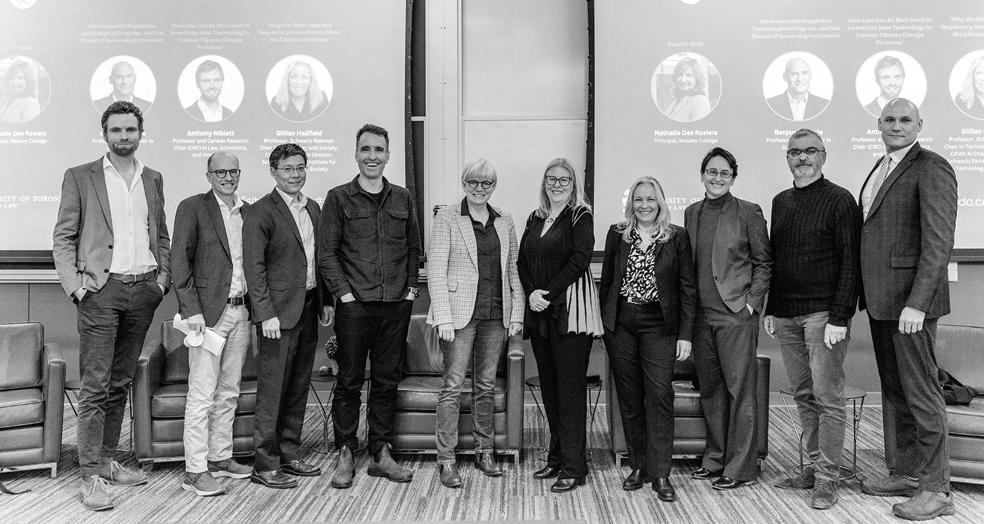 HANNAH WEST (2L) AND ELISE BURGERT (3L)
further discussion, including the economic order, the rights of nature, and the 2022 United Nations Climate Change Conference (COP27), leading to an engaging question-and-answer period where topics from circular economies to consensus-based decision-making were discussed.
The conference was then in full swing with panels discussing topics including law and technology, law and institutions, and who governs in times of climate change.
One theme running through many of the panellists’ presentations was a demonstration of their frank understanding of the climate crisis, coupled with suggestions of how their fields provide potential solutions. For example, Dean Jutta Brunnée discussed how, in one sense, international law has failed because we now have the highest concentration of carbon dioxide in the atmosphere ever recorded; however, she suggested that there is hope in the 2015 Paris Agreement’s non-binding commitment structure that avoids the traps of consensusbased law making.
Julie Ann Shepard, Manager of Indigenous Initiatives, helped to communicate to the law school on the Committee’s behalf.
“We appreciate the entire law school community’s support,” commented Committee member Crabtree. “Several students, staff, and faculty generously donated promises. The auction of the promises raised an impressive sum for the six Indigenous-supporting organizations the committee selected. Many more students, staff, and faculty donated directly to the organizations and enthusiastically participated in the trivia night. As usual, Prof. Niblett hosted trivia with creativity, wit, and humour. Thank you, U of T Law!”
Editor’s Note: Ultra Vires contributed a “super-flattering article” to the silent auction.
Every member of society and every area of law has a role in solving the climate crisis. This was the overarching theme of Law in a Changing World: The Climate Crisis, a conference held at the Faculty of Law from March 2–3, 2023. In keeping with this theme, the conference promised presentations on the intersections of law and the climate crisis. These presentations were given by faculty members who are leaders in diverse
fields, ranging from philosophy to health law.
The conference began with Kim Stanley Robinson, the author of The Ministry for the Future (2020), a science fiction book that discusses climate change. Robinson reflected on how important it is to have intersectional discussions about the climate crisis and hoped that the conference would “fire up the imaginations” of attendees. Robinson made a few remarks on areas ripe for
Cheryl Milne, Executive Director of the Asper Centre for Constitutional Rights, stressed potential ethical issues in the involvement of youth litigants in much of the climate-related litigation brought around the world. However, Milne concluded by saying that there are ways to work with youth litigants to advance climate change cases ethically and that some organizations have already begun to implement some of these changes. The law and technology panel discussed technical
solutions to the climate crisis, such as nuclear fusion and more incentives for innovation.
Another theme running through several presentations were calls to action. For example, Professor Abdi Aidid called for a thorough reconsideration of current legal ethics rules in light of the climate crisis. Additionally, Professor Trudo Lemmens and Gabrielle Peters, a disability rights advocate, called for greater consideration of people with disabilities in climate change mitigation efforts.
The conference was not without spice, with some panellists expressing frustration with the slow progress of the law in Canada. Further, panellists expressed an understanding of why activists may choose to take a more hands-on approach to the climate crisis. This provided a nice contrast to the smattering of comments from attendees and panellists that framed the crisis as not requiring radical change. Varying perspectives were to be expected with well-educated presenters from so many different backgrounds.
Overall, the conference was well attended, ran smoothly, was excellently catered, offered top-quality swag, and provided a plethora of food for thought. We hope Dean Brunnée takes Professor Langille up on his suggestion to turn this conference into a course. We believe this would allow all law students to have their imaginations fired up, and realize that they can and should grapple with the climate crisis, regardless of their legal interests.
NATASHA BURMAN (3L)
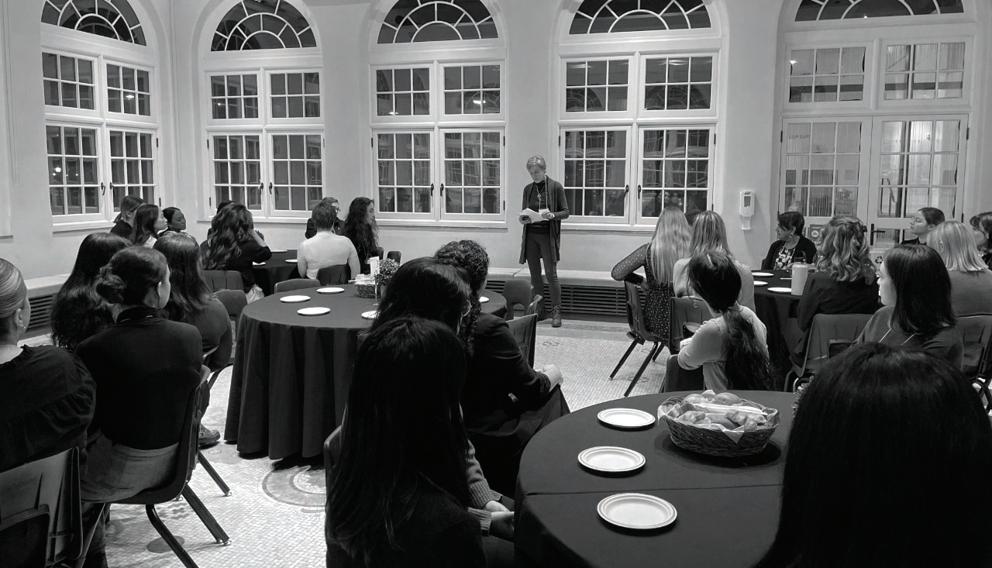
On March 7, 2023, the University of Toronto Faculty of Law welcomed five Ontario judges for An Evening with Female Judges. The judges in attendance were Justice Jill M. Copeland of the Ontario Court of Appeal; Justice Rita J. Maxwell, Justice Gisele M. Miller, and Justice Lucy K. McSweeney of the Superior Court of Justice of Ontario; and Justice Manjusha Pawagi of the Ontario Court of Justice, Family Court.
Female-identifying students of all years at the law school were invited to attend a dinner with the esteemed guests, during which the five judges imparted their great wisdom. Students had the opportunity to speak intimately with the panel, asking them questions about their careers, managing a work-life balance, experiencing imposter syndrome, and for advice about law school, articling, practice, and beyond.
An Evening with Female Judges is a programme
by the Canadian Chapter of the International Association of Women Judges, with a mandate to enhance the work of women judges nationally and internationally in pursuit of equality, judicial independence, and the rule of law. The Association supports women judges around the world; notably, the Canadian Chapter’s Afghan Judges Support Committee is working to aid women judges in Afghanistan who were persecuted when the Taliban assumed control over the judicial system. Many of the Afghan women judges have been welcomed into Canada. The Association strives to eliminate gender bias from judicial systems and promote equal access to the courts.
This is the third time the law school has hosted An Evening with Female Judges, with the last event being held on March 20, 2020, just before COVID-19 restrictions were put in place. This year, everyone who was interested in the event was able to attend.
Court of Appeal; Sarbjit S. Basra, Managing Partner of Davies Ward Phillips & Vineberg LLP; and Prasanna Balasundaram, Director of Downtown Legal Services. Unfortunately, due to unforeseen circumstances, the fourth panellist, Ramandeep Grewal, a partner in the Corporate Group at Stikeman Elliott LLP, was unable to attend.
Planning for this event began last August when Shiv Padam, Co-Chair of Osgoode SALSA, reached out to Jasveen Singh (3L), U of T SALSA Co-Chair, and Devraj Adajania, LASL SALSA President, to gauge interest in a collaborative event.
ed by Jasveen Singh and Devraj Adajania. The moderators skillfully curated questions which prompted responses that provided student attendees with valuable insights and takeaways for their legal education and budding legal careers. The panellists were asked to discuss their journey in the profession as South Asian practitioners, their thoughts on the evolution of diversity in the legal profession, the importance of mentorship, and general advice for law students. Insightful responses from the panellists based on their diverse perspectives and backgrounds provided for an evening of fruitful discussion.
On February 13, 2023, U of T Law’s South Asian Law Students’ Association (SALSA) hosted the inaugural Pathways in Law: The South Asian Perspective panel, in collaboration with SALSA chapters at Osgoode Hall Law School and the Lincoln Alexander School of Law (LASL). The event was sponsored in part by Blake, Cas-
sels & Graydon LLP (Blakes), who hosted the event at their Toronto office, and the South Asian Bar Association (SABA) of Toronto.
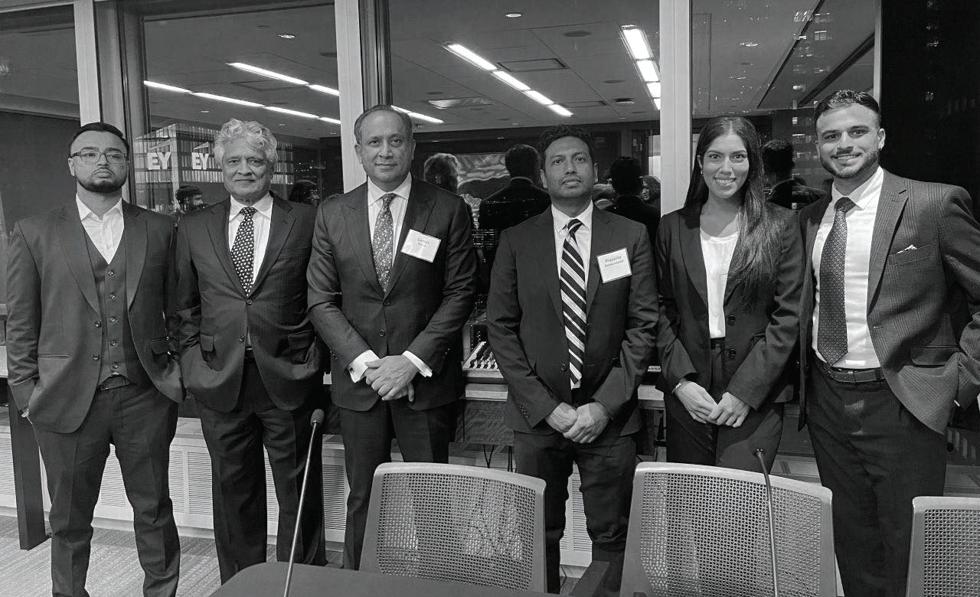
The event brought together panellists from various sectors of the legal profession: Justice Russell Juriansz, the first South Asian judge to be appointed to the Ontario
Countless Zoom calls and conversations between the executive members of the SALSA chapters from the respective schools, including Shiv Padam (3L, Osgoode Hall), Devraj Adajania (2L, LASL), Miina Balasubramaniam (4L JD/MPP), Anisha Sivathas (3L), and Jasveen Singh, went into planning the event. This included various steps, from brainstorming the format of the event to the nitty gritty details of picking a menu for the networking mixer. Members of the planning team assisted by reaching out to Blakes and panellists, and organizing and marketing the event. The assistance of Kyle Elliott, leader of Diversity and Inclusion initiatives at Blakes, was truly invaluable in the planning and execution of the event.
The event began with the panel portion, where the panellists answered a variety of questions pertaining to their respective professional journeys and their lived experiences as South Asian lawyers. The panel was moderat-
The second portion of the evening was a networking mixer, where attendees had the opportunity to mingle with the panellists, other law students, and professionals in the South Asian legal community while enjoying South Asian-inspired light refreshments. Overall, the event had a great turnout with nearly 160 student attendees.
It was an honour to work alongside our colleagues from Osgoode and LASL to bring together trailblazers in the South Asian legal community with law students who will eventually become future practitioners. Our hope is that this event will run annually and continue to provide a forum to connect South Asian practitioners and law students. Special thanks to the panellists, Blakes, SABA Toronto, the U of T Students’ Law Society, Osgoode SALSA, and LASL SALSA for their support in making this event a success!
Editor’s Note: Anisha Sivathas and Jasveen Singh are executives of the U of T SALSA.
TOM RUSSELL (3L)
On March 21, the University of Toronto Faculty of Law hosted the 2022–23 Cecil A. Wright Memorial Lecture. Room J140 was full of notable professors, enthusiastic members of the community, and a handful of eager students. The Wright Memorial Lecture has been a recurring nearly-annual event since 1969. It is hosted in honour of former Dean Cecil (“Caesar”) Wright, who held the position from 1949–65 and is credited with helping to develop the modern approach to legal education adopted by U of T.
This year, Jedediah Purdy, Raphael Lemkin Professor at Duke University School of Law, provided the lecture. Among other topics, Prof. Purdy teaches and writes about constitutional law, property law, and political and legal theory. Prof. Purdy published a book in 2022 called Two Cheers for Politics: Why De-
mocracy is Flawed, Frightening—and Our Best Hope
Prof. Purdy rapidly delivered a lecture filled with complex ideas. Though my typing speed is sub-par, I will do my best to briefly summarize Prof. Purdy’s thoughts.
In his lecture, Prof. Purdy focused on the role that trust plays in politics. Prof. Purdy started by describing trust as the constellation of attitudes that makes dependence on others tolerable and the vulnerability which that trust entails bearable. Prof. Purdy went on to explain a form of trust called “Democratic Trust”: the willingness to hand over major political questions to shifting majorities. Democratic Trust, according to Prof. Purdy, seems to be dependent on either the belief that a collective exists or the belief that others are morally capable of making decisions.
Prof. Purdy lamented that Democratic Trust has
been degrading in North America since the 1970s, further exacerbated by the rise of populism. In explaining part of what underlies this trend, Prof. Purdy discussed the failure of neoliberalism’s assumption, and Adam Smith’s original promise, that markets can improve trust in society. Prof. Purdy stressed the importance of trust in democracies and noted that the recent impulse towards popular sovereignty highlights the importance of Democratic Trust in a polity that obtains its legitimacy from a democratic tradition.
Prof. Purdy ended by noting the importance of asking whether it is possible for politics, moving forward, to help build Democratic Trust in a virtuous cycle, thereby undoing the current trend.
During the question period, one member of the audience noted the pessimistic tone of the lecture and
CLARE MURRAY (2L)
On March 11 and 12, U of T Law’s Sports and Entertainment Law Society (SELS) hosted the 2022–23 Hockey Arbitration Competition of Canada (HACC). This was the first in-person HACC since 2020.
HACC is a mock salary arbitration competition hosted annually by SELS since 2012. The competition is open to law students across Canada and the United States. This year, 16 teams representing 14 law schools competed, including three American law schools (Denver University, Villanova University, and Rutgers University). Four U of T Law students—Shelby Martin (2L), Sang Park (2L), Brody Zukerman Schure (2L), and Alex Sweatman (2L)— formed two teams to represent the Faculty of Law, alongside two students who filled in as a swing team, Patrick Cowley (1L) and Dimitris Logothetis (1L). The HACC started with a preliminary round. Each team competed with a randomly assigned op-
posing team. Afterwards, the winners of the preliminary rounds, and each successive round, competed until there was a final winner. The teams represented either the players or the club and prepared mock NHL salary arbitration briefs. During the competition, competitors presented oral submissions to guest arbitrators with extensive salary arbitration experience. Each team had 18 minutes to present and rebut the other side’s arguments every round. After deliberation, the guest arbitrators chose a winner and provided feedback.
Kristen Buckholt (2L), Co-Director of the 2022–23 HACC, thought that returning to an in-person format greatly benefited all participants, particularly with the new inclusion of a social event for competitors.
“It was incredible to return to in-person competition. We were able to meet so many talented competitors from across North America, and our accom-
asked whether Prof. Purdy had anything optimistic to provide. Prof. Purdy considered this for a moment before providing his thoughtful answer. He noted that, historically, there have been times when the United States showed some capacity to create real change in people’s lives, coupled with an increase in Democratic Trust. From this, Prof. Purdy stipulated that whenever people have the capacity to change things and find that the changes they were able to make created a better world for enough of them, then that might be a start towards an increase in trust.
Prof. Purdy’s lecture, in my opinion, was a wakeup call to anyone that lives in, and depends on, functioning democracies. While the lecture may seem “doom and gloom” at first, Prof. Purdy had some key insights on how we might move forward to create a better tomorrow.
plished guest arbitrators made HACC such a success. It’s amazing to see schools travel from as far as Colorado to attend our competition.”
Students who participated in HACC had a very positive experience. Shelby Martin, who placed second in the final round, said that HACC was a very unique and valuable experience. “The arbitrators were extremely impressive and gave us incredibly helpful feedback on our advocacy. A particular highlight was having the opportunity to argue in front of Brandon Pridham of the Toronto Maple Leafs.”
Other arbitrators included Stefanie Holland of Cassels Brock & Blackwell LLP, André Nowakowski and Dan Rabinowitz of Miller Thomson LLP, and Amir Torabi of the Toronto Blue Jays.
The results of this year’s HACC are as follows: Quarter-Finalists:
• Team 1 (Rutgers University)
• Team 2 (Thompson Rivers University)
• Team 3 (Université de Montréal)
• Team 6 (Osgoode Hall)
• Team 7 (University of British Columbia)
• Team 10 (Université de Sherbrooke)
• Team 11 (University of Alberta)
• Team 14 (University of Toronto)
Semi-Finalists:
• Team 6 (Osgoode Hall)
• Team 7 (University of British Columbia)
• Team 11 (University of Alberta)
• Team 14 (University of Toronto)
Finalists:
• 1st Place: Team 6 (Osgoode Hall: Corbin Boes & Jordan Mamelak)
• 2nd Place: Team 14 (University of Toronto: Shelby Martin & Sang Park)
ChatGPT and other generative artificial intelligence (AI) tools have taken the world by storm. These tools use language models to provide natural, dialogue-like responses to queries. The public can use ChatGPT and similar AI tools to draft essays, create code, and edit work. The use of these tools in an academic setting is currently the subject of mass debate, with some arguing that they encourage cheating while others embrace their use.
While the University of Toronto’s Office of the Vice-Provost, Innovations in Undergraduate Education issued a resource page on using AI tools and AI-generated content in the classroom in January, the Faculty of Law was silent on this issue until recently.
Ultra Vires reached out to the Dean’s Office and the law school administration on March 15 to understand the Faculty’s stance on using generative AI in written submissions. In response, on the eve of March 22, Associate Dean, JD Program Christopher Essert released a statement to the U of T Law community advising them of the law school’s position: absent express instructions from an instructor permitting the use, using generative AI tools on graded written submissions will constitute “the use of an unauthorized aid, which is an offence under the University’s Code of Behaviour on Academic Matters,” and may attract disciplinary action. While the Faculty “recognizes this technology can be used productively and can be an important part of a learning experience,” it is also concerned with academic integrity. This is consistent with the guidance for undergraduate students.
Associate Dean Essert’s email links to the University’s resource page, which provides answers to frequently asked questions like the extent to which students can use AI tools to complete their assessments and how faculty members can determine if a student’s work includes AI-generated content.
The University states that students are expected to complete assignments on their own, without any outside assistance, unless otherwise specified. Professors are encouraged to inform students about what AI tools they may use. The University notes that it is within professors’ discretion to decide if students can use AI tools to create their assignment outlines and first drafts. Consistent with Associate Dean Essert’s email, students are urged to ask their instructors if they are uncertain about the permissibility of using any technology tool.
However, the University discourages professors from using AI detectors (such as “GPTZero”) on students’ work, as the quality of these detectors is yet to be ascertained. Further, the resource page notes that sharing a student’s work with one of these detectors may raise privacy-related and ethical issues. This raises concerns about how a professor can determine whether a student’s work contains AI-generated content. Associate Dean Essert’s email is silent on this issue; however, if the Faculty is largely adopting the University’s guidance in other regards, it could be assumed they too discourage the use of AI detectors.

With exam season fast approaching, this guidance from the Faculty reassures law students’ and faculty members’ concerns. Ultra Vires also surveyed how other schools are responding to this issue and queried students and faculty on their thoughts about the policy.
Beyond U of T
New York City’s (NYC) Education Department has blocked the use of ChatGPT on school devices and networks, citing “negative impacts on student learning, and concerns regarding the safety and accuracy of content.” NYC is not the only school district to outright ban the AI-powered chatbot; as of January, the Seattle Public Schools have banned ChatGPT from all school devices, with the rationale that the district “does not allow cheating and requires original thought and work from students.” Similar controls have been implemented in Queensland and New South Wales, Australia.
In contrast, many universities in Canada have opted to release faculty guidance pages, like U of T. The page issued by York University and the memo from the Associate Vice-President, Academic of the University of Waterloo both state that the unauthorized use of ChatGPT or similar AI tools for generating content that is submitted as one’s own work is considered a violation of academic honesty. A uOttawa page on academic integrity directs students to ask their professors if using AI generators violates academic integrity provisions. Further, students must disclose any use of AI-generated content.
As of publication, McGill University has taken a different position in the debate. Instead, the Dean of Students sent out an internal newsletter naming ChatGPT as the beginning of a new paradigm shift, akin to the release of the HP35 calculator in 1972 and the invention of spell-check on the personal computer. The Dean’s Office is soliciting student and faculty comments on how the future should look.
Ultra Vires reached out to Professor Benjamin Alarie, a vocal proponent of allowing AI tools in the classroom, for his thoughts on what the law school’s policy should look like. Prof. Alarie used ChatGPT to help formulate his comment.
“First, I genuinely believe that AI and ChatGPT have the power to change education for the better,” commented Prof. Alarie. “New tech can help students and faculty in so many ways, like offering personalized explanations and sparking new ideas. But, of course, we've got to find the right balance between using these tools effectively and addressing academic integrity concerns.”
In Prof. Alarie’s view, the Faculty should permit students to use AI tools like ChatGPT so long as they stay within clear guidelines. To Prof. Alarie, AI can be a “helpful sidekick” but not a replacement for students’ own thinking and work.
Prof. Alarie also commented on the concern of academic integrity. He noted that “a reasonable guideline [for students using AI-generated content] is that they should treat it like any other source and give proper credit.” He emphasized that it is the Faculty’s job, as academics, “to help [students] understand the responsible use of AI in their academic journey.”
Finally, regarding the use of AI detectors, Prof. Alarie noted that he understands why the University would be cautious about allowing the use of detectors in classrooms; however, he thinks “they could be helpful in some circumstances for teachers who want to ensure a level playing field for all students.”
Further, Prof. Alarie advocated for finding a “middle ground,” such as “fostering a collaborative environment where students, teachers, and AI work together to maintain academic integrity. Open communication and a transparent evaluation process could be the way to go.”
Ultimately, Prof. Alarie believes that “we can harness the power of AI to create an even more enriching learning experience if we approach it thoughtfully and responsibly.”
Professor Ariel Katz also provided a comment on the issue of using AI detectors, noting that, at the least, there would likely be no student intellectual property concerns. Among other things, this case could be analogized to the A.V. v iParadigms case from the United States, where the use of plagiarism software was held not to be a violation of copyright. Prof. Katz noted that the Faculty has other strong arguments against student intellectual property claims, such as arguing that “no reproduction of substantial part has been made,” and possibly requiring students’ consent to the use of these detectors.
In addition to professors’ perspectives, Ultra Vires asked the U of T Law student community for their thoughts on using AI tools in the classroom. Of the students who responded, 91 percent used ChatGPT or a similar AI tool, with 64 percent using these tools
in relation to their law school work. Many students noted that they used these tools “as a starting point” to formulate ideas and research topics. They also used them to help explain legal concepts. One student responded that they did not find AI useful for interpreting cases, stating that the language model seemed to just make up sources that did not exist. This is a common concern; individuals online have noted that ChatGPT regularly generates fake academic references and should be used with caution. When asked whether students should be allowed to use ChatGPT or a similar AI tool to help with their law school work, most responses recommended permitting the use of AI tools to assist with research, summarize legal topics, and help make writing clearer. Students agreed that users of the tool should be warned of the risks of plagiarism, and the tool should not be used to replace students’ own work.
On the issue of whether to police the use of AI content generation in academia, the polled law students were divided on whether professors should be permitted to screen students’ work using AI detectors. One student noted that where AI-generated content is banned, the ban must be enforced in some way to uphold respect for academic rules. However, another student commented that procedural safeguards are required to ensure that detectors, if used by professors, do not lead to disciplinary action in cases where a student’s work is not plagiarised. As the current standard for finding an academic offence is on the balance of probabilities, this is “far too low, given the reliability issues of detectors.” The student recommended that an offence of using AI-generated content on an assignment should be its own unique academic offence, assessed on a higher standard—“beyond a reasonable doubt.”
With the lack of clarity surrounding the efficacy of AI detectors, policing and enforcing the law school’s policy on the use of AI content in assignments remains uncertain.
On June 23, 2023, section 45(1.1) of the Competition Act (the “Act ”) will come into force prohibiting unaffiliated employers from entering into or enforcing wage-fixing or nonsolicitation agreements. Wage-fixing agreements are agreements to fix, maintain, decrease or control wages, salaries or terms and conditions of employment. Non-solicitation agreements are agreements not to solicit or hire each other’s employees. Commentators on The Canadian Law Forum have suggested that some Canadian law firms may have engaged in wage-fixing, which remains generally permissible under Canadian law until June 23, 2023.
Many Canadians were shocked to learn during the COVID-19 pandemic that wagefixing was not per se illegal when large grocers simultaneously introduced and removed $2 per hour “hero pay.” The grocers deny they engaged in wage-fixing.
When questioned by a House of Commons committee Loblaws President, Sarah Davis, said she sent a “courtesy email” to competitors to let them know about Loblaws’s decision to cut “hero pay.” However, Metro CEO, Eric La Flèche, told the committee he called executives at competitors trying to get information about when they planned to cut “hero pay.”
In 2016, the U.S. Department of Justice (DOJ) announced that they interpreted wagefixing and non-solicitation agreements to be criminally prohibited by U.S. antitrust law and that they would start to investigate and prosecute these agreements. Previously, the DOJ had only pursued civil antitrust complaints against alleged wage-fixing and nonsolicitation agreements.
Currently, the Canadian Competition Bureau can review wage-fixing and non-solicitation agreements under s. 90.1 of the Competition Act . Under this civil subsection, the Competition Bureau can order employers not to enforce wage-fixing or non-solicitation agreements if it can prove on a balance of probabilities that the agreement will substantially or is likely to lessen competition.
According to the Competition Bureau’s draft guidance on s. 45(1.1) of the Act , it will make wage-fixing agreements and non-solicitation agreements per se illegal—there will be no requirement for prosecutors to prove the agreements had any effect on competition. The Competition Bureau’s guidance is not legally binding and can be modified.
Subsection 45(1.1) is a criminal law subsection of the Competition Act . It will require proof beyond a reasonable doubt and carry a criminal penalty of imprisonment of up to 14 years, a fine determined by the court, or both.
Wage-fixing and non-solicitation agreements may be formal or informal. The Competition Bureau’s draft guidance does not consider “conscious parallelism, when a business acts independently with awareness of the likely response of its competitors or in response to the conduct of its competitors” to be a violation of s. 45 of the Act . However, the guidance says “parallel conduct coupled with facilitating practices, such as sharing sensitive employment information or taking steps to monitor each other’s employment practices, may be sufficient to prove that an agreement was concluded.”
For years, there has been great convergence among large Canadian law firms’ salaries. For example, historically, in Toronto, most—but not all—large law firms pay salaries for sum -
mer students, articling students, and associates on the same grid. This salary grid is sometimes referred to as “the market rate” or the “large firm grid.”
Currently, most large law firms’ Toronto offices pay their 2L students and articling students $1,900 a week and their first-year associates $130,000 per year.
Almost all large firms eliminated bonuses for summer and articling students when the Toronto large firm grid "raised" students' salaries to $1,900 per week in 2019. Many large Toronto law firms award discretionary bonuses to associates that range from 10–30 percent of the associate’s salary. Compensation for partners varies widely and does not appear to follow any discernible grid. See Table 1 for the current Toronto large firm grid.
In many industries, salary grids change annually (often to account for inflation). The Toronto large firm grid is “updated” sporadically, with the most recent updates in 2021 and 2019. If the first-year associate salary in the Toronto large firm grid of $130,000 per year had increased with inflation since it was set in 2021 it would be approximately $144,768 today. Law students’ salaries on the large firm grid did not change from 2007 to 2019.
Publicly, it appears the Toronto law firm grid is “updated” by one large firm announcing a raise to salaries, and then most other large law firms match the first mover’s salary raise within a couple of months. Historically, various firms have been the first mover.
The similarity of large law firms’ salaries in Canada does not mean that law firms are engaging in wage-fixing or that they will be liable for violating s. 45(1.1) of the Act once it comes into force. There are innocuous explanations for why salaries may converge and there are defences to s. 45(1.1).
The convergence of the legal salaries may just be the result of conscious parallelism. Many firms may raise their salaries to match a competitor to avoid losing employees to the competitor. Many firms may be reluctant to raise salaries because it will increase their labour costs in the long term and only result in a recruiting edge in the short term as other firms have historically matched salary raises.
Subsection 45(4) of the Competition Act provides an ancillary restraints defence to s. 45(1.1) of the Act . It is available when a wagefixing or non-solicitation agreement is ancillary to a broader agreement between the employers and is reasonably necessary for achieving the objectives of the broader agreement, and the broader agreement alone does not violate s. 45(1.1) of the Act . The Competition Bureau's guidance says it will consider s. 45(4) of the Act to apply to most wage-fixing and no-poaching agreements that are ancillary to mergers and acquisitions of companies.
Other defences apply to s. 45(1.1) of the Act For instance, the regulated conduct defence exempts employers from many competition laws if they are required to follow a valid provincial statute that conflicts with the competition law.
I reached out to some of the largest law firms in Canada and Toronto to ask if they intended to make any changes to their human resources or compensation policies in response to s. 45(1.1) of the Competition Act coming into force. Three firms said they were already in compliance with s. 45(1.1) of the Competition Act or will ensure they are compliant with it
before it comes into force. Five firms declined to comment. Eight firms did not respond to Ultra Vires ’ request for comment in time for publication.
Subsection 45(1.1) of the Act does not apply to conduct before it comes into force on June 22, 2023. As such, employers are not liable for entering into or enforcing wage-fixing or non-solicitation agreements before that date. However, there is no grandfathering provision, so employers may be liable after June 22, 2023, for enforcing wage-fixing or non-solicitation agreements that they entered into before that date.
Subsection 45(1.1) of the Act applies to agreements between employers rather than employment contracts. In some circumstances, employers can effectively prevent employees from quitting to work for a competitor by entering into a non-solicitation agreement with competitors or by putting a non-compete agreement in their employment contracts with their employees. Non-compete agreements prevent an employee from engaging in any business or work that competes with the employer after the employment relationship between the employer and employee ends.
In Canada, there are common law restrictions and in some provinces, statutory restrictions on non-compete agreements. In 2021, Ontario added s. 67.2 to the Employment Standards Act to prohibit employers from entering
non-compete agreements unless they were in connection to the sale of a business or the employee was an executive.
Subsection 67.2 of the Employment Standards Act does not prohibit the enforcement of noncompete agreements that were entered into before the subsection came into force. However, they are still subject to the common law restrictions on non-compete agreements.
It is unclear if s. 45(1.1) of the Act will have any effect on law firms’ compensation or human resources policies or cause a greater divergence among firm salaries.
Generally, economists oppose price-fixing and wage-fixing because controls on the prices of goods, services, or labour tend to distort the efficient allocation of resources in the economy.
The Competition Bureau’s guidance says “employers should take care when sharing information with each other in the course of collaborative activities, such as the benchmarking of employment terms, to ensure that the conduct does not raise concerns under subsection 45(1.1) of the Act .” Hopefully, s. 45(1.1) of the Act does not cause an unintended effect of discouraging employers from publicly disclosing salary and benefits information to jobseekers to avoid any potential concerns under s. 45(1.1) of the Act
Only time will tell if s. 45(1.1) of the Act will shake up Canada’s labour market.
I am sick and tired of U of T professors messing up the names of racialized students.
At the beginning of every semester, friendly professors love to proudly tell the class that they will learn everyone’s names. They want this class to be engaging, not one where they’re just lecturing to blank faces. They claim that this fosters a better learning experience, one where students feel welcome to participate. They happily identify students who have been in their previous classes. They might throw in a joke that it will take them a couple of weeks, that they’re getting old and their memory isn’t what it was when they started teaching, or that this was easier on Zoom when everyone’s name was conveniently displayed under their videos.
But as the weeks pass, it’s easy to notice which names get picked up quicker and which ones are still a struggle. More often than not, professors struggle to remember and pronounce the names of racialized students. It’s even worse for students who have non-English names, as professors flounder in their attempts at pronunciation or just give a vague gesture in the student’s direction while calling on almost every other student by name.
This isn’t just the cute forgetfulness of a busy professor. Let’s call this what it is: a microaggression.
This microaggression comes in several fun flavours. There’s the classic forgetting, where the prof simply does not remember your name, even though you’ve helpfully reminded them multiple times. There’s mispronunciation, where the prof can’t seem to nail the inflections required of your incredibly exotic, incredibly foreign language. There’s misordering, where profs are baffled by the first/middle/last name dichotomy, despite the class list sitting right in front of them. And perhaps most depressing of all, there’s misidentification, where the prof will go through the name of every other racialized student in the class (and there probably aren’t that many!) until they stumble on yours.
“But profs mess up everyone’s names! They have so many students, and they’re so old!” one might counter. I acknowledge that some profs cheerfully mess up everyone’s names and that certain profs mess up more often than others. But the fact that misnaming happens disproportionately to racialized students indicates that profs as a whole have difficulties with students and names that are non-white and non-English.
Others might counter that I’m taking this too seriously. After all, it’s just a name and it’s not like the profs are being intentionally racist. But names are important! Names identify us as individuals. It’s a show of respect to recognize someone and pronounce their
name correctly. In a classroom setting, a properly pronounced name shows that the prof values our presence and our input as intelligent, capable students worthy of being in the class and at U of T Law.
This isn’t just about ~feelings~ either. In classes with participation marks, I’m always left wondering if profs can correctly identify students who have participated, especially if the prof has consistently confused them with other students or has never even acknowledged them by name. Even though participation marks have always been ephemeral at best, it would be nice to have some assurance that the prof is taking participation seriously.
Unfortunately, the name games don’t just stop after law school. The Law Society of Ontario (LSO) grappled with the problem of mispronounced names at last year’s call to the bar ceremony. In a memo dated May 9, 2022, the LSO proposed hiring a professional name reader, “whose training is oriented around linguistics and diverse pronunciation,” to read candidates’ names at the call ceremony. Unfortunately, the LSO passed a motion on May 6, 2022 that for the June 2022 ceremony, “the names of the individual Candidates for Admission shall be read out by Benchers of the LSO, and by no other person.” The seconder for the motion, Bencher Murray Klippenstein, dismissed the issue as a
symptom of “never-ending, round-the-clock, turbocharged identity politics” or “whacky wokism” in Canadian society and the LSO.
If U of T really is “committed to ensuring that [the] law school is accessible to and inclusive of talented students from all segments of society,” it can demonstrate that inclusivity by encouraging professors to make committed efforts to learn the names of racialized students in the classroom.
And professors can take ownership of their mistakes, recognize that they do disproportionately misname racialized students, and make efforts to do better. They may choose to adopt a variety of strategies in their classrooms, like asking students for correct name pronunciations and taking notes, requesting that students bring name tags, or acquiring class lists with student photos from E.Legal. These are all strategies that I’ve actually seen professors use, by the way—so it is possible!
When professors say they want to create better, more welcoming learning experiences, I really want to believe them. Properly recognizing all students in the classroom is the first step they can take toward that goal.
This is my last article for Ultra Vires, our law school’s beloved student newspaper. Since starting classes at the Faculty in the fall of 2020, I’ve made an effort to write at least one article per issue. Now, three years later and nearing the end of my law school journey, I have written or contributed to nearly 60 articles for UV. I’m honestly a bit sad. While I am generally very ready to graduate, I will miss aspects of student life—especially UV.
UV is the best kind of extracurricular this law school has to offer. What other student activity lets you write virtually anything you want an hour after the deadline? Not only do you get to experience the joys of publishing (in print, no less!), your hard work gets compensated with free donuts and a chance to piss off some of your favourite people at the school. In an institution filled with career-daunting, pressure-inducing activities, UV is a low-stakes, high-reward haven tucked away in the basement dungeon of Falconer Hall.

Contributing to the law school newspaper is also a surefire way to meet the coolest and most down-to-earth people. I started law school during the pandemic year, which made it even harder to forge friendships. Joining UV as an Associate Opinions Editor in my 1L year made all the difference in creating relationships that have lasted me to this day. At the very least, it kept me up-to-date on the law school tea (imagine the newsroom the day the IHRP scandal broke).
More than just a fun bonding experience, I’d like to think that UV has made a difference. Of course, it publishes its annual recruit special. In addition to providing the Canadian legal community with important statistics, the publication increases the transparency and accountability of an otherwise opaque recruit process. But while the recruit special is important and hard volunteer work (trust me when I say getting yelled at by a partner of a firm who did not want to disclose
their hiring numbers was not top of my bucket list), UV does more than churn out numbers.
In my first year on UV, I co-wrote an article on a law student’s posthumous call to the bar, the first time the Law Society of Ontario permitted such calls, and one student’s story of resilience in advocating for this result. This represents just one of the many dives into investigative journalism that UV has supported. Last year, when I was co-Editor-in-Chief, we ran an article on a student’s human rights claim against the Faculty and an in-depth investigation into the Faculty’s budget, penned by your current co-Editor-in-Chief, Harry Myles (3L). Tuition is a hot topic at UV; from the Tuition Special in 2013 to the countless articles on the subject, UV has contributed to holding this school accountable for rising tuition costs with seemingly inadequate justification. Even way back when, in 2001, UV worked to be the first to expose the grades scandal at U of T Law that shocked the legal community. And, although it’s been recently characterized as mere complaining (I’m looking at you, Follies), I am very proud of the opinion articles UV has published and continues to publish. To me, they represent the heart and soul of this paper.
In my past life as an Opinion Editor for McMaster University’s The Silhouette, I wrote a totally-not-self-promoting piece on why students should write opinion articles and a final article on why students have a responsibility to hold their institutions accountable. Both hold true today. Students should contribute to all aspects of UV (please do!) but I’m going to make a special case for opinion articles. I know you pesky law students are brewing with hot takes. Please share them with UV!
In the best-case scenario, your opinion article sparks a change or inspires ongoing advocacy. I’ve seen it happen before. For example, though I’ve argued the Faculty’s current lecture recording policy is still suboptimal, the policy up until late last
year was an outright ban. When making yet another plea for lecture recordings, I found similar requests in the UV archives dating back to at least 2016. Though it took six years, a global pandemic, and tons of student advocacy outside of UV for the new policy to come into place, those articles served to support proposals for change and now provide documentation on how the process took place (and an indication of how long it took).
In the worst-case scenario, your article does just that: it joins the UV archive and helps form part of an important historical record in a place where the institutional memory is so short. I can’t tell you the number of times I’ve sat down to start drafting an article, searched the UV archives, and learned that the same concern I’ve had has been echoed by those decades before me. Preserving your thoughts in UV is not only a great outlet to express your concerns and form solidarity (or healthy debate) with your peers, but allows you to connect with those who have already graduated. Contributing to UV really lets you become part of this ever-expanding community.
I echo the words of a wise former Editor-in-Chief of Volume 13, who I had the privilege of interviewing last year: “I’m not worried about the fucking journal continuing because absolute keener, kiss-ass, resume-stuffers are always going to want to volunteer for that pointless job. But UV is an institution that is really just there to augment the joy of student life. It’s not good for the resume; it has no ancillary benefit other than making U of T Law a great place to go and a fun place to be a student.”
I agree. You can painstakingly review the McGill Guide to edit citations for an article that a handful of people, at best, will read. You can also spend hours preparing to moot fake problems for fake court that will largely make no impact on anyone but yourself, if that. Having done both of those activities, I can guarantee that you’ll have much more fun, and likely make a
much bigger difference, contributing to your student newspaper. When I look back at my three years at U of T Law, I don’t remember studying for torts, editing footnotes for journals, or drafting factums.
What I do remember is my 1L study group sending me flowers after my grandma passed away during our property law exam, breaking a heel (or two) at Law Ball as my friends and I danced to bhangra, and all the laughs, gossip, and pride that came from publishing a new issue of UV.
Your time here feels long, but it goes by
quickly. Make sure when you graduate that you have fond memories to look back on.
Editor’s Note: Sabrina Macklai was co-Editorin-Chief of Ultra Vires for Volume 23 in 2021–22 and an Associate Opinions Editor in 2020–21. Much to the current Editor-in-Chiefs’ likely chagrin (sorry, Harry and Shae!), she stuck around in 2022–23 in her very official role as Editor-in-Chief Emeritus.
Message from Harry and Shae: We love you Sab, thanks for everything!
Co-Editors-in-Chief: Martha Côté (3L) and Julianne Schmidt (2L)
Senior Editors: Duncan Crabtree (2L) and Ally Mastantuono (2L)
Junior Editors: Fatima Aamir (2L), Hannah Beltran (1L), and Vidit Desai (1L)
Online Editor: Jason Quinn (1L)
Alexa Koenig, JD, PhD is an adjunct professor and the Co-Executive Director and Co-Faculty Director of the Human Rights Center at the University of California, Berkeley School of Law. Among other appointments, she previously served as co-chair and co-founder of the Technology Advisory Board of the Office of the Prosecutor at the International Criminal Court. She co-authored Digital Witness: Using Open Source Methods for Human Rights Investigations, Advocacy and Accountability (Oxford University Press, 2019) and Graphic: Trauma and Meaning in Our Online Lives (Cambridge University Press, forthcoming 2023).
Andrew Parker (AP): Tell us a little about how you first became involved in open-source investigations.

Alexa Koenig (AK): I was fortunate to join the Human Rights Center (“the Center”) as a graduate student researcher while working on my PhD at UC Berkeley. I was a lawyer before I came to Berkeley and had specialized in cyberlaw, so I was already thinking about the relevance of digital technologies to legal practice. During my first few years at the Center, our brilliant directors (Camille Crittenden and Eric Stover) recognized that digital technologies were beginning to transform how human rights researchers documented—and could document—violations. Smartphones and social media were rapidly shifting how human rights activists and investigators worked and had tremendous potential to shift the field further. At the same time, satellite imagery was being increasingly deployed to understand everything better, from the movement of troops to the location of mass grave sites to the construction of roads and buildings that might be used to facilitate conflict. In 2009, the Center hosted what we think was the first global workshop on new and emerging technologies and human rights practice, called “Soul of the New Machine.” That kicked off the next fifteen years of work at the Human Rights Center, through which we were thinking critically about the role and potential role of digital technologies in securing accountability for violations. During that period, we often acted as a hub to bring technologists, human rights practitioners, lawyers, and others together to advance the field of practice.
As I transitioned from graduate student researcher to Executive Director in 2012, I became increasingly involved in our work with the International Criminal Court (ICC). Our work grappled with how digital information could increasingly be used to corroborate survivor/witness testimonies and could be triangulated with more traditional types of evidence to strengthen the evidentiary basis of international criminal cases. Through that, I helped set up the ICC’s technology advisory board (with Alison Cole) and became co-chair of the board (we had previously helped the ICC set up its scientific advisory board). What Alison had the foresight to recognize in the very early 2010s was the potential role that social media content in particular might play in the documentation of international crimes. She and I began working together and in parallel to
explore how the field could advance. While journalists were pioneering some incredible methods for online fact-finding and verification, we were figuring out where that work had relevance for international legal practice. The lack of clear answers around that led to the creation of the Investigations Lab (to explore how digital information could support legal, journalistic and human rights fact-finding) and later the establishment of the Berkeley Protocol.
AP: You were instrumental in the development of the Berkeley Protocol, which seeks to standardize and strengthen open-source investigation practices. Do you think the Berkeley Protocol will pave the way for greater use of open-source evidence in legal proceedings?
AK: Yes, I think the Berkeley Protocol will help advance the use of open-source evidence in legal proceedings. The protocol was created in direct response to the need of lawyers to figure out how online open-source information (the information that is publicly accessible on the internet) can support legal practice. In the mid-2010s, I was getting calls from lawyers all over the world asking what they should do with the videos and photographs being sent to them over encrypted messaging platforms, or the potential documentary evidence they were finding on YouTube, Facebook, and other platforms. How do they download and preserve that information? How do they store it? How do they code and tag it for the greatest utility, including so that they (or others) could find the information when needed? How do they think about the chain of custody of digital data? How do they verify authenticity?
The protocol was an attempt to, first, aggregate existing jurisprudence and research on these issues and, second, to create a uniform way of talking about digital open-source information. The terminology was all over the place, with OSINT (opensource intelligence) being the primary terme du jour Yet, in most instances, the collected information was not just being used for intelligence (or decisionmaking) purposes, but also as lead information or linkage evidence. Ultimately, the protocol is a normative document that is helping to standardize how we communicate in the space and raise awareness of the kinds of information that may be helpful to court processes. It also underscores how to handle such material responsibly, with an awareness of digital, physical, and psychosocial security risks, as well as emphasizing the importance of incorporating professional ethics into the handling of these kinds of materials.
Ultimately, the protocol creates a foundation for using digital open-source information in legal practice. What every legal team still needs, however, are standard operating procedures that get into the specifics of how they will work with the information. What specific tools will they use for downloading and preserving the data? To analyze the data? What kind of VPN will they use to mask their identity when conducting online searches? We have helped a
number of organizations develop those standard operating procedures (SOPs), using the Berkeley Protocol as a starting place for asking important questions. The annexes in the back of the protocol are designed to help teams create their own documentation templates, create investigation plans, and assess the tools they are considering incorporating into their workflows.
We were intentional in making the protocol tool agnostic, given the rapid pace of technological change. We wanted a document that could endure, and thus it had to be principles-based. Any SOPs float on top of that foundation.
AP: Do you see the development of sophisticated “deep fake” technology as posing a risk to the reliability of open-source evidence?
AK: Yes and no. As many others have pointed out, the biggest risk politically and, to some extent, practically (at least currently) is the liar’s dividend by which people allege that videos or photographs that show them engaging in illegal activity are fakes. Another big risk is that posed by shallow fakes: the mis-contextualizing of visual imagery or written posts, or the surface-level manipulation of what you see. As I’ve written about previously, the risk of deep fakes underscores the importance of engaging in a multi-part verification process like that outlined in the Berkeley Protocol, which has people assess the technical data affiliated with a post or other digital item, as well as the source and the content. In addition, it gives me hope that some extraordinary technologists are working on technical, political, and regulatory responses to these growing risks, even if the field has become a bit of an arms race [between] those creating technologies designed to deceive and those creating technologies to assess authenticity and reliability.
AP: Open-source investigations into human rights abuses often involve spending hours reviewing graphic or disturbing evidence. Do you have any advice on good mental hygiene practices for students interested in open-source investigations?
AK: Yes! Andrea Lampros, co-founder and past resiliency manager of Berkeley’s Investigations Lab, and I have written a book on this that will come out in June. There are a few best practices that we recommend, building off the incredible work already done by others in the space (a shout out here to Sam Dubberley, currently of Human Rights Watch and formerly of Amnesty International, who has played a pivotal role in strengthening awareness of these issues). First, it's important to generate awareness of your baseline functioning, so that you’re aware when you’re beginning to be affected (for example, sleeping poorly or a lot, or increasing your drinking) and can take time off, or engage in other practices that help you process heavy emotions, whether getting professional help, baking, or otherwise. It’s critical to also cultivate awareness of what helps you when you’re struggling. For some that may be meditation, for others exercise, for others playing with kids—it’s incredibly individualistic.
You also want to be aware of your particular triggers. Again, everyone is different as to what affects them most, so if you’re part of a team, maybe there’s a way to divide up what you are looking at to share that load or support each other by taking on the material that affects you less than others, and vice versa.
Second, there are time-tested tips and tricks. For example, keeping the sound on videos turned way down or off, minimizing screen size when you’re just trying to see what content a video contains but don’t need to analyze that video, turning off autoplay on your social media feeds so you can control your exposure, being sure to label graphic videos with what kinds of graphic content they contain before sharing with others (so they can make smart choices about whether, when, and/or where to watch), and thinking critically about where you look at graphic content and when. For example, you want to avoid scrolling in your bed late at night or alone in order to protect those times and spaces from being affiliated with upsetting material. Also, don’t just watch to watch—have a reason.

Third, community is important. Can students be partnered up so that they have at least one other person as a support? Can you celebrate the milestones as a team? Can you connect with people who have been affected by the atrocity you’re witnessing to understand the human dimensions of the work that you’re doing and to connect yourself to the reasons why this work is important?
While there’s so much more to talk about, I would also stress the importance of acknowledging and celebrating impact. Even little “wins” are worth pointing out.
Finally, a great resource for more information is provided by RatedResilient, as well as that provided by the Investigations Lab at the University of California, Santa Cruz, some of which was created in partnership with our team.
AP: What advice do you have for students who are interested in OSINT but who don’t know how to get started?
AK: There are several excellent online and offline resources. One free online training was put together by Amnesty International with Advocacy Assembly. I would also follow various organizations and individuals on Twitter. If you pull up #OSINT, you’ll start seeing resources. A number of organizations provide free or low-cost courses. I’m biased, but I also think the book Digital Witness can provide a solid foundation for thinking about everything from the history of open-source investigations, to the methods and the ethics. We’re beginning work now on the next edition.
I’m really excited to see how this field evolves and am heartened to see these kinds of methods scale, ideally in ways that are thoughtful and keep the dignity of all those impacted at the center. This interview has been edited for brevity and clarity.

Adam F. Fanaki Competition Law Moot
Mooters: Hudson Manning (4L), Gordon Milne (2L), Edmund Nilson (2L), and Max van der Weerd (2L)
Student Coaches: Grace Li (3L) and Kyra McAllister (3L) Adjunct Coaches: Michael Laskey (Stikeman Elliott LLP) and Nathaniel Read-Ellis (Adair Goldblatt Bieber LLP)
The Fanaki Moot presents students with the opportunity to engage with civil and criminal issues in a growing area of law. This year’s participants dealt with a case of misleading advertising, where the impugned company, Pear, marketed the highlevel privacy features of its new phone but subsequently suffered a security breach.
The Fanaki Moot took place on March 24 and 25 in Toronto. Max van der Weerd and Edmund Nilson were the winning pair and awarded best respondent team and best respondent factum. Van der Weerd likewise won third best respondent oralist. Gordon Milne and Hudson Manning won second-best appellant team and Milne was awarded second-place appellant oralist. U of T Law was awarded “best faculty” overall.
Callaghan Memorial Moot
Mooters: Jordyn Selznick (3L), Andrea Almeida-Pasko (2L), Genevieve Citron (2L), Gurratan Gill (2L), Rose Ghaedi (2L), Priti Gupta (2L), Emily Hean (2L), Hannah Im (2L), Justin Kim (2L), Rebekah Kim (2L), Ben Kitching (2L), Noa Levin (2L), Kyle MacDonald (2L), Ronan Mallovy (2L), Olivia O’Connor (2L), and Lucy Yang (2L)
Student Coaches: Myles Goodman-Vincent (3L), Kaitlyn Nelson (3L), Zachary Rosen (3L), Stefan Rus (3L), Alison Schwenk (3L), Cameron Somerville (3L), Emma Tomas (3L), and Bill Xu (3L)
Faculty Advisor: Diane Shnier (Polley Faith LLP)
The Callaghan is U of T Law’s in-house moot, focusing on issues in criminal and constitutional law. This year’s problem was loosely based on R v Canfield, 2020 ABCA 383, and provided the students with an opportunity to explore issues of stare decisis, s. 8 Charter violations, and the exclusion of evidence under s. 24(2) of the Charter
This year’s winning pair was Olivia O’Connor and Ben Kitching, with Ronan Mallovy and Hannah Im as the runners up. Noa Levin and Gurratan Gill were awarded best appellant’s factum, while Mallovy and Im submitted the top respondent factum. O’Connor was selected as the top oralist, Lucy Yang as the second best, and Mallovy third.
Canadian Labour Arbitration Competition
Mooters: Clare Murray (2L) and Sang Park (2L)
Student Coaches: Jacqueline Huang (3L) and Victoria Purdy (3L)
Adjunct Coaches: Kathryn Bird (Ogletree Deakins PC), Amanda Lawrence-Patel (Hicks Morley Hamilton Stewart Storie LLP), Lauren Pearce (Jones Pearce LLP), Kate Shao (Paliare Roland Rosenberg Rothstein LLP), and Stephen Shore (Ogletree Deakins PC)
The Canadian Labour Arbitration Competition is a unique opportunity for students to engage in a simulated grievance arbitration hearing. This year’s problem arose out of a dispute between a long-haul truckers’ union and its employer: students dealt with the privacy implications of police requiring in-cab cameras in all trucks and the termination of an employee who consumed medical cannabis to treat symptoms of post-traumatic stress disorder. The competition took place on February 4 and 5 at the Ontario Labour Relations Board in Toronto.
Davies Corporate/Securities Law Moot
Mooters: Lien Shi (4L), Ben Grondin (2L), Isaac Jonker (2L), and Evan Morin (2L)
Student Coaches: Robin Chang (3L) and Rose Ma (3L)
Adjunct Coaches: Shane D’Souza (McCarthy Tétrault LLP) and Andrew Matheson (McCarthy Tétrault LLP)
The Davies Corporate/Securities Law Moot is a unique experience that allows teams to argue both sides of the argument of a securities law problem. This year’s problem, loosely based on the Court of Appeal for Ontario’s decision in Wong v Pretium Resources, 2022 ONCA 549, explored a secondary market liability misrepresentation claim arising out of an alleged failure to disclose material information.
U of T Law students participated on March 13 in Toronto. Congratulations on winning best factum and third-best team overall!
Donald G. Bowman National Tax Moot
Mooters: Lillian Liu (3L), John Metzger (3L), Matthew McGreer (2L), and Christian Wigger (2L)
Student Coaches: Zoey Chau (3L) and Chuxi Wang (3L)
Adjunct Coaches: Benjamin Alarie (U of T Law), Andrew Boyd (Baker & McKenzie LLP), and Martha MacDonald (Torys LLP)
U of T Law students competed online on March 3 and 4 in Canada’s National Tax Moot. The problem involved an appeal of the recent Supreme Court decision in Canada v Collins Family Trust, 2022 SCC 26. Mooters were tasked with grappling with the Court’s interpretation of the availability of equitable rescission for mistakes with tax consequences.
Gale Cup Moot
Mooters: Mackenzie Faulkner (3L), Adrianna Mills (3L), Emma Danaher (2L), and Benjamin MacLean-Max (2L)
Student Coaches: Laura Goldfarb (3L), Charles Ma (3L), and Benjamin Zolf (3L)
Adjunct Coaches: Sinziana Hennig (Stikeman Elliott LLP) and Paul-Erik Veel (Lenczner Slaght LLP)
U of T Law saw great success during the competition in Ottawa on March 3 and 4 for the competition’s 50th edition. Mackenzie Faulkner and Benjamin McLean-Max were chosen as winners, while also receiving the award for second-best factum. McLean-Max was further selected as the best oralist in the final rounds.
Harold G. Fox Intellectual Property Moot
Mooters: Sabrina Macklai (3L), Christopher Black (2L), Sarah McLaughlin (2L), and Ayushi Thakur (2L)
Student Coaches: Annie Chan (3L), Megan Chan (3L), and Amy Yun (3L)
Adjunct Coaches: Dominique Hussey (Bennett Jones LLP) and Andy Shaughnessy (Torys LLP)
The Fox Intellectual Property Moot problem challenged competitors to deal with issues posed by cutting-edge technologies in telecommunications. The problem featured an action for patent infringement against SpaceNext Canada, the operator of a satellite network servicing Canadian communities. An aspirant competitor, RF Access, sought an injunction claiming that the network infringed on the technology they used in their cellular networks.
U of T Law mooters competed on February 24 and 25, with Christopher Black and Sarah McLaughlin securing a second-place finish.
Law Moot
Mooters: Ikram Handulle (3L), Fatima Aamir (2L), Shae MacPherson (2L), and Daryn Tyndale (2L)
Student Coaches: Lauren Cao (3L), Jane Fallis Cooper (3L), and Gina Kwon (3L)
Adjunct Coaches: Kes Posgate (Battista Migration Law Group) and Nicholas Woodward (Battista Migration Law Group)
The moot problem tasked competitors with an appeal concerning a mother and two children from Brazil seeking refugee protection on the basis
of domestic violence. The administrative tribunal relied heavily on unsolicited evidence from the father to deny refugee status to the claimants.
The competition took place virtually on March 2 and 3, with U of T securing the award for the top overall law school, reflective of receiving the top oral and facta scores.
Julius Alexander Isaac Moot
Mooters: Duncan Crabtree (2L), Erica Fox (2L), Alexandra Guerra (2L), and Amy Kwong (2L)
Student Coaches: Laura Goldfarb (3L), Katarina Kusic (3L), and Ivy Xu (3L)
Adjunct Coach: Joseph Cheng (National Litigation Sector, Department of Justice Canada)
This year mooters dealt with an appeal from the Ontario Court of Appeal’s decision in R v Morris, 2021 ONCA 680, a case where the Court considered the role of anti-black racism in sentencing. Mooters were tasked with a doctrinal issue regarding how trial judges should take anti-black racism into account during sentencing and were challenged to consider wider theoretical grounds of appeal, such as whether the Criminal Code should formally recognize over-incarceration of black offenders. Mooters competed between February 2–4 at Osgoode Hall.
Laskin Moot
Mooters: Madeline Eskandari (2L), Milana Grahovac (2L), Hye-Seon Jung (2L), and Irene Li (2L)
Student Coaches: Faisal Bhabha (3L) and Maguid Nicholas (3L)
Adjunct Coaches: Lauren Pearce (Jones Pearce LLP) and Stephen Shore (Ogletree Deakins PC)
This year’s moot was an appeal from a fictional decision of the Federal Court and Federal Court of Appeal in Citizens for Democracy v Canada (Attorney General). This year’s topic concerned the cancellation of the federal election by the Governor-inCouncil because of protests by a group that had occupied cities and towns and destroyed sources of artificial light across the country. Students dealt with whether the public authority exceeded its statutory power and violated Canadian citizens’ s. 3 Charter rights—the right to vote—by cancelling the election.
The Laskin was hosted by Dalhousie University in Halifax between February 23–25. U of T Law placed 10th in the competition, with Madeline Eskandari being selected as 20th best oralist.
Philip C. Jessup International Law Moot Court Competition
Mooters: Julia Cappellacci (2L), Jeffrey Ma (2L), Jack Stewart (2L), and Nicolas Williams (2L)
Student Coach: Mishail Adeel (3L)
Adjunct Coaches: Misha Boutillier (Canadian Centre for the Responsibility to Protect), Jonathan Hou (Financial Services Regulatory Authority of Ontario), Daniel Sisgoreo (Quinn Emanuel LLP), and Maureen Whelton (Stevenson Whelton LLP)
This year’s problem centred on the Clarent Belt, a small sliver of coastal land leased by one country to another. Mooters were challenged with issues of war, including self-defence and international humanitarian law, as well as the lawfulness of sanctions and liability for causing environmental harm.
U of T Law students competed in Winnipeg between February 23–25, and came fourth place overall. Julia Cappellacci and Nicolas Williams secured second-best applicant memorial, while the team as a whole was awarded the prize for thirdbest memorial. Jack Stewart was ranked as the second-place oralist.
Walsh Family Law Moot
Mooters: Niema Mohammad (3L), Hamza Naim (3L),
Fievel Lim (2L), and Emily Rand (2L)
Student Coach: Tommy Ritthaler (3L)
Adjunct Coaches: Richard Glennie (Beaton Burke Young LLP), Heather Hansen (McCarthy Hansen & Company LLP), and Martha McCarthy (McCarthy Hansen & Company LLP)
The Walsh Family Law Moot allows students to engage with hot topics in family law, and a chance to meet judges and practitioners alike in the family law bar. This year’s topic was a case of divorced parents disagreeing on whether their children should receive the COVID-19 vaccination or not.
U of T Law students participated on March 4 at the Ontario Court of Appeal in front of many family law judges from across the province. Congratulations to Niema Mohammad for winning best oralist!
Walsh Family Law Negotiation Competition
Competitors: Zoey Chau (3L), Carissa De Marinis (3L), Jasveen Singh (3L), and Anna Welch (2L)
Student Coach: Tommy Ritthaler (3L)
Adjunct Coaches: Samantha Eisen (Gillian Hnatiw & Co.) and Judith Huddart (Ontario Association of Collaborative Professionals)
The Walsh Family Law Negotiation Competition is a unique opportunity for the students to draft a representation plan and participate in a real-time negotiation with the opposing counsel.
U of T students participated in this competition on March 4 and did so with flying colours! One team won the award for the best-written representation plan, while the other won first place for the negotiation itself.
Warren K. Winkler Class Actions Moot
Mooters: Appollonia Mastrogiacomo (3L), Caeleb “Rae” Goff (2L), Ryan Reid (2L), and Roya Shidfar (2L)
Student Coaches: Mackenzie Faulkner (3L) and Griffin Murphy (3L)
Adjunct Coaches: Joseph Blinick (Bennett Jones LLP) and Cheryl Woodin (Bennett Jones LLP)
The Winkler Class Actions Moot gives students a unique opportunity to participate in a class certification proceeding. The moot problem for class actions is unique because it is a motion for class certification. The moot problem this year was whether plaintiffs impacted by the sale of their data through the application “QuickClips” had a certifiable class on the common issues of breach of PIPEDA and the tort of intrusion upon seclusion.
This year’s team saw great success in the competition, held in mid-March in Toronto. Ryan Reid and Caeleb “Rae” Goff were the winning pair, while Ryan Reid and Roya Shidfar were chosen as the first and second-best oralists, respectively.
Wilson Moot
Mooters: David Côté (3L), Nicholas Heinrich (2L), Laura Henderson-Cameron (2L), and Caitlin Salvino (2L)
Student Coaches: Katarina Kusic (3L), Haya Sardar (3L), and Ivy Xu (3L)
Adjunct Coaches: Joseph Cheng (National Litigation Sector, Department of Justice Canada) and Cheryl Milne (Asper Centre for Constitutional Rights)
This year, mooters dealt with a claim brought by Daniel Nakashima, a city planner who was terminated by the Cape Breton Regional Municipality after struggling to return to in-person work after the COVID-19 pandemic. Nakashima made claims that the policy violated his rights under both ss. 7 and 15 of the Charter U of T Law’s mooters were highly successful in the oral rounds in Toronto, winning the competition and being awarded the best facta. Caitlin Salvino was also selected as second-best oralist.
As this year’s competitive mooting season comes to a close, participants and coaches may reflect on the long and exciting journey in which they engaged. This year was particularly special, as for many competitors it meant a return to in-person mooting after years of virtual moots during the COVID-19 pandemic. As usual, Ultra Vires sent out a survey to ask for feedback and comments on the mooting process. Around 20 students responded to our survey.
The Moot Court Committee (MCC) explained that the organization and administration of the moots are split between the MCC and the Faculty. The Faculty is responsible for the requirements and prerequisites of moots, registering competitors, and finding faculty advisors.
On the other hand, the MCC, a student-run body, is in charge of organizing and running moot tryouts within the Faculty’s parameters, finding student coaches, and coordinating the 1L moots and trial advocacy, as well as organizing the Grand Moot.
The first question posed in the survey asked for students’ thoughts on the timing of the moot tryouts. Overall, the responses were generally good. Upper-years appreciated that the tryouts happened early in the semester before classes ramped up. Some still wished there was more time to prepare for the problem before the actual tryout though; the MCC noted in a comment to Ultra Vires that sign-ups and the initial information session are made available on the first day of school, and moving the information session any earlier is not feasible. One suggestion was to distribute a recording of the moot infor-
mation session earlier on for those who are interested. Another common complaint was that phone callbacks were quite stressful and perhaps a different process should be explored.
There was a dichotomy in opinion on the moot tryout process itself. A few responses indicated the process was “fair” and they “wouldn’t have changed anything.” On the other hand, the majority of responses indicated the process itself was too short, especially considering that there were two rounds of tryouts. The two rounds also seemed dubious, considering that only about five students were eliminated on the first day.
Many also thought the mooting process was a lot to handle for those who have never mooted. Many expressed that they were completely clueless and confused, and that the whole process seemed to be geared toward those who had moot experience. The general sentiment for these students was that they wished there was more specific instruction on how to prepare for the moot tryout. Fortunately, substantively, the tryout material length and overall fairness of the actual tryouts weren’t particularly contentious this year.
There was another mixed bag of answers for how well-informed mooters felt for their particular moot competitions. This is probably due to the individual variance between the different competitions. For example, the Arnup Cup had good access to information, as it was mentioned often in the Trial Advocacy class prior to tryouts. On the other hand, others expressed that they “knew literally nothing about [their moot].”
Some individuals felt like they were missing information on the actual workload and on how particular deadlines worked with their moot. One suggestion was to have a database where basic information could be found regarding “rough dates for factums/competitions, subject area, number of schools participating, external advisors, [and] past year results so we know if it's going to be a lot of work.”
Most survey participants did not mind the timing of their moot competition. Of course, dates vary for each moot. As a result, some complained that it was too late in the semester, leaving them behind for exam preparation, while others complained the opposite, that it was too early, forcing them to work during the winter holidays. However, it is clear that this would be a difficult problem to rectify, due to the number of moots and the busy schedules that law students inevitably have.
Mooting coaches were universally well-received. Students really appreciated that coaches were “helpful,” “very kind,” and “awesome.” Participants recognized mooting coaches were taking their own time to do this for the most part, and were grateful for the coaching, preparing, and scheduling that had to be done for each moot competition. Special shout out to all the student coaches who helped out!
Most participants stressed the significant workload that comes with a competitive moot, particularly for run-throughs in advance of the competition’s oral portion. Most significantly, in January and February, time commitments were varied but high, ranging from 10–20 hours per
week. Students felt that this did not align with the credit allocation each moot received (3–4 credits for the full year) and that it was difficult to catch up on school work once the mooting season ended in March. With that being said, some students acknowledged that they were “only as busy as [they] care[d] to be”, and that, since the competitions are ungraded, students may choose how much work they wish to invest into their competition.
For student coaches, the workload can be equally demanding, with the need to support factum writing and attend practices throughout much of the year. One former coach expressed particular frustration that coaches do not receive credit unless they complete additional work on top of their support for their mooters.
The MCC noted that this was not a concern that had been shared with them previously, and they encouraged concerned students to raise it with the Faculty in the future.
Overall, while students did raise significant concerns about the steep learning curve involved in the tryout process and the strenuous workload, they were quick to note the wide range of positive experiences involved in mooting. Commenters highlighted the unique value of mooting as an opportunity to engage in oral advocacy at a young age and connect with other law students across the country who are also interested in litigation, arbitration, and negotiation. What is clear from this year’s reflections is that there is nothing quite like mooting in the U of T Law student experience.
FIEVEL LIM (2L)
Editor’s Note: Ultra Vires contributed a personalized profile to this year’s law school Promise Auction. Professor Jim Phillips was the generous winner, who graciously selected his good friend, Professor Martha Shaffer, to be highlighted in this interview. Literally none of the upcoming information was fabricated nor exaggerated.
Now if you thought that the profile on Professor Jim Phillips back in 2017 was impressive, you were right—it was. But even so, I know for a fact that none of you are ready for this. Those of you who don’t know her, brace yourselves. Who is this shining star? Well, of course, it is none other than our very own Professor Martha Shaffer, the pride and joy of the Faculty of Law.
If you haven’t heard already, Professor Shaffer teaches the number one most sought-after class, Evidence Law. While the rules and exceptions for hearsay are obviously riveting for any law student, that isn’t why this class boasts an impressive 200-person waitlist. Yes, that’s right, Professor Shaffer is the reason the upper years vie for this class. As one of the lucky law students enrolled in Evidence this semester, I can confirm that there are a million and one reasons why this class is everyone’s number one choice on Cognomos, making it the single most difficult class to get into, despite its 80-student class size.
When I found out that Professor Shaffer had been selected for this profile, I knew I had to personally find out more about our beloved professor. She is, of course, lovely, sweet, and by all accounts, kind. Some other information may shock you—so buckle up, and stay tuned. Allow me to share with you all the information you didn’t know you needed until now about Professor Shaffer, aside from her well-renowned teaching.
Professor Shaffer grew up in Edmonton, Alberta, and in 1979, she headed to Harvard University for her undergraduate degree. Like many of us, Canada was always going to be home. After finishing her degree, Professor Shaffer was drawn to Toronto, having always wanted to visit the city. When I asked her why she loved Toronto so much, she replied that it was “interesting, vibrant, and diverse,” and I certainly couldn’t agree more.
For her next steps, Professor Shaffer couldn’t decide whether she wanted to go into psychology or law. She worked at a law firm for a year as a law clerk and “hated every single minute of it.” I mean—that’s fair, who wouldn’t?
So what did she want to do? Professor Shaffer replied that at the time she wanted to do social justice type of work, particularly where she could work closely with people. She went to law school notwithstanding her legal experience, thinking she would do clinic work or practice in poverty law. She smiled knowingly when I suggested that she does sort of work with people in dire financial straits in need of her expertise—not too far off
from her original plan.
She described her transition into teaching as something she just fell into. The Faculty at the time was looking for a very short but strong woman who could carry and uplift students, literally and metaphorically. Needless to say, Professor Shaffer fits that bill to a tee.
Beneath her confident exterior, Professor Shaffer is sweet, lovely, and modest to a fault. You will probably have noticed all these photos of her are surreptitious, as Professor Shaffer is self-described as “camera-phobic” and has “literally never taken a selfie in her life.” I had to obtain a candid photo (with her express consent) as an alternative.
Furthermore, Professor Shaffer had a thing or two to say about her good friend Professor Phillips. They met in 1988 as fellow clerks for the Supreme Court of Canada and have been the best of friends ever since. Professor Shaffer instantly recognized Professor Phillips as someone a little bit older and smarter at the time.
She described Professor Phillips as the “most generous, kindest person [she] knows, not to mention the smartest.” It couldn’t be clearer how much respect these two have for each other. Professor Phillips came to Professor Shaffer’s rescue one late night while doing research at the library, where she was unable to reach a book on the top shelf. Luckily, it was nothing that couldn’t be solved by Professor Phillips’ impressive height and long arms. No wonder Professor Shaffer looks up to him, literally and figuratively.
Their friendship has never waned. When the faculty moved out of the old building, Professor Shaffer and Professor Phillips purposely chose to have offices next to each other, so that their friendship could be reflected in their office proximity. Need I say more?
I asked her one last question: “Why do you love us students?”
She replied, “I like students. I really love the interaction with students, and the worst part of the pandemic was not being able to interact with students on a daily basis.” Professor Shaffer comes to the Faculty of Law every day just to run into students, even on days off! Now that is true dedication.
Before letting me go, Professor Shaffer did have one secret to share—her secret passion: bodybuilding. Yes, you read that right. We all knew she was a scholarly superhero, but it turns out she is more than just an intellectual genius. She even had a picture to share, which I have permission to share with you all now. Professor Shaffer’s defining feature, her hair, can be seen in the photo—but that’s not all that’s defined if you know what I mean

Who knew that Professor Shaffer was moonlighting as a superhero? No wonder she’s so good at carrying students through law school. Don’t worry, Professor, we appreciate you, and your secret is safe with us.
What an incredible year! This past academic year, the Faculty of Law Athletics Association (FLAA) organized 22 intramural teams across various sports. We had 158 law students, representing approximately a quarter of the student body, play in at least one game this year. All of our intramural teams were also open to graduate law students and recent law graduates. Whether it be flag football and ultimate frisbee or dodgeball and soccer, many students participated in numerous teams across both semesters. Over 150 games were cumulatively played against students from undergraduate colleges and other professional programs.
Many of our teams found great success, especially in the fall. In the fall semester, the Women’s Soccer, Mixed Dodgeball, and Open Flag Football teams finished first in their leagues. In
the finals, Women’s Soccer won 4–0 against Victoria College; Flag Football won 20–0 against U of T Mississauga, and Mixed Dodgeball won 5–2 against Pharmacy. Both Women’s Soccer and Flag Football were undefeated in their championship run! In the winter semester, the Mixed Dodgeball team, captained by Ronan Mallovy (2L/MA English), returned to the finals, where they unfortunately lost to Dentistry. Mallovy commented, “We fought hard and threw harder, and we’re coming back next season for the prize. Thanks to the whole team for making it a great season!”
This year, FLAA saw great support from the law school as Sara-Marni Hubbard helped secure funding which subsidized the cost of jerseys for the hockey team and athletic shirts for the student body. The U of T Law hockey team

showcased their new kit in a friendly exhibition match against Osgoode Hall Law School, and many students wore their athletic shirts during their games. Thank you to the FLAA execs, Dilan Brar (3L), Mackenzie Thomas (2L), and Christos Kakaletris (2L), for helping us set up the various logistics surrounding intramurals. Finally, a huge thank you to all our team captains for your leadership and organization!
Some truly standout players include Abby Bruyer (1L), Maddy Regan (1L), Samir Reynolds (2L), and Andrew Luba (JD ‘21)! Bruyer played in 33 games across seven intramural teams and is a two-time champion, winning in Women’s Soccer and Mixed Dodgeball. Regan is also a two-time champion and played in 26 games across five intramural teams. Reynolds and Luba are also champions, winning Open Flag Football together and having played in 22 and 16 games, respectively.
Leading FLAA has been a rewarding experience, and there is tremendous potential for athletics to be expanded at U of T Law. If you wish to lead FLAA next year, please contact Melanie Vincent (2L) and Justin Kim (2L) via email at uoftlawathletics@gmail.com.
As we head into the final stretch of this semester, we at In Vino Veritas find ourselves feeling “senioritis” at an all-time high—so much so that we were unable to come up with a real theme this month. Instead, we’ve put together a list of our favourite wines of the moment. Please enjoy these wonderful juices as you procrastinate working on outlines.
As I sit down to write this review, seven hours past the article submission deadline, I can feel the senioritis reaching peak levels. I’ve managed to not contribute a single IVV review for my entire 3L year thus far, but that all changes now! While I had all the intentions of going out with a bang and reviewing something bougie to end the year (and my degree), I have simply lost control of the semester and so, instead, you’ll get my review of a bottle of wine that’s been collecting dust on my shelf for at least the past year. I know what you’re thinking: ”Shae, what do you mean you don’t immediately drink the wine that you buy?” Listen, I get you, but I love to plan for a rainy day, not unlike today. You never know when the procrastination will hit, and you’ll be thankful you saved yourself a secret stash of the good stuff.
Okay, onto the wine. One thing I love more than putting off my responsibilities until the absolute last moment is a good French wine. This is no exception. Hints of lemon meringue, tart acidity, and chalky on the palate (trust me, ask for a mineral-forward white and you won’t be disappointed), this wine pairs great with salty chips and the last ounces of energy and willpower you have to finish the semester.
Is this my best review? Absolutely not, but it’s honest work. Grade: P

Jared Barkman (2L)
Claus Preisinger – Blaufränkisch
Grape Witches | $39
I had a rude awakening in recent weeks when someone referred to me as being in my “late 20s.” Upon further reflection, it struck me that, at my age, my parents had three kids and a mortgage, while I’m a broke student undertaking yet another degree. Perhaps that explains why I’m suddenly waking up with a headache after two glasses of wine, necessitating a reprioritization of my alcohol consumption.
In essence, it’s time to “act my age,” ditch the bottom-shelf bottles from undergrad, and choose my early-onset hangovers selectively. This is where Claus Preisinger comes in, an organic producer in Burgenland, Austria, who embraced biodynamic wine long before it was trendy. While long a fan of his infamous Zwiegelt, this bottle was my first foray into the Blaufränkisch varietal, and I may never go back. A dark red grape with rich tannins and a touch of spice, the wine still drinks nearly as light as a pinot noir, with juicy notes of plum and red fruit and bright minerality. Why buy two bottles of Apothic Red when you can have twice the enjoyment and half the headache?
Howard – 2018 Folly Alvarinho
Summerhill LCBO | $23.95
A few nights ago, I had the pleasure of enjoying this rich, moderately aged white from the Vinho Verde region of northern Portugal. This unique microclimate is renowned for producing crisp and refreshing white wines with high acidity. The high acidity lends itself well to aging the wine, a relatively unique quality among whites.
The result of five years in the bottle is a well-balanced, elegant palate with a relatively full body and dark honey colour. It smells of citrus and minerality with green apple, pear, and candied lemon flavours.
It drinks beautifully on its own but would also pair well with light appetizers or seafood. I found it was perfect alongside fish tacos and chips and dip.
I would recommend this bottle (and Portuguese Alvarinho/Spanish Albariño in general) to anyone who is a fan of mineral-forward whites like Pinot Grigio and is looking to explore bolder, more unique options.
Segura Viudas – 2021 Heredad

Reserva Brut Cava
LCBO | $39.95
Sometimes I just walk into the LCBO and take the first bottle that catches my eye. This month, that bottle was the Segura Viudas Cava Reserva Heredad Brut. This is a sparkling wine composed of a blend of Macabeo and Parellada from Catalonia. I am so happy I picked up this bottle because I loved this wine.
Not only is the bottle eye-catching, but the wine has a light straw colour and a beautiful, fruity aroma. I noted flavours of lemon, apricot, and nuts. The taste is very smooth and the finish was noticeably acidic and clean. This wine is delicious, light, and refreshing. I would highly recommend this sparkling wine as a starter at your next summer hangout. For pairing, I would recommend shellfish, cured meats, or white fish.
Mare Di Sirena – Pinot Grigio LCBO | $9.95
It is 11pm. You are in a lonely study room in the Bora Laskin Law Library, which is about to close. You are in no way close to finishing your revisions for your Corporate Tax Law exam. Standards have dropped. There is an LCBO only a 15 minute walk away. On top of everything else, you only have $20 in your account after paying rent. Suddenly, you see a beautiful mermaid on a bottle that claims to be imported from Italy. You buy it. It tastes horrid but it’s just the liquid courage you need to continue your work (and potentially blackout if you decide to go clubbing).
According to reviews, this white wine is meant to have flavours of citrus, white peach, and a hint of pear. In my humble opinion, it is not good, but it is cheap and, if you just want to drown your Corporate Tax sorrows, it does the job. Best paired with your burned-out brain.
ANDREW PARKER (2L)
3 Brewers
272 Yonge Street
A hop, skip, and jump away from YongeDundas Square, 3 Brewers is conveniently located for anyone hoping to grab a beer after a long day shopping at the Eaton Centre or preaching to passersby. Admittedly, 3 Brewers is, in many ways, unremarkable. With a menu of greasy bar fare and a decent beer list, its offerings are uncontroversial if not unimpressive. That said, 3 Brewers’ trademark “triton”—a three or five-litre half-pitcher, half-keg of beer—
makes it the ideal spot for a thirsty group. So, bring a friend (or three) and feel free to drink enough to drown out the memory of the latest law-related trauma.
Left Field Brewery
36 Wagstaff Drive
Located in Leslieville, Left Field’s versatile list of craft creations includes seltzers, sours, stouts, lagers, and IPAs. While we’ve yet to find a Left Field beer we dislike, our favourite is the “Sweet Jesus” mocha marshmallow stout—a “mocha-inspired
treat” which comes topped with a freshly toasted marshmallow. If you’re in the mood for something sweeter, the “Bang-Bang” sour is a solid choice, with notes of “lemon, papaya, sour candy, tangerine, and hints of pineapple.” In keeping with their ethos of inclusiveness, Left Field also offers flavoured sparkling water for any teetotallers. Although Left Field is somewhat off the beaten path, the beer is well worth the travel time.
Kensington Brewing Company
299 Augusta Avenue
Call to the Bar (CTTB) regulars may hazily recall Supermarket from this year’s first CTTB outing. Located just across the street from Supermarket, Kensington Brewing Company boasts a hipster-friendly selection of craft beers, including an Earl Grey tea ale with apricot and milk sugars. Like any bar with a couch in it, Kensington has a relaxed, slightly drowsy, vibe—perfect for a low-key night out. Plus, if you hang around until close, the staff will generally ply you with a free alcoholic slushie as they clean out their slushie machine for the night.
JACQUELINE HUANG (3L)
1. It’s Follies season again—spring is vaguely in the air, and so are the spectres of final exams and papers… Of course, here at U of T Law, having fun while you can before nosediving into the misery of finals has been a long-standing tradition.
2. Just like Follies 2021 and 2022 (which I previously reviewed for Ultra Vires), Follies 2023 comes in a pre-recorded film format. Many moons ago, Follies used to be a live show on stage, but perhaps the film format is here to stay. According to a video YouTube decided to recommend to many people some weeks ago, people are increasingly reliant on subtitles when watching shows. Besides, a film format allows many more subtle jokes to be planted (for example, those awkward autocomplete suggestions in Outlook and "fake ACORN" on a miserable all-LP transcript).

3. Another advantage of the film format that really stood out in this year's Follies is how the camera moved. The camera comically zoomed in and out and bounced sideways as if saying "nope," bringing the sketches to life.
4. The Follies production team invested in some fancy new microphones! We witnessed the brutally honest hosts, Alex Rego (3L) and Meaza Dante (3L), canvassing the law school and polling students’ opinions on Follies with a perfectly yellow banana, a crisp cucumber, a fresh crown of broccoli, and a big fat sweet potato. Needless to say, with the exorbitant price of produce nowadays, the sound quality was topnotch.
5. What is Law Follies about, anyway? It is about the nerve-wracking, mildly-annoying, sometimes-draining experiences as law students exaggerated to the extreme and flipped into things that we can all have a good laugh at. Each year brings a new crew, but the following are destined to stay: LPs, HHs, the all-too-familiar Outlook interface, keeners with endless hypotheticals, PFOs, an overload of readings, sleep deprivation, $$$$$$ on Bay Street, and of course, frustrations with law school admin.
6. Some skits are again presented as pop song parodies, although in my opinion, the past years’ renditions were more memorable. I did notice the desperate progression from “give me an H” to “give me a P” and the devotedly worshipped Big Law shrines (kudos to the cameraperson again) in this year’s musical sketches, though.
7. In my opinion, this year’s Follies did a fantastic job of producing commercials. Pialis, a potent study drug disguised as a packet of chewing gum to help you excel in participation marks, is every keener’s dream come true. Never run out of things to say in class again, even if your utterance doesn’t make any sense. Hand getting too high in the air to come down for everything else? A small price to pay.
8. Every law firm says their people make them special, but that law firm promotion clip has truly, deeply made a point that they really are all about the people™.
9. After watching the personal-injury-firm-adturned-soap-opera-drama, I suggest the firm just use their hotline as the name of the firm— yup, like 1-800-GOT-JUNK.
10. As an old-fashioned millennial, I’m not the most familiar with the words and phrases floating around the Gen Z court. Still, live-stream-
ing decisions on TikTok may just be the next big thing—it will rejuvenate our tech-resistant profession! Though Professor Shaffer, the recurring Faculty star of Law Follies, may say Gen Zs take evidence rules all too lightly.
11. Apart from making cameos in the show himself, Professor Niblett was also portrayed by an actor in the tax law-AI hype sketch. I know it is supposed to be ridiculous, and it is admittedly hard to pull an Aussie accent, but despite what you might have imagined, people don’t actually speak like that down under. (Source: I used to live there.)
12. The nature documentary reminded me of a Follies classic—the “North American House Roach” in the 2021 show. Finally, another magical creature at U of T Law, the SNAILs, can rival the Roach’s sneakiness!
13. Overall, this year’s Follies crew produced a solid two hours of entertainment, and those
who declared they were not going to Follies at the beginning of the show really missed out on an opportunity to just sit back, laugh, and forget about schoolwork for a bit.
14. On my way home after the Follies screening, I saw an advertisement just outside of Queen’s Park about free coffee and tea at IKEA restaurants. Even IKEA does it better than the law school café now. Maybe that could go into next year’s sketches if the café keeps on selling watery bean juice that used to be free for $2…
15. What I like about Law Follies is seeing the same mixed bags of emotions playfully reenacted on the screen by different people in different ways every year—the hopes, dreams, dread, and exhaustion are all quintessential parts of the law school experience. As a 3L who will soon leave this place, I feel the temptation to end with a cliché: however all-consuming law school may be, this too shall pass.
The 2023 Toronto 1L recruit resulted in at least 76 students getting hired. Although this number was a slight overall decrease from last year (where 82 students were hired by 16 employers), this cumulative total is still significantly higher than years prior. This suggests that large Toronto law firms are increasingly looking to the 1L recruit to fill their classes. Blake, Cassels & Graydon LLP once again took on the most students this year with 14, though this was four less than last year.
The participating firms in this year’s recruit changed slightly, as Borden Ladner Gervais LLP, Chagpar & Associates, Smart & Biggar LLP, Thornton Grout Finnigan LLP, and Zarek Taylor Grossman Hanrahan LLP did not participate. However, new to the fray this year is Skadden, Arps, Slate, Meagher & Flom LLP’s Toronto office—though the U.S.-based firm declined to provide their results. Overall, 12 employers participated in the formal recruit this year—four fewer than last year.
As in previous years, U of T Law finished ahead of the other law schools in terms of both the total number of students hired (24) and the proportion of students hired relative to overall class size (11 percent). Osgoode Hall Law School had the second highest number of hires (18), and the University of Ottawa (seven hires) rounded out the top three. However, these statistics may not be fully representative of hiring distribution, as McMillan LLP, who hired seven 1L students, declined to disclose which schools their students attend.
While it appears that the Bay Street firms are more willing than ever to take on 1L students, the majority of students will still be looking elsewhere for 1L summer employment.
The Ottawa general recruit concluded at the end of February. This year, 36 employers participated in the recruit, an increase from the 31 participating employers from last year.
At least 60 students are confirmed to be working in Ottawa this summer, with four students returning following prior summer employment. Notably, 25 percent of students were hired from outside Ontario.
Consistent with prior years, the University of Ottawa dominated the recruit with 37 students securing positions, representing 61 percent of the total summer positions. McGill, Queen’s, and the University of Toronto followed with nine, seven, and four positions, respectively.
Amongst the firms, Gowling WLG hired the most students with 20 positions. Borden Ladner Gervais LLP came in second with 11 positions.
The world looked a lot different in the fall of 2019 when the JD Class of 2023 applied to law school. Fast-forward to August 2020, we showed up on the law school’s back lawn for our first day of Legal Methods, masks in hand and hopeful for a distanced but otherwise “normal” classroom experience. Spoiler alert: that didn’t pan out. Mere weeks later, the entire class was transferred to the Zoom University School of Law for the remainder of our 1L year. That’s not all! Zoom University: The Sequel made its triumphant debut in January of 2L. At least we got to see Goodmans LLP Café reopen before our final days in Jackman Hall, right?
Every year, Ultra Vires asks the graduating class to reflect on their law school journey and where it all started: their applications. Students submit excerpts from their personal statements and compare them with their post-graduation plans.
I think it’s safe to say that when we logged on to OLSAS and submitted our applications, not a single one of us could have anticipated the law school experience that we ended up having. A pandemic, a faculty scandal, and three (or more) years later, have these unprecedented and head-spinning events left our graduating class unscathed?
The following have been edited for brevity and clarity.
The grassroots gunner
“A legal education, from my understanding, is very theoretically robust, which lends itself well to a student like myself who values and appreciates academic pursuits… I see myself using my law degree to work with grassroots organizations and the issues relevant to them, either in a local or international context, to support their mandate and rights. Examples of this might be immigration law, such as supporting refugees, or land rights, such as supporting Indigenous communities against major corporations.”
This student will article at a full-service Bay Street firm. They found humour in contrasting the areas of law they wished to pursue and their articling firm’s practice areas. While this student believes there was truth to their personal statement, they admit that when they applied to law school, they had a feeling their aspirations would not materialize because of the school’s financial burden. While they aren’t surprised they ended up on Bay Street, they remain hopeful that one day, their practice will align better with their personal statement.
The true crime aficionado
“When I was around 10 years old, I would curl up with my dad on Friday nights to watch crime documentaries. At this early age, I was amazed by the resilience and strength of victims who experienced immense trauma. While the injustice they faced was unfathomable, interwoven into these victims’ stories was a narrative of hope for answers and restitution. I was intrigued by lawyers who would listen to these stories, recognize the pain in their community, and advocate for those affected— the victims and those accused of the crimes. While I intended to just be entertained those Friday nights, I realized that these fact-finders, storytellers, and justice seekers are what I aspired to be. I knew that I wanted to pursue a career in law so that I could help those facing adversity achieve jus -
tice.”
This student will article at the Ministry of the Attorney General: Crown Attorney’s Office. Despite U of T Law’s entanglement with Bay Street, this student resisted the corporate conveyor belt. Although this student applied and interviewed with Bay Street firms, they couldn’t deny their genuine excitement for criminal law—the same excitement they shared in their youth. While in law school, this student was able to pursue their passion for criminal law by working at Downtown Legal Services. This student wishes everyone could follow their true excitement but understands that the debt load of law school can be a barrier to doing so.
The storytelling Scorpio
“My unique combination of fields of study allows me to learn about all the things I’m most interested in and passionate about. The best thing is that they all involve story-telling, through different media and through different lenses. I get to learn about the world from different perspectives. Be it through analyzing current legal cases, or reading Montaigne’s essays from the Renaissance, or analyzing graphs about evolution and genetics, I’m exposed to all sorts of stories. That’s what I’m most passionate about— telling stories, through both written and oral communication, about all sorts of topics, in all sorts of formats. I have an unbridled curiosity for the world, and being a typical Scorpio, am very investigative. This is why I want to study law. I love finding patterns, applying principles to cases, thinking of the right questions to ask, approaching issues from different perspectives, and helping people through telling stories.”
This student is headed to a corporate firm in New York. They found humour in their personal statement, especially in how litigation-oriented it sounds—in law school, they quickly realized that litigation was not their passion and that they would be better suited for transactional work. They also noted that they seemingly left out of their personal statement the fact that they mainly wanted to go to law school to be able to work in a fancy office and buy nice things.
The IP purist
“I wish to pursue studies in intellectual property law. I am interested in the patents of new chemicals, the copyrights of literary masterpieces, and the trademarks of designer logos. Pursuing legal studies gives me the freedom to learn and be amazed by the innovations of different disciplines without feeling restricted to committing to just one. With my experiences in chemical research and publishing, combined with my graduate studies, I have a deep understanding of the commodification, ownership, and protection of information [...]. My childhood dream has evolved from being an inventor to helping the world’s inventors share and protect their creations. I am confident that I have not only the technical background but also the mindset required for success in this field.”
This student will clerk. While writing their personal statement, this student admits they didn’t exactly know what IP lawyers do, but figured it would be better than pipetting in a cold, dark lab for the rest of their life. Although U of T may be lean on IP offerings, this student has taken advantage of other law schools’ IP opportunities. While they aren’t entirely sure where they’ll end up careerwise, they are absolutely certain that IP work
beats lab work.
The MD/JD hopeful
“This led me to the conclusion that I want to advocate for better health for my community members at the institutional level by addressing health-centred policy as a legal practitioner, while also providing direct care at the personal level as a physician, using a consecutive legal and medical education. It would be fair of you to ask why a dual medical-legal education would be so important, and what makes me equipped to handle such a rigorous career. For this, I turn to the words of President John F. Kennedy in his 1962 Apollo program address when he said: ‘We choose to go to the Moon in this decade and do the other things, not because they are easy, but because they are hard… because that goal will serve to organize and measure the best of our energies and skills…’”
This student will article at a full-service Bay Street firm. They admit there is more to law than they realized before entering law school. In the end, they found their passion in litigation and contract law, rather than health law.
The climate change champion
"After all of this learning, studying law is what I want to do next; I am looking for a way to develop legal solutions to the complex sustainability challenges I have identified in my first degree, where business and science solutions fall short. Difficult problems like climate change require rigorous education, great thought, and an academic community that can accommodate people who think strongly between disciplines."
This student will article at a non-profit environmental law organization. In sticking to their personal statement, this student realizes that they are likely in the minority amongst their peers. However, this student believes that the pressure to be swayed into corporate law actually drove them to dig their heels in, stick to their guns, and follow their true passions—even if that was only done to spite fate.
The global mind
“As the world becomes progressively more open, the problems we face cannot be solved on a national scale. Economies have become too dependent on imports and exports of goods and business ideas, as well as on migration of people. Issues of pollution and climate change are no longer up to a single country to solve. As a result, there is a growing need for lawyers who can work in these international contexts and I believe that this is where I fit.”
This student will article at a full-service Bay Street firm. The biggest draw for this student to enroll in corporate courses was exam-based grading, which they believe was a better fit for their learning style and would better prepare their transcript for future job applications. After landing a job in the recruit, this student wanted to diversify their law school education but struggled to do so with limited and overlapping course offerings.
The space cowboy lawyer
“As of right now, there are two possible avenues that I would like to pursue with a legal education. First, as I mentioned in my personal statement, I am keen to explore the legal protections of organizations in high-risk situations. With a JD, I
would like to provide legal safeguards to the people on the ground and ensure the safety of their humanitarian work. My second area of interest is international environmental law in the planet’s final frontier: outer space. In planetary bodies, there is a significant amount of untapped mineral resources. Officially, this environment has been designated the common heritage of humankind and its resources are thus owned by humanity. I would like to use my JD to expand the international environmental laws governing outer space to ensure a legal system is created that benefits all of humanity.”
This student will article at a union-side labour firm. The IHRP scandal and subsequent censure had a major impact on this student, leaving them unable to explore the international law opportunities they were interested in before law school. Throughout law school, this student’s belief and trust in the law to enact real, tangible gains eroded. In reflecting on the law now, they believe it is a mechanism of oppressive capitalism. From this experience, this student’s career goals have shifted toward supporting organized collective action.
The SCC starstruck
“At the University of Toronto, the professional networking opportunities would allow me to meet even more inspiring people like Justice Abella. Also, experiential courses like 'The Supreme Court: The Search for Justice' would equip me to create the political change I seek.”
This student will article at a full-service Bay Street firm. Quite the poet, this student believes their personal statement was filled with artistic flare, and was “somewhat surprised that U of T read it and said, ‘yes, let this one in.’” This student admits that their career aspirations have changed significantly since writing their statement—unless anyone in the political scene is looking for an entertainment law expert. However, having achieved their dream of meeting Justice Abella, this student can confirm Rosie is a “boss.”
The U of T enthusiast
“For me, the University of Toronto is more than just a school. It is my value system, my ethic, and my family. The phrase 'velut arbor aevo' continues to remind me of my obligations to myself, my community, and the field of law. Over the past few years, I have strived to cultivate these virtues, and am now applying with a renewed desire to give back to the Faculty’s unparalleled national and global legacy. I wish to do this in the realms of academic research, legal innovation, and community work… Based on my academic and work experiences, I am confident that I have gained the skills to maximise my opportunities at the University of Toronto Faculty of Law, and give back to the school that has made me the person I am today. I look forward to coming back home.”
This student will article at the Public Prosecution Service of Canada. Although this student began their law school journey with corporate law in mind, they found their calling in criminal law after summering with the Crown. While they look forward to practising for a few years, their long-term career goal is in academia and they’ve been grateful to explore various academic scholarship opportunities while in law school.
In summertime, village cricket is the delight of everyone. Unfortunately for law students, most of us do not spend our summers on the idyllic cricket field. Instead, many of us will be joining the workforce from May to August, sadly spending our hard-earned vacation time trapped in the office.
Many employers are asking students to work in-person at the office instead of working from home or working hybrid this summer. As we shed our comfy sweatpants, oversized sweaters, and ratty t-shirts and leave the non-judgemental space of the law school, we need to know: what do we wear to work?
For guys, this is relatively easy. Just wear a suit. If your workplace is less formal, you might not even have to wear a suit jacket. Nice.
Women, on the other hand, are subject to different standards. Let’s be real. We could theoretically wear the same suit every day, but it would probably raise some eyebrows. “Business casual” for a woman means something different than for a man; we’re allowed more “flexibility” and don’t have to wear long pants in the summer, but we’re also expected to be stylish and modern, formal and fashionable—and expected to make it look effortless.
For women who’ve never worked in corporate before, these new expectations can be daunting, and, even worse, they can be expensive. Getting a work wardrobe together, even a relatively simple one, will cost you. Plus, women’s fashion changes often—a
practicing lawyer I spoke with suggested that trendy styles change every three years or so, while a man’s classic-cut suit can keep forever. The viral, perfect-for-the-office pants you bought for your 1L summer could be out by the time you write the bar.
Yet, despite the struggle, clothing can also be a source of confidence. When you’re comfortable in your own clothes, you’ll feel more comfortable at work. And when you’re navigating the unfamiliar ins and outs of being a summer student, you need all the advantages you can get. A good outfit can serve as professional armour, something that establishes that you know what you’re doing and underscores that you are not a woman to be messed with. There’s something to the phrase “dressing for success.”
So, where do women in law buy their clothes? I attended Women & the Law’s Professional Networking Cocktail Event on March 9, where I polled practicing womenidentifying lawyers and judges for their favourite brands and their fashion advice.
Some of the brands listed below are wellknown, but there are also some hidden gems. Here are all the brands I found, along with some of the comments I’ve collected. The prices can vary, so take a look and see what works best for you:
Clothing
• Ar itzia
• At hleta (A lawyer explained that this is Gap’s athleisure line, but they also have business clothes—meaning the
clothes are machine washable, stretchy, comfy, and have pockets.)
• Ba nana Republic
• Cl ub Monaco
• Dy namite
• Elo quii (A lawyer highly recommended this plus-sized brand. They’re based in the United States, so you’ll have to pay for shipping to Canada.)
• Eve rlane
• Ev er New Melbourne (A lawyer compared this brand to Aritzia, but better quality.)
• Fe mme de Carrière
• Jo e Fresh (This surprised me, but a lawyer said they do have business clothes, although they can be pricey.)
• M.M. LaFleur
• Ma ssimo Dutti (A lawyer mentioned they have good sales.)
• Re formation
• Si mons
• Un iqlo (A lawyer mentioned that offices can get cold, so she recommended layering HEATTECH, Uniqlo’s base layer line, under your clothes to stay warm.)
• Zar a
Shoes
• St eve Madden
• St uart Weitzman (A lawyer’s advice: always wait for a sale.)
Accessories
• Ky lie Jenner lipstain (A lawyer said
she wasn’t normally into influencer makeup, but this lipstain won’t smudge on the inside of your mask.)
• Sh eertex tights (A lawyer said the cost of buying new pantyhose can add up, and these do not rip. I was told to stock up during their Boxing Day sale.)
One lawyer also suggested checking out online forums for more suggestions. Reddit and Fishbowl have discussion boards for professional women, and there are often threads with advice on office fashion. Instagram and TikTok can also be good resources if you can navigate the right discussion spaces.
There is some light at the end of the tunnel, though. I spoke with a judge who’s been on the bench for a while, and she said that judges wear whatever they find most comfortable under their robes, even if it’s not the most fashionable outfit. Who knows—one day you could find yourself getting appointed to the bench, where you’ll be able to flex the “casual” part of business casual under the cover of an oversized robe.
As a final note, the gendered expectations around fashion in the modern office are definitely outdated and sexist, creating social pressure for women in the workplace. Things like WFH (“work from home”) and the ongoing movement towards more comfortable, inclusive workwear are certainly making things better. After all, we’ll be able to do our best work in clothes that work best for us.
SHAE ROTHERY (3L)
As Harry and I wrap up our tenure as co-Editorsin-Chief, I was inspired to look to the EiCs of years past and see where they’ve landed after all these years. Turns out, UV has range! Our EiC emeriti can be found all across Canada, in New York, and across the pond, covering everything from corporate to environmental law, artificial intelligence, peacekeeping, and beyond. I was pleasantly surprised to find out that almost all are still practicing law or working in law-adjacent fields—it looks like I might be able to get some use out of this JD after all.
Unless otherwise noted, our former EiCs are located in Ontario. This information was taken from publicly accessible sources (thanks, LinkedIn!) or included with permission and is current as of publication.
Volume 1, 1999–2000 and Vol. 2, 2000–01
• Melissa Kluger: Founder, CEO, and publisher of Law and Style Media Inc., which publishes Precedent Magazine, The Precedent A-List, and PrecedentJD
Volume 3, 2001–02
• Noah Gitterman: General Counsel and Chief of Strategic Initiatives at Resource Productivity & Recovery Authority.
• Dan Murdoch: Partner, Litigation & Dispute Resolution at Stikeman Elliott LLP.
Volume 4, 2002–03
• Salman Haq: Deputy Director, Peace and Secu-
rity Cluster at the United Nations (New York).
Volume 5, 2003–04
• Bernina Butt: Partner, Banking & Finance at Mayer Brown LLP (Frankfurt).
Volume 6, 2004–05
• John Norquay: Policy Counsel, Refugee and Immigration at Legal Aid Ontario.
Volume 7, 2005–06
• Keir Wilmut: Senior Legal Counsel at Financial Services Regulatory Authority of Ontario.
Volume 8, 2006-07
• Stephen Birman: Partner at Thomson Rogers.
Volume 9, 2007–08
• Josh Lavine: Partner at Torys LLP.
• Robert Wakulat: Partner at WRD LLP.
Volume 10, 2008–09
• Rano Daoud: Tax and Estate Planner at TD Canada Trust.
• Ari David Kopolovic: Director, Investment Banking at Credit Suisse.
Volume 11, 2009–10
• Tina Yang: Partner, Class Actions and Commercial Litigation at Waddell Phillips PC.
Volume 12, 2010–11
• Aaron Christoff: Partner, Indigenous Law and Litigation at Gowling WLG (Vancouver).
• Abrar Huq: Co-Founder and Chief Revenue Officer at Arteria AI.
Volume 13, 2011–12
• Matt Brown: Associate at Boghosian + Allen LLP.
Volume 14, 2012–13
• Patrick Hartford: Founder of NoticeConnect and Adjunct Professor, Global Professional LLM Program at the University of Toronto Faculty of Law.
Volume 15, 2013–14
• Emily Debono: Senior Associate at Torys LLP.
Volume 16, 2014–15
• David Gruber: Associate, Pensions and Benefits at Hicks Morley Hamilton Stewart Storie LLP.
• Paloma van Groll: Counsel, Advocacy Department at Human Rights Watch (New York).
Volume 17, 2015–16
• Brett Hughes: Associate at Dewart Gleason LLP.
Volume 18, 2016–17
• Nick Papageorge: Associate, Labour, Employment & Human Rights at Ross & McBride LLP.
• Maud Rozee: Lawyer at Community Legal Assistance Society (Vancouver).
Volume 19, 2017–18
• Aidan Campbell: Lawyer at Edelmann & Co. (Vancouver)
• Amani Rauff: Associate at Dewart Gleason LLP.
Volume 20, 2018–19
• Chloe Magee: Associate, Private Investment Funds at Proskauer Rose LLP (New York).
• Honghu Wang: Associate, Securities Litigation at Weil, Gotshal & Manges LLP (New York).
Volume 21, 2019–20
• Melody Chan: Associate, Corporate at Paul, Weiss, Rifkind, Wharton & Garrison LLP (New York).
• James Flynn: Associate at Torys LLP.
Volume 22, 2020–21
• Vivian Cheng: Articling Student at Bordner Ladner Gervais LLP (Vancouver).
• Angela Gu: Incoming Associate at Paul, Weiss, Rifkind, Wharton & Garrison LLP (New York).
Volume 23, 2021–22
• Sabrina Macklai: Incoming Judicial Clerk at the Federal Court of Canada.
• Annecy Pang: Articling Student at Polley Faith LLP.
Volume 24, 2022–23
• Harry Myles: Incoming Articling Student at Goldblatt Partners LLP.
• Shae Rothery: Incoming Articling Student at Cassels Brock & Blackwell LLP.
I’m excited to see where the next generation of EiCs end up, but in the meantime, I’ll be patiently awaiting UV Volume 48’s update 24 years from now!
University Family Housing (UFH) is a cheap, closeto-school option for students with one or two children and/or those living full-time with a common-law partner or spouse. However, past and current residents have reported recurring cockroach infestations, heat issues, repeated water shut-offs, and mold problems in the Charles Street Community, raising concerns about the conditions student families and couples must endure to find affordable accommodations within the city.
UFH currently consists of the Charles Street Community (two highrises built in 1969 housing approximately 2,000 adults and children) and the Huron-Sussex Community—a group of historic homes owned by U of T converted into apartments for new faculty, a small number of student families, and some long-term tenants. Amongst the 35 Charles St. highrise tenants, one resident made a bingo card of the problems they face, featuring cockroaches, water shutoffs, mold, water leaks, lost internet connections, too little heat, too much heat, and fire alarm testing.
Mold
A past student resident of the 35 Charles St. complex recounted a lengthy battle with building management to address a mold issue. The building did not respond to the student’s initial maintenance requests, and the student grew increasingly concerned due to physical reactions to the mold.
At one point, the campus police were called to the tenant’s unit because building security viewed the mold as a safety issue—building management later acknowledged this was an error in judgment. Eventually, a hole was cut in the wall to investigate the problem (a water leak). The unit underwent mold remediation, and the student was transferred to a new unit.
Ultra Vires requested comments from the University on the issues named in this article. When asked about mold concerns, the University asserted that the building operations team reviews each mold report and escalates matters to Environmental Health and Safety when ap-
propriate.
Cockroaches
A current law student resident at 35 Charles St. noted the building is infested with cockroaches. The severity of the issue in each apartment depends on the extent of the infestation in neighbouring units, so some areas of the building are more affected than others. The student and their family diligently seal every opening in their unit, including grates over vents and covers over electrical outlets. The tenant noted that building management does in fact respond to treatment requests; however, the cockroaches can return quickly if a neighbouring unit does not receive the same treatment. This is in addition to the ongoing hassle of removing all items from cupboards and covering furniture each time in preparation for treatment.
On the problem of cockroaches, U of T Media Relations noted that cockroaches are “a reality at all large downtown apartment buildings.” UFH has an ongoing pest control program and undertakes building-wide, targeted treatments. Management likewise provides weekly gel and spray treatments to units that request it and will conduct block inspections of apartments to identify unreported issues in addition to annual unit inspections.
Heating and Water
The student likewise noted an issue with the distribution of the central heating in the building. One side of the building is always too cold, and one side is too hot. Usually, this is not a large inconvenience for the student and their family. That being said, there was a time last year when a May heatwave struck and building management refused to turn off the heat until June 1. The student’s family needed to leave the unit for the majority of two days due to the unbearable heat.
The University noted that the heating system adjusts to the outdoor temperature, but these adjustments can take about 24 hours. Building management tries to find “a balance” when responding to requests from residents
regarding temperature concerns.
Finally, the student mentioned that the water is turned off every three to four weeks for 24 hours at a time. According to the University, there have been nine building-wide water shutdowns in the past calendar year to repair plumbing. The shutdowns usually occurred between 8am to 5pm; the University reported no 24hour water shutdowns in either Charles Street building.
An Unfortunate Reality
One of the tenants I spoke to acknowledged that many of these issues are not isolated to the 35 Charles St. building, but symptomatic of any large downtown highrise. Considering the age of the building—over 50 years old at this point—it is likewise expected that various maintenance issues will arise. As a result of this, the University claims they have an ongoing preventive maintenance strategy to address the aging infrastructure.
The University noted that maintenance feedback surveys show a 96 percent satisfaction rate from Charles Street residents for unit maintenance work. Residents can submit maintenance requests online or by contacting the maintenance office and staff, who are available after hours for emergency issues.
Tenants have more or less accepted the conditions, and the same can be said for many other people facing similar issues in downtown units. Cockroaches and mold are only a handful of the problems Toronto residents put up with as a cost of living in a major city.
This by no means is a justification for such deplorable conditions—especially considering the astronomical rent the average Toronto tenant pays—and specifically for U of T family housing, the wealth associated with the University of Toronto raises questions about the University’s priorities.
In University Family Housing’s Annual 2021–22 Report (the most recent report available), the overall operating expenses budget was $13 million. The largest portion of that budget (30 percent) went to annual and
major maintenance (including all maintenance expenses plus cleaning, garbage, and grounds). UFH’s revenue is largely derived from residence fees (74 percent) and Huron-Sussex rentals (21 percent). Like other residences operated by the University, UFH is a “self-funded ancillary operation” and does not receive central University funding for operations or capital work.
In contrast, the 2022–23 U of T budget report noted an operating budget of $3.23 billion for core teaching and administrative activities; $143 million for ancillary costs like residences and food; and $186 million for capital expenses related to major construction and renovation projects.
With so much money in the University coffers and major construction projects underway like the Schwartz Reisman Innovation Centre (made possible by a $100 million donation), some may wonder why family housing conditions remain at a sub-par level.
When asked why central U of T funding is not directed towards UFH, the University claimed limited operating funds are meant to support U of T’s “core academic operations and priorities across the broad categories of teaching and research.” As a result, housing must be self-funded. This arrangement “is a common practice across all publicly funded or publicly assisted higher-education institutions” according to the University.
The Charles Street buildings are old, and it is a considerable undertaking to upkeep an aging building in the heart of downtown Toronto. This article is not meant to suggest the building management does not care about the residents, but rather to ask: given the conditions, is it possible for more to be done, perhaps with additional funding?
The conditions in University Family Housing highlight yet another chronic symptom of the ongoing housing crisis: in order to find affordable accommodations, tenants must simply accept that they will endure pests, maintenance issues, and other undesirable conditions.
NIK KHAKHAR (3L), EDITOR AT THE CRIMINAL LAW STUDENTS’ ASSOCIATION
In January, the Supreme Court of Canada (SCC) delivered a landmark ruling on the principles of sentencing in the case of R v Hills, 2023 SCC 2. The case involved a 38-year-old man named Jesse Dallas Hills, who was convicted of possession of a loaded prohibited firearm, possession of drugs for the purpose of trafficking, and breach of probation. Hills was sentenced to five years and seven months in prison, which he argued was a disproportionate sentence given the nature of his offences and his personal circumstances.
In determining the appropriate sentence for Hills, the Court considered both the gravity of the offence and his degree of responsibility. The gravity of the offence was found to be high, given the serious risks posed by the possession of a loaded firearm and the harm caused by drug trafficking. However, the Court also considered Hills' personal circumstances, including his difficult upbringing, struggles with mental health and addiction, and his efforts to turn his life around.
The Court ultimately found that the sentence imposed on Hills was disproportionate to his degree of responsibility for the offences, and reduced his sentence to three years and one month. The Hills decision reaffirms the importance of the principles of sentencing, particularly the concept of proportionality. To ensure a just sanction, sentences must be proportional to the gravity of the offence and the offender's degree of responsibility.
This case invited the Court to clarify the interpretation of s. 12 of the Canadian Charter of Rights and Freedoms (the Charter). I outline six takeaways from the Hills decision below.
1. Reasonable hypothetical scenarios are valid ways to assess the constitutionality of provisions
The SCC reaffirmed that reasonable hypothetical
scenarios are a valid device to assess the constitutionality of provisions. A reasonable hypothetical scenario involves assessing the constitutionality of provisions based on the circumstances of a hypothetical offender rather than those of the actual offender before the court. Hills used a reasonable hypothetical scenario to illustrate that the mandatory minimum sentence was grossly disproportionate and therefore violated s. 12 of the Charter
2. Low moral blameworthiness and risk of harm can be considered in reasonable hypotheticals
The SCC held that low moral blameworthiness and risk of harm can be considered in reasonable hypotheticals. The wording of the firearms provision captured circumstances of low moral blameworthiness and risk of harm as described in the hypothetical scenario. Thus, the sentencing judge concluded that the impugned provision was unconstitutional.
3. Psychological and social harm should also be considered
The SCC clarified that psychological and social harm from the reckless use of a firearm should also be considered in assessing the constitutionality of provisions. Antonio J found that the expert evidence was insufficient for the purposes to which it was applied. She held that an appropriate sentence for Hills was four and a half years of imprisonment.
The SCC reaffirmed that proportionality is a central tenet of Canada’s sentencing regime. Courts should fix sentences in light of the principles of parity and proportionality. Imprisonment is the “penal sanction of last resort.”
Central to its analysis of proportionality was the SCC's affirmation that proportionality is a bifurcated approach that considers both the gravity of the offence and the offender's responsibility separately. The gravity of the offence refers to the general seriousness of the offence, which is reflected in the potential penalty imposed by Parliament and in any specific features of the commission of the crime. The offender's moral culpability or degree of responsibility should be measured by gauging the essential substantive elements of the offence, including the offence's mens rea, the offender's conduct in the commission of the offence, the offender's motive for committing the offence, and aspects of the offender's background that increase or decrease the offender's individual responsibility for the crime, including the offender's personal circumstances and mental capacity.
In addition, the sentence imposed must be commensurate with the responsibility and moral blameworthiness of the offender, and must not be greater than the offender's moral culpability and blameworthiness. Proportionality requires consideration of both gravity and responsibility, with the aim of ensuring a just sanction.
5. There is a difference in the standard of proportionality when evaluating mandatory minimum sentences compared to judicially handed sentences
In R v Lyons, 1987 CanLII 25 (SCC), La Forest J explained that the word "grossly" in the standard of s. 12 reflects the Court's concern not to hold Parliament to an exacting standard that accommodates every crime and offender. In Hills, the gross disproportionality standard intends to reflect deference to Parliament in crafting sentencing provisions. The word "grossly" signals that Parliament is not required to impose perfectly proportion-
ate sentences—especially in mandatory minimum sentences—where there is likely to be some disproportion between the individually fit sentence and the uniform mandatory minimum.
On the other hand, sentences that are products of judicial discretion can be overturned if they are simply disproportionate—they do not need to meet the standard for gross disproportionality to be overturned. The lower standard for reversing a judicial sentence is likely attributable to their unelected nature.
6. Mandatory minimum sentences can violate s. 12 of the Charter
The SCC held that s. 244.2(3)(b) of the Criminal Code violated s. 12 of the Charter by requiring a four-year minimum sentence for an aggravated form of the offence of intentionally discharging a firearm. The Court found the provision grossly disproportionate in its effects on offenders whose moral blameworthiness and risk of harm were low.
Conclusion
In conclusion, Hills clarifies the use of reasonable hypothetical scenarios to challenge the constitutionality of Charter provisions. The decision reaffirms the importance of proportionality in Canada’s sentencing regime and explains the importance of considering psychological and social harm in assessing the constitutionality of provisions.
The decision also further clarified the principles of sentencing, particularly the concept of proportionality. The SCC noted that proportionality is a bifurcated approach that considers both the gravity of the offence and the offender's responsibility separately. The concept of proportionality is rooted in fairness and justice to prevent unjust punishment for the common good and ensure justice for the offender.
FIEVEL LIM (2L) AND AMY KWONG (2L) WITH CONTRIBUTIONS FROM HARRY MYLES (3L)
March Madness as children overrun the law school
Students were surprised to find youngsters all over the law school in mid-March, chatting in the Atrium with far too much youthful energy and optimism to be true law students. Upon seeing this new type of SNAIL, students expressed bewilderment and shock until someone pointed out the Youth Summer Program banner on display. Apparently, these high schoolers elected to squander their March Break in the basement of Jackman Hall, “preparing” for a DISTANT future in med school or law school. For current law students, why on earth they would do so remains a mystery.
Viva Laws Vegas—Jackpot!
The gambling is over, and the results are in. Ding ding ding! We’re all winners! Students enjoyed a night of nostakes blackjack, roulette, poker, and slots at Old Mill Hotel, as well as food, drinks, and dancing. Adding to the James Bond mood, many students adopted a brand new look, trading in dark circles and school sweaters for contact lenses and fancy dresses, becoming
nearly unrecognizable in the process. Was that a future justice I just saw throwing up outside?
…First rule of Bar Fight Club?
We don’t talk about Fight Club. Second rule, we do not talk about Fight Club. But if we were to, bets would definitely not be on a Supreme Court justice over a random drunk guy in Arizona.
Folly of Law Follies
Recently, students have been afraid of a vengeful spirit haunting the halls of Jackman. 1Ls who stay until the library closes reported that there’s been an eerie noise coming from the stacks late at night. Sounds of wailing and sobbing of a spirit long forgotten among the old books can be heard among the basement bookshelves. Legend has it that this ghost can only be put to rest by adding their name to the credits of the sketch comedy they starred in many, many years ago. The trouble is, their name has been lost to the sands of time. If you listen carefully, you may be able to decipher the faint cries whispering something that sounds like justin… kimmm…
Spring Awakening of Long Lost Students
After a long winter of hibernation, reports say sleepy students are finally waking from their long slumber. After months of non-attendance in classrooms or being reported missing, rumour has it these stragglers are slowly returning to school. It is currently unclear whether this is due to the anticipation of the free snacks provided during the exam period, or in anticipation of the riot that will ensue should the snacks not be provided.
Summer Brrrrrrreak
After a brief reappearance at school for exam snacks, students are already planning their next escape. Anywhere with warmer weather. Anywhere but here, really. Set us free!!!!
Cholera Medicine Anyone?
If anyone is in need of cholera medicine this summer break, have no fear! A box of the stuff has been sitting in the basement student lounge fridge since at least 2020. Whose is it? Who put it there? Is it still good? Who’s to say?
NAOMI CHERNOS (3L)
For as long as there has been a written record, law students at U of T have been pointing out the high school similarities. Lest the lockers and shared lunch hours (and insular social scene) not meet the standard on their own, this batch of graduates has also recaptured the thrills of the traditional Senior Superlatives list. Ultra Vires ran an anonymous survey and tallied the results, with hundreds of nominations cast across all categories.
Most Likely to be on the Supreme Court: Laura Goldfarb
Most School Spirit: Paul Mohan
Best Event Planner: Saskia De Vries
Best Dressed: Sana Najafi
Most Likely to Run for Office: Charles Ma
Most Likely to Put Law Review/Moot on Dating Profile: Mack Faulkner and Nik Khakhar
Most Likely to Have a Bust in the Law School: Tomas Jirousek
Cutest Couple: Katherine Pacoli and Jeff Vandespyker
Best Roommates: Lauren Teixeira and Madison Frehlick
Tallest: Thomas Jovanovic-Pelletier
Most Likely to Make Bay Street Partner: Cam Somerville
Best TikTok Personality: Max Samuels
Most Likely to Interrupt a Judge: Ben Zolf
Most Likely to be Disbarred: [REDACTED]
Most Likely to Leave Law: Dahlia Horlick
Life of the Party: Noah Springer
Most Likely to Start a Firm Intramural Team: Sabina Haque
Kindest: Jane Fallis Cooper
MVP: Meaza Damte
LUKA KNEZEVIC (2L)
An anonymous third-year student recently confessed to Ultra Vires that they are still waiting for law school to become enjoyable. The unnamed student had this to say: “Before starting law school everyone told me that this would be a transformative experience where I would meet friends for life, meet the love of my life, get six-pack abs, learn to think like a lawyer, cure cancer, and overall have a robust social life.” The student continued, “Surely all these people who told me this wouldn’t have said that for no reason? I mean even though many of them never went to law school, surely their opinions based on stereotypes from film and television are completely valid.”
When asked if they were beginning to doubt
the accuracy of the statements, the student had this to say: “No way! I just can’t believe all this amazing stuff is going to happen to me whilst studying for exams! Who would’ve thought that the month where I have four exams and 11 papers due, alongside the 40 mental breakdowns I usually have at that time, would be so exciting and filled with positivity!?”
When confronted with the possibility that April might just be another regular month and that even so, law school might still be better than articling or working as an associate, the 3L became visibly upset and began breathing heavily. They became even more agitated and flew into a rage when UV suggested that the student could potentially pursue LLM or SJD
degrees to prolong their law school experiences in hopes of eventually turning it into a “fun” experience. Thankfully, they remembered Terry Gardiner’s wellness exercises and calmed down extremely quickly—only taking a matter of hours to stop frothing at the mouth in fury. Upon regathering their composure, the student concluded with the following comment: “Look I’ve been here for almost three years now and it’s like they say—hope springs eternal. I really need this optimism, I’m 3-L-O-L-ing a little too hard…” The student then realized the conditional nature of their articling return offer and sprinted off to the Bora Laskin Law Library, running so fast they left a smoke cloud silhouette.
It’s spring again and the sun is (starting to) shine down on Jackman Hall. Remember to take a break from outlining and get outside for a little walk—but before you do, try your hand at this practice exam question. This question has been personally vetted by us and we can confirm that it’s a totally real exam question and definitely not based on any UV editors’ life experiences. Definitely not. What—have you heard otherwise? From whom?
After publishing an ultra popular article in UV that some classes were sleep-inducing, 2L Diversions authors Felix and Annie were not seen in school for several days. When several weeks later they still didn’t appear, they were officially declared missing persons in the province of Flavelle.
Although there were many people who wanted these authors off UV, some were more suspicious. Campus police collected a series of statements from multiple student witnesses who knew the two missing persons and were on campus at the time. Eventually, Simran Daumguy was arrested for kidnapping. Unfortunately, none of the students will be available to testify since the trial will be taking place during the April exam period.
Below are the statements the defence counsel is attempting to introduce at trial to cast doubt on the identity of the perpetrator:
Priscilla: “Annie and Felix both told me that Professor John from Securities Regulation said he really wanted to meet with them.”
Terun: “I don’t know why police are even investigating this, those two are actually Osgoode students— they don’t even go here.”
Sherry: “Those two aren’t even good writers, I heard the Editors-in-Chief of UV wanted them gone.”
Dr. Reel: “I am an expert in 2L student culture. Drawing from my numerous peer-reviewed research articles, I can confirm that they left Flavelle by choice.”
Would any of these out-of-court statements be admitted in court under a traditional hearsay exception? What other exclusionary rules would apply? What are the chances Felix and Annie will get justice? Discuss.
From the moment I walked into the DLS building as a caseworker, I fell in love with the uneven lime green floors and the inexplicable showers between offices—leftovers from its past lives as private residences, small businesses, and convents.
One day in October 2021, another caseworker and I entered the employment office to find an incredible stench that persisted for weeks. The smell was deemed a health hazard in November, which prevented us from working there for the rest of the semester.
After weeks of inexplicable smells and dying flies, we became suspicious that DLS may have had an unearthly visitor. Plans for séances and exorcisms were bandied about. However, before they could be implemented, we were proven right—a raccoon was excavated from the roof over the third-floor employment office in the following semester. While the University considered the matter closed, the students knew better.

Ultra Vires reported on this phenomenon last year, speculating about the presence of a “disgruntled” raccoon spirit that might still be lingering in the halls. UV assumed the spirits had made their peace once the smell had left. Yet, in a shocking twist, the UV editors received a daunting letter last month, threatening their motivation to finish the semester.
The author of this chilling note claimed to be the very ghost they thought they had left behind with their clinical placements. Sensing that our Procyon wraith had more to say, the UV editors acknowledged that, as a serious newspaper with integrity, it was time to tell both sides of the story—extending the proverbial olive branch to help facilitate hostage negotiations.
Given my love of the DLS building, and on-the-ground experience with the spirit in the past (not to mention the stellar mediation and negotiation training I received as a caseworker), I’ve been appointed Lead Negotiator and liaison. After all, I had nothing
to lose. My own motivation is unsalvageable, and so can easily be sacrificed to save the year for everyone else.
After tense negotiations, Steven (as he prefers to be addressed) has agreed to drop his demands in exchange for a profile and a doughnut.
I met with Steven in the Ultra Vires dungeon, having summoned him through the requested séance, where he looked right at home amongst the precariously piled stack of newspapers. As the familiar faint stench wafted through the air, we curled up with our coffee for a chat.
I asked why he had such an attachment to the DLS building. “It’s well-known in the community that something about DLS just attracts animals,” Steven explained. “I had a gig getting rid of other pests in the area, and a condo developer had just evicted me. I needed a new place, preferably close to work, and the DLS roof was open because of their renovations. I thought a loft apartment sounded sweet.”
Steven failed to realize that this hole would soon be closed and his corporeal remains would become trapped in the rafters. “That’s what I get for having the cognitive capacity of a human toddler. The afterlife has truly put things in perspective for me.”
Though he found the afterlife initially disorienting, Steven soon enjoyed it. “I realized that banditry became much easier when walls no longer mattered. I also made some new friends, which was pretty cool.”
When asked about these friends, Steven told UV that he met up with the squirrels who caused DLS to shift locations in 2000, to “compare notes.” Their spectres likewise have remained with the clinic long after their demise. We told Steven that our sources at the time assumed the squirrels would have left, reporting that the new building was “convenient, clean, and house[d] no wildlife!”
Steven was deeply offended. “It’s just so
hard doing your job with no appreciation, you know? Because I haunted the Employment Division office, I knew it was hard to ground a grievance in mere lack of appreciation. Instead, I settled for causing a fly infestation of biblical proportions. I thought— that’ll show them!”
In response, the DLS staff tried to cover the smell using car fresheners and waited for the smell to go away. “They really only made the smell worse.” Steven added, “I think that Building’s Services didn’t want to take the roof apart because it had been freshly renovated. Maybe that’s why they
waited so long to find me.”
By the Winter 2022 term, paranormal experts (and construction workers) had successfully located and removed Steven. “I still go back there sometimes,” he says. “The DLS building just wouldn’t be the same without an animal spectre haunting it. I hope to carry on the tradition.”
We hope that readers now realize the critical contribution of our furry friends to our campus life. “I know DLS celebrated its 50th anniversary in 2022, and I’m really happy for them. I can’t wait to see what we can achieve together in the next 50 years.”
THE SAUCY INTRUDER
Hello Saucy,
I’m going broke. Apart from paying too much for tuition, my boyfriend and I pay too much for rent, groceries, and commuting. Any advice on saving money and living better?
Thanks, Flat Baroque
Dear Flat Baroque,
These 4 simple solutions will turn your life from rags to riches.
1) Try out the extremely affordable Goodmans LLP Café, conveniently located right inside the law school. Grab a sandwich whenever you want!*
*8am to 3:30pm, Monday to Friday, after which you may starve.
2) Not interested in tax law, labour and employment law, or originalism? Well now you are! You can load up on lunch, dinner, and tomorrow’s lunch by attending various club meetings.
3) You mentioned that you have a boyfriend. Is he providing value? If not, it may be time to drop him and begin digging for
gold. Though not usually available on Tinder or Hinge, if you venture south of the law building you may be able to find an engineer. If you’re feeling a little more ambitious, hop onto the GO train westbound to Waterloo.
Not interested in a FAANG boyfriend?
That’s okay! Maybe you need a finance bro. There’s plenty of JD/MBAs buzzing around the law school and Rotman is only a short walk away. Listen for these magic words to identify them: venture capital, ROI, and crypto.
4)Buy financial management books.
Happy saving!
Saucy
Editor’s Note: Take this advice at your own risk. Saucy will not be held liable for any damages caused to your love life, stomach, or otherwise.
Dearest Saucy Intruder,
I would never dare to admit it out loud, but I think I’m better than everyone else. I need everyone to know
how much better I am than them without explicitly saying so. I also want all my professors to know that I’m the best student in their class. Any tips on how I can assert my excellence?
Sincerely, Akeenah
Dear Akeenah,
The best way for professors to get a sense of your intelligence is for you to ask as many questions as possible. Don’t be afraid to ask every hypothetical that comes to mind—no matter how remote it is from the subject matter. To demonstrate your superior acumen and to distinguish yourself from your peers, ask detailed questions at the end of the class, especially if it’s a late-night Thursday class. You should also diverge every conversation back to your grades. Don’t forget to mention how little effort you put into getting those grades.
Yours, Saucy
Hi,
I’m an incoming 1L. I need a lot of advice and mentorship and tutoring. How do I get it?
- John Smith (0L)Dear John Smith,
Your anxiety is understandable. I recommend that you do follow all the advice below to maximise your chances of finding a suitable upper year mentor.
Before school starts, find upper years on LinkedIn and send them an invitation to connect alongside a lengthy note detailing your life story.
While you may be tempted to use the law school’s facilitated mentorship program, don’t do it. You’ll most likely get ghosted.
Once school starts, use weekly Call to the Bars as your primary networking avenue—CTTB is basically one big coffee chat. Scout out upper years and ask them anything.
And remember: reach out to upper years whenever—whether it’s 4 am, the morning of Call Day, or the night before one of their exams. Other people are resources for you!
Stay sssssaucy!
Who decided pink and white fur was a good look?
SABRINA MACKLAI (3L JD/MI)Graduating students have a lot to look forward to: astronomical licensing fees, repayment of student loans and lines of credit, and photos featuring the ugliest sash known to mankind. Seriously, who decided that a pink sash with a white fur trim was a good look?
Now, I’m no fashion expert. I admit, I’ve made some questionable attire choices in the past. But even I know that mixing pink and white for any occasion that isn’t a bridal shower is a questionable choice at best. This isn’t 2017, U of T Law! Millennial pink is out.
The shade of pink is far from a flattering one. It’s not a true baby or hot pink— but instead, some awful bubblegum-esque monstrosity that does absolutely nothing for individuals with even a drop of melanin in their bodies (although I suppose that’s an issue this law school is not entirely concerned about).
Don’t even get me started on the fur. I know that fur had its moment again in 2021—but it’s 2023 now. We’ve moved on, and our sashes need to as well. Plus, if you’re going to do fur, you better do it right. I’m not suggesting we use real fur but for goodness sake, don’t use whatever itchy, cheap fabric that currently looks like you skinned a Dollarama rabbit plushie.
Put together the Pepto Bismol pink
with the SHEIN-quality fur and you have the U of T Law graduation sash! Starting at a hefty $85, photos of you in this hot mess can be printed and featured on your mom’s fridge for your extended family to judge every holiday. Yet another perk of coming to this fine institution!


I’d be a little less cheesed if this was just the law school norm. Sure, it’d still be ugly, but at least I’d take comfort in knowing even the Osgoode kids have to commit a fashion faux pas. But, no—Osgoode students get to wear red! Some quick Googling revealed that while fur may be attached to graduates from higher degree programs, the traditional colour for the sash (or “hood”) is purple. This makes a lot of sense. Purple is regal, powerful, and doesn't make graduates look like they’re going to their kindergarten show-and-tell. Why U of T Law settled on this tacky Dr. Seuss Thneedknock off is a mystery.
I’ve written a lot for Ultra Vires over the past three years. Some might say that I like complaining. I disagree. I only write about issues of the utmost importance to our law school community. And this? This is the gravest issue I’ve covered to date. I sincerely hope that next year’s graduates do not have to suffer these crimes against fashion.

Settle in because the final playlist of the year is here! Rather than some study tunes, I’m providing you with some hidden gems—songs under a million plays on Spotify. Spin one of these songs at a postexam gathering, and I guarantee the inevitable “what song is this? I’ve never heard of it!” will provide you with a next-level ego boost. This playlist is genreless, so I recommend listening to it on shuffle. This is for you, music-snob-in-training. You can thank me later. Featuring tracks by SG Lewis, Kelela, Phony Ppl, and some of our very own (and very talented) U of T Law students!
Down
RONAN MALLOVY (2L JD/MA ENGLISH)
REBEKAH KIM (2L)
Exam season is upon us. Here is a puzzle challenge for you to tackle while procrastinating. Try solving all five mini-puzzles, and then the final meta puzzle. Email editor@ultravires.ca if you think you have the answer!
Puzzle 1:
Here’s the first puzzle: ujbtrw
Stuck? Try shifting your sights to the Supreme Court and asking all 9 justices!
Puzzle 2: 2-a: 1
7: 6
8: 6
9: 36
24-2: 19
Hint: CCoRaF; no spaces, yes punctuations
Puzzle 3:
Someone texted me this, but I have no idea what it means:
22 666 666 55
Puzzle 4:
A list of familiar last names—where should I start first?
Puzzle 5: This was written by a first-year student. I wonder what it means.
Consideration – 6
Adverse Possession – 1
Negligence – 3 Mens Rea – 5
Federalism – 14
Meta Puzzle: Answers to the mini puzzles point to this.
Hint: 369; 2030-2100
1 Pill taken by a control group
2 Where a thorough searcher might search
3 Unappreciative person
4 Home to the Taj Mahal
5 Lavatory across the pond
6 Sounding congested
7 Word of regret
8 Oldest Japanese beer brand
9 Unsettle
10 Missing, in military code
11 Tort remedy
12 Delete
13 Home to a lion or dragon
14 Twin-reeded instrument
15 French brandy variety
16 Opposite of 131-Across
17 Difference between a millennial and a baby boomer
18 Prefix to fiction or fat
28 Cheeky
30 Cook with intense heat
32 Area of a map with greater detail
34 Dig deeper
35 Sk illful deception, or a hint to the circled squares

37 Book that may contain a 32-Down
39 Sarcastic "Friend"
40 Expel
41 Medicine quantities
43 Dog's noise
44 Upton Sinclair novel
45 Mono's counterpart
47 Coincidence of musical notes
49 Differ
53 12:11, for example
55 Creature
56 Like some inert gases
57 Rap or rock subgenre
58 Follower of "shop" or "H"
59 "A ll ___ is quite useless." -Oscar Wilde
61 Darlings
62 Trial's partner
65 Garfield or Marmaduke
67 Horizontal
69 The food of love, per Shakespeare
71 Most of Florida, geographically
73 Celebrity gossip magazine
75 Public with one's sexuality, for short
76 Verb conjugation that sounds like a letter
77 Surname for Jane or John?
81 Way one might order their coffee in the summer
83 Collect, as a fortune
84 English county home to Plymouth
85 Foil to Harry, Ron, and Hermione
86 Great Britain and Ireland, for two
87 "Au revoir" alternative
89 Capital of Bulgaria
92 Utopia
94 ___ Moines, Iowa
95 "Gnarly!"
98 Language of eastern Spain
99 Like some meat and cheese
101 Kigali native
102 Etiquette
103 Ruling empire of China from 202 BCE to 220 CE
105 Currency of Angola (not to be confused with a cultural celebration)
107 The ___ (2018 shark-attack blockbuster)
110 Nimble
112 Cut
115 Lightly char
117 Saucy
119 Sitarist Shankar
120 Popular subreddit where one might ask if they are in the wrong, for short
121 Crucial comp. component
122 A winner might take it
123 Campaigned for office
124 Something chewed in idle conversation, per an idiom
125 Tabletop RPG facilitators
127 Nile snake