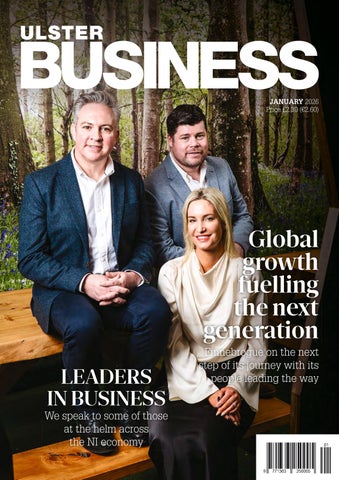
JANUARY 2026 Price £2.30 (€2.60)
Global growth fuelling the next generation LEADERS IN BUSINESS
We speak to some of those at the helm across the NI economy
Finnebrogue on the next step of its journey with its people leading the way
08
22
18
33
67
51
Contents 08 News
51 Leaders in Business
84 Photocall
The latest news and exclusives from across the world of Northern Ireland business and beyond
We profile top business chiefs from right across the sectors in Northern Ireland
A look at what’s been happening across Northern Ireland over the last few weeks
18
Cover story
67 Ones to Watch
92 Review
New global ownership helping power innovative food producer Finnebrogue
A look at our up-and-coming entrepreneurs and business leaders of the future
John Mulgrew spends a week with IWC’s people pleasing Mark XX pilot watch
22 In Focus
77 Motoring
94 Travel
John Mulgrew sits down with the new director of RenewableNI, Mark Richardson
Pat Burns tries Fiat’s latest 500 hybrid and a contender to the Ford Explorer
It’s easy to be seduced by Lithuania’s leafy capital, writes Isabel Conway
33 Outlook 2026
82 Appointments
96 Technology
We hear from industry leaders from across the sectors about what’s ahead in the new year
Ulster Business looks at some of the latest moves and promotions
Clio’s Ronnie Gurion says $1bn AI assistant will be good for business, writes Adrian Weckler
Ulster Business is a part of the Independent Press Standards Organisation (IPSO). If you believe you have been unfairly treated, you can contact IPSO in writing via its website for guidance on what to do. The service is free. IPSO can then advise on whether it’s likely you have grounds for a complaint and what to do about it. The normal procedure is for the complainant to then contact the publication’s editor directly. If no agreement is reached, the complainant can go back to IPSO to look for an adjudication, or for it to take over the complaint. Full details are available at www.ipso.co.uk. Alternatively, email complaints@ipso.co.uk, or inquiries@ipso.co.uk, or telephone 0300 123 2220, or the out-of-hours emergency number: 07659 152 656. Or write to: IPSO, c/o Halton House, 20-23 Holborn, London EC1N 2JD
JANUARY 2026
5
EDITOR’S COMMENTS
Is 2026 the year we sort it all out?
T
his time last year I joked that we’d achieved more or less all the economic, business, and infrastructure goals we’d set out in front of us.
That’s clearly not the case, unfortunately. At the heart of many of Northern Ireland’s growth challenges remains infrastructure, our waste water system, and a planning system which remains considerably slower and more disjointed than other jurisdictions across the UK and Ireland. So, is 2026 the year in which we get our act together? There’s little more than a year and a few months left in our current sitting of the Assembly. And during that time, have
we really done enough? It’s the issue of a revolving door of governments and ministerial posts.
haven’t come out and said ‘this isn’t going to happen’.
We’ve had new legislation around ‘good jobs’ and amendments to planning policy in a bid to address the delay and challenges facing the renewables sector, among others.
We’ve already seen the impact of tax and National Insurance changes on businesses here, with one small hospitality firm blaming the increases on the shuttering of two of its locations.
But many would say that it’s not enough. I bang on about us falling behind on renewable generation, but it very much feels like the elephant in the room for our folks On the Hill. We’re supposed to be at 80% generation in four years. We estimate we’ll need 50 sizeable schemes in the ground by now to meet that target.
We are, however, somewhere which has dealt with a series of blows in recent years with great resilience. We’re in a position to both leverage our exports, as well as make Northern Ireland a world-leader across a range of sectors, including tourism, hospitality, and potentially, the growing renewables sector.
Yet, despite being at 44% and, essentially, a million miles away, many representatives
So, have a happy new year. We’ll be hearing many stories during 2026, and beyond. ■
Publisher Ulster Business c/o Mediahuis UK Ltd Belfast Telegraph House, 33 Clarendon Road, Clarendon Dock, Belfast BT1 3BG
Editor John Mulgrew, john.mulgrew@mediahuis.co.uk
Printer W&G Baird Greystone Press, Caulside Drive, Antrim BT41 2RS www.wgbaird.com
Graphic design Susan McClean, Mediahuis Ireland Design Studio
www.ulsterbusiness.com
Advertising Judith Martin, j.martin@mediahuis.co.uk
Cover photo Elaine Hill
@ulsterbusiness
Ulster Business Magazine
Mediahuis UK Ltd © 2026. All rights reserved. No part of this publication may be reproduced, stored in a retrieval system, or transmitted in any form, or by any means, electronic, mechanical, photocopying, recording, or otherwise without the prior permission of Mediahuis.
JANUARY 2026
7
NEWS
‘Capsule pods’ part of £5m Belfast boutique budget hotel
A month in numbers
1.3%
The predicted growth of the NI economy in 2025, according to Danske Bank.
John Mulgrew
J
£12.4m
The sale price of Erneside Shopping Centre in Enniskillen. It was on the market for just over £15m.
5.1%
The unemployment rate across the UK as a whole, which rose in the three months to October.
£5m
The potential value of a new boutique budget Revolver hotel set to be developed in Belfast.
8
Jonathan Doherty
apanese-style capsule sleeping pods could be coming to Northern Ireland amid plans for a new £5m boutique budget hotel, Ulster Business can reveal. Jonathan Doherty says his group’s new “contemporary hospitality concept” Revolver could be open in the space of a year, creating 35 jobs and up to 70 during its construction. He’s the founder and managing director of WORQ Group, which is behind a range of hospitality developments, including restaurants, in Scotland, including Revolver budget hotels in Glasgow and Edinburgh. “The Revolver brand is a mix,” he says. “It’s a boutique-style budget hotel… a contemporary hospitality concept. It’s not just a backpacker hostel – it’s design-led, and made
for a mixture of styles of customers.” Fresh plans could see offices at the Mayfair Buildings, close to Cornmarket, turned into a new 136-bed development. The types of rooms vary and include double bedrooms, family rooms, dormitory-style rooms for multiple occupancy, Japanese-style pods, and apartments which can sleep 10-12 people. Mr Doherty says the shared rooms could cost as little as £25 a night, with standard rooms from £80, pods for between £50-70, and apartments ranging from £200-400. He says the Revolver brand attracts a range of customers – from students, to stags and hen groups, as well as business travellers, and couples. “With the one in Glasgow city centre, it changes between the seasons,” Jonathan says. “During the summer we have backpackers, hens, stags, and people visiting the city. And we do get business travellers who want a nice double bedroom. “We also provide a gym, sauna, hot tub, and we have a spa area.” Mr Doherty says the hotel runs a host of events and “there is a good chance something is on”. “We’ve looked at Belfast for a while and are lucky to have a partnership with Alterity [Investments],” he says. “They are very experienced in the city and we just think, location wise, it’s the best location in Belfast for this style of hotel. “We don’t have many people coming with vehicles – it’s mostly public transport. We have everything on our doorstep – bars, restaurants, and tourist attractions.” He says the firm is using local designers, architects and contractors on the scheme. “We are hoping to be open by this time next year,” he says. Jonathan Doherty, who was born in Edinburgh but went to school in Dublin, says the plan is to design the development “around the people that come and visit”.
NEWS
Renewable development has ‘stalled’ and planning changes ‘don’t go far enough’ John Mulgrew
N
Mark Richardson
JANUARY 2026
orthern Ireland’s renewable energy development has “stalled” while fresh government planning policy changes “don’t go far enough”, it’s been claimed. Mark Richardson is now the director of RenewableNI, representing the wider green energy sector. “I have come into [the role] with optimism,” he says. “There is positivity underneath the surface of negativity.” Mark says while “Northern Ireland has led in the past” with renewables, it has now “effectively stalled”. “Northern Ireland was a leader with 51% back in 2022,” he says. “We are not heading in the right direction. How do we turn
that around? There is a pipeline of [issues] – funding challenges, skills gaps, and not enough electricians, for example. It’s not just about wind farms for me.” On changes to the latest Stormont planning policy, aimed at improving renewable and low carbon energy development, Mark says: “It’s not dissimilar to work I did when I was in Scotland. Initially, it didn’t go far enough and we worked to make sure it went further. I feel like we’re in a similar place. “… there are positive moves towards changes in language, particularly around renewables… but for now, it doesn’t go far enough and we are stuck with what seems like a lack of weighting towards climate and electricity targets.” Read the full interview on page 22-23
9
NEWS
NI economy expansion ‘at risk amid structural issues’
Angela McGowan
T
he expansion of Northern Ireland’s economy remains at risk from our “inability to tackle the structural issues holding back growth”, it’s been claimed. And Angela McGowan, director of CBI NI, says our there must also be “recognition that delivering our infrastructure ambitions will require publishing an Infrastructure Investment Plan and giving thoughtful consideration to new approaches to revenue-raising”. “Northern Ireland’s economic risks will stem from our inability to tackle the structural issues holding back growth – such as inadequate wastewater infrastructure and slow, inflexible planning processes,” she says. “Northern Ireland’s economy is expected to expand by around 1.2% in 2026. It will be supported by UK-wide measures – including industrial policy support, and those fiscal decisions to support household incomes. As a small open economy, Northern Ireland is strongly influenced by global and European economic growth. This region works well when it leverages ‘the best of all worlds. “In conclusion, as we enter 2026, local chief executives will continue to navigate a world of constant change, shaped by rapid advancements in technology and AI, shifting workforce dynamics, global instability and general uncertainty. But business leaders have built up huge reserves of resilience.” Looking at the wider economy, Ms McGowan said the global economy is “expected to deliver moderate growth of around 3.1% in 2026 according to the latest IMF projections”. “As always, performance will vary, with advanced economies growing by around 1.6% on average and emerging markets and developing
Quotes of the month
10
“If Belfast is to succeed, collaboration must become the norm.... the business community stands ready to play its part.” Belfast Chamber chief executive Clare Guinness writing in this edition.
economies seeing growth of just over 4%. The world’s largest economy, the US is projected to grow by 2.1%, the Eurozone by 1.1% and the UK by 1.3%. And looking ahead to 2026, she says “falling inflation in many advanced economies is expected to support consumer spending and business investment in the year ahead”. “There is upward potential stemming from AI-related expenditure which could provide a significant boost to key sectors such as health, manufacturing, finance and energy. Momentum will also come from continued progress on global trade agreements and lower effective tariff rates relative to 2025. “However, downside risks must also be considered. For example, the IMF notes that stricter immigration policies in advanced economies could restrict labour supply and put upward pressure on labour costs. In addition, elevated debt levels in some economies could translate into higher interest rates if not carefully managed. “The IMF also alludes to the repricing of new technology as a further risk. This is because market optimism typically underpins tech stock prices and any sudden reassessment could lead to a potentially destabilising financial correction (like the bursting of the dotcom bubble a couple of decades ago).” Read the full article on page 34-35
“House prices have grown by around 6%... as we look ahead to 2026, there are no signs of demand easing.” Jordan Buchanan, chief executive of PropertyPal, speaking about NI’s housing market.
“Inflation is projected to remain above target, higher taxes are likely to constrain activity and ongoing uncertainty will likely continue.” Danske Bank’s Conor Lambe on the NI economy in 2026.
NEWS
Rebecca Adlington after winning gold and breaking the world record in the Women’s 800m Freestyle Final during The Beijing Olympic Games in 2008
Swimming lesson chain backed by Olympians coming to Northern Ireland
A
new children’s swimming lesson business backed by two Olympians could be coming to a Northern Ireland retail park amid new plans. Swim! is a UK-based business which focuses on teaching children how to swim. It’s now earmarked its first Northern Ireland location as part of fresh plans. That could see it taking on a unit at Longwood Retail Park. Swimmers Rebecca Adlington OBE and Steve Parry MBE are behind the creation of the business. “Our Olympians are passionate about teaching children to swim,” the company says. “We are achieving this by opening familyfriendly centres around the UK. “Currently in the UK, one in four children are unable to swim by the time they go to secondary school – we’re here to change this. “Through our bespoke member only centres we enable more families across the UK access to our expert teaching programmes within a premium and fun environment making learning
JANUARY 2026
to swim the best part of a child’s week.” The company looks set to take on a subdivided unit at the retail park. That could also include a new retailer, as well as a JD Gym. Aside from its teaching business, Swim! says it has offered schools across the UK funding to save their indoor pool facilities and partner with swim an through the Learn to Swim programme. “Led by Olympians Steve Parry MBE and Becky Adlington OBE, the School Pool Legacy Fund also offers schools the opportunity to generate revenue from their facilities and contribute to the well-being of their community,” it says. Rebecca Adlington became a household name after winning double gold at the Beijing Olympics in 2008. She made her senior British debut at the 2006 European Championships in Hungary, when she won 800m freestyle silver. Steve Parry MBE finished in sixth place in the final at the 2000 Summer Olympics, and four
years later won a bronze in Athens. In other championships he was third in the 200m butterfly at the 1997 European Championships. He was also a silver medallist at the same event at the 2002 Commonwealth Games and a two-time a bronze medallist at the Commonwealth Games. Speaking about the Swim! school in an interview on its website, Mr Parry said: “I’ve only ever wanted to do something I’m passionate about and that will get me out of bed in the morning. When your product is giving kids the best 30 minutes of their week and putting smiles on their faces it was an easy choice. Not to mention the children get a life saving skill.” Longwood Retail Park will see a number of new tenants moving in, including a Caffe Nero. However, its Poundland store was one of dozens of stores shutting across the UK. Others in Northern Ireland include stores at Craigavon’s Rushmere Retail Park. Meanwhile, Poundland has also closed its large unit in the heart of Belfast city centre.
11
NEWS
Private healthcare pharmacy tie-up ‘to ease pressure on health service’
John McEvoy
A
private healthcare business now partnering with pharmacies to deliver GP services will help ease pressure on both patients and the health service, its chief has said. Duality Healthcare is a private healthcare provider offering a range of general health services, from routine GP care and urgent appointments to diagnostics, minor procedures and specialist clinics. The company recently announced a tie-up with Gordons Chemists here. It’s opening virtual GP hubs in Gordons Chemists in Kilkeel, Lisburn, Enniskillen and Rathcoole, allowing patients private virtual consultations and instant delivery of prescriptions by email, phone, or to the pharmacist’s desk. Duality Healthcare’s chief executive, John McEvoy, told Ulster Business: “It works for the pharmacies because we alleviate pressure on them.
12
“It alleviates pressures on the NHS because we are going to have a lot more geographic scope. It alleviates pressure on patients.” As a freshly appointed chief, Mr McEvoy is keen to move the business into its next phase of innovation and expansion in 2026. “We’ve done a lot in two years. Everything is aligning.” Earlier this year, Duality Healthcare raised £4.5m to expand its GP services, deliver faster and more affordable private GP care to local communities, and help ease pressure on the NHS. Recently, Mr McEvoy, who guided Duality as chairman and co-founder, stepped into the role of chief executive. “I didn’t grow up with a silver spoon in my mouth,” he says. “I come from a workingclass family. I thought, ‘Why is there not an alternative for everybody who needs access to quick healthcare? Why does it have to go through the morning phone lottery to the NHS? Why should a patient have to pay a
fortune to another private provider to access something that should be readily available? Duality Healthcare was founded in that ethos.” The business has two central pricing structures: a membership plan, starting at £34.99 a month for individuals, which includes unlimited appointments, an annual check-up, and priority booking. The second consists of pay-as-you-go services (such as £49 for a virtual appointment). John compares the membership plan to the equivalent of a takeaway at the weekend or subscription to a streaming service. “Compared with alternatives in the market, we feel it’s a fair price to pay for quality, excellence, and speed of access to critical care.” Duality Healthcare has a seven day virtual GP service which other providers also offer. But what makes Duality unique in Northern Ireland is a parallel face-to-face offering. Read the full interview on page 52-53
NEWS
Spirit AeroSystems in Belfast
Sale of Spirit AeroSystems to Airbus and Boeing completed
B
oeing and Airbus have completed a major deal to take on the Spirit AeroSystems business in Northern Ireland. The business was formerly known as Short Brothers and was taken over by Bombardier in 1989 before a sale to Spirit AeroSystems in 2020. Now the global Spirit AeroSystems business is being taken over by Boeing, which owned Spirit in the past, resulting in the divestiture of some parts of the Spirit business. Boeing’s portion of the business in Northern Ireland will operate under the “Short Brothers” tag after Boeing revived the famous name. Airbus has taken over the part of the Spirit business which manufactures parts for its planes. The future of the Spirit AeroSystems sites in Belfast has attracted much attention over the past year, not least due to its association with the Short Brothers company and its prominence as one of our biggest
JANUARY 2026
manufacturing employers. The news brings a new chapter in the story of aircraft manufacture in Northern Ireland, with 2,400 workers joining Boeing and around 1,600 becoming Airbus staff. Boeing’s business will operate as ‘Short Brothers, a Boeing Company’ reporting to Boeing Global services. A spokesperson said: “Short Brothers is an iconic aerospace company with a rich heritage in the UK. “Using the Short Brothers brand is a nod to this history, and Boeing’s plans to build for a successful future of the site. Boeing will continue identifying opportunities that can contribute to the long-term stability and success of Short Brothers.” What is now the Boeing part of the business will continue to carry out work including the production of fuselage sections, engine nacelles, horizontal stabilisers, and other flight components. Boeing said it also has a “significant” aftermarket business due to its status as an
original equipment manufacturer, along with engineering expertise and growing space and defence activities. Sir Jeremy Quin, president of Boeing UK and Ireland, said: “The site’s rich history and legacy, in addition to its highly skilled workforce, is a strong addition to our operations in Northern Ireland where we already have robust supply chain and strategic academic partnerships.” One unusual aspect of the sale is that Boeing and Airbus will share the use of one part of what used to be Spirit AeroSystems sites in Belfast. The overall deal to sell Spirit to Boeing has involved a carve-up of the company’s sites, with Airbus retaining the parts of the company that produced Airbus products specifically. The same principle applies to Belfast, with Airbus’ purchases focusing on the parts of Spirit involved in making A220 plane parts. However, Belfast’s Spirit sites have not proven so easily split, and the rival companies have agreed to share usage of one of the facilities.
13
RECRUITMENT
Could we really see the next wave of the Great Resignation in 2026? Mark Wade, Hays NI
T
he start of a new year often marks a natural reset point for a lot of people when it comes to their careers. Some people choose the holidays as the time to look for an immediate change of job, some start to plot an alternative career path, while others resolve to make progress with their existing employer or get the most out of their current position. While it might be a good time for employees to take stock, new research from Hays suggests that employers also need to use this time to look closely at what they are doing to keep staff engaged and remain attractive to new talent. Our annual Hays Salary & Recruiting Trends survey of over 5,100 professionals and employers across the UK, including Northern Ireland, found that career confidence is not in a good place, with only 36% of professionals in Northern Ireland saying they feel positive about their career prospects heading into 2026, and 61% of people telling us they plan to look for a new job in the next 12 months. While the majority of those we surveyed were uncertain about what the year ahead holds (52%) and only 12% took a negative view of what’s around the corner, the figure marks the lowest level of career optimism since the first year of the pandemic. This so-called “career dissatisfaction” is a trend we have seen growing over a number of years now and there are rightly questions being asked about whether something could trigger another wave of the “great resignation” we saw when so many people reassessed their priorities immediately after the pandemic.
14
For those of us who work with employers, the research into what is driving this sentiment is where it gets interesting. You might think it is all to do with salary and that is a factor, with over two out of every five professionals (44%) saying they aren’t happy with their salary or pay rate and 49% of employers saying they aren’t able to meet market salary expectations. But pay is only part of the story. Over half of professionals in Northern Ireland (53%) believe there’s no scope for them to progress their career in their current organisation, while a third of employers cited high workloads and burnout as a major factor as to why they are struggling to retain staff. The NI numbers were broadly consistent with sentiment across the whole of the UK. However, our survey indicates that the challenges facing employers when it comes to retaining the best talent and keeping their workers satisfied are more emotional and personal than they have ever been in the past. The research highlights a shift in priorities, with purpose, balance, and belonging now central to career decisions. For those satisfied in their current roles, the top drivers include a good fit with colleagues (57%) and flexible working patterns (41%) – something we’ve seen some employers start to question as we get further away from the days of Covid-19. When considering a new role, professionals told us they are looking beyond salary. A strong benefits package tops the list for professionals in Northern Ireland (54%), followed by a positive work atmosphere (40%) and career development opportunities (30%). Many would even accept a lower-paid role for better work/life balance (53%), greater sense of purpose (21%), or improved wellbeing support (14%).
As a result of career dissatisfaction, 61% of workers said they expect to change roles in the next 12 months – that’s up from 52% in 2024. This focus on the emotional economy of work creates a different sort of challenge for employers who in many sectors are still facing skills shortages and high levels of competition for talent – not to mention recent Budget changes that may add further pressure on the job market, particularly for higher earners. It would seem like perfect storm: professionals feel stuck, opportunities for progression are limited, and now external economic factors are pushing people to rethink their priorities. Employers who fail to recognise the importance of purpose, balance and belonging to career decisions risk losing their best talent to organisations that offer more than just a good pay packet at the end of the month. My view is that those who act now by creating transparent career pathways, investing in wellbeing, and fostering a culture of flexibility will not only retain their workforce but also be in pole position to attract the talent others are about to lose. If confidence begins to rebound in 2026, it is entirely possible we could see a significant surge in job moves – which some may characterise as that next wave of the Great Resignation. For professionals considering their next move, this is a pivotal moment to take control of their careers - whether it’s seeking development opportunities internally or exploring new roles that align with personal values. The next 12 months could redefine what success looks like for many. ■
RECRUITMENT
JANUARY 2026
15
LAW
Prioritising culture amid record growth As we step into 2026, we’re filled with optimism about the trajectory Millar McCall Wylie (MMW) is on, and the significant opportunities that lie ahead, writes Jan Cunningham, managing partner
L
ast year marked a record period for Millar McCall Wylie (MMW), with growth exceeding 30% across the
firm. This performance, which surpassed our most ambitious internal targets, is a clear testament to our enduring strategy – a relentless focus on people, culture and service. We don’t take any of it for granted. Our success is the result of a strategic investment into our infrastructure and our team. We have now enjoyed our first full year operating from our modern premises in Belfast’s Printworks, and we have bolstered our dedicated residential and private client team in Eastleigh, east Belfast. Overall, we’ve increased our team by 10% in the last twelve months, with all areas experiencing growth on the previous year. Talent development Our view is that a strong talent pipeline is the lifeblood of the firm’s future. Nurturing new talent is crucial. We’ve welcomed six newly qualified solicitors this year, alongside four trainees commencing at the Institute, and have another five already lined up for the 2027 intake. We continue to invest in the leaders of tomorrow, developing our directors through a clear leadership pathway and helping individuals build careers that they actually love and thrive in. Culture and connection A huge focus for us remains on building the vibrant, people-first culture we’ve actively cultivated over the years. Following comprehensive staff research, we now have a popular employee engagement programme, MMW Balance, designed to meet the modern
16
Jan Cunningham
needs of our team. We launched MMW Impact in 2025, our CSR commitment to supporting the community and environment around us. Our team have really invested in these programmes, participating in workshops, training, volunteering and charity projects, complemented by the social activities we deliver regularly. For us, it’s about shaping the whole perception and experience of a legal career; life in law doesn’t need to mean long hours or being confined to a desk behind mountains of paperwork. That is very much the opposite of what we strive to offer. Lawyers for life We are seeing how our full-service offering has never been more valuable. We talk about being ‘Lawyers for Life’ and are increasingly often seeing clients simultaneously use several of our specialist teams for complex, multi-
faceted advice. Our breadth of services has really come into its own, allowing us to provide a seamless, high-quality experience across the full range of legal disciplines. What’s next Looking ahead, the market is robust, with consistent demand for exceptional legal counsel. While the world of AI and technology overall continues to evolve, we are actively exploring how these tools can enhance efficiency and, crucially, free our lawyers to focus on high-value advisory work. Our primary focus, however, remains the retention of our unique identity and the values that underpin it. Retaining our independence is everything. It allows us to continually invest in helping our people be the best lawyers and leaders they can be. We look forward to another successful year defined by growth, innovation, and partnership, with both our clients and colleagues. ■
COVER STORY
After years of expansion, Downpatrick-based Finnebrogue has entered a new era under the ownership of global food giant Sofina, bringing investment, wider global reach and new opportunities for its people, who helped build the business from a family-run firm into a £230m market leader. Ulster Business speaks to some of its leaders about the future
Finnebrogue: new global ownership helping power innovative food producer T he journey from small family-owned meat producer to an industry giant with global reach is one which has been led by Finnebrogue’s people. When the Downpatrick-based company was acquired by Sofina Foods in June, the move marked a milestone in a partnership that had
18
been strengthening for years. For Declan Ferguson, group director, new product development and innovation, the acquisition represents not a shift in identity, but a natural next step in a long-standing relationship built on aligned values, expertise and shared ambition.
“We’ve been growing for quite a few years, and with the new ownership, Sofina wants to help with that journey,” he tells Ulster Business. Finnebrogue has grown into a Top 100 company, making a wide range of meat and non-meat products – including branded
COVER STORY
Declan Ferguson, Melissa Mackey, and Joe Stranney
ranges, such as Naked Bacon, which made without nitrites, and a raft of private label products for our biggest supermarkets. And as one of the UK’s leading food producers, it’s expanded into a company employing more than 1,450 people, with turnover around £230m. Sofina has long been one of Finnebrogue’s major suppliers, particularly for pork – much of it sourced locally from Northern Ireland and processed in Cookstown, with further production capacity in the group’s other UK sites. Bringing the businesses fully together, Declan says, “helps the end-to-end supply chain from farm to fork”. One of the biggest advantages of becoming part of Sofina is access to a larger market footprint. Finnebrogue’s success has been built
JANUARY 2026
on its ability to innovate – from its pioneering nitrite-free bacon and ham to sausages and plant-based ranges – and to respond quickly to changing consumer trends. “With that whole vertical integration piece, we can play more readily into those retailer relationships,” Declan says. “We can take them on the full journey with us, thanks to a dedicated supply chain.” The aim is to deepen partnerships with existing customers while expanding into new product categories, offering products that reflect both evolving consumer expectations and Finnebrogue’s strengths in healthier, additive-free innovation. And helping to fuel that expansion are the people behind Finnebrogue’s journey – it’s about a commitment to developing people from within.
Melissa Mackey, the company’s head of HR, says the acquisition opens a new frontier for internal talent development. “It’s really exciting because we now have global mobility where we didn’t have that before,” she says. “It means we can invest more in our people and offer opportunities across the UK and Ireland, and further afield.” Finnebrogue’s win at the Grocer Gold Awards in 2024 for Employer of the Year was a testament to its people-first strategy. Now, as part of a global organisation, the business also has the chance to influence Sofina’s wider people strategy. “It’s about showcasing what we’ve built here – the culture, the investment in talent, the way we support people from the ground up.” And Joe Stranney is a testament to that fostering of talent and ability to develop a >
19
COVER STORY
Joe Stranney, Melissa Mackey, and Declan Ferguson
strong career through the company. He’s now general manager of Finnebrogue’s sausage division, across two sites. His career at Finnebrogue began in 2011 with what he believed would be just a few months of seasonal work. “I came in September, thinking I’d be away by Christmas,” he says. After the festive season he was asked to stay on in a supervisory role, then moved through a series of increasingly senior operational and supply chain positions. By 2015, when Finnebrogue moved to its current site, Joe had already stepped into floor management and then into roles that allowed him to understand hygiene, production, operations and supply chain functions. That experience prepared him for his eventual appointment as site manager, followed by his current role leading the sausage division. Looking back, Joe says he never expected his career to unfold the way it did. “When I came in, I didn’t think I’d be going past Christmas,” he says with a laugh. “We were very small, very family-run. But to go to where we are now, it’s been a really great journey.” And his story is far from unique within the company. “A lot of people have grown with the business,” Joe says. Finnebrogue has a clear preference for promoting from within, identifying those ready for the next step and supporting their development. His recent appointment of a new factory manager, Stephen, was another example.
20
The company is now hoping to leverage Sofina’s international reach, according to Declan Ferguson. “We see opportunities to produce products for customers we don’t currently trade with,” he says. Its global scale brings access to markets Finnebrogue could not previously reach, allowing the company to bring its specialist expertise. The move away from ultra-processed foods is reshaping the market, with shoppers increasingly scrutinising ingredient lists and seeking products free from artificial additives. Finnebrogue, having launched its Naked range in 2018, has been well ahead of the curve. Declan notes that recent EU legislation reducing permitted nitrite levels in bacon and ham “is part of a wider shift” the company anticipated early on. “There’s a real desire for healthier alternatives,” he says. “People want options that fit their lifestyle, whether that’s low-fat products, nitrite-free bacon, or items that work for both everyday meals and seasonal occasions.” Looking ahead, Declan sees Finnebrogue maintaining the open-minded, opportunity-led approach that has fuelled its journey. He says growth will continue to be both driven and organic – shaped by consumer demand, customer needs and the company’s instinct for innovation. “We’ve grown with a core group of customers,” he says. “We see that trajectory
continuing’’. Finnebrogue’s ambition is to help retailers grow their sales and attract footfall, as well as being able to inspire the end customer. “It’s about how we excite and delight them,” he says. “How do we make sure that when they go in to shop every week, that they choose our products?” Whether it’s healthier alternatives or inventive seasonal ranges for Christmas and Easter, the goal is the same – staying relevant, responsive, and ahead of the curve. Under Sofina’s ownership, Finnebrogue will also operate as part of a wider product portfolio. “We’ll act as one Sofina,” Declan says. “When we talk to customers, yes, we’ll talk about the things Finnebrogue make, such as sausages, burgers, or Christmas products, but we can also talk about pork joints, bacon, and even seafood.” Bringing these capabilities together strengthens the offer for retailers seeking consistent supply, greater choice and seasonal expertise. Finnebrogue, however, remains firmly rooted in Northern Ireland. Its sites, people, leadership and values remain the foundation of the business, while Sofina’s investment signals confidence in the region’s capability and potential. For the senior team and hundreds of colleagues across the company, it’s about a bigger and brighter future as part of a global business, with Finnebrogue at the core. ■
IN FOCUS
‘I wouldn’t say the 2030 renewables target is gone’ Mark Richardson has recently taken up the role of director of RenewableNI, representing the interests of the wider sector, from developers to lawyers and stakeholders. He speaks to John Mulgrew about entering the job with ‘positivity’, why setting ambitious targets works, how NI can be a leader in the sector, and why fresh planning policy doesn’t go far enough
W
hile it’s certainly a more complex issue, on the face of it, we’re regressing with renewable energy. That’s in terms of the proportion of generation coming from renewable sources, not total generation – as our electricity needs only increase as we move away from fossil fuels. But Mark Richardson hasn’t entirely given up on the idea of us meeting our own government-led targets. That would see Northern Ireland generating 80% of its power through renewables by 2030 – that’s just four short years away, and we’re now just at 44.2%. Stormont has been banging that drum for years, but no minister yet appears to have raised their heads above the parapet to say that the figure is turning into pure fantasy. “I wouldn’t say it’s gone,” Mark Richardson, the recently-appointed director of RenewableNI, tells me. “I’m always a firm believer, coming from Scottish Renewables, that it’s good to set high targets – setting the bar high.” In 2024, RenewableNI’s former director, Steven Agnew, told Ulster Business that around 2.5GW of extra capacity is needed in order for Northern Ireland to generate enough power to reach the target set by the Stormont Executive. That means roughly 50 sizeable schemes, shovel ready by 2026. That’s this year. “[It’s about] looking at renewables as a whole, planning etc, and how many schemes you need. If they weren’t in planning last year,
22
they aren’t going to be ready for 2030. “It’s an ongoing conversation. We need to drive it from the renewables side. It’s not like, on January 1, 2030, we do or don’t [reach the target]. Climate change doesn’t just stop in a day – it goes beyond that. “It’s ongoing and we are reviewing where we are, and what we need to set beyond that date.” Mark has a long background working across the renewables sector, joining RenewableNI at the end of last year. Born in London, he grew up in the West Country, and spent time studying and working in India, the US and China, working in different sectors, before moving into renewables. “[For me] it’s been about relationships,” he says. That means working groups, and hearing from a wide range of members – something which he says has expanded considerably – from developers, to policy makers, system operators, lawyers and community representatives. “All those groups fit the puzzle and it’s about what we need to do to improve things, and be faster – looking at what is working and always trying to stress the positives.” On the Renewable Electricity Price Guarantee (REPG) final design, announced by the Department for the Economy, Mark says while progress is to be welcomed, given the “importance of it” in driving us, ultimately, towards clean energy production, it’s important it gets over the line, with fewer than 500 days left in this Assembly.
In terms of missing that 2030 target, he says issues such as ‘dispatch down’, grid capacity, and connections all play their part. But, as with other sectors – especially those anchored in development – planning remains the centre of attention. “Planning… it’s always planning, wherever I have been,” Mark says. “It needs to be treated as a whole system, not just renewables, and it needs to be joined up – not people working in silos. “It’s not just a renewables problem – it impacts on investment and economic growth. We need more planners, clearer policies, and faster decisions to unlock potential.” Looking towards what increased green energy should mean for the market, Mark says, for consumers, it could be lower bills and, along with business, energy security. “For business, price stability and predictive energy costs as well as inward investment opportunities, and supply chain growth.” He says Northern Ireland and its people have an opportunity to be world-leaders in the green power global marketplace. “In the Middle East, you’ll always see a Scot or someone from Northern Ireland in oil and gas – I don’t know why we can’t see that for renewables,” he says. Mark says while “Northern Ireland has led in the past” with renewable generation, it has now “effectively stalled”. “Northern Ireland was a leader with 51% back in 2022,” he says. “We are not heading in the right direction. How do we turn that
IN FOCUS
around? There is a pipeline of [issues] – funding challenges, skills gaps, and not enough electricians, for example. It’s not just about wind farms for me. “A sustainable energy ecosystem is important – it delivers real value to the economy, business, and people. [There needs to an] open renewables sector, and conversation with as many people as possible. “The benefits of decarbonisation can be shared more widely and there’s a real economic opportunity, like I’ve seen in Scotland and elsewhere. “[We need] committed policy leadership, investment in infrastructure – that’s where NI is falling behind slightly, and we need collaboration in action.” On changes to the latest Stormont planning policy, aimed at improving renewable and low carbon energy development, Mark says: “It’s not dissimilar to work I did when I was in Scotland. Initially, it didn’t go far enough and we worked to make sure it went further. I feel like we’re in a similar place. “While we welcome the planning statement update – which members have been waiting for – it’s taken a long time to come through, and there’s a communications piece as well. “There are positive moves towards changes in language, particularly around renewables… but for now, it doesn’t go far enough and we are stuck with what seems like a lack of weighting towards climate and electricity targets.” “I have come into [the role] with optimism. There is positivity underneath the surface of negativity.” ■ Mark Richardson
JANUARY 2026
23
PUBLIC SECTOR
Public sector pressures: outsourcing offering a viable solution Noel Brady, founder of Nb 1, says at a time when Northern Ireland’s public sector is under unprecedented strain outsourcing and managed services can be a vital part of the solution
W
ith more than 40 years’ experience spanning both public and private sectors, Noel Brady believes the time has come for a more pragmatic, partnership-led approach to delivering public services. “Our politicians and senior public sector leaders are facing huge challenges,” he says, highlighting ever-reducing budgets, growing public demand and systems that are no longer fit for purpose. For Noel, transformation is no longer optional. Instead, he argues that greater collaboration with the private sector – through outsourcing and managed services – could be a vital part of the solution. Noel Brady has a strong background of working firstly in the public sector for 16 years and the remainder in various senior roles in the private sector. In the latter he has been an expert in the area of outsourcing and managing the provision of public sector services. Noel makes the case for outsourcing based around helping to meet the objectives of the Programme for Government. Noel is the founder of Nb1, and recently marked two decades in business, with another two decades working across both the public and private sectors, alongside a win at the Belfast Telegraph IT Awards. He is also a member of the public sector taskforce looking at AI. In 2024, he marked 20 years of Nb1, and has worked with countless organisations from right across the business sectors, offering strategic expert advice and guidance. Through Nb1, Noel has advised organisations across health, local government, utilities and central departments, helping leaders assess where outsourcing can add real value rather than simply reduce costs. He is clear that outsourcing should never be a blunt instrument. Instead, when done well, it can directly support the Programme for Government by improving service delivery, enabling economic growth and allowing public bodies to focus on what they do best. “There are areas where the private sector can genuinely bring expertise that is difficult to recruit or retain internally,” Noel says. Functions such as back-office processing, ICT services, contact centres, facilities management and other non-core services are often better delivered at scale, with access to specialist skills, modern technology and proven operating models. The benefits, he says, go beyond efficiency. Outsourcing can create
26
Noel Brady
new, high-quality jobs, improve long-term budget forecasting and release public funding that can be redirected to frontline services. It also frees up internal teams to concentrate on policy, oversight and strategic priorities rather than day-to-day operations. Noel is keen to challenge the long-standing perception that outsourcing is simply about awarding contracts to the cheapest bidder. Lower overheads, economies of scale, smarter use of technology and the ability to spread capital investment across multiple clients all contribute to better outcomes – without compromising quality. He is equally realistic about the risks. Outsourcing can introduce challenges around service delivery, security, flexibility and long-term stability. With Northern Ireland’s public finances under sustained pressure, Noel’s message is clear: outsourcing is not a silver bullet, but when applied intelligently, it can be a powerful tool for reform. “The question,” he says, “is not whether we can afford to consider outsourcing – it’s whether we can afford not to.” ■
INVESTMENT
Whiterock expects strong equity and debt investment deal flow in 2026 Belfast-based fund manager Whiterock on how it has grown its team significantly over the past two years to help meet demand for both the debt and equity funding it offers
I
t has been a busy couple of years for Whiterock, one of Northern Ireland’s longest established and most successful fund managers. Whiterock has been operating in Northern Ireland for more than 13 years, managing over £255m across five funds. Its current funds include the Growth Capital Fund, which provides minority equity investments in scaling Northern Ireland companies with high-growth potential, and the Investment Fund for Northern Ireland debt fund, which offers debt finance as a commercial alternative or supplement to traditional bank loans. In the last two years alone its debt and equity funds have deployed over £47m in funds to Northern Ireland-based companies, leveraging a further £50m of investment into these locally based businesses from other commercial funders. To manage this demand Whiterock has continued to invest in its team, recruiting a number of key individuals over the past 18 months, and it now has 20 professionals working across its funds and commercial finance teams. “We have the largest team of any fund manager in Northern Ireland and a management team with the ability to make decisions locally,” says Paul Millar, chief executive of Whiterock. “I think the fact that we have boots on the ground here and we’re providing access to
28
a very high level of expertise and experience on their doorstep does matter to a lot of very successful, locally-owned businesses. “We are proud to have built up a high level of trust in the business community and work closely with referrers such as accountants, banks, lawyers and other funders.” The growth of the team led Whiterock to make a significant investment in 2025 into its office space in City Exchange on Gloucester Street, the firm’s home since it was established in 2012. “We made the decision to invest in a revamp of the office layout to cater for the growing team today and also to allow for future growth,” says Whiterock partner, Rhona Barbour. “We’ve created more meeting spaces to make sure clients, referrers and partners can be accommodated and refreshed the office to make it an attractive environment for the team. It is a further demonstration of our commitment to the Northern Ireland funding landscape and the wider economy.” The funding landscape has changed since Whiterock was founded, with more choice available to local companies seeking debt or equity finance support to help grow their businesses. But Whiterock continues to be at the forefront of NI deal activity. Whiterock’s £75m Growth Capital Fund makes investments of between £1m and £5m for minority shareholdings in growth and scaling
companies, backed by the British Business Bank and private investors. In less than two years since the Growth Capital Fund was launched, Whiterock has deployed £25m of equity funding across 11 deals, leveraging a further £20m in funding alongside this investment. “We’ve seen a huge appetite in the market for the fund as understanding of equity investment and our offer has increased,” says David McCurley, partner at Whiterock. “Our typical first cheque size is between £1m and £5m, with the potential for follow on funding up to £7.5m, and it has been really interesting to see the broad range of businesses who have availed of equity funding through the Growth Capital Fund since we launched back in February 2024.” Companies supported have included
INVESTMENT
Whiterock partners Rhona Barbour, Neil McCabe, David McCurley and chief executive Paul Millar
Belfast-based whiskey distillery Titanic Distillers, Fermanagh headquartered plastics manufacturer Re-kkur, drinks industry brand owner and distributor Drinksology Kirker Greer, independent solar panel installer Solarfix, innovative medtech companies Neurovalens and Cumulus, flexible office provider Hubflow and vehicle fleet camera software business Mantis. Whiterock has been no less busy in the debt space, where it operates the British Business Bank’s Investment Fund for Northern Ireland’s (IFNI) debt fund, which offers loans of £25,000 up to £2m to businesses from all sectors at different growth stages. The £30m IFNI debt fund provided by British Business Bank was bolstered last month by a further £29.2m from Invest NI, announced by Economy Minister Dr Caoimhe Archibald, increasing the availability of debt financing to
JANUARY 2026
almost £60m. “Access to finance continues to be a crucial issue for many of the small and medium businesses that drive our economy and provide jobs for people who live here,” says Whiterock partner Neil McCabe. “Through the debt fund, Whiterock has helped increase the supply and diversity of finance available to a really broad array of businesses, providing loans on a flexible basis over a two-to-seven-year period.” Since IFNI launched in January 2024, the fund has deployed over £21m to 47 different companies, leveraging a further £30m in private funding. This has included deals to support growing businesses such as Coleraine sports company Powerhouse Padel, independent watchmakers Nomadic Watches, fastener distributor Profast,
security technology firm AES Global, energy services business Refresh NI and boutique Belfast hotel Harrison Chambers of Distinction. Added to this, Whiterock’s commercial finance team has been involved in over £30m of commercial and property finance deals, which have been brokered across various sectors including commercial, residential, construction and development. It’s another area where Whiterock is expecting continued growth, says Paul Millar. “It’s fair to say our funds and deal teams have been extremely busy, and we are grateful to all of our partners and colleagues for the part they have played in this,” he says. “As appetite for funding continues to increase, we look forward to another active year supporting Northern Ireland businesses in 2026.” ■
29
CONFERENCES
Rory Sutherland
MLN SuMMit: top behavioural thinker to speak at leading management event
R
ory Sutherland has long been recognised as one of the world’s most engaging behavioural thinkers. He is the first speaker to be announced for the SuMMit event, which will take place at Titanic Belfast on Friday, February 27. The event has previously included guests such as Leo Varadkar, Baroness Eliza Manningham Buller, Martin O’Neill, Sir AP McCoy and Nigel Owens MBE. While Sutherland’s career began and flourished within the advertising world – he is vice chairman of Ogilvy, one of the most respected global creative networks – his true impact has come from his work as a behavioural scientist. For more than two decades, he has championed the idea that understanding how people actually think, decide, and act is more powerful than any amount of conventional logic, data modelling,
30
or managerial frameworks. A prolific writer and speaker, Rory is the author of the acclaimed ‘Alchemy: The Surprising Power of Ideas That Don’t Make Sense’, a book which challenges leaders to embrace unconventional solutions and recognise that human choices rarely follow the neat, rational paths executives assume. His work has influenced governments, global brands, public-sector organisations, and fast-growth start-ups. Through his long-running column for The Spectator, his TED talks, and his role as co-founder of Ogilvy’s Behavioural Science Practice, Sutherland has made behavioural insights accessible, practical, and unexpectedly entertaining. For managers and business leaders in Northern Ireland, his upcoming appearance at the MLN SuMMit offers something rare: a chance to rethink long-held assumptions at a
time when the need for fresh problem-solving has never been greater. In an era of economic uncertainty, talent shortages, political complexity, and accelerating digital change, Sutherland argues that competitive advantage increasingly belongs to organisations that understand psychology better than their rivals. Those attending the MLN SuMMit can expect to learn how small behavioural interventions – what he calls ‘psycho-logic’ – can often unlock far greater value than largescale structural reforms. He will demonstrate why customer and employee behaviour frequently defies rational prediction, and how leaders can harness those insights to design better services, motivate teams, improve communication, and create more memorable customer experiences. Importantly, he will highlight the cost-effective power of reframing problems: looking at challenges from angles traditional management thinking tends to overlook. Sutherland’s insights land particularly well with audiences responsible for strategy, innovation, policy, and organisational culture. His message is consistently clear: to lead effectively, one must understand people. Not theoretical people, but real people – messy, emotional, inconsistent, brilliant. For Northern Ireland’s leaders, the opportunity to hear from Rory Sutherland is not just an intellectual exercise. It is an invitation to adopt new thinking, challenge entrenched assumptions, and unlock ideas that can transform how their organisations grow and compete in a changing world. He is the first of five world-class speakers to be announced for the event which will take place at Titanic Belfast from 8.15am to 1.30pm on Friday, February 27. The event consistently attracts a full house of 450 leaders and tickets (and tables) can be booked at www.mln.org.uk
TAX & ACCOUNTANCY
Navigating the tax changes around the Autumn Budget The UK Autumn Budget announced a number of significant changes that will impact how Northern Irish businesses plan, invest and manage their staff over the coming years, writes Caroline Keenan, head of tax, at Sumer NI
W
hile some of the new changes announced by Chancellor Rachel Reeves are gradual, others signal a clear shift in incentives, costs, and reliefs, making it essential for local businesses to plan ahead. Employment Northern Ireland employers will face rising labour costs over the coming years. The National Living Wage will increase by 4.1% to £12.71 an hour from April 2026, with younger workers and apprentices also seeing substantial uplifts. Employees will also feel the impact of the freeze in personal allowances and this may also drive wage demands. For local sectors like retail, hospitality, and health care, where labour is a significant cost, this will directly affect budgeting, pricing, and recruitment strategies. From April 2029, salary sacrifice pension contributions above £2,000 a year will see a National Insurance Contributions (NICs) charge for both employers and employees. While not being implemented for the next three years, this change will influence long-term benefits planning for companies offering pension schemes, particularly in sectors with higherpaid staff. Other employment-related changes, including increasing Van Benefit Charges and delays to Employee Car Ownership Scheme reforms until 2030, will offer clarity for companies with fleets, but will impact budgeting for staff benefits and vehicle strategies.
Capital taxes For family-owned and succession-focused businesses in Northern Ireland, there was little to welcome, with no changes to last year’s announcements on APR and BPR. Inheritance Tax thresholds remain frozen until 2031 and similarly, the £1m combined allowance for agricultural and business property relief remains fixed until 2031. However, the one big positive was the ability to transfer the £1m combined allowance to a surviving spouse or civil partner. Businesses considering Employee Ownership Trusts (EOTs) will need to reassess their options with the capital gains tax relief on disposals to EOTs dropping from 100% to 50%, reducing the financial attractiveness of this succession route. Investment, growth, and green initiatives The Budget encourages investment in fixed assets, particularly through the new 40% first-year allowance from January 2026. At the same
32
Caroline Keenan
time, the main rate writing-down allowance will fall from 18% to 14%, meaning that Northern Irish businesses will need to evaluate short-term versus long-term investment strategies carefully. Green initiatives remain supported, with the 100% first-year allowance for zero-emission cars and EV charge points extended until 2027. For Northern Ireland companies looking to expand their fleets or improve sustainability, this represents a tangible opportunity to reduce upfront costs. Support for innovation and growth is strengthened through wider access to Venture Capital Trusts (VCTs), and Enterprise Investment Schemes (EIS) from April 2026. While some reliefs, such as VCT income tax relief, reduce, the increase in investment limits makes it easier for local companies to attract funding and expand. The Autumn Budget was clearly a political one, balancing the Labour Party’s need to keep its back benches happy with the need to raise taxes. Growth and productivity initiatives clearly played second fiddle to welfare and taxes. For Northern Ireland businesses, the focus must be on proactive planning, particularly around succession, workforce strategy, and capital investment, to maximise opportunities and manage the impact of rising costs. ■
Outlook 2026 Industry leaders on what’s ahead this year
OUTLOOK 2026
‘Our economic risks will stem from the inability to tackle structural issues holding back growth’ Angela McGowan, CBI director for Northern Ireland, looks towards the local and global outlook for the economy and wider business landscape as we head into 2026
T
he global economy is expected to deliver moderate growth of around 3.1% in 2026 according to the latest IMF projections. As always, performance will vary, with advanced economies growing by around 1.6% on average and emerging markets and developing economies seeing growth of just over 4%. The world’s largest economy, the US is projected to grow by 2.1%, the Eurozone by 1.1% and the UK by 1.3%.
Influences on global economy in 2026 Falling inflation in many advanced economies is expected to support consumer spending and business investment in the year ahead. There is upward potential stemming from AIrelated expenditure - which could provide a significant boost to key sectors such as health, manufacturing, finance and energy. Momentum will also come from continued progress on global trade agreements and lower effective tariff rates relative to 2025.
34
OUTLOOK 2026
However, downside risks must also be considered. For example, the IMF notes that stricter immigration policies in advanced economies could restrict labour supply and put upward pressure on labour costs. In addition, elevated debt levels in some economies could translate into higher interest rates if not carefully managed. The IMF also alludes to the repricing of new technology as a further risk. This is because market optimism typically underpins tech stock prices and any sudden reassessment could lead to a potentially destabilising financial correction (like the bursting of the dotcom bubble a couple of decades ago). The UK economy Closer to home, the Office for Budget Responsibility (OBR) expects UK GDP to grow by 1.4% in 2026. The economy will be supported by loosening monetary policy as inflation is expected to ease to 2.5% in the year ahead. The demand-side of the economy will also be supported by fiscal measures announced in the autumn 2025 Budget, including lifting the two-child benefit cap, extending the freeze to fuel duty and reducing energy bills for households and business. Risks to the UK economy Risks to the UK economy outlook include persistent skills shortages, uncertainty around the pace of productivity growth, and mounting fiscal pressures – servicing debt will be a problem if growth was to remain weak. The UK economy could also be impacted by any sharp equity market correction or rise in geopolitical uncertainty in 2026 that could weigh on confidence and investment. What UK businesses would like to see The CBI has argued that for the UK to deliver strong growth, government must
JANUARY 2026
commit to a business-led economic strategy. This, coupled with private sector investment is essential for raising the long-term growth potential of the economy. The CBI has set out a crystal-clear framework for achieving exactly that, centred on four key priorities: 1. Fast-tracking infrastructure delivery. Planning reform must be accelerated, and major national projects must be unblocked. In addition, a new approach to partnering with the private sector must be adopted, as the public sector purse alone cannot pay for this investment. 2. Maximising workforce potential. Reforming the Apprenticeship Levy, widening access to skills training and removing tax barriers that discourage workplace investment are all essential. 3. Scaling technology. A national tech adoption plan is needed, coupled with stronger R&D incentives. 4. Boosting business competitiveness. Reducing overheads, deepening liquidity in London’s financial markets and resisting the temptation to impose yet more taxes on business. Industrial policy will be an important lever In the summer of 2025, the UK Government published a credible, long-term industrial strategy, that focuses on the areas of the economy where the UK can genuinely compete and win global market share. The strategy includes several measures to support firms, including tackling uncompetitive electricity prices, putting clean energy industries at the heart of the UK’s growth strategy and making it easier for employers to access and attract the skilled workforce needed to grow. When it comes to the industrial strategy, government ambition is there and the direction of travel is right, but delivery is everything. To support this effort, the CBI has teamed up with Lloyds to deliver the UK’s Industrial Strategy Roadshow 2026 – a year-long programme designed to reinforce collaboration between
business and government. The roadshow will host conversations across all 12 UK regions, bringing together local firms and policy leaders to align priorities and accelerate delivery. The Northern Ireland session is scheduled for February 2026. Northern Ireland’s economic outlook Northern Ireland’s economy is expected to expand by around 1.2% in 2026. It will be supported by UK-wide measures – including industrial policy support, and those fiscal decisions to support household incomes. As a small open economy, Northern Ireland is strongly influenced by global and European economic growth. This region works well when it leverages ‘the best of all worlds’, for example, taking the benefits from UK industrial policy, making the most of dual-market access and maximising the opportunities presented by a dynamic all-island economy. Together, these benefits can position Northern Ireland to build a resilient and competitive regional economy. Northern Ireland’s economic risks will stem from our inability to tackle the structural issues holding back growth – such as inadequate wastewater infrastructure and slow, inflexible planning processes. There must also be recognition that delivering our infrastructure ambitions will require publishing an Infrastructure Investment Plan and giving thoughtful consideration to new approaches to revenue-raising. In conclusion, as we enter 2026, local chief executives will continue to navigate a world of constant change, shaped by rapid advancements in technology and AI, shifting workforce dynamics, global instability and general uncertainty. But business leaders have built up huge reserves of resilience. They recognise that the most successful path forward will come from business and government working in tandem – aligning ambition, investment and economic policy to create the best outcomes for our local economy. ■
35
OUTLOOK 2026
‘I want to be upbeat going into 2026… but we must act now or face an uncertain future’ 36
OUTLOOK 2026
John Davison, director and head of strategic communications at Turley, looks at the infrastructure hurdles facing us here and why 2026 is a year for business to speak plainly to tackle those issues
N
orthern Ireland enters 2026 facing two structural constraints that have become existential crises for the construction and infrastructure development sector. That includes a planning system that has not delivered at pace for more than a decade, and a wastewater network that is literally full or crumbling beneath our feet across many towns, cities and other parts of this region. These aren’t technical irritants – they are the choke points throttling housing, stalling renewables, and eroding investor confidence.
Looking back… looking forward In Roman mythology, Janus, the two-faced god, looked both to the past and the future. It’s an apt metaphor for Northern Ireland in 2026. One face reminds us of decades of underinvestment and systemic inertia: planning reviews that gathered dust, wastewater upgrades deferred, and flagship transport schemes like the A5 Western Transport Corridor and York Street Interchange mired in legal wrangles and procurement delays. The other face looks forward – to the promise of the All-Island Rail Review. Addressing our wastewater deficit could unlock up to £2.5bn of added GVA by delivering 19,800 homes in the next decade. Some might argue that existing and future regulatory burdens as a result of climate action policies are hampering viability of our region, but in my own view enabling sustainability through smarter building regulations or encouraging use of improved public transport is simply planning for an environmentally more stable future that is increasingly at jeopardy. Why 2026 matters politically This year, 2026, is critical to the ambitions set out in the Northern Ireland Climate Change Action Plan and the Housing Supply Strategy; both of which demand infrastructure delivery at a scale and speed we have never achieved before. We await the long overdue Northern Investment Strategy – but it’s hard to consider a single objective that it might propose that would not benefit from an improved planning system, wastewater infrastructure and wider connectivity.
JANUARY 2026
This is not just another year set adrift. It is the year before local government and Assembly elections in 2027, and that matters. In preelection years in other parts of these islands political parties’ campaign on the economy, housing, and climate. Whether they succeed or not, both the Labour government and the coalition government in Ireland have prioritised housing growth and planning reform as a means of tackling both a housing crisis and to stimulate wider economic growth. In Northern Ireland pre-election years are not marked by debates about delivery, but on identity issues, and we have already seen the precursors of these disputes at the tail end of last year, both at city hall and Stormont. There is no more road to kick the can down Where in the next year the success of Prime Minister, Keir Starmer or Taoiseach Micheál Martin might be subject to the vagaries of each jurisdiction’s respective political and socioeconomic currents, our Executive parties know that whilst planning reform and wastewater infrastructure are important, they aren’t yet issues that will bring their voters out. The temptation then will be to kick the can down the road. But delay is not neutral – it deepens the housing crisis, deters clean-energy and water, and risks environmental penalties. We are very close to, if not past, the tipping point where a £100 added to the average household rates bill through a hypothecated levy to offset the required £2bn of borrowing required. To ensure we a credible plan for capital expenditure for NI Water ahead of the next price control period in 2028, we need all parties to agree a way forward – and time is of the essence as housebuilding and other development begins to stall. The political reality in Northern Ireland, continues to be a place apart, and our parties are not punished for poor stewardship. Effort has been made to begin the transformation of our planning system and average processing time has improved. However, without more energy and resources, the 6% fall in planning applications in the quarter ending September 2025, mirrors the continuing fall in housing completions in the same quarter – total
completions dropped by 15% to an all-time low, and we have seen a near stall in onshore wind development. It suggests the market has already shifted its focus elsewhere on these islands. To win back confidence we urgently need a system that enforces statutory timeframes as well as properly resourced consultees if we are to attract investment, particularly for major and regionally significant projects. We also await the Audit Office Report on reform of the Planning Appeals Commission. There are some green shoots – with the Loft Lines due to complete later this year, and new medium and higher density housing projects proposed within the wider Harbour Estate we hold our collective breath in the hope that the build to rent model spurs a renewed investment in city centre living across private and affordable homes. The wider infrastructure picture Planning and wastewater aren’t the only bottlenecks, however. Northern Ireland’s transport infrastructure deficit is widening, with long promised schemes like the A5 Western Transport Corridor and York Street Interchange upgrades mired in legal challenges and procurement delays. These projects have been stuck in judicial review limbo for years, eroding confidence and inflating costs. Meanwhile, the All-Island Rail Review offers a rare opportunity to think big. Why it’s a year for action This is the year for business to speak plainly: doing nothing costs more than doing something. Every stalled housing scheme, every delayed wind farm, every missed investment opportunity is a silent tax on growth. The prize? A construction sector that grows, not shrinks; housing targets that move from aspiration to delivery; and a renewables pipeline that ensures Northern Ireland can get back on track for net zero. I would like to be upbeat at the beginning of the year, and believe that we can face into our collective challenges, but the realist in me looks back at our track record and can draw only one conclusion, we must act now or we face into an increasingly uncertain future. ■
37
OUTLOOK 2026
‘Belfast is making progress… but not fast enough’ Clare Guinness, chief executive of Belfast Chamber, says while the city has seen significant progression, untapped opportunities remain and it can no longer just be business as usual
A
s we move towards 2026, it’s clear that Belfast has made real progress. However, it’s equally clear that we are not moving fast enough. Belfast is brimming with talent, innovation, energy and ambition – yet too often these qualities are constrained by fragmented responsibility, slow decision-making and a lack of a cohesive long-term vision. It is difficult not to be struck by the scale of opportunity before us and the reality that Belfast will only reach its potential if we rethink how our city is planned, managed and delivered. We cannot continue with business as usual. Across the world, great cities are defined by clarity of purpose and confidence of leadership. They share a unifying vision, make tough choices, prioritise investment, and create delivery structures that work. That is exactly what we need for Belfast. And we don’t have to look too far for a compelling example. The research report published by KPMG, called ‘Dublin 2040 – The countdown to a better city’, sets out a comprehensive approach to managing a modern capital city – addressing leadership, planning, funding and long-term sustainability. It recognises the need for coherence, for accountability and for structures designed specifically to deliver the scale of change required. Belfast needs its own equivalent, a bold, ambitious ‘Belfast 2050 Vision’ that every stakeholder signs up to and understands. But a vision on its own is not enough, we need the machinery to deliver it. For some time, Belfast Chamber and others within the business community have put forward the view that the best mechanism for delivering transformational change in Belfast is a dedicated development corporation. This
38
could fill the strategic void which exists due to the lack of combined mayoral authorities which are prevalent in high growth cities such as Manchester, Liverpool and Leeds. As we look to 2026 and beyond, this idea is progressing from concept to near-reality, gaining political support and some momentum behind it. Our current structures are simply not designed for the scale of regeneration that Belfast requires. Responsibility is split across departments, arm’s-length bodies, and the city council. No single body has the authority, the levers or the mandate to deliver at pace. Nor to give confidence on delivery timeframes or address viability issues which are preventing much-needed external capital and investment into our city. These structural gaps are particularly evident in the delivery of new homes. Belfast cannot thrive as a city without significantly increasing the number of people who live in its centre. Achieving this will require a substantial uplift in housing supply and the adoption of models such as build to rent, which can deliver highquality homes at pace, attract investment and support an economically active city. A development corporation would change that. Imagine a ‘one-stop shop’ that brings together Stormont departments, Belfast City Council, business, communities and other stakeholders. A body equipped with the powers to borrow, to regenerate, to plan strategically, to deliver major infrastructure, to form publicprivate partnerships, and to shape community development. We know it can work because we’ve done it before. In the 1990s, the Laganside Corporation transformed the banks of the River Lagan. The Waterfront Hall, the Lagan Weir and the Gasworks business park changed the fabric
of our city. Laganside had a clear geography, a clear remit and the authority to act, and the results speak for themselves. Given similar powers and resources, a modern-day development corporation could do for Belfast city centre what Laganside did a generation ago. The Executive Office would have to agree to the formation of this new approach which could be established under existing legislation with help from the Strategic Investment Board. With political will and cross-party support, this could move quickly and be delivered in the pre-election window. If this works in Belfast, it could be rolled out elsewhere in Northern Ireland. The need for stronger more focused leadership is not a new idea. In 2007, ‘Placeshaping: a shared ambition for the future of local government’, the final report by the Lyons Inquiry into Local Government, set out a powerful case for change, and its conclusions remain relevant for Belfast today. As Sir Michael Lyons wrote: “Local government’s place-shaping role – using powers and influence creatively to promote the wellbeing of a community and its citizens – is crucial… central government needs to leave more room for local discretion…while local government needs to strengthen its own confidence and capability.” This is exactly the shift Belfast needs – stronger place-shaping capacity, greater confidence and more room to make decisions locally. A development corporation would provide that platform. In 2023, Belfast Chamber published ‘Moving Belfast Forward’, a report setting out the reforms required to make Belfast a more investible, globally competitive city. The Chamber made the case for better coordination
OUTLOOK 2026
between local and central government, more ambitious public-private partnerships and a more streamlined investor journey. Nearly three years on, the message remains the same. The lack of joined-up thinking is not news to anyone; it is something Belfast Chamber has been vocal about for some time. A development corporation isn’t just another idea; it is the structural solution to a longrecognised problem. If Belfast is to succeed, collaboration must become the norm. Business, public sector, universities, communities and government must work together to drive investment, innovation and development. The business community stands ready to play its part but needs structures that allow it to do so meaningfully. A city that works well economically is a safer city, a city that attracts investment is a city that thrives socially, while a city with a clear plan is one that builds confidence among its citizens. Belfast has transformed before and we can do it again. By working differently, we can build the world class city our people deserve. ■
JANUARY 2026
39
OUTLOOK 2026
‘We’re entering 2026 on a strong footing with sectors outperforming last year’ 40
OUTLOOK 2026
Tom Donnan, head of agency, Lambert Smith Hampton, says while areas such as office continue to struggle, some sectors within the commercial property sector could have a strong year ahead
I
t is always difficult to provide an outlook on a market which can be affected by so many economic and geopolitical issues, but the commercial property market in Northern Ireland has entered 2026 on a strong foundation, with key sectors primed to outperform 2025. Strategically, the Windsor Framework places the region in a unique position for trade, and we are starting to see companies reaping the benefits of this arrangement. With the constantly moving goal posts of post-Brexit trading arrangements proving difficult to navigate, companies were perhaps tentative at first, but it seems the dust is settling, and businesses across these islands are beginning to put long-term arrangements in place to capitalise on the benefits that Northern Ireland can offer. Strong demand has not abated for industrial sector as both owner occupiers and investors continue to compete for the limited opportunities that come to the market. In 2025, we saw Evri acquire 115,000 sq ft of warehouse and distribution space in Mallusk, praising the dual-market access that Northern Ireland affords them. This acquisition also highlights the continued demand for industrial warehouses in locations with strong connectivity. The undersupply is exacerbated by a combination of issues including the lack of development in the sector due to high development costs and local infrastructure challenges. Hopefully as the year develops, a reduction in interest rates and easing of inflationary pressures could give developers the confidence to speculatively develop in absence of a pre-let. There is no doubt that the demand is there. In contrast, the office market has continued to struggle since the move to hybrid and flexible working. Across the first three quarters of 2025, uptake of office space fell to a
JANUARY 2026
five-year low. Whilst many businesses have either encouraged or mandated a return to the office, the uptake of space has still not returned to pre-pandemic levels. However, companies are now investing in higher quality office space, as they strive to entice their employees back to the office and provide a welcoming environment to attract new staff. With excellent ESG credentials now as a standard requirement, prime Grade A office space still remains in high demand, and we expect this to increase in 2026 with supply of top quality space now dwindling. There are several large office requirements in Belfast at present. These are likely to be realised early in 2026 which will contribute to a stronger take up of space early in the year. We don’t expect that supply will increase vastly in 2026, as there is less speculative development of grade A office space. Developers are being understandably more cautious when building office blocks, reluctant to commit to a project without a high percentage of it pre-let in advance of construction. We expect the proposed increase in Business Rates on vacant buildings, from 50% to 75% and eventually 100%, will further compound this problem, as the holding costs for the unlet units will significantly increase. In 2025, several secondary office buildings were sold where buyers intend to redevelop into alternative uses, for instance student accommodation, residential, hotel and leisure, and the proposed business rates increase could further encourage change of use for vacant units. If this trend continues, office supply will contract and potentially drive an increase in rents in the sector. My colleagues in retail report that the sector has remained resilient in 2025, with several new brands making their Northern Ireland debut, including Astrid & Miyu, Krispy Kreme and Bershka. Looking ahead, interest shows
no sign of slowing. Beauty giant Sephora and Indian street food chain Mowgli are set to open in early 2026 at Victoria Square, reinforcing Belfast’s position as a destination for international brands. High street performance, however, varies significantly by location. Donegall Place in Belfast has enjoyed a revival, with major names such as Victoria’s Secret and The Ivy investing in substantial units. By contrast, many provincial towns continue to face challenges, as many high streets are forced to compete with nearby shopping centres. Over the past few years, we have seen several major deals on shopping centres with many large-scale assets changing hands, including Abbey Centre, Forestside, Rushmere, Foyleside, Tower Centre and Bloomfield. Our investment team has noted that local investors have been snapping up some of NI’s flagship shopping centres, which were already well-established with strong fundamentals. With assets on their doorstep, the local stake in the success of the centres has led to significant investment, development and asset management initiatives – for example the expansion of Lesley Forestside to open new food outlets and Herbert Group pledging major expansion plans in Lesley Bloomfield and Lesley Abbey Centre. Investor demand for successful shopping centres clearly remains high, but with limited supply in Northern Ireland and many major assets recently sold, there may be few opportunities left to come to market in the year ahead. While the property market will face its share of challenges this year, the outlook across many sectors remains positive. Proposed increases in business rates on vacant buildings could incentivise redevelopment in town and city centres. However, to unlock the market’s full potential, pressing infrastructure and planning issues must be addressed. ■
41
OUTLOOK 2026
‘Retail needs to reimagine and reinvent itself... as well as our high streets’ As retail, like many other facets of the private sector, face the challenges of our local economy and a technological revolution, Glyn Roberts, chief executive of Retail NI, looks at what’s needed from those on the ground, and at Stormont and Westminster, to help make 2026 a strong year for growth
A
s we focus on the many challenges facing our local economy in 2026, we are living through a 21st century technological revolution that is transforming how we work, live, interact with each other, and engage with the world around us. It is doing so in a way every bit as powerful and all-encompassing as the 19th century Industrial Revolution – possibly even more so. It is worth reminding ourselves just how much our largest sector contributes to the local economy. With over 6,100 businesses, employing 129,000 people and accounting for 16% of all jobs, retail will continue to play a leading role in revitalising our economy and reimagining 21st century high streets in every village, town, and city. The pace of change facing Northern Ireland’s largest sector is simply staggering. As Jacqueline Windsor, partner with PwC, said: “Retailers today are navigating changing and competing demands – where the most successful retailers embed agility in their organisation to respond and pivot quickly. They make decisions faster (and learn from them). They make use of partners and select acquisitions. And they continually self-fund growth.”
42
Household finances may be the strongest they have been in three years, with almost two in five people having money left at the end of the month. Coupled with the ‘sticker shock’ that follows a period of high inflation, consumers are understandably cautious. Most retail categories will therefore see more subdued growth as inflation normalises throughout 2026. For many businesses, the focus will need to shift to taking market share and protecting margins. Retailers must revisit what their value proposition really means to the customers they serve. How are they making customers’ lives easier, better, or more fulfilling? How can they deliver the right blend of convenience, service, and experience to demonstrate the value they provide? And crucially – how do they differentiate from the multitude of other sellers competing for the same customers? It is not just retail that needs to reimagine and reinvent itself – so too must our high streets and town centres. The focus is no longer simply on repopulating the high street with more retailers, but on considering how these spaces cater to people holistically. Blending residential, hospitality, leisure, and culture to appeal to a broader range of interests not only diversifies the high street but also puts people back at the heart of their communities.
Regeneration is not just about replacing what has been lost. A successful high street today must offer more than a mix of shops and services – it must become a destination people want to visit, experience, and even choose to live nearby. This requires rethinking how spaces are used, incorporating green infrastructure, creating pedestrian-friendly zones, and making high streets places where people want to spend time beyond transactional experiences. Repurposing empty units into creative hubs, educational spaces, or enterprise zones where businesses can test new concepts will increase footfall and boost local economic growth. Across the UK, former department stores have already been transformed into artist collectives, community workshops, learning centres, and innovation hubs – showing what is possible with ambition and imagination. Beyond commercial and cultural uses, there is a significant opportunity to integrate healthcare and social infrastructure into high streets. Locating GPs, wellness centres, and community support hubs alongside shops and services not only provides essential amenities but also drives footfall and deeper community engagement. However, the biggest challenge facing our high streets in 2026 is the ever-growing cost of doing business crisis. At our High Street Summit, Retail NI published the results of a member survey examining the impact of increases to National Insurance, the National Living Wage, and business rates. More than 400 members responded. The findings are stark. The perfect storm of cost increases will cost the average
OUTLOOK 2026
independent retailer a staggering £90,000. As a result: ● 74% say they will reduce employee numbers and cut staff working hours. ● 86% say expansion plans will be cancelled, reducing new employment opportunities. ● 96% believe the Executive needs to do much more to support local businesses and deliver for the economy. Government at all levels must take action to address this worsening crisis. Without intervention, businesses will close, workers will lose their jobs, scale-up plans will be abandoned, and economic stagnation will follow. Retail NI’s Five Point Plan sets out costeffective and realistic measures the Executive could take immediately. Strengthening the Town Centre First retail planning policy, recalling the High Street Taskforce, and establishing a Cost of Doing Business Advisory Forum are further steps that would help stabilise the sector and support sustainable growth. The Northern Ireland Executive’s Programme for Government must be more than an agreement between the four political parties that form the Executive. Its delivery must be co-designed with business and other key civic-society stakeholders if we are to realise and share the full potential of this region. What is needed is not only a change of policy, but a change in how policy is made. In short, we
JANUARY 2026
want to be partners – not just consultees – in the development and implementation of the Programme for Government. All of us who represent key sectors of the economy are essential to its successful delivery. In 2026 the Executive and Assembly will ultimately be judged on effective delivery: on how they improve the lives of working people, provide more and better jobs, and build an ecosystem of innovation. This requires every sector of business to play its part by offering solution-focused policy priorities, and by helping to forge a new, dynamic partnership between government and the private sector. ■
43
RETAIL & WHOLESALE
Martin Agnew, joint executive chair, Henderson Group
‘Change is inevitable but growth will come from it’ Henderson Group joint executive chair, Martin Agnew, looks at leadership changes at one of Northern Ireland’s top grocers
T
he past year at Henderson Group has seen strategic changes throughout the leadership team, with new faces taking on top roles across Group companies. “As the saying goes, change is the only constant in life,” says Martin Agnew, who, will this year leave his role of managing director at Henderson Wholesale, and will focus on leading and overseeing the strategy and development of the Group, as it grows in size and complexity, as joint executive chair alongside his brother, Geoffrey. “As our business grows, so too does the demand on our leadership teams. My new
44
role will allow me to channel all my focus on exploring new opportunities for the Group in totality, while investing in many areas of our business, including our leadership teams,” Martin says. Geoffrey Agnew will continue his dual role of joint executive chair and managing director of Henderson Group Property, and has passed the role of Henderson Retail managing director to Mark McCammond. William Adams, previous head of group property, takes up the position of director of group property from Mark Adrain, who was with the group for 17 years before his retirement. “The growth in our property business has been exponential in recent years,” Martin says. “There is consistent and considerable demand for retail stores, and working with our retail business, we have the knowledge and resilience to work quickly, diversify our offering for various communities, and build strategic assets.” George Rankin succeeds Mark McCammond
as retail director, having taken up the role in May 2025. In 2025, Henderson Retail completed 14 major projects and numerous minor projects, representing an investment of around £18.2m, strategically expanding stores and supermarkets to modern forecourts and convenience offerings, with grab and go hot food and coffee for now a core essential for every store. The multi-award winning company now owns and operates 115 SPAR and EUROSPAR stores in Northern Ireland. Henderson Retail’s first in-store Production Kitchen launched in 2025, with meals cooked from scratch by a dedicated team of cooks throughout the day at EUROSPAR Kilkeel, the company’s biggest store to date, standing at over 10,000 sq ft after a £4.7m renovation which completed in May 2025. “Kilkeel is one of a kind,” Martin says. “It is what we aspire towards for the future of our grocery, fuel, food for now and coffee to go offering, and quite literally has everything under one roof. Opening stores with so many
RETAIL & WHOLESALE
Mark McCammond (centre), Henderson Retail managing director, is pictured with Henderson Retail colleagues and the company’s five Independent Retail Chain of the Year trophies from the Grocer Gold Awards
Paddy Doody, who has been at Henderson Group for 22 years, will retire in June 2026
services and facilities also means we can provide more employment opportunities for local communities. Kilkeel employs 105 people throughout customer service, deli, bakery and butchery and supports over 190 local suppliers in-store.” Such is the growth of the business’s core grocery and retail assets that, from June 2026, the sales and marketing director role will split, with two new directors taking the helm. Desi Derby, former wholesale marketing director at Musgrave steps into the marketing director role at Henderson Group, with Richard Ash who spent 14 years at Marks & Spencer, taking on the sales director role. It means the Group is set to bid a fond farewell to sales and marketing director, Paddy Doody, who will retire in June 2026 after 22 years with the business. “Under Paddy’s leadership, our sales and marketing teams have grown and the company’s strategic direction has diversified,” Martin says. “This requires additional resource and we are delighted to welcome Desi and Richard to the Group. They will bring fresh ideas, a solid knowledge of the retail and grocery sectors in Northern Ireland, and an alignment with our mission and values.” In 2025, 54 independent SPAR, EUROSPAR and ViVO branded stores invested £9.1m in renovations and upgrades. In July, Henderson Group reported an increase in turnover to £1.39bn for 2024, with chief financial officer Neil Gamble explaining the increase was “driven by solid like for like performance in both independent and
sector across the UK and Ireland. As Henderson Group moves into 2026, it brings with it strengths that have been steadfast over its multiple decades of business, accompanied by a new strategic focus that will navigate the number of headwinds and challenges that remain across the sector. “Our investment in the senior structures across our Group is considered and positive,” Martin says. “We are confident of the benefits which will flow from adding further expertise within our senior leadership teams. As a family business, we value the contribution and commitment of our board members and senior team, past and present, who continue to support us and the next generation of family members who have joined the business in recent years.” ■
JANUARY 2026
Henderson Retail opened EUROSPAR Kilkeel in May 2025, the company’s biggest outlet yet
company owned stores, supported by Group investments throughout its retail estate, including Henderson Retail’s acquisitions”. Henderson Foodservice also had an extremely positive year, with sales growing to £280m. In 2025, the company played a high profile role during the 153rd Open at Royal Portrush, supplying more than 20,000 locally sourced products to the catering team. “The company’s success at the Open signals their growing capabilities, diversifying into large events to create a point of difference in a busy marketplace,” Martin says. In October, Henderson Technology announced the acquisition of PowerEPOS in England, creating a new company – Power EPOS Technologies – which will see the expansion of the company into the hospitality
45
FAST 50
Deloitte Technology Fast 50 2025 at Mansion House, Dublin
Richard Fuller, chief financial officer, StormHarvester, Brian Moloney, founder and chief executive, StormHarvester, Lisa Shields, head of people, StormHarvester, Aisléan Nicholson, partner, Deloitte
Deloitte 2025 Technology Fast 50: StormHarvester first NI firm in 25 years to land top spot Nine companies from Northern Ireland made it onto Deloitte’s list of fastest-growing technology companies on the island. StormHarvester is the first Northern Ireland-based company to top the list since Newry’s First Derivatives
T
he Deloitte Technology Fast 50 Awards, now in its 26th year, is one of Ireland’s foremost technology award programmes. The ranking includes both private and public technology companies that have proven substantial revenue growth over a four-year period. Each organisation has earned its place through demonstrating innovative strategies, strong leadership, and a clear vision for the marketplace. At this year’s ceremony in the Mansion House in Dublin, StormHarvester was named the fastest growing technology company on the island for 2025. The Belfast-based tech firm uses its advanced anomaly detection
46
Stevie Gallagher, chief technical officer, StormHarvester, Brian Maloney, chief executive, StormHarvester, Aisléan Nicholson, partner, Deloitte, James Toomey, partner and Fast 50 Lead, Deloitte
system to analyse data from thousands of sensors to help wastewater utilities predict and prevent issues like flooding and pollution. StormHarvester showed revenue growth of 2,910% over the qualifying period. It is the first time in 25 years that a company from Northern Ireland has topped the Fast 50, since Newry-headquartered financial technology firm First Derivatives. The Northern Ireland companies featured in this year’s Fast 50 ranking
were: StormHarvester, Fibrus, Halo Technologies, TeamFeePay, Catagen, Barclay Communications, SciLeads, Locate a Locum and Syndeo. Of these nine, TeamFeePay was another first-time entrant from NI, making its appearance at number 11. Reacting to the win, Brian Moloney, founder and chief executive of StormHarvester, said: “Achieving the top spot in Deloitte’s Fast 50 ranking is a really special moment for all the team at StormHarvester. What started
FAST 50
Eimear McVeigh, Fibrus ISP, Clare Loye, Fibrus, Jenny Nuttall, Fibrus, James Toomey, partner and Fast 50 Lead, Deloitte, and Kathryn Montgomery, Fibrus
as an idea over 10 years ago in Australia for a solution that would reduce the impact of flooding has grown into a proud Belfastbased business that is going from strength to strength. In the last year alone, our funding has enabled us to double our headcount, which will help us fuel our expansion further and create even more exciting opportunities in Ireland. “The Deloitte Fast 50 Awards recognition is a chance to pause, reflect and celebrate all that we have achieved and all that we plan to achieve in the years ahead.” Cumulatively, the Deloitte 2025 Technology Fast 50 winners generated €1.76bn (£1.54bn) in total annual revenues. The average growth rate of the companies was 442%. The 50 companies employ over 7,500 people and 12 of the ranked companies were first time winners. Aisléan Nicholson, partner and Fast 50 lead for Deloitte in Belfast, said: “The Deloitte Technology Fast 50 ranking celebrates innovation and entrepreneurship in the technology sector and recognises tech companies with sustainable revenue growth over four years. “This data-driven methodology gives the Fast 50 a credibility that sets the programme apart and highlights not just the buzz around a tech company but also their readiness to scale globally. “Congratulations to all the companies whose dedication and approach to innovation have earned them a well-deserved place on this year’s list. Particularly to StormHarvester, who are the second Northern Irish company to take the top spot since the programme began 26 years ago. Northern Ireland’s reputation as a hub for creative, homegrown technology continues to strengthen, and the achievements of those featured in the Fast 50 showcases the talent, expertise, and vision driving our local tech sector forward.”
JANUARY 2026
The Northern Ireland companies ranked this year were: StormHarvester helps wastewater utilities predict and prevent issues like flooding and pollution before they happen, protecting communities and reducing costs. Its advanced anomaly detection system analyses data from thousands of sensors, turning it into precise, actionable insights that drive smarter decisions. Fibrus provides full fibre broadband services to rural and regional customers in Northern Ireland and the north of England. The company currently serves 130,000 customers and has delivered connectivity to over 450,000 homes and businesses to date. Last summer, Fibrus completed Project Stratum – the largest telecoms infrastructure project ever seen in Northern Ireland – significantly enhancing digital access for underserved areas. HALO Technologies is a leading provider of subscription-based bodycams and cloud-based digital asset management systems. HALO’s innovative and affordable video evidence gathering technology enhances safety and security for individuals and organisations. HALO Technologies operates a subscription model that optimises technology budgets and enables broader deployment. TeamFeePay is a software firm for football clubs to help streamline communication, manage and grow club finances, and support in areas such as football development, income generation, planning and facilities. The company also provides specialist advice on boosting membership, streamlining operations, and achieving financial security. Catagen provides patented green emissions testing services to global automotive manufacturers. Its expertise in the mobility sector and global emissions standards has led the company to develop new technologies including: biohydrogen generators, e-fuel, hydrogen compression and carbon capture. Locate a Locum is an online platform
Susan Crawford, Catagen, Andrew Woods, Catagen, with Aisléan Nicholson, Deloitte
Laura Haldane, Scileads, Aisléan Nicholson, Deloitte, Nuala Houston, Scileads
developed for locum pharmacy and optometry workers to help them book locum shifts in the UK. They also offer a workforce management platform that has been integrated into the UK’s largest pharmacy chains for example Superdrug, Boots and Day Lewis. Barclay Communications is an innovative telecoms company incorporating a highly specialised field sales and telesales acquisition team. By embracing the new technology available in fixed line communication through Barclay’s VoIP and cloud-based products, they are able to implement fresh ways of managing calls coming into a client’s business. SciLeads provides a visionary lead generation and market intelligence SaaS platform that helps scientific companies identify, engage with, and close their ideal buyers. SciLeads has created a database that maps the world’s scientific research and biotech output, helping sales and marketing teams quickly identify potential customers. Full details on the winners can be found at www.fast50.ie
47
TRANSPORT
Modern commutes planned to a ‘T’ J
anuary brings with it the familiar urge to reset habits and behaviours. It is also an ideal time to rethink how we travel, perhaps leaving the car at home in favour of more sustainable public transport options. Such a shift shouldn’t be daunting - and there’s a simple tool designed to make it even more straightforward. Translink’s Journey Planner app puts essential travel information directly in your pocket, helping people move from A to B with ease and confidence. Enhanced features including live service tracking, travel updates and a CO2 savings calculator, have helped cement the app as an everyday essential. Among its most frequent users are busy working professionals for whom planning is key. Many of them also represent businesses signed up to Translink’s Better on Board Charter, which encourages more sustainable commuting. These organisations are embracing
48
digital tools like Journey Planner to support their employees, reduce car dependency and promote more sustainable commuting within their workplaces and wider networks. Paul Crane is a regular app user when commuting for his role as service delivery lead at Allstate NI. “For me, it just saves time planning my own journey, particularly these days when traffic has become so heavy,” he says. “I use the bus, so I can get on and just relax.” With a combined staff and student population of approximately 30,000, Queen’s University Belfast sees the importance of moving away from private car use towards greener alternatives. Nathan Booth, assistant estates manager (sustainable travel) for the university, describes the app as “visual and user-friendly”, praising the park-and-ride and multimodal features within the platform. “There are key options in the app to lessen the car dependency behaviours we have here
in Northern Ireland,” he says. “Park and ride is a big one – it’s great to have a dedicated section where users can explore those options. The ‘Bike It’ feature is also excellent for those who take various forms of transport, and it’s really useful to see which platforms have cyclefriendly secure shelters.” Benny Miskelly, senior manager and chief purpose officer at PwC NI, is a newer user but was immediately impressed, finding the app “very easy to use, straightforward and intuitive”. He also believes it will be invaluable for colleagues travelling to and from the firm’s city centre office. “You don’t have to be tech savvy to use it – it’s pretty straightforward,” Benny says. “Many of our staff come in via train and bus and live outside Belfast. This Journey Planner app will be crucial for them and certainly makes life easier.” Another busy professional who uses the app “all the time” is Michelle Kelly, head of
TRANSPORT
transport policy for the Consumer Council NI. She sees it as a “really beneficial tool” for her planning needs, particularly for tracking live services. “A really useful new feature is the ability to track my Metro bus just before it gets to my stop,” Michelle says. “It means I know exactly where it is, and it just provides that little bit more confidence in my journey.” Sustainable travel is also high on the agenda for National Museums NI, who want more of their staff and visitors using public transport. Sustainability manager Adrian Fitzpatrick
JANUARY 2026
finds the live tracking and service information especially beneficial. “It’s really good to have the Journey Planner and all the various features in it,” Adrian says. “We want to get more of our staff onto trains and buses for their daily commute, and we also want to encourage more visitors to travel to our sites by public transport.” Adrian recognises that the app can support this ambition – as do his fellow Better on Board partners across their respective workplaces. Translink positions Journey Planner as a must-have travel companion for modern commuting
and its growing uptake reflects Translink’s commitment to keep people better connected. Chris Conway, Translink Group chief executive, said: “It’s fantastic to see more people using our Journey Planner app which provides the information you need to navigate our network, services and tickets – all at your fingertips. This tool reflects our strong customer focus commitment and vision to be first choice for travel. “More organisations across Northern Ireland are also becoming Better on Board Charter partners, embracing public transport and championing smarter commuting. Hopefully their experiences encourage others to leave the car at home and choose bus or train, with our app supporting you every step of the way.” As new year resolutions take hold, the Journey Planner app is well placed to become part of a simple and lasting habit change, and part of a broader shift towards cleaner, greener travel across Northern Ireland. ■ Download the Translink Journey Planner app for free from the App Store or Google Play. To find out more about your business becoming a Better on Board charter partner, visit translink.co.uk/ better-on-board
49
NEWS
NI hotel construction ‘to fall by 50% next year after planning approval decline’ T he number of hotels built in Northern Ireland could fall by almost 50% this year after a “sharp decline in approvals”. Meanwhile, new home building looks set to drive the sector to growth in 2026 and into 2027, according to the latest Construction Industry Forecast from CIS. It says there will be overall modest growth in construction starts, based on value, in 2026 – up by 2%, and 10% into 2027. That follows a fall during 2025 – down by 17%, according to the report. But while the hotel and leisure sector saw a big bump in work this year – up around 56% – the report is predicting a fall of 47% in 2026, followed by a return to growth in 2027 of 11%. “This year’s Northern Ireland Hotels Federation report, Hotels 2025, highlighted continued growth in the hospitality market, driven by new investment and a projected rise in visitor numbers,” it said. “In 2024, Northern Ireland saw a surge in hotel and leisure project starts. Growth is expected to slow in 2025 but remain strong at 56%. “Although a 47% decline is projected for 2026 following a sharp decline in approvals during 2024 and 2025. The outlook improves again with a rebound anticipated in 2027.” Looking at the housing sector – a lack of homes impacting both prices and rental values – the report says while “housebuilding faced significant challenges in Northern Ireland in 2025”. But it says its forecast to rise by 39% during 2026. “Political uncertainty and affordability
50
There could be modest growth in construction starts during 2026
challenges, coupled with water infrastructure issues, led to a dampening in residential planning approvals. “Therefore, we expect a decline in social housing starts in 2025, while the recovery in private housing starts will be very weak. However, activity is forecast to pick up in 2026, with 39% growth in private housing construction starting on-site and a more moderate 2% growth in social housing, with growth continuing into 2027 as economic conditions start to improve.” On retail, it says construction starts activity is “expected to decline in 2025 and 2026 amid economic headwinds”.
“Recovery is expected in 2027, with a forecast of a 10% increase in projects starting on site,” it says. Turning to the office market, the report says the demand for high-quality office space “continues as new hybrid working policies bring people back to the office on a more consistent basis”. “[2024] saw a strong surge in office planning approvals, strengthening the development pipeline. While consents saw a decline in 2025, there are enough projects in the pipeline to support 42% growth in 2025, which will continue at a slower 18% rate in 2026.” ■
Leaders in Business We speak to some of those leading the way across the NI economy and beyond Sponsored by
LEADERS IN BUSINESS
John McEvoy
DUALITY HEALTHCARE
J
ohn McEvoy knows the power of serendipity. A few years ago, he was visiting his native Newry when he decided to get an annual check up at a local private clinic. John was fresh from the €1.5bn sale of Amryt Pharma, which he had overseen from the position of head of legal. He helped grow the Dublin-based business practically from the ground-up to become an enormous global success and now he was wondering what to do next. After the check-up, the clinician Dr Declan Morgan congratulated John on the acquisition and said: “I’d love to have a chat to see if you’d be interested in doing something in the private medical sector.” John was all ears and the concept of Duality Healthcare was born. “It was a complete chance meeting,” John says. “If I had gone for another medical somewhere else, none of this would have happened.” The accidental meeting of minds between John McEvoy and Declan Morgan was fortuitous not only for their careers but for healthcare in Northern Ireland. Earlier this year, Duality Healthcare raised £4.5m to expand its GP services, deliver faster and more affordable private GP care to local communities, and help ease pressure on the NHS. Recently, John, who guided Duality as chairman and co-founder, stepped into the role of chief executive. “My first chief executive gig,” he says. Across his work for private legal practices, he has worked alongside many influential chief executives, “advising them from a global perspective. Becoming chief was a natural step for me because I’ve worked with
52
brilliant leaders and learned from great chief executives. I feel confident to step in and lead a business.” He is surrounded by an equally great team at the remodelled Duality Healthcare. Born and raised in Newry, John McEvoy is a lawyer by trade. A graduate of Queen’s University Belfast, he sat the exam for the New York Bar. He began his career in private practice at international law firm Herbert Smith Freehills where he gained early experience in corporate mergers and acquisitions (M&A). From New York he moved to London and from there back to Ireland after he met his wife Ciara who is from Cork. In Dublin he worked for the law firm Arthur Cox for two years before moving to Amryt Pharma in 2017. Under his legal guidance, Amryt became listed on the Nasdaq and acquired different companies and products, including a product approved by the US Food and Drug Administration (FDA): “One of my proudest achievements across business and my legal career.” Amryt was a pharmaceutical company but it gave him exposure to other businesses that operated in the medical sector, medicines and clinical research. Coming from Northern Ireland and having lived in London, he was acutely aware of the struggles within the NHS. All these stars aligned when he met Declan Morgan. “I knew there was an opportunity to do something that could help and impact people in a positive way with accessibility to healthcare. There was no major primary care provider from a private perspective in Northern Ireland. A gap in the market existed.”
After their first encounter, John and Declan talked about what they could add to private healthcare in Northern Ireland. They assembled partners and executed a plan. The two pillars of their company, John explains, are affordability and accessibility. In terms of affordability, they were aware that private healthcare providers were traditionally seen as only catering for elites or people with excellent health coverage. “I didn’t grow up with a silver spoon in my mouth,” John says. “I come from a workingclass family. I thought, ‘Why is there not an alternative for everybody who needs access to quick healthcare? Why does it have to go through the morning phone lottery to the NHS? Why should a patient have to pay a fortune to another private provider to access something that should be readily available? Duality Healthcare was founded in that ethos.” The business has two central pricing structures: a membership plan, starting at £34.99 a month for individuals, which includes unlimited appointments, an annual check-up, and priority booking. The second consists of pay-as-you-go services (such as £49 for a virtual appointment). John compares the membership plan to the equivalent of a takeaway at the weekend or subscription to a streaming service. “Compared with alternatives in the market, we feel it’s a fair price to pay for quality, excellence, and speed of access to critical care.” Duality Healthcare has a seven day virtual GP service which other providers also offer. But what makes Duality unique in Northern Ireland is a parallel face-to-face offering. This is where Duality’s accessibility comes into the
LEADERS IN BUSINESS
mix. “Our USP is a dual approach,” John says. “Our healthcare is a five-star service and we take a lot of pride in that.” Duality has clinics in Newry, Ballymena and Omagh, and now it’s expanding. In December, 2025, Duality opens a new clinic in Derry’s Gordons Chemists, offering a full-range of face-to-face GP services. The move is part of a wider deal between the private healthcare provider and pharmacy chain: the first of its kind in Northern Ireland. Duality is opening virtual GP hubs in Gordons Chemists in Kilkeel, Lisburn, Enniskillen and Rathcoole, allowing patients private virtual consultations and instant delivery of prescriptions via email, phone, or to the pharmacist’s desk. John McEvoy describes this as a game changer. “It works for the pharmacies because we alleviate pressure on them. It alleviates pressures on the NHS because we are going to have a lot more geographic scope. It alleviates pressure on patients.” John, as freshly appointed chief, is keen to move the business into its next phase of innovation and expansion in 2026. “We’ve done a lot in two years. Everything is aligning.” Fortuity is not just about luck, you see. It’s also the culmination of a lot of hard work and determination. ■
JANUARY 2026
53
LEADERS IN BUSINESS
54
LEADERS IN BUSINESS
Marie Doyle DELOITTE
F
rom a farming background and the first in her family to go to university, Marie Doyle has risen to one of the most senior professional services roles here in Northern Ireland. During her more than 20-year career at Deloitte, the Co Armagh and Cambridge University graduate has worked across a wide swathe of areas within the global business – taking her to England and through the firm’s first graduate intake programme. The senior partner now leads Deloitte’s Technology and Transformation practice in Northern Ireland. “[For us] it’s not just about adoption of technology, but change management, and a shift towards digital as well,” she says. “We used to be a regional firm within a global firm. It used to be about serving the Northern Ireland market from a Northern Ireland office. Now, we are a regional firm with interntional footprint for delivery.” That means a team of around 1,300 people in Northern Ireland, with many looking at technology as a transformation for businesses. Marie started off life in the village of Ballymacnab – coming from a farming background. “I come from a farming family,” she says. “My mother and father still have a farm. I was the first in the family to go to university.” But Marie didn’t take the traditional route – A-levels and then onto higher education. She says she was “vocationally focused”, then
JANUARY 2026
attended Queen’s University Belfast, followed by Cambridge University. “Deloitte in Belfast has grown massively over the last 10-12 years,” she says. Deloitte deals with a range of areas here, including audit, assurance, tax, strategy, risk, and transaction advisory. But while it’s very much rooted here, Marie says the majority of its clients are based outside of Northern Ireland. “Deloitte is very vested into Northern Ireland because of the quality of the people they can get here, and the cost of hiring talent,” she says. Looking ahead at the wider market, she says “business has had quite a turbulent number of years”. “The level of geopolitical shift is unprecedented and feels unstable,” she says. “As a business, we always talk about the desire for certainty. “In our business, as an industry, there was a huge surge activity with Covid. The services we provide… we can respond to events, with operational delivery. Covid really saw significant demand for us. “There was a lot of work around at the time. That’s tapering off. There’s the Ukraine war, the cost of living, geopolitical shifts, as well as the change of UK government. The market was somewhat subdued. [There’s been] a shift in the US, and buying decisions were slower than they have been. The market has been challenging.”
Deloitte is, however, expanding further here. It recently announced 500 new tech jobs for Belfast. “Headwinds are softening and becoming more positive, and more optimistic,” she says. “We are coming to the end of the half financial year and it’s been a good half so far. [We are] cautiously confident about the second half.” On her own role as leader, Marie says for her, it’s about “engagement”. “We have 1,300 people and operate in a hybrid-working environment. Employee engagement is important to me. My style is inclusive and quite flexile. I’m very much an open-door person. I’m keen for people to come and talk to me. “A superpower for us is how we bring everything together and are able to do some incredible things. I don’t want to stifle that innovation, and collaboration is key for me. “It’s not just with our firms, but across the ecosystem in Northern Ireland.” She says that includes its tie-up with Catalyst and NOW Group at its Ewart Building base in Belfast city centre. “As a firm we are ambitious. It’s creating ambition for this place and for our people… we are tremendously proud to be able to offer great careers. “Growing up, if you wanted to work in technology you had to go to US. Now, you can have a globally-impactful job right here.” ■
55
LEADERS IN BUSINESS
56
LEADERS IN BUSINESS
David Burrows
KING’S HALL BALMORAL
D
avid Burrows is right in the middle of leading the development of what will soon become one of the UK and Ireland’s largest health hubs. The King’s Hall Health and Wellbeing Park will transform much of the historic site into a £100m scheme across 16 acres. That will include a major integrated medical facility, along with care home, community hub, and research and leisure facilities. For David, qualifying as a chartered surveyor kicked off his some three-decade long career working across the commercial property sector. “I qualified in 1992 and began my career in London, before returning to Northern Ireland in 1994. I initially specialised as an Investment Surveyor, focused on acquiring high street retail properties and shopping centres across the UK. “In 2008, I moved into the development side of the industry and joined a leading development company, where I was involved in delivering large-scale commercial projects. “In 2021, I launched my own development consultancy providing strategic advice and project leadership across healthcare and mixeduse schemes. Today, I primarily specialise in the healthcare sector, where I continue to act as an advisor and investor with a focus on long-term value and sustainable development. “Our work is centred on healthcare
JANUARY 2026
development and residential schemes, particularly later living. We have invested significant time and capital into the healthcare sector, and the King’s Hall Health and Wellbeing Park is a strong example of the scale of work we are committed to delivering. The overall development will invest over £100m and regenerate a 16-acre brownfield site which includes the refurbishment and repurposing of the Iconic King’s Hall building.” In addition, he says they are focused on also providing housing – specifically for those over 55. “We feel strongly that the people of Northern Ireland should be afforded the same opportunities as those in GB and around the world,” he says. “We have specifically designed a variety of apartments that offer spacious luxury living in a secure environment. “We provide a range of additional benefits such as lounge spaces, fitness room, reading room and a club room that is designed to be used for a variety of uses. It can be used for hosting a dinner party, family event, bridge club or just watching a sporting event or the final of strictly with some friends and perhaps a glass of wine.” Looking at the wider commercial property landscape, he says that while it varies sector-tosector – with some subdued – the healthcare
sector is “expanding and demand is high, which is unusual in the current market”. “In terms of approach, we place strong emphasis on co-location and community,” he says. “We focus on genuinely understanding sector needs and bringing complementary uses together to create environments that improve quality of life, rather than standalone buildings.” Turning to the challenges, David says that includes everything from significant timeframes around planning and consent, rising material and construction costs, and skills shortages across the industry. “I think that we still struggle with delivering within efficient timeframes which can lead to deal fatigue, it is difficult to specifically identify the cause of this, but I believe that if we could speed up the transaction chain it would lead to better outcomes.” And on his own approach to leadership, he says it’s about being “close to the detail”. “I’m very immersed in each project and I like to be close to the detail,” he says. “My approach is collaborative and solutiondriven, encouraging open dialogue while remaining decisive when direction is needed. I believe in creating an environment where people feel supported, accountable, and part of the wider vision.” ■
57
LEADERS IN BUSINESS
Michael McKillop
GLENS OF ANTRIM GROUP
D
iversification has been a key part of Michael McKillop’s entrepreneurial agri-food journey. “It’s in my blood, and I’m proud of how our business model has changed and thrived,” he tells Ulster Business. Starting off working on his family farm in Cushendall – leaving school at 15 – it was potatoes that were initially the driver in the early days of the Glens of Antrim Group. It’s now a business which deals with the raw materials, alongside crisps, and a whiskey brand and operation. “As we expanded I became the account manager, marketing the brand and dealing with local shops,” he says. “We continued to expand, taking on more growers, and I became more actively involved in running the business as a whole. “The arrival of the multiples in NI in the mid 90s was a game changer for Glens of Antrim as it redefined the market. We now deal with all the key players. “Over the last 10 years, diversification has been central to our growth, starting with our investment in crisp manufacturing in 2016 and most recently in whiskey.” Michael runs the Glens of Antrim Group alongside his brother Charles, and sister -in-law Mary. “We work really effectively together as we each have different roles but we’re united in our focus on driving the business forward,” Michael says. “My priorities today are managing the business on a day-to-day basis, while also looking forward to pre-empt and adapt our model for the future. “We have a strong and highly effective team, but increasingly I’m exploring ways to make our processes less ‘manual’, better streamlined and
58
more efficient.” The Glens of Antrim Group is also a company which deals with the seasons. “It’s reflected in our different offerings – potatoes are a seasonal product, with sales dipping from May to September – while crisps are in demand all year round and they have a longer shelf life,” Michael says. “Automation helps us cater to all markets and provides balance over the 12 month production cycle.” It’s also launched its own whiskey brand from its Glens of Antrim Distillery, called Lir. “It offers us huge potential,” he says. “After several years of investment in its development we are poised to take it to the next level. We don’t just regard it as ‘another local whiskey’ but is very much an artisan product which offers great tourism potential thanks to our location on the north coast. To date it has been a ‘work in progress’ and we have major plans for 2026 and beyond.” Of course, leadership and entrepreneurship faces their own challenges and hurdles along the way, with the wider agri-sector arguably up against more than others. “Generally, red tape is a huge stumbling block impacting on all businesses which want to export,” Michael says. “Add Brexit to the mix and it’s a total quagmire – not to mention the tariff.” He says there should also been “greater harmony and unit” from local government to help clarify and address some of the issues. Michael says he’s also received assistance and support from Invest NI along the way. “We’ve certainly benefited from the input of their team which has helped to reshape and reposition our business model for local and global markets,” he says. But for something that comes out of the
ground, the environment itself has a huge impact on the local agri-sector. “We’ve always had to deal with its unpredictability, but climate change has had a major impact on our operations, particularly growing conditions,” he says. “It means we have to continually look to new methods and varieties which are more compatible with the changing seasons and can cope with wetter, milder conditions. All of which requires time and investment.” For Michael, diversification has been a “key driver of growth” for the group. “It’s particularly at farming level where innovative farmers (or the next generation of farmers) have expanded their mindset, responded to the market, and sought out new opportunities to adapt and futureproof their farming enterprises. “The real opportunity however lies beyond these shores – so we need agri-food businesses which offer export potential and can invest in new product development, and marketing, to fully capitalise on a growing global population which needs to be fed and nurtured.” On his own leadership style, Michael says it’s a mixture of “hands-on and hands-off”. “Because I’ve worked my way up and I’ve never been afraid of hard work, and ‘handsoff’ – because I trust my team and expect them to get on with the job,” he says. “I appreciate proactivity – if someone identifies a problem I expect them to come forward with a suggested solution. “[In the future] what we’ll be doing and how we’ll be doing it will probably be different from the way we operate today, but change is good and we recognise and reward those who are excited by the potential this presents.” ■
LEADERS IN BUSINESS
JANUARY 2026
59
LEADERS IN BUSINESS
60
LEADERS IN BUSINESS
Judith Totten
UPSTREAM ABL
T
he business landscape here, and across the UK as a whole, is quite flat at the moment, says Judith Totten. But the chief and majority shareholder of Upstream ABL also says a wider backdrop of business burdens shouldn’t stop both political leadership and the determination to push through the challenges towards a better and more sustainable environment. “Perhaps it’s a reflection of the economic headwinds we have all been facing in terms of interest rate burden – now thankfully reducing – and cost of living issues, plus a generous dollop of uncertainty politically,” she tells Ulster Business. “ Northern Ireland business owners are notoriously resilient and upbeat and despite the issues, the general mood is positive to be fair, with investment and growth evident, albeit perhaps a little constrained.” Upstream ABL was set up in 2011 as an independent provider of working capital funding for Northern Ireland SMEs. It now provides structured asset-based lending to SMEs and mid corporate-sized businesses across Ireland and in Great Britain. This year, the company completed a £150m management buy out to acquire the business back from the US fund which had partnered their growth since 2021. Judith and her team now lead firm. Collectively, they provide a credible, complementary option to mainstream banking and finance, by unlocking the cash tied up in balance sheet assets. And expansion and growth remains on the horizon.
JANUARY 2026
“Upstream will view a business holistically and seek to release funding on a packaged basis, against receivables, property , plant and machinery, equipment and vehicles and any typically realisable asset recognised in the balance sheet,” she says. “… Upstream is now in scale and acquisition mode, and we have doubled our lending book in 11 months. “We are looking to replicate this in 2026 through a potential acquisition of a similar type of business in GB and through organic growth in the structured asset-based lending sector across the UK and Ireland. Upstream has made three strategic appointments in 2025 and plans another two or three full time staff in 2026. The team now sits at 13 and a planned six figure investment in technology will ensure that Upstream continues to drive growth efficiently.” Before setting up Upstream, Judith was a career banker with Danske Bank for more than 20 years. In addition to Upstream, Judith is chair of Young Enterprise in NI, and was a board member with Invest NI for eight years. “Sometimes the barriers are in our heads,” she says. “In Upstream, we have always adopted the view that just because this is the way it’s always been done, that doesn’t make it the best way. “So, we are challenging the norms and innovating as much as possible to ensure that we deliver funding to our customers seamlessly, competitively, and thoughtfully – integrating with their business needs and complementing their overall processes. “We are trail-blazing and sometimes it is hard to always be the ‘first’ but it is important
to deliver what our customers need, not just what we think they should need.” Judith was awarded an MBE in 2018 for services to economic development in Northern Ireland. And as for her own role as company chief, she says it’s about leading by example. “I am not an autocratic person – I prefer the diplomatic style,” she says. “It’s about listening and acting on a shared vision or opinion. If I need to make a decision, I will, but I much prefer that the team drives the flow of the business and I am simply here to guide and endorse when needed. “I always say that nobody works ‘for’ me , we all work together in a team – and I truly mean that. “So many amazing ideas come from within the team, and it is our role as leaders to embrace those ideas and shape them.” Looking ahead, Judith says while the recent budget was “much feared and with the outcome not quite as damaging as we maybe expected”. “I am hopeful that 2026 will see a lift in optimism and a push for real growth,” she says. “That said, we still have challenges across various sectors so in Upstream we are simply listening intently to what our markets needs, and endeavouring to deliver solutions swiftly, professionally and with as little ‘fuss’ and disruption to daily business as possible – just as we always have – but perhaps with even more understanding than normal. “We are, after all, just the same as our clients – we are a privately-owned business with all the same headaches.” ■
61
LEADERS IN BUSINESS
Rob McConnell ICC BELFAST
J
ust a few short years ago it would be hard to believe Belfast would be competing on the international stage for some of the world’s biggest corporate events. “ICC Belfast competes against venues in destinations like Glasgow, Vienna and Barcelona,” says Rob McConnell. He’s the recently-appointed chief executive of ICC Belfast, Waterfront Hall, and Ulster Hall, following a stint at the helm of global tech firm Expleo. “A lot of my career has involved helping organisations to transform, innovate and grow – this is not so different,” he says. “I firmly believe that the growth potential for these venues is huge. “As a business, it’s complex, fast-paced and competitive. My career experience has brought fresh perspectives on innovation and commercialism which are vital to our long-term success. “The organisation is essentially two very different events businesses: ICC Belfast is a purpose-built international convention centre and can accommodate up to 5,000 delegates. The other side of the business is as guardian of Belfast’s landmark entertainment venues, the Waterfront and Ulster Hall. We promote a wide range of music, theatre and sports events which play an important role in the city’s unique cultural experience. “One of the main strategic points we’re focusing on is that we’re selling a lot more
62
than conference space. ICC Belfast is a vital economic driver for business tourism in the city: large international scientific meetings, conferences and exhibitions fill up hotels, restaurants, attractions and feed the airports and transport providers. “In 2025, our activities are expected to have contributed around £40m to the city’s economy. We employ around 300 people across full-time and casual roles, and we work with a network of wider partners for food and beverage, security and maintenance. “We must be relentlessly customer-centric in everything we do. On a weekly basis, the Waterfront Hall and Ulster Hall bring roughly 2,000-4,000 people into the city in any one night – with the calibre of events we’re securing, we’re attracting visitors from all over the world.” On the wider marketplace, Rob says, like many sectors, “we’re operating in an environment where consumer spending can be under pressure, and our offer is often a discretionary spend”. “We are also under the same constant cost pressures as other events and hospitality based businesses,” he says. “In live entertainment, touring schedules are tighter, so Belfast doesn’t always make the list. At the same time, audiences have more choice than ever, making competition for ticket sales intense. “The live entertainment ecosystem is complex, involving artists, managers,
promoters and venues, and profitability can be tight. That makes it critical to programme the right events for the right audiences. “Connectivity is another challenge. Dublin captures around 70% of international travellers coming into Ireland, and improving direct access to Belfast remains vitally important.” On his own approach to leadership, Rob says he believes “strongly in leading by example and setting clear standards through action, not just words”. “If I say I’m going to try something new, I work with the team to make it happen,” he says. “One principle I live by is that “the hand that gives is the hand that gains.” Supporting others ultimately strengthens the organisation. “I take a consultative, coaching-led approach to leadership and I lead with empathy and humanity. “I place great value on knowing our people, and on being visible and accessible as chief executive. “I want our organisation to be a place where people enjoy their work, feel supported and are encouraged to innovate, while also understanding the importance of focus and hard work. “Ultimately, my role is to help people be at their best and to share the vision for our city’s potential: when they thrive, so does the organisation, and – as we’re starting to see – the economic prize for the region is even greater.” ■
LEADERS IN BUSINESS
JANUARY 2026
63
LEADERS IN BUSINESS
Openreach: playing a key role in full fibre roll-out and supporting local communities Tell us about your background and your current role at Openreach NI? “I’m originally from south Belfast and studied Computer Information Technology at Queen’s University Belfast, completing a BSc which I absolutely loved. That degree gave me a strong technical foundation but, just as importantly, it sparked a real interest in how technology can improve people’s everyday experiences. Straight after university, I joined BT Group in 2013, initially working as a software developer within the BT TV team delivering and managing the in-life customer experience for their IPTV (Internet Protocol Television) product. “Those early years were formative for me. I spent a lot of time focused on delivering great customer experience outcomes – understanding what matters most to customers, how we can improve the reliability of our underlying network and deliver brilliant in-home services for customers as modern day expectations continue to rise. That’s where my passion for this sector really developed. “Around three years ago, after returning from maternity leave, I moved from the BT Group Networks division into Openreach as a senior controls manager for Northern Ireland. That move was very well-timed personally and professionally. My previous role involved frequent travel across England, as my teams were London-based, so having the opportunity to work closer to home was incredibly valuable. “Today, as acting director of Openreach NI, I’m leading a team of almost 1,000 people at a pivotal moment in Northern Ireland’s digital transformation. I have two young sons, and my husband is a teacher and football coach, so flexibility and support really matter to me. Openreach has been fantastic in enabling that balance, and it’s something I’m passionate about paying forward to others.”
64
Lauren McGaughey, acting director of Openreach NI, on her career journey, the big move to full fibre, and the company’s role in driving the future forward as well as its role supporting the local community Could we talk about Northern Ireland’s digital future and the move to full fibre? “We’re living in a world of rapidly rising demand for faster, more reliable connectivity. How we live, work, learn and access public services has changed fundamentally, and the network underpinning all of that needs to keep pace. The reality is that Northern Ireland’s traditional copper-based PSTN network has done an incredible job over many decades, but it’s reaching the end of its natural life. “The PSTN switch-off in 2027 isn’t just a technical upgrade – it’s a generational shift. Copper is becoming increasingly expensive to maintain, less resilient and more prone to faults. Staying on it is what puts customers and essential services at risk. “Full fibre is fundamentally different. It’s far more reliable, far more resilient to weather, more secure and capable of supporting whatever comes next – from 5G innovation to smarter homes, digital healthcare and new business models. Once you’re on fibre, you’re future-proofed. That’s why moving now is so important. It means moving once and moving to something better. “This is truly a once-in-a-generation opportunity. Fibre isn’t just about speed – it’s about unlocking better healthcare access, smarter education, secure digital public services and stronger economic growth. It ensures rural and urban communities alike can participate fully in the digital economy. “The next 16 months are critical. The
remaining migrations are likely to be the most complex, but with the right support, we can get everyone there safely. We’re proud to be building the networks that will serve Northern Ireland for generations – and to be the trusted partner helping people move confidently into that future.” What is Openreach’s role in this journey? “Earlier this year, we reached a hugely significant milestone – 90% coverage of Ultrafast Full Fibre across Northern Ireland, the highest level anywhere in the UK. That’s something we’re incredibly proud of, and it reflects the dedication and skill of our people on the ground. “However, reaching 90% doesn’t mean the job gets easier. In fact, the final stages are the most complex. As we push towards our ambition of 97% coverage, we’re increasingly working in rural areas and more challenging environments. That requires experience, careful planning and continued investment, but we’ve been running and evolving these networks for decades and we’re not slowing down. “This is part of one of the largest infrastructure programmes the UK has ever seen. Across the UK as a whole, Openreach is on track to reach 25 million premises with full fibre by the end of 2026, going faster and further than any other provider. Northern Ireland continues to lead the way within that programme. “Full fibre is the foundation for Northern
LEADERS IN BUSINESS
transformation that’s happening now is going to see us into the future. This is the fibre network of the future and being able to lead people through that chapter has been a great experience. “Diversity and inclusion are central to our people-first culture. We’re always supportive of measures to increase representation, particularly for women in engineering and leadership roles, and we support colleagues’ wellbeing, flexible working and personal lives. Our visible presence at Pride in Belfast earlier this year and our year-round inclusion initiatives reflect that commitment.”
Lauren McGaughey
Ireland’s competitiveness, investment and innovation, and Openreach is committed to delivering it.” Tell me a bit about the workforce, and how the company fosters the next generation of talent, along with its role and responsibly within diversity and inclusion? “Openreach is good at ensuring talented people can progress. We do have a culture that really does reward ambition and hard work, people who are passionate about doing the right thing and who enjoy problem solving.
JANUARY 2026
We have good pathways for progression at all levels, across technical, operational and leadership side of things. “As we have built out this network, we’ve had to do heavy investment in training, apprenticeships and evolving the next generation of engineers and apprentices. I’m very proud to be to be part of company that does champion and develop people. “At the centre of anything you’re trying to do, it’s the people who make the difference. It’s been great to have the opportunity to lead this team at such a pivotal point in time in the journey here in Northern Ireland. This
What role does Openreach play within the wider community? “At Openreach Northern Ireland, we play a vital role in supporting the communities where our people live and work - not just by building world-class digital infrastructure, but by actively investing in people and places at a grassroots level. “A key part of this is our Openreach Community Fund, which we manage in partnership with the Community Foundation for Northern Ireland. Through this fund, we provide around £50,000 each year in grants to local, community-led organisations supporting young people, older residents and those with disabilities. These projects help tackle issues such as rural isolation, digital exclusion and social isolation, ensuring communities can better access opportunities and services. “Of course, our most significant contribution is through connectivity. Reaching 90% full-fibre coverage across Northern Ireland is a major milestone and a testament to collaboration, ambition and sustained investment. By building ultrafast, reliable broadband – particularly in rural and hard-toreach areas – we’re helping to level the digital playing field, support local businesses, improve access to education and healthcare, and drive long-term economic growth. “Ultimately, Openreach’s role within the wider community is about enabling opportunity - building the connections, both digital and social, that help Northern Ireland’s communities and economy thrive now and into the future.” ■
65
NEWS
Artificial intelligence ‘essential part of business’ say four in five NI chiefs A round four in five business chiefs here believe artificial intelligence (AI) should be an essential part of their companies. And a greater number of chief executives here – 80% – believe AI is essential, over bosses in the Republic, on 63%. That’s according to the latest KPMG CEO Outlook. It also shows fewer NI leaders (32%) expect to allocate 10–20% of budgets to AI over the next year, compared with 43% in the Republic, and 69% globally. Looking at confidence levels around AI, they remain lower in Northern Ireland with 51% believing they can keep pace with AI’s rapid development, versus 60% in the Republic, and 74% globally. “Still, optimism is strong, with nine in ten NI chief executives, agreeing AI will deliver competitive advantage, mirroring international sentiment,” the report says. Turning to overall business performance, Northern Ireland chief executives balance optimism for their own businesses with caution about the wider economic climate. “While 80% expect earnings growth, modest GDP forecasts (1% in 2025) underline structural fragility,” the survey says. “Headcount growth intentions are strong but slightly lower than the Republic of Ireland, reflecting the pressures of wage costs, restrictive monetary policy, and inflation that remains above target.” Johnny Hanna, partner in charge at KPMG in Northern Ireland, said: “We’re seeing cautious optimism. Chief executives are committed to AI adoption, enhanced cybersecurity, and sustainability investment that makes business sense. “However, the backdrop of modest growth,
66
Johnny Hanna
elevated costs, and wage pressures are pushing business leaders to think carefully about where their priorities should lie.” On cybercrime, more than three in four chiefs believe it is a critical concern, with investment in digital risk resilience (46%) well above the Republic of Ireland (23%). “Supply chain resilience (29%) and climate risk (43%) also rank high. By contrast, global chief executives are more focused on geopolitical volatility and talent shortages.” Johnny Hanna said: “The risks are increasingly interconnected. Northern Ireland chief executives are right to prioritise cyber
resilience, but they must also ensure they don’t underinvest in the broader supply chain to protect against heightened geopolitical risks.” The use of artificial intelligence by businesses in Northern Ireland has surged by 88%, according to a report by Microsoft Ireland, published earlier this year. The report, which was developed by Microsoft Ireland in collaboration with Trinity College Dublin Business School, found that 86% of senior leaders in Northern Ireland believe AI has a role in generating economic growth and job creation, while overall AI adoption has increased to 88%. ■
Ones to Watch We speak to some of our up-and-coming entrepreneurs and business leaders of the future
ONES TO WATCH
special. A growing number of customers now choose to complete the entire journey online. They use our digital systems, sign all documents electronically and have the vehicle delivered to their door. We have invested heavily in technology to make the process simple, secure and straightforward.
Aaron McGrath IGEN AUTOS
How did the business start? iGen Autos began my business partner, Paul Donnelly, and I, recognised a clear opportunity to do things differently in the used car market. After working together for six years in the motor finance industry at MotoNovo Finance and having both previously been in car sales, we understood the realities of the trade and how customer expectations were changing. Buyers wanted a transparent, modern experience that combined a smooth digital journey with the personal service of a traditional dealership. We knew the industry was ready for a new kind of dealer that put the customer first. That vision of a new generation of customer and a new generation of dealership inspired the name iGen and became the foundation of the business.
joining MotoNovo where I spent six years supporting dealerships and gaining a broader view of the sector. That mix of experience across sales, finance, insurance and customer service gave me a strong base when Paul and I made the decision to launch iGen Autos in 2021.
What is your own background? I hold a degree in communications and went straight into car sales where I spent four years learning the industry from the ground up. I then worked in motor trade insurance before
Who are your main customers? The nature of our business means we work with people from every walk of life. We help new drivers buying their first car and we also help experienced drivers who want something
68
What are your unique strengths? I would describe resilience and focus as my strongest qualities. I am able to stay calm, think clearly and make good decisions even in fast moving situations. I have a natural interest in planning and numbers which helps me stay ahead of challenges. I am highly motivated, enjoy the work I do and always try to make decisions that protect the long term health of the business.
How do you want the business to grow? Since opening, we have already expanded our site twice to increase stock levels and create two dedicated workshops. Our next steps are focused on further stock growth, bringing more people into the team and redesigning our office layout so that it benefits staff and customers. Our ambition is steady and sustainable growth that strengthens our reputation. What challenges have you faced so far? Rapid growth has required quick thinking and the ability to adapt. Increasing stock levels means more staff and more space, and we have had to keep upgrading our facilities to meet demand. Making the right decisions at pace has been an important part of our success. Who or what most inspires you? My biggest motivation is building a business that Paul and I can be proud of. We set goals, work hard and hold each other accountable. I want to create something that genuinely puts the customer first. On a personal level, my two boys inspire me every day and they motivate me to push for more. Where do you think your business will be in the next few years? We expect continued growth in stock, staff and facilities. With our focus on customer experience and innovation, supported by recent award wins, we believe iGen Autos will become one of Northern Ireland’s most trusted and forward thinking independent automotive retailers. ■
ONES TO WATCH
How did the business start? ARC Regulatory began under a different name as a one-man operation in 2010 and continued as a single-consultant service to large medtech and pharma companies developing precision medicine until 2015, when I hired my first employee in the role of regulatory associate. We now have 40 full-time employees, supplemented by 15 clinical research associates supporting our global test-site monitoring division and 11 of the top 15 global pharma companies developing targeted therapies. What is your own background? I’m an engineer by background and education, having completed a degree in aeronautical engineering, followed by an MSc in computeraided engineering design – both at Queen’s University Belfast. My first role was as a design engineer for a US-headquartered medtech company with a Belfast subsidiary. I soon moved into project management, overseeing product development initiatives, including elements of design, quality, and regulatory affairs. What are your unique strengths? Being innovative. I can understand a problem and think creatively about how to solve it for our clients. This mindset led to the launch of our two major offerings: our PharmaAI product, enabling safe, transparent, and compliant AI, and ARC360 – our full end-toend SaaS product that guides clients from early concepts through to market launch. Who will be your main customer? ARC’s customers span the global life-science sector – leading pharmaceutical companies, medical-device and diagnostic manufacturers, and innovative biotech start-ups developing advanced IVD ((in vitro diagnostics) and companion diagnostic technologies. The company supports both early-stage ventures seeking regulatory pathways to market and established multi-national organisations
JANUARY 2026
Seamus Kearney ARC REGULATORY
requiring specialist expertise in clinical performance studies, regulatory strategy, and compliance. Through its integrated consulting, quality-management, and laboratory services, ARC provides end-to-end support across the full product lifecycle.
diagnostic products. We have also faced the pressures of scaling a highly specialised team in a competitive market, while supporting clients through major transitions such as the introduction of the EU IVDR and shifting trade conditions in the US.
How do you want the business to grow? We’re focused on strengthening our role as a trusted partner for pharma, biotech, and diagnostic companies across the US and Europe, and by building on our recent expansion into the Asian market. By investing in new technology and offering practical support, we are positioning ARC for global growth while creating more high-value jobs.
Who or what inspires you most? The development and growth of our business – and of our people, who do such important work in programmes that deliver safe and effective therapeutics for patients.
What challenges have you faced so far? We have navigated several industry-wide challenges, including evolving global regulatory frameworks for diagnostics, shifts in international supply chains, and increasing complexity around clinical-evidence requirements for IVD and companion
Where do you think your business will be in the next few years? We are on a growth trajectory, achieving 40% year-on-year organic expansion over the past two years. I expect this growth to accelerate as we build a high-performing business-development team, expand our core services to existing clients, attract new clients, and drive process improvements through the implementation of an enterprise resource planning system. ■
69
ONES TO WATCH
How do you want the business to grow? From the beginning, we’ve designed Movetru with international growth in mind. Having early US investors reinforced the belief that this product has global potential, and we’re taking that mindset into our commercial strategy. We want to make the greatest impact possible by reaching the widest range of athletes and organisations. The more people we serve, the more we can help improve performance and reduce injury risk.
Naomi McGregor MOVETRU
How did the business start? Movetru began from a deeply personal experience. I grew up as a classical ballet dancer and at 14 suffered a knee injury that took three years and multiple specialists to diagnose. I was told I should never dance again. That experience gave me a firsthand understanding of how many athletes lack access to clear, objective information about their movement. After pivoting from dance, I completed a Master’s in product design engineering at Queen’s University Belfast, where the idea emerged: could we create technology that helps reduce the risk of injury through real-time insight? After graduating, I decided to take on that challenge and build Movetru. What is your own background? My background is a combination of dance, lived injury experience, and engineering. That
70
blend allows me to empathise deeply with athletes while having the technical skills to design solutions that genuinely meet their needs. What are your unique strengths? My background also shaped one of my unique strengths: translating user insight into practical engineering outcomes. My training taught me how to problem-solve, identify root causes, and create tools that genuinely solve problems for people. Who will be your main customers? Our main customers are within the sports industry. Particularly those focused on movement quality and reducing injury risk. We’re especially targeting on-field athletes. But our technology is adaptable, and we see opportunity across many sports because Movetru can be used anywhere, anytime.
What challenges have you faced so far? Building the company hasn’t been without challenges. Movetru started as a graduate project and became a deep-tech startup during a global pandemic, so resilience and adaptability were essential early on. Surrounding the business with the right people has been key. From building a strong team in Belfast to bringing on experienced advisors and, most recently, appointing our board. We see challenges as catalysts that push us to iterate quickly and find better solutions. Who or what inspires you? My greatest inspiration has always been my family’s independent business. Growing up in their store from the age of eight, I learned the value of resilience, customer empathy, honest communication, and unwavering integrity. Those lessons have profoundly shaped how I lead and how we build relationships across the business today. Where do you think your business will be in the next few years? Looking ahead, I’m incredibly excited about the next phase of Movetru’s journey. We recently held our product launch event on December 4, celebrating alongside athletes, investors, and advisers. Over the next few years, our focus is on international rollout and scaling our impact. Our vision is for Movetru to become a global standard in how athletes understand their movement, improve performance, and reduce the risk of injury. We’re now in a strong position to make that vision a reality. ■
ONES TO WATCH
continued growth is driven by employers who value high standards, reliable service, and a long-term partnership approach. How do you want the business to grow? Our strategy is to continue strengthening each business while expanding our footprint across Northern Ireland, the Republic of Ireland, and Great Britain. For Training, this means broadening our accredited offering, enhancing our digital learning capabilities, and growing our public and in-company training portfolio. For Occupational Health, we are building clinical capacity, and investing in technology to modernise how occupational health is delivered. The long-term goal is sustainable group-wide growth built on quality, innovation, and customer trust.
Shaun Doran
HEALTH MATTERS OCCUPATIONAL HEALTH How did the business start? Health Matters was established by my mum in 1997, originally delivering healthcare-related training to the healthcare sector. Under her leadership, the business steadily diversified into more mainstream health and safety training. I joined the company in 2010, and together we expanded the organisation further by establishing Health Matters Occupational Health as a standalone division providing clinical workplace health services. Mum retired in 2018, and since then I’ve taken on the mantle of leading the group. What is your own background? I first entered the world of workplace health and safety by completing the NEBOSH General Certificate during my school summer break before my A-levels. Although it sparked a strong interest, I went on to study quantity surveying at university and worked in the construction sector for several years. In 2010,
JANUARY 2026
I joined my mum in the family business and have never looked back. What are your unique strengths? Self-reflection is never easy, but I believe my strengths lie in simplifying complexity and creating clear direction for the people around me. I’m highly driven and determined, some might call it stubborn, but that resilience serves me well when working towards ambitious goals or navigating challenging business priorities. Who are your main customers? Our customer base spans every major work sector. We deliver training for some of Northern Ireland’s largest public-sector bodies, including the Northern Ireland Civil Service and the Education Authority, and we provide services to major global companies with local operations such as Terex and Dale Farm. We work with organisations of all sizes, but our
What challenges have you faced so far? Scaling two distinct service lines simultaneously has required significant investment in systems, people, and structure. Recruitment, particularly clinical roles, is a sector-wide challenge, but we’ve addressed it through strong partnerships, clear development pathways, and a culture clinicians and trainers want to be part of. We’ve also had to modernise processes. Tackling these challenges early has strengthened the foundations for growth. Who or what most inspires you? I’m inspired by many local businesspeople, including some within my own family network. They share a common ability to build purposeful organisations and lead with resilience and clarity. Their example motivates me, as does the impact of our own work, whether that’s raising safety standards through training or supporting an employee’s health through our clinical services. Where do you think your business will be in the next few years? In the next three to five years, Health Matters will be firmly established as the leading provider of workplace training and occupational health services in Northern Ireland, with a growing presence in the Republic of Ireland and GB. Each division will continue to grow as a standalone service, supported by shared leadership, strong systems, and a unified vision. Our goal is to be recognised not just as a provider, but as a partner employers trust to support their people and their business success. ■
71
ONES TO WATCH
How did the business start? Inclutech began after I realised how many people struggle to contact emergency services because they can’t make a voice call. When I was 16, a deaf colleague told me how difficult it was for them to communicate in urgent situations, and that moment stayed with me. Years later, I began developing what became TapSOS – a non-verbal, app-based way to reach 999. What started as a simple idea to solve one person’s challenge has grown into a company focused on inclusive technology and safer communication for everyone. What is your own background? I’ve always been interested in how people interact with the world around them, especially those who experience barriers. That curiosity first led me into art and design, and later to a Master’s in multidisciplinary design at Ulster University. It was during that time that I fully stepped into technology design, shaping my understanding of inclusion, empathy and communication – all centred around real human needs. What are your unique strengths? My strengths come from a mix of creativity, problem-solving and empathy. I approach innovation through a human-centred lens, designing from the perspective of those whose needs are often overlooked. I’m driven by purpose, persistent through challenges, and comfortable navigating both creative design and the practical realities of building a company. Ultimately, I’m motivated by improving safety and accessibility for people who are most at risk. Who will be your main customers? Our technology (TapSOS) is for anyone to freely use. It will bring particular benefit to those who currently face any form of communication barrier; deaf and hard-of-hearing communities, individuals with speech or medical conditions, and anyone unable to safely make a voice call. Beyond individual users, our customers include emergency services, public-sector bodies, and increasingly private-sector organisations such as transport operators and large employers
72
Becca Hume INCLUTECH
seeking more inclusive, discreet and accessible ways for people to report concerns or reach help. How do you want the business to grow? I want Inclutech to grow into a leading safety-tech company with a suite of inclusive communication functionality. That means expanding beyond TapSOS 999 into solutions for high-risk victims, safer travel, workplace protection, and broader public-safety reporting. We’re building partnerships across government and industry, growing our team, and focusing on technology that can be deployed internationally while remaining free or easily accessible to those who need it most. What challenges have you faced so far? Every stage has brought challenges – from securing early funding to navigating long public-sector procurement pathways and ensuring our technology meets stringent security and accreditation standards. Scaling a
mission-driven company also requires balancing purpose with commercial sustainability. But each challenge has reinforced the importance of what we are building. Who or what most inspires you? I’m inspired by the people we are designing for those who are often unheard, those who face barriers to safety, communication or support. Designing for the most vulnerable improves systems for everyone, and that principle drives my work every day. Where do you think your business will be in the next few years? I see Inclutech operating internationally, partnering with emergency services, transport networks and major organisations. Our technology platform will make reporting, reaching help and staying safe more inclusive, discreet and accessible. Our goal is simple: to ensure that no one is left without a voice when they need help the most. ■
ONES TO WATCH
authenticity, modesty, and never living beyond one’s means. What are your unique strengths? Our strengths lie in doing things differently. With around 75 pigs at any time, we raise them slowly and ethically: outdoor-reared, no precautionary medicines, fed only locallysourced whole grains, legumes, and whey from Corleggy Cheese, and given harvested rainwater. The pigs themselves carry out the land’s rotavating and clearing, eliminating the need for heavy machinery. Everything else is done by hand or with the help of Stephen’s vintage Massey Ferguson tractor.
Rachael and Stephen McMaster CURLY PIGS
How did the business start? We never set out to become farmers. Stephen was a joiner, and I was a nurse, and together we simply dreamed of living the ‘good life’ – growing fruit and vegetables, keeping hens and bees, and striving for self-sufficiency. Everything changed in 2014 when we bought a sow and five weaners from an online marketplace advert, hoping to produce our own Christmas ham. We soon discovered we had unintentionally acquired a rare breed: the Royal Hungarian Mangalitsa, known for being the Wagyu of pork – due to its red, beef-like, marbled meat rather than traditional gammon.
JANUARY 2026
What is your own background? Neither of us had farming experience, yet we embraced the learning curve wholeheartedly. A borrowed farm shed from family friend Muriel Elliott allowed us to expand, and with the arrival of a pedigree boar ‘Henry’, the herd grew – along with our affection for the pigs. By the time we reached 60 pigs, we realised we needed an outlet for our produce. Charcuterie courses and one-toone mentoring followed, and the Curly Pigs was born. When Muriel later passed she left Stephen her farm and we are committed to growing the business with her ethos in mind:
Who are your main customers? Our main customers are retail shops, restaurants, and regulars at markets across Northern Ireland – people who appreciate exceptional animal welfare, slow farming, and small-batch charcuterie. Although I work full-time in healthcare, our shared commitment means days begin early with feeding rounds, followed by Stephen’s solitary routine of butchering, curing, slicing, and packing in the production space above our garage. Market weekends, long drives for whey collection, and the fortnightly export of a pig to Ballyshannon – due to Northern Ireland abattoirs refusing older, heavier animals – fill the rest of the schedule. The looming retirement of our current abattoir represents out biggest operational challenge. How do you want the business to grow? Still, inspiration drives us forward: Muriel’s legacy, Stephen’s determination to achieve near-zero waste, nose-to-tail butchery, and our profound respect for the animals we raise. In the coming years, we envision steady, sustainable growth – expanding production while keeping welfare at the heart of everything we do. Farming and charcuterie have become, not just a business, but a way of life. Though demanding and rarely glamorous, it’s a rhythm we now cherish, and one we intend to carry into the future with the same honesty and passion that shaped our unexpected beginning. ■
73
ONES TO WATCH
How did the business start? I started my business in 2020 during the pandemic, originally trading under the name Zara Ceramics, from my grandparents’ garage in Ballymoney. At the time, the world felt very uncertain, I had studied art at Ulster University, where I first fell in love with ceramics, even though I had no real business experience beyond scraping through a business studies A-level. What I did have was a passion for making and a desire to share that process with others. My early growth came from building a small but incredibly supportive online community. I began documenting my post-graduate life on Instagram. Sharing my experiments, my mistakes, my wins and slowly connected with like-minded people. A career in art isn’t something you can simply fall into; you have to carve out your own path, and that’s exactly what those early days helped me do. What is your background? Before starting my business at 22, I worked in a local cafe and spent time apprenticing with several potters throughout my early 20s. I took on all the unglamorous tasks like cleaning pottery wheels and tidying studios, simply for the chance to have my own pieces fired in their kilns. Art was always my passion while growing up throughout school, it was the one thing I knew I wanted to pursue. What are your unique strengths? My biggest strength is that I genuinely love what I do. Over the years, I’ve created a warm and welcoming studio environment and a space that feels joyful, not just for me but for everyone who visits. I now run pottery painting workshops, wheel-throwing classes, and I continue to produce my own line of pottery. This past year has been especially exciting. I collaborated with fashion brand Hope Macaulay and designed a full-dinner service for the cafe Batch in Bangor. Since outgrowing my grandparents’ garage, I now work from a beautiful two-storey studio on the Loughan Road in Coleraine. I’m also incredibly grateful to have a supportive team of talented women each one creative, dedicated, and always willing to go above and beyond.
74
Zara McLaughlin
ZARA MCLAUGHLIN STUDIOS Who are your main customers? My studio welcomes absolutely everyone. We’re an accessible space, and our staff are always happy to assist with any need. Although most of our workshops are aimed at adults due to their challenging (but very fun) nature, people of all levels and backgrounds visit us. I also maintain a lovely group of collectors who regularly purchase my work. How do you want the business to grow? I’d love to continue growing steadily perhaps opening a second location someday. For now,
I’m grateful for how far the studio has come in such a short time. I hope to keep expanding my team and to give back to the creative community that helped me succeed. What challenges have you faced so far? My toughest challenge was being forced to rebrand to Zara McLaughlin Studios after receiving legal pressure from Zara, the fashion retailer. It was overwhelming, but ultimately the rebrand strengthened my business, boosted my visibility, and made me more resilient. ■
Word Wise FROM THE
The column with an ear for experience... How did you start out in your business? I grew up in an entrepreneurial family, which gave me a strong work ethic and early exposure to the realities of running an SME in Northern Ireland in the 1980s. I was the first in my family to go to university and started with a local family business, before spending 20 years with a global company, rising to senior executive level. That role involved major mergers and acquisitions, significant travel and responsibility for a diverse portfolio of businesses and thousands of employees worldwide. I then joined a renewable energy start-up before being approached to join Mount Charles just over seven years ago and I am now group chief executive across our companies on the island of Ireland. What have you found the most challenging during your years of business, so far? I’ve had many highs and lows, but the most challenging period was the pandemic and lockdown. It hit when the business was performing extremely well, then within three days 70% of our revenue stopped: a cliff edge moment. I had to make tough decisions quickly. At the peak in Northern Ireland, we had 1,200 people on furlough. My crisis management training was invaluable, but it was stressful for everyone. Experiences like that force you to learn and grow and, as a result, Mount Charles is now more aligned, stronger and more resilient as a business and as a team. How would you describe your management style? Over the last year we’ve established our own Leadership Academy at Mount Charles. It has given us valuable insight into people’s profiles and how the leadership team works together, raising self-awareness across the organisation.
JANUARY 2026
Barry Byrne Chief executive, Mount Charles Group It also confirmed my own style – calm and systematic, but very driven and instinctively competitive.
and jurisdictions. Many of those colleagues have gone on to become outstanding leaders in private and public sector organisations, which is something I am very proud of.
What would you change if you could go back and do it all again? Very little. I’ve been extremely fortunate, with a healthy, happy family and a varied, successful career. I try not to dwell on the past; in life and business you must make decisions and accept that not all will be perfect. My philosophy is simple: do the right thing and you will rarely be far wrong. Also, if you make a bad decision, learn quickly and move on.
How would you like your business to be remembered? I’d like Mount Charles to be remembered for outstanding, highly engaged people who look after customers with exceptional service. Personally, I hope my contribution will be creating a fantastic place to work and an environment that develops people who live our values of doing the right thing and having fun.
Have you done it all on your own? Absolutely not. I’ve had a hugely supportive wife, Catherine, who single-handedly raised our three children while I pursued an international career. Professionally, one of my main achievements has been building highperforming teams across different businesses
What piece of advice would you give to a 20-year-old you? I’d tell my younger self to prioritise your health, invest in your knowledge and skills and build a strong network. Above all, learn to be agile and embrace change, because the world is moving faster than ever. ■
75
PROFILE
NI company founder marks 40 years at the helm A Northern Ireland businessman is making 40 years at the helm of a leading audio-visual firm. James Conlon, who became boss of Niavac in the mid-1980s, subsequently built the company into a major supplier of corporate and event technology across the UK and Ireland. The Dungannon native’s foray into business began with studies at Belfast Metropolitan College and Ulster Polytechnic, followed by a two-year stint in South Africa. After returning home, he worked as a television production assistant at Queen’s University Belfast, before applying for a position at a small firm specialising in audiovisual equipment in July 1985. Despite being just 23 when the company’s owner moved to sell it, the Co Tyrone man spotted an opening after the deal fell through and bought a 50% stake. Niavac was struggling, weighed down by obsolete projectors, but James saw where technology was heading and pivoted to emerging AV systems and language-learning equipment, helping modernise schools across Northern Ireland. Despite the bombs, checkpoints and curfews of the late 1980s and 1990s, Niavac expanded. By the time of the Good Friday Agreement, the company had become a trusted name in education and government contracts. James bought out the remaining shareholders and became sole owner. In 2006, amid the global financial crisis, when he invested £2m in a new 12,000 sq ft headquarters and showroom in Belfast. The gamble paid off and Niavac’s client base grew rapidly, spanning public institutions, blue-chip firms and event venues across Ireland and the UK. Many of Niavac’s staff have remained with the company for decades, a testament to their boss’s belief that business is built on people, not profit. It’s a philosophy that extends beyond the
76
Niavac boss James Conlon and Clive Couldwell, AV Magazine
boardroom: Niavac has become a fixture in local sport, sponsoring a diverse group of sports and community organisations across the region. “Sport builds discipline and leadership,” James said. “It’s the same in business – it’s all teamwork and preparation.” When the pandemic hit and live events disappeared overnight, Niavac faced its toughest test yet. The Niavac team responded by turning the company’s facilities into three professional live-streaming studios, allowing clients to keep
communicating during lockdowns. The innovation earned industry awards and kept Niavac’s staff working when many competitors were forced to close. In recent years, Niavac has continued to expand, acquiring Loft Sound and scaling up its live events division. James’s son, Ciarán, has since joined the business, bringing a new generation of ideas and digital expertise. Niavac now employs a growing team of AV specialists, delivering installations and event production across the UK and Ireland. ■
Motoring Pat Burns
MOTORING
New MG taking on electric SUV market
P
itched directly against the new Ford Explorer, the new MGS6 EV has just gone on sale. Powered by a 77 kWh battery and offering drivers both rear and all-wheel drive options, the MGS6 EV is a spacious, refined and well equipped C-SUV segment car from MG and has already secured a 5-star safety rating from Euro NCAP. The MGS6 EV will be available in three distinct variants. The S6 EV SE Long Range features a single motor with a total power output of 180kW and a WLTP combined range of 329 miles. The MGS6 EV Trophy Long Range offers the same 329 miles capability, power and rear wheel drive configuration but with an even more extensive array of equipment for entertainment and comfort. The line-up is completed by the all-wheel drive S6 EV Trophy Dual Motor. Power output is increased to 266kW offering an enticing
78
combination of grip and performance, delivering a 0-62mph time of just 5.1 seconds. This performance-focussed model achieves a WLTP combined range of 301 miles. All three models are capable of charging from 10% to 80%in 38 minutes on rapid chargers. Five drive modes with five regeneration modes, including one-pedal, mode also feature. The S6 EV is the third MG model to use the Modular Scalable Platform – first offered on the MG4 EV – which delivers dynamic handling combined with a spacious and comfortable cabin. All models feature a high definition 10.25inch driver display and 12.8-inch ‘infotainment’ screen. The Trophy models also boast a headup display showing key vehicle and safety information as well as navigation guidance. Also featured in the Trophy models are heated and ventilated front seats, a panoramic sunroof as well as an 11-speaker audio system.
New, high quality seating options are also introduced with a choice of grey or beige leather-style seats with suede effect inserts. MG has created over 30 storage and practicality features throughout the cabin, including a large compartment under the central console. There is 674 litres of boot space available which extends to 1,910 litres with the rear seats folded. A front ‘frunk’ offers up to 124 litres of storage. The all new MGS6EV is fully connected when it comes to ‘infotainment’. Trophy models come with in-built and popular apps such as You Tube, Spotify, Tik Tok and Amazon Music. Trophy models all feature an 11-speaker audio system. MG’s iSmart mobile app ensures you’re always fully connected with your car. iSmart enables you find your parked car, check tyre pressures, available range or pre-heat or cool the cabin ahead of a journey. The SE Long Range is available at £37,995, the Trophy Long Range is priced at £40,995 and the Trophy Dual Motor £43,995 ■
MOTORING
Fiat adds new hybrid model to 500 range
T
he Fiat 500 continues to be a top seller and with the arrival of the new Hybrid, it adds to the brand’s heritage along with new technology and Italian design. The launch also marks the model’s connection to Fiat’s Mirafiori car production facility in Turin, the original birthplace of the 500 in 1957. Production of the new 500 Hybrid in left hand drive format has already started in the Mirafiori plant in Turin, while right hand drive production is expected to begin in the second quarter of 2026. Alongside the fully electric 500e, the 500 Hybrid will be offered here in two body styles – Hatchback and Convertible – and with a choice of Icon or La Prima trims. A Torino launch edition will also be available, a tribute to the city that has always been the home of Fiat and offered in Hatchback format. The Hybrid powertrain consist of the 1.0l,
JANUARY 2026
three-cylinder petrol engine producing 65HP alongside a 12 volt Li-ion battery driving the front wheels through a six-speed manual gearbox. The Hybrid model has a top speed of 96 mph, with a 0-62 mph acceleration time of 16.2 secs (17. 3 secs for Convertible) and combined WLTP fuel consumption of 53 mpg (52 mpg for the Convertible). Icon is the entry point and includes 16-inch alloy wheels, full LED headlamps and gloss black door mirror caps, while the interior features bi-colour monogram fabric seats in black and ivory, body coloured dashboard, 10.25-inch touchscreen and soft-touch black steering wheel. The finishing touches to the Icon model include automatic air conditioning, wireless CarPlay/Android Auto and rear parking sensors. At the top of the Fiat 500 Hybrid range sits La Prima, a flagship trim that combines charm
with premium finishes. This model has 17-inch alloy wheels, tinted rear glass, fixed glass roof (hatchback version) and chrome door sill plates, which is matched on the interior by eco-leather seats, in a choice of Ivory or Graphite and Ivory colours, matt pearl dashboard and bi-colour premium steering wheel. La Prima models also have heated front seats and windscreen, auto high beam, rear camera and satellite navigation. Celebrating the arrival of the 500 Hybrid range, the Torino model serves as a tribute to the ‘Made in Turin’ history at the Mirafiori plant. Unique Torino badging and dedicated fabric/vinyl seats combine with a specification including 16-inch alloy wheels, LED headlamps, automatic air conditioning and rear parking sensors, to offer a unique and stylish launch edition. Prices will be announced closer to its UK launch in the spring. ■
79
MOTORING
Ford explores more EV options
C
ombining German engineering with American-style, the mid-size Ford Explorer SUV offers customers the chance to join the growing list of electric vehicle drivers. It is the first in a wave of innovative new electric vehicles from Ford, which says the Explorer forges the way for a complete reinvention of the Ford brand in Europe. Features include a sync move movable touchscreen and fully connected infotainment system with audio tailored to the interior, wireless app integration and advanced driver assistance technology. Designed in Europe and assembled at the new Cologne Electric Vehicle Center, Germany, the new all-electric Explorer is another step on Ford’s journey towards a new generation of high-quality electric passenger vehicles. The new all-electric Explorer is Ford’s first passenger EV to be developed and built in Europe, delivering a high standard specification and up to 374 miles driving range on a single charge.
80
The Explorer is available with a choice of single motor rear-wheel drive (RWD) or dual motor all-wheel drive (AWD) powertrains. Both use an extended-range, lithium-ion nickel manganese cobalt (NMC) battery chosen for its energy density, power and performance in European climates from Scandinavia to the Mediterranean. A single motor RWD powertrain with standard-range NMC battery is also available. Charging from 10% to 80% takes approximately 26 minutes using up to 185 kW DC fast charging for the AWD model. Explorer drivers across Europe will be able to easily access and pay for charging at more than 600,000 charging points within the BlueOval Charge Network using the FordPass app or innovative plug and charge technology. These include high power charging stations from Ionity – a consortium of which Ford is a founder member, and Allego – with whom Ford has announced a partnership to introduce ultra-fast chargers at Ford dealerships. The Explorer can accelerate faster than a
Focus ST, with 340 PS on tap meaning 62mph can be reached in 5.3 seconds by the AWD model. The AWD model can also tow up to 1,200 kg. In addition to the 490 litres of combined storage, including the 17-litre console and the secure ‘My Private Locker’ in the cabin, every Explorer features Sync Move 2 connected infotainment with an adjustable 14.6-inch centre touchscreen that can be raised and lowered through an arc of more than 30 degrees. This helps drivers easily find the ideal position for accessing touchscreen-activated features, viewing navigation, or simply adjusting to their interior styling preference. Also standard are a heated steering wheel and front seats, massaging driver’s seat and wireless phone charging. The interior has sports seats with integrated headrests, and a stylish soundbar to enjoy audio played through wireless Android Auto and Apple CarPlay connected devices. The Explorer Premium model adds a 10-speaker B&O sound system and ambient interior lighting, as well as upgrading Explorer’s signature headlamps from LED with auto highbeam to dynamic matrix LED with glarefree highbeam. Prices start from £37,785. ■
MOTORING
BMW brings two different sports cars to the market Geraldine Herbert
T
he BMW 2 Series is the Dr Jekyll and Mr Hyde of compact coupes. On one side, there is the BMW Gran Coupé: a sleek and stylish four-door. At the opposite end of the spectrum comes the fire-breathing M2, the ‘baby’ M car with zero interest in comfort settings. This week, both cars are on test. The 2 Series Gran Coupé sports a flowing roofline, stretched stance and is now sharper and sleeker than ever. Then there’s the M2 – shorter, squatter and all muscle. Everything’s done to excess, including the haunches, the intakes and the attitude. Slip inside the Gran Coupé, and it’s all very modern-BMW chic: twin curved displays (10.25-inch and 10.7-inch) and ambient lighting. It seats five in theory, but while rear legroom is decent, the sloping roofline means some passengers may find headroom on the
JANUARY 2026
tight side. It comes with 360 litres of boot space. It’s basically a lounge with a power button. The M2, by contrast, feels like strapping into a cockpit. Exclusive M touches include a carbon-fibre trim, bold accents and deeply bolstered sports seats. Tech is equally impressive, with a 14.9-inch touchscreen, 12.3inch digital display and head-up display, all managed via BMW’s rotary controller. Android Auto and Apple CarPlay come standard. The 220 M Sport Gran Coupé is powered by a 1.5-litre three-cylinder petrol engine. It’s fast enough for fun, calm enough for traffic and frugal enough for your wallet. Meanwhile, under the bonnet of the M2 is a 3.0-litre twin-turbo straight-six that belts out 480hp and 600Nm and zips from 0–60mph in around four seconds flat. Standard is an eight-speed automatic or you can pay extra for a six-speed manual. Power goes only to the rear wheels, because of course it does.
On the road the Gran Coupé is agile yet composed and comfortable, and it is good to drive whether on a narrow back road or gliding down the motorway. The M2, on the other hand, is pure drama. I had to apologise in advance to my closest neighbour for the roar every time I hit the start button. This is not a car you slip quietly around in, but the noise, the feedback and the sheer sense of occasion are part of its charm. The M2 is a car designed for a racetrack or at the very least an autobahn, but it is still so much fun to drive even staying within the speed limits. The Gran Coupé comes with a full suite of assistance systems, including pedestrian detection, lane departure and adaptive cruise. If you tick the right boxes, it’ll practically parallel-park itself while you admire your reflection in a shop window. Similarly, the M2 comes with the essentials, collision warning, lane assist and active cruise control. ■
81
APPOINTMENTS
Mark Thompson, specialising in litigation, has been elevated to legal director at Mills Selig. He joined the firm as a trainee 15 years ago and is regarded as an expert in media law, defamation, privacy, and intellectual property law. Paula Gibson has been promoted to partner at Mills Selig in recognition of her exceptional legal expertise across all aspects of wealth management. Ms Gibson has been a valued member of Mills Selig’s private client team for over four years. Robert Connor, having successfully completed his training with Mills Selig, will join its corporate team as a qualified solicitor, assisting the team with highprofile and complex transactions.
Lyndsey McSherry, specialising in corporate law, has been promoted to senior associate at Mills Selig. She brings wide ranging knowledge and experience in corporate law, consistently providing clear, pragmatic, and strategic legal guidance. Ciara Campbell has been promoted to senior associate within Mills Selig’s property team. Ms Campbell has been with the firm for four years and is recognised for her expertise in residential property law. Conor Mulligan has been promoted to associate in recognition of his expertise in construction law. Mr Mulligan joined Mills Selig as a trainee six years ago and is known for his solutions-focused approach, consistently supporting clients through complex construction matters.
Emma McCloskey has been promoted to senior associate in recognition of her expertise in corporate law. Having been with Mills Selig for eight years, Ms McCloskey consistently delivers strategic and commercially minded legal guidance. Laura Campbell has been promoted to associate within Mills Selig’s property team. Having been with the firm for four years, Ms Campbell is an integral member of the team, providing reliable, practical, and insightful guidance across all aspects of property law. Christina McDowell has been promoted to associate in recognition of her dedication and contributions within Mills Selig’s litigation team. She has been with Mills Selig for three years and continues to provide clients with strategic guidance in complex litigation matters.
82
1 PHOTOCALL
1. Three organisations from Antrim and Newtownabbey, including the Mallusk Community Action Group, have been recognised with the King’s Award for Voluntary Service.
2
3
4
2. Invest NI has committed almost £30m to the Investment Fund for Northern Ireland. Pictured are George McKinney, Invest NI, Louis Taylor, British Business Bank, Economy Minister Dr Caoimhe Archibald, and Mark Sterritt.
84
5
3. Phil Alexander from Cancer Fund for Children, Paddy Doody from Henderson Group and Conor O’Kane from Marie Curie celebrate a fundraising total of £175,000 from Henderson Wholesale’s Killarney conference.
4. Max Loebnau, who pitched the winning business idea and picked up the £2,000 prize at Danske Bank as part of the final of the ‘Young Entrepreneurs to Watch’ initiative.
5. Dr Terry Cross OBE (second from right) has been presented with the Freedom of the City of London. He’s pictured with Dr Stanley Gamble, Father Gary Donegan, and Reverend Dr Bill Shaw OBE.
6 PHOTOCALL
6. Christmas came early in Ballymena as Primark opened the doors of its new store at Fairhill Shopping Centre.
7
8
9
7. Infrastructure Minister Liz Kimmins has announced that Hill Street in Belfast will be a pedestrianised zone as part of an initial six month trial.
JANUARY 2026
8. Northern Ireland Food Chain Certification has paid tribute to its retiring chief Valerie McCann, marking 24 years of service. She’s pictured with Robin Irvine, past board chairman, and George Mullan, board chairman.
9. Danske Bank has been named as the top company to work for in Northern Ireland. Pictured are Vicky Davies, chief executive; Caroline van der Feltz, HR director, and Orla King, senior manager, HR at Danske Bank UK.
10
10. Ormeau Business Park is celebrating 25 years at the heart of south Belfast’s entrepreneurial community. Celebrating the milestone are Lord Mayor of Belfast, Tracy Kelly, and Ormeau Business Park chief executive, Patricia McNeill.
85
11 PHOTOCALL
11. Morrow Communications was crowned ‘Consultancy of the Year’ at the CIPR Northern Ireland Awards. It follows its previous recognition as PRCA ‘Large Consultancy of the Year’ for 2025/26 presented in June.
12
14
12. Citi Belfast is celebrating its 20th anniversary, marking two decades of significant growth and economic contribution to Northern Ireland. Pictured are Lauren McCoy, Peter Holden, and Carla McGlynn.
86
13
15
13. Dan Sten Olsson of Stena Line, has been awarded an honorary doctorate by Queen’s University Belfast in recognition of his impact across industry and commerce.
14. Ciaran Connolly, chief executve of ProfileTree, showcases the agency’s ChatGPT Masterclass as a practical AI toolkit for SMEs.
15. Construction and fit-out contractor Gilbert-Ash Ireland has officially unveiled its new headquarters in the heart of Dublin. Pictured are Sean Doran, Ray Hutchinson, and Danielle Gillespie.
16 PHOTOCALL
16. JComms has won eight awards at the CIPR Northern Ireland Awards. Pictured are Jonny Graham, Joris Minne, Lauren Irwin, Jane Williams, Claire McKee, Chris Harrison, Orry Robinson, Aimee Moore and Kate McCormack.
17
18
19
17. The Naughton Gallery at Queen’s University Belfast has launched Disasters and Interventions, a showcase by internationally-acclaimed artist, author, illustrator and activist, Oliver Jeffers.
JANUARY 2026
18. Ad-Vance Engineering has won the Supplier PartnershipToolmaker award at The Plastics Industry Awards 2025. Roger and Beth Vance are pictured with Ellie Taylor and Chris Whitlam of Hasco Internorm.
19. United Wines has expanded its Designated Driver campaign to include the Belfast Giants’ Elite League match against Guildford Flames at the SSE Arena. Pictured are players Josh Roach and Sam Jones, with David Greenlees.
20
20. Rowan White has retired from Arthur Cox Northern Ireland after a long and distinguished career with the firm. He’s pictured with Lynsey Mallon, managing partner, Arthur Cox NI.
87
21 PHOTOCALL
21. A new €10m collaborative research project called Onehealth has been officially launched by science and technology hub Catalyst with its partners at an event in Belfast.
22
24
22. Michael McQuillan, chief executive, Enterprise NI and Maureen O’Reilly, economist, launch the 2025 Enterprise Barometer which shows one in five firms are contracting.
88
23
25
23. Economy Minister Dr Caoimhe Archibald has visited China to undertake a series of engagements designed to showcase Northern Ireland’s strengths in education, trade, tourism, and the screen industries.
24. A breakthrough protein project, which includes Belfastheadquartered forage seed specialist, Germinal, has developed ‘flavourless’ peas with better nutrition and fewer allergens.
25. Patrick Branney, and Greg Mulholland, from Sysco Belfast, Yvonne Maguire, and Mark Hassett, from Patrician Youth Centre, Downpatrick, as one of seven centres to benefit from a Sysco donation of boxes filled with food staples and treats.
26 PHOTOCALL
26. Law firm Davidson McDonnell has invested in a series of new hires to add to its fast-growing corporate team to meet significant growth in client demand for business services.
27
28
29
27. The Londonderry Chamber of Commerce has appointed Steven Lindsay as its new president at the organisation’s annual general meeting. He is pictured with outgoing president Andrew Fleming.
JANUARY 2026
28. Infrastructure Minister Liz Kimmins with Davy Jackson from Road Safe NI as he signs up to Share the Road to Zero community engagement campaign to encourage us to take more responsibility and care on the roads.
29. KPMG has once again shown its commitment to developing future business leaders by announcing a new cohort of scholars at Queen’s University Management School.
30
30. The Errigle Inn, one of Belfast’s most beloved and storied pubs, marked a major milestone in December as it celebrated 90 years on the Ormeau Road. Pictured is The Errigle’s Phil McGurran.
89
31 PHOTOCALL
31. Beth Stringer, teacher at Grange Park Primary School, alongside Ellie McGimpsey, Belfast City Airport, and Jude Myers-Holmes from Bangor Horticultural Society, pictured with students showcasing their homemade sustainable bird feeders in the school garden.
32
34
32. Mallaghan engineering apprentices, Teagan Dorman and Odhran McCluskey, have been awarded Gold in the Automation category at the WorldSkills UK National Final, placing them among the top young engineers in the UK.
90
33
35
33. Glentoran Football Club has announced a new partnership with Stephen McCosh Funeral Director, which joins the club as an Official Academy Partner for the 2025/26 season. He’s pictured with Michael Jackson, Glentoran Academy manager.
34. Apex Housing Association’s Lisnagarvagh Park development has opened in Lisburn. Lisa Tennyson, who recently moved to Lisnagarvagh Park, is pictured with David Connolly from Apex.
35. Mark McCammond (centre), Henderson Retail managing director is pictured with Henderson Retail colleagues and the company’s five Independent Retail Chain of the Year trophies from the Grocer Gold Awards
36 PHOTOCALL
36. Pubgoers got ‘mammoth’ surprise as a life-size replica of Belfast’s most famous elephant, Sheila, returned to the cobbles of Commercial Court outside The Duke of York. Pictured are Barra Best and Willie Jack.
37
38
39
37. Kathleen from Nanabelles, Antrim who took part in council’s Visual Merchandising Programme joins Mayor, Leah Kirkpatrick to launch the ‘Embrace Your Town this Christmas’ campaign.
JANUARY 2026
38. LEDCOM has supported the creation of over 350 jobs in the Antrim and Newtownabbey and Mid and East Antrim Council areas. Pictured are Dr Norman Apsley OBE, Ken Nelson MBE, Tina McKenzie, Alan Lowry, and Catherine Anderson.
39. Entries are now open for the 2026 Women in Business Awards which returns in March. Pictured are Lorraine Acheson, Ian Bailey, and event host Pamela Ballantine.
40
40. Infrastructure Minister Liz Kimmins (left) as she launches a raft Road Maintenance Strategy for consultation. She is pictured with the chief executive of Gaist, Steve Birdsall.
91
REVIEW
IWC: the Mark XX is a pilot watch people pleaser 92
REVIEW
IWC has updated its smaller-cased and paredback pilot watch with new colours, improved in-house movement, and a power reserve that would make many other big brands blush. John Mulgrew visits authorised retailer Lunn’s Jewellers and spends a week with the Mark XX
I
f finances weren’t part of the equation, I’d love a Big Pilot in my collection. But with changing tastes, and wrist size playing a key role, that hefty 46mm case diameter and almost 16mm thickness would perhaps be a tough excessive. However, IWC is continuing to do its very best to create a watch which typifies the ‘go anywhere do anything’ timepiece. There’s substantial aviation heritage at the heart of the IWC story. The Big Pilot, in particular, evoking the spirit of the even largercased watches, worn by pilots, over their flight jacket sleeves. The Pilot’s Watch Mark XX is, however, very much in the sweet spot territory with this modernised and reworked version of arguably one of the brand’s cleanest and simplest references. While it also traces its origins back to the late 1940s, this iteration of the XX was first revealed in 2022, in a variety of colours – including a deep green dial, black, and blue – the choice of leather band or five-piece bracelet, with a mixture of both polishing and brushing. This blue reference on bracelet is a subtle looker on wrist. With a case thickness of just under 11mm, it sits snug and tight, with the lug-to-lug measurement (arguably more important than case dimensions) coming in comfortably under 50mm. The dial pops with high contrast, rhodiumplated sword-shaped hands making legibility about as straightforward as possible. There’s a white date window at the 3 position, and a fine seconds hand, and that’s
JANUARY 2026
FACTFILE MODEL: Pilot’s Watch Mark XX MOVEMENT: Calibre 32111 CASE SIZE: 40mm MATERIAL: Stainless steel PRICE: £5,500
it – the IWC brand at 12 with reference and ‘automatic’ above the 6. Arabic numerals on the dial are clear and punchy. The case itself is entirely brushed, with polishing on the bezel, and on the sides of the clasp. And there’s on-the-fly adjustment here – and one of the better systems from the big Swiss brands – making adjustments easy, even without taking the piece off. Inside beats a new movement, the IWC calibre 32111, which is an in-house movement supplied by ValFleurier, also part of the Richemont group. And it’s certainly an upgrade to some of the older Selita-based movements, especially when it comes to the power reserve. This Pilot will do five days when fully wound and taken off wrist
– putting it up there with some of the brand’s chunkier watches which have considerably more space for a bigger mainspring. IWC has also jumped on the bandwagon with making bracelet removal an easier task. The EasX-Change takes away the need for spring bar tools, allowed the user to pop straps off with the push of a button. Cartier has a similar system (as well as the best links removal system in the market) and others could learn a thing or two. I long lusted after a Pilot chronograph. But, for me, even the 43mm case size is just too big. But this range of Pilot watches feels like it would suit the vast majority of wrists. And in that simplicity is versatility, both in the colour options – which now include a white dial – and true flexibility. ■
93
More than 60% of Vilnius is green space
TRAVEL
Nature and nurture turn on old-style charm in Vilnius It’s easy to be seduced by Lithuania’s leafy capital, Europe’s largest baroque old town, writes Isabel Conway
‘N
obody knows where it is, but when you find it – it is amazing”. The timing of Lithuania’s capital Vilnius daring advertising blitz in 2018 – on the eve of a papal visit – was unfortunate. Politicians and church leaders had appealed in vain for a postponement of the raunchy marketing campaign, whose posters featured a young woman lying on top of a map of Europe, one hand gripping Lithuania, her eyes closed in ecstatic bliss. Decried by women and church leaders for “wrongful use of female sexuality”, the award-winning campaign referring to the city as “the G-spot of Europe”, was deemed to be more sinning than sinned against. But it drew worldwide media coverage for this seductive Baltic capital, lying in the shadow of stately Riga in neighbouring Latvia and Estonia’s medieval gem, Tallinn. “Nature is everywhere here and that isn’t just another slogan for a tourist board,” explains Co Carlow-born Brendan Harding, who moved from Ireland to Vilnius 11 years ago. “More than 60% of the city is green space, there are massive parks and only minutes away from my home in Uzupis district are beavers and otters in the river. A wild pig once wandered into my garden and I see pine martins, foxes and eagles close by regularly”. Lithuania was my last Baltic state bucketlist destination, a country that in the past fell under the radar. My late-night taxi journey from Vilnius airport takes barely 15 minutes to
94
reach the city passing bleak high-rise Soviet-era apartment blocks on the way, reminiscent of Bucharest and Belgrade’s outer suburbs. Next morning what a joy to be seduced by Europe’s largest baroque old town, a Unesco world heritage site whose sinuous cobbled streets are intimate, ancient and charming. My four-day stay will be split between Vilnius and discovering the Curonian Spit – the 98km curved sand-dune that separates the Curonian Lagoon from the Lithuanian Baltic coast. Vilnius turns out to be a delight – compact and walkable, filled with interesting neighbourhoods and landmarks plus free attractions such as open-air concerts and movies. Quirky bars and restaurants abound, from Michelin-starred temples of gastronomy to simple cafes specialising in potato pancakes. Cheap public transport is another nice surprise, with a fixed charge of €1 on city routes, increased only recently from 60 cents per trip. While locals complain about spiralling prices, especially for accommodation, Vilnius remains good value for food and drink since Lithuania’s introduction of the Euro in 2015. Directly across the street from my hotel, St Casimir’s Church is splendidly baroque with a turbulent past, mirroring power grabs throughout the centuries. Originally built as a Catholic place of worship in the 17th century, then a Russian Orthodox Church, it was later stripped down to become a museum of atheism under Soviet Occupation. In 1991 the Jesuits returned as custodians, adding the church to the city’s famed pilgrims route.
More than 50 churches, most of them in the old town, are found at every turn, drawing religious tourism from neighbouring countries. Large numbers of female pilgrims arrive in tour buses from Poland on a daily basis outside my hotel. Pagan Lithuania was the last country in Europe to embrace Christianity, but when it did, it went all in, explains Julia, a city guide who shepherds me in and out of the lofty churches and immense cathedrals in gothic, Renaissance and baroque styles. My Vilnius discovery takes in atmospheric Stikliu street, once lined with glassblowers’ ateliers and artisans’ studios. Today, crafts and fashion boutiques, coffee shops and restaurants spill onto the laneways of what were once Jewish ghettos. More than 90% of the country’s Jewish population was decimated by the Nazis, while
TRAVEL
hundreds of thousands of academics and intellectuals among the Lithuanian population were forcibly deported by the communists after Second World War. An absolute must do in Vilnius is to spend at least half a day in bohemian Uzupis, a self-styled “republic” of artists which declared independence back in 1997 – not for nothing on April 1, All Fools’ Day. On the Saturday closest to St Patrick’s Day, the river Vilnia turns green. Once derelict and crime ridden, Uzupis is a remarkable example of artistic endeavour, today one of the city’s most coveted addresses and filled with creativity, street art and artist workshops. Tibet Square in Uzupis was created on an abandoned site following the 2013 visit of the Dalai Lama, who was granted honorary citizenship to the Free Republic of Uzupis. I’m keen to see Lithuania’s countryside,
JANUARY 2026
especially the national park forests. We take the motorway, which is the fastest route to the Baltic coast, passing flat landscapes with few trees or houses and terrain which harks back to the vast Soviet collective farms. The Curonian Spit, a remote narrow strip of land, stretches from Lithuania’s north west coast into Russia’s Kaliningrad region. Over five hours by road from Vilnius then a short ferry crossing from the port of Klaipeda, this Unesco world heritage site is equally shared by Lithuania and the Russian Federation. A short walk up the dunes, crossing land that was traded back and forth between Germany and Lithuania between the wars – becoming part of the Soviet Union at the end of the Second World War – reveals a very different horizon. On the other side of the spit is a heavily militarised Russian landscape of patrol towers and radar signal sites.
The contrast is striking, but both countries were charged with taking responsibility for protecting their precious world heritage site jointly. But co-operation from the other side to address conservation and plans for the future has not yet been forthcoming, apparently. My long journey to the coast involved a stop-off at the Hill of Crosses, pilgrimage site where hundreds of thousands of crosses have been erected, an enduring reminder of defiance by this staunchly Catholic nation. The practice reached its devotional height in 1960, under Soviet rule, when anyone found at the site risked imprisonment. The crosses were seized and destroyed by the military who bulldozed the site at least four times. But the crosses kept returning, remaining a powerful symbol for a people who are fiercely proud of their national identity. ■
95
TECHNOLOGY
Legal firm chief predicts golden age with AI doing heavy lifting Clio’s chief operating officer Ronnie Gurion says $1bn AI assistant will be good for business, writes Adrian Weckler
96
P
eople are thinking about AI and jobs all wrong, says Ronnie Gurion, chief operating officer at Clio, one of the world’s biggest legal software firms. AI isn’t going to replace lawyers, he says it’s going to let them initiate far more cases. It’s a curious upside to think about for those who aren’t in the legal industry. Does the world need more lawsuits? But Gurion, whose company has operated an office in Dublin for a decade and which has recently spent $1bn acquiring vLex, an AI assistant start-up to make solicitor firms’ processes even more automated, sees it as a
rights vindication issue. “The market is very underserved, in terms of the total legal cases that people actually undertake,” Gurion says. “According to the World Justice Project, 77% of legal matters go unaddressed. How many times do you talk to someone who tells you something like ‘I wish I could have sued somebody’ or ‘I thought about suing somebody’, or ‘I didn’t want to invest the money to take on a legal matter so I’m deciding whether to settle’? “When you think about how technology and AI can suddenly reduce the amount of
TECHNOLOGY
Could AI start doing the heavy lifting for firms here? Stock image
effort and resources required to address a particular matter, it makes it all much more accessible. “So maybe lawyers become more efficient on a particular case level, but that also then frees them up to make themselves more available and have end users engage more.” Of all the pitches on how AI makes the world a more interesting place, this, surely, is one of the most novel. Annoyed with your neighbour’s six-inch incursion of their fence into your back garden? Got a dodgy chocolate bar with a fly in it? Don’t like plans for an apartment block being
JANUARY 2026
prepared a kilometre down the road? The good news is that because AI is doing so much of a solicitor’s paperwork, the human lawyers are now out looking to take on more work and are free to talk to you about your grievance. Underlying this diverted attention is a key double-edged question that most legal practices have about AI: billable hours and staffing. If the fancy technology we’re all now integrating can research, compile and summarise precedents, cases and statutes, how much can firms now legitimately charge clients for time spent on cases? And what does that mean for how many lawyers are needed in the first place? Gurion, whose firm just completed a $500m ‘series G’ funding round valuing the company at $5bn, and is backed by giants such as Goldman Sachs, Blackstone and Sixth Street says this is one of the things people frequently ask him. “It’s obviously the question a lot of legal people ask,” he says. “A lot of the legal work that gets done is quite manual today. People are paying money and junior lawyers are doing the work – which is not necessarily the type of work they may really enjoy, or that adds the most value to clients. “Stuff that used to take 10 hours to research can now be done in a matter of minutes with Vincent [Clio’s recently acquired legal AI assistant] and then they’re able to spend time really adding higher value in terms of using that research and thinking about strategies. “So there isn’t really a displacement of lawyers. In the near-term and medium-term, it’s more about amplification.” The concept of billable hours, though, may evolve, Gurion says. Headquartered in Canada, Clio has had an office in Ireland for 10 years. Last week, it announced an expansion from 60 to 100 jobs here and a bigger new office on the North Wall in Dublin. Clio placed a large bet on AI becoming the next phase of day-to-day software at work, buying the Spanish-American legal research start-up vLex this year for $1bn, partly for its Vincent AI assistant. But if AI is the next phase of office software use, and firms like Google and OpenAI are hoovering up all available documentation worldwide, what stops lawyers just using
ChatGPT, instead of Clio’s Vincent? “A few things,” Gurion says. “First, our core product, Clio, is a legal practice management solution that is the nerve centre for how a lot of law firms operate. “It becomes their most important platform. It’s how they run their business. It’s how they manage every client, every interaction, every case, every six minute increment, every bill. And it’s how they ultimately run their business. So the core capabilities are based on that. “As a result, it has all the context of how a firm operates, with every email, every text, every case, every action. And we have that for over 200,000 users and 50,000 firms. No-one comes close to us and we’re growing that on a significant basis every year. So that data and that context is a very unique asset and very hard to replicate.” Will it eventually end up replacing lawyers altogether, though? If the technology keeps accelerating, won’t I be able to self-serve on legal issues? Why will I need a lawyer in an era of AI? “I think the narrative that AI is going to decimate the need for lawyers is a little bit naive,” Gurion says. “I’m actually engaging with the lawyer right now on a personal matter and I’m using Vincent myself. “It’s been great, you know, but I still need to rely on an expert who’s got the judgment. Like, I need to know things such as how does the law get interpreted? What are the strategies? What are the tactics, what are the negotiation approaches? What is the counter side going to do? “I don’t think AI is going to be replacing a lot of the high judgment and needs of lawyers and clients. “What we see with other technologies is instructive. Think about all the jobs that exist today that didn’t exist 20 years ago. People evolve, amplify and create additional ways to drive value. “Where AI comes in now is to streamline a lot of regular work, like email. When email arrived, it wasn’t like everybody needed fewer employees. In fact, it amplified productivity and you were able to work on a higher level, with thoughts, strategies and capabilities. And that’s what we now hear from a lot of lawyers. “I think there’s a lot more nuance to it than assuming it’s a static industry and that AI is just going to reduce the overall demand.” ■
97
my day
UNCOVERING THE 9-5
11am External engagements often take place midmorning, and a core part of my role is to represent the Utility Regulator in these settings. These could, for example, involve contributing to a roundtable hosted by a local community or voluntary group on protecting consumers, or chairing a UK Regulators Network forum on how best to support vulnerable customers. We also hold regular forums to encourage two way learning with domestic and nondomestic energy consumers. Our Consumer Protection Advisory Group, comprising domestic energy representatives, and our Non-Domestic Energy Forum, made up of business representative organisations, ensure that diverse voices help shape our approach.
Sinéad Dynan Head of consumer and business protection, Utility Regulator 8am Like many, I start my morning with a coffee. It’s a small ritual that helps me ease into the day. Before the pace of business picks up, I take time to catch up on emails and check my calendar to get a sense of what’s ahead. 9am By 9am, I’m in the office, ready for a quick, informal catch up with my teams. These early conversations are a chance to check in on how everyone is getting on, hear about any challenges they’re facing, and share good news and small wins as they happen. Being in the office also gives me an opportunity to connect with colleagues beyond my immediate teams, which helps build a wider understanding of current energy and water issues. Alongside this, I take time to scan industry news. Despite having work plans and a Consumer Protection Programme in place, things can change quickly. Staying abreast of what’s happening in Northern Ireland is essential to appreciating the pressures that
98
consumers face, particularly those in vulnerable circumstances. 10am As the Utility Regulator’s head of consumer and business protection, no two days are ever the same. On Monday mornings, I usually hold a status meeting with the managers of the three teams I oversee, where we identify key issues for the week ahead. The Consumer Protection team is central to the Utility Regulator’s work, and with the organisation’s mission to protect the interests of Northern Ireland’s electricity, gas and water consumers, collaboration is essential. Much of my time is spent working with different directorates across the Utility Regulator to deliver the projects outlined within the organisation’s Consumer Protection Programme. Some of our recent work has included the launch of Northern Ireland’s Consumer Energy Charters for Winter 2025/2026, an important initiative designed to support households and small businesses over the winter months.
1pm Around lunchtime, I like to step away from my desk and take a walk around the block if I can. It’s a simple way to clear my head, reset my focus, and re energise for the afternoon. Once back at my desk, I’ll take time to clear my inbox and respond to any emails from the morning. 2pm Mid-afternoon is often my time to focus on documents that need attention. These might include Board papers, consultations, or research reports. It’s a chance to ensure progress is on track and that I’m well prepared for upcoming discussions. 5pm By late afternoon, I usually turn to admin. Since I’m not naturally a morning person, I find I’m more productive tackling these tasks later in the day. It’s often the point where I tie up loose ends. Working into the evening gives me the opportunity to make progress on key governance and corporate tasks. 6.30pm Towards the end of the evening, I’ll spend time finalising emails, organising notes, and setting priorities for tomorrow. Once that’s done, I make a point of winding down, whether that’s a short walk or simply switching off, so that I’m ready to start fresh the next day. ■