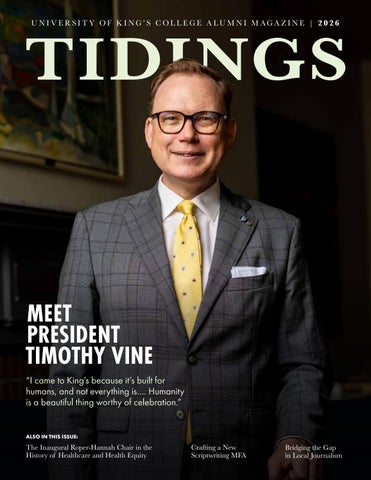
U N I V E R SI T Y OF K I NG’ S COL L EGE A LU M N I M AGA Z I N E | 2026
MEET PRESIDENT TIMOTHY VINE “I came to King’s because it’s built for humans, and not everything is…. Humanity is a beautiful thing worthy of celebration.”
ALSO IN THIS ISSUE:
The Inaugural Roper-Hannah Chair in the History of Healthcare and Health Equity
Crafting a New Scriptwriting MFA
Bridging the Gap in Local Journalism
CAMPUS NEWS
FEATURES
4 FAREWELL FOR PRESIDENT BILL
16 WHY THE HUMANITIES MATTER MORE THAN EVER
28 SUPPORTING LOCAL NEWS
20 WRITING THE DIGITAL SPELL
30 CUT TO: SCRIPTED STORYTELLING AT KING’S
TIDINGS 2026
Editor Karen Eull Contributors Kelly Clark Lana Hall, MFA’23 Emma Kuzmyk, MFA’25 Ainslie Nicholl-Penman Katherine O’Brien, BJ’87 Nicola Pulling Kate Rae David Silverberg Riley Smith Design Co. & Co. www.coandco.ca Postal Address Tidings c/o Advancement Office University of King’s College 6350 Coburg Road Halifax NS B3H 2A1
Tidings is produced on behalf of the University of King’s College Alumni Association. The views expressed in Tidings are expressly those of the individual contributors or sources. We welcome and encourage feedback on each issue. Cover photo and all photos of Dr. Timothy Vine by Riley Smith
Family, friends, dignitaries and esteemed colleagues gathered in the King’s Library to celebrate President Lahey’s decade of leadership.
7 THE COURAGE TO CHOOSE AN UNCOMMON PATH
Two exceptional Sandra MacLeod Award recipients are pursuing research that challenges what history has left out.
9 WELCOMING VISITING SCHOLARS TO FYP
Last year, Foundation Year Program students learned from 45 unique lecturers, including 21 visiting lecturers who brought fresh perspectives to the classroom.
12 Q&A WITH DR. JENNIFER FRASER
The new Roper-Hannah Chair in the History of Healthcare and Health Equity explores connections between colonialism and modern epidemiology.
15 FIELD NOTES
Deane Little Scholarshipwinner and recent grad Callie Jurmain, BA(Hons)’26, reflects on finding her community at King’s.
Alumni in three different fields on how their humanities education serves them in their thriving careers.
Winning HOST essay inspires Claudiane Beaudoin to examine our relationship to technology, the environment and each other.
22 MEET PRESIDENT TIMOTHY VINE
King’s new president shares how his love of education, background in business, care for community and good fortune have positioned him to lead the university.
26 FROM CLASSROOM TO NEWSROOM
King’s alum Robert Cribb, BA’89, founded the Investigative Journalism Bureau to encourage students to produce hard-hitting stories with long-lasting impact.
The Signal uses a Canada Heritage grant to fund student projects that help fill the growing gap in local journalism.
An anonymous gift launches plans for an exciting new MFA program focusing on scripted storytelling for film, television, theatre and other media.
32 SUSTAINABLE RESOURCES
A King’s student provides research support for a project to help the university move toward its goal of a net-zero energy campus.
34 POD PEOPLE
Listen in on just a small selection of the compelling podcasts created by the King’s community.
COLUMNS
1 Letter from the President 2 Letter from the Alumni Association President 3 Letter from the Director of Advancement 36 Alumni News 43 Lives Lived
LETTER FROM THE PRESIDENT
TIMOTHY VINE
HOW WONDERFUL TO BE ensconced at my desk in the President’s Office, writing my first letter for Tidings. I arrived in Halifax in July, a lovely time to get our family settled in the Lodge, and a critical time to connect with faculty and administration to plan for the academic year ahead. And now, as September is upon us, the campus has come alive with what’s to come. I’m seeing new faces arrive on campus each day now, students returning with fresh work and life experiences, and those who are as new to King’s as I am. Together, we’ll be initiated in the tradition of Matriculation, making reciprocal promises to live and learn in community. And together we’ll discover all that makes King’s so exceptional. Meeting more of you is what I’m most looking forward to as the year progresses. After all, it’s the conversations with all of you—alumni, students, faculty, staff, and our extended community—that are critical for me as I gain an understanding of the range of views from our constituency. Together we will determine how to advance as we bolster the sustainability of King’s. I’m here to contribute my vision and experience, but the way forward is about a convergence of leadership, of learning, and balancing our collective aspirations for the future of King’s. And the way we get there is through conversations, sharing each other’s stories and perspectives.
The success of the recent Welcoming: The Future King’s campaign (see page 3) has laid the groundwork for many current and new initiatives, for which we are deeply grateful. You have accelerated investment in what we already know to be possible and true—that with the right resources and guidance, the potential for students from King’s to thrive in every sector, to serve their communities, to achieve all they want in life, is limitless. And, as I am discovering, this is aptly demonstrated by the astounding accomplishments of our alumni. As Margaret Mead famously said, “Never doubt that a small group of thoughtful, committed citizens can change the world. Indeed, it is the only thing that ever has.” While our immediate future shares the challenges of the post-secondary sector and institutions across Canada, we shall endure. And, as far as most communities go, King’s is
well over-indexed on thoughtful, committed citizens. I have no doubt that together we will continue to make an impact on the world. It’s a privilege to be in your company. It’s an honour to be a part of this mission to help support and celebrate this bright and motivated community of readers, writers, scholars, creators, and thinkers—and of the kind, generous, and purposeful human beings that I have come to know are what makes King’s special.
Dr. Tim Vine President and Vice-Chancellor T I D I N G S 2026
1
LETTER FROM ALUMNI ASSOCIATION PRESIDENT
JENN THORNHILL VERMA
Photo by Crystal Anderson Roo Roo THERE’S A MOMENT every King’s alum knows. You’re walking up those front steps— or crossing the Quad on a grey Halifax morning, collar turned up against the wind— and something shifts in your mind. The years collapse. You’re back. I’ve been thinking about that feeling a lot this past year, my first as President of the Alumni Association. It’s a role that brings you close to King’s in a new way—not as a student navigating seminars and deadlines, but as someone watching the institution from a slight distance and marvelling, still, at what it is. This year brought change, and with it, gratitude. After more than a decade of steady, principled leadership, President William Lahey stepped down from his role as President and Vice-Chancellor of King’s. Bill led this university through some of the most complex years in recent memory—years that tested every institution of higher learning— with integrity and a deep commitment to
2
T I D I N G S 2026
what makes King’s singular. On behalf of the Alumni Association, I want to say plainly: thank you, Bill. The King’s we love today bears the mark of your leadership. We welcome Dr. Timothy Vine with equal warmth. He arrives at a moment of real possibility—and real challenge. Higher education in Canada is navigating pressures that would have been difficult to imagine a generation ago: enrolment uncertainties, funding constraints, questions about the purpose and value of a liberal arts education in a world that sometimes seems to have little patience for nuance. Against all of that, King’s continues to do what it has always done: it produces graduates who think carefully, write well and know how to sit with hard questions. That’s not a small thing. That’s the whole thing. And you—wherever you are reading this—are part of why it endures. Alumni are not peripheral to King’s. You are its argument. Every time a King’s graduate brings rigour and creativity and
ethical seriousness to their work, the case for this place is made again. The traditions, the rituals, the strange and wonderful particularity of a King’s education—they carry forward through you. So, stay in touch. Come back when you can. Walk up those steps again. And know that the Alumni Association is here, working to keep the connection between you and King’s strong, no matter how far the Quad recedes in your rear-view mirror. The feeling never leaves you. That’s rather the point.
Jenn Thornhill Verma, BJ(Hons)’02, MFA’19 President, King’s Alumni Association
ADRIANE ABBOTT
LETTER FROM DIRECTOR OF ADVANCEMENT
BEFORE YOU DELVE into this issue, I’d like to take a moment to express gratitude on behalf of all of us at King’s. On June 6, to a cheerful crowd at the annual Alumni Day Brunch, then-President, now President Emeritus, Bill Lahey had the pleasure of sharing the news that the Welcoming: The Future King’s campaign had exceeded its $15 million goal with $16.2 million raised. To state the obvious, the campaign owes its success to its donors—those motivated by the spirit of philanthropy and by the goals and ambitions of this campaign. Through your giving you’ve helped to increase access and inclusion at King’s, expand and diversify the educational experience and enhance the excellence of cultural life at King’s, too! We are touched by the stories behind your giving and grateful for the care you have for King’s and its current and future students. We acknowledge the Campaign Leadership Council, who assembled in 2024 to launch the public phase of the campaign. They are Chancellor Debra Deane Little and Bob Little (parents), Peter Jelley, BA(Hons)’94 (parent), Lincoln Caylor, BA’90, Dr. Kathryn R. Burton, BA’98, DCL’23, Professor of Theatre Dr. Roberta
Photo by Emma Kuzmyk, MFA’25 Barker, BA(Hons)’96, Maureen Welton (parent), John Wedderburn (parent), Jane Smith (friend), Chère Chapman, BSc(Hons)’94. Their love of King’s and belief in what was possible gave lift to the campaign through important launch events and networking. And special thanks to Sarah and James Baxter (parents) for hosting Ottawa’s launch event at their home. The success of the Future King’s campaign has laid the groundwork for many current and new initiatives, including funding for visiting lecturers to bring fresh perspectives to classrooms (read about visiting FYP
lecturers on page 9). Dr. Jennifer Fraser (page 12) has been appointed the inaugural Roper-Hannah Chair in the History of Healthcare and Health Equity, a chair funded by generous donors helping position King’s and Dalhousie at the forefront of medical humanities. Gifts to the campaign have also funded new initiatives in the School of Journalism, Writing & Publishing, including plans for an MFA in Scripted Storytelling (page 30) and a Centre for Excellence in Podcasting and Audio Storytelling (page 34). Reading the stories within these pages provides a snapshot of some exciting developments at the university, demonstrating your gifts in motion—and there are many more stories of impact from Future King’s campaign gifts still to be told. Throughout the academic year ahead, we will share more stories of the difference your thoughtful gifts have brought (and continue to bring) to King’s. Today, I join our new President, Dr. Tim Vine, the faculty and all our colleagues at King’s in offering you, the donors, appreciation and thanks for the positive influence you are having at King’s, on its mission, and on its future. Thank you.
Adriane Abbott Director of Advancement Photo by Kelly Clark T I D I N G S 2026
3
CAMPUS NEWS
FAREWELL FOR PRESIDENT BILL In June, we gathered in the King’s Library to celebrate President Lahey’s decade of leadership. He changed King’s for the better, and as he said that evening, King’s also changed him by Nicola Pulling and Emma Kuzmyk, MFA’25
4
T I D I N G S 2026
CAMPUS NEWS
CAMPUS NEWS
ON JUNE 25, THE KING’S extended community gathered in the Library to honour and celebrate the decade of exemplary leadership of retiring President and Vice-Chancellor William Lahey. The room was filled with people from various eras of President Lahey’s career in government and academia. Former premiers and university presidents, philanthropists and politicians from all levels of government, academics and alumni, students and staff—and of course his family, including Kathryn Lassaline, two of his three children and two sisters—all came to pay their respects, raise a glass and honour President Lahey’s tenure. The evening began with remarks by the Chair of the Board of Governors Stephanie McGrath, BJ(Hons)’99, who announced that the Board of Governors had voted that afternoon to adopt policy and bestow the title of President Emeritus upon William Lahey. Dr. Kim Brooks, President and Vice-Chancellor of Dalhousie University, also paid touching tribute to working with President Lahey and celebrating the 100th anniversary of the King’s-Dalhousie association. King’s Chancellor Debra Deane Little was
emotional in her farewell to the president who had encouraged her to become the university’s 15th chancellor. “Bill lives by the advice that he’s given to King’s students — do everything full heartedly and be fully engaged,” she said. “It’s clear to everyone who has had the pleasure of knowing him and working with him at King’s, Bill has led this university with a full heart.” Students Noam Koubi, Amal Al-Noman and recent graduate Jonah Cameron, BA(Hons)’26, each shared stories about how President Lahey made them feel at home at King’s—whether they crossed paths at a soccer match, in Prince Hall during a meal or simply walking across the Quad. The students presented President Lahey with a handcrafted book filled with photos from his years at King’s as well as more than 100 letters from people near and far who wanted him to know how much they appreciated him. So many letters were submitted that the book overflowed, and a separate, matching box was needed to accommodate them all. The whole package was tied with a ribbon and a note that said, “to be read in private.” One highlight of the evening was the
“Bill lives by the advice that he’s given to King’s students— do everything full heartedly and be fully engaged.” CLOCKWISE, FROM TOP LEFT: Chancellor Debra Deane Little, Chair of the Board of Governors Stephanie McGrath and Dalhousie President Kim Brooks; Amal Al-Noman, Jonah Cameron and Noam Koubi; Artist Elizabeth R. Whelan and President Lahey; President Lahey with his book. Photos by Kelly Clark
T I D I N G S 2026
5
CAMPUS NEWS
unveiling of the presidential portrait. Artist Elizabeth R. Whelan, commissioned to capture President Lahey’s likeness, was present to reveal her work. The portrait speaks to President Lahey making his home at King’s; it is set in the living room of the Lodge, where he and his family lived and where they hosted so many events for students, faculty, staff, alumni and community members. Also depicted is a drum by famous Mi’kmaw artist Allan Syliboy and a picture of the family dog, a.k.a. Casey the Campus Canine. On his jacket lapel, President Lahey proudly sports the King’s crest and a Blue Devils pin. In a touching tribute, Dr. Ann Sylliboy, DCL’26, alongside Board Member Catherine Martin, commended President Lahey for King’s commitment to Indigenous—
6
T I D I N G S 2026
and especially Mi’kmaw—communities, saying, “very few listen as much as Bill and King’s do.” Dr. Sylliboy then presented him with a medallion hand beaded by Andrea Paul of Pictou Landing First Nation and Regional Chief, Nova Scotia that reads “We are all learning together.” Martin sang and drummed a Mi’kmaw thank-you song. When President Lahey stepped up to the microphone, he spoke of his love of King’s, and of the extraordinary support and love of his wife Kathryn and their three children, who “finished growing up at King’s.” He expressed his gratitude to the community and spoke about how much his time at King’s has changed him. While thanking all those who have supported him over the years, he singled
out Assistant to the President Susan MacDonald and recently retired Manager of Governance and University Ceremonies Pamela Hazel as well as the Senior Administrative Team. He saved his greatest appreciation for the students he’s gotten to know through the last decade. He said he may have been at King’s for only ten years of its long history, but he “now belongs to King’s forever.”
CLOCKWISE, FROM TOP LEFT: Board Member Catherine Martin, Dr. Ann Sylliboy and President Lahey; Beaded medallion by Regional Chief Andrea Paul; President Lahey addressing guests. Photos by Kelly Clark
CAMPUS NEWS
THE COURAGE TO CHOOSE AN UNCOMMON PATH These two exceptional students are pursuing research that challenges what history has left out by Katherine O’Brien, BJ’87
THE SANDRA MACLEOD AWARD, established in 1975 by her family in her memory, recognizes King’s students who make outstanding contributions to the university through the fullest use of their qualities of character and intellect. Today, the fund supports two awards— one given annually, one renewable for up to three years. The current recipients embody both the courage to pursue an unconventional path and the drive to use their education to challenge and illuminate.
ANIQA JALAL Aniqa Jalal felt the odds were stacked against her attending university. The child of Bangladeshi immigrants, she grew up in a one-income household and spent much of her grade school years in critical medical care. When Jalal was accepted into a general science program, staying put would have been the safe choice. Ultimately, though, she switched to King’s Foundation Year Program and is now pursuing a King’s/Dalhousie Combined Honours in Neuroscience and History of Science and Technology. “I love doing so many different things,” she says. “I love the arts as much as I love the sciences.” Jalal is thriving at King’s, doing research that connects her directly to her own heritage. This past June she was the only undergraduate student whose abstract was accepted at a joint conference of the Canadian Society for the History and Philosophy of Science, the Canadian Philosophical Association and the Canadian Society for the History and Philosophy of Mathematics. Her paper, on the 19th-century Bengali physician Mahendralal Sircar, explores how colonized peoples have negotiated and reoriented Western scientific knowledge. “I felt very proud that I was able to carry through despite moments of selfdoubt,” says Jalal, who plans to expand this research for her honours thesis. Under the supervision of Assistant Professor Dr. Sarah Carson, a historian who studies T I D I N G S 2026
7
CAMPUS NEWS South Asia, she is also translating Bangla folk proverbs into English. This project carries personal weight as the proverbs were used by female ancestors on her father’s side. “I feel I have a moral responsibility to work through questions about the textual appropriation of oral folklore and rural Bengali women’s identities and honour their ancestral wisdom.” One of the first women in her family to pursue higher education, Jalal was encouraged to read and write in Bangla by her parents. Beyond her research, Jalal has worked to dismantle the barriers she experienced first-
hand. As former Communications Vice-President of the King’s Students’ Union, she led the development of the BIPOC Excellence Scholarship Program. She also was on the hiring committee that searched for a Director of Equity and Community Supports and has sat on the Sexualized Violence Prevention Implementation Advisory Committee. Not only has the Sandra MacLeod Award helped alleviate financial stress, enabling Jalal to focus on meaningful projects, but its renewable nature also gives her a chance to reflect on how she is enacting social change.
“I feel I have a moral responsibility to work through questions about the textual appropriation of oral folklore.”
ure out what they mean,” she says. Last May she encountered that art first-hand during the EMSP’s month-long study-abroad course in Florence. “It was a really incredible experience to learn about the art on-site,” she says. Throughout her time at King’s, Bisci has worked as a note taker, student assistant and library assistant and has mentored prospective students through the Humanities for Young People program. As Co-President of the EMSS, she spearheaded a cross-society journals launch and a Salon Series and helped
organize the EMSS conference. Like many students, Bisci says she initially lacked confidence in her ability to handle university-level work. “After third year, I hit my stride,” she says, crediting a talent for art history, engaged professors and a tight-knit cohort. “Once you find your footing and trust yourself more, you understand that you’re not going to be great at everything—but there is something for you.”
ISABELLA BISCI Isabella Bisci, an Early Modern Studies Program (EMSP) student, doesn’t shy away from uncomfortable topics. She has been exploring the eroticization of sexual violence in the early modern period, seeking to understand how those ideas continue to shape contemporary culture. “If you can’t understand it, you can’t really unlearn it or start to pull it apart,” says Bisci, whose paper on Titian’s The Rape of Europa was published in 2025 in the EMSP journal Babel and presented at the Early Modern Studies Society (EMSS) conference. “I was intrigued and disturbed by the painting, which made me want to understand it more,” she says. For her honours thesis, she plans to write about the eroticization of sexual violence in depictions of saints. Bisci may expand the topic for a master’s thesis or pivot to explore racialized myths of sexuality. “I hope this research can help with the cultural reckoning we’ve been having,” she says. Bisci is also drawn to the mystery behind early modern paintings. “We don’t necessarily have a lot of information about so many works and there’s so much to decode from the symbolism and historical background to fig-
“If you can’t understand it, you can’t really unlearn it or start to pull it apart.” 8
T I D I N G S 2026
CAMPUS NEWS
WELCOMING VISITING SCHOLARS TO FYP EXPANDING AND DIVERSIFYING the educational experience is a key priority of the Welcoming: The Future King’s campaign— one that complements the very nature of the Foundation Year Program (FYP). In the past academic year alone, the program was taught by 45 unique lecturers, including 21 visiting lecturers. Through these lectures and accompanying readings, students gain a broad
understanding of important developments in philosophy, history, literature, drama, and natural and social sciences. Director of FYP Dr. Neil Robertson, BA(Hons)’85, refers to the program’s unique curriculum as “a journey”—one that brings students to thought-provoking, unfamiliar places through the study of great books and ideas, from ancient to contemporary.
DR. STEPHANIE M. CAVANAUGH
Associate Professor in the Department of Historical Studies at the University of New Brunswick From her November 21 lecture Colonialism in the Americas: Encounters and Impact “The vast majority of my research works with documentary resources and is largely focused on the 16th century. I get to work with a whole wide variety of primary sources, and we’re going to think a lot today about primary evidence and what to do with different perspectives: How to bring them into comparison and conversation with each other. Do we normally take at face value exactly what the source says? We try to think about other perspectives. We try to think about not only the information that’s included, but what’s excluded. What kind of perspectives are represented or ignored, what kind of assumptions might be made within a document that show us something about the norms, or are there things about this society we can also look at? Reading against the grain is a term used commonly in my field of early modern social history. Let’s say you have a piece of fabric and you go one way and it feels quite smooth. But if you move against the grain, you get a different feeling. You see something different about it.”
In the 2025/26 academic year alone, Foundation Year Program students learned from 21 visiting lecturers who brought fresh perspectives to the classroom By Kate Rae and Emma Kuzmyk, MFA’25
Including many voices and perspectives enriches the program’s depth and breadth, and gifts made to the Excellence in Teaching campaign priority of the Welcoming: The Future King’s campaign will allow us to welcome even more visiting scholars to King’s. Here are excerpts from the presentations of five visiting lecturers.
NAIOMI METALLIC
Associate Professor of Law, Chancellor’s Chair in Aboriginal Law and Policy and Aboriginal Law Certificate Coordinator at Dalhousie University From her March 27 lecture Truth and Reconciliation
“Reconciliation isn’t just Photo by Ainslie Nicholl-Penman apologies or reparations—it’s also learning the truth. Truth and healing, I think, are so key to real reconciliation. You’ve got to learn this context. You’ve got to learn this history. You don’t understand what’s really happening if you don’t understand why this has happened. All this history explains why we are where we’re at. And you can’t really go in a different direction if you don’t understand that. I really like how the TRC talks about this; it’s healing for Indigenous people, and doing things like revitalizing our laws and our languages and our culture is a big part of healing. But there’s a healing that non-Indigenous people and non-Indigenous youth in particular also need. You’re also damaged from the stereotypes and the misconceptions and the lies that have been told in the past about our history. Although it might feel, for some people, uncomfortable or even like something’s being taken away from them, but it really is just more of a real redistribution, a more equal and fair distribution guided by United Nations Declaration on the Rights of Indigenous Peoples (UNDRIP).”
T I D I N G S 2026
9
CAMPUS NEWS
DR. ISAAC SANEY
Professor and Coordinator of Black and African Diaspora Studies and History at Dalhousie University From his March 30 lecture Revolutionary Voices: The Lives in Politics and Philosophy of Martin Luther King Jr. and Malcolm X “Martin Luther King and Malcolm X remain two of the most iconic and influential figures in the history of the Black freedom struggle in the United States, and of course in the global Black liberation struggle. While they are often portrayed in stark contrast, with King as the paradigm of non-violence and integration, and Malcolm X as the fiery prophet of Black nationalism and self-defense, their philosophies and political visions were far more complex and, at times, convergent. Each offered a critique of white supremacy, imperialism and racial capitalism, and both men died in the pursuit of liberation. This lecture explores their lives, philosophies and political trajectories, shedding light on how their distinct yet overlapping visions helped shape the contours of the Black Freedom Movement in the 20th century and into the 21st century. When they were killed, each was in the midst of organizing the broad masses of people to challenge the system. The goal, the promised land, was the creation of a better world, one fit for human beings.” Photo by Ainslie Nicholl-Penman
CHIEF DR. STEPHEN AUGUSTINE
Hereditary Chief on the Mi’kmaq Grand Council From his September 5 lecture The Mi’kmaw Creation Story “A bolt of lightning hits, and everything that’s on the earth all of a sudden comes together and forms the shape of a human being. It’s laying on the ground, its arms outstretched—one to the north, one to the south. The head is facing the east and the feet are in the direction of the west. It’s the first elements of Creation, the first person. There are seven sacred parts to his head: two ears to listen from the goodness of his heart, two eyes to look from the goodness of his heart. Two holes in his nose to sense his place from his heart and a mouth to take in the air, the water, the medicine, the food that comes from Mother Earth, which belongs to everybody. He’s given all these seven sacred parts, our Elders teach us when they’re teaching us the Creation Story. They say you’re always going to have to listen all the time with goodness from your heart. You share the water. You share the air that we breathe. We shared a medicine that comes from our mother, through the birds, plants, animals and fish. And that’s how we learned to survive on Mother Earth.”
Photo by Emma Kuzmyk, MFA’25 10
T I D I N G S 2026
CAMPUS NEWS
DR. ROOPEN MAJITHIA
FYP GUEST LECTURERS FOR THE 2025/26 ACADEMIC YEAR
From his September 25 lecture The Bhagavad Gītā on Living a Meaningful Life that is Universally Accessible
Chief Dr. Stephen Augustine Hereditary Chief on the Mi’kmaq Grand Council
“Before the Gītā, you’d have to first and foremost be a Brahmin—a member of the knowledge class—before you could obtain the theoretical basis for self-knowledge. And you would have to finish your worldly duties and then withdraw from the world, and then you would be in a position to undertake the meditative practices to obtain this kind of self-knowledge. The Buddhists agree with that, that a withdrawl from the world is necessary to obtain self-knowledge but what the Gītā then ends up doing—and this is a huge revolution—is saying you don’t have to do that. You can actually have this insight in the world, regardless of what you do, by transforming all kinds of work into a form of meditation. This is the huge shift that the Gītā represents, not only because it’s making self-knowledge universally accessible no matter what you do, but it’s a huge shift because it’s no longer restricted to a certain class of person. And that’s revolutionary, because in many ways this knowledge was a very carefully guarded secret, and a lot of time was spent trying to defend why this is; in terms of having the right kind of preparation to avoid cheapening the value of this insight… for if you’re just given the secret knowledge [it was argued], it becomes trivial. But all kinds of reasons—some of them to do with maintaining class priority in the social structure—might have also been in play. But with one swift stroke, the Gītā undermines these reasons and opens this access up.”
Dr. Dawn Brandes, BA(Hons)’05 Assistant Professor in the Fountain School of Performing Arts at Dalhousie University
Professor in the Department of Philosophy at Mount Allison University
Dr. Kathy Cawsey Professor in the Department of English at Dalhousie University Dr. Stephanie M. Cavanaugh Associate Professor in the Department of Historical Studies at the University of New Brunswick Dr. Eli Diamond, BA(Hons)’99 Associate Professor and Chair of Ancient Philosophy at Dalhousie University Dr. David Huebert, BA(Hons)’08 MFA Mentor, Fiction at the University of King’s College Hilary Ilkay, BA(Hons)’13 Associate Fellow at the University of King’s College Dr. Chike Jeffers Associate Professor in the Department of Philosophy at Dalhousie University and Canada Research Chair (Tier 2) in Africana Philosophy Dr. Krista Kesselring Professor in the Department of History at Dalhousie University Dr. Roopen Majithia Professor in the Department of Philosophy at Mount Allison University
Dr. Eva Mroczek Simon and Riva Spatz Chair in Jewish Studies and Professor in the Department of Classics and the Religious Studies Program at Dalhousie University Dr. David Nicol Associate Professor of Theatre Studies and Cinema & Media Studies and Fountain School Director at Dalhousie University Dr. Kait Pinder Associate Professor and Department Head of the Department of English & Theatre at Acadia University Dr. Seth Sanders McLeod Chair of Classics and Professor in the Department of Classics and the Religious Studies Program at Dalhousie University Dr. Isaac Saney Professor and Coordinator of Black and African Diaspora Studies and History at Dalhousie University Christopher Snook, BA(Hons)’00 Lecturer in the Department of Classics at Dalhousie University Dr. Alexander Treiger Professor in the Religious Studies Program at Dalhousie University Dr. Emily Varto Associate Professor in the Department of Classics at Dalhousie University Michelle Wilband Instructor at The Classical Learning Resource Centre Dr. Parisa Zahiremami Associate Fellow at the University of King’s College
Naiomi Metallic Associate Professor of Law, Chancellor’s Chair in Aboriginal Law and Policy and Aboriginal Law Certificate Coordinator at Dalhousie University
Photo by Ainslie Nicholl-Penman T I D I N G S 2026
11
CAMPUS NEWS
Q&A WITH DR. JENNIFER FRASER Meet the new Roper-Hannah Chair in the History of Healthcare and Health Equity 12
T I D I N G S 2026
CAMPUS NEWS
LAST YEAR, KING’S and Dalhousie University announced the creation of the Roper-Hannah Chair in the History of Healthcare and Health Equity, a new academic position dedicated to advancing research and teaching in medical humanities. Supported by a $3.5-million endowment—$1.75 million each from AMS Healthcare and the J & W Murphy Foundation—the Chair is the first Hannah Chair in Atlantic Canada and was unveiled during celebrations marking 100 years of the King’s-Dalhousie partnership. Now, Dr. Jennifer Fraser is ready to take on the role, appointed jointly to Dalhousie’s Department of History, King’s History of Science and Technology program and Dalhousie’s Faculty of Medicine. Fraser, a historian of medicine, is originally from WhitchurchStouffville, Ont., and her most recent role was as a Research Associate in the Cartographies of Cancer project at King’s College London’s Department of Global Health & Social Medicine. Her work has focused on the intersections of history, colonialism and modern healthcare and the health inequalities across different contexts. We spoke with her about the ways epidemiology carries histories that are anything but neutral, what she hopes students take away and why community engagement is central to her work.
Much of your work takes a global or geographical view on health issues, including a forthcoming book chapter on colonialism and modern epidemiology. Can you talk about that intersection? People often say descriptive epidemiology rests on three things: person, place and time. You need those same elements historically, because they reveal who and what counts and gets counted, and under what circumstances. We tend to treat epidemiological facts as neutral, but many of the ideas and methods of epidemiology—particularly noncommunicable disease epidemiology, which is my focus— are rooted in long histories of colonialism that persist today. Tracing the pathways through which these tools emerged in different places helps us understand the authority they still carry and the conditions under which they were produced. For example, there has long been a tendency to portray Indigenous and African populations as somehow naturally susceptible to or protected from certain cancer types. These ideas, which are embedded in broader structures of colonial harm, have real policy consequences, revealing how even the most celebrated epidemiological breakthroughs can carry complex legacies, often
rooted in histories of colonialism, exploitation and inequality. Many of these claims were produced under specific colonial assumptions about people’s diets and sexual practices. The practical effect was that many people were never screened, so the data was never collected—which reinforced the original claim. Tracing a statistic like that back, you find it originates with 1950s colonial medical officials and gets recycled in reports for decades afterward. The goal isn’t just to bring this history to light—it’s to ask what we carry forward unexamined. How is this work critical to shaping a more equitable and compassionate healthcare system? History shows that health systems are attached to a specific social, political and economic context, shaped by particular priorities. They could have developed differently, and there may still be room to do things differently now. Cancer epidemiology is a good case study. The field, and practices like cancer registration, took shape partly because the researchers who built it—figures like Richard Doll, known for the smoking-lung cancer link
—were also colonial medical officers comparing cancer patterns across populations. That history lets us ask whether today’s standards for collecting cancer data still carry assumptions from that period. Your interest in merging history and healthcare seems to stem from your BA(Hons) in history and psychology. Did you know then this would be your mix? Not at all—it was completely accidental. My first job was actually in public health, as a policy analyst for the Canadian Partnership Against Cancer. That role involved a lot of public and patient involvement work, as well as report writing. It was here where I noticed the pattern that became my research topic: statistics claiming certain populations were more or less likely to get certain types of cancer sitting beside the line ‘we have no data on this.’ That contradiction pulled me into my PhD. I had no idea then this would be where I’d end up—but it’s shaped everything since, this idea that history, policy and practice are fundamentally intertwined.
T I D I N G S 2026
13
CAMPUS NEWS
“There’s real power in making sure what we produce as researchers actually reaches practice, and that we’re listening to the communities the research relates to.”
How does community engagement fit into this? It’s crucial. There’s real power in making sure what we produce as researchers actually reaches practice, and that we’re listening to the communities the research relates to. Scholarship is at its best when it is collaborative, and real dialogue with the people you’re writing about adds a richness and depth that can’t be achieved any other way. What do you hope students will take away from your courses and lectures? I want students to develop a deeper understanding of the complex histories and power dynamics that shape contemporary health systems. More broadly, history helps people think critically—to ask why things are the way they are, who benefits and whether those arrangements should continue. Understanding the roots of health inequalities, and how social and political factors shape outcomes, has value far beyond academia. It applies whether you become a doctor, a nurse, a health policy professional or someone building an AI tool for healthcare. My goal is to show students this history isn’t confined to the past—it’s a flexible skill set that travels into almost any health-related career.
14
T I D I N G S 2026
CAMPUS NEWS
FIELD NOTES As she contemplates her post-graduate academic future, Callie Jurmain reflects on finding her community at King’s by Lana Hall, MFA’23
BETWEEN A DOUBLE undergraduate major, a series of student leadership roles and playing for the varsity soccer team, it’s fair to say that Callie Jurmain, BA(Hons)’26, made the most of her time at King’s. Last May, Jurmain graduated with First Class Honours in Contemporary Studies and History, receiving the University Medal in Contemporary Studies. Her thesis centred on the concept of “crimmigration,” and the political and social consequences borne from its growing prominence in Canadian immigration practices. In addition to her double major, Jurmain, originally from St. Catharines, Ont., threw herself into the organized social aspect of campus life. She served as Co-President of the Contemporary Studies Program Society where she organized the Conference of the Contemporary at King’s, and later as Vice-President of the Dalhousie Undergraduate History Society. Jurmain received an Academic Excellence award at the school’s athletic banquet as one of four student-athletes who maintained a 4.3 GPA throughout the semester. “It’s so much fun being involved in campus life and being part of a community of people that have similar interests to yourself,” she says. “With contemporary studies, you can see the vastly different paths everyone can take, even within the same classes.” She happily recalls raucous trivia nights, as well as a series of student presentations tying philosophical concepts to modern meme culture. “You can really draw a lot of connections from these philosophers to kind of the contemporary world, which is fun.” Jurmain has played soccer almost her entire life, so earning a spot on the King’s varsity team—and receiving a coveted Debra Deane Little and Robert Little Academic Scholarship for Varsity Athletes—was mean-
ingful. Valued at $5,000 per year and renewable for up to four years, these scholarships, created by King’s Chancellor Debra Deane Little, are for varsity athletes who achieved a high school average at 80 per cent or above. “The financial support from that was huge for me,” says Jurmain. Amid the pressure of studies, hitting the field was a much-needed physical outlet, while early-morning practices four days a week built discipline and provided clarity before a full day of studies. The social aspect helped too. “It’s so great being part of a team environment,” she says. “We’re always trying to calm each other down, be there for each other, hype everyone up before the game. We did this ‘GangnamStyle’ dance in the locker room. It’s so much fun and it’s a great way to burn off energy.” With her undergraduate degree behind her, Jurmain is planning to take a gap year and consider her many options for the future. She’s looking into various master’s programs and plans to take the LSAT next year, with an eye to law school.
“It’s so much fun being involved in campus life and being part of a community of people that have similar interests to yourself.”
Photo by Emma Breton, BJ(Hons)’26 T I D I N G S 2026
15
WHY THE HUMANITIES MATTER MORE THAN EVER Alumni in three different fields on why their humanities education has been essential to their thriving careers By Kate Rae
16
T I D I N G S 2026
WHAT DOES IT MEAN TO THINK WELL? To listen carefully, argue persuasively, sit with ambiguity and understand what drives human behaviour across cultures and centuries? These are not abstract academic exercises. They are the very foundations of meaningful work. The case for a humanities education has never been more urgent— or more misunderstood. In an era that prizes technical credentials and measurable outputs, degrees in history, philosophy, literature and the arts are too easily dismissed as impractical luxuries. Yet, they are far from being a relic of the past. As society confronts challenges that are as much human as they are technological, the humanities remain essential preparation not just for careers, but for engaged citizenship and lifelong learning, helping us make sense of an increasingly complex world. At King’s, a humanities education has always been about more than content. It is about the habits that form when you wrestle with difficult texts, debate ideas across the seminar table and learn to hold complexity without retreating to easy answers. Those habits— curiosity, rigour, empathy, ethical reasoning—don’t simply stay in the lecture hall. These three King’s alumni have discovered first-hand the power of their humanities degrees.
CHARLES HUMPHREY BA(HONS)‘06 AI Prototype Developer, Department of National Defence, Halifax “After university, I went into Emergency Medical Services as a paramedic. I wanted to explore the kinds of sacrifices required to provide the comfort and security I’d always known, to put myself front and centre of things that are difficult and dangerous and uncomfortable. I was a paramedic until late 2023 when I got accommodated into a new role. I was all over the place—I’m still all over the place—and that suits me. Part of the fun of FYP is that you encounter a new thinker and, especially at 17 or 18, you think: this is the absolute truth, this makes complete sense and then the following week you learn it’s nonsense, and you write a piece explaining exactly why. Then you get to Wittgenstein, who tells you none of it carries inherent meaning. It’s this endless cycle of constructing grand, airtight narratives and then dismantling them.
I think that process trains the mind in a very particular way, one that prepares you for the uncertainty of the world. One skill that has served me especially well is the ability to encounter something entirely new and feel comfortable being out of my depth, not threatened by it, not too emotionally or egotistically attached to a position. I’m willing to feel stupid. I actually crave that uncertainty. Whether that’s an innate characteristic or the result of a liberal arts education, or some combination of the two, I’m not sure, but the two are probably synergistic. It’s a kind of freedom that requires you to adapt, read what’s happening around you and chase the opportunity in front of you. That’s essentially what I’ve done: looked at what’s going on, connected my humanistic values to the technical realities of the tools and systems available, and moved accordingly.”
“One skill that has served me especially well is the ability to encounter something entirely new and feel comfortable being out of my depth, not threatened by it...” T I D I N G S 2026
17
“...if you don’t understand communities, their realities and how people think, both individually and collectively, it’s very difficult to design policies that actually work.” CAMILLE HORTON-POOLE BA(HONS)‘16 Senior Policy Analyst, Public Health Agency of Canada, Halifax “The political philosophy pieces we read during FYP were the ones that spoke to me the most, and so I decided to explore a political science undergrad. One of my profs at Dalhousie recommended the Master of Public Administration program—it’s basically an MBA if you want to go work for government—and now I’m working in antimicrobial-resistance policy. Working in policy, you have to be a jackof-all-trades and a master of essentially nothing, except writing. What’s particularly unique about working on social files in a socially
18
T I D I N G S 2026
minded department is the level of critical thinking and behavioural analysis required. This is especially true in health. You can implement programs to encourage people to get vaccinated or wash their hands but if you don’t understand communities, their realities and how people think, both individually and collectively, it’s very difficult to design policies that actually work. That requires critical thinking and the ability to hold complex systems in your head. Right now, security, national defence and economic investment are the dominant priorities, and it wouldn’t seem like healthcare automatically aligns with those. I’d like to think that drawing the connections between healthcare and national defence requires the critical thinking and creative lens that a humanities education develops. It’s something that makes us genuinely distinct.
A lot of us arrive at King’s as very high-performing students, and it’s a bit of a shock when you get your first paper back. I remember being warned by a professor that it would probably be a grade we’d never seen in our lives. He was right. At King’s, you’re constantly pushed beyond ‘this is a good paper’ to ‘this is a great paper and a truly effective argument.’ I can trace the way I write, the way I edit and the way I make arguments directly back to the skills I developed there. I remember some of my Dalhousie profs knew I was from King’s because of how I wrote. There’s a different kind of critical thinking that happens at King’s, a different way of writing and really owning your own perspective.”
JOHN ADAMS BA(HONS)‘10 Executive Director of Zero, a small R&D team within Metalab, Vancouver “After I finished FYP, I stayed working at the university for two or three years, working in the KSU office, and I found I really liked the problem-solving aspect of running a business. Then I went to business school; from there, I got into the tech industry. I think the appeal for me is that it’s hard to find an industry that is as fast moving. I have friends who work in more classical engineering and their projects are measured in years and decades. And I like things that are measured in days and weeks. One of the things FYP really prepares you for is arguing out loud. It’s incredibly easy now to produce writing that is structurally sound. Anyone can generate a paper on the meaning of ‘the good’ using AI. But ask that person to defend it with conviction, and they will wilt. If you haven’t developed that grey matter, if you haven’t trained that intellectual muscle and have instead outsourced it to a non-deterministic prediction machine, you’re going to be very disappointed with what comes next. In a world where anyone can produce an argument via chatbot, the ability to evaluate arguments, dissect the logic, draw on historical examples, apply a humanities framework or synthesize perspectives from the people around you, is actually far more meaningful. The humanities train you to evaluate ideas, and that’s a skill that’s deeply undervalued right now. I could have gotten a computer science degree and it would have served me well. But the type of intelligence the humanities trains —interpretation, evaluation, comfort with ambiguity, articulation—has only become more valuable in my work. The fact that computers can now do more doesn’t make those qualities worth less. I’m literally running the AI exploration team at a digital product agency, so I’m as embedded in this technology as anyone. But I don’t rely on it to generate end solutions. It can produce ten versions of anything I need. The skill lies in determining: this one is right, this one is wrong, here’s why and here’s what we do about it. That sounds a lot more like a FYP seminar than a computer science class. I don’t think the humanities is a silver bullet. But personally, I’m betting on the people who can ask the right questions and think critically, not the subscribers to any one worldview. I’m betting on the people who are adaptable and who are okay with ambiguity.”
“I could have gotten a computer science degree.... But the type of intelligence the humanities trains—interpretation, evaluation, comfort with ambiguity, articulation—has only become more valuable in my work.”
T I D I N G S 2026
19
20
T I D I N G S 2026
WRITING THE DIGITAL SPELL Winning HOST essay inspires a King’s student to examine our relationship to technolog y, the environment and each other by Lana Hall, MFA’23
SOMETIMES IT TAKES A SPECIAL instructor to open a particular door. That’s what Claudiane Beaudoin discovered when she took an environmental ethics class taught by Dr. Kathryn Lawson, then a Faculty Fellow in the Humanities. “It was the first class where I witnessed people having true student-led discussions, students with a real diversity of academic backgrounds and genuine curiosity and passion,” says Beaudoin, who is currently in her third year at King’s, pursuing a double major in Contemporary Studies and English. “I saw that evolve throughout the semester and it was mostly thanks to the way that Dr. Lawson designed her class. That combination with the subject made me think, ‘this is what feels important to me.’” Beaudoin’s passion for the class inspired an essay entitled, “The Digital Spell: Sensual Estrangement and the Return to the Lifeworld.” In it, she explores the relationship between humans, technology and the “morethan-human” world by examining elements of ecologist David Abram’s book, The Spell of the Sensuous. For her meaningful exploration of the topic, Beaudoin was awarded the Dr. Rowland Marshall History of Science and Technology (HOST) Essay Prize. The award was created by retired Saint Mary’s philosophy professor and Second World War veteran Dr. Rowland Marshall to celebrate and encourage students studying the intersection of humanities and the environment. Dr. Marshall also supports a King’s Choral Award and several other scholarships and special funds at universities in Halifax. This year marks the 25th anniversary of HOST at King’s. The honours program was created to explore how science and technology infuse every aspect of modern life—an area of study that feels even more crucial
with each passing year as we explore the ever-evolving social and political implications of scientific discovery and medical practice. “The Spell of the Sensuous was kind of trying to strip back all these artificial systems and to really look for the core of the issue, which is how we perceive our reality and how we perceive ourselves in the world,” says Beaudoin. “The idea of the shared flesh of the world, the inherent reciprocity and intersubjectivity that we have with each other and the more-than-human world felt hopeful to me. It affirms that we share the same fabric of existence through our senses.” For Beaudoin, who wants to pursue graduate studies, perhaps in environmental
philosophy, having her essay recognized by Dr. Marshall’s award feels additionally consequential, given her strong feelings about the topic. She followed up her essay by exploring the subject through the sensory experience of painting—and had the chance to share her piece, entitled Returning to the Lifeworld, with Dr. Marshall, who is also an artist. “I wasn’t entirely sure what I wanted to feel in my academic career, and I felt a true passion and interest writing the essay that I had never quite felt,” she says. “The fact that it was seen and appreciated just felt so good and so validating. And it’s made me want to pursue this more specific realm of academia and research, so it’s been very meaningful.”
Beaudoin’s painting Returning to the Lifeworld was inspired by her award-winning HOST essay
T I D I N G S 2026
21
MEET PRESIDENT TIMOTHY VINE Photos by Riley Smith 22
T I D I N G S 2026
On July 13, 2026, Dr. Timothy Vine became the 26th President and Vice-Chancellor of King’s. Here, he shares how his love of education, background in business, care for community and a “wagonload” of good fortune have positioned him to lead the university for the next five years
Q: What drew you to King’s? A: Really, the scale of it and the seriousness with which it treats its subject matter. Even as a graduate student, I was aware of the Foundation Year Program in particular, and I had thought that it would be such an interesting experience being one of the teaching fellows. And when the job came up, I thought, King’s still seems to have maintained an identity of human scale, person-centred education in a way that a lot of other post-secondary institutions had maybe diluted, as they had the business imperative to grow enrolments. I thought that this place is trying to strike that balance between the business imperatives and the seriousness of a traditional education and opening that up in interesting ways. And it’s exciting to see what the rigour of journalism and writing adds, inspiring additional discussions and perspectives that are essential, perhaps now more than ever. So, through the research that I was doing and the conversations I was having, I really felt it was a place where not only myself, but my wife, Crystal, and my family could find a community. That’s so critically important about King’s, that aspect of community.
Q: And what’s delighted you most about the King’s community so far? A: I think the care that people have for the institution and for the work that’s done here. I don’t want to downplay the headwinds that King’s has or the sector is facing, but I’m getting a real impression that the ends are not in dispute. We have a lot of serious conversations about the means and how we get there, but there seems to be general alignment around what the place is and what the place is for.
“I take conversation to be a very deeply ethical thing, and I go in with that ethic of transformation in mind...” T I D I N G S 2026
23
“Formative education of the type found at King’s helps develop broadminded citizens and is essential to push back against tyranny and fascism.” President Timothy Vine with his wife, Crystal Bossio, and their son
Q: You’re building on President Emeritus William Lahey’s mandate to forge a path that’s more diverse and more welcoming to those who may have not previously felt invited into this community. Where will you pick up this path? A: I hope right from where Bill has left off. The work he’s done is critically important. I was just chatting with Director of Equity and Community Supports Karen Mutyabule this week about how I can ensure that we don’t lose ground in the good work that’s being done. The subject matter and the place can get in the way of what is more deeply underlying about King’s, which is the ability to help form broad-minded, holistic people. And that’s a universal human thing. And whether it’s the legacy of the benefit that King’s has had economically from a history of slavery, whether it’s being on unceded Mi’kmaw territory, there’s a moral debt, if not an actual debt, and an impetus to rectify those relationships and make people feel welcome. King’s can sometimes have a bit of an elitist feel to it, whether by design or because of some of its more traditional aspects. But traditions can be open to anybody, I believe. Walking a path that maintains the best of our traditions while welcoming all those who want to participate in and broaden these experiences embodies the type of holistic whole-person formation that King’s is truly about.
24
T I D I N G S 2026
Q: Your PhD dissertation was about the Truth and Reconciliation Commission of Canada and Crown-Indigenous Relations. How will your work in Indigenization inform your approach to building stronger connections with Mi’kmaw and Indigenous communities in and beyond King’s? A: I hope it makes me an easier person to have a conversation with. I hope that with my background, I can credibly come to conversations with Indigenous people without having them have to do the emotional labour, with an understanding of the history of colonization, with an appreciation for the experience of Indigenous people because of the reading, the listening, the conversations that I’ve already done. Now, most of that has been in Anishinaabe territory. That’s where I’ve been living for the last 10 years. I grew up in Haudenosaunee territory, so I’m more familiar with those histories. I’m working to become more familiar with the specific history of the Mi’kmaw nation and Mi’kma’ki, which I hope will allow our conversations to be a little bit easier. I’m often concerned about the performative nature of reconciliation, and it’s easy for people that look a lot like me to say really nice words and then do nothing about it. But I am deeply invested in not only saying the things that ought to be said in support of right relationship, but in actually carrying through and being held accountable to carrying through on those things that need to happen. The university has made some important strides on the path toward
reconciliation, including the School of Journalism, Writing and Publishing’s responses to the Truth and Reconciliation Commission’s Call to Action #86 that addresses the need for Canadian journalism programs and media schools to require education for all students on the history and rights of Indigenous peoples. This is essential and ongoing learning for all Canadians. Q: The contributions of African Nova Scotians and Black communities to this province are unique and integral to the past and future of King’s. How will you delve into learning more about this history and get to know our local community partners? A: Again, I think it’s relationships. It’s conversations. It’s sitting down in true dialogue. I have a very specific view of what conversation means—a little bit from Hannah Arendt, but also just a little bit from my own formation about those meaningful moments where people come together, and we truly commit to being transformed by the experience. I take conversation to be a very deeply ethical thing, and I go in with that ethic of transformation in mind when I have conversations with folks. Admittedly, I am less familiar with the history of African Nova Scotians. I’m reading and preparing so that, again, when we have those conversations, we’re not starting at square one, because people who have had to do more advocacy to receive equity often are expected to do too much of that emotional labour and educate people that look like me on the things
that they ought to know. I’m trying to come to the table knowing as many things as I ought to know and be a true ally in that way. Q: What are you and your family most looking forward to exploring in Halifax and Nova Scotia? A: We’re looking forward to the food and culture scene. Crystal’s background is in built heritage and historic architecture, so we’re really looking forward to just wandering around and enjoying all the history and the architecture of the place. We definitely want to do some day trips. We were in Lunenburg when Crystal was in school and working on a building conditions assessment on the Lunenburg Academy. I’m desperate to get back to Elizabeth’s Books, the quirky bookshop that is only open late at night. I love second-hand books. Q: King’s loves a campus dog, and now we have two new additions. Can you tell us about them? A: So, we’ve got Mackie and Poppy. This is actually a bit of a homecoming for Mackie, who’s from PEI originally. He is a Wheaton Husky mix, which is a very bizarre mix of animals, but he is the cutest thing. Poppy is a Labradoodle. She is quite friendly, but she barks. She can’t help herself and looks so embarrassed when she barks. I’m looking forward to introducing them to folks as I take them for walks at lunch. Q: What book has helped shape your life and career? A: This is a tough question! I actually think it’s Boethius, The Consolation of Philosophy. I’m a bit attracted to stoicism. I read the book again at an important time in my life. It was really helpful, mostly in the idea of the role of Fortuna, of luck in one’s life. I’ve had cancer twice, and it was the second time when my wife gave me the book and said, ‘Maybe it will help make sense of your world.’ At first, it seemed a little bit cruel to say so much is down to fortune, but it gave me a bit of distance and reflection when I was going through treatments. It helped me transition and distance myself from the materiality of life and concentrate on those things that are immaterial in the strictest sense, like relationships, knowledge, the joy of learning, the joy of being in each other’s company. The book contains aspects of Neoplatonism that I’m not sure I wholly subscribe to, but for me, it was the discussion of the Wheel of Fortune that was formative in my concentration on human relationships. Fortune is also at the very basis of recognizing privilege. It’s inherent that
there is so much that I haven’t earned. A guy who looks and talks the way I do, with this educational background, and the family that I’ve come from…I come with a wagonload of stuff that I didn’t earn. Q: What prompted you to return to academia? A: Every moment in history may seem urgent, but I do feel like this really is an urgent moment in our shared life—social, economic, political—that endangers pillars of democracy. The sort of settled status quo that we’ve had in the transatlantic West in the post-war period is really under threat and is being deeply undermined and questioned, not in a fair, good-faith way. Formative education of the type found at King’s helps develop broad-minded citizens and is essential to push back against tyranny and fascism. Q: What is your fondest university memory as a student and then as an instructor working with students? A: I started out as a really indifferent C student, and what I remember most is that when I got to Huron, whose program I know was modelled after King’s, the smaller class sizes and the interaction with the professors really pushed me. And there was a kind of click that happened when I figured out the secret sauce of how to write an essay. That environment, and those really small classes made me feel much more confident and curious to keep pursuing my academic career. And then, as a teacher, I love the other side of that equation. I love seeing when a student
gets it. Anybody who’s taught, I’m sure, has had at least one of those students who comes in and that first assignment is rough, but you try to work with them. You want to help them. You give feedback, you invest the time, and you watch that student improve. And then you get that email at the end of the term that’s now maybe a bit too humble, where they write that they don’t know how this is going to go but they’ve done their best, with a thank you for spending the time and effort. And then the essay is just brilliant! It’s that ability to have a human connection that transcends the dynamics of power we set up within institutions that’s the most special part of being an educator, where somebody gives back the energy that you want to put in for them to progress. You know, going back to one of your original questions, I could have probably answered why I came to King’s a little bit more simply: It’s built for humans, and not everything is. We have a society that’s really big—geographically, population-wise, it’s complex. We interact with corporations that are impossibly large, where we feel literally dehumanized. And now they’ve got the simulacrum of interaction with AI agents, so you don’t always know if you’re talking to a real person. The ability to be human—vulnerable, complicated, fallible, honest—is the wonderful thing about an institution that has just over 100 employees and 1,000 students. You can’t hide. And, especially in this age that wants to remove the best parts of our humanities to technological processes, humanity is a beautiful thing worthy of celebration.
Residence and Conference Services Coordinator Jakob Burke and Housing and Ancillary Services Operations Coordinator Lorne Burke chat with President Vine in the Quad
T I D I N G S 2026
25
FROM CLASSROOM TO NEWSROOM King’s alum Robert Cribb founded the Investigative Journalism Bureau to encourage students to produce hard-hitting stories with long-lasting impact By David Silverberg
WHEN JENNA OLSEN, BJ’26, looks back at her summer internship spent reporting on a seismic story for the Investigative Journalism Bureau (IJB), her smile grows wide. “The IJB teaches students how to dig deeper and use investigative research methods to write these important pieces of journalism,” says Olsen. The IJB is a non-profit investigative newsroom at the University of Toronto (U of T) founded by Robert Cribb, BA’89, where students collaborate with experienced journalists, editors and academics to develop feature reports that often end up being published in mainstream outlets. They have also partnered with journalism schools at other universities, including King’s, to encourage students to earn credits by interning with the IJB. “What we aim to do is move students beyond the classroom into big projects where they may be interviewing whistleblowers or filing Freedom of Information requests,” says Cribb. “We see this as a supplementary experience to what students learn at journalism schools.” Olsen, who was still a King’s student while interning at the IJB, worked with Cribb to break a widely read 2025 story published in
26
T I D I N G S 2026
the National Post that uncovered an Ontario hospital covertly experimenting on and then euthanizing dogs. This work turned into an IJB series that has explored many angles on this nuanced issue and led to new Ontario legislation banning invasive medical research on dogs and cats. In a speech after he was awarded the 2026 Judge J. Elliott Hudson Distinguished Alumni Award, Cribb called Olsen one of the most talented students he’s ever worked with—after graduation, she landed a coveted CBC News summer scholarship and was also the winner of the 2026 World Press Freedom Canada Student Achievement Award. And it’s evident that the admiration flows both ways. “When I saw Rob Cribb give a talk at King’s, it was clear to me how much he loves journalism and how he wants to create a future where investigative work is central,” says Olsen. “Listening to Rob talk for five minutes taught me more than reading an entire textbook.” In fact, Cribb has written an essential text for journalism students. He co-authored Digging Deeper: A Canadian Reporter’s Research Guide (Oxford University Press) with King’s Direc-
tor of Journalism Fred Vallance-Jones, King’s MFA Cohort Director Dean Jobb and King’s MJ Data Advisor David McKie. As an investigative reporter at the Toronto Star, Cribb has garnered national and international awards and citations for his reporting on offshore tax evasion, human trafficking and public health threats. At Toronto Metropolitan University (then Ryerson) and King’s, he taught students to harness investigative journalism techniques and strengthen their writing. In 2025, Cribb left his job at the Star after almost 27 years to focus on what he calls his “legacy work” with the IJB. Cribb first conceived of the IJB as he watched newspaper revenue plummet in the mid-2000s. He witnessed how investigative journalism was often on the chopping block. During this tumultuous era for media, the germ of an idea began to sprout. Cribb remembers thinking, “…how could I not establish the IJB? Investigative journalism is on life support now and accountability reporting is vital to understanding how we live and how our tax dollars are being spent.” He sought to develop a “lab” where students could work “shoulder to shoulder”
with experienced journalists, academics and professionals, including physicians and healthcare experts who could advise on public health stories. “A collaborative model where we can widen the tent and have a teaching-hospital approach to investigative journalism, that’s what I wanted to do,” Cribb says. At first, getting university support for the concept was tough. He credits Inglis Professor Dr. Kim Kierans, BA’82, DCL’23, MFA’25, as the first person who said, “That’s a great idea. How can I help you with that?” She understood how important the work was and once even flew to Montreal “on her own dime” to help him advocate for the project. U of T’s Dalla Lana School of Public Health Sciences was excited to launch the lab in 2020. The IJB has since produced stories that investigated the Indigenous femicide crisis, migrant worker exploitation, fictional studies appearing in medical journals and the role of safe consumption sites to curb overdose deaths. “These aren’t stories that are wrapped up by 5 p.m.,” says Cribb. “These are long stories that are expensive and legally fraught that take months to research and write.”
While first affiliated with the Star to publish IJB stories online and in print, the Bureau has since inked a deal with Postmedia. It also partnered with TVO on podcast productions such as The Ultimate Choice, which focuses on stories on medically assisted deaths. The Bureau has been recognized with more than two dozen prestigious journalism awards and accolades, such as the Canadian Journalism Foundation’s Jackman Award for Excellence in Journalism Honours for reporting on youth mental health, two National Newspaper Awards and the Canadian Association of Journalists Award for Human Rights Reporting. “One of the great strengths is how these stories still matter sometimes a year after they are published,” says Associate Professor of Journalism Lisa Taylor, who is on the Academic and Editorial Advisory Board of the IJB. “The IJB brings to light critical issues affecting Canadians and offers incredible opportunities to students at King’s and other schools.” Vallance-Jones anticipates there will be more opportunities in the future for King’s students to work with the IJB. Currently,
King’s undergrads can apply for standard internships, and master’s students can complete their required nine-month professional project under Cribb’s editorial guidance with support from King’s faculty. These initiatives build on King’s long commitment to investigative journalism. Over the past two decades, investigative projects by teams of senior King’s students have won or been nominated for multiple awards, including a National Newspaper Award nomination, a tradition that now continues in the MJ program. Vallance-Jones is looking into ways that King’s can further collaborate with other journalism programs. He’s hopeful that the work of the IJB—and future collaborations with King’s students—will help build the future of journalism in Canada. TOP LEFT: In his acceptance speech for the Judge J. Elliott Hudson Distinguished Alumni Award, Robert Cribb credited Inglis Professor Dr. Kim Kierans for helping advocate for the creation of the Investigative Journalism Bureau (IJB). Photo by Kelly Clark TOP RIGHT: Jenna Olsen worked on awardwinning investigative journalism pieces with Robert Cribb while interning at the IJB
T I D I N G S 2026
27
SUPPORTING LOCAL NEWS The Signal uses a Canada Heritage grant to fund student projects that help fill the growing gap in local journalism By David Silverberg
WHEN TEDI BUFFETT CONSIDERS what she learned from a recent investigative project for The Signal on the controversy surrounding Canada’s first whale sanctuary, she replies almost immediately on a topic she’s given a lot of thought to in the last several months. “A lot of the mainstream media reporting has been done at a distance, but we really wanted to meet people in the community to get a better sense of the land, and those were great skills to learn. We have to credit Lyndsie for helping us with that,” she says. Assistant Professor of Journalism Lyndsie Bourgon, BJ(Hons)’08, led the whale sanctuary project reported by Buffett and Olivia Nitti, BJ’26. The Signal received $4,200 in funding from the federal government under the Special Measures for Journalism program. Journalism faculty decided to use the money to pay for one or more projects that would result in deeply reported, original journalism. After an internal application process, two projects—one on the whale sanctuary and one on pedestrian safety in Halifax Regional Municipality— were approved by a faculty committee. “During the school year, The Signal is an important part of the local news environment in Halifax and Nova Scotia and we wanted to give our students and instructors the opportunity to do something that went beyond, that had impact,” says Director of Journalism Fred Vallance-Jones. “This showed how tightly connected King’s Journalism is to our communities, while also creating new opportunities for learning.” “We often publish articles that aren’t much longer than 800 words,” says Bourgon, “so this gave students a real opportunity to dive into the elements of long-form reporting and feature writing and to enrich their storytelling skills.”
28
T I D I N G S 2026
Photo by Tedi Buffett while on assignment with the “Finding Sanctuary” project
FINDING SANCTUARY In October 2025, the Nova Scotia government issued a cabinet order giving the U.S.-based Whale Sanctuary Project a 20-year lease for 83 hectares of Crown lands and coastal waters. For their project, Buffett and Nitti dove deep into the tensions between landowners, residents and developers who want to carve part of the shoreline of Wine Harbour, N.S., to make way for the sanctuary. They used the grant funds to cover on-the-ground reporting and fees for Freedom of Information requests, which gave them troves of information, including blueprints, proposal documents and exchanges between government officials and developers. “If they didn’t have the budget, they wouldn’t have been able to pay for all those documents and they wouldn’t have had the capacity to actually go to the locations that they’re writing about,” says Bourgon. “It was encouraging to see my students get out in the real world and take their news reporting background and expand on it.”
EYES ON THE ROAD
News-workshop instructor Caora McKenna, BJ(Hons)’17, led a second group of students working on a six-part series on pedestrian-vehicle collisions in Halifax. “To make this ‘Eyes on the Road’ project with a team of 14 journalists, and to be able to spend six weeks digging into these road accidents, that was really special,” she says. The group aimed to move beyond reporting accidents as data points and tell more human-centred stories. Students interviewed families of accident victims, spoke to activists advocating for better road safety, and reported on how most Halifax drivers who kill pedestrians rarely face criminal charges. Barley Burns, BJ’26, wrote a recap of how the team approached their investigations, and shot the multimedia story. “It was a really great opportunity to work with folks that are coming in with different levels of experience, and understanding what goes into a group project,” they said. After the articles were published in February, McKenna recalls hearing from several family members of victims. “They said thank you for writing about this issue and for building accountability by naming and honouring the victims of these crashes.” McKenna credits the grant for helping jump-start the project and get it off the ground, covering travel costs so students could visit and interview victims and their families, and fees for a photography instructor who helped guide the multimedia reportage. “The main thing that the funds enabled was to have us start a project for students that felt even more interesting and urgent than their regular day-to-day classwork,” she says. Read the results at
SIGNALHFX.CA/SERIES/ EYES-ON-THE-ROAD/
The team recently won silver at the Atlantic Journalism Awards, and the experience also helped Buffett add a new skill to her journalistic toolbox. “This project allowed me to take some photos of Wine Harbour, because the land is a character in this story and to communicate that can be challenging,” she says. “The photography in the article was something I found very cool to do, especially since I only used to do it as a hobby.”
Read the full story at
SIGNALHFX.CA/ FINDING-SANCTUARY/
Photo by Serra Hamilton, BJ(Hons)’26, while on assignment with the “Eyes on the Road” project
T I D I N G S 2026
29
CUT TO: SCRIPTED STORYTELLING AT KING’S 30
T I D I N G S 2026
An anonymous gift launches plans for an exciting new MFA program that explores storytelling beyond the pages of a book By Lana Hall, MFA’23
KING’S SCHOOL OF Journalism, Writing & Publishing continues to grow and remain at the forefront of media education as faculty and staff work toward the launch of a third MFA option—this one focusing on scripted storytelling for film, television, theatre and other media. Dr. Gillian Turnbull, MFA’17, King’s Director of Writing & Publishing, says the university began envisioning the new MFA after receiving feedback from writers and writing students interested in adapting an existing book—sometimes their own—into a serial podcast, film or documentary. “This is just the next logical step,” she says. The program would follow a similar format as King’s existing two-year MFA programs in Fiction and Creative Nonfiction. The MFA in Scripted Storytelling will focus on producing a complete scripted work by the program’s end. That script could be designed for film, television or theatre, or other media, such as gaming and oral storytelling. Novelist and TV writer Zoe Whittall, who serves as a mentor in the King’s MFA in Fiction program, isn’t surprised that prose writers are increasingly interested in branching out into more visual mediums. She too felt pulled toward writing for television after over a decade as an author. “When I got there, I discovered I loved it just as much as writing books. It’s more collaborative, more social,” she says. “I think it makes sense that people want to try both.” But navigating the adaptation process and learning how to work with producers and directors can be challenging for writers who aren’t familiar with the industry, a challenge made easier when writers have access to mentorship and instruction. “It is a very whirlwind process for prose writers when they get involved on that side,” says Whittall. “There’s always been a bit of mystique around how to become part of the TV and film industry, and I think it’s great to democratize it.” Both the gaming and film industries are fast-growing sectors in Nova Scotia—and this new program was developed in close part-
nership with the local film industry. “We’ve been proud to support the development of the Scripted Storytelling MFA at King’s,” says Laura Mackenzie, Executive Director, Screen Nova Scotia. “Programs like this are essential to building a sustainable screen industry in Nova Scotia. By equipping writers with the skills, experience and industry connections they need to succeed, King’s is helping to strengthen our talent pipeline and ensure that more Nova Scotian stories are created, produced and shared on a global stage.” This MFA can help open many doors as students learn how to write and polish an original script, adapt an existing book for the stage or screen, or offer their own teaching and consulting services. Writing for the screen or the stage requires a different approach than one might use to write a book or an essay or a short story, says author Wanda Taylor, BJ’08, who teaches screenwriting at Toronto’s Centennial College and previously served as Cohort Director for the King’s MFA in Fiction program before being appointed the Rogers Chair in Journalism at King’s. A film or an audio narrative moves fast, and screenwriters don’t have the luxury of exposition; everything in a script must be spoken or visually portrayed. “You only have a very little space to tell a very big story,” says Taylor. “In a novel you can spend pages talking about why that woman is standing in a garden crying, and you can describe the flowers and what she’s wearing and what era it is. But in a script, you can’t do that … your audience never sees your words, so you need to be able to communicate what’s happening that translates for a visual medium.” Like the rest of the King’s MFA programs, the scripted storytelling stream will be offered in a “low-residency” approach, meaning that aside from one nine-day residency on campus each June for two years and one six-day residency online each January for two years, each school year, students work on their deliverables remotely and asynchronously. This makes the program more flexible for
“There’s always been a bit of mystique around how to become part of the TV and film industry, and I think it’s great to democratize it.” students, including those who may be working or caregiving full-time. Each student is guided by a mentor and provided opportunities to workshop with fellow classmates and network with industry professionals in the writing and publishing sectors. Plans for the new MFA were seeded by a generous anonymous gift of $250,000 to the university’s current Welcoming: The Future King’s campaign, helping to fulfil a key campaign goal seeking to diversify the educational experience through curriculum and program expansion. Pending approval, the MFA in Scripted Storytelling will welcome its first cohort in June 2028. Taylor hopes the new program welcomes a new generation of storytellers to King’s, eager to explore their talents across emerging platforms and formats and to share their stories with the world. “We just need more representation in screenwriting,” she says. “More women, more people from the 2SLGBTQIA+ community, more writers from rural communities. We need more people who understand how to write a script and tell different kinds of stories.”
T I D I N G S 2026
31
LEFT TO RIGHT: Director of Facilities Management Ian Wagschal; Lokwing Wong
SUSTAINABLE RESOURCES When Ian Wagschal, Director of Facilities Management, needed research support for an on-campus project to help the university move toward its goal of a net-zero energ y campus he knew exactly who to hire—a King’s student By Kate Rae
32
T I D I N G S 2026
WHEN MOST PEOPLE THINK OF STUDENT JOBS in Facilities Management, they imagine summer jobs mowing lawns and repainting walls. Director Ian Wagschal sees something else too: an opportunity to put King’s students to work solving complex institutional problems they never expected to encounter. Over the past several years, students studying everything from classics to military governance to bird habitat conservation have helped catalogue campus assets, build predictive maintenance models, and analyze accessibility improvements. Now Wagschal is leading a new project, designed to help King’s and other universities with historic campuses that want to pursue sustainability goals, but lack the staff capacity to prepare the complex financial analyses required for major infrastructure funding. King’s is helping develop reusable tools so institutions don’t each have to invent the process from scratch on their own. And once again, a (then) King’s student, Lokwing Wong, BSc(Hons)’26, has had a front row seat and learned to contribute in ways she never imagined. Wong’s first day on the job had her jotting down rapid-fire notes of terms to look up later. “I think it’s one of the first times I’ve been immersed in something that I had no prior connection to,” she says. “It was quite overwhelming at first. I’ve described it as being in a dark room and just feeling around and figuring out things when I’m doing them, which is a strange feeling.” Wong didn’t know what pro forma meant, and now she’s helping to craft these projective financial documents. “With a King’s student, you can give them any problem, and they can figure out a way to solve it,” says Wagschal. “Even if they don’t know everything about the topic.” Hiring Wong as a research assistant was a win-win: a chance for her to gain hands-on work experience and expand her knowledge base, and an opportunity for Wagschal to move ahead with King’s commitment to a more sustainable campus.
THE LONG ROAD TO A NET-ZERO ENERGY CAMPUS Several years ago, Wagschal and his team conducted a campus-wide study to better understand what it would take to reach near-zero carbon status, significantly minimizing greenhouse-gas (GHG) emissions at the source rather than relying solely on carbon offsets. They came up with a comprehensive series of actions, from properly insulating and sealing the buildings to replacing the current steam-heating system with a new geothermal one. King’s intends to reach net-zero GHGs for Scope 1 and Scope 2 emissions before 2030. Reaching these goals, though, will cost $12 million—around half of the university’s entire operational spending. Normally, large organizations would be able to put together the kind of financial pro formas—the documentation that governmental entities ask for—to apply for and win grants, but it’s challenging for smaller institutions to do the same. King’s plans for a new building on the southeast corner of campus will help make King’s a leader in addressing climate change by achieving LEED certification and incorporating a geothermal project to heat and cool King’s campus—but that project is still in its design phase and seeking additional funding to break ground. Now, an opportunity has emerged to make headway on plans for a Net-Zero Energy Campus through a grant from Nova Scotia’s Low Carbon Communities program, which helps smaller organizations fund sustainability and zero-carbon projects. The funding is supporting a study to develop standardized, plug-andplay documents, helping to make the process of applying sustainability methods on a campus easier. The study is a joint effort between NSCAD, Dalhousie, Mount Saint Vincent and King’s.
LEARNING WITH PURPOSE With Wagschal’s support, Wong quickly grew more comfortable with the role, which has involved combing government websites for grant opportunities and putting the information into Excel. “It’s basic academic research but applied to a practical subject. And because it’s so rigorous, and because King’s students have learned to be thorough and to think with depth on what they’re studying, she’s been able to do it easily,” Wagschal says. The idea of doing something that felt like a very practical action toward climate change was very appealing to Wong. Because if they’re able to pull this off, says Wagschal, the result will be a much more energy-efficient campus with a geothermal system that provides cooling just as readily as it provides heating. “As we progress into the next 50 or 100 years, the university will be ready.”
“With a King’s student, you can give them any problem, and they can figure out a way to solve it. Even if they don’t know everything about the topic.”
BRICK BY BRICK Picture all the buildings on the King’s campus, says Ian Wagschal, Director of Facilities Management. Maintenance for each one is a priority that demands steady resources, which can be a challenge at a small university with limited funding. Wagschal relies on help from many different students he’s hired over the past few years through the Experiential Learning Program. King’s Experiential Learning Program facilitates opportunities for students to work in almost every area of the university, and in community. This work experience helps students shape their personal development, gain confidence in their skills and values and make valuable contributions to their community—at King’s and beyond. Students can apply for a range of internships and fellowships. On campus, those include peer-mentorship roles and many job opportunities, from reporting on King’s news for the communications team, to working in the athletics centre or the King’s Co-op Bookstore, to helping out in Facilities. “Even though their fields are not at all related, I throw King’s students into the technicalities of being a facilities manager, and they can do it,” says Wagschal. “Watching them learn new skills and gain confidence is one of the things that makes my job a real pleasure.” Here’s a glimpse into the diverse interests of the students he’s worked with, and how they’ve each helped the department meet its goals.
NERISSA ZHANG BA(HONS)’23
Field of study: Classics and Philosophy “Nerissa did the initial tallying, going through all the buildings and figuring out all our assets. She took pictures of them all, put them all in a big database and made sure it was thoroughly organized through a logical, hierarchical system.”
ZOE COULTER BSC’26
Field of study: Environmental Science “Zoe had learned statistical analysis and programming in R from their environmental science courses. We used that knowledge, and Nerissa’s database, to do a predictive analysis on what things on the campus were going to break first.”
AVA GREEN BA(HONS)’27
Field of study: Political Science and International Development “Ava had to teach herself how to use the statistical computer program that Zoe had created to analyze the database. She had never programmed in her life but figured it out. She then took it a step further, adding code to analyze all the things that we should fix, what will have the greatest sustainability improvements and what will have the greatest improvements to accessibility.”
T I D I N G S 2026
33
POD PEOPLE Listen in on just a small selection of the compelling podcasts created by the King’s community By Nicola Pulling
34
T I D I N G S 2026
PODCASTING IS THE ORAL storytelling of our time—a contemporary spin on an ancient tradition that now connects people across the planet, allowing us to share eclectic interests and stories that span centuries. Not surprisingly, King’s folk have dug deep into this medium to share their love of the humanities and longform journalism. Pauline Dakin, MFA’15, is the heart, mind and soul of podcasting at King’s. An award-winning audio producer, journalist and author, the Assistant Professor of Journalism has been teaching podcasting since 2023. The CBC’s podcast adaptation of her memoir Run, Hide, Repeat won a gold medal at the New York Festivals Radio Awards in 2023 and has more than one million downloads. Dakin also produced, with audio technician Mark Pineo, This is King’s, the podcast that “explores what it means to be a small liberal arts college in a
time of evolving sensibilities.” Last April, King’s students in her Advanced Podcasting Workshop launched a podcast called Unplugged Minds. The four-part series investigates why Gen Z is turning away from their online lives and toward more faceto-face connection and analogue technology, crafts and hobbies in search of more fulfilling lives. The tagline: “Your parents were right; it’s those damned phones!” An earlier cohort of podcast students produced If It Makes You Happy, a three-part series for The Signal that explored happiness— what it is and how to achieve it. The students followed four people as they put happiness to the test, and the results won gold at the Canadian Online Publishing Awards and best student work at the Atlantic Journalism Awards.
In 2027-28, Dakin will lead King’s new Centre for Excellence in Podcasting and Audio Storytelling. The centre will allow the university to expand its already indemand podcast offerings to include new certificate and micro-credential initiatives. Funding will also enhance existing production facilities, adding new video capabilities—an increasingly essential skillset in today’s evolving media landscape.
The centre’s advisory board of industry professionals will guide program development and activities. “Podcasting is no longer the new kid on the block. It’s a maturing medium,” says Dakin. While the estimated existing five million podcasts prove that anyone can make a podcast, not everyone can make a good one, she adds. At the centre, students will gain hands-
on experience in writing, recording, producing, editing, sound design and audience development. This exciting new initiative in the School of Journalism, Writing & Publishing was made possible thanks to a gift of $130,000 in memory of Gretchen (Pierce) Ziegler, ’66, a King’s alum and long-time newspaper journalist who is remembered for her passion for storytelling.
ADD THESE MUST-HEAR PODCASTS TO YOUR QUEUE INJURY RESERVE
Journalism alumni Ethan Hunt, BJH’26, and Callum Watson, BJH’26, bring their passion for sports to this podcast. Each week, Hunt and Watson talk about local sports and athletes, do in-depth analysis on mainstream professional leagues and have a game show segment. In 2025, they won best sports broadcast at the National Community Radio Awards.
ONE FEELING AT A TIME
Growing out of her experience at King’s on the award-winning If It Makes You Happy podcast, Raeesa Alibhai, BJ(Hons)’24, created her own podcast. The series is meant to “educate, empower and create a space for emotional introspection.” Alibhai took Dakin’s first podcast course in 2023 (Introduction to Podcasting) and went on to take both the Audio and Advanced Audio Workshops. A fun side note: the music for One Feeling at a Time was created by Avery Dakin, Pauline’s daughter.
FURTHER READING
This interview podcast comes out of the King’s MFA programs, and is, “by writers for writers.” It began in 2021, created and originally hosted by the programs’ director, Dr. Gillian Turnbull, MFA’17. In 2024, she passed the mic to MFA alumni RC Shaw, MFA’17, and Aaron Williams, BJ’13, MFA’17. Further Reading brings together Canadian writers who “sit down and wax poetic about craft, structure, the publishing world, and what makes them tick.”
THE CAUTIOUS CLIMATE OPTIMIST
Pam Sullivan, BJ’97, is the Managing Editor of Climate Stories Atlantic, a website that explores stories about climate solutions. Her podcast is a spinoff that focuses on good news stories about climate work. Sullivan also hosts Hali-facts, born out of a weekend podcasting workshop at King’s— a passion project she describes as “a little bit of this and a little bit of that, but always Halifax-focused.”
TAI ASKS WHY, TESTED, ALONE: A LOVE STORY
Now a Senior Producer at CBC Podcasts, Veronica Simmonds, BA(Hons)’09, has been producer, story editor and lead producer for many award-winning series. Her work includes the acclaimed Tai Asks Why, a kids’ podcast that explores philosophical and science questions; Tested about elite female runners who can no longer race as women, and which was nominated for a Peabody Award; and Alone: A Love Story, which won gold at the New York Festivals World’s Best Radio Programs.
SICK SOCIETY
The Sick Society podcast gives UK-based medical sociologist and bioethicist Dr. Alexis Paton, BSc(Hons)’07, and her sister Hannah Paton, BA’12, Executive Producer at Haunted Mouse Productions in Halifax, a chance to work together despite an ocean between them. Going into its second season, the podcast, which Dr. Paton co-hosts with former president of the Royal College of Physicians Sir Andrew Goddard, explores the social issues behind the headlines of health and medicine.
T I D I N G S 2026
35
ALUMNI NEWS
ALUMNI PUBLISH
King’s has a long tradition of producing and nurturing storytellers. Here are just some of the many books published by alumni this year By Emma Kuzmyk, MFA’25
THE CRANE
Jaime Burnet, BA’08 Nimbus Publishing, May 2025
James Anderson turns his back on his family’s military legacy and travels to Newfoundland to fulfil a promise his twin brother made before he was killed in the Vietnam War. In Newfoundland, James is swept into an intergenerational family secret. Dr. Kidd is a multidisciplinary writer, an award-winning journalist and filmmaker, and physician. The Crane is her third novel.
A powerful work of contemporary literary fiction set in Cape Breton and Scotland exploring the clandestinity of queer abuse, the fierceness of friendship and the magic of found family. Burnet lives with her family in Halifax, where she writes, makes music and practices labour, employment and human rights law. Her first novel, Crocuses Hatch From Snow, was published by Vagrant Press in 2019.
ONE IN SIX MILLION: THE BABY BY THE ROADSIDE AND THE MAN WHO RETRACED A HOLOCAUST SURVIVOR’S LOST IDENTITY Amy Fish, MFA’23 Goose Lane Editions, April 2025
In 1942, on the side of a road near Krosno, Poland, a childless couple found eight-month-old Maria with a note that stated only her first name and date of birth. This true story is one of unexpected coincidences, astonishing revelations and lost—and found—identity. Fish is the author of two previous books of non-fiction. She lives in Montreal where she works as the Ombudsperson at Concordia University.
36
T I D I N G S 2026
MILKTOOTH
Monica Kidd, MFA’25 Breakwater Books, February 2025
THEOPOLITICS AND THE ERA OF THE WITNESS
Jane Barter, BA’91 Routledge Press, June 2025
A study of the relationship between theological forms of witnessing within Jewish and Christian traditions and public forms of witnessing in the 20th and 21st centuries. This book explores the ways witnesses to political atrocity and their mediators tacitly drew on religious themes of salvation to make sense of their suffering. Barter is a professor in the Department of Religion and Culture at the University of Winnipeg.
ALUMNI NEWS
IF IT’S SHREVEPORT, IT MUST BE TUESDAY: BASED ON A TRUE STORY
THE POWER OF GUILT: WHY WE FEEL IT AND ITS SURPRISING ABILITY TO HEAL
It’s 2001, and tech startups are imploding, taking Marilyn Carr’s brand-new telecom job with them. A glittering consulting contract rescues her: all-expenses-paid travel across the United States, interviews with high-powered executives and precious U.S. dollars. But America proves stranger than expected, where weather maps erase Canada and everything is supersized, including the culture shock. If It’s Shreveport, It Must Be Tuesday is Carr’s third memoir.
A blend of science and storytelling that uses personal experience and extensive research into human and animal psychology, psychotherapy, philosophy, comparative religion and legal frameworks to explore how guilt affects our lives. Dr. Moore is a professor of psychology at Dalhousie University. He has edited five books and special issues of academic journals, and authored The Development of Commonsense. He lives in Nova Scotia with his family.
THE UNDESIRABLES: A HISTORY OF ROCKHEAD PRISON
TO LEAVE A WARRIOR BEHIND: THE LIFE AND STORIES OF CHARLES R. SAUNDERS, THE MAN WHO REWROTE FANTASY
Marilyn Carr, MFA’20 Iguana Books, July 2025
Katie Ingram, BJ’11 Pottersfield Press, September 2025
The revealing story of Rockhead, an imposing structure that was located on Gottingen (now Novalea Drive) and Leeds Streets in Halifax. Nestled in with the industrial, working-class North End, for many residents, their backyards were adjacent to the prison. Ingram is a Halifax-based freelance journalist and writer. She is also the author of Breaking Disaster: Newspaper Stories of the Halifax Explosion and is a parttime instructor in the journalism programs.
BLOOD LETTERS
Ariel Gordon, BJ’97, and GMB Chomichuk Great Plains Press, October 2025 In this speculative-fiction young adult novel, siblings Kris, Albany and Millie are caught up in a world war with flesh-eating fog and robotic monstrosities. They dump everything they know—confessions and consolations, poems for fallen friends and battleground sketches—into letters. Gordon is a writer, editor and author of seven books. She is based in Winnipeg.
Chris Moore, MFA’22 HarperCollins, December 2025
Jon Tattrie, MFA’20 McClelland & Stewart, January 2026
The untold story of Charles R.Saunders, the “Father of Sword and Soul”—a fantasy sub-genre built on Black heroes, African myth and history. To Leave a Warrior Behind is an intimate goodbye to a friend and a remembrance of a writer who should not be forgotten. Tattrie is the author of 10 books, including Peace by Chocolate and The Hermit of Africville. He lives in Nova Scotia with his family.
IT’S NOT YOU, IT’S THE WORLD: A MENTAL HEALTH SURVIVAL GUIDE FOR US ALL Joanna Cheek, MFA’24 HarperCollins, February 2026
It’s Not You, It’s the World, a Globe and Mail bestseller, offers mental-health tools, chapter-by-chapter guidance and practical action to empower, connect and instill hope in readers who may feel depressed, anxious, enraged, numb or sick from adapting to a world on fire. Dr. Cheek is a board-certified psychiatrist, psychotherapist trained in dozens of modalities, researcher, meditation teacher, journalist and clinical professor at the University of British Columbia’s Faculty of Medicine.
T I D I N G S 2026
37
ALUMNI NEWS
DEMENTIA WIDOW: A MEMOIR ABOUT LOVE, DEATH, AND SURVIVAL
PLEASE TOUCH EVERYTHING: A HISTORY OF THE ONTARIO SCIENCE CENTRE
Fay Martin, MFA’23 Iguana Books, March 2026
The medical system took twelve years to agree with Martin that her husband was sliding into dementia. This is a book about what happens behind that veil of invisibility. When the final loss came, she felt relief followed by guilt that she wasn’t grieving “properly” and resentment that years of invisible grief were unrecognized. Since then, she has reclaimed her life and written this book as a guide to others.
Joan Francuz, MFA’16 Dundurn Press, June 2026
In 1964, the Ontario Science Centre upended the traditional museum instruction—Don’t Touch— and along the way changed how the public interacts with museums. Staff explained science by building mechanical devices for visitors to touch. Francuz is a business and technical writer who worked at the Ontario Science Centre in the early 1990s. Her book documents the centre’s history and the contributions it made to the public understanding of science.
BLOOD TYPED
DOCTOR DOPAMINE: THE EXTRAORDINARY LIFE AND SCIENCE OF DR. HARRY ROBERTSON
Jane Doucet, BJ(Hons)’93 Nimbus Publishing, May 2026 An uproarious and satirical contemporary mystery set in Nova Scotia’s author community. At the NOVA Prize gala ceremony, protagonist Val Jenkins anticipates jealousy—she didn’t expect there to also be murder. Doucet is an author and journalist. She lives in Halifax with her husband and is working on her fifth novel, Death at the Petting Zoo, the second in the Val Jenkins mystery series.
THE LOST SEASON: A MEMOIR OF INFERTILITY, MOTHERHOOD, AND THE WORRY AND WORK DEMANDED OF WOMEN
Stacey May Fowles, MFA’15 Penguin Random House, June 2026
A memoir exploring infertility, motherhood, mental health and the work demanded of women. The Lost Season examines what it means to create life with a traumatized body and how our ideas of motherhood limit and hurt us. Fowles is an award-winning journalist, author of six books and editor of four anthologies. She lives in Toronto with her husband and daughter.
38
T I D I N G S 2026
Jon Tattrie, MFA’20 HARP, June 2026
Tattrie explores the remarkable career of Dr. Harry Roberts, Professor Emeritus of Pharmacology at Dalhousie University, a neuroscientist whose discoveries transformed our understanding of Parkinson’s disease by showing that loss of smell can be an early warning sign. He helped move the field toward earlier intervention and then, in a twist, Dr. Roberts was diagnosed with Parkinson’s.
Find a selection of published titles by King’s alumni, faculty and students at the King’s Co-op Bookstore, or order them online:
KINGSBOOKSTORE.CA
ALUMNI NEWS
ALUMNOTES Highlights from the lives of fellow King’s alumni 70s Arthur Shears, BSc’71, accepted a volunteer assignment through the Canadian agency Catalyste+ to advise the Government of Dominica on the development of a five-year Strategic Plan for the Technical, Vocational Education and Training (TVET) Council of Dominica. The assignment was conducted over the summer of 2025 and follows previous consulting work with UNESCO and the International Labour Organization.
80s
Vice-Chair of the Board and former Nova Scotia Premier the Honourable Darrell Dexter, ECNS, KC, BA’79, BJ’83, DCL’25, (above, left) has been appointed to the Order of Nova Scotia by His Honour The Honourable Mike Savage, ONS Lieutenant Governor of Nova Scotia, in recognition of his dedication to public service, “which has transformed Nova Scotia through visionary leadership and enduring contributions.” John MacFarlane, BSc’70, (left) has seen his lifelong maritime history project, Nauticapedia, relaunched by the Maritime Museum of British Columbia as a next-generation digital research platform. More than 50 years in the making, the site now contains records for more than 100,000 vessels and serves as a leading global resource for maritime history research.
Henry Thiessen, ’23, Jordan Draper, BA’10, Kate Jordan, BA(Hons)’17, Iain Luke, BA(Hons)’85, and John Matheson, BA(Hons)’77, had an unexpected reunion at the General Synod of the Anglican Church of Canada, held in London, Ont., during the last week of June. Representing King’s alumni across five decades—from the 1970s to the 2020s—they discovered a shared bond through their common King’s experience.
Robert Cribb, BA(Hons)’89, and Jenna Olsen, BJ(Hons)’26, received a silver medal at the 2025 Canadian Online Publishing Awards for the investigative article “‘Sacrificed’: Puppies secretly tested and killed in Ontario for human health research.” A dozen King’s alumni were recognized as finalists across the awards’ Academic, Consumer and Media categories. Alan Doerksen, BJ’88, has published the novel Ayumi’s Language Academy—the story of a young man from Halifax who graduates from the University of King’s College and goes to Japan to teach at a language academy. Alan currently works as Publications Editor with Intercede International. Darren Greer’s, ’89, new novel, The Range Rules, explores addiction, queer identity and redemption in society’s margins. Set between elite privilege and underground culture, the novel continues Darren’s acclaimed tradition of morally complex storytelling. It will be released with Cormorant Books in September.
T I D I N G S 2026
39
ALUMNI NEWS
Roger Thompson, BA’89, HC’91, (above) commissioned a statue of his mentor, the late Rear-Admiral Fred Crickard, whom he met during his senior year at King’s in 1989 and who helped launch Roger’s writing career. Admiral Crickard, a naval leader and scholar, passed away in 2012, and through the statue, Roger helps preserve his memory. In response, Vice-Admiral Angus Topshee, Canada’s highest-ranking naval officer, sent him a handwritten thank-you note and one of his prestigious command coins that bears the word “Respect.” Now, Roger is back in Canada and transitioning to a new career as an online tutor after teaching the civic ideals of President John F. Kennedy and fictional character Atticus Finch at Kyung Hee University in South Korea for seven years. The course was highly ranked and drew praise from former United States Ambassador Caroline Kennedy, who gifted him a copy of President Kennedy’s Profiles In Courage. To aid him in his transition, he gained certification from Harvard University for a course called We The People: Civic Engagement in a Constitutional Democracy, taught by renowned Professor Dr. Danielle Allen.
90s
Barb Stegemann, BA’91, BJ’99, (right) appeared as a guest Dragon on CBC’s Dragon’s Den. Barb was the first woman from Atlantic Canada to land a venture capital deal on the popular business reality show and is now the first Dragon from Atlantic Canada. Her episodes aired on February 26 and March 5.
Paula Clarke, BA’92, is thrilled to announce the finalization of her divorce in 2026 after 20 years of intensely draining marital life. Paula’s upcoming plans include financial independence, a firm commitment to personal autonomy, mental peace and no longer needing to sleep with earplugs. Dr. Sherri Borden Colley, BJ(Hons)’97, DCL’24, was interviewed in February for a Canadian Press story written by Lindsay Armstrong, MJ’19, about the impact of American civil rights leader Reverend Jesse Jackson’s death for African Nova Scotians. Sherri, a longtime Halifax journalist, did an exclusive interview with Jackson during his visit to Nova Scotia in June 2009. Amanda Burt Currie, BA(Hons)’99, BJ’04, won a Peabody Award for her work as a producer on the 2024 documentary Any Other Way: The Jackie Shane Story. Amanda has also been named a recipient of the 2026 Women in Film & Television Toronto (WIFT+ Toronto) Banff World Media Scholarship. Amanda was recognized alongside filmmaker Esther Caszo and received support to attend the Banff World Media Festival, one of Canada’s premier media industry events. Jane Doucet, BJ(Hons)’93, is pleased to announce that Nimbus Publishing’s Vagrant Press has acquired Death at the Petting Zoo, the second book in her Val Jenkins Mystery series, scheduled for a spring 2028 release.
Ariel Gordon, BJ’97, (above) has been named the 2025–26 Writer in Residence at the Winnipeg Public Library.
40
T I D I N G S 2026
Elizabeth (Beth) Maloney-Iredale, BA(Hons)’99, has been appointed to the Alberta Court of Justice (Calgary Family and Youth), effective April 7, 2026. A graduate of both King’s and the Dalhousie Law School, Maloney-Iredale has built a distinguished
career with Alberta’s Justice and Solicitor General ministry and is recognized for her expertise in child protection law. Dr. Stephanie Nolen, OC, BJ(Hons)’93, DCL’09, was a finalist in the International Reporting category of the 2026 Pulitzer Prizes. Her work was recognized for cataloging, in devastating detail, the harm caused to vulnerable people across the developing world by the Trump administration’s abrupt dismantling of U.S. humanitarian aid, which had fought disease and promoted good health for decades. Stephanie has also been appointed an Officer of the Order of Canada. A distinguished journalist and author, she has reported from more than 80 countries, exposing inequities in health, conflict and social justice. Renowned for her groundbreaking HIV-AIDS coverage in Africa, Stephanie has earned major national and international awards, and has written acclaimed books on AIDS, art history and women’s roles in the space race. Paul Thomson, BA’90, KHS, (left) a former member of the Board of Governors and former President of the Alumni Association, received a Papal Order of Knighthood from the Holy See in June 2025, in an investiture ceremony held at St. Mary’s Basilica in Halifax. Paul was invested as a Knight of the Equestrian Order of the Holy Sepulchre of Jerusalem, an order founded in 1099 dedicated to aiding and supporting the charitable, cultural and social work of the Church and Christians in the Holy Land.
ALUMNI NEWS
00s Rich Aucoin, BA(Hons)’06, was awarded Electronic Recording of the Year at the 2025 East Coast Music Awards in St. John’s, Nfld., for his recording, Space. Aaron Beswick, BA’05, was awarded 2024 Journalist of the Year at the National Newspaper Awards in Montreal in April 2025. Marco Chown Oved, BA(Hons)’05, has won a National Newspaper Award (NNA) for his coverage in the Toronto Star of how Tesla exploited the federal government’s electric vehicle rebate program, leaving Canadian auto dealers out of pocket more than $10 million. Judges said Ottawa’s decision to reopen the program and reimburse auto dealers was due to Marco’s reporting. This is his third NNA. Stephanie Dick, BA(Hons)’07, delivered the prestigious Keyfitz Lecture in Mathematics and the Social Sciences at the Fields Institute for Research at the University of Toronto. Her research traces the postwar history of attempts to mechanize reasoning, with particular attention to the epistemic, political and labour consequences of automation. Stephanie also delivered the 30th annual Hans Rausing lecture at Cambridge University in June. David Huebert, BA(Hons)’08, was awarded the 2025 Thomas Raddall Atlantic Fiction Award for his debut novel, Oil People. He was also a finalist for the 49th annual Amazon Canada First Novel Award.
Jaime Burnet, BA’08, (above) was longlisted for the Carol Shields Prize for Fiction, was a finalist for the Lambda Literary Award for Lesbian Fiction and won the Thomas Raddall Atlantic Fiction Award for her novel milktooth.
Jessica Patterson, BJ(Hons)’07, (right, with Inglis Professor Dr. Kim Kierans, BA’82, DCL 23, MFA’25) won the 2026 MichenerL. Richard O’Hagan Fellowship for Journalism Education for “AI Literacy for Canadian Journalism Education.” The Michener Awards Foundation recognizes outstanding projects to advance public service journalism. Melina Kennedy, BSc’08, has been appointed Superintendent by the Board of Directors of the Atlantic Provinces Special Education Authority (APSEA). Dr. Suzie LeBlanc, DCL’08, was awarded Classical Release of the Year at the 2025 East Coast Music Awards in St. John’s, Nfld., for her recording, Pour une Amérique engloutie, a composition by Jérôme Blais. Dr. Alexis Paton, BSc’07, (left) has co-authored a new novel, Murder at Little Marigold, with her husband. The cozy mystery, set in Regency England and featuring a woman detective, is the first installment in the Marigold Manor Mystery series. The pair also recently launched their own independent publishing house, Corner Light Press, with Murder at Little Marigold serving as its debut publication. Veronica Simmonds, BA(Hons)’09, was nominated for a Peabody Award for her work editing the podcast Tested, from CBC and NPR’s Embedded, which explores the topic of sex testing at the Olympics. Jenn Thornhill Verma, BJ(Hons)’02, MFA’19, was awarded gold in “best data journalism” at this year’s Digital Publishing Awards for the Entangled series, published in the Globe and Mail and supported by the Pulitzer Center, covering US-Canada measures to protect the critically endangered North Atlantic right whale. Jenn’s reporting for the Unsettled series, another Globe-Pulitzer Center collaboration about how Labrador Inuit are adapting to climate change in Canada’s Far North, received bronze in ‘outstanding explanatory reporting’ at the Society of Environmental Journalists awards. In August, Jenn delivered the keynote address at Projected Futures, the science journalism summer school hosted by Concordia University’s Department of Journalism in Montreal.
Ten King’s alumni gathered in Ottawa for a social event and a chance to reconnect. Hosted by Alumni Association President Jenn Thornhill Verma, the group enjoyed a warm, collegial conversation and strengthened their connections within the King’s alumni community.
10s Nance Ackerman, MJ’13, presented the premiere of her new documentary The Delivery Line at the Hot Docs Film Festival. The powerful documentary looks at brave midwives navigating dangerous circumstances to perform their critical, lifesaving work. Charlie Bourne, BA(Hons)’12, received his professional designation to become a licensed architect with the Nova Scotia Association of Architects. During his six years working at Fathom Studio in Dartmouth, Charlie has worked on housing, community centres, and teaching and gathering spaces throughout the Maritimes. In his design work, Charlie aims to help communities imagine and realize a resilient, equitable and sustainable future. Jake Byrne, ’11, was awarded the 2025 Trillium Book Award for his poetry collection, DADDY, which explores “patriarchy, intergenerational trauma and queer desire.” His book also grapples with ideas from Augustine, Spinoza and Wittgenstein, works he enjoyed from FYP. The Bachelor of Journalism class of 2015 reunited at King’s in July to mark 10 years since graduation. Organized by Ameya Charnalia, BJ’15, along with fellow classmates Christian McQuaig, BJ’15, Mark Henderson, BJ’15, and Sergio Gonzalez, BJ’15, 12 alumni gathered at the Wardroom to reconnect, reminisce and raise a glass to old times and new memories.
T I D I N G S 2026
41
ALUMNI NEWS Fortescue follows two friends sharing a carefree summer at a cottage until a boyfriend joins them to perform a fairytale. One friend spirals into a trance and confronts struggles with traditional female roles. Directed by Rebeccah Love, ’10, the film is now streaming on CBC Gem.
Brielle LeBlanc, BA’24, was part of Telefilm Canada’s Not Short on Talent cohort of filmmakers who were at the 2026 Cannes Film Festival. Their new short film, Burnt Toast, written, directed and co-produced by Brielle, alongside co-producer Siobhan Maheux Galway, BA(Hons)’20, was presented at the Short Film Corner in May.
20s Emilie K. Adin, MFA’25, was inducted into the Canadian Institute of Planners’ College of Fellows in recognition of her lifelong contributions to transformative urban planning across Canada. Raeesa Alibhai, BJ(Hons)’24, recently launched her podcast One Feeling at a Time. Each episode explores a different emotion in conversation with a featured guest. Raeesa found her passion for audio storytelling and developed the idea in her Intro to Podcasting course at King’s. Her podcasting work has earned her two national awards, shared with fellow King’s alumni.
Angel Moore, BJ’18, (above) is a finalist in broadcast journalism for the 2026 WIBN Journalism Excellence Award for her work on the Hunters Mountain series for APTN news. Sean Mott, BJ(Hons)’16, has self-published his second novel, Under the Spire. The book explores the cost of independence and what it means to truly be alone. Aaron Williams, MFA’17, has been awarded the 2025 Edna Staebler Award for Creative Non-Fiction for his book The Last Logging Show: A Forestry Family at the End of an Era.
42
T I D I N G S 2026
Monica Kidd, MFA’25, was shortlisted for the 2026 W.O. Mitchell Book Prize for her novel, The Crane. Monica’s next book, Holding Ground: The World’s Eroding Coastlines, has been sold to Harper Collins Canada for 2027 publication. Katie Lawrence, BA(Hons)’21, was a finalist for the Bronwen Wallace Award in Creative Nonfiction for her piece “Paint Job,” a time capsule that transports readers to the fraught ground of young adulthood and her last summer as a King’s student in Halifax. Her writing has been published in The Dalhousie Review, performed at the Halifax Fringe Festival and the 2026 Toronto Fringe Festival.
Alex Faubert, BJ(Hons)’12, (above, left) was nominated for a 2026 Canadian Screen Award in the Best Web Program or Series, Non-Fiction category for Etalk Live at the Oscars. Nicolas Haddad, BJ(Hons)’14, (left) has been named a recipient of one of the William Southam Journalism Fellowships at Massey College. The fellowship provides accomplished mid-career journalists with the opportunity to pursue academic study and reflection at the University of Toronto. A multilingual journalist, Nicolas is currently the host of Radio-Canada’s morning daily radio program for Southern Ontario, Y a pas deux matins pareils.
$75,000 USD annual stipend along with full tuition and fees paid by Stanford. Jenny Li also made the 2025 CBC Poetry Prize longlist for Thirty-Seven Degrees.
Diana Bayko, MFA’25, Antoinette Bekker, MFA’25, and Michelle Hébert, BA’91, BJ’92, MFA’24, are among 28 writers from across Canada named to the 2025 CBC Nonfiction Prize longlist for their respective stories: “I Married a Spy. The Secrecy Broke My Heart,” “The Sensibilities of Dogs” and “A Mother’s Guide to Urban Gardening.” Jenny Li Chen, MFA’23, has been awarded the Wallace Stegner Fellowship at Stanford University, regarded as one of the most prestigious creative writing fellowships in the world. The two-year fellowship includes a
Dr. Chris Luedecke, DCL’22, professionally known as Old Man Luedecke, was awarded Songwriter of the Year at the 2025 East Coast Music Awards in St. John’s, Nfld., for his recording, The Raven and The Dove.
Sarah Moore, BJ(Hons)’21, (above, second from left) won the Donner Prize for her work in Seized by Uncertainty: The Markets, Media and Special Interests that Shaped Canada’s Response to COVID-19 (McGill-Queen’s University Press). Olivia Piercey, BJ(Hons)’25, received the honourable mention for Student Journalist of the Year from J-Schools Canada. The culinary memoir of Bonny Reichert, MFA’22, How to Share an Egg: A True Story of Hunger, Love and Plenty, has been named one of the Globe and Mail’s most notable books of 2025. The best-selling book explores heritage, identity and self-discovery through food, family and storytelling.
LIVES LIVED
THE HONOURABLE DR. JOHN HAMM 1938–2026 Remembered for his innumerable contributions to Nova Scotia as a family physician, politician and educational advocate, Dr. John Hamm, OC, ONS, BSc’58, DCL’14, became the province’s 25th Premier, serving from 1999 to 2006. He was named an Officer of the Order of Canada in 2009 and was posthumously appointed to the Order of Nova Scotia in 2026. Dr. Hamm was a man recognized and respected across
the province—at King’s he was a committed and engaged alum and one of our own. Dr. Hamm graduated from King’s in 1958, and the Angels’ Roost at King’s remained his home for his subsequent years of medical training at Dalhousie. His experience living on campus inspired him to direct what he called his final legacy gift to King’s to help fund the 2020 restoration of three historic residence Bays, Chapel, Middle and Radical.
In 2006, the Alumni Association bestowed its highest honour upon Dr. Hamm, the Judge J. Elliott Hudson Distinguished Alumni Award. In 2007, Dr. Hamm began the first of his two terms as Chair of the Board of Governors. To this role, he consistently brought his broad smile, wry chuckle and navy-blue blazer with its vintage King’s crest. In his characteristic humble and steady way, Dr. Hamm led King’s through advances and triumphs, and a few difficult years, with skill. In 2014, King’s conferred the honorary degree of Doctor of Civil Law on Dr. Hamm for his leadership at King’s and across Nova Scotia. In the accompanying citation, it was noted that in 2005, when he announced his retirement from politics after 12 years as a Member of the Nova Scotia Legislative Assembly and six years as the province’s 25th Premier, “voices from all parties not only lauded his record of service but praised his personal integrity with rare warmth and concord.” In his Encaenia speech at the President’s Dinner in 2014—more than 50 years after first graduating from King’s—Dr. Hamm praised the educational experience at the university for being special and rounded, stating, “I am reminded of the Ontario junior high principal who once said, ‘The doctor of philosophy who cannot make a simple box is as poorly educated as the carpenter who cannot read.’” Few are as truly well-rounded as Dr. Hamm himself—a beloved father, husband, friend and colleague, a devoted doctor and public advocate, and a respected politician dedicated to making life better for Nova Scotians.
T I D I N G S 2026
43
LIVES LIVED
DR. ROSELLE GREEN 1928–2026 A lifelong learner, Dr. Roselle Green DipJ’65, DCL’15, and her late husband, Dr. Saul Green, formed deep connections to King’s from the time she earned her Diploma of Journalism here in the ’60s. Prior to that, she had been admitted as one of two women to the Dalhousie Law School in 1947 but left to marry Saul. She later went on to complete a Bachelor of Arts, Master of Arts and Diploma in Public Administration at Dalhousie. The Greens were founding members of Halifax’s Shaar Shalom Congregation,
where Roselle was lauded for her innovative and inspired vision. In her career as a public relations consultant, she received numerous distinctions, including the President’s medal of the Canadian Public Relations Society, a life membership from the society’s Nova Scotia Chapter, and a Progress Club Award of Excellence in Communications and Public Affairs. At the Alumni Dinner in 2014, Dr. Green was inducted into the Order of the Ancient Commoner, which recognizes an alum or friend of the college who has given significant support to King’s or to the Alumni Association. And for her lifelong contributions to learning, communications and community, Dr. Green received an honorary degree, Doctor of Civil Law, in 2015. In her speech, she called the institutions of law, community, family and our halls of learning, “the stuff of life.” “King’s footprint will be with you always,” she added. A steady, cherished presence at King’s events, Dr. Green was a driving force behind the annual lecture created in partnership with the Shaar Shalom Synagogue and named for her late husband, Dr. Saul Green, which explores aspects of Judaism, medicine and humanitarianism. The most recent Saul Green Memorial Lecture last November was the very first of these events that she was
unable to attend. She was—and will now forever be—deeply missed. Dr. Green spent all of her 98 years living a rich life of the mind—including by regularly registering for university courses in many different disciplines. Although her campus visits were less frequent in the last few years of her life, she remained a voracious reader and continued to teach herself
DR. DALE GODSOE 1944–2026
Dr. Dale Godsoe, CM, DCL’19, touched the lives of so many Nova Scotians, as an educator, mentor, community leader and advocate for equality, particularly for women. Born in Halifax, Dr. Godsoe graduated
44
T I D I N G S 2026
from Dalhousie with a BA, BEd and MEd before beginning her career as a school teacher. She had a rich career in philanthropic and social impact sectors and continued her passion for public education for life as chair
of the (then) Halifax School Board, on the Board of Governors at Mount Saint Vincent University and in the decade that she served as Dalhousie’s Vice-President External. Her extensive work at Dalhousie also included fundraising for the Dalhousie Arts Centre and the creation of the J. Gerald Godsoe Scholarship, named for her late husband, a prominent lawyer and public policy leader. The scholarship supports JD students with a passion for public policy. Dr. Godsoe joined King’s Board of Governors as a co-opted member in 2007 and was appointed to the executive in 2011, where she was also Chair of the Fund Development Committee. She assumed the role of Board Chair from 2013 to 2018. Her thorough understanding of governance provided a steady hand that helped guide King’s through turbulent times. The college became stronger through her insistence on inclusivity. At the 2018 King’s Alumni Annual Dinner, Dr. Godsoe was awarded the Order of the Ancient Commoner for embodying the spirit of service and selfless contribution to
LIVES LIVED
IN MEMORIAM Rev. Paul Abbass, BA’73, October 13, 2024
Bernard Hart, BA’58, May 21, 2026
Mary Kathryn Arnold, BA(Hons)’98, February 16, 2026
Edward Kelly, BSc’68, October 15, 2025
Michael Baker, BA’75, April 22, 2026 Dorothea Beckwith, friend of the college, March 26, 2025 Mary Blanchard, friend of the college, June 14, 2025 Jordan Breen, BA’09, June 1, 2025 Brian Brownlee, friend of the college, November 12, 2025 Joan (French) Buck, BA’70, May 27, 2026 how to play the violin. The Greens provided the kind of inspiration we need to push back against what divides us and to embrace our shared desire and the opportunities we have to make the world a better place, through friendship, neighbourly relations and spending time learning together. Their legacy will remain with everyone who knew and loved them.
Dr. David Cadogan, DCL’02, April 5, 2026 Driffield Cameron, friend of the college, April 26, 2023 Mary Jane Craik, ’56, September 14, 2025 Robert Davis, August 7, 2025
Mary (Lewis) Kennedy, BSc’76, July 30, 2025 Bernard King, ’70s, November 30, 2025 Gail Klug, friend of the college, April 7, 2026 Cindy Littlefair, MFA’22, April 15, 2025 Ruth (Whitman) Loomer, BA(Hons)’53, August 9, 2025 George MacDonald, friend of the college, September 23, 2025 Rev. Iain Macdonald, friend of the college, May 14, 2025 James Alister MacDonald, ’75, September 30, 2025 Kassidy Marriott-Crawford, ’24, January 3, 2026
Sir J. Graham Day, friend of the college, July 31, 2025
Michael Melski, BA’91, July 18, 2025
Kerry DeLorey, BA’76, BJ(Hons)’80, November 20, 2025
Dr. Robert Murray, ’55, January 18, 2025
Dr. Jacques DesRosiers, BA(Hons)’77, July 3, 2025 the betterment of the university. Dr. Godsoe’s devotion to fundraising and work in the non-profit and cultural sectors benefited an astoundingly long list of organizations that stretched across Canada, earning her a Canada Volunteer Award in 1995 and an appointment as Member of the Order of Canada in 1998. For her wise leadership in governance and unequivocal dedication to the best interests of King’s and her community, Dr. Godsoe received an honorary degree, Doctor of Civil Law, in 2019. At the President’s Dinner that followed, she encouraged King’s students to, “…listen and talk with others and then tell their stories, speak to them, write them, share them, perform them. Use your voice, for it matters. And use it in service of those who may not have a voice. Do this with humility and with courage both…. Never be afraid of jumping in over your head. Of seeking truth in areas of discomfort and fear. For you are needed.” The kindness, wit and wisdom of her voice will not be forgotten at King’s.
William Hay, ’64, August 11, 2025
Carol (Coles) Dicks, BSc’53, July 30, 2025 Roger Fage, ’03, June 25, 2025 Robert Forbes, friend of the college, August 30, 2025 Dr. J. Roderick Fraser, ’50, November 23, 2025 Dr. Robert Fulford, DCL’96, October 15, 2024 Dr. Dale Godsoe, former Board Chair, DCL’19, December 6, 2025 Nita Graham, friend of the college, September 9, 2025 Dorothy (Gray) Grantmyre, MSW’55, July 19, 2025 Dr. Roselle Green, DipJ’65, DCL’15, March 5, 2026
Sharon Munro, BA’72, May 19, 2025 Nancy O’Brien, friend of the college, May 4, 2026 Mark Power, friend of the college, February 27, 2026 Dr. Ed Rosenberg, friend of the college, December 6, 2025 Joan Sinden, BA’87, September 9, 2025 Nicholas Sorge, ’67, June 4, 2025 William Sullivan, MFA’17, September 5, 2025 Jill Tasman, friend of the college, May 1, 2025 Donald A. Thompson, BA’59, July 29, 2026 Rev. Edward Thompson, BA’47, December 5, 2025 Mary Vingoe, friend of the college, July 18, 2025 Dr. Fern Wentzell, BA’60, July 19, 2025
Dr. John Hamm, OC, ONS, BSc’58, DCL’14
Raymond Whitzman, BA’72, July 7, 2025
Andy Hare, BA’70, March 7, 2026
Joël Youden, BA’88, June 3, 2026
T I D I N G S 2026
45
Discover savings with TD Insurance.
Unlock savings with Insurance. You could get preferred ratesTD on home, car and travel insurance. Plus, exploreget flexible coverage options with TD Insurance. You could preferred rates on home and car insurance. Plus, learn about TD Insurance products To learn more or toother get a quote visit
tdinsurance.com/ukings
To learn more or to get a quote visit tdinsurance.com/<partner page>
FPO
The TD Insurance Meloche Monnex program is underwritten by SECURITY NATIONAL INSURANCE COMPANY. It is distributed by Meloche Monnex Insurance and Financial Services, Inc. in Quebec, Meloche Monnex Financial Services Inc. inNATIONAL> Ontario and by TD Insurance DirectCOMPANY. Agency Inc. the rest of address: 50 Place The TD Insurance Meloche by Monnex program is underwritten by <SECURITY <PRIMMUM> INSURANCE It isin distributed byCanada. Meloche Our Monnex Insurance and Crémazie, 12th Floor, H2P 1B6. DueFinancial to provincial legislation, this Carand andby Recreational program is not in BritishOur Columbia, Financial Services Inc.Montréal, in Quebec,Québec by Meloche Monnex Services Inc. in Ontario TD InsuranceInsurance Direct Agency Inc. in the offered rest of Canada. address:Manitoba 50 Place or Saskatchewan. All trademarks are property of their respective owners. ®The TD logo and other TD trademarks are the property of The Toronto-Dominion Bank or its subsidiaries. All trademarks are property of their respective owners. ®The TD logo and other TD trademarks are the property of The Toronto-Dominion Bank or its subsidiaries. Saskatchewan.