jewishnewsva.org | AUGUST 31, 2026 | JEWISH NEWS | 11
Happy New Year from your friends at MHC and Greentree Healthcare!
W
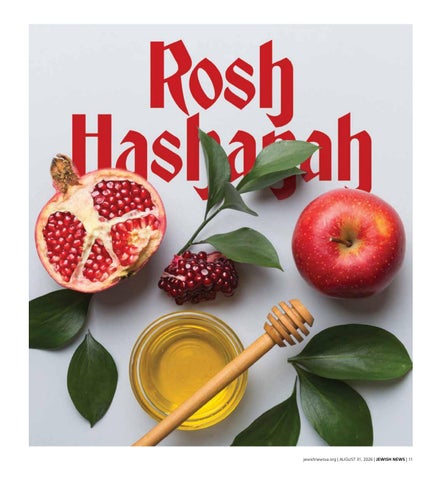
Rosh Hashanah
Dear Readers, The High Holidays are doing it again. . . they’re arriving early! Unlike the guest who rings the doorbell 15 minutes early without warning, the holidays don’t really sneak up on us. The first day of the Hebrew month Tishrei is where it always is on the Jewish calendar and this year it falls on Saturday, Sept. 12. With the news a near constant barrage of disturbing reports of antisemitism – much of it occurring in places once considered safe – it feels even more important to pause, to turn it all off, and to observe and celebrate the Jewish New Year.
ith the new year comes new ownership.
We pride ourselves with the same high standard of exceptional care you have come to expect. Please come by for a tour… we’d love to show you around! Looking forward to greeting you soon.
In Tidewater, we’re fortunate to have multiple options for worship, with a style or type of observance for nearly everyone. In fact, many congregations are advertising within these pages, welcoming old and new members to their services. The rabbis, cantors, musicians, administrative staffs, and volunteers at these congregations all put in enormous amounts of time and effort to assure their services are meaningful, inspiring, and safe. If you haven’t already, now might be the moment to join or re-join. For me, the approach of the season is packed with fond memories of family gatherings and traditions, along with the awareness that it is important to be open to creating new ones. My hope for you, our Jewish News readers, is that this Rosh Hashanah is filled with good health, peace, and the makings of memories to cherish for years to come. L’Shanah Tovah,
HEALTH CENTER
THE VILLAGE
6401 Auburn Drive Virginia Beach VA 23464 Mhcofvb.com
1049 College Park Blvd Virginia Beach VA 23464 Villageatmhc.com
757.420.2512 • 757.282.2384
12 | JEWISH NEWS | AUGUST 31, 2026 | jewishnewsva.org
Terri Denison Editor
Rosh Hashanah
Sweetness and shofars: Celebrating Rosh Hashanah with little ones Haley Bartel Rosh Hashanah is a special holiday, offering observers a sense of renewal and the opportunity for a fresh start. It is a time for reflecting on the previous year and considering what to do differently in the year to come. The concept might not immediately resonate with children, most of whom have not lived quite long enough to gain a real perspective on their place in the world. Nonetheless, there are myriad ways to introduce the holiday and familiarize youngsters with it in a meaningful way. Here, three Strelitz International Academy families share their approaches. In Irina Komarovsky’s home, Rosh Hashanah is all about sweetness. She leans into the holiday’s central wordplay, calling it a “sweet new year,” and fills her table with apples dipped in honey and an array of desserts. One small, playful touch has become a family favorite: Swedish Fish, meant to symbolize being a leader.
Palmer and Irina Komarovsky.
This year, that table will look a little different. Komarovsky’s son, Palmer, nine years old and a fourth grader at Strelitz International Academy, will be joined by his soon-to-be stepfather, Nick, and four-year-old stepbrother, Luca – the family’s first Rosh Hashanah as a blended household of four. The holiday is now a chance for the two boys to bond. Palmer has taken on a teaching role of his own, sharing his collection of PJ Library books with Luca to introduce him to the holidays their new family will celebrate together. Komarovsky, who was born in the former Soviet Union and immigrated to the United States as a toddler, says her own approach to the holidays shifted after she lost her grandparents and became a mother. Growing up, she says her family didn’t always celebrate at home, but she wanted to change that – (Continued on page 14)
L’Shana Tova U’Metuka CAN YOU HEAR THE FUTURE CALLING?
May the sounding of the shofar help us find solace in our community and support in each other. We extend heartfelt wishes for a year marked by blessings, growth, and dreams fulfilled.
foundation.jewishva.org | foundation@tjfva.org
jewishnewsva.org | AUGUST 31, 2026 | JEWISH NEWS | 13
Rosh Hashanah We wish you and your family a happy, healthy, and prosperous New Year!
Pati and Rabbi Ari Oliszewski with their children.
Cohen Investment Group is a relationship-driven, trusted commercial real estate sponsor. We are committed to our clients’ success while delivering attractive institutional real estate investment opportunities. For more information about investing with us, please contact:
Cohen Investment Group
208 Golden Oak Ct. Reflections 3 - Suite 220 Va. Beach, VA 23452 (757) 490-1193 www.coheninvestmentgrp.com
14 | JEWISH NEWS | AUGUST 31, 2026 | jewishnewsva.org
both for Palmer, and to honor her grandparents’ memory. “I want Palmer and Luca to remember the smells of the house while Nick and I cook,” Komarovsky says. “I want them to remember the warmth around the table as we include both found family and blood family when we celebrate Jewish joy.” Other parents point to the shofar as a point of fascination. Aly Yaary’s oldest son, Asher (who is, by his own emphatic correction, three and three quarters), has always loved music and instruments. When he learned that Rosh Hashanah has its own instrument to blow, he was thrilled. There was just one problem: the family doesn’t own a shofar. Undeterred, Asher enlists his mom to “fake blow” one by making trumpet noises. He coaches her through the holiday’s four traditional blasts – tekiah, shevarim, teruah, and tekiah gedolah – and he does not let mistakes slide. Asher is far from the only child with a shofar hyper fixation. Pati Oliszewski shares that the shofar has made Rosh Hashanah particularly Ben Oliszewski blows the shofar. meaningful to her six-year-old son, Ben. Given that his father is Rabbi Ari at Temple Emanuel, Ben has been watching his dad blow the shofar since he was born. Last year, his parents gave him a mini shofar of his own to play at home. He did so well that he and two friends now take part in the official shofar blowing during services. “It gives them a real role in the holiday rather than simply watching the adults celebrate it,” Oliszewski says. Apart from the shofar, she highlights community as an important aspect of Rosh Hashanah. Going to synagogue and seeing everyone (especially those they only see once a year) is part of what makes this time of year so special. “That feeling of belonging and experiencing the holiday together is something I really value and hope our children will remember,” she says. Asher Yaary.
Rosh Hashanah
The story behind some Rosh Hashanah honey: How a Galilee family keeps their tradition alive
Tania Shalom Michaelian (JTA) — When Tzvike and Hadas Ophir planted their vineyard in 1986, on the day their eldest daughter Adva was born, they had no plans to make wine. They wanted to grow something alongside their hives. The couple was among the first residents of Alon HaGalil, a town in Israel’s North about an hour and a half’s drive from Tel Aviv. Tzvike grew up in Emek Hefer and Hadas in Kfar Yehoshua, both in farming families. Tzvike was also a second-generation beekeeper. “The bees fly, but vines are planted in the ground,” says Adva Ophir. “The vineyard was a way of putting down roots in the Galilee.” At first, the family grew table grapes. The work was intensive and required too much water, and after three difficult years they switched to wine grapes. They sold their harvest to Israeli wineries, including several boutique wineries that opened during the 1990s. The feedback was good enough to persuade Tzvike to try making wine himself. Meshek Ophir sold its first bottle in 2001. “It was never my father’s dream to make wine,” Adva says. “We weren’t even a family that drank wine. The idea literally came out of the earth.” Today, Meshek Ophir produces wine and honey and continues to sell grapes to other wineries. It remains a family business, run by people whose working lives are tied to the weather, the seasons, and the condition of their bees.
What it takes to fill a jar The farm has around 1,000 mobile beehives. Tzvike, who is nearly 70, and Adva’s brother Noam move them from place to place according to the flowering season. Some are positioned near sunflower fields, avocado orchards, and other crops, where the bees pollinate the plants. Rainfall, the number of blossoms, and the length of the flowering period all affect the amount of honey produced. The bees must first make enough to feed themselves. Only then is there honey for the family to harvest and sell. Meshek Ophir’s honey contains no
additives and is not heated before it is placed in jars. Getting it there requires long days of physical work. Tzvike and Noam transport the hives, monitor the queens and worker bees, and protect the colonies from disease and other threats. “We make our living from the honey, but our more important job is protecting the bees and helping them survive,” Adva says. “Without beekeepers, many of them would not survive in the wild. The pollination they provide also allows other Israeli farmers to grow their crops.” After October 7, reaching some of the hives became dangerous. The family’s bees are spread across the Galilee, including near areas that came under rocket and missile fire. At times, entering those areas was prohibited. Tzvike continued to check on the hives. “My father is a farmer. He doesn’t care about war. He cares about his bees,” Adva says. “He went into areas under fire because if he didn’t look after them, he could lose them. This is what he knows how to do, and it is his livelihood.” The work was made harder by the absence of Noam and other family members, who continue to serve in reserve duty for months at a time. Noam normally drives the truck that transports the hives because Tzvike no longer has a truck license. During his reserve service, much of the responsibility fell back on his father. For Adva, the reason the family kept going is not difficult to explain. “We have been working together on this farm for 40 years,” she says. “It is our livelihood, but for the next generation, it is also about working as a family, being connected to the land, and passing those values on to our children. It is what keeps us here.”
Help when needed most
Meshek Ophir was one of the founding members of Western Galilee Now, a Jewish National Fund-USA-driven nonprofit that promotes small businesses and tourism in the region. During the recent conflict, that relationship became particularly important to the family.
Sweet savings
for Rosh Hashanah
With funding from Jewish National Fund-USA partners (donors), Adva was also able to combine her work as a filmmaker with the family vineyard. She created Between the Vineyards, a film festival at the farm that includes a screening of the documentary she spent 15 years making about her family’s work. The festival gives people another reason to visit the farm and draws tourists to the area. This year, Meshek Ophir’s honey will also be sold through Jewish National FundUSA’s Online Mitzvah Marketplace (jnf.org/ store), operated in partnership with Western Galilee Now to help small Israeli businesses reach customers overseas.
For the Ophirs, the marketplace offers access to customers they would struggle to reach on their own. It also comes ahead of Rosh Hashanah, when honey sales are at their highest. “We need people to enjoy the honey and come back for more, but we also want them to understand how much work goes into every jar,” Adva said. “We are not a factory or a high-tech company. When people buy our honey, they help us maintain our 1,000 hives, provide pollination services to farmers and continue doing what we know how to do.”
jewishnewsva.org | AUGUST 31, 2026 | JEWISH NEWS | 15
Rosh Hashanah
Reverse Tashlich: Repentance as environmental action
Rosh Hashanah Craft and Cookie Workshop Monday, September 14, 5 - 6 pm Sandler Family Campus
Haley Bartel The ritual of Tashlich is an allencompassing symbolic representation of the High Holidays. This process of releasing sins into the river comes directly from the book of Micah, verse 19: “He will again have compassion upon us; He will subdue our iniquities; and Thou wilt cast all their sins into the depths of the sea.” It’s wonderfully intuitive – as participants in the ritual tear up the pieces of bread, they acknowledge their sins with a faint whisper and a prayer. Then, once repentance is made clear, the guilt-ridden crumbs are thrown into the running water, to be carried away by the currents. The crumbs, however, are not always carried afar. Where many Jews live, including in Tidewater, the breadcrumbs often wash up on the beach, remain
Start the new year with Tidewater’s new Shinshinim, Liel Aisikowitz and Evyatar Olswang, along with PJ Library in Tidewater. Families are invited to a Rosh Hashanah Cookie and Craft Workshop, where children and parents can decorate holiday-themed cookies and create festive crafts. Whether creating something to keep or to gift to someone special, this is a great opportunity to spend time together, enjoy the holiday spirit, and get to know how the Shinshinim celebrate the Jewish New Year in Israel. For more information about this event or the Shinshinim program, visit JewishVA. org/Shinshinim or contact Nofar Trem at NTrem@UJFT.org. Ohef Sholom Temple’s Reverse Tashlich group 2025. 16 | JEWISH NEWS | AUGUST 31, 2026 | jewishnewsva.org
floating in the lake, or are eaten by the aquatic animals inhabiting their waters. As Joanne Palmer of the Jewish Standard, a regional newspaper serving North Jersey and Rockland, New York, recalls, “someone at our lunch fantasized about the ducks getting ready for their annual feast. ‘I know I shouldn’t eat all that bread but I can’t help it,’ she imagined a duck saying. ‘It’s so tempting. Even though it goes straight to my thighs.’” It’s a funny anecdote, but ultimately, there is some truth in the anthropomorphic situation posed here. Ducks, fish, and other wildlife that receive the sin-contaminated bread, in many ways do not benefit from the extra gluten cast into their waters. In fact, according to an article on the Chabad website, the ritual is not exactly aligned with Jewish law. “On Shabbat and
Rosh Hashanah
Breakfast • Lunch • Dinner • CATERING
Reverse Tashlich group from 2024 with their accumulated trash.
holidays, one is not allowed to feed any animals that aren’t one’s responsibility and are not dependent upon him for their sustenance.” In the decades since this moral dilemma has been posed, alternatives such as frozen peas and river-friendly grains have been championed by Jewish environmental organizations. The Jewish environmental organization Repair the Sea (Tikkun HaYam) has pushed the conversation a step further by introducing a new kind of Tashlich ritual that suggests cleaning up pollution in waterways rather than producing more. Created in 2018 by Rabbi Ed Rosenthal, Reverse Tashlich is essentially an organized trash clean-up through a Jewish lens. Rooted in the Jewish value of Repair the World (Tikkun Olam), the concept of Reverse Tashlich is maybe just as intuitive as its traditional counterpart. It was brought to Tidewater by Andrea Tank, Ohef Sholom Temple’s Sisterhood president. Having worked for the Sierra Club and lobbied on behalf of the Chesapeake Bay Foundation, Tank is extremely aware of the environmental crisis of the 21st century and the importance of Tikkun Olam. “There’s a lot of young people that have a huge concern for our environment,” Tank says. “To me, this is a very physical way to demonstrate your care and repair of the world.” Ohef Sholom’s Rabbi Rosalin Mandelberg agrees. “It is a creative and
good way of reimagining an old tradition for a new day,” she says. “And though it isn’t a replacement for the traditional ritual of casting one’s sins away, it calls upon Jewish communities to do something just as important – be good stewards of the planet.” The idea began as a joke when Rabbi Rosenthal, founder and CEO of Tikkun HaYam, was explaining the tradition to members of Scooby Jew, the Jewish scuba-diving club he created at Eckerd College in St. Petersburg, Fla. One of them pushed back. “There’s already more than enough human sin in the water,” the student said. “Why don’t we take some of it out instead?” Rosenthal took the challenge seriously. He recruited five students, and together they pulled about 75 pounds of debris out of the mangroves along Eckerd’s mile and a half of waterfront. The next year, the group grew to 10 students, eventually prompting Rosenthal to take the concept off campus and reach out to synagogues across the Tampa Bay area. “I was really surprised at the response,” he says. “It showed me that there’s an interest, but there was no vehicle in the Jewish world to raise awareness of it.” Almost a decade later that response has scaled well beyond Tampa. Last year alone, 320 teams in 31 countries participated in reverse Tashlich events, including a Newport News-based chapter already serving Tidewater. “When you combine the awareness of the mitzvah and recognize it’s fulfilling the mitzvah,” Rosenthal says, “an ordinary
Wishing our friends, family, and community a meaningful Yom Kippur! Break the Fast at George & Sam’s! Call Now to place your catering order. 4000 Virginia Beach BLVD | georgeandsams.com | (757) 463-0789 Sun - Thurs: 8am - 3pm | FRI - Sat: 8am - 8pm
action like a beach cleanup becomes a holy action — no different than going to synagogue.” The concept has strong roots in religious values, drawing heavily on Bal Tashchit, the biblical prohibition against needless waste. Rosenthal also points to Tza’ar Ba’alei Chayim, the prohibition against causing needless suffering to animals. “It's very bad for the fish,” Rosenthal says of the use of bread for Tashlich. “It’s not their normal food.” But he doesn’t ask people to abandon the traditional ritual altogether.
Instead, he recommends observers use pebbles and seashells – things already native to the water. Seashells are made of calcium carbonate, a compound that the ocean is increasingly starved of by rising acidity. As Rabbi Rosenthal says, “We in the Western world take water for granted, because it’s the most common substance on the planet… in Hebrew, our tradition refers to it as mayim chayim — living water. The water is alive, and it gives life. It sustains life. Without it, we die.”
jewishnewsva.org | AUGUST 31, 2026 | JEWISH NEWS | 17
SHANAH TOVAH! B e t h C ha v e ri m, Vi rgi n i a Beach's Re f o r m Je wi s h C on gre g ation, w arm ly i n vi t es you t o j oi n Gue st Rabbi Susan Rh ei n s, Sol oi s t Ji m H i b berd, and the B e t h C ha v e ri m C hoi r for our High H olid ay Se rv i ce s . Celeb r a t e Ros h H as han ah and Yom Ki p p u r wi t h our we l com ing, inclusive com m u ni t y, a n d j oi n u s f or our annual B r e a k -t he - Fas t fol l owi ng Yom K ippur. S e r v i ce s are a v a i l a b l e b o th in person a n d on li n e . For more i nfo rm ation or to re que s t v i rt ual access, please con t act :
Rosh Hashanah
Honey Pomegranate Mandelbrot
These classic Ashkenazi cookies are updated with High Holiday flavors. Leah Koenig This story originally appeared on The Nosher. Long before pomegranates became known as a healthy superfood — linked to everything from improving cardiovascular health and reducing cholesterol to preventing cancer — they were a mainstay of Jewish cuisine.
t e m ple .o ffic e @be th c h ave r i m . c om
WWW.BETHCHAVERIM.COM
Shofar’s Calling Rabbi Israel Zoberman
The ram’s horn cut off To proclaim the brokenness Of the heart. Only what’s incomplete May sound the yearning To be whole. Rabbi Dr. Israel Zoberman is founder of Temple Lev Tikvah in Virginia Beach.
18 | JEWISH NEWS | AUGUST 31, 2026 | jewishnewsva.org
Named in Deuteronomy 8:8 as one of the seven agricultural species cultivated in ancient Israel (along with wheat, barley, grapes, figs, olives and dates) and mythologized to contain 613 seeds in every fruit (to correspond with the number of mitzvot/commandments given to the Israelites by God), pomegranates are, without doubt, one of Jewish tradition’s most well-known, sacred, and celebrated foods. As a symbol of fertility and love, the pomegranate shows up multiple times in the Jewish canon’s most famous love poem, The Song of Songs. For example (4:3): “Your lips are like a crimson thread; your mouth is lovely. Your brow behind your veil [gleams] like a pomegranate split open.” Not surprisingly, given its connection to love, the red, spherical fruit also regularly shows up as an artistic theme on ketubot, challah covers, and other marriage and family-focused Judaica. Pomegranates’ peak season
generally falls somewhere in the autumn around the High Holidays, which makes them the perfect accompaniment to Rosh Hashanah (the Jewish New Year) or the harvest holiday of Sukkot. Some families hang the red orbs in their sukkahs as decoration. Others incorporate their juicy red seeds into both sweet and savory dishes – everything from pomegranateglazed chicken to salads speckled with lush, bright red seeds. In that spirit, this mandelbrot recipe drizzles the traditional Ashkenazi almond cookies (the name translates from Yiddish to “almond bread”) with a bright pink pomegranate glaze. The sweet-tart glaze adds color and personality to the light and crispy mandelbrot and helps an otherwise humble cookie stand out on the dessert table. A generous pour of sweet, golden honey folded into the batter also adds to these cookies’ appeal and makes them a lovely plus one to any High Holiday spread.
Total Time: 1 hour 15 minutes (35 minutes active) • Yield: About 2 dozen cookies
Ingredients • 1½ cups all-purpose flour, plus more for shaping • ½ tsp baking powder • ½ tsp baking soda • ¼ tsp kosher salt • ½ cup unsalted butter or vegan butter, softened • ¼ cup + 2 Tbsp granulated sugar, divided • ¼ cup mild honey
Rosh Hashanah • 2 large eggs • ¾ tsp vanilla extract • ¾ cup roasted, unsalted almonds, chopped
For the glaze • ¾ cup confectioner’s sugar, plus more if needed • 1½ tbsp pomegranate juice, plus more if needed
Instructions 1. Make the cookies: Preheat the oven to 350°F and line a large, rimmed baking sheet with parchment paper. 2. Sift together the flour, baking powder, baking soda and salt in a medium bowl; set aside. 3. In a stand mixer or using a handheld electric mixer and a large bowl, beat the butter and ¼ cup of the sugar together on medium speed, scraping down the bowl as necessary, until pale and creamy, 2-3 minutes. 4. Add the honey, eggs and vanilla and beat to combine. The mixture might look curdled at this point, but will smooth out when you add the flour. 5. Add the flour mixture to the butter mixture in two stages, beating on low until just combined and a soft dough forms. Fold in the almonds with a spatula. 6. Divide the batter into two equal mounds on the baking sheet, leaving at least 2 inches of space in between the mounds. Using lightly floured hands, pat and press the batter into long, flat rectangles (about 9×4 inches and ½ inch thick).
7. Bake until puffed and deep golden brown, about 20 minutes, then remove from the oven and let cool for about 1 minute. Slice both of the rectangles vertically down their middles. Then, slice them horizontally into 1 inch-wide pieces. 8. Turn the pieces on their sides and sprinkle evenly with 1 Tbsp of the remaining sugar. Bake for 10 more minutes, then remove the baking sheet again. Flip the pieces to the other side and sprinkle with the remaining 1 Tbsp sugar. Bake until the cookies are firm, 5-10 minutes more. (Be careful not to overbake them – they continue to crisp up as they cool.) 9. Remove from the oven and set the baking sheet on a wire rack to cool for 5 minutes, then transfer the cookies to the racks to cool completely. 10. M ake the glaze: Sift the confectioner’s sugar into a medium bowl. Add the pomegranate juice and stir to form a thick but pourable glaze. If the glaze is too thick to drizzle, stir in a little more pomegranate juice. (Likewise if it is too runny, stir in a little more sifted confectioner’s sugar.) 11. G enerously drizzle the tops of the cooled cookies with glaze and set cookies back on the racks to allow the glaze to set. Note: Store cookies in an airtight container at room temperature for up to 3 days, or in the fridge or freezer for longer.
JEWISH TRIVIA NIGHT
Tuesday, September 1, 7 – 9 pm, Smartmouth Brewery Hannah Yasemsky United Jewish Federation of Tidewater’s NextGen community gathers to kick off a month of holiday celebrations. Connect with friends, meet new people, and engage in friendly competition during a special trivia game designed to prepare everyone for the Jewish traditions and festivities ahead.
This family-friendly event offers a welcoming space for all ages, while guests aged 21 and older can sample a variety of local craft beers. Register at www.jewishva.org/NextGen. For more information, email Hannah Yasemsky, NextGen Engagement coordinator, at Hyasemsky@ujft.org.
jewishnewsva.org | AUGUST 31, 2026 | JEWISH NEWS | 19
Rosh Hashanah
When the shofar asks: Who am I? Rabbi Ari Oliszewski Rosh Hashanah arrives each year carrying questions. What did I accomplish during the year that has passed? Where did I fall short? Whom did I help? Whom did I hurt? What needs to change? But beneath all these questions lies another, more fundamental one: Who am I? The easiest answers are usually the most immediate: our names, professions, accomplishments, relationships, and responsibilities. We introduce ourselves by describing what we do, where we live or to whom we belong. These things are important, but they are not the whole story. Jobs change. Titles disappear. Success comes and goes. Even the roles we treasure most may change with time. Rosh Hashanah invites us to look
beneath those temporary descriptions and encounter the deeper self—the soul that remains when the titles and achievements are stripped away. Jewish tradition suggests that this soul is formed through relationship: our relationship with family, with community, with other human beings, and with God. The Torah teaches, Lo tov heyot ha’adam levado—“It is not good for the human being to be alone” (Genesis 2:18). Family is not merely an accessory to life. It is one of the principal places in which the soul is formed. It is where we first learn to give and receive love, to disagree, to forgive, to make sacrifices, and to care for someone beyond ourselves. Family, of course, is not only biological. There are families we inherit and families we create. There is also the extended family of the Jewish people—a
people bound together by memory, responsibility, and a story that began long before us and, God willing, will continue long after us. A beautiful midrash (Shir HaShirim Rabbah 1:4) teaches that when God prepared to give the Torah at Mount Sinai, God asked the Israelites to provide guarantors who would ensure its Rabbi Ari Oliszewski. continuity. The people first offered their ancestors and then their prophets. Finally, they said,
Founded in 1844, Ohef Sholom Temple is the oldest and largest Reform Congregation in Southeastern Virginia.
530 Raleigh Avenue, Norfolk, VA 23507 757-625-4295 • ohefsholom.org
Visit ohefsholom.org/high-holidays for dates and times regarding in-person and streamed services as well as ticket information. OST offers adult and family services as well as children’s programs.
Rosalin Mandelberg, Senior Rabbi • Jennifer Rueben, Cantor • Lawrence A. Forman, Rabbi Emeritus 20 | JEWISH NEWS | AUGUST 31, 2026 | jewishnewsva.org
“Our children will be our guarantors.” God accepted. The message is powerful: Jewish identity cannot survive only as a memory of the past. It survives when we place it into the hands of the future. Our children become our guarantors when they see that Judaism matters to us—not only in what we say, but in the lives we lead. Faith forms another part of this deeper identity. The Torah says: “The word is very near to you, in your mouth and in your heart, so that you may do it” (Deuteronomy 30:14). Faith is not necessarily found in dramatic miracles or perfect certainty. It can live in prayer, gratitude, doubt, and even complaint. After all, complaining to God may itself be an expression of faith. It means that somewhere within us, we still believe someone is listening. The Talmud (Ta’anit 25a) tells a remarkable story about Rabbi Hanina ben Dosa, a man who lived in profound poverty. In response to his prayers, Heaven granted his household one leg from a golden table. Later, however, his wife dreamed that in the World to Come everyone else sat at complete tables while theirs was missing a leg. Rabbi Hanina prayed again, asking that the golden leg be taken back. The story is not teaching us that poverty is inherently holy or that material needs are unimportant. Judaism does not romanticize suffering. Rather, it challenges us to consider how we measure abundance. Pirkei Avot offers a different way of measuring abundance: “Who is rich? The
Rosh Hashanah one who rejoices in what they have” (4:1). True wealth is not determined only by what we possess. It is also found in the people we love, the values we transmit, the good we bring into the lives of others, and the ability to recognize blessings before they disappear. At the end of life, Pirkei Avot teaches, neither silver nor gold accompanies us. What remains are our acts of Torah and kindness. What we accumulate eventually belongs to someone else. What we plant within another person can continue growing for generations. This brings us back to the shofar. The central mitzvah of Rosh Hashanah is not simply to blow the shofar, but to hear its voice. This year, because the first day of Rosh Hashanah falls on Shabbat, we will wait until Sunday to fulfill that mitzvah. Perhaps the waiting itself can prepare us to do more than hear a sound. Perhaps it can prepare us to receive its message. The shofar has no vocabulary and offers no explanation. It speaks through breath, broken notes, and silence. The tekiah is whole and confident—the sound of the person we hope to become. The shevarim is fractured—the sound of disappointment, grief, and the awareness that something within us needs repair. The teruah trembles—the sound of a human being struggling, searching, and refusing to give up. Finally, we return to the long, unbroken sound of tekiah. Yet it is not the same sound we heard at the
beginning. We have passed through brokenness. We have acknowledged our imperfections. The final tekiah is not the sound of innocence, but of resilience. The shofar does not ask about our résumé. It does not ask how impressive we appear to others. It asks whether we are awake. Are we present for the people who need us? Are we transmitting Judaism to the next generation? Do our actions reflect the values we claim to hold? Are we so busy building a successful life that we have forgotten to build a meaningful one? Perhaps our identity is not something we discover once and possess forever. It is something we create through every relationship, decision, and act of responsibility. This Rosh Hashanah, when we finally hear the shofar, may we allow its voice to become a mirror. May it remind us that we are more than our titles, possessions, successes—and even our failures. And when the new year asks, “Who are you?” may we be able to answer: I am a soul still growing. I am part of a family and a community. I am responsible for what I transmit to those who come after me. I am connected to God, even when I question, struggle or complain. I am a member of Am Yisrael. And I am ready to begin again. Shana Tovah! Rabbi Ari Oliszewski, Temple Emanuel Virginia Beach
Southside Chapel • 5033 Rouse Drive Virginia Beach • 757 422-4000
Chris Sisler, Vice President, Member of Ohef Sholom Temple, Board member of the Berger-Goldrich Home at Beth Sholom Village, James E. Altmeyer, Jr., President, James E. Altmeyer, Sr., Owner
Maestas Chapel • 1801 Baltic Ave. Virginia Beach • 757 428-1112
• Family owned and operated since 1917 • Affordable services to fit any budget
Chesapeake Chapel • 929 S. Battlefield Blvd. Chesapeake • 757 482-3311
• Advance funeral planning • Professional, experienced, caring staff • Flexible burial options
Denbigh Chapel • 12893 Jefferson Ave. Newport News • 757 874-4200
• Flexible payment options Approved by all area Rabbis and Chevrah Kadisha Riverside Chapel • 7415 River Road Newport News • 757 245-1525
www.altmeyerfuneralandcremation.com
ROSH HASHANAH BUZZ Sunday, September 6, 5 – 7 pm Sandler Family Campus Get ready to celebrate a sweet New Year and prepare for Rosh Hashanah with United Jewish Federation of Tidewater’s NextGen community (ages 22–45ish). The event will honor Tikkun Olam—the Jewish value of repairing the world—by exploring the important role of environmental pollinators. Designed to build community connections, the evening offers an
opportunity to mingle and deepen holiday traditions through the lens of ecological care. Local beekeeper expert, and fellow community member, Nate Brauner, will give a special presentation of the fascinating world of beekeeping. He will also bring a variety of flavors of raw honey to taste that were harvested by his own local bees.
Step into the hive for a couple of hours and discover the beautiful craft behind the sweetness and start the new year with purpose. Register at www.jewishva.org/NextGen. For more information, email Hannah Yasemsky, NextGen Engagement coordinator, at Hyasemsky@ujft.org.
jewishnewsva.org | AUGUST 31, 2026 | JEWISH NEWS | 21
Rosh Hashanah
The Nosher's Guide to the perfect holiday brisket Brisket has long taken center stage on the Jewish holiday table. This slow-cooked, aromatic main dish is worth the time and effort, but making the perfect brisket for a crowd doesn’t have to be an intimidating task. That’s why The Nosher created The Nosher’s Guide to Jewish Brisket. Whether looking for the most traditional of recipes or wanting to try something new, including vegetarian options, this guide will help serve up the holiday brisket of any cook’s dreams. The free guide includes recipes from Jake Cohen, Adeena Sussman, Eitan Bernath, and more. Also included: a handy portion chart, storage and freezing tips, and recipe pairing suggestions. The Nosher’s Guide to Jewish Brisket is a Rosh Hashanah
Pleasejoin joinTemple TempleIsrael Israelfor forthe the2019/5780 2026/5787holidays! holidays! Please Celebrate the fullness of Jewish worship with us as together we find spiritual Please join Temple Israel worship for the 2019/5780 holidays!we find Celebrate the fullness Jewish with us as together meaning in the words of ourof sages. You will find a hearty greeting from a warm Celebrate the fullness of Jewish worship with us as together weafind spiritual spiritual meaning in the words ofthe ourtimeless sages. You hearty congregation that embraces both andwill thefind innovative. meaning in thefrom words of ourcongregation sages. You will find a heartyboth greeting from a warm greeting a warm that embraces Come join us and let us welcome you home. the timeless congregation that embraces both the timeless and the and the innovative. Come join us and let us welcome innovative. you home. Come join us and let us welcome you home.
7255 Granby Street, Norfolk, VA 23505 7255 Granby757-489-4550 Street, Norfolk, VA 23505 www.templeisraelva.org 757-489-4550 www.templeisraelva.org
22 | JEWISH NEWS | AUGUST 31, 2026 | jewishnewsva.org
cooking essential hosts can return to year after year. Go to https://www.myjewishlearning.com/the-noshers-guideto-jewish-brisket-is-on-its-way to get a free copy delivered via email. And, while on the site, check out additional High Holiday recipes such as The Nosher’s easy honey cake recipe or a classic tzimmes recipe, among many others. There’s also a link to a Guide to Hosting Rosh Hashanah from Kveller —a mini magazine featuring a variety of menus, a “How to Host” checklist, blessings, tips on how to make things fun for the kids, and decor ideas.